
Ask AI
— answers from the official manualAnswers from the official manual.
Common questions
Common Questions
9 totalWhat are the minimum wiring connections needed to use the gauge?
Switched/fused 12V (RED) and power ground (BLACK) must be supplied to the 10-pin connector. Any unused wires may be secured and fastened away for future use. The 8-pin sensor harness must also be connected between the gauge and the sensor.
When should I perform a free air calibration?
If you feel your sensor has been extremely contaminated or damaged and requires re-calibration, performing a free-air calibration may be helpful. The factory-supplied sensor is laboratory calibrated using the integral trim resistor, which is the preferred method.
What does 'SEnS' displayed on the gauge mean?
'SEnS' indicates the gauge cannot detect the oxygen sensor. Ensure the 8-pin sensor harness is plugged in and check that the LS4.9 sensor is properly connected.
Why does my gauge show 'bAtt'
'bAtt' indicates a low voltage condition. The gauge requires adequate supply voltage to function properly, typically higher than 10V when the engine is off and 13.8V while running.
What does four dashes mean on the gauge?
Four dashes display that extremely lean conditions are detected, such as a reading above 20:1 air fuel ratio (AFR). This can occur during engine-off, deceleration fuel cutoff, or in an exhaust leak.
How do I troubleshoot the installation if the gauge shows nothing but four dashes?
If you've installed correctly and see four dashes ('----'), this typically means full lean conditions—over 20:1 AFR. Check for exhaust leaks or confirm the sensor is positioned properly inside the exhaust with no air gaps.
Full Manual
14 pages
Instruction Manual

P/N 30-0300 X-SERIES UEGO GAUGE AEM/FAE SENSOR
|
STOP! - READ THIS BEFORE INSTALL OR USE! WARNING: THIS INSTALLATION MAY REQUIRE WELDING OR INTEGRATION INTO A VEHICLE'S ELECTRICAL SYSTEM. DAMAGE TO SENSITIVE ELECTRONICS, FIRE, OR EXPLOSION MAY OCCUR IF PROPER PRECAUTION IS NOT TAKEN. IF THERE IS ANY DOUBT, DO NOT ATTEMPT THE INSTALLATION AND CONSULT A PROFESSIONAL. NOTE: IT IS THE RESPONSIBILITY OF THE ENGINE TUNER TO ULTIMATELY CONFIRM THE CALIBRATION USE FOR ANY PARTICULAR ENGINE IS SAFE FOR ITS INTENDED USE. AEM HOLDS NO RESPONSIBILITY FOR ANY ENGINE DAMAGE THAT RESULTS FROM THE MISUSE OF THIS PRODUCT.
| |---|
The 52mm (2-1/16”) AEM X-Series Universal Exhaust Gas Oxygen (UEGO) Gauge features a four digit central readout and sweeping 24-color-coded LED display, providing immediate reference to the engine air fuel ratio (or Lambda) in real-time. The AEM gauge is ideal for all vehicles including carbureted applications and engine dynamometers. A 0-5V analog output is included and can be used with data loggers or aftermarket ECUs including the AEM Infinity Engine Management System (EMS). In addition, an AEMnet (CAN bus) and serial data stream are also available for logging or mixture control purposes.
The X-Series Digital Wideband technology is US Patent #9,575,030.
##### Features
|KIT CONTENTS| | |---|---| |PN|Description| |10-0400|INST, X-SERIES UEGO GAUGE| |35-0400|GAUGE ASSY, X-SERIES AFR GAUGE| |-|RED INSULATED BUTT CONNECTORS (4)| |35-4005|WELD-IN BUNG,02 SENSOR 1214 MILD STEEL| |35-8618|NUT, KNURLED, M4x0.7 (2)| |35-8614|BRACKET, X-SERIES GAUGE| |35-3430|PWR/IO CABLE, X-SERIES GAUGE| |35-3427|SENSOR CABLE, X-SERIES GAUGE LSU4.9| |35-8617|RUBBER BAND, X-SERIES GAUGE| |35-2404|SENSOR, WIDEBAND UEGO AEM/FAE|
X-Digital Technology Free air or resistor trim calibration modes Fast response, 20ms typical 2-1/16" / 52mm outer diameter mounting 8.0:1 to 20.0:1 AFR / 0.55 to 2.00 Lambda Configurable 3 or 4 digit precision display mode Lambda, AFR, O2 % display modes with reversible faceplate Black bezel/faceplate supplied; Silver/white available as optional purchase Locking connectors Supports vehicle/system voltages up to 16V Supports AEM/FAE Sensor Supports Bosch LSU4.9 Sensor 0-5V Analog Output AEMnet (CAN bus) Output Serial RS-232 Output
|*OPTIONAL* ACCESSORIES|*OPTIONAL* ACCESSORIES| |---|---| |PN|Description| |30-0300-ACC|BEZEL, X-SERIES GAUGE SILVER FACEPLATE, X-SERIES AFR WHITE| |30-2355-200|NO WELD UEGO CLAMP KIT, 1.75" to 2.00"| |30-2355-250|NO WELD UEGO CLAMP KIT, 2.25" to 2.50"| |30-2355-300|NO WELD UEGO CLAMP KIT, 2.75" to 3.00"| |30-2355-350|NO WELD UEGO CLAMP KIT, 3.25" to 3.50"| |30-4008|WELD-IN FINNED BUNG, O2 LONG, STAINLESS STEEL| |35-4001|BUNG PLUG,02 SENSOR|
AEM Performance Electronics, 2205 126th Street Unit A, Hawthorne, CA 90250 - Phone: (310) 484-2322 http://www.aemelectronics.com
Wiring Installation Diagram

Gauge Connections
The X-Series UEGO gauge is supplied with a Power/IO wiring harness (A) and a UEGO sensor harness (B); the harnesses are connected to the gauge as shown below. The UEGO sensor harness simply needs to be routed to the UEGO sensor whereas the Power/IO harness will require further integration into the vehicle. The minimum Power/IO connections required to operate the gauge are switched 12V (5A fuse) and ground. Please reference the provided diagrams and information for further details.

#### Connector A - Power / IO
|Pin|Color|Description| |---|---|---| |1|RED|Switched 12V Power (5A Fuse)|
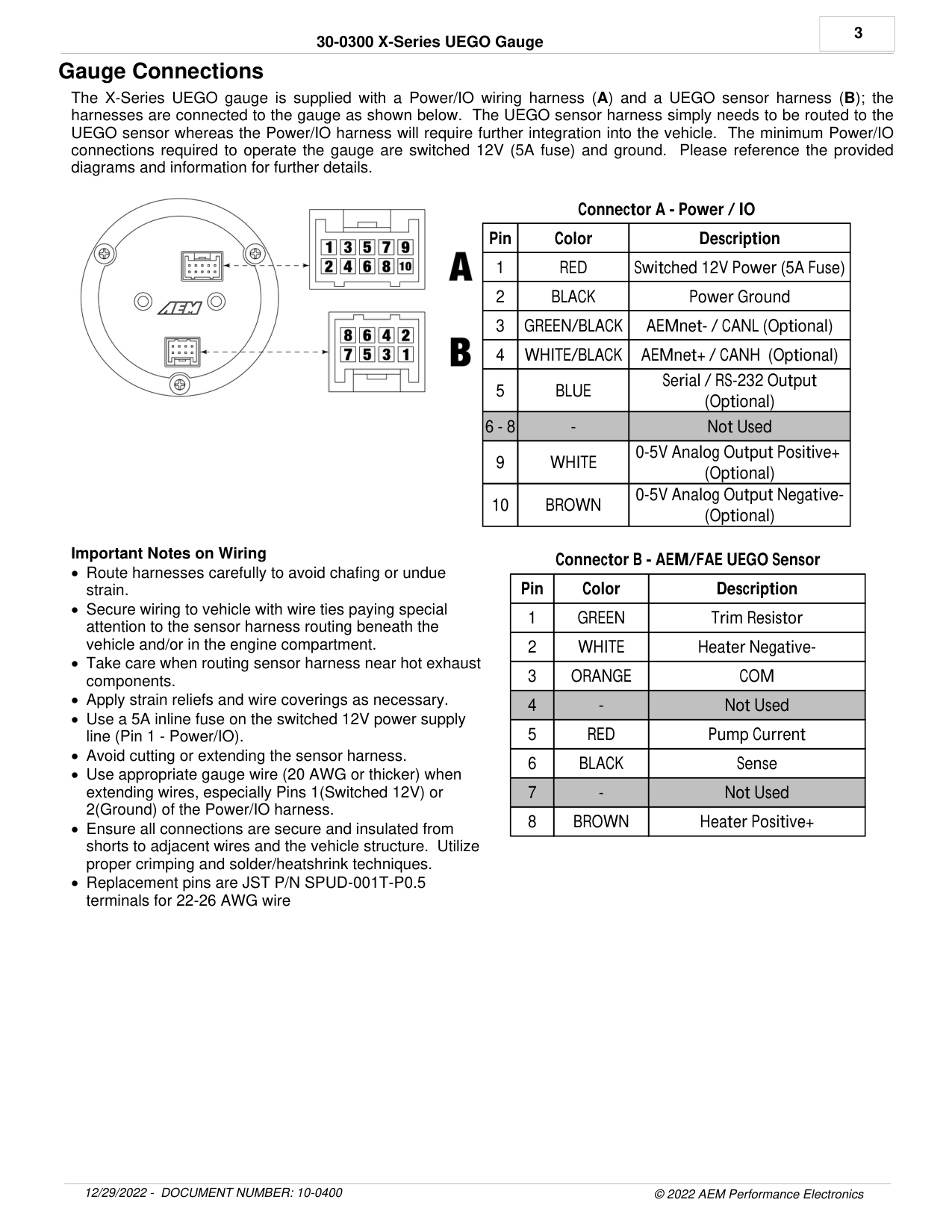
|2|BLACK|Power Ground| |3|GREEN/BLACK|AEMnet- / CANL (Optional)| |4|WHITE/BLACK|AEMnet+ / CANH (Optional)| |5|BLUE|Serial / RS-232 Output (Optional)| |6 - 8|-|Not Used| |9|WHITE|0-5V Analog Output Positive+ (Optional)| |10|BROWN|0-5V Analog Output Negative(Optional)|
Important Notes on Wiring Route harnesses carefully to avoid chafing or undue strain. Secure wiring to vehicle with wire ties paying special attention to the sensor harness routing beneath the vehicle and/or in the engine compartment. Take care when routing sensor harness near hot exhaust components. Apply strain reliefs and wire coverings as necessary. Use a 5A inline fuse on the switched 12V power supply line (Pin 1 - Power/IO). Avoid cutting or extending the sensor harness. Use appropriate gauge wire (20 AWG or thicker) when extending wires, especially Pins 1(Switched 12V) or 2(Ground) of the Power/IO harness. Ensure all connections are secure and insulated from shorts to adjacent wires and the vehicle structure. Utilize proper crimping and solder/heatshrink techniques. Replacement pins are JST P/N SPUD-001T-P0.5 terminals for 22-26 AWG wire
#### Connector B - AEM/FAE UEGO Sensor
|Pin|Color|Description| |---|---|---| |1|GREEN|Trim Resistor| |2|WHITE|Heater Negative-| |3|ORANGE|COM| |4|-|Not Used| |5|RED|Pump Current| |6|BLACK|Sense| |7|-|Not Used| |8|BROWN|Heater Positive+|
Operation
Mode (MODE) and select (SEL) buttons are located on the face of the gauge for configuration; refer to the diagram below for the available options and their function. Note that the faceplate is two-sided and reversible. If the display mode is changed to Lambda, the faceplate may be flipped to display the corresponding Lambda scaling. Please reference the Faceplate/Bezel Installation section in this manual for instruction on this process. The oxygen percentage display mode may be selected but the outer "needle" LEDs will be non-functional and, thus, there is no corresponding faceplate for this mode. The center display will indicate the current sensor reading numerically or four dashes "----" if the current mixture is full lean (> 20:1 AFR).

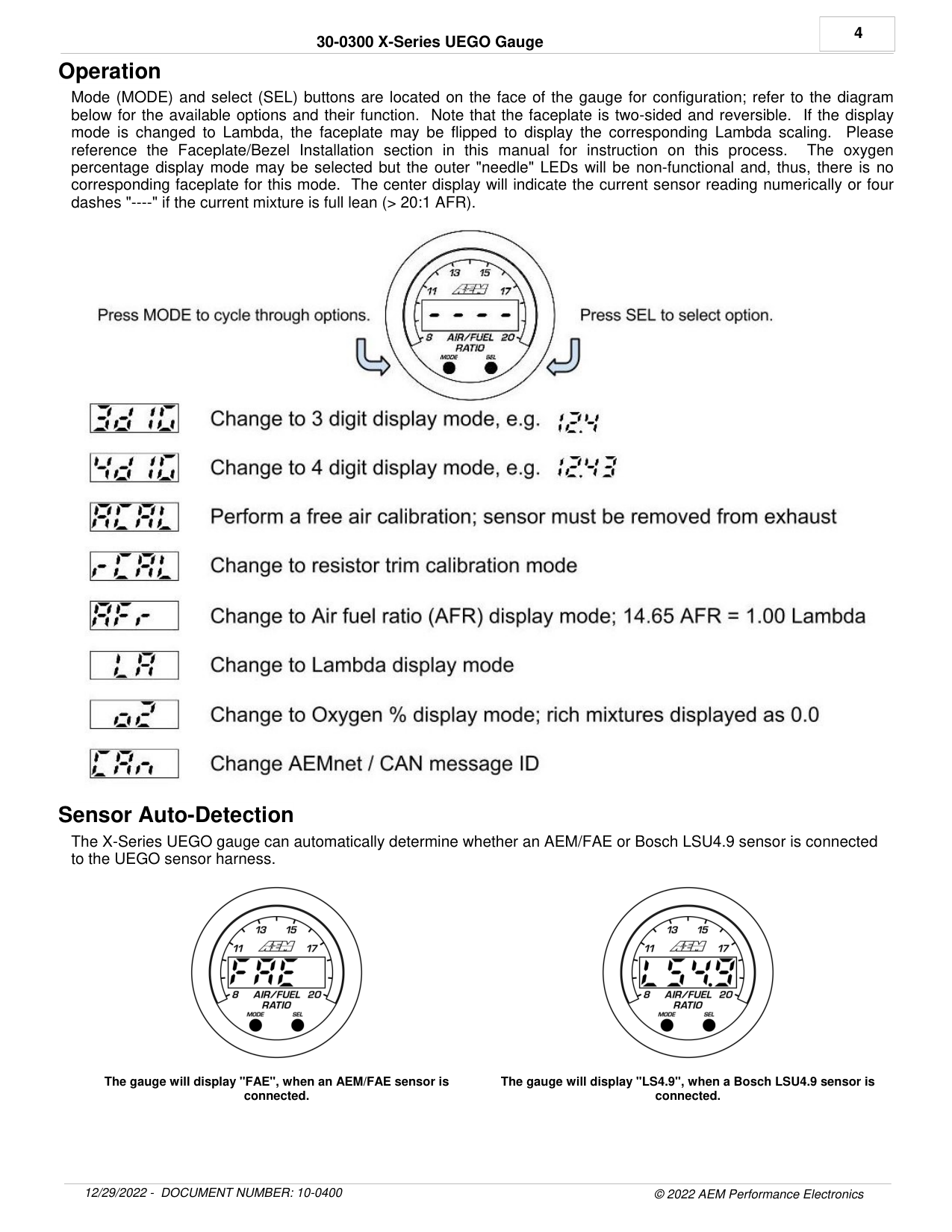
Sensor Auto-Detection
The X-Series UEGO gauge can automatically determine whether an AEM/FAE or Bosch LSU4.9 sensor is connected to the UEGO sensor harness.

The gauge will display "FAE", when an AEM/FAE sensor is connected.

The gauge will display "LS4.9", when a Bosch LSU4.9 sensor is connected.
Calibration Calibration
The supplied UEGO sensor is factory calibrated via a trim resistor, integral to the sensor connector, and requires no further calibration. The ability to perform a free air calibration is provided for users that wish to do so. A free air calibration can be used as a sensor ages, however, new sensors should use the resistor calibration for best accuracy.
Resistor Trim Calibration Mode (rCAL) This is the X-Series UEGO controller's default mode as shipped from the factory. It is the recommended calibration mode and, for most users, no further action or calibration is required.
###### Free Air Calibration Mode (ACAL)
Refer to the Operation section of this manual for instruction on how to navigate to the menu selection ACAL. The sensor MUST be removed from the exhaust for this procedure. The free air calibration process begins once the ACAL menu option selection is confirmed. The calibration will take approximately ten to fifteen seconds during which the sensor must be placed in a "fresh" air environment, i.e. an area without lingering exhaust or chemical fumes. The process will complete and the gauge will report PASS or FAIL on the display. If the gauge reports FAIL then the sensor detected too low a level of oxygen; this is typically indicative of a sensor being left in the exhaust pipe or in an environment with excess exhaust/chemical fumes.
Faceplate / Bezel Installation
The gauge kit is supplied assembled with a black faceplate and black bezel. An accessory kit is available (for purchase through AEM dealers) which includes an optional silver bezel and white faceplate. Please reference the Optional Accessories section earlier in the document for the appropriate part numbers. Contact your dealer or visit www.aemelectronics.com for more information.
The faceplate may be reversible, displaying alternative scalings on either side. Reference the Operation section of this manual for details on how to switch the display mode when reversing the faceplate. Disassembly is required to change the faceplate, flip/reverse the faceplate, or change the bezel of the gauge. The following diagram will provide familiarization with the major components of the gauge prior to beginning the procedure.

|Item|Qty|Description|
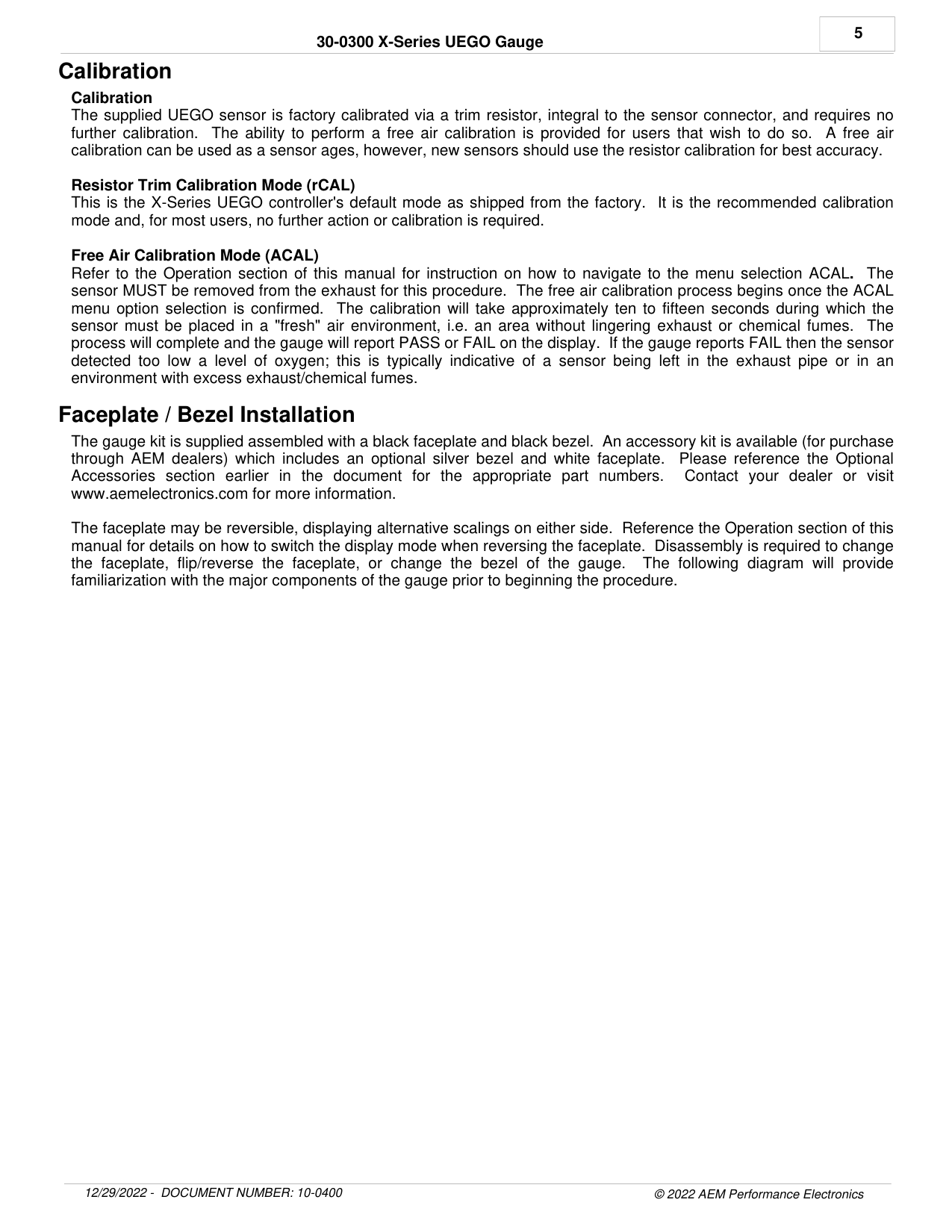
|---|---|---| |1|1|Lens| |2|1|Bezel| |3|1|Faceplate| |4|1|Diffuser| |5|1|Light Guide| |6|2|Button| |7|2|Mounting Stud (M4 x 0.7)| |8|3|Assembly Screw| |9|1|Mounting Bracket| |10|2|Brass Thumb Screw (M4 x 0.7)| |11|1|Printed Circuit Board (PCB)|
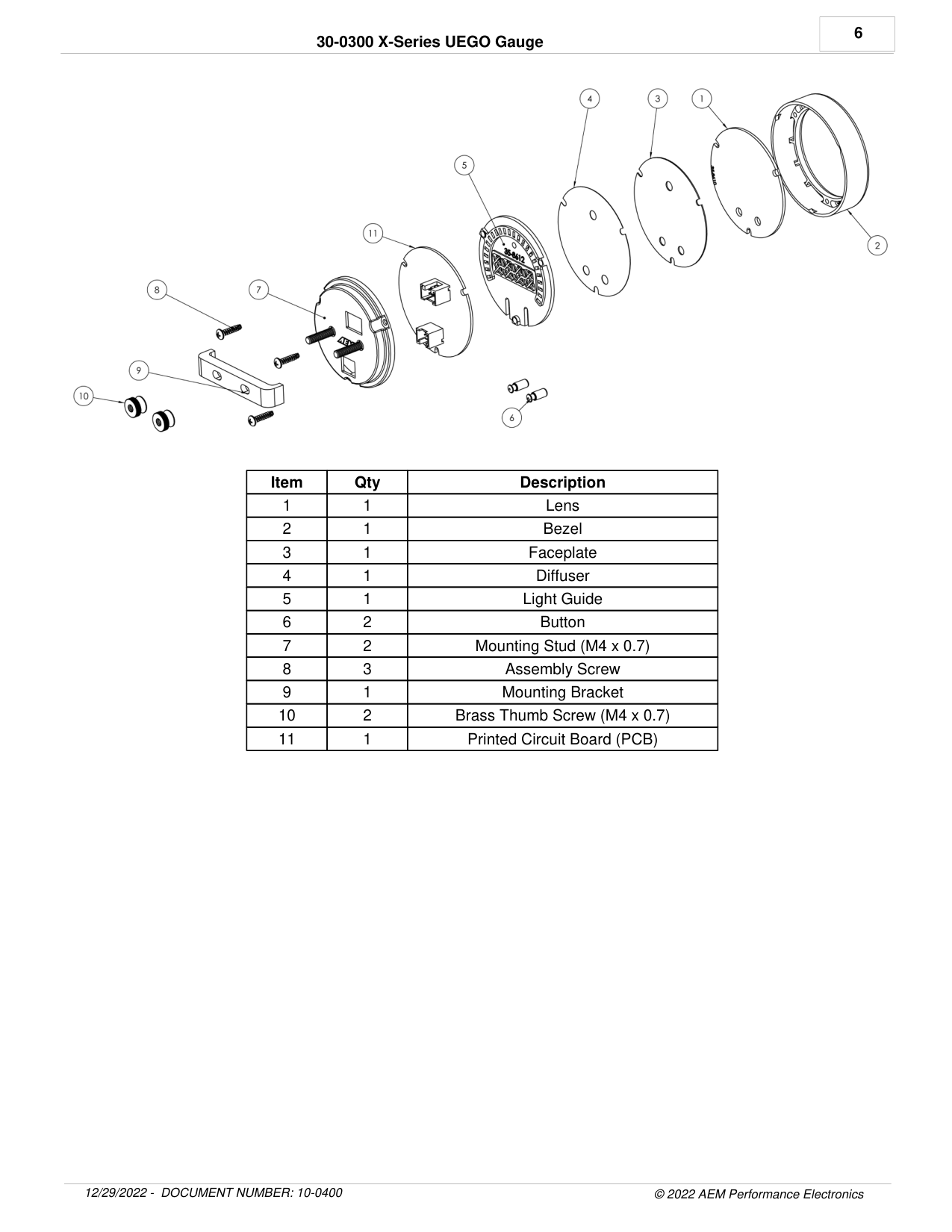
Gauge Disassembly
||| |---|---| |STEP 1 - Remove the three assembly screws (8) using a #1 Phillips head screwdriver. Separate the bezel (2) and cup (7) from the rest of the assembly. If you have purchased the optional accessory kit, the silver bezel may be replaced for the existing bezel at this time|STEP 2 - Separate the PCB (11) from the remaining components| ||| |STEP 3 - Slide the light guide (5) upward to remove it, the buttons may fall out at this time - take care not to lose them|STEP 4 - As you separate the remaining components, diffuser (4), faceplate (3), lens (1), note the order in which they were assembled. The faceplate (3) may now be reversed to display an alternate scaling or replaced for a different color as included in the optional accessory kit|
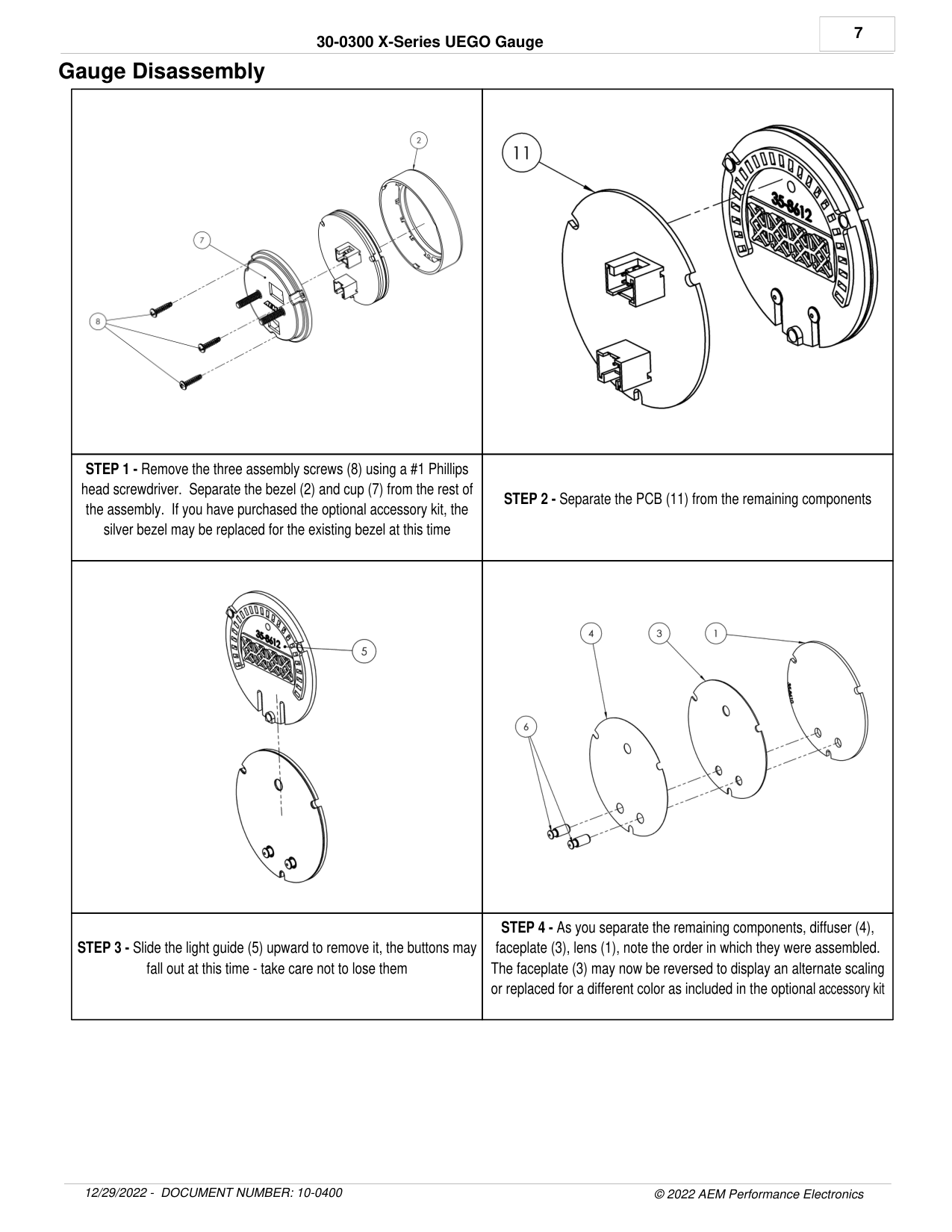
Gauge Assembly
||| |---|---| |STEP 1 - Place the light guide (5) on a flat surface (black side up) and slide the buttons (6) into the slots|STEP 2 - Stack the diffuser (4), faceplate (3), and lens (1) in order, over the buttons, and on to the light guide| ||| |STEP 3 - Reassemble the PCB and display stack with the bezel, making sure screw holes are aligned through the entire assembly|STEP 4 - Reassemble and tighten screws to 2 in-lb (previously assembled bezel) or 3 in-lb (new bezel). Do not over-tighten!|
What is a UEGO Wideband Sensor?
A Universal Exhaust Gas Oxygen (UEGO) oxygen sensor, also known as a wideband or Lambda sensor, measures the proportion of oxygen (O2) in the exhaust of a running engine. An air to fuel ratio (AFR) or Lambda value can be calculated from this measurement. Typically, when calibrating or "tuning" the fuel delivery system of an engine, a specific AFR can be targeted to achieve maximum power, economy, or emissions. The output from a UEGO sensor controller can be used to adjust a carburetor or fuel injection system to reach this target.
UEGO sensors are one of the more sophisticated sensors found in today's vehicles. The sensing element is made of a zirconium dioxide ceramic with a thin platinum coating and has an integrated heating element. An electronic controller, such as is contained in AEM's X-Series UEGO Gauge or Inline Controller, is required to use a UEGO oxygen sensor. The controller connects to the sensor via multiple wires (up to 6) carrying sensitive voltages and electrical currents to process and calculate an AFR value. This value may be read directly from a gauge face or data-log as recorded by an ECU or logger via several methods as discussed elsewhere in this manual.
AEM/FAE Sensor
The 30-0300 X-Series UEGO gauge is supplied with an AEM/FAE sensor (P/N 30-2404). AEM has spent years collaborating with FAE to develop a motorsport-focused oxygen sensor for maximum performance, specifically designed to minimize response times and improve durability and resistance to race fuels. The AEM/FAE sensor provides industry-leading quick response times, which means improved wideband feedback control. This ultimately leads to a safer, more powerful and accurate tune. The mechanical durability and performance have also been improved, and the sensor structure has been reinforced to better protect against lead contamination. The AEM/FAE sensors have undergone innumerable hours of rigorous internal and field testing on high-abuse test engines running a variety of fuels, including race fuel. The result is a fast responding sensor that can also handle the most extreme motorsport environments.
Interpreting Wideband Sensor Readings
An internal combustion engine runs on air (which contains ~20% oxygen) and fuel. The ratio of air to fuel (AFR) that, when combusted, perfectly consumes 100% of both the oxygen and fuel is called the stoichiometric ratio. This ratio is different for every fuel. Ratios lower than stoichiometric have more fuel and are considered "rich"; ratios higher than stoichiometric have less fuel and are considered "lean."
|Fuel|Stoichiometric AFR|Lambda| |---|---|---| |Unleaded Gasoline|14.65 : 1|1.00| |Methanol|6.47 : 1|1.00| |Ethanol|9.00 : 1|1.00| |Propane|15.67 : 1|1.00| |CNG|17.20 : 1|1.00|
Lambda is a unitless ratio that is fuel agnostic. In other words, a Lambda reading of 1.0 is stochiometric for any fuel; AFR = ( Stoichiometric AFR * Lambda.)
In general, an engine will have three areas of operation: idle/cruise, wide open throttle, and fuel cut off. The exact AFR value that should be expected (or tuned to) for these areas is very specific to the type and configuration of each individual engine. However, while monitoring your AEM X-Series controller, you should see readings similar to the chart below. Fuel cutoff is generally experienced when completely lifting off the throttle, while decelerating in gear, at high RPM.
|Operating Region|WOT|IDLE/CRUISE|FUEL CUTOFF| |---|---|---|---| |Approximate AFR|10.5 (RICH)|14.7 (STOICH)|20.0 (LEAN)|
IMPORTANT NOTE: Engine tuning should only be performed by experienced individuals as engine damage, or outright failure, can be the result of an improper calibration.
Sensor Placement
The location at which the sensor is installed in the vehicle's exhaust system is critical to its performance and longevity. Please review the following placement guidelines:
Sensor Bung
The supplied mild steel sensor bung must be welded into the vehicle's exhaust. An optional stainless steel sensor bung is available for purchase from AEM dealers and may be useful in specific installation scenarios. The taller geometry of this bung helps bring the sensing element further out of the exhaust stream when used in small diameter tubing such as header primaries. In addition, the finned body helps dissipate heat when used in extreme applications. As an alternative to welding, users may purchase a P/N 30-2355-XXX No Weld UEGO Clamp Kit.


P/N 35-4001 Mild Steel Sensor Bung P/N 30-4008 Stainless Steel Tall Sensor Bung w/ Fins

P/N 30-2355-XXX No Weld UEGO Clamp Kit
The bung should be welded in such a way that the installed sensor orientation is greater than ten degrees from horizontal to allow any condensation to properly drain from the sensor. In addition, it is recommended to avoid a completely vertical sensor orientation to prevent overheating the sensor. Failure to heed these recommendations may result in premature sensor failure.

Important Notes on Wideband Sensors
The sensor contains an integrated heating element and will become hot enough to produce burns, when powered, even without the presence of exhaust gas. Sensors can remain hot enough to burn or start a fire for quite some time after removing power -- handle with caution.
UEGO sensors are very sensitive devices that must handled and installed with care. Listed below are several contaminants and conditions which will shorten the life of the sensor or result in outright failure.
The following may damage or destroy oxygen sensors:
Gauge Installation


Installation using supplied bracket Installation without bracket, using rubber band
A 2-1/6" (52mm) hole is required to mount the X-Series gauge. A bracket and thumbscrews are provided to facilitate installation into a panel or gauge pod. In some cases, the gauge cup may be pushed into a mounting hole causing an interference fit strong enough to retain the gauge; the supplied rubber band may be fit to the gauge to create a tighter fit in mounting holes slightly larger than 52mm. It is, however, recommended that gauges be mounted securely using the supplied bracket to ensure they never become loose and cause a hazard during vehicle operation.
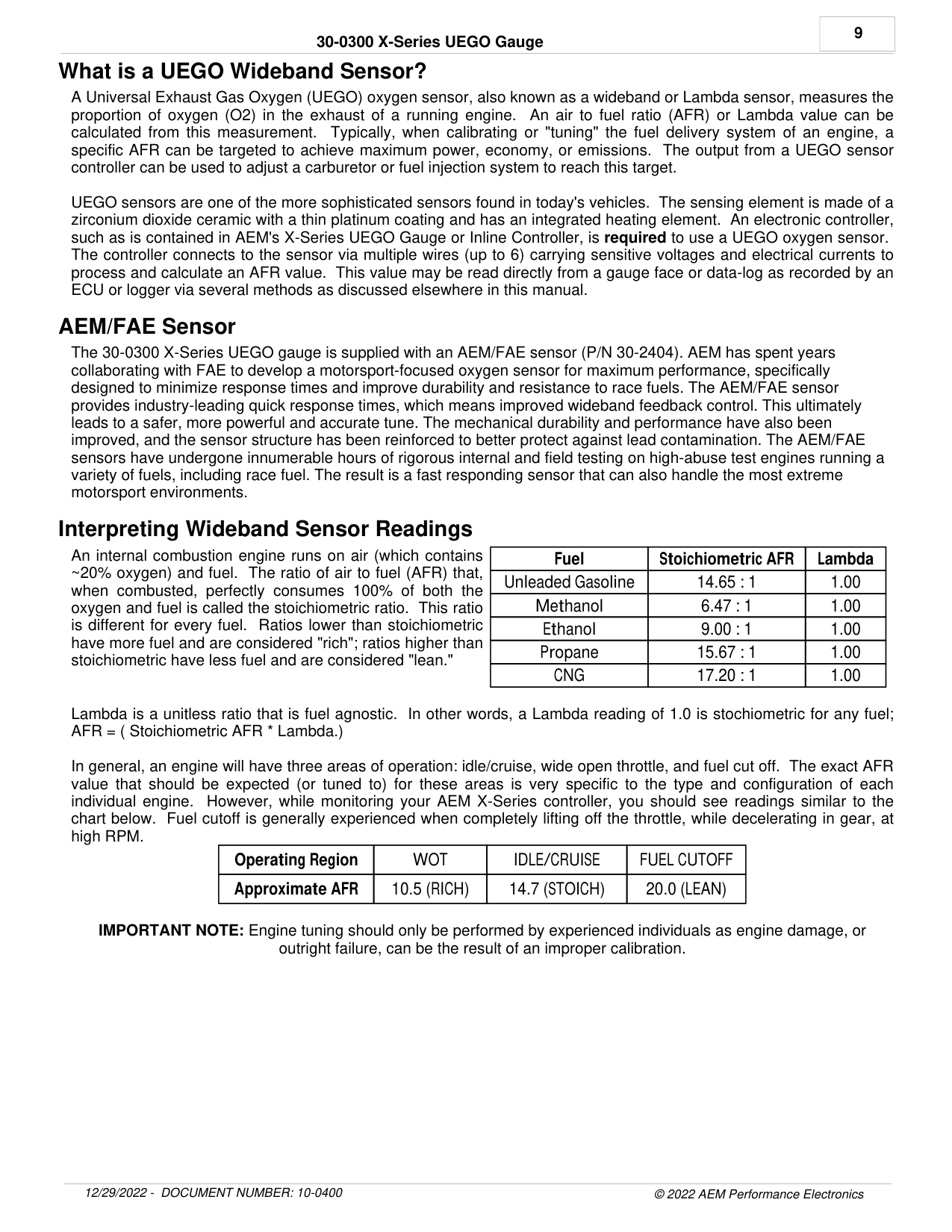
Note: The gauge is not water-proof and should not be installed in a location with exposure to water or snow. Damage caused by water ingress will not be covered under warranty.
0-5V Analog Output
##### WHITE WIRE = Analog Positive + BROWN WIRE = Analog Negative -
|0-5V Analog Output Scaling Formulas|0-5V Analog Output Scaling Formulas|0-5V Analog Output Scaling Formulas| |---|---|---| |AFR|=|(2.3750 * Volts) + 7.3125| |Lambda|=|(0.1621 * Volts) + 0.4990|
The 0-5V analog output is suitable for output to devices such as loggers or ECUs. This differential output requires special care to ensure proper operation. The WHITE signal wire should be connected to the positive of the analog input of the logging device or ECU; the BROWN wire must be connected to the negative of the analog input of the logging device or ECU. If the logging device or ECU does not have a differential analog input (both a dedicated positive and negative terminal for the analog input) then connect the BROWN wire to the shared signal ground. If the device does not have a dedicated signal ground then as a last course of action, connect it to the power ground of the logging device.
Important Note: If bench testing the analog output outside of a vehicle, a multimeter's positive lead may be connected to the WHITE wire however the BROWN wire must be connected to BOTH the multimeter's negative lead AND power ground going to the X-Series UEGO device. This connection is usually made by the circuitry inside an ECU or data logger.
|0-5V Analog Output Scaling Table|0-5V Analog Output Scaling Table|0-5V Analog Output Scaling Table| |---|---|---| |Volts|Lambda|AFR (Gasoline)| |<0.50|SENSOR NOT READY|SENSOR NOT READY| |0.50|0.58|8.50| |0.75|0.62|9.09| |1.00|0.66|9.69| |1.25|0.70|10.28| |1.50|0.74|10.88| |1.75|0.78|11.47| |2.00|0.82|12.06| |2.25|0.86|12.66| |2.50|0.90|13.25| |2.75|0.94|13.84| |3.00|0.99|14.44|
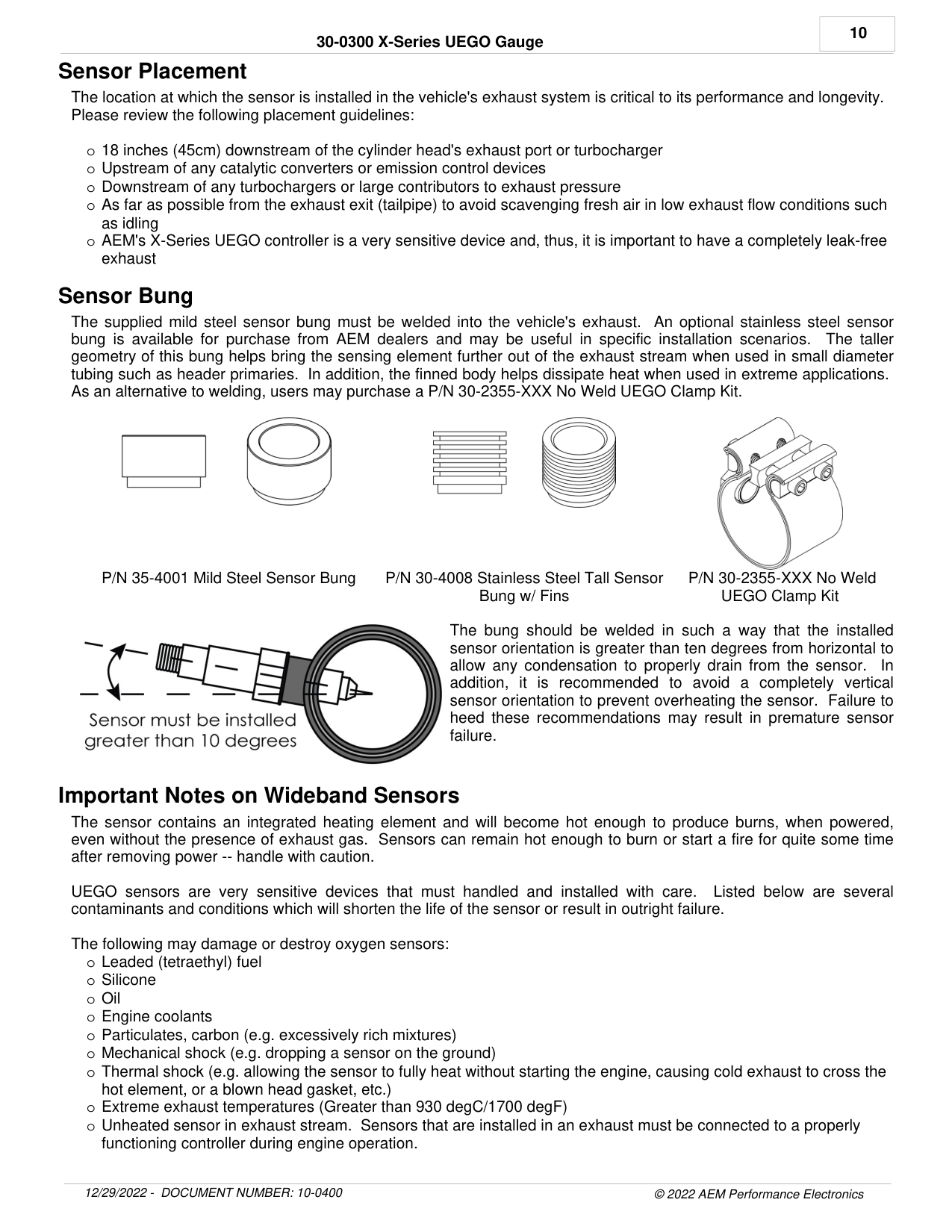
|3.25|1.03|15.03| |3.50|1.07|15.63| |3.75|1.11|16.22| |4.00|1.15|16.81| |4.25|1.19|17.41| |4.50|1.23|18.00| |>4.50|SENSOR ERROR|SENSOR ERROR|
AEMnet (CAN Bus) Output
WHITE WIRE WITH BLACK STRIPE = AEMnet+ / CANH GREEN WIRE WITH BLACK STRIPE = AEMnet- / CANL
The AEMnet output is suitable for output to AEM devices such as the AQ-1 data logger or Infinity ECU. The following CAN configuration and message definition information is provided below to facilitate interface with third-party devices.
Message ID If multiple gauges are connected to the same CAN bus then they must each be configured to have unique message IDs using the gauge's menu system. Depress the MODE button to navigate to the CAN submenu, press the SEL button until the desired ID is displayed then wait 3 seconds to accept setting; dOnE will appear to confirm your selection. The options "ID 1", "ID 2", ..., "ID 16" correspond to the 29-bit identifiers 0x0000180, 0x0000181, 0x0000182, ..., 0x000018F.
Bus Termination All AEMnet/CAN networks must be terminated to have an equivalent of approximately 60 Ohms of resistance. Generally, this means a 120 Ohm resistor connected in parallel to AEMnet+/AEMnet- (or CANH/CANL) at both physical ends of the bus run. The X-Series controller does not have any internal termination and is intended to be connected to a pre-existing, properly terminated network. Please refer to the Bosch CAN2.0B specification for further detail.
|bit rate|500|kb/sec| |---|---|---| |format|29|bit ID| |transmit rate|100|hz| |terminating resistor|none| | |endianness|big / Motorola|big / Motorola| |Message/Arbitration ID|0x00000180 to 0x0000018F|0x00000180 to 0x0000018F| |DLC|8| |
|Byte|Bit|Bitmask|Label|Data Type| |---|---|---|---|---|
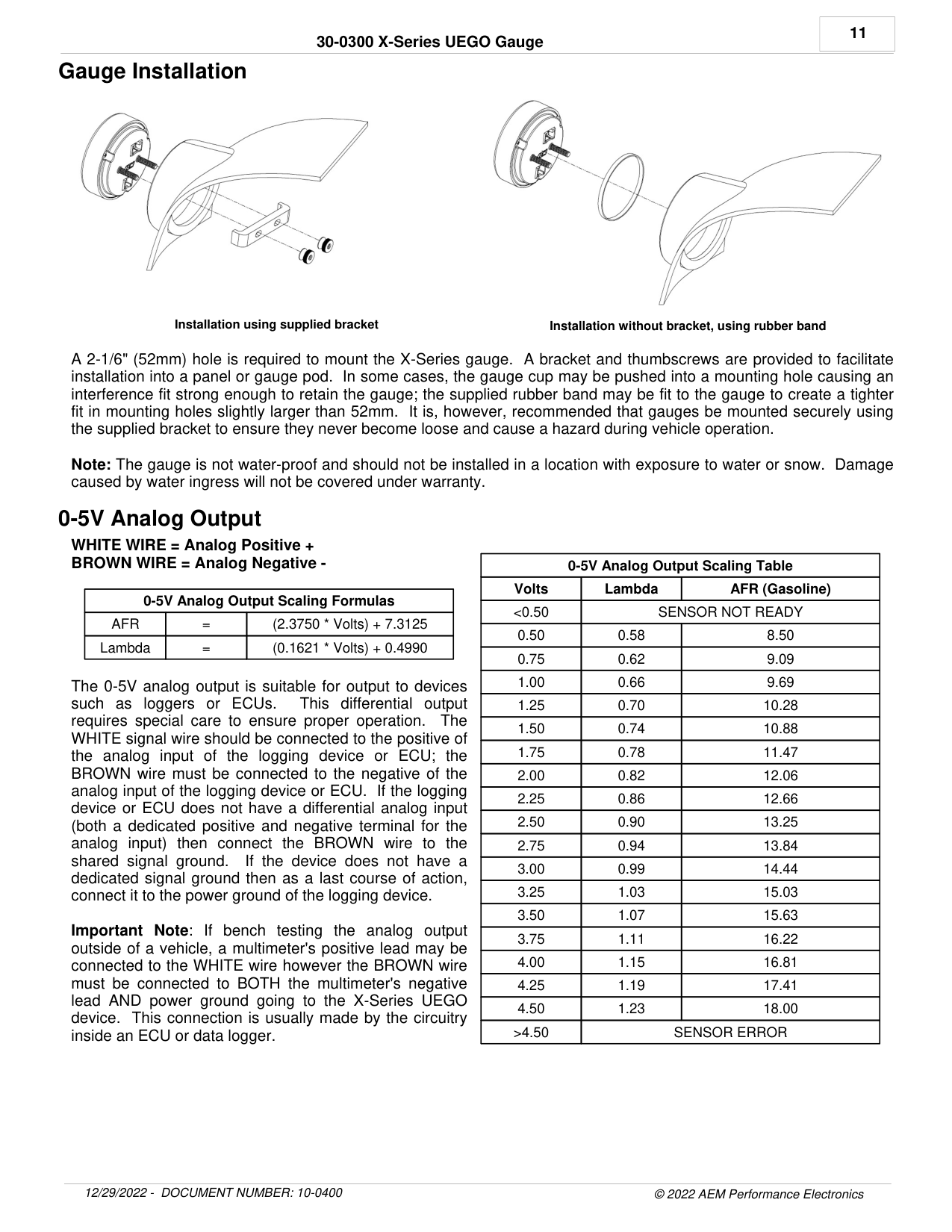
|0-1| | |Lambda|16 bit unsigned| |2-3| | |Oxygen|16 bit signed| |4| | |System Volts|8 bit unsigned| |5| | |Reserved|---| |6
|0 (lsb)|0|Reserved|---| |6
|1|2|AEM/FAE Detected|Boolean| |6
|2 - 4|4|Reserved|---| |6
|5|32|Free-Air cal in use|Boolean| |6
|6|64|Reserved|---| |6
|7 (msb)|128|Lambda Data Valid|Boolean| |7
|0 - 5|0|Reserved|---| |7
|6|64|Sensor Fault|Boolean| |7
|7 (msb)|128|Reserved|---|
|Scaling|Offset|Range| |---|---|---| |.0001 Lambda/bit|0|0 to 6.5535 Lambda| |0.001%/bit|0|-32.768% to 32.767%| |0.1 V/bit|0|0 to 25.5 Volts| |---|---|---| |---|---|---| |0 = false, 1 = true|0|0/1| |---|---|---| |0 = false, 1 = true|0|0/1| |---|---|---| |0 = false, 1 = true|0|0/1| |---|---|---| |0 = false, 1 = true|0|0/1| |---|---|---|
Serial (RS-232) Output
###### BLUE WIRE = Serial Out
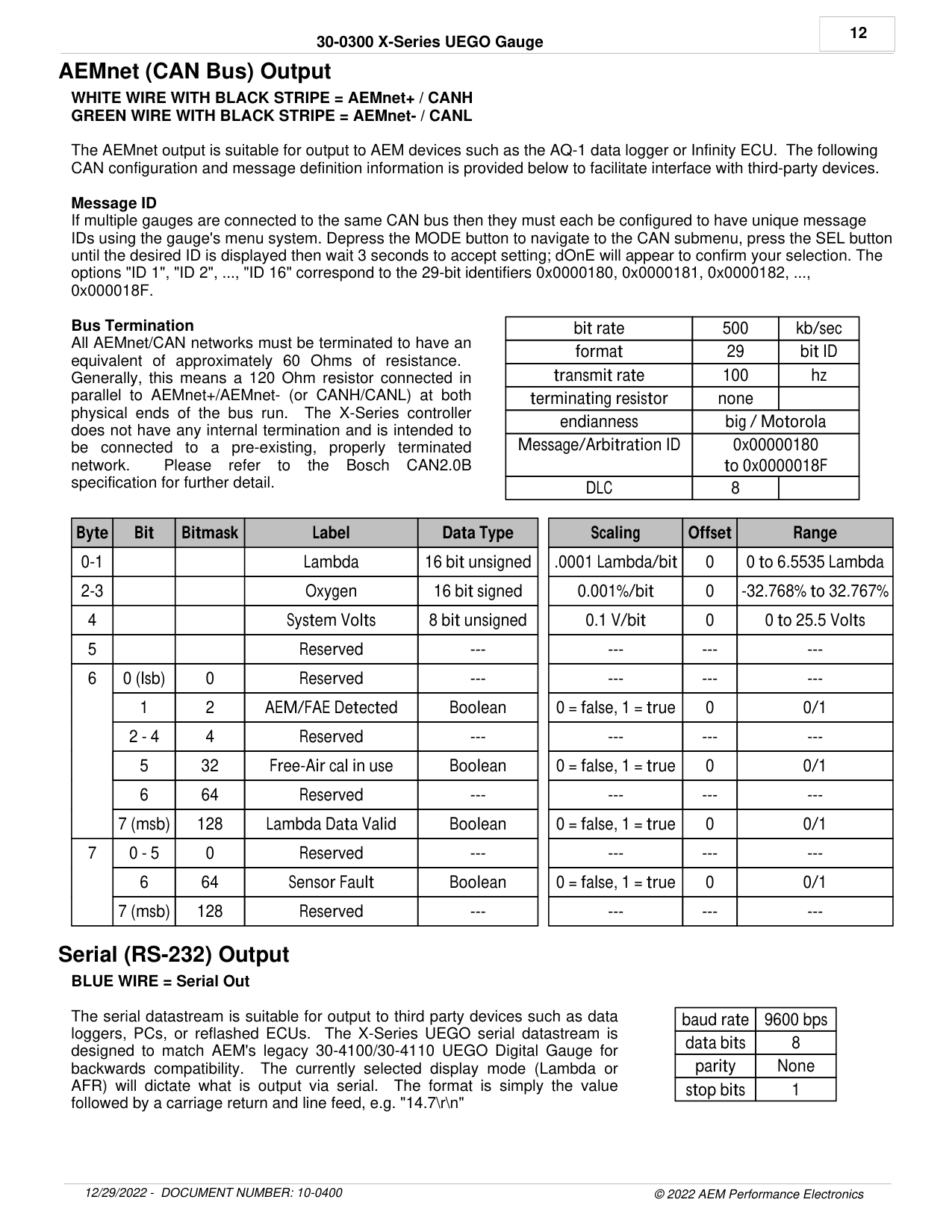
The serial datastream is suitable for output to third party devices such as data loggers, PCs, or reflashed ECUs. The X-Series UEGO serial datastream is designed to match AEM's legacy 30-4100/30-4110 UEGO Digital Gauge for backwards compatibility. The currently selected display mode (Lambda or AFR) will dictate what is output via serial. The format is simply the value followed by a carriage return and line feed, e.g. "14.7\r\n"
|baud rate|9600 bps| |---|---| |data bits|8| |parity|None| |stop bits|1|
FAQ / Troubleshooting
###### What are the minimum wiring connections needed to use the gauge?
Switched/fused 12V (RED) and power ground (BLACK) must be supplied to the 10 pin connector. Any unused wires may be secured and fastened away for future use. The 8 pin sensor harness must also be connected between the gauge and sensor.
###### When should I use free air calibration mode?
The sensor that is supplied is laboratory calibrated using the integral trim resistor; this is the preferred and recommended calibration mode. If you feel your sensor has been extremely contaminated or damaged and requires re-calibration then it is suggested that you purchase a new sensor. Alternatively, performing a free air calibration may be helpful.
###### The gauge displays "SEnS", what does this mean?
The gauge is not detecting the O2 sensor. Ensure the 8 pin sensor harness is plugged in and LS4.9 sensor is plugged in. If the sensor is not heating up then the gauge may be damaged and you should contact AEM Technical Support for further instructions.
###### The gauge displays "bAtt" when I key-on or crank the engine.
The gauge requires a minimum supply voltage to properly drive the UEGO sensor heater and will display "bAtt" if a low voltage condition is detected. Please ensure the vehicle's battery is in good condition, e.g. >12V engine off, >13.8V engine running.
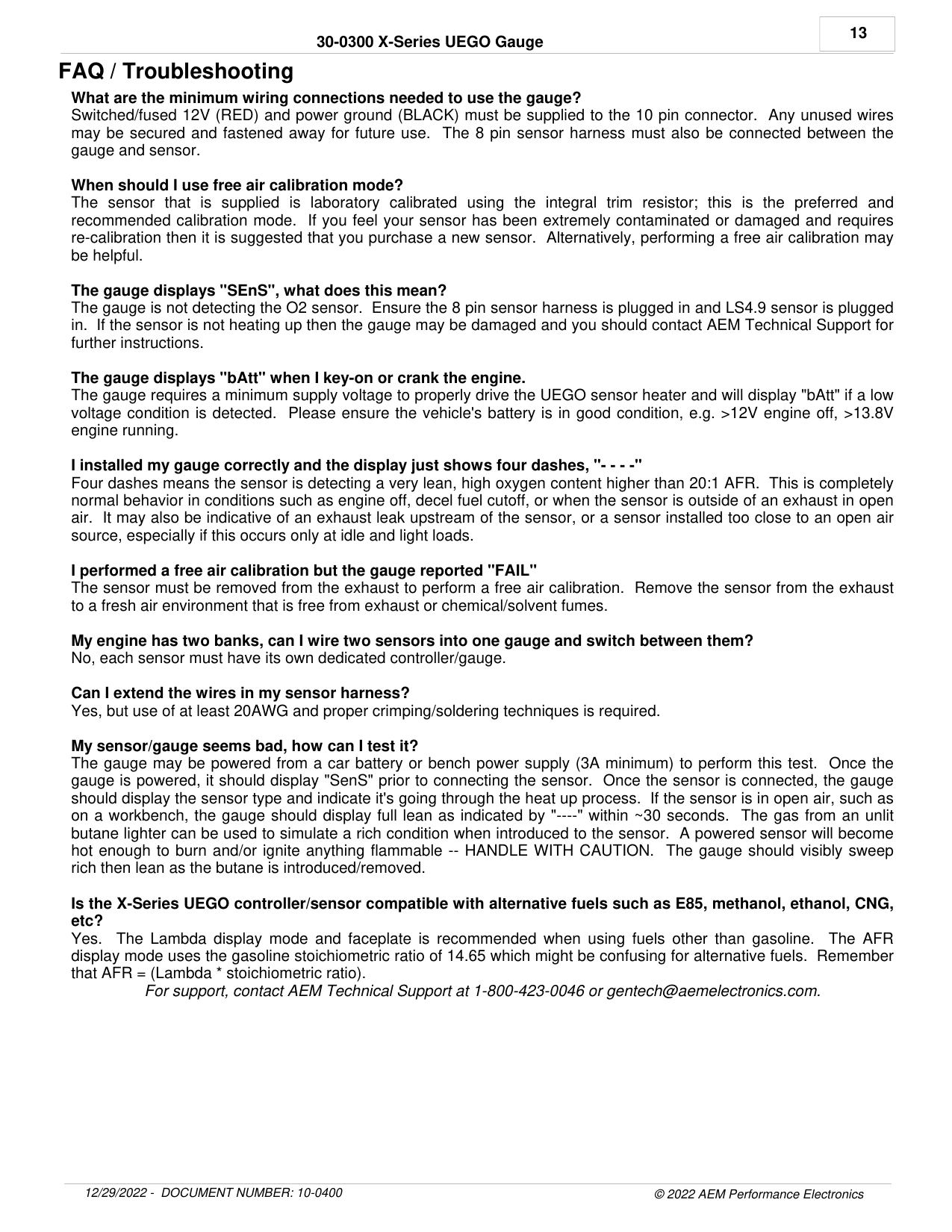
###### I installed my gauge correctly and the display just shows four dashes, "- - - -"
Four dashes means the sensor is detecting a very lean, high oxygen content higher than 20:1 AFR. This is completely normal behavior in conditions such as engine off, decel fuel cutoff, or when the sensor is outside of an exhaust in open air. It may also be indicative of an exhaust leak upstream of the sensor, or a sensor installed too close to an open air source, especially if this occurs only at idle and light loads.
I performed a free air calibration but the gauge reported "FAIL" The sensor must be removed from the exhaust to perform a free air calibration. Remove the sensor from the exhaust to a fresh air environment that is free from exhaust or chemical/solvent fumes.
My engine has two banks, can I wire two sensors into one gauge and switch between them? No, each sensor must have its own dedicated controller/gauge.
Can I extend the wires in my sensor harness? Yes, but use of at least 20AWG and proper crimping/soldering techniques is required.
###### My sensor/gauge seems bad, how can I test it?
The gauge may be powered from a car battery or bench power supply (3A minimum) to perform this test. Once the gauge is powered, it should display "SenS" prior to connecting the sensor. Once the sensor is connected, the gauge should display the sensor type and indicate it's going through the heat up process. If the sensor is in open air, such as on a workbench, the gauge should display full lean as indicated by "----" within ~30 seconds. The gas from an unlit butane lighter can be used to simulate a rich condition when introduced to the sensor. A powered sensor will become hot enough to burn and/or ignite anything flammable -- HANDLE WITH CAUTION. The gauge should visibly sweep rich then lean as the butane is introduced/removed.
Is the X-Series UEGO controller/sensor compatible with alternative fuels such as E85, methanol, ethanol, CNG, etc?
Yes. The Lambda display mode and faceplate is recommended when using fuels other than gasoline. The AFR display mode uses the gasoline stoichiometric ratio of 14.65 which might be confusing for alternative fuels. Remember that AFR = (Lambda * stoichiometric ratio).
For support, contact AEM Technical Support at 1-800-423-0046 or gentech@aemelectronics.com.
12 Month Limited Warranty
AEM Performance Electronics warrants to the consumer that all AEM products will be free from defects in material and workmanship for a period of twelve (12) months from date of the original purchase. Products that fail within this 12-month warranty period will be repaired or replaced at AEM’s option, when determined by AEM that the product failed due to defects in material or workmanship. This warranty is limited to the repair or replacement of the AEM part. In no event shall this warranty exceed the original purchase price of the AEM part nor shall AEM be responsible for special, incidental or consequential damages or cost incurred due to the failure of this product. Warranty claims to AEM must be transportation prepaid and accompanied with dated proof of purchase. This warranty applies only to the original purchaser of product and is non-transferable. All implied warranties shall be limited in duration to the said 12-month warranty period. Improper use or installation, accident, abuse, unauthorized repairs or alterations voids this warranty. AEM disclaims any liability for consequential damages due to breach of any written or implied warranty on all products manufactured by AEM. Warranty returns will only be accepted by AEM when accompanied by a valid Return Merchandise Authorization (RMA) number. Product must be received by AEM within 30 days of the date the RMA is issued.
####### Note: The AEM/FAE UEGO oxygen sensor included in this kit carries a 24 month extended warranty.
Please note that before AEM can issue an RMA for any electronic product, it is first necessary for the installer or end user to contact the EMS tech line at 1-800-423-0046 to discuss the problem. Most issues can be resolved over the phone. Under no circumstances should a system be returned or a RMA requested before the above process transpires.
AEM will not be responsible for products that are installed incorrectly, installed in a non-approved application, misused, or tampered with.
Any AEM product can be returned for repair if it is out of the warranty period. There is a minimum charge of $50.00 for inspection and diagnosis of AEM electronic parts. Parts used in the repair of AEM components will be extra. AEM will provide an estimate of repairs and receive written or electronic authorization before repairs are made to the product.
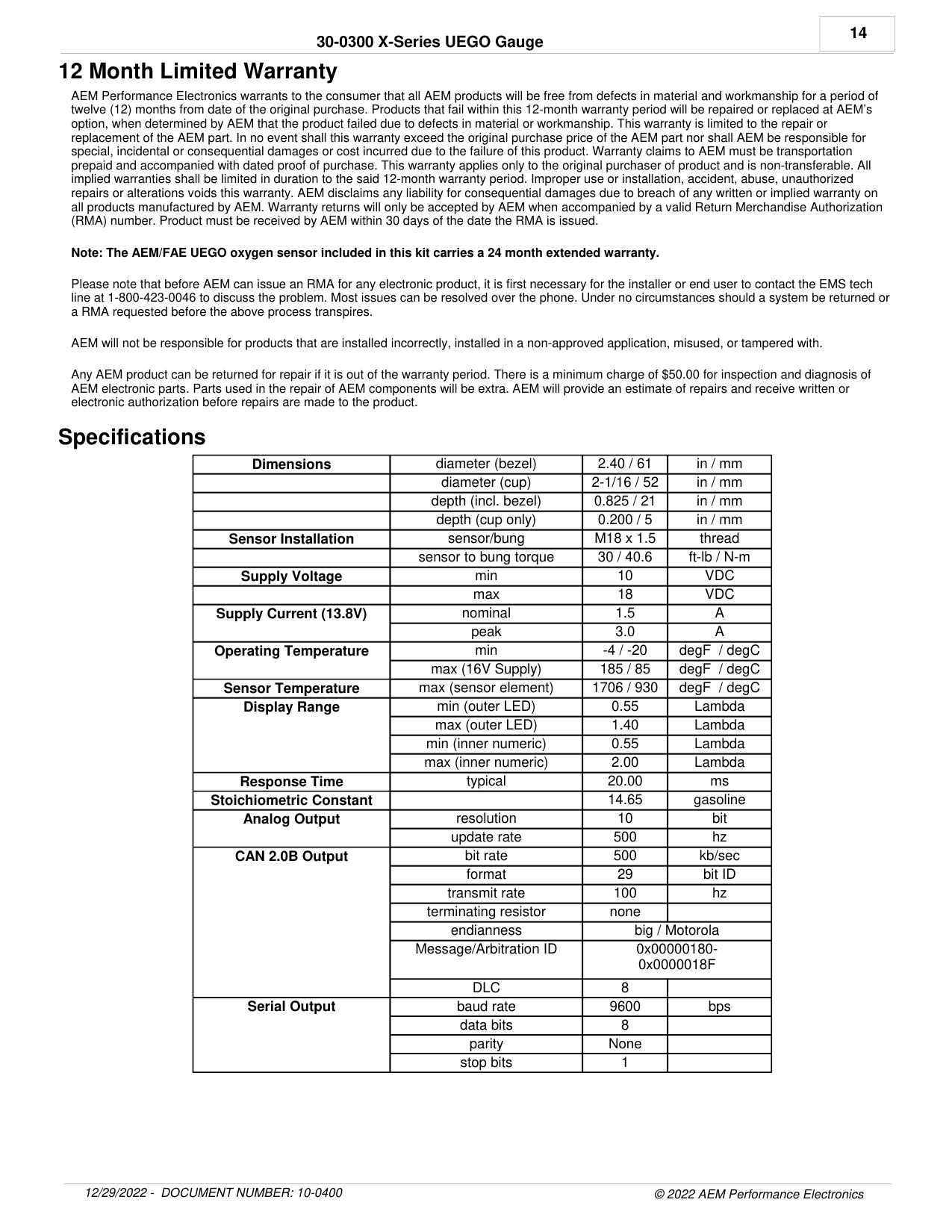
Specifications
|Dimensions|diameter (bezel)|2.40 / 61|in / mm| |---|---|---|---| | |diameter (cup)|2-1/16 / 52|in / mm| | |depth (incl. bezel)|0.825 / 21|in / mm| | |depth (cup only)|0.200 / 5|in / mm| |Sensor Installation|sensor/bung|M18 x 1.5|thread| | |sensor to bung torque|30 / 40.6|ft-lb / N-m| |Supply Voltage|min|10|VDC| | |max|18|VDC| |Supply Current (13.8V)
|nominal|1.5|A| |Supply Current (13.8V)
|peak|3.0|A| |Operating Temperature
|min|-4 / -20|degF / degC| |Operating Temperature
|max (16V Supply)|185 / 85|degF / degC| |Sensor Temperature|max (sensor element)|1706 / 930|degF / degC| |Display Range
|min (outer LED)|0.55|Lambda| |Display Range
|max (outer LED)|1.40|Lambda| |Display Range
|min (inner numeric)|0.55|Lambda| |Display Range
|max (inner numeric)|2.00|Lambda| |Response Time|typical|20.00|ms| |Stoichiometric Constant| |14.65|gasoline| |Analog Output
|resolution|10|bit| |Analog Output
|update rate|500|hz| |CAN 2.0B Output
|bit rate|500|kb/sec| |CAN 2.0B Output
|format|29|bit ID| |CAN 2.0B Output
|transmit rate|100|hz| |CAN 2.0B Output
|terminating resistor|none| | |CAN 2.0B Output
|endianness|big / Motorola|big / Motorola| |CAN 2.0B Output
|Message/Arbitration ID|0x000001800x0000018F|0x000001800x0000018F| |CAN 2.0B Output
|DLC|8| | |Serial Output
|baud rate|9600|bps| |Serial Output
|data bits|8| | |Serial Output
|parity|None| | |Serial Output
|stop bits|1| |