Apec Water Roes 50 manual
Unknown · 7 Q&As

Apec Water Roes 50

Ask AI

— answers from the official manual

Answers from the official manual.

Common questions

Common Questions

7 total
Show 1 more questions

Full Manual

44 pages
Page 1

![image 1](a4f3ae3e-8524-461e-a687-2b89d1e1aa05_images/imageFile1.png)

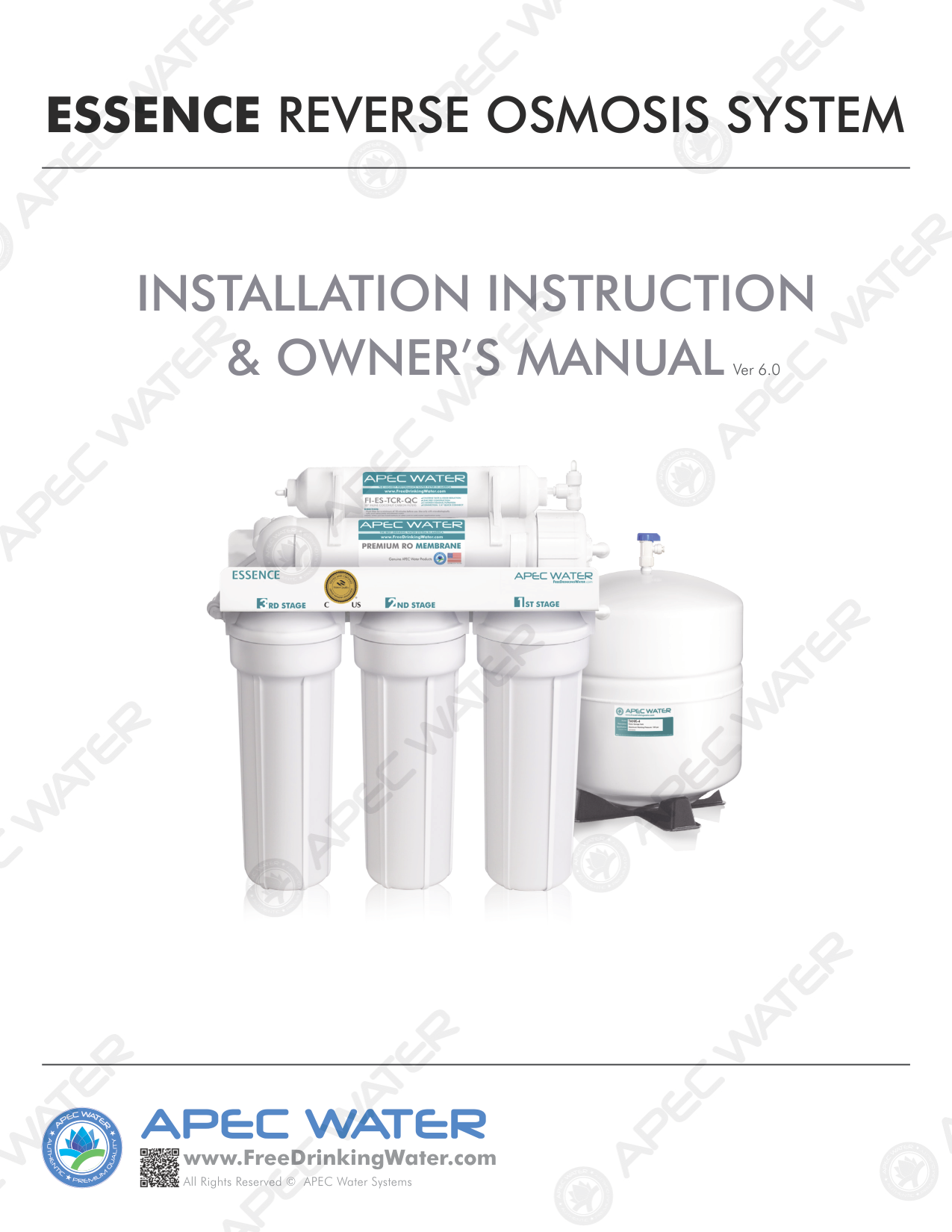
ESSENCE REVERSE OSMOSIS SYSTEM

INSTALLATION INSTRUCTION & OWNER’S MANUAL Ver 6.0

![image 2](a4f3ae3e-8524-461e-a687-2b89d1e1aa05_images/imageFile2.png)

![image 3](a4f3ae3e-8524-461e-a687-2b89d1e1aa05_images/imageFile3.png)

![image 4](a4f3ae3e-8524-461e-a687-2b89d1e1aa05_images/imageFile4.png)

![image 5](a4f3ae3e-8524-461e-a687-2b89d1e1aa05_images/imageFile5.png)

![image 6](a4f3ae3e-8524-461e-a687-2b89d1e1aa05_images/imageFile6.png)

![image 7](a4f3ae3e-8524-461e-a687-2b89d1e1aa05_images/imageFile7.png)

![image 8](a4f3ae3e-8524-461e-a687-2b89d1e1aa05_images/imageFile8.png)

![image 9](a4f3ae3e-8524-461e-a687-2b89d1e1aa05_images/imageFile9.png)

![image 10](a4f3ae3e-8524-461e-a687-2b89d1e1aa05_images/imageFile10.png)

![image 11](a4f3ae3e-8524-461e-a687-2b89d1e1aa05_images/imageFile11.png)

########## www.FreeDrinkingWater.com

![image 12](a4f3ae3e-8524-461e-a687-2b89d1e1aa05_images/imageFile12.png)

![image 13](a4f3ae3e-8524-461e-a687-2b89d1e1aa05_images/imageFile13.png)

![image 14](a4f3ae3e-8524-461e-a687-2b89d1e1aa05_images/imageFile14.png)

Page 2

![image 15](a4f3ae3e-8524-461e-a687-2b89d1e1aa05_images/imageFile15.png)

![image 16](a4f3ae3e-8524-461e-a687-2b89d1e1aa05_images/imageFile16.png)

![image 17](a4f3ae3e-8524-461e-a687-2b89d1e1aa05_images/imageFile17.png)

![image 18](a4f3ae3e-8524-461e-a687-2b89d1e1aa05_images/imageFile18.png)

![image 19](a4f3ae3e-8524-461e-a687-2b89d1e1aa05_images/imageFile19.png)

All Rights Reserved © APEC Water Systems

![image 20](a4f3ae3e-8524-461e-a687-2b89d1e1aa05_images/imageFile20.png)

![image 21](a4f3ae3e-8524-461e-a687-2b89d1e1aa05_images/imageFile21.png)

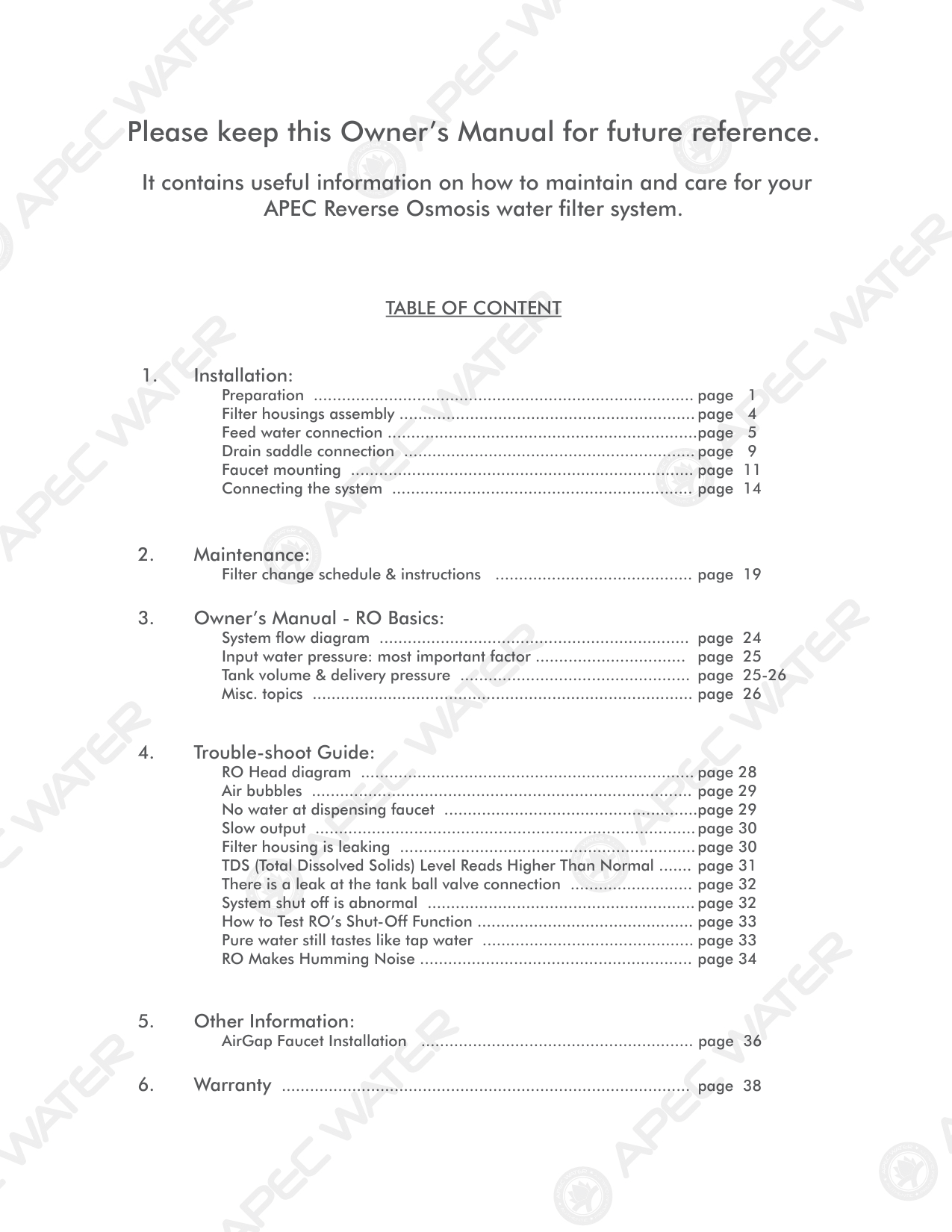
#### Please keep this Owner’s Manual for future reference.

######### It contains useful information on how to maintain and care for your APEC Reverse Osmosis water filter system.

############ TABLE OF CONTENT

  • 1. Installation: Preparation ................................................................................. page 1 Filter housings assembly ...............................................................page 4 Feed water connection ..................................................................page 5 Drain saddle connection ..............................................................page 9 Faucet mounting ......................................................................... page 11 Connecting the system ................................................................ page 14
  • 2. Maintenance: Filter change schedule & instructions .......................................... page 19
  • 3. Owner’s Manual - RO Basics: System flow diagram .................................................................. page 24 Input water pressure: most important factor ................................ page 25 Tank volume & delivery pressure ................................................. page 25-26 Misc. topics ................................................................................. page 26
  • 4. Trouble-shoot Guide: RO Head diagram ....................................................................... page 28 Air bubbles ................................................................................. page 29 No water at dispensing faucet ......................................................page 29 Slow output .................................................................................page 30 Filter housing is leaking ...............................................................page 30 TDS (Total Dissolved Solids) Level Reads Higher Than Normal ....... page 31 There is a leak at the tank ball valve connection .......................... page 32 System shut off is abnormal ......................................................... page 32 How to Test RO’s Shut-Off Function .............................................. page 33 Pure water still tastes like tap water ............................................. page 33 RO Makes Humming Noise .......................................................... page 34
  • 5. Other Information: AirGap Faucet Installation .......................................................... page 36
  • 6. Warranty ....................................................................................... page 38
  • ![image 22](a4f3ae3e-8524-461e-a687-2b89d1e1aa05_images/imageFile22.png)

    ###### Thank you for choosing APEC reverse osmosis systems. You now own the finest water filter in America.
    Page 3

    Please read and become familiar with instructions and parts needed before proceeding with the installation.

    BEFORE INSTALLATION: Inspect the system: Please take the system and all the components out of the box. Inspect the system and all the connection fittings carefully, make sure nothing is damaged during shipping. If any part is cracked or broken, please do not proceed with the installation and contact APEC or your distributor for an exchange or diagnosis. Recommended tools list:

  • • Variable speed drill
  • • Drill bit: 1/4” (for the drain line), 1/8” (as pilot, not mandatory), and 1/2” (for standard faucet hole, air-gap faucet requires 1”d hole)
  • • 5/8”, 9/16” open-end wrench, or adjustable wrench, pliers
  • • Phillips screwdriver
  • • Utility knife, or scissors
  • • Teflon tape
  • Operating Parameter

  • • Operating pressure: 85psi maximum
  • • Feed water temperature: 40 – 100 °F (4-37 °C)
  • • Feed water TDS level: 2000ppm maximum
  • • Do not connect this unit to hot water source
  • • Install the RO in a sheltered environment, avoid exposure to hot and cold weather or under direct sunlight.
  • General Installation/Operation/Maintenance Requirements

  • • Installation needs to comply with state and local laws and regulations.
  • • System must be installed indoor away from possible environmental damage
  • • Do not use with water that is microbiologically unsafe or of unknown quality without adequate disinfection before or after system. Systems certified for cyst reduction may be used on disinfected water that may contain filterable cysts.
  • • This reverse osmosis system contains a replaceable treatment component critical for effective reduction of total dissolved solids. The product water shall be tested periodically to verify that system is performing satisfactorily.
  • Important! Please TURN OFF the main cold water supply to the RO system when the unit is not in use during a vacation or extended leave. During very cold or freezing weather conditions, please also TURN OFF the main cold water supply and completely drain all of the water from the RO system and water storage tank.

    Copyright: This manual is copyrighted by APEC Inc. Under the copyright laws, this manual may not be reproduced in any form, in whole or part, without the prior written consent of APEC Inc. Manual print ver. 6.0, 2020 Apr.

    ![image 23](a4f3ae3e-8524-461e-a687-2b89d1e1aa05_images/imageFile23.png)

    Page 4

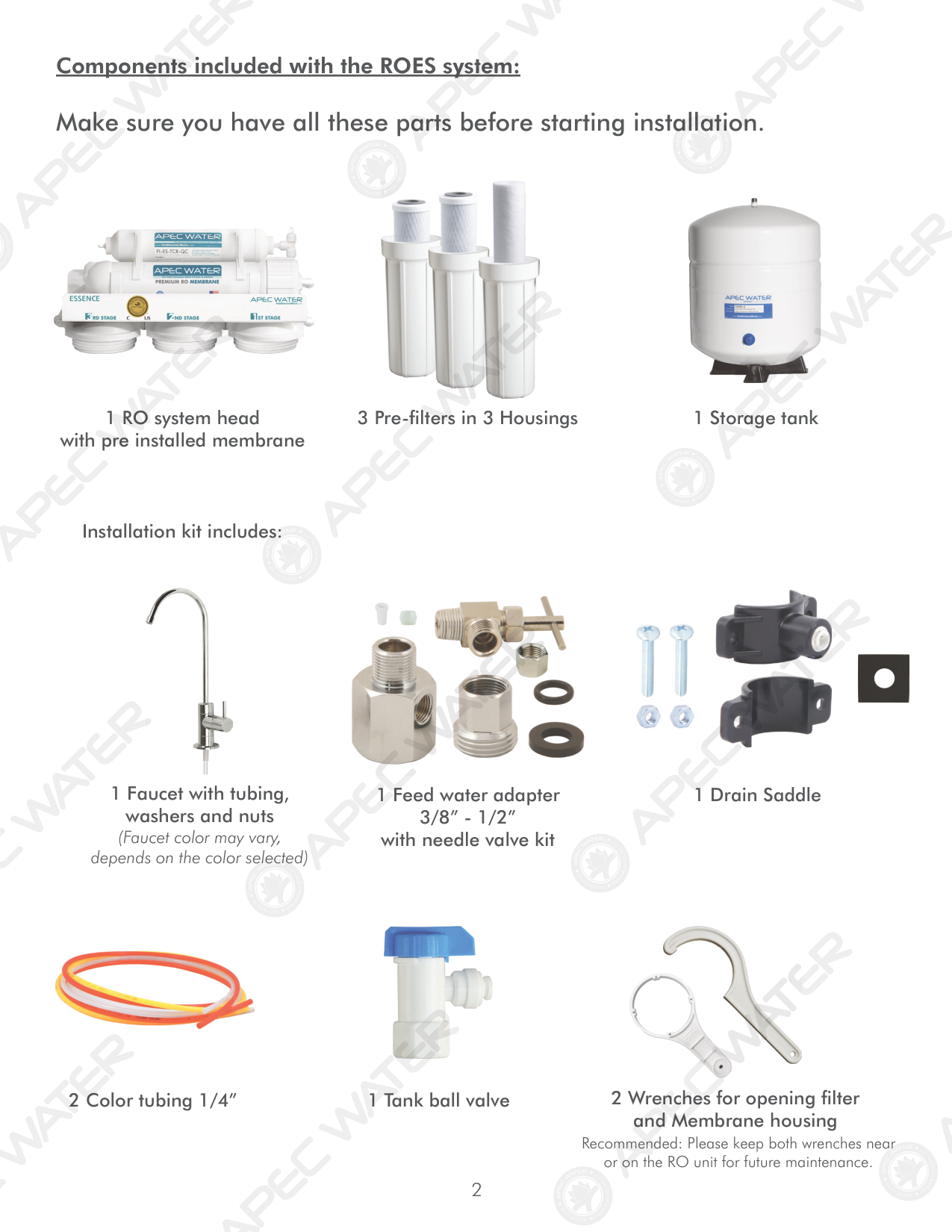
    ###### Components included with the ROES system: Make sure you have all these parts before starting installation.

    ![image 24](a4f3ae3e-8524-461e-a687-2b89d1e1aa05_images/imageFile24.png)

    ![image 25](a4f3ae3e-8524-461e-a687-2b89d1e1aa05_images/imageFile25.png)

    ![image 26](a4f3ae3e-8524-461e-a687-2b89d1e1aa05_images/imageFile26.png)

    1 RO system head with pre installed membrane

    3 Pre-filters in 3 Housings

    1 Storage tank

    Installation kit includes:

    ![image 27](a4f3ae3e-8524-461e-a687-2b89d1e1aa05_images/imageFile27.png)

    ![image 28](a4f3ae3e-8524-461e-a687-2b89d1e1aa05_images/imageFile28.png)

    ![image 29](a4f3ae3e-8524-461e-a687-2b89d1e1aa05_images/imageFile29.png)

    ![image 30](a4f3ae3e-8524-461e-a687-2b89d1e1aa05_images/imageFile30.png)

    1 Faucet with tubing, washers and nuts (Faucet color may vary, depends on the color selected)

    1 Feed water adapter 3/8” - 1/2” with needle valve kit

    1 Drain Saddle

    ![image 31](a4f3ae3e-8524-461e-a687-2b89d1e1aa05_images/imageFile31.png)

    ![image 32](a4f3ae3e-8524-461e-a687-2b89d1e1aa05_images/imageFile32.png)

    Page 5

    ![image 33](a4f3ae3e-8524-461e-a687-2b89d1e1aa05_images/imageFile33.png)

    ![image 34](a4f3ae3e-8524-461e-a687-2b89d1e1aa05_images/imageFile34.png)

    2 Wrenches for opening filter and Membrane housing

    2 Color tubing 1/4”

    1 Tank ball valve

    Recommended: Please keep both wrenches near or on the RO unit for future maintenance.

    ![image 35](a4f3ae3e-8524-461e-a687-2b89d1e1aa05_images/imageFile35.png)

    ######### Component Itemization:

    ![image 36](a4f3ae3e-8524-461e-a687-2b89d1e1aa05_images/imageFile36.png)

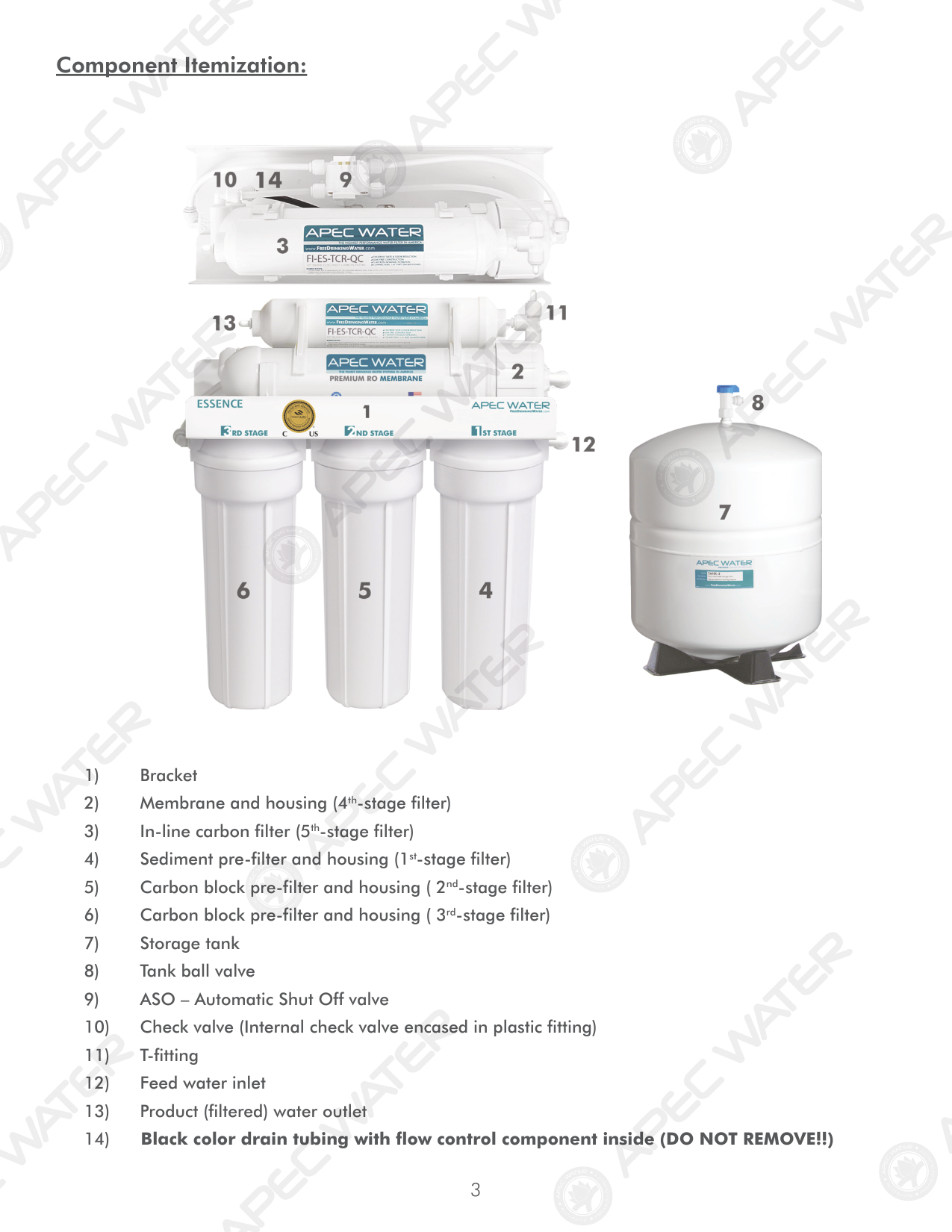
  • 1) Bracket
  • 2) Membrane and housing (4th-stage filter)
  • 3) In-line carbon filter (5th-stage filter)
  • 4) Sediment pre-filter and housing (1st-stage filter)
  • 5) Carbon block pre-filter and housing ( 2nd-stage filter)
  • 6) Carbon block pre-filter and housing ( 3rd-stage filter)
  • 7) Storage tank
  • 8) Tank ball valve
  • 9) ASO – Automatic Shut Off valve
  • 10) Check valve (Internal check valve encased in plastic fitting)
  • 11) T-fitting
  • 12) Feed water inlet
  • 13) Product (filtered) water outlet
  • 14) Black color drain tubing with flow control component inside (DO NOT REMOVE!!)
  • Page 6

    ![image 37](a4f3ae3e-8524-461e-a687-2b89d1e1aa05_images/imageFile37.png)

    ########### THERE ARE TWO PARTS TO INSTALLING THE RO SYSTEM:

  • Part I.
  • Part II. Note:
  • Assemble the filters and housings onto the main system Installing the system The RO Membrane Element has already been pre installed.

  • PART I. ASSEMBLE THE FILTERS AND HOUSINGS ONTO THE MAIN SYSTEM
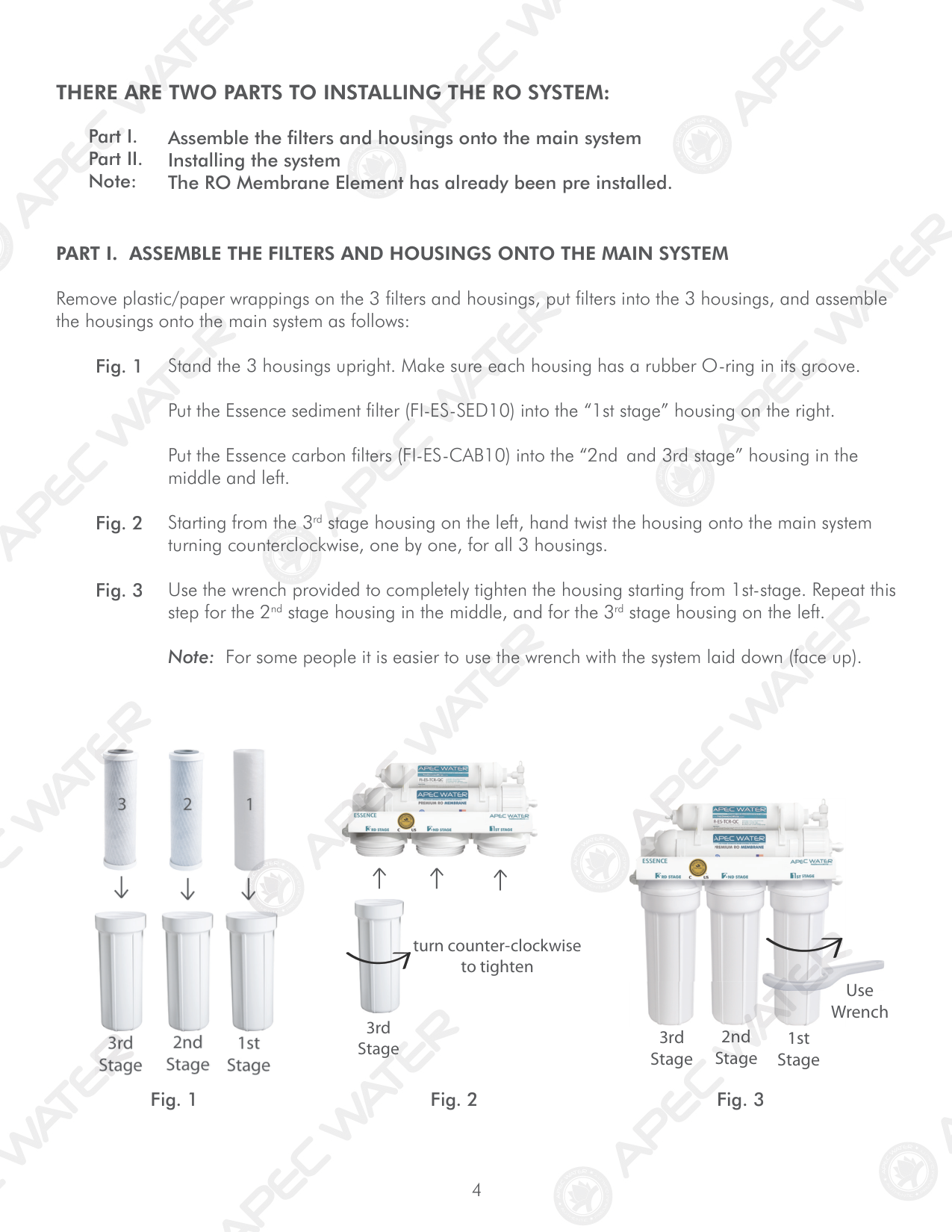
  • Remove plastic/paper wrappings on the 3 filters and housings, put filters into the 3 housings, and assemble the housings onto the main system as follows:

    Stand the 3 housings upright. Make sure each housing has a rubber O-ring in its groove. Put the Essence sediment filter (FI-ES-SED10) into the “1st stage” housing on the right. Put the Essence carbon filters (FI-ES-CAB10) into the “2nd and 3rd stage” housing in the middle and left. Starting from the 3rd stage housing on the left, hand twist the housing onto the main system turning counterclockwise, one by one, for all 3 housings. Use the wrench provided to completely tighten the housing starting from 1st-stage. Repeat this step for the 2nd stage housing in the middle, and for the 3rd stage housing on the left. Note: For some people it is easier to use the wrench with the system laid down (face up).

  • Fig. 1
  • Fig. 2
  • Fig. 3
  • ![image 38](a4f3ae3e-8524-461e-a687-2b89d1e1aa05_images/imageFile38.png)

    ![image 39](a4f3ae3e-8524-461e-a687-2b89d1e1aa05_images/imageFile39.png)

    ![image 40](a4f3ae3e-8524-461e-a687-2b89d1e1aa05_images/imageFile40.png)

    ![image 41](a4f3ae3e-8524-461e-a687-2b89d1e1aa05_images/imageFile41.png)

    ![image 42](a4f3ae3e-8524-461e-a687-2b89d1e1aa05_images/imageFile42.png)

    ![image 43](a4f3ae3e-8524-461e-a687-2b89d1e1aa05_images/imageFile43.png)

    Page 7

    ![image 44](a4f3ae3e-8524-461e-a687-2b89d1e1aa05_images/imageFile44.png)

    ![image 45](a4f3ae3e-8524-461e-a687-2b89d1e1aa05_images/imageFile45.png)

    ![image 46](a4f3ae3e-8524-461e-a687-2b89d1e1aa05_images/imageFile46.png)

    ![image 47](a4f3ae3e-8524-461e-a687-2b89d1e1aa05_images/imageFile47.png)

    ![image 48](a4f3ae3e-8524-461e-a687-2b89d1e1aa05_images/imageFile48.png)

    turn counter-clockwise to tighten

    ![image 49](a4f3ae3e-8524-461e-a687-2b89d1e1aa05_images/imageFile49.png)

    ![image 50](a4f3ae3e-8524-461e-a687-2b89d1e1aa05_images/imageFile50.png)

    ![image 51](a4f3ae3e-8524-461e-a687-2b89d1e1aa05_images/imageFile51.png)

    Use

    ![image 52](a4f3ae3e-8524-461e-a687-2b89d1e1aa05_images/imageFile52.png)

    ![image 53](a4f3ae3e-8524-461e-a687-2b89d1e1aa05_images/imageFile53.png)

    Wrench

    3rd Stage

    2nd Stage

    3rd Stage

    1st Stage
    Page 8

    Fig. 1 Fig. 2 Fig. 3

    ![image 54](a4f3ae3e-8524-461e-a687-2b89d1e1aa05_images/imageFile54.png)

  • PART II. INSTALLING THE SYSTEM
  • Space: Make sure there is sufficient space under the counter for installation (an area of about 17”L x 6”W x 18”H for the system, 11”D x 18”H for tank).

    The RO system is best installed under the kitchen sink. But if that is not feasible you can install the system anywhere where there is a cold water supply with sufficient water pressure for the chosen RO model, and an outlet to drain off the drain water from the system.

    Mounting: No need to mount the RO system on the wall. The RO system can stand in the sink cabinet without mounting, this makes future filter change easy and convenient. If you prefer to mount the system to the wall, please make sure it can be taken down easily for filter replacement.

    Feed Water: RO systems are designed to treat both hard and soft water and can handle incoming TDS levels up to 2,000 ppm.

  • Step 1: Feed Water Connection The RO system must be connected to the COLD water supply only!
  • 1. Locate the Cold water supply valve under the kitchen sink (the round or oblong handle on the right side). Turn off the incoming cold water completely by turning the shut off handle clockwise.
  • Note: If the cold water shut off valve can not turn off the water, the main water supply to the house must be shut off for the installation. Another option for feed water adapter connection is to use a “self-piercing saddle valve” from APEC or from a local hardware store.

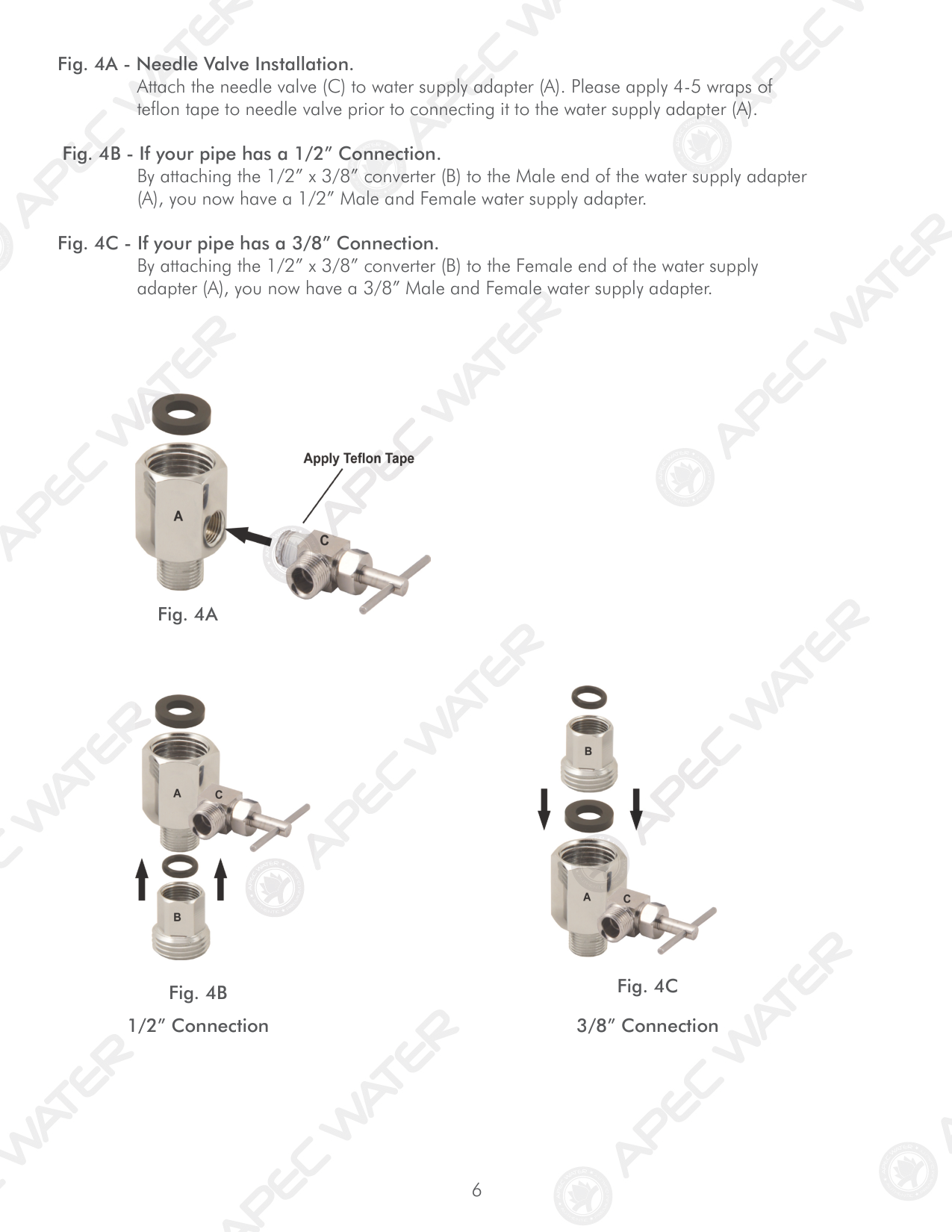
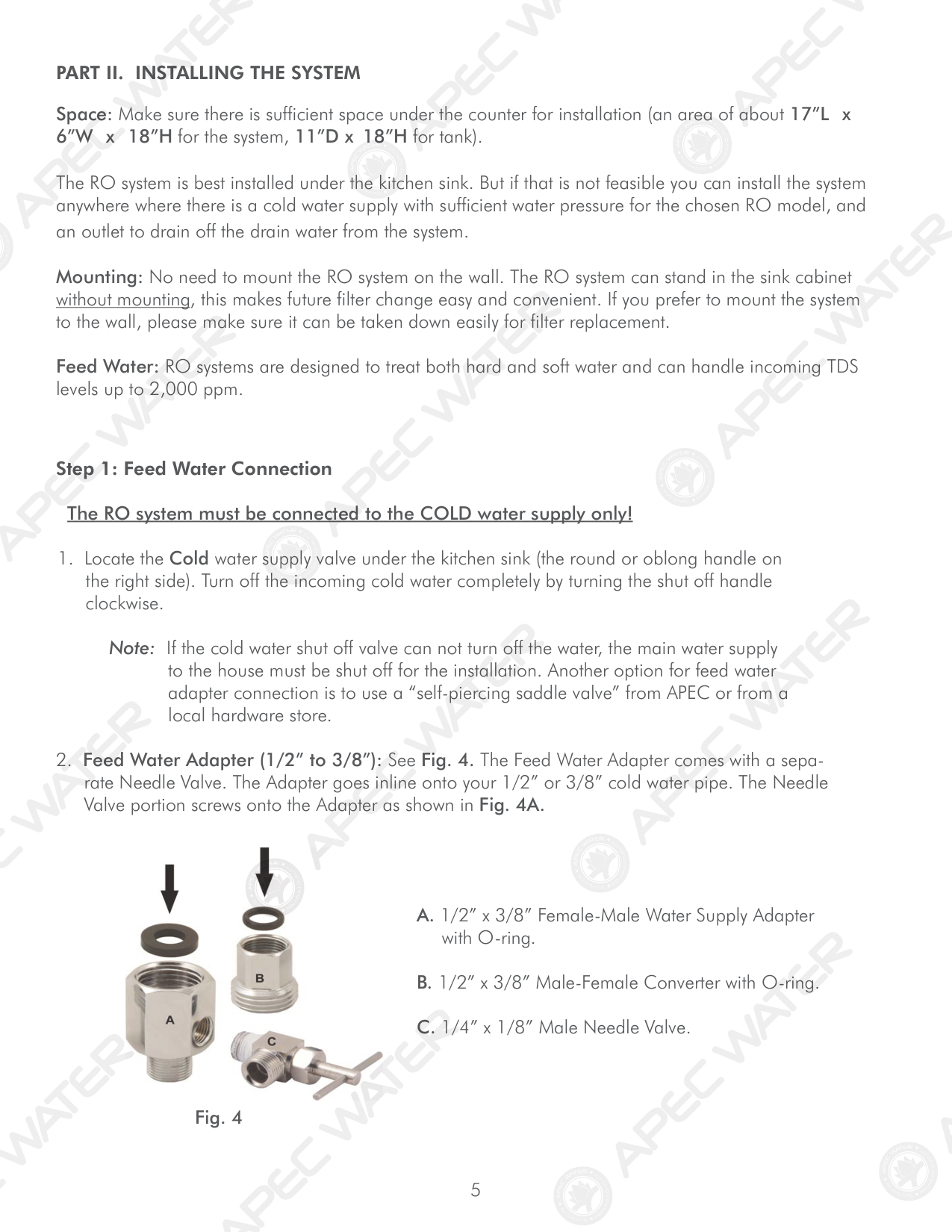
  • 2. Feed Water Adapter (1/2” to 3/8”): See Fig. 4. The Feed Water Adapter comes with a separate Needle Valve. The Adapter goes inline onto your 1/2” or 3/8” cold water pipe. The Needle Valve portion screws onto the Adapter as shown in Fig. 4A.
  • ![image 55](a4f3ae3e-8524-461e-a687-2b89d1e1aa05_images/imageFile55.png)

  • A. 1/2” x 3/8” Female-Male Water Supply Adapter with O-ring.
  • B. 1/2” x 3/8” Male-Female Converter with O-ring.
  • C. 1/4” x 1/8” Male Needle Valve.
  • Fig. 4

    Page 9

    ![image 56](a4f3ae3e-8524-461e-a687-2b89d1e1aa05_images/imageFile56.png)

  • Fig. 4A - Needle Valve Installation. Attach the needle valve (C) to water supply adapter (A). Please apply 4-5 wraps of teflon tape to needle valve prior to connecting it to the water supply adapter (A).
  • Fig. 4B - If your pipe has a 1/2” Connection. By attaching the 1/2” x 3/8” converter (B) to the Male end of the water supply adapter (A), you now have a 1/2” Male and Female water supply adapter.
  • Fig. 4C - If your pipe has a 3/8” Connection. By attaching the 1/2” x 3/8” converter (B) to the Female end of the water supply adapter (A), you now have a 3/8” Male and Female water supply adapter.
  • ![image 57](a4f3ae3e-8524-461e-a687-2b89d1e1aa05_images/imageFile57.png)

  • Fig. 4A
  • Fig. 4B
  • ![image 58](a4f3ae3e-8524-461e-a687-2b89d1e1aa05_images/imageFile58.png)

    ![image 59](a4f3ae3e-8524-461e-a687-2b89d1e1aa05_images/imageFile59.png)

    Fig. 4C

    1/2” Connection 3/8” Connection

    ![image 60](a4f3ae3e-8524-461e-a687-2b89d1e1aa05_images/imageFile60.png)

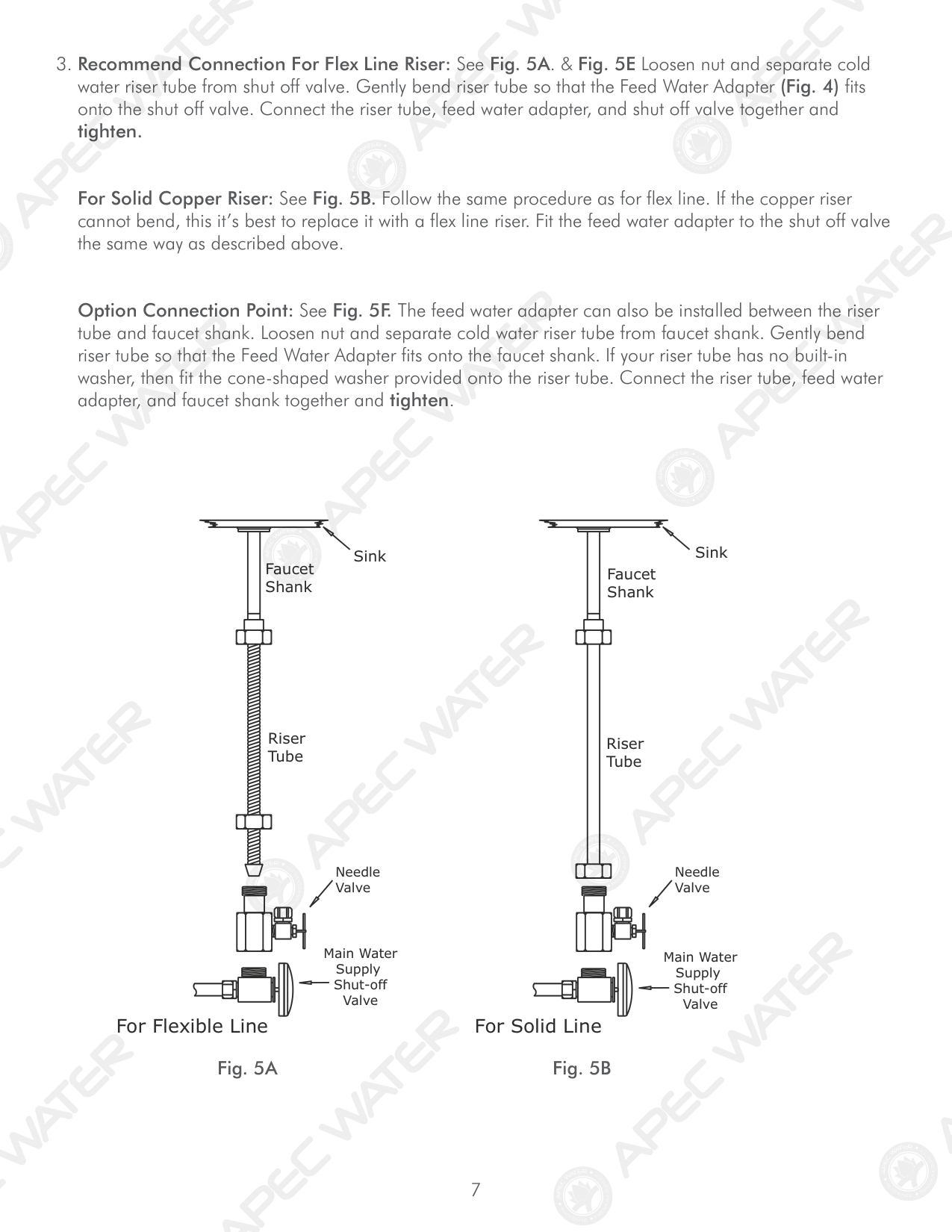
  • 3. Recommend Connection For Flex Line Riser: See Fig. 5A. & Fig. 5E Loosen nut and separate cold water riser tube from shut off valve. Gently bend riser tube so that the Feed Water Adapter (Fig. 4) fits onto the shut off valve. Connect the riser tube, feed water adapter, and shut off valve together and tighten.
  • For Solid Copper Riser: See Fig. 5B. Follow the same procedure as for flex line. If the copper riser cannot bend, this it’s best to replace it with a flex line riser. Fit the feed water adapter to the shut off valve the same way as described above.

    Option Connection Point: See Fig. 5F. The feed water adapter can also be installed between the riser tube and faucet shank. Loosen nut and separate cold water riser tube from faucet shank. Gently bend riser tube so that the Feed Water Adapter fits onto the faucet shank. If your riser tube has no built-in washer, then fit the cone-shaped washer provided onto the riser tube. Connect the riser tube, feed water adapter, and faucet shank together and tighten.

    | | | | |---|---|---| | | | |
    Page 10

    | | | | | | | | | | | | | | | |

    | | | | |---|---|---| | | | | | | | | | | | |

    Sink Sink

    Faucet Shank

    Faucet Shank

    Riser Tube

    Riser Tube

    Needle Valve

    Needle Valve

    | | | | |---|---|---| | | | |

    | | | | |---|---|---|
    Page 11

    | | | |

    Main Water Supply Shut-off Valve

    Main Water Supply Shut-off Valve

    | | | |---|---| | | |

    | | | |---|---| | | |

    For Solid Line

    For Flexible Line

    Fig. 5A Fig. 5B

    ![image 61](a4f3ae3e-8524-461e-a687-2b89d1e1aa05_images/imageFile61.png)

    ![image 62](a4f3ae3e-8524-461e-a687-2b89d1e1aa05_images/imageFile62.png)

    ![image 63](a4f3ae3e-8524-461e-a687-2b89d1e1aa05_images/imageFile63.png)

    ![image 64](a4f3ae3e-8524-461e-a687-2b89d1e1aa05_images/imageFile64.png)

    ![image 65](a4f3ae3e-8524-461e-a687-2b89d1e1aa05_images/imageFile65.png)

    ![image 66](a4f3ae3e-8524-461e-a687-2b89d1e1aa05_images/imageFile66.png)

    Page 12

    ![image 67](a4f3ae3e-8524-461e-a687-2b89d1e1aa05_images/imageFile67.png)

    ![image 68](a4f3ae3e-8524-461e-a687-2b89d1e1aa05_images/imageFile68.png)

    Insert Sleeve Compression Nut

    ![image 69](a4f3ae3e-8524-461e-a687-2b89d1e1aa05_images/imageFile69.png)

    ![image 70](a4f3ae3e-8524-461e-a687-2b89d1e1aa05_images/imageFile70.png)

    ![image 71](a4f3ae3e-8524-461e-a687-2b89d1e1aa05_images/imageFile71.png)

    ![image 72](a4f3ae3e-8524-461e-a687-2b89d1e1aa05_images/imageFile72.png)

    ![image 73](a4f3ae3e-8524-461e-a687-2b89d1e1aa05_images/imageFile73.png)

    ![image 74](a4f3ae3e-8524-461e-a687-2b89d1e1aa05_images/imageFile74.png)

    ![image 75](a4f3ae3e-8524-461e-a687-2b89d1e1aa05_images/imageFile75.png)

    ![image 76](a4f3ae3e-8524-461e-a687-2b89d1e1aa05_images/imageFile76.png)

    Push the tubing all the way into the needle valve while tightening compression nut.

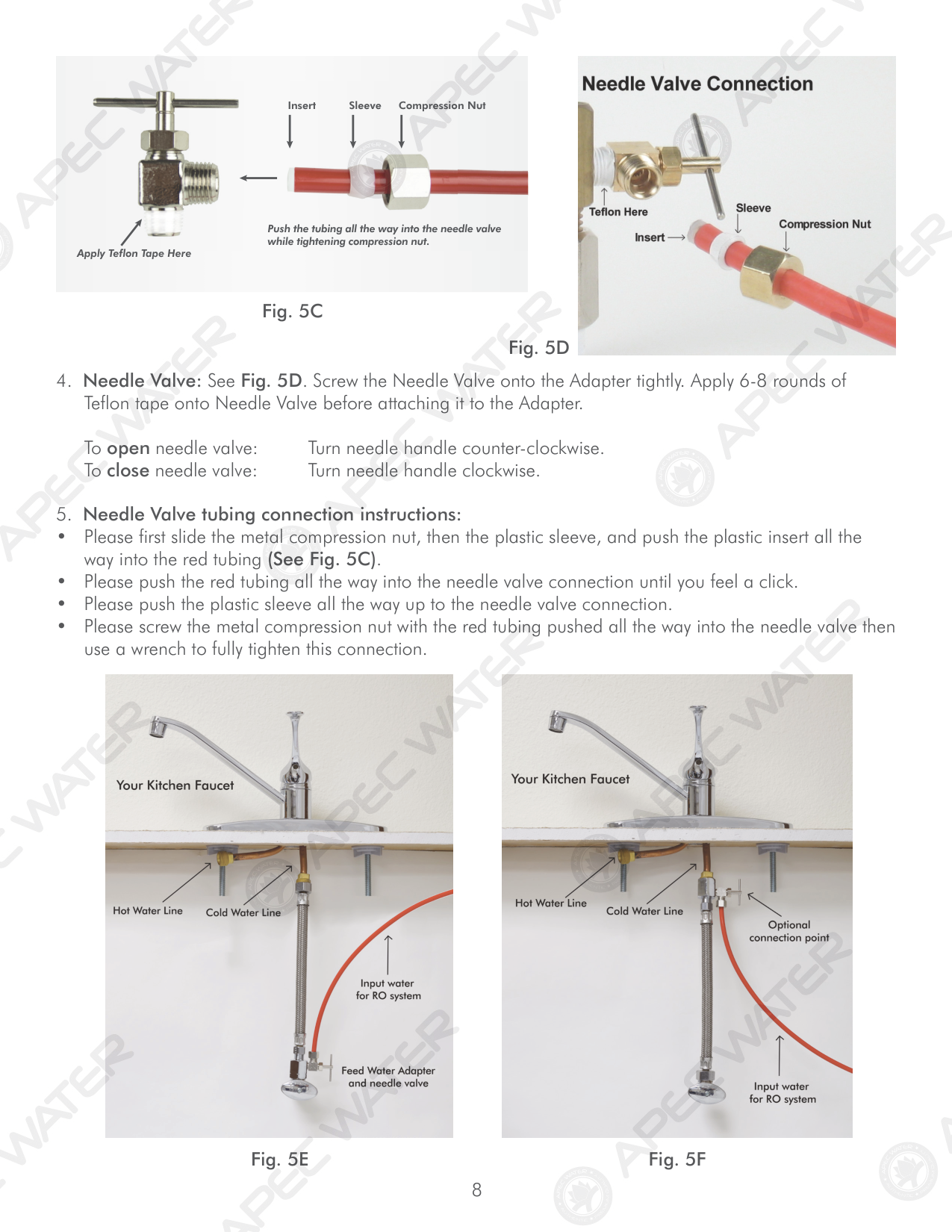
    Apply Teflon Tape Here

    Fig. 5C

    Fig. 5D

  • 4. Needle Valve: See Fig. 5D. Screw the Needle Valve onto the Adapter tightly. Apply 6-8 rounds of Teflon tape onto Needle Valve before attaching it to the Adapter.
  • Page 13

    To open needle valve: Turn needle handle counter-clockwise. To close needle valve: Turn needle handle clockwise.

  • Needle Valve tubing connection instructions:
  • • Please first slide the metal compression nut, then the plastic sleeve, and push the plastic insert all the way into the red tubing (See Fig. 5C).
  • • Please push the red tubing all the way into the needle valve connection until you feel a click.
  • • Please push the plastic sleeve all the way up to the needle valve connection.
  • • Please screw the metal compression nut with the red tubing pushed all the way into the needle valve then use a wrench to fully tighten this connection.
  • ![image 77](a4f3ae3e-8524-461e-a687-2b89d1e1aa05_images/imageFile77.png)

    ![image 78](a4f3ae3e-8524-461e-a687-2b89d1e1aa05_images/imageFile78.png)

    Fig. 5E Fig. 5F

    ![image 79](a4f3ae3e-8524-461e-a687-2b89d1e1aa05_images/imageFile79.png)

    Test for leaks after the system is completely installed: Close the Needle Valve (turn needle handle clockwise all the way in to close). Turn ON the cold water supply to the sink faucet. If the Needle Valve or the Adapter leaks, check the connection and try applying more Teflon tape or tighten the brass nut some more to stop the leak.

  • Step 2: Drain Saddle Installation
  • Important: DO NOT REMOVE the black drain tubing from the RO system! If you need to extend the drain tubing please use a union connector to connect additional length of tubing.

    Note: To avoid possible drainage noise, mount drain line as low as possible on the vertical tailpiece, or on horizontal tailpiece.

    There is constant water pressure “packed” inside the RO system which blocks the drain water from backing-up into the system. So the drain water is “forced-drained”, not “gravity-drained”.

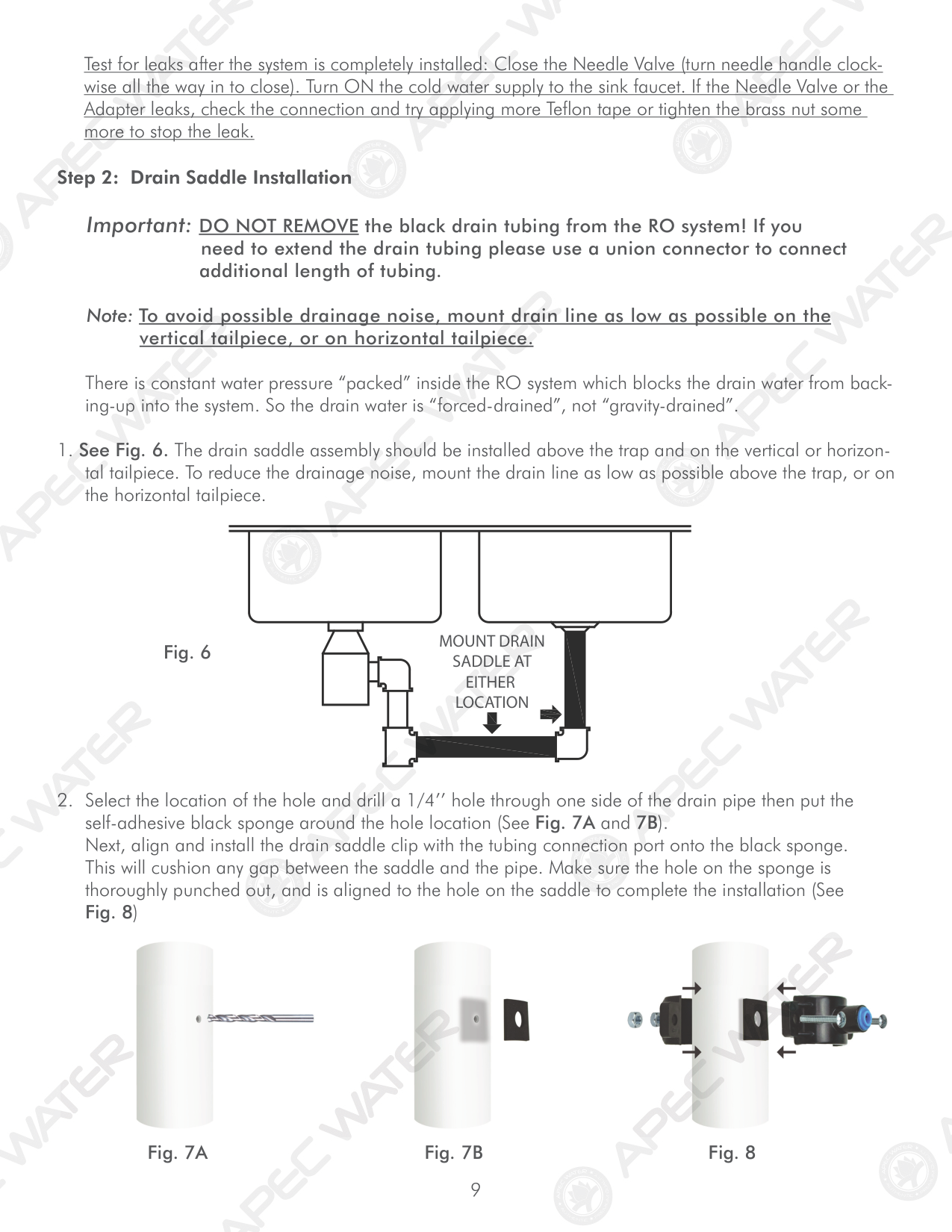
  • 1. See Fig. 6. The drain saddle assembly should be installed above the trap and on the vertical or horizontal tailpiece. To reduce the drainage noise, mount the drain line as low as possible above the trap, or on the horizontal tailpiece.
  • MOUNT DRAIN SADDLE AT EITHER LOCATION

  • 2. Select the location of the hole and drill a 1/4’’ hole through one side of the drain pipe then put the self-adhesive black sponge around the hole location (See Fig. 7A and 7B). Next, align and install the drain saddle clip with the tubing connection port onto the black sponge. This will cushion any gap between the saddle and the pipe. Make sure the hole on the sponge is thoroughly punched out, and is aligned to the hole on the saddle to complete the installation (See Fig. 8)
  • Page 14

  • Fig. 6
  • Fig. 7A Fig. 8
  • ![image 80](a4f3ae3e-8524-461e-a687-2b89d1e1aa05_images/imageFile80.png)

    ![image 81](a4f3ae3e-8524-461e-a687-2b89d1e1aa05_images/imageFile81.png)

    ![image 82](a4f3ae3e-8524-461e-a687-2b89d1e1aa05_images/imageFile82.png)

    Fig. 7B

    ![image 83](a4f3ae3e-8524-461e-a687-2b89d1e1aa05_images/imageFile83.png)

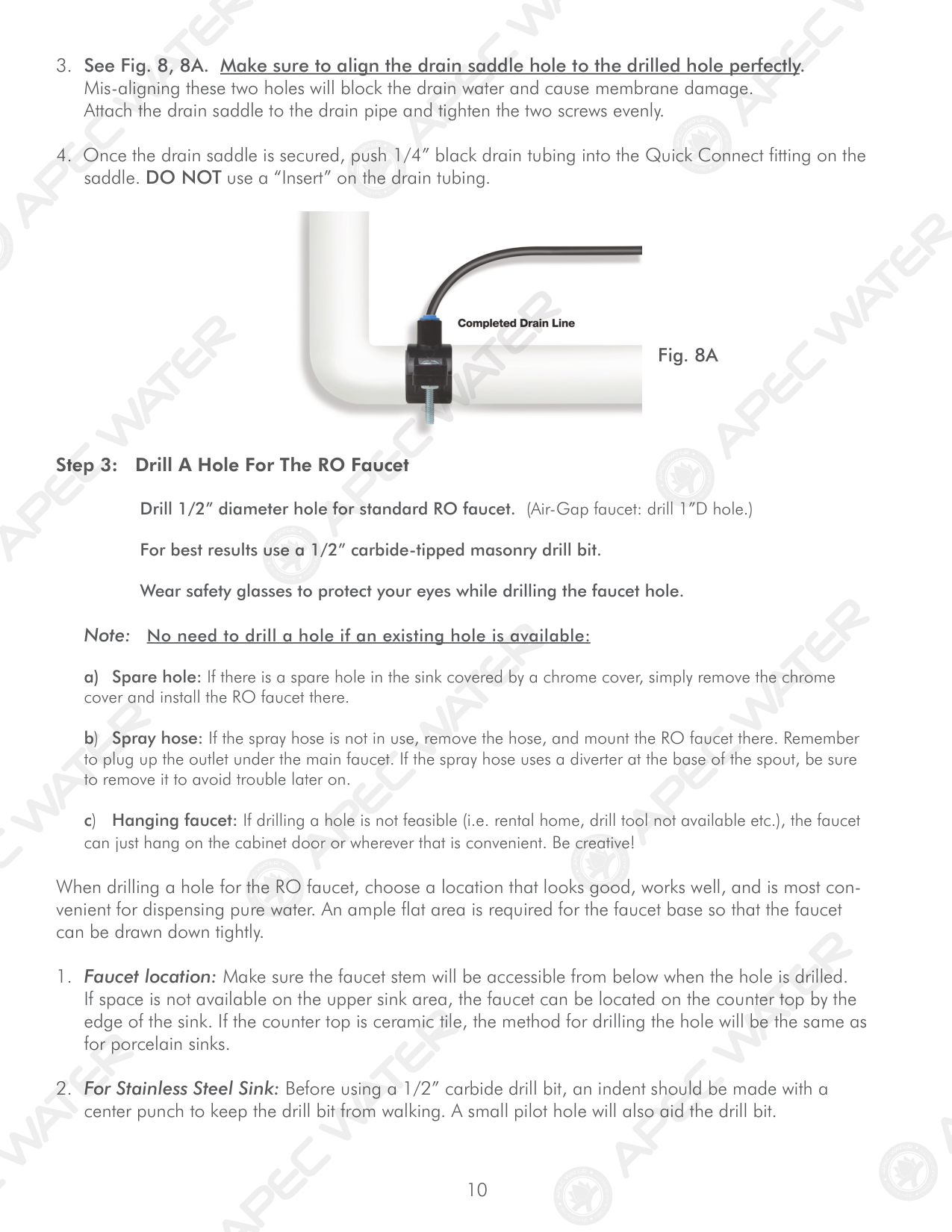
  • 3. See Fig. 8, 8A. Make sure to align the drain saddle hole to the drilled hole perfectly. Mis-aligning these two holes will block the drain water and cause membrane damage. Attach the drain saddle to the drain pipe and tighten the two screws evenly.
  • 4. Once the drain saddle is secured, push 1/4” black drain tubing into the Quick Connect fitting on the saddle. DO NOT use a “Insert” on the drain tubing.
  • ![image 84](a4f3ae3e-8524-461e-a687-2b89d1e1aa05_images/imageFile84.png)

    Fig. 8A

  • Step 3: Drill A Hole For The RO Faucet
  • Drill 1/2” diameter hole for standard RO faucet. (Air-Gap faucet: drill 1”D hole.) For best results use a 1/2” carbide-tipped masonry drill bit. Wear safety glasses to protect your eyes while drilling the faucet hole.

    Note: No need to drill a hole if an existing hole is available:

  • a) Spare hole: If there is a spare hole in the sink covered by a chrome cover, simply remove the chrome cover and install the RO faucet there.
  • b) Spray hose: If the spray hose is not in use, remove the hose, and mount the RO faucet there. Remember to plug up the outlet under the main faucet. If the spray hose uses a diverter at the base of the spout, be sure to remove it to avoid trouble later on.
  • c) Hanging faucet: If drilling a hole is not feasible (i.e. rental home, drill tool not available etc.), the faucet can just hang on the cabinet door or wherever that is convenient. Be creative!
  • Page 15

    When drilling a hole for the RO faucet, choose a location that looks good, works well, and is most convenient for dispensing pure water. An ample flat area is required for the faucet base so that the faucet can be drawn down tightly.

  • 1. Faucet location: Make sure the faucet stem will be accessible from below when the hole is drilled. If space is not available on the upper sink area, the faucet can be located on the counter top by the edge of the sink. If the counter top is ceramic tile, the method for drilling the hole will be the same as for porcelain sinks.
  • 2. For Stainless Steel Sink: Before using a 1/2” carbide drill bit, an indent should be made with a center punch to keep the drill bit from walking. A small pilot hole will also aid the drill bit.
  • ![image 85](a4f3ae3e-8524-461e-a687-2b89d1e1aa05_images/imageFile85.png)

  • 3. For Porcelain Sink: Porcelain enameled sinks can readily be chipped if care is not exercised when drilling the hole. Before starting the drill motor, apply firm downward pressure on the bit until a crunching occurs. This will help keep the drill bit from walking when starting the hole. A small pilot hole will also aid the drill bit.
  • Note: Immediately after the hole drilling is done, clean up all metal chips, for metal chips will stain the porcelain!!

    ![image 86](a4f3ae3e-8524-461e-a687-2b89d1e1aa05_images/imageFile86.png)

    ![image 87](a4f3ae3e-8524-461e-a687-2b89d1e1aa05_images/imageFile87.png)

    ![image 88](a4f3ae3e-8524-461e-a687-2b89d1e1aa05_images/imageFile88.png)

    ![image 89](a4f3ae3e-8524-461e-a687-2b89d1e1aa05_images/imageFile89.png)

    ![image 90](a4f3ae3e-8524-461e-a687-2b89d1e1aa05_images/imageFile90.png)

  • Step 4: Mounting The Faucet
  • ![image 91](a4f3ae3e-8524-461e-a687-2b89d1e1aa05_images/imageFile91.png)

    ![image 92](a4f3ae3e-8524-461e-a687-2b89d1e1aa05_images/imageFile92.png)

    If your faucet comes with tubing attached:

    Page 16

    ![image 93](a4f3ae3e-8524-461e-a687-2b89d1e1aa05_images/imageFile93.png)

    ![image 94](a4f3ae3e-8524-461e-a687-2b89d1e1aa05_images/imageFile94.png)

    ![image 95](a4f3ae3e-8524-461e-a687-2b89d1e1aa05_images/imageFile95.png)

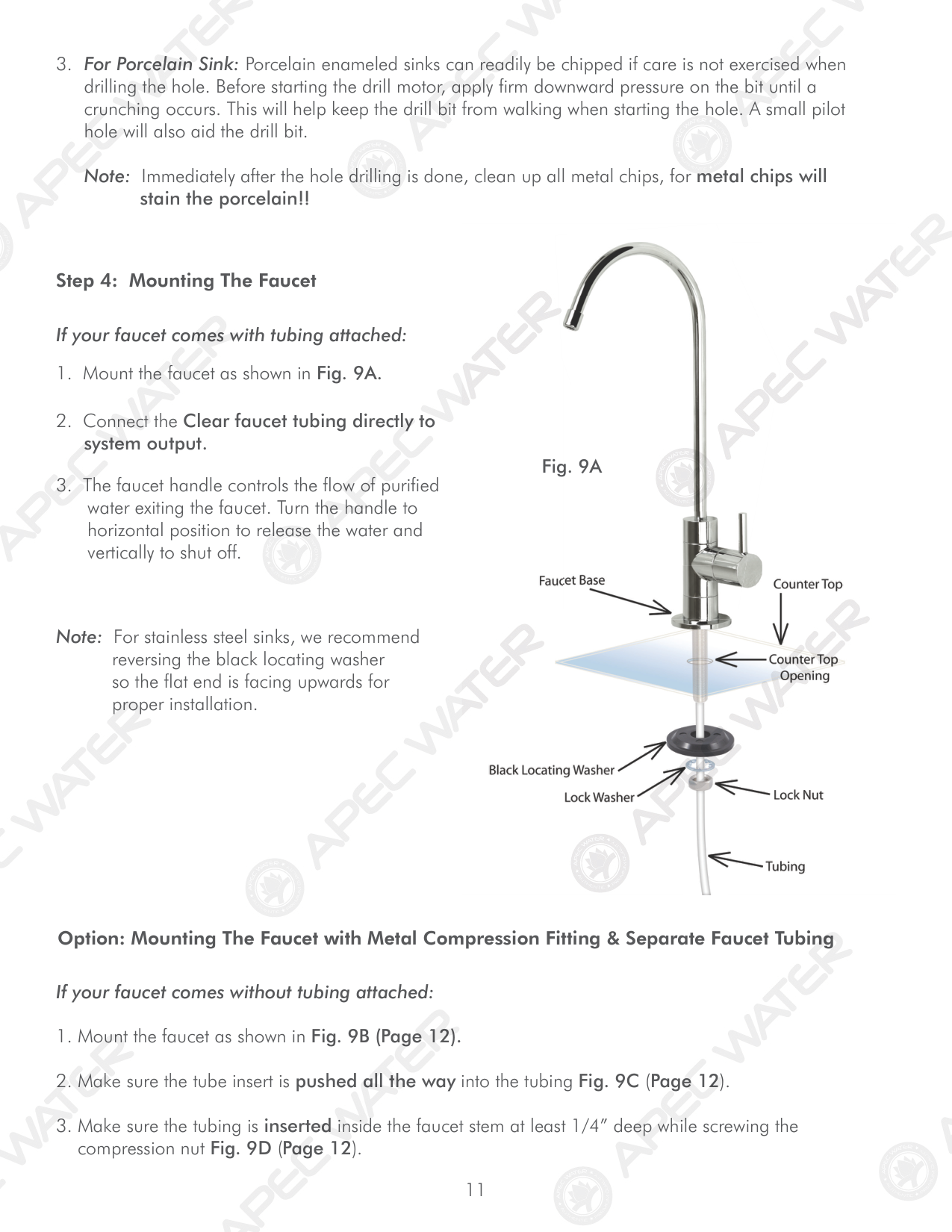
  • 1. Mount the faucet as shown in Fig. 9A.
  • 2. Connect the Clear faucet tubing directly to system output.
  • 3. The faucet handle controls the flow of purified water exiting the faucet. Turn the handle to horizontal position to release the water and vertically to shut off.
  • ![image 96](a4f3ae3e-8524-461e-a687-2b89d1e1aa05_images/imageFile96.png)

    ![image 97](a4f3ae3e-8524-461e-a687-2b89d1e1aa05_images/imageFile97.png)

    Fig. 9A

    ![image 98](a4f3ae3e-8524-461e-a687-2b89d1e1aa05_images/imageFile98.png)

    ![image 99](a4f3ae3e-8524-461e-a687-2b89d1e1aa05_images/imageFile99.png)

    ![image 100](a4f3ae3e-8524-461e-a687-2b89d1e1aa05_images/imageFile100.png)

    ![image 101](a4f3ae3e-8524-461e-a687-2b89d1e1aa05_images/imageFile101.png)

    ![image 102](a4f3ae3e-8524-461e-a687-2b89d1e1aa05_images/imageFile102.png)

    ![image 103](a4f3ae3e-8524-461e-a687-2b89d1e1aa05_images/imageFile103.png)

    ![image 104](a4f3ae3e-8524-461e-a687-2b89d1e1aa05_images/imageFile104.png)

    ![image 105](a4f3ae3e-8524-461e-a687-2b89d1e1aa05_images/imageFile105.png)

    Faucet Base

    Page 17

    ![image 106](a4f3ae3e-8524-461e-a687-2b89d1e1aa05_images/imageFile106.png)

    ![image 107](a4f3ae3e-8524-461e-a687-2b89d1e1aa05_images/imageFile107.png)

    Counter Top

    ![image 108](a4f3ae3e-8524-461e-a687-2b89d1e1aa05_images/imageFile108.png)

    Note: For stainless steel sinks, we recommend reversing the black locating washer so the flat end is facing upwards for proper installation.

    Counter Top Opening

    Black Locating Washer Lock Washer Lock Nut

    Tubing

    Option: Mounting The Faucet with Metal Compression Fitting & Separate Faucet Tubing

    If your faucet comes without tubing attached:

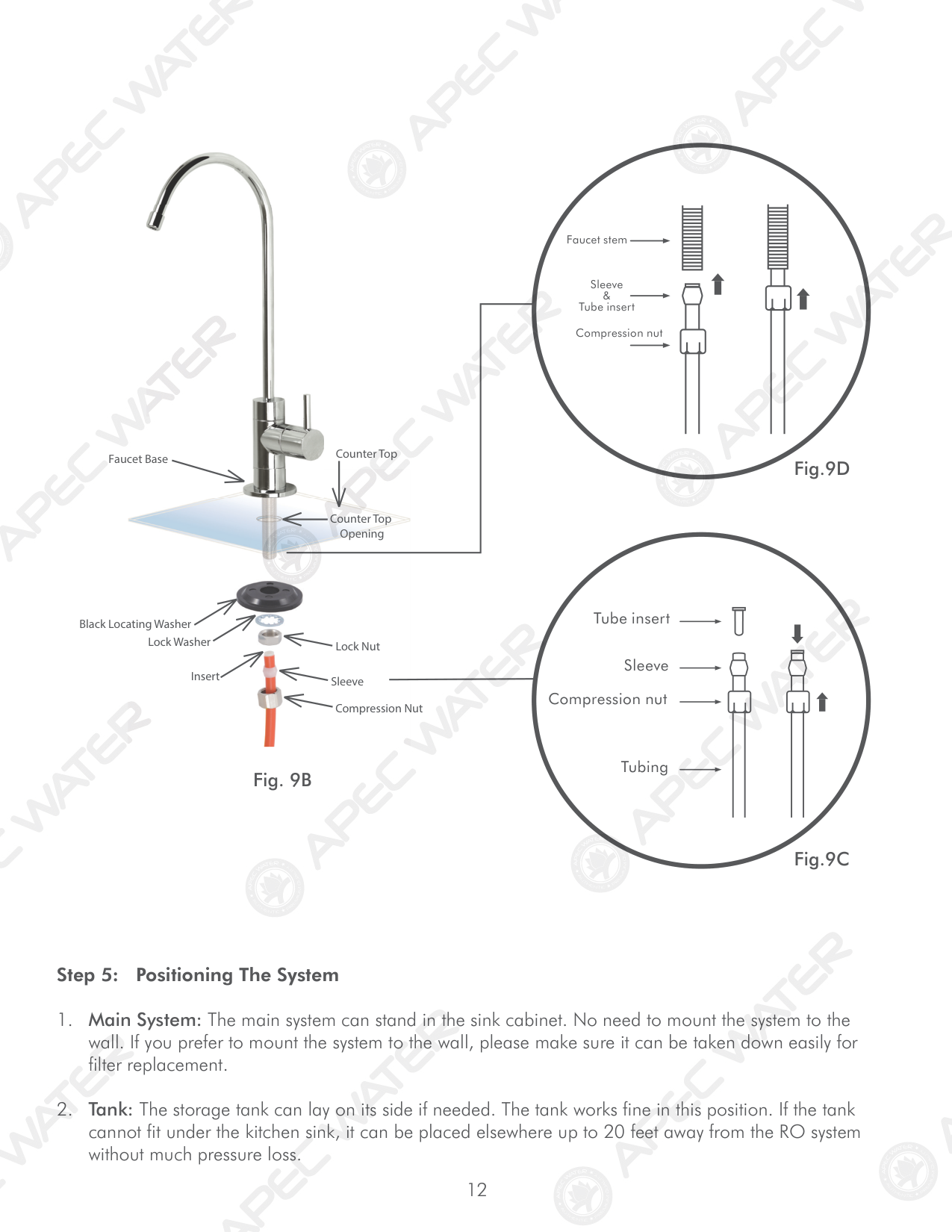
  • 1. Mount the faucet as shown in Fig. 9B (Page 12).
  • 2. Make sure the tube insert is pushed all the way into the tubing Fig. 9C (Page 12).
  • 3. Make sure the tubing is inserted inside the faucet stem at least 1/4” deep while screwing the compression nut Fig. 9D (Page 12).
  • ![image 109](a4f3ae3e-8524-461e-a687-2b89d1e1aa05_images/imageFile109.png)

    ![image 110](a4f3ae3e-8524-461e-a687-2b89d1e1aa05_images/imageFile110.png)

    ![image 111](a4f3ae3e-8524-461e-a687-2b89d1e1aa05_images/imageFile111.png)

    ![image 112](a4f3ae3e-8524-461e-a687-2b89d1e1aa05_images/imageFile112.png)

    Page 18

    ![image 113](a4f3ae3e-8524-461e-a687-2b89d1e1aa05_images/imageFile113.png)

    Faucet stem

    ![image 114](a4f3ae3e-8524-461e-a687-2b89d1e1aa05_images/imageFile114.png)

    ![image 115](a4f3ae3e-8524-461e-a687-2b89d1e1aa05_images/imageFile115.png)

    Sleeve & Tube insert

    ![image 116](a4f3ae3e-8524-461e-a687-2b89d1e1aa05_images/imageFile116.png)

    ![image 117](a4f3ae3e-8524-461e-a687-2b89d1e1aa05_images/imageFile117.png)

    Compression nut

    ![image 118](a4f3ae3e-8524-461e-a687-2b89d1e1aa05_images/imageFile118.png)

    ![image 119](a4f3ae3e-8524-461e-a687-2b89d1e1aa05_images/imageFile119.png)

    ![image 120](a4f3ae3e-8524-461e-a687-2b89d1e1aa05_images/imageFile120.png)

    Counter Top

    Faucet Base

    Fig.9D

    ![image 121](a4f3ae3e-8524-461e-a687-2b89d1e1aa05_images/imageFile121.png)

    ![image 122](a4f3ae3e-8524-461e-a687-2b89d1e1aa05_images/imageFile122.png)

    Counter Top Opening

    Page 19

    Tube insert

    Black Locating Washer Lock Washer Lock Nut

    Sleeve Compression nut

    Insert Sleeve Compression Nut

    Tubing

    Fig. 9B

    Fig.9C

  • Step 5: Positioning The System
  • 1. Main System: The main system can stand in the sink cabinet. No need to mount the system to the wall. If you prefer to mount the system to the wall, please make sure it can be taken down easily for filter replacement.
  • 2. Tank: The storage tank can lay on its side if needed. The tank works fine in this position. If the tank cannot fit under the kitchen sink, it can be placed elsewhere up to 20 feet away from the RO system without much pressure loss.
  • ![image 123](a4f3ae3e-8524-461e-a687-2b89d1e1aa05_images/imageFile123.png)

  • Step 6: Connecting The System
  • ##### IMPORTANT INSTALLATION NOTICE!

    G

    ![image 124](a4f3ae3e-8524-461e-a687-2b89d1e1aa05_images/imageFile124.png)

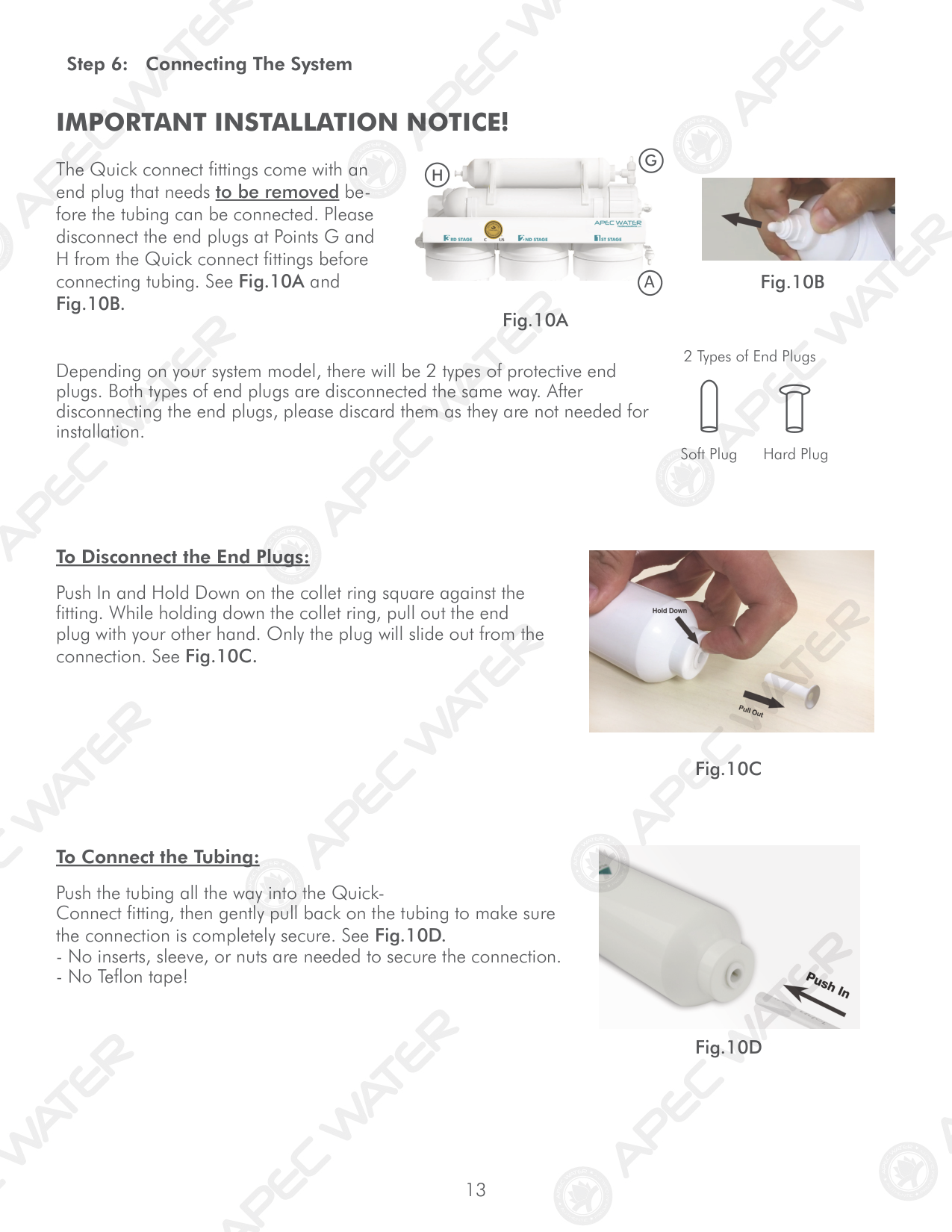
    The Quick connect fittings come with an end plug that needs to be removed before the tubing can be connected. Please disconnect the end plugs at Points G and H from the Quick connect fittings before connecting tubing. See Fig.10A and Fig.10B.
    Page 20

    H

    ![image 125](a4f3ae3e-8524-461e-a687-2b89d1e1aa05_images/imageFile125.png)

    Fig.10BA

    Fig.10A

    2 Types of End Plugs

    Depending on your system model, there will be 2 types of protective end plugs. Both types of end plugs are disconnected the same way. After disconnecting the end plugs, please discard them as they are not needed for installation.

    Soft Plug Hard Plug

    To Disconnect the End Plugs:

    ![image 126](a4f3ae3e-8524-461e-a687-2b89d1e1aa05_images/imageFile126.png)

    Push In and Hold Down on the collet ring square against the fitting. While holding down the collet ring, pull out the end plug with your other hand. Only the plug will slide out from the connection. See Fig.10C.

    Fig.10C

    To Connect the Tubing:

    ![image 127](a4f3ae3e-8524-461e-a687-2b89d1e1aa05_images/imageFile127.png)

    Push the tubing all the way into the QuickConnect fitting, then gently pull back on the tubing to make sure the connection is completely secure. See Fig.10D.

  • - No inserts, sleeve, or nuts are needed to secure the connection.
  • - No Teflon tape!
  • Fig.10D

    Page 21

    ![image 128](a4f3ae3e-8524-461e-a687-2b89d1e1aa05_images/imageFile128.png)

    ![image 129](a4f3ae3e-8524-461e-a687-2b89d1e1aa05_images/imageFile129.png)

    To Disconnect the Tubing:

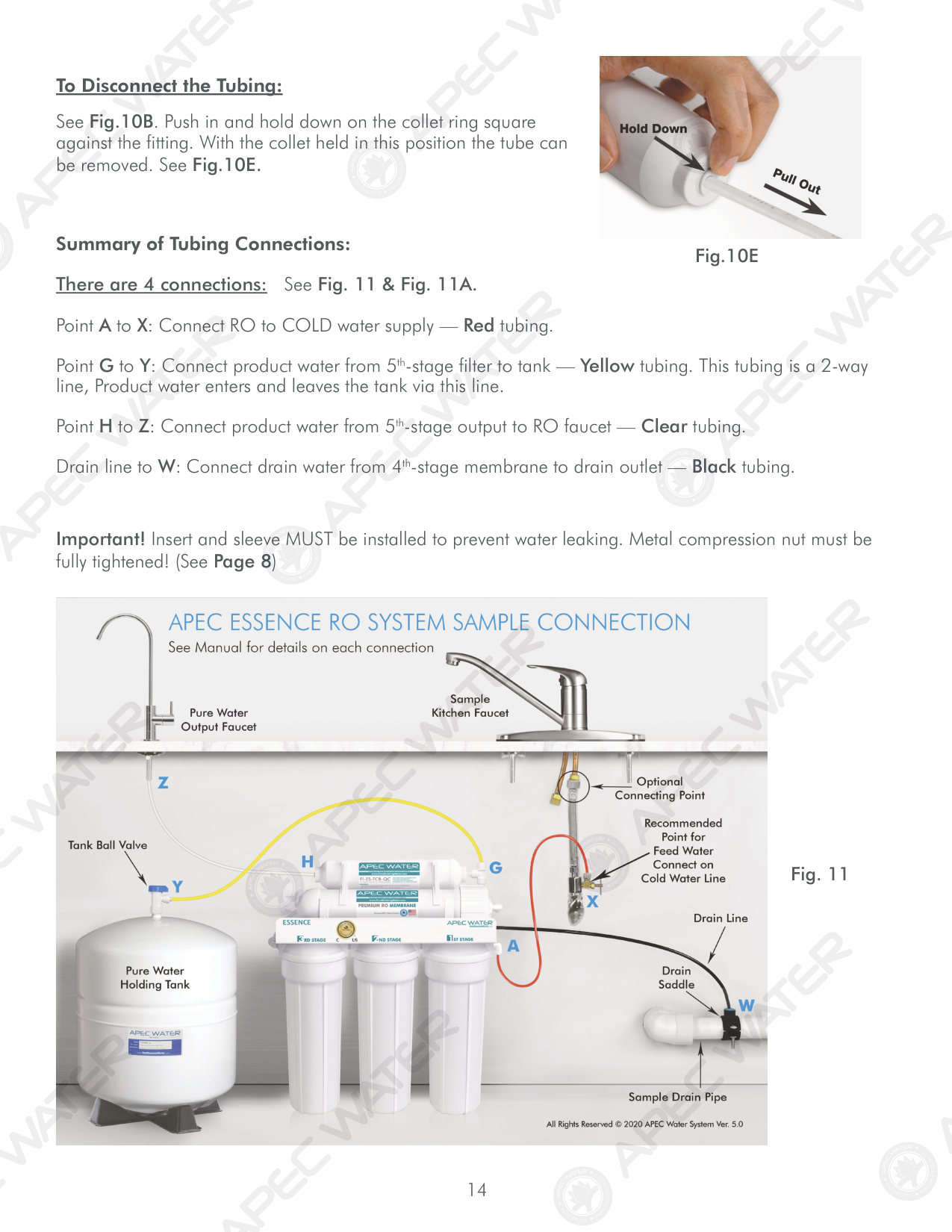
    See Fig.10B. Push in and hold down on the collet ring square against the fitting. With the collet held in this position the tube can be removed. See Fig.10E.

    Summary of Tubing Connections: There are 4 connections: See Fig. 11 & Fig. 11A. Point A to X: Connect RO to COLD water supply — Red tubing.

    Fig.10E

  • Point G to Y: Connect product water from 5th-stage filter to tank — Yellow tubing. This tubing is a 2-way line, Product water enters and leaves the tank via this line.
  • Point H to Z: Connect product water from 5th-stage output to RO faucet — Clear tubing. Drain line to W: Connect drain water from 4th-stage membrane to drain outlet — Black tubing.
  • Important! Insert and sleeve MUST be installed to prevent water leaking. Metal compression nut must be fully tightened! (See Page 8)

    ![image 130](a4f3ae3e-8524-461e-a687-2b89d1e1aa05_images/imageFile130.png)

    Fig. 11

    ![image 131](a4f3ae3e-8524-461e-a687-2b89d1e1aa05_images/imageFile131.png)

    ![image 132](a4f3ae3e-8524-461e-a687-2b89d1e1aa05_images/imageFile132.png)

    Fig. 11A

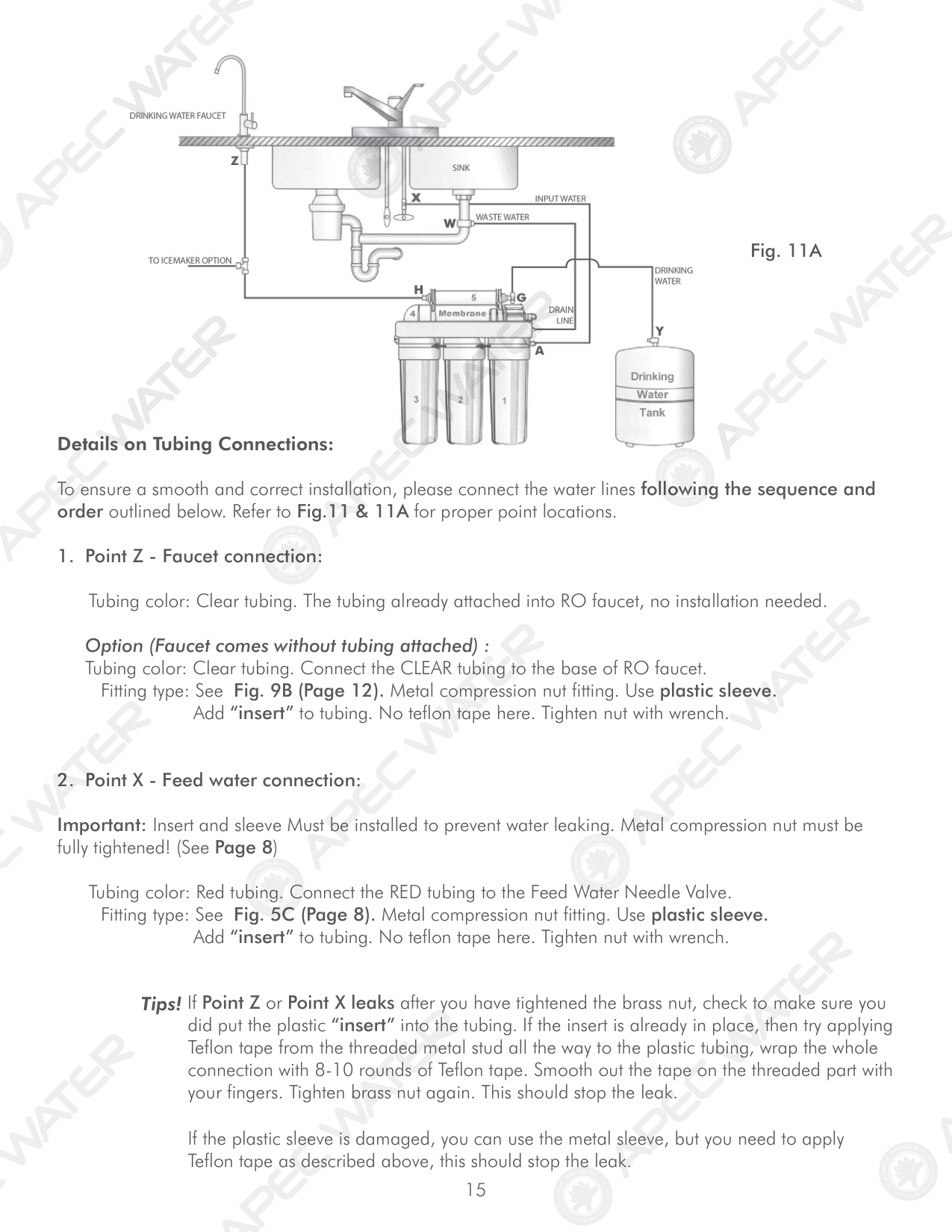
    Details on Tubing Connections: To ensure a smooth and correct installation, please connect the water lines following the sequence and order outlined below. Refer to Fig.11 & 11A for proper point locations.

  • 1. Point Z - Faucet connection: Tubing color: Clear tubing. The tubing already attached into RO faucet, no installation needed.
  • Option (Faucet comes without tubing attached) : Tubing color: Clear tubing. Connect the CLEAR tubing to the base of RO faucet.
    Page 22

    Fitting type: See Fig. 9B (Page 12). Metal compression nut fitting. Use plastic sleeve. Add “insert” to tubing. No teflon tape here. Tighten nut with wrench.

  • 2. Point X - Feed water connection:
  • Important: Insert and sleeve Must be installed to prevent water leaking. Metal compression nut must be fully tightened! (See Page 8)

    Tubing color: Red tubing. Connect the RED tubing to the Feed Water Needle Valve. Fitting type: See Fig. 5C (Page 8). Metal compression nut fitting. Use plastic sleeve. Add “insert” to tubing. No teflon tape here. Tighten nut with wrench.

    Tips! If Point Z or Point X leaks after you have tightened the brass nut, check to make sure you did put the plastic “insert” into the tubing. If the insert is already in place, then try applying Teflon tape from the threaded metal stud all the way to the plastic tubing, wrap the whole connection with 8-10 rounds of Teflon tape. Smooth out the tape on the threaded part with your fingers. Tighten brass nut again. This should stop the leak.

    If the plastic sleeve is damaged, you can use the metal sleeve, but you need to apply Teflon tape as described above, this should stop the leak.

    ![image 133](a4f3ae3e-8524-461e-a687-2b89d1e1aa05_images/imageFile133.png)

  • 3. Point W - Drain water connection:
  • Tubing color: Black tubing. Connect the BLACK tubing from the RO to the Drain Saddle. Fitting type: Simply push the Clear tubing into the Quick Connect fitting. No Inserts, Sleeves or Nuts are needed to secure the connection. No Teflon tape needed here.
  • 4. Point A - System water inlet (to Stage 1 pre-filter) connection:
  • Tubing color: Red tubing. Connect the RED tubing from the Feed Water Valve to the RO’s stage -1 prefilter.

    Fitting type: Quick Connect fitting See Fig. 10D (Page 13). Simply push the Red tubing into the QC fitting. No Inserts, Sleeves or Nuts are needed to secure the connection. No Teflon tape needed here.

  • 5. Point H - Stage-5 filtered water to faucet connection:
  • Tubing color: Clear tubing. Connect the CLEAR tubing from the faucet base stud to the Stage-5 filter’s outflow end at point H. (See “Flow -->” arrow on the filter for flow direction.) Fitting type: Quick Connect: Simply push the Clear tubing into the QC fitting. No Inserts, Sleeves or Nuts are needed to secure the connection. No Teflon tape needed here.

  • 6. Point G - Stage-5 filter’s T-fitting connection:
  • Tubing color: Yellow tubing. Connect the YELLOW tubing to Stage-5 filter’s T-fitting. Fitting type: Quick Connect: Simply push the Yellow tubing into the QC fitting. No Inserts, Sleeves or Nuts are needed to secure the connection. No Teflon tape needed here.

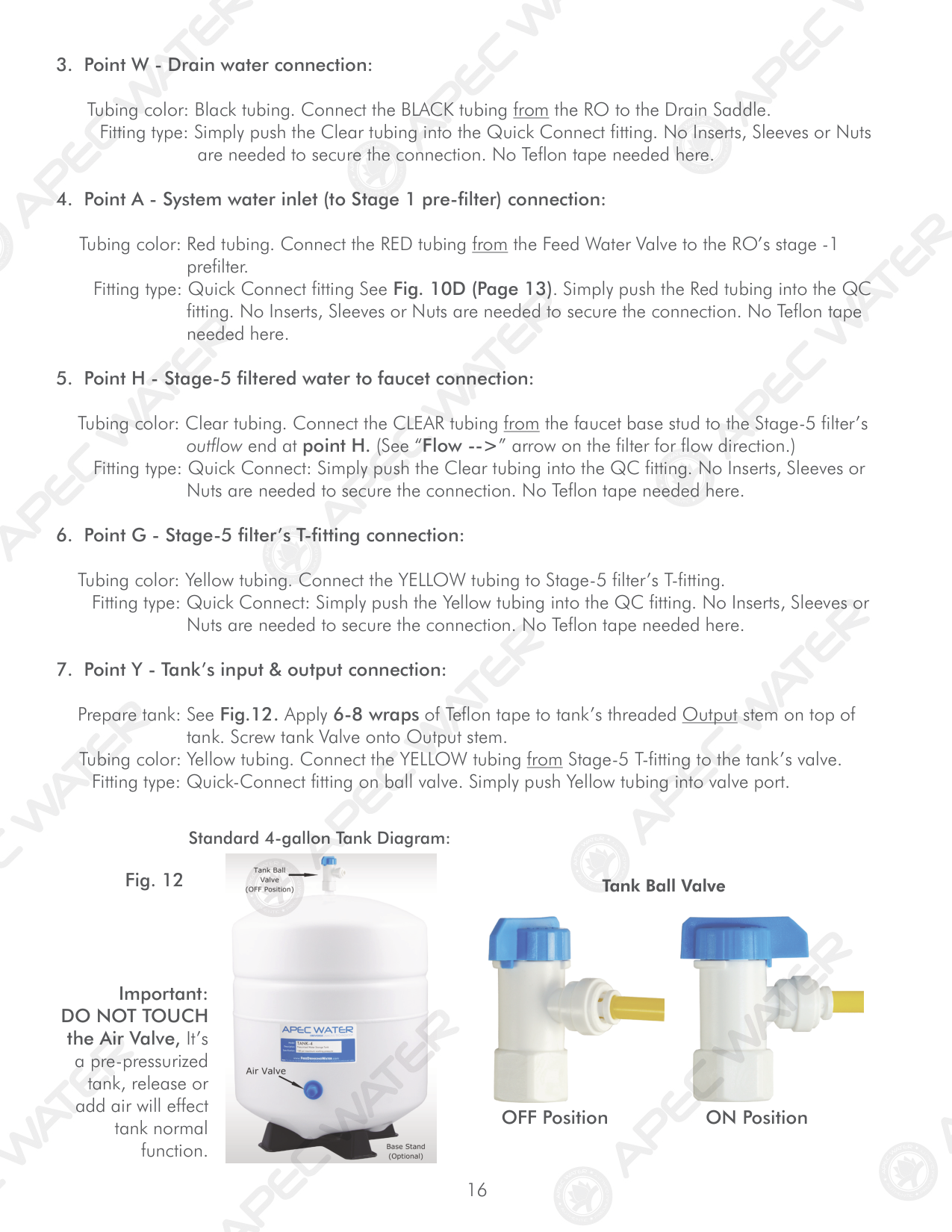
  • 7. Point Y - Tank’s input & output connection:
  • Page 23

    Prepare tank: See Fig.12. Apply 6-8 wraps of Teflon tape to tank’s threaded Output stem on top of tank. Screw tank Valve onto Output stem. Tubing color: Yellow tubing. Connect the YELLOW tubing from Stage-5 T-fitting to the tank’s valve. Fitting type: Quick-Connect fitting on ball valve. Simply push Yellow tubing into valve port.

    Standard 4-gallon Tank Diagram:

    ![image 134](a4f3ae3e-8524-461e-a687-2b89d1e1aa05_images/imageFile134.png)

    Fig. 12 Tank Ball Valve

    ![image 135](a4f3ae3e-8524-461e-a687-2b89d1e1aa05_images/imageFile135.png)

    ![image 136](a4f3ae3e-8524-461e-a687-2b89d1e1aa05_images/imageFile136.png)

    Important: DO NOT TOUCH the Air Valve, It’s a pre-pressurized tank, release or add air will effect tank normal function.

    OFF Position ON Position

    ![image 137](a4f3ae3e-8524-461e-a687-2b89d1e1aa05_images/imageFile137.png)

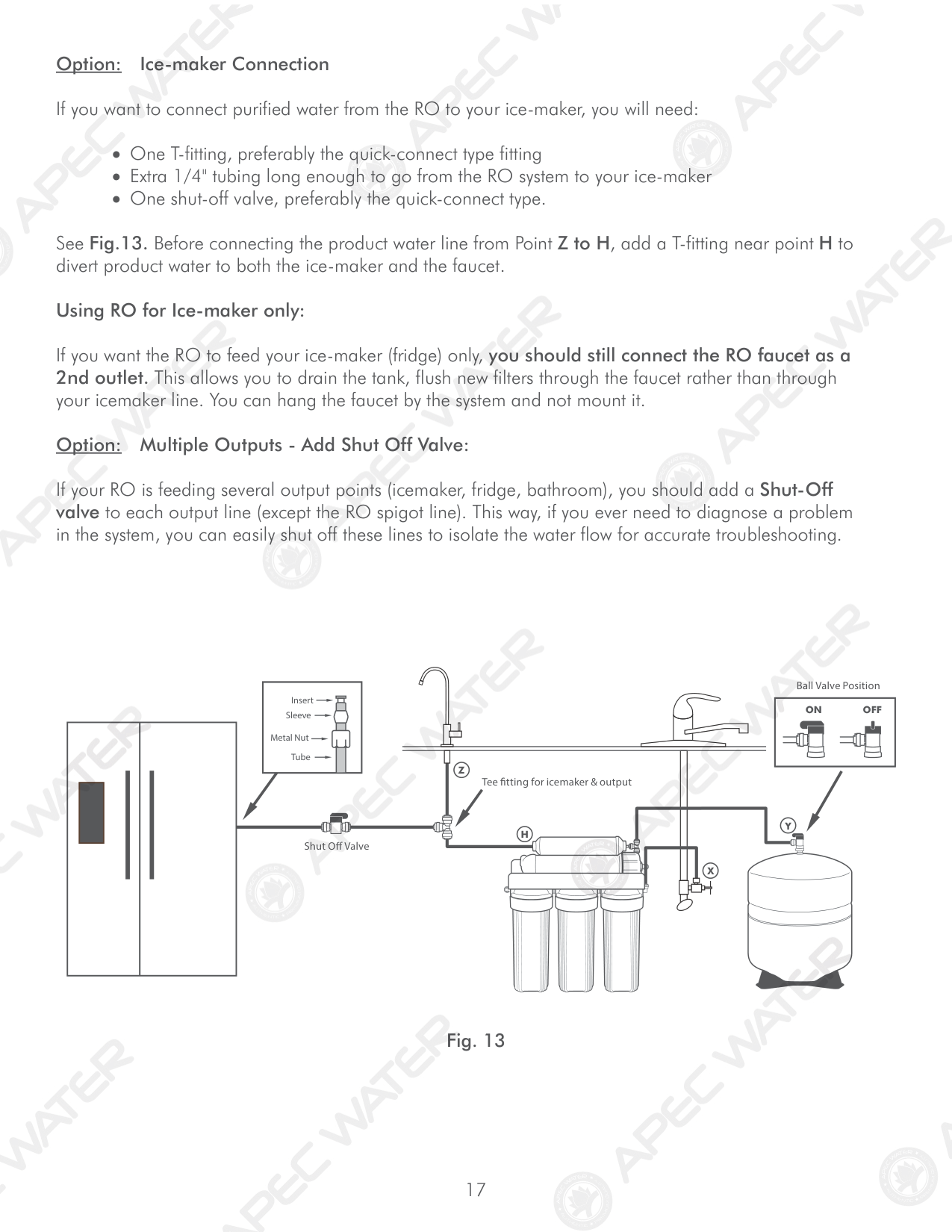
    Option: Ice-maker Connection If you want to connect purified water from the RO to your ice-maker, you will need:

  • • One T-fitting, preferably the quick-connect type fitting
  • • Extra 1/4" tubing long enough to go from the RO system to your ice-maker
  • • One shut-off valve, preferably the quick-connect type.
  • See Fig.13. Before connecting the product water line from Point Z to H, add a T-fitting near point H to divert product water to both the ice-maker and the faucet.

    Using RO for Ice-maker only: If you want the RO to feed your ice-maker (fridge) only, you should still connect the RO faucet as a 2nd outlet. This allows you to drain the tank, flush new filters through the faucet rather than through your icemaker line. You can hang the faucet by the system and not mount it. Option: Multiple Outputs - Add Shut Off Valve: If your RO is feeding several output points (icemaker, fridge, bathroom), you should add a Shut-Off valve to each output line (except the RO spigot line). This way, if you ever need to diagnose a problem in the system, you can easily shut off these lines to isolate the water flow for accurate troubleshooting.

    Ball Valve Position

    Insert Sleeve
    Page 24

    |ON OFF| |---|

    Metal Nut

    Tube

    Z

    Tee tting for icemaker & output

    Y

    H

    Shut O Valve

    X

    Fig. 13

    ![image 138](a4f3ae3e-8524-461e-a687-2b89d1e1aa05_images/imageFile138.png)

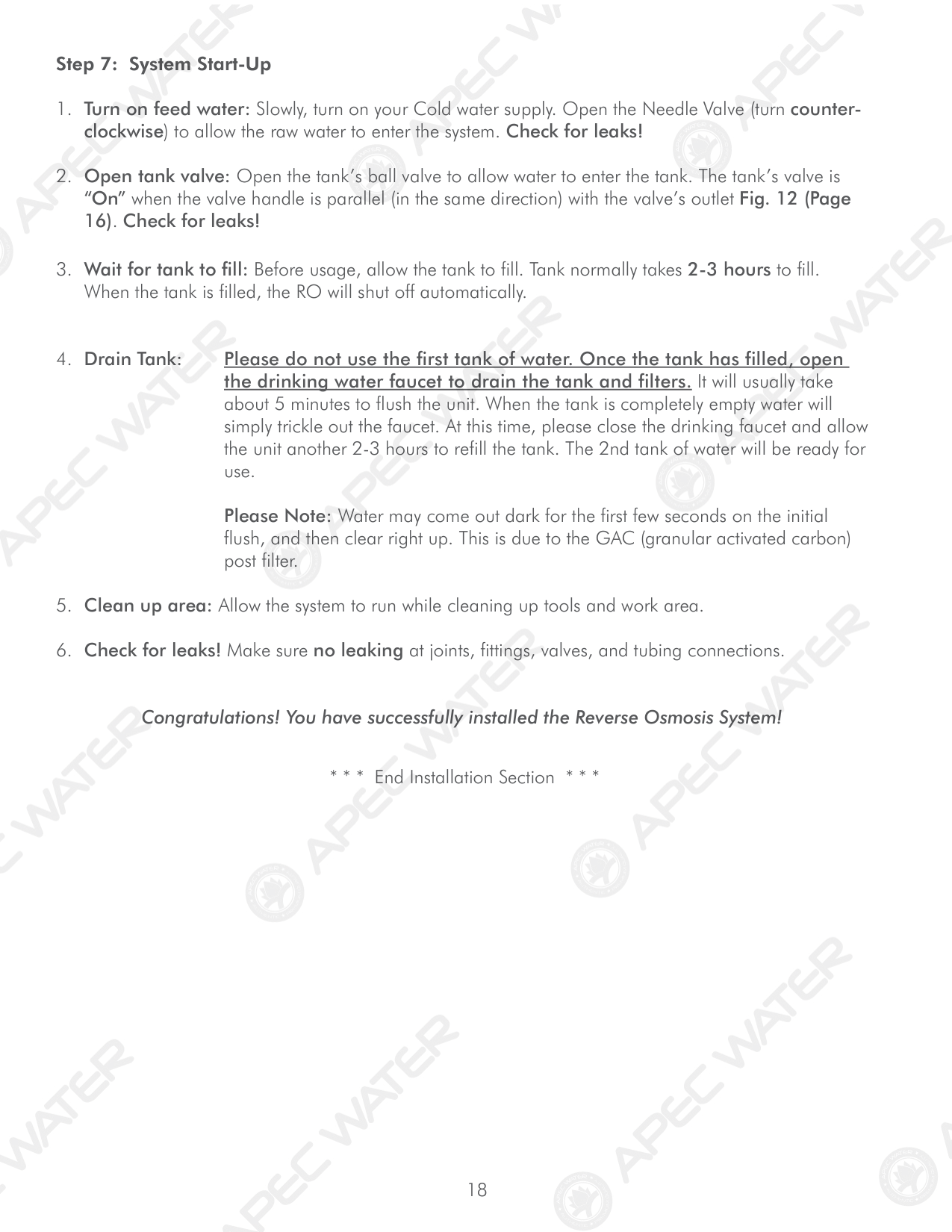
  • Step 7: System Start-Up
  • 1. Turn on feed water: Slowly, turn on your Cold water supply. Open the Needle Valve (turn counterclockwise) to allow the raw water to enter the system. Check for leaks!
  • 2. Open tank valve: Open the tank’s ball valve to allow water to enter the tank. The tank’s valve is “On” when the valve handle is parallel (in the same direction) with the valve’s outlet Fig. 12 (Page 16). Check for leaks!
  • 3. Wait for tank to fill: Before usage, allow the tank to fill. Tank normally takes 2-3 hours to fill. When the tank is filled, the RO will shut off automatically.
  • 4. Drain Tank: Please do not use the first tank of water. Once the tank has filled, open the drinking water faucet to drain the tank and filters. It will usually take about 5 minutes to flush the unit. When the tank is completely empty water will simply trickle out the faucet. At this time, please close the drinking faucet and allow the unit another 2-3 hours to refill the tank. The 2nd tank of water will be ready for use.
  • Page 25

    Please Note: Water may come out dark for the first few seconds on the initial flush, and then clear right up. This is due to the GAC (granular activated carbon) post filter.

  • 5. Clean up area: Allow the system to run while cleaning up tools and work area.
  • 6. Check for leaks! Make sure no leaking at joints, fittings, valves, and tubing connections.
  • Congratulations! You have successfully installed the Reverse Osmosis System!

  • * * End Installation Section * * *
  • ![image 139](a4f3ae3e-8524-461e-a687-2b89d1e1aa05_images/imageFile139.png)

    ![image 140](a4f3ae3e-8524-461e-a687-2b89d1e1aa05_images/imageFile140.png)

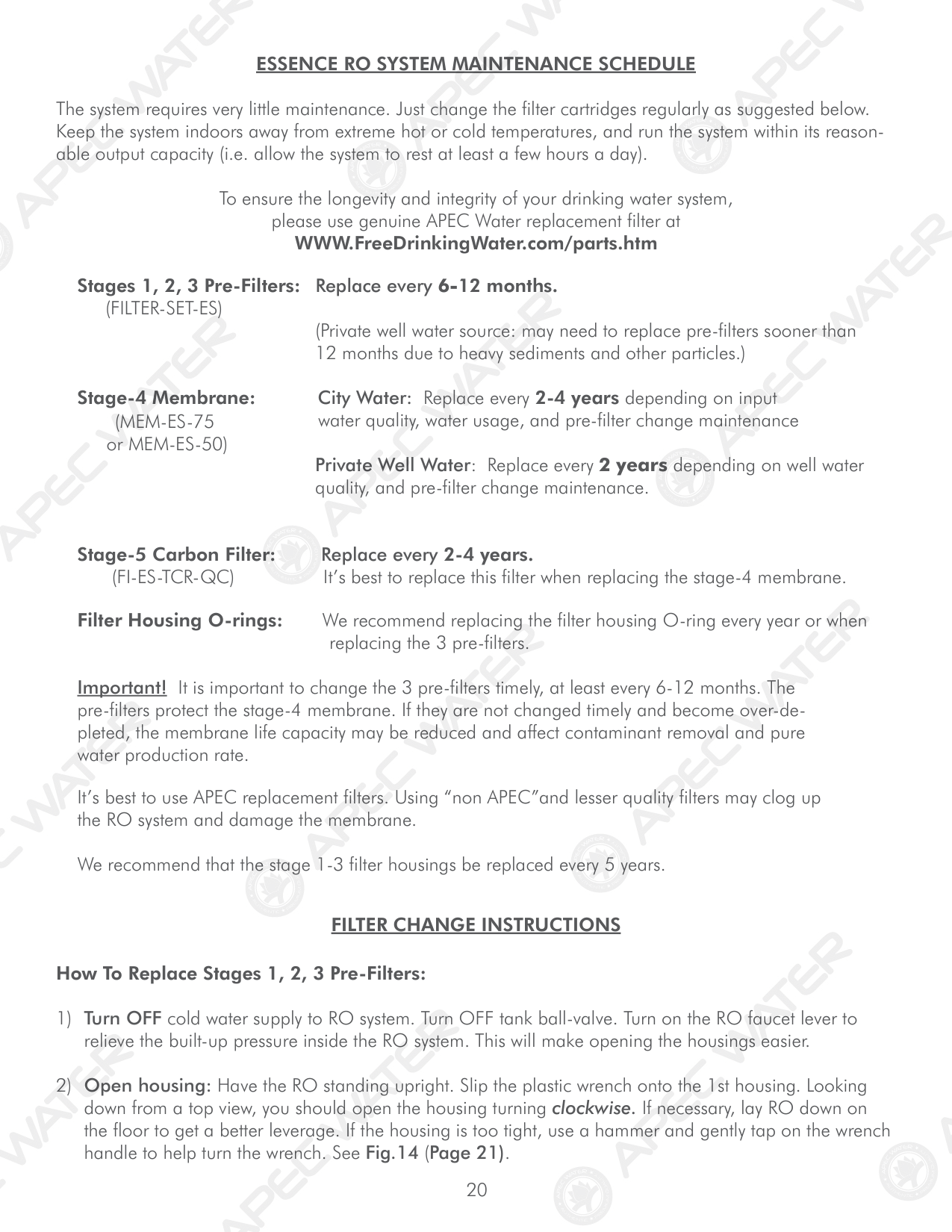
    ESSENCE RO SYSTEM MAINTENANCE SCHEDULE

    The system requires very little maintenance. Just change the filter cartridges regularly as suggested below. Keep the system indoors away from extreme hot or cold temperatures, and run the system within its reasonable output capacity (i.e. allow the system to rest at least a few hours a day).

    To ensure the longevity and integrity of your drinking water system, please use genuine APEC Water replacement filter at WWW.FreeDrinkingWater.com/parts.htm Stages 1, 2, 3 Pre-Filters: Replace every 6-12 months.

    (FILTER-SET-ES)

    (Private well water source: may need to replace pre-filters sooner than 12 months due to heavy sediments and other particles.)

  • Stage-4 Membrane: City Water: Replace every 2-4 years depending on input water quality, water usage, and pre-filter change maintenance
  • Private Well Water: Replace every 2 years depending on well water quality, and pre-filter change maintenance.

  • Stage-5 Carbon Filter: Replace every 2-4 years. (FI-ES-TCR-QC) It’s best to replace this filter when replacing the stage-4 membrane.
  • (MEM-ES-75 or MEM-ES-50)

    Page 26

    Filter Housing O-rings: We recommend replacing the filter housing O-ring every year or when replacing the 3 pre-filters.

    Important! It is important to change the 3 pre-filters timely, at least every 6-12 months. The

    pre-filters protect the stage-4 membrane. If they are not changed timely and become over-depleted, the membrane life capacity may be reduced and affect contaminant removal and pure water production rate.

    It’s best to use APEC replacement filters. Using “non APEC”and lesser quality filters may clog up the RO system and damage the membrane.

    We recommend that the stage 1-3 filter housings be replaced every 5 years.

    FILTER CHANGE INSTRUCTIONS

    How To Replace Stages 1, 2, 3 Pre-Filters:

  • 1) Turn OFF cold water supply to RO system. Turn OFF tank ball-valve. Turn on the RO faucet lever to relieve the built-up pressure inside the RO system. This will make opening the housings easier.
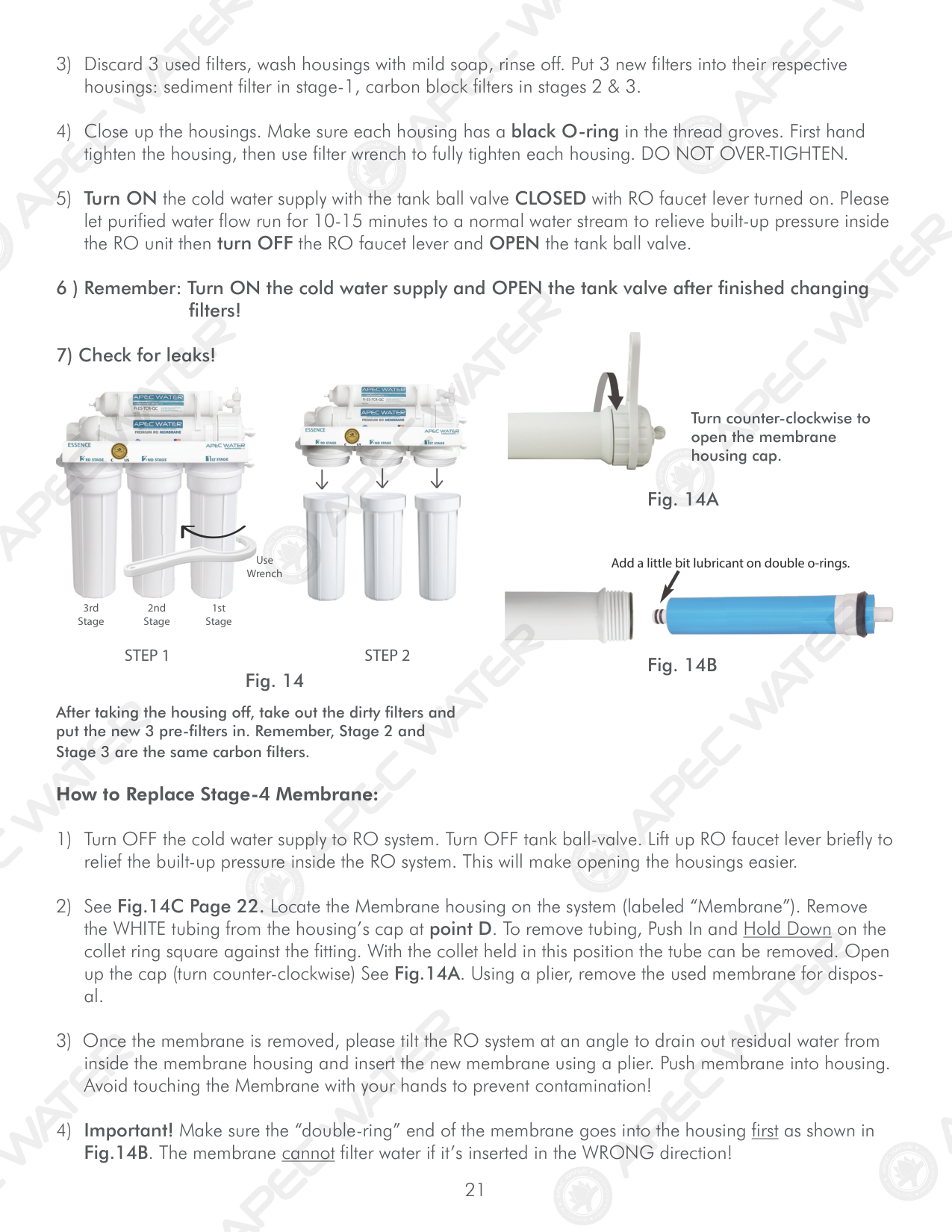
  • 2) Open housing: Have the RO standing upright. Slip the plastic wrench onto the 1st housing. Looking down from a top view, you should open the housing turning clockwise. If necessary, lay RO down on the floor to get a better leverage. If the housing is too tight, use a hammer and gently tap on the wrench handle to help turn the wrench. See Fig.14 (Page 21).
  • ![image 141](a4f3ae3e-8524-461e-a687-2b89d1e1aa05_images/imageFile141.png)

  • 3) Discard 3 used filters, wash housings with mild soap, rinse off. Put 3 new filters into their respective housings: sediment filter in stage-1, carbon block filters in stages 2 & 3.
  • 4) Close up the housings. Make sure each housing has a black O-ring in the thread groves. First hand tighten the housing, then use filter wrench to fully tighten each housing. DO NOT OVER-TIGHTEN.
  • 5) Turn ON the cold water supply with the tank ball valve CLOSED with RO faucet lever turned on. Please let purified water flow run for 10-15 minutes to a normal water stream to relieve built-up pressure inside the RO unit then turn OFF the RO faucet lever and OPEN the tank ball valve.
  • 6 ) Remember: Turn ON the cold water supply and OPEN the tank valve after finished changing filters!
  • 7) Check for leaks!
  • ![image 142](a4f3ae3e-8524-461e-a687-2b89d1e1aa05_images/imageFile142.png)

    ![image 143](a4f3ae3e-8524-461e-a687-2b89d1e1aa05_images/imageFile143.png)

    ![image 144](a4f3ae3e-8524-461e-a687-2b89d1e1aa05_images/imageFile144.png)

    ![image 145](a4f3ae3e-8524-461e-a687-2b89d1e1aa05_images/imageFile145.png)

    Page 27

    ![image 146](a4f3ae3e-8524-461e-a687-2b89d1e1aa05_images/imageFile146.png)

    ![image 147](a4f3ae3e-8524-461e-a687-2b89d1e1aa05_images/imageFile147.png)

    Turn counter-clockwise to open the membrane housing cap.

    ![image 148](a4f3ae3e-8524-461e-a687-2b89d1e1aa05_images/imageFile148.png)

    ![image 149](a4f3ae3e-8524-461e-a687-2b89d1e1aa05_images/imageFile149.png)

    ![image 150](a4f3ae3e-8524-461e-a687-2b89d1e1aa05_images/imageFile150.png)

    ![image 151](a4f3ae3e-8524-461e-a687-2b89d1e1aa05_images/imageFile151.png)

  • Fig. 14A
  • Fig. 14B
  • ![image 152](a4f3ae3e-8524-461e-a687-2b89d1e1aa05_images/imageFile152.png)

    ![image 153](a4f3ae3e-8524-461e-a687-2b89d1e1aa05_images/imageFile153.png)

    ![image 154](a4f3ae3e-8524-461e-a687-2b89d1e1aa05_images/imageFile154.png)

    ![image 155](a4f3ae3e-8524-461e-a687-2b89d1e1aa05_images/imageFile155.png)

    ![image 156](a4f3ae3e-8524-461e-a687-2b89d1e1aa05_images/imageFile156.png)

    ![image 157](a4f3ae3e-8524-461e-a687-2b89d1e1aa05_images/imageFile157.png)

    Add a little bit lubricant on double o-rings.

    Use Wrench
    Page 28

    ![image 158](a4f3ae3e-8524-461e-a687-2b89d1e1aa05_images/imageFile158.png)

    W

    ![image 159](a4f3ae3e-8524-461e-a687-2b89d1e1aa05_images/imageFile159.png)

    ![image 160](a4f3ae3e-8524-461e-a687-2b89d1e1aa05_images/imageFile160.png)

    ![image 161](a4f3ae3e-8524-461e-a687-2b89d1e1aa05_images/imageFile161.png)

    ![image 162](a4f3ae3e-8524-461e-a687-2b89d1e1aa05_images/imageFile162.png)

    ![image 163](a4f3ae3e-8524-461e-a687-2b89d1e1aa05_images/imageFile163.png)

    3rd Stage

    1st Stage

    2nd Stage

    STEP 1 STEP 2

    Fig. 14

    After taking the housing off, take out the dirty filters and put the new 3 pre-filters in. Remember, Stage 2 and Stage 3 are the same carbon filters.
  • How to Replace Stage-4 Membrane:
  • 1) Turn OFF the cold water supply to RO system. Turn OFF tank ball-valve. Lift up RO faucet lever briefly to relief the built-up pressure inside the RO system. This will make opening the housings easier.
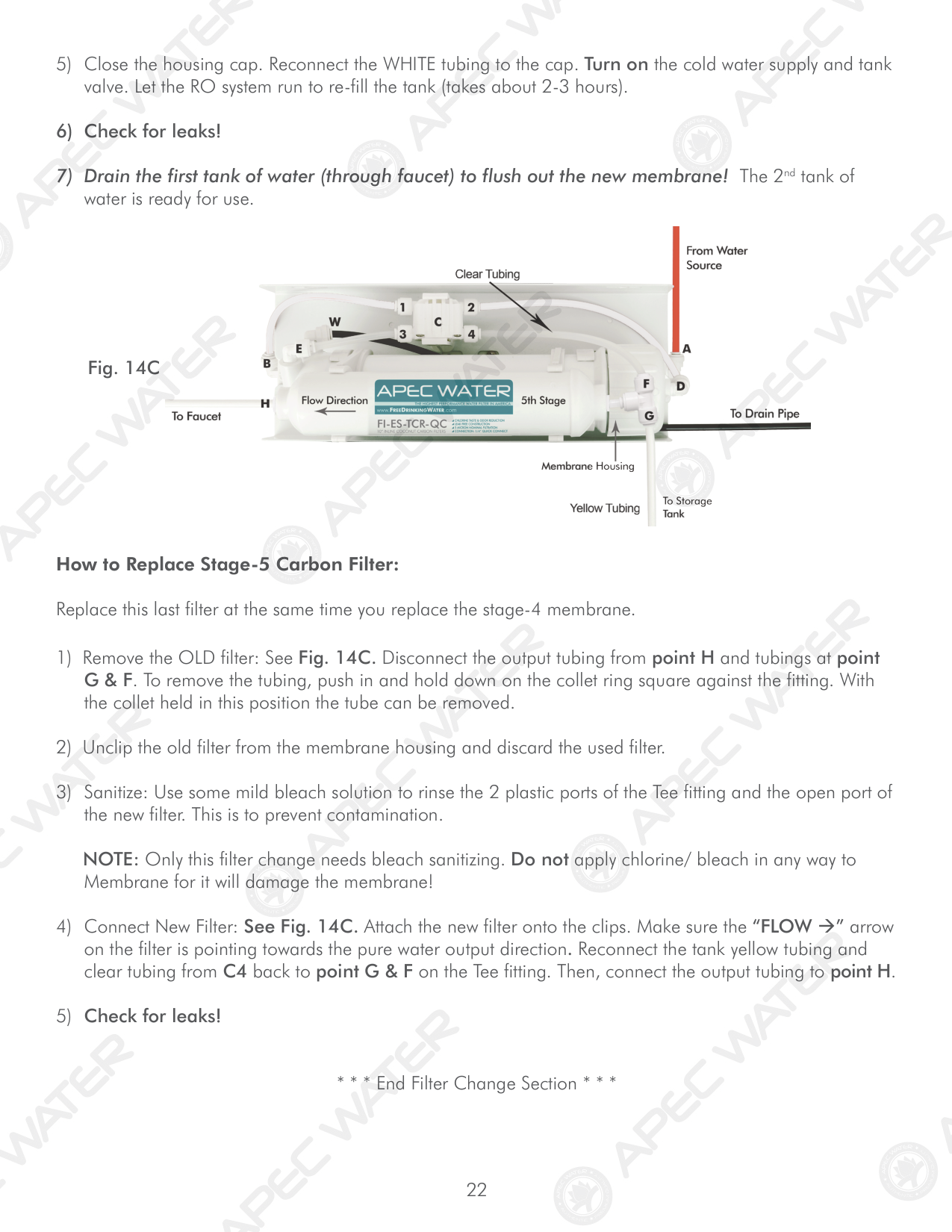
  • 2) See Fig.14C Page 22. Locate the Membrane housing on the system (labeled “Membrane”). Remove the WHITE tubing from the housing’s cap at point D. To remove tubing, Push In and Hold Down on the collet ring square against the fitting. With the collet held in this position the tube can be removed. Open up the cap (turn counter-clockwise) See Fig.14A. Using a plier, remove the used membrane for disposal.
  • 3) Once the membrane is removed, please tilt the RO system at an angle to drain out residual water from inside the membrane housing and insert the new membrane using a plier. Push membrane into housing. Avoid touching the Membrane with your hands to prevent contamination!
  • 4) Important! Make sure the “double-ring” end of the membrane goes into the housing first as shown in Fig.14B. The membrane cannot filter water if it’s inserted in the WRONG direction!
  • Page 29

    ![image 164](a4f3ae3e-8524-461e-a687-2b89d1e1aa05_images/imageFile164.png)

  • 5) Close the housing cap. Reconnect the WHITE tubing to the cap. Turn on the cold water supply and tank valve. Let the RO system run to re-fill the tank (takes about 2-3 hours).
  • 6) Check for leaks!
  • 7) Drain the first tank of water (through faucet) to flush out the new membrane! The 2nd tank of water is ready for use.
  • ![image 165](a4f3ae3e-8524-461e-a687-2b89d1e1aa05_images/imageFile165.png)

    Fig. 14C

  • How to Replace Stage-5 Carbon Filter: Replace this last filter at the same time you replace the stage-4 membrane.
  • 1) Remove the OLD filter: See Fig. 14C. Disconnect the output tubing from point H and tubings at point G & F. To remove the tubing, push in and hold down on the collet ring square against the fitting. With the collet held in this position the tube can be removed.
  • 2) Unclip the old filter from the membrane housing and discard the used filter.
  • 3) Sanitize: Use some mild bleach solution to rinse the 2 plastic ports of the Tee fitting and the open port of the new filter. This is to prevent contamination.
  • NOTE: Only this filter change needs bleach sanitizing. Do not apply chlorine/ bleach in any way to Membrane for it will damage the membrane!

  • 4) Connect New Filter: See Fig. 14C. Attach the new filter onto the clips. Make sure the “FLOW ” arrow on the filter is pointing towards the pure water output direction. Reconnect the tank yellow tubing and clear tubing from C4 back to point G & F on the Tee fitting. Then, connect the output tubing to point H.
  • 5) Check for leaks!
  • * * End Filter Change Section * * *
  • ![image 166](a4f3ae3e-8524-461e-a687-2b89d1e1aa05_images/imageFile166.png)

    OWNER’S MANUAL

    ####### Please read this section for useful RO system and maintenance information.
    Page 30

    TABLE OF CONTENT

  • Part I: RO Basics
  • Basic terms ................................................................................. page 24 System flow diagram ................................................................... page 24 Water pressure -- The most important factor ............................... page 25 Tank -- Fill up time. Fill up volume. Delivery pressure ............... page 25-26 Icemaker and multiple output points ........................................... page 26 Insufficient water Pressure -- Problems with non-pump systems .... page 27 How to test your water pressure ................................................. page 27 Premature membrane failure ...................................................... page 27

  • Part II: Trouble-shoot Guide
  • RO Head diagram ....................................................................... page 28 Air bubbles ................................................................................. page 29 No water at dispensing faucet ...................................................... page 29 Slow output ................................................................................. page 30 Filter housing is leaking ............................................................... page 30 TDS (Total Dissolved Solids) Level Reads Higher Than Normal ....... page 31 There is a leak at the tank ball valve connection .......................... page 32 System shut off is abnormal ......................................................... page 32 How to Test RO’s Shut-Off Function .............................................. page 33 Pure water still tastes like tap water ............................................. page 33 RO Makes Humming Noise ......................................................... page 34

    ![image 167](a4f3ae3e-8524-461e-a687-2b89d1e1aa05_images/imageFile167.png)

    ###### Part I: RO BASICS

    This section provides basic concepts on how an ROES system works, how it performs in relation to your house’s water condition. We hope this information helps keep your ROES system running at top performance for years to come.

  • 1) Basic Terms
  • GPD = Gallons Per Day (flow rate) PSI = Pounds per Square Inch (pressure) TDS = Total Dissolved Solids (contaminants) PPM = Parts Per Million (unit used to measure TDS level) TDS Meter = A digital meter for measuring the TDS level in the water

  • 2) Flow Diagram for 5-Stage RO System:
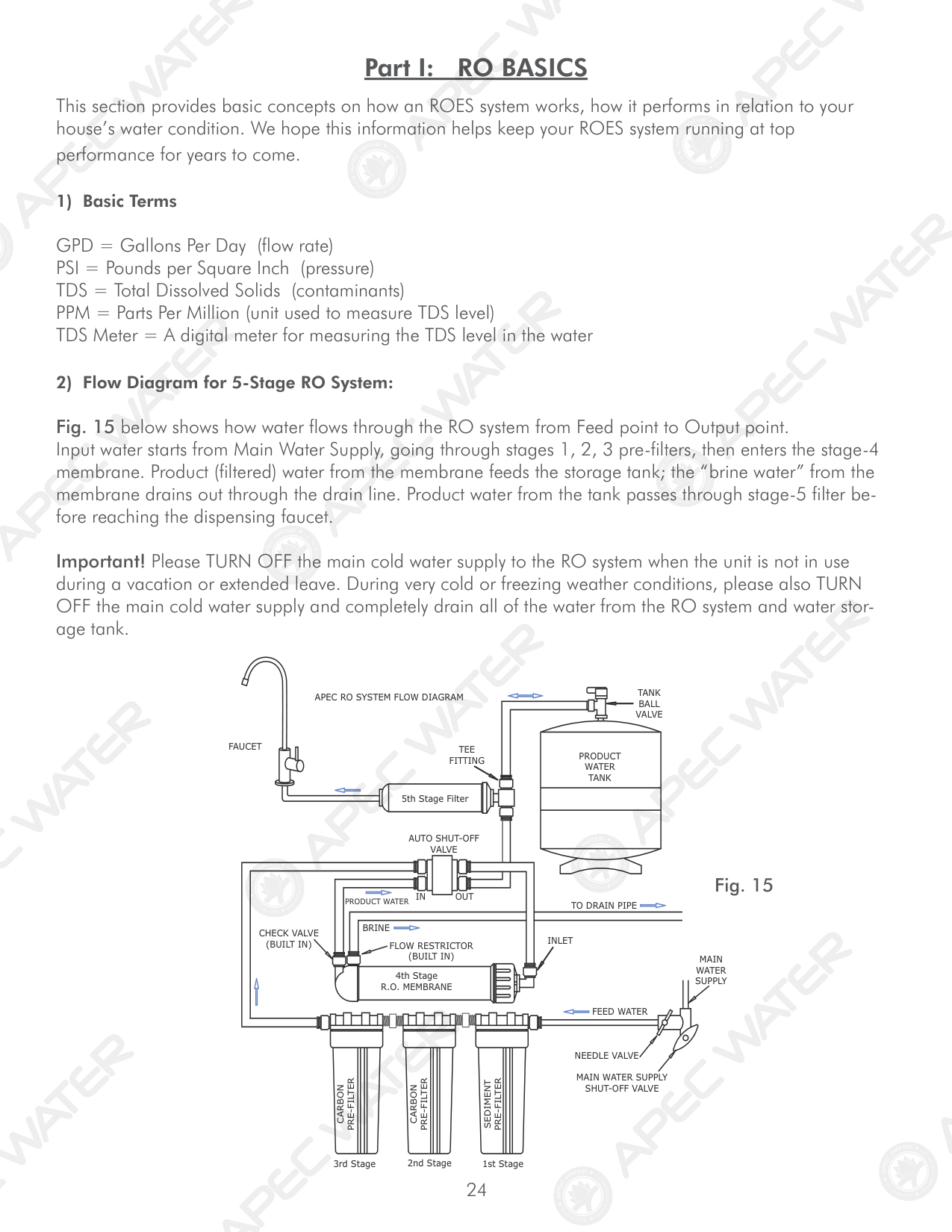
  • Fig. 15 below shows how water flows through the RO system from Feed point to Output point. Input water starts from Main Water Supply, going through stages 1, 2, 3 pre-filters, then enters the stage-4 membrane. Product (filtered) water from the membrane feeds the storage tank; the “brine water” from the membrane drains out through the drain line. Product water from the tank passes through stage-5 filter before reaching the dispensing faucet.

    Important! Please TURN OFF the main cold water supply to the RO system when the unit is not in use during a vacation or extended leave. During very cold or freezing weather conditions, please also TURN OFF the main cold water supply and completely drain all of the water from the RO system and water storage tank.

    TANK BALL VALVE

    APEC RO SYSTEM FLOW DIAGRAM

    |PRODUCT WATER TANK| |---|
    Page 31

    | | | |

    FAUCET

    TEE FITTING

    |5th Stage Filter| | |---|---|

    AUTO SHUT-OFF VALVE

    Fig. 15

    PRODUCT WATER IN OUT

    TO DRAIN PIPE BRINE

    CHECK VALVE (BUILT IN)

    INLET

    FLOW RESTRICTOR (BUILT IN)

    MAIN WATER SUPPLY

    4th Stage R.O. MEMBRANE

    | | | |---|---| | | | | | |
    Page 32

    FEED WATER

    | | | | | | | | |---|---|---|---|---|---|---| | | | | | | | | | | | | | | | |

    | | | | | | | | | | | |---|---|---|---|---|---|---|---|---|---| | | | | | | | | | | |

    NEEDLE VALVE MAIN WATER SUPPLY SHUT-OFF VALVE

    PRE-FILTER

    PRE-FILTER

    PRE-FILTER

    SEDIMENT

    CARBON

    CARBON

    2nd Stage3rd Stage 1st Stage

    ![image 168](a4f3ae3e-8524-461e-a687-2b89d1e1aa05_images/imageFile168.png)

  • 3) Water Pressure – The Most Important Factor!
  • Page 33

    RO systems run on water pressure. Therefore your water pressure has the most direct effect on how well your RO will perform. With sufficient water pressure (85 psi max.), your RO system will function well, give high output with high removal rate, and fill up the storage tank quickly.

  • 4) TDS Meter (Option) – How to Test Your Water Quality:
  • The TDS meter is used to test your water’s quality before and after the RO system. It also tells you when the membrane needs to be changed.

    Please follow instructions below: Use 2 clean glasses, fill one glass with Tap water, fill the other glass with Product (filtered) water (rinse this glass with filtered water several times to get an accurate reading). Remove the Sensor cap on the TDS meter and rinse the meter sensor with filtered water several times, then Turn on the meter.

    The meter will show “000” reading on its screen. Place the TDS meter into the Product water. Record Product water’s TDS reading. Then do the same for the Tap water. Record the Tap water’s reading. Compare the 2 readings.

    The Product water’s TDS should be about 3%-10% of your Tap water’s TDS. This is a normal range.

    For example: Your Tap water’s TDS: 100 ppm Your Product water’s TDS should read within: 10% of 100ppm => 10ppm

    This means that with 100 ppm input, the RO system has removed 90% of the contaminants (TDS) from the source, leaving only 10% (10 ppm) residual TDS in the Product water. This is a normal range. Which means the RO membrane is in good condition.

    If your Product water TDS reads less than 10%, that is a very good and normal reading.

    You should test your water once or twice a year to monitor the membrane condition. As the membrane gets depleted overtime, its rejection capacity will decrease. When this happens, the TDS in the Product water will increase.

    When your Product water TDS creeps up to 15%- 20% of input water’s TDS, it’s time to replace the membrane.

  • 5) How Long Does It Take to Fill Tank?
  • |Substance|Influent challenge concentration (mg/L)|Maximum permissible product water concentration mg/L| |---|---|---| |Total Dissolved Solids|750±40 mg/L|187|

    ############ Depending on your water pressure, the standard tank will fill up in 2-3 hours. After the tank is filled, the RO will shut off automatically.

    ![image 169](a4f3ae3e-8524-461e-a687-2b89d1e1aa05_images/imageFile169.png)

    Page 34

  • 6) How Full Can My Tank Fill Up?
  • Your water pressure and temperature will determine how full and how fast the storage tank will be filled up. The stronger your input water pressure, the faster and fuller the tank can fill. If water pressure is low, the tank will fill slower and will not fill up to its full capacity.

    For a non-pumped RO system: The 4* gallon tank will fill up according to your input water pressure as follows: Input 70+ psi —> tank fills 3.1 gallon ( almost 100% full ) Input 60 psi —> tank fills 2.8 gallon ( about 88% full ) Input 50 psi —> tank fills 2.5 gallon ( about 70% full ) Input 40 psi —> tank fills 1.9 gallon ( about 50% full ) So, if your input water pressure is low, the tank will not fill up to full.

  • 4-gal refers to tank’s total volume (air space & bladder). At 80-90psi, tank bladder’s capacity is around 3.2 gallons.
  • 7) How Much Pressure Can RO Deliver to My Ice-Maker?
  • The RO’s delivery pressure depends on how full the tank is. The pressure is high when tank is full, and drops when tank depletes. See chart below for 4-gallon tank.

    4-gallon tank’s delivery pressure:

    3.0 gallon —> 50 psi output/delivery pressure (pressure inside tank) 2.5 gallon —> 36 psi 2.0 gallon —> 24 psi 1.5 gallon —> 18 psi 1.0 gallon —> 14 psi

  • 0.5 gallon —> 10 psi Tank empty —> 5 psi (pre-charged pressure)
  • 8) Ice-Maker Inlet Pressure Requirement:
  • If your ice-maker requires a minimum input water pressure of 20-30psi, you need to have at least 50+psi input water pressure going into your non-pump RO system. If your water pressure is under 50psi, the tank will not fill up enough, and the delivery pressure to your ice-maker may be sluggish and unstable. To boost output pure water pressure, you can add a Permeate Pump to your RO system.

  • 9) Feeding Multiple Outlets:
  • Feeding the filtered water to multiple outlets is doable. The key is choosing the right RO model that fits your house’s water pressure level. This model should fill up the tank quickly and fully. A frequently full tank will then provide good delivery pressure to feed the multiple outlets in your house.

    We suggest limiting output points to no more than 3 outlets. Total tubing distance should be within 40 ft. horizontal and 15 ft. vertical from the RO system (more or less).

    ![image 170](a4f3ae3e-8524-461e-a687-2b89d1e1aa05_images/imageFile170.png)

  • 10) Insufficient Water Pressure – Problems with Non-Pump RO Systems: The 3 most common problems caused by low input water pressure:
  • Page 35

  • 1) Tank does not fill up, get little water from tank
  • 2) Sluggish flow at the dispensing faucet
  • 3) RO makes water slower than the claimed GPD
  • If you experience these problems, Please check your input water pressure as the first step. This will often solve the above listed problems.

  • 11) How to Test Your Water Pressure:
  • Get a water pressure gauge that adapts onto your sink or garden faucet (from hardware store), attach gauge onto faucet, turn water on to FULL, then take a reading.

    For some areas, water pressure is lower during the day and higher at night when less people are using water. So to get an accurate average, take several measurements at different times of the day and average them out.

  • 12) Premature Membrane Failure: There are 4 common causes that lead to premature membrane failure:
  • 1. Failing to replace the 3 pre-filters as frequently as needed:
  • If you’re on city water: The over-depleted carbon pre-filters allow the chlorine to get through and damage the membrane.

    If you’re on private well water: The overloaded pre-filters allow excessive sediments and particles to get through and clog up the membrane surface.

  • 2. Your water source may contain certain organic or chemical compounds that form a slimy film which covers up the membrane’s surface. This will disable the membrane prematurely. In this case, adding a UV light could help extend the membrane’s life.
  • 3. Your water source is extremely hard. This will clog up the membrane with heavy calcification. Adding a water softener will help greatly.
  • 4. If the drain water flow is somehow restricted or blocked, the membrane will be damaged prematurely. So please check to make sure the drain water is draining off unhindered.
  • * * End RO Basics Section * * *
  • ![image 171](a4f3ae3e-8524-461e-a687-2b89d1e1aa05_images/imageFile171.png)

    ###### Part II: Trouble-Shoot Guide For Newly Installed RO System
    Page 36

    After installation, if you encounter any of the problems described below, please follow this guide to troubleshoot. In most cases, the problem is quickly solved by following this guide.

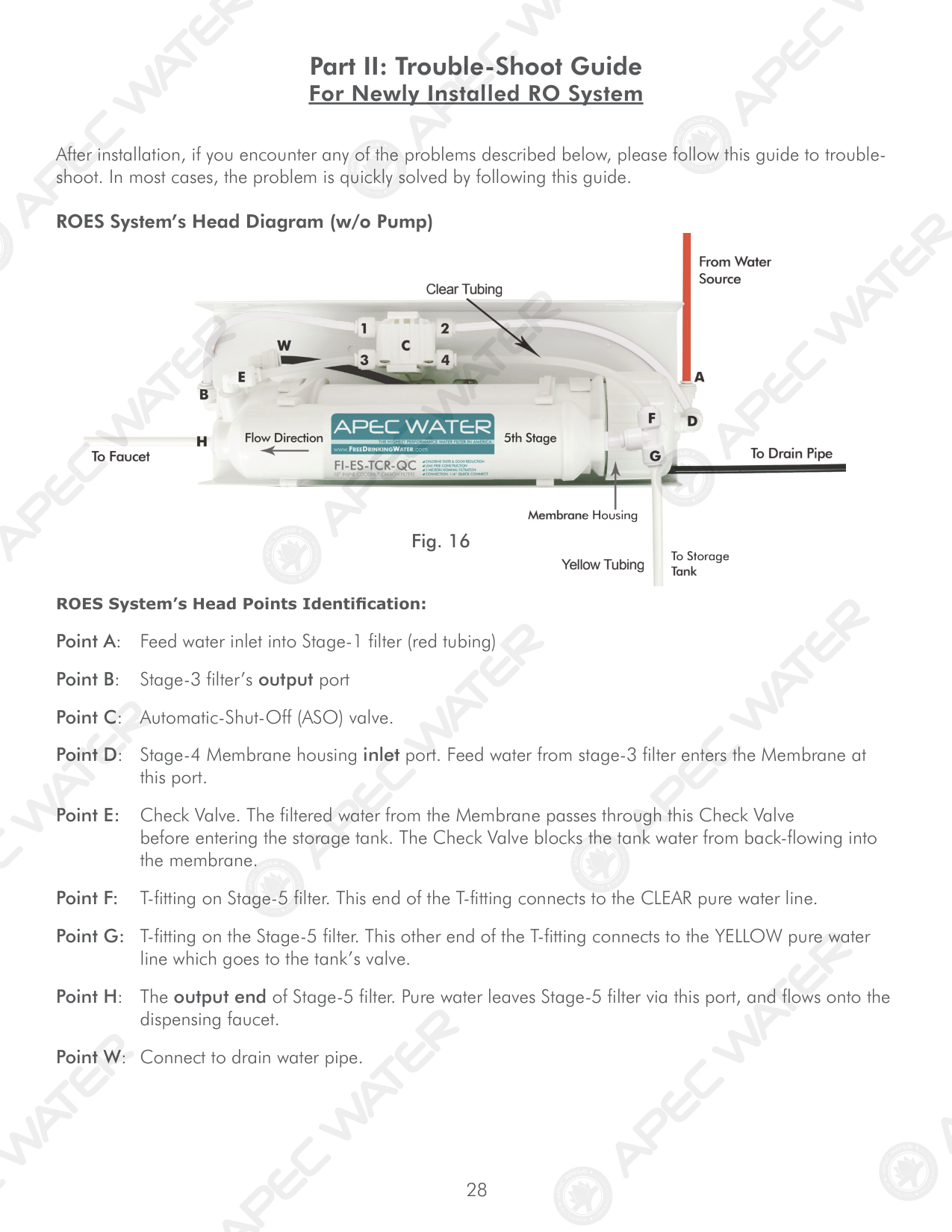
    ROES System’s Head Diagram (w/o Pump)

    ![image 172](a4f3ae3e-8524-461e-a687-2b89d1e1aa05_images/imageFile172.png)

    Fig. 16

    ROES System’s Head Points Identification:

  • Point A: Feed water inlet into Stage-1 filter (red tubing)
  • Point B: Stage-3 filter’s output port
  • Point C: Automatic-Shut-Off (ASO) valve.
  • Point D: Stage-4 Membrane housing inlet port. Feed water from stage-3 filter enters the Membrane at this port.
  • Point E: Check Valve. The filtered water from the Membrane passes through this Check Valve before entering the storage tank. The Check Valve blocks the tank water from back-flowing into the membrane.
  • Point F: T-fitting on Stage-5 filter. This end of the T-fitting connects to the CLEAR pure water line.
  • Point G: T-fitting on the Stage-5 filter. This other end of the T-fitting connects to the YELLOW pure water line which goes to the tank’s valve.
  • Point H: The output end of Stage-5 filter. Pure water leaves Stage-5 filter via this port, and flows onto the dispensing faucet.
  • Point W: Connect to drain water pipe.

    ![image 173](a4f3ae3e-8524-461e-a687-2b89d1e1aa05_images/imageFile173.png)

    1) Air Bubbles: Lots of Air bubbles in cup or bottle when filling

    It is quite normal to see air bubbles in a cup of pure water. This mainly occurs when a RO unit is first installed or when filters are being replaced. When new filters are installed to the unit, the filter housings are dry. When they are attached onto the RO head, air pockets will fill the housing. As water is turned on and flows through the unit, the air pockets move throughout the system. This can have an effect on the appearance of air bubbles in the water.

    RO units will self purge the air bubbles that can accumulate inside the unit. As you continue to draw water, trapped air will be removed by the water flow and you should quickly see a reduction in the bubbles inside the water cup. You can also drain 1-2 tanks of water to quickly purge the air bubbles.
  • 2) No Water at Dispensing Faucet
  • - Water supply is off —> Turn on the water supply, or open Needle Valve ( turn needle handle counter clockwise)
  • Page 37

  • - Tank’s valve is closed —> Turn tank valve to an “Open” position
  • - Output line is crimped —> Remove crimp
  • - Incorrect installation —> See Fig.11 (Page 14). Verify all line connections.
  • - Low tank pre-charge pressure —> Raise tank air pressure to 5-7 psi.
  • - ASO connection Error —> See Fig. 17 to reconnect ASO to the correct connection.
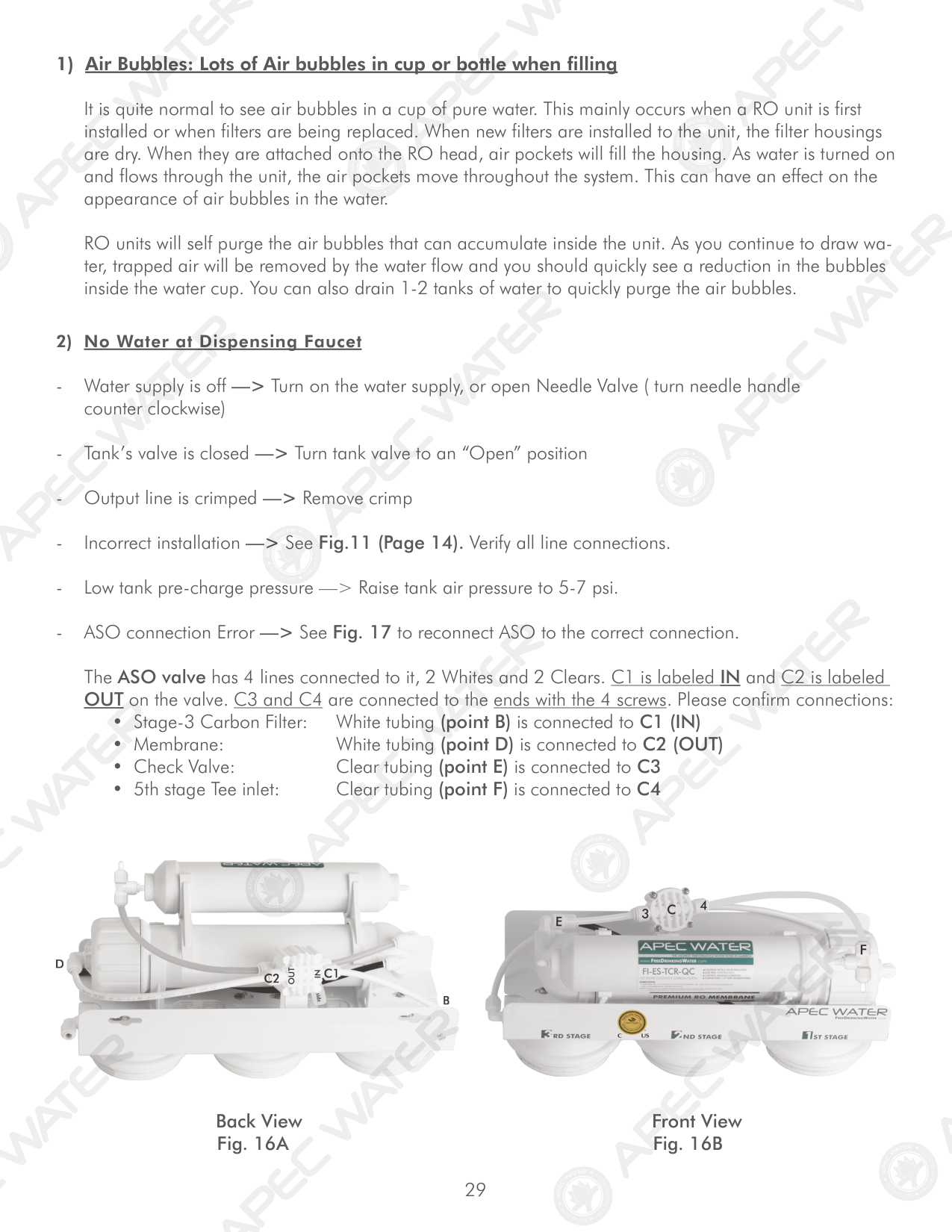
  • The ASO valve has 4 lines connected to it, 2 Whites and 2 Clears. C1 is labeled IN and C2 is labeled OUT on the valve. C3 and C4 are connected to the ends with the 4 screws. Please confirm connections:

  • • Stage-3 Carbon Filter: White tubing (point B) is connected to C1 (IN)
  • • Membrane: White tubing (point D) is connected to C2 (OUT)
  • • Check Valve: Clear tubing (point E) is connected to C3
  • • 5th stage Tee inlet: Clear tubing (point F) is connected to C4
  • ![image 174](a4f3ae3e-8524-461e-a687-2b89d1e1aa05_images/imageFile174.png)

    ![image 175](a4f3ae3e-8524-461e-a687-2b89d1e1aa05_images/imageFile175.png)

    Back View

    Front View

    Fig. 16A

    Fig. 16B

    ![image 176](a4f3ae3e-8524-461e-a687-2b89d1e1aa05_images/imageFile176.png)

  • 3) Sluggish Flow At Dispensing Faucet
  • - Insufficient water pressure (see “RO Basics” for explanation) —> Check water pressure. If too low for this chosen RO model, either increase your water pressure or add pump to RO system.
  • - Input water to RO is blocked —> Make sure Feed water valve is fully opened and unhindered.
  • Page 38

  • - Tank not filled yet —> Wait until tank is more filled, takes 2-3 hours average.
  • - Low tank pre-charge pressure —> Raise tank pre-charge to 5-7 psi.
  • 4) Tank Takes Long Time To Fill (does not meet claimed GPD)

  • - Insufficient water pressure (below 50 psi for non-pump systems) —> Increase house water pressure or add an appropriate pump to system.
  • - Low water temperature (below 77 degree F ) —> Increase house water pressure or add pump to compensate for low (cold) water temperature.
  • Claimed GPD:

    The claimed gallon per day (GPD) flow rate for each RO model is rated based on 60 psi input water pressure at 77 degree F water temperature. At this standard water pressure and temperature, the ROES 50 gpd system should make about 2.08 gal of filtered water per hour, the 4-gal tank should fill in 1.5-2 hours.

    Lower water pressure and colder temperature will slow the system’s output to less than the claimed GPD flow rate. Please check your water pressure as the first step in determining the cause of slow flow rate (low GPD).

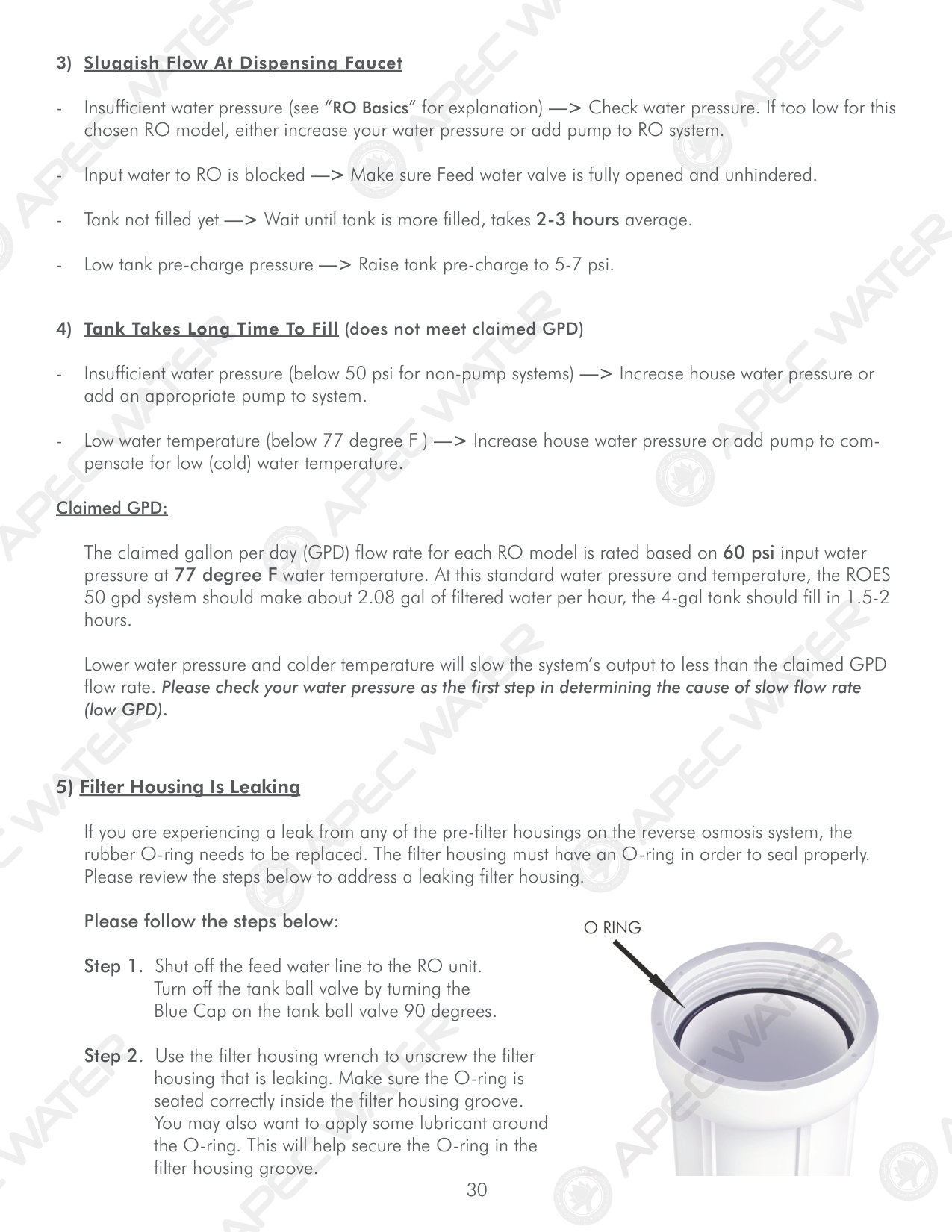
  • 5) Filter Housing Is Leaking
  • If you are experiencing a leak from any of the pre-filter housings on the reverse osmosis system, the rubber O-ring needs to be replaced. The filter housing must have an O-ring in order to seal properly. Please review the steps below to address a leaking filter housing.

    ![image 177](a4f3ae3e-8524-461e-a687-2b89d1e1aa05_images/imageFile177.png)

    Please follow the steps below:

  • Step 1. Shut off the feed water line to the RO unit. Turn off the tank ball valve by turning the Blue Cap on the tank ball valve 90 degrees.
  • Step 2. Use the filter housing wrench to unscrew the filter housing that is leaking. Make sure the O-ring is seated correctly inside the filter housing groove. You may also want to apply some lubricant around the O-ring. This will help secure the O-ring in the filter housing groove.
  • ![image 178](a4f3ae3e-8524-461e-a687-2b89d1e1aa05_images/imageFile178.png)

  • Step 3. Re-attach the filter housing to the RO head. Hand tighten the housing, then use the filter housing wrench and simply give an additional quarter inch turn. Do Not over tighten the housing.
  • Step 4. Open the tank ball valve and feed water line. Check for leaks. If the filter housing continues to leak, please contact APEC technician for replacement assistance.
  • Page 39

  • 6) TDS (Total Dissolved Solids) Level Reads Higher Than Normal
  • How to test TDS correctly: See “TDS Meter -- How to Test Your Water Quality” instructions on page

  • If the filtered water’s TDS reads higher than the normal 10% range, these are the possible causes:
  • - Forgot to insert membrane into its housing —> Put membrane into housing.
  • - Membrane is inserted incorrectly —> Re-insert membrane correctly. See Fig.14B, page 21.
  • - Water pressure too low, causing TDS to be higher than usual —> Raise water pressure or add pump to RO.
  • - Input source water has very high TDS and/or contains certain heavy dissolved elements resulting in TDS higher than usual.
  • - Drain water flow is restricted or clogged —> Check and re-align the drain saddle and drain line.
  • - Your input water’s TDS fluctuates resulting in high “composite” TDS in the holding tank —> To verify this, test the filtered water’s TDS before it enters the tank. Do test as follows:
  • Test #1 TDS from tank: Dispense some water from the RO faucet, this water comes directly from the tank. Test TDS, record the reading, then Do Test #2.
  • Test #2 TDS bypassing tank: Turn OFF tank valve. Disconnect the Yellow line from the tank’s valve. A stream of filtered water will trickle out of the Yellow line. Let the water trickle freely for about 1 minute, then Catch some water here and do a TDS test. The TDS here is the actual “real time TDS” the RO is producing before water enters the tank. Compare this TDS reading with the tank’s TDS you get in Test #1.
  • If tank TDS is higher than Yellow line TDS, that means your source water’s TDS level fluctuates over time. So, from day to day, the TDS highs and lows accumulate in the tank resulting in a high “composite TDS” reading. This is especially true if you’re on a private well. The well pump’s fluctuating pressure cycles also cause TDS to go up and down. In this case, the “real-time” TDS from the Yellow line (prior to the tank) is the system’s true performance. If this number is within 10% of your tap TDS, then it is within an acceptable range, and your RO system is working fine.

    Drawing more water can help stabilize the TDS. If you are only drawing a small amount of water every time, the unit will quickly turn On and Off, not allowing the membrane to receive full inlet pressure, causing a spike in the TDS.

    ![image 179](a4f3ae3e-8524-461e-a687-2b89d1e1aa05_images/imageFile179.png)

  • 7) There is a leak at the Tank ball valve connection
  • If you are experiencing a leak from where the tank ball valve attaches to the tank stem, you may not have applied enough Teflon tape to the stem when you first installed the valve. To correct this issue, please turn off the supply water to the system and turn on the drinking water faucet to completely empty the tank. Then, unscrew the tank ball valve and apply 6-8 wraps of Teflon Tape to the tank stem and screw on the tank ball valve back onto the tank. Please double check the connection for leaks.
  • 8) System Slow Shut-Off: Drain water runs for hours (6-7 hrs) - but Eventually Stops
  • Page 40

    The most common cause for “slow-shut-off” is insufficient input water pressure. RO needs sufficient input pressure to shut off promptly.

  • - Input water pressure too low (below 40psi). Not enough pressure to shut off RO promptly —> Check input water pressure. If pressure is low, boost house pressure or add pump to RO.
  • - Feed water valve partially blocked, not opened fully, reducing input water pressure to RO —> Check and fix feed water valve, make sure it is opened fully to allow maximum pressure to RO.
  • - Stages 1, 2, 3 pre-filters partially clogged, reducing the input water pressure in RO —> Check stage-1 filter to see if it’s very dirty. If this filter has turned brown or other color in just 1-3 months, that means your input water has very heavy sediments and other clogging agents. Need to replace stage-1 filter frequently.
  • - RO busy feeding multiple output points —> If your RO feeds multiple outlets (icemaker, bathroom, aquarium), the drain water will run as long as the RO is making water to fill the tank and other output points. In this case, it’s normal to hear drain water running. NOTE: Very cold tap water temperature may cause slower shut off
  • 9) System Does Not Shut-Off: Drain water runs all day - and Never Stops
  • - Input pressure way too low (below 30psi). Not enough pressure to shut off the RO at all —> Check input water pressure. If pressure is below 30psi, need switch to Booster-Pumped RO model. Contact APEC customer service for assistance.
  • - If you would like to perform a shut-off test to see if your RO’s shut-off function is working normally, please perform the test below.
  • ![image 180](a4f3ae3e-8524-461e-a687-2b89d1e1aa05_images/imageFile180.png)

  • 10)How to Test RO’s Shut-Off Function:
  • The RO system should shut off automatically when the tank is filled. When the RO fails to shut off after tank is filled, drain water will keep running down the drain depleting the pre-filters, the membrane, and may lead to higher water bills. To test if your RO system is shutting down normally, please follow the steps below.
  • - Draw 3-4 glasses of water from spigot. RO will start making water to fill tank.
  • - Turn OFF the blue tank ball valve on top of the water storage tank clockwise 90 degrees to mimic a full tank.
  • - If your RO feeds multiple output points (icemaker, bathroom, etc), please use a manual shut off valve to shut OFF water to those lines.
  • - Wait up to 10 minutes, then check to see if the drain water starts slowing down to a stop.
  • - Check drain water by pulling the black drain tubing out from the drain pipe and let water flow into a good size bucket to view it.
  • - If drain water stops running --> The RO is shutting off properly no additional test is needed.
  • - If drain water continues to run after 10 minutes --> it could be caused by the following:
  • a. Insufficient or low water pressure.
  • b. Colder tap water during winter seasons.
  • c. System part or filter not working correctly.
  • Page 41

    Please contact an APEC Product Specialist at your earliest convenience to help take care of this issue quickly.

  • 11) Pure water still tastes like Tap water:
  • If the RO system is newly installed, please make sure the first 1-2 tanks of water have been completely flushed out. The new filters on your system needs to be flushed out before use.

    Once the tank has been fully filled and flushed 1-2 times, use the TDS meter to check the tap water vs. pure water TDS. With good water pressure and normal water quality, our RO units are designed to remove 90-99% of total dissolved solids impurities from water. Please contact an APEC product specialist if you have any questions or need assistance.

    ![image 181](a4f3ae3e-8524-461e-a687-2b89d1e1aa05_images/imageFile181.png)

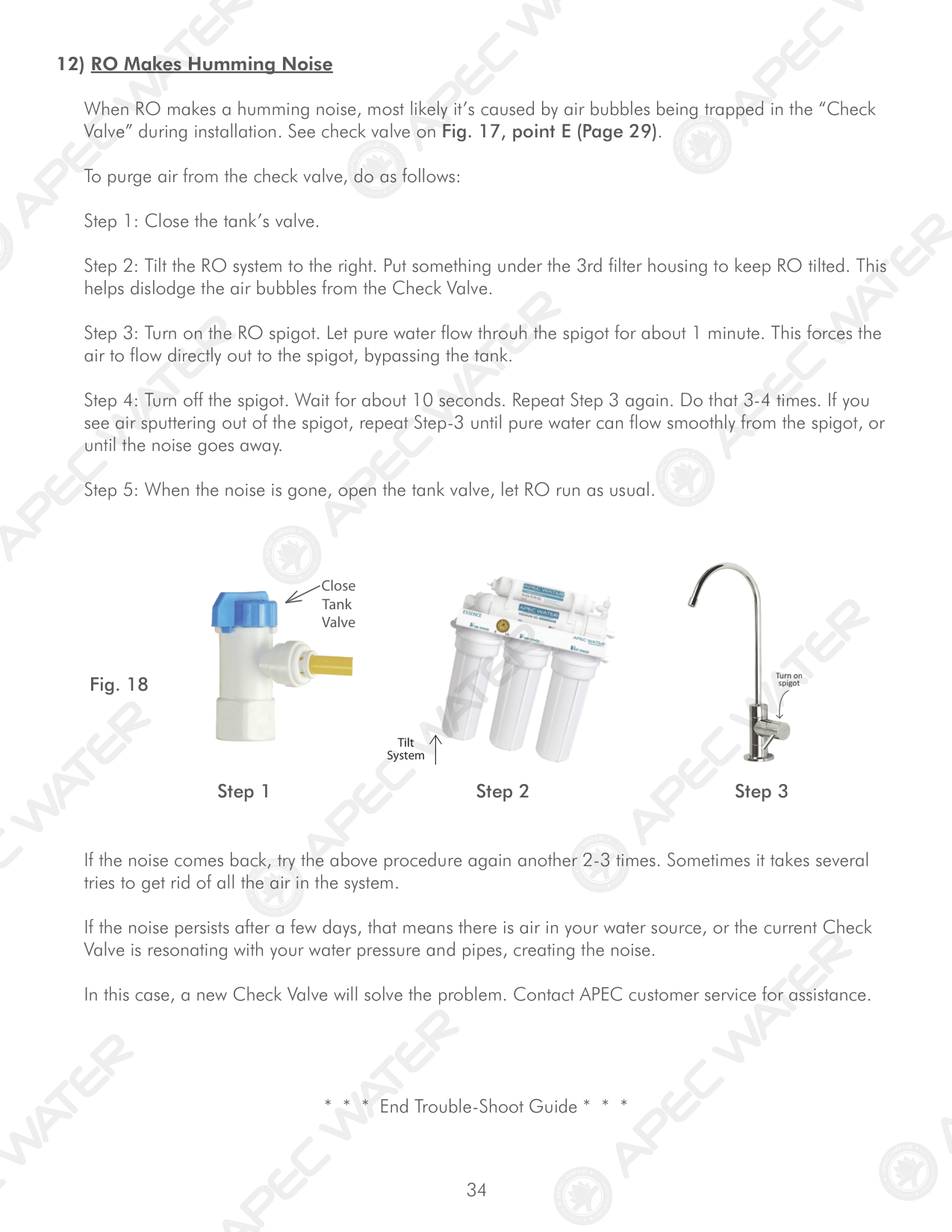
  • 12) RO Makes Humming Noise
  • When RO makes a humming noise, most likely it’s caused by air bubbles being trapped in the “Check Valve” during installation. See check valve on Fig. 17, point E (Page 29).

    To purge air from the check valve, do as follows:

  • Step 1: Close the tank’s valve.
  • Step 2: Tilt the RO system to the right. Put something under the 3rd filter housing to keep RO tilted. This helps dislodge the air bubbles from the Check Valve.
  • Step 3: Turn on the RO spigot. Let pure water flow throuh the spigot for about 1 minute. This forces the air to flow directly out to the spigot, bypassing the tank.
  • Step 4: Turn off the spigot. Wait for about 10 seconds. Repeat Step 3 again. Do that 3-4 times. If you see air sputtering out of the spigot, repeat Step-3 until pure water can flow smoothly from the spigot, or until the noise goes away.
  • Step 5: When the noise is gone, open the tank valve, let RO run as usual.
  • ![image 182](a4f3ae3e-8524-461e-a687-2b89d1e1aa05_images/imageFile182.png)

    ![image 183](a4f3ae3e-8524-461e-a687-2b89d1e1aa05_images/imageFile183.png)

    Close Tank Valve

    ![image 184](a4f3ae3e-8524-461e-a687-2b89d1e1aa05_images/imageFile184.png)

    Page 42

    ![image 185](a4f3ae3e-8524-461e-a687-2b89d1e1aa05_images/imageFile185.png)

    ![image 186](a4f3ae3e-8524-461e-a687-2b89d1e1aa05_images/imageFile186.png)

    ![image 187](a4f3ae3e-8524-461e-a687-2b89d1e1aa05_images/imageFile187.png)

    Fig. 18

    ![image 188](a4f3ae3e-8524-461e-a687-2b89d1e1aa05_images/imageFile188.png)

    ![image 189](a4f3ae3e-8524-461e-a687-2b89d1e1aa05_images/imageFile189.png)

    ![image 190](a4f3ae3e-8524-461e-a687-2b89d1e1aa05_images/imageFile190.png)

    Tilt System

    ![image 191](a4f3ae3e-8524-461e-a687-2b89d1e1aa05_images/imageFile191.png)

    ![image 192](a4f3ae3e-8524-461e-a687-2b89d1e1aa05_images/imageFile192.png)

    Step 1 Step 2 Step 3

    If the noise comes back, try the above procedure again another 2-3 times. Sometimes it takes several tries to get rid of all the air in the system.

    If the noise persists after a few days, that means there is air in your water source, or the current Check Valve is resonating with your water pressure and pipes, creating the noise.

    In this case, a new Check Valve will solve the problem. Contact APEC customer service for assistance.

  • * * End Trouble-Shoot Guide * * *
  • ![image 193](a4f3ae3e-8524-461e-a687-2b89d1e1aa05_images/imageFile193.png)

    ![image 194](a4f3ae3e-8524-461e-a687-2b89d1e1aa05_images/imageFile194.png)

    Page 43

    ###### OTHER INFORMATION

    AirGap Faucet Installation (Optional)

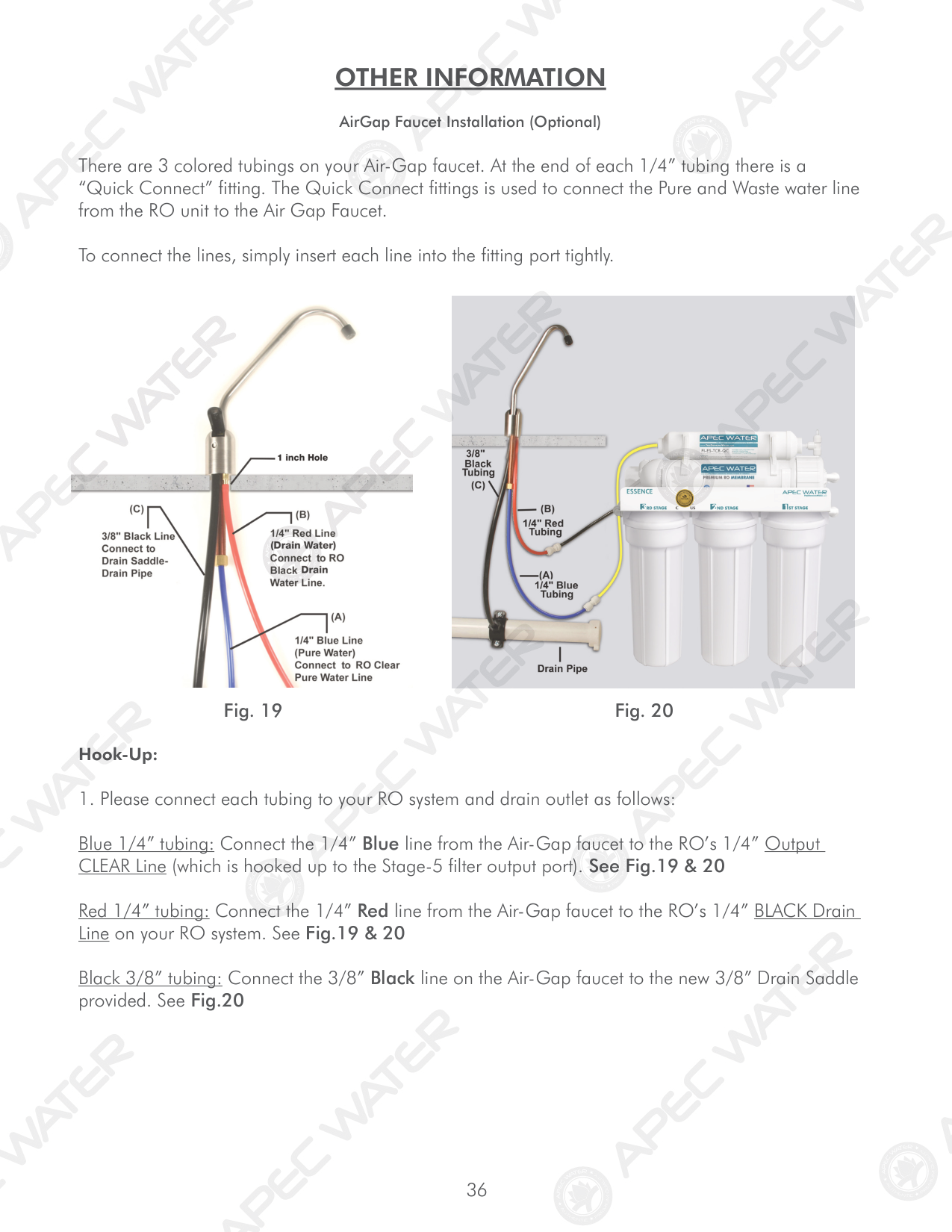
    There are 3 colored tubings on your Air-Gap faucet. At the end of each 1/4” tubing there is a “Quick Connect” fitting. The Quick Connect fittings is used to connect the Pure and Waste water line from the RO unit to the Air Gap Faucet.

    To connect the lines, simply insert each line into the fitting port tightly.

    ![image 195](a4f3ae3e-8524-461e-a687-2b89d1e1aa05_images/imageFile195.png)

    ![image 196](a4f3ae3e-8524-461e-a687-2b89d1e1aa05_images/imageFile196.png)

    Fig. 19 Fig. 20

    Hook-Up:

  • Please connect each tubing to your RO system and drain outlet as follows: Blue 1/4” tubing: Connect the 1/4” Blue line from the Air-Gap faucet to the RO’s 1/4” Output CLEAR Line (which is hooked up to the Stage-5 filter output port). See Fig.19 & 20 Red 1/4” tubing: Connect the 1/4” Red line from the Air-Gap faucet to the RO’s 1/4” BLACK Drain Line on your RO system. See Fig.19 & 20 Black 3/8” tubing: Connect the 3/8” Black line on the Air-Gap faucet to the new 3/8” Drain Saddle provided. See Fig.20
  • ![image 197](a4f3ae3e-8524-461e-a687-2b89d1e1aa05_images/imageFile197.png)

    How drain water is disposed via Air-Gap faucet:

    ############ Drain water is routed through the Air-Gap faucet prior to being drained off into the standard drainpipe outlet. The 1/4” BLACK drain water line from the RO system will discharge through the 1/4” RED line to the Air-Gap faucet. The drain water will then flow back down the 3/8” BLACK drain water line of the Air-Gap faucet to your drain pipe.

    Pure water output flow:

    After the Air Gap faucet is installed, the RO pure water output line will flow from the Stage-5 filter, through the BLUE line of the Air-Gap faucet, to the dispensing faucet.

    ############ * * * End AirGap Faucet Installation * * *

    ![image 198](a4f3ae3e-8524-461e-a687-2b89d1e1aa05_images/imageFile198.png)

    System Certified by WQA to NSF/ANSI 58 for TDS, as verified and substantiated by test data.
    Page 44

    |LIMITED PRODUCT WARRANTY

    Scope

    APEC takes pride in selling a superb line of products, including this reverse osmosis system (“Product”). As such, APEC expressly warrants to the original purchaser that, for a period of one (1) year from the date of purchase, the Product will be reasonably free of defects in materials and workmanship. Within that one (1) year period from the original purchase, APEC will, at its option, repair or replace the Product without charge, or refund the cost of the Product, if the Product fails or does not perform as warranted solely due to a manufacturing defect within the warranty period, subject to the limitations and exclusions set forth in this Limited Product Warranty. This Limited Product Warranty only applies when the Product is used, stored, handled, fabricated and/or installed in the manner recommended by APEC in the Installation Instruction & Owner’s Manual (“Manual”).

    Repair or Replacement

    Repair or replacement during this one (1) year warranty shall include reasonable labor charges necessary to repair or replace the defective Product, but shall not include freight charges or any other local labor charges from third parties other than APEC, unless APEC expressly approves such charges in writing. During the entire one (1) year warranty, APEC’s obligation to repair or replace shall further be limited to repair or replacement with the styles, models, products, colors, etc. of the Product that are available at the time of the repair or replacement, and shall be limited to the repair or replacement of only the specific Product that fails due to a manufacturing defect. Any repaired or replaced product shall also remain subject to the original one (1) year warranty from the date of the original purchase, and any repair or replacement shall not extend the original warranty period in any manner or start a new warranty period.

    Conditions of Validity of this Limited Product Warranty

    Even though the Product has extremely high endurance for operating conditions such as pH, maximum TDS, temperature, and optimum water pressure, THIS LIMITED PRODUCT WARRANTY SHALL ONLY BE VALID IF:

    1. The replaceable filters and membrane are changed and maintained on a regular basis as directed in the Manual. Moreover, depending on local water input water quality, regular maintenance may need to be increased.
    2. The Product is operated within the confines of the following standard operating conditions:


    Water Pressure pH Range Max. TDS Water Temperature Standard System 40- 85 psi 2-11 2000 ppm 40-100 F

    Any information or suggestion by APEC with respect to the Product concerning applications, specifications or compliance with codes and standards is provided solely for your convenient reference and is made without any representation as to accuracy or suitability. You must verify and test the suitability of any information with respect to the Product for your specific application.

    Non-Covered Defects

    THIS LIMITED PRODUCT WARRANTY DOES NOT COVER DEFECTS CAUSED BY:

    1. Improper storage, installation, maintenance, handling, use and/or alterations of the Product, including, but not limited to, noncompliance with the installation, maintenance and standard operation conditions stated in the Manual and this Limited Product Warranty.
    2. Unreasonable use, unintended use, or misuse of the Product for something other than its intended purpose as a reverse osmosis system.
    3. Use of replacement parts, filters, membranes or other accessories that are not sold or manufactured by APEC for use with this particular Product.
    4. Damage not resulting from manufacturing defects that occur while the Product is in the original purchaser’s possession.
    5. Installation of the Product with known or visible manufacturing defects at the time of installation.
    6. Damage caused by freezing, flood, fire or Act of God.


    ![image 199](a4f3ae3e-8524-461e-a687-2b89d1e1aa05_images/imageFile199.png)| |---|

    |CONDITIONS THAT RENDER THIS LIMITED PRODUCT WARRANTY VOID

    THIS LIMITED PRODUCT WARRANTY SHALL BE VOID IF:

    1. The Product is not operated in compliance with normal municipal water conditions for which the particular model of this Product is intended.
    2. The person seeking to invoke the warranty is not the original purchaser. That is, this Limited Product Warranty only extends to original purchasers.
    3. The product is purchased used. That is, this Limited Product Warranty only covers new products.
    4. The Product is purchased from someone other than APEC or one of APEC’s authorized dealers. This is because, unless the Product was sold by APEC or one of its authorized dealers, APEC cannot verify or guarantee the integrity or authenticity of the Product.


    General Conditions

    The warranties set forth herein are the only warranties made by APEC in connection with the product. APEC cannot and does not make any implied or express warranties with respect to the product, and disclaims all other warranties, including, but not limited to, any warranty of merchantability or fitness for a particular purpose. Products sold by APEC are sold only to the specifications specifically set forth by APEC in writing. Other than the limited product warranty set forth herein, APEC makes no other warranties, express or implied. APEC’s sole obligation under this warranty shall be repair or replacement of a non-conforming product or parts of the product, or at the option of APEC, return of the product and a refund of the purchase price. Buyer assumes all risk whatsoever as to the result of the use of the product purchased, whether used singularly or in combination with any other products or substances.

    No claim by the buyer/owner of any kind, including claims for indemnification, shall be greater in amount than the purchase price of the products in respect to which damages are claimed. In no event shall APEC be liable to buyer/owner in tort, contract or otherwise, for any special, indirect, incidental, consequential, reliance, statutory, special, punitive or exemplary damages, including, but not limited to, lost profits, loss of use, loss of time, inconvenience, damage to good will or reputation, or loss of data, even if advised of the possibility of such damages or such damages could have been reasonably foreseen, in connection with, arising out of, or as a result of, the sale, delivery, servicing, use or loss of use of the products sold hereunder, or for any liability of buyer to any third party with respect thereto.

    Obtaining Warranty Coverage or General Inquiries

    If coverage is available, you may obtain coverage under this Limited Product Warranty by providing APEC with proof of original purchase, and that you are the original purchaser. For service under this Limited Product Warranty, you must notify APEC by phone at 1-800-880-4808, by email at techsupport@freedrinkingwater.com, or in writing at 1320 S. Johnson Dr., City of Industry, CA 91745. In making the claim, please provide your name, address, phone number, a description of the product involved, and an explanation of the defect.

    California Proposition 65 Warning

    WARNING: This product contains chemicals known to the State of California to cause cancer or birth defects or other reproductive harm. For more information go to www.P65Warnings.ca.gov.

    ![image 200](a4f3ae3e-8524-461e-a687-2b89d1e1aa05_images/imageFile200.png)| |---|

    ![image 201](a4f3ae3e-8524-461e-a687-2b89d1e1aa05_images/imageFile201.png)

    ![image 202](a4f3ae3e-8524-461e-a687-2b89d1e1aa05_images/imageFile202.png)

    ![image 203](a4f3ae3e-8524-461e-a687-2b89d1e1aa05_images/imageFile203.png)

    ![image 204](a4f3ae3e-8524-461e-a687-2b89d1e1aa05_images/imageFile204.png)

    ![image 205](a4f3ae3e-8524-461e-a687-2b89d1e1aa05_images/imageFile205.png)

    ![image 206](a4f3ae3e-8524-461e-a687-2b89d1e1aa05_images/imageFile206.png)

    ![image 207](a4f3ae3e-8524-461e-a687-2b89d1e1aa05_images/imageFile207.png)

    ![image 208](a4f3ae3e-8524-461e-a687-2b89d1e1aa05_images/imageFile208.png)

    ![image 209](a4f3ae3e-8524-461e-a687-2b89d1e1aa05_images/imageFile209.png)

    ![image 210](a4f3ae3e-8524-461e-a687-2b89d1e1aa05_images/imageFile210.png)

    ![image 211](a4f3ae3e-8524-461e-a687-2b89d1e1aa05_images/imageFile211.png)

    ![image 212](a4f3ae3e-8524-461e-a687-2b89d1e1aa05_images/imageFile212.png)

    ![image 213](a4f3ae3e-8524-461e-a687-2b89d1e1aa05_images/imageFile213.png)

    ![image 214](a4f3ae3e-8524-461e-a687-2b89d1e1aa05_images/imageFile214.png)

    ![image 215](a4f3ae3e-8524-461e-a687-2b89d1e1aa05_images/imageFile215.png)

    ![image 216](a4f3ae3e-8524-461e-a687-2b89d1e1aa05_images/imageFile216.png)

    ![image 217](a4f3ae3e-8524-461e-a687-2b89d1e1aa05_images/imageFile217.png)

    ![image 218](a4f3ae3e-8524-461e-a687-2b89d1e1aa05_images/imageFile218.png)

    ######## Advanced Purification Engineering Corp. 1320 S Johnson Drive City of Industry, CA 91745

    For questions or comments please visit our website at:

    #### www.FreeDrinkingWater.com

    For technical support contact us at: Techsupport@freedrinkingwater.com

    1-800-880-4808

    Similar Unknown