
Ask AI
— answers from the official manualAnswers from the official manual.
Common questions
Common Questions
10 totalHow can I ensure safety while charging a sealed (AGM or GEL) battery?
Monitor the battery to check if it becomes unusually warm during extended periods; overheating may indicate an issue and could cause damage. Disconnect the charger immediately if excessive gas is released or the temperature exceeds 130°F (55°C). Refer to the battery manufacturer's instructions for more details.
What should I do before disconnecting a battery from a vehicle?
Turn off all vehicle accessories and always remove the cable connected to the grounded terminal first. Clean the battery terminals if necessary, ensuring no corrosion or debris gets near your eyes.
Why won't my charger work with a battery below 3 volts?
The BATTERY TENDER® CHARGERS have an internal safety circuit that prevents generating any DC output voltage for batteries below this threshold to protect the equipment.
How do I interpret the red and green status indicator lights on my charger?
The red light indicates charging is in progress, while the green light signifies completion. If both lights are off, there might be a connection issue. Flashing lights can indicate other specific states or problems.
What should I do if my battery releases excessive gas during charging?
Disconnect the charger and allow the battery to cool down. If the temperature exceeds 130°F (55°C), further action may be needed as this indicates a potentially dangerous condition.
How do I locate my Battery Tender Junior properly?
Place the charger far from any combustible materials and out of direct contact with wet or corrosive environments. The output cable harness should not be overly stretched, providing some free space around it.
Full Manual
4 pages
|Battery Tender® JUNIOR & Battery Tender® PLUS Battery Chargers
| |---|
12 & 6 Volt Models:
750 Milliamp & 1.25 Amp
&
8 Volt Model 1.25 Amp IMPORTANT SAFETY INSTRUCTIONS
SAVE THESE INSTRUCTIONS: This manual contains important safety and operating instructions for BATTERY TENDER® CHARGERS, both the 12 & 6 Volt 750 Milliamp BT JUNIOR and 12, 6, & 8 Volt 1.25 Amp BT PLUS models. CAREFULLY READ THESE INSTRUCTIONS BEFORE USING THE BATTERY CHARGER.
|WARNING AND CAUTION LABEL DEFINITIONS:| |---|
WARNING WARNING indicates a potentially hazardous situation, which, if not avoided, could result in serious injury or death.
CAUTION CAUTION indicates a potentially hazardous situation, which, if not avoided, may result in minor or moderate injury.
CAUTION
CAUTION used without the safety alert symbol indicates a potentially hazardous situation that if not avoided, may result in property damage.
|GENERAL PRECAUTIONS| |---|
WARNING
Battery posts, terminals and related accessories contain lead and lead components, chemicals known to the State of California to cause cancer and birth defects or other reproductive harm. Always wash your hands after handling these devices.
WARNING
Do not operate the battery charger with damaged AC power cords or plugs or DC output cords or accessories - Replace accessories immediately. Since neither the AC power cord nor the DC output cord can be replaced, if either cord is damaged the battery charger should be scrapped.
1
|392-0154-RA| |---|
##### CAUTION
WORKING WITH LEAD ACID BATTERIES AND BATTERY CHARGERS: All lead acid batteries have the potential to emit gasses that may combine into a combustible or explosive mixture. In many cases, it is possible that lead acid batteries will emit these gasses during normal discharge and charging operations. Because of this potential danger, it is important that you follow the precautions recommended by both the battery and battery charger manufacturers before using either one.
USING MANUALS: Study all of the battery manufacturer's precautions and specific recommendations for safe operation such as not removing cell caps while charging and the recommended rates of charge (charger output current).
CAUTION CHARGER VOLTAGE COMPATIBILITY: NEVER unless the battery voltage matches the output voltage rating of the charger. For example, do not use a 12-volt charger with a 6-volt battery and vice-versa. CHARGER LOCATION: LOCATE the charger as far away from the battery as is allowed by the length of the output cable harness. above the battery. NEVER set the charger on a surface constructed from combustible material. NEVER place the battery, the charger, or any of the electrical connections between them in an area that is likely to become wet.
| | |---|
EXCESSIVE MOISTURE: Do not expose the battery charger or any of its electrical connections (either AC or DC) to rain, snow, or extremely high, condensing humidity.
CHARGER ATTACHMENTS: Do not use attachments that are not recommended or sold by the charger manufacturer. To do otherwise may result in the risk of electric shock, fire, or possibly some other unforeseen potential personal injury situations.
HANDLING POWER CORDS: When handling electric power cords, always pull by the plug rather than by the cord. This will reduce the risk of damage to both the plug and cord, and it will minimize the likelihood of electric shock resulting from that damage.
LOCATION OF POWER CORDS: Make sure all electric power cords are located so that they cannot be stepped on, tripped over, or otherwise subjected to damage or stress.
###### MONITORING SEALED & NON-SEALED BATTERIES:
battery charger connected to either a sealed (AGM or GEL) or non-sealed (flooded battery) for extended periods of time (weeks, months, etc.), periodically check the battery to see if it is unusually warm. This is an indication that the battery may have a weak cell and that it could go into a thermal runaway condition. If the battery releases an excessive amount of gas or if the battery gets hotter than 130°F (55°C) during charging, disconnect the charger and allow the battery to cool. Overheating may result in plate distortion, internal shorting, drying out or other damage. For flooded batteries, also check individual cell fluid levels against manufacturer's recommendations for safe operation.
2
INFORMATION NOTE ABOUT DRY-CELL BATTERIES: There are some wet, non-spillable, lead acid batteries on the market whose manufacturers' make the claim that they are dry-cell batteries. These batteries are sealed, gas-recombinant, starved electrolyte, possibly with AGM (Absorbed Glass Mat) type construction. It is perfectly safe to use
TENDER® CHARGERS, both the12 & 6 Volt 750 Milliamp BT JUNIOR and the 12, 6, & 8 Volt 1.25 Amp BT PLUS models,
of batteries. The dry-cell battery warning is intended for non-rechargeable, alkaline and other similar types of batteries. If you have any doubt about the type of battery that you have, please contact the battery manufacturer before attempting to charge the battery.
##### WARNING
ELECTRIC SPARK & OPEN FLAME: NEVER smoke or allow a source of electric spark or open flame in the vicinity of the battery or engine. (For example: Don't charge the battery next to a gas water heater.)
VENTILATION: Do not operate the charger where ventilation is restricted. The intent here is to allow sufficient airflow to minimize and dissipate the heat generated by the charger and to diffuse the gasses that may be emitted by the battery.
CHARGER MAINTENANCE: NEVER disassemble the charger or attempt to do internal repairs. Take it to a qualified service technician. Assembling the charger incorrectly may result in the risk of electric shock or create a fire hazard.
##### WARNING
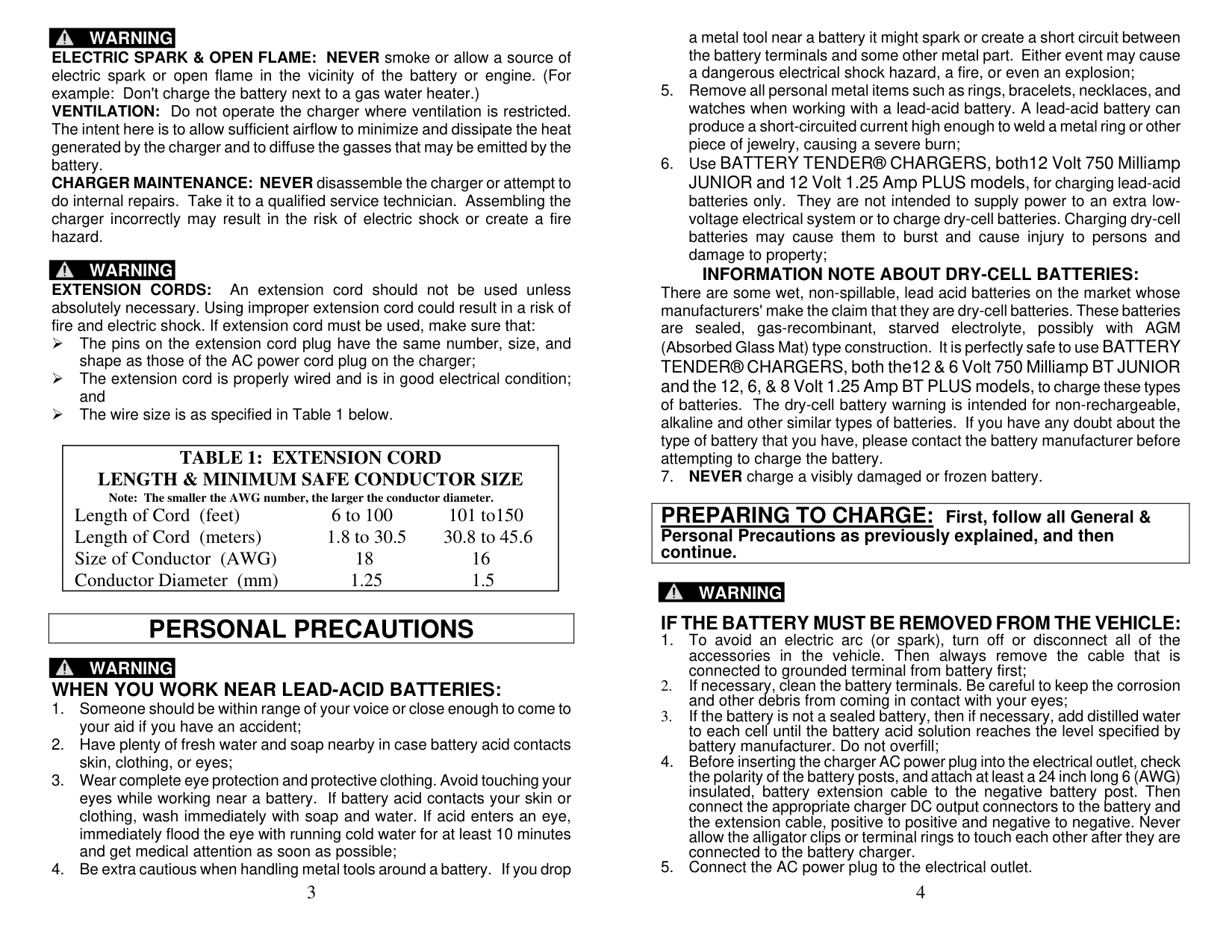
EXTENSION CORDS: An extension cord should not be used unless absolutely necessary. Using improper extension cord could result in a risk of fire and electric shock. If extension cord must be used, make sure that:
The pins on the extension cord plug have the same number, size, and shape as those of the AC power cord plug on the charger; The extension cord is properly wired and is in good electrical condition; and The wire size is as specified in Table 1 below.
|TABLE 1: EXTENSION CORD LENGTH & MINIMUM SAFE CONDUCTOR SIZE
Note: The smaller the AWG number, the larger the conductor diameter. Length of Cord (feet) 6 to 100 101 to150 Length of Cord (meters) 1.8 to 30.5 30.8 to 45.6 Size of Conductor (AWG) 18 16 Conductor Diameter (mm) 1.25 1.5
| |---|
|PREPARING TO CHARGE: First, follow all General & Personal Precautions as previously explained, and then continue.
| |---|
WARNING
| | |---|
#### IF THE BATTERY MUST BE REMOVED FROM THE VEHICLE:
|PERSONAL PRECAUTIONS| |---|
WARNING
#### WHEN YOU WORK NEAR LEAD-ACID BATTERIES:
3
WARNING
| | |---|
#### IF THE BATTERY REMAINS INSTALLED IN THE VEHICLE:
|ADDITIONAL CHARGER INFORMATION| |---|
AUTOMATIC CHARGING AND BATTERY STATUS MONITORING: The BATTERY TENDER® CHARGERS are completely automatic and may be left connected to both AC power and to the battery that it is charging for long periods of time. However, it is prudent to periodically check both the battery and the charger for normal operation during these extended charging periods.
The charger output power, voltage, and current all depend on the condition of the battery that is being charged. Both BATTERY TENDER® CHARGERS have status lights that indicate the operating mode of the charger, and the condition of the battery that is connected to the charger.
The chargers operate in one of the 3 primary charge modes: the bulk mode (full charge power, constant current, increasing battery voltage, battery is 0% to 75% or 80% charged), the absorption mode (high constant voltage, decreasing current, battery is 75% to 100% charged), or the storage/float maintenance mode (low constant voltage, minimal charge current, battery is fully charged, typically 100% to 103%).
When the battery is fully charged, the green status indicator light will turn on and the charger will switch to a storage/maintenance charge mode. Both BATTERY TENDER® CHARGERS will automatically monitor and maintain the battery at full charge.
5
SPECIAL FEATURES: The BATTERY TENDER® CHARGERS
have the following special features:
SPARKPROOF: The battery charger DC output leads, either ring terminals or alligator clips must be connected to a battery before an output voltage is developed by the battery charger.
SHORT CIRCUIT PROTECTION: The short circuit connection directly across its DC output terminals indefinitely without any risk of either electric shock or excessive heat. REVERSE POLARITY PROTECTION:
protected internally against any damage due to the DC output leads being connected to the opposite polarity battery post. No damage will result to either the battery or the battery charger.
#### TEMPERATURE COMPENSATION (BT PLUS Only):
voltage is compensated at -3.5mV/ °C/Cell. This increases the output voltage in cold climates to keep the battery from being undercharged and, more importantly, reduces the voltage in high temperature climates to protect the battery from overcharge.
TIME REQUIRED TO CHARGE A BATTERY: The BATTERY TENDER® CHARGERS charge at a rate of either 0.75 Amps (0.75 Amp-Hours per hour) or 1.25 Amps (1.25 Amp-Hours per hour). Therefore, a fully discharged 15 Amp-Hour battery will take approximately 16 hours or 9.6 hours respectively, to recharge to 80% capacity. Some large automotive or marine, deep cycle type batte recharge.
##### WORKING WITH A DEAD BATTERY OR A BATTERY WITH A VERY LOW VOLTAGE:
If you try to charge a dead battery having a voltage below 3 Volts, the BATTERY TENDER® CHARGERS will not start to charge because an internal safety circuit prevents the battery chargers from generating any DC output voltage.
NOTE: If a 12 Volt, Lead-Acid battery has an output voltage of less than 9 volts when it is at rest, when it is neither being charged nor supplying electrical current to an external load, there is a good chance that the battery is defective. As a frame of reference, a fully charged 12-Volt, Lead-Acid battery will have a reststate, no-load voltage of approximately 12.9 volts. A fully discharged 12-Volt, Lead-Acid battery will have a rest-state, no-load voltage of approximately 11.4 volts. That means that a voltage change of only 1.5 volts represents the full range of charge 0% to 100% on a 12-Volt, Lead-Acid battery. Depending on the manufacturer, and the age of the battery, the specific voltages will vary by a few tenths of a volt, but the 1.5-volt range will still be a good indicator of the battery charge %.
STATUS INDICATOR LIGHTS: The following describes the indicator light operation: Note that the JUNIOR has a single light that will shine either RED or GREEN, while the PLUS has two separate lights, one RED and one GREEN.
6
NEITHER THE RED OR GREEN LIGHT TURN ON (Both models) – This is an abnormal condition and most likely indicates that the charger is not properly connected to the AC power.
RED LIGHT FLASHING (All models except 6V Junior) – The red light flashing indicates that the battery charger has AC power available and that the microprocessor is functioning properly. If the red light continues to flash, then either the battery voltage is too low (less than 3 volts) or the output alligator clips or accessory ring terminals are not connected correctly.
RED LIGHT ON STEADY (Both models) – Whenever the red light is on steady, a battery is connected properly and the charger is charging the battery. The red light will remain on until the charger completes the charging stage.
GREEN LIGHT FLASHING (1.25A only) - When the green light is flashing, and the red light is on, the battery is greater than 80% charged and may be removed from the charger and used if necessary. Whenever possible, leave the battery on charge until the green light is solid.
GREEN LIGHT ON STEADY (Both models) - When the green light stops flashing and burns steady, the charge is complete and the battery can be returned to service if necessary.
ALTERNATING RED & GREEN LIGHTS FLASHING (PLUS) This is abnormal and most likely indicates either that the battery is sulfated or that there is a poor electrical connection between the charger DC output and the battery posts.
#### TROUBLESHOOTING CHECK LIST:
7
SPECIFICATION SUMMARY:
|Technical Specifications (BT Plus & BTJR Models)|Technical Specifications (BT Plus & BTJR Models)|Technical Specifications (BT Plus & BTJR Models)| |---|---|---| |Input Voltage / Frequency|100 to 132 VAC / 60 Hz|100 to 132 VAC / 60 Hz| |Input Current (Maximum)|0.43 or 0.36 Amps RMS|0.43 or 0.36 Amps RMS| | | | | |Output Current Typical|1.25 or 0.75 Amps DC|1.25 or 0.75 Amps DC| |Output Voltage|12 , 8, & 6 or 12 & 6 Volts DC|12 , 8, & 6 or 12 & 6 Volts DC| |Charger Output Voltage Amplitudes throughout the entire charge algorithm, including absorption and float maintenance, are consistent with the optimum charging recommendations of the major lead-acid battery manufacturers.|Charger Output Voltage Amplitudes throughout the entire charge algorithm, including absorption and float maintenance, are consistent with the optimum charging recommendations of the major lead-acid battery manufacturers.|Charger Output Voltage Amplitudes throughout the entire charge algorithm, including absorption and float maintenance, are consistent with the optimum charging recommendations of the major lead-acid battery manufacturers.| |Maximum Operating Temperature|Maximum Operating Temperature| | |Charger Case Dimensions:
0.75 Amp BT JUNIOR: 3.313 in (85 mm) L
1.875 in (48 mm) H. 1.25 Amp BT PLUS: 4.875 in (124 mm) L in (73 mm) H.
Note: When sizing the space available for the 1.25 Amp battery charger, do not forget to allow additional length for safe bending of the strain relief on AC or DC power cords, typically 1 in (25.4 mm).|Charger Case Dimensions:
0.75 Amp BT JUNIOR: 3.313 in (85 mm) L
1.875 in (48 mm) H. 1.25 Amp BT PLUS: 4.875 in (124 mm) L in (73 mm) H.
Note: When sizing the space available for the 1.25 Amp battery charger, do not forget to allow additional length for safe bending of the strain relief on AC or DC power cords, typically 1 in (25.4 mm).|Charger Case Dimensions:
0.75 Amp BT JUNIOR: 3.313 in (85 mm) L
1.875 in (48 mm) H. 1.25 Amp BT PLUS: 4.875 in (124 mm) L in (73 mm) H.
Note: When sizing the space available for the 1.25 Amp battery charger, do not forget to allow additional length for safe bending of the strain relief on AC or DC power cords, typically 1 in (25.4 mm).| |Gross Shipping Weight: BTPlus 1.25 Amp: Approx. 3.0 lbs (1.4 kg) BTJR 0.75 Amp: Approx. 1.8 lbs (0.8 kg)
|Gross Shipping Weight: BTPlus 1.25 Amp: Approx. 3.0 lbs (1.4 kg) BTJR 0.75 Amp: Approx. 1.8 lbs (0.8 kg)
|Gross Shipping Weight: BTPlus 1.25 Amp: Approx. 3.0 lbs (1.4 kg) BTJR 0.75 Amp: Approx. 1.8 lbs (0.8 kg)
|
|Declaration of Conformity: These battery charger products are designed to meet or exceed the specific requirements of UL-1236. See UL File E206016.| |---| |Design Conformance & Revision: All charger products are 100% inspected and electrically tested prior to shipment. All battery charger designs are proprietary and subject to change without notice. Manufacturer makes no specific claims nor does it either make or imply any specific guarantee or warranty with respect to either the physical configuration or performance of any of the battery charger products listed herein, including suitability for purpose or merchantability.|
8