
Ask AI
— answers from the official manualAnswers from the official manual.
Common questions
Common Questions
10 totalCan I use my vehicle’s LATCH system instead of the seat belt?
The car seat can be installed using either the vehicle's LATCH system or seatbelt. Check your vehicle’s manual for exact location and guidelines.
How do I remove the top tether strap after installation?
Push in on the hook's spring, pull away from anchor, then push tether hook into storage position as shown.
How should I secure my child when using a booster seat with a lap/shoulder belt?
Ensure the vehicle’s shoulder belt lies across your child's shoulders, between neck and shoulder edge. Adjust to fit tightly while lying flat against the body without twisting.
What is the best seating location for my car seat?
The safest place in most vehicles is usually the back center seat unless you have a specific reason not to use it per your manual's recommendations. Avoid seats with lap belts only or active front airbags.
How do I properly adjust and tighten the harness?
Pull up on the release lever, lay straps over shoulders, buckled securely, raise chest clip to armpit level. Tighten straps so no slack can be pinched; straps should stay straight without sagging.
How often do I need to replace car seat parts or accessories?
Contact Graco for recommended care and replacement of parts. Do not use damaged or missing parts which could impair performance or safety functions.
Full Manual
200 pages


######### www.gracobaby.com






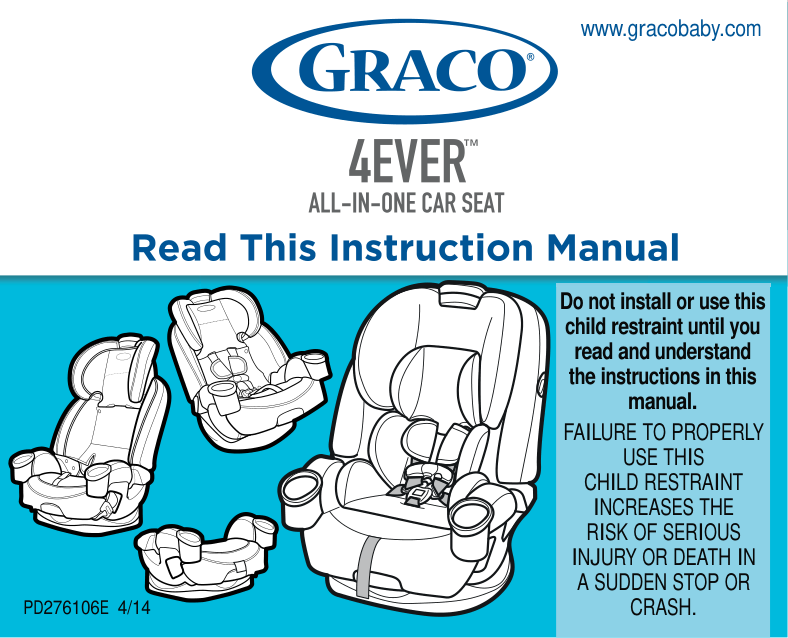
Do not install or use this child restraint until you read and understand the instructions in this manual.
FAILURE TO PROPERLY USE THIS CHILD RESTRAINT INCREASES THE RISK OF SERIOUS INJURY OR DEATH IN A SUDDEN STOP OR CRASH.
PD276106E 4/14
Important Pages 6-16
Certification Car Seat’s Useful Life Vehicle Seat Protection Warm Weather Use
Features Pages 17-23
Rear-Facing Use Pages 24-38
Rear-Facing Continued

Forward-Facing Use Pages 39-53
Belt-Positioning Booster Use Pages 54-68
Securing Child Pages 69-81
Care & Cleaning Pages 82-86
Additional Information Pages 87-99
Additional Information Continued


1-A Welcome to the Graco Family!
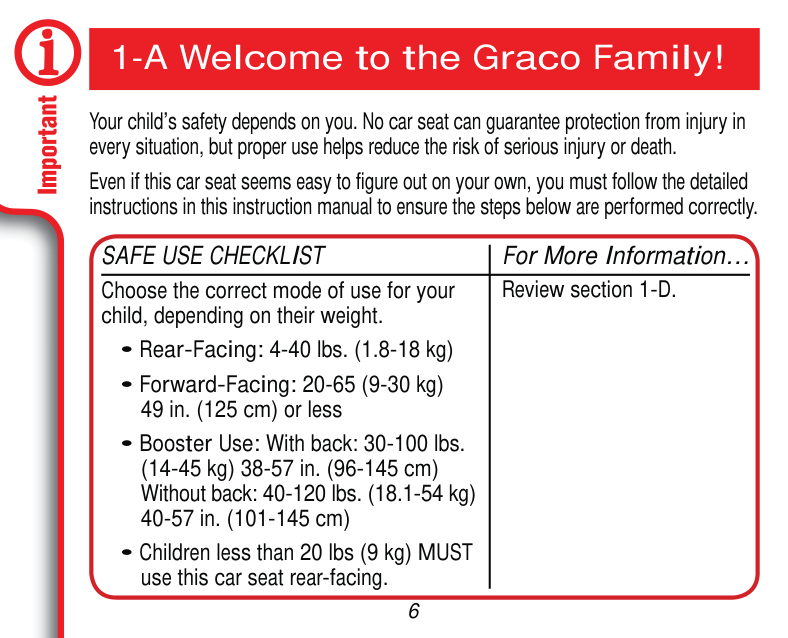
Your child’s safety depends on you. No car seat can guarantee protection from injury in every situation, but proper use helps reduce the risk of serious injury or death.
Even if this car seat seems easy to figure out on your own, you must follow the detailed instructions in this instruction manual to ensure the steps below are performed correctly.
####### SAFE USE CHECKLIST For More Information…
Review section 1-D.
Choose the correct mode of use for your child, depending on their weight.



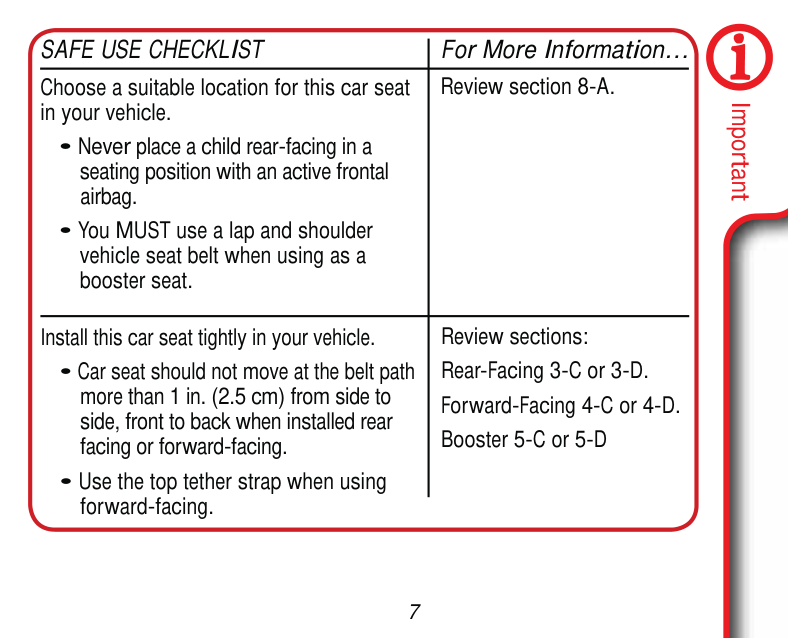
Review section 8-A.
Choose a suitable location for this car seat in your vehicle.
####### Important
Review sections: Rear-Facing 3-C or 3-D. Forward-Facing 4-C or 4-D. Booster 5-C or 5-D
Install this car seat tightly in your vehicle.



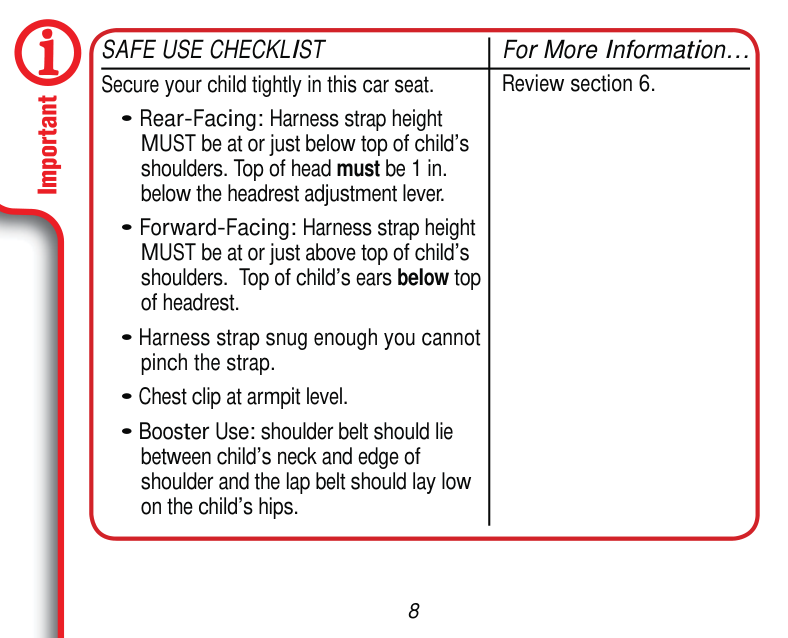
Review section 6.
Secure your child tightly in this car seat.



1-B Before You Begin
Important
######### Register This Child Restraint
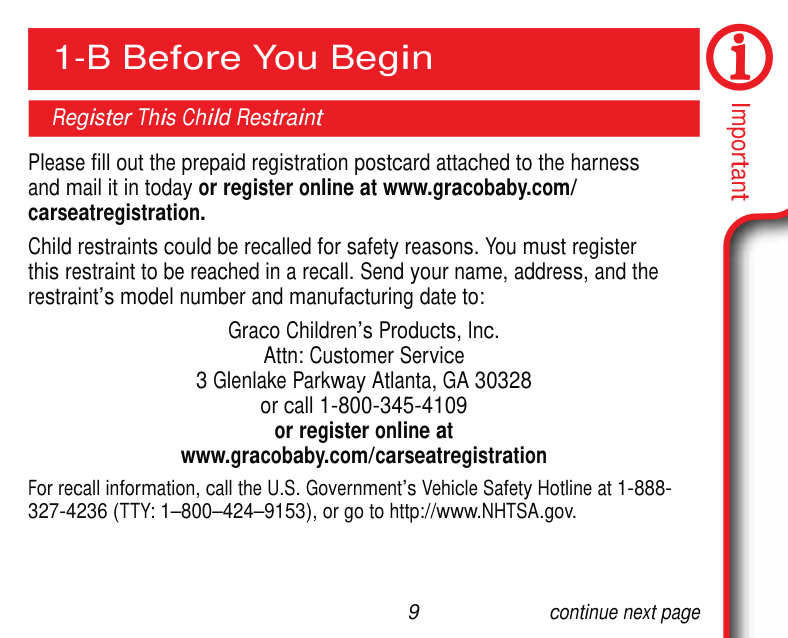
Please fill out the prepaid registration postcard attached to the harness and mail it in today or register online at www.gracobaby.com/ carseatregistration.
Child restraints could be recalled for safety reasons. You must register this restraint to be reached in a recall. Send your name, address, and the restraint’s model number and manufacturing date to:
Graco Children’s Products, Inc. Attn: Customer Service 3 Glenlake Parkway Atlanta, GA 30328 or call 1-800-345-4109 or register online at www.gracobaby.com/carseatregistration
For recall information, call the U.S. Government’s Vehicle Safety Hotline at 1-888327-4236 (TTY: 1–800–424–9153), or go to http://www.NHTSA.gov.

continue next page
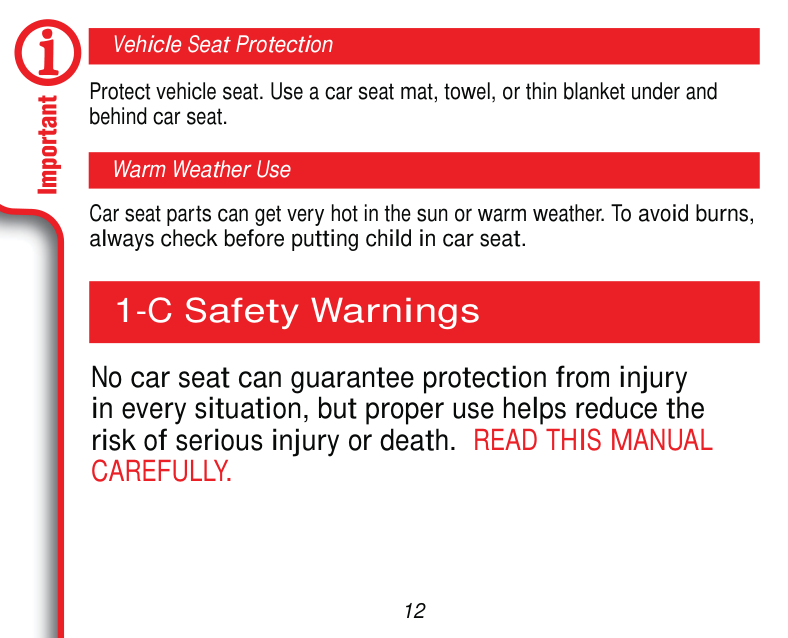


For future reference or if you change addresses, record the model name, model number, date of manufacture and purchase date of this car seat on the below. You can find this information either on the registration card if you still have it or on the date label located on the back of the car seat.
Model Name _________________________ Model Number _______________________ Date of Manufacture __________________ Date of Purchase _____________________
######### If You Need Help


In the U.S.A, please contact our Customer Service Department with any questions you may have concerning parts, use, or maintenance. When you contact us, please have your product’s model number and date of manufacture ready so that we may help you efficiently. These numbers can be found on a sticker on the back side of your car seat.
For additional resources or to get your car seat checked by a child passenger safety technician, please visit the following web sites:
www.nhtsa.gov • www.seatcheck.org • www.safekids.org • www.cpsc.gov continue next page
10


Certification
This child restraint meets or exceeds all applicable requirements of Federal Motor Vehicle Safety Standard 213 for use in motor vehicles.
####### Important
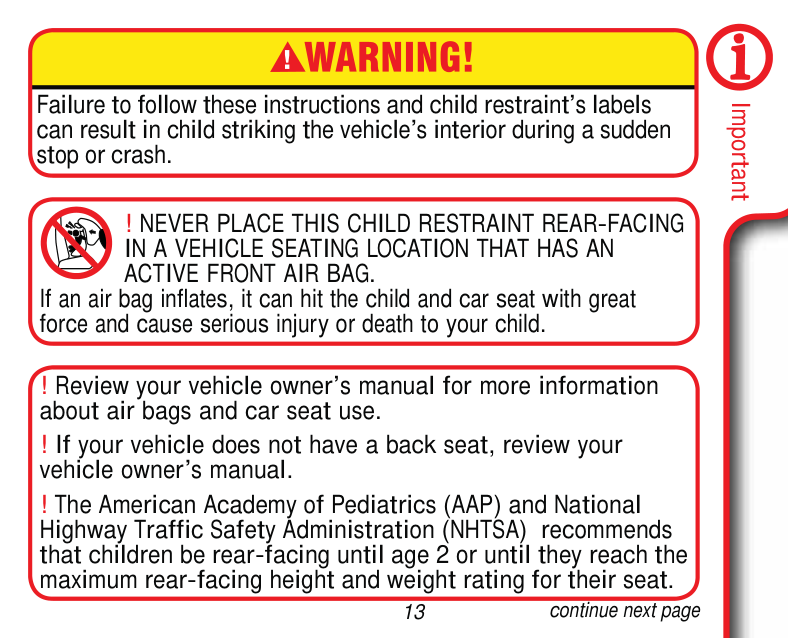
This child restraint is certified for use in aircraft only when used with the internal harness system.
This child restraint is NOT certified for use in aircraft when used as a booster seat because aircrafts do not have shoulder belts.
Contact the airline for their specific polices.
Car Seat’s Useful Life
STOP using this car seat and throw it away 10 years after the date of manufacture. Look for this sticker on back of the car seat.
Graco Children’s Products Inc. advises against loaning or passing along a car seat unless you know the complete history of the product. We also advise against purchasing a car seat second hand.


Vehicle Seat Protection
Protect vehicle seat. Use a car seat mat, towel, or thin blanket under and behind car seat.
Warm Weather Use
Car seat parts can get very hot in the sun or warm weather. To avoid burns, always check before putting child in car seat.
1-C Safety Warnings


No car seat can guarantee protection from injury in every situation, but proper use helps reduce the risk of serious injury or death. READ THIS MANUAL CAREFULLY.


Failure to follow these instructions and child restraint’s labels can result in child striking the vehicle’s interior during a sudden stop or crash.
Important
! NEVER PLACE THIS CHILD RESTRAINT REAR-FACING IN A VEHICLE SEATING LOCATION THAT HAS AN ACTIVE FRONT AIR BAG.
If an air bag inflates, it can hit the child and car seat with great force and cause serious injury or death to your child.
! Review your vehicle owner’s manual for more information about air bags and car seat use.
! If your vehicle does not have a back seat, review your vehicle owner’s manual.
! The American Academy of Pediatrics (AAP) and National Highway Traffic Safety Administration (NHTSA) recommends that children be rear-facing until age 2 or until they reach the maximum rear-facing height and weight rating for their seat.

continue next page


! Choose the correct mode of use for the car seat depending on your child’s size. Infants less than 20 lbs. (9 kg) MUST use this car seat rear-facing.
! Select a suitable location for the car seat in your vehicle. ! Secure car seat with a vehicle seat belt or LATCH that is properly routed as shown in this manual. ! Vehicle seat belt system MUST hold car seat securely. Not all vehicle seat belts can be used with a car seat.
! If vehicle seat belt does not hold car seat securely, read “Vehicle Seat Belts” section 8-F and your vehicle owner’s manual.


! Always secure car seat with LATCH or a vehicle seat belt, even when unoccupied. In a crash, an unsecured car seat can injure passengers.
! If car seat is in a crash, it must be replaced. DO NOT use it again! A crash can cause unseen damage and using it again could result in serious injury or death.
! DO NOT use car seat if it is damaged or missing parts.


! DO NOT use accessories or parts other than those provided by Graco. Their use could alter the performance of the car seat.
Important
! DO NOT remove LATCH system from car seat. If using vehicle seat belt to secure car seat, LATCH connectors must be stored.
! Never leave child unattended, even when sleeping. Child may become tangled in harness straps and suffocate or strangle.
! Rear-facing car seat must be properly leveled:
! Never attach two LATCH connectors to one vehicle lower anchor point unless specifically allowed by the vehicle manufacturer.
! Do not use both the vehicle belt and LATCH belts at the same time when using the car seat rear or forward facing.


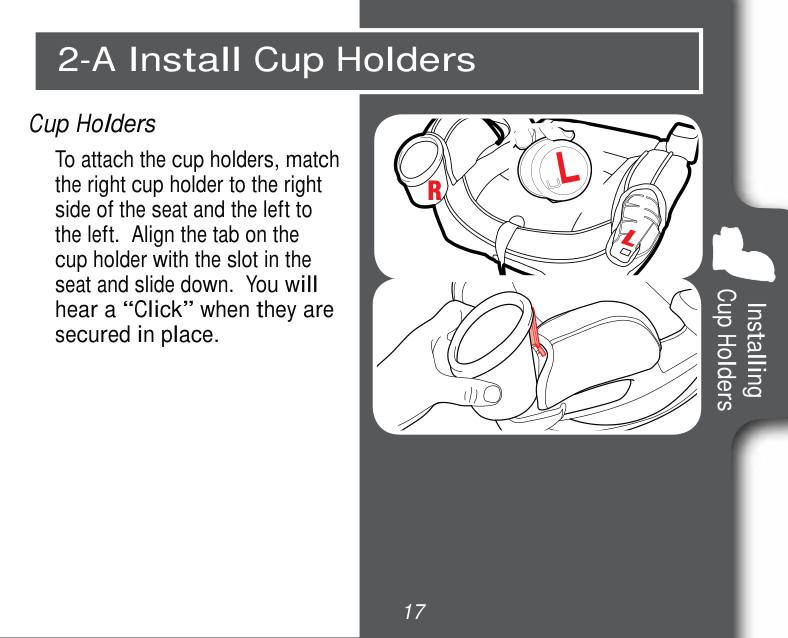
1-D Right Mode of Use
Important
|4 lbs (1.8 kg)|20 lbs (9 kg)|30 lbs (14 kg)|40 lbs (18 kg)|65 lbs (30 kg)
120 lbs (54 kg)| |---|---|---|---|---|
Rear-Facing with 5-Point Harness 4-20 lbs (1.8-9 kg) less than 1 year old MUST be rear-facing. 20-40 lbs (9-18 kg) CAN be rear-fcing.
Forward-Facing with 5-Point Harness 20-40 lbs (9-18 kg) can sit upright unassisted CAN be forward-facing. 40-65 lbs (18-30 kg) SHOULD be forward-facing.
Booster Mode with Vehicle Lap/Shoulder Seat Belt 30-65 lbs (14-30 kg) CAN be in backed booster mode. 40-65 lbs (18.1-30 kg) CAN be in backless booster mode. Over 65 lbs (30 kg) MUST be in booster mode.
Note: Preterm or low birth weight infants may be at special risk in a vehicle or aircraft. According to the AAP, these infants may suffer breathing issues if improperly reclined in a car seat. When rear-facing, use the corrected age for preemies. Graco advises that you have your physician or hospital staff evaluate your infant and recommend the proper car seat or car bed before you and your infant leave the hospital.


|2-A Install Cup Holders| |---|
####### Cup Holders
To attach the cup holders, match the right cup holder to the right side of the seat and the left to the left. Align the tab on the cup holder with the slot in the seat and slide down. You will hear a “Click” when they are secured in place.
###### R
L
Installing Cup Holders


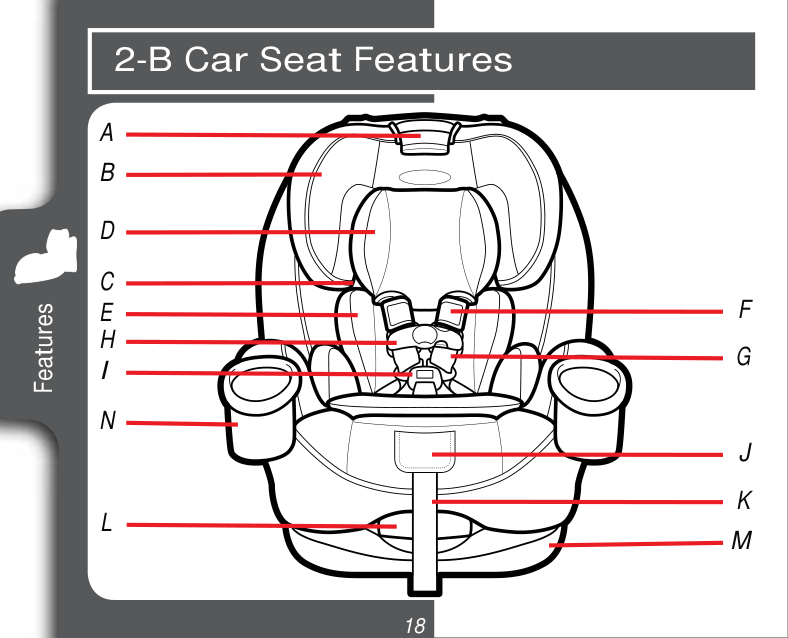
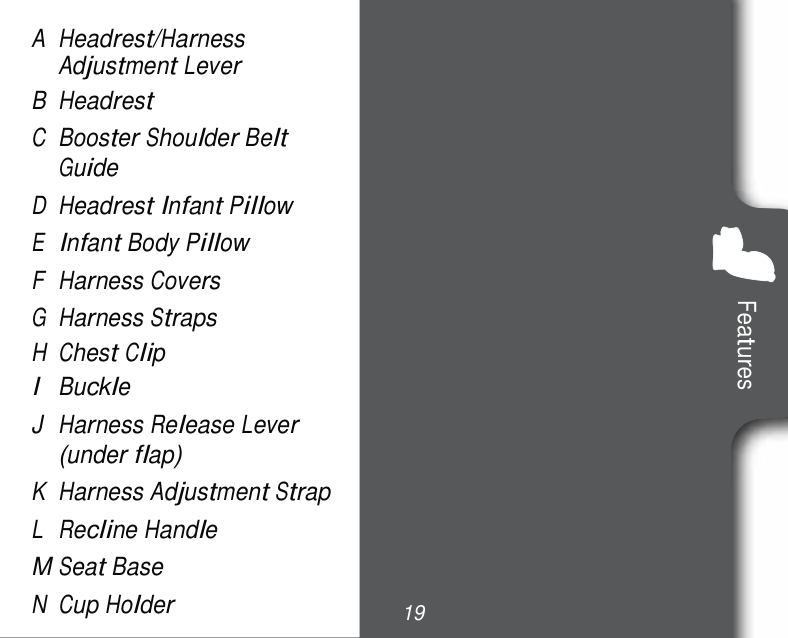
|2-B Car Seat Features| |---|
C
G
K M
B
Features
J
| | | |---|---|
| | |

L


Features


B
A
D
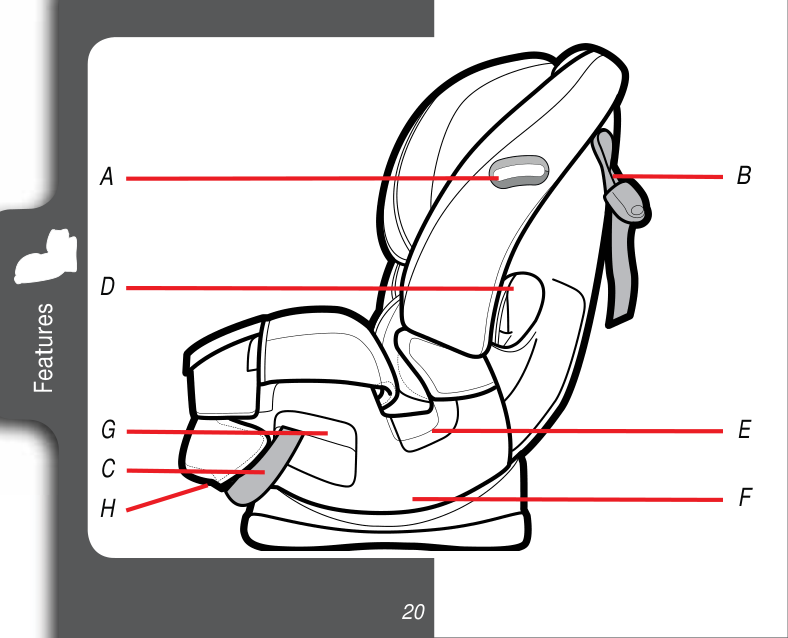
Features
G
C
H


Features


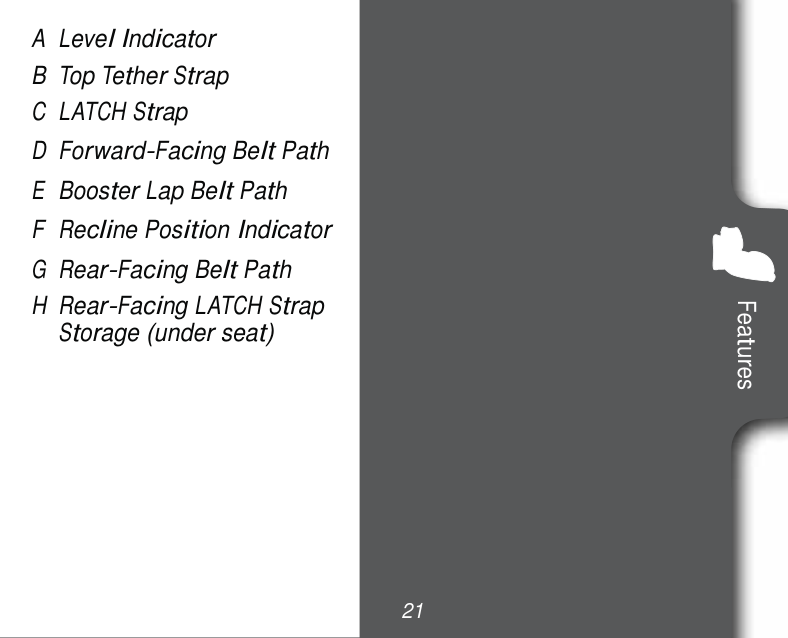
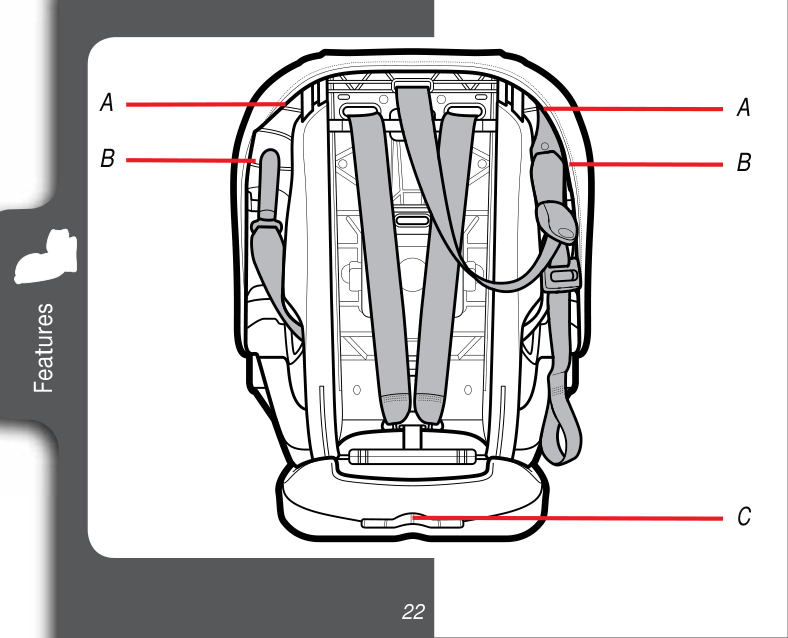
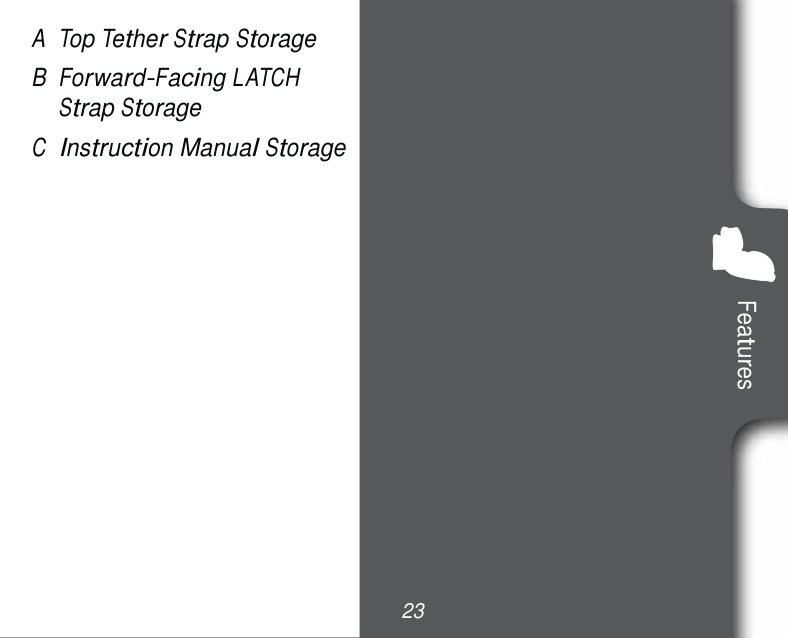
A B
Features

C


Features


| | | |
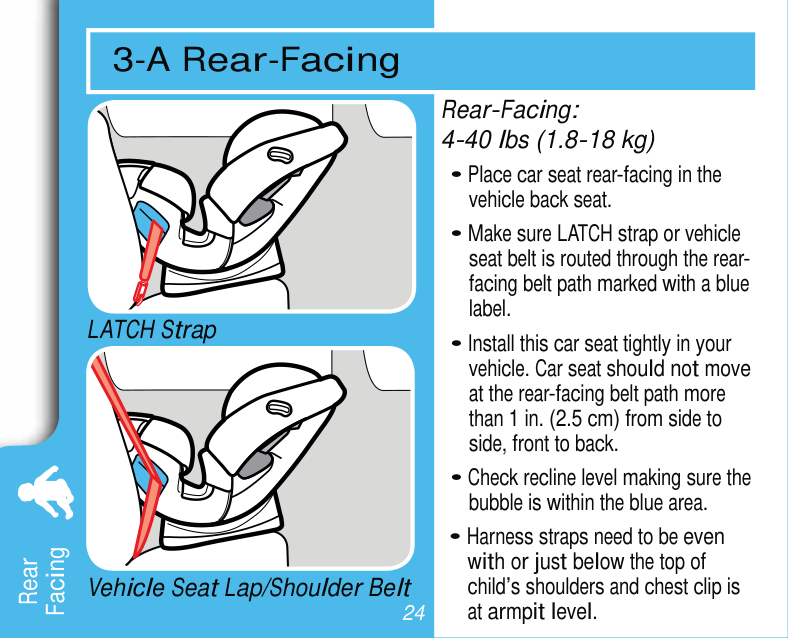
|---|---|---| |3-A Rear-Fa|ing| | | |Rear-Facing:| |
4-40 lbs (1.8-18 kg)
LATCH Strap

Facing
Rear
Vehicle Seat Lap/Shoulder Belt


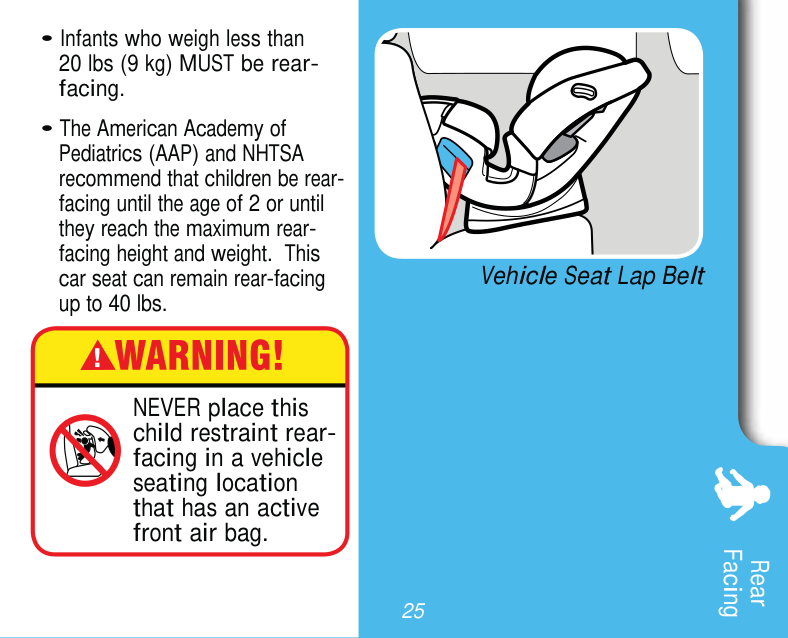
Vehicle Seat Lap Belt
NEVER place this child restraint rearfacing in a vehicle seating location that has an active front air bag.

Rear Facing


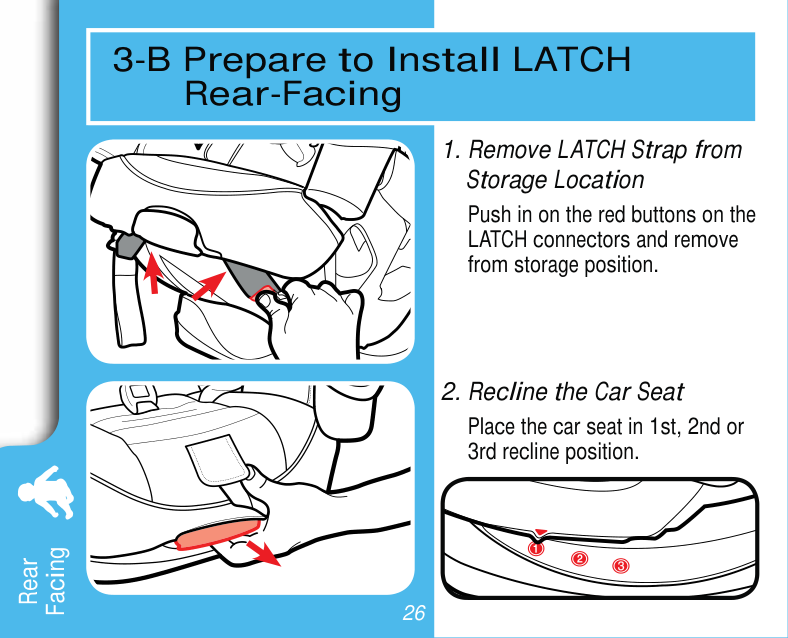
|3-B Prepare to Install LATCH Rear-Facing| |---|
####### 1. Remove LATCH Strap fromStorage Location
Push in on the red buttons on the LATCH connectors and remove from storage position.
####### 2. Recline the Car Seat
Place the car seat in 1st, 2nd or 3rd recline position.


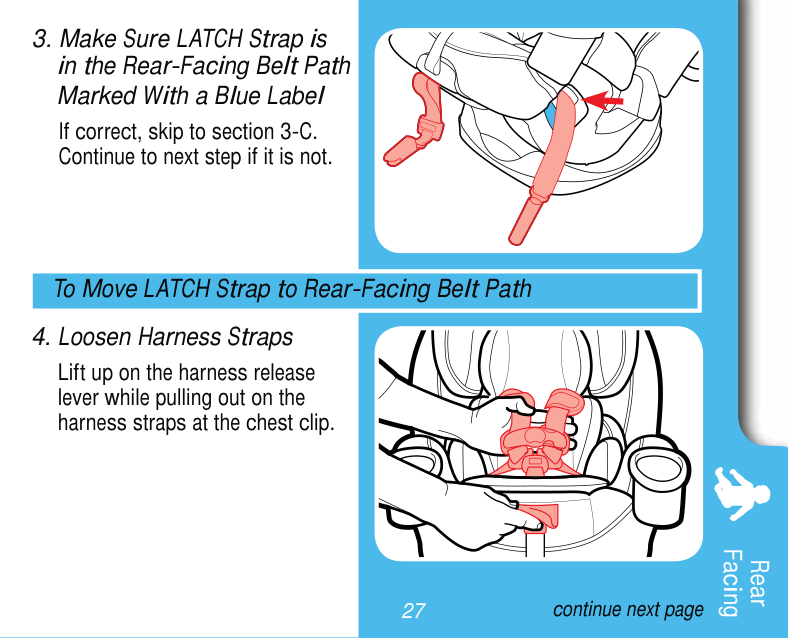
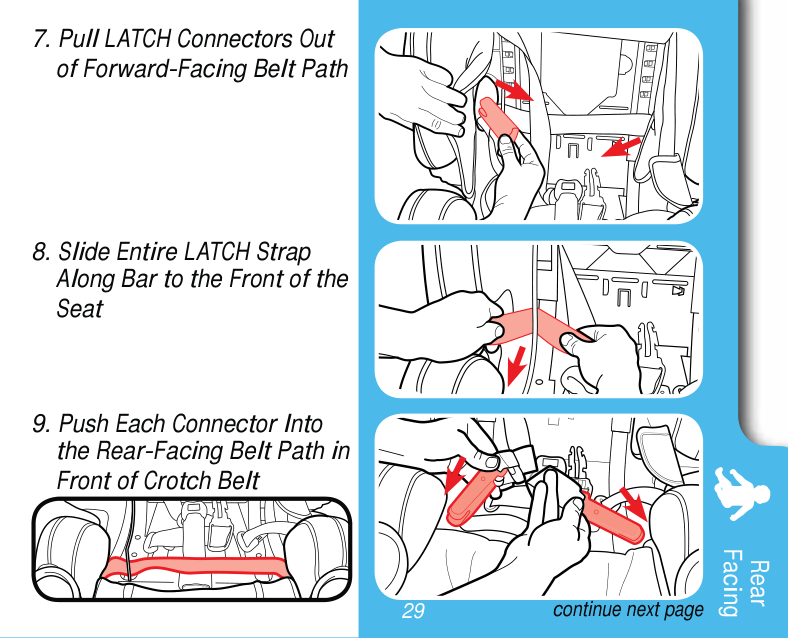
|To Move LATCH Strap to Rear-Facing Belt Path|
|---|
Lift up on the harness release lever while pulling out on the harness straps at the chest clip.

| | | |---|---| |27|continue next page|
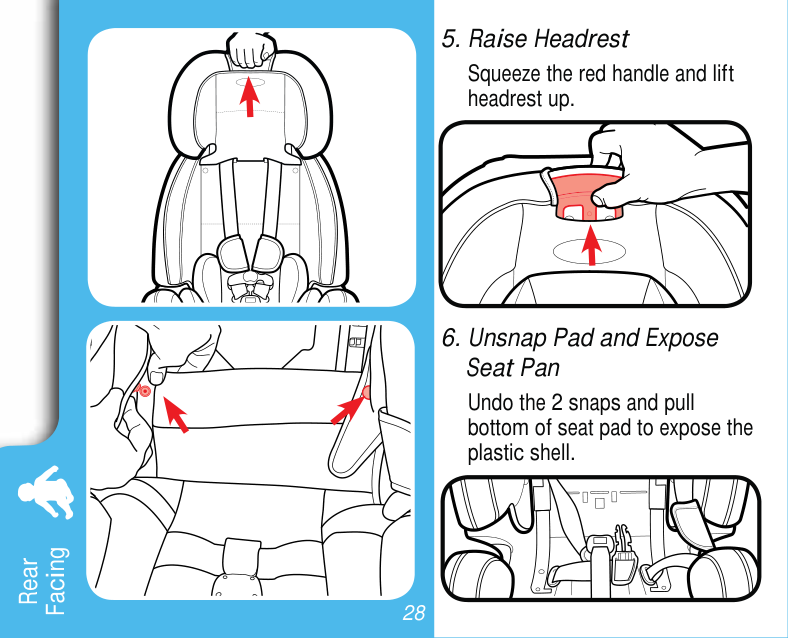
Rear Facing


####### 5. Raise Headrest
Squeeze the red handle and lift headrest up.
####### 6. Unsnap Pad and Expose Seat Pan
Undo the 2 snaps and pull bottom of seat pad to expose the plastic shell.



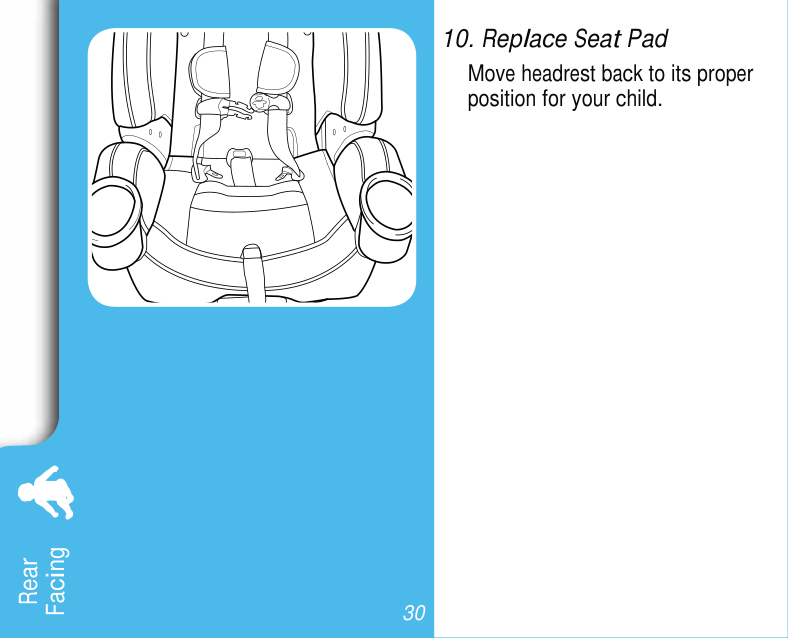
####### 10. Replace Seat Pad
Move headrest back to its proper position for your child.


|3-C Installing With LATCH Straps| |---|
|Review your vehicle’s owner manual for LATCH location and use.| |---|
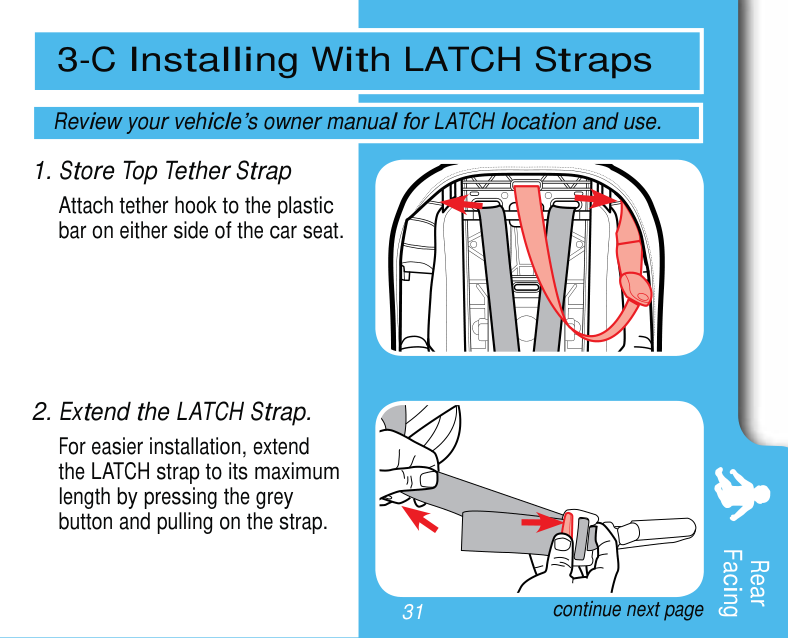
####### 1. Store Top Tether Strap
Attach tether hook to the plastic bar on either side of the car seat.
####### 2. Extend the LATCH Strap.
For easier installation, extend the LATCH strap to its maximum length by pressing the grey button and pulling on the strap.


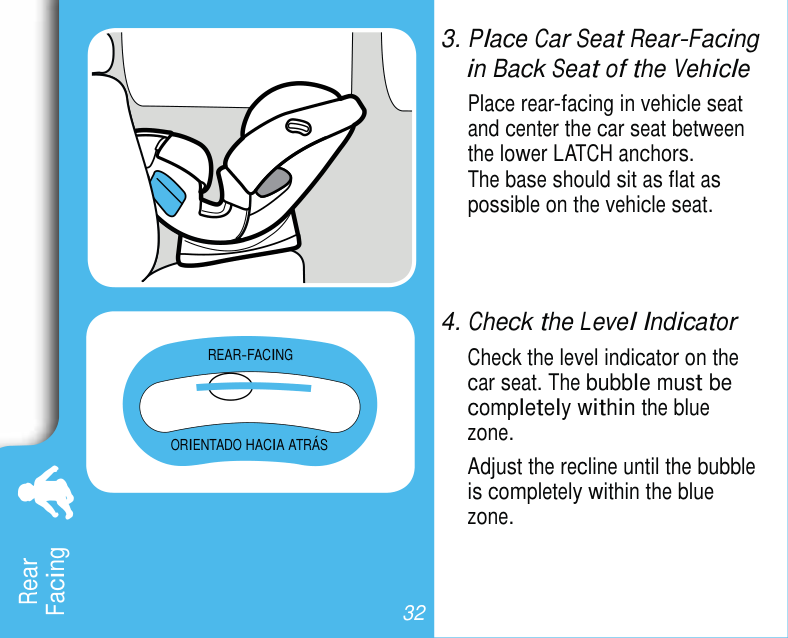
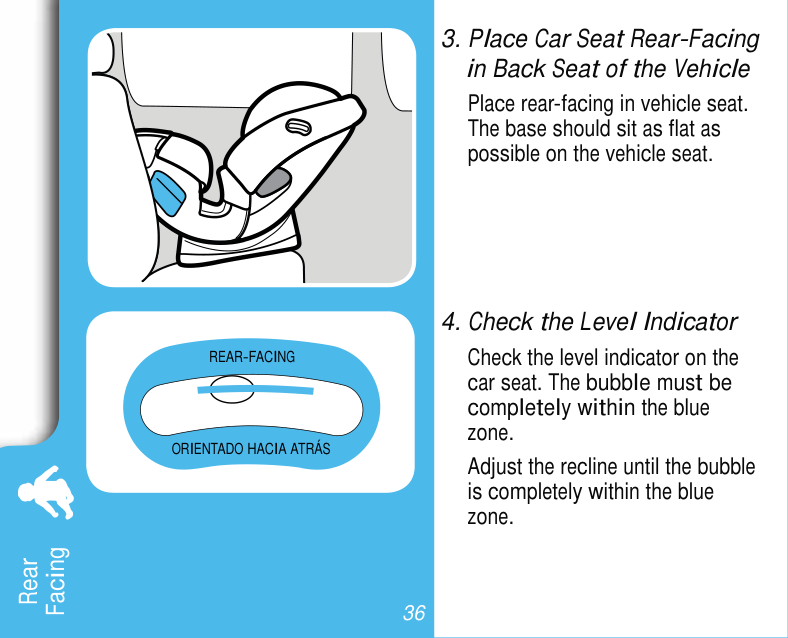
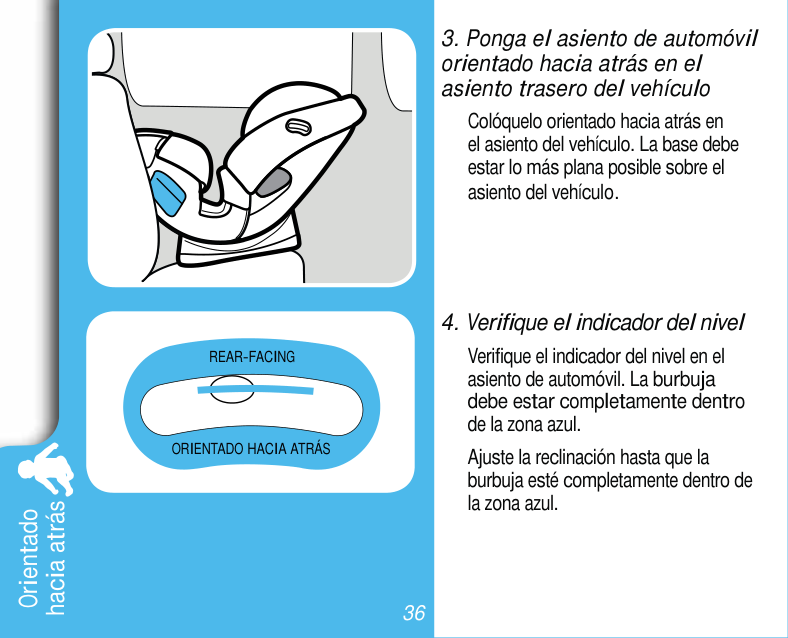
####### 3. Place Car Seat Rear-Facing in Back Seat of the Vehicle
Place rear-facing in vehicle seat and center the car seat between the lower LATCH anchors. The base should sit as flat as possible on the vehicle seat.
REAR-FACING
ORIENTADO HACIA ATRÁS


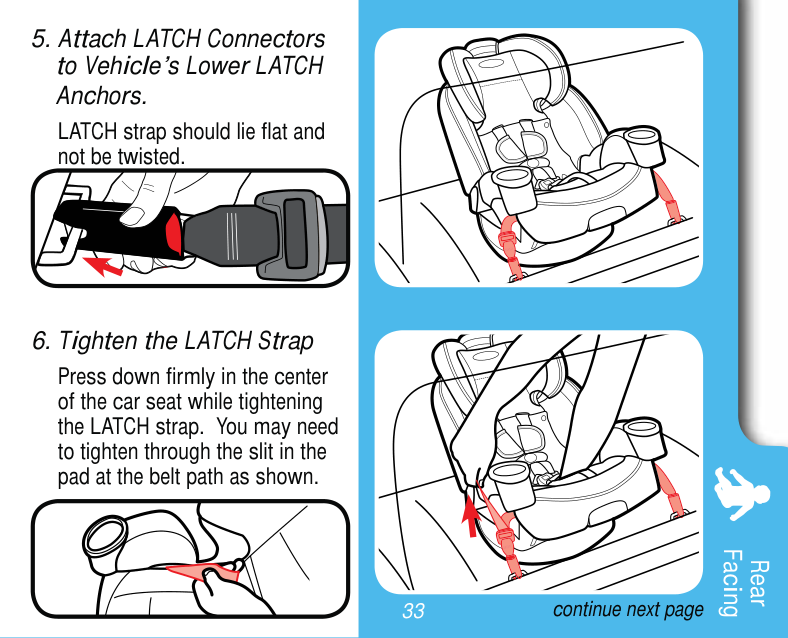
####### 5. Attach LATCH Connectorsto Vehicle’s Lower LATCHAnchors.
LATCH strap should lie flat and not be twisted.
####### 6. Tighten the LATCH Strap
Press down firmly in the center of the car seat while tightening the LATCH strap. You may need to tighten through the slit in the pad at the belt path as shown.


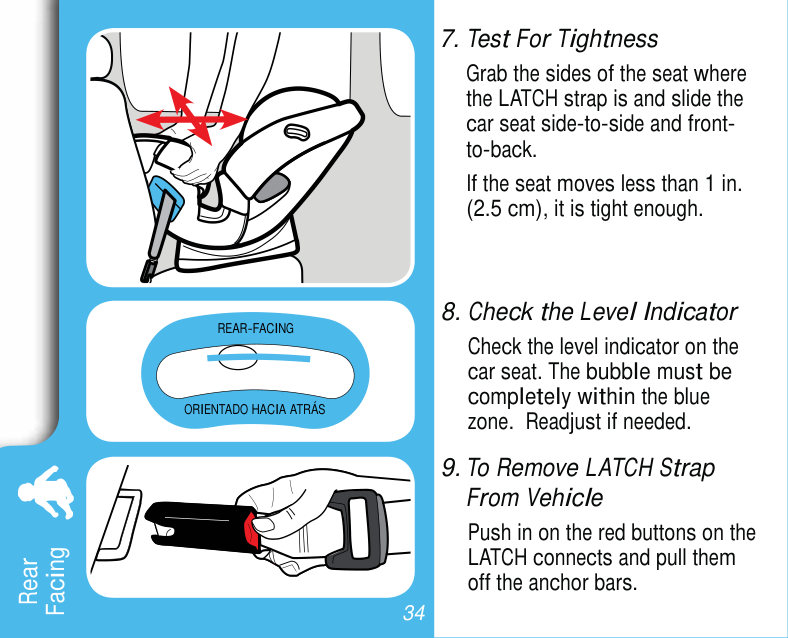
Grab the sides of the seat where the LATCH strap is and slide the car seat side-to-side and frontto-back.
If the seat moves less than 1 in. (2.5 cm), it is tight enough.
####### 8. Check the Level Indicator
REAR-FACING
Check the level indicator on the car seat. The bubble must be completely within the blue zone. Readjust if needed.
ORIENTADO HACIA ATRÁS
####### 9. To Remove LATCH StrapFrom Vehicle

Push in on the red buttons on the LATCH connects and pull them off the anchor bars.
Facing
Rear


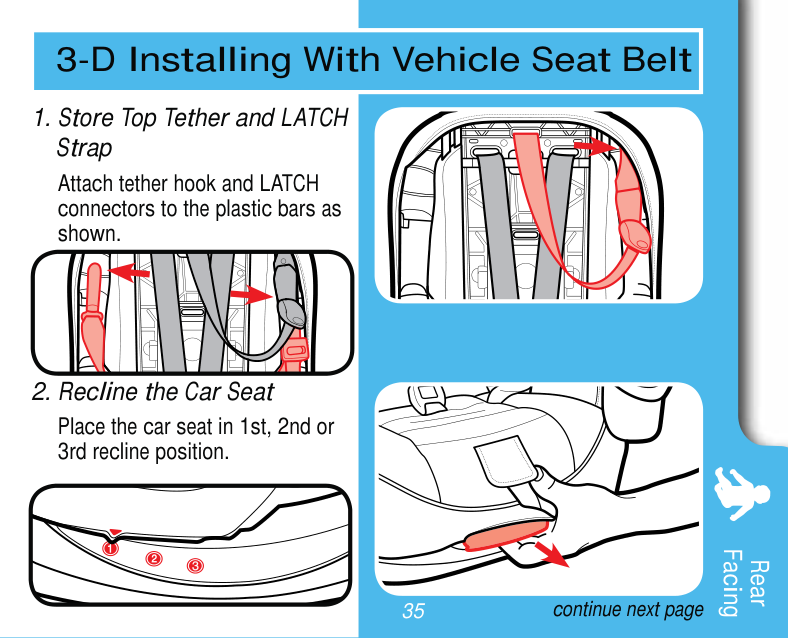
|3-D Installing With Vehicle Seat Belt| |---|
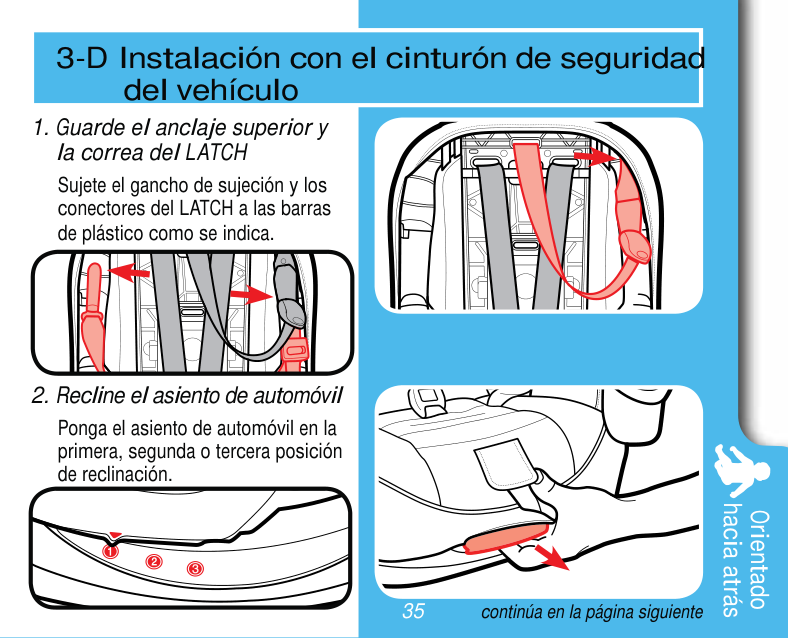
####### 1. Store Top Tether and LATCHStrap
Attach tether hook and LATCH connectors to the plastic bars as shown.
####### 2. Recline the Car Seat
Place the car seat in 1st, 2nd or 3rd recline position.


REAR-FACING
ORIENTADO HACIA ATRÁS

####### Facing
####### Rear


|Review your vehicle’s owner manual for vehicle seat belt use| |---|
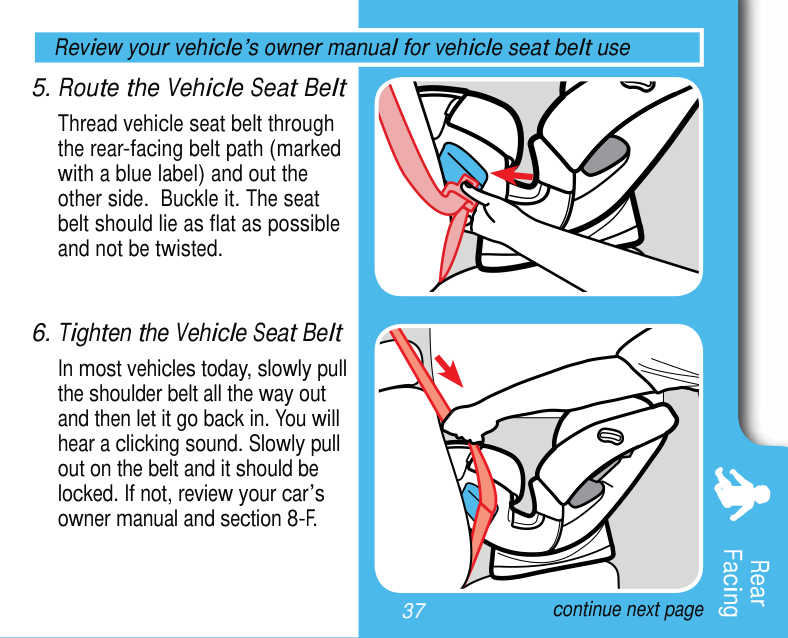
####### 5. Route the Vehicle Seat Belt
Thread vehicle seat belt through the rear-facing belt path (marked with a blue label) and out the other side. Buckle it. The seat belt should lie as flat as possible and not be twisted.
####### 6. Tighten the Vehicle Seat Belt
In most vehicles today, slowly pull the shoulder belt all the way out and then let it go back in. You will hear a clicking sound. Slowly pull out on the belt and it should be locked. If not, review your car’s owner manual and section 8-F.


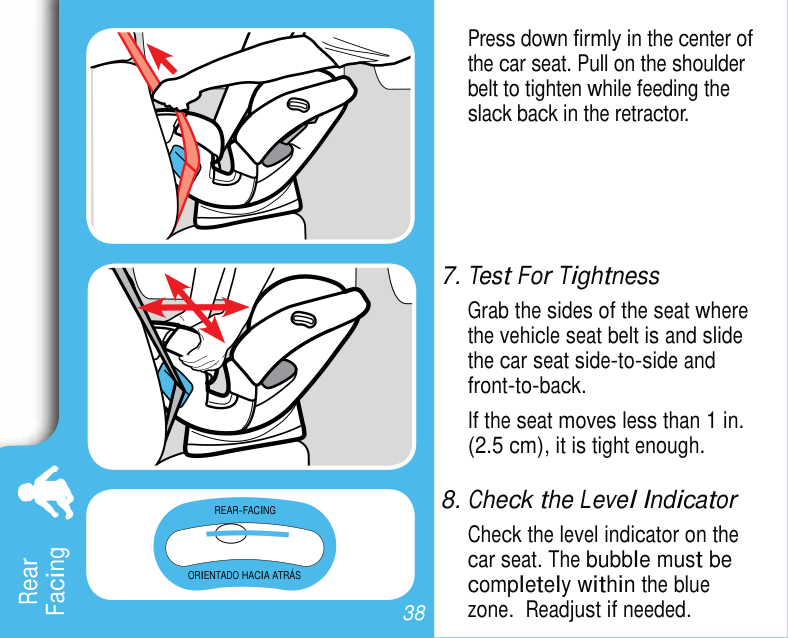
Press down firmly in the center of the car seat. Pull on the shoulder belt to tighten while feeding the slack back in the retractor.
####### 7. Test For Tightness
Grab the sides of the seat where the vehicle seat belt is and slide the car seat side-to-side and front-to-back.
If the seat moves less than 1 in. (2.5 cm), it is tight enough.
####### 8. Check the Level Indicator

REAR-FACING
Check the level indicator on the car seat. The bubble must be completely within the blue zone. Readjust if needed.
####### Facing
####### Rear
ORIENTADO HACIA ATRÁS


4-A Forward-Facing
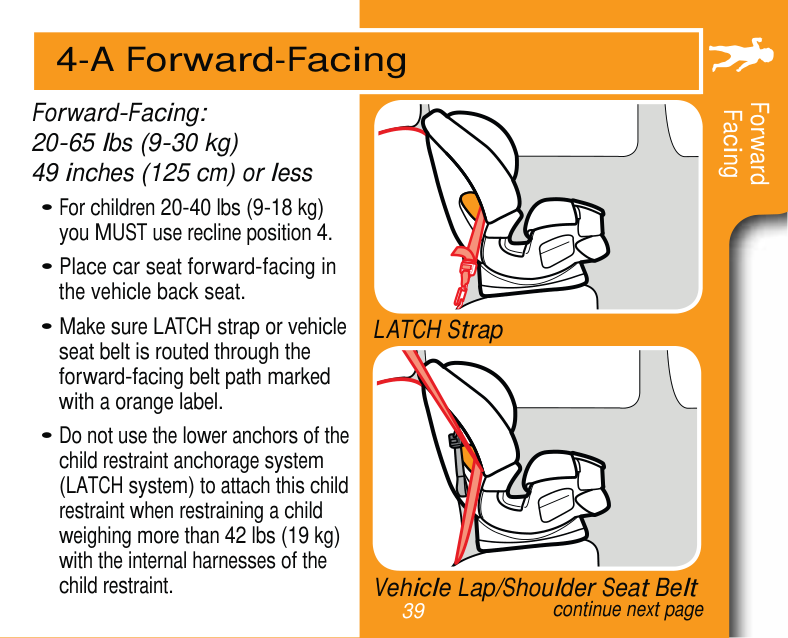
####### Forward-Facing: 20-65 lbs (9-30 kg) 49 inches (125 cm) or less
Important
Forward Facing

LATCH Strap

Vehicle Lap/Shoulder Seat Belt


Forward
Facing
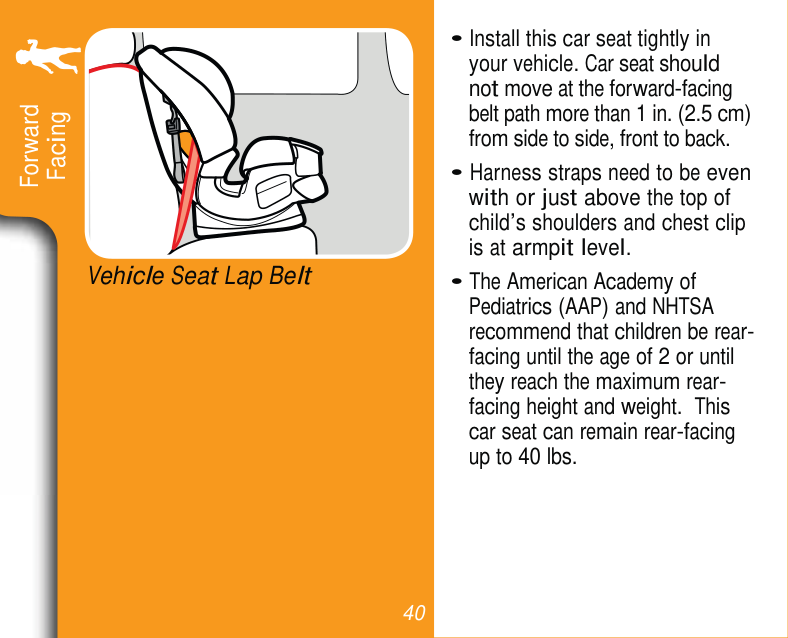
####### Vehicle Seat Lap Belt


|4-B Prepare to Install LATCH Forward-Facing|
|---|

Important
Forward Facing

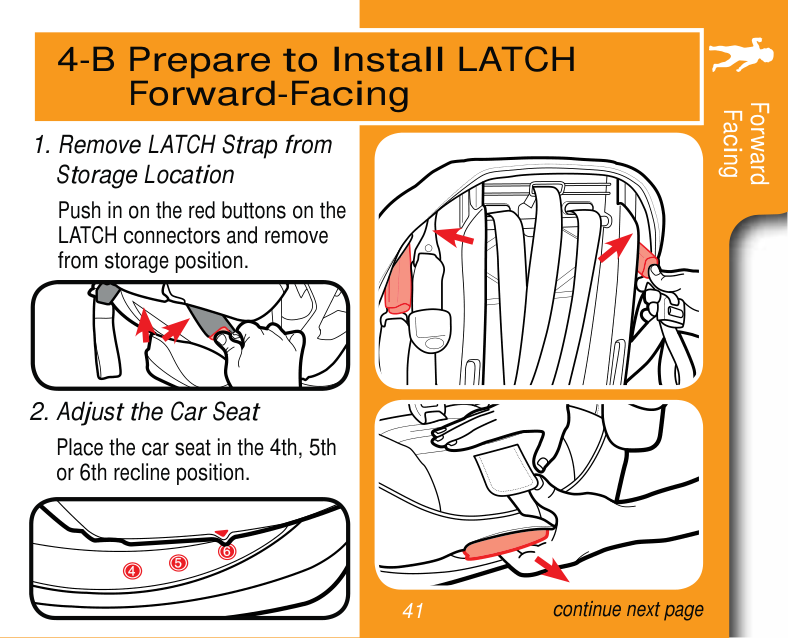
####### 1. Remove LATCH Strap fromStorage Location
Push in on the red buttons on the LATCH connectors and remove from storage position.
####### 2. Adjust the Car Seat
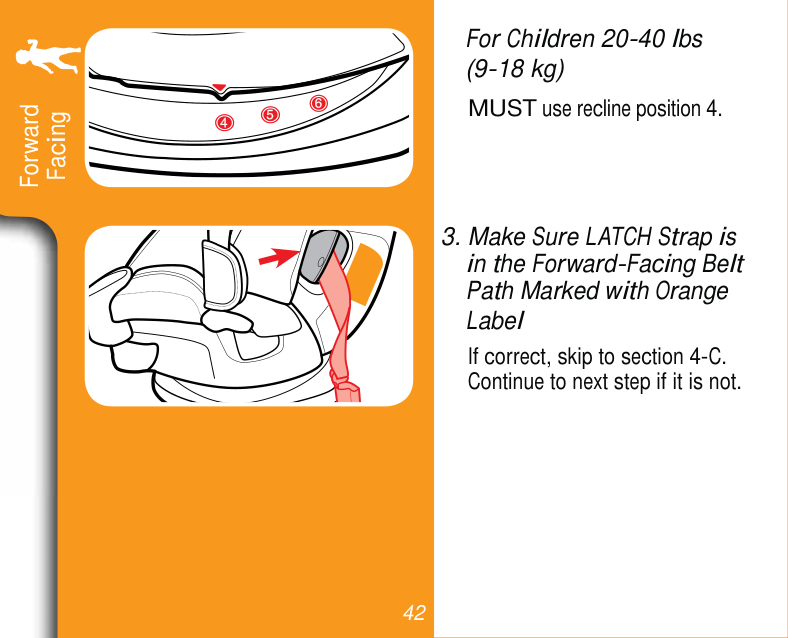
Place the car seat in the 4th, 5th or 6th recline position.


For Children 20-40 lbs (9-18 kg)
MUST use recline position 4.
Forward
Facing
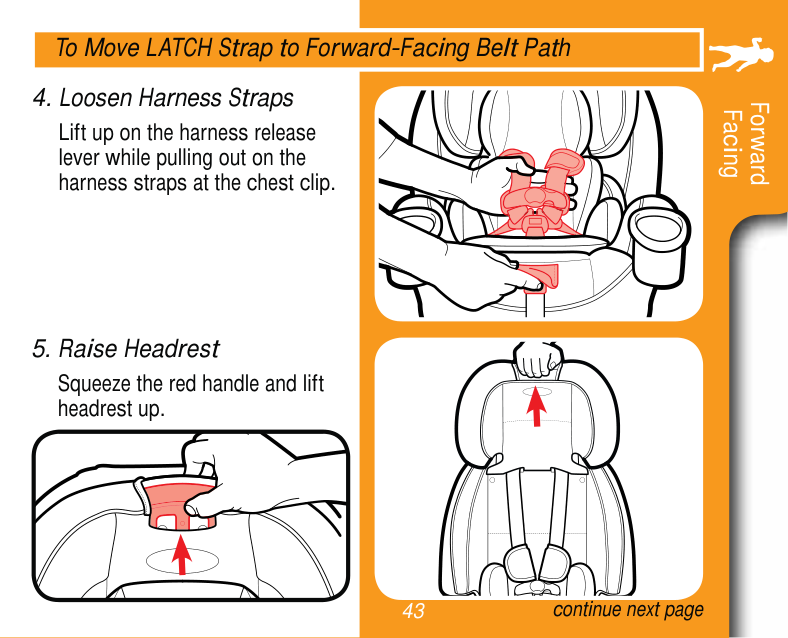
####### 3. Make Sure LATCH Strap is in the Forward-Facing Belt Path Marked with Orange Label
If correct, skip to section 4-C. Continue to next step if it is not.


|To Move LATCH Strap to Forward-Facing Belt Path| |---|
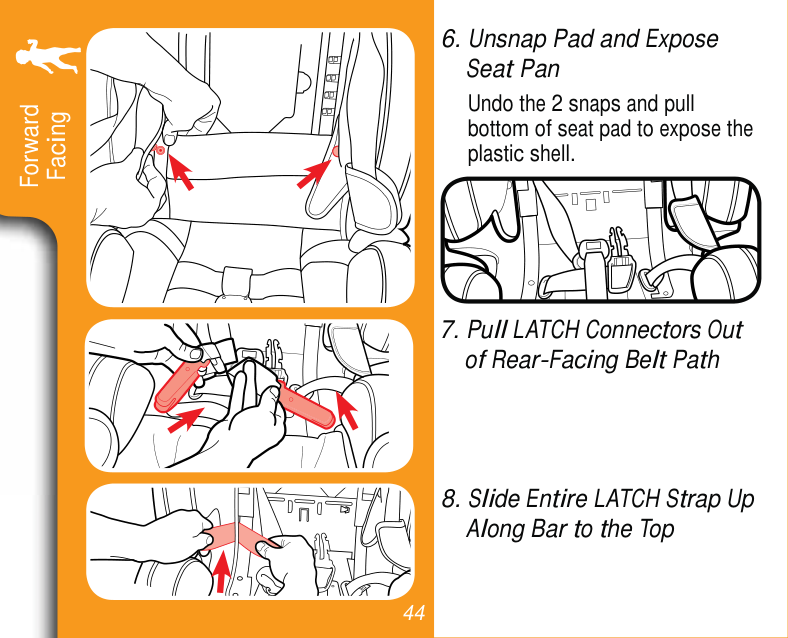

####### 4. Loosen Harness Straps
Important
Forward Facing

Lift up on the harness release lever while pulling out on the harness straps at the chest clip.
| | | |---|---| | | | | | |
Squeeze the red handle and lift headrest up.


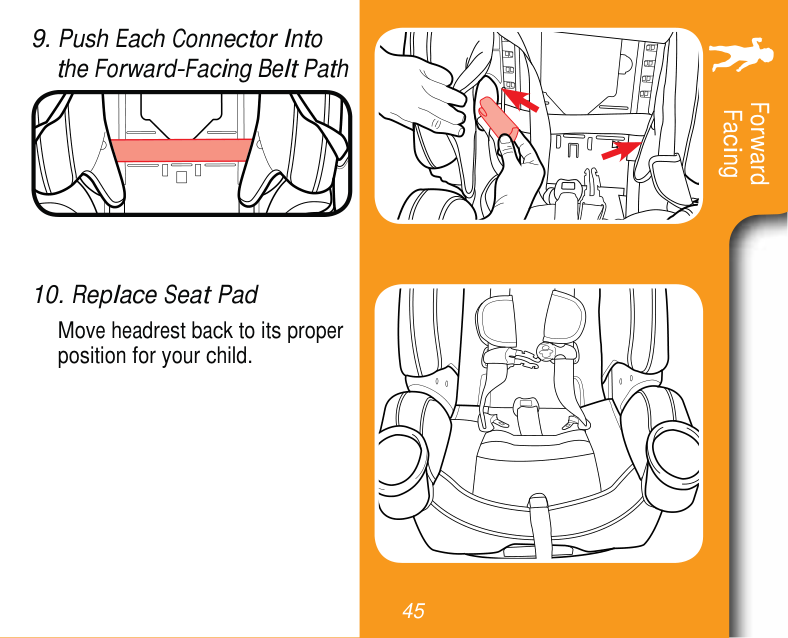
Undo the 2 snaps and pull bottom of seat pad to expose the plastic shell.
Forward
Facing
| | | |---|---| | | | | | |


####### 9. Push Each Connector Into the Forward-Facing Belt Path


Important
Forward Facing

Move headrest back to its proper position for your child.


|4-C Installing With LATCH Straps| |---|
Forward
Facing
Do not use the lower anchors of the child restraint anchorage system (LATCH system) to attach this child restraint when restraining a child weighing more than 42 lbs (19 kg) with the internal harnesses of the child restraint.
|Review your vehicle’s owner manual for LATCH location and use.| |---|
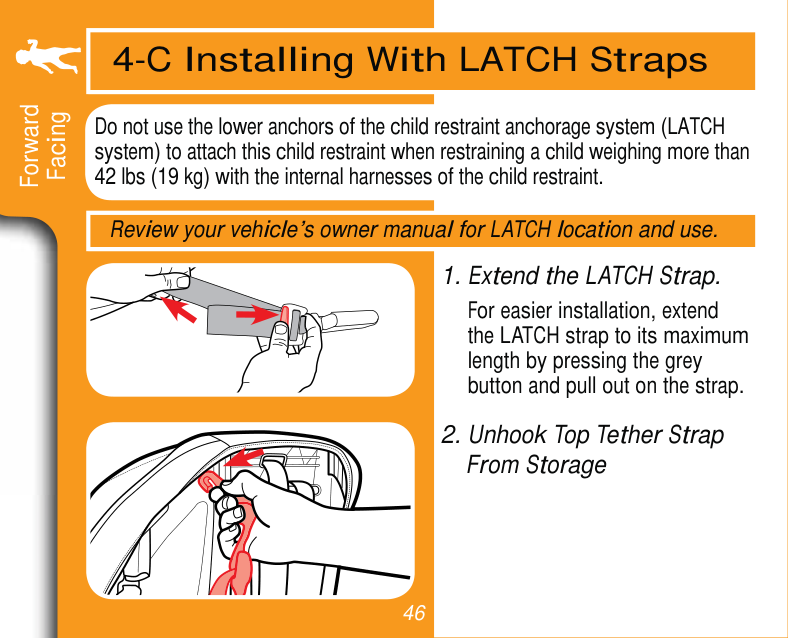
####### 1. Extend the LATCH Strap.
For easier installation, extend the LATCH strap to its maximum length by pressing the grey button and pull out on the strap.


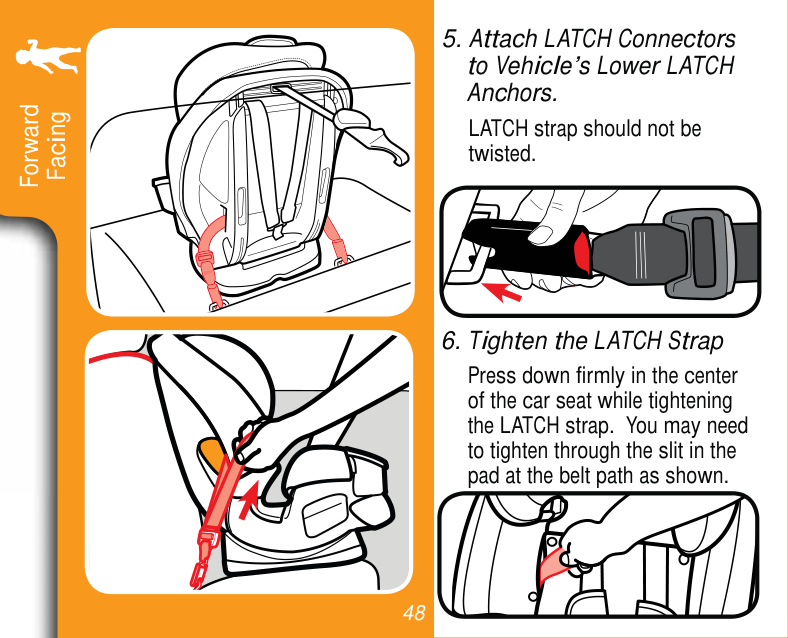
####### 3. Place Car Seat Forward-Facing in Back Seat of theVehicle


Important
Forward Facing

Place forward-facing in vehicle seat and center the car seat between the lower LATCH anchors. The base should sit as flat as possible on the vehicle seat.
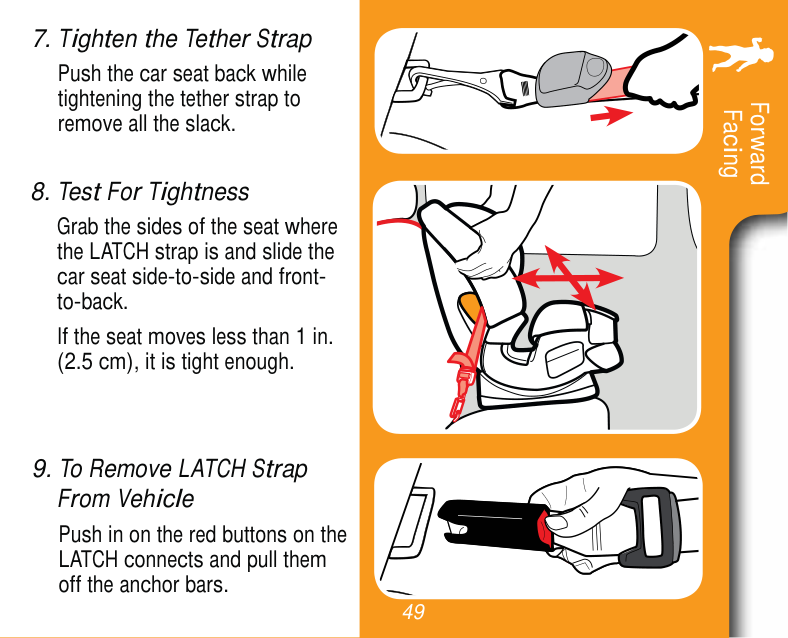
####### 4. Loosely Attach Top TetherStrap
Do not tighten. Consult vehicle’s owner manual for specific location.

47 continue next page


LATCH strap should not be twisted.
Forward
Facing
Press down firmly in the center of the car seat while tightening the LATCH strap. You may need to tighten through the slit in the pad at the belt path as shown.


Push the car seat back while tightening the tether strap to remove all the slack.
Grab the sides of the seat where the LATCH strap is and slide the car seat side-to-side and frontto-back.
If the seat moves less than 1 in. (2.5 cm), it is tight enough.


Important
Forward Facing


Push in on the red buttons on the LATCH connects and pull them off the anchor bars.


|4-D Installing With Vehicle Seat Belt| |---|
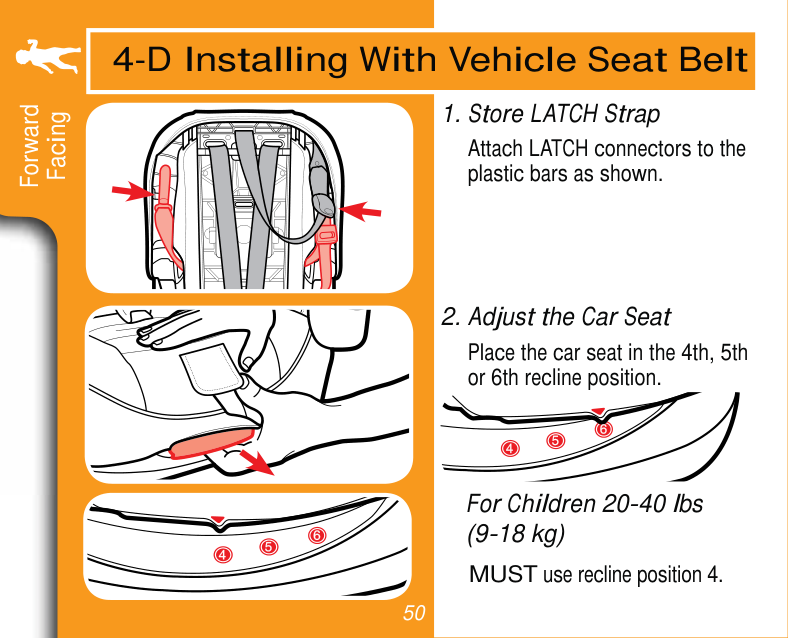
####### 1. Store LATCH Strap
Forward
Facing
Attach LATCH connectors to the plastic bars as shown.
####### 2. Adjust the Car Seat
Place the car seat in the 4th, 5th or 6th recline position.
####### For Children 20-40 lbs (9-18 kg)

MUST use recline position 4.


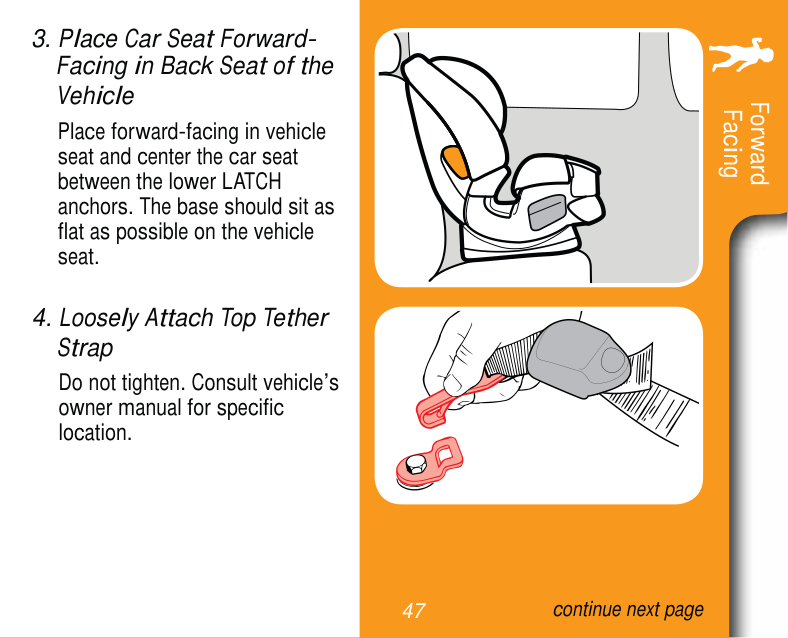
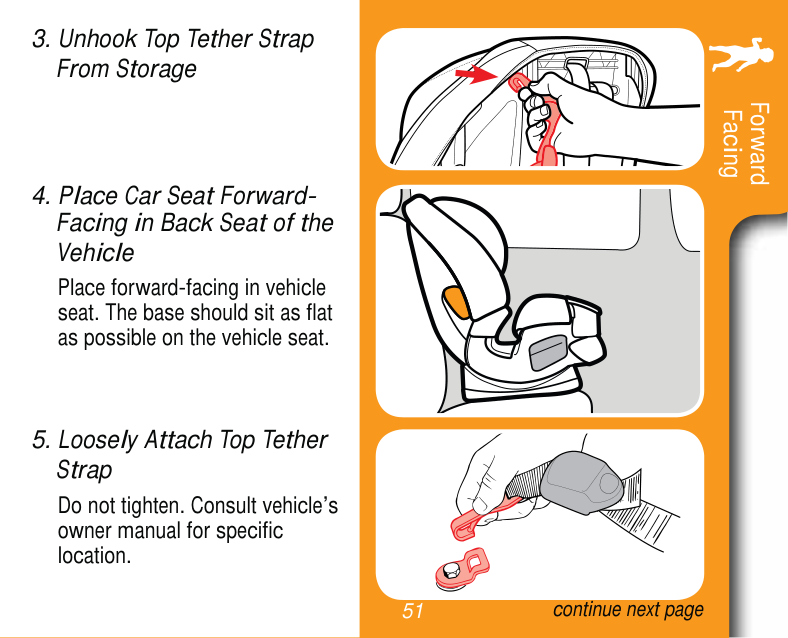
####### 3. Unhook Top Tether Strap From Storage


Important
Forward Facing

####### 4. Place Car Seat Forward-Facing in Back Seat of theVehicle
Place forward-facing in vehicle seat. The base should sit as flat as possible on the vehicle seat.
####### 5. Loosely Attach Top TetherStrap
Do not tighten. Consult vehicle’s owner manual for specific location.

51 continue next page
| | | |---|---| |Review your vehicle’s owner man|al for vehicle seat belt use|


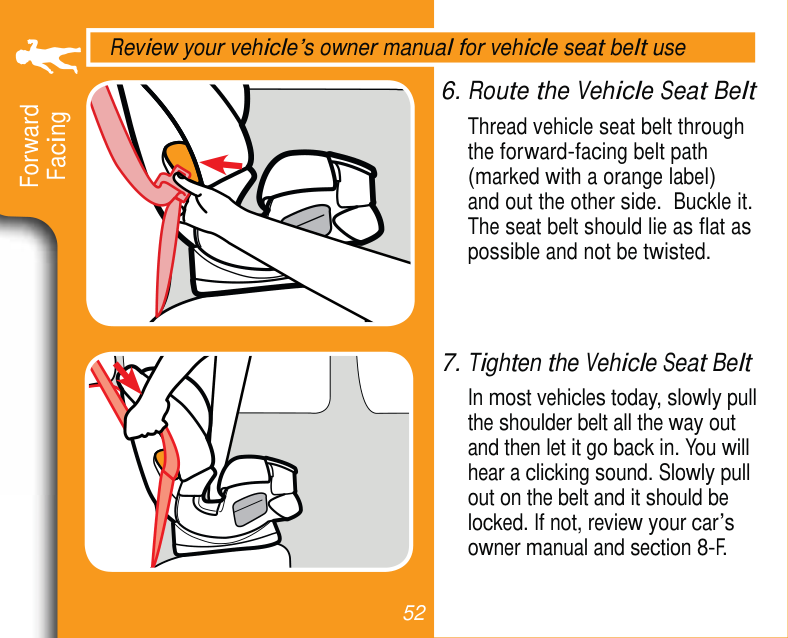
Thread vehicle seat belt through the forward-facing belt path (marked with a orange label) and out the other side. Buckle it. The seat belt should lie as flat as possible and not be twisted.
Forward
Facing
In most vehicles today, slowly pull the shoulder belt all the way out and then let it go back in. You will hear a clicking sound. Slowly pull out on the belt and it should be locked. If not, review your car’s owner manual and section 8-F.


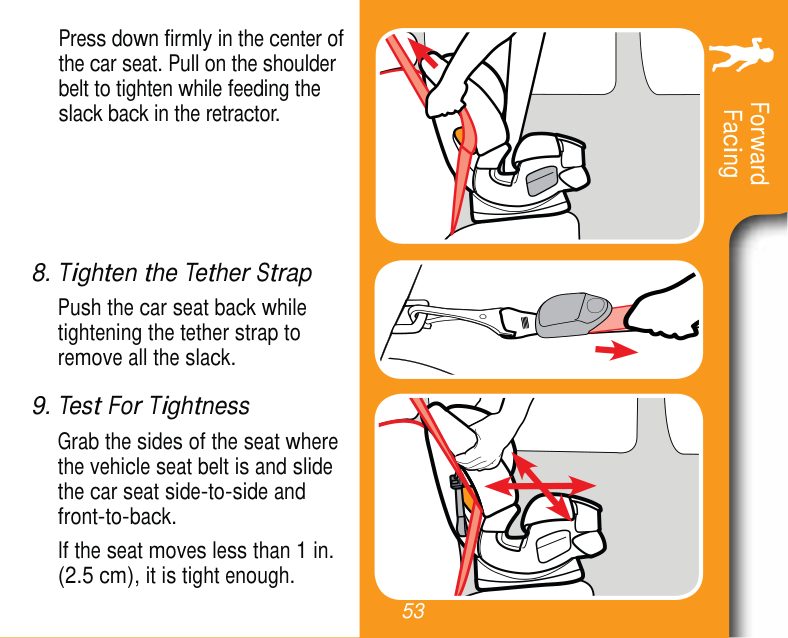
Press down firmly in the center of the car seat. Pull on the shoulder belt to tighten while feeding the slack back in the retractor.

####### Important
####### Forward Facing

####### 8. Tighten the Tether Strap
Push the car seat back while tightening the tether strap to remove all the slack.
####### 9. Test For Tightness
Grab the sides of the seat where the vehicle seat belt is and slide the car seat side-to-side and front-to-back.

If the seat moves less than 1 in. (2.5 cm), it is tight enough.


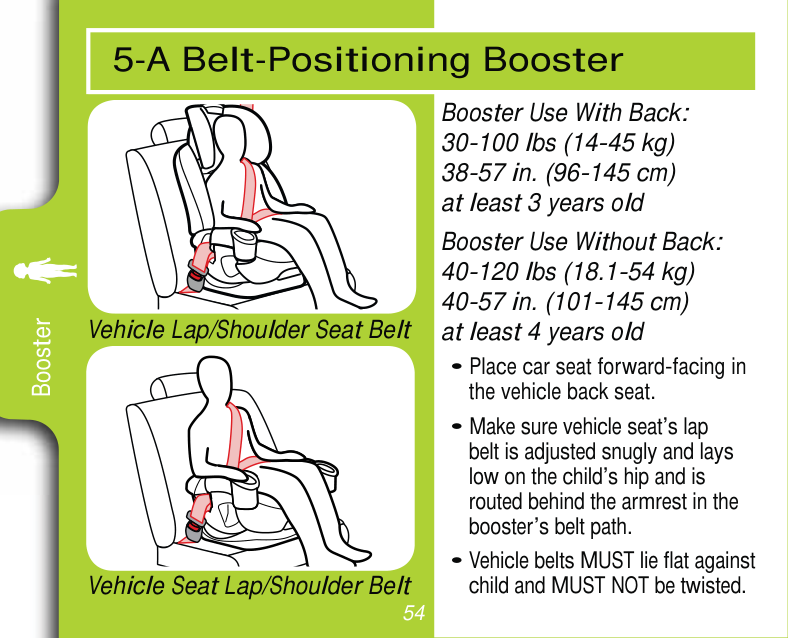
Booster Use With Back: 30-100 lbs (14-45 kg) 38-57 in. (96-145 cm)
Booster Use Without Back: 40-120 lbs (18.1-54 kg) 40-57 in. (101-145 cm)
Vehicle Lap/Shoulder Seat Belt
Booster

Vehicle Seat Lap/Shoulder Belt


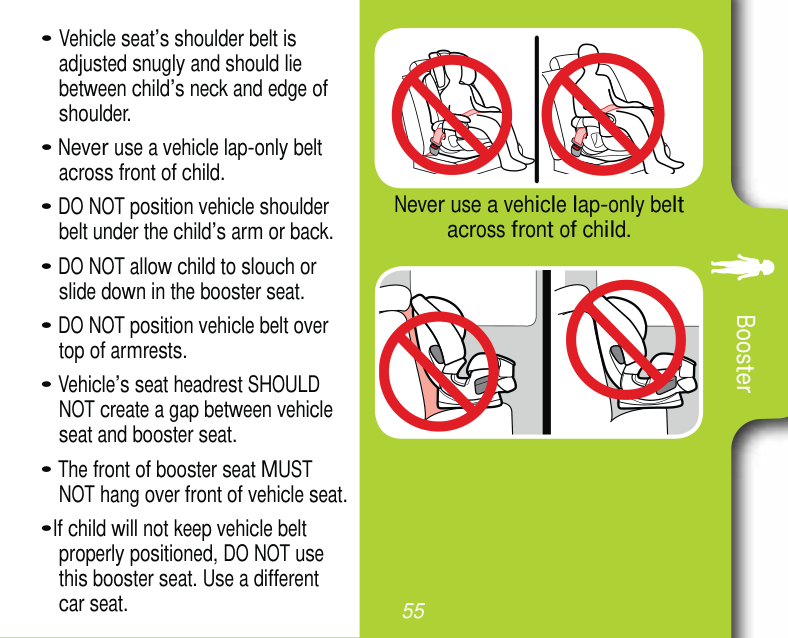
######### Never use a vehicle lap-only belt across front of child.
####### Booster


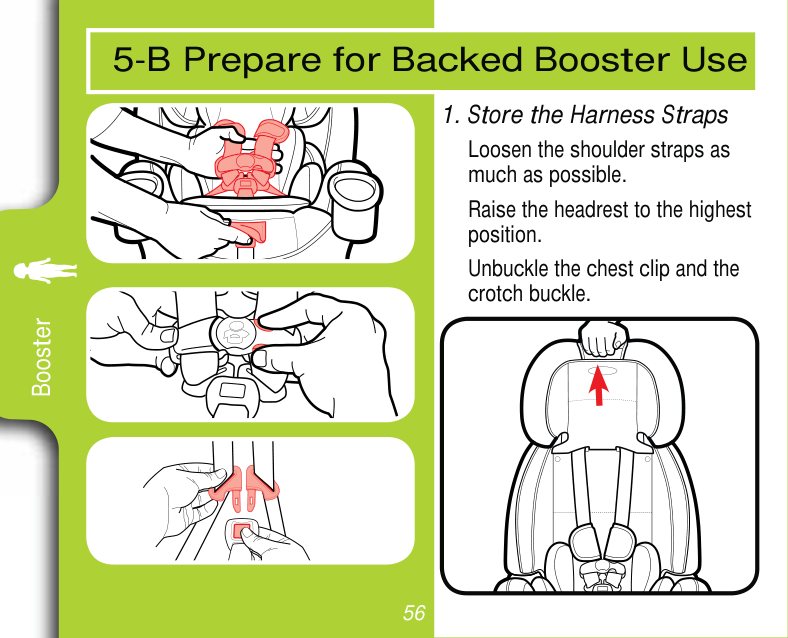
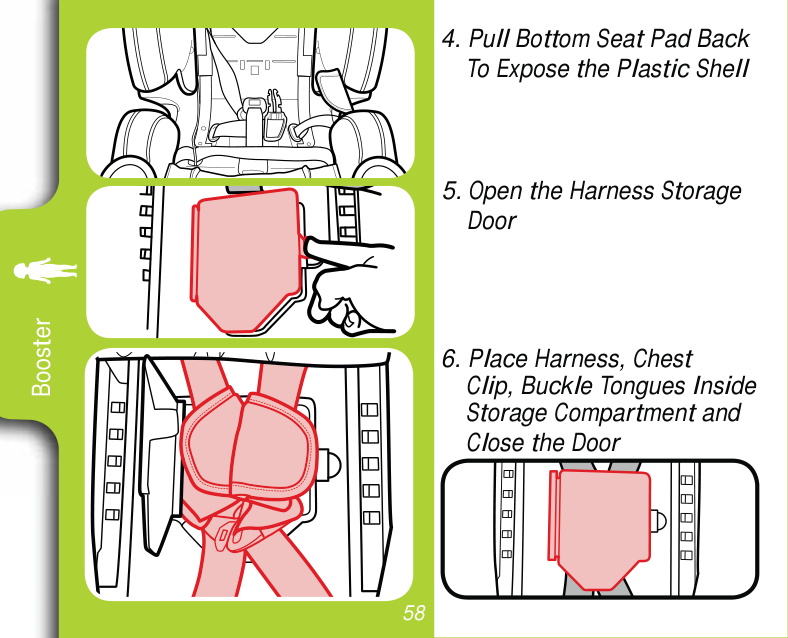
####### 1. Store the Harness Straps
Loosen the shoulder straps as much as possible.
Raise the headrest to the highest position.
Unbuckle the chest clip and the crotch buckle.
####### Booster


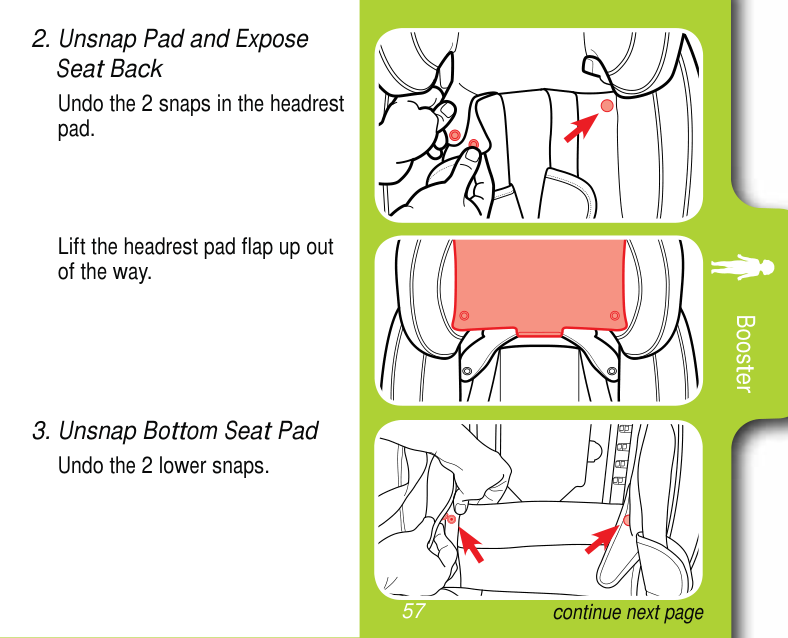
####### 2. Unsnap Pad and ExposeSeat Back
Undo the 2 snaps in the headrest pad.
Lift the headrest pad flap up out of the way.
####### Booster
| | | | |---|---|---| | | | | | | | |
####### 3. Unsnap Bottom Seat PadUndo the 2 lower snaps.

57
continue next page


Booster


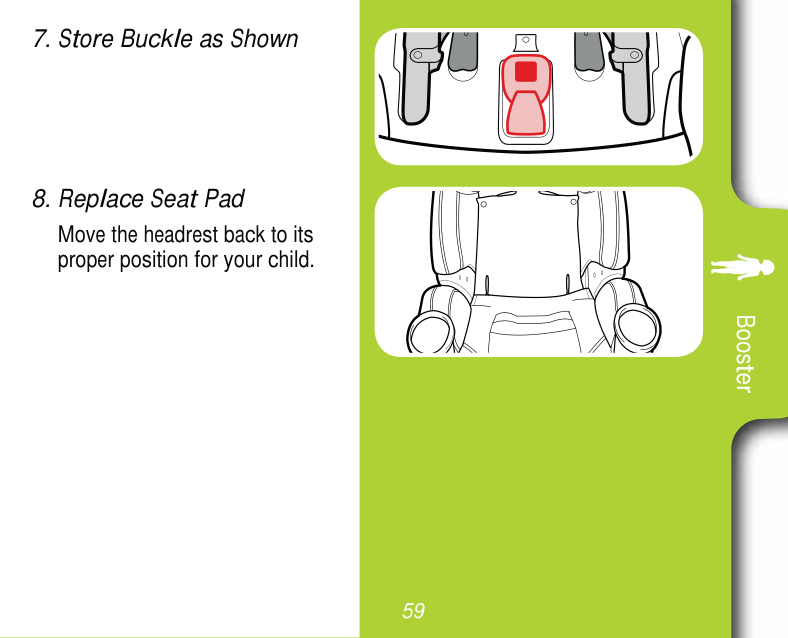
####### 7. Store Buckle as Shown
Move the headrest back to its proper position for your child.
Booster


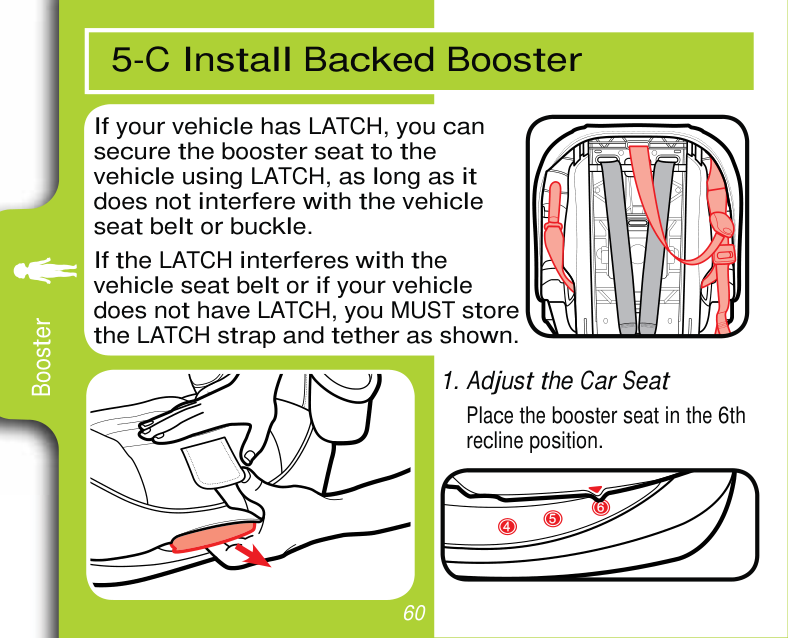
|5-C Install Backed Booster| |---|
If your vehicle has LATCH, you can secure the booster seat to the vehicle using LATCH, as long as it does not interfere with the vehicle seat belt or buckle.
If the LATCH interferes with the vehicle seat belt or if your vehicle does not have LATCH, you MUST store the LATCH strap and tether as shown.
Booster
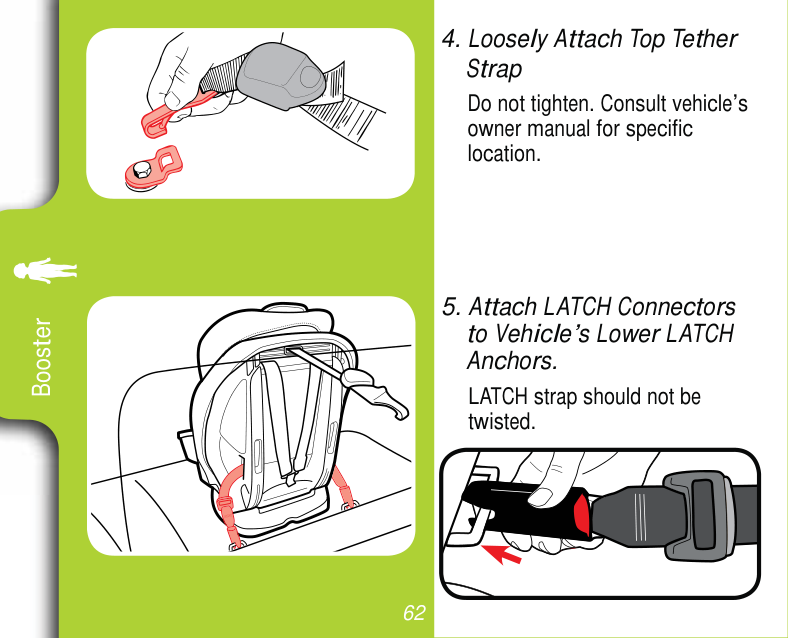
####### 1. Adjust the Car Seat
Place the booster seat in the 6th recline position.


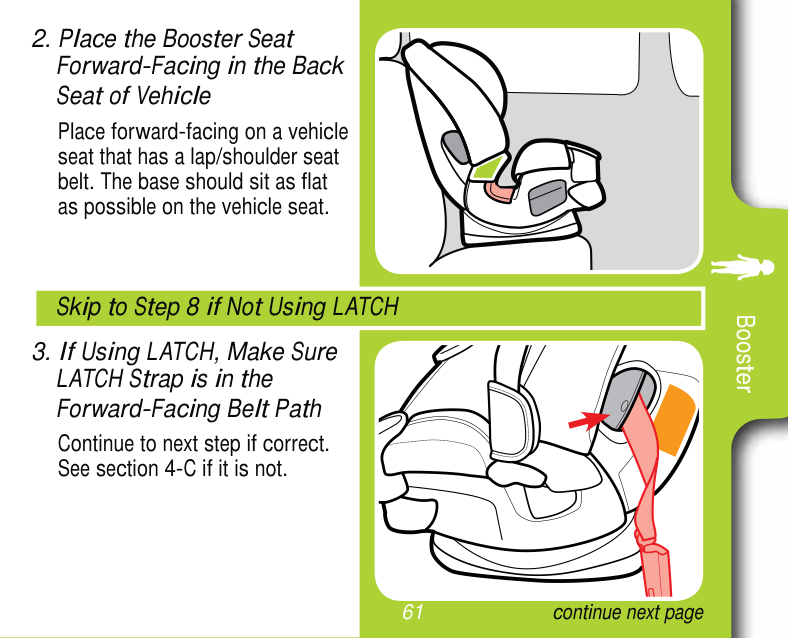
Place forward-facing on a vehicle seat that has a lap/shoulder seat belt. The base should sit as flat as possible on the vehicle seat.
|Skip to Step 8 if Not Using LATCH| |---|
Booster
Continue to next step if correct. See section 4-C if it is not.

continue next page


####### 4. Loosely Attach Top Tether Strap
Do not tighten. Consult vehicle’s owner manual for specific location.
Booster
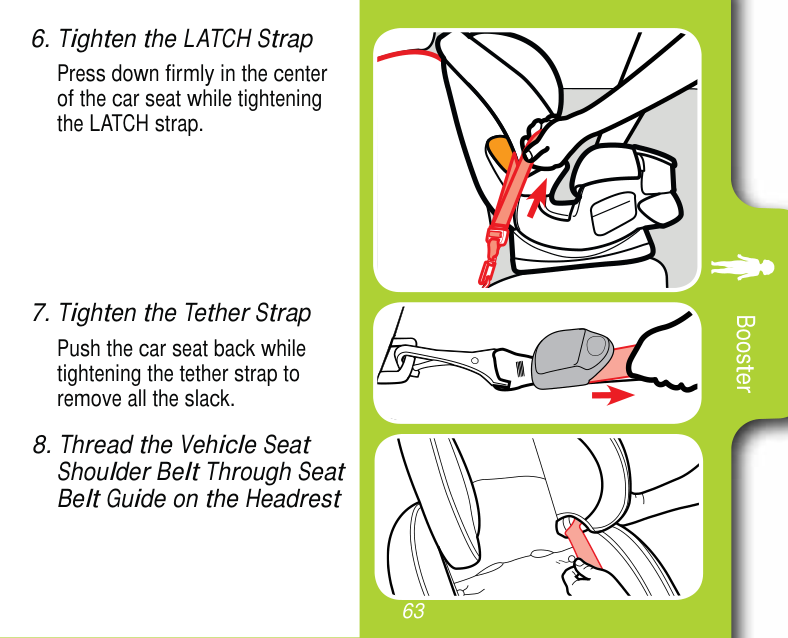
LATCH strap should not be twisted.


Press down firmly in the center of the car seat while tightening the LATCH strap.
Push the car seat back while tightening the tether strap to remove all the slack.
Booster


|5-D Prepare Backless Booster Use| |---|
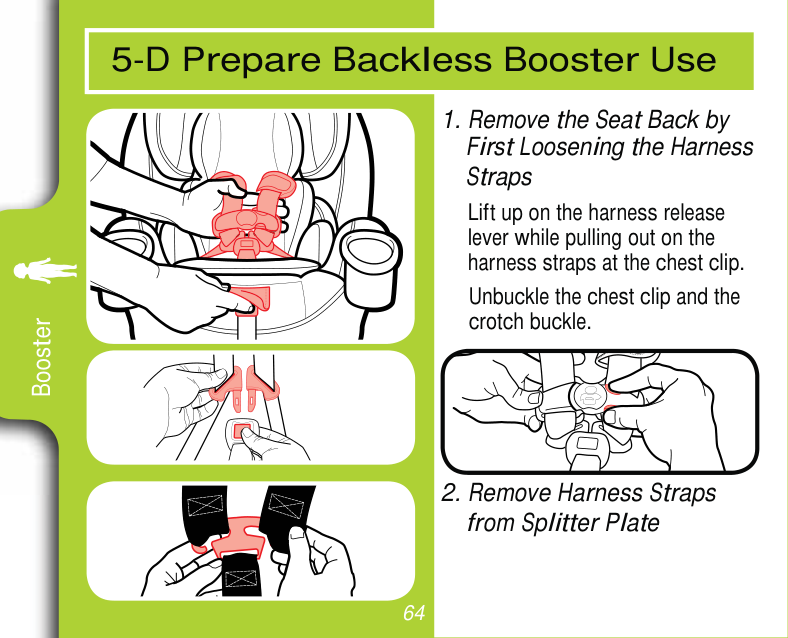
####### 1. Remove the Seat Back by First Loosening the Harness Straps
Lift up on the harness release lever while pulling out on the harness straps at the chest clip.
Unbuckle the chest clip and the crotch buckle.
| | | |---|---| | | |
Booster



| | | | |---|---|---| | | | | | | | |
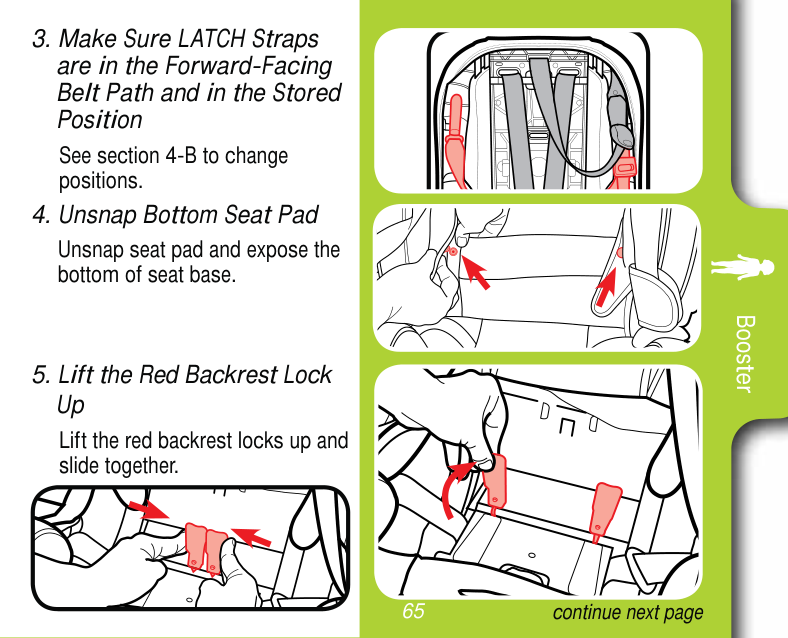
See section 4-B to change positions.
####### 4. Unsnap Bottom Seat Pad
Unsnap seat pad and expose the bottom of seat base.
####### Booster
####### 5. Lift the Red Backrest LockUp
Lift the red backrest locks up and slide together.

65
continue next page


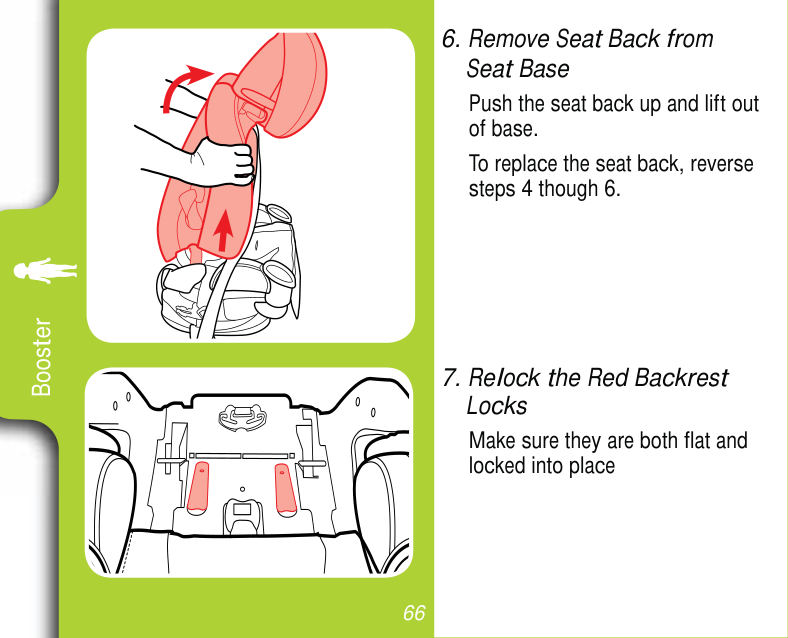
Push the seat back up and lift out of base.
To replace the seat back, reverse steps 4 though 6.
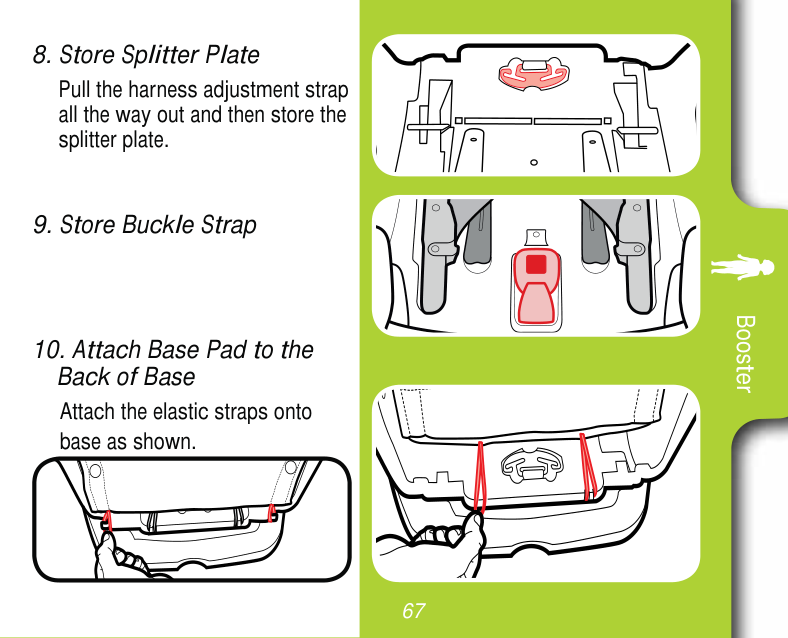
Booster
Make sure they are both flat and locked into place


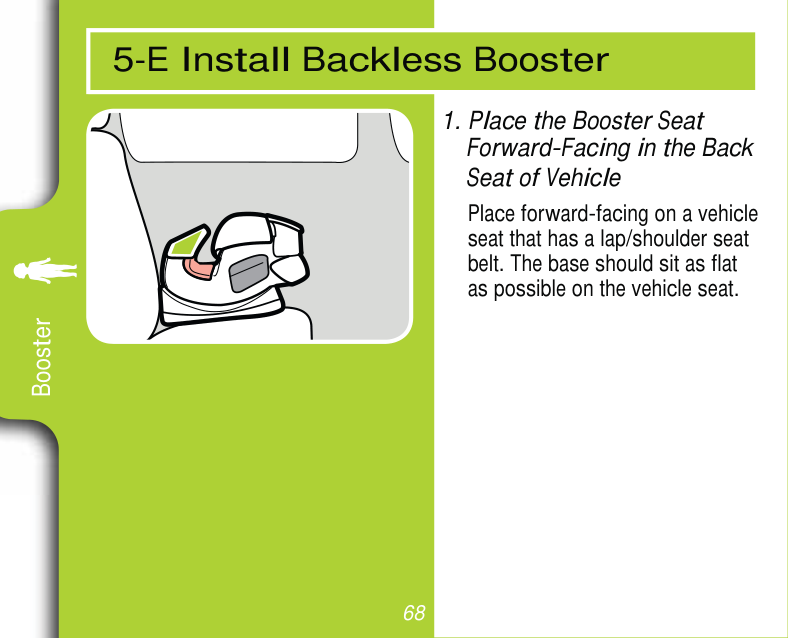
Pull the harness adjustment strap all the way out and then store the splitter plate.
Booster


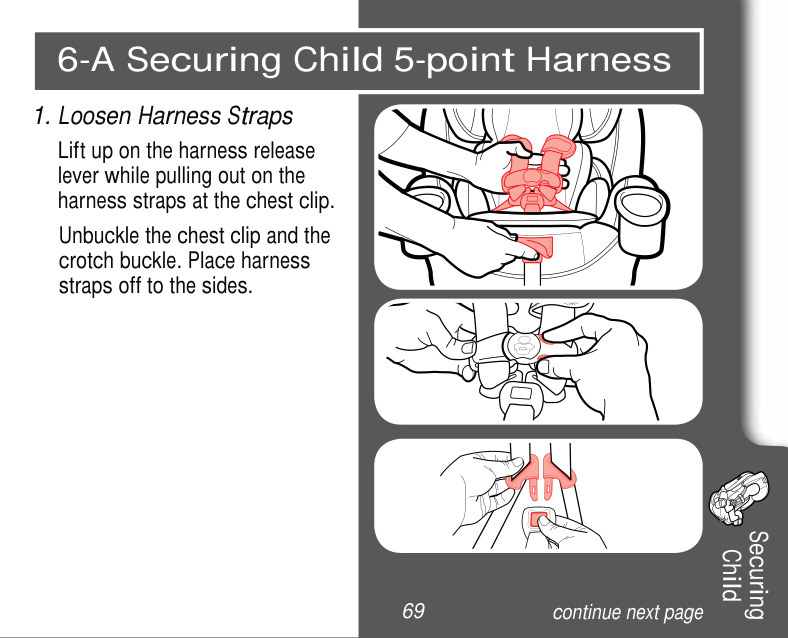
5-E Install Backless Booster
####### 1. Place the Booster Seat Forward-Facing in the Back Seat of Vehicle
Place forward-facing on a vehicle seat that has a lap/shoulder seat belt. The base should sit as flat as possible on the vehicle seat.
Booster


|6-A Securing Child 5-point Harness| |---|
####### 1. Loosen Harness Straps
Lift up on the harness release lever while pulling out on the harness straps at the chest clip.
Unbuckle the chest clip and the crotch buckle. Place harness straps off to the sides.
| | | |---|---| | | | | | |

####### Securing Child
69
continue next page

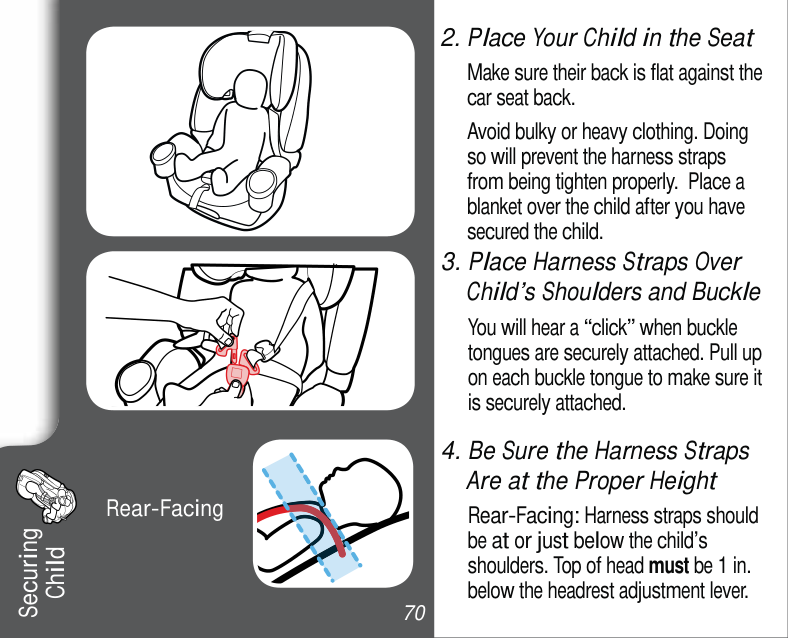
####### 2. Place Your Child in the Seat
Make sure their back is flat against the car seat back.
Avoid bulky or heavy clothing. Doing so will prevent the harness straps from being tighten properly. Place a blanket over the child after you have secured the child.
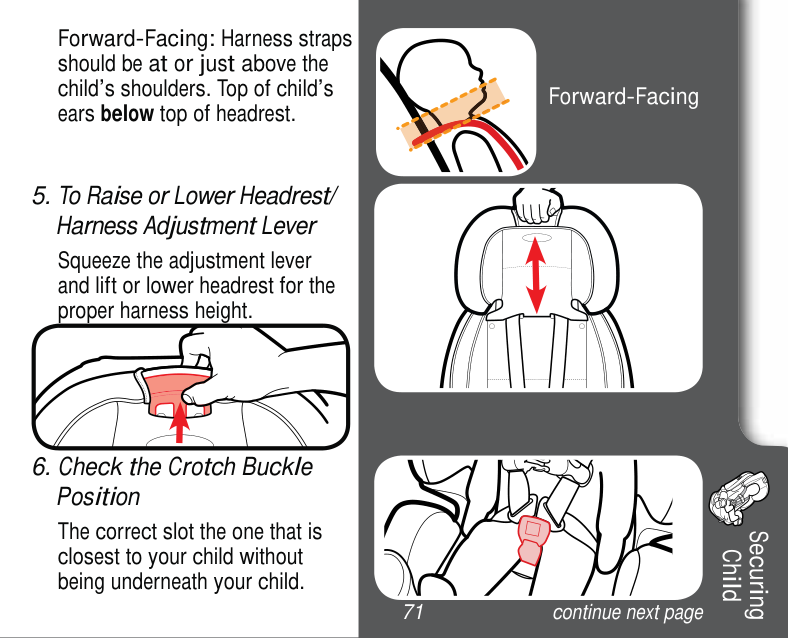
####### 3. Place Harness Straps Over Child’s Shoulders and Buckle
You will hear a “click” when buckle tongues are securely attached. Pull up on each buckle tongue to make sure it is securely attached.
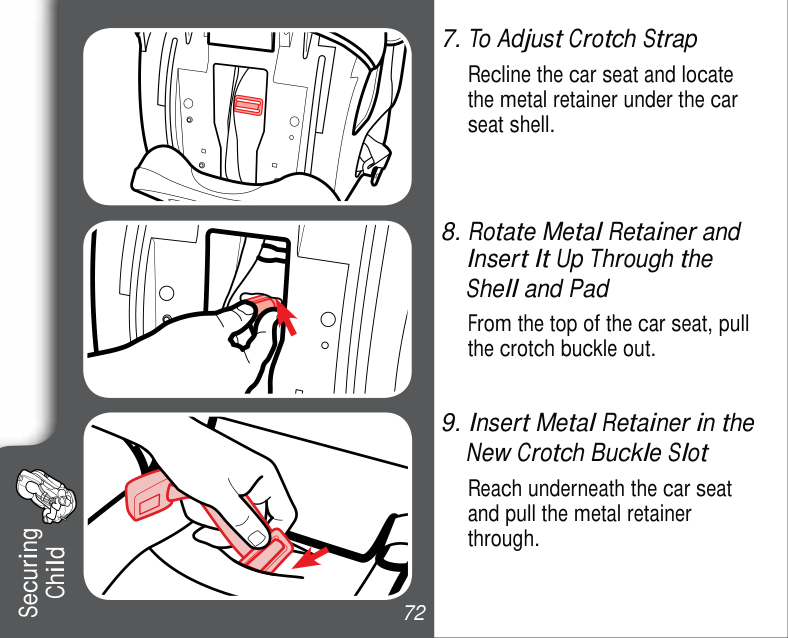
Rear-Facing
####### Securing
####### Child

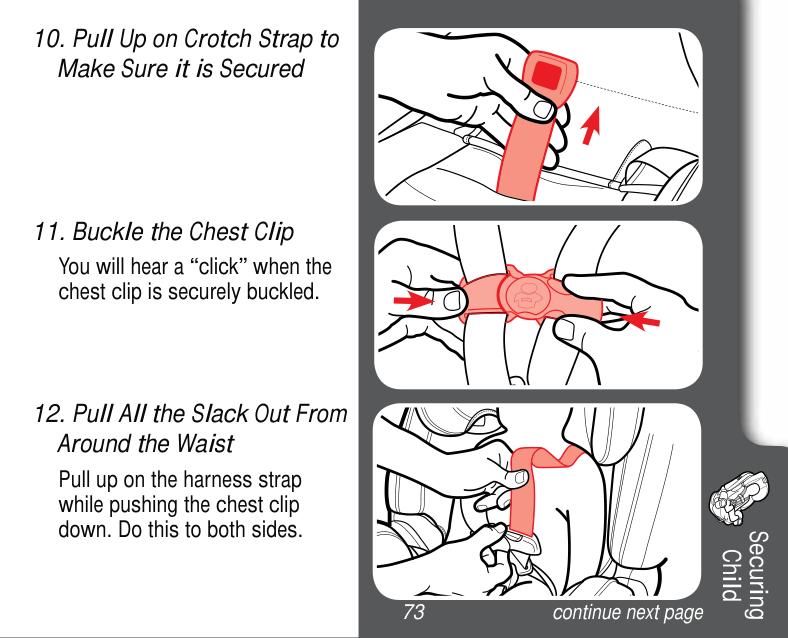
Forward-Facing: Harness straps should be at or just above the child’s shoulders. Top of child’s ears below top of headrest.
######### Forward-Facing
The correct slot the one that is closest to your child without being underneath your child.
####### Securing Child


####### 7. To Adjust Crotch Strap
Recline the car seat and locate the metal retainer under the car seat shell.
####### 8. Rotate Metal Retainer andInsert It Up Through theShell and Pad
From the top of the car seat, pull the crotch buckle out.
####### 9. Insert Metal Retainer in theNew Crotch Buckle Slot
Reach underneath the car seat and pull the metal retainer through.


You will hear a “click” when the chest clip is securely buckled.
Pull up on the harness strap while pushing the chest clip down. Do this to both sides.


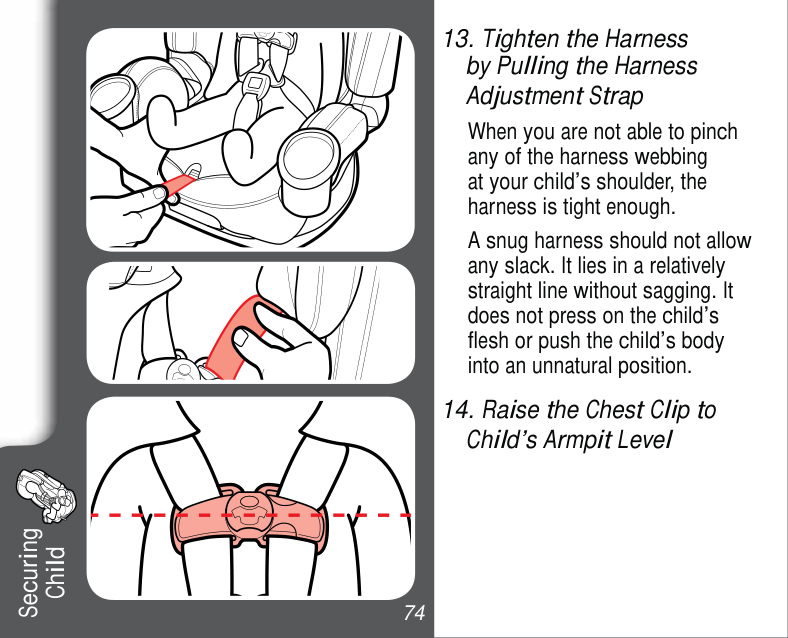
####### 13. Tighten the Harnessby Pulling the HarnessAdjustment Strap
When you are not able to pinch any of the harness webbing at your child’s shoulder, the harness is tight enough.
A snug harness should not allow any slack. It lies in a relatively straight line without sagging. It does not press on the child’s flesh or push the child’s body into an unnatural position.
####### 14. Raise the Chest Clip toChild’s Armpit Level



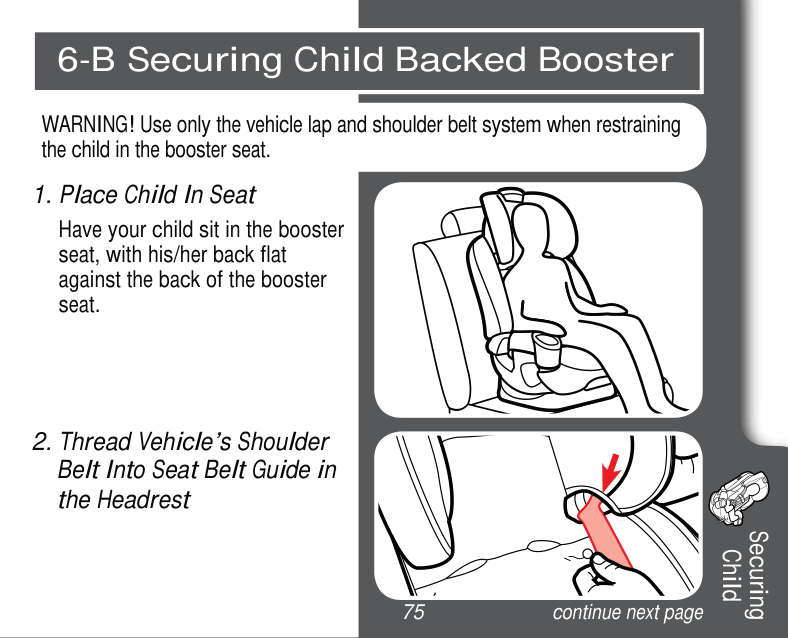
Have your child sit in the booster seat, with his/her back flat against the back of the booster seat.
####### 2. Thread Vehicle’s Shoulder Belt Into Seat Belt Guide in the Headrest


####### Securing
####### Child
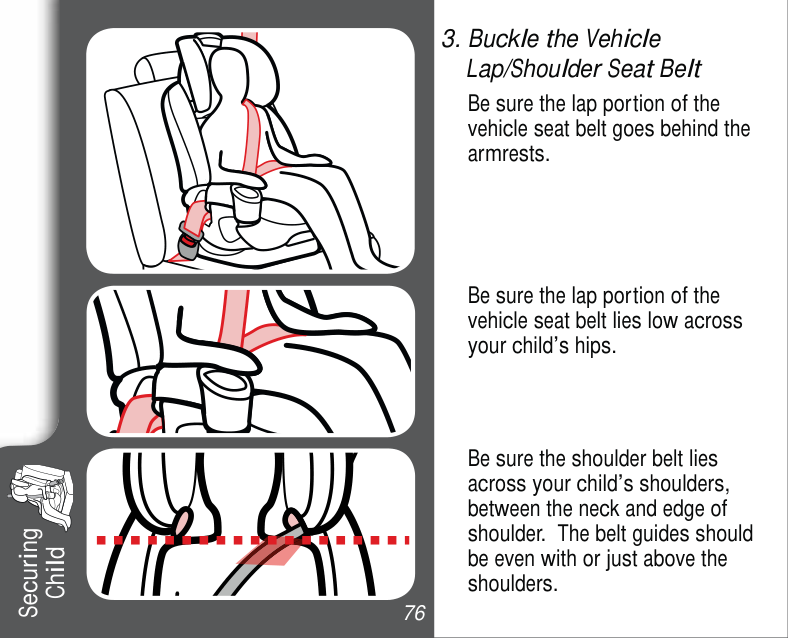
####### 3. Buckle the Vehicle Lap/Shoulder Seat Belt
Be sure the lap portion of the vehicle seat belt goes behind the armrests.
Be sure the lap portion of the vehicle seat belt lies low across your child’s hips.
Be sure the shoulder belt lies across your child’s shoulders, between the neck and edge of shoulder. The belt guides should be even with or just above the shoulders.
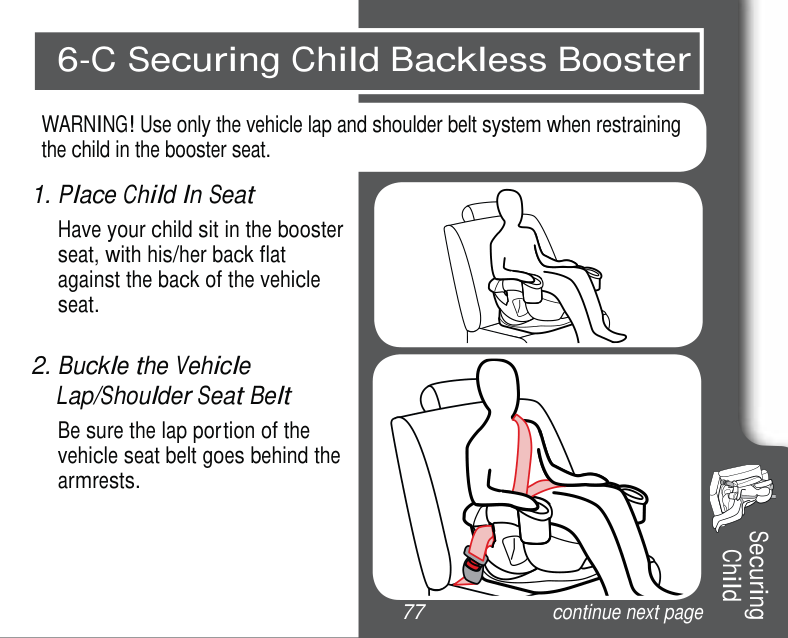


Have your child sit in the booster seat, with his/her back flat against the back of the vehicle seat.
####### 2. Buckle the Vehicle Lap/Shoulder Seat Belt
Be sure the lap portion of the vehicle seat belt goes behind the armrests.

####### Securing Child
77 continue next page

Be sure the lap portion of the vehicle seat belt lies low across your child’s hips.
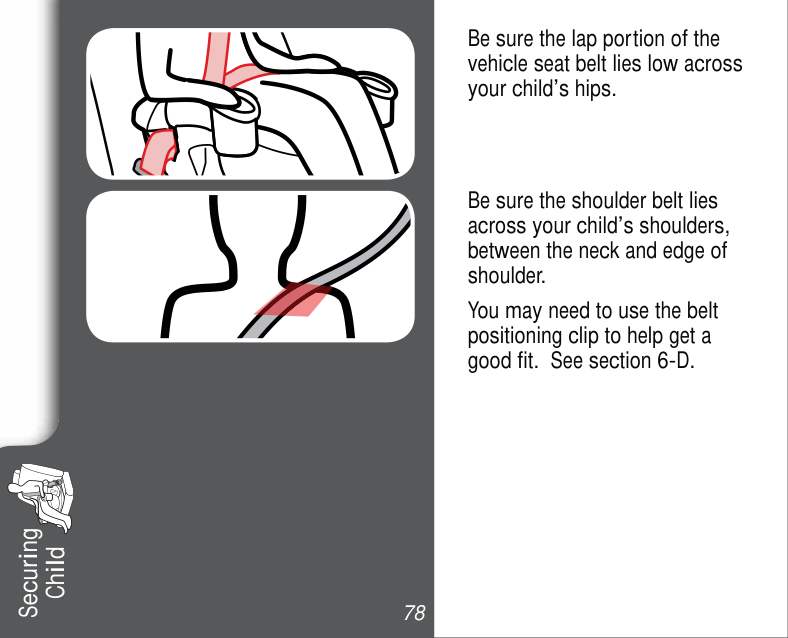
Be sure the shoulder belt lies across your child’s shoulders, between the neck and edge of shoulder.
You may need to use the belt positioning clip to help get a good fit. See section 6-D.
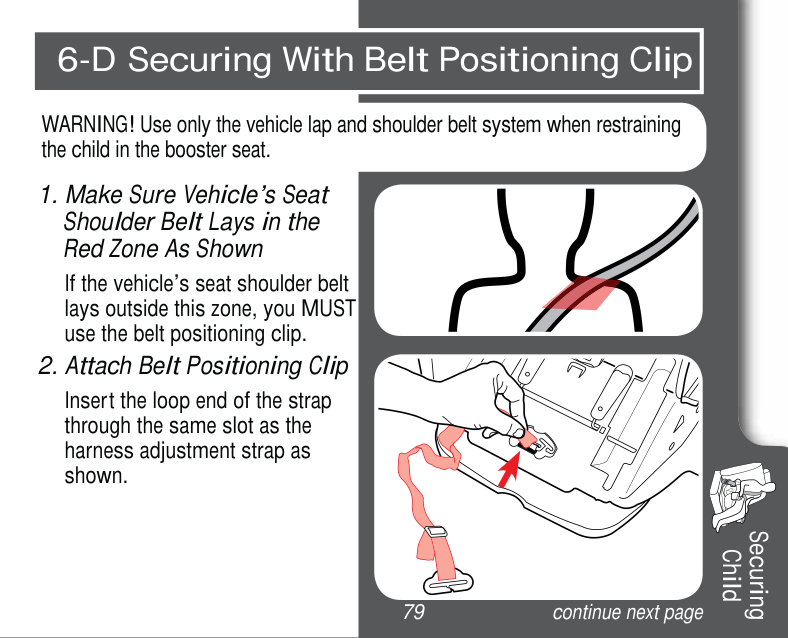
If the vehicle’s seat shoulder belt lays outside this zone, you MUST use the belt positioning clip.
|6-D Securing With Belt Positioning Clip| |---|
WARNING! Use only the vehicle lap and shoulder belt system when restraining the child in the booster seat.
Insert the loop end of the strap through the same slot as the harness adjustment strap as shown.

Securing Child
continue next page


####### 7. Place Child in Seat, BuckleChild In Seat and AttachBelt Positioning Clip
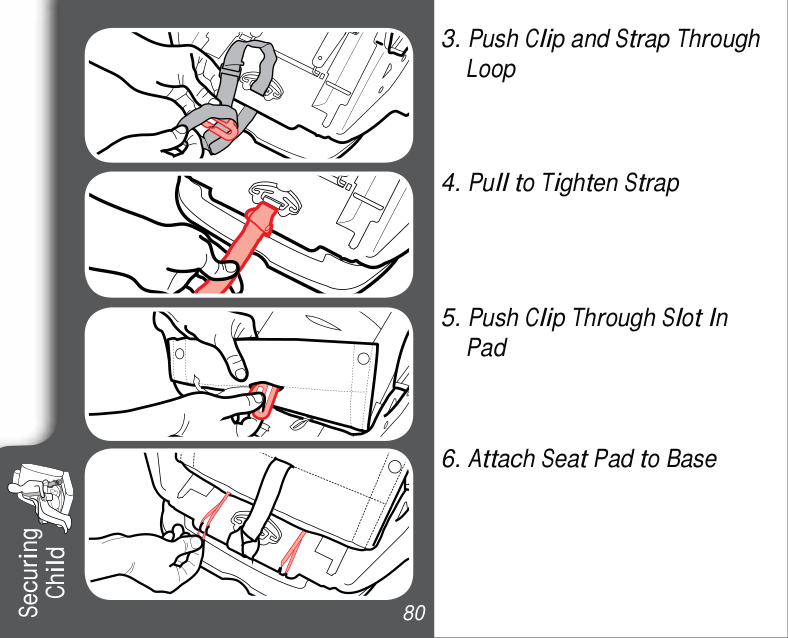
With child’s back flat against the back of the vehicle seat, buckle child in. Then slide the clip onto the vehicle’s seat shoulder belt as shown.
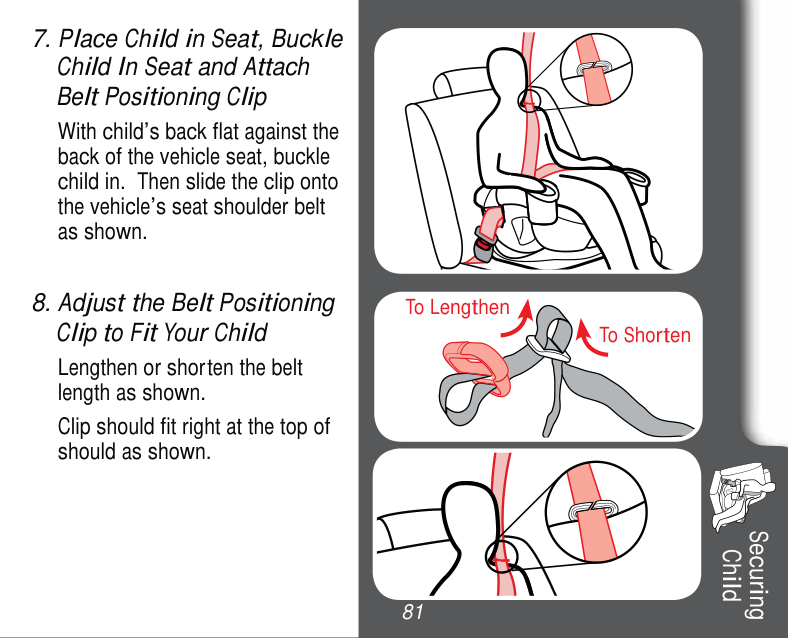
####### 8. Adjust the Belt PositioningClip to Fit Your Child
To Lengthen
To Shorten
Lengthen or shorten the belt length as shown.
Clip should fit right at the top of should as shown.

####### Securing Child


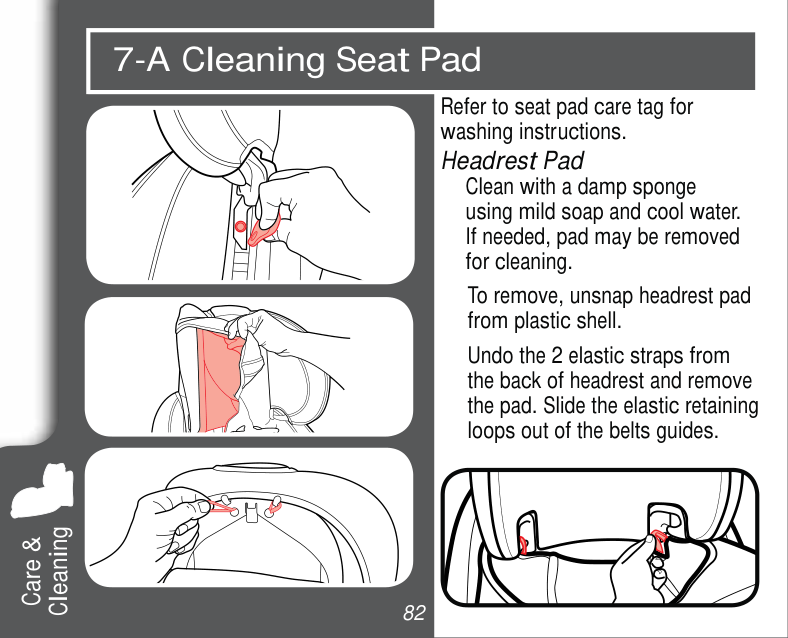
Refer to seat pad care tag for washing instructions.
Headrest Pad Clean with a damp sponge using mild soap and cool water. If needed, pad may be removed for cleaning.
To remove, unsnap headrest pad from plastic shell.
Undo the 2 elastic straps from the back of headrest and remove the pad. Slide the elastic retaining loops out of the belts guides.

####### Cleaning
####### Care &


Machine wash pad in cold water on delicate cycle and drip-dry. DO NOT USE BLEACH.
Reverse the steps to reattach the pad on the headrest.
####### Seat Pad
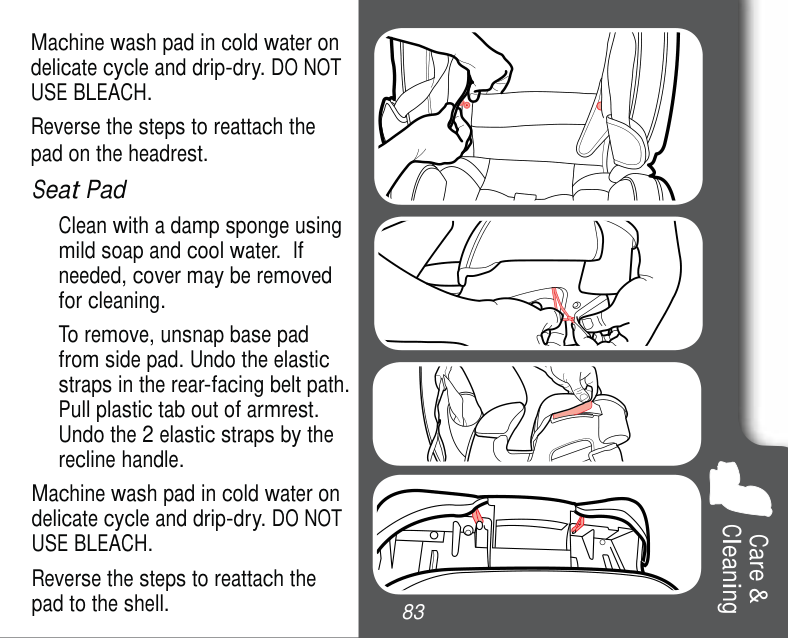
Clean with a damp sponge using mild soap and cool water. If needed, cover may be removed for cleaning.
To remove, unsnap base pad from side pad. Undo the elastic straps in the rear-facing belt path. Pull plastic tab out of armrest. Undo the 2 elastic straps by the recline handle.
Machine wash pad in cold water on delicate cycle and drip-dry. DO NOT USE BLEACH.

####### Care & Cleaning
Reverse the steps to reattach the pad to the shell.


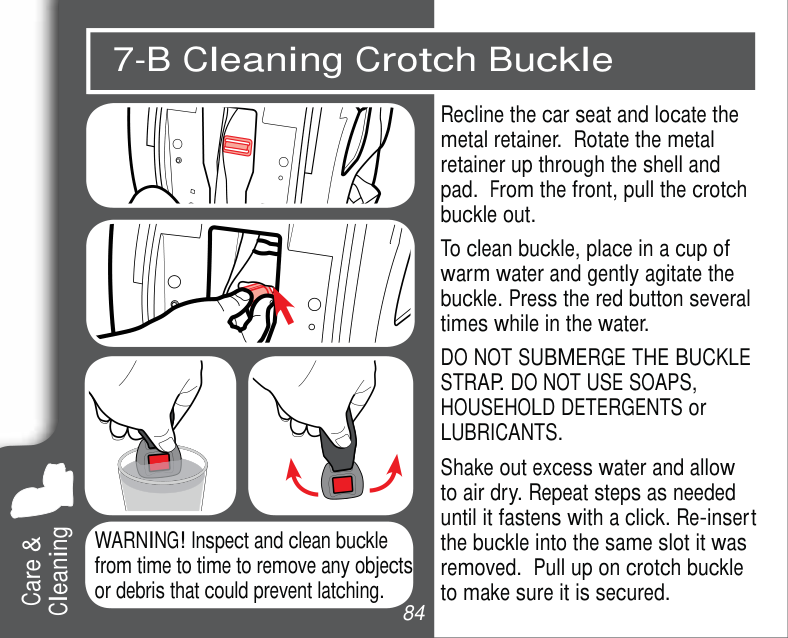
Recline the car seat and locate the metal retainer. Rotate the metal retainer up through the shell and pad. From the front, pull the crotch buckle out.
To clean buckle, place in a cup of warm water and gently agitate the buckle. Press the red button several times while in the water.
DO NOT SUBMERGE THE BUCKLE STRAP. DO NOT USE SOAPS, HOUSEHOLD DETERGENTS or LUBRICANTS.
Shake out excess water and allow to air dry. Repeat steps as needed until it fastens with a click. Re-insert the buckle into the same slot it was removed. Pull up on crotch buckle to make sure it is secured.

####### Cleaning
WARNING! Inspect and clean buckle from time to time to remove any objects or debris that could prevent latching.
####### Care &


|7-C Cleaning Harness and LATCH Straps| |---|
Surface wash only with mild soap and damp cloth. DO NOT IMMERSE THE HARNESS STRAPS or LATCH STRAP IN WATER Doing so may weaken the straps. If harness straps or LATCH belt are frayed or heavily soiled, contact Customer Service at www.gracobaby.com or 1-800-345-4109.
|7-D Accessories (on select models)| |---|
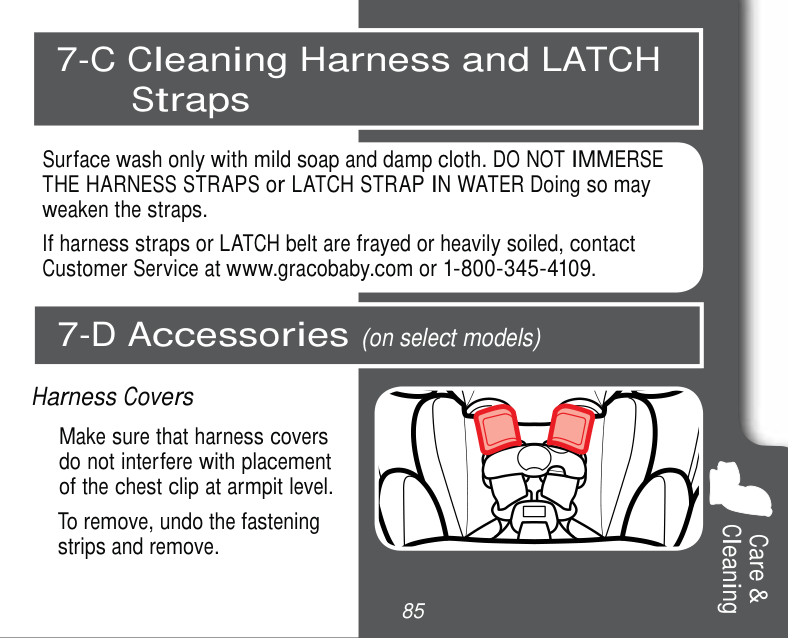
####### Harness Covers
Make sure that harness covers do not interfere with placement of the chest clip at armpit level.

To remove, undo the fastening strips and remove.
Care & Cleaning


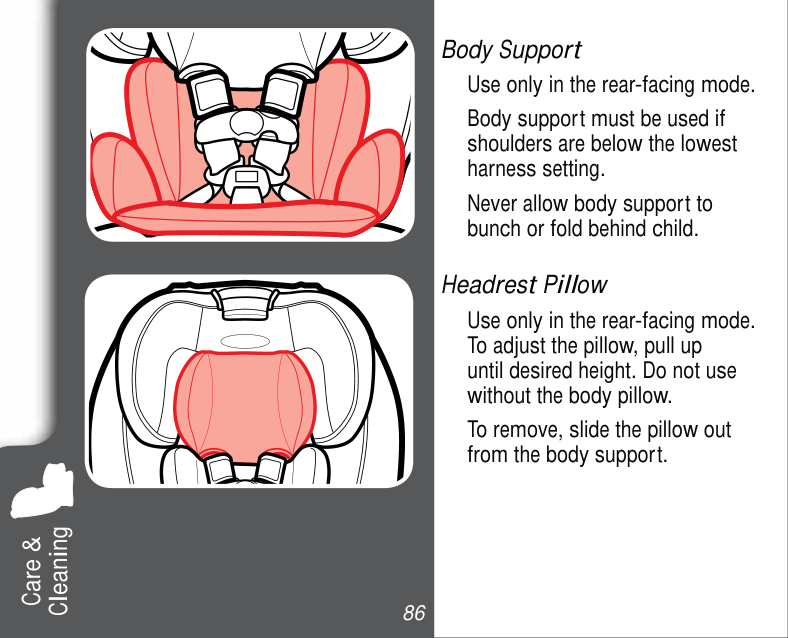
Body Support Use only in the rear-facing mode. Body support must be used if shoulders are below the lowest harness setting. Never allow body support to bunch or fold behind child.
####### Headrest Pillow
Use only in the rear-facing mode. To adjust the pillow, pull up until desired height. Do not use without the body pillow.
To remove, slide the pillow out from the body support.

####### Cleaning
####### Care &


|8-A Choosing Vehicle Seat Location| |---|
Additional Information
Important

|Review your vehicle owner’s manual for seating locations.| |---|
####### The best seating location for this car seat is one that:
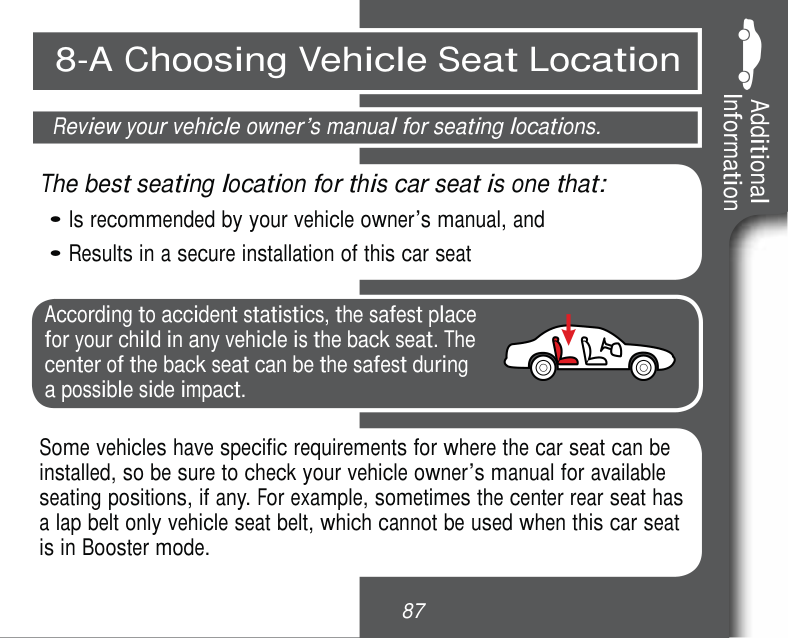
According to accident statistics, the safest place for your child in any vehicle is the back seat. The center of the back seat can be the safest during a possible side impact.
Some vehicles have specific requirements for where the car seat can be installed, so be sure to check your vehicle owner’s manual for available seating positions, if any. For example, sometimes the center rear seat has a lap belt only vehicle seat belt, which cannot be used when this car seat is in Booster mode.


In the event there is no available back seat and / or you have no other option than to place a child other than an infant in a rear-facing car seat in a front passenger seating position, the National Highway Traffic Safety Administration (NHTSA) recommends that you take the following steps:
Information
Additional
|8-B Unsafe Vehicle Seat Locations| |---|
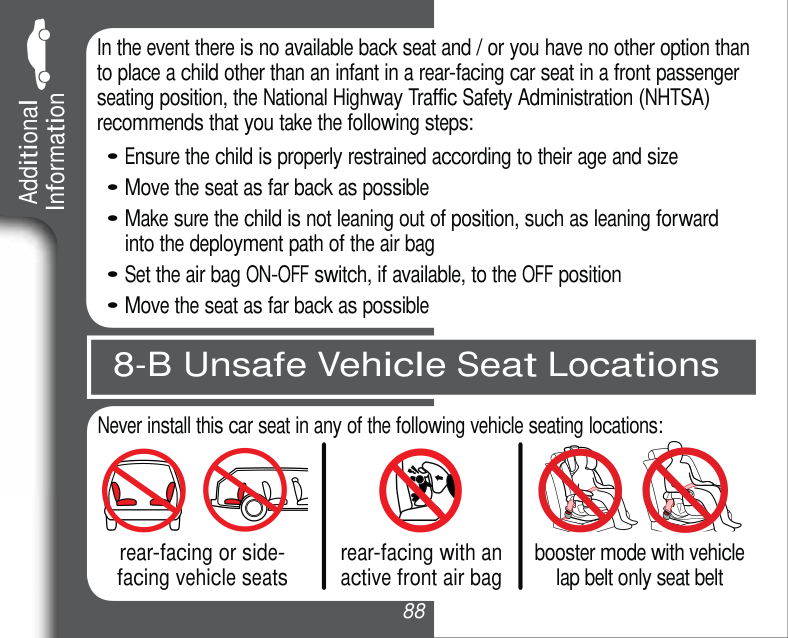
Never install this car seat in any of the following vehicle seating locations:

rear-facing or sidefacing vehicle seats
rear-facing with an active front air bag
booster mode with vehicle lap belt only seat belt


|8-C What is LATCH?| |---|
Additional Information
Important

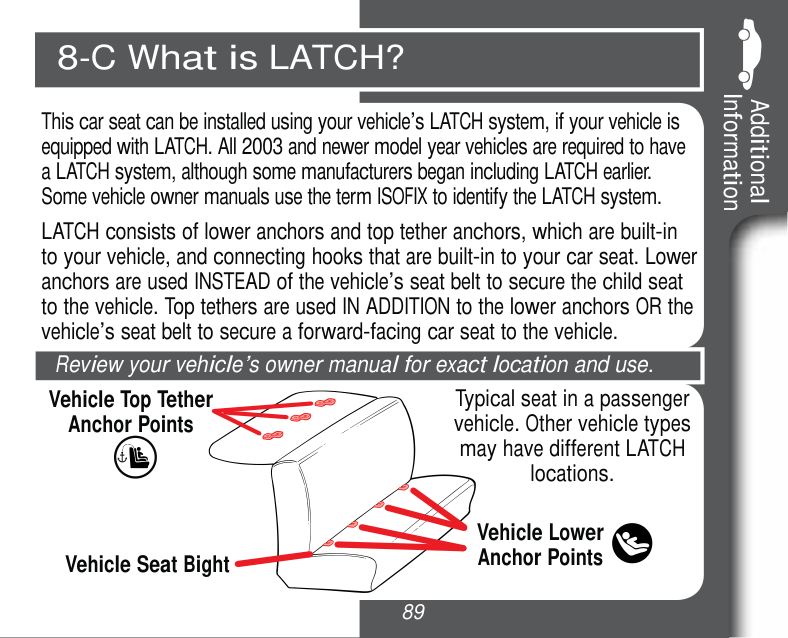
This car seat can be installed using your vehicle’s LATCH system, if your vehicle is equipped with LATCH. All 2003 and newer model year vehicles are required to have a LATCH system, although some manufacturers began including LATCH earlier. Some vehicle owner manuals use the term ISOFIX to identify the LATCH system.
LATCH consists of lower anchors and top tether anchors, which are built-in to your vehicle, and connecting hooks that are built-in to your car seat. Lower anchors are used INSTEAD of the vehicle’s seat belt to secure the child seat to the vehicle. Top tethers are used IN ADDITION to the lower anchors OR the vehicle’s seat belt to secure a forward-facing car seat to the vehicle.
|Review your vehicle’s owner manual for exact location and use.| |---|
Typical seat in a passenger vehicle. Other vehicle types may have different LATCH locations.
Vehicle Top Tether Anchor Points

Vehicle Lower Anchor Points
Vehicle Seat Bight


|8-D Choosing LATCH or Seat Belts| |---|
Information
Additional
This car seat can be installed in your vehicle using either the vehicle seat belt OR the LATCH system.
The LATCH system allows you to securely attach your safety seat in your car without using the vehicle seat belt and possibly to get a better fit. For more information on LATCH and how to determine if your vehicle is equipped with LATCH, see section 8-D: What is LATCH?.
For seating positions equipped with LATCH, experts recommend trying the LATCH installation first and only using the seat belt in that seating position if LATCH, for some reason, results in a looser fit. If you want to use the center rear seat and LATCH is not available in that position (check the vehicle owner’s manual), try the seat belt to be sure you can get a tight installation. If you cannot, try using LATCH in a different seating position. Remember to only use LATCH in seating positions recommended by your vehicle manufacturer.

Do not use the lower anchors of the child restraint anchorage system (LATCH system) to attach this child restraint when restraining a child weighing more than 42 lbs (19 kg) with the internal harnesses of the child restraint.


|8-E How to Remove LATCH and Tether| |---|
Additional Information
####### LATCH
Important

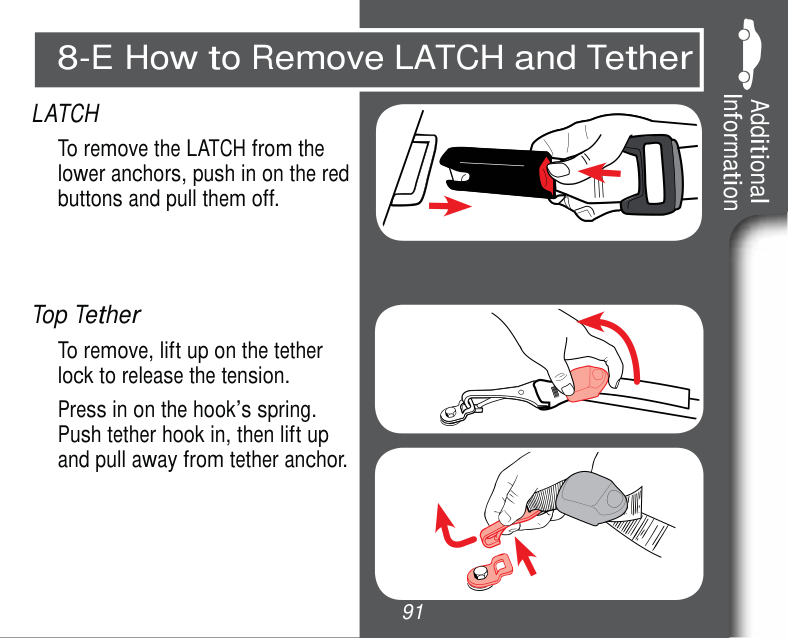
To remove the LATCH from the lower anchors, push in on the red buttons and pull them off.
####### Top Tether
To remove, lift up on the tether lock to release the tension.
Press in on the hook’s spring. Push tether hook in, then lift up and pull away from tether anchor.


|8-F Vehicle Seat Belts| |---|
Information
|Review your vehicle owner’s manual for vehicle seat belt use| |---|
Additional
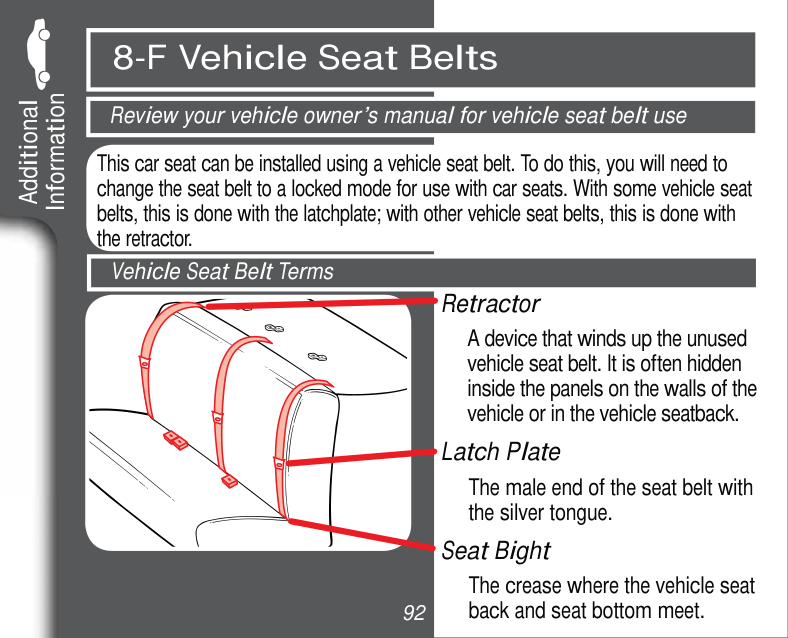
This car seat can be installed using a vehicle seat belt. To do this, you will need to change the seat belt to a locked mode for use with car seats. With some vehicle seat belts, this is done with the latchplate; with other vehicle seat belts, this is done with the retractor.
|Vehicle Seat Belt Terms| |---|
####### Retractor
A device that winds up the unused vehicle seat belt. It is often hidden inside the panels on the walls of the vehicle or in the vehicle seatback.
####### Latch Plate
The male end of the seat belt with the silver tongue.

####### Seat Bight
The crease where the vehicle seat back and seat bottom meet.
|Identify Your Seat Belt Type| |---|
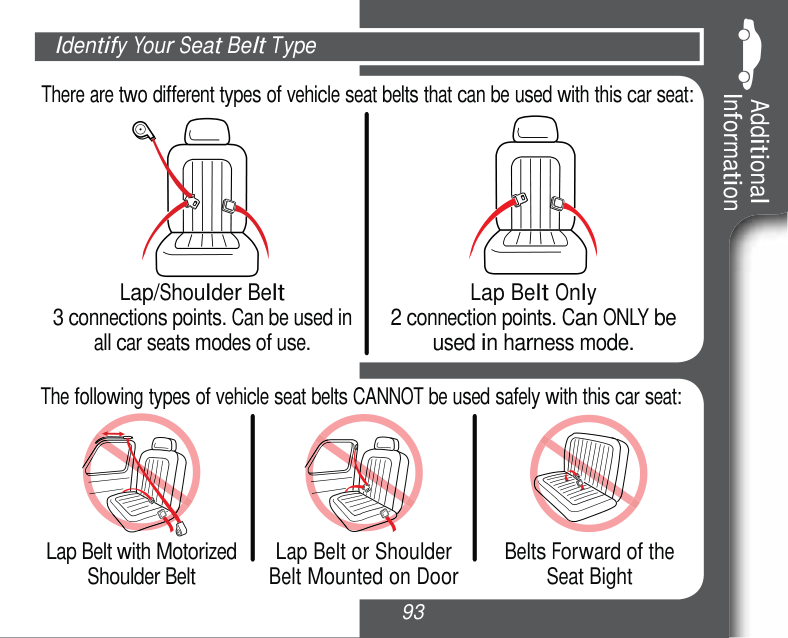
There are two different types of vehicle seat belts that can be used with this car seat:
Lap/Shoulder Belt 3 connections points. Can be used in all car seats modes of use.
Lap Belt Only 2 connection points. Can ONLY be used in harness mode.
The following types of vehicle seat belts CANNOT be used safely with this car seat:
Lap Belt with Motorized Shoulder Belt
Lap Belt or Shoulder Belt Mounted on Door
Belts Forward of the Seat Bight
####### Additional Information
####### Important


|Lap/Shoulder Belt Installation - Rear-Facing/Forward Facing Modes| |---|
Always review your vehicle owner’s manual for specific information about your vehicle seat belts.
####### Information
####### Additional
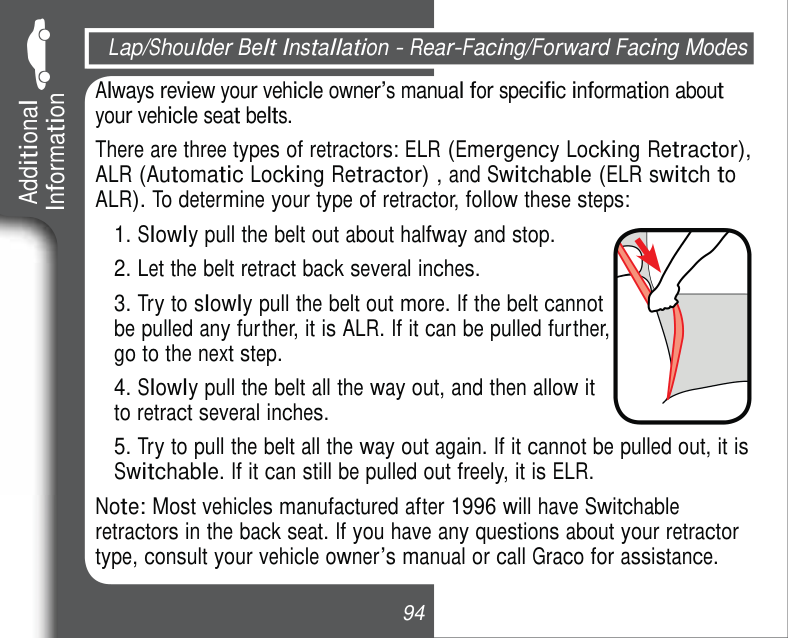
There are three types of retractors: ELR (Emergency Locking Retractor), ALR (Automatic Locking Retractor) , and Switchable (ELR switch to ALR). To determine your type of retractor, follow these steps:
Note: Most vehicles manufactured after 1996 will have Switchable retractors in the back seat. If you have any questions about your retractor type, consult your vehicle owner’s manual or call Graco for assistance.


|How to Lock Your Lap and Shoulder Vehicle Seat Belt| |---|
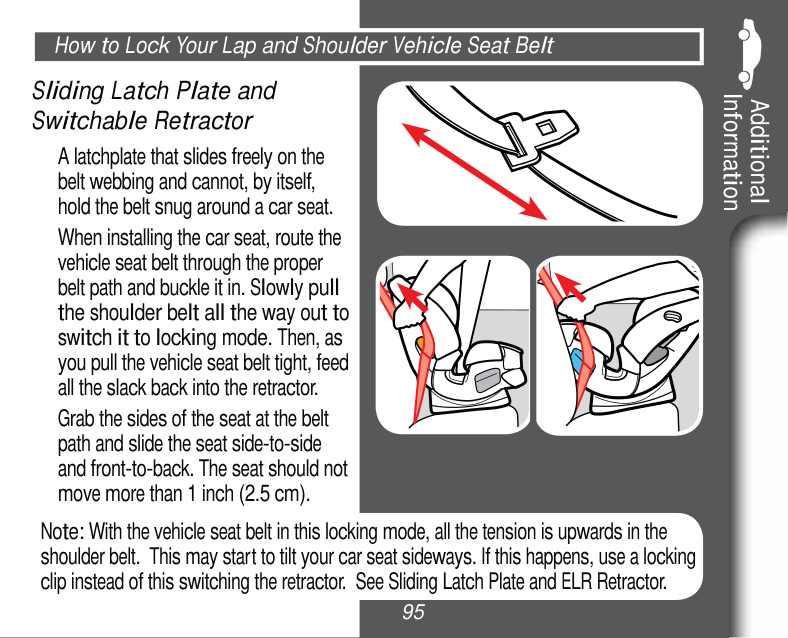
####### Sliding Latch Plate and Switchable Retractor
####### Additional Information
####### Important

A latchplate that slides freely on the belt webbing and cannot, by itself, hold the belt snug around a car seat. When installing the car seat, route the vehicle seat belt through the proper belt path and buckle it in. Slowly pull the shoulder belt all the way out to switch it to locking mode. Then, as you pull the vehicle seat belt tight, feed all the slack back into the retractor. Grab the sides of the seat at the belt path and slide the seat side-to-side and front-to-back. The seat should not move more than 1 inch (2.5 cm).

Note: With the vehicle seat belt in this locking mode, all the tension is upwards in the shoulder belt. This may start to tilt your car seat sideways. If this happens, use a locking clip instead of this switching the retractor. See Sliding Latch Plate and ELR Retractor.


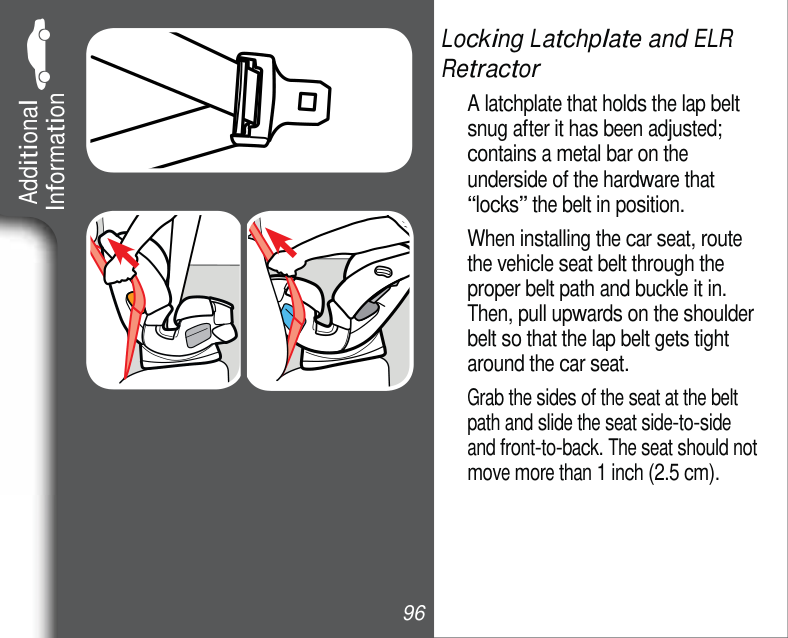
####### Locking Latchplate and ELR Retractor
A latchplate that holds the lap belt snug after it has been adjusted; contains a metal bar on the underside of the hardware that “locks” the belt in position.
####### Information
####### Additional
When installing the car seat, route the vehicle seat belt through the proper belt path and buckle it in. Then, pull upwards on the shoulder belt so that the lap belt gets tight around the car seat.
Grab the sides of the seat at the belt path and slide the seat side-to-side and front-to-back. The seat should not move more than 1 inch (2.5 cm).


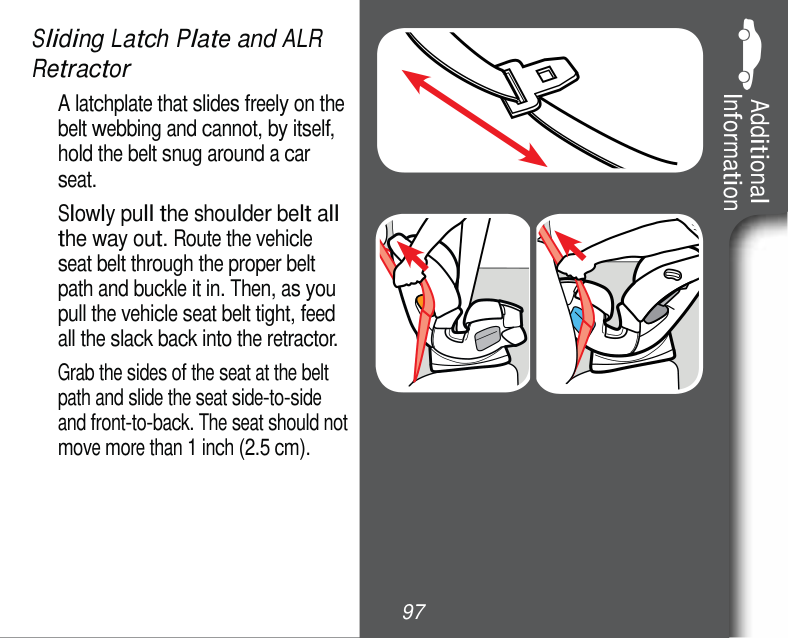
####### Sliding Latch Plate and ALR Retractor
A latchplate that slides freely on the belt webbing and cannot, by itself, hold the belt snug around a car seat.
####### Additional Information
####### Important

Slowly pull the shoulder belt all the way out. Route the vehicle seat belt through the proper belt path and buckle it in. Then, as you pull the vehicle seat belt tight, feed all the slack back into the retractor.
Grab the sides of the seat at the belt path and slide the seat side-to-side and front-to-back. The seat should not move more than 1 inch (2.5 cm).


####### Sliding Latch Plate and ELR Retractor
A latchplate that slides freely on the belt webbing and cannot, by itself, hold the belt snug around a car seat.
####### Information
####### Additional
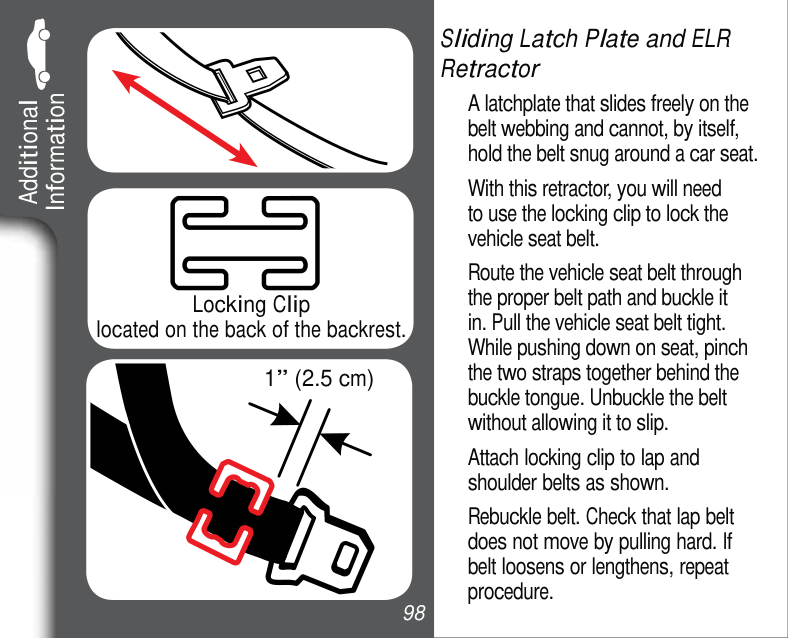
With this retractor, you will need to use the locking clip to lock the vehicle seat belt.
Route the vehicle seat belt through the proper belt path and buckle it in. Pull the vehicle seat belt tight. While pushing down on seat, pinch the two straps together behind the buckle tongue. Unbuckle the belt without allowing it to slip.
Locking Clip located on the back of the backrest.
1” (2.5 cm)
Attach locking clip to lap and shoulder belts as shown.

Rebuckle belt. Check that lap belt does not move by pulling hard. If belt loosens or lengthens, repeat procedure.


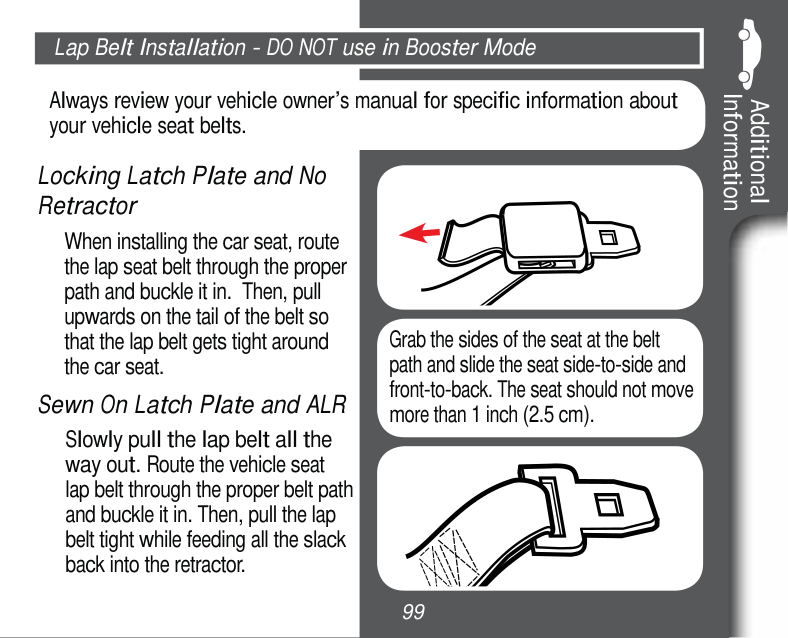
|Lap Belt Installation - DO NOT use in Booster Mode| |---|
Always review your vehicle owner’s manual for specific information about your vehicle seat belts.
####### Additional Information
####### Important

####### Locking Latch Plate and No Retractor
When installing the car seat, route the lap seat belt through the proper path and buckle it in. Then, pull upwards on the tail of the belt so that the lap belt gets tight around the car seat.
Grab the sides of the seat at the belt path and slide the seat side-to-side and front-to-back. The seat should not move more than 1 inch (2.5 cm).
####### Sewn On Latch Plate and ALR
Slowly pull the lap belt all the way out. Route the vehicle seat lap belt through the proper belt path and buckle it in. Then, pull the lap belt tight while feeding all the slack back into the retractor.

Replacement Parts
To purchase parts or accessories in the United States, please contact us at the following:
www.gracobaby.com or
|1-80|-345-4|09| |---|---|---| | | | |
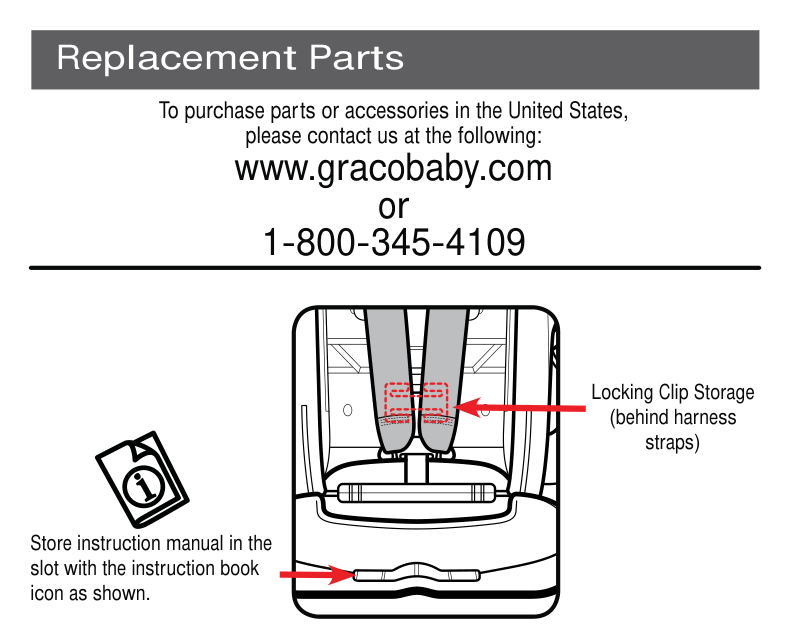
Store instruction manual in the slot with the instruction book icon as shown.
Locking Clip Storage (behind harness straps)




######### www.gracobaby.com




No instale ni use este sistema de seguridad para niños hasta que haya leído y entendido las instrucciones en este manual.

NO USAR DEBIDAMENTE ESTE SISTEMA DE SEGURIDAD PARA NIÑOS AUMENTA EL RIESGO DE LESIONES GRAVES O LA MUERTE EN UN ACCIDENTE O AL DETENERSE REPENTINAMENTE.
PD276107E 4/14
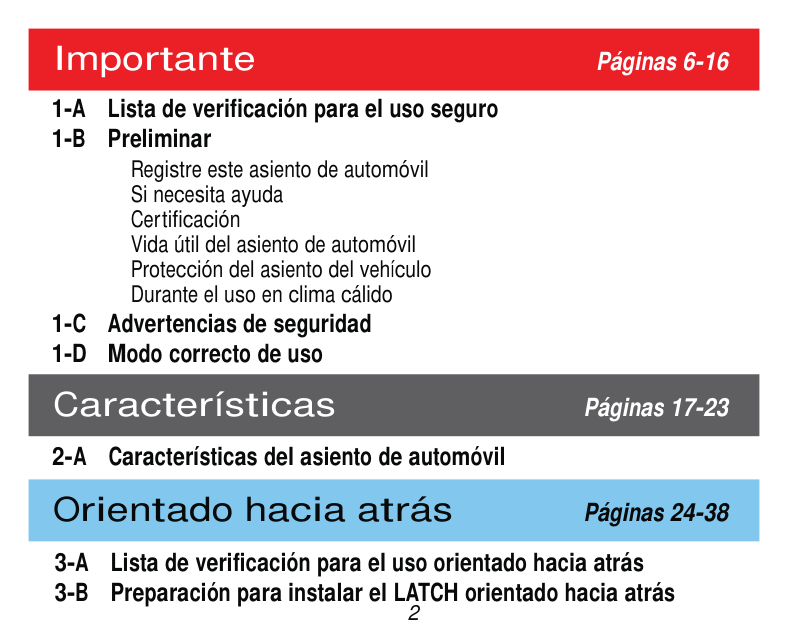
Importante Páginas 6-16
######## 1-A Lista de verificación para el uso seguro 1-B Preliminar
Registre este asiento de automóvil Si necesita ayuda
Certificación Vida útil del asiento de automóvil Protección del asiento del vehículo Durante el uso en clima cálido
Características Páginas 17-23
Orientado hacia atrás Páginas 24-38
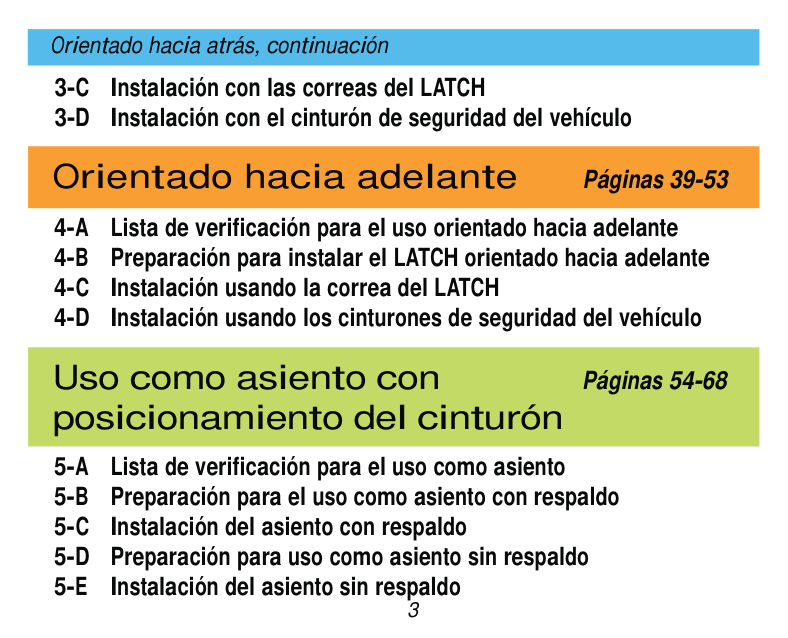
Orientado hacia atrás, continuación
Orientado hacia adelante Páginas 39-53
Uso como asiento con posicionamiento del cinturón
Páginas 54-68
5-A Lista de verificación para el uso como asiento 5-B Preparación para el uso como asiento con respaldo 5-C Instalación del asiento con respaldo 5-D Preparación para uso como asiento sin respaldo 5-E Instalación del asiento sin respaldo
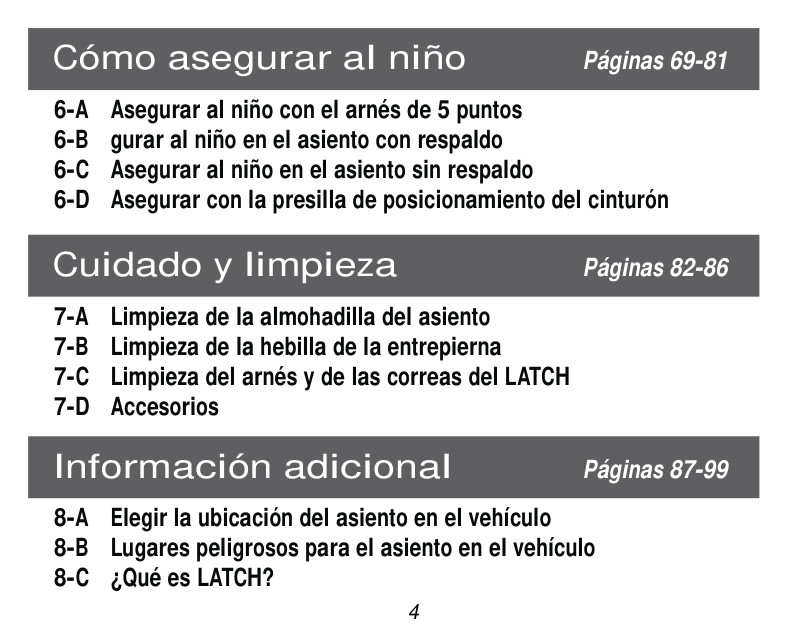
Cómo asegurar al niño Páginas 69-81
6-A Asegurar al niño con el arnés de 5 puntos 6-B gurar al niño en el asiento con respaldo 6-C Asegurar al niño en el asiento sin respaldo 6-D Asegurar con la presilla de posicionamiento del cinturón
Cuidado y limpieza Páginas 82-86
7-A Limpieza de la almohadilla del asiento 7-B Limpieza de la hebilla de la entrepierna 7-C Limpieza del arnés y de las correas del LATCH 7-D Accesorios
Información adicional Páginas 87-99
8-A Elegir la ubicación del asiento en el vehículo 8-B Lugares peligrosos para el asiento en el vehículo 8-C ¿Qué es LATCH?
Información adicional, continuación
######## 8-D Elegir el LATCH o los cinturones de seguridad 8-E Cómo sacar el LATCH y la correa de sujeción 8-F Cinturones de seguridad del vehículo


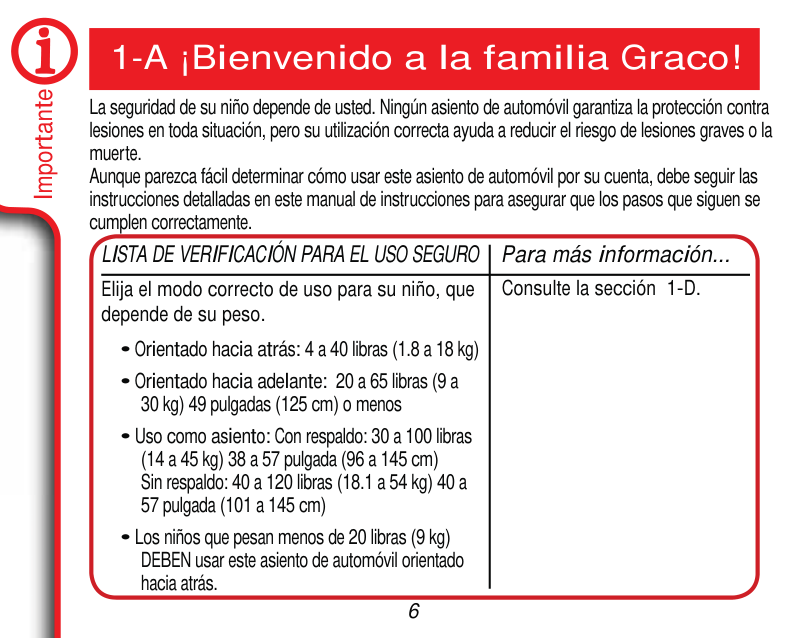
1-A ¡Bienvenido a la familia Graco!
Importante
La seguridad de su niño depende de usted. Ningún asiento de automóvil garantiza la protección contra lesiones en toda situación, pero su utilización correcta ayuda a reducir el riesgo de lesiones graves o la muerte. Aunque parezca fácil determinar cómo usar este asiento de automóvil por su cuenta, debe seguir las instrucciones detalladas en este manual de instrucciones para asegurar que los pasos que siguen se cumplen correctamente.
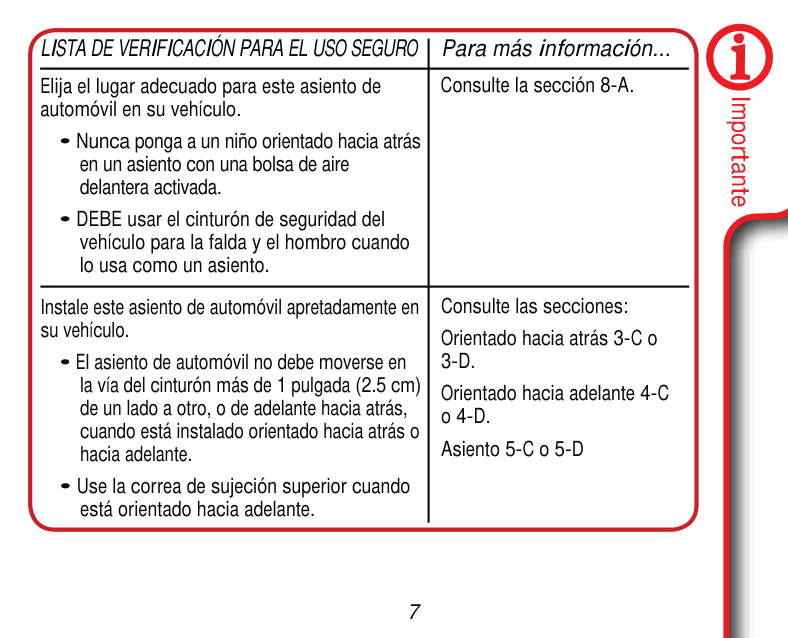
######### LISTA DE VERIFICACIÓN PARA EL USO SEGURO Para más información...
Consulte la sección 1-D.
Elija el modo correcto de uso para su niño, que depende de su peso.


Consulte la sección 8-A.
Elija el lugar adecuado para este asiento de automóvil en su vehículo.
####### Importante
Consulte las secciones: Orientado hacia atrás 3-C o 3-D. Orientado hacia adelante 4-C o 4-D. Asiento 5-C o 5-D
Instale este asiento de automóvil apretadamente en su vehículo.



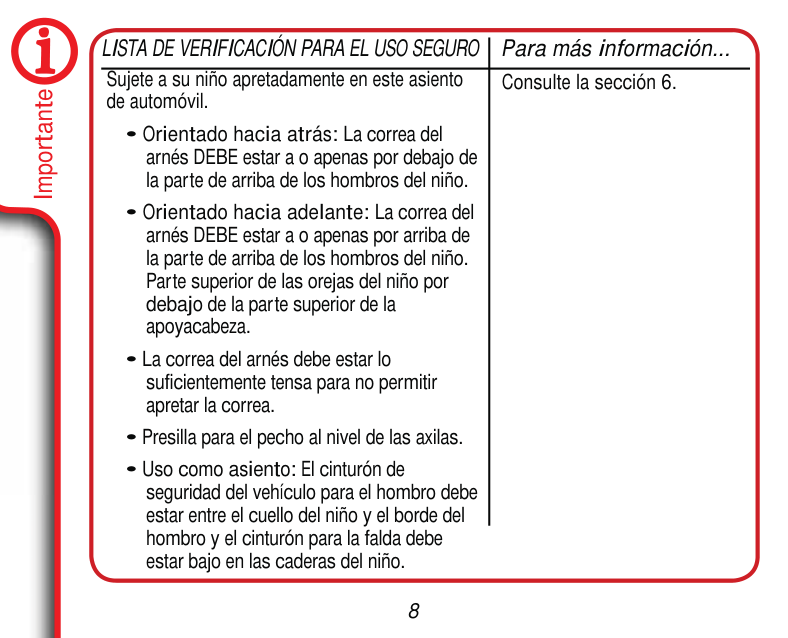
Sujete a su niño apretadamente en este asiento de automóvil.
Consulte la sección 6.
####### Importante


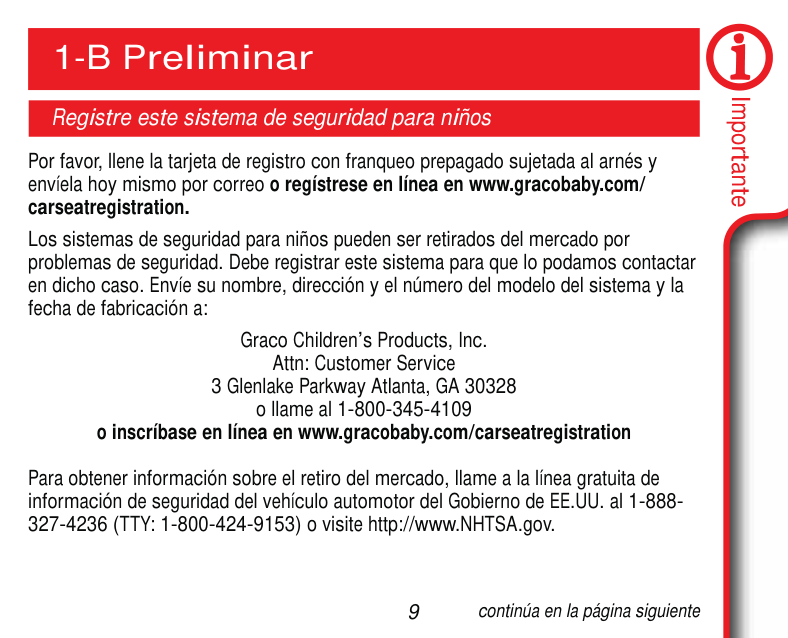
1-B Preliminar
Importante
######### Registre este sistema de seguridad para niños
Por favor, llene la tarjeta de registro con franqueo prepagado sujetada al arnés y envíela hoy mismo por correo o regístrese en línea en www.gracobaby.com/ carseatregistration.
Los sistemas de seguridad para niños pueden ser retirados del mercado por problemas de seguridad. Debe registrar este sistema para que lo podamos contactar en dicho caso. Envíe su nombre, dirección y el número del modelo del sistema y la fecha de fabricación a:
Graco Children’s Products, Inc. Attn: Customer Service 3 Glenlake Parkway Atlanta, GA 30328 o llame al 1-800-345-4109 o inscríbase en línea en www.gracobaby.com/carseatregistration
Para obtener información sobre el retiro del mercado, llame a la línea gratuita de información de seguridad del vehículo automotor del Gobierno de EE.UU. al 1-888327-4236 (TTY: 1-800-424-9153) o visite http://www.NHTSA.gov.


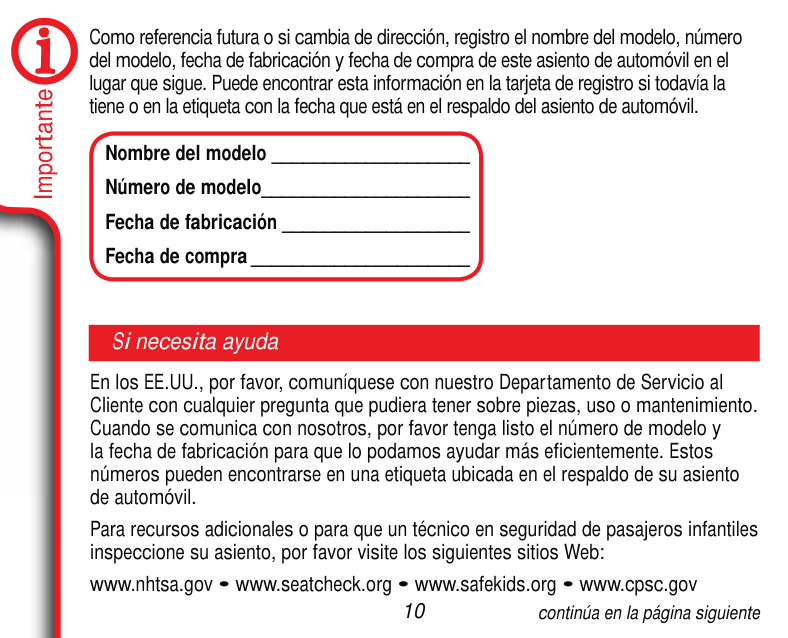
Como referencia futura o si cambia de dirección, registro el nombre del modelo, número del modelo, fecha de fabricación y fecha de compra de este asiento de automóvil en el lugar que sigue. Puede encontrar esta información en la tarjeta de registro si todavía la tiene o en la etiqueta con la fecha que está en el respaldo del asiento de automóvil.
####### Importante
Nombre del modelo ___________________ Número de modelo ____________________ Fecha de fabricación __________________ Fecha de compra _____________________
######### Si necesita ayuda
En los EE.UU., por favor, comuníquese con nuestro Departamento de Servicio al Cliente con cualquier pregunta que pudiera tener sobre piezas, uso o mantenimiento. Cuando se comunica con nosotros, por favor tenga listo el número de modelo y la fecha de fabricación para que lo podamos ayudar más eficientemente. Estos números pueden encontrarse en una etiqueta ubicada en el respaldo de su asiento de automóvil.

Para recursos adicionales o para que un técnico en seguridad de pasajeros infantiles inspeccione su asiento, por favor visite los siguientes sitios Web:
www.nhtsa.gov • www.seatcheck.org • www.safekids.org • www.cpsc.gov


Certificación
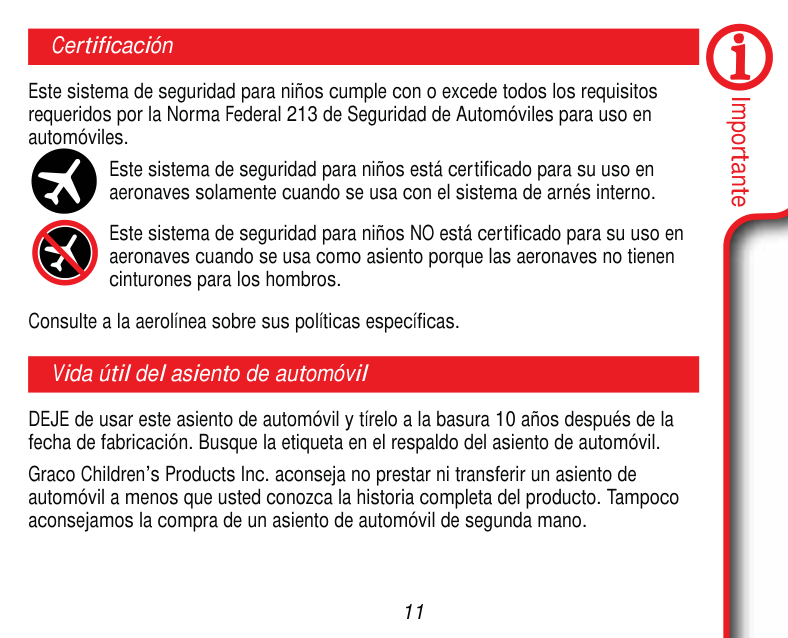
Este sistema de seguridad para niños cumple con o excede todos los requisitos requeridos por la Norma Federal 213 de Seguridad de Automóviles para uso en automóviles.
####### Importante
Este sistema de seguridad para niños está certificado para su uso en aeronaves solamente cuando se usa con el sistema de arnés interno.
Este sistema de seguridad para niños NO está certificado para su uso en aeronaves cuando se usa como asiento porque las aeronaves no tienen cinturones para los hombros.
Consulte a la aerolínea sobre sus políticas específicas.
Vida útil del asiento de automóvil
DEJE de usar este asiento de automóvil y tírelo a la basura 10 años después de la fecha de fabricación. Busque la etiqueta en el respaldo del asiento de automóvil.
Graco Children’s Products Inc. aconseja no prestar ni transferir un asiento de automóvil a menos que usted conozca la historia completa del producto. Tampoco aconsejamos la compra de un asiento de automóvil de segunda mano.



Protección del asiento del vehículo
Proteja el asiento del vehículo. Use una alfombrilla, una toalla o una manta fina debajo y detrás del asiento de automóvil.
Importante
Uso durante clima cálido
Las piezas del asiento de automóvil se pueden calentar mucho cuando están bajo el sol o cuando hace calor. Para evitar quemaduras, compruebe siempre la temperatura del asiento antes de sentar al niño.
1-C Advertencias de seguridad
Ningún asiento de automóvil garantiza la protección contra lesiones en toda situación, pero su utilización correcta ayuda a reducir el riesgo de lesiones graves o la muerte. LEA ESTE MANUAL CON ATENCION.


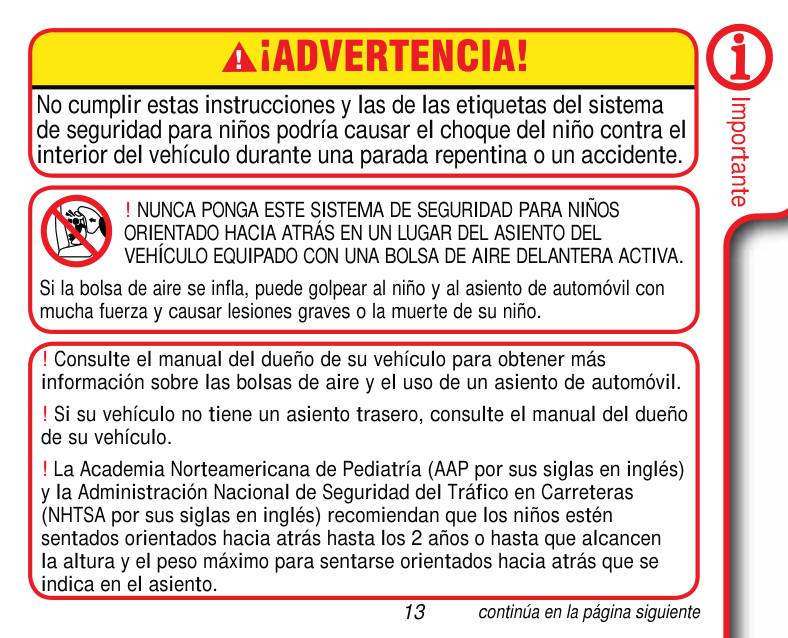
¡ADVERTENCIA!
####### No cumplir estas instrucciones y las de las etiquetas del sistema de seguridad para niños podría causar el choque del niño contra el interior del vehículo durante una parada repentina o un accidente.
####### Importante
########## ! NUNCA PONGA ESTE SISTEMA DE SEGURIDAD PARA NIÑOS ORIENTADO HACIA ATRÁS EN UN LUGAR DEL ASIENTO DEL VEHÍCULO EQUIPADO CON UNA BOLSA DE AIRE DELANTERA ACTIVA.
Si la bolsa de aire se infla, puede golpear al niño y al asiento de automóvil con mucha fuerza y causar lesiones graves o la muerte de su niño.
! Consulte el manual del dueño de su vehículo para obtener más información sobre las bolsas de aire y el uso de un asiento de automóvil.
! Si su vehículo no tiene un asiento trasero, consulte el manual del dueño de su vehículo.
! La Academia Norteamericana de Pediatría (AAP por sus siglas en inglés) y la Administración Nacional de Seguridad del Tráfico en Carreteras (NHTSA por sus siglas en inglés) recomiendan que los niños estén sentados orientados hacia atrás hasta los 2 años o hasta que alcancen la altura y el peso máximo para sentarse orientados hacia atrás que se indica en el asiento.

13
continúa en la página siguiente


! Elija el modo de empleo correcto para el asiento de automóvil de acuerdo al tamaño de su niño. Los niños que pesan menos de 20 libras (9 kg) DEBEN usar este asiento de automóvil orientado hacia atrás.
####### Importante
! Elija el lugar adecuado para el asiento de automóvil en su vehículo. ! Sujete el asiento de automóvil con el cinturón de seguridad del vehículo o el sistema LATCH que se ha colocado correctamente según las indicaciones en este manual. ! El sistema de cinturones de seguridad del vehículo DEBE sujetar firmemente el asiento de automóvil. No todos los cinturones de seguridad de todos los vehículos se pueden utilizar con un asiento de automóvil. ! Si el cinturón de seguridad del vehículo no sujeta firmemente el asiento de automóvil, lea la sección 8-F “cinturones de seguridad del vehículo” y el manual del dueño de su vehículo. ! Sujete siempre el asiento de automóvil con el sistema LATCH o el cinturón de seguridad del vehículo, incluso cuando esté desocupado. En un accidente, un asiento de automóvil sin sujetar puede lastimar a los pasajeros. ! Se debe reemplazar el asiento de automóvil tras haber sido sometido a un accidente. ¡NO lo use de nuevo! Un accidente podría causar daños ocultos y su utilización repetida podría causar lesiones graves o la muerte. ! NO use el asiento de automóvil si ha resultado dañado o si faltan piezas.


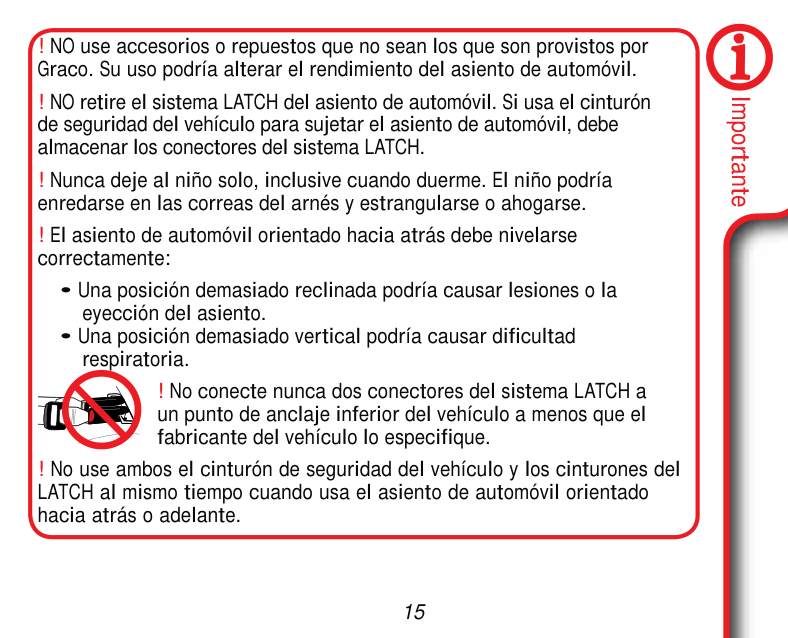
! NO use accesorios o repuestos que no sean los que son provistos por Graco. Su uso podría alterar el rendimiento del asiento de automóvil.
! NO retire el sistema LATCH del asiento de automóvil. Si usa el cinturón de seguridad del vehículo para sujetar el asiento de automóvil, debe almacenar los conectores del sistema LATCH.
####### Importante
! Nunca deje al niño solo, inclusive cuando duerme. El niño podría enredarse en las correas del arnés y estrangularse o ahogarse.
! El asiento de automóvil orientado hacia atrás debe nivelarse correctamente:
! No conecte nunca dos conectores del sistema LATCH a un punto de anclaje inferior del vehículo a menos que el fabricante del vehículo lo especifique.
! No use ambos el cinturón de seguridad del vehículo y los cinturones del LATCH al mismo tiempo cuando usa el asiento de automóvil orientado hacia atrás o adelante.


1-D Modo correcto de uso
Importante
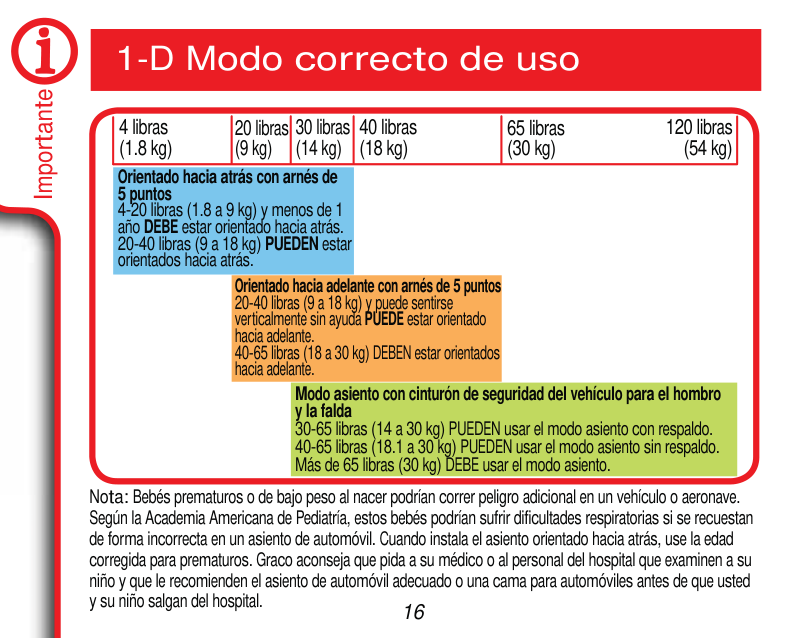
|4 libras (1.8 kg)|20 libras (9 kg)|30 libras (14 kg)|40 libras (18 kg)|65 libras (30 kg)
120 libras (54 kg)| |---|---|---|---|---|
Orientado hacia atrás con arnés de 5 puntos 4-20 libras (1.8 a 9 kg) y menos de 1 año DEBE estar orientado hacia atrás. 20-40 libras (9 a 18 kg) PUEDEN estar orientados hacia atrás.
Orientado hacia adelante con arnés de 5 puntos 20-40 libras (9 a 18 kg) y puede sentirse verticalmente sin ayuda PUEDE estar orientado hacia adelante. 40-65 libras (18 a 30 kg) DEBEN estar orientados hacia adelante.
Modo asiento con cinturón de seguridad del vehículo para el hombro y la falda 30-65 libras (14 a 30 kg) PUEDEN usar el modo asiento con respaldo. 40-65 libras (18.1 a 30 kg) PUEDEN usar el modo asiento sin respaldo. Más de 65 libras (30 kg) DEBE usar el modo asiento.
Nota: Bebés prematuros o de bajo peso al nacer podrían correr peligro adicional en un vehículo o aeronave. Según la Academia Americana de Pediatría, estos bebés podrían sufrir dificultades respiratorias si se recuestan de forma incorrecta en un asiento de automóvil. Cuando instala el asiento orientado hacia atrás, use la edad corregida para prematuros. Graco aconseja que pida a su médico o al personal del hospital que examinen a su niño y que le recomienden el asiento de automóvil adecuado o una cama para automóviles antes de que usted y su niño salgan del hospital.


|2-A Instalación de los soportes para vasos| |---|
######### Soportes para vasos
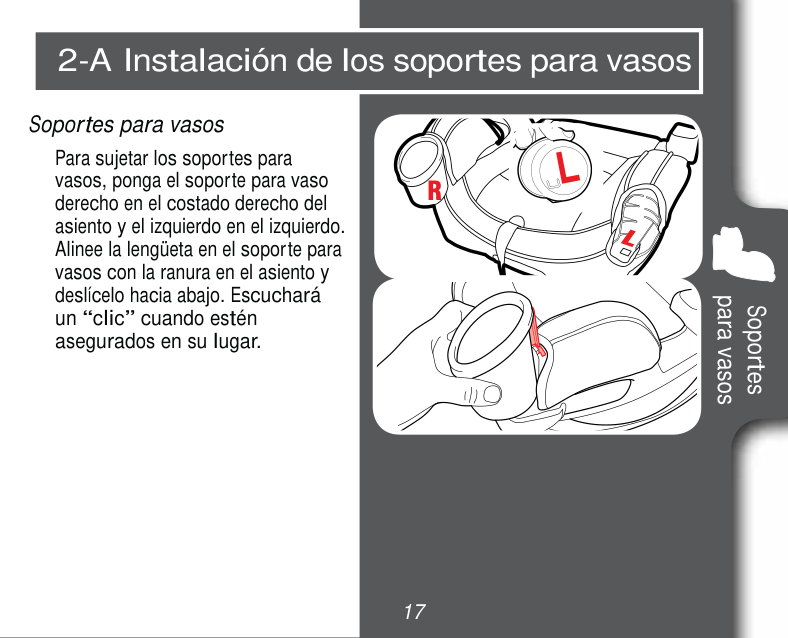
Para sujetar los soportes para vasos, ponga el soporte para vaso derecho en el costado derecho del asiento y el izquierdo en el izquierdo. Alinee la lengüeta en el soporte para vasos con la ranura en el asiento y deslícelo hacia abajo. Escuchará
###### R
L
Soportes para vasos
un “clic” cuando estén asegurados en su lugar.


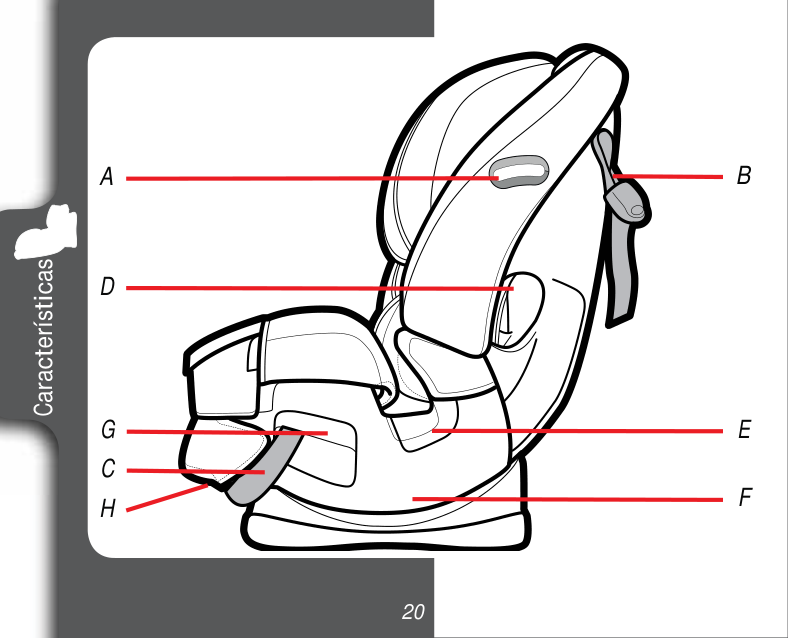

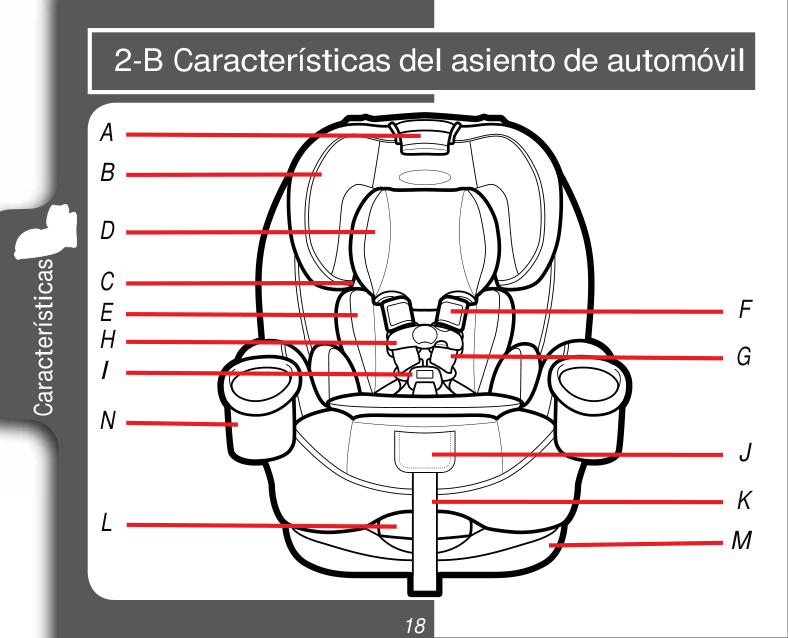
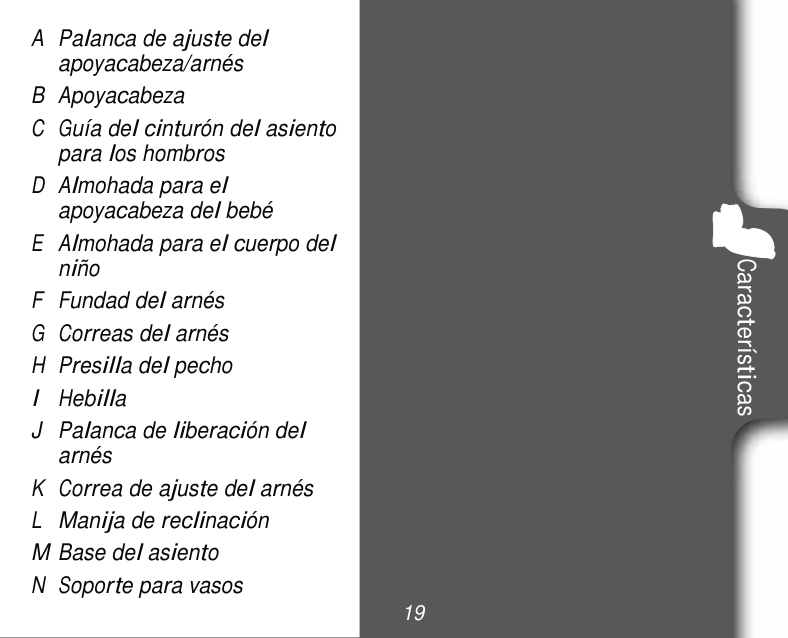
|2-B Características del asiento de automóvil| |---|
A
B
D
Características
C
E F
H I
G
N
J
| | | |---|---| | | |
K M

L


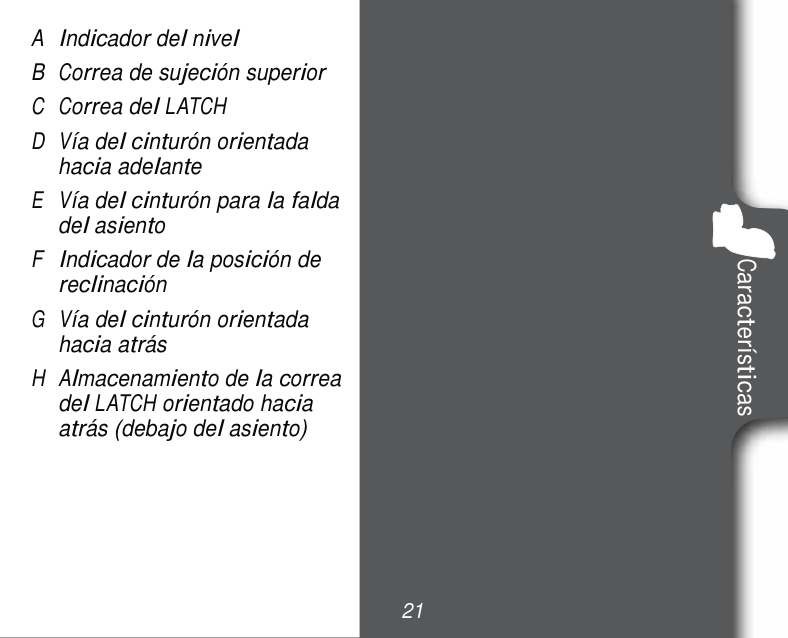
####### Características


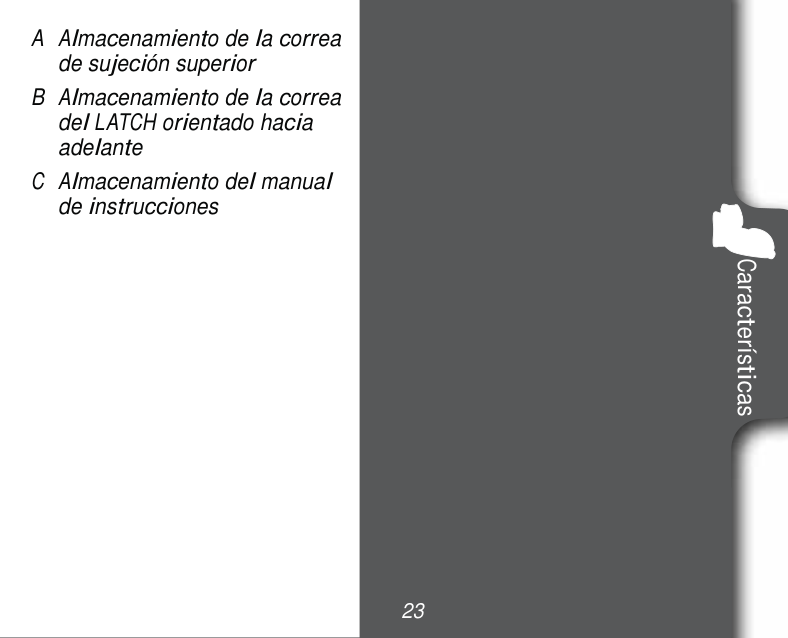

B
A
Características
D
E
G
C
F
H



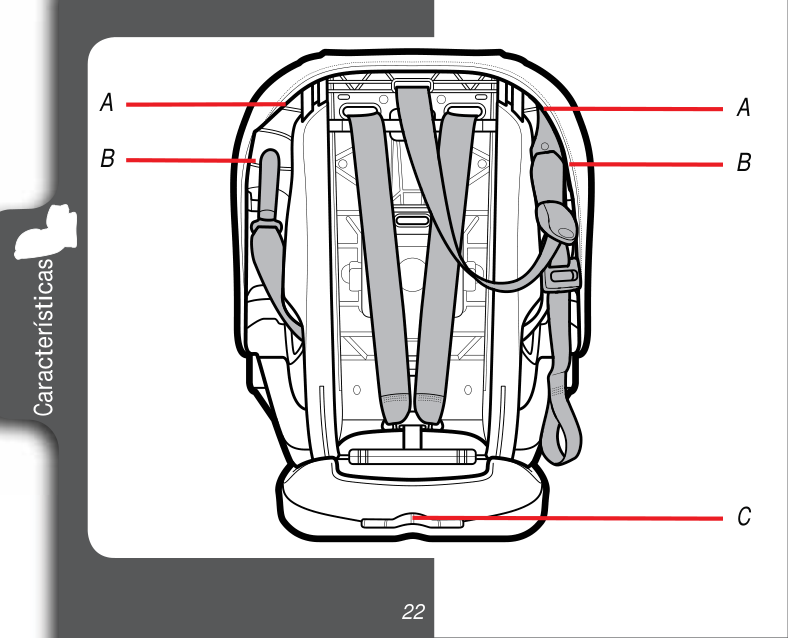
####### Características


A B
A B
Características

C


####### Características


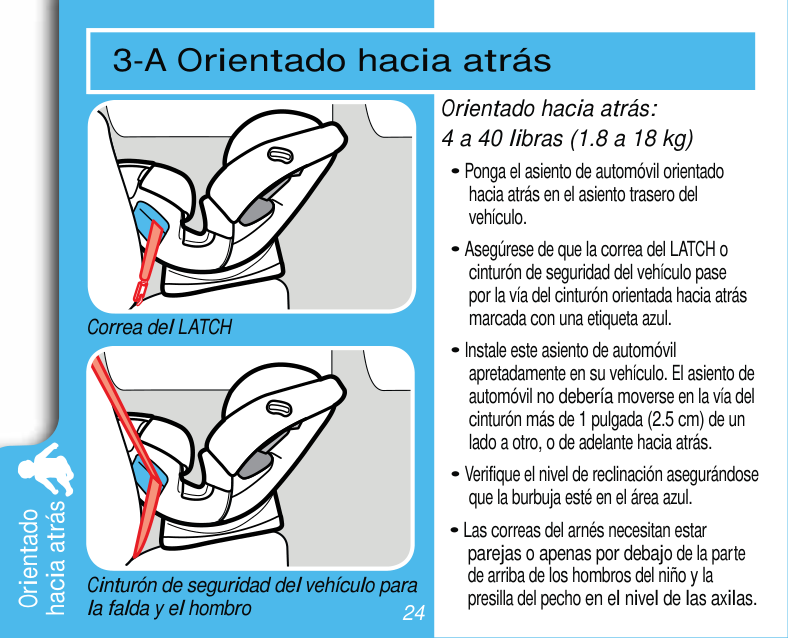
| | | | |---|---|---| |3-A Orientad|hacia atrás| | | |Orientado haci|atrás:|
######### 4 a 40 libras (1.8 a 18 kg)
Correa del LATCH

####### hacia atrás
####### Orientado
Cinturón de seguridad del vehículo para la falda y el hombro


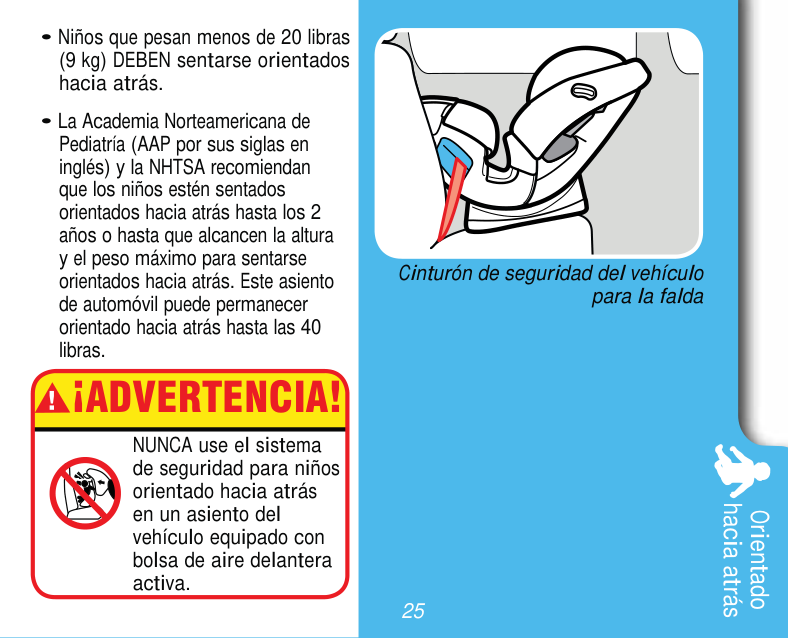
Cinturón de seguridad del vehículo para la falda
¡ADVERTENCIA!
NUNCA use el sistema de seguridad para niños orientado hacia atrás en un asiento del vehículo equipado con bolsa de aire delantera activa.

Orientado hacia atrás


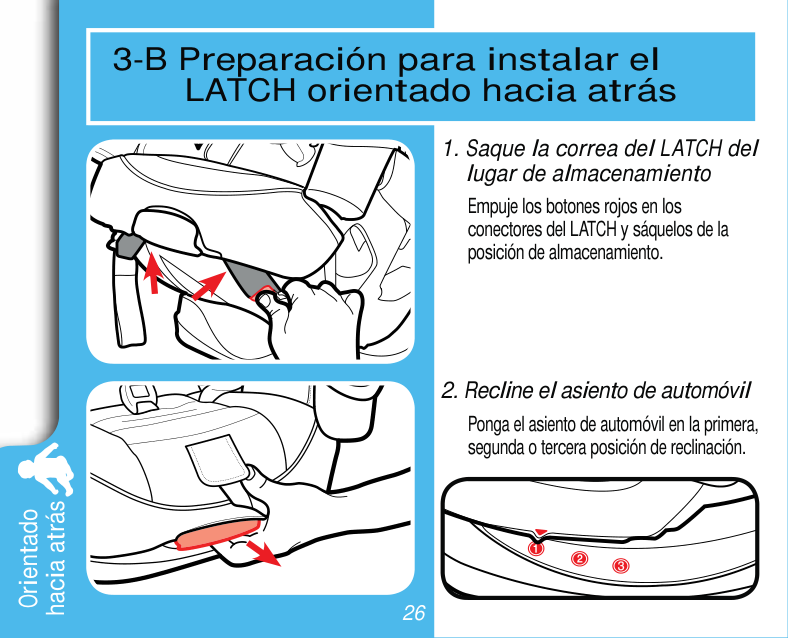
|3-B Preparación para instalar el LATCH orientado hacia atrás| |---|
######### 1. Saque la correa del LATCH del lugar de almacenamiento
Empuje los botones rojos en los conectores del LATCH y sáquelos de la posición de almacenamiento.
######### 2. Recline el asiento de automóvil
Ponga el asiento de automóvil en la primera, segunda o tercera posición de reclinación.


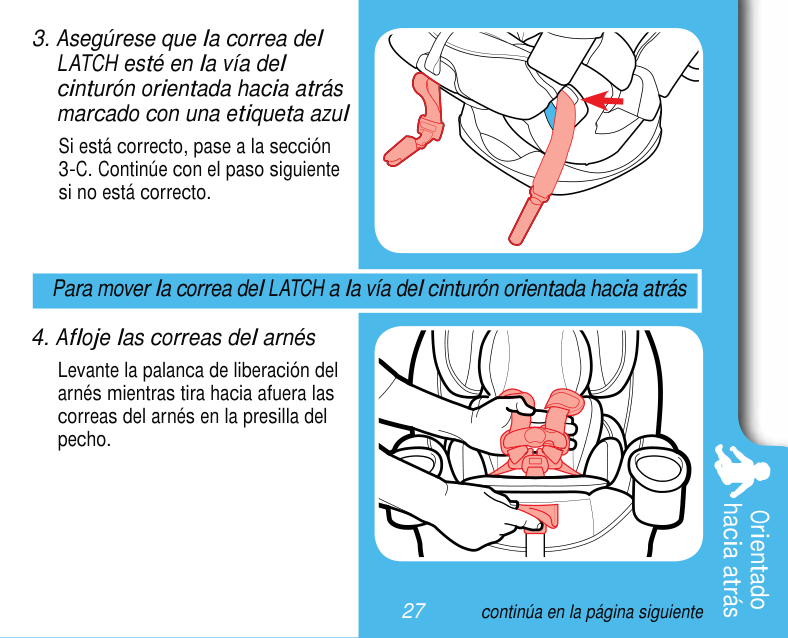
Si está correcto, pase a la sección 3-C. Continúe con el paso siguiente si no está correcto.
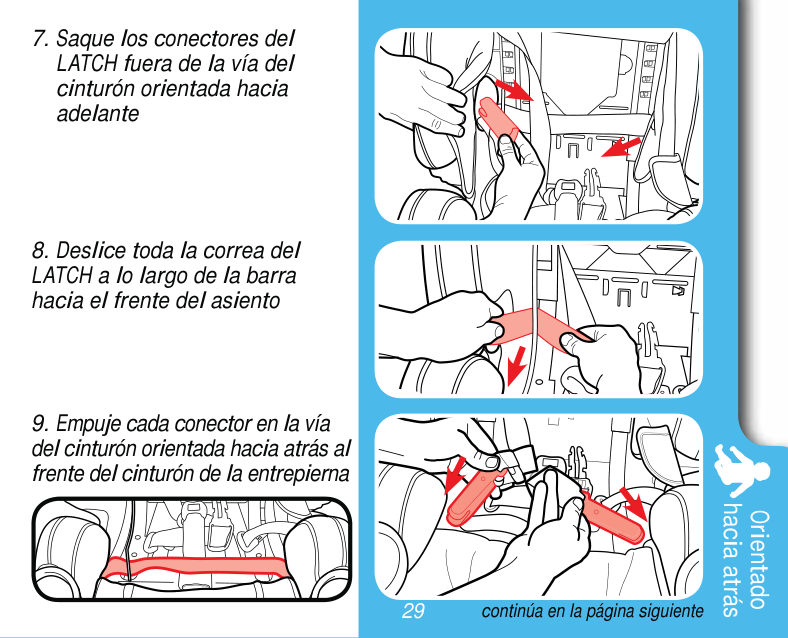
|Para mover la correa del LATCH a la vía del cinturón orientada hacia atrás| |---|
######### 4. Afloje las correas del arnés
Levante la palanca de liberación del arnés mientras tira hacia afuera las correas del arnés en la presilla del pecho.

####### Orientado hacia atrás
| | |
|---|---| |27 continú|en la página sigui|


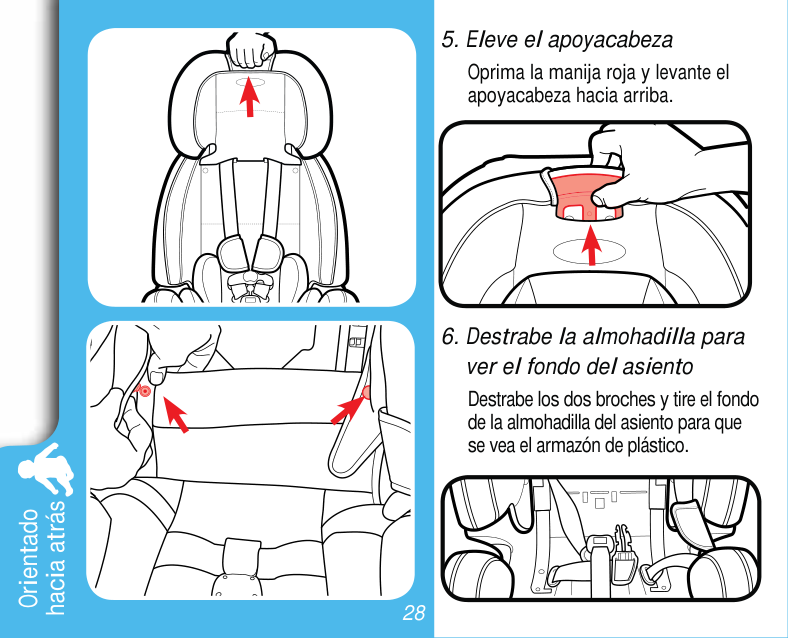
######### 5. Eleve el apoyacabeza
Oprima la manija roja y levante el apoyacabeza hacia arriba.
######### 6. Destrabe la almohadilla para ver el fondo del asiento
Destrabe los dos broches y tire el fondo de la almohadilla del asiento para que se vea el armazón de plástico.



####### hacia atrás


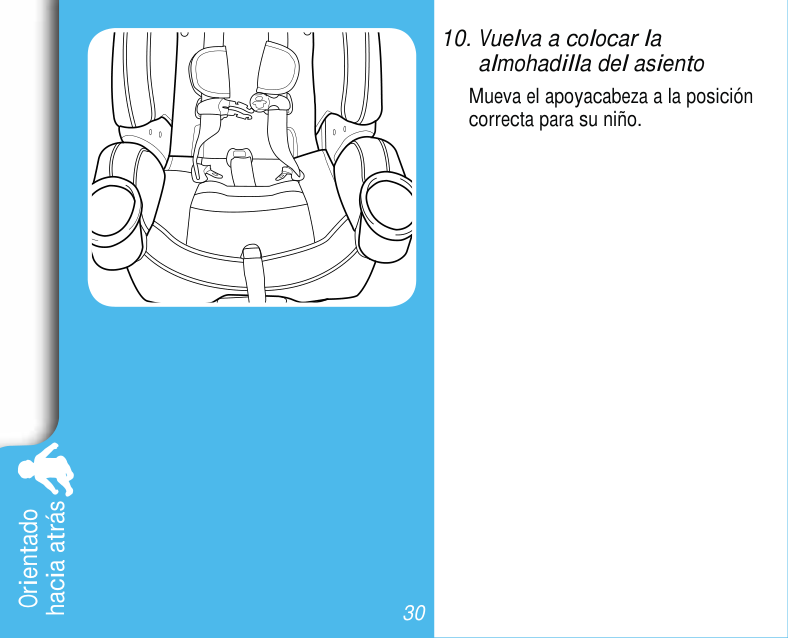
######### 10. Vuelva a colocar la almohadilla del asiento
Mueva el apoyacabeza a la posición correcta para su niño.


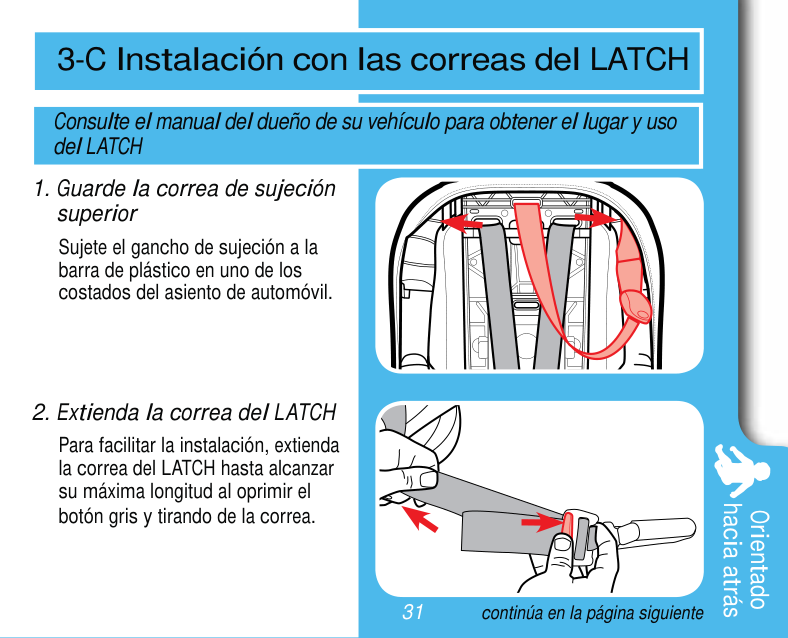
|3-C Instalación con las correas del LATCH|
|---|
|Consulte el manual del dueño de su vehículo para obtener el lugar y uso del LATCH| |---|
Sujete el gancho de sujeción a la barra de plástico en uno de los costados del asiento de automóvil.

hacia atrás


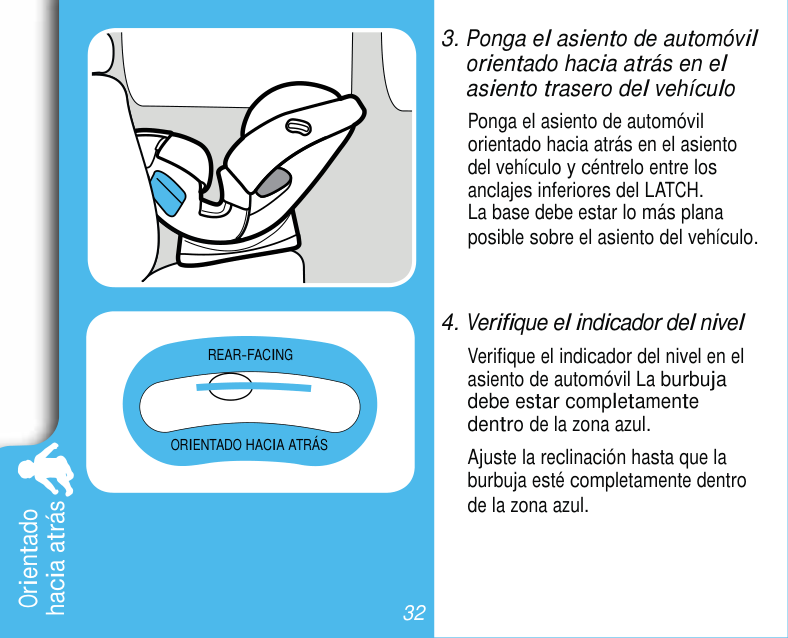
######### 3. Ponga el asiento de automóvil orientado hacia atrás en el asiento trasero del vehículo
Ponga el asiento de automóvil orientado hacia atrás en el asiento del vehículo y céntrelo entre los anclajes inferiores del LATCH. La base debe estar lo más plana posible sobre el asiento del vehículo.
######### 4. Verifique el indicador del nivel
Verifique el indicador del nivel en el asiento de automóvil La burbuja debe estar completamente dentro de la zona azul.
REAR-FACING
ORIENTADO HACIA ATRÁS
Ajuste la reclinación hasta que la burbuja esté completamente dentro de la zona azul.


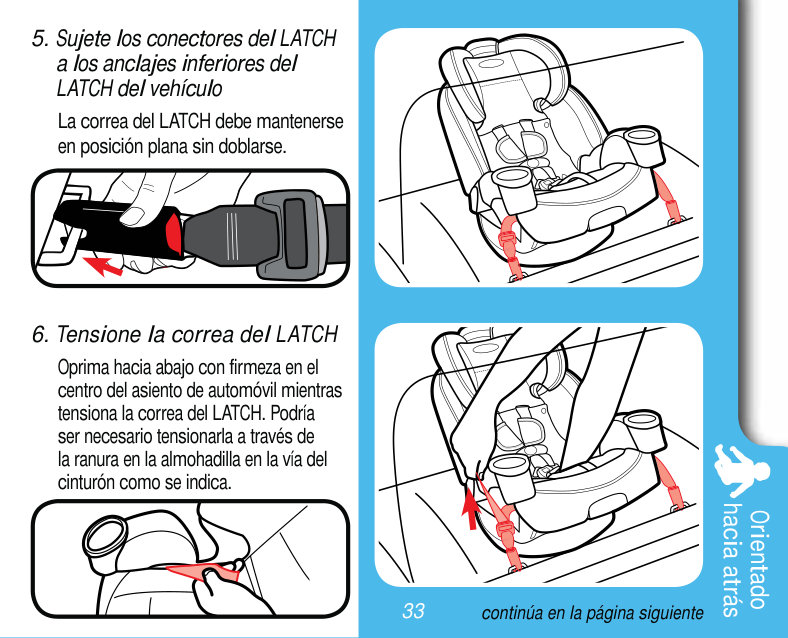
######### 5. Sujete los conectores del LATCH a los anclajes inferiores del LATCH del vehículo
La correa del LATCH debe mantenerse en posición plana sin doblarse.
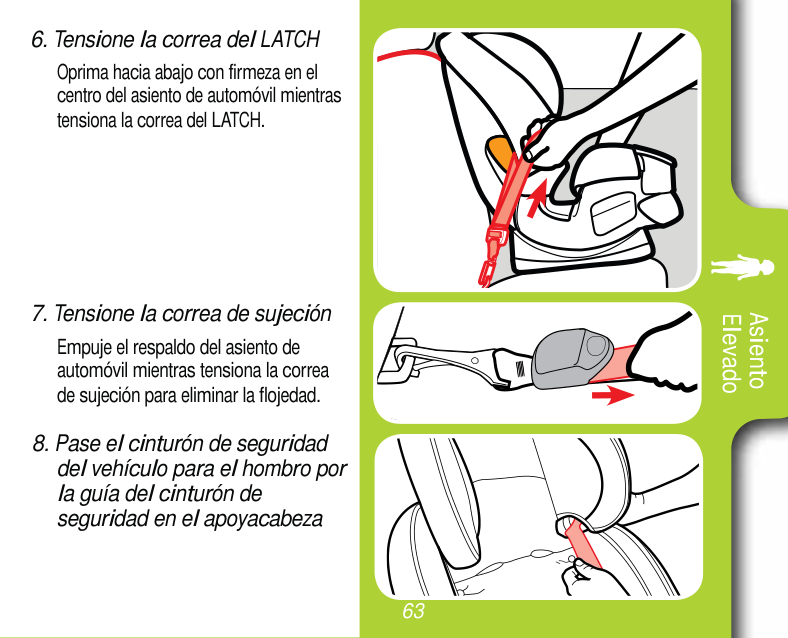
######### 6. Tensione la correa del LATCH
Oprima hacia abajo con firmeza en el centro del asiento de automóvil mientras tensiona la correa del LATCH. Podría ser necesario tensionarla a través de la ranura en la almohadilla en la vía del cinturón como se indica.


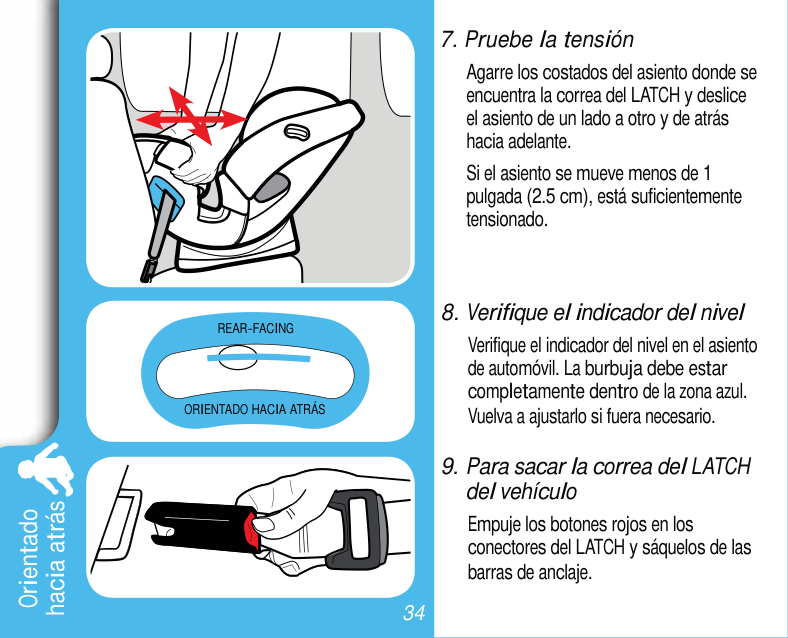
######### 7. Pruebe la tensión
Agarre los costados del asiento donde se encuentra la correa del LATCH y deslice el asiento de un lado a otro y de atrás hacia adelante.
Si el asiento se mueve menos de 1 pulgada (2.5 cm), está suficientemente tensionado.
######### 8. Verifique el indicador del nivel
REAR-FACING
Verifique el indicador del nivel en el asiento de automóvil. La burbuja debe estar completamente dentro de la zona azul. Vuelva a ajustarlo si fuera necesario.
ORIENTADO HACIA ATRÁS
######### 9. Para sacar la correa del LATCHdel vehículo

####### hacia atrás
####### Orientado
Empuje los botones rojos en los conectores del LATCH y sáquelos de las barras de anclaje.


|3-D Instalación con el cinturón de seguridad del vehículo| |---|
Ponga el asiento de automóvil en la primera, segunda o tercera posición de reclinación.


######### 3. Ponga el asiento de automóvil orientado hacia atrás en el asiento trasero del vehículo
Colóquelo orientado hacia atrás en el asiento del vehículo. La base debe estar lo más plana posible sobre el asiento del vehículo.
REAR-FACING
ORIENTADO HACIA ATRÁS

####### hacia atrás
####### Orientado


|Consulte el manual del dueño de su vehículo para obtener el uso del cinturón de seguridad del vehículo| |---|
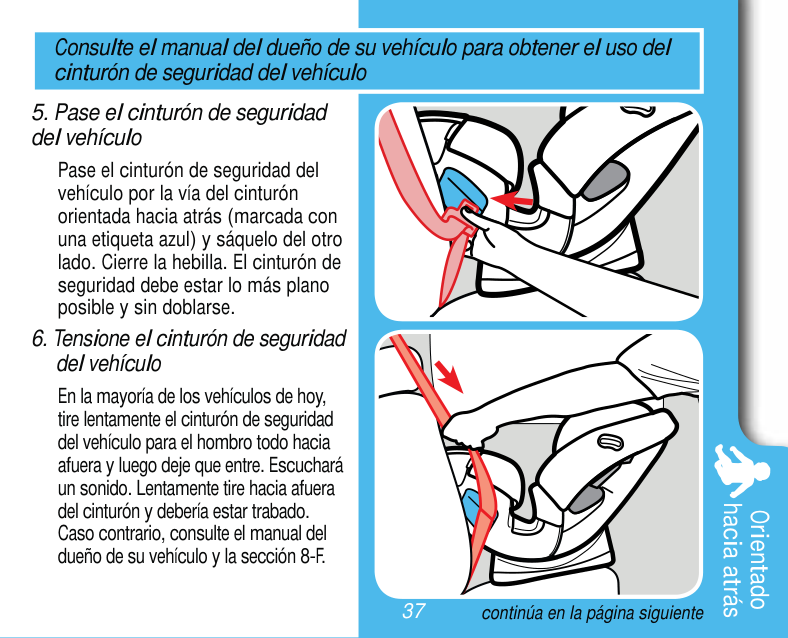
######### 5. Pase el cinturón de seguridaddel vehículo
Pase el cinturón de seguridad del vehículo por la vía del cinturón orientada hacia atrás (marcada con una etiqueta azul) y sáquelo del otro lado. Cierre la hebilla. El cinturón de seguridad debe estar lo más plano posible y sin doblarse.
######### 6. Tensione el cinturón de seguridaddel vehículo
En la mayoría de los vehículos de hoy, tire lentamente el cinturón de seguridad del vehículo para el hombro todo hacia afuera y luego deje que entre. Escuchará un sonido. Lentamente tire hacia afuera del cinturón y debería estar trabado. Caso contrario, consulte el manual del dueño de su vehículo y la sección 8-F.

####### Orientado hacia atrás


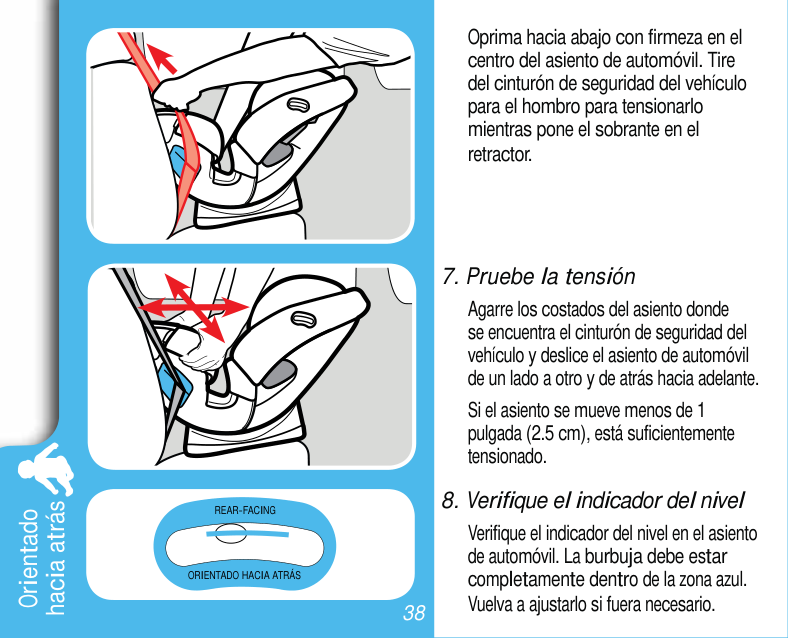
Oprima hacia abajo con firmeza en el centro del asiento de automóvil. Tire del cinturón de seguridad del vehículo para el hombro para tensionarlo mientras pone el sobrante en el retractor.
######### 7. Pruebe la tensión
Agarre los costados del asiento donde se encuentra el cinturón de seguridad del vehículo y deslice el asiento de automóvil de un lado a otro y de atrás hacia adelante.
Si el asiento se mueve menos de 1 pulgada (2.5 cm), está suficientemente tensionado.

####### hacia atrás
REAR-FACING
####### Orientado
ORIENTADO HACIA ATRÁS


#### 4-A Orientado hacia adelante
Orientado hacia adelante
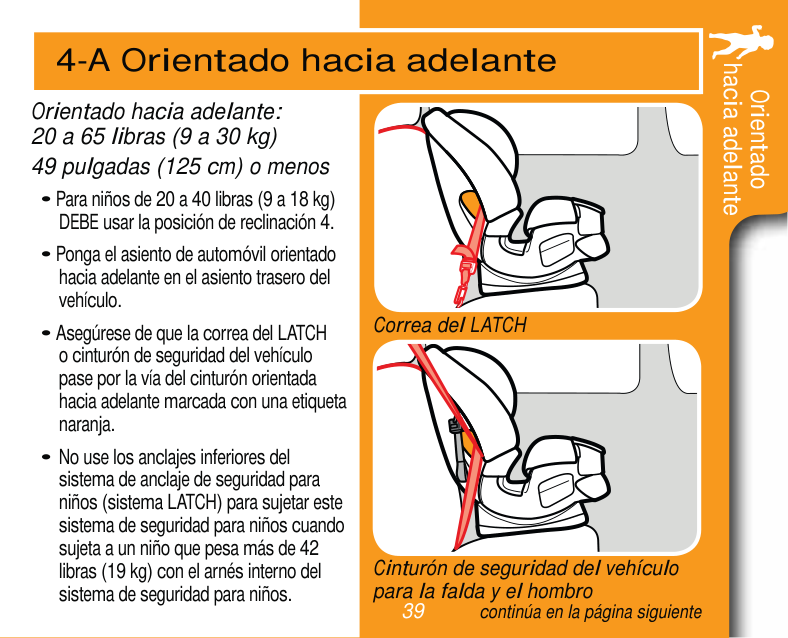
######### Orientado hacia adelante: 20 a 65 libras (9 a 30 kg) 49 pulgadas (125 cm) o menos
Important
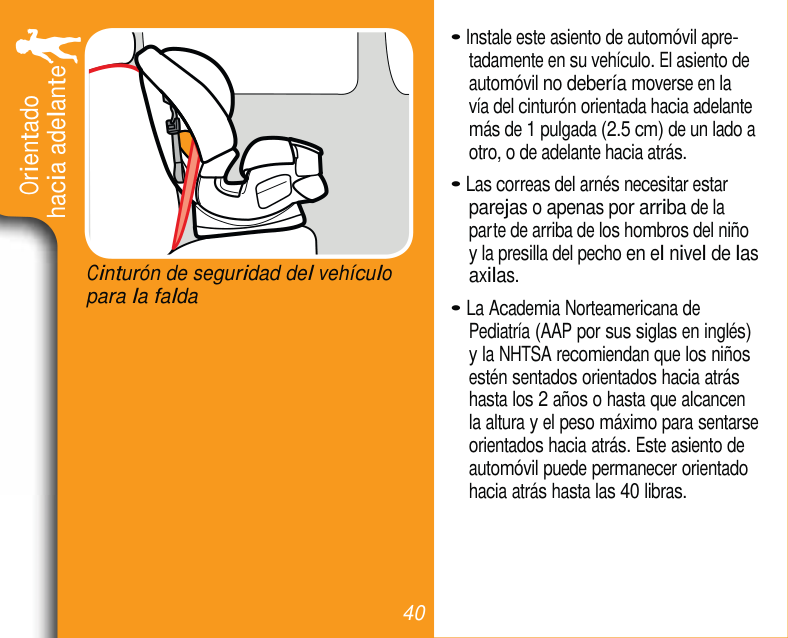

Correa del LATCH

Cinturón de seguridad del vehículo para la falda y el hombro


####### hacia adelante
####### Orientado
########## Cinturón de seguridad del vehículo para la falda


|4-B Preparación para instalar el LATCH orientado hacia adelante| |---|

Orientado hacia adelante
Important

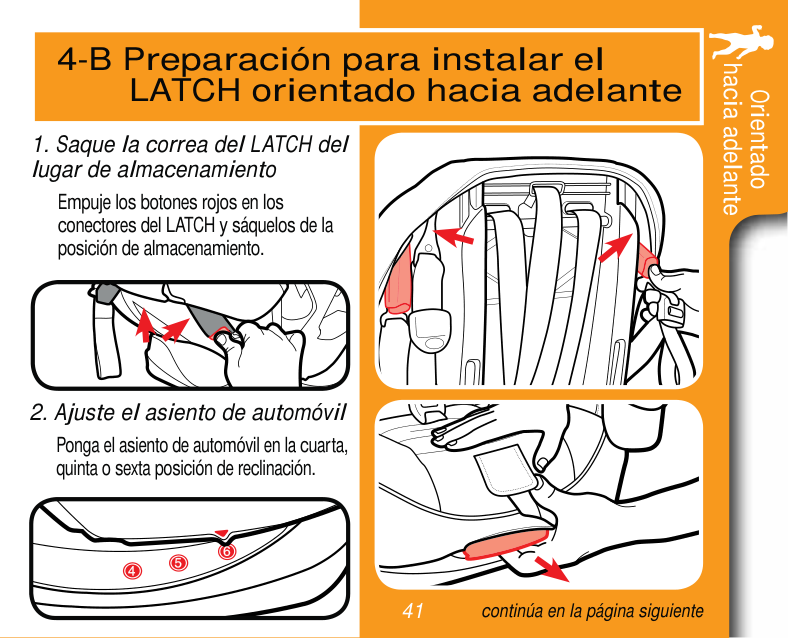
######### 1. Saque la correa del LATCH del lugar de almacenamiento
Empuje los botones rojos en los conectores del LATCH y sáquelos de la posición de almacenamiento.
######### 2. Ajuste el asiento de automóvil
Ponga el asiento de automóvil en la cuarta, quinta o sexta posición de reclinación.


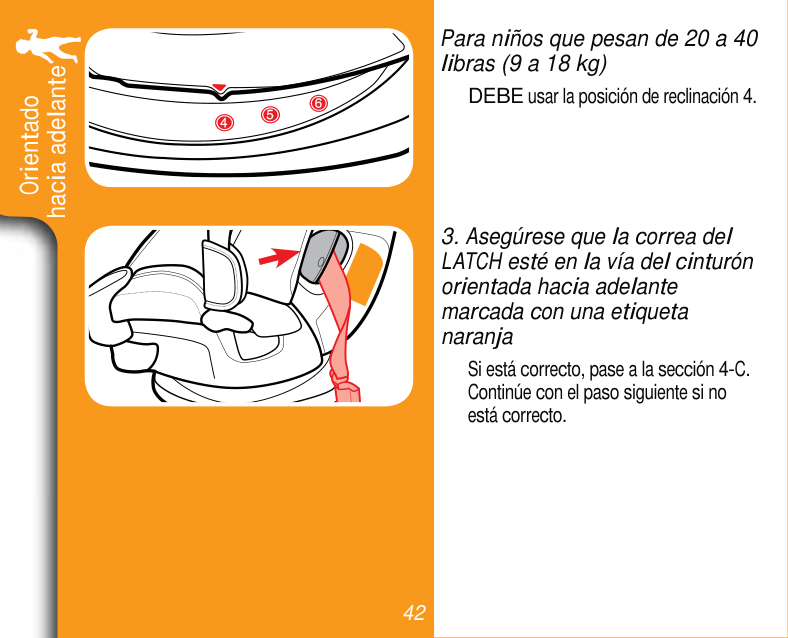
######### Para niños que pesan de 20 a 40 libras (9 a 18 kg)
####### hacia adelante
DEBE usar la posición de reclinación 4.
####### Orientado
######### 3. Asegúrese que la correa del LATCH esté en la vía del cinturón orientada hacia adelante marcada con una etiqueta naranja
Si está correcto, pase a la sección 4-C. Continúe con el paso siguiente si no está correcto.


|Para mover la correa del LATCH a la vía del cinturón orientada hacia adelante| |---|

####### Orientado hacia adelante
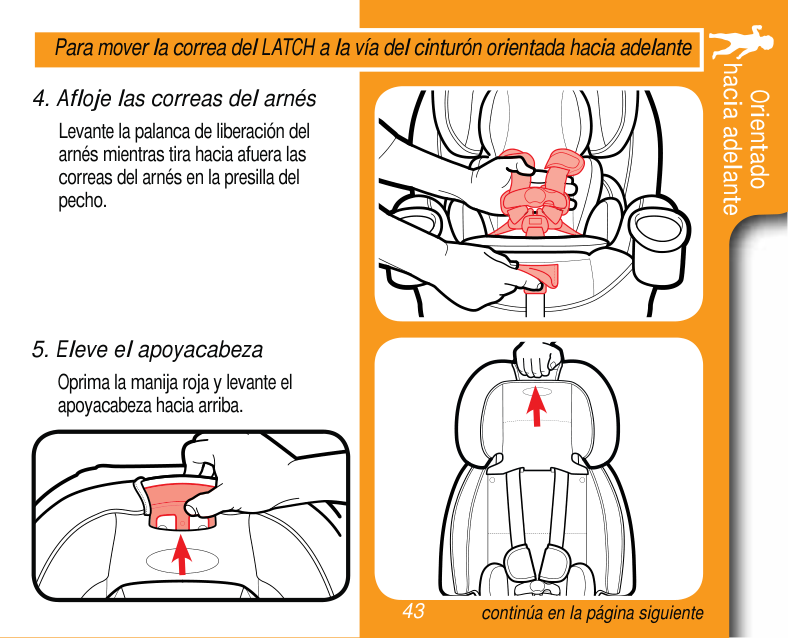
######### 4. Afloje las correas del arnés
####### Important

Levante la palanca de liberación del arnés mientras tira hacia afuera las correas del arnés en la presilla del pecho.
| | | |---|---| | | | | | |
######### 5. Eleve el apoyacabeza
Oprima la manija roja y levante el apoyacabeza hacia arriba.


####### hacia adelante
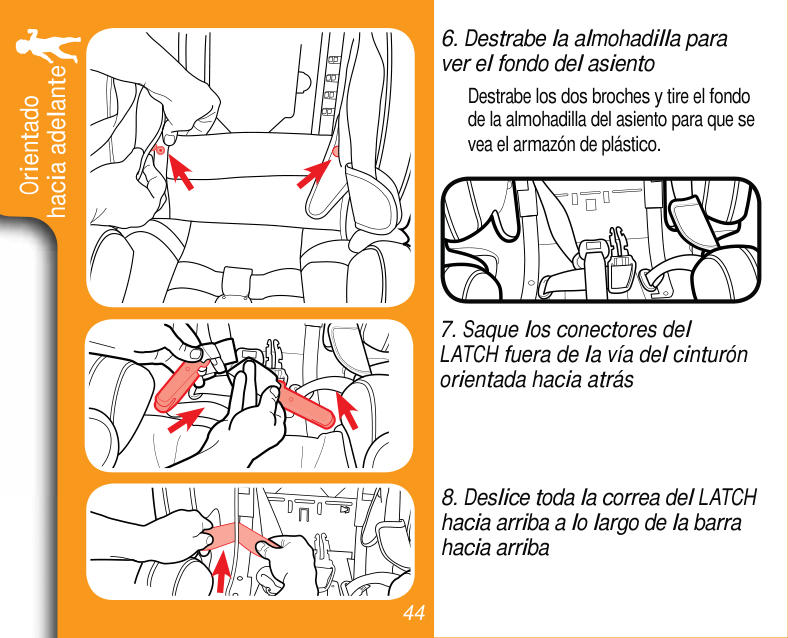
Destrabe los dos broches y tire el fondo de la almohadilla del asiento para que se vea el armazón de plástico.
####### Orientado
| | | |---|---| | | | | | |



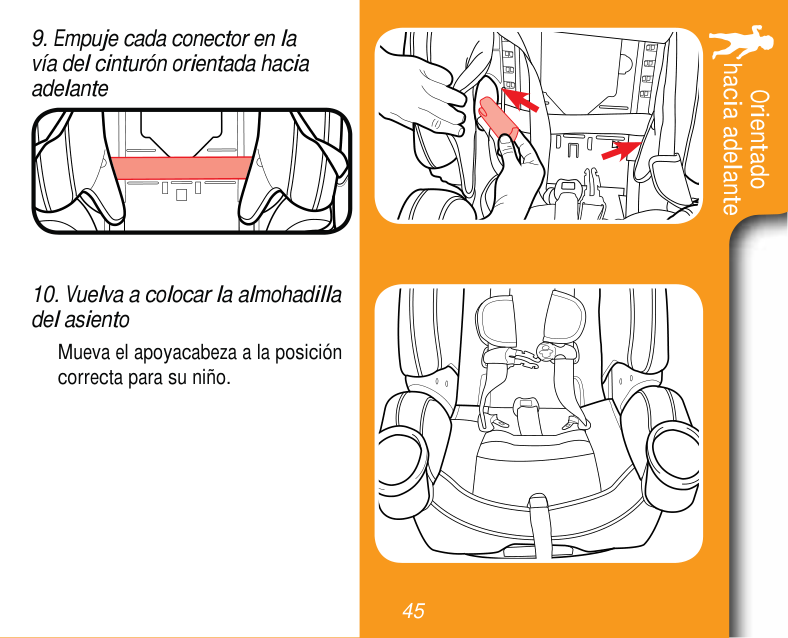
######### 9. Empuje cada conector en la vía del cinturón orientada hacia adelante

####### Orientado hacia adelante
####### Important

######### 10. Vuelva a colocar la almohadilla del asiento
Mueva el apoyacabeza a la posición correcta para su niño.


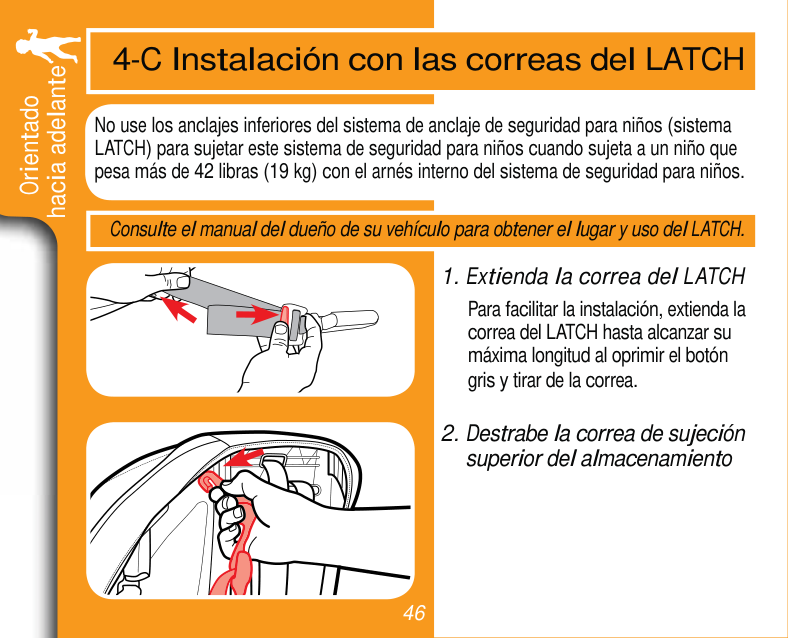
|4-C Instalación con las correas del LATCH| |---|
hacia adelante
Orientado
No use los anclajes inferiores del sistema de anclaje de seguridad para niños (sistema LATCH) para sujetar este sistema de seguridad para niños cuando sujeta a un niño que pesa más de 42 libras (19 kg) con el arnés interno del sistema de seguridad para niños.
|Consulte el manual del dueño de su vehículo para obtener el lugar y uso del LATCH.| |---|


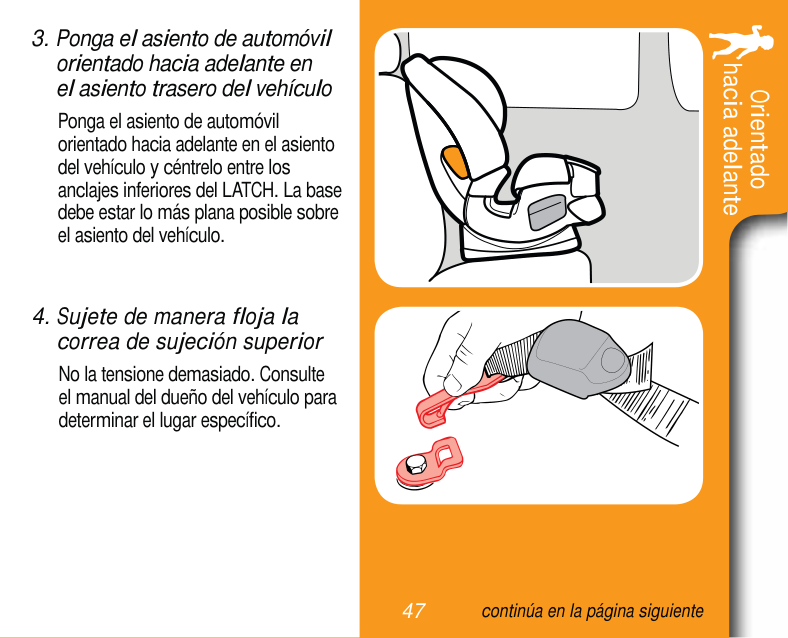
######### 3. Ponga el asiento de automóvil orientado hacia adelante en el asiento trasero del vehículo

####### Orientado hacia adelante
####### Important

Ponga el asiento de automóvil orientado hacia adelante en el asiento del vehículo y céntrelo entre los anclajes inferiores del LATCH. La base debe estar lo más plana posible sobre el asiento del vehículo.

47
continúa en la página siguiente


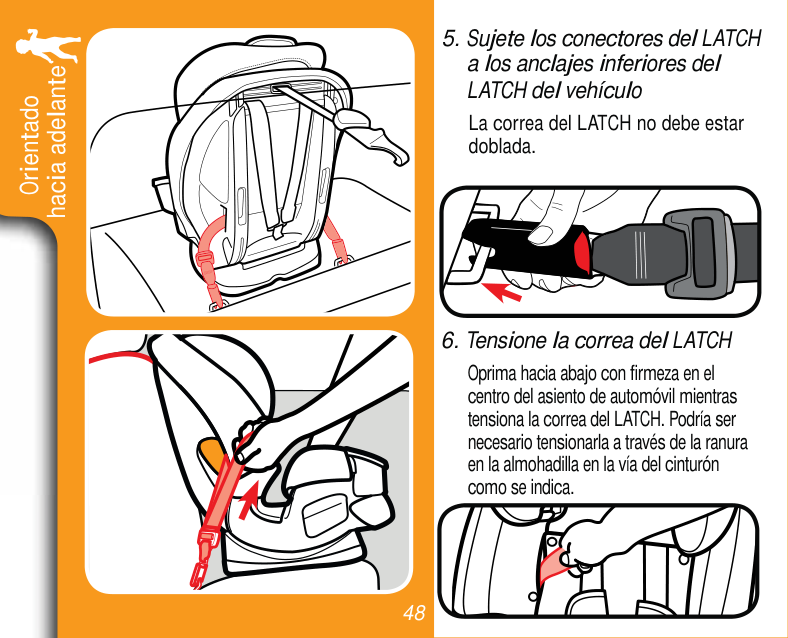
######### 5. Sujete los conectores del LATCH a los anclajes inferiores del LATCH del vehículo
####### hacia adelante
####### Orientado
La correa del LATCH no debe estar doblada.
######### 6. Tensione la correa del LATCH
Oprima hacia abajo con firmeza en el centro del asiento de automóvil mientras tensiona la correa del LATCH. Podría ser necesario tensionarla a través de la ranura en la almohadilla en la vía del cinturón como se indica.


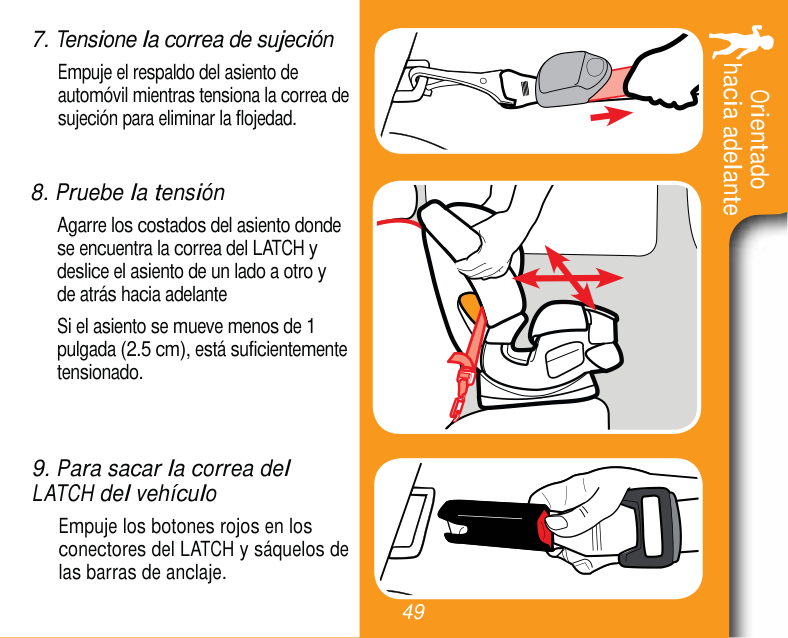
Empuje el respaldo del asiento de automóvil mientras tensiona la correa de sujeción para eliminar la flojedad.
Agarre los costados del asiento donde se encuentra la correa del LATCH y deslice el asiento de un lado a otro y de atrás hacia adelante
Si el asiento se mueve menos de 1 pulgada (2.5 cm), está suficientemente tensionado.

Orientado hacia adelante
Important


Empuje los botones rojos en los conectores del LATCH y sáquelos de las barras de anclaje.


|4-D Instalación con el cinturón de seguridad del vehículo| |---|
hacia adelante
Orientado
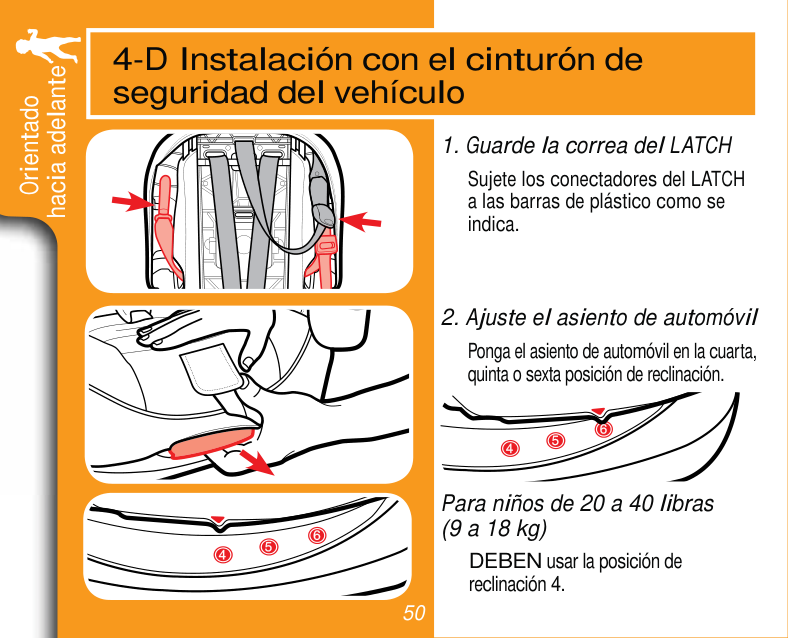
######### 1. Guarde la correa del LATCH
Sujete los conectadores del LATCH a las barras de plástico como se indica.
######### 2. Ajuste el asiento de automóvil
Ponga el asiento de automóvil en la cuarta, quinta o sexta posición de reclinación.
######### Para niños de 20 a 40 libras (9 a 18 kg)

DEBEN usar la posición de reclinación 4.


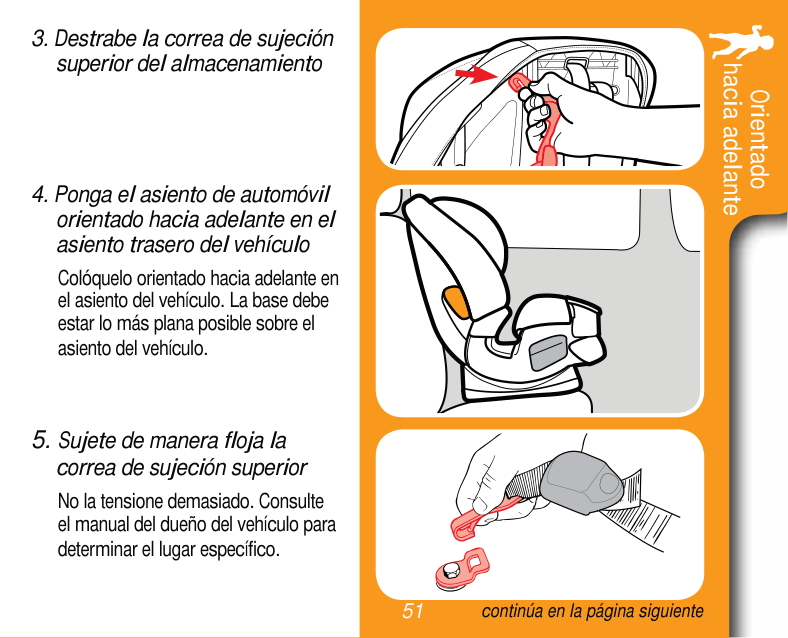
######### 3. Destrabe la correa de sujeción superior del almacenamiento

####### Orientado hacia adelante
####### Important

######### 4. Ponga el asiento de automóvilorientado hacia adelante en elasiento trasero del vehículo
Colóquelo orientado hacia adelante en el asiento del vehículo. La base debe estar lo más plana posible sobre el asiento del vehículo.
####### 5. Sujete de manera floja lacorrea de sujeción superior
No la tensione demasiado. Consulte el manual del dueño del vehículo para determinar el lugar específico.

51
continúa en la página siguiente
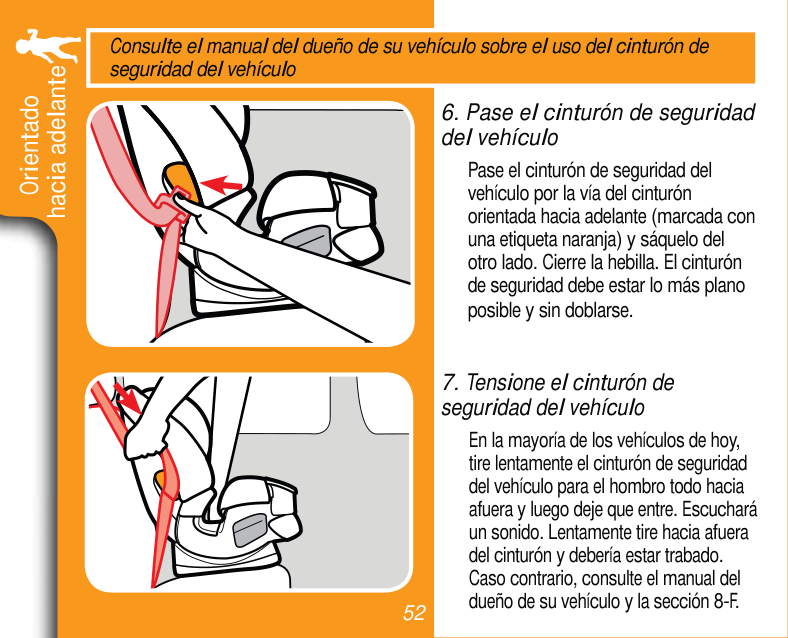
| | | |---|---| |Consulte el manual del dueño de su ve seguridad del vehículo|ículo sobre el uso del cinturón de|


hacia adelante
Orientado
Pase el cinturón de seguridad del vehículo por la vía del cinturón orientada hacia adelante (marcada con una etiqueta naranja) y sáquelo del otro lado. Cierre la hebilla. El cinturón de seguridad debe estar lo más plano posible y sin doblarse.
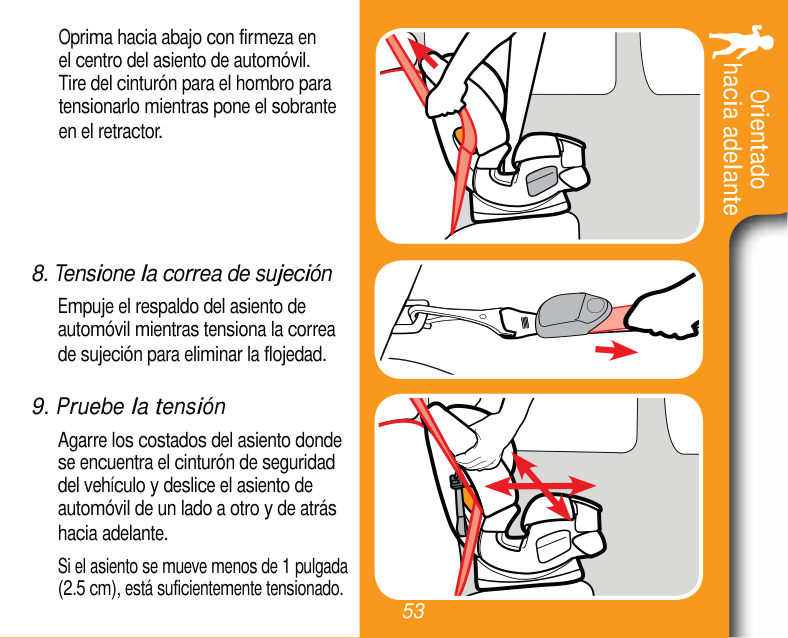
En la mayoría de los vehículos de hoy, tire lentamente el cinturón de seguridad del vehículo para el hombro todo hacia afuera y luego deje que entre. Escuchará un sonido. Lentamente tire hacia afuera del cinturón y debería estar trabado. Caso contrario, consulte el manual del dueño de su vehículo y la sección 8-F.



Oprima hacia abajo con firmeza en el centro del asiento de automóvil. Tire del cinturón para el hombro para tensionarlo mientras pone el sobrante en el retractor.

####### Orientado hacia adelante
####### Important

######### 8. Tensione la correa de sujeción
Empuje el respaldo del asiento de automóvil mientras tensiona la correa de sujeción para eliminar la flojedad.
######### 9. Pruebe la tensión
Agarre los costados del asiento donde se encuentra el cinturón de seguridad del vehículo y deslice el asiento de automóvil de un lado a otro y de atrás hacia adelante.

Si el asiento se mueve menos de 1 pulgada (2.5 cm), está suficientemente tensionado.


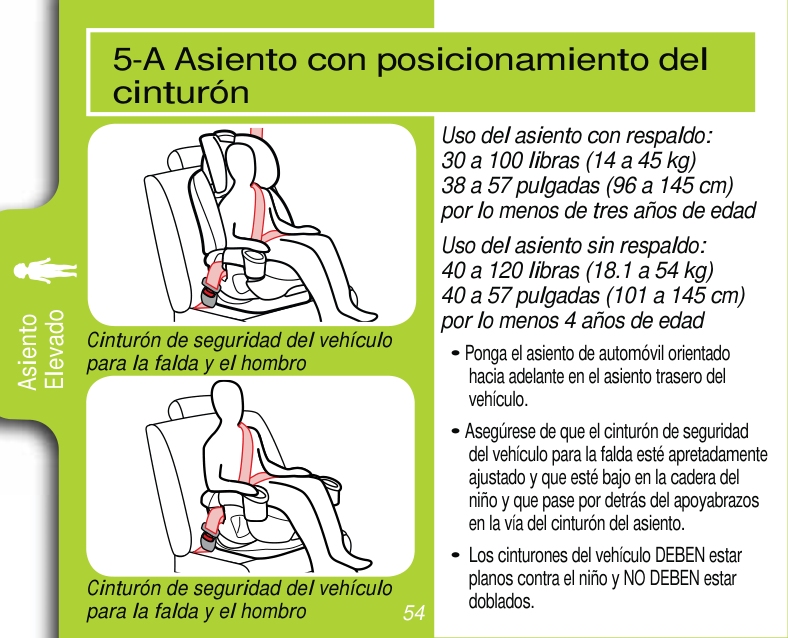
|5-A Asiento con posicionamiento del cinturón| |---|
Uso del asiento con respaldo: 30 a 100 libras (14 a 45 kg) 38 a 57 pulgadas (96 a 145 cm) por lo menos de tres años de edad
Uso del asiento sin respaldo: 40 a 120 libras (18.1 a 54 kg) 40 a 57 pulgadas (101 a 145 cm) por lo menos 4 años de edad
Elevado
Asiento
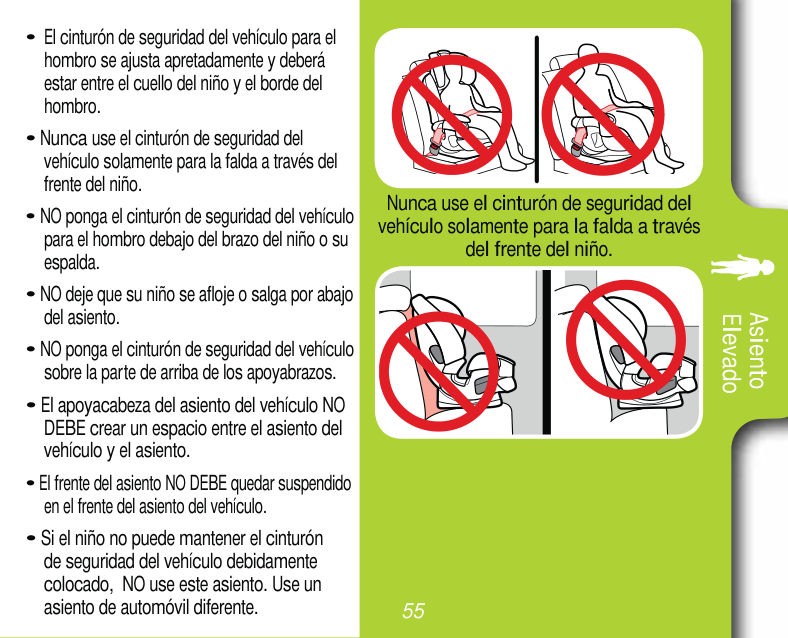
Cinturón de seguridad del vehículo para la falda y el hombro

Cinturón de seguridad del vehículo para la falda y el hombro


########## Nunca use el cinturón de seguridad del vehículo solamente para la falda a través del frente del niño.
####### Asiento Elevado


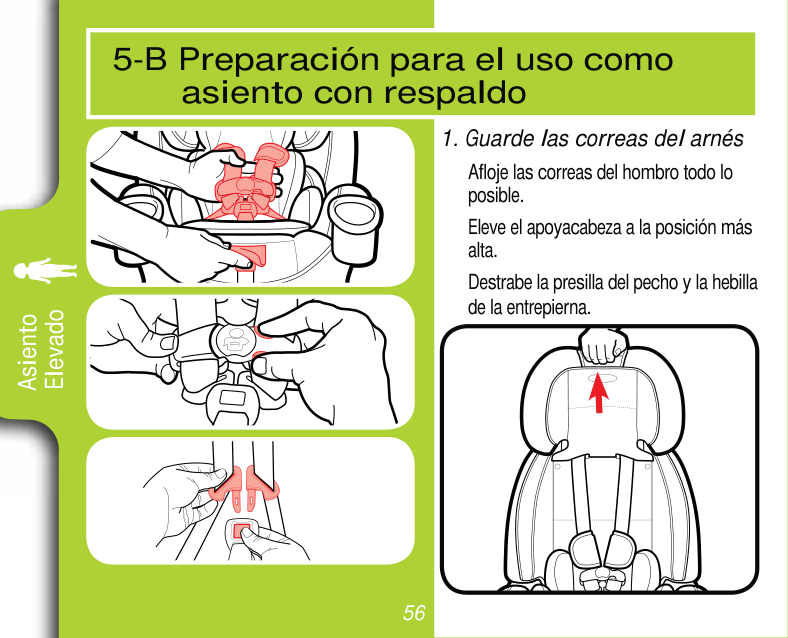
|5-B Preparación para el uso como asiento con respaldo| |---|
Afloje las correas del hombro todo lo posible.
Eleve el apoyacabeza a la posición más alta.
Destrabe la presilla del pecho y la hebilla de la entrepierna.
Elevado
Asiento


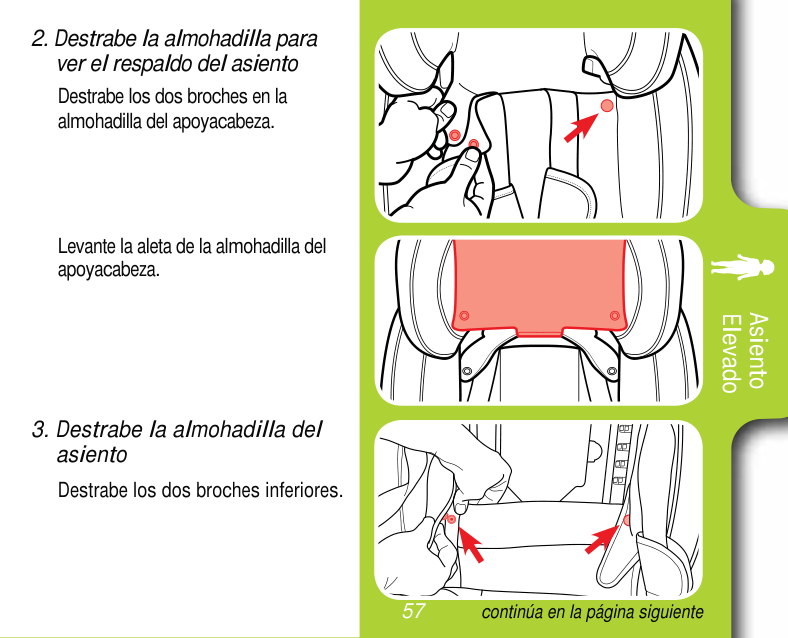
######### 2. Destrabe la almohadilla paraver el respaldo del asiento
Destrabe los dos broches en la almohadilla del apoyacabeza.
Levante la aleta de la almohadilla del apoyacabeza.
####### Asiento Elevado
| | | | |---|---|---|
| | | | | | | |
######### 3. Destrabe la almohadilla delasientoDestrabe los dos broches inferiores.

57
continúa en la página siguiente


Elevado
Asiento


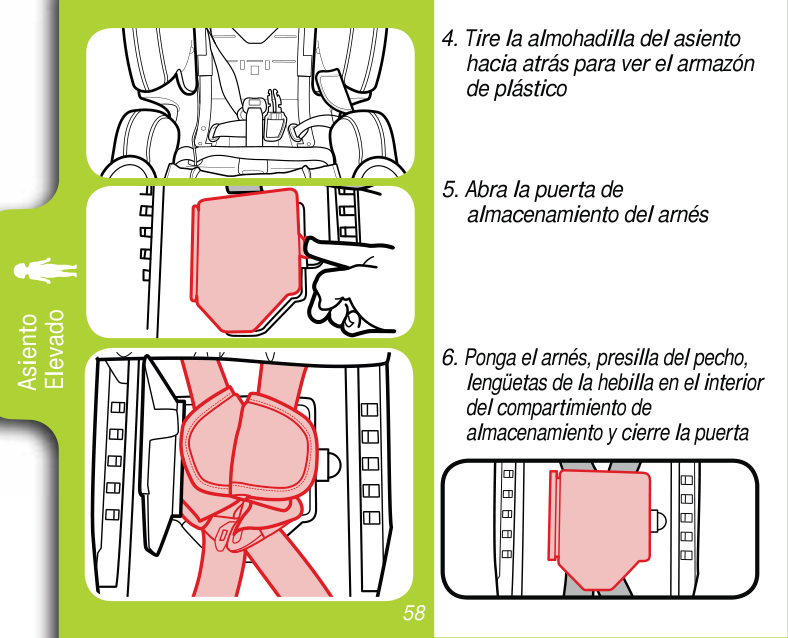
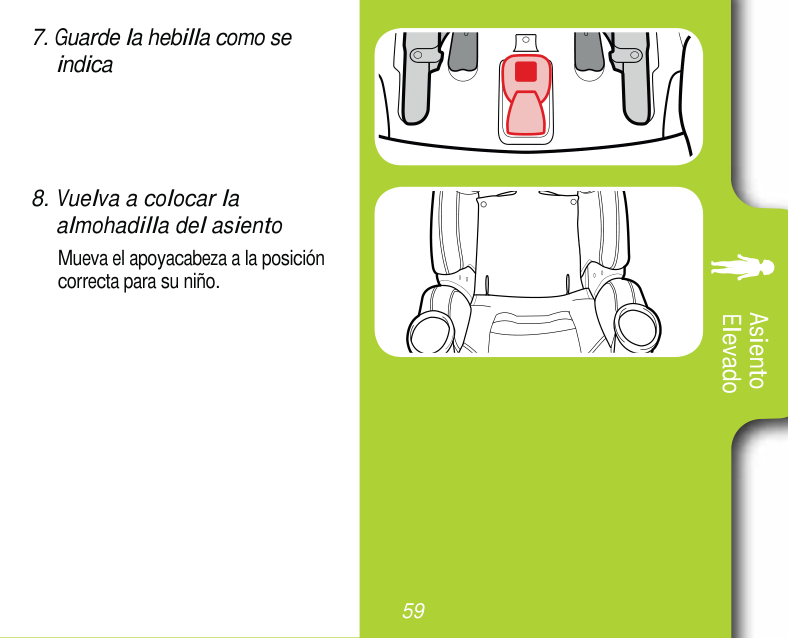
######### 7. Guarde la hebilla como se indica
######### 8. Vuelva a colocar la almohadilla del asiento
Mueva el apoyacabeza a la posición correcta para su niño.
####### Asiento Elevado



|5-C Instalación del asiento con respaldo| |---|
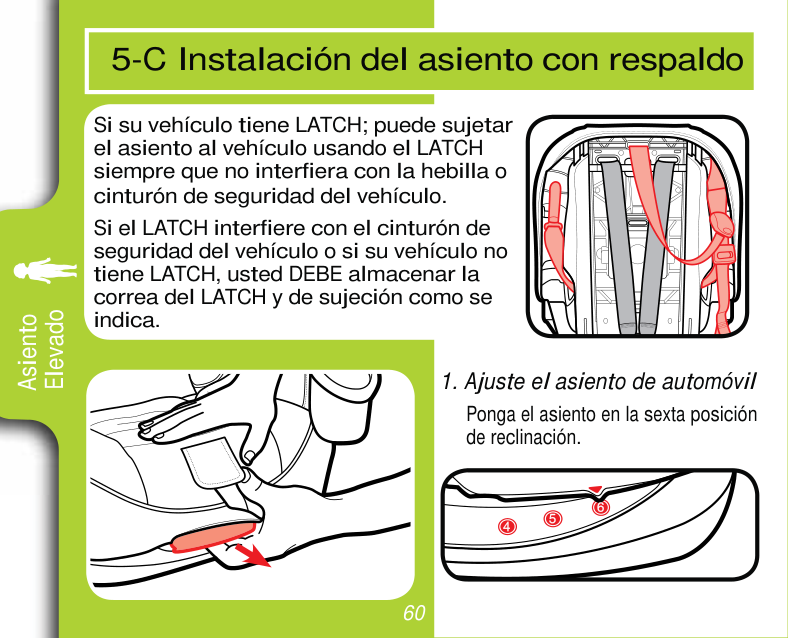
Si su vehículo tiene LATCH; puede sujetar el asiento al vehículo usando el LATCH siempre que no interfiera con la hebilla o cinturón de seguridad del vehículo. Si el LATCH interfiere con el cinturón de seguridad del vehículo o si su vehículo no tiene LATCH, usted DEBE almacenar la correa del LATCH y de sujeción como se indica.
Elevado
Asiento
######### 1. Ajuste el asiento de automóvil
Ponga el asiento en la sexta posición de reclinación.


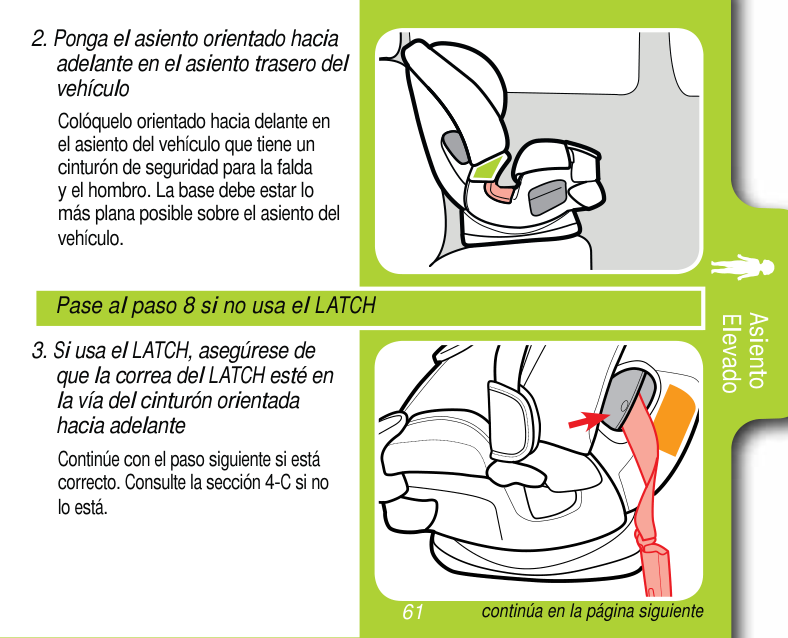
######### 2. Ponga el asiento orientado hacia adelante en el asiento trasero del vehículo
Colóquelo orientado hacia delante en el asiento del vehículo que tiene un cinturón de seguridad para la falda y el hombro. La base debe estar lo más plana posible sobre el asiento del vehículo.
|Pase al paso 8 si no usa el LATCH| |---|
####### Asiento Elevado
######### 3. Si usa el LATCH, asegúrese de que la correa del LATCH esté en la vía del cinturón orientada hacia adelante
Continúe con el paso siguiente si está correcto. Consulte la sección 4-C si no lo está.

continúa en la página siguiente


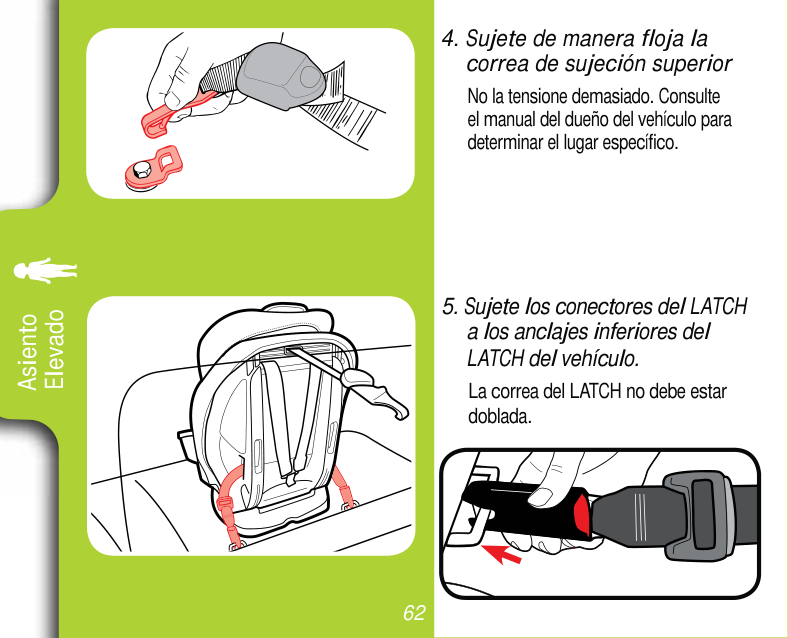
######### 4. Sujete de manera floja la correa de sujeción superior
No la tensione demasiado. Consulte el manual del dueño del vehículo para determinar el lugar específico.
######### 5. Sujete los conectores del LATCH a los anclajes inferiores del LATCH del vehículo.
####### Elevado
####### Asiento
La correa del LATCH no debe estar doblada.


Oprima hacia abajo con firmeza en el centro del asiento de automóvil mientras tensiona la correa del LATCH.
Empuje el respaldo del asiento de automóvil mientras tensiona la correa de sujeción para eliminar la flojedad.
####### Asiento Elevado


|5-D Preparación para uso como asiento sin respaldo| |---|
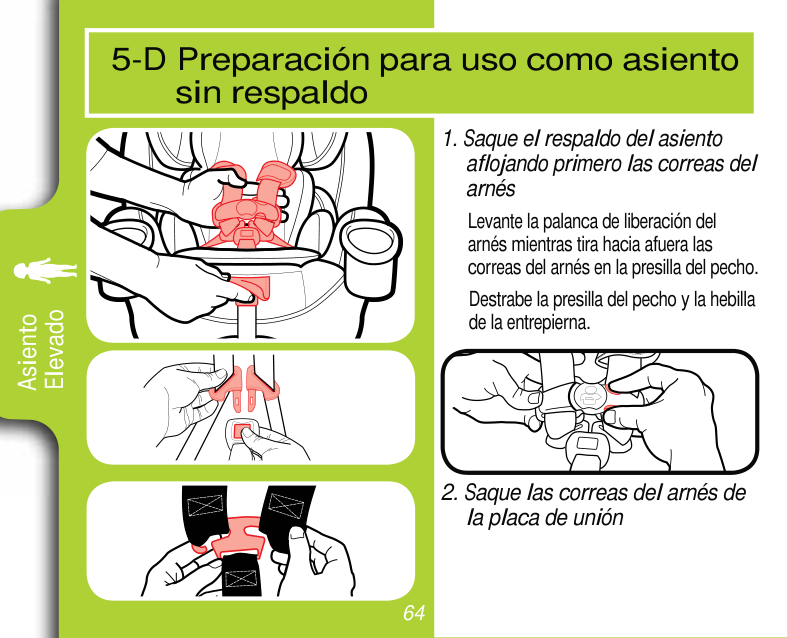
######### 1. Saque el respaldo del asiento aflojando primero las correas del arnés
Levante la palanca de liberación del arnés mientras tira hacia afuera las correas del arnés en la presilla del pecho. Destrabe la presilla del pecho y la hebilla de la entrepierna.
| | | |---|---| | | |
Elevado
Asiento


| | | | |---|---|---| | | | | | | | |
Consulte la sección 4-B para cambiar de posición.
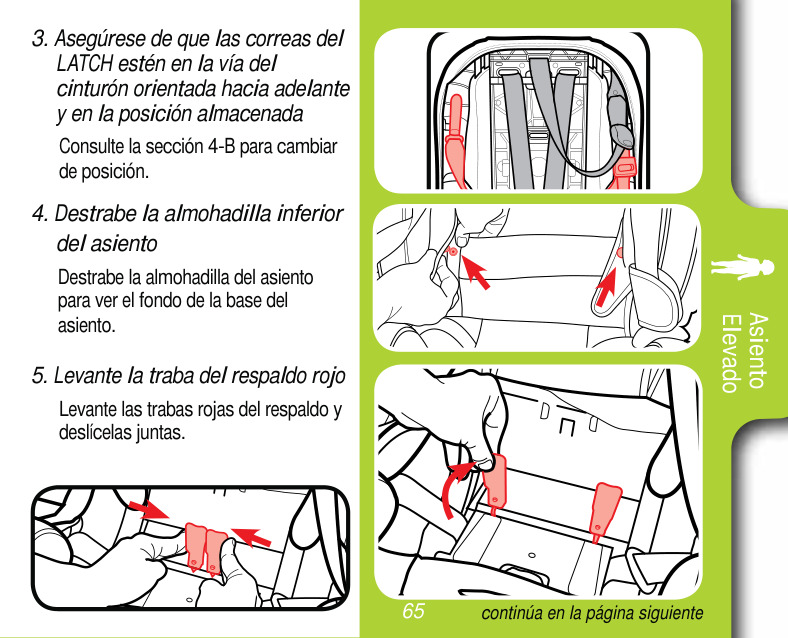
######### 4. Destrabe la almohadilla inferiordel asiento
Destrabe la almohadilla del asiento para ver el fondo de la base del asiento.
####### Asiento Elevado
######### 5. Levante la traba del respaldo rojo
Levante las trabas rojas del respaldo y deslícelas juntas.

65
continúa en la página siguiente


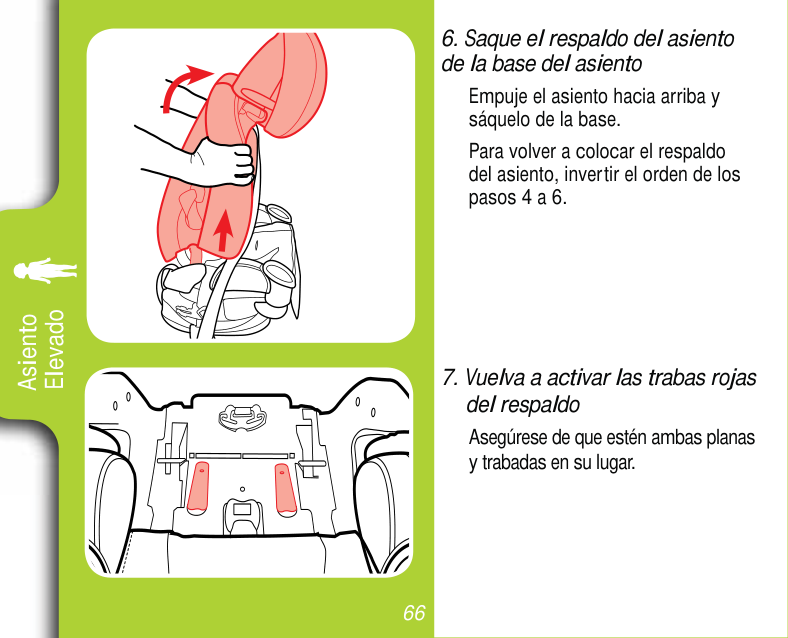
Empuje el asiento hacia arriba y sáquelo de la base.
Para volver a colocar el respaldo del asiento, invertir el orden de los pasos 4 a 6.
Elevado
Asiento
Asegúrese de que estén ambas planas y trabadas en su lugar.


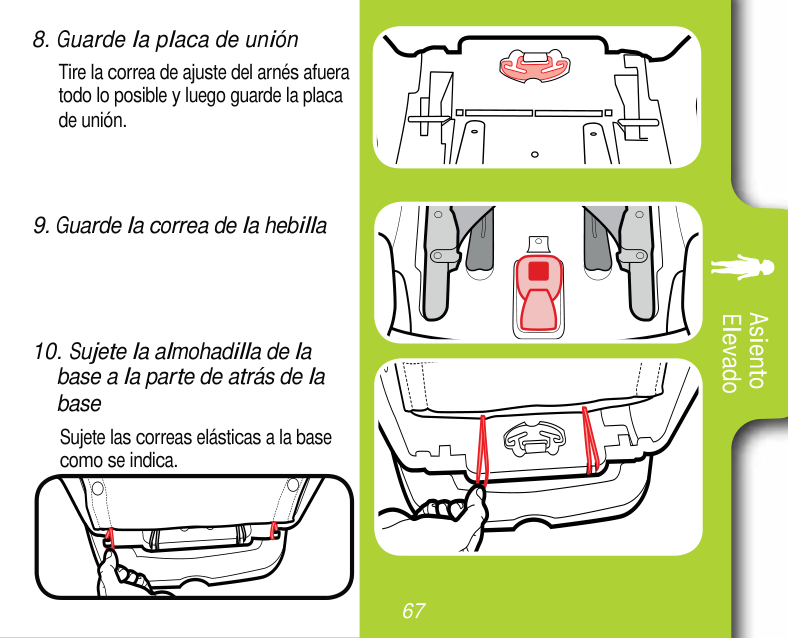
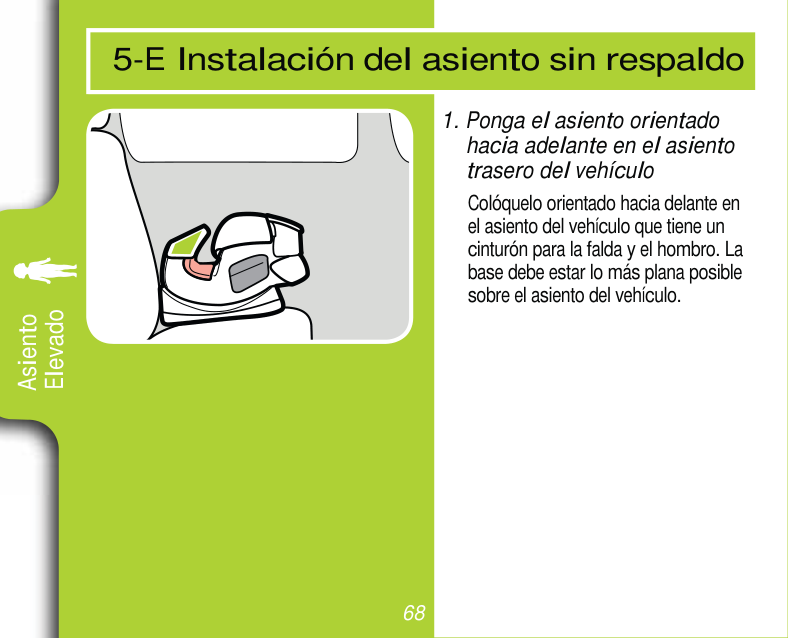
Tire la correa de ajuste del arnés afuera todo lo posible y luego guarde la placa de unión.
Sujete las correas elásticas a la base como se indica.
####### Asiento Elevado



#### 5-E Instalación del asiento sin respaldo
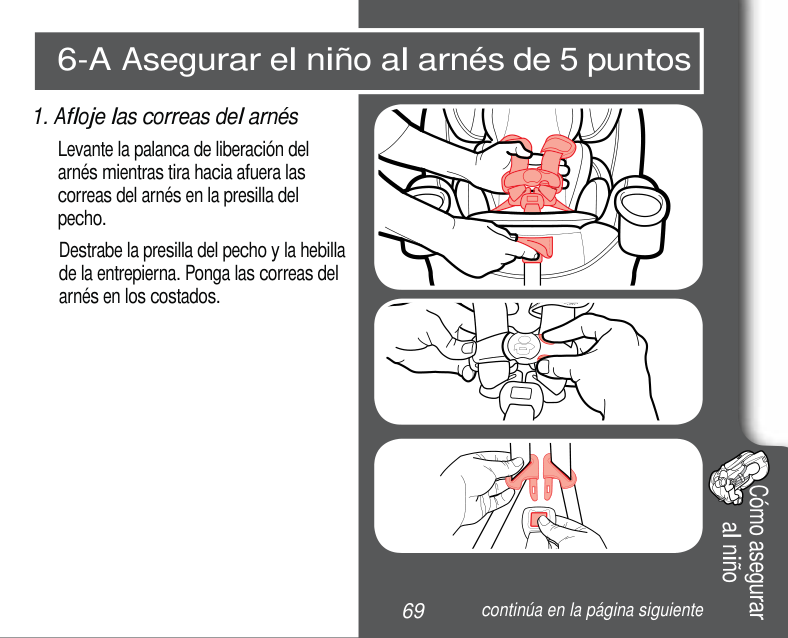
######### 1. Ponga el asiento orientado hacia adelante en el asiento trasero del vehículo
Colóquelo orientado hacia delante en el asiento del vehículo que tiene un cinturón para la falda y el hombro. La base debe estar lo más plana posible sobre el asiento del vehículo.
Elevado
Asiento


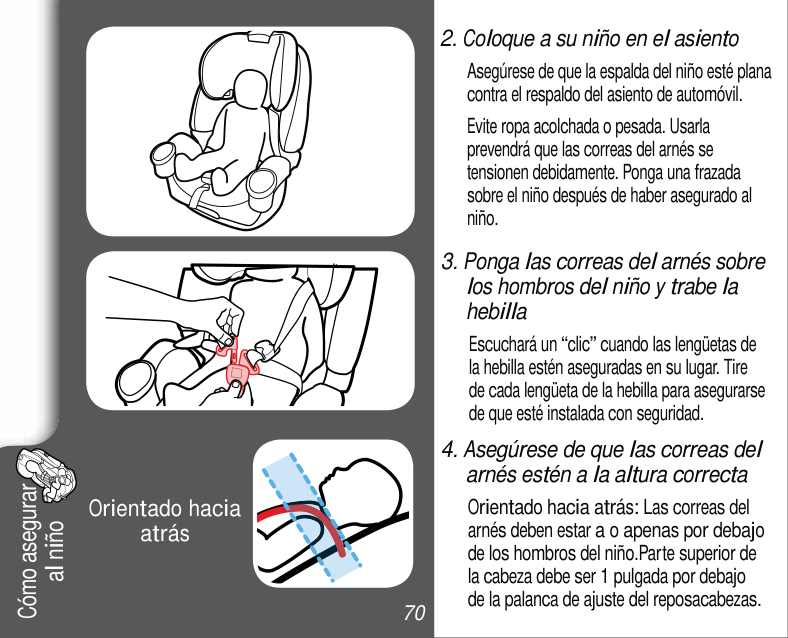
|6-A Asegurar el niño al arnés de 5 puntos| |---|
Levante la palanca de liberación del arnés mientras tira hacia afuera las correas del arnés en la presilla del pecho.
Destrabe la presilla del pecho y la hebilla de la entrepierna. Ponga las correas del arnés en los costados.
| | | |---|---| | | | | | |
Cómo asegurar al niño

continúa en la página siguiente

####### Cómo asegurar
####### al niño
######### 2. Coloque a su niño en el asiento
Asegúrese de que la espalda del niño esté plana contra el respaldo del asiento de automóvil.
Evite ropa acolchada o pesada. Usarla prevendrá que las correas del arnés se tensionen debidamente. Ponga una frazada sobre el niño después de haber asegurado al niño.
######### 3. Ponga las correas del arnés sobre los hombros del niño y trabe la hebilla
Escuchará un “clic” cuando las lengüetas de la hebilla estén aseguradas en su lugar. Tire de cada lengüeta de la hebilla para asegurarse de que esté instalada con seguridad.
Orientado hacia atrás

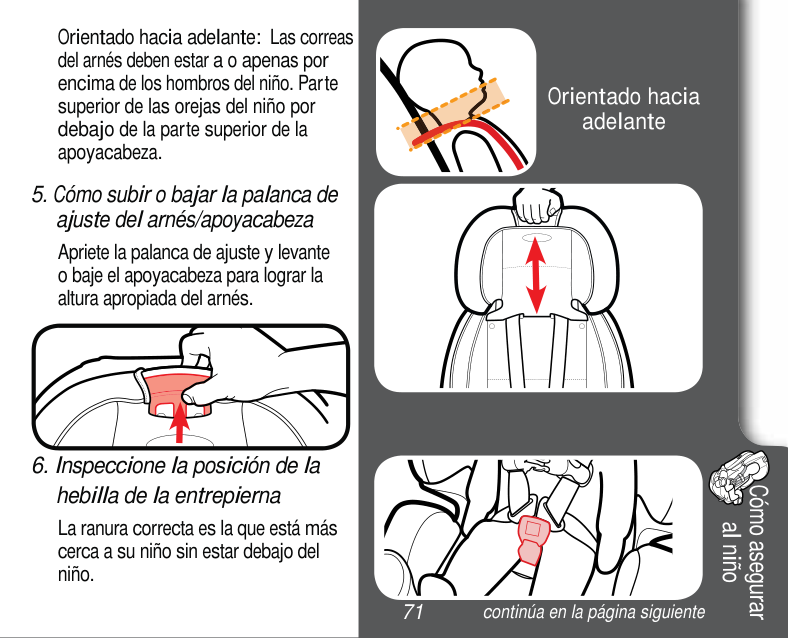
Orientado hacia adelante: Las correas del arnés deben estar a o apenas por encima de los hombros del niño. Parte superior de las orejas del niño por debajo de la parte superior de la apoyacabeza.
######### Orientado hacia adelante
######### 5. Cómo subir o bajar la palanca de ajuste del arnés/apoyacabeza
Apriete la palanca de ajuste y levante o baje el apoyacabeza para lograr la altura apropiada del arnés.
######### 6. Inspeccione la posición de la hebilla de la entrepierna
####### Cómo asegurar al niño
La ranura correcta es la que está más cerca a su niño sin estar debajo del niño.


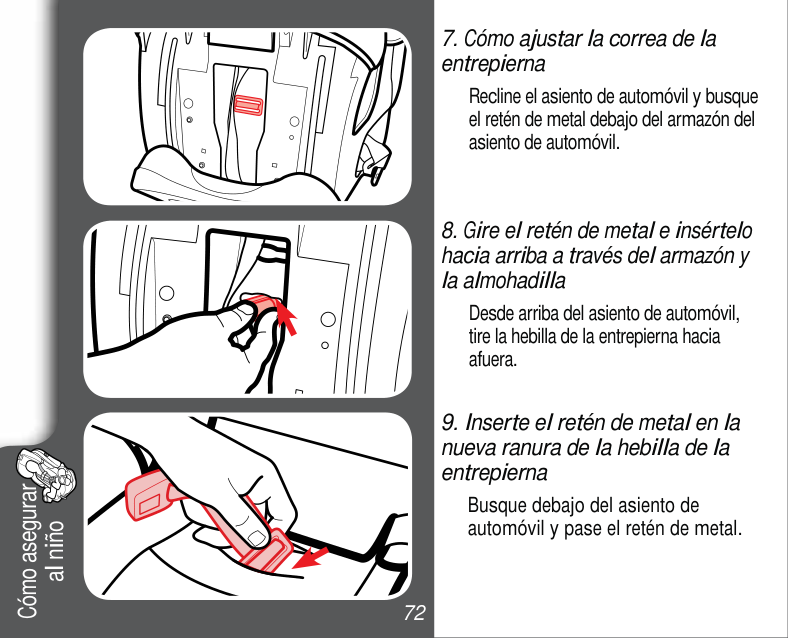
######### 7. Cómo ajustar la correa de laentrepierna
Recline el asiento de automóvil y busque el retén de metal debajo del armazón del asiento de automóvil.
######### 8. Gire el retén de metal e insértelohacia arriba a través del armazón yla almohadilla
Desde arriba del asiento de automóvil, tire la hebilla de la entrepierna hacia afuera.
######### 9. Inserte el retén de metal en lanueva ranura de la hebilla de laentrepierna
####### Cómo asegurar
Busque debajo del asiento de automóvil y pase el retén de metal.


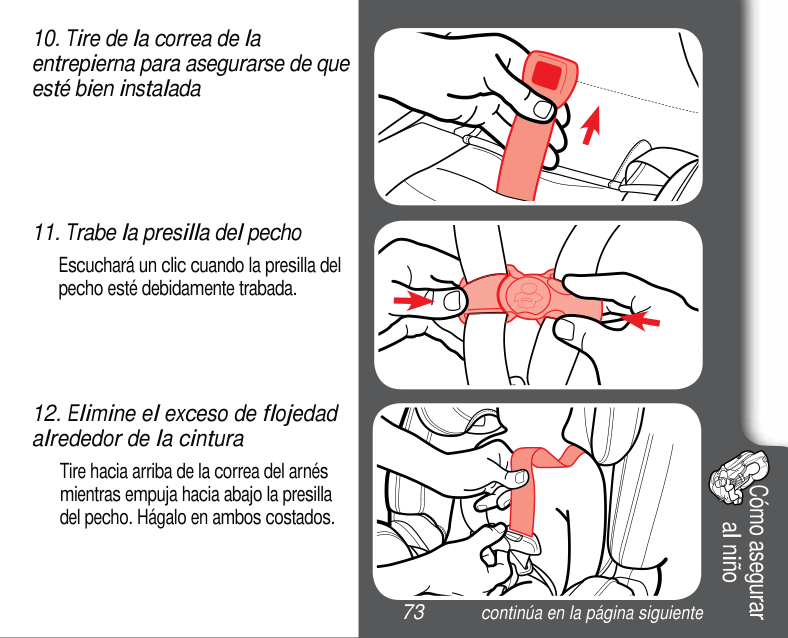
Escuchará un clic cuando la presilla del pecho esté debidamente trabada.
Tire hacia arriba de la correa del arnés mientras empuja hacia abajo la presilla del pecho. Hágalo en ambos costados.
####### Cómo asegurar


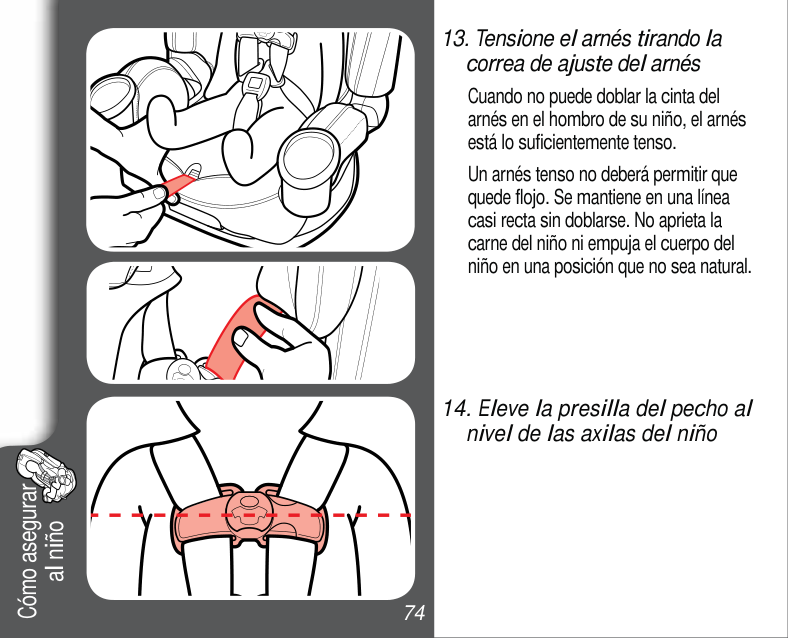
Cuando no puede doblar la cinta del arnés en el hombro de su niño, el arnés está lo suficientemente tenso.
Un arnés tenso no deberá permitir que quede flojo. Se mantiene en una línea casi recta sin doblarse. No aprieta la carne del niño ni empuja el cuerpo del niño en una posición que no sea natural.
####### Cómo asegurar


|6-B Asegurar al niño en el asiento con respaldo| |---|
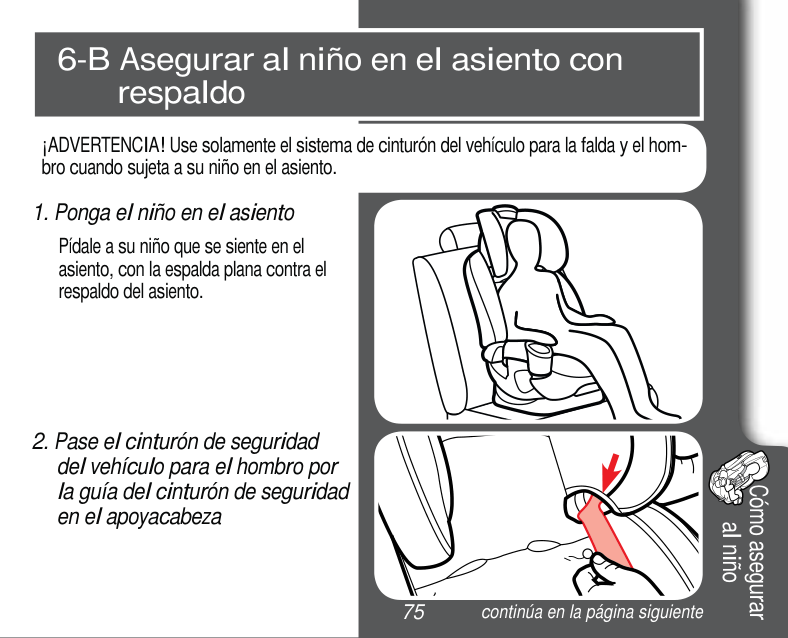
¡ADVERTENCIA! Use solamente el sistema de cinturón del vehículo para la falda y el hombro cuando sujeta a su niño en el asiento.
Pídale a su niño que se siente en el asiento, con la espalda plana contra el respaldo del asiento.
Cómo asegurar


####### Cómo asegurar
####### al niño
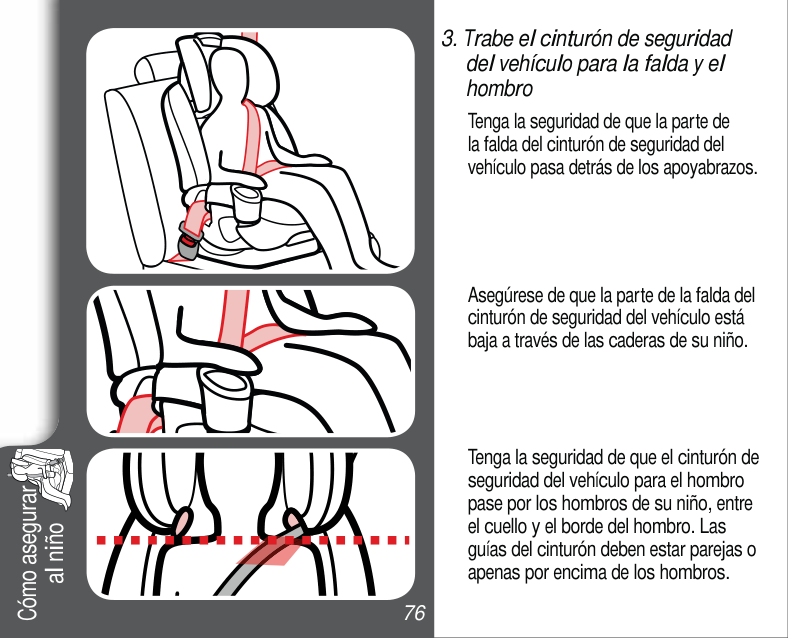
######### 3. Trabe el cinturón de seguridad del vehículo para la falda y el hombro
Tenga la seguridad de que la parte de la falda del cinturón de seguridad del vehículo pasa detrás de los apoyabrazos.
Asegúrese de que la parte de la falda del cinturón de seguridad del vehículo está baja a través de las caderas de su niño.
Tenga la seguridad de que el cinturón de seguridad del vehículo para el hombro pase por los hombros de su niño, entre el cuello y el borde del hombro. Las guías del cinturón deben estar parejas o apenas por encima de los hombros.


|6-C Asegurar al niño en el asiento sin respaldo| |---|
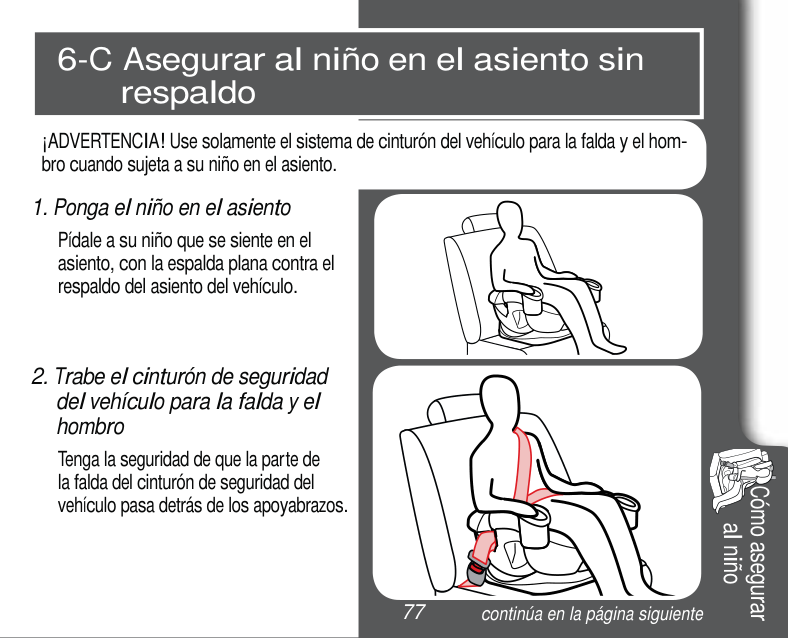
¡ADVERTENCIA! Use solamente el sistema de cinturón del vehículo para la falda y el hombro cuando sujeta a su niño en el asiento.
######### 1. Ponga el niño en el asiento
Pídale a su niño que se siente en el asiento, con la espalda plana contra el respaldo del asiento del vehículo.
######### 2. Trabe el cinturón de seguridaddel vehículo para la falda y elhombro
Tenga la seguridad de que la parte de la falda del cinturón de seguridad del vehículo pasa detrás de los apoyabrazos.
####### Cómo asegurar


####### Cómo asegurar
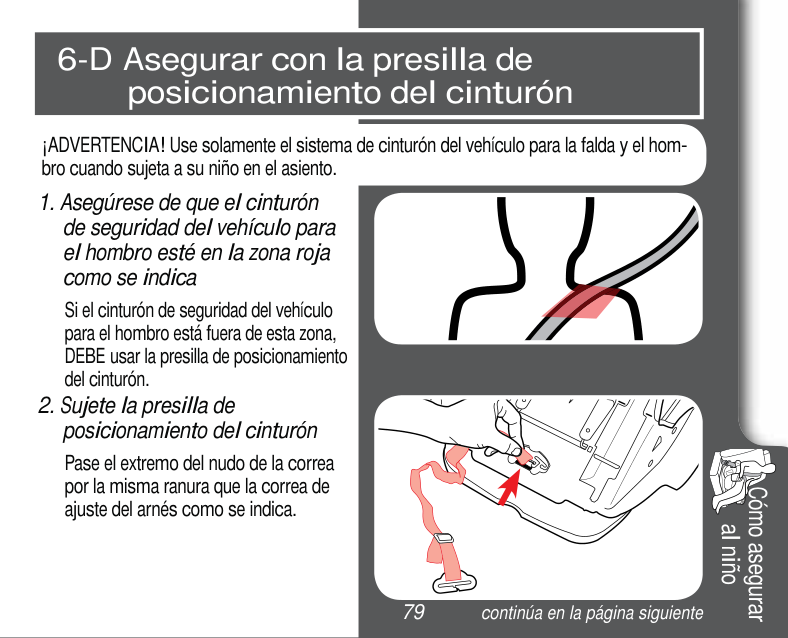
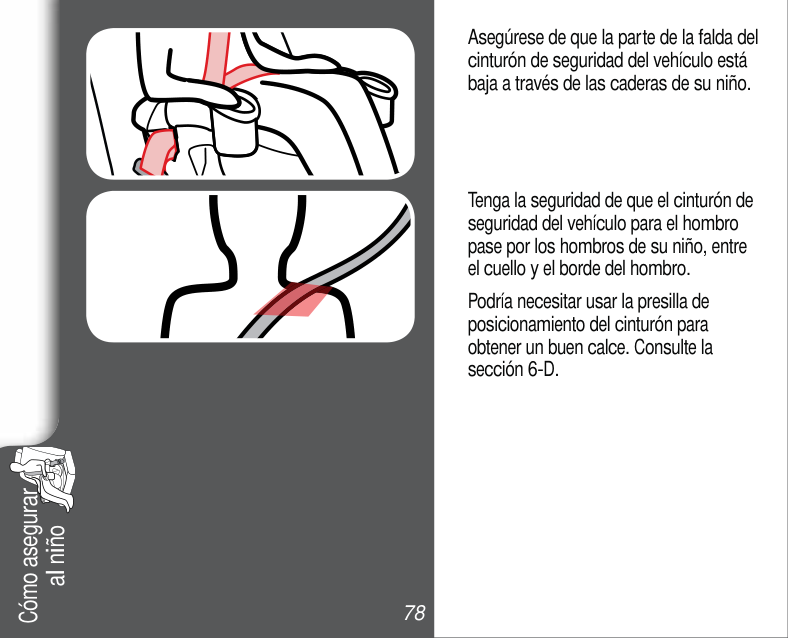
Asegúrese de que la parte de la falda del cinturón de seguridad del vehículo está baja a través de las caderas de su niño.
Tenga la seguridad de que el cinturón de seguridad del vehículo para el hombro pase por los hombros de su niño, entre el cuello y el borde del hombro.
Podría necesitar usar la presilla de posicionamiento del cinturón para obtener un buen calce. Consulte la sección 6-D.

|6-D Asegurar con la presilla de posicionamiento del cinturón| |---|
¡ADVERTENCIA! Use solamente el sistema de cinturón del vehículo para la falda y el hombro cuando sujeta a su niño en el asiento.
######### 1. Asegúrese de que el cinturónde seguridad del vehículo parael hombro esté en la zona rojacomo se indica
Si el cinturón de seguridad del vehículo para el hombro está fuera de esta zona, DEBE usar la presilla de posicionamiento
del cinturón.
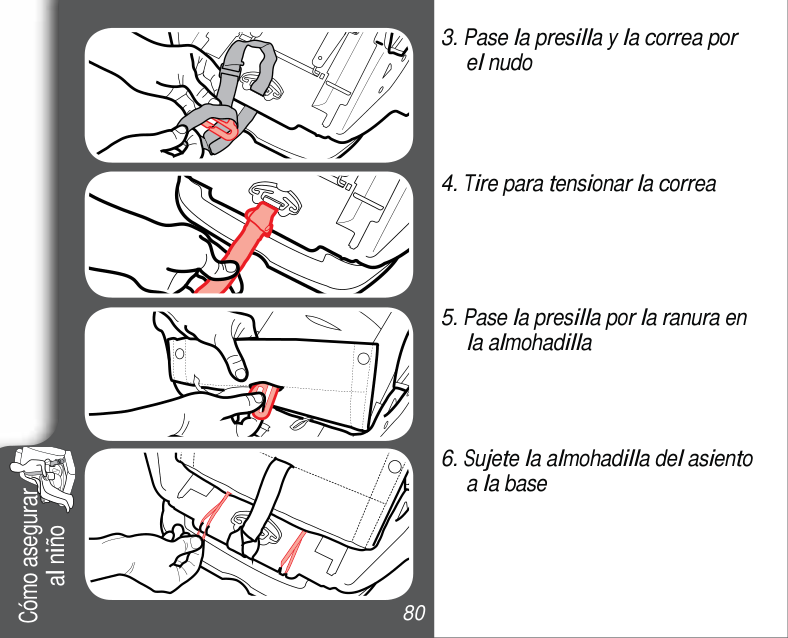
######### 2. Sujete la presilla deposicionamiento del cinturón
Pase el extremo del nudo de la correa por la misma ranura que la correa de ajuste del arnés como se indica.
####### Cómo asegurar


####### Cómo asegurar


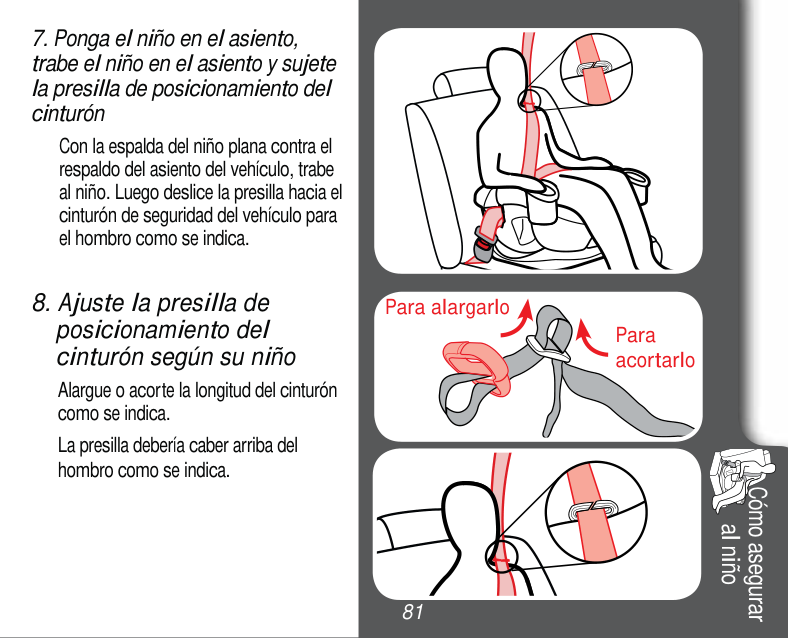

######### 7. Ponga el niño en el asiento, trabe el niño en el asiento y sujete la presilla de posicionamiento del cinturón
Con la espalda del niño plana contra el respaldo del asiento del vehículo, trabe al niño. Luego deslice la presilla hacia el cinturón de seguridad del vehículo para el hombro como se indica.
####### 8. Ajuste la presilla de posicionamiento del cinturón según su niño
Para alargarlo
Para acortarlo
Alargue o acorte la longitud del cinturón como se indica.
La presilla debería caber arriba del hombro como se indica.
####### Cómo asegurar al niño

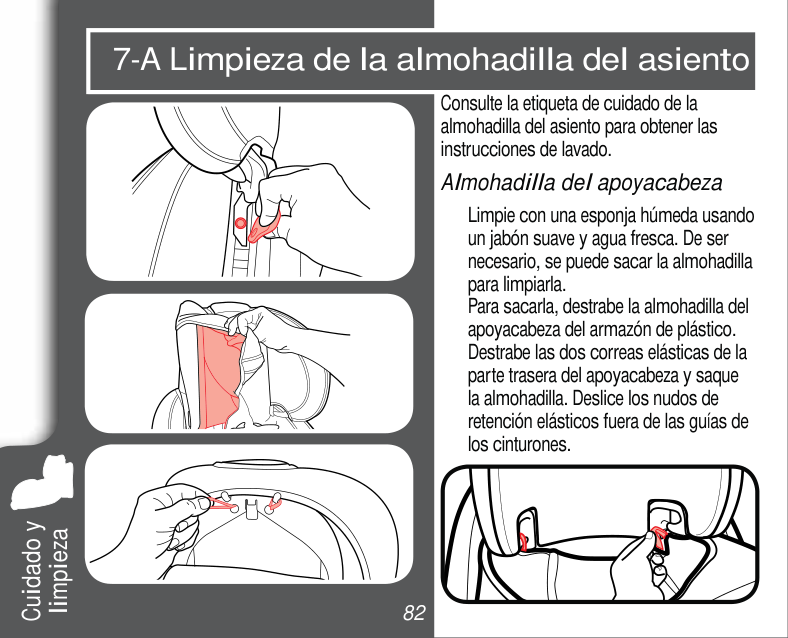


Consulte la etiqueta de cuidado de la almohadilla del asiento para obtener las instrucciones de lavado.
######### Almohadilla del apoyacabeza
Limpie con una esponja húmeda usando un jabón suave y agua fresca. De ser necesario, se puede sacar la almohadilla para limpiarla. Para sacarla, destrabe la almohadilla del apoyacabeza del armazón de plástico. Destrabe las dos correas elásticas de la parte trasera del apoyacabeza y saque la almohadilla. Deslice los nudos de retención elásticos fuera de las guías de los cinturones.

####### Cuidado y
####### limpieza


Lave la almohadilla a máquina en agua fría en el ciclo delicado y séquela al aire. NO USE BLANQUEADOR.
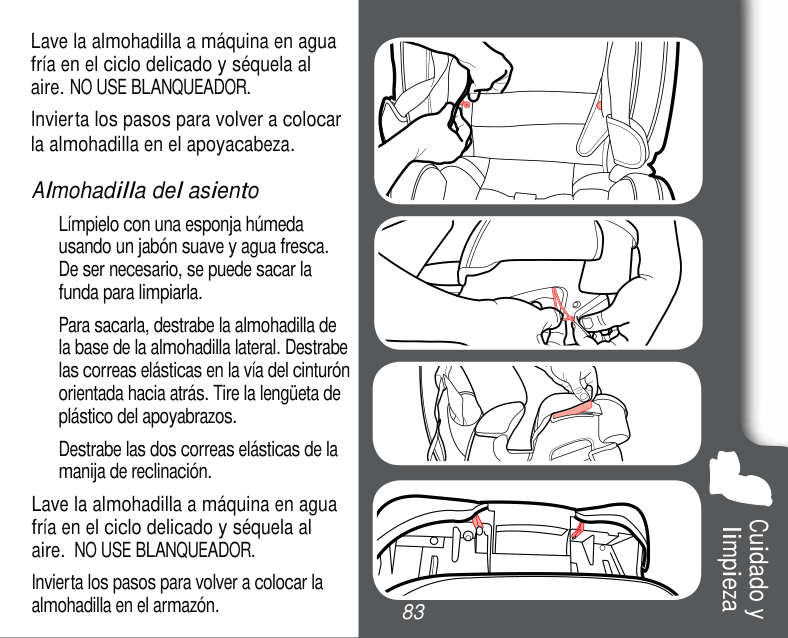
Invierta los pasos para volver a colocar la almohadilla en el apoyacabeza.
######### Almohadilla del asiento
Límpielo con una esponja húmeda usando un jabón suave y agua fresca. De ser necesario, se puede sacar la funda para limpiarla.
Para sacarla, destrabe la almohadilla de la base de la almohadilla lateral. Destrabe las correas elásticas en la vía del cinturón orientada hacia atrás. Tire la lengüeta de plástico del apoyabrazos.
Destrabe las dos correas elásticas de la manija de reclinación.
Lave la almohadilla a máquina en agua fría en el ciclo delicado y séquela al aire. NO USE BLANQUEADOR.

####### Cuidado y limpieza
Invierta los pasos para volver a colocar la almohadilla en el armazón.

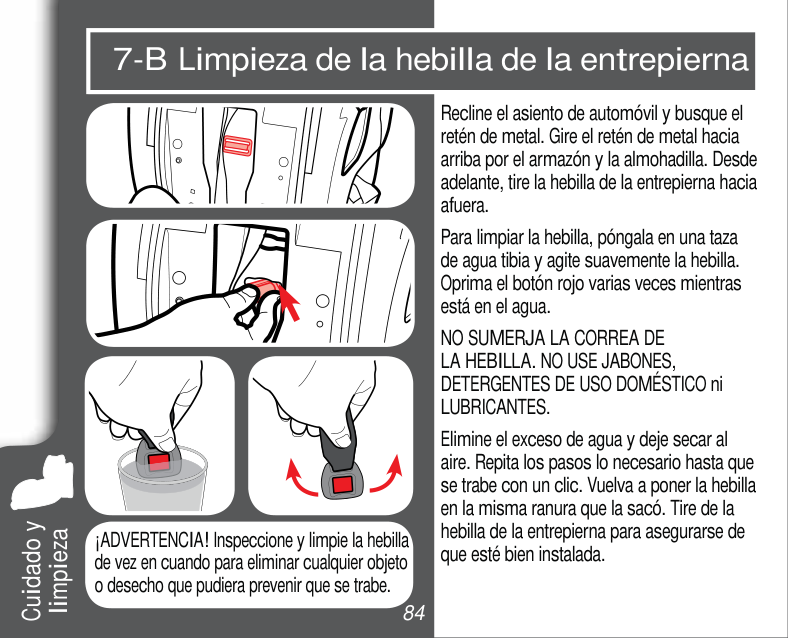

Recline el asiento de automóvil y busque el retén de metal. Gire el retén de metal hacia arriba por el armazón y la almohadilla. Desde adelante, tire la hebilla de la entrepierna hacia afuera.
Para limpiar la hebilla, póngala en una taza de agua tibia y agite suavemente la hebilla. Oprima el botón rojo varias veces mientras está en el agua.
NO SUMERJA LA CORREA DE LA HEBILLA. NO USE JABONES, DETERGENTES DE USO DOMÉSTICO ni LUBRICANTES.
Elimine el exceso de agua y deje secar al aire. Repita los pasos lo necesario hasta que se trabe con un clic. Vuelva a poner la hebilla en la misma ranura que la sacó. Tire de la hebilla de la entrepierna para asegurarse de que esté bien instalada.

####### Cuidado y
¡ADVERTENCIA! Inspeccione y limpie la hebilla de vez en cuando para eliminar cualquier objeto o desecho que pudiera prevenir que se trabe.
####### limpieza


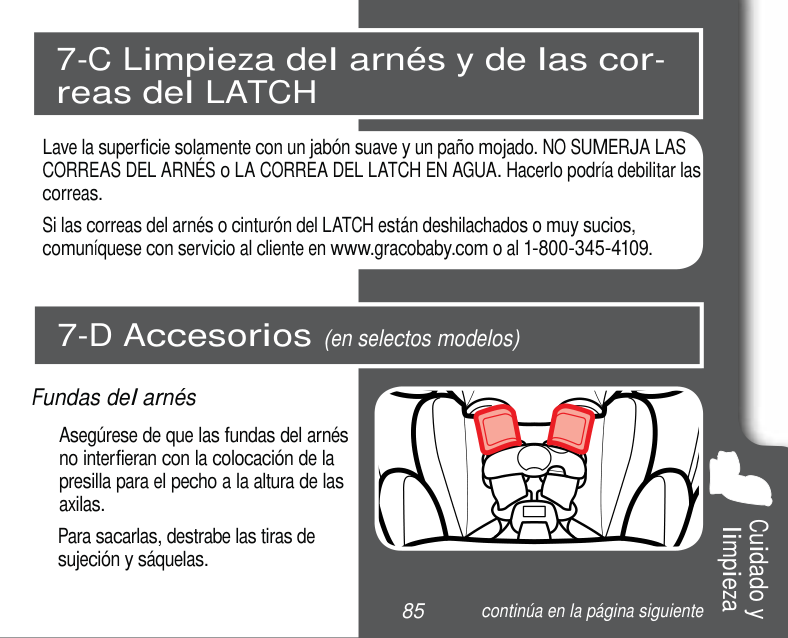
|7-C Limpieza del arnés y de las correas del LATCH| |---|
Lave la superficie solamente con un jabón suave y un paño mojado. NO SUMERJA LAS CORREAS DEL ARNÉS o LA CORREA DEL LATCH EN AGUA. Hacerlo podría debilitar las correas. Si las correas del arnés o cinturón del LATCH están deshilachados o muy sucios, comuníquese con servicio al cliente en www.gracobaby.com o al 1-800-345-4109.
|7-D Accesorios (en selectos modelos)| |---|
######### Fundas del arnés
Asegúrese de que las fundas del arnés no interfieran con la colocación de la presilla para el pecho a la altura de las axilas.

Cuidado y limpieza
Para sacarlas, destrabe las tiras de sujeción y sáquelas.
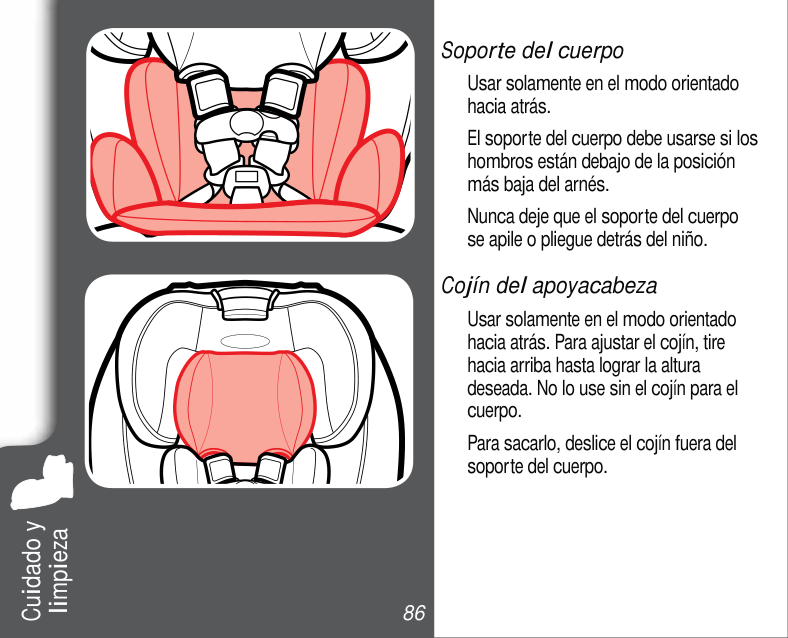


######### Soporte del cuerpo
Usar solamente en el modo orientado hacia atrás.
El soporte del cuerpo debe usarse si los hombros están debajo de la posición más baja del arnés.
Nunca deje que el soporte del cuerpo se apile o pliegue detrás del niño.
######### Cojín del apoyacabeza
Usar solamente en el modo orientado hacia atrás. Para ajustar el cojín, tire hacia arriba hasta lograr la altura deseada. No lo use sin el cojín para el cuerpo.
Para sacarlo, deslice el cojín fuera del soporte del cuerpo.

####### Cuidado y
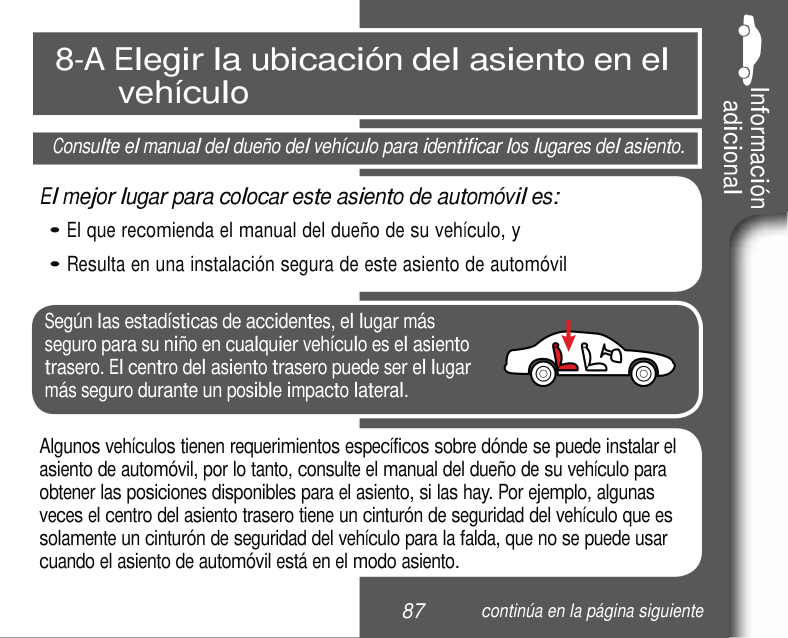
####### limpieza


|8-A Elegir la ubicación del asiento en el vehículo| |---|
Información adicional
Important

|Consulte el manual del dueño del vehículo para identificar los lugares del asiento.| |---|
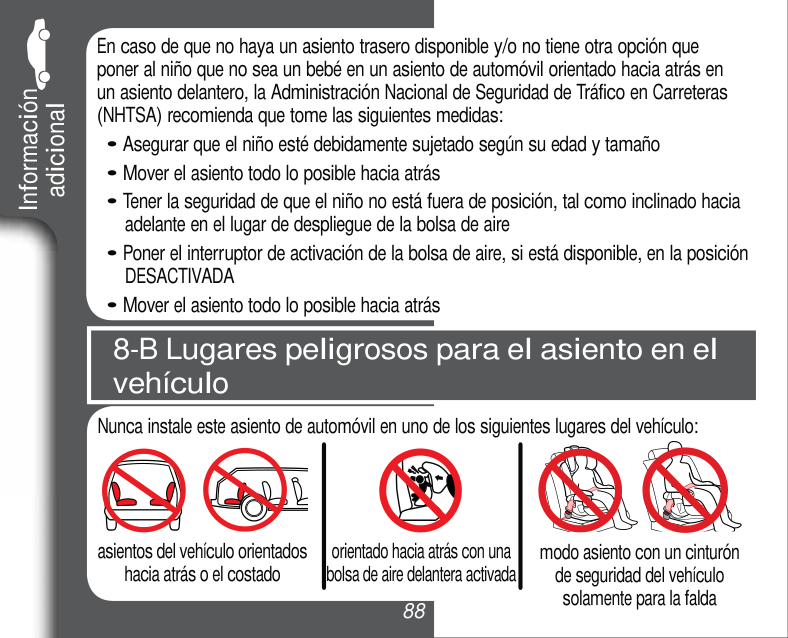
######### El mejor lugar para colocar este asiento de automóvil es:
Según las estadísticas de accidentes, el lugar más seguro para su niño en cualquier vehículo es el asiento trasero. El centro del asiento trasero puede ser el lugar más seguro durante un posible impacto lateral.
Algunos vehículos tienen requerimientos específicos sobre dónde se puede instalar el asiento de automóvil, por lo tanto, consulte el manual del dueño de su vehículo para obtener las posiciones disponibles para el asiento, si las hay. Por ejemplo, algunas veces el centro del asiento trasero tiene un cinturón de seguridad del vehículo que es solamente un cinturón de seguridad del vehículo para la falda, que no se puede usar cuando el asiento de automóvil está en el modo asiento.


En caso de que no haya un asiento trasero disponible y/o no tiene otra opción que poner al niño que no sea un bebé en un asiento de automóvil orientado hacia atrás en un asiento delantero, la Administración Nacional de Seguridad de Tráfico en Carreteras (NHTSA) recomienda que tome las siguientes medidas:
Información
adicional
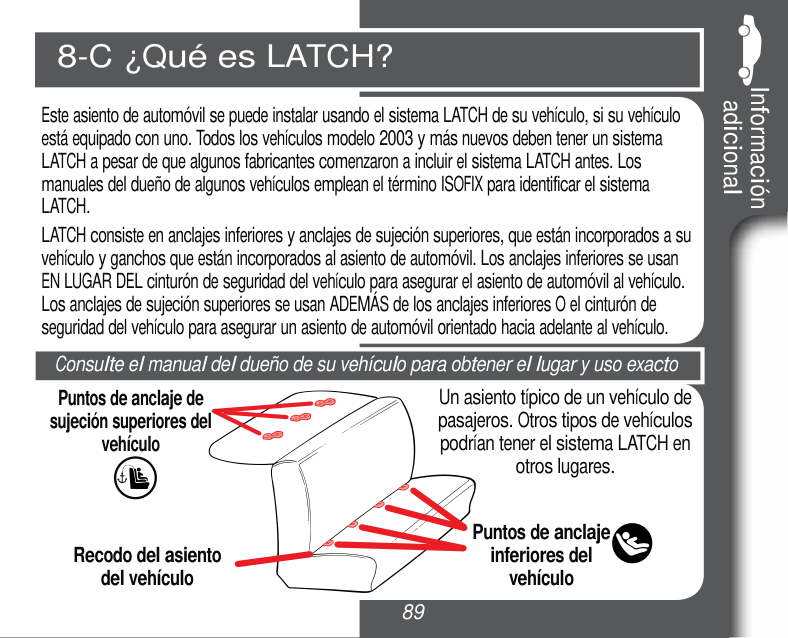
|8-B Lugares peligrosos para el asiento en el vehículo| |---|
Nunca instale este asiento de automóvil en uno de los siguientes lugares del vehículo:

asientos del vehículo orientados hacia atrás o el costado
orientado hacia atrás con una bolsa de aire delantera activada
modo asiento con un cinturón de seguridad del vehículo solamente para la falda


|8-C ¿Qué es LATCH?| |---|
Información adicional
Important
Este asiento de automóvil se puede instalar usando el sistema LATCH de su vehículo, si su vehículo está equipado con uno. Todos los vehículos modelo 2003 y más nuevos deben tener un sistema LATCH a pesar de que algunos fabricantes comenzaron a incluir el sistema LATCH antes. Los manuales del dueño de algunos vehículos emplean el término ISOFIX para identificar el sistema LATCH. LATCH consiste en anclajes inferiores y anclajes de sujeción superiores, que están incorporados a su vehículo y ganchos que están incorporados al asiento de automóvil. Los anclajes inferiores se usan EN LUGAR DEL cinturón de seguridad del vehículo para asegurar el asiento de automóvil al vehículo. Los anclajes de sujeción superiores se usan ADEMÁS de los anclajes inferiores O el cinturón de seguridad del vehículo para asegurar un asiento de automóvil orientado hacia adelante al vehículo.

|Consulte el manual del dueño de su vehículo para obtener el lugar y uso exacto| |---|
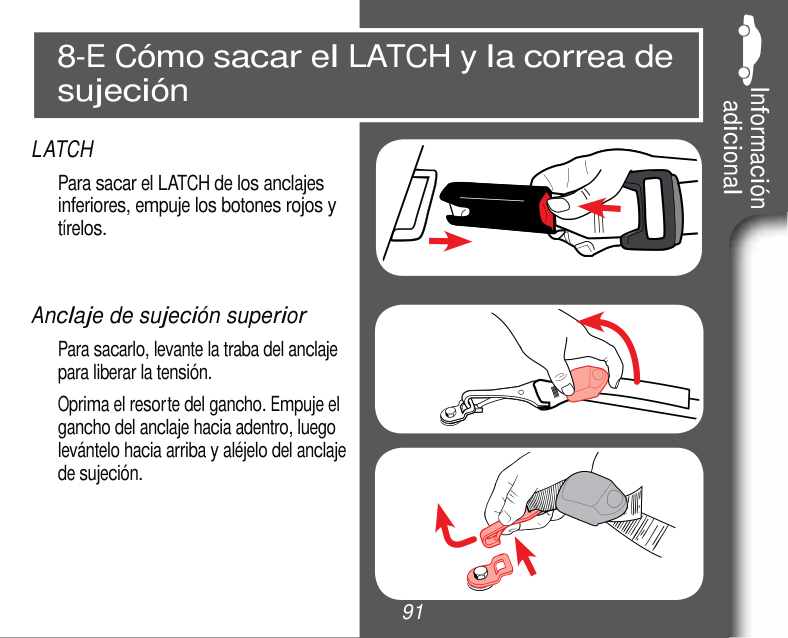
Un asiento típico de un vehículo de pasajeros. Otros tipos de vehículos podrían tener el sistema LATCH en otros lugares.
Puntos de anclaje de sujeción superiores del vehículo

Puntos de anclaje inferiores del vehículo
Recodo del asiento del vehículo


|8-D Elegir el LATCH o los cinturones de seguridad| |---|
Información
adicional
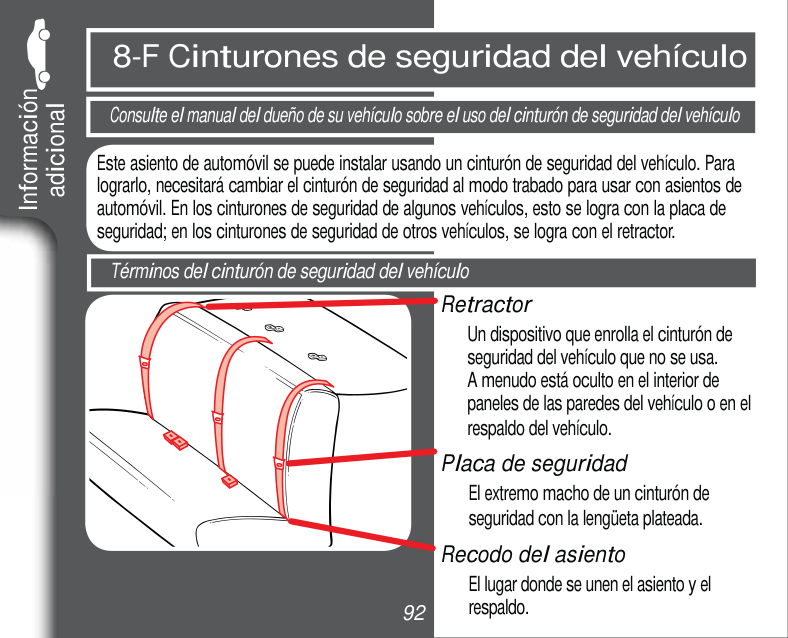
Este asiento de automóvil se puede instalar en su vehículo usando el cinturón de seguridad del vehículo O el sistema LATCH.
El sistema LATCH le permite sujetar apretadamente su asiento de seguridad en el automóvil sin usar el cinturón de seguridad del vehículo y posiblemente lograr un mejor calce. Para más información sobre el LATCH y cómo determinar si su vehículo está equipado con LATCH, consulte la sección 8-D: ¿Qué es LATCH?.
Para las posiciones del asiento equipadas con LATCH, los expertos recomiendan primero la instalación con el LATCH y solamente usar el cinturón de seguridad en la posición si el LATCH, por algún motivo, produce un calce más flojo. Si desea usar el centro del asiento trasero y el LATCH no está disponible en dicha posición (consulte el manual del dueño del vehículo), pruebe usar el cinturón de seguridad para tener la seguridad de que obtiene una instalación apretada. Si no puede, pruebe usar el LATCH en otra posición del asiento. Recuerde usar solamente el LATCH en los lugares para sentarse recomendados por el fabricante de su vehículo.

No use los anclajes inferiores del sistema de anclaje de seguridad para niños (sistema LATCH) para sujetar este sistema de seguridad para niños cuando sujeta a un niño que pesa más de 42 libras (19 kg) con el arnés interno del sistema de seguridad para niños.


|8-E Cómo sacar el LATCH y la correa de sujeción| |---|
Información adicional
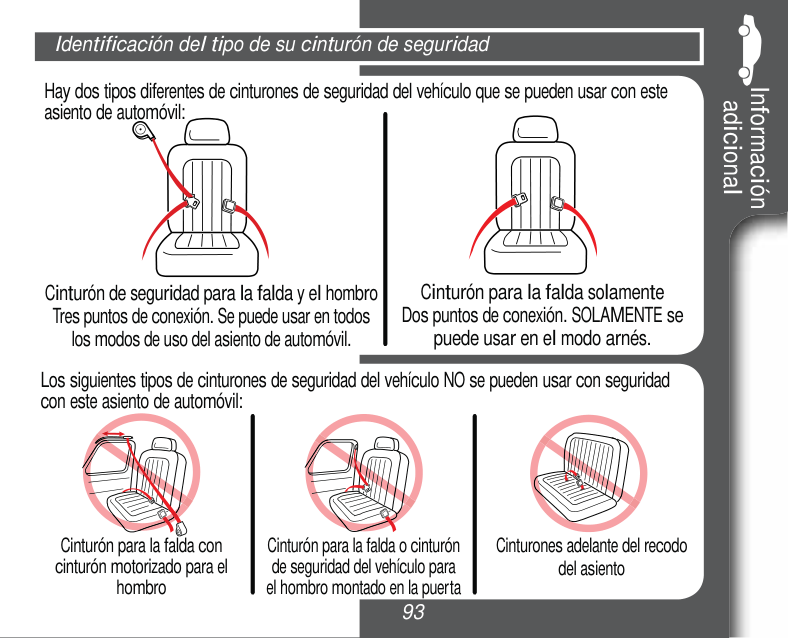
Important

######### LATCH
Para sacar el LATCH de los anclajes inferiores, empuje los botones rojos y tírelos.
######### Anclaje de sujeción superior
Para sacarlo, levante la traba del anclaje para liberar la tensión.
Oprima el resorte del gancho. Empuje el gancho del anclaje hacia adentro, luego levántelo hacia arriba y aléjelo del anclaje de sujeción.


|8-F Cinturones de seguridad del vehículo|
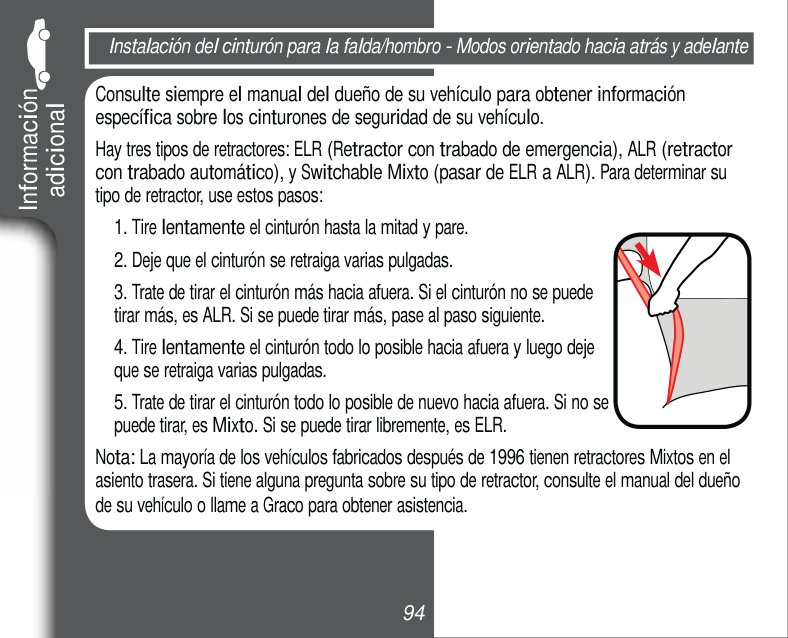
|---|
Información
|Consulte el manual del dueño de su vehículo sobre el uso del cinturón de seguridad del vehículo| |---|
adicional
Este asiento de automóvil se puede instalar usando un cinturón de seguridad del vehículo. Para lograrlo, necesitará cambiar el cinturón de seguridad al modo trabado para usar con asientos de automóvil. En los cinturones de seguridad de algunos vehículos, esto se logra con la placa de seguridad; en los cinturones de seguridad de otros vehículos, se logra con el retractor.
|Términos del cinturón de seguridad del vehículo| |---|
Retractor Un dispositivo que enrolla el cinturón de seguridad del vehículo que no se usa. A menudo está oculto en el interior de paneles de las paredes del vehículo o en el respaldo del vehículo.
Placa de seguridad El extremo macho de un cinturón de seguridad con la lengüeta plateada.
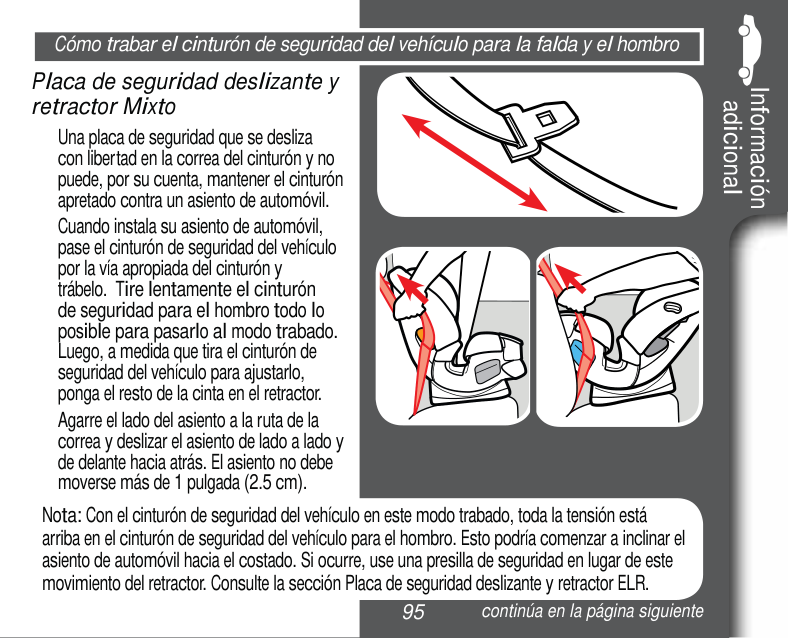

Recodo del asiento El lugar donde se unen el asiento y el respaldo.
|Identificación del tipo de su cinturón de seguridad| |---|
Hay dos tipos diferentes de cinturones de seguridad del vehículo que se pueden usar con este asiento de automóvil:
Cinturón para la falda solamente Dos puntos de conexión. SOLAMENTE se puede usar en el modo arnés.
Cinturón de seguridad para la falda y el hombro Tres puntos de conexión. Se puede usar en todos los modos de uso del asiento de automóvil.
Los siguientes tipos de cinturones de seguridad del vehículo NO se pueden usar con seguridad con este asiento de automóvil:
Cinturón para la falda con cinturón motorizado para el hombro
Cinturón para la falda o cinturón de seguridad del vehículo para el hombro montado en la puerta
Cinturones adelante del recodo del asiento
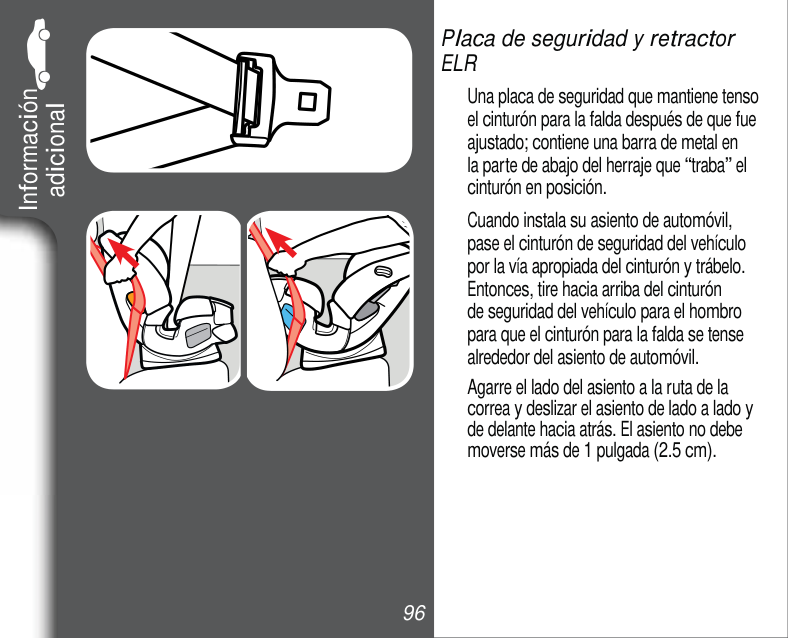
####### Información adicional
####### Important


|Instalación del cinturón para la falda/hombro - Modos orientado hacia atrás y adelante| |---|
Consulte siempre el manual del dueño de su vehículo para obtener información específica sobre los cinturones de seguridad de su vehículo.
####### Información
####### adicional
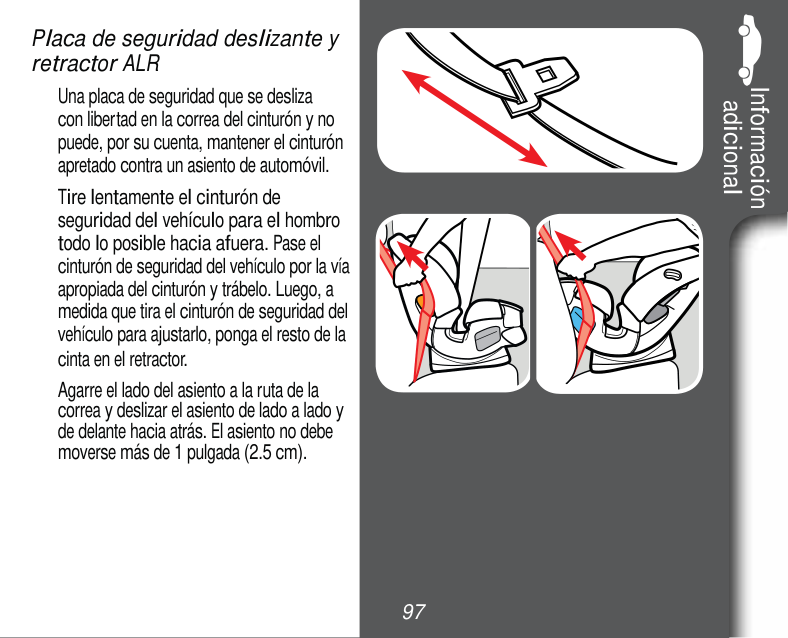
Hay tres tipos de retractores: ELR (Retractor con trabado de emergencia), ALR (retractor con trabado automático), y Switchable Mixto (pasar de ELR a ALR). Para determinar su tipo de retractor, use estos pasos:
Nota: La mayoría de los vehículos fabricados después de 1996 tienen retractores Mixtos en el asiento trasera. Si tiene alguna pregunta sobre su tipo de retractor, consulte el manual del dueño de su vehículo o llame a Graco para obtener asistencia.


|Cómo trabar el cinturón de seguridad del vehículo para la falda y el hombro| |---|
######### Placa de seguridad deslizante y retractor Mixto
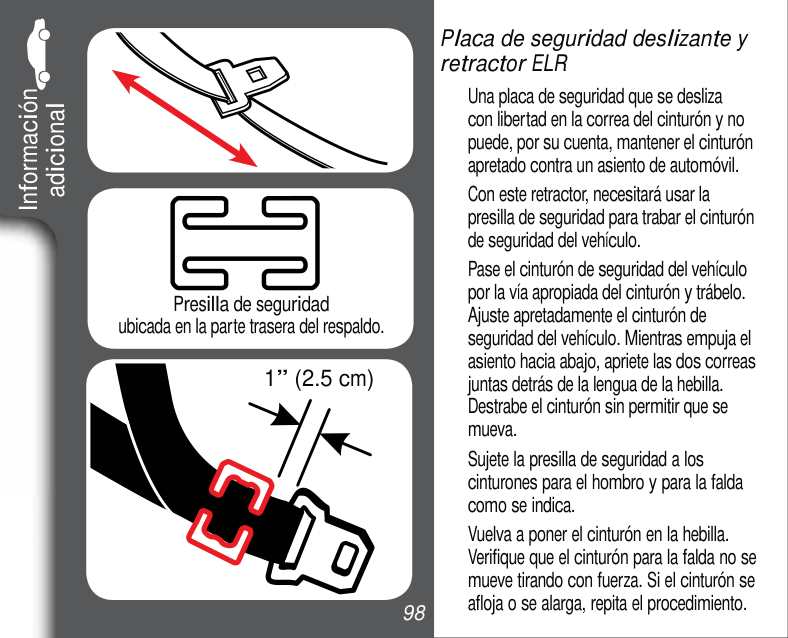
####### Información adicional
####### Important

Una placa de seguridad que se desliza con libertad en la correa del cinturón y no puede, por su cuenta, mantener el cinturón apretado contra un asiento de automóvil. Cuando instala su asiento de automóvil, pase el cinturón de seguridad del vehículo por la vía apropiada del cinturón y trábelo. Tire lentamente el cinturón de seguridad para el hombro todo lo posible para pasarlo al modo trabado. Luego, a medida que tira el cinturón de seguridad del vehículo para ajustarlo, ponga el resto de la cinta en el retractor. Agarre el lado del asiento a la ruta de la correa y deslizar el asiento de lado a lado y de delante hacia atrás. El asiento no debe moverse más de 1 pulgada (2.5 cm).

Nota: Con el cinturón de seguridad del vehículo en este modo trabado, toda la tensión está arriba en el cinturón de seguridad del vehículo para el hombro. Esto podría comenzar a inclinar el asiento de automóvil hacia el costado. Si ocurre, use una presilla de seguridad en lugar de este movimiento del retractor. Consulte la sección Placa de seguridad deslizante y retractor ELR.
continúa en la página siguiente


######### Placa de seguridad y retractor ELR
Una placa de seguridad que mantiene tenso el cinturón para la falda después de que fue ajustado; contiene una barra de metal en la parte de abajo del herraje que “traba” el cinturón en posición.
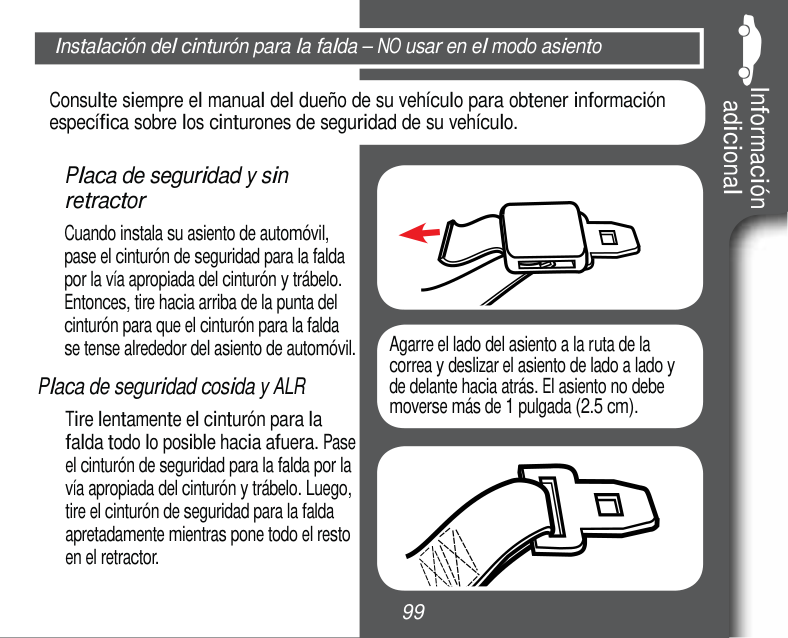
####### Información
####### adicional
Cuando instala su asiento de automóvil, pase el cinturón de seguridad del vehículo por la vía apropiada del cinturón y trábelo. Entonces, tire hacia arriba del cinturón de seguridad del vehículo para el hombro para que el cinturón para la falda se tense alrededor del asiento de automóvil.
Agarre el lado del asiento a la ruta de la correa y deslizar el asiento de lado a lado y de delante hacia atrás. El asiento no debe moverse más de 1 pulgada (2.5 cm).


######### Placa de seguridad deslizante y retractor ALR
Una placa de seguridad que se desliza con libertad en la correa del cinturón y no puede, por su cuenta, mantener el cinturón apretado contra un asiento de automóvil.
####### Información adicional
####### Important
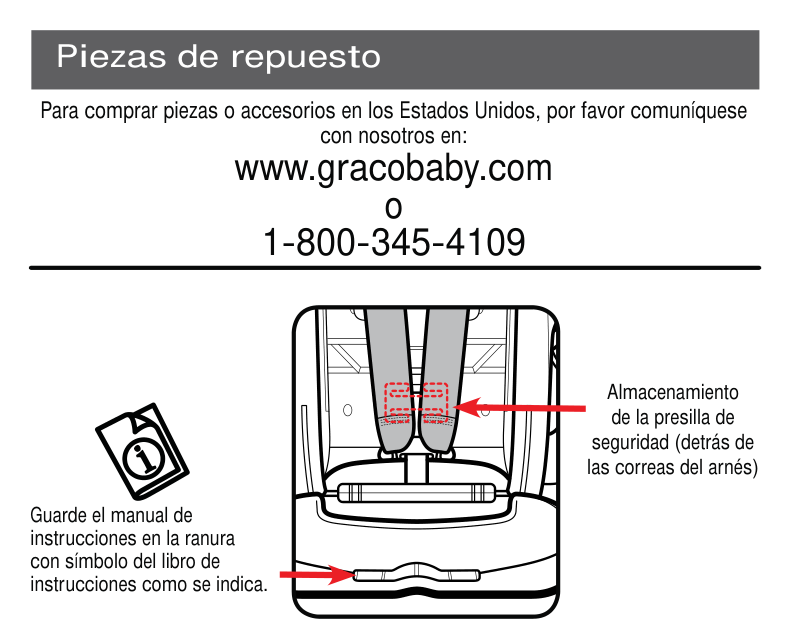

Tire lentamente el cinturón de seguridad del vehículo para el hombro todo lo posible hacia afuera. Pase el cinturón de seguridad del vehículo por la vía apropiada del cinturón y trábelo. Luego, a medida que tira el cinturón de seguridad del vehículo para ajustarlo, ponga el resto de la cinta en el retractor. Agarre el lado del asiento a la ruta de la correa y deslizar el asiento de lado a lado y de delante hacia atrás. El asiento no debe moverse más de 1 pulgada (2.5 cm).


######### Placa de seguridad deslizante y retractor ELR
Una placa de seguridad que se desliza con libertad en la correa del cinturón y no puede, por su cuenta, mantener el cinturón apretado contra un asiento de automóvil. Con este retractor, necesitará usar la presilla de seguridad para trabar el cinturón de seguridad del vehículo. Pase el cinturón de seguridad del vehículo por la vía apropiada del cinturón y trábelo. Ajuste apretadamente el cinturón de seguridad del vehículo. Mientras empuja el asiento hacia abajo, apriete las dos correas juntas detrás de la lengua de la hebilla. Destrabe el cinturón sin permitir que se mueva. Sujete la presilla de seguridad a los cinturones para el hombro y para la falda como se indica. Vuelva a poner el cinturón en la hebilla. Verifique que el cinturón para la falda no se mueve tirando con fuerza. Si el cinturón se afloja o se alarga, repita el procedimiento.
####### Información
####### adicional
Presilla de seguridad ubicada en la parte trasera del respaldo.
1” (2.5 cm)


|Instalación del cinturón para la falda – NO usar en el modo asiento| |---|
####### Información adicional
Consulte siempre el manual del dueño de su vehículo para obtener información específica sobre los cinturones de seguridad de su vehículo.
####### Important

######### Placa de seguridad y sin retractor
Cuando instala su asiento de automóvil, pase el cinturón de seguridad para la falda por la vía apropiada del cinturón y trábelo. Entonces, tire hacia arriba de la punta del cinturón para que el cinturón para la falda se tense alrededor del asiento de automóvil.
Agarre el lado del asiento a la ruta de la correa y deslizar el asiento de lado a lado y de delante hacia atrás. El asiento no debe moverse más de 1 pulgada (2.5 cm).
######### Placa de seguridad cosida y ALR
Tire lentamente el cinturón para la falda todo lo posible hacia afuera. Pase el cinturón de seguridad para la falda por la vía apropiada del cinturón y trábelo. Luego, tire el cinturón de seguridad para la falda apretadamente mientras pone todo el resto en el retractor.

Piezas de repuesto
Para comprar piezas o accesorios en los Estados Unidos, por favor comuníquese con nosotros en:
www.gracobaby.com o
|1-80|-345-4|09| |---|---|---| | | | |
Guarde el manual de instrucciones en la ranura con símbolo del libro de instrucciones como se indica.
Almacenamiento de la presilla de seguridad (detrás de las correas del arnés)