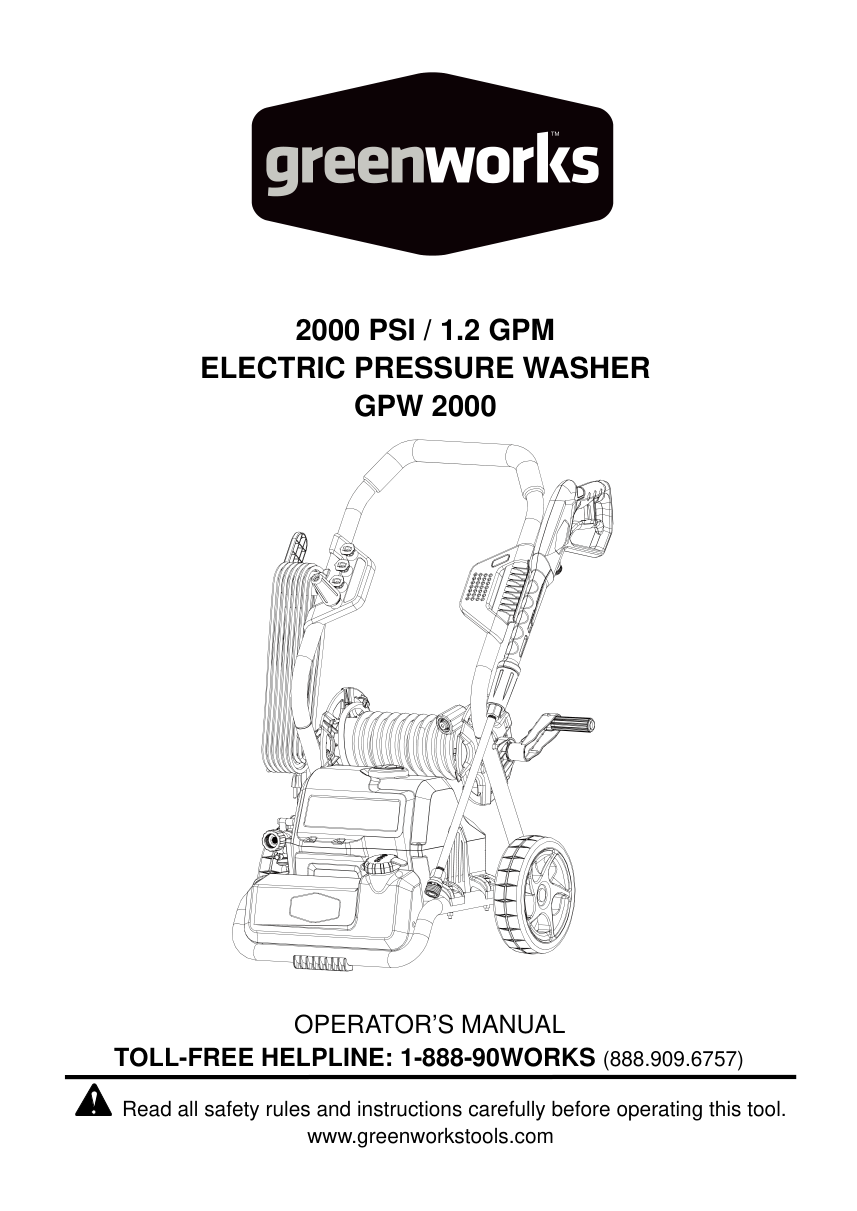
Greenworks GPW2000 Pressure Washer
Ask AI
— answers from the official manualAnswers from the official manual.
Common questions
Common Questions
19 totalCan I use an extension cord with the Greenworks GPW2000?
Yes, it is recommended to use an extension cord rated for outdoor use with a sufficient power rating to ensure safe operation of your pressure washer.
How should I properly store the Greenworks GPW2000?
Store the machine in a dry, isolated, and frost-free area, ensuring that the spray gun, high-pressure hose, and pump are completely dry before storage. Keep the product clean and free from oil and grease.
Is the Greenworks GPW2000 suitable for commercial cleaning applications?
No, the GPW2000 is designed specifically for residential use. For commercial applications requiring higher durability and performance ratings, you should consider models specifically rated for commercial use.
How do I add detergent to the pressure washer?
Place the pressure washer upright on a flat surface, remove the cap from the detergent tank, pour in the appropriate amount of detergent, and reinstall the cap. Use only detergines designed for pressure washers; household detergents or other chemicals can damage the pump. Ensure to refer to mixing instructions if provided by the detergent manufacturer.
What is the recommended way to store and maintain the high-pressure hose?
Roll up the high pressure hose and hang it on the cord arm, or secure one end of the hose to a left side holder, turn the crank handle clockwise until fully wound for storage. Both methods prevent kinks and ensure proper storage.
How do I troubleshoot low pressure issues with my Greenworks GPW2000?
Check if your garden hose diameter is too small; increase it to a 1" or 5/8" size. Also, ensure there are no kinks in the water supply and that all outlets involved in operation are fully open.
Show 13 more questions
How do I replace a clogged spray tip on my pressure washer?
How should I prepare my pressure washer for winter storage?
What safety precautions should I take when operating this pressure washer?
How can I ensure GFCI functionality of my pressure washer?
What nozzle angle would you recommend for cleaning wood decks?
How do I add power to my Greenworks GPW2000?
What are the key specifications of the Greenworks GPW2000 pressure washer?
How do I set up and connect the Greenworks GPW2000?
What is the proper procedure for starting the Greenworks 2000 PSI pressure washer?
What should I do if my Greenworks GPW2000 does not start?
Why is my pressure washer producing low water pressure?
How do I fix water leakage on the Greenworks GPW2000?
How often should I maintain my Greenworks pressure washer?
Full Manual
32 pages
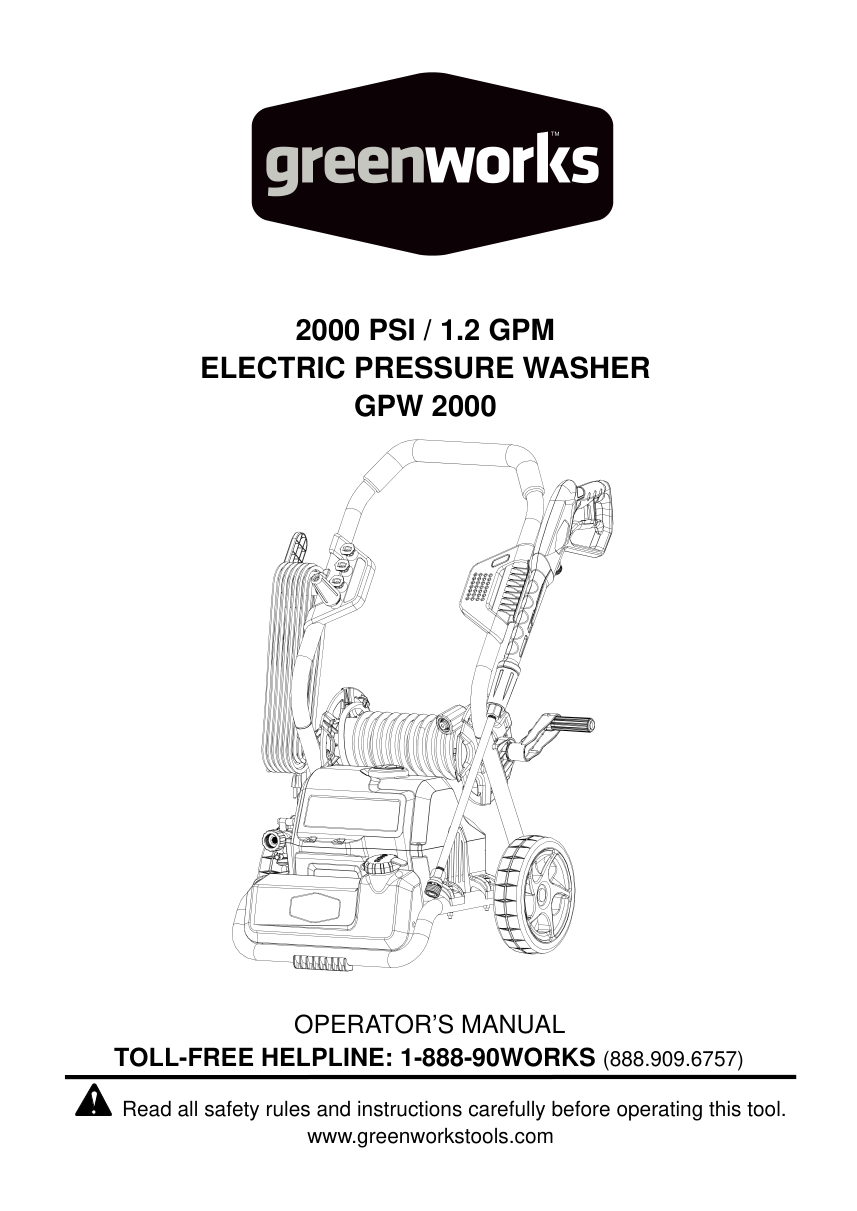
2000 PSI / 1.2 GPM ELECTRIC PRESSURE WASHER GPW 2000
OPERATOR’S MANUAL TOLL-FREE HELPLINE: 1-888-90WORKS (888.909.6757)
Read all safety rules and instructions carefully before operating this tool. www.greenworkstools.com
##### INSTRUCTION
Important Safety Instructions………………………………………………………............................................3 Specific Safety Rules……………………………………………………………….........................................4-5 Symbols………………………………………………………………………………......................................6-7 Electrical………………………………………………………………………………........................................8 Know Your Pressure Washer…………………………………………………………......................................9 Packing List..............................................................................................................................................10 Assembly………………………………………………………………………………................................11-15 Operation………………………………………………………………………………................................16-21 Maintenance…………………………………………………………………………..................................22-24 Troubleshooting……………………………………………………………………….................................25-27 Warranty……………………………………………………………………………………...............................28 Exploded View…………………………………………………………………………................................….29 Parts List……………………………………………………………………………….................................30-31
##### PROdUCT SPECIFICATION
Induction Motor……………………………………………………….................................120V,60Hz,13Amps Power Cord with In-Line GFCI................................................................................................................35ft Max. Pounds Per Square Inch Pressure…………………………………….......................................2000psi Rated Gallons Per Minute……………………………………………………….....................................1.2gpm Maximum Inlet Water Temperature……………………………………………..……................104°F(40℃) Cleaning Units...............................................................................................................................2400 C.U Net Weight……………………………………………………………......................................40.39lbs(18.3kg)
##### IMPORTANT SAFETY INSTRUCTIONS
W A R N I N G Read and understand all instructions. Failure to follow all instructions listed below may result. in electric shock, fire, and/or serious personal injury.
####### W A R N I N G
When using this product, basic precautions should always be followed.
###### REAd ALL INSTRUCTIONS BEFORE USING THIS PROdUCT
####### W A R N I N G
Risk of injection or injury – Do not direct discharge stream at people or animals.
GROUNd FAULT CIRCUIT INTERRUPTER PROTECTION This pressure washer is provided with a ground fault circuit interrupter (GFCI) built into the plug of the power supply cord. This device provides additional protection from the risk of electric shock. Should replacement of the plug or cord become necessary, use only identical replacement parts that include GFCI protection.
###### EXTENSION CORdS
■ Do not use with extension cord. Plug directly into receptacle.
W A R N I N G To reduce the risk of electrocution, keep all connections dry and off the ground. Do not touch plug with wet hands.
W A R N I N G High pressure jets can be dangerous if subject to misuse. The jet must not be directed at people, animals, electrical devices, or the machine itself.
W A R N I N G Some dust created by power sanding, sawing, grinding, drilling, and other construction activities contains chemicals known to cause cancer, birth defects or other reproductive harm. Some examples of these chemicals are:
W A R N I N G This product contains chemical(s) including lead, known to the State of California to cause cancer, birth defects, and other reproductive harm. Do not drink water from this hose. Wash hands after use.
######## Some of the following symbols may be used on this product. Please study them and learn their meaning. Proper interpretation of these symbols will allow you to operate the product better and safer.
|SYMBOL|NAME|DESIGNATION/EXPLANATION| |---|---|---| |V|Volts|Voltage| |A|Amperes|Current| |Hz|Hertz|Frequency (cycles per second)| |W|Watt|Power| |no|No Load Speed|Rotational speed, at no load| | |Alternating Current|Type of current| |.../min|Per Minute|Revolutions, strokes, surface speed, orbits etc., per minute| | |Safety Alert|Indicates a potential personal injury hazard.| | |Read Operator’s Manual|To reduce tthe risk of injury, user must read and understand operator’s manual before using this product.| | |Eye Protection|Always wear eye protection with side shields marked to comply with ANSI Z87.1.| | |Wet Conditions Alert|Do not expose to rain or use in damp locations.| || | |---|
|Risk of Injection|To reduce the risk of injection or injury, never direct a water system towards people or pets or place any body part in the stream. Leaking hoses and fittings are also capable of causing
injection injury. Do not hold hoses or fittings.| | |Kickback|To reduce the risk of injury from kickback, hold the spray wand securely with both hands when the machine is on.| || |
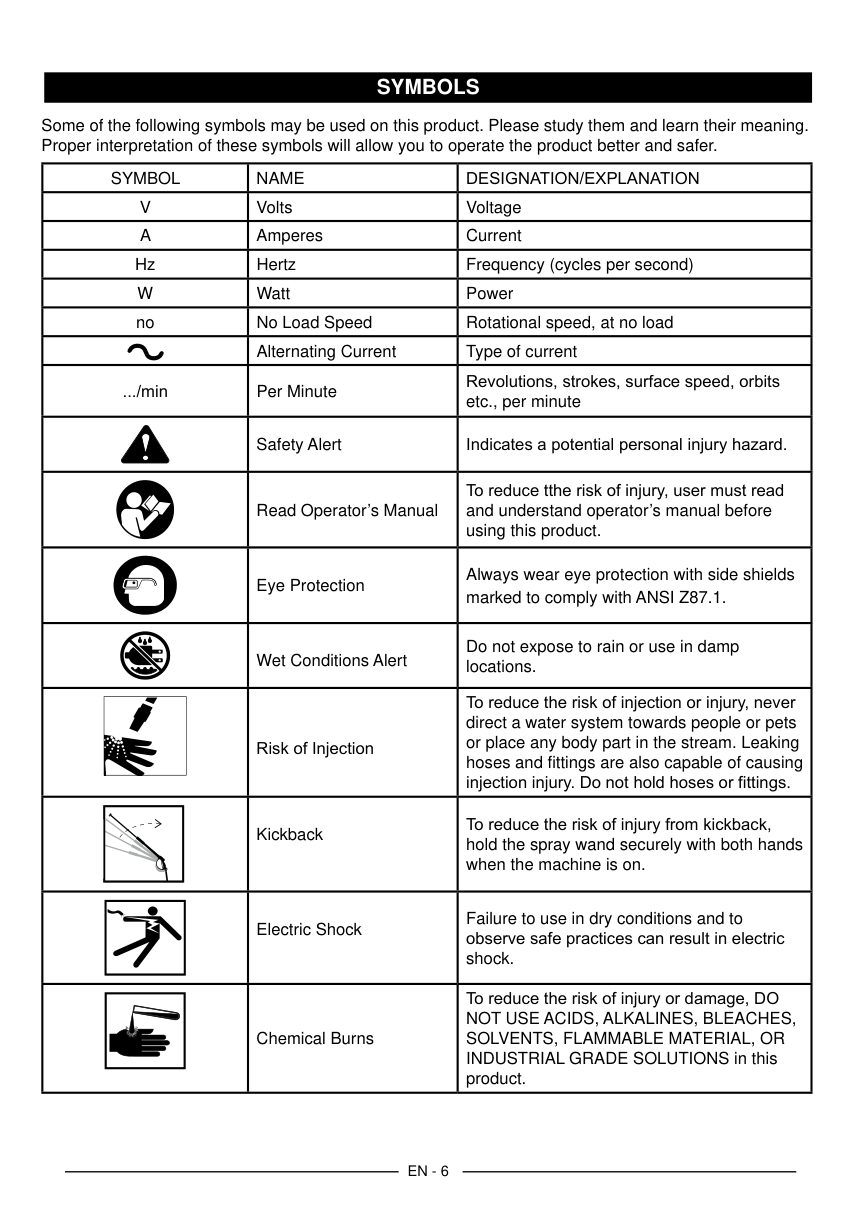
|---| |Electric Shock|Failure to use in dry conditions and to observe safe practices can result in electric shock.| || | |---| |Chemical Burns|To reduce the risk of injury or damage, DO NOT USE ACIDS, ALKALINES, BLEACHES, SOLVENTS, FLAMMABLE MATERIAL, OR INDUSTRIAL GRADE SOLUTIONS in this product.|
The following signal words and meanings are intended to explain the levels of risk associated with this product.
|SYMBOL|SIGNAL|MEANING| |---|---|---| | |DANGER|Indicates an imminently hazardous situation, which, if not avoided, will result in death or serious injury.| | |WARNING|Indicates a potentially hazardous situation, which, if not avoided, could result in death or serious injury.| | |CAUTION|Indicates a potentially hazardous situation, which, if not avoided, may result in minor or moderate injury.| | |CAUTION|(Without Safety Alert Symbol) Indicates a situation that may result in property damage.|
SERVICE Servicing requires extreme care and knowledge and should be performed only by a qualified service technician. For service, return the product to your nearest AUTHORIZEd SERVICE CENTER for repair. When servicing, use only identical replacement parts.
W A R N I N G To avoid serious personal injury, do not attempt to use this product until you read thoroughly and understand completely the operator’s manual. If you do not understand the warnings and instructions in the operator’s manual, do not use this product. Call GREENWORKS customer service for assistance.
The operation of any power tool can result in foreign objects being thrown into your eyes, which can result in severe eye damage. Before beginning power tool operation, always wear safety goggles or safety glasses with side shields and, when needed, a full face shield. We recommend Wide Vision Safety Mask for use over eyeglasses or standard safety glasses with side shields. Always use eye protection which is marked to comply with ANSI Z87.1.
##### ELECTRICAL
ELECTRICAL CONNECTION This product has a precision-built electric motor. It should be connected to a power supply that is 120 volts, 60 Hz, AC only (normal household current). Do not operate this product on direct current (DC). A substantial voltage drop will cause a loss of power and the motor will overheat. If the product does not operate when plugged into an outlet, double check the power supply.
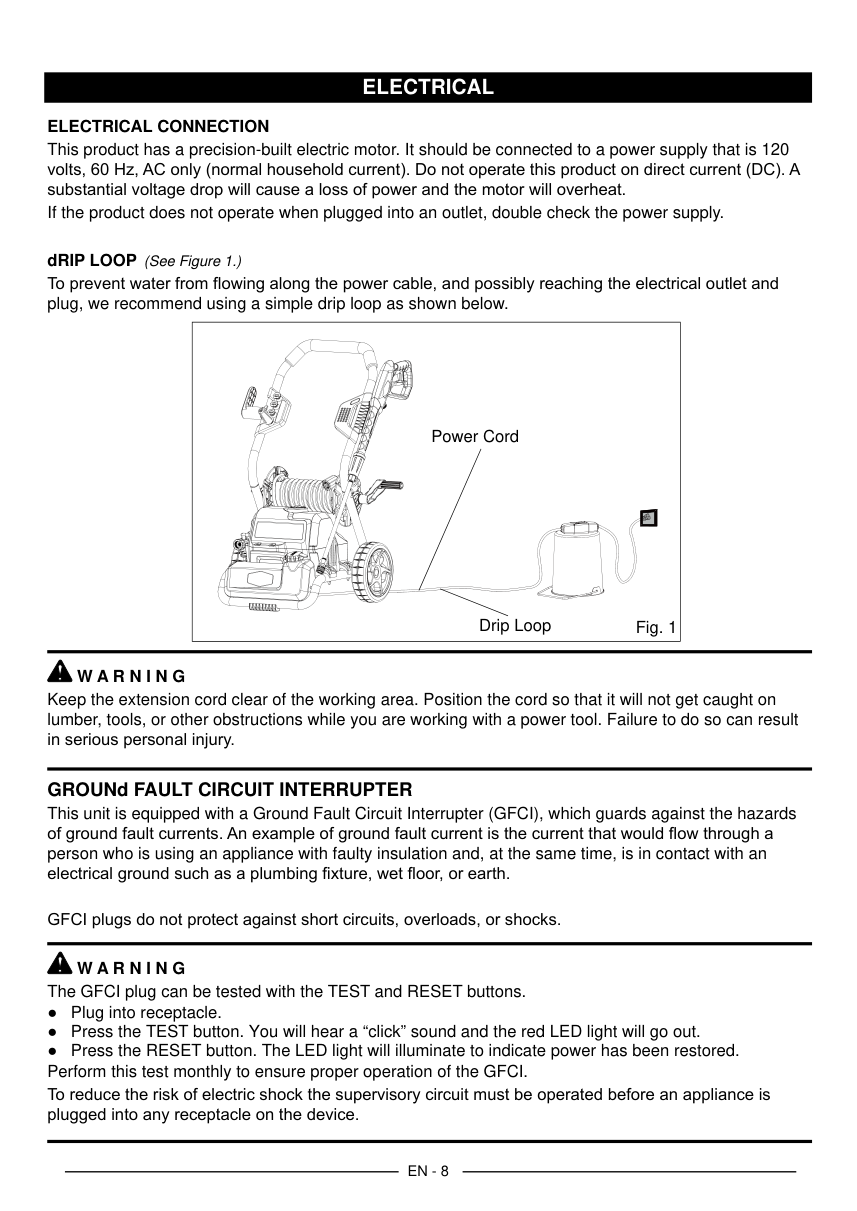
dRIP LOOP (See Figure 1.) To prevent water from flowing along the power cable, and possibly reaching the electrical outlet and plug, we recommend using a simple drip loop as shown below.
|Fig. 1
Power Cord
Drip Loop| |---|
W A R N I N G Keep the extension cord clear of the working area. Position the cord so that it will not get caught on lumber, tools, or other obstructions while you are working with a power tool. Failure to do so can result in serious personal injury.
GROUNd FAULT CIRCUIT INTERRUPTER This unit is equipped with a Ground Fault Circuit Interrupter (GFCI), which guards against the hazards of ground fault currents. An example of ground fault current is the current that would flow through a person who is using an appliance with faulty insulation and, at the same time, is in contact with an electrical ground such as a plumbing fixture, wet floor, or earth.
GFCI plugs do not protect against short circuits, overloads, or shocks.
####### W A R N I N G
The GFCI plug can be tested with the TEST and RESET buttons.
##### KNOW YOUR PRESSURE WASHER
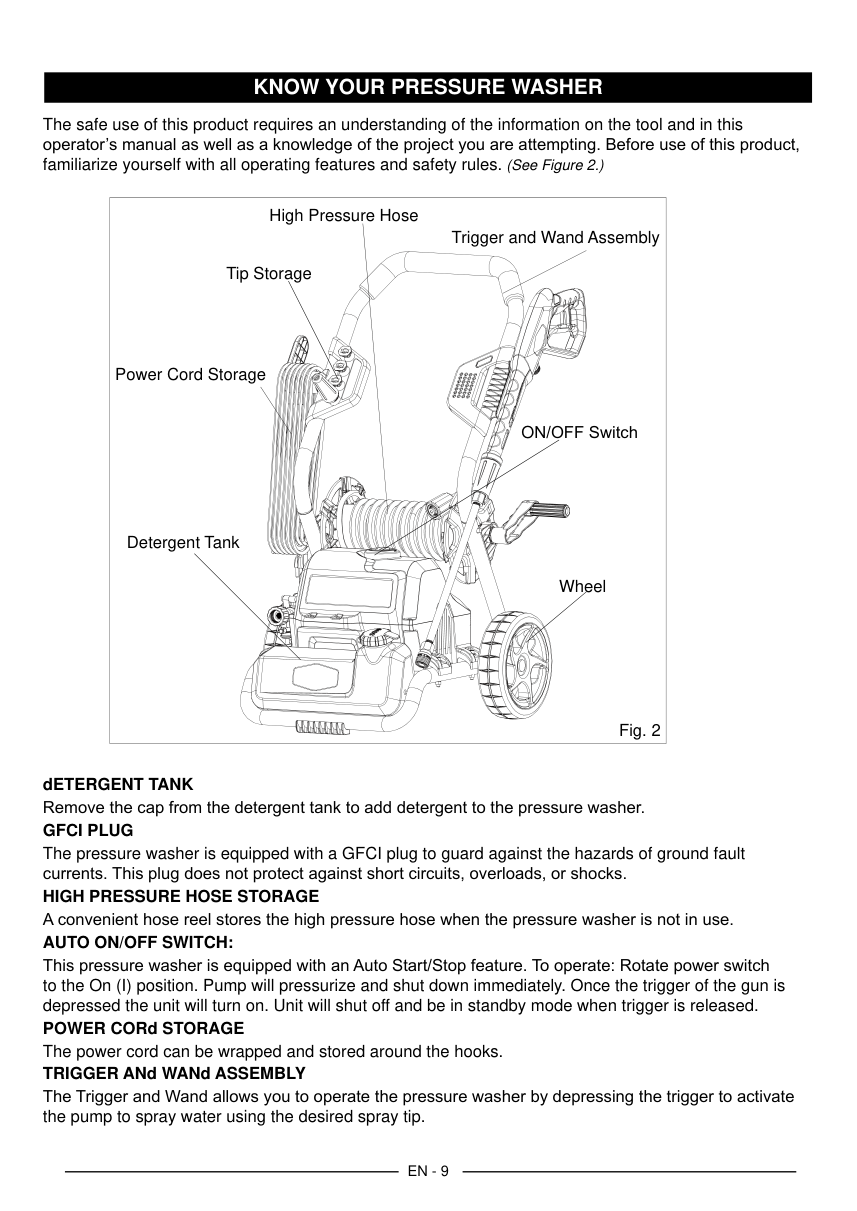
The safe use of this product requires an understanding of the information on the tool and in this operator’s manual as well as a knowledge of the project you are attempting. Before use of this product, familiarize yourself with all operating features and safety rules. (See Figure 2.)
|ON/OFF Switch
Power Cord Storage
Trigger and Wand Assembly
High Pressure Hose
Detergent Tank
Wheel
Fig. 2
Tip Storage
| |---|
dETERGENT TANK Remove the cap from the detergent tank to add detergent to the pressure washer. GFCI PLUG The pressure washer is equipped with a GFCI plug to guard against the hazards of ground fault currents. This plug does not protect against short circuits, overloads, or shocks. HIGH PRESSURE HOSE STORAGE A convenient hose reel stores the high pressure hose when the pressure washer is not in use. AUTO ON/OFF SWITCH: This pressure washer is equipped with an Auto Start/Stop feature. To operate: Rotate power switch to the On (I) position. Pump will pressurize and shut down immediately. Once the trigger of the gun is depressed the unit will turn on. Unit will shut off and be in standby mode when trigger is released. POWER CORd STORAGE The power cord can be wrapped and stored around the hooks. TRIGGER ANd WANd ASSEMBLY The Trigger and Wand allows you to operate the pressure washer by depressing the trigger to activate the pump to spray water using the desired spray tip.
##### PACKING LIST
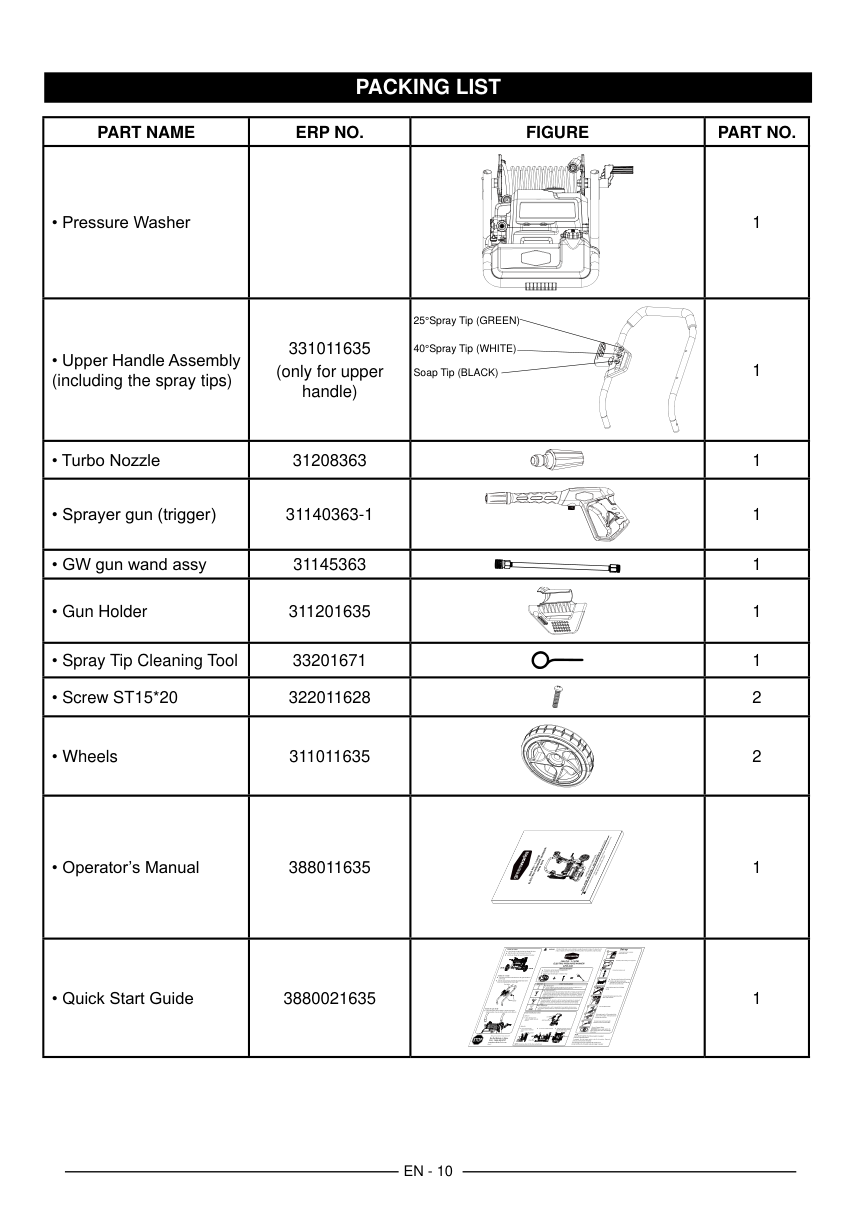
|PART NAME|ERP NO.|FIGURE|PART NO.| |---|---|---|---| |• Pressure Washer| | |1| |• Upper Handle Assembly (including the spray tips)|331011635 (only for upper handle)|25°Spray Tip (GREEN)
Soap Tip (BLACK)
40°Spray Tip (WHITE)
|1| |• Turbo Nozzle|31208363| |1| |• S p r a y e r g u n ( t r ig g e r )|31140363-1| |1|
|• GW gun wand assy|31145363| |1| |• Gun Holder|311201635| |1| |• Spray Tip Cleaning Tool|33201671| |1| |• Screw ST15*20|322011628| |2| |• Wheels|311011635| |2| |• Operator’s Manual|388011635|WA
W
PER
AT
’S M
AN
UAL
TO
LL-FREE HELPLI
E: 1-888-90W
RKS
|1| |• Quick Start Guide|3880021635|USING DETERGENT
25
40
ELECTRIC PRESSURE WASHER GPW 2000
Set-up
|1|
UNPACKING This product requires assembly.
■ Carefully remove the product and any accessories from the box. Make sure that all items listed in the packing list are included.
####### W A R N I N G
Do not use this product if any parts on the Packing List are already assembled to your product when you unpack it. Parts on this list are not assembled to the product by the manufacturer and require customer installation. Use of a product that may have been improperly assembled could result in serious personal injury.
W A R N I N G If any parts are damaged or missing do not operate this product until the parts are replaced. Use of this product with damaged or missing parts could result in serious personal injury.
W A R N I N G Do not attempt to modify this product or create accessories not recommended for use with this product. Any such alteration or modification is misuse and could result in a hazardous condition leading to possible serious personal injury.
W A R N I N G Do not connect to power supply until assembly is complete. Failure to comply could result in accidental starting and possible serious personal injury.
###### ASSEMBLING THE WHEEL (See Figure 3.)
ASSEMBLING THE GUN HOLdER (See Figure 4.)
|Fig. 3
Axle
Wheels
Washers
Pins
Axle| |---|
|Fig. 4
Screws
Gun Holder| |---|
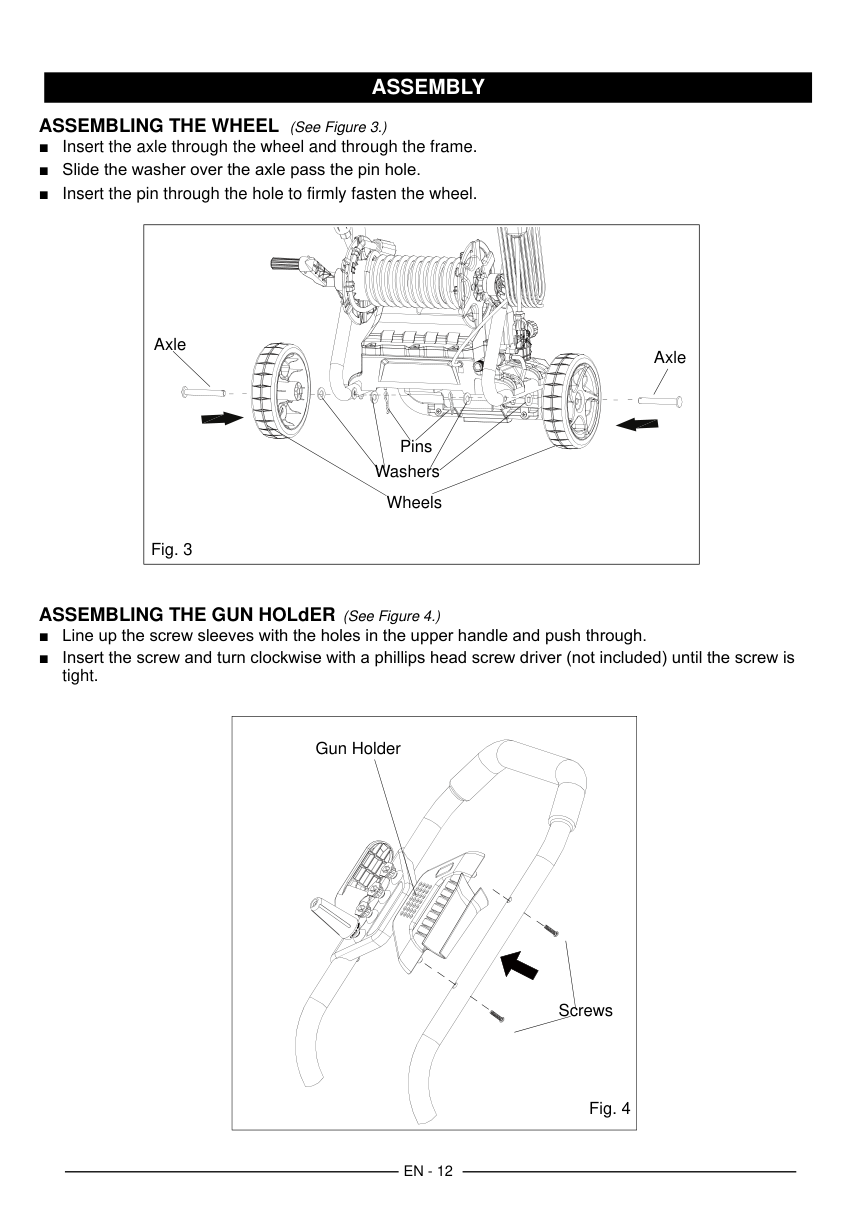
###### ASSEMBLING THE HANdLE (See Figure 5.)
■ Push and hold the push-pin button on the side of the upper handle assembly (1) as you slide the handle onto the frame (2).
NOTE: Before use, pull the handle up until the lock button snaps through the locking slots to secure the handle place.
|Fig. 5
(1)
(2)| |---|
###### ASSEMBLING THE HIGH PRESSURE HOSE
| | |
|---|---| | | |
| | | |---|---| | | | | | |
| | | |---|---| | | |
| | | | | | | | | | | | | | | | | |---|---|---|---|---|---|---|---|---|---|---|---|---|---|---|---| | | | | | | | | | | | | | | | | |
Crank Handle Fig. 6-2
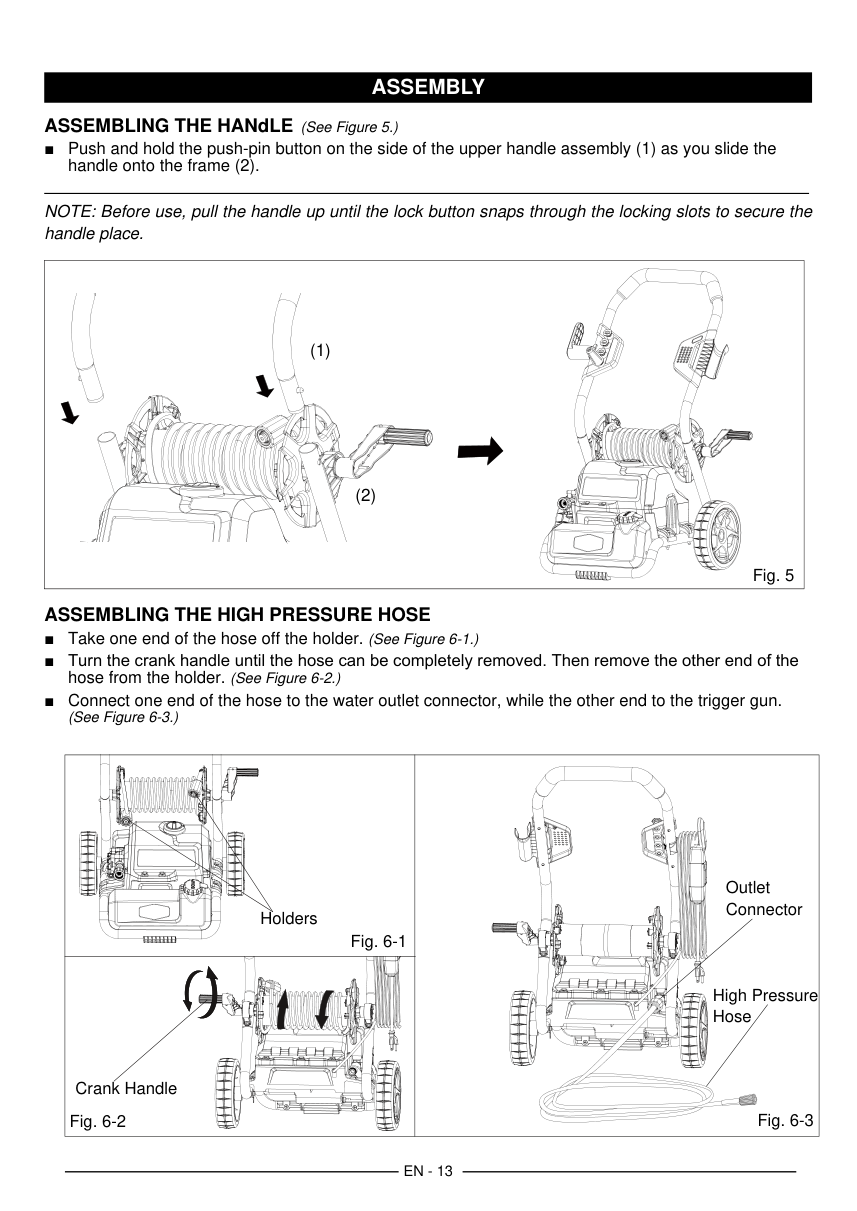
Holders
Fig. 6-1
Outlet Connector
High Pressure Hose
Fig. 6-3
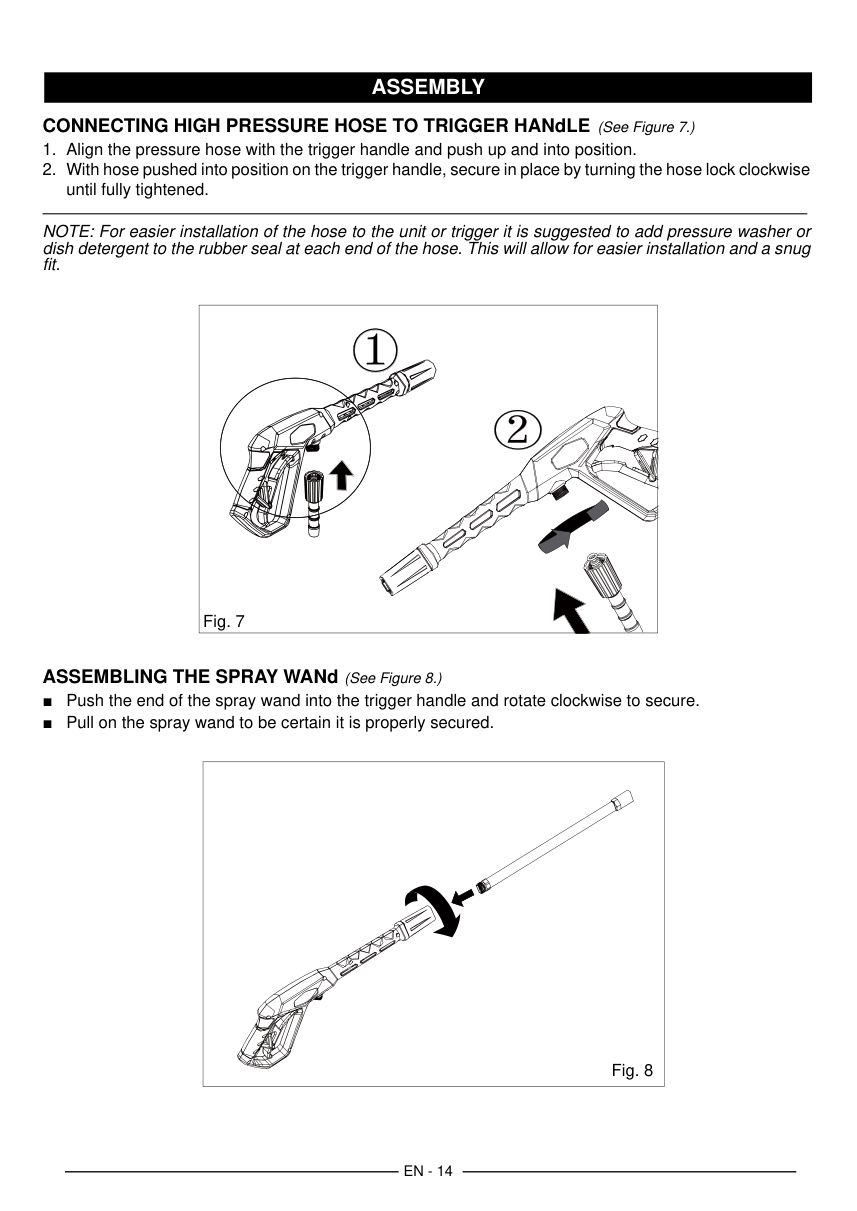
###### CONNECTING HIGH PRESSURE HOSE TO TRIGGER HANdLE (See Figure 7.)
NOTE: For easier installation of the hose to the unit or trigger it is suggested to add pressure washer or dish detergent to the rubber seal at each end of the hose. This will allow for easier installation and a snug fit.
|Fig. 7
①
②| |---|
###### ASSEMBLING THE SPRAY WANd (See Figure 8.)
|Fig. 8| |---|
###### CONNECTING THE GARdEN HOSE (See Figure 9.)
C A U T I O N : Always observe all local regulations when connecting hoses to the water main. Some areas have restrictions against connecting directly to public drinking water supply to prevent the feedback of chemicals into the drinking water supply. Direct connection through a receiver tank or backflow preventer is usually permitted.
NOTE:There must be a minimum of 10 feet of unrestricted garden hose between the water intake and the garden hose faucet or shut off valve (such as a “Y” shut off connector).
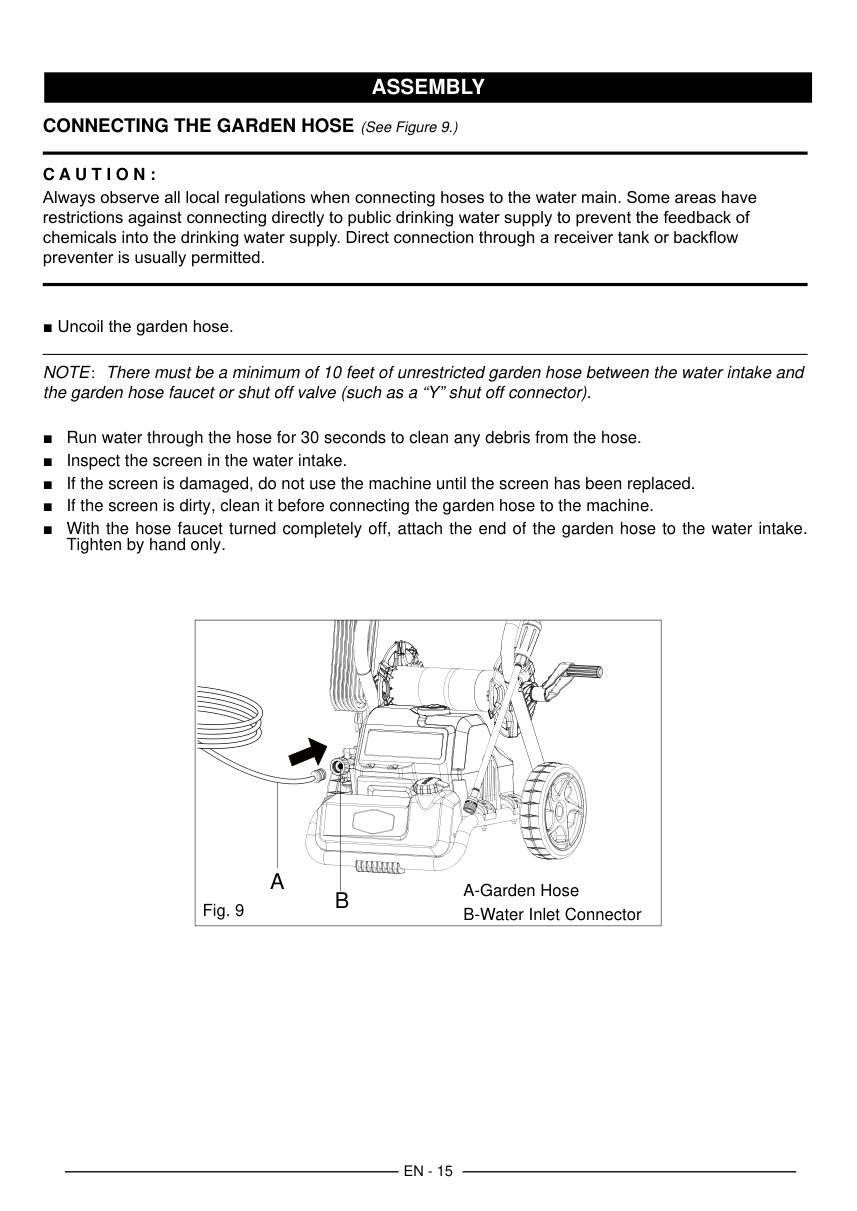
|Fig. 9
A A-Garden Hose
B-Water Inlet Connector
| | | |---|---| | | |
B| |---|
W A R N I N G Do not allow familiarity with the product to make you careless. Remember that a careless fraction of a second is sufficient to inflict serious injury.
W A R N I N G Always wear eye protection with side shields marked to comply with ANSI Z87.1. Failure to do so could result in objects being thrown into your eyes resulting in possible serious injury.
W A R N I N G Do not use any attachments or accessories not recommended by the manufacturer of this product. The use of attachments or accessories not recommended can result in serious personal injury.
W A R N I N G Never direct a water stream toward people or pets, or any electrical device. Failure to heed this warning could result in serious injury.
APPLICATIONS You may use this product for the purposes listed below:
■ Cleaning boats, cars, trucks, motorcycles, outdoor furniture, grills, house siding, driveways, patios and decks.
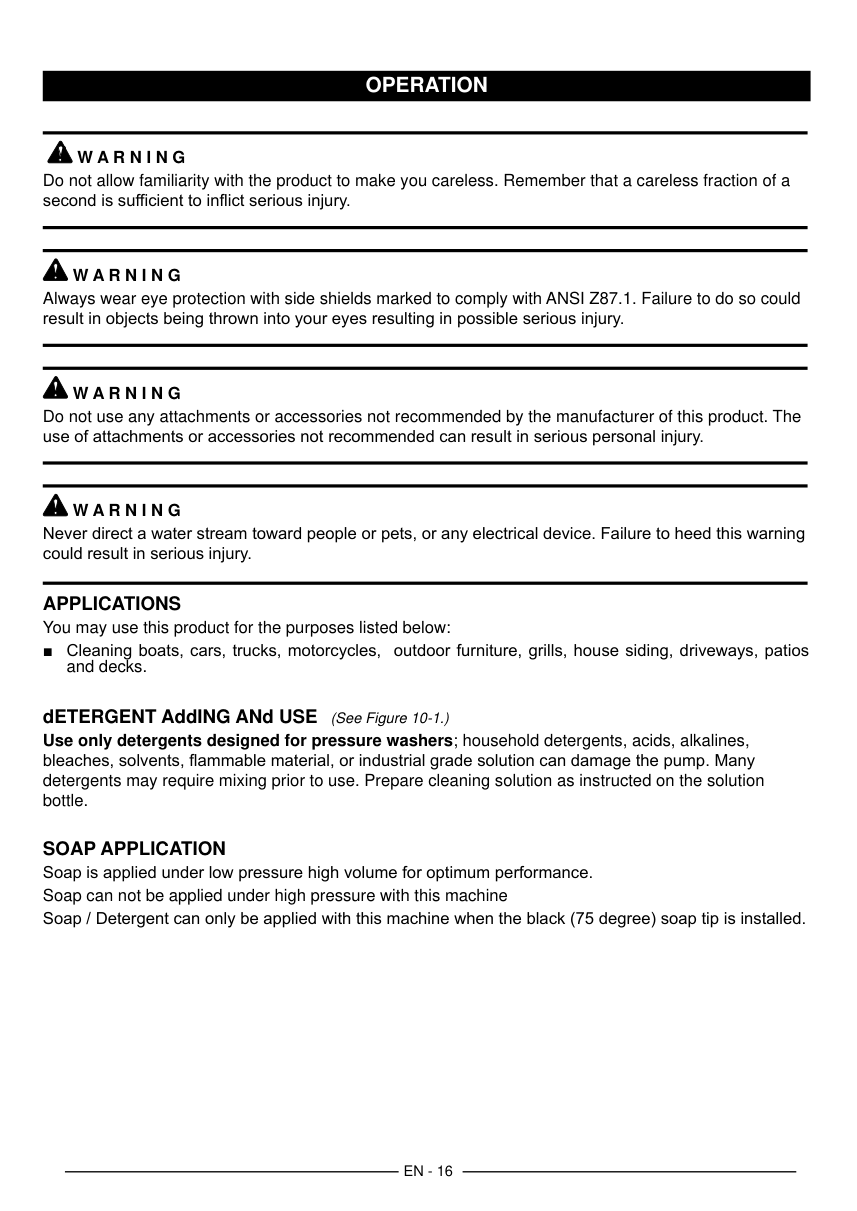
dETERGENT AddING ANd USE (See Figure 10-1.) Use only detergents designed for pressure washers; household detergents, acids, alkalines, bleaches, solvents, flammable material, or industrial grade solution can damage the pump. Many detergents may require mixing prior to use. Prepare cleaning solution as instructed on the solution bottle.
SOAP APPLICATION Soap is applied under low pressure high volume for optimum performance. Soap can not be applied under high pressure with this machine Soap / Detergent can only be applied with this machine when the black (75 degree) soap tip is installed.
####### To add detergent:
|Detergent
Tank
Fig. 10-1
|Use Black Soap Tip Only
Fig. 10-2| |---|---|
C A U T I O N : Use only approved pressure washer cleaners. Do not use bleach, chlorine,or any cleaners containing acids.
####### To use:
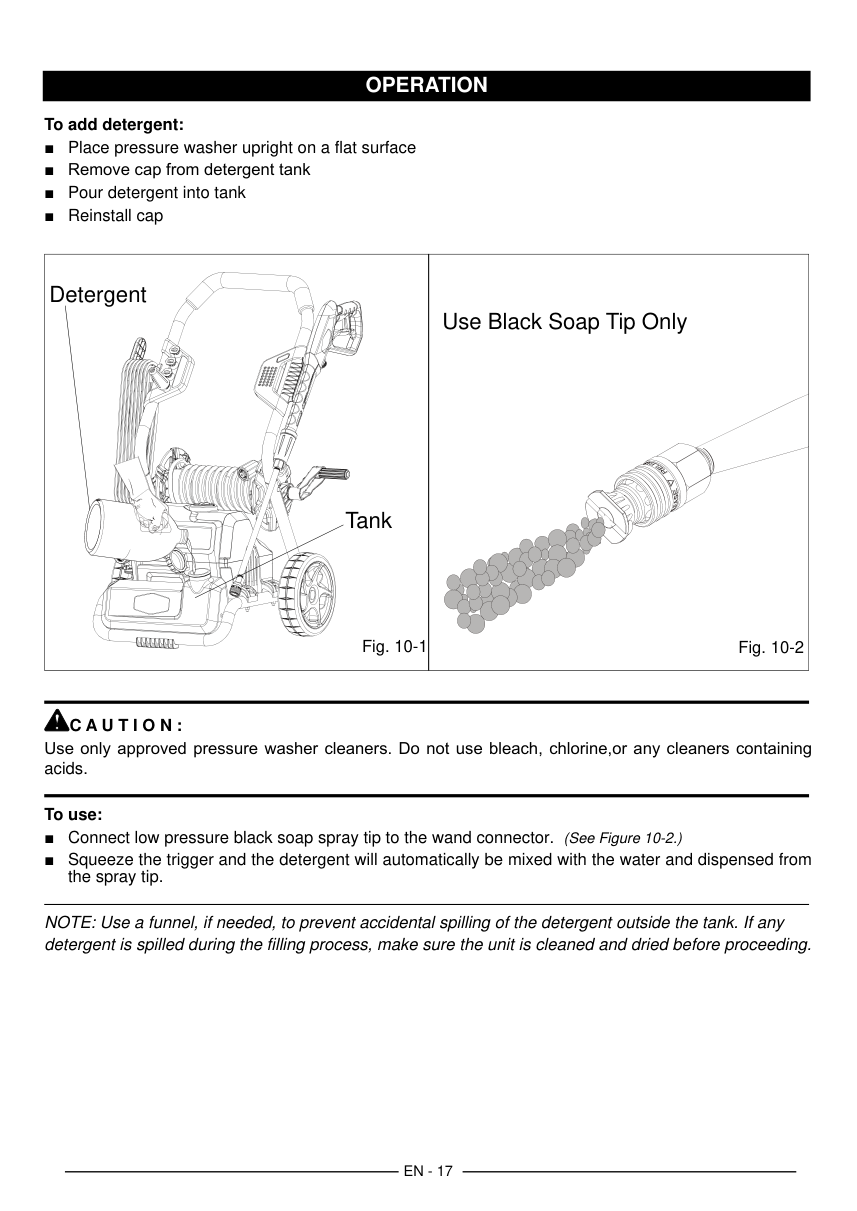
NOTE: Use a funnel, if needed, to prevent accidental spilling of the detergent outside the tank. If any detergent is spilled during the filling process, make sure the unit is cleaned and dried before proceeding.
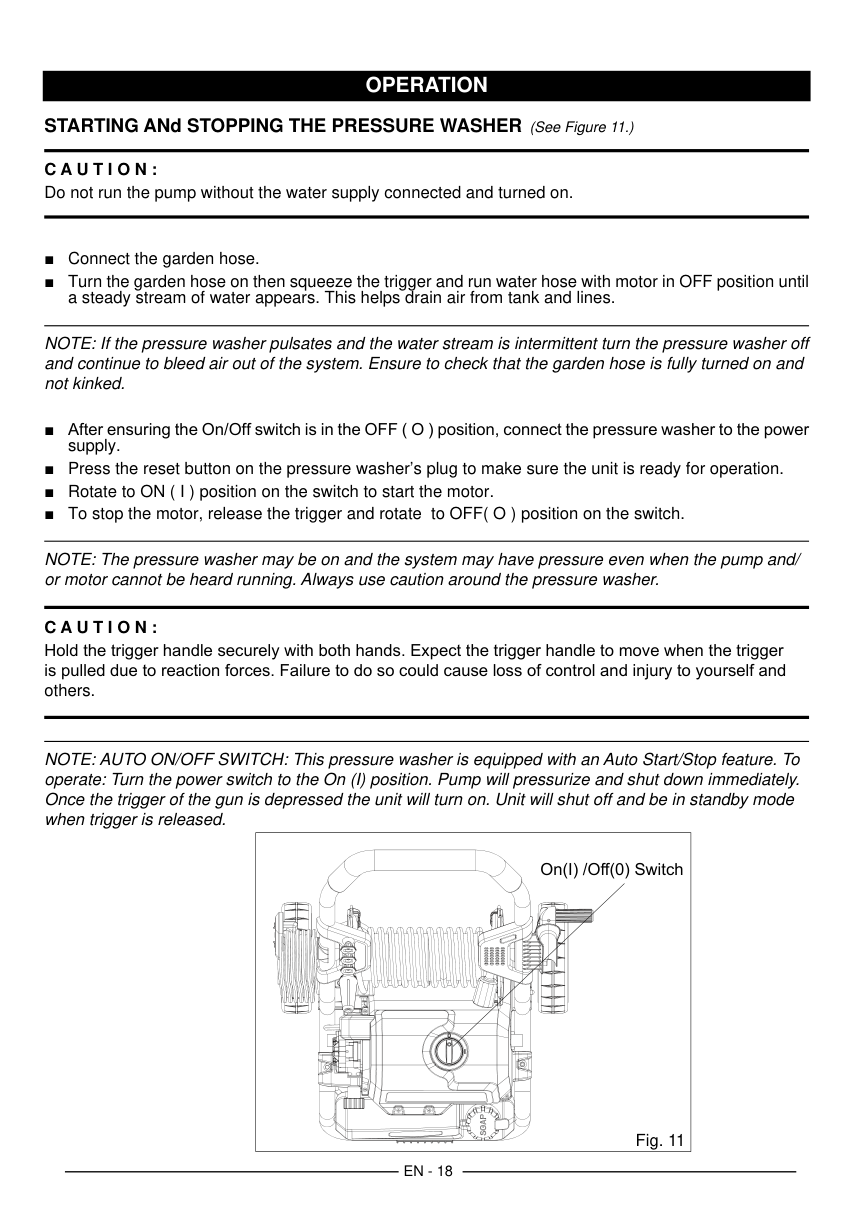
###### STARTING ANd STOPPING THE PRESSURE WASHER (See Figure 11.)
C A U T I O N : Do not run the pump without the water supply connected and turned on.
NOTE: If the pressure washer pulsates and the water stream is intermittent turn the pressure washer off and continue to bleed air out of the system. Ensure to check that the garden hose is fully turned on and not kinked.
NOTE: The pressure washer may be on and the system may have pressure even when the pump and/ or motor cannot be heard running. Always use caution around the pressure washer.
####### C A U T I O N :
Hold the trigger handle securely with both hands. Expect the trigger handle to move when the trigger is pulled due to reaction forces. Failure to do so could cause loss of control and injury to yourself and others.
NOTE: AUTO ON/OFF SWITCH: This pressure washer is equipped with an Auto Start/Stop feature. To operate: Turn the power switch to the On (I) position. Pump will pressurize and shut down immediately. Once the trigger of the gun is depressed the unit will turn on. Unit will shut off and be in standby mode when trigger is released.
|Fig. 11
On(I) /Off(0) Switch| |---|
USING THE SPRAY TIPS (See Figure 12.) Each of the spray tips has a different spray pattern. Before starting any cleaning job, determine the best spray tip for the job. The following chart offers some general guidelines to help you choose the best spray tip for your application.
NOTE: Always try spray tip in an inconspicuous area first.
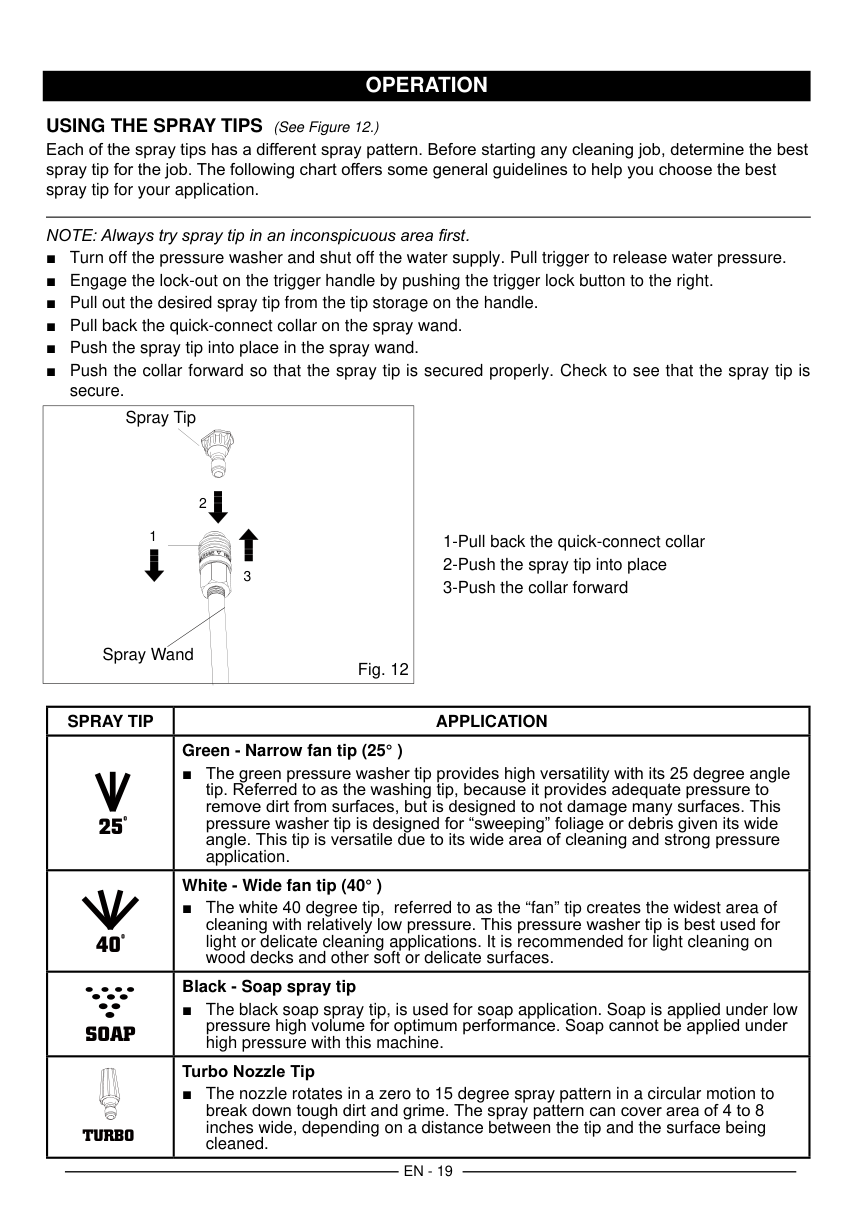
|Fig. 12
1
2
3
Spray Tip
Spray Wand| |---|
|SPRAY TIP|APPLICATION| |---|---| |25
O|Green - Narrow fan tip (25° )
■ The green pressure washer tip provides high versatility with its 25 degree angle tip. Referred to as the washing tip, because it provides adequate pressure to remove dirt from surfaces, but is designed to not damage many surfaces. This pressure washer tip is designed for “sweeping” foliage or debris given its wide angle. This tip is versatile due to its wide area of cleaning and strong pressure application.| |40
O|White - Wide fan tip (40° )
■ The white 40 degree tip, referred to as the “fan” tip creates the widest area of cleaning with relatively low pressure. This pressure washer tip is best used for light or delicate cleaning applications. It is recommended for light cleaning on wood decks and other soft or delicate surfaces.| |SOAP|Black - Soap spray tip
■ The black soap spray tip, is used for soap application. Soap is applied under low pressure high volume for optimum performance. Soap cannot be applied under high pressure with this machine.| |TURBO|Turbo Nozzle Tip
■ The nozzle rotates in a zero to 15 degree spray pattern in a circular motion to
break down tough dirt and grime. The spray pattern can cover area of 4 to 8 inches wide, depending on a distance between the tip and the surface being cleaned.|
NEVER change spray tips without engaging the lock-out on the trigger handle and NEVER point the wand at your face or at others. The quick-connect feature contains small springs that could eject the spray tip with some force. Failure to heed this may cause personal injury.
###### TO dISCONNECT A SPRAY TIP FROM THE SPRAY WANd ONCE THE CLEANING JOB IS COMPLETE:
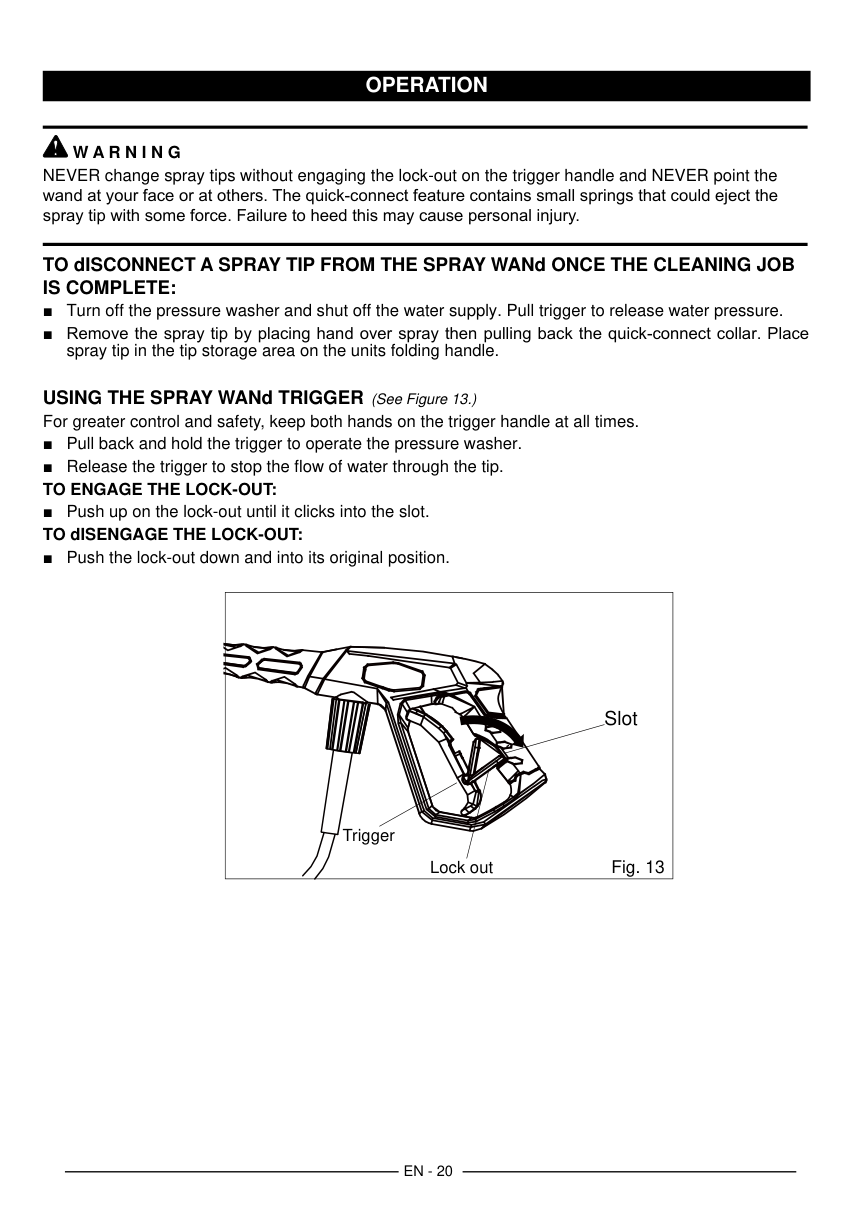
|Slot
Fig. 13
Trigger
Lock out| |---|
OPERATING THE PRESSURE WASHER (See Figure 14.) Use only detergents designed for pressure washers. Many detergents may requrie mixing prior to use. Prepare cleaning solution as instructed on the solution bottle.
| | | | |---|---|---| | | | |


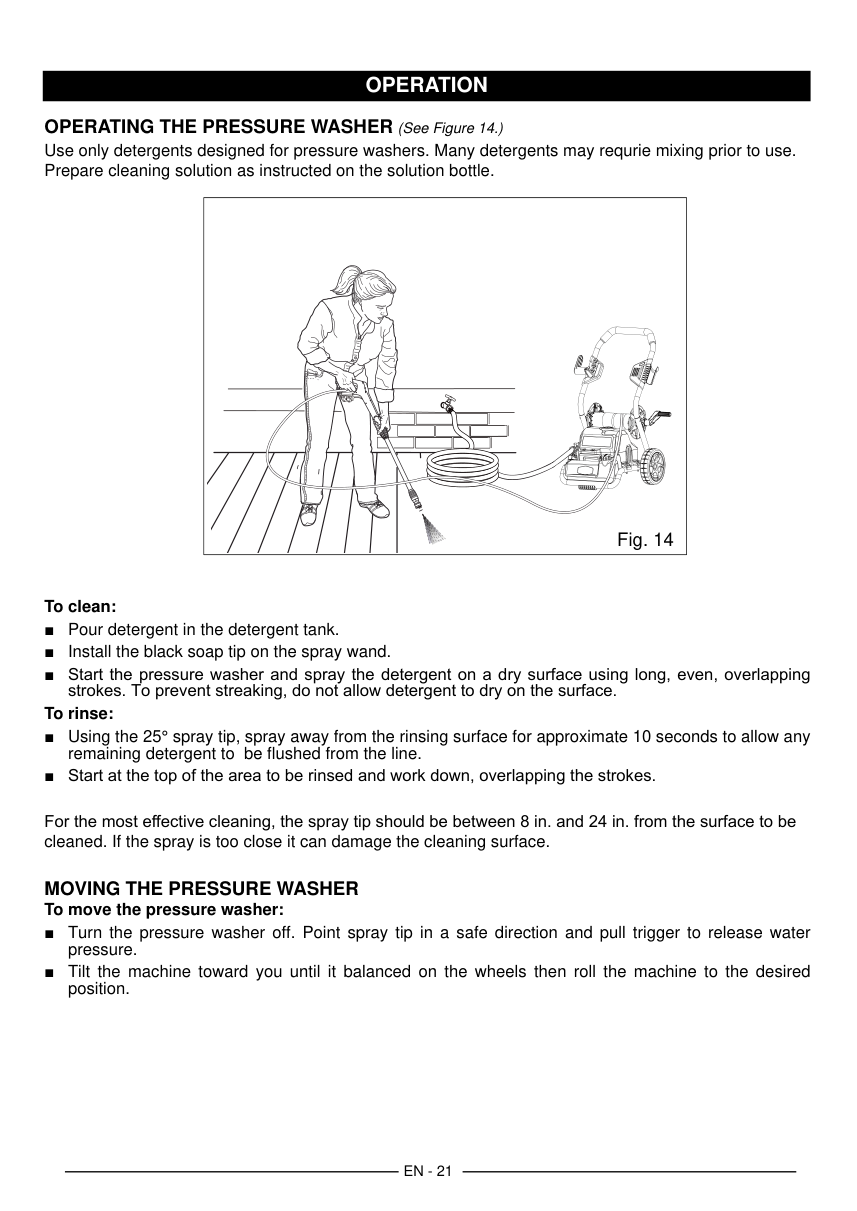

Fig. 14
####### To clean:
####### To rinse:
For the most effective cleaning, the spray tip should be between 8 in. and 24 in. from the surface to be cleaned. If the spray is too close it can damage the cleaning surface.
MOVING THE PRESSURE WASHER To move the pressure washer:
When servicing, use only identical replacement parts. Use of any other parts may create a hazard or cause product damage.
W A R N I N G Before inspecting, cleaning or servicing the machine, turn off the unit, unplug from the outlet, pull trigger to release water pressure and disconnect the high pressure hose. Failure to follow these instructions can result in serious personal injury or property damage.
GENERAL MAINTENANCE Avoid using solvents when cleaning plastic parts. Most plastics are susceptible to damage from various types of commercial solvents and may be damaged by their use. Use clean cloths to remove dirt, dust, oil, grease, etc.
####### W A R N I N G
Do not at any time let brake fluids, gasoline, petroleum based products, penetrating oils, etc.,come in contact with plastic parts. Chemicals can damage, weaken or destroy plastic which may result in serious personal injury.
Only the parts shown on the parts list are intended to be repaired or replaced by the customer. All other parts should be replaced at an authorized service center.
SPRAY TIP MAINTENANCE (See Figure 15.) Excessive pump pressure (a pulsing sensation felt while squeezing the trigger) may be the result of a clogged or dirty spray tip.
NOTE: Never point the spray wand at your face.
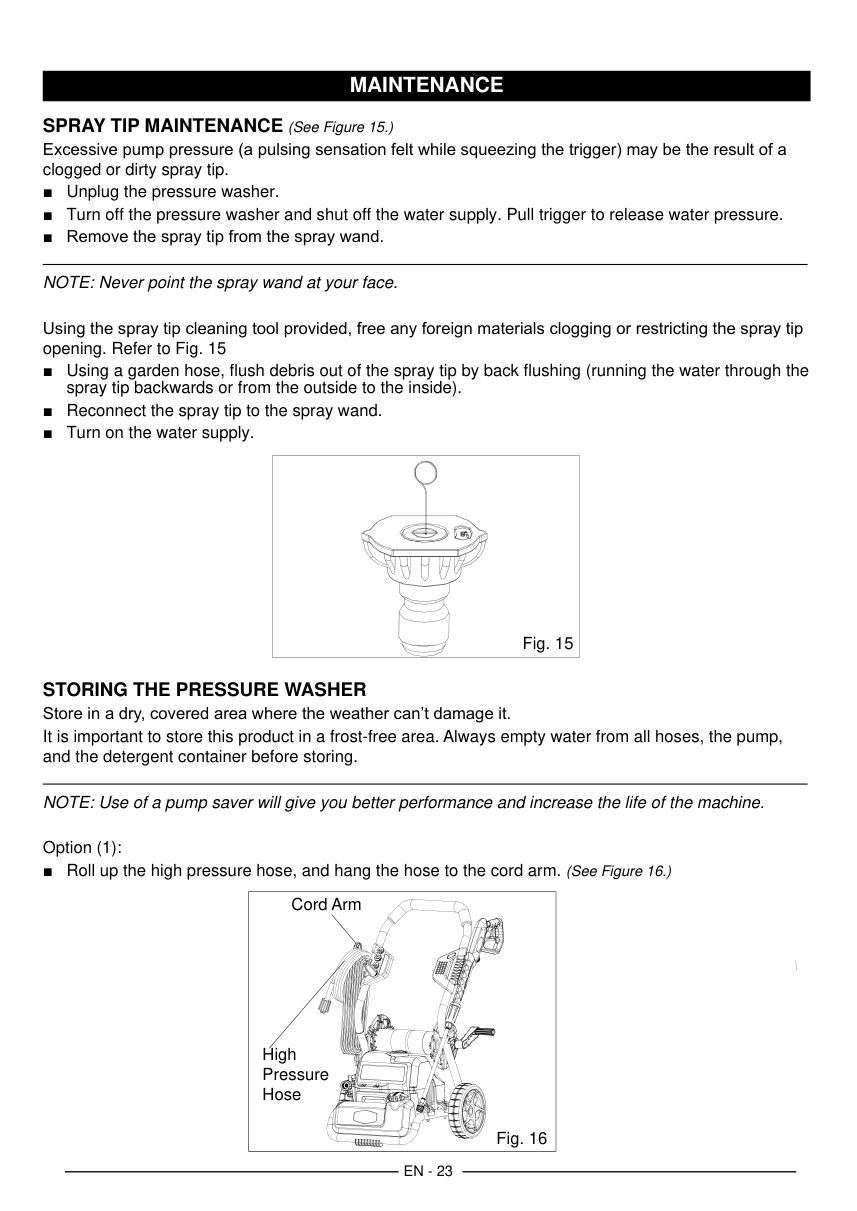
Using the spray tip cleaning tool provided, free any foreign materials clogging or restricting the spray tip opening. Refer to Fig. 15
STORING THE PRESSURE WASHER Store in a dry, covered area where the weather can’t damage it.
It is important to store this product in a frost-free area. Always empty water from all hoses, the pump, and the detergent container before storing.
NOTE: Use of a pump saver will give you better performance and increase the life of the machine.
|Fig. 15| |---|
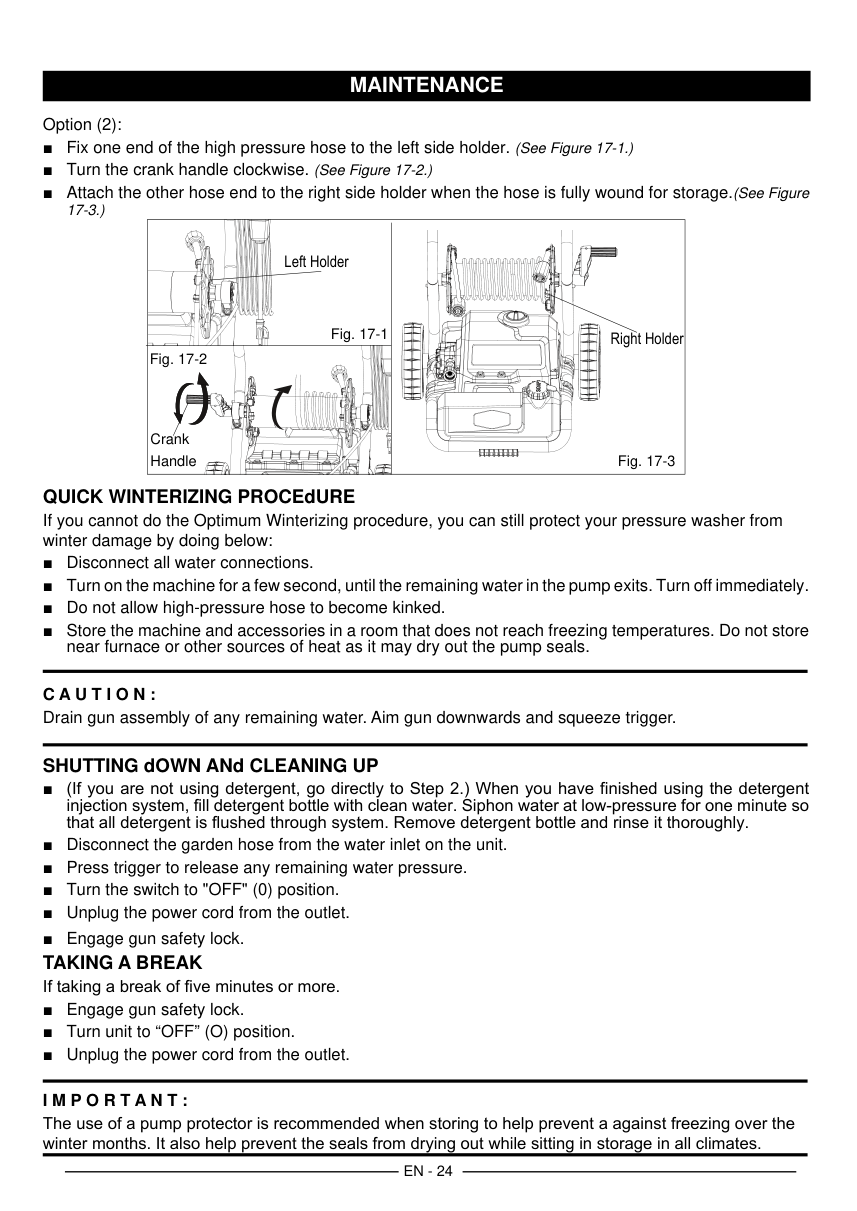
|Fig. 16
Cord Arm
High Pressure Hose
| |---|
Left Holder
Fig. 17-1
Right Holder
| | | |---|---| | | |
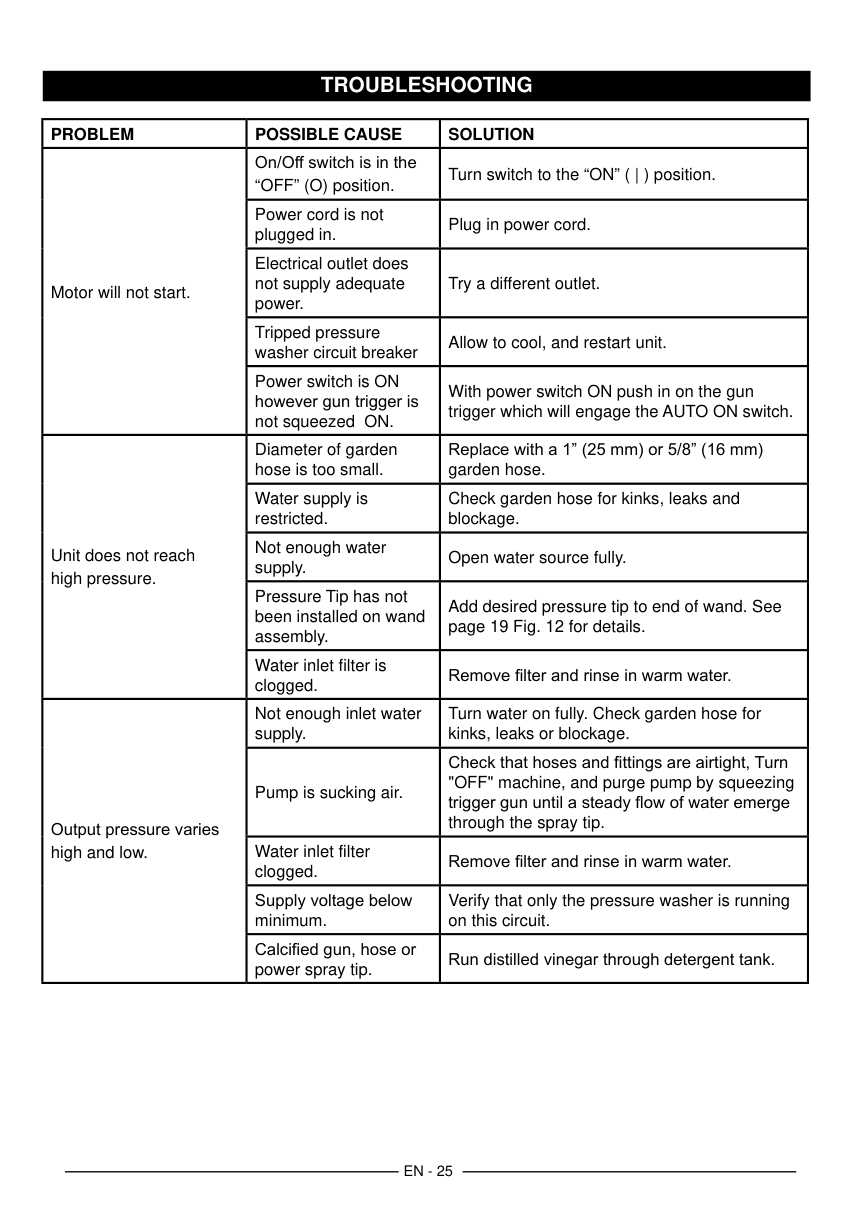
Fig. 17-2
| | | |---|---| | | | | | |
| | | |---|---| | | |
| | | |---|---| | | | | | | | | |
Crank Handle
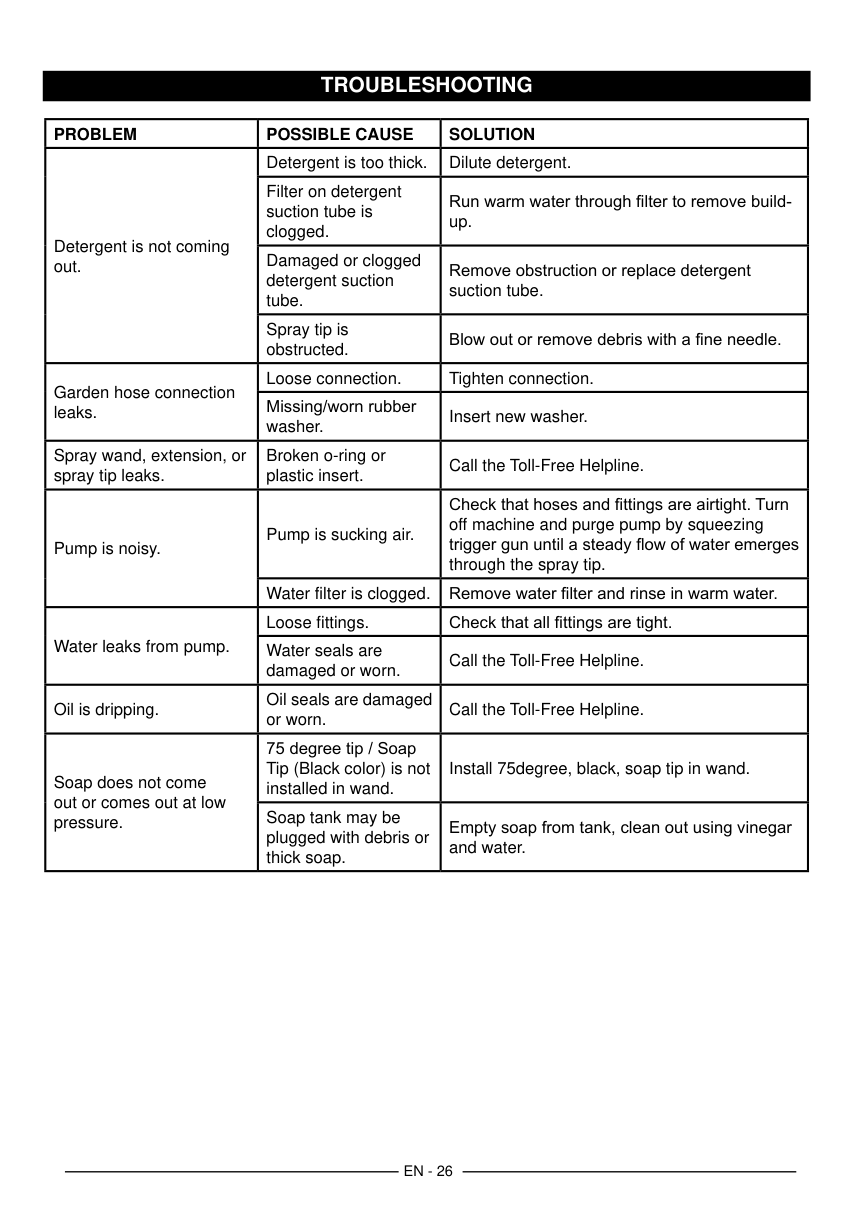
| | | | | | | | | | | | | | | | | |---|---|---|---|---|---|---|---|---|---|---|---|---|---|---|---| | | | | | | | | | | | | | | | | |
Fig. 17-3
QUICK WINTERIZING PROCEdURE If you cannot do the Optimum Winterizing procedure, you can still protect your pressure washer from winter damage by doing below:
C A U T I O N : Drain gun assembly of any remaining water. Aim gun downwards and squeeze trigger.
###### SHUTTING dOWN ANd CLEANING UP
I M P O R T A N T : The use of a pump protector is recommended when storing to help prevent a against freezing over the winter months. It also help prevent the seals from drying out while sitting in storage in all climates.
|PROBLEM|POSSIBLE CAUSE|SOLUTION| |---|---|---| |Motor will not start.|On/Off switch is in the “OFF” (O) position.|Turn switch to the “ON” ( | ) position.| |Motor will not start.|Power cord is not plugged in.|Plug in power cord.| |Motor will not start.|Electrical outlet does not supply adequate power.|Try a different outlet.| |Motor will not start.|Tripped pressure washer circuit breaker|Allow to cool, and restart unit.| |Motor will not start.|Power switch is ON however gun trigger is not squeezed ON.|With power switch ON push in on the gun trigger which will engage the AUTO ON switch.| |Unit does not reach high pressure.|Diameter of garden hose is too small.|Replace with a 1” (25 mm) or 5/8” (16 mm) garden hose.| |Unit does not reach high pressure.|Water supply is restricted.|Check garden hose for kinks, leaks and blockage.| |Unit does not reach high pressure.|Not enough water supply.|Open water source fully.| |Unit does not reach high pressure.|Pressure Tip has not been installed on wand assembly.|Add desired pressure tip to end of wand. See page 19 Fig. 12 for details.|
|Unit does not reach high pressure.|Water inlet filter is clogged.|Remove filter and rinse in warm water.| |Output pressure varies high and low.|Not enough inlet water supply.|Turn water on fully. Check garden hose for kinks, leaks or blockage.| |Output pressure varies high and low.|Pump is sucking air.|Check that hoses and fittings are airtight, Turn "OFF" machine, and purge pump by squeezing trigger gun until a steady flow of water emerge through the spray tip.| |Output pressure varies high and low.|Water inlet filter clogged.|Remove filter and rinse in warm water.| |Output pressure varies high and low.|Supply voltage below minimum.|Verify that only the pressure washer is running on this circuit.| |Output pressure varies high and low.|Calcified gun, hose or power spray tip.|Run distilled vinegar through detergent tank.|
|PROBLEM|POSSIBLE CAUSE|SOLUTION| |---|---|---| |Detergent is not coming out.|Detergent is too thick.|Dilute detergent.| |Detergent is not coming out.|Filter on detergent suction tube is clogged.|Run warm water through filter to remove buildup.| |Detergent is not coming out.|Damaged or clogged detergent suction tube.|Remove obstruction or replace detergent suction tube.| |Detergent is not coming out.|Spray tip is obstructed.|Blow out or remove debris with a fine needle.| |Garden hose connection leaks.|Loose connection.|Tighten connection.| |Garden hose connection leaks.|Missing/worn rubber washer.|Insert new washer.| |Spray wand, extension, or spray tip leaks.|Broken o-ring or plastic insert.|Call the Toll-Free Helpline.| |Pump is noisy.|Pump is sucking air.|Check that hoses and fittings are airtight. Turn off machine and purge pump by squeezing trigger gun until a steady flow of water emerges through the spray tip.| |Pump is noisy.|Water filter is clogged.|Remove water filter and rinse in warm water.| |Water leaks from pump.|Loose fittings.|Check that all fittings are tight.| |Water leaks from pump.|Water seals are damaged or worn.|Call the Toll-Free Helpline.| |Oil is dripping.|Oil seals are damaged or worn.|Call the Toll-Free Helpline.|
|Soap does not come out or comes out at low pressure.|75 degree tip / Soap Tip (Black color) is not installed in wand.|Install 75degree, black, soap tip in wand.| |Soap does not come out or comes out at low pressure.|Soap tank may be plugged with debris or thick soap.|Empty soap from tank, clean out using vinegar and water.|
|PROBLEM|POSSIBLE CAUSE|SOLUTION| |---|---|---| |Motor buzzes but fails to run.|Supply voltage below minimum.|Verify that only the pressure washer is running on this circuit.| |Motor buzzes but fails to run.|System has residual pressure.|Turn unit “OFF”, squeeze trigger on spray wand to release pressure, then turn unit "ON".| |Motor buzzes but fails to run.|Voltage loss due to extension cord.|Unplug any extension cords attached and plug the unit directly into the outlet.| |Motor buzzes but fails to run.|Pressure washer not used for long periods.|Call the Toll-Free Helpline.| |Motor buzzes but fails to run.|Residual friction among components. Unit might hum.|Disconnect water supply and power ON for 2 to 3 seconds, repeat couple times or until the motor starts.| |No water.|Water supply is OFF.|Turn ON water supply.| |No water.|Kink in the garden hose.|Remove kink in garden hose.|
###### NOTE: AUTO ON/OFF SWITCH: This Pressure washer is equipped with an Auto Start/ Stop feature. To operate: Press power switch On (I). Pump will pressurize and shut down immediately. Once the trigger of the gun is depressed the unit will turn on. Unit will shut off and be in standby mode when trigger is released.
##### WARRANTY
GREENWORKS™ hereby warranties this product, to the original purchaser with proof of purchase, for a period of one (1) years against defects in materials, parts or workmanship. GREENWORKS™, at its own discretion will repair or replace any and all parts found to be defective, through normal use, free of charge to the customer. This warranty is valid only for units which have been used for personal use that have not been hired or rented for industrial/ commercial use, and that have been maintained in accordance with the instructions in the owners’ manual supplied with the product from new.
####### ITEMS NOT COVEREd BY WARRANTY:
GREENWORKS HELPLINE (1-888-90WORKS): Warranty service is available by calling our toll-free helpline, at 1-888-909-6757 (1-888-90WORKS). Order Replacement parts online @ www.greenworkstools.com.
####### TRANSPORTATION CHARGES:
Transportation charges for the movement of any power equipment unit or attachment are the responsibility of the purchaser. It is the purchaser’s responsibility to pay transportation charges for any part submitted for replacement under this warranty unless such return is requested in writing by GREENWORKS.
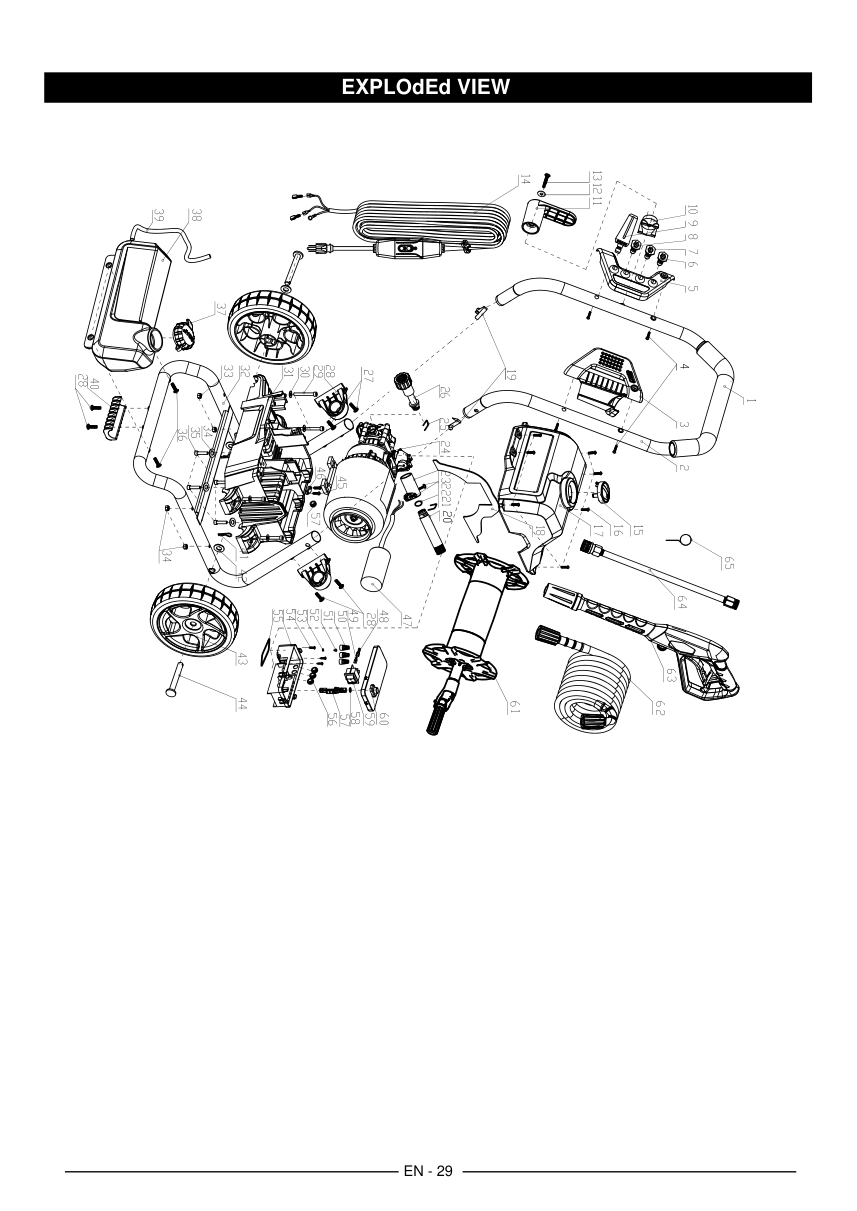
##### EXPLOdEd VIEW
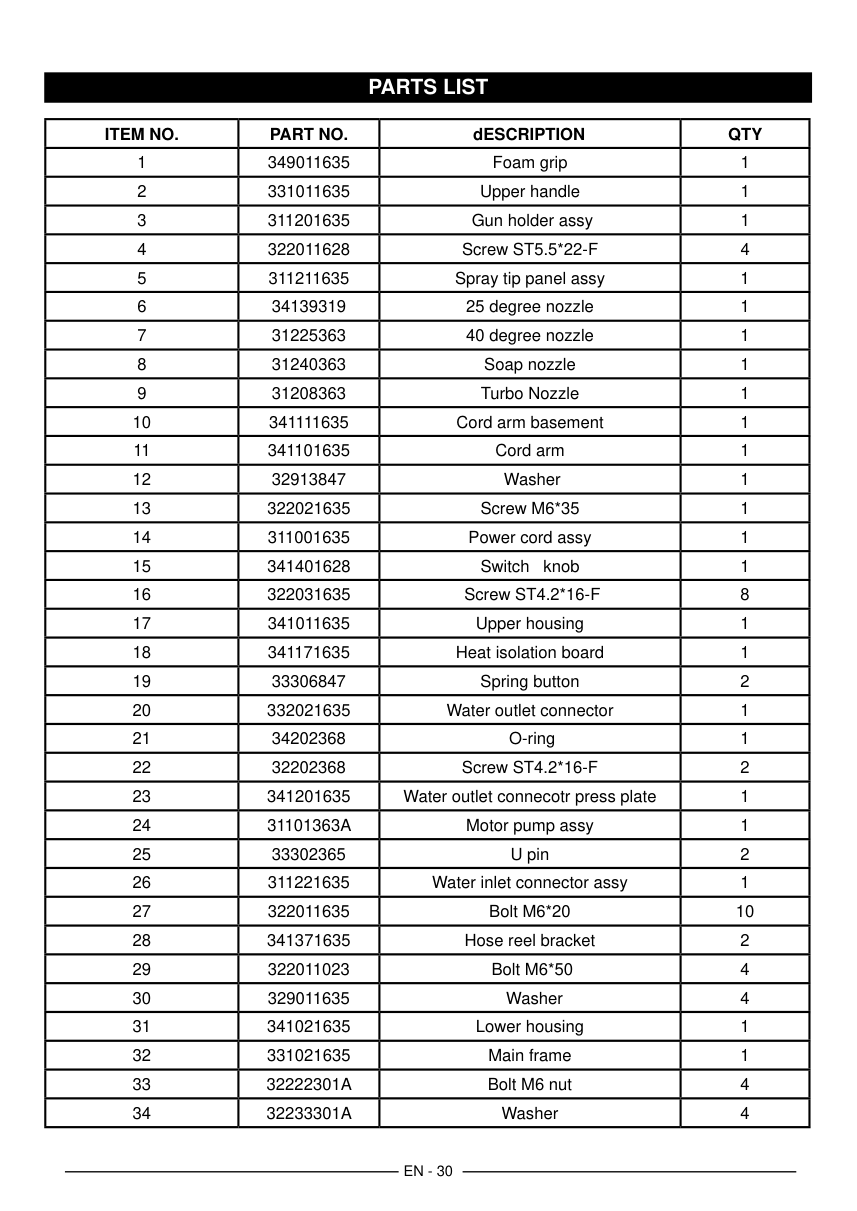
|ITEM NO.|PART NO.|dESCRIPTION|QTY| |---|---|---|---| |1|349011635|Foam grip|1| |2|331011635|Upper handle|1| |3|311201635|Gun holder assy|1| |4|322011628|Screw ST5.5*22-F|4|
|5|311211635|Spray tip panel assy|1| |6|34139319|25 degree nozzle|1| |7|31225363|40 degree nozzle|1| |8|31240363|Soap nozzle|1| |9|31208363|Turbo Nozzle|1| |10|341111635|Cord arm basement|1| |11|341101635|Cord arm|1| |12|32913847|Washer|1| |13|322021635|Screw M6*35|1| |14|311001635|Power cord assy|1| |15|341401628|Switch knob|1| |16|322031635|Screw ST4.2*16-F|8| |17|341011635|Upper housing|1| |18|341171635|Heat isolation board|1| |19|33306847|Spring button|2| |20|332021635|Water outlet connector|1| |21|34202368|O-ring|1| |22|32202368|Screw ST4.2*16-F|2| |23|341201635|Water outlet connecotr press plate|1| |24|31101363A|Motor pump assy|1| |25|33302365|U pin|2| |26|311221635|Water inlet connector assy|1|

|27|322011635|Bolt M6*20|10| |28|341371635|Hose reel bracket|2| |29|322011023|Bolt M6*50|4| |30|329011635|Washer|4| |31|341021635|Lower housing|1| |32|331021635|Main frame|1| |33|32222301A|Bolt M6 nut|4| |34|32233301A|Washer|4|
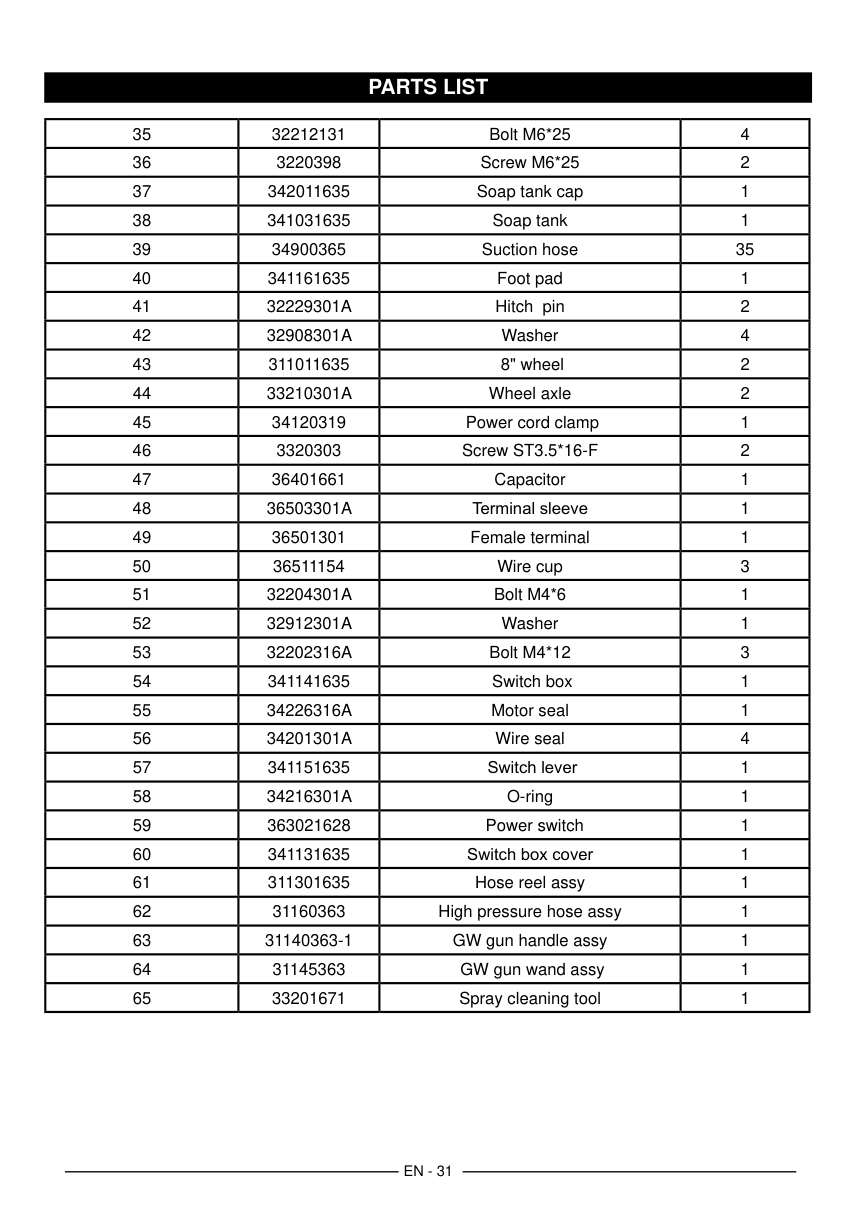
|35|32212131|Bolt M6*25|4| |---|---|---|---| |36|3220398|Screw M6*25|2| |37|342011635|Soap tank cap|1| |38|341031635|Soap tank|1| |39|34900365|Suction hose|35| |40|341161635|Foot pad|1| |41|32229301A|Hitch pin|2| |42|32908301A|Washer|4| |43|311011635|8" wheel|2| |44|33210301A|Wheel axle|2| |45|34120319|Power cord clamp|1| |46|3320303|Screw ST3.5*16-F|2| |47|36401661|Capacitor|1| |48|36503301A|Terminal sleeve|1| |49|36501301|Female terminal|1| |50|36511154|Wire cup|3| |51|32204301A|Bolt M4*6|1| |52|32912301A|Washer|1| |53|32202316A|Bolt M4*12|3| |54|341141635|Switch box|1| |55|34226316A|Motor seal|1| |56|34201301A|Wire seal|4| |57|341151635|Switch lever|1| |58|34216301A|O-ring|1| |59|363021628|Power switch|1| |60|341131635|Switch box cover|1| |61|311301635|Hose reel assy|1| |62|31160363|High pressure hose assy|1| |63|31140363-1|GW gun handle assy|1| |64|31145363|GW gun wand assy|1| |65|33201671|Spray cleaning tool|1|