
Tecno Kg7 Spark 8 Series Smartphone With 5000mah Battery
Ask AI
— answers from the official manualAnswers from the official manual.
Common questions
Common Questions
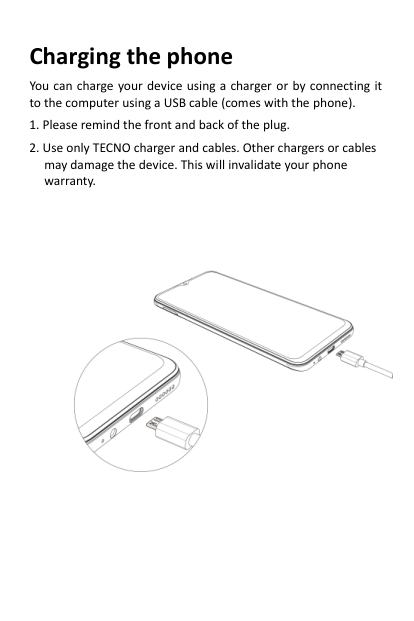
7 totalWhat do I need to do before inserting SIM cards into my Tecno KG7 Spark 8 Series?
Ensure the device is powered off before installing SIM cards. Follow the diagram provided in the manual for correct installation (Page 5).
How do I safely charge my Tecno KG7 Spark 8 Series phone?
Use only TECNO chargers and cables to avoid damaging your device. Charging with unauthorized accessories can invalidate the warranty (Page 6).
What should I do if my Tecno KG7 Spark 8 Series phone causes interference with radio or TV?
Reorient or relocate the receiving antenna, increase separation between your device and receiver, connect to a different outlet circuit. Consult a specialist for further solutions (Page 8).
What is the Specific Absorption Rate (SAR) of my phone when used at the ear?
The highest measured SAR value when your Tecno KG7 Spark 8 Series phone is used at the ear is 1.334 W/kg, well within FCC limits (Page 9).
What safety precaution should I follow if wearing my phone against my body?
Maintain a minimum separation distance of 10mm between the user's body and the handset to comply with RF exposure requirements. Use only non-metallic accessories (Page 9).
Where can I find details about FCC compliance for my phone?
Search on http://www.fcc.gov/oet/fc-id after looking up the specific equipment identification number, which is FCC ID: 2ADYY-KG7 (Page 9).
Show 1 more questions
Full Manual
9 pages
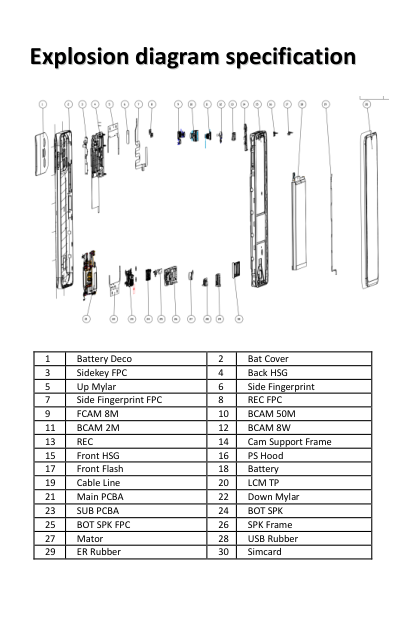
Explosion diagram specification

|1|Battery Deco|2|Bat Cover| |---|---|---|---| |3|Sidekey FPC|4|Back HSG| |5|Up Mylar|6|Side Fingerprint| |7|Side Fingerprint FPC|8|REC FPC|

|9|FCAM 8M|10|BCAM 50M| |11|BCAM 2M|12|BCAM 8W| |13|REC|14|Cam Support Frame| |15|Front HSG|16|PS Hood| |17|Front Flash|18|Battery| |19|Cable Line|20|LCM TP| |21|Main PCBA|22|Down Mylar| |23|SUB PCBA|24|BOT SPK| |25|BOT SPK FPC|26|SPK Frame|

|27|Mator|28|USB Rubber| |29|ER Rubber|30|Simcard|
Know your phone

SIM/SD card installation
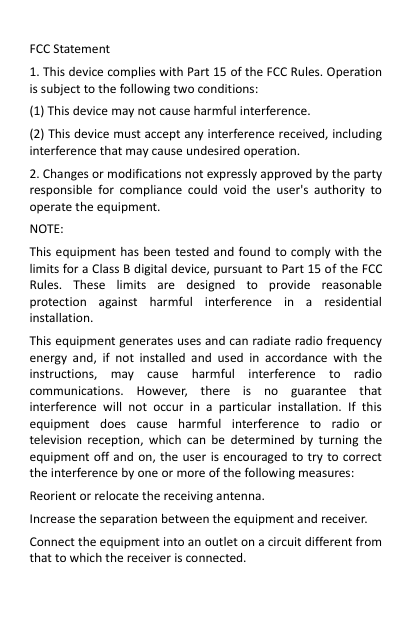

Charging the phone
You can charge your device using a charger or by connecting it to the computer using a USB cable (comes with the phone).

FCC Statement
This equipment has been tested and found to comply with the limits for a Class B digital device, pursuant to Part 15 of the FCC Rules. These limits are designed to provide reasonable protection against harmful interference in a residential installation.

This equipment generates uses and can radiate radio frequency energy and, if not installed and used in accordance with the instructions, may cause harmful interference to radio communications. However, there is no guarantee that interference will not occur in a particular installation. If this equipment does cause harmful interference to radio or television reception, which can be determined by turning the equipment off and on, the user is encouraged to try to correct the interference by one or more of the following measures:
Reorient or relocate the receiving antenna. Increase the separation between the equipment and receiver. Connect the equipment into an outlet on a circuit different from that to which the receiver is connected.
Consult the dealer or an experienced radio/TV technician for help.
SAR Information Statement
Your wireless phone is a radio transmitter and receiver. It is designed and manufactured not to exceed the emission limits for exposure to radiofrequency (RF) energy set by the Federal Communications Commission of the U.S. Government. These limits are part of comprehensive guidelines and establish permitted levels of RF energy for the general population. The guidelines are based on standards that were developed by independent scientific organizations through periodic and thorough evaluation of scientific studies. The standards include a substantial safety margin designed to assure the safety of all persons, regardless of age and health. The exposure standard for wireless mobile phones employs a unit of measurement known as the Specific Absorption Rate, or SAR. The SAR limit set by the FCC is 1.6 W/kg. * Tests for SAR are conducted with the phone transmitting at its highest certified power level in all tested frequency bands. Although the SAR is determined at the highest certified power level, the actual SAR level of the phone while operating can be well below the maximum value. This is because the phone is designed to operate at multiple power levels so as to use only the power required to reach the network. In general, the closer you are to a wireless base station antenna, the lower the power output. Before a phone model is available for sale to the public, it must be tested and certified to the FCC that it does not exceed the limit established by the government adopted requirement for safe exposure. The tests are performed in positions and locations (e.g., at the ear and worn on the body) as required by the FCC for each model. The highest

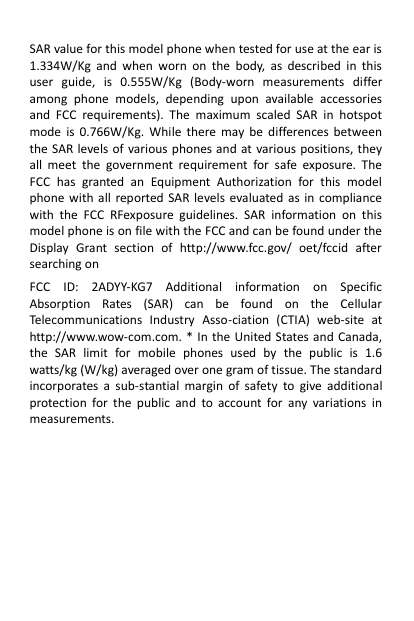
SAR value for this model phone when tested for use at the ear is 1.334W/Kg and when worn on the body, as described in this user guide, is 0.555W/Kg (Body-worn measurements differ among phone models, depending upon available accessories and FCC requirements). The maximum scaled SAR in hotspot mode is 0.766W/Kg. While there may be differences between the SAR levels of various phones and at various positions, they all meet the government requirement for safe exposure. The FCC has granted an Equipment Authorization for this model phone with all reported SAR levels evaluated as in compliance with the FCC RFexposure guidelines. SAR information on this model phone is on file with the FCC and can be found under the Display Grant section of http://www.fcc.gov/ oet/fccid after searching on
FCC ID: 2ADYY-KG7 Additional information on Specific Absorption Rates (SAR) can be found on the Cellular Telecommunications Industry Asso-ciation (CTIA) web-site at http://www.wow-com.com. * In the United States and Canada, the SAR limit for mobile phones used by the public is 1.6 watts/kg (W/kg) averaged over one gram of tissue. The standard incorporates a sub-stantial margin of safety to give additional protection for the public and to account for any variations in measurements.
Body-worn Operation
This device was tested for typical body-worn operations. To comply with RF exposure requirements, a minimum separation distance
of 10mm must be maintained between the user’s body and the handset, including the antenna. Third-party belt-clips, holsters,
and similar accessories used by this device should not contain any metallic components. Body-worn accessories that do not meet these requirements may not comply with RF exposure requirements and should be avoided. Use only the supplied or an approved antenna.
