
Ask AI
— answers from the official manualAnswers from the official manual.
Common questions
Common Questions
9 totalCan I use my QC20 headphones on iPhones?
The basic audio playback and answer/end functionality will work for iPhones, but additional controls such as track navigation and volume adjustment will not function due to the headphone's compatibility limitations.
How does Aware mode work?
Aware mode uses a microphone inside the earbud to pick up ambient sounds and send them to the user’s ear, allowing them to hear their surroundings while still listening to audio. It maintains minimal noise reduction for background noises.
What is TriPort technology?
TriPort® technology utilizes external ports to vent the earbuds and effectively enlarge the acoustic volume, providing better audio quality and active noise reduction from a smaller, lighter headphone.
What does full-spectrum noise reduction mean?
Full-spectrum noise reduction means that the headphones reduce unwanted noise across the entire audible frequency range, similar to all keys on a piano keyboard, rather than just at certain frequencies.
What happens when I plug my QC20i headphones into an older Apple device?
Plugging these headphones into an older Apple product will still allow basic audio playback but volume control may not work and the answer/end button’s effect has not been determined.
How do I charge the QC20 and 20i headphones?
To charge these headphones, plug the micro-USB end of the provided cable into the connector on the control module. The USB end can be plugged directly into a computer or into a wall charger for charging from an electrical outlet. Charging takes up to two hours; during this time, the power status indicator will flash amber.
Full Manual
15 pages
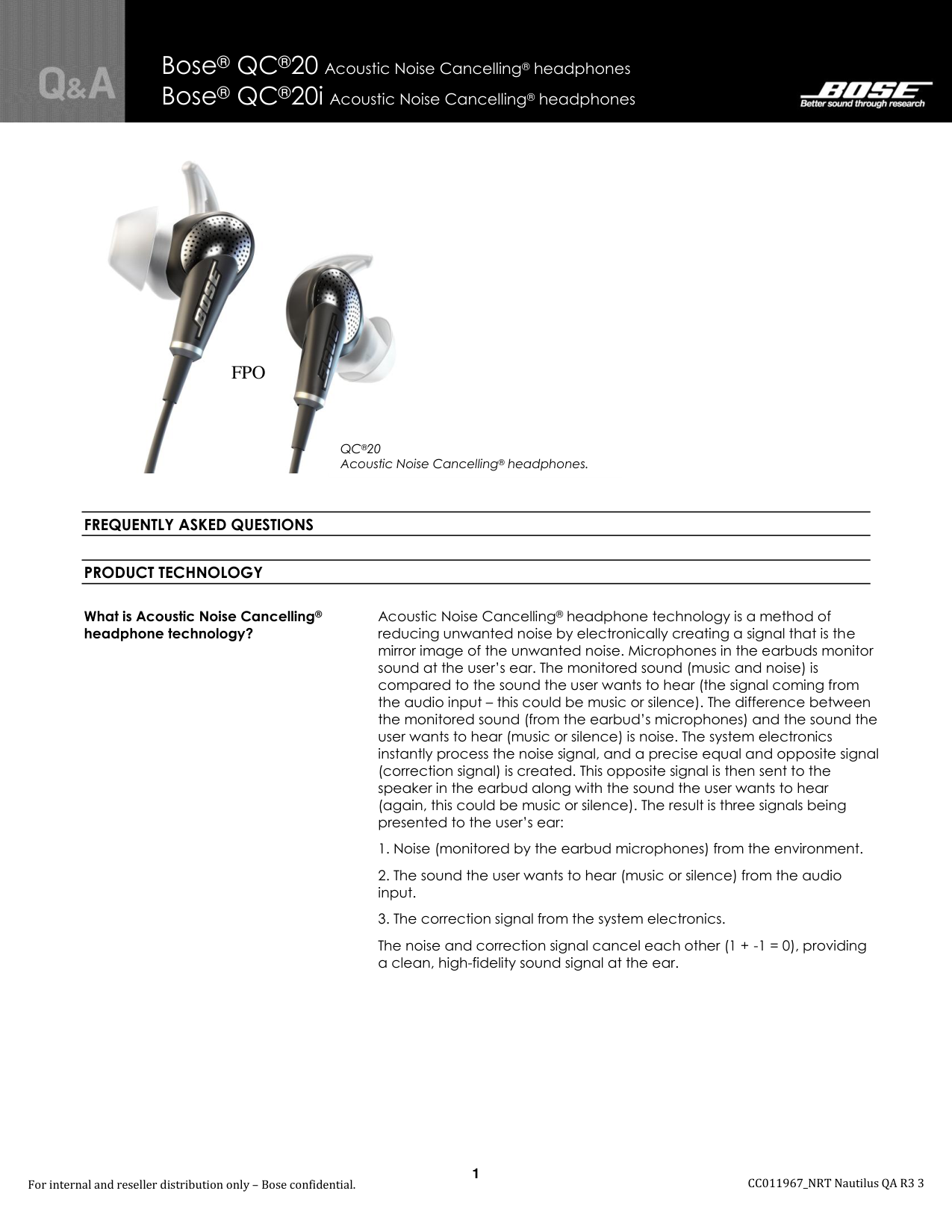

FPO
|QC®20 Acoustic Noise Cancelling® headphones.| |---|
FREQUENTLY ASKED QUESTIONS
PRODUCT TECHNOLOGY
What is Acoustic Noise Cancelling® headphone technology?
Acoustic Noise Cancelling® headphone technology is a method of reducing unwanted noise by electronically creating a signal that is the mirror image of the unwanted noise. Microphones in the earbuds monitor sound at the user’s ear. The monitored sound (music and noise) is compared to the sound the user wants to hear (the signal coming from the audio input – this could be music or silence). The difference between the monitored sound (from the earbud’s microphones) and the sound the user wants to hear (music or silence) is noise. The system electronics instantly process the noise signal, and a precise equal and opposite signal (correction signal) is created. This opposite signal is then sent to the speaker in the earbud along with the sound the user wants to hear (again, this could be music or silence). The result is three signals being presented to the user’s ear:
The noise and correction signal cancel each other (1 + -1 = 0), providing a clean, high-fidelity sound signal at the ear.
How is the total noise cancellation in these headphones achieved?
The QC®20 and 20i headphones utilize both active and passive noise reduction technologies. They use a sophisticated proprietary electronics approach to active noise reduction, placing microphones both inside and outside the earbud. The electronics system senses the sound in almost any environment and then measures, compares and reacts – instant by instant – to produce an opposing cancellation signal. New, patented tip technology from Bose creates a gentle seal at the entrance to the ear canal that enables full-spectrum noise reduction.
What is Aware mode? In Aware mode, Bose® proprietary technology uses one of the microphones within the earbud to pick up surrounding sounds and send them to the user’s ear. This makes it possible for the user to hear what is going on around them while still listening to their audio. At the same time, Aware mode enhances the listening experience by maintaining a minimal amount of noise reduction to block certain background noises while still allowing the user to be aware of most ambient sounds.
Are you always able to hear your surroundings in Aware mode?
As with any headphone, the signal from the audio source can dominate the ability to hear your surroundings. If the source volume is at a moderate level, Aware mode will provide the user with the ability to hear their surroundings.
What is TriPort® headphone technology?
Proprietary TriPort® headphone technology utilizes external ports to vent the earbuds and effectively enlarge the acoustic volume, while maintaining a small size. The result is better audio and active noise reduction from a smaller, lighter, more comfortable headphone. TriPort headphone technology is used in all of our consumer headphones.
What is Active EQ? Active EQ (equalization) involves electronically tuning the frequency response to closely match the proprietary Bose® audio target for headphones. The closer the frequency response comes to matching the target curve, the more lifelike the audio performance.
What is unpowered audio? The QC®20 and 20i headphones are still able to play audio if the battery power is depleted or when the unit is powered off. Note: power is required for Noise Cancelling and Aware modes to operate.
What is full-spectrum noise reduction? Think of a piano keyboard as the full spectrum of human hearing, from the low notes at one end, to the midrange notes in the middle, to the high notes at the opposite end. Through a combination of advanced active electronics and passive attenuation, the QC®20 and 20i headphones reduce noise across the full range of human hearing (all of the keys on the keyboard). Other noise reduction headphones may be effective at only some frequencies (only some of the keys on the full keyboard).
What is electronic noise floor? Noise floor is the electronic “hiss” that may be heard when listening to noise reduction headphones in a quiet environment. The QC®20 and 20i headphones use sophisticated electronic circuitry to minimize noise floor.
Why do QC®20 and 20i Acoustic Noise Cancelling® headphones use digital technology when previous Bose® QuietComfort® headphones did not?
We make conscious decisions about which technology is used in each of our products. In order to create a small-sized, in-ear Acoustic Noise Cancelling® headphone with Bose® noise reduction, we used an advanced digital electronic chip. It allows the circuit board to be much smaller, because we are able to use fewer electronic components than before. To reduce noise cancellation to a single digital chip, the analog outputs of microphones must be converted into digital signals. In the past, converting these signals with the precision needed for high fidelity and low noise floor added delay, which compromised performance by slowing the ability to quickly react to noise. The new technology in QC®20 and 20i headphones reduces this delay to negligible levels, allowing these small in-ear headphones to offer noise reduction rivaling any fullsized headphone.
GENERAL PRODUCT INFORMATION
What are the QC®20 and 20i Acoustic Noise Cancelling® headphones?
The QC®20 and 20i headphones are the first in-ear noise cancelling headphones from Bose, and have been designed to let the user enjoy their music wherever they go. They deliver an unexpected level of audio performance and noise reduction, yet are small enough to fit in a pocket. These headphones are the most versatile headphones Bose makes, giving the user the option to enjoy a fully immersive musical experience or enabling them to hear their surroundings while still enjoying their music. As with other QuietComfort® headphones, these in-ear headphones are also ideal for air travel, providing noise reduction while maintaining our acclaimed audio quality and comfortable fit.
What is the difference between the QC®20 and 20i Acoustic Noise Cancelling® headphones?
Both the QC®20 and 20i headphones can be used to listen to audio from a variety of sources.
The QC20 headphones are specifically designed to work with most Android™, Windows® and BlackBerry® smartphones. An inline microphone and one-touch answer/end button allow for seamless switching between your calls and music. Some phones may require you to hold the answer/end button for a few seconds to perform these functions.
The QC20i headphones incorporate an inline microphone and threebutton remote that provide more functionality with select Apple products. With the inline remote control you can adjust volume, play/pause tracks, skip forward/back on tracks, fast-forward or rewind within tracks and change playlists. Depending on your Apple product, you also may be able to answer/end phone calls, switch between calls, and decline an incoming call. The microphone supports mobile communications, and you can access certain voice applications, such as VoiceOver or Voice Control, where available.
How much noise do the QC®20 and 20i Acoustic Noise Cancelling® headphones cancel when in Noise Cancelling mode?
It is difficult to establish one number that is valid for all the different environments and situations where the headphones can be used. The headphones will reduce unwanted noise to a level that is noticeably more comfortable when compared to the same situation without using the headphones. We encourage consumers to try it for themselves in a variety of situations, both with and without an external audio source.
What type of sound quality do the QC®20 and 20i Acoustic Noise Cancelling® headphones provide when in Noise Cancelling and Aware modes?
When powered, Active EQ, TriPort® headphone technology and low noise floor enable QC®20 and 20i headphones to achieve high standards in headphone audio performance. Active EQ enhances the clarity throughout the entire spectrum of sound for lifelike audio reproduction, while the combination of the seal created by the tips and TriPort headphone technology structure fosters an accurate bass response not commonly found in such small headphones.
Can you listen to music when the battery runs down? What type of sound quality do the QC®20 and 20i Acoustic Noise Cancelling® headphones provide when listening to audio when unpowered?
These headphones allow users to continue to listen to their source even if the battery power is depleted. Without power, the combination of the seal created by the tips and TriPort® headphone technology continues to foster a bass response not commonly found in such small headphones, but neither active noise cancellation nor Active EQ are able to function. Audio performance in the unpowered state is similar to that of Bose® audio headphones (such as the Bose IE2 audio headphones).
How comfortable are the QC®20 and 20i Acoustic Noise Cancelling® headphones?
These headphones were designed to maximize all of the features that contribute to user comfort, especially when using the headphones for extended periods of time. The StayHear®+ tips are designed for improved in-ear stability and a lasting, comfortable fit; they spread contact evenly across your ears and conform naturally to their shape. The tips come in S, M and L sizes so you can select the size that fits best.
What is the warranty on the QC®20 and 20i Acoustic Noise Cancelling® headphones?
The limited warranty on these headphones is one year in the U.S. Additional details are furnished on the warranty card that is included with the headphones.
Do the QC®20 and 20i Acoustic Noise Cancelling® headphones come with the 30-day return policy?
Yes. In North America and some international markets, these headphones are covered by a 30-day return policy.
PRODUCT COST
How much do the QC®20 and 20i Acoustic Noise Cancelling® headphones cost?
The QC®20 headphones cost $299.95. The QC®20i headphones cost $299.95.
Why are the QC®20 and 20i Acoustic Noise Cancelling® headphones more expensive than other headphones?
One of the reasons Bose Corporation has been successful is because our founder and chairman, Dr. Amar Bose, established a company that is committed to producing nothing but the very best products. When comparing prices, you must compare performance. Using numerous U.S. patents and building on decades of research, the QC®20 and 20i headphones grant the user a superior in-ear headphone experience.
We offer a 30-day return policy to give you the opportunity to try them and compare the noise reduction, audio performance, comfort and convenience for yourself. We recognize that some consumers will choose to purchase less-costly products. However, we also know that when consumers are looking for the best in terms of performance and quality, Bose products not only deliver, but they also do so at a great value.
How much is the shipping and handling? Standard shipping and handling costs may vary according to sales
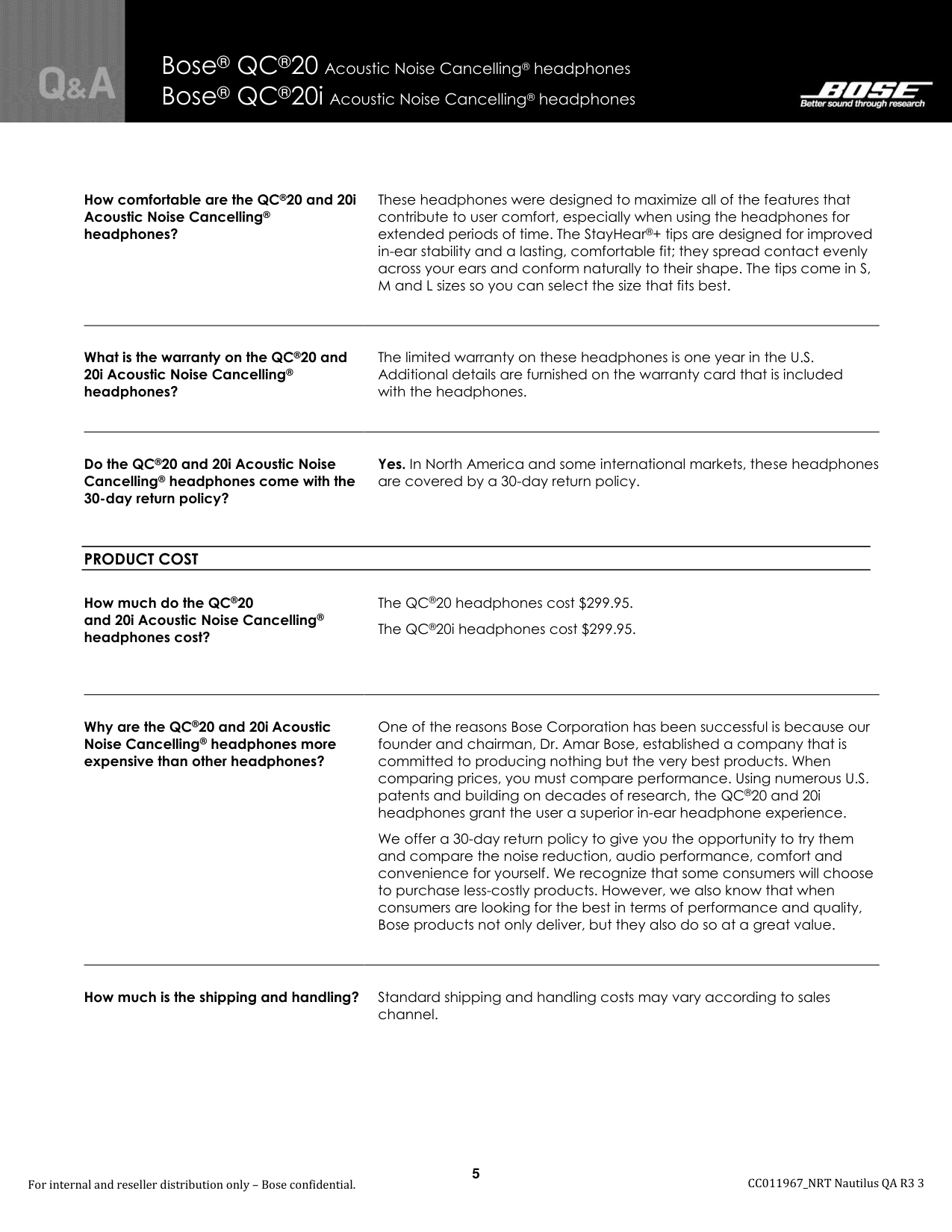
channel.
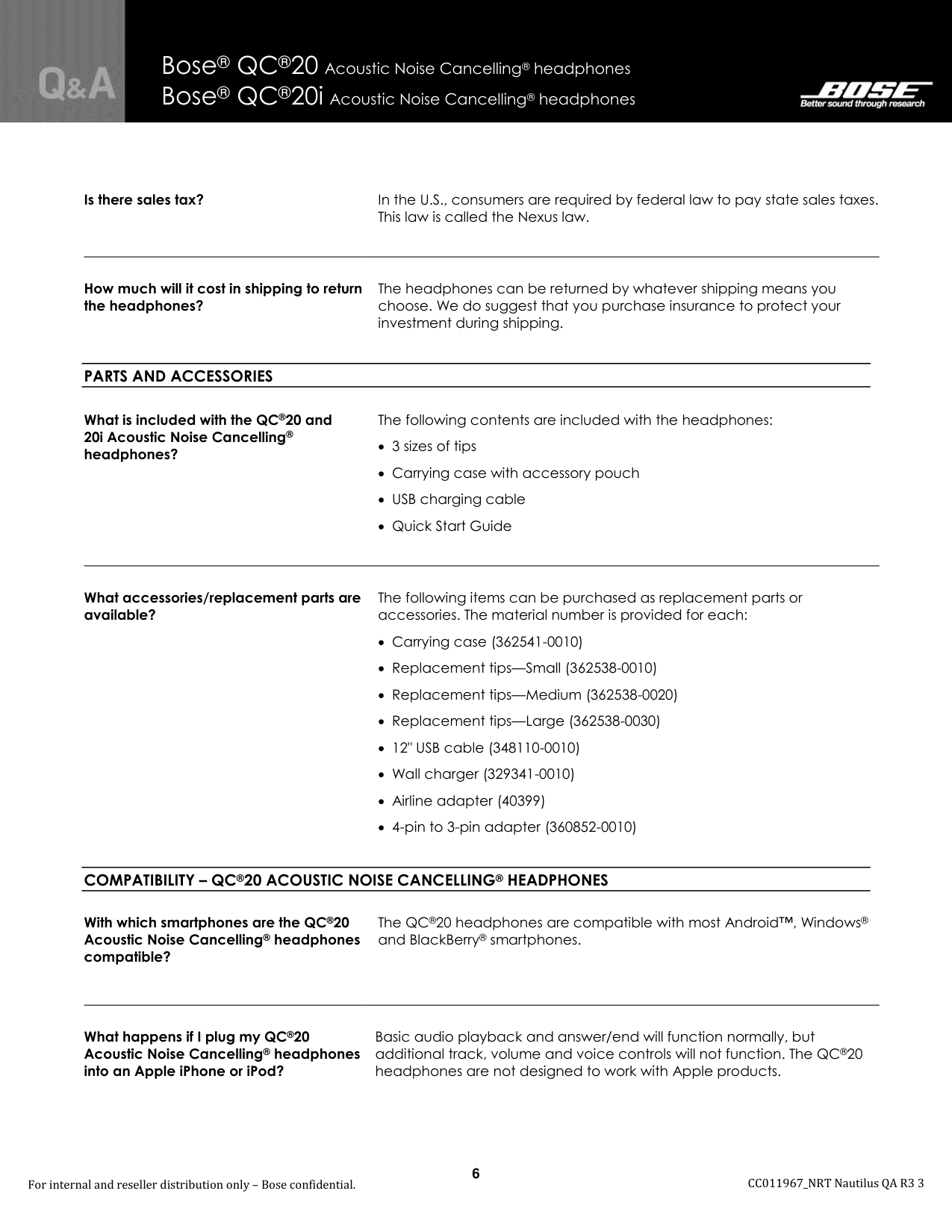
Is there sales tax? In the U.S., consumers are required by federal law to pay state sales taxes. This law is called the Nexus law.
How much will it cost in shipping to return the headphones?
The headphones can be returned by whatever shipping means you choose. We do suggest that you purchase insurance to protect your investment during shipping.
PARTS AND ACCESSORIES
What is included with the QC®20 and 20i Acoustic Noise Cancelling® headphones?
The following contents are included with the headphones:
What accessories/replacement parts are available?
The following items can be purchased as replacement parts or accessories. The material number is provided for each:
COMPATIBILITY – QC®20 ACOUSTIC NOISE CANCELLING® HEADPHONES
With which smartphones are the QC®20 Acoustic Noise Cancelling® headphones compatible?
The QC®20 headphones are compatible with most Android™, Windows® and BlackBerry® smartphones.
What happens if I plug my QC®20 Acoustic Noise Cancelling® headphones into an Apple iPhone or iPod?
Basic audio playback and answer/end will function normally, but additional track, volume and voice controls will not function. The QC®20 headphones are not designed to work with Apple products.
How would I know if a mobile phone was not compatible with my QC®20 Acoustic Noise Cancelling® headphones?
The QC®20 headphones are compatible with many Android™, Windows® and BlackBerry® smartphones. If you are able to plug in the headphones, but experience any of the following situations, the headphones might not be compatible with your phone:
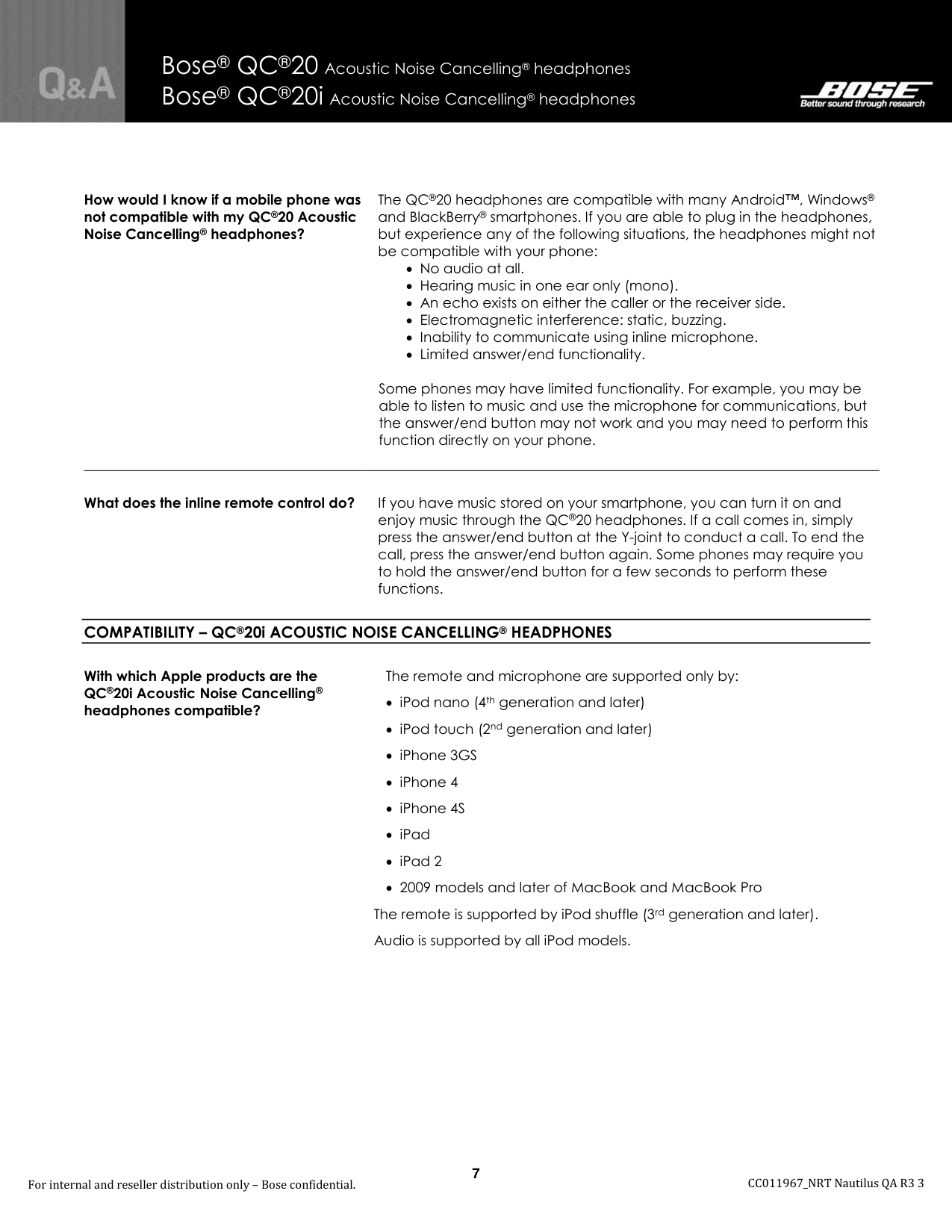
Some phones may have limited functionality. For example, you may be able to listen to music and use the microphone for communications, but the answer/end button may not work and you may need to perform this function directly on your phone.
What does the inline remote control do? If you have music stored on your smartphone, you can turn it on and enjoy music through the QC®20 headphones. If a call comes in, simply press the answer/end button at the Y-joint to conduct a call. To end the call, press the answer/end button again. Some phones may require you to hold the answer/end button for a few seconds to perform these functions.
COMPATIBILITY – QC®20i ACOUSTIC NOISE CANCELLING® HEADPHONES
With which Apple products are the QC®20i Acoustic Noise Cancelling® headphones compatible?
The remote and microphone are supported only by:
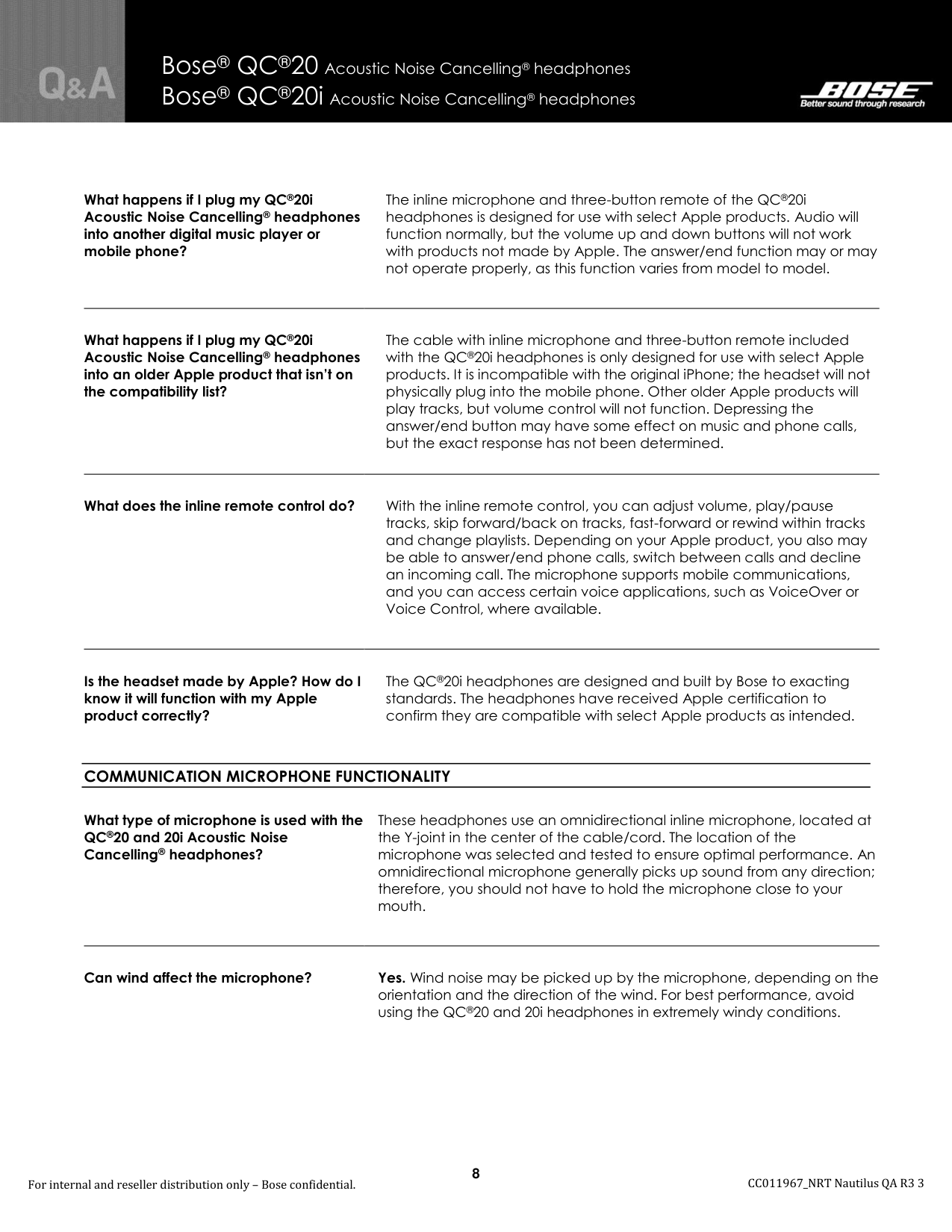
The remote is supported by iPod shuffle (3rd generation and later). Audio is supported by all iPod models.
What happens if I plug my QC®20i Acoustic Noise Cancelling® headphones into another digital music player or mobile phone?
The inline microphone and three-button remote of the QC®20i headphones is designed for use with select Apple products. Audio will function normally, but the volume up and down buttons will not work with products not made by Apple. The answer/end function may or may not operate properly, as this function varies from model to model.
What happens if I plug my QC®20i Acoustic Noise Cancelling® headphones into an older Apple product that isn’t on the compatibility list?
The cable with inline microphone and three-button remote included with the QC®20i headphones is only designed for use with select Apple products. It is incompatible with the original iPhone; the headset will not physically plug into the mobile phone. Other older Apple products will play tracks, but volume control will not function. Depressing the answer/end button may have some effect on music and phone calls, but the exact response has not been determined.
What does the inline remote control do? With the inline remote control, you can adjust volume, play/pause tracks, skip forward/back on tracks, fast-forward or rewind within tracks and change playlists. Depending on your Apple product, you also may be able to answer/end phone calls, switch between calls and decline an incoming call. The microphone supports mobile communications, and you can access certain voice applications, such as VoiceOver or Voice Control, where available.
Is the headset made by Apple? How do I know it will function with my Apple product correctly?
The QC®20i headphones are designed and built by Bose to exacting standards. The headphones have received Apple certification to confirm they are compatible with select Apple products as intended.
COMMUNICATION MICROPHONE FUNCTIONALITY
What type of microphone is used with the QC®20 and 20i Acoustic Noise Cancelling® headphones?
These headphones use an omnidirectional inline microphone, located at the Y-joint in the center of the cable/cord. The location of the microphone was selected and tested to ensure optimal performance. An omnidirectional microphone generally picks up sound from any direction; therefore, you should not have to hold the microphone close to your mouth.
Can wind affect the microphone? Yes. Wind noise may be picked up by the microphone, depending on the orientation and the direction of the wind. For best performance, avoid using the QC®20 and 20i headphones in extremely windy conditions.
BATTERY/CHARGING INFORMATION
How do I charge the QC®20 and 20i Acoustic Noise Cancelling® headphones? How long will they take to charge?
These headphones can be charged using the USB cable supplied in the box. Plug the micro-USB end of the cable into the connector on the control module. The USB end of the cable can be plugged directly into a computer, or it can be plugged into a USB wall charger to allow charging from an electrical outlet (like the charger that comes with the Apple iPhone). Allow up to two hours for the headset to fully charge. While charging, the power status indicator will flash amber. Once fully charged, the power status indicator light will turn solid green.
What is the typical battery life per charge?
The battery will provide up to 16 hours of use per charge.
How do I know how many hours of battery life are remaining?
The power status indicator light on the control box will be solid green until there is approximately 3 hours of battery life remaining. At that point, the light will begin flashing green. When the light goes off, battery power has been fully depleted.
Can the battery in the QC®20 and 20i Acoustic Noise Cancelling® headphones be replaced?
No. The battery in the QC®20 and 20i headphones cannot be replaced.
STAYHEAR®+ TIPS
How are the StayHear®+ tips included with the QC®20 and 20i Acoustic Noise Cancelling® headphones different from the original Bose® StayHear tip?
The StayHear®+ tip is made of the same soft silicone material as the original StayHear tip, but it utilizes a unique umbrella shape to create a gentle seal at the entrance of the ear canal. This seal is the basis for both the total noise reduction and audio performance achieved by the QC®20 and 20i headphones.
Why are there three pairs of ear tips? Three different sizes of StayHear®+ tips are included so you can select the size most appropriate and most comfortable for you. You will have to experiment to find the best fit for your ears and may find that having a different size for each ear is most comfortable. Typically, most adults will prefer the medium-size tips.
How do I differentiate between the different sizes of StayHear®+ tips?
The StayHear®+ tips are color-coded. There is a small colored ring inside each tip that tells you what size it is.
How do the StayHear®+ tips provide a stable fit?
The StayHear®+ tips have an extended flexible wing that sits in the bowl of your ear. They use the ridge of your ear for support and provide significantly improved stability, while the soft material and rounded profile delivers a comfortable fit for long-term wear.
How are the StayHear®+ tips removed and replaced on the earbud?
The StayHear®+ tips will resist unintentional removal, but can be taken off by gently peeling up from the large rounded side, ideally near the bottom.
Caution: Do not pull from the tip wing to remove the tips, as this may damage them.
To put on another tip, make sure you match the tip to the correct side earpiece. The tips and the earpieces are marked L and R for your convenience. Slide the replacement tip over the nozzle of the headphone. Press the tip securely into place until you feel it latch. The ridge on the headphone housing should fit into the slot on the inside of the tip.
How do I put the earpieces in my ears? First, locate the L and the R on the headset, and match the StayHear®+ tips to their corresponding side. Insert the headphone with the opening toward your ear and the flexible wing pointing upward. The wing of the tip fits just under your ear ridge.
To put the tip in your ear:
The tips are designed to rest gently against the opening of the ear canal and sit comfortably yet securely in the bowl of the ear. They should be the only part of the headphones in contact with the ear.
How do I know that I have the headphone tips in my ears correctly with a proper fit?
The headphones come with three sizes of soft StayHear®+ tips. To ensure proper headphone performance, it is important that you find the appropriate tip size for your ear.
You should experiment with the different sizes of tips and assess the comfort and noise reduction performance of each. As a quick test, put both tips in your ears and speak aloud (with the headphone power off). Your voice should sound loud, yet muffled (as if your fingers were blocking your ears). Test until you find the size that best suits your ear size and gives you proper performance.
Can I wash the StayHear®+ tips? Will my StayHear+ tips change color or get dirty over time?
The StayHear®+ tips are made of a durable material that can be washed with a mild detergent and water, and dried as needed. Allow the ear tips to dry completely before reattaching them to the headset.
The StayHear+ tips should be very resistant to dirt or the effects of UV radiation, which typically cause some color change. With normal use, the appearance of the tips should remain unchanged through years of use.
Are the StayHear®+ tips compatible with other Bose® in-ear headphones?
No. The StayHear®+ tips are not compatible with other Bose® in-ear
headphones. They have been designed so they cannot attach to other in-ear headphones, to ensure proper performance of each headphone model.
PRODUCT FUNCTIONALITY/USAGE
Can I use the QC®20 and 20i Acoustic Noise Cancelling® headphones outside in the rain or snow?
These headphones are not designed for use in wet environments. It is important that no moisture be allowed to enter the earbuds or electronics box. If any water does get into the system, there may be serious damage to the headphones.
Can I use the QC®20 and 20i Acoustic Noise Cancelling® headphones to exercise?
These headphones were not specifically designed for use while exercising, like the Bose® SIE2 and SIE2i sport headphones.
Can I use the QC®20 and 20i Acoustic Noise Cancelling® headphones in my car?
In many regions, there are laws that prohibit using this type of headphone while operating a motor vehicle. However, passengers may enjoy using these headphones while riding in an automobile.
I am a pilot; can I use the QC®20 or 20i Acoustic Noise Cancelling® headphones to fly?
No. These headphones do not include features that would be required to meet the needs of pilots, nor do they meet FAA standards for aviation communication. The Bose® A20® Aviation Headset is designed exclusively to meet these needs. For further information on the Bose A20 Aviation Headset, contact Bose Corporation at 1-800-444-BOSE.
Can the QC®20 and 20i Acoustic Noise Cancelling® headphones be brought onboard an airline?
Yes. Just as you can bring your own digital music player or laptop computer onboard, you can bring your own personal headphones onboard. However, as with any electronic device, there are FAA restrictions on use during takeoff and landing. You are required to follow the directions of flight attendants throughout the flight.
Can I use the QC®20 and 20i Acoustic Noise Cancelling® headphones to watch an in-flight movie or listen to in-flight audio programming?
Yes. You can use these headphones to connect to the in-flight entertainment system that will allow you access to both the movie audio and music channels. Depending on the aircraft, you may choose to use the airline adapter accessory for greater volume control and/or a dual plug jack.
How are the headphones cleaned? The headphones do not require scheduled cleaning. However, if some cleaning is necessary, gently wipe the outside surfaces with a slightly moist cloth. Be careful not to allow any moisture to enter the headphones through the earbud ports. In addition, be certain not to force any dirt or debris into the ports. Do not blow air into or vacuum the earbud.
Are the headphones durable? Yes. In the U.S., these headphones carry a one-year limited warranty for defects in materials and workmanship. We recommend that you store the headphones in their carrying case when not in use for their protection.
Are the QC®20 and 20i Acoustic Noise Cancelling® headphones protected from electromagnetic interference (EMI)?
Certain wireless electrical devices, such as mobile phones and wireless computer networks, may cause some static interference with audio products. The interference depends on the specific device and the distance from the audio product.
The EMI shielding of the QC®20 and 20i headphones includes circuitry designed to minimize the potential for interference from wireless Internet networks or mobile phones. They have been tested and conform to all electromagnetic emission levels, safety and other directives/ specifications presently required by the Council of European Communities (CE).
PRODUCT DIFFERENTIATION
Do the QC®20 and 20i Acoustic Noise Cancelling® headphones reduce more noise than the QC15 and 3 Acoustic Noise Cancelling headphones?
The total noise attenuation of the QC®20 and 20i headphones is similar to that of the QC15 headphones, though the balance of active and passive noise reduction is different in each headphone. The QC20, 20i and 15 headphones provide more noise reduction than the QC3 headphones.
Do the QC®20 and 20i Acoustic Noise Cancelling® headphones deliver better audio reproduction than the QC15 and 3 Acoustic Noise Cancelling headphones?
The QC®20 and 20i headphones maintain the acclaimed audio performance of QC15 and 3 headphones, but in a smaller form factor.
Do the QC®20 and 20i Acoustic Noise Cancelling® headphones deliver better audio reproduction than the Bose® audio headphones?
When powered, the QC®20 and 20i headphones utilize an Active EQ that closely matches the proprietary Bose® audio target for headphones. Additionally, a combination of the seal created by the StayHear®+ tip and TriPort® headphone technology enable a bass response not commonly found in such small headphones. This provides better overall audio reproduction than Bose audio headphones.
When unpowered, the QuietComfort® 20 and 20i headphones utilize the combination of the seal created by the tip and proprietary TriPort headphone technology to deliver a bass response not common for small headphones. However, Active EQ is unable to function. Audio performance in this state is similar to that of Bose audio headphones (like the Bose IE2 audio headphones).
Are the QC®20 and 20i Acoustic Noise Cancelling® headphones the same as the Bose® aviation headsets?
No. Only our aviation headsets:
Are the QC®20 and 20i Acoustic Noise Cancelling® headphones appropriate for industrial use as a hearing-protection device?
No. These headphones were not designed for use in industrial situations requiring hearing protection. Tests that should be performed on such a product, such as making sure the product is not damaged by chemicals or solvents, have not been done. The audio cable could become tangled in machinery, posing a safety hazard. Finally, the noise reduction rating (NRR) as defined by the government cannot be measured for this product because the test method specified by law is generally recognized to be inaccurate when applied to active devices.
What are the noise reduction specifications? Is there an NRR rating?
Bose Corporation does not provide a noise reduction rating (NRR) or attenuation specification for our QC® headphones.
The 1970s-era NRR standard for rating industrial hearing-protection devices was developed long before active noise reduction headphones were commercially available. In fact, NRR, as defined by the government, cannot be determined for this product because the test method specified by law is generally recognized to be inaccurate when applied to active devices.
OTHER ISSUES
Will the QC®20 and 20i Acoustic Noise Cancelling® headphones help consumers that suffer from tinnitus, hyperacusis or autism?
Bose Corporation does not make any claims about relief of tinnitus, hyperacusis or autism, and we have not conducted any long-term clinical studies of the headphones’ effect on these conditions. Tinnitus, hyperacusis and autism are complex conditions that are not easily addressed. Some consumers have reported that the headphones improve their situation, but others have not experienced any improvement.
With the Bose Corporation 30-day, risk-free trial period, we can suggest consumers try the QC®20 or 20i headphones personally to see if they experience an improvement.
Can you get a pressure sensation when trying on noise reduction headphones?
Our QC® headphones, including the QC®20 and 20i headphones, cannot create any static pressure in the earbud. We infrequently receive reports from people who believe they are feeling such pressure. The only explanation we have is that the perceived sonic effect one hears when wearing any well-performing ANR headphone – where the lowfrequency sound in one’s environment is significantly reduced – also can be caused when one’s eardrums are under a pressure difference, which can happen in a fast-moving elevator or a descending airplane. Some people may associate this sound with a sense of pressure.
Airline travelers quickly learn to yawn or swallow to “pop” their ears when the world sounds like this, as the plane ascends or descends. The sonic effect of ANR, by reducing the low-frequency noise, can obscure this trigger we’ve all learned, and you may feel some discomfort if you don’t “pop” your ears soon enough to avoid any discomfort. The first time or two you fly with any of our QuietComfort® headphones, pay particular attention to swallowing early to equalize the pressure in your ears.
HOLOSPOT
Why is there a hologram label on the Y-joint of my QC®20 or 20i Acoustic Noise Cancelling® headphones?
The label is there to provide the customer and Bose® Customer Service a way to identify that the product is genuine. The label contains a code that is unique to each individual headphone.
Can the hologram label itself be counterfeited?
The label we use is produced with various security features that make it difficult to forge effectively. In addition, the label has a distinctive look and feel, and is serialized to make each one unique. However, counterfeiters may attempt to pass off less-sophisticated holograms as legitimate. The only way to ensure that you purchase a genuine Bose® product is to purchase one through Bose or one of our authorized dealers.
How can I tell if my QC®20 or 20i Acoustic Noise Cancelling® headphones are counterfeit?
If you buy directly from Bose or from an authorized reseller, you can be confident that you are buying a genuine Bose® product. The most important distinguishing element of counterfeit units that they are sold through unauthorized means, either through auction sites or other online shops, and they typically are bought at a significant discount, much lower than the Bose announced minimum resale price of $299.95. The only way to be sure you’re buying a genuine Bose product is to buy directly from Bose or a Bose authorized dealer. Bose products purchased by consumers directly from Bose or an authorized dealer – whether online, by telephone, from a catalog or in a store – are genuine, factory-new and carry the Bose limited warranty.
Apple, iPad, iPhone, iPod, iPod classic, iPod nano, iPod shuffle, iPod touch, and MacBook are trademarks of Apple Inc., registered in the U.S. and other countries. Android is a trademark of Goggle Inc. Windows is a registered trademark of Microsoft Corporation in the United States and other countries. The Trademark BlackBerry® is owned by Research in Motion Limited and is registered in the United States and may be pending or registered in other countries. Bose Corporation is not endorsed, sponsored, affiliated with or otherwise authorized by Research in Motion Limited.