Calphalon Espresso Machine manual
Coffee Makers · 10 Q&As

Calphalon Espresso Machine

Ask AI

— answers from the official manual

Answers from the official manual.

Common questions

Common Questions

10 total
1

How do I set up my Calphalon Espresso Machine for the first time?

First, remove all packaging and position the machine on a dry, stable, flat countertop. Wash the removable parts (milk pitcher, drip tray grill, filter baskets) in warm water with mild detergent, then rinse and dry them. Fill the water reservoir with room temperature water, remove the red plug from the base of the reservoir, insert the power plug into a 120V outlet, and press the ON/OFF button. The ON/OFF light will pulse while heating, and when both the ON/OFF and READY lights are fully illuminated, insert the portafilter with the two cup filter basket into the group head and turn the dial to 2 SHOT to prime the machine. Repeat this priming step once more before use. (Page 4-5)

2

What should I do if no coffee pours from the Group Head?

First, check that the water reservoir is filled with water and run water through the machine without a filter basket to ensure it is fully primed. If water still doesn't flow, the Group Head may be blocked and requires descaling (see pages 20-21), or the Dual Wall Filter Baskets may be blocked and can be unblocked using the cleaning pin. If the grounds are too fine or tamped too hard, empty the filter basket, rinse it under water, and refill with grinds tamped more lightly. (Page 23)

3

How often should I descale my espresso machine?

It is recommended to descale your machine every 4-6 months, although this period will depend on the hardness of your water and frequency of use. You can use Espresso Machine Descaling Tablets, liquid descaler, or white vinegar and warm water for the descaling process. (Page 20)

4

Why is my espresso tasting burnt?

The burnt taste can be caused by the type of coffee being used, so try using different brands of coffee. Another common cause is using the steam function just before pouring an espresso shot—allow time for the thermoblock to purge steam and cool down before pouring. The STEAM LIGHT should have finished flashing and the READY LIGHT should be fully illuminated before brewing. (Page 22)

5

What is the correct milk temperature for frothing?

The correct milk temperature is between 140-149°F. An indicator that the correct temperature has been reached is when the pitcher can only be held for approximately 3 seconds. If the milk is not heated long enough, it will be warm with little froth, and if heated too long it will start to boil around 162°F and have a burnt taste with all froth lost. (Page 12)

6

How do I clean the Steam Wand after frothing milk?

After every use, immediately purge the Steam Wand by turning the dial to HOT WATER for 1-2 seconds, then wipe the Steam Wand with a damp cloth to remove milk residue. Every 2-3 months, soak the Steam Wand overnight in the milk pitcher with warm water and one Espresso Machine Cleaning Tablet, rinse thoroughly in the morning, and run hot water through it for 40 seconds. (Page 19)

Show 4 more questions

Full Manual

15 pages
Page 1

Temp iQ Espresso Machine User Guide

Bvclecmp1
Page 2

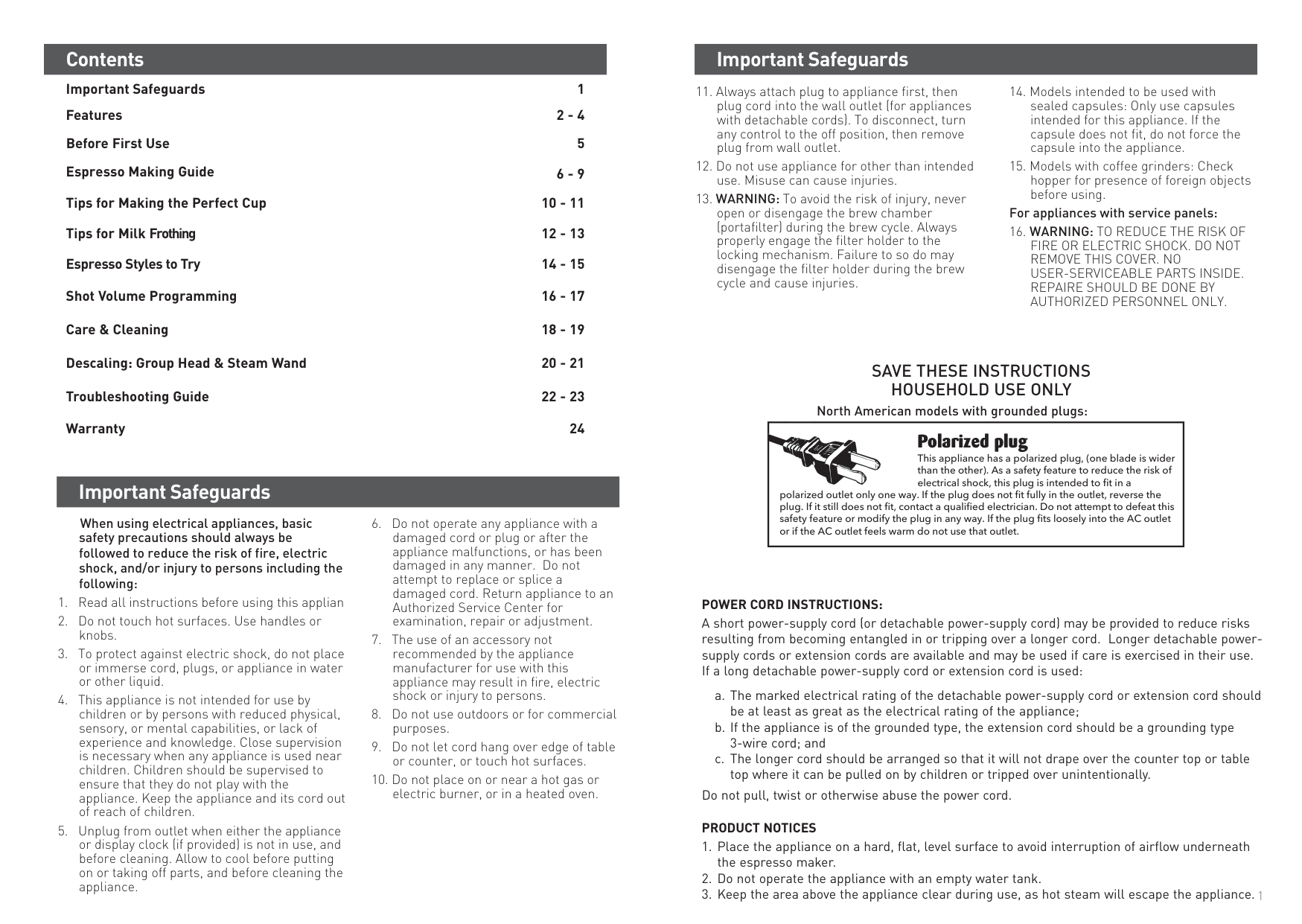
Important Safeguards Contents Important Safeguards

1 Features

2 - 4 Before First Use

5 Espresso Making Guide

6 - 9 Tips for Making the Perfect Cup 10 - 11 Tips for Milk Frothing

12 - 13 Espresso Styles to Try

14 - 15 Shot Volume Programming 16 - 17 Care & Cleaning 18 - 19 Descaling: Group Head & Steam Wand 20 - 21 Troubleshooting Guide 22 - 23 Warranty 24

1

  • Always attach plug to appliance first, then
  • plug cord into the wall outlet (for appliances with detachable cords). To disconnect, turn any control to the off position, then remove plug from wall outlet.
  • Do not use appliance for other than intended
  • use. Misuse can cause injuries.
  • WARNING: To avoid the risk of injury, never
  • open or disengage the brew chamber (portafilter) during the brew cycle. Always properly engage the filter holder to the locking mechanism. Failure to so do may disengage the filter holder during the brew cycle and cause injuries.
  • Models intended to be used with
  • sealed capsules: Only use capsules intended for this appliance. If the capsule does not fit, do not force the capsule into the appliance.
  • Models with coffee grinders: Check
  • hopper for presence of foreign objects before using. For appliances with service panels:

    16. Warning: To Reduce The Risk Of

    Fire Or Electric Shock. Do Not

    Remove This Cover. No

    User-Serviceable Parts Inside.

    Repaire Should Be Done By

    Authorized Personnel Only.

    Save These Instructions

    Household Use Only

    North American models with grounded plugs:

    Power Cord Instructions:

    Product Notices

    A short power-supply cord (or detachable power-supply cord) may be provided to reduce risks resulting from becoming entangled in or tripping over a longer cord. Longer detachable power- supply cords or extension cords are available and may be used if care is exercised in their use. If a long detachable power-supply cord or extension cord is used: Do not pull, twist or otherwise abuse the power cord. a. The marked electrical rating of the detachable power-supply cord or extension cord should be at least as great as the electrical rating of the appliance; b. If the appliance is of the grounded type, the extension cord should be a grounding type 3-wire cord; and c. The longer cord should be arranged so that it will not drape over the counter top or table top where it can be pulled on by children or tripped over unintentionally.
  • Place the appliance on a hard, flat, level surface to avoid interruption of airflow underneath
  • the espresso maker.
  • Do not operate the appliance with an empty water tank.
  • Keep the area above the appliance clear during use, as hot steam will escape the appliance.
  • Important Safeguards When using electrical appliances, basic safety precautions should always be followed to reduce the risk of fire, electric shock, and/or injury to persons including the following:
  • Read all instructions before using this applian
  • Do not touch hot surfaces. Use handles or
  • knobs.
  • To protect against electric shock, do not place
  • or immerse cord, plugs, or appliance in water or other liquid.
  • This appliance is not intended for use by
  • children or by persons with reduced physical, sensory, or mental capabilities, or lack of experience and knowledge. Close supervision is necessary when any appliance is used near children. Children should be supervised to ensure that they do not play with the appliance. Keep the appliance and its cord out of reach of children.
  • Unplug from outlet when either the appliance
  • or display clock (if provided) is not in use, and before cleaning. Allow to cool before putting on or taking off parts, and before cleaning the appliance.
  • Do not operate any appliance with a
  • damaged cord or plug or after the appliance malfunctions, or has been damaged in any manner. Do not attempt to replace or splice a damaged cord. Return appliance to an Authorized Service Center for examination, repair or adjustment.
  • The use of an accessory not
  • recommended by the appliance manufacturer for use with this

    appliance may result in fire, electric shock or injury to persons.
  • Do not use outdoors or for commercial
  • purposes.
  • Do not let cord hang over edge of table
  • or counter, or touch hot surfaces.
  • Do not place on or near a hot gas or
  • electric burner, or in a heated oven. Polarized plug This appliance has a polarized plug, (one blade is wider than the other). As a safety feature to reduce the risk of electrical shock, this plug is intended to fit in a polarized outlet only one way. If the plug does not fit fully in the outlet, reverse the plug. If it still does not fit, contact a qualified electrician. Do not attempt to defeat this safety feature or modify the plug in any way. If the plug fits loosely into the AC outlet or if the AC outlet feels warm do not use that outlet.

    Page 3

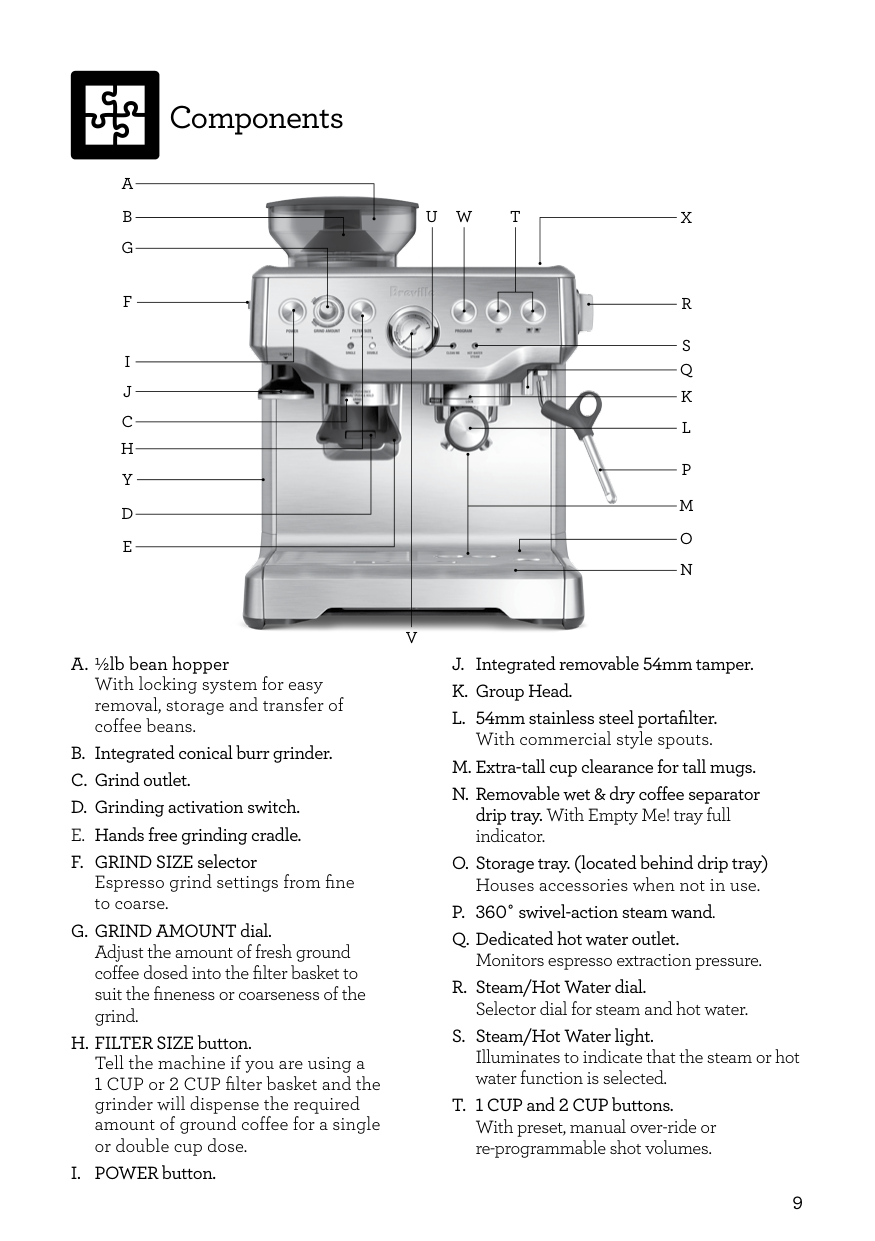
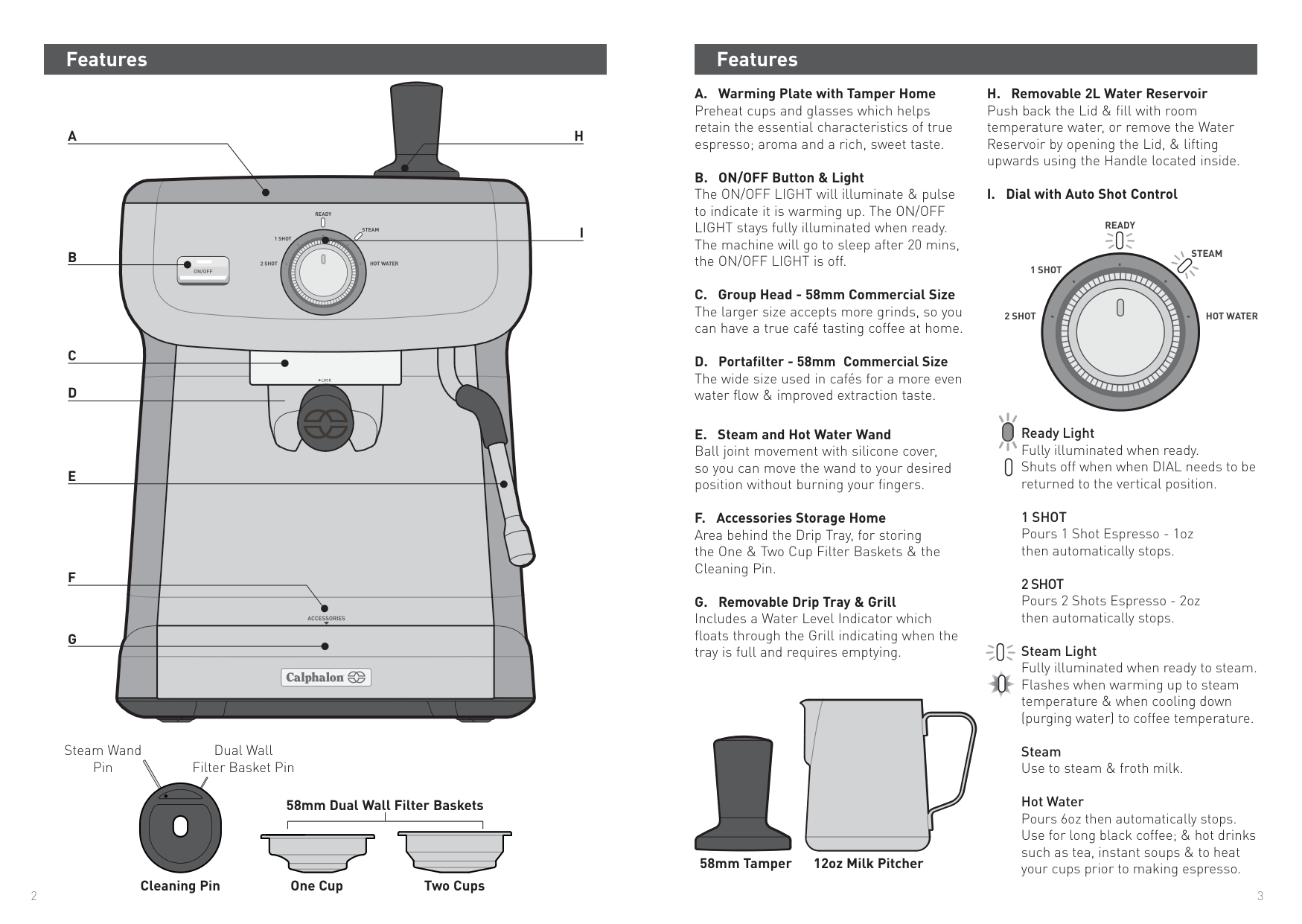
    3 Features 2 Features A. Warming Plate with Tamper Home Preheat cups and glasses which helps retain the essential characteristics of true espresso; aroma and a rich, sweet taste. B. ON/OFF Button & Light The ON/OFF LIGHT will illuminate & pulse to indicate it is warming up. The ON/OFF LIGHT stays fully illuminated when ready. The machine will go to sleep after 20 mins, the ON/OFF LIGHT is off. C. Group Head - 58mm Commercial Size The larger size accepts more grinds, so you can have a true café tasting coffee at home. D. Portafilter - 58mm Commercial Size The wide size used in cafés for a more even water flow & improved extraction taste. E. Steam and Hot Water Wand Ball joint movement with silicone cover, so you can move the wand to your desired position without burning your fingers. F. Accessories Storage Home Area behind the Drip Tray, for storing the One & Two Cup Filter Baskets & the Cleaning Pin. G. Removable Drip Tray & Grill Includes a Water Level Indicator which floats through the Grill indicating when the tray is full and requires emptying. H. Removable 2L Water Reservoir Push back the Lid & fill with room temperature water, or remove the Water Reservoir by opening the Lid, & lifting upwards using the Handle located inside. I. Dial with Auto Shot Control Two Cups One Cup Cleaning Pin

    A

    B

    C

    G

    H

    I

    E

    F

    58mm Tamper 12oz Milk Pitcher Ready Light Fully illuminated when ready. Shuts off when when DIAL needs to be returned to the vertical position.

    1 Shot

    Pours 1 Shot Espresso - 1oz then automatically stops.

    2 Shot

    Pours 2 Shots Espresso - 2oz then automatically stops. Steam Light Fully illuminated when ready to steam. Flashes when warming up to steam temperature & when cooling down (purging water) to coffee temperature. Steam Use to steam & froth milk. Hot Water Pours 6oz then automatically stops. Use for long black coffee; & hot drinks such as tea, instant soups & to heat your cups prior to making espresso.

    D

    58mm Dual Wall Filter Baskets Steam Wand Pin Dual Wall Filter Basket Pin

    On/Off

    Ready

    Steam

    1 Shot

    2 Shot

    Hot Water

    Ready

    Steam

    1 Shot

    2 Shot

    Hot Water

    Lock
    Page 4

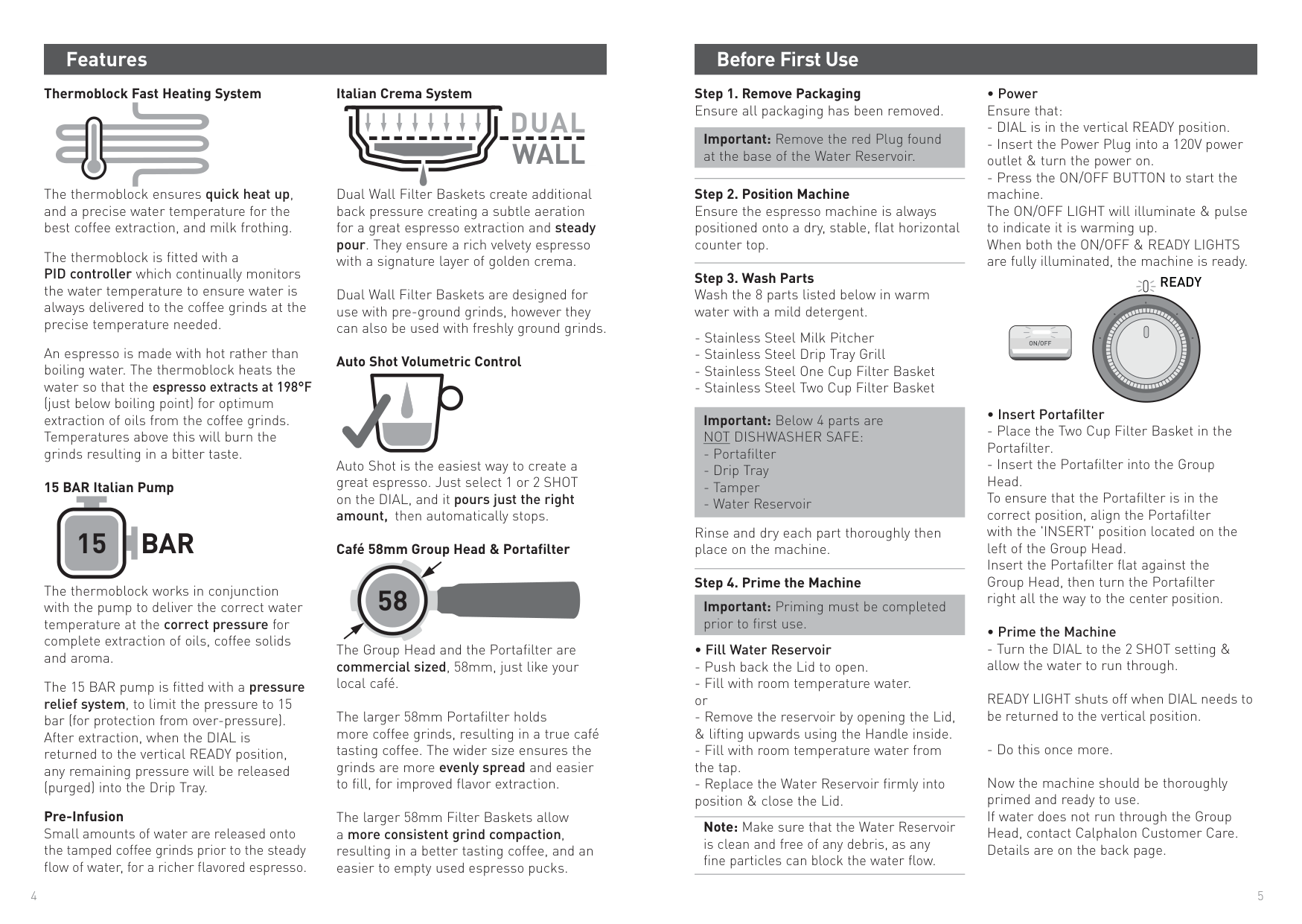
    Step 1. Remove Packaging Ensure all packaging has been removed. Step 2. Position Machine Ensure the espresso machine is always positioned onto a dry, stable, flat horizontal counter top. Step 3. Wash Parts Wash the 8 parts listed below in warm water with a mild detergent.

  • Stainless Steel Milk Pitcher
  • Stainless Steel Drip Tray Grill
  • Stainless Steel One Cup Filter Basket
  • Stainless Steel Two Cup Filter Basket
  • Rinse and dry each part thoroughly then place on the machine. Step 4. Prime the Machine
  • Fill Water Reservoir
  • Push back the Lid to open.
  • Fill with room temperature water.
  • or
  • Remove the reservoir by opening the Lid,
  • & lifting upwards using the Handle inside.
  • Fill with room temperature water from
  • the tap.
  • Replace the Water Reservoir firmly into
  • position & close the Lid.
  • Power
  • Ensure that:
  • DIAL is in the vertical READY position.
  • Insert the Power Plug into a 120V power
  • outlet & turn the power on.
  • Press the ON/OFF BUTTON to start the
  • machine. The ON/OFF LIGHT will illuminate & pulse to indicate it is warming up. When both the ON/OFF & READY LIGHTS are fully illuminated, the machine is ready.
  • Insert Portafilter
  • Place the Two Cup Filter Basket in the
  • Portafilter.
  • Insert the Portafilter into the Group
  • Head. To ensure that the Portafilter is in the correct position, align the Portafilter with the 'INSERT' position located on the left of the Group Head. Insert the Portafilter flat against the Group Head, then turn the Portafilter right all the way to the center position.
  • Prime the Machine
  • Turn the DIAL to the 2 SHOT setting &
  • allow the water to run through. READY LIGHT shuts off when DIAL needs to be returned to the vertical position.
  • Do this once more.
  • Now the machine should be thoroughly primed and ready to use. If water does not run through the Group Head, contact Calphalon Customer Care. Details are on the back page. Thermoblock Fast Heating System The thermoblock ensures quick heat up, and a precise water temperature for the best coffee extraction, and milk frothing. The thermoblock is fitted with a PID controller which continually monitors the water temperature to ensure water is always delivered to the coffee grinds at the precise temperature needed. An espresso is made with hot rather than boiling water. The thermoblock heats the water so that the espresso extracts at 198°F (just below boiling point) for optimum extraction of oils from the coffee grinds. Temperatures above this will burn the grinds resulting in a bitter taste. 15 BAR Italian Pump The thermoblock works in conjunction with the pump to deliver the correct water temperature at the correct pressure for complete extraction of oils, coffee solids and aroma. The 15 BAR pump is fitted with a pressure relief system, to limit the pressure to 15 bar (for protection from over-pressure). After extraction, when the DIAL is returned to the vertical READY position, any remaining pressure will be released (purged) into the Drip Tray. Pre-Infusion Small amounts of water are released onto the tamped coffee grinds prior to the steady flow of water, for a richer flavored espresso. Italian Crema System Dual Wall Filter Baskets create additional back pressure creating a subtle aeration for a great espresso extraction and steady pour. They ensure a rich velvety espresso with a signature layer of golden crema. Dual Wall Filter Baskets are designed for use with pre-ground grinds, however they can also be used with freshly ground grinds. Auto Shot Volumetric Control Auto Shot is the easiest way to create a great espresso. Just select 1 or 2 SHOT on the DIAL, and it pours just the right amount, then automatically stops. Café 58mm Group Head & Portafilter The Group Head and the Portafilter are commercial sized, 58mm, just like your local café. The larger 58mm Portafilter holds more coffee grinds, resulting in a true café tasting coffee. The wider size ensures the grinds are more evenly spread and easier to fill, for improved flavor extraction. The larger 58mm Filter Baskets allow a more consistent grind compaction, resulting in a better tasting coffee, and an easier to empty used espresso pucks. 58 4 5 Features Before First Use

    Dual

    Wall

    15 Bar

    Important: Below 4 parts are

    Not Dishwasher Safe:

  • Portafilter
  • Drip Tray
  • Tamper
  • Water Reservoir
  • Important: Remove the red Plug found at the base of the Water Reservoir. Important: Priming must be completed prior to first use. Note: Make sure that the Water Reservoir is clean and free of any debris, as any fine particles can block the water flow.

    Ready

    On/Off

    Page 5

    One Cup

    Two Cup

    Center

    Align & Insert

    Turn

    Or

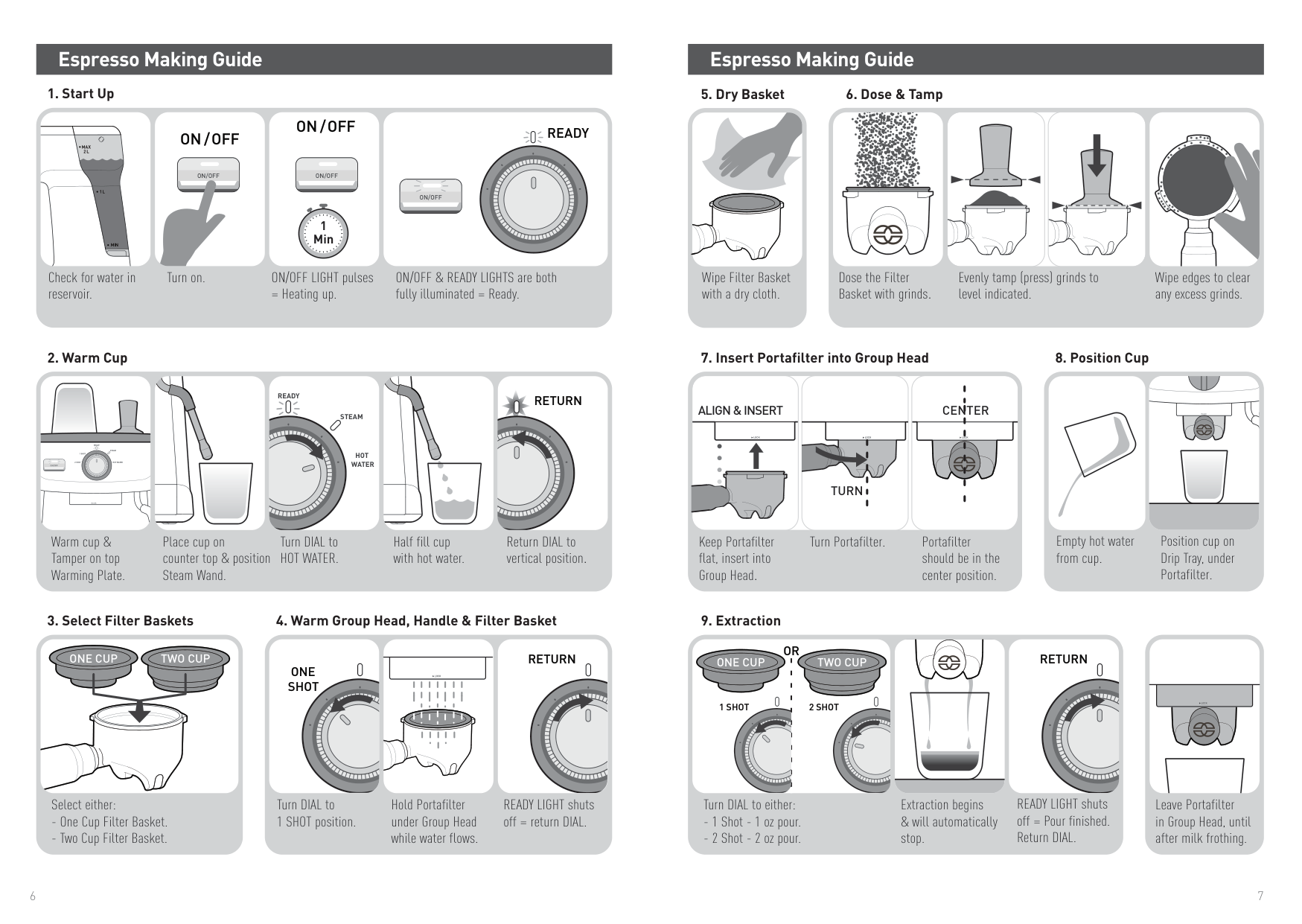
    Portafilter should be in the center position. 7 Espresso Making Guide Keep Portafilter flat, insert into Group Head. Empty hot water from cup. Turn Portafilter. Turn DIAL to either:
  • 1 Shot - 1 oz pour.
  • 2 Shot - 2 oz pour.
  • Evenly tamp (press) grinds to level indicated. Wipe Filter Basket with a dry cloth. Wipe edges to clear any excess grinds. READY LIGHT shuts off = Pour finished. Return DIAL. Leave Portafilter in Group Head, until after milk frothing. Position cup on Drip Tray, under Portafilter. Extraction begins & will automatically stop.
  • Dry Basket
  • Dose & Tamp
  • Position Cup
  • Insert Portafilter into Group Head
  • Extraction
  • Dose the Filter Basket with grinds. 1 Min

    On /Off

    Max

    2 L

    Min

    1 L

    On /Off

    One

    Shot

    One Cup

    Two Cup

    Return

    Return

    Turn DIAL to

    Hot Water.

    Half fill cup with hot water. Turn DIAL to 1 SHOT position. 6 Check for water in reservoir. Warm cup & Tamper on top Warming Plate. Turn on. Place cup on counter top & position Steam Wand. Select either:
  • One Cup Filter Basket.
  • Two Cup Filter Basket.
  • ON/OFF LIGHT pulses = Heating up. Return DIAL to vertical position. READY LIGHT shuts off = return DIAL. Hold Portafilter under Group Head while water flows. ON/OFF & READY LIGHTS are both fully illuminated = Ready.
  • Start Up
  • Warm Cup
  • Select Filter Baskets
  • Warm Group Head, Handle & Filter Basket
  • Espresso Making Guide

    Ready

    On/Off

    On/Off

    On/Off

    Lock

    Ready

    Steam

    1 Shot

    2 Shot

    Hot Water

    On/Off

    Ready

    Steam

    Hot

    Water

    1 Shot

    2 Shot

    Return

    Lock

    Lock

    Lock

    Lock

    Lock

    Lock
    Page 6

    12

    O’Clock

    3

    O’Clock

    Max

    140-149°F

    Pause

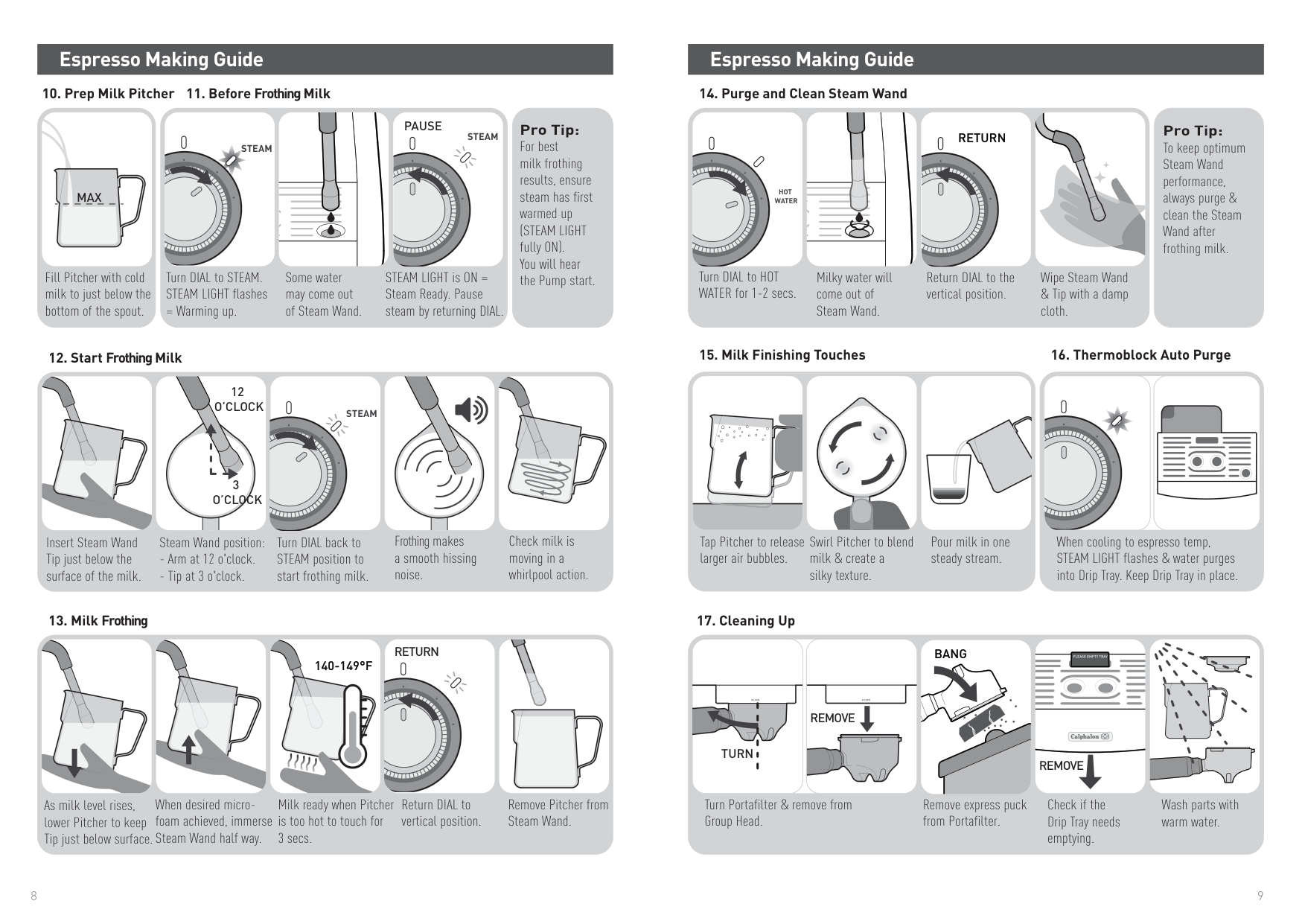
    Steam Wand position:
  • Arm at 12 o'clock.
  • Tip at 3 o'clock.
  • Remove

    Please Empty Tray

    Remove

    Turn

    Bang

    8 9 Espresso Making Guide
  • Prep Milk Pitcher
  • Before Frothing Milk
  • Purge and Clean Steam Wand
  • Start Frothing Milk
  • Milk Finishing Touches
  • Thermoblock Auto Purge
  • Cleaning Up
  • Milk Frothing
  • Pour milk in one steady stream. When cooling to espresso temp, STEAM LIGHT flashes & water purges into Drip Tray. Keep Drip Tray in place. Tap Pitcher to release larger air bubbles. Swirl Pitcher to blend milk & create a silky texture. Return DIAL to the vertical position. Wipe Steam Wand & Tip with a damp cloth. Turn DIAL to HOT WATER for 1-2 secs. Milky water will come out of Steam Wand. Pro Tip: To keep optimum Steam Wand performance, always purge & clean the Steam Wand after frothing milk. Remove express puck from Portafilter. Check if the Drip Tray needs emptying. Turn Portafilter & remove from Group Head. Wash parts with warm water. Frothing makes a smooth hissing noise. Check milk is moving in a whirlpool action. Insert Steam Wand Tip just below the surface of the milk. Some water may come out of Steam Wand. STEAM LIGHT is ON = Steam Ready. Pause steam by returning DIAL. Fill Pitcher with cold milk to just below the bottom of the spout. Turn DIAL to STEAM. STEAM LIGHT flashes = Warming up. Pro Tip: For best milk frothing results, ensure steam has first warmed up

    (Steam Light

    fully ON). You will hear the Pump start. Turn DIAL back to STEAM position to start frothing milk. Milk ready when Pitcher is too hot to touch for 3 secs. Return DIAL to vertical position. As milk level rises, lower Pitcher to keep Tip just below surface. When desired micro- foam achieved, immerse Steam Wand half way. Remove Pitcher from Steam Wand. Espresso Making Guide

    Steam

    Steam

    Steam

    Return

    Hot

    Water

    Return

    Lock

    Lock
    Page 7

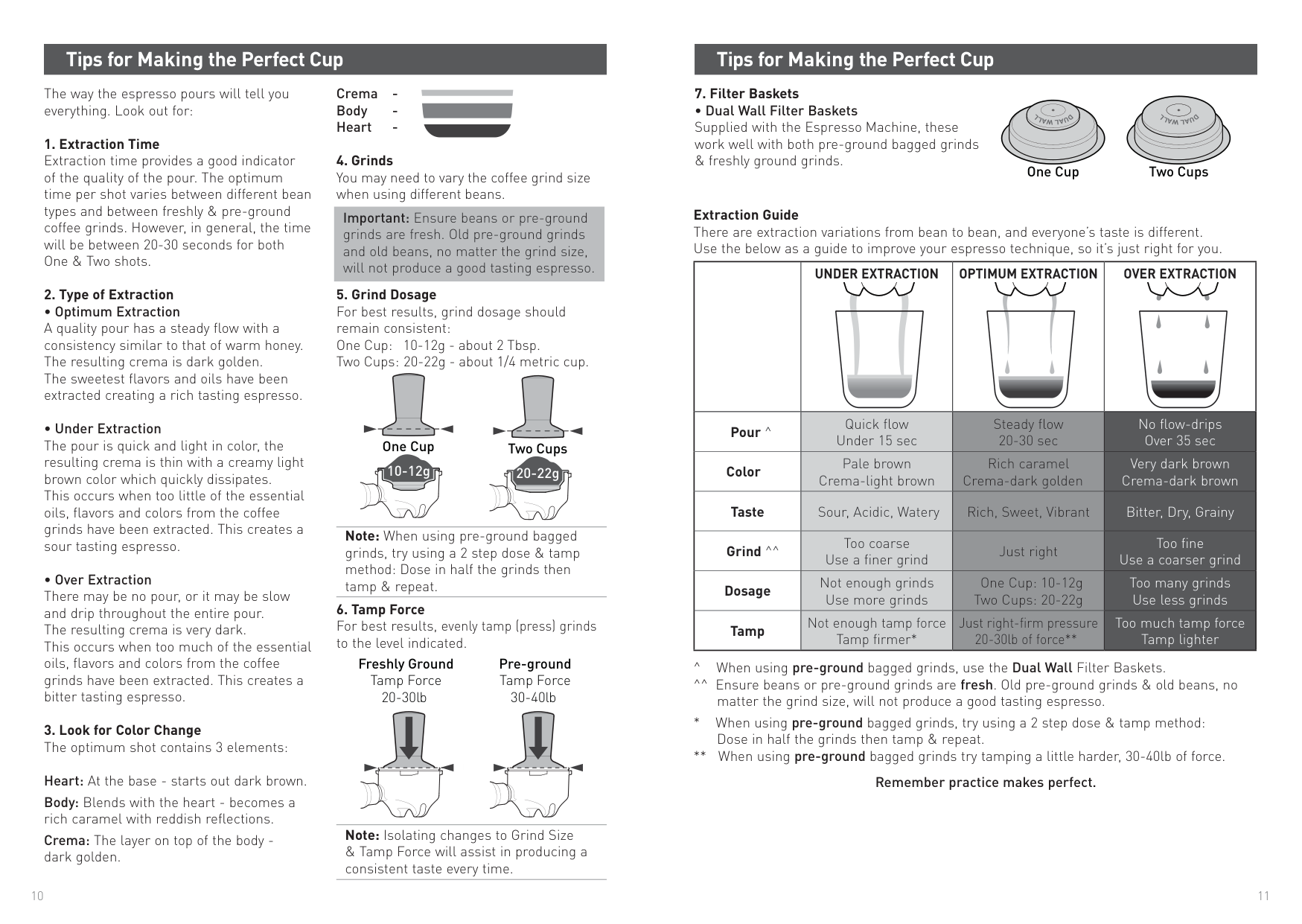
    The way the espresso pours will tell you everything. Look out for:

  • Extraction Time
  • Extraction time provides a good indicator of the quality of the pour. The optimum time per shot varies between different bean types and between freshly & pre-ground coffee grinds. However, in general, the time will be between 20-30 seconds for both One & Two shots.
  • Type of Extraction
  • Optimum Extraction
  • A quality pour has a steady flow with a consistency similar to that of warm honey. The resulting crema is dark golden. The sweetest flavors and oils have been extracted creating a rich tasting espresso.
  • Under Extraction
  • The pour is quick and light in color, the resulting crema is thin with a creamy light brown color which quickly dissipates. This occurs when too little of the essential oils, flavors and colors from the coffee grinds have been extracted. This creates a sour tasting espresso.
  • Over Extraction
  • There may be no pour, or it may be slow and drip throughout the entire pour. The resulting crema is very dark. This occurs when too much of the essential oils, flavors and colors from the coffee grinds have been extracted. This creates a bitter tasting espresso.
  • Look for Color Change
  • The optimum shot contains 3 elements: Heart: At the base - starts out dark brown. Body: Blends with the heart - becomes a rich caramel with reddish reflections. Crema: The layer on top of the body - dark golden. Crema - Body
  • Heart
  • Grinds
  • You may need to vary the coffee grind size when using different beans.
  • Grind Dosage
  • For best results, grind dosage should remain consistent: One Cup: 10-12g - about 2 Tbsp. Two Cups: 20-22g - about 1/4 metric cup.
  • Tamp Force
  • For best results, evenly tamp (press) grinds to the level indicated.
  • Filter Baskets
  • Dual Wall Filter Baskets
  • Supplied with the Espresso Machine, these work well with both pre-ground bagged grinds & freshly ground grinds.

    Extraction Guide There are extraction variations from bean to bean, and everyone’s taste is different. Use the below as a guide to improve your espresso technique, so it’s just right for you.

    Under Extraction

    Optimum Extraction

    Over Extraction

    Pour ^ Quick flow Under 15 sec Steady flow 20-30 sec No flow-drips Over 35 sec Color Pale brown Crema-light brown Rich caramel Crema-dark golden Very dark brown Crema-dark brown Taste Sour, Acidic, Watery Rich, Sweet, Vibrant Bitter, Dry, Grainy Grind ^^ Too coarse Use a finer grind Just right Too fine Use a coarser grind Dosage Not enough grinds Use more grinds One Cup: 10-12g Two Cups: 20-22g Too many grinds Use less grinds Tamp Not enough tamp force Tamp firmer* Just right-firm pressure 20-30lb of force** Too much tamp force Tamp lighter ^ When using pre-ground bagged grinds, use the Dual Wall Filter Baskets. ^^ Ensure beans or pre-ground grinds are fresh. Old pre-ground grinds & old beans, no matter the grind size, will not produce a good tasting espresso.
  • When using pre-ground bagged grinds, try using a 2 step dose & tamp method:
  • Dose in half the grinds then tamp & repeat. ** When using pre-ground bagged grinds try tamping a little harder, 30-40lb of force. 11 Tips for Making the Perfect Cup 10 Tips for Making the Perfect Cup Freshly Ground Tamp Force 20-30lb Pre-ground Tamp Force 30-40lb Remember practice makes perfect. One Cup 10-12g Two Cups 20-22g Important: Ensure beans or pre-ground grinds are fresh. Old pre-ground grinds and old beans, no matter the grind size, will not produce a good tasting espresso. Note: Isolating changes to Grind Size & Tamp Force will assist in producing a consistent taste every time. Note: When using pre-ground bagged grinds, try using a 2 step dose & tamp method: Dose in half the grinds then tamp & repeat.

    D

    U

    A

    L

    W

    A

    L

    L

    D

    U

    A

    L

    W

    A

    L

    L

    One Cup Two Cups
    Page 8

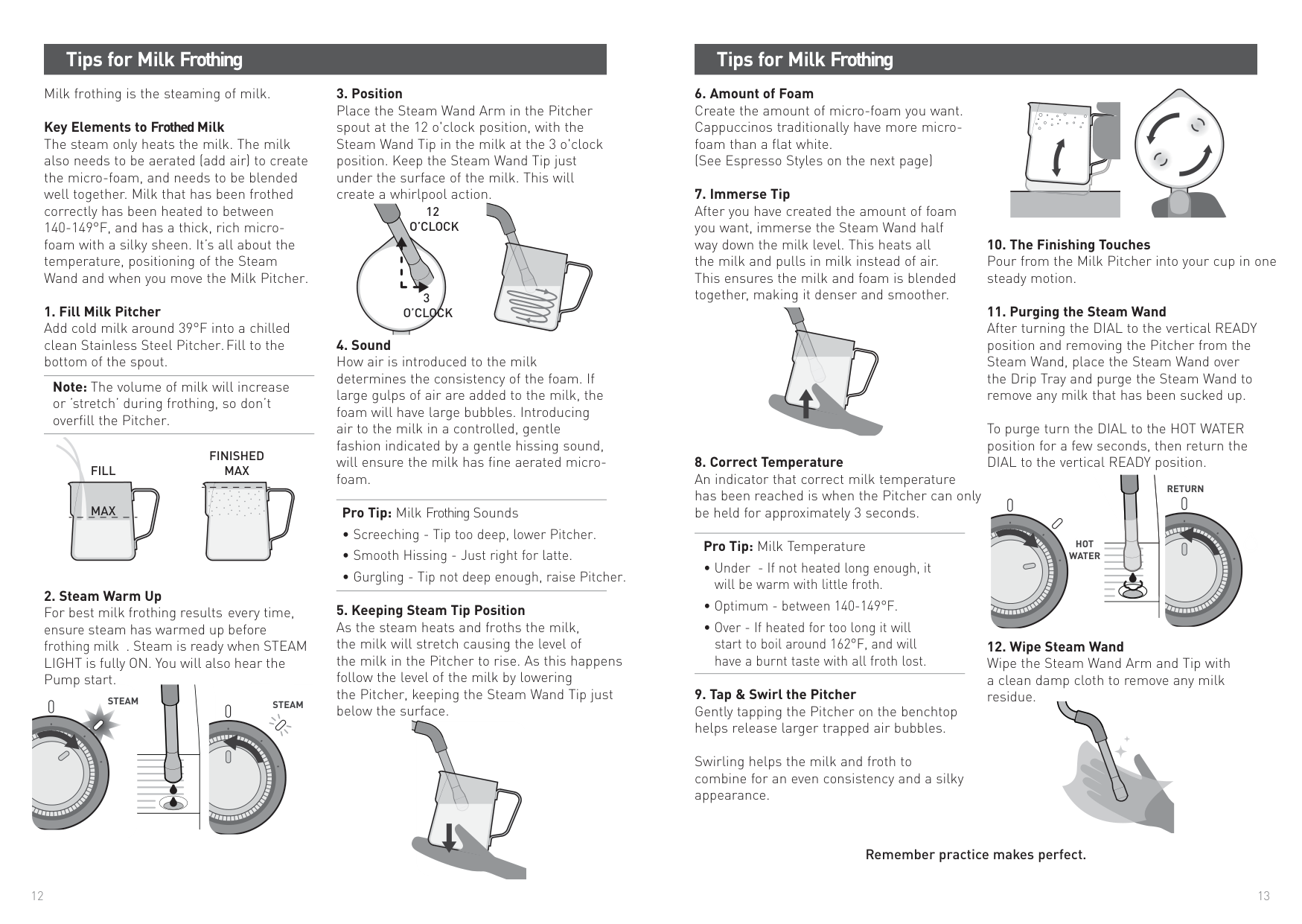
    Milk frothing is the steaming of milk. Key Elements to Frothed Milk The steam only heats the milk. The milk also needs to be aerated (add air) to create the micro-foam, and needs to be blended well together. Milk that has been frothed correctly has been heated to between 140-149°F, and has a thick, rich micro- foam with a silky sheen. It’s all about the temperature, positioning of the Steam Wand and when you move the Milk Pitcher.

  • Fill Milk Pitcher
  • Add cold milk around 39°F into a chilled clean Stainless Steel Pitcher. Fill to the bottom of the spout.
  • Steam Warm Up
  • For best milk frothing results every time, ensure steam has warmed up before frothing milk . Steam is ready when STEAM LIGHT is fully ON. You will also hear the Pump start.
  • Position
  • Place the Steam Wand Arm in the Pitcher spout at the 12 o'clock position, with the Steam Wand Tip in the milk at the 3 o'clock position. Keep the Steam Wand Tip just under the surface of the milk. This will create a whirlpool action.
  • Sound
  • How air is introduced to the milk determines the consistency of the foam. If large gulps of air are added to the milk, the foam will have large bubbles. Introducing air to the milk in a controlled, gentle fashion indicated by a gentle hissing sound, will ensure the milk has fine aerated micro- foam. Pro Tip: Milk Frothing Sounds
  • Screeching - Tip too deep, lower Pitcher.
  • Smooth Hissing - Just right for latte.
  • Gurgling - Tip not deep enough, raise Pitcher.
  • Keeping Steam Tip Position
  • As the steam heats and froths the milk, the milk will stretch causing the level of the milk in the Pitcher to rise. As this happens follow the level of the milk by lowering the Pitcher, keeping the Steam Wand Tip just below the surface. 12

    O’Clock

    3

    O’Clock

  • Amount of Foam
  • Create the amount of micro-foam you want. Cappuccinos traditionally have more micro- foam than a flat white. (See Espresso Styles on the next page)
  • Immerse Tip
  • After you have created the amount of foam you want, immerse the Steam Wand half way down the milk level. This heats all the milk and pulls in milk instead of air. This ensures the milk and foam is blended together, making it denser and smoother.
  • Correct Temperature
  • An indicator that correct milk temperature has been reached is when the Pitcher can only be held for approximately 3 seconds. Pro Tip: Milk Temperature
  • Under - If not heated long enough, it
  • will be warm with little froth.
  • Optimum - between 140-149°F.
  • Over - If heated for too long it will
  • start to boil around 162°F, and will have a burnt taste with all froth lost.

  • Tap & Swirl the Pitcher
  • Gently tapping the Pitcher on the benchtop helps release larger trapped air bubbles. Swirling helps the milk and froth to combine for an even consistency and a silky appearance.
  • The Finishing Touches
  • Pour from the Milk Pitcher into your cup in one steady motion.
  • Purging the Steam Wand
  • After turning the DIAL to the vertical READY position and removing the Pitcher from the Steam Wand, place the Steam Wand over the Drip Tray and purge the Steam Wand to remove any milk that has been sucked up. To purge turn the DIAL to the HOT WATER position for a few seconds, then return the DIAL to the vertical READY position.
  • Wipe Steam Wand
  • Wipe the Steam Wand Arm and Tip with a clean damp cloth to remove any milk residue. 13 12 Tips for Milk Frothing Tips for Milk Frothing

    Max

    Fill

    Finished

    Max

    Remember practice makes perfect. Note: The volume of milk will increase or ’stretch’ during frothing, so don’t overfill the Pitcher.

    Steam

    Hot

    Water

    Steam

    Return

    Page 9

    14 15 Espresso Styles to Try Espresso Styles to Try Espresso (Short Black) Espresso is a concentrated, full bodied coffee with a stable layer of ‘crema’ on top. An espresso is the foundation of all café coffee.
  • Espresso glass (3 oz)
  • Single or double shot of espresso (1-2 oz)
  • Ristretto A ristretto is an extremely short espresso, distinguished by its intense flavor and aftertaste.
  • Espresso cup (3 oz)
  • Half a single shot of espresso (0.5 oz)
  • Long Black (Americano) A standard espresso with hot water added. The hot water is added first so that the ‘crema’ is maintained.
  • Cup (6 oz)
  • Hot Water (to preference)
  • Single or double shot of espresso (1-2 oz)
  • Con Panna Con Panna, Italian for ‘with cream’, made up of an espresso topped with lightly whipped cream. It can also be dusted with cinnamon or chocolate.
  • Cup (6 oz)
  • Single or double shot of espresso (1-2 oz)
  • Lightly whipped cream - dusted cinnamon.
  • Macchiato Macchiato, Italian for ‘to stain or mark’. Traditionally served as a standard espresso with a dash of cold or frothed milk and a small dollop of foam into the middle of the ‘crema’.
  • Espresso glass (3 oz)
  • Single or double shot of espresso (1-2 oz)
  • Dash of cold or frothed milk & small dollop of foam.
  • Flat White An espresso with frothed milk and a thin layer of foam milk on top. The wider cup will create the slim layer of foam, the signature of the flat white.
  • Wide cup (6 oz)
  • Single or double shot of espresso (1-2 oz)
  • Frothed milk & foam.
  • Latte An espresso with frothed milk and a finger width layer of foam milk on top. The narrower cup will create the thicker layer of foam.
  • Glass or Cup (7 oz)
  • Single or double shot of espresso (1-2 oz)
  • Frothed milk & foam.
  • Cappuccino An espresso with ⅓ steamed milk, topped with ⅓ creamy foam and a dusting of chocolate.
  • Cup (6-8 oz)
  • Single or double shot of espresso (1-2 oz)
  • ⅓ Frothed milk, ⅓ foam - dusted with chocolate.
  • Mocha Made in a similar way to a cappuccino but with the addition of chocolate. Simply stir the chocolate into the espresso prior to adding the steamed milk and foam.
  • Cup or tall glass (6-8 oz)
  • Single or double shot of espresso (1-2 oz)
  • Chocolate Syrup (to preference)
  • ⅓ Frothed milk, ⅓ foam.
  • Babyccino Steamed milk with a layer of foamed milk. It can also be dusted with chocolate.
  • Small cup (3 oz)
  • No shot of espresso
  • Frothed milk & foam - dusted with chocolate.
  • Page 10

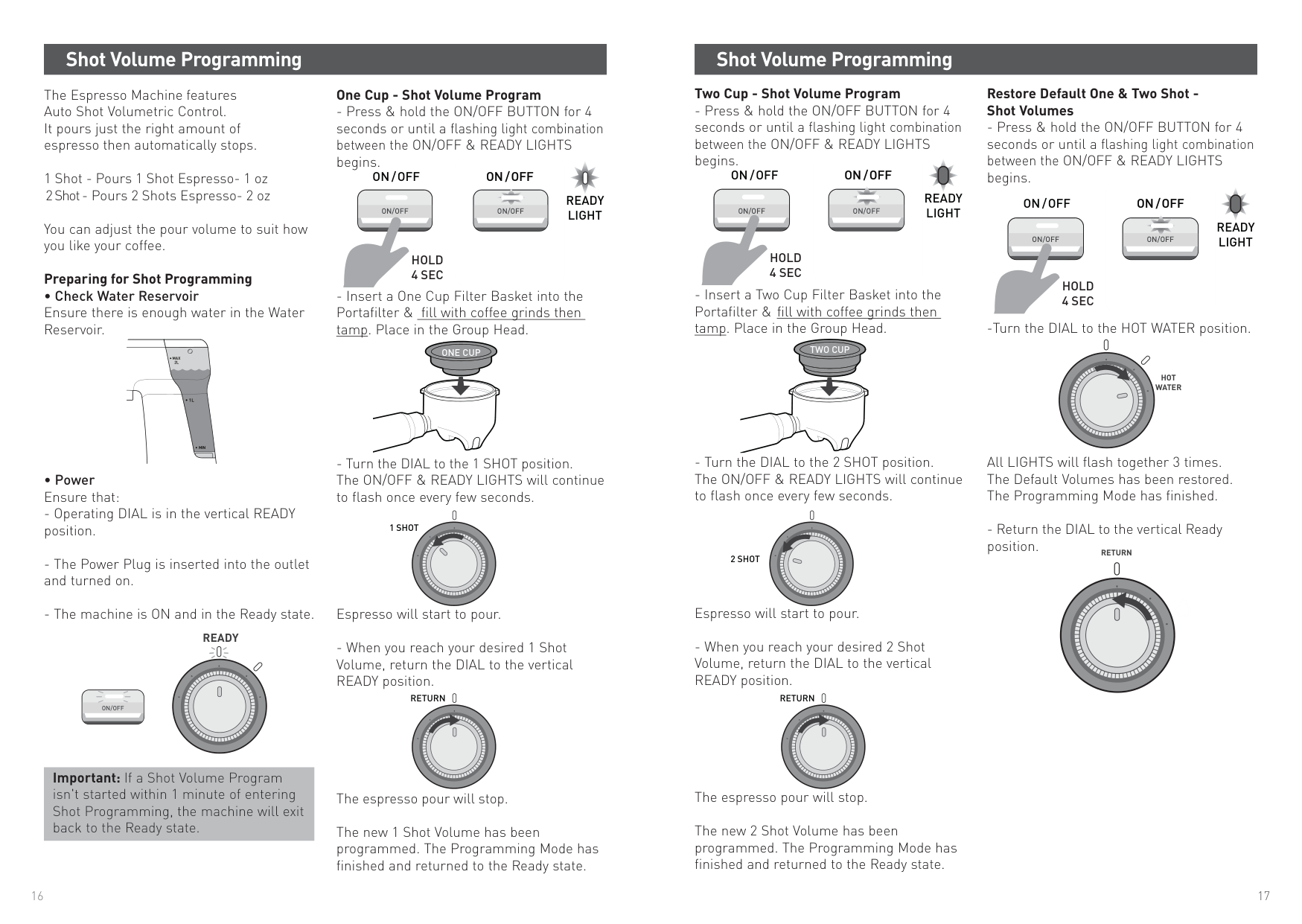
    17 Shot Volume Programming The Espresso Machine features Auto Shot Volumetric Control. It pours just the right amount of espresso then automatically stops.

    1 Shot - Pours 1 Shot Espresso- 1 oz 2 Shot - Pours 2 Shots Espresso- 2 oz You can adjust the pour volume to suit how you like your coffee. Preparing for Shot Programming

  • Check Water Reservoir
  • Ensure there is enough water in the Water Reservoir.
  • Power
  • Ensure that:
  • Operating DIAL is in the vertical READY
  • position.
  • The Power Plug is inserted into the outlet
  • and turned on.
  • The machine is ON and in the Ready state.
  • One Cup - Shot Volume Program
  • Press & hold the ON/OFF BUTTON for 4
  • seconds or until a flashing light combination between the ON/OFF & READY LIGHTS begins.
  • Insert a One Cup Filter Basket into the
  • Portafilter & fill with coffee grinds then tamp. Place in the Group Head.
  • Turn the DIAL to the 1 SHOT position.
  • The ON/OFF & READY LIGHTS will continue to flash once every few seconds. Espresso will start to pour.

  • When you reach your desired 1 Shot
  • Volume, return the DIAL to the vertical READY position. The espresso pour will stop. The new 1 Shot Volume has been programmed. The Programming Mode has finished and returned to the Ready state. 16 Shot Volume Programming

    Max

    2L

    Min

    1 L

    Important: If a Shot Volume Program isn't started within 1 minute of entering Shot Programming, the machine will exit back to the Ready state. Two Cup - Shot Volume Program
  • Press & hold the ON/OFF BUTTON for 4
  • seconds or until a flashing light combination between the ON/OFF & READY LIGHTS begins.
  • Insert a Two Cup Filter Basket into the
  • Portafilter & fill with coffee grinds then tamp. Place in the Group Head.
  • Turn the DIAL to the 2 SHOT position.
  • The ON/OFF & READY LIGHTS will continue to flash once every few seconds. Espresso will start to pour.
  • When you reach your desired 2 Shot
  • Volume, return the DIAL to the vertical READY position. The espresso pour will stop. The new 2 Shot Volume has been programmed. The Programming Mode has finished and returned to the Ready state. Restore Default One & Two Shot - Shot Volumes
  • Press & hold the ON/OFF BUTTON for 4
  • seconds or until a flashing light combination between the ON/OFF & READY LIGHTS begins. -Turn the DIAL to the HOT WATER position. All LIGHTS will flash together 3 times. The Default Volumes has been restored. The Programming Mode has finished.
  • Return the DIAL to the vertical Ready
  • position.

    On /Off

    On /Off

    Ready

    Light

    Hold

    4 Sec

    On /Off

    On /Off

    Ready

    Light

    Hold

    4 Sec

    On /Off

    On /Off

    Ready

    Light

    Hold

    4 Sec

    One Cup

    Two Cup

    On/Off

    1 Shot

    2 Shot

    Return

    Return

    On/Off

    On/Off

    Ready

    On/Off

    On/Off

    On/Off

    On/Off

    Hot

    Water

    Return
    Page 11

    This appliance has no user serviceable parts. Any servicing beyond that described in the Cleaning Section should be performed by an Authorized Service Representative only. See warranty available online.

  • Place Filter Basket into Portafilter
  • (without coffee) & insert into Group Head.
  • Turn the DIAL to the 1 SHOT setting.
  • Water will pour through.
  • Return DIAL when finished.
  • Repeat if needed.
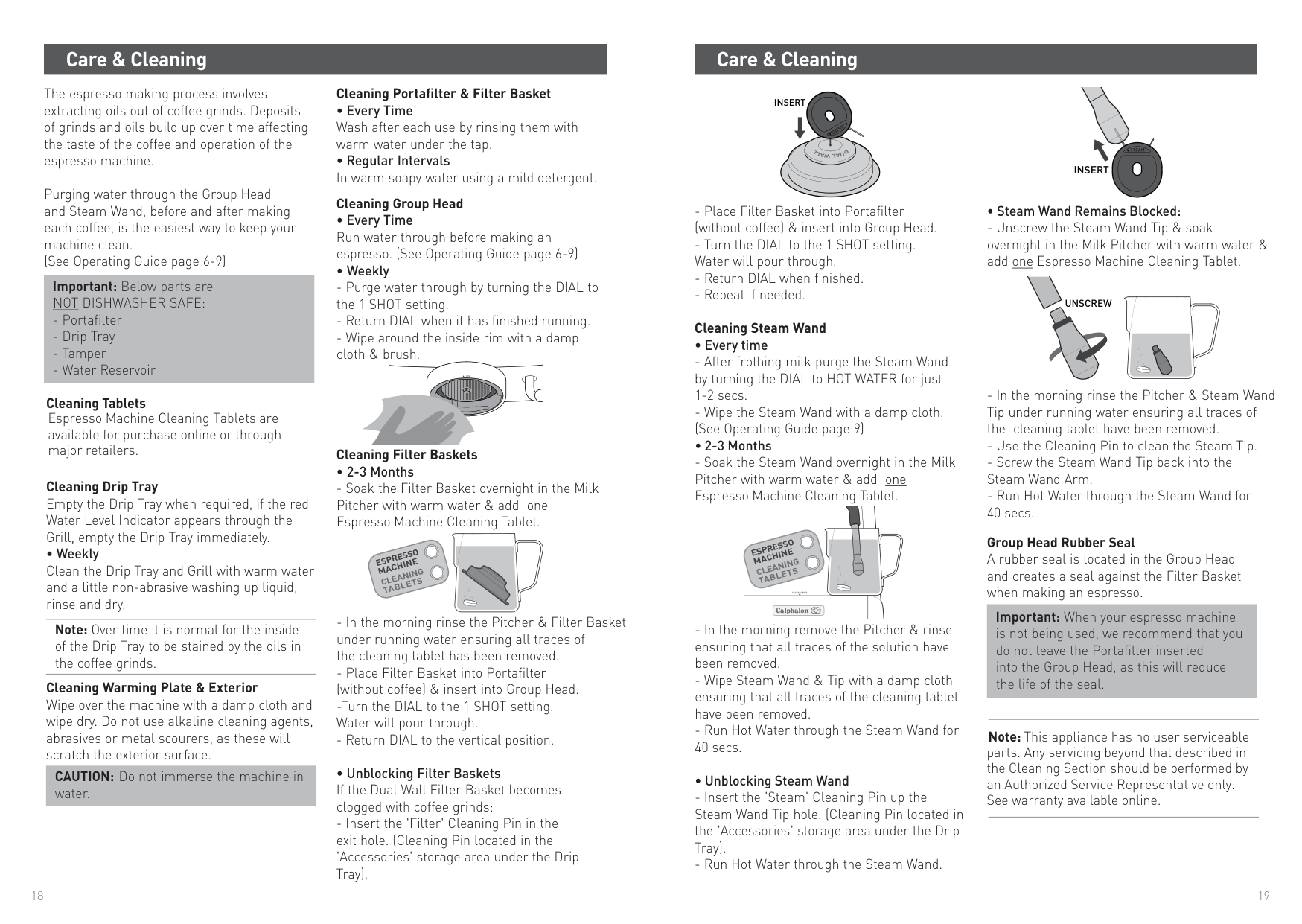
  • Cleaning Steam Wand
  • Every time
  • After frothing milk purge the Steam Wand
  • by turning the DIAL to HOT WATER for just 1-2 secs.
  • Wipe the Steam Wand with a damp cloth.
  • (See Operating Guide page 9)
  • 2-3 Months
  • Soak the Steam Wand overnight in the Milk
  • Pitcher with warm water & add one Espresso Machine Cleaning Tablet.
  • In the morning remove the Pitcher & rinse
  • ensuring that all traces of the solution have been removed.
  • Wipe Steam Wand & Tip with a damp cloth
  • ensuring that all traces of the cleaning tablet have been removed.
  • Run Hot Water through the Steam Wand for
  • 40 secs.
  • Unblocking Steam Wand
  • Insert the 'Steam' Cleaning Pin up the
  • Steam Wand Tip hole. (Cleaning Pin located in the 'Accessories' storage area under the Drip Tray).
  • Run Hot Water through the Steam Wand.
  • Steam Wand Remains Blocked:
  • Unscrew the Steam Wand Tip & soak
  • overnight in the Milk Pitcher with warm water & add one Espresso Machine Cleaning Tablet.
  • In the morning rinse the Pitcher & Steam Wand
  • Tip under running water ensuring all traces of the cleaning tablet have been removed.
  • Use the Cleaning Pin to clean the Steam Tip.
  • Screw the Steam Wand Tip back into the
  • Steam Wand Arm.
  • Run Hot Water through the Steam Wand for
  • 40 secs.

    Espresso

    Machine

    Cleaning

    Tablets

    The espresso making process involves extracting oils out of coffee grinds. Deposits of grinds and oils build up over time affecting the taste of the coffee and operation of the espresso machine. Purging water through the Group Head and Steam Wand, before and after making each coffee, is the easiest way to keep your machine clean. (See Operating Guide page 6-9) Cleaning Tablets Cleaning Drip Tray Empty the Drip Tray when required, if the red Water Level Indicator appears through the Grill, empty the Drip Tray immediately.
  • Weekly
  • Clean the Drip Tray and Grill with warm water and a little non-abrasive washing up liquid, rinse and dry. Cleaning Warming Plate & Exterior Wipe over the machine with a damp cloth and wipe dry. Do not use alkaline cleaning agents, abrasives or metal scourers, as these will scratch the exterior surface. Cleaning Portafilter & Filter Basket
  • Every Time
  • Wash after each use by rinsing them with warm water under the tap.
  • Regular Intervals
  • In warm soapy water using a mild detergent. Cleaning Group Head
  • Every Time
  • Run water through before making an espresso. (See Operating Guide page 6-9)
  • Weekly
  • Purge water through by turning the DIAL to
  • the 1 SHOT setting.
  • Return DIAL when it has finished running.
  • Wipe around the inside rim with a damp
  • cloth & brush. Cleaning Filter Baskets
  • 2-3 Months
  • Soak the Filter Basket overnight in the Milk
  • Pitcher with warm water & add one Espresso Machine Cleaning Tablet.
  • In the morning rinse the Pitcher & Filter Basket
  • under running water ensuring all traces of the cleaning tablet has been removed.
  • Place Filter Basket into Portafilter
  • (without coffee) & insert into Group Head. -Turn the DIAL to the 1 SHOT setting. Water will pour through.
  • Return DIAL to the vertical position.
  • Unblocking Filter Baskets
  • If the Dual Wall Filter Basket becomes clogged with coffee grinds:
  • Insert the 'Filter' Cleaning Pin in the
  • exit hole. (Cleaning Pin located in the 'Accessories' storage area under the Drip Tray).

    Steam

    Insert

    O

    18 19 Care & Cleaning Care & Cleaning CAUTION: Do not immerse the machine in water. Important: Below parts are

    Not Dishwasher Safe:

  • Portafilter
  • Drip Tray
  • Tamper
  • Water Reservoir
  • Note: Over time it is normal for the inside of the Drip Tray to be stained by the oils in the coffee grinds.

    Filter

    Insert

    D

    U

    A

    L

    W

    A

    L

    L

    Group Head Rubber Seal A rubber seal is located in the Group Head and creates a seal against the Filter Basket when making an espresso. Important: When your espresso machine Note: is not being used, we recommend that you do not leave the Portafilter inserted into the Group Head, as this will reduce the life of the seal.

    Unscrew

    Espresso

    Machine

    Cleaning

    Tablets

    Espresso Machine Cleaning Tablets are available for purchase online or through major retailers.

    Lock

    Page 12

    Hold

    4 Sec

    On/Off

    On/Off

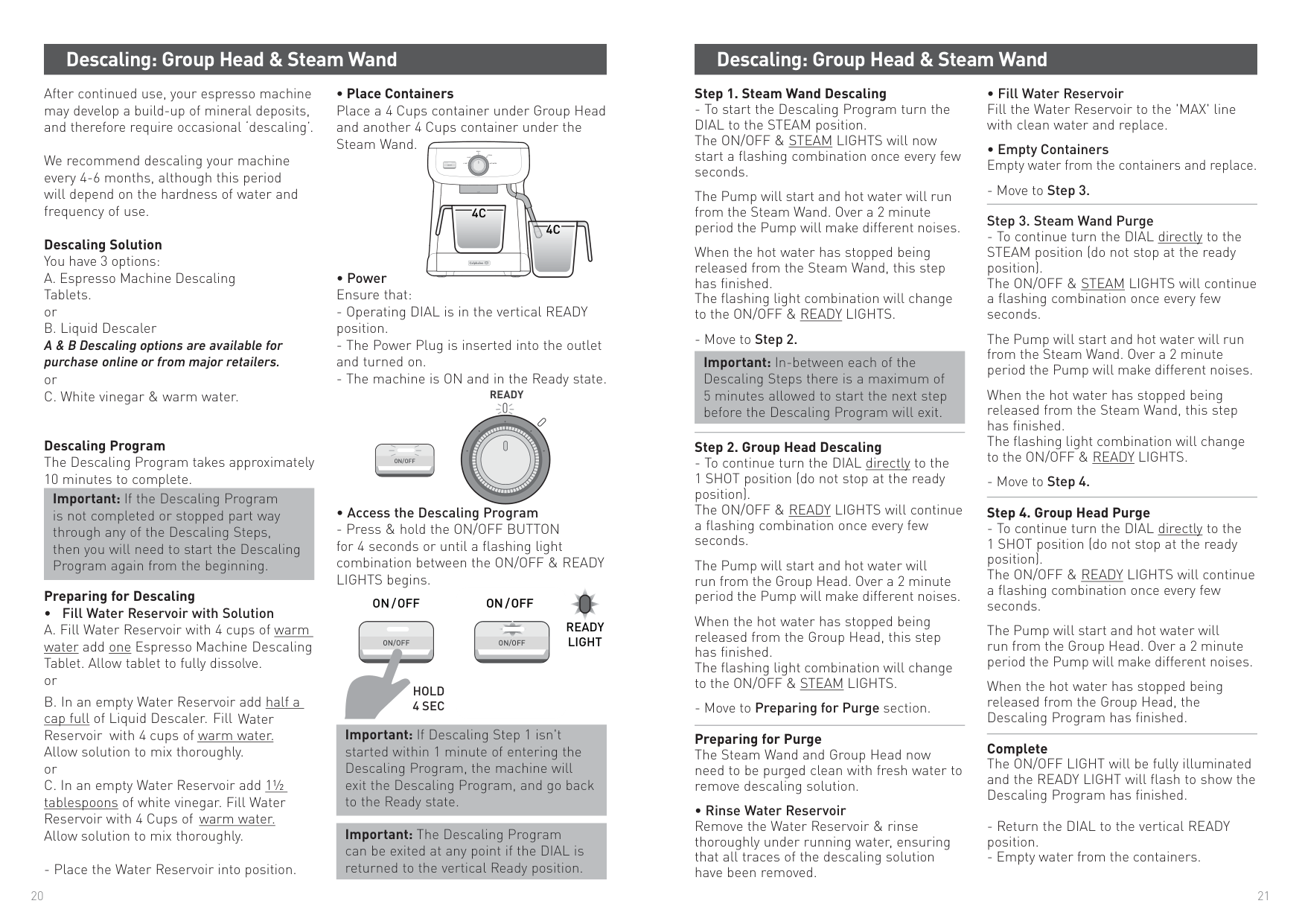
    After continued use, your espresso machine may develop a build-up of mineral deposits, and therefore require occasional ‘descaling’. We recommend descaling your machine every 4-6 months, although this period will depend on the hardness of water and frequency of use. Descaling Solution You have 3 options: A. Espresso Machine Descaling Tablets. or B. Liquid Descaler A & B Descaling options are available for purchase online or from major retailers. or C. White vinegar & warm water. Descaling Program The Descaling Program takes approximately 10 minutes to complete. Preparing for Descaling
  • Fill Water Reservoir with Solution
  • A. Fill Water Reservoir with 4 cups of warm water add one Espresso Machine Descaling Tablet. Allow tablet to fully dissolve. or B. In an empty Water Reservoir add half a cap full of Liquid Descaler. Fill Reservoir Water with 4 cups of warm water. Allow solution to mix thoroughly. or C. In an empty Water Reservoir add 1½ tablespoons of white vinegar. Fill Water Reservoir with 4 Cups of warm water. Allow solution to mix thoroughly.
  • Place the Water Reservoir into position.
  • Place Containers
  • Place a 4 Cups container under Group Head and another 4 Cups container under the Steam Wand.
  • Power
  • Ensure that:
  • Operating DIAL is in the vertical READY
  • position.
  • The Power Plug is inserted into the outlet
  • and turned on.
  • The machine is ON and in the Ready state.
  • Access the Descaling Program
  • Press & hold the ON/OFF BUTTON
  • for 4 seconds or until a flashing light combination between the ON/OFF & READY LIGHTS begins. Step 1. Steam Wand Descaling
  • To start the Descaling Program turn the
  • DIAL to the STEAM position. The ON/OFF & STEAM LIGHTS will now start a flashing combination once every few seconds. The Pump will start and hot water will run from the Steam Wand. Over a 2 minute period the Pump will make different noises. When the hot water has stopped being released from the Steam Wand, this step has finished. The flashing light combination will change to the ON/OFF & READY LIGHTS.
  • Move to Step 2.
  • Step 2. Group Head Descaling
  • To continue turn the DIAL directly to the
  • 1 SHOT position (do not stop at the ready position). The ON/OFF & READY LIGHTS will continue a flashing combination once every few seconds. The Pump will start and hot water will run from the Group Head. Over a 2 minute period the Pump will make different noises. When the hot water has stopped being released from the Group Head, this step has finished. The flashing light combination will change to the ON/OFF & STEAM LIGHTS.
  • Move to Preparing for Purge section.
  • Preparing for Purge The Steam Wand and Group Head now need to be purged clean with fresh water to remove descaling solution.
  • Rinse Water Reservoir
  • Remove the Water Reservoir & rinse thoroughly under running water, ensuring that all traces of the descaling solution have been removed.
  • Fill Water Reservoir
  • Fill the Water Reservoir to the 'MAX' line with clean water and replace.
  • Empty Containers
  • Empty water from the containers and replace.
  • Move to Step 3.
  • Step 3. Steam Wand Purge
  • To continue turn the DIAL directly to the
  • STEAM position (do not stop at the ready position). The ON/OFF & STEAM LIGHTS will continue a flashing combination once every few seconds. The Pump will start and hot water will run from the Steam Wand. Over a 2 minute period the Pump will make different noises. When the hot water has stopped being released from the Steam Wand, this step has finished. The flashing light combination will change to the ON/OFF & READY LIGHTS.
  • Move to Step 4.
  • Step 4. Group Head Purge
  • To continue turn the DIAL directly to the
  • 1 SHOT position (do not stop at the ready position). The ON/OFF & READY LIGHTS will continue a flashing combination once every few seconds. The Pump will start and hot water will run from the Group Head. Over a 2 minute period the Pump will make different noises. When the hot water has stopped being released from the Group Head, the Descaling Program has finished. Complete The ON/OFF LIGHT will be fully illuminated and the READY LIGHT will flash to show the Descaling Program has finished.
  • Return the DIAL to the vertical READY
  • position.
  • Empty water from the containers.
  • Important: If the Descaling Program is not completed or stopped part way through any of the Descaling Steps, then you will need to start the Descaling Program again from the beginning. 20 21 Descaling: Group Head & Steam Wand Descaling: Group Head & Steam Wand

    On /Off

    On /Off

    Ready

    Light

    4C

    4C

    Important: In-between each of the Descaling Steps there is a maximum of 5 minutes allowed to start the next step before the Descaling Program will exit. Important: The Descaling Program can be exited at any point if the DIAL is returned to the vertical Ready position. Important: If Descaling Step 1 isn't started within 1 minute of entering the Descaling Program, the machine will exit the Descaling Program, and go back to the Ready state.

    On/Off

    Ready

    Steam

    1 Shot

    2 Shot

    Hot Water

    Lock

    On/Off

    Ready
    Page 13

    22 23

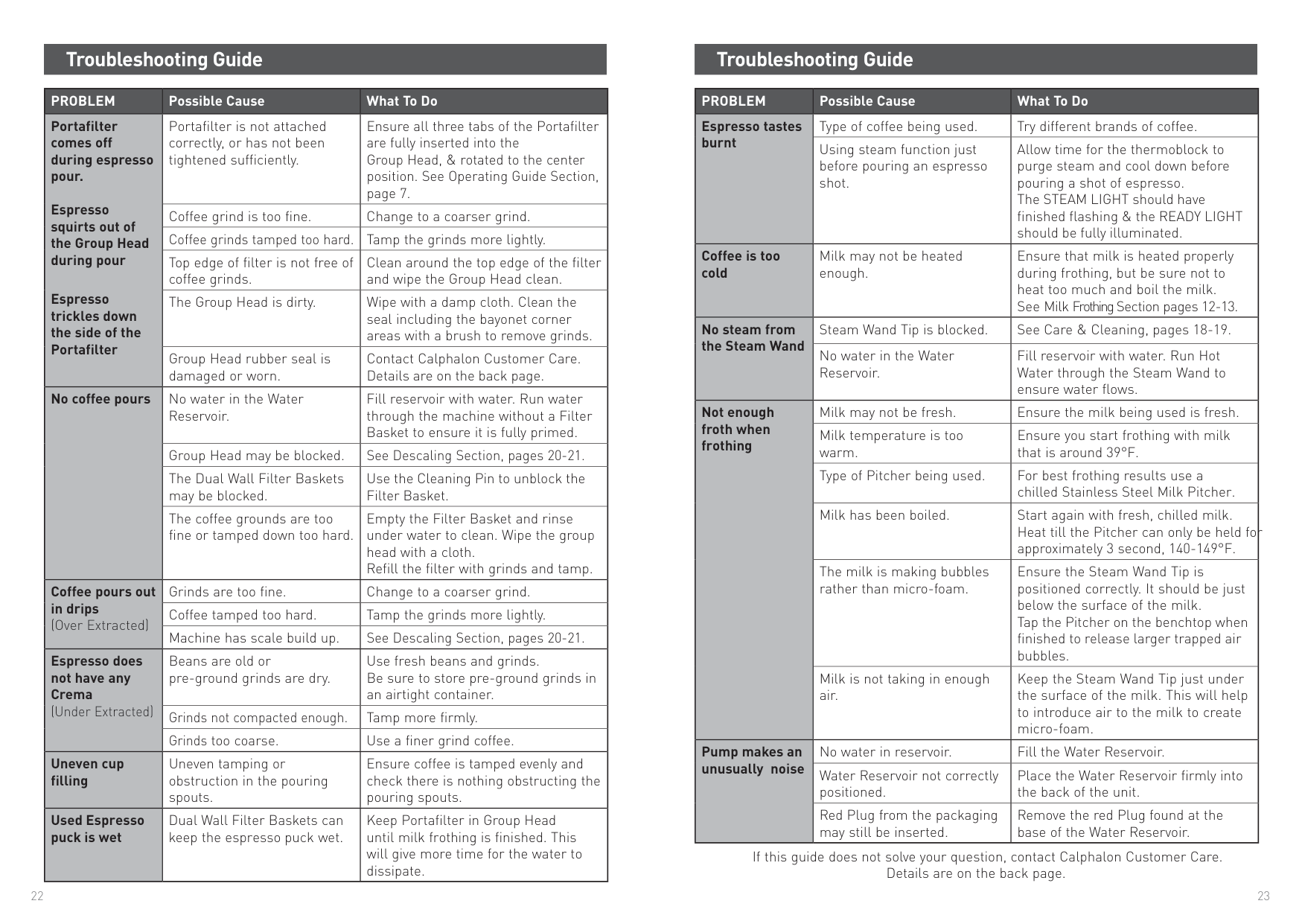
    Troubleshooting Guide Troubleshooting Guide

    Problem

    Possible Cause What To Do Espresso tastes burnt Type of coffee being used. Try different brands of coffee. Using steam function just before pouring an espresso shot. Allow time for the thermoblock to purge steam and cool down before pouring a shot of espresso. The STEAM LIGHT should have finished flashing & the READY LIGHT should be fully illuminated. Coffee is too cold Milk may not be heated enough. Ensure that milk is heated properly during frothing, but be sure not to heat too much and boil the milk. See Milk Frothing Section pages 12-13. No steam from the Steam Wand Steam Wand Tip is blocked. See Care & Cleaning, pages 18-19. No water in the Water Reservoir. Fill reservoir with water. Run Hot Water through the Steam Wand to ensure water flows. Not enough froth when frothing Milk may not be fresh. Ensure the milk being used is fresh. Milk temperature is too warm. Ensure you start frothing with milk that is around 39°F. Type of Pitcher being used. For best frothing results use a chilled Stainless Steel Milk Pitcher. Milk has been boiled. Start again with fresh, chilled milk. Heat till the Pitcher can only be held for approximately 3 second, 140-149°F. The milk is making bubbles rather than micro-foam. Ensure the Steam Wand Tip is positioned correctly. It should be just below the surface of the milk. Tap the Pitcher on the benchtop when finished to release larger trapped air bubbles. Milk is not taking in enough air. Keep the Steam Wand Tip just under the surface of the milk. This will help to introduce air to the milk to create micro-foam. Pump makes an unusually noise No water in reservoir. Fill the Water Reservoir. Water Reservoir not correctly positioned. Place the Water Reservoir firmly into the back of the unit. Red Plug from the packaging may still be inserted. Remove the red Plug found at the base of the Water Reservoir. If this guide does not solve your question, contact Calphalon Customer Care. Details are on the back page.

    Problem

    Possible Cause What To Do Portafilter comes off during espresso pour. Espresso squirts out of the Group Head during pour Espresso trickles down the side of the Portafilter Portafilter is not attached correctly, or has not been tightened sufficiently. Ensure all three tabs of the Portafilter are fully inserted into the Group Head, & rotated to the center position. See Operating Guide Section, page 7. Coffee grind is too fine. Change to a coarser grind. Coffee grinds tamped too hard. Tamp the grinds more lightly. Top edge of filter is not free of coffee grinds. Clean around the top edge of the filter and wipe the Group Head clean. The Group Head is dirty. Wipe with a damp cloth. Clean the seal including the bayonet corner areas with a brush to remove grinds. Group Head rubber seal is damaged or worn. Contact Calphalon Customer Care. Details are on the back page. No coffee pours No water in the Water Reservoir. Fill reservoir with water. Run water through the machine without a Filter Basket to ensure it is fully primed. Group Head may be blocked. See Descaling Section, pages 20-21. The Dual Wall Filter Baskets may be blocked. Use the Cleaning Pin to unblock the Filter Basket. The coffee grounds are too fine or tamped down too hard. Empty the Filter Basket and rinse under water to clean. Wipe the group head with a cloth. Refill the filter with grinds and tamp. Coffee pours out in drips (Over Extracted) Grinds are too fine. Change to a coarser grind. Coffee tamped too hard. Tamp the grinds more lightly. Machine has scale build up. See Descaling Section, pages 20-21. Espresso does not have any Crema (Under Extracted) Beans are old or pre-ground grinds are dry. Use fresh beans and grinds. Be sure to store pre-ground grinds in an airtight container. Grinds not compacted enough. Tamp more firmly. Grinds too coarse. Use a finer grind coffee. Uneven cup filling Uneven tamping or obstruction in the pouring spouts. Ensure coffee is tamped evenly and check there is nothing obstructing the pouring spouts. Used Espresso puck is wet Dual Wall Filter Baskets can keep the espresso puck wet. Keep Portafilter in Group Head until milk frothing is finished. This will give more time for the water to dissipate.
    Page 14

    24 Warranty

    3 Year Limited Warranty

    Calphalon ("Calphalon") warrants that for a period of three years from the date of purchase, this product will be free from defects in material and workmanship. Calphalon, at its option, will repair or replace this product or any component of the product found to be defective during the guarantee period. Replacement will be made with a new or remanufactured product or component. If the product is no longer available, replacement may be made with a similar product of equal or greater value. This is your exclusive guarantee. Do NOT attempt to repair or adjust any electrical or mechanical functions on this product. Doing so will void this guarantee. This guarantee is valid for the original retail purchaser from the date of initial retail purchase and is not transferable. Keep the original sales receipt. Proof of purchase is required to obtain satisfaction guarantee performance. Calphalon dealers, service centers, or retail stores selling Calphalon, do not have the right to alter, modify or any way change the terms and conditions of this guarantee. This guarantee does not cover damage resulting from any of the following: negligent use or misuse of the product, use on improper voltage or current, use contary to the operating instructions, disassembly, repair or alteration by anyone other than Calphalon or an authorized Calphalon service center. Further the guarantee does not cover: Acts of God such as fire, flood, hurricanes and tornadoes. What are the limits on Calphalon's Liability? Calphalon shall not be liable for any incidental or consequential damages caused by the breach of any express, implied or statutory guarantee or condition. Except to the extent prohibited by applicable law, any implied guarantee or condition of merchantability or fitness for a particular purpose is limited in duration to the duration of the above guarantee. Calphalon disclaims all other guarantees, conditions or representations, express, implied, statutory or otherwise. Calphalon shall not be liable for any damages for any kind resulting from the purchase, use or misuse of, or inability to use the product including incidental, special, consequential or similar damages or loss of profits, or for any breach of contract, fundamental or otherwise, or for any claim brought against purchaser by any other party. Some provinces, states or jurisdictions do not allow the exclusion or limitation of incidental or consequential damages or limitations on how long an implied guarantee lasts, so the above limitations or exclusion may not apply to you. This guarantee gives you specific legal rights, and you may also have other rights that vary from province to province, state to state or jurisdiction to jurisdiction. For additional immediate assistance with the Calphalon Temp iQ Espresso Machine, please call our Customer Service Center at 1-800-809-7267. To view the complete suite of products, please visit our website: www.calphalon.com

    Page 15

    Due to continued product improvements, product illustrations and photographs in this User Guide may differ slightly from the actual product. 198957 Need help with your appliance? www.Calphalon.com 1-800-809-7267 Contact our Customer Care Team or visit our website for information and tips on getting the most from your appliance.

    Product of: Sunbeam Products Inc. 2381 NW Executive Center Dr., Boca Raton, FL, 33431

    Made In China

    Similar Coffee Makers