Graco Car Seat Seatbelt
Car Seats · 10 Q&As

Graco Car Seat Seatbelt

Ask AI

— answers from the official manual

Answers from the official manual.

Common questions

Common Questions

10 total
1

How should I clean and maintain the car seat?

Clean metal and plastic parts with mild soap and cool water (no bleach or detergents). Spot clean harness and LATCH straps without immersing in water. Clean buckle and harness adjuster with a damp cloth. Never lubricate the buckle. The seat cover can be machine washed in cold water on delicate cycle and air dried. Never use bleach on the cover. (Page 35)

2

Can I use this car seat on an airplane?

This restraint is certified for use in aircraft ONLY when used with the built-in harness. When used as a booster without the harness, this restraint is NOT certified for use in aircraft. Install it the same way as in an automobile with a lap belt and verify the airplane seat belt holds the car seat securely in place. (Page 32)

3

What should I do if my child is between 30 and 40 lbs and their shoulders are below the upper harness slots?

Graco highly recommends using the built-in harness for as long as it is suitable and comfortable when your child weighs between 30 and 40 lbs and their shoulders are below the upper harness slots. This provides the maximum protection for your child in this weight range. (Page 10)

4

What are the weight and height requirements for using the car seat with the built-in harness?

Your child must weigh between 20 to 40 lbs (9 to 18 kg) and be between 27 to 43 inches (69 to 109 cm) in height. Your child must also be at least one year old, able to sit upright unassisted, and have shoulders below the top harness slots. If your child's shoulders are above the top harness slots, they are too large for the built-in harness. (Page 10)

5

How do I properly position the harness straps for my child?

The harness straps must go into the slots even with or just above your child's shoulders. To adjust, loosen the straps by pushing the red adjustment button on the front of the seat and pulling the straps out at the shoulders. Remember to check the shoulder and crotch straps as your child grows and move them to the next position when necessary. (Page 18-21)

6

What are the steps to secure the car seat in my vehicle using a lap or lap/shoulder belt?

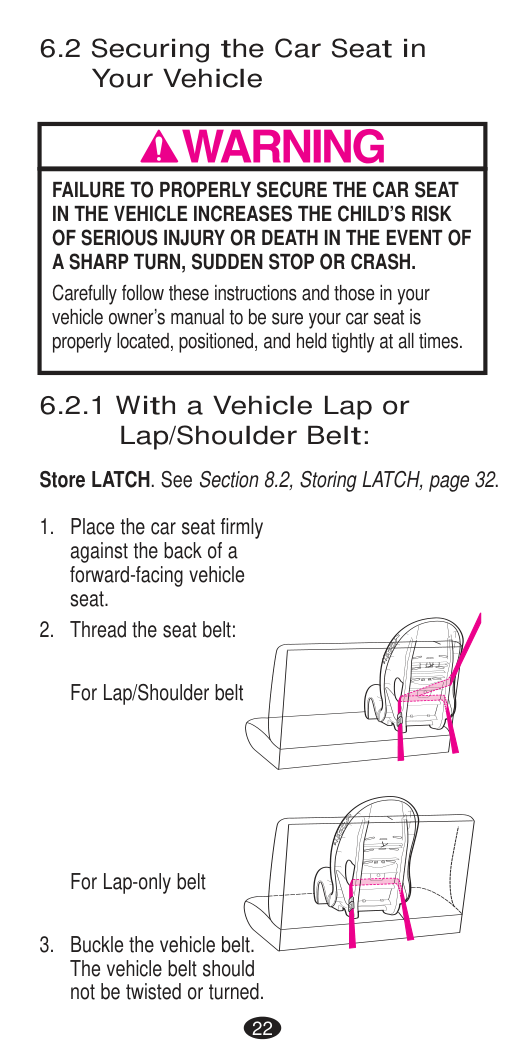
Place the car seat firmly against the back of a forward-facing vehicle seat, thread the seat belt through the appropriate path, buckle the vehicle belt, then tighten by pushing down hard in the middle of the car seat while pulling the belt tight. Perform a safety check by twisting and pulling the car seat front to back and left to right to ensure it is secure. (Page 22-23)

Show 4 more questions

Full Manual

81 pages
Page 1

1 Car Seat/Booster Seat Owner’s Manual

Read This Manual.

Do not install or use this car seat until you read and understand the instructions in this manual.

Failure To Properly Use This

Car Seat Increases The Risk Of

Serious Injury Or Death In A

Sudden Stop Or Crash.

© 2006 Graco ISPB007BE 10/06 US
Page 2

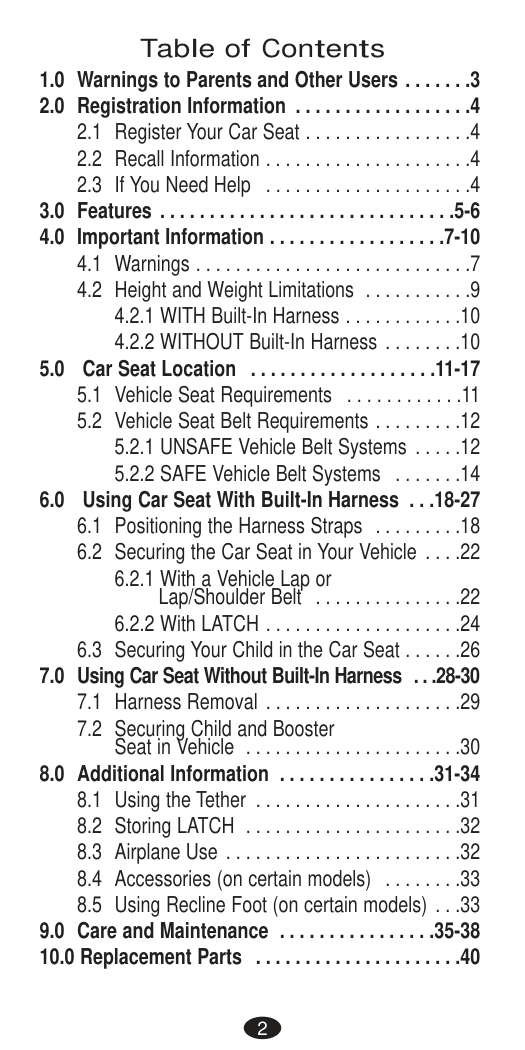
2 1.0 Warnings to Parents and Other Users . . . . . . .3 2.0 Registration Information . . . . . . . . . . . . . . . . . .4 2.1 Register Your Car Seat . . . . . . . . . . . . . . . . .4 2.2 Recall Information . . . . . . . . . . . . . . . . . . . . .4 2.3 If You Need Help . . . . . . . . . . . . . . . . . . . . .4 3.0 Features . . . . . . . . . . . . . . . . . . . . . . . . . . . . . .5-6 4.0 Important Information . . . . . . . . . . . . . . . . . .7-10 4.1 Warnings . . . . . . . . . . . . . . . . . . . . . . . . . . . .7 4.2 Height and Weight Limitations . . . . . . . . . . .9 4.2.1 WITH Built-In Harness . . . . . . . . . . . .10 4.2.2 WITHOUT Built-In Harness . . . . . . . .10 5.0 Car Seat Location . . . . . . . . . . . . . . . . . . .11-17 5.1 Vehicle Seat Requirements . . . . . . . . . . . .11 5.2 Vehicle Seat Belt Requirements . . . . . . . . .12 5.2.1 UNSAFE Vehicle Belt Systems . . . . .12 5.2.2 SAFE Vehicle Belt Systems . . . . . . .14 6.0 Using Car Seat With Built-In Harness . . .18-27 6.1 Positioning the Harness Straps . . . . . . . . .18 6.2 Securing the Car Seat in Your Vehicle . . . .22 6.2.1 With a Vehicle Lap or Lap/Shoulder Belt . . . . . . . . . . . . . . .22 6.2.2 With LATCH . . . . . . . . . . . . . . . . . . . .24 6.3 Securing Your Child in the Car Seat . . . . . .26 7.0 Using Car Seat Without Built-In Harness . . .28-30 7.1 Harness Removal . . . . . . . . . . . . . . . . . . . .29 7.2 Securing Child and Booster Seat in Vehicle . . . . . . . . . . . . . . . . . . . . . .30 8.0 Additional Information . . . . . . . . . . . . . . . .31-34 8.1 Using the Tether . . . . . . . . . . . . . . . . . . . . .31 8.2 Storing LATCH . . . . . . . . . . . . . . . . . . . . . .32 8.3 Airplane Use . . . . . . . . . . . . . . . . . . . . . . . .32 8.4 Accessories (on certain models) . . . . . . . .33 8.5 Using Recline Foot (on certain models) . . .33 9.0 Care and Maintenance . . . . . . . . . . . . . . . .35-38 10.0 Replacement Parts . . . . . . . . . . . . . . . . . . . . .40 Table of Contents
Page 3

3 Failure to properly use this car seat increases the risk of serious injury or death in a sharp turn, sudden stop or crash. Your child’s safety depends on you installing and using this car seat correctly. Even if using this car seat seems easy to figure out on your own, it is very important to READ THE OWNER’S MANUAL and the vehicle owner’s manual. Your child’s safety depends on:
  • Choosing the correct mode of use for the car
  • seat depending on your child’s size.
  • Inserting the harness straps (if needed) in the
  • proper slots for your child.
  • Selecting a suitable location for the car seat in
  • your vehicle.
  • Properly routing the vehicle seat belt or properly
  • using LATCH.
  • Properly securing the car seat in the vehicle
  • using a seat belt designed to restrain both the car seat and your child or by using LATCH. Many seat belts are NOT safe to use with this car seat, even though they can easily be threaded through or around the car seat!
  • Properly securing your child in the car seat.
  • 1.0 Warnings to Parents and Other Users

    Page 4

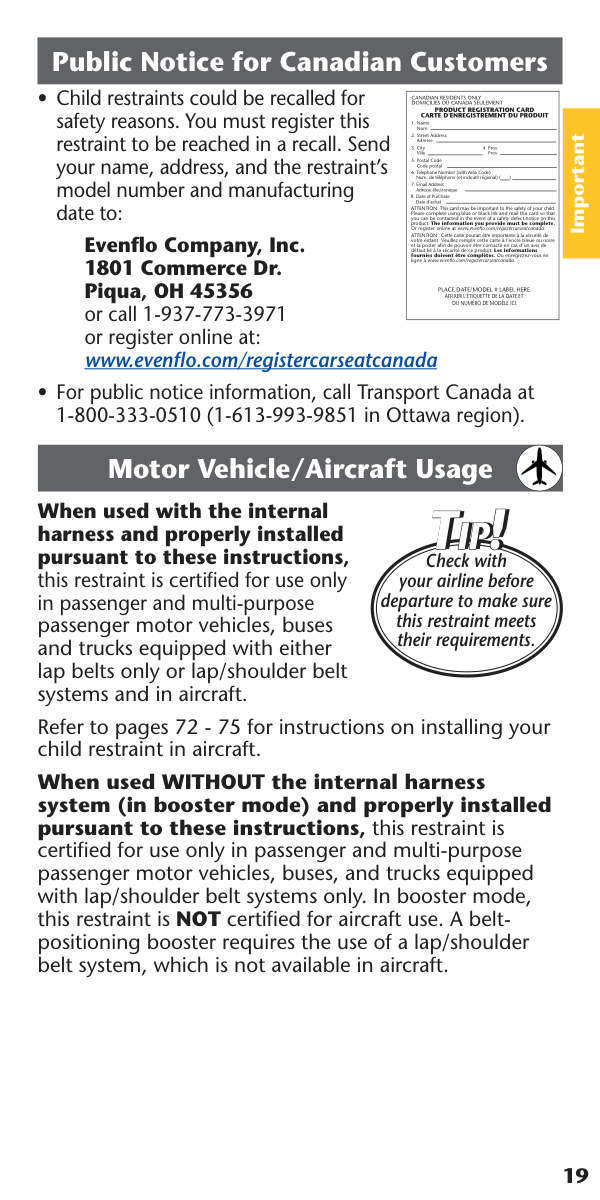
    Please contact our Customer Service Department with any questions you may have concerning parts, use, or maintenance. When you contact us, please have your product’s model number and manufactured in (date) ready so that we may help you efficiently. This number can be found on a sticker on the underside of your child restraint. 1-800-345-4109 or www.gracobaby.com 4 Model Number: Manufactured in: Purchase Date: 2.0 Registration Information 2.1 Register Your Car Seat 2.3 If You Need Help Please fill in the above information. The model number and manufactured in (date) can be found on a label underneath your child restraint. Fill out the prepaid registration postcard attached to the seat cover and mail it today. Child restraints could be recalled for safety reasons. You must register this restraint to be reached in a recall. Send your name, address, model number and manufacturing date to: Graco Children’s Products Inc. 150 Oaklands Blvd. Exton, PA 19341 or call 1-800-345-4109 or register online at www.gracobaby.com
  • Call the U.S. Government’s Vehicle Safety Hotline
  • at 1-888-327-4236 (TTY: 1-800-424-9153) or go to http://www.NHTSA.gov
  • Graco: 1-800-345-4109 or www.gracobaby.com
  • 2.2 Recall Information

    Page 5

    5 Harness slot Harness clip Harness strap Crotch strap Harness buckle 3.0 Features Accessories (on certain models) Shoulder belt positioner Harness adjustment strap Harness adjustment button Harness adjustment button plate Harness buckle tongue
    Page 6

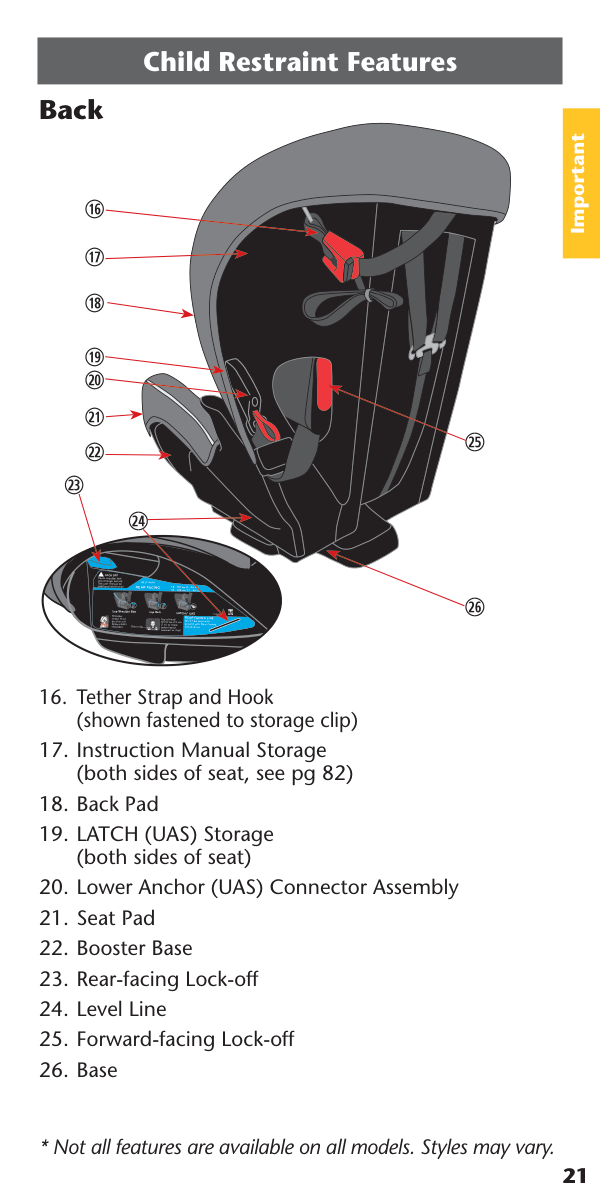
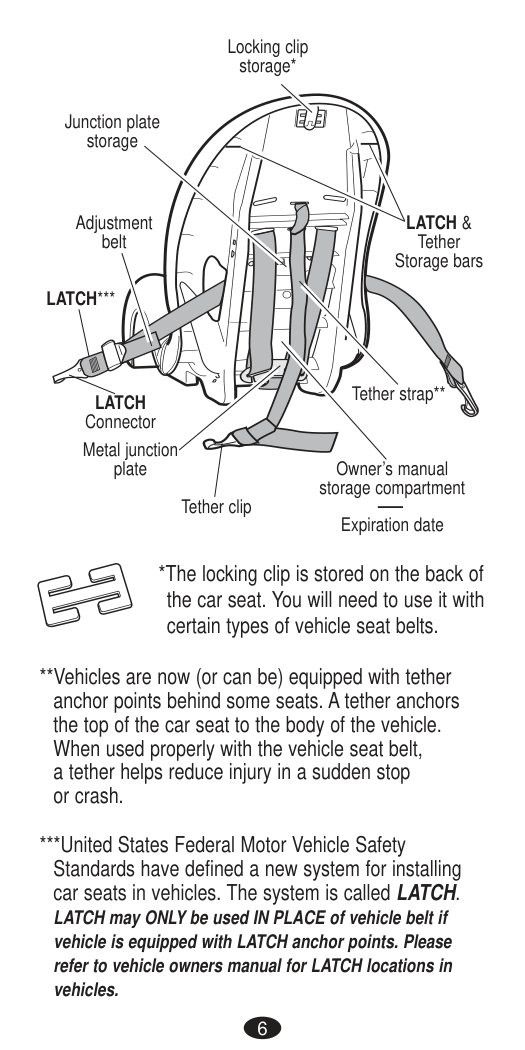
    6 **Vehicles are now (or can be) equipped with tether anchor points behind some seats. A tether anchors the top of the car seat to the body of the vehicle. When used properly with the vehicle seat belt, a tether helps reduce injury in a sudden stop or crash. Locking clip storage* Tether strap** Owner’s manual storage compartment Expiration date Tether clip — *The locking clip is stored on the back of the car seat. You will need to use it with certain types of vehicle seat belts. Metal junction plate Junction plate storage

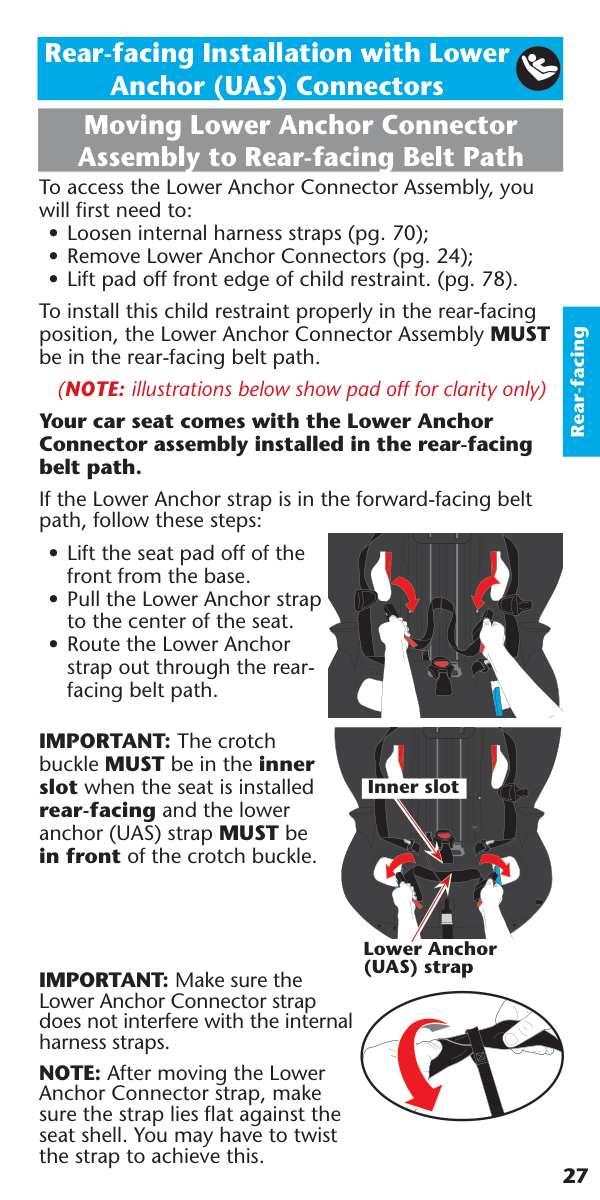
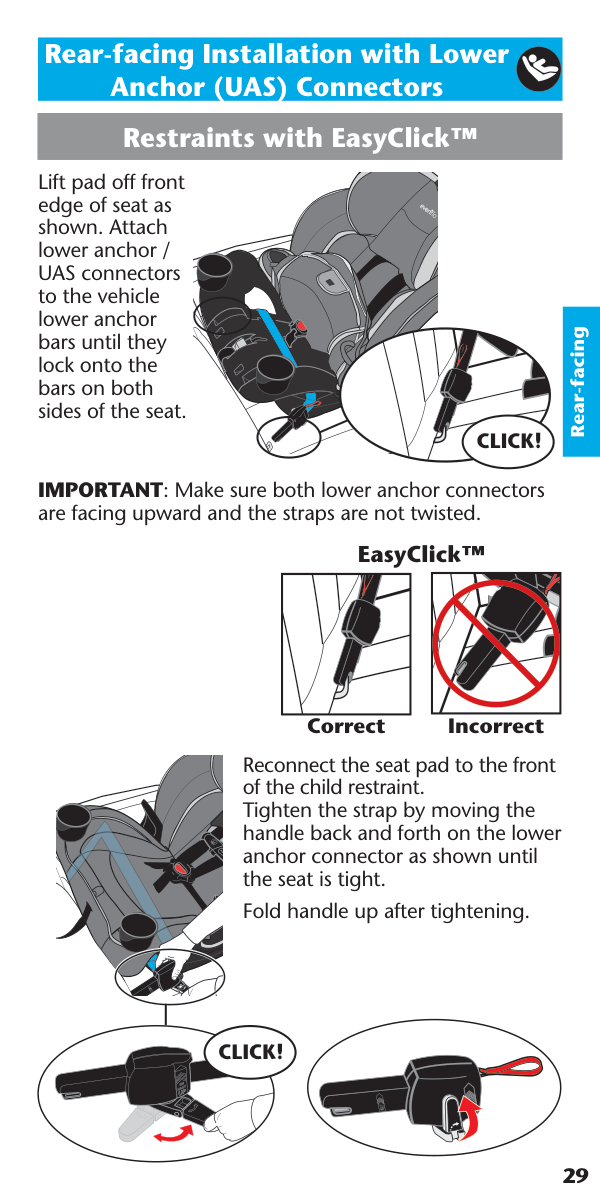
    Latch***

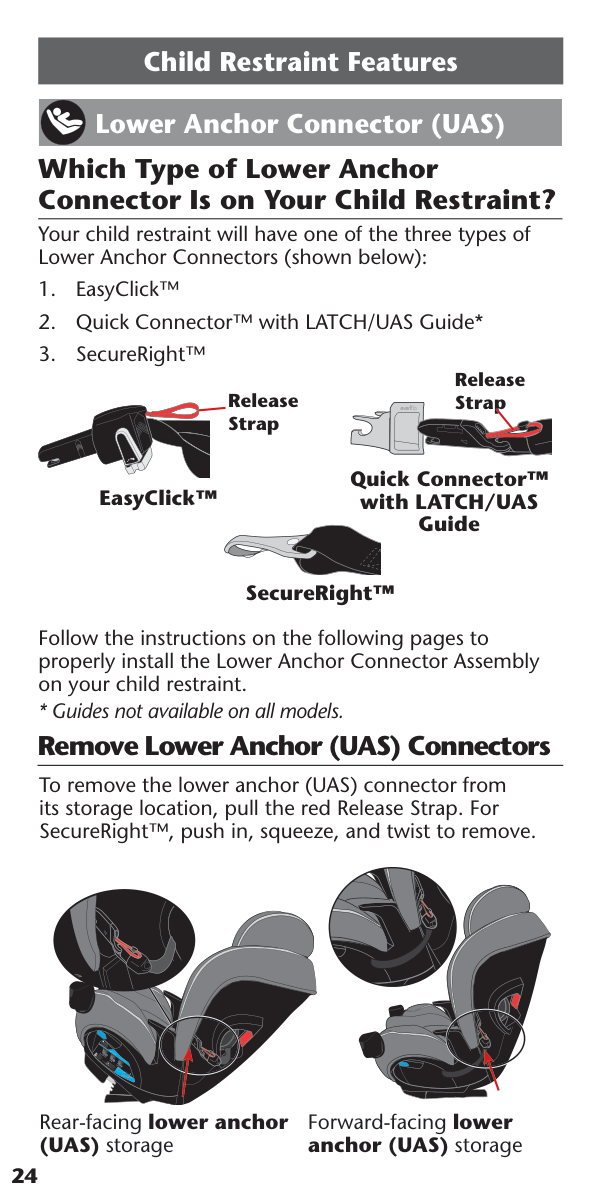
    ***United States Federal Motor Vehicle Safety Standards have defined a new system for installing car seats in vehicles. The system is called LATCH. LATCH may ONLY be used IN PLACE of vehicle belt if vehicle is equipped with LATCH anchor points. Please refer to vehicle owners manual for LATCH locations in vehicles. Adjustment belt

    Latch &

    Tether Storage bars

    Latch

    Connector

    Page 7

    7

    • Do Not Install Or Use This Car Seat

    Until You Read And Understand The

    Instructions In This Manual And In

    Your Vehicle Owner’S Manual. Do

    NOT let others install or use the car seat unless they understand how to use it.

    • Failure To Properly Use This Car Seat

    Increases The Risk Of Serious Injury Or

    Death In A Sharp Turn, Sudden Stop Or

    CRASH. Your child can be injured in a vehicle even if you are not in a crash. Sudden braking and sharp turns can injure your child if the car seat is not properly installed or if your child is not properly secured in the car seat.

    • Never Place This Booster Seat In A

    Vehicle Seating Location That Has A

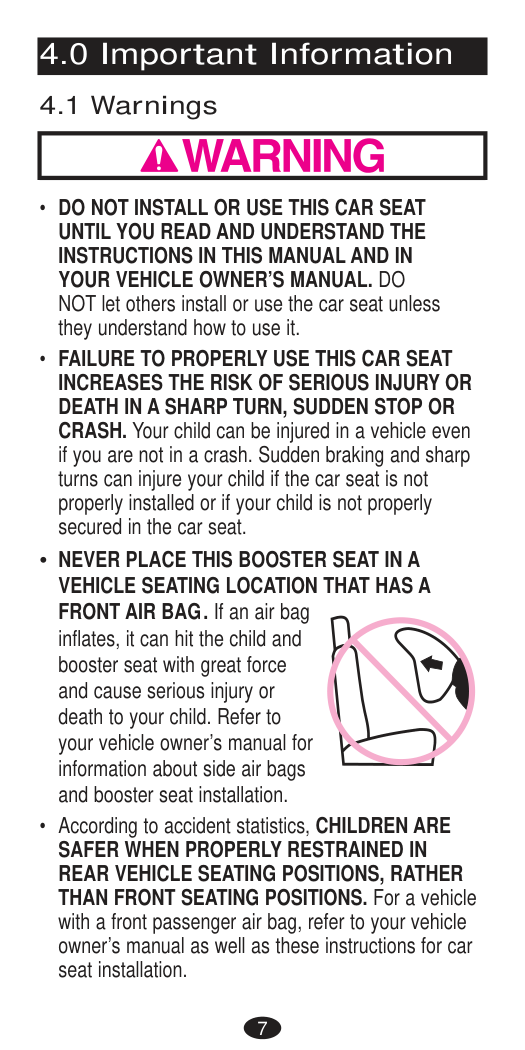
    FRONT AIR BAG. If an air bag inflates, it can hit the child and booster seat with great force and cause serious injury or death to your child. Refer to your vehicle owner’s manual for information about side air bags and booster seat installation.
  • According to accident statistics, CHILDREN ARE
  • Safer When Properly Restrained In

    Rear Vehicle Seating Positions, Rather

    THAN FRONT SEATING POSITIONS. For a vehicle with a front passenger air bag, refer to your vehicle owner’s manual as well as these instructions for car seat installation. 4.0 Important Information 4.1 Warnings
    Page 8

    8

    • Never Leave Your Child Unattended.

    • Never Leave A Car Seat Unsecured In

    YOUR VEHICLE. An unsecured car seat can be thrown around and may injure occupants in a sharp turn, sudden stop or crash. Remove it or make sure that it is securely belted in the vehicle. If not using LATCH, make sure LATCH connectors are properly stored on back of seat.

    • Replace The Car Seat After An Accident

    OF ANY KIND. An accident can cause damage to the car seat that you cannot see.

    • Stop Using Car Seat And Throw It Away

    after the date molded into the back of the car seat.
  • DO NOT MODIFY YOUR CAR SEAT or use any
  • accessories or parts supplied by other manufacturers.

    • Never Use Car Seat If It Has Damaged Or

    MISSING PARTS. DO NOT use a cut, frayed or damaged car seat harness, LATCH belt or vehicle seat belt.

    • The Car Seat Can Become Very Hot If

    LEFT IN THE SUN. Contact with these parts can burn your child’s skin. Always touch the surface of any metal or plastic parts before putting your child in the car seat.
  • THIS CHILD RESTRAINT CONFORMS to all
  • applicable Federal Motor Vehicle Safety Standards and is certified for use in motor vehicles. It is certified for use in Aircraft ONLY when used with the built-in harness. When used as a booster without the harness, this restraint is NOT certified for use in aircraft.
  • NEVER GIVE THIS CAR SEAT to someone else
  • without also giving them this manual.
  • NEVER USE A SECOND-HAND CAR SEAT or a
  • car seat whose history you do not know.

    Page 9

    9

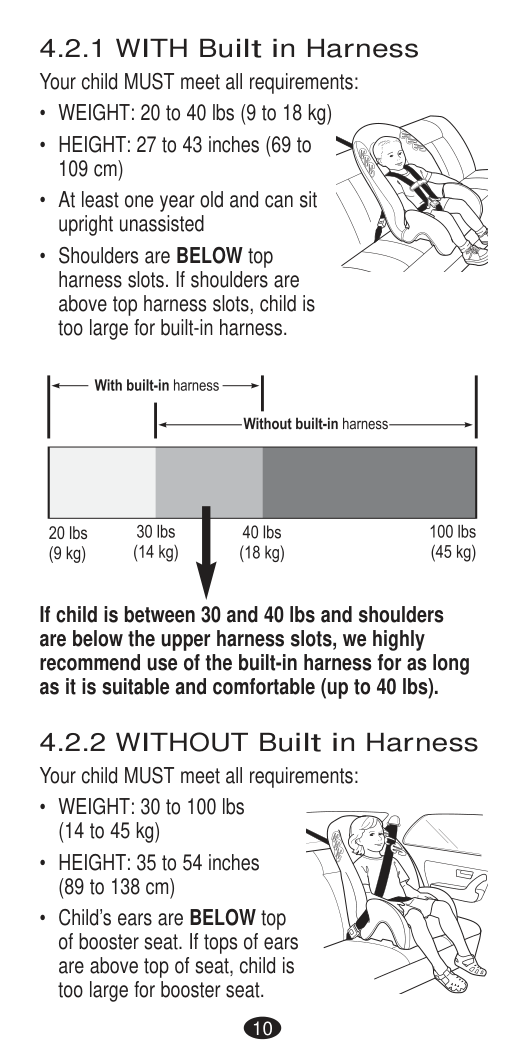
    Failure To Use Car Seat In A Manner

    Appropriate For Your Child’S Size May

    Increase The Risk Of Serious Injury Or

    DEATH. Instructions for the use of this car seat and your vehicle’s seat belt differ greatly depending on the size of your child. Be sure you are using the car seat in the correct mode and with the correct features for your child. 4.2 Height and Weight Limitations
    Page 10

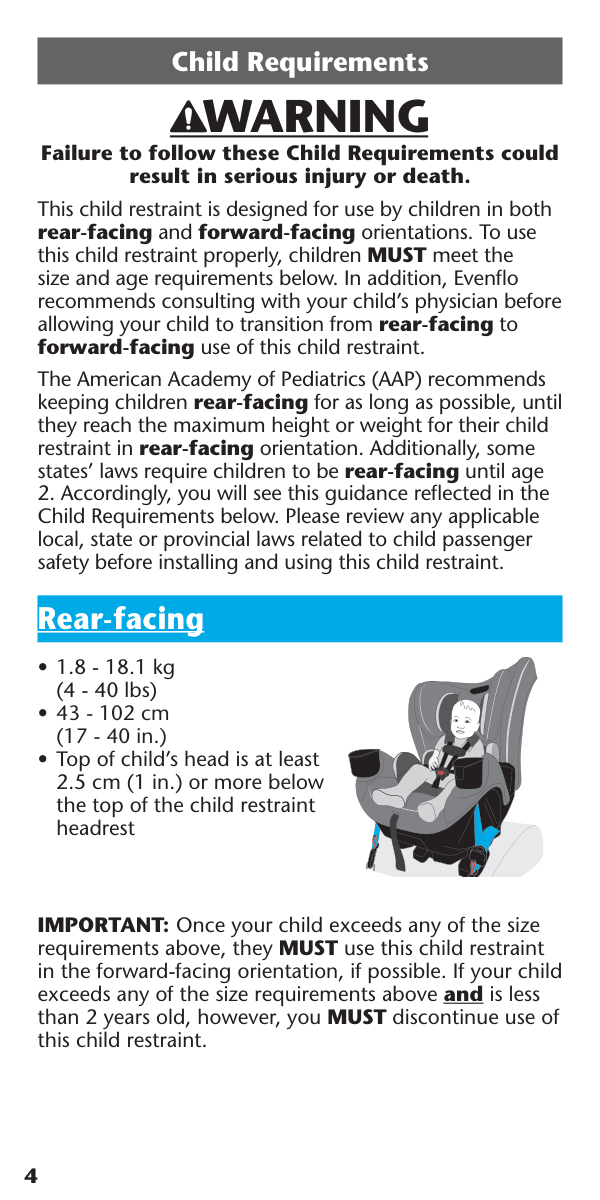
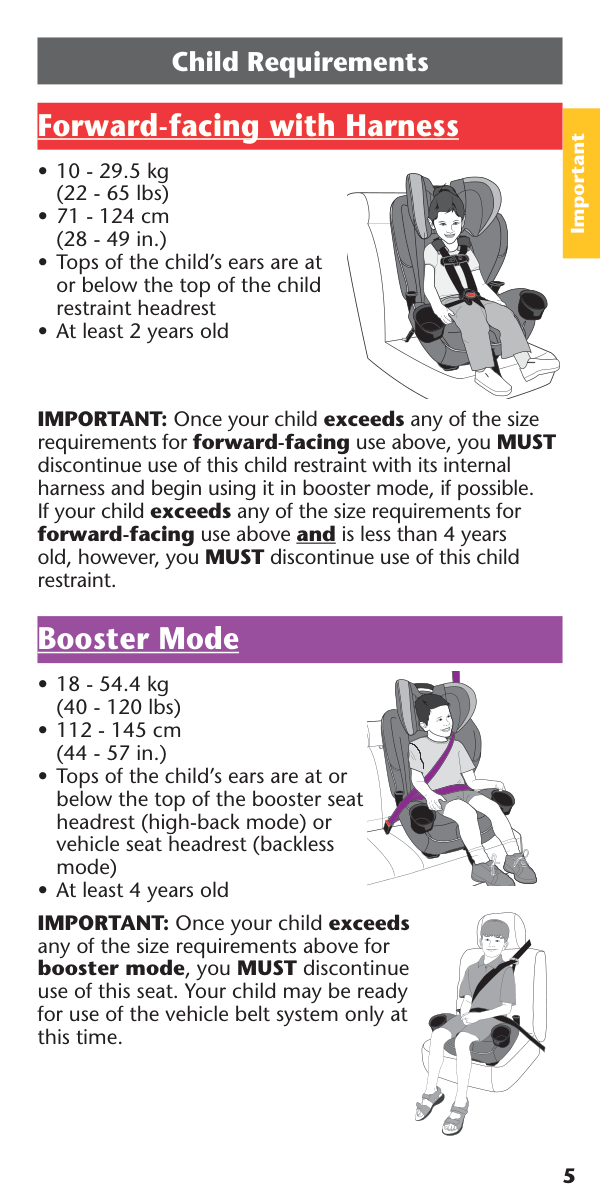
    10 4.2.1 WITH Built in Harness Your child MUST meet all requirements:
  • WEIGHT: 20 to 40 lbs (9 to 18 kg)
  • HEIGHT: 27 to 43 inches (69 to
  • 109 cm)
  • At least one year old and can sit
  • upright unassisted
  • Shoulders are BELOW top
  • harness slots. If shoulders are above top harness slots, child is too large for built-in harness. 4.2.2 WITHOUT Built in Harness Your child MUST meet all requirements:
  • WEIGHT: 30 to 100 lbs
  • (14 to 45 kg)
  • HEIGHT: 35 to 54 inches
  • (89 to 138 cm)
  • Child’s ears are BELOW top
  • of booster seat. If tops of ears are above top of seat, child is too large for booster seat. If child is between 30 and 40 lbs and shoulders are below the upper harness slots, we highly recommend use of the built-in harness for as long as it is suitable and comfortable (up to 40 lbs).

    Page 11

    11

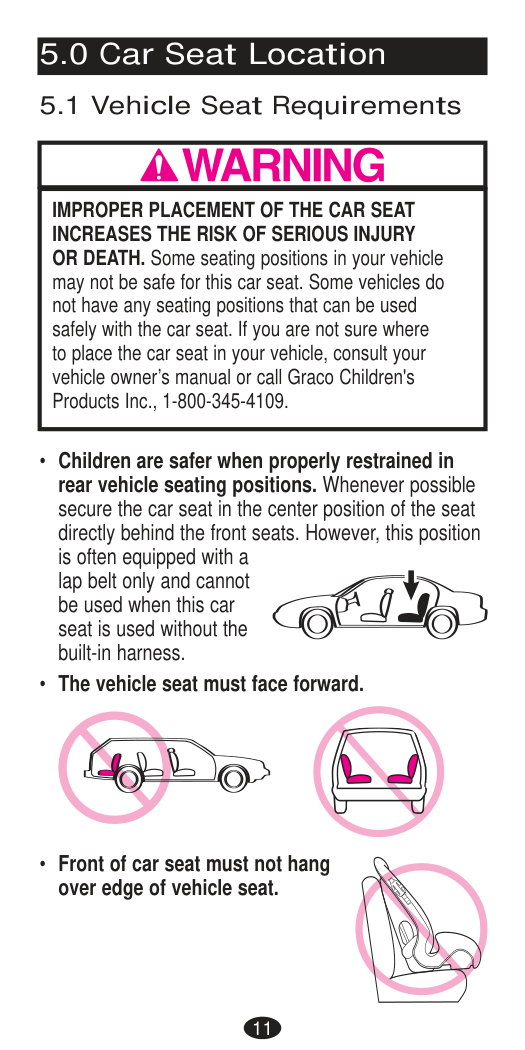
  • Children are safer when properly restrained in
  • rear vehicle seating positions. Whenever possible secure the car seat in the center position of the seat directly behind the front seats. However, this position is often equipped with a lap belt only and cannot be used when this car seat is used without the built-in harness.
  • The vehicle seat must face forward.
  • 5.0 Car Seat Location 5.1 Vehicle Seat Requirements

    Improper Placement Of The Car Seat

    Increases The Risk Of Serious Injury

    OR DEATH. Some seating positions in your vehicle may not be safe for this car seat. Some vehicles do not have any seating positions that can be used safely with the car seat. If you are not sure where to place the car seat in your vehicle, consult your vehicle owner’s manual or call Graco Children's Products Inc., 1-800-345-4109.
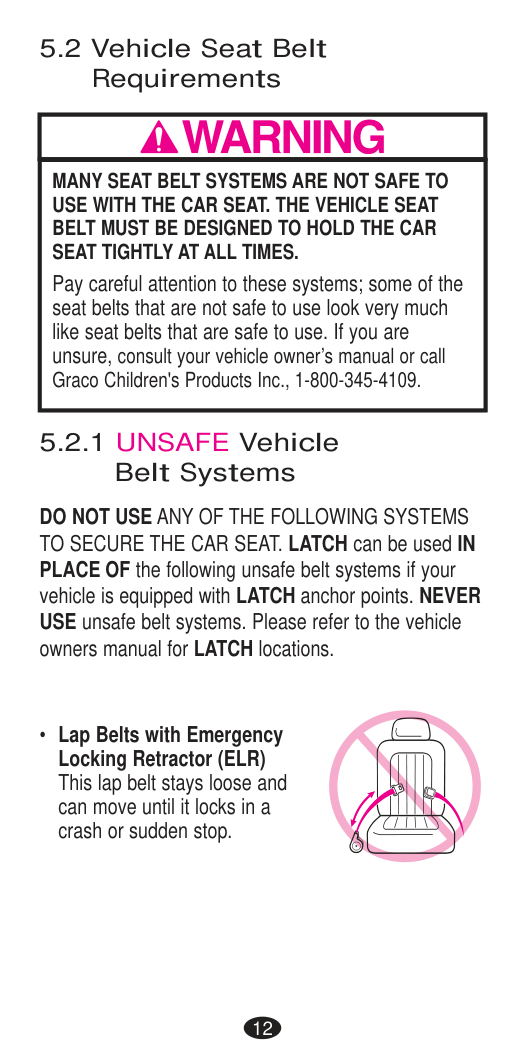
  • Front of car seat must not hang
  • over edge of vehicle seat.

    Page 12

    12

    Do Not Use Any Of The Following Systems

    TO SECURE THE CAR SEAT. LATCH can be used IN PLACE OF the following unsafe belt systems if your vehicle is equipped with LATCH anchor points. NEVER USE unsafe belt systems. Please refer to the vehicle owners manual for LATCH locations.
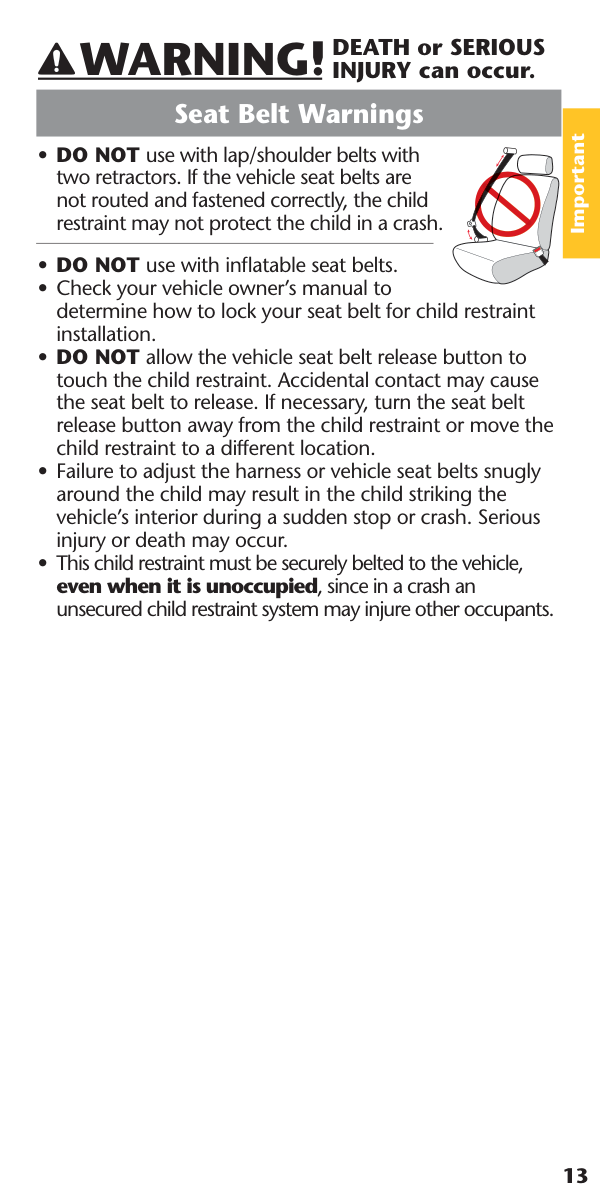
  • Lap Belts with Emergency
  • Locking Retractor (ELR) This lap belt stays loose and can move until it locks in a crash or sudden stop. 5.2 Vehicle Seat Belt Requirements

    Many Seat Belt Systems Are Not Safe To

    Use With The Car Seat. The Vehicle Seat

    Belt Must Be Designed To Hold The Car

    Seat Tightly At All Times.

    Pay careful attention to these systems; some of the seat belts that are not safe to use look very much like seat belts that are safe to use. If you are unsure, consult your vehicle owner’s manual or call Graco Children's Products Inc., 1-800-345-4109. 5.2.1 UNSAFE Vehicle Belt Systems
    Page 13

    13

  • Combination
  • Lap/Shoulder Belt with Retractor Each strap has a retractor at one end and is attached to the latch plate at the other end.
  • Passive Restraint -
  • Lap or Shoulder Belt Mounted on Door
  • Passive Restraint -
  • Lap Belt with Motorized Shoulder Belt DO NOT use vehicle belts that are attached to the door in any way or that move along a track to automatically surround the passenger when the door is closed.
  • Lap Belts Forward of
  • Seat Crease

    Page 14

    14 5.2.2 SAFE Vehicle Belt Systems

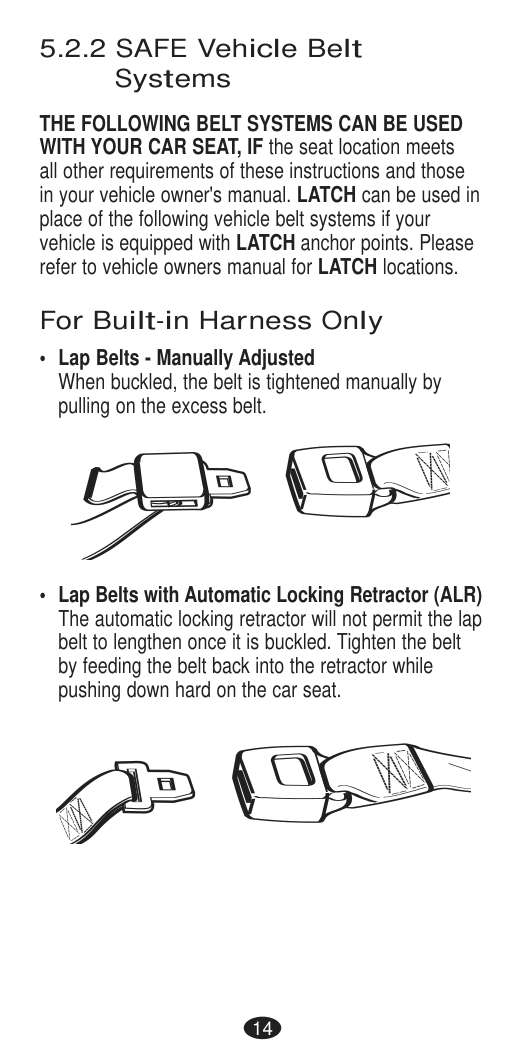
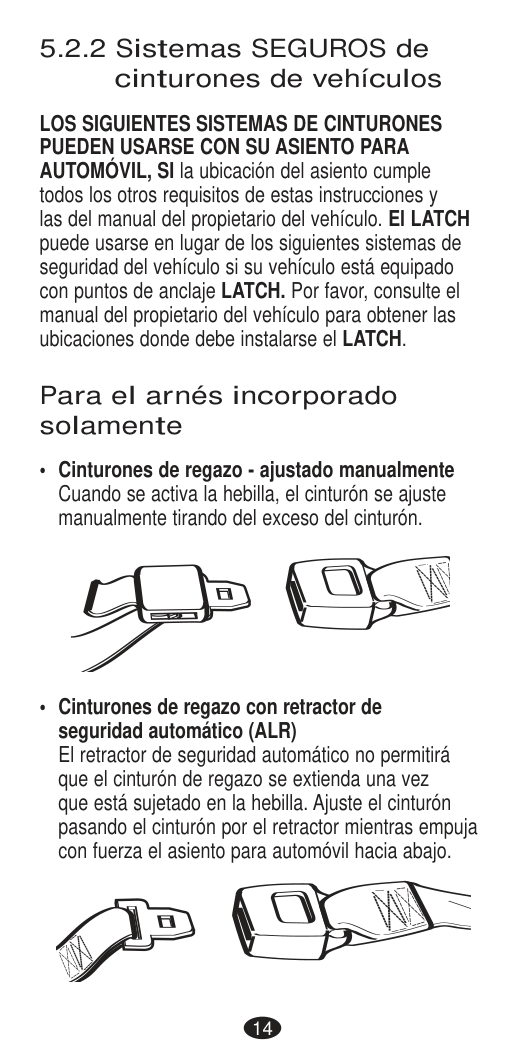
  • Lap Belts - Manually Adjusted
  • When buckled, the belt is tightened manually by pulling on the excess belt.
  • Lap Belts with Automatic Locking Retractor (ALR)
  • The automatic locking retractor will not permit the lap belt to lengthen once it is buckled. Tighten the belt by feeding the belt back into the retractor while pushing down hard on the car seat.

    The Following Belt Systems Can Be Used

    WITH YOUR CAR SEAT, IF the seat location meets all other requirements of these instructions and those in your vehicle owner's manual. LATCH can be used in place of the following vehicle belt systems if your vehicle is equipped with LATCH anchor points. Please refer to vehicle owners manual for LATCH locations. For Built-in Harness Only
    Page 15

    15

  • Combination Lap/Shoulder Belt with Locking
  • Latch Plate Once it is buckled, this type of belt has a latchplate that will not allow the lap portion of the belt to loosen. Belt is tightened by pulling hard on the shoulder portion of the vehicle belt while pushing down hard on the car seat.
  • Combination Lap/Shoulder Belt with Sliding
  • Latch Plate This belt has a latchplate that slides freely along the belt. WITH Built-in harness: This belt MUST be converted to prevent movement of the lap portion of the belt. You must use the locking clip provided with the car seat, unless your vehicle's seat belt can be converted in another way as described in your vehicle owner's manual. WITHOUT Built-in harness: Conversion or locking clip are not needed. With OR Without Built-in Harness Locking clip

    Page 16

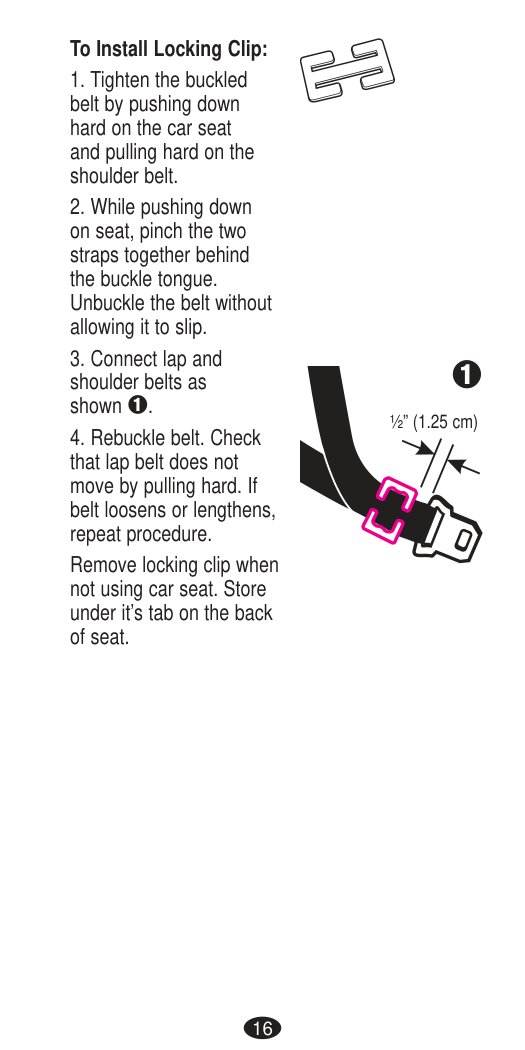
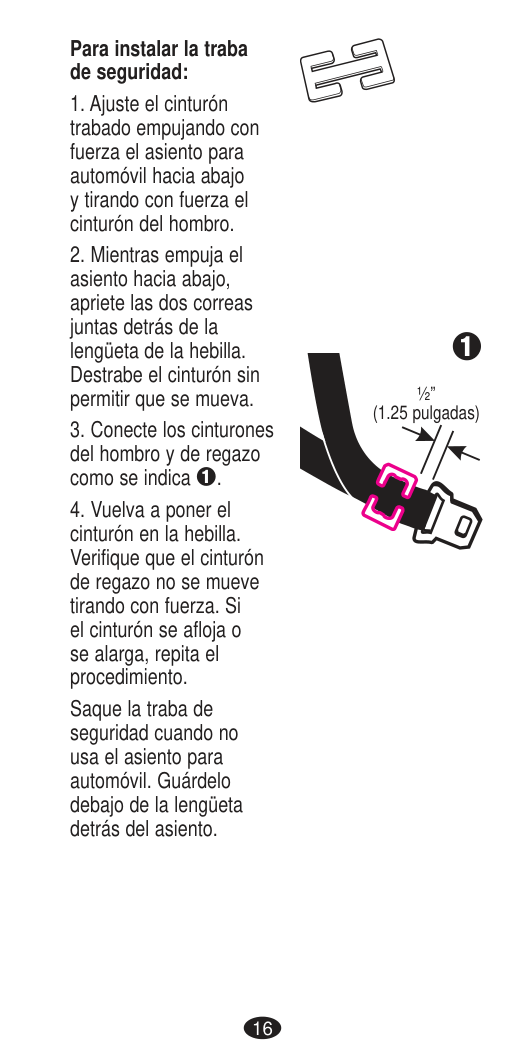
    16 To Install Locking Clip:

  • Tighten the buckled
  • belt by pushing down hard on the car seat and pulling hard on the shoulder belt.
  • While pushing down
  • on seat, pinch the two straps together behind the buckle tongue. Unbuckle the belt without allowing it to slip.
  • Connect lap and
  • shoulder belts as shown –.
  • Rebuckle belt. Check
  • that lap belt does not move by pulling hard. If belt loosens or lengthens, repeat procedure. Remove locking clip when not using car seat. Store under it’s tab on the back of seat. ½” (1.25 cm) –

    Page 17

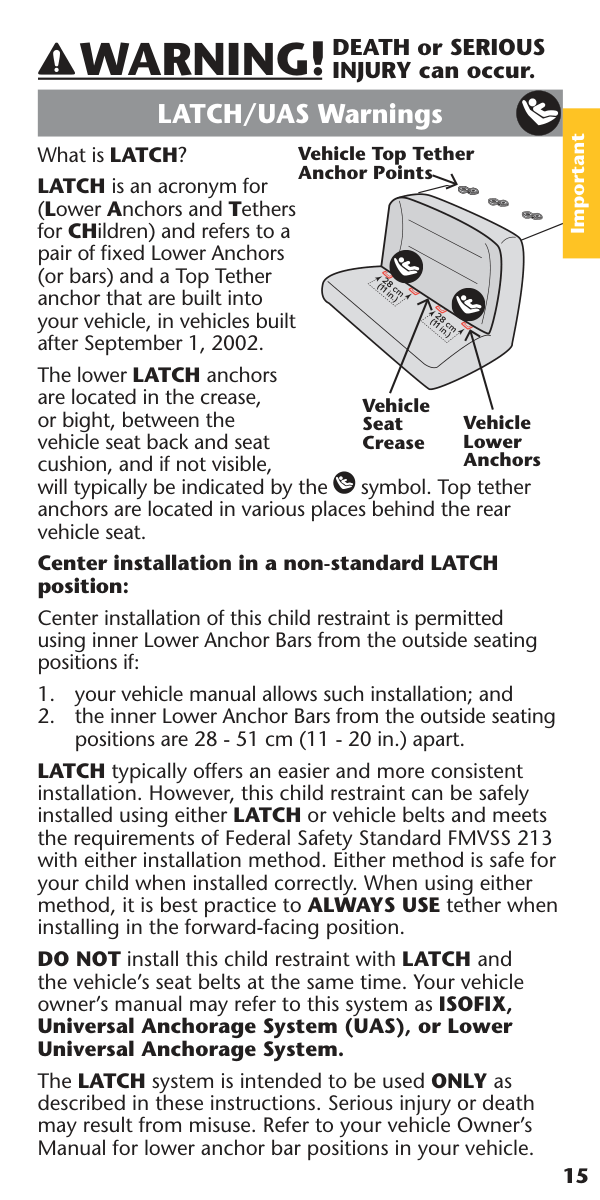
    17 With LATCH Newer vehicles have one or more seating positions with LATCH anchorage systems. If vehicle is equipped with LATCH, the vehicle lower anchor points may be visible at the vehicle seat crease. If not visible, they may be marked with the symbol below —. See your vehicle owner’s manual for exact locations, anchor identification, and requirements for use with a car seat. Typical seat in a passenger vehicle. Other vehicle types may have different LATCH locations. Check vehicle owner’s manual for vehicle top tether anchor locations. They may be identified using one of the anchor symbols as shown above ˜ or ™. ONLY use LATCH on a car seat in a seating position recommended by vehicle manufacturer. Vehicle Top Tether Anchor Points Vehicle Lower Anchor Points Vehicle Seat Crease — ˜ ™
    Page 18

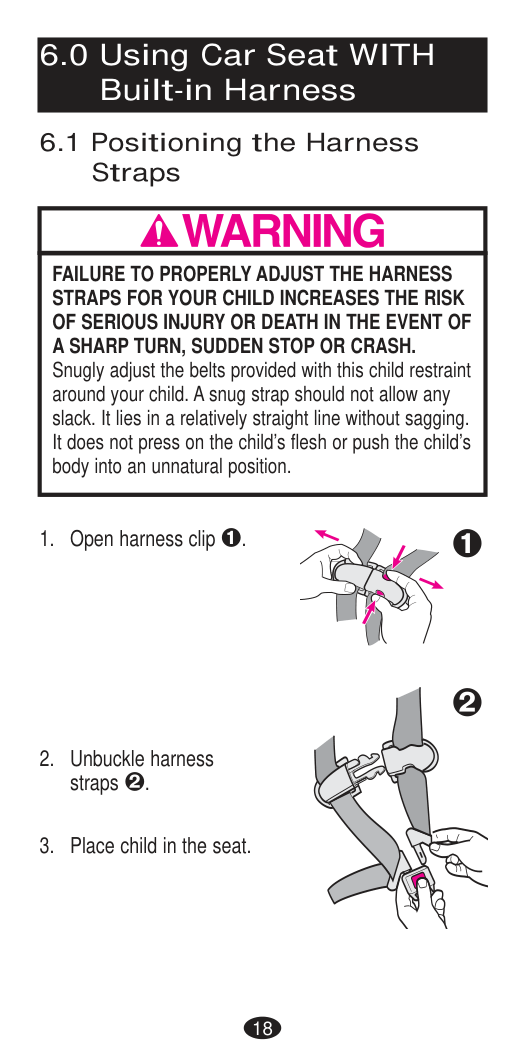
    18 6.0 Using Car Seat WITH Built-in Harness 6.1 Positioning the Harness Straps

    Failure To Properly Adjust The Harness

    Straps For Your Child Increases The Risk

    Of Serious Injury Or Death In The Event Of

    A Sharp Turn, Sudden Stop Or Crash.

    Snugly adjust the belts provided with this child restraint around your child. A snug strap should not allow any slack. It lies in a relatively straight line without sagging. It does not press on the child’s flesh or push the child’s body into an unnatural position.
  • Open harness clip –.
  • Unbuckle harness
  • straps —.
  • Place child in the seat.
  • — –

    Page 19

    19

  • Check the crotch strap.
  • Choose the position that is closest to but not under your child. To move the strap: Reach under seat and push the metal retainer up through the slot sideways ˜. Place the retainer in the appropriate slot. Pull on buckle to make sure it is secure.
  • The harness straps
  • must go into the slots even with or just above the shoulders ™.
  • If straps are in the proper
  • slots, go to step 11 on page 21.
  • To adjust harness
  • straps: Remove straps from metal junction plate š. ˜ ™ š

    Page 20

    20

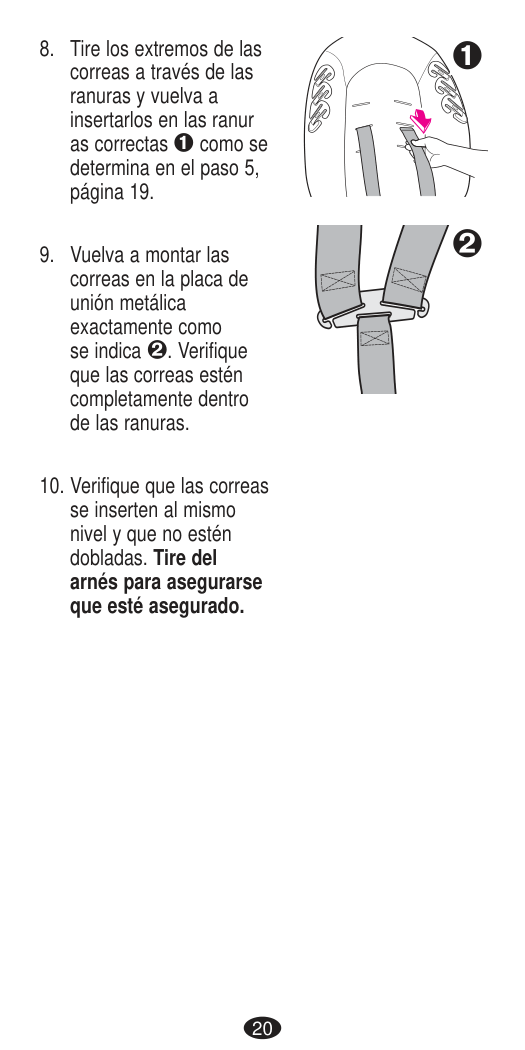
  • Pull strap ends through
  • slots and reinsert them in the correct slots – as determined in step 5, page 19.
  • Reassemble straps onto
  • metal junction plate exactly as shown —. Check that straps are completely within the slots.
  • Check that the straps are
  • inserted at the same level and that they are not twisted. Pull on harness to make sure it is secure. – —

    Page 21

    21

  • Harness Adjustment
  • Loosen the harness straps by fully pushing in the red adjustment button on the front of the seat and pulling the straps out at the shoulders as shown ˜. (See also Section 6.3, Securing Your Child in the Car Seat, page 26.) REMEMBER to check the shoulder and crotch straps as your child grows and move them to the next position when necessary. ˜

    Page 22

    22 6.2 Securing the Car Seat in Your Vehicle

    Failure To Properly Secure The Car Seat

    In The Vehicle Increases The Child’S Risk

    Of Serious Injury Or Death In The Event Of

    A Sharp Turn, Sudden Stop Or Crash.

    Carefully follow these instructions and those in your vehicle owner’s manual to be sure your car seat is properly located, positioned, and held tightly at all times.
  • Place the car seat firmly
  • against the back of a forward-facing vehicle seat.
  • Thread the seat belt:
  • For Lap/Shoulder belt For Lap-only belt
  • Buckle the vehicle belt.
  • The vehicle belt should not be twisted or turned. 6.2.1 With a Vehicle Lap or Lap/Shoulder Belt: Store LATCH. See Section 8.2, Storing LATCH, page 32.

    Page 23

    23

  • Tighten vehicle seat belt
  • Push down hard with your knee or free hand in the middle of the car seat –. Then pull and tighten the vehicle belt. For more information on how to tighten the belt for your seat belt system, see Section 5.2 Vehicle Seat Belt Requirements, pp. 12-17, or your vehicle owner’s manual.
  • If you want to use
  • tether to hold seat in place, secure it now. See Section 8.1 Using the Tether, page 31. When not using the tether, hook it on the tether storage bar on the back of the seat.
  • Safety Check for
  • Secure Installation Perform this test every time you drive with your child. Twist and pull car seat front to back and left to right to check that seat is secure —. Vehicle belt must stay tight. Car seat must be very tight. If car seat is not secure or loose, repeat procedure OR find another location for the seat, see Section 5.0 Car Seat Location, pp. 11-17. – —

    Page 24

    24

  • For ease of installation,
  • extend LATCH to its maximum length.
  • Place the car seat firmly
  • against the back of a forward-facing vehicle seat.
  • Thread LATCH
  • through the belt path normally used for the vehicle seat belt –. Belt must lay flat and not be twisted.
  • Hook LATCH
  • Connectors to vehicle lower anchors. Pull firmly on Connectors to be sure they are attached —.
  • Tighten LATCH by
  • pushing down hard on car seat and pulling the adjustment belt ˜.
  • NEVER put two LATCH
  • connectors on one vehicle LATCH anchor unless specifically allowed by the manufacturer ™. — 6.2.2 With LATCH ˜ ™ –

    Page 25

    25

  • All LATCH seating
  • positions have tether anchors. Secure the top of the seat using the tether strap. See Section 8.1 Using the Tether, page 31. When not using the tether, hook it on the tether storage bar on the back of the seat.
  • Safety Check for
  • Secure Installation Perform this test every time you drive with your child. Twist and pull car seat front to back and left to right to check that seat is secure š. LATCH belt must stay tight. Car seat must be very tight. If car seat is not secure, repeat procedure OR find another location for the seat, see Section 5.0 Car Seat Location, pp. 11-17. š

    Page 26

    26

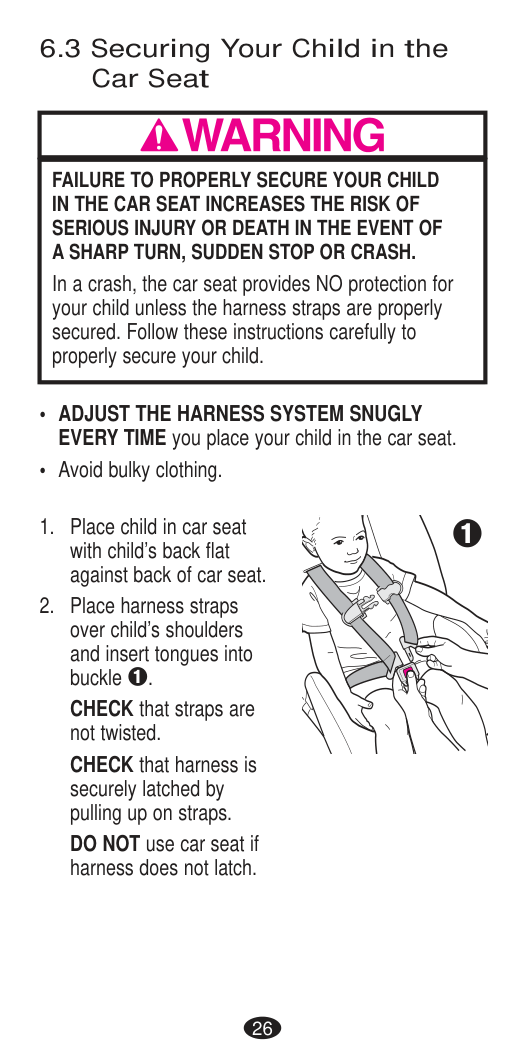
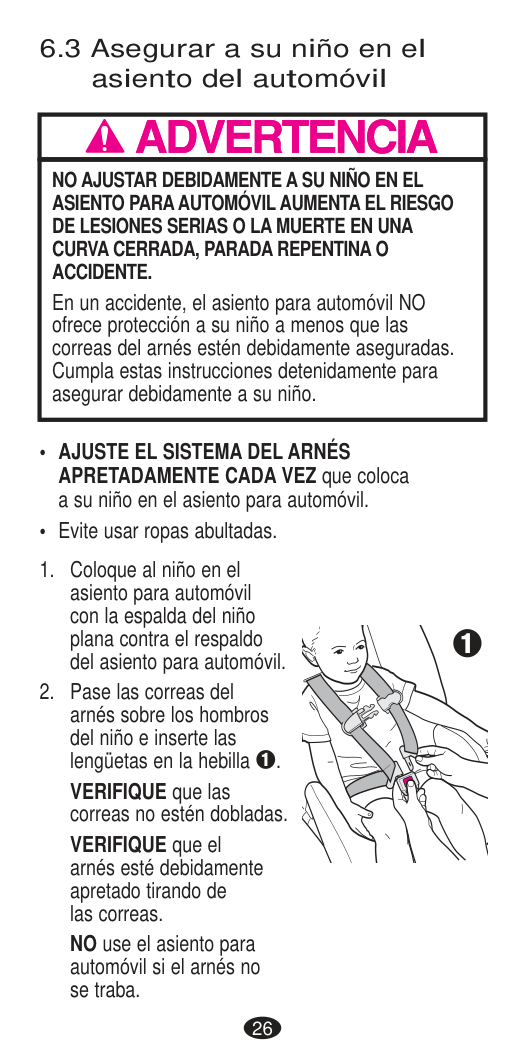
  • Place child in car seat
  • with child’s back flat against back of car seat.
  • Place harness straps
  • over child’s shoulders and insert tongues into buckle –. CHECK that straps are not twisted. CHECK that harness is securely latched by pulling up on straps. DO NOT use car seat if harness does not latch. 6.3 Securing Your Child in the Car Seat

    Failure To Properly Secure Your Child

    In The Car Seat Increases The Risk Of

    Serious Injury Or Death In The Event Of

    A Sharp Turn, Sudden Stop Or Crash.

    In a crash, the car seat provides NO protection for your child unless the harness straps are properly secured. Follow these instructions carefully to properly secure your child.

    • Adjust The Harness System Snugly

    EVERY TIME you place your child in the car seat.
  • Avoid bulky clothing.
  • –

    Page 27

    27

  • Pull the adjustment strap
  • to securely tighten the harness —.
  • Fasten harness clip ˜.
  • Position harness clip at middle of child’s chest, level with armpits.
  • Make sure straps are
  • flat and tight against child’s shoulders. A snug strap should not allow any slack. It lies in a relatively straight line without sagging. It does not press on the child’s flesh or push the child’s body into an unnatural position ™. — ˜ ™

    Page 28

    28 7.0 Using Car Seat WITHOUT Built-in Harness

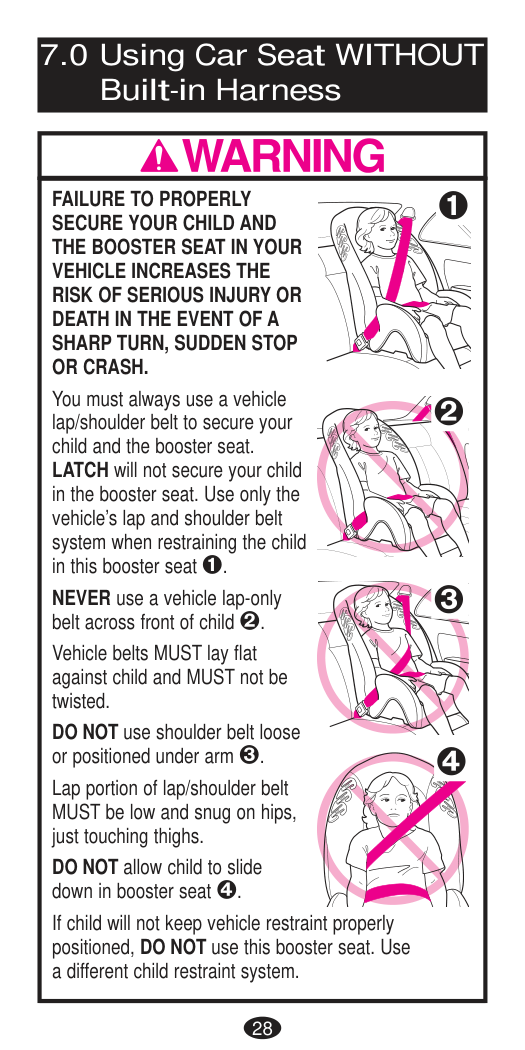
    Failure To Properly

    Secure Your Child And

    The Booster Seat In Your

    Vehicle Increases The

    Risk Of Serious Injury Or

    Death In The Event Of A

    Sharp Turn, Sudden Stop

    Or Crash.

    You must always use a vehicle lap/shoulder belt to secure your child and the booster seat. LATCH will not secure your child in the booster seat. Use only the vehicle’s lap and shoulder belt system when restraining the child in this booster seat –. NEVER use a vehicle lap-only belt across front of child —. Vehicle belts MUST lay flat against child and MUST not be twisted. DO NOT use shoulder belt loose or positioned under arm ˜. Lap portion of lap/shoulder belt MUST be low and snug on hips, just touching thighs. DO NOT allow child to slide down in booster seat ™. If child will not keep vehicle restraint properly positioned, DO NOT use this booster seat. Use a different child restraint system. — ˜ ™ –
    Page 29

    29 7.1 Harness Removal

  • Remove harness straps
  • from metal junction plate. See figure 5 on page 19 for more help. Pull the straps through harness slots. Do not remove buckles or harness clip from straps š. Push straps, buckles and harness clip through bottom of seat.
  • Remove crotch strap.
  • See figure 3 on page 19 for more help. Buckle crotch strap to harness and fasten harness clip together for storage.
  • Metal junction plate
  • and strap are not removable. Push in red adjustment button and pull strap to rear of seat ›. Snap junction plate in back of seat œ.
  • Store LATCH. See
  • Section 8.2, Storing LATCH, page 32.
  • Reverse instructions to
  • reinstall. See figure 1 on page 38 for the correct path for the harness. š › œ

    Page 30

    30

  • Place car seat firmly against the back
  • of a forward-facing vehicle seat equipped with a lap/shoulder belt only.
  • If you want to use tether to hold
  • seat in place, secure it now. See Section 8.1 Using the Tether, page 31.
  • Place child in car seat with child’s
  • back flat against back of car seat.
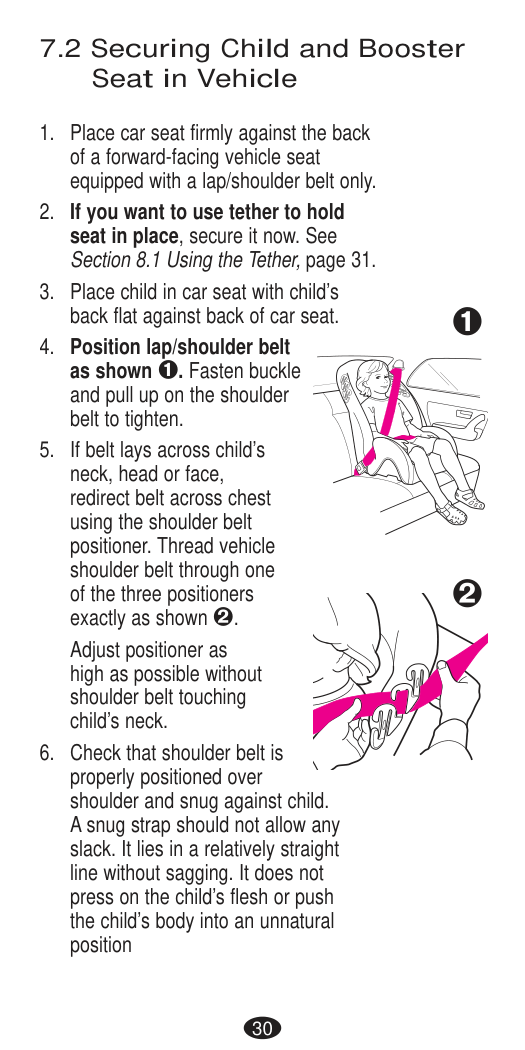
  • Position lap/shoulder belt
  • as shown –. Fasten buckle and pull up on the shoulder belt to tighten.
  • If belt lays across child’s
  • neck, head or face, redirect belt across chest using the shoulder belt positioner. Thread vehicle shoulder belt through one of the three positioners exactly as shown —. Adjust positioner as high as possible without shoulder belt touching child’s neck.
  • Check that shoulder belt is
  • properly positioned over shoulder and snug against child. A snug strap should not allow any slack. It lies in a relatively straight line without sagging. It does not press on the child’s flesh or push the child’s body into an unnatural position – — 7.2 Securing Child and Booster Seat in Vehicle

    Page 31

    31 8.0 Additional information 8.1 Using the Tether
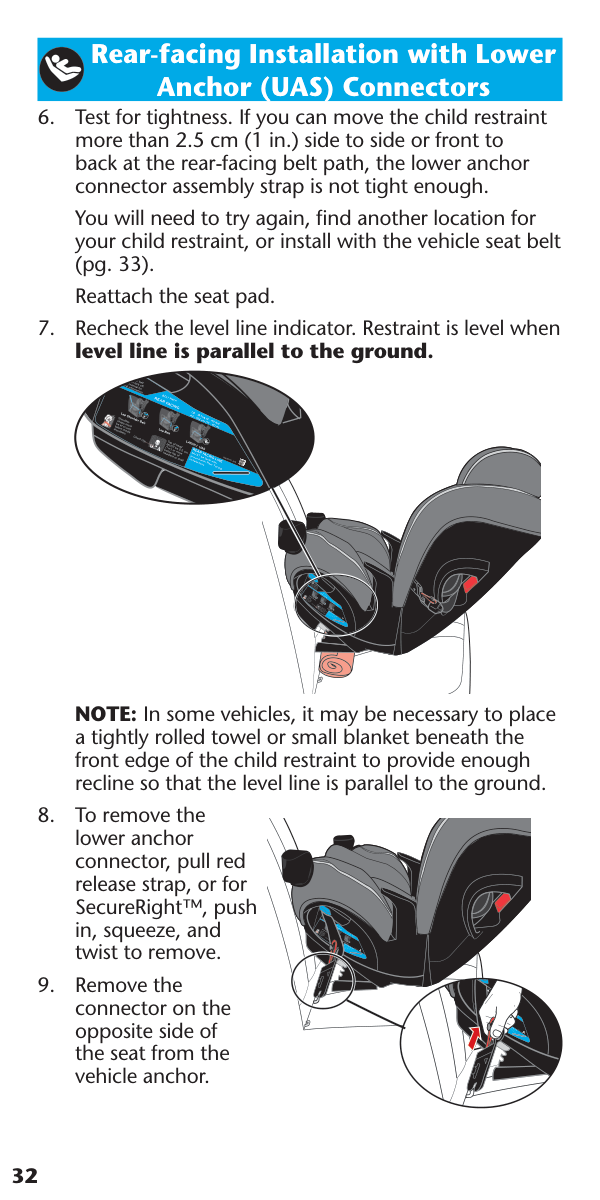
  • Check that tether is
  • securely attached to car seat.
  • Fasten tether clip to
  • anchor point ˜.
  • Tighten the tether
  • strap securely ™.
  • Check car seat tightness
  • after securing tether. If necessary, retighten vehicle seat belt when used with the built-in harness.
  • To loosen, lift up on
  • the metal tongue of the buckle š. All LATCH seating positions have tether anchors. If you want to use the tether, check your vehicle owner’s manual for the location(s). If your vehicle is not equipped with a tether anchor, it may be possible to install one. Contact your vehicle dealership for the proper anchor location and installation. You may purchase a tether anchor parts kit by calling Graco Customer Service at 1-800-345-4109. ˜ ™ š

    Page 32

    32 8.3 Airplane Use This restraint is certified for use in Motor Vehicles. It is certified for use in Aircraft ONLY when used with the built-in harness. When used as a booster without the harness, this restraint is NOT certified for use in aircraft because there is no shoulder belt available. Important points to remember

  • Airlines have some restrictions about the use of
  • car seats.
  • Install your car seat on an airplane in the same way
  • it is installed in an automobile with a lap belt (see Section 6.2.1, Securing the Car Seat in Your Vehicle with a Vehicle Lap or Lap/Shoulder Belt, pp. 22-23).
  • Check that the airplane seat belt holds the car seat
  • securely in place at all times. 8.2 Storing LATCH
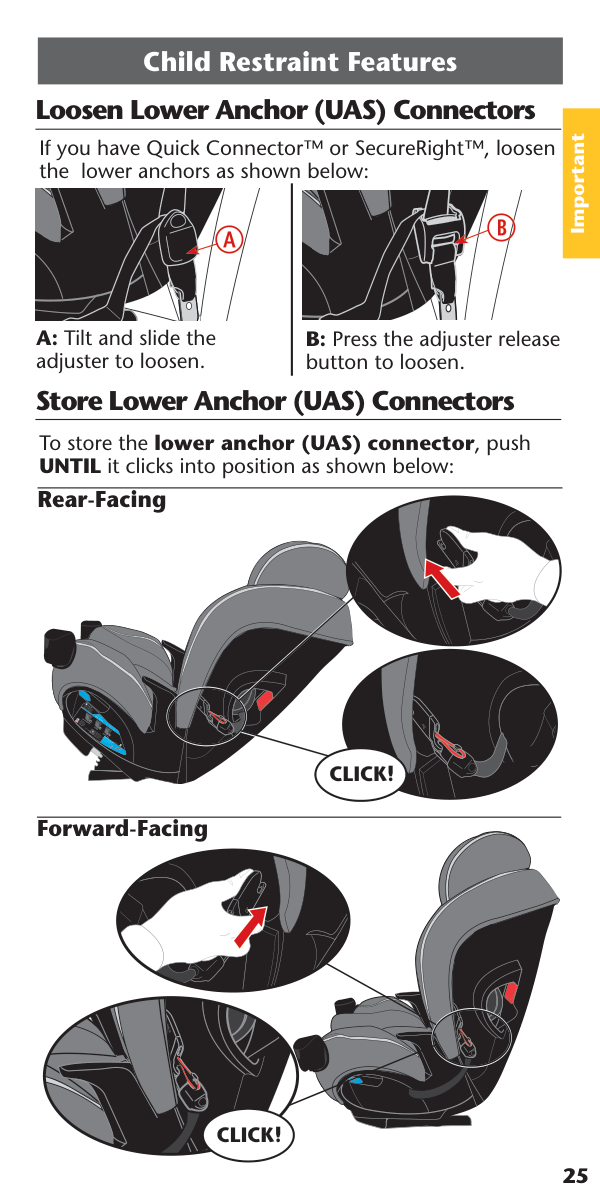
  • For ease of storing,
  • extend LATCH to its maximum length.
  • Locate the storage
  • bars on back of car seat –.
  • Fasten ends of LATCH
  • onto storage bars as shown.
  • After fastening onto
  • storage bar, pull on adjustment belt to make sure LATCH is securely fastened.
  • LATCH storage
  • should look like this when complete –. – Storage bars

    Page 33

    8.4 Accessories (on certain models)

  • Insert the two prongs
  • of the cupholder into the two slots on either the left or right side of the seat —.
  • Push cupholder down
  • until the clip snaps onto the bottom of seat ˜. CHECK that cupholder is secure by pulling on it. Clip — ˜ 33 Never place sharp or pointed objects in a cupholder. In a crash, these objects could hit your child and cause serious injuries. 8.5 Using Recline Foot (on certain models) Some models come with a recline foot on the bottom of the seat.
  • To use recline: flip foot to
  • front of seat. –.
  • For storage: flip foot
  • toward rear of seat. – –

    Page 34

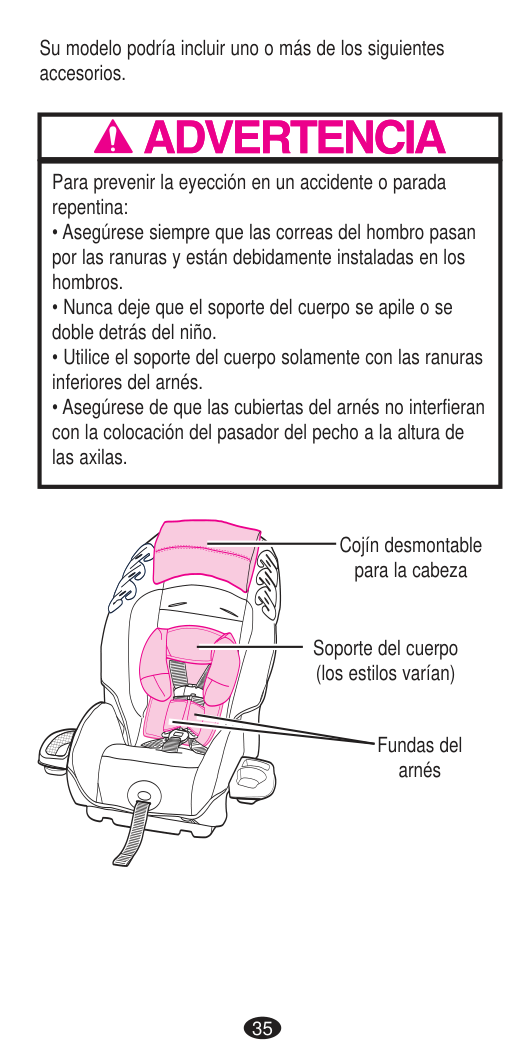
    34 To prevent ejection in sudden stop or crash:
  • Always make sure shoulder straps are threaded
  • through slots and properly positioned on shoulders.
  • Never allow body support to bunch or fold behind child.
  • Use body support with bottom harness slots only.
  • Make sure that harness covers do not interfere with
  • placement of the chest clip at armpit level. Detachable Head Pillow Harness Covers Body Support (styles vary) Your model may include one or more of the following accessory items.

    Page 35

    35 9.0 Care and Maintenance

    • Continuous Use Of Car Seat May Cause

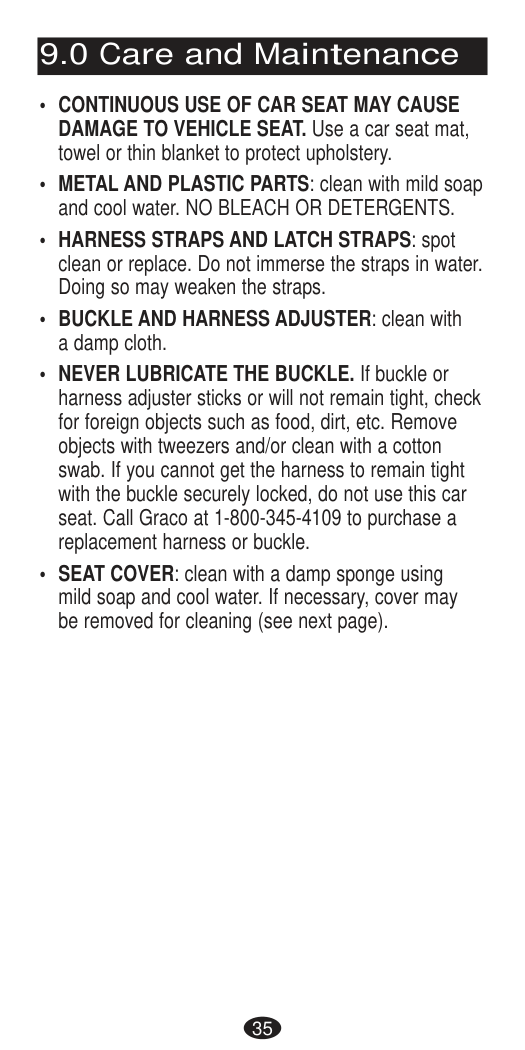
    DAMAGE TO VEHICLE SEAT. Use a car seat mat, towel or thin blanket to protect upholstery.
  • METAL AND PLASTIC PARTS: clean with mild soap
  • and cool water. NO BLEACH OR DETERGENTS.
  • HARNESS STRAPS AND LATCH STRAPS: spot
  • clean or replace. Do not immerse the straps in water. Doing so may weaken the straps.
  • BUCKLE AND HARNESS ADJUSTER: clean with
  • a damp cloth.
  • NEVER LUBRICATE THE BUCKLE. If buckle or
  • harness adjuster sticks or will not remain tight, check for foreign objects such as food, dirt, etc. Remove objects with tweezers and/or clean with a cotton swab. If you cannot get the harness to remain tight with the buckle securely locked, do not use this car seat. Call Graco at 1-800-345-4109 to purchase a replacement harness or buckle.
  • SEAT COVER: clean with a damp sponge using
  • mild soap and cool water. If necessary, cover may be removed for cleaning (see next page).

    Page 36

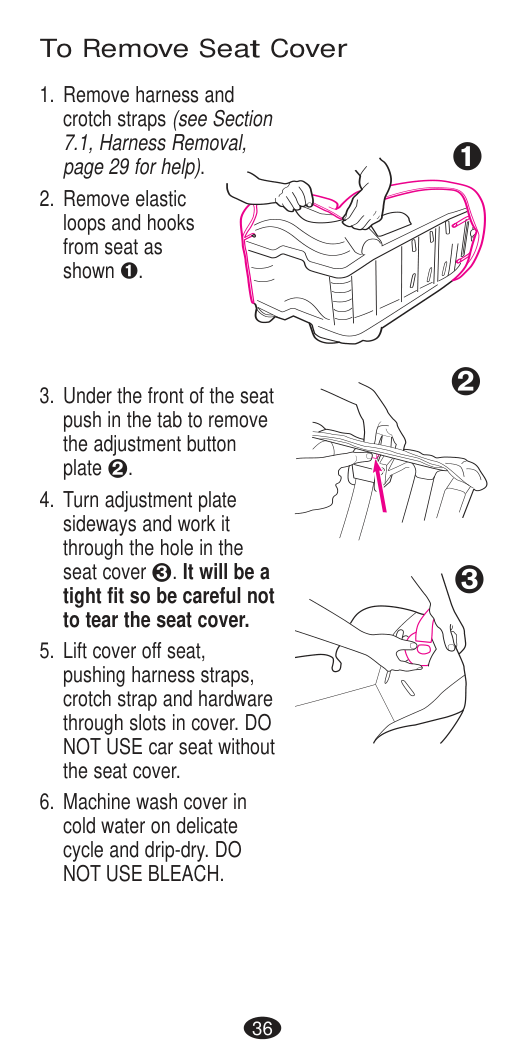
    36 To Remove Seat Cover

  • Remove harness and
  • crotch straps (see Section 7.1, Harness Removal, page 29 for help).
  • Remove elastic
  • loops and hooks from seat as shown –.
  • Under the front of the seat
  • push in the tab to remove the adjustment button plate —.
  • Turn adjustment plate
  • sideways and work it through the hole in the seat cover ˜. It will be a tight fit so be careful not to tear the seat cover.
  • Lift cover off seat,
  • pushing harness straps, crotch strap and hardware through slots in cover. DO NOT USE car seat without the seat cover.
  • Machine wash cover in
  • cold water on delicate cycle and drip-dry. DO

    Not Use Bleach.

    – ˜ —

    Page 37

    37

  • To put the seat cover back
  • on, reverse preceding instructions. Push the adjustment plate and strap through the hole in the seat cover. Be careful not to tear the seat cover.
  • Insert the two fingers of
  • the adjustment plate into the back of the hole in the seat ™.
  • Push the fabric up so
  • that the tab under the adjustment plate is under the cloth š. Snap the adjustment plate back on the seat ›. Make sure that the adjustment plate is attached securely to the seat and that the strap moves freely when the button is pushed. › š ™ To Reinstall Seat Cover

    Page 38

    38

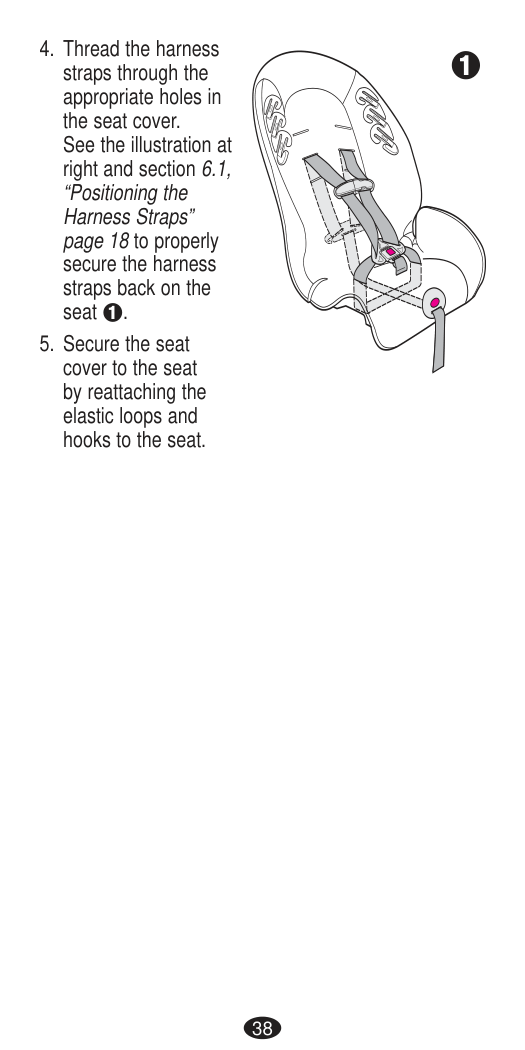
  • Thread the harness
  • straps through the appropriate holes in the seat cover. See the illustration at right and section 6.1, “Positioning the Harness Straps” page 18 to properly secure the harness straps back on the seat –.
  • Secure the seat
  • cover to the seat by reattaching the elastic loops and hooks to the seat. –

    Page 40

    40 10.0 Replacement Parts To purchase parts or accessories or for warranty information in the United States, please contact us at the following: www.gracobaby.com or 1-800-345-4109

    Page 42

    42 Keep this manual in the storage compartment on the back of the car seat.
    Page 43

    1 © 2006 Graco ISPB007BE 10/06 US Asiento para automóvil/ asiento para niños Manual del propietario

    Lea Este Manual.

    No instale ni use este asiento para automóvil hasta que haya leído y entendido las instrucciones en este manual.

    No Usar Debidamente Este Asiento

    Para Automóvil Aumenta El Riesgo

    De Lesiones Serias O Muerte En Una

    Parada Repentina O Accidente

    Page 44

    2 1.0 Advertencias a padres y otros usuarios . . . . . . . . . . . .3 2.0 Información sobre el registro . . . . . . . . . . . . . . . . . . . . .4 2.1 Registre su asiento para automóvil . . . . . . . . . . . . .4 2.2 Información sobre el retiro de productos del mercado .4 2.3 Si necesita ayuda . . . . . . . . . . . . . . . . . . . . . . . . . . .4 3.0 Características . . . . . . . . . . . . . . . . . . . . . . . . . . . . . . .5-6 4.0 Información importante . . . . . . . . . . . . . . . . . . . . . . .7-10 4.1 Advertencias . . . . . . . . . . . . . . . . . . . . . . . . . . . . . . .7 4.2 Limitaciones de peso y altura . . . . . . . . . . . . . . . . . .9 4.2.1 CON el arnés incorporado . . . . . . . . . . . . . . .10 4.2.2 SIN de arnés incorporado . . . . . . . . . . . . . . .10 5.0 Ubicación del asiento para automóvil . . . . . . . . . .11-16 5.1 Requisitos del asiento del vehículo . . . . . . . . . . . .11 5.2 Requisitos del cinturón de seguridad del vehículo .12 5.2.1 Sistemas PELIGROSOS de cinturones de vehículos . . . . . . . . . . . . . . . . . . . . . . . . . .12 5.2.2 Sistemas SEGUROS de cinturones de vehículos . . . . . . . . . . . . . . . . . . . . . . . . . .14 6.0 Uso del asiento para automóviles con el arnés incorporado . . . . . . . . . . . . . . . . . . . . . . . . . .18-27 6.1 Colocación de las correas del arnés . . . . . . . . . . .18 6.2 Asegurar el asiento del automóvil en su vehículo .22 6.2.1 Con el cinturón del vehículo de regazo o de regazo/hombro . . . . . . . . . . . . . . . . . . . . .22 6.2.2 Con LATCH . . . . . . . . . . . . . . . . . . . . . . . . . .24 6.3 Asegurar a su niño en el asiento del automóvil . . .26 7.0 Uso del asiento para automóviles sin arnés incorporado . . . . . . . . . . . . . . . . . . . . . . . . . . . . . .28-30 7.1 Eliminación del arnés . . . . . . . . . . . . . . . . . . . . . . .29 7.2 Asegurar al niño y el asiento para niños en el vehículo . . . . . . . . . . . . . . . . . . . . . . . . . . . . .30 8.0 Información adicional . . . . . . . . . . . . . . . . . . . . . . .31-34 8.1 Uso de la soga . . . . . . . . . . . . . . . . . . . . . . . . . . . .31 8.2 Almacenamiento del LATCH . . . . . . . . . . . . . . . . . .32 8.3 Uso en aeronaves . . . . . . . . . . . . . . . . . . . . . . . . . .33 8.4 Accesorios (ciertos modelos) . . . . . . . . . . . . . . . . .34 8.5 Uso del pie de reclinación (en ciertos modelos) . . .34 9.0 Cuidado y mantenimiento . . . . . . . . . . . . . . . . . . . .36-39 10.0 Piezas de repuesto . . . . . . . . . . . . . . . . . . . . . . . . . . . . .40 Índice de materias

    Page 45

    3 No usar debidamente este asiento para automóvil aumenta el riesgo de lesiones serias o muerte en una curva cerrada, parada repentina o accidente. La seguridad de su niño depende de que usted instale y use este asiento para automóvil correctamente. A pesar de que el uso de este asiento para automóvil parezca fácil de descifrar, es muy importante LEER EL MANUAL DEL PROPIETARIO y el manual del usuario del vehículo. La seguridad de su niño depende de:
  • Elegir el modo de uso correcto del asiento de
  • seguridad, según el tamaño de su niño.
  • Insertar las correas (si resultan necesarias) en las
  • ranuras correctas para su niño.
  • Elegir una ubicación adecuada para el asiento de
  • seguridad en su vehículo.
  • Colocar el cinturón de seguridad del vehículo o
  • LATCH de manera correcta.
  • Sujetar el asiento de seguridad en el vehículo
  • correctamente usando un cinturón de seguridad diseñado para contener ambos el asiento de seguridad y su niño o usando LATCH. Muchos cinturones de seguridad NO son seguros para su uso con este asiento de seguridad, incuso si se colocan fácilmente a través o alrededor de este asiento de seguridad.
  • Sujetar a su niño correctamente en el asiento
  • de seguridad. 1.0 Advertencias a padres y otros usuarios

    Page 46

    4 Número de modelo: Fabricado en: Fecha de compra: 2.0 Información sobre el registro 2.1 Registre su asiento para automóvil Por favor, complete la información que se solicita más arriba. El número de modelo y la fecha de fabri- cación pueden encontrarse en una etiqueta ubicada debajo del asiento para automóvil. Llena la tarjeta postal de registro prepagada que se encuentra en la tapa del asiento y envíela hoy mismo. Los dispositivos de seguridad para niños podrán ser retirados del mercado por problemas de seguridad. Debe registrar este sistema para que lo podamos contactar en dicho caso. Envíe su nombre, dirección, número de modelo et la fecha de fabricación a: Graco Children’s Products Inc. 150 Oaklands Blvd. Exton, PA 19341 o llame al 1-800-345-4109 o www.gracobaby.com

  • Llame a la línea telefónica sobre seguridad en
  • automóviles del gobierno de EE.UU. al 1-888-327-4236 (TTY: 1-800-424-9153), o http://www.NHTSA.gov
  • Graco: 1-800-345-4109 o www.gracobaby.com
  • 2.2 Información sobre el retiro de productos del mercado

    Page 47

    5 Ranura para el arnés Traba del arnés Correa del arnés Correa para la entrepierna Hebilla del arnés 3.0 Características Colocador de la correa del hombro 2.3 Si necesita ayuda Por favor, comuníquese con el Departamento de Servicio al Cliente con cualquier pregunta que pudiera tener sobre piezas, uso o mantenimiento. Cuando se ponga en contacto con nosotros, por favor tenga listo el número de modelo de su producto para que lo podamos ayudar más eficientemente. Estos números pueden encontrarse en una etiqueta ubicada abajo del asiento para automóvil. 1-800-345-4109 o www.gracobebe.com Correa de ajustes del arnés Botón de ajustes del arnés Placa de ajustes del arnés Lengüeta de la hebilla de las correas Accesorios (ciertos modelos)
    Page 48

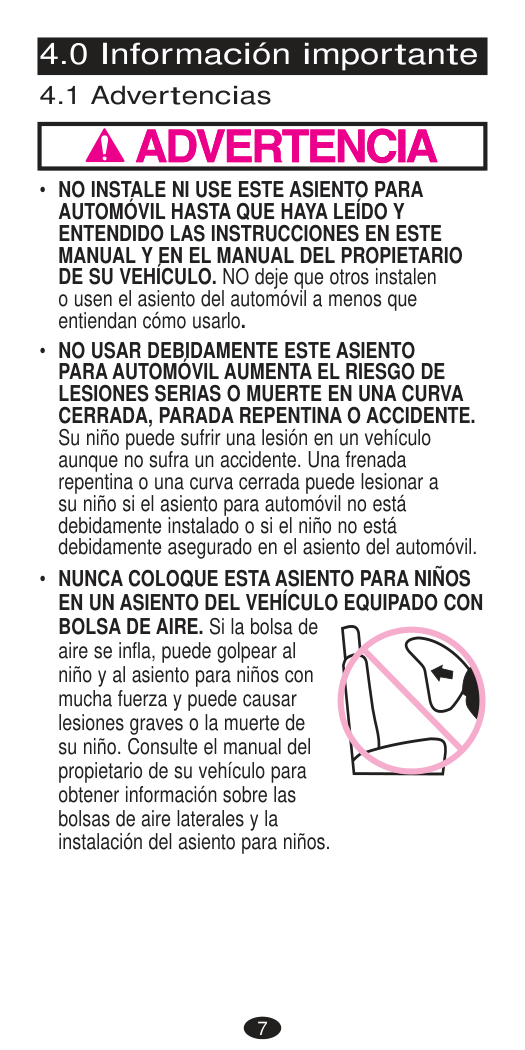
    6 **Los vehículos ahora vienen equipados (o pueden estar equipados) con puntos de sujetación de la soga detrás de algunos asientos. Una soga sujeta la parte superior del asiento para automóvil a la carrocería del vehículo. Cuando se usa debidamente con el cinturón de seguridad del vehículo, la soga ayuda a reducir las lesiones en una parada repentina o accidente. Almacenamiento de la traba de seguridad* Correa de la soga** Compartimiento de almacenamiento del manual del propietario Fecha de vencimiento Traba de la soga — *La traba de seguridad se guarda en el respaldo del asiento para automóvil. Necesitará usarlo con ciertos tipos de cinturones de seguridad de automóviles. Placa de unión metálica Almacenaje para la placa de unión

    Latch***

    ***Las Normas Federales para Seguridad de Automóviles de Estados Unidos han determinado un nuevo sistema de instalación de asientos de seguridad en los vehículos. El sistema se denomina LATCH. LATCH debe usarse EN LUGAR del cinturón del vehículo SOLAMENTE si el vehículo está equipado con puntos de anclaje LATCH. Por favor, consulte el manual del usuario del vehículo para obtener las ubicaciones donde debe instalarse el LATCH en los vehículos. Cinturón de ajuste Barras de almacenamiento del LATCH y la soga Conector del LATCH
    Page 49

    7

    • No Instale Ni Use Este Asiento Para

    Automóvil Hasta Que Haya Leído Y

    Entendido Las Instrucciones En Este

    Manual Y En El Manual Del Propietario

    DE SU VEHÍCULO. NO deje que otros instalen o usen el asiento del automóvil a menos que entiendan cómo usarlo.

    • No Usar Debidamente Este Asiento

    Para Automóvil Aumenta El Riesgo De

    Lesiones Serias O Muerte En Una Curva

    Cerrada, Parada Repentina O Accidente.

    Su niño puede sufrir una lesión en un vehículo aunque no sufra un accidente. Una frenada repentina o una curva cerrada puede lesionar a su niño si el asiento para automóvil no está debidamente instalado o si el niño no está debidamente asegurado en el asiento del automóvil.

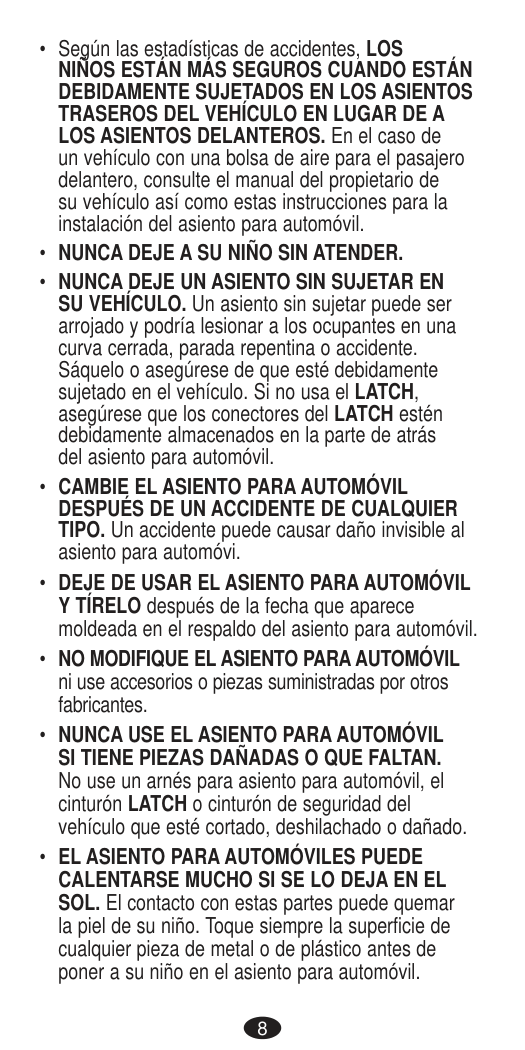
    • Nunca Coloque Esta Asiento Para Niños

    En Un Asiento Del Vehículo Equipado Con

    BOLSA DE AIRE. Si la bolsa de aire se infla, puede golpear al niño y al asiento para niños con mucha fuerza y puede causar lesiones graves o la muerte de su niño. Consulte el manual del propietario de su vehículo para obtener información sobre las bolsas de aire laterales y la instalación del asiento para niños. 4.0 Información importante 4.1 Advertencias
    Page 50

    8

  • Según las estadísticas de accidentes, LOS
  • Niños Están Más Seguros Cuando Están

    Debidamente Sujetados En Los Asientos

    Traseros Del Vehículo En Lugar De A

    LOS ASIENTOS DELANTEROS. En el caso de un vehículo con una bolsa de aire para el pasajero delantero, consulte el manual del propietario de su vehículo así como estas instrucciones para la instalación del asiento para automóvil.

    • Nunca Deje A Su Niño Sin Atender.

    • Nunca Deje Un Asiento Sin Sujetar En

    SU VEHÍCULO. Un asiento sin sujetar puede ser arrojado y podría lesionar a los ocupantes en una curva cerrada, parada repentina o accidente. Sáquelo o asegúrese de que esté debidamente sujetado en el vehículo. Si no usa el LATCH, asegúrese que los conectores del LATCH estén debidamente almacenados en la parte de atrás del asiento para automóvil.

    • Cambie El Asiento Para Automóvil

    Después De Un Accidente De Cualquier

    TIPO. Un accidente puede causar daño invisible al asiento para automóvi.

    • Deje De Usar El Asiento Para Automóvil

    Y TÍRELO después de la fecha que aparece moldeada en el respaldo del asiento para automóvil.

    • No Modifique El Asiento Para Automóvil

    ni use accesorios o piezas suministradas por otros fabricantes.

    • Nunca Use El Asiento Para Automóvil

    Si Tiene Piezas Dañadas O Que Faltan.

    No use un arnés para asiento para automóvil, el cinturón LATCH o cinturón de seguridad del vehículo que esté cortado, deshilachado o dañado.

    • El Asiento Para Automóviles Puede

    Calentarse Mucho Si Se Lo Deja En El

    SOL. El contacto con estas partes puede quemar la piel de su niño. Toque siempre la superficie de cualquier pieza de metal o de plástico antes de poner a su niño en el asiento para automóvil.
    Page 51

    9

    No Usar El Asiento Para Automóvil De

    Manera Apropiada Según El Tamaño De

    Su Niño Podría Aumentar El Riesgo De

    Sufrir Una Lesión Seria O La Muerte.

    Las instrucciones para el uso de este asiento para automóvil y el cinturón de seguridad del vehículo difieren mucho dependiendo del tamaño de su niño. Asegúrese de que usa el asiento para automóvil de la manera correcta y con las funciones correctas para su niño. 4.2 Limitaciones de peso y altura
  • ESTE SISTEMA PARA NIÑOS CUMPLE con todas
  • las Normas Federales de Seguridad para Vehículos Automotor y ha sido certificado para el uso en vehículos automotor. Ha sido certificado para uso en aeronaves solamente cuando se lo usa con el arnés incorporado. Cuando se lo usa como asiento para niños sin el arnés, este sistema no ha sido certificado para ser usado en aeronaves.

    • Nunca Entregue Este Asiento Para

    AUTOMÓVIL a otra persona sin entregarles este manual.

    • Nunca Use Un Asiento Para Automóvil

    USADO o un asiento para automóvil cuya historia no conoce.

    Page 52

    10 4.2.2 SIN el arnés incorporado Su niño DEBE CUMPLIR todos los requisitos:
  • PESO: 30 a 100 libras (14 a 45 kg)
  • ALTURA: 35 a 54 pulgadas
  • (89 a 138 cm)
  • Los oídos del niño están
  • DEBAJO de la parte superior de la asiento para niños. Si la parte de arriba de los oídos se encuentran arriba de la parte superior del asiento, el niño es demasiado grande para la asiento para niños. Si el niño pesa entre 30 y 40 libras y los hombros se encuentran por debajo de las ranuras superiores del arnés, recomendamos enfáticamente el uso del arnés incorporado mientras sea cómodo y útil (hasta las 40 libras). 4.2.1 CON el arnés incorporado Su niño DEBE CUMPLIR todos los requisitos:
  • PESO: 20 a 40 libras (9 a 18 kg)
  • ALTURA: 27 a 43 pulgadas (69
  • a 109 cm)
  • Por lo menos debe tener un año
  • de edad y debe poder sentarse sin ayuda
  • Los hombros están DEBAJO de las ranuras
  • superiores del arnés. Si los hombros están por encima de las ranuras superiores del arnés, el niño es demasiado grande para usar el arnés incorporado.

    Page 53

    11

  • Los niños están más seguros cuando están
  • debidamente sujetados en las posiciones de sentado trasero en el vehículo. Cuando sea posible, asegure el asiento del automóvil en la posición de sentado central directamente atrás de los asientos delanteros. Sin embargo, esta posición está más a menudo equipada solamente con un cinturón de regazo y no puede usarse con este asiento para automóvil sin el arnés incorporado.
  • El asiento del vehículo debe mirar hacia adelante.
  • 5.0 Ubicación del asiento para automóvil

    Una Colocación Inadecuada Del Asiento

    Para Automóvil Aumenta El Riesgo De

    Sufrir Una Lesión Seria O La Muerte.

    Algunas posiciones de sentado en su vehículo podrían no ser seguras para este asiento para automóvil. Algunos vehículos no tienen posiciones de sentado que puedan usarse seguramente con el asiento para automóvil. Si no está seguro sobre dónde colocar el asiento para automóvil en su vehículo, consulte el manual del propietario del vehículo o llame Graco Children's Products, Inc., al 1-800-345-4109.
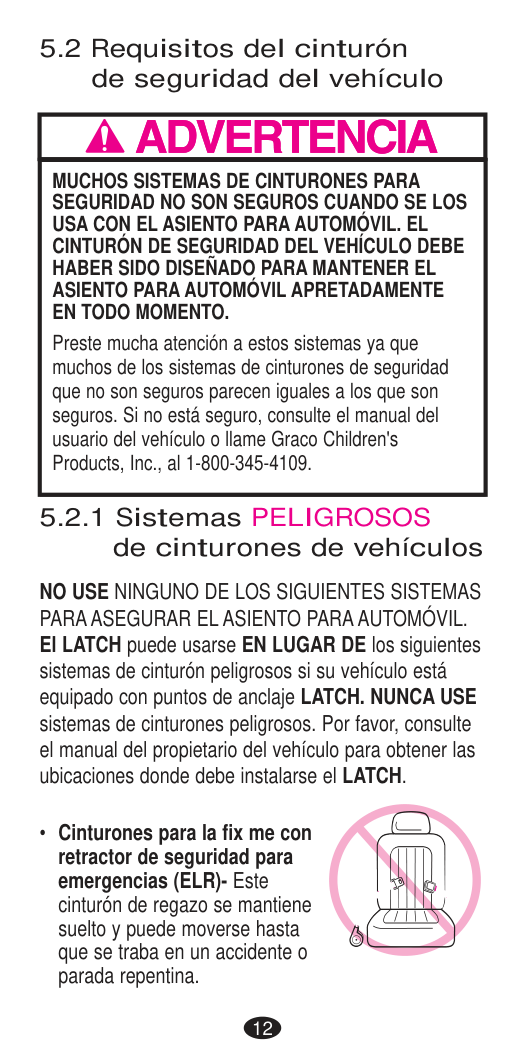
  • El frente del asiento para automóvil
  • no debe quedar suspendido sobre el borde del asiento del vehículo. 5.1 Requisitos del asiento del vehículo

    Page 54

    12

    No Use Ninguno De Los Siguientes Sistemas

    Para Asegurar El Asiento Para Automóvil.

    El LATCH puede usarse EN LUGAR DE los siguientes sistemas de cinturón peligrosos si su vehículo está equipado con puntos de anclaje LATCH. NUNCA USE sistemas de cinturones peligrosos. Por favor, consulte el manual del propietario del vehículo para obtener las ubicaciones donde debe instalarse el LATCH.
  • Cinturones para la fix me con
  • retractor de seguridad para emergencias (ELR)- Este cinturón de regazo se mantiene suelto y puede moverse hasta que se traba en un accidente o parada repentina. 5.2 Requisitos del cinturón de seguridad del vehículo

    Muchos Sistemas De Cinturones Para

    Seguridad No Son Seguros Cuando Se Los

    Usa Con El Asiento Para Automóvil. El

    Cinturón De Seguridad Del Vehículo Debe

    Haber Sido Diseñado Para Mantener El

    Asiento Para Automóvil Apretadamente

    En Todo Momento.

    Preste mucha atención a estos sistemas ya que muchos de los sistemas de cinturones de seguridad que no son seguros parecen iguales a los que son seguros. Si no está seguro, consulte el manual del usuario del vehículo o llame Graco Children's Products, Inc., al 1-800-345-4109. 5.2.1 Sistemas PELIGROSOS de cinturones de vehículos

    Page 55

    13

  • Combinación de cinturón
  • para el hombro y de regazo con retractor - Cada correa tiene un retractor en una punta y está conectada a la placa de seguridad en la otra punta.
  • Cinturón pasivo -
  • Cinturón para el hombro o de regazo montado en la puerta
  • Cinturón pasivo -
  • Cinturón de regazo con cinturón para el hombro motorizado NO use los cinturones del vehículo que estén conectados a la puerta de manera alguna o que se muevan a través de un carril para rodear automáticamente al pasajero cuando se cierra la puerta.
  • Cinturones de regazo
  • que están más adelante del pliegue del asiento

    Page 56

    14 5.2.2 Sistemas SEGUROS de cinturones de vehículos

  • Cinturones de regazo - ajustado manualmente
  • Cuando se activa la hebilla, el cinturón se ajuste manualmente tirando del exceso del cinturón.
  • Cinturones de regazo con retractor de
  • seguridad automático (ALR) El retractor de seguridad automático no permitirá que el cinturón de regazo se extienda una vez que está sujetado en la hebilla. Ajuste el cinturón pasando el cinturón por el retractor mientras empuja con fuerza el asiento para automóvil hacia abajo.

    Los Siguientes Sistemas De Cinturones

    Pueden Usarse Con Su Asiento Para

    AUTOMÓVIL, SI la ubicación del asiento cumple todos los otros requisitos de estas instrucciones y las del manual del propietario del vehículo. El LATCH puede usarse en lugar de los siguientes sistemas de seguridad del vehículo si su vehículo está equipado con puntos de anclaje LATCH. Por favor, consulte el manual del propietario del vehículo para obtener las ubicaciones donde debe instalarse el LATCH. Para el arnés incorporado solamente

    Page 57

    15

  • Combinación cinturón para el hombro/de regazo
  • con placa de seguridad con traba Una vez que está trabado en la hebilla, este tipo de cinturón tiene una placa de seguridad que no permitirá que la parte del cinturón que está en de regazo se afloje. El cinturón se ajusta tirando con fuerza de la parte del hombro del cinturón del vehículo mientras empuja con fuerza el asiento para automóvil hacia abajo.
  • Combinación cinturón para el hombro/de regazo
  • con placa de seguridad con traba móvil Este cinturón tiene una placa de seguridad que se mueve libremente a lo largo del cinturón. CON el arnés incorporado: Este cinturón DEBE convertirse para prevenir el movimiento de la parte de regazo del cinturón. Debe usar la traba de seguridad provista con el asiento para automóvil, a menos que el cinturón de seguridad del asiento de su vehículo pueda convertirse de otra manera como se describe en el manual del propietario del vehículo. SIN el arnés incorporado: No se necesita la traba de seguridad o de conversión. Con O sin el arnés incorporado Traba de seguridad

    Page 58

    16 Para instalar la traba de seguridad:
  • Ajuste el cinturón
  • trabado empujando con fuerza el asiento para automóvil hacia abajo y tirando con fuerza el cinturón del hombro.
  • Mientras empuja el
  • asiento hacia abajo, apriete las dos correas juntas detrás de la lengüeta de la hebilla. Destrabe el cinturón sin permitir que se mueva.
  • Conecte los cinturones
  • del hombro y de regazo como se indica –.
  • Vuelva a poner el
  • cinturón en la hebilla. Verifique que el cinturón de regazo no se mueve tirando con fuerza. Si el cinturón se afloja o se alarga, repita el procedimiento. Saque la traba de seguridad cuando no usa el asiento para automóvil. Guárdelo debajo de la lengüeta detrás del asiento. ½” (1.25 pulgadas) –

    Page 59

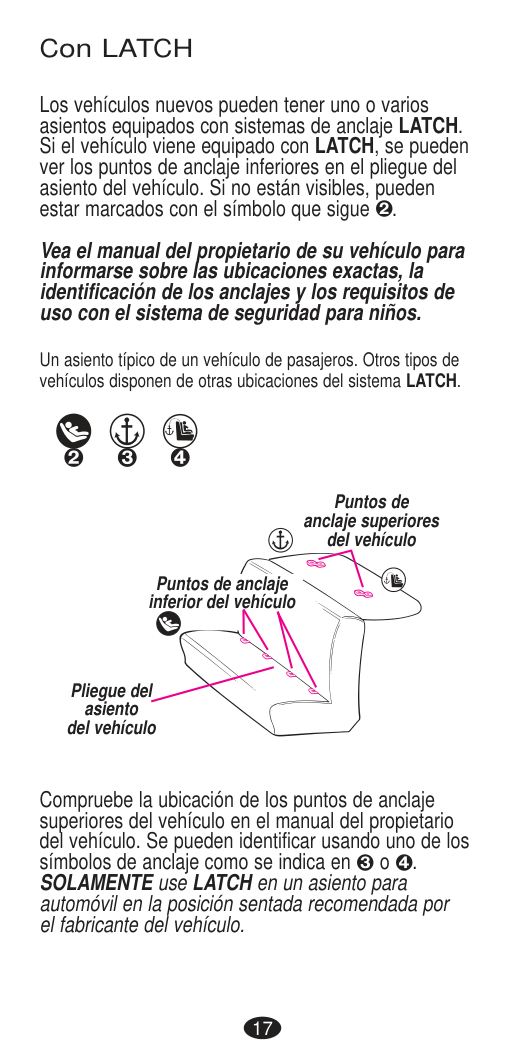
    17 Con LATCH Los vehículos nuevos pueden tener uno o varios asientos equipados con sistemas de anclaje LATCH. Si el vehículo viene equipado con LATCH, se pueden ver los puntos de anclaje inferiores en el pliegue del asiento del vehículo. Si no están visibles, pueden estar marcados con el símbolo que sigue —. Vea el manual del propietario de su vehículo para informarse sobre las ubicaciones exactas, la identificación de los anclajes y los requisitos de uso con el sistema de seguridad para niños. Un asiento típico de un vehículo de pasajeros. Otros tipos de vehículos disponen de otras ubicaciones del sistema LATCH. Compruebe la ubicación de los puntos de anclaje superiores del vehículo en el manual del propietario del vehículo. Se pueden identificar usando uno de los símbolos de anclaje como se indica en ˜ o ™. SOLAMENTE use LATCH en un asiento para automóvil en la posición sentada recomendada por el fabricante del vehículo. Puntos de anclaje superiores del vehículo Puntos de anclaje inferior del vehículo Pliegue del asiento del vehículo — ˜ ™
    Page 60

    18 6.0 Uso del asiento para automóvil CON arnés incorporado 6.1 Colocación de las correas del arnés

    No Ajustar Debidamente Las Correas Del

    Arnés De Su Niño Aumenta El Riesgo De

    Lesiones Serias O La Muerte En Una Curva

    Cerrada, Parada Repentina O Accidente.

    Ajuste apretadamente los cinturones provistos con este sistema de seguridad alrededor de su niño. Una correa bien ajustada no deberá tener nada de huelgo. Se mantiene en una línea relativamente derecha sin combarse. No aprieta la piel del niño ni pone al cuerpo del niño en una posición poco natural.
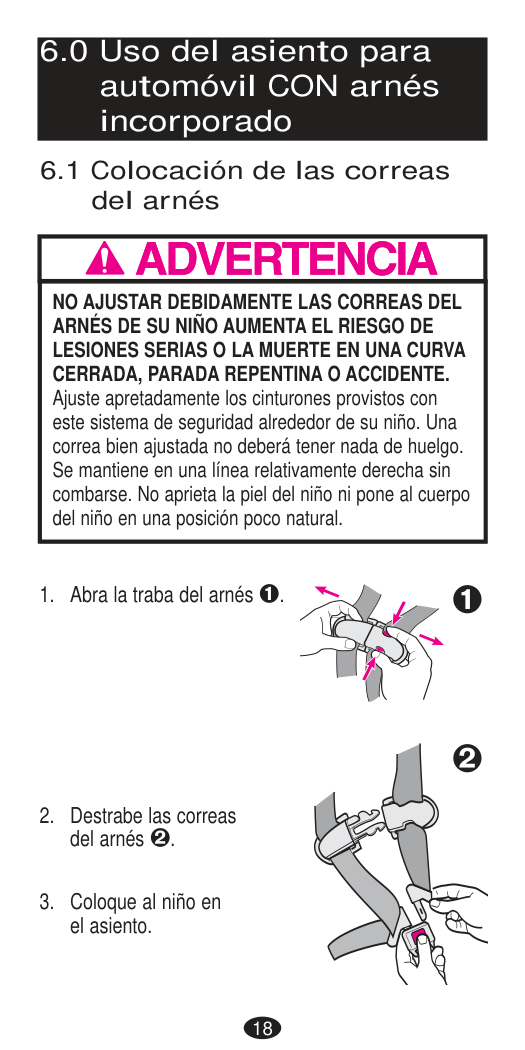
  • Abra la traba del arnés –.
  • Destrabe las correas
  • del arnés —.
  • Coloque al niño en
  • el asiento. — –

    Page 61

    19

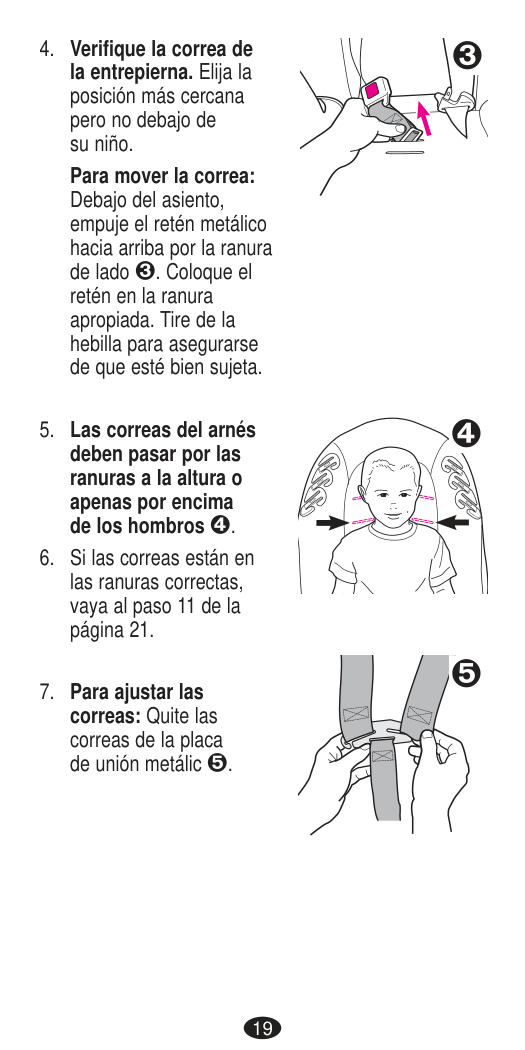
  • Verifique la correa de
  • la entrepierna. Elija la posición más cercana pero no debajo de su niño. Para mover la correa: Debajo del asiento, empuje el retén metálico hacia arriba por la ranura de lado ˜. Coloque el retén en la ranura apropiada. Tire de la hebilla para asegurarse de que esté bien sujeta.
  • Las correas del arnés
  • deben pasar por las ranuras a la altura o apenas por encima de los hombros ™.
  • Si las correas están en
  • las ranuras correctas, vaya al paso 11 de la página 21.
  • Para ajustar las
  • correas: Quite las correas de la placa de unión metálic š. ˜ ™ š

    Page 62

    20

  • Tire los extremos de las
  • correas a través de las ranuras y vuelva a insertarlos en las ranur as correctas – como se determina en el paso 5, página 19.
  • Vuelva a montar las
  • correas en la placa de unión metálica exactamente como se indica —. Verifique que las correas estén completamente dentro de las ranuras.
  • Verifique que las correas
  • se inserten al mismo nivel y que no estén dobladas. Tire del arnés para asegurarse que esté asegurado. – —

    Page 63

    21

  • Ajuste del arnés
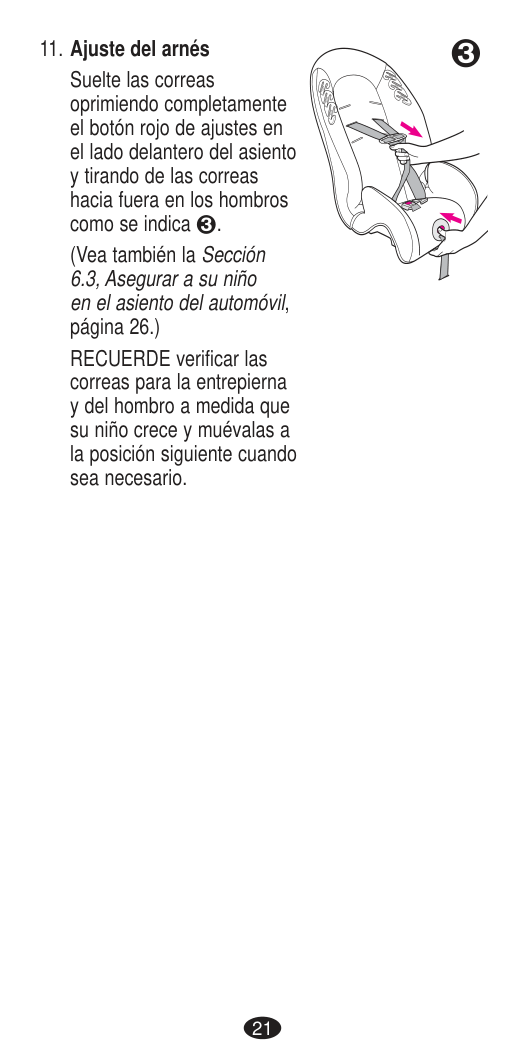
  • Suelte las correas oprimiendo completamente el botón rojo de ajustes en el lado delantero del asiento y tirando de las correas hacia fuera en los hombros como se indica ˜. (Vea también la Sección 6.3, Asegurar a su niño en el asiento del automóvil, página 26.) RECUERDE verificar las correas para la entrepierna y del hombro a medida que su niño crece y muévalas a la posición siguiente cuando sea necesario. ˜

    Page 64

    22 6.2 Asegurar el asiento para automóvil en su vehículo

    No Ajustar Debidamente El Asiento Para

    Automóvil En El Vehículo Aumenta El

    Riesgo De Lesiones Serias O La Muerte

    En Una Curva Cerrada, Parada Repentina

    O Accidente.

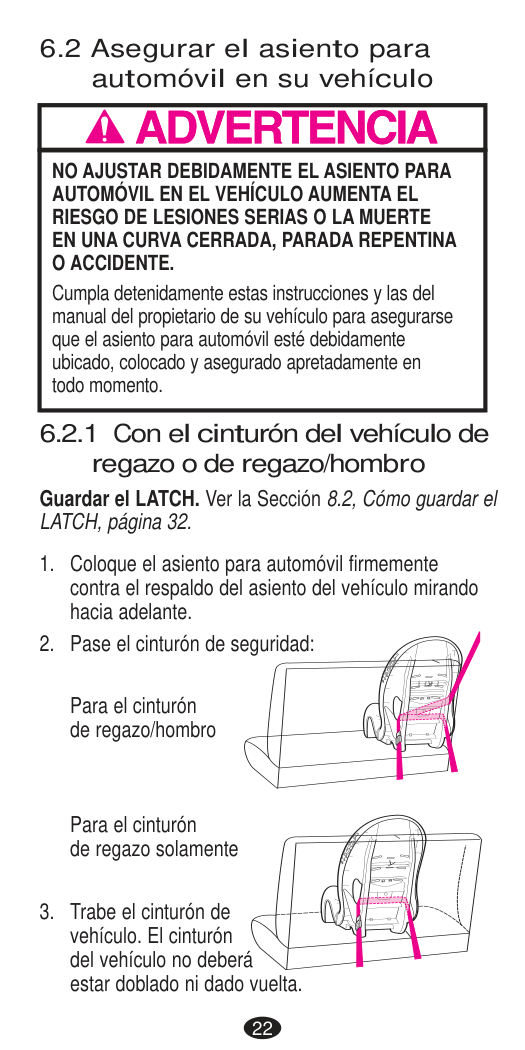
    Cumpla detenidamente estas instrucciones y las del manual del propietario de su vehículo para asegurarse que el asiento para automóvil esté debidamente ubicado, colocado y asegurado apretadamente en todo momento.
  • Coloque el asiento para automóvil firmemente
  • contra el respaldo del asiento del vehículo mirando hacia adelante.
  • Pase el cinturón de seguridad:
  • Para el cinturón de regazo/hombro Para el cinturón de regazo solamente
  • Trabe el cinturón de
  • vehículo. El cinturón del vehículo no deberá estar doblado ni dado vuelta. 6.2.1 Con el cinturón del vehículo de regazo o de regazo/hombro Guardar el LATCH. Ver la Sección 8.2, Cómo guardar el LATCH, página 32.

    Page 65

    23

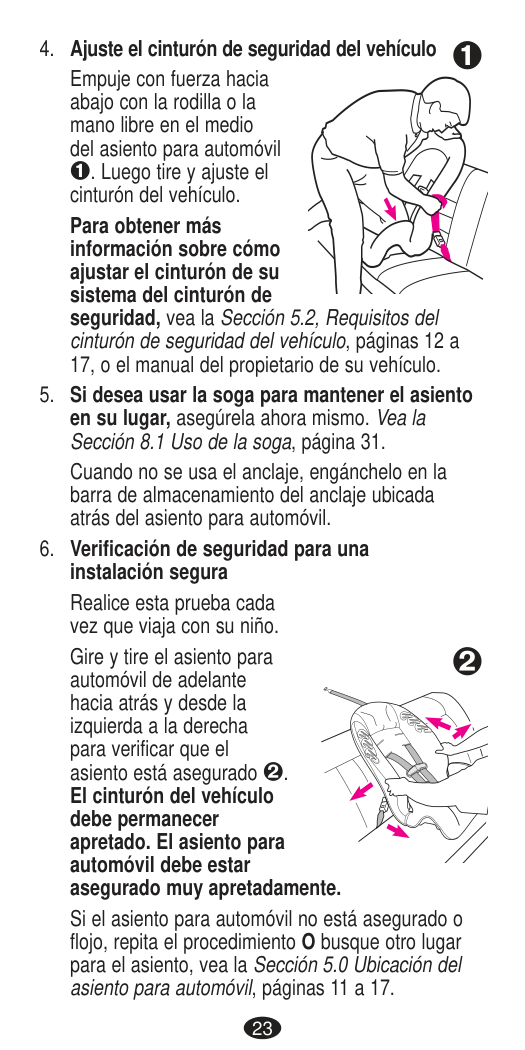
  • Ajuste el cinturón de seguridad del vehículo
  • Empuje con fuerza hacia abajo con la rodilla o la mano libre en el medio del asiento para automóvil –. Luego tire y ajuste el cinturón del vehículo. Para obtener más información sobre cómo ajustar el cinturón de su sistema del cinturón de seguridad, vea la Sección 5.2, Requisitos del cinturón de seguridad del vehículo, páginas 12 a 17, o el manual del propietario de su vehículo.
  • Si desea usar la soga para mantener el asiento
  • en su lugar, asegúrela ahora mismo. Vea la Sección 8.1 Uso de la soga, página 31. Cuando no se usa el anclaje, engánchelo en la barra de almacenamiento del anclaje ubicada atrás del asiento para automóvil.
  • Verificación de seguridad para una
  • instalación segura Realice esta prueba cada vez que viaja con su niño. Gire y tire el asiento para automóvil de adelante hacia atrás y desde la izquierda a la derecha para verificar que el asiento está asegurado —. El cinturón del vehículo debe permanecer apretado. El asiento para automóvil debe estar asegurado muy apretadamente. Si el asiento para automóvil no está asegurado o flojo, repita el procedimiento O busque otro lugar para el asiento, vea la Sección 5.0 Ubicación del asiento para automóvil, páginas 11 a 17. – —

    Page 66

    24

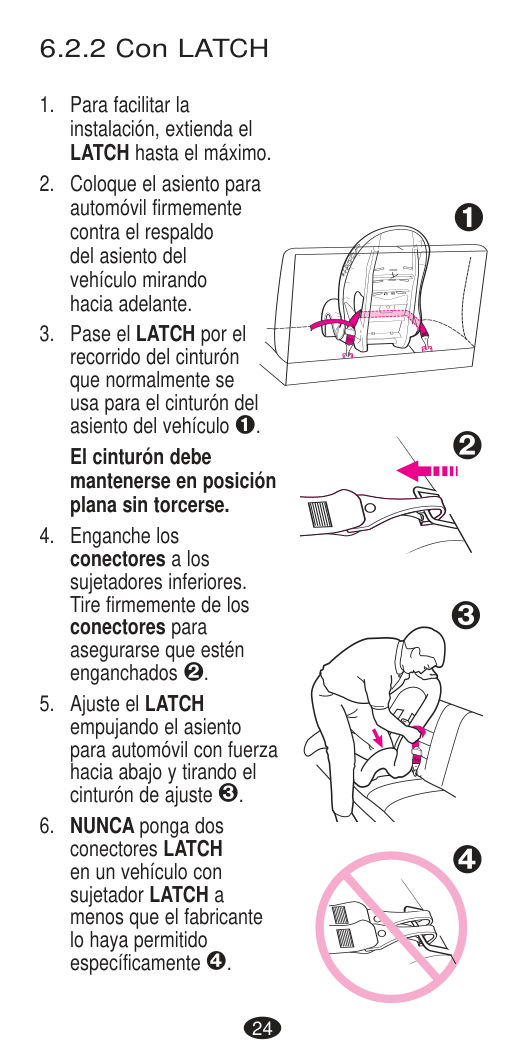
  • Para facilitar la
  • instalación, extienda el LATCH hasta el máximo.
  • Coloque el asiento para
  • automóvil firmemente contra el respaldo del asiento del vehículo mirando hacia adelante.
  • Pase el LATCH por el
  • recorrido del cinturón que normalmente se usa para el cinturón del asiento del vehículo –. El cinturón debe mantenerse en posición plana sin torcerse.
  • Enganche los
  • conectores a los sujetadores inferiores. Tire firmemente de los conectores para asegurarse que estén enganchados —.
  • Ajuste el LATCH
  • empujando el asiento para automóvil con fuerza hacia abajo y tirando el cinturón de ajuste ˜.
  • NUNCA ponga dos
  • conectores LATCH en un vehículo con sujetador LATCH a menos que el fabricante lo haya permitido específicamente ™. — ™ 6.2.2 Con LATCH ˜ –

    Page 67

    25

  • Todas las posiciones del
  • asiento LATCH tienen puntos de anclaje. Asegure la parte de arriba del asiento usando la correa la soga. Vea la Sección 8.1 Uso de la soga página 31. Cuando no se usa el anclaje, engánchelo en la barra de almacenamiento del anclaje ubicada atrás del asiento para automóvil.
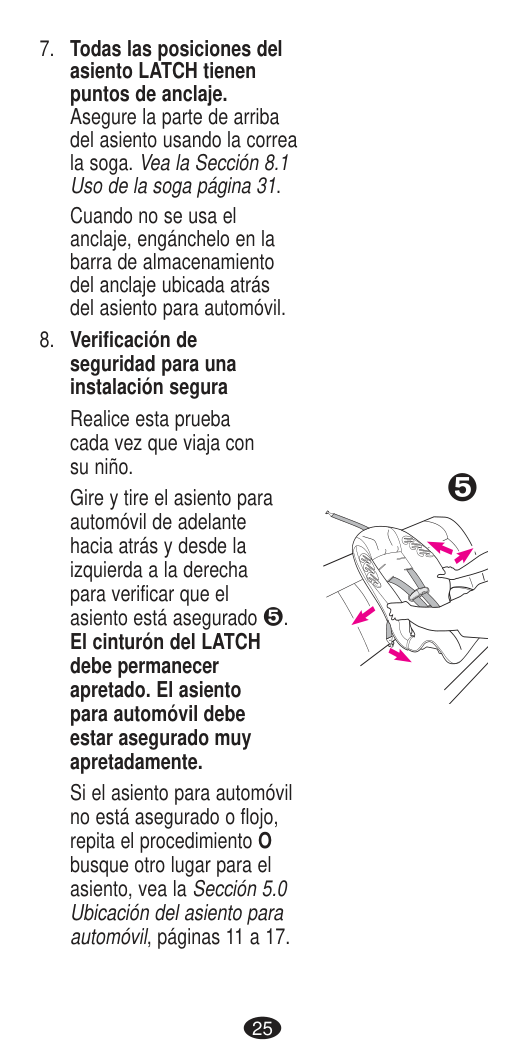
  • Verificación de
  • seguridad para una instalación segura Realice esta prueba cada vez que viaja con su niño. Gire y tire el asiento para automóvil de adelante hacia atrás y desde la izquierda a la derecha para verificar que el asiento está asegurado š. El cinturón del LATCH debe permanecer apretado. El asiento para automóvil debe estar asegurado muy apretadamente. Si el asiento para automóvil no está asegurado o flojo, repita el procedimiento O busque otro lugar para el asiento, vea la Sección 5.0 Ubicación del asiento para automóvil, páginas 11 a 17. š

    Page 68

    26

  • Coloque al niño en el
  • asiento para automóvil con la espalda del niño plana contra el respaldo del asiento para automóvil.
  • Pase las correas del
  • arnés sobre los hombros del niño e inserte las lengüetas en la hebilla –. VERIFIQUE que las correas no estén dobladas. VERIFIQUE que el arnés esté debidamente apretado tirando de las correas. NO use el asiento para automóvil si el arnés no se traba. 6.3 Asegurar a su niño en el asiento del automóvil

    No Ajustar Debidamente A Su Niño En El

    Asiento Paraautomóvil Aumenta El Riesgo

    De Lesiones Serias O La Muerte En Una

    Curva Cerrada, Parada Repentina O

    Accidente.

    En un accidente, el asiento para automóvil NO ofrece protección a su niño a menos que las correas del arnés estén debidamente aseguradas. Cumpla estas instrucciones detenidamente para asegurar debidamente a su niño.

    • Ajuste El Sistema Del Arnés

    APRETADAMENTE CADA VEZ que coloca a su niño en el asiento para automóvil.
  • Evite usar ropas abultadas.
  • –

    Page 69

    27

  • Tire de la correa de
  • ajustes para apretar el arnés —.
  • Asegure la traba del
  • arnés ˜. Coloque la traba del arnés en el medio del pecho del niño, nivelado con las axilas.
  • Asegúrese que las
  • correas estén planas y ajustadas contra los hombros del niño. Una correa bien ajustada no deberá tener nada de huelgo. Se mantiene en una línea relativamente derecha sin combarse. No aprieta la piel del niño ni pone al cuerpo del niño en una posición poco natural ™. — ˜ ™

    Page 70

    28

    No Ajustar Debidamente

    A Su Niño Y La Asiento

    Para Niños En El Vehículo

    Aumenta El Riesgo De

    Lesiones Serias O La

    Muerte En Una Curva

    Cerrada, Parada

    Repentina O Accidente.

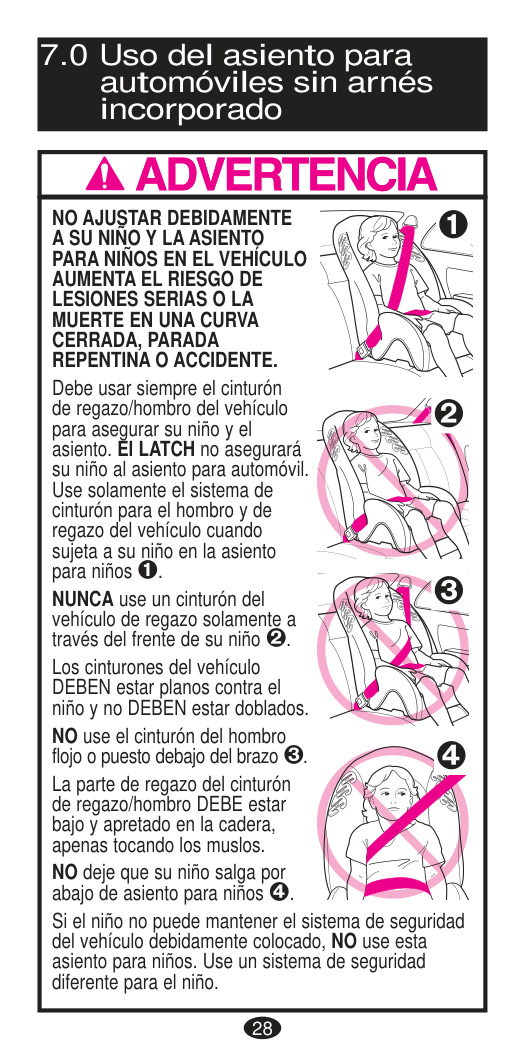
    Debe usar siempre el cinturón de regazo/hombro del vehículo para asegurar su niño y el asiento. El LATCH no asegurará su niño al asiento para automóvil. Use solamente el sistema de cinturón para el hombro y de regazo del vehículo cuando sujeta a su niño en la asiento para niños –. NUNCA use un cinturón del vehículo de regazo solamente a través del frente de su niño —. Los cinturones del vehículo DEBEN estar planos contra el niño y no DEBEN estar doblados. NO use el cinturón del hombro flojo o puesto debajo del brazo ˜. La parte de regazo del cinturón de regazo/hombro DEBE estar bajo y apretado en la cadera, apenas tocando los muslos. NO deje que su niño salga por abajo de asiento para niños ™. Si el niño no puede mantener el sistema de seguridad del vehículo debidamente colocado, NO use esta asiento para niños. Use un sistema de seguridad diferente para el niño. — ˜ ™ 7.0 Uso del asiento para automóviles sin arnés incorporado –
    Page 71

    29 7.1 Eliminación del arnés

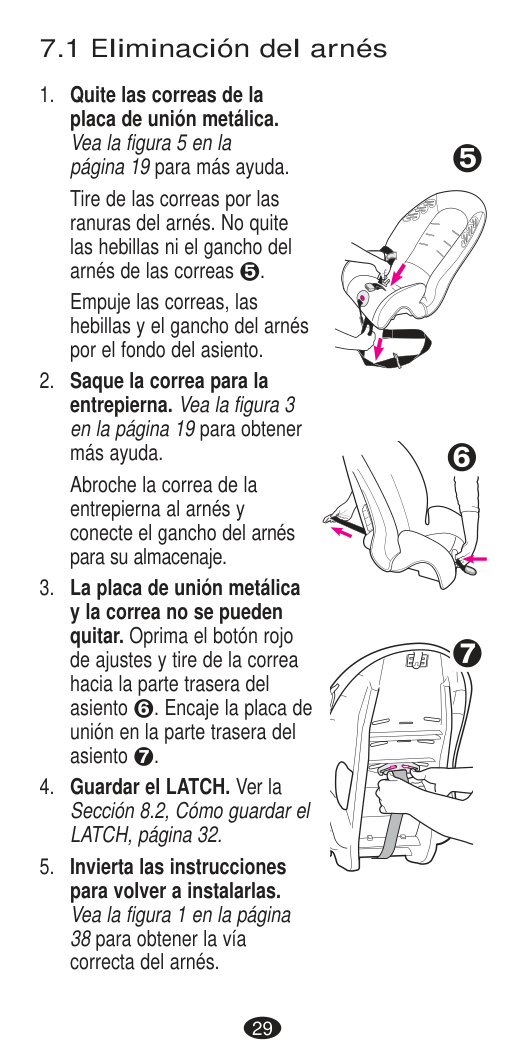
  • Quite las correas de la
  • placa de unión metálica. Vea la figura 5 en la página 19 para más ayuda. Tire de las correas por las ranuras del arnés. No quite las hebillas ni el gancho del arnés de las correas š. Empuje las correas, las hebillas y el gancho del arnés por el fondo del asiento.
  • Saque la correa para la
  • entrepierna. Vea la figura 3 en la página 19 para obtener más ayuda. Abroche la correa de la entrepierna al arnés y conecte el gancho del arnés para su almacenaje.
  • La placa de unión metálica
  • y la correa no se pueden quitar. Oprima el botón rojo de ajustes y tire de la correa hacia la parte trasera del asiento ›. Encaje la placa de unión en la parte trasera del asiento œ.
  • Guardar el LATCH. Ver la
  • Sección 8.2, Cómo guardar el LATCH, página 32.
  • Invierta las instrucciones
  • para volver a instalarlas. Vea la figura 1 en la página 38 para obtener la vía correcta del arnés. š › œ

    Page 72

    30

  • Coloque el asiento para automóvil mirando hacia
  • adelante y firmemente contra el respaldo del asiento del vehículo equipado solamente con un cinturón para el hombro y de regazo.
  • Si desea usar la correa de la soga para mantener
  • el asiento en su lugar, asegúrela ahora mismo. Vea la Sección 8.1 Uso de la soga, página 31.
  • Coloque al niño en el asiento para automóvil con
  • la espalda del niño plana contra el respaldo del asiento para automóvil.
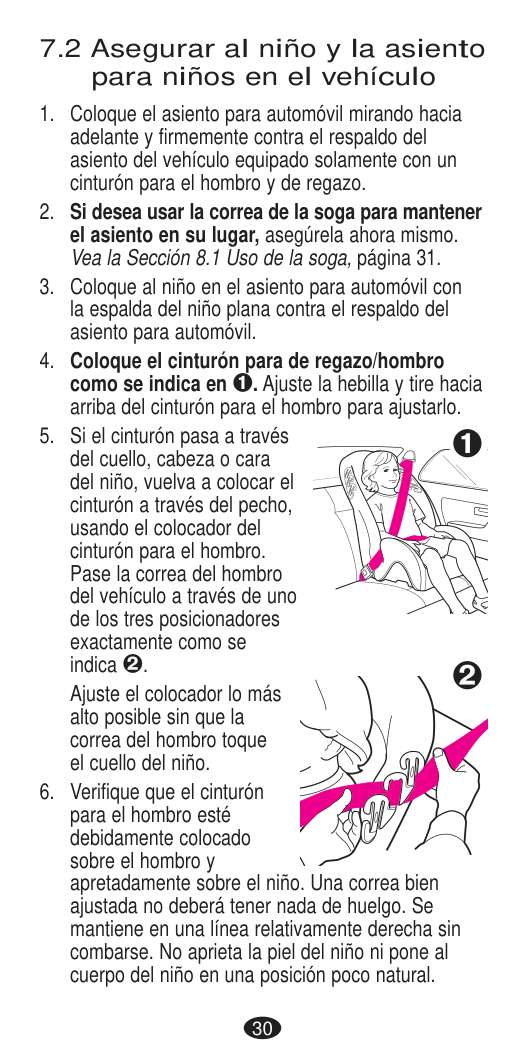
  • Coloque el cinturón para de regazo/hombro
  • como se indica en –. Ajuste la hebilla y tire hacia arriba del cinturón para el hombro para ajustarlo.
  • Si el cinturón pasa a través
  • del cuello, cabeza o cara del niño, vuelva a colocar el cinturón a través del pecho, usando el colocador del cinturón para el hombro. Pase la correa del hombro del vehículo a través de uno de los tres posicionadores exactamente como se indica —. Ajuste el colocador lo más alto posible sin que la correa del hombro toque el cuello del niño.
  • Verifique que el cinturón
  • para el hombro esté debidamente colocado sobre el hombro y apretadamente sobre el niño. Una correa bien ajustada no deberá tener nada de huelgo. Se mantiene en una línea relativamente derecha sin combarse. No aprieta la piel del niño ni pone al cuerpo del niño en una posición poco natural. — 7.2 Asegurar al niño y la asiento para niños en el vehículo –

    Page 73

    31 8.0 Información adicional 8.1 Uso de la soga
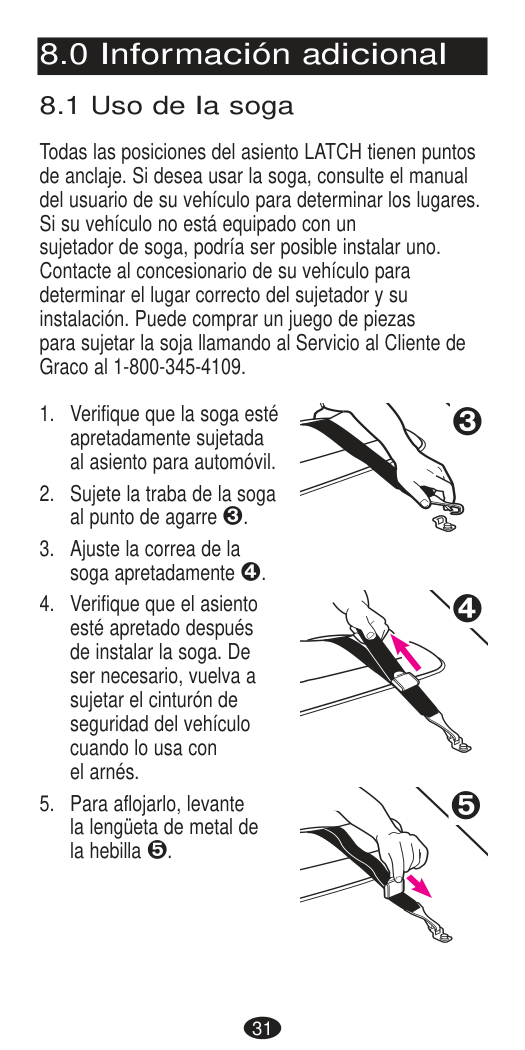
  • Verifique que la soga esté
  • apretadamente sujetada al asiento para automóvil.
  • Sujete la traba de la soga
  • al punto de agarre ˜.
  • Ajuste la correa de la
  • soga apretadamente ™.
  • Verifique que el asiento
  • esté apretado después de instalar la soga. De ser necesario, vuelva a sujetar el cinturón de seguridad del vehículo cuando lo usa con el arnés.
  • Para aflojarlo, levante
  • la lengüeta de metal de la hebilla š. Todas las posiciones del asiento LATCH tienen puntos de anclaje. Si desea usar la soga, consulte el manual del usuario de su vehículo para determinar los lugares. Si su vehículo no está equipado con un sujetador de soga, podría ser posible instalar uno. Contacte al concesionario de su vehículo para determinar el lugar correcto del sujetador y su instalación. Puede comprar un juego de piezas para sujetar la soja llamando al Servicio al Cliente de Graco al 1-800-345-4109. ˜ ™ š

    Page 74

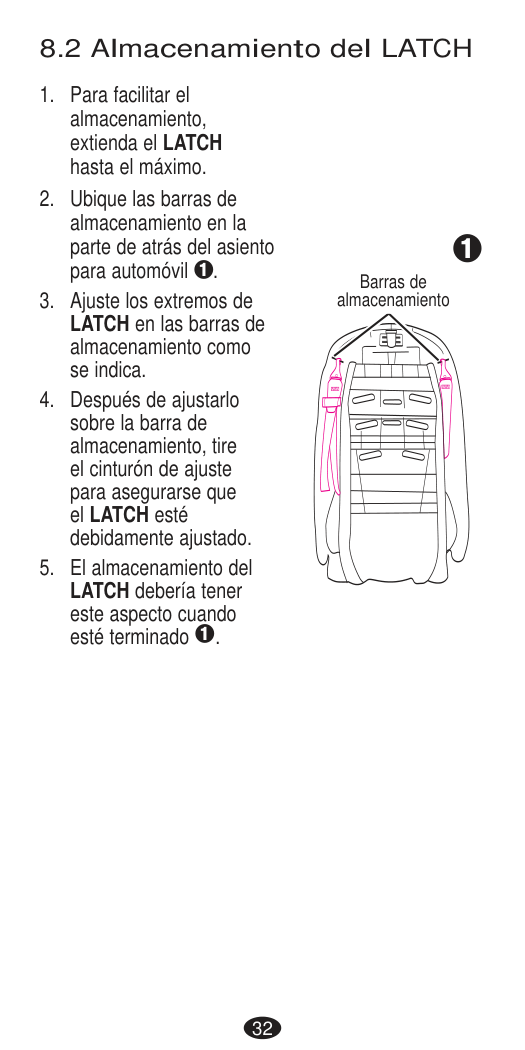
    32 8.2 Almacenamiento del LATCH

  • Para facilitar el
  • almacenamiento, extienda el LATCH hasta el máximo.
  • Ubique las barras de
  • almacenamiento en la parte de atrás del asiento para automóvil –.
  • Ajuste los extremos de
  • LATCH en las barras de almacenamiento como se indica.
  • Después de ajustarlo
  • sobre la barra de almacenamiento, tire el cinturón de ajuste para asegurarse que el LATCH esté debidamente ajustado.
  • El almacenamiento del
  • LATCH debería tener este aspecto cuando esté terminado –. – Barras de almacenamiento

    Page 75

    33 8.3 Uso en aeronaves Este sistema de seguridad ha sido certificado para ser usado en vehículos automotor. Ha sido certificado para uso en aeronaves SOLAMENTE cuando se lo usa con el arnés incorporado. Cuando se lo usa como asiento para niños sin el arnés, este sistema NO ha sido certificado para ser usado en aeronaves porque no hay cinturón del hombro disponible. Puntos importantes que recordar:
  • Las aerolíneas tienen ciertas restricciones sobre
  • el uso de los asientos para automóviles.
  • Instale el asiento para automóvil en un aeronave
  • de la misma manera en que se instala en un automóvil con un cinturón de regazo (ver la Sección 6.2.1, Cómo asegurar el asiento para automóvil en su vehículo, páginas 22 y 23).
  • Verifique que el cinturón del asiento de la aeronave
  • sujeta seguramente al asiento para automóvil en todo momento.

    Page 76

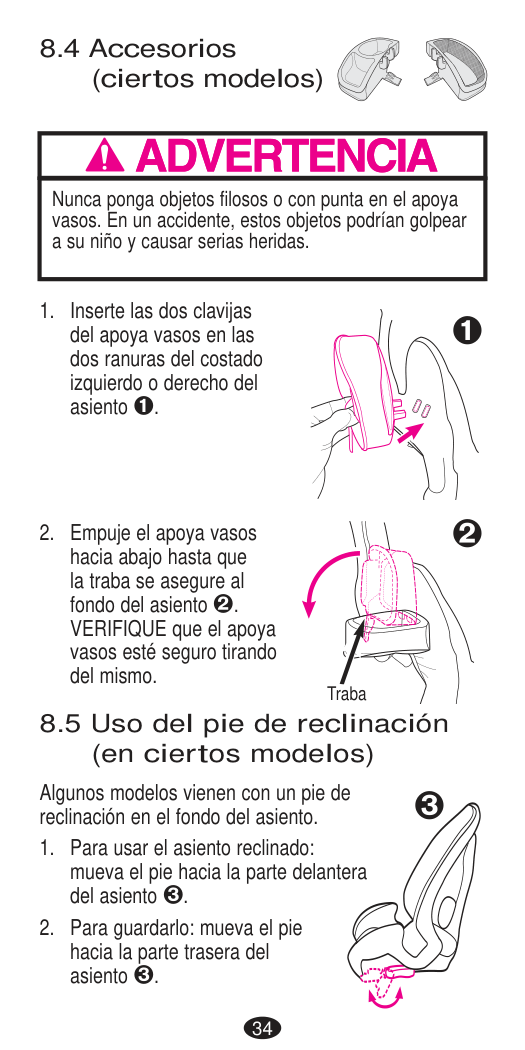
    34 8.5 Uso del pie de reclinación (en ciertos modelos) ˜ 8.4 Accesorios (ciertos modelos)

  • Inserte las dos clavijas
  • del apoya vasos en las dos ranuras del costado izquierdo o derecho del asiento –.
  • Empuje el apoya vasos
  • hacia abajo hasta que la traba se asegure al fondo del asiento —. VERIFIQUE que el apoya vasos esté seguro tirando del mismo. – — Traba Nunca ponga objetos filosos o con punta en el apoya vasos. En un accidente, estos objetos podrían golpear a su niño y causar serias heridas. Algunos modelos vienen con un pie de reclinación en el fondo del asiento.
  • Para usar el asiento reclinado:
  • mueva el pie hacia la parte delantera del asiento ˜.
  • Para guardarlo: mueva el pie
  • hacia la parte trasera del asiento ˜.

    Page 77

    35 Para prevenir la eyección en un accidente o parada repentina:

  • Asegúrese siempre que las correas del hombro pasan
  • por las ranuras y están debidamente instaladas en los hombros.
  • Nunca deje que el soporte del cuerpo se apile o se
  • doble detrás del niño.
  • Utilice el soporte del cuerpo solamente con las ranuras
  • inferiores del arnés.
  • Asegúrese de que las cubiertas del arnés no interfieran
  • con la colocación del pasador del pecho a la altura de las axilas. Su modelo podría incluir uno o más de los siguientes accesorios. Cojín desmontable para la cabeza Fundas del arnés Soporte del cuerpo (los estilos varían)

    Page 78

    36 9.0 Cuidado y mantenimiento

    • Uso Continuo Del Asiento Para

    Automóvil Podría Causar Daño Al

    ASIENTO DEL VEHÍCULO. Use una estera para asiento del automóvil, toalla o frazada fina para proteger el tapizado.
  • PIEZAS DE METAL Y DE PLÁSTICO: limpiar con
  • un jabón suave y agua fresca. NO USE CLORO NI

    Detergentes.

    • Correas Del Arnés Y Correas Del Latch:

    limpie el lugar sucio. No sumerja las correas en agua. Hacerlo podría aflojar las correas.

    • Ajustador De La Hebilla Y El Arnés:

    limpiar con un trapo húmedo.
  • NUNCA LUBRIQUE LA HEBILLA. Si la hebilla o
  • el ajustador del arnés se pega o no se mantiene apretado, verifique que no haya ningún objeto extraño tal como comida, suciedad, etc. Saque los objetos con pinzas y/o límpielas con una escobilla de algodón. Si no puede lograr que el arnés se mantenga apretado con la hebilla trabada con seguridad, no use este asiento para automóvil. Llame Graco al 1-800-345-4109 para comprar un arnés o hebilla de repuesto.
  • FUNDA DEL ASIENTO: limpiar con una esponja
  • húmeda usando un jabón suave y agua fresca. De ser necesario, se puede sacar la funda para limpiarla (ver la página siguiente).

    Page 79

    37 Para sacar la funda del asiento

  • Quite las correas del
  • arnés y de la entrepierna (Vea la Sección 7.1, Eliminación del arnés, pagina 29, para ayuda).
  • Quite los bucles
  • elásticos y los ganchos del asiento como se indica –.
  • Debajo de la parte
  • delantera del asiento, oprima la lengüeta para quitar la placa del botón de ajustes —.
  • Ponga la placa de ajustes
  • de lado y pásela por el agujero en la funda del asiento ˜. La apertura es muy estrecha, así que asegúrese de no romper la funda.
  • Quite la funda del asiento,
  • pasando las correas del arnés, la de la entrepierna y los herrajes por las ranuras en la funda. NO USE el asiento de seguridad infantil sin la funda del asiento.
  • Lave la funda a máquina
  • en agua fría en el ciclo delicado y déjelo secar al aire. NO USE CLORO. – ˜ —

    Page 80

    38

  • Para colocar la funda
  • de nuevo, siga los pasos anteriores en orden inverso. Empuje la placa de ajustes y la correa por el agujero en la funda. Asegúrese de no romper la funda.
  • Inserte las dos
  • lengüetas de la placa de ajustes en la parte trasera del agujero del asiento –.
  • Empuje la tela hacia arriba
  • para que la lengüeta debajo de la placa de ajustes quede debajo de la tela —. Encaje la placa de ajustes de nuevo en el asiento ˜. Asegúrese que la placa de ajustes esté bien sujeta al asiento y que la correa se deslice libremente cuando se apriete el botón. ˜ — – Para colocar la funda de nuevo

    Page 81

    39

  • Pase las correas de
  • arnés por los agujeros apropiados en la funda del asiento. Vea la ilustración a la derecha y en la sección 6.1, "Colocación de las correas del arnés" (página 18) para volver a colocar las correas del arnés en el asiento correctamente ™.
  • Sujete la funda al
  • asiento volviendo a colocar los bucles elásticos y los ganchos en el asiento. ™

    Page 82

    40 10.0 Piezas de repuesto Para comprar piezas o accesorios o para obtener información sobre la garantía en los Estados Unidos, por favor comuníquese con nosotros en: www.gracobaby.com o 1-800-345-4109

    Page 84

    42 Guarde este manual en el compartimiento de almacenamiento en el respaldo del asiento para automóvil.

    More from Graco

    Similar Car Seats