
Ask AI
— answers from the official manualAnswers from the official manual.
Common questions
Common Questions
10 totalHow do I reset the Hisense HRF266N6CSE to factory settings?
Press and hold the Power button for 10 seconds until the LED flashes red. This clears all settings and returns the device to factory defaults. Upon resetting, you will need to re-pair any connected devices (Page 23).
What should I do if my fridge is not cooling correctly?
Check if the power cord is properly plugged into the outlet. Ensure your room temperature is within a suitable range and that no food blocks air outlets, affecting circulation (Page 24).
How do I change the water filter on my fridge?
First shut off the main water supply. Turn the water filter counterclockwise a quarter turn and pull it out gently. Follow instructions to insert and secure the new filter, flush lines, ensure no leaks then turn the water back on (Page 17).
Why isn't my ice maker working properly?
Check if you have waited long enough after installing the water line, whether the water valve is open or if there's any blockage in the bucket causing poor ice production (Page 24).
How often should I clean my fridge and freezer to maintain hygiene?
The appliance interior should be cleaned regularly, at least every two months. Ensure it's unplugged before cleaning and dry thoroughly afterward (Page 23).
How do I install the water line for my new fridge?
Shut off your main water supply, drill holes in a cold-water pipe and connect with a saddle-type shutoff valve. Secure all tubing connections and flush lines before reconnecting power (Page 8).
Full Manual
48 pages
USER’S OPERATION MANUAL
Before operating this unit, please read this manual thoroughly, and retain for future reference.
#### HRF266N6CSE HRF266N6CSE1
English
For questions about features, operation/performance, parts or service, call: 1-877-465-3566
Table of Contents
Brief introduction Important safety instructions Installing your new appliance Description of the appliance Display controls Using your appliance Cleaning and care Helpful hints and tips Trouble shooting Disposal of the appliance
..................................................................................................................... 2 .................................................................................................. 3 ................................................................................................ 5
............................................................................................... 11
...................................................................................................................... 12 ............................................................................................................ 14 ............................................................................................................... 17 ............................................................................................................. 19 .......................................................................................................... .......... 20 .................................................................................................... 22
Brief Introduction
|Please ensure that everyone using this appliance is familiar with its operation and safety features. It is important that you install the appliance correctly and pay careful attention to the safety instructions. We recommend that you keep this user’s manual with the appliance for future reference. This appliance is intended to be used in households and similar applications such as:
Thank you for your choosing Hisense. We are sure you will find your new refrigerator a pleasure to use. Before you use the appliance, we recommend that you carefully read through these instructions, which provide details about installing and using the product.
This appliance is not intended for use by persons (including children) with reduced physical, sensory or mental capabilities, or lack of experience and knowledge, unless they have supervision or been given instruction concerning use of the appliance. Children should be supervised to ensure that they do not play with the appliance. Do not store explosive substances such as aerosol cans with a flammable propellant in this appliance.
Kitchen areas in shops, offices and other working environments. Hotels, motels and other residential environments. Bed and breakfast environments. Catering and similar non-commericial applications.| |---|
|WARNING
Connect to potable water supply only. Do not use mechanical devices or other means to accelerate the defrosting process, other than those recommended by the manufacturer.
Do not damage the refrigerant circuit. Do not use electrical appliances inside the food storage compartments of the appliance, unless they are of the type recommended by the manufacturer.
When disposing of the appliance do so only at an authorized waste disposal center. Do not expose to flame. If the power cord is damaged, it must be replaced by the manufacturer, its service agent or similarly qualified persons in order to avoid a hazard.| |---|
Important Safety Instructions
|General safety and daily use It is important to use your appliance safely. We recommend that you follow the guidelines below. Store any food in accordance with the storage instructions from the manufacturer.
Safety for children and other persons
Don't try to repair the appliance yourself. It is dangerous to alter the specifications or modify this product in any way. Any damage to the power cord may cause a short circuit, fire or electric shock.
Don’t place too much food directly against the air outlet on the rear wall of both the refrigerator and freezer compartment, as it may affect important air circulation.
Don’t place hot items near the plastic components of this appliance.
Frozen food must not be refrozen once it has been thawed out.
Don’t store bottled or canned drinks (especially carbonated drinks) in the freezer compartment. Bottles and cans may explode.
Use caution consuming popsicles or ice cubes straight from the freezer as this can cause freezer burn to the mouth and lips.
Keep all packaging away from children to avoid risk of suffocation.
Protect children from being scalded by touching the compressor at the rear bottom of appliance
Don’t place items on top of the appliance as this could cause injury should they fall off.
Never allow children to play with the appliance by hanging or standing over or on the doors, racks, shelves and drawers etc.
the instructions about electricity belo
Unpack and check through the appliance. Should any damage be evident, don’t plug in the appliance but contact the shop immediately from which you purchased it. Keep all packing materials in this case.
We recommend that you wait for 4 hours before connecting the appliance to allow the refrigerant to flow back into the compressor.
The appliance must be applied with single phase alternating current of 110~115V/60Hz. If the voltage fluctuates exceeding the upper limit, A.C. automatic voltage regulator of more than 350W should be applied to the refrigerator for safety use.
The power plug must be accessible when the appliance is installed.
This appliance must be grounded. This appliance is fitted with a plug,
in accordance with local standard. The plug should be suitable for use in all houses fitted with sockets in accordance with current specifications.
Electrical Safety
To avoid the risks that are always present when using an electric appliance, we recommend that you pay attention to the instructions about electricity below.| |---|
|If the fitted plug is not suitable for your socket outlets, it should be cut off and carefully disposed of. To avoid a possible shock hazard, do not insert the discarded plug into a socket. If in doubt contact a qualified, registered electrician.
Do not use extension cords or multiple sockets which could cause overloading of wiring circuits and could cause a fire. Always plug your appliance into its own individual electrical socket which has a voltage rating that matched the rating plate.
Make sure that the plug is not squashed or damaged. Otherwise, it may cause short circuit, electric shock or overheat and even cause a fire.
Do not insert the power plug if the socket is loose, there is a risk of electric shock or fire.
Switch off the appliance and disconnect it from the main power before you clean or move it.
Never unplug the appliance by pulling on the electrical cord. Always grip the plug firmly and pull straight out from the socket to prevent damaging the power cord.
Do not operate the appliance without the cover of interior lighting.
Any electrical component must be replaced or repaired by a qualified electrician or authorized service engineer. Only genuine replacement parts should be used.
Do not use electrical appliances such as ice cream makers inside the food storage compartments of the appliance unless they are approved by the manufacturer.
To avoid eye injury, do not look directly into the LED light located in the refrigerator compartment. If it is not functioning correctly, consult a qualified, registered electrician or replace it in accordance
with the “Cleaning and Care” chapter.
The refrigerant isobutane (R600a) is contained within the refrigerant circuit of the appliance. During transportation and installation of the appliance, ensure that none of the components of the refrigerant circuit become damaged. The refrigerant (R600a) is flammable.
Don't store products which contain flammable propellants (e.g. spray cans) or explosive substances in the appliances.
Avoid open flames (candles, lamps etc. ) and other sources of ignition.
Thoroughly ventilate the room in which the appliance is situated.
Refrigerant
Caution: Risk of Fire
Should the refrigerant circuit be damaged:| |---|

Installing Your New Appliance
Before using the appliance for the first time, you should be informed of the following tips.
1/2 "
WARNING
For proper installation, this refrigerator must be placed on a level surface of hard material that is the same height as the rest of the flooring. This surface should be strong enough to support a fully loaded refrigerator. The rollers, which are not casters, should be only used for forward or backward movement. Moving the refrigerator sideways may damage your floor and the rollers.
2 "
70"

1/2 "
1/2"
Note:
This appliance performs well within the climate class from N to T shown in the table below. It may not work properly if left at a temperature above or below the indicated range for a long period.
Climate class SN N SN T
Ambient temperature
+50°F to + 90°F +61°F to + 90°F
Ventilation of appliance
+61°F to + 100°F +61°F to + 109°F
In order to improve efficiency of the cooling system and save energy, it is necessary to maintain good ventilation around the appliance for the dissipation of heat. For this reason, sufficient clear space should be available around the refrigerator.
Stand your appliance in a dry place to avoid high moisture.
Keep the appliance out of direct sunlight, rain or frost. Stand the appliance away from heat sources such as stoves, fires or heaters.
Suggestion: It is advisable for there to be at least 2"(50mm) of clearance from the back of the fridge to the wall, at least 1/2"(12mm) of clearance from its top, at least 1/2" (12mm ) from its side to the wall and a clear space in front to allow the doors to open 125°. As shown in the following diagrams.
####### Leveling of appliance
####### Door Removal
For sufficient leveling and air circulating in the lower rear section of the appliance, the bottom feet may need to be adjusted. You can adjust them manually by hand or by using a suitable tool.
In case your home access door is too narrow for the refrigerator to pass through, remove the refrigerator doors and drawers. If you do not need to remove the appliance doors, proceed to ‘Installing Water Lines’ on page 8. If you need to remove the doors, continue below.
To allow the doors to self-close, tilt the top backwards by 0.4" - 0.6"(10- 15mm)..
################# Tools you will need(Not provided):

||| |---|---|
0.4"~0.6"(10-15mm)
Allen Wrench (5/32",4mm)
Wrench (5/16",8mm)
|| |---|

Philips Screwdriver
With the door closed, remove the 3 screws holding the top cover (A) with Philips (+) screwdriver, and then remove the top cover with the entireharness attached.

A

Front roller Rear roller
Adjustable bottom feet
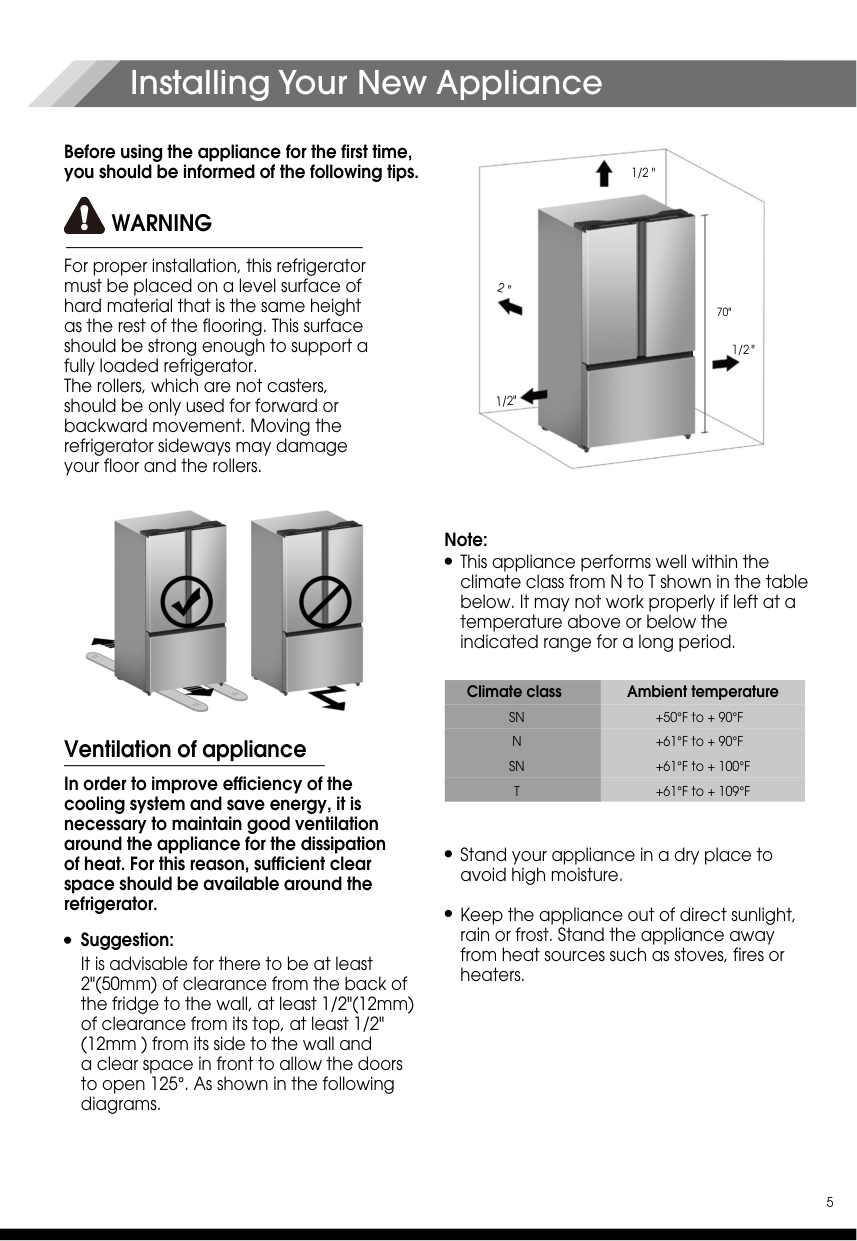
Remove the screws (B) fixed on the hinges with a wrench (5/16",8mm) and 1 ground screw (C) attached to the hinge with Philips (+) screwdriver. Remove the upper left and right door hinges (D).

C
B
D
Adjustable bottom feet

Use both hands to open the door more than 90°. Lift it up and take it off.
Take out the ice storage box (I) by lifting it up in the direction of the arrow.

I
Take out the upper freezer drawer (J) by lifting it up from the rail system.

J
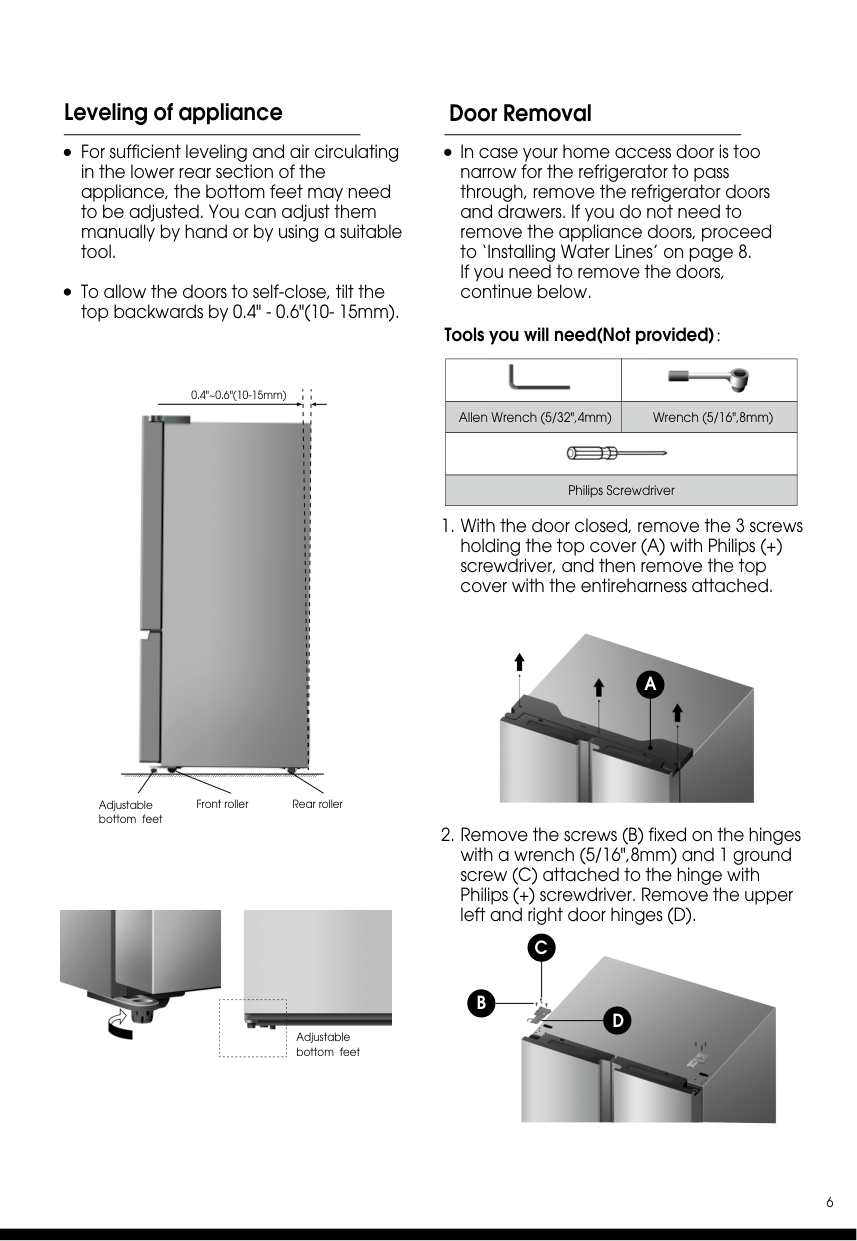
Remove the 2 screws (F) with an Philips Screwdriver. Remove the lower left and right door hinges (G).

G
Remove the lower freezer drawer (K) by lifting it up.
E

F
E
K
Disassembling the freezer door

Pull out the freezer door and the upper freezer drawer (H) to the final position.
Remove the 2 screws attached to the supporting frame (L).

H
L
################# What you need to have before you start
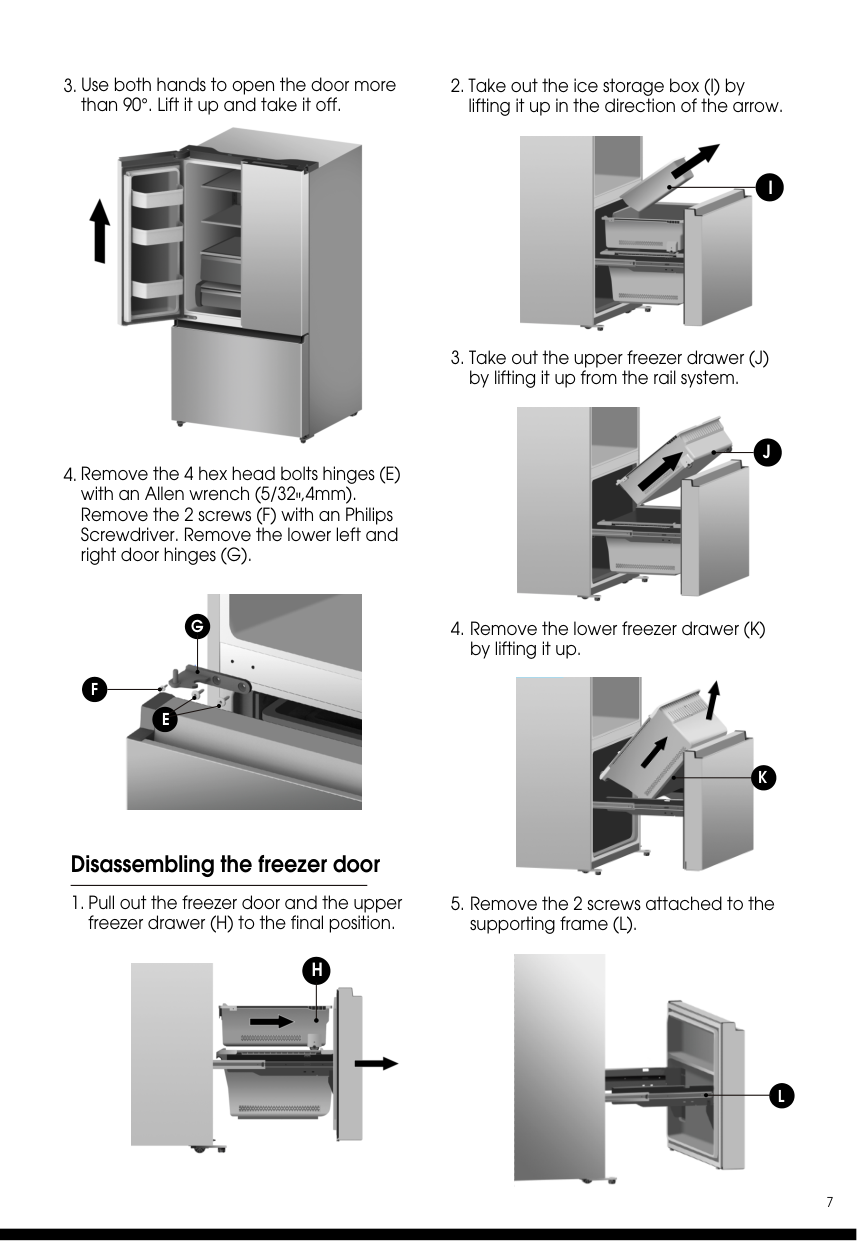


one 1/4” compression
Saddle-type Shut offvalve (1/4” outlet)
1 ferrule (sleeve)


1/4” extension tubing
1 Coupler 2 Clips
Re-assembling the freezer door To reattach the drawer after you moved the appliance to its final location, assemble the parts in reverse order.
4.You need to purchase several item to compalet this connection.You may find these items sold as a kit at local hardware store.
Installing the water lines
####### Connecting to the water supply line

A water dispenser with a filter is one of the helpful features on your new appliance. To help promote better health, the water filter removes unwanted particles from your water. However, it does not sterilize or destroy microorganisms. You may need to purchase a water purifying system to do that. In order for the ice maker to operate properly, a water line is required.
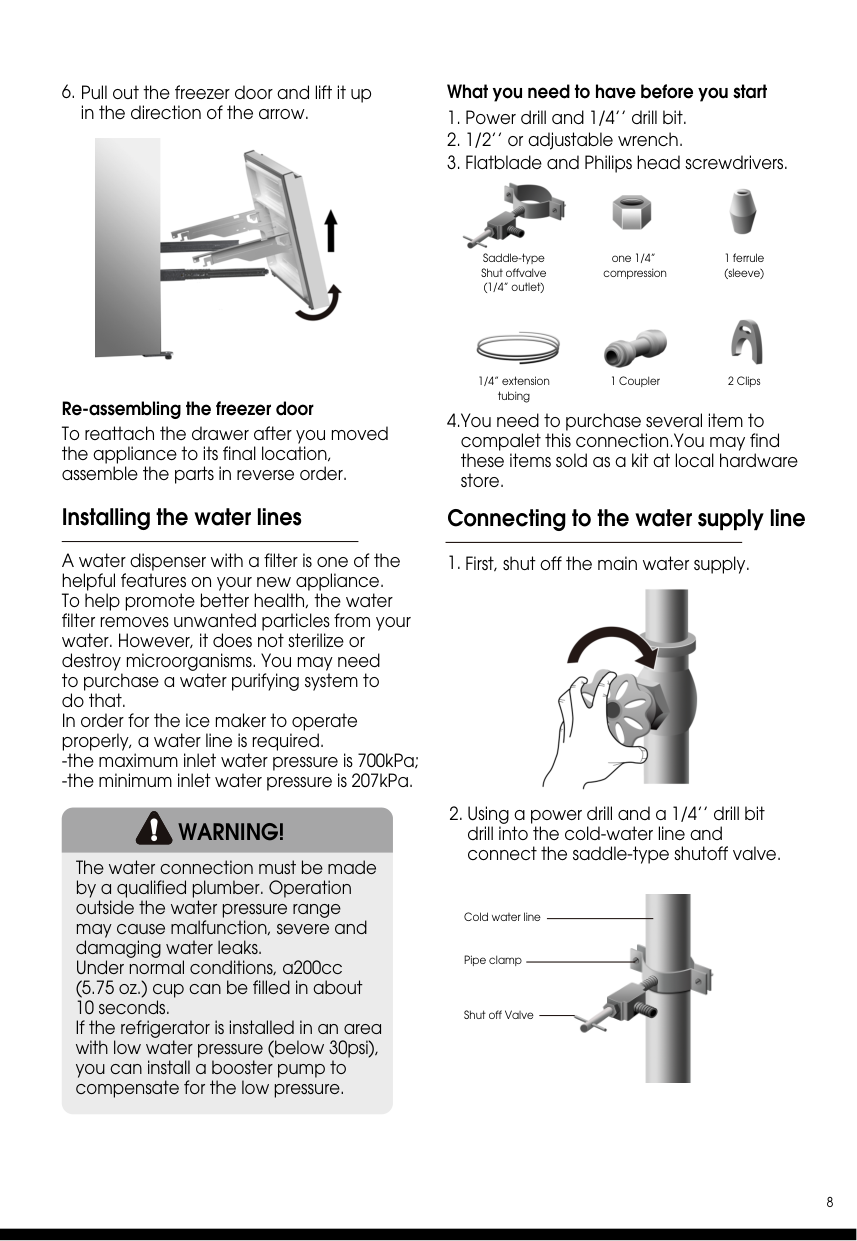
First, shut off the main water supply.

################## Using a power drill and a 1/4’’ drill bit drill into the cold-water line and connect the saddle-type shutoff valve.
####### WARNING!
The water connection must be made by a qualified plumber. Operation outside the water pressure range may cause malfunction, severe and damaging water leaks. Under normal conditions, a200cc (5.75 oz.) cup can be filled in about 10 seconds. If the refrigerator is installed in an area with low water pressure (below 30psi), you can install a booster pump to compensate for the low pressure.
Cold water line
Pipe clamp
Shut off Valve

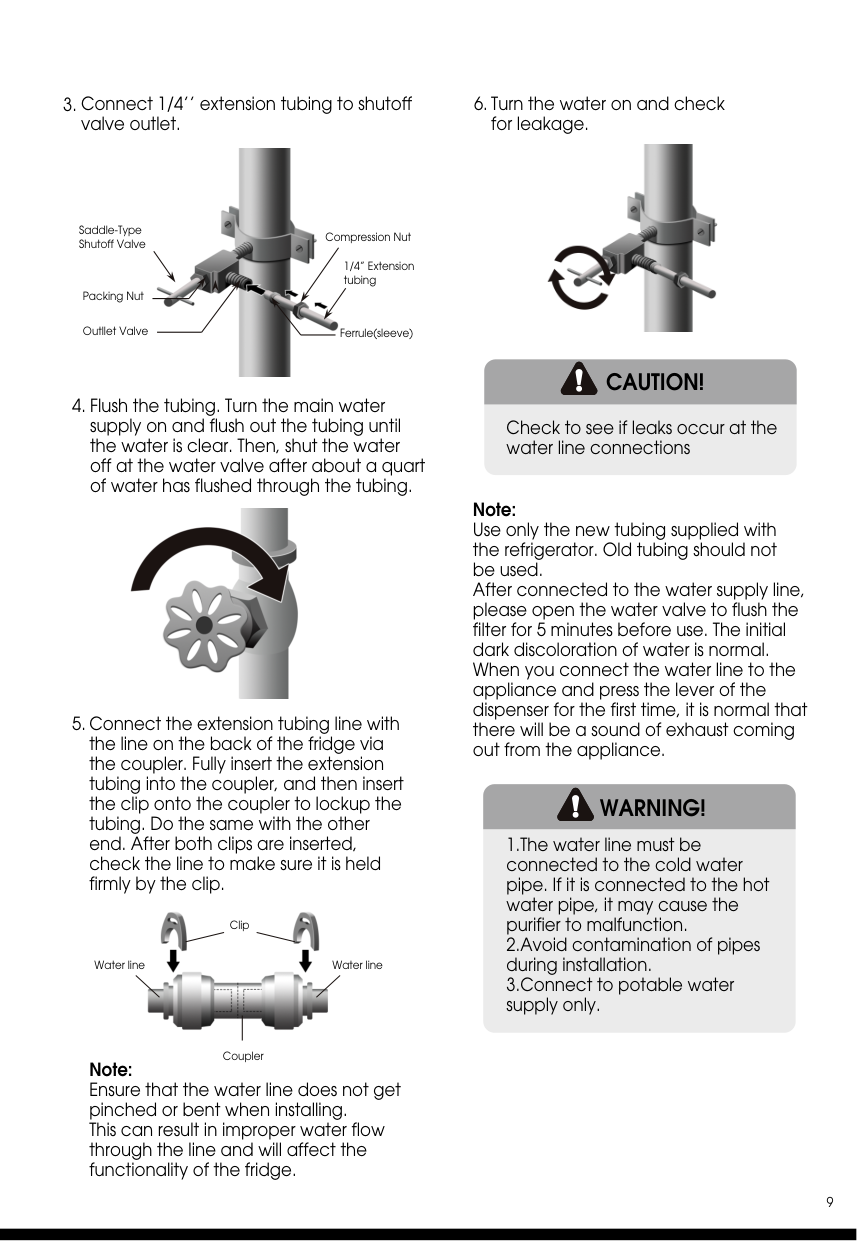

Flush the tubing. Turn the main water supply on and flush out the tubing until the water is clear. Then, shut the water off at the water valve after about a quart of water has flushed through the tubing.

Saddle-Type Shutoff Valve
Compression Nut
1/4” Extension tubing
Packing Nut
Outllet Valve
Ferrule(sleeve)
CAUTION!
Check to see if leaks occur at the water line connections
Note: Use only the new tubing supplied with the refrigerator. Old tubing should not be used. After connected to the water supply line, please open the water valve to flush the filter for 5 minutes before use. The initial dark discoloration of water is normal. When you connect the water line to the appliance and press the lever of the dispenser for the first time, it is normal that there will be a sound of exhaust coming out from the appliance.

Connect the extension tubing line with the line on the back of the fridge via the coupler. Fully insert the extension tubing into the coupler, and then insert the clip onto the coupler to lockup the tubing. Do the same with the other end. After both clips are inserted, check the line to make sure it is held firmly by the clip.
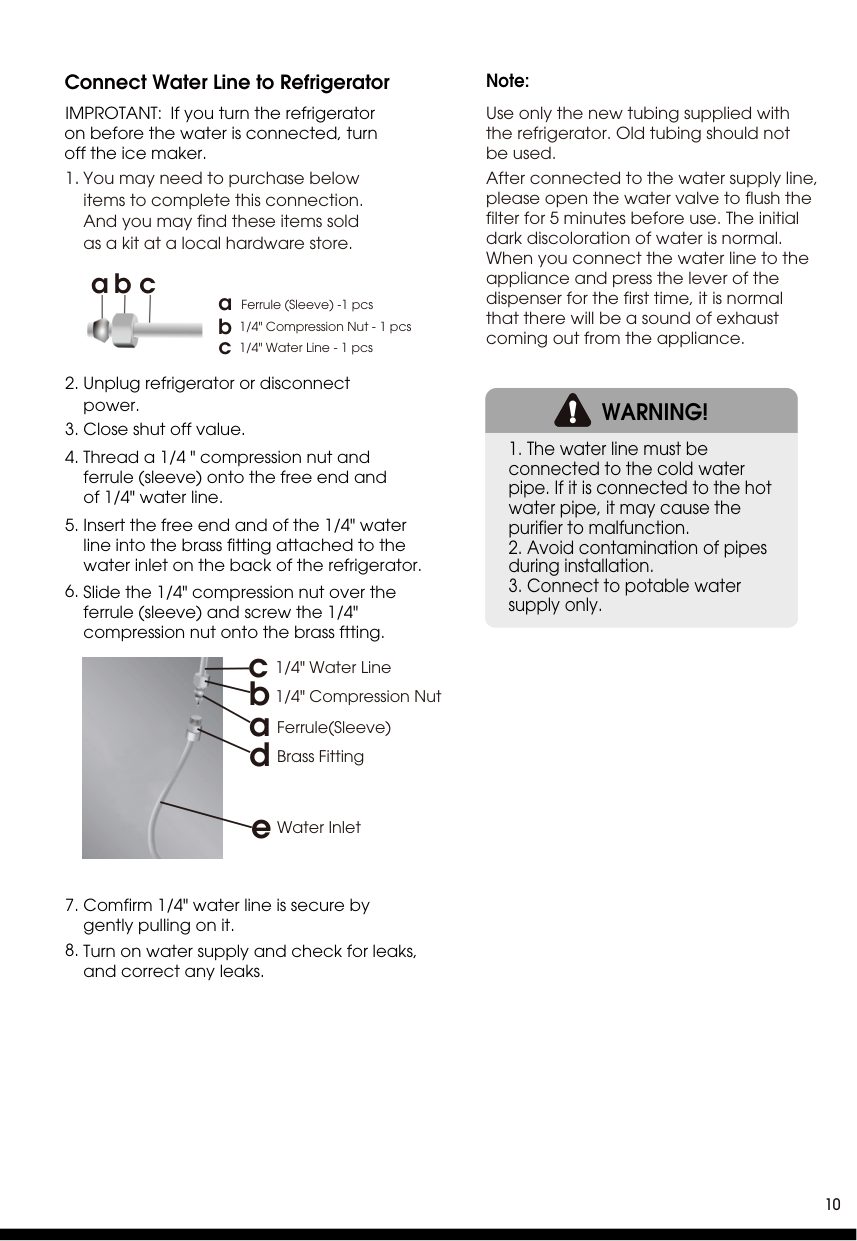
Clip
Water line Water line
Coupler
Note: Ensure that the water line does not get pinched or bent when installing. This can result in improper water flow through the line and will affect the functionality of the fridge.
########## Connect Water Line to Refrigerator IMPROTANT:
If you turn the refrigerator on before the water is connected, turn off the ice maker.
##### a b c

Ferrule (Sleeve) -1 pcs 1/4" Compression Nut - 1 pcs 1/4" Water Line - 1 pcs
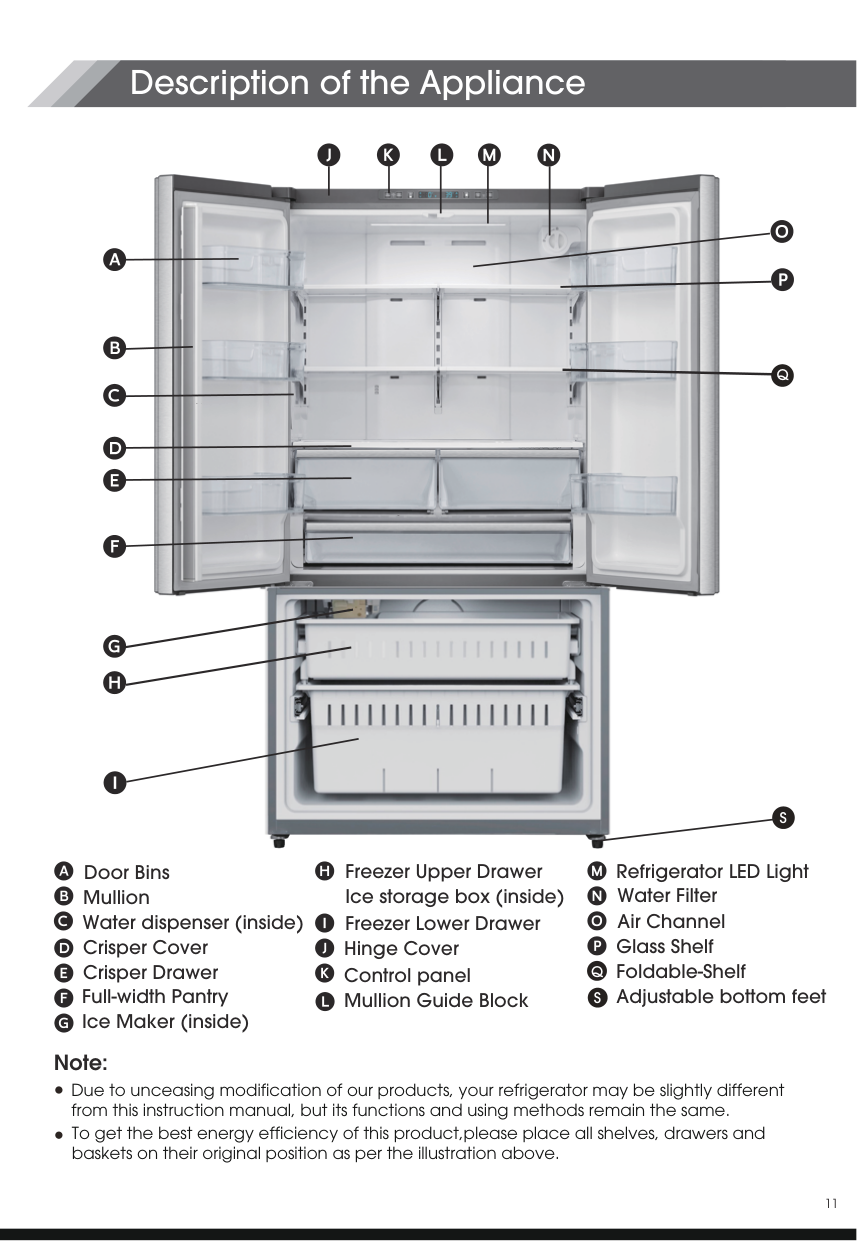
Unplug refrigerator or disconnect power. Close shut off value.
Thread a 1/4 " compression nut and ferrule (sleeve) onto the free end and of 1/4" water line.
Insert the free end and of the 1/4" water line into the brass fitting attached to the water inlet on the back of the refrigerator.
e
d
c 1/4" Water Line 1/4" Compression Nut Ferrule(Sleeve) Brass Fitting
Slide the 1/4" compression nut over the ferrule (sleeve) and screw the 1/4" compression nut onto the brass ftting.

Water Inlet
################# Note:
Use only the new tubing supplied with the refrigerator. Old tubing should not be used.
After connected to the water supply line, please open the water valve to flush the filter for 5 minutes before use. The initial dark discoloration of water is normal. When you connect the water line to the appliance and press the lever of the dispenser for the first time, it is normal that there will be a sound of exhaust coming out from the appliance.
####### WARNING!
10

Q
S
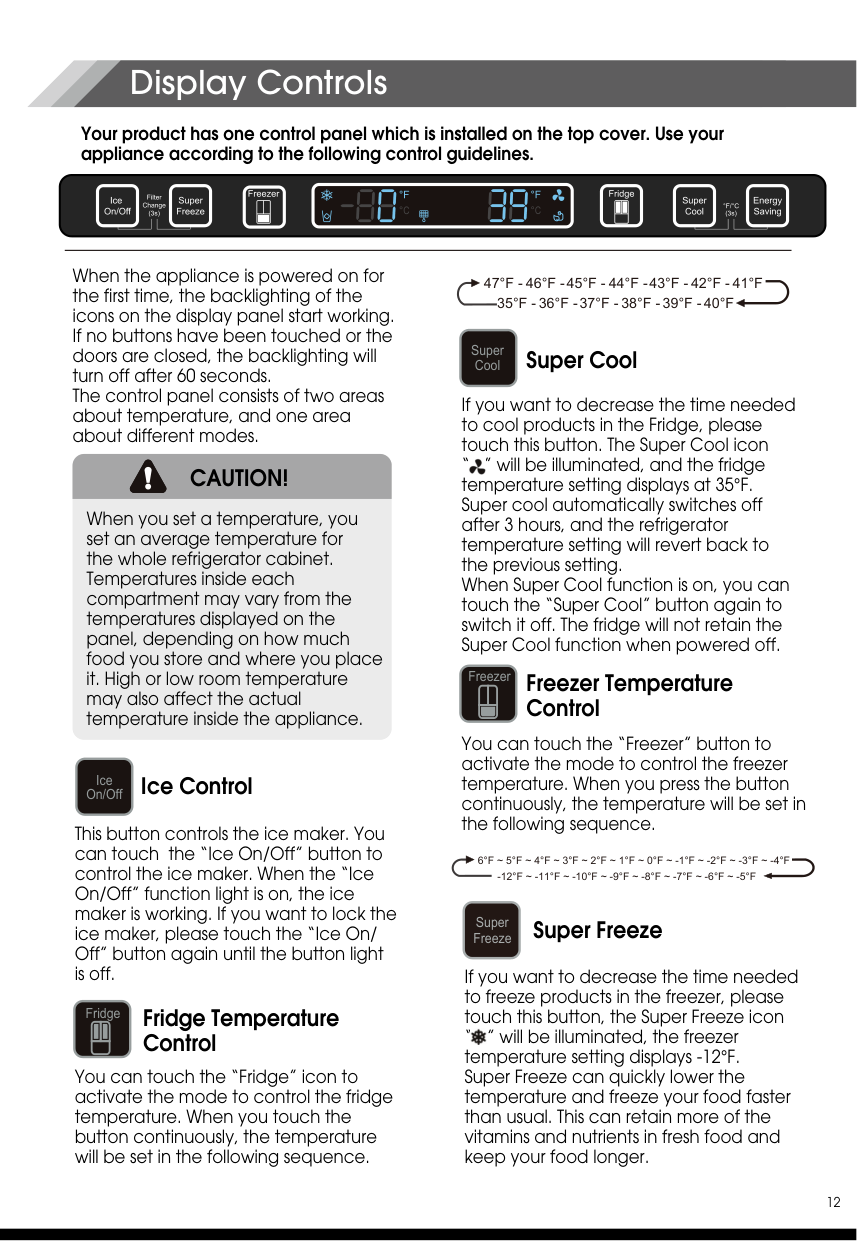
Door Bins Mullion
Water dispenser (inside)
Crisper Cover Crisper Drawer Full-width Pantry Ice Maker (inside)
Freezer Upper Drawer
Ice storage box (inside)
Freezer Lower Drawer
Hinge Cover Control panel Mullion Guide Block
############ Refrigerator LED Light
Water Filter
Air Channel Glass Shelf Foldable-Shelf Adjustable bottom feet
Q
S
######### Note:
Due to unceasing modification of our products, your refrigerator may be slightly different from this instruction manual, but its functions and using methods remain the same. To get the best energy efficiency of this product,please place all shelves, drawers and baskets on their original position as per the illustration above.
11
Display Controls
################# Your product has one control panel which is installed on the top cover. Use your appliance according to the following control guidelines.
When the appliance is powered on for the first time, the backlighting of the icons on the display panel start working. If no buttons have been touched or the doors are closed, the backlighting will turn off after 60 seconds. The control panel consists of two areas about temperature, and one area about different modes.
47°F - 46°F -45°F - 44°F -43°F - 42°F - 41°F 40°F39°F -38°F -37°F -36°F -35°F -
Super Cool
####### Super Cool
If you want to decrease the time needed to cool products in the Fridge, please touch this button. The Super Cool icon “ ” will be illuminated, and the fridge temperature setting displays at 35°F. Super cool automatically switches off after 3 hours, and the refrigerator temperature setting will revert back to the previous setting. When Super Cool function is on, you can touch the “Super Cool” button again to switch it off. The fridge will not retain the Super Cool function when powered off.

####### CAUTION!
When you set a temperature, you set an average temperature for the whole refrigerator cabinet. Temperatures inside each compartment may vary from the temperatures displayed on the panel, depending on how much food you store and where you place it. High or low room temperature may also affect the actual temperature inside the appliance.
Freezer
####### Freezer Temperature Control
You can touch the “Freezer” button to activate the mode to control the freezer temperature. When you press the button continuously, the temperature will be set in the following sequence.
Ice Control
Ice On/Off
This button controls the ice maker. You can touch the “Ice On/Off” button to control the ice maker. When the “Ice On/Off” function light is on, the ice maker is working. If you want to lock the ice maker, please touch the “Ice On/ Off” button again until the button light is off.
6°F ~ 5°F ~ 4°F ~ 3°F ~ 2°F ~ 1°F ~ 0°F ~ -1°F ~ -2°F ~ -3°F ~ -4°F
-12°F ~ -11°F ~ -10°F ~ -9°F ~ -8°F ~ -7°F ~ -6°F ~ -5°F
Super
####### Freeze Super Freeze
If you want to decrease the time needed to freeze products in the freezer, please touch this button, the Super Freeze icon “ ” will be illuminated, the freezer temperature setting displays -12°F. Super Freeze can quickly lower the temperature and freeze your food faster than usual. This can retain more of the vitamins and nutrients in fresh food and keep your food longer.
Fridge Temperature Control
Fridge

You can touch the “Fridge” icon to activate the mode to control the fridge temperature. When you touch the button continuously, the temperature will be set in the following sequence.
The Super Freeze mode allows you to freeze items inside with maximum speed. We recommend that you let the appliance operate for 6 hours first. Super Freeze automatically switches off after 26 hours, and the freezer temperature setting will revert back to the previous setting. When the Super Freeze function is on, you can touch the “Super Freeze” button again to switch off. If power cutoff happens while Super Freeze is activated, the Super Freeze will not remain active after power is resupplied.
Note: If you want to exchange the “°F” to “°C”, please press and hold the “Super Cool” and “Energy Saving” buttons for 3 seconds.

Water Filter
In general, you should change the water filter every 6 months to ensure the highest possible water quality. After the refrigerator has dispensed about 300 gallons of water, the filter icon “ ” will blink, reminding you to replace the water filter. First of all, you need to purchase a new water filer. You can purchase the new filter from the retailer where you purchased your refrigerator or the Hisense after-sales service system.

Before that, please check that the new filter is the same filter type that came with your fridge and can be correctly used in your refrigerator. After you change the water filter, push and hold the “Ice On/Off” and “Super Freeze” buttons for 3 seconds to make the blinking stop. When you replace the water filter, some water may leak from the filter and lines. Please let the water flow into a pan and wipe up any leakage that may have occurred.
Energy SavingEnergySaving
You can touch this button to turn Energy Saving mode on and off. When you turn Energy Saving on, the Energy Saving icon
“ ” lights up. The temperature of the fridge is automatically switched to 42°F and the freezer to 2°F. If you turn Energy Saving off, the icon “ ” will go off and the temperature setting will revert back to the previous setting.


####### Door Alarm
When any door is open over 2 minutes, the door alarm will be actrivated. The buzzer will sound 3 times every 1 minute and the display will present “dr”. The alarm will stop when the doors closed or stop automatically after 10 minutes. To save energy, please avoid keeping the door open for long time when using the appliance.
Note:
The control panel will light up when the door is open, or you touch any button. The light will go off without touching any buttons or if the doors have been closed for over one minute. When the refrigerator is powered on, all the icons of the control panel will light up for 3 seconds, and a buzzer sounds. The temperature setting reverts back to the previous setting.
Demo mode (Freezer/ Fridge Temperature Indicator moving)
Demo mode is for store display, and it prevents the refrigerator from generating cool air. In Demo Mode, the refrigerator may seem like it is working but it will not make cool air. The indicators on the control panel will show double “0F”. To cancel this mode, press and hold “Ice On/Off” and “Energy Saving” keys at the same time for 3 seconds until the buzzer beep three times and the display panel will light for 3 seconds.
Using your Appliance


This section tells you how to use most of the useful features. We recommend that you read through them carefully before using the appliance.
K
####### Getting Cold Water
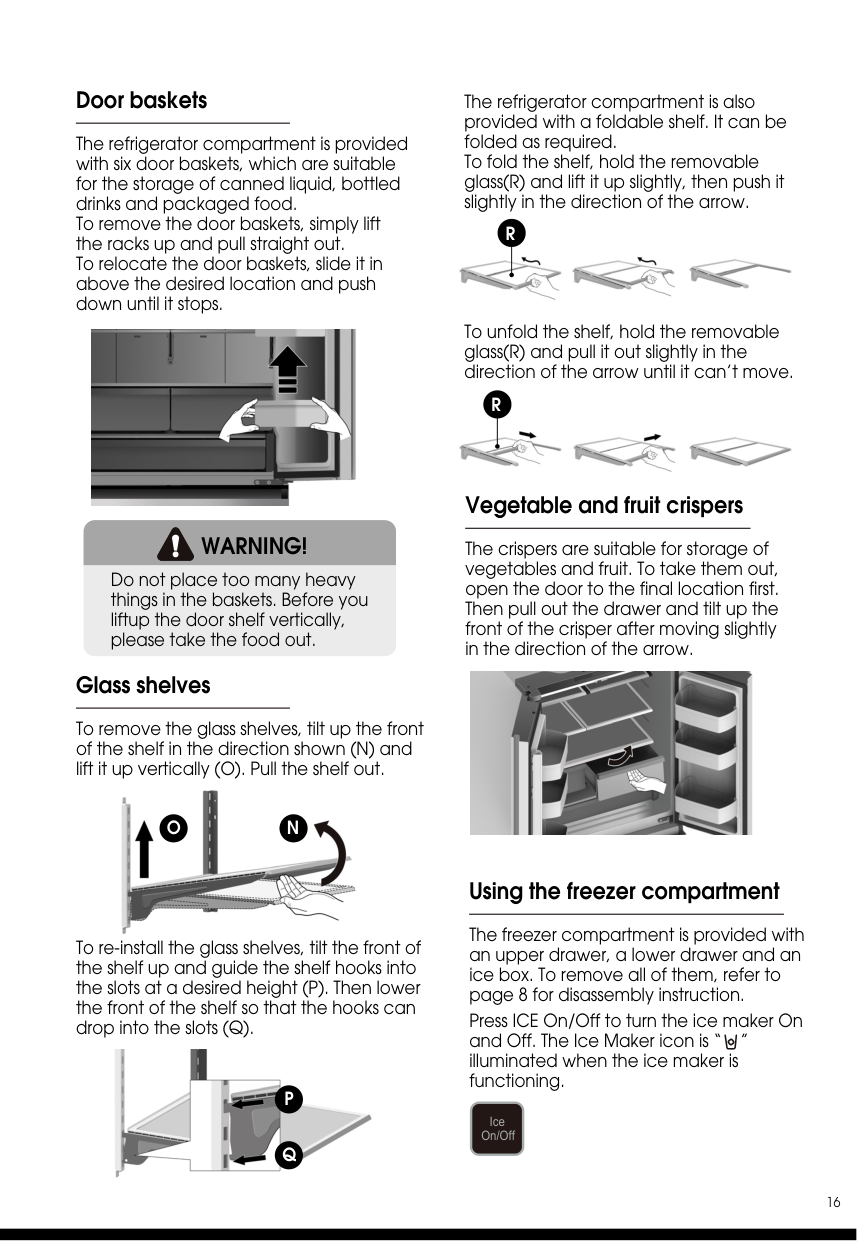
The water dispenser is located in the left side of the fridge. Open the refrigerator doors, and push the water dispenser button to get water. Then move your glass down the dispenser lever in the suggested position and press it. Hold the glass underneath the dispenser for 2~3 seconds after releasing the dispenser button as water may continue to dispense after the button is released.
2.Pull the water filter (K) from the filter holder (L).

################# L

####### Note:
About 1.6inch
To change the water filter easily, shut off the water supply valve. Sometimes, it is hard to disassemble the water filter because impurities in the water cause it to stick. If you are having difficulties, grip the water filter firmly and pull it out. When you pull the water filter, a little water can leak from the opening. This is normal. To minimize the water leaks, keep the filter cartridge horizontal when pulling it.
####### Changing the water filter
################# 1
To drink the freshest and cleanest water from your refrigerator, change the filter on time. Please follow these steps:
To prevent overflow, empty the water filter tray (M) and dry around the filter case. To insert the new water filter, follow the directions below.
K


Note:
When having problem with releasing water filter, please use the enclosed tool which provide in package as above. Insert the tool into the filter housing and rotate it counter clock wise (to the left) 90 degrees. Please keep for future use when changing the water filter.
M
Insert the new filter into the filter holder.
If you turned off the water supply, turn it back on.
After turning on the water supply, you should check the leaks. If leaks occur, repeat the steps 1- 5. If leaks persist, discontinue use and call Hisense customer service..


################# K
Push the filter, and then turn it clockwise until it locks.

If you have trouble inserting the water filter because of high water pressure, shut off the water supply valve.
Note:
Note:
Be sure to flush the dispenser thoroughly, otherwise water may drip from the dispenser. This means that there is still air in the line. Do not dispense the entire 2.5 gallon amount continuously. Depress and release the dispenser pad for cycles of 30 seconds ON and 60 seconds OFF.
################# Reverse osmosis water supply:
The pressure of the water supply coming out of a reverse osmosis system going to the water inlet valve of the refrigerator needs to be between 30 and 100psi (207 and 700kPa). If a reverse osmosis water system is connected to your cold water supply, the water pressure to the reverse osmosis system needs to be a minimum of 40 to 60 psi (276 to 414 kPa).If the water pressure to the reverse osmosis system is less than 40 to 60 psi (276 to 414 kPa):
Check to see whether the sediment filter in the reverse osmosis system is blocked. Replace the filter if necessary. Allow the storage tank on the reverse osmosis system to refill after heavy usage. If your refrigerator has a water filter, it may further reduce the water pressure when used in conjunction with a reverse osmosis system. To resolve it, remove the water filter.
Removing any residual matter inside the water supply line after installing the water filter
####### 2 Using your fridge compartment
2
The refrigerator compartment is suitable for storage of vegetables and fruit. Food inside should be sealed for storage in order to avoid losing moisture or flavor permeating into other foods.
####### CAUTION!
Never close the refrigerator door while the shelves, crisper and/or telescopic slides are extended It may damage both them and the refrigerator.
Door baskets
The refrigerator compartment is also provided with a foldable shelf. It can be folded as required. To fold the shelf, hold the removable glass(R) and lift it up slightly, then push it slightly in the direction of the arrow.
The refrigerator compartment is provided with six door baskets, which are suitable for the storage of canned liquid, bottled drinks and packaged food. To remove the door baskets, simply lift the racks up and pull straight out. To relocate the door baskets, slide it in above the desired location and push down until it stops.

R


To unfold the shelf, hold the removable glass(R) and pull it out slightly in the direction of the arrow until it can’t move.
R


Vegetable and fruit crispers
WARNING!
The crispers are suitable for storage of vegetables and fruit. To take them out, open the door to the final location first. Then pull out the drawer and tilt up the front of the crisper after moving slightly in the direction of the arrow.

Do not place too many heavy things in the baskets. Before you liftup the door shelf vertically, please take the food out.
####### Glass shelves
To remove the glass shelves, tilt up the front of the shelf in the direction shown (N) and lift it up vertically (O). Pull the shelf out.

################# O N
####### Using the freezer compartment
The freezer compartment is provided with an upper drawer, a lower drawer and an ice box. To remove all of them, refer to page 8 for disassembly instruction.
To re-install the glass shelves, tilt the front of the shelf up and guide the shelf hooks into the slots at a desired height (P). Then lower the front of the shelf so that the hooks can drop into the slots (Q).
Press ICE On/Off to turn the ice maker On and Off. The Ice Maker icon is “ ” illuminated when the ice maker is functioning.

Ice On/Off
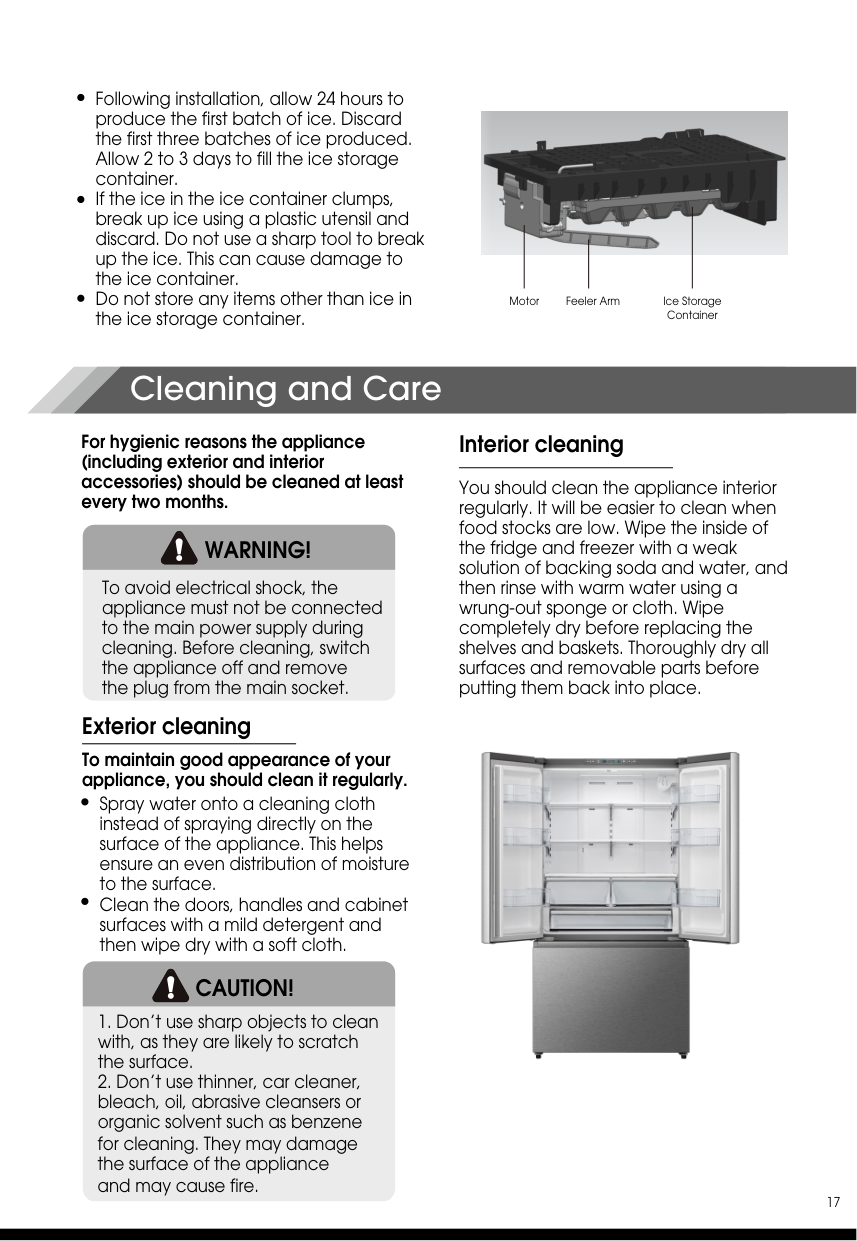
Following installation, allow 24 hours to produce the first batch of ice. Discard the first three batches of ice produced. Allow 2 to 3 days to fill the ice storage container. If the ice in the ice container clumps, break up ice using a plastic utensil and discard. Do not use a sharp tool to break up the ice. This can cause damage to the ice container. Do not store any items other than ice in the ice storage container.

Motor
Feeler Arm Ice Storage Container
Cleaning and Care
For hygienic reasons the appliance (including exterior and interior accessories) should be cleaned at least every two months.
####### WARNING!
To avoid electrical shock, the appliance must not be connected to the main power supply during cleaning. Before cleaning, switch the appliance off and remove the plug from the main socket.
Exterior cleaning
To maintain good appearance of your appliance, you should clean it regularly.
Spray water onto a cleaning cloth instead of spraying directly on the surface of the appliance. This helps ensure an even distribution of moisture to the surface. Clean the doors, handles and cabinet surfaces with a mild detergent and then wipe dry with a soft cloth.
####### CAUTION!
####### Interior cleaning
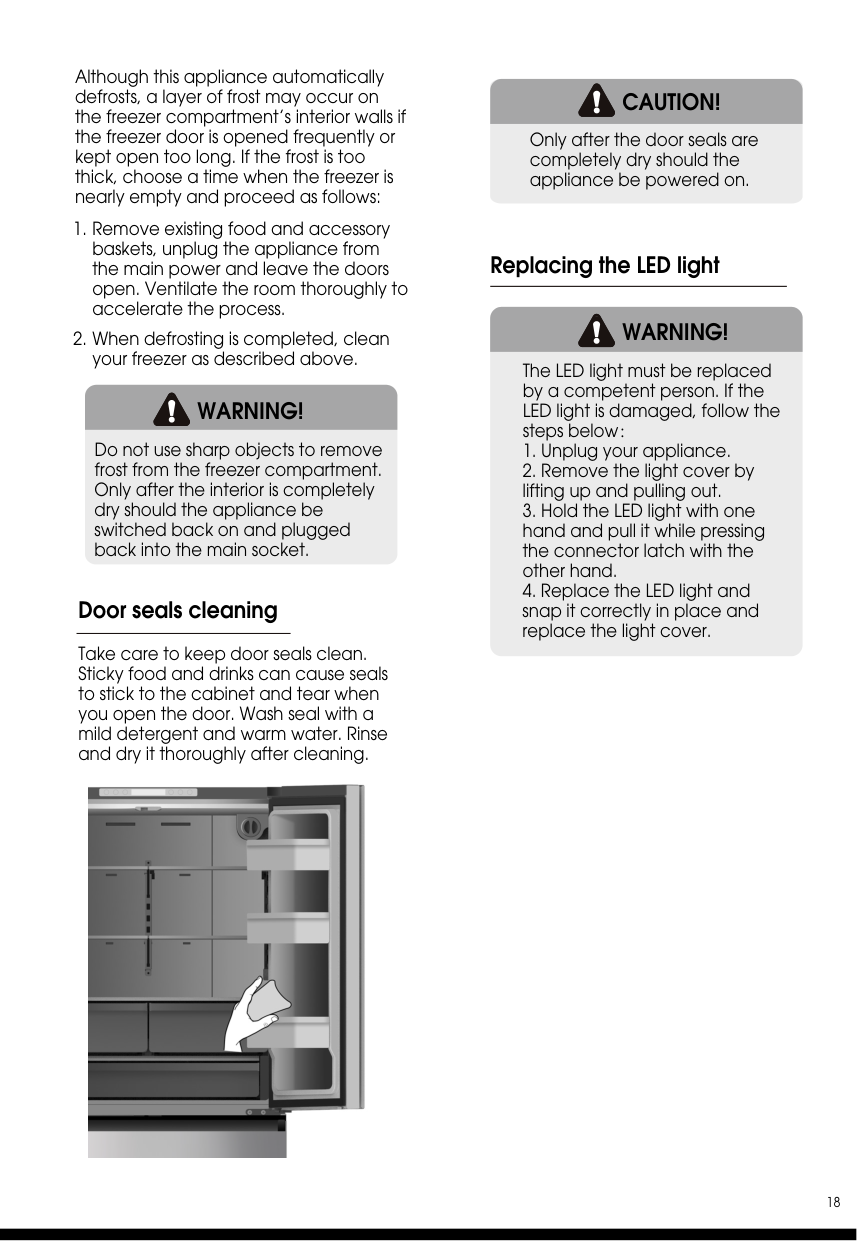
You should clean the appliance interior regularly. It will be easier to clean when food stocks are low. Wipe the inside of the fridge and freezer with a weak solution of backing soda and water, and then rinse with warm water using a wrung-out sponge or cloth. Wipe completely dry before replacing the shelves and baskets. Thoroughly dry all surfaces and removable parts before putting them back into place.

Although this appliance automatically defrosts, a layer of frost may occur on the freezer compartment’s interior walls if the freezer door is opened frequently or kept open too long. If the frost is too thick, choose a time when the freezer is nearly empty and proceed as follows:
Remove existing food and accessory baskets, unplug the appliance from the main power and leave the doors open. Ventilate the room thoroughly to accelerate the process.
When defrosting is completed, clean your freezer as described above.
####### WARNING!
Do not use sharp objects to remove frost from the freezer compartment. Only after the interior is completely dry should the appliance be switched back on and plugged back into the main socket.
Door seals cleaning
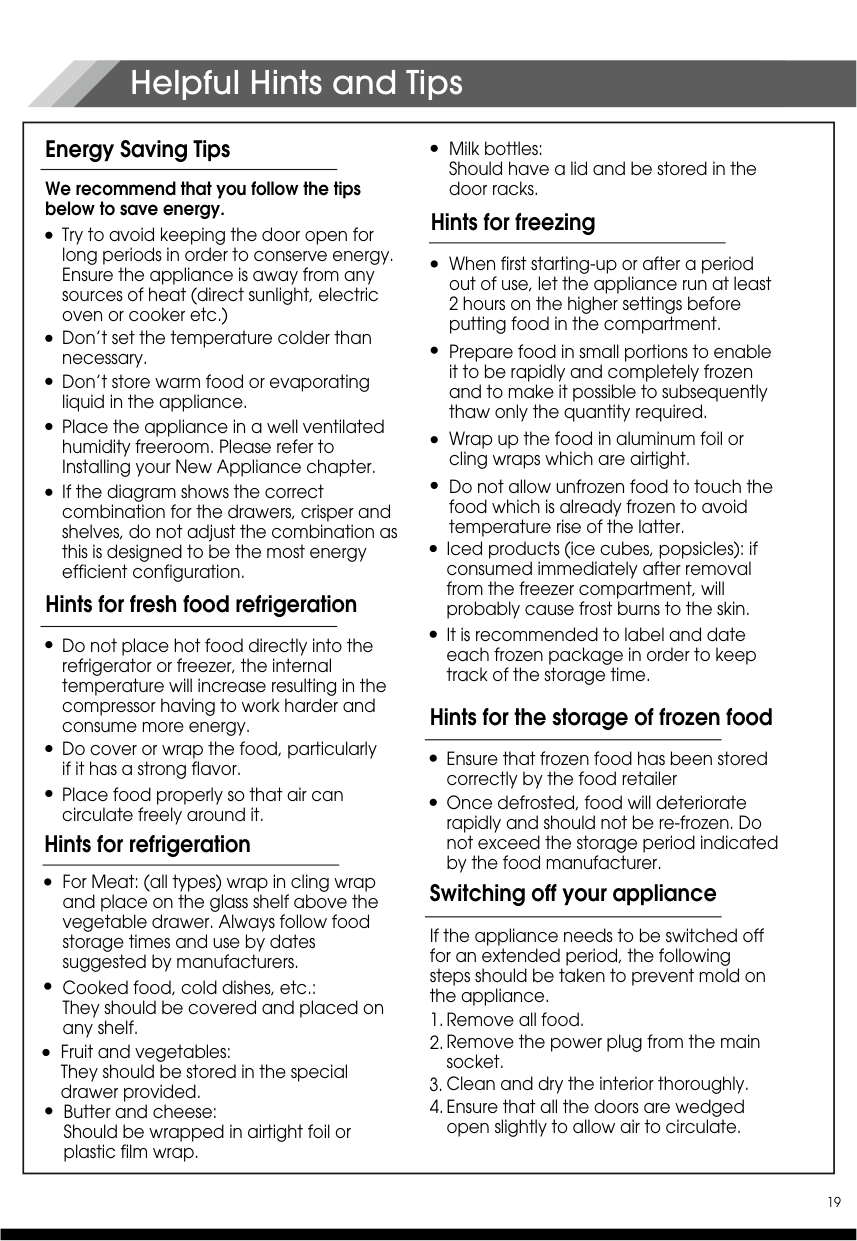
Take care to keep door seals clean. Sticky food and drinks can cause seals to stick to the cabinet and tear when you open the door. Wash seal with a mild detergent and warm water. Rinse and dry it thoroughly after cleaning.

####### CAUTION!
Only after the door seals are completely dry should the appliance be powered on.
Replacing the LED light
WARNING!
The LED light must be replaced by a competent person. If the LED light is damaged, follow the steps below:
Helpful Hints and Tips
|Energy Saving Tips
We recommend that you follow the tips below to save energy.
Hints for fresh food refrigeration
Try to avoid keeping the door open for long periods in order to conserve energy. Ensure the appliance is away from any sources of heat (direct sunlight, electric oven or cooker etc.) Don’t set the temperature colder than necessary. Don’t store warm food or evaporating liquid in the appliance. Place the appliance in a well ventilated humidity freeroom. Please refer to Installing your New Appliance chapter. If the diagram shows the correct combination for the drawers, crisper and shelves, do not adjust the combination as this is designed to be the most energy efficient configuration.
Do not place hot food directly into the refrigerator or freezer, the internal temperature will increase resulting in the compressor having to work harder and consume more energy. Do cover or wrap the food, particularly if it has a strong flavor. Place food properly so that air can circulate freely around it.
Fruit and vegetables: They should be stored in the special drawer provided. Butter and cheese: Should be wrapped in airtight foil or plastic film wrap.
Milk bottles: Should have a lid and be stored in the door racks.
When first starting-up or after a period out of use, let the appliance run at least 2 hours on the higher settings before putting food in the compartment.
Prepare food in small portions to enable it to be rapidly and completely frozen and to make it possible to subsequently thaw only the quantity required.
Wrap up the food in aluminum foil or cling wraps which are airtight.
Do not allow unfrozen food to touch the food which is already frozen to avoid temperature rise of the latter.
Hints for freezing
For Meat: (all types) wrap in cling wrap and place on the glass shelf above the vegetable drawer. Always follow food storage times and use by dates suggested by manufacturers. Cooked food, cold dishes, etc.: They should be covered and placed on any shelf.
Hints for refrigeration
Hints for the storage of frozen food
Iced products (ice cubes, popsicles): if consumed immediately after removal from the freezer compartment, will probably cause frost burns to the skin. It is recommended to label and date each frozen package in order to keep track of the storage time.
Ensure that frozen food has been stored correctly by the food retailer Once defrosted, food will deteriorate rapidly and should not be re-frozen. Do not exceed the storage period indicated by the food manufacturer.
Switching off your appliance
If the appliance needs to be switched off for an extended period, the following steps should be taken to prevent mold on the appliance.
Remove all food. Remove the power plug from the main socket. Clean and dry the interior thoroughly.
Ensure that all the doors are wedged open slightly to allow air to circulate.
1.
2.
4.
3.
| |---|
Trouble shooting
If you experience a problem with your appliance or are concerned that the appliance is not functioing correctly, you can carry out some easy checks before calling for service, please see below.
WARNING
####### DANGER
Risk of child entrapment. Before you throw away your old refrigerator or freezer:
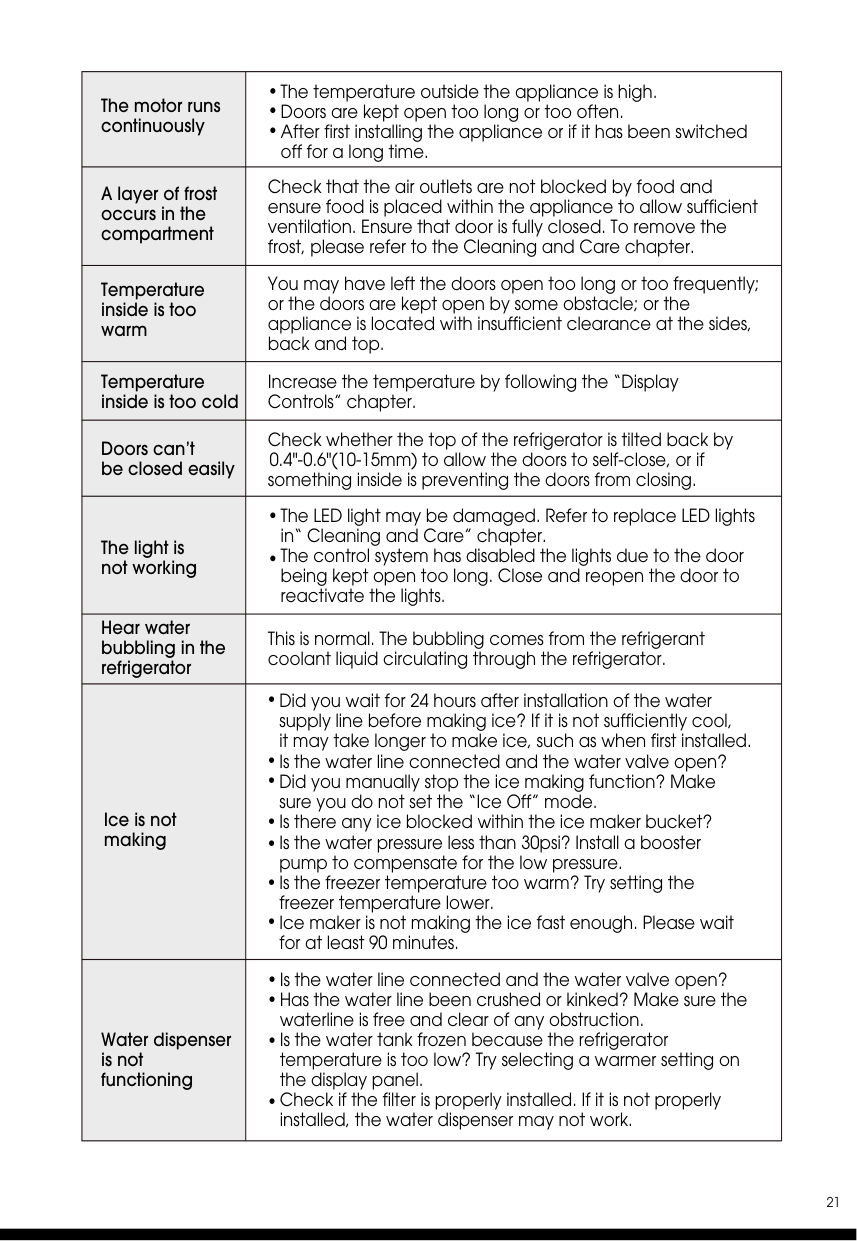
|Problem|Possible Cause & Solution| |---|---| |Appliance is not working correctly|Check whether the power cord is plugged into the power outlet properly.| |Appliance is not working correctly|Check the fuse or circuit of your power supply, replace if necessary.| |Appliance is not working correctly|The room temperature may be too low. Try setting the refrigerator or freezer temperature to a colder level to solve this problem.| |Appliance is not working correctly|It is normal that the freezer is not operating during the defrost cycle, or for a short time after the appliance is switched on to protect the compressor.| |Odors from the compartments|The interior may need to be cleaned| |Odors from the compartments|Some food, containers or wrapping may cause odors.| |Noise from the appliance|• •
• • • • •
The sounds below are quite normal: Compressor running noises. Air movement noise from the small fan motor in the freezer compartment or other compartments. Gurgling sound similar to water boiling. Popping noise during automatic defrosting. Clicking noise before the compressor starts. Clicking noise when you get the water. The motor running noises when you get ice.| |Noise from the appliance|Other unusual noises are due to the reasons below and may need you to check and take action: The cabinet is not level. The back of appliance is touching the wall. Bottles or containers have fallen or are rolling.| |The motor runs continuously|It is normal to frequently hear the sound of the motor, it will need to run more when in following circumstances:
Temperature setting is set colder than necessary. Large quantity of warm food has recently been stored within the appliance.
|
|The motor runs continuously|The temperature outside the appliance is high. Doors are kept open too long or too often. After first installing the appliance or if it has been switched off for a long time.| |---|---| |A layer of frost occurs in the compartment|Check that the air outlets are not blocked by food and ensure food is placed within the appliance to allow sufficient ventilation. Ensure that door is fully closed. To remove the frost, please refer to the Cleaning and Care chapter.| |Temperature inside is too warm|You may have left the doors open too long or too frequently; or the doors are kept open by some obstacle; or the appliance is located with insufficient clearance at the sides, back and top.| |Temperature inside is too cold|Increase the temperature by following the “Display Controls” chapter.| |Doors can’t be closed easily|Check whether the top of the refrigerator is tilted back by 0.4"-0.6"(10-15mm) to allow the doors to self-close, or if something inside is preventing the doors from closing.|

|The light is not working|The LED light may be damaged. Refer to replace LED lights in“ Cleaning and Care” chapter. The control system has disabled the lights due to the door being kept open too long. Close and reopen the door to reactivate the lights.| |Hear water bubbling in the refrigerator|This is normal. The bubbling comes from the refrigerant coolant liquid circulating through the refrigerator.| |Ice is not making|•
• •
• •
• •
Did you wait for 24 hours after installation of the water supply line before making ice? If it is not sufficiently cool, it may take longer to make ice, such as when first installed. Is the water line connected and the water valve open? Did you manually stop the ice making function? Make sure you do not set the “Ice Off” mode. Is there any ice blocked within the ice maker bucket? Is the water pressure less than 30psi? Install a booster pump to compensate for the low pressure. Is the freezer temperature too warm? Try setting the freezer temperature lower. Ice maker is not making the ice fast enough. Please wait for at least 90 minutes.| |Water dispenser is not functioning|• •
•
•
Is the water line connected and the water valve open? Has the water line been crushed or kinked? Make sure the waterline is free and clear of any obstruction. Is the water tank frozen because the refrigerator temperature is too low? Try selecting a warmer setting on the display panel. Check if the filter is properly installed. If it is not properly installed, the water dispenser may not work.|
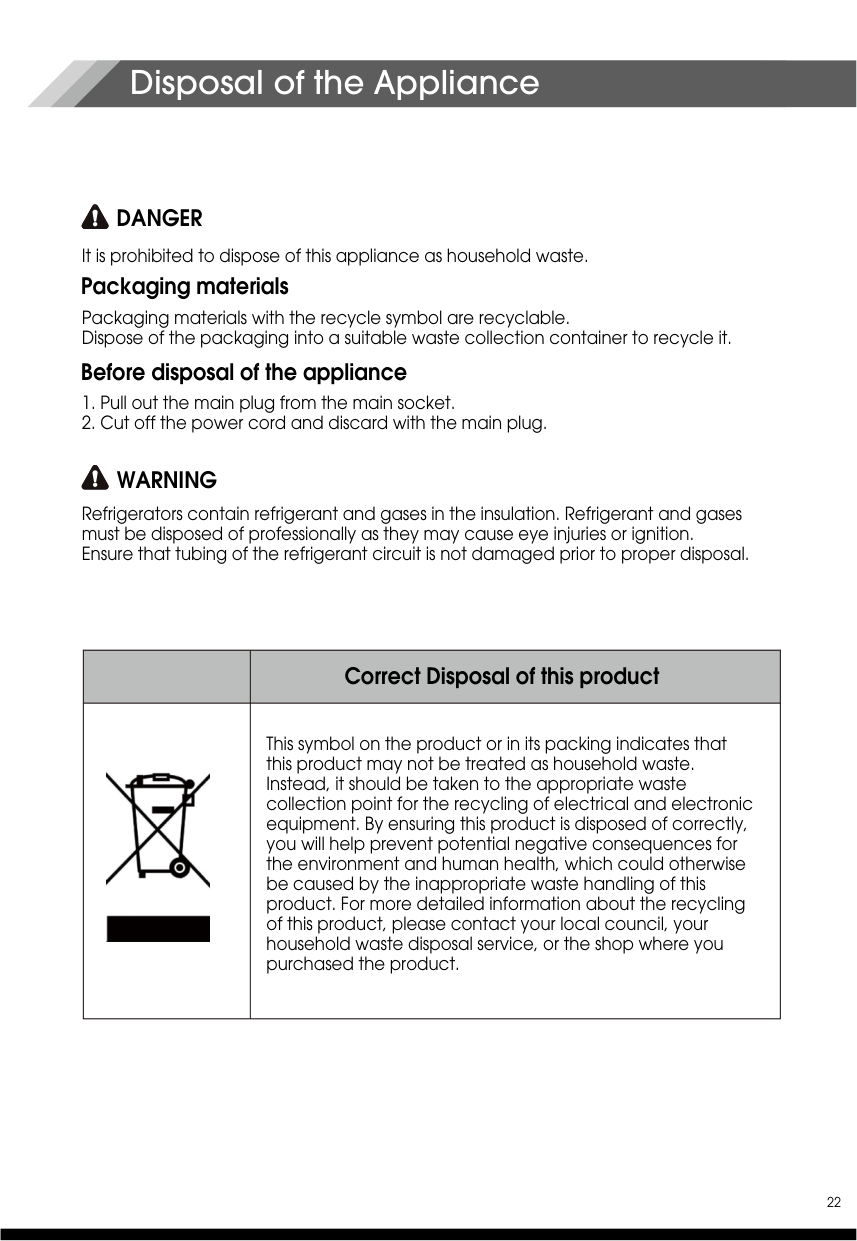
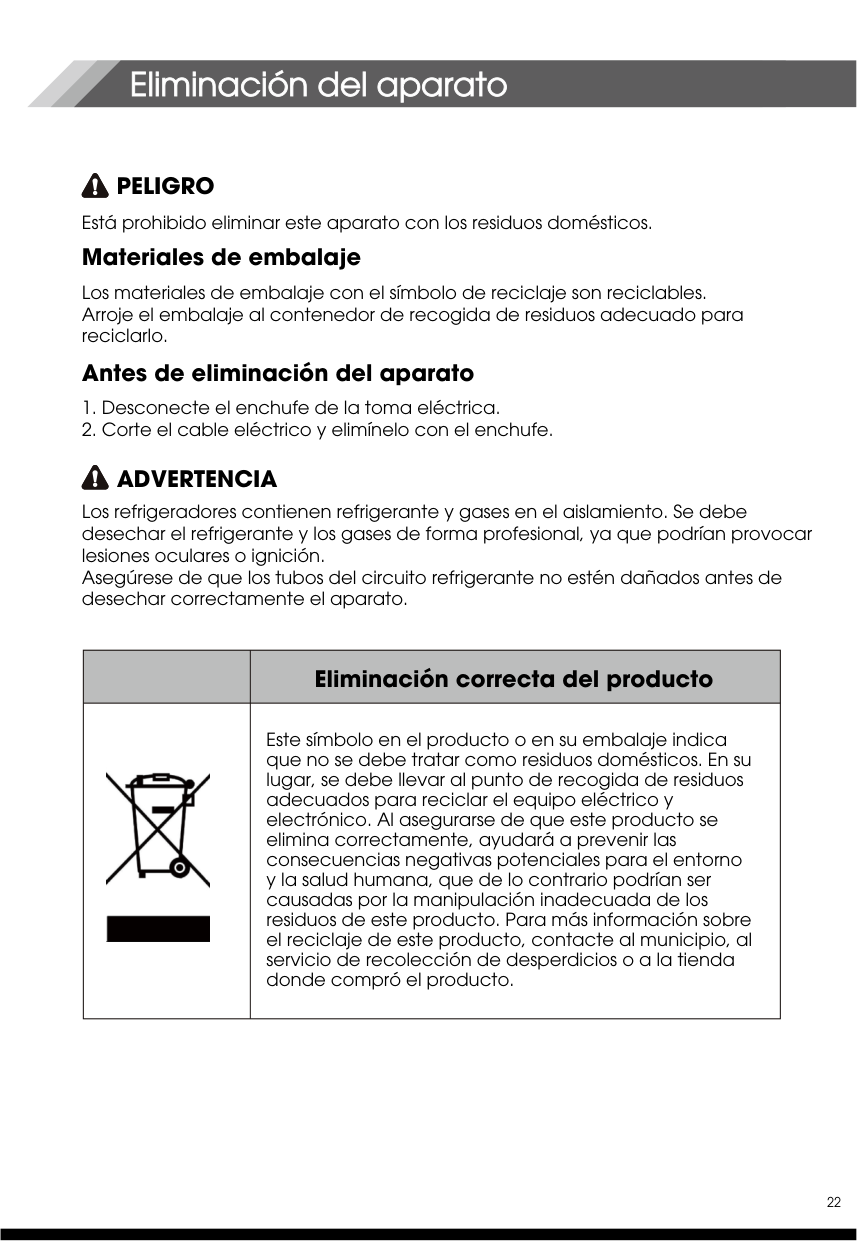
Disposal of the Appliance
DANGER
It is prohibited to dispose of this appliance as household waste. Packaging materials
Packaging materials with the recycle symbol are recyclable. Dispose of the packaging into a suitable waste collection container to recycle it.
####### Before disposal of the appliance
WARNING
Refrigerators contain refrigerant and gases in the insulation. Refrigerant and gases must be disposed of professionally as they may cause eye injuries or ignition. Ensure that tubing of the refrigerant circuit is not damaged prior to proper disposal.
| |Correct Disposal of this product| |---|---| ||This symbol on the product or in its packing indicates that this product may not be treated as household waste. Instead, it should be taken to the appropriate waste collection point for the recycling of electrical and electronic equipment. By ensuring this product is disposed of correctly, you will help prevent potential negative consequences for the environment and human health, which could otherwise be caused by the inappropriate waste handling of this product. For more detailed information about the recycling of this product, please contact your local council, your household waste disposal service, or the shop where you purchased the product.|
################# Copyright Statement
© 2022 Hisense Company Ltd. All Rights Reserved.
All material in this User Manual is the property of Hisense Company Ltd. and its subsidiaries, and is protected under US, CANADA, MEXICO and International copyright and/or other intellectual property laws. Reproduction or transmission of the materials, in whole or in part, in any manner, electronic, print, or otherwise, without the prior written consent of Hisense Company Ltd. is a violation of Hisense Company Ltd. rights under the aforementioned laws.
No part of this publication may be stored, reproduced, transmitted or distributed, in whole or in part, in any manner, electronic or otherwise, whether or not for a charge or other or no consideration, without the prior written permission of Hisense Company Ltd.
Requests for permission to store, reproduce, transmit or distribute materials may be made to one of the following addresses:
USA:
Hisense USA Corporation 105 Satellite Blvd NW, Suwanee, GA 30024
CANADA:
Hisense Canada Co., Ltd 2283 Argentia Road, Unit 16 Mississauga, ON, Canada LSN 5Z2
MEXICO:
Hisense Mexico S. de R.L. de C.V. Blvd. Miguel de Cervantes Saavedra No 301 Torre Norte Piso 2, Col. Ampliación Granada Miguel Hidalgo, Ciudad de México, C.P. 11520
Hisense, and any and all other Hisense product names, logo’s, slogans or marks are registered trademarks of Hisense Company Ltd. and its subsidiaries. All other trademarks are the property of their respective holders.
© 2022. All rights reserved. Hisense and the Hisense logo are registered trademarks of Hisense. Other brand and product names are registered trademarks of their respective owners.
############### Disclaimer: Images throughout this document are for illustrative purposes only and may differ from the actual product.
MANUAL DE OPERACIÓN DEL USUARIO
Antes de operar esta unidad, lea completamente este manual y guárdelo para referencia futura.
#### HRF266N6CSE HRF266N6CSE1
Español
Para consultas sobre las características, funcionamiento/ rendimiento, piezas o servicio, llame al: 1-877-465-3566
Tabla de contenidos
Introducción breve...............................................................................................................2 Instrucciones importantes de seguridad...........................................................................3 Instalar el nuevo aparato....................................................................................................5 Descripción del aparato....................................................................................................11 Controles de la pantalla....................................................................................................12 Usar seu aparelho...............................................................................................................14 Limpieza y cuidado............................................................................................................17 Sugerencias y consejos útiles............................................................................................19 Resolución de problemas..................................................................................................20 Eliminación del aparato....................................................................................................22
Introducción breve
|Asegúrese de que todas las personas que utilizan el aparato estén familiarizadas con el funcionamiento y las características de seguridad. Es importante que instale el aparato correctamente y preste atención a las instrucciones de seguridad. Le recomendamos conservar este manual del usuario con el aparato para futuras consultas. Este aparato ha sido diseñado para usarse en aplicaciones domésticas y similares, como:
Gracias por elegir Hisense. Estamos seguros de que disfrutará utilizar el nuevo refrigerador. Le recomendamos leer cuidadosamente todas estas instrucciones antes de utilizar el aparato ya que las mismas brindan detalles acerca de la instalación y uso del producto.
Cocinas en tiendas, oficinas y otros ambientes de trabajo. Hoteles, moteles y otro tipo residencial. Entornos de alojamiento y desayuno. Servicios de hostelería y aplicaciones similares no comerciales. Este aparato no ha sido diseñado para que lo utilicen personas (incluidos niños) con capacidades físicas, sensoriales o mentales reducidas, o con falta de experiencia o conocimientos, a menos que estén supervisados o reciban instrucciones acerca del uso del aparato por parte de una persona responsable de su seguridad.. Se debe supervisar a los niños para asegurase de que no jueguen con el electrodoméstico. No almacene sustancias explosivas, como latas de aerosol con un propulso inflamable, en este aparato.| |---|
|ADVERTENCIA
Sólo conéctelo a un suministro de agua potable. No utilice los dispositivos mecánicos u otros medios para acelerar el proceso de descongelación, con excepción de los recomendados por el fabricante. No dañe el circuito refrigerante. No utilice los aparatos eléctricos dentro de los compartimientos de almacenamiento de alimentos del aparato, a menos que sean de tipo recomendado por el fabricante.
Para desechar el aparato, llévelo a un centro autorizado de eliminación de residuos. No lo expongan a llamas. Si el cable de alimentación está dañado, debe reemplazarse por el fabricante, su agente de servicio o personas calificadas similares para evitar un peligro.| |---|
Instrucciones importantes de seguridad
|Seguridad general y uso diario
Es importante utilizar el electrodoméstico de forma segura. Se recomienda seguir estas pautas. Almacene cualquier alimento según las instrucciones de almacenamiento del fabricante.
Seguridad para niños y otras personas
No intente reparar el aparato usted mismo. Es peligroso alterar las especificaciones o modificar el producto de cualquier modo. Cualquier daño en el cable de alimentación puede causar cortocircuitos, incendios o descargas eléctricas.
No ponga muchos alimentos en la salida de aire de la pared trasera del compartimento refrigerador o congelador, pues puede afectar notablemente a la circulación de aire.
No coloque objetos calientes cerca de los componentes de plástico de este aparato.
La comida congelada no se debe volver a congelar una vez que se haya descongelado.
No coloque bebidas enlatadas o botellas (especialmente las bebidas gasificadas) en el compartimiento del congelador. Garrafas e latas podem estourar. Tenga cuidado al consumir las paletas heladas o los cubos de hielo directamente del congelador ya que pueden causar quemaduras de frío en la boca y en los labios.
Mantenga el material de empaque lejos de los niños para evitar el riesgo de sofocación.
Proteja a los niños para que no se quemen al tocar el compresor de la parte trasera inferior del aparato.
No coloque objetos sobre el aparato, ya que podrían provocar lesiones en caso de caída.
Nunca permita que los niños jueguen con el aparato colgándose o subiéndose a las puertas, bandejas, estantes, cajones, etc.
Seguridad eléctrica
Desempaquete y compruebe detenidamente el aparato. En caso de mostrar daños evidentes, no enchufe el aparato y póngase en contacto inmediatamente con la tienda donde lo compró. En este caso, conserve todos los materiales de empaque.
Se recomienda esperar al menos 4 horas antes de conectar el aparato para permitir que el refrigerante regrese al compresor.
El electrodoméstico es apto para fuentes de alimentación de corriente alterna de fase simple de 110~115V/60Hz. Para un uso seguro, si la oscilación de la tensión excede el límite máximo, se debe colocar un regulador de tensión automático de CA de más de 350W en el refrigerador.
El enchufe eléctrico debe ser accesible cuando el aparato esté instalado.
Este aparato debe tener conexión a tierra.
El aparato está equipado con un conector que cumple con las normas locales. El conector debe ser apto para el uso hogareño y debe estar equipado con un tomacorriente que cumpla con las normas vigentes.
Para evitar los riesgos siempre presentes al utilizar un aparato eléctrico, se recomienda prestar atención a las siguientes instrucciones acerca de electricidad.
| |---|
|Si el conector no es apto para su tomacorriente, debe cortarlo y eliminarlo cuidadosamente. Para evitar posibles descargas eléctricas, no coloque el conector que ya eliminó en un tomacorriente. Si tiene dudas, contacte a un electricista matriculado y calificado.
No utilice cables de extensión ni múltiples tomacorrientes ya que podrían causar sobrecargas en el cableado e incendios. Conecte siempre el electrodoméstico en un tomacorriente individual que tenga la misma capacidad de voltaje que la placa.
Compruebe que el enchufe eléctrico no esté aplastado ni dañado. De lo contrario, puede causar cortocircuitos, descargas eléctricas o sobrecalentamiento y causar incendios.
No inserte el enchufe eléctrico si la toma está suelta, existe riesgo de descarga eléctrica o incendio.
Apague el aparato y desconéctelo del interruptor principal antes de realizar la limpieza o moverlo.
Nunca desenchufe el aparato tirando del cable eléctrico. Sujete siempre el enchufe con firmeza y tire hacia afuera del enchufe, para evitar dañar el cable de alimentación.
No utilice el aparato sin una cubierta de iluminación interior.
La sustitución o reparación de los componentes eléctricos las debe realizar un electricista cualificado o un ingeniero de servicio autorizado. Solo se deben utilizar piezas de repuesto originales.
No utilice aparatos eléctricos como máquinas de helados dentro de los compartimentos de almacenamiento de alimentos del aparato a menos que hayan sido aprobados por el fabricante.
Para evitar lesiones en la vista, no mire directamente a la luz LED ubicada en el compartimiento del refrigerador. Si no funciona correctamente, consulte con un electricista cualificado y certificado o sustitúyala en conformidad con el capítulo “Limpieza y cuidado”.
El refrigerante isobutano (R600a) se encuentra dentro del circuito refrigerante del aparato. Asegúrese de que ningún componente del circuito refrigerante se haya dañado durante el traslado y la instalación del aparato. El refrigerante (R600a) es inflamable.
No almacene productos que contengan propelentes inflamables (ej.: latas de aerosol) o sustancias explosivas en el electrodoméstico.
Evite llamas (velas, lámparas, etc.) y otras fuentes de ignición.
Ventile completamente la habitación donde se encuentra ubicado el electrodoméstico.
Precaución: Riesgo de incendio
Refrigerante
Si el circuito refrigerante está dañado:| |---|

Instalar el nuevo aparato
Antes de utilizar el aparato por primera vez, debe leer los siguientes consejos.
1/2”
ADVERTENCIA
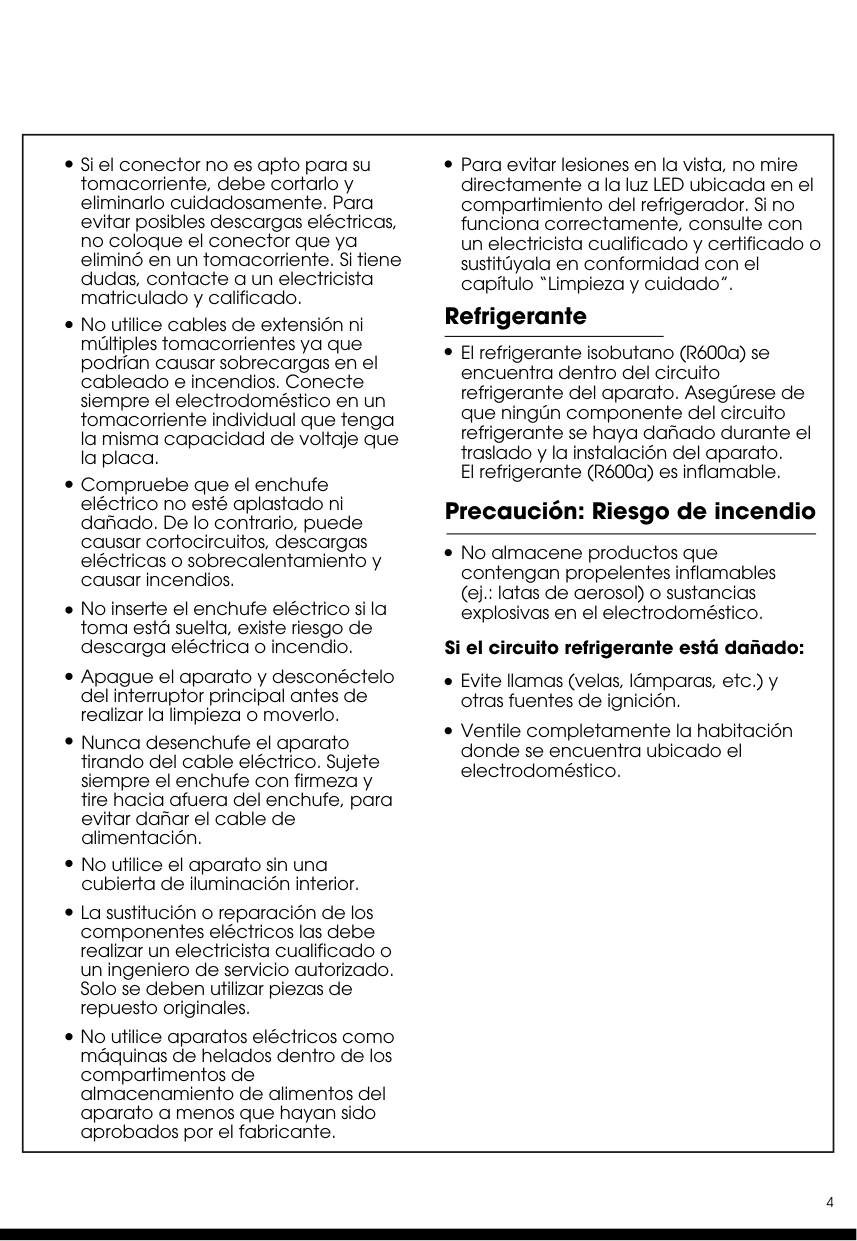
Para realizar una instalación adecuada, se debe colocar la nevera sobre una superficie nivelada de material duro que esté a la misma altura que el resto del suelo. Esta superficie debe ser lo suficientemente fuerte para soportar una nevera completamente cargada. Los rodillos, que no son ruedas, solo se deben usar para moverla hacia delante o hacia atrás. Mover la nevera hacia los lados podría dañar el suelo y los rodillos.
2”
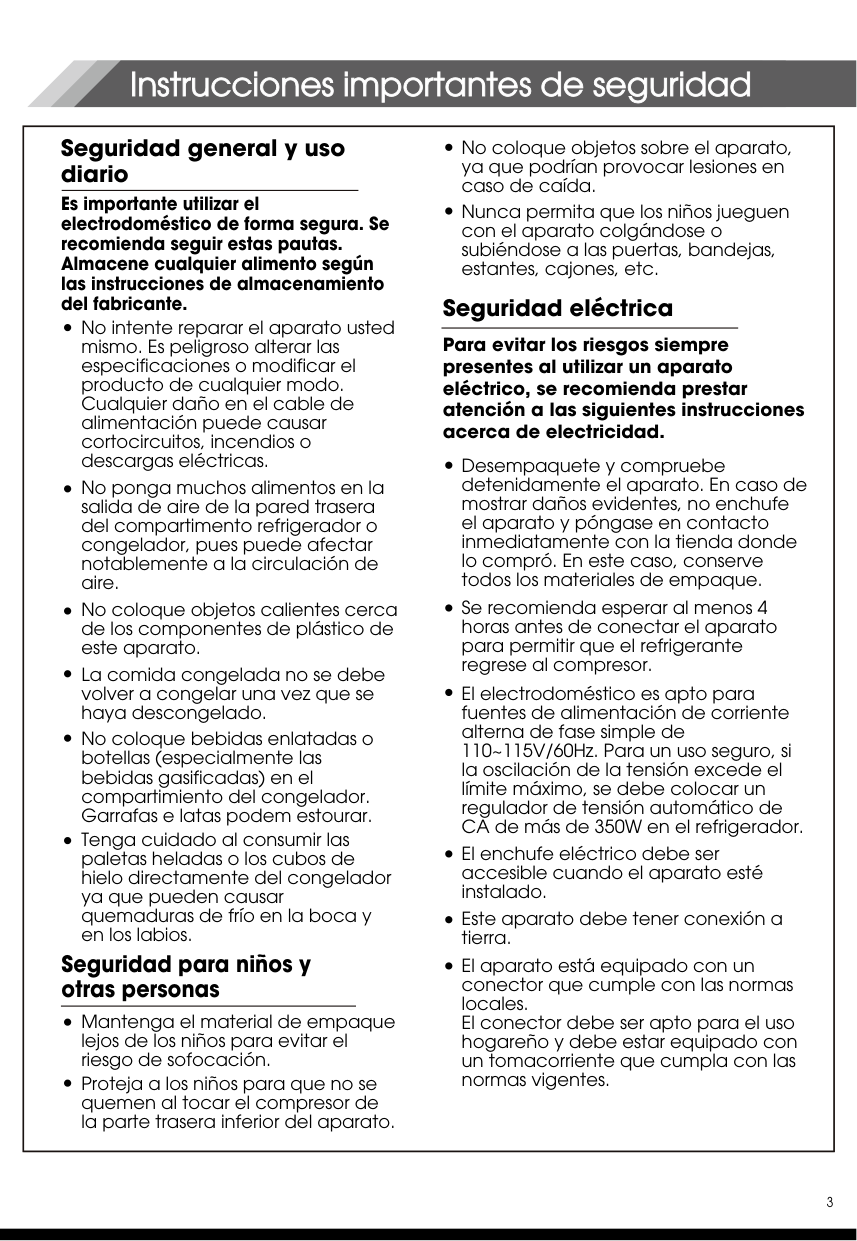
70”

1/2 ”
1/2”
Nota:
Este aparato funciona bien dentro de la clase climática N a T que se muestra en la siguiente tabla. Es posible que no funcione correctamente si se deja a una temperatura superior o inferior al rango indicado durante mucho tiempo.
Clase climática
################### Temperatura ambiente
+50°F a + 90°F +61°F a + 90°F +61°F a + 100°F +61°F a + 109°F
SN N SN T
Ventilación del aparato
Para mejorar la eficiencia del sistema de refrigeración y ahorrar energía, es necesario mantener una buena ventilación alrededor del electrodoméstico para permitir la disipación del calor. Por este motivo, debe haber disponible suficiente espacio libre alrededor del refrigerador.
Coloque el aparato en un lugar seco para evitar daños por la humedad. Mantenga el aparato lejos de la luz solar, la lluvia o las heladas. Coloque el aparato alejado de fuentes de calor, como estufas, fuegos o calentadores.
Sugerencia: Se recomienda dejar al menos 2”(50mm) de espacio entre la parte trasera de la nevera y la pared, al menos 1/2”(12mm) encima, al menos 1/2”(12mm) desde el lado a la pared y un espacio libre delante que permita abrir las puertas en 125°. Como se muestra en los siguientes diagramas.
###### Estabilización del aparato
###### Retirada de las puertas
Si la puerta de acceso a su hogar es demasiado estrecha para que pase el refrigerador, retire las puertas y los cajones del refrigerador. Si no necesita retirar las puertas del aparato, consulte “Instalar las tuberías de agua” en la página 8. Si necesita retirarlas, siga leyendo.
Para um nivelamento suficiente e circulação de ar na parte inferior traseira do aparelho, os pés precisam de ser ajustados. Puede ajustarlas manualmente o usando una llave adecuada.
Para permitir que las puertas se cierren solas, incline la parte superior hacia atrás unos 0,4” 0,6”(10-15mm).
############## Herramientas que necesitará(No incluidas):

||| |---|---|
0.4”~0.6”(10-15mm)
Llave (5/16”,8mm)
Llave Allen (5/32”,4mm)
|| |---|

Destornillador Philips
Con la puerta cerrada, retire los 3 tornillos de la cubierta superior (A) con un destornillador Philips (+) y, a continuación, retire cuidadosamente la cubierta superior con el arnés instalado.

A

Rueda frontal Rueda trasera
Patas inferiores ajustables
Retire los tornillos (B) fijados en las bisagras con una llave (5/16”,8mm) y 1 tornillo de tierra (C) instalados en la bisagra con un destornillador Philips (+). Retire las bisagras de la puerta superior izquierda y derecha (D).

C
B
D
Patas inferiores ajustables

Para quitar el recipiente (I) para almacenar hielo, levántelo siguiendo la dirección de la flecha.
quítela.

I
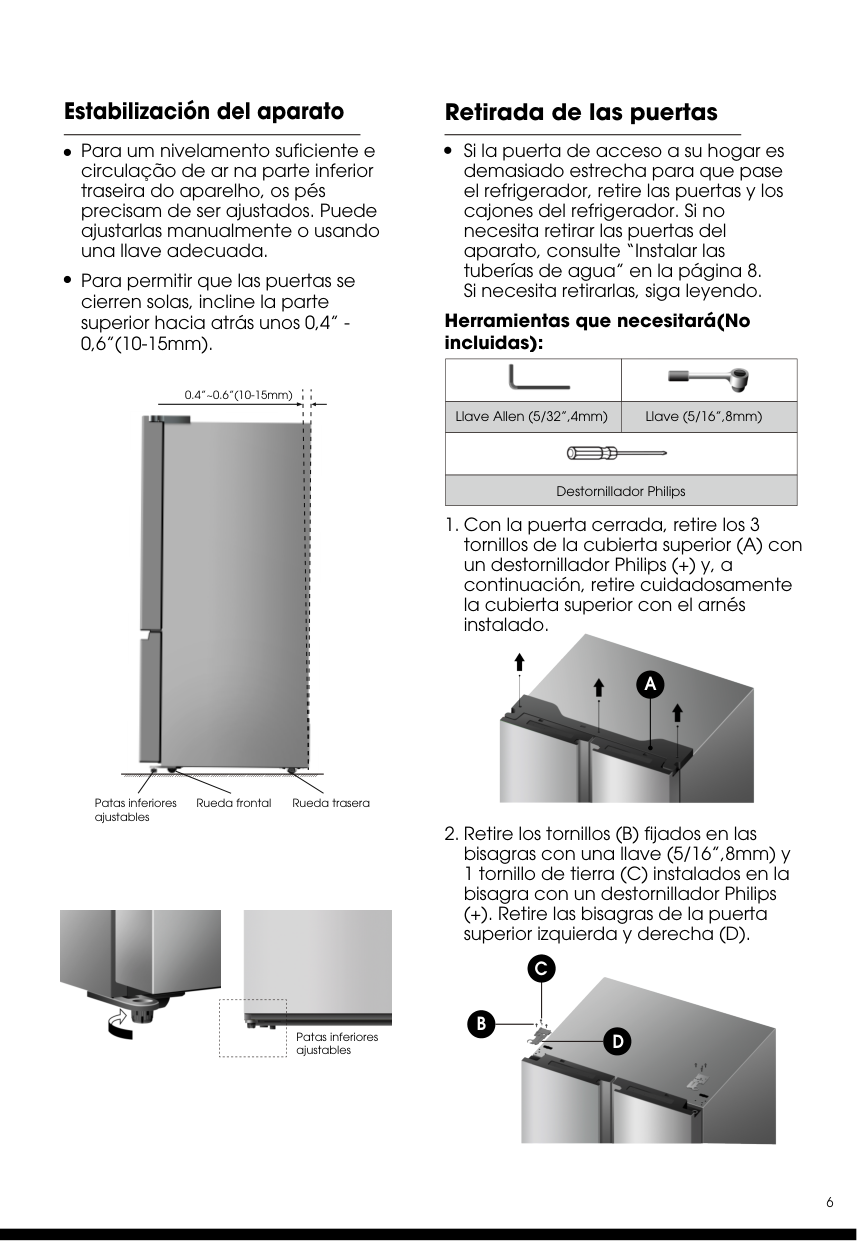
Retire el cajón superior del congelador (J) levantándolo del sistema de rieles.

J

G
Retire el cajón inferior del congelador (K) levantándolo.

F
E
K
Desmontar la puerta del congelador
Retire los 2 tornillos instalados en el marco de soporte (L).
Coloque la puerta del congelador y el cajón superior del congelador (H) en la posición final.

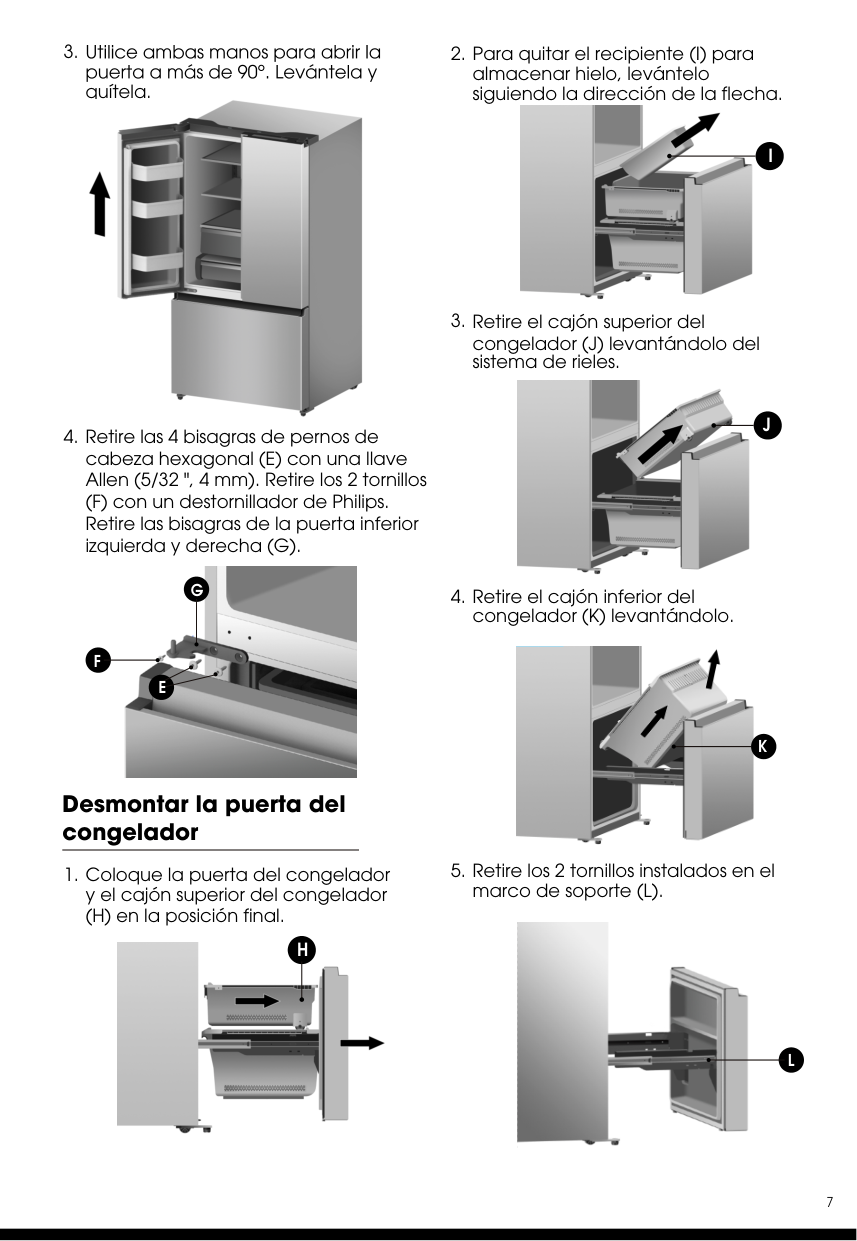

H
L
################ 2. Llave de 1/2” o llave inglesa.


Válvula de cierre de tipo montura uno y 1/4”
1 Virola


1 Acoplador 2 Pinza
############## congelador
4.
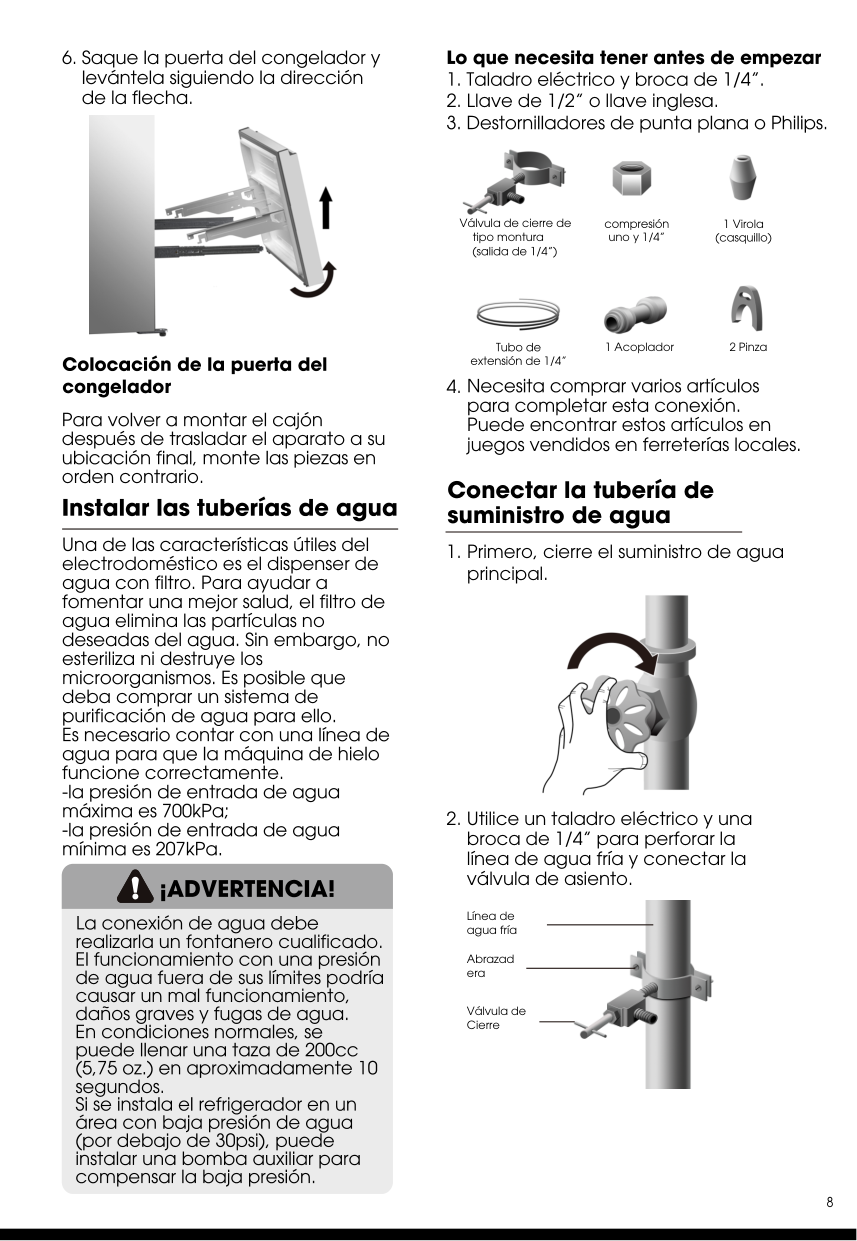
Puede encontrar estos artículos en
después de trasladar el aparato a su orden contrario.
###### Conectar la tubería de suministro de agua

Primero, cierre el suministro de agua principal.
electrodoméstico es el dispenser de agua con filtro. Para ayudar a agua elimina las partículas no esteriliza ni destruye los deba comprar un sistema de

funcione correctamente.
Utilice un taladro eléctrico y una broca de 1/4” para perforar la línea de agua fría y conectar la válvula de asiento.
Línea de agua fría
realizarla un fontanero cualificado. de agua fuera de sus límites podría causar un mal funcionamiento,
Abrazad era
Válvula de Cierre
segundos.

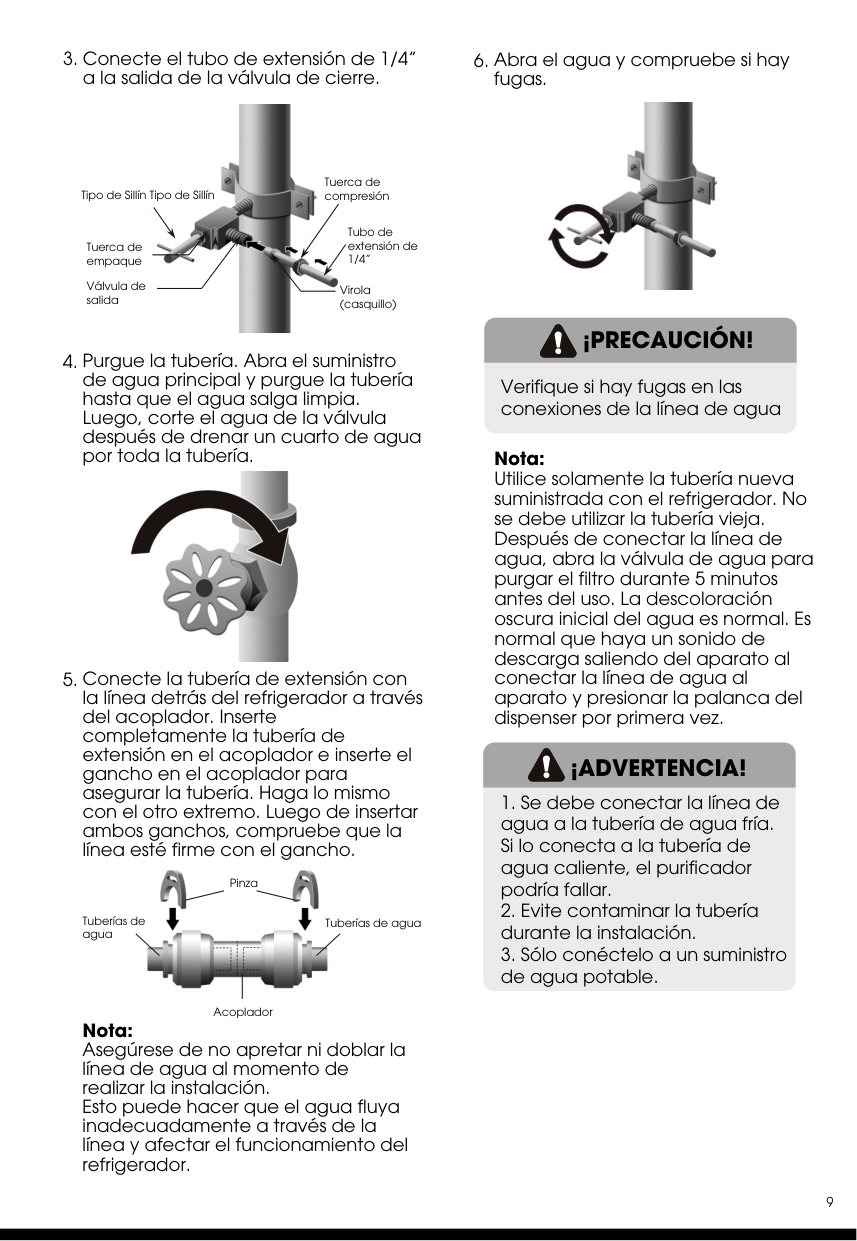

################ 3. Conecte el tubo de extensión de 1/4”a la salida de la válvula de cierre.
Tuerca de compresión
Tipo de Sillín Tipo de Sillín
Tubo de extensión de 1/4”
Tuerca de empaque
Válvula de salida
Virola (casquillo)
¡PRECAUCIÓN!
Purgue la tubería. Abra el suministro de agua principal y purgue la tubería hasta que el agua salga limpia. Luego, corte el agua de la válvula después de drenar un cuarto de agua por toda la tubería.
################ 4.

Verifique si hay fugas en las conexiones de la línea de agua
Nota: Utilice solamente la tubería nueva suministrada con el refrigerador. No se debe utilizar la tubería vieja. Después de conectar la línea de agua, abra la válvula de agua para purgar el filtro durante 5 minutos antes del uso. La descoloración oscura inicial del agua es normal. Es normal que haya un sonido de descarga saliendo del aparato al conectar la línea de agua al aparato y presionar la palanca del dispenser por primera vez.

Conecte la tubería de extensión con la línea detrás del refrigerador a través del acoplador. Inserte completamente la tubería de extensión en el acoplador e inserte el gancho en el acoplador para asegurar la tubería. Haga lo mismo con el otro extremo. Luego de insertar ambos ganchos, compruebe que la línea esté firme con el gancho.
¡ADVERTENCIA!
Pinza
Tuberías de agua
Tuberías de agua
Acoplador
Nota: Asegúrese de no apretar ni doblar la línea de agua al momento de realizar la instalación. Esto puede hacer que el agua fluya inadecuadamente a través de la línea y afectar el funcionamiento del refrigerador.
9
########### Conexión de la tubería de agua al refrigerador
############# Nota:
Utilice solamente la tubería nueva suministrada con el refrigerador. No se debe utilizar la tubería vieja. Después de conectar la línea de agua, abra la válvula de agua para purgar el filtro durante 5 minutos antes del uso. La descoloración oscura inicial del agua es normal. Es normal que haya un sonido de descarga saliendo del aparato al conectar la línea de agua al aparato y presionar la palanca del
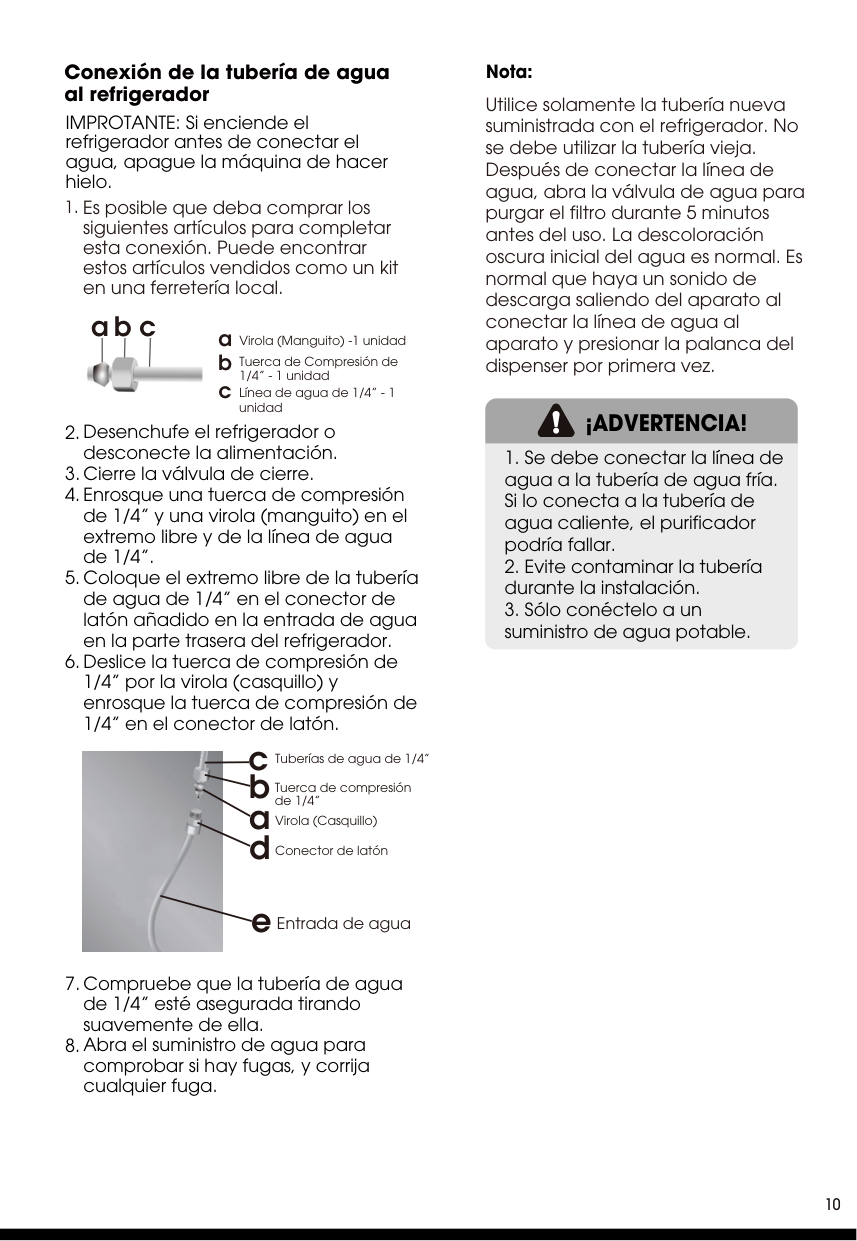
IMPROTANTE: Si enciende el refrigerador antes de conectar el agua, apague la máquina de hacer hielo.
##### a b c
Virola (Manguito) -1 unidada

dispenser por primera vez.Tuerca de Compresión de1/4” - 1 unidad Línea de agua de 1/4” - 1 unidad
###### ¡ADVERTENCIA!
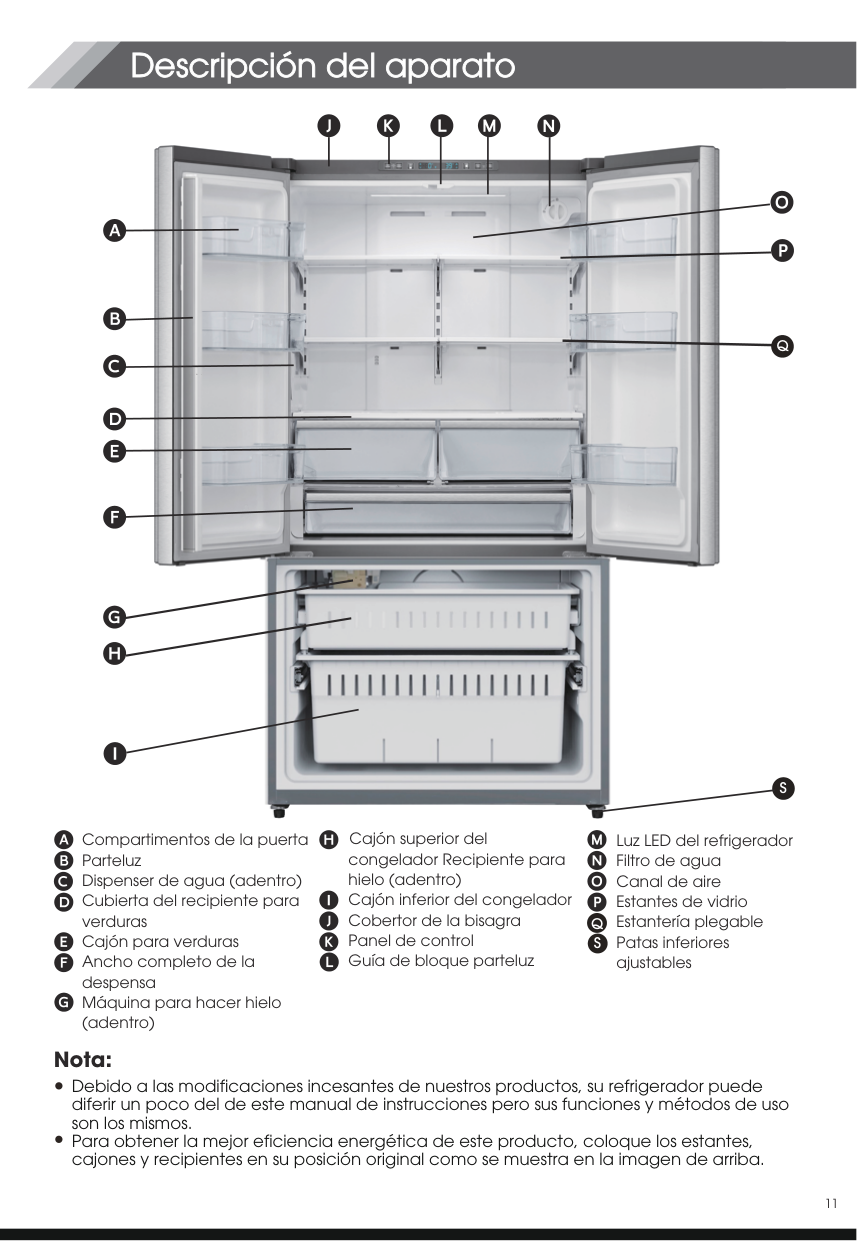
Desenchufe el refrigerador o desconecte la alimentación. Cierre la válvula de cierre. Enrosque una tuerca de compresión de 1/4” y una virola (manguito) en el extremo libre y de la línea de agua de 1/4”. Coloque el extremo libre de la tubería de agua de 1/4” en el conector de latón añadido en la entrada de agua en la parte trasera del refrigerador. Deslice la tuerca de compresión de 1/4” por la virola (casquillo) y enrosque la tuerca de compresión de 1/4” en el conector de latón.
e
d
c Tuberías de agua de 1/4”
Conector de latón

Tuerca de compresión de 1/4”
Virola (Casquillo)
Entrada de agua
10
Descripción del aparato

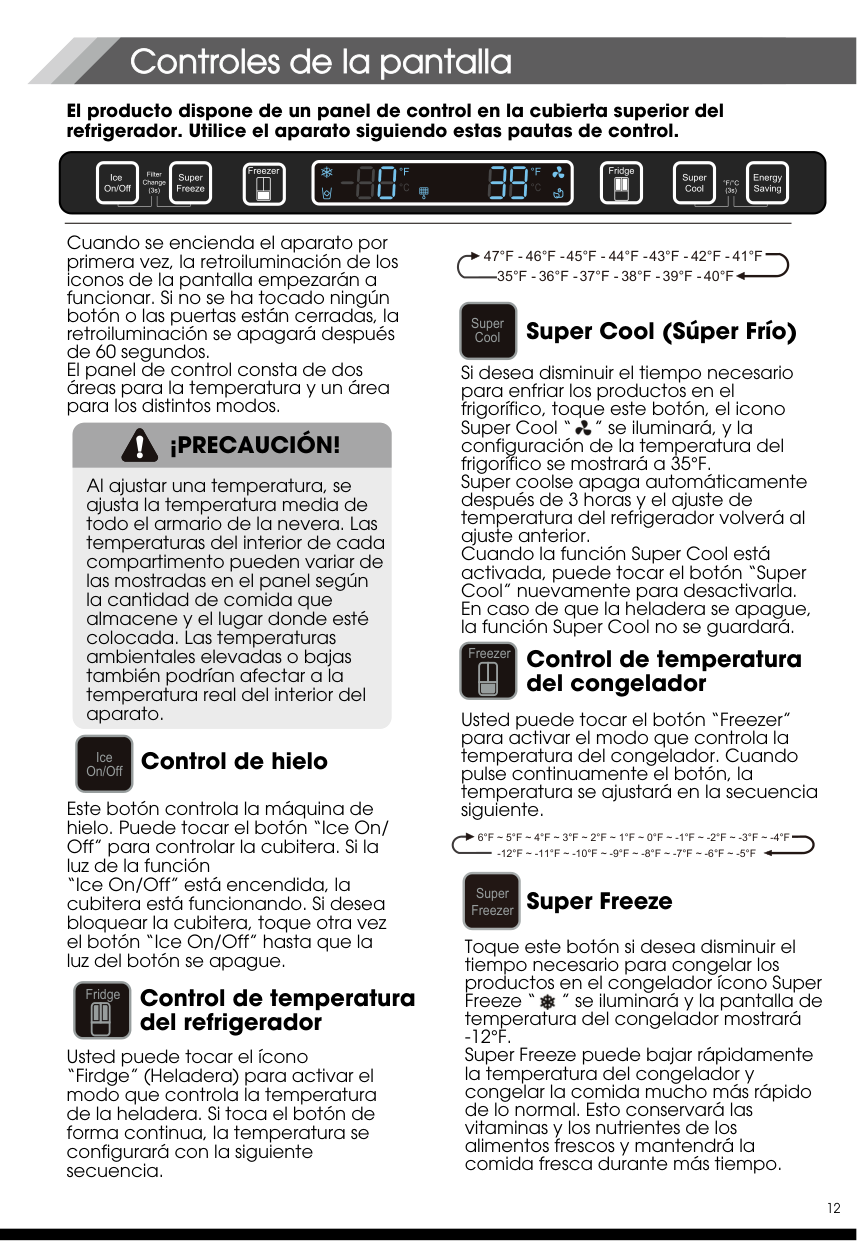
Q
S
Cajón superior del congelador Recipiente para hielo (adentro) Cajón inferior del congelador Cobertor de la bisagra Panel de control Guía de bloque parteluz
Compartimentos de la puerta Parteluz Dispenser de agua (adentro) Cubierta del recipiente para verduras Cajón para verduras Ancho completo de la despensa Máquina para hacer hielo (adentro)
Luz LED del refrigerador Filtro de agua Canal de aire Estantes de vidrio Estantería plegable Patas inferiores ajustables
Q
S
######## Nota:
Debido a las modificaciones incesantes de nuestros productos, su refrigerador puede diferir un poco del de este manual de instrucciones pero sus funciones y métodos de uso son los mismos. Para obtener la mejor eficiencia energética de este producto, coloque los estantes, cajones y recipientes en su posición original como se muestra en la imagen de arriba.
11
Controles de la pantalla
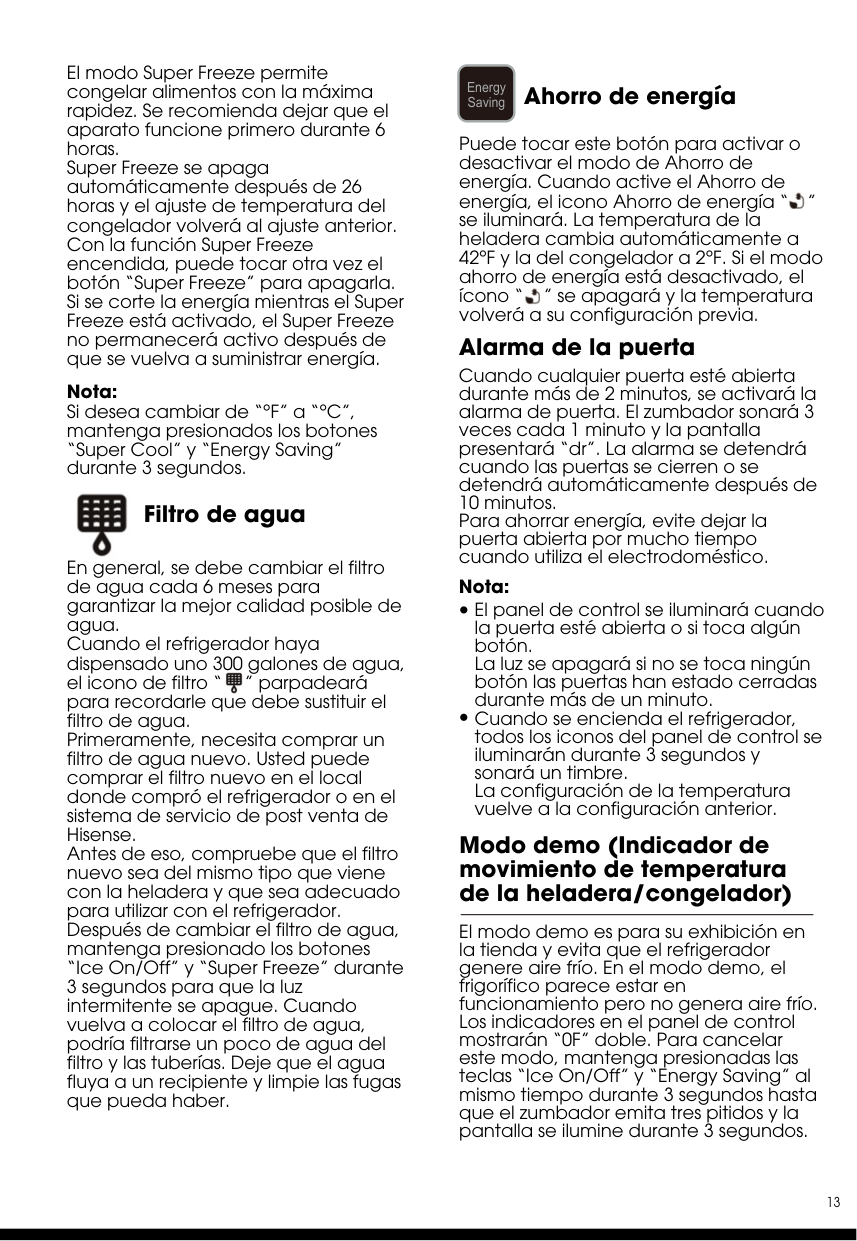
############## El producto dispone de un panel de control en la cubierta superior del refrigerador. Utilice el aparato siguiendo estas pautas de control.
Cuando se encienda el aparato por primera vez, la retroiluminación de los iconos de la pantalla empezarán a funcionar. Si no se ha tocado ningún botón o las puertas están cerradas, la retroiluminación se apagará después de 60 segundos. El panel de control consta de dos áreas para la temperatura y un área para los distintos modos.
47°F - 46°F -45°F - 44°F -43°F - 42°F - 41°F 40°F39°F -38°F -37°F -36°F -35°F -
Super Cool
###### Super Cool (Súper Frío)
Si desea disminuir el tiempo necesario para enfriar los productos en el frigorífico, toque este botón, el icono Super Cool “ ” se iluminará, y la configuración de la temperatura del frigorífico se mostrará a 35°F. Super coolse apaga automáticamente después de 3 horas y el ajuste de temperatura del refrigerador volverá al ajuste anterior. Cuando la función Super Cool está activada, puede tocar el botón “Super Cool” nuevamente para desactivarla. En caso de que la heladera se apague, la función Super Cool no se guardará.

###### ¡PRECAUCIÓN!
Al ajustar una temperatura, se ajusta la temperatura media de todo el armario de la nevera. Las temperaturas del interior de cada compartimento pueden variar de las mostradas en el panel según la cantidad de comida que almacene y el lugar donde esté colocada. Las temperaturas ambientales elevadas o bajas también podrían afectar a la temperatura real del interior del aparato.
###### Control de temperatura del congelador
Freezer
Usted puede tocar el botón “Freezer” para activar el modo que controla la temperatura del congelador. Cuando pulse continuamente el botón, la temperatura se ajustará en la secuencia siguiente.
Control de hielo
Ice On/Off
Este botón controla la máquina de hielo. Puede tocar el botón “Ice On/ Off” para controlar la cubitera. Si la luz de la función “Ice On/Off” está encendida, la cubitera está funcionando. Si desea bloquear la cubitera, toque otra vez el botón “Ice On/Off” hasta que la luz del botón se apague.
6°F ~ 5°F ~ 4°F ~ 3°F ~ 2°F ~ 1°F ~ 0°F ~ -1°F ~ -2°F ~ -3°F ~ -4°F
-12°F ~ -11°F ~ -10°F ~ -9°F ~ -8°F ~ -7°F ~ -6°F ~ -5°F
Super
###### Freezer Super Freeze
Toque este botón si desea disminuir el tiempo necesario para congelar los productos en el congelador ícono Super Freeze “ ” se iluminará y la pantalla de temperatura del congelador mostrará
Control de temperatura del refrigerador
Fridge

-12°F. Super Freeze puede bajar rápidamente la temperatura del congelador y congelar la comida mucho más rápido de lo normal. Esto conservará las vitaminas y los nutrientes de los alimentos frescos y mantendrá la comida fresca durante más tiempo.
Usted puede tocar el ícono “Firdge” (Heladera) para activar el modo que controla la temperatura de la heladera. Si toca el botón de forma continua, la temperatura se configurará con la siguiente secuencia.
El modo Super Freeze permite congelar alimentos con la máxima rapidez. Se recomienda dejar que el aparato funcione primero durante 6 horas. Super Freeze se apaga automáticamente después de 26 horas y el ajuste de temperatura del congelador volverá al ajuste anterior. Con la función Super Freeze encendida, puede tocar otra vez el botón “Super Freeze” para apagarla. Si se corte la energía mientras el Super Freeze está activado, el Super Freeze no permanecerá activo después de que se vuelva a suministrar energía.
Nota: Si desea cambiar de “ºF” a “ºC”, mantenga presionados los botones “Super Cool” y “Energy Saving” durante 3 segundos.

Filtro de agua
En general, se debe cambiar el filtro de agua cada 6 meses para garantizar la mejor calidad posible de agua. Cuando el refrigerador haya dispensado uno 300 galones de agua, el icono de filtro “ ” parpadeará para recordarle que debe sustituir el filtro de agua. Primeramente, necesita comprar un filtro de agua nuevo. Usted puede comprar el filtro nuevo en el local donde compró el refrigerador o en el sistema de servicio de post venta de Hisense. Antes de eso, compruebe que el filtro nuevo sea del mismo tipo que viene con la heladera y que sea adecuado para utilizar con el refrigerador. Después de cambiar el filtro de agua, mantenga presionado los botones “Ice On/Off” y “Super Freeze” durante 3 segundos para que la luz intermitente se apague. Cuando vuelva a colocar el filtro de agua, podría filtrarse un poco de agua del filtro y las tuberías. Deje que el agua fluya a un recipiente y limpie las fugas que pueda haber.

Ahorro de energíaEnergySaving
Puede tocar este botón para activar o desactivar el modo de Ahorro de energía. Cuando active el Ahorro de energía, el icono Ahorro de energía “ ” se iluminará. La temperatura de la heladera cambia automáticamente a 42ºF y la del congelador a 2ºF. Si el modo ahorro de energía está desactivado, el ícono “ ” se apagará y la temperatura volverá a su configuración previa.


###### Alarma de la puerta
Cuando cualquier puerta esté abierta durante más de 2 minutos, se activará la alarma de puerta. El zumbador sonará 3 veces cada 1 minuto y la pantalla presentará “dr”. La alarma se detendrá cuando las puertas se cierren o se detendrá automáticamente después de 10 minutos. Para ahorrar energía, evite dejar la puerta abierta por mucho tiempo cuando utiliza el electrodoméstico.
Nota:
El panel de control se iluminará cuando la puerta esté abierta o si toca algún botón. La luz se apagará si no se toca ningún botón las puertas han estado cerradas durante más de un minuto. Cuando se encienda el refrigerador, todos los iconos del panel de control se iluminarán durante 3 segundos y sonará un timbre. La configuración de la temperatura vuelve a la configuración anterior.
Modo demo (Indicador de movimiento de temperatura de la heladera/congelador)
El modo demo es para su exhibición en la tienda y evita que el refrigerador genere aire frío. En el modo demo, el frigorífico parece estar en funcionamiento pero no genera aire frío. Los indicadores en el panel de control mostrarán “0F” doble. Para cancelar este modo, mantenga presionadas las teclas “Ice On/Off” y “Energy Saving” al mismo tiempo durante 3 segundos hasta que el zumbador emita tres pitidos y la pantalla se ilumine durante 3 segundos.
Usar seu aparelho


Esta sección explica cómo utilizar la mayoría de funciones útiles. Se recomienda leerla detenidamente antes de utilizar el aparato.
K
###### Obtención del agua fría
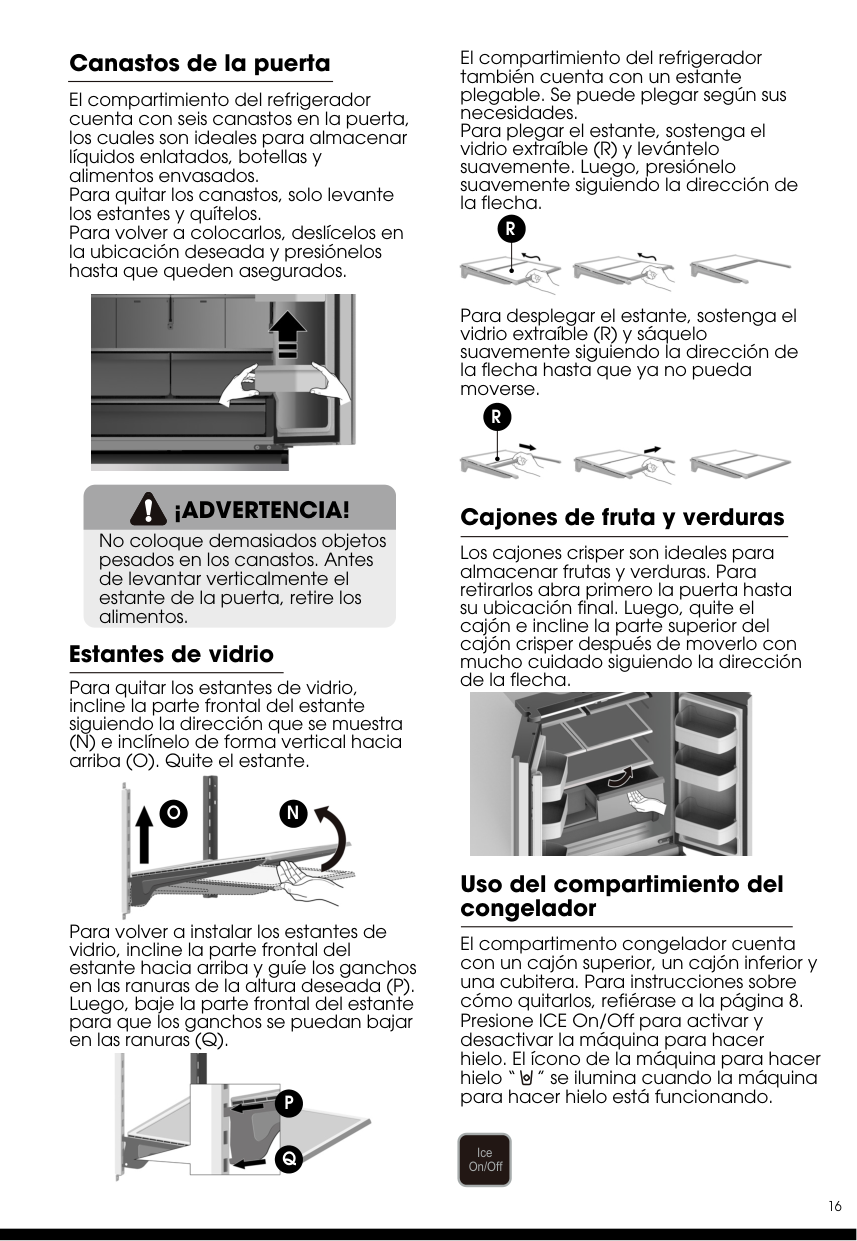
El dispenser de agua está ubicado en el lado izquierdo de la heladera. Abra las puertas del refrigerador y presione el botón del dispenser de agua para obtener agua. Luego, coloque el vaso debajo de la palanca del dispenser en la posición sugerida y presiónela. Sostenga el vaso debajo del dispenser durante 2~3 segundos después de soltar el botón del dispenser ya que el agua puede seguir saliendo después de soltar el botón.

L

###### Nota:
Aprox. 1,6inch
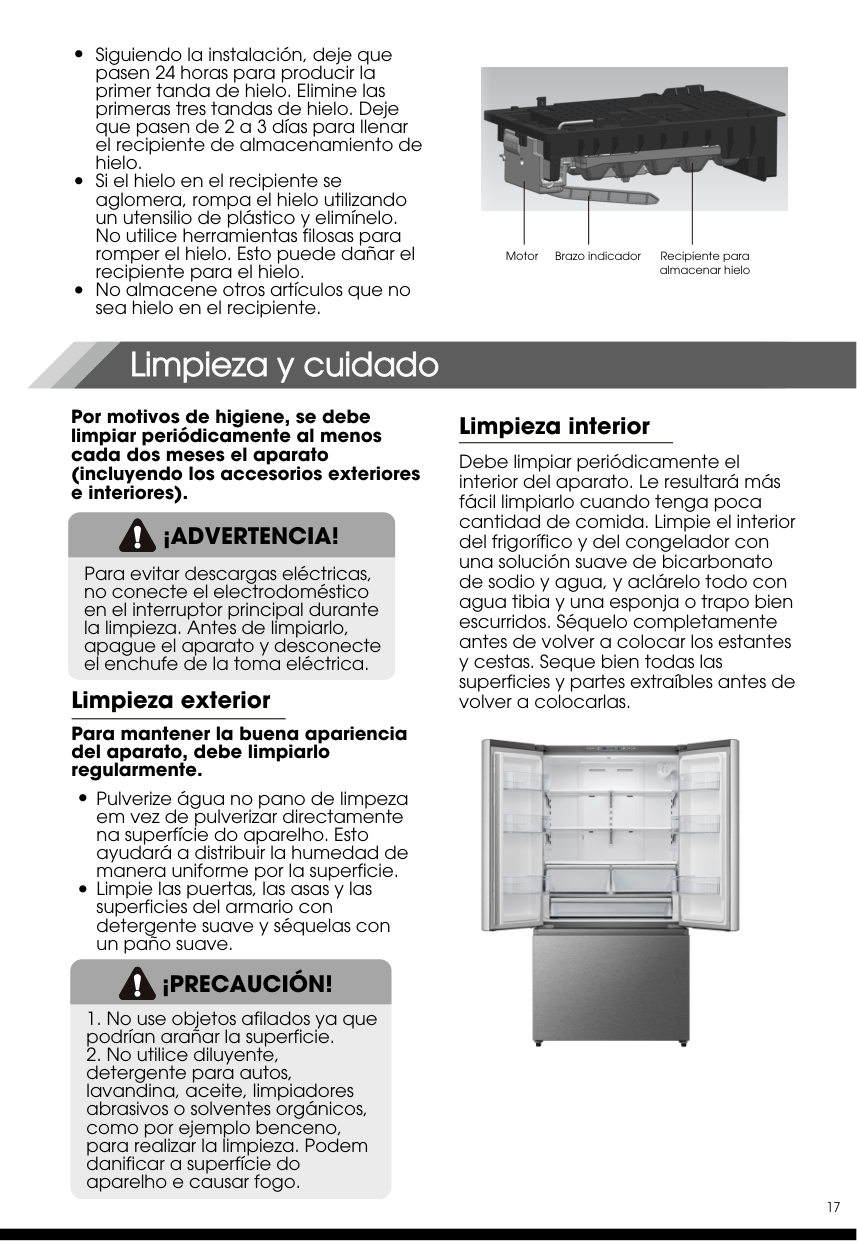
Para cambiar fácilmente el filtro de agua, cierre la válvula del suministro de agua. A veces es difícil desarmar el filtro de agua ya que las impurezas del agua hacen que el filtro de pegue. Si tiene estas dificultades, sujete firmemente el filtro de agua y quítelo. Al quitar el filtro, se puede filtrar un poco de agua desde la abertura. Esto es normal. Para minimizar las fugas de agua, mantenga el cartucho del filtro de forma horizontal al momento de quitarlo. Para evitar el desbordamiento, vacíe la bandeja (M) del filtro de agua y seque el armazón del filtro. Siga las siguientes instrucciones para insertar el nuevo filtro de agua.
###### Cambio del filtro de agua
################# 1
Cambie el filtro a tiempo para beber agua fresca y limpia del refrigerador. Siga estos pasos:


Nota:
Si tiene problemas para liberar el filtro de agua, utilice la herramienta que se incluye en el paquete mencionado anteriormente. Inserte la herramienta en la carcasa del filtro y gírela 90 grados en sentido antihorario (hacia izquierda). Cuando cambie el filtro de agua, guárdelo para uso futuro.
################# M
Coloque el filtro nuevo en el soporte del filtro.
############## Nota:
Si cerró el suministro de agua, vuélvalo a abrir.
Nota:
Después de abrir el suministro de agua, verifique si hay fugas. Si hay fugas, repita los pasos 1-5. Si las fugas persisten, suspenda el uso y llame al centro de atención al cliente de Hisense.

Asegúrese de purgar todo el dispenser; de lo contrario, el agua puede gotear desde el dispenser. Esto significa que todavía hay aire en la línea. No dispense los 2,5 galones de manera continua. Deje de presionar y libere la almohadilla del dispensador en ciclos de 30 segundos encendido y 60 segundos apagado.

K
Suministro de agua por ósmosis inversa:
Presione el filtro y gírelo hacia la derecha hasta que quede asegurado.
La presión del suministro de agua que sale por el sistema de ósmosis inversa hacia la entrada de la válvula del refrigerador necesita ser de entre 30 y 100psi (207 y 700kPa). El sistema de agua por ósmosis inversa está conectado al suministro de agua fría, el sistema de ósmosis inversa necesita estar a un mínimo de 40 a 60 psi (276 a 414kPa). Si la presión del agua hacia el sistema de ósmosis inversa es inferior a 40 a 60 psi (276 a 414kPa):

Si tiene problemas para insertar el filtro de agua debido a la presión alta del agua, cierre la válvula del suministro de agua.
Compruebe si el filtro de sedimentos en el sistema de ósmosis inversa está bloqueado. Reemplace el filtro si es necesario. Permita que el tanque de almacenamiento en el sistema de ósmosis inversa vuelva a llenarse después del uso intensivo. Si el refrigerador cuenta con un filtro de agua, podría reducir aún más la presión de agua cuando se utiliza en conjunto con un sistema de ósmosis inversa. Para solucionarlo, quite el filtro de agua.
2 Uso del compartimiento del
Quite cualquier contenido residual dentro de la línea de agua después de instalar el filtro de agua
refrigerador
El compartimento de refrigerador es apto para almacenar carnes, verduras y fruta. Debe sellar los alimentos para evitar la pérdida de humedad o para que los sabores se impregnen en otros alimentos.
###### ¡PRECAUCIÓN!
Nunca cierre la puerta de la nevera con las estanterías, el cajón para verduras y/o guías telescópicas extendidas. Podrían dañarse, así como a la nevera.
El compartimiento del refrigerador también cuenta con un estante plegable. Se puede plegar según sus necesidades. Para plegar el estante, sostenga el vidrio extraíble (R) y levántelo suavemente. Luego, presiónelo suavemente siguiendo la dirección de la flecha.
Canastos de la puerta
El compartimiento del refrigerador cuenta con seis canastos en la puerta, los cuales son ideales para almacenar líquidos enlatados, botellas y alimentos envasados. Para quitar los canastos, solo levante los estantes y quítelos. Para volver a colocarlos, deslícelos en la ubicación deseada y presiónelos hasta que queden asegurados.

R



Para desplegar el estante, sostenga el vidrio extraíble (R) y sáquelo suavemente siguiendo la dirección de la flecha hasta que ya no pueda moverse.
R


¡ADVERTENCIA!
Cajones de fruta y verduras
No coloque demasiados objetos pesados en los canastos. Antes de levantar verticalmente el estante de la puerta, retire los alimentos.
Los cajones crisper son ideales para almacenar frutas y verduras. Para retirarlos abra primero la puerta hasta su ubicación final. Luego, quite el cajón e incline la parte superior del cajón crisper después de moverlo con mucho cuidado siguiendo la dirección de la flecha.

###### Estantes de vidrio
Para quitar los estantes de vidrio, incline la parte frontal del estante siguiendo la dirección que se muestra (N) e inclínelo de forma vertical hacia arriba (O). Quite el estante.

################# O N
###### Uso del compartimiento del congelador
Para volver a instalar los estantes de vidrio, incline la parte frontal del estante hacia arriba y guíe los ganchos en las ranuras de la altura deseada (P). Luego, baje la parte frontal del estante para que los ganchos se puedan bajar en las ranuras (Q).
El compartimento congelador cuenta con un cajón superior, un cajón inferior y una cubitera. Para instrucciones sobre cómo quitarlos, refiérase a la página 8. Presione ICE On/Off para activar y desactivar la máquina para hacer hielo. El ícono de la máquina para hacer hielo “ ” se ilumina cuando la máquina para hacer hielo está funcionando.

Ice On/Off
Siguiendo la instalación, deje que pasen 24 horas para producir la primer tanda de hielo. Elimine las primeras tres tandas de hielo. Deje que pasen de 2 a 3 días para llenar el recipiente de almacenamiento de hielo. Si el hielo en el recipiente se aglomera, rompa el hielo utilizando un utensilio de plástico y elimínelo. No utilice herramientas filosas para romper el hielo. Esto puede dañar el recipiente para el hielo. No almacene otros artículos que no sea hielo en el recipiente.

Motor
Brazo indicador Recipiente para almacenar hielo
Limpieza y cuidado
Por motivos de higiene, se debe limpiar periódicamente al menos cada dos meses el aparato (incluyendo los accesorios exteriores e interiores).
###### ¡ADVERTENCIA!
Para evitar descargas eléctricas, no conecte el electrodoméstico en el interruptor principal durante la limpieza. Antes de limpiarlo, apague el aparato y desconecte el enchufe de la toma eléctrica.
Limpieza exterior
Para mantener la buena apariencia del aparato, debe limpiarlo regularmente.
Pulverize água no pano de limpeza em vez de pulverizar directamente na superfície do aparelho. Esto ayudará a distribuir la humedad de manera uniforme por la superficie. Limpie las puertas, las asas y las superficies del armario con detergente suave y séquelas con un paño suave.
###### ¡PRECAUCIÓN!
###### Limpieza interior
Debe limpiar periódicamente el interior del aparato. Le resultará más fácil limpiarlo cuando tenga poca cantidad de comida. Limpie el interior del frigorífico y del congelador con una solución suave de bicarbonato de sodio y agua, y aclárelo todo con agua tibia y una esponja o trapo bien escurridos. Séquelo completamente antes de volver a colocar los estantes y cestas. Seque bien todas las superficies y partes extraíbles antes de volver a colocarlas.

Aunque esta unidad se descongela automáticamente, puede producirse una capa de escarcha en las paredes interiores del congelador si la puerta del congelador se abre con frecuencia o se mantiene abierta durante demasiado tiempo. Si la escarcha es demasiado gruesa, elija un momento en el que las existencias de alimentos sean bajas y siga estos pasos:
Retire los alimentos y las cestas de accesorios, desenchufe el aparato de la corriente y deje las puertas abiertas. Ventile detenidamente la sala para acelerar el proceso de descongelación.
Cuando termine de descongelarlo,limpie el congelador como se describe anteriormente.
###### ¡ADVERTENCIA!
No utilice objetos afilados para retirar la escarcha del compartimento congelador. Solo cuando el interior esté completamente seco, se puede volver a encender el aparato y volver a enchufarlo en la toma eléctrica.
Limpieza del sello de las puertas
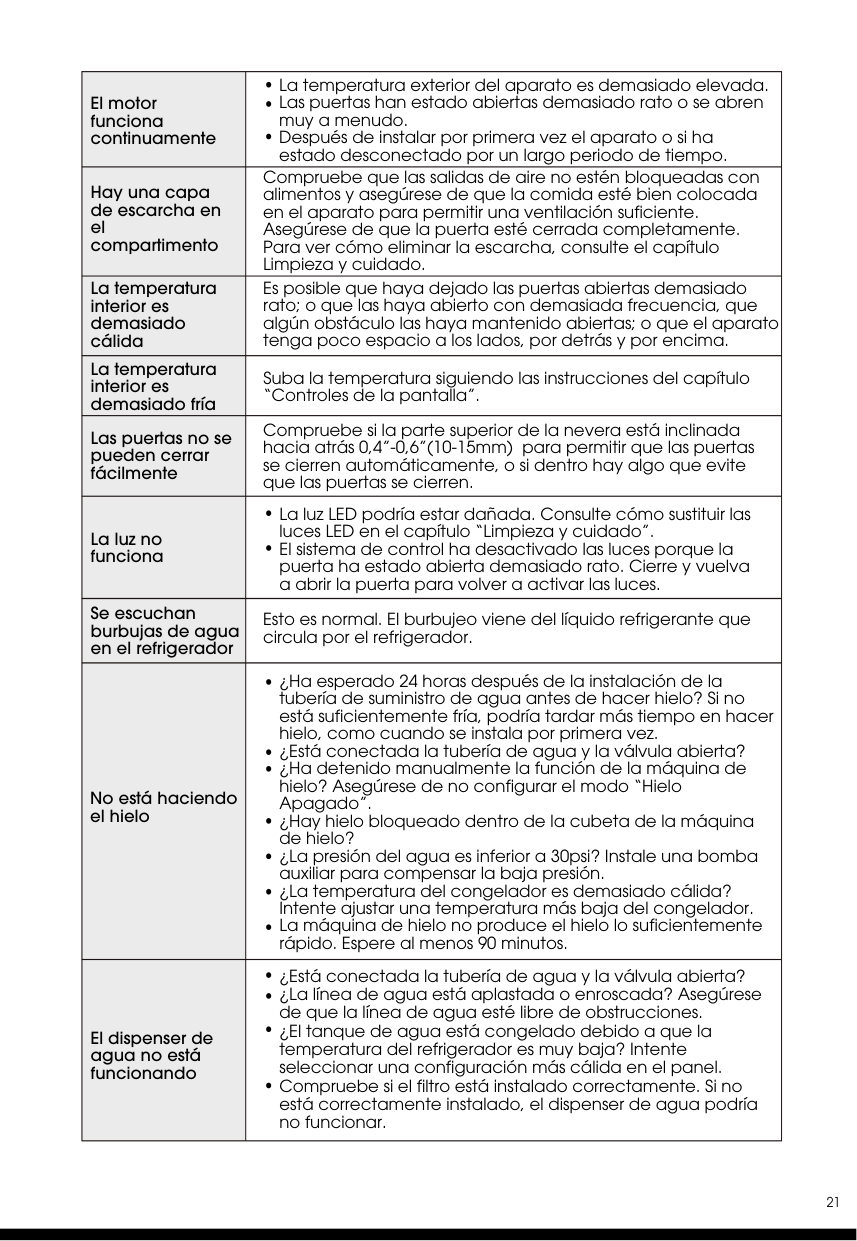
Procure mantener limpio el sello de las puertas. Los alimentos y bebidas pegajosos pueden hacer que los sellos se enganchen en el armario y se rompan al abrir la puerta. Limpie el sello con un detergente suave y agua caliente, Aclárelo y séquelo completamente después de limpiarlo.

###### ¡PRECAUCIÓN!
Sólo debe encender el electrodoméstico después de que los sellos de la puerta estén completamente secos.
Sustituir la luz LED
¡ADVERTENCIA!
Una persona capacitada debe reemplazar la luz LED. Si la luz LED se daña, siga los siguientes pasos:
Sugerencias y consejos útiles
|Consejos de ahorro de energía
Se recomienda seguir estos consejos para ahorrar energía.
Sugerencias para refrigerar alimentos frescos
Procure evitar mantener la puerta abierta durante mucho rato para ahorrar energía. Asegúrese de que el aparato estéalejado de fuentes de calor (luz del sol directa, hornos o fogones eléctricos, etc.) No configure la temperatura más frio de lo necesario. No almacene alimentos calientes o líquidos que se evaporan en la unidad. Coloque el aparato en una sala bien ventilada y libre de humedad. Consulte el capítulo Instalar el nuevo aparato. Si el diagrama muestra la combinación correcta de cajones, cajones para verduras y estantes, no la modifique, ya que ha sido diseñada para ofrecer la configuración energética más eficiente.
No coloque alimentos calientes directamente en la nevera o el congelador. La temperatura interna aumentaría provocando que el compresor deba trabajar con más potencia y consumirá más energía. Cubra o envuelva los alimentos, sobre todo si tienen un sabor fuerte. Coloque los alimentos cuidadosamente para que el aire pueda circular libremente en torno a ellos.
Botellas de leche: Deben tener una tapa y se pueden almacenar en los estantes de la puerta.
Cuando lo encienda por primera vez o lo utilice después de un periodo largo, deje que el aparato funcione al menos 2 horas con los ajustes más altos antes de colocar alimentos en el compartimento. Prepare los alimentos en porciones pequeñas para que se congelen del todo rápidamente y para que sea posible después descongelar solo la cantidad necesaria. Envuelva los alimentos en papel aluminio o film hermético. No permita que los alimentos no congelados toquen los que ya están congelados para evitar el aumento de temperatura de los últimos. Produtos gelados (cubos de gelo, picolés): se consumidos imediatamente após a retirada do congelador, provavelmente causarão queimaduras na pele. Se recomienda etiquetar y fechar cada paquete congelado para mantener un registro de su tiempo de almacenamiento.
Sugerencias de congelación
Para carnes: (todos los tipos) envueltas y colocadas en el estante de vidrio sobre el cajón de verduras. Siga sempre os tempos de armazenamento dos alimentos e consuma antes das datas sugeridas pelos manufactores. Alimentos cocinados, platos fríos, etc.: Se deben cubrir y se pueden colocar en cualquier estantería. Frutas y verduras: Se deben guardar en el cajón especial provisto. Mantequilla y queso: Se deben envolver con plástico hermético o película plástica.
Sugerencias de refrigeración
Recomendaciones para guardar los alimentos congelados
Asegúrese de que el vendedor de los alimentos haya almacenado los alimentos congelados de forma correcta. Una vez descongelados, los alimentos se deteriorarán rápidamente y no deben volverse a congelar. No supere el periodo de almacenamiento indicado por el fabricante de los alimentos.
Desligar o seu aparelho
Si tiene que desenchufar el electrodoméstico durante un largo periodo de tiempo, debe seguir los siguientes pasos para evitar que le salga moho.
Retire todos los alimentos. Retire el enchufe eléctrico de la corriente. Limpe e seque completamente o interior. Asegúrese de que todas las puertas queden abiertas ligeramente para permitir que circule el aire.
1.
2. 4.
3.
| |---|
Resolución de problemas
Si experimenta problemas con el aparato o le preocupa que no funcione correctamente, puede realizar algunas comprobaciones sencillas antes de llamar al servicio de mantenimiento, consulte a continuación.
ADVERTENCIA
###### PELIGRO
Riesgo de atrapamiento para niños. Antes de desechar su refrigerador o congelador usados:
|Problema|Causa Posible y Solución|
|---|---| |El aparato no funciona correctamente|Compruebe si el cable eléctrico está enchufado correctamente en la toma eléctrica.| |El aparato no funciona correctamente|Compruebe el fusible o el circuito del suminsitro eléctrico y sustitúyalos si fuera necesario.| |El aparato no funciona correctamente|La temperatura de la habitación puede ser muy baja. Intente ajustar la temperatura del refrigerador o del congelador a un nivel más frío para resolver este problema.| |El aparato no funciona correctamente|Es normal que el congelador no funcione durante el ciclo de descongelación automática, o durante un breve tiempo después de encender el aparato para proteger el compresor.| |Salen olores de los compartimentos|Es posible que sea necesario limpiar el interior.| |Salen olores de los compartimentos|Algunos alimentos, recipientes o envoltorios pueden causar olores.| |Se oye ruido del aparato|Los sonidos descritos a continuación son normales: Ruido de funcionamiento del compresor. Ruido de movimiento de aire del motor del ventilador pequeño en el compartimento del congelador o los otros compartimentos. Sonido de borboteo parecido al del agua en ebullición. Sonido de golpeteo durante la descongelación automática. Chasquidos antes de que arranque el compresor. Se escucha un chasquido al sacar agua. Ruído de funcionamento do motor quando você recebe o gelo.
| |Se oye ruido del aparato|Otros ruidos inusuales pueden ser debidos a los motivos descritos a continuación y es posible que deba comprobarlos y tomar medidas: El armario no está nivelado. La parte trasera del aparato toca la pared. Las botellas o recipientes se caen o ruedan.| |El motor funciona continuamente|Es normal escuchar con frecuencia el sonido del motor, deberá funcionar con más potencia en las circunstancias siguientes:
El ajuste de temperatura es más frío de lo necesario. Se ha almacenado recientemente una gran cantidad de comida caliente dentro del aparato.
|
|El motor funciona continuamente|La temperatura exterior del aparato es demasiado elevada. Las puertas han estado abiertas demasiado rato o se abren muy a menudo. Después de instalar por primera vez el aparato o si ha estado desconectado por un largo periodo de tiempo.| |---|---| |Hay una capa de escarcha en el compartimento|Compruebe que las salidas de aire no estén bloqueadas con alimentos y asegúrese de que la comida esté bien colocada en el aparato para permitir una ventilación suficiente. Asegúrese de que la puerta esté cerrada completamente. Para ver cómo eliminar la escarcha, consulte el capítulo Limpieza y cuidado.| |La temperatura interior es demasiado cálida|Es posible que haya dejado las puertas abiertas demasiado rato; o que las haya abierto con demasiada frecuencia, que algún obstáculo las haya mantenido abiertas; o que el aparato tenga poco espacio a los lados, por detrás y por encima.| |La temperatura interior es demasiado fría|Suba la temperatura siguiendo las instrucciones del capítulo “Controles de la pantalla”.| |Las puertas no se pueden cerrar fácilmente|Compruebe si la parte superior de la nevera está inclinada hacia atrás 0,4”-0,6”(10-15mm) para permitir que las puertas se cierren automáticamente, o si dentro hay algo que evite que las puertas se cierren.| |La luz no funciona|La luz LED podría estar dañada. Consulte cómo sustituir las luces LED en el capítulo “Limpieza y cuidado”. El sistema de control ha desactivado las luces porque la puerta ha estado abierta demasiado rato. Cierre y vuelva a abrir la puerta para volver a activar las luces.| |Se escuchan burbujas de agua en el refrigerador|Esto es normal. El burbujeo viene del líquido refrigerante que circula por el refrigerador.| |No está haciendo el hielo|¿Ha esperado 24 horas después de la instalación de la tubería de suministro de agua antes de hacer hielo? Si no está suficientemente fría, podría tardar más tiempo en hacer hielo, como cuando se instala por primera vez. ¿Está conectada la tubería de agua y la válvula abierta? ¿Ha detenido manualmente la función de la máquina de hielo? Asegúrese de no configurar el modo “Hielo Apagado”. ¿Hay hielo bloqueado dentro de la cubeta de la máquina de hielo? ¿La presión del agua es inferior a 30psi? Instale una bomba auxiliar para compensar la baja presión. ¿La temperatura del congelador es demasiado cálida? Intente ajustar una temperatura más baja del congelador. La máquina de hielo no produce el hielo lo suficientemente rápido. Espere al menos 90 minutos.
| |El dispenser de agua no está funcionando|¿Está conectada la tubería de agua y la válvula abierta? ¿La línea de agua está aplastada o enroscada? Asegúrese de que la línea de agua esté libre de obstrucciones. ¿El tanque de agua está congelado debido a que la temperatura del refrigerador es muy baja? Intente seleccionar una configuración más cálida en el panel. Compruebe si el filtro está instalado correctamente. Si no está correctamente instalado, el dispenser de agua podría no funcionar.|
Eliminación del aparato
PELIGRO
Está prohibido eliminar este aparato con los residuos domésticos.
Materiales de embalaje
Los materiales de embalaje con el símbolo de reciclaje son reciclables. Arroje el embalaje al contenedor de recogida de residuos adecuado para reciclarlo.
Antes de eliminación del aparato

ADVERTENCIA
Los refrigeradores contienen refrigerante y gases en el aislamiento. Se debe desechar el refrigerante y los gases de forma profesional, ya que podrían provocar lesiones oculares o ignición. Asegúrese de que los tubos del circuito refrigerante no estén dañados antes de desechar correctamente el aparato.
| |Eliminación correcta del producto| |---|---| ||Este símbolo en el producto o en su embalaje indica que no se debe tratar como residuos domésticos. En su lugar, se debe llevar al punto de recogida de residuos adecuados para reciclar el equipo eléctrico y electrónico. Al asegurarse de que este producto se elimina correctamente, ayudará a prevenir las consecuencias negativas potenciales para el entorno y la salud humana, que de lo contrario podrían ser causadas por la manipulación inadecuada de los residuos de este producto. Para más información sobre el reciclaje de este producto, contacte al municipio, al servicio de recolección de desperdicios o a la tienda donde compró el producto.|
############## Declaración sobre los derechos de autor
© 2022 Hisense Company Ltd. All Rights Reserved.Todos los derechos reservados.
Todo el material en esta Manual de usuario es propiedad de Hisense Company Ltd. y sus subsidiarias. El mismo está protegido bajo las leyes de derecho de autor y/o de propiedad intelectual Internacional y de EE. UU., CANADÁ, MÉXICO. La reproducción o transmisión del material, de forma parcial o completa, de cualquier manera, ya sea electrónica o impresa, sin previo aviso escrito de Hisense Company Ltd. es una violación a los derechos de Hisense Company Ltd. bajo las leyes mencionadas anteriormente.
No se puede guardar, reproducir, transmitir ni distribuir ninguna parte de esta publicación, ya sea de forma parcial o completa, de manera electrónica o impresa, ya sea o no para un cambio u otro propósito, sin previo aviso escrito de Hisense Company Ltd.
El permiso para guardar, reproducir, transmitir o distribuir este material se puede hacer a una de las siguientes direcciones:
USA:
CANADA:
MEXICO:
Hisense USA Corporation 105 Satellite Blvd NW, Suwanee, GA 30024
Hisense Canada Co., Ltd 2283 Argentia Road, Unit 16 Mississauga, ON, Canada LSN 5Z2
Hisense Mexico S. de R.L. de C.V. Blvd. Miguel de Cervantes Saavedra No 301 Torre Norte Piso 2, Col. Ampliación Granada Miguel Hidalgo, Ciudad de México, C.P. 11520
Hisense y todos los nombres, logos, lemas o marcas de los productos Hisense son marca registrada de Hisense Company Ltd. y sus filiales. Todas las demás marcas comerciales son propiedad de sus respectivos titulares.
© 2022. Todos los derechos reservados. Hisense y el logotipo de Hisense son marcas registradas de Hisense. Otras marcas y nombres de productos son marcas registradas de sus respectivos propietarios.
Descargo de responsabilidad: Las imágenes en este documento son solo a modo ilustrativo y pueden diferir del producto real.