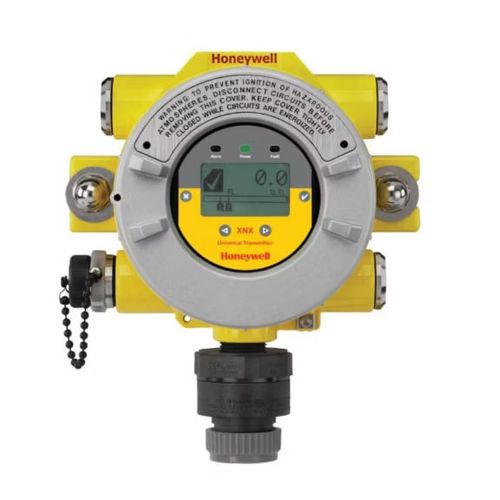
The XNX Universal Transmitter is Honeywell's industrial gas-detection transmitter platform, designed to interface with three sensor families: electrochemical (EC), millivolt (mV), and infrared (IR). It's installed in environments where flammable, toxic, or oxygen-deficient atmospheres are possible — refineries, chemical plants, water treatment, confined spaces. If you're reading this, you're likely commissioning, calibrating, or replacing one in a hazardous-area installation, and the safety-critical procedures below matter more than the convenience features.
Read this before you do anything
Do not open the XNX enclosure under power unless the area is known to be non-hazardous. This is not a conventional warning — it's the central safety constraint of the device. The XNX is rated for installation in hazardous (classified) areas, and the enclosure's flameproof / explosion-proof rating depends on it being closed when energized. Opening it under power in a hazardous atmosphere can ignite that atmosphere.
Procedure to follow before opening: confirm the area is non-hazardous via gas detection equipment, then proceed. If the area cannot be confirmed non-hazardous, de-energize the XNX (and any nearby equipment that requires the same precaution) before opening.
Source: page 6 of the manual
Do not adjust the IR personality switches S3 or S4 with power applied. This will permanently damage the XNX. The switches must be set to their final position before power is applied to the unit, and they must not be touched once energized. This is the second hardware bricking risk to be aware of on the IR sensor variant — the others are mostly recoverable.
Source: page 30 of the manual
Power supply requirements
The XNX has different voltage requirements based on the sensor type connected:
- EC and mV transmitters: 16-32 VDC input
- IR transmitters: 18-32 VDC input
- External relay module (if present): 18-32 VDC
Voltage outside these ranges either won't power the unit or will damage it. Industrial 24 VDC is the standard supply that meets all three requirements, with appropriate margin.
Cable runs from the power source to the XNX should account for voltage drop. The further the run, the higher the source voltage needs to be to keep the XNX terminals within spec. If the field readings are intermittent or noisy, voltage drop is the first thing to verify with a multimeter at the XNX terminals under load.
Source: page 18 of the manual
Sensor installation
Electrochemical (EC) sensors
EC sensors are user-replaceable as cartridges:
- Verify the new sensor's gas-type label matches the application. EC sensors are gas-specific (CO, H2S, O2, etc.) and installing the wrong type means the transmitter reads the wrong gas with no warning.
- Unscrew the weatherproof cover.
- Loosen the sensor retainer locking screw.
- Remove the old sensor cartridge.
- Plug in the new cartridge.
- Replace the retainer and tighten the locking screw.
- Replace the weatherproof cover.
Calibrate after installation. EC sensors drift during shipping and storage, and the calibration procedure is what brings the transmitter's reading back to a known reference.
Source: page 22 of the manual
Remote sensor mounting (mV sensors)
Maximum remote-mounting distance from the transmitter depends on wire gauge. The manual lists tables for each Honeywell sensor family; for example, an 18 AWG cable run with a Honeywell MPD CB1, 705 Series, or Sensepoint Series sensor has a specific maximum that should be cross-referenced before specifying cable.
Exceeding the listed distance causes voltage drop that degrades sensor signal integrity. The reading appears to work but trends slow and missed alarms become possible.
Source: page 27 of the manual
EC remote mounting kit cable
The cable on the EC remote mounting kit cannot be extended. Once the original cable is cut, the intrinsically safe certification is invalidated. If the original length is insufficient, Honeywell sells longer pre-certified cable assemblies — buy the right length. Do not splice.
Source: page 24 of the manual
Things to verify on every installation
- Gas type label on the EC sensor matches the application. Confirm this twice — once before cutting the box open, once before installing.
- Power voltage at the XNX terminals under load. Spec is 16-32 VDC (EC/mV) or 18-32 VDC (IR). Margin matters.
- IR personality switches (S3, S4) are set to their final position before applying power. Permanent damage if adjusted hot.
- Enclosure is fully closed and torqued before re-energizing in a hazardous area.
- Calibration is complete before the alarm logic is activated. A new sensor with no calibration is a false-confidence sensor.
Service in hazardous areas
The XNX is designed for installation in zones classified as hazardous under IEC, ATEX, and (in North America) NEC Class I Division 1 / 2 standards. Service procedures in those zones must follow the site's hot-work and gas-detection protocols. The XNX manual is explicit: never open the enclosure under power without first confirming the area is non-hazardous.
A typical site's hazardous-area service workflow includes: 1. Notification of the site's gas-detection / safety officer before starting work. 2. A gas-meter sweep around the XNX area immediately before opening. 3. A hot-work permit (or equivalent site procedure) if the work involves any spark-generating activity. 4. Opening the enclosure, performing the service, closing and torquing the enclosure. 5. Re-energizing and verifying operation through the calibration / bump-test procedure.
Specific procedures vary by site and operator; the manual and your facility's operating procedures take precedence over any general guidance. If your site doesn't have these protocols formalized, the XNX is not the place to start improvising.
Specifications worth remembering
- Input voltage: 16-32 VDC (EC/mV), 18-32 VDC (IR)
- Sensor types: Electrochemical, millivolt, infrared
- Output options: 4-20 mA, Modbus, HART (depending on configuration)
- Hazardous area certifications: ATEX, IECEx, NEC Class I Division 1/2 (verify the specific spec sheet for your unit)
- Operating temperature: per the data sheet for your specific configuration
Honeywell support and the manual
The full XNX manual is detailed and worth keeping accessible at the installation site, not just digitally. The score-5 FAQs cited above only summarize key procedures — the manual covers calibration, fault codes, and configuration in significantly more depth.
Honeywell Process Solutions support: https://process.honeywell.com/us/en/support
Related Honeywell gas-detection products
(No internal links yet — AskManual's Honeywell catalog is currently limited to this transmitter. As more sensors and transmitters are added, this section will reference the Searchpoint Optima, Sensepoint XCD, and Manning Aircheck product pages.)