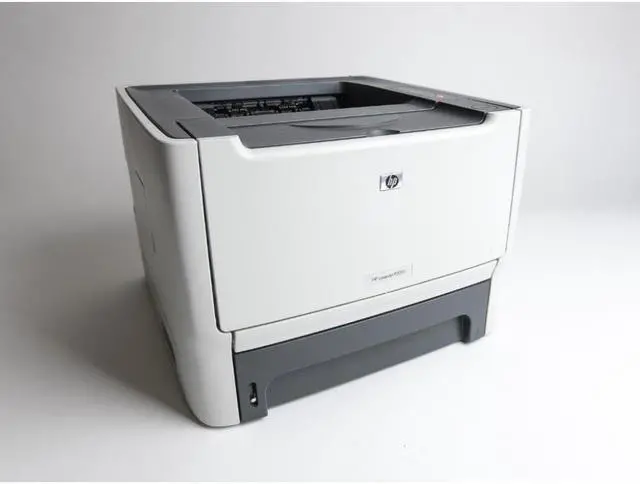
Ask AI
— answers from the official manualAnswers from the official manual.
Common questions
Common Questions
27 totalWhat do I do if my printer is jammed?
Press the Cancel button to cancel any current print job. Follow jam-clearing instructions within user guide or online documentation as appropriate for your model and location of jam.
How can I connect an HP LaserJet P2015 printer to my network?
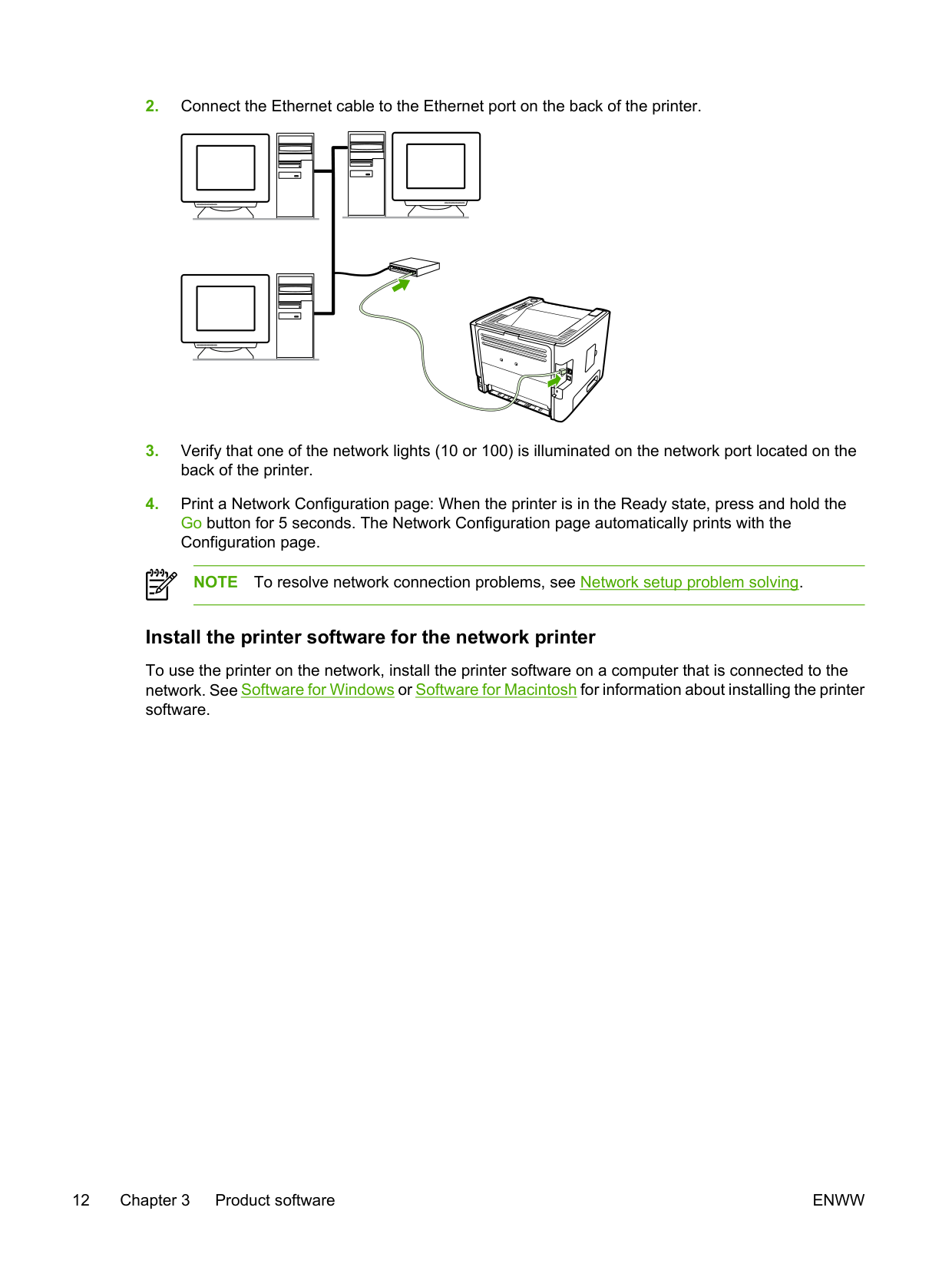
Connect the CAT-5 Ethernet cable from printer's Network port to a hub or router. Verify that one of the 10/100 lights illuminate on the printer indicating proper connection.
How do I load custom-sized paper into tray 1?
Open straight-through output door, set media guides to width of paper, place with top forward and face-up in tray 1. Adjust settings through printer Properties menu.
What are the recommended media specifications for my HP LaserJet P2015?
Use paper between 75gsm to 104gsm or within specified size guidelines (minimum 76mm x 127mm, maximum 216mm x 356mm). Only use high-quality media designed for laser printers.
Where can I view printer alerts and configuration information via software?
Install HP ToolboxFX to check printer status, configure settings, and receive alerts for issues such as low toner or empty trays. See Network settings tab in embedded Web server for configuration details.
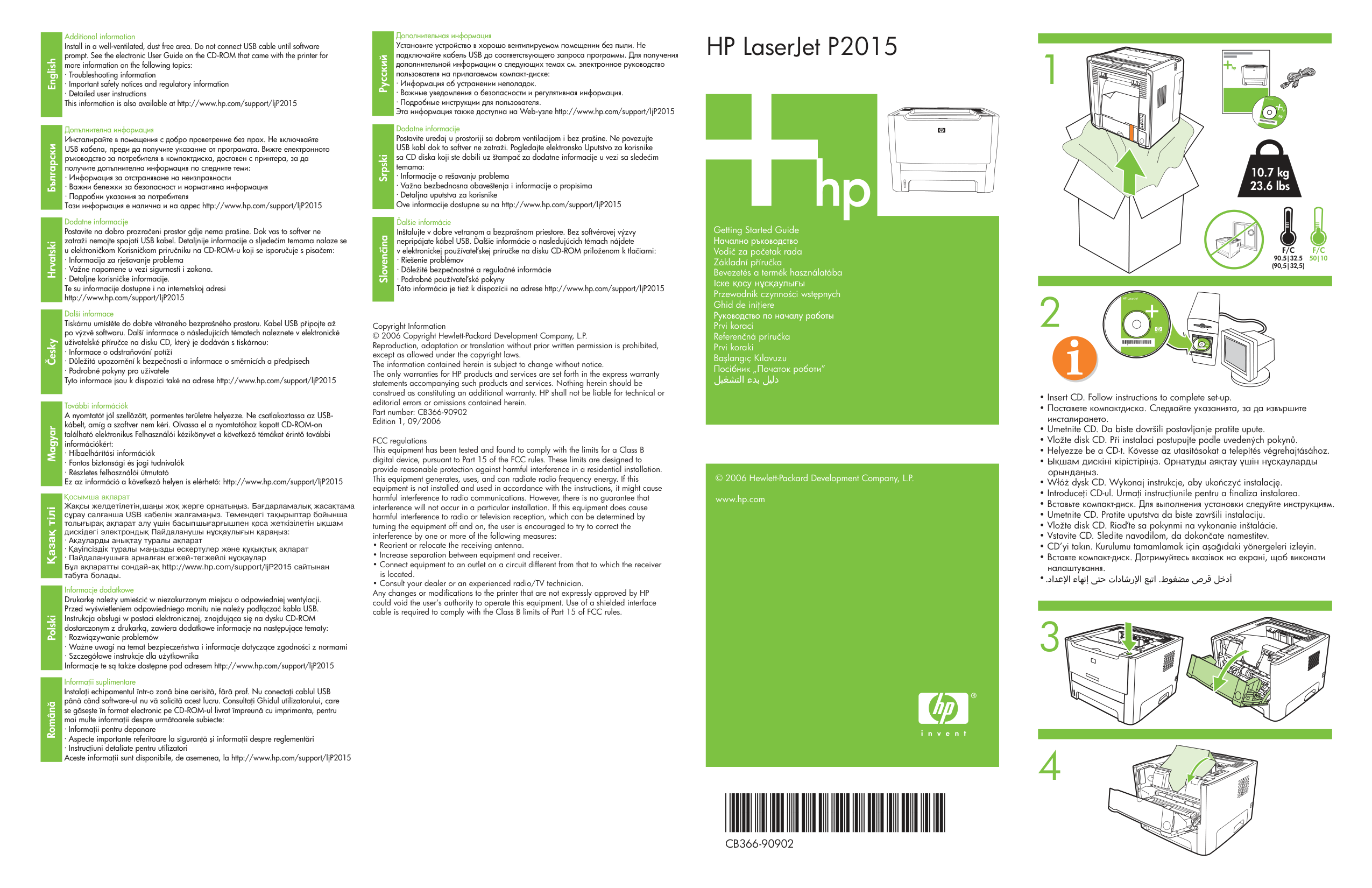
How do I complete the initial setup of the HP LaserJet P2015?
Insert the CD that came with the printer and follow the on-screen instructions to complete the setup. Do not connect the USB cable until the software prompts you to do so during the installation process.
Show 21 more questions
Where can I find safety and regulatory information for the HP LaserJet P2015?
What are the operating temperature requirements for the HP LaserJet P2015?
Does the HP LaserJet P2015 comply with FCC regulations?
What should I do if the HP LaserJet P2015 causes interference with radio or television reception?
Can I modify the HP LaserJet P2015 printer hardware?
How do I install the printer software on my Windows XP computer?
How do I manually feed different types of paper?
What is EconoMode and how can I activate it?
How do I print a demo page on my HP LaserJet P2015?
How do I locate the safety warnings and regulatory information for the HP LaserJet P2015?
Where should I install the HP LaserJet P2015 for best performance?
How do I access instructions and troubleshooting information after setup?
How do I troubleshoot radio interference issues?
When should I connect the USB cable during setup?
Where can I find troubleshooting information for the HP LaserJet P2015?
Where should I install the HP LaserJet P2015 printer?
What does the HP LaserJet P2015 weigh?
What steps are necessary before connecting USB cables?
Is there assistance available for detailed maintenance procedures?
What are the dimensions and weight of the printer?
How can I access detailed user instruction manuals?
Full Manual
158 pages
HP LaserJet P2015 Series
User Guide
HP LaserJet P2015 Series
User Guide
Copyright information © 2006 Copyright Hewlett-Packard Development Company, L.P. Reproduction, adaptation or translation without prior written permission is prohibited, except as allowed under the copyright laws. Part number: CB366-90951 Edition 1, 09/2006 The information contained herein is subject to change without notice. The only warranties for HP products and services are set forth in the express warranty statements accompanying such products and services. Nothing herein should be construed as constituting an additional warranty. HP shall not be liable for technical or editorial errors or omissions contained herein. Trademark credits Microsoft® and Windows® are U.S. registered trademarks of Microsoft Corporation. PostScript® is a registered trademark of Adobe Systems Incorporated. Energy Star® and the Energy Star mark® are US registered marks of the United States Environmental Protection Agency.
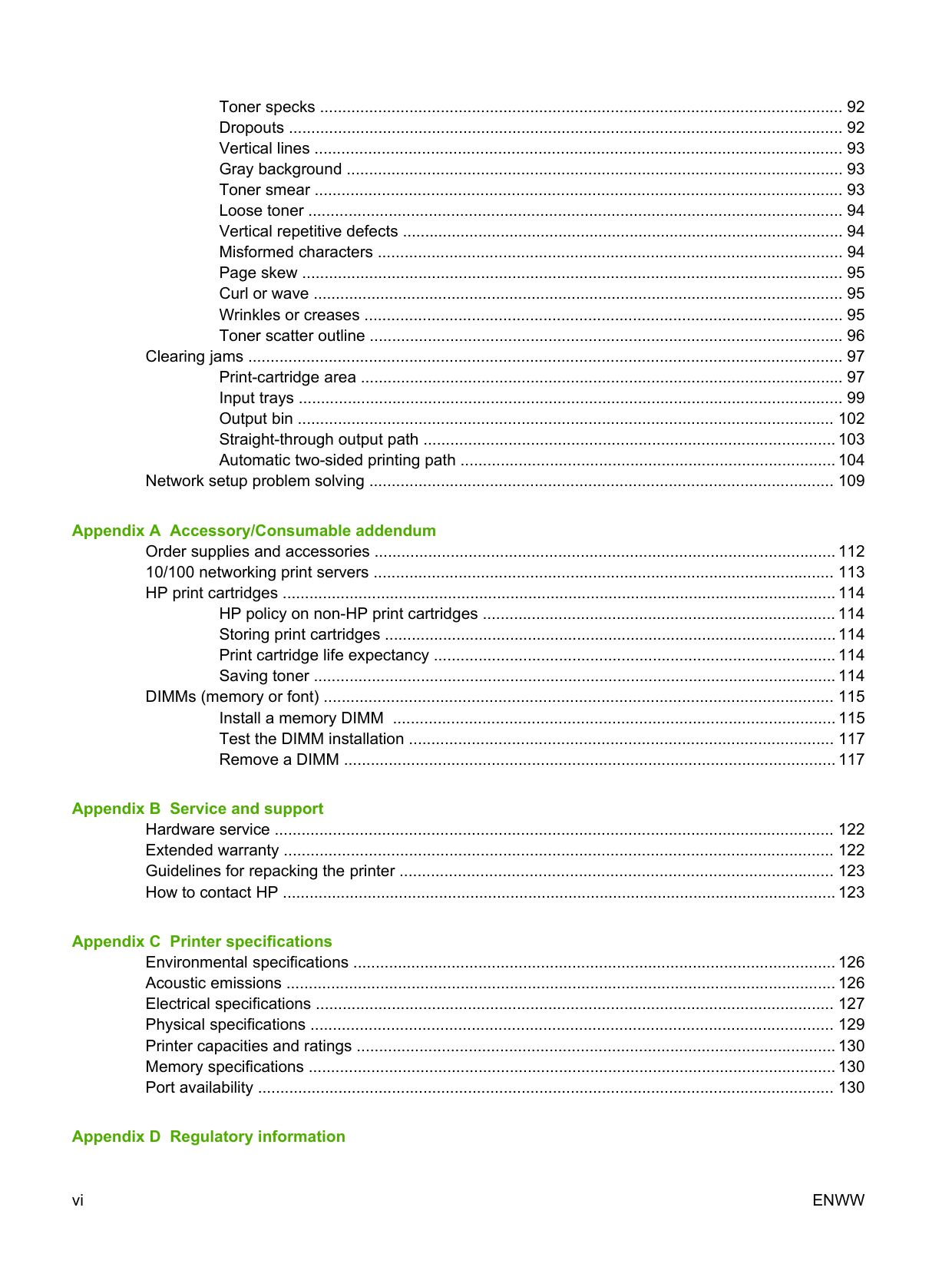
Table of contents
HP LaserJet P2015 printer .................................................................................................. 2 HP LaserJet P2015d printer ................................................................................................ 2 HP LaserJet P2015n printer ................................................................................................ 3 HP LaserJet P2015dn printer .............................................................................................. 3 HP LaserJet P2015x printer ................................................................................................. 3
Identify product parts ............................................................................................................................ 4
USB connections ............................................................................................................... 11 Network connections ......................................................................................................... 11
Connect the printer to the network .................................................................... 11 Install the printer software for the network printer ............................................. 12
Software for Windows ........................................................................................................................ 13
Windows printer drivers ..................................................................................................... 13 Windows driver types ........................................................................................ 13 Install the Windows printer software ................................................................. 13
To install printer software for Windows XP (64-bit) and Windows Server 2003 ...................................................................................... 13 To install printer software for Windows 98 (driver only), Me (driver only), 2000, and XP (32–bit) ............................................................. 13
Configure the Windows printer driver ................................................................ 13 HP ToolboxFX ................................................................................................................... 14 Embedded Web server ...................................................................................................... 14
Software for Macintosh ....................................................................................................................... 15
Macintosh printer drivers ................................................................................................... 15 Install the Macintosh printer driver .................................................................... 15 Configure the Macintosh printer driver .............................................................. 15
PostScript Printer Description files (PPDs) ........................................................................ 16
HP media ........................................................................................................................... 19

ENWW iii
Media to avoid ................................................................................................................... 19 Media that can damage the printer .................................................................................... 19 Paper ................................................................................................................................. 20 Labels ................................................................................................................................ 20
Label construction ............................................................................................. 20 Transparencies .................................................................................................................. 20 Envelopes .......................................................................................................................... 20
Envelope construction ....................................................................................... 20 Envelopes with double-side seams ................................................................... 21 Envelopes with adhesive strips or flaps ............................................................ 21 Envelope storage .............................................................................................. 21
Card stock and heavy media ............................................................................................. 21 Card stock construction ..................................................................................... 22 Card stock guidelines ........................................................................................ 22
Letterhead and preprinted forms ....................................................................................... 22
Print-quality settings ........................................................................................................................... 26 Print on special media ........................................................................................................................ 27
Print on an envelope .......................................................................................................... 27 Print on transparencies or labels ....................................................................................... 28 Print on letterhead and preprinted forms ........................................................................... 29 Print on custom-size media and card stock ....................................................................... 30
Print on both sides of the page (duplex) ............................................................................................. 32
Manual two-sided printing .................................................................................................. 32 Manual two-sided printing using the top output bin ........................................... 32 Manual two-sided printing using the straight-through output door .................... 35
Automatic two-sided printing .............................................................................................. 38 Print multiple pages on a single sheet of paper (N-up printing) ......................................................... 40 Print booklets ...................................................................................................................................... 41 Print watermarks ................................................................................................................................ 42 Cancel a print job ............................................................................................................................... 43
Demo page ........................................................................................................................ 46 Configuration page ............................................................................................................ 46 Supplies Status page ......................................................................................................... 46 Network Configuration page .............................................................................................. 46
HP ToolboxFX .................................................................................................................................... 47 To view HP ToolboxFX ...................................................................................................... 47 Status ................................................................................................................................. 48 Alerts .................................................................................................................................. 49
Set up status alerts ........................................................................................... 49 Set up e-mail alerts ........................................................................................... 49
Help ................................................................................................................................... 49 Device settings .................................................................................................................. 50
Device information ............................................................................................ 50 Paper handling .................................................................................................. 51 Print quality ....................................................................................................... 51 Paper types ....................................................................................................... 51 System setup .................................................................................................... 52 Service .............................................................................................................. 52
Print settings ...................................................................................................................... 52 Printing .............................................................................................................. 52
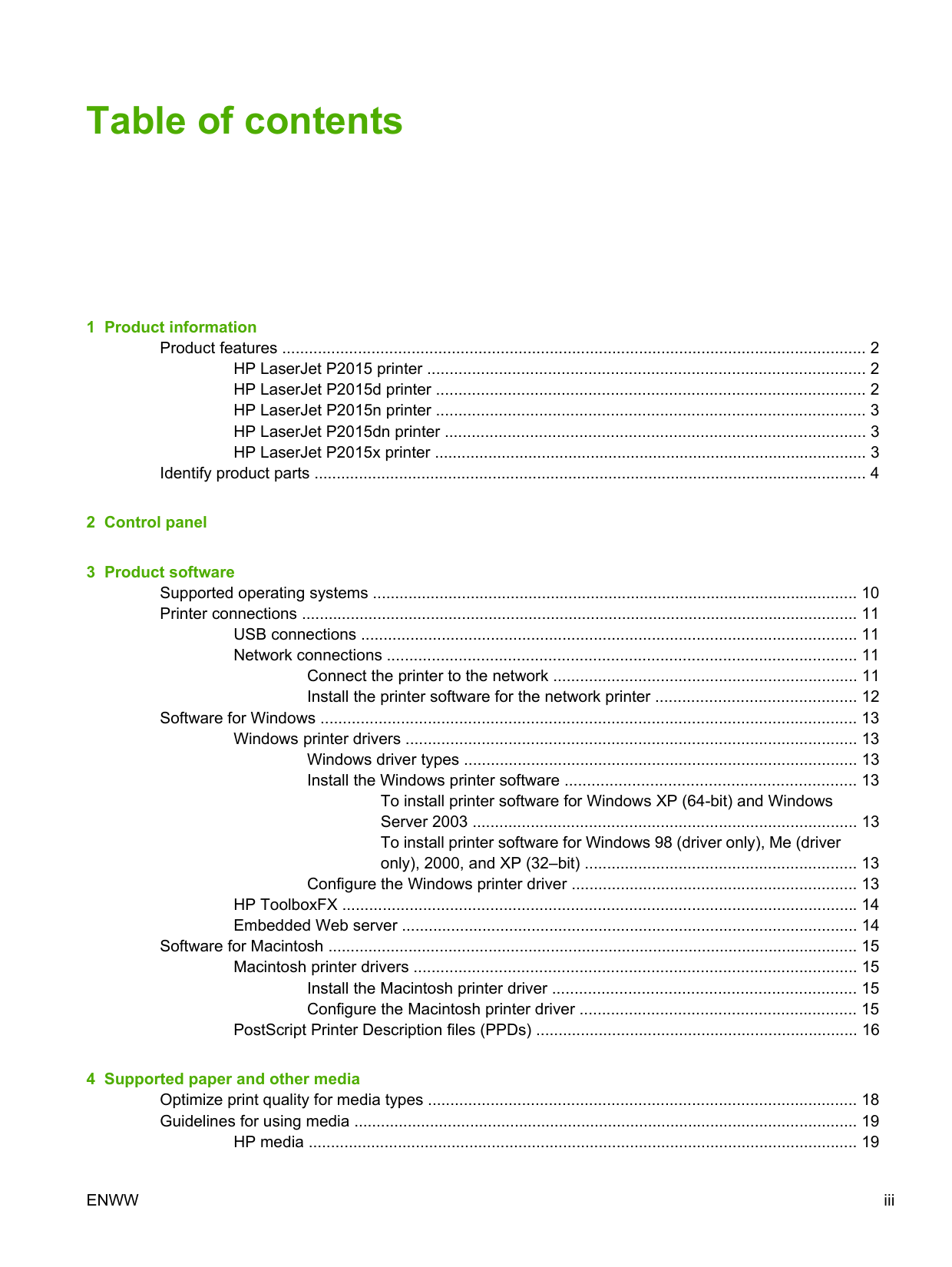
Network settings ................................................................................................................ 53
Embedded Web server ....................................................................................................................... 54 Open the embedded Web server ....................................................................................... 54 Status tab ........................................................................................................................... 55 Settings tab ........................................................................................................................ 55 Networking tab ................................................................................................................... 55 Links .................................................................................................................................. 56
Replace the print cartridge ................................................................................................................. 57 Redistribute toner ............................................................................................................................... 59 Clean the printer ................................................................................................................................. 60
Clean the print-cartridge area ............................................................................................ 60 Clean the printer media path ............................................................................................. 61
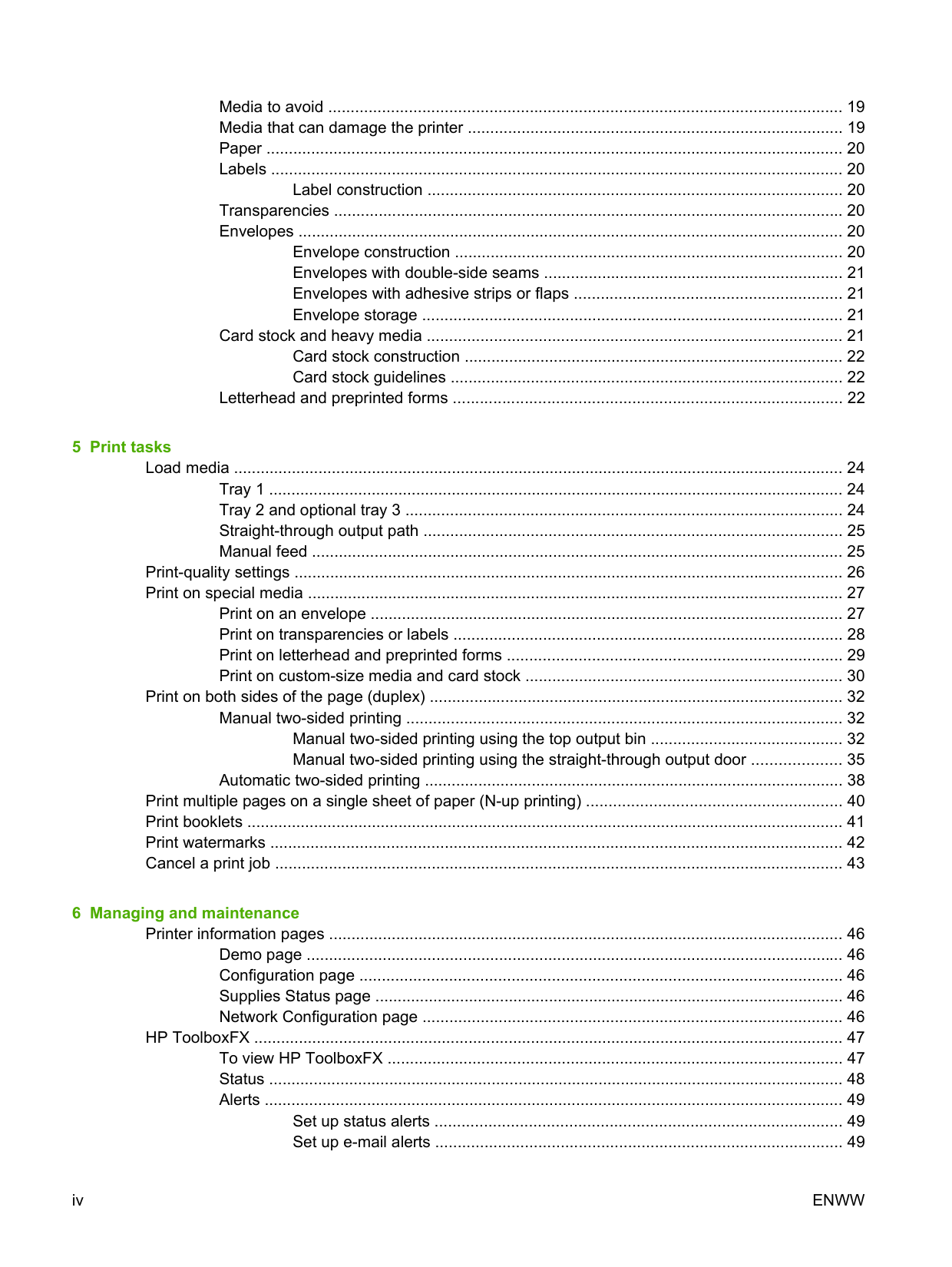
Status-light patterns ........................................................................................................................... 76 Common Macintosh problems ............................................................................................................ 83 HP postscript level 3 emulation errors ................................................................................................ 86 Media problem solving ....................................................................................................................... 87 Printed page is different than what appeared on screen .................................................................... 89
Garbled, incorrect, or incomplete text ................................................................................ 89 Missing graphics or text, or blank pages ........................................................................... 89 Page format is different than on another HP LaserJet printer ........................................... 90 Graphics quality ................................................................................................................. 90
Printer software problems .................................................................................................................. 91 Improve print quality ........................................................................................................................... 92
Light print or faded ............................................................................................................. 92
ENWW v
Toner specks ..................................................................................................................... 92 Dropouts ............................................................................................................................ 92 Vertical lines ...................................................................................................................... 93 Gray background ............................................................................................................... 93 Toner smear ...................................................................................................................... 93 Loose toner ........................................................................................................................ 94 Vertical repetitive defects ................................................................................................... 94 Misformed characters ........................................................................................................ 94 Page skew ......................................................................................................................... 95 Curl or wave ....................................................................................................................... 95 Wrinkles or creases ........................................................................................................... 95 Toner scatter outline .......................................................................................................... 96
Clearing jams ..................................................................................................................................... 97 Print-cartridge area ............................................................................................................ 97 Input trays .......................................................................................................................... 99 Output bin ........................................................................................................................ 102 Straight-through output path ............................................................................................ 103 Automatic two-sided printing path .................................................................................... 104
Network setup problem solving ........................................................................................................ 109
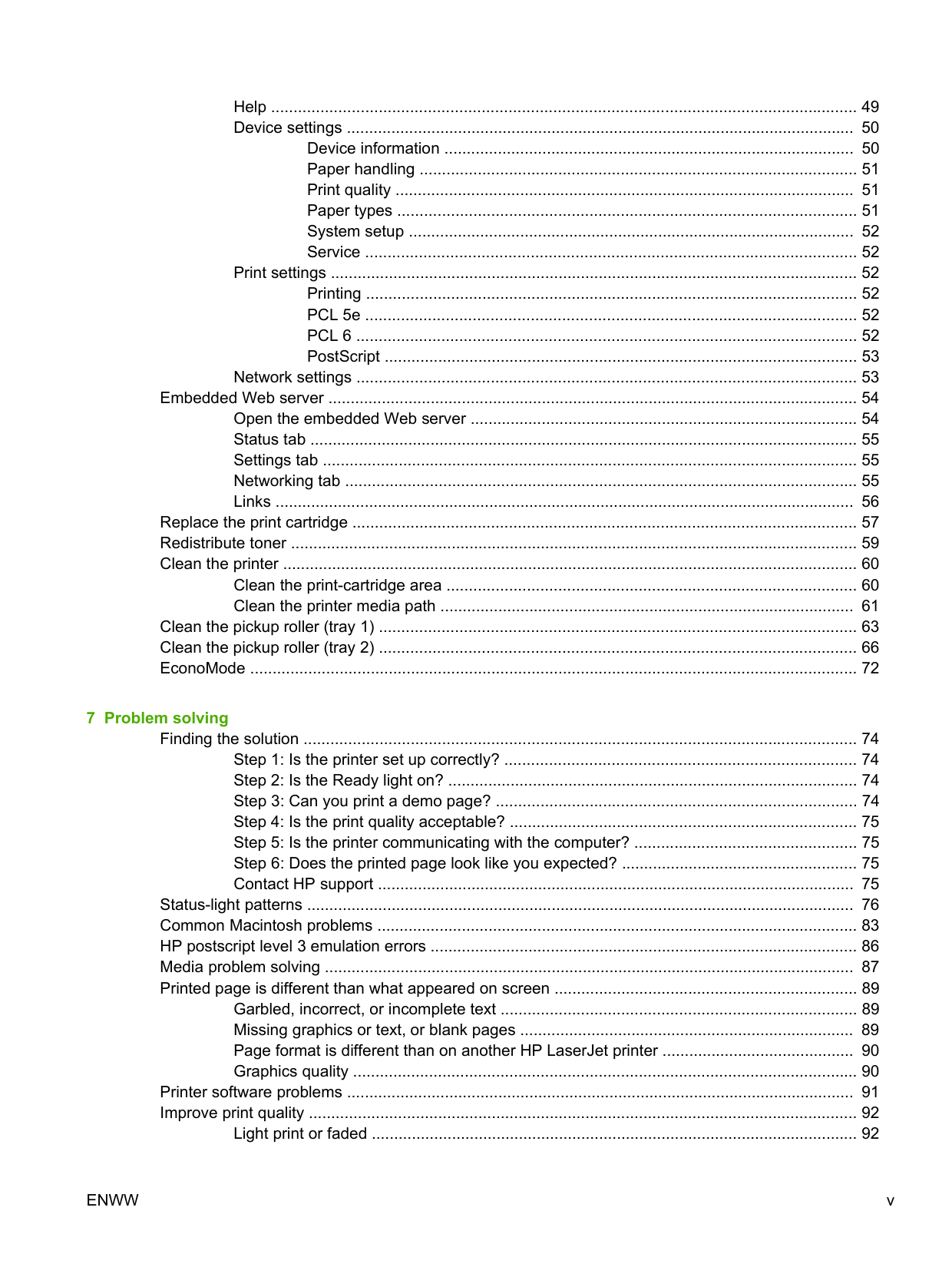
HP policy on non-HP print cartridges ............................................................................... 114 Storing print cartridges ..................................................................................................... 114 Print cartridge life expectancy .......................................................................................... 114 Saving toner ..................................................................................................................... 114
DIMMs (memory or font) .................................................................................................................. 115 Install a memory DIMM ................................................................................................... 115 Test the DIMM installation ............................................................................................... 117 Remove a DIMM .............................................................................................................. 117
FCC compliance ............................................................................................................................... 132 Declaration of Conformity statements .............................................................................................. 133 Regulatory statements ..................................................................................................................... 134
Laser safety statement .................................................................................................... 134 Canadian DOC regulations .............................................................................................. 134 Korean EMI statement ..................................................................................................... 134 Laser statement for Finland ............................................................................................. 135
Environmental product stewardship program ................................................................................... 136 Protecting the environment .............................................................................................. 136 Ozone production ............................................................................................................ 136 Power consumption ......................................................................................................... 136 Toner consumption .......................................................................................................... 136 Paper use ........................................................................................................................ 136 Plastics ............................................................................................................................ 136 HP LaserJet printing supplies .......................................................................................... 136 HP printing supplies returns and recycling program information ..................................... 137 Paper ............................................................................................................................... 137 Material restrictions .......................................................................................................... 137 Disposal of Waste Equipment by Users in Private Household in the European Union ............................................................................................................................... 137 Material safety data sheet ................................................................................................ 138 For more information ....................................................................................................... 138
###### Index ................................................................................................................................................................. 143
ENWW vii
1 Product information
This chapter provides information on the following topics:
ENWW 1
Product features
The following are the standard configurations for the HP LaserJet P2015 Series printers.
#### HP LaserJet P2015 printer
#### HP LaserJet P2015d printer
The HP LaserJet P2015d printer includes all of the features of the HP LaserJet P2015 plus automatic two-sided (duplex) printing.

#### HP LaserJet P2015n printer
The HP LaserJet P2015n printer includes all of the features of the HP LaserJet P2015 plus an HP internal network port.
#### HP LaserJet P2015dn printer
The HP LaserJet P2015dn printer includes all of the features of the HP LaserJet P2015d plus an HP internal network port.
#### HP LaserJet P2015x printer
The HP LaserJet P2015x printer includes all of the features of the HP LaserJet P2015dn plus an additional 250-sheet input tray (tray 3).
ENWW Product features 3
Identify product parts
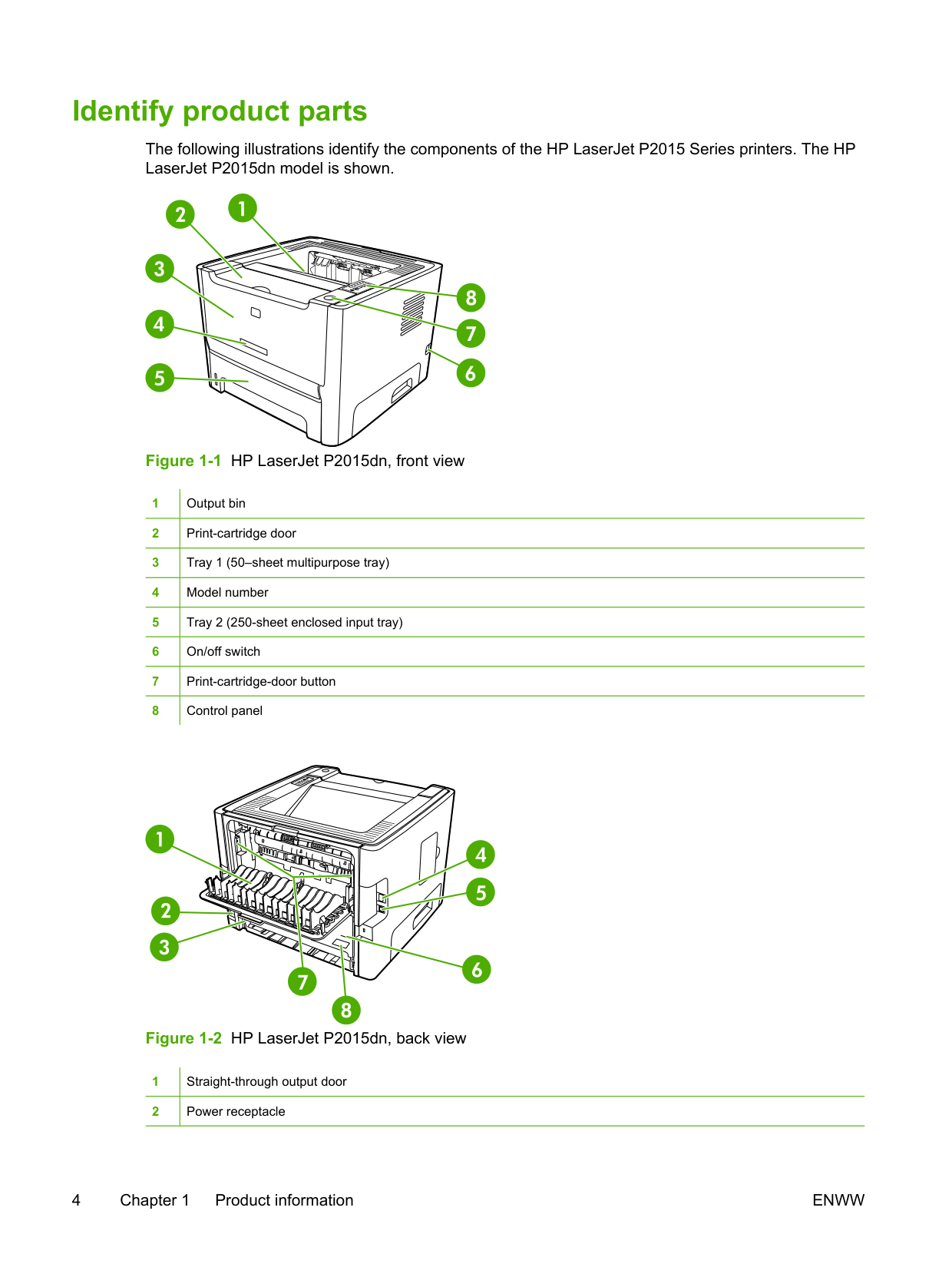
The following illustrations identify the components of the HP LaserJet P2015 Series printers. The HP LaserJet P2015dn model is shown.
|1|Output bin
| |---|---|
|2|Print-cartridge door| |3|Tray 1 (50–sheet multipurpose tray)| |4|Model number
| |5|Tray 2 (250-sheet enclosed input tray)| |6|On/off switch| |7|Print-cartridge-door button
| |8|Control panel|
|1|Straight-through output door| |---|---| |2|Power receptacle|
|3|Automatic two-sided-printing media-size selector (duplex models only)| |---|---| |4|HP internal network port (network-ready models only)| |5|USB port| |6|Rear automatic two-sided path door (duplex models only)|
|7|Jam-clearing levers| |8
|Serial number|
####### ENWW Identify product parts 5
2 Control panel
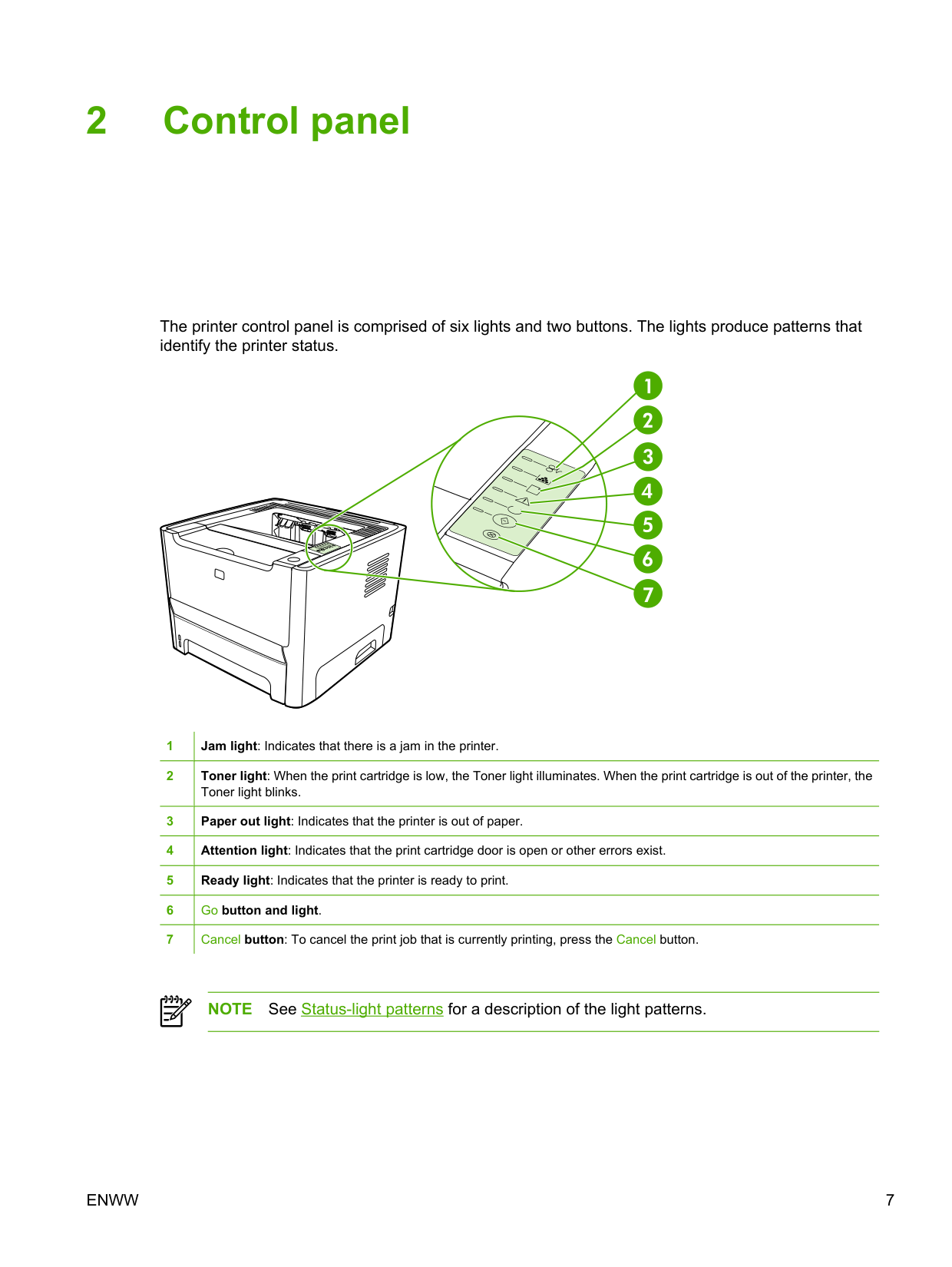
The printer control panel is comprised of six lights and two buttons. The lights produce patterns that identify the printer status.
|1|Jam light: Indicates that there is a jam in the printer.| |---|---| |2|Toner light: When the print cartridge is low, the Toner light illuminates. When the print cartridge is out of the printer, the Toner light blinks.
| |3|Paper out light: Indicates that the printer is out of paper.
| |4|Attention light: Indicates that the print cartridge door is open or other errors exist.| |5|Ready light: Indicates that the printer is ready to print.| |6|Go button and light.| |7|Cancel button: To cancel the print job that is currently printing, press the Cancel button.|
| | |---|
NOTE See Status-light patterns for a description of the light patterns.
####### 8 Chapter 2 Control panel ENWW
3 Product software
For easy printer setup and access to the full range of printer features, HP strongly recommends that you install the software that is provided with the printer.
The following sections describe the software that is provided with the HP LaserJet P2015 Series printers:
Supported operating systems
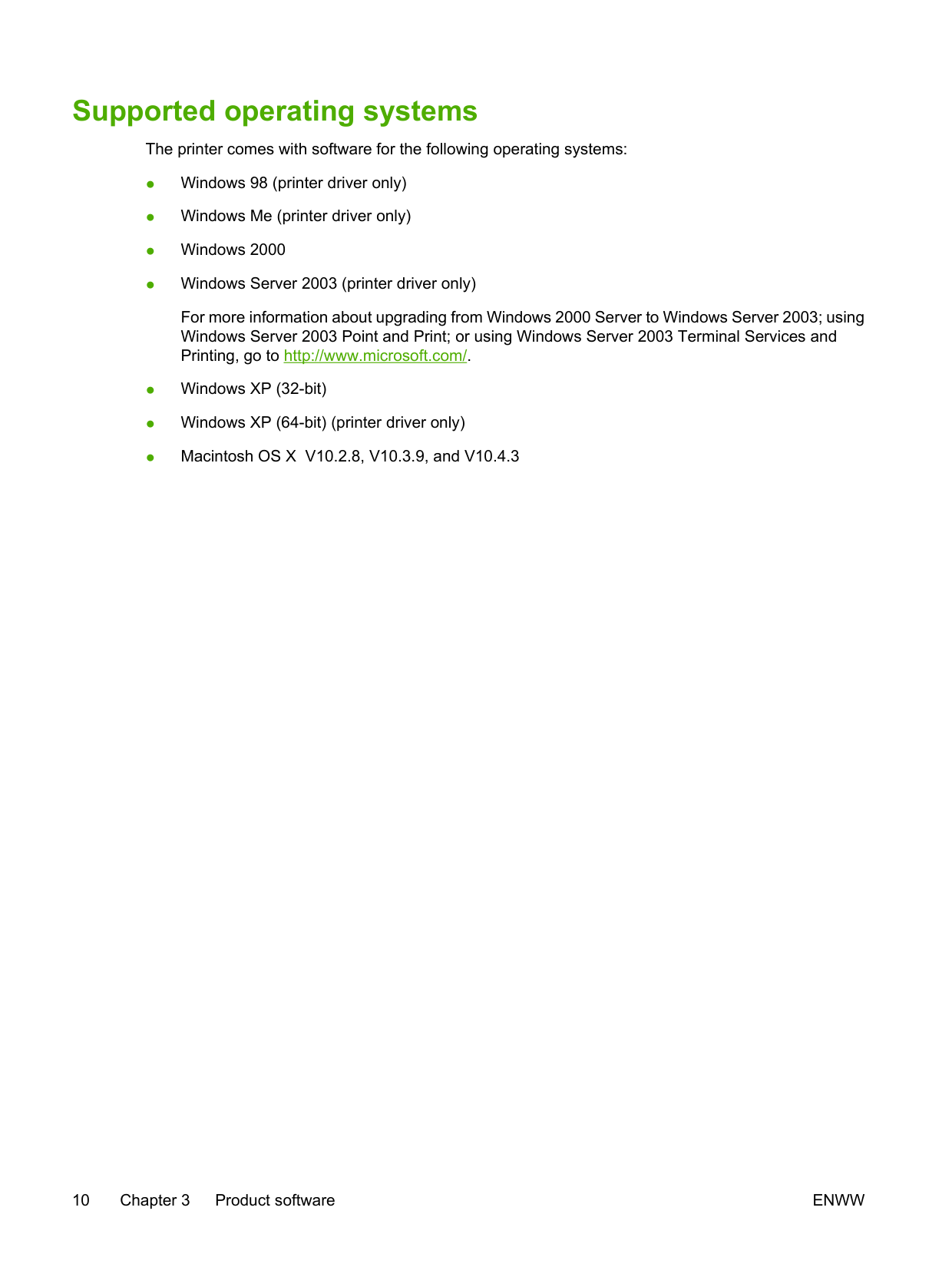
The printer comes with software for the following operating systems:
For more information about upgrading from Windows 2000 Server to Windows Server 2003; using Windows Server 2003 Point and Print; or using Windows Server 2003 Terminal Services and Printing, go to http://www.microsoft.com/.
Printer connections
This section shows you how to connect the printer to your computer or network by a USB or network connection.
#### USB connections
All HP LaserJet P2015 Series printers support USB connections.

#### Network connections
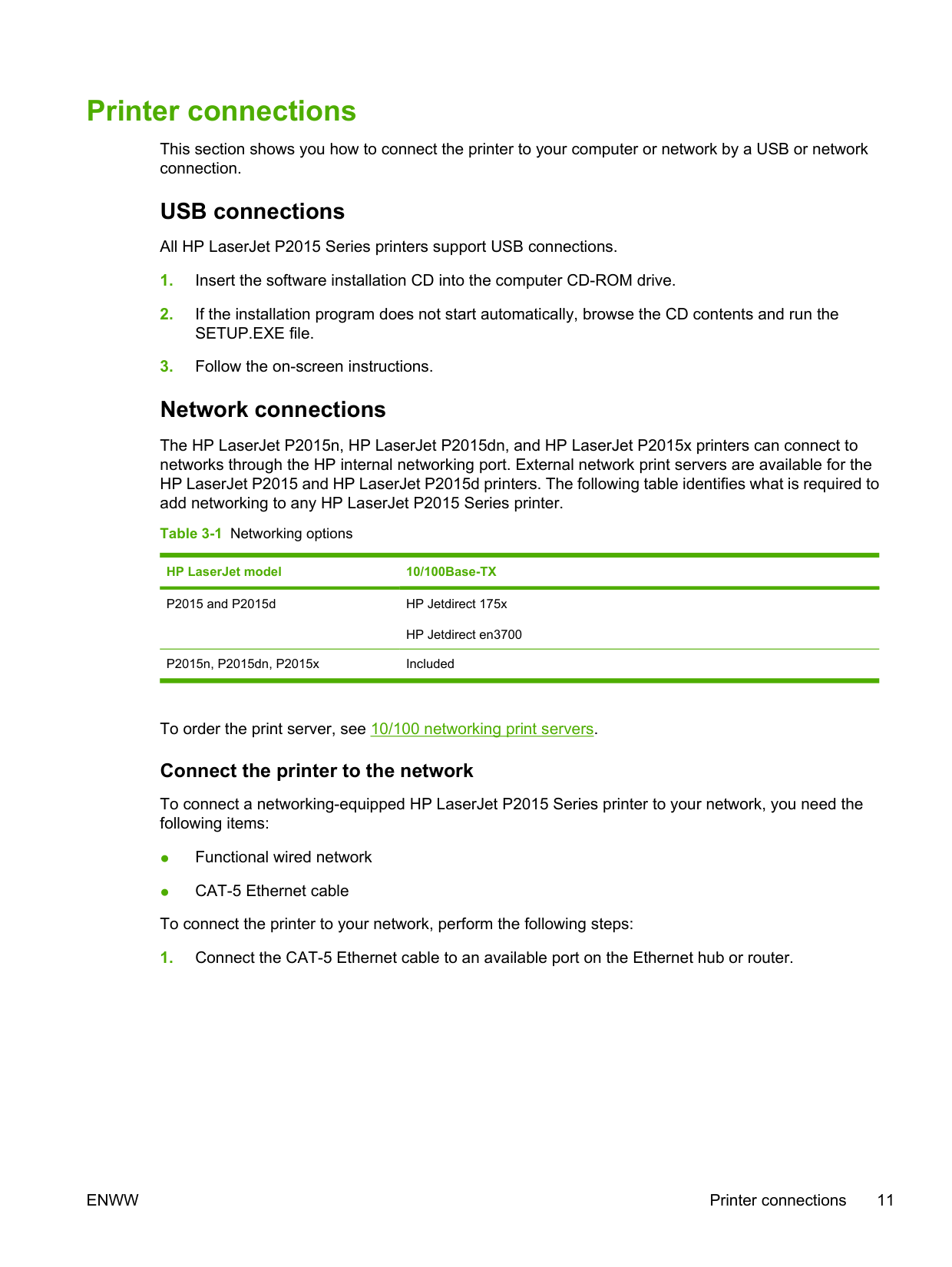
The HP LaserJet P2015n, HP LaserJet P2015dn, and HP LaserJet P2015x printers can connect to networks through the HP internal networking port. External network print servers are available for the HP LaserJet P2015 and HP LaserJet P2015d printers. The following table identifies what is required to add networking to any HP LaserJet P2015 Series printer.
Table 3-1 Networking options
########### HP LaserJet model 10/100Base-TX
P2015 and P2015d HP Jetdirect 175x
HP Jetdirect en3700 P2015n, P2015dn, P2015x Included
To order the print server, see 10/100 networking print servers. Connect the printer to the network
To connect a networking-equipped HP LaserJet P2015 Series printer to your network, you need the following items:

ENWW Printer connections 11
| | | | |---|---|---| | | | | | | | | | | | | | | | | | | | |
| | | | |---|---|---|
| | | | | | | | | | | | | | | | | | | |
| | |---|
NOTE To resolve network connection problems, see Network setup problem solving.
##### Install the printer software for the network printer
To use the printer on the network, install the printer software on a computer that is connected to the network. See Software for Windows or Software for Macintosh for information about installing the printer software.
Software for Windows

The following sections describe the Windows software that is available for the HP LaserJet P2015 Series printers.
#### Windows printer drivers
A printer driver is the software that provides access to printer features and provides the means for the computer to print to the printer.
##### Windows driver types
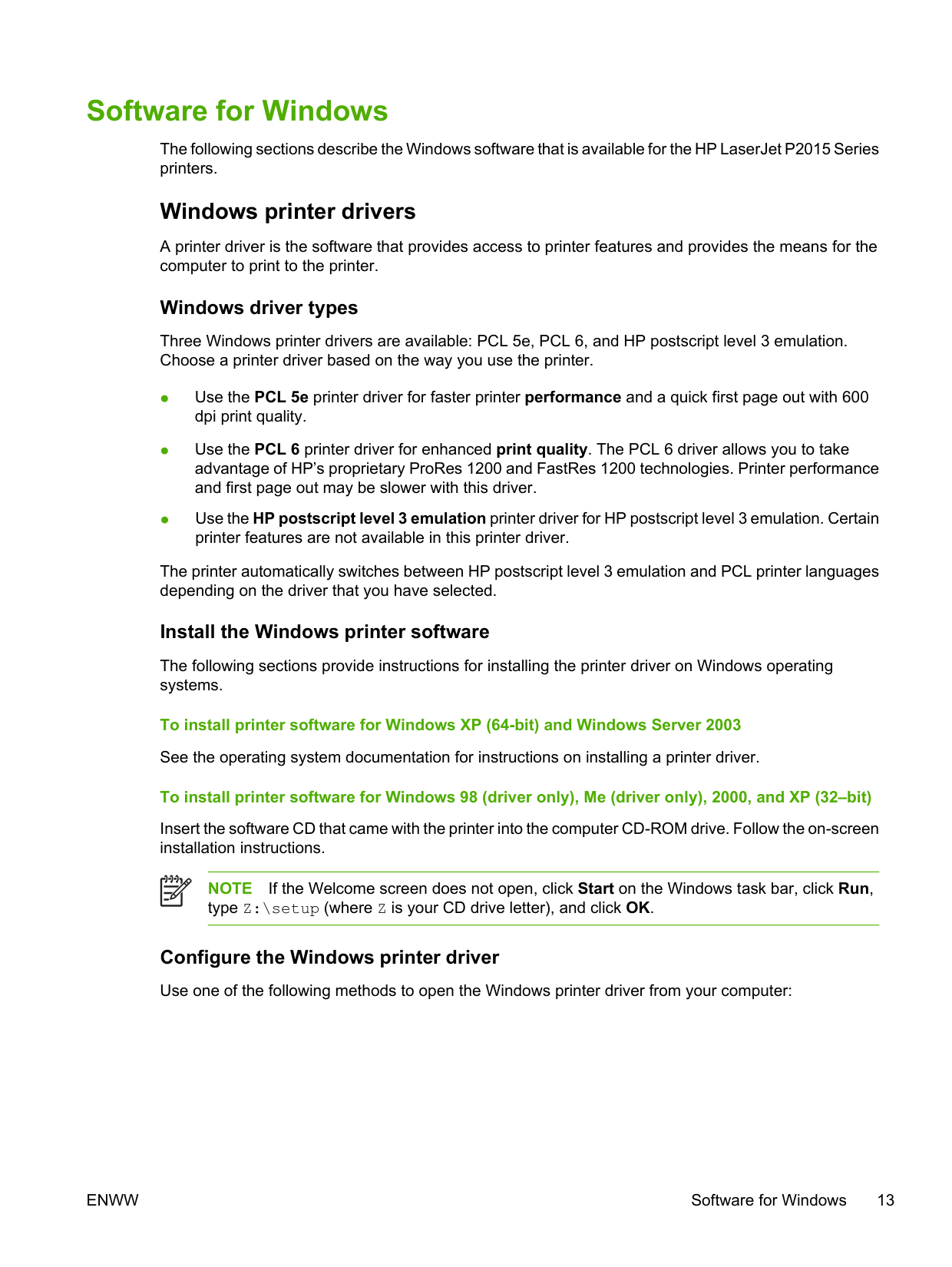
Three Windows printer drivers are available: PCL 5e, PCL 6, and HP postscript level 3 emulation. Choose a printer driver based on the way you use the printer.
● Use the HP postscript level 3 emulation printer driver for HP postscript level 3 emulation. Certain printer features are not available in this printer driver.
The printer automatically switches between HP postscript level 3 emulation and PCL printer languages depending on the driver that you have selected.
##### Install the Windows printer software
The following sections provide instructions for installing the printer driver on Windows operating systems.

###### To install printer software for Windows XP (64-bit) and Windows Server 2003 See the operating system documentation for instructions on installing a printer driver. To install printer software for Windows 98 (driver only), Me (driver only), 2000, and XP (32–bit)
Insert the software CD that came with the printer into the computer CD-ROM drive. Follow the on-screen installation instructions.
| | |---|
NOTE If the Welcome screen does not open, click Start on the Windows task bar, click Run, type Z:\setup (where Z is your CD drive letter), and click OK.
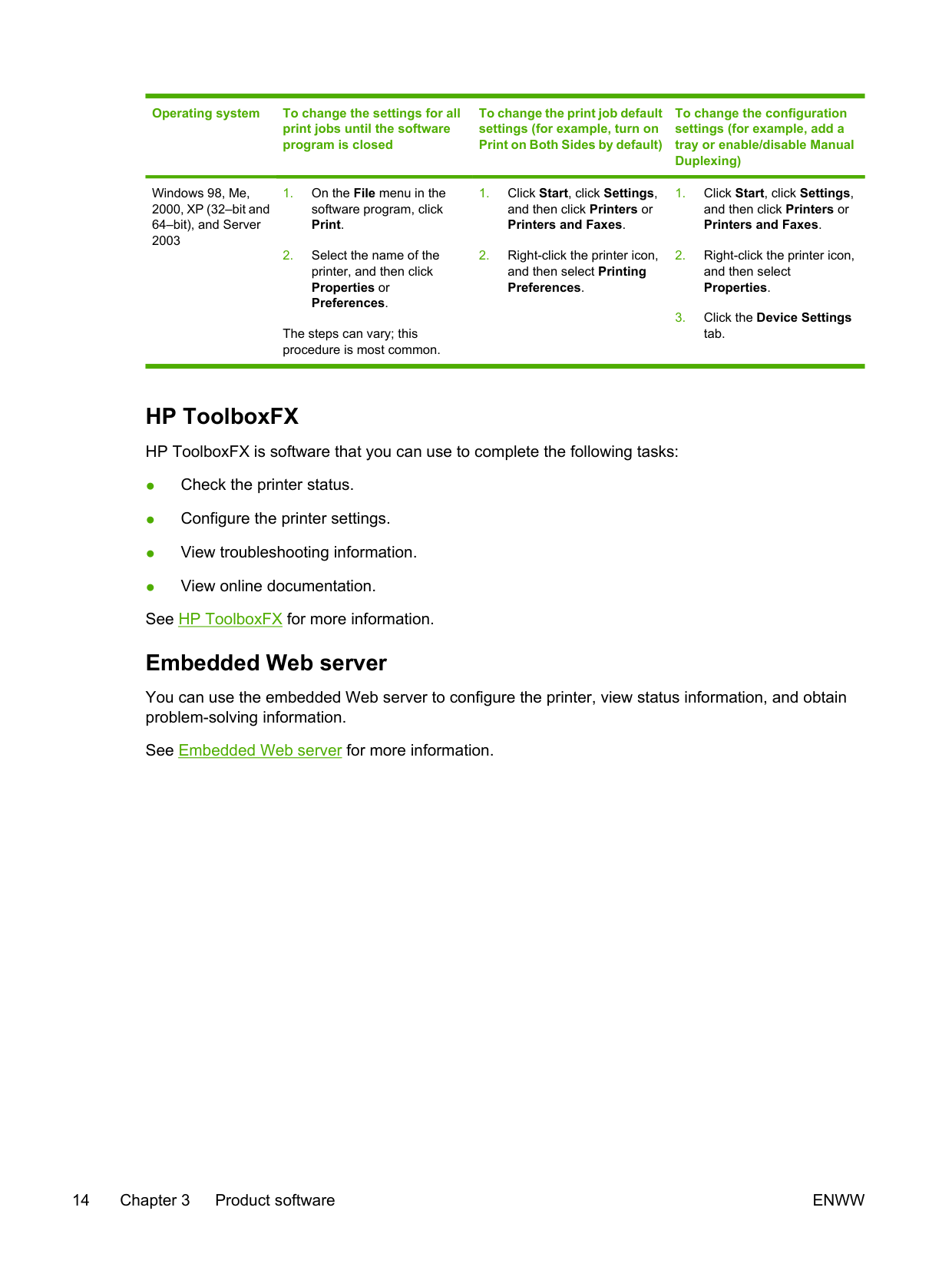
Configure the Windows printer driver Use one of the following methods to open the Windows printer driver from your computer:
ENWW Software for Windows 13
Operating system To change the settings for all
To change the print job default settings (for example, turn on Print on Both Sides by default)
To change the configuration settings (for example, add a tray or enable/disable Manual Duplexing)
print jobs until the software program is closed
Windows 98, Me, 2000, XP (32–bit and 64–bit), and Server 2003
The steps can vary; this procedure is most common.
#### HP ToolboxFX
HP ToolboxFX is software that you can use to complete the following tasks:
#### Embedded Web server
You can use the embedded Web server to configure the printer, view status information, and obtain problem-solving information.
See Embedded Web server for more information.
Software for Macintosh
The following sections describe the Macintosh software that is available for the HP LaserJet P2015 Series printers.
#### Macintosh printer drivers
A printer driver is the software component that provides access to printer features and provides the means for the computer to communicate with the printer.
##### Install the Macintosh printer driver
This section explains how to install the printing system software for Macintosh OS X V10.2.8, V10.3.9 and V10.4.3.
| | |---|
NOTE USB queues are created automatically when the printer is attached to the computer. However, the queue will use a generic PPD if the installer has not been run before the USB cable is connected. To change the queue PPD, open the Print Center or Printer Setup Utility, select the correct printer queue, and then click Show Info to open the Printer Info dialog box. In the pop-up menu, select Printer Model, and then, in the pop-up menu in which Generic is selected, select the correct PPD for the printer.
Use the following procedure to install the Macintosh printer driver:
If installation fails, reinstall the software. If this fails, see the Late-Breaking Information section of the Install Notes. The Install Notes are located on the printer CD or at the support Web site (see How to contact HP for the Web address).
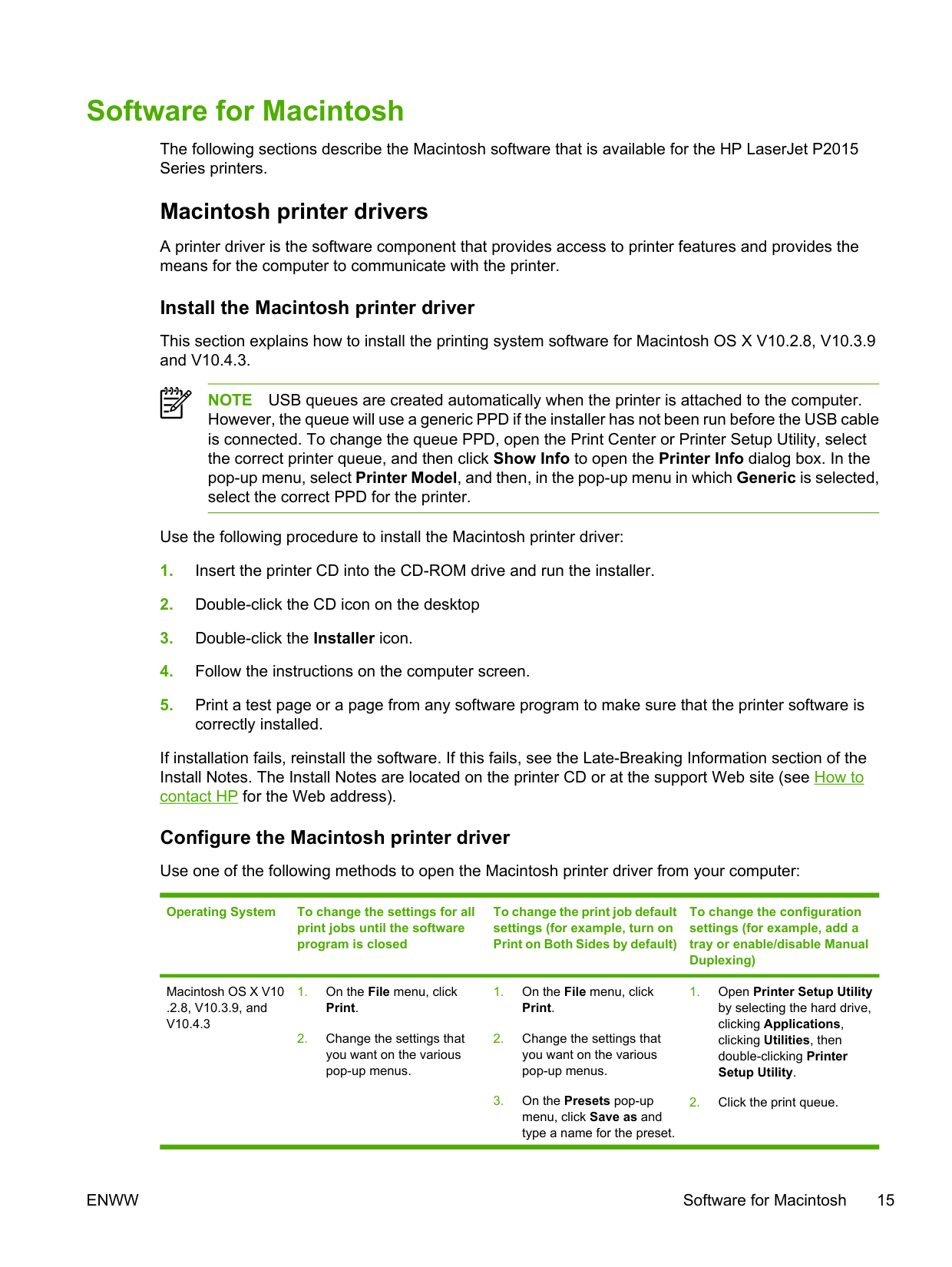
Configure the Macintosh printer driver Use one of the following methods to open the Macintosh printer driver from your computer:
Operating System To change the settings for all
To change the print job default settings (for example, turn on Print on Both Sides by default)
To change the configuration settings (for example, add a tray or enable/disable Manual Duplexing)
print jobs until the software program is closed
Macintosh OS X V10
.2.8, V10.3.9, and V10.4.3
ENWW Software for Macintosh 15
Operating System To change the settings for all
To change the print job default settings (for example, turn on Print on Both Sides by default)
To change the configuration settings (for example, add a tray or enable/disable Manual Duplexing)
print jobs until the software program is closed
These settings are saved in the Presets menu. To use the new settings, you must select the saved preset option every time you open a program and print.
#### PostScript Printer Description files (PPDs)
PPDs, in combination with the HP postscript level 3 emulation driver, access the printer features and allow the computer to communicate with the printer. An installation program for the PPDs is provided on the HP LaserJet P2015 Series printer CD.
4 Supported paper and other media
The HP LaserJet P2015 Series printer can use a variety of paper and other print media in accordance with the guidelines in this user guide. Media that does not meet these guidelines might cause the following problems:
For best results, use only HP brand paper and print media. Hewlett-Packard Company cannot recommend the use of other brands. Because they are not HP products, HP cannot influence or control their quality.
It is possible for media to meet all of the guidelines in this user guide and still not produce satisfactory results. This might be the result of improper handling, unacceptable temperature and humidity levels, or other variables over which Hewlett-Packard has no control.
Before you purchase a large quantity of media, test the media and make sure that it meets the requirements specified in this user guide and in HP LaserJet printer family media guide. The guidelines can be downloaded from http://www.hp.com/support/ljpaperguide/, or see Order supplies and accessories for more information about ordering the guidelines.
CAUTION Using media that does not meet Hewlett-Packard's specifications might cause problems for the printer, requiring repair. This repair is not covered by the Hewlett-Packard warranty or service agreements.
ENWW 17
Optimize print quality for media types
The HP LaserJet P2015 Series printers provide a number of print modes that allow the unit to adapt to various media. You can change the print modes on the Paper tab in the printer driver, in HP ToolboxFX, or in the embedded Web server.
| | |---|
NOTE When using the CARDSTOCK, ENVELOPE, LABEL, and ROUGH modes, the printer pauses between pages and the number of pages per minute decreases.
Table 4-1 Driver print modes Mode Media type PLAIN 75 to 104 g/m2 (20 to 27 lb) LIGHT Less than 75 g/m2 (20 lb) HEAVY 90 to 105 g/m2 (24 to 28 lb) CARDSTOCK Card stock or thick media TRANSPARENCY 4-mil, 0.1 Monochrome Overhead Transparencies (OHTs) ENVELOPE Standard HP LaserJet envelopes LABEL Standard HP LaserJet labels BOND Bond paper ROUGH Rough paper
Guidelines for using media
You can print on a variety of media, such as paper (including up to 100% recycled-fiber-content paper), envelopes, labels, transparencies, and custom-size media. The following are the supported media sizes:
Properties such as weight, grain, and moisture content are important factors that affect printer performance and quality. To achieve the best possible print quality, only use high-quality media that is designed for laser printers.
| | |---|
NOTE Always test a sample of the media before you purchase large quantities.
#### HP media
HP recommends a variety of media. See the HP LaserJet Printer Family Print Media Guide (http://www.hp.com/support/ljpaperguide/) for a full list.
#### Media to avoid
Media outside the printer specifications will cause a loss of print quality and increase the occurrence of jams.
Media that can damage the printer
Avoid media that can damage the printer.
To order HP LaserJet printing supplies, go to http://www.hp.com/go/ljsupplies/ in the U.S. or to http://www.hp.com/ghp/buyonline.html/ worldwide.
#### Paper
For best results, use conventional 75 g/m2 (20 lb) paper. Make sure that the paper is of good quality and free of cuts, nicks, tears, spots, loose particles, dust, wrinkles, voids, and curled or bent edges.
#### Labels
Print labels from tray 1 using the straight-through output path. See Print on transparencies or labels and Straight-through output path for more information.
CAUTION Do not feed a sheet of labels through the printer more than once. The adhesive degrades and might damage the printer.
Label construction When selecting labels, consider the quality of the following components:
Transparencies
Transparencies must be able to withstand 200° C (392° F), the printer's maximum temperature.
Envelopes
Print envelopes from tray 1 using the straight-through paper path. See Print on an envelope and Straightthrough output path for more information.
Envelope construction
Envelope construction is critical. Envelope fold lines can vary considerably, not only between manufacturers but also within a box from the same manufacturer. When selecting envelopes, consider the following components:
##### Envelopes with double-side seams
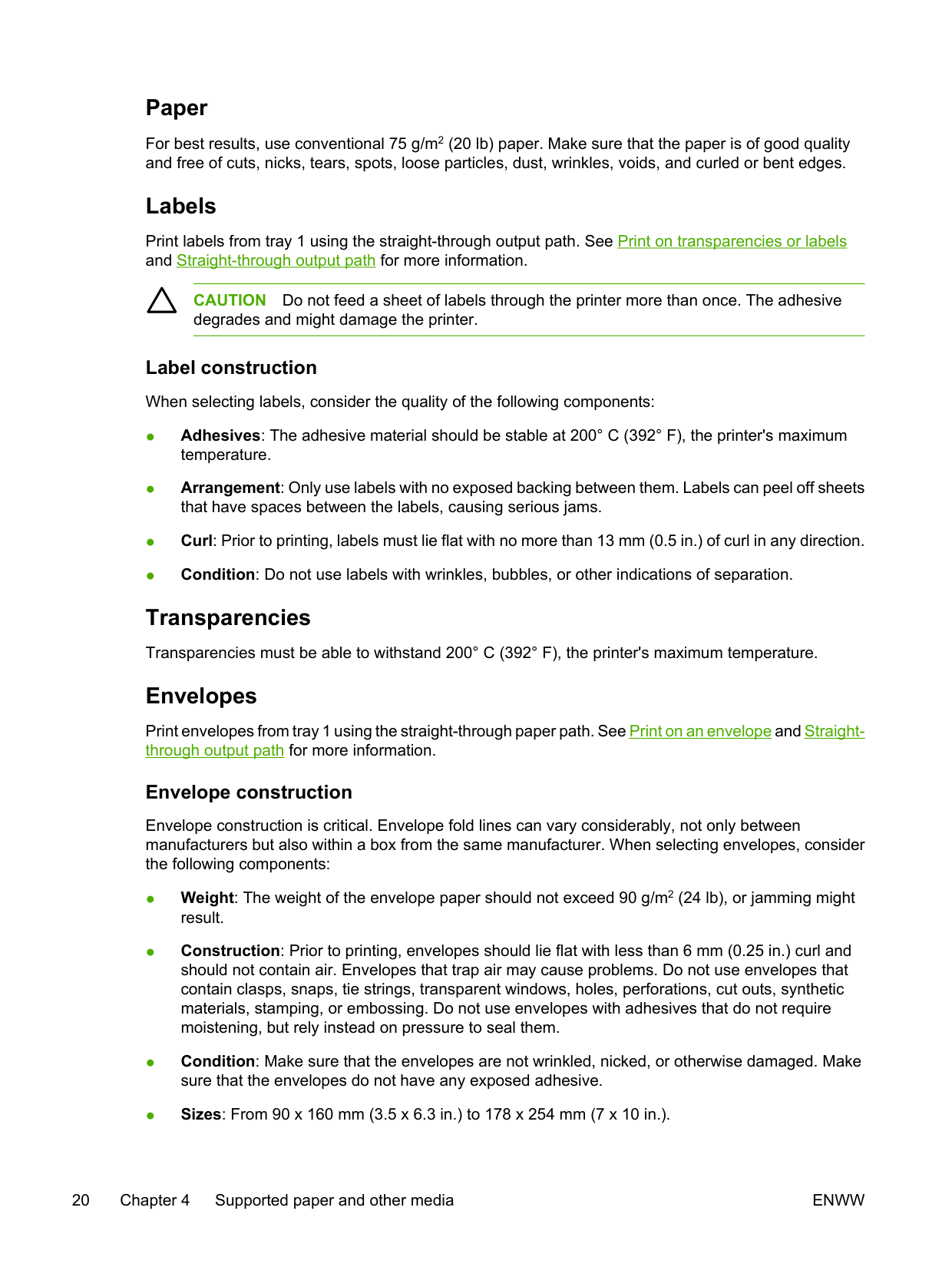
An envelope with double-side-seam construction has vertical seams at both ends of the envelope rather than diagonal seams. This style might be more likely to wrinkle. Make sure that the seam extends all the way to the corner of the envelope as shown in the following illustration:
|1|acceptable envelope construction| |---|---| |2|unacceptable envelope construction|
##### Envelopes with adhesive strips or flaps
Envelopes with a peel-off adhesive strip or with more than one flap that folds over to seal must use adhesives compatible with the heat and pressure in the printer: 200° C (392° F). The extra flaps and strips might cause wrinkling, creasing, or jams.
##### Envelope storage
Proper storage of envelopes contributes to good print quality. You should store envelopes flat. If air is trapped in an envelope, creating an air bubble, the envelope might wrinkle during printing.
#### Card stock and heavy media
You can print many types of card stock from the paper input tray, including index cards and postcards. Some card stock performs better than others because its construction is better suited for feeding through a laser printer.
For optimum printer performance, do not use paper heavier than 157 g/m2 (42 lb). Paper that is too heavy might cause misfeeds, stacking problems, paper jams, poor toner fusing, poor print quality, or excessive mechanical wear.
| | |---|
NOTE You might be able to print on heavier paper if you do not fill the input tray to capacity and if you use paper with a smoothness rating of 100-180 Sheffield.
##### Card stock construction
Card stock guidelines Set margins at least 2 mm (0.08 in.) away from the edges.
#### Letterhead and preprinted forms
Many manufacturers now offer premium paper advertised as laser-compatible or laser-guaranteed. Some of the rougher surface finishes, such as cockle, laid, or linen, might require the special fuser modes that are available on some printer models in order to achieve adequate toner adhesion.
| | |---|
NOTE Some page-to-page variation is normal when printing with laser printers. This variation cannot be observed when printing on plain paper. However, this variation is obvious when printing on preprinted forms because the lines and boxes are already placed on the page.
To avoid problems when using preprinted forms, embossed paper, and letterhead, observe the following guidelines:
5 Print tasks
This chapter provides information on the following topics:
ENWW 23
Load media
The following sections describe how to load media into the different input trays.
CAUTION If you try to print on media that is wrinkled, folded, or damaged in any way, a jam might occur. See Clearing jams for more information.
#### Tray 1
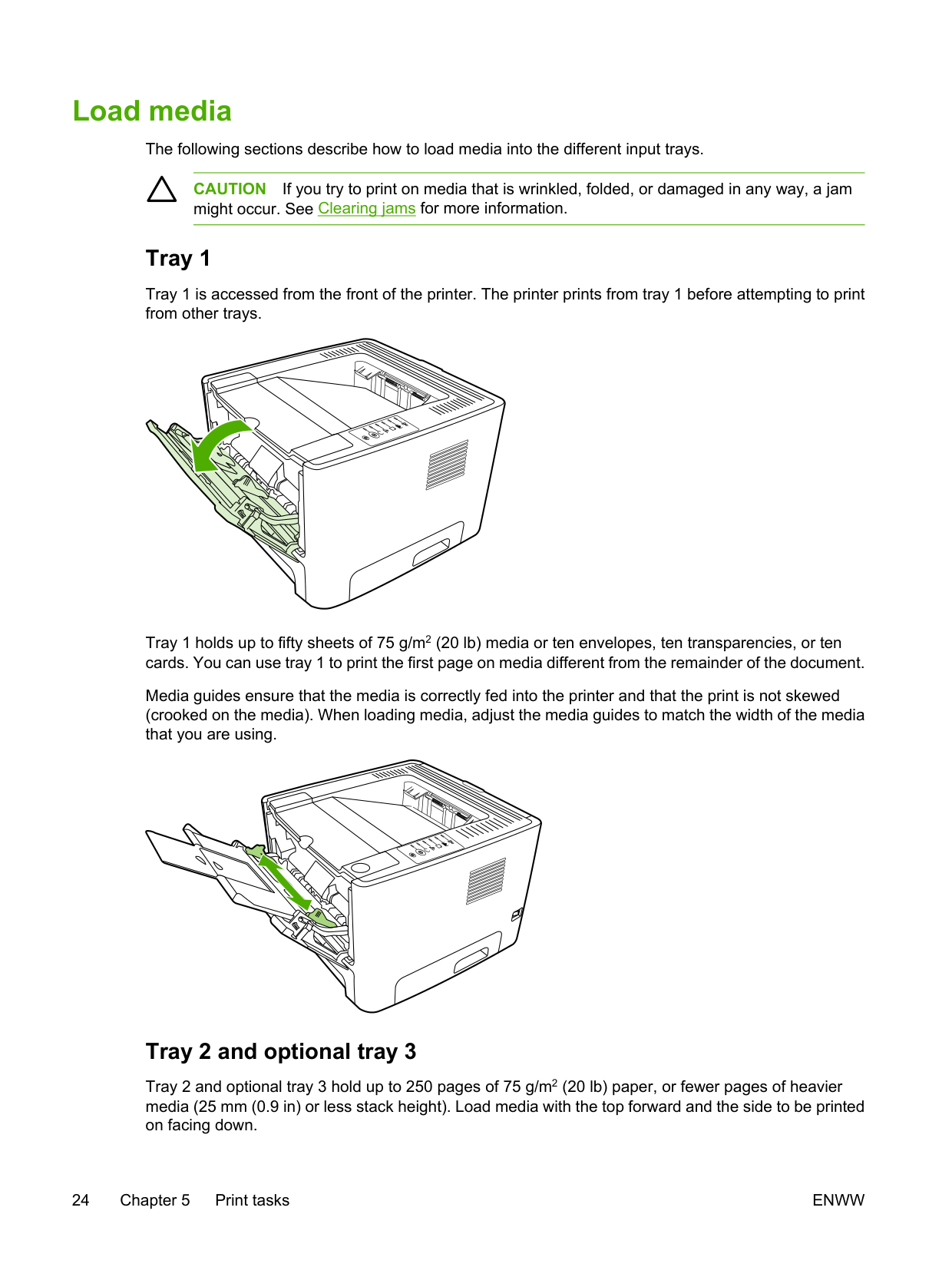
Tray 1 is accessed from the front of the printer. The printer prints from tray 1 before attempting to print from other trays.
Media guides ensure that the media is correctly fed into the printer and that the print is not skewed (crooked on the media). When loading media, adjust the media guides to match the width of the media that you are using.
Media guides ensure that the media feeds correctly into the printer and that the print is not skewed. Tray 2 has side and rear media guides. When loading media, adjust the media guides to match the length and width of the media that you are using.
| | |---|
NOTE When you add new media, make sure that you remove all of the media from the input tray and straighten the stack of new media. This reduces jams by preventing multiple sheets of media from feeding through the printer at one time.
#### Straight-through output path
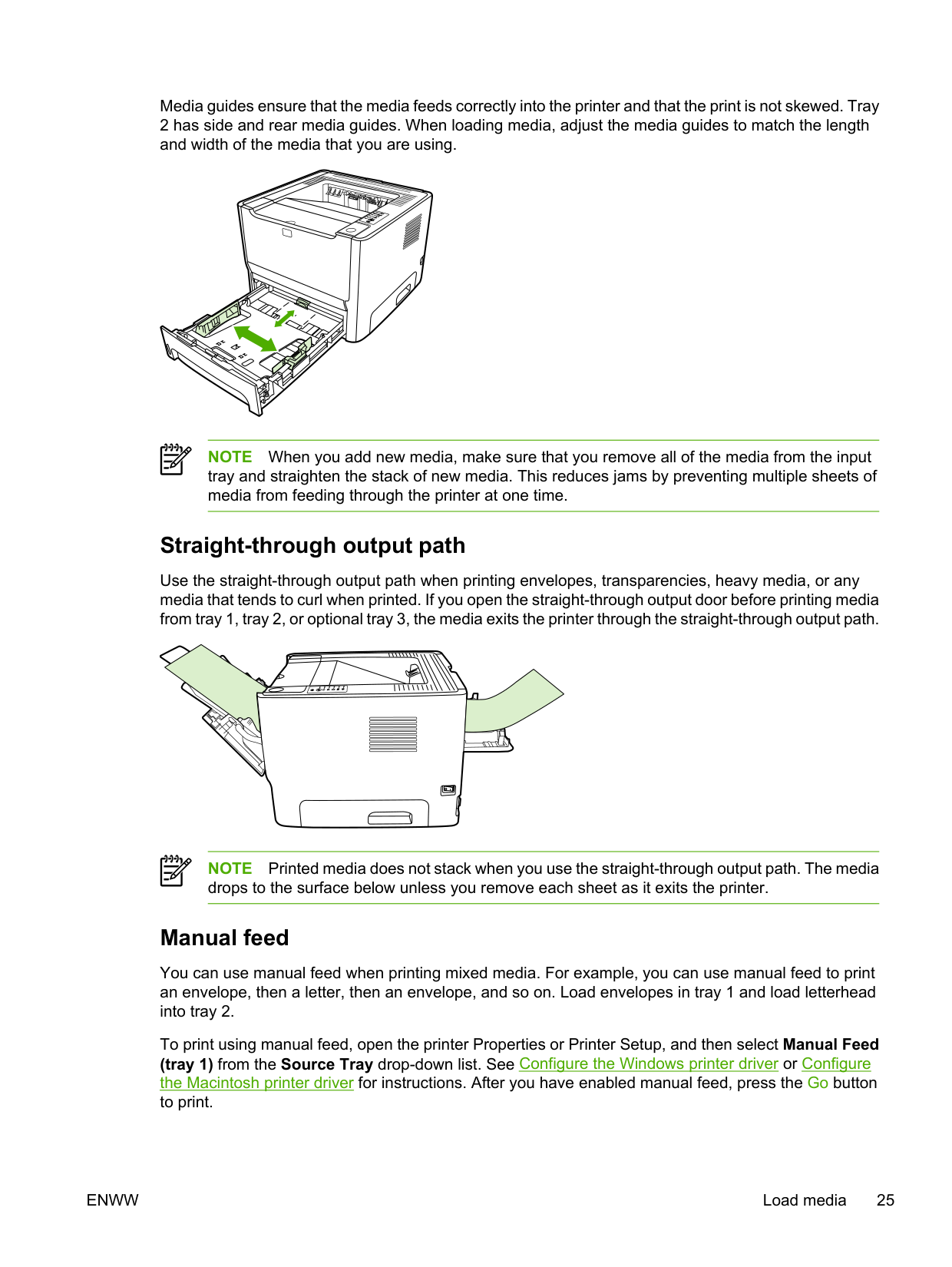
Use the straight-through output path when printing envelopes, transparencies, heavy media, or any media that tends to curl when printed. If you open the straight-through output door before printing media from tray 1, tray 2, or optional tray 3, the media exits the printer through the straight-through output path.
| | |---|
NOTE Printed media does not stack when you use the straight-through output path. The media drops to the surface below unless you remove each sheet as it exits the printer.
#### Manual feed
You can use manual feed when printing mixed media. For example, you can use manual feed to print an envelope, then a letter, then an envelope, and so on. Load envelopes in tray 1 and load letterhead into tray 2.
To print using manual feed, open the printer Properties or Printer Setup, and then select Manual Feed (tray 1) from the Source Tray drop-down list. See Configure the Windows printer driver or Configure the Macintosh printer driver for instructions. After you have enabled manual feed, press the Go button to print.
ENWW Load media 25
Print-quality settings
Print-quality settings affect print resolution and toner usage. Use the following procedure to change print-quality settings:
| | |---|
NOTE Not all printer features are available in all drivers or operating systems. See the printer Properties (driver) online Help for information about availability of features for that driver.
Print on special media
The following sections explain how to print on a variety of media.
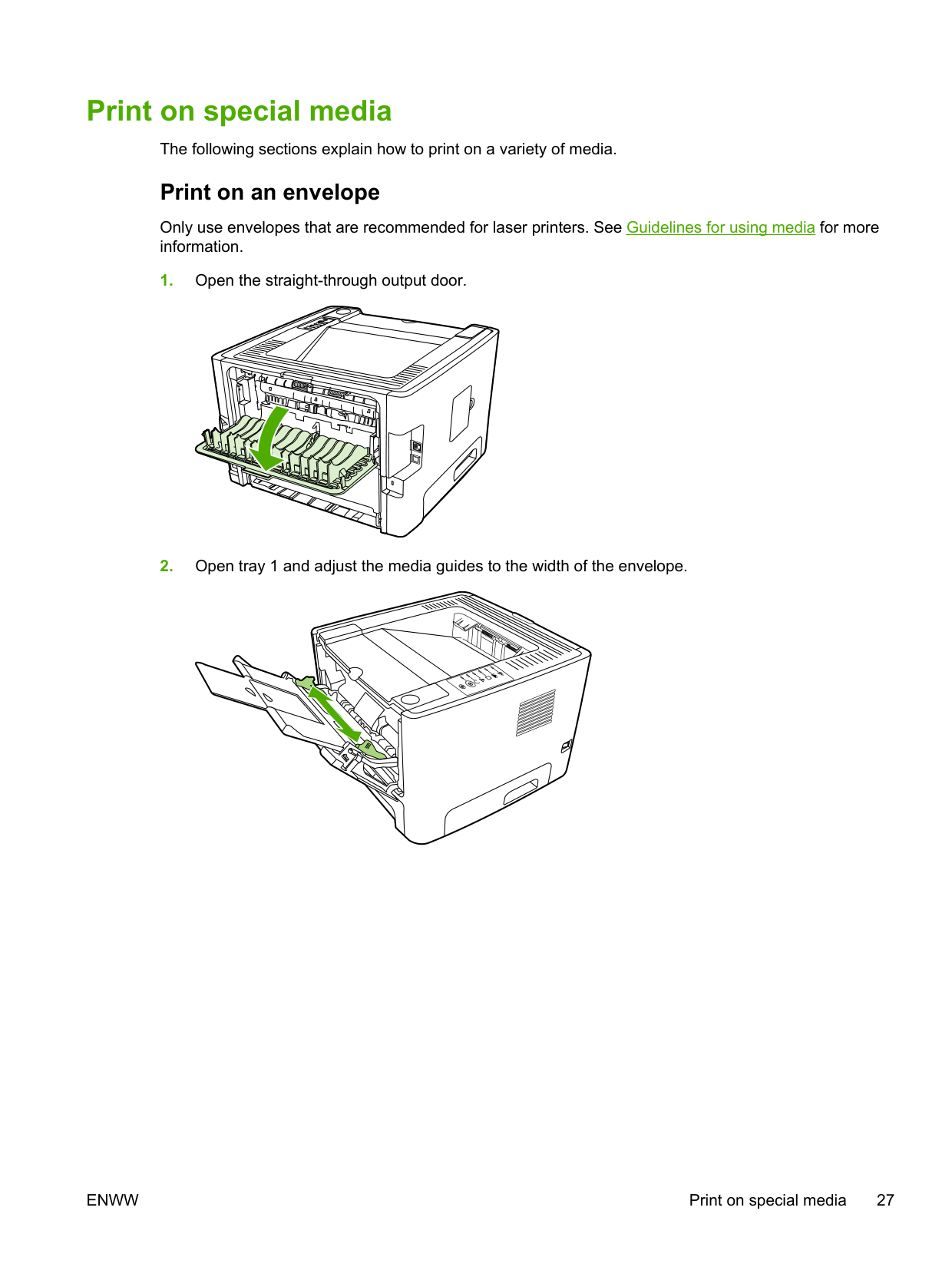
#### Print on an envelope
Only use envelopes that are recommended for laser printers. See Guidelines for using media for more information.
| | |---|
NOTE If the envelope has a flap on the short edge, feed that edge into the printer first.
| |
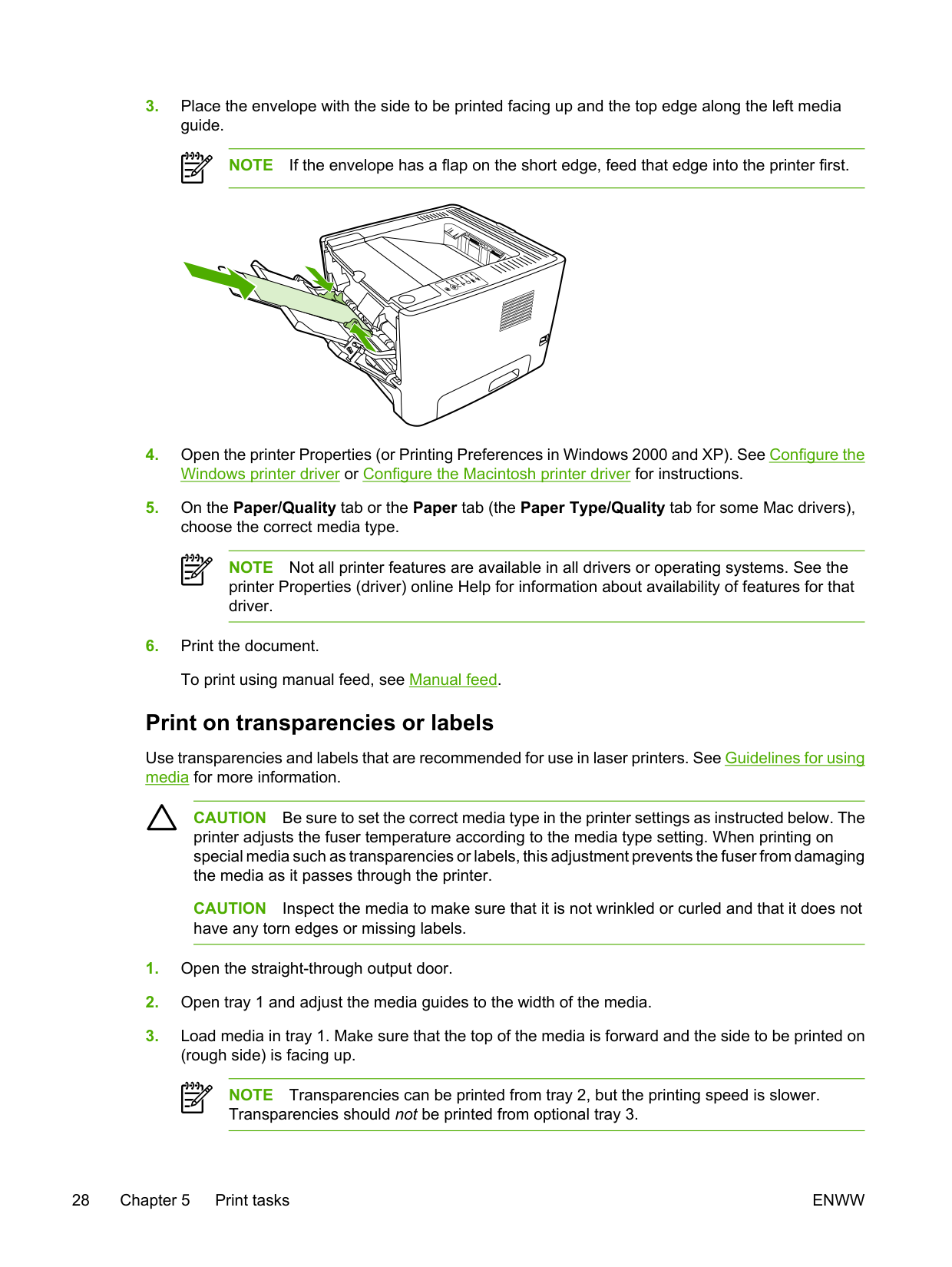
|---|
NOTE Not all printer features are available in all drivers or operating systems. See the printer Properties (driver) online Help for information about availability of features for that driver.
#### Print on transparencies or labels
Use transparencies and labels that are recommended for use in laser printers. See Guidelines for using media for more information.
CAUTION Be sure to set the correct media type in the printer settings as instructed below. The printer adjusts the fuser temperature according to the media type setting. When printing on special media such as transparencies or labels, this adjustment prevents the fuser from damaging the media as it passes through the printer.
CAUTION Inspect the media to make sure that it is not wrinkled or curled and that it does not have any torn edges or missing labels.
| |
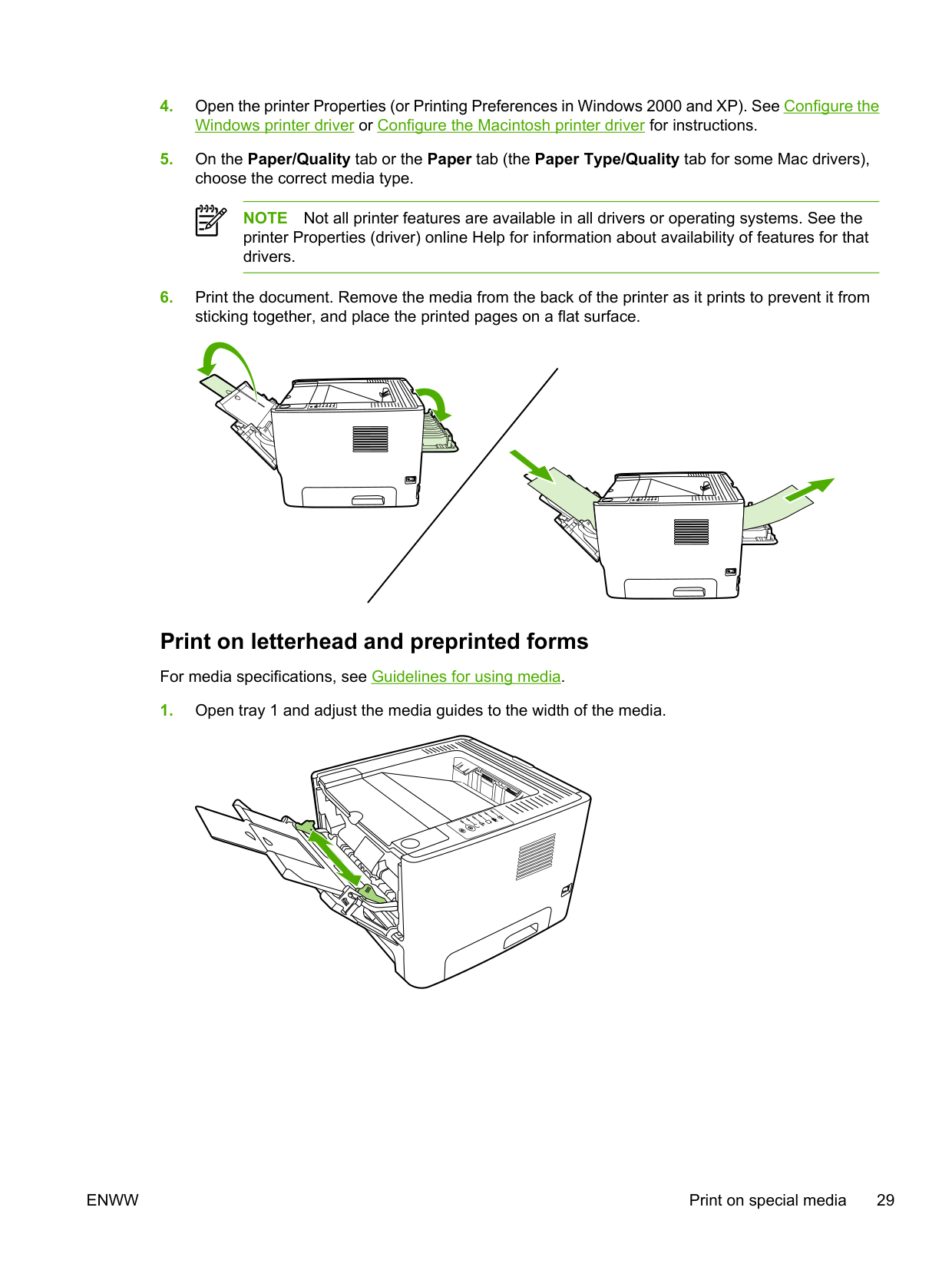
|---|
NOTE Transparencies can be printed from tray 2, but the printing speed is slower. Transparencies should not be printed from optional tray 3.
| | |---|
NOTE Not all printer features are available in all drivers or operating systems. See the printer Properties (driver) online Help for information about availability of features for that drivers.
#### Print on letterhead and preprinted forms
For media specifications, see Guidelines for using media.
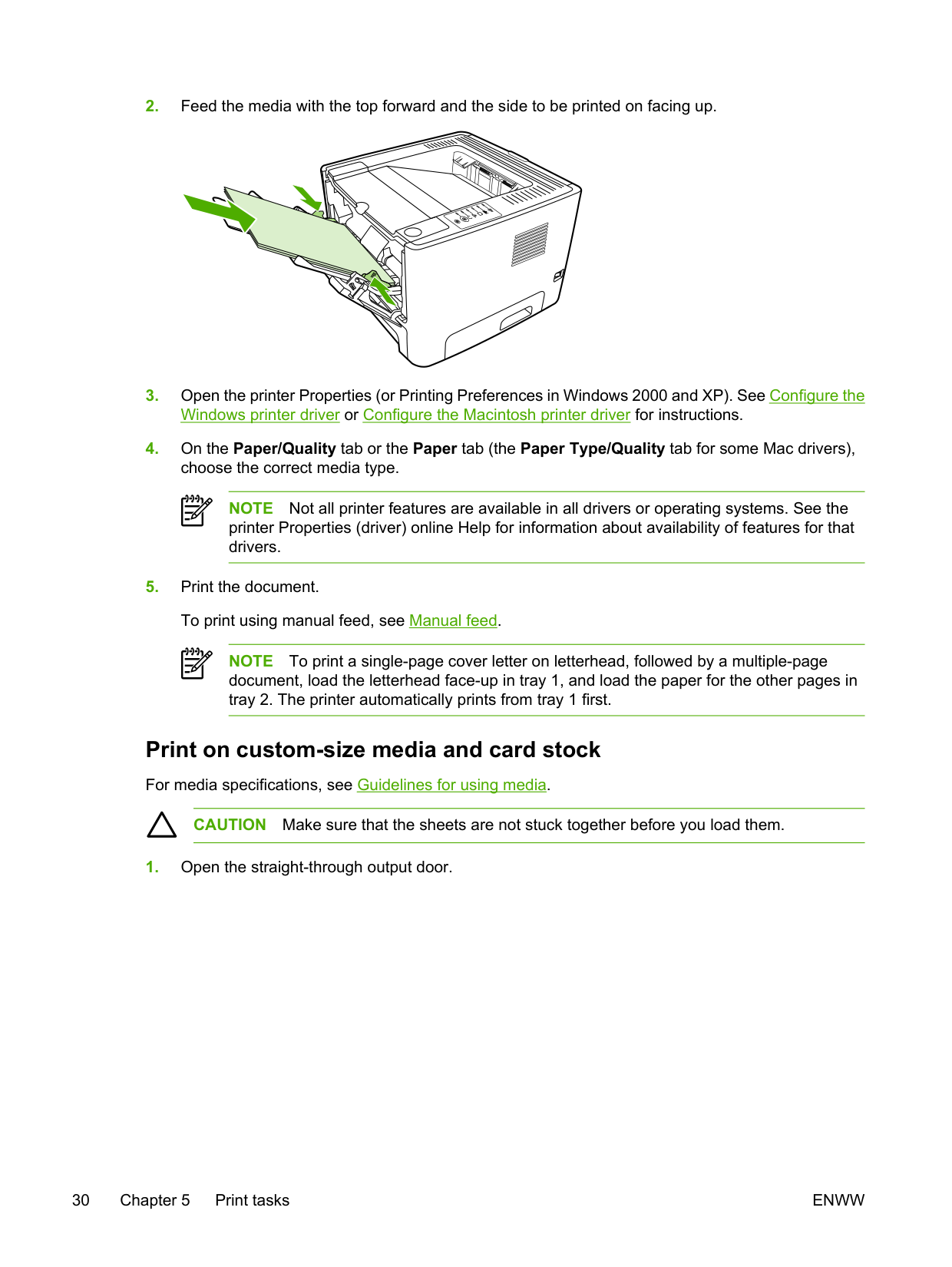
| | |---|
NOTE Not all printer features are available in all drivers or operating systems. See the printer Properties (driver) online Help for information about availability of features for that drivers.
| | |---|
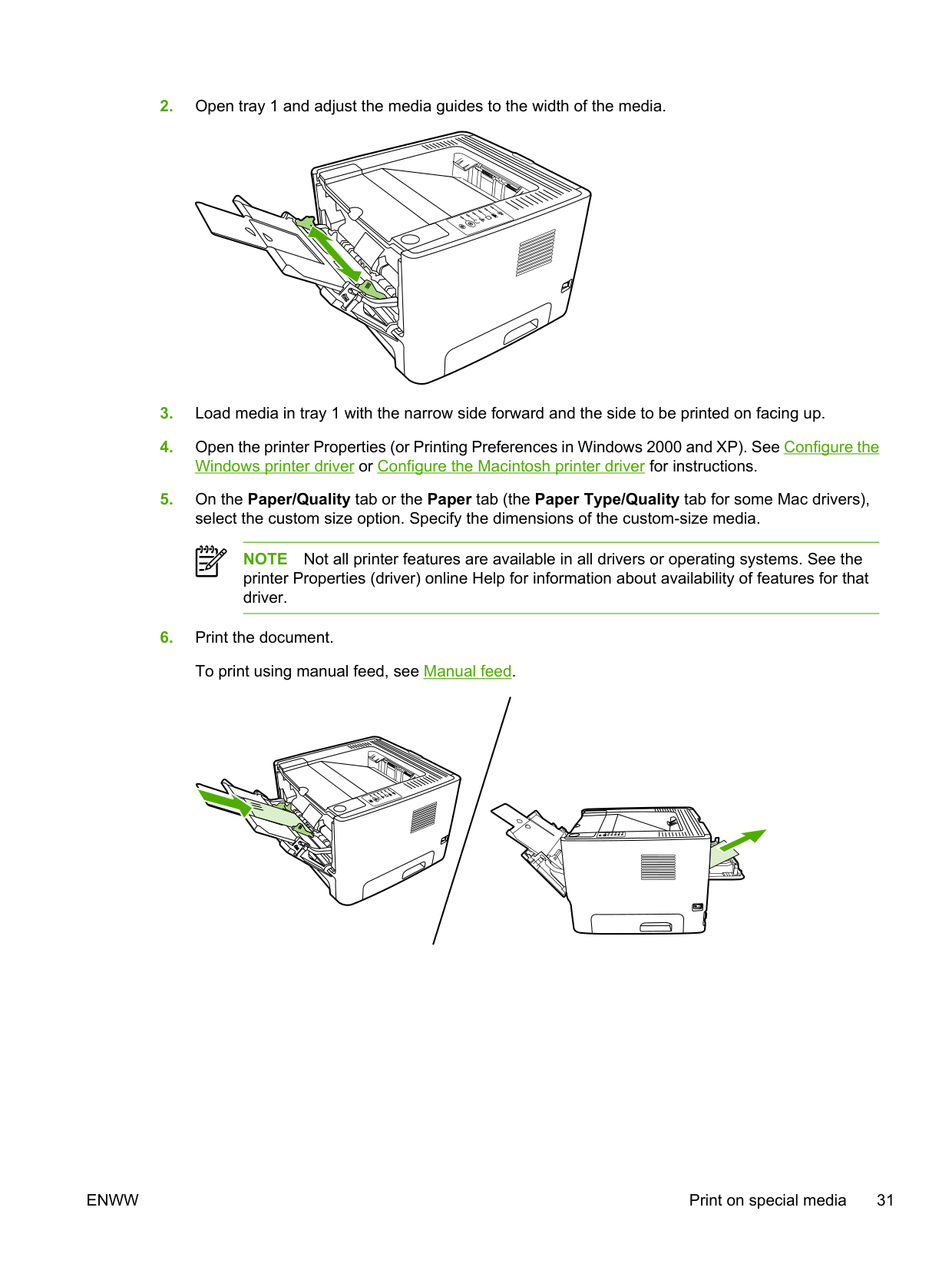
NOTE To print a single-page cover letter on letterhead, followed by a multiple-page document, load the letterhead face-up in tray 1, and load the paper for the other pages in tray 2. The printer automatically prints from tray 1 first.
#### Print on custom-size media and card stock
For media specifications, see Guidelines for using media.
CAUTION Make sure that the sheets are not stuck together before you load them.
| | |---|
NOTE Not all printer features are available in all drivers or operating systems. See the printer Properties (driver) online Help for information about availability of features for that driver.
Print on both sides of the page (duplex)
The section explains the manual and automatic methods of printing on both sides of the paper.
#### Manual two-sided printing
To manually print on both sides of the paper, you must run the paper through the printer twice. You can print using either these options:
| | |---|
NOTE Manual two-sided printing can cause the printer to become dirty, reducing print quality. See Clean the printer for instructions if the printer becomes dirty.
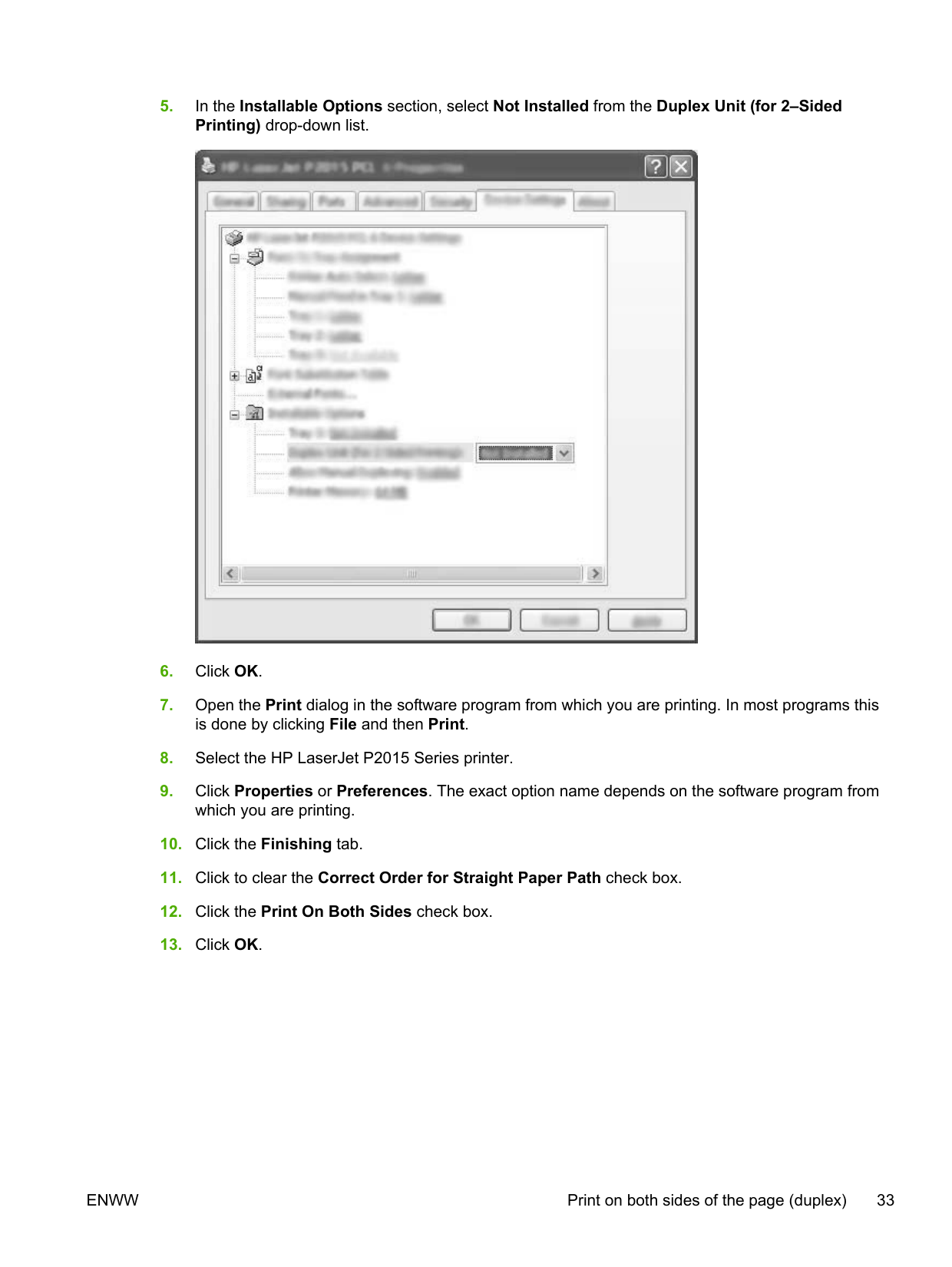
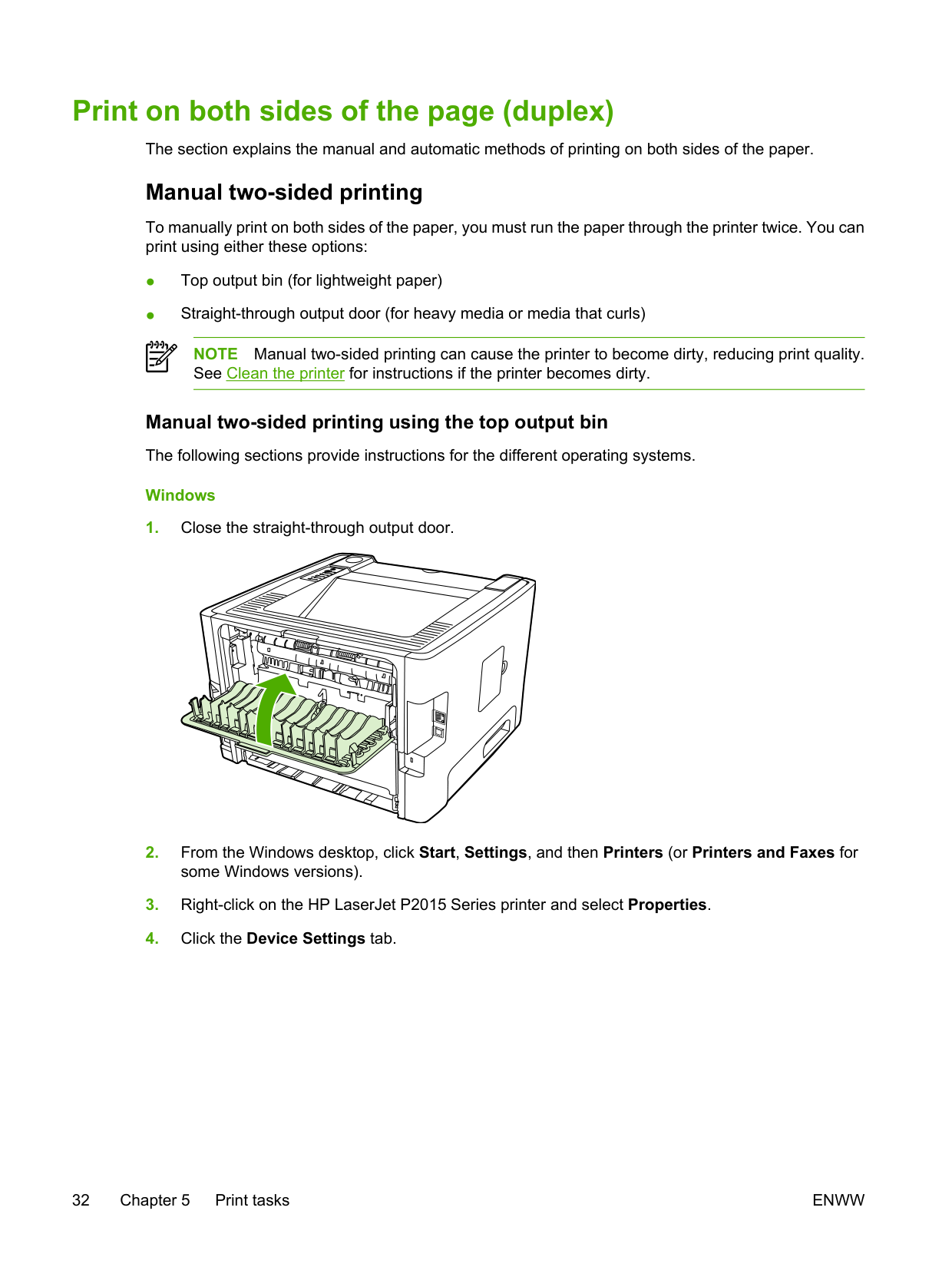
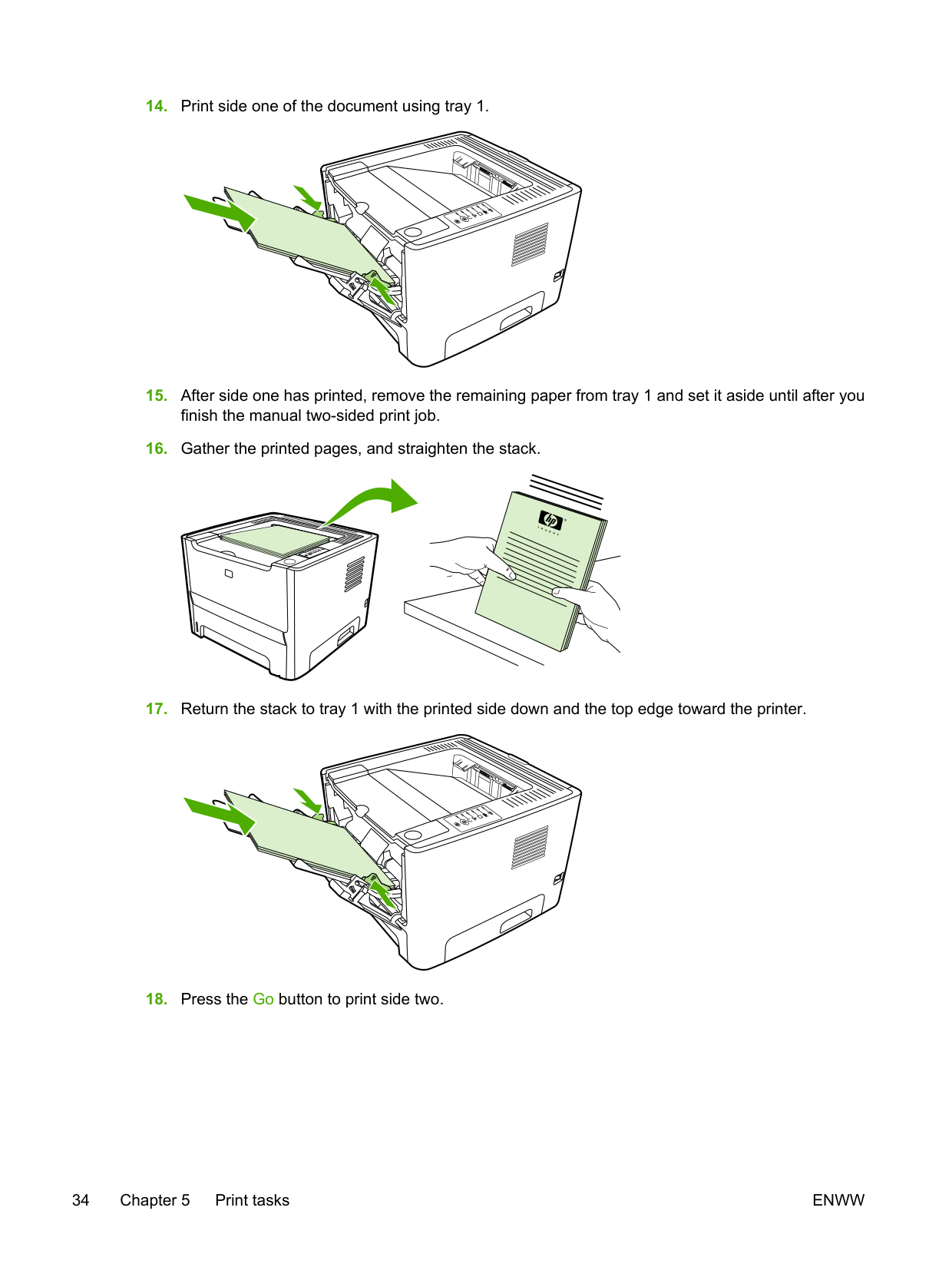
Manual two-sided printing using the top output bin The following sections provide instructions for the different operating systems. Windows

inv
e
n t
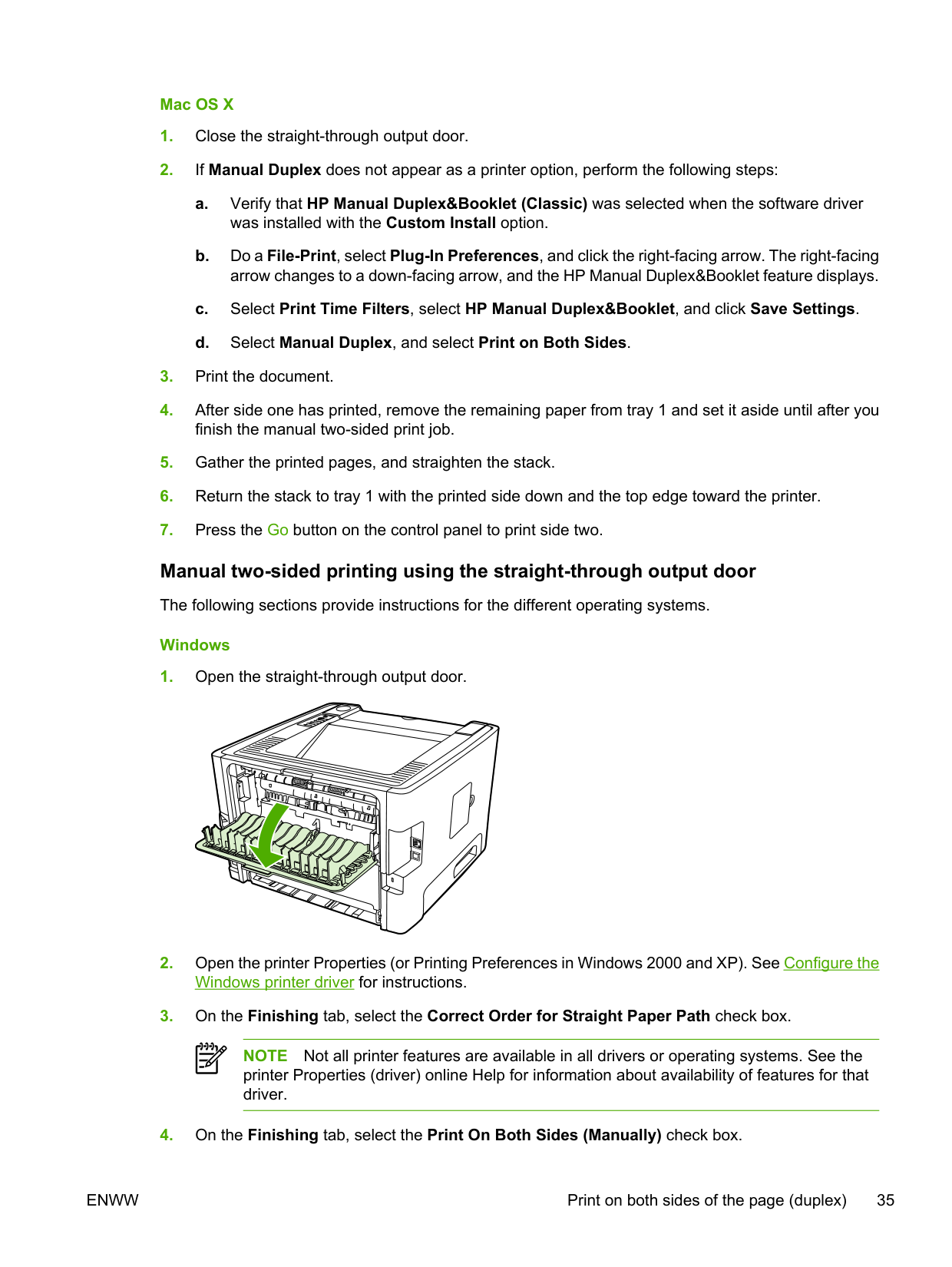
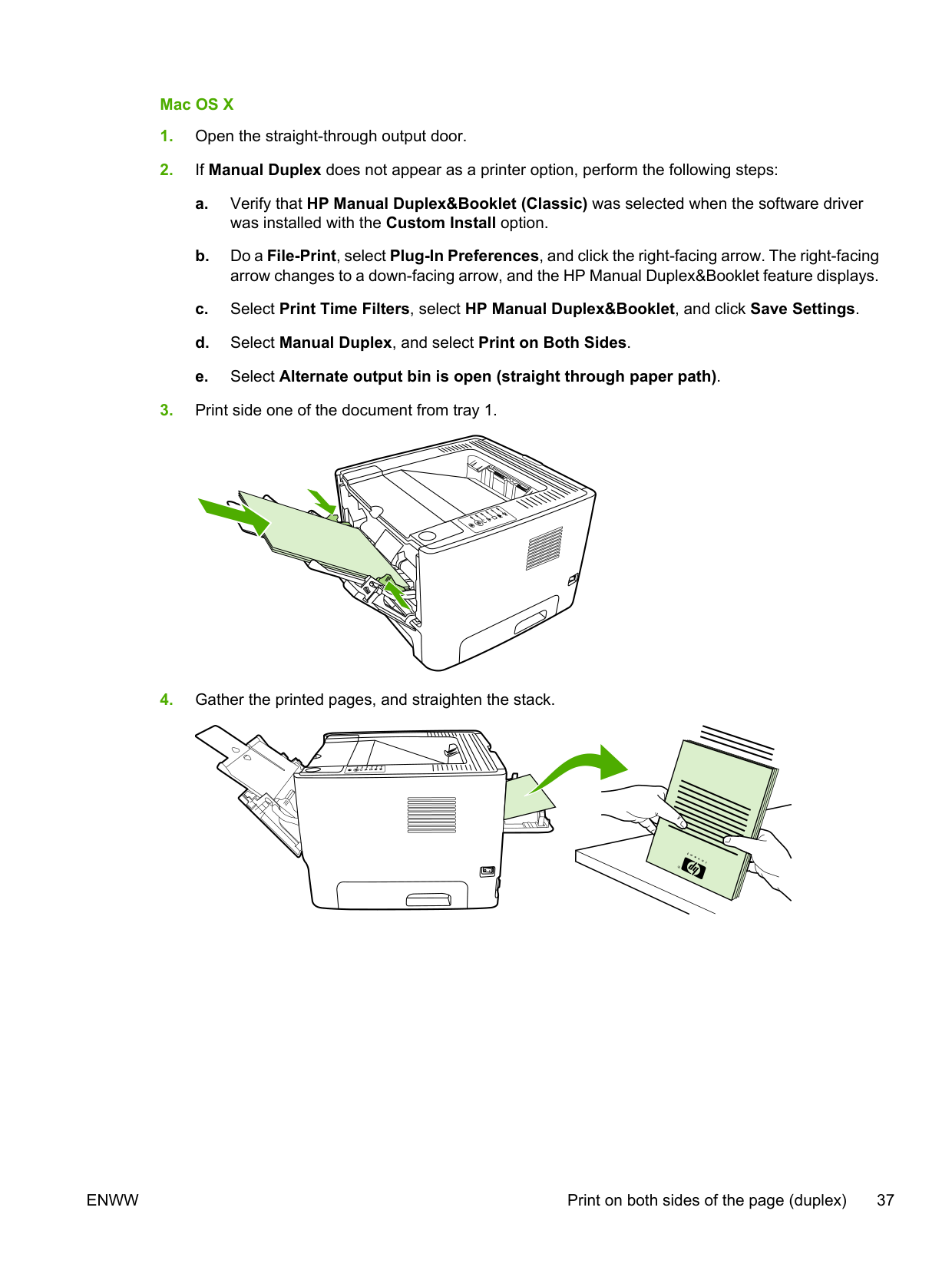
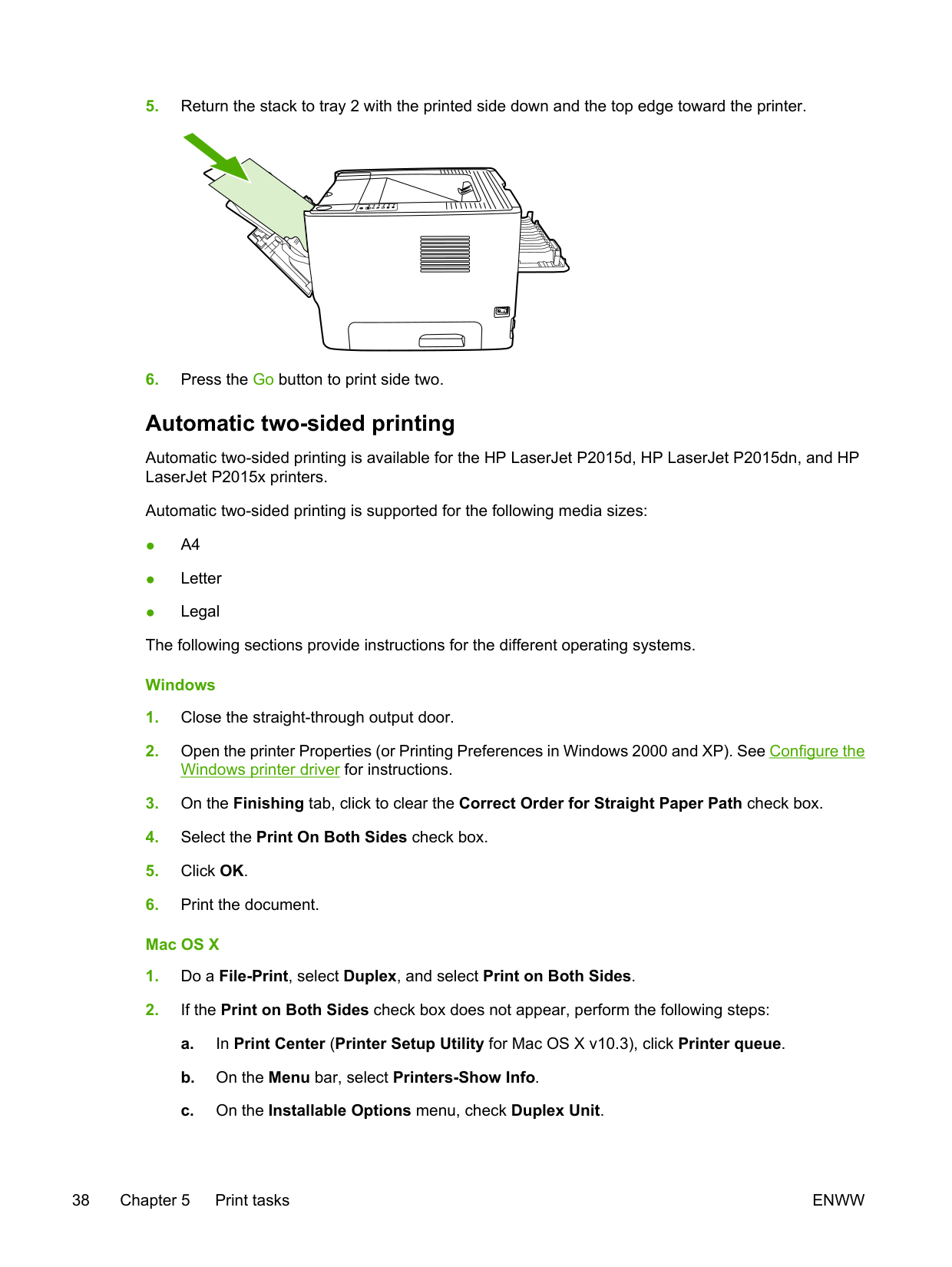
Manual two-sided printing using the straight-through output door The following sections provide instructions for the different operating systems. Windows
| | |---|
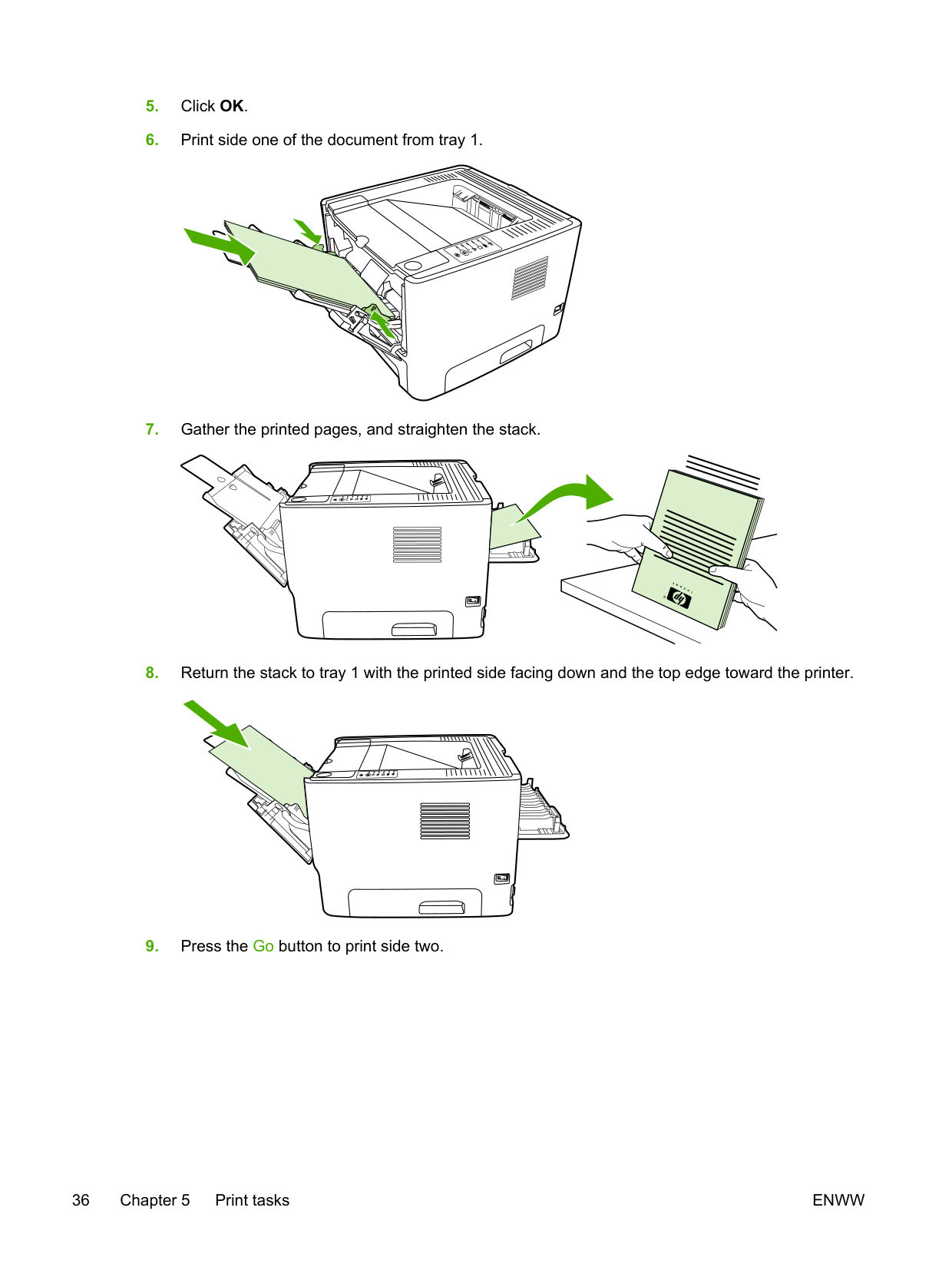
NOTE Not all printer features are available in all drivers or operating systems. See the printer Properties (driver) online Help for information about availability of features for that driver.
#### Automatic two-sided printing
Automatic two-sided printing is available for the HP LaserJet P2015d, HP LaserJet P2015dn, and HP LaserJet P2015x printers.
Automatic two-sided printing is supported for the following media sizes:
###### Windows
Mac OS X

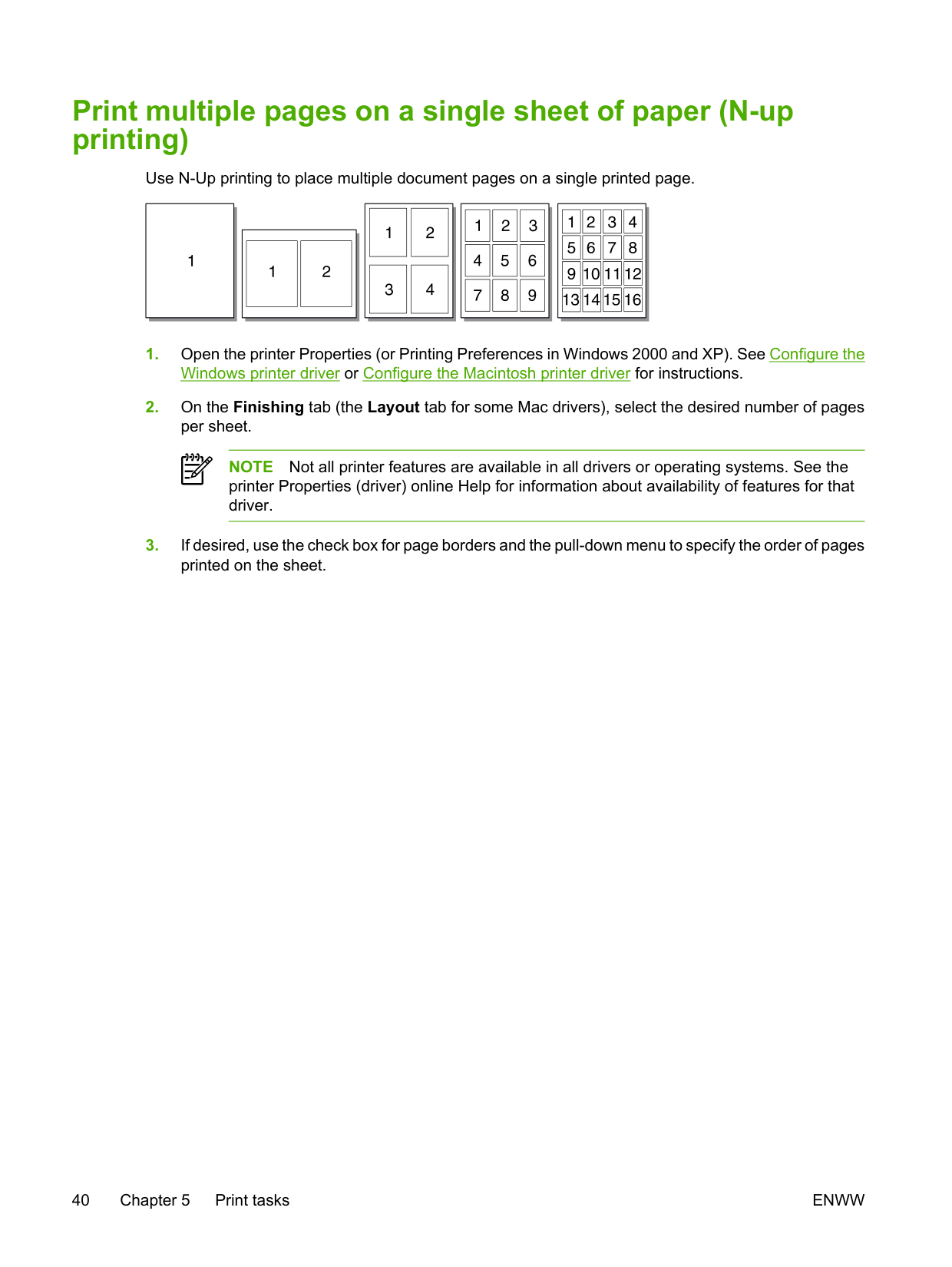
Print multiple pages on a single sheet of paper (N-up printing)
Use N-Up printing to place multiple document pages on a single printed page.
| | |---|
NOTE Not all printer features are available in all drivers or operating systems. See the printer Properties (driver) online Help for information about availability of features for that driver.
Print booklets
You can print booklets on letter, legal, or A4 paper.
| | |---|
NOTE This feature is not available for all Macintosh OS X versions .
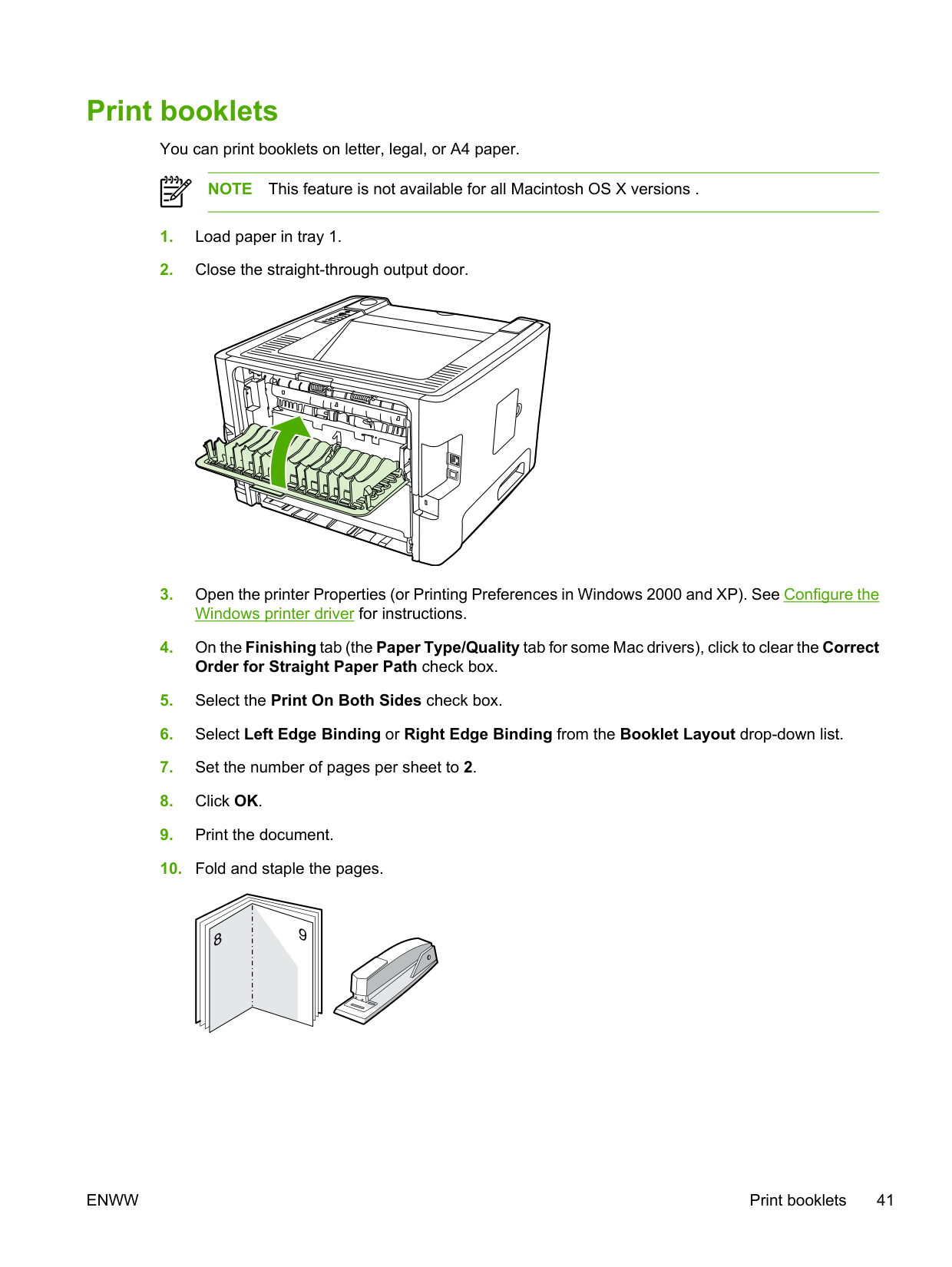
ENWW Print booklets 41
Print watermarks
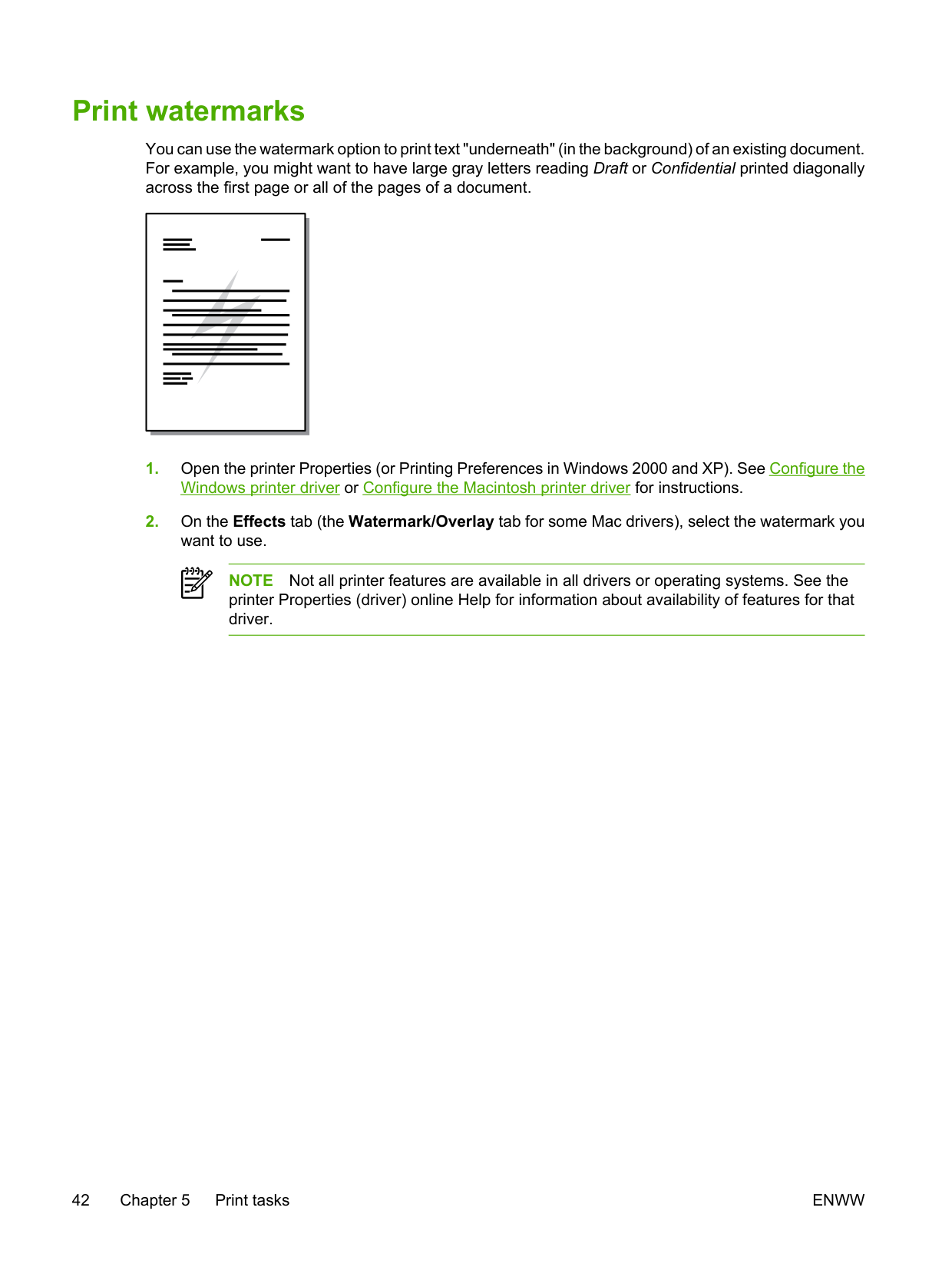
You can use the watermark option to print text "underneath" (in the background) of an existing document. For example, you might want to have large gray letters reading Draft or Confidential printed diagonally across the first page or all of the pages of a document.
| | |---|
| | |---|
NOTE Not all printer features are available in all drivers or operating systems. See the printer Properties (driver) online Help for information about availability of features for that driver.
Cancel a print job
You can cancel a print job from the following locations:
If the status lights on the control panel continue to blink after you cancel a print job, the computer is still sending the job to the printer. Either delete the job from the print queue or wait until the computer finishes sending data. The printer will return to the Ready state.
ENWW Cancel a print job 43
6 Managing and maintenance
This chapter provides information on the following topics:
ENWW 45

Printer information pages
You can print the following information pages.
#### Demo page
The Demo page contains examples of text and graphics. To print the Demo page, press the Go button when the printer Ready light is on and no other jobs are printing.
#### Configuration page
The Configuration page lists current settings and properties of the printer. It also contains a status log report. You can print a Configuration page from the following locations:
| | |---|
NOTE You can also get the information contained in the Event log and the Configuration page through the HP ToolboxFX without printing the pages. See HP ToolboxFX for more information.
#### Supplies Status page
The Supplies Status page automatically prints when you print a Configuration page from the control panel. The Supplies Status page provides the following information:
#### Network Configuration page
| | |---|
NOTE The Network Configuration page is only available on printers with an HP internal network port.
The Network Configuration page automatically prints when you print a Configuration page from the control panel. The Network Configuration page provides the following information about the printer network configuration:
HP ToolboxFX
HP ToolboxFX is software that you can use to complete the following tasks:
You can view HP ToolboxFX when the printer is directly connected to your computer or when it is connected to the network. You must perform a typical software installation to install HP ToolboxFX.
| | |---|
NOTE HP ToolboxFX is not supported for Windows 98 SE, Windows Me, Windows Server 2003, or Macintosh operating systems.
NOTE You do not need Internet access to open and use HP ToolboxFX.
#### To view HP ToolboxFX
Open HP ToolboxFX in one of these ways:
#### Status
The HP ToolboxFX Status folder contains links to the following main pages:
#### Alerts
The HP ToolboxFX Alerts folder contains links to the following main pages:
##### such as low toner levels. Set up status alerts
HP ToolboxFX can open pop-up alerts on your computer when certain events occur. Events that trigger alerts include jams, low levels of toner in HP print cartridges, non-HP print cartridge in use, empty input trays, and error messages.
Alerts only appear when the printer is printing from the computer on which you set up the alerts.
| | |---|
NOTE You must click Apply to save your changes.
##### Set up e-mail alerts
Use HP ToolboxFX to configure up to two e-mail addresses to receive alerts when certain events occur. You can specify different events for each e-mail address. Enter the information for the e-mail server that will send out the e-mail alert messages for the printer.
| | |---|
NOTE You must click Apply to save your changes.
#### Help
The HP ToolboxFX Help folder contains links to the following main pages:
#### Device settings
The HP ToolboxFX Device Settings folder contains links to the following main pages:
Device information The information that you type in these fields appears on the Configuration page. See Configuration page.
| | |---|
NOTE You must click Apply to save your changes.
Paper handling Use the HP ToolboxFX paper-handling options to configure your default settings. Three options are available for handling print jobs when the product is out of media:
The Paper out time field specifies how long the printer waits before acting on your selections. You can specify from 0 to 3600 seconds.
| | |---|
NOTE You must click Apply to save your changes.
Print quality Use the HP ToolboxFX print-quality options to improve the appearance of your print jobs.
| | |---|
NOTE You must click Apply to save your changes.
##### Paper types
Use these HP ToolboxFX Paper types options to configure print modes that correspond to the various media types. When you select RESTORE MODES, all of the modes are reset to the factory settings.
| | |---|
NOTE You must click Apply to save your changes.
System setup Use the HP ToolboxFX system settings options to configure miscellaneous print settings.
| | |---|
NOTE You must click Apply to save your changes.
##### Service
During the printing process, paper, toner, and dust particles can accumulate inside the printer. Over time, this buildup can cause print-quality problems such as toner specks or smearing. HP ToolboxFX provides an easy method for cleaning the paper path. For more information, see Clean the printer media path.
#### Print settings
The HP ToolboxFX Print Settings tab contains links to the following main pages:
Printing Use the HP ToolboxFX printing settings options to configure the settings for all print functions.
| | |---|
NOTE You must click Apply to save your changes.
##### PCL 5e
| | |---|
NOTE You must click Apply to save your changes.
PCL 6
| | |---|
NOTE You must click Apply to save your changes.
##### PostScript
Use the PostScript option when you are using the HP postscript level 3 emulation print personality. When the Print PostScript Errors option is turned on, the HP postscript level 3 emulation error page automatically prints when HP postscript level 3 emulation errors occur.
| | |---|
NOTE You must click Apply to save your changes.
#### Network settings
The network administrator can use the HP ToolboxFX Network Settings folder to control the networkrelated settings for the printer when it is connected to a TCP/IP-based network.

The following options are available:
Embedded Web server
The embedded Web server allows you to view printer and network status and to manage printing functions from your computer instead of from the printer control panel. Below are examples of what you can do using the embedded Web server:
The embedded Web server provides the same functions as the Advanced Printer Settings section of the HP ToolboxFX. The main differences between using the embedded Web server and using the HP ToolboxFX are the following:
The embedded Web server works when the printer is connected to an TCP/IP-based network. The embedded Web server does not support IPX-based printer connections.
| | |---|
NOTE You do not have to have Internet access to open and use the embedded Web server. However, if you click a link on any of the pages, you must have Internet access in order to go to the site associated with the link.
#### Open the embedded Web server
To open the embedded Web server, type the IP address or hostname of the printer in the address field of a supported Web browser. To find the IP address, print a Configuration page at the printer by pressing and holding the Go button for 5 seconds.
Hint After you open the URL, bookmark it so that you can return to it quickly in the future.
The embedded Web server has three tabs that contain settings and information about the printer: the Status tab, the Settings tab, and the Networking tab.
#### Status tab
The Status pages group consists of the following pages.
Settings tab
This tab allows you to configure the printer from your computer. If this printer is networked, always consult with the printer administrator before changing settings on this tab.
The Settings tab contains the following pages:
#### Networking tab
This tab allows the network administrator to control network-related settings for the printer when it is connected to an IP-based network.
ENWW Embedded Web server 55
#### Links
Links are located in the upper-right part of the Status pages. You must have Internet access in order to use any of these links. If you use a dial-up connection and did not connect when you first opened the embedded Web server, you must connect before you can visit these Web sites. Connecting might require that you close the embedded Web server and reopen it.
Replace the print cartridge
CAUTION To prevent damage, do not expose the print cartridge to light. Cover it with a piece of paper.
ENWW Replace the print cartridge 57
CAUTION If toner gets on your clothing, wipe it off with a dry cloth and wash the clothing in cold water. Hot water sets toner into the fabric.
Redistribute toner
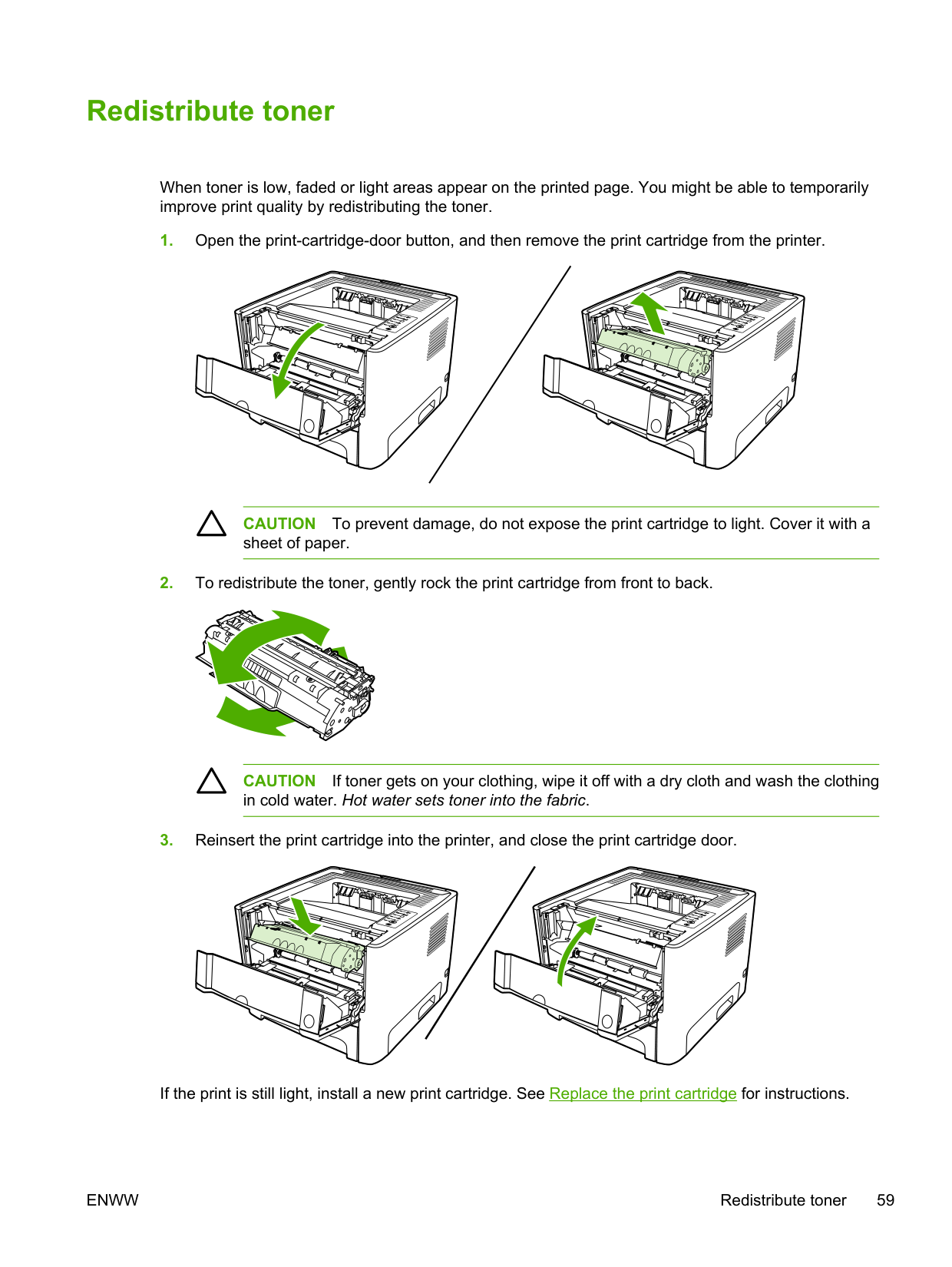
When toner is low, faded or light areas appear on the printed page. You might be able to temporarily improve print quality by redistributing the toner.
CAUTION To prevent damage, do not expose the print cartridge to light. Cover it with a sheet of paper.
CAUTION If toner gets on your clothing, wipe it off with a dry cloth and wash the clothing in cold water. Hot water sets toner into the fabric.
If the print is still light, install a new print cartridge. See Replace the print cartridge for instructions.
ENWW Redistribute toner 59
Clean the printer
Clean the outside of the printer with a clean, damp cloth when necessary.
CAUTION Do not use ammonia-based cleaners on or around the printer.
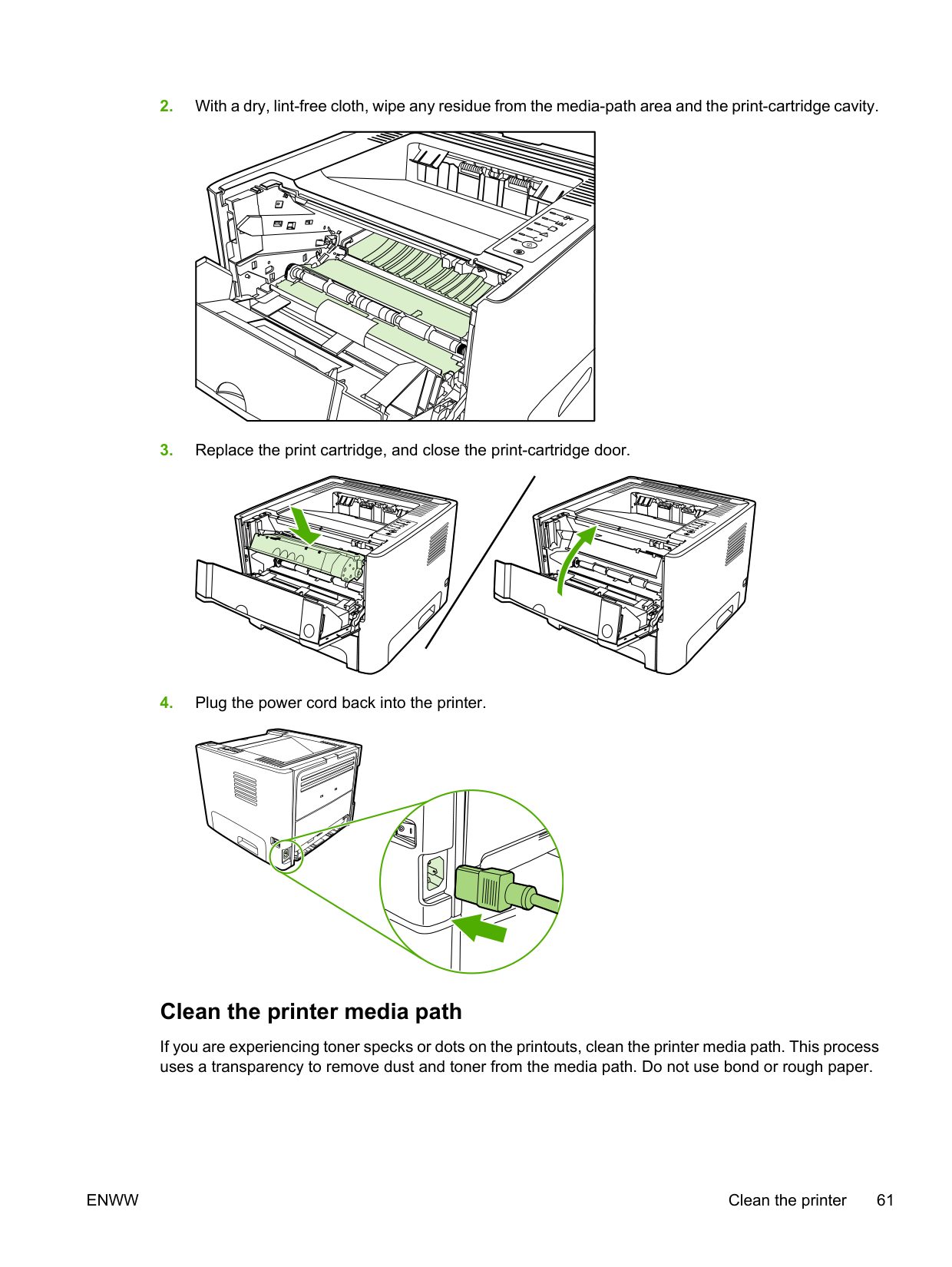
During the printing process, paper, toner, and dust particles can accumulate inside the printer. Over time, this buildup can cause print quality problems, such as toner specks or smearing, and paper jams. To correct and prevent these types of problems, you can clean the print cartridge area and the printer media path.
#### Clean the print-cartridge area
You do not need to clean the print-cartridge area often. However, cleaning this area can improve the quality of your printed sheets.
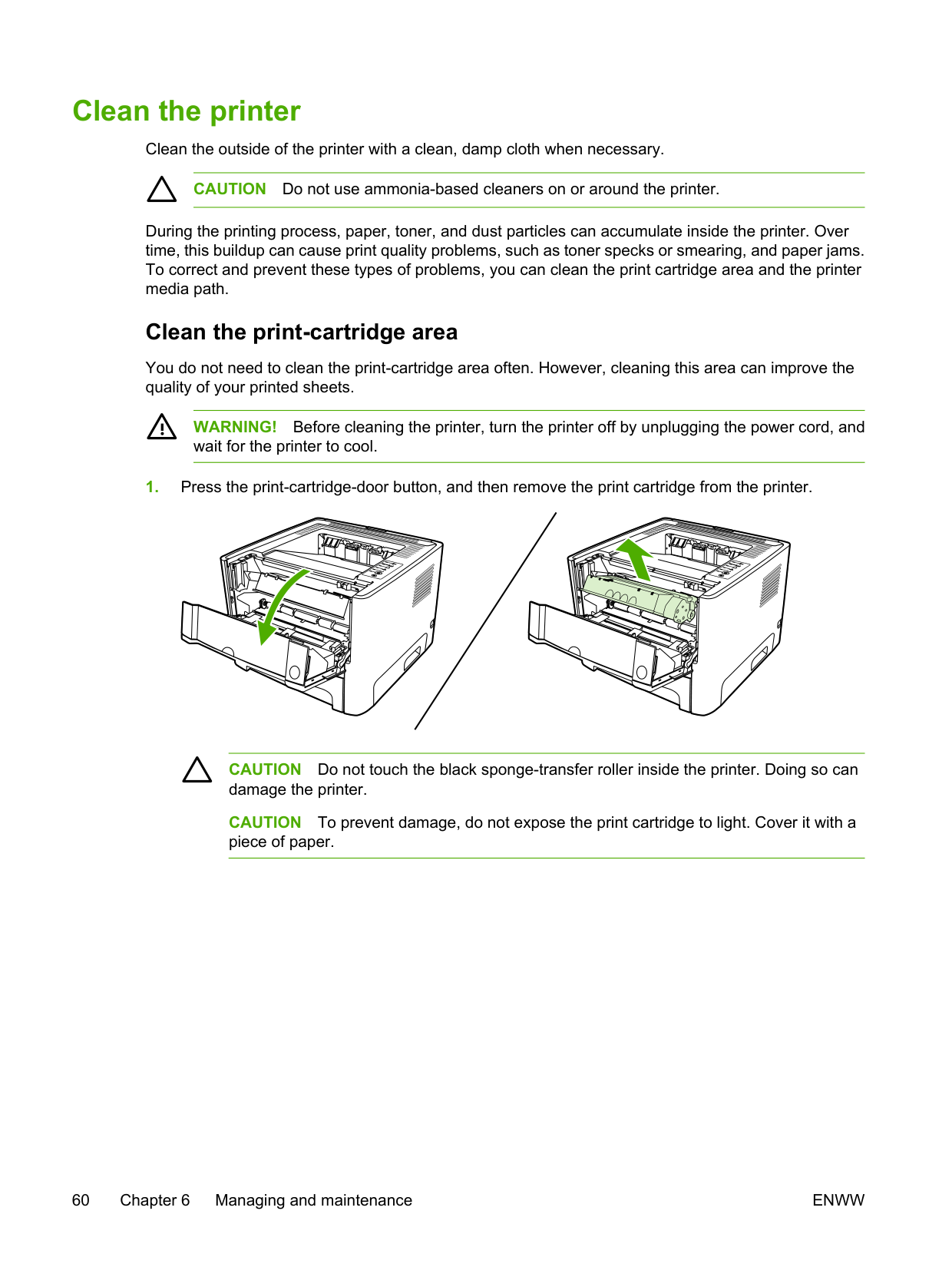
WARNING! Before cleaning the printer, turn the printer off by unplugging the power cord, and wait for the printer to cool.
CAUTION Do not touch the black sponge-transfer roller inside the printer. Doing so can damage the printer.
CAUTION To prevent damage, do not expose the print cartridge to light. Cover it with a piece of paper.
#### Clean the printer media path
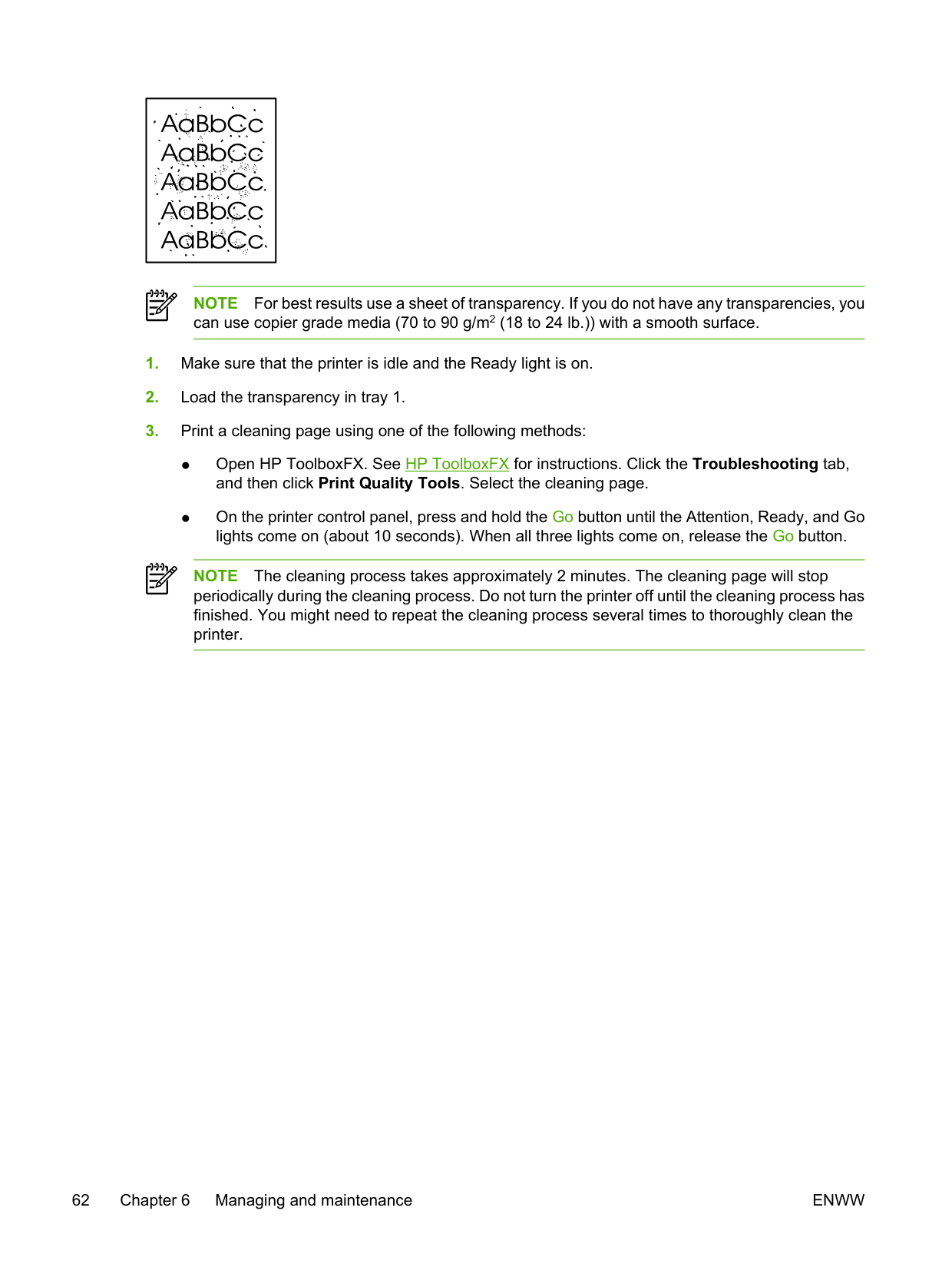
If you are experiencing toner specks or dots on the printouts, clean the printer media path. This process uses a transparency to remove dust and toner from the media path. Do not use bond or rough paper.
ENWW Clean the printer 61
| | |---|
| | |---|
NOTE For best results use a sheet of transparency. If you do not have any transparencies, you can use copier grade media (70 to 90 g/m2 (18 to 24 lb.)) with a smooth surface.
| | |---|
NOTE The cleaning process takes approximately 2 minutes. The cleaning page will stop periodically during the cleaning process. Do not turn the printer off until the cleaning process has finished. You might need to repeat the cleaning process several times to thoroughly clean the printer.
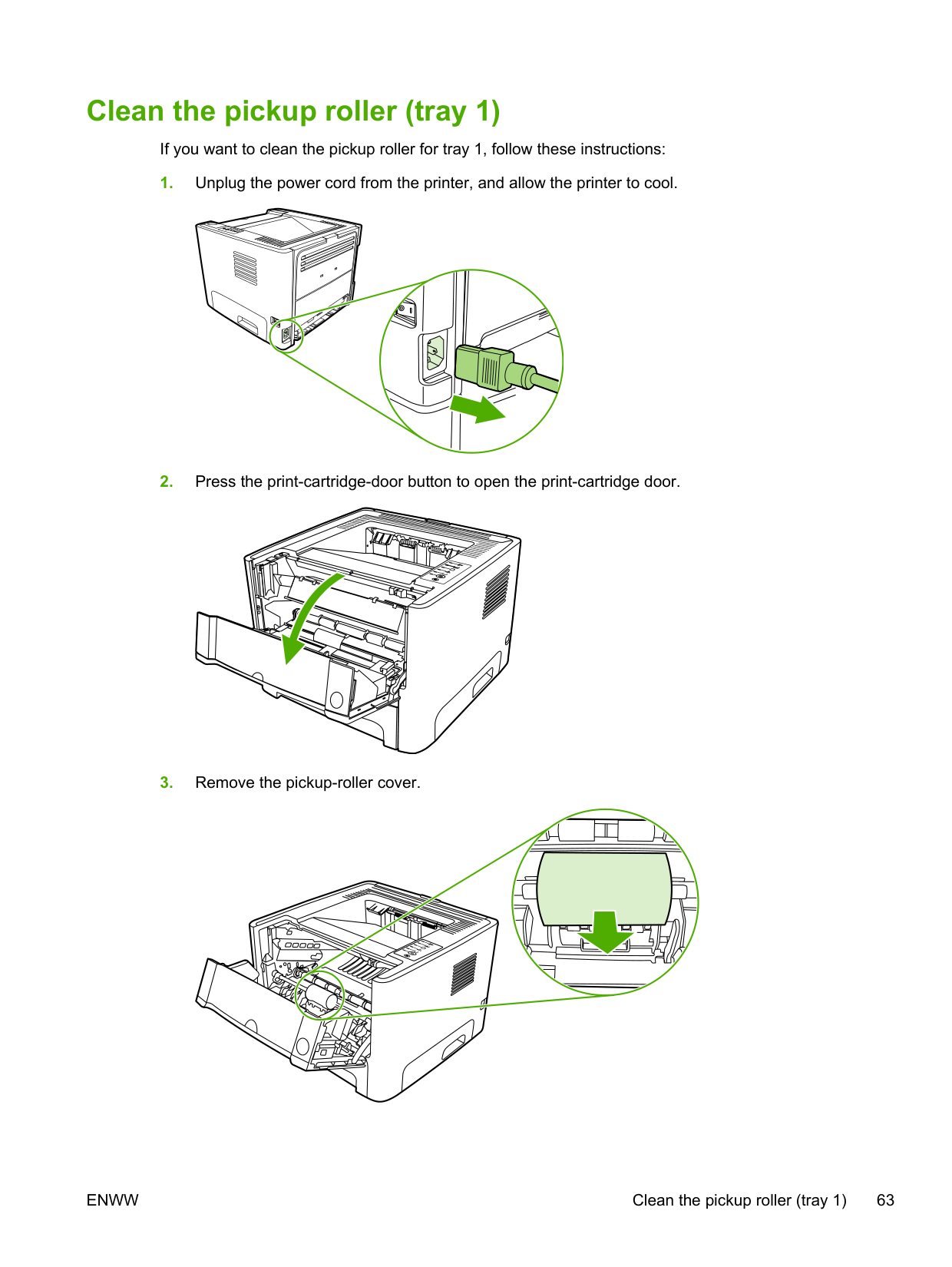
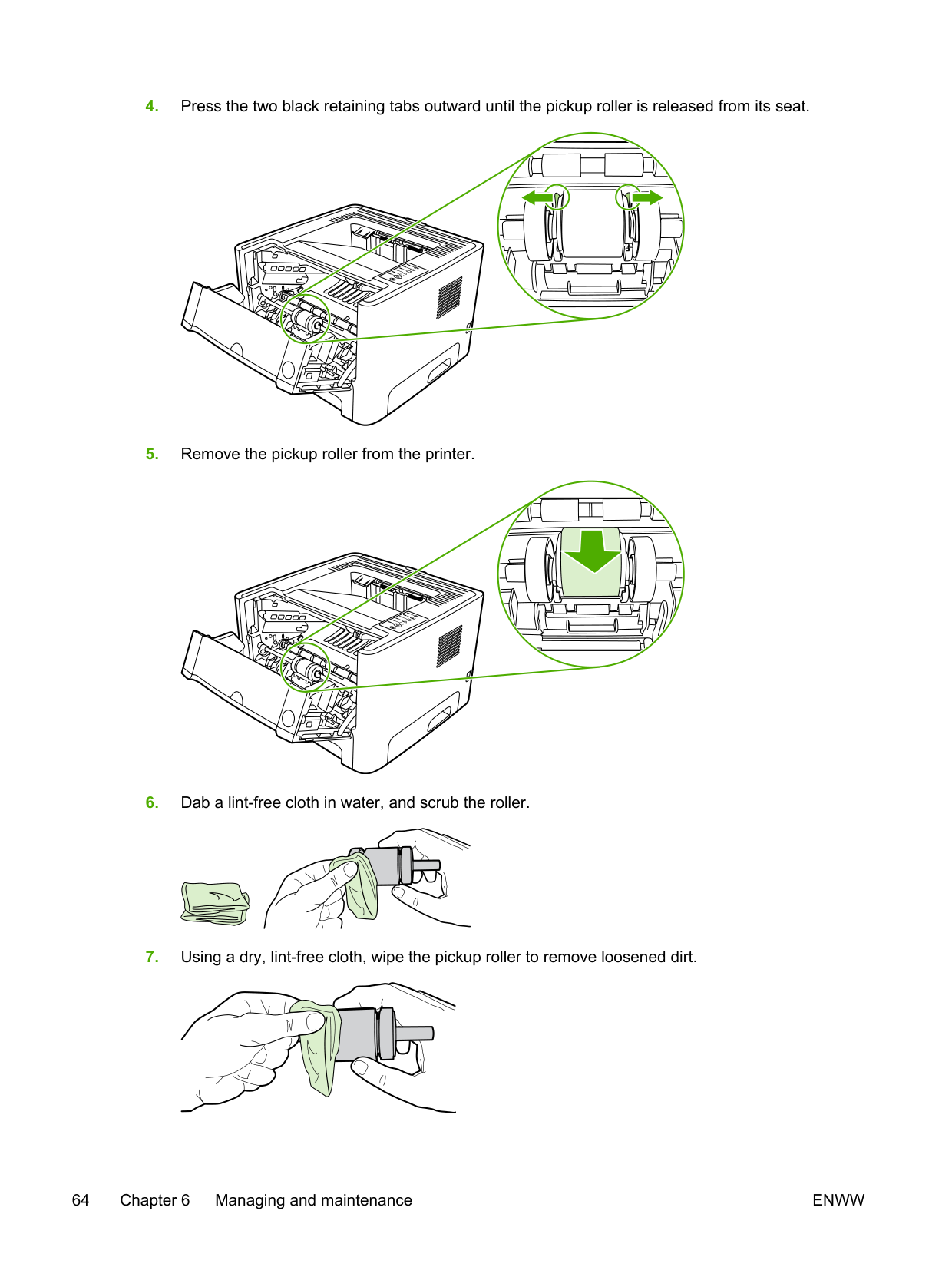
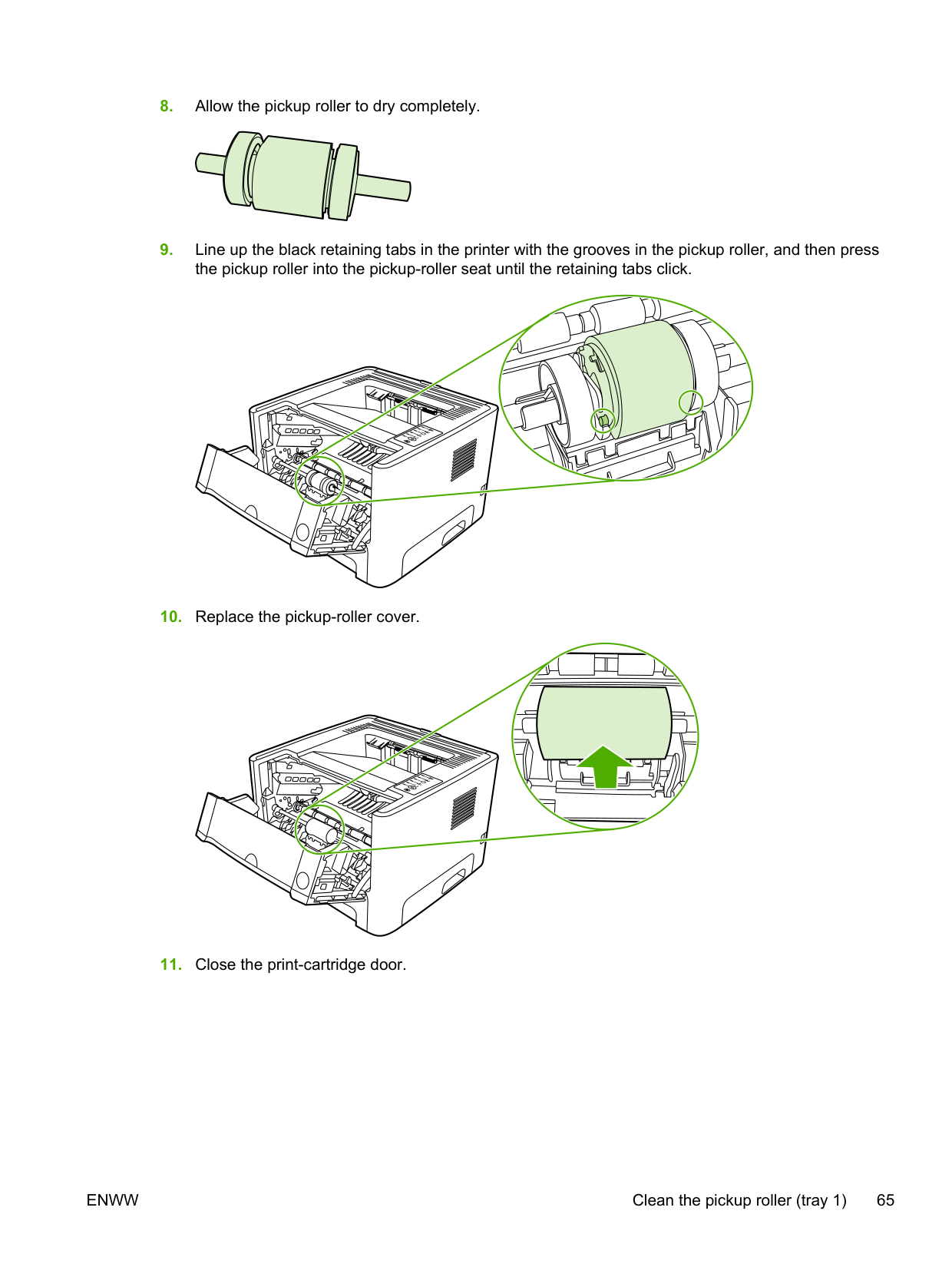
Clean the pickup roller (tray 1)
If you want to clean the pickup roller for tray 1, follow these instructions:
Clean the pickup roller (tray 2)
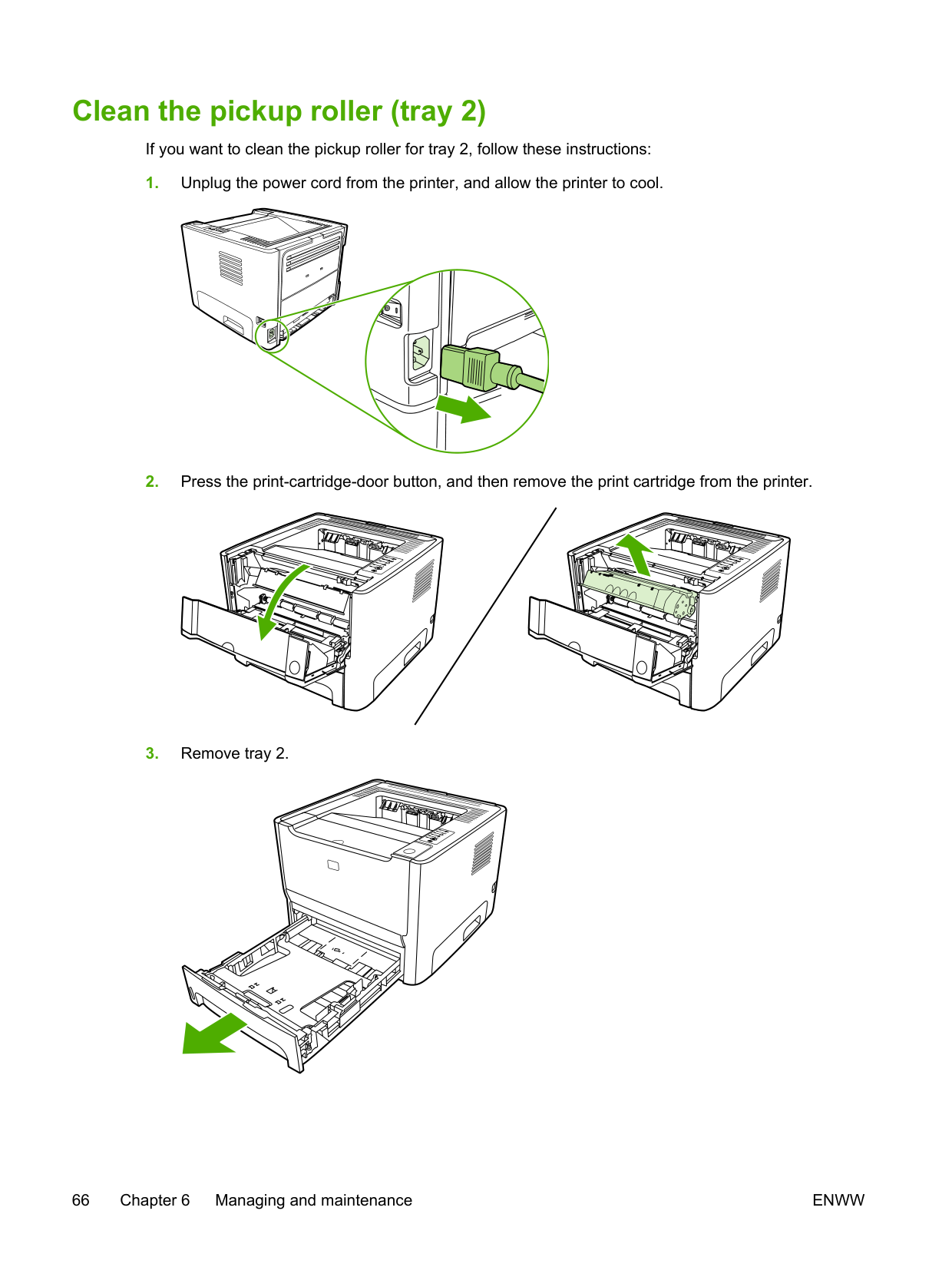
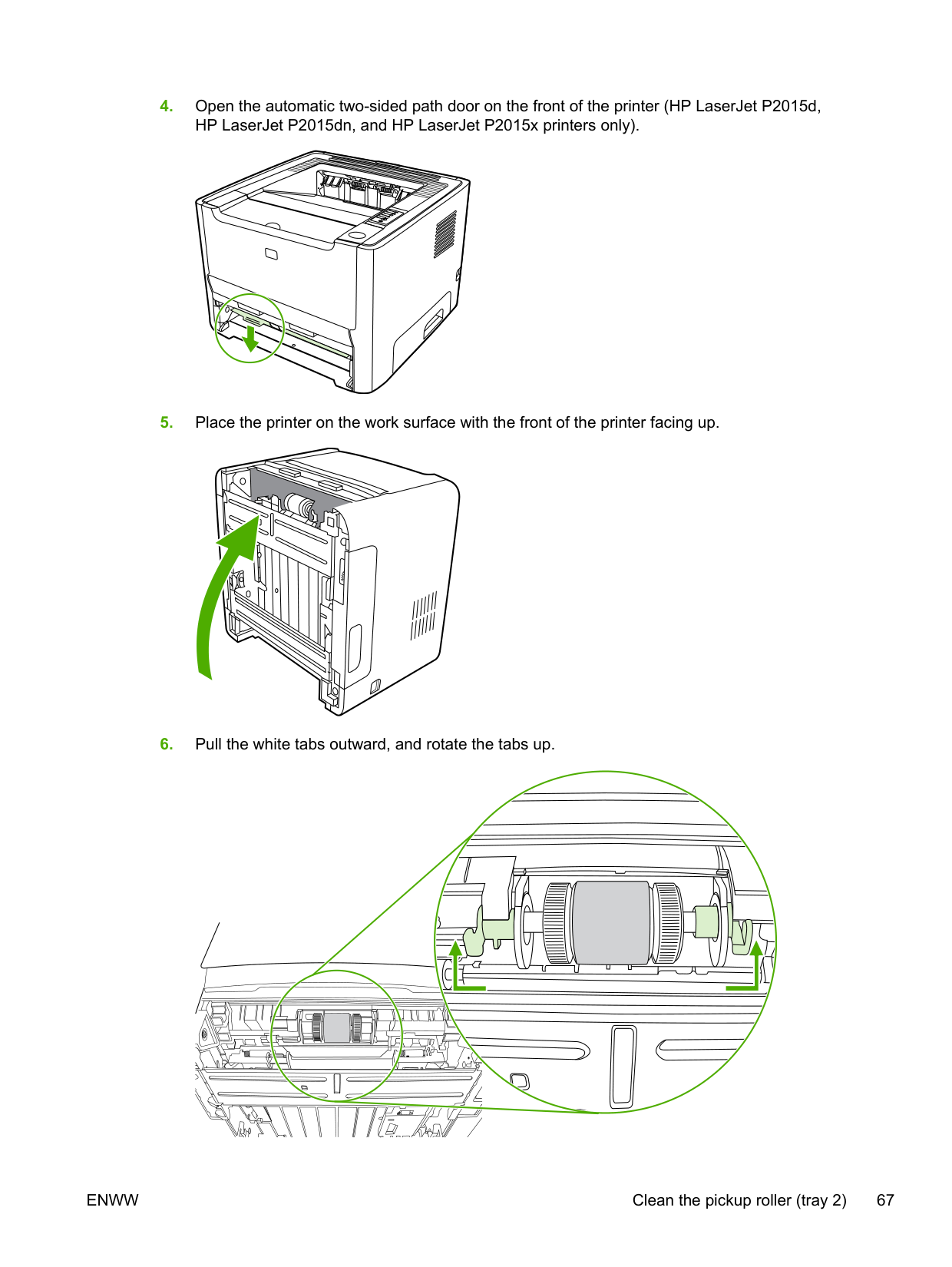
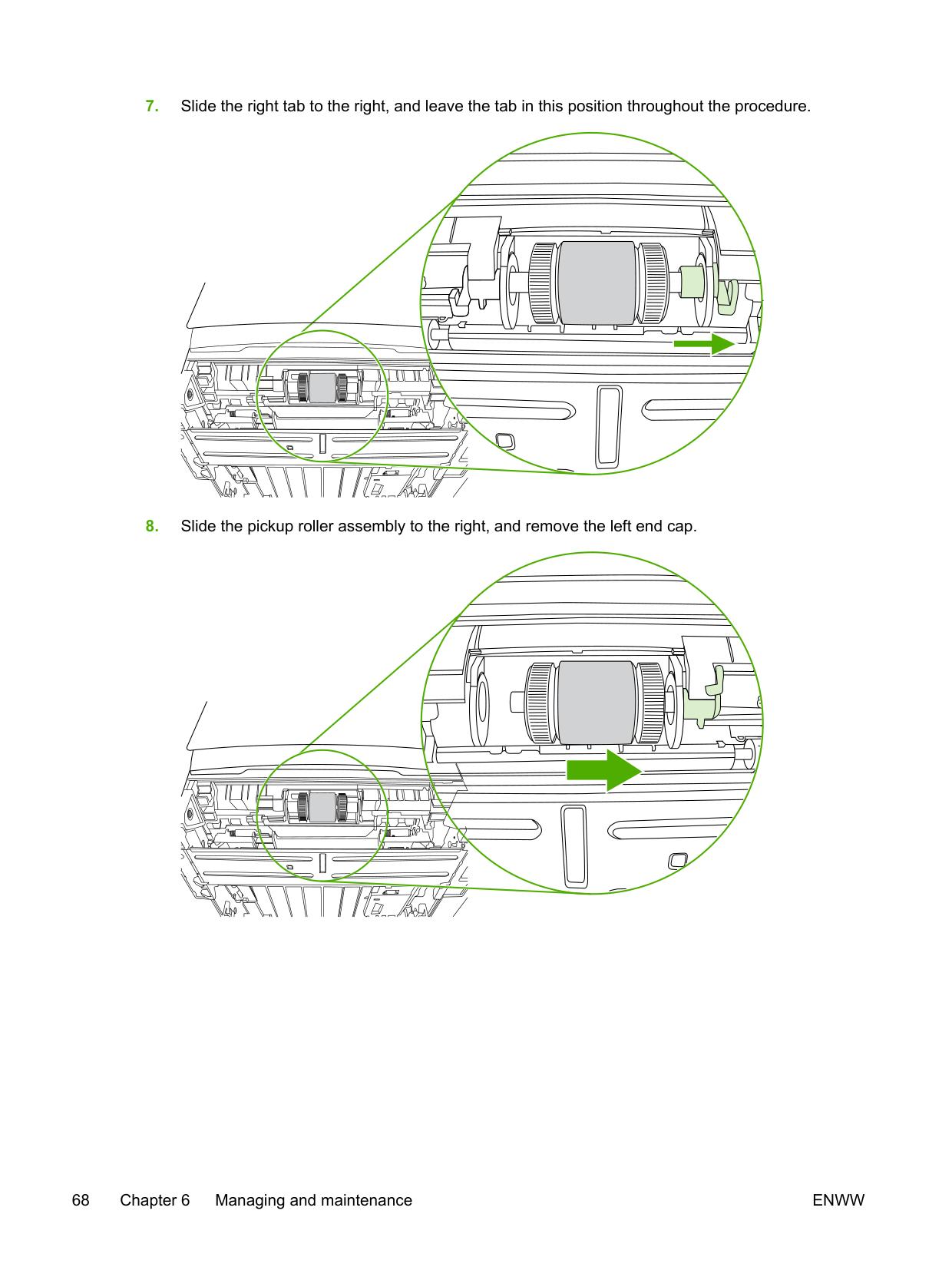
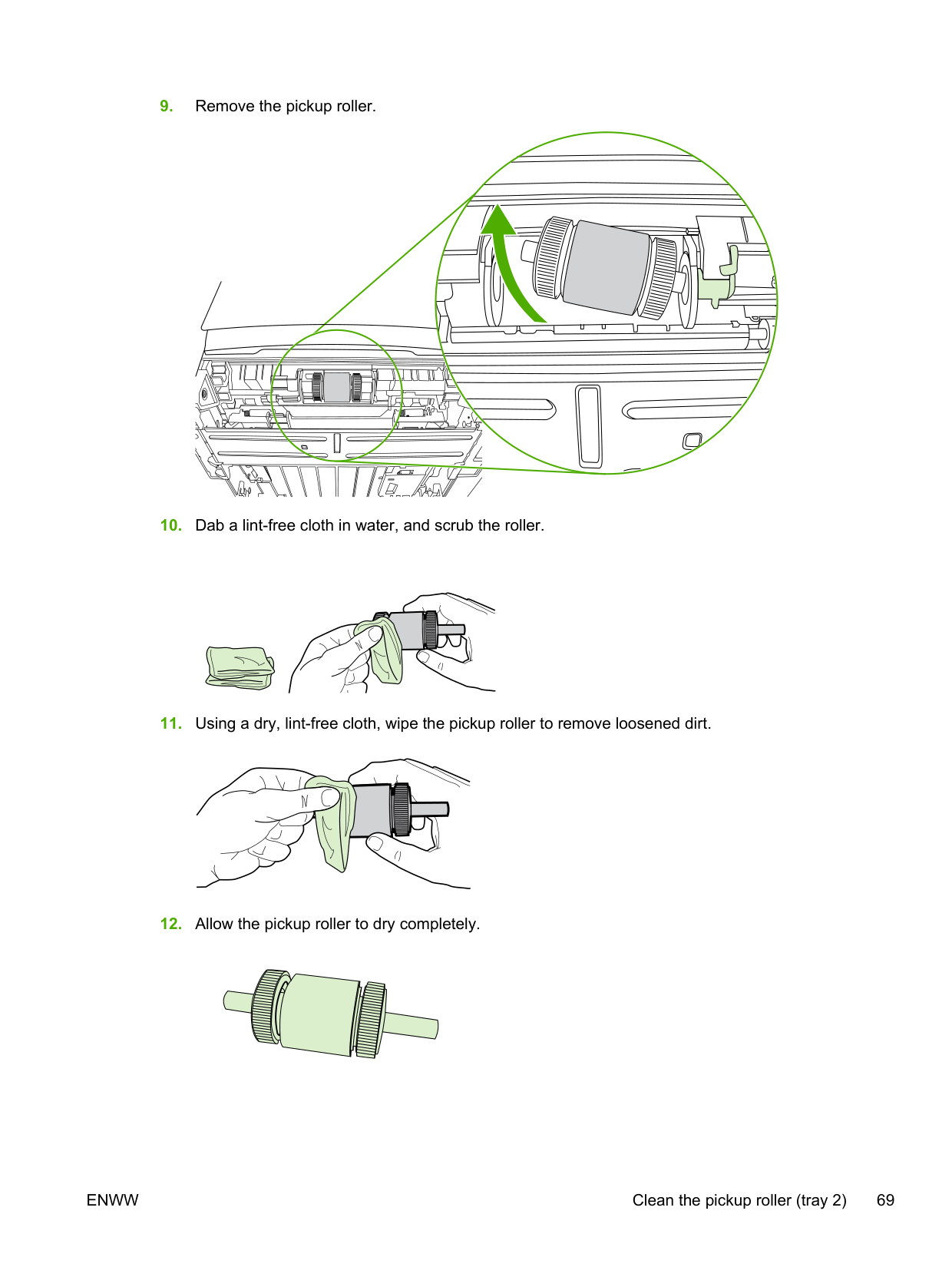
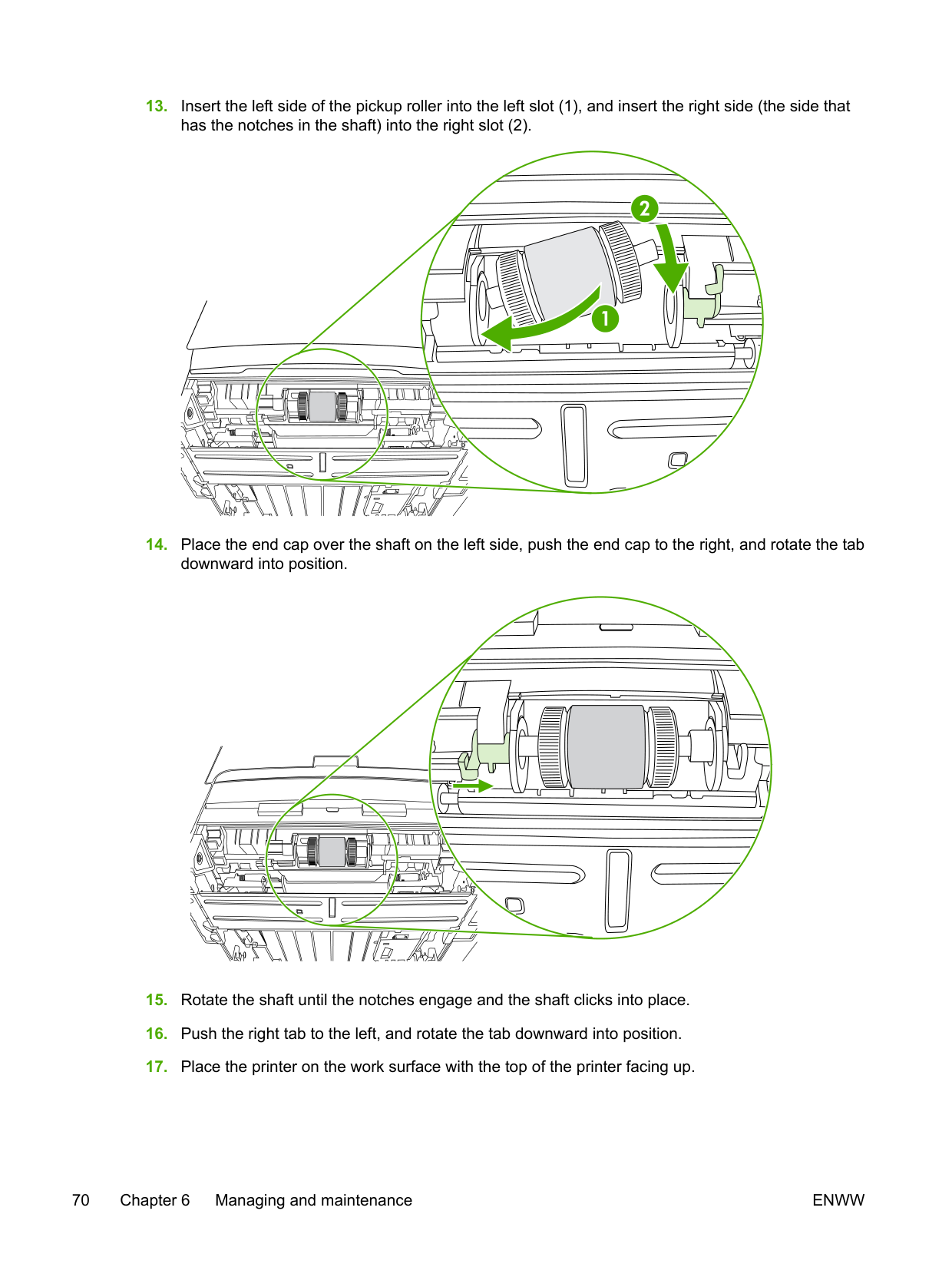
If you want to clean the pickup roller for tray 2, follow these instructions:
| | | | |---|---|---| | | | |
| | |---|
| | |---|
EconoMode
EconoMode is a feature that allows the printer to use less toner per page. Selecting this option may extend the life of the print cartridge and reduce your cost per page. However, it will also reduce print quality. The printed image is lighter, but it is adequate for printing drafts or proofs.
HP does not recommend the full-time use of EconoMode. If EconoMode is used full-time when the average toner coverage is significantly less than 5%, it is possible that the toner supply will outlast the mechanical parts in the print cartridge. If print quality begins to degrade under these circumstances, you must install a new print cartridge, even if there is toner supply remaining in the cartridge.
| | |---|
NOTE Not all printer features are available in all drivers or operating systems. See the printer Properties (driver) online Help for information about availability of features for that driver.
7 Problem solving
This chapter provides information on the following topics:
ENWW 73
Finding the solution
You can use this section to find the solution to common printer problems.
#### Step 1: Is the printer set up correctly?
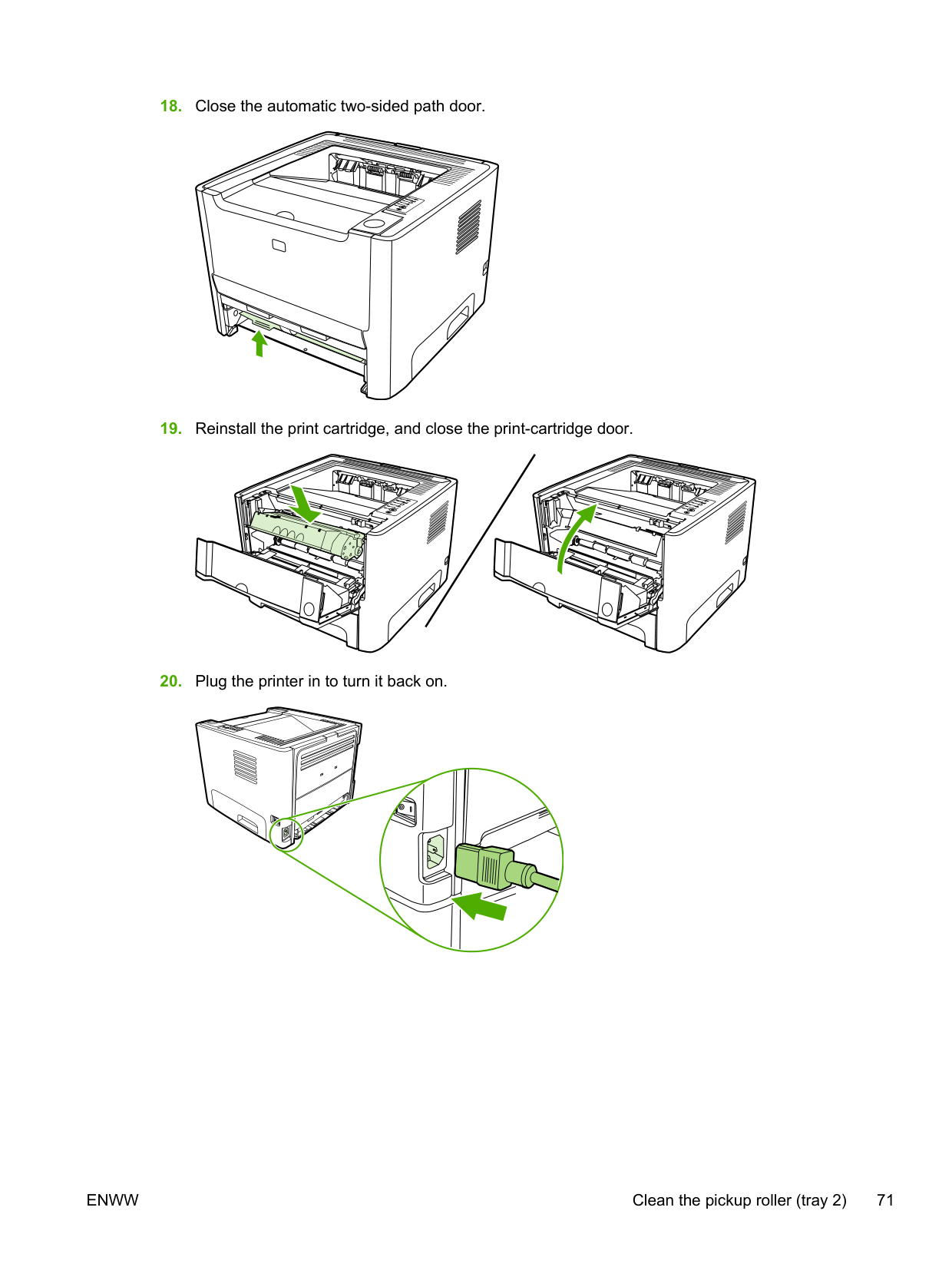
Yes If you answered yes to the questions above, go to Step 2: Is
the Ready light on?
No If the printer will not turn on, Contact HP support.
#### Step 2: Is the Ready light on?
Verify that the Ready light (1) is illuminated on the control panel.
Yes Go to Step 3: Can you print a demo page? No If the control panel lights do not look like the picture above,
see Status-light patterns. If you are unable to resolve the problem, Contact HP support.
#### Step 3: Can you print a demo page?
Press the Go button to print a demo page.
Yes If the demo page printed, go to Step 4: Is the print quality
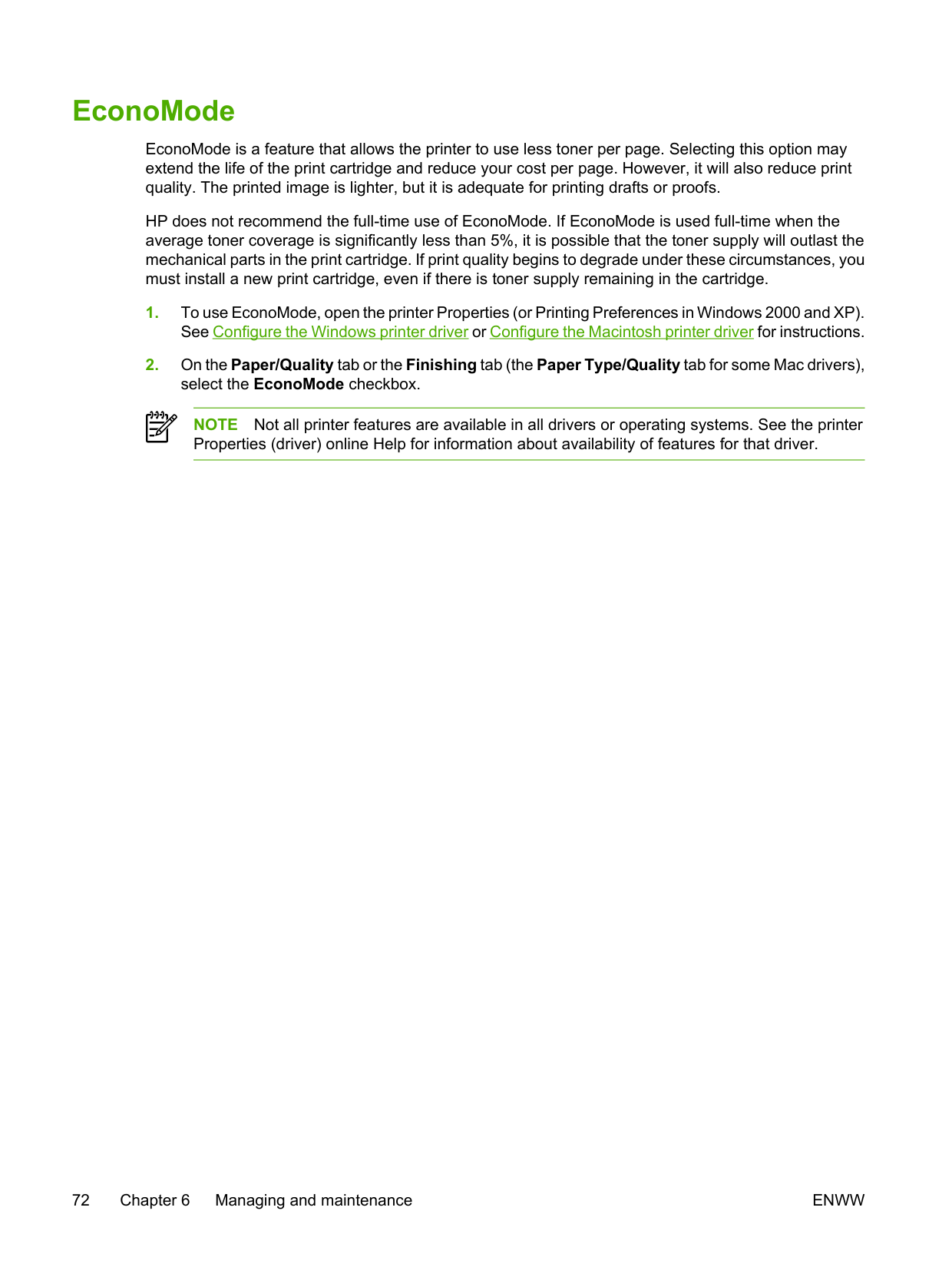
acceptable?
No If no paper came out, see Media problem solving.
If you are unable to resolve the problem, Contact HP support.
#### Step 4: Is the print quality acceptable?
Yes If the print quality is acceptable, go to Step 5: Is the printer
communicating with the computer?
No If the print quality is poor, see Improve print quality.
Verify that the print settings are correct for the media you are using. See Optimize print quality for media types for information on adjusting the settings for various types of media.
If you are unable to resolve the problem, Contact HP support.
#### Step 5: Is the printer communicating with the computer?
Try printing a document from a software application.
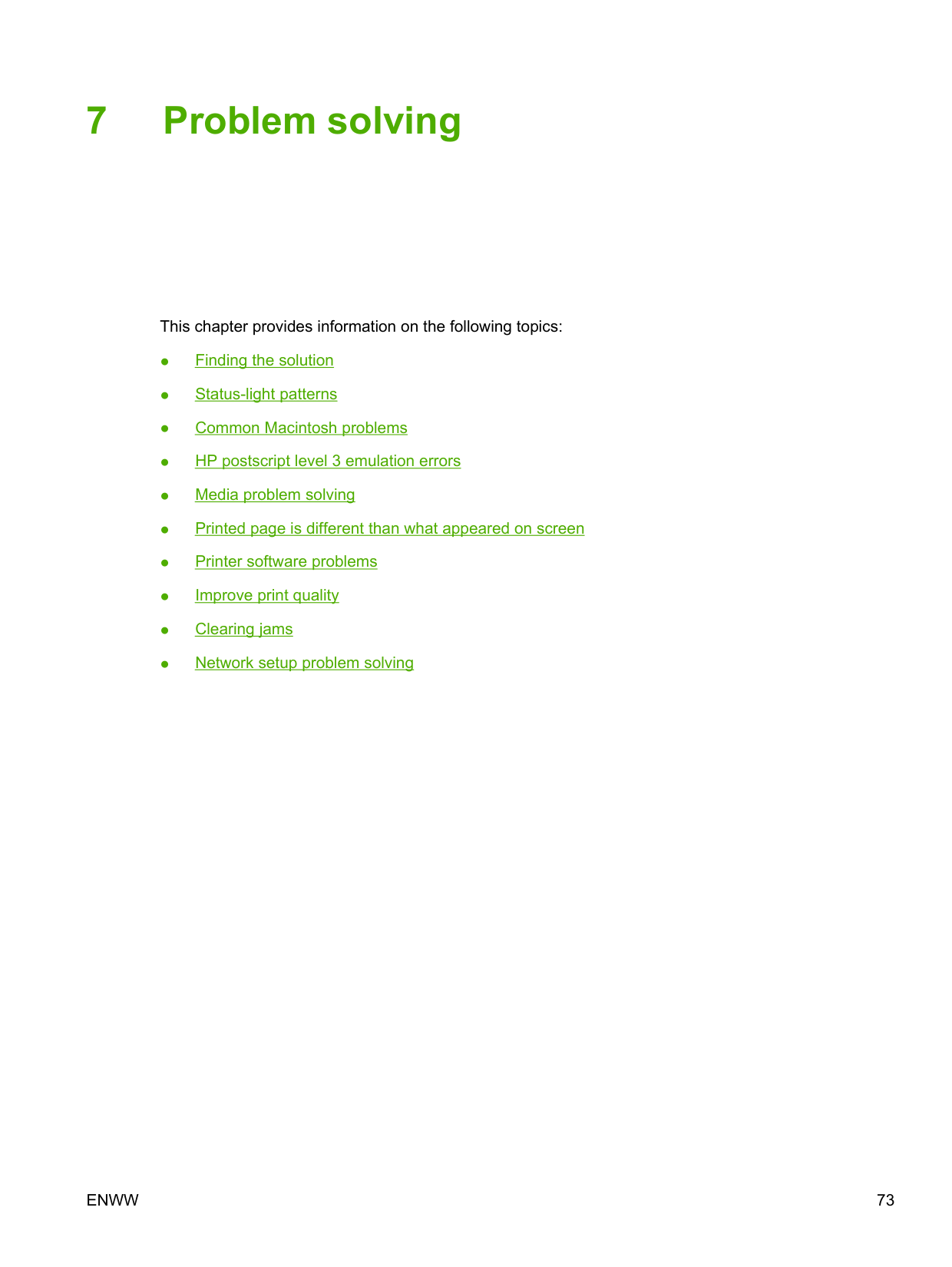
Yes If the document prints, go to Step 6: Does the printed page look
like you expected?
No If the document does not print, see Printer software problems. If you are using a Macintosh computer, see Common Macintosh problems.
If you are using an HP postscript level 3 emulation driver, see HP postscript level 3 emulation errors.
If you are unable to resolve the problem, Contact HP support.
#### Step 6: Does the printed page look like you expected?
Yes The problem should be resolved. If it is not resolved, Contact
HP support.
No See Printed page is different than what appeared on screen.
If you are unable to resolve the problem, Contact HP support.
#### Contact HP support
ENWW Finding the solution 75
Status-light patterns
Symbol for "light off" Symbol for "light on" Symbol for "light blinking"
Light status State of the printer Action
Initialization/Startup
During the Initialization, Reconfiguration, and Job Cancel processes, pressing buttons has no effect.
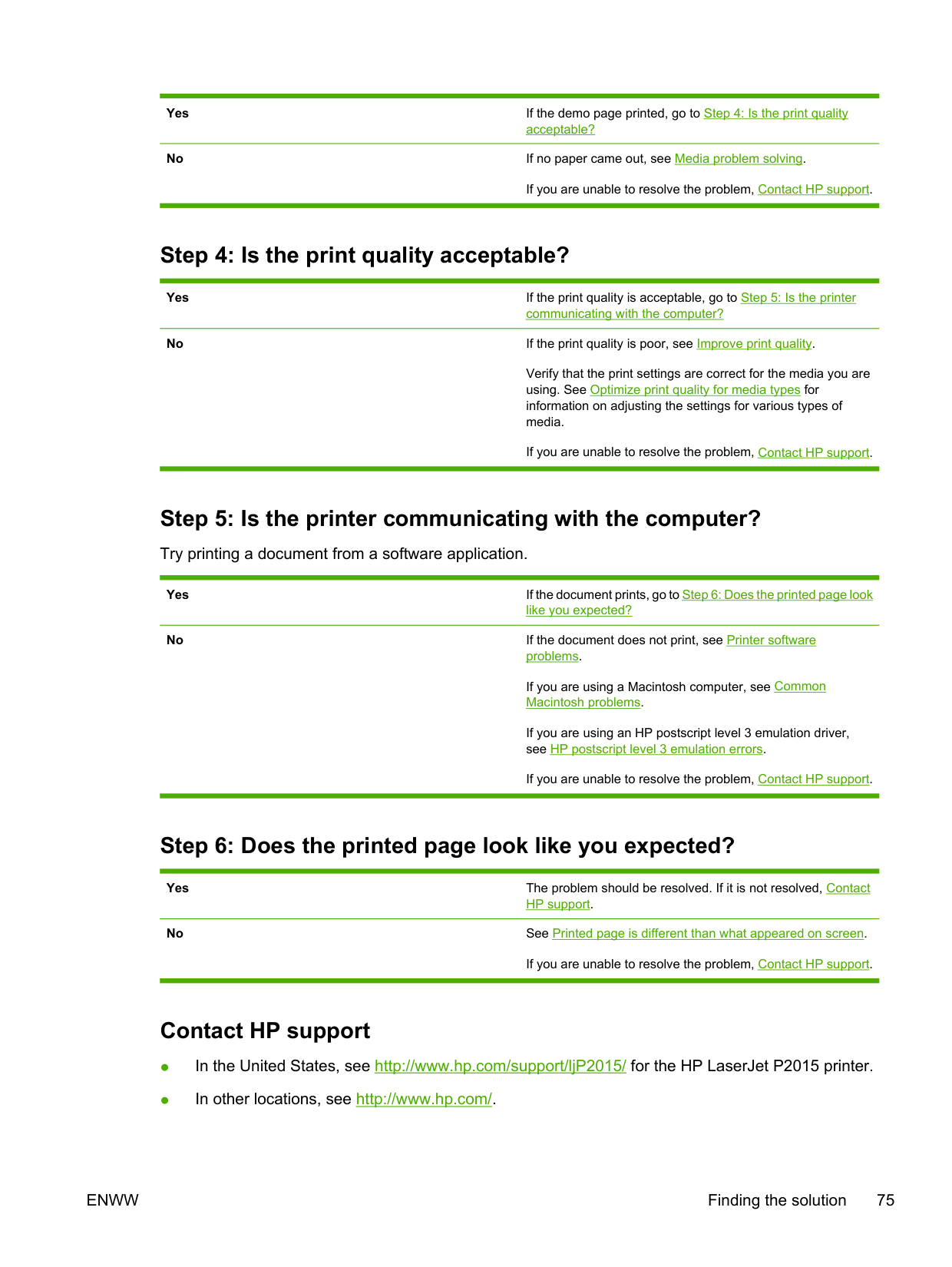
While in the Startup state, the Go, Ready, and Attention lights cycle (at the rate of 500 ms) one after another.
########### Reconfiguration Initialization
During the printer start up, you can request special initialization sequences that reconfigure the printer. When one of the sequences is requested, such as cold reset, the lights cycle as in the Initialization/Startup state.
########### Job Cancel
After the cancellation process has been completed, the printer returns to the Ready state.
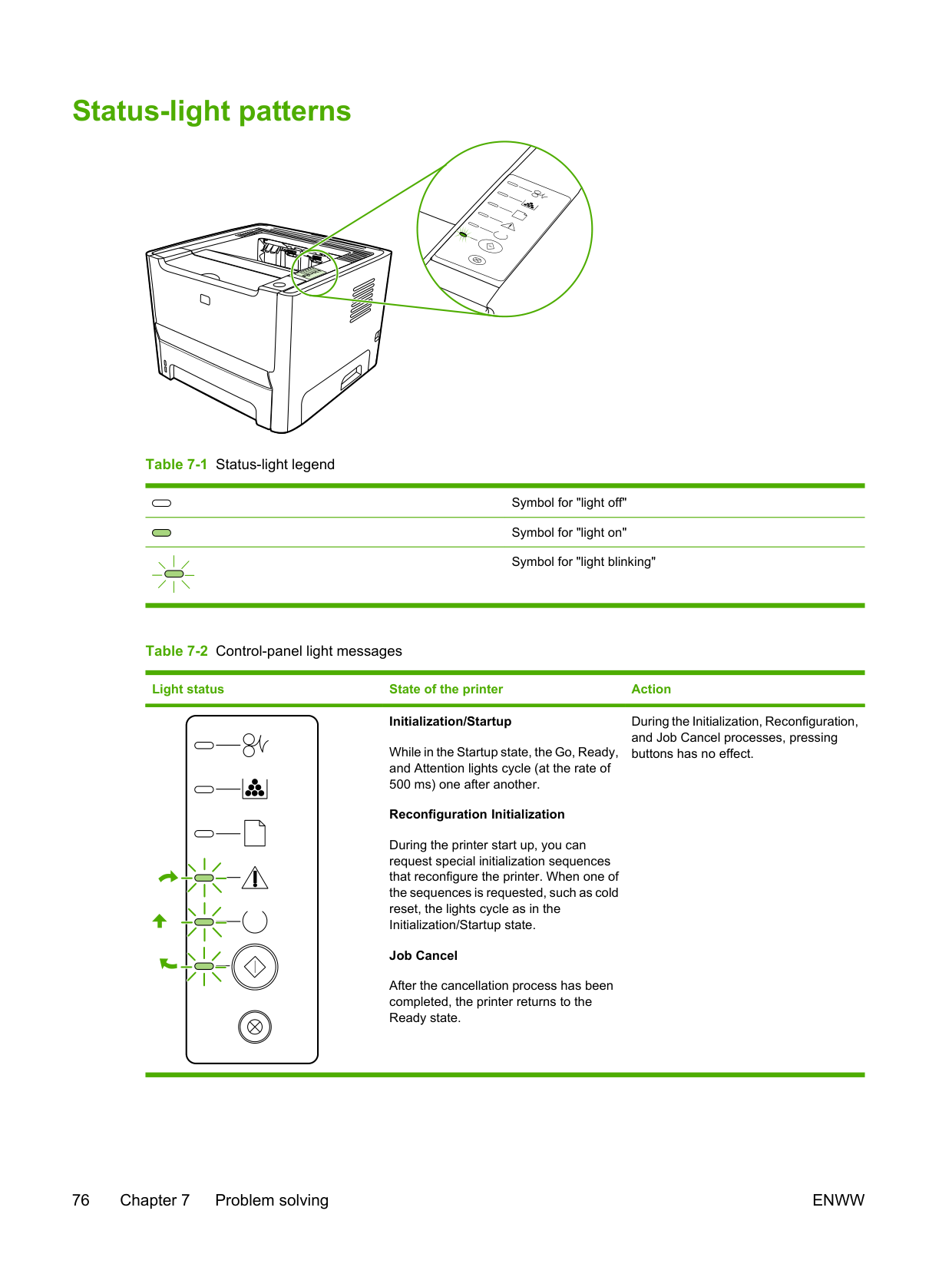
Ready The printer is ready with no job activity.
To print a Configuration page, press and hold the Go button for 5 seconds.
To print a Demo page, press and release the Go button.
To cancel the current job, press the Cancel button.
########### Processing Data
The printer is processing or receiving data.
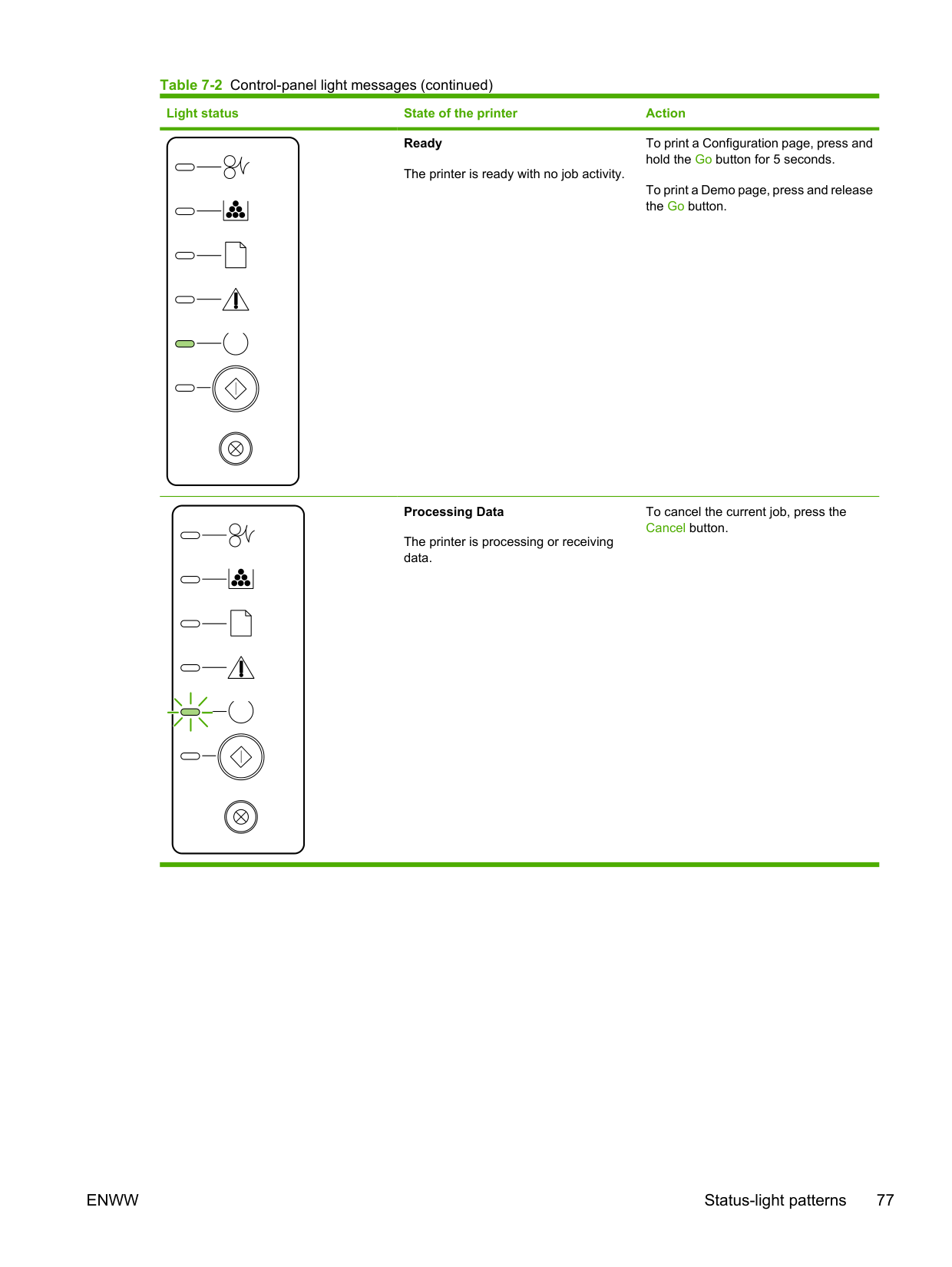
########### Manual Feed or Continuable Error
To recover from the error and print whatever data is possible, press the Go button.
This state can be reached in the following circumstances:
If the recovery is successful, the printer goes to the Processing Data state and completes the job.
If the recovery is unsuccessful, the printer returns to the Continuable Error state.
Attention The print-cartridge door is open.
Close the print-cartridge door.
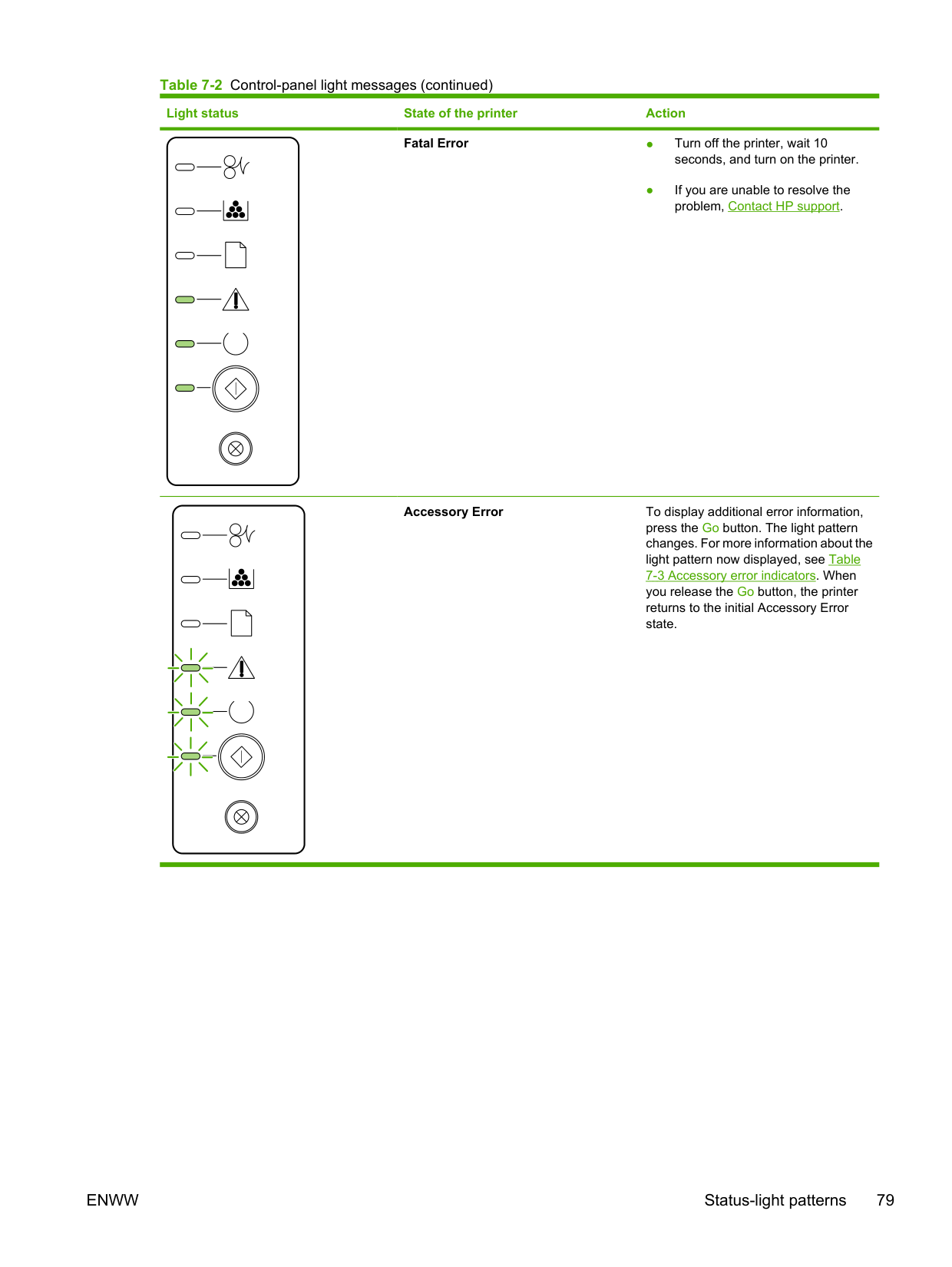
Fatal Error ● Turn off the printer, wait 10
seconds, and turn on the printer.
● If you are unable to resolve the problem, Contact HP support.
Accessory Error To display additional error information, press the Go button. The light pattern changes. For more information about the light pattern now displayed, see Table 7-3 Accessory error indicators. When you release the Go button, the printer returns to the initial Accessory Error state.
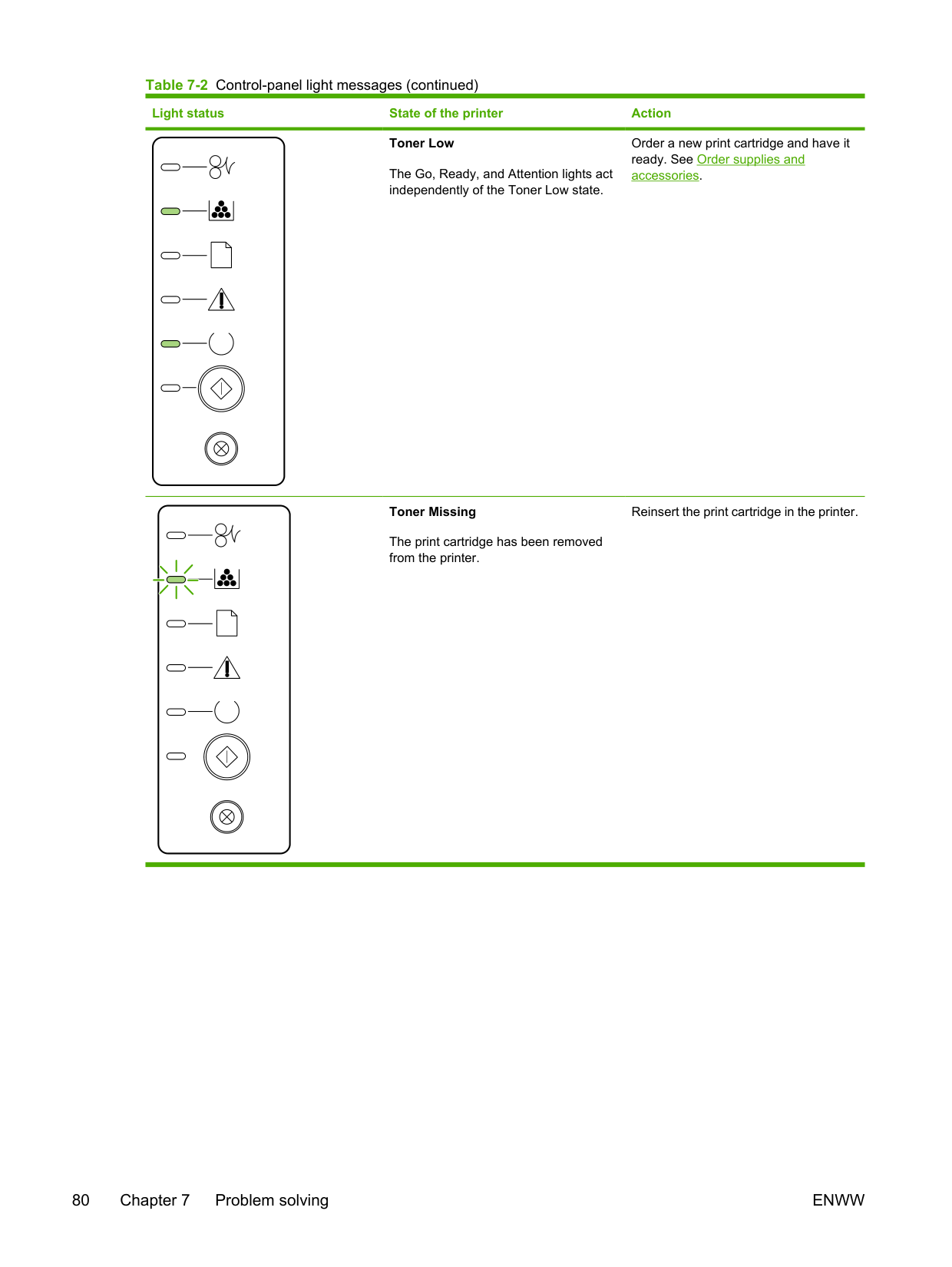
########### Toner Low
Order a new print cartridge and have it ready. See Order supplies and accessories.
The Go, Ready, and Attention lights act independently of the Toner Low state.
Reinsert the print cartridge in the printer.
########### Toner Missing
The print cartridge has been removed from the printer.
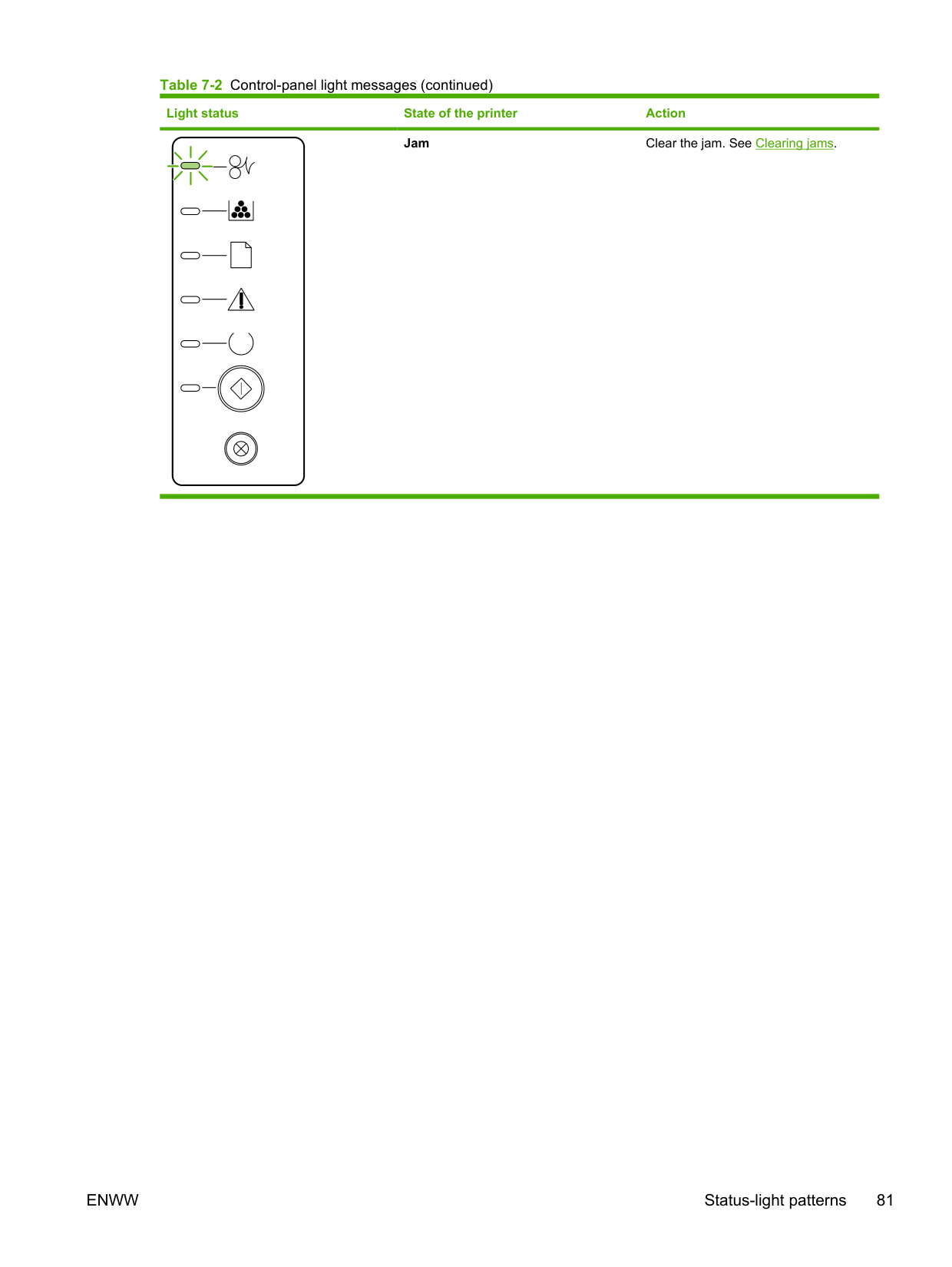
############ Jam Clear the jam. See Clearing jams.
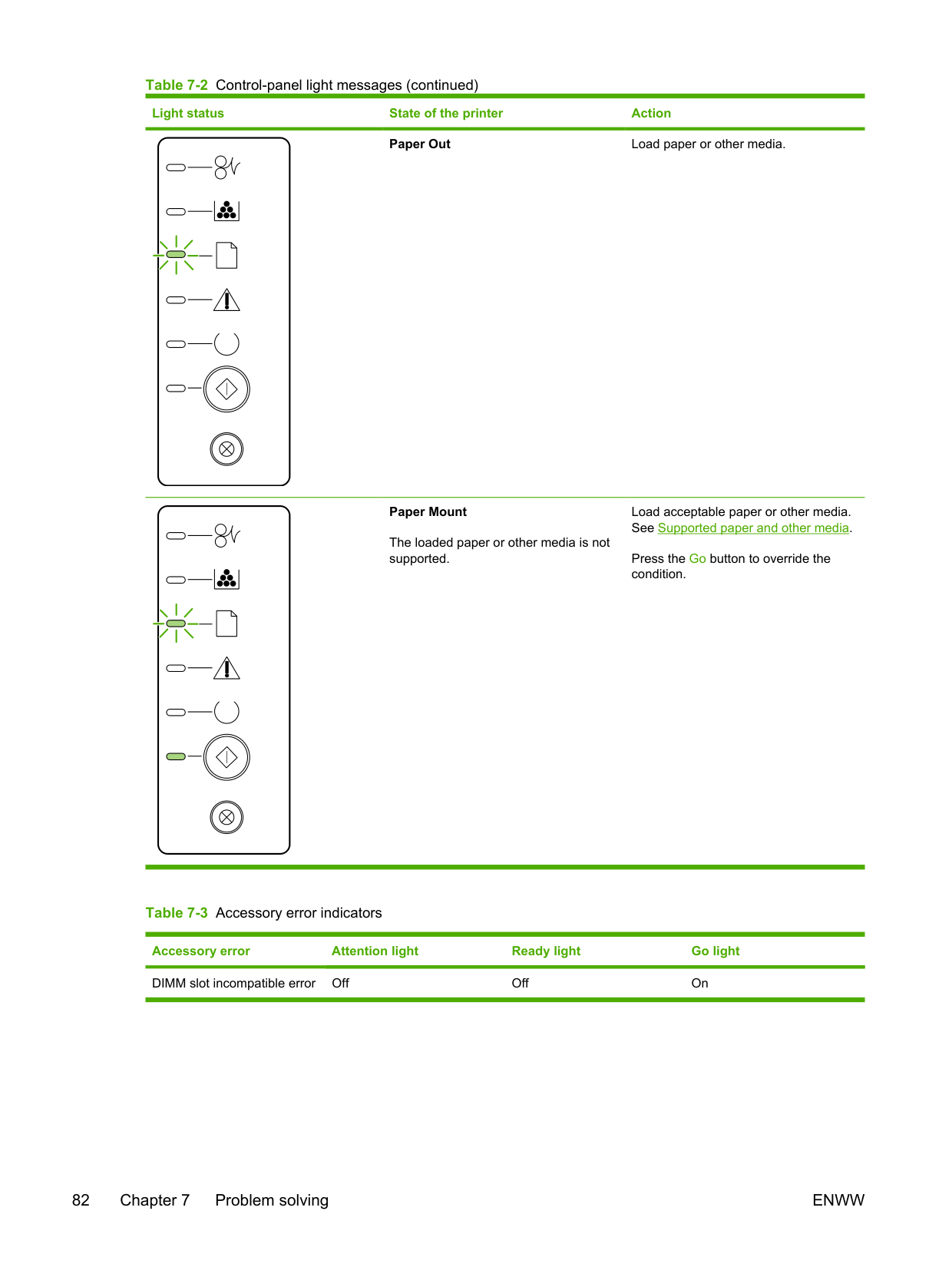
Paper Out Load paper or other media.
########### Paper Mount
Load acceptable paper or other media. See Supported paper and other media.
The loaded paper or other media is not supported.
Press the Go button to override the condition.
########### Accessory error Attention light Ready light Go light
DIMM slot incompatible error Off Off On
Common Macintosh problems This section lists problems that can occur when using Mac OS X. Table 7-4 Problems with Mac OS X
The printer driver is not listed in the Print Center or Printer Setup Utility.
Cause Solution
The printer software might not have been installed or was installed incorrectly.
Make sure that the printer PPD is in the following hard-drive folder: Library/Printers/PPDs/Contents/Resources/
the language that you are using. If necessary, reinstall the software. See the Getting Started Guide for instructions.
The PostScript Printer Description (PPD) file is corrupt. Delete the PPD file from the following hard-drive folder: Library/ Printers/PPDs/Contents/Resources/
The printer name, IP address, or Rendezvous or Bonjour host name does not appear in the printer list in the Print Center or Printer Setup Utility.
Cause Solution
The printer might not be ready. Make sure that the cables are connected correctly, the printer is on,
and the ready light is on. If you are connecting through a USB or Ethernet hub, try connecting directly to the computer or use a different port.
The wrong connection type might be selected. Make sure that USB, IP Printing, or Rendezvous or Bonjour is
selected, depending on the type of connection that exists between the printer and the computer.
The wrong printer name, IP address, or Rendezvous or Bonjour host name is being used.
Print a configuration page to check the printer name, IP address, or Rendezvous or Bonjour host name. Verify that the name, IP address, or Rendezvous or Bonjour host name on the configuration page matches the printer name, IP address, or Rendezvous or Bonjour host name in the Print Center or Printer Setup Utility.
The interface cable might be defective or of poor quality. Replace the interface cable. Make sure to use a high-quality cable.
The printer driver does not automatically set up your selected printer in the Print Center or Printer Setup Utility.
Cause Solution
The printer might not be ready. Make sure that the cables are connected correctly, the printer is on, and the ready light is on. If you are connecting through a USB or Ethernet hub, try connecting directly to the computer or use a different port.
The printer software might not have been installed or was installed incorrectly.
Make sure that the printer PPD is in the following hard-drive folder: Library/Printers/PPDs/Contents/Resources/
########### The printer driver does not automatically set up your selected printer in the Print Center or Printer Setup Utility. Cause Solution The PostScript Printer Description (PPD) file is corrupt. Delete the PPD file from the following hard-drive folder: Library/
Printers/PPDs/Contents/Resources/
The printer might not be ready. Make sure that the cables are connected correctly, the printer is on,
and the ready light is on. If you are connecting through a USB or Ethernet hub, try connecting directly to the computer or use a different port.
The interface cable might be defective or of poor quality. Replace the interface cable. Make sure to use a high-quality cable.
A print job was not sent to the printer that you wanted.
Cause Solution
The print queue might be stopped. Restart the print queue. Open print monitor and select Start Jobs.
The wrong printer name or IP address is being used. Another printer with the same or similar name, IP address, or Rendezvous or Bonjour host name might have received your print job.
Print a configuration page to check the printer name, IP address, or Rendezvous or Bonjour host name. Verify that the name, IP address, or Rendezvous or Bonjour host name on the configuration page matches the printer name, IP address, or Rendezvous or Bonjour host name in the Print Center or Printer Setup Utility.
You are unable to print from a third-party USB card.
Cause Solution
This error occurs when the software for USB printers is not installed.
When adding a third-party USB card, you might need the Apple USB Adapter Card Support software. The most current version of this software is available from the Apple Web site.
When connected with a USB cable, the printer does not appear in the Print Center or Printer Setup Utility after the driver is selected.
Cause Solution
This problem is caused by either a software or a hardware component.
########### Software troubleshooting
When connected with a USB cable, the printer does not appear in the Print Center or Printer Setup Utility after the driver is selected.
Cause Solution
| |
|---|
NOTE The iMac keyboard is a nonpowered USB hub.
HP postscript level 3 emulation errors
The following situations are HP postscript level 3 emulation language-specific and can occur when several printer languages are being used.
| | |---|
NOTE To receive a printed or screen displayed message when HP postscript level 3 emulation errors occur, open the Print Options dialog box and click the desired selection next to the PS Errors section. You can also access this from the embedded Web server.
Table 7-5 HP postscript level 3 emulation errors
########### Symptom Possible cause Solution
The job prints in Courier (the printer's default typeface) instead of the typeface you requested.
The requested typeface is not downloaded. A personality switch may have been performed to print a PCL job just before the HP postscript level 3 emulation printing job was received.
Download the desired font and send the print job again. Verify the type and location of the font. Download to printer if applicable. Check with the software documentation.
A legal page prints with clipped margins. Print job too complex. You may need to print your job at
600 dots per inch, reduce the complexity of the page, or install more memory.
An HP postscript level 3 emulation error page prints.
Print job may not be HP postscript level 3 emulation.
Make sure the print job is an HP postscript level 3 emulation job. Check to see whether the software application expected a setup or HP postscript level 3 emulation header file to be sent to the printer.
Limit Check Error Print job is too complex. You may need to print your job at
600 dots per inch, reduce the complexity of the page, or install more memory.
VM Error Font Error Select unlimited downloadable fonts
from printer driver. Range Check Font Error Select unlimited downloadable fonts from printer driver.
Media problem solving
The following problems with media cause print-quality deviations, jamming, or damage to the printer.
########### Problem Cause Solution
Poor print quality or toner adhesion The paper is too moist, too rough, too heavy or too smooth, or it is embossed or from a faulty paper lot.
Try another kind of paper, between 100 and 250 Sheffield, with 4 to 6% moisture content.
Dropouts, jamming, or curl The paper has been stored incorrectly. Store paper flat in its moisture-proof
wrapping.
The paper has variability from one side to the other.
Turn the paper over.
Excessive curl The paper is too moist, has the wrong
Open the rear output bin, or use longgrain paper.
grain direction, or is of short-grain construction
The paper varies from side-to-side. Turn the paper over. Jamming, damage to printer The paper has cutouts or perforations. Use paper that is free of cutouts or
perforations. Problems with feeding The paper has ragged edges. Use high-quality paper that is made for
laser printers. The paper varies from side-to-side. Turn the paper over. The paper is too moist, too rough, too heavy or too smooth, has the wrong grain direction, or is of short-grain construction or it is embossed or from a faulty paper lot.
Try another kind of paper, between 100 and 250 Sheffield, 4 to 6% moisture content.
Open the rear output bin, or use longgrain paper.
Print is skewed (crooked). The media guides might be incorrectly
Remove all media from the input tray, straighten the stack, and then load the media in the input tray again. Adjust the media guides to the width and length of the media that you are using and try printing again.
adjusted.
More than one sheet feeds at one time. The media tray might be overloaded. Remove some of the media from the tray.
See Load media.
The media might be wrinkled, folded, or damaged.
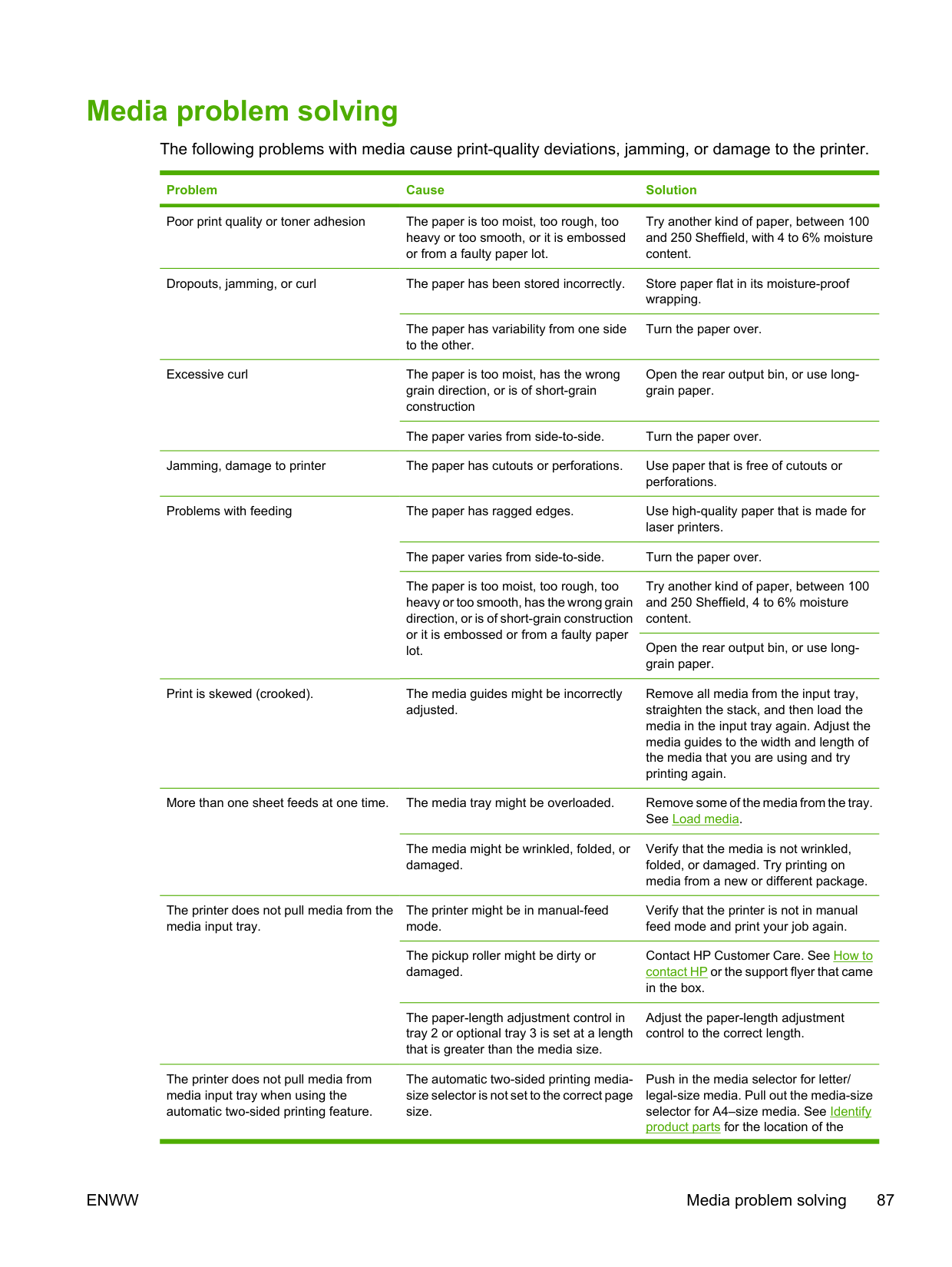
Verify that the media is not wrinkled, folded, or damaged. Try printing on media from a new or different package.
The printer does not pull media from the media input tray.
The printer might be in manual-feed mode.
Verify that the printer is not in manual feed mode and print your job again.
The pickup roller might be dirty or damaged.
Contact HP Customer Care. See How to contact HP or the support flyer that came in the box.
The paper-length adjustment control in tray 2 or optional tray 3 is set at a length that is greater than the media size.
Adjust the paper-length adjustment control to the correct length.
The printer does not pull media from media input tray when using the automatic two-sided printing feature.
The automatic two-sided printing mediasize selector is not set to the correct page size.
Push in the media selector for letter/ legal-size media. Pull out the media-size selector for A4–size media. See Identify product parts for the location of the

ENWW Media problem solving 87
########### Problem Cause Solution
automatic two-sided printing media-size selector.
Printed page is different than what appeared on screen
Choose the item that best describes the problem:
Garbled, incorrect, or incomplete text
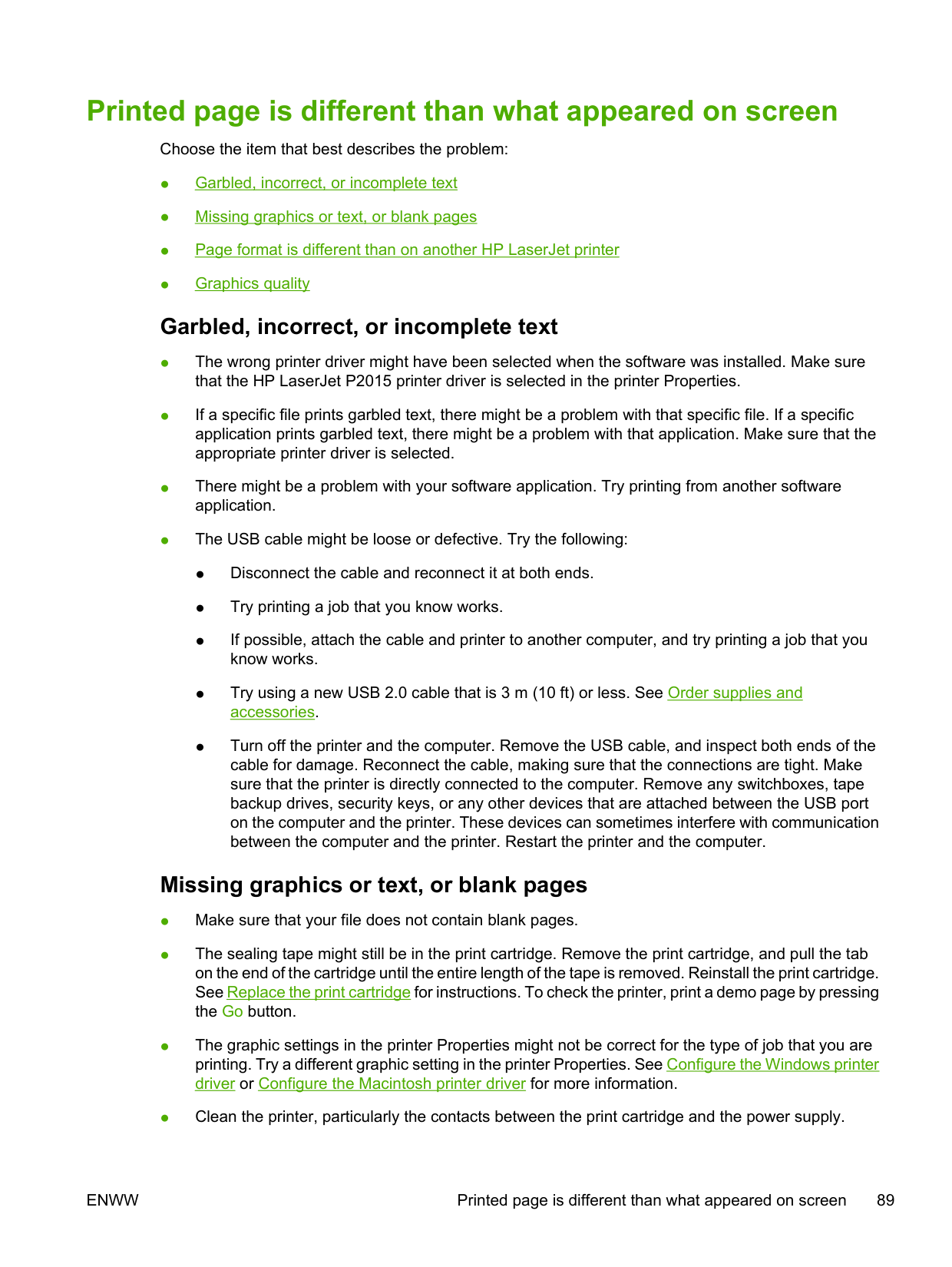
#### Missing graphics or text, or blank pages
ENWW Printed page is different than what appeared on screen 89
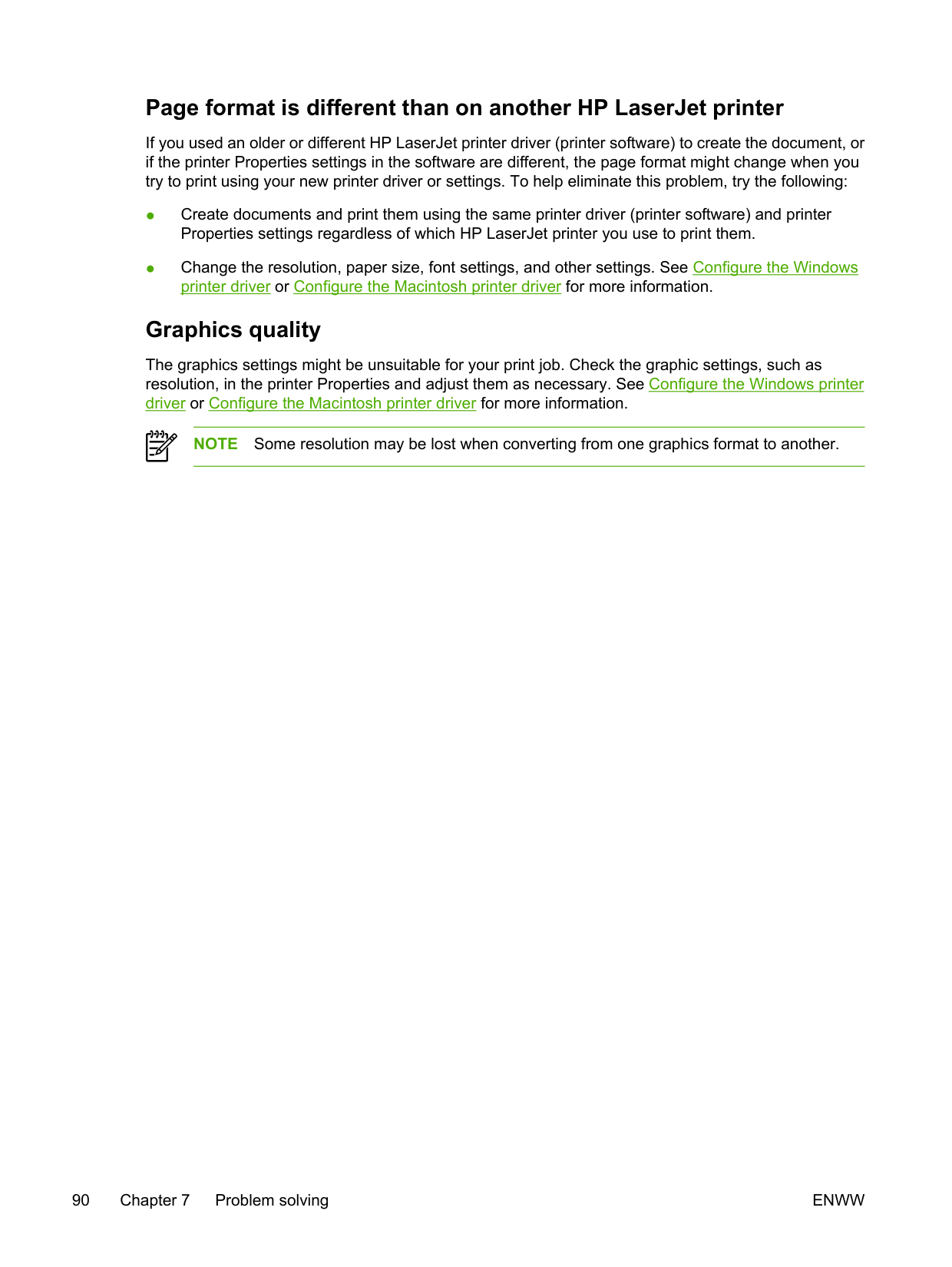
#### Page format is different than on another HP LaserJet printer
If you used an older or different HP LaserJet printer driver (printer software) to create the document, or if the printer Properties settings in the software are different, the page format might change when you try to print using your new printer driver or settings. To help eliminate this problem, try the following:
#### Graphics quality
The graphics settings might be unsuitable for your print job. Check the graphic settings, such as resolution, in the printer Properties and adjust them as necessary. See Configure the Windows printer driver or Configure the Macintosh printer driver for more information.
| | |---|
NOTE Some resolution may be lost when converting from one graphics format to another.
Printer software problems
Table 7-6 Printer software problems
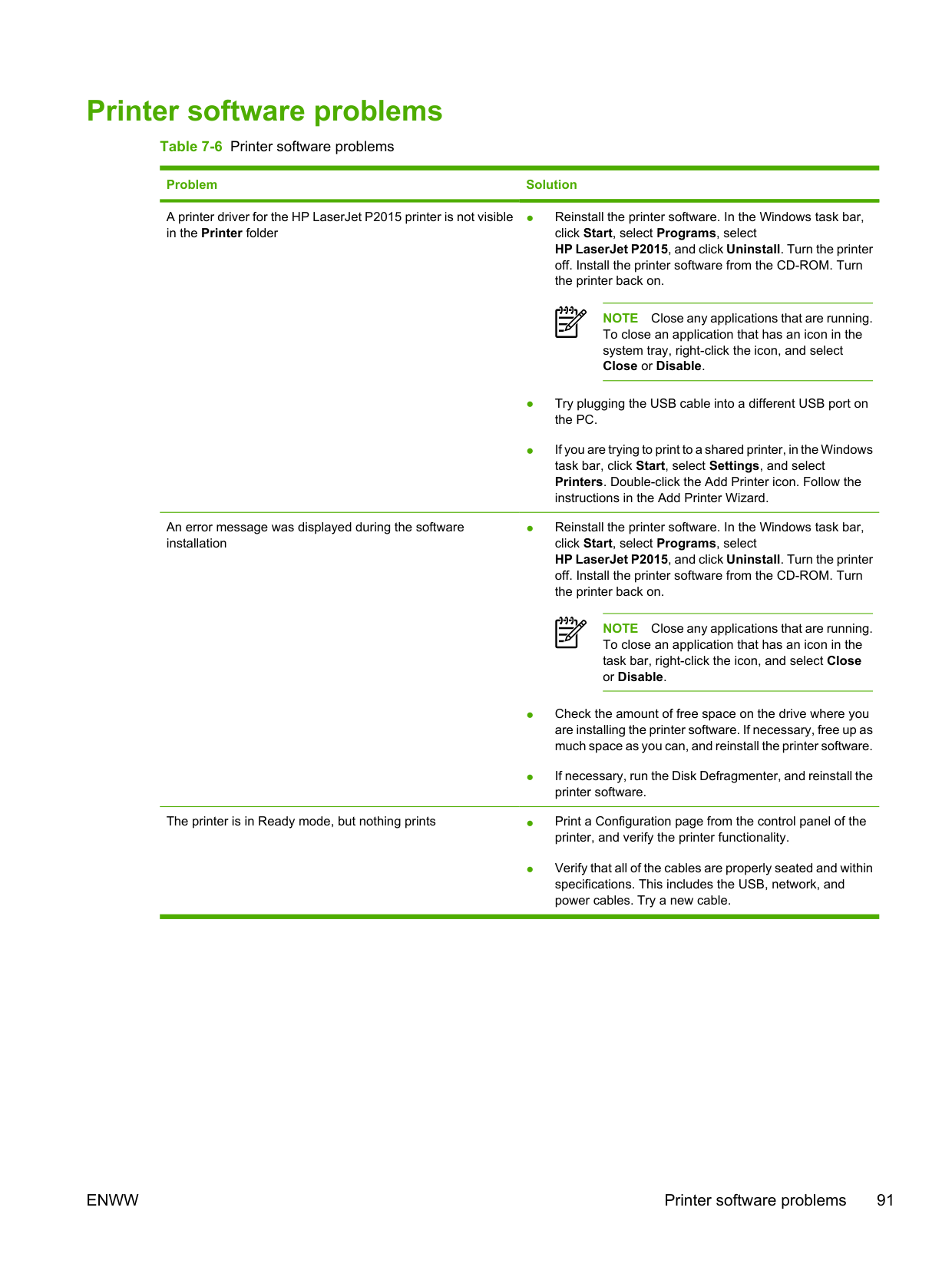
########### Problem Solution
| | |---|
NOTE Close any applications that are running. To close an application that has an icon in the system tray, right-click the icon, and select Close or Disable.
A printer driver for the HP LaserJet P2015 printer is not visible in the Printer folder
| | |---|
NOTE Close any applications that are running.
To close an application that has an icon in the task bar, right-click the icon, and select Close or Disable.
An error message was displayed during the software installation
The printer is in Ready mode, but nothing prints ● Print a Configuration page from the control panel of the printer, and verify the printer functionality.
● Verify that all of the cables are properly seated and within specifications. This includes the USB, network, and power cables. Try a new cable.
ENWW Printer software problems 91
Improve print quality
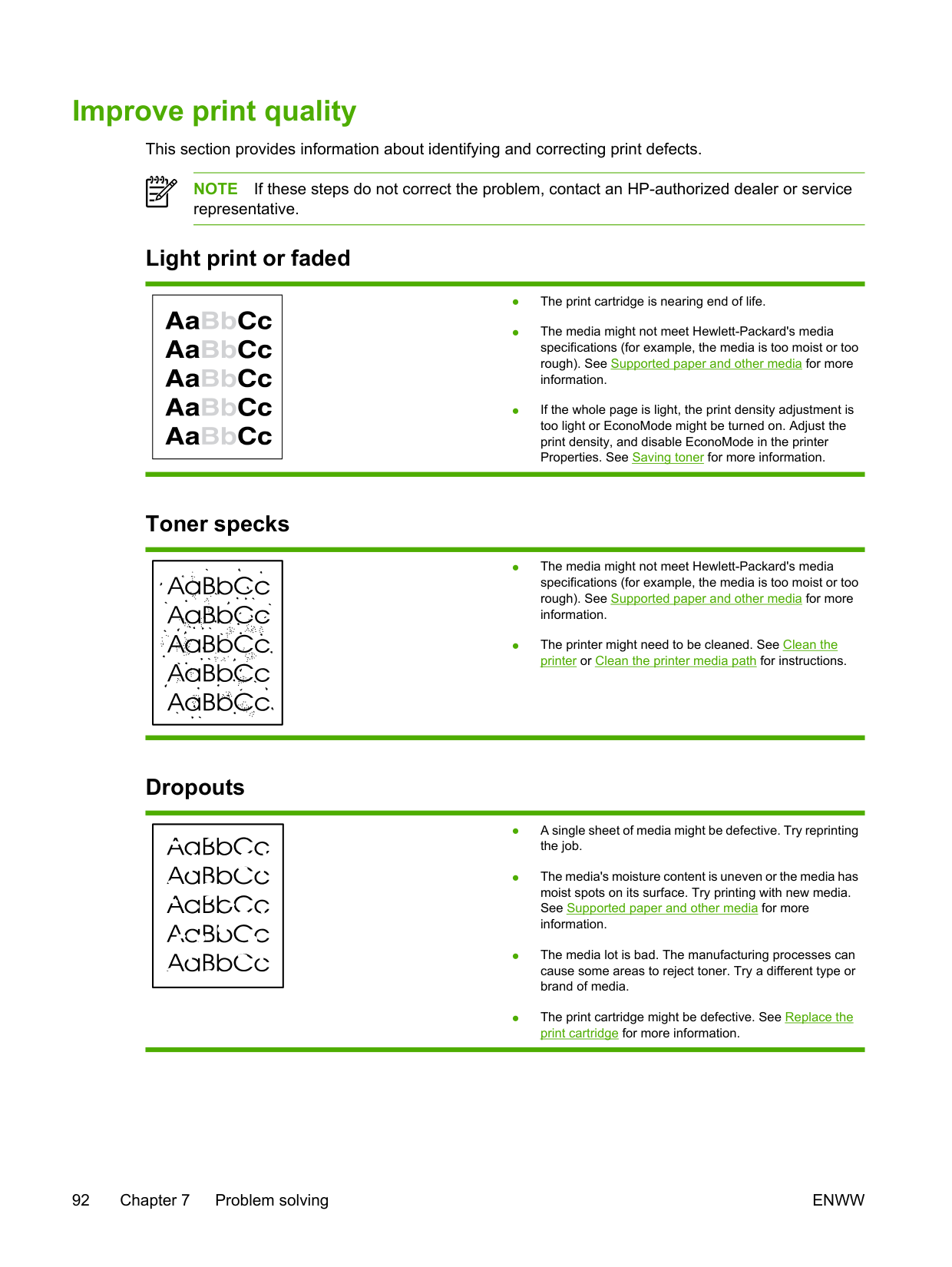
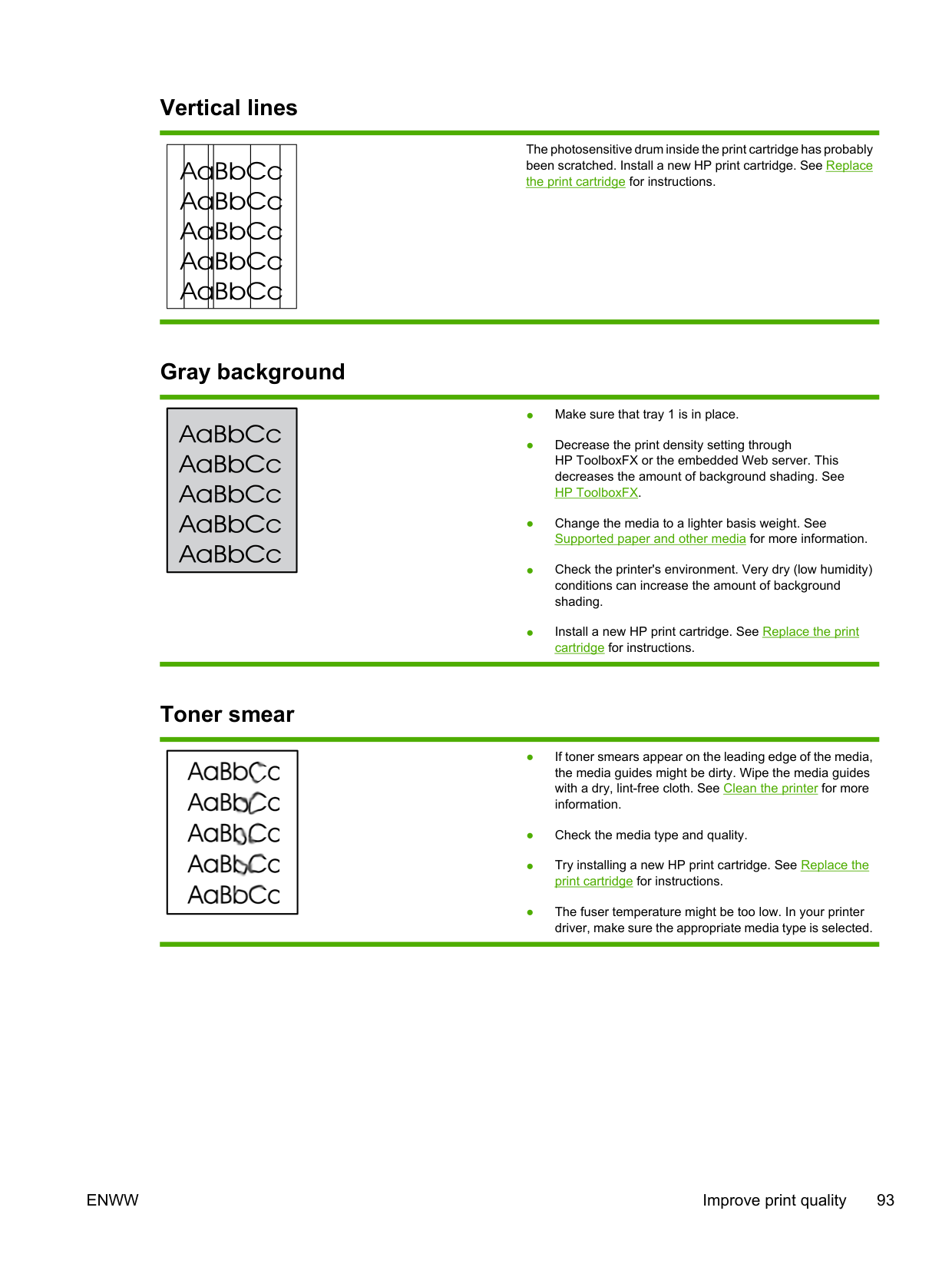
This section provides information about identifying and correcting print defects.
| |
|---|
NOTE If these steps do not correct the problem, contact an HP-authorized dealer or service representative.
#### Light print or faded
| | |---|
#### Toner specks
| | |---|
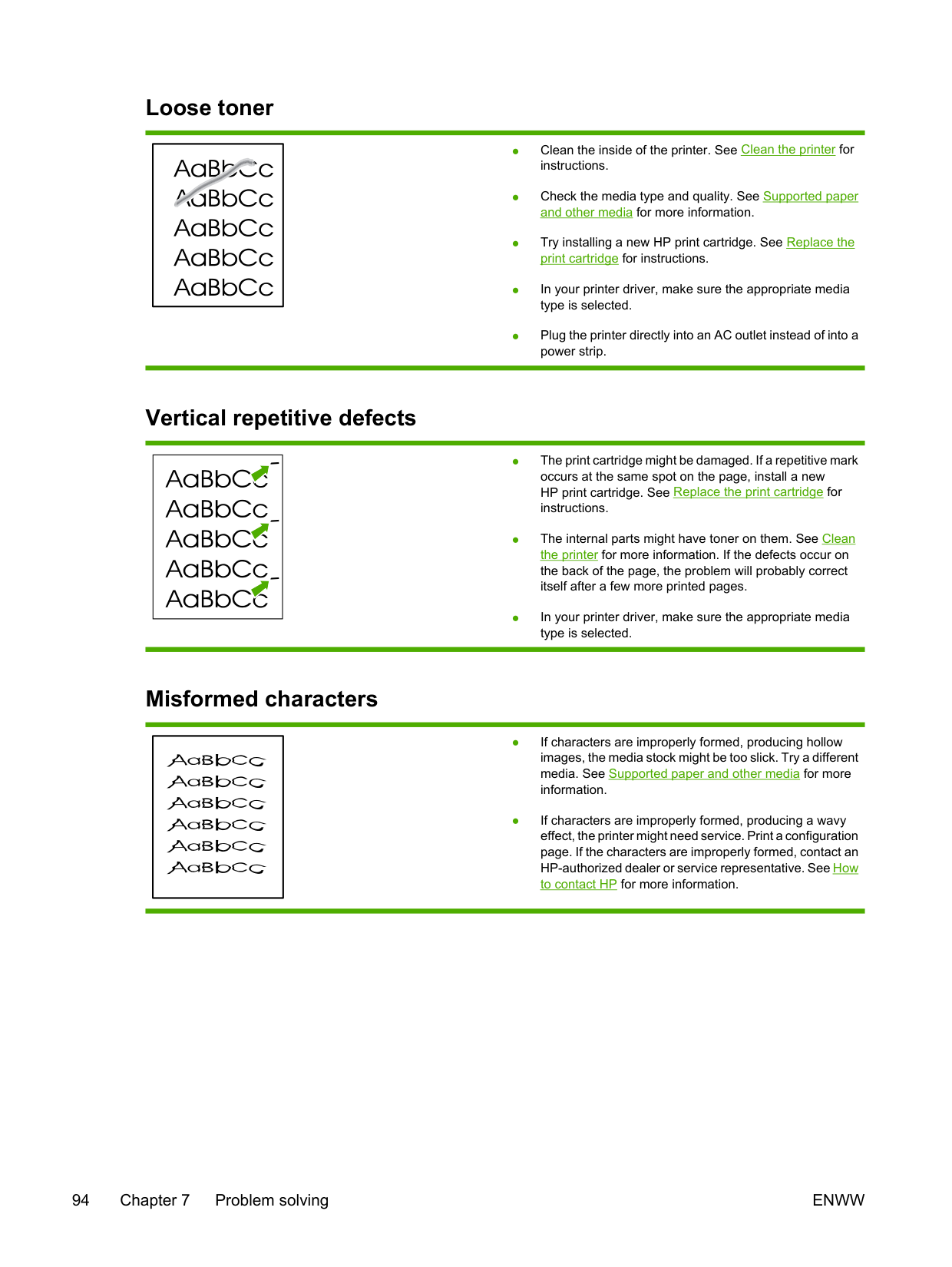
#### Dropouts
| | |---|
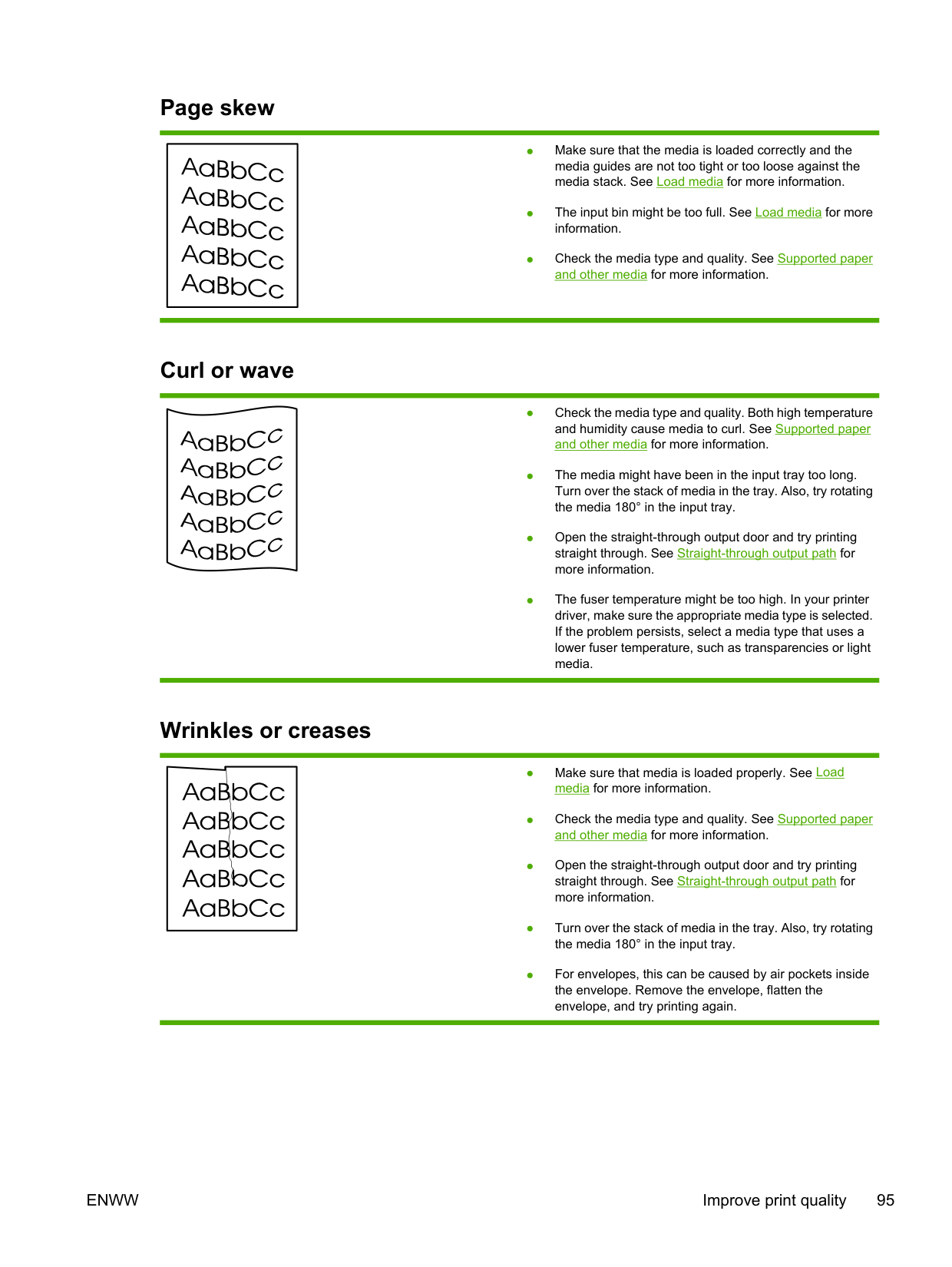
#### Vertical lines
| | | | | | |
|---|---|---|---|---|---|
#### Gray background
| | |---|
#### Toner smear
|| |---|
The photosensitive drum inside the print cartridge has probably been scratched. Install a new HP print cartridge. See Replace the print cartridge for instructions.
#### Loose toner
| | |---|
#### Vertical repetitive defects
| | |---|
#### Misformed characters
| | |---|
#### Page skew
| | |---|
#### Curl or wave
#### Wrinkles or creases
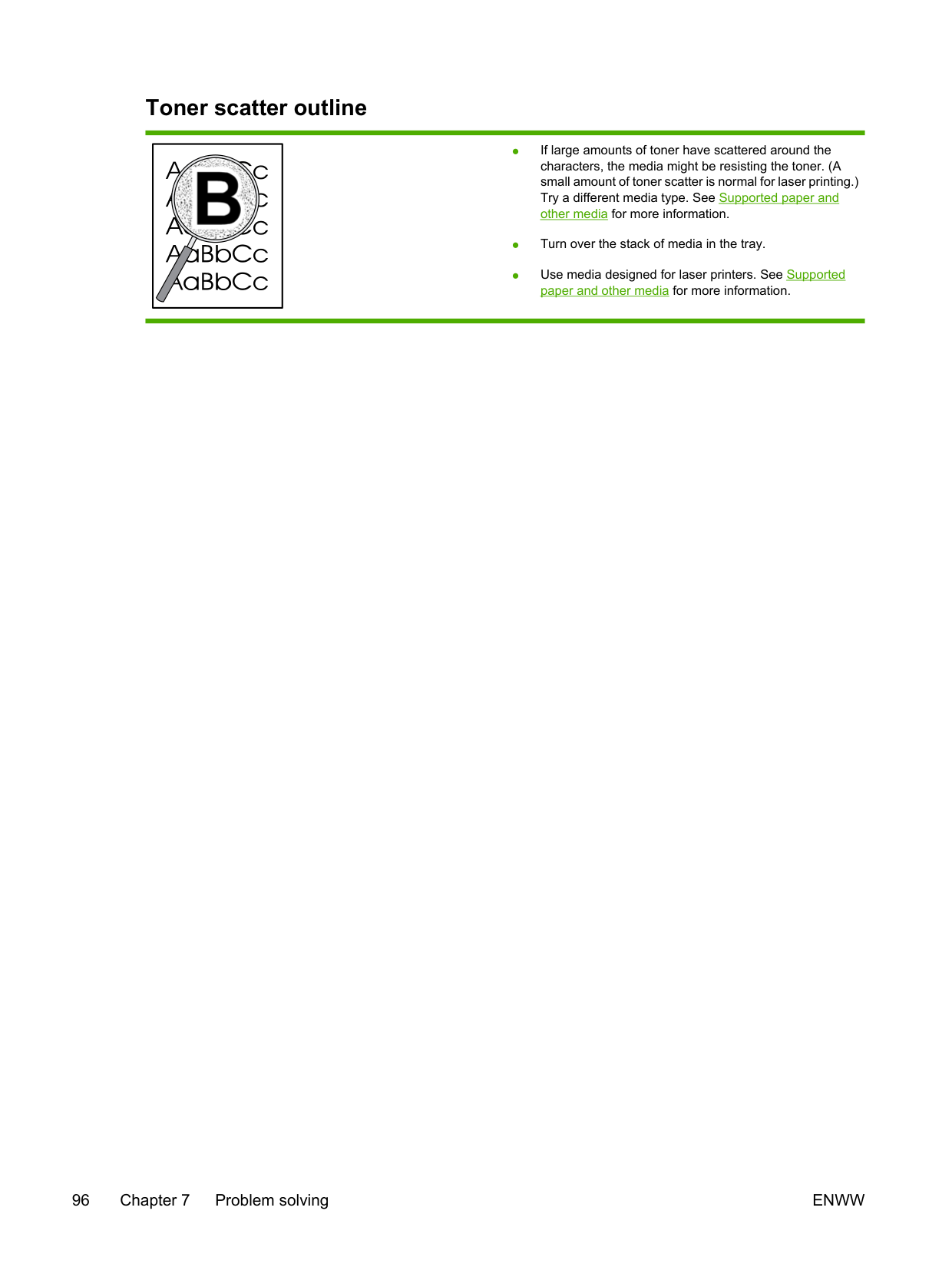
#### Toner scatter outline
|
| |---|
Clearing jams
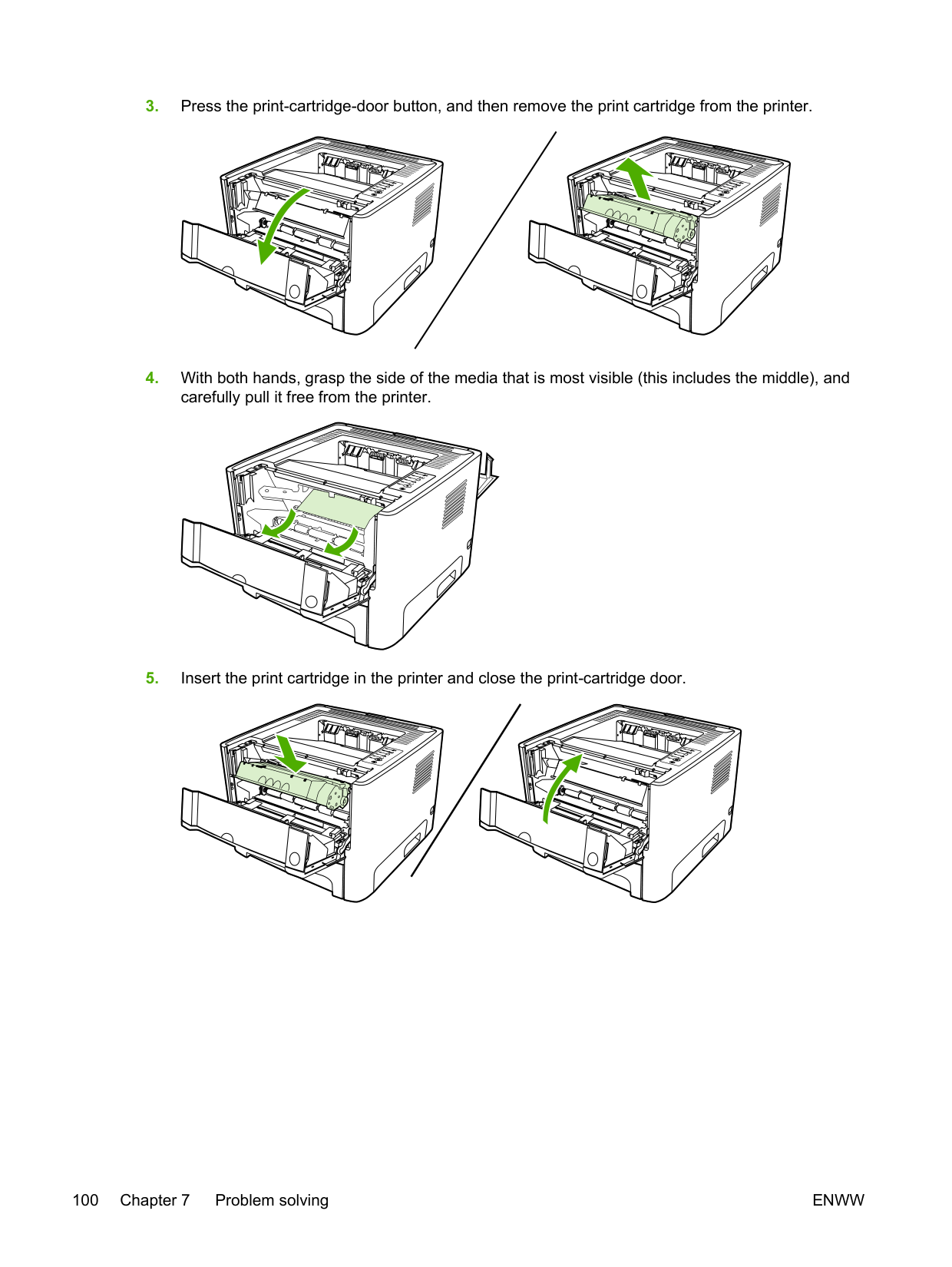
Occasionally, media becomes jammed during a print job. You are notified of a media jam by an error in the software and the printer control panel lights. See Status-light patterns for more information.
The following are some of the causes of media jams:
| | |---|
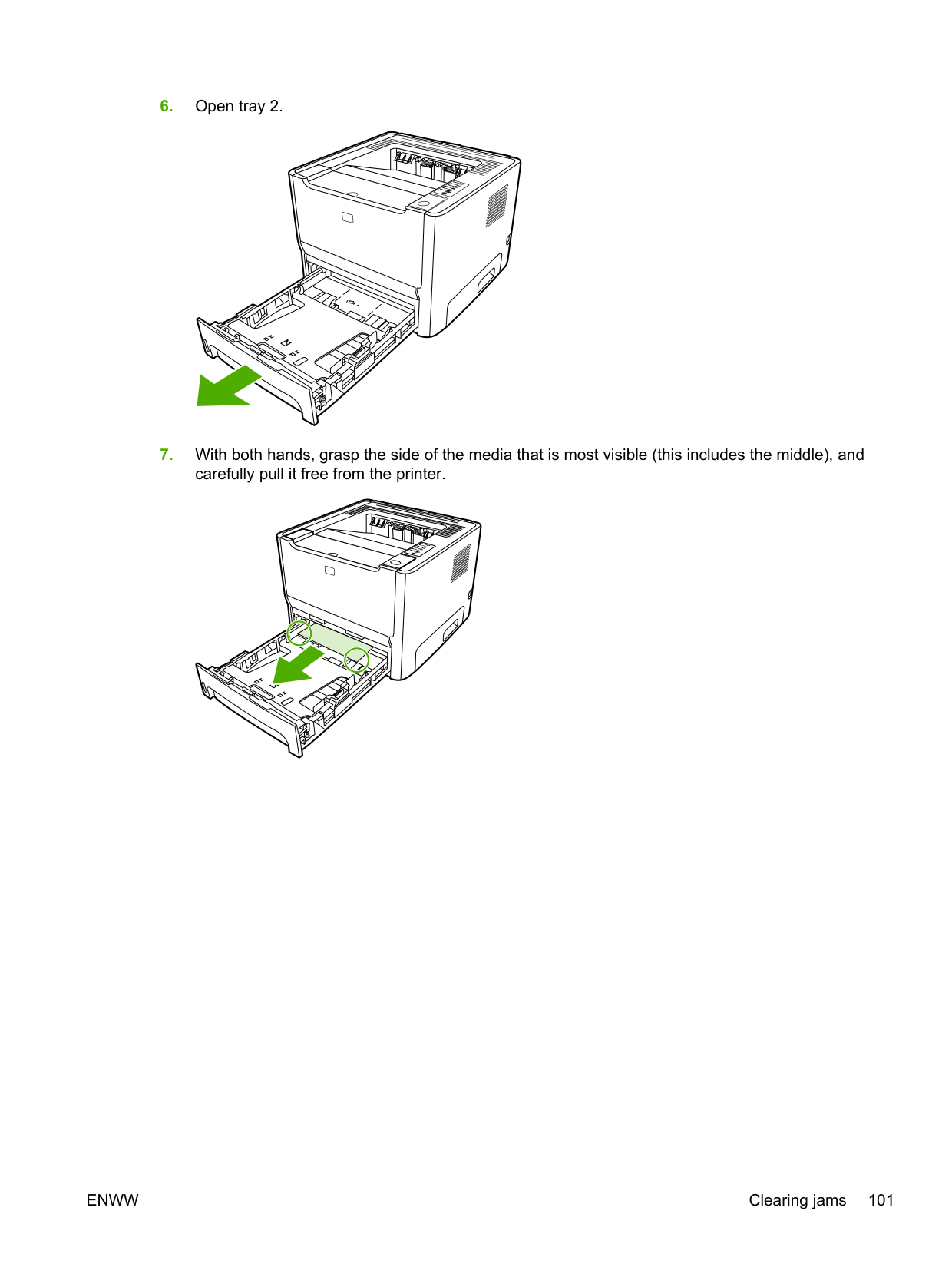
NOTE When you add new media, always remove all of the media from the input tray and straighten the stack of new media. This helps prevent multiple sheets of media from feeding through the printer at one time, reducing media jams.
There might be loose toner in the printer after a media jam. This toner clears up after a few sheets print.
CAUTION Media jams might result in loose toner on the page. If you get any toner on your clothes, wash them in cold water. Hot water will permanently set the toner into the fabric.
#### Print-cartridge area
To clear a jam in the print-cartridge area, perform the following steps:
CAUTION Do not use sharp objects, such as tweezers or needlenose pliers, to remove jams. Damage caused by sharp objects will not be covered by the warranty.
CAUTION To prevent damage to the print cartridge, minimize its exposure to direct light.
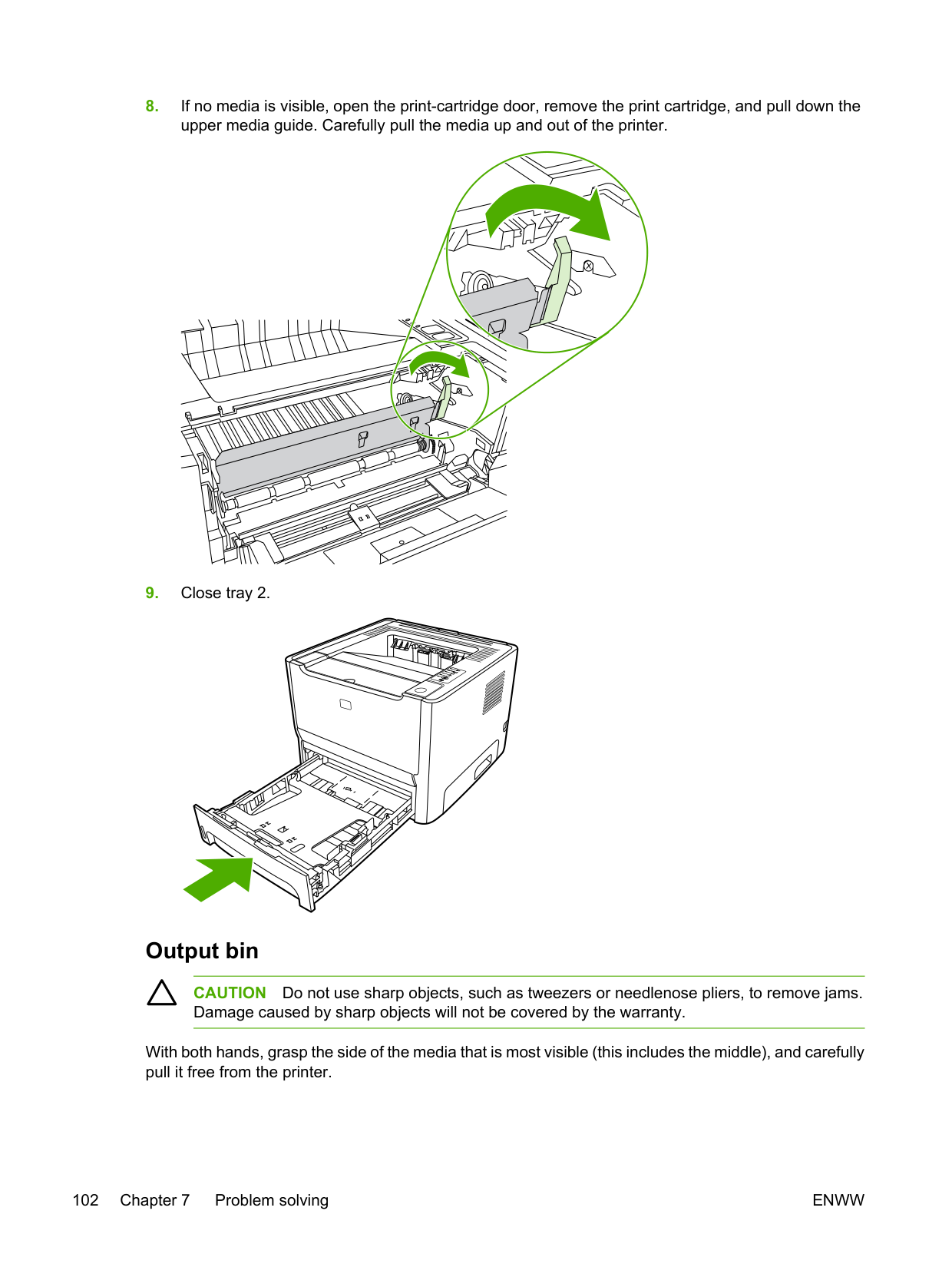
#### Input trays
To clear a jam in the input trays, perform the following steps:
CAUTION Do not use sharp objects, such as tweezers or needlenose pliers, to remove jams. Damage caused by sharp objects will not be covered by the warranty.
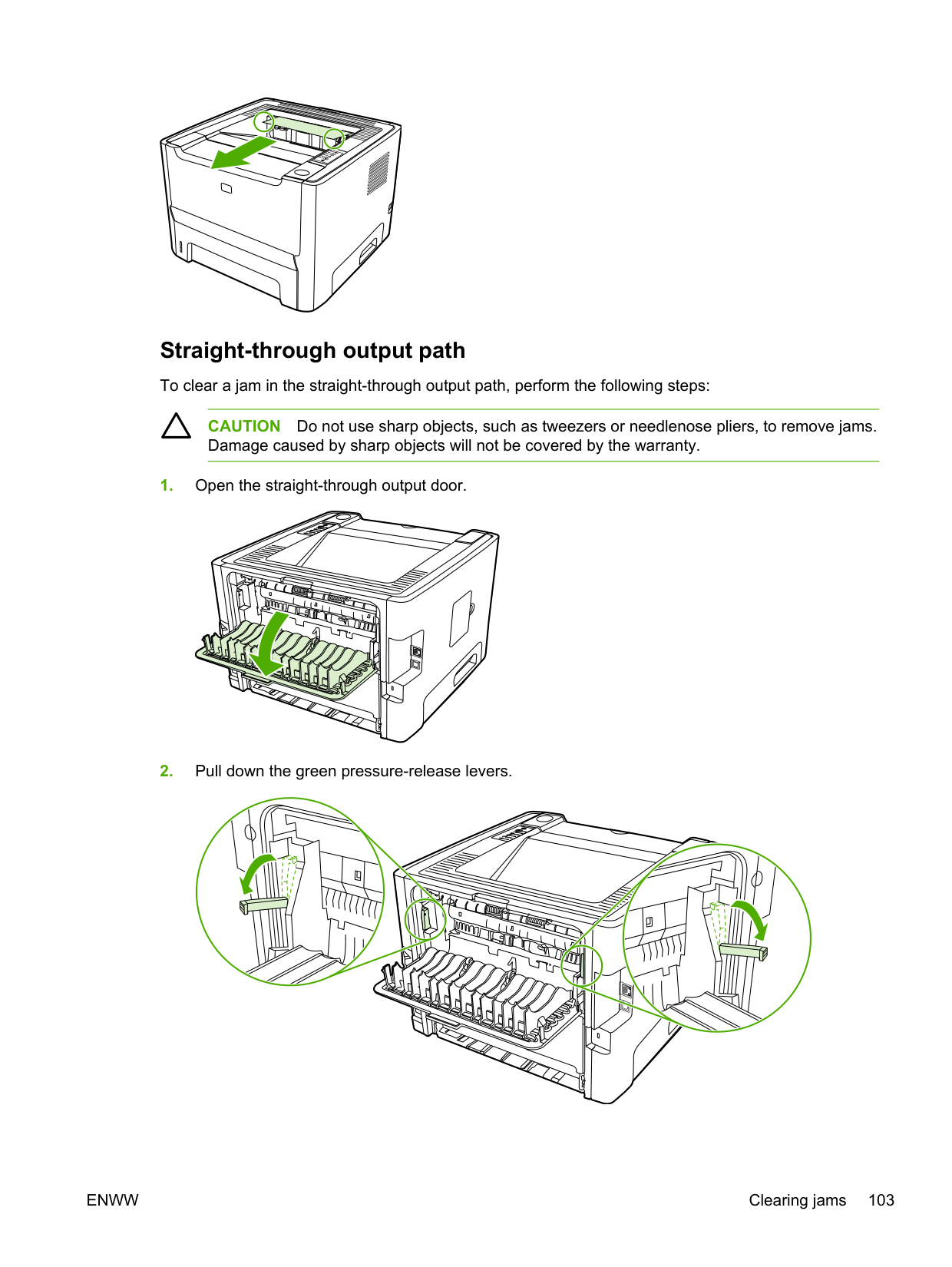
#### Output bin
CAUTION Do not use sharp objects, such as tweezers or needlenose pliers, to remove jams. Damage caused by sharp objects will not be covered by the warranty.
With both hands, grasp the side of the media that is most visible (this includes the middle), and carefully pull it free from the printer.
#### Straight-through output path
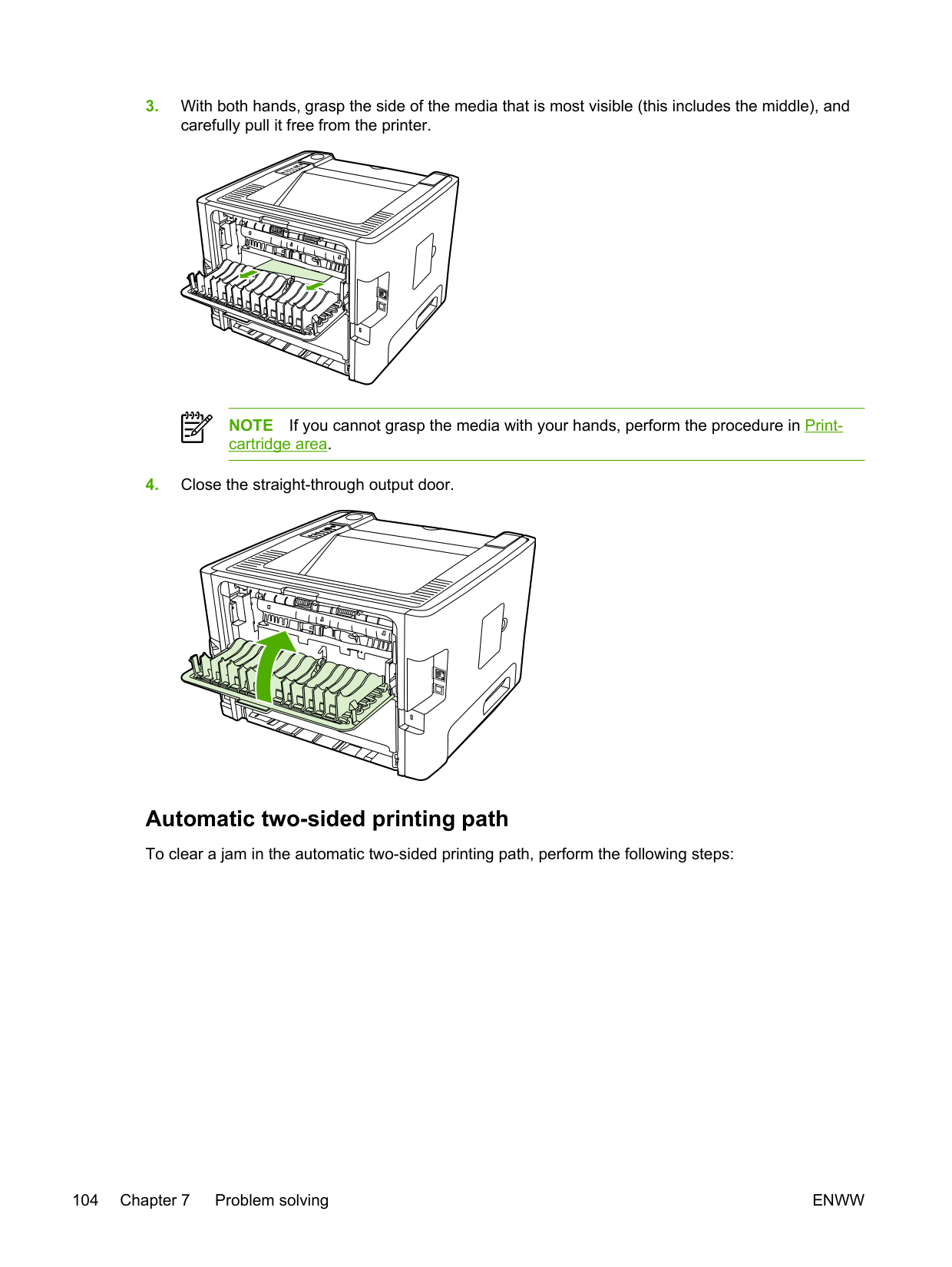
To clear a jam in the straight-through output path, perform the following steps:
CAUTION Do not use sharp objects, such as tweezers or needlenose pliers, to remove jams. Damage caused by sharp objects will not be covered by the warranty.
| | |---|
NOTE If you cannot grasp the media with your hands, perform the procedure in Printcartridge area.
#### Automatic two-sided printing path
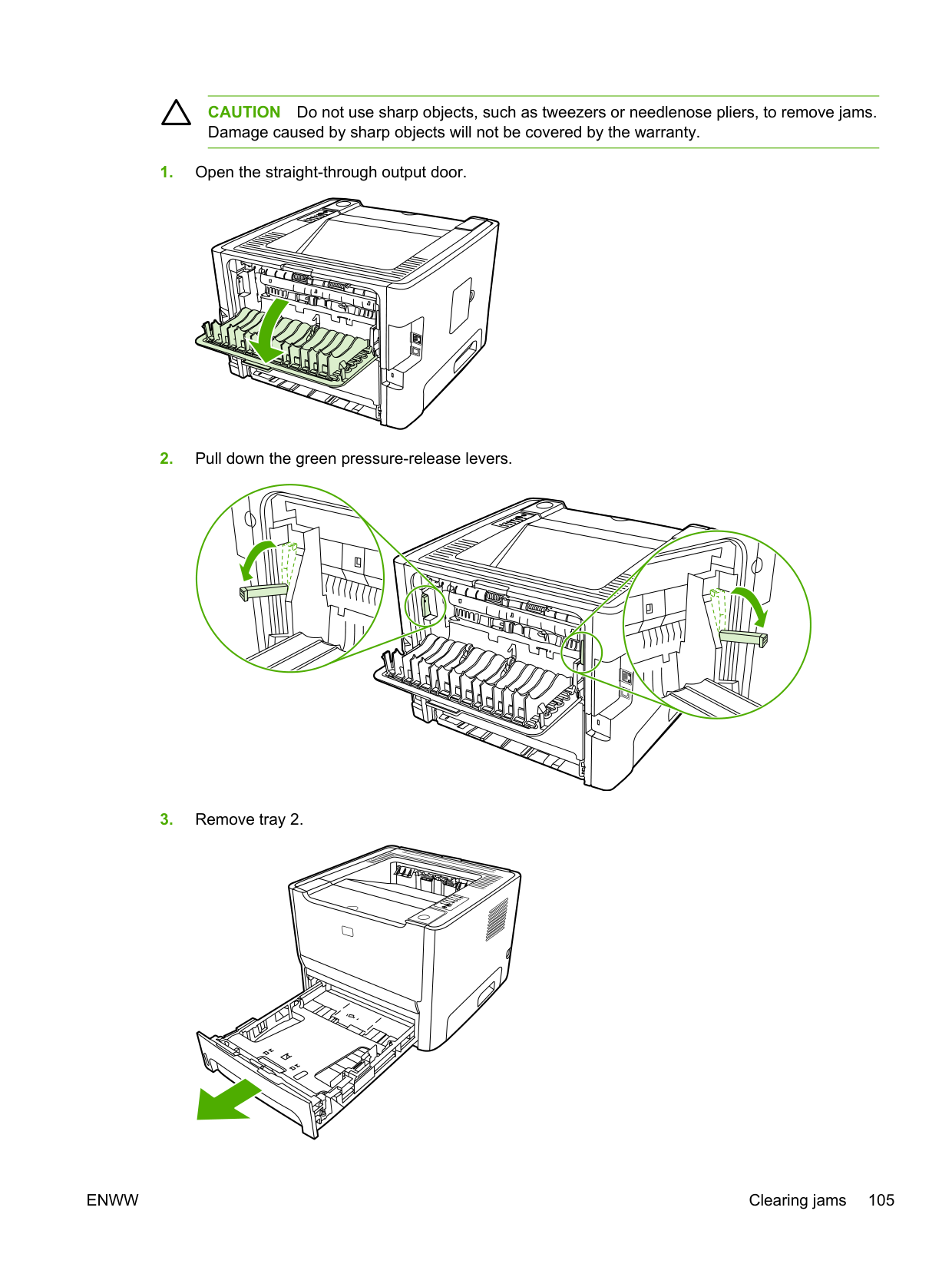
To clear a jam in the automatic two-sided printing path, perform the following steps:
CAUTION Do not use sharp objects, such as tweezers or needlenose pliers, to remove jams. Damage caused by sharp objects will not be covered by the warranty.
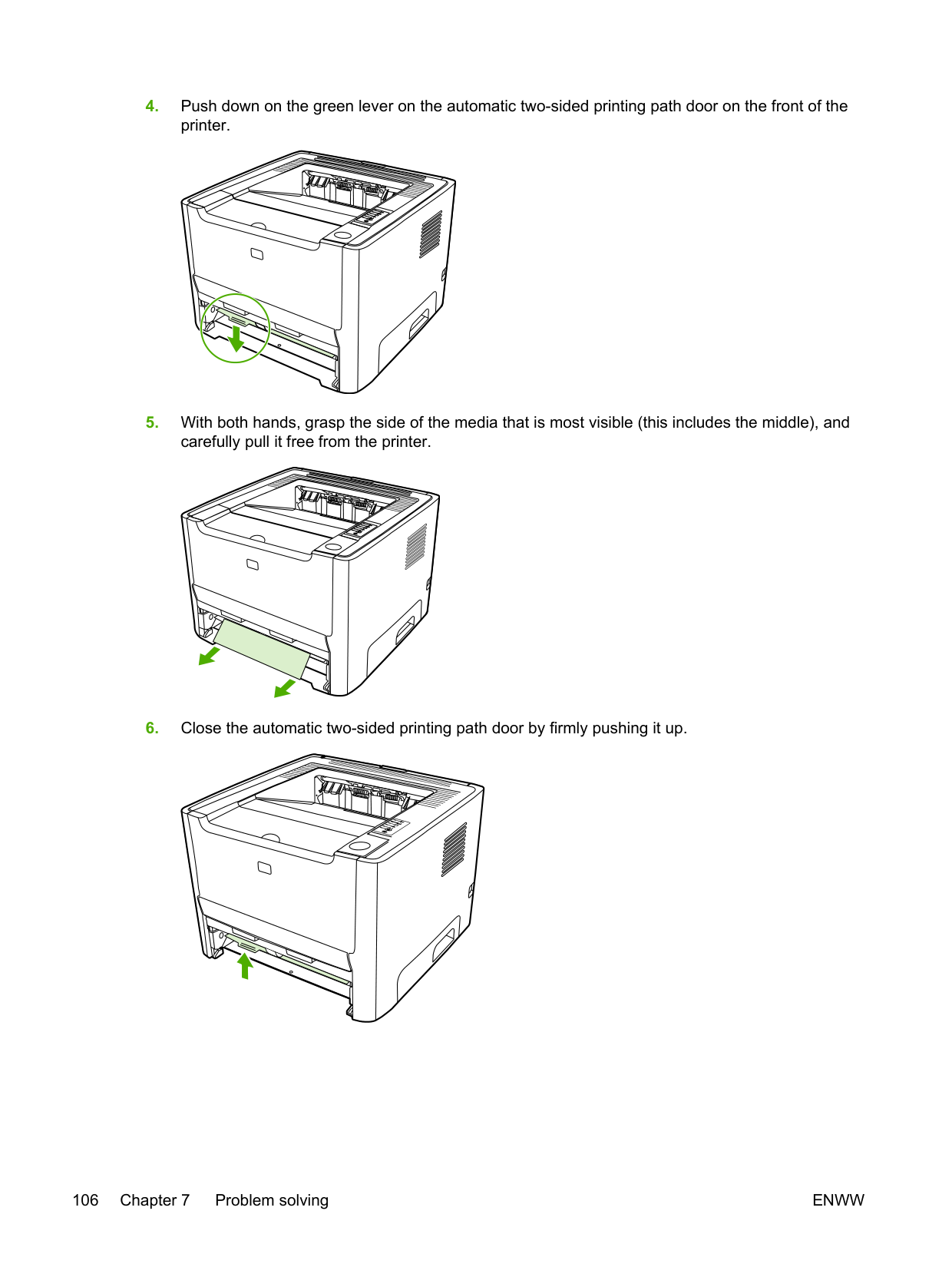
####### 10. Close the automatic two-sided printing path door.
Network setup problem solving
If the computer cannot discover the networked HP LaserJet 2015 Series printer, perform the following steps:
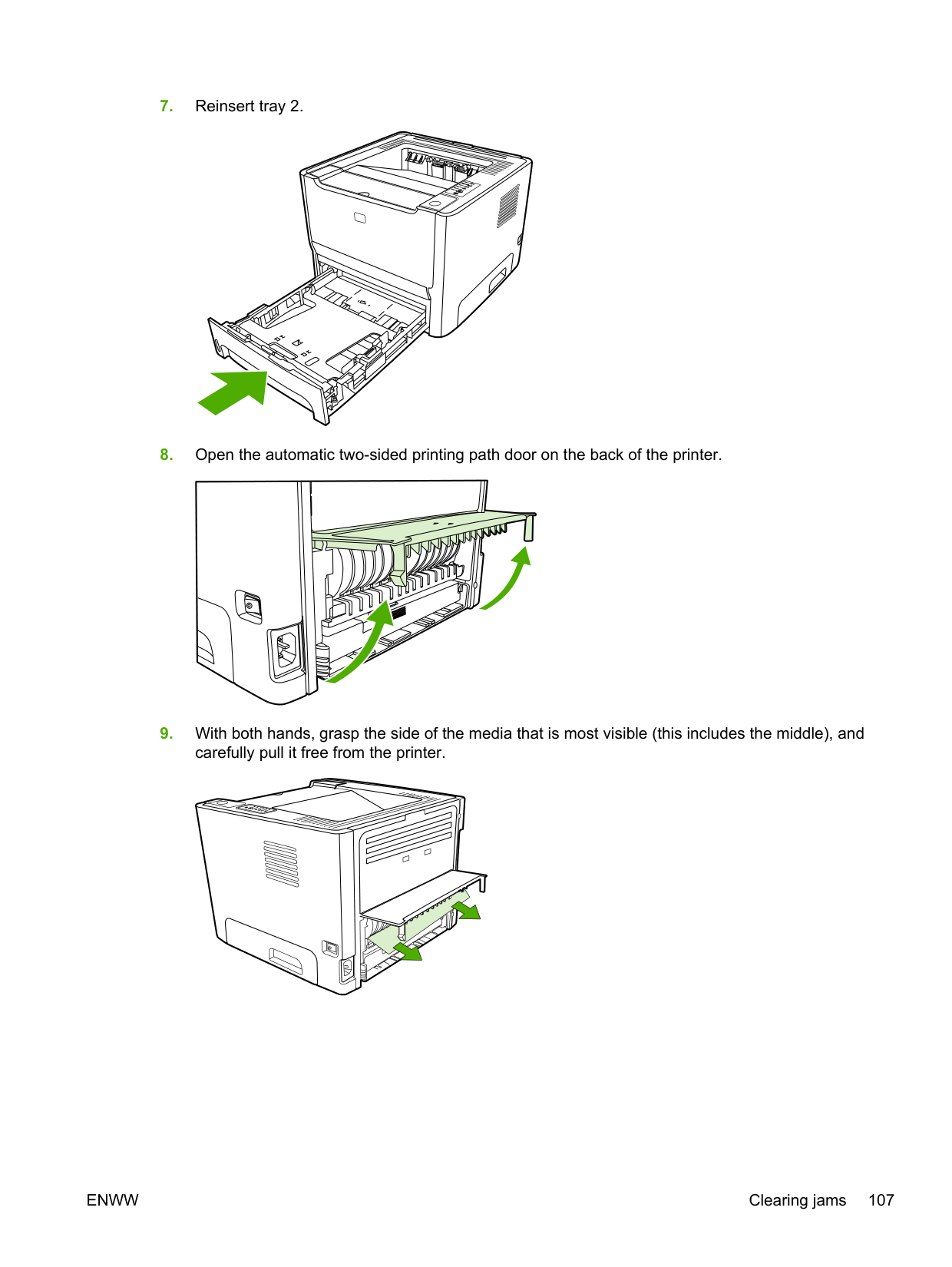
After the Attention, Ready, and Go lights finish cycling, the printer returns to a Ready state and the reset is complete.
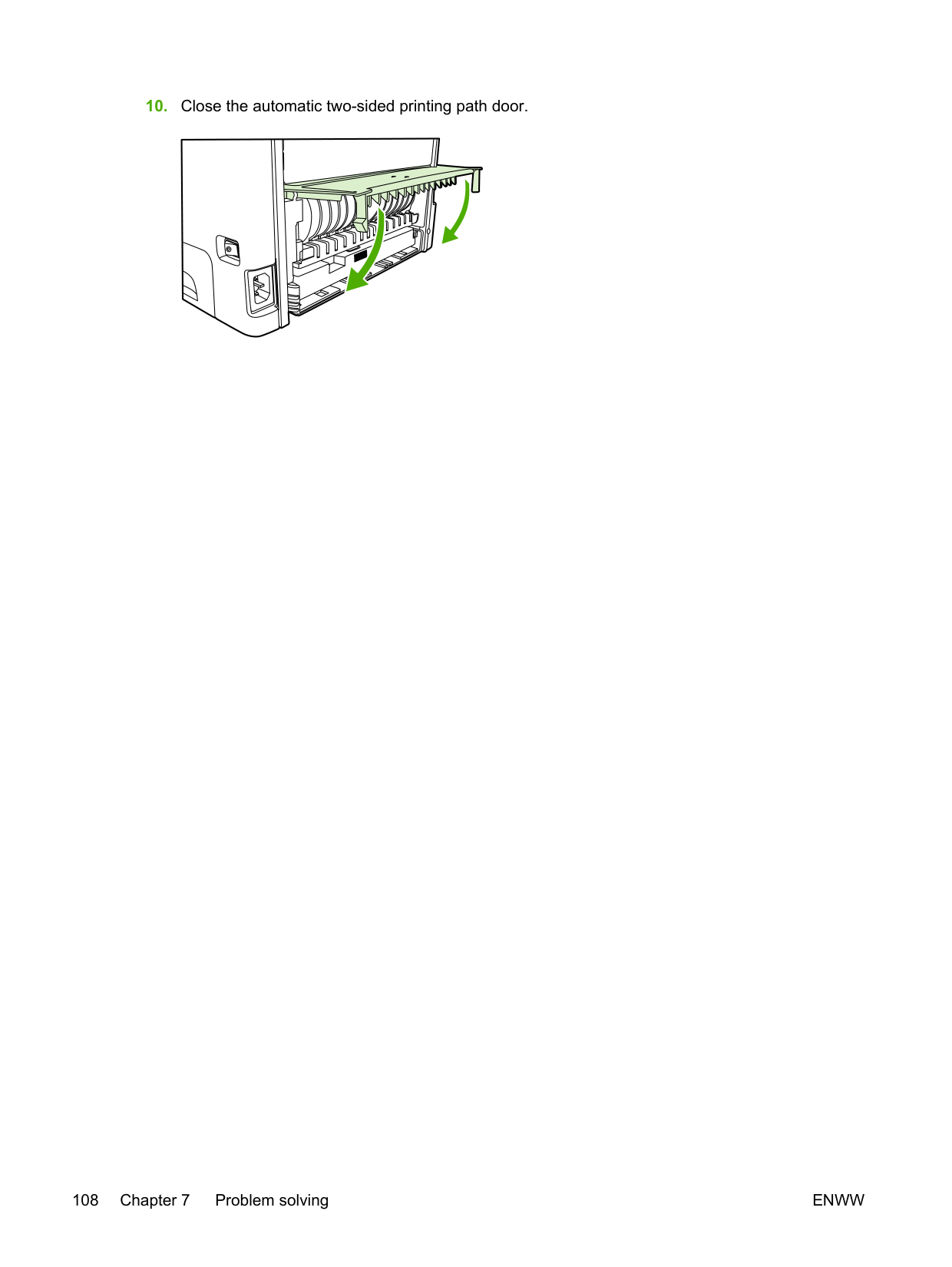
ENWW Network setup problem solving 109
A Accessory/Consumable addendum
This appendix provides information on the following topics:
ENWW 111
Order supplies and accessories
You can increase the printer's capabilities with optional accessories and supplies. Use accessories and supplies specifically designed for the HP LaserJet P2015 Series printers to ensure optimum performance.
The HP LaserJet P2015 Series printer features Smart Printing Supplies. When you print a Configuration page by pressing and holding the Go button for 5 seconds, a Supplies Status page prints after the Configuration page. The Supplies Status page has information on the amount of toner remaining in the print cartridge, part numbers for ordering supplies, and whether the installed print cartridge is a genuine HP supply item.
Table A-1 Ordering information
########### Item Description or use Order number
Printing supplies HP Multipurpose paper HP brand paper for a variety of uses (1 box of 10 reams, 500 sheets each). To order a sample, in the U.S., call 1-800-471-4701.
HPM1120
HP LaserJet paper Premium HP brand paper for
HPJ1124
use with HP LaserJet printers (1 box of 10 reams, 500 sheets each). To order a sample, in the U.S., call 1-800-471-4701.
HP LaserJet transparency film
HP brand transparency film for use with HP LaserJet monochrome printers.

Print cartridges for the HP LaserJet P2015 Series printer
Smart print cartridges Replacement print cartridges
Q7553A (3,000-page cartridge)
for the HP LaserJet P2015 Series printer.
Q7553X (7,000-page cartridge)
Supplementary documentation
HP LaserJet family print media guide
A guide to using paper and other print media with HP LaserJet printers.
5963-7863
| | |---|

NOTE This document can be downloaded from http://www.hp.com/ support/ ljpaperguide/.
Replacement parts Media pickup roller (for tray 1) Picks media from tray 1 and
CB366-67901
advances it through the printer.
Media pickup roller (for tray 2) Picks media from tray 2 and
CB366-67902
advances it through the printer.
Accessories 250-sheet paper tray (tray 3) Provides an additional 250sheet input tray. It is standard on the HP LaserJet P2015x.
Q5931A
10/100 networking print servers
Table A-2 HP LaserJet P2015 Series printer
########### Item and description Order number
HP Jetdirect 175x fast-Ethernet external print server (value line, USB port)
J6035C
Must be Version C or later.
HP Jetdirect en3700 fast Ethernet print server J7942A HP Jetdirect en2400 802.11g wireless external print server (full featured, USB port)
J7951A
ENWW 10/100 networking print servers 113
HP print cartridges
#### HP policy on non-HP print cartridges
Hewlett-Packard Company cannot recommend the use of non-HP print cartridges, either new, refilled, or remanufactured. Since they are not HP products, Hewlett-Packard cannot influence their design or control their quality. Service or repair that is required as a result of using non-HP print cartridges will not be covered under the printer warranty.
| | |---|
NOTE The warranty does not apply to defects resulting from software, interfacing, or parts not supplied by Hewlett-Packard.
#### Storing print cartridges
Do not remove the print cartridge from its package until you are ready to use it, and minimize exposure to light.
#### Print cartridge life expectancy
The average cartridge yield is 3000 pages in accordance with ISO/IEC 19752. A replacement cartridge that has an average yield of 7000 pages in accordance with ISO/IEC 19752 is also available. Actual cartridge yield depends on specific use.
#### Saving toner
EconoMode is a feature that allows the printer to use less toner per page. Selecting this option may extend the life of the print cartridge and reduce your cost per page. However, it will also reduce print quality. The printed image is lighter, but it is adequate for printing drafts or proofs. HP does not recommend full-time use of EconoMode. See EconoMode for more information.
DIMMs (memory or font)
The following sections provide instructions for installing, testing, and removing DIMMs.
#### Install a memory DIMM
If you add memory (RAM only) to the HP LaserJet P2015 Series printer, you can print more complex print jobs.
To install a DIMM, follow the instructions below:
CAUTION Handling a DIMM (memory) without wearing a grounded, antistatic device might damage the DIMM. Touch any metal part of the printer or other grounded metal before touching the DIMM.
####### 4. With the gold contacts facing upward, insert the DIMM in the DIMM seat and press the DIMM bodyin until the metal retaining pins click.
#### Test the DIMM installation
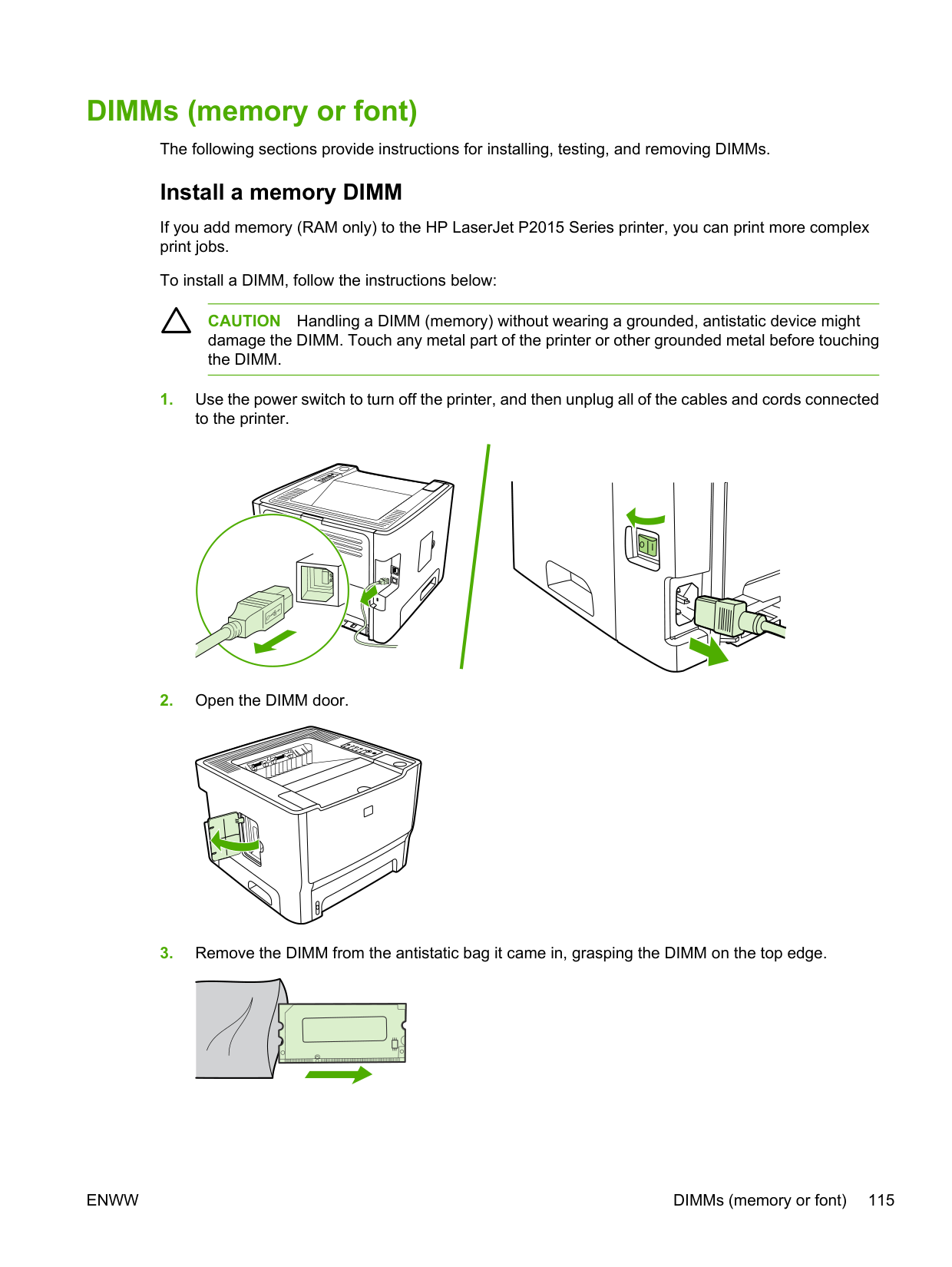
To test the DIMM installation, print a configuration page, and check the Total Memory specified on the page. See Printer information pages for more information.
If all lights on the control panel are blinking, the DIMM installation was unsuccessful. Remove the DIMM and reinstall it.
#### Remove a DIMM
To remove a DIMM, follow the instructions below:
CAUTION Handling a DIMM (memory) without wearing a grounded, antistatic device might damage the DIMM. Touch any metal part of the printer or other grounded metal before touching the DIMM.
| |
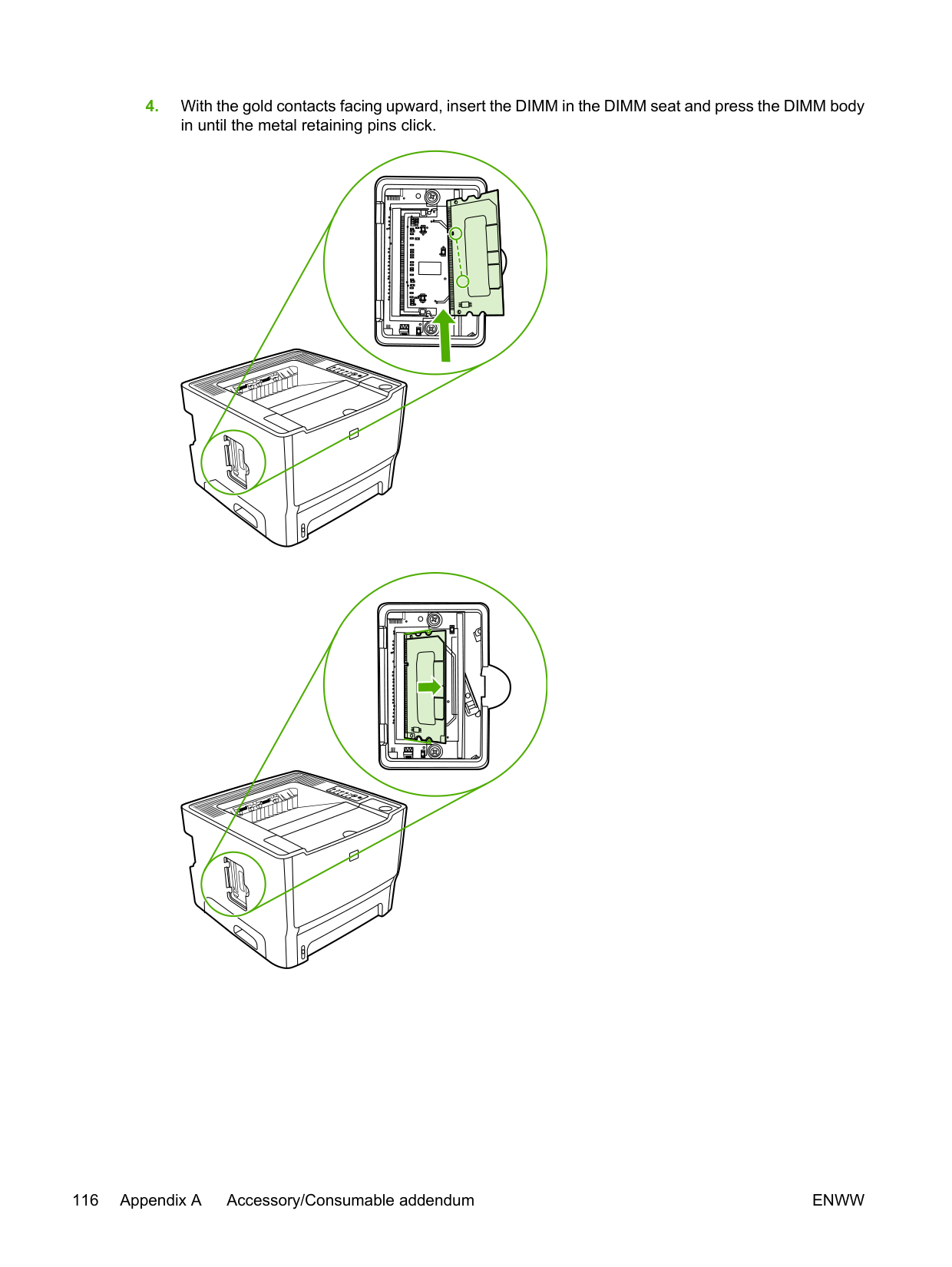
|---|
NOTE Store the DIMM in an antistatic bag.
B Service and support
This appendix provides information on the following topics:
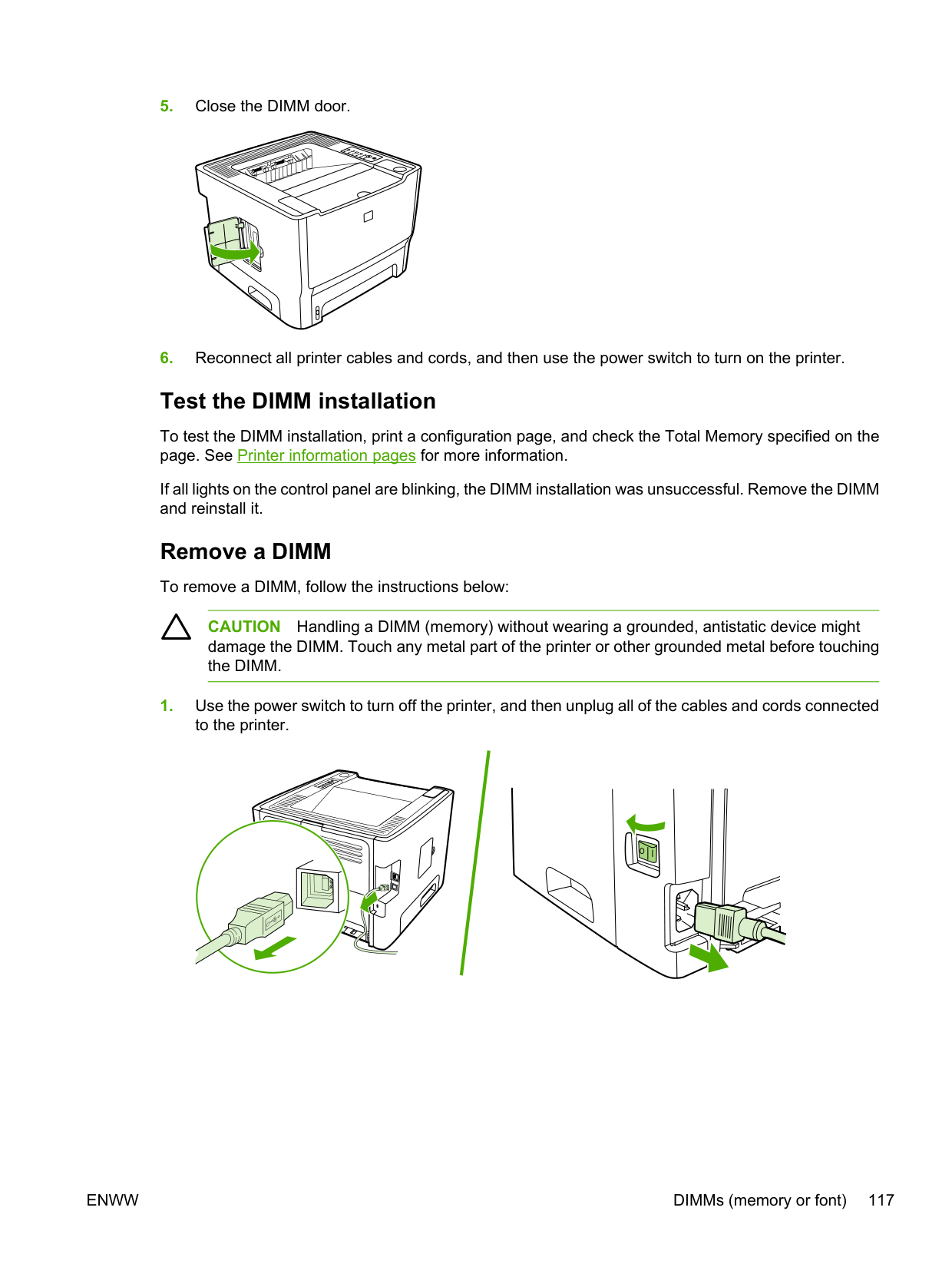
ENWW 121
Hardware service
If your hardware fails during the warranty period, Hewlett-Packard offers the following support options: ● Hewlett-Packard repair services: Hewlett-Packard will arrange to pick up the unit, repair it, and
return it to you within 5 to 10 business days, depending on your location.
● Hewlett-Packard authorized service provider: You can return the unit to a local authorized service dealer.
See How to contact HP for more information.
Extended warranty
HP Care Pack provides coverage for the HP product and all HP-supplied internal components. The hardware maintenance covers a three-year period from the date of the HP product purchase. The customer may purchase an HP Care Pack up to one year from the date of purchase of the HP product. For more information, contact the HP Customer Care Service and Support group. See How to contact HP.
HP Care Pack options might be available after the standard warranty period has expired. Go to http://www.hpexpress-services.com/10467a/ and enter the product number to identify the HP Care Pack options that are available for your product.
Guidelines for repacking the printer
Use the following guidelines when repacking the printer:
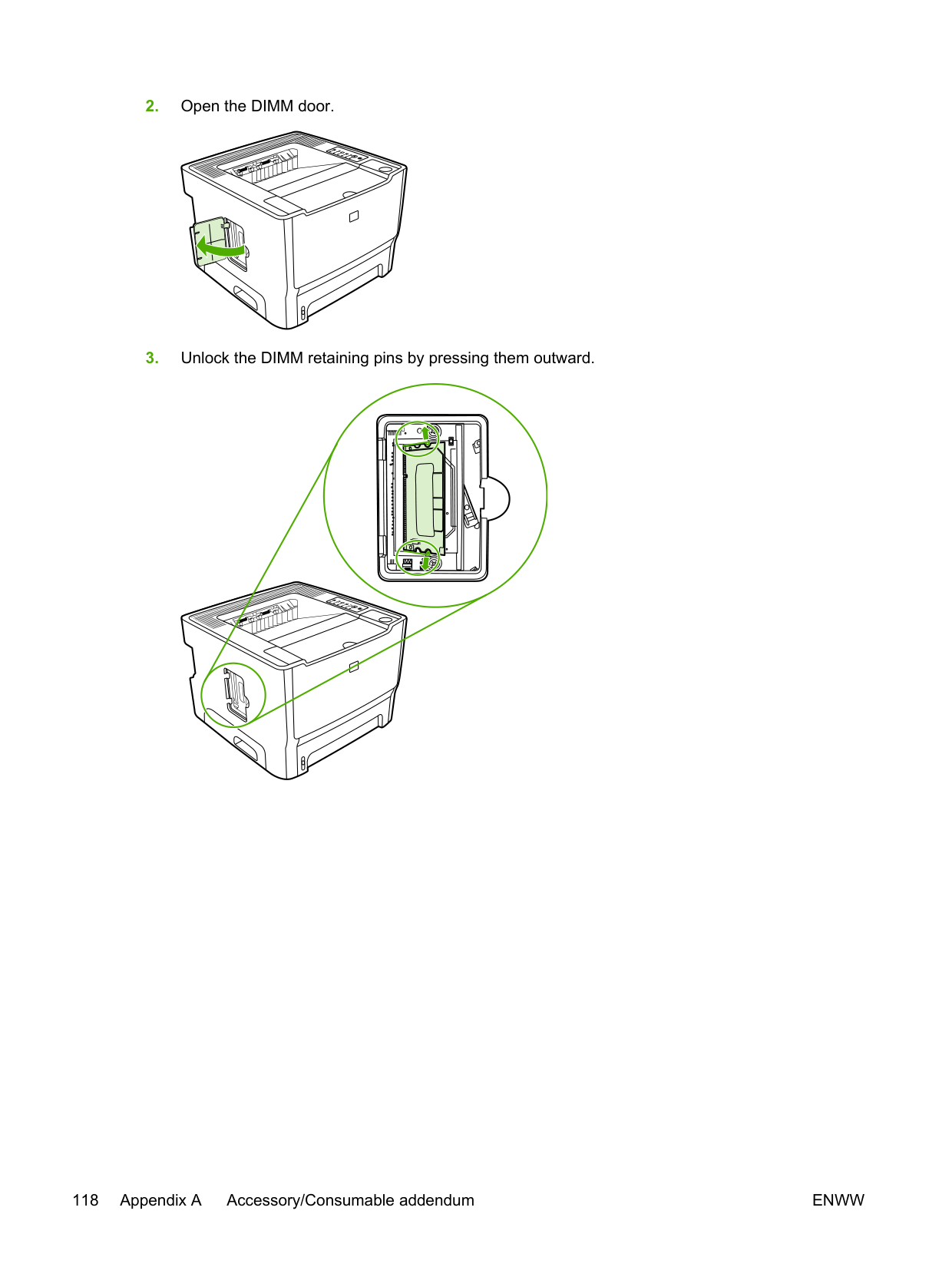
CAUTION Static electricity can damage DIMMs. When handling DIMMs, wear a grounded, antistatic wrist strap.
CAUTION To prevent damage to the print cartridge, store the print cartridge in its original packing material, or store it so that it is not exposed to light.
How to contact HP
If you need to contact HP for service or support, use one of the following links:
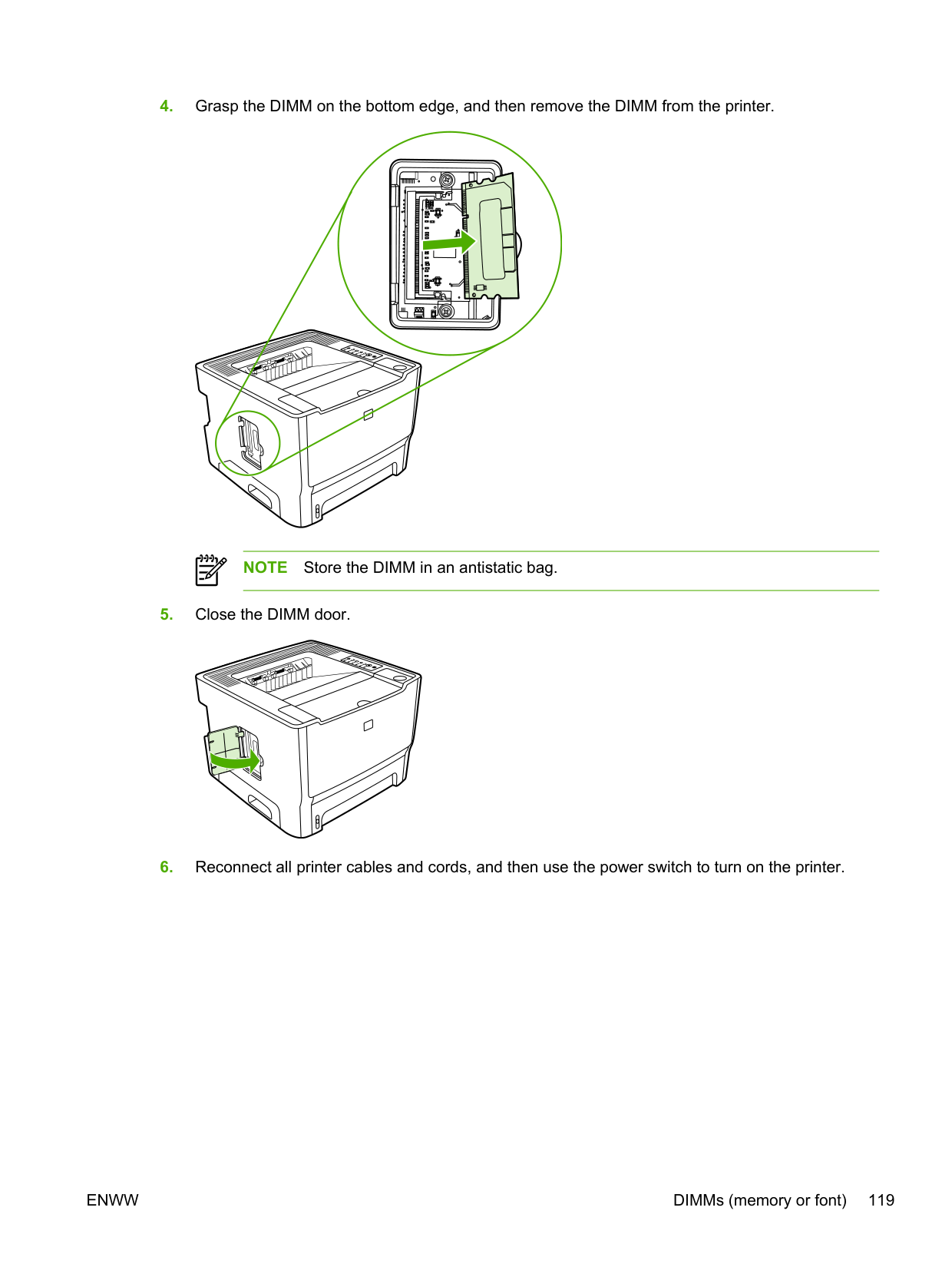
ENWW Guidelines for repacking the printer 123
C Printer specifications
This appendix provides information on the following topics:

ENWW 125
Environmental specifications
Operating environment Printer plugged into an AC outlet:
NOTE Values are based on preliminary data. See http://www.hp.com/support/ljP2015 for current information.
Acoustic emissions Declared per ISO 9296 Table C-1 HP LaserJet P2015 printer
Sound power level Printing (26 ppm): LWAd = 6.2 Bels A and 62 dB (A)
Ready (Sleep): Inaudible
Sound pressure level bystander position Printing (26 ppm): LpAm = 51 dB (A) Ready (Sleep): Inaudible
NOTE Values are based on preliminary data. See http://www.hp.com/support/ljP2015 for current information.
NOTE Configuration tested: HP LaserJet P2015 base base unit, 26 ppm, standard tray, A4 paper, and simplex continuous print.
Electrical specifications
####### WARNING! Power requirements are based on the country/region where the printer is sold. Do not convert operating voltages. Doing so might damage the printer and void the product warranty.
Power requirements (110) 110-127v (+/-10%), 50/60 Hz (+/-2) Power requirements (220) 220v-240v (+/-10%), 50/60 Hz (+/-2 Hz) Power consumption ● During printing (27 ppm): 325 watts (average)
Rated current ● 4.9 amps at 115 volts ● 2.9 amps at 230 volts
Power requirements (110) 110-127v (+/-10%), 50/60 Hz (+/-2) Power requirements (220) 220v-240v (+/-10%), 50/60 Hz (+/-2 Hz) Power consumption ● During printing (27 ppm): 325 watts (average)
Rated current ● 4.9 amps at 115 volts ● 2.9 amps at 230 volts
Power requirements (110) 110-127v (+/-10%), 50/60 Hz (+/-2) Power requirements (220) 220v-240v (+/-10%), 50/60 Hz (+/-2 Hz) Power consumption ● During printing (27 ppm): 325 watts (average)
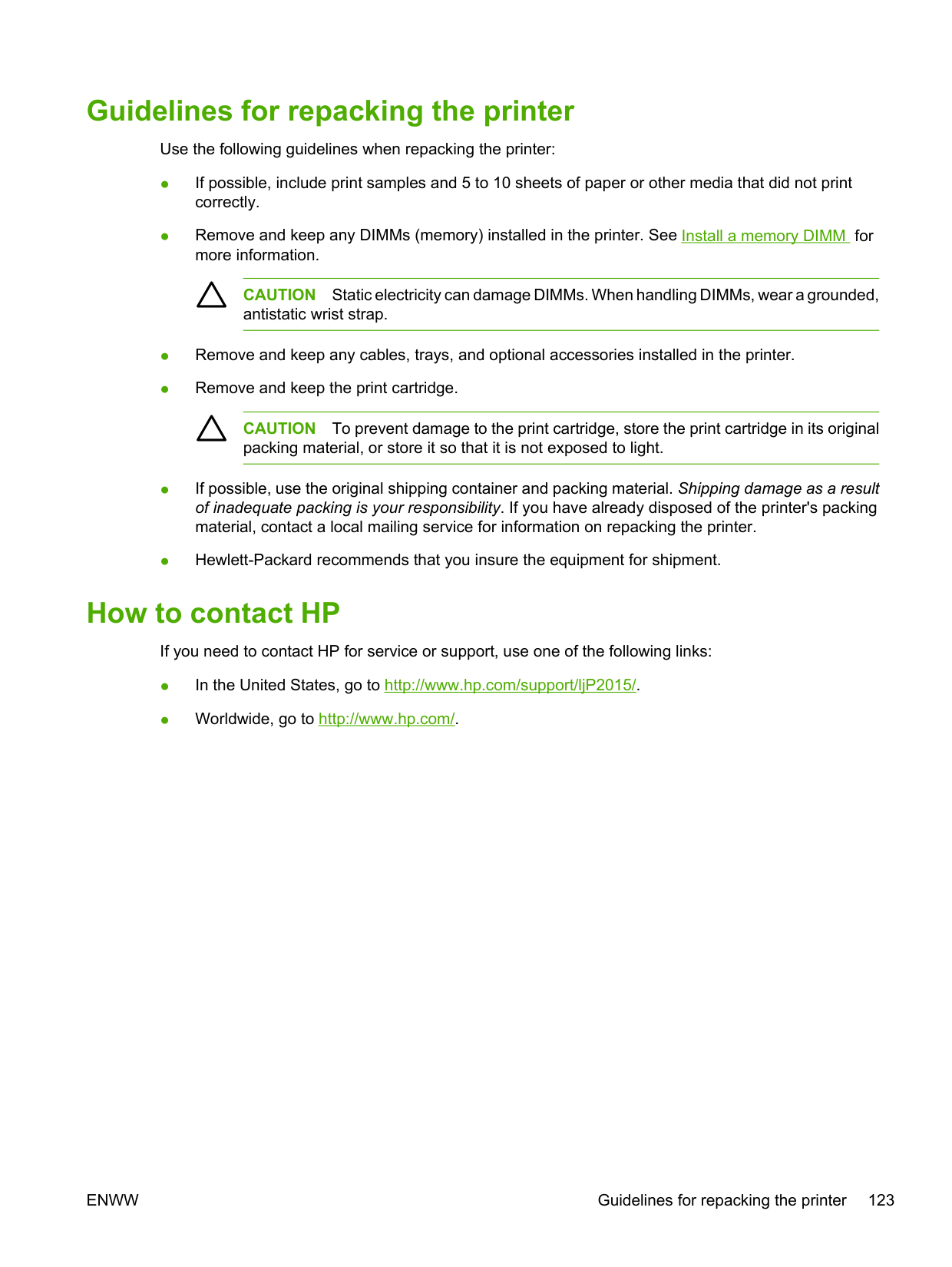
Rated current ● 4.9 amps at 115 volts ● 2.9 amps at 230 volts
ENWW Electrical specifications 127
| | |---|
NOTE Values are based on preliminary data. See http://www.hp.com/support/ljP2015 for current information.
NOTE The power reported is the highest value measured for monochrome printing using all standard voltages.
NOTE The default time from Ready mode to Sleep mode and the recovery time from Sleep mode to the start of printing is less than 10 seconds because of the instant-on fusing.
NOTE The heat dissipation in Ready mode is 25 BTU/hour.
Physical specifications
Dimensions ● Width: 350 mm (16.8 inches) ● Depth: 361 mm (14.2 inches)

● Height: 256 mm (10.0 inches) Weight (3,000-page cartridge installed) HP LaserJet P2015 printer: 10.7 kg (23.6 lb)
NOTE Values are based on preliminary data. See http://www.hp.com/support/ljP2015 for current information.
ENWW Physical specifications 129
Printer capacities and ratings
Print speed HP LaserJet P2015 printer:
Straight through media path: 60 to 163 g/m2 (16 to 43 lbs) Base memory 32 MB RAM Upgrade memory expansion One DIMM slot available for a 32, 64, 128, or 256 MB RAM,
144-pin, DDR2 DIMM Print resolution ● 1200 dpi: This setting uses ProRes 1200 to provide fine-
line detail at 1200 x 1200 dpi.
Duty cycle ● 10,000 single-sided pages per month (maximum)
● 1,000 single-sided pages per month (average) PCL PCL 5e, PCL 6 Postscript emulation HP postscript level 3 emulation
Memory specifications
Base memory 32 MB RAM Upgrade memory expansion (1 slot available) 144-pin, DDR2 DIMM
Port availability
USB Compatible with High-speed USB 2.0 specifications Network (networking-equipped models only)
RJ-45, Ethernet 10/100
D Regulatory information
ENWW 131
FCC compliance
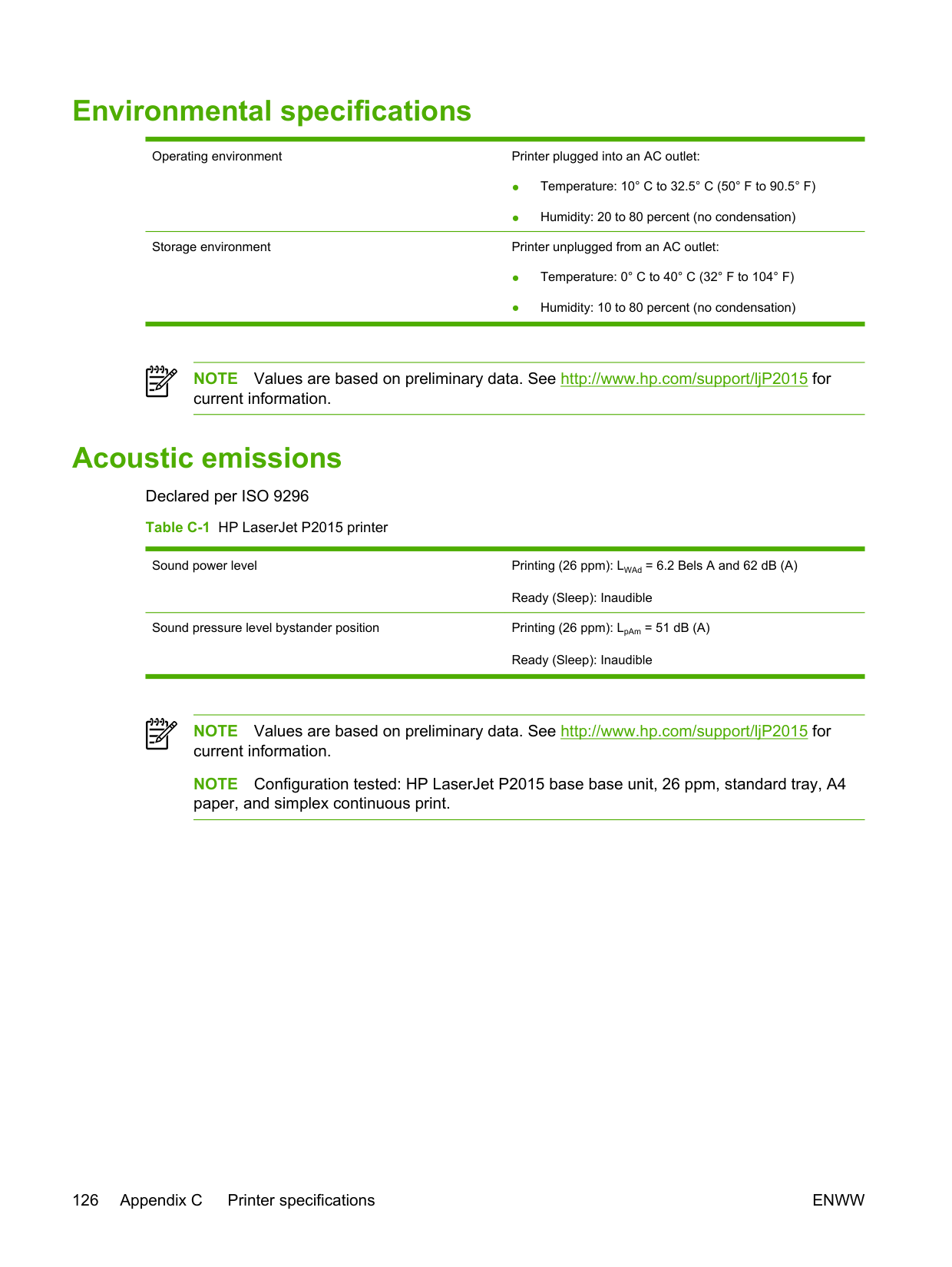
This equipment has been tested and found to comply with the limits for a Class B digital device, pursuant to Part 15 of the FCC rules. These limits are designed to provide reasonable protection against harmful interference in a residential installation. This equipment generates, uses, and can radiate radio frequency energy. If it is not installed and used in accordance with the instructions, it may cause harmful interference to radio communications. However, there is no guarantee that interference will not occur in a particular installation. If this equipment does cause harmful interference to radio or television reception, which can be determined by turning the equipment off and on, the user is encouraged to try to correct the interference by one or more of the following measures:
| | |---|
Declaration of Conformity statements
Declaration of Conformity according to ISO/IEC Guide 22 and EN 45014
Manufacturer's Name: Hewlett-Packard Company Manufacturer's Address: 11311 Chinden Boulevard,
Boise, Idaho 83714-1021, USA
declares that the product Product Name 4): HP LaserJet P2015 Series Regulatory Model 3): BOISB-0602-00
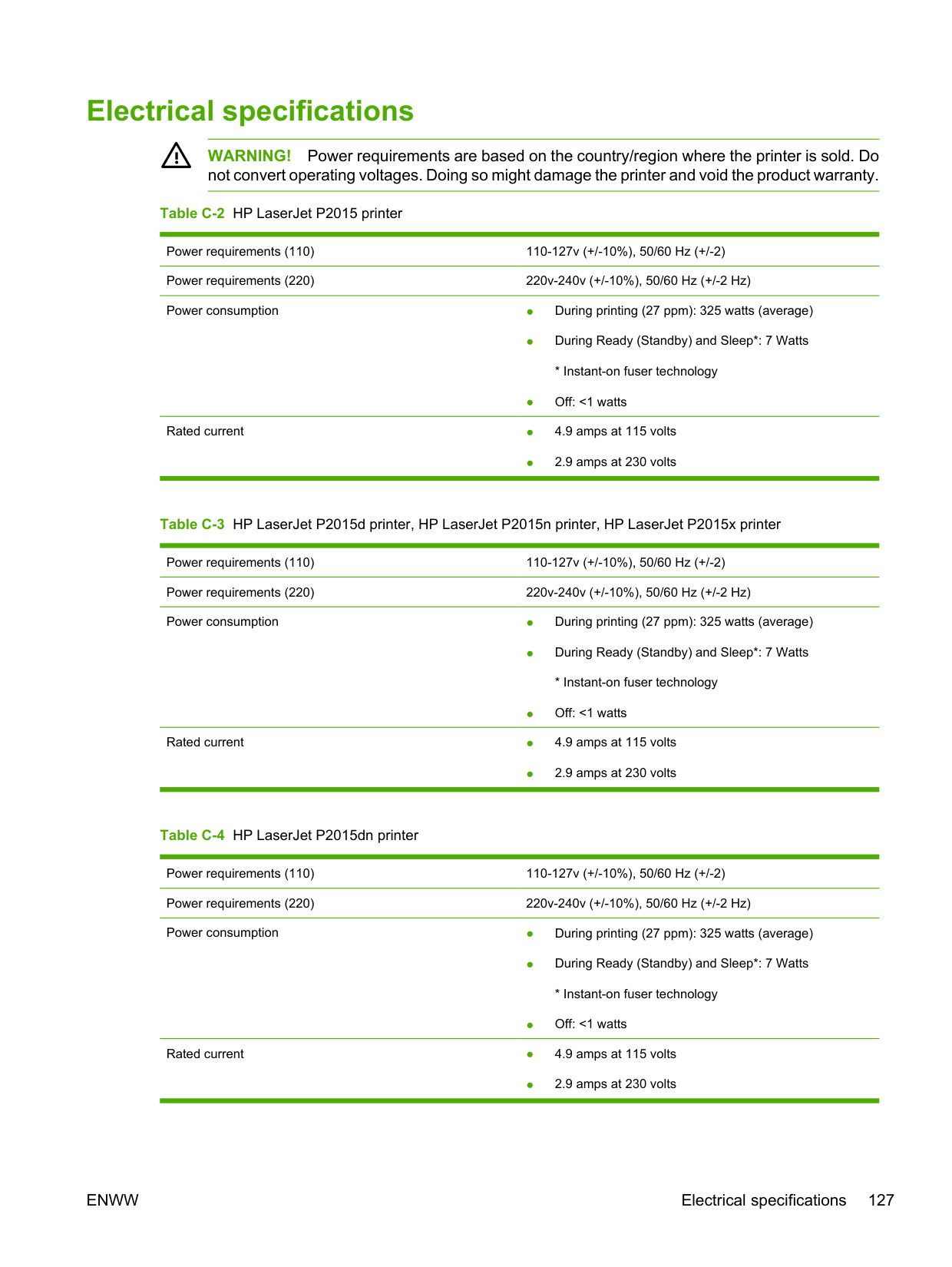
Including: Q5931A — Optional 250–Sheet Input Tray Product Options: ALL
Toner Cartridges: Q7553A / Q7553X
conforms to the following Product Specifications: Safety: IEC 60950-1:2001 / EN 60950-1:2001 +A11
IEC 60825-1:1993 +A1 +A2/EN 60825-1:1994 +A1 +A2 Class 1 Laser/LED Product) GB4943-2001
EMC: CISPR 22:1993 +A1 +A2/ EN 55022:1994 Class B1) EN 61000-3-2:2000 EN 61000-3-3:1995 / A1 EN 55024:1998 +A1 +A2 FCC Title 47 CFR, Part 15 Class B2) / ICES-003, Issue 4 GB9254-1998, GB17625.1-2003
########### Supplementary Information:
The product herewith complies with the requirements of the EMC Directive 89/336/EEC and the Low Voltage Directive 73/23/EEC, and carries the CE-marking accordingly.
Boise, Idaho 83714, USA

########### September 1, 2006
For Regulatory Topics ONLY, contact: Australia Contact: Product Regulations Manager, Hewlett-Packard Australia Ltd., 31-41 Joseph Street, Blackburn, Victoria 3130,
Australia European Contact: Your Local Hewlett-Packard Sales and Service Office or Hewlett-Packard GmbH, Department HQ-TRE / Standards Europe, Herrenberger Straße 140, Böblingen, D-71034, Germany, (FAX: +49-7031-14-3143) USA Contact: Product Regulations Manager, Hewlett-Packard Company, PO Box 15, Mail Stop 160, Boise, Idaho 83707-0015, USA, (Phone: 208-396-6000)
ENWW Declaration of Conformity statements 133
Regulatory statements
#### Laser safety statement
The Center for Devices and Radiological Health (CDRH) of the U.S. Food and Drug Administration has implemented regulations for laser products manufactured since August 1, 1976. Compliance is mandatory for products marketed in the United States. The printer is certified as a "Class 1" laser product under the U.S. Department of Health and Human Services (DHHS) Radiation Performance Standard according to the Radiation Control for Health and Safety Act of 1968.
Since radiation emitted inside the printer is completely confined within protective housings and external covers, the laser beam cannot escape during any phase of normal user operation.
WARNING! Using controls, making adjustments, or performing procedures other than those specified in this user guide could result in exposure to hazardous radiation.
Canadian DOC regulations Complies with Canadian EMC Class B requirements. « Conforme à la classe B des normes canadiennes de compatibilité électromagnétiques (CEM). »
#### Korean EMI statement
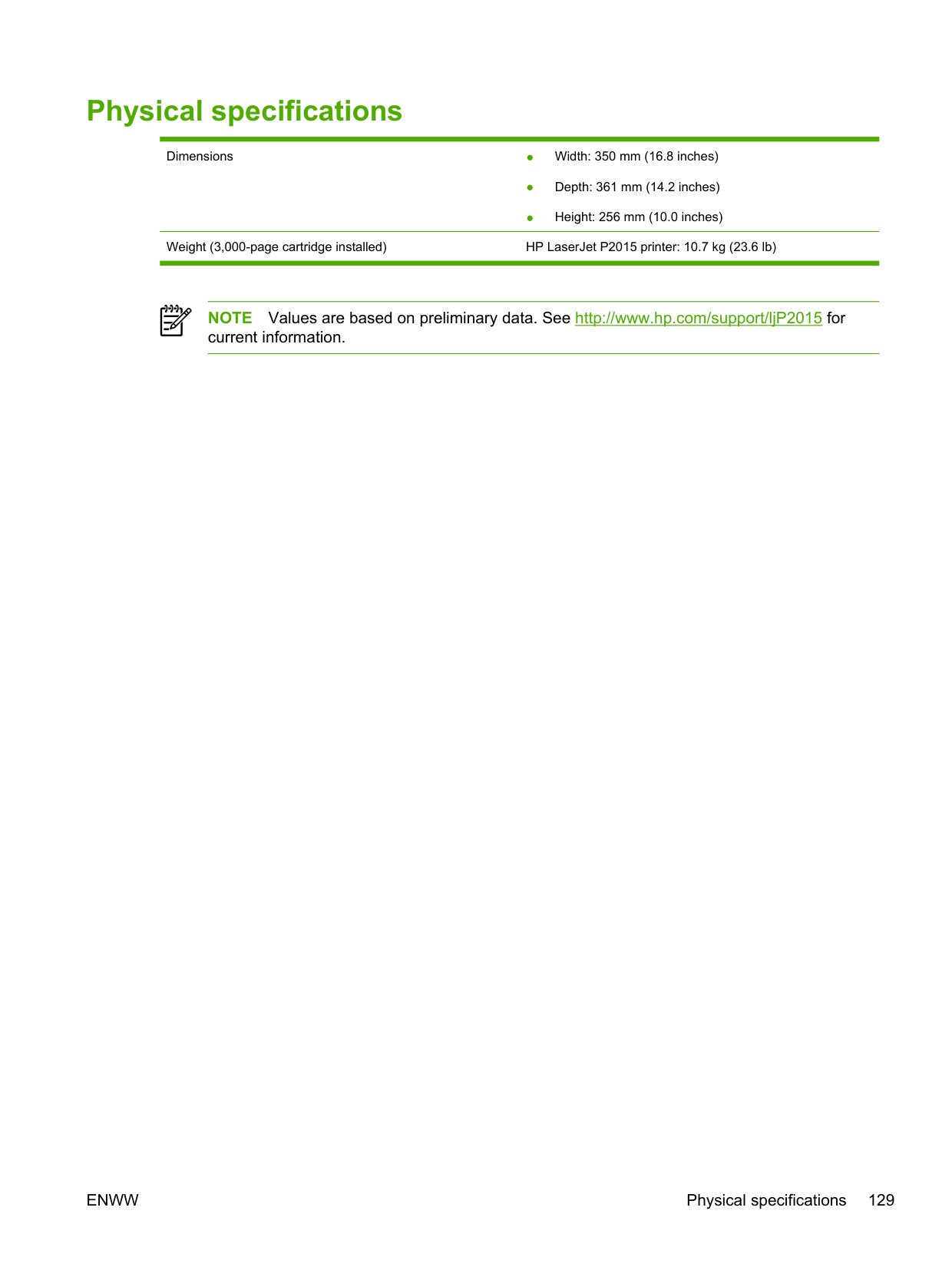
| | |---|
Laser statement for Finland LASERTURVALLISUUS LUOKAN 1 LASERLAITE KLASS 1 LASER APPARAT
HP LaserJet P2015, HP LaserJet P2015d, HP LaserJet P2015n, HP LaserJet P2015x, HP LaserJet P2015dn -laserkirjoitin on käyttäjän kannalta turvallinen luokan 1 laserlaite. Normaalissa käytössä kirjoittimen suojakotelointi estää lasersäteen pääsyn laitteen ulkopuolelle.
Laitteen turvallisuusluokka on määritetty standardin EN 60825-1 (1994) mukaisesti. VAROITUS!
Laitteen käyttäminen muulla kuin käyttöohjeessa mainitulla tavalla saattaa altistaa käyttäjän turvallisuusluokan 1 ylittävälle näkymättömälle lasersäteilylle.
######## VARNING!
Om apparaten används på annat sätt än i bruksanvisning specificerats, kan användaren utsättas för osynlig laserstrålning, som överskrider gränsen för laserklass 1.
######## HUOLTO
HP LaserJet P2015, HP LaserJet P2015d, HP LaserJet P2015n, HP LaserJet P2015x, HP LaserJet P2015dn -kirjoittimen sisällä ei ole käyttäjän huollettavissa olevia kohteita. Laitteen saa avata ja huoltaa ainoastaan sen huoltamiseen koulutettu henkilö. Tällaiseksi huoltotoimenpiteeksi ei katsota väriainekasetin vaihtamista, paperiradan puhdistusta tai muita käyttäjän käsikirjassa lueteltuja, käyttäjän tehtäväksi tarkoitettuja ylläpitotoimia, jotka voidaan suorittaa ilman erikoistyökaluja.
######## VARO!
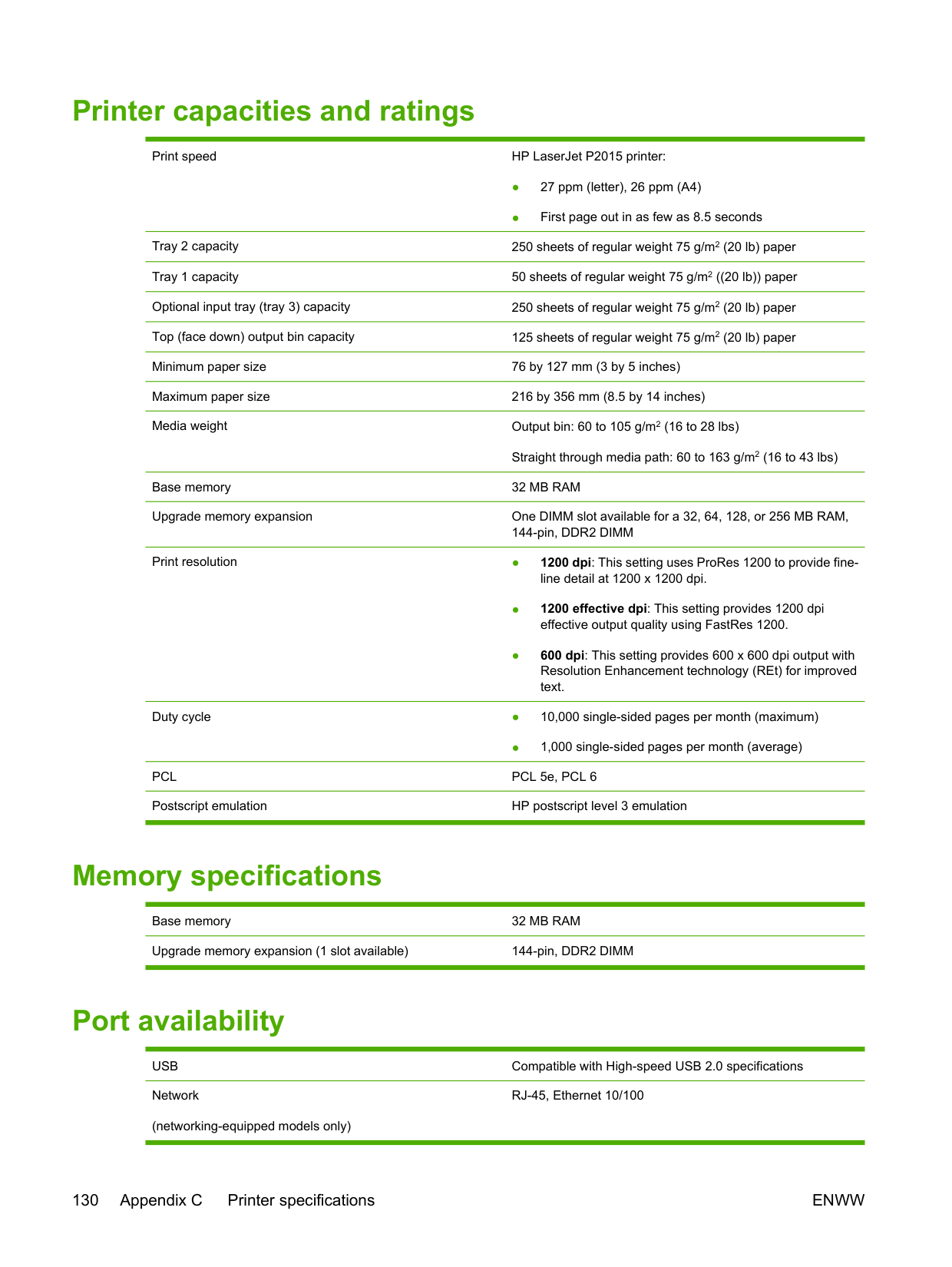
Mikäli kirjoittimen suojakotelo avataan, olet alttiina näkymättömälle lasersäteilylle laitteen ollessa toiminnassa. Älä katso säteeseen.
######## VARNING!
Om laserprinterns skyddshölje öppnas då apparaten är i funktion, utsättas användaren för osynlig laserstrålning. Betrakta ej strålen.
Tiedot laitteessa käytettävän laserdiodin säteilyominaisuuksista: Aallonpituus 785-800 nm Teho 5 mW Luokan 3B laser
ENWW Regulatory statements 135
Environmental product stewardship program
#### Protecting the environment
Hewlett-Packard Company is committed to providing quality products in an environmentally sound manner. This product has been designed with several attributes to minimize the impact on our environment.
#### Ozone production
This product generates no appreciable ozone gas (O3).
#### Power consumption

Power usage drops significantly while in Ready/Sleep mode, which saves natural resources and saves money without affecting the high performance of this product. This product qualifies for ENERGY STAR® (Version 3.0), which is a voluntary program to encourage the development of energy-efficient office products.
ENERGY STAR® and the ENERGY STAR mark are U.S. registered marks. As an Energy Star® partner, Hewlett-Packard Company has determined this product meets ENERGY STAR® guidelines for energy efficiency. For more information, see http://www.energystar.gov/.
#### Toner consumption
Economode uses significantly less toner, which might extend the life of the print cartridge.
#### Paper use
This product's manual/optional automatic duplex feature and N-up printing (multiple pages printed on one page) capability can reduce paper usage and the resulting demands on natural resources.
#### Plastics
Plastic parts over 25 grams (0.9 oz) are marked according to international standards that enhance the ability to identify plastics for recycling purposes at the end of the product's life.
#### HP LaserJet printing supplies
It's easy to return and recycle your empty HP LaserJet print cartridges—free of charge—with HP Planet Partners. HP is committed to providing inventive, high-quality products and services that are environmentally sound, from product design and manufacturing to distribution, operation and recycling processes. We ensure your returned HP LaserJet print cartridges are recycled properly, processing them to recover valuable plastics and metals for new products and diverting millions of tons of waste from landfills. Since this cartridge is being recycled and used in new materials, it will not be returned to
you. Your empty HP LaserJet print cartridges are recycled responsibly when you participate in the HP Planet Partners program. Thank you for being environmentally responsible!
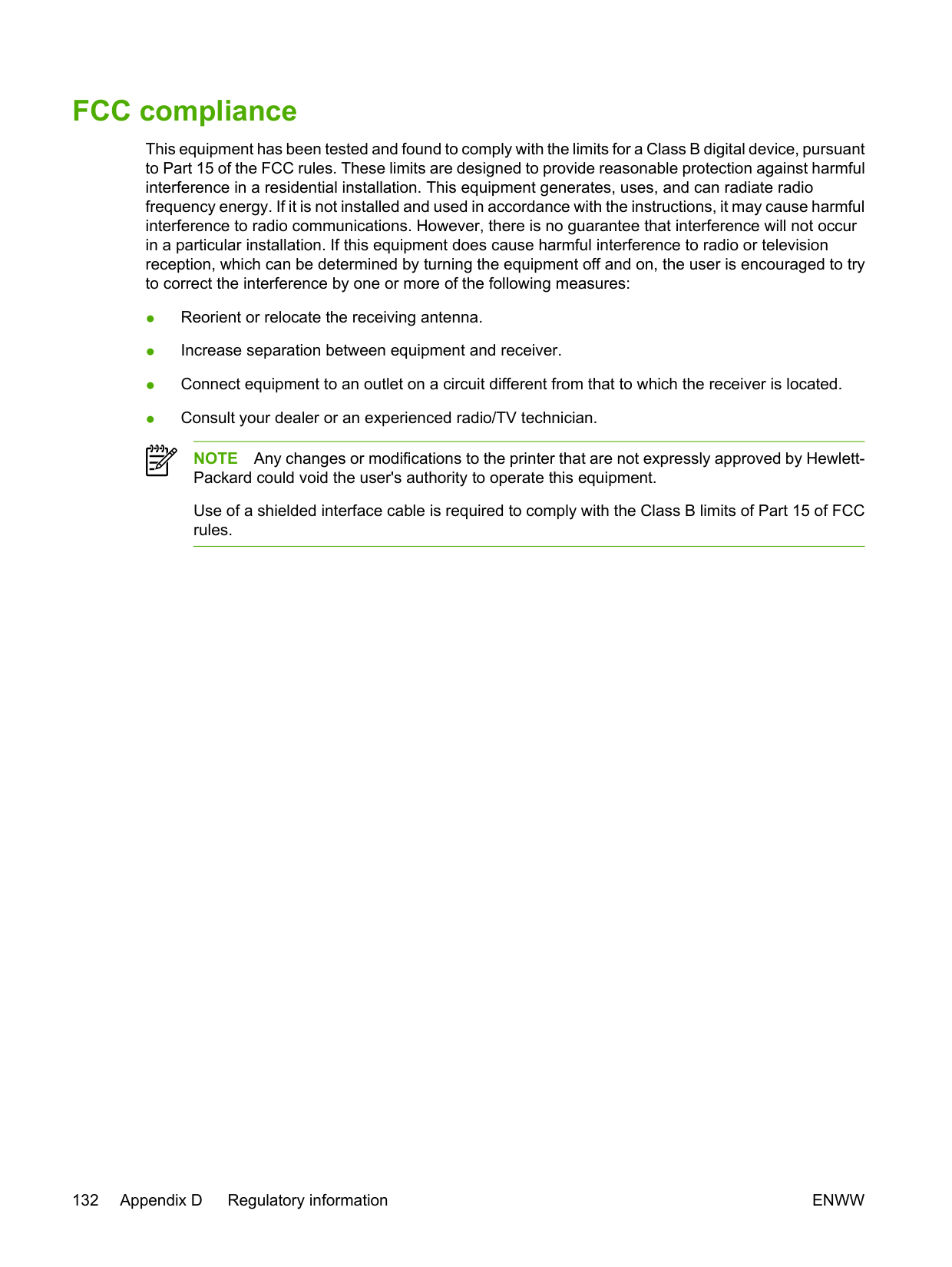
In many countries/regions, this product's printing supplies (for example, print cartridges) can be returned to HP through the HP Printing Supplies Returns and Recycling Program. An easy-to-use, free take back program is available in more than 35 countries/regions. Multi-lingual program information and instructions are included in every new HP LaserJet print cartridge and supplies package.
#### HP printing supplies returns and recycling program information
Since 1992, HP has offered HP LaserJet supplies return and recycling free of charge. In 2004, HP Planet Partners for LaserJet Supplies was available in 85% of the world market where HP LaserJet supplies are sold. Postage-paid and pre-addressed labels are included within the instruction guide in most HP LaserJet print cartridge boxes. Labels and bulk boxes are also available through the Web site: http://www.hp.com/recycle.
Use the label to return empty, original HP LaserJet print cartridges only. Please do not use this label for non-HP cartridges, refilled or remanufactured cartridges, or warranty returns. Printing supplies or other objects inadvertently sent to the HP Planet Partners program cannot be returned.
More than 10 million HP LaserJet print cartridges were recycled globally in 2004 through the HP Planet Partners supplies recycling program. This record number represents 26 million pounds of print cartridge materials diverted from landfills. Worldwide, in 2004, HP recycled an average of 59% of the print cartridge by weight consisting primarily of plastic and metals. Plastics and metals are used to make new products such as HP products, plastic trays and spools. The remaining materials are disposed of in an environmentally responsible manner.
###### U.S. returns
For a more environmentally responsible return of used print cartridges and supplies, HP encourages the use of bulk returns. Simply bundle two or more print cartridges together and use the single, prepaid, pre-addressed UPS label that is supplied in the package. For more information in the U.S., call (1)
(800) (340-2445) or visit the HP Web site at http://www.hp.com/recycle. Non-U.S. returns
Non-U.S. customers should visit the http://www.hp.com/recycle Web site for more information regarding availability of the HP Supplies Returns and Recycling program.
#### Paper
This product is capable of using recycled papers when the paper meets the guidelines outlines in the Print Media Guide. See Order supplies and accessories for ordering information. This product is suitable for the use of recycled paper according to EN12281:2002.
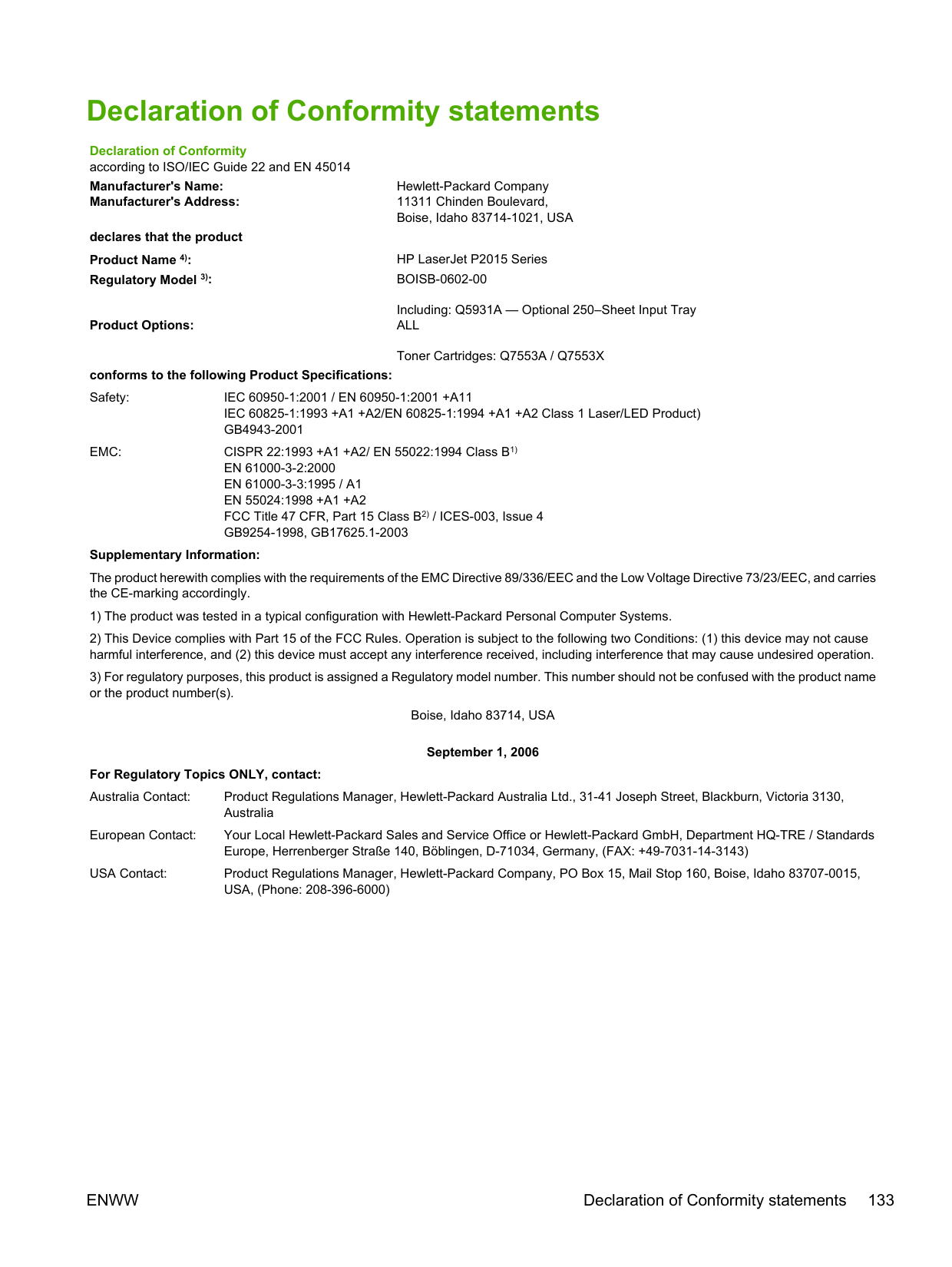
Material restrictions This HP product does not contain added mercury. This HP product does not contain batteries.
#### Disposal of Waste Equipment by Users in Private Household in the European Union
This symbol on the product or on its packaging indicates that this product must not be disposed of with your other household waste. Instead, it is your responsibility to dispose of your waste equipment by
ENWW Environmental product stewardship program 137
handing it over to a designated collection point for the recycling of waste electrical and electronic equipment. The separate collection and recycling of your waste equipment at the time of disposal will help to conserve natural resources and ensure that it is recycled in a manner that protects human health and the environment. For more information about where you can drop off your waste equipment for recycling, please contact your local city office, your household waste disposal service or the shop where you purchased the product.
#### Material safety data sheet
Material Safety Data Sheets (MSDS) for supplies containing chemical substances (e.g., toner) can be obtained by contacting the HP Web site at: http://www.hp.com/go/msds or http://www.hp.com/hpinfo/ community/environment/productinfo/safety.
#### For more information
To obtain information about these environmental topics:
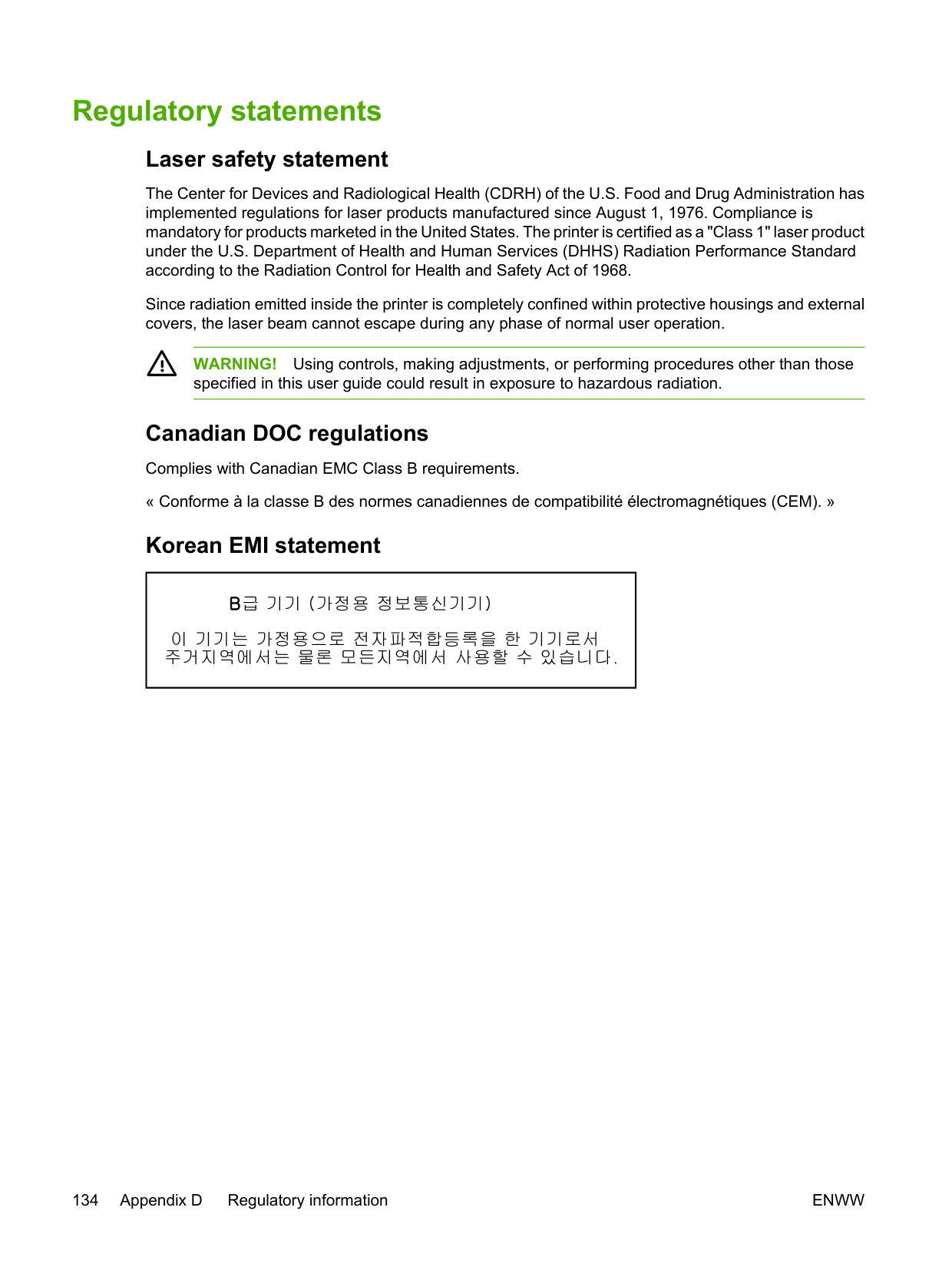
E Warranty and licensing
ENWW 139
Hewlett-Packard limited warranty statement
HP PRODUCT DURATION OF LIMITED WARRANTY HP LaserJet P2015 Series printers One year from date of purchase
HP warrants to you, the end-user customer, that HP hardware and accessories will be free from defects in materials and workmanship after the date of purchase, for the period specified above. If HP receives notice of such defects during the warranty period, HP will, at its option, either repair or replace products which prove to be defective. Replacement products may be either new or equivalent in performance to new.
HP warrants to you that HP software will not fail to execute its programming instructions after the date of purchase, for the period specified above, due to defects in material and workmanship when properly installed and used. If HP receives notice of such defects during the warranty period, HP will replace software which does not execute its programming instructions due to such defects.
HP does not warrant that the operation of HP products will be uninterrupted or error free. If HP is unable, within a reasonable time, to repair or replace any product to a condition as warranted, you will be entitled to a refund of the purchase price upon prompt return of the product.
HP products may contain remanufactured parts equivalent to new in performance or may have been subject to incidental use.
Warranty does not apply to defects resulting from (a) improper or inadequate maintenance or calibration, (b) software, interfacing, parts or supplies not supplied by HP, (c) unauthorized modification or misuse, (d) operation outside of the published environmental specifications for the product, or (e) improper site preparation or maintenance.
HP's limited warranty is valid in any country/region or locality where HP has a support presence for this product and where HP has marketed this product. The level of warranty service you receive may vary according to local standards. HP will not alter form, fit or function of the product to make it operate in a country/region for which it was never intended to function for legal or regulatory reasons. TO THE EXTENT ALLOWED BY LOCAL LAW, THE ABOVE WARRANTIES ARE EXCLUSIVE AND NO OTHER WARRANTY OR CONDITION, WHETHER WRITTEN OR ORAL, IS EXPRESSED OR IMPLIED AND HP SPECIFICALLY DISCLAIMS ANY IMPLIED WARRANTIES OR CONDITIONS OF MERCHANTABILITY, SATISFACTORY QUALITY, AND FITNESS FOR A PARTICULAR PURPOSE. Some countries/regions, states or provinces do not allow limitations on the duration of an implied warranty, so the above limitation or exclusion might not apply to you. This warranty gives you specific legal rights and you might also have other rights that vary from country/region to country/region, state to state, or province to province.
TO THE EXTENT ALLOWED BY LOCAL LAW, THE REMEDIES IN THIS WARRANTY STATEMENT ARE YOUR SOLE AND EXCLUSIVE REMEDIES. EXCEPT AS INDICATED ABOVE, IN NO EVENT WILL HP OR ITS SUPPLIERS BE LIABLE FOR LOSS OF DATA OR FOR DIRECT, SPECIAL, INCIDENTAL, CONSEQUENTIAL (INCLUDING LOST PROFIT OR DATA), OR OTHER DAMAGE, WHETHER BASED IN CONTRACT, TORT, OR OTHERWISE. Some countries/regions, states or provinces do not allow the exclusion or limitation of incidental or consequential damages, so the above limitation or exclusion may not apply to you.
THE WARRANTY TERMS CONTAINED IN THIS STATEMENT, EXCEPT TO THE EXTENT LAWFULLY PERMITTED, DO NOT EXCLUDE, RESTRICT OR MODIFY AND ARE IN ADDITION TO THE MANDATORY STATUTORY RIGHTS APPLICABLE TO THE SALE OF THIS PRODUCT TO YOU.
Hewlett-Packard software license agreement
ATTENTION: USE OF THE SOFTWARE IS SUBJECT TO THE HP SOFTWARE LICENSE TERMS SET FORTH BELOW. USING THE SOFTWARE INDICATES YOUR ACCEPTANCE OF THESE LICENSE TERMS.
HP SOFTWARE LICENSE TERMS The following License Terms govern your use of the accompanying Software unless you have a separate signed agreement with Hewlett-Packard.
License Grant. Hewlett-Packard grants you a license to use one copy of the Software. "Use" means storing, loading, installing, executing, or displaying the Software. You may not modify the Software or disable any licensing or control features of the Software. If the Software is licensed for "concurrent use," you may not allow more than the maximum number of authorized users to Use the Software concurrently.
Ownership. The Software is owned and copyrighted by Hewlett-Packard or its third-party suppliers. Your license confers no title to, or ownership in, the Software and is not a sale of any rights in the Software. Hewlett-Packard's third-party suppliers may protect their rights in the event of any violation of these License Terms.
Copies and Adaptations. You may only make copies or adaptations of the Software for archival
purposes or when copying or adaptation is an essential step in the authorized Use of the Software. You must reproduce all copyright notices in the original Software on all copies or adaptations. You may not copy the Software onto any public network.
No Disassembly or Decryption. You may not disassemble or decompile the Software unless HP's prior written consent is obtained. In some jurisdictions, HP's consent may not be required for limited disassembly or decompilation. Upon request, you will provide HP with reasonably detailed information regarding any disassembly or decompilation. You may not decrypt the Software unless decryption is a necessary part of the operation of the Software.
Transfer. Your license will automatically terminate upon any transfer of the Software. Upon transfer, you must deliver the Software, including any copies and related documentation, to the transferee. The transferee must accept these License Terms as a condition to the transfer.
Termination. HP may terminate your license upon notice for failure to comply with any of these License Terms. Upon termination, you must immediately destroy the Software, together with all copies, adaptations, and merged portions in any form.
Export Requirements. You may not export or re-export the Software or any copy or adaptation in violation of any applicable laws or regulations.
U.S. Government Restricted Rights. The Software and any accompanying documentation have been developed entirely at private expense. They are delivered and licensed as "commercial computer software" as defined in DFARS 252.227-7013 (Oct 1988), DFARS 252.211-7015 (May 1991), or DFARS 252.227-7014 (Jun 1995), as a "commercial item" as defined in FAR 2.101(a) (Jun 1987), or as "Restricted computer software" as defined in FAR 52.227-19 (Jun 1987) (or any equivalent agency regulation or contract clause), whichever is applicable. You have only those rights provided for such Software and any accompanying documentation by the applicable DFARs or FAR clause or the HP standard software agreement for the product involved.
ENWW Hewlett-Packard software license agreement 141
Limited warranty for print cartridge life
| | |---|
NOTE The following warranty applies to the print cartridge that came with this printer.
This HP product is warranted to be free from defects in materials and workmanship. This warranty does not apply to products that (a) have been refilled, refurbished, remanufactured or tampered with in any way, (b) experience problems resulting from misuse, improper storage, or operation outside of the published environmental specifications for the printer product or (c) exhibit wear from ordinary use. To obtain warranty service, please return the product to place of purchase (with a written description of the problem and the print samples) or contact HP customer support. At HP's option, HP will either replace products that prove to be defective or refund your purchase price. TO THE EXTENT ALLOWED BY LOCAL LAW, THE ABOVE WARRANTY IS EXCLUSIVE AND NO OTHER WARRANTY OR CONDITION, WHETHER WRITTEN OR ORAL, IS EXPRESSED OR IMPLIED AND HP SPECIFICALLY DISCLAIMS ANY IMPLIED WARRANTIES OR CONDITIONS OF MERCHANTABILITY, SATISFACTORY QUALITY, AND FITNESS FOR A PARTICULAR PURPOSE. TO THE EXTENT ALLOWED BY LOCAL LAW, IN NO EVENT WILL HP OR ITS SUPPLIERS BE LIABLE FOR DIRECT, SPECIAL INCIDENTAL, CONSEQUENTIAL (INCLUDING LOST PROFIT OR DATA), OR OTHER DAMAGE, WHETHER BASED IN CONTRACT, TORT, OR OTHERWISE. THE WARRANTY TERMS CONTAINED IN THIS STATEMENT, EXCEPT TO THE EXTENT LAWFULLY PERMITTED, DO NOT EXCLUDE, RESTRICT OR MODIFY AND ARE IN ADDITION TO THE MANDATORY STATUTORY RIGHTS APPLICABLE TO THE SALE OF THIS PRODUCT TO YOU.
Index
Symbols/Numerics 10/100 networking and wireless
print servers 113
5 automatic two-sided printing 38 automatic two-sided printing media-
size selector 5
guidelines for using 21 printing on 30
cleaning media path 61
clearing jams 97 configuration

HP LaserJet P2015 printer 2 HP LaserJet P2015d printer 2 HP LaserJet P2015dn printer
3
HP LaserJet P2015n printer 3 HP LaserJet P2015x printer 3
Configuration page 46 connecting to the network 11 conserving toner 114
contacting HP 123 control panel
HP ToolboxFX settings 52 status-light patterns 76
crooked pages 87 custom-size media 30
50
DIMM adding 115 removing 117 testing 117
Documentation tab (HP ToolboxFX) 49

door print cartridge 4 straight-through output 4
driver Macintosh, accessing 15 Macintosh, installing 15 Macintosh, problem solving
83 Windows, accessing 13 Windows, installing 13
duplex (two-sided) printing automatic 38 manual 32
Configuration page 55 device status 55 event log 55 Information tab 55 Networking tab 55
order supplies 56 overview 14 print info pages 55 product support 56 Settings tab 55 supplies status 55 using 54
Energy Star 136 envelopes
guidelines for using 20 printing on 27
Environmental Product
Stewardship Program 136 environmental specifications 126 errors
postscript level 3 emulation 86
software 91 EWS. See embedded Web server extended warranty 122
missing 89 poor quality 90
21 Help tab, HP ToolboxFX 49 HP internal network port 5 HP media 19 HP ToolboxFX
Device Settings tab 50
Documentation tab 49 Help tab 49 Network Settings tab 53 Status tab 48
Configuration page 46 Demo page 46 Network Configuration page
46
Supplies Status page 46 Information tab (embedded Web
server) 55
input tray loading media 24 tray 1 4 tray 2 4 IP address 83
L labels
guidelines for using 20
letterhead guidelines for using 22
license, software 141 life expectancy, print cartridge
114 light patterns 76 loading media
optional tray 3 24
M Macintosh
driver, accessing 15 driver, installing 15 driver, problem solving 83 PPDs 16 problems, solving 83 software 15 USB card, troubleshooting 84
manual two-sided printing 32
manual-feed printing 25 Material Safety Data Sheet (MSDS)
138
media card stock 21 clearing jams 97 envelopes 20 guidelines for use 19 heavy 21 HP ToolboxFX settings 51 labels 20 letterhead 22 loading 24 optimizing print quality for media
types 18 paper 20 preprinted forms 22 printing manually 25 recommended 19 transparencies 20 types that may damage the
printer 19
types to avoid 19 media path, cleaning 61 memory
installing 115 removing 117 testing 117
missing graphics 89 text 89
model number 4 multiple pages, printing on a single
sheet of paper 40
###### N
HP ToolboxFX 53 Networking tab (embedded Web server) 55
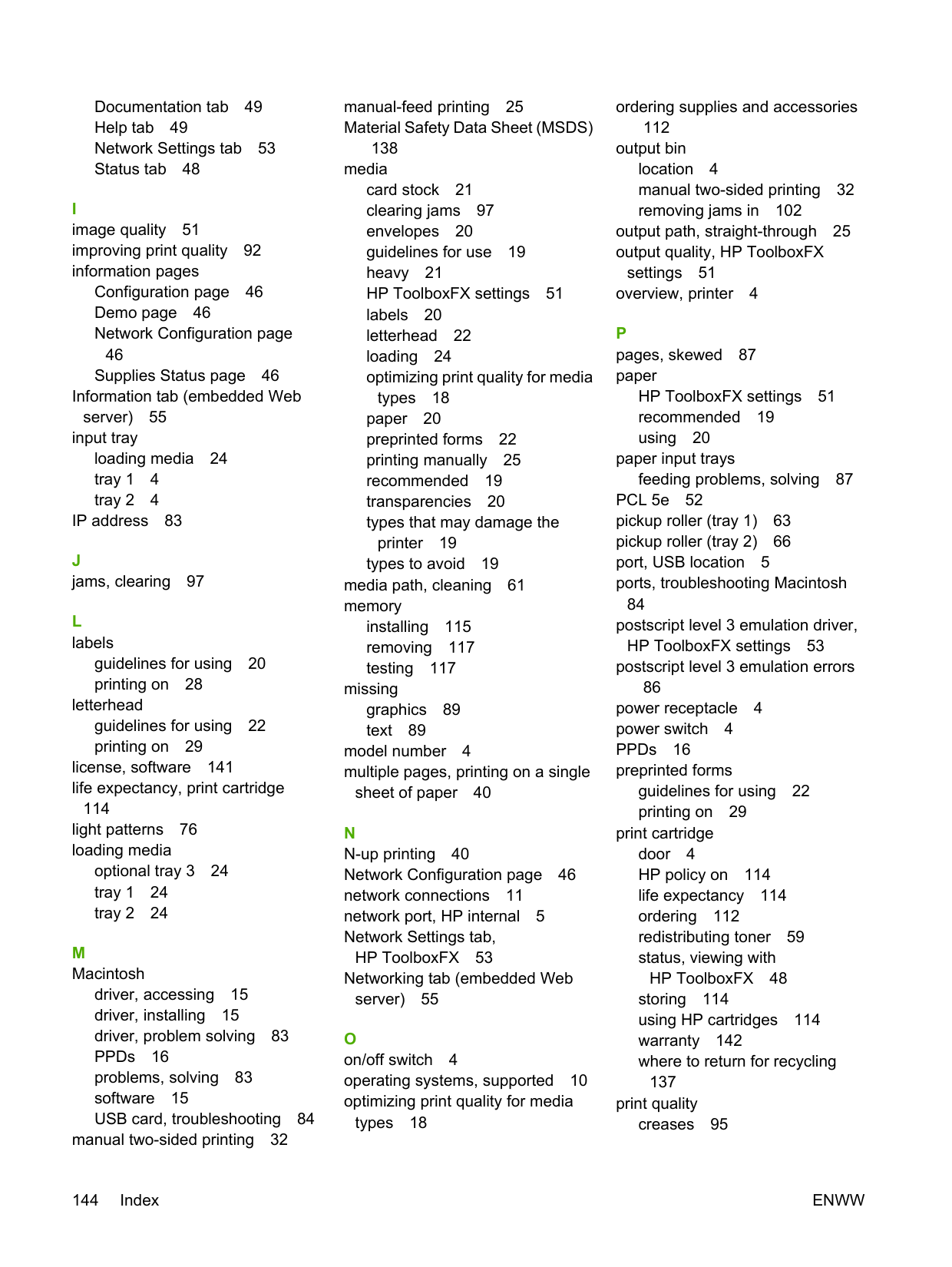
types 18
ordering supplies and accessories 112
output bin location 4 manual two-sided printing 32 removing jams in 102
output path, straight-through 25 output quality, HP ToolboxFX
settings 51 overview, printer 4
P pages, skewed 87 paper
HP ToolboxFX settings 51 recommended 19 using 20 paper input trays
feeding problems, solving 87 PCL 5e 52
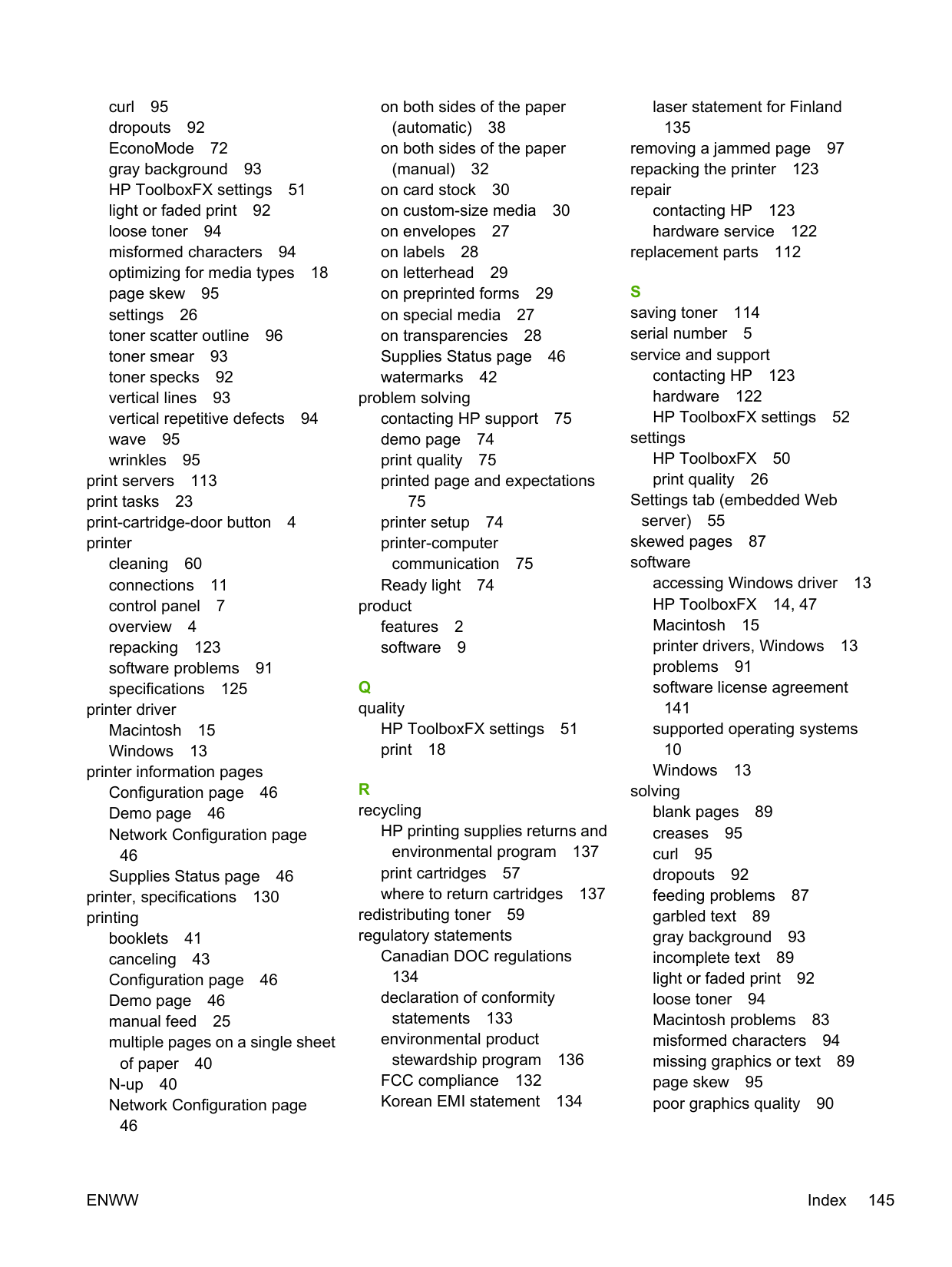
84 postscript level 3 emulation driver, HP ToolboxFX settings 53 postscript level 3 emulation errors
86 power receptacle 4 power switch 4 PPDs 16 preprinted forms
guidelines for using 22 printing on 29
print cartridge door 4 HP policy on 114 life expectancy 114 ordering 112 redistributing toner 59 status, viewing with
HP ToolboxFX 48 storing 114 using HP cartridges 114 warranty 142 where to return for recycling
137 print quality creases 95
curl 95 dropouts 92 EconoMode 72 gray background 93 HP ToolboxFX settings 51 light or faded print 92 loose toner 94 misformed characters 94 optimizing for media types 18 page skew 95 settings 26 toner scatter outline 96 toner smear 93 toner specks 92 vertical lines 93 vertical repetitive defects 94 wave 95 wrinkles 95 print servers 113 print tasks 23 print-cartridge-door button 4 printer
cleaning 60 connections 11 control panel 7 overview 4 repacking 123 software problems 91 specifications 125
printer driver Macintosh 15 Windows 13
printer information pages Configuration page 46 Demo page 46 Network Configuration page
46
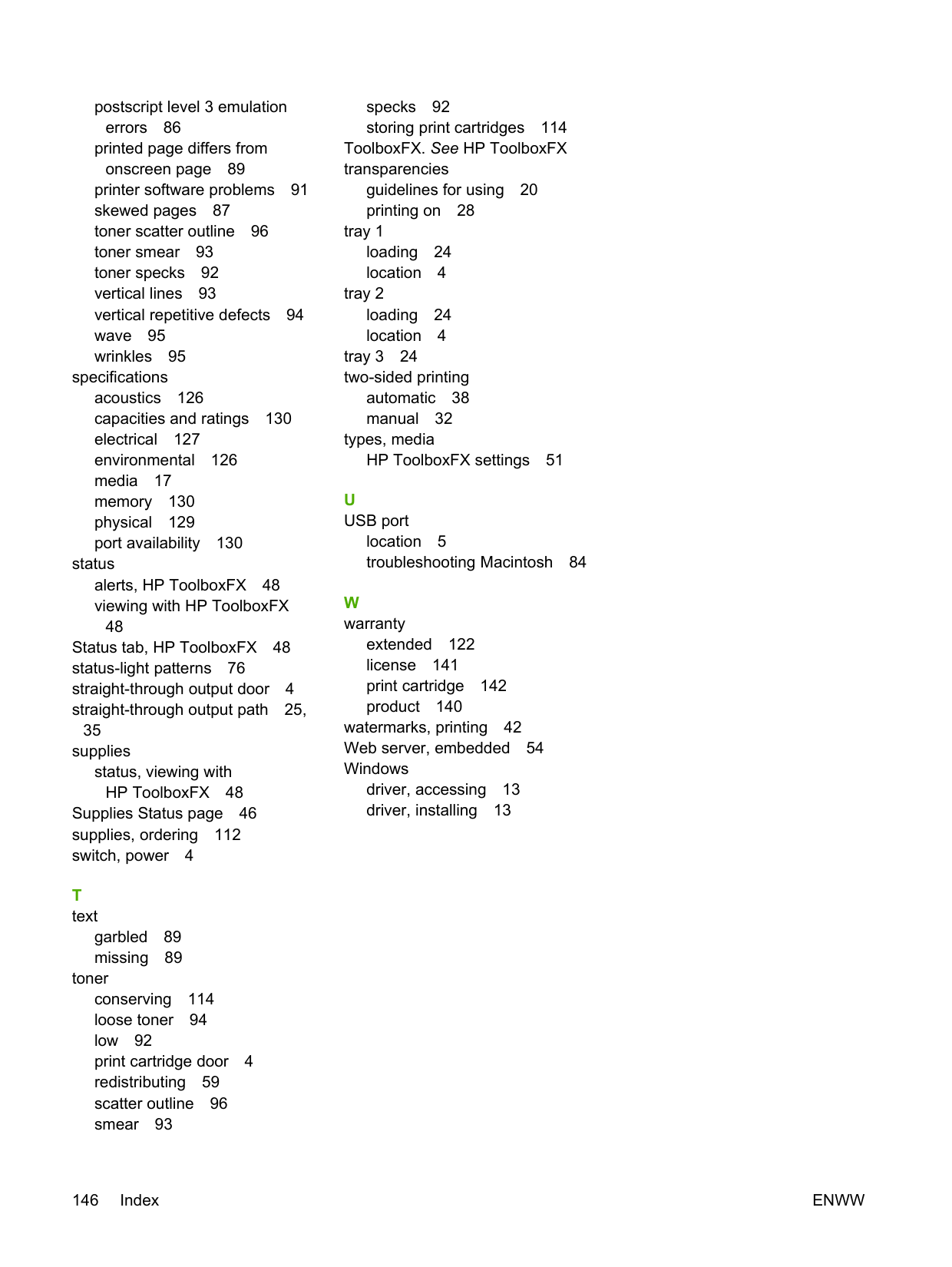
Supplies Status page 46 printer, specifications 130 printing
booklets 41 canceling 43 Configuration page 46 Demo page 46 manual feed 25 multiple pages on a single sheet
of paper 40 N-up 40 Network Configuration page
46
on both sides of the paper (automatic) 38 on both sides of the paper
(manual) 32 on card stock 30 on custom-size media 30 on envelopes 27 on labels 28 on letterhead 29 on preprinted forms 29 on special media 27 on transparencies 28 Supplies Status page 46 watermarks 42
problem solving contacting HP support 75 demo page 74 print quality 75 printed page and expectations
75 printer setup 74 printer-computer
communication 75 Ready light 74
product
features 2 software 9

HP ToolboxFX settings 51 print 18
HP printing supplies returns and environmental program 137 print cartridges 57 where to return cartridges 137
redistributing toner 59 regulatory statements
Canadian DOC regulations 134 declaration of conformity statements 133 environmental product
stewardship program 136 FCC compliance 132 Korean EMI statement 134
laser statement for Finland
135 removing a jammed page 97 repacking the printer 123 repair
contacting HP 123 hardware service 122

replacement parts 112
S saving toner 114 serial number 5 service and support
contacting HP 123 hardware 122 HP ToolboxFX settings 52
settings HP ToolboxFX 50 print quality 26
Settings tab (embedded Web
server) 55 skewed pages 87 software
accessing Windows driver 13 HP ToolboxFX 14, 47 Macintosh 15 printer drivers, Windows 13 problems 91 software license agreement
141 supported operating systems 10 Windows 13
solving blank pages 89 creases 95 curl 95 dropouts 92 feeding problems 87 garbled text 89 gray background 93 incomplete text 89 light or faded print 92 loose toner 94 Macintosh problems 83 misformed characters 94 missing graphics or text 89 page skew 95 poor graphics quality 90
postscript level 3 emulation errors 86 printed page differs from
onscreen page 89 printer software problems 91 skewed pages 87 toner scatter outline 96 toner smear 93 toner specks 92 vertical lines 93 vertical repetitive defects 94 wave 95 wrinkles 95
specifications acoustics 126 capacities and ratings 130 electrical 127 environmental 126 media 17 memory 130 physical 129 port availability 130
status alerts, HP ToolboxFX 48 viewing with HP ToolboxFX
48 Status tab, HP ToolboxFX 48 status-light patterns 76 straight-through output door 4 straight-through output path 25,
35 supplies status, viewing with
HP ToolboxFX 48 Supplies Status page 46 supplies, ordering 112 switch, power 4
T text
garbled 89 missing 89
toner conserving 114 loose toner 94 low 92 print cartridge door 4 redistributing 59 scatter outline 96 smear 93
specks 92 storing print cartridges 114
ToolboxFX. See HP ToolboxFX transparencies
guidelines for using 20 printing on 28
automatic 38 manual 32
types, media HP ToolboxFX settings 51
U USB port
location 5 troubleshooting Macintosh 84
W warranty
extended 122 license 141 print cartridge 142 product 140
watermarks, printing 42 Web server, embedded 54 Windows
driver, accessing 13 driver, installing 13
© 2006 Hewlett-Packard Development Company, L.P. www.hp.com
CB366-90951