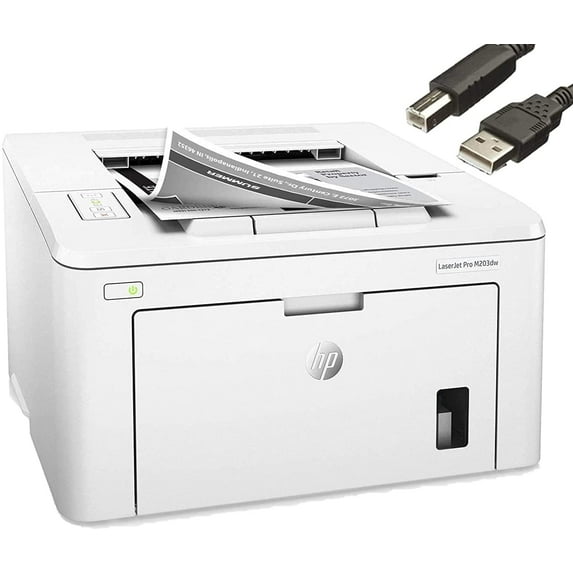
Ask AI
— answers from the official manualAnswers from the official manual.
Common questions
Common Questions
19 totalHow do I replace the imaging drum on the HP LaserJet Pro M203?
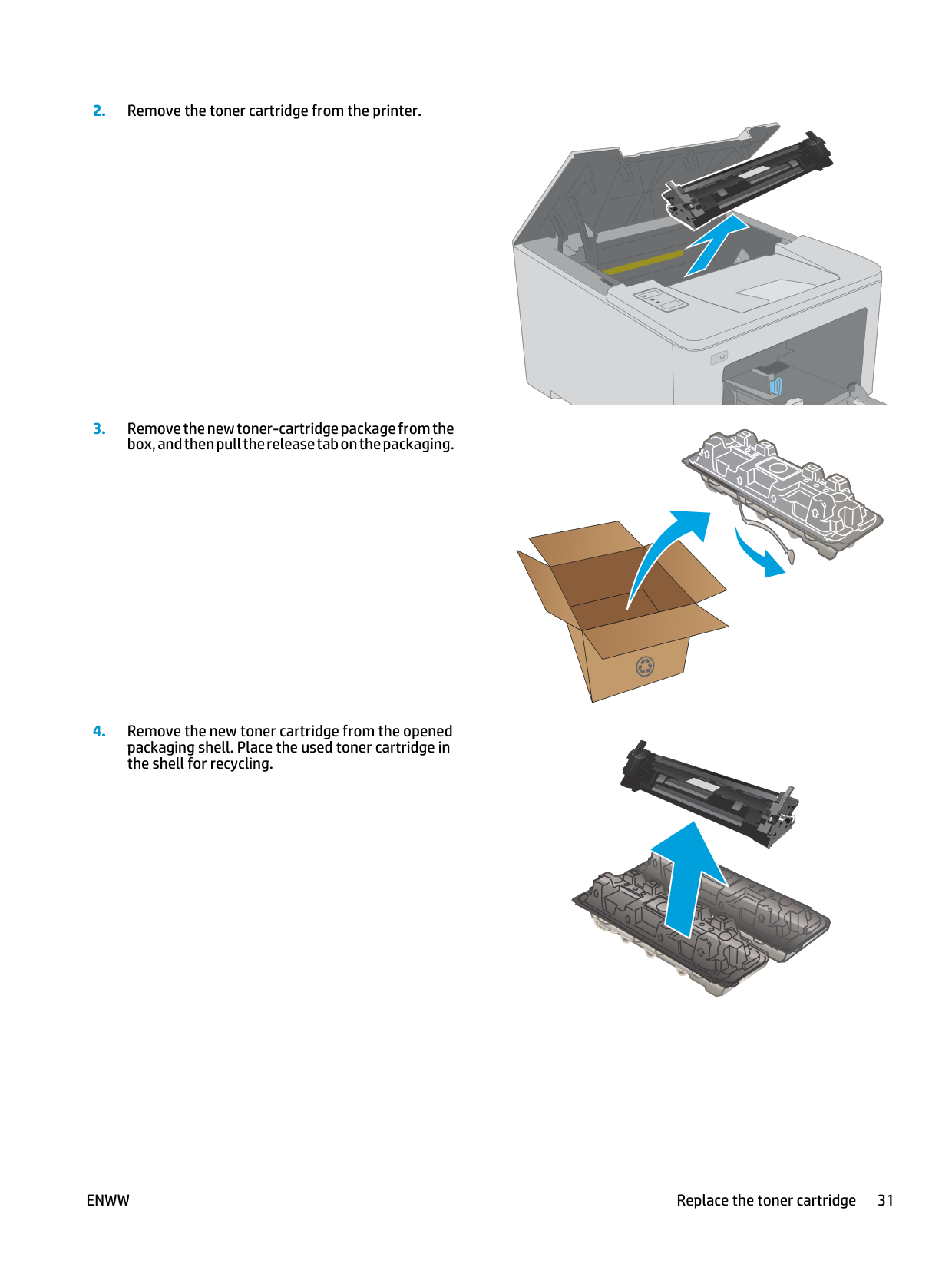
Open the cartridge door, temporarily remove the toner cartridge, and then remove the used imaging drum. Install the new imaging drum by aligning it with the tracks inside the printer until it is firmly seated, then reinstall the toner cartridge and close the cartridge door. Important: Do not touch the imaging drum surface, as fingerprints can cause print quality problems. (Page 34-36)
What are the recommended operating temperature and humidity conditions for the HP LaserJet Pro M203?
The recommended operating temperature is 17° to 25°C (62.6° to 77°F), with an allowed range of 15° to 30°C (59° to 86°F). The recommended relative humidity is 30% to 70% RH, with an allowed range of 10% to 80% RH. The printer can operate at altitudes from 0 to 3048 m (0 to 10,000 ft). (Page 8)
How do I set up Wi-Fi Direct printing on the HP LaserJet Pro M203?
Wi-Fi Direct must first be enabled through the HP Embedded Web Server (EWS) by navigating to the Networking tab and clicking Wi-Fi Direct Setup, then selecting the On option and clicking Apply. To connect, open the Wi-Fi or Wi-Fi Direct menu on your mobile device, select the printer name from available networks, and enter the Wi-Fi Direct password if prompted. Note that Wi-Fi Direct is only available on wireless models. (Page 46-48)
How do I load and print envelopes on the HP LaserJet Pro M203?
Both the Priority input tray and the Main input tray hold up to 10 envelopes; load them face up with the short, postage end leading into the printer. To print, select the Print option in your software, open the print driver, go to the Paper/Quality tab, select 'Envelope' as the paper type, and select 'Manual feed' as the paper source. Supported envelope sizes include Envelope #10, Monarch, B5, C5, and DL. (Page 19-20)
How do I reset the laserjet to factory defaults?
Press and hold the Resume button until the Ready light begins blinking. Release the Resume button to access the printer settings where you can restore factory defaults (Page 76).
What does the Supplies LED indicate on the control panel?
The Supplies LED is on when the toner cartridge is very low, and it blinks when there is a problem with the toner cartridge or imaging drum (Page 4).
Show 13 more questions
How do I change the IP address of my HP Laserjet Pro M203?
How do I install the toner cartridge in my HP Laserjet Pro M203?
Where can I find instructions for replacing the imaging drum in my HP Laserjet Pro M203?
How do I configure printer security features using the HP Embedded Web Server (EWS)?
How do I print on both sides of the paper automatically?
What mobile printing options are available for the HP Laserjet Pro M203?
How do I change the ‘Very Low’ setting notification of toner in my HP Laserjet Pro M203?
How do I manually feed envelopes into the Main input tray of my HP Laserjet Pro M203?
What does it mean when the Supplies LED is blinking on my HP LaserJet Pro M203?
How many sheets of paper can the Main input tray hold?
How do I print on both sides of the paper (duplex printing) in Windows?
What toner cartridges are compatible with the HP LaserJet Pro M203?
What is the error message '10.57.0X Protected Cartridge' and how do I fix it?
Full Manual
121 pages
User Guide LaserJet Pro M203 M203dn M203dw www.hp.com/support/ljM203

HP LaserJet Pro M203 User Guide

Copyright and License © Copyright 2016 HP Development Company,
L.P.
Reproduction, adaptation, or translation without prior written permission is prohibited, except as allowed under the copyright laws. The information contained herein is subject to change without notice. The only warranties for HP products and services are set forth in the express warranty statements accompanying such products and services. Nothing herein should be construed as constituting an additional warranty. HP shall not be liable for technical or editorial errors or omissions contained herein. Edition 1, 11/2016 Trademark Credits Adobe®, Adobe Photoshop®, Acrobat®, and PostScript® are trademarks of Adobe Systems Incorporated. Apple and the Apple logo are trademarks of Apple Inc., registered in the U.S. and other countries. OS X is a trademark of Apple Inc., registered in the U.S. and other countries. AirPrint is a trademark of Apple Inc., registered in the U.S. and other countries. iPad is a trademark of Apple Inc., registered in the U.S. and other countries. iPod is a trademark of Apple Inc., registered in the U.S. and other countries. iPhone is a trademark of Apple Inc., registered in the U.S. and other countries. Microsoft®, Windows®, Windows® XP, and Windows Vista® are U.S. registered trademarks of Microsoft Corporation. UNIX® is a registered trademark of The Open Group.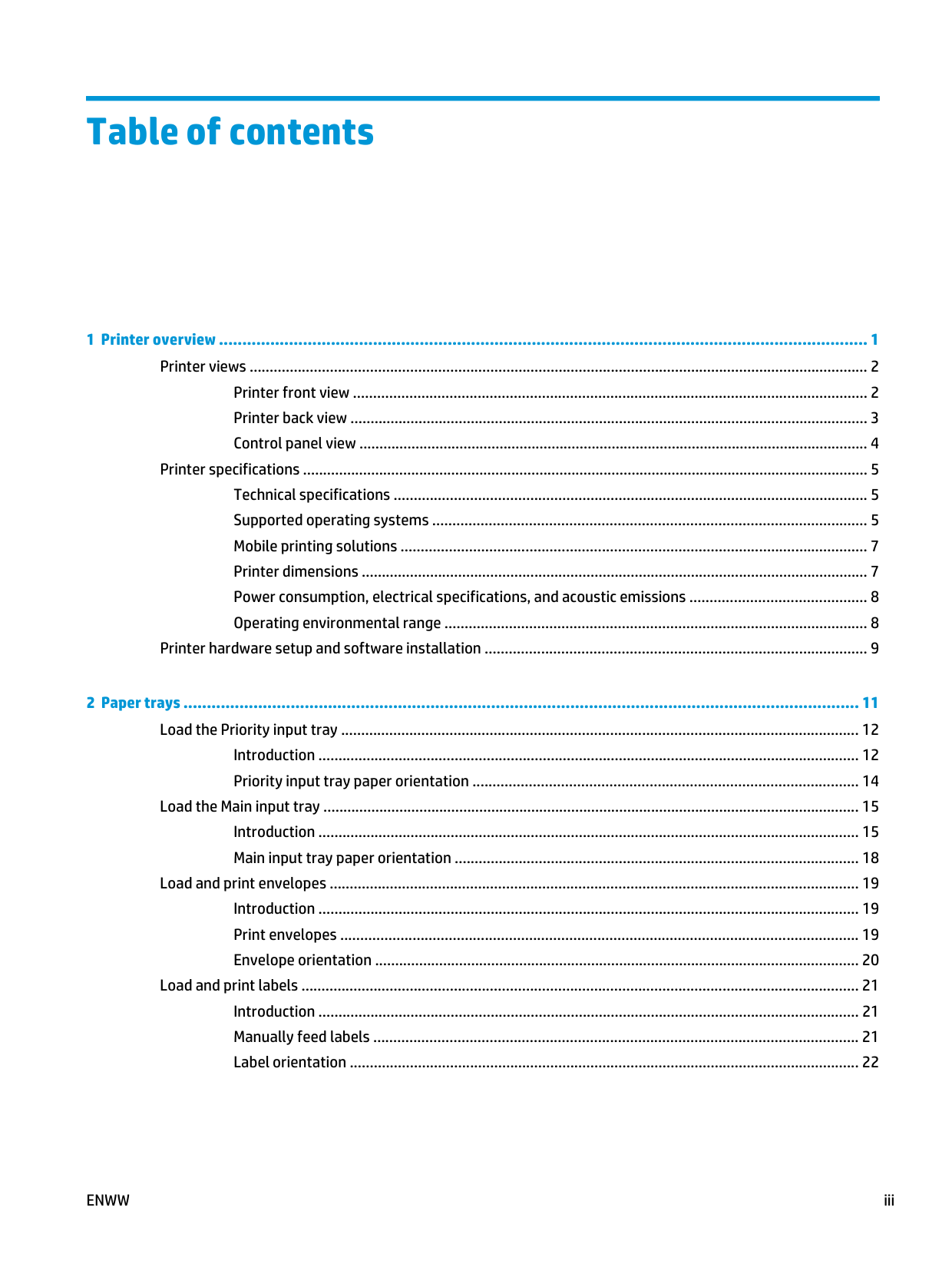
Table of contents 1 Printer overview ........................................................................................................................................... 1 Printer views .......................................................................................................................................................... 2 Printer front view ................................................................................................................................ 2 Printer back view ................................................................................................................................. 3 Control panel view ............................................................................................................................... 4 Printer specifications ............................................................................................................................................. 5 Technical specifications ...................................................................................................................... 5 Supported operating systems ............................................................................................................ 5 Mobile printing solutions .................................................................................................................... 7 Printer dimensions .............................................................................................................................. 7 Power consumption, electrical specifications, and acoustic emissions ............................................ 8 Operating environmental range ......................................................................................................... 8 Printer hardware setup and software installation ............................................................................................... 9 2 Paper trays ................................................................................................................................................. 11 Load the Priority input tray ................................................................................................................................. 12 Introduction ....................................................................................................................................... 12 Priority input tray paper orientation ................................................................................................ 14 Load the Main input tray ...................................................................................................................................... 15 Introduction ....................................................................................................................................... 15 Main input tray paper orientation ..................................................................................................... 18 Load and print envelopes .................................................................................................................................... 19 Introduction ....................................................................................................................................... 19 Print envelopes ................................................................................................................................. 19 Envelope orientation ......................................................................................................................... 20 Load and print labels ........................................................................................................................................... 21 Introduction ....................................................................................................................................... 21 Manually feed labels ......................................................................................................................... 21 Label orientation ............................................................................................................................... 22
Enww
iii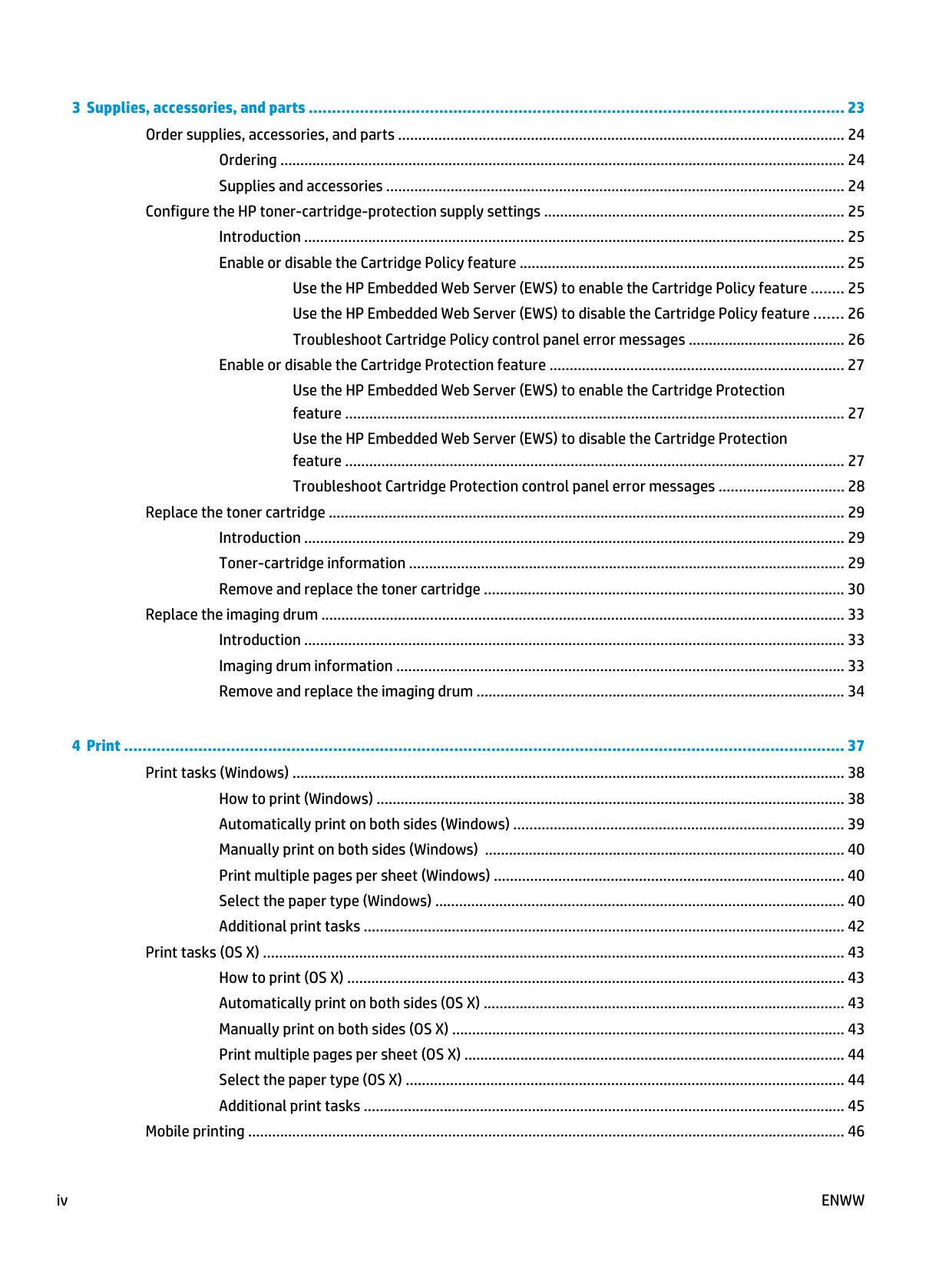
3 Supplies, accessories, and parts ................................................................................................................... 23 Order supplies, accessories, and parts ............................................................................................................... 24 Ordering ............................................................................................................................................. 24 Supplies and accessories .................................................................................................................. 24 Configure the HP toner-cartridge-protection supply settings ........................................................................... 25 Introduction ....................................................................................................................................... 25 Enable or disable the Cartridge Policy feature ................................................................................. 25 Use the HP Embedded Web Server (EWS) to enable the Cartridge Policy feature ........ 25 Use the HP Embedded Web Server (EWS) to disable the Cartridge Policy feature ....... 26 Troubleshoot Cartridge Policy control panel error messages ....................................... 26 Enable or disable the Cartridge Protection feature ......................................................................... 27 Use the HP Embedded Web Server (EWS) to enable the Cartridge Protection feature ............................................................................................................................ 27 Use the HP Embedded Web Server (EWS) to disable the Cartridge Protection feature ............................................................................................................................ 27 Troubleshoot Cartridge Protection control panel error messages ............................... 28 Replace the toner cartridge ................................................................................................................................. 29 Introduction ....................................................................................................................................... 29 Toner-cartridge information ............................................................................................................. 29 Remove and replace the toner cartridge .......................................................................................... 30 Replace the imaging drum .................................................................................................................................. 33 Introduction ....................................................................................................................................... 33 Imaging drum information ................................................................................................................ 33 Remove and replace the imaging drum ............................................................................................ 34 4 Print ........................................................................................................................................................... 37 Print tasks (Windows) .......................................................................................................................................... 38 How to print (Windows) ..................................................................................................................... 38 Automatically print on both sides (Windows) .................................................................................. 39 Manually print on both sides (Windows) .......................................................................................... 40 Print multiple pages per sheet (Windows) ....................................................................................... 40 Select the paper type (Windows) ...................................................................................................... 40 Additional print tasks ........................................................................................................................ 42 Print tasks (OS X) ................................................................................................................................................. 43 How to print (OS X) ............................................................................................................................ 43 Automatically print on both sides (OS X) .......................................................................................... 43 Manually print on both sides (OS X) .................................................................................................. 43 Print multiple pages per sheet (OS X) ............................................................................................... 44 Select the paper type (OS X) ............................................................................................................. 44 Additional print tasks ........................................................................................................................ 45 Mobile printing ..................................................................................................................................................... 46 iv
Enww
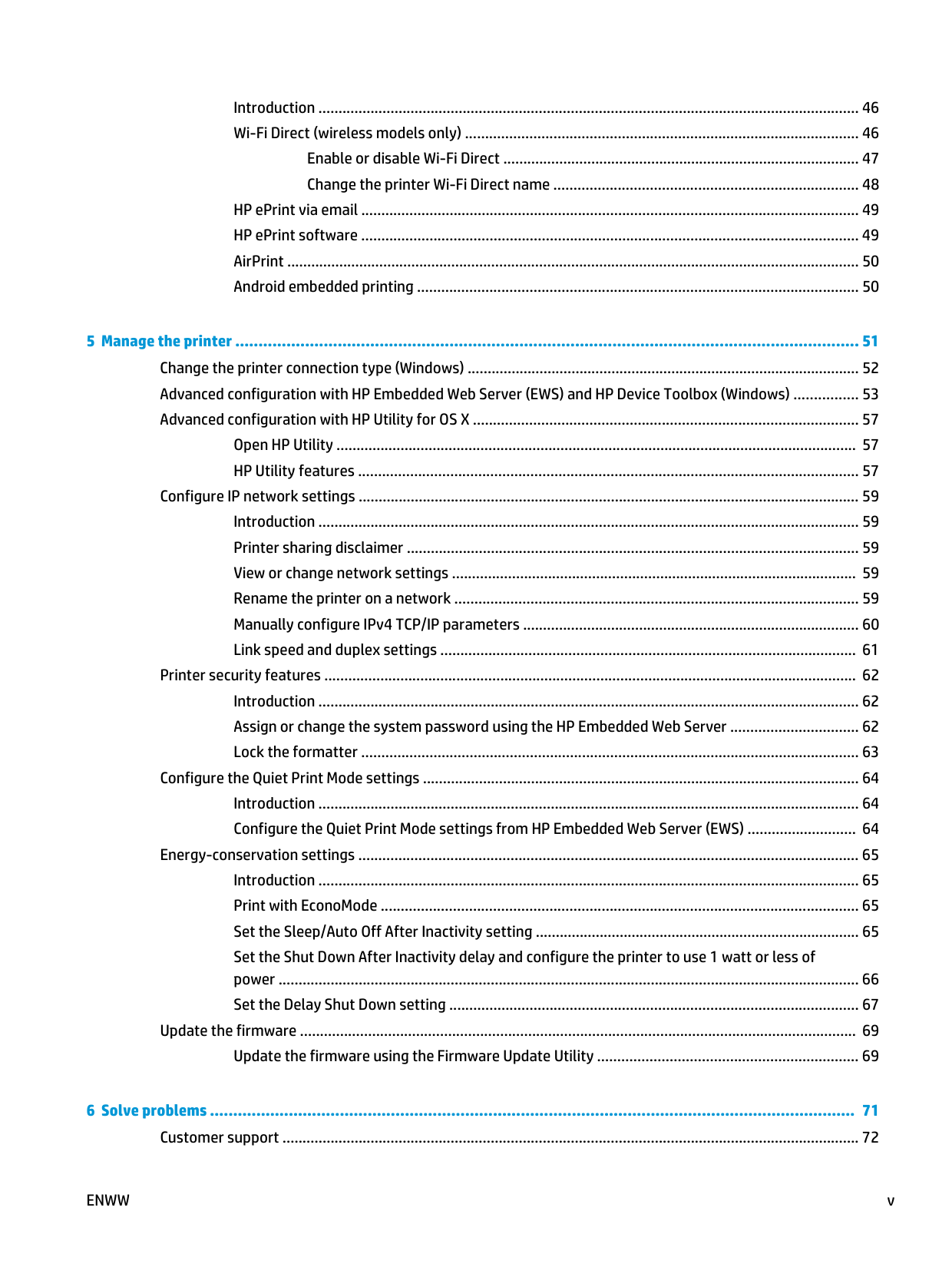
Introduction ....................................................................................................................................... 46 Wi-Fi Direct (wireless models only) .................................................................................................. 46 Enable or disable Wi-Fi Direct ......................................................................................... 47 Change the printer Wi-Fi Direct name ............................................................................ 48 HP ePrint via email ............................................................................................................................ 49 HP ePrint software ............................................................................................................................ 49 AirPrint ............................................................................................................................................... 50 Android embedded printing .............................................................................................................. 50 5 Manage the printer ...................................................................................................................................... 51 Change the printer connection type (Windows) .................................................................................................. 52 Advanced configuration with HP Embedded Web Server (EWS) and HP Device Toolbox (Windows) ................ 53 Advanced configuration with HP Utility for OS X ................................................................................................ 57 Open HP Utility .................................................................................................................................. 57 HP Utility features ............................................................................................................................. 57 Configure IP network settings ............................................................................................................................. 59 Introduction ....................................................................................................................................... 59 Printer sharing disclaimer ................................................................................................................. 59 View or change network settings ..................................................................................................... 59 Rename the printer on a network ..................................................................................................... 59 Manually configure IPv4 TCP/IP parameters .................................................................................... 60 Link speed and duplex settings ........................................................................................................ 61 Printer security features ..................................................................................................................................... 62 Introduction ....................................................................................................................................... 62 Assign or change the system password using the HP Embedded Web Server ................................ 62 Lock the formatter ............................................................................................................................ 63 Configure the Quiet Print Mode settings ............................................................................................................. 64 Introduction ....................................................................................................................................... 64 Configure the Quiet Print Mode settings from HP Embedded Web Server (EWS) ........................... 64 Energy-conservation settings ............................................................................................................................. 65 Introduction ....................................................................................................................................... 65 Print with EconoMode ....................................................................................................................... 65 Set the Sleep/Auto Off After Inactivity setting ................................................................................. 65 Set the Shut Down After Inactivity delay and configure the printer to use 1 watt or less of power ................................................................................................................................................. 66 Set the Delay Shut Down setting ...................................................................................................... 67 Update the firmware ........................................................................................................................................... 69 Update the firmware using the Firmware Update Utility ................................................................. 69 6 Solve problems ........................................................................................................................................... 71 Customer support ................................................................................................................................................ 72
Enww
v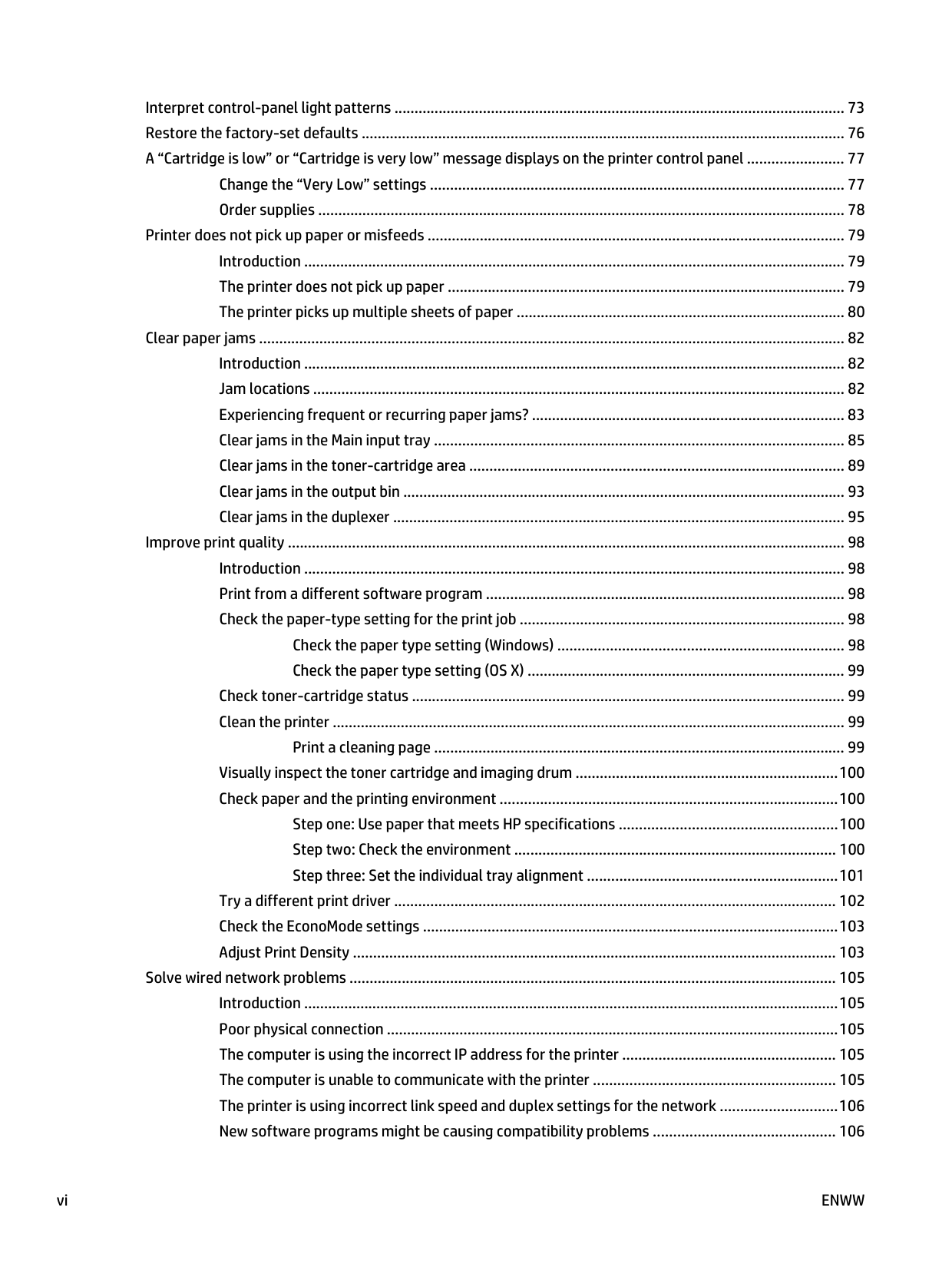
Interpret control-panel light patterns ................................................................................................................ 73 Restore the factory-set defaults ........................................................................................................................ 76 A “Cartridge is low” or “Cartridge is very low” message displays on the printer control panel ........................ 77 Change the “Very Low” settings ....................................................................................................... 77 Order supplies ................................................................................................................................... 78 Printer does not pick up paper or misfeeds ........................................................................................................ 79 Introduction ....................................................................................................................................... 79 The printer does not pick up paper ................................................................................................... 79 The printer picks up multiple sheets of paper .................................................................................. 80 Clear paper jams .................................................................................................................................................. 82 Introduction ....................................................................................................................................... 82 Jam locations .................................................................................................................................... 82 Experiencing frequent or recurring paper jams? .............................................................................. 83 Clear jams in the Main input tray ...................................................................................................... 85 Clear jams in the toner-cartridge area ............................................................................................. 89 Clear jams in the output bin .............................................................................................................. 93 Clear jams in the duplexer ................................................................................................................ 95 Improve print quality ........................................................................................................................................... 98 Introduction ....................................................................................................................................... 98 Print from a different software program ......................................................................................... 98 Check the paper-type setting for the print job ................................................................................. 98 Check the paper type setting (Windows) ....................................................................... 98 Check the paper type setting (OS X) ............................................................................... 99 Check toner-cartridge status ............................................................................................................ 99 Clean the printer ................................................................................................................................ 99 Print a cleaning page ...................................................................................................... 99 Visually inspect the toner cartridge and imaging drum ................................................................. 100 Check paper and the printing environment .................................................................................... 100 Step one: Use paper that meets HP specifications ...................................................... 100 Step two: Check the environment ................................................................................ 100 Step three: Set the individual tray alignment .............................................................. 101 Try a different print driver .............................................................................................................. 102 Check the EconoMode settings ....................................................................................................... 103 Adjust Print Density ........................................................................................................................ 103 Solve wired network problems ......................................................................................................................... 105 Introduction ..................................................................................................................................... 105 Poor physical connection ................................................................................................................ 105 The computer is using the incorrect IP address for the printer ..................................................... 105 The computer is unable to communicate with the printer ............................................................ 105 The printer is using incorrect link speed and duplex settings for the network ............................. 106 New software programs might be causing compatibility problems ............................................. 106 vi
Enww
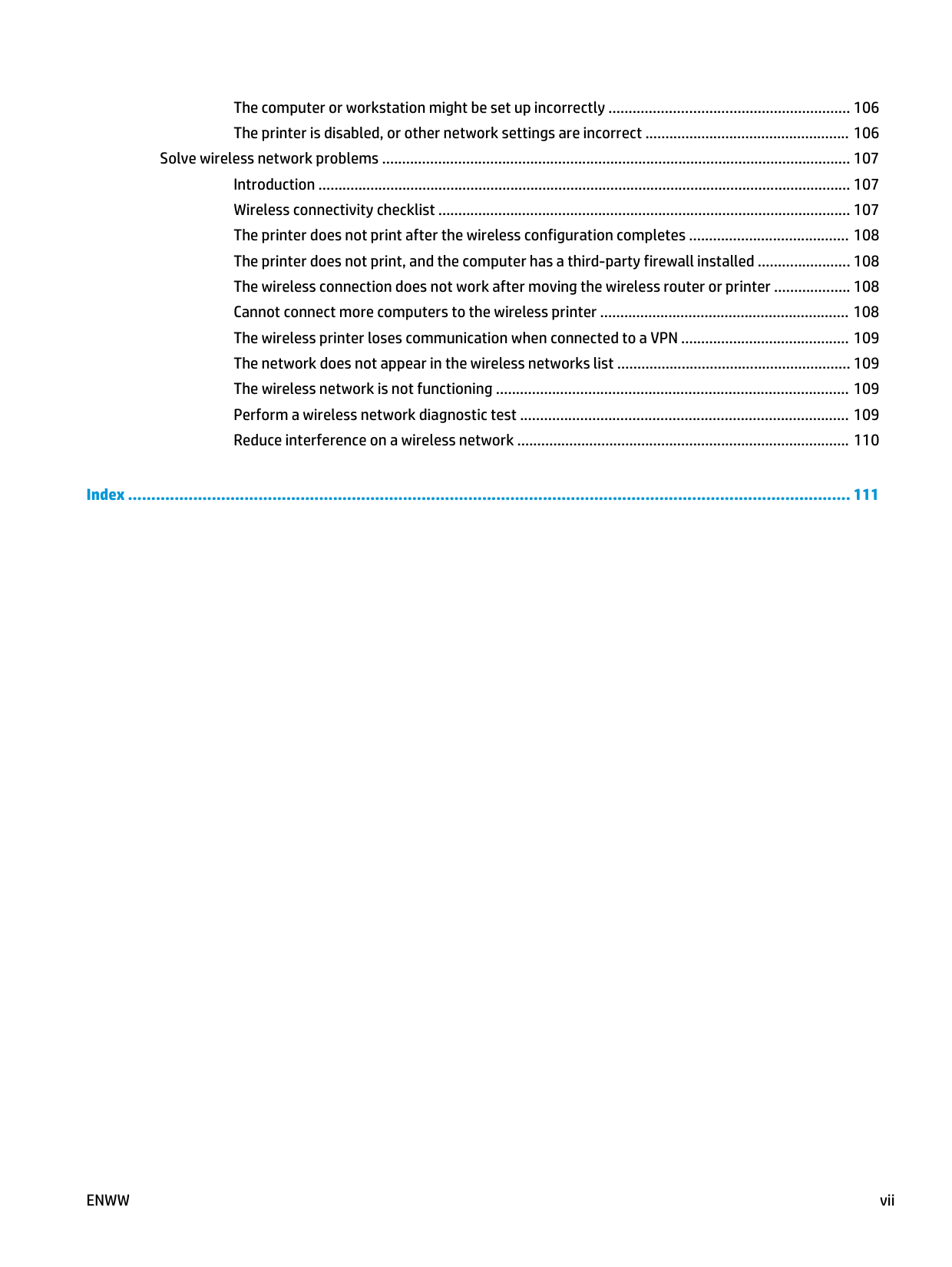
The computer or workstation might be set up incorrectly ............................................................ 106 The printer is disabled, or other network settings are incorrect ................................................... 106 Solve wireless network problems ..................................................................................................................... 107 Introduction ..................................................................................................................................... 107 Wireless connectivity checklist ....................................................................................................... 107 The printer does not print after the wireless configuration completes ........................................ 108 The printer does not print, and the computer has a third-party firewall installed ....................... 108 The wireless connection does not work after moving the wireless router or printer ................... 108 Cannot connect more computers to the wireless printer .............................................................. 108 The wireless printer loses communication when connected to a VPN .......................................... 109 The network does not appear in the wireless networks list .......................................................... 109 The wireless network is not functioning ........................................................................................ 109 Perform a wireless network diagnostic test .................................................................................. 109 Reduce interference on a wireless network ................................................................................... 110 Index ........................................................................................................................................................... 111
Enww
vii
viii
Enww
1 Printer overview ● Printer views ● Printer specifications ● Printer hardware setup and software installation For more information: The following information is correct at the time of publication. For current information, see www.hp.com/ support/ljM203. HP's all-inclusive help for the printer includes the following information: ● Install and configure ● Learn and use ● Solve problems ● Download software and firmware updates ● Join support forums ● Find warranty and regulatory information
Enww
1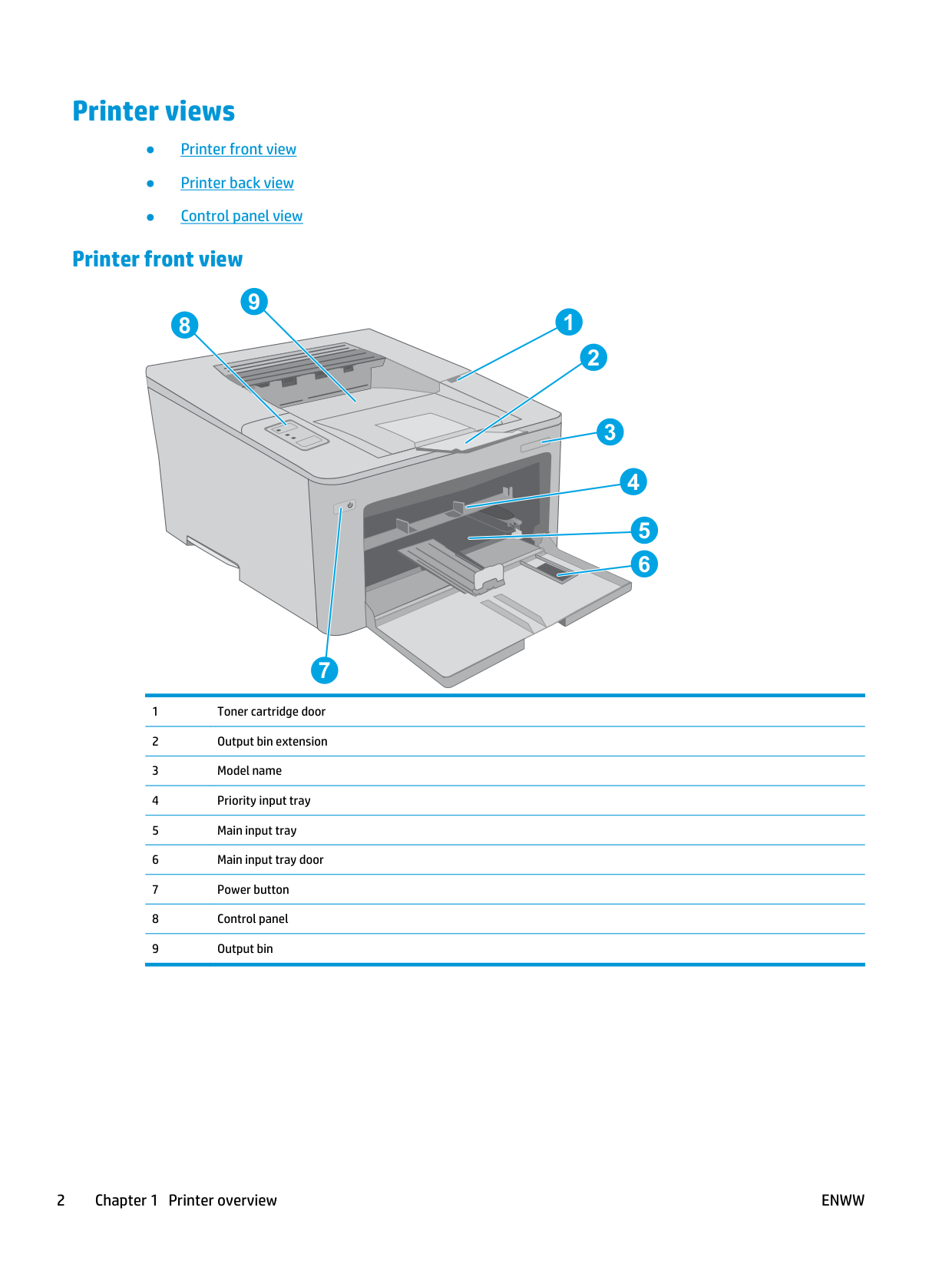
Printer views ● Printer front view ● Printer back view ● Control panel view Printer front view 2 6 1 4 5 9 7 8 3 1 Toner cartridge door 2 Output bin extension 3 Model name 4 Priority input tray 5 Main input tray 6 Main input tray door 7 Power button 8 Control panel 9 Output bin 2 Chapter 1 Printer overview
Enww
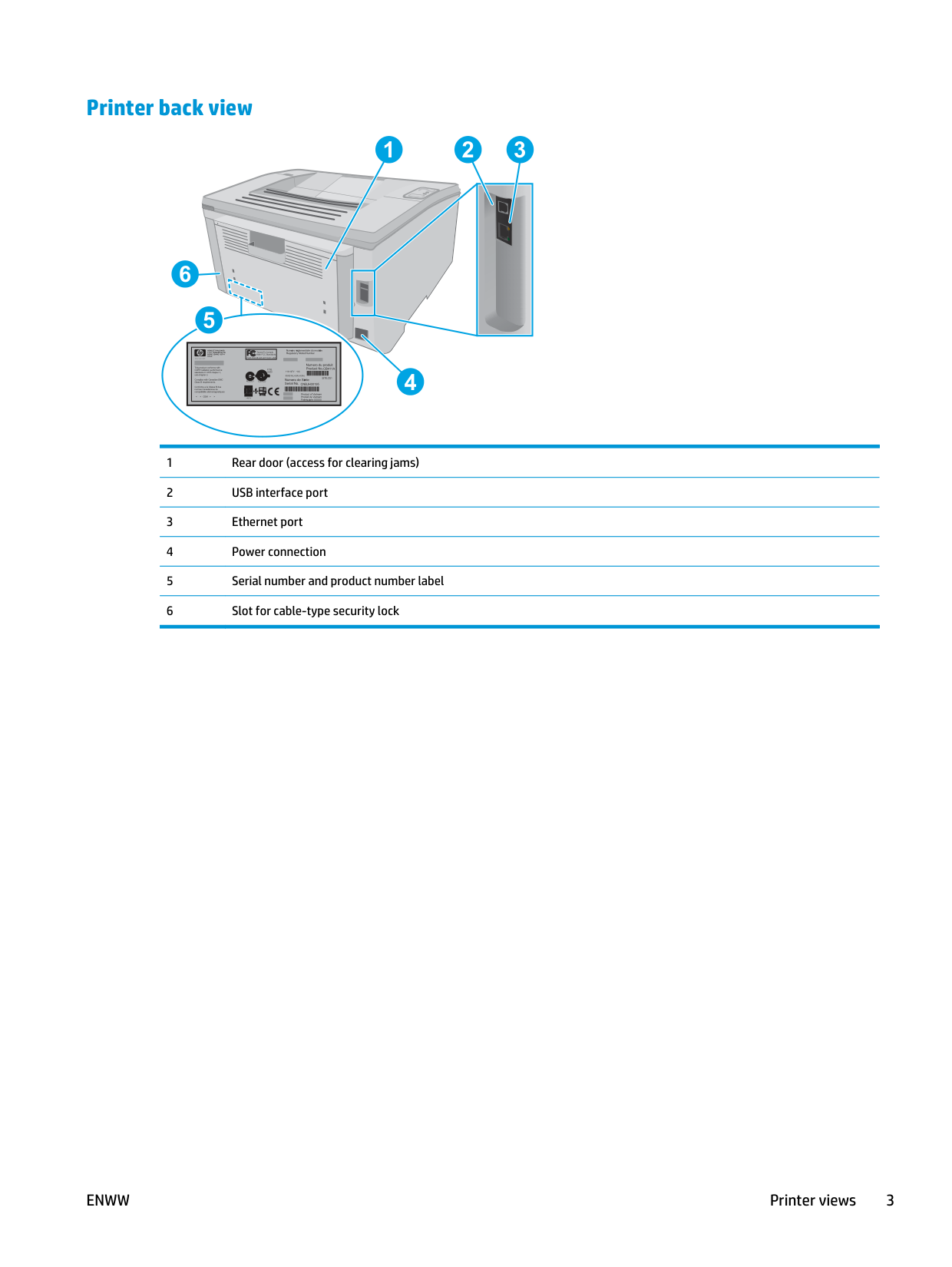
Printer back view 1 4 6 5 2 3 1 Rear door (access for clearing jams) 2 USB interface port 3 Ethernet port 4 Power connection 5 Serial number and product number label 6 Slot for cable-type security lock
Enww
Printer views 3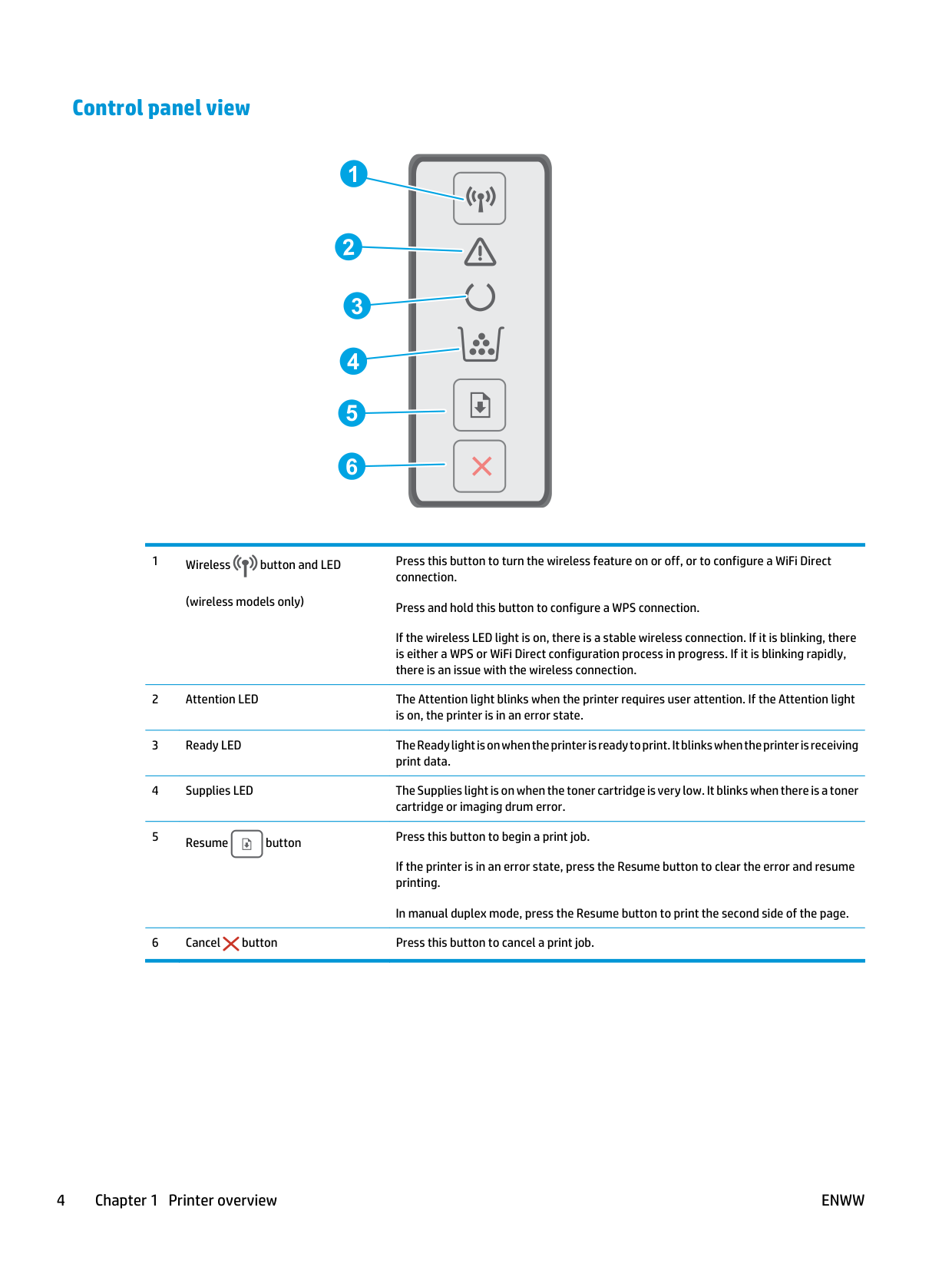
Control panel view 2 3 4 5 6 1 1 Wireless button and LED (wireless models only) Press this button to turn the wireless feature on or off, or to configure a WiFi Direct connection. Press and hold this button to configure a WPS connection. If the wireless LED light is on, there is a stable wireless connection. If it is blinking, there is either a WPS or WiFi Direct configuration process in progress. If it is blinking rapidly, there is an issue with the wireless connection. 2 Attention LED The Attention light blinks when the printer requires user attention. If the Attention light is on, the printer is in an error state. 3 Ready LED The Ready light is on when the printer is ready to print. It blinks when the printer is receiving print data. 4 Supplies LED The Supplies light is on when the toner cartridge is very low. It blinks when there is a toner cartridge or imaging drum error. 5 Resume button Press this button to begin a print job. If the printer is in an error state, press the Resume button to clear the error and resume printing. In manual duplex mode, press the Resume button to print the second side of the page. 6 Cancel button Press this button to cancel a print job. 4 Chapter 1 Printer overview
Enww
Printer specifications
Important:
The following specifications are correct at the time of publication, but they are subject to change. For current information, see www.hp.com/support/ljM203. ● Technical specifications ● Supported operating systems ● Mobile printing solutions ● Printer dimensions ● Power consumption, electrical specifications, and acoustic emissions ● Operating environmental range Technical specifications See www.hp.com/support/ljM203 for current information. Supported operating systems The following information applies to the printer-specific Windows PCL 6 and HP print drivers for OS X and to the in-box software installation CD. Windows: The HP Software Installer CD installs the “HP PCL.6”, the “HP PCL 6”, or the “HP PCL-6” print driver, depending on the Windows operating system, along with optional software when using the full software installer. Download the "HP PCL.6", the "HP PCL 6", and the "HP PCL-6" print driver from the support website for this printer: www.hp.com/support/ljM203 Mac computers and OS X: Mac computers are supported with this printer. Download HP Easy Start either from 123.hp.com or from the support website, and then use HP Easy Start to install the HP print driver. HP Easy Start is not included in the in-box CD.Enww
Printer specifications 5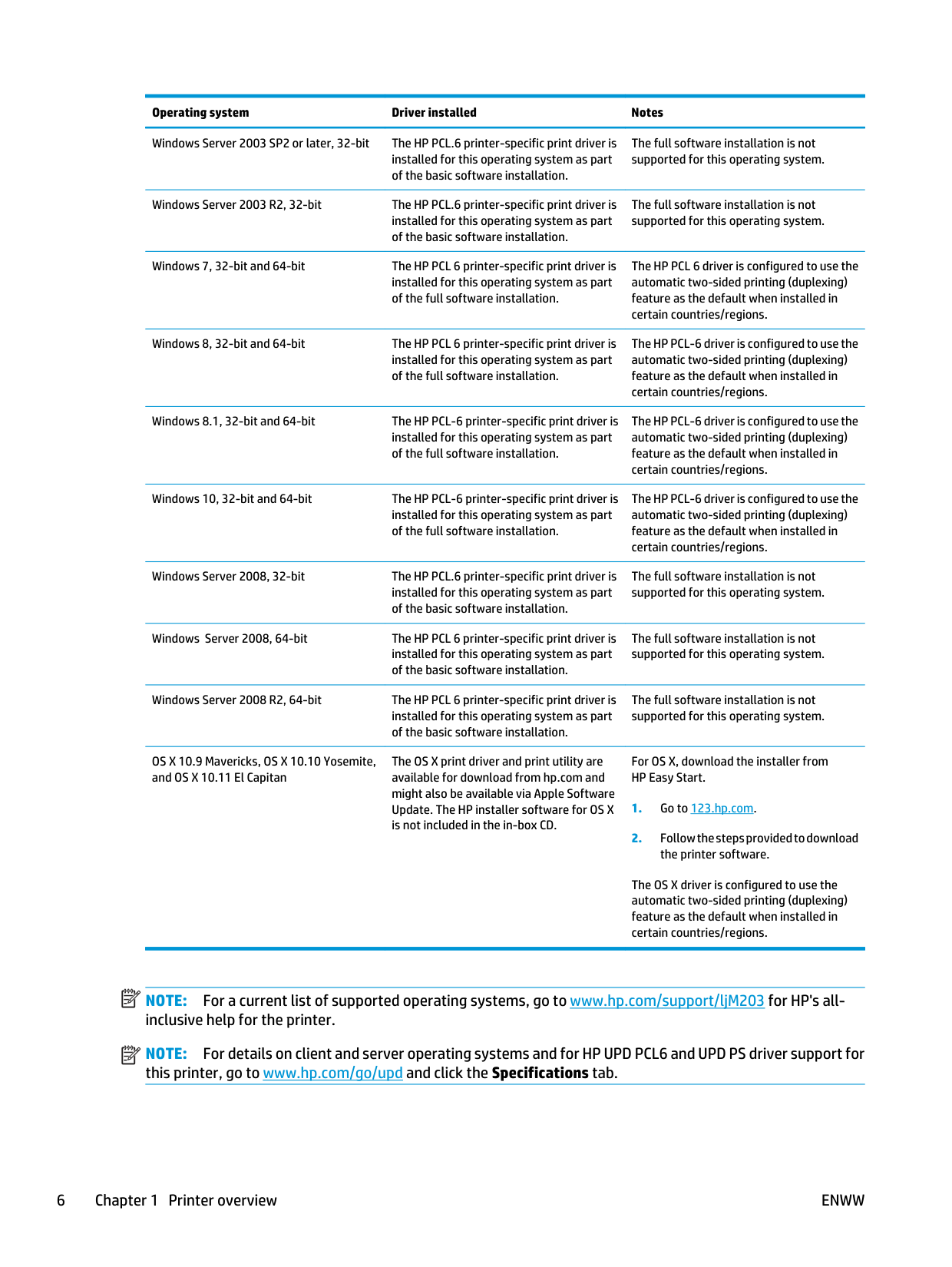
Operating system Driver installed Notes Windows Server 2003 SP2 or later, 32-bit The HP PCL.6 printer-specific print driver is installed for this operating system as part of the basic software installation. The full software installation is not supported for this operating system. Windows Server 2003 R2, 32-bit The HP PCL.6 printer-specific print driver is installed for this operating system as part of the basic software installation. The full software installation is not supported for this operating system. Windows 7, 32-bit and 64-bit The HP PCL 6 printer-specific print driver is installed for this operating system as part of the full software installation. The HP PCL 6 driver is configured to use the automatic two-sided printing (duplexing) feature as the default when installed in certain countries/regions. Windows 8, 32-bit and 64-bit The HP PCL 6 printer-specific print driver is installed for this operating system as part of the full software installation. The HP PCL-6 driver is configured to use the automatic two-sided printing (duplexing) feature as the default when installed in certain countries/regions. Windows 8.1, 32-bit and 64-bit The HP PCL-6 printer-specific print driver is installed for this operating system as part of the full software installation. The HP PCL-6 driver is configured to use the automatic two-sided printing (duplexing) feature as the default when installed in certain countries/regions. Windows 10, 32-bit and 64-bit The HP PCL-6 printer-specific print driver is installed for this operating system as part of the full software installation. The HP PCL-6 driver is configured to use the automatic two-sided printing (duplexing) feature as the default when installed in certain countries/regions. Windows Server 2008, 32-bit The HP PCL.6 printer-specific print driver is installed for this operating system as part of the basic software installation. The full software installation is not supported for this operating system. Windows Server 2008, 64-bit The HP PCL 6 printer-specific print driver is installed for this operating system as part of the basic software installation. The full software installation is not supported for this operating system. Windows Server 2008 R2, 64-bit The HP PCL 6 printer-specific print driver is installed for this operating system as part of the basic software installation. The full software installation is not supported for this operating system. OS X 10.9 Mavericks, OS X 10.10 Yosemite, and OS X 10.11 El Capitan The OS X print driver and print utility are available for download from hp.com and might also be available via Apple Software Update. The HP installer software for OS X is not included in the in-box CD. For OS X, download the installer from HP Easy Start.
Note:
For a current list of supported operating systems, go to www.hp.com/support/ljM203 for HP's all- inclusive help for the printer.Note:
For details on client and server operating systems and for HP UPD PCL6 and UPD PS driver support for this printer, go to www.hp.com/go/upd and click the Specifications tab. 6 Chapter 1 Printer overviewEnww
Mobile printing solutions HP offers multiple mobile and ePrint solutions to enable easy printing to an HP printer from a laptop, tablet, smartphone, or other mobile device. To see the full list and to determine the best choice, go to www.hp.com/ go/LaserJetMobilePrinting.
Note:
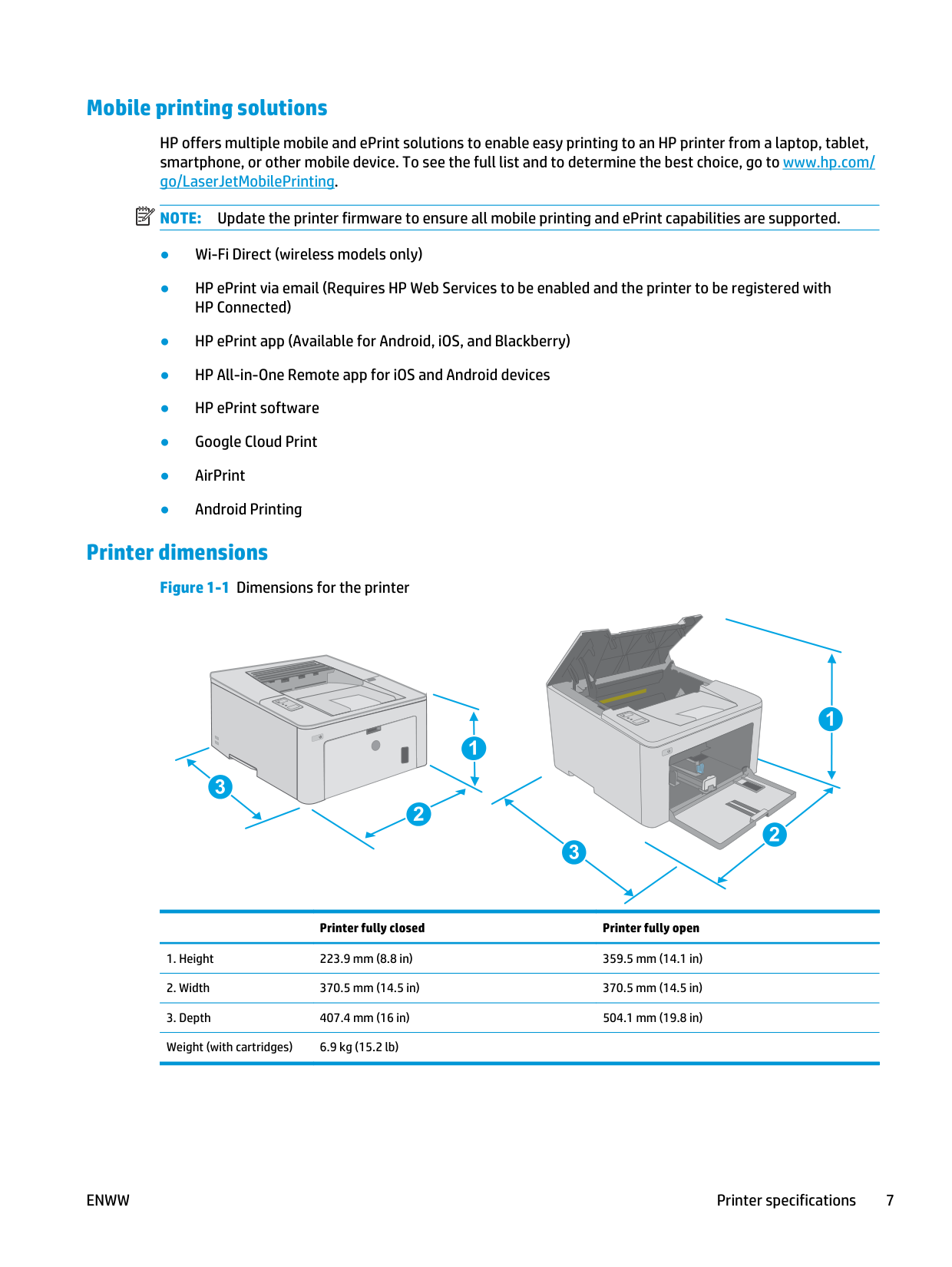
Update the printer firmware to ensure all mobile printing and ePrint capabilities are supported. ● Wi-Fi Direct (wireless models only) ● HP ePrint via email (Requires HP Web Services to be enabled and the printer to be registered with HP Connected) ● HP ePrint app (Available for Android, iOS, and Blackberry) ● HP All-in-One Remote app for iOS and Android devices ● HP ePrint software ● Google Cloud Print ● AirPrint ● Android Printing Printer dimensions Figure 1-1 Dimensions for the printer 1 2 3 1 2 3 Printer fully closed Printer fully openEnww
Printer specifications 7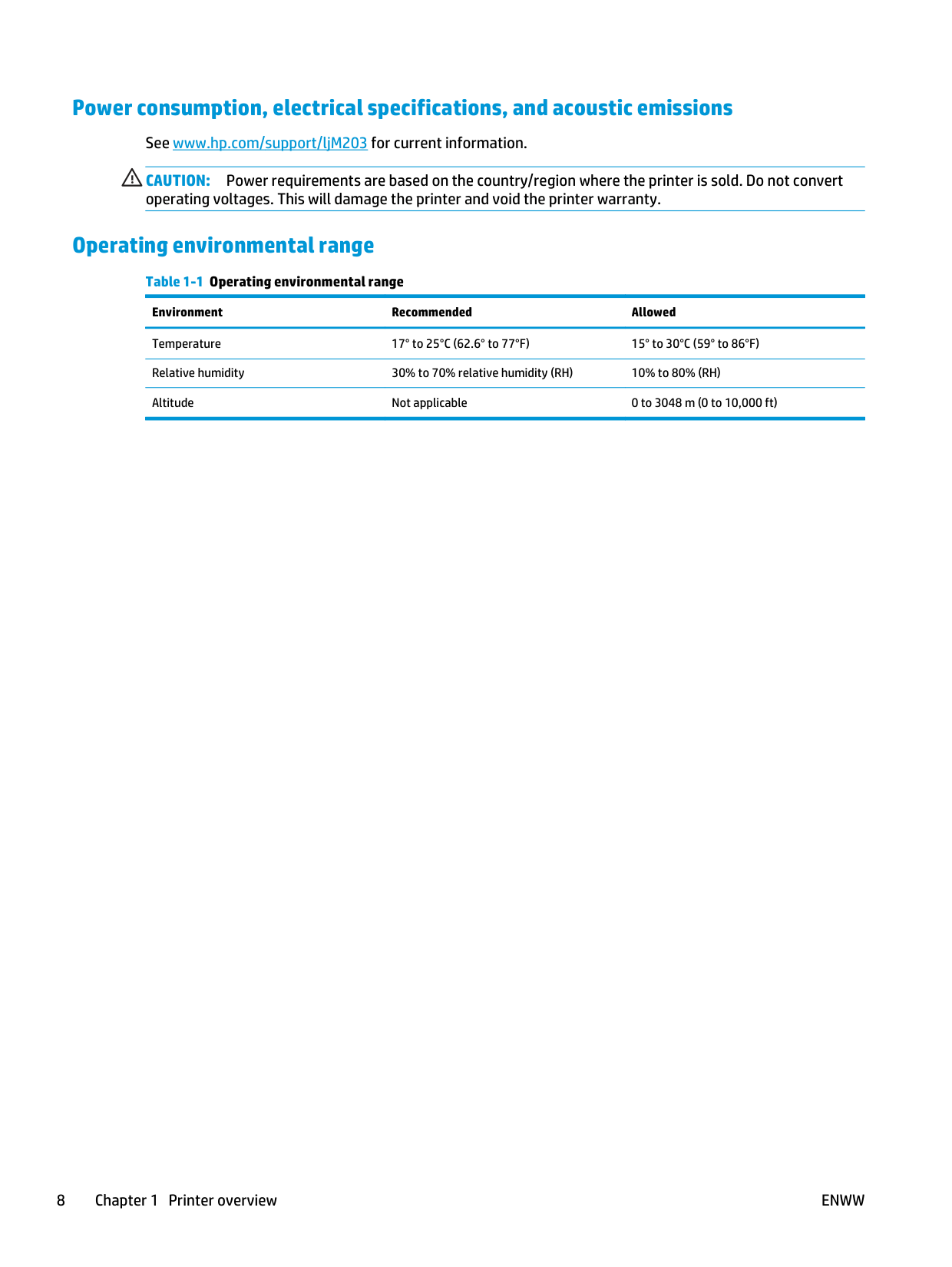
Power consumption, electrical specifications, and acoustic emissions See www.hp.com/support/ljM203 for current information.
Caution:
Power requirements are based on the country/region where the printer is sold. Do not convert operating voltages. This will damage the printer and void the printer warranty. Operating environmental range Table 1-1 Operating environmental range Environment Recommended Allowed Temperature 17° to 25°C (62.6° to 77°F) 15° to 30°C (59° to 86°F) Relative humidity 30% to 70% relative humidity (RH) 10% to 80% (RH) Altitude Not applicable 0 to 3048 m (0 to 10,000 ft) 8 Chapter 1 Printer overviewEnww
Printer hardware setup and software installation For basic setup instructions, see the Setup Poster and Getting Started Guide that came with the printer. For additional instructions, go to HP support on the Web. Go to www.hp.com/support/ljM203 for HP's all-inclusive help for the printer. Find the following support: ● Install and configure ● Learn and use ● Solve problems ● Download software and firmware updates ● Join support forums ● Find warranty and regulatory information
Enww
Printer hardware setup and software installation 9
10 Chapter 1 Printer overview
Enww
2 Paper trays ● Load the Priority input tray ● Load the Main input tray ● Load and print envelopes ● Load and print labels For more information: The following information is correct at the time of publication. For current information, see www.hp.com/ support/ljM203. HP's all-inclusive help for the printer includes the following information: ● Install and configure ● Learn and use ● Solve problems ● Download software and firmware updates ● Join support forums ● Find warranty and regulatory information
Enww
11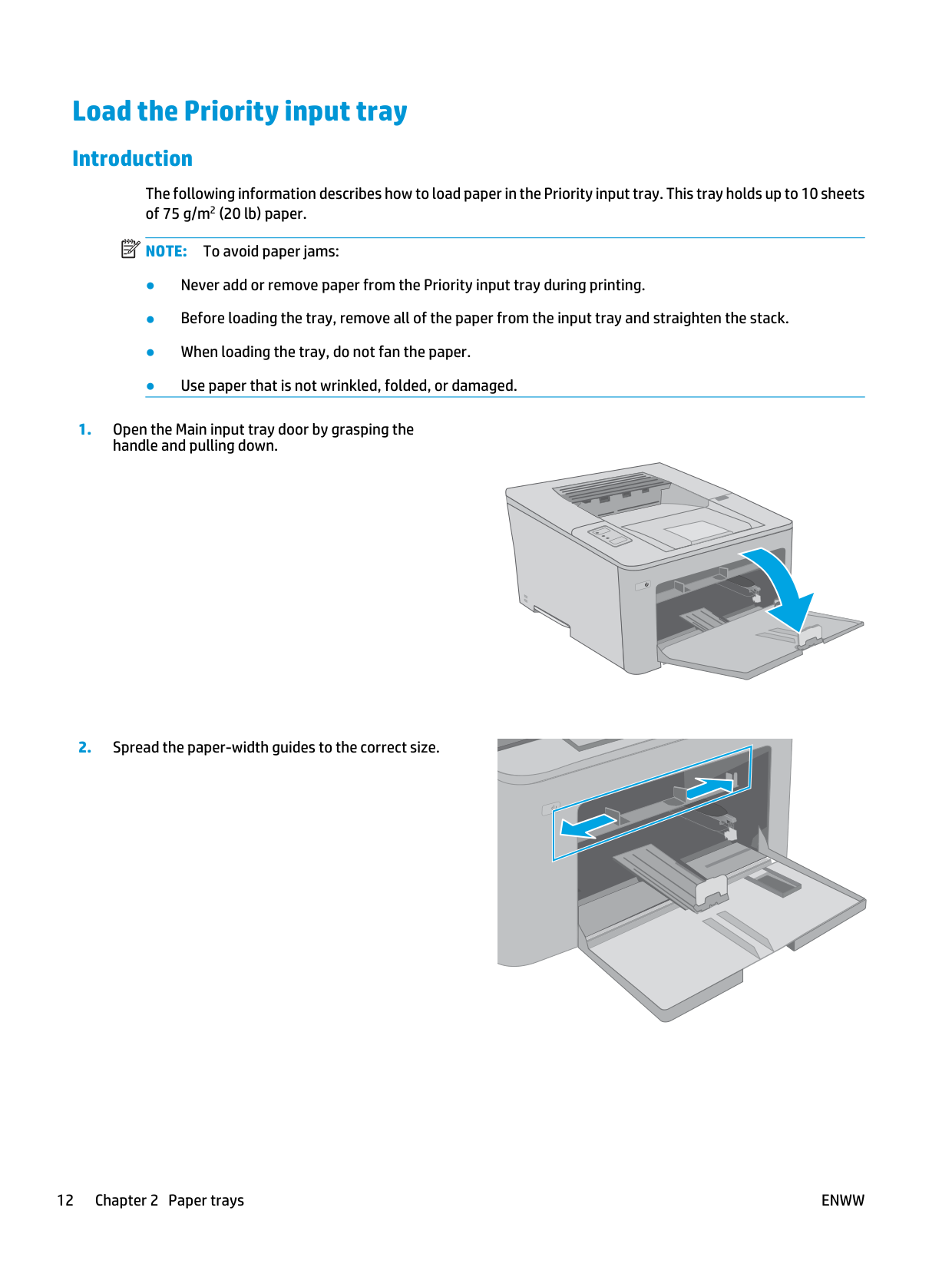
Load the Priority input tray Introduction The following information describes how to load paper in the Priority input tray. This tray holds up to 10 sheets of 75 g/m2 (20 lb) paper.
Note:
To avoid paper jams: ● Never add or remove paper from the Priority input tray during printing. ● Before loading the tray, remove all of the paper from the input tray and straighten the stack. ● When loading the tray, do not fan the paper. ● Use paper that is not wrinkled, folded, or damaged.Enww
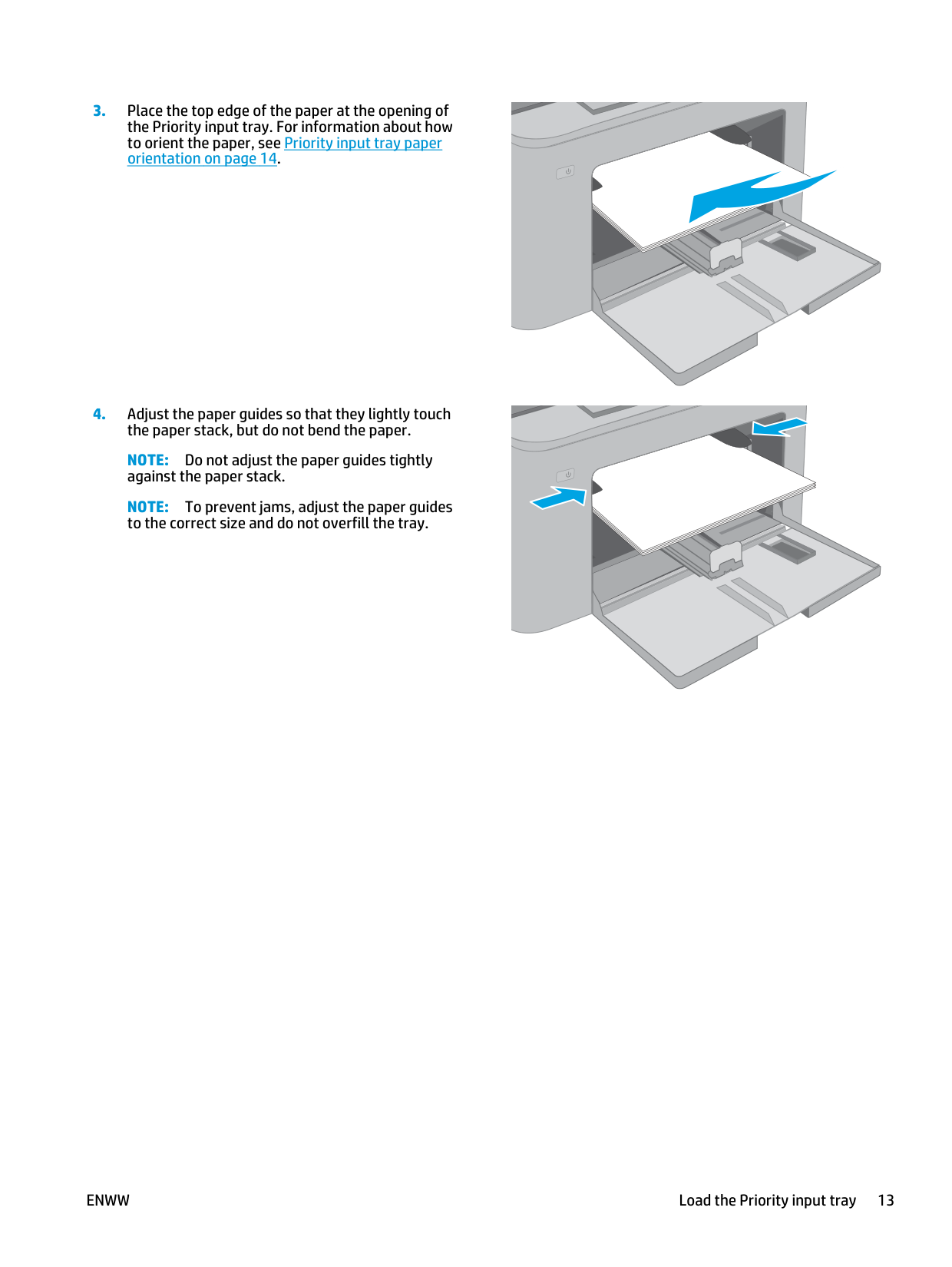
Note:
Do not adjust the paper guides tightly against the paper stack.Note:
To prevent jams, adjust the paper guides to the correct size and do not overfill the tray.Enww
Load the Priority input tray 13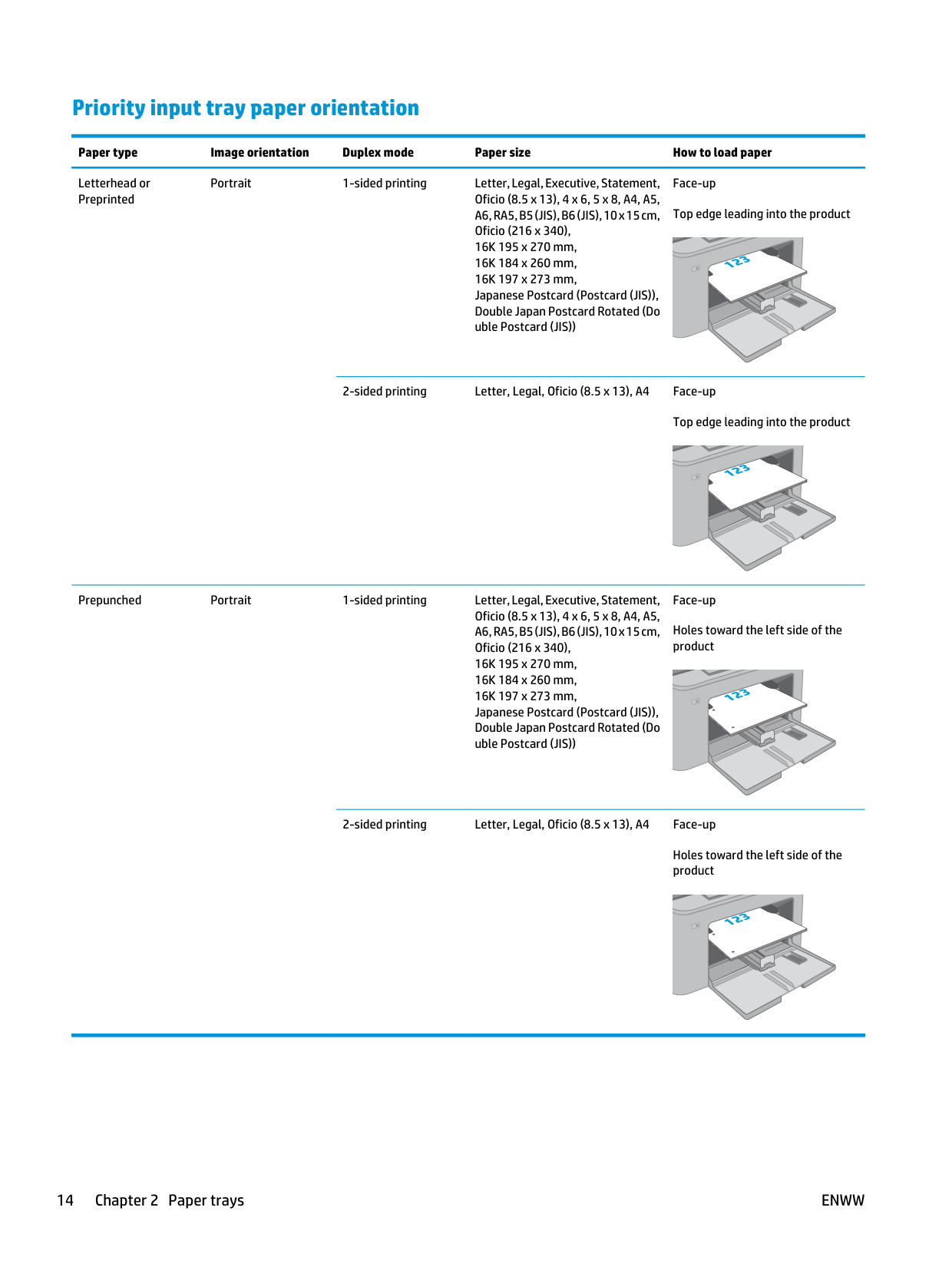
Priority input tray paper orientation Paper type Image orientation Duplex mode Paper size How to load paper Letterhead or Preprinted Portrait 1-sided printing Letter, Legal, Executive, Statement, Oficio (8.5 x 13), 4 x 6, 5 x 8, A4, A5, A6, RA5, B5 (JIS), B6 (JIS), 10 x 15 cm, Oficio (216 x 340), 16K 195 x 270 mm, 16K 184 x 260 mm, 16K 197 x 273 mm, Japanese Postcard (Postcard (JIS)), Double Japan Postcard Rotated (Do uble Postcard (JIS)) Face-up Top edge leading into the product 123 2-sided printing Letter, Legal, Oficio (8.5 x 13), A4 Face-up Top edge leading into the product 123 Prepunched Portrait 1-sided printing Letter, Legal, Executive, Statement, Oficio (8.5 x 13), 4 x 6, 5 x 8, A4, A5, A6, RA5, B5 (JIS), B6 (JIS), 10 x 15 cm, Oficio (216 x 340), 16K 195 x 270 mm, 16K 184 x 260 mm, 16K 197 x 273 mm, Japanese Postcard (Postcard (JIS)), Double Japan Postcard Rotated (Do uble Postcard (JIS)) Face-up Holes toward the left side of the product 123 2-sided printing Letter, Legal, Oficio (8.5 x 13), A4 Face-up Holes toward the left side of the product 123 14 Chapter 2 Paper trays
Enww
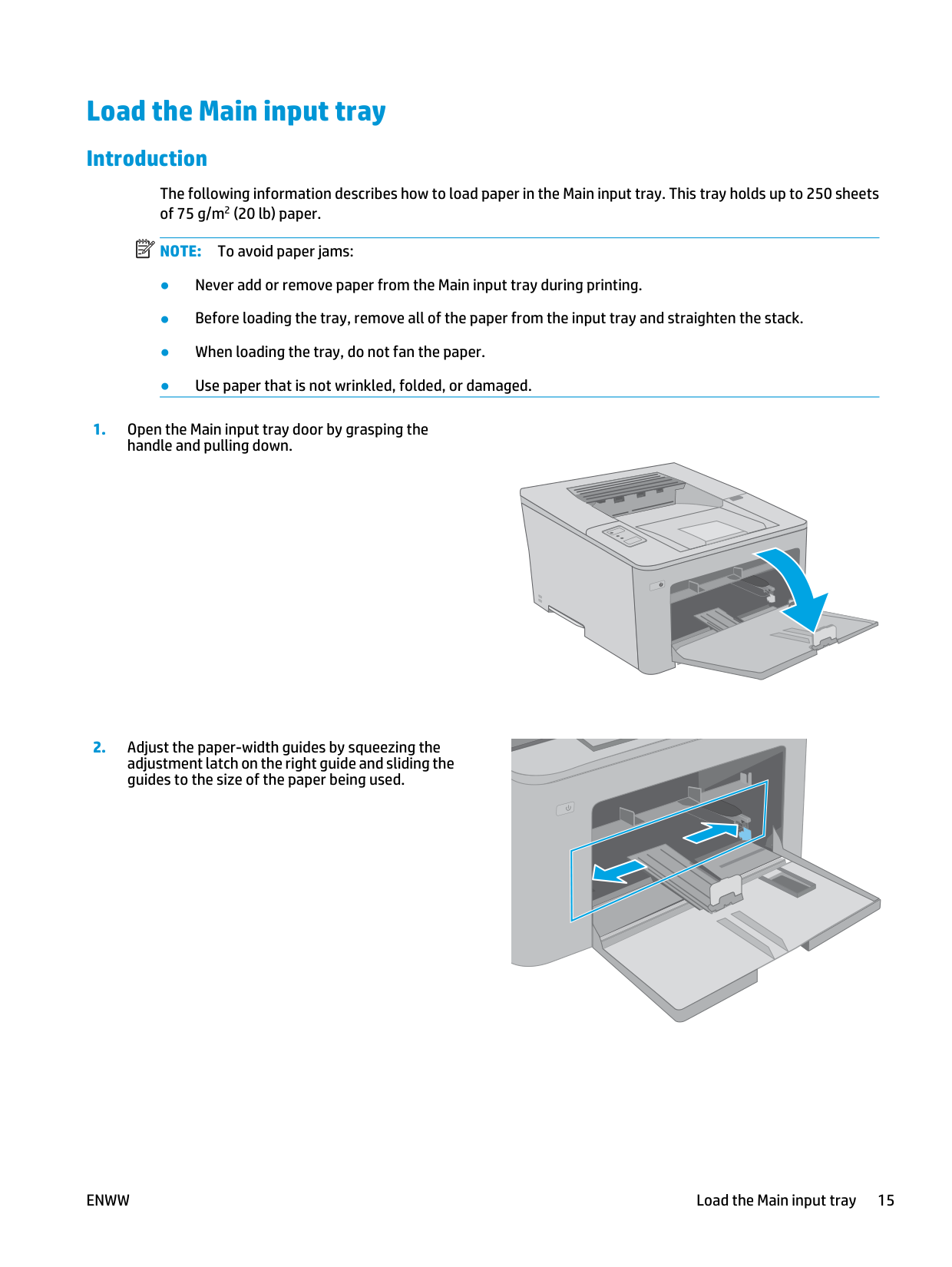
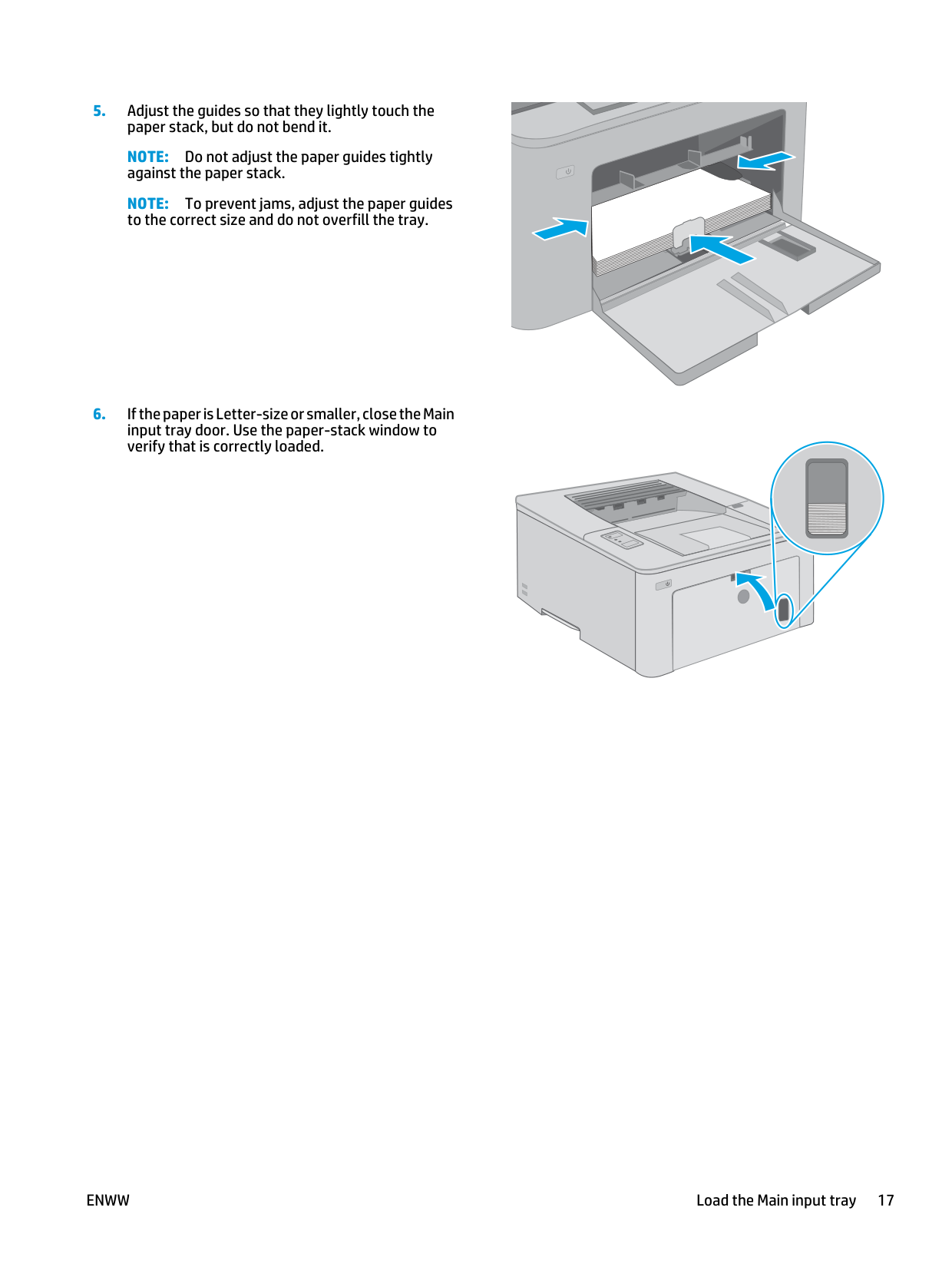
Load the Main input tray Introduction The following information describes how to load paper in the Main input tray. This tray holds up to 250 sheets of 75 g/m2 (20 lb) paper.
Note:
To avoid paper jams: ● Never add or remove paper from the Main input tray during printing. ● Before loading the tray, remove all of the paper from the input tray and straighten the stack. ● When loading the tray, do not fan the paper. ● Use paper that is not wrinkled, folded, or damaged.Enww
Load the Main input tray 15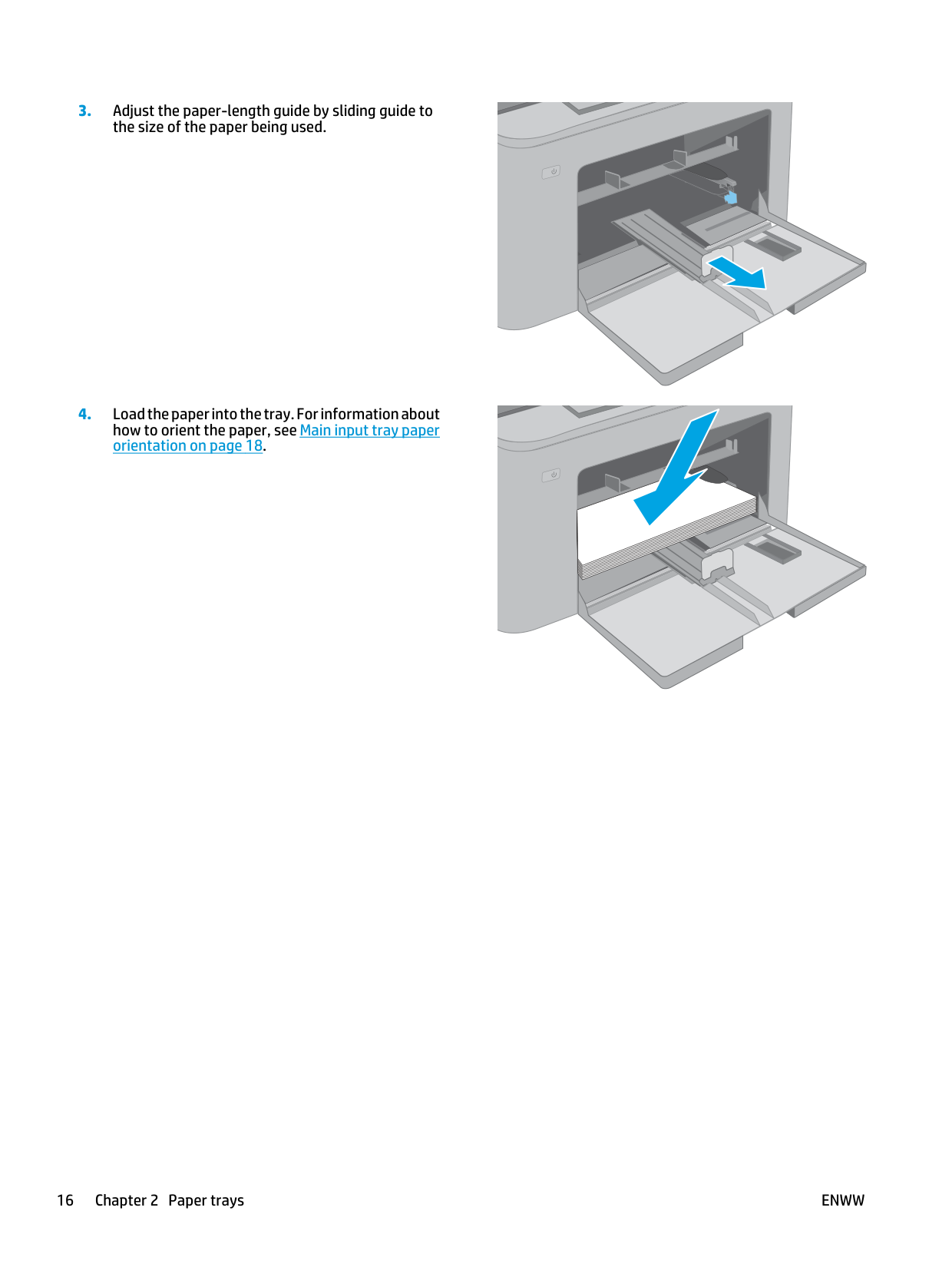
16 Chapter 2 Paper trays
Enww
Note:
Do not adjust the paper guides tightly against the paper stack.Note:
To prevent jams, adjust the paper guides to the correct size and do not overfill the tray.Enww
Load the Main input tray 17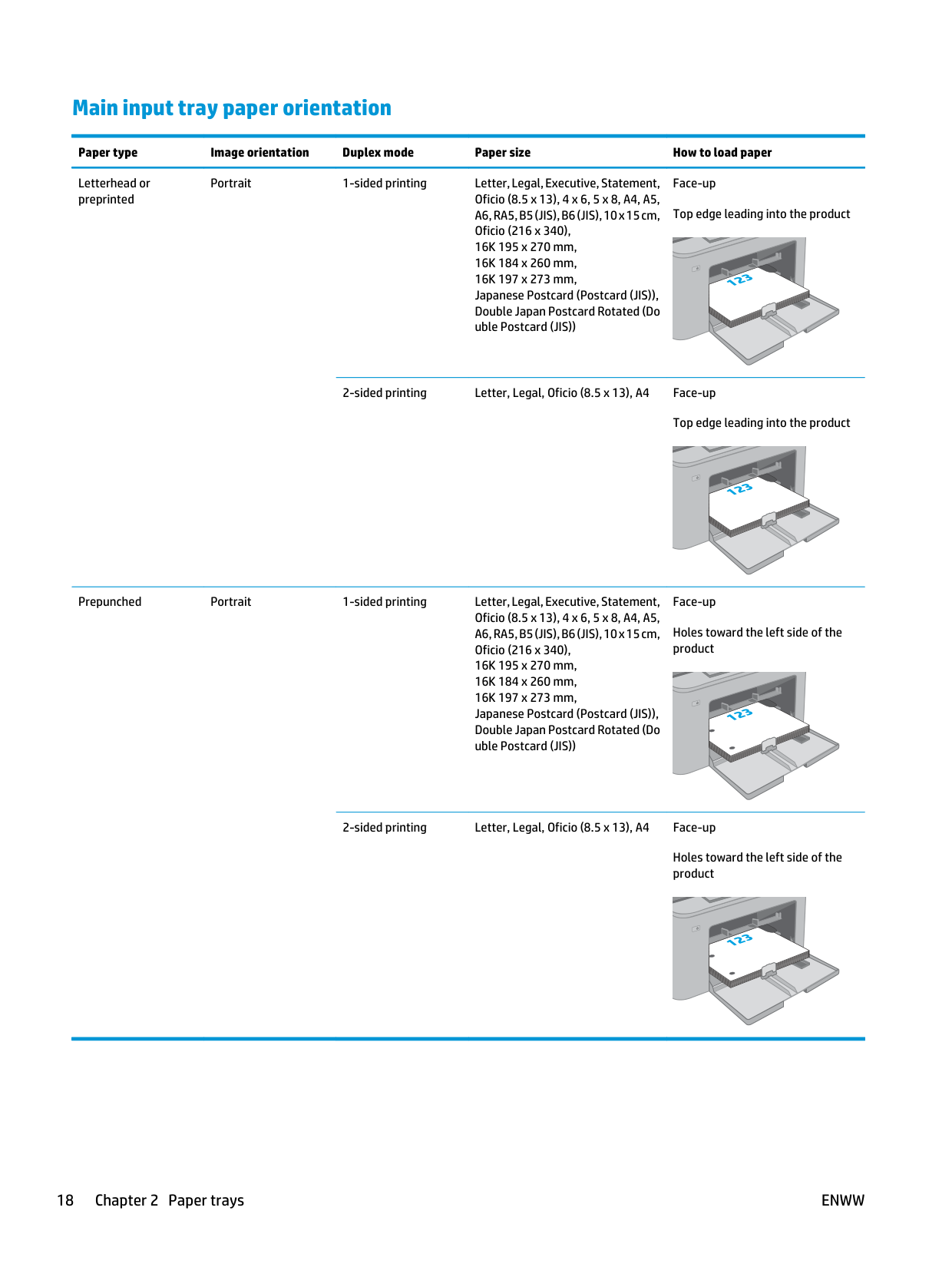
Main input tray paper orientation Paper type Image orientation Duplex mode Paper size How to load paper Letterhead or preprinted Portrait 1-sided printing Letter, Legal, Executive, Statement, Oficio (8.5 x 13), 4 x 6, 5 x 8, A4, A5, A6, RA5, B5 (JIS), B6 (JIS), 10 x 15 cm, Oficio (216 x 340), 16K 195 x 270 mm, 16K 184 x 260 mm, 16K 197 x 273 mm, Japanese Postcard (Postcard (JIS)), Double Japan Postcard Rotated (Do uble Postcard (JIS)) Face-up Top edge leading into the product 123 2-sided printing Letter, Legal, Oficio (8.5 x 13), A4 Face-up Top edge leading into the product 123 Prepunched Portrait 1-sided printing Letter, Legal, Executive, Statement, Oficio (8.5 x 13), 4 x 6, 5 x 8, A4, A5, A6, RA5, B5 (JIS), B6 (JIS), 10 x 15 cm, Oficio (216 x 340), 16K 195 x 270 mm, 16K 184 x 260 mm, 16K 197 x 273 mm, Japanese Postcard (Postcard (JIS)), Double Japan Postcard Rotated (Do uble Postcard (JIS)) Face-up Holes toward the left side of the product 123 2-sided printing Letter, Legal, Oficio (8.5 x 13), A4 Face-up Holes toward the left side of the product 123 18 Chapter 2 Paper trays
Enww
Load and print envelopes Introduction The following information describes how to print and load envelopes. The Priority input tray holds up to 10 envelopes. The Main input tray holds up to 10 envelopes. To print envelopes using the manual feed option, follow these steps to select the correct settings in the print driver, and then load the envelopes into the tray after sending the print job to the printer. Print envelopes
Note:
The name of the button varies for different software programs.Note:
To access these features from a Windows 8 or 8.1 Start screen, select Devices, select Print, and then select the printer.Enww
Load and print envelopes 19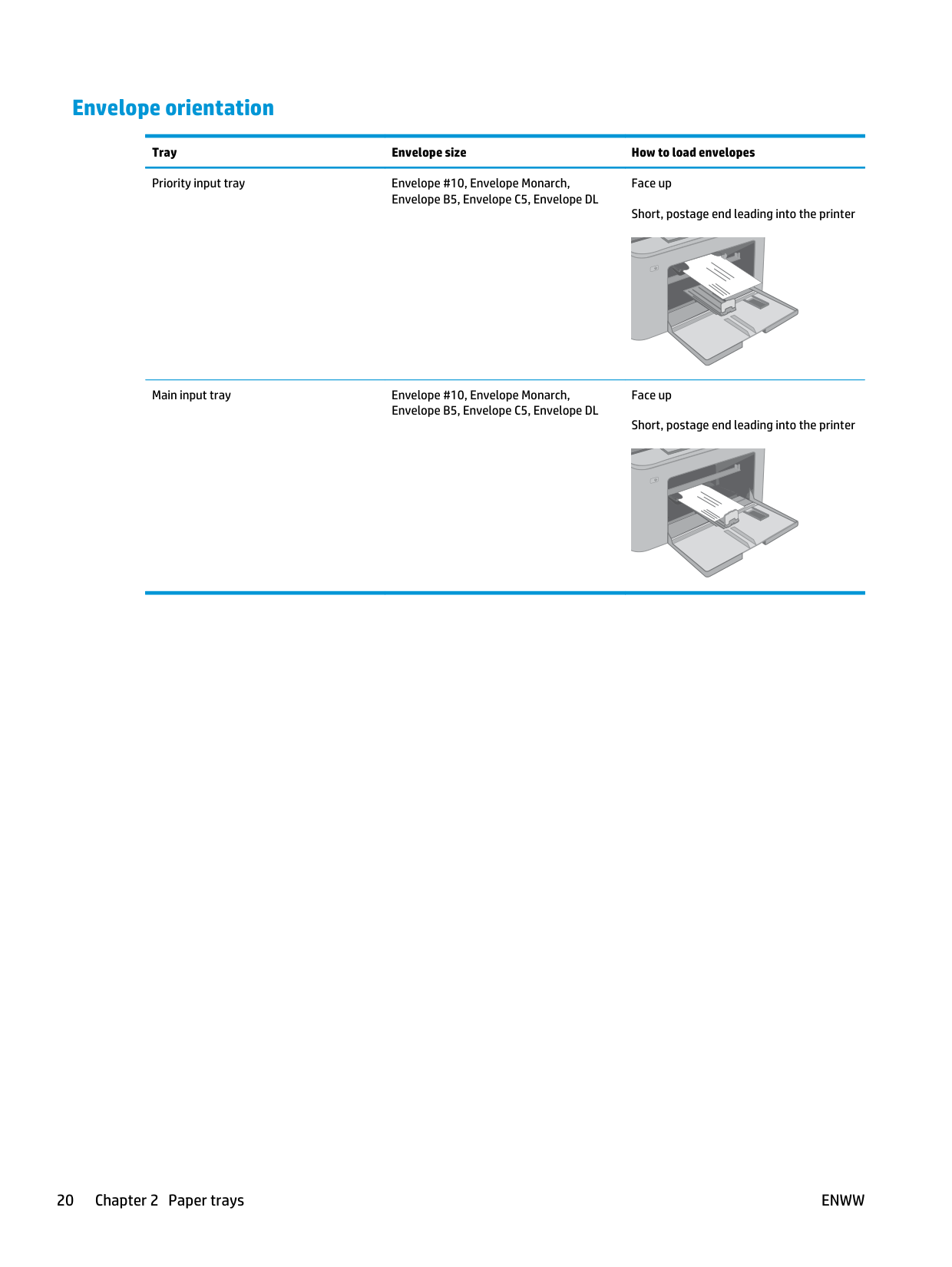
Envelope orientation Tray Envelope size How to load envelopes Priority input tray Envelope #10, Envelope Monarch, Envelope B5, Envelope C5, Envelope DL Face up Short, postage end leading into the printer Main input tray Envelope #10, Envelope Monarch, Envelope B5, Envelope C5, Envelope DL Face up Short, postage end leading into the printer 20 Chapter 2 Paper trays
Enww
Load and print labels Introduction The following information describes how to print and load labels. To print labels using the manual feed option, follow these steps to select the correct settings in the print driver, and then load the labels into the tray after sending the print job to the printer. When using manual feed, the printer waits to print the job until it detects that the tray has been opened. Manually feed labels
Note:
The name of the button varies for different software programs.Note:
To access these features from a Windows 8 or 8.1 Start screen, select Devices, select Print, and then select the printer.Enww
Load and print labels 21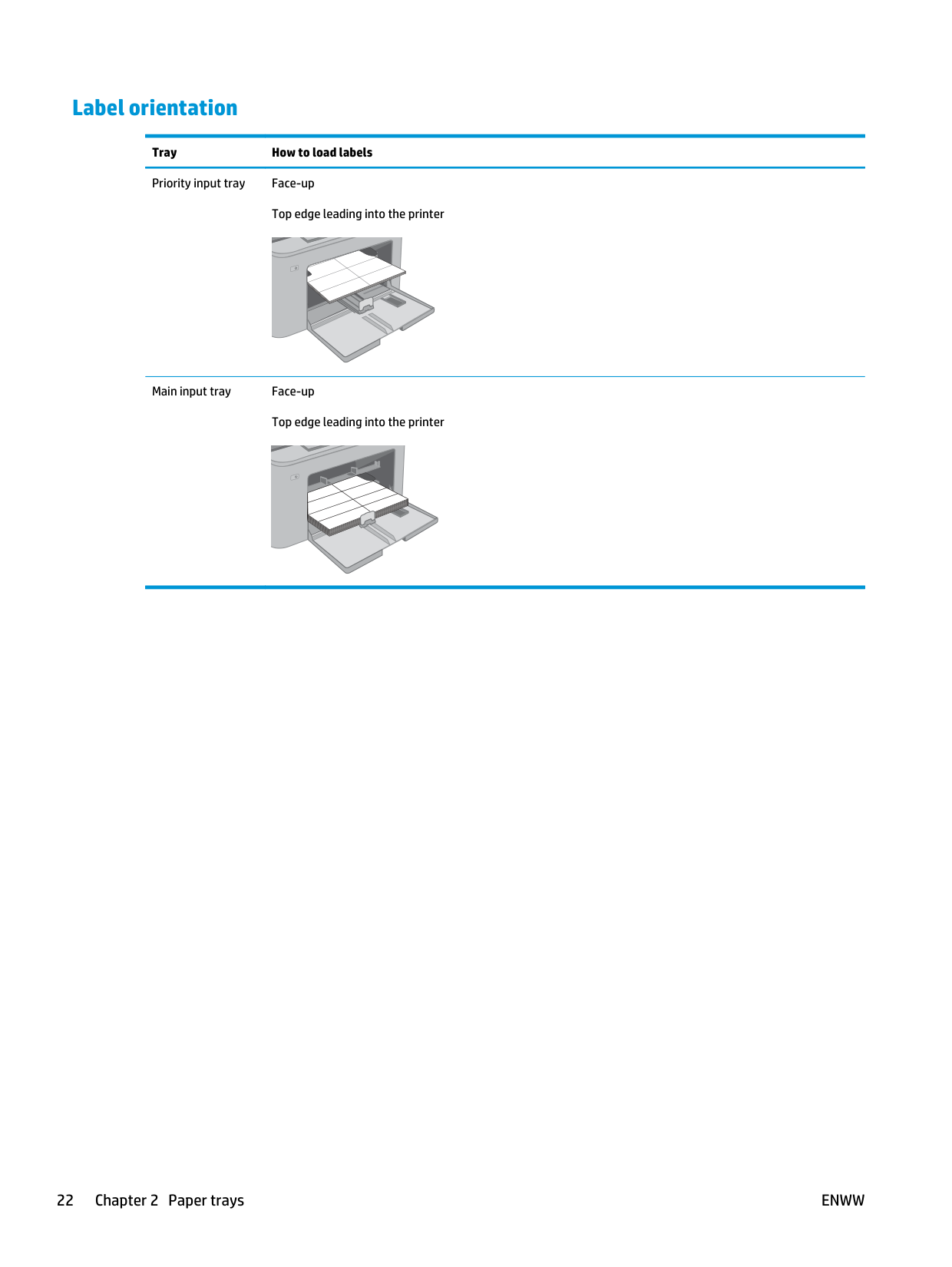
Label orientation Tray How to load labels Priority input tray Face-up Top edge leading into the printer Main input tray Face-up Top edge leading into the printer 22 Chapter 2 Paper trays
Enww
3 Supplies, accessories, and parts ● Order supplies, accessories, and parts ● Configure the HP toner-cartridge-protection supply settings ● Replace the toner cartridge ● Replace the imaging drum For more information: The following information is correct at the time of publication. For current information, see www.hp.com/ support/ljM203. HP's all-inclusive help for the printer includes the following information: ● Install and configure ● Learn and use ● Solve problems ● Download software and firmware updates ● Join support forums ● Find warranty and regulatory information
Enww
23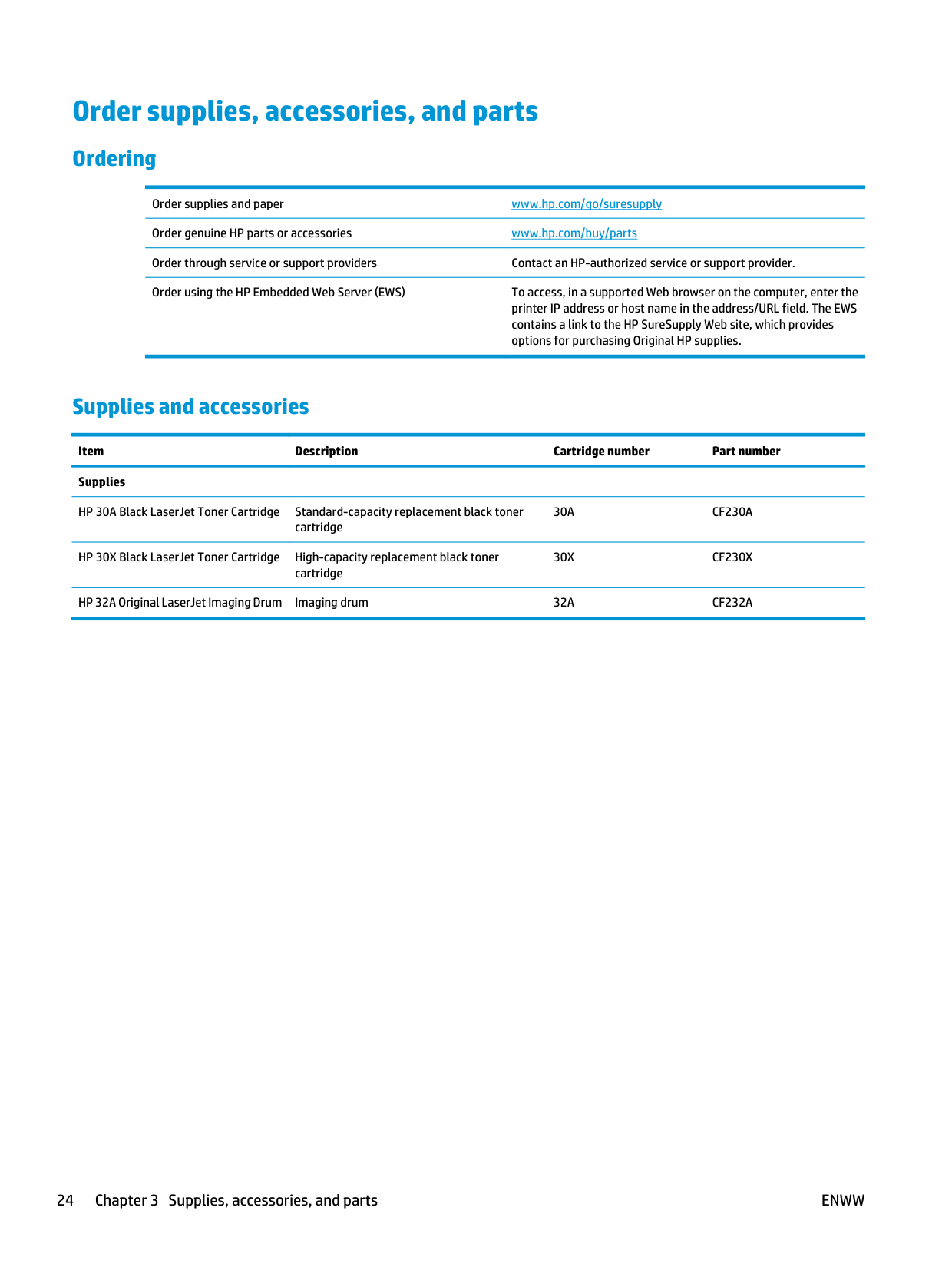
Order supplies, accessories, and parts Ordering Order supplies and paper www.hp.com/go/suresupply Order genuine HP parts or accessories www.hp.com/buy/parts Order through service or support providers Contact an HP-authorized service or support provider. Order using the HP Embedded Web Server (EWS) To access, in a supported Web browser on the computer, enter the printer IP address or host name in the address/URL field. The EWS contains a link to the HP SureSupply Web site, which provides options for purchasing Original HP supplies. Supplies and accessories Item Description Cartridge number Part number Supplies HP 30A Black LaserJet Toner Cartridge Standard-capacity replacement black toner cartridge
30A
Cf230A
HP 30X Black LaserJet Toner Cartridge High-capacity replacement black toner cartridge30X
Cf230X
HP 32A Original LaserJet Imaging Drum Imaging drum32A
Cf232A
24 Chapter 3 Supplies, accessories, and partsEnww
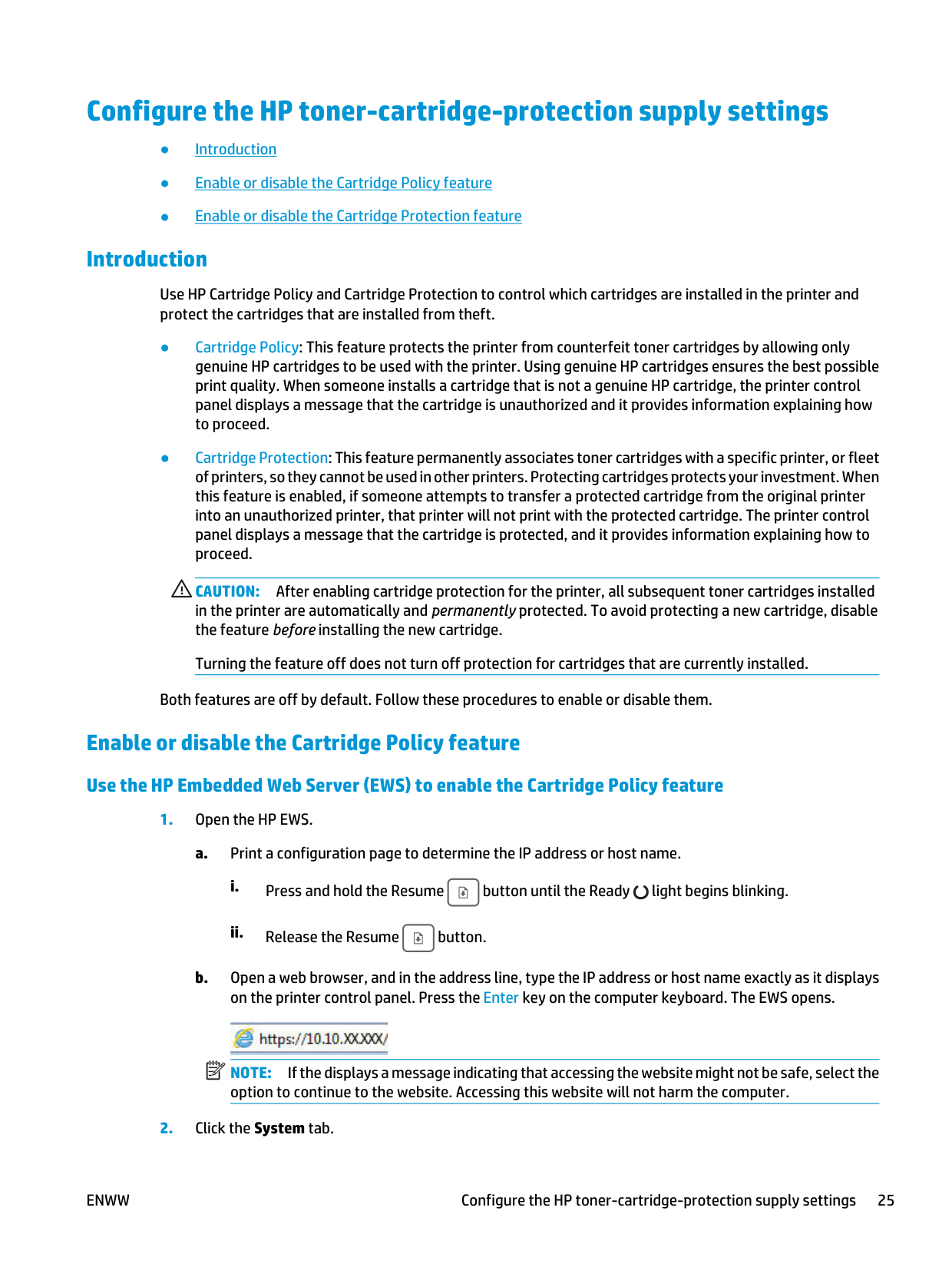
Configure the HP toner-cartridge-protection supply settings ● Introduction ● Enable or disable the Cartridge Policy feature ● Enable or disable the Cartridge Protection feature Introduction Use HP Cartridge Policy and Cartridge Protection to control which cartridges are installed in the printer and protect the cartridges that are installed from theft. ● Cartridge Policy: This feature protects the printer from counterfeit toner cartridges by allowing only genuine HP cartridges to be used with the printer. Using genuine HP cartridges ensures the best possible print quality. When someone installs a cartridge that is not a genuine HP cartridge, the printer control panel displays a message that the cartridge is unauthorized and it provides information explaining how to proceed. ● Cartridge Protection: This feature permanently associates toner cartridges with a specific printer, or fleet of printers, so they cannot be used in other printers. Protecting cartridges protects your investment. When this feature is enabled, if someone attempts to transfer a protected cartridge from the original printer into an unauthorized printer, that printer will not print with the protected cartridge. The printer control panel displays a message that the cartridge is protected, and it provides information explaining how to proceed.
Caution:
After enabling cartridge protection for the printer, all subsequent toner cartridges installed in the printer are automatically and permanently protected. To avoid protecting a new cartridge, disable the feature before installing the new cartridge. Turning the feature off does not turn off protection for cartridges that are currently installed. Both features are off by default. Follow these procedures to enable or disable them. Enable or disable the Cartridge Policy feature Use the HP Embedded Web Server (EWS) to enable the Cartridge Policy featureNote:
If the displays a message indicating that accessing the website might not be safe, select the option to continue to the website. Accessing this website will not harm the computer.Enww
Configure the HP toner-cartridge-protection supply settings 25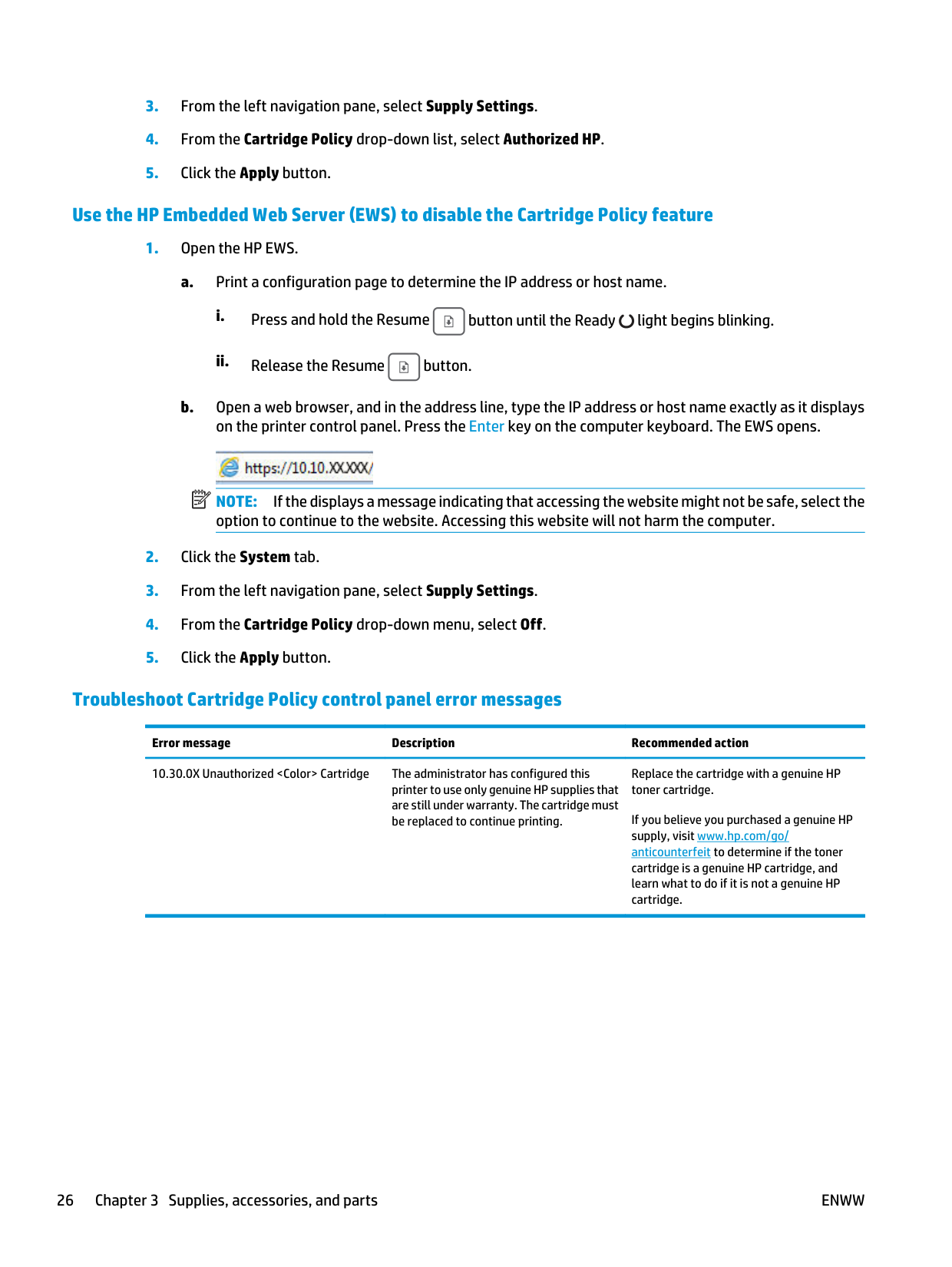
Note:
If the displays a message indicating that accessing the website might not be safe, select the option to continue to the website. Accessing this website will not harm the computer.Enww
Enable or disable the Cartridge Protection feature Use the HP Embedded Web Server (EWS) to enable the Cartridge Protection feature
Note:
If the displays a message indicating that accessing the website might not be safe, select the option to continue to the website. Accessing this website will not harm the computer.Caution:
After enabling cartridge protection for the printer, all subsequent toner cartridges installed in the printer are automatically and permanently protected. To avoid protecting a new cartridge, disable the Cartridge Protection feature before installing the new cartridge. Turning the feature off does not turn off protection for cartridges that are currently installed. Use the HP Embedded Web Server (EWS) to disable the Cartridge Protection featureNote:
If the displays a message indicating that accessing the website might not be safe, select the option to continue to the website. Accessing this website will not harm the computer.Enww
Configure the HP toner-cartridge-protection supply settings 27
Enww
Replace the toner cartridge ● Introduction ● Toner-cartridge information ● Remove and replace the toner cartridge Introduction The following information provides details about the toner cartridge for the printer, and it includes instructions to replace it. Toner-cartridge information This printer indicates when the toner cartridge level is low. The actual toner cartridge life remaining can vary. Consider having a replacement cartridge available to install when print quality is no longer acceptable. To purchase cartridges or check cartridge compatibility for the printer, go to HP SureSupply at www.hp.com/ go/suresupply. Scroll to the bottom of the page and verify that the country/region is correct. Item Description Cartridge number Part number HP 30A Black LaserJet Toner Cartridge Standard-capacity replacement black toner cartridge
30A
Cf230A
HP 30X Black LaserJet Toner Cartridge High-capacity replacement black toner cartridge30X
Cf230X
Note:
High-yield toner cartridges contain more toner than standard cartridges for increased page yield. For more information, go to www.hp.com/go/learnaboutsupplies. Do not remove the toner cartridge from its package until it is time to replace it.Caution:
To prevent damage to the toner cartridge, do not expose it to light for more than a few minutes. The following illustration shows the toner-cartridge components.Enww
Replace the toner cartridge 29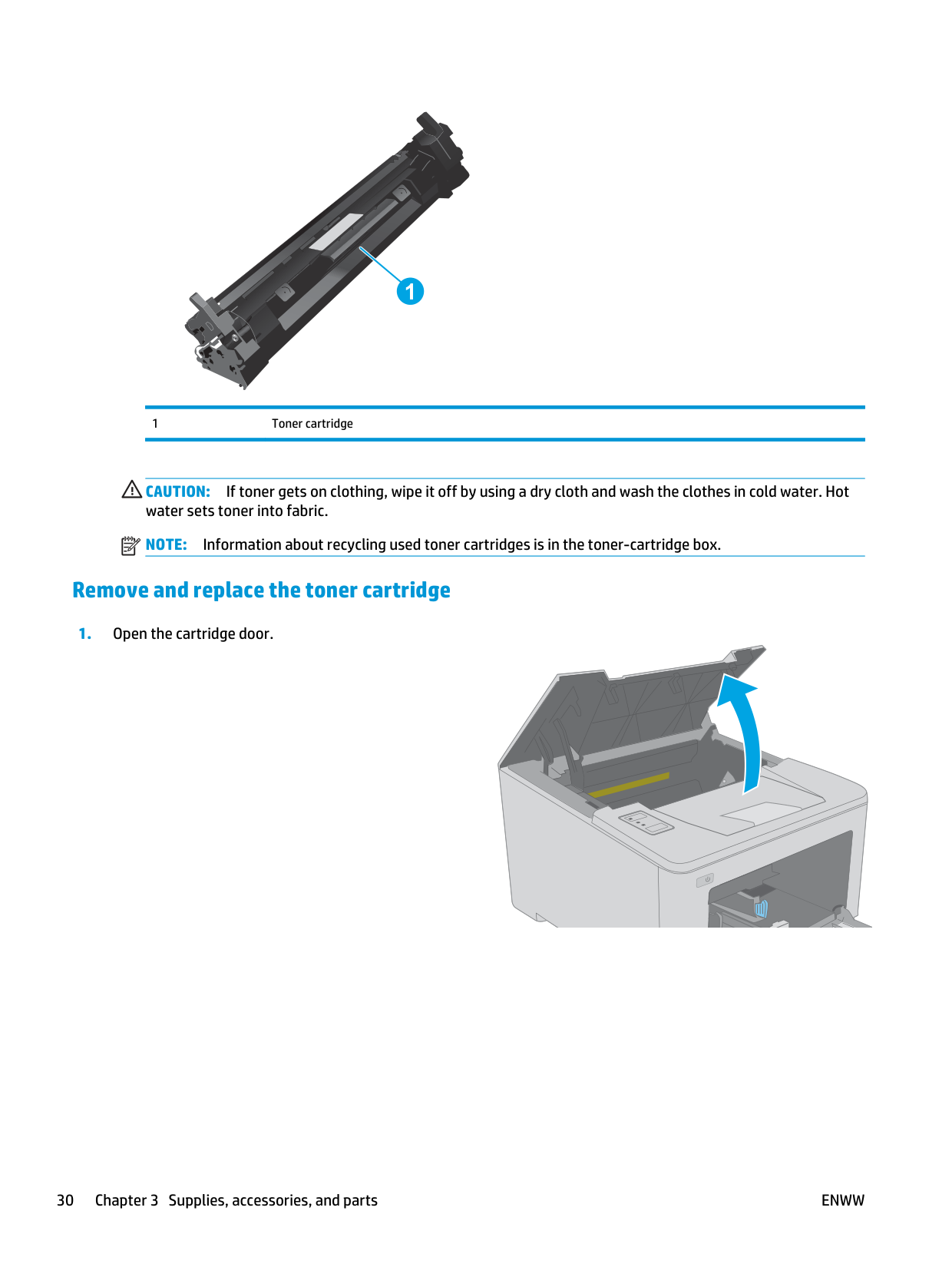
1 1 Toner cartridge
Caution:
If toner gets on clothing, wipe it off by using a dry cloth and wash the clothes in cold water. Hot water sets toner into fabric.Note:
Information about recycling used toner cartridges is in the toner-cartridge box. Remove and replace the toner cartridge30 Chapter 3 Supplies, accessories, and parts
Enww
Enww
Replace the toner cartridge 31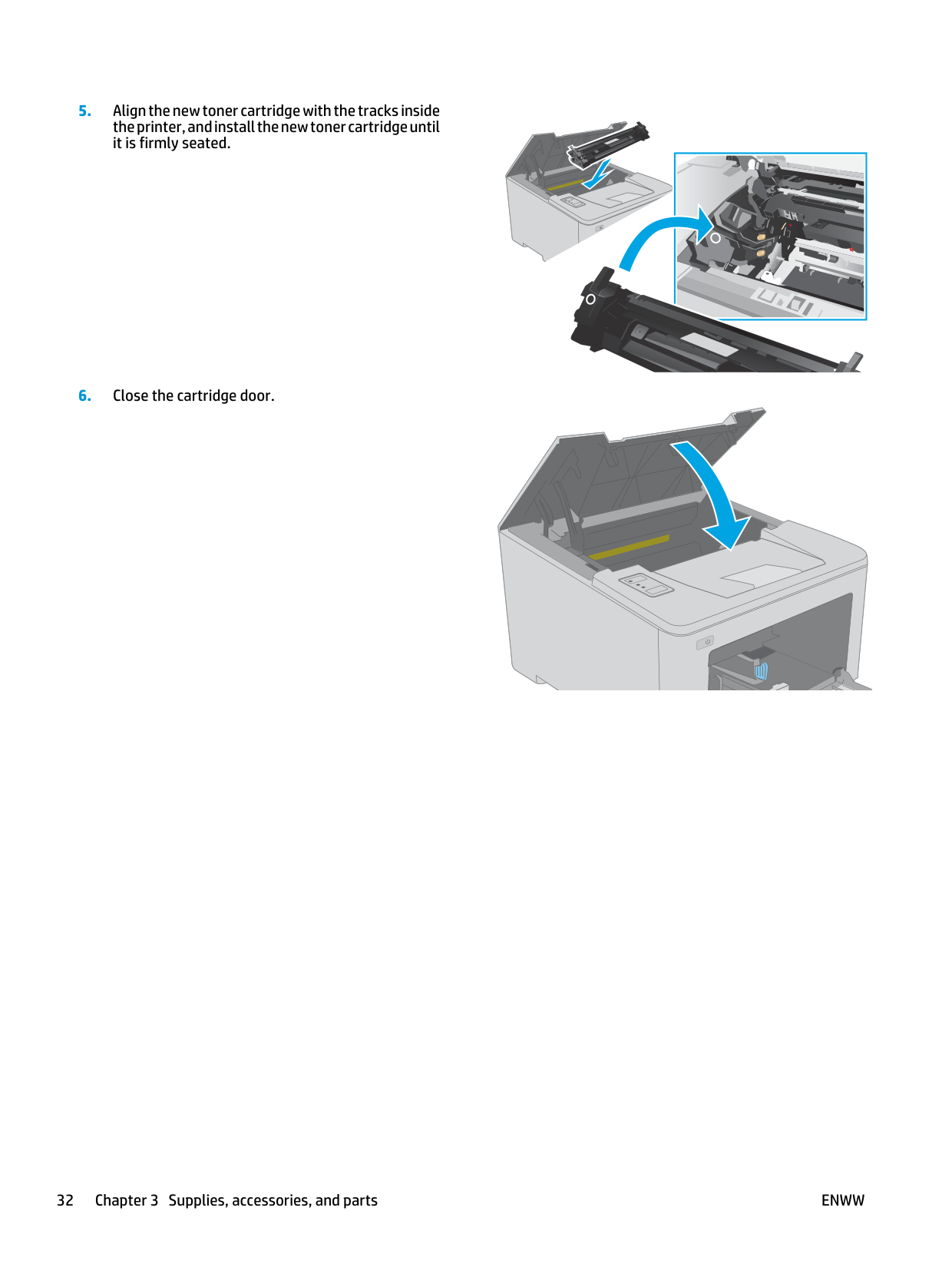
32 Chapter 3 Supplies, accessories, and parts
Enww
Replace the imaging drum ● Introduction ● Imaging drum information ● Remove and replace the imaging drum Introduction The following information provides details about the imaging drum for the printer, and it includes instructions to replace it. Imaging drum information This printer indicates when the imaging drum needs to be replaced. The actual imaging drum life remaining can vary. Consider having a replacement imaging drum available to install when print quality is no longer acceptable. To purchase imaging drums for the printer, go to HP SureSupply at www.hp.com/go/suresupply. Scroll to the bottom of the page and verify that the country/region is correct. Item Description Cartridge number Part number HP 32A Original LaserJet Imaging Drum Replacement imaging drum
32A
Cf232A
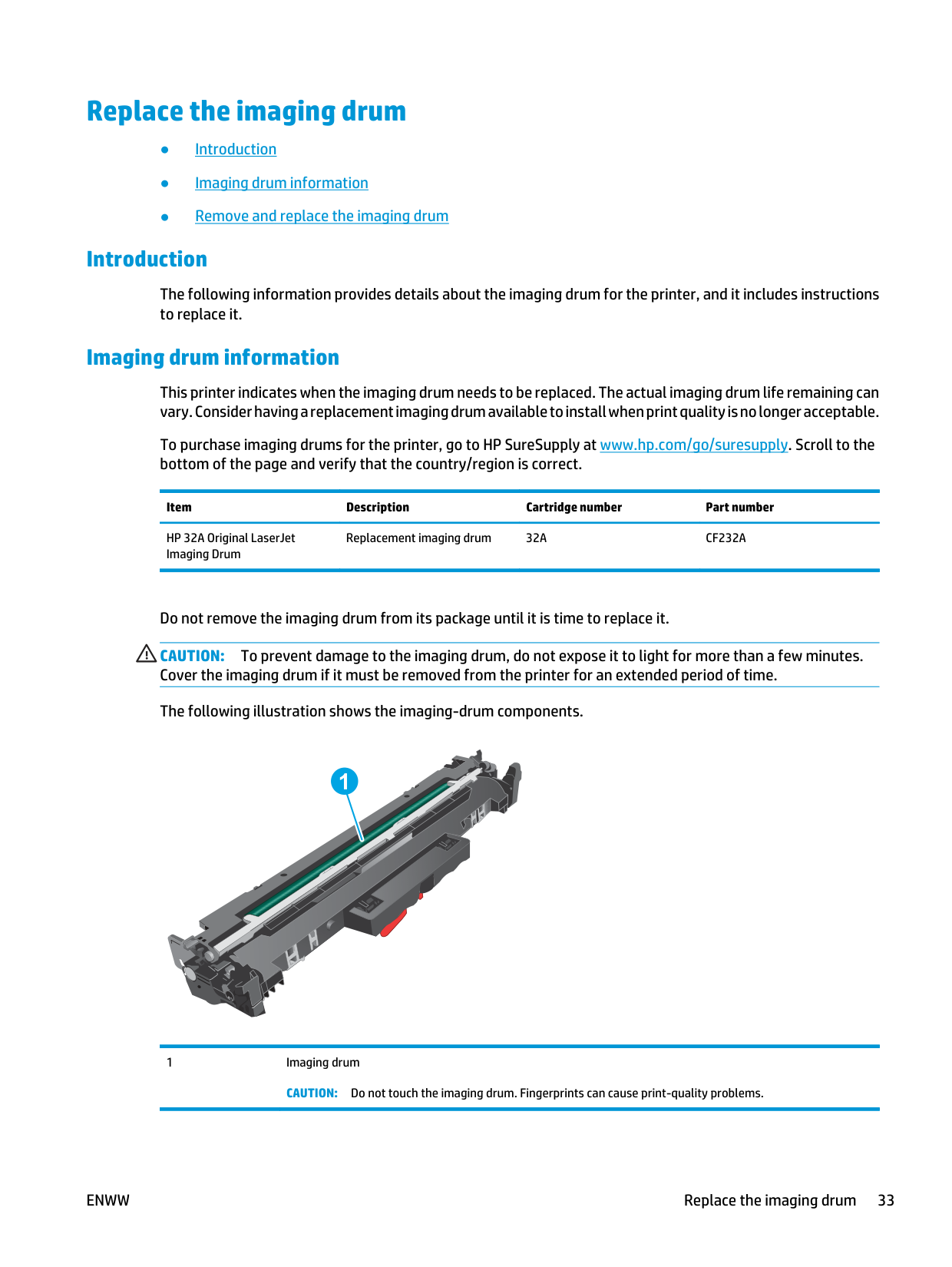
Do not remove the imaging drum from its package until it is time to replace it.Caution:
To prevent damage to the imaging drum, do not expose it to light for more than a few minutes. Cover the imaging drum if it must be removed from the printer for an extended period of time. The following illustration shows the imaging-drum components. 1 1 Imaging drumCaution:
Do not touch the imaging drum. Fingerprints can cause print-quality problems.Enww
Replace the imaging drum 33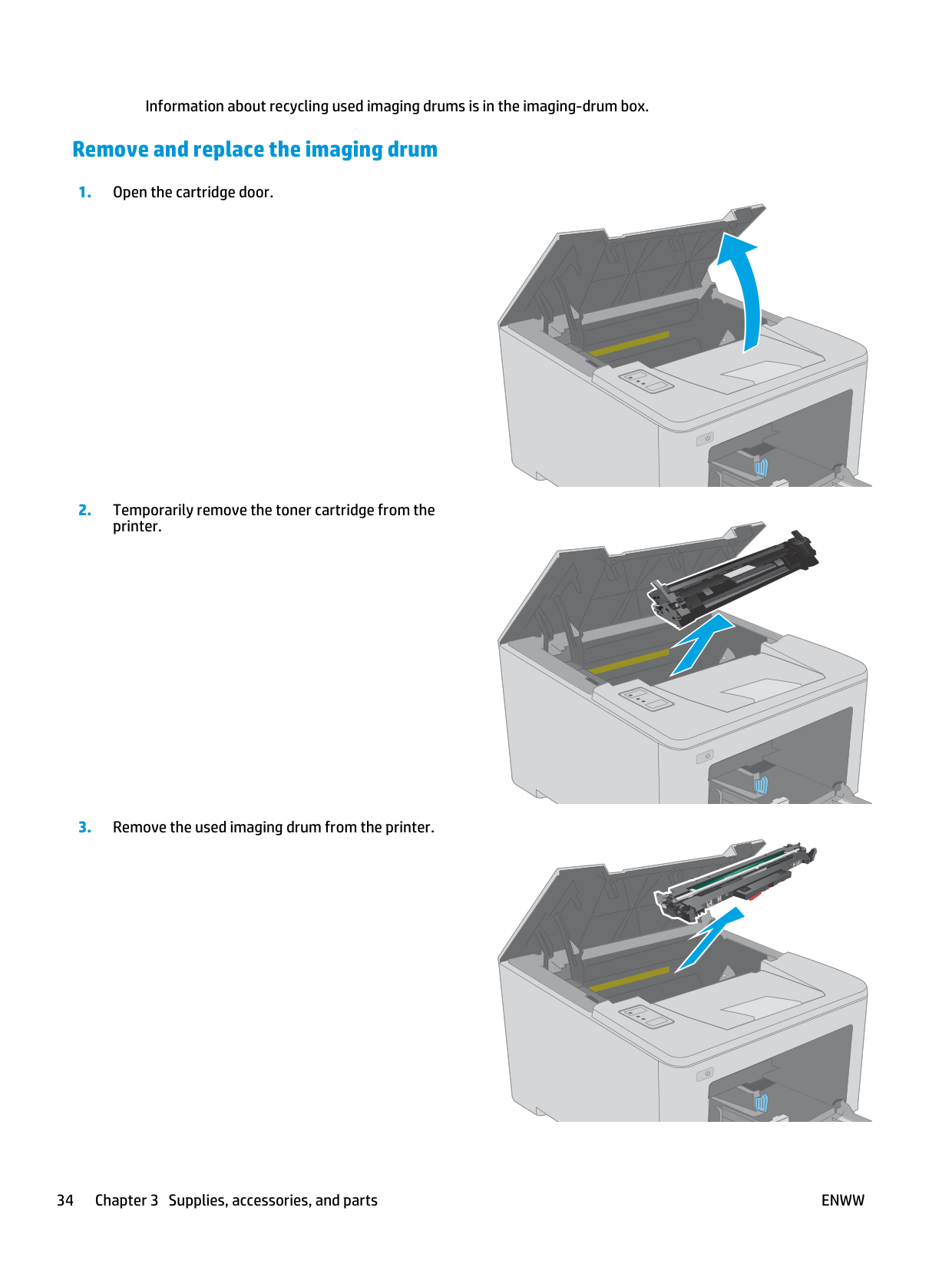
Information about recycling used imaging drums is in the imaging-drum box. Remove and replace the imaging drum
34 Chapter 3 Supplies, accessories, and parts
Enww
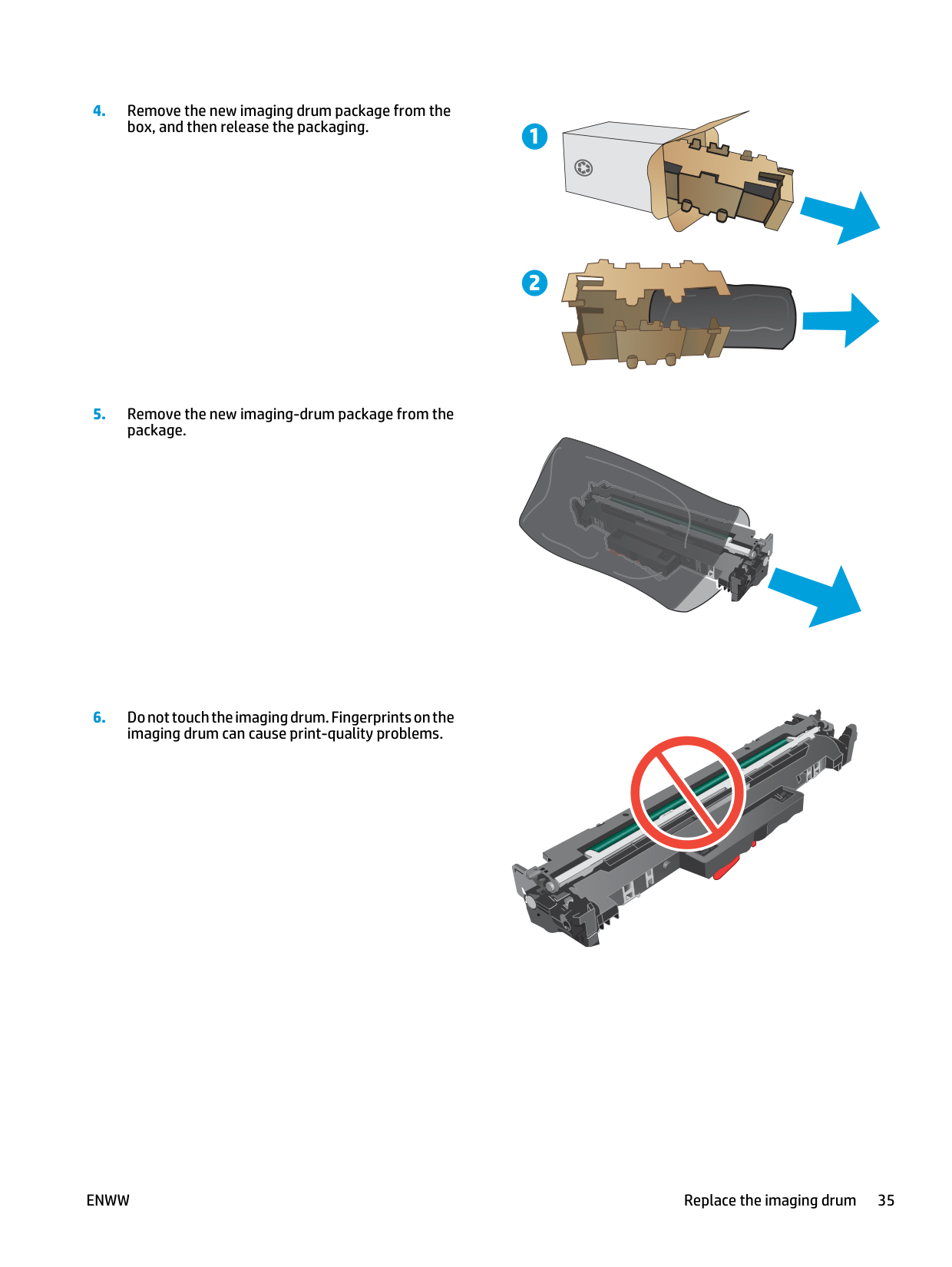
1 2
Enww
Replace the imaging drum 35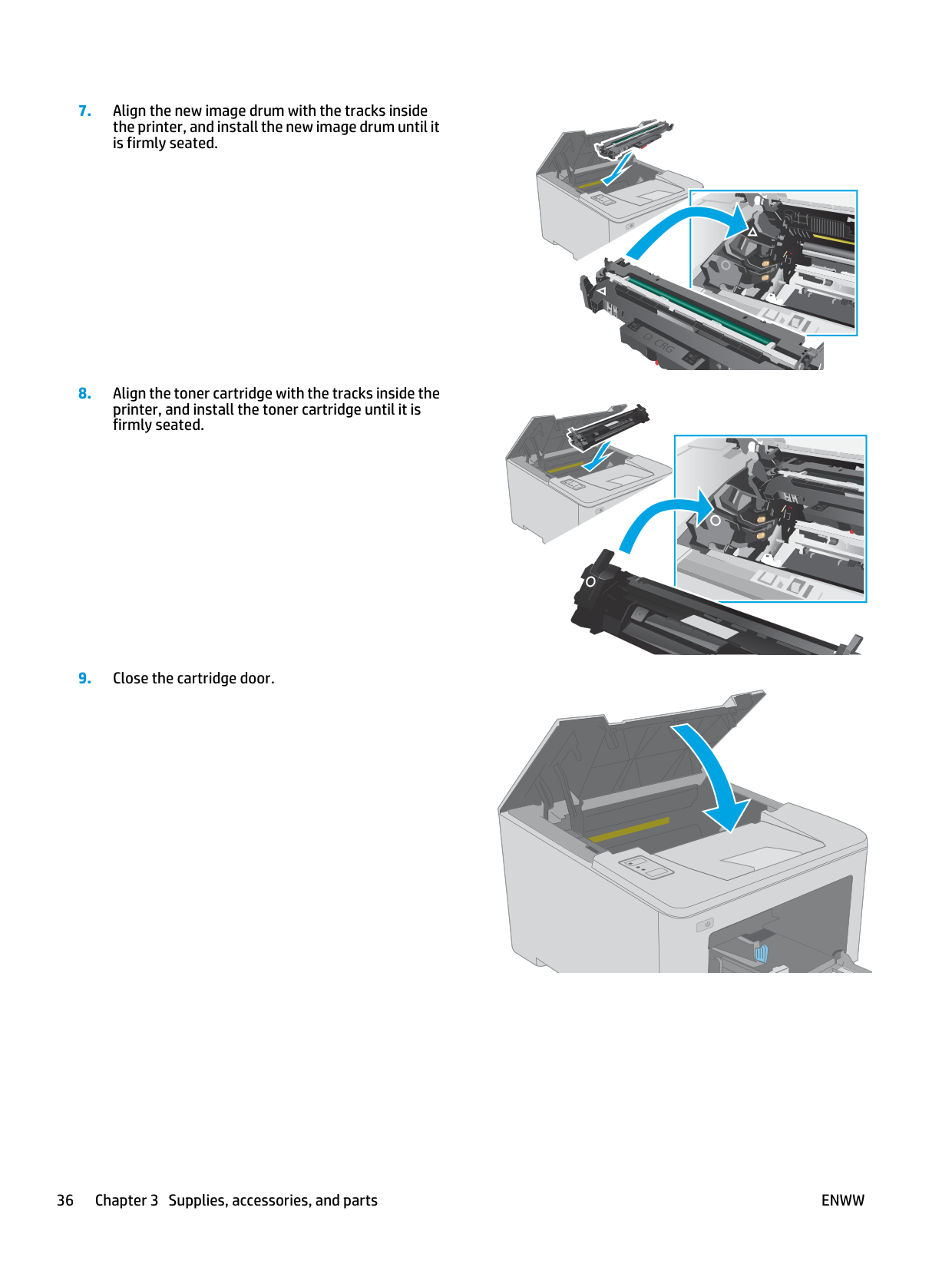
36 Chapter 3 Supplies, accessories, and parts
Enww
4 Print ● Print tasks (Windows) ● Print tasks (OS X) ● Mobile printing For more information: The following information is correct at the time of publication. For current information, see www.hp.com/ support/ljM203. HP's all-inclusive help for the printer includes the following information: ● Install and configure ● Learn and use ● Solve problems ● Download software and firmware updates ● Join support forums ● Find warranty and regulatory information
Enww
37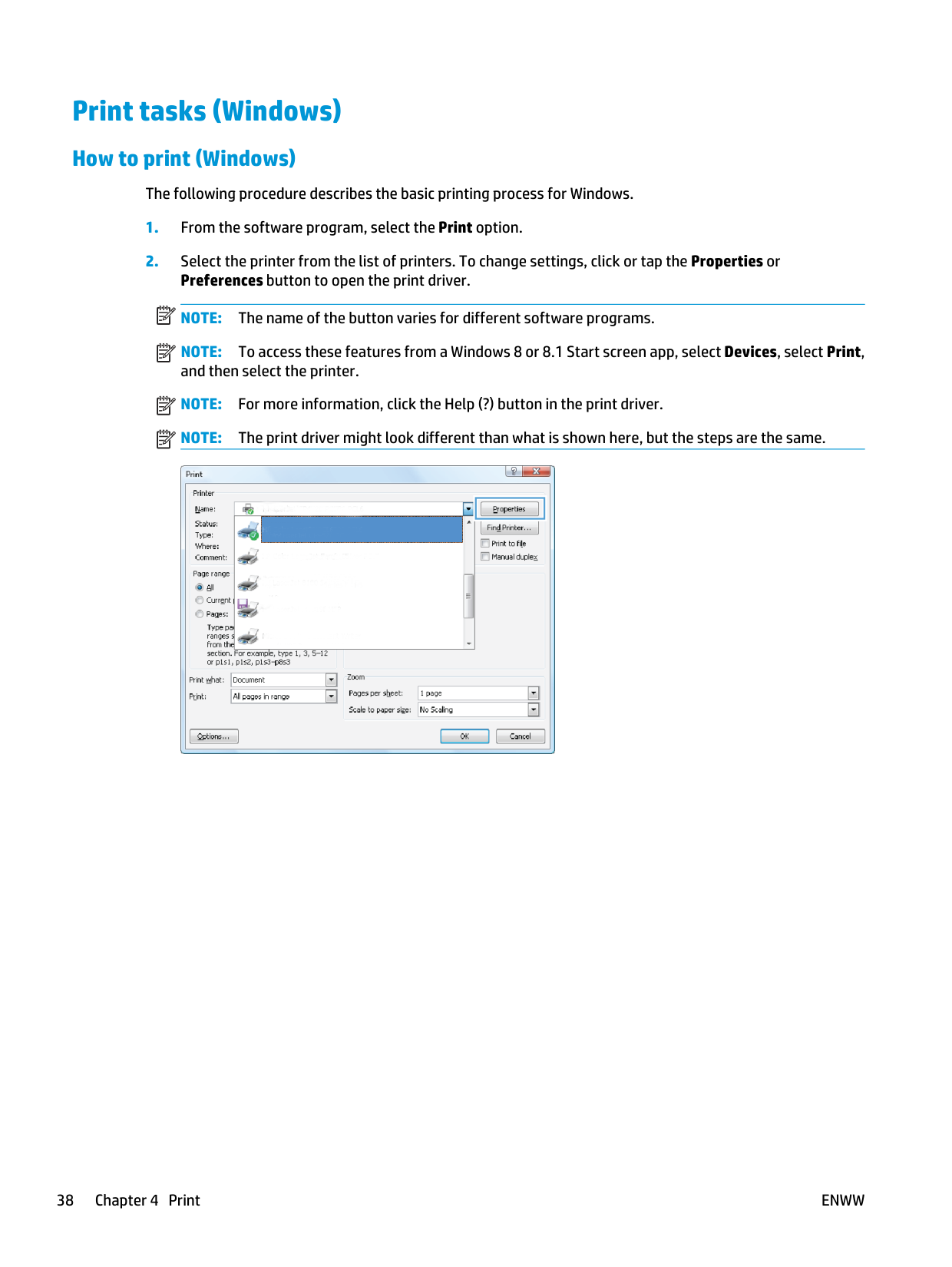
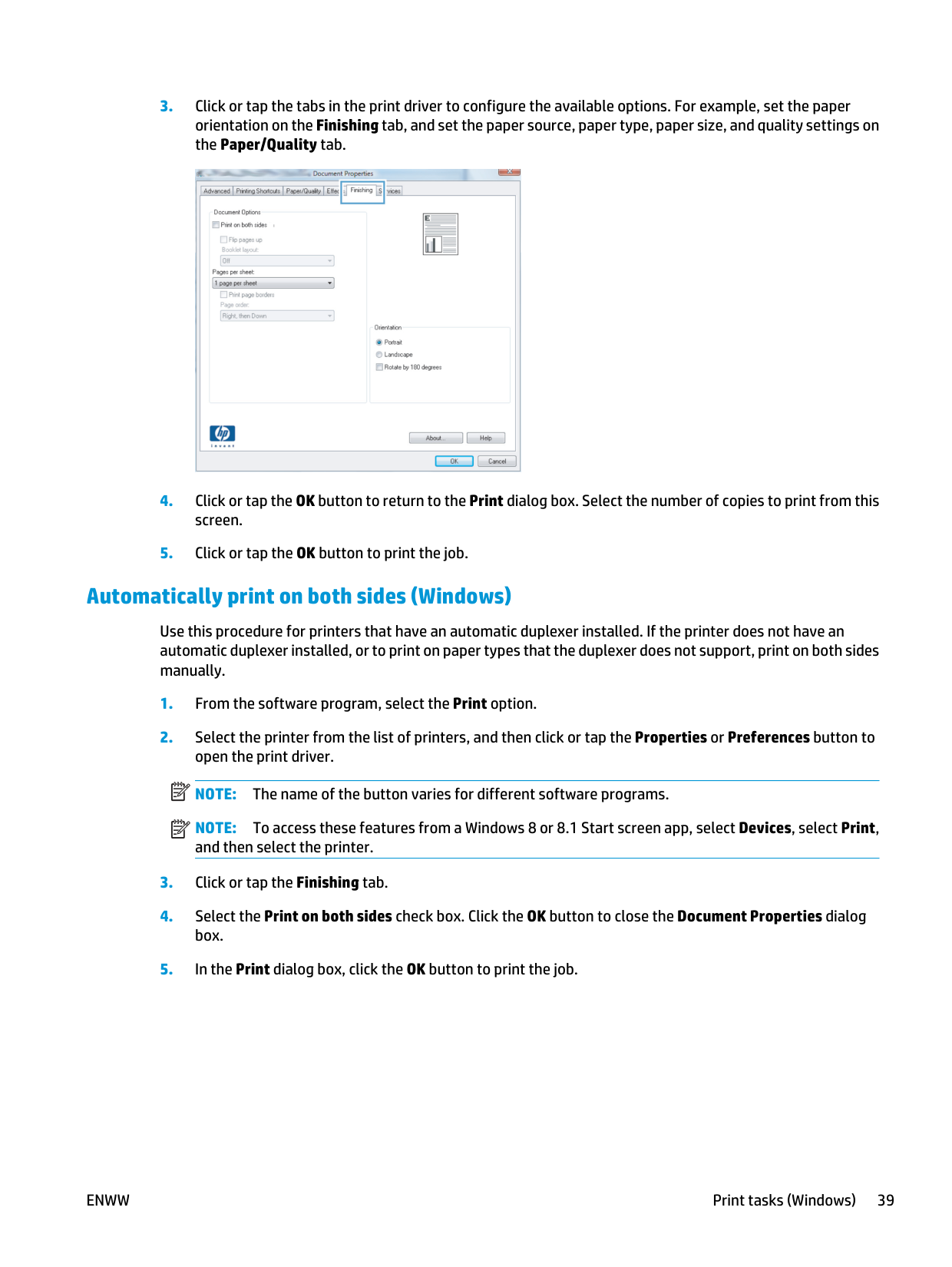
Print tasks (Windows) How to print (Windows) The following procedure describes the basic printing process for Windows.
Note:
The name of the button varies for different software programs.Note:
To access these features from a Windows 8 or 8.1 Start screen app, select Devices, select Print, and then select the printer.Note:
For more information, click the Help (?) button in the print driver.Note:
The print driver might look different than what is shown here, but the steps are the same. 38 Chapter 4 PrintEnww
Note:
The name of the button varies for different software programs.Note:
To access these features from a Windows 8 or 8.1 Start screen app, select Devices, select Print, and then select the printer.Enww
Print tasks (Windows) 39
Manually print on both sides (Windows) Use this procedure for printers that do not have an automatic duplexer installed or to print on paper that the duplexer does not support.
Note:
The name of the button varies for different software programs.Note:
To access these features from a Windows 8 or 8.1 Start screen app, select Devices, select Print, and then select the printer.Note:
The name of the button varies for different software programs.Note:
To access these features from a Windows 8 or 8.1 Start screen app, select Devices, select Print, and then select the printer.Note:
The name of the button varies for different software programs.Note:
To access these features from a Windows 8 or 8.1 Start screen app, select Devices, select Print, and then select the printer.Enww

Enww
Print tasks (Windows) 41
Additional print tasks Go to www.hp.com/support/ljM203. Instructions are available for performing specific print tasks, such as the following: ● Create and use printing shortcuts or presets ● Select the paper size, or use a custom paper size ● Select the page orientation ● Create a booklet ● Scale a document to fit a specific paper size ● Print the first or last pages of the document on different paper ● Print watermarks on a document 42 Chapter 4 Print
Enww
Print tasks (OS X) How to print (OS X) The following procedure describes the basic printing process for OS X.
Note:
The name of the item varies for different software programs.Note:
This information applies to printers that include an automatic duplexer.Note:
This feature is available if you install the HP print driver. It might not be available if you are using AirPrint.Note:
The name of the item varies for different software programs.Note:
This feature is available if you install the HP print driver. It might not be available if you are using AirPrint.Note:
The name of the item varies for different software programs.Enww
Print tasks (OS X) 43
Note:
The name of the item varies for different software programs.Note:
The name of the item varies for different software programs.Note:
This list contains the master set of options available. Some options are not available on all printers. ● Media Type: Select the option for the type of paper for the print job. ● Print Quality: Select the resolution level for the print job. ● Edge-To-Edge Printing: Select this option to print close to the paper edges. ● EconoMode: Select this option to conserve toner when printing drafts of documents.Enww

Additional print tasks Go to www.hp.com/support/ljM203. Instructions are available for performing specific print tasks, such as the following: ● Create and use printing shortcuts or presets ● Select the paper size, or use a custom paper size ● Select the page orientation ● Create a booklet ● Scale a document to fit a specific paper size ● Print the first or last pages of the document on different paper ● Print watermarks on a document
Enww
Print tasks (OS X) 45
Mobile printing Introduction HP offers multiple mobile and ePrint solutions to enable easy printing to an HP printer from a laptop, tablet, smartphone, or other mobile device. To see the full list and to determine the best choice, go to www.hp.com/ go/LaserJetMobilePrinting.
Note:
Update the printer firmware to ensure all mobile printing and ePrint capabilities are supported. ● Wi-Fi Direct (wireless models only) ● HP ePrint via email ● HP ePrint software ● AirPrint ● Android embedded printing Wi-Fi Direct (wireless models only) Wi-Fi Direct enables printing from a wireless mobile device without requiring a connection to a network or the Internet. Wi-Fi Direct does not support all mobile operating systems. If the mobile device does not support Wi-Fi Direct, you must change the wireless network connection of the device to the Wi-Fi Direct connection of the printer before printing.Note:
For non-Wi-Fi Direct capable mobile devices, the Wi-Fi Direct connection only enables printing. After using Wi-Fi Direct to print, you must reconnect to a local network in order to access the Internet. To access the printer Wi-Fi Direct connection, complete the following steps:Note:
If the web browser displays a message indicating that accessing the website might not be safe, select the option to continue to the website. Accessing this website will not harm the computer.Enww
Note:
If the printer name does not display, you might be out of range of the Wi-Fi Direct signal. Move the device closer to the printer.Note:
For Android devices that support Wi-Fi Direct, if the connection method is set to Automatic, the connection will occur automatically, without a password prompt. If the connection method is set to Manual, you will need to either press the OK button, or provide a personal identification number (PIN) — displayed on the printer control panel — as a password on the mobile device.Note:
To access the Wi-Fi Direct password, from the EWS open the Networking tab, and then click Wi- Fi Direct Setup.Note:
If the mobile device does not support printing, install the HP ePrint mobile app.Enww
Mobile printing 47
Note:
If the web browser displays a message indicating that accessing the website might not be safe, select the option to continue to the website. Accessing this website will not harm the computer. Step two: Enable or disable Wi-Fi DirectNote:
In environments where more than one model of the same printer is installed, it might be helpful to provide each printer a unique Wi-Fi Direct name for easier printer identification for Wi-Fi Direct printing. Change the printer Wi-Fi Direct name Follow this procedure to change the printer Wi-Fi Direct name using the HP Embedded Web Server (EWS): Step one: Open the HP Embedded Web ServerNote:
If the web browser displays a message indicating that accessing the website might not be safe, select the option to continue to the website. Accessing this website will not harm the computer. Step two: Change the Wi-Fi Direct nameEnww
HP ePrint via email Use HP ePrint to print documents by sending them as an email attachment to the printer's email address from any email enabled device. To use HP ePrint, the printer must meet these requirements: ● The printer must be connected to a wired or wireless network and have Internet access. ● HP Web Services must be enabled on the printer, and the printer must be registered with HP Connected. Follow this procedure to enable HP Web Services and register with HP Connected: Step one: Open the HP Embedded Web Server
Note:
If the web browser displays a message indicating that accessing the website might not be safe, select the option to continue to the website. Accessing this website will not harm the computer. Step two: Enable HP Web ServicesEnww
Mobile printing 49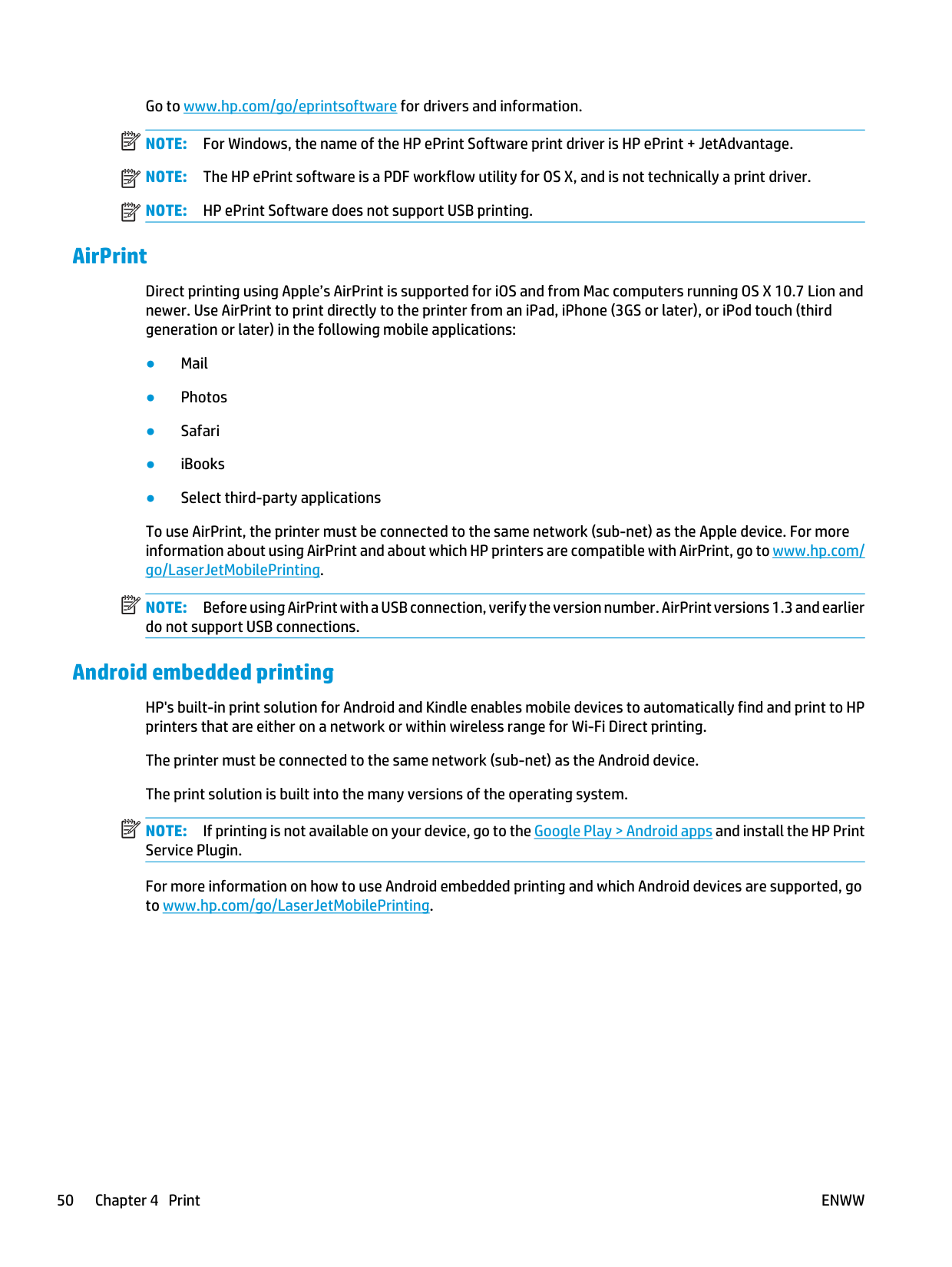
Go to www.hp.com/go/eprintsoftware for drivers and information.
Note:
For Windows, the name of the HP ePrint Software print driver is HP ePrint + JetAdvantage.Note:
The HP ePrint software is a PDF workflow utility for OS X, and is not technically a print driver.Note:
HP ePrint Software does not support USB printing. AirPrint Direct printing using Apple’s AirPrint is supported for iOS and from Mac computers running OS X 10.7 Lion and newer. Use AirPrint to print directly to the printer from an iPad, iPhone (3GS or later), or iPod touch (third generation or later) in the following mobile applications: ● Mail ● Photos ● Safari ● iBooks ● Select third-party applications To use AirPrint, the printer must be connected to the same network (sub-net) as the Apple device. For more information about using AirPrint and about which HP printers are compatible with AirPrint, go to www.hp.com/ go/LaserJetMobilePrinting.Note:
Before using AirPrint with a USB connection, verify the version number. AirPrint versions 1.3 and earlier do not support USB connections. Android embedded printing HP's built-in print solution for Android and Kindle enables mobile devices to automatically find and print to HP printers that are either on a network or within wireless range for Wi-Fi Direct printing. The printer must be connected to the same network (sub-net) as the Android device. The print solution is built into the many versions of the operating system.Note:
If printing is not available on your device, go to the Google Play > Android apps and install the HP Print Service Plugin. For more information on how to use Android embedded printing and which Android devices are supported, go to www.hp.com/go/LaserJetMobilePrinting. 50 Chapter 4 PrintEnww
5 Manage the printer ● Change the printer connection type (Windows) ● Advanced configuration with HP Embedded Web Server (EWS) and HP Device Toolbox (Windows) ● Advanced configuration with HP Utility for OS X ● Configure IP network settings ● Printer security features ● Configure the Quiet Print Mode settings ● Energy-conservation settings ● Update the firmware For more information: The following information is correct at the time of publication. For current information, see www.hp.com/ support/ljM203. HP's all-inclusive help for the printer includes the following information: ● Install and configure ● Learn and use ● Solve problems ● Download software and firmware updates ● Join support forums ● Find warranty and regulatory information
Enww
51
Change the printer connection type (Windows) If you are already using the printer and you wish to change the way it is connected, use Device Setup & Software to change the connection. For example, connect the new printer to the computer using a USB or network connection, or change the connection from a USB to a wireless connection. To open Device Setup & Software, complete the following procedure:
Enww
Advanced configuration with HP Embedded Web Server (EWS) and HP Device Toolbox (Windows) Use the HP Embedded Web Server to manage printing functions from a computer instead of the printer control panel. ● View printer status information ● Determine the remaining life for all supplies and order new ones ● View and change tray configurations ● View and change the printer control-panel menu configuration ● View and print internal pages ● Receive notification of printer and supplies events ● View and change network configuration The HP Embedded Web Server works when the printer is connected to an IP-based network. The HP Embedded Web Server does not support IPX-based printer connections. Internet access is not needed to open and use the HP Embedded Web Server. When the printer is connected to the network, the HP Embedded Web Server is automatically available.
Note:
HP Device Toolbox is software used to connect to the HP Embedded Web Server when the printer is connected to a computer via USB. It is available only if a full installation was performed when the printer was installed on a computer. Depending on how the printer is connected, some features might not be available.Note:
The HP Embedded Web Server is not accessible beyond the network firewall. Method one: Open the HP Embedded Web Server (EWS) from the softwareEnww
Advanced configuration with HP Embedded Web Server (EWS) and HP Device Toolbox (Windows) 53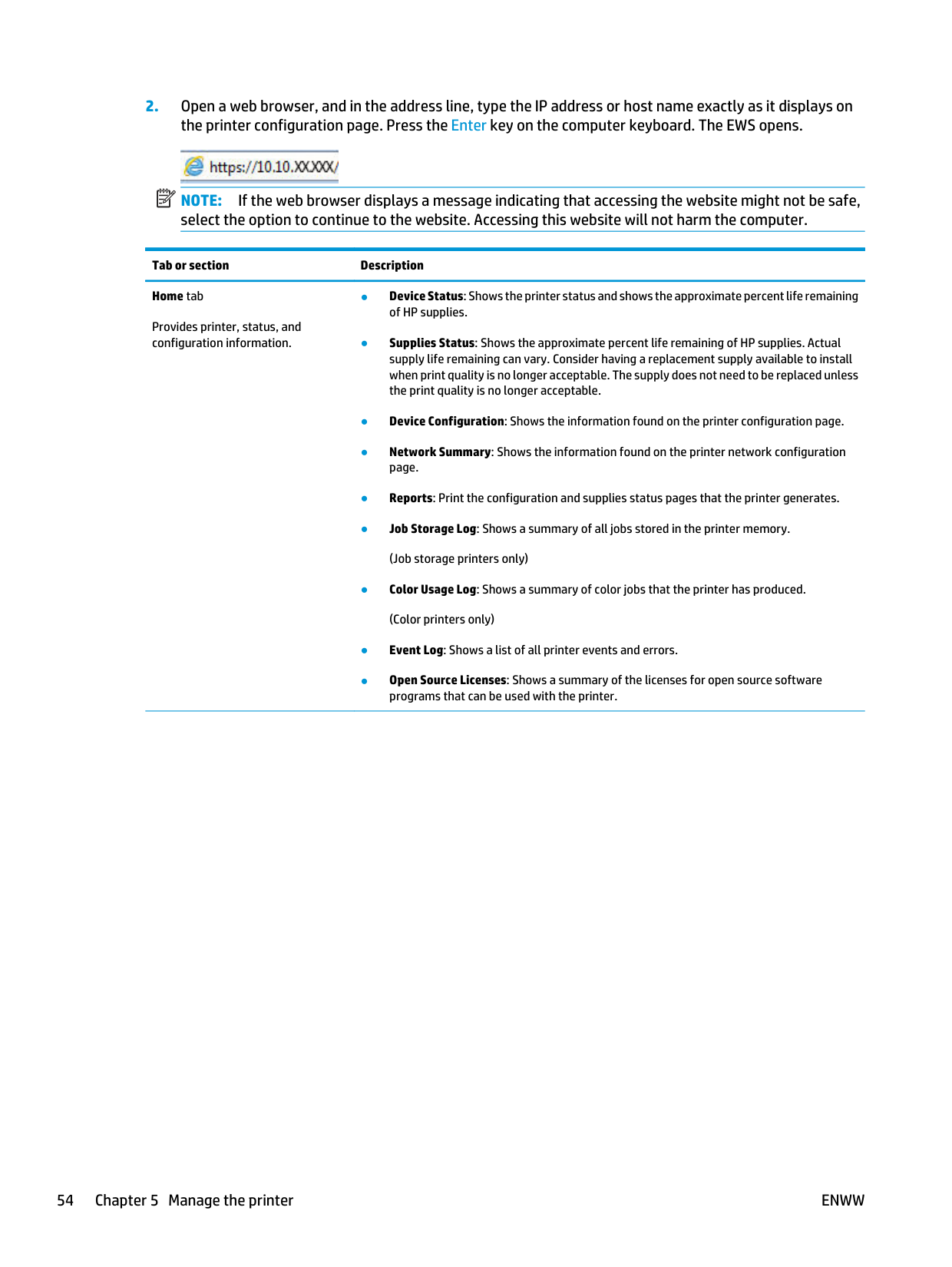
Note:
If the web browser displays a message indicating that accessing the website might not be safe, select the option to continue to the website. Accessing this website will not harm the computer. Tab or section Description Home tab Provides printer, status, and configuration information. ● Device Status: Shows the printer status and shows the approximate percent life remaining of HP supplies. ● Supplies Status: Shows the approximate percent life remaining of HP supplies. Actual supply life remaining can vary. Consider having a replacement supply available to install when print quality is no longer acceptable. The supply does not need to be replaced unless the print quality is no longer acceptable. ● Device Configuration: Shows the information found on the printer configuration page. ● Network Summary: Shows the information found on the printer network configuration page. ● Reports: Print the configuration and supplies status pages that the printer generates. ● Job Storage Log: Shows a summary of all jobs stored in the printer memory. (Job storage printers only) ● Color Usage Log: Shows a summary of color jobs that the printer has produced. (Color printers only) ● Event Log: Shows a list of all printer events and errors. ● Open Source Licenses: Shows a summary of the licenses for open source software programs that can be used with the printer. 54 Chapter 5 Manage the printerEnww
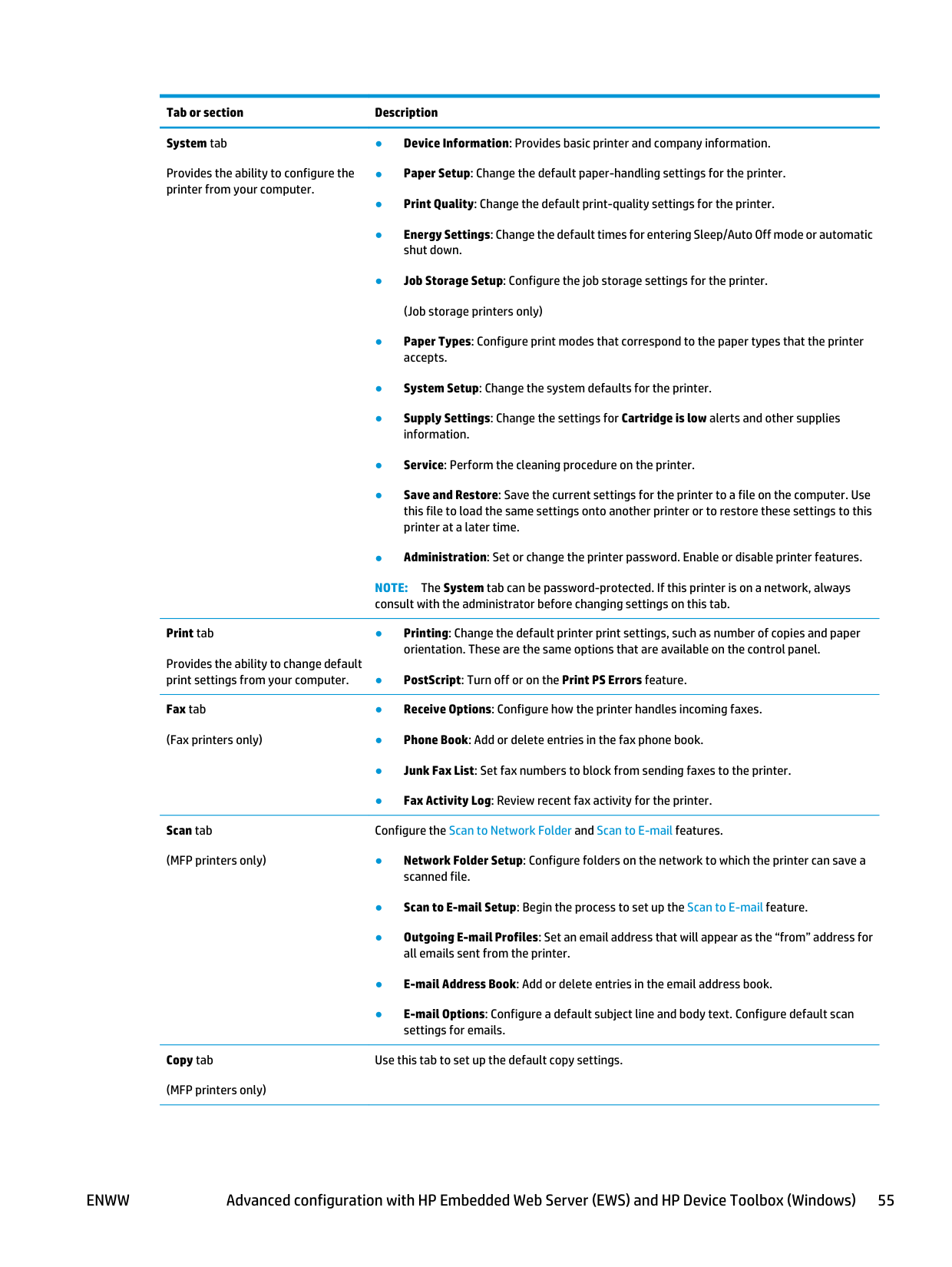
Tab or section Description System tab Provides the ability to configure the printer from your computer. ● Device Information: Provides basic printer and company information. ● Paper Setup: Change the default paper-handling settings for the printer. ● Print Quality: Change the default print-quality settings for the printer. ● Energy Settings: Change the default times for entering Sleep/Auto Off mode or automatic shut down. ● Job Storage Setup: Configure the job storage settings for the printer. (Job storage printers only) ● Paper Types: Configure print modes that correspond to the paper types that the printer accepts. ● System Setup: Change the system defaults for the printer. ● Supply Settings: Change the settings for Cartridge is low alerts and other supplies information. ● Service: Perform the cleaning procedure on the printer. ● Save and Restore: Save the current settings for the printer to a file on the computer. Use this file to load the same settings onto another printer or to restore these settings to this printer at a later time. ● Administration: Set or change the printer password. Enable or disable printer features.
Note:
The System tab can be password-protected. If this printer is on a network, always consult with the administrator before changing settings on this tab. Print tab Provides the ability to change default print settings from your computer. ● Printing: Change the default printer print settings, such as number of copies and paper orientation. These are the same options that are available on the control panel. ● PostScript: Turn off or on the Print PS Errors feature. Fax tab (Fax printers only) ● Receive Options: Configure how the printer handles incoming faxes. ● Phone Book: Add or delete entries in the fax phone book. ● Junk Fax List: Set fax numbers to block from sending faxes to the printer. ● Fax Activity Log: Review recent fax activity for the printer. Scan tab (MFP printers only) Configure the Scan to Network Folder and Scan to E-mail features. ● Network Folder Setup: Configure folders on the network to which the printer can save a scanned file. ● Scan to E-mail Setup: Begin the process to set up the Scan to E-mail feature. ● Outgoing E-mail Profiles: Set an email address that will appear as the “from” address for all emails sent from the printer. ● E-mail Address Book: Add or delete entries in the email address book. ● E-mail Options: Configure a default subject line and body text. Configure default scan settings for emails. Copy tab (MFP printers only) Use this tab to set up the default copy settings.Enww
Advanced configuration with HP Embedded Web Server (EWS) and HP Device Toolbox (Windows) 55
Tab or section Description Networking tab (Network-connected printers only) Provides the ability to change network settings from your computer. Network administrators can use this tab to control network-related settings for the printer when it is connected to an IP-based network. It also allows the network administrator to set up Wi-Fi Direct functionality. This tab does not appear if the printer is directly connected to a computer. HP Web Services tab Use this tab to set up and use various Web tools with the printer. 56 Chapter 5 Manage the printer
Enww
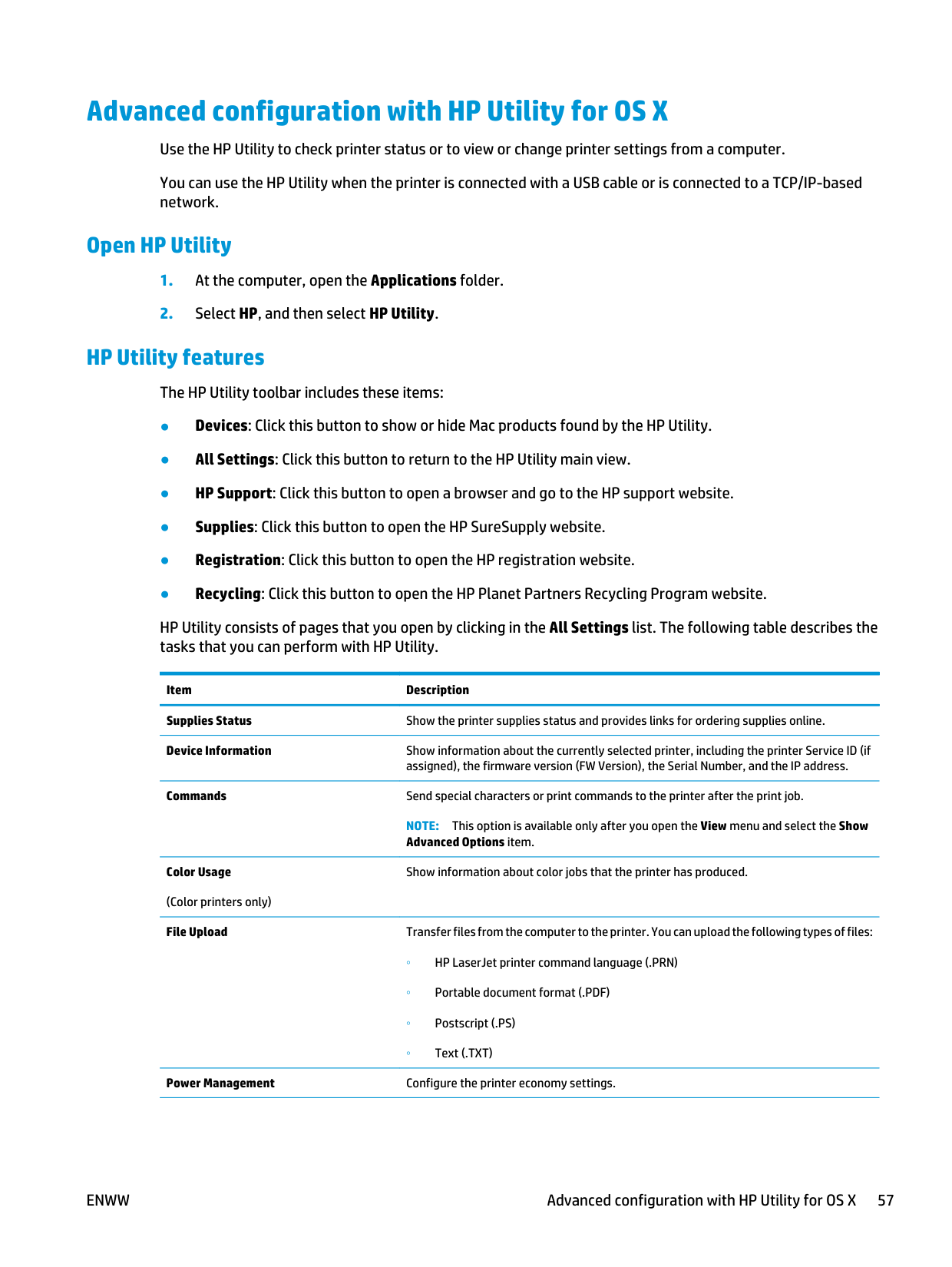
Advanced configuration with HP Utility for OS X Use the HP Utility to check printer status or to view or change printer settings from a computer. You can use the HP Utility when the printer is connected with a USB cable or is connected to a TCP/IP-based network. Open HP Utility
Note:
This option is available only after you open the View menu and select the Show Advanced Options item. Color Usage (Color printers only) Show information about color jobs that the printer has produced. File Upload Transfer files from the computer to the printer. You can upload the following types of files: ◦ HP LaserJet printer command language (.PRN) ◦ Portable document format (.PDF) ◦ Postscript (.PS) ◦ Text (.TXT) Power Management Configure the printer economy settings.Enww
Advanced configuration with HP Utility for OS X 57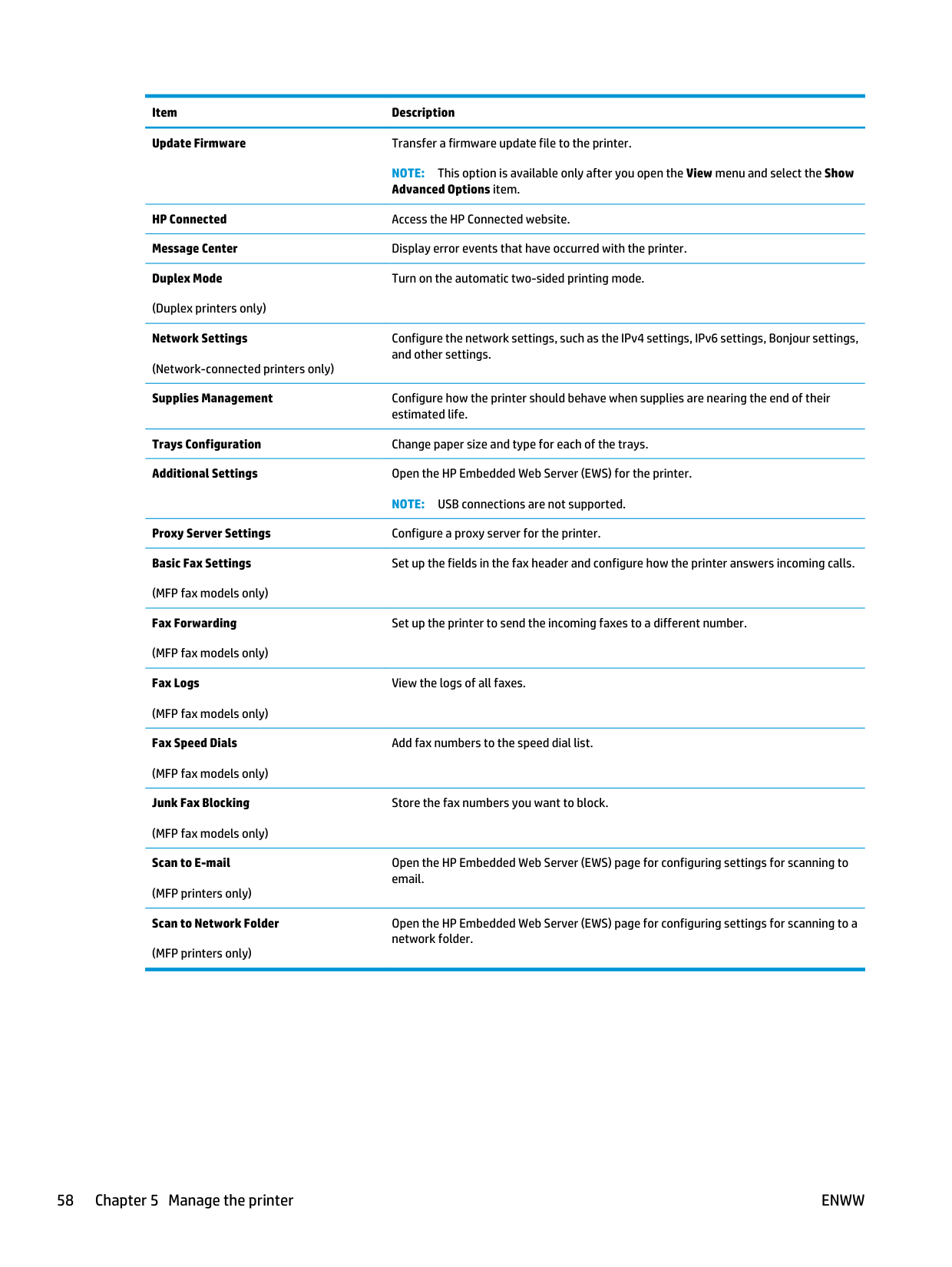
Item Description Update Firmware Transfer a firmware update file to the printer.
Note:
This option is available only after you open the View menu and select the Show Advanced Options item. HP Connected Access the HP Connected website. Message Center Display error events that have occurred with the printer. Duplex Mode (Duplex printers only) Turn on the automatic two-sided printing mode. Network Settings (Network-connected printers only) Configure the network settings, such as the IPv4 settings, IPv6 settings, Bonjour settings, and other settings. Supplies Management Configure how the printer should behave when supplies are nearing the end of their estimated life. Trays Configuration Change paper size and type for each of the trays. Additional Settings Open the HP Embedded Web Server (EWS) for the printer.Note:
USB connections are not supported. Proxy Server Settings Configure a proxy server for the printer. Basic Fax Settings (MFP fax models only) Set up the fields in the fax header and configure how the printer answers incoming calls. Fax Forwarding (MFP fax models only) Set up the printer to send the incoming faxes to a different number. Fax Logs (MFP fax models only) View the logs of all faxes. Fax Speed Dials (MFP fax models only) Add fax numbers to the speed dial list. Junk Fax Blocking (MFP fax models only) Store the fax numbers you want to block. Scan to E-mail (MFP printers only) Open the HP Embedded Web Server (EWS) page for configuring settings for scanning to email. Scan to Network Folder (MFP printers only) Open the HP Embedded Web Server (EWS) page for configuring settings for scanning to a network folder. 58 Chapter 5 Manage the printerEnww
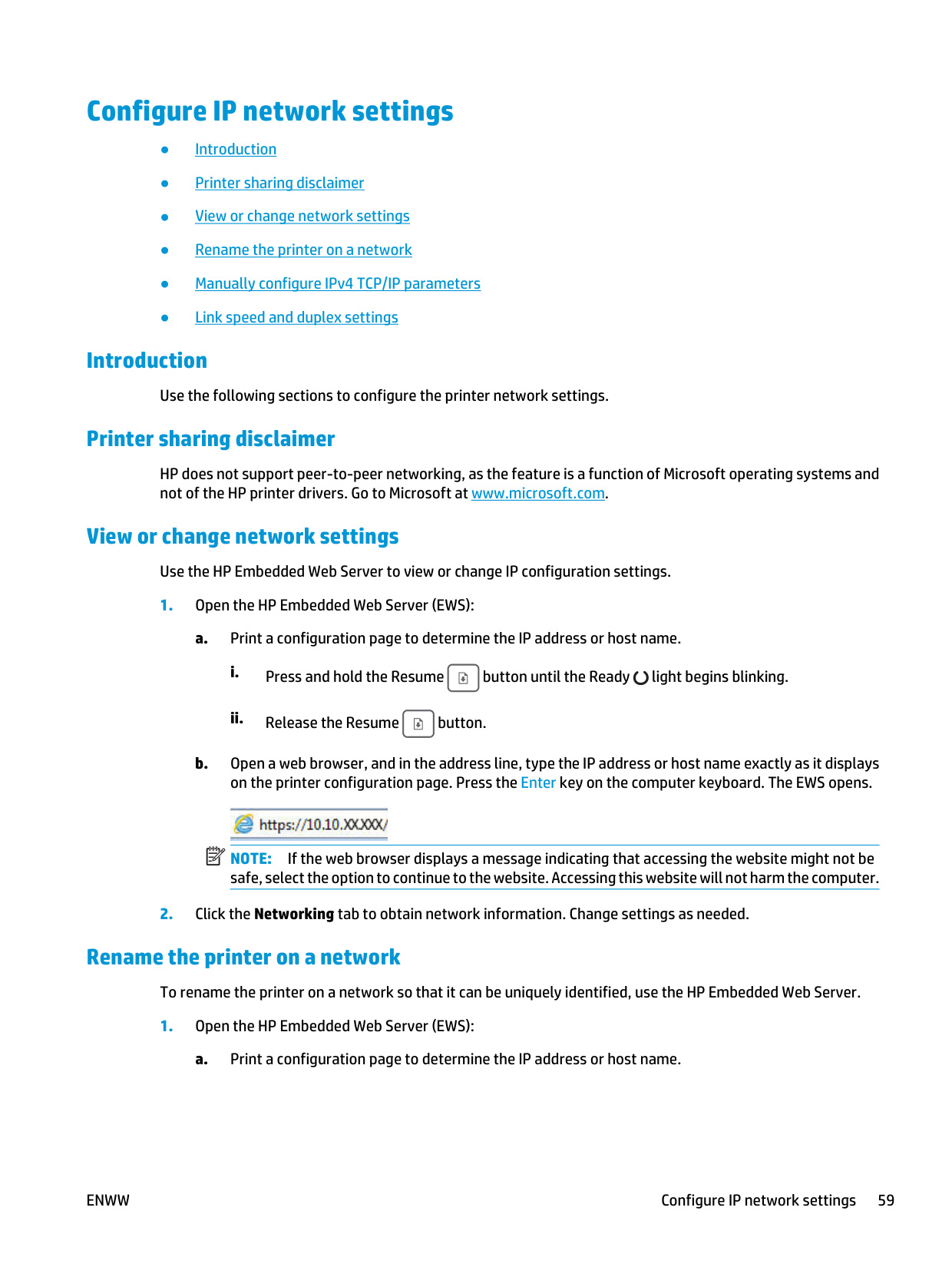
Configure IP network settings ● Introduction ● Printer sharing disclaimer ● View or change network settings ● Rename the printer on a network ● Manually configure IPv4 TCP/IP parameters ● Link speed and duplex settings Introduction Use the following sections to configure the printer network settings. Printer sharing disclaimer HP does not support peer-to-peer networking, as the feature is a function of Microsoft operating systems and not of the HP printer drivers. Go to Microsoft at www.microsoft.com. View or change network settings Use the HP Embedded Web Server to view or change IP configuration settings.
Note:
If the web browser displays a message indicating that accessing the website might not be safe, select the option to continue to the website. Accessing this website will not harm the computer.Enww
Configure IP network settings 59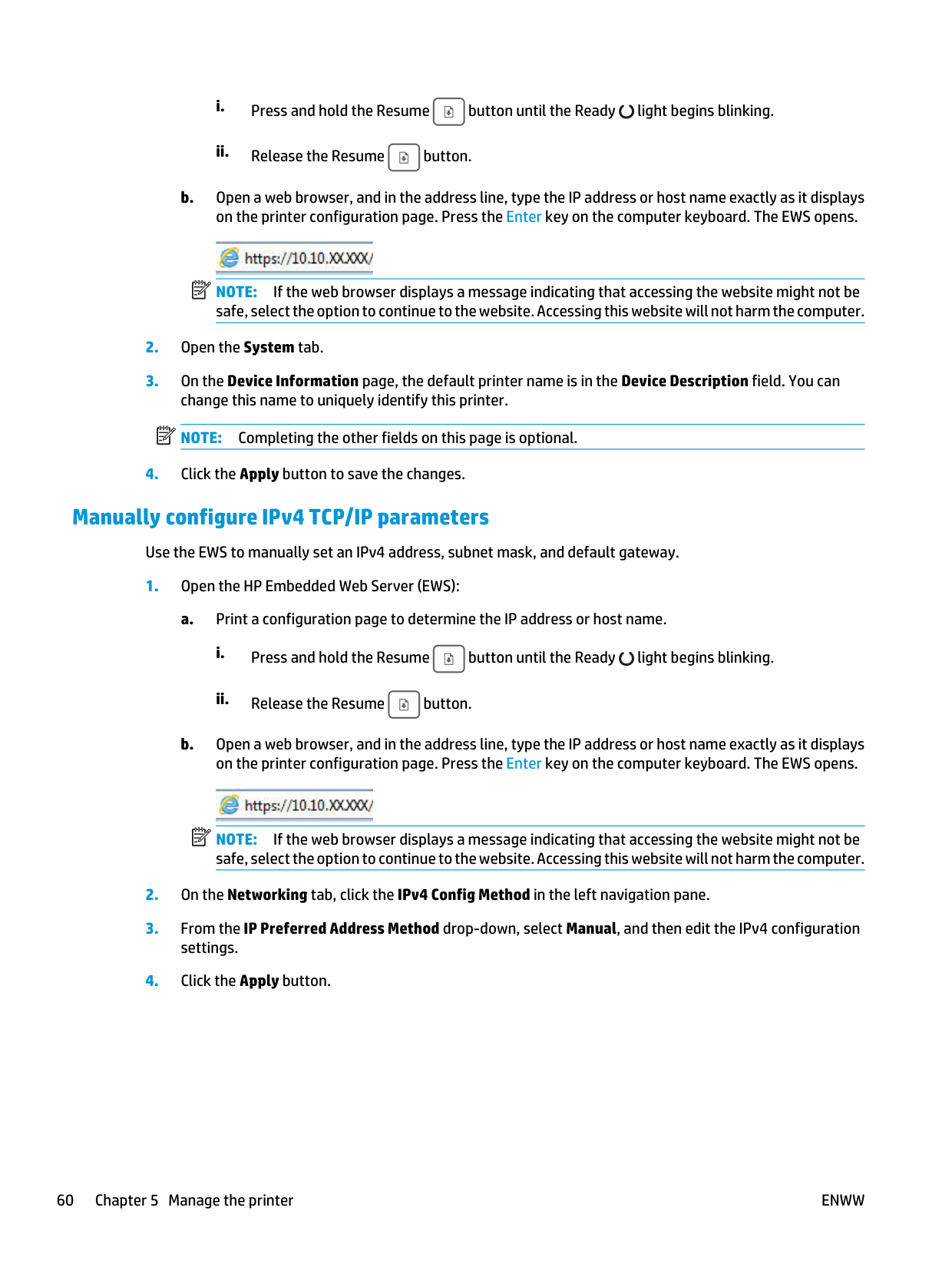
i. Press and hold the Resume button until the Ready light begins blinking. ii. Release the Resume button. b. Open a web browser, and in the address line, type the IP address or host name exactly as it displays on the printer configuration page. Press the Enter key on the computer keyboard. The EWS opens.
Note:
If the web browser displays a message indicating that accessing the website might not be safe, select the option to continue to the website. Accessing this website will not harm the computer.Note:
Completing the other fields on this page is optional.Note:
If the web browser displays a message indicating that accessing the website might not be safe, select the option to continue to the website. Accessing this website will not harm the computer.Enww
Link speed and duplex settings
Note:
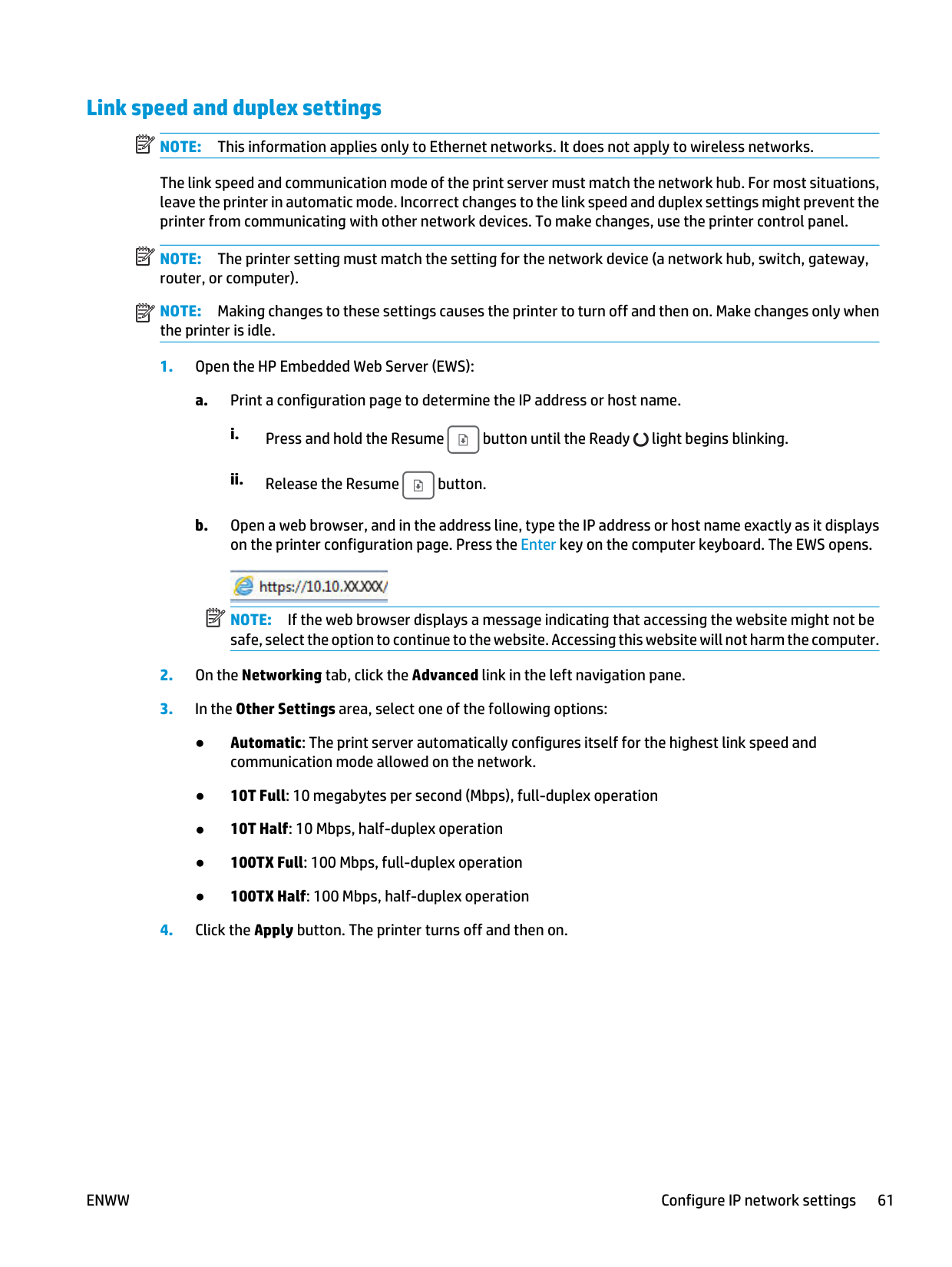
This information applies only to Ethernet networks. It does not apply to wireless networks. The link speed and communication mode of the print server must match the network hub. For most situations, leave the printer in automatic mode. Incorrect changes to the link speed and duplex settings might prevent the printer from communicating with other network devices. To make changes, use the printer control panel.Note:
The printer setting must match the setting for the network device (a network hub, switch, gateway, router, or computer).Note:
Making changes to these settings causes the printer to turn off and then on. Make changes only when the printer is idle.Note:
If the web browser displays a message indicating that accessing the website might not be safe, select the option to continue to the website. Accessing this website will not harm the computer.Enww
Configure IP network settings 61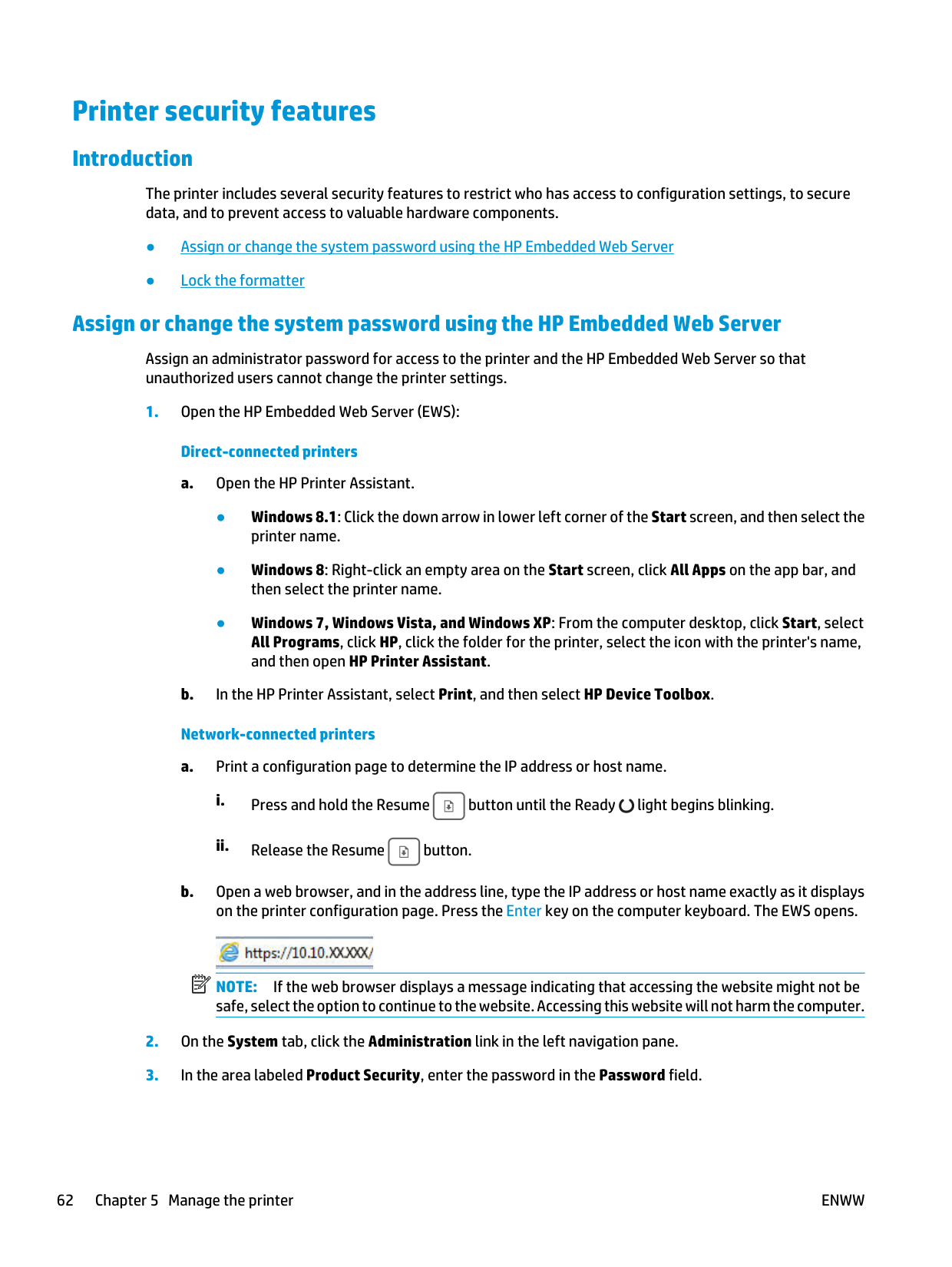
Printer security features Introduction The printer includes several security features to restrict who has access to configuration settings, to secure data, and to prevent access to valuable hardware components. ● Assign or change the system password using the HP Embedded Web Server ● Lock the formatter Assign or change the system password using the HP Embedded Web Server Assign an administrator password for access to the printer and the HP Embedded Web Server so that unauthorized users cannot change the printer settings.
Note:
If the web browser displays a message indicating that accessing the website might not be safe, select the option to continue to the website. Accessing this website will not harm the computer.Enww

Note:
Make note of the password and store it in a safe place. Lock the formatter The formatter has a slot that you can use to attach a security cable. Locking the formatter prevents someone from removing valuable components from it.Enww
Printer security features 63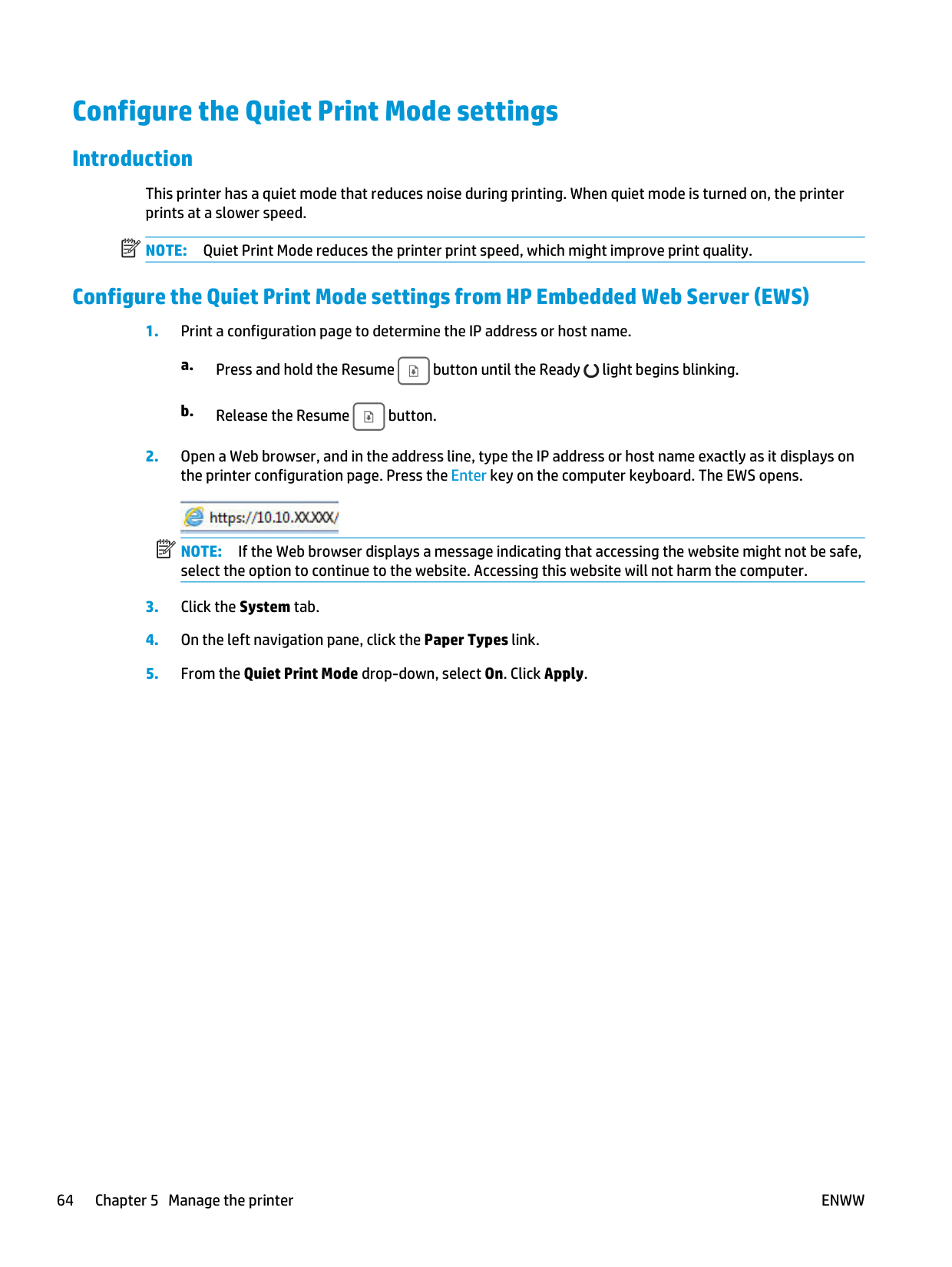
Configure the Quiet Print Mode settings Introduction This printer has a quiet mode that reduces noise during printing. When quiet mode is turned on, the printer prints at a slower speed.
Note:
Quiet Print Mode reduces the printer print speed, which might improve print quality. Configure the Quiet Print Mode settings from HP Embedded Web Server (EWS)Note:
If the Web browser displays a message indicating that accessing the website might not be safe, select the option to continue to the website. Accessing this website will not harm the computer.Enww
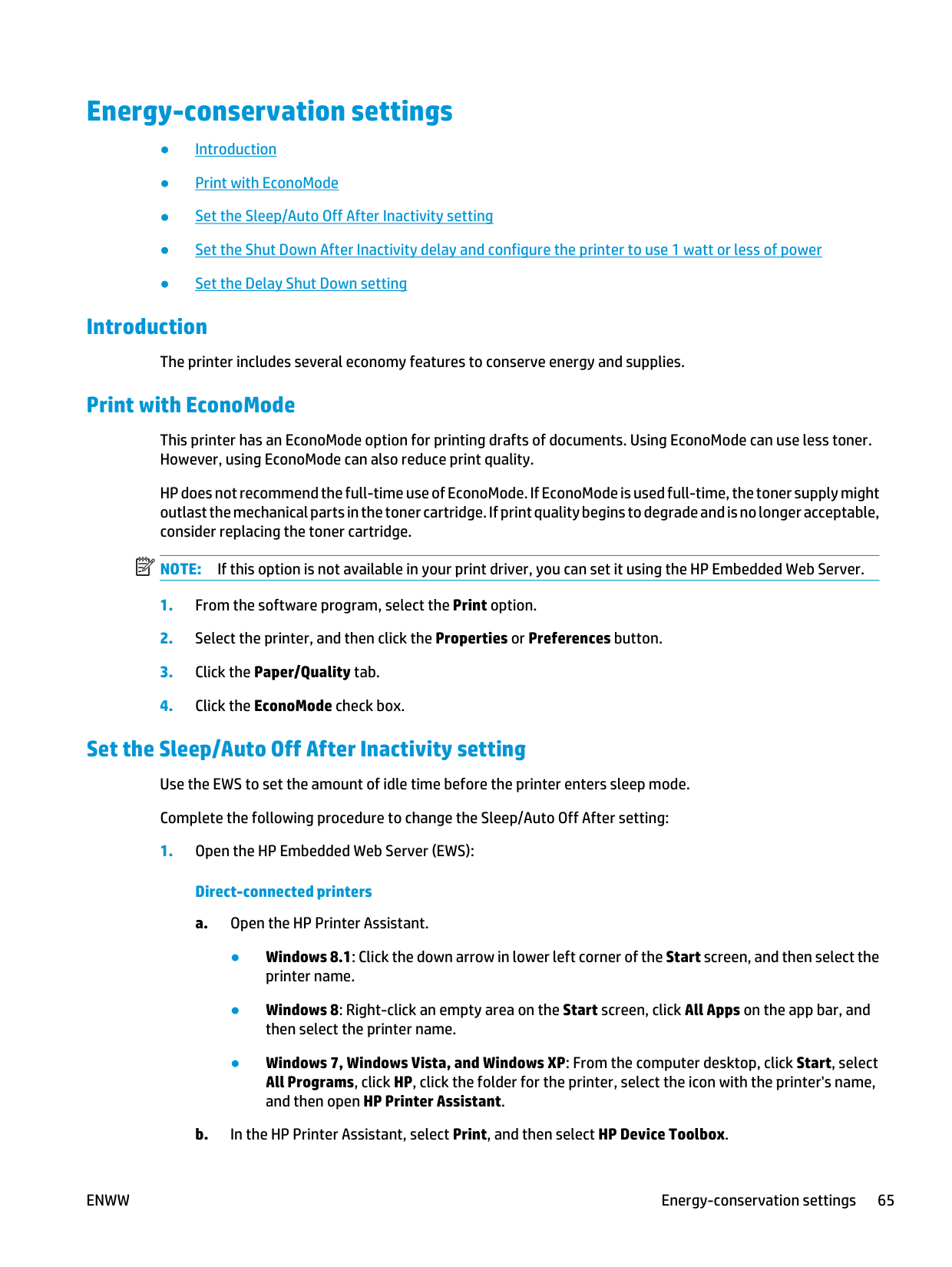
Energy-conservation settings ● Introduction ● Print with EconoMode ● Set the Sleep/Auto Off After Inactivity setting ● Set the Shut Down After Inactivity delay and configure the printer to use 1 watt or less of power ● Set the Delay Shut Down setting Introduction The printer includes several economy features to conserve energy and supplies. Print with EconoMode This printer has an EconoMode option for printing drafts of documents. Using EconoMode can use less toner. However, using EconoMode can also reduce print quality. HP does not recommend the full-time use of EconoMode. If EconoMode is used full-time, the toner supply might outlast the mechanical parts in the toner cartridge. If print quality begins to degrade and is no longer acceptable, consider replacing the toner cartridge.
Note:
If this option is not available in your print driver, you can set it using the HP Embedded Web Server.Enww
Energy-conservation settings 65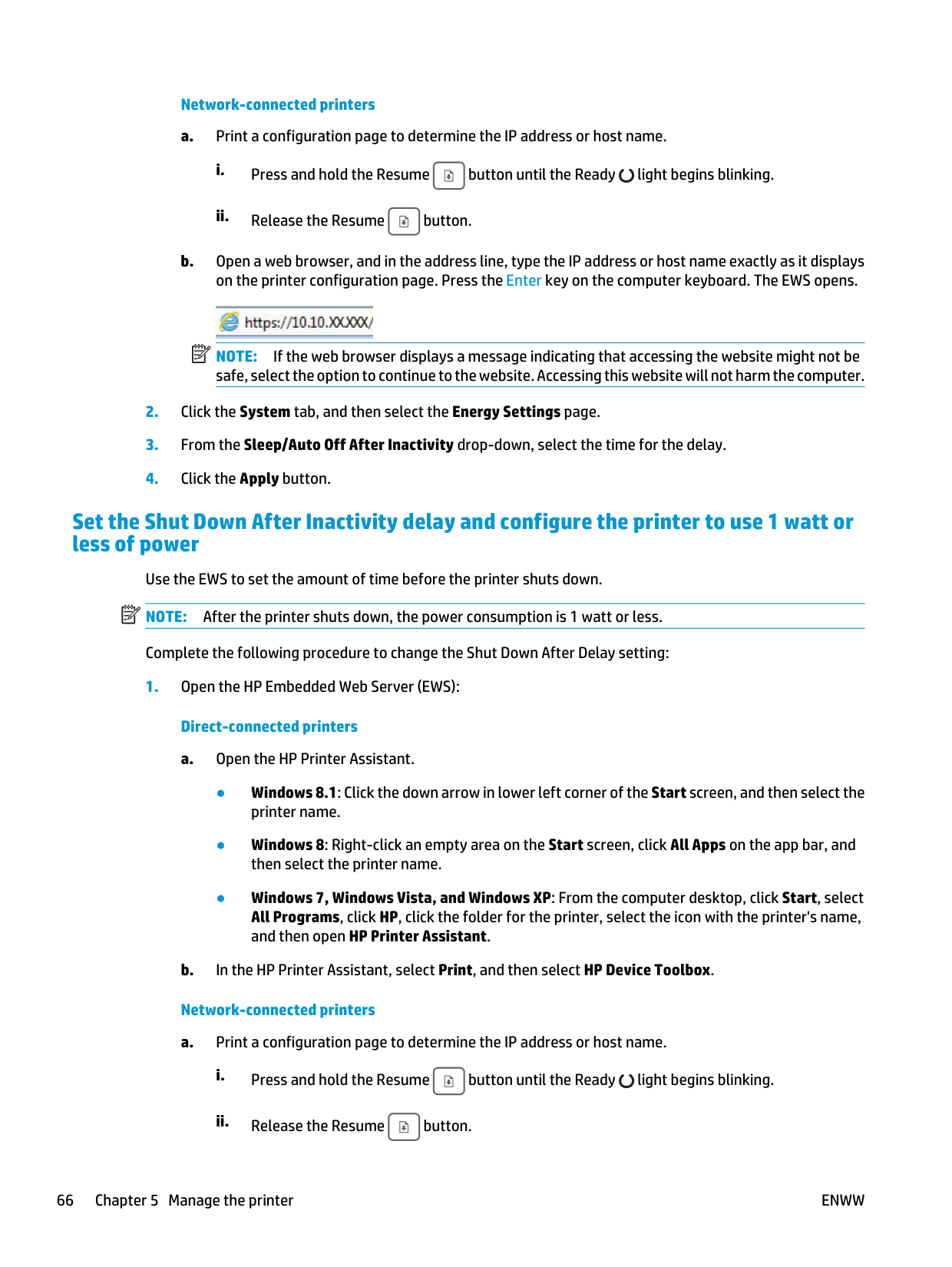
Network-connected printers a. Print a configuration page to determine the IP address or host name. i. Press and hold the Resume button until the Ready light begins blinking. ii. Release the Resume button. b. Open a web browser, and in the address line, type the IP address or host name exactly as it displays on the printer configuration page. Press the Enter key on the computer keyboard. The EWS opens.
Note:
If the web browser displays a message indicating that accessing the website might not be safe, select the option to continue to the website. Accessing this website will not harm the computer.Note:
After the printer shuts down, the power consumption is 1 watt or less. Complete the following procedure to change the Shut Down After Delay setting:Enww
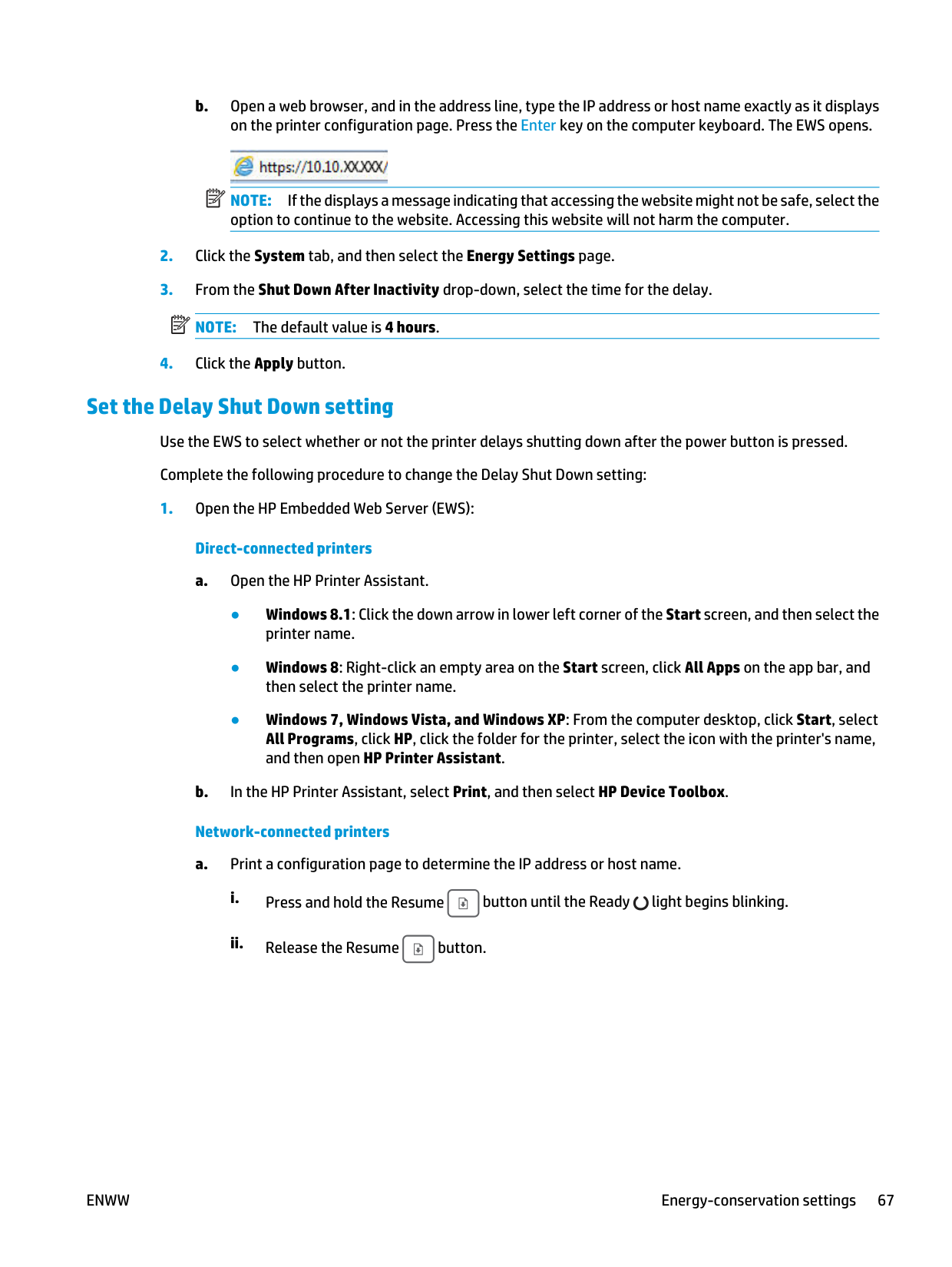
b. Open a web browser, and in the address line, type the IP address or host name exactly as it displays on the printer configuration page. Press the Enter key on the computer keyboard. The EWS opens.
Note:
If the displays a message indicating that accessing the website might not be safe, select the option to continue to the website. Accessing this website will not harm the computer.Note:
The default value is 4 hours.Enww
Energy-conservation settings 67
b. Open a web browser, and in the address line, type the IP address or host name exactly as it displays on the printer configuration page. Press the Enter key on the computer keyboard. The EWS opens.
Note:
If the displays a message indicating that accessing the website might not be safe, select the option to continue to the website. Accessing this website will not harm the computer.Note:
When this option is selected the printer will not shut down unless all ports are inactive. An active network link or fax connection will prevent the printer from shutting down. 68 Chapter 5 Manage the printerEnww
Update the firmware HP offers periodic printer updates, new Web Services apps, and new features to existing Web Services apps. Follow these steps to update the printer firmware for a single printer. When you update the firmware, Web Service apps will update automatically. Update the firmware using the Firmware Update Utility Use these steps to manually download and install the Firmware Update Utility from HP.com.
Note:
This method is the only firmware update option available for printers connected to the computer via a USB cable. It also works for printers connected to a network.Note:
You must have a print driver installed in order to use this method.Note:
To print a configuration page to verify the installed firmware version before or after the update process, click Print Config.Enww
Update the firmware 69
70 Chapter 5 Manage the printer
Enww
6 Solve problems ● Customer support ● Interpret control-panel light patterns ● Restore the factory-set defaults ● A “Cartridge is low” or “Cartridge is very low” message displays on the printer control panel ● Printer does not pick up paper or misfeeds ● Clear paper jams ● Improve print quality ● Solve wired network problems ● Solve wireless network problems For more information: The following information is correct at the time of publication. For current information, see www.hp.com/ support/ljM203. HP's all-inclusive help for the printer includes the following information: ● Install and configure ● Learn and use ● Solve problems ● Download software and firmware updates ● Join support forums ● Find warranty and regulatory information
Enww
71
Customer support Get telephone support for your country/region Have the printer name, serial number, date of purchase, and problem description ready Country/region phone numbers are on the flyer that was in the box with the printer or at www.hp.com/support/. Get 24-hour Internet support, and download software utilities and drivers www.hp.com/support/ljM203 Order additional HP service or maintenance agreements www.hp.com/go/carepack Register the printer www.register.hp.com 72 Chapter 6 Solve problems
Enww
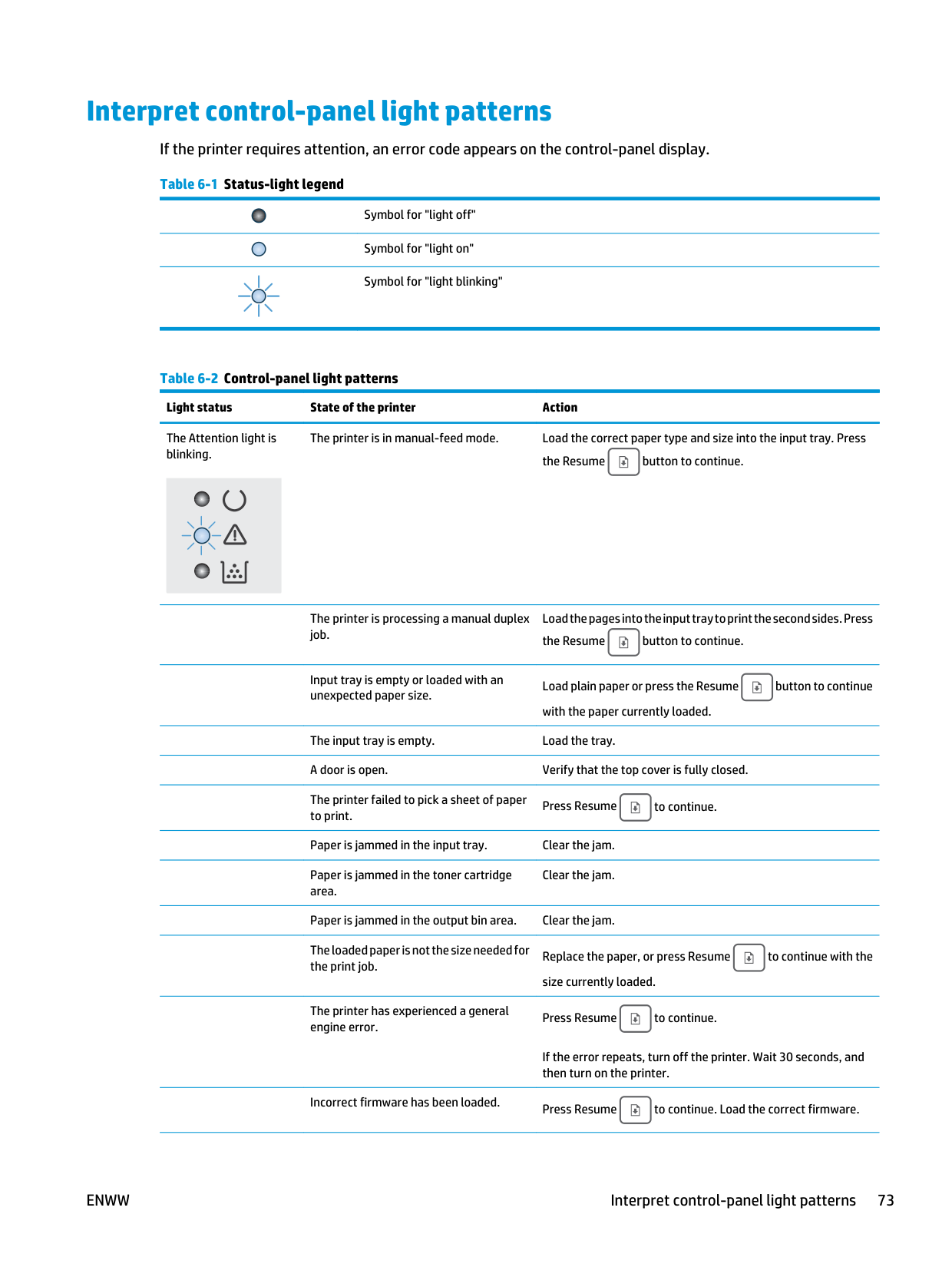
Interpret control-panel light patterns If the printer requires attention, an error code appears on the control-panel display. Table 6-1 Status-light legend Symbol for "light off" Symbol for "light on" Symbol for "light blinking" Table 6-2 Control-panel light patterns Light status State of the printer Action The Attention light is blinking. The printer is in manual-feed mode. Load the correct paper type and size into the input tray. Press the Resume button to continue.
The printer is processing a manual duplex job. Load the pages into the input tray to print the second sides. Press the Resume button to continue.
Input tray is empty or loaded with an unexpected paper size. Load plain paper or press the Resume button to continue with the paper currently loaded.
The input tray is empty. Load the tray.
A door is open. Verify that the top cover is fully closed.
The printer failed to pick a sheet of paper to print. Press Resume to continue.
Paper is jammed in the input tray. Clear the jam.
Paper is jammed in the toner cartridge area. Clear the jam.
Paper is jammed in the output bin area. Clear the jam.
The loaded paper is not the size needed for the print job. Replace the paper, or press Resume to continue with the size currently loaded.
The printer has experienced a general engine error. Press Resume to continue. If the error repeats, turn off the printer. Wait 30 seconds, and then turn on the printer.
Incorrect firmware has been loaded. Press Resume to continue. Load the correct firmware.
Enww
Interpret control-panel light patterns 73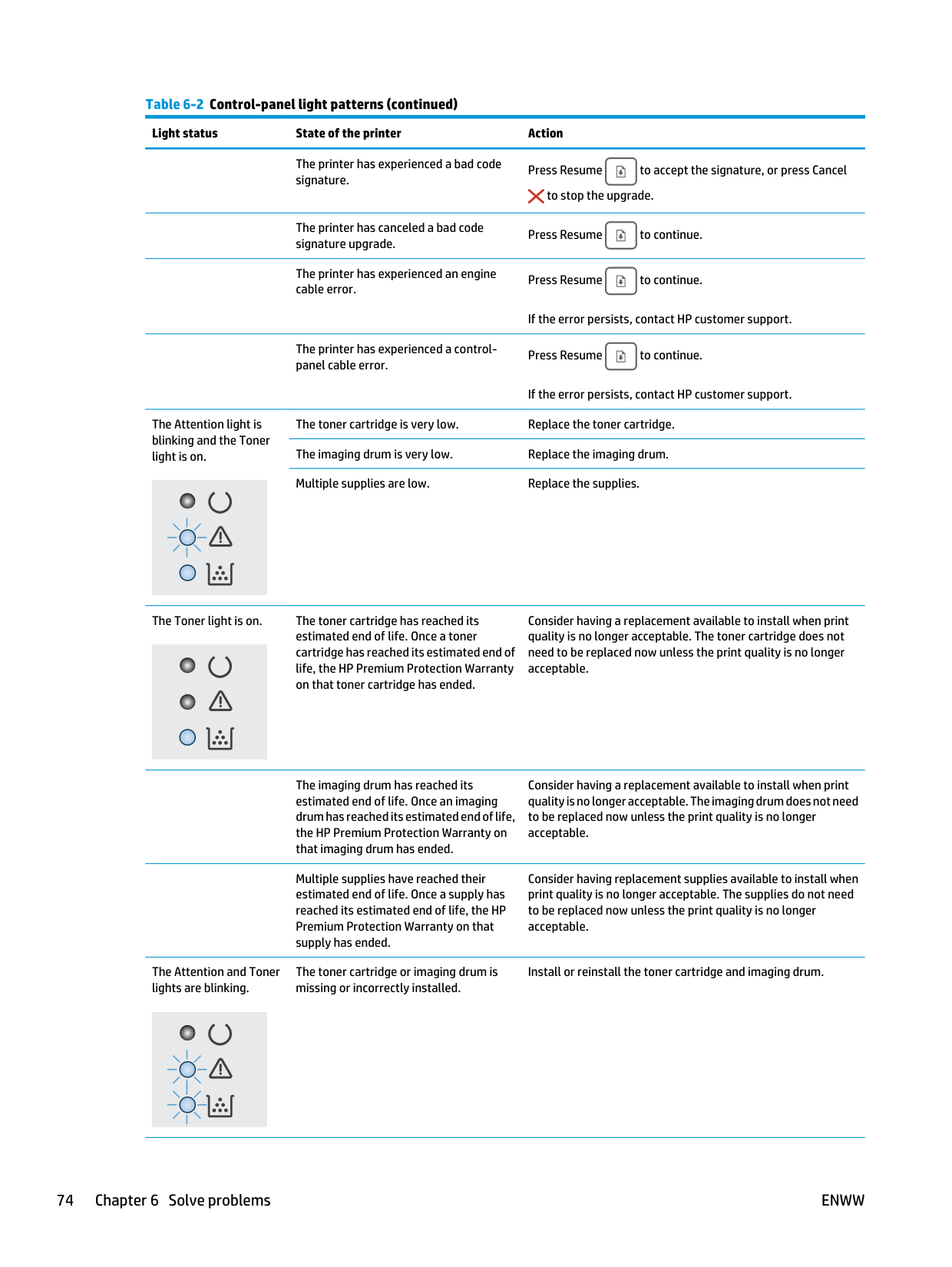
Table 6-2 Control-panel light patterns (continued) Light status State of the printer Action
The printer has experienced a bad code signature. Press Resume to accept the signature, or press Cancel to stop the upgrade.
The printer has canceled a bad code signature upgrade. Press Resume to continue.
The printer has experienced an engine cable error. Press Resume to continue. If the error persists, contact HP customer support.
The printer has experienced a control- panel cable error. Press Resume to continue. If the error persists, contact HP customer support. The Attention light is blinking and the Toner light is on. The toner cartridge is very low. Replace the toner cartridge. The imaging drum is very low. Replace the imaging drum. Multiple supplies are low. Replace the supplies. The Toner light is on. The toner cartridge has reached its estimated end of life. Once a toner cartridge has reached its estimated end of life, the HP Premium Protection Warranty on that toner cartridge has ended. Consider having a replacement available to install when print quality is no longer acceptable. The toner cartridge does not need to be replaced now unless the print quality is no longer acceptable.
The imaging drum has reached its estimated end of life. Once an imaging drum has reached its estimated end of life, the HP Premium Protection Warranty on that imaging drum has ended. Consider having a replacement available to install when print quality is no longer acceptable. The imaging drum does not need to be replaced now unless the print quality is no longer acceptable.
Multiple supplies have reached their estimated end of life. Once a supply has reached its estimated end of life, the HP Premium Protection Warranty on that supply has ended. Consider having replacement supplies available to install when print quality is no longer acceptable. The supplies do not need to be replaced now unless the print quality is no longer acceptable. The Attention and Toner lights are blinking. The toner cartridge or imaging drum is missing or incorrectly installed. Install or reinstall the toner cartridge and imaging drum. 74 Chapter 6 Solve problems
Enww
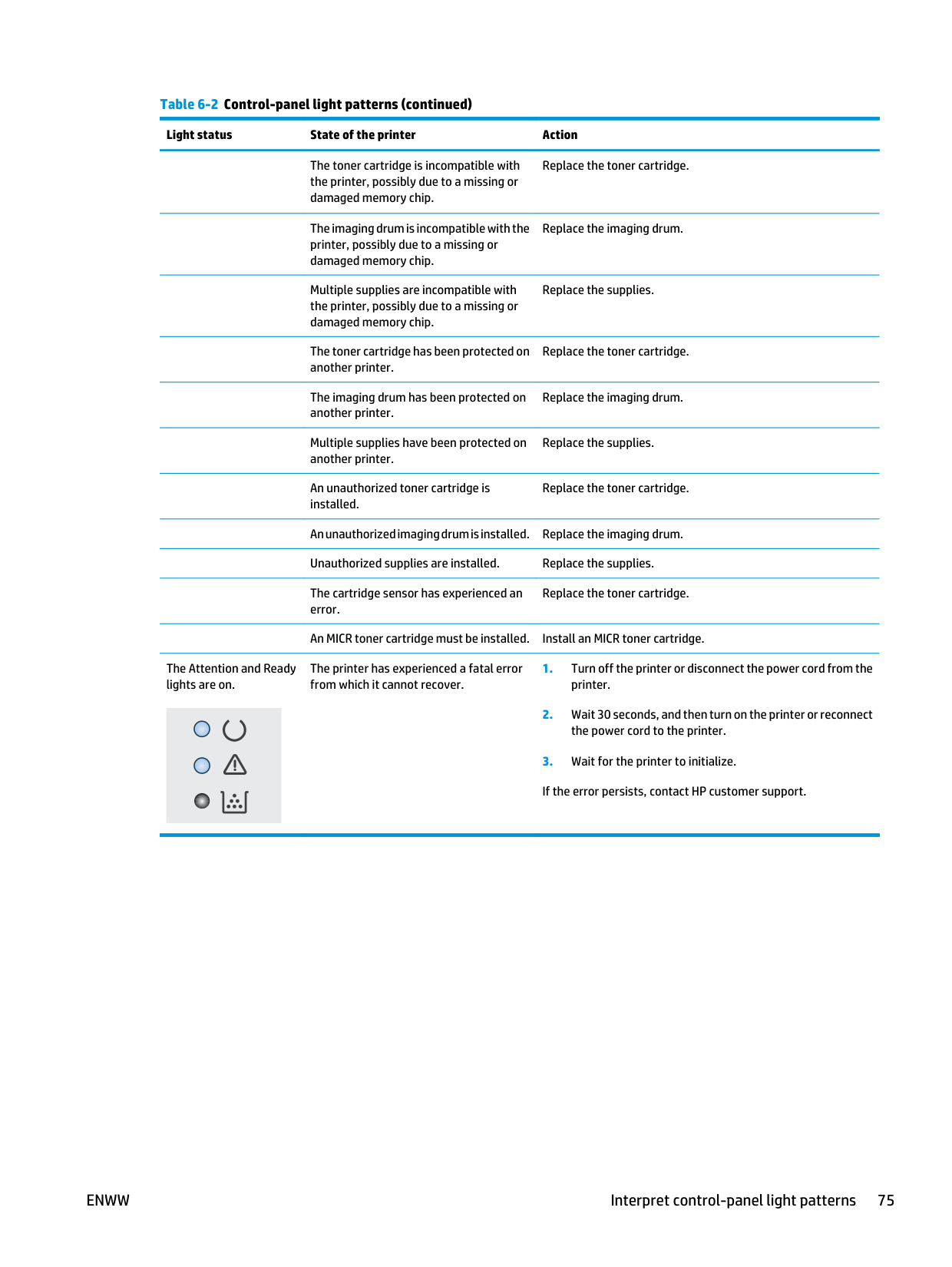
Table 6-2 Control-panel light patterns (continued) Light status State of the printer Action
The toner cartridge is incompatible with the printer, possibly due to a missing or damaged memory chip. Replace the toner cartridge.
The imaging drum is incompatible with the printer, possibly due to a missing or damaged memory chip. Replace the imaging drum.
Multiple supplies are incompatible with the printer, possibly due to a missing or damaged memory chip. Replace the supplies.
The toner cartridge has been protected on another printer. Replace the toner cartridge.
The imaging drum has been protected on another printer. Replace the imaging drum.
Multiple supplies have been protected on another printer. Replace the supplies.
An unauthorized toner cartridge is installed. Replace the toner cartridge.
An unauthorized imaging drum is installed. Replace the imaging drum.
Unauthorized supplies are installed. Replace the supplies.
The cartridge sensor has experienced an error. Replace the toner cartridge.
An MICR toner cartridge must be installed. Install an MICR toner cartridge. The Attention and Ready lights are on. The printer has experienced a fatal error from which it cannot recover.
Enww
Interpret control-panel light patterns 75
Restore the factory-set defaults Restoring the factory-set defaults returns all of the printer and network settings to the factory defaults. It will not reset the page count, tray size, or language. To restore the printer to the factory-default settings, follow these steps.
Caution:
Restoring the factory-set defaults returns all of the settings to the factory defaults, and it also deletes any pages that are stored in the memory.Note:
If the displays a message indicating that accessing the website might not be safe, select the option to continue to the website. Accessing this website will not harm the computer.Enww
A “Cartridge is low” or “Cartridge is very low” message displays on the printer control panel Cartridge is low: The printer indicates when a cartridge level is low. Actual cartridge life remaining may vary. Consider having a replacement available to install when print quality is no longer acceptable. The cartridge does not need to be replaced now. Cartridge is very low: The printer indicates when the cartridge level is very low. Actual cartridge life remaining may vary. Consider having a replacement available to install when print quality is no longer acceptable. The cartridge does not need to be replaced now unless the print quality is no longer acceptable. Once an HP cartridge has reached Very Low, HP’s Premium Protection Warranty on that toner cartridge has ended. Change the “Very Low” settings You can change the way the printer reacts when supplies reach the Very Low state. You do not have to re- establish these settings when you install a new cartridge.
Enww
A “Cartridge is low” or “Cartridge is very low” message displays on the printer control panel 77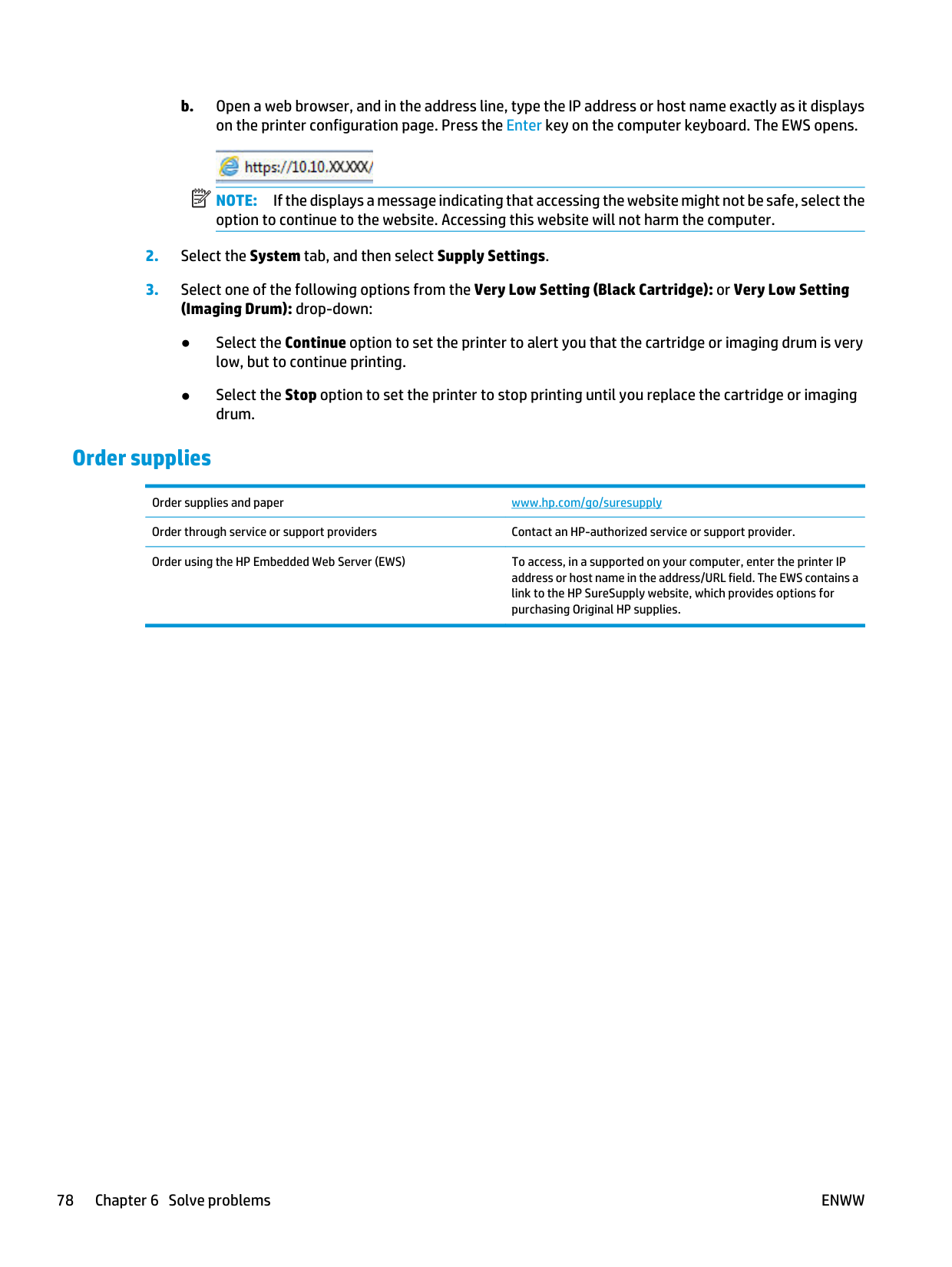
b. Open a web browser, and in the address line, type the IP address or host name exactly as it displays on the printer configuration page. Press the Enter key on the computer keyboard. The EWS opens.
Note:
If the displays a message indicating that accessing the website might not be safe, select the option to continue to the website. Accessing this website will not harm the computer.Enww
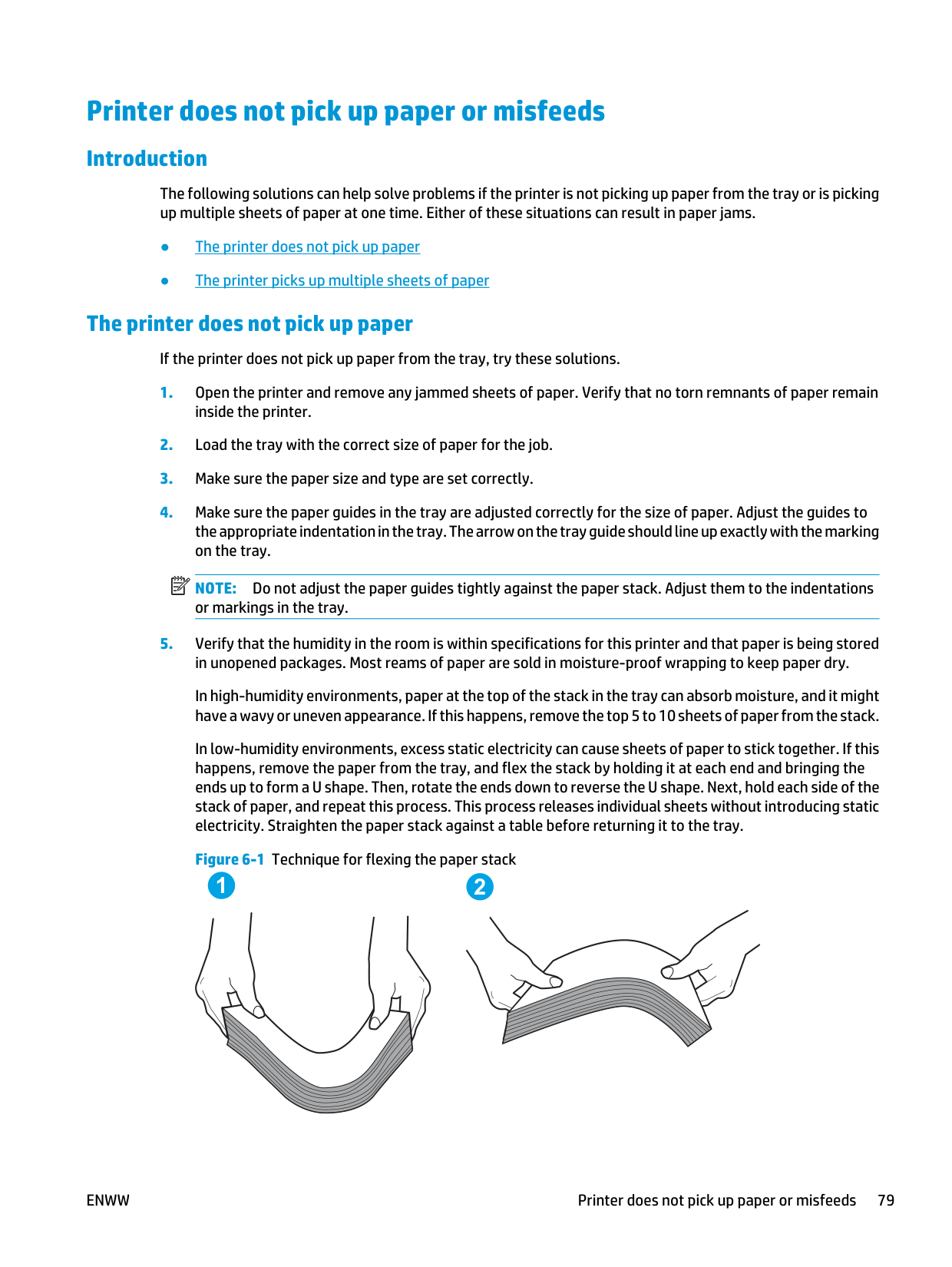
Printer does not pick up paper or misfeeds Introduction The following solutions can help solve problems if the printer is not picking up paper from the tray or is picking up multiple sheets of paper at one time. Either of these situations can result in paper jams. ● The printer does not pick up paper ● The printer picks up multiple sheets of paper The printer does not pick up paper If the printer does not pick up paper from the tray, try these solutions.
Note:
Do not adjust the paper guides tightly against the paper stack. Adjust them to the indentations or markings in the tray.Enww
Printer does not pick up paper or misfeeds 79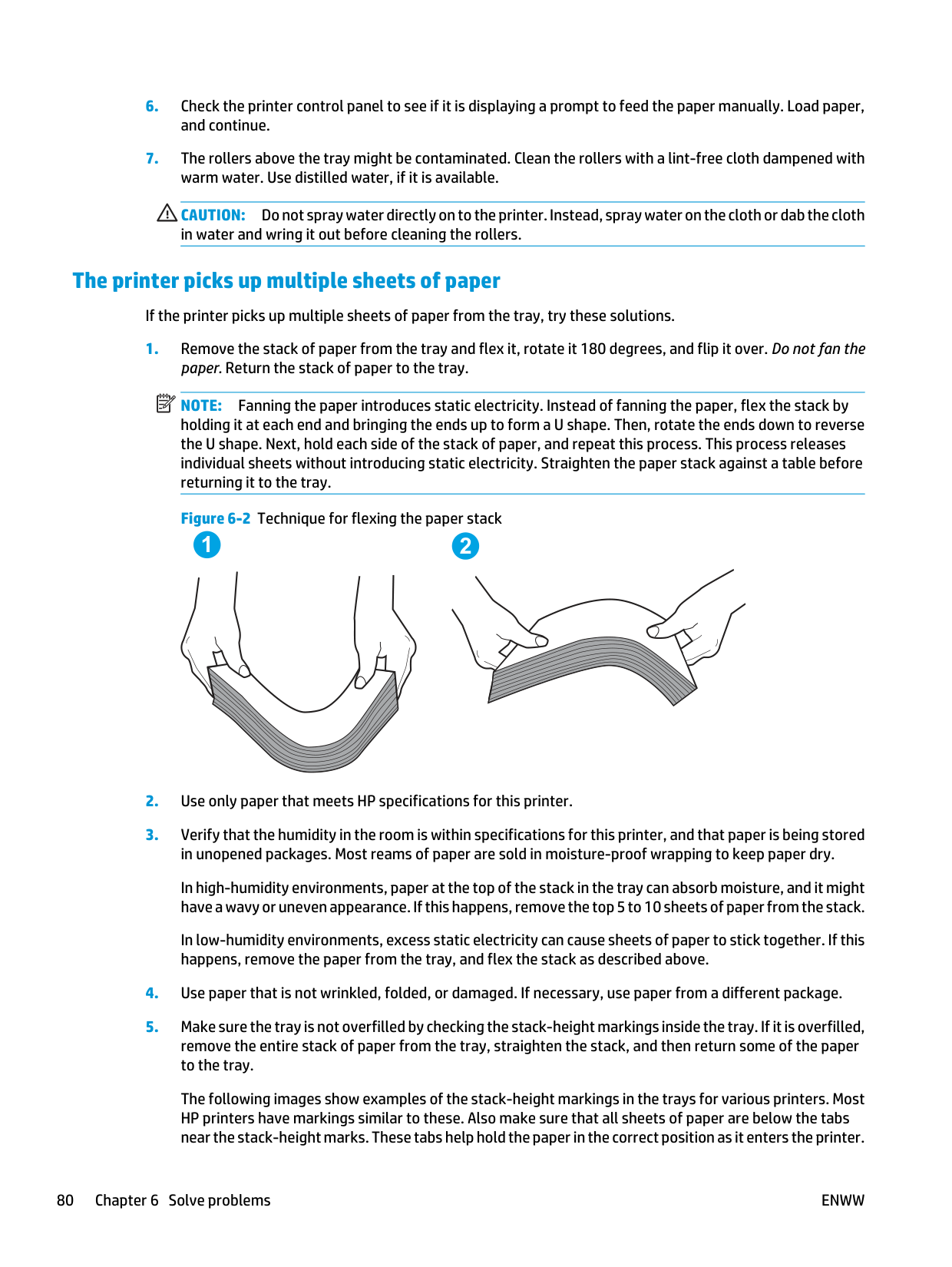
Caution:
Do not spray water directly on to the printer. Instead, spray water on the cloth or dab the cloth in water and wring it out before cleaning the rollers. The printer picks up multiple sheets of paper If the printer picks up multiple sheets of paper from the tray, try these solutions.Note:
Fanning the paper introduces static electricity. Instead of fanning the paper, flex the stack by holding it at each end and bringing the ends up to form a U shape. Then, rotate the ends down to reverse the U shape. Next, hold each side of the stack of paper, and repeat this process. This process releases individual sheets without introducing static electricity. Straighten the paper stack against a table before returning it to the tray. Figure 6-2 Technique for flexing the paper stack 1 2Enww

Note:
Do not adjust the paper guides tightly against the paper stack. Adjust them to the indentations or markings in the tray.Enww
Printer does not pick up paper or misfeeds 81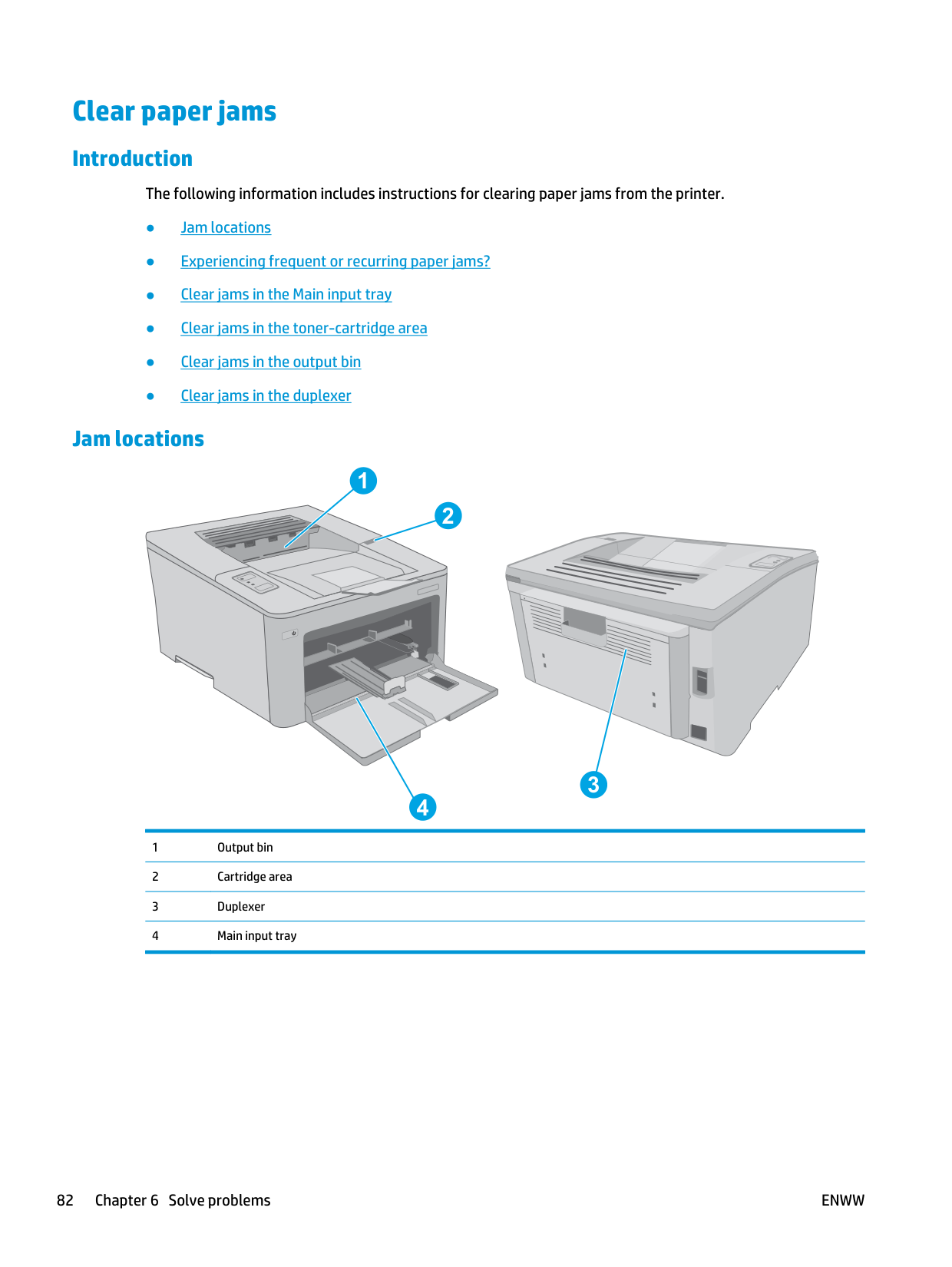
Clear paper jams Introduction The following information includes instructions for clearing paper jams from the printer. ● Jam locations ● Experiencing frequent or recurring paper jams? ● Clear jams in the Main input tray ● Clear jams in the toner-cartridge area ● Clear jams in the output bin ● Clear jams in the duplexer Jam locations 1 2 4 3 1 Output bin 2 Cartridge area 3 Duplexer 4 Main input tray 82 Chapter 6 Solve problems
Enww
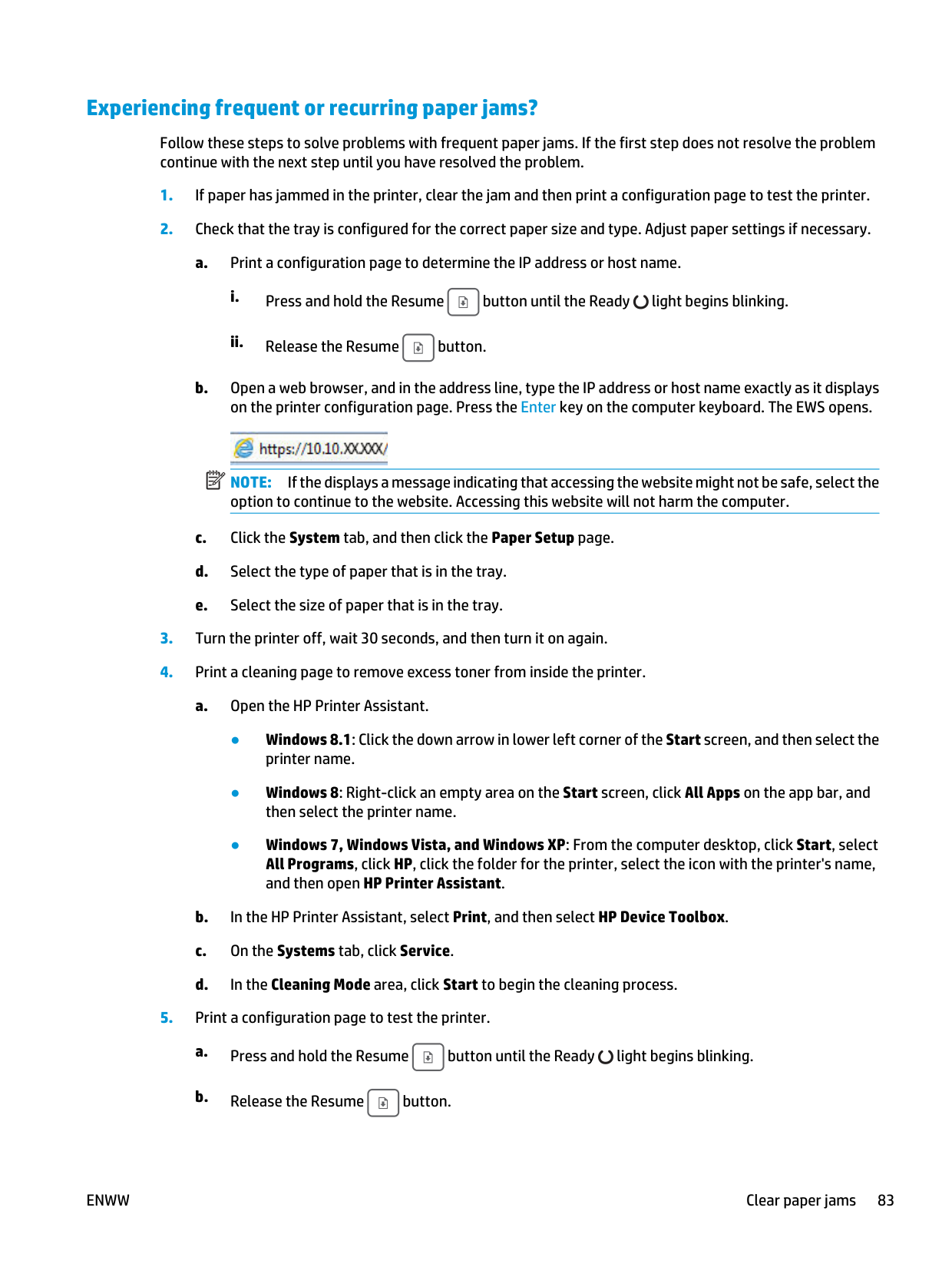
Experiencing frequent or recurring paper jams? Follow these steps to solve problems with frequent paper jams. If the first step does not resolve the problem continue with the next step until you have resolved the problem.
Note:
If the displays a message indicating that accessing the website might not be safe, select the option to continue to the website. Accessing this website will not harm the computer. c. Click the System tab, and then click the Paper Setup page. d. Select the type of paper that is in the tray. e. Select the size of paper that is in the tray.Enww
Clear paper jams 83
If none of these steps resolves the problem, the printer might need service. Contact HP customer support. 84 Chapter 6 Solve problems
Enww
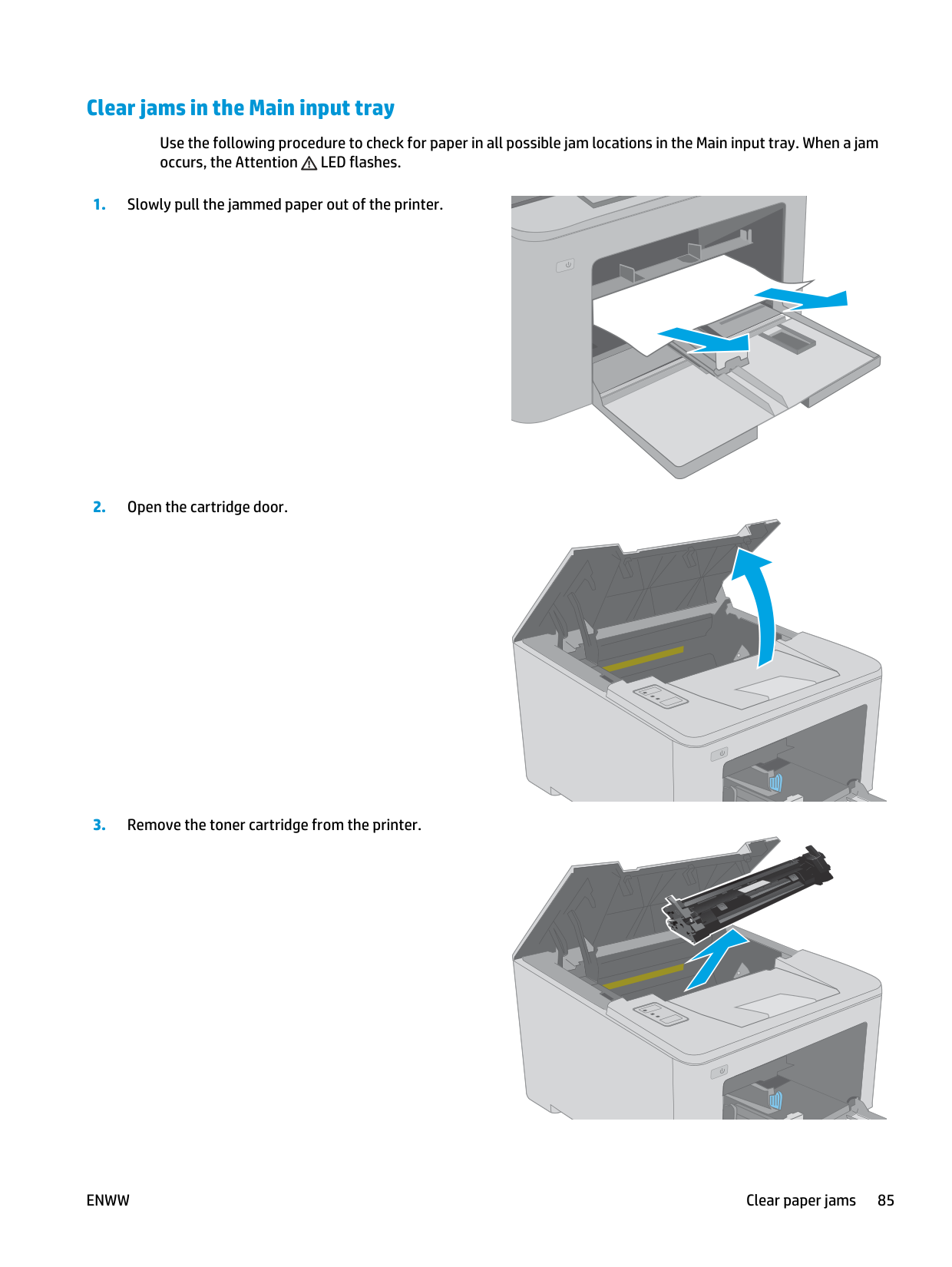
Clear jams in the Main input tray Use the following procedure to check for paper in all possible jam locations in the Main input tray. When a jam occurs, the Attention LED flashes.
Enww
Clear paper jams 85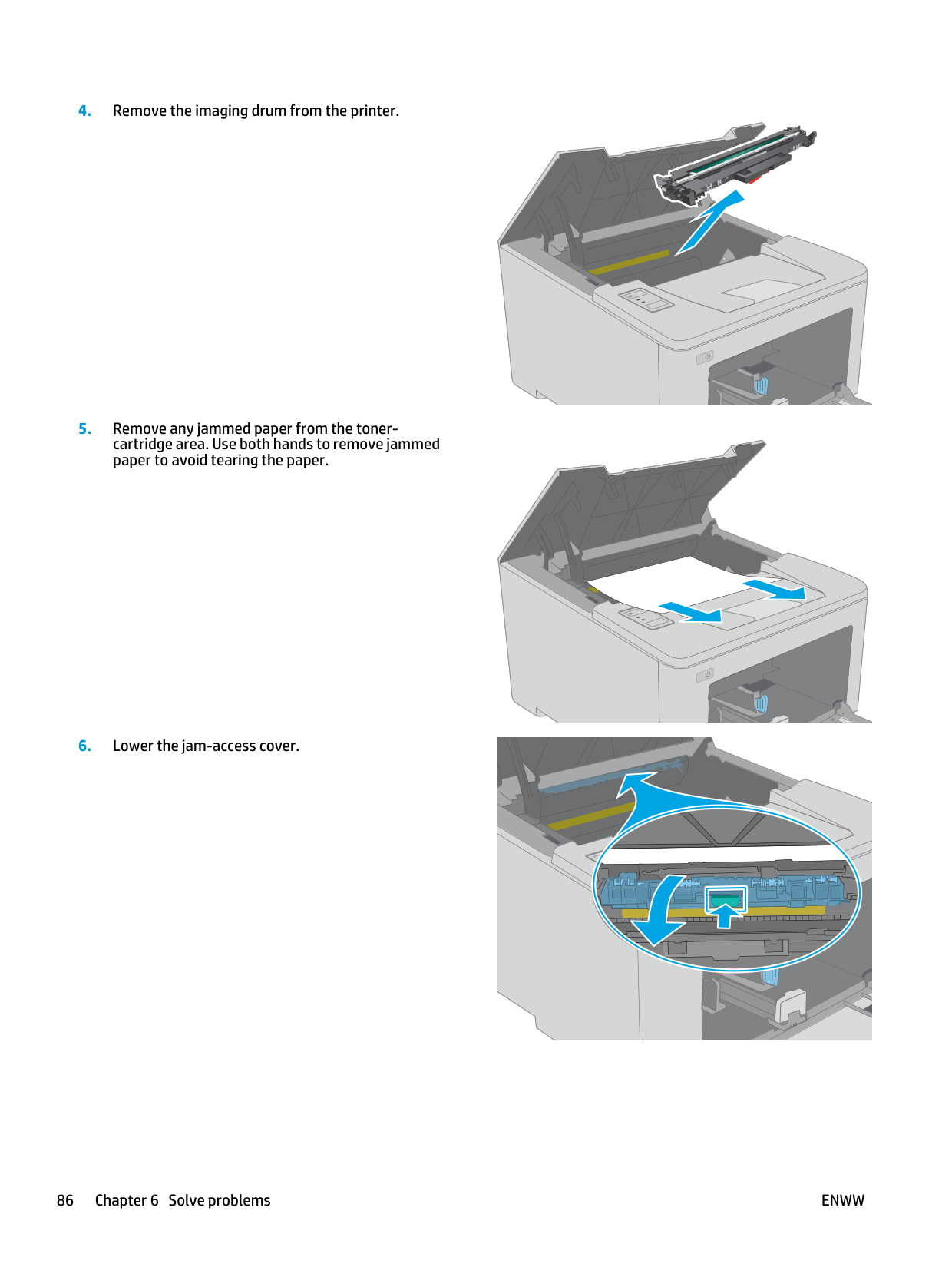
86 Chapter 6 Solve problems
Enww
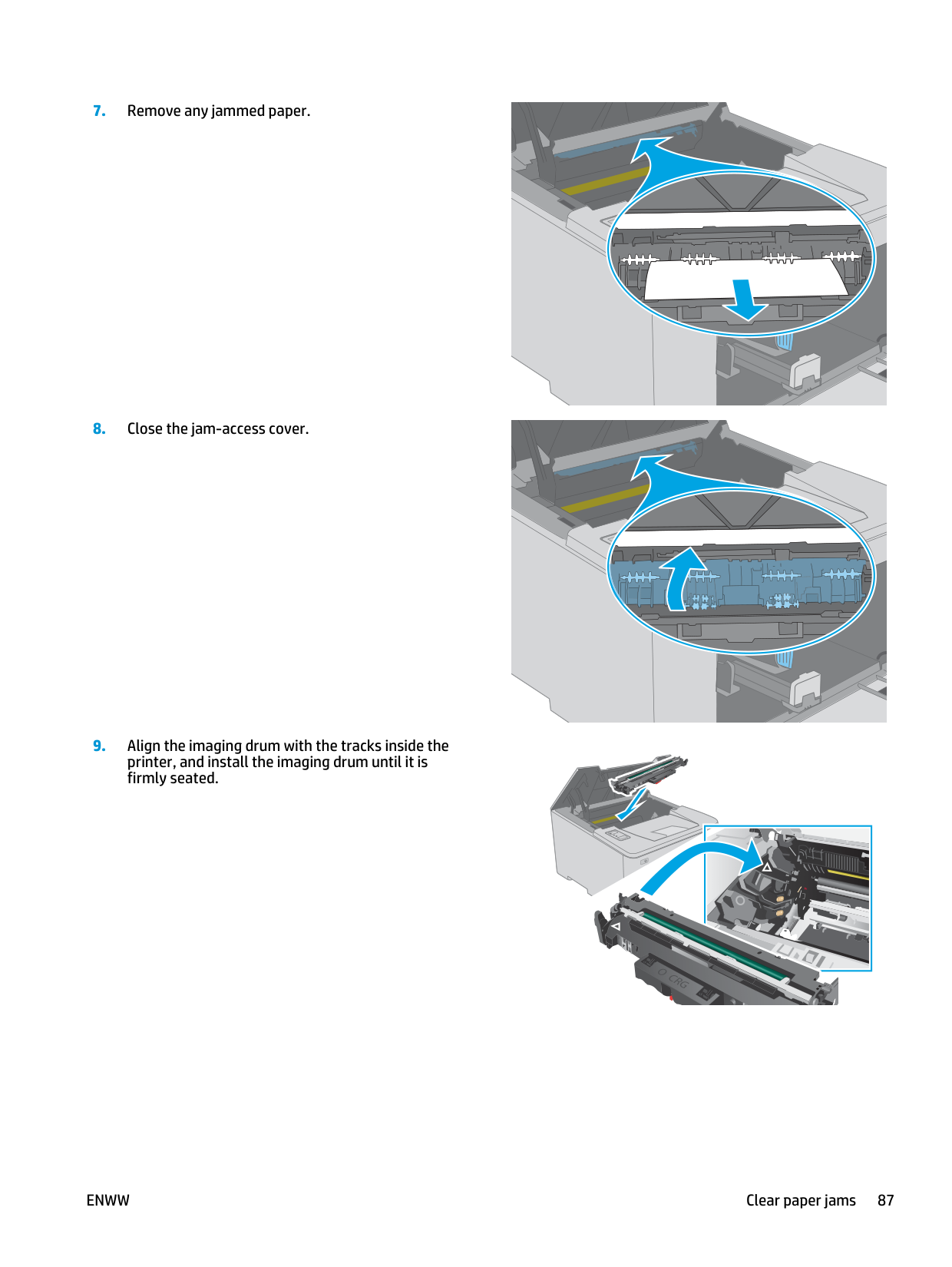
Enww
Clear paper jams 87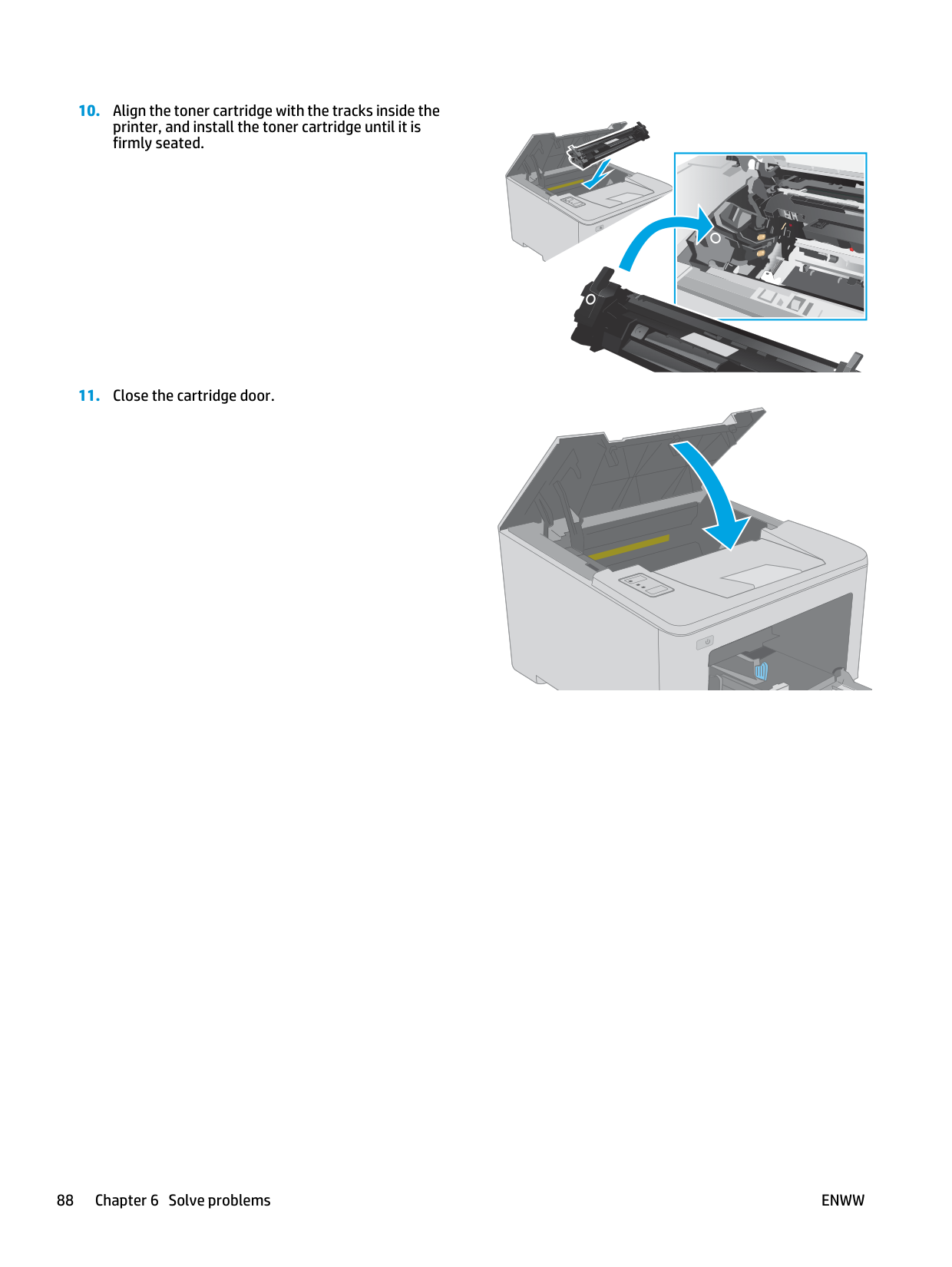
88 Chapter 6 Solve problems
Enww
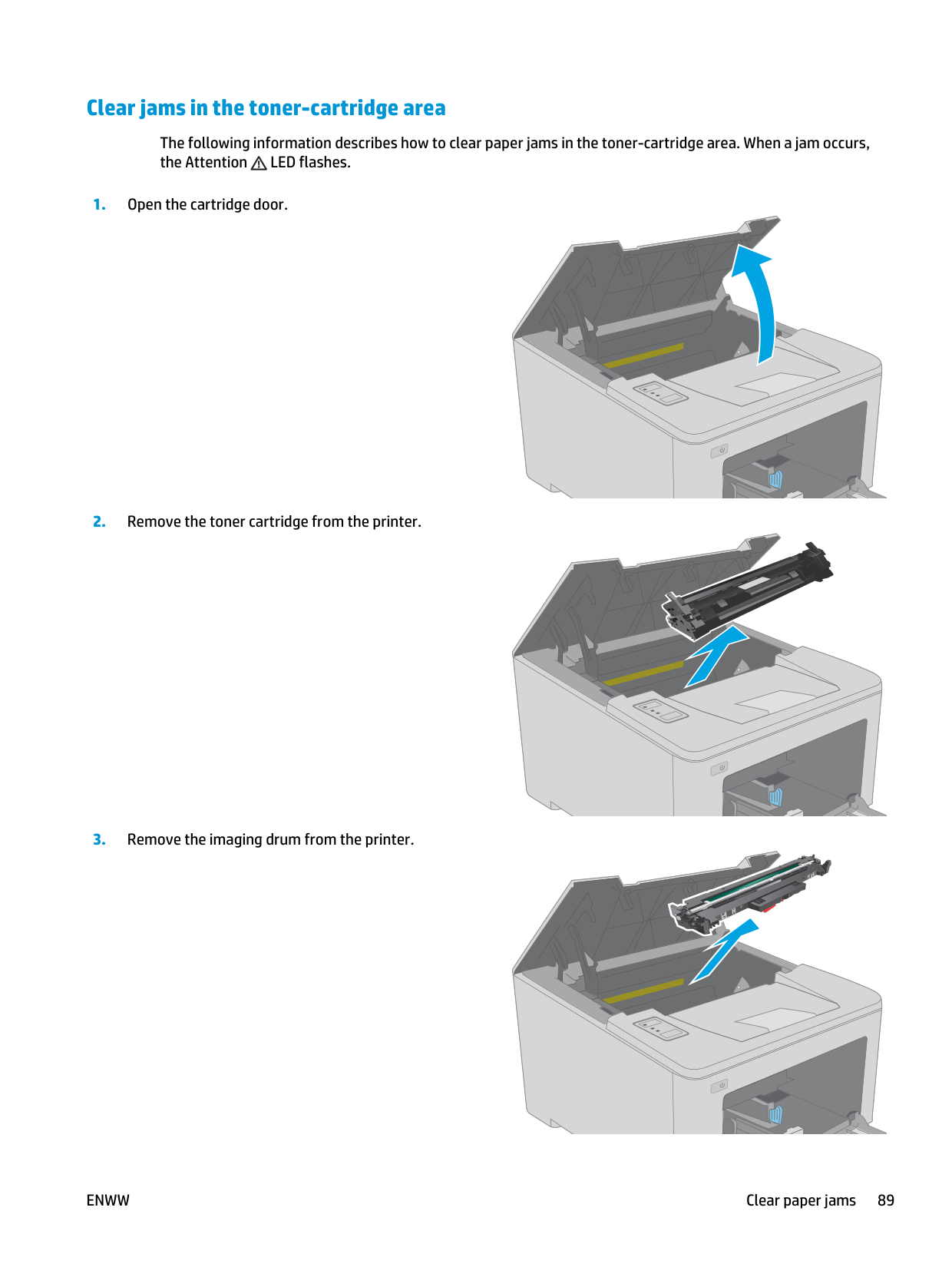
Clear jams in the toner-cartridge area The following information describes how to clear paper jams in the toner-cartridge area. When a jam occurs, the Attention LED flashes.
Enww
Clear paper jams 89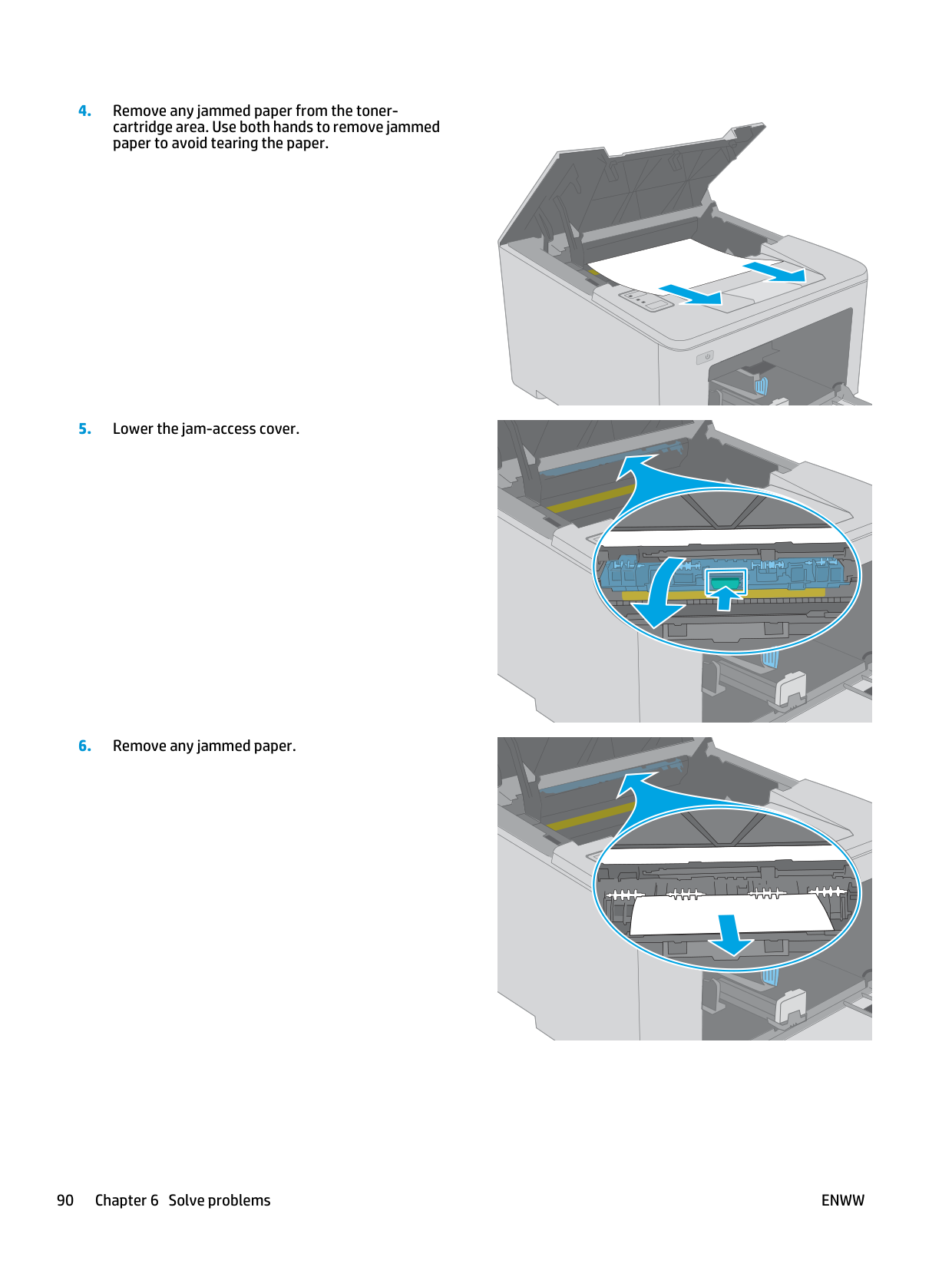
90 Chapter 6 Solve problems
Enww
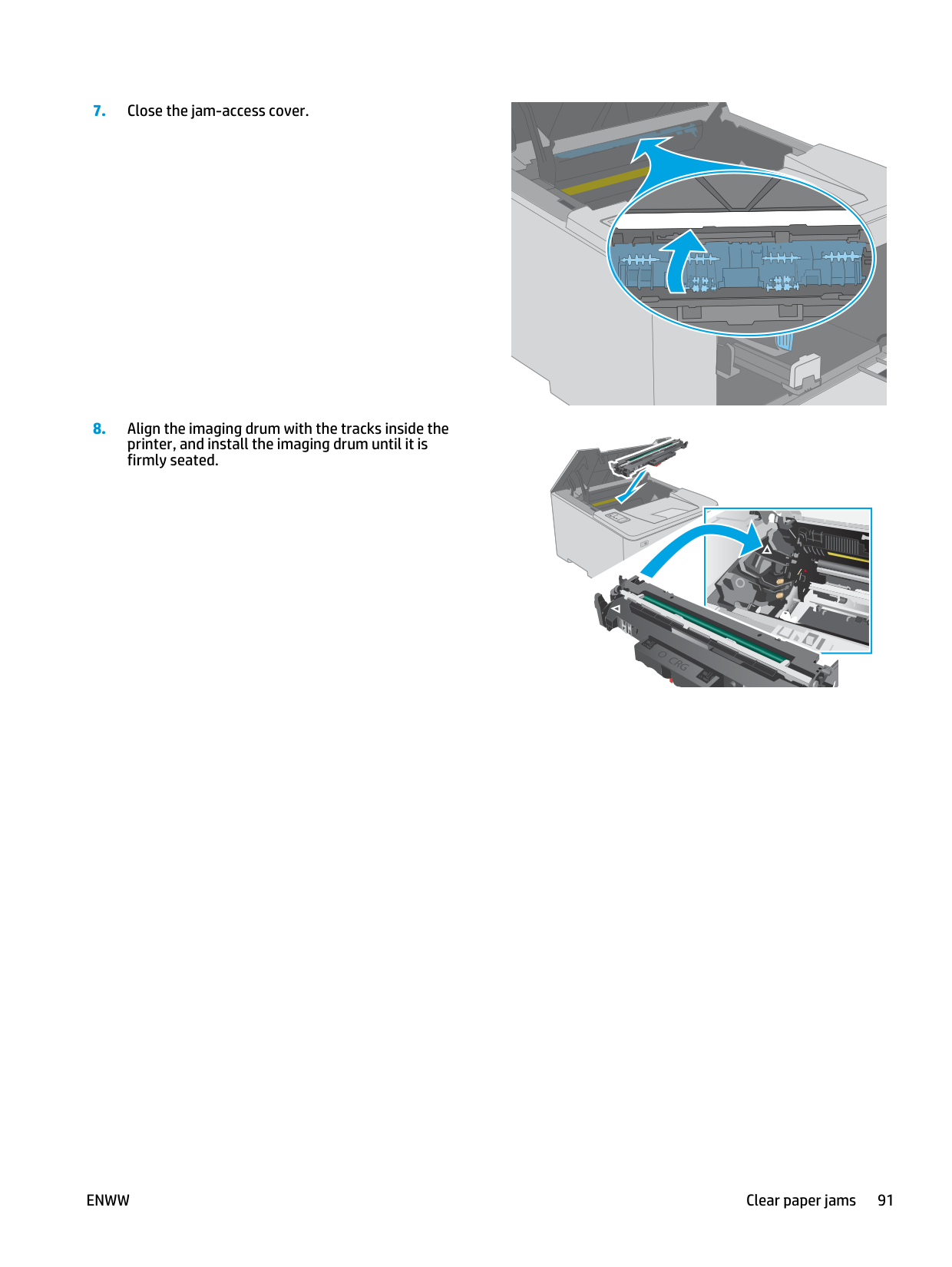
Enww
Clear paper jams 91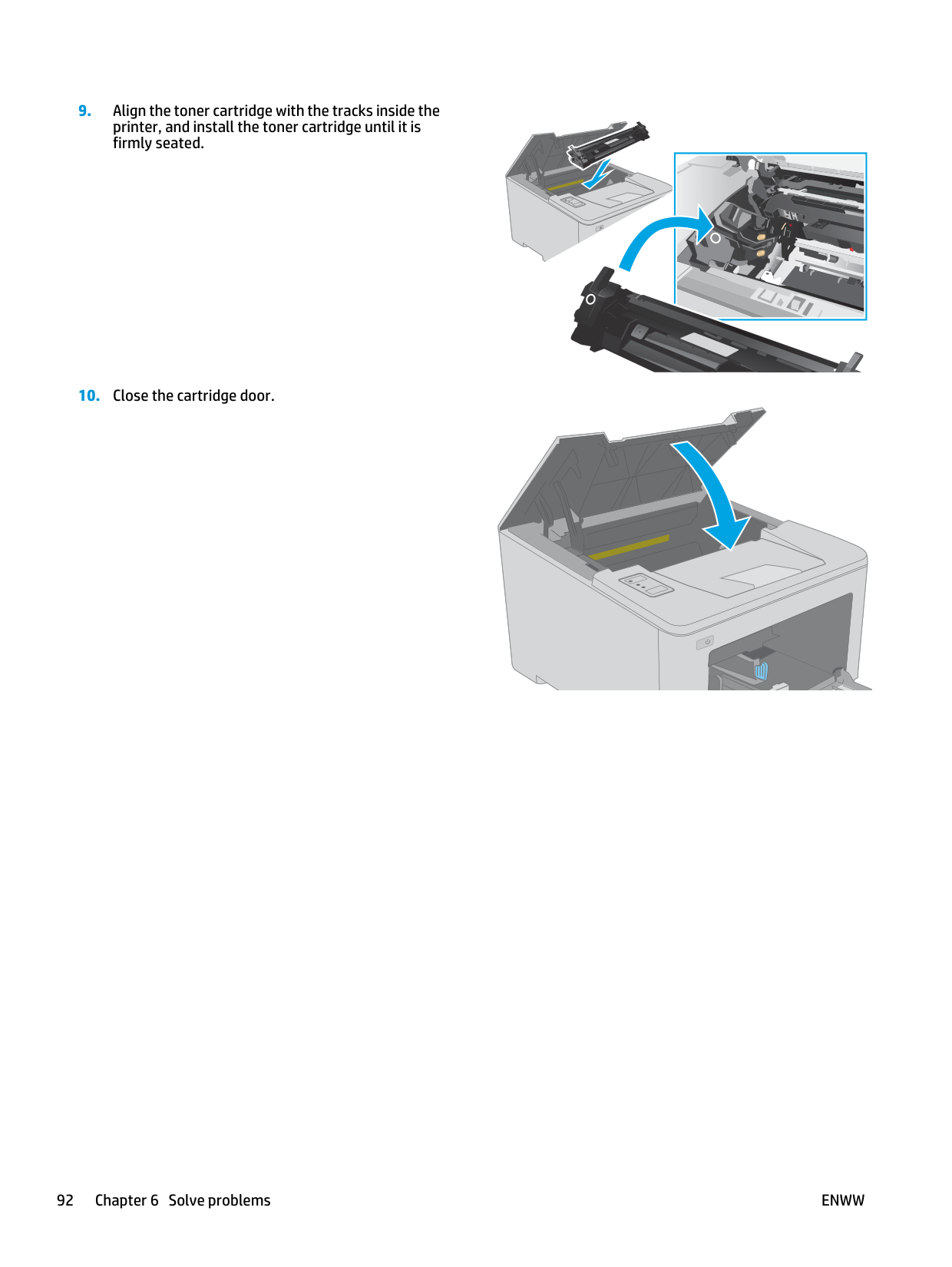
92 Chapter 6 Solve problems
Enww
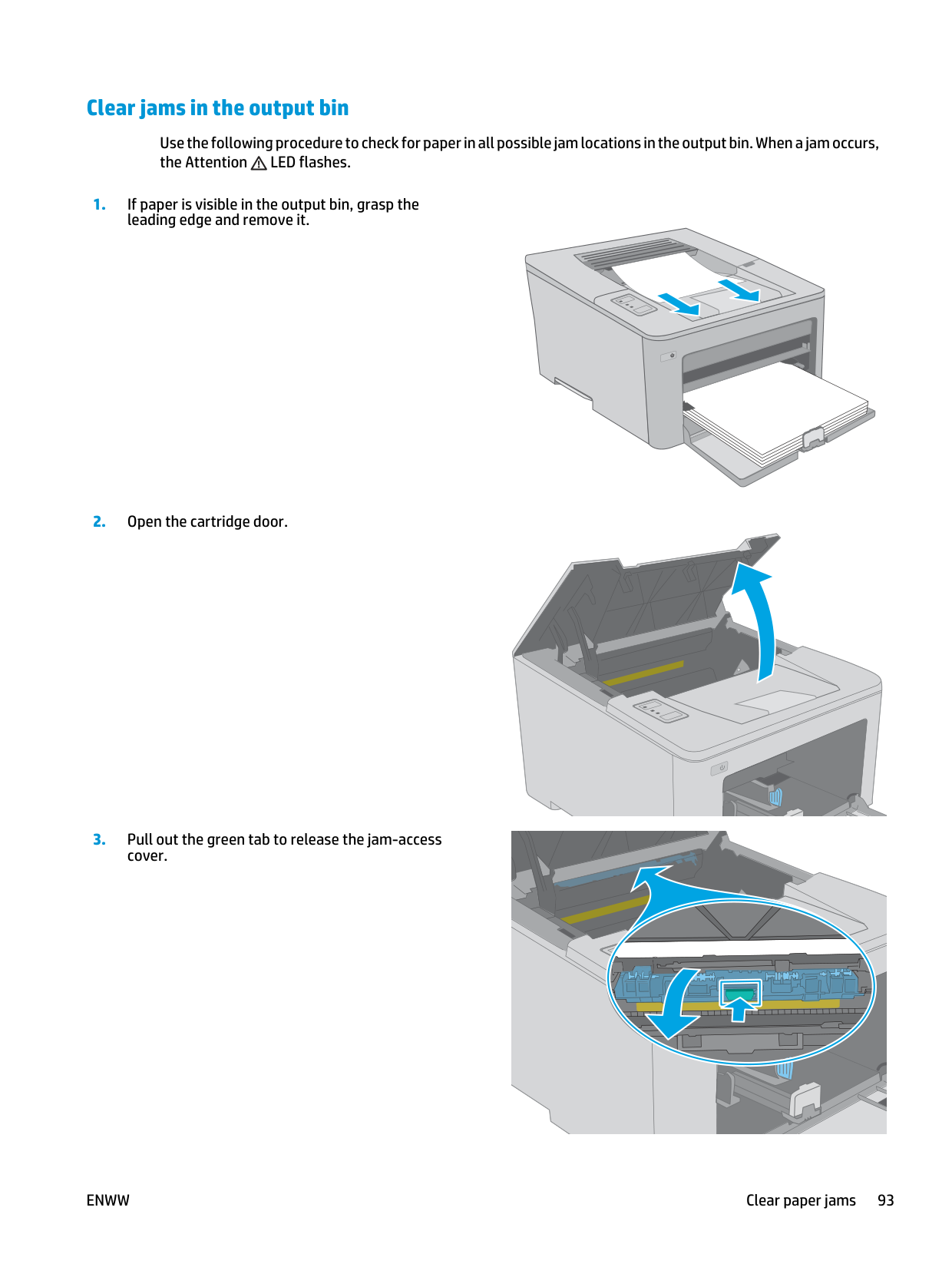
Clear jams in the output bin Use the following procedure to check for paper in all possible jam locations in the output bin. When a jam occurs, the Attention LED flashes.
Enww
Clear paper jams 93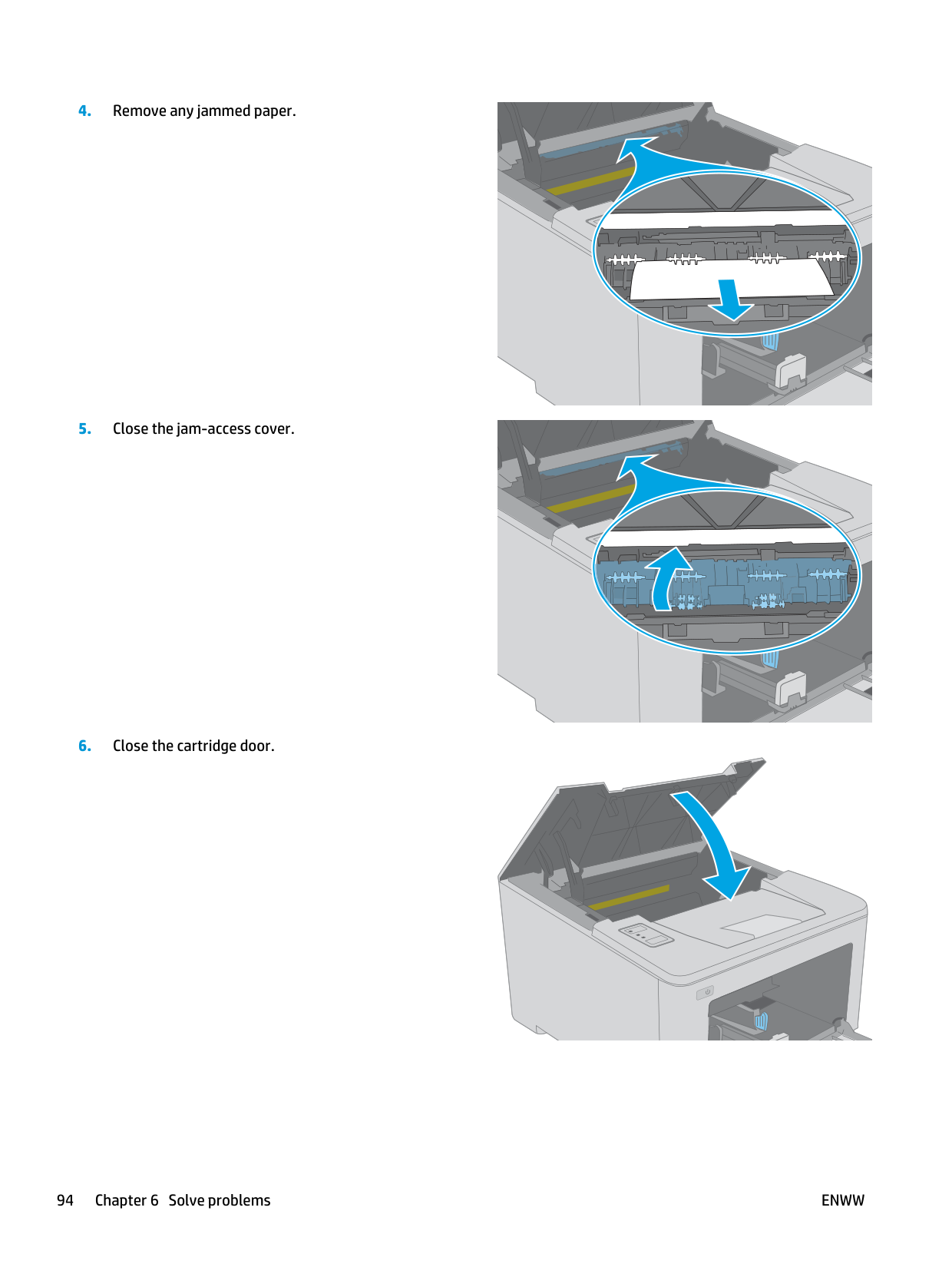
94 Chapter 6 Solve problems
Enww
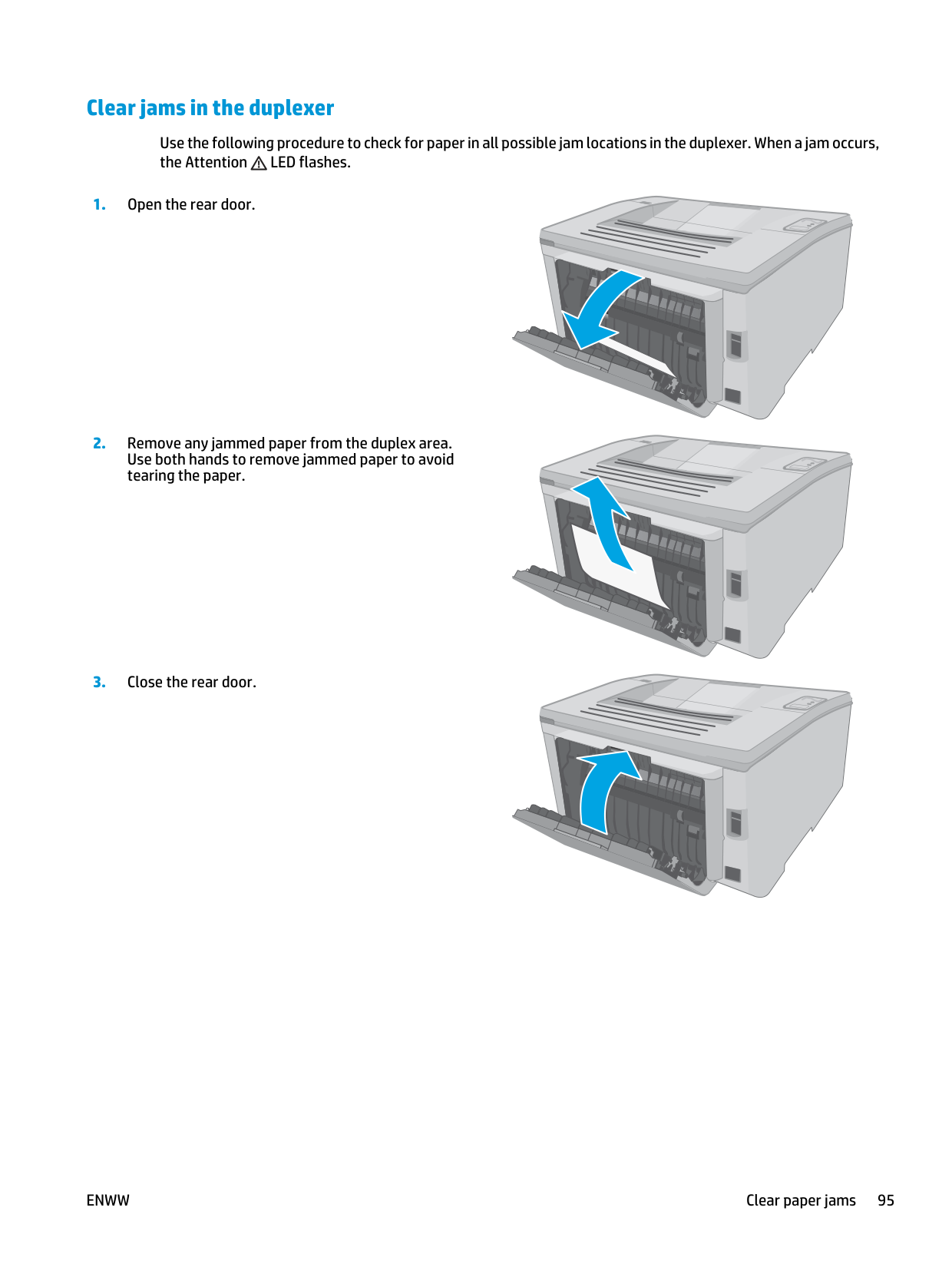
Clear jams in the duplexer Use the following procedure to check for paper in all possible jam locations in the duplexer. When a jam occurs, the Attention LED flashes.
Enww
Clear paper jams 95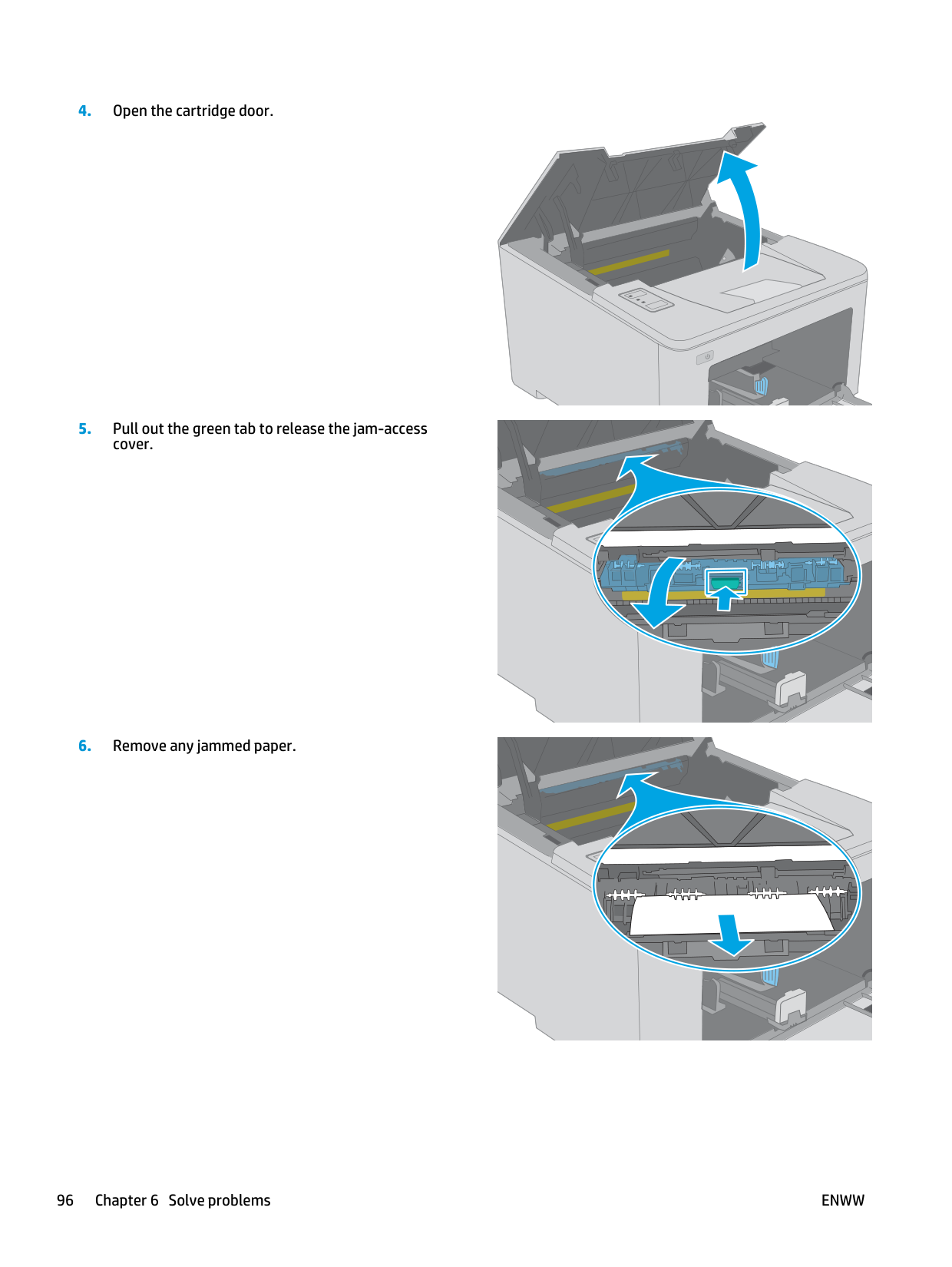
96 Chapter 6 Solve problems
Enww
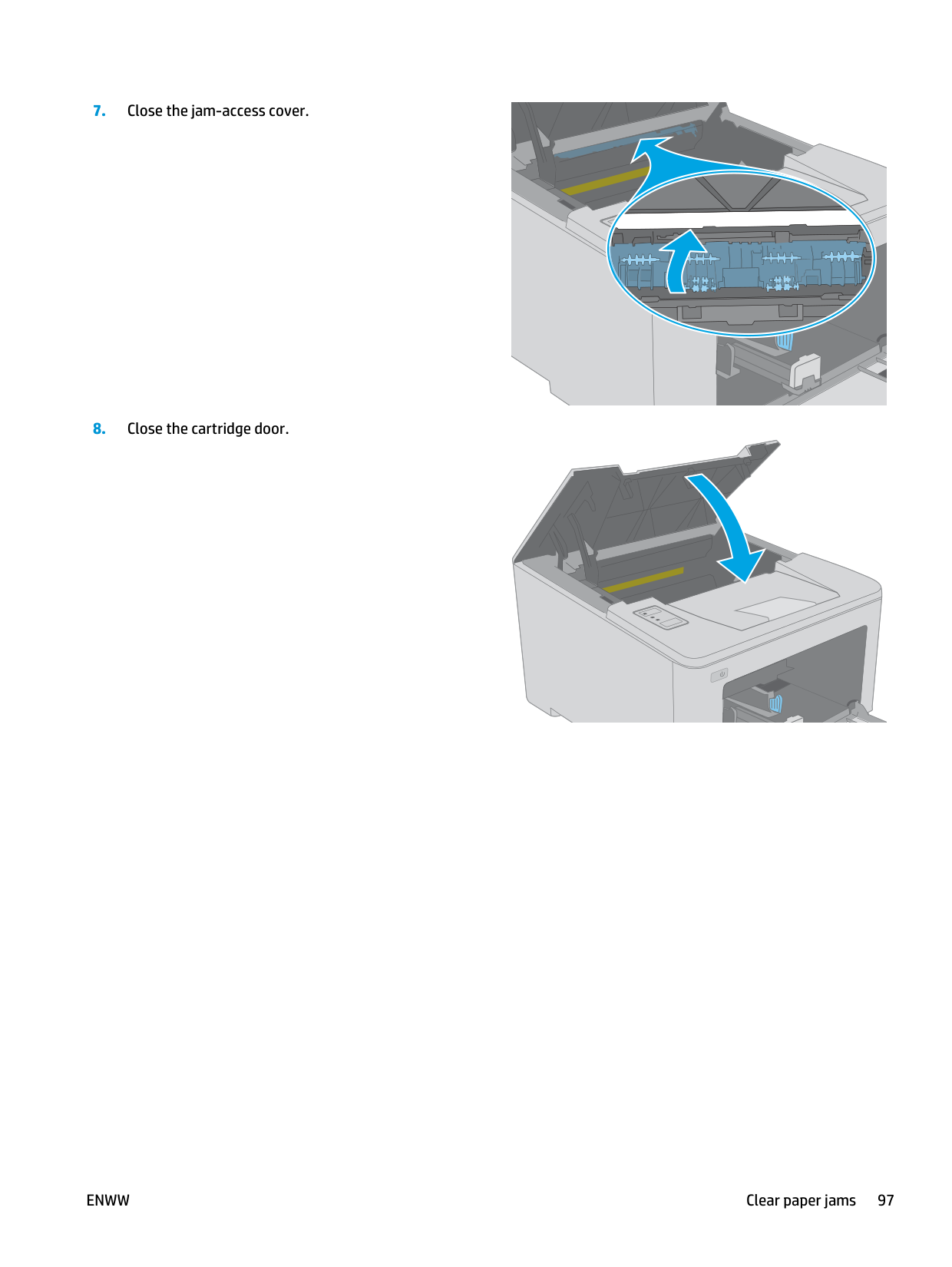
Enww
Clear paper jams 97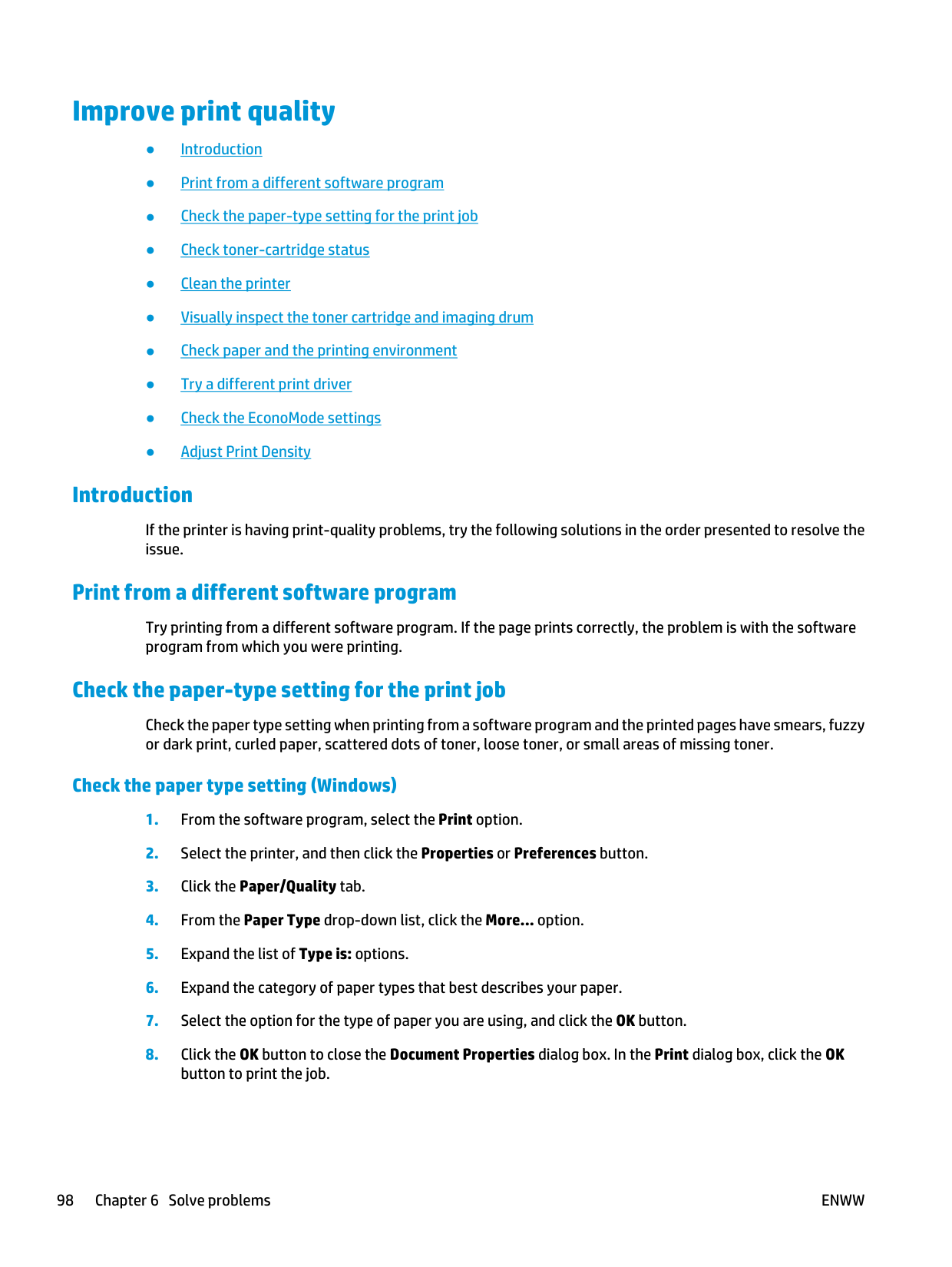
Improve print quality ● Introduction ● Print from a different software program ● Check the paper-type setting for the print job ● Check toner-cartridge status ● Clean the printer ● Visually inspect the toner cartridge and imaging drum ● Check paper and the printing environment ● Try a different print driver ● Check the EconoMode settings ● Adjust Print Density Introduction If the printer is having print-quality problems, try the following solutions in the order presented to resolve the issue. Print from a different software program Try printing from a different software program. If the page prints correctly, the problem is with the software program from which you were printing. Check the paper-type setting for the print job Check the paper type setting when printing from a software program and the printed pages have smears, fuzzy or dark print, curled paper, scattered dots of toner, loose toner, or small areas of missing toner. Check the paper type setting (Windows)
Enww
Check the paper type setting (OS X)
Enww
Improve print quality 99
Visually inspect the toner cartridge and imaging drum Follow these steps to inspect each toner cartridge and imaging drum.
Caution:
Do not touch the imaging drum. Fingerprints on the imaging drum can cause print-quality problems.Enww
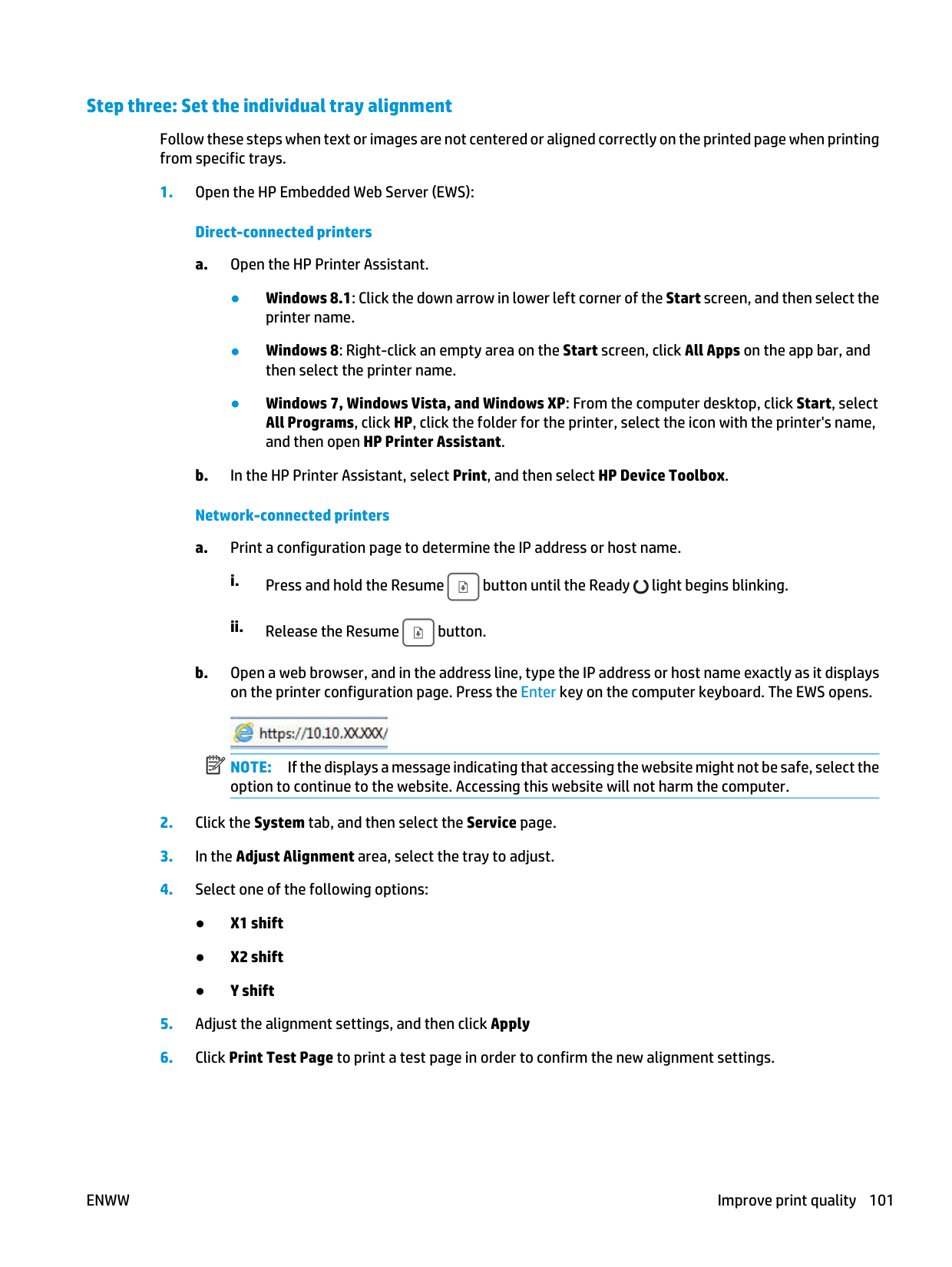
Step three: Set the individual tray alignment Follow these steps when text or images are not centered or aligned correctly on the printed page when printing from specific trays.
Note:
If the displays a message indicating that accessing the website might not be safe, select the option to continue to the website. Accessing this website will not harm the computer.Enww
Improve print quality 101
Try a different print driver Try a different print driver when printing from a software program and the printed pages have unexpected lines in graphics, missing text, missing graphics, incorrect formatting, or substituted fonts. Download any of the following drivers from the HP Web site: www.hp.com/support/ljM203. HP PCL.6 driver HP PCL 6 driver HP PCL-6 driver ● Provided as the default driver on the printer CD. This driver is automatically installed unless you select a different one. ● Recommended for all Windows environments ● Provides the overall best speed, print quality, and printer-feature support for most users ● Developed to align with the Windows Graphic Device Interface (GDI) for the best speed in Windows environments ● Might not be fully compatible with third-party and custom software programs that are based on PCL 5 HP UPD PS driver ● Recommended for printing with Adobe® software programs or with other highly graphics-intensive software programs ● Provides support for printing from postscript emulation needs, or for postscript flash font support
Hp Upd Pcl 5
● Recommended for general office printing in Windows environments ● Compatible with previous PCL versions and older HP LaserJet printers ● The best choice for printing from third-party or custom software programs ● The best choice when operating with mixed environments, which require the printer to be set to PCL 5 (UNIX, Linux, mainframe) ● Designed for use in corporate Windows environments to provide a single driver for use with multiple printer models ● Preferred when printing to multiple printer models from a mobile Windows computerHp Upd Pcl 6
● Recommended for printing in all Windows environments ● Provides the overall best speed, print quality, and printer feature support for most users ● Developed to align with Windows Graphic Device Interface (GDI) for best speed in Windows environments ● Might not be fully compatible with third-party and custom software programs that are based on PCL 5 102 Chapter 6 Solve problemsEnww
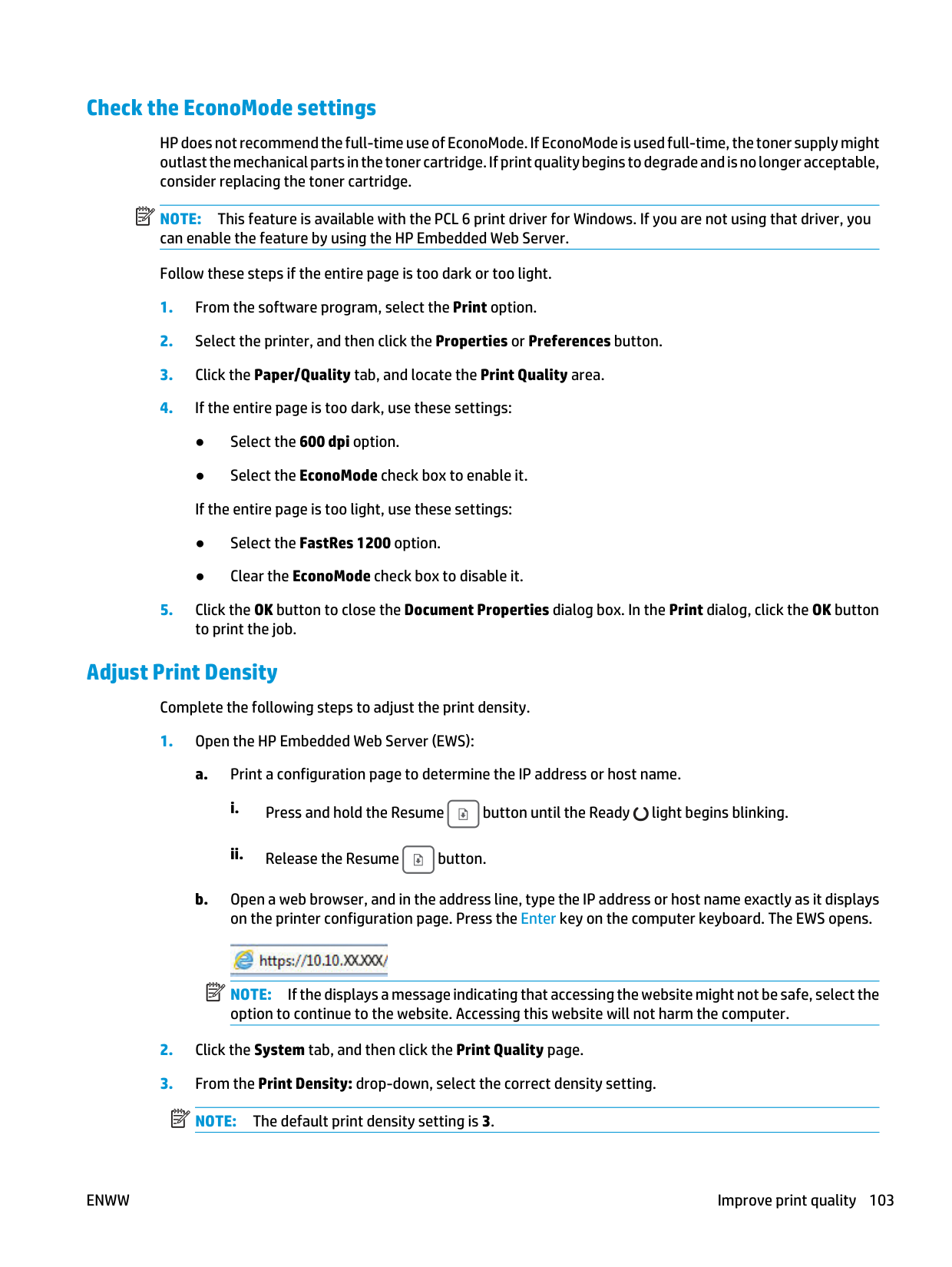
Check the EconoMode settings HP does not recommend the full-time use of EconoMode. If EconoMode is used full-time, the toner supply might outlast the mechanical parts in the toner cartridge. If print quality begins to degrade and is no longer acceptable, consider replacing the toner cartridge.
Note:
This feature is available with the PCL 6 print driver for Windows. If you are not using that driver, you can enable the feature by using the HP Embedded Web Server. Follow these steps if the entire page is too dark or too light.Note:
If the displays a message indicating that accessing the website might not be safe, select the option to continue to the website. Accessing this website will not harm the computer.Note:
The default print density setting is 3.Enww
Improve print quality 103
● 1 (Light) ● 2 ● 3 ● 4 ● 5 (Dark)
Enww
Solve wired network problems Introduction Check the following items to verify that the printer is communicating with the network. Before beginning, print a configuration page from the printer control panel and locate the printer IP address that is listed on this page. ● Poor physical connection ● The computer is using the incorrect IP address for the printer ● The computer is unable to communicate with the printer ● The printer is using incorrect link speed and duplex settings for the network ● New software programs might be causing compatibility problems ● The computer or workstation might be set up incorrectly ● The printer is disabled, or other network settings are incorrect
Note:
HP does not support peer-to-peer networking, as the feature is a function of Microsoft operating systems and not of the HP print drivers. For more information, go to Microsoft at www.microsoft.com. Poor physical connectionEnww
Solve wired network problems 105
● For Windows, click Start, click Run, type cmd, and then press Enter. ● For OS X, go to Applications, then Utilities, and open Terminal. b. Type ping followed by the IP address for your printer. c. If the window displays round-trip times, the network is working.
Enww
Solve wireless network problems ● Introduction ● Wireless connectivity checklist ● The printer does not print after the wireless configuration completes ● The printer does not print, and the computer has a third-party firewall installed ● The wireless connection does not work after moving the wireless router or printer ● Cannot connect more computers to the wireless printer ● The wireless printer loses communication when connected to a VPN ● The network does not appear in the wireless networks list ● The wireless network is not functioning ● Perform a wireless network diagnostic test ● Reduce interference on a wireless network Introduction Use the troubleshooting information to help resolve issues.
Note:
To determine whether HP NFC and Wi-Fi Direct printing are enabled on your printer, print a configuration page from the printer control panel Wireless connectivity checklist ● Verify that the network cable is not connected. ● Verify that the printer and the wireless router are turned on and have power. Also make sure that the wireless radio in the printer is turned on. ● Verify that the service set identifier (SSID) is correct. Print a configuration page to determine the SSID. If you are not sure the SSID is correct, run the wireless setup again. ● With secured networks, verify that the security information is correct. If the security information is incorrect, run the wireless setup again. ● If the wireless network is working correctly, try accessing other computers on the wireless network. If the network has Internet access, try connecting to the Internet over a wireless connection. ● Verify that the encryption method (AES or TKIP) is the same for the printer as it is for the wireless access point (on networks using WPA security). ● Verify that the printer is within the range of the wireless network. For most networks, the printer must be within 30 m (100 ft) of the wireless access point (wireless router). ● Verify that obstacles do not block the wireless signal. Remove any large metal objects between the access point and the printer. Make sure poles, walls, or support columns containing metal or concrete do not separate the printer and wireless access point.Enww
Solve wireless network problems 107
● Verify that the printer is located away from electronic devices that might interfere with the wireless signal. Many devices can interfere with the wireless signal including motors, cordless phones, security system cameras, other wireless networks, and some Bluetooth devices. ● Verify that the print driver is installed on the computer. ● Verify that you have selected the correct printer port. ● Verify that the computer and printer connect to the same wireless network. ● For OS X, verify that the wireless router supports Bonjour. The printer does not print after the wireless configuration completes
Enww
Enww
Solve wireless network problems 109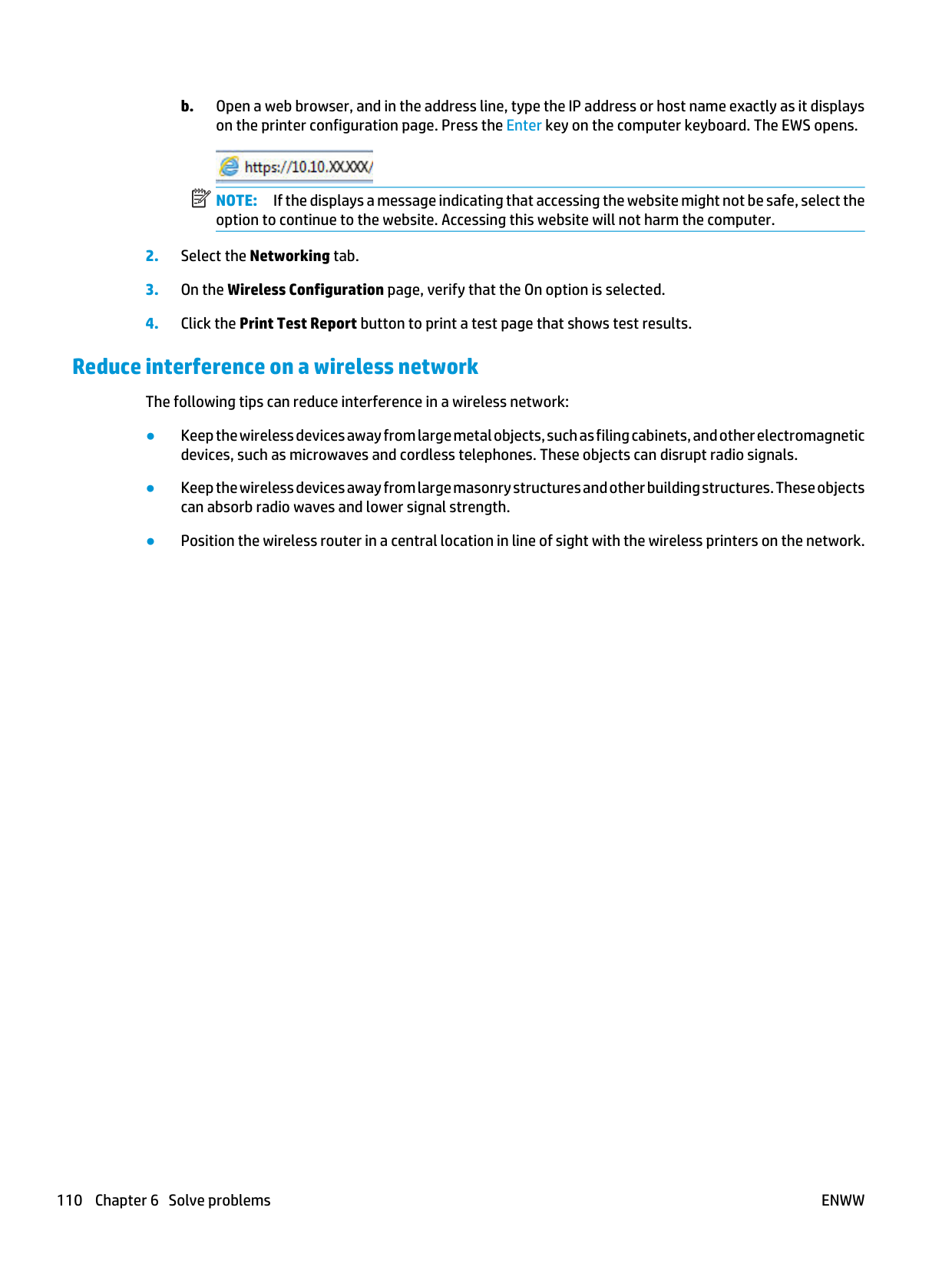
b. Open a web browser, and in the address line, type the IP address or host name exactly as it displays on the printer configuration page. Press the Enter key on the computer keyboard. The EWS opens.
Note:
If the displays a message indicating that accessing the website might not be safe, select the option to continue to the website. Accessing this website will not harm the computer.Enww
Index
A
accessories ordering 24 part numbers 24 acoustic specifications 8 AirPrint 50 Android devices printing from 50B
bin, output locating 2 browser requirements HP embedded Web Server 53C
cartridge policy 25 checklist wireless connectivity 107 cleaning paper path 99 control panel LED light patterns 73 locating 2 customer support online 72D
defaults, restoring 76 dimensions, printer 7 double-sided printing Mac 43 Windows 40 drivers, supported 5 duplex printing Mac 43 duplex printing (double-sided) settings (Windows) 39 Windows 40 duplexer locating 3 duplexing manually (Mac) 43 manually (Windows) 40E
EconoMode setting 65, 103 economy settings 65 electrical specifications 8 Embedded Web Server changing password 62 opening 62 Embedded Web Server (EWS) features 53 envelope orientation 19 envelopes, loading 19 Explorer, versions supported HP Embedded Web Server 53F
factory-set defaults, restoring 76G
genuine HP cartridges 25H
HP Customer Care 72 HP Device Toolbox, using 53 HP Embedded Web Server changing password 62 opening 62 HP Embedded Web Server (EWS) features 53 HP ePrint 49 HP ePrint software 49 HP EWS, using 53 HP Utility 57 HP Utility for Mac Bonjour 57 features 57 HP Utility, Mac 57I
interface ports locating 3 Internet Explorer, versions supported HP Embedded Web Server 53J
jams locating 82L
label orientation 21 labels printing on 21 labels, loading 21 lock formatter 63M
Macintosh HP Utility 57 Main input tray loading 15 loading envelopes 19 loading labels 21 orientation 15 manual duplex Mac 43 Windows 40 memory included 5 mobile printing Android devices 50Enww
Index 111
mobile printing solutions 5 mobile printing, software supported 7 multiple pages per sheet printing (Mac) 44 printing (Windows) 40