
Ask AI
— answers from the official manualAnswers from the official manual.
Common questions
Common Questions
10 totalHow do I access and use the Computer Setup (F10) Utility?
To access Computer Setup (F10), turn on or restart your computer, then repeatedly press F10 when the monitor light turns green. Navigate through Main, Security, Advanced, and UEFI Drivers options using arrow keys to make changes and settings adjustments as needed. Save all changes by selecting 'Main > Save Changes and Exit'. To exit without saving changes, choose 'Ignore Changes and Exit'. (Page 47)
What should I do if I encounter POST error messages or diagnostic codes?
POST numeric codes and text messages provide guidance on resolving issues such as hardware configuration problems. Refer to the Maintenance and Service Guide, specifically chapters about POST errors starting from page 85 for detailed troubleshooting instructions corresponding to each code displayed on LED lights. This section includes interpreting system validation diagnostics through front panel LEDs and audible signals. (Page 85)
How do I reset the BIOS settings to default values?
To restore factory defaults, access the Computer Setup utility by pressing F10 during bootup, go to 'Main', then select 'Apply Factory Defaults and Exit'. This resets all settings from advanced features back to their original factory state. (Page 47)
What general routine maintenance does the computer require?
Routine care includes keeping the computer away from excessive moisture, direct sunlight, and extremes of heat or cold. Ensure that there is a 10 cm clearance on all sides to allow proper air flow for cooling. Regularly clean vents with a cloth after unplugging the system if blocked by dust; do not immerse any parts in water or use flammable solvents. (Page 24-25, page 6)
How do I clean my computer correctly?
For routine cleaning of the computer case, use plain water or a mild dishwashing liquid diluted with water on lint-free cloths; avoid solvents and flammable solutions. Unplug the power source before cleaning the keyboard or air vents and always wear safety glasses when cleaning under keys. Clean internal parts only as per specified guidelines in the guide to prevent damage. (Page 25)
Can I remove a memory module while my computer is powered?
To avoid irreparable damage, you must completely disconnect power from your device and wait approximately 30 seconds for remaining voltage to drain before adding or removing memory modules. Ensure you are properly grounded as static electricity can damage components during handling. (Page 35)
Full Manual
124 pages


Maintenance and Service Guide
HP ProDesk 600 G4 SFF
© Copyright 2018 HP Development Company, L.P.
Product notice Bluetooth is a trademark owned by its proprietor and used by HP Inc. under license. Intel, Core, and Celeron are trademarks of Intel Corporation in the U.S. and other countries. Microsoft and Windows are either registered trademarks or trademarks of Microsoft Corporation in the United States and/or other countries. SD Logo is a trademark of its proprietor. This guide describes features that are common to most models. Some features may not be available on your computer. Not all features are available in all editions of Windows 10. This computer may require upgraded and/or separately purchased hardware, drivers and/or software to take full advantage of Windows 10 functionality. See http://www.microsoft.com for details.
The only warranties for HP products and services are set forth in the express warranty statements accompanying such products and services. Nothing herein should be construed as constituting an additional warranty. HP shall not be liable for technical or editorial errors or omissions contained herein.
The information contained herein is subject to change without notice. The only warranties for HP products and services are set forth in the express warranty statements accompanying such products and services. Nothing herein should be construed as constituting an additional warranty. HP shall not be liable for technical or editorial errors or omissions contained herein.
Second Edition: November 2018 First Edition: May 2018 Document Part Number: L16887-002
Software terms
By installing, copying, downloading, or otherwise using any software product preinstalled on this computer, you agree to be bound by the terms of the HP End User License Agreement (EULA). If you do not accept these license terms, your sole remedy is to return the entire unused product (hardware and software) within 14 days for a full refund subject to the refund policy of your seller.
#### About This Book
WARNING! Text set off in this manner indicates that failure to follow directions could result in bodily harm or loss of life.
CAUTION: Text set off in this manner indicates that failure to follow directions could result in damage to equipment or loss of information.
| | |---|
NOTE: Text set off in this manner provides important supplemental information.
iii
####### iv About This Book
Table of contents
Generating static ............................................................................................................................................... 22 Preventing electrostatic damage to equipment ........................................................................................... 23 Personal grounding methods and equipment .............................................................................................. 23 Grounding the work area .................................................................................................................................. 23 Recommended materials and equipment ..................................................................................................... 24
Operating guidelines .............................................................................................................................................................. 24 Routine care ............................................................................................................................................................................ 25
General cleaning safety precautions .............................................................................................................. 25 Cleaning the computer case ............................................................................................................................ 25 Cleaning the keyboard ...................................................................................................................................... 25 Cleaning the monitor ........................................................................................................................................ 26 Cleaning the mouse .......................................................................................................................................... 26
Service considerations .......................................................................................................................................................... 26 Tools and software requirements .................................................................................................................. 26 Screws ................................................................................................................................................................. 26 Cables and connectors ..................................................................................................................................... 27 Hard Drives ......................................................................................................................................................... 27 Lithium coin cell battery ................................................................................................................................... 27
SMART ATA drives ................................................................................................................................................................... 27
v
Front bezel .............................................................................................................................................................................. 31 Hard drives .............................................................................................................................................................................. 32 Drive cage ................................................................................................................................................................................ 34 Memory module ..................................................................................................................................................................... 35 Speaker .................................................................................................................................................................................... 36 Power supply .......................................................................................................................................................................... 37 Fan shroud ............................................................................................................................................................................... 38 Fan-sink ................................................................................................................................................................................... 39 Processor ................................................................................................................................................................................. 40 Serial connector module ....................................................................................................................................................... 42 System board .......................................................................................................................................................................... 43 Connector board ..................................................................................................................................................................... 46

###### 5 Computer Setup (F10) Utility ................................................................................................................................................................ 47Computer Setup (F10) Utilities ............................................................................................................................................ 47
Using Computer Setup (F10) Utilities ............................................................................................................. 48 Computer Setup–Main ...................................................................................................................................... 49 Computer Setup—Security .............................................................................................................................. 51 Computer Setup—Advanced ........................................................................................................................... 53
Recovering the Configuration Settings ............................................................................................................................... 58
####### 6 Troubleshooting without diagnostics ................................................................................................................................................. 59Safety and comfort ................................................................................................................................................................ 59Before you call for technical support .................................................................................................................................. 59Helpful hints ............................................................................................................................................................................ 60Solving general problems ..................................................................................................................................................... 61Solving power problems ....................................................................................................................................................... 64Solving hard drive problems ................................................................................................................................................ 65Solving media card reader problems .................................................................................................................................. 67Solving display problems ...................................................................................................................................................... 68Solving audio problems ........................................................................................................................................................ 72Solving printer problems ...................................................................................................................................................... 74Solving keyboard and mouse problems ............................................................................................................................. 75Solving hardware installation problems ............................................................................................................................. 77Solving network problems .................................................................................................................................................... 78Solving memory problems ................................................................................................................................................... 81Solving USB flash drive problems ........................................................................................................................................ 82Solving front panel component problems ......................................................................................................................... 83Solving Internet access problems ....................................................................................................................................... 83Solving software problems .................................................................................................................................................. 84
vi
Creating recovery media and backups ........................................................................................................... 98
Creating HP Recovery media (select products only) ............................................................... 99 Using Windows tools ...................................................................................................................................... 100 Restore and recovery ..................................................................................................................................... 100
Recovering using HP Recovery Manager ................................................................................ 101 What you need to know before you get started ............................................... 101 Using the HP Recovery partition (select products only) .................................. 101 Using HP Recovery media to recover .................................................................. 102 Changing the computer boot order .................................................................... 102 Removing the HP Recovery partition (select products only) .......................... 102

vii
###### Index ........................................................................................................................................................................................................... 115
viii
1 Product features
Standard configuration features
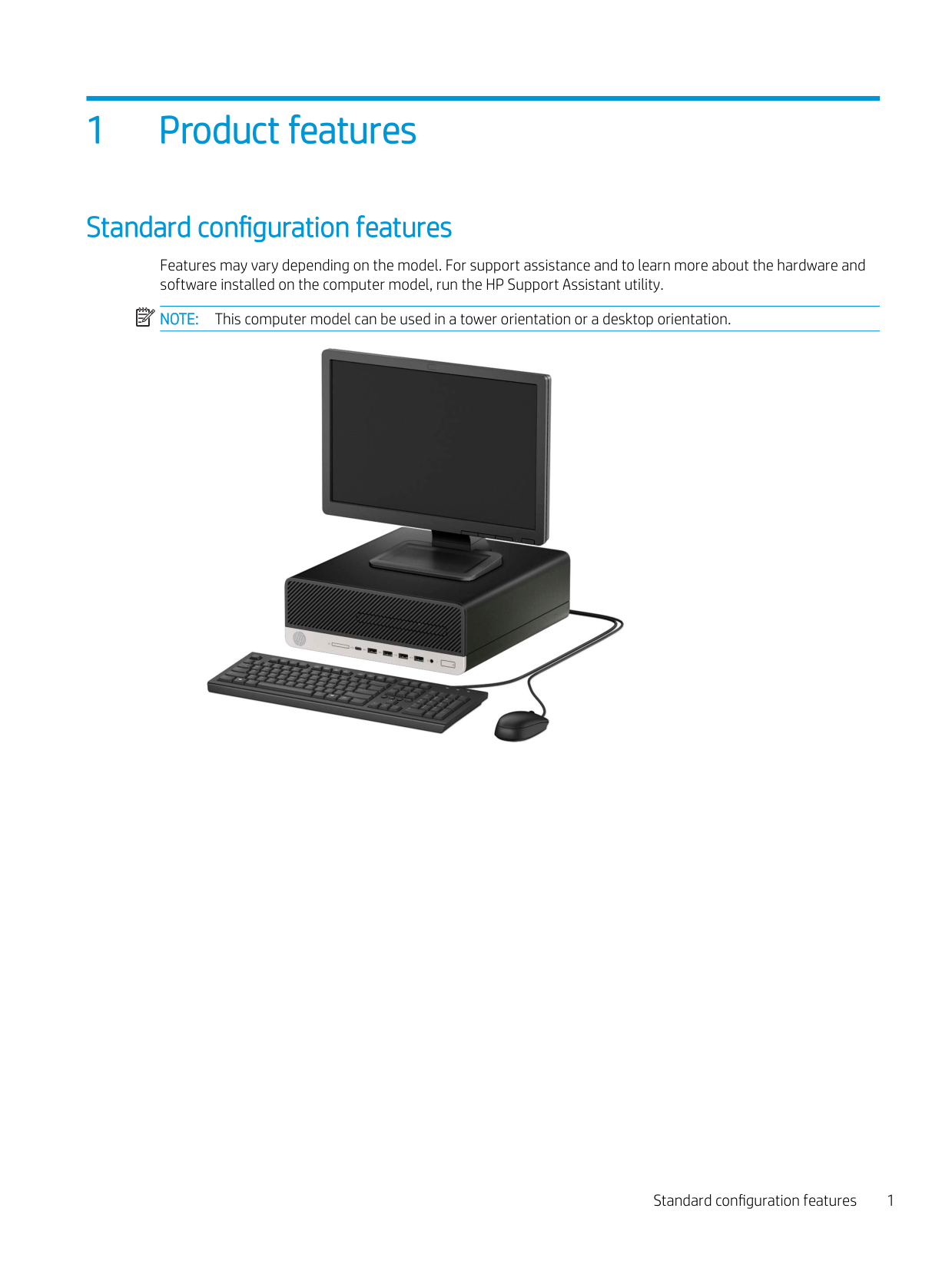
Features may vary depending on the model. For support assistance and to learn more about the hardware and software installed on the computer model, run the HP Support Assistant utility.
| | |---|
NOTE: This computer model can be used in a tower orientation or a desktop orientation.

Standard configuration features 1
Front panel components
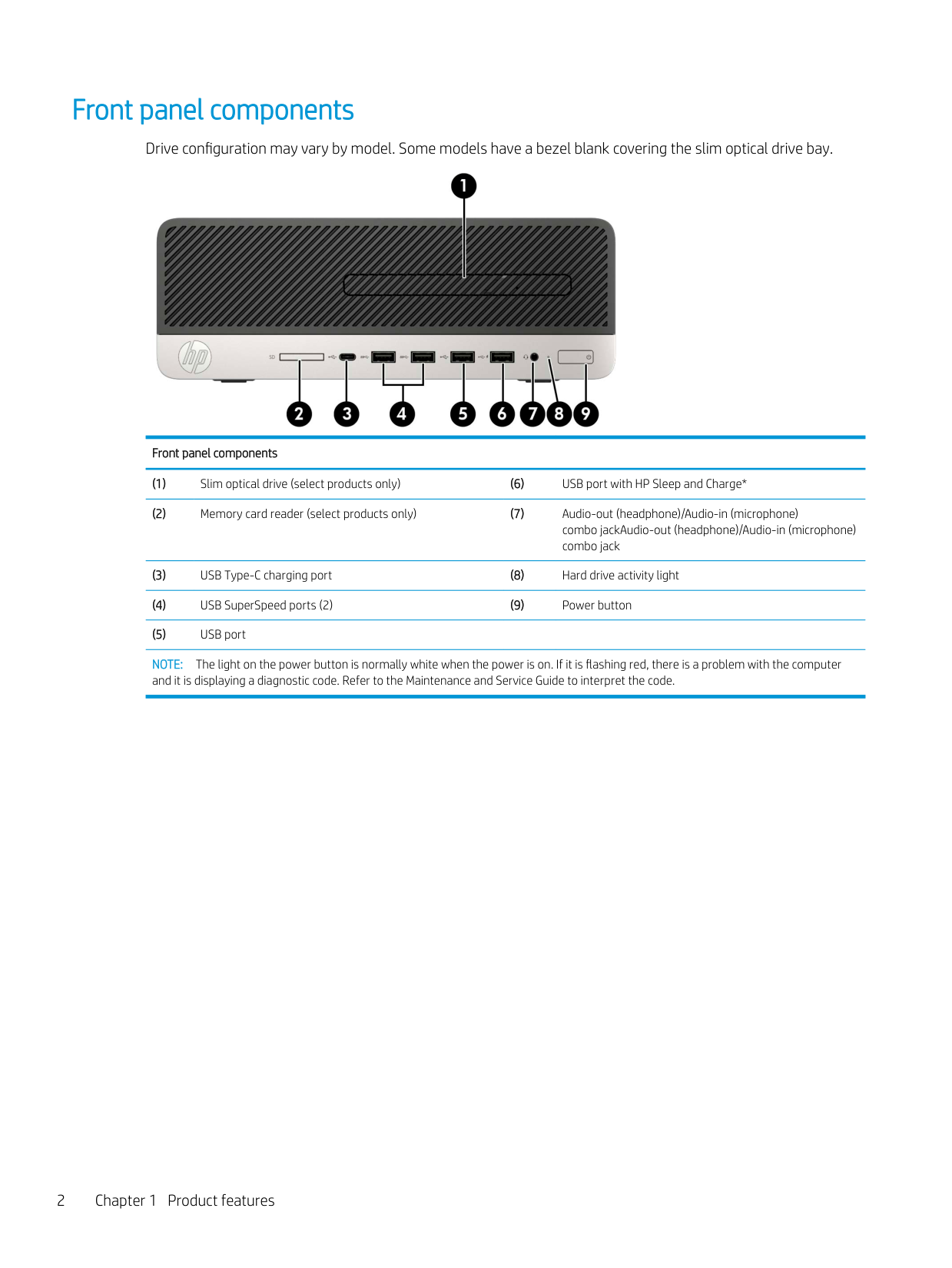
Drive configuration may vary by model. Some models have a bezel blank covering the slim optical drive bay.

Front panel components
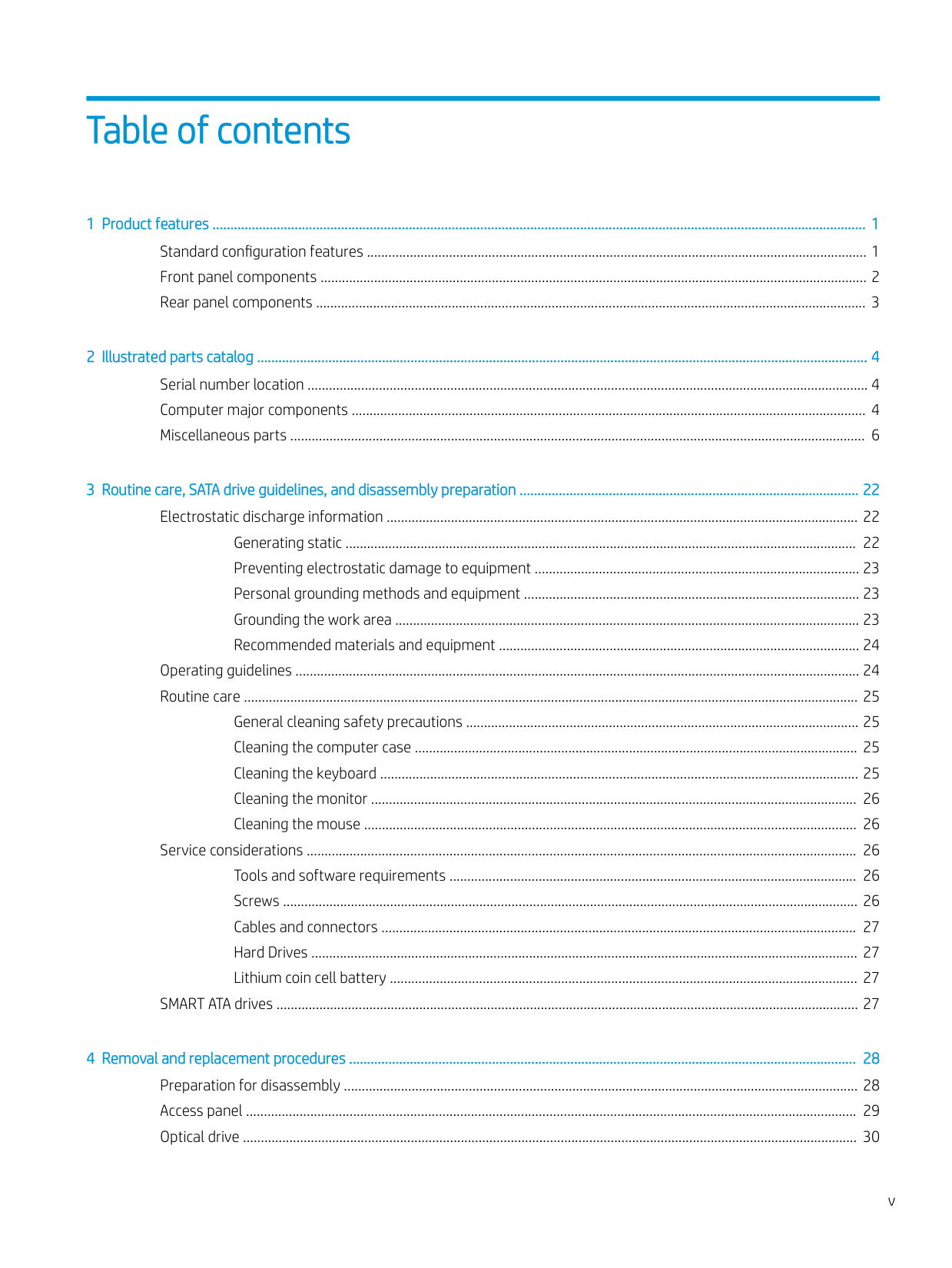
NOTE: The light on the power button is normally white when the power is on. If it is flashing red, there is a problem with the computer and it is displaying a diagnostic code. Refer to the Maintenance and Service Guide to interpret the code.
2 Chapter 1 Product features
Rear panel components

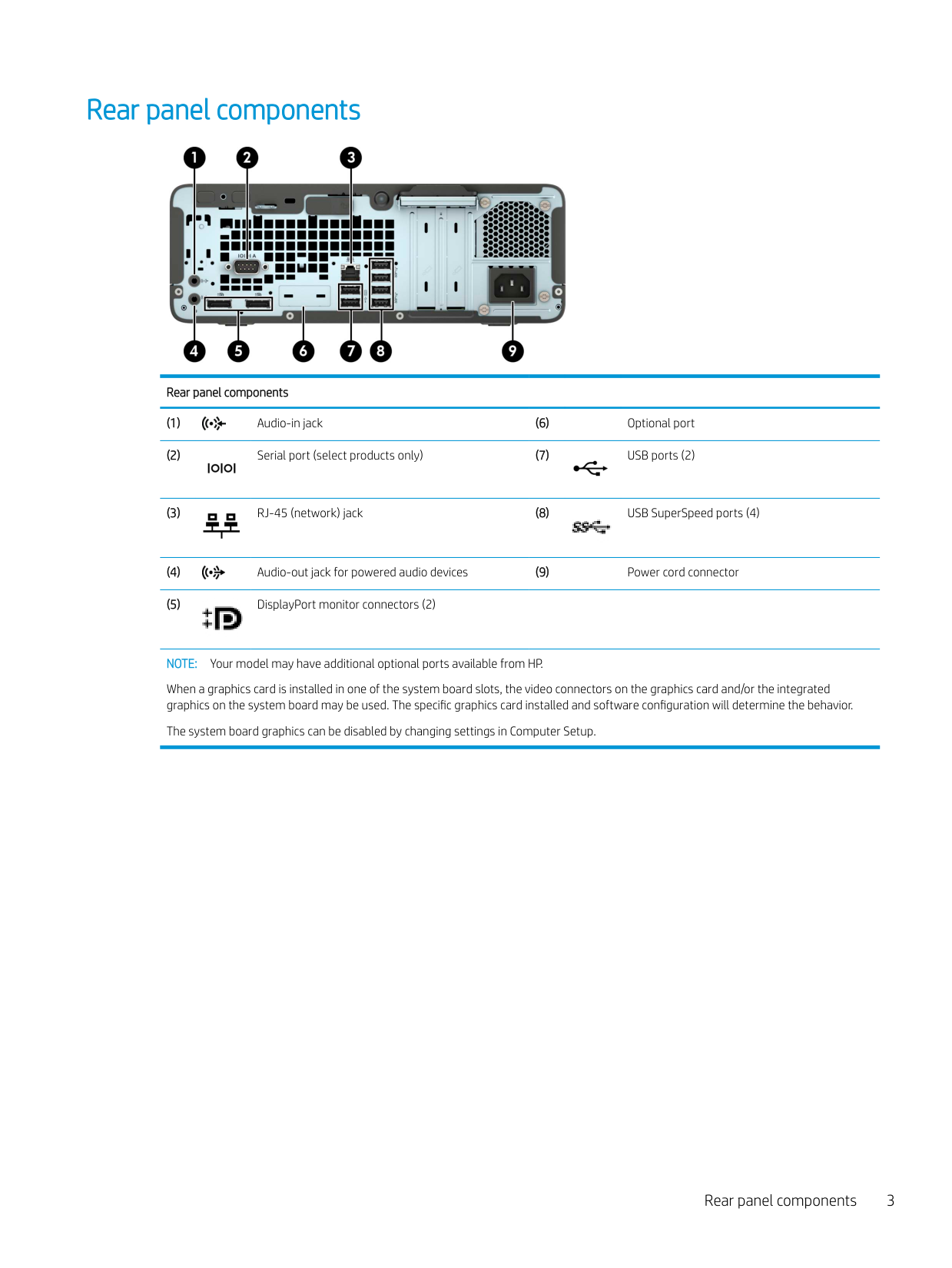
Rear panel components


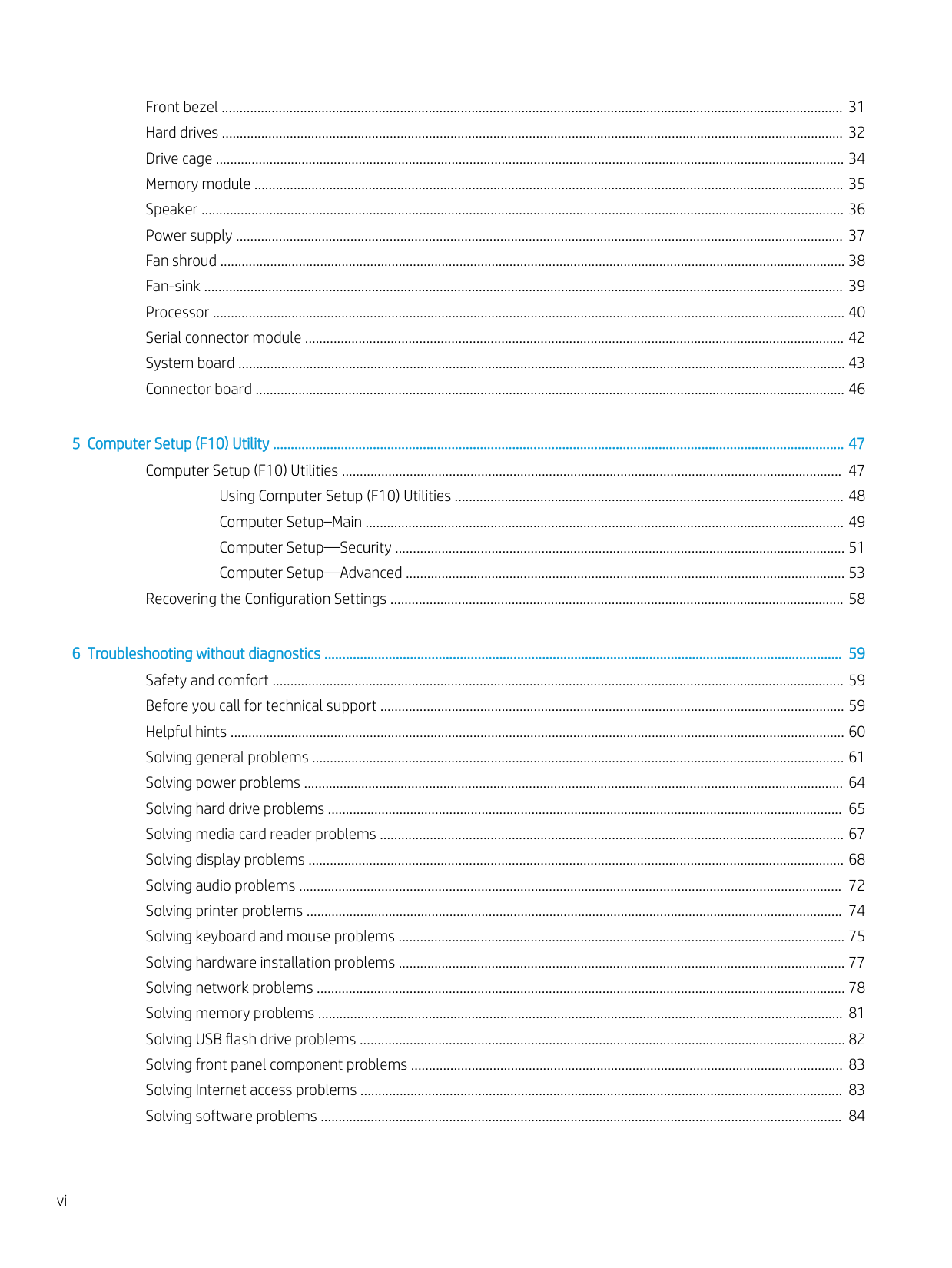


NOTE: Your model may have additional optional ports available from HP.
When a graphics card is installed in one of the system board slots, the video connectors on the graphics card and/or the integrated graphics on the system board may be used. The specific graphics card installed and software configuration will determine the behavior.
The system board graphics can be disabled by changing settings in Computer Setup.
Rear panel components 3
2 Illustrated parts catalog
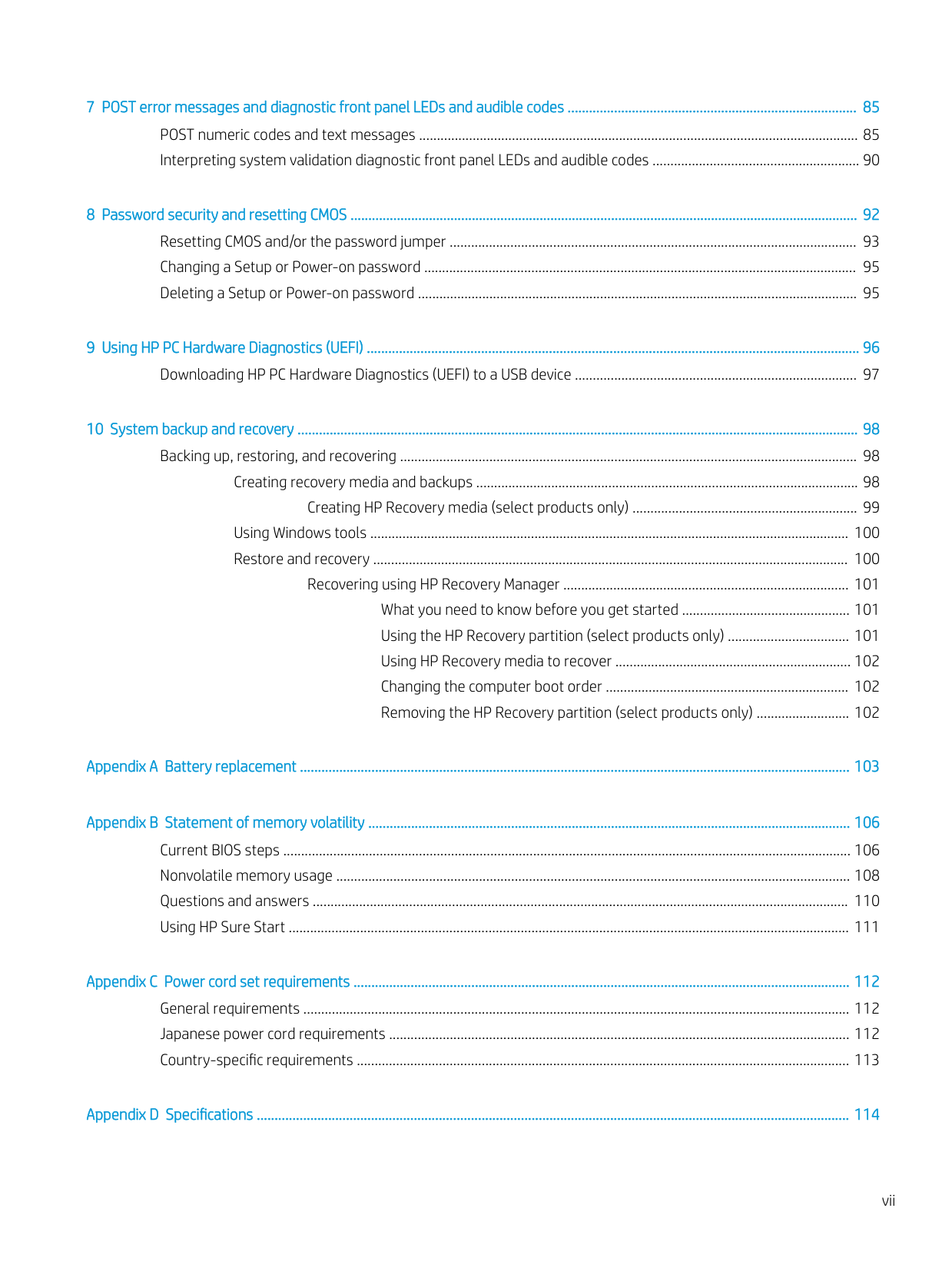
Serial number location
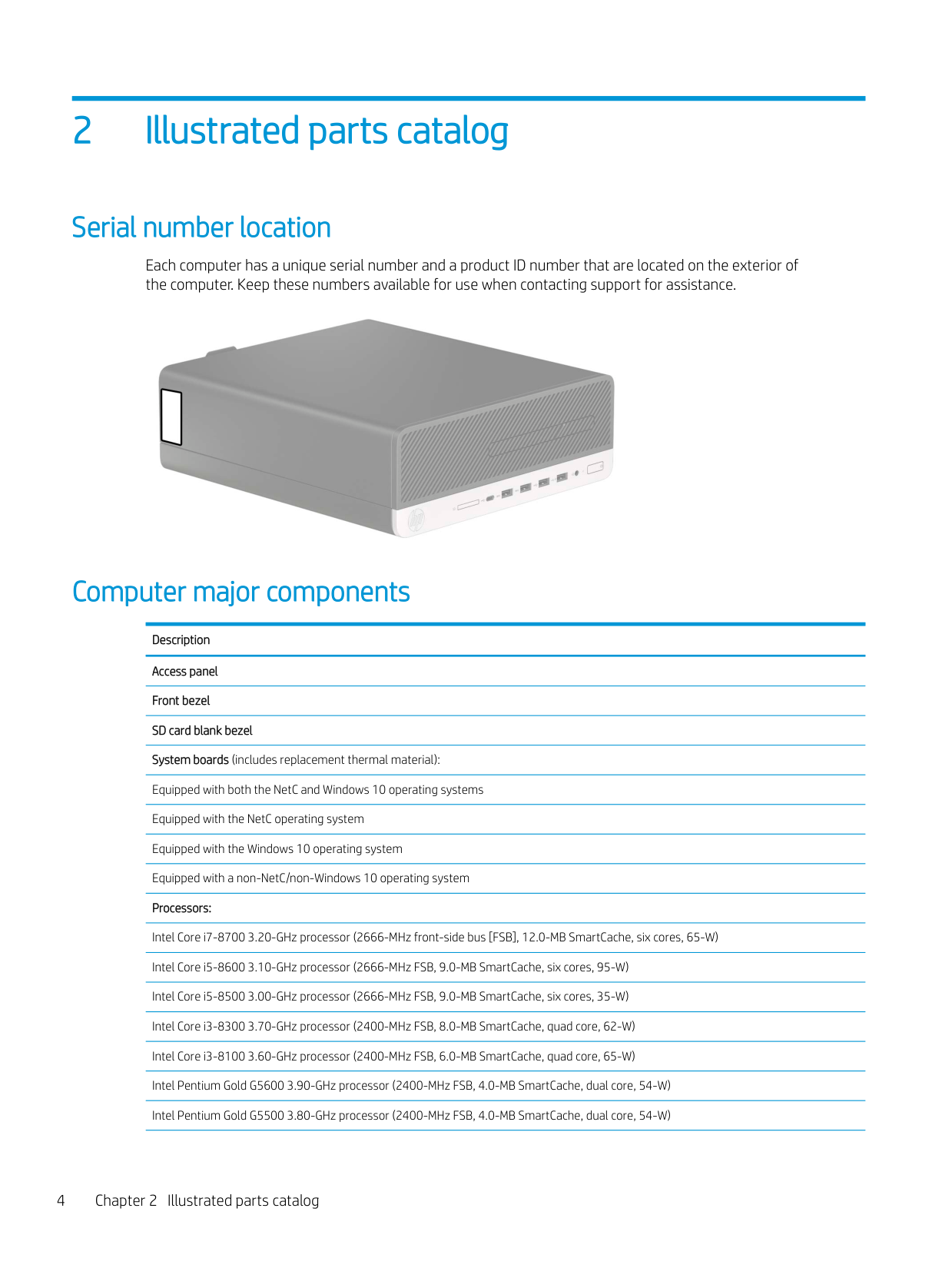
Each computer has a unique serial number and a product ID number that are located on the exterior of the computer. Keep these numbers available for use when contacting support for assistance.

Computer major components
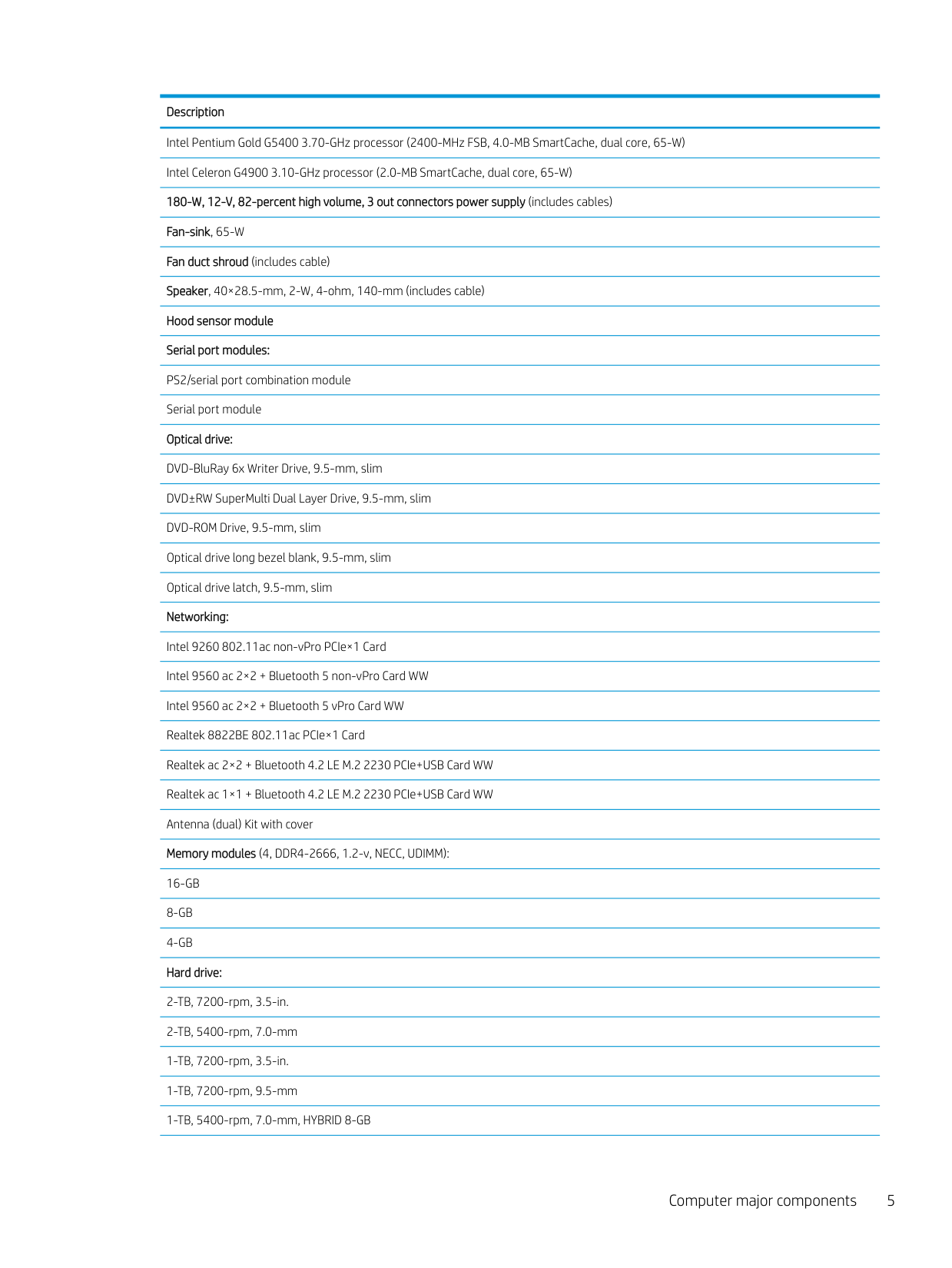
Description Access panel Front bezel SD card blank bezel System boards (includes replacement thermal material): Equipped with both the NetC and Windows 10 operating systems Equipped with the NetC operating system Equipped with the Windows 10 operating system Equipped with a non-NetC/non-Windows 10 operating system Processors: Intel Core i7-8700 3.20-GHz processor (2666-MHz front-side bus [FSB], 12.0-MB SmartCache, six cores, 65-W) Intel Core i5-8600 3.10-GHz processor (2666-MHz FSB, 9.0-MB SmartCache, six cores, 95-W) Intel Core i5-8500 3.00-GHz processor (2666-MHz FSB, 9.0-MB SmartCache, six cores, 35-W) Intel Core i3-8300 3.70-GHz processor (2400-MHz FSB, 8.0-MB SmartCache, quad core, 62-W) Intel Core i3-8100 3.60-GHz processor (2400-MHz FSB, 6.0-MB SmartCache, quad core, 65-W) Intel Pentium Gold G5600 3.90-GHz processor (2400-MHz FSB, 4.0-MB SmartCache, dual core, 54-W) Intel Pentium Gold G5500 3.80-GHz processor (2400-MHz FSB, 4.0-MB SmartCache, dual core, 54-W)
Intel Pentium Gold G5400 3.70-GHz processor (2400-MHz FSB, 4.0-MB SmartCache, dual core, 65-W) Intel Celeron G4900 3.10-GHz processor (2.0-MB SmartCache, dual core, 65-W) 180-W, 12-V, 82-percent high volume, 3 out connectors power supply (includes cables) Fan-sink, 65-W Fan duct shroud (includes cable) Speaker, 40×28.5-mm, 2-W, 4-ohm, 140-mm (includes cable) Hood sensor module Serial port modules: PS2/serial port combination module Serial port module Optical drive: DVD-BluRay 6x Writer Drive, 9.5-mm, slim DVD±RW SuperMulti Dual Layer Drive, 9.5-mm, slim DVD-ROM Drive, 9.5-mm, slim Optical drive long bezel blank, 9.5-mm, slim Optical drive latch, 9.5-mm, slim Networking: Intel 9260 802.11ac non-vPro PCIe×1 Card Intel 9560 ac 2×2 + Bluetooth 5 non-vPro Card WW Intel 9560 ac 2×2 + Bluetooth 5 vPro Card WW Realtek 8822BE 802.11ac PCIe×1 Card Realtek ac 2×2 + Bluetooth 4.2 LE M.2 2230 PCIe+USB Card WW Realtek ac 1×1 + Bluetooth 4.2 LE M.2 2230 PCIe+USB Card WW Antenna (dual) Kit with cover Memory modules (4, DDR4-2666, 1.2-v, NECC, UDIMM): 16-GB 8-GB 4-GB Hard drive: 2-TB, 7200-rpm, 3.5-in. 2-TB, 5400-rpm, 7.0-mm 1-TB, 7200-rpm, 3.5-in. 1-TB, 7200-rpm, 9.5-mm 1-TB, 5400-rpm, 7.0-mm, HYBRID 8-GB
Computer major components 5
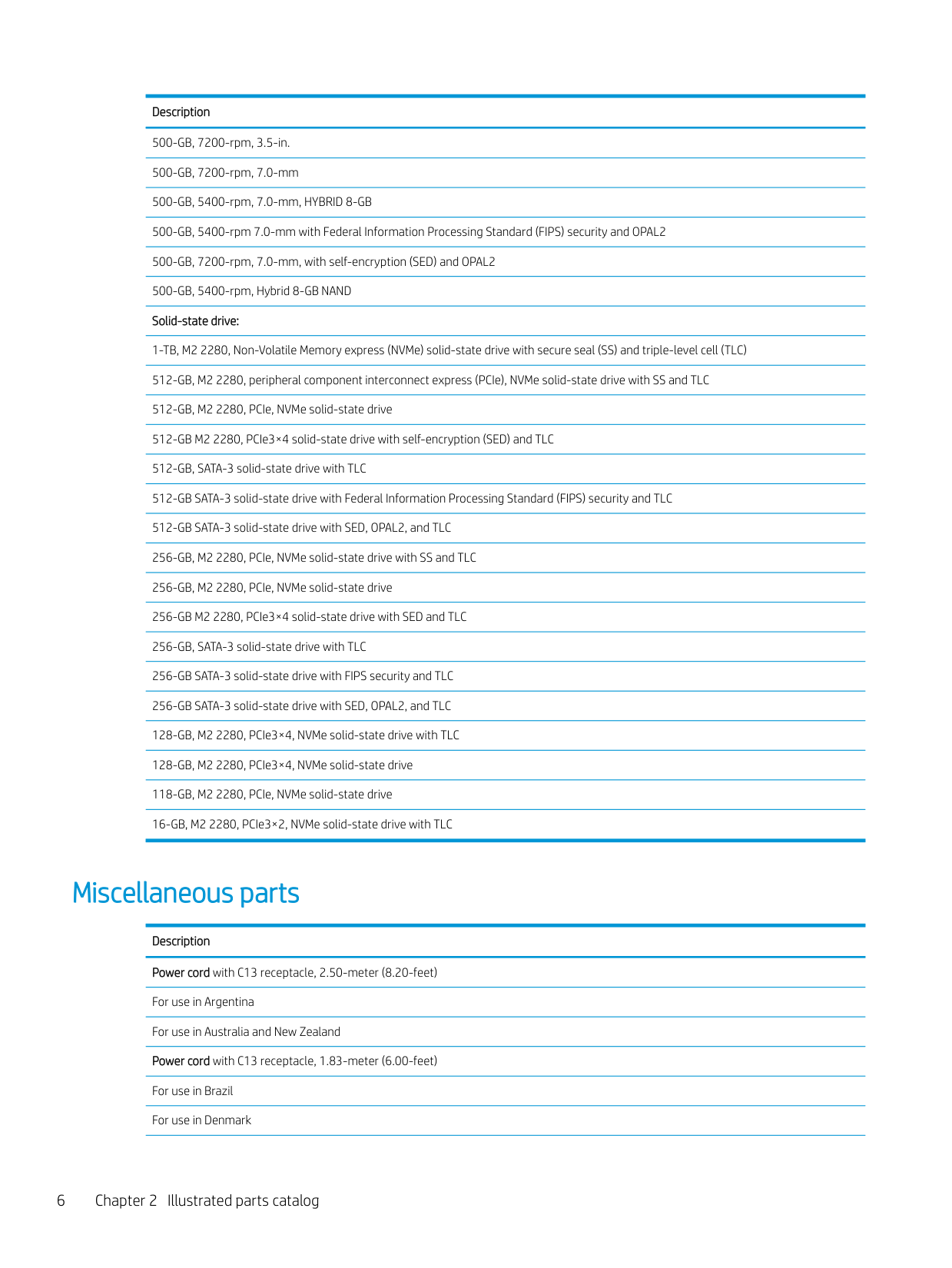
500-GB, 7200-rpm, 3.5-in. 500-GB, 7200-rpm, 7.0-mm 500-GB, 5400-rpm, 7.0-mm, HYBRID 8-GB 500-GB, 5400-rpm 7.0-mm with Federal Information Processing Standard (FIPS) security and OPAL2 500-GB, 7200-rpm, 7.0-mm, with self-encryption (SED) and OPAL2 500-GB, 5400-rpm, Hybrid 8-GB NAND Solid-state drive: 1-TB, M2 2280, Non-Volatile Memory express (NVMe) solid-state drive with secure seal (SS) and triple-level cell (TLC) 512-GB, M2 2280, peripheral component interconnect express (PCIe), NVMe solid-state drive with SS and TLC 512-GB, M2 2280, PCIe, NVMe solid-state drive 512-GB M2 2280, PCIe3×4 solid-state drive with self-encryption (SED) and TLC 512-GB, SATA-3 solid-state drive with TLC 512-GB SATA-3 solid-state drive with Federal Information Processing Standard (FIPS) security and TLC 512-GB SATA-3 solid-state drive with SED, OPAL2, and TLC 256-GB, M2 2280, PCIe, NVMe solid-state drive with SS and TLC 256-GB, M2 2280, PCIe, NVMe solid-state drive 256-GB M2 2280, PCIe3×4 solid-state drive with SED and TLC 256-GB, SATA-3 solid-state drive with TLC 256-GB SATA-3 solid-state drive with FIPS security and TLC 256-GB SATA-3 solid-state drive with SED, OPAL2, and TLC 128-GB, M2 2280, PCIe3×4, NVMe solid-state drive with TLC 128-GB, M2 2280, PCIe3×4, NVMe solid-state drive 118-GB, M2 2280, PCIe, NVMe solid-state drive 16-GB, M2 2280, PCIe3×2, NVMe solid-state drive with TLC
Miscellaneous parts
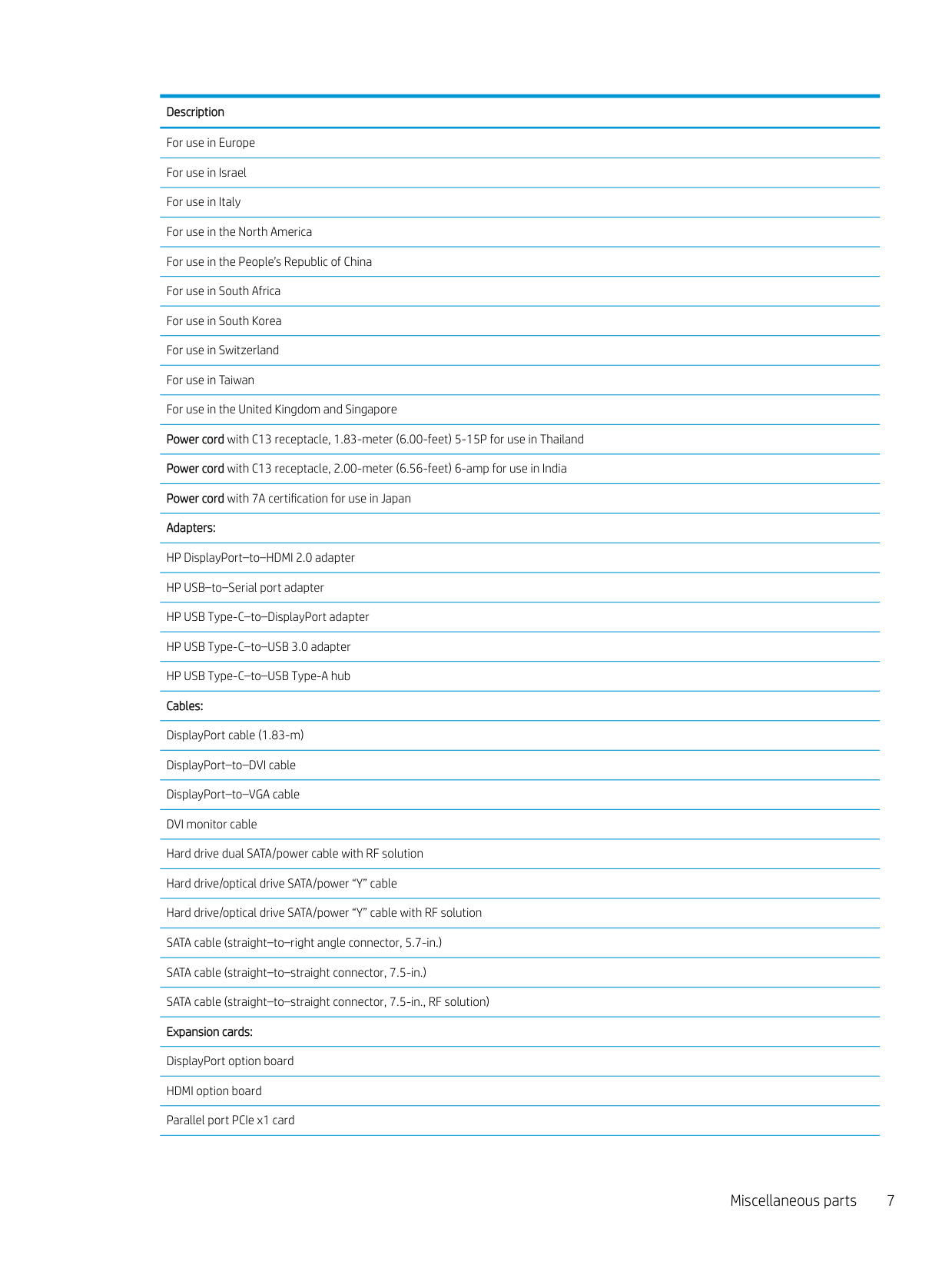
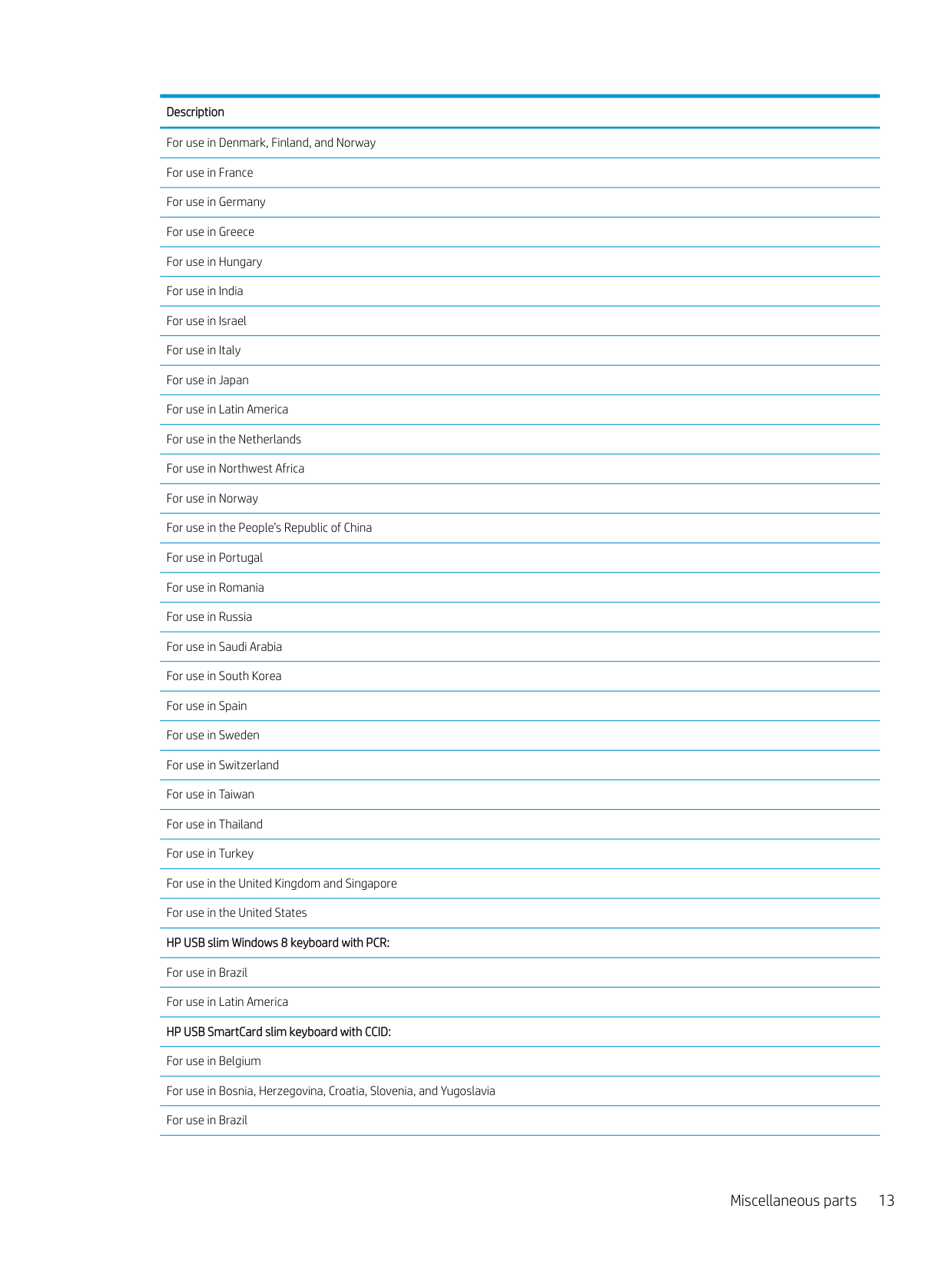
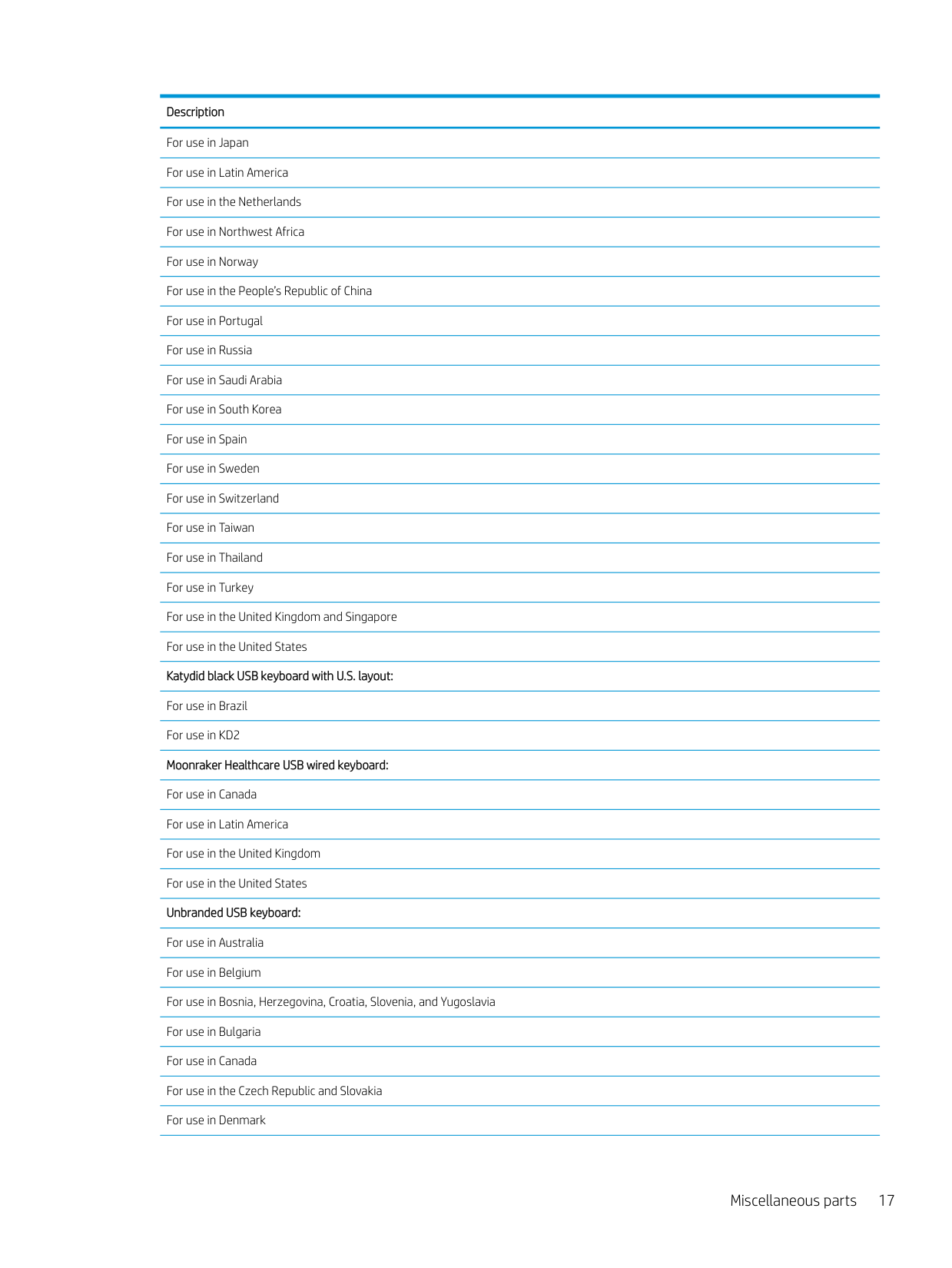
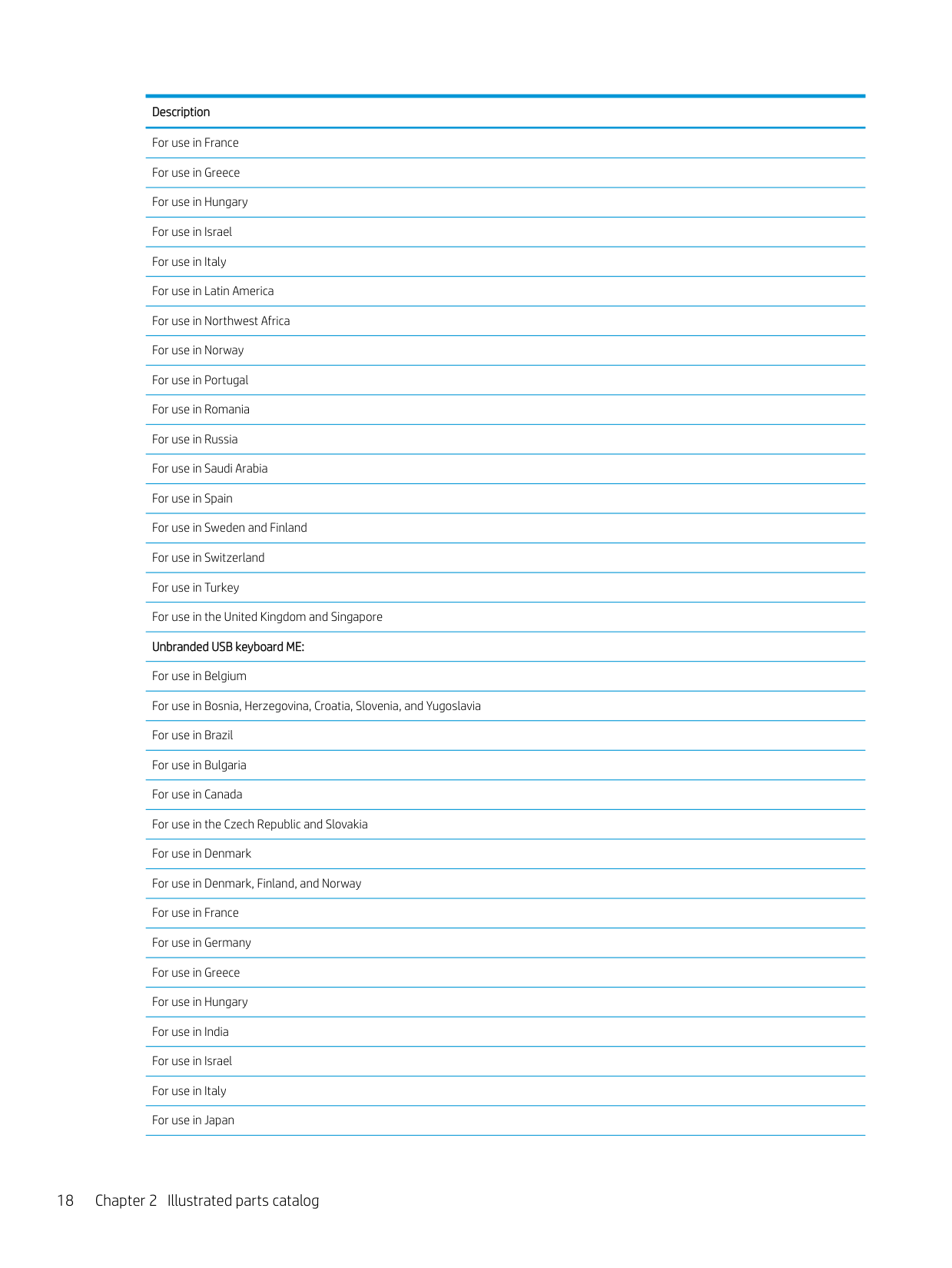
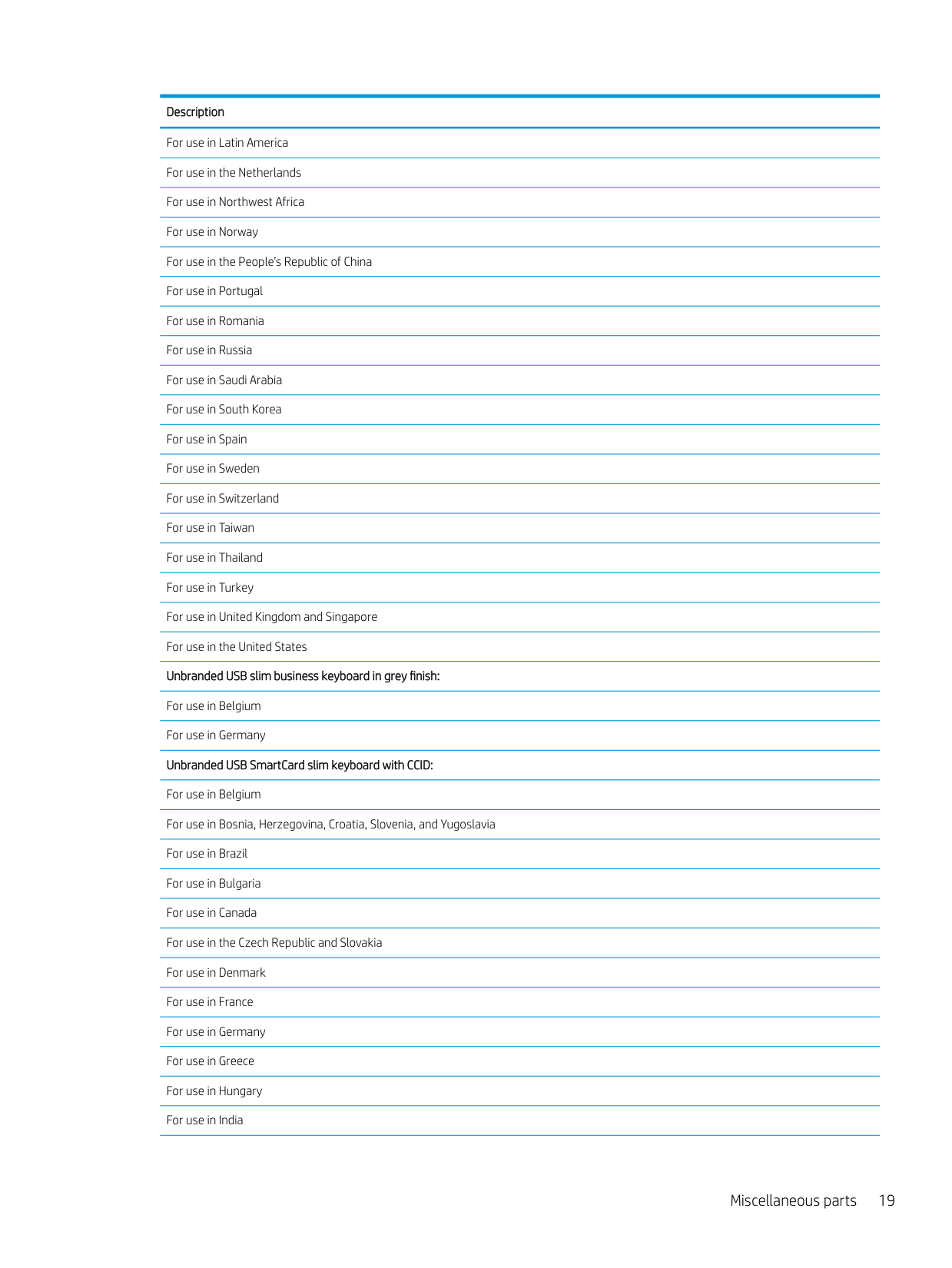
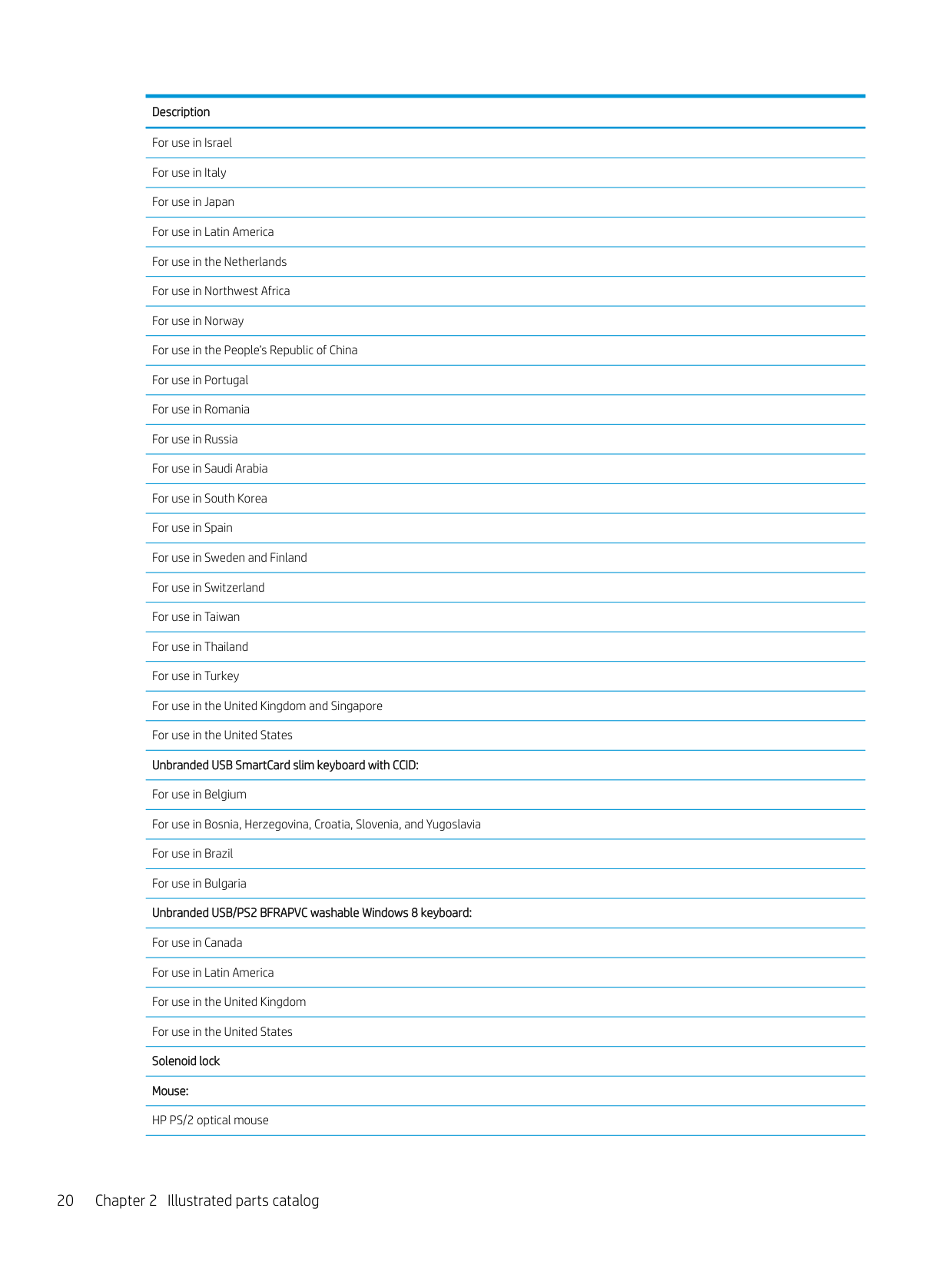
Description Power cord with C13 receptacle, 2.50-meter (8.20-feet) For use in Argentina For use in Australia and New Zealand Power cord with C13 receptacle, 1.83-meter (6.00-feet) For use in Brazil For use in Denmark
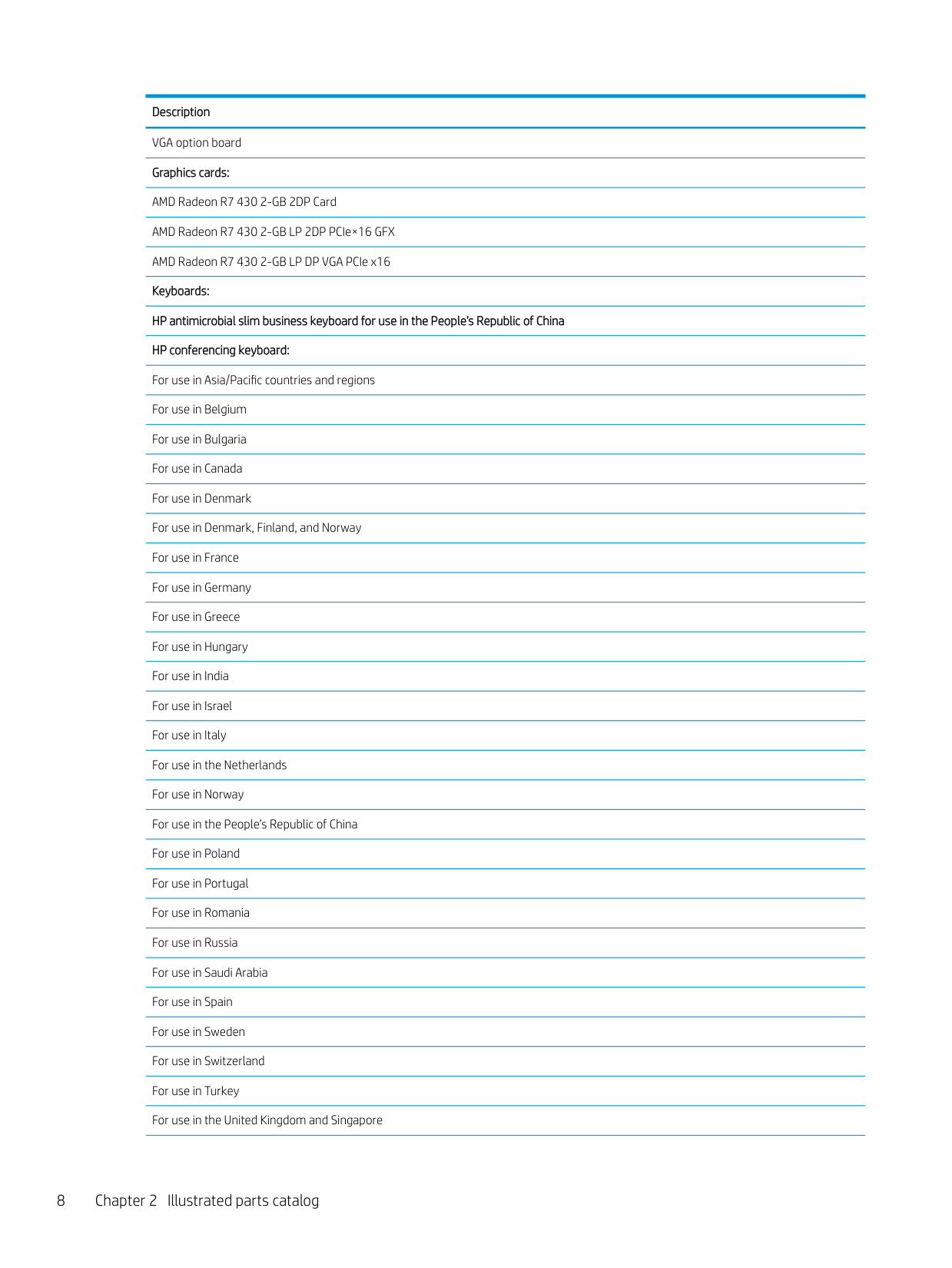
For use in Europe For use in Israel For use in Italy For use in the North America For use in the People’s Republic of China For use in South Africa For use in South Korea For use in Switzerland For use in Taiwan For use in the United Kingdom and Singapore
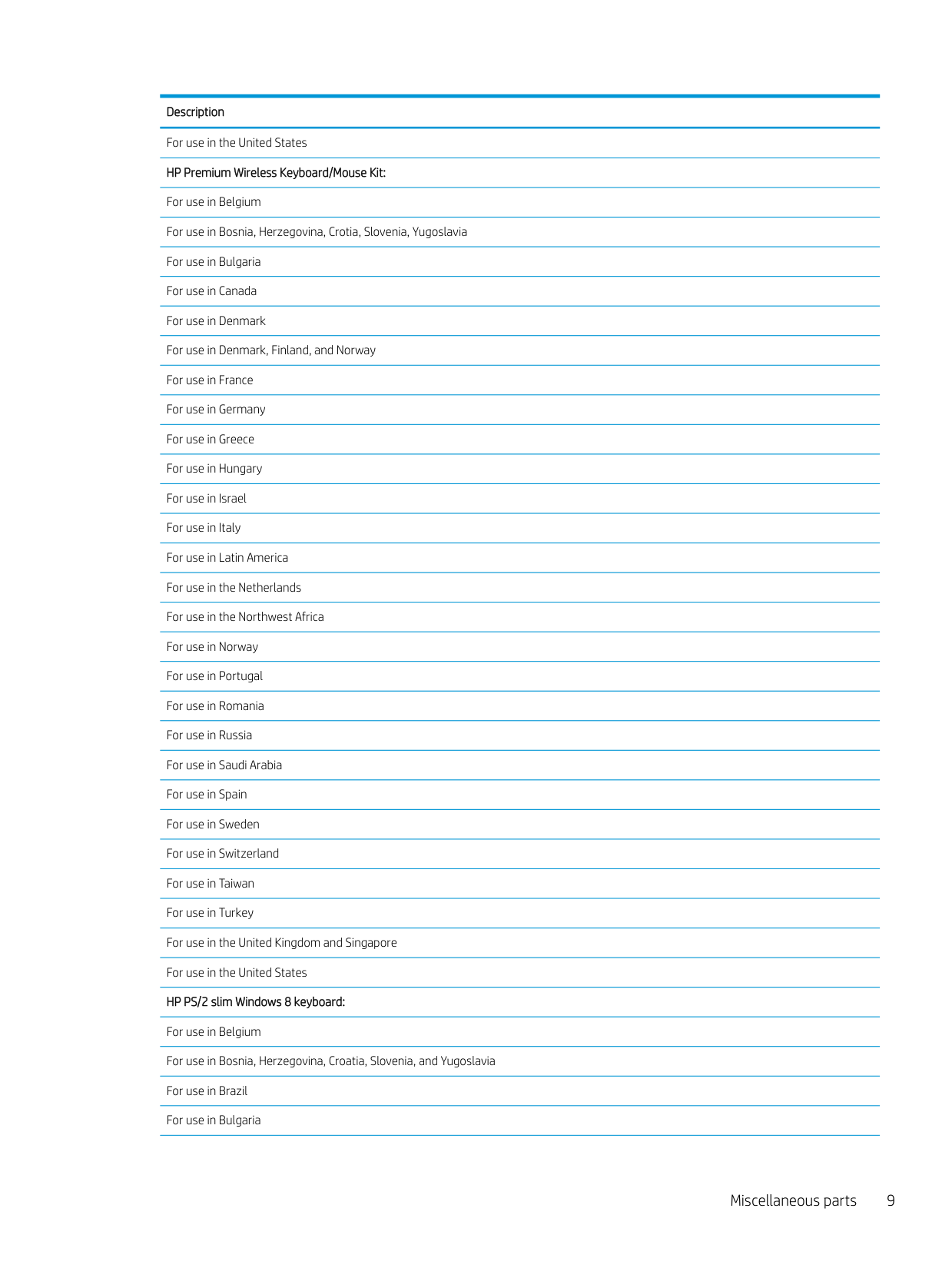
VGA option board Graphics cards: AMD Radeon R7 430 2-GB 2DP Card AMD Radeon R7 430 2-GB LP 2DP PCIe×16 GFX AMD Radeon R7 430 2-GB LP DP VGA PCIe x16 Keyboards: HP antimicrobial slim business keyboard for use in the People’s Republic of China HP conferencing keyboard: For use in Asia/Pacific countries and regions For use in Belgium For use in Bulgaria For use in Canada For use in Denmark For use in Denmark, Finland, and Norway For use in France For use in Germany For use in Greece For use in Hungary For use in India For use in Israel For use in Italy For use in the Netherlands For use in Norway For use in the People’s Republic of China For use in Poland For use in Portugal For use in Romania For use in Russia For use in Saudi Arabia For use in Spain For use in Sweden For use in Switzerland For use in Turkey For use in the United Kingdom and Singapore
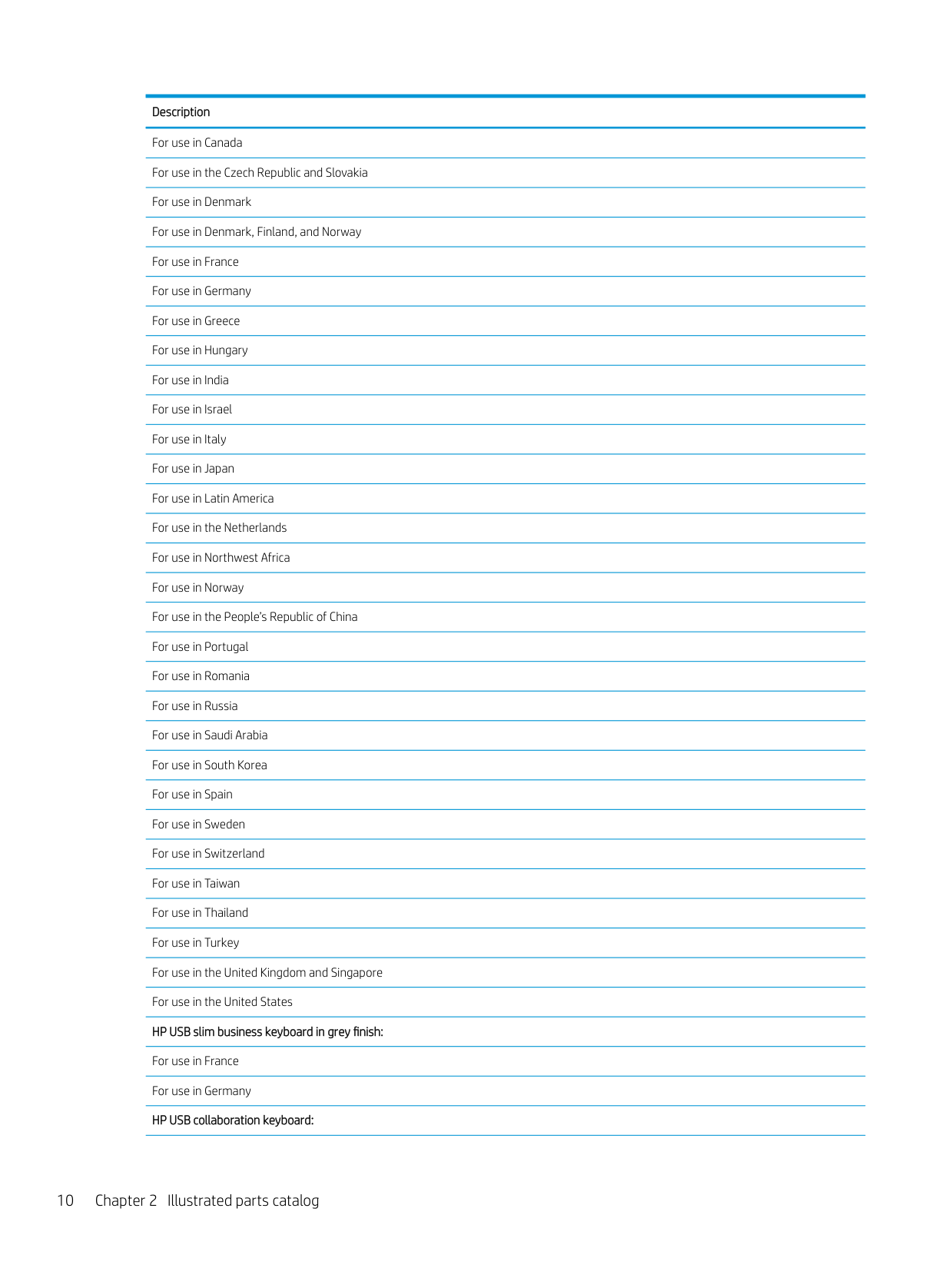
For use in the United States HP Premium Wireless Keyboard/Mouse Kit: For use in Belgium For use in Bosnia, Herzegovina, Crotia, Slovenia, Yugoslavia For use in Bulgaria For use in Canada For use in Denmark For use in Denmark, Finland, and Norway For use in France For use in Germany For use in Greece For use in Hungary For use in Israel For use in Italy For use in Latin America For use in the Netherlands For use in the Northwest Africa For use in Norway For use in Portugal For use in Romania For use in Russia For use in Saudi Arabia For use in Spain For use in Sweden For use in Switzerland For use in Taiwan For use in Turkey For use in the United Kingdom and Singapore For use in the United States HP PS/2 slim Windows 8 keyboard: For use in Belgium For use in Bosnia, Herzegovina, Croatia, Slovenia, and Yugoslavia For use in Brazil For use in Bulgaria
For use in Canada For use in the Czech Republic and Slovakia For use in Denmark For use in Denmark, Finland, and Norway For use in France For use in Germany For use in Greece For use in Hungary For use in India For use in Israel For use in Italy For use in Japan For use in Latin America For use in the Netherlands For use in Northwest Africa For use in Norway For use in the People’s Republic of China For use in Portugal For use in Romania For use in Russia For use in Saudi Arabia For use in South Korea For use in Spain For use in Sweden For use in Switzerland For use in Taiwan For use in Thailand For use in Turkey For use in the United Kingdom and Singapore For use in the United States HP USB slim business keyboard in grey finish: For use in France For use in Germany HP USB collaboration keyboard:
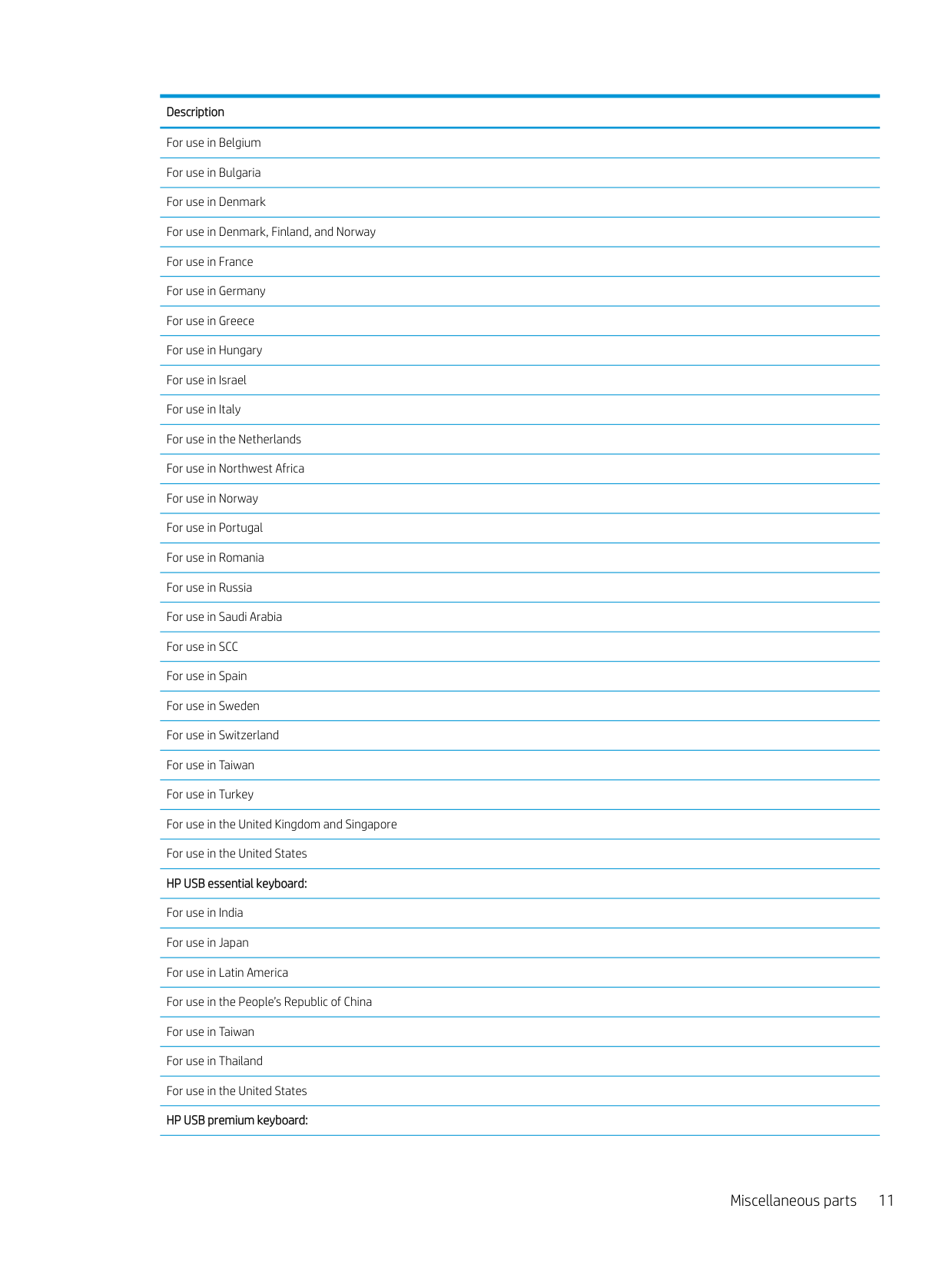
For use in Denmark For use in Denmark, Finland, and Norway For use in France For use in Germany For use in Greece For use in Hungary For use in Israel For use in Italy For use in the Netherlands For use in Northwest Africa For use in Norway For use in Portugal For use in Romania For use in Russia For use in Saudi Arabia For use in SCC For use in Spain For use in Sweden For use in Switzerland For use in Taiwan For use in Turkey For use in the United Kingdom and Singapore For use in the United States HP USB essential keyboard: For use in India For use in Japan For use in Latin America For use in the People’s Republic of China For use in Taiwan For use in Thailand For use in the United States HP USB premium keyboard:

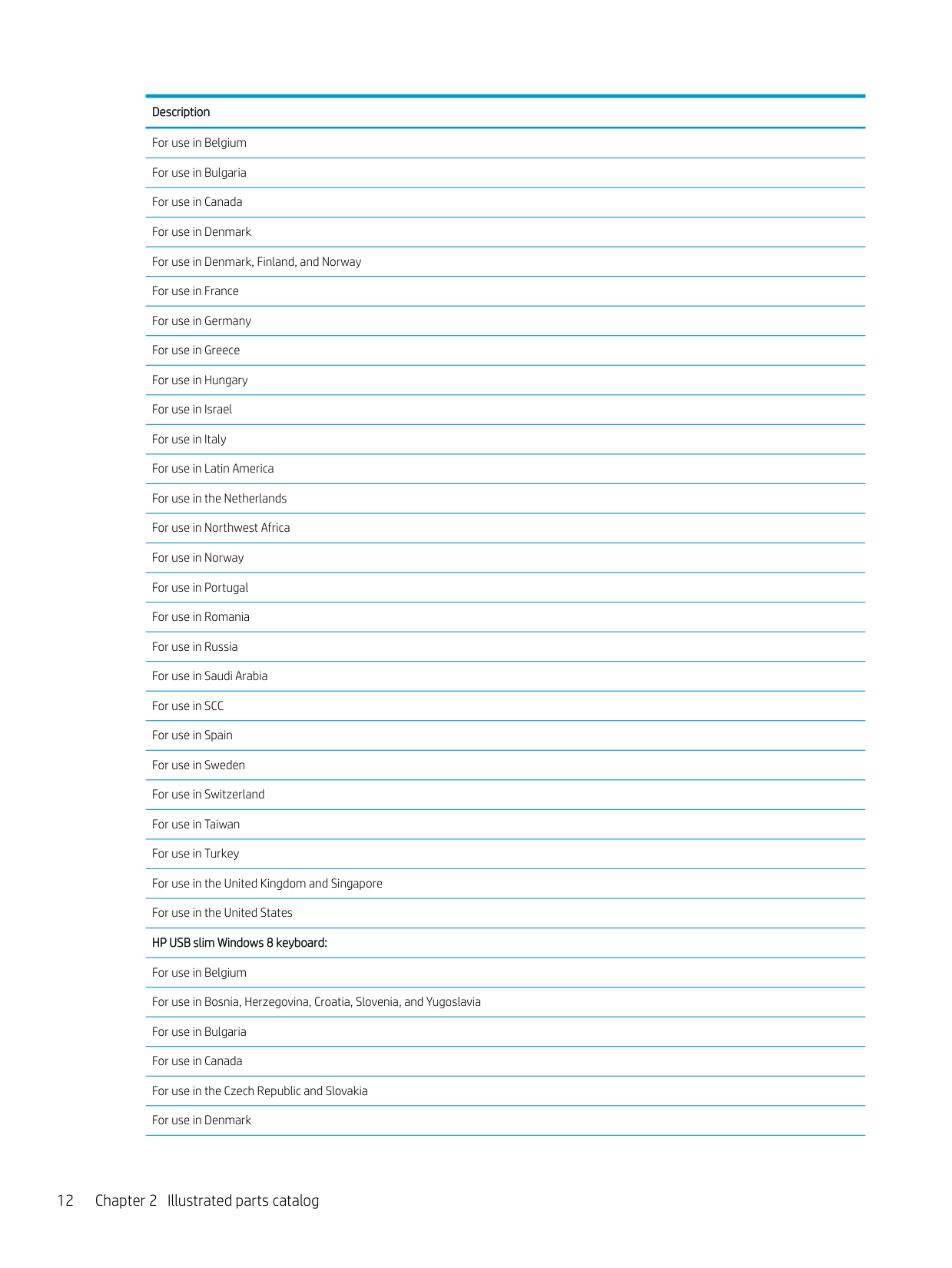
For use in Canada For use in Denmark For use in Denmark, Finland, and Norway For use in France For use in Germany For use in Greece For use in Hungary For use in Israel For use in Italy For use in Latin America For use in the Netherlands For use in Northwest Africa For use in Norway For use in Portugal For use in Romania For use in Russia For use in Saudi Arabia For use in SCC For use in Spain For use in Sweden For use in Switzerland For use in Taiwan For use in Turkey For use in the United Kingdom and Singapore For use in the United States HP USB slim Windows 8 keyboard: For use in Belgium For use in Bosnia, Herzegovina, Croatia, Slovenia, and Yugoslavia For use in Bulgaria For use in Canada For use in the Czech Republic and Slovakia For use in Denmark
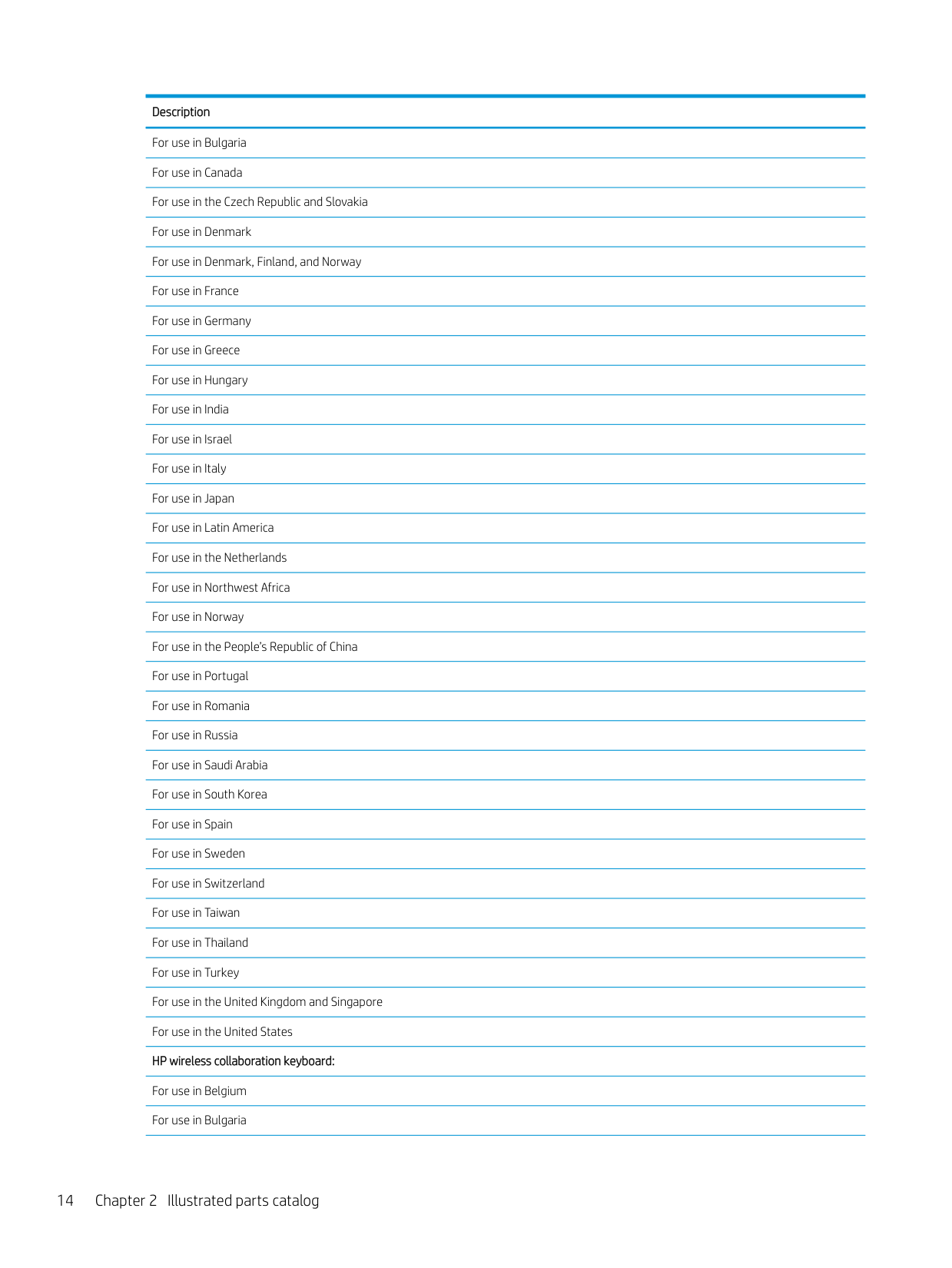
For use in Denmark, Finland, and Norway For use in France For use in Germany For use in Greece For use in Hungary For use in India For use in Israel For use in Italy For use in Japan For use in Latin America For use in the Netherlands For use in Northwest Africa For use in Norway For use in the People’s Republic of China For use in Portugal For use in Romania For use in Russia For use in Saudi Arabia For use in South Korea For use in Spain For use in Sweden For use in Switzerland For use in Taiwan For use in Thailand For use in Turkey For use in the United Kingdom and Singapore For use in the United States HP USB slim Windows 8 keyboard with PCR: For use in Brazil For use in Latin America HP USB SmartCard slim keyboard with CCID: For use in Belgium For use in Bosnia, Herzegovina, Croatia, Slovenia, and Yugoslavia For use in Brazil
For use in Bulgaria For use in Canada For use in the Czech Republic and Slovakia For use in Denmark For use in Denmark, Finland, and Norway For use in France For use in Germany For use in Greece For use in Hungary For use in India For use in Israel For use in Italy For use in Japan For use in Latin America For use in the Netherlands For use in Northwest Africa For use in Norway For use in the People’s Republic of China For use in Portugal For use in Romania For use in Russia For use in Saudi Arabia For use in South Korea For use in Spain For use in Sweden For use in Switzerland For use in Taiwan For use in Thailand For use in Turkey For use in the United Kingdom and Singapore For use in the United States HP wireless collaboration keyboard:
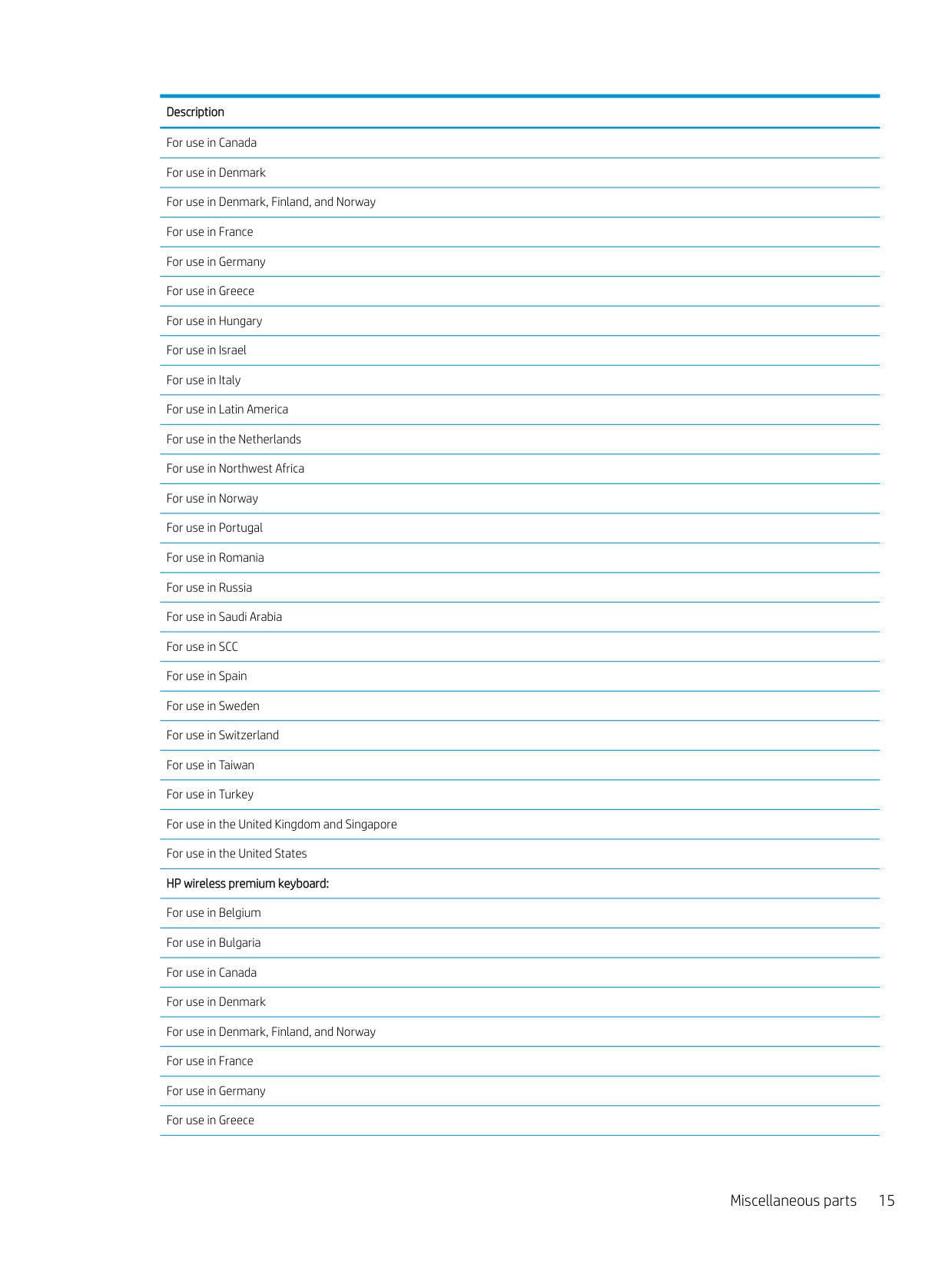
For use in Belgium For use in Bulgaria
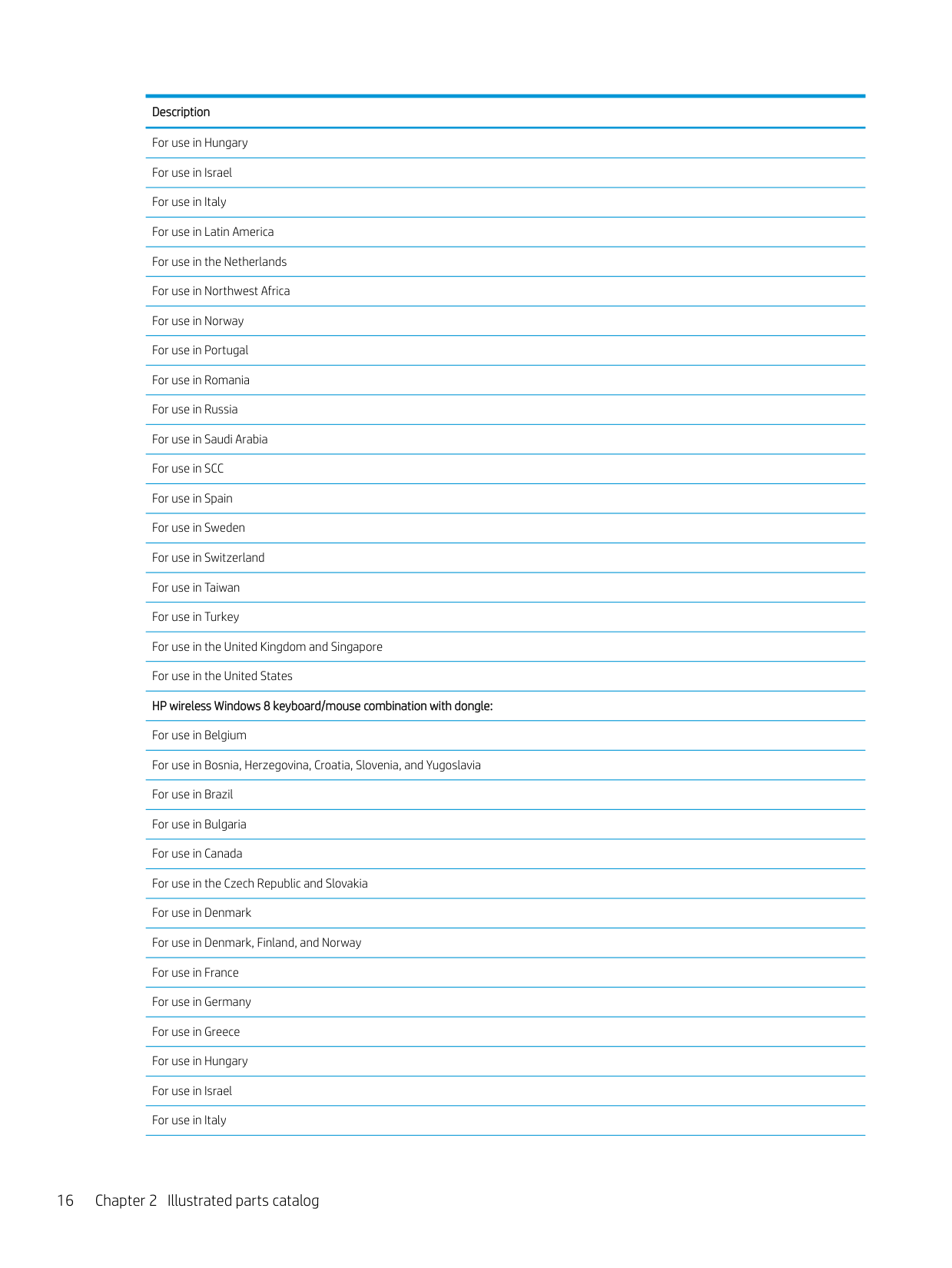
For use in Canada For use in Denmark For use in Denmark, Finland, and Norway For use in France For use in Germany For use in Greece For use in Hungary For use in Israel For use in Italy For use in Latin America For use in the Netherlands For use in Northwest Africa For use in Norway For use in Portugal For use in Romania For use in Russia For use in Saudi Arabia For use in SCC For use in Spain For use in Sweden For use in Switzerland For use in Taiwan For use in Turkey For use in the United Kingdom and Singapore For use in the United States HP wireless premium keyboard: For use in Belgium For use in Bulgaria For use in Canada For use in Denmark For use in Denmark, Finland, and Norway For use in France For use in Germany For use in Greece
For use in Hungary For use in Israel For use in Italy For use in Latin America For use in the Netherlands For use in Northwest Africa For use in Norway For use in Portugal For use in Romania For use in Russia For use in Saudi Arabia For use in SCC For use in Spain For use in Sweden For use in Switzerland For use in Taiwan For use in Turkey For use in the United Kingdom and Singapore For use in the United States HP wireless Windows 8 keyboard/mouse combination with dongle: For use in Belgium For use in Bosnia, Herzegovina, Croatia, Slovenia, and Yugoslavia For use in Brazil For use in Bulgaria For use in Canada For use in the Czech Republic and Slovakia For use in Denmark For use in Denmark, Finland, and Norway For use in France For use in Germany For use in Greece For use in Hungary For use in Israel For use in Italy
For use in Japan For use in Latin America For use in the Netherlands For use in Northwest Africa For use in Norway For use in the People’s Republic of China For use in Portugal For use in Russia For use in Saudi Arabia For use in South Korea For use in Spain For use in Sweden For use in Switzerland For use in Taiwan For use in Thailand For use in Turkey For use in the United Kingdom and Singapore For use in the United States Katydid black USB keyboard with U.S. layout: For use in Brazil For use in KD2 Moonraker Healthcare USB wired keyboard: For use in Canada For use in Latin America For use in the United Kingdom For use in the United States Unbranded USB keyboard: For use in Australia For use in Belgium For use in Bosnia, Herzegovina, Croatia, Slovenia, and Yugoslavia For use in Bulgaria For use in Canada For use in the Czech Republic and Slovakia For use in Denmark
For use in France For use in Greece For use in Hungary For use in Israel For use in Italy For use in Latin America For use in Northwest Africa For use in Norway For use in Portugal For use in Romania For use in Russia For use in Saudi Arabia For use in Spain For use in Sweden and Finland For use in Switzerland For use in Turkey For use in the United Kingdom and Singapore Unbranded USB keyboard ME: For use in Belgium For use in Bosnia, Herzegovina, Croatia, Slovenia, and Yugoslavia For use in Brazil For use in Bulgaria For use in Canada For use in the Czech Republic and Slovakia For use in Denmark For use in Denmark, Finland, and Norway For use in France For use in Germany For use in Greece For use in Hungary For use in India For use in Israel For use in Italy For use in Japan
For use in Latin America For use in the Netherlands For use in Northwest Africa For use in Norway For use in the People’s Republic of China For use in Portugal For use in Romania For use in Russia For use in Saudi Arabia For use in South Korea For use in Spain For use in Sweden For use in Switzerland For use in Taiwan For use in Thailand For use in Turkey For use in United Kingdom and Singapore For use in the United States Unbranded USB slim business keyboard in grey finish: For use in Belgium For use in Germany Unbranded USB SmartCard slim keyboard with CCID: For use in Belgium For use in Bosnia, Herzegovina, Croatia, Slovenia, and Yugoslavia For use in Brazil For use in Bulgaria For use in Canada For use in the Czech Republic and Slovakia For use in Denmark For use in France For use in Germany For use in Greece For use in Hungary For use in India
For use in Israel For use in Italy For use in Japan For use in Latin America For use in the Netherlands For use in Northwest Africa For use in Norway For use in the People’s Republic of China For use in Portugal For use in Romania For use in Russia For use in Saudi Arabia For use in South Korea For use in Spain For use in Sweden and Finland For use in Switzerland For use in Taiwan For use in Thailand For use in Turkey For use in the United Kingdom and Singapore For use in the United States Unbranded USB SmartCard slim keyboard with CCID: For use in Belgium For use in Bosnia, Herzegovina, Croatia, Slovenia, and Yugoslavia For use in Brazil For use in Bulgaria Unbranded USB/PS2 BFRAPVC washable Windows 8 keyboard: For use in Canada For use in Latin America For use in the United Kingdom For use in the United States Solenoid lock Mouse: HP PS/2 optical mouse
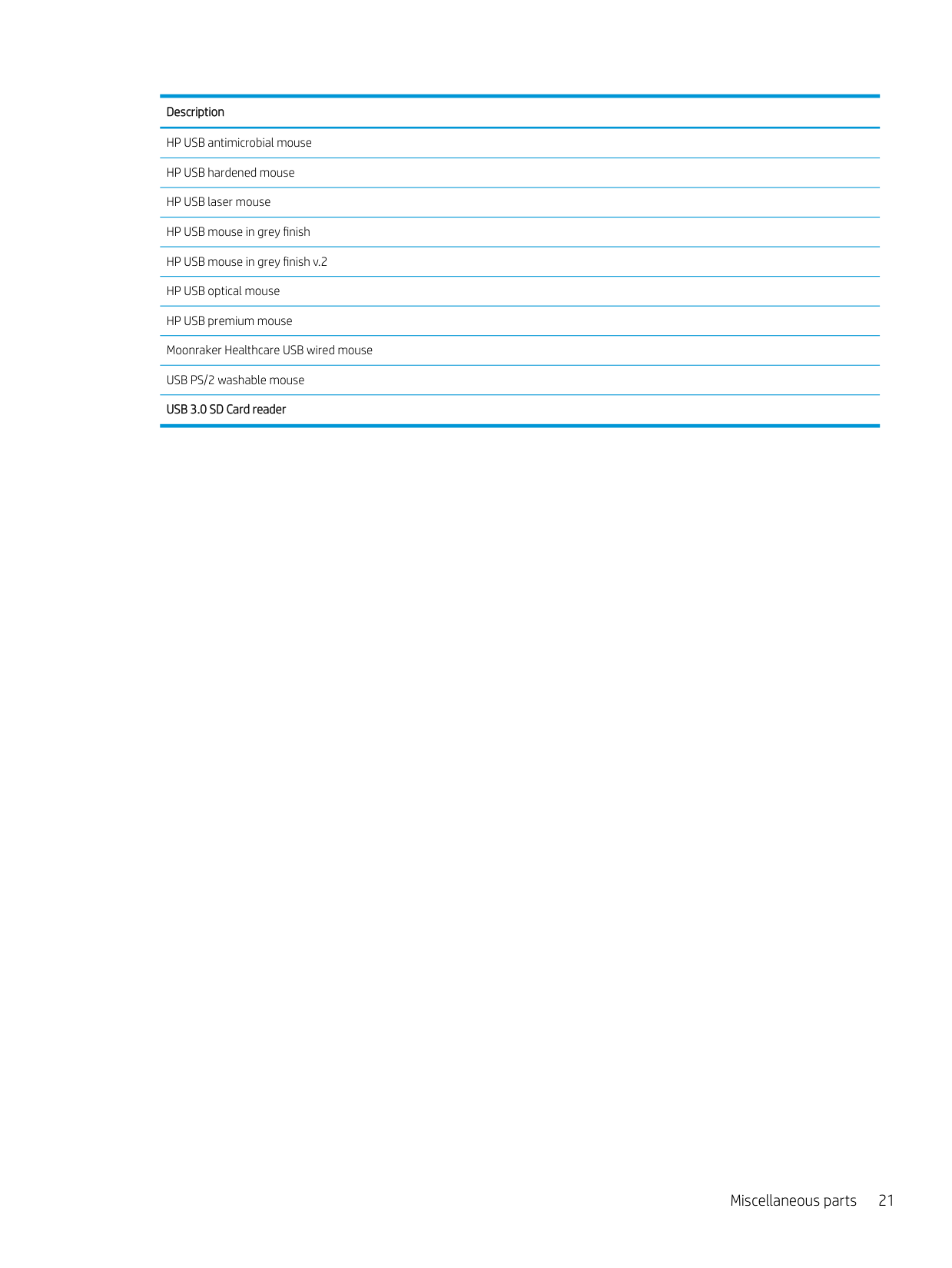
HP USB antimicrobial mouse HP USB hardened mouse HP USB laser mouse HP USB mouse in grey finish HP USB mouse in grey finish v.2 HP USB optical mouse HP USB premium mouse Moonraker Healthcare USB wired mouse USB PS/2 washable mouse USB 3.0 SD Card reader
3 Routine care, SATA drive guidelines, anddisassembly preparation
This chapter provides general service information for the computer. Adherence to the procedures and precautions described in this chapter is essential for proper service.
CAUTION: When the computer is plugged into an AC power source, voltage is always applied to the system board. The power cord must be disconnected from the power source before opening the computer to prevent system board or component damage.
Electrostatic discharge information
A sudden discharge of static electricity from your finger or other conductor can destroy static-sensitive devices or microcircuitry. Often the spark is neither felt nor heard, but damage occurs. An electronic device exposed to electrostatic discharge (ESD) may not appear to be affected at all and can work perfectly throughout a normal cycle. The device may function normally for a while, but it has been degraded in the internal layers, reducing its life expectancy.
Networks built into many integrated circuits provide some protection, but in many cases, the discharge contains enough power to alter device parameters or melt silicon junctions.
#### Generating static
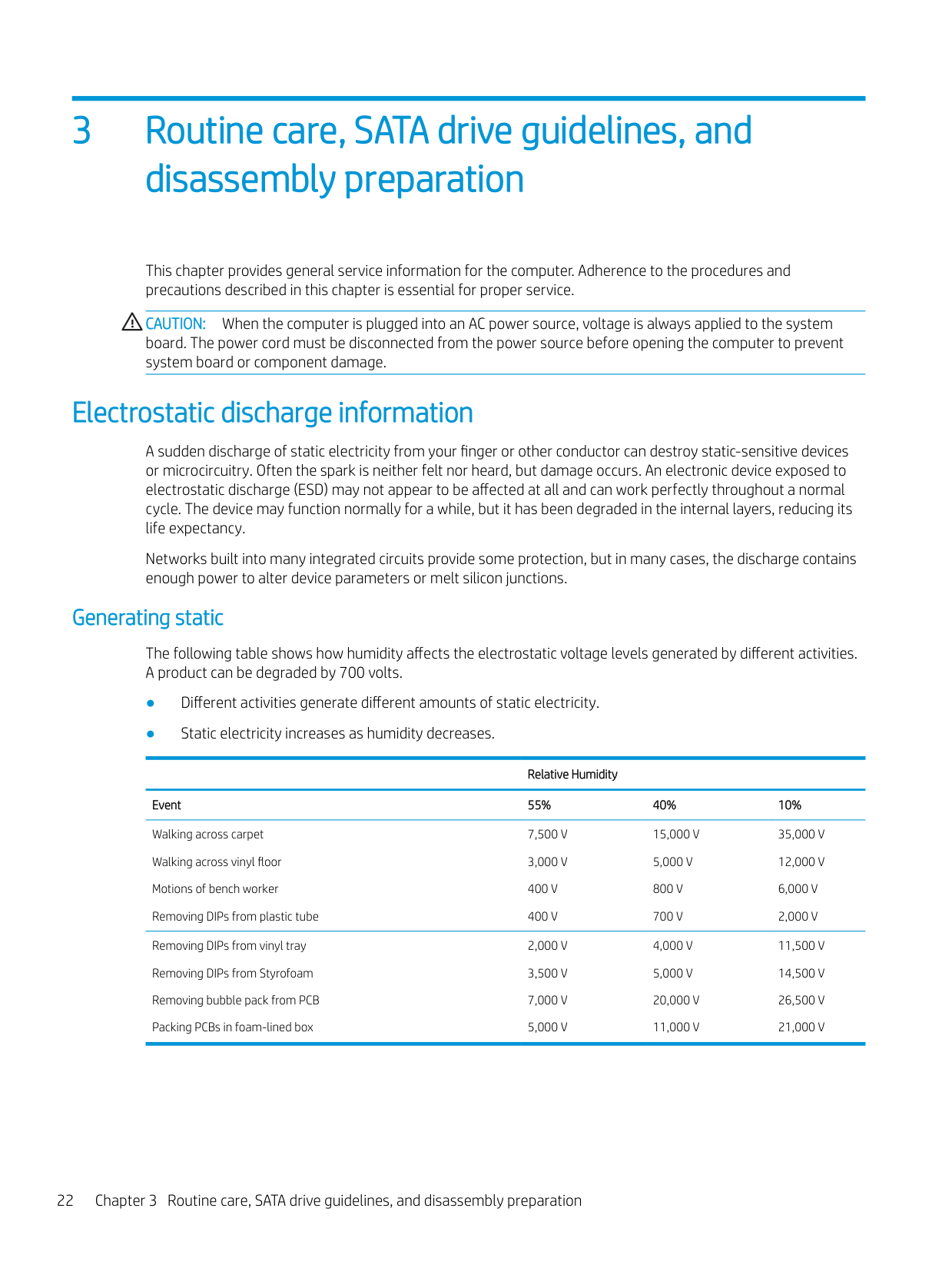
The following table shows how humidity affects the electrostatic voltage levels generated by different activities. A product can be degraded by 700 volts.
Relative Humidity Event 55% 40% 10% Walking across carpet Walking across vinyl floor Motions of bench worker Removing DIPs from plastic tube
7,500 V 3,000 V 400 V 400 V
15,000 V 5,000 V 800 V 700 V
35,000 V 12,000 V 6,000 V 2,000 V
Removing DIPs from vinyl tray Removing DIPs from Styrofoam Removing bubble pack from PCB Packing PCBs in foam-lined box
11,500 V 14,500 V 26,500 V 21,000 V
#### Preventing electrostatic damage to equipment
Many electronic components are sensitive to ESD. Circuitry design and structure determine the degree of sensitivity. The following packaging and grounding precautions are necessary to prevent damage to electric components and accessories.
#### Personal grounding methods and equipment
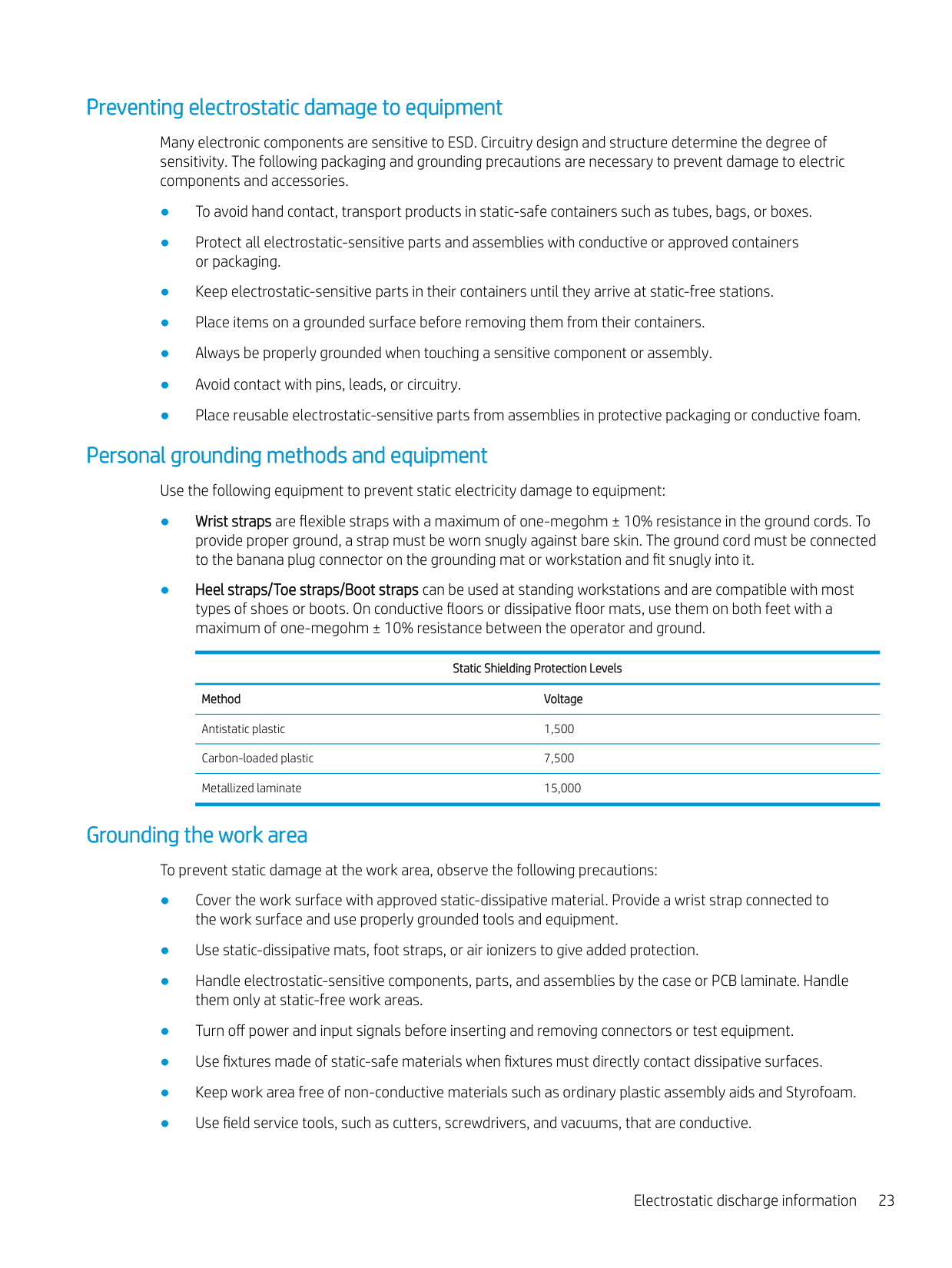
Use the following equipment to prevent static electricity damage to equipment:
Static Shielding Protection Levels Method Voltage
Antistatic plastic 1,500 Carbon-loaded plastic 7,500 Metallized laminate 15,000
#### Grounding the work area
To prevent static damage at the work area, observe the following precautions:
Electrostatic discharge information 23
#### Recommended materials and equipment
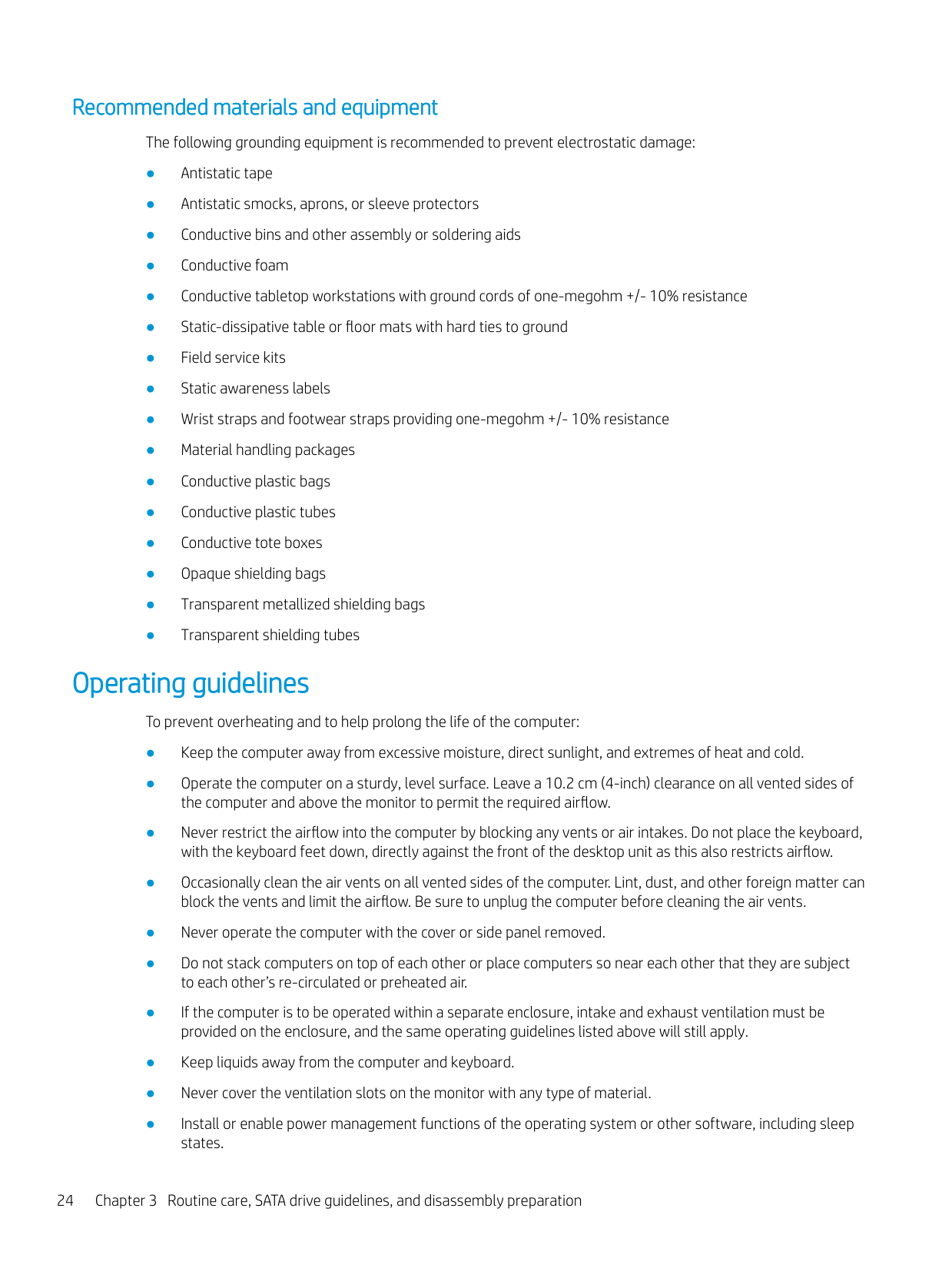
The following grounding equipment is recommended to prevent electrostatic damage:
Operating guidelines
To prevent overheating and to help prolong the life of the computer:
Routine care
#### General cleaning safety precautions
Cleaning the computer case Follow all safety precautions in General cleaning safety precautions on page 25 before cleaning the computer. To clean the computer case, follow the procedures described below:
#### Cleaning the keyboard
Follow all safety precautions in General cleaning safety precautions on page 25 before cleaning the keyboard. To clean the tops of the keys or the keyboard body, follow the procedures described in Cleaning the computer case on page 25.
When cleaning debris from under the keys, review all rules in General cleaning safety precautions on page 25 before following these procedures:
CAUTION: Use safety glasses equipped with side shields before attempting to clean debris from under the keys.
Routine care 25
CAUTION: Never remove a wide, level key (like the space bar) from the keyboard. If these keys are improperly removed or installed, the keyboard may not function properly.
#### Cleaning the monitor
#### Cleaning the mouse
Before cleaning the mouse, ensure that the power to the computer is turned off.
Service considerations
Listed below are some of the considerations that you should keep in mind during the disassembly and assembly of the computer.
#### Tools and software requirements
To service the computer, you need the following:
#### Screws
The screws used in the computer are not interchangeable. They may have standard or metric threads and may be of different lengths. If an incorrect screw is used during the reassembly process, it can damage the unit. HP strongly recommends that all screws removed during disassembly be kept with the part that was removed, then returned to their proper locations.
CAUTION: Metric screws have a black finish. U.S. screws have a silver finish and are used on hard drives only. CAUTION: As each subassembly is removed from the computer, it should be placed away from the work area to prevent damage.
#### Cables and connectors
Most cables used throughout the unit are flat, flexible cables. These cables must be handled with care to avoid damage. Apply only the tension required to seat or unseat the cables during insertion or removal from the connector. Handle cables by the connector whenever possible. In all cases, avoid bending or twisting the cables, and ensure that the cables are routed in such a way that they cannot be caught or snagged by parts being removed or replaced.
CAUTION: When servicing this computer, ensure that cables are placed in their proper location during the reassembly process. Improper cable placement can damage the computer.
#### Hard Drives
Handle hard drives as delicate, precision components, avoiding all physical shock and vibration. This applies to failed drives as well as replacement spares.
#### Lithium coin cell battery
The battery that comes with the computer provides power to the real-time clock and has a minimum lifetime of about three years.
See the appropriate removal and replacement chapter for the chassis you are working on in this guide for instructions on the replacement procedures.
WARNING! This computer contains a lithium battery. There is a risk of fire and chemical burn if the battery is handled improperly. Do not disassemble, crush, puncture, short external contacts, dispose in water or fire, or expose it to temperatures higher than 140ºF (60ºC). Do not attempt to recharge the battery.
| | |---|
NOTE: Batteries, battery packs, and accumulators should not be disposed of together with general household waste. In order to forward them for recycling or proper disposal, please use the public collection system or return them to HP.
SMART ATA drives
The Self Monitoring Analysis and Recording Technology (SMART) ATA drives for HP personal computers have built-in drive failure prediction that warns the user or network administrator of an impending failure (crash) of the hard drive. The SMART drive tracks fault prediction and failure indication parameters such as reallocated sector count, spin retry count, and calibration retry count. If the drive determines that a failure is imminent, it generates a fault alert.
SMART ATA drives 27
4 Removal and replacement procedures
Adherence to the procedures and precautions described in this chapter is essential for proper service. After completing all necessary removal and replacement procedures, run the Diagnostics utility to verify that all components operate properly.
| | |---|
NOTE: Not all features listed in this guide are available on all computers.
Preparation for disassembly
WARNING! Voltage is always present on the system board when the computer is plugged into an active AC outlet. To avoid possible personal injury and damage to the equipment the power cord should be disconnected from the computer and/or the AC outlet before opening the computer.
See Routine care, SATA drive guidelines, and disassembly preparation on page 22 for initial safety procedures.
Regardless of the power-on state, voltage is always present on the system board as long as the system is plugged into an active AC outlet. In some systems the cooling fan is on even when the computer is in the “Standby,” or “Suspend” modes. The power cord should always be disconnected before servicing a unit.
| | |---|
NOTE: During disassembly, label each cable as you remove it, noting its position and routing. Keep all screws with the removed components.
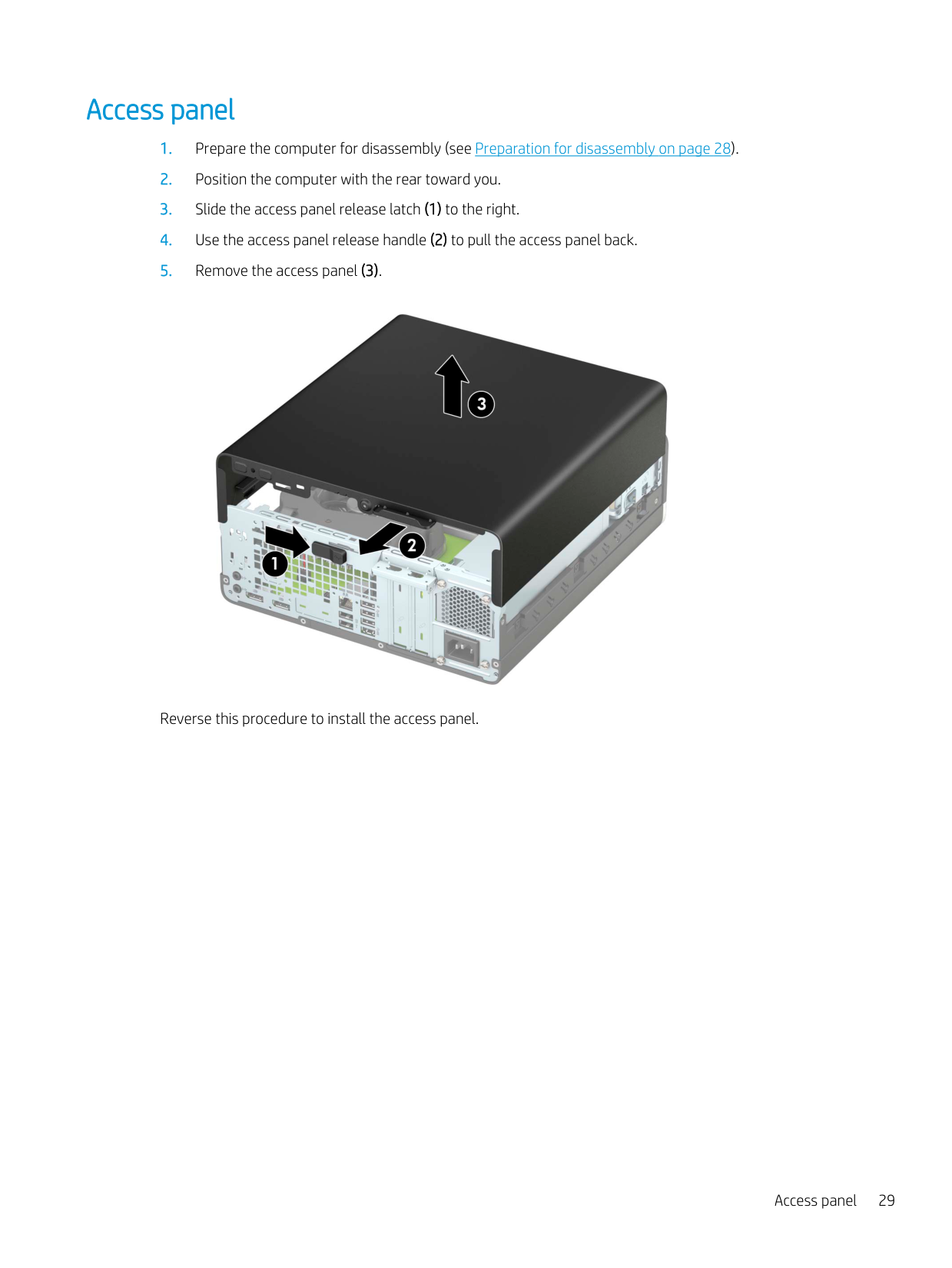
Access panel

Reverse this procedure to install the access panel.
Access panel 29
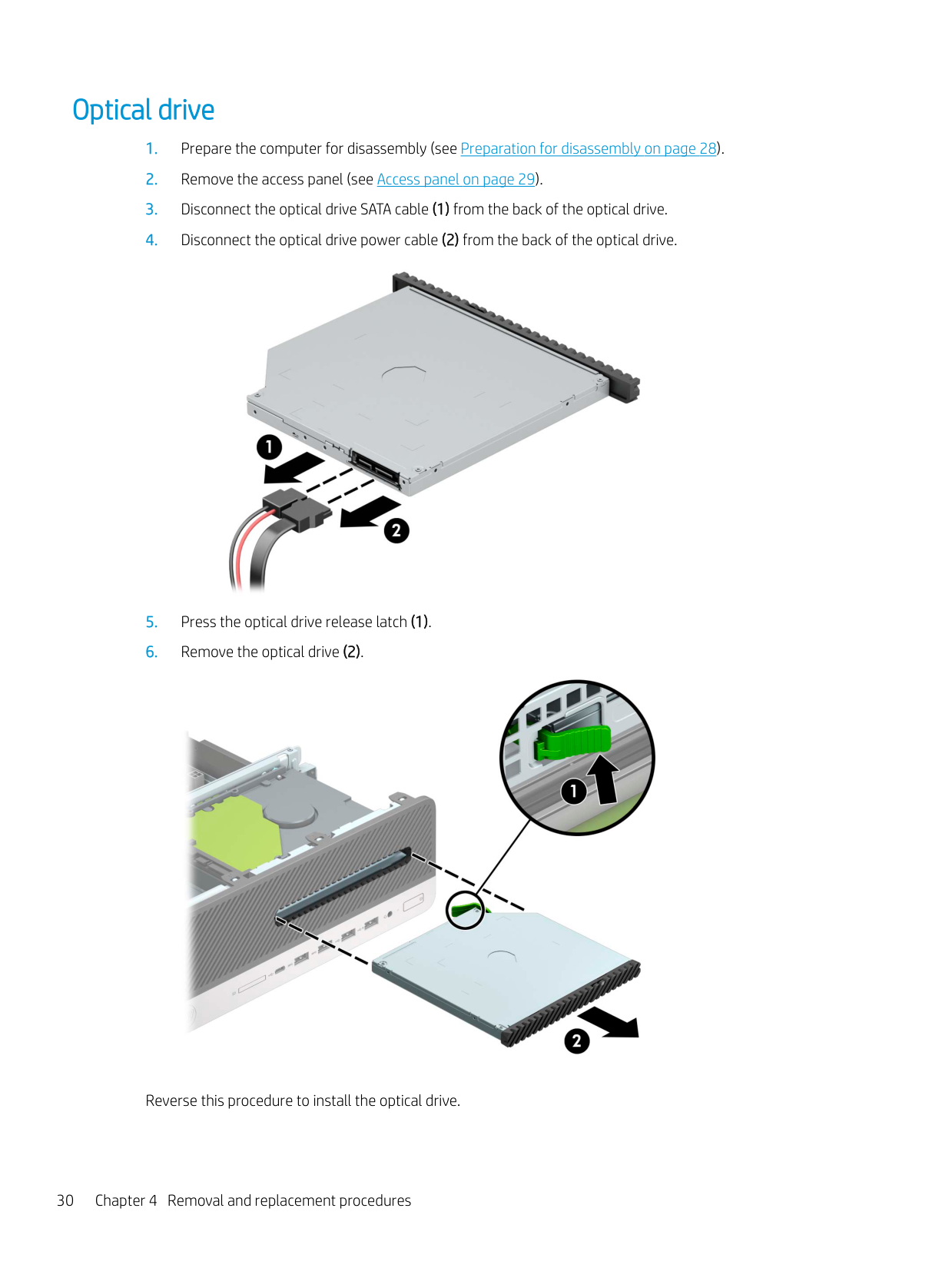
Optical drive


Reverse this procedure to install the optical drive.
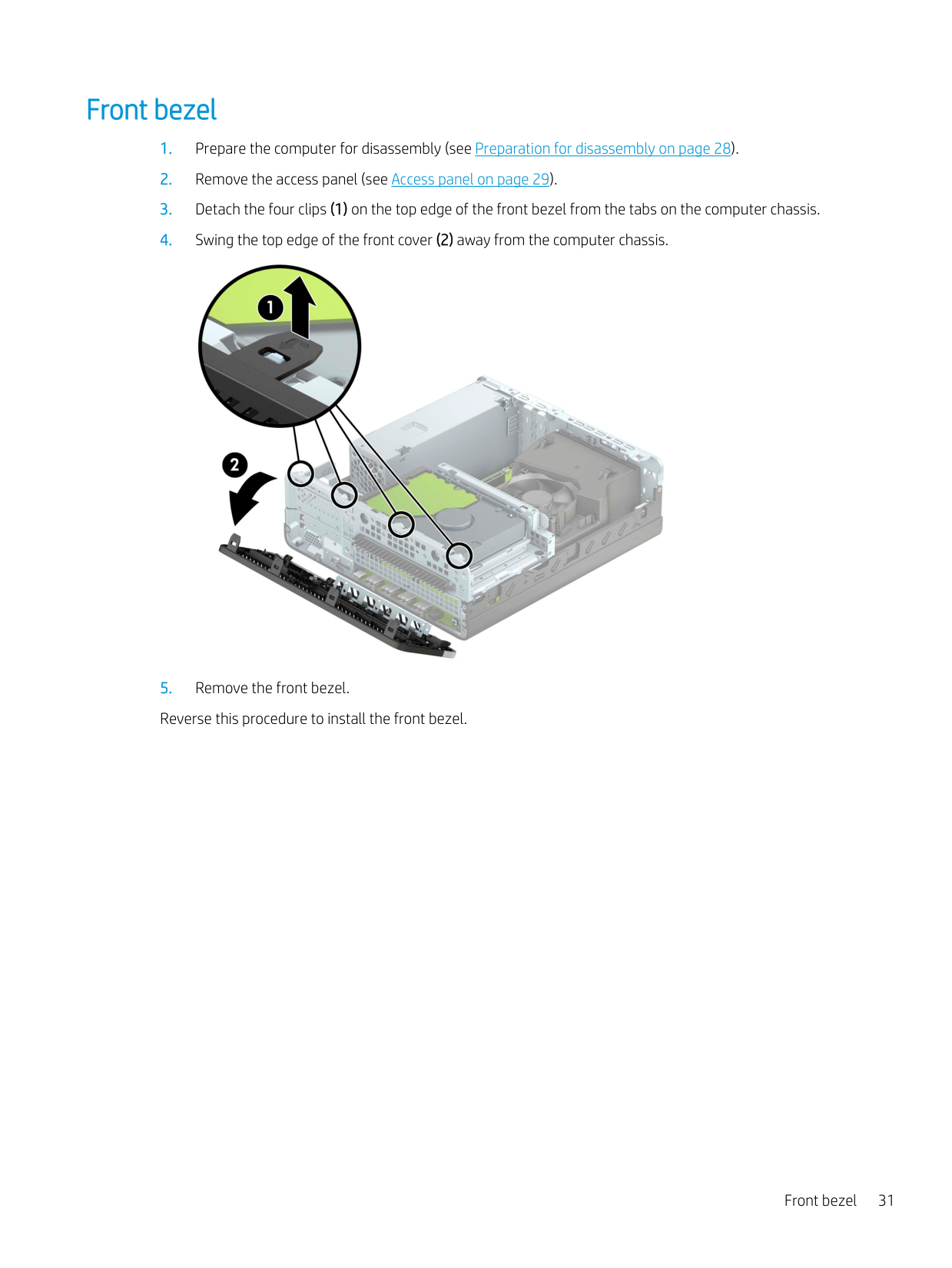
Front bezel

Front bezel 31
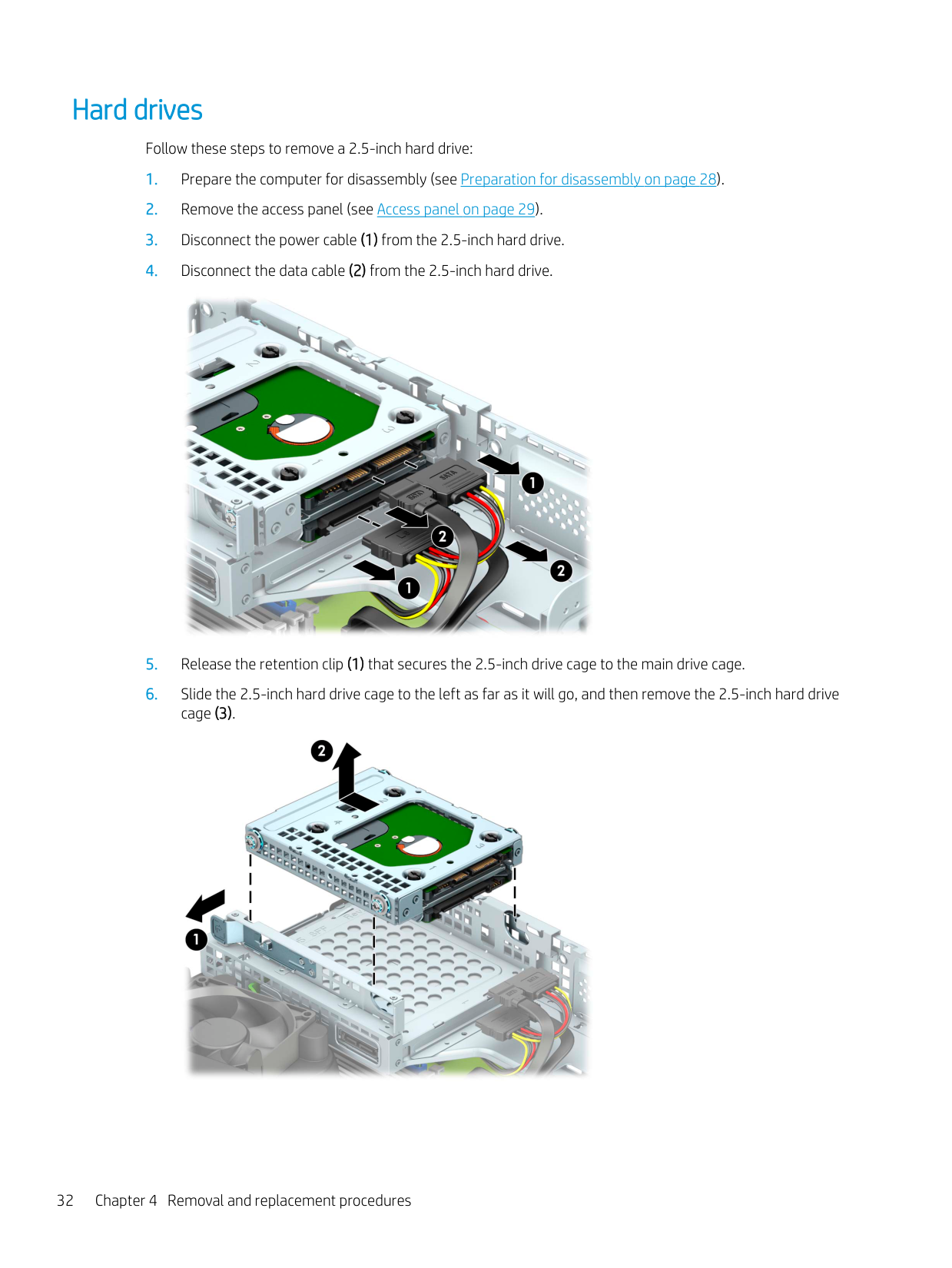
Hard drives
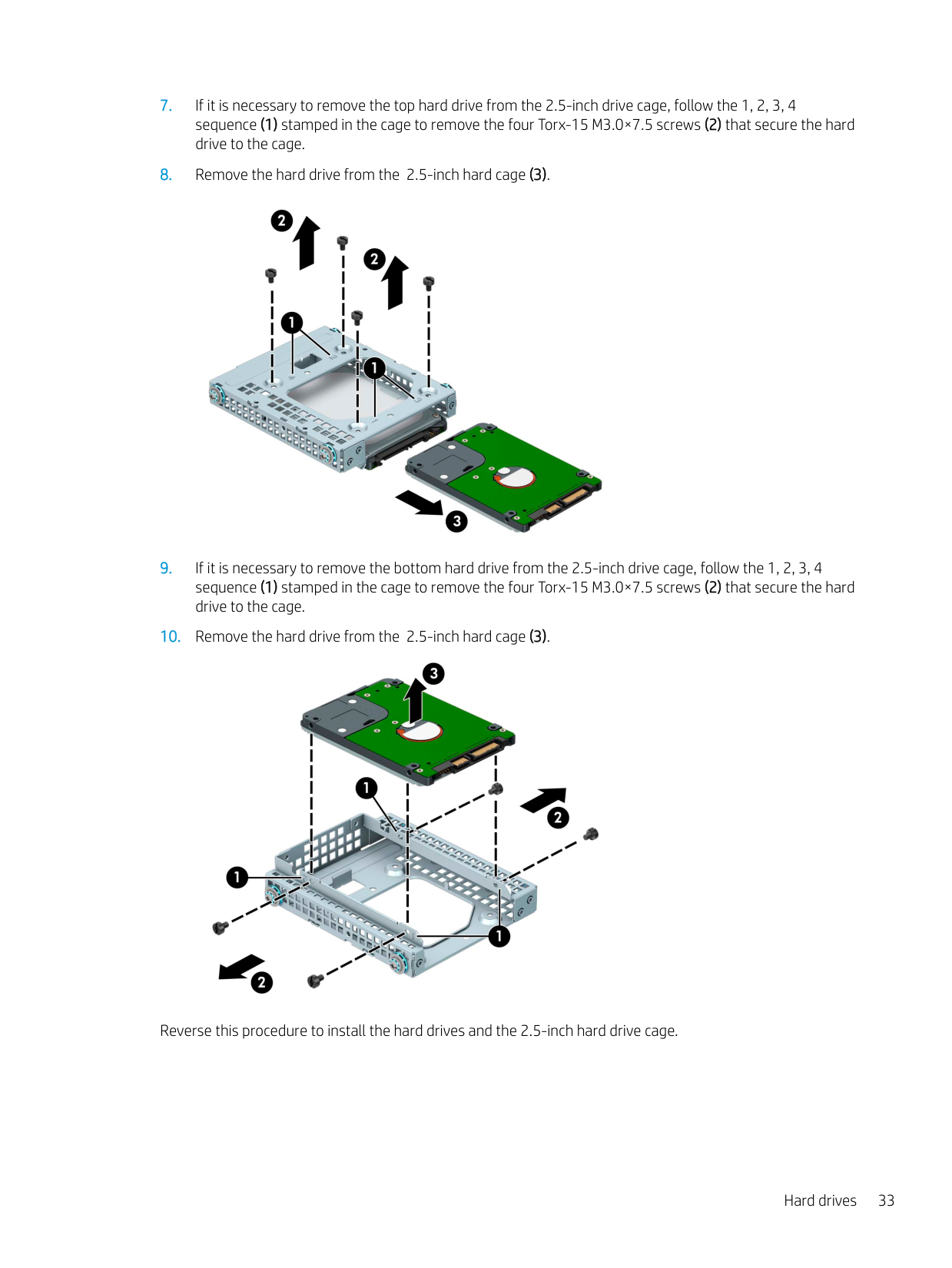
Follow these steps to remove a 2.5-inch hard drive:



Reverse this procedure to install the hard drives and the 2.5-inch hard drive cage.
Hard drives 33
Drive cage
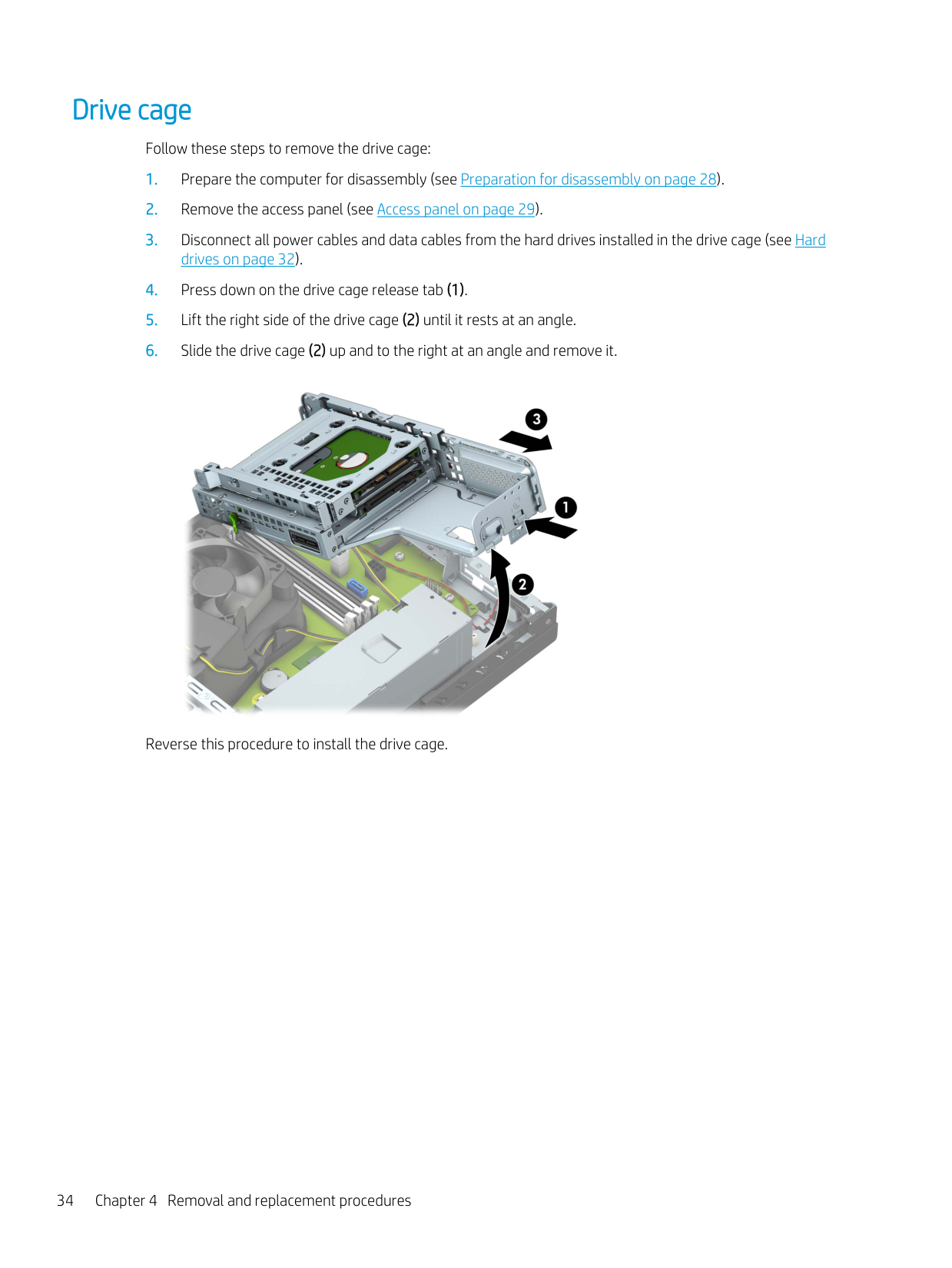
Follow these steps to remove the drive cage:

Reverse this procedure to install the drive cage.
Memory module The computer has four memory module sockets. CAUTION: You must disconnect the power cord and wait approximately 30 seconds for the power to drain before adding or removing memory modules. Regardless of the power-on state, voltage is always supplied to the memory modules as long as the computer is plugged into an active AC outlet. Adding or removing memory modules while voltage is present may cause irreparable damage to the memory modules or system board.
The memory module sockets have gold-plated metal contacts. When upgrading the memory, it is important to use memory modules with gold-plated metal contacts to prevent corrosion and/or oxidation resulting from having incompatible metals in contact with each other.
Static electricity can damage the electronic components of the computer or optional cards. Before beginning these procedures, ensure that you are discharged of static electricity by briefly touching a grounded metal object.
When handling a memory module, be careful not to touch any of the contacts. Doing so may damage the module.
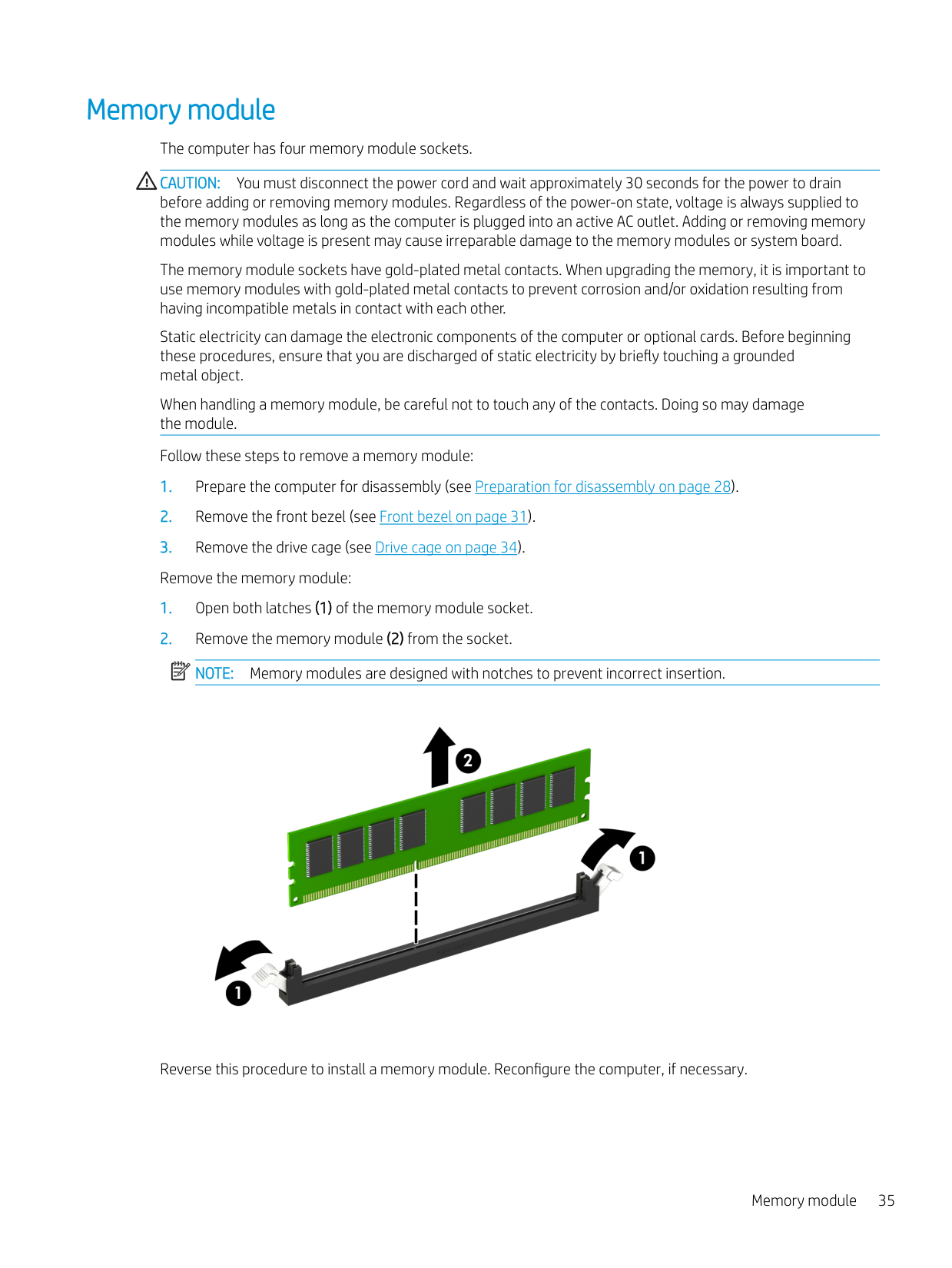
Follow these steps to remove a memory module:
| | |---|

Reverse this procedure to install a memory module. Reconfigure the computer, if necessary.
Memory module 35
Speaker
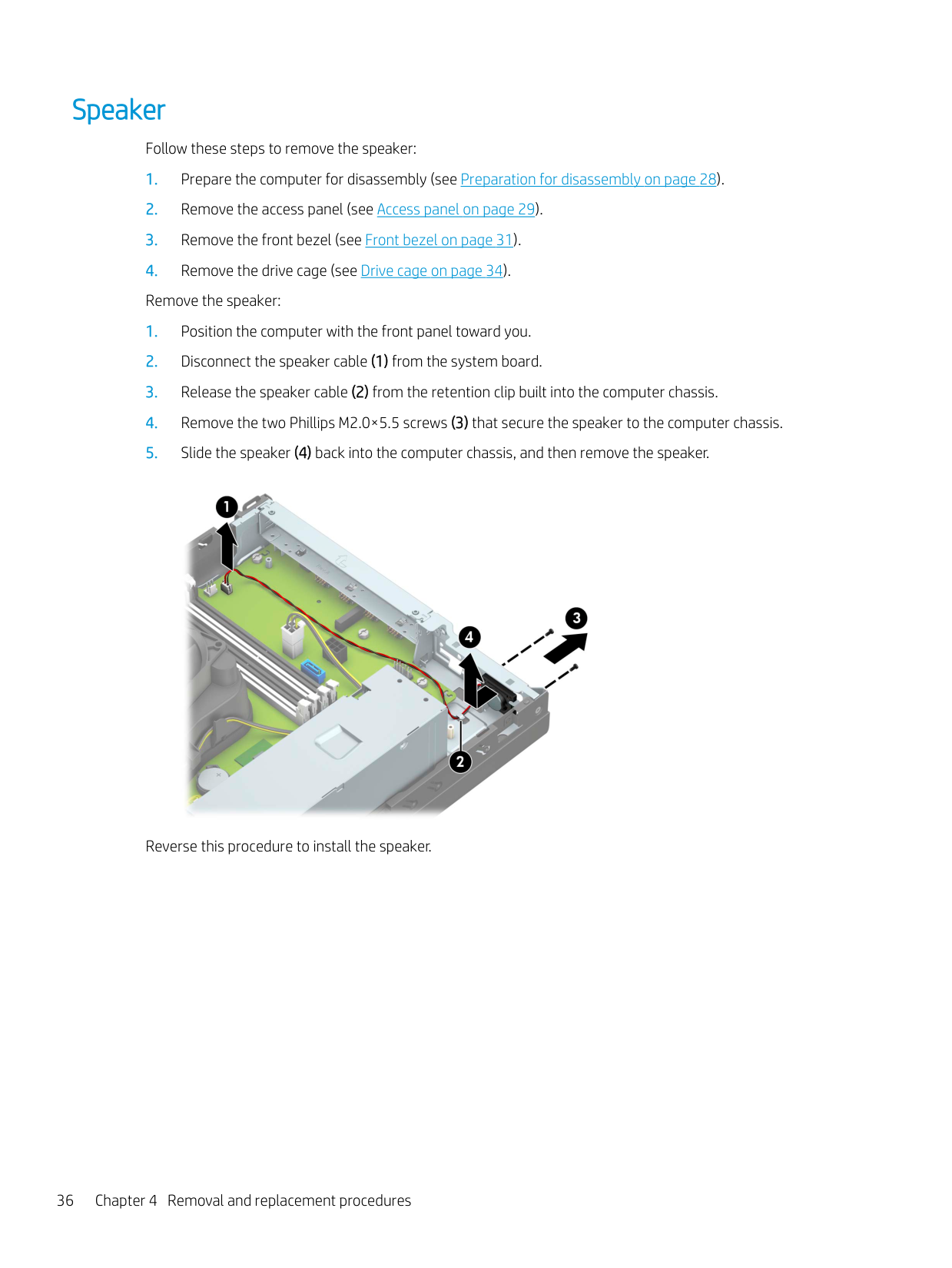
Follow these steps to remove the speaker:

Reverse this procedure to install the speaker.
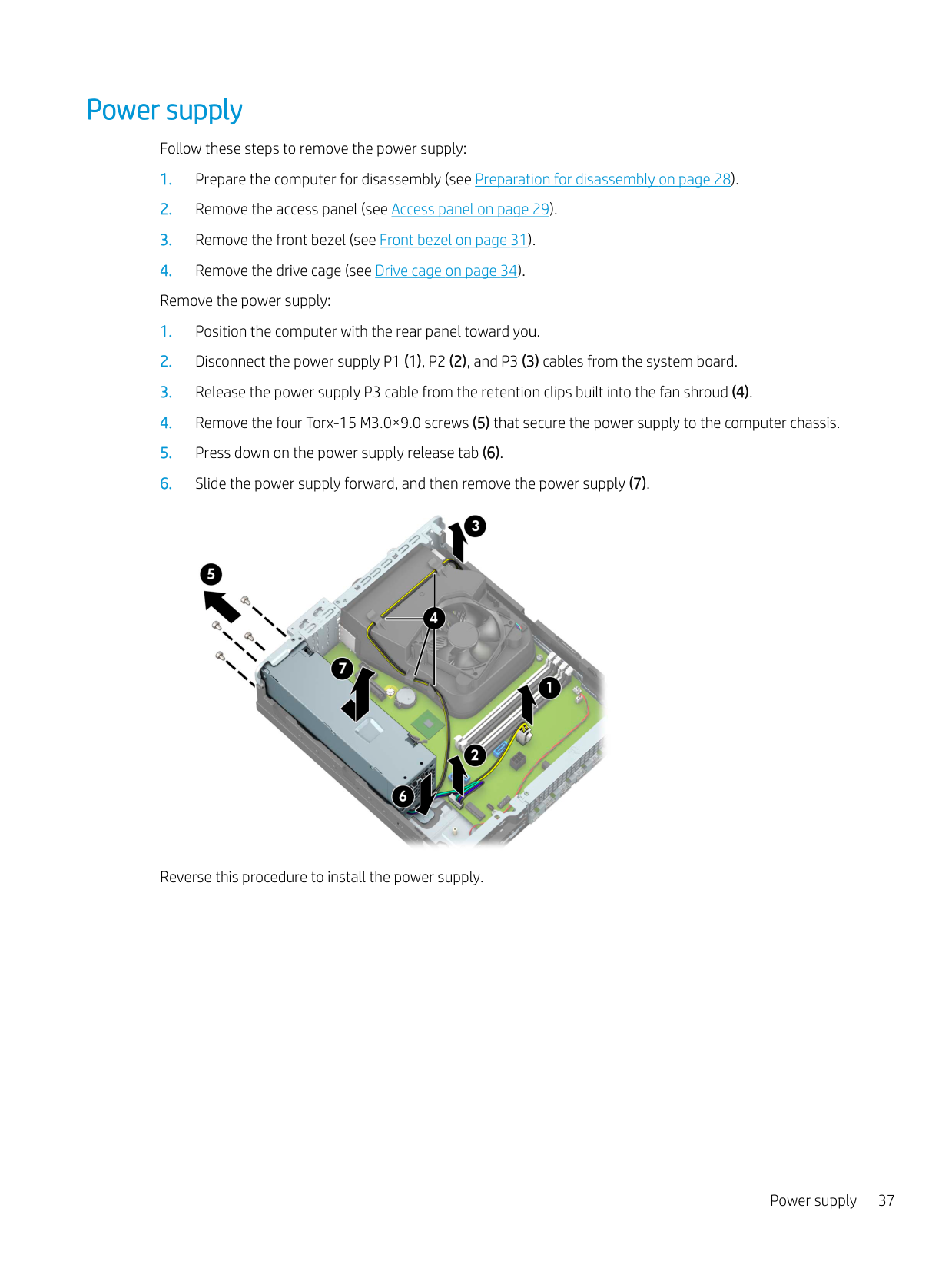
Power supply
Follow these steps to remove the power supply:

Reverse this procedure to install the power supply.
Power supply 37
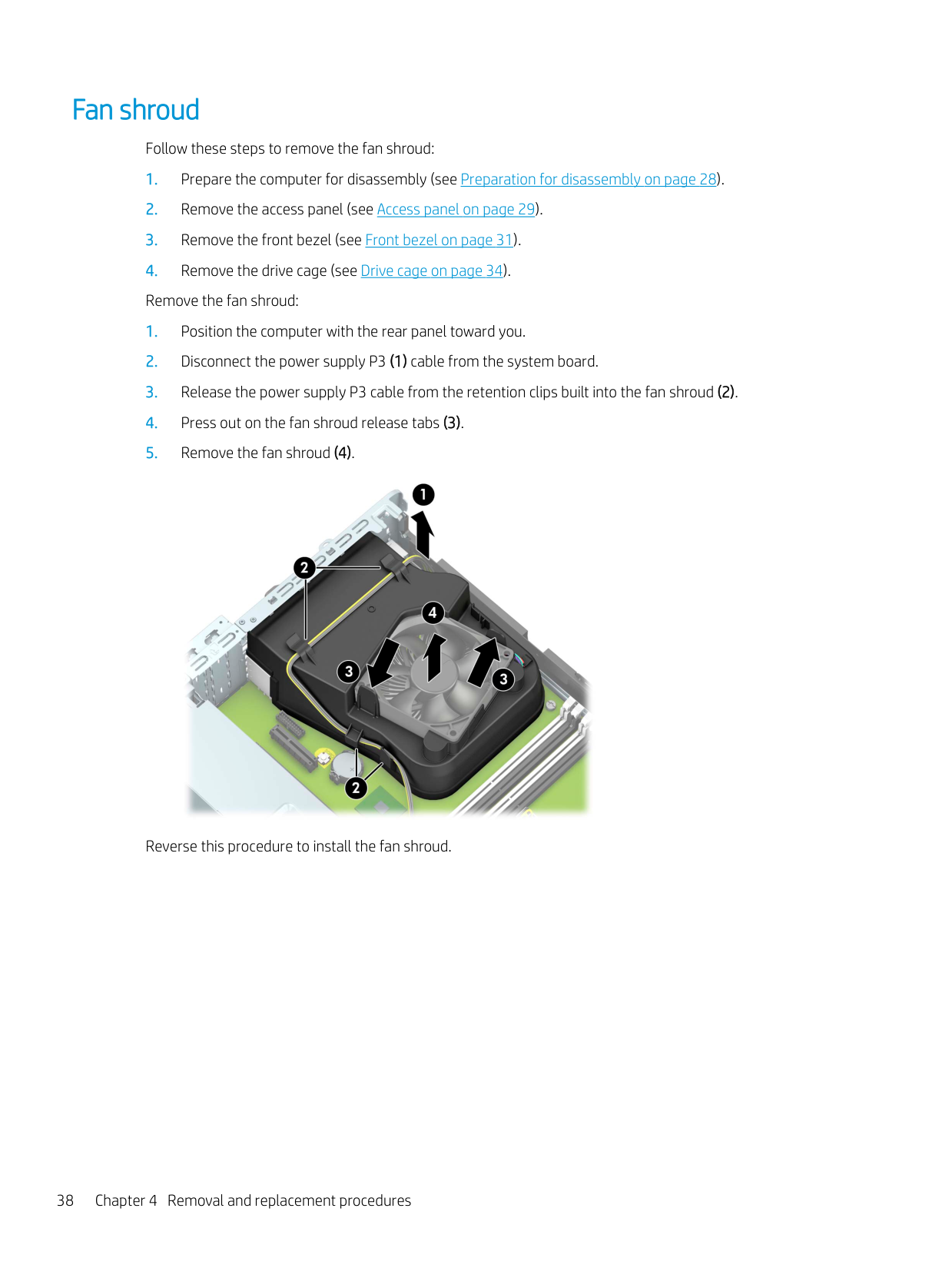
Fan shroud
Follow these steps to remove the fan shroud:

Reverse this procedure to install the fan shroud.
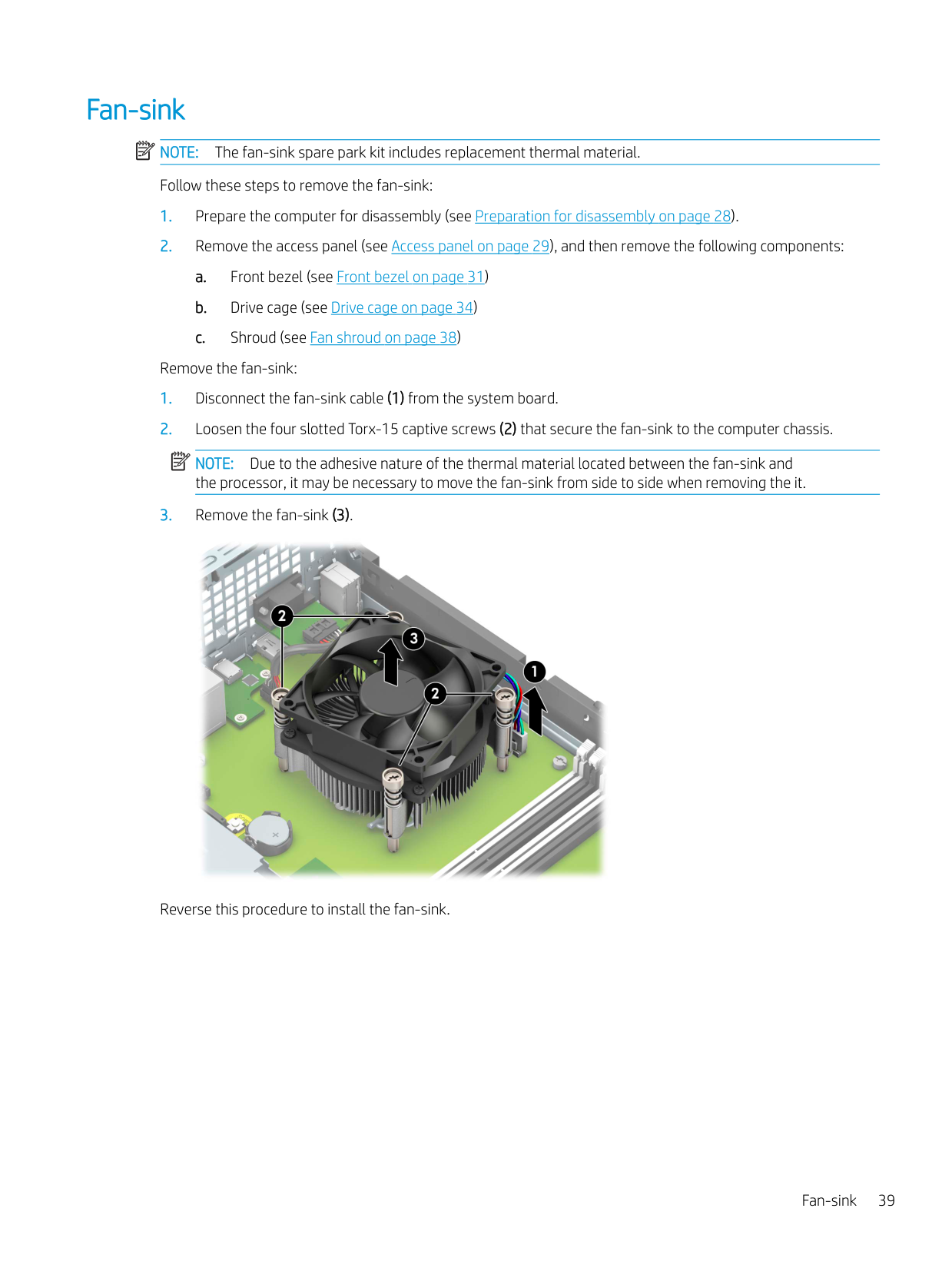
Fan-sink NOTE: The fan-sink spare park kit includes replacement thermal material. Follow these steps to remove the fan-sink:
| | |---|
Remove the fan-sink:
NOTE: Due to the adhesive nature of the thermal material located between the fan-sink and the processor, it may be necessary to move the fan-sink from side to side when removing the it.
| | |---|

Reverse this procedure to install the fan-sink.
Fan-sink 39
Processor NOTE: The processor spare park kit includes replacement thermal material. Follow these steps to remove the fan-sink:
| | |---|
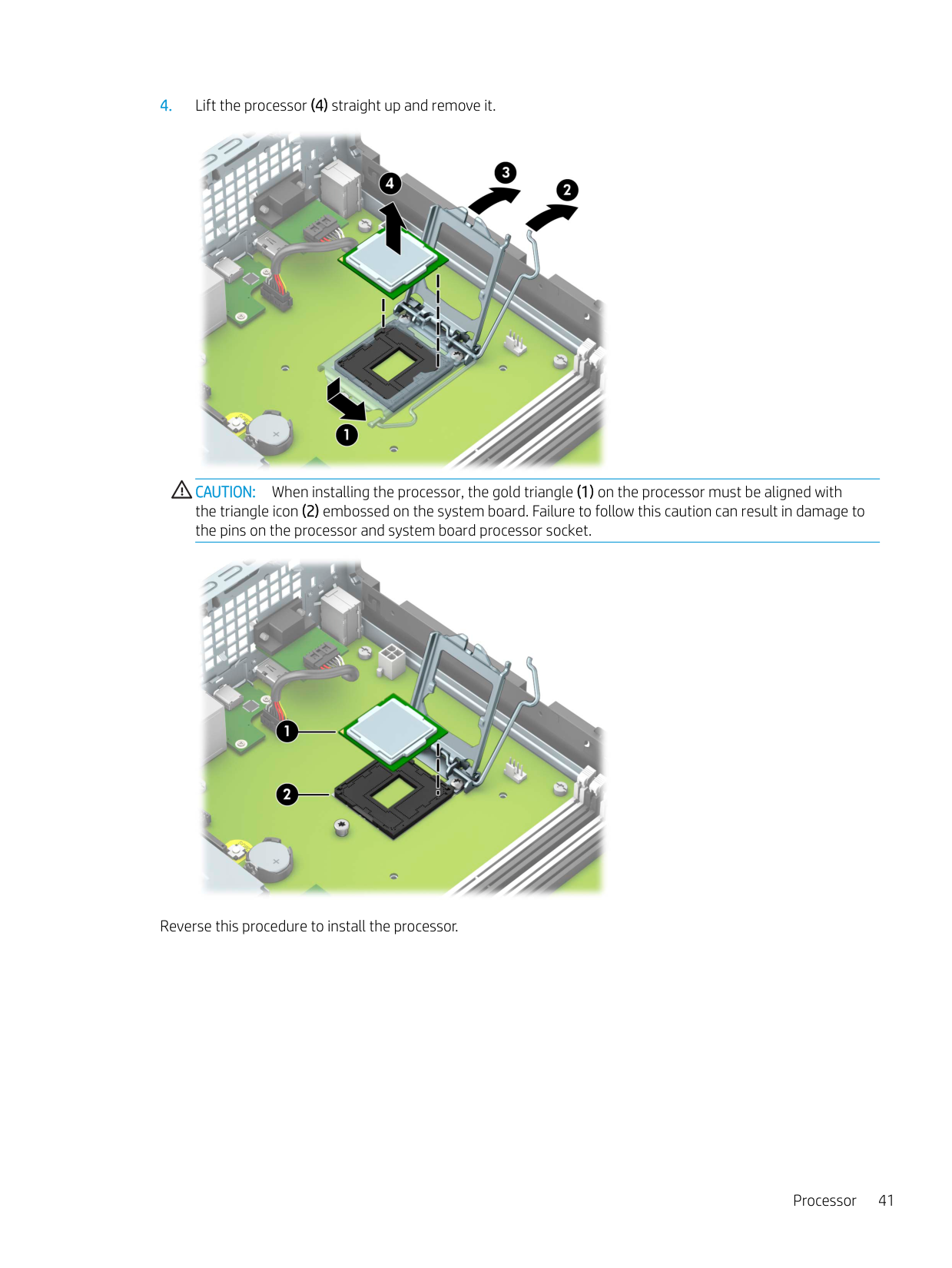
Remove the processor:

CAUTION: When installing the processor, the gold triangle (1) on the processor must be aligned with the triangle icon (2) embossed on the system board. Failure to follow this caution can result in damage to the pins on the processor and system board processor socket.

Reverse this procedure to install the processor.
Processor 41
Serial connector module
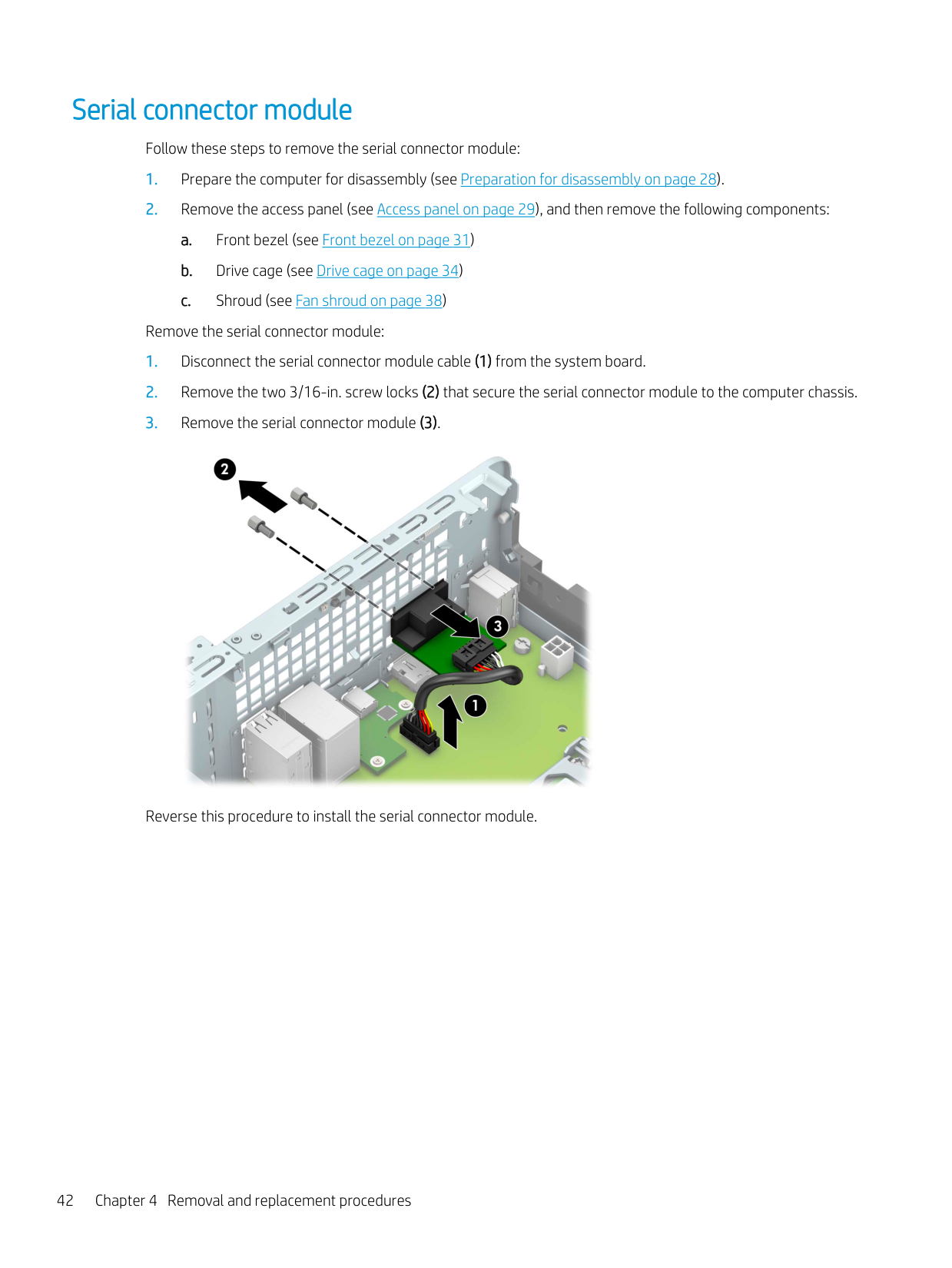
Follow these steps to remove the serial connector module:
Remove the serial connector module:

Reverse this procedure to install the serial connector module.
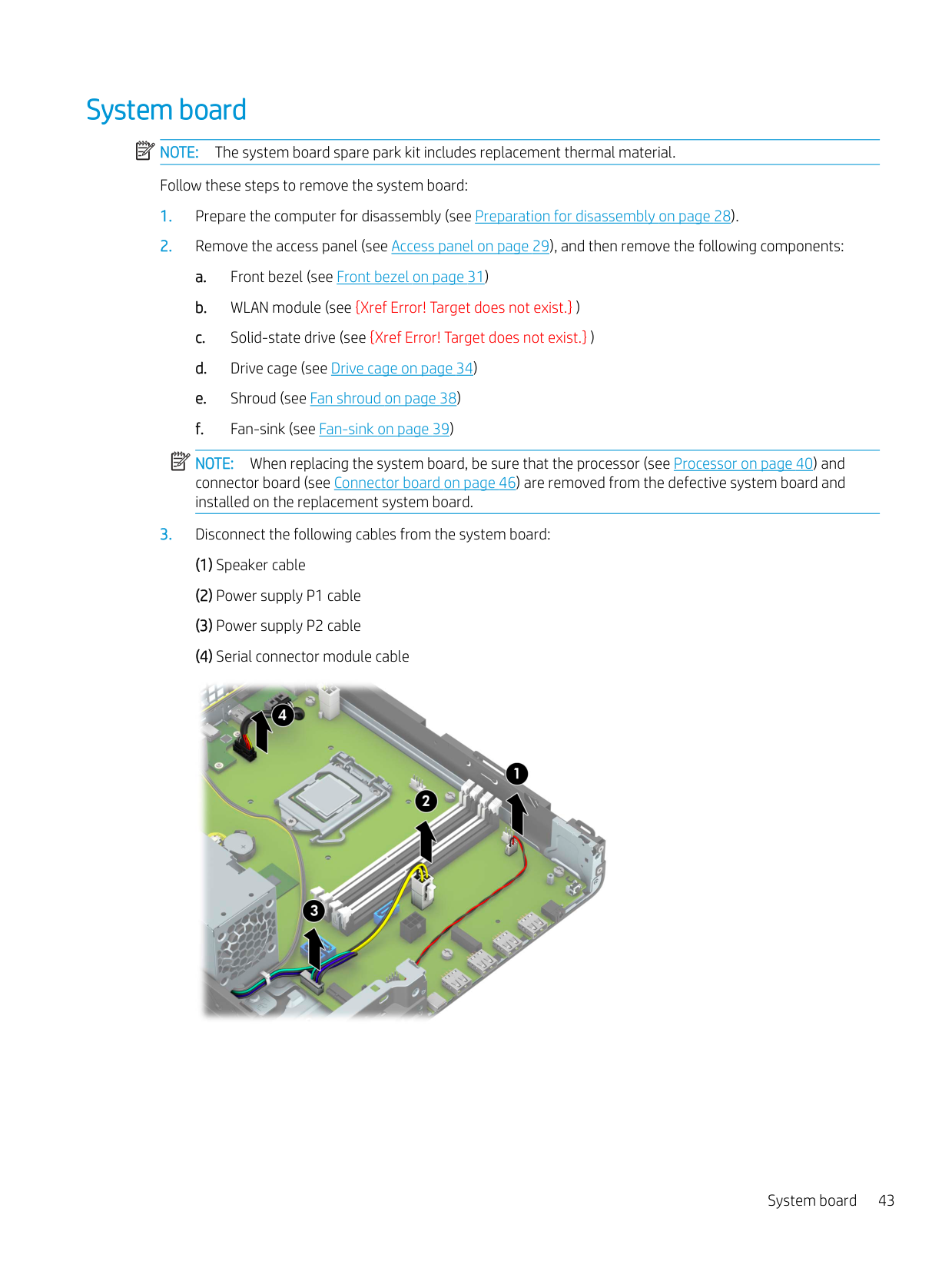
System board NOTE: The system board spare park kit includes replacement thermal material. Follow these steps to remove the system board:
| | |---|
NOTE: When replacing the system board, be sure that the processor (see Processor on page 40) and connector board (see Connector board on page 46) are removed from the defective system board and installed on the replacement system board.
| | |---|



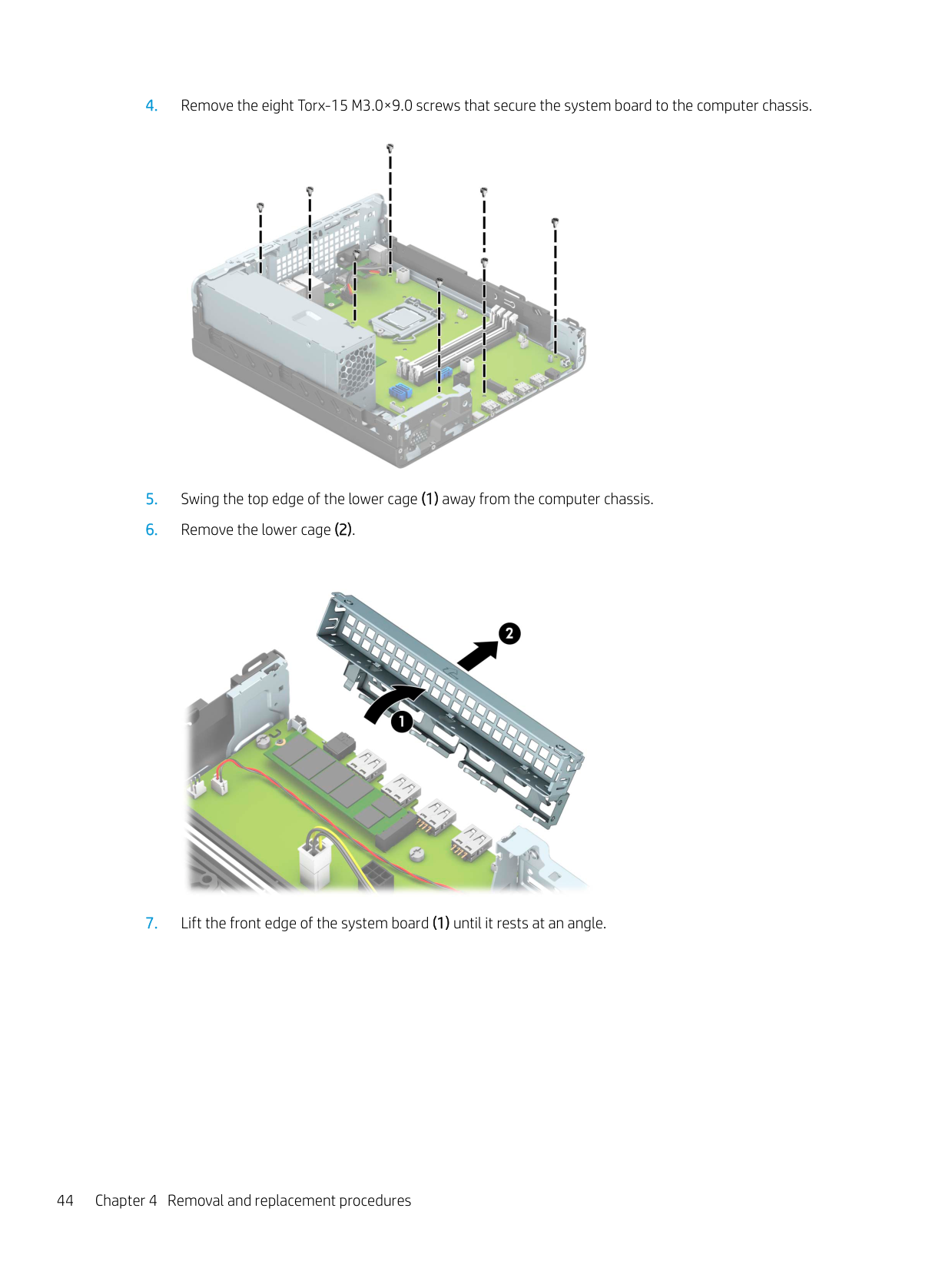
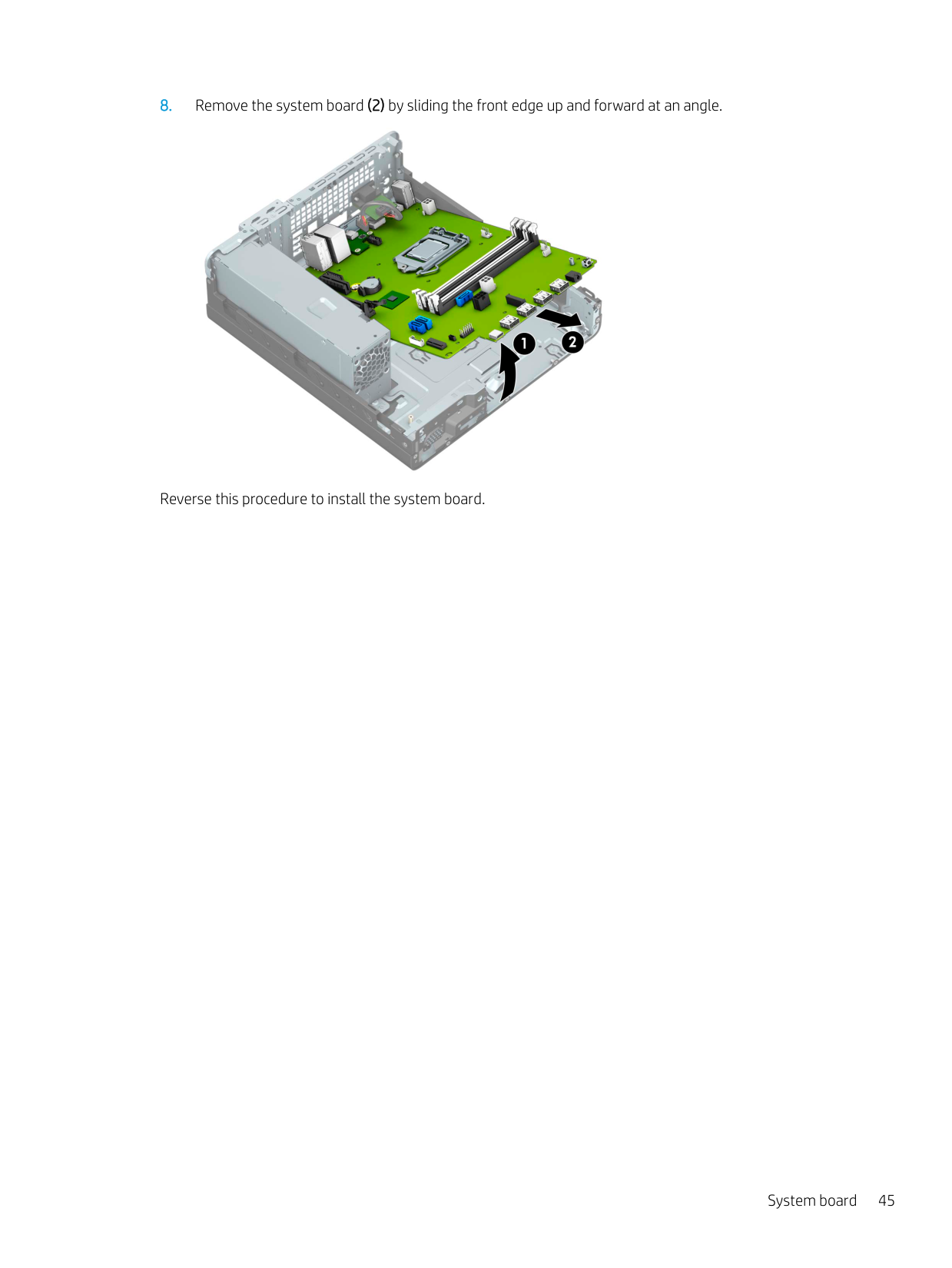
Reverse this procedure to install the system board.
Connector board
Follow these steps to remove the connector board:
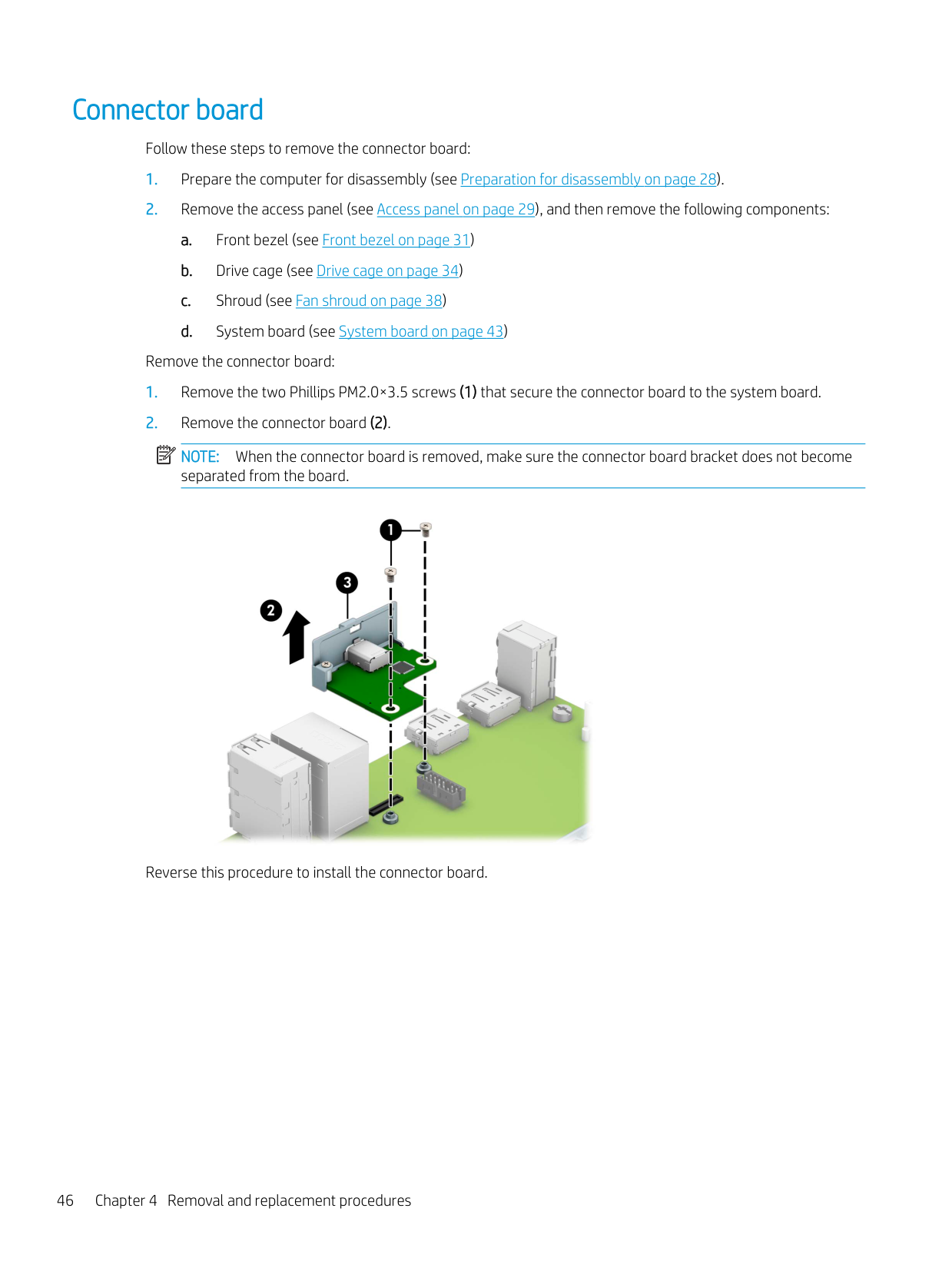
Remove the connector board:
| | |---|
NOTE: When the connector board is removed, make sure the connector board bracket does not become separated from the board.

Reverse this procedure to install the connector board.
5 Computer Setup (F10) Utility
Computer Setup (F10) Utilities
Use Computer Setup (F10) Utility to do the following:
#### Using Computer Setup (F10) Utilities
Computer Setup can be accessed only by turning the computer on or restarting the system. To access the Computer Setup Utilities menu, complete the following steps:
You can also press Esc to a menu that allows you to access different options available at startup, including the Computer Setup utility.
NOTE: If you do not press F10 at the appropriate time, you must restart the computer and again repeatedly press F10 when the monitor light turns green to access the utility.
NOTE: Selecting UEFI Drivers restarts the computer into the 3rd party option ROM management application. You can access this application directly by pressing F3 during startup.
| | |---|
| | |---|
| | |---|
NOTE: Settings in the Security menu are not modified by Apply Defaults. Those values are reset by Restore Security Settings to Default at the bottom of the Security menu.
| | |---|
NOTE: Not all settings shown in the following sections are available for all models
CAUTION: Do NOT turn the computer power OFF while the BIOS is saving the Computer Setup (F10) changes because the settings could become corrupted. It is safe to turn off the computer only after exiting the F10 Setup screen.
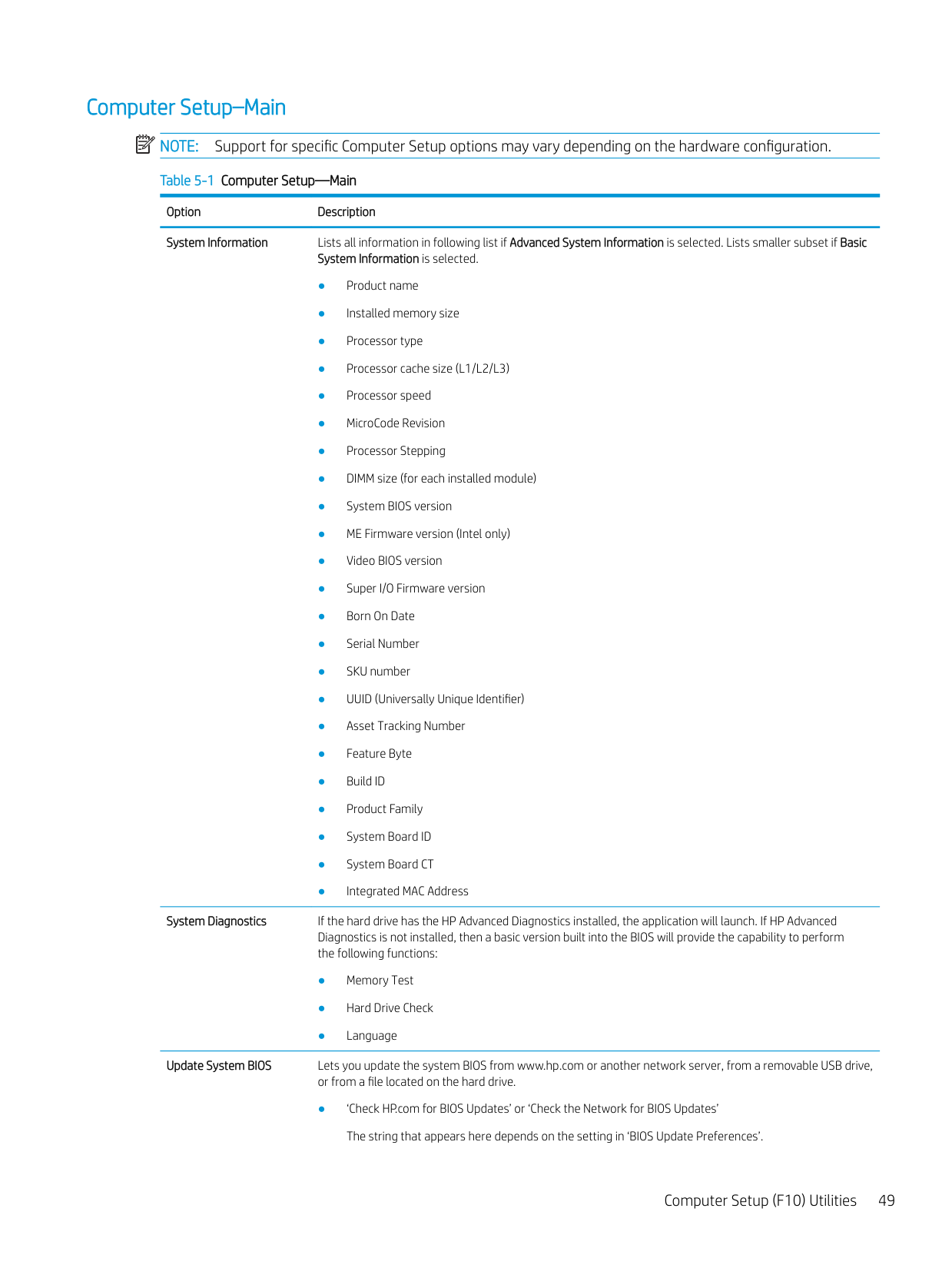
Computer Setup–Main NOTE: Support for specific Computer Setup options may vary depending on the hardware configuration. Table 5-1 Computer Setup—Main
| | |---|
Option Description System Information Lists all information in following list if Advanced System Information is selected. Lists smaller subset if Basic
System Information is selected.
System Diagnostics If the hard drive has the HP Advanced Diagnostics installed, the application will launch. If HP Advanced Diagnostics is not installed, then a basic version built into the BIOS will provide the capability to perform the following functions:
Update System BIOS Lets you update the system BIOS from www.hp.com or another network server, from a removable USB drive,
or from a file located on the hard drive.
● ‘Check HP.com for BIOS Updates’ or ‘Check the Network for BIOS Updates’
The string that appears here depends on the setting in ‘BIOS Update Preferences’.
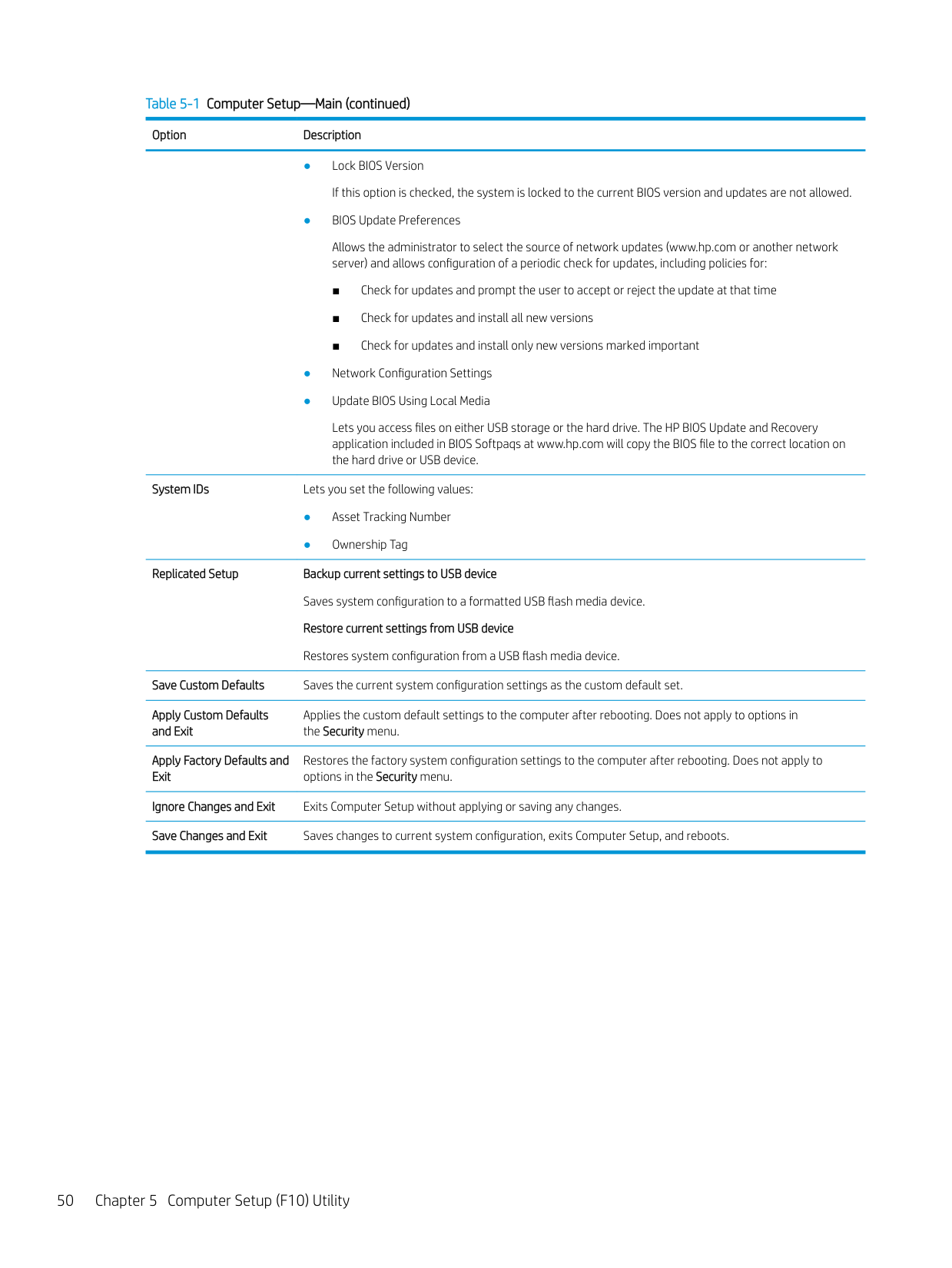
Table 5-1 Computer Setup—Main (continued)
Option Description
Allows the administrator to select the source of network updates (www.hp.com or another network server) and allows configuration of a periodic check for updates, including policies for:
Lets you access files on either USB storage or the hard drive. The HP BIOS Update and Recovery application included in BIOS Softpaqs at www.hp.com will copy the BIOS file to the correct location on the hard drive or USB device.
System IDs Lets you set the following values:
Replicated Setup Backup current settings to USB device Saves system configuration to a formatted USB flash media device. Restore current settings from USB device Restores system configuration from a USB flash media device.
Save Custom Defaults Saves the current system configuration settings as the custom default set. Apply Custom Defaults and Exit
Applies the custom default settings to the computer after rebooting. Does not apply to options in the Security menu.
Apply Factory Defaults and Exit
Restores the factory system configuration settings to the computer after rebooting. Does not apply to options in the Security menu.
Ignore Changes and Exit Exits Computer Setup without applying or saving any changes. Save Changes and Exit Saves changes to current system configuration, exits Computer Setup, and reboots.
Computer Setup—Security NOTE: Support for specific Computer Setup options may vary depending on the hardware configuration. Table 5-2 Computer Setup—Security
| | |---|
Option Description Set up BIOS Administrator Password
Lets you set and enable a BIOS administrator password, which includes the following privileges:
NOTE: If the password is set, it is required to change Computer Setup options, update the BIOS, and make changes to certain plug and play settings under Windows.
Change BIOS Administrator Password (This selection is active only if a BIOS administrator password is set.)
Lets you change the BIOS administrator password. You must know the current password to be able to change it.
Password Policies Let you set the guidelines for a valid password. Options include:
Select ‘Honor’ to allow or ‘Ignore’ to not allow the absence of the password jumper to clear the passwords at boot up. Default is ‘Honor’.
Security Configuration TPM Embedded Security
Select to reset the TPM to an unowned state. After the TPM is cleared, it is also turned off. To temporarily suspend TPM operations, turn the TPM off instead of clearing it.
CAUTION: Clearing the TPM resets it to factory defaults and turns it off. You will lose all created keys and data protected by those keys.
BIOS Sure Start
Select to check validity of boot block region each boot. If not selected, boot block region will be validated on power cycles.
######## ● Data Recovery Policy
Select ‘Automatic’ or ‘Manual’ to set data recovery policy. ‘Manual’ lets you select whether or not to execute recovery of a corrupted region if it is detected.
Set Up BIOS Power-On Password
Lets you set and enable a BIOS power-on password. The power-on password prompt appears after a power cycle or reboot. If the user does not enter the correct power-on password, the unit will not boot.
Change BIOS Power-On Password (This selection is active only if a BIOS power-on password is set.)
Lets you change the BIOS power-on password. You must know the current password to be able to change it.
DriveLock Allows you to assign or modify a master or user password for hard drives. When this feature is enabled, the user is prompted to provide one of the DriveLock passwords during POST. If neither is successfully entered, the hard drive will remain inaccessible until one of the passwords is successfully provided during a subsequent cold-boot sequence.
NOTE: This selection will only appear when at least one drive that supports the DriveLock feature is attached to the system.
CAUTION: Be aware that these settings take place immediately. A save is not necessary. CAUTION: Be sure to document the DriveLock password. Losing a DriveLock password will render a drive permanently locked. After you select a drive, the following options are available:
Set DriveLock Master Password. Sets the drive’s master password but does not enable DriveLock. Enable DriveLock. Sets the drive’s user password and enables DriveLock.
Secure Erase Lets you select a hard drive to completely erase.
Once a hard drive has been erased with a program that utilizes Secure Erase firmware commands, no file recovery program, partition recovery program, or other data recovery method will be able to extract data from the drive.
Save/Restore MBR of the system hard drive
NOTE: Windows 10 systems are generally not formatted to include an MBR. Instead they use GUID Partition Table (GPT) format, which better supports large hard drives. Enabling this feature will save the Master Boot Record (MBR) of the system hard drive. If the MBR gets changed, the user will be prompted to restore the MBR. Default is disabled. The MBR contains information needed to successfully boot from a disk and to access the data stored on the disk. Master Boot Record Security may prevent unintentional or malicious changes to the MBR, such as those caused by some viruses or by the incorrect use of certain disk utilities. It also allows you to recover the "last known good" MBR, should changes to the MBR be detected when the system is restarted. NOTE: Most operating systems control access to the MBR of the current bootable disk; the BIOS cannot prevent changes that may occur while the operating system is running. Restores the backup Master Boot Record to the current bootable disk. Default is disabled. Only appears if all of the following conditions are true:
CAUTION: Restoring a previously saved MBR after a disk utility or operating system has modified the MBR, may cause the data on the disk to become inaccessible. Only restore a previously saved MBR if you are confident that the current bootable disk's MBR has been corrupted or infected with a virus.
Smart Cover Cover Lock (Lock/Unlock)
Default is ‘Unlock’. Cover Removal Sensor (Disabled/Notify user/Administrator password)
Lets you disable the cover sensor or configure what action is taken if the computer cover was removed. Default is ‘Disabled’.
NOTE: Notify user alerts the user with a POST error on the first boot after the sensor detects removal of the cover. If the password is set, Administrator Password requires that the password be entered to boot the computer if the sensor detects that the cover has been removed.
System Management Command
Allows authorized personnel to reset security settings during a service event. Default is enabled.
Restore Security Settings to Default
This action resets security devices, clears BIOS passwords (not including DriveLock), and restores settings in the Security menu to factory defaults.
#### Computer Setup—Advanced NOTE: Support for specific Computer Setup options may vary depending on the hardware configuration. Table 5-3 Computer Setup—Advanced (for advanced users)
| | |---|
Option Heading Display Language Lets you select the language of the menus in F10 Setup and the keyboard layout. Scheduled Power-On This feature wakes the system up from a powered off state at a specified date and time. Boot Options Select the devices that the computer can boot from, as well as other options, including:
NOTE: If the system is configured to ‘Power On from Keyboard Ports’ (see Power Management Options), then this setting is forced to ‘Power On’.
Default is enabled. Specify the order in which UEFI boot sources (such as a internal hard drive, USB hard drive, USB optical drive, or internal optical drive) are checked for a bootable operating system image.
UEFI boot sources always have precedence over legacy boot sources.
Specify the order in which legacy boot sources (such as a network interface card, internal hard drive, USB optical drive, or internal optical drive) are checked for a bootable operating system image.
Specify the order of attached hard drives. The first hard drive in the order will have priority in the boot sequence and will be recognized as drive C (if any devices are attached).
NOTE: To drag a device to a preferred place, press Enter. NOTE: MS-DOS drive lettering assignments may not apply after a non-MS-DOS operating system has started. Shortcut to Temporarily Override Boot Order
To boot one time from a device other than the default device specified in Boot Order, restart the computer and press Esc (to access the Startup menu) and then F9 (Boot Menu), or only F9 (skipping the Startup menu) when the monitor light turns green. After POST is completed, a list of bootable devices is displayed. Use the arrow keys to select the preferred bootable device and press Enter. The computer then boots from the selected non-default device for this one time.
Secure Boot Configuration Configure Legacy Support and Secure Boot
Legacy Support – Lets you turn off all legacy support on the computer, including booting to DOS, running legacy graphics cards, booting to legacy devices, and so on.
Secure Boot – Lets you make sure an operating system is legitimate before booting to it, making Windows resistant to malicious modification from preboot to full OS booting, preventing firmware attacks. UEFI and Windows Secure Boot only allow code signed by pre-approved digital certificates to run during the firmware and OS boot process.
Default is ‘Legacy Support Enable and Secure Boot Disable’ for non-Windows configurations. Default is ‘Legacy Support Disable and Secure Boot Enable’ for Windows 10 configurations.
Secure Boot Key Management Lets you manage the custom key settings. Clear Secure Boot Keys
Lets you delete any previously loaded custom boot keys. Clearing keys will disable secure boot. Default is disabled.
Reset Secure Boot keys to factory defaults Default is disabled. Enable MS UEFI CA key
Disabling this setting alters the Secure Boot key list to further restrict the allowed software components. Set this option to ‘disable’ to support Device Guard.
System Options Configure Storage Controller for RAID (enable/disable) Lets you enable onboard RAID. Default is disabled. POST Prompt for RAID Configuration (Intel only) When disabled, the prompt for ‘RAID option ROM’ in legacy mode is suppressed. SVM CPU Virtualization (AMD only)
Controls the virtualization features of the processor. Changing this setting requires turning the computer off and then back on. Default is disabled.
Virtualization Technology (VTx) (Intel only)
Controls the virtualization features of the processor. Changing this setting requires turning the computer off and then back on. Default is disabled.
Virtualization Technology for Directed I/O (VTd) (Intel only)
Controls virtualization DMA remapping features of the chipset. Changing this setting requires turning the computer off and then back on. Default is disabled.
PCI Express Slot x (enable/disable) Lets you disable individual expansion slots. Allow PCIe/PCI SERR# Interrupt (enable/disable)
Allows PCI devices to report PCI/PCIe System Error signals, such as address parity errors, data parity errors, and critical errors other than parity. Default is enabled.
Power Button Override (disable/4 sec/15 sec)
Lets you disable or enable and select the number of seconds you have to hold down the power button for it to force the system to power off. Default is ‘4 sec’.
Built-In Device Options Embedded LAN Controller Select to show the device in the operating system. Default is enabled. Wake On LAN
Lets you either disable the Wake On LAN feature, or configure where the computer boots, including the network or hard drive. Default is Boot to Network.
Dust Filter
Select to enable the Dust Filter replacement reminder, which can be set for 15, 30, 60, 90, 120, or 180 days. The reminder will show during POST after the reminder timer has expired.
Video Memory Size
Use this option to manage graphics memory allocation. The value you choose is allocated permanently to graphics and is unavailable to the operating system.
Audio Device Select to show the device in the operating system. Default is enabled. Internal Speakers (does not affect external speakers)
Clear to disable the chassis speaker or speakers. This function is applicable to normal audio playback in the operating system and does not affect the error or warning beeps during POST. Default is enabled.
Integrated Microphone
Clear to disable the integrated microphone. This does not affect devices plugged into audio jacks. Default is enabled.
Integrated Camera Clear to disable the integrated webcam. Default is enabled. Increase Idle Fan Speed(%)
Sets idle fan speed percentage. This setting only changes the minimum fan speed. The fan is still automatically controlled.
Fingerprint Device Select to show the device in the operating system. Default is enabled. Touch Panel
Clear to disable the display panel touch feature. Default is enabled. Port Options Allows you to hide the following ports from the operating system:
When some devices are restricted, the system will disable USB ports that do not meet the allowed criteria. This feature is usually combined with similar policies within the operating system since USB devices can be moved to different ports. The ports disabled by the BIOS will remain disabled until the system is restarted.
Option ROM Launch Policy These policies control whether Legacy Option ROMs or UEFI drivers are loaded. Default is ‘All legacy’ for nonWindows configurations. Default is ‘All UEFI’ for Windows 10. Configure Option ROM Launch Policy
Power Management Options
Runtime Power Management (enable/disable)
Allows certain operating systems to reduce processor voltage and frequency when the current software load does not require the full capabilities of the processor. Default is enabled.
Extended Idle Power States (enable/disable)
Allows certain operating systems to decrease the processors power consumption when the processor is idle. Default is enabled.
S5 Maximum Power Savings (enable/disable)
Enabling this feature reduces the power of the system as much as possible in the S5 state. Power is removed from the wake up circuitry, the expansion slots, and any management features while in S5. Default is disabled.
SATA Power Management (enable/disable)
Enables or disables SATA bus and/or device power management. Default is enabled. PCI Express Power Management (enable/disable)
Enabling this option permits the PCI Express links to use Active Power State Management (ASPM) to enter lower power states while not in use. Default is enabled.
Unique Sleep State Blink Rates (enable/disable)
This feature is designed to provide a visual indication of what sleep state the system is in. Each sleep state has a unique blink pattern. Default is disabled.
NOTE: A normal shutdown goes to the S4 state for Windows 10. S0 (On) = Solid white LED.
S4 (Hibernation)= 4 blinks at 1Hz (50% duty cycle) followed by a pause of 2 seconds (white LED) — repeated
When enabled, this feature allows a key press to power on the system when it is off (S5 state). If using a USB keyboard, it must be plugged into one of the rear ports labeled with the keyboard icon. Default is disabled.
Remote Management Options
Active Management (AMT) (Intel only) (enable/disable). Default is enabled. Allows you to discover, repair, and protect networked computing devices. USB Key Provisioning Support (enable/disable) Default is disabled. USB Redirection Support (enable/disable). Default is enabled.
USB redirection allows USB devices plugged into a client computer to be transparently redirected to the guest operating system.
Unconfigure AMT on next boot (Do Not Apply/Apply). Default is ‘Do Not Apply’. SOL Terminal Emulation Mode (ANSI / VT100). Default is ANSI.
SOL terminal emulation mode is only activated during remote AMT redirection operations. The emulation options allow administrators to select which mode works best with their console.
Show Unconfigure ME Confirmation Prompt (enable/disable). Default is enabled. Verbose Boot Messages (enable/disable). Default is enabled.
Verbose boot shows additional logging information during the boot. mainly for debugging if something goes wrong during bootup.
Watchdog Timer (enable/disable). Default is enabled.
Allows you to set amount of time for a operating system and BIOS watchdog alert to be sent if the timers are not deactivated. BIOS watchdog is deactivated by BIOS and would indicate that a halt occurred during execution if the alert is sent to the management console. An operating system alert is deactivated by the operating system image and would indicate that a hang occurred during its initialization.
CIRA is Customer Initiated Remote Assistance, an Intel service to help users employing Active Management Technology (AMT).
Recovering the Configuration Settings
This method of recovery requires that you first perform the Save to Removable Media command with the Computer Setup (F10) Utility before Restore is needed. (See Computer Setup–Main on page 49 in the Computer Setup—File table.)
The Save to Removable Media option creates a file named HPSETUP.TXT on an inserted USB flash media device. This file can be edited to change the settings on Restore. An asterisk (*) marks the selected option for a setting.
| | |---|
NOTE: It is recommended that you save any modified computer configuration settings to a USB flash media device and save the device for possible future use. To restore the configuration, insert the USB flash media device with the saved configuration and perform the Restore from Removable Media command with the Computer Setup (F10) Utility. (See Computer Setup–Main on page 49 in the Computer Setup—File table.)
6 Troubleshooting without diagnostics
This chapter provides information on how to identify and correct minor problems, such as USB devices, hard drive, graphics, audio, memory, and software problems. If you encounter problems with the computer, refer to the tables in this chapter for probable causes and recommended solutions.
| | |---|
NOTE: For information on specific error messages that may appear on the screen during Power-On Self-Test (POST) at startup, refer to POST error messages and diagnostic front panel LEDs and audible codes on page 85.
Safety and comfort
WARNING! Misuse of the computer or failure to establish a safe and comfortable work environment may result
in discomfort or serious injury. Refer to the Safety & Comfort Guide at http://www.hp.com/ergo for more information on choosing a workspace and creating a safe and comfortable work environment. For more information, refer to the Safety & Regulatory Information guide.
Before you call for technical support
If you are having problems with the computer, try the appropriate solutions below to try to isolate the exact problem before calling for technical support.
To assist you in resolving problems online, HP Instant Support Professional Edition provides you with self-solve diagnostics. If you need to contact HP support, use HP Instant Support Professional Edition's online chat feature. Access HP Instant Support Professional Edition at: http://www.hp.com/go/ispe.
Access the Business Support Center (BSC) at http://www.hp.com/go/bizsupport for the latest online support information, software and drivers, proactive notification, and worldwide community of peers and HP experts.
Safety and comfort 59
If it becomes necessary to call for technical assistance, be prepared to do the following to ensure that your service call is handled properly:
CAUTION: Restoring the system will erase all data on the hard drive. Be sure to back up all data files before running the restore process.
| | |---|
NOTE: For sales information and warranty upgrades (Care Packs), call your local authorized service provider or dealer.
Helpful hints
If you encounter problems with the computer, monitor, or software, see the following list of general suggestions before taking further action:
CAUTION: When the computer is plugged into an AC power source, there is always voltage applied to the system board. You must disconnect the power cord from the power source before opening the computer to prevent system board or component damage.
Solving general problems
You may be able to easily resolve the general problems described in this section. If a problem persists and you are unable to resolve it yourself or if you feel uncomfortable about performing the operation, contact an authorized dealer or reseller.
WARNING! When the computer is plugged into an AC power source, voltage is always applied to the system board. To reduce the risk of personal injury from electrical shock and/or hot surfaces, be sure to disconnect the power cord from the wall outlet and allow the internal system components to cool before touching.
Cannot access the Computer Setup (F10) Utility when booting the computer. Cause Solution
The Computer Setup (F10) Utility is set to “fast boot” causing the F10 access screen to display too briefly when booting the computer.
Before turning on the computer, press and hold F10. Turn on the computer and continue to hold F10 until the Computer Setup (F10) Utility is displayed.
Computer appears locked up and will not turn off when the power button is pressed. Cause Solution Software control of the power switch is not functional. 1. Press and hold the power button for at least four seconds
until the computer turns off.
Computer will not respond to keyboard or mouse. Cause Solution Computer is in Sleep state. To resume from Sleep state, press the power button.
CAUTION: When attempting to resume from Sleep state, do not hold down the power button for more than four seconds. Otherwise, the computer will shut down and you will lose any unsaved data.
System has locked up. Restart computer.
Computer date and time display is incorrect. Cause Solution RTC (real-time clock) battery may need to be replaced. NOTE: Connecting the computer to a live AC outlet prolongs the life of the RTC battery.
Reset the date and time under Control Panel (Computer Setup can also be used to update the RTC date and time). If the problem persists, replace the RTC battery. See the Removal and Replacement section for instructions on installing a new battery, or contact an authorized dealer or reseller for RTC battery replacement.
To access Control Panel, type control panel in the taskbar search box, and then select Control Panel.
There is no sound or sound volume is too low. Cause Solution System volume may be set low or muted. 1. Check the Computer Setup settings to make sure the internal
system speaker is not muted (this setting does not affect the external speakers).
Cannot remove computer cover or access panel. Cause Solution Smart Cover Lock, featured on some computers, is locked. Unlock the Smart Cover Lock using Computer Setup.
In case of forgotten password, power loss, or computer malfunction, you must manually disable the Smart Cover lock . A key to unlock the Smart Cover Lock is not available from HP. Keys are typically available from a hardware store.
Poor performance. Cause Solution Processor is too hot. 1. Make sure airflow to the computer is not blocked. Leave a
10.2-cm (4-inch) clearance on all vented sides of the computer and above the monitor to permit the required airflow.
Hard drive is full. Transfer data from the hard drive to create more space on the hard drive.
Low on memory. Add more memory.
Poor performance. Cause Solution Hard drive fragmented. Defragment hard drive. Program previously accessed did not release reserved memory back to the system.
Restart the computer.
Virus resident on the hard drive. Run virus protection program. Too many applications running. 1. Close unnecessary applications to free up memory.
Some software applications, especially games, are stressful on the graphics subsystem.
Cause unknown. Restart the computer.
Computer powered off automatically and the Power LED flashes red four times and then white two times. Cause Solution
Processor thermal protection activated: A fan may be blocked or not turning. OR The heat sink is not properly attached to the processor.
System does not power on and the LEDs on the front of the computer are not flashing. Cause Solution System unable to power on. Press and hold the power button for less than 4 seconds. If the hard
drive LED turns white, then:
System does not power on and the LEDs on the front of the computer are not flashing. Cause Solution
Press and hold the power button for less than 4 seconds. If the hard drive LED does not turn on white then:
Solving power problems
Common causes and solutions for power problems are listed in the following table. Power supply shuts down intermittently. Cause Solution
If equipped with a voltage selector, voltage selector switch on rear of computer chassis (some models) not switched to correct line voltage (115V or 230V).
Select the proper AC voltage using the selector switch.
Power supply will not turn on because of internal power supply fault.
Replace the power supply.
Computer powered off automatically and the Power LED flashes red two times, once every second, followed by a two second pause, and the computer beeps two times. (Beeps stop after fifth iteration but LEDs continue flashing.) Computer powered off automatically and the Power LED flashes red four times and then white two times.
Cause Solution Processor thermal protection activated: A fan may be blocked or not turning. OR The heat sink is not properly attached to the processor.
Power LED flashes red four times, once every second, followed by a two second pause, and the computer beeps four times. (Beeps stop after fifth iteration but LEDs continue flashing.) Computer powered off automatically and the Power LED flashes red three times and then white four times.
Cause Solution Power failure (power supply is overloaded). 1. If equipped with a voltage selector, check that the voltage
selector, located on the rear of the power supply (some models), is set to the appropriate voltage. Proper voltage setting depends on your region.
Solving hard drive problems
Hard drive error occurs. Cause Solution Hard disk has bad sectors or has failed. 1. Type file in the taskbar search box, and then select File
Explorer from the list of applications. In the left column, expand This PC, right-click on a drive, select Properties, and then select the Tools tab. Under Error checking click Check.
necessary, reformat the hard disk.
Disk transaction problem. Cause Solution Either the directory structure is bad or there is a problem with a file. Type file in the taskbar search box, and then select File Explorer
from the list of applications. In the left column, expand This PC, right-click on a drive, select Properties, and then select the Tools tab. Under Error checking click Check.
Drive not found (identified). Cause Solution Cable could be loose. Check cable connections. The system may not have automatically recognized a newly installed device.
See reconfiguration directions in the Solving hardware installation problems on page 77 section. If the system still does not recognize the new device, check to see if the device is listed within
Solving hard drive problems 65
Drive not found (identified). Cause Solution
Computer Setup. If it is listed, the probable cause is a driver problem. If it is not listed, the probable cause is a hardware problem.
If this is a newly installed drive, run the Computer Setup utility and try adding a POST delay under Advanced > Boot Options.
The device is attached to a SATA port that has been hidden in Computer Setup.
Run the Computer Setup utility and ensure Device Available is selected for the device's SATA port in Advanced > Port Options.
Drive responds slowly immediately after power-up. Run Computer Setup and increase the POST Delay in Advanced >
Boot Options.
Nonsystem disk/NTLDR missing message. Cause Solution
The system is trying to start from the hard drive but the hard drive may have been damaged.
▲ Perform Drive Protection System (DPS) testing in system
ROM. System files missing or not properly installed. 1. Insert bootable media and restart the computer.
Hard drive boot has been disabled in Computer Setup. Run the Computer Setup utility and enable the hard drive entry in the Advanced > Boot Options list.
Bootable hard drive is not attached as first in a multi-hard drive configuration.
If attempting to boot from a hard drive, ensure it is attached to the system board dark blue SATA connector.
Bootable hard drive is not listed first in the Boot Order. Run the Computer Setup utility and select Advanced > Boot Options and ensure the bootable hard drive is listed immediately under the Hard Drive entry.
Computer will not boot from hard drive. Cause Solution
The device is attached to a SATA port that has been hidden in Computer Setup.
Boot order is not correct. Run the Computer Setup utility and change boot sequence in
Advanced > Boot Options.
Hard drive is damaged. Observe if the front panel Power LED is blinking RED and if any
beeps are heard. See POST error messages and diagnostic front panel LEDs and audible codes on page 85 to determine possible causes for the blinking red and beep codes.
See the Worldwide Limited Warranty for terms and conditions.
Computer seems to be locked up. Cause Solution Program in use has stopped responding to commands. 1. Use the task manager to close programs that do not respond.
Solving media card reader problems
Media card will not work in a digital camera after formatting it in Windows. Cause Solution
By default, Windows will format any media card with a capacity greater than 32MB with the FAT32 format. Some digital cameras use the FAT (FAT16 & FAT12) format and can not operate with a FAT32 formatted card.
Either format the media card in the digital camera or select FAT file system to format the media card in a computer with Windows.
A write-protected or locked error occurs when attempting to write to the media card. Cause Solution
Media card is locked. Locking the media card is a safety feature that prevents writing to and deleting from an SD/Memory Stick/PRO card.
If using an SD card, make sure that the lock tab located on the right of the SD card is not in the locked position. If using a Memory Stick/PRO card, make sure that the lock tab located on the bottom of the Memory Stick/PRO card is not in the locked position.
Can not write to the media card. Cause Solution The media card is a read-only memory (ROM) card. Check the manufacturer’s documentation included with your card to
see if it writable. Refer to the previous section for a list of compatible cards.
Media card is locked. Locking the media card is a safety feature that prevents writing to and deleting from an SD/Memory Stick/PRO card.
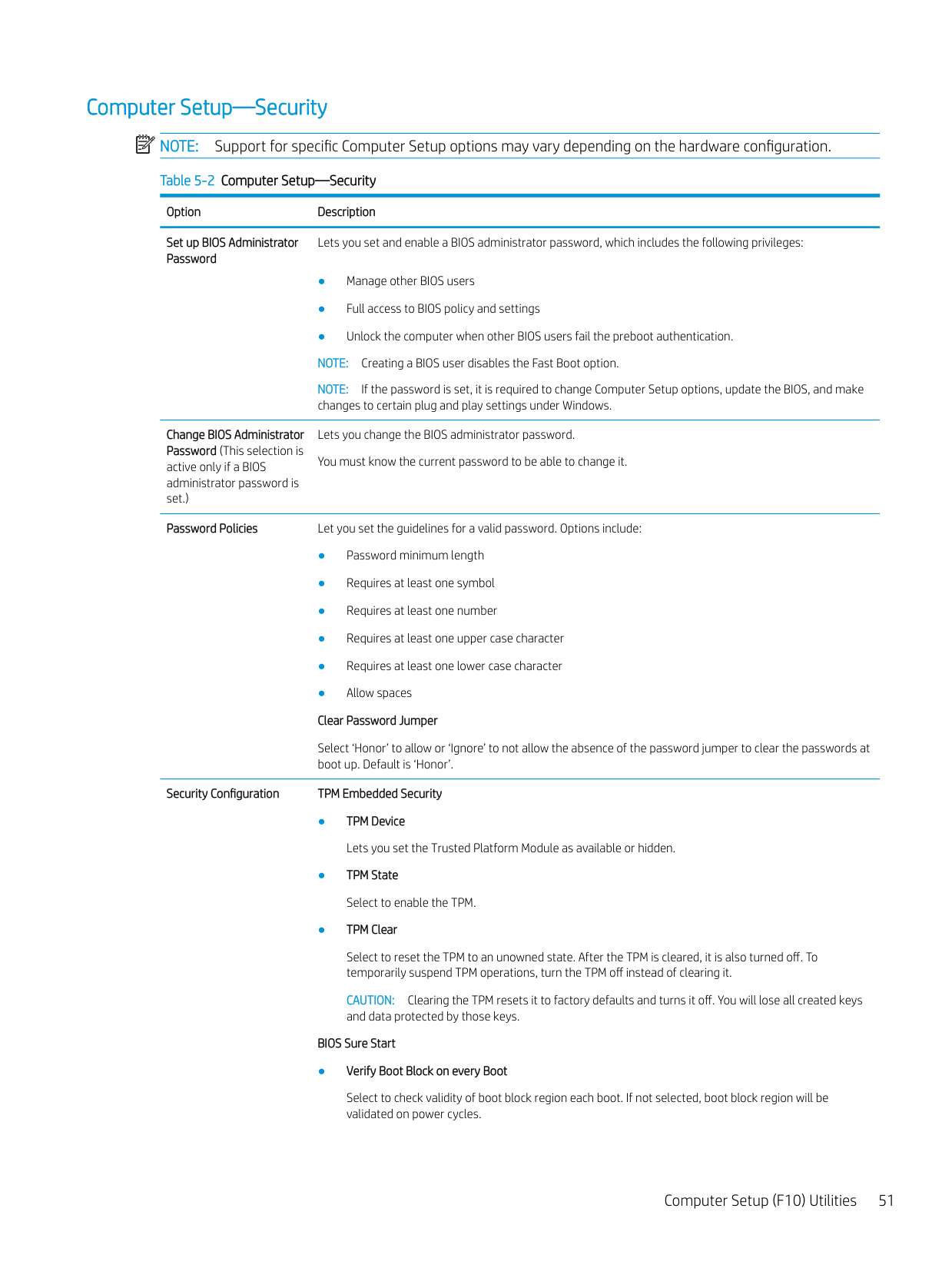
If using an SD card, make sure that the lock tab located on the right of the SD card is not in the locked position. If using a Memory Stick/PRO card, make sure that the lock tab located on the bottom of the Memory Stick/PRO card is not in the locked position.
Unable to access data on the media card after inserting it into a slot. Cause Solution
The media card is not inserted properly, is inserted in the wrong slot, or is not supported.
Ensure that the card is inserted properly with the gold contact on the correct side. The green LED will light if inserted properly.
Solving media card reader problems 67
Do not know how to remove a media card correctly. Cause Solution The computer’s software is used to safely eject the card. Type file in the taskbar search box, and then select File Explorer
from the list of applications. In the left column, expand This PC, right-click on the corresponding drive icon, and then select Eject. Pull the card out of the slot.
NOTE: Never remove the card when the green LED is flashing
After installing the media card reader and booting to Windows, the reader and the inserted cards are not recognized by the computer. Cause Solution
The operating system needs time to recognize the device if the reader was just installed into the computer and you are turning the PC on for the first time.
Wait a few seconds so that the operating system can recognize the reader and the available ports, and then recognize the media inserted in the reader.
After inserting a media card in the reader, the computer attempts to boot from the media card. Cause Solution The inserted media card has boot capability. 1. If you do not want to boot from the media card, remove it
during boot or do not select the option to boot from the inserted media card during the boot process.
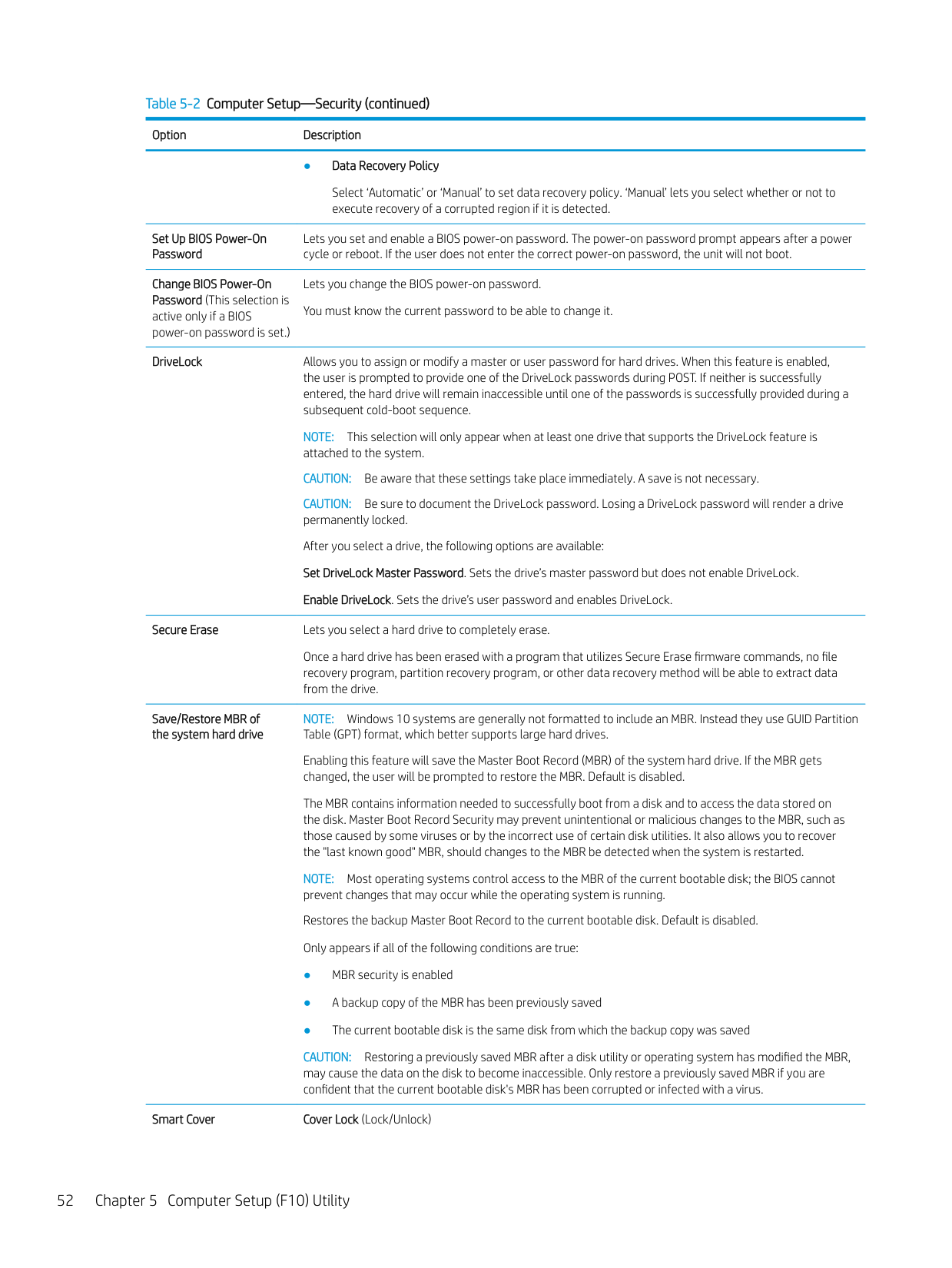
Solving display problems
If you encounter display problems, see the documentation that came with the monitor and to the common causes and solutions listed in the following table.
Blank screen (no video). Cause Solution Monitor is not turned on and the monitor light is not on. Turn on the monitor and check that the monitor light is on. Bad monitor. Try a different monitor. The cable connections are not correct. Check the cable connection from the monitor to the computer and
to the electrical outlet.
You may have a screen blanking utility installed or energy saver features are enabled.
Press any key or click the mouse button and type your password (if set).
System ROM is corrupted; system is running in Boot Block Emergency Recovery Mode (indicated by eight beeps).
Reflash the system ROM with the latest BIOS image.
You are using a fixed-sync monitor and it will not sync at the resolution chosen.
Be sure that the monitor can accept the same horizontal scan rate as the resolution chosen.
Computer is in Sleep state. Press the power button to resume from Sleep state.
Blank screen (no video). Cause Solution
CAUTION: When attempting to resume from Sleep state, do not hold down the power button for more than four seconds. Otherwise, the computer will shut down and you will lose any unsaved data.
Monitor cable is plugged into the wrong connector. Systems may have a monitor connection on both the motherboard or an add-in card. Try moving the monitor connection to a different connector on the back of the computer
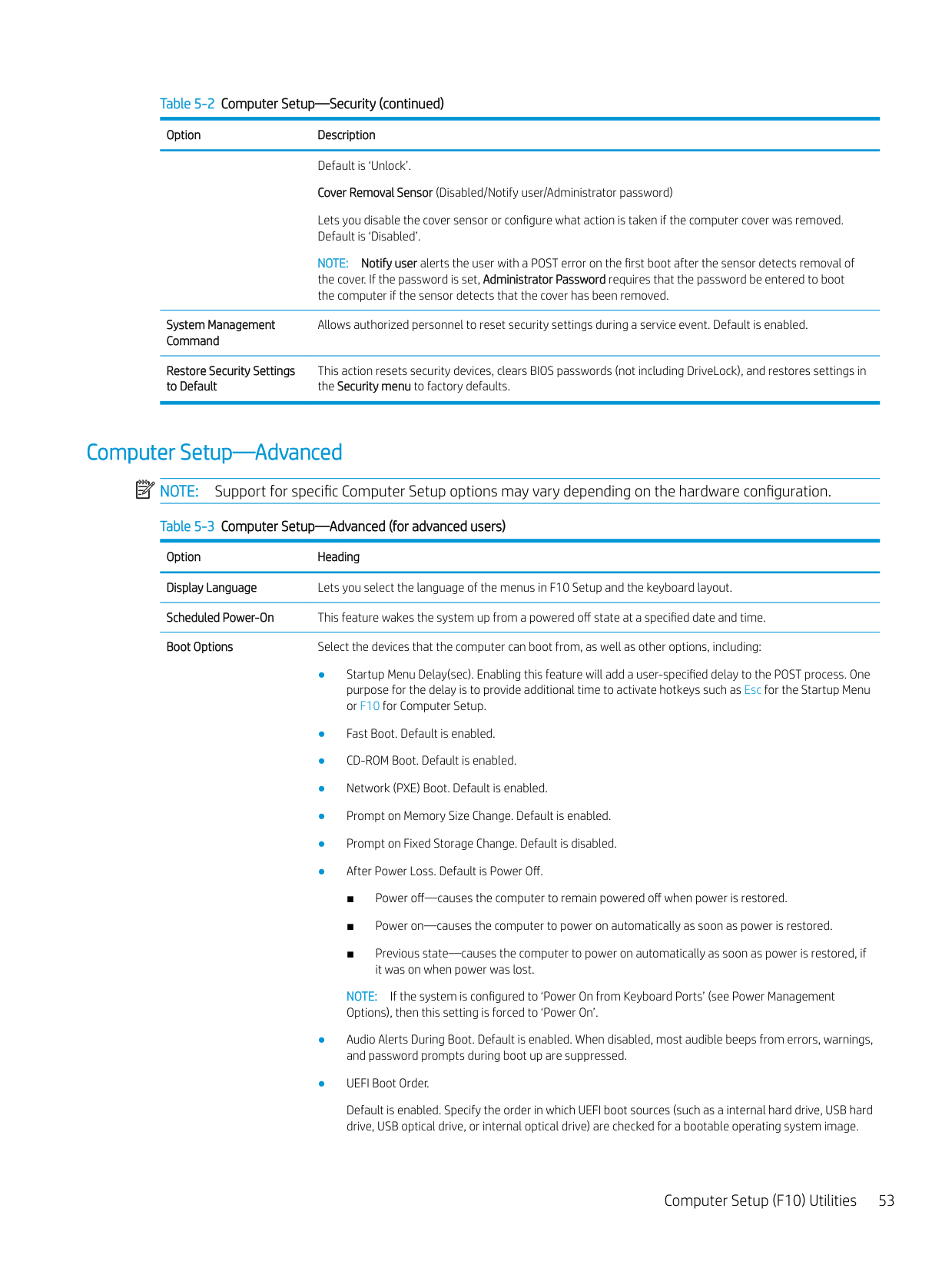
Monitor settings in the computer are not compatible with the monitor.
To access Control Panel, type control panel in the taskbar search box, and then select Control Panel from the list of applications.
Monitor is configured to use an input that is not active. Use the monitor's on-screen menu controls to select the input that is being driven by the system. Refer to the monitor's user documentation for more information on the on-screen controls and settings.
Blank screen and the power LED flashes Red five times, once every second, followed by a two second pause, and the computer beeps five times. (Beeps stop after fifth iteration but LEDs continue flashing.)
Cause Solution Pre-video memory error. 1. Reseat DIMMs. Power on the system.
Blank screen and the power LED flashes Red six times, once every second, followed by a two second pause, and the computer beeps six times. (Beeps stop after fifth iteration but LEDs continue flashing.)
Cause Solution Pre-video graphics error. For systems with a graphics card:
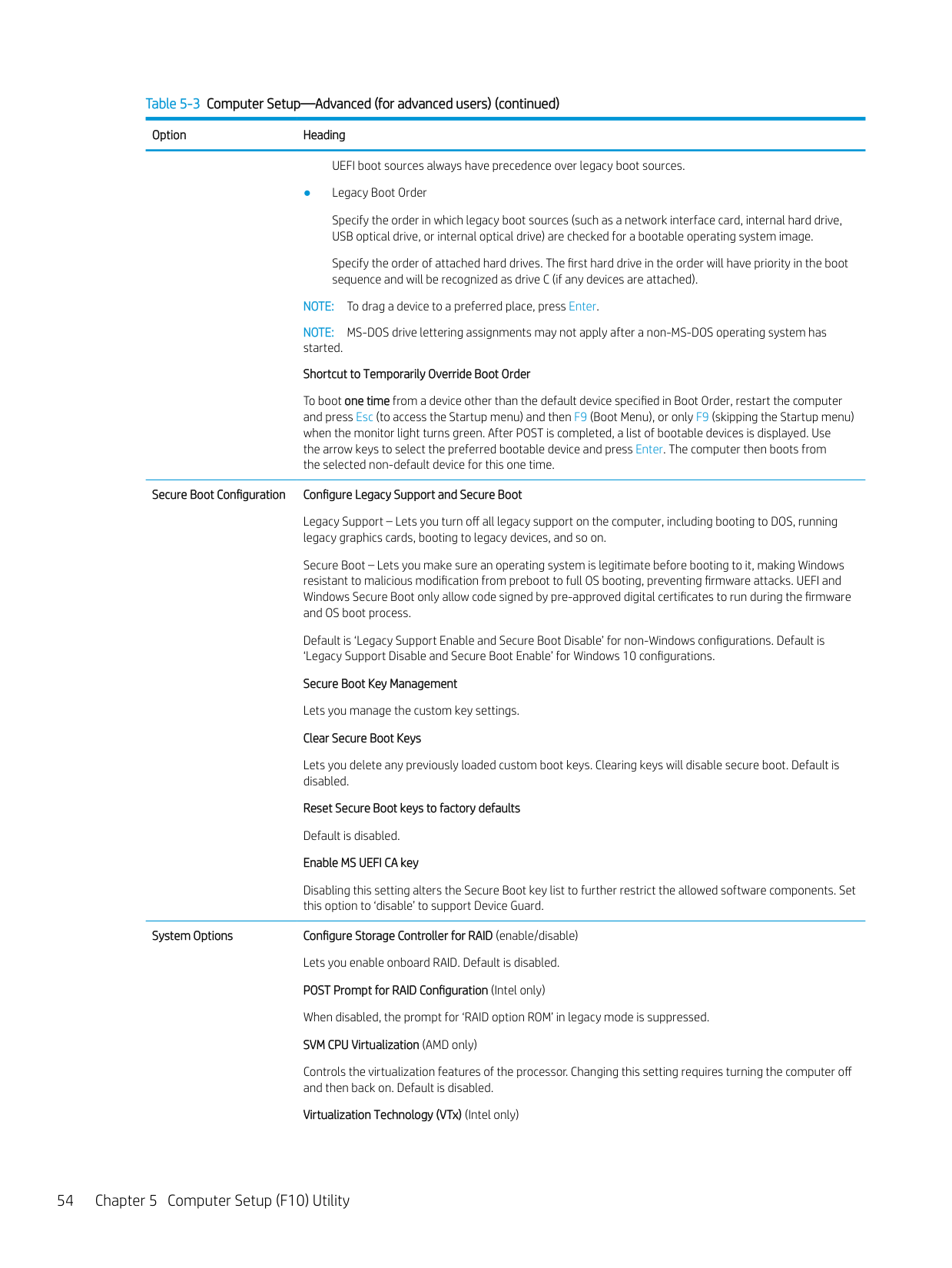
Blank screen and the power LED flashes Red seven times, once every second, followed by a two second pause, and the computer beeps seven times. (Beeps stop after fifth iteration but LEDs continue flashing.)
Cause Solution System board failure (ROM detected failure prior to video). Replace the system board.
Monitor does not function properly when used with energy saver features. Cause Solution
Monitor without energy saver capabilities is being used with energy saver features enabled.
Disable monitor energy saver feature.
Dim characters. Cause Solution The brightness and contrast controls are not set properly. Adjust the monitor brightness and contrast controls. Cables are not properly connected. Check that the graphics cable is securely connected to the graphics
card (if applicable) or video connector and the monitor.
Blurry video or requested resolution cannot be set. Cause Solution
If the graphics controller was upgraded, the correct graphics drivers may not be loaded.
Install the video drivers included in the upgrade kit.
Monitor is not capable of displaying requested resolution. Change requested resolution. Graphics card is bad. Replace the graphics card.
The picture is broken up, rolls, jitters, or flashes. Cause Solution
The monitor connections may be incomplete or the monitor may be incorrectly adjusted.
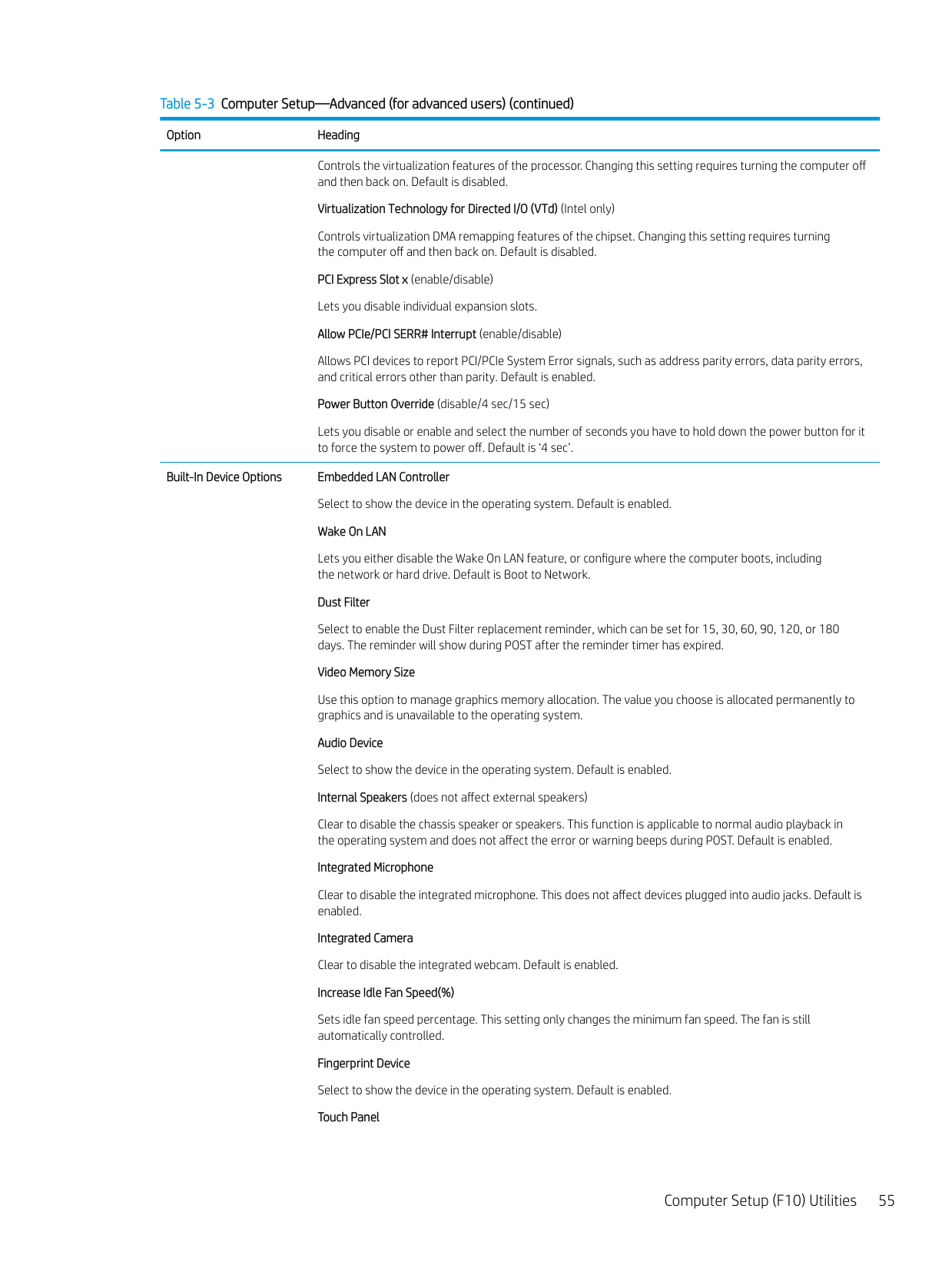
Monitor needs to be degaussed. Degauss the monitor. Refer to the documentation that came with the monitor for instructions.
Image is not centered. Cause Solution Position may need adjustment. Press the monitor's Menu button to access the OSD menu. Select
ImageControl/ Horizontal Position or Vertical Position to adjust the horizontal or vertical position of the image.
“No Connection, Check Signal Cable” displays on screen. Cause Solution Monitor video cable is disconnected. Connect the video cable between the monitor and computer.
CAUTION: Ensure that the computer power is off while connecting the video cable.
“Out of Range” displays on screen. Cause Solution
Video resolution and refresh rate are set higher than what the monitor supports.
Restart the computer and enter Safe Mode. Change the settings to a supported setting then restart the computer so that the new settings take effect. To enter Safe Mode:
When your computer is in safe mode, Safe Mode displays in the corners of your monitor. To exit safe mode, restart your computer and let Windows start normally.
High pitched noise coming from inside a flat panel monitor. Cause Solution Brightness and/or contrast settings are too high. Lower brightness and/or contrast settings.
Fuzzy focus; streaking, ghosting, or shadowing effects; horizontal scrolling lines; faint vertical bars; or unable to center the picture on the screen (flat panel monitors using an analog VGA input connection only).
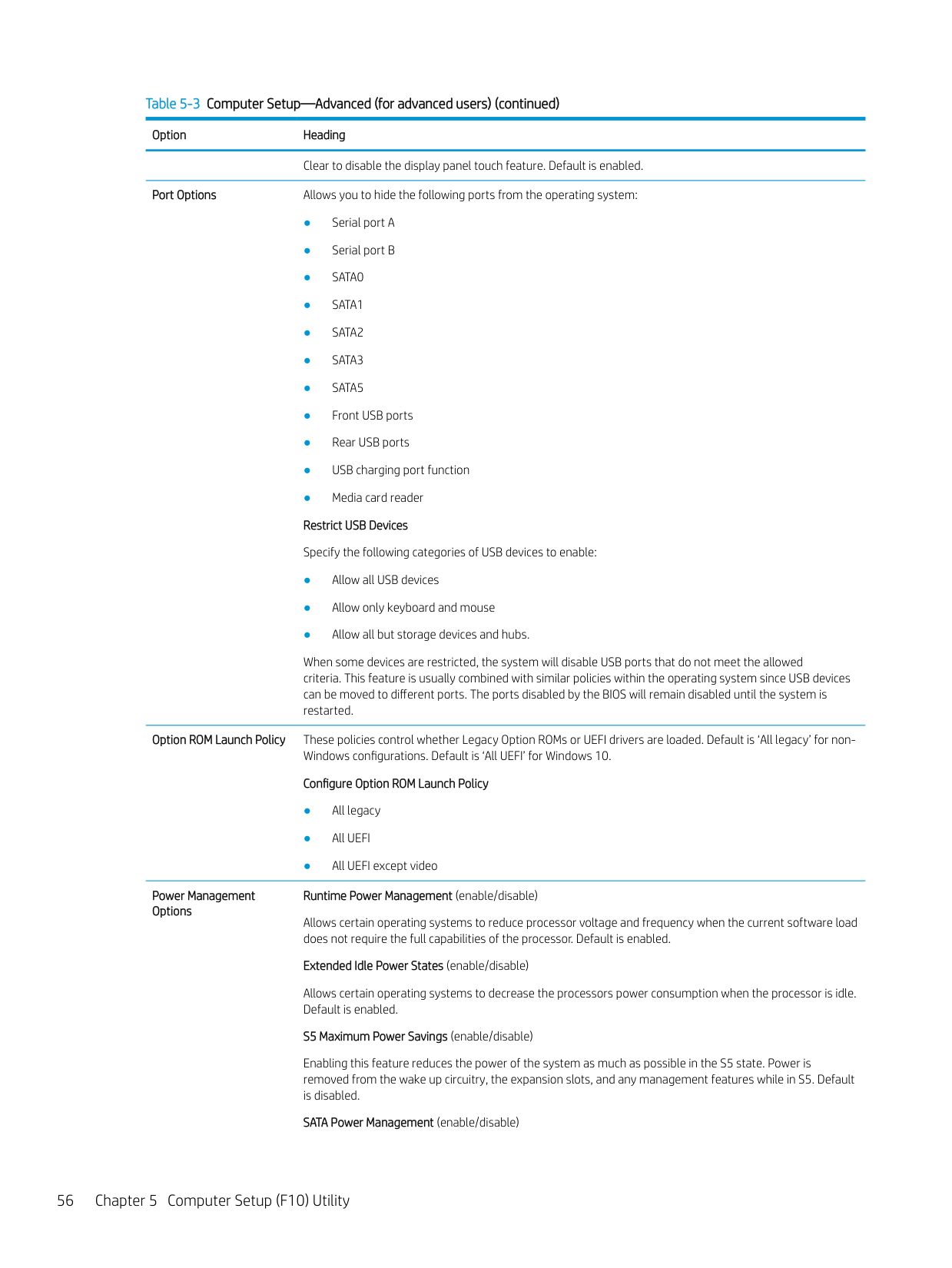
Cause Solution
Flat panel monitor’s internal digital conversion circuits may be unable to correctly interpret the output synchronization of the graphics card.
Fuzzy focus; streaking, ghosting, or shadowing effects; horizontal scrolling lines; faint vertical bars; or unable to center the picture on the screen (flat panel monitors using an analog VGA input connection only).
Cause Solution
the appropriate monitor, and download either SP32347 or SP32202: http://www.hp.com/support
Graphics card is not seated properly or is bad (some models). 1. Reseat the graphics card.
Certain typed symbols do not appear correct. Cause Solution The font you are using does not support that particular symbol. Use the Character Map to locate and select the appropriate symbol.
You can copy the symbol from the Character Map into a document. Type ch in the taskbar search box, and then select Character Map from the list of applications.
Solving audio problems
If the computer has audio features and you encounter audio problems, see the common causes and solutions listed in the following table.
Sound cuts in and out. Cause Solution Processor resources are being used by other open applications. Shut down all open processor-intensive applications.
Sound does not come out of the speaker or headphones. Cause Solution Software volume control is turned down or muted. Double-click the Speaker icon on the taskbar, then make sure that
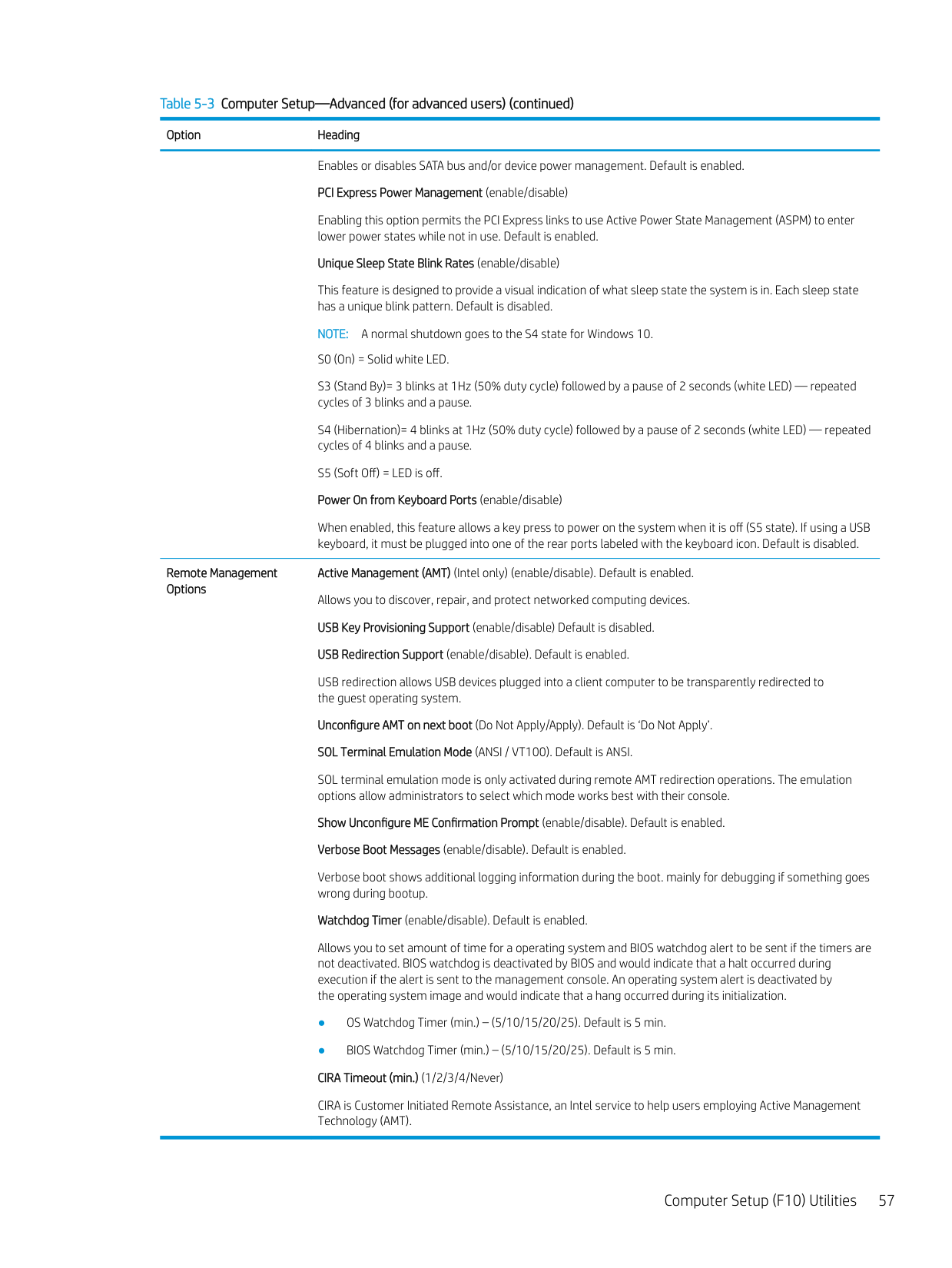
Mute is not selected and use the volume slider to adjust the volume.
Audio is hidden in Computer Setup. Enable the audio in Computer Setup: Advanced > Built-in Device
Options. The external speakers are not turned on. Turn on the external speakers. The audio device may be connected to the wrong jack. Ensure that the device is connected to the correct jack on
the computer. The speakers should be plugged into the line-out jack and the headphones should be plugged into the headphone jack.
External speakers plugged into the wrong audio jack on a recently installed sound card.
See the sound card documentation for proper speaker connection. The rear audio jack output is the green receptacle.
Headphones or devices connected to the line-out connector mute the internal speaker.
Turn on and use headphones or external speakers, if connected, or disconnect headphones or external speakers.
Computer is in Sleep state. Press the power button to resume from Sleep state.
Sound does not come out of the speaker or headphones. Cause Solution
CAUTION: When attempting to resume from Sleep state, do not hold down the power button for more than four seconds. Otherwise, the computer will shut down and you will lose any unsaved data.
Internal speaker is disabled in Computer Setup. Enable the internal speaker in Computer Setup. Select Advanced >
Built-in Device Options.
The application is set to use a different audio device than speakers. Some graphics cards support audio over the DisplayPort connection (if applicable), so multiple audio devices may be listed in Device Manager. Make sure the correct device is being used.
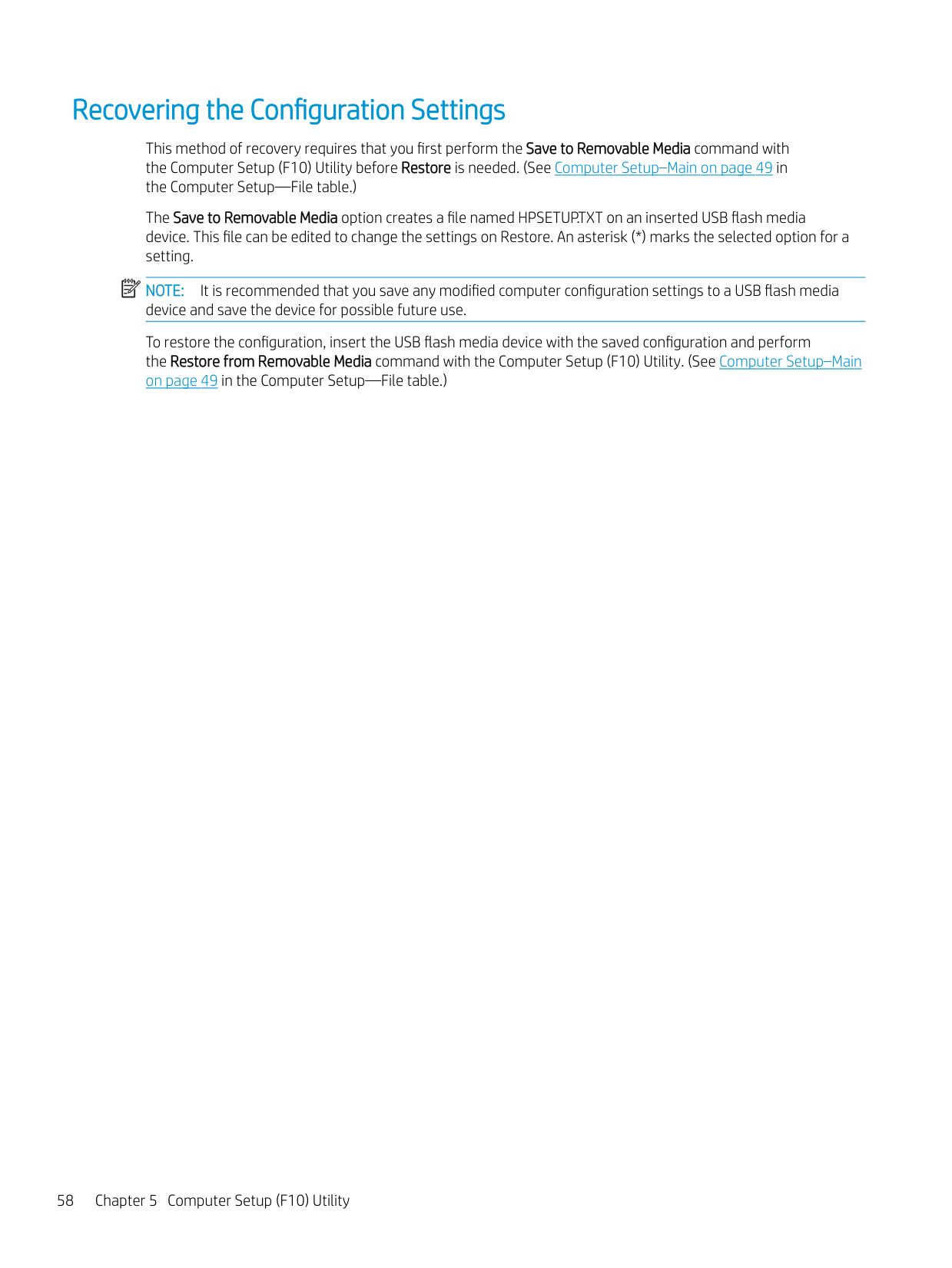
To access Device Manager, type device manager in the taskbar search box, and then select Device Manager from the list of applications.
Some applications can select which audio output device is used. Make sure the application has selected the correct audio device. The operating system controls may be set to use a different audio device as the default output device than what is expected.
Set the operating system to use the correct audio device.
Sound from headphones is not clear or muffled. Cause Solution
Headphones are plugged into the rear audio output connector. The rear audio output connector is for powered audio devices and is not designed for headphone use.
Plug the headphones into the headphone connector on the front of the computer.
Computer appears to be locked up while recording audio. Cause Solution The hard disk may be full. Before recording, make sure there is enough free space on the hard
disk. You can also try recording the audio file in a compressed format.
Line-in jack is not functioning properly. Cause Solution
Jack has been reconfigured in the audio driver or application software.
In the audio driver or application software, reconfigure the jack or set the jack to its default value.
There is no sound or very weak sound is detected by the headset microphone. Cause Solution The incorrect style of headset is being used. The front headset jack supports only Cellular Telephone Industries
Association (CTIA) style headsets. Open Mobile Terminal Platform (OMTP) style headsets are not supported. These styles of headsets differ by the way that the microphone signals are oriented on the
Solving audio problems 73
There is no sound or very weak sound is detected by the headset microphone. Cause Solution
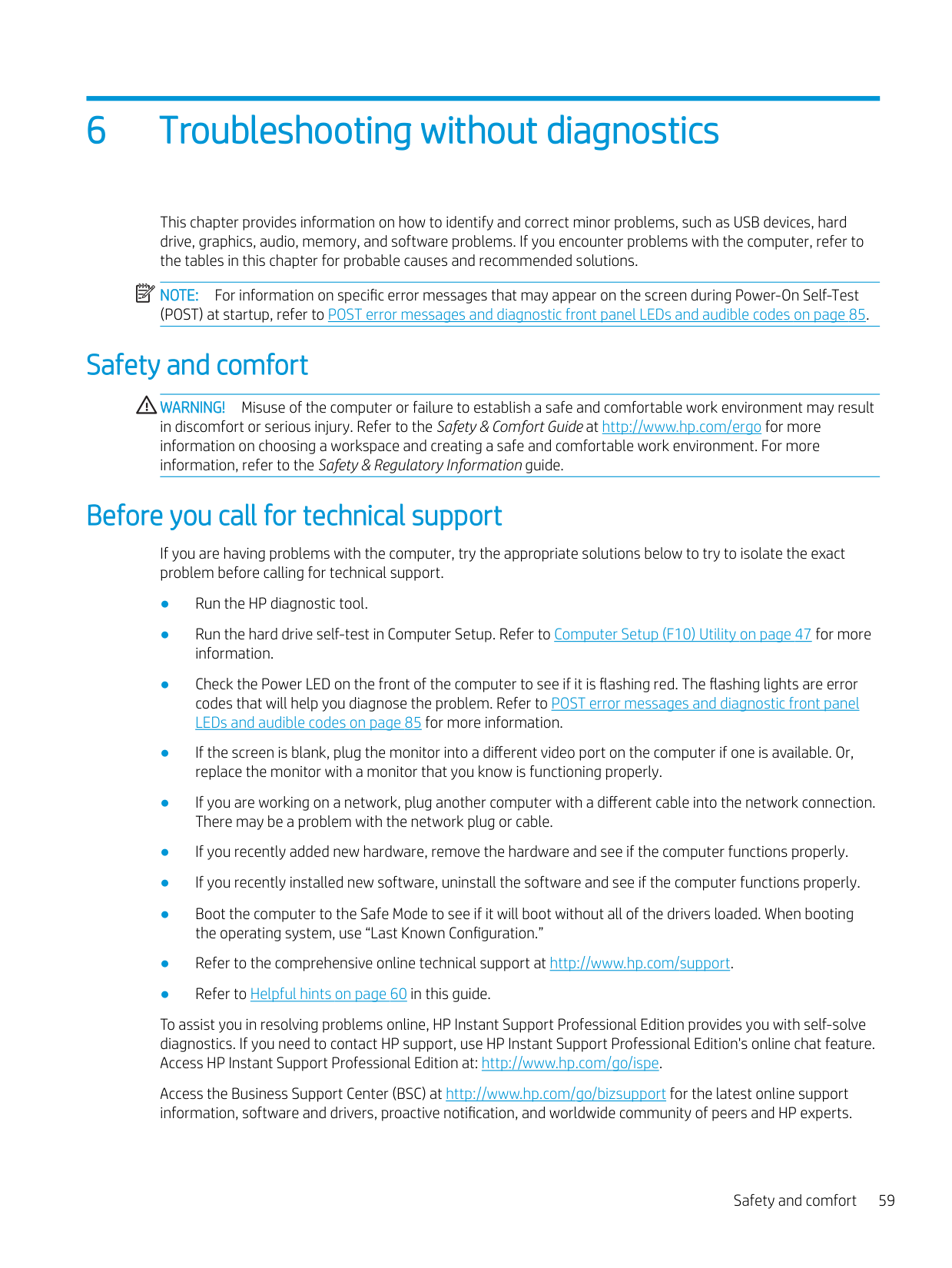
connector. To solve the issue, use a CTIA style headset or a commercially available adapter that will convert from OMTP to CTIA signaling.
There is no sound or sound volume is too low. Cause Solution The application is set to use a different audio device than speakers. Some graphics cards support audio over the DisplayPort connection
(if applicable), so multiple audio devices may be listed in Device Manager. Make sure the correct device is being used.
To access Device Manager, type device manager in the taskbar search box, and then select Device Manager from the list of applications.
Some applications can select which audio output device is used. Make sure the application has selected the correct audio device. The operating system controls may be set to use a different audio device as the default output device than what is expected.
Set the operating system to use the correct audio device.
Solving printer problems
If you encounter printer problems, see the documentation that came with the printer and to the common causes and solutions listed in the following table.
Printer will not print. Cause Solution Printer is not turned on and online. Turn the printer on and make sure it is online. The correct printer drivers for the application are not installed. 1. Install the correct printer driver for the application.
where [printer port] is the address of the printer being used. If the printer works, reload the printer driver.
To run MS-DOS commands, press the Windows key + r, type cmd in the Open box, and then click OK.
If you are on a network, you may not have made the connection to the printer.
Make the proper network connections to the printer.
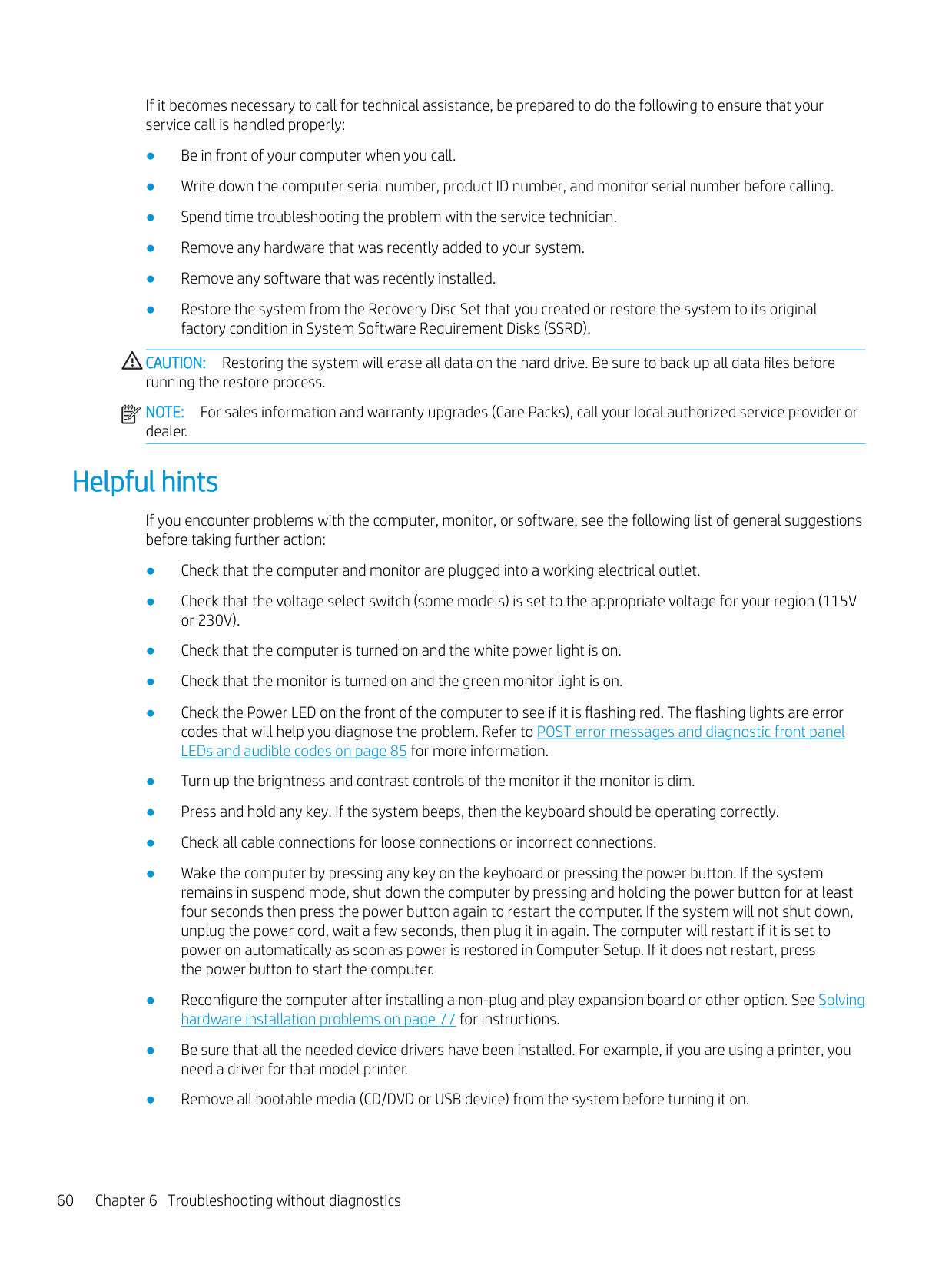
Printer may have failed. Run printer self-test.
Printer will not turn on. Cause Solution The cables may not be connected properly. Reconnect all cables and check the power cord and electrical outlet.
Printer prints garbled information. Cause Solution The correct printer driver for the application is not installed. Install the correct printer driver for the application. The cables may not be connected properly. Reconnect all cables. Printer memory may be overloaded. Reset the printer by turning it off for one minute, then turn it back
on.
Printer will not print. Cause Solution The printer may be out of paper. Check the paper tray and refill it if it is empty.
Solving keyboard and mouse problems
If you encounter keyboard or mouse problems, see the documentation that came with the equipment and to the common causes and solutions listed in the following table.
A wireless keyboard/mouse is not working correctly. Symptoms include lagging mouse movement, jumpy mouse/keyboard, or no function of mouse/keyboard and external drive.
Cause Solution
If your computer is equipped with USB 3.0 ports, connected USB 3.0 devices can interfere with the wireless keyboard USB receiver.
Connect the wireless keyboard USB receiver to a USB 2.0 port that is separated from ports with USB 3.0 devices. If you still experience interference, you may have to place the connectors farther apart using an external USB hub.
Keyboard commands and typing are not recognized by the computer. Cause Solution Keyboard connector is not properly connected. Shut down the computer, reconnect the keyboard to the back of
the computer, and then restart the computer. Program in use has stopped responding to commands. Shut down your computer using the mouse and then restart
the computer. Keyboard needs repairs. See the Worldwide Limited Warranty for terms and conditions. Computer is in Sleep state. Press the power button to resume from Sleep state.
CAUTION: When attempting to resume from Sleep date, do not hold down the power button for more than four seconds. Otherwise, the computer will shut down and you will lose any unsaved data.
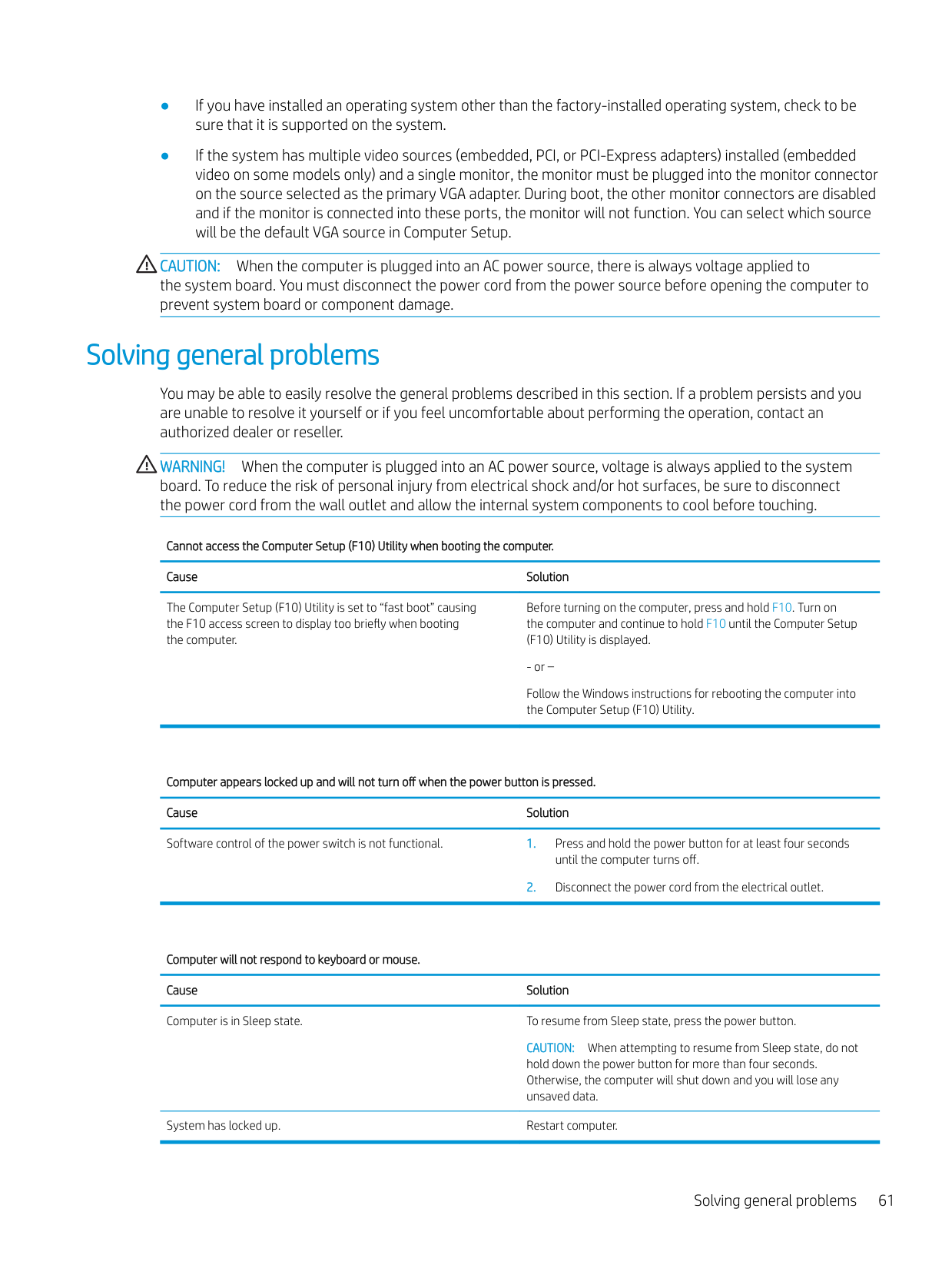
Solving keyboard and mouse problems 75
Mouse does not respond to movement or is too slow. Cause Solution
Mouse connector is not properly plugged into the back of the computer.
Shut down the computer using the keyboard.
Program in use has stopped responding to commands. Shut down the computer using the keyboard then restart the computer.
Mouse may need cleaning. Remove the roller ball cover on the mouse and clean the internal
components. Mouse may need repair. See the Worldwide Limited Warranty for terms and conditions. Computer is in Sleep state. Press the power button to resume from Sleep state.
CAUTION: When attempting to resume from Sleep state, do not hold down the power button for more than four seconds. Otherwise, the computer will shut down and you will lose any unsaved data.
Mouse will only move vertically, horizontally, or movement is jerky. Cause Solution
Mouse roller ball or the rotating encoder shafts that make contact with the ball are dirty.
Remove roller ball cover from the bottom of the mouse and clean the internal components with a mouse cleaning kit available from most computer stores.
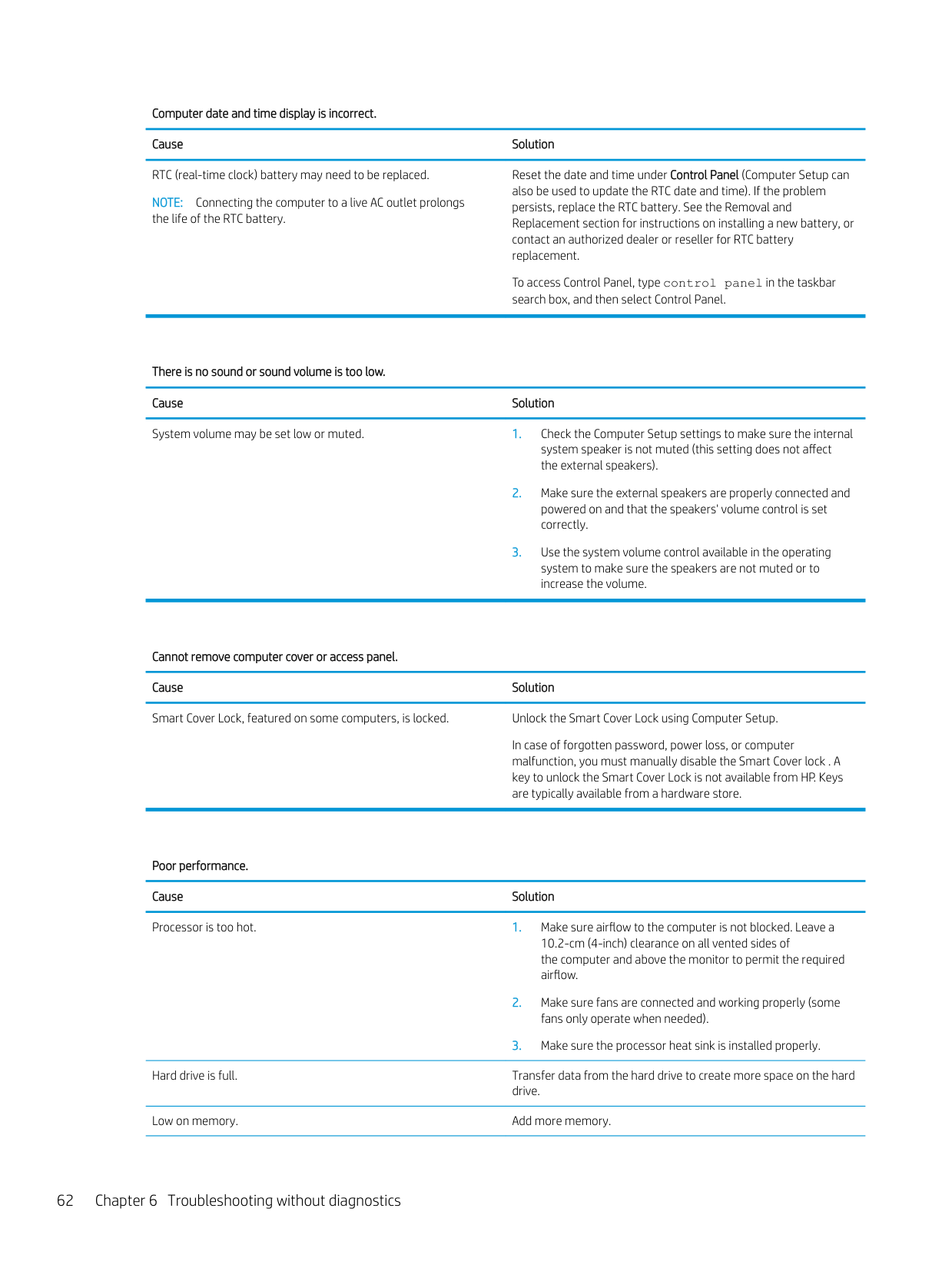
Solving hardware installation problems
You may need to reconfigure the computer when you add or remove hardware, such as an additional drive or expansion card. If you install a plug and play device, Windows automatically recognizes the device and configures the computer. If you install a non-plug and play device, you must reconfigure the computer after completing installation of the new hardware. In Windows, use the Add Hardware Wizard and follow the instructions that appear on the screen.
To open the Add Hardware Wizard, open a Command Prompt and open hdwwiz.exe. WARNING! When the computer is plugged into an AC power source, voltage is always applied to the system board. To reduce the risk of personal injury from electrical shock and/or hot surfaces, be sure to disconnect the power cord from the wall outlet and allow the internal system components to cool before touching.
Table 6-1 Solving hardware installation problems A new device is not recognized as part of the system. Cause Solution Device is not seated or connected properly. Ensure that the device is properly and securely connected and that
pins in the connector are not bent down.
Cable(s) of new external device are loose or power cables are unplugged.
Ensure that all cables are properly and securely connected and that pins in the cable or connector are not bent down.
Power switch of new external device is not turned on. Turn off the computer, turn on the external device, then turn on the computer to integrate the device with the computer system.
When the system advised you of changes to the configuration, you did not accept them.
Reboot the computer and follow the instructions for accepting the changes.
A plug and play board may not automatically configure when added if the default configuration conflicts with other devices.
Use Windows Device Manager to deselect the automatic settings for the board and choose a basic configuration that does not cause a resource conflict. You can also use Computer Setup to reconfigure or disable devices to resolve the resource conflict.
To access Device Manager, type device manager in the taskbar search box, and then select Device Manager from the list of applications.
USB ports on the computer are disabled in Computer Setup. Run the Computer Setup utility and ensure that Device available is selected for appropriate USB ports under Advanced > Port Options.
Computer will not start. Cause Solution
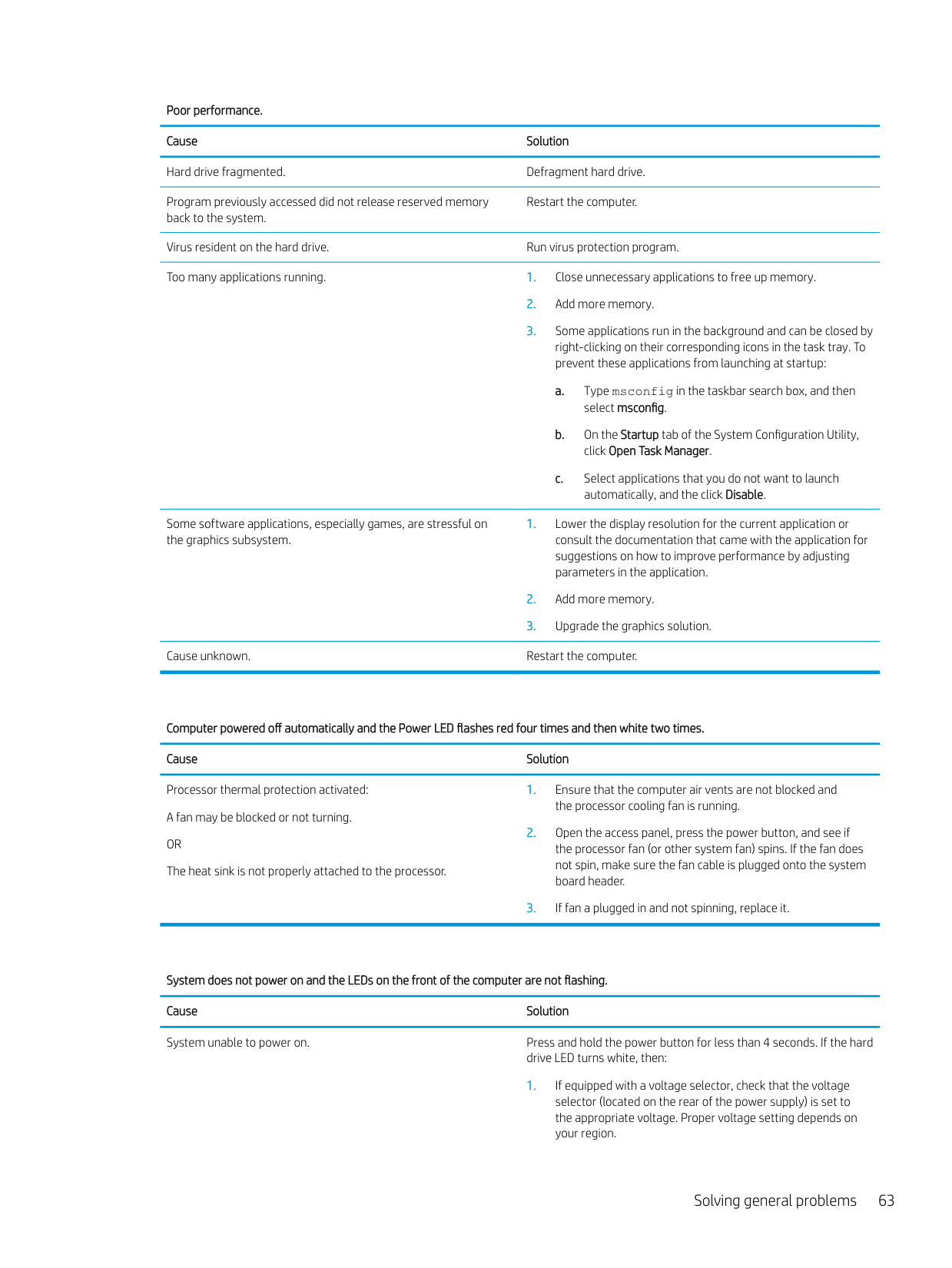
Wrong memory modules were used in the upgrade or memory modules were installed in the wrong location.
NOTE: DIMM1 or XMM1 must always be installed. DIMM1 must be installed before DIMM2, and DIMM3 must be installed before DIMM4.
####### Solving hardware installation problems 77
Power LED flashes Red three times and then white two times. Cause Solution Memory is installed incorrectly or is bad. CAUTION: To avoid damage to the DIMMs or the system board,
you must unplug the computer power cord before attempting to reseat, install, or remove a DIMM module.
NOTE: DIMM1 or XMM1 must always be installed. DIMM1 must be installed before DIMM2, and DIMM3 must be installed before DIMM4
Solving network problems
Some common causes and solutions for network problems are listed in the following table. These guidelines do not discuss the process of debugging the network cabling.
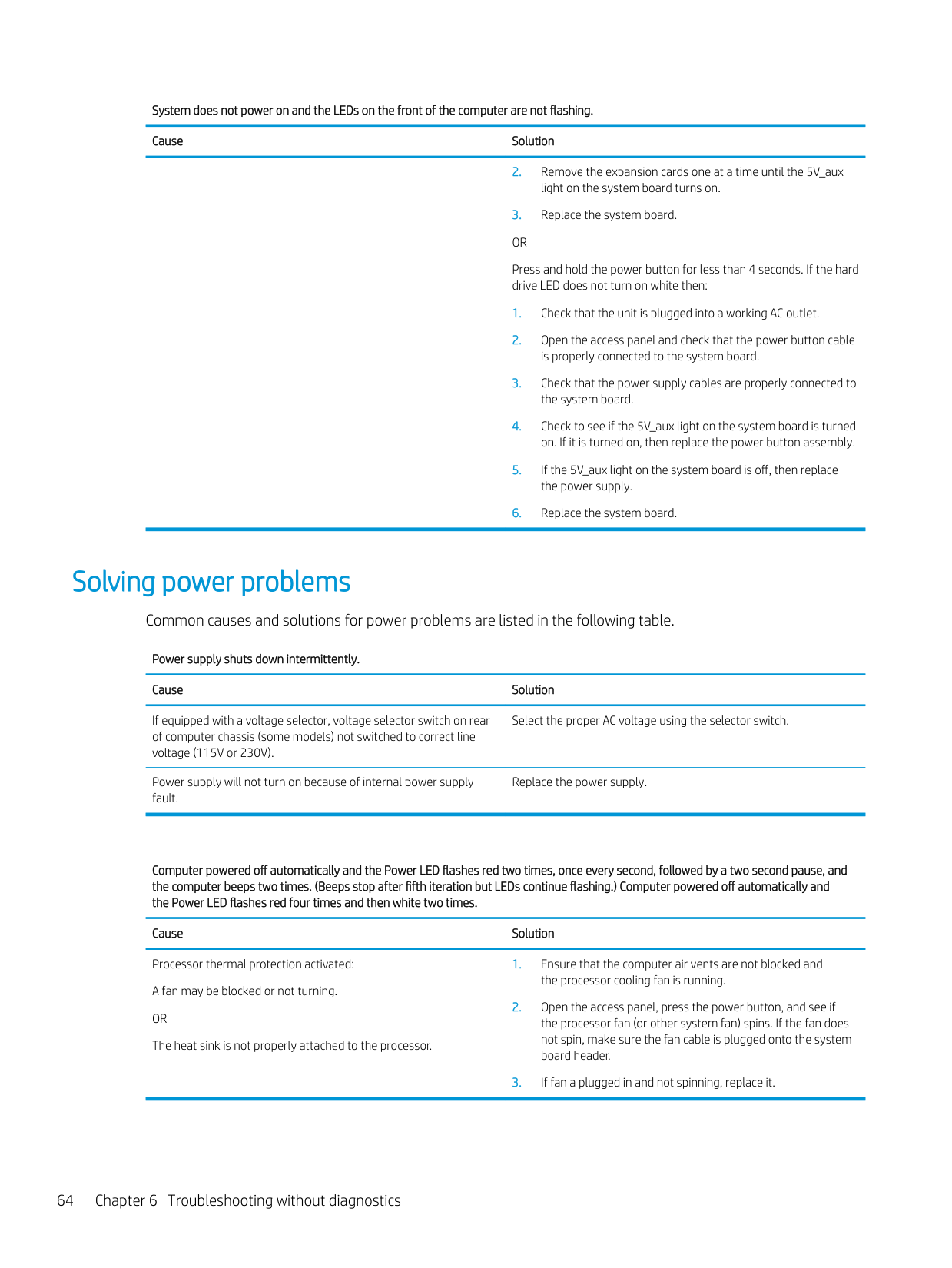
Table 6-2 Solving network problems Network driver does not detect network controller. Cause Solution Network controller is disabled. 1. Run Computer Setup and enable network controller.
Incorrect network driver. Check the network controller documentation for the correct driver or obtain the latest driver from the manufacturer’s Web site.
Network status link light never flashes. NOTE: The network status light is supposed to flash when there is network activity. Cause Solution No active network is detected. Check cabling and network equipment for proper connection. Network controller is not set up properly. Check for the device status within Windows, such as Device
Manager for driver load and the Network Connections applet within Windows for link status.
To access Device Manager, type device manager in the taskbar search box, and then select Device Manager from the list of applications.
Network controller is disabled. 1. Run Computer Setup and enable network controller.
Table 6-2 Solving network problems (continued) Network status link light never flashes. NOTE: The network status light is supposed to flash when there is network activity. Cause Solution
Network driver is not properly loaded. Reinstall network drivers. System cannot autosense the network. Disable auto-sensing capabilities and force the system into
the correct operating mode.
Diagnostics reports a failure. Cause Solution The cable is not securely connected. Ensure that the cable is securely attached to the network connector
and that the other end of the cable is securely attached to the correct device.
The cable is attached to the incorrect connector. Ensure that the cable is attached to the correct connector. There is a problem with the cable or a device at the other end of the cable.
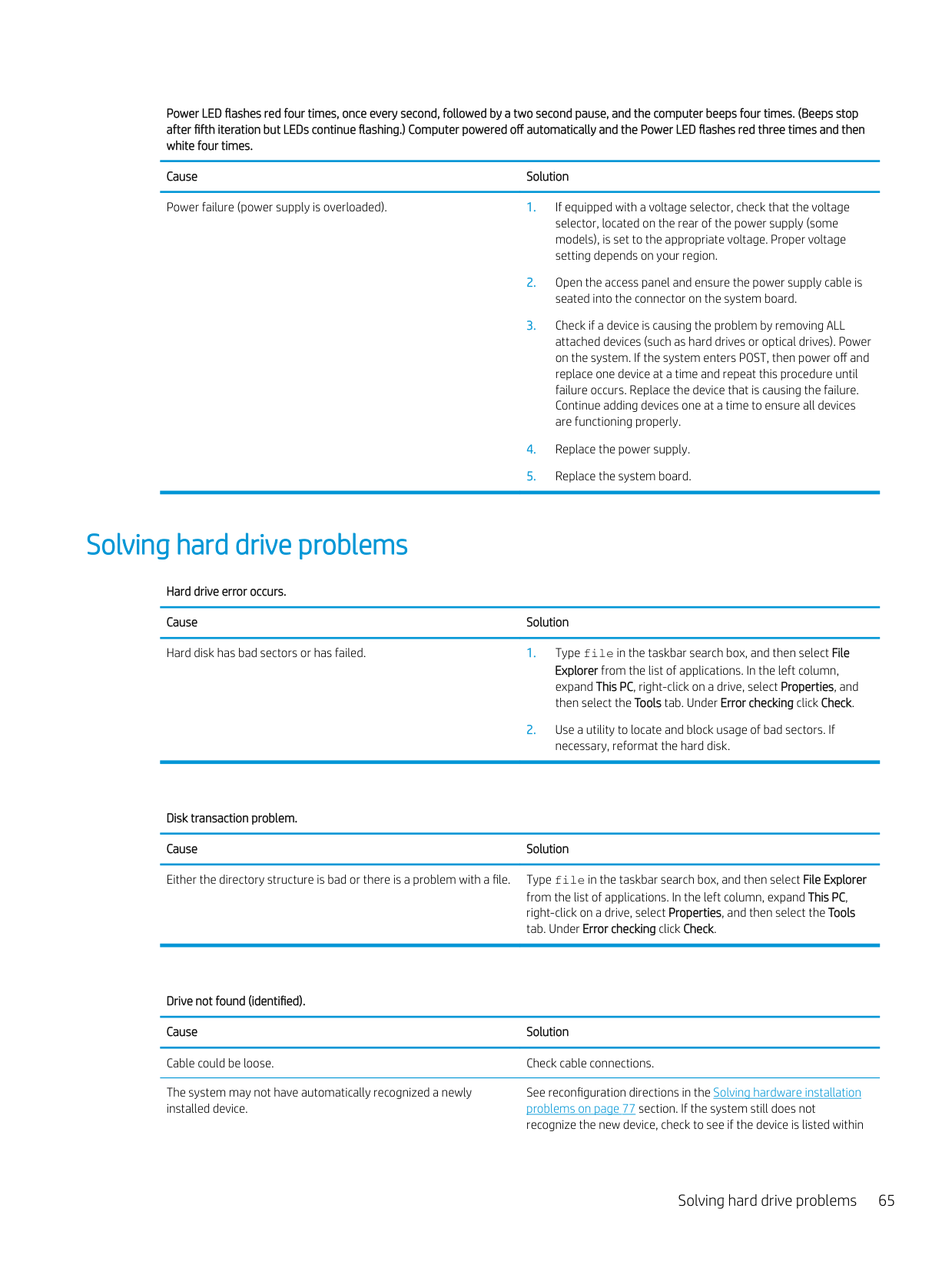
Ensure that the cable and device at the other end are operating correctly.
The network controller is defective. Contact an authorized service provider.
Diagnostics passes, but the computer does not communicate with the network. Cause Solution Network drivers are not loaded, or driver parameters do not match current configuration.
Make sure the network drivers are loaded and that the driver parameters match the configuration of the network controller.
Make sure the correct network client and protocol is installed.
The network controller is not configured for this computer. Select the Network and Sharing Center icon in the Control Panel and configure the network controller. To access Control Panel, type control panel in the taskbar search box, and then select Control Panel from the list of applications.
Network controller stopped working when an expansion board was added to the computer. Cause Solution The network controller requires drivers. Verify that the drivers were not accidentally deleted when
the drivers for a new expansion board were installed.
Solving network problems 79
Network controller stops working without apparent cause. Cause Solution The files containing the network drivers are corrupted. Reinstall the network drivers using the Windows recovery tools.
If necessary, download the softpaq from the web (from a different computer).
The cable is not securely connected. Ensure that the cable is securely attached to the network connector and that the other end of the cable is securely attached to the correct device.
The network controller is defective. Contact an authorized service provider.
New network card will not boot. Cause Solution
New network card may be defective or may not meet industrystandard specifications.
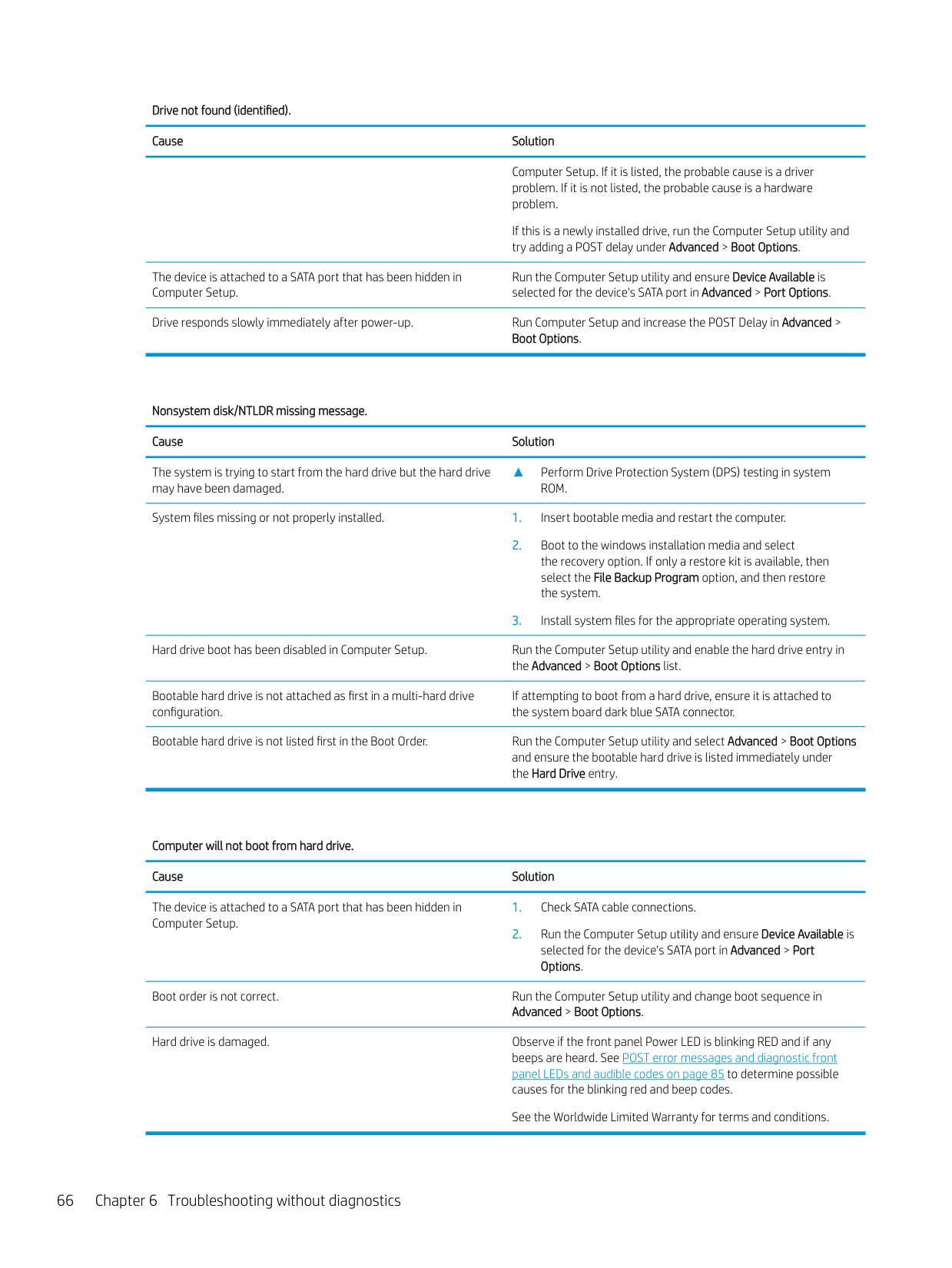
Install a working, industry-standard NIC, or change the boot sequence to boot from another source.
Cannot connect to network server when attempting Remote System Installation. Cause Solution The network controller is not configured properly. Verify Network Connectivity, that a DHCP Server is present, and that
the Remote System Installation Server contains the NIC drivers for your NIC.
System setup utility reports unprogrammed EEPROM. Cause Solution Unprogrammed EEPROM. Contact an authorized service provider.
Solving memory problems If you encounter memory problems, some common causes and solutions are listed in the following table. CAUTION: Power may still be supplied to the DIMMs when the computer is turned off (depending on the Management Engine (ME) settings). To avoid damage to the DIMMs or the system board, you must unplug the computer power cord before attempting to reseat, install, or remove a memory module.
For those systems that support ECC memory, HP does not support mixing ECC and non-ECC memory. Otherwise, the computer will not boot the operating system.
| | |---|
NOTE: The memory count will be affected by configurations with the Management Engine (ME) enabled. The ME uses 8MB of system memory in single channel mode or 16MB of memory in dual-channel mode to download, decompress, and execute the ME firmware for Out-of-Band (OOB), third-party data storage, and other management functions.
System will not boot or does not function properly after installing additional memory modules. Cause Solution A memory module is not installed in the DIMM1 or XMM1 socket. Ensure that a memory module is installed in the DIMM1 or XMM1
socket on the system board. This socket must be populated with a memory module.
Memory module is not the correct type or speed grade for the system or the new memory module is not seated properly.
Replace module with the correct industry-standard device for the computer. On some models, ECC and non-ECC memory modules cannot be mixed.
Out of memory error. Cause Solution You have run out of memory to run the application. Check the application documentation to determine the memory
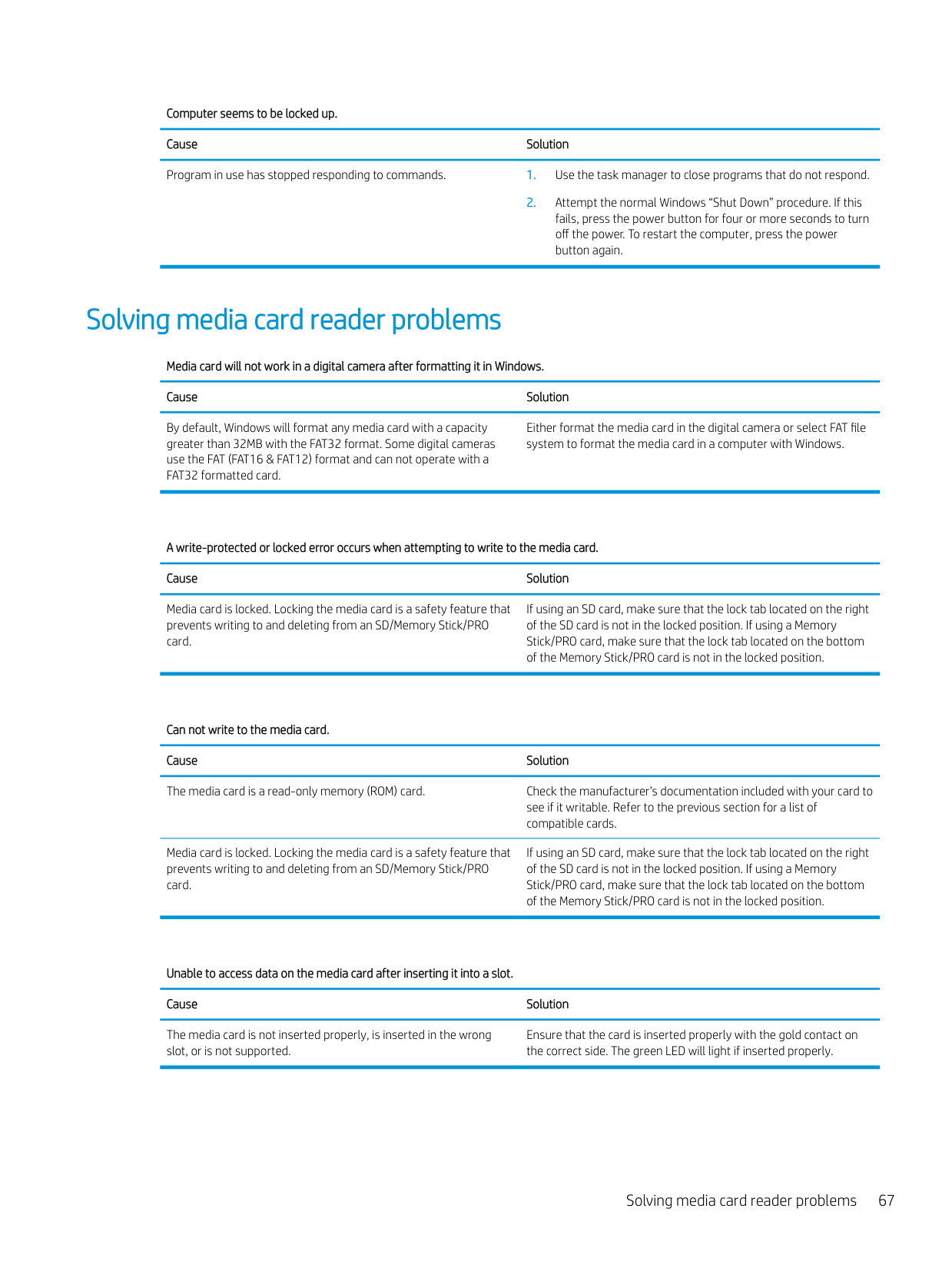
requirements.
Memory count during POST is wrong. Cause Solution The memory modules may not be installed correctly. Check that the memory modules have been installed correctly and
that proper modules are used. Integrated graphics may use system memory. No action required.
Insufficient memory error during operation. Cause Solution
Too many Terminate and Stay Resident programs (TSRs) are installed.
Delete any TSRs that you do not need.
You have run out of memory for the application. Check the memory requirements for the application or add more memory to the computer.
Solving memory problems 81
Power LED flashes Red five times, once every second, followed by a two second pause, and the computer beeps five times. (Beeps stop after fifth iteration but LEDs continue flashing.)
Cause Solution Memory is installed incorrectly or is bad. 1. Reseat DIMMs. Power on the system.
Solving USB flash drive problems
If you encounter USB flash drive problems, common causes and solutions are listed in the following table. USB flash drive is not seen as a drive letter in Windows. Cause Solution The drive letter after the last physical drive is not available. Change the default drive letter for the flash drive in Windows.
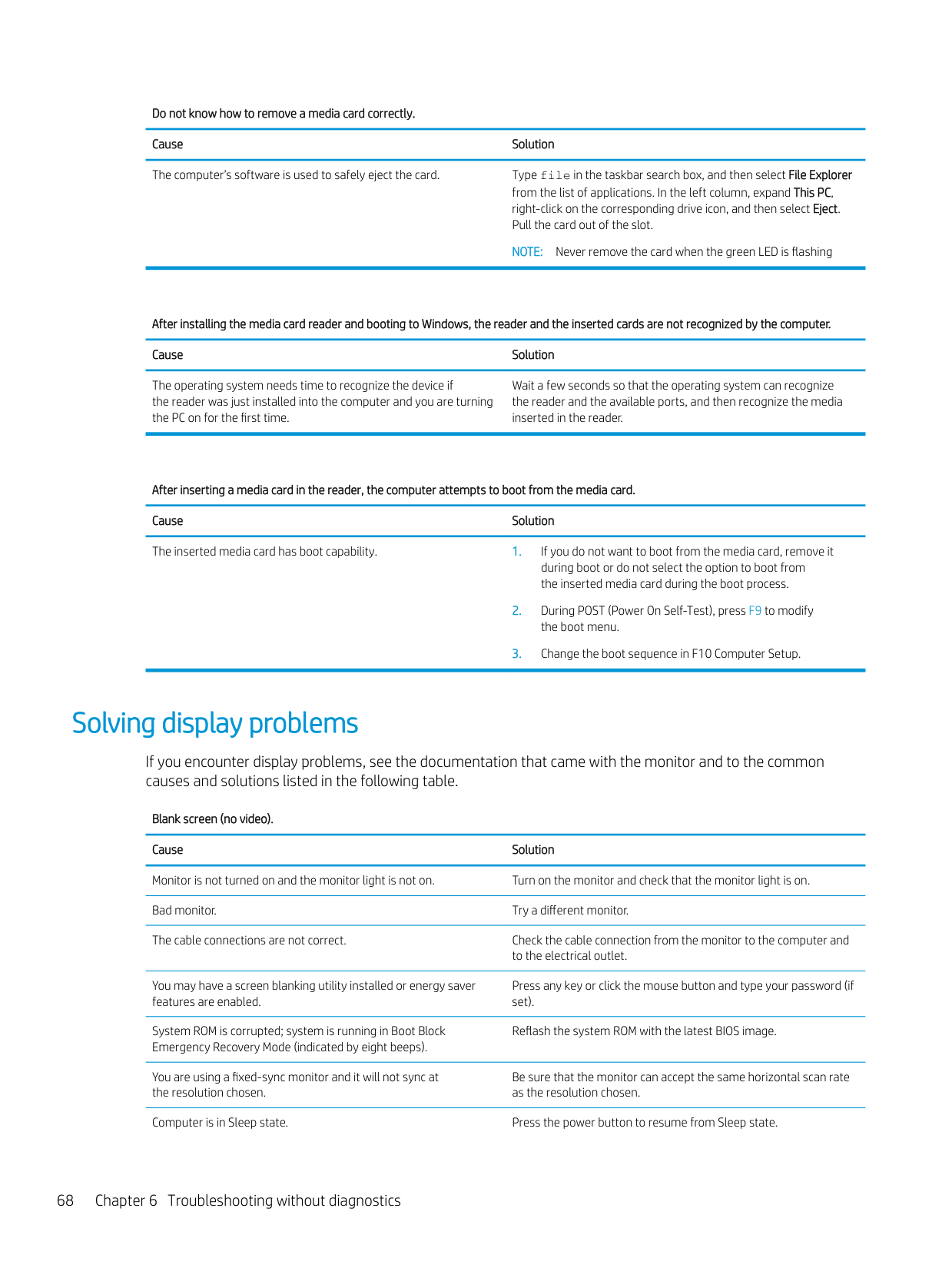
USB flash drive not found (identified). Cause Solution
The device is attached to a USB port that has been hidden in Computer Setup.
Run the Computer Setup utility and enable USB ports in Advanced > Port Options.
The device was not properly seated before power-up. Ensure the device is fully inserted into the USB port before applying power to the system
System will not boot from USB flash drive. Cause Solution Boot order is not correct. Run the Computer Setup utility and change boot sequence in
Advanced > Boot Options.
Removable Media Boot is disabled in the Computer Setup utility. Run the Computer Setup utility and enable booting to removable media in Advanced > Boot Options. Ensure USB is enabled in Storage > Boot Order.
The computer boots to DOS after making a bootable flash drive. Cause Solution Flash drive is bootable. Install the flash drive only after the operating system boots. Flash drive is defective. Try a different flash drive.
Solving front panel component problems
If you encounter problems with devices connected to the front panel, refer to the common causes and solutions listed in the following table.
A USB device, headphone, or microphone is not recognized by the computer. Cause Solution Device is not properly connected. 1. Turn off the computer.
the computer. The device does not have power. If the USB device requires AC power, be sure one end is connected
to the device and one end is connected to a live outlet. The correct device driver is not installed. 1. Install the correct driver for the device.
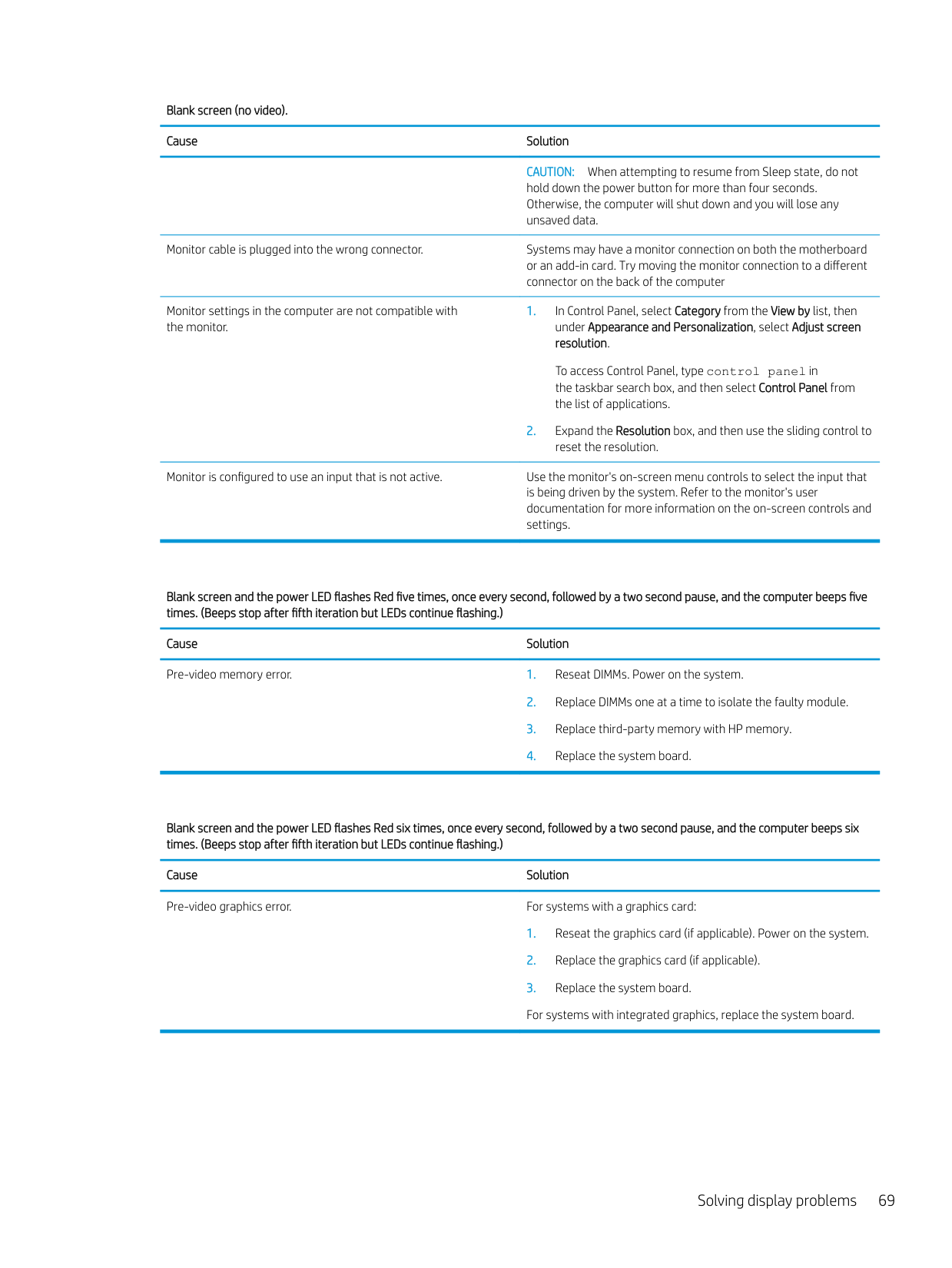
USB ports on the computer are disabled in Computer Setup. Run the Computer Setup utility and ensure that the USB ports are set to Enabled in Security > USB Security.
Solving Internet access problems
If you encounter Internet access problems, consult your Internet Service Provider (ISP) or refer to the common causes and solutions listed in the following table.
Unable to connect to the Internet. Cause Solution Internet Service Provider (ISP) account is not set up properly. Verify Internet settings or contact your ISP for assistance. Web browser is not set up properly. Verify that the Web browser is installed and set up to work with
your ISP. Cable/DSL modem is not plugged in. Plug in cable/DSL modem. You should see a “power” LED light on the front of the cable/DSL modem.
Cable/DSL service is not available or has been interrupted due to bad weather.
Try connecting to the Internet at a later time or contact your ISP. (If the cable/DSL service is connected, the “cable” LED light on the front of the cable/DSL modem will be on.)
The CAT5 UTP cable is disconnected. Connect the CAT5 UTP cable between the cable modem and the computers’s RJ-45 connector. (If the connection is good, the “PC” LED light on the front of the cable/DSL modem will be on.)
IP address is not configured properly. Contact your ISP for the correct IP address. Cookies are corrupted. (A “cookie” is a small piece of information that a Web server can store temporarily with the Web browser. This is useful for having the browser remember some specific information that the Web server can later retrieve.)
Solving front panel component problems 83
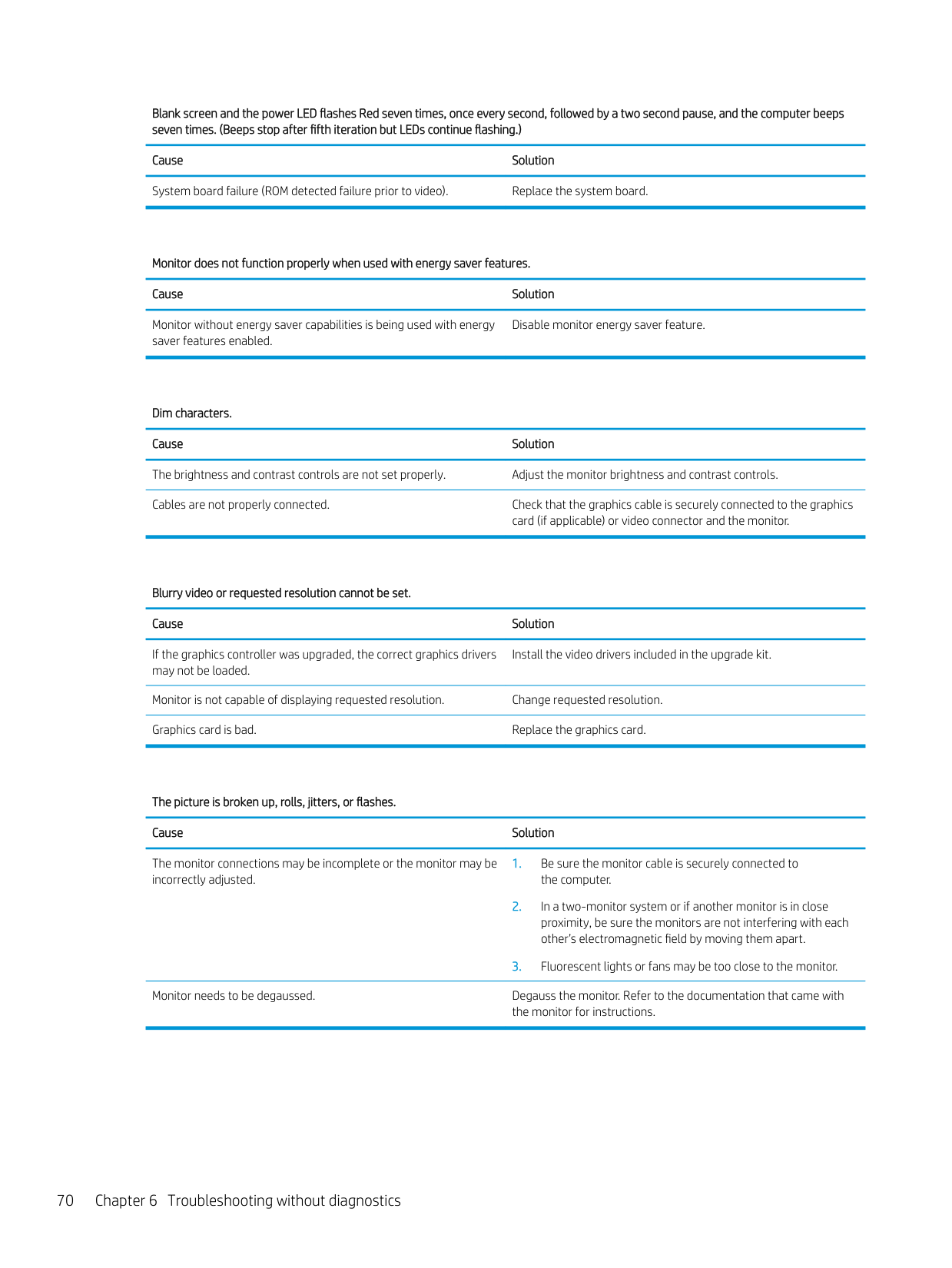
Unable to connect to the Internet. Cause Solution
Cannot automatically launch Internet programs. Cause Solution You must log on to your ISP before some programs will start. Log on to your ISP and launch the desired program.
Solving software problems
Most software problems occur as a result of the following:
If you encounter software problems, see the applicable solutions listed in the following table. Computer will not continue and the HP logo does not display. Cause Solution ROM issue - POST error has occurred. Observe the beeps and LED lights on the front of the computer. See
POST error messages and diagnostic front panel LEDs and audible codes on page 85 to determine possible causes.
See the Worldwide Limited Warranty for terms and conditions.
“Illegal Operation has Occurred” error message is displayed. Cause Solution
Software being used is not Microsoft-certified for your version of Windows.
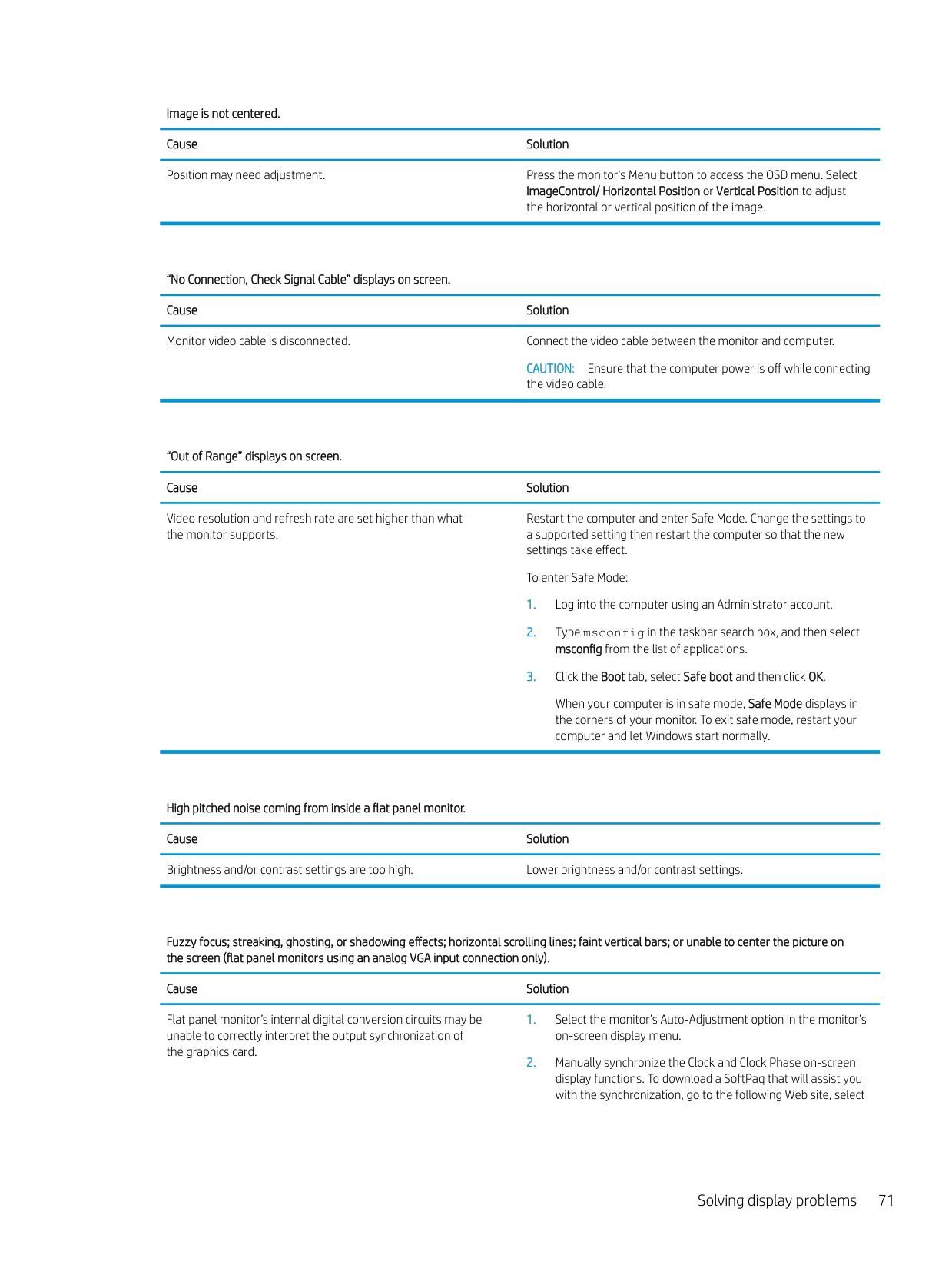
Verify that the software is certified by Microsoft for your version of Windows (see program packaging for this information).
Configuration files are corrupt. If possible, save all data, close all programs, and restart the computer.
7 POST error messages and diagnostic front panel LEDs and audible codes
This appendix lists the error codes, error messages, and the various indicator light and audible sequences that you may encounter during Power-On Self-Test (POST) or computer restart, the probable source of the problem, and steps you can take to resolve the error condition.
POST Message Disabled suppresses most system messages during POST, such as memory count and non-error text messages. If a POST error occurs, the screen will display the error message. To manually switch to the POST Messages Enabled mode during POST, press any key (except F10, F11, or F12). The default mode is POST Message Disabled.
The speed at which the computer loads the operating system and the extent to which it is tested are determined by the POST mode selection.
Quick Boot is a fast startup process that does not run all of the system level tests, such as the memory test. Full Boot runs all of the ROM-based system tests and takes longer to complete.
Full Boot may also be enabled to run every 1 to 30 days on a regularly scheduled basis. To establish the schedule, reconfigure the computer to the Full Boot Every x Days mode, using Computer Setup.
| | |---|
NOTE: For more information on Computer Setup, see Computer Setup (F10) Utility on page 47.
POST numeric codes and text messages
This section covers those POST errors that have numeric codes associated with them. The section also includes some text messages that may be encountered during POST.
| | |---|
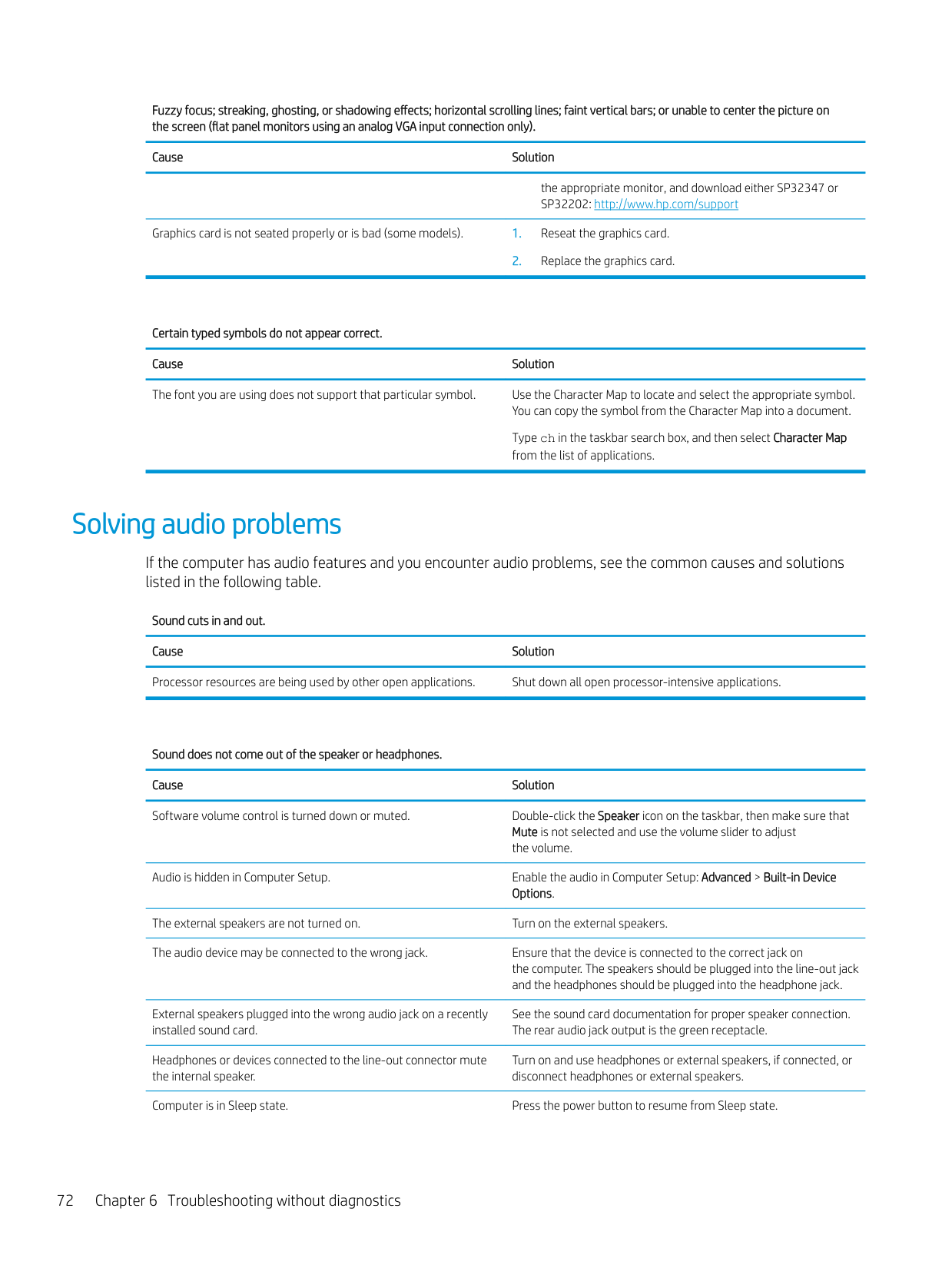
NOTE: The computer will beep once after a POST text message is displayed on the screen.
Control panel message Description Recommended action
005-Real-Time Clock Power Loss Invalid time or date in configuration memory. Reset the date and time under Control Panel (Computer Setup can also be used). If
RTC (real-time clock) battery may need to be replaced.
the problem persists, replace the RTC battery. See the Removal and Replacement section for instructions on installing a new battery.
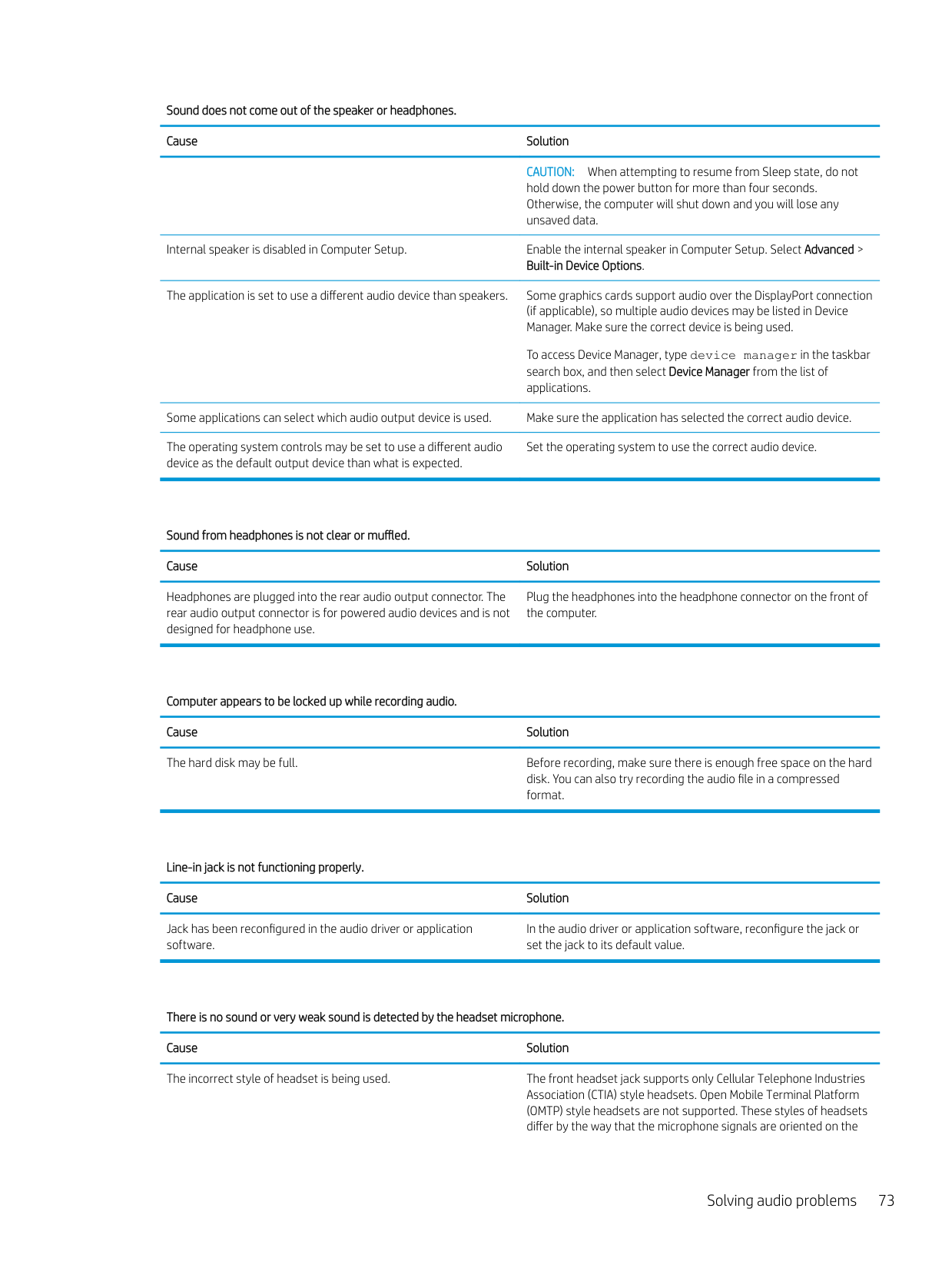
Memory error during POST execution of the Management Engine (ME) BIOS Extensions option ROM.
Use Computer Setup to update this information.
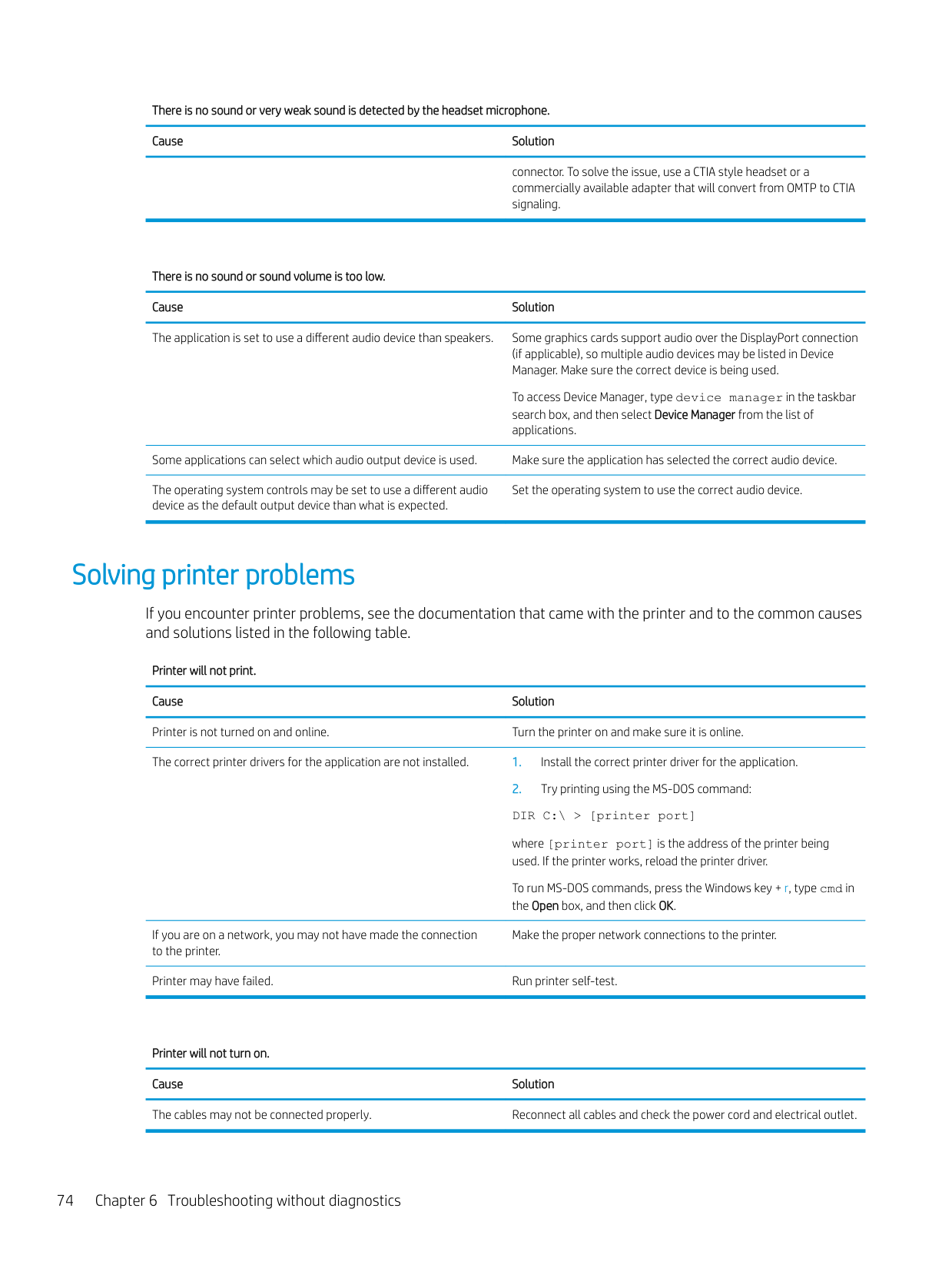
Memory error during POST execution of the Management Engine (ME) BIOS Extensions option ROM.
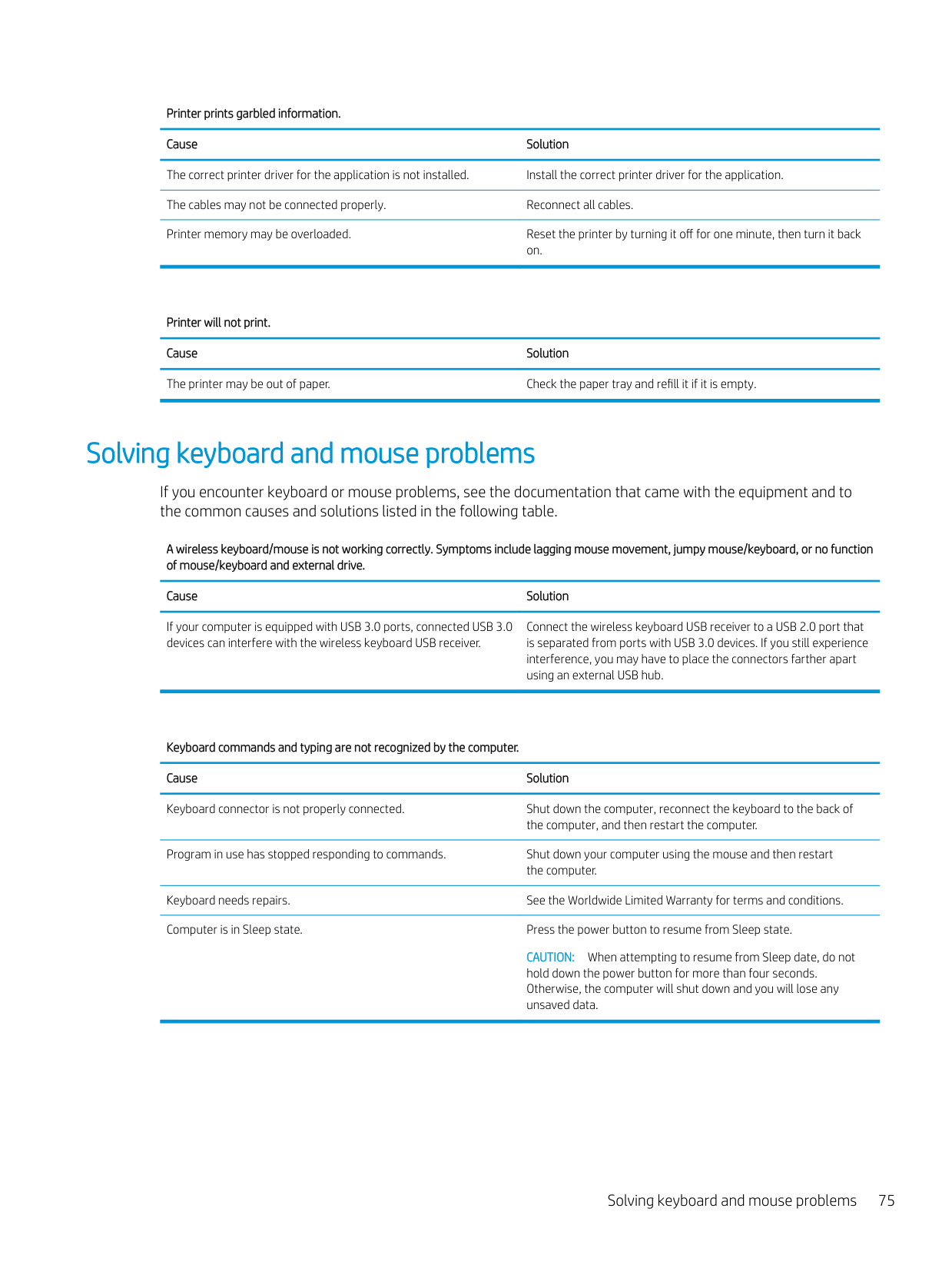
100-Front Audio Not Connected Front audio cable has been detached or unseated from system board.
Reconnect or replace front audio cable.
The system memory size is different from the last startup. The most common reason is the removal of memory from the system board. Press the F1 key to save the memory changes. If this message persists, verify that the memory modules are installed correctly.
A memory module in memory socket identified in the error message is missing critical SPD information, or is incompatible with the chipset.
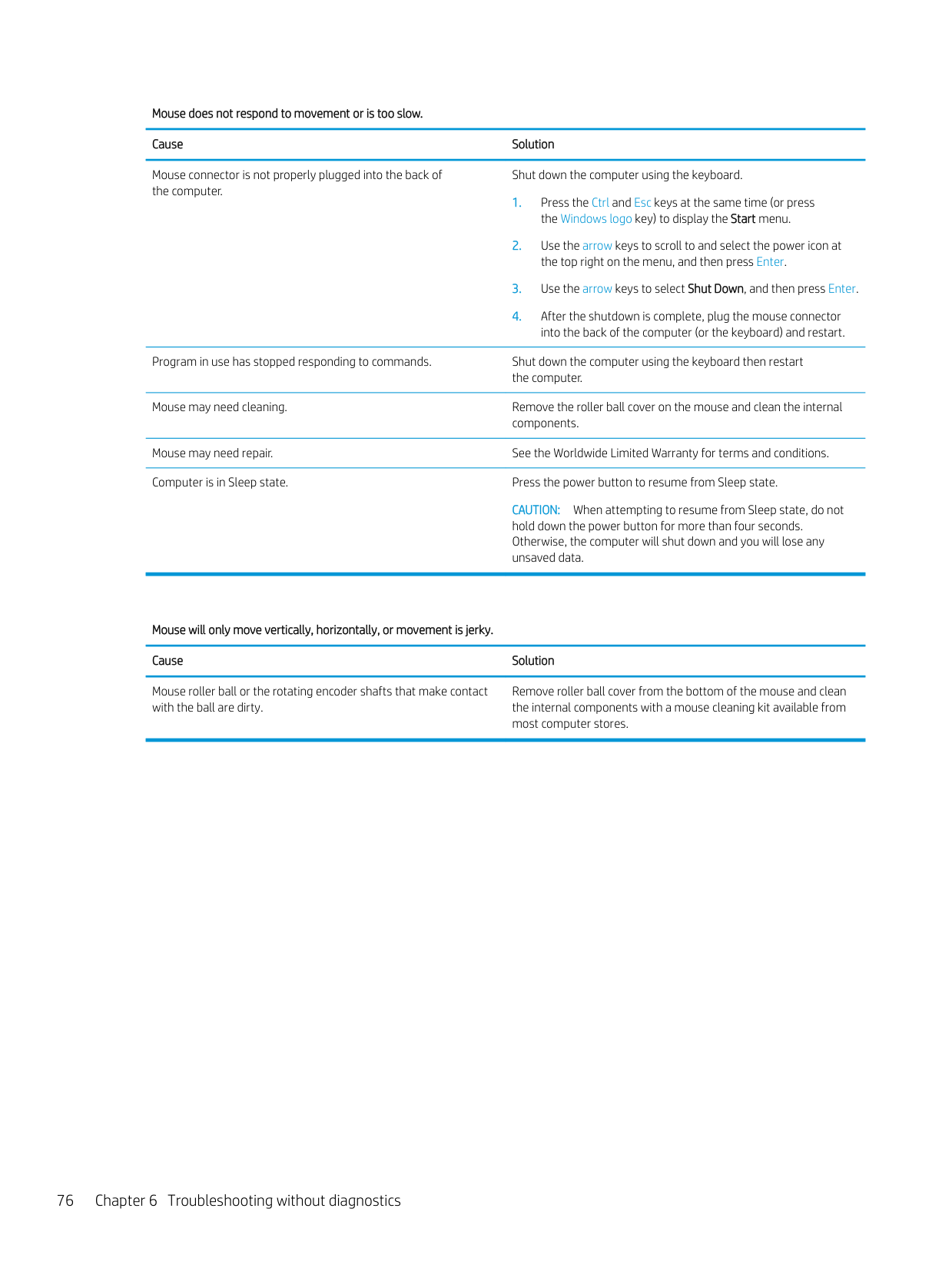
Rearrange the DIMMs so that each channel has the same amount of memory.
Recently added memory module(s) support ECC memory error correction.
2E6–Memory Not Configured Correctly for Proper MEBx Execution
DIMM1 is not installed. Make sure there is a memory module in
the DIMM1 socket and that it is properly seated. 300–Configuration Change Warning The storage device configuration will be updated
Not applicable
as shown.
Hard drive is about to fail. (Some hard drives have a hard drive firmware patch that will fix an erroneous error message.)
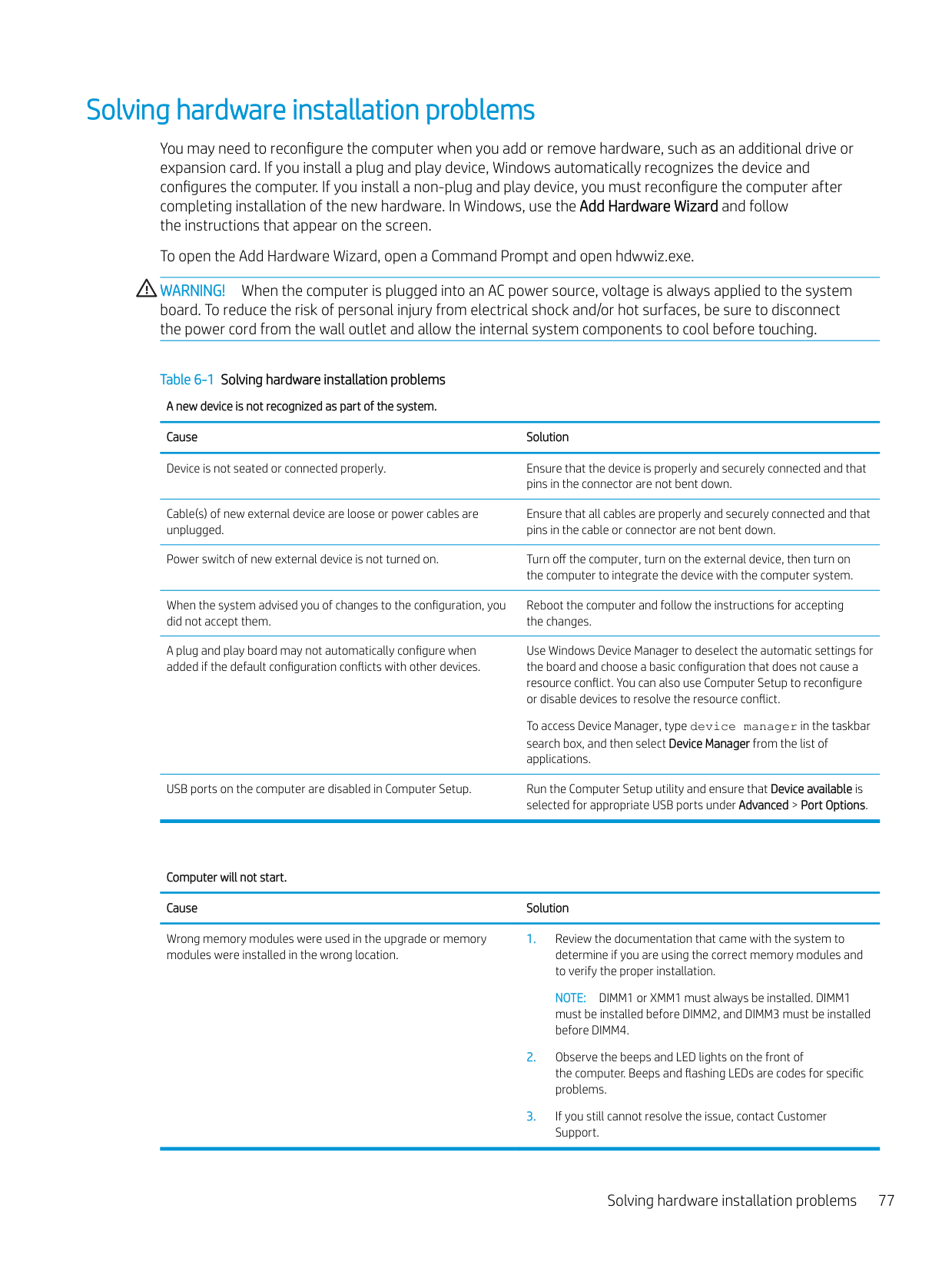
Hard drive is about to fail. (Some hard drives have a hard drive firmware patch that will fix an erroneous error message.)
309 – 30C: Hard Disk 3–6: SMART Hard Drive Detects Imminent Failure
Hard drive is about to fail. (Some hard drives have a hard drive firmware patch that will fix an erroneous error message.)
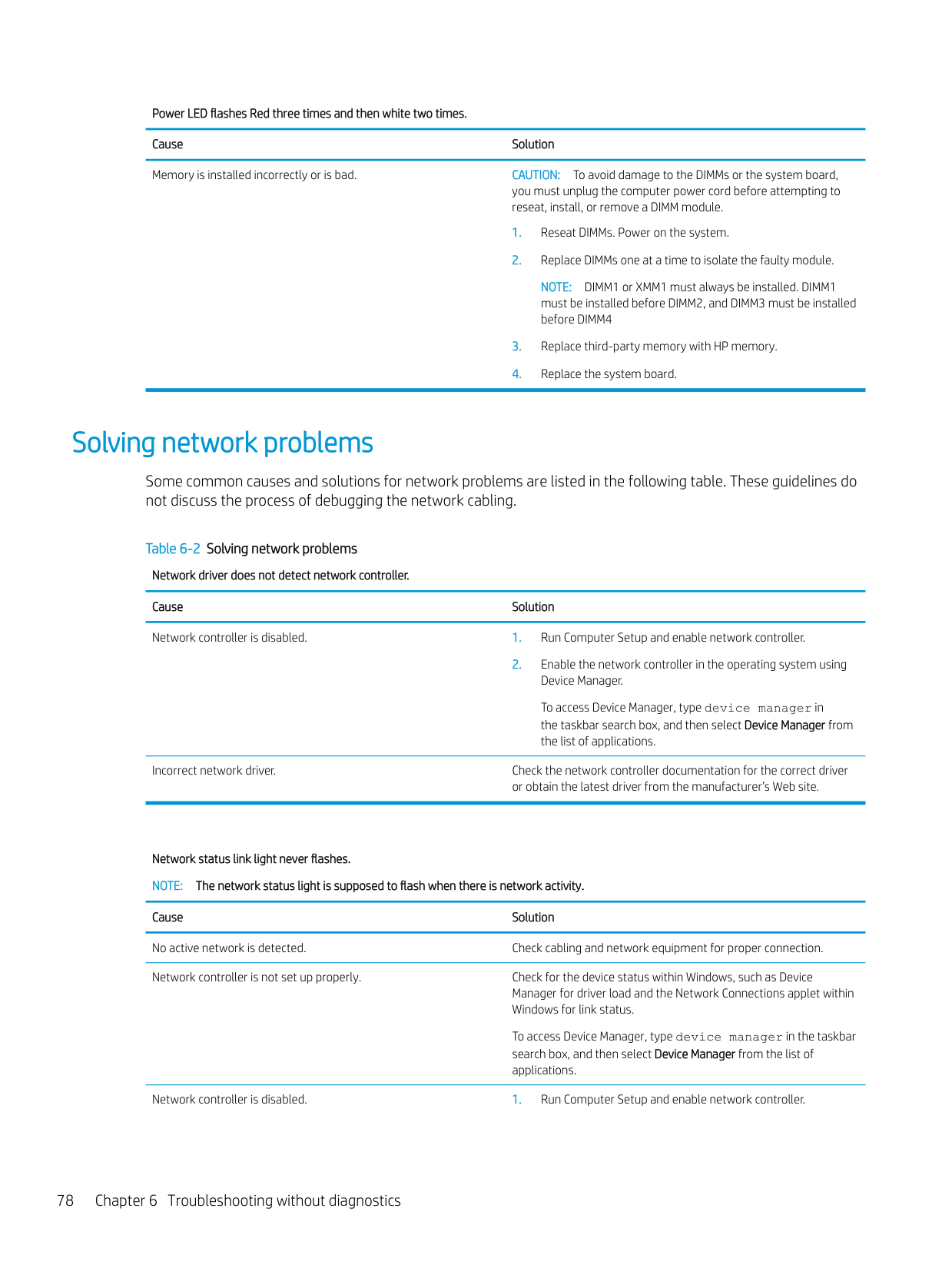
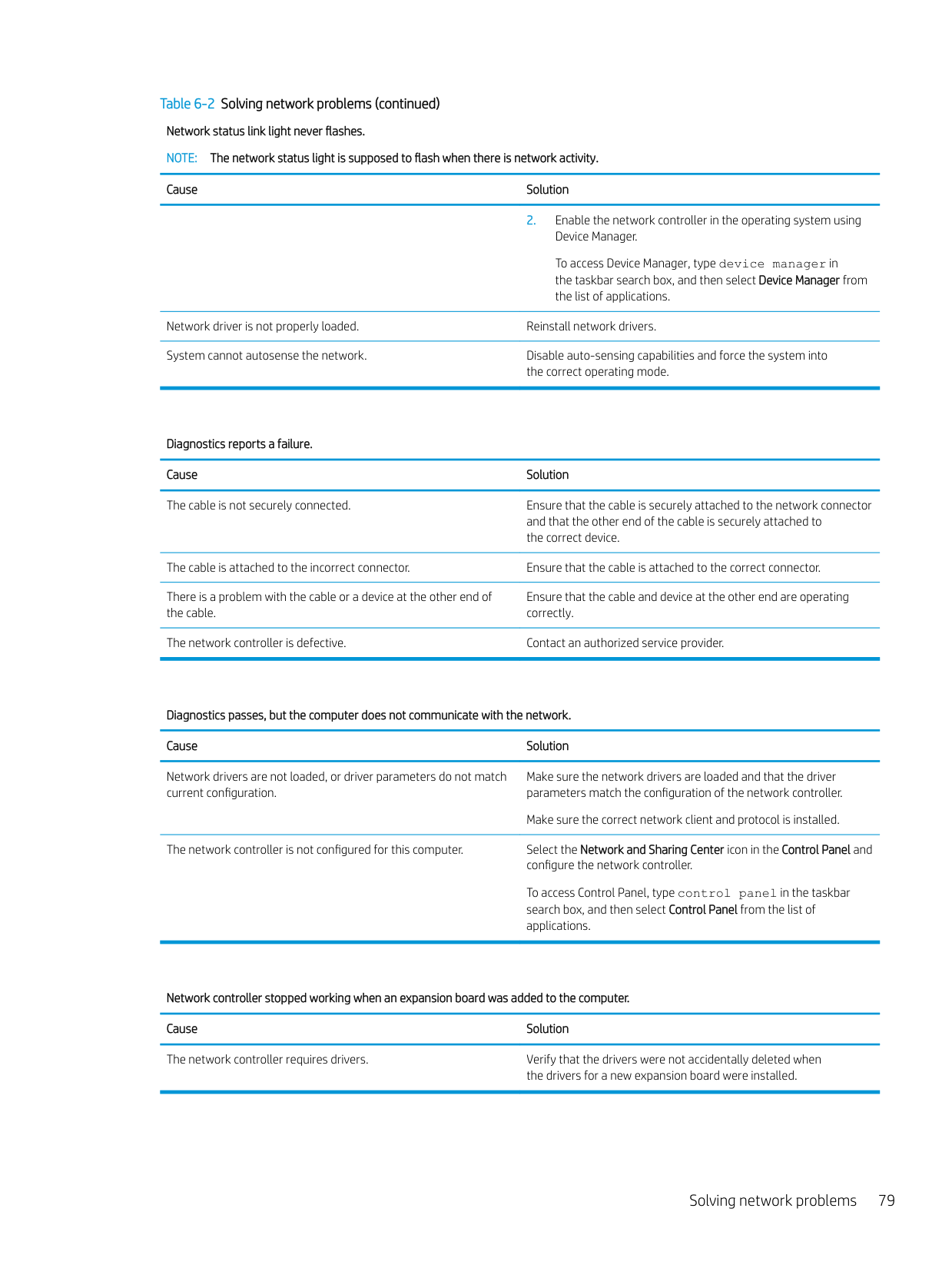
419-Out of Memory Space for Option ROMs Recently added PCI expansion card contains an option ROM too large to download during POST.
▲ If a PCI expansion card was recently added,
remove it to see if the problem remains.
Reconnect or replace front USB cable.
Try rebooting the system. If the error reoccurs, the device may not work with this system
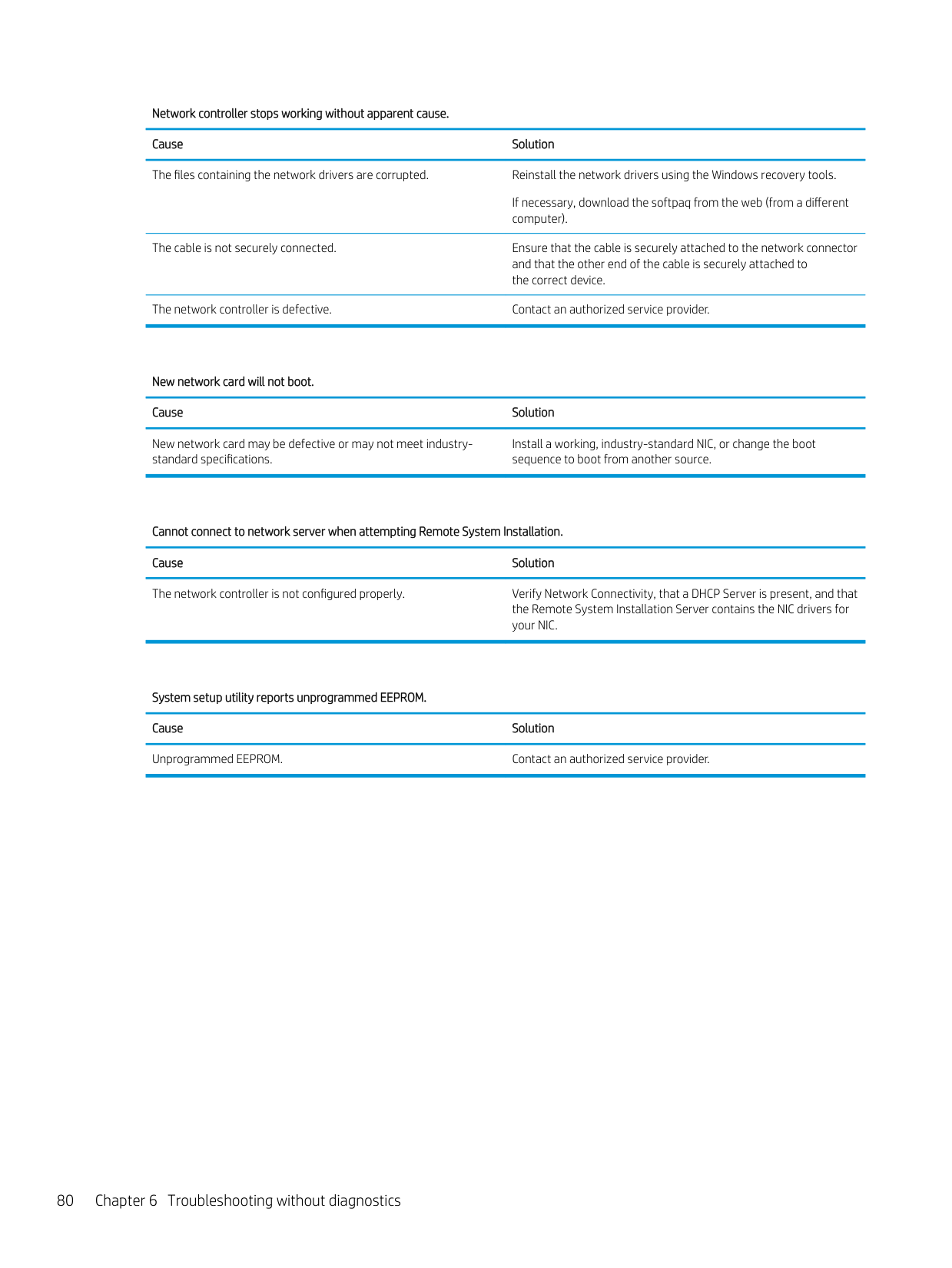
Install cable between I2C on card and USB-C on the system board.
More than one USB type-C card is installed. Remove USB type-C card so only one is installed.
500–BIOS Recovery A system BIOS recovery has occurred. Not applicable. 70x-Wireless Mode Not Supported The system has detected a wireless module
Replace with a supported module.
installed in the system that is not supported and has been disabled.
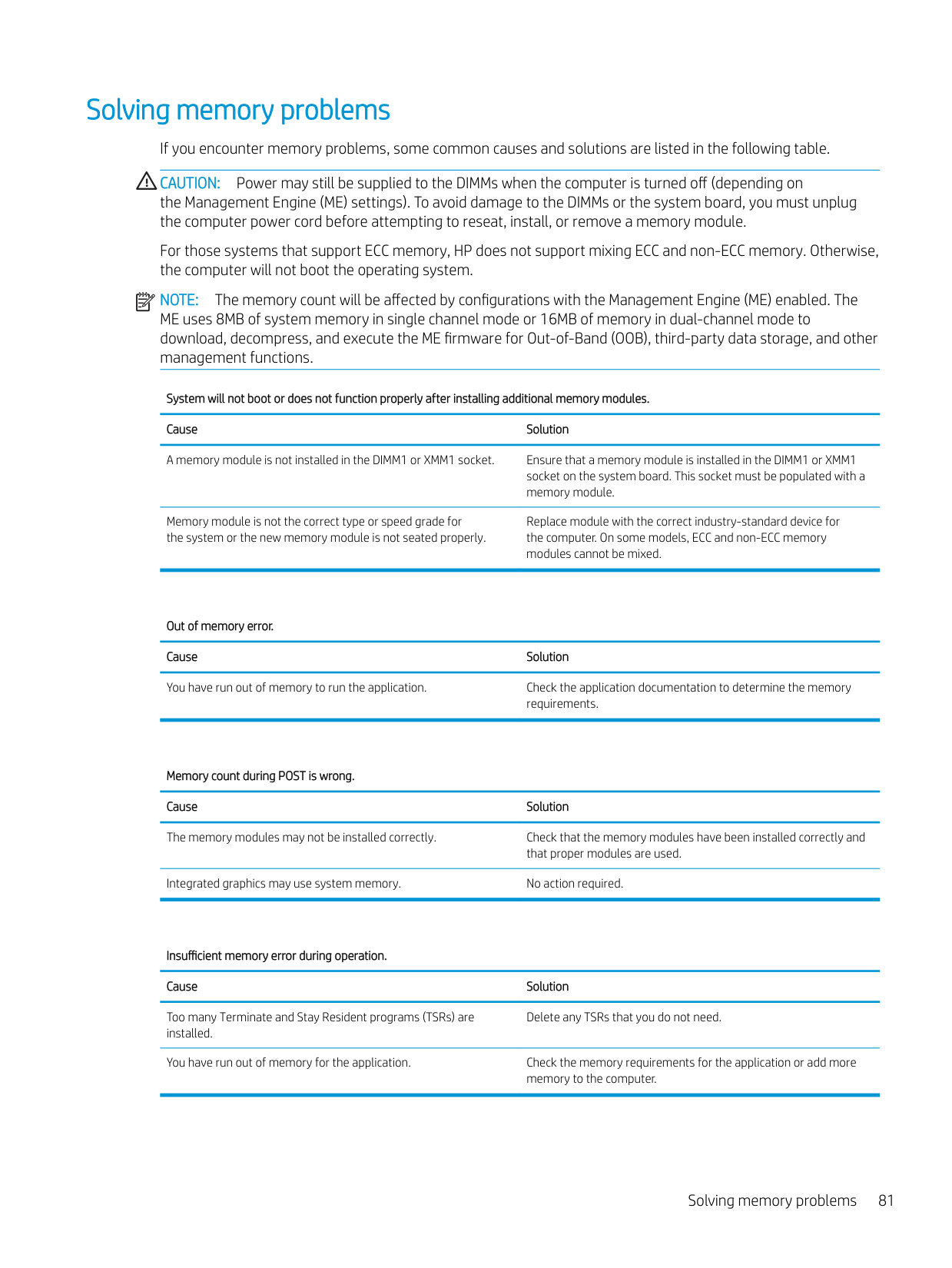
Chassis, rear chassis, or front chassis fan is not connected or may have malfunctioned.
N/A
Ensure SATA connectors are used in ascending order. For one device, use SATA 0. For two devices, use SATA 0 and SATA 1. For three devices, use SATA 0, SATA 1, and SATA 2.
90B-Fan Failure The system has detected that a cooling fan is not operating correctly.
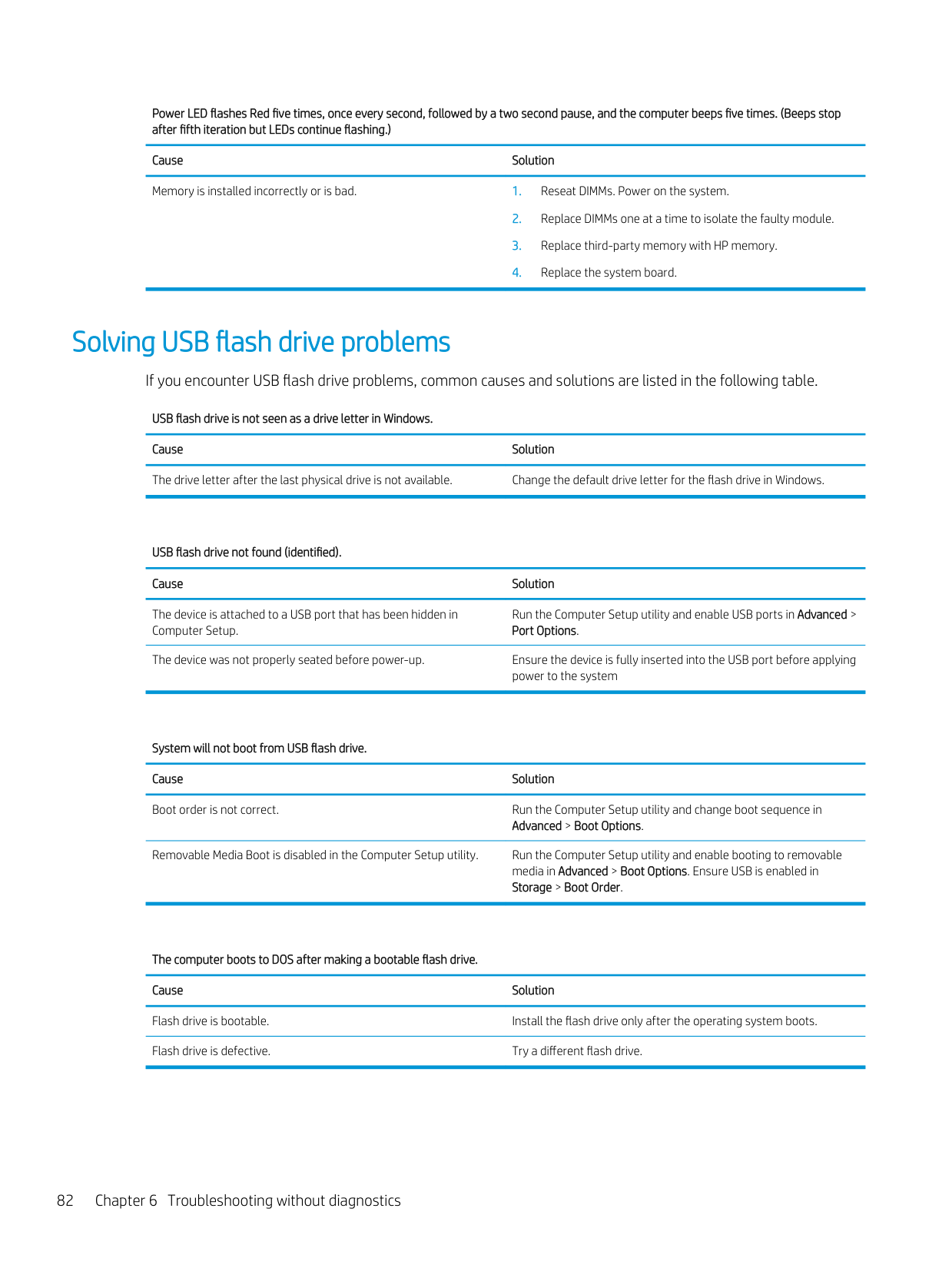
Make sure system has proper airflow.
910–Filter Warning Airflow filter is dirty. Replace the airflow filter.
Interpreting system validation diagnostic front panel LEDs and audible codes
During the system validation phase that occurs at system startup, the BIOS validates the functionality of the following subsystems and conditions:
| | |---|
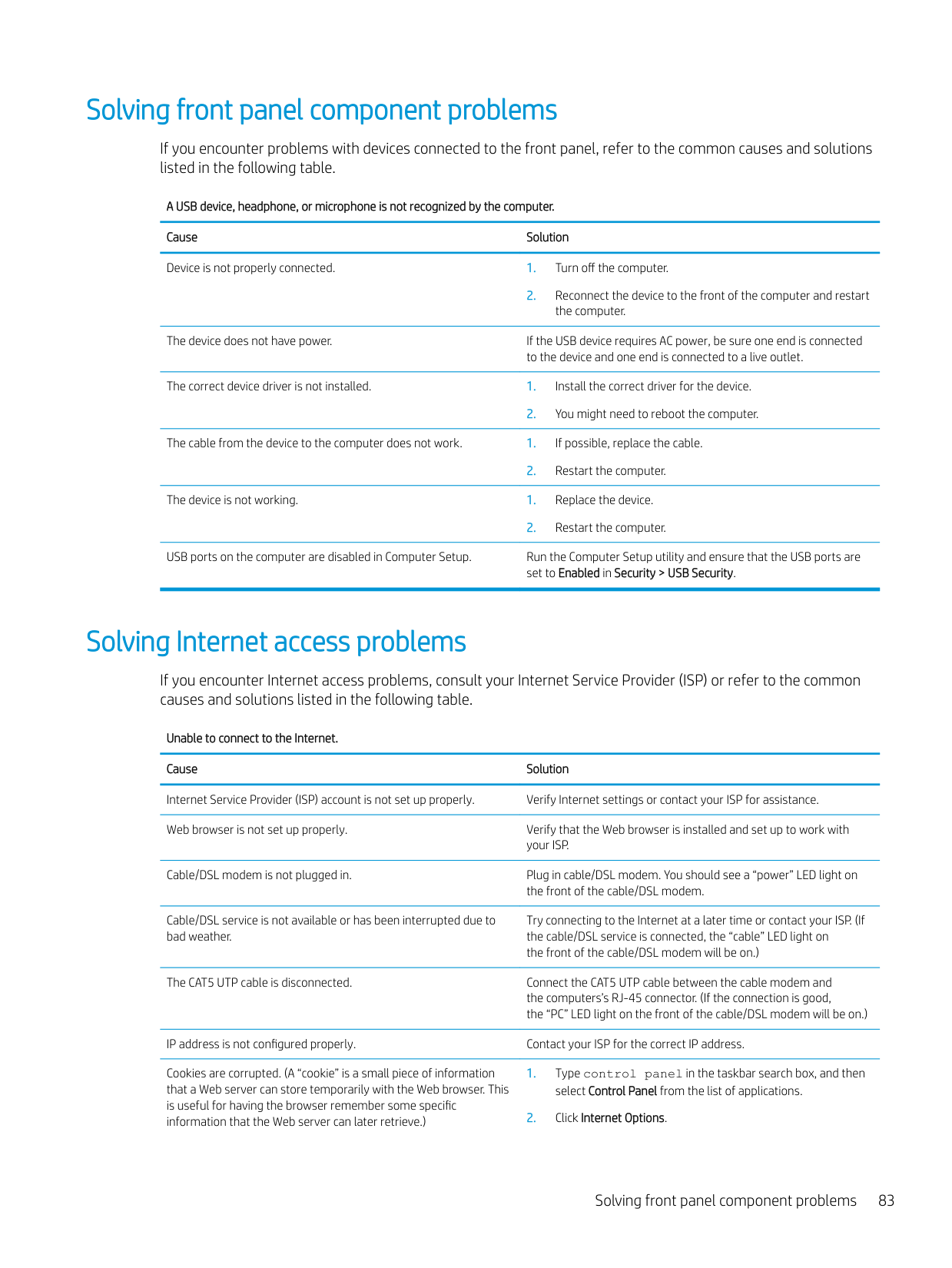
If an error is detected, specific patterns of long and short blinks, accompanied by long and short beeps (where applicable) are used to identify the error. These patterns will make up a two part code:
Number of long beeps/blinks Error category
Patterns of blink/beep codes are determined by using the following parameters:
| | |---|
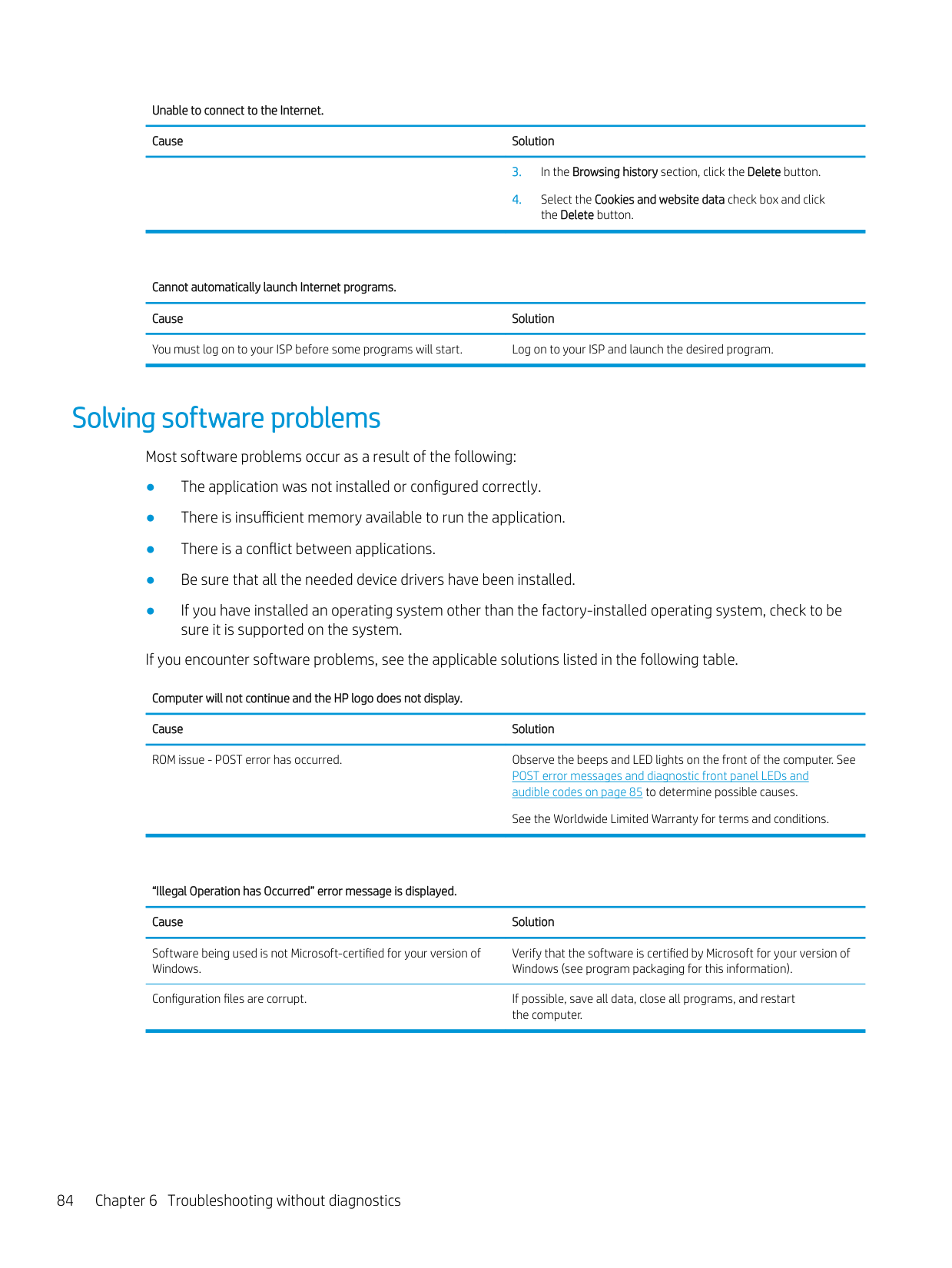
The red LED blinks to represent the major error category (long blinks). The white LED blinks to represent the minor error category (short blinks). For example, ‘3.5’ indicates 3 long red blinks and 5 short white blinks to communicate the processor is not detected.
Category Major/minor code Description BIOS 2.2 The main area (DXE) of BIOS has become corrupted and there is no recovery
binary image available.
Hardware 3.2 The embedded controller has timed out waiting for BIOS to return from memory initialization.
Thermal 4.2 A processor over temperature condition has been detected.*
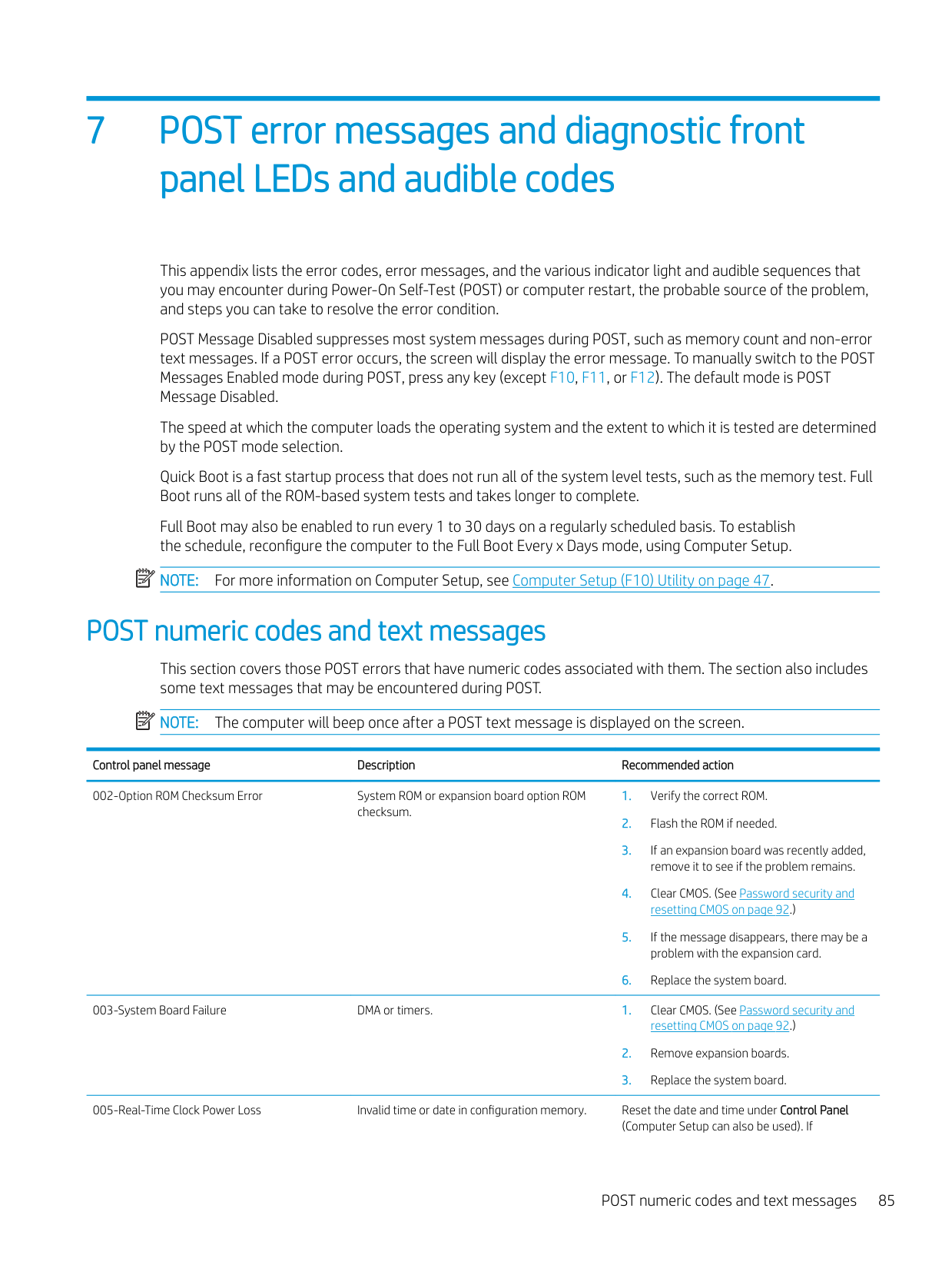
System board 5.2 The embedded controller cannot find valid firmware.
Interpreting system validation diagnostic front panel LEDs and audible codes 91
8 Password security and resetting CMOS
This computer supports security password features, which can be established through the Computer Setup Utilities menu.
This computer supports two security password features that are established through the Computer Setup Utilities menu: administrator password and power-on password. When you establish only an administrator password, any user can access all the information on the computer except Computer Setup. When you establish only a power-on password, the power-on password is required to access Computer Setup and any other information on the computer. When you establish both passwords, only the administrator password will give you access to Computer Setup.
When both passwords are set, the administrator password can also be used in place of the power-on password as an override to log in to the computer. This is a useful feature for a network administrator.
If you forget one or both passwords, you can clear all passwords by powering off the system, opening the cover, temporarily removing the CLR_PSWD jumper, and booting once. This will erase the administrator and power-on passwords. You must restore the jumper to create new passwords.
The computer’s configuration memory (CMOS) stores information about the computer’s configuration. The CMOS jumper resets CMOS but does not clear the power-on and setup passwords. CAUTION: Resetting the CMOS with power removed will reset the BIOS settings to factory defaults. It may be useful to back up the BIOS settings or save them as custom defaults before resetting them in case they are needed later. Back up can be performed in Computer Setup or using the BiosConfigUtility tool available from www.hp.com. See Computer Setup (F10) Utility on page 47 for information on backing up the BIOS settings.
Resetting CMOS resets BIOS settings to default, but does not clear the passwords or affect any of the other Security settings. On Intel systems with advanced manageability features, resetting CMOS will also partially unprovision AMT.
CAUTION: Stringent security is a mode where there is no physical bypass of the password function. If enabled, removing the password jumper will be ignored. To enable this mode, change the security setting Clear Password Jumper in Password Policies to Ignore.
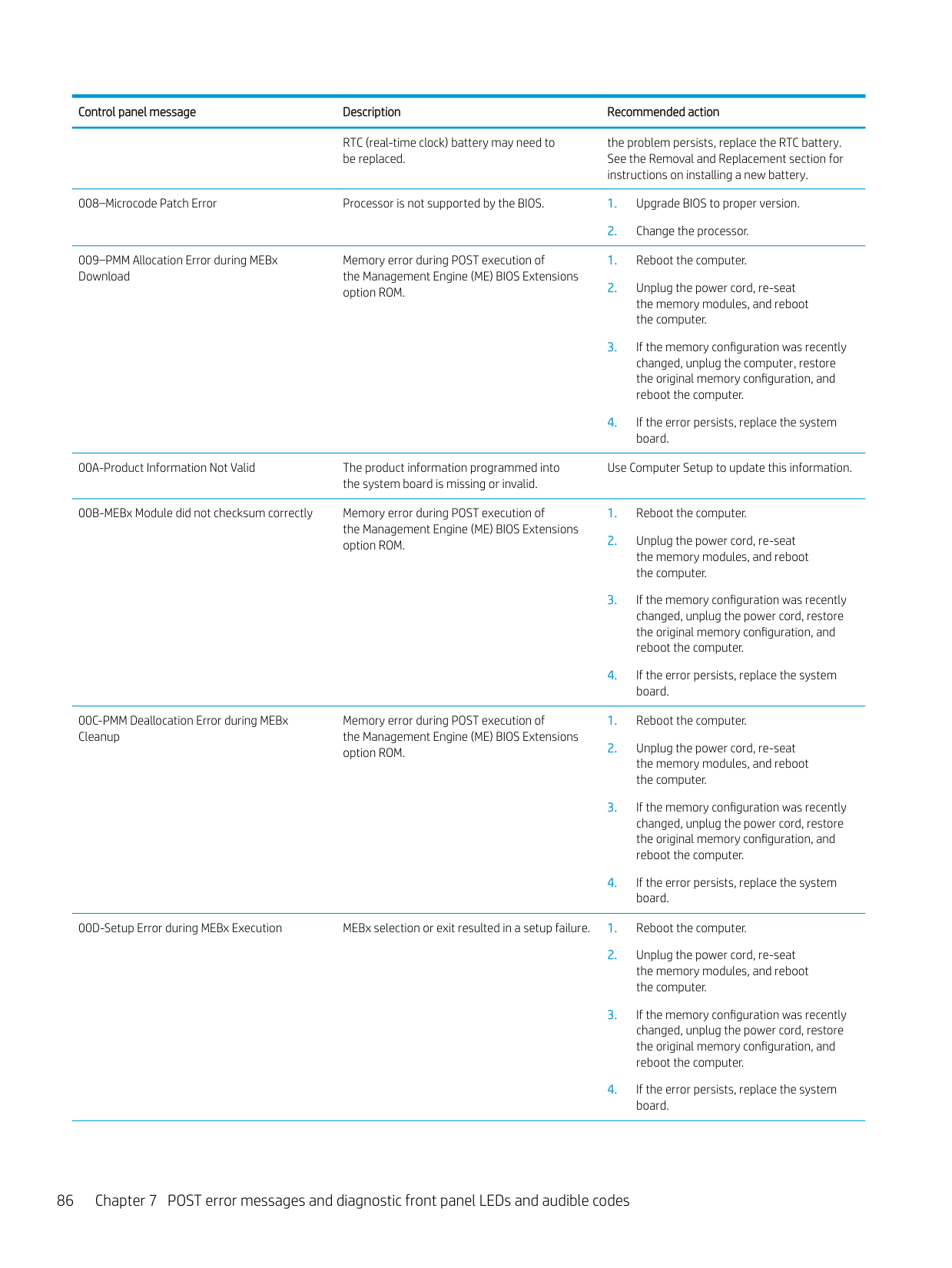
If you lose or forget the password when in stringent security mode, the system can only be reset by System Management Command. This is a way for HP Service and Support to provide a secure method to access the BIOS and command a password reset for a specifically identified unit under the direction of the owner. This scenario may not be covered under warranty.
To prevent needing a customer service event to restore access to the system, record your configured administrator and power-on passwords in a safe place away from your computer.
| | |---|
NOTE: You will receive POST error messages after clearing CMOS and rebooting advising you that configuration changes have occurred. Use Computer Setup to reset any special system setups along with the date and time.
CAUTION: It is important to back up the computer CMOS settings before resetting them in case they are needed later. Back up is easily done through Computer Setup. See Computer Setup (F10) Utility on page 47 for information on backing up the CMOS settings.
Resetting CMOS and/or the password jumper
This computer supports security password features, which can be established through the Computer Setup Utilities menu.
This computer supports two security password features that are established through the Computer Setup Utilities menu: administrator password and power-on password. When you establish only an administrator password, any user can access all the information on the computer except Computer Setup. When you establish only a power-on password, the power-on password is required to access Computer Setup and any other information on the computer. When you establish both passwords, only the administrator password will give you access to Computer Setup.
When both passwords are set, the administrator password can also be used in place of the power-on password as an override to log in to the computer. This is a useful feature for a network administrator.
If you forget one or both passwords, you can clear all passwords by powering off the system, opening the cover, temporarily removing the CMOS/PSWD jumper, and booting once. This will erase the administrator and power-on passwords. You must restore the jumper to create new passwords.
CAUTION: Resetting the CMOS with power removed will reset the BIOS settings to factory defaults. It may be useful to back up the BIOS settings or save them as custom defaults before resetting them in case they are needed later. Back up can be performed in Computer Setup or using the BiosConfigUtility tool available from www.hp.com. See Computer Setup (F10) Utility on page 47 for information on backing up the BIOS settings.
Resetting CMOS resets BIOS settings to default, but does not clear the passwords or affect any of the other Security settings. On Intel systems with advanced manageability features, resetting CMOS will also partially unprovision AMT.
CAUTION: Stringent security is a mode where there is no physical bypass of the password function. If enabled, removing the password jumper will be ignored. To enable this mode, change the security setting Clear Password Jumper in Password Policies to Ignore.
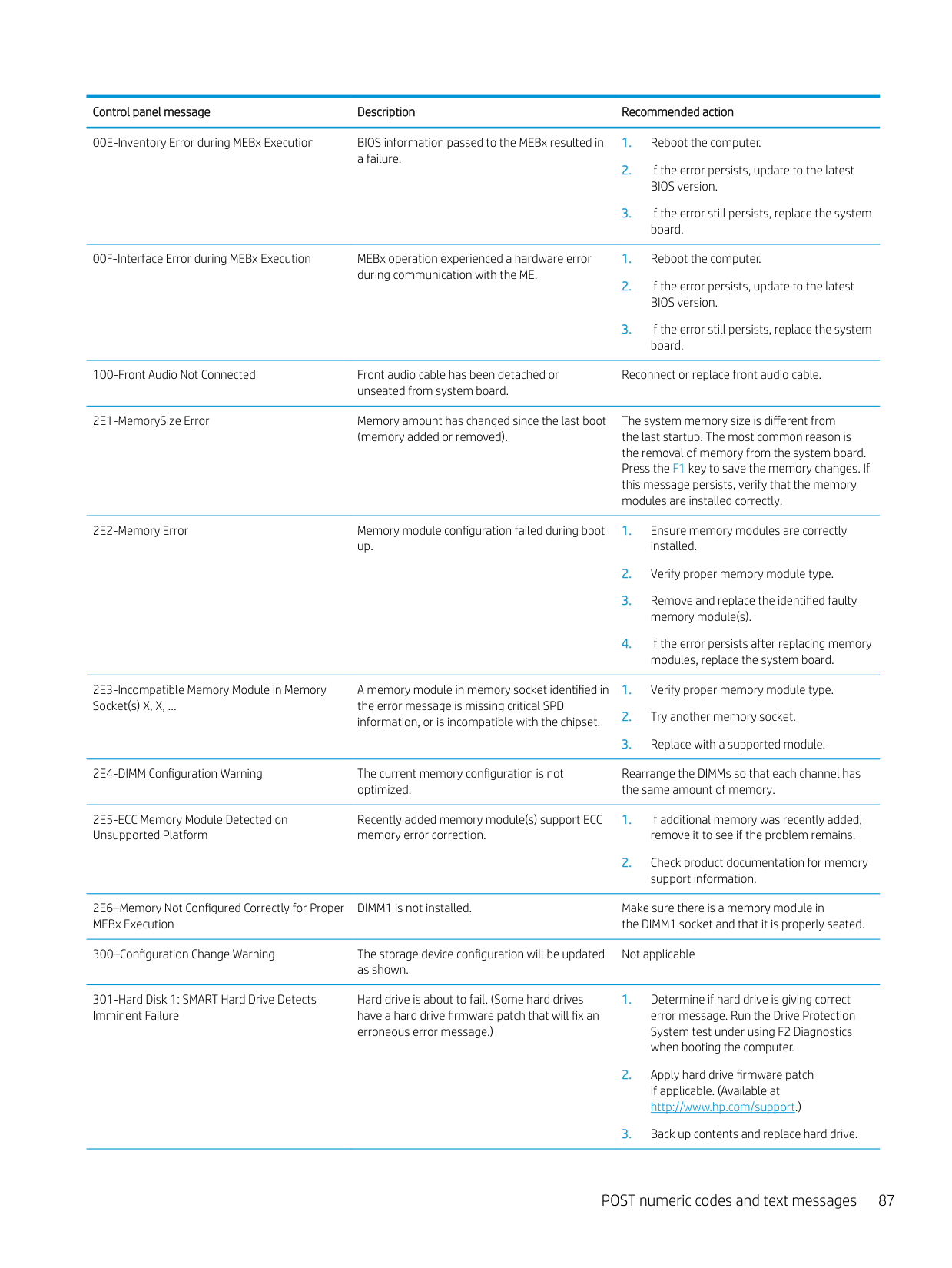
If you lose or forget the password when in stringent security mode, the system can only be reset by System Management Command. This is a way for HP Service and Support to provide a secure method to access the BIOS and command a password reset for a specifically identified unit under the direction of the owner. This scenario may not be covered under warranty.
To prevent needing a customer service event to restore access to the system, record your configured administrator and power-on passwords in a safe place away from your computer.
| | |---|
NOTE: You will receive POST error messages after clearing CMOS and rebooting advising you that configuration changes have occurred. Use Computer Setup to reset any special system setups along with the date and time. To clear CMOS, disable the power-on or administrator password features, or to clear the power-on or administrator passwords, complete the following steps:
Resetting CMOS and/or the password jumper 93
WARNING! To reduce the risk of personal injury from electrical shock and/or hot surfaces, be sure to disconnect the power cord from the wall outlet, and allow the internal system components to cool before touching.
CAUTION: When the computer is plugged in, the power supply always has voltage applied to the system board even when the unit is turned off. Failure to disconnect the power cord can result in damage to the system.
Static electricity can damage the electronic components of the computer or optional equipment. Before beginning these procedures, ensure that you are discharged of static electricity by briefly touching a grounded metal object. See the Safety & Regulatory Information guide for more information.
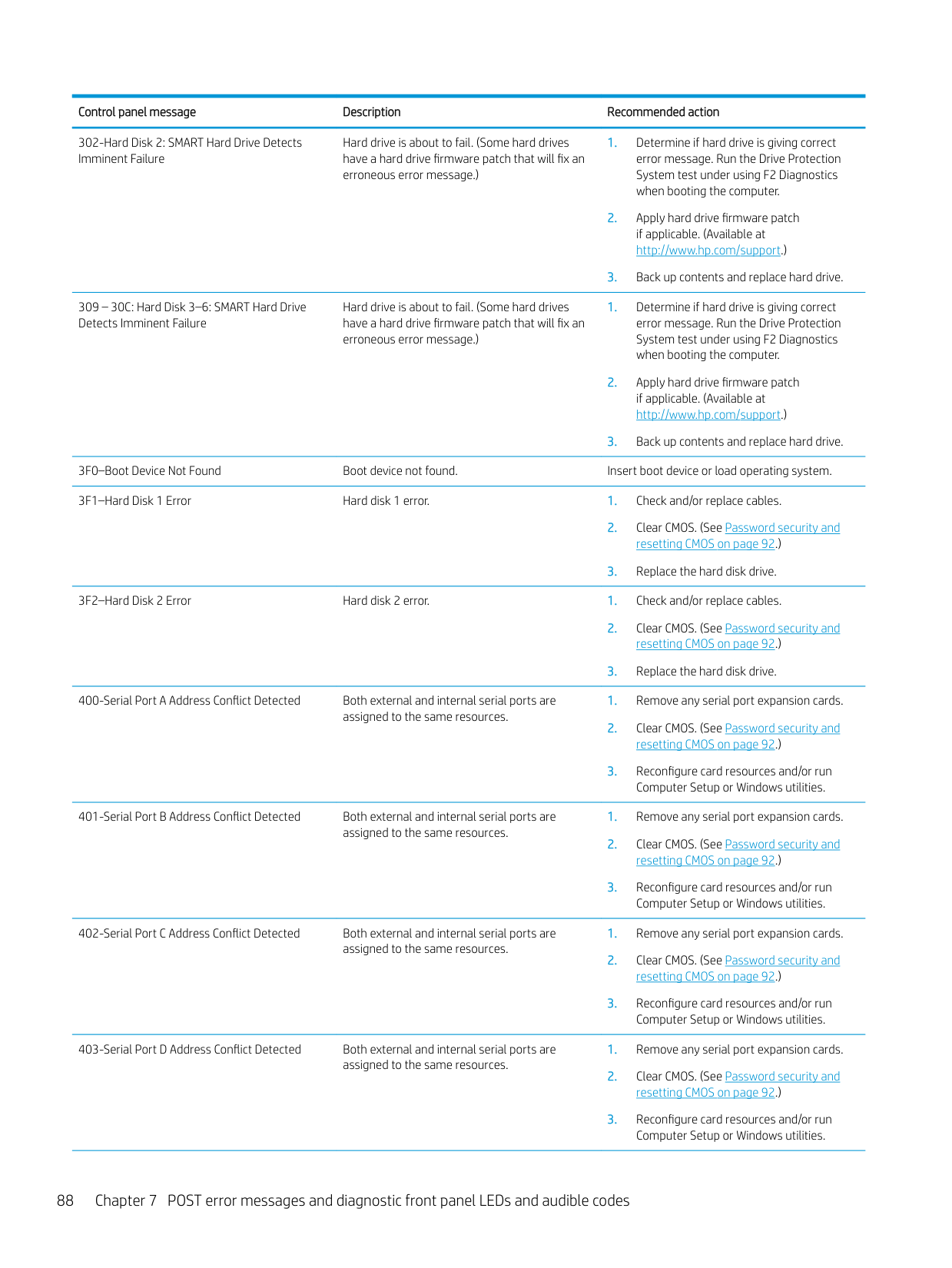
| | |---|
Changing a Setup or Power-on password
To change the power-on or setup password, complete the following steps:
| | |---|
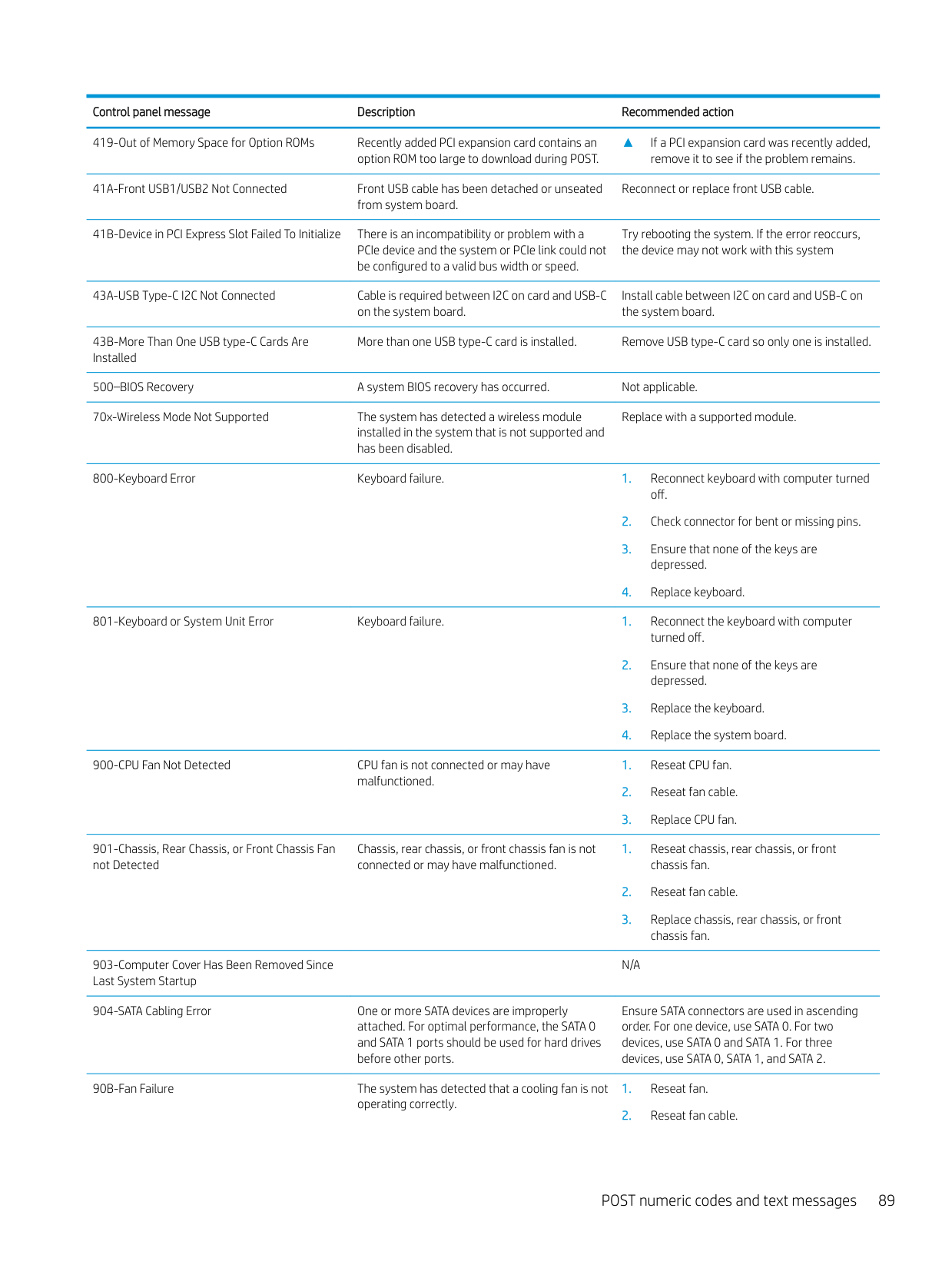
Deleting a Setup or Power-on password
To delete the power-on or setup password, complete the following steps:
Changing a Setup or Power-on password 95
9 Using HP PC Hardware Diagnostics (UEFI)
HP PC Hardware Diagnostics is a Unified Extensible Firmware Interface (UEFI) that allows you to run diagnostic tests to determine whether the computer hardware is functioning properly. The tool runs outside the operating system so that it can isolate hardware failures from issues that are caused by the operating system or other software components.
When HP PC Hardware Diagnostics (UEFI) detects a failure that requires hardware replacement, a 24-digit Failure ID is generated. This ID can then be provided to support to help determine how to correct the problem.
To start HP PC Hardware Diagnostics (UEFI), follow these steps:
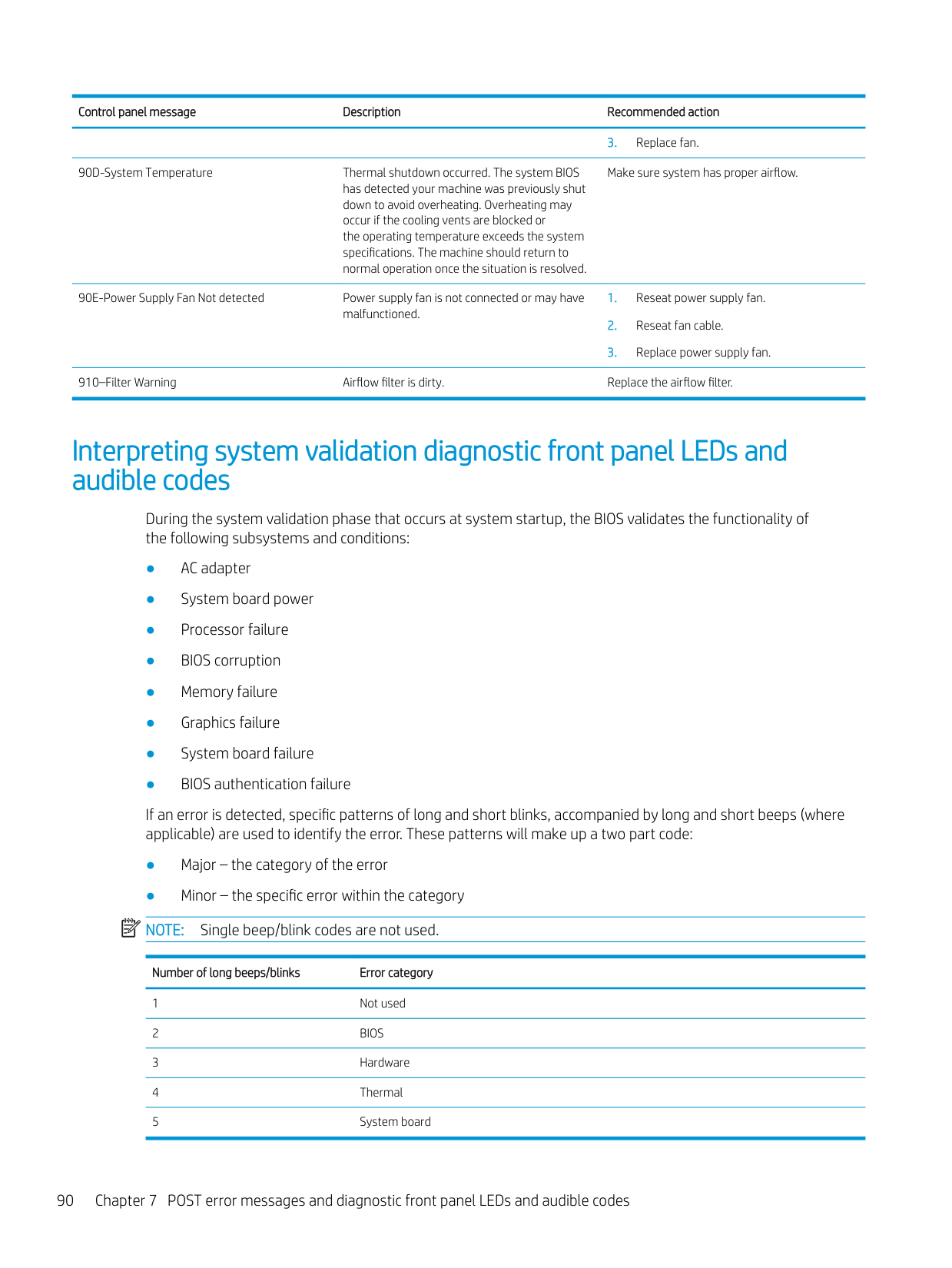
| | |---|
| | |---|
NOTE: If you need to stop a diagnostic test, press esc.
96 Chapter 9 Using HP PC Hardware Diagnostics (UEFI)
Downloading HP PC Hardware Diagnostics (UEFI) to a USB device
| | |---|
NOTE: The HP PC Hardware Diagnostics (UEFI) download instructions are provided in English only, and you must use a Windows computer to download and create the HP UEFI support environment because only .exe files are offered.
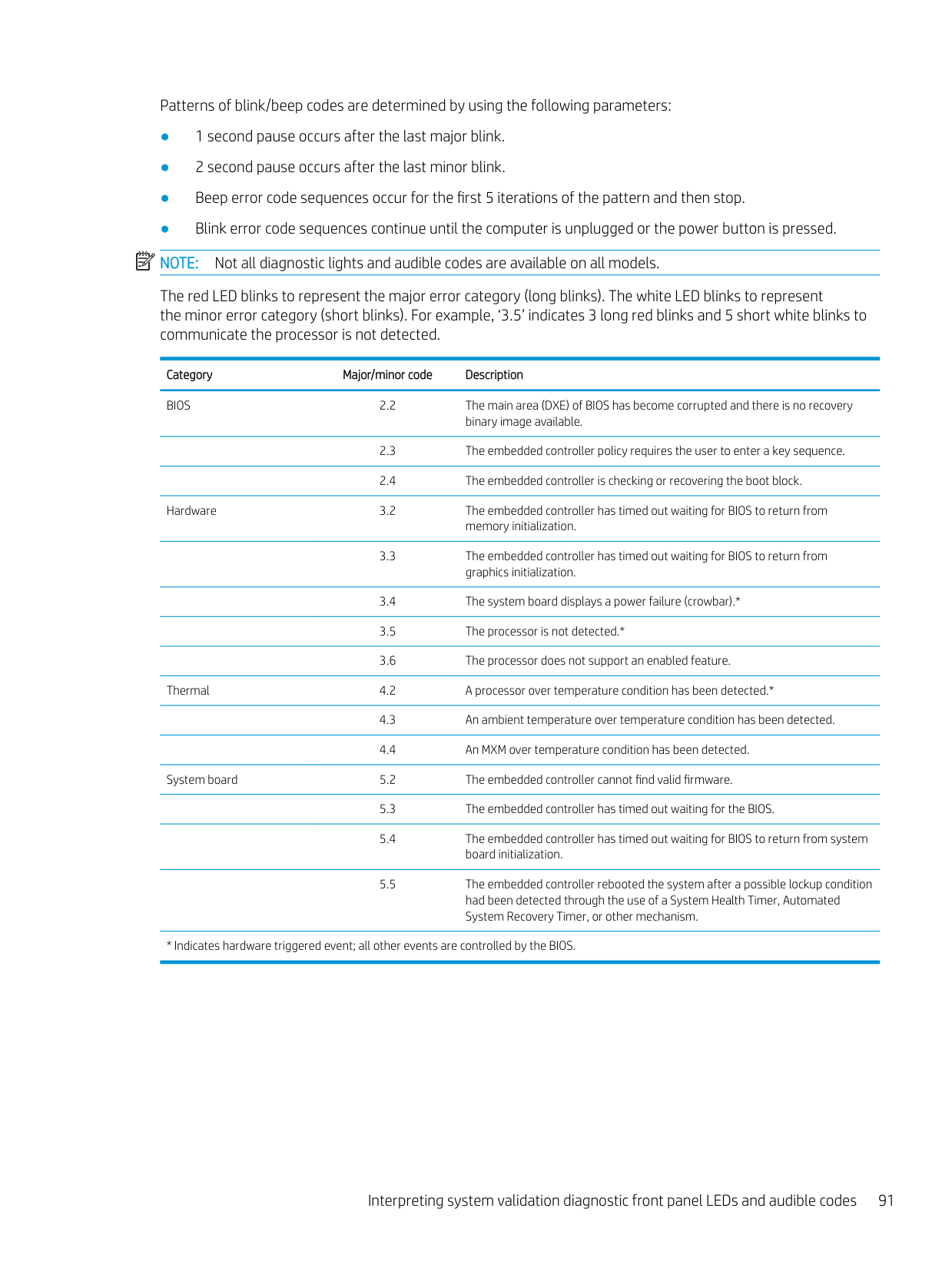
There are two options to download HP PC Hardward Diagnostics to USB device. Download the latest UEFI version
– or – Click Find Now to let HP automatically detect your product.
Downloading HP PC Hardware Diagnostics (UEFI) to a USB device 97
10 System backup and recovery
Backing up, restoring, and recovering
This section provides information about the following processes. The information in the section is standard procedure for most products.
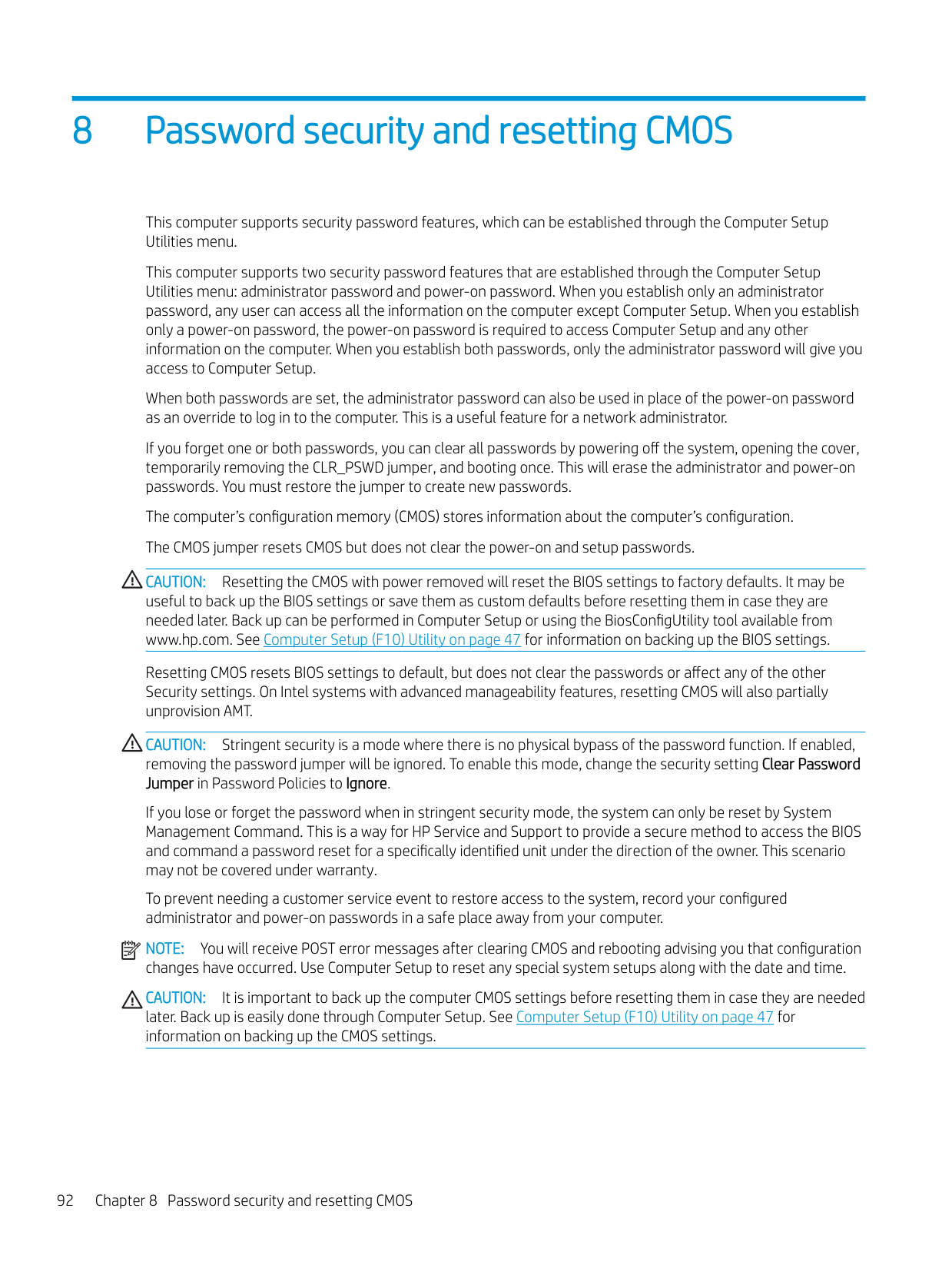
▲ Type help in the taskbar search box, and then select Help and Support.
#### Creating recovery media and backups
The following methods of creating recovery media and backups are available on select products only. Choose the available method according to your computer model.
| | |---|
NOTE: If storage is 32 GB or less, Microsoft System Restore is disabled by default.
##### Creating HP Recovery media (select products only)
If possible, check for the presence of the Recovery partition and the Windows partition. From the Start menu, select File Explorer.
You can use Windows tools to create system restore points and create backups of personal information, see Using Windows tools on page 100.
To create HP Recovery media:
#### Using Windows tools
You can create recovery media, system restore points, and backups of personal information using Windows tools.
| | |---|
NOTE: If storage is 32 GB or less, Microsoft System Restore is disabled by default. For more information and steps, see Help and Support.
▲ Type help in the taskbar search box, and then select Help and Support.
#### Restore and recovery
There are several options for recovering your system. Choose the method that best matches your situation and level of expertise:
| | |---|
IMPORTANT: Not all methods are available on all products.
▲ Type help in the taskbar search box, and then select Help and Support.
▲ Type recovery in the taskbar search box, select HP Recovery Manager, select Reinstall drivers
and/or applications, and then follow the on-screen instructions.
##### Recovering using HP Recovery Manager
HP Recovery Manager software allows you to recover the computer to its original factory state by using the HP Recovery media that you either created or that you obtained from HP, or by using the HP Recovery partition (select products only). If you have not already created recovery media, see Creating HP Recovery media (select products only) on page 99.
###### What you need to know before you get started
IMPORTANT: Recovery through HP Recovery Manager should be used as a final attempt to correct computer issues.
| | |---|
| | |---|
| | |---|
IMPORTANT: HP Recovery Manager does not automatically provide backups of your personal data. Before beginning recovery, back up any personal data you want to retain. Using HP Recovery media, you can choose from one of the following recovery options: NOTE: Only the options available for your computer display when you start the recovery process.
The HP Recovery partition (select products only) allows System Recovery only. Using the HP Recovery partition (select products only)
The HP Recovery partition allows you to perform a system recovery without the need for recovery discs or a recovery USB flash drive. This type of recovery can be used only if the hard drive is still working.
To start HP Recovery Manager from the HP Recovery partition:
###### Using HP Recovery media to recover
You can use HP Recovery media to recover the original system. This method can be used if your system does not have an HP Recovery partition or if the hard drive is not working properly.
NOTE: If the computer does not automatically restart in HP Recovery Manager, change the computer boot order. See Changing the computer boot order on page 102.
| | |---|
###### Changing the computer boot order
If your computer does not restart in HP Recovery Manager, you can change the computer boot order, which is the order of devices listed in BIOS where the computer looks for startup information. You can change the selection to an optical drive or a USB flash drive.
To change the boot order:
###### Removing the HP Recovery partition (select products only)
HP Recovery Manager software allows you to remove the HP Recovery partition to free up hard drive space.
| | |---|
IMPORTANT: After you remove the HP Recovery partition, you will not be able to perform System Recovery or create HP recovery media from the HP Recovery partition. So before you remove the Recovery partition, create HP Recovery media; see Creating HP Recovery media (select products only) on page 99.
| | |---|
NOTE: The Remove Recovery Partition option is only available on products that support this function. Follow these steps to remove the HP Recovery partition:
A Battery replacement
The battery that comes with the computer provides power to the real-time clock. When replacing the battery, use a battery equivalent to the battery originally installed in the computer. The computer comes with a 3-volt lithium coin cell battery.
WARNING! The computer contains an internal lithium manganese dioxide battery. There is a risk of fire and burns if the battery is not handled properly. To reduce the risk of personal injury: Do not attempt to recharge the battery. Do not expose to temperatures higher than 60°C (140ºF). Do not disassemble, crush, puncture, short external contacts, or dispose of in fire or water. Replace the battery only with the HP spare designated for this product. CAUTION: Before replacing the battery, it is important to back up the computer CMOS settings. When the battery is removed or replaced, the CMOS settings will be cleared. Static electricity can damage the electronic components of the computer or optional equipment. Before beginning these procedures, ensure that you are discharged of static electricity by briefly touching a grounded metal object. NOTE: The lifetime of the lithium battery can be extended by plugging the computer into a live AC wall socket. The lithium battery is only used when the computer is NOT connected to AC power. HP encourages customers to recycle used electronic hardware, HP original print cartridges, and rechargeable batteries. For more information about recycling programs, go to http://www.hp.com/recycle.
| | |---|
CAUTION: Regardless of the power-on state, voltage is always present on the system board as long as the system is plugged into an active AC outlet. You must disconnect the power cord to avoid damage to the internal components of the computer.
NOTE: On some computer models, it may be necessary to remove an internal component to gain access to the battery.
| | |---|


104 Appendix A Battery replacement

| | |---|
NOTE: After the battery has been replaced, use the following steps to complete this procedure.
B Statement of memory volatility
The purpose of this chapter is to provide general information regarding nonvolatile memory in HP Business PCs. This chapter also provides general instructions for restoring nonvolatile memory that can contain personal data after the system has been powered off and the hard drive has been removed.
HP Business PC products that use Intel®-based or AMD®-based system boards contain volatile DDR memory. The amount of nonvolatile memory present in the system depends upon the system configuration. Intel-based and AMD-based system boards contain nonvolatile memory subcomponents as originally shipped from HP, assuming that no subsequent modifications have been made to the system and assuming that no applications, features, or functionality have been added to or installed on the system.
Following system shutdown and removal of all power sources from an HP Business PC system, personal data can remain on volatile system memory (DIMMs) for a finite period of time and will also remain in nonvolatile memory. Use the steps below to remove personal data from the PC, including the nonvolatile memory found in Intel-based and AMD-based system boards.
Current BIOS steps
| | |---|
| | |---|
| | |---|
| | |---|
– or –
– or –
| | |---|
Current BIOS steps 107
Nonvolatile memory usage
Does this memory store customer data?
Does this memory retain data when power is removed?
What is the purpose of this memory?
Nonvolatile memory type Amount (Size)
How is data input into this memory?
How is this memory writeprotected?
HP Sure Start flash (select models only)
8 MBytes No Yes Provides protected backup of critical System BIOS code, EC firmware, and critical PC configuration data for select platforms that support HP Sure Start.
Data cannot be written to this device via the host processor. The content is managed solely by the HP Sure Start Embedded Controller.
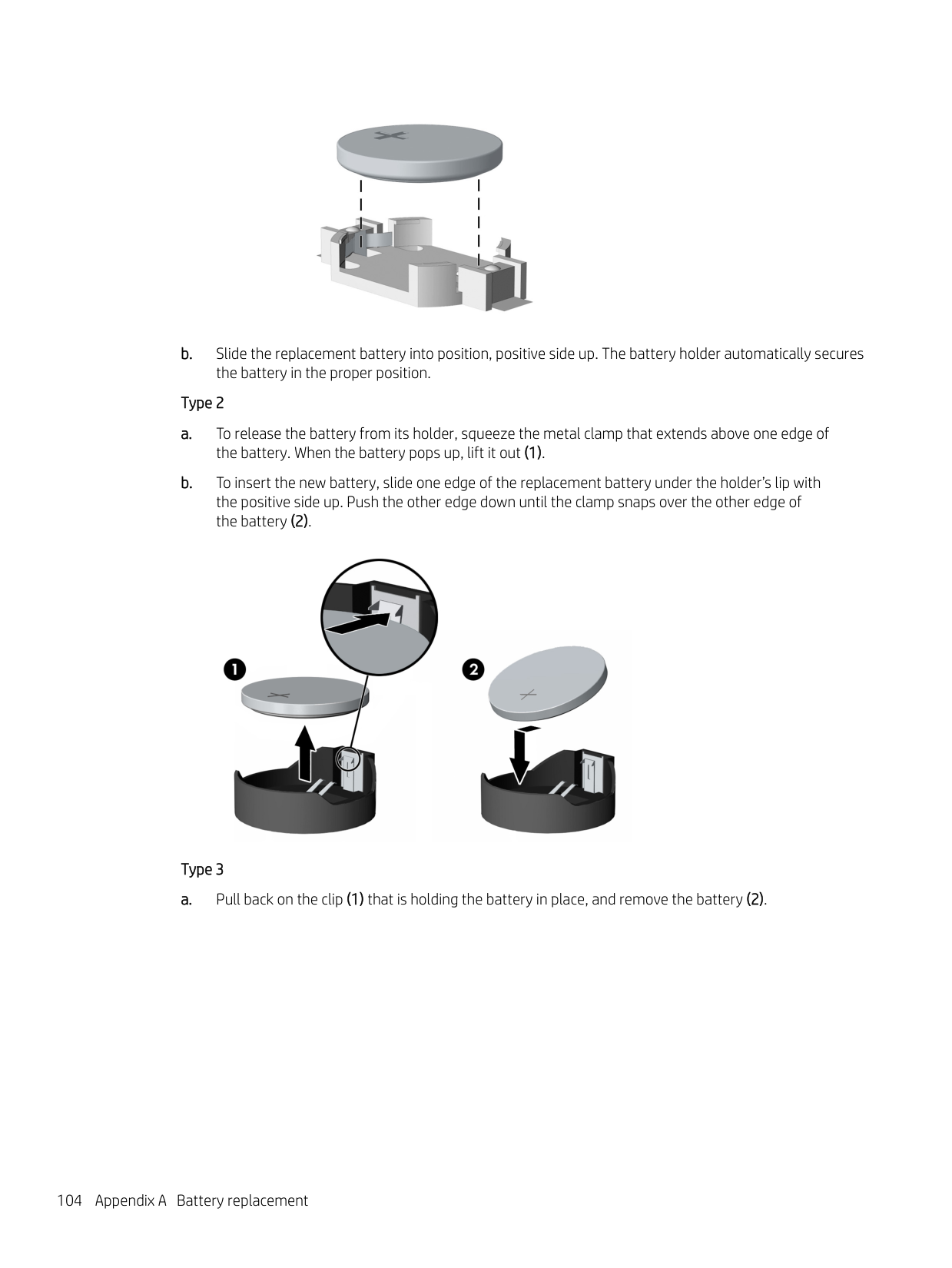
This memory is protected by the HP Sure Start Embedded Controller.
For more information, see Using HP Sure Start on page 111.
Real Time Clock (RTC) battery backed-up CMOS configuration memory
256 Bytes No Yes Stores system date and time and noncritical data.
RTC battery backed-up CMOS is programmed using the Computer Setup (BIOS), or changing the Microsoft Windows date and time.
This memory is not writeprotected.
Controller (NIC) EEPROM
64 KBytes (not customer accessible)
No Yes Stores NIC configuration and NIC firmware.
NIC EEPROM is programmed using a utility from the NIC vendor that can be run from DOS.
A utility is required to write data to this memory and is available from the NIC vendor. Writing data to this ROM in an inappropriate manner will render the NIC nonfunctional.
DIMM Serial Presence Detect (SPD) configuration data
256 Bytes per memory board, 128 Bytes programmable (not customer accessible)
No Yes Stores memory board information.
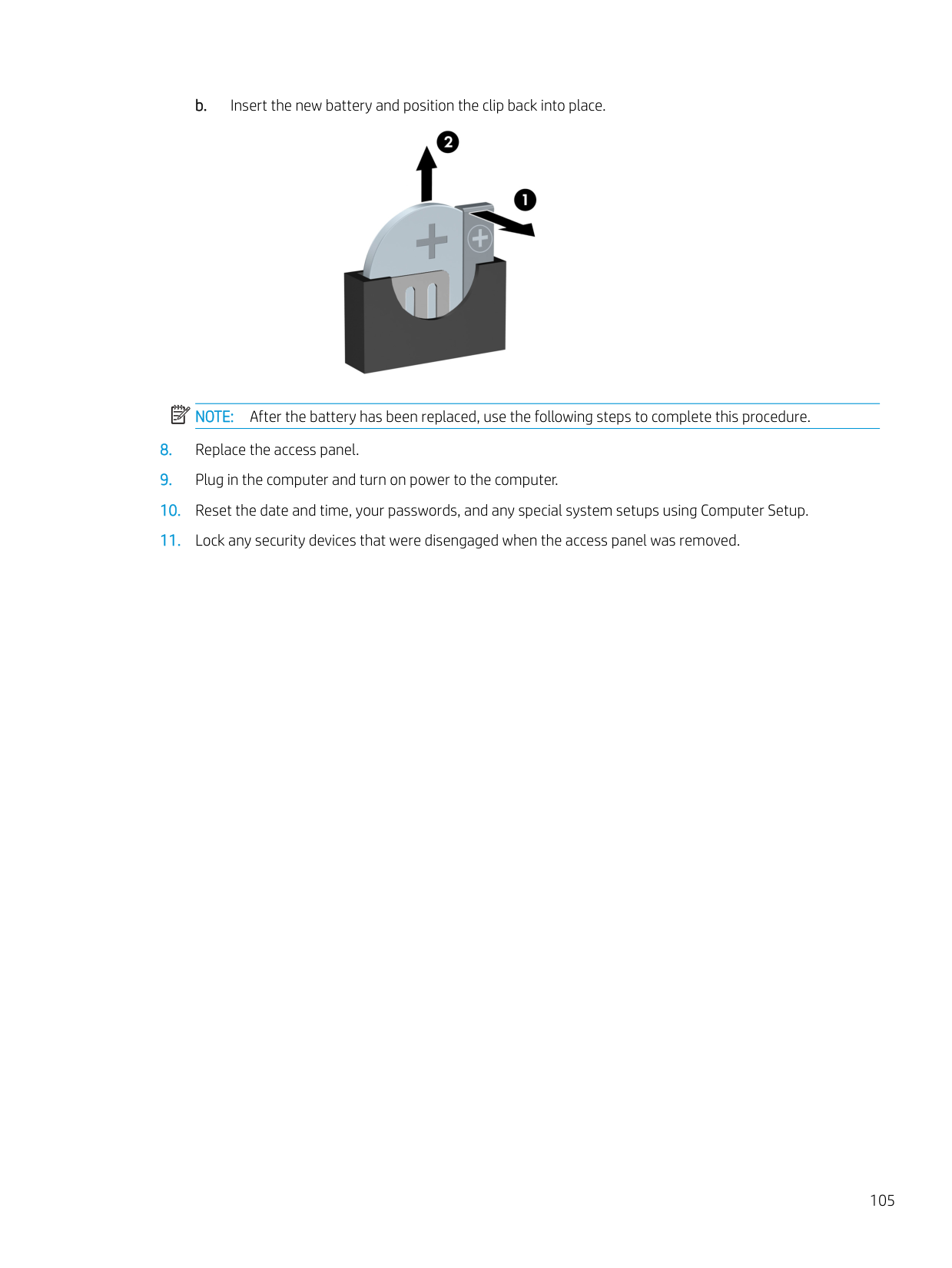
DIMM SPD is programmed by the memory vendor.
Data cannot be written to this memory when the board is installed in a PC. The specific writeprotection method varies by memory vendor.
System BIOS 9 MBytes Yes Yes Stores system BIOS code and PC configuration data.
System BIOS code is programmed at the factory. Code is updated when the system BIOS is updated. Configuration data and settings are input using the Computer Setup (BIOS) or a custom utility.
NOTE: Writing data to this ROM in an inappropriate manner can render the PC nonfunctional.
A utility is required for writing data to this memory and is available on the HP website; go to http://www.hp.com/ support, and select your country. Select Drivers & Downloads, and then
Does this memory store customer data?
Does this memory retain data when power is removed?
What is the purpose of this memory?
Nonvolatile memory type Amount (Size)
How is data input into this memory?
How is this memory writeprotected?
follow the on-screen instructions.
Intel Management Engine Firmware
7 MBytes Yes Yes Stores Management Engine Code, Settings, Provisioning Data and iAMT third-party data store.
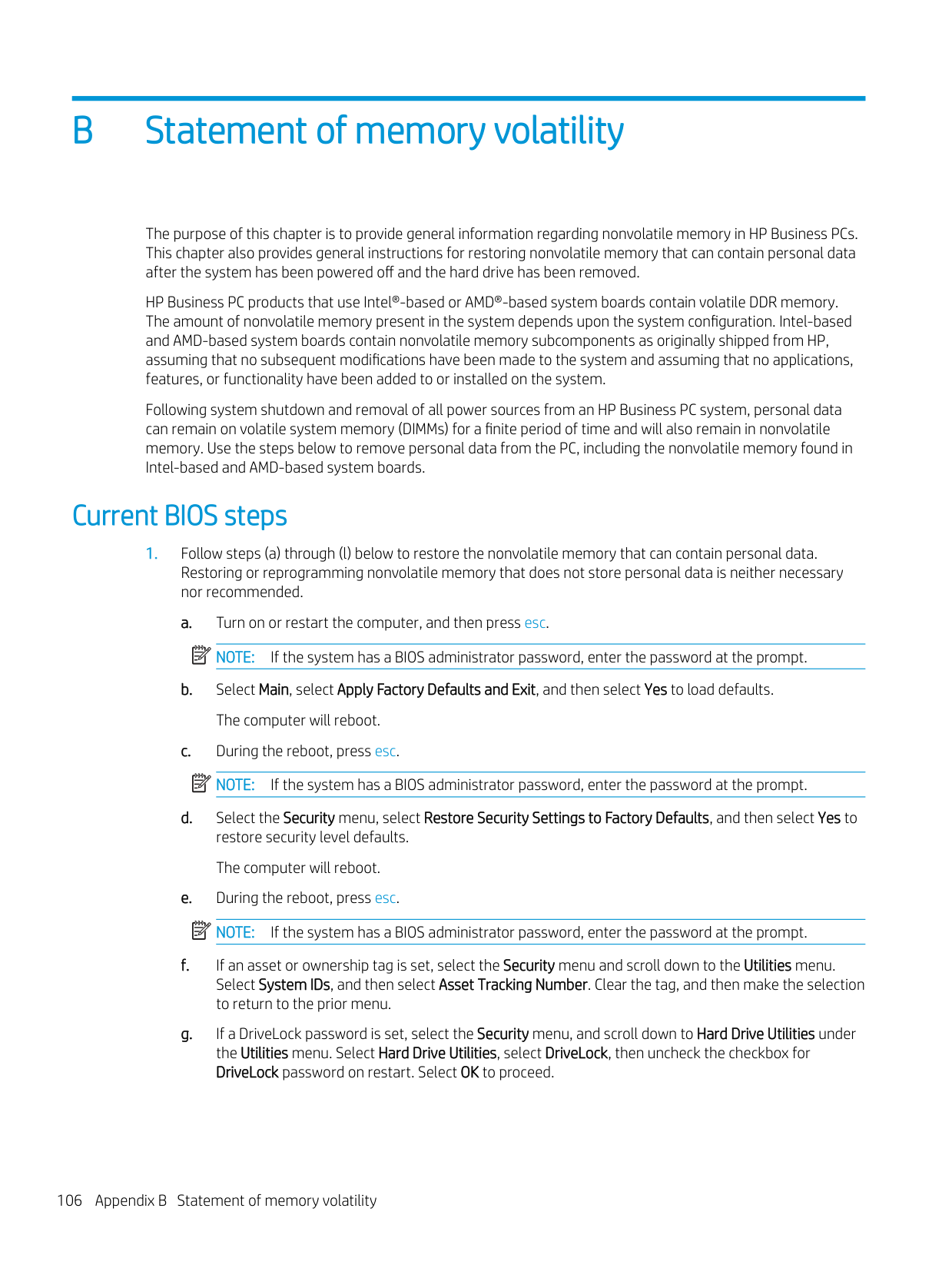
Management Engine Code is programmed at the factory. Code is updated via Intel secure firmware update utility. Unique Provisioning Data can be entered at the factory or by an administrator using the Management Engine (MEBx) setup utility. The third-party data store contents can be populated by a remote management console or local applications that have been registered by an administrator to have access to the space.
The Intel chipset is configured to enforce hardware protection to block all direct read/write access to this area. An Intel utility is required for updating the firmware. Only firmware updates digitally signed by Intel can be applied using this utility.
Nonvolatile memory usage 109
Questions and answers
IMPORTANT: Restore defaults does not securely erase any data on your hard drive. See question and answer 6 for steps to securely erase data. Restore defaults does not reset the Custom Secure Boot keys. See question and answer 7 for information about resetting the keys.
The Unified Extensible Firmware Interface (UEFI) BIOS is an industry-standard software interface between the platform firmware and an operating system (OS). It is a replacement for the older BIOS architecture, but supports much of the legacy BIOS functionality.
Like the legacy BIOS, the UEFI BIOS provides an interface to display the system information and configuration settings and to change the configuration of your computer before an OS is loaded. BIOS provides a secure run-time environment that supports a Graphic User Interface (GUI). In this environment, you can use either a pointing device (Touchscreen, TouchPad, pointing stick, or USB mouse) or the keyboard to navigate and make menu and configuration selections. The UEFI BIOS also contains basic system diagnostics.
The UEFI BIOS provides functionality beyond that of the legacy BIOS. In addition, the UEFI BIOS works to initialize the computer’s hardware before loading and executing the OS; the run-time environment allows the loading and execution of software programs from storage devices to provide more functionality, such as advanced hardware diagnostics (with the ability to display more detailed system information) and advanced firmware management and recovery software.
HP has provided options in Computer Setup (BIOS) to allow you to run in legacy BIOS, if required by the operating system. Examples of this requirement would be if you upgrade or downgrade the OS.
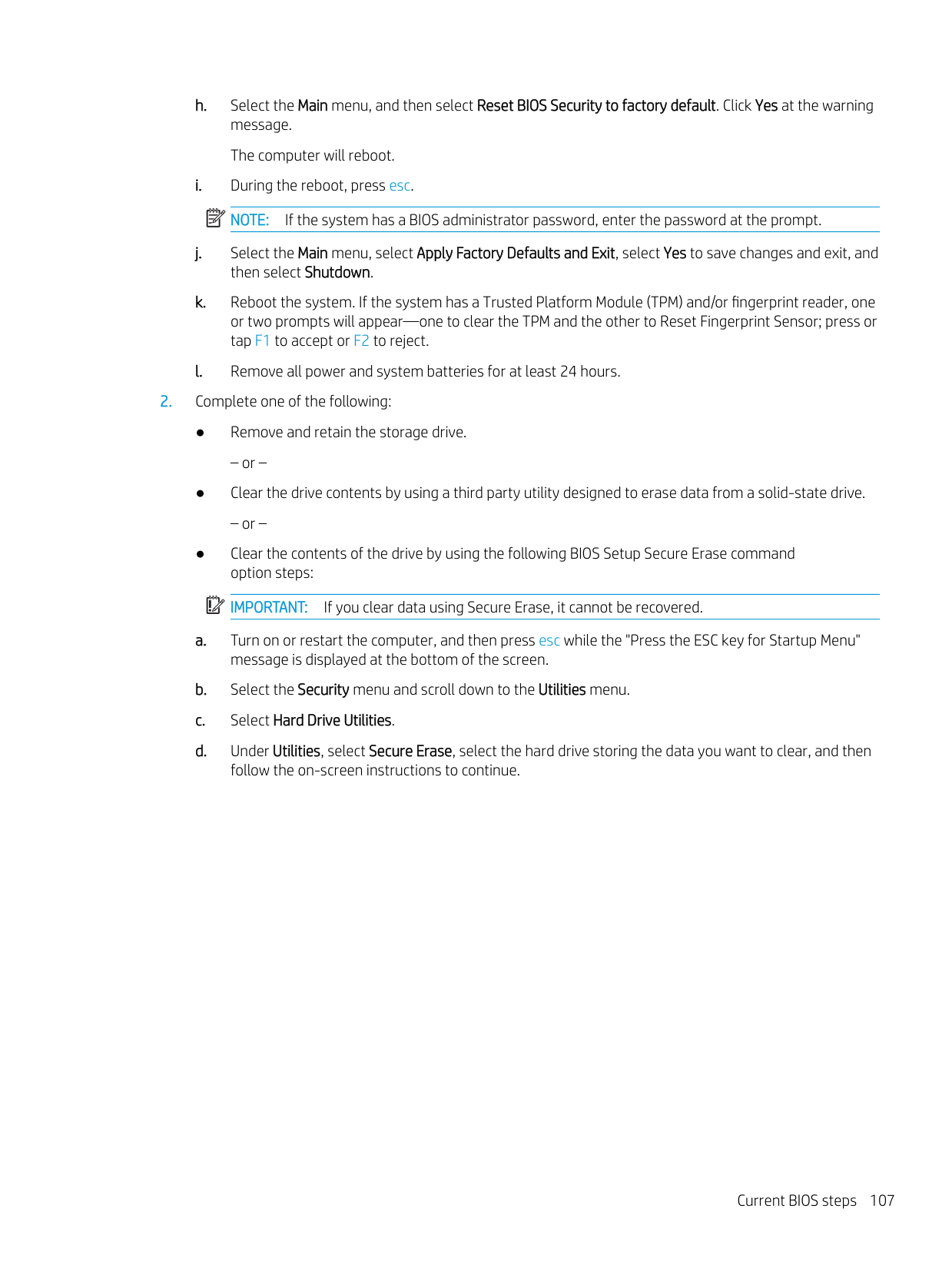
The DIMM SPD memory contains information about the memory board, such as size, serial number, data width, speed/timing, voltage, and thermal information. This information is written by the board manufacturer and stored on an EEPROM. This EEPROM cannot be written to when the memory board is installed in a PC. Third-party tools do exist that can write to the EEPROM when the memory board is not installed in a PC. Various third-party tools are available to read SPD memory.
This message relates to clearing the Real Time Clock (RTC) CMOS memory that contains PC configuration data.
| | |---|
| | |---|
IMPORTANT: Resetting will result in the loss of information.
These steps will not reset Custom Secure Boot Keys. See question and answer 7 for information about resetting the keys.
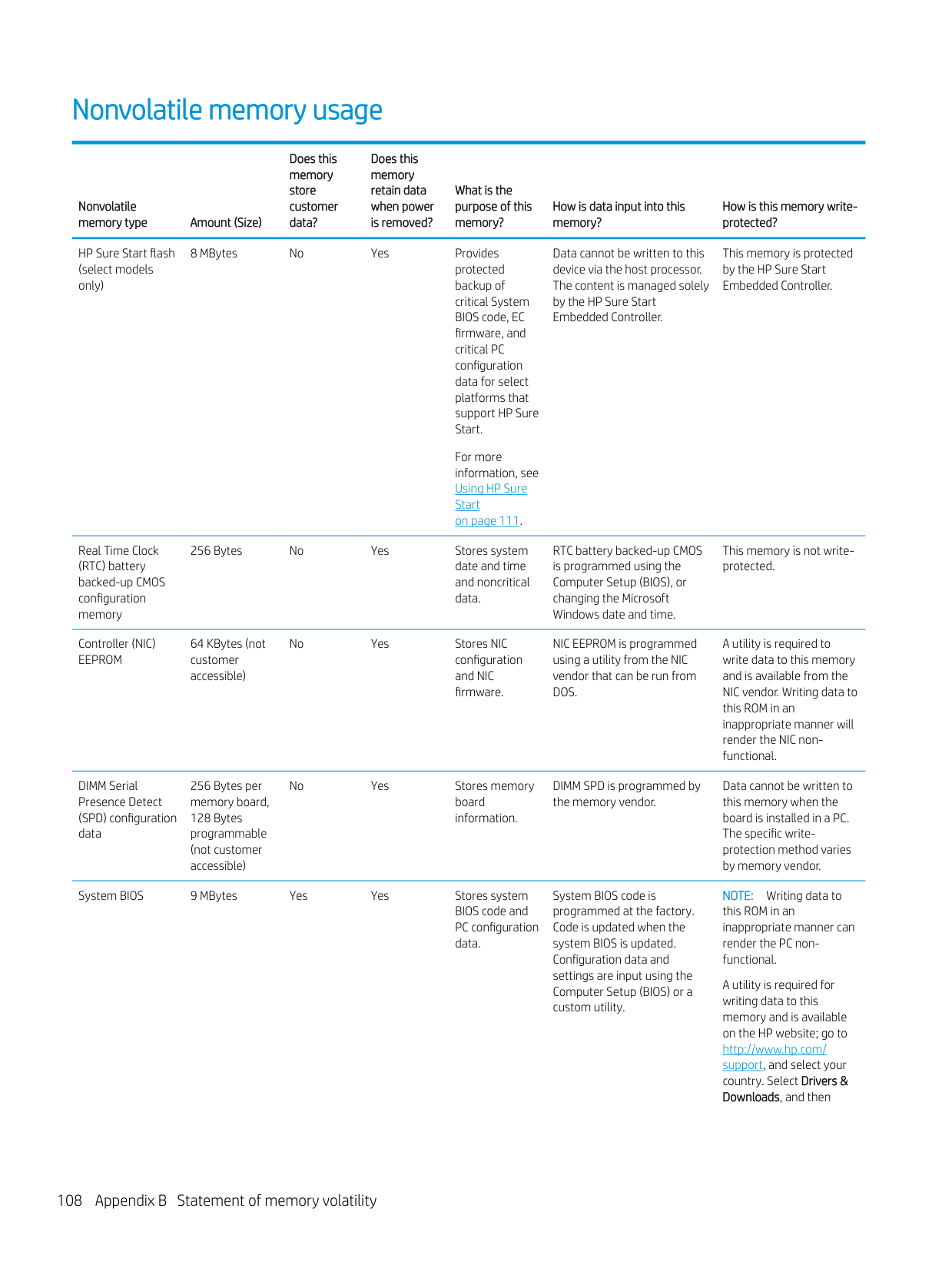
###### 7. How can the Custom Secure Boot Keys be reset?
Secure Boot is a feature to ensure that only authenticated code can start on a platform. If you enabled Secure Boot and created Custom Secure Boot Keys, simply disabling Secure Boot will not clear the keys. You must also select to clear the Custom Secure Boot Keys. Use the same Secure Boot access procedure you used to create the Custom Secure Boot Keys, but make the selection to clear or delete all Secure Boot Keys.
Using HP Sure Start
Select computer models are configured with HP Sure Start, a technology that continuously monitors your computer's BIOS for attacks or corruption. If the BIOS becomes corrupted or is attacked, HP Sure Start restores the BIOS to its previously safe state, without user intervention. Those select computer models ship with HP Sure Start configured and enabled. HP Sure Start is configured and already enabled so that most users can use the HP Sure Start default configuration. The default configuration can be customized by advanced users.
To access the latest documentation on HP Sure Start, go to http://www.hp.com/support, and select your country. Select Drivers & Downloads, and then follow the on-screen instructions.
Using HP Sure Start 111
C Power cord set requirements
The power supplies on some computers have external power switches. The voltage select switch feature on the computer permits it to operate from any line voltage between 100-120 or 220-240 volts AC. Power supplies on those computers that do not have external power switches are equipped with internal switches that sense the incoming voltage and automatically switch to the proper voltage.
The power cord set received with the computer meets the requirements for use in the country where you purchased the equipment.
Power cord sets for use in other countries must meet the requirements of the country where you use the computer.
General requirements
The requirements listed below are applicable to all countries:
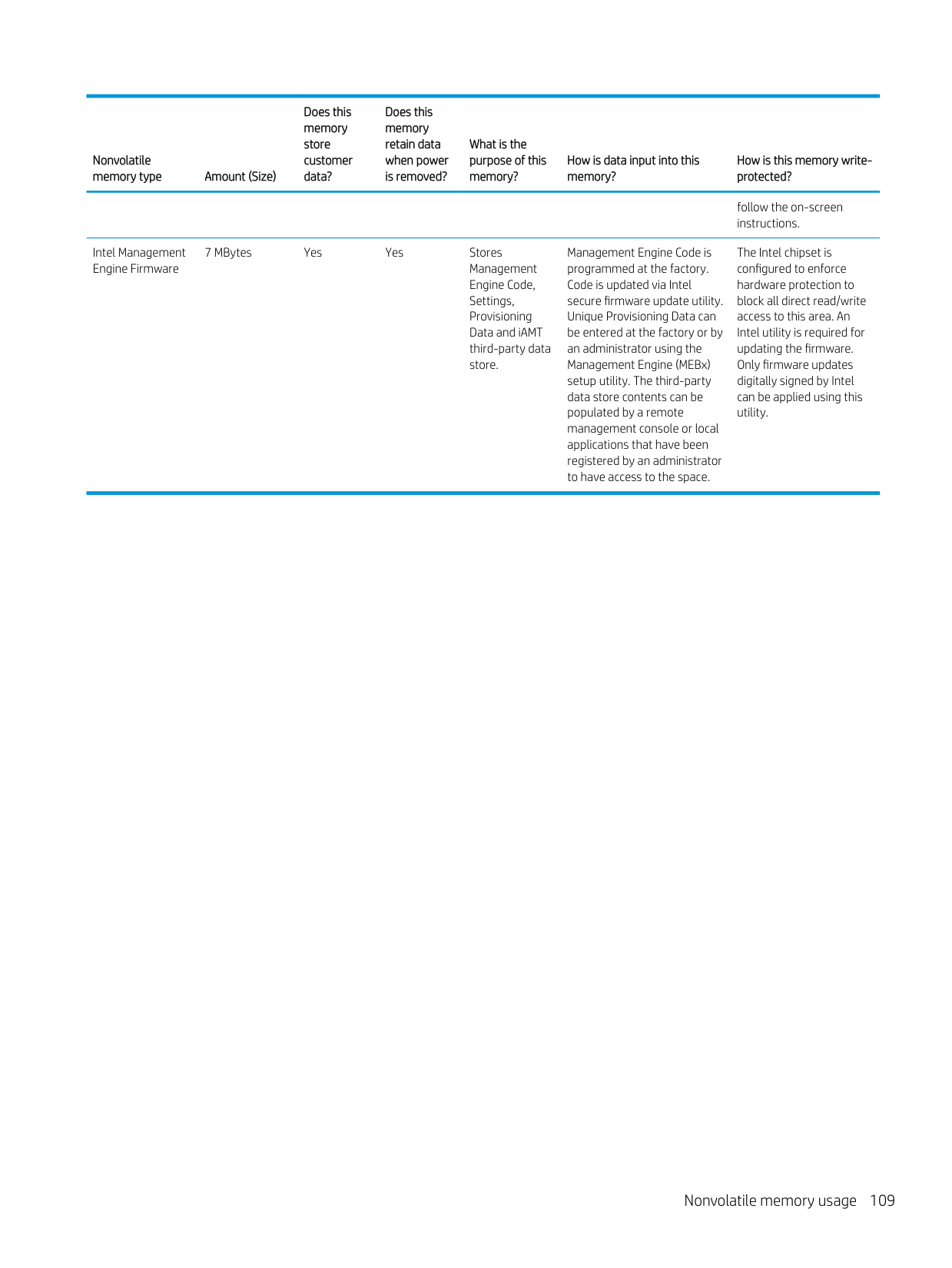
the country where the power cord set will be installed.
rating of 125 or 250 volts AC, as required by each country’s power system.
between 1.8 m (6 feet) and 3.6 m (12 feet).
The power cord should be routed so that it is not likely to be walked on or pinched by items placed upon it or against it. Particular attention should be paid to the plug, electrical outlet, and the point where the cord exits from the product.
WARNING! Do not operate this product with a damaged power cord set. If the power cord set is damaged in any manner, replace it immediately.
Japanese power cord requirements For use in Japan, use only the power cord received with this product. CAUTION: Do not use the power cord received with this product on any other products.
112 Appendix C Power cord set requirements
Country-specific requirements
Additional requirements specific to a country are shown in parentheses and explained below.
Country Accrediting Agency Country Accrediting Agency Australia (1) Austria (1) Belgium (1) Canada (2)
EANSW OVE CEBC CSA
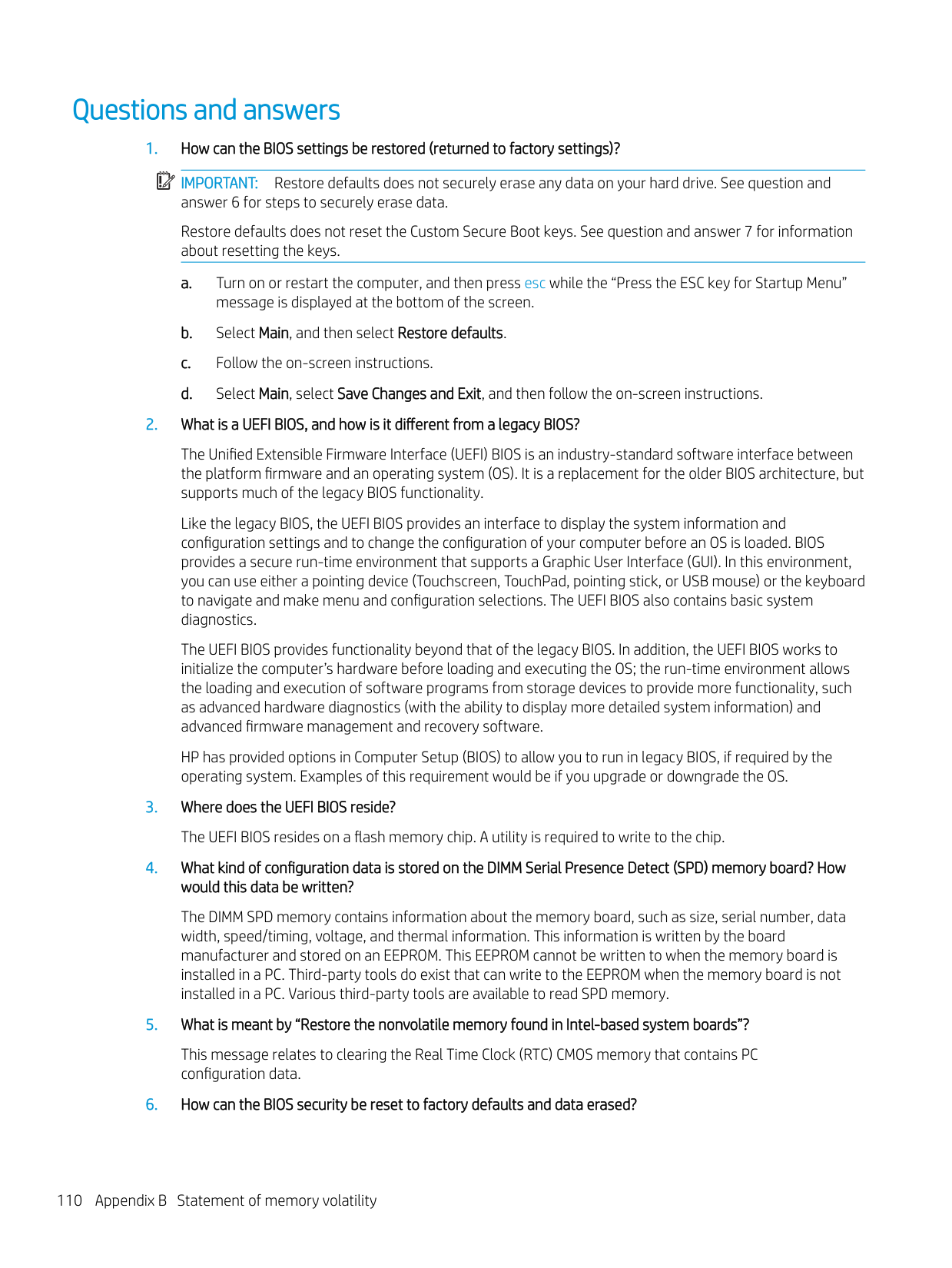
Italy (1) Japan (3) Norway (1) Sweden (1)
IMQ METI NEMKO SEMKO
Denmark (1) Finland (1) France (1) Germany (1)
DEMKO SETI UTE VDE
Switzerland (1) United Kingdom (1) United States (2)
SEV BSI UL
Dentori Law. Flexible cord must be Type VCT or VCTF, 3-conductor, 0.75 mm2 conductor size. Wall plug must be a two-pole grounding type with a Japanese Industrial Standard C8303 (7A, 125V) configuration.
Country-specific requirements 113
D Specifications
Unit Value Chassis (in the desktop position) Height Width Depth
3.7 in 10.6 in 11.8 in
95 mm 270 mm 300 mm
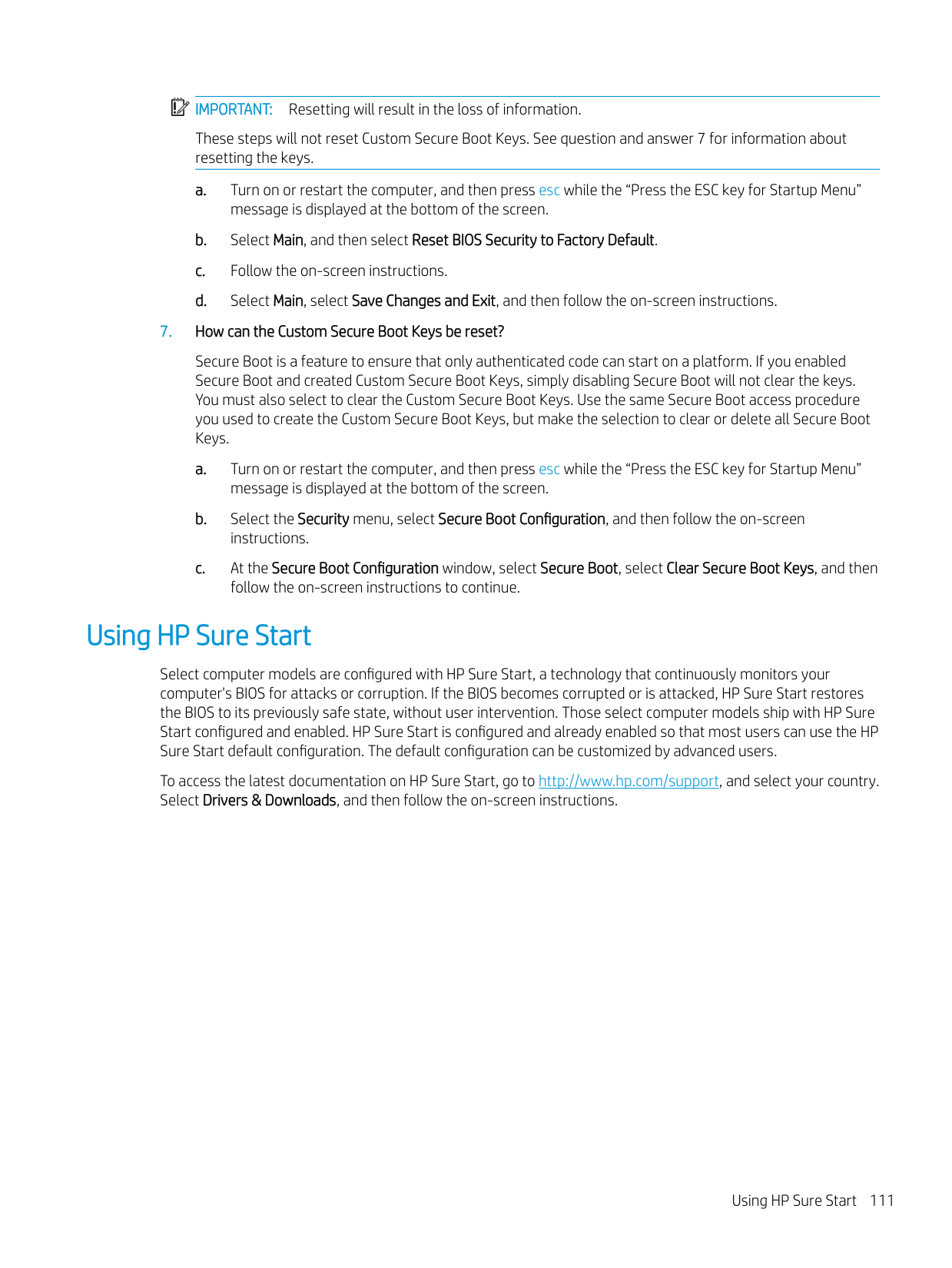
Approximate Weight 9.8 lb 4.43 kg Weight Supported (maximum distributed load in desktop position) 77 lb 35 kg Temperature Range Operating Nonoperating
50° to 95°F
10° to 35°C
-22° to 140°F
-30° to 60°C
NOTE: Operating temperature is derated 1.0° C per 300 m (1000 ft) to 3000 m (10,000 ft) above sea level; no direct sustained sunlight. Maximum rate of change is 10° C/Hr. The upper limit may be limited by the type and number of options installed.
Relative Humidity (noncondensing) Operating Nonoperating (38.7°C max wet bulb)
10-90% 5-95%
10-90% 5-95%
Maximum Altitude (unpressurized) Operating Nonoperating
16,404 ft 50,000 ft
5,000 m 15,240 m
Power Supply Operating Voltage Range Rated Voltage Range1 Rated Line Frequency Operating Line Frequency
90-264 VAC 100-240 VAC 50-60 Hz 47-63 Hz
Standard Efficiency High Efficiency
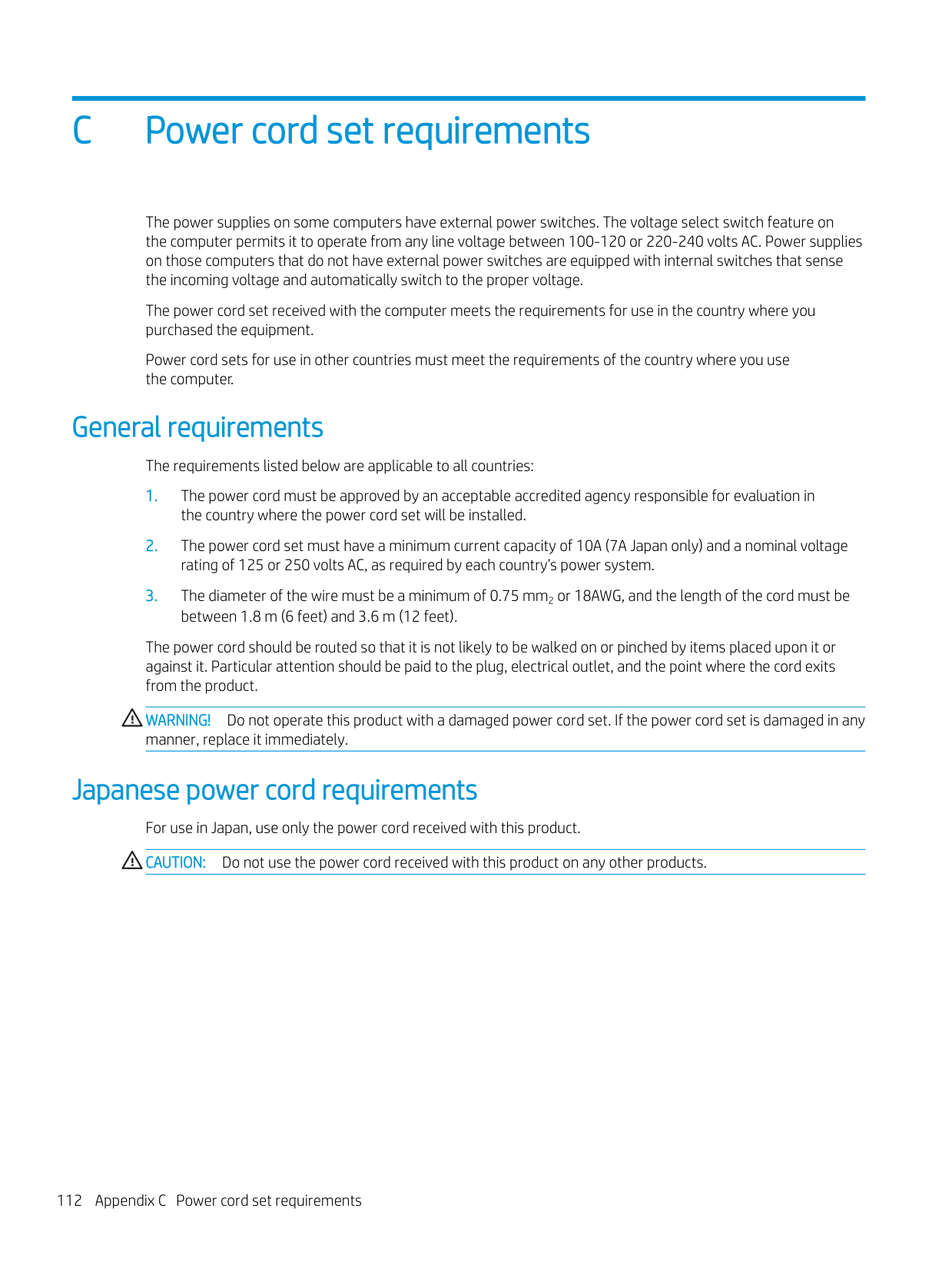
180 W / 250 W active PFC 82/85/82% efficient at 20/50/100% load (115V)
Rated Input Current 250 W / 4 A
180 W / 2.3 A
1 This system utilizes an active power factor corrected power supply. This allows the system to pass the CE mark requirements for use in the countries of the European Union. The active power factor corrected power supply also has the added benefit of not requiring an input voltage range select switch.
114 Appendix D Specifications
Index
locked 62 removal and replacement 29
audible codes 90 audio problems 72 audio-in jack 2, 3 audio-out jack 2, 3
disposal 27 battery replacement 103 beep codes 90 booting options
Full Boot 85 Quick Boot 85
buttons power 2
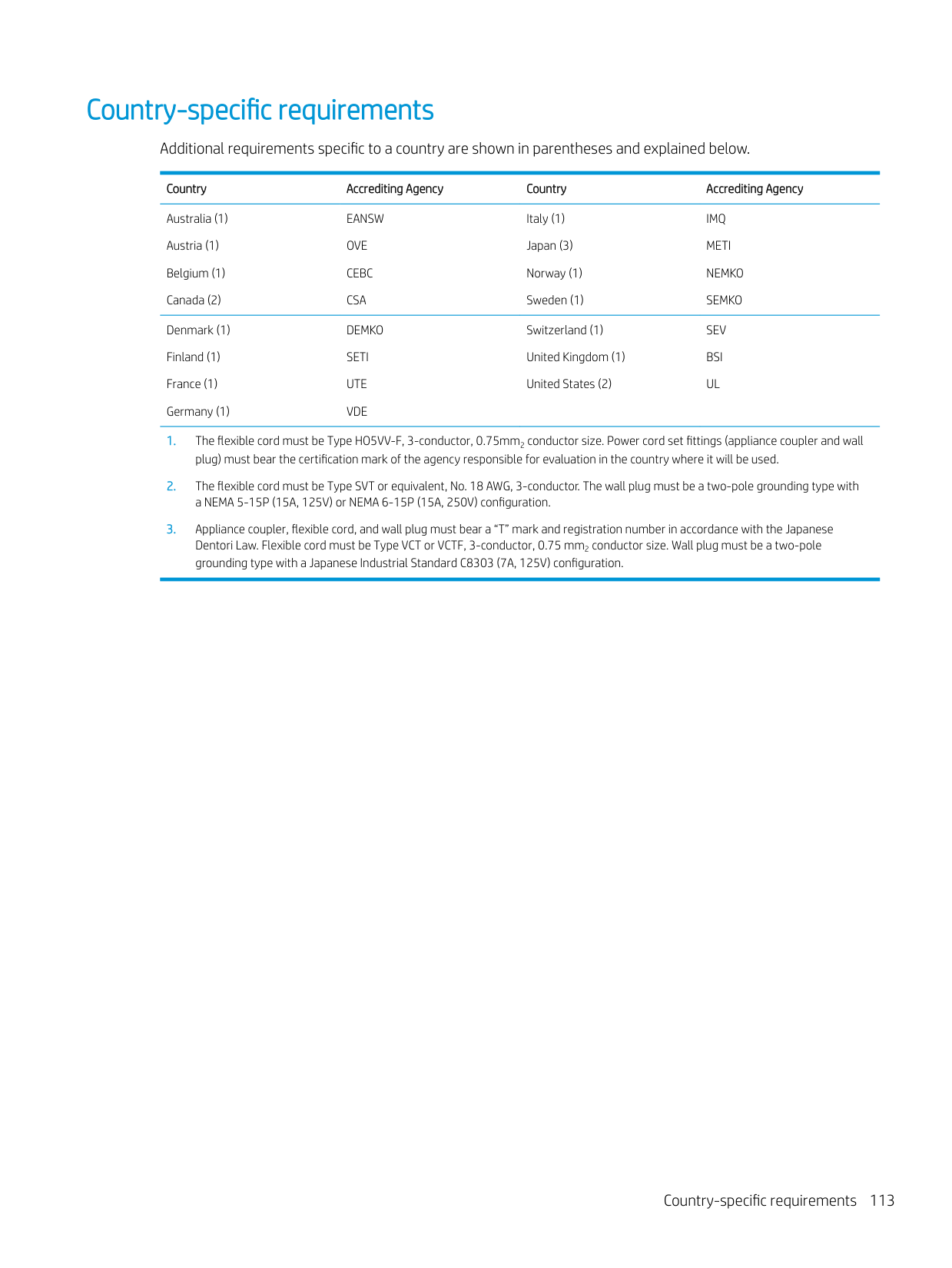
AC power 22 cables 27 electrostatic discharge 22 keyboard cleaning 25 keyboard keys 26
changing a Power-On password 95 changing a Setup password 95 cleaning
computer 25 mouse 26 safety precautions 25
CMOS backing up 92
components front panel 2 rear panel 3
computer serial number 4 specifications 114
computer cleaning 25 Computer Setup
access problem 61
connector board removal and replacement 42, 46
connectors DisplayPort monitor 3 power cord 3 country power cord set requirements 113 Customer Support 59
removal and replacement 34
preventing damage 23
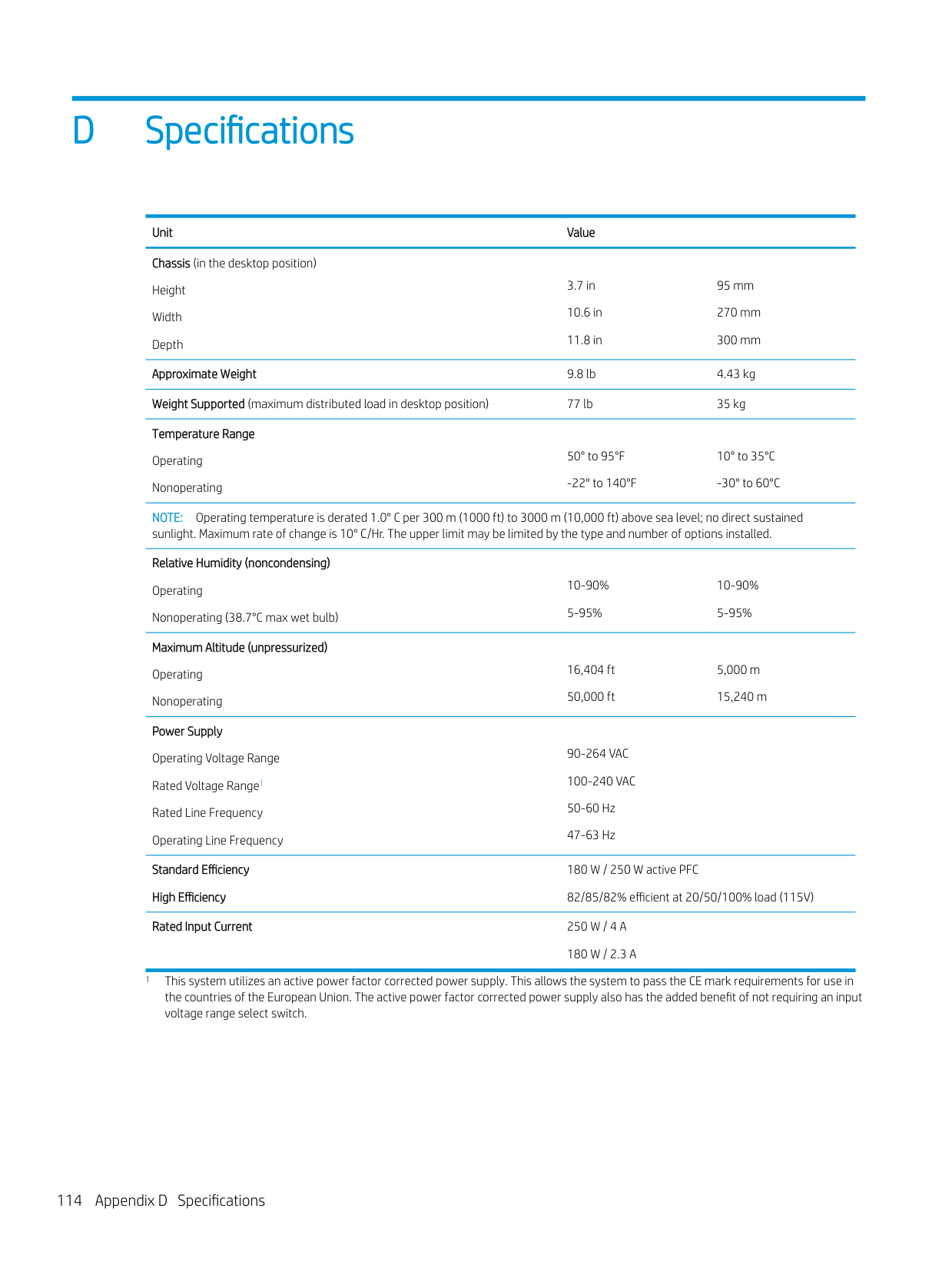
error codes 85, 90 messages 85
fan-sink
removal and replacement 39 flash drive problems 82 flashing LEDs 90 front bezel
removal and replacement 31 front panel components 2 front panel problems 83
proper handling 27 hard drive activity light 2 hard drive problems 65
hard drives
removal and replacement 32 hardware installation problems 77 headphone jack 2 helpful hints 60 HP PC Hardware Diagnostics (UEFI)
downloading 97 HP Sure Start 111
battery 103 Internet access problems 83
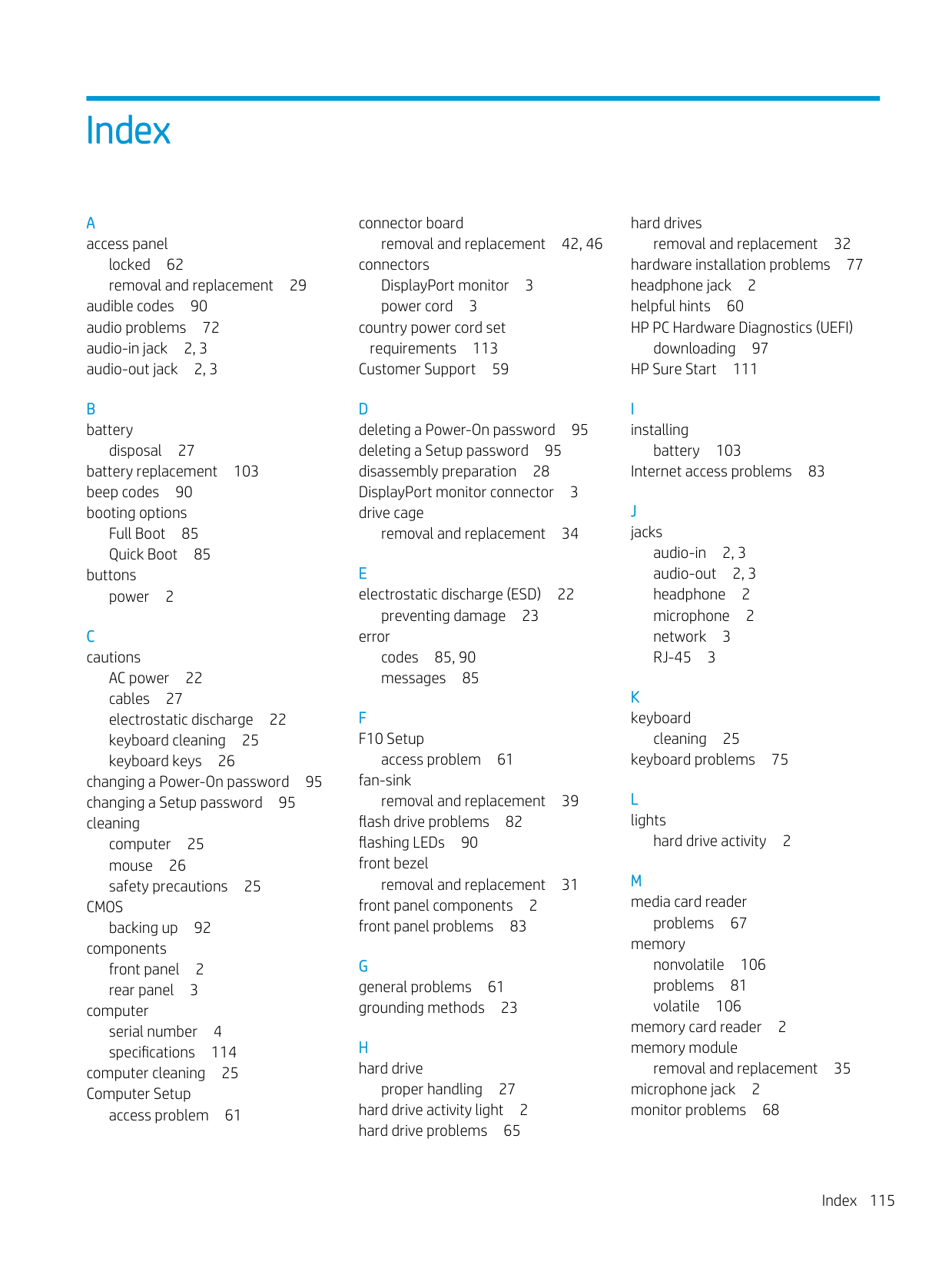
audio-in 2, 3 audio-out 2, 3 headphone 2 microphone 2 network 3 RJ-45 3
cleaning 25 keyboard problems 75
hard drive activity 2
problems 67
memory nonvolatile 106 problems 81 volatile 106
memory card reader 2 memory module
removal and replacement 35 microphone jack 2 monitor problems 68
Index 115
mouse cleaning 26 problems 75
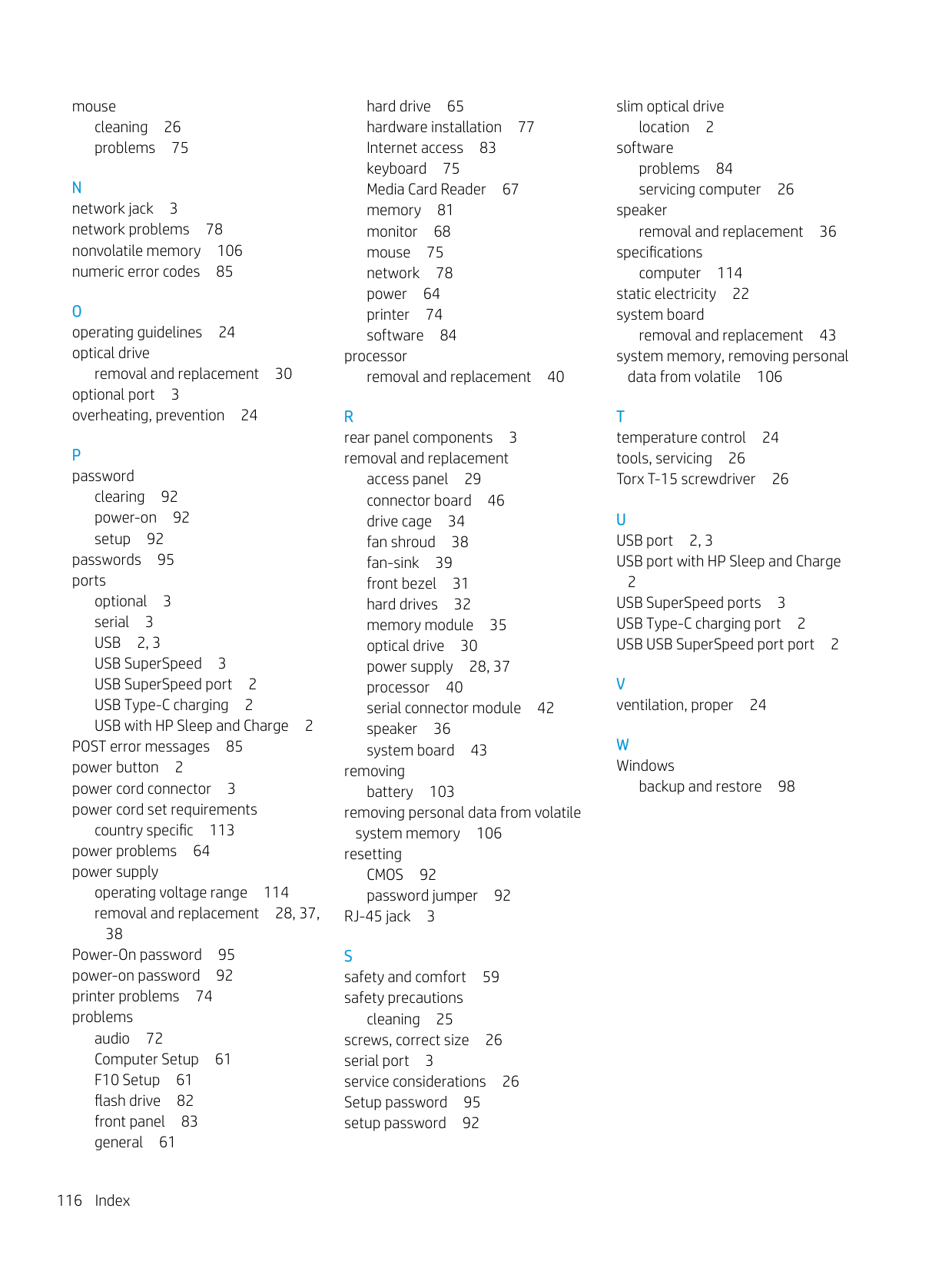
removal and replacement 30 optional port 3 overheating, prevention 24
clearing 92 power-on 92 setup 92
passwords 95 ports
optional 3 serial 3 USB 2, 3 USB SuperSpeed 3 USB SuperSpeed port 2 USB Type-C charging 2 USB with HP Sleep and Charge 2
POST error messages 85 power button 2 power cord connector 3 power cord set requirements country specific 113 power problems 64 power supply
operating voltage range 114 removal and replacement 28, 37,
38 Power-On password 95 power-on password 92 printer problems 74 problems
audio 72 Computer Setup 61 F10 Setup 61 flash drive 82 front panel 83 general 61
hard drive 65 hardware installation 77 Internet access 83 keyboard 75 Media Card Reader 67 memory 81 monitor 68 mouse 75 network 78 power 64 printer 74 software 84
processor removal and replacement 40
access panel 29 connector board 46 drive cage 34 fan shroud 38 fan-sink 39 front bezel 31 hard drives 32 memory module 35 optical drive 30 power supply 28, 37 processor 40 serial connector module 42 speaker 36 system board 43
removing battery 103 removing personal data from volatile system memory 106
resetting CMOS 92 password jumper 92
RJ-45 jack 3
cleaning 25 screws, correct size 26 serial port 3 service considerations 26 Setup password 95 setup password 92
116 Index
slim optical drive location 2
software problems 84 servicing computer 26
speaker
removal and replacement 36 specifications
computer 114 static electricity 22 system board
removal and replacement 43 system memory, removing personal data from volatile 106
2 USB SuperSpeed ports 3 USB Type-C charging port 2 USB USB SuperSpeed port port 2
backup and restore 98