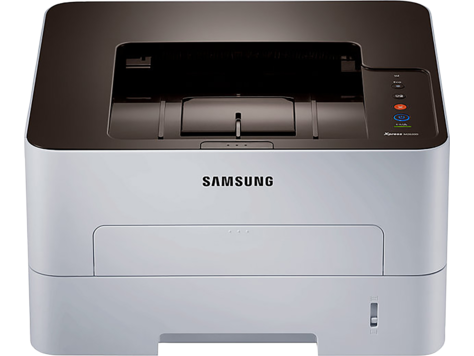
HP Samsung Xpress SL M2020 Laser Printer Series
Printers · 10 Q&As

HP Samsung Xpress SL M2020 Laser Printer Series

Ask AI

— answers from the official manual

Answers from the official manual.

Common questions

Common Questions

10 total
1

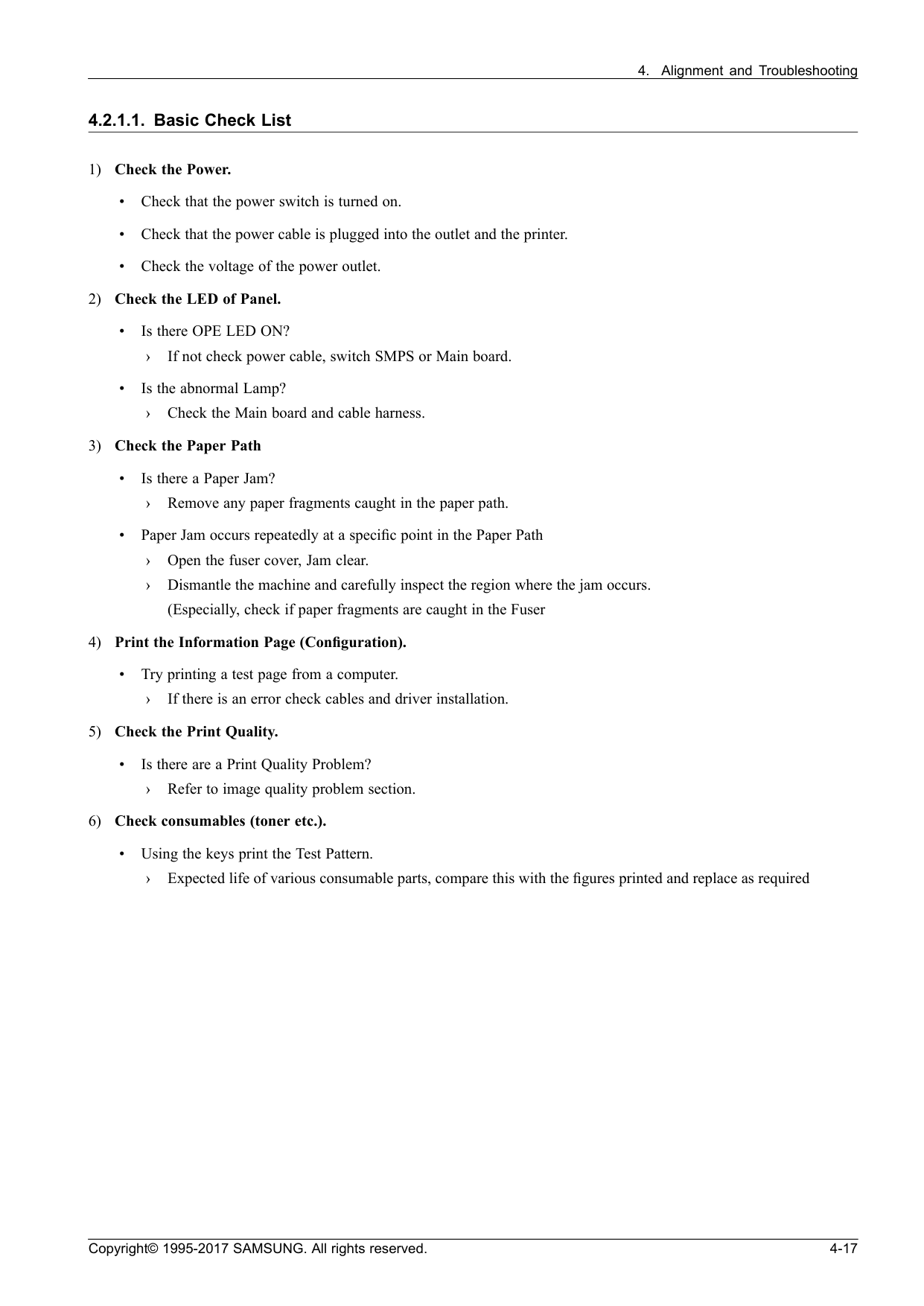
What do the different LED status colors mean on the Samsung Xpress SL M2020?

A solid green LED means the machine is on-line and ready to use, while a blinking green LED indicates data is being received or printed. A solid red LED means the cover is open, there is no paper in the tray, or a major error has occurred. An orange LED means a paper jam has occurred, and a blinking orange LED indicates a firmware upgrade is in progress.

2

How do I clear a paper jam inside the Samsung Xpress SL M2020?

Close the output support first, then open the top cover — the jammed paper may be removed automatically. If the paper is not visible, open the tray and top cover, remove the toner cartridge, open the fuser unit cover, and gently pull the jammed paper straight out. Note that the fuser unit area is hot, so take care when removing paper from that area.

3

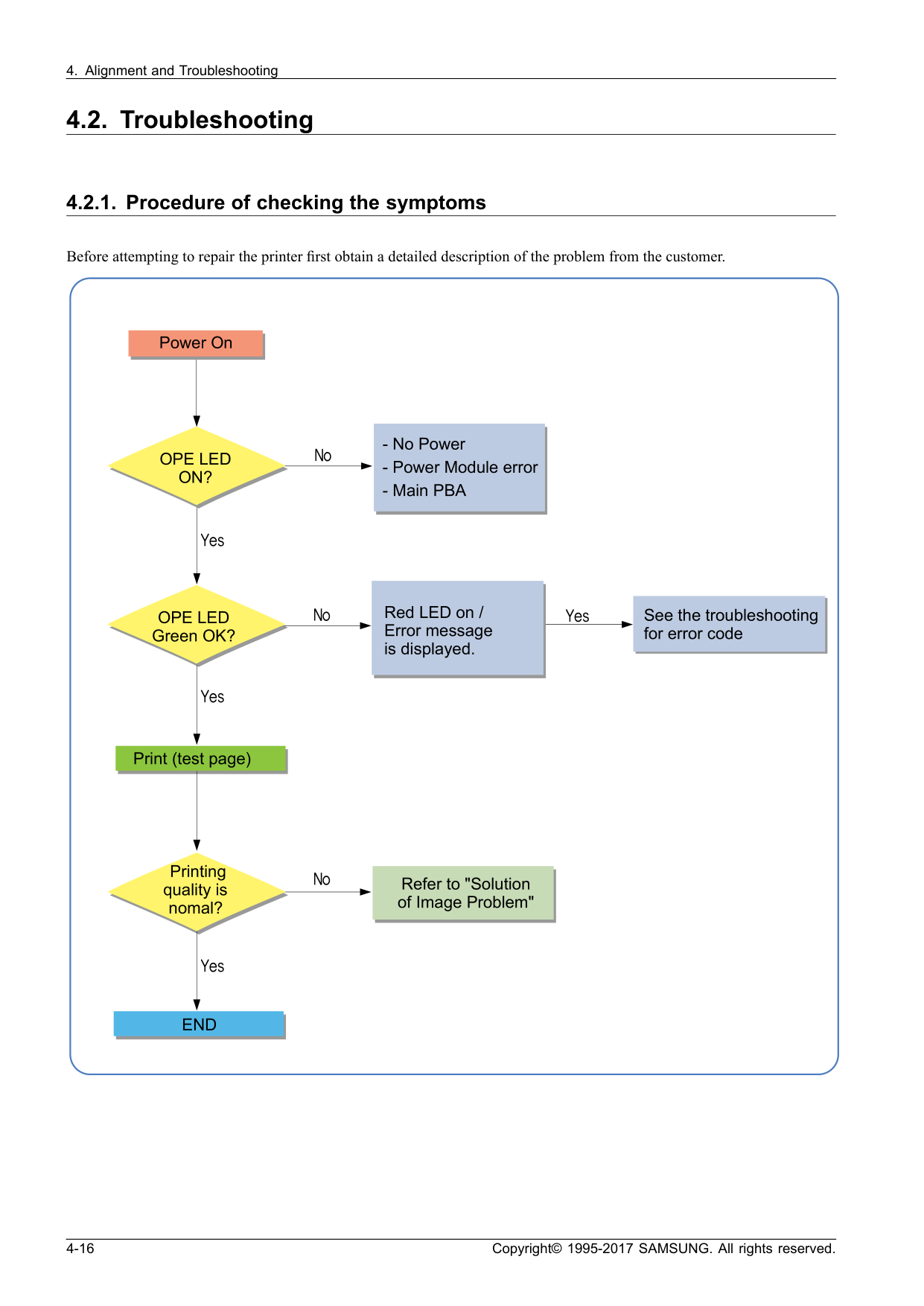
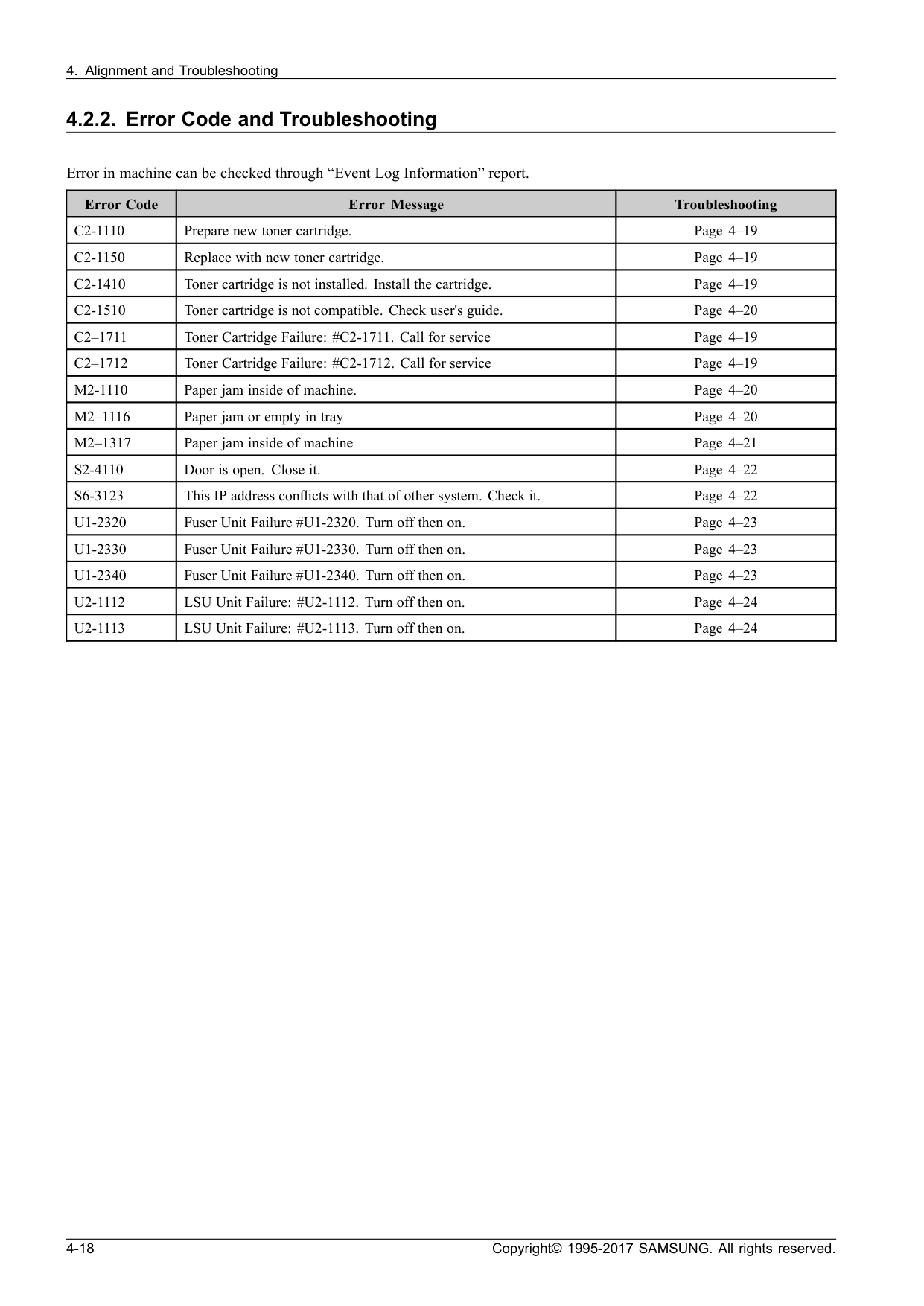
What does error code U1-2320, U1-2330, or U1-2340 mean and how do I fix it?

These error codes indicate a Fuser Unit Failure. The recommended troubleshooting action is to turn the machine off and then back on. If the issue persists, further service inspection of the fuser unit is required.

4

How do I update the firmware on the Samsung Xpress SL M2020 using a USB port?

Turn the machine off, connect the USB cable, then turn the machine on and confirm it is in ready status. Drag and drop the firmware file onto the usblist2.exe tool, and the firmware update will start automatically. When the upgrade is completed, the machine will automatically reboot.

5

What should I do when error code C2-1410 or C2-1711 appears indicating a toner cartridge problem?

First, check that the toner cartridge is properly installed, then turn the machine off and back on. If the error persists, remove the cartridge and roll it five or six times to distribute the toner evenly, then reinstall it. If the problem continues, check whether the CRUM contact area is contaminated and clean it, or replace the toner cartridge with a new one.

6

What are the operating temperature and humidity requirements for the Samsung Xpress SL M2020?

The printer must be operated at a temperature between 10°C and 32°C (50°F to 90°F) and a relative humidity between 10% and 80%. If the machine has been stored below zero Celsius for a long time, it should be allowed to return to room temperature before use to avoid malfunction.

Show 4 more questions

Full Manual

97 pages
Page 1

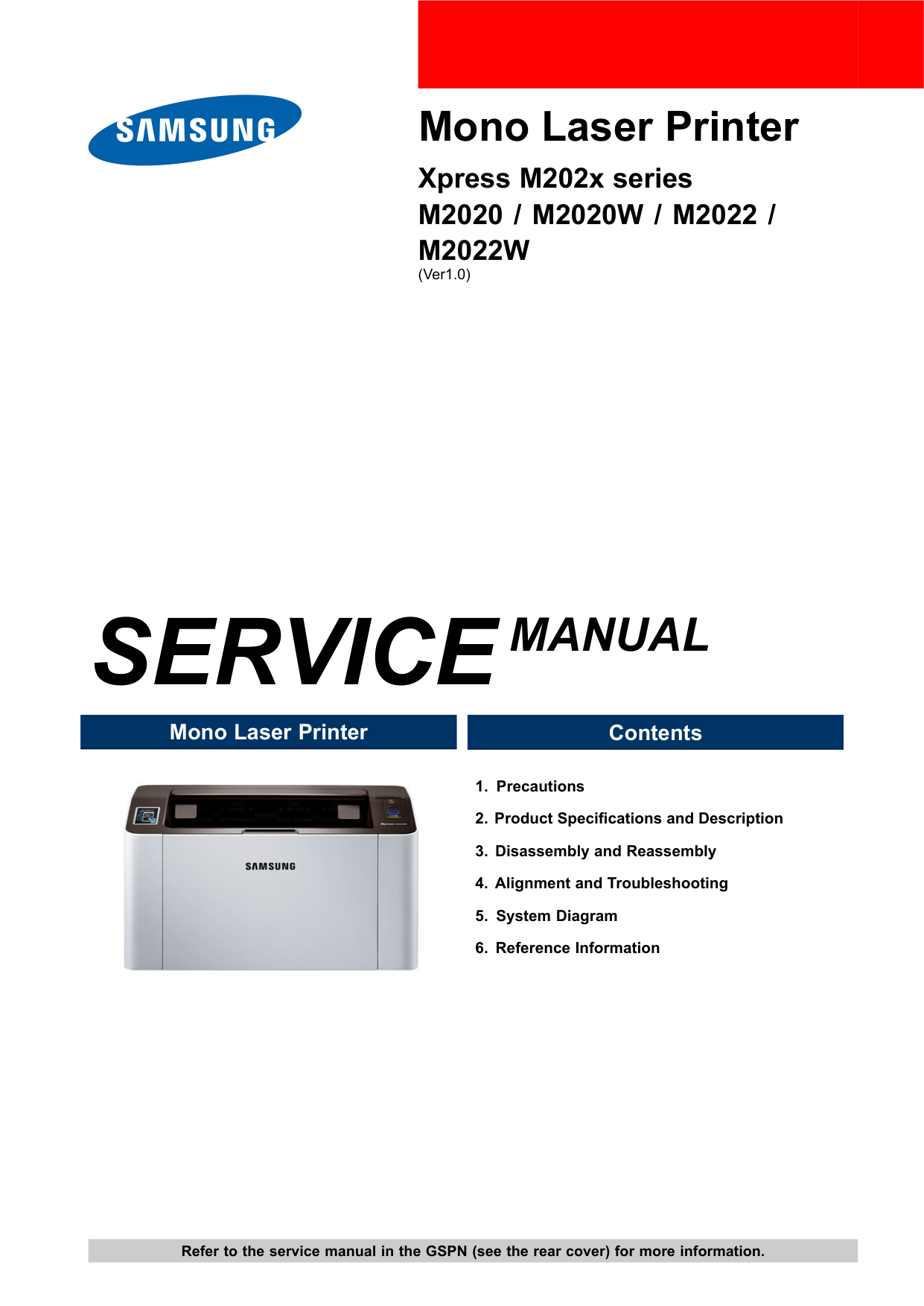
Mono Laser Printer Xpress M202x series

M2020 / M2020W / M2022 /

M2022W

(Ver1.0)

Service Manual

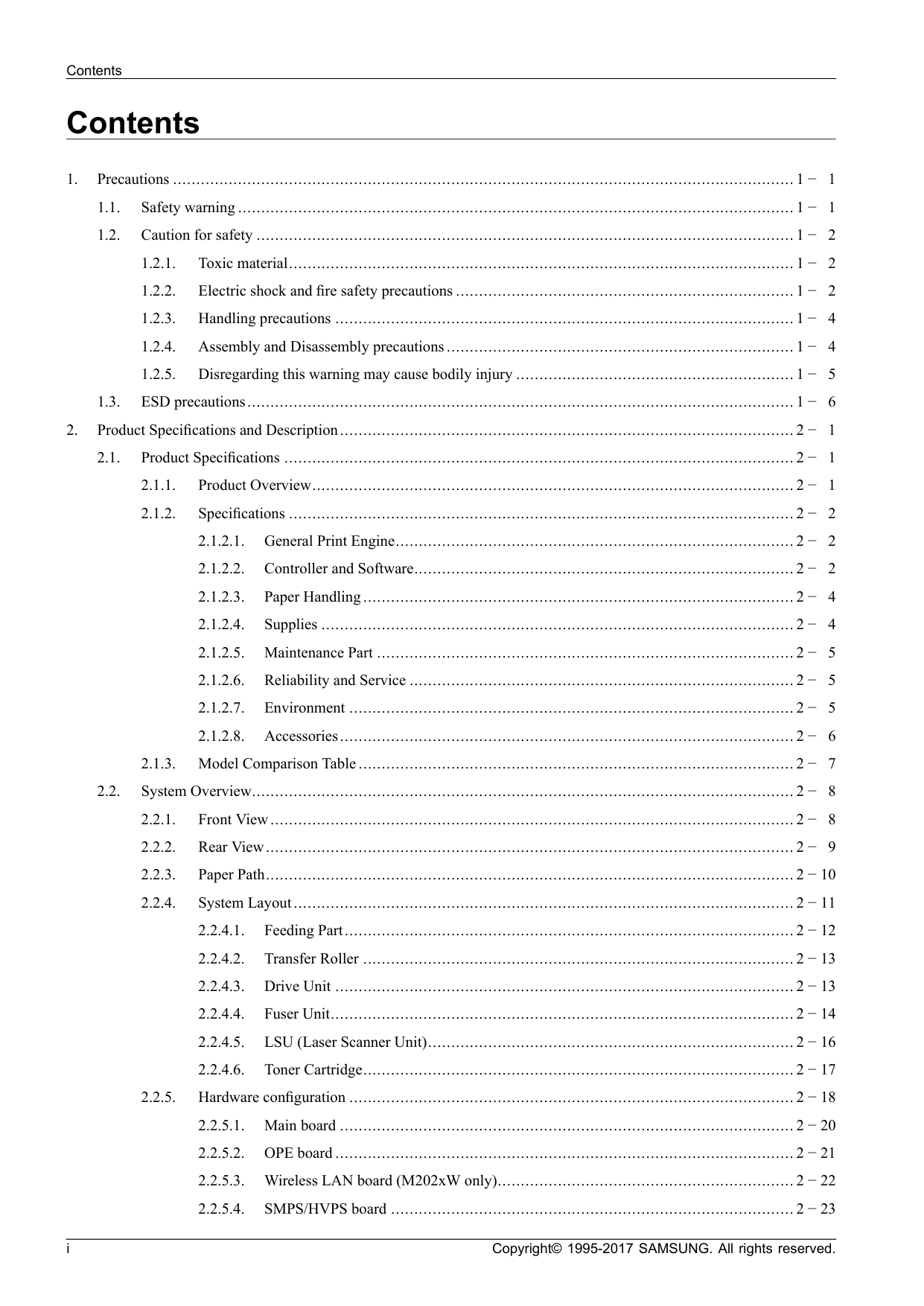
Mono Laser Printer Contents
  • Precautions
  • Product Specifications and Description
  • Disassembly and Reassembly
  • Alignment and Troubleshooting
  • System Diagram
  • Reference Information
  • Refer to the service manual in the GSPN (see the rear cover) for more information.

    Page 2

    Contents Contents

  • Precautions ...................................................................................................................................... 1 −1
  • 1.1. Safety warning ........................................................................................................................ 1 −1 1.2. Caution for safety .................................................................................................................... 1 −2 1.2.1. Toxic material............................................................................................................. 1 −2 1.2.2. Electric shock and fire safety precautions ......................................................................... 1 −2 1.2.3. Handling precautions ................................................................................................... 1 −4 1.2.4. Assembly and Disassembly precautions........................................................................... 1 −4 1.2.5. Disregarding this warning may cause bodily injury ............................................................ 1 −5 1.3. ESD precautions...................................................................................................................... 1 −6
  • Product Specifications and Description.................................................................................................. 2 −1
  • 2.1. Product Specifications .............................................................................................................. 2 −1 2.1.1. Product Overview........................................................................................................ 2 −1 2.1.2. Specifications ............................................................................................................. 2 −2 2.1.2.1. General Print Engine...................................................................................... 2 −2 2.1.2.2. Controller and Software.................................................................................. 2 −2 2.1.2.3. Paper Handling............................................................................................. 2 −4 2.1.2.4. Supplies ...................................................................................................... 2 −4 2.1.2.5. Maintenance Part .......................................................................................... 2 −5 2.1.2.6. Reliability and Service ................................................................................... 2 −5 2.1.2.7. Environment ................................................................................................ 2 −5 2.1.2.8. Accessories.................................................................................................. 2 −6 2.1.3. Model Comparison Table .............................................................................................. 2 −7 2.2. System Overview..................................................................................................................... 2 −8 2.2.1. Front View................................................................................................................. 2 −8 2.2.2. Rear View.................................................................................................................. 2 −9 2.2.3. Paper Path.................................................................................................................. 2 −10 2.2.4. System Layout............................................................................................................ 2 −11 2.2.4.1. Feeding Part................................................................................................. 2 −12 2.2.4.2. Transfer Roller ............................................................................................. 2 −13 2.2.4.3. Drive Unit ................................................................................................... 2 −13 2.2.4.4. Fuser Unit.................................................................................................... 2 −14 2.2.4.5. LSU (Laser Scanner Unit)............................................................................... 2 −16 2.2.4.6. Toner Cartridge............................................................................................. 2 −17 2.2.5. Hardware configuration ................................................................................................ 2 −18 2.2.5.1. Main board .................................................................................................. 2 −20 2.2.5.2. OPE board ................................................................................................... 2 −21 2.2.5.3. Wireless LAN board (M202xW only)................................................................ 2 −22 2.2.5.4. SMPS/HVPS board ....................................................................................... 2 −23 i Copyright© 1995-2017 SAMSUNG. All rights reserved.

    Page 3

    Contents 2.2.5.5. Electrical Parts Location................................................................................. 2 −25 2.2.6. Engine F/W Contol Algorithm ....................................................................................... 2 −26 2.2.6.1. Feeding ....................................................................................................... 2 −26 2.2.6.2. Transfer....................................................................................................... 2 −26 2.2.6.3. Fusing......................................................................................................... 2 −27 2.2.6.4. LSU............................................................................................................ 2 −27 2.2.7. Software Descriptions .................................................................................................. 2 −28 2.2.7.1. Software system overview .............................................................................. 2 −28 2.2.7.2. Architecture ................................................................................................. 2 −28 2.2.7.3. Data and Control Flow ................................................................................... 2 −29
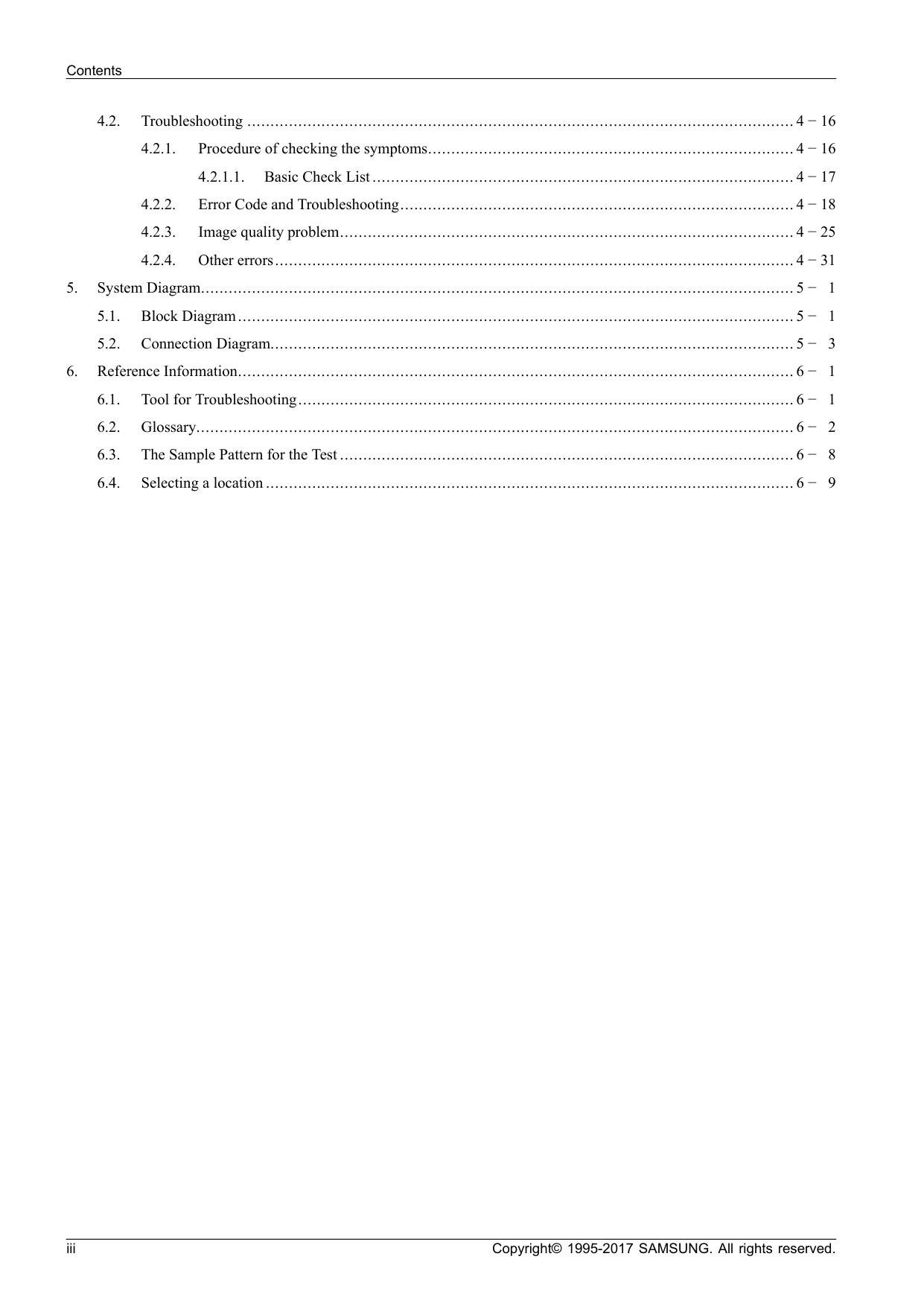
  • Disassembly and Reassembly .............................................................................................................. 3 −1
  • 3.1. Precautions when replacing parts ................................................................................................ 3 −1 3.1.1. Precautions when assembling and disassembling ............................................................... 3 −1 3.1.2. Preautions when handling PBA ...................................................................................... 3 −1 3.1.3. Releasing Plastic Latches.............................................................................................. 3 −2 3.2. Screws used in the printer.......................................................................................................... 3 −3 3.3. Replacing the Main SVC parts ................................................................................................... 3 −4 3.3.1. Cover........................................................................................................................ 3 −4 3.3.2. Main board................................................................................................................. 3 −6 3.3.3. Fuser Unit.................................................................................................................. 3 −6 3.3.4. SMPS/HVPS board...................................................................................................... 3 −7 3.3.5. Drive Unit.................................................................................................................. 3 −7 3.3.6. LSU.......................................................................................................................... 3 −8 3.3.7. Feed Sensor PBA ........................................................................................................ 3 −9 3.3.8. Pick up roller.............................................................................................................. 3 −9 3.3.9. Motor........................................................................................................................ 3 −10 3.3.10. Transfer Roller............................................................................................................ 3 −11
  • Alignment and Troubleshooting ........................................................................................................... 4 −1
  • 4.1. Alignment and Adjustments....................................................................................................... 4 −1 4.1.1. Control Panel.............................................................................................................. 4 −1 4.1.2. Understanding the status LED........................................................................................ 4 −3 4.1.3. Jam Removal.............................................................................................................. 4 −4 4.1.4. Periodic Defective Image.............................................................................................. 4 −7 4.1.5. Useful management tools.............................................................................................. 4 −8 4.1.5.1. Using Samsung Easy Printer Manager (Windows and Macintosh only).................... 4 −8 4.1.5.2. Using Samsung Printer Status (Windows only) ................................................... 4 −10 4.1.5.3. Using SyncThru Web Service (SWS) ................................................................ 4 −11 4.1.6. Updating Firmware...................................................................................................... 4 −13 4.1.6.1. Update the firmware by using the USB port........................................................ 4 −13 4.1.6.2. Update the firmware by using the network (M202xW only)................................... 4 −14 Copyright© 1995-2017 SAMSUNG. All rights reserved. ii

    Page 4

    Contents 4.2. Troubleshooting ...................................................................................................................... 4 −16 4.2.1. Procedure of checking the symptoms............................................................................... 4 −16 4.2.1.1. Basic Check List ........................................................................................... 4 −17 4.2.2. Error Code and Troubleshooting..................................................................................... 4 −18 4.2.3. Image quality problem.................................................................................................. 4 −25 4.2.4. Other errors................................................................................................................ 4 −31
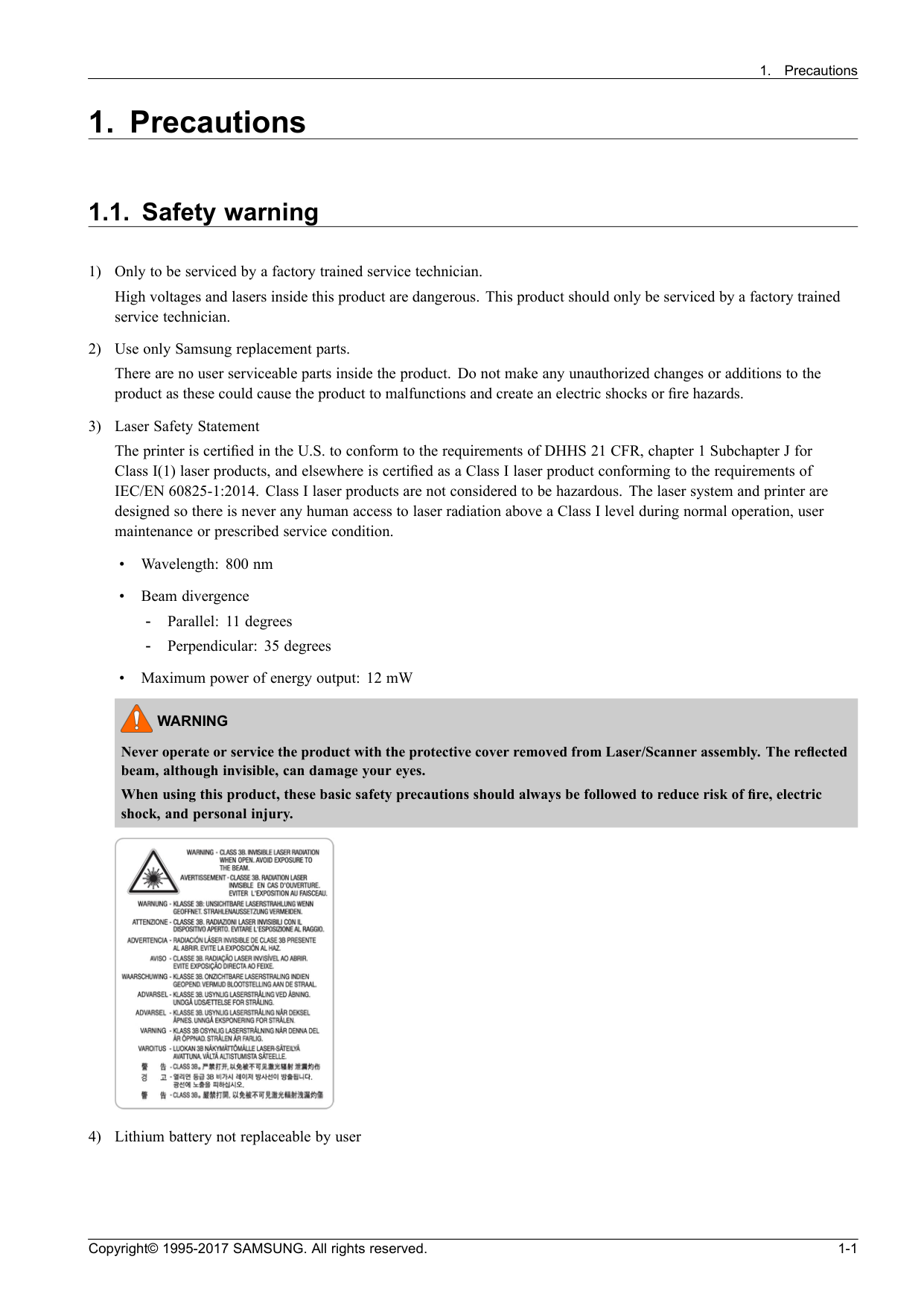
  • System Diagram................................................................................................................................ 5 −1
  • 5.1. Block Diagram........................................................................................................................ 5 −1 5.2. Connection Diagram................................................................................................................. 5 −3
  • Reference Information........................................................................................................................ 6 −1
  • 6.1. Tool for Troubleshooting........................................................................................................... 6 −1 6.2. Glossary................................................................................................................................. 6 −2 6.3. The Sample Pattern for the Test .................................................................................................. 6 −8 6.4. Selecting a location .................................................................................................................. 6 −9 iii Copyright© 1995-2017 SAMSUNG. All rights reserved.

    Page 5

  • Precautions
  • Precautions
  • 1.1. Safety warning 1) Only to be serviced by a factory trained service technician. High voltages and lasers inside this product are dangerous. This product should only be serviced by a factory trained service technician. 2) Use only Samsung replacement parts. There are no user serviceable parts inside the product. Do not make any unauthorized changes or additions to the product as these could cause the product to malfunctions and create an electric shocks or fire hazards. 3) Laser Safety Statement The printer is certified in the U.S. to conform to the requirements of DHHS 21 CFR, chapter 1 Subchapter J for Class I(1) laser products, and elsewhere is certified as a Class I laser product conforming to the requirements of IEC/EN 60825-1:2014. Class I laser products are not considered to be hazardous. The laser system and printer are designed so there is never any human access to laser radiation above a Class I level during normal operation, user maintenance or prescribed service condition. • Wavelength: 800 nm • Beam divergence
  • Parallel: 11 degrees
  • Perpendicular: 35 degrees
  • • Maximum power of energy output: 12 mW

    Warning

    Never operate or service the product with the protective cover removed from Laser/Scanner assembly. The reflected beam, although invisible, can damage your eyes. When using this product, these basic safety precautions should always be followed to reduce risk of fire, electric shock, and personal injury. 4) Lithium battery not replaceable by user Copyright© 1995-2017 SAMSUNG. All rights reserved. 1-1
    Page 6

  • Precautions
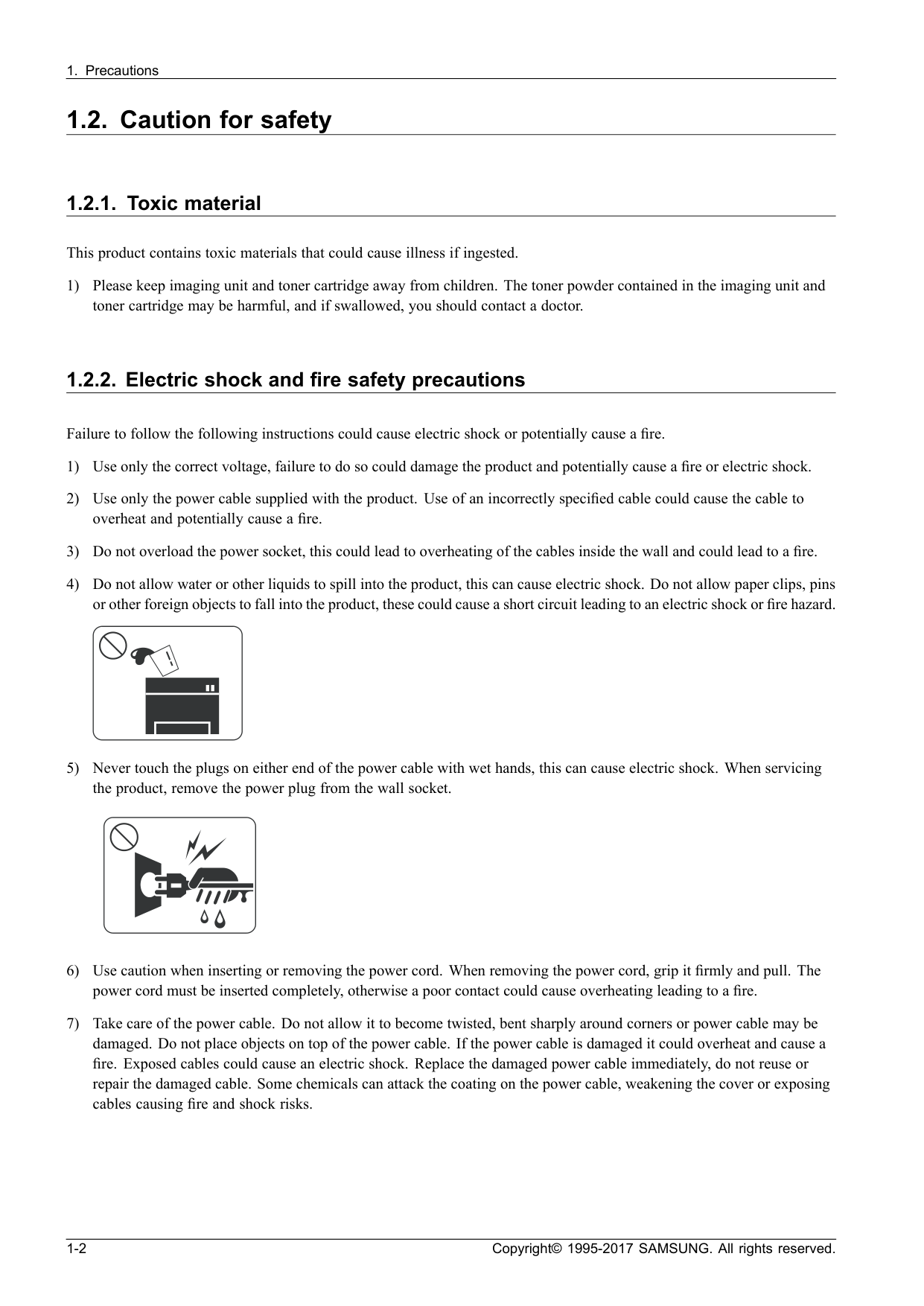
  • 1.2. Caution for safety 1.2.1. Toxic material This product contains toxic materials that could cause illness if ingested. 1) Please keep imaging unit and toner cartridge away from children. The toner powder contained in the imaging unit and toner cartridge may be harmful, and if swallowed, you should contact a doctor. 1.2.2. Electric shock and fire safety precautions Failure to follow the following instructions could cause electric shock or potentially cause a fire. 1) Use only the correct voltage, failure to do so could damage the product and potentially cause a fire or electric shock. 2) Use only the power cable supplied with the product. Use of an incorrectly specified cable could cause the cable to overheat and potentially cause a fire. 3) Do not overload the power socket, this could lead to overheating of the cables inside the wall and could lead to a fire. 4) Do not allow water or other liquids to spill into the product, this can cause electric shock. Do not allow paper clips, pins or other foreign objects to fall into the product, these could cause a short circuit leading to an electric shock or fire hazard. 5) Never touch the plugs on either end of the power cable with wet hands, this can cause electric shock. When servicing the product, remove the power plug from the wall socket. 6) Use caution when inserting or removing the power cord. When removing the power cord, grip it firmly and pull. The power cord must be inserted completely, otherwise a poor contact could cause overheating leading to a fire. 7) Take care of the power cable. Do not allow it to become twisted, bent sharply around corners or power cable may be damaged. Do not place objects on top of the power cable. If the power cable is damaged it could overheat and cause a fire. Exposed cables could cause an electric shock. Replace the damaged power cable immediately, do not reuse or repair the damaged cable. Some chemicals can attack the coating on the power cable, weakening the cover or exposing cables causing fire and shock risks. 1-2 Copyright© 1995-2017 SAMSUNG. All rights reserved.

    Page 7

  • Precautions
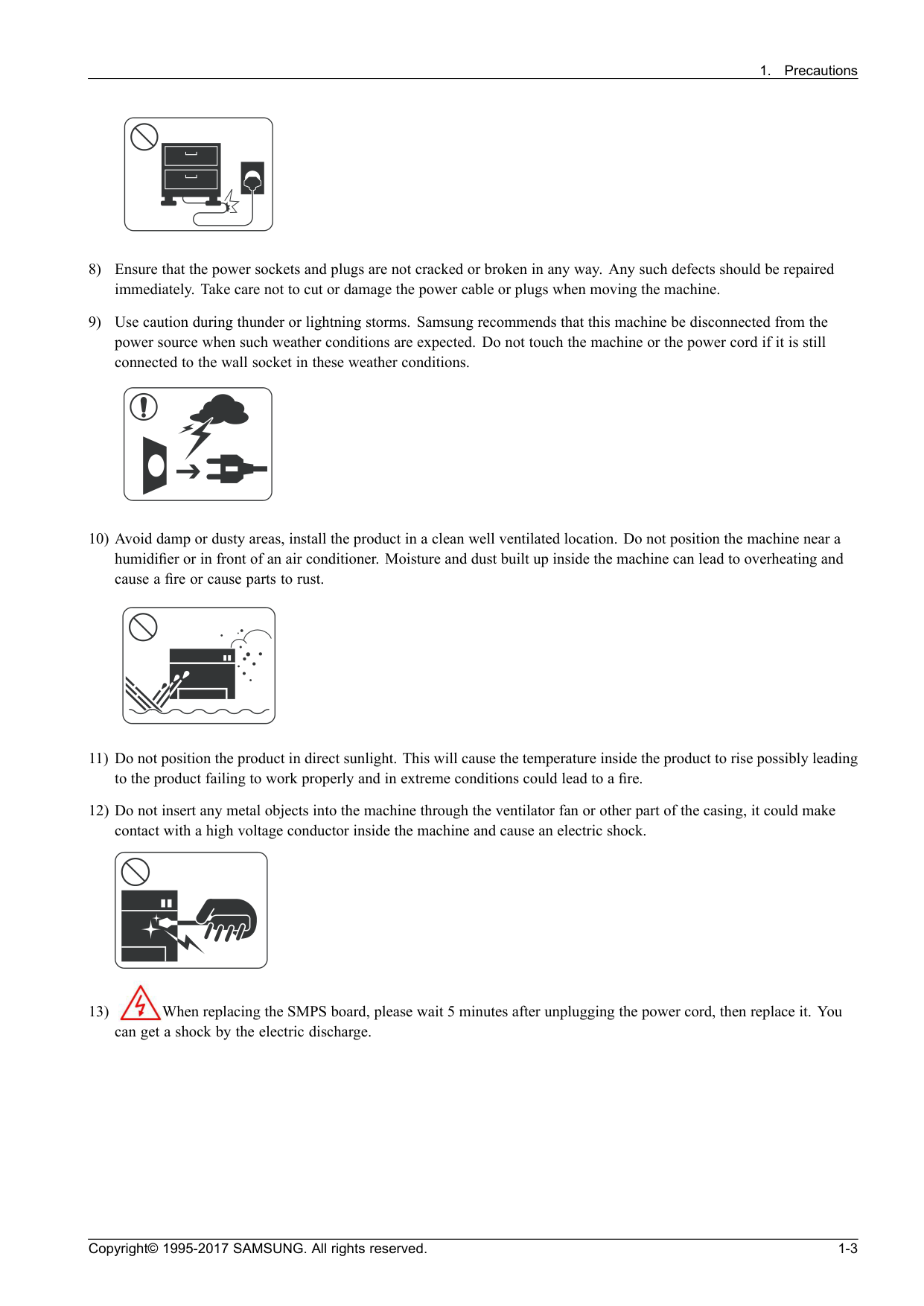
  • 8) Ensure that the power sockets and plugs are not cracked or broken in any way. Any such defects should be repaired immediately. Take care not to cut or damage the power cable or plugs when moving the machine. 9) Use caution during thunder or lightning storms. Samsung recommends that this machine be disconnected from the power source when such weather conditions are expected. Do not touch the machine or the power cord if it is still connected to the wall socket in these weather conditions. 10) Avoid damp or dusty areas, install the product in a clean well ventilated location. Do not position the machine near a humidifier or in front of an air conditioner. Moisture and dust built up inside the machine can lead to overheating and cause a fire or cause parts to rust. 11) Do not position the product in direct sunlight. This will cause the temperature inside the product to rise possibly leading to the product failing to work properly and in extreme conditions could lead to a fire. 12) Do not insert any metal objects into the machine through the ventilator fan or other part of the casing, it could make contact with a high voltage conductor inside the machine and cause an electric shock. 13) When replacing the SMPS board, please wait 5 minutes after unplugging the power cord, then replace it. You can get a shock by the electric discharge. Copyright© 1995-2017 SAMSUNG. All rights reserved. 1-3

    Page 8

  • Precautions
  • 1.2.3. Handling precautions The following instructions are for your own personal safety to avoid injury and so as not to damage the product. 1) Ensure the product is installed on a level surface, capable of supporting its weight. Failure to do so could cause the product to tip or fall. 2) The product contains many rollers, gears and fans. Take great care to ensure that you do not catch your fingers, hair or clothing in any of these rotating devices. 3) Do not place any small metal objects, containers of water, chemicals or other liquids close to the product which if spilled could get into the machine and cause damage or a shock or fire hazard. 4) Do not install the machine in areas with high dust or moisture levels, beside on open window or close to a humidifier or heater. Damage could be caused to the product in such areas. 5) Do not place candles, burning cigarettes, etc on the product, These could cause a fire. 6) Ensure that the machine is installed and used in proper area to meet the temperature and humidity specifications. • If the machine is stored at below zero Celsius for a long time, do not use the machine instantly after movement. It can malfunction. Take care of the machine storage. If the machine is stored at below zero Celsius for a long time, keep the machine at room temperature and install it. 1.2.4. Assembly and Disassembly precautions 1) Replace parts carefully and always use Samsung parts. Take care to note the exact location of parts and also cable routing before dismantling any part of the machine. Ensure all parts and cables are replaced correctly. Please carry out the following procedures before dismantling the product or replacing any parts. 2) Ensure that power is disconnected before servicing or replacing any electrical parts. 3) Disconnect interface cables and power cables. 4) Only use approved spare parts. Ensure that part number, product name, any voltage, current or temperature rating are correct. 5) When removing or re-fitting any parts do not use excessive force, especially when fitting screws into plastic. 6) Take care not to drop any small parts into the machine. 7) Handling of the OPC Drum • The OPC Drum can be irreparably damaged if it exposed to light. Take care not to expose the OPC Drum either to direct sunlight or to fluorescent or incandescent room lighting. Exposure for as little as 5 minutes can damage the surface of the photoconductive properties and will result in print quality degradation. Take extra care when servicing the product. Remove the OPC Drum and store it in a black bag or other lightproof container. Take care when working with the Covers (especially the top cover) open as light is admitted to the OPC area and can damage the OPC Drum. • Take care not to scratch the green surface of OPC Drum Unit. If the green surface of the Drum Cartridge is scratched or touched the print quality will be compromised. 1-4 Copyright© 1995-2017 SAMSUNG. All rights reserved.

    Page 9

  • Precautions
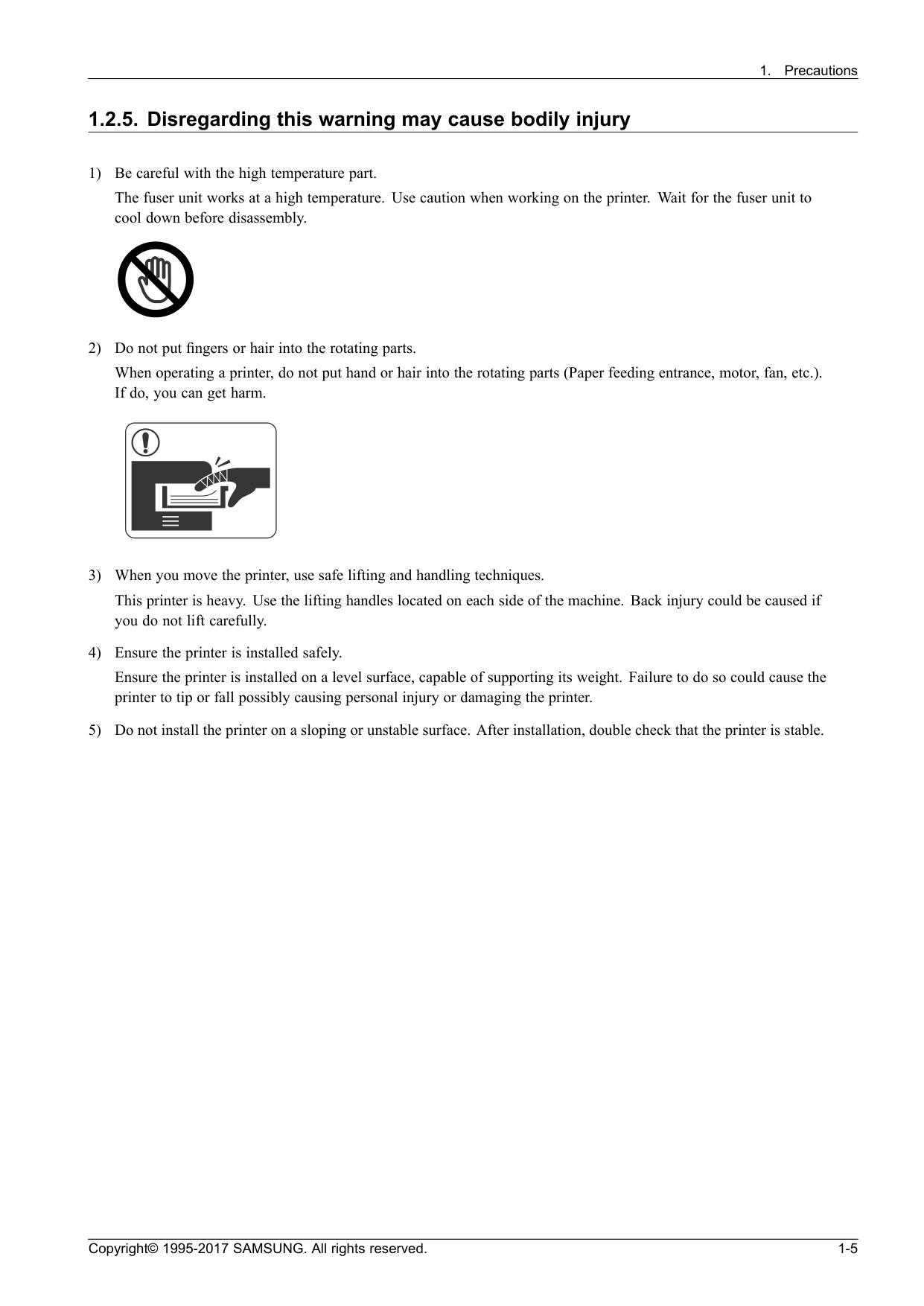
  • 1.2.5. Disregarding this warning may cause bodily injury 1) Be careful with the high temperature part. The fuser unit works at a high temperature. Use caution when working on the printer. Wait for the fuser unit to cool down before disassembly. 2) Do not put fingers or hair into the rotating parts. When operating a printer, do not put hand or hair into the rotating parts (Paper feeding entrance, motor, fan, etc.). If do, you can get harm. 3) When you move the printer, use safe lifting and handling techniques. This printer is heavy. Use the lifting handles located on each side of the machine. Back injury could be caused if you do not lift carefully. 4) Ensure the printer is installed safely. Ensure the printer is installed on a level surface, capable of supporting its weight. Failure to do so could cause the printer to tip or fall possibly causing personal injury or damaging the printer. 5) Do not install the printer on a sloping or unstable surface. After installation, double check that the printer is stable. Copyright© 1995-2017 SAMSUNG. All rights reserved. 1-5

    Page 10

  • Precautions
  • 1.3. ESD precautions Certain semiconductor devices can be easily damaged by static electricity. Such components are commonly called “Electrostatically Sensitive (ES) Devices” or ESDs. Examples of typical ESDs are: integrated circuits, some field effect transistors, and semiconductor “chip” components. The techniques outlined below should be followed to help reduce the incidence of component damage caused by static electricity.

    Caution

    Be sure no power is applied to the chassis or circuit, and observe all other safety precautions. 1) Immediately before handling a semiconductor component or semiconductor-equipped assembly, drain off any electrostatic charge on your body by touching a known earth ground. Alternatively, employ a commercially available wrist strap device, which should be removed for your personal safety reasons prior to applying power to the unit under test. 2) After removing an electrical assembly equipped with ESDs, place the assembly on a conductive surface, such as aluminum or copper foil, or conductive foam, to prevent electrostatic charge buildup in the vicinity of the assembly. 3) Use only a grounded tip soldering iron to solder or desolder ESDs. 4) Use only an “anti-static” solder removal device. Some solder removal devices not classified as “anti-static” can generate electrical charges sufficient to damage ESDs. 5) Do not use Freon-propelled chemicals. When sprayed, these can generate electrical charges sufficient to damage ESDs. 6) Do not remove a replacement ESD from its protective packaging until immediately before installing it. Most replacement ESDs are packaged with all leads shorted together by conductive foam, aluminum foil, or a comparable conductive material. 7) Immediately before removing the protective shorting material from the leads of a replacement ESD, touch the protective material to the chassis or circuit assembly into which the device will be installed. 8) Maintain continuous electrical contact between the ESD and the assembly into which it will be installed, until completely plugged or soldered into the circuit. 9) Minimize bodily motions when handling unpackaged replacement ESDs. Normal motions, such as the brushing together of clothing fabric and lifting one’s foot from a carpeted floor, can generate static electricity sufficient to damage an ESD. 1-6 Copyright© 1995-2017 SAMSUNG. All rights reserved.
    Page 11

  • Product Specifications and Description
  • Product Specifications and Description
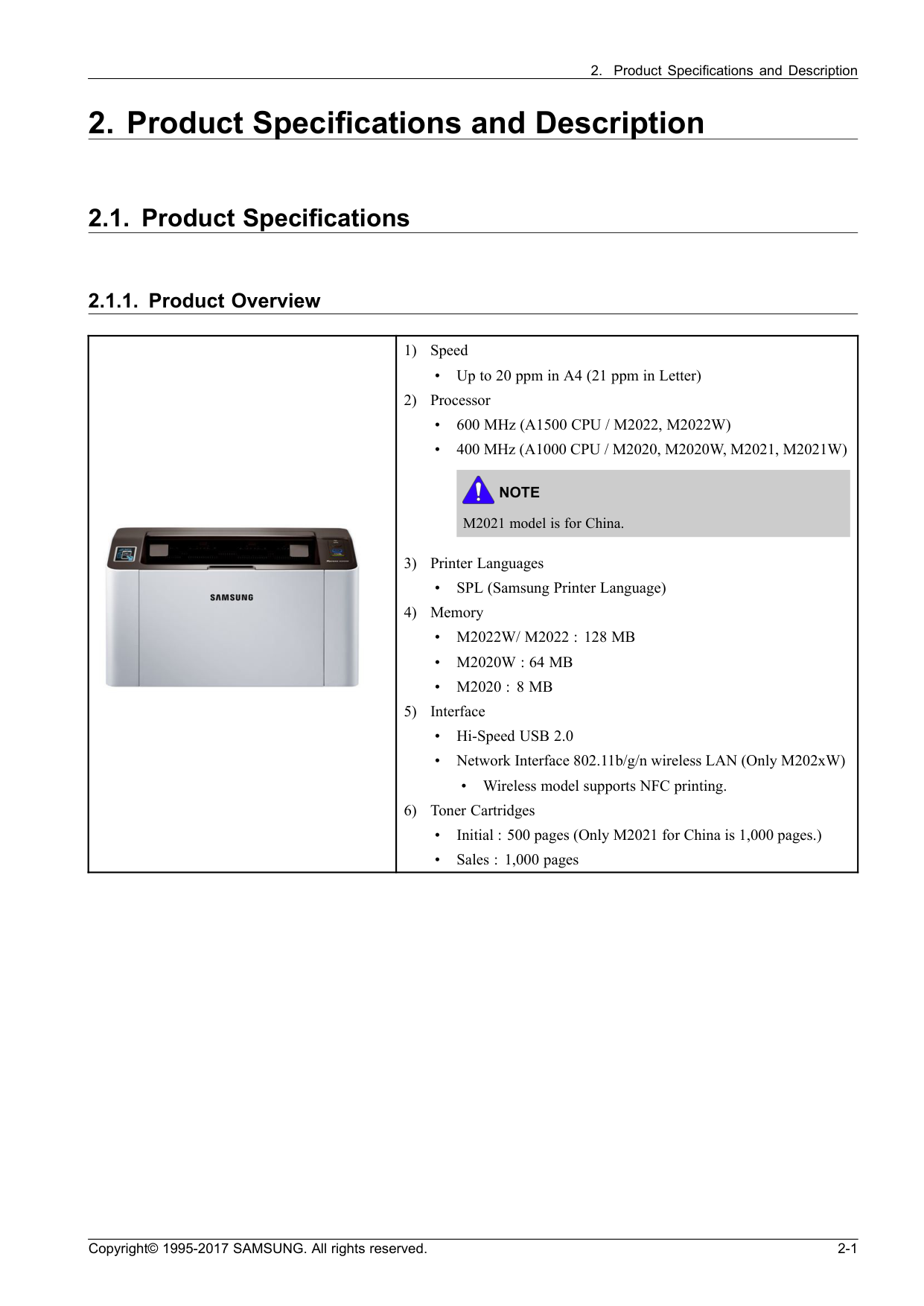
  • 2.1. Product Specifications 2.1.1. Product Overview 1) Speed • Up to 20 ppm in A4 (21 ppm in Letter) 2) Processor • 600 MHz (A1500 CPU / M2022, M2022W) • 400 MHz (A1000 CPU / M2020, M2020W, M2021, M2021W)

    Note

    M2021 model is for China. 3) Printer Languages • SPL (Samsung Printer Language) 4) Memory •

    M2022W/ M2022 : 128 Mb

    M2020W : 64 Mb

    M2020 : 8 Mb

    5) Interface • Hi-Speed USB 2.0 • Network Interface 802.11b/g/n wireless LAN (Only M202xW) • Wireless model supports NFC printing. 6) Toner Cartridges • Initial : 500 pages (Only M2021 for China is 1,000 pages.) • Sales : 1,000 pages Copyright© 1995-2017 SAMSUNG. All rights reserved. 2-1
    Page 12

  • Product Specifications and Description
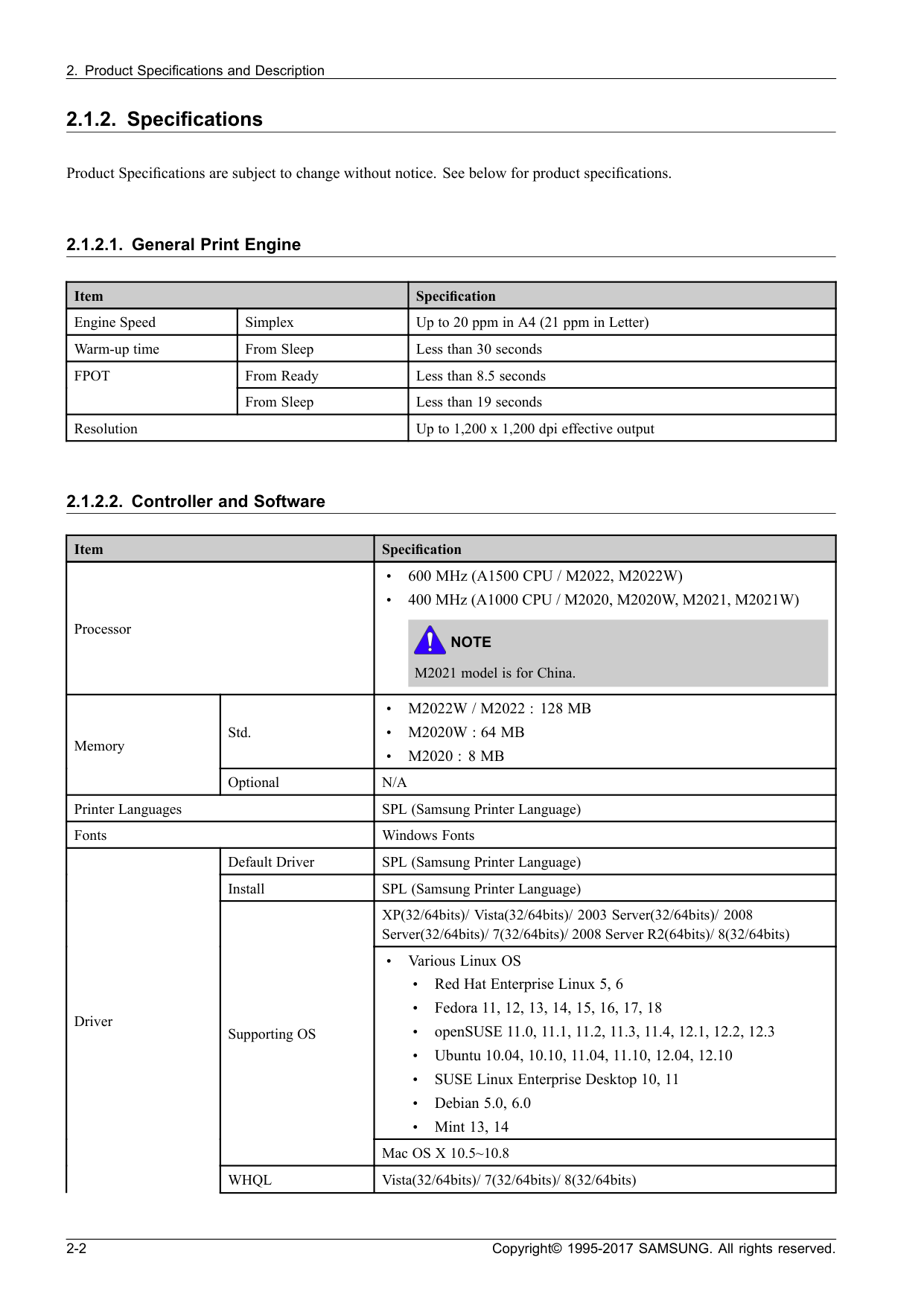
  • 2.1.2. Specifications Product Specifications are subject to change without notice. See below for product specifications. 2.1.2.1. General Print Engine Item Specification Engine Speed Simplex Up to 20 ppm in A4 (21 ppm in Letter) Warm-up time From Sleep Less than 30 seconds From Ready Less than 8.5 seconds

    Fpot

    From Sleep Less than 19 seconds Resolution Up to 1,200 x 1,200 dpi effective output 2.1.2.2. Controller and Software Item Specification Processor • 600 MHz (A1500 CPU / M2022, M2022W) • 400 MHz (A1000 CPU / M2020, M2020W, M2021, M2021W)

    Note

    M2021 model is for China. Std. •

    M2022W / M2022 : 128 Mb

    M2020W : 64 Mb

    M2020 : 8 Mb

    Memory Optional

    N/A

    Printer Languages SPL (Samsung Printer Language) Fonts Windows Fonts Default Driver SPL (Samsung Printer Language) Install SPL (Samsung Printer Language) XP(32/64bits)/ Vista(32/64bits)/ 2003 Server(32/64bits)/ 2008 Server(32/64bits)/ 7(32/64bits)/ 2008 Server R2(64bits)/ 8(32/64bits) • Various Linux OS • Red Hat Enterprise Linux 5, 6 • Fedora 11, 12, 13, 14, 15, 16, 17, 18 • openSUSE 11.0, 11.1, 11.2, 11.3, 11.4, 12.1, 12.2, 12.3 • Ubuntu 10.04, 10.10, 11.04, 11.10, 12.04, 12.10 • SUSE Linux Enterprise Desktop 10, 11 • Debian 5.0, 6.0 • Mint 13, 14 Supporting OS Mac OS X 10.5~10.8

    Whql

    Vista(32/64bits)/ 7(32/64bits)/ 8(32/64bits) Driver 2-2 Copyright© 1995-2017 SAMSUNG. All rights reserved.
    Page 13

  • Product Specifications and Description
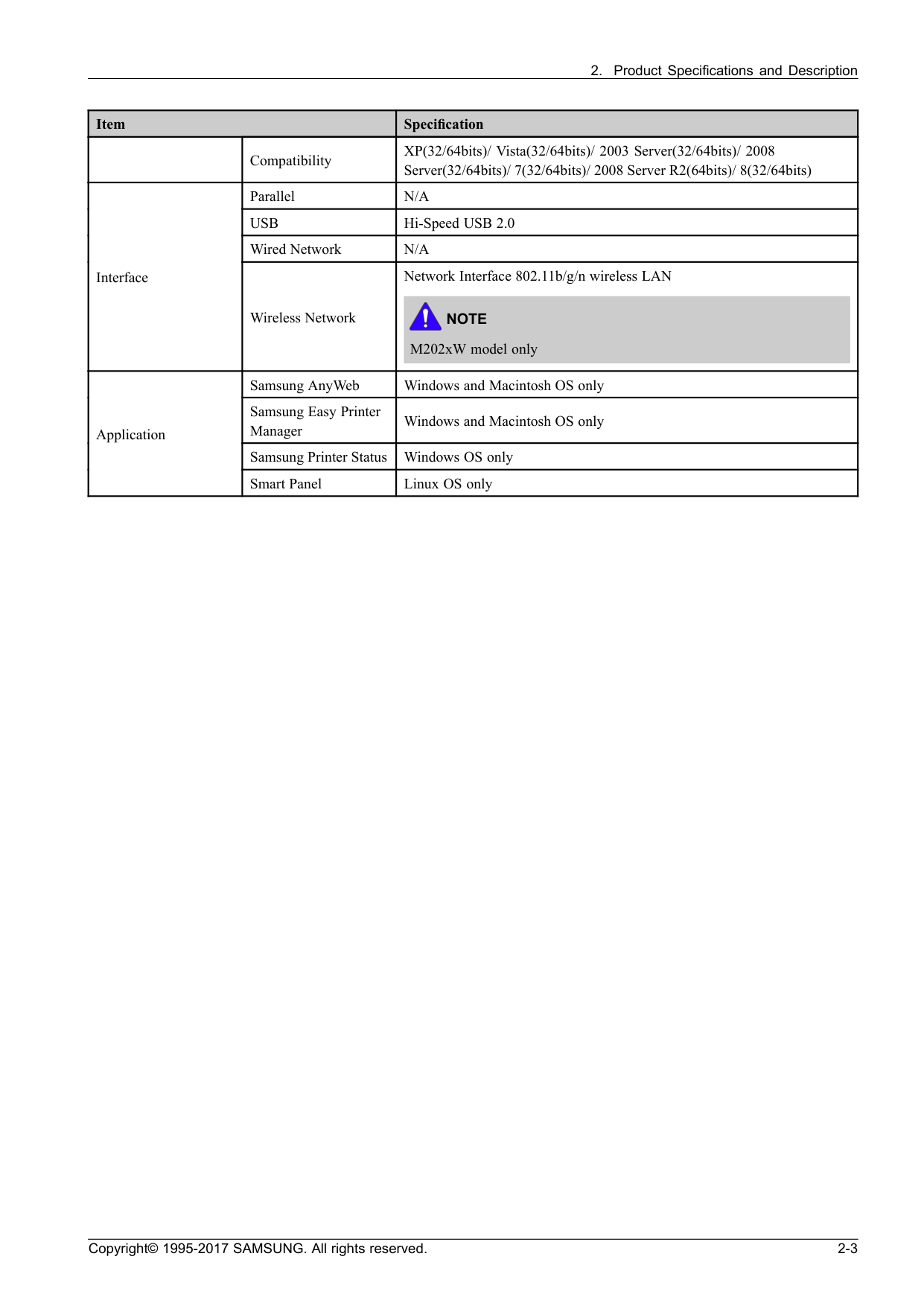
  • Item Specification Compatibility XP(32/64bits)/ Vista(32/64bits)/ 2003 Server(32/64bits)/ 2008 Server(32/64bits)/ 7(32/64bits)/ 2008 Server R2(64bits)/ 8(32/64bits) Parallel

    N/A

    Usb

    Hi-Speed USB 2.0 Wired Network

    N/A

    Interface Wireless Network Network Interface 802.11b/g/n wireless LAN

    Note

    M202xW model only Samsung AnyWeb Windows and Macintosh OS only Samsung Easy Printer Manager Windows and Macintosh OS only Samsung Printer Status Windows OS only Application Smart Panel Linux OS only Copyright© 1995-2017 SAMSUNG. All rights reserved. 2-3
    Page 14

  • Product Specifications and Description
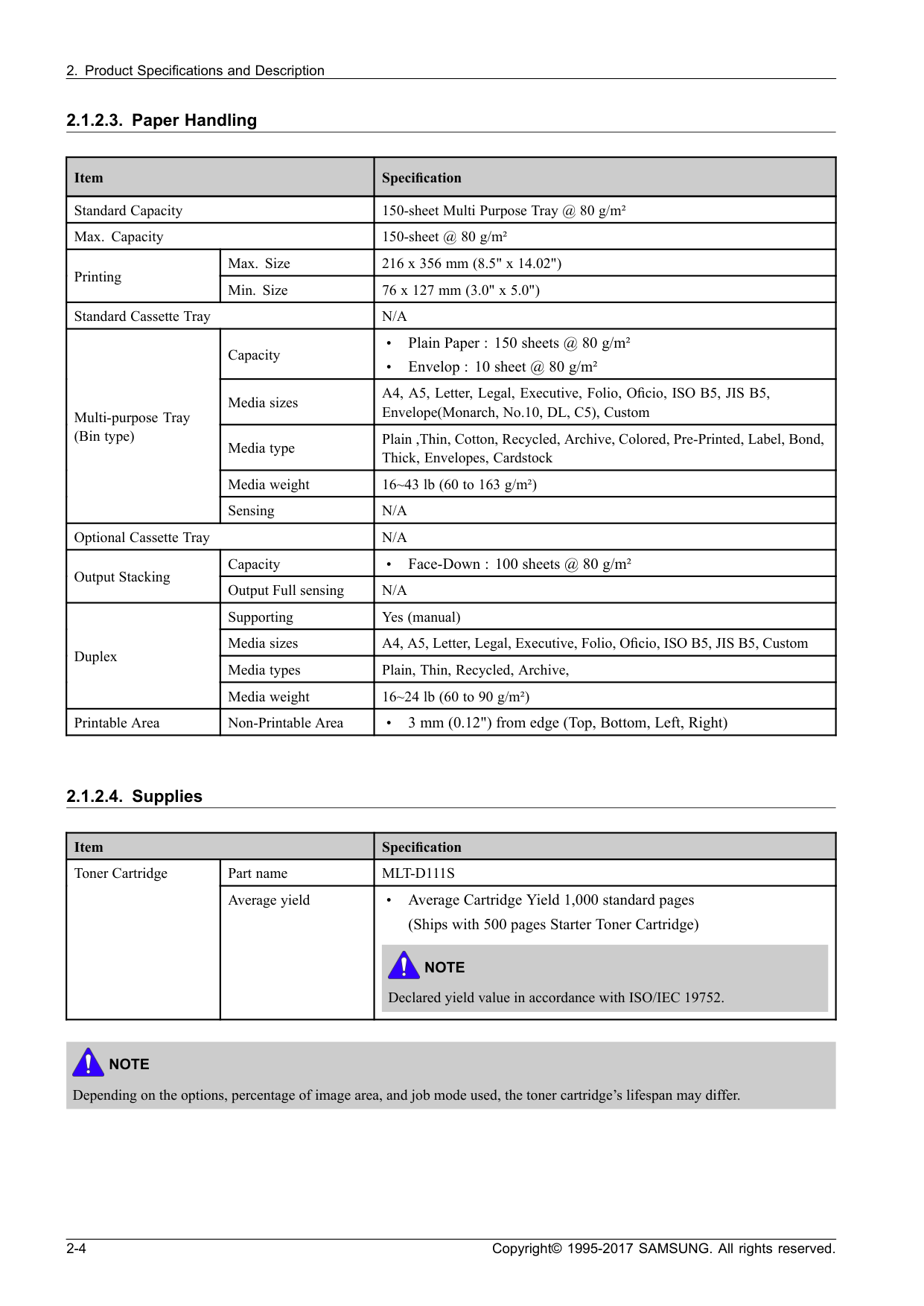
  • 2.1.2.3. Paper Handling Item Specification Standard Capacity 150-sheet Multi Purpose Tray @ 80 g/m² Max. Capacity 150-sheet @ 80 g/m² Max. Size 216 x 356 mm (8.5" x 14.02") Printing Min. Size 76 x 127 mm (3.0" x 5.0") Standard Cassette Tray

    N/A

    Capacity • Plain Paper : 150 sheets @ 80 g/m² • Envelop : 10 sheet @ 80 g/m² Media sizes A4, A5, Letter, Legal, Executive, Folio, Oficio, ISO B5, JIS B5, Envelope(Monarch, No.10, DL, C5), Custom Media type Plain ,Thin, Cotton, Recycled, Archive, Colored, Pre-Printed, Label, Bond, Thick, Envelopes, Cardstock Media weight 16~43 lb (60 to 163 g/m²) Multi-purpose Tray (Bin type) Sensing

    N/A

    Optional Cassette Tray

    N/A

    Capacity • Face-Down : 100 sheets @ 80 g/m² Output Stacking Output Full sensing

    N/A

    Supporting Yes (manual) Media sizes A4, A5, Letter, Legal, Executive, Folio, Oficio, ISO B5, JIS B5, Custom Media types Plain, Thin, Recycled, Archive, Duplex Media weight 16~24 lb (60 to 90 g/m²) Printable Area Non-Printable Area • 3 mm (0.12") from edge (Top, Bottom, Left, Right) 2.1.2.4. Supplies Item Specification Part name

    Mlt-D111S

    Toner Cartridge Average yield • Average Cartridge Yield 1,000 standard pages (Ships with 500 pages Starter Toner Cartridge)

    Note

    Declared yield value in accordance with ISO/IEC 19752.

    Note

    Depending on the options, percentage of image area, and job mode used, the toner cartridge’s lifespan may differ. 2-4 Copyright© 1995-2017 SAMSUNG. All rights reserved.
    Page 15

  • Product Specifications and Description
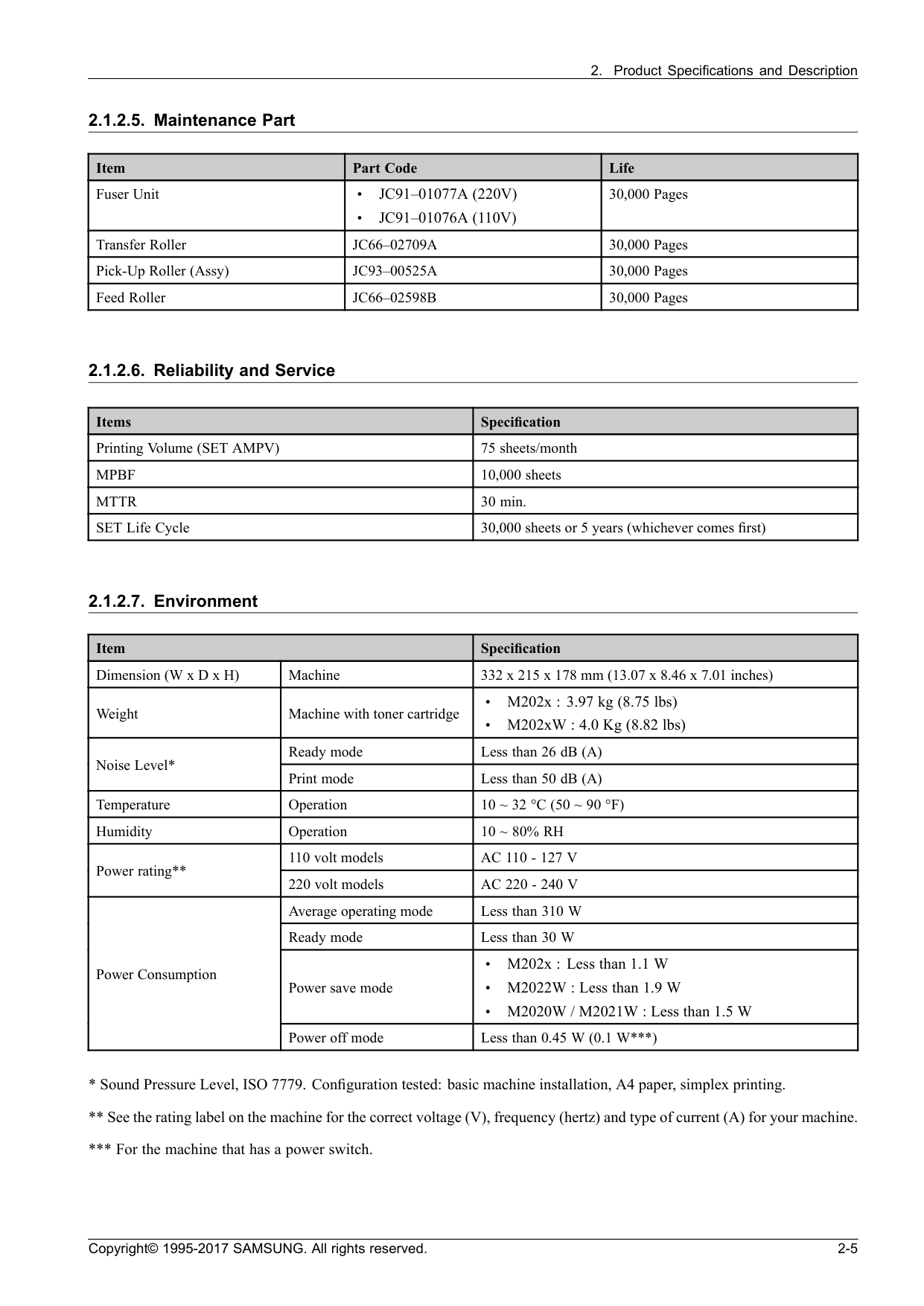
  • 2.1.2.5. Maintenance Part Item Part Code Life Fuser Unit •

    Jc91–01077A (220V)

    Jc91–01076A (110V)

    30,000 Pages Transfer Roller

    Jc66–02709A

    30,000 Pages Pick-Up Roller (Assy)

    Jc93–00525A

    30,000 Pages Feed Roller

    Jc66–02598B

    30,000 Pages 2.1.2.6. Reliability and Service Items Specification Printing Volume (SET AMPV) 75 sheets/month

    Mpbf

    10,000 sheets

    Mttr

    30 min. SET Life Cycle 30,000 sheets or 5 years (whichever comes first) 2.1.2.7. Environment Item Specification Dimension (W x D x H) Machine 332 x 215 x 178 mm (13.07 x 8.46 x 7.01 inches) Weight Machine with toner cartridge • M202x : 3.97 kg (8.75 lbs) • M202xW : 4.0 Kg (8.82 lbs) Ready mode Less than 26 dB (A) Noise Level* Print mode Less than 50 dB (A) Temperature Operation

    10 ~ 32 °C (50 ~ 90 °F)

    Humidity Operation

    10 ~ 80% Rh

    110 volt models

    Ac 110 - 127 V

    Power rating** 220 volt models

    Ac 220 - 240 V

    Average operating mode Less than 310 W Ready mode Less than 30 W Power save mode • M202x : Less than 1.1 W • M2022W : Less than 1.9 W • M2020W / M2021W : Less than 1.5 W Power Consumption Power off mode Less than 0.45 W (0.1 W***)
  • Sound Pressure Level, ISO 7779. Configuration tested: basic machine installation, A4 paper, simplex printing.
  • ** See the rating label on the machine for the correct voltage (V), frequency (hertz) and type of current (A) for your machine. *** For the machine that has a power switch. Copyright© 1995-2017 SAMSUNG. All rights reserved. 2-5

    Page 16

  • Product Specifications and Description
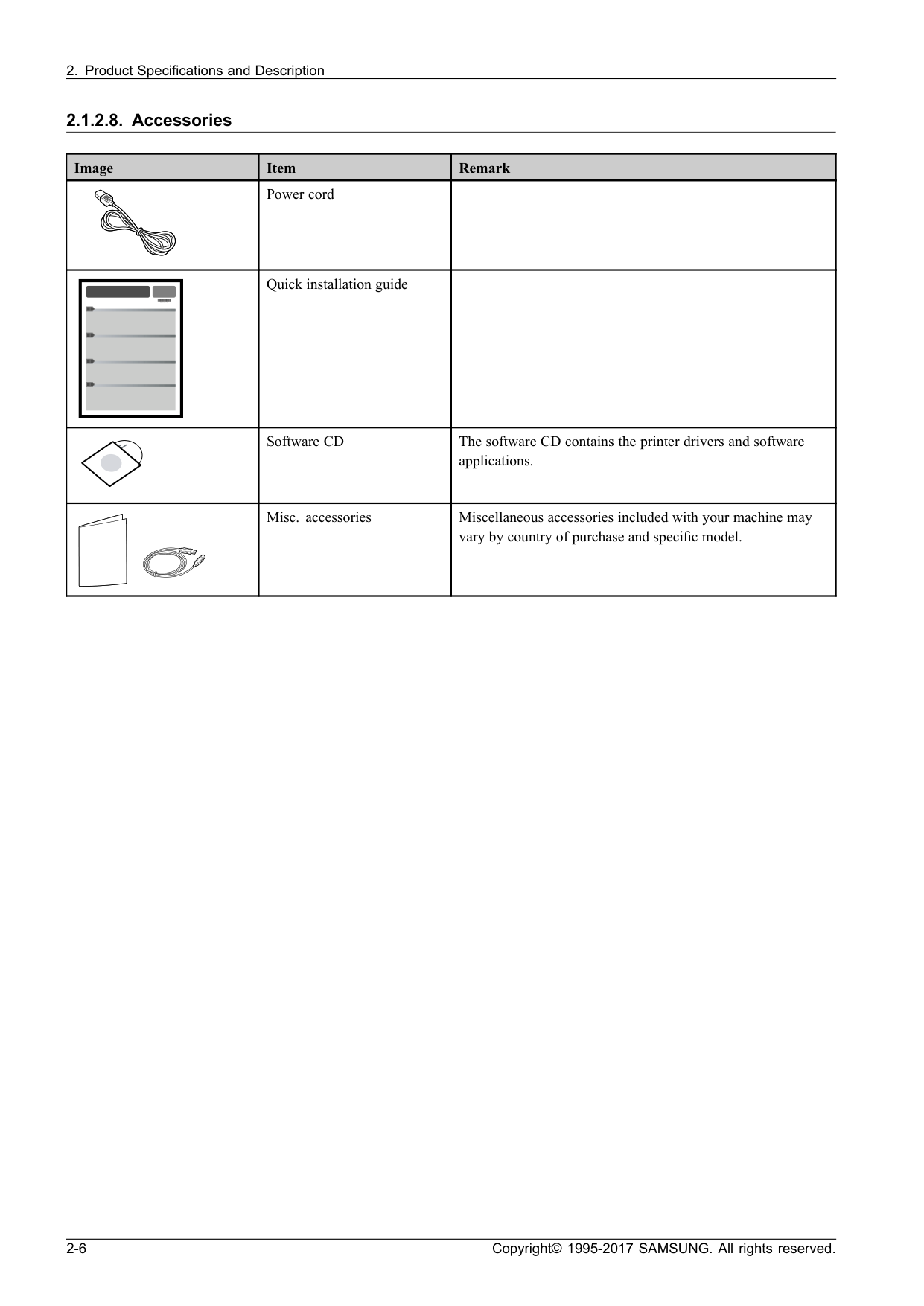
  • 2.1.2.8. Accessories Image Item Remark Power cord Quick installation guide Software CD The software CD contains the printer drivers and software applications. Misc. accessories Miscellaneous accessories included with your machine may vary by country of purchase and specific model. 2-6 Copyright© 1995-2017 SAMSUNG. All rights reserved.

    Page 17

  • Product Specifications and Description
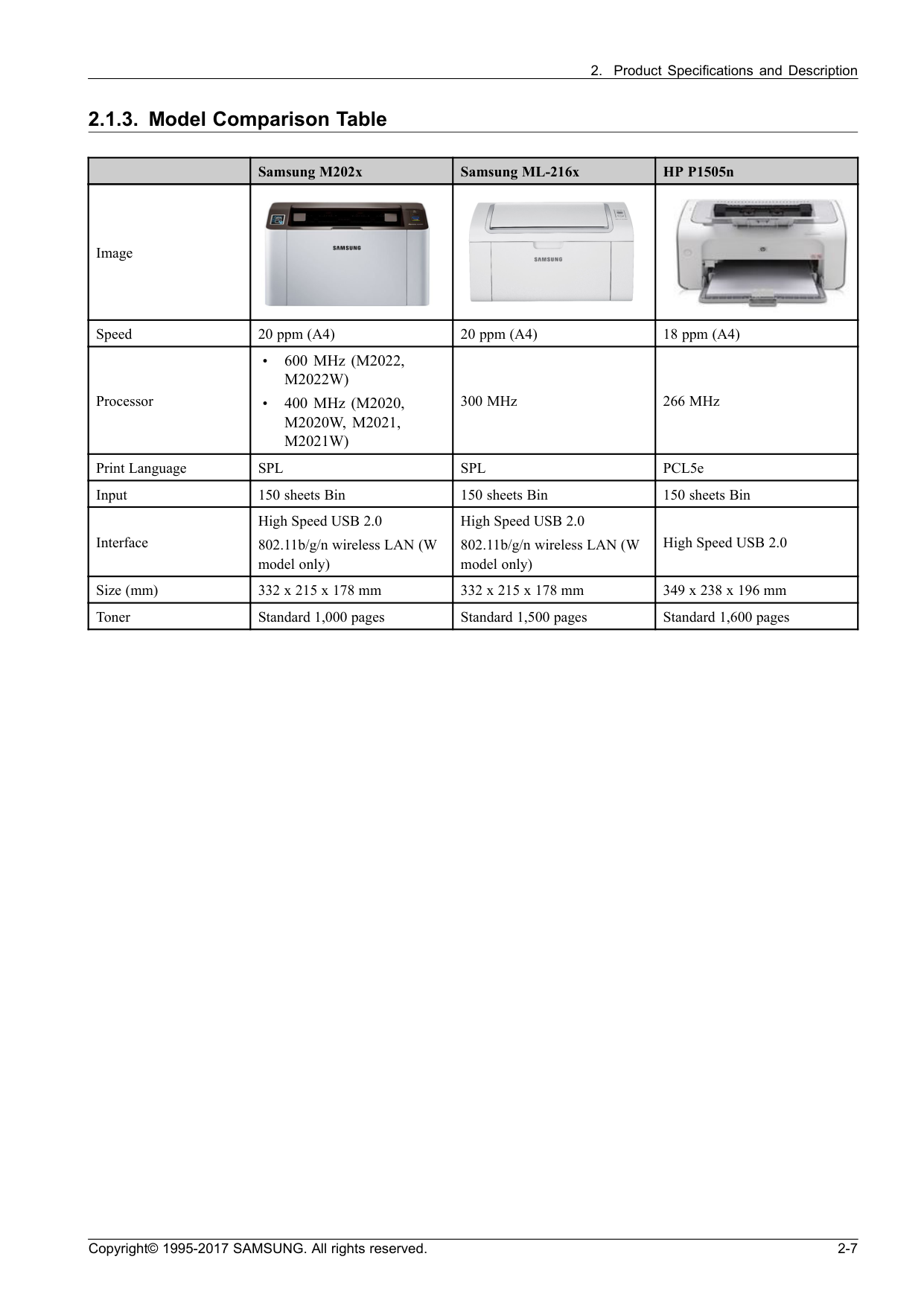
  • 2.1.3. Model Comparison Table Samsung M202x Samsung ML-216x HP P1505n Image Speed 20 ppm (A4) 20 ppm (A4) 18 ppm (A4) Processor • 600 MHz (M2022,

    M2022W)

    • 400 MHz (M2020,

    M2020W, M2021,

    M2021W)

    300 MHz 266 MHz Print Language

    Spl

    Spl

    PCL5e Input 150 sheets Bin 150 sheets Bin 150 sheets Bin Interface High Speed USB 2.0 802.11b/g/n wireless LAN (W model only) High Speed USB 2.0 802.11b/g/n wireless LAN (W model only) High Speed USB 2.0 Size (mm) 332 x 215 x 178 mm 332 x 215 x 178 mm 349 x 238 x 196 mm Toner Standard 1,000 pages Standard 1,500 pages Standard 1,600 pages Copyright© 1995-2017 SAMSUNG. All rights reserved. 2-7
    Page 18

  • Product Specifications and Description
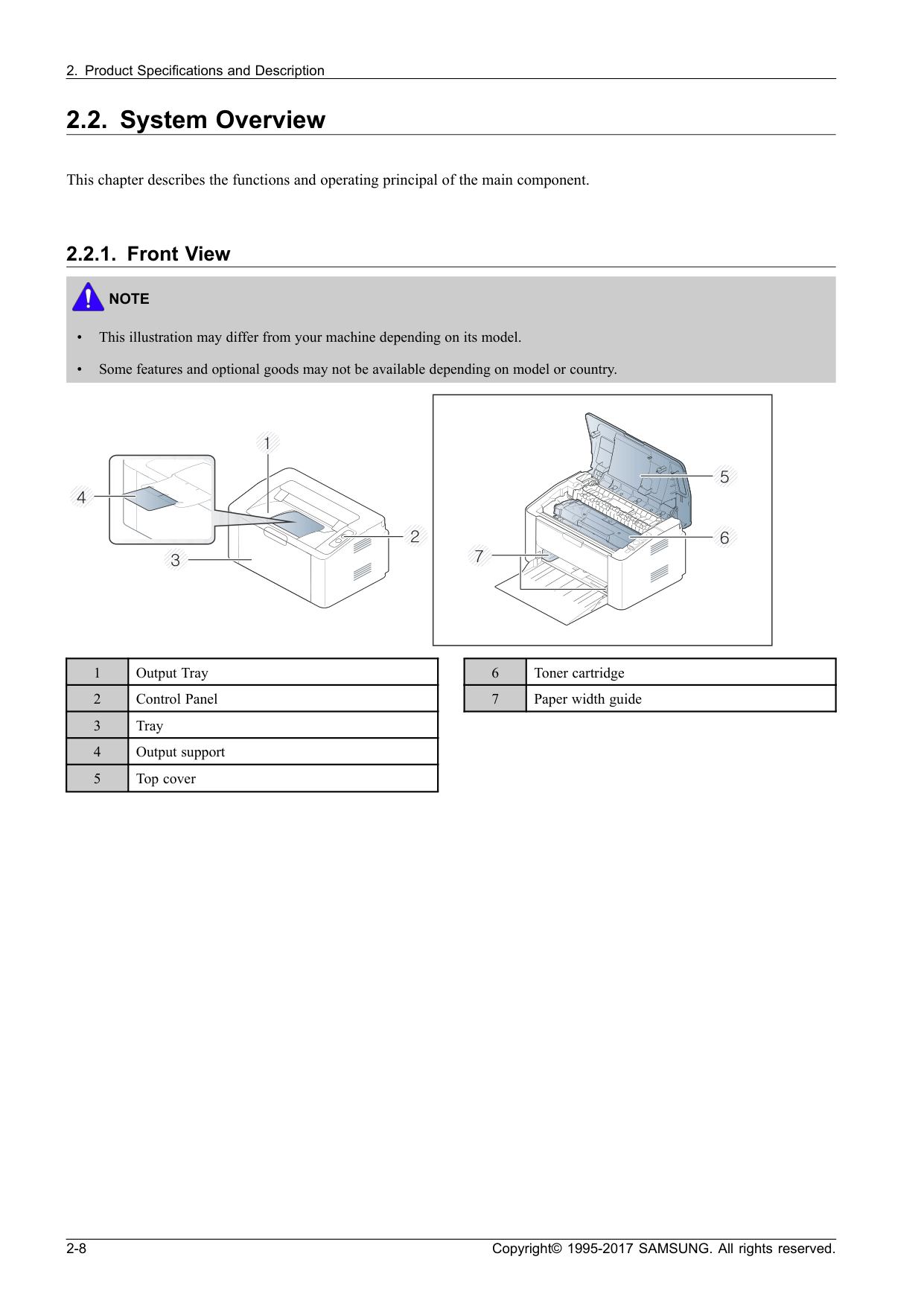
  • 2.2. System Overview This chapter describes the functions and operating principal of the main component. 2.2.1. Front View

    Note

    • This illustration may differ from your machine depending on its model. • Some features and optional goods may not be available depending on model or country. 1 Output Tray 2 Control Panel 3 Tray 4 Output support 5 Top cover 6 Toner cartridge 7 Paper width guide 2-8 Copyright© 1995-2017 SAMSUNG. All rights reserved.
    Page 19

  • Product Specifications and Description
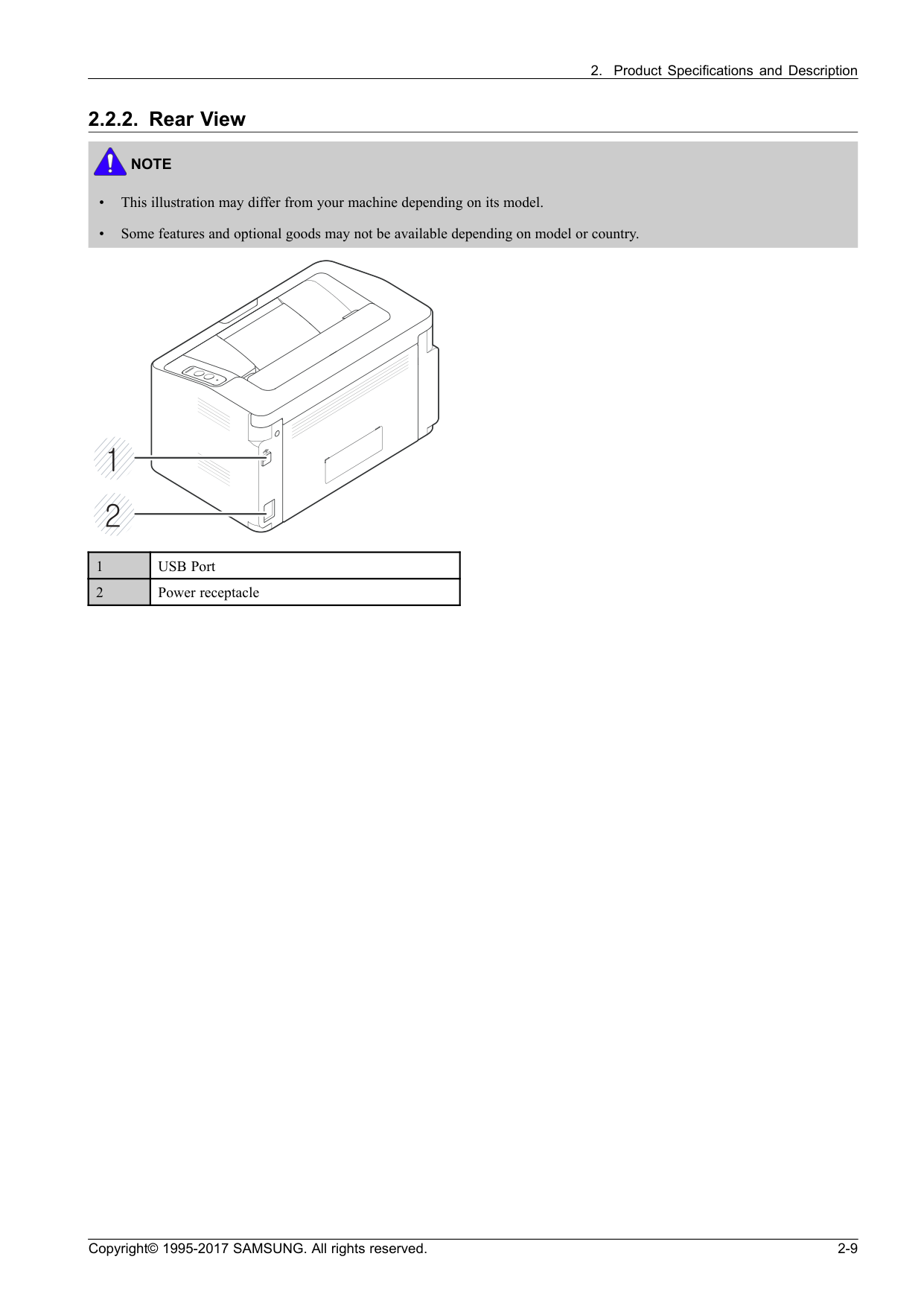
  • 2.2.2. Rear View

    Note

    • This illustration may differ from your machine depending on its model. • Some features and optional goods may not be available depending on model or country. 1 USB Port 2 Power receptacle Copyright© 1995-2017 SAMSUNG. All rights reserved. 2-9
    Page 20

  • Product Specifications and Description
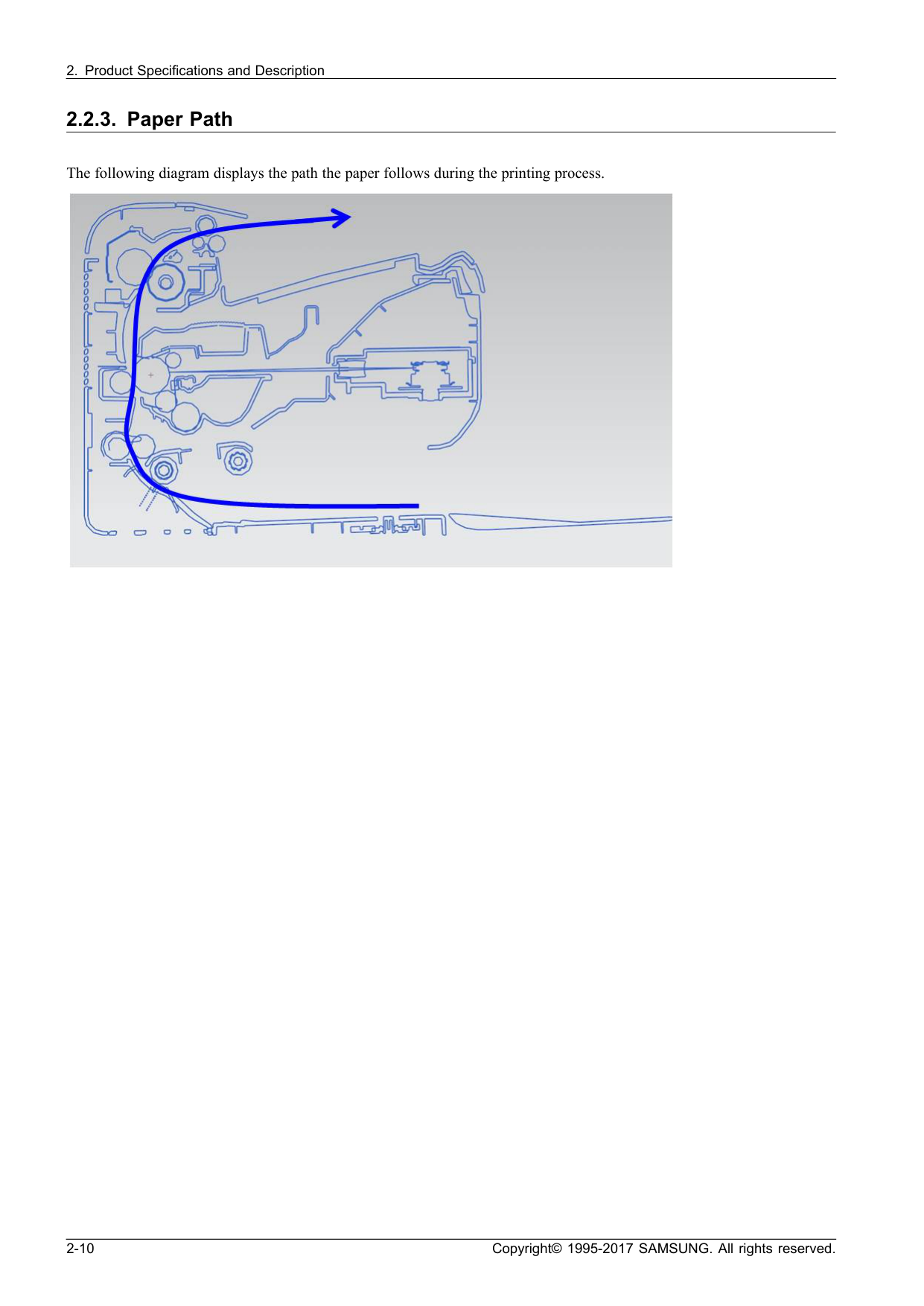
  • 2.2.3. Paper Path The following diagram displays the path the paper follows during the printing process. 2-10 Copyright© 1995-2017 SAMSUNG. All rights reserved.

    Page 21

  • Product Specifications and Description
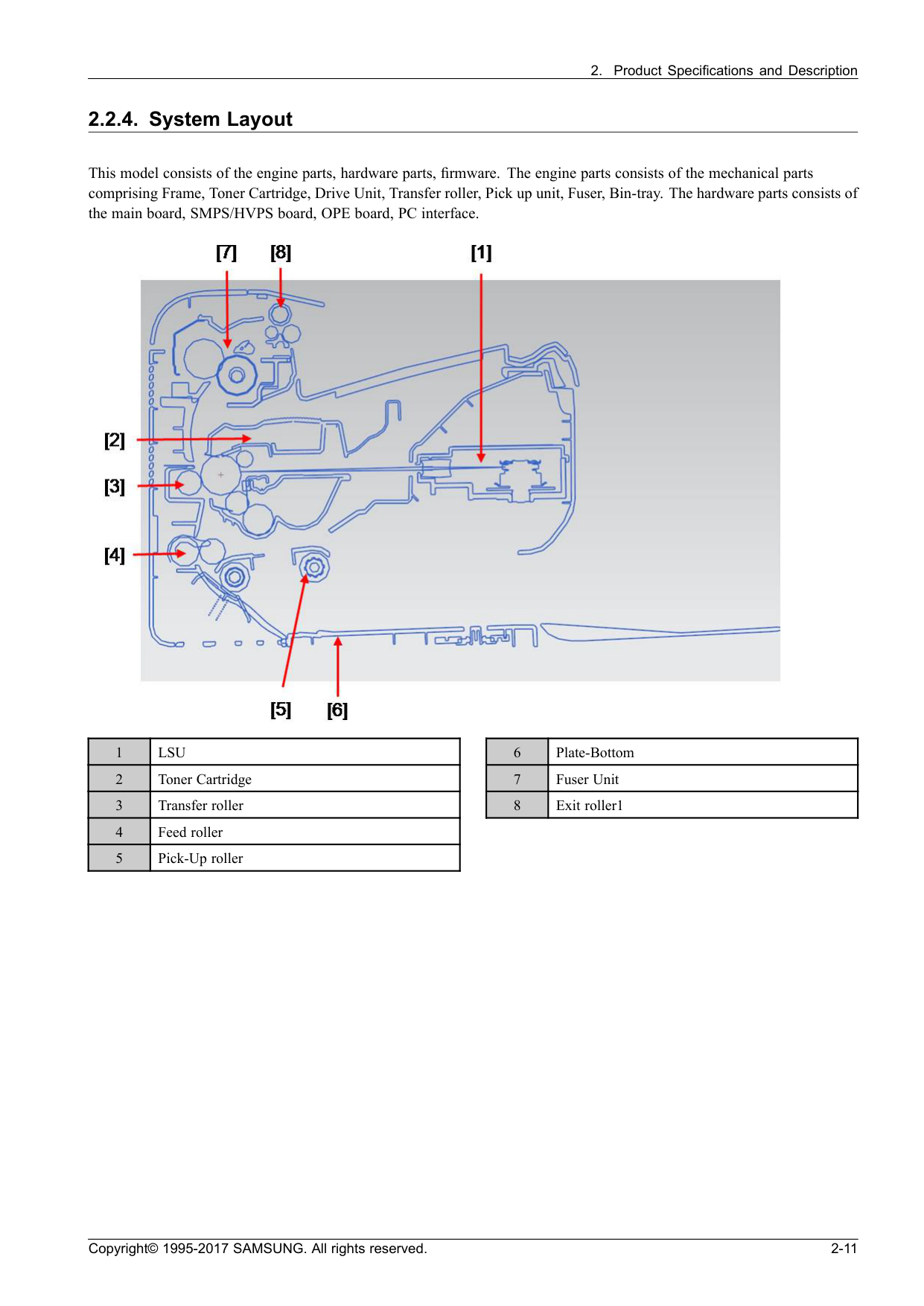
  • 2.2.4. System Layout This model consists of the engine parts, hardware parts, firmware. The engine parts consists of the mechanical parts comprising Frame, Toner Cartridge, Drive Unit, Transfer roller, Pick up unit, Fuser, Bin-tray. The hardware parts consists of the main board, SMPS/HVPS board, OPE board, PC interface. 1

    Lsu

    2 Toner Cartridge 3 Transfer roller 4 Feed roller 5 Pick-Up roller 6 Plate-Bottom 7 Fuser Unit 8 Exit roller1 Copyright© 1995-2017 SAMSUNG. All rights reserved. 2-11
    Page 22

  • Product Specifications and Description
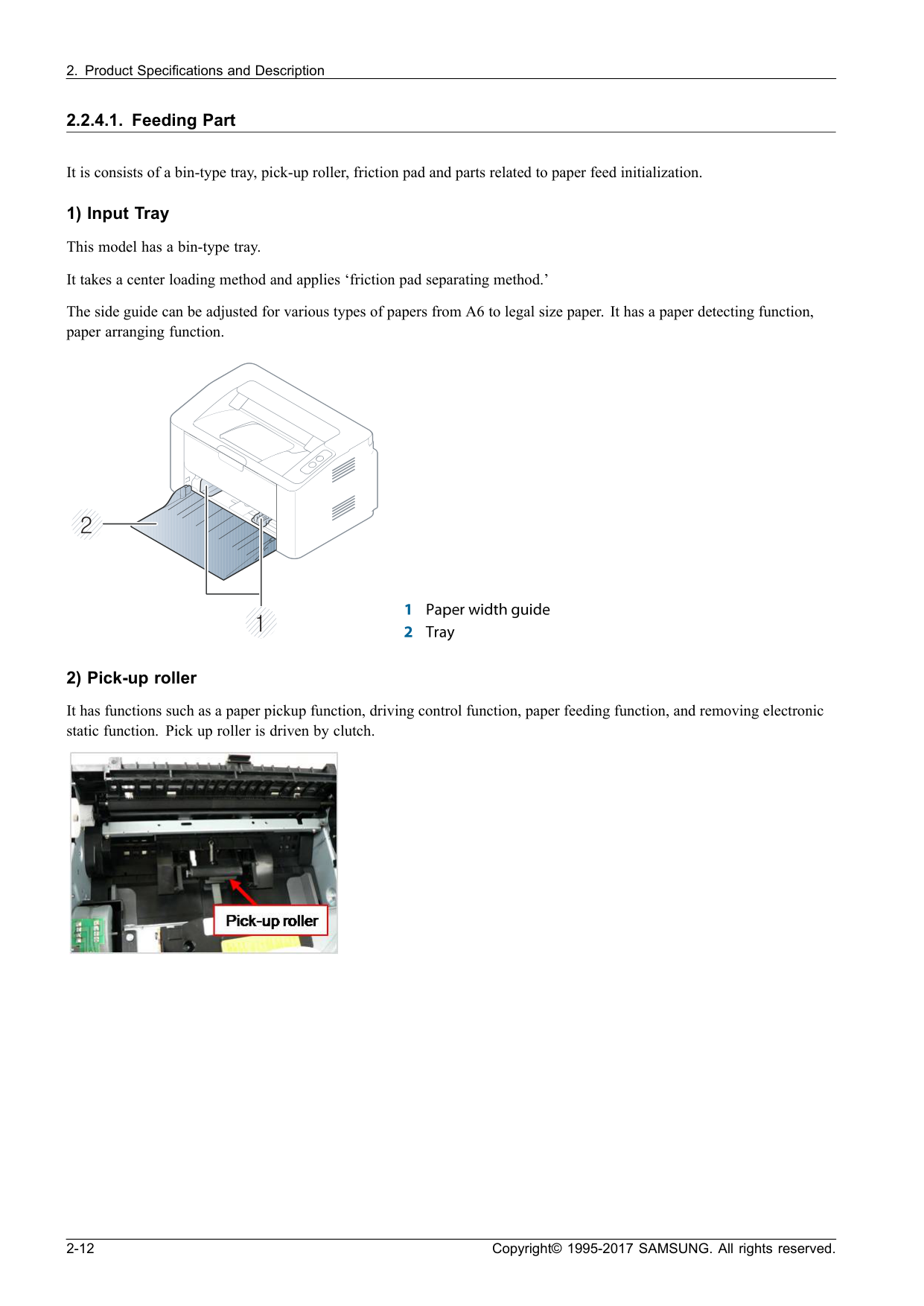
  • 2.2.4.1. Feeding Part It is consists of a bin-type tray, pick-up roller, friction pad and parts related to paper feed initialization. 1) Input Tray This model has a bin-type tray. It takes a center loading method and applies ‘friction pad separating method.’ The side guide can be adjusted for various types of papers from A6 to legal size paper. It has a paper detecting function, paper arranging function. 2) Pick-up roller It has functions such as a paper pickup function, driving control function, paper feeding function, and removing electronic static function. Pick up roller is driven by clutch. 2-12 Copyright© 1995-2017 SAMSUNG. All rights reserved.

    Page 23

  • Product Specifications and Description
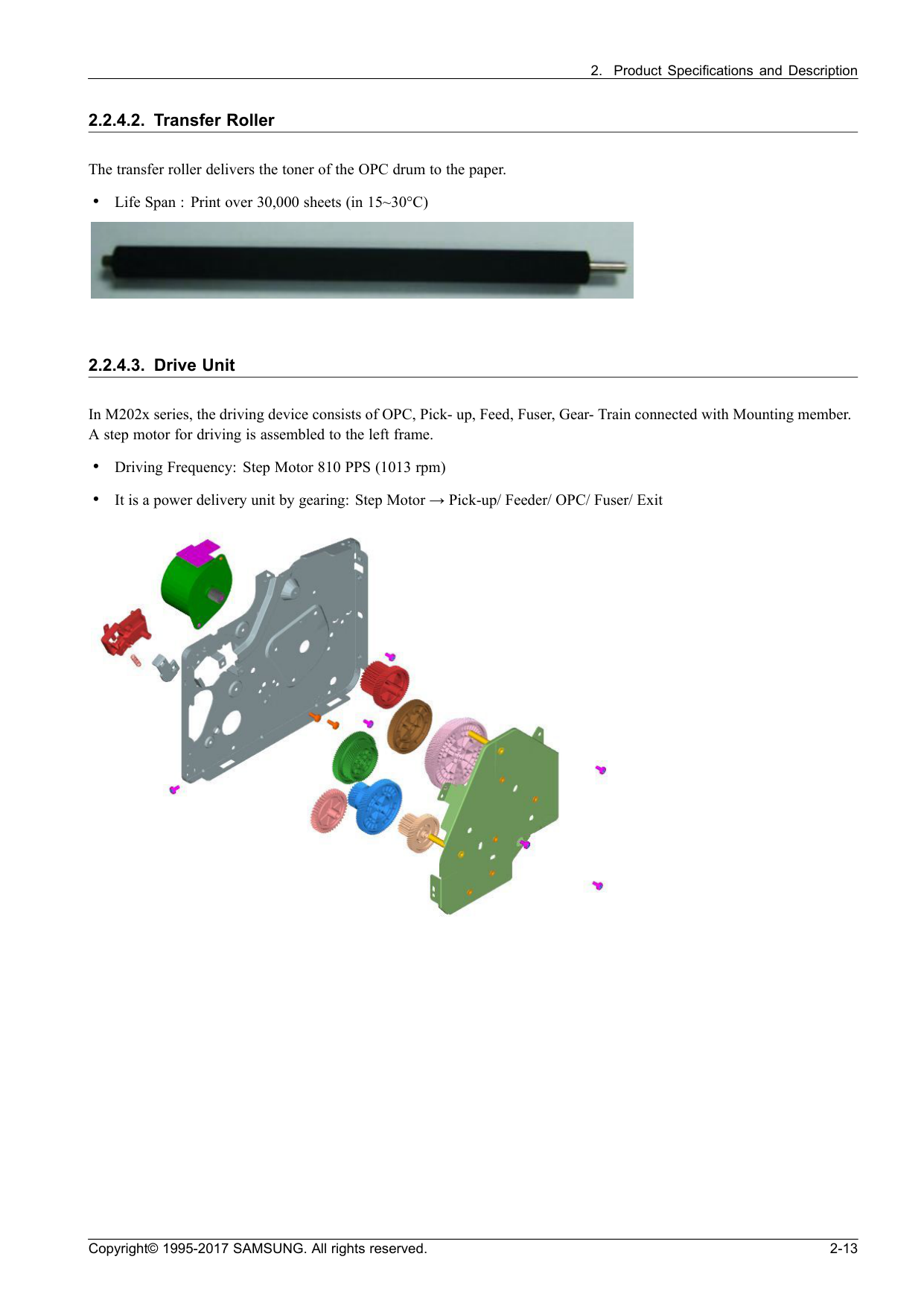
  • 2.2.4.2. Transfer Roller The transfer roller delivers the toner of the OPC drum to the paper. • Life Span : Print over 30,000 sheets (in 15~30°C) 2.2.4.3. Drive Unit In M202x series, the driving device consists of OPC, Pick- up, Feed, Fuser, Gear- Train connected with Mounting member. A step motor for driving is assembled to the left frame. • Driving Frequency: Step Motor 810 PPS (1013 rpm) • It is a power delivery unit by gearing: Step Motor →Pick-up/ Feeder/ OPC/ Fuser/ Exit Copyright© 1995-2017 SAMSUNG. All rights reserved. 2-13

    Page 24

  • Product Specifications and Description
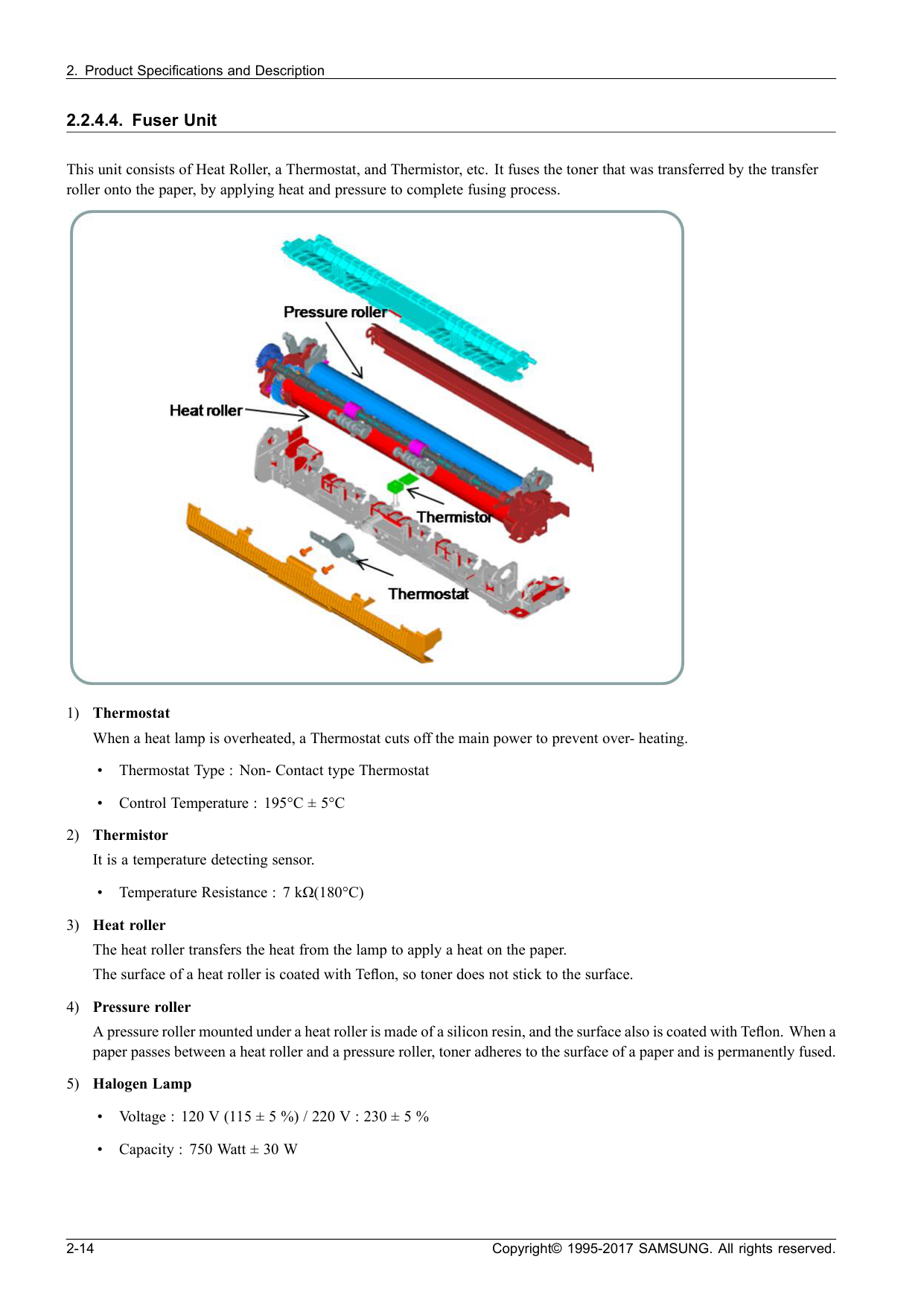
  • 2.2.4.4. Fuser Unit This unit consists of Heat Roller, a Thermostat, and Thermistor, etc. It fuses the toner that was transferred by the transfer roller onto the paper, by applying heat and pressure to complete fusing process. 1) Thermostat When a heat lamp is overheated, a Thermostat cuts off the main power to prevent over- heating. • Thermostat Type : Non- Contact type Thermostat • Control Temperature : 195°C ± 5°C 2) Thermistor It is a temperature detecting sensor. • Temperature Resistance : 7 kΩ(180°C) 3) Heat roller The heat roller transfers the heat from the lamp to apply a heat on the paper. The surface of a heat roller is coated with Teflon, so toner does not stick to the surface. 4) Pressure roller A pressure roller mounted under a heat roller is made of a silicon resin, and the surface also is coated with Teflon. When a paper passes between a heat roller and a pressure roller, toner adheres to the surface of a paper and is permanently fused. 5) Halogen Lamp • Voltage : 120 V (115 ± 5 %) / 220 V : 230 ± 5 % • Capacity : 750 Watt ± 30 W 2-14 Copyright© 1995-2017 SAMSUNG. All rights reserved.

    Page 25

  • Product Specifications and Description
  • 6) Items for safety • Protecting device for overheating
  • 1st protection device: Hardware cuts off when overheated
  • 2nd protection device: Software cuts off when overheated
  • 3rd protection device: Thermostat cuts off main power.
  • • Safety device
  • A fuser power is cut off when a front cover is opened.
  • Maintain a temperature of fuser cover’s surface under 80°C for user, and attach a caution label at where
  • customer can see easily when customer open a rear cover. Copyright© 1995-2017 SAMSUNG. All rights reserved. 2-15

    Page 26

  • Product Specifications and Description
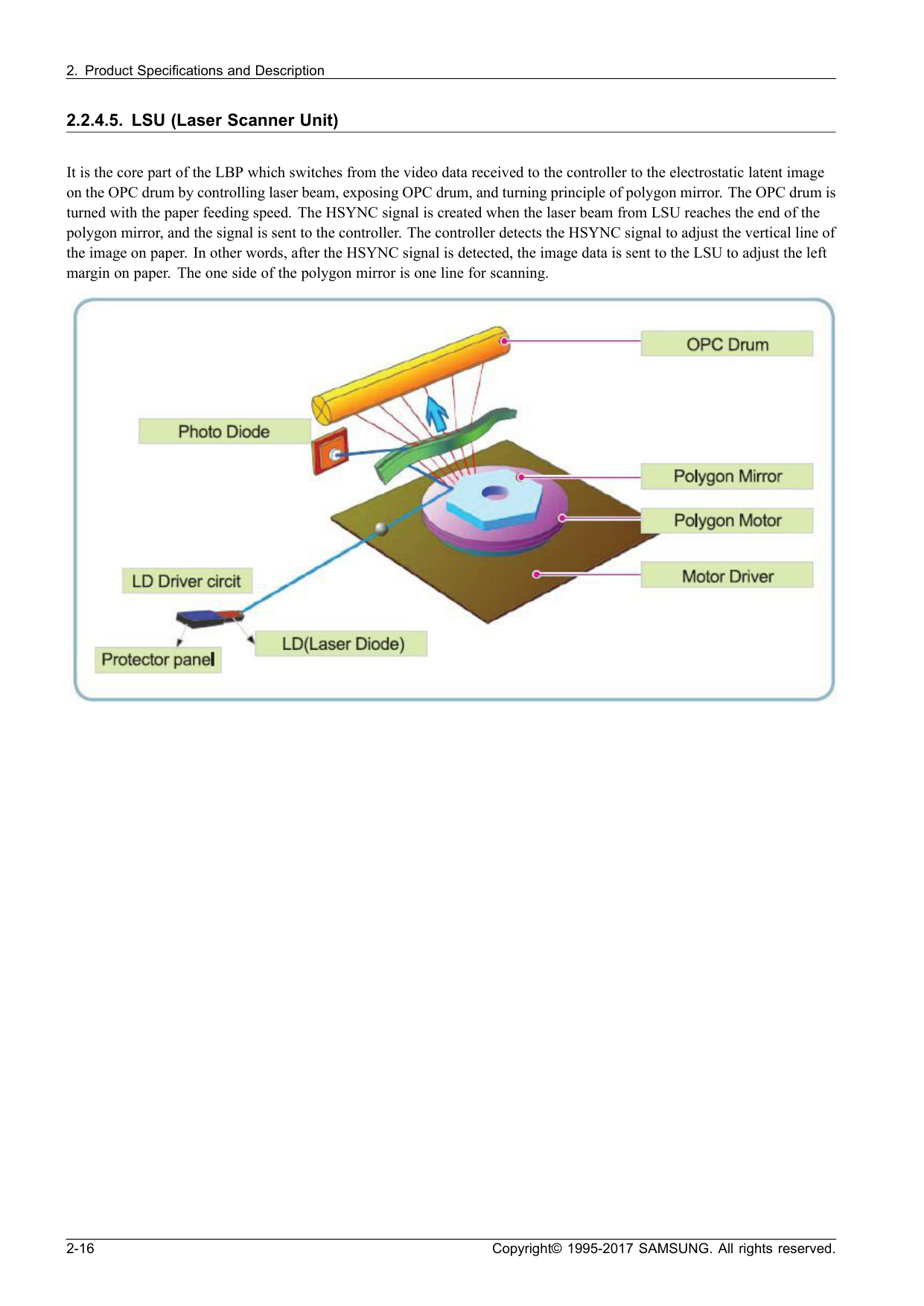
  • 2.2.4.5. LSU (Laser Scanner Unit) It is the core part of the LBP which switches from the video data received to the controller to the electrostatic latent image on the OPC drum by controlling laser beam, exposing OPC drum, and turning principle of polygon mirror. The OPC drum is turned with the paper feeding speed. The HSYNC signal is created when the laser beam from LSU reaches the end of the polygon mirror, and the signal is sent to the controller. The controller detects the HSYNC signal to adjust the vertical line of the image on paper. In other words, after the HSYNC signal is detected, the image data is sent to the LSU to adjust the left margin on paper. The one side of the polygon mirror is one line for scanning. 2-16 Copyright© 1995-2017 SAMSUNG. All rights reserved.

    Page 27

  • Product Specifications and Description
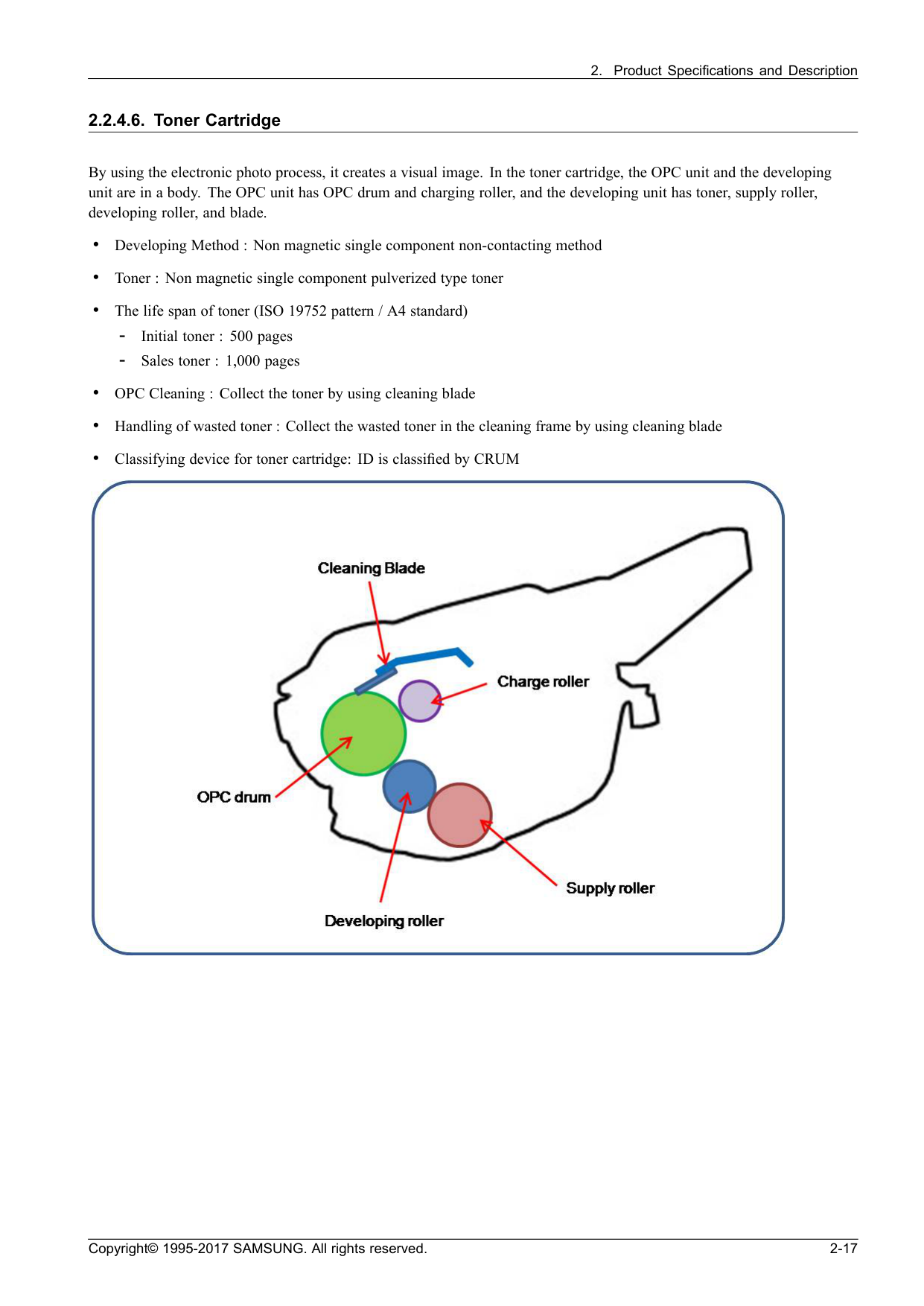
  • 2.2.4.6. Toner Cartridge By using the electronic photo process, it creates a visual image. In the toner cartridge, the OPC unit and the developing unit are in a body. The OPC unit has OPC drum and charging roller, and the developing unit has toner, supply roller, developing roller, and blade. • Developing Method : Non magnetic single component non-contacting method • Toner : Non magnetic single component pulverized type toner • The life span of toner (ISO 19752 pattern / A4 standard)
  • Initial toner : 500 pages
  • Sales toner : 1,000 pages
  • • OPC Cleaning : Collect the toner by using cleaning blade • Handling of wasted toner : Collect the wasted toner in the cleaning frame by using cleaning blade • Classifying device for toner cartridge: ID is classified by CRUM Copyright© 1995-2017 SAMSUNG. All rights reserved. 2-17

    Page 28

  • Product Specifications and Description
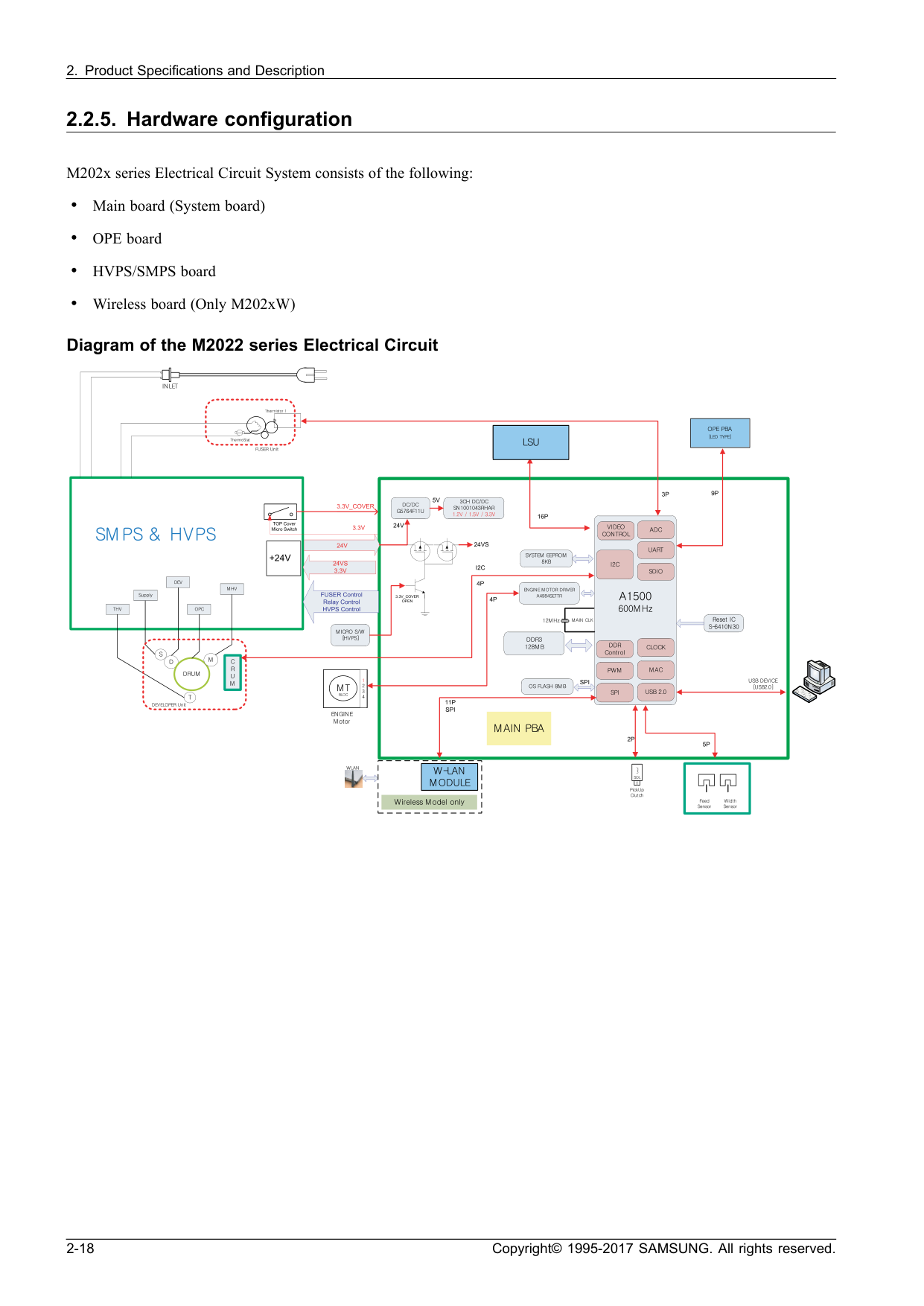
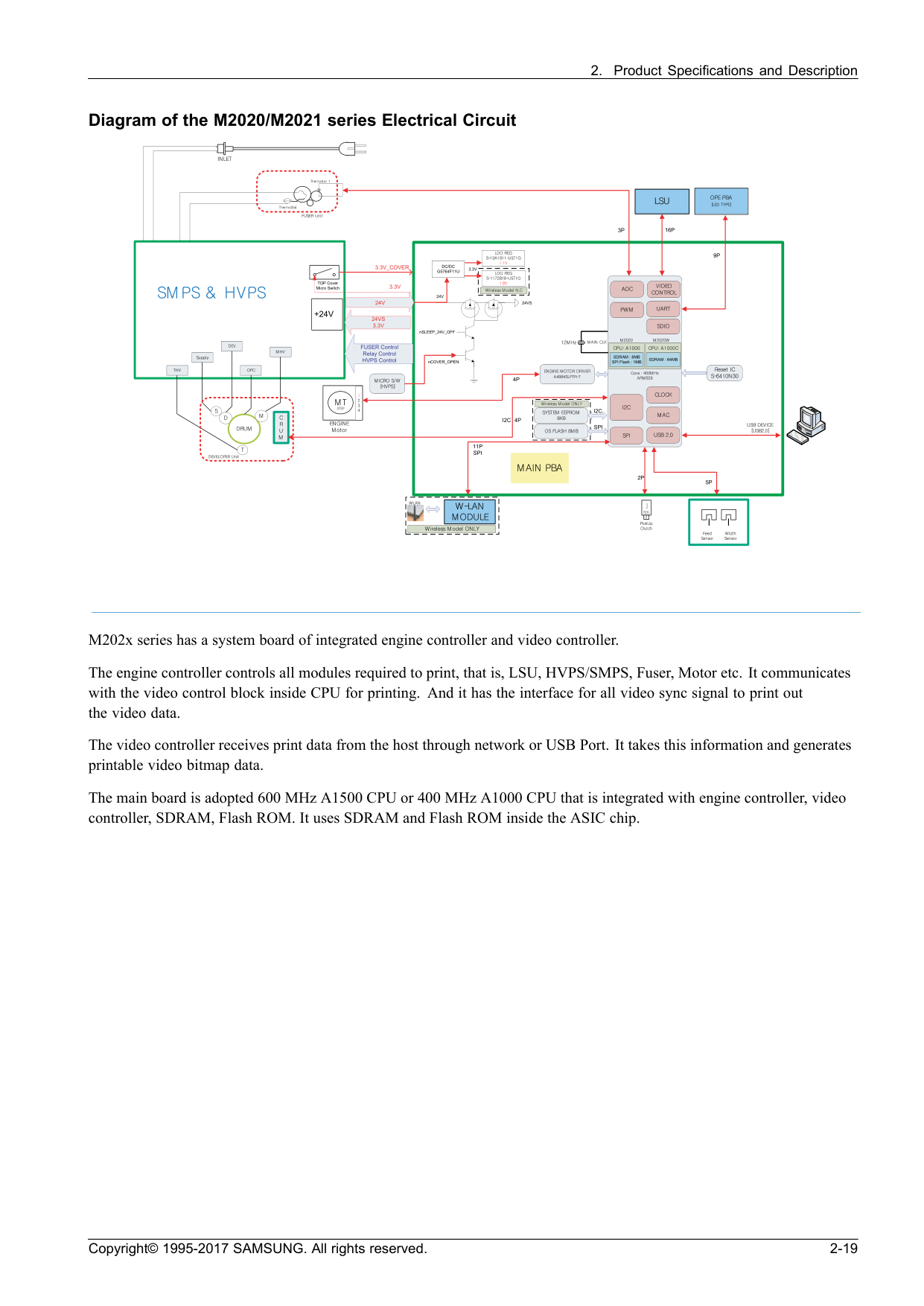
  • 2.2.5. Hardware configuration M202x series Electrical Circuit System consists of the following: • Main board (System board) • OPE board • HVPS/SMPS board • Wireless board (Only M202xW) Diagram of the M2022 series Electrical Circuit 2-18 Copyright© 1995-2017 SAMSUNG. All rights reserved.

    Page 29

  • Product Specifications and Description
  • Diagram of the M2020/M2021 series Electrical Circuit M202x series has a system board of integrated engine controller and video controller. The engine controller controls all modules required to print, that is, LSU, HVPS/SMPS, Fuser, Motor etc. It communicates with the video control block inside CPU for printing. And it has the interface for all video sync signal to print out the video data. The video controller receives print data from the host through network or USB Port. It takes this information and generates printable video bitmap data. The main board is adopted 600 MHz A1500 CPU or 400 MHz A1000 CPU that is integrated with engine controller, video controller, SDRAM, Flash ROM. It uses SDRAM and Flash ROM inside the ASIC chip. Copyright© 1995-2017 SAMSUNG. All rights reserved. 2-19

    Page 30

  • Product Specifications and Description
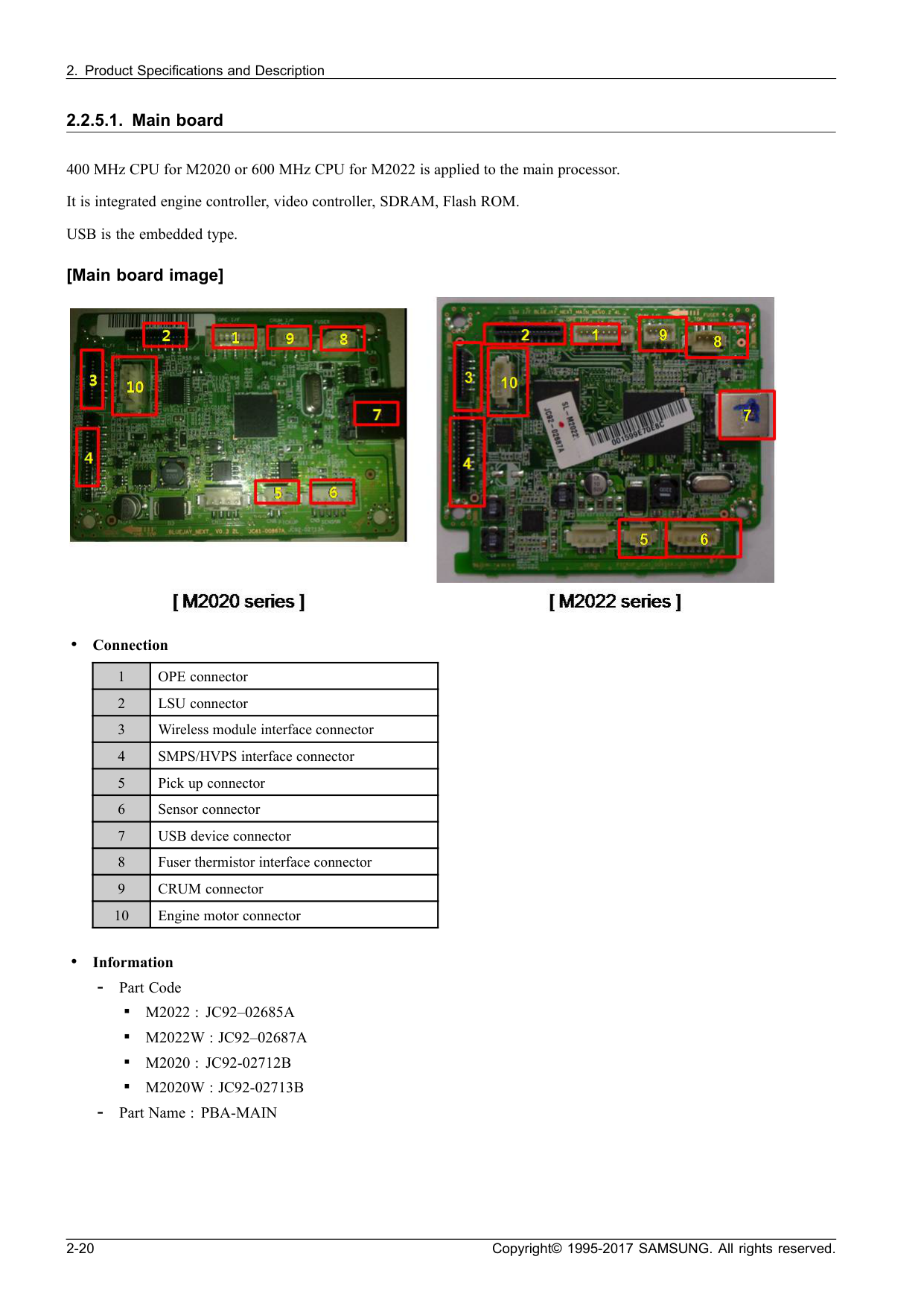
  • 2.2.5.1. Main board 400 MHz CPU for M2020 or 600 MHz CPU for M2022 is applied to the main processor. It is integrated engine controller, video controller, SDRAM, Flash ROM. USB is the embedded type. [Main board image] • Connection 1 OPE connector 2 LSU connector 3 Wireless module interface connector 4 SMPS/HVPS interface connector 5 Pick up connector 6 Sensor connector 7 USB device connector 8 Fuser thermistor interface connector 9 CRUM connector 10 Engine motor connector • Information
  • Part Code
  • M2022 : Jc92–02685A

    M2022W : Jc92–02687A

    M2020 : Jc92-02712B

    M2020W : Jc92-02713B

  • Part Name : PBA-MAIN
  • 2-20 Copyright© 1995-2017 SAMSUNG. All rights reserved.

    Page 31

  • Product Specifications and Description
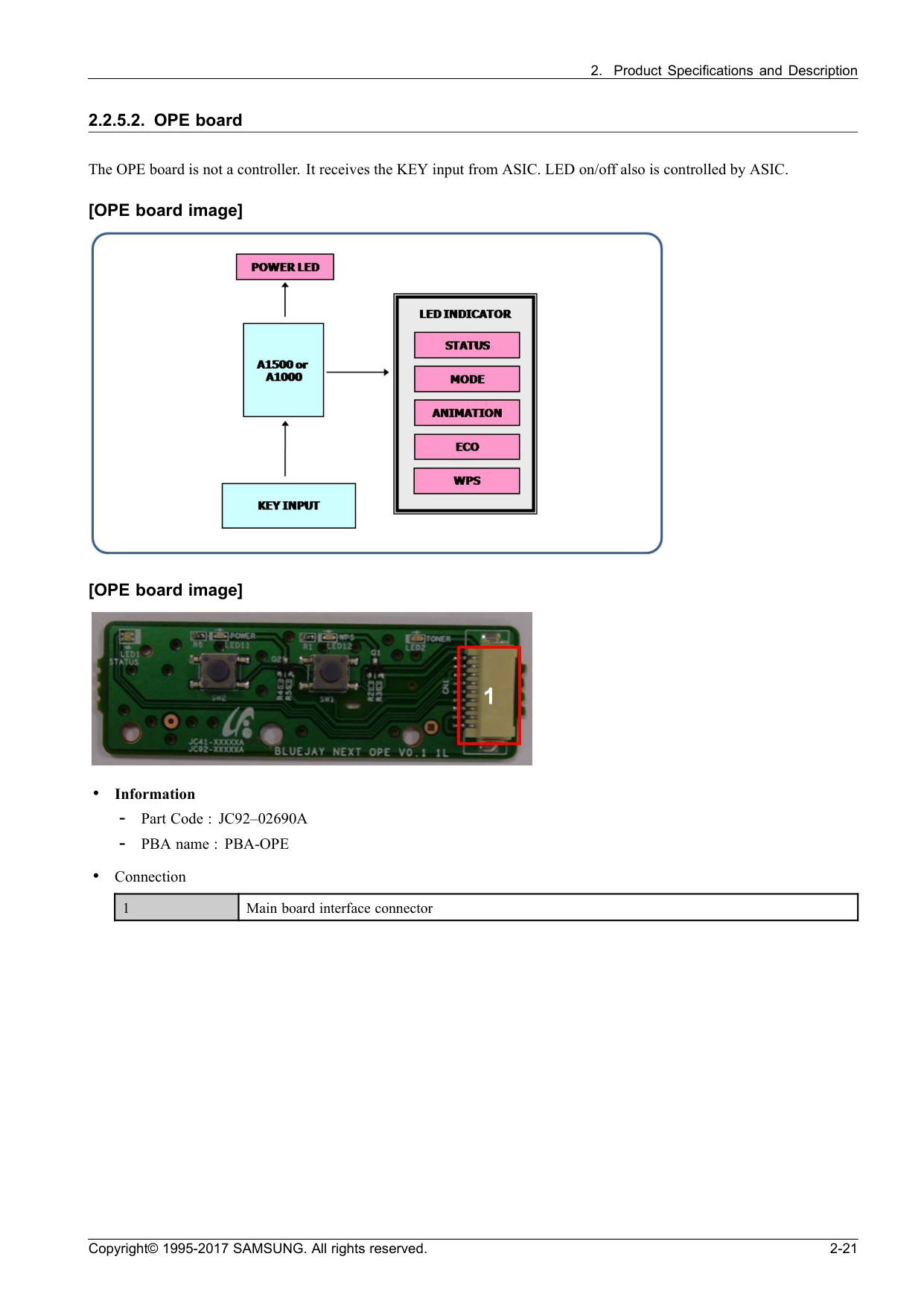
  • 2.2.5.2. OPE board The OPE board is not a controller. It receives the KEY input from ASIC. LED on/off also is controlled by ASIC. [OPE board image] [OPE board image] • Information
  • Part Code : JC92–02690A
  • PBA name : PBA-OPE
  • • Connection 1 Main board interface connector Copyright© 1995-2017 SAMSUNG. All rights reserved. 2-21

    Page 32

  • Product Specifications and Description
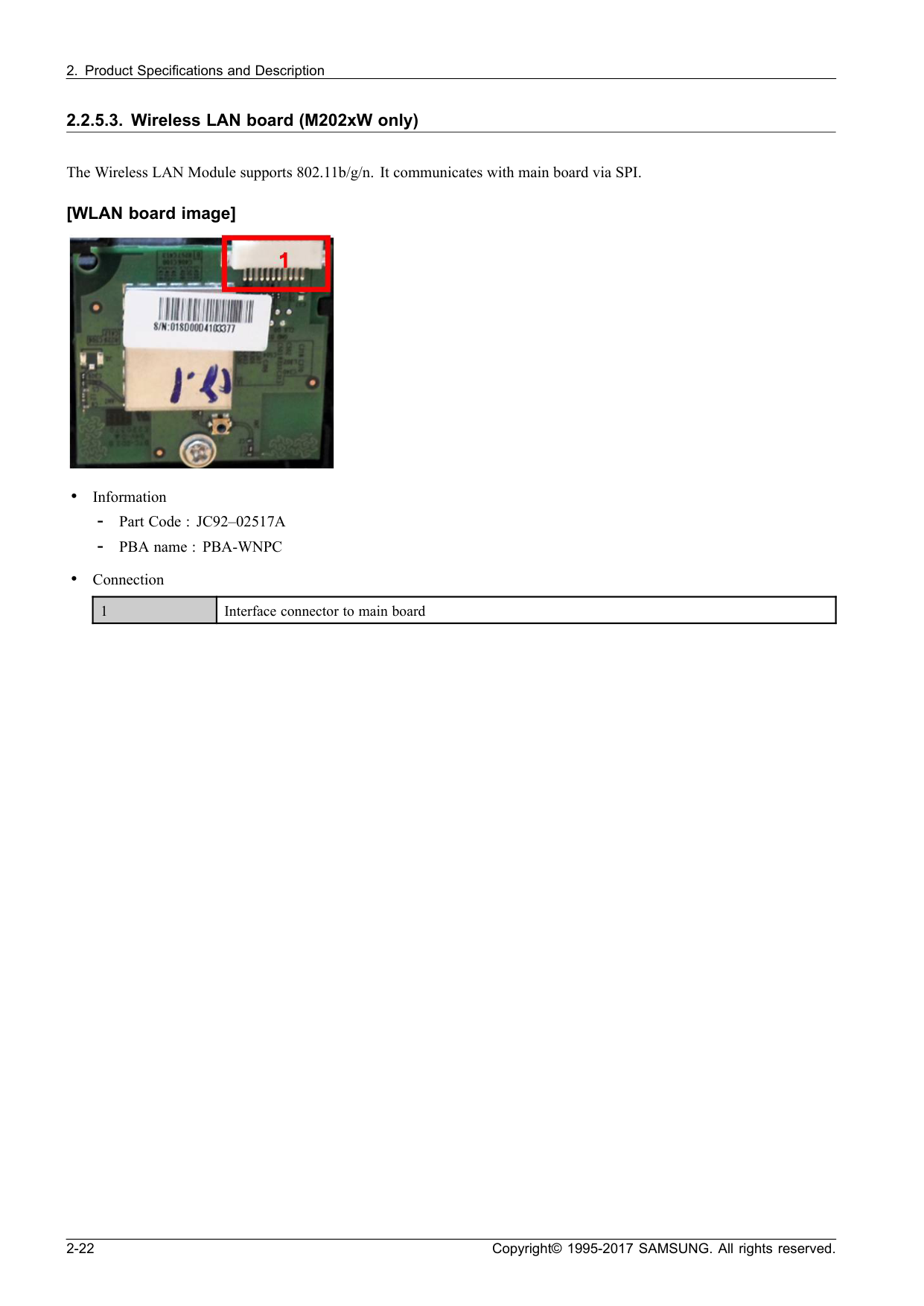
  • 2.2.5.3. Wireless LAN board (M202xW only) The Wireless LAN Module supports 802.11b/g/n. It communicates with main board via SPI. [WLAN board image] • Information
  • Part Code : JC92–02517A
  • PBA name : PBA-WNPC
  • • Connection 1 Interface connector to main board 2-22 Copyright© 1995-2017 SAMSUNG. All rights reserved.

    Page 33

  • Product Specifications and Description
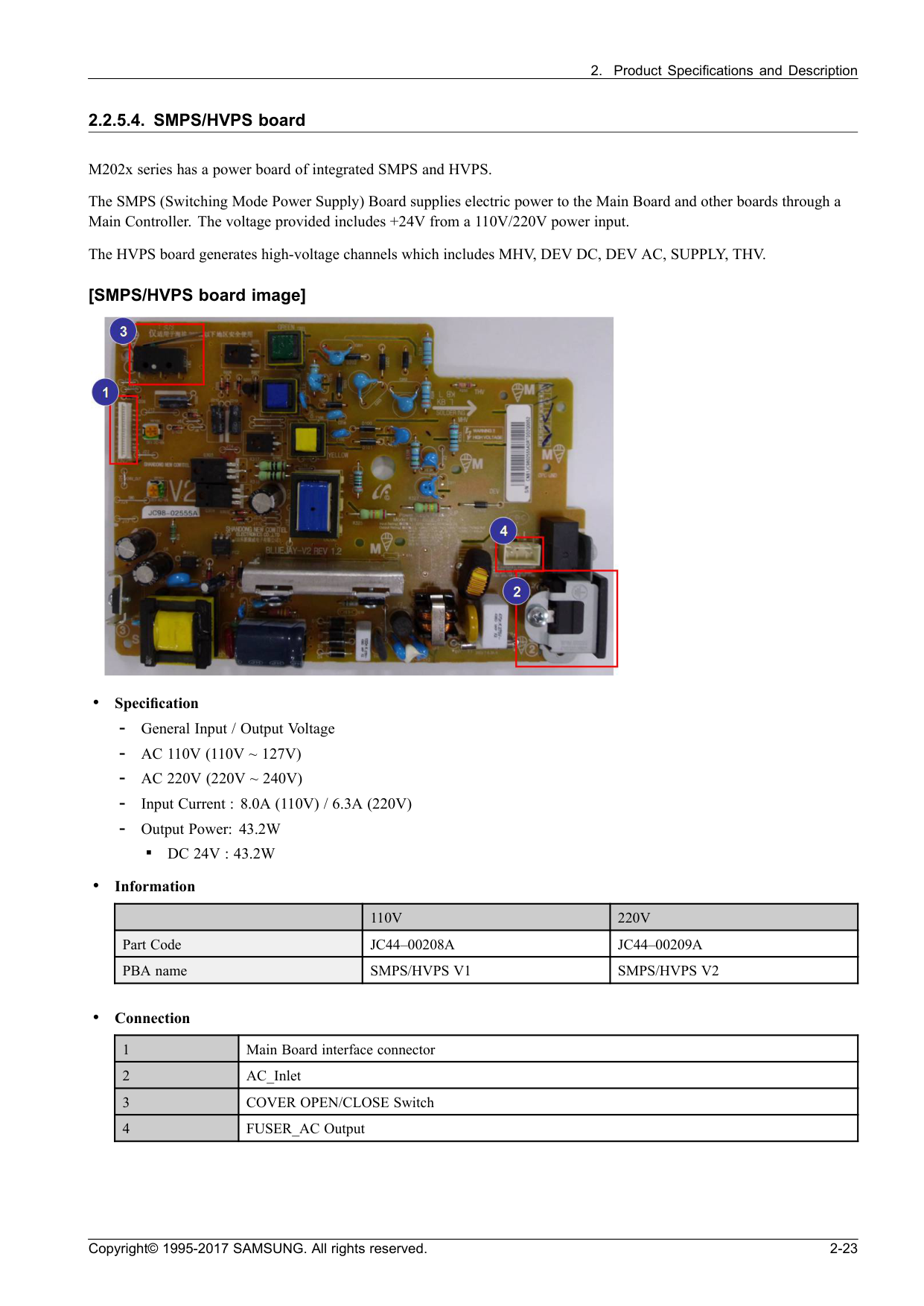
  • 2.2.5.4. SMPS/HVPS board M202x series has a power board of integrated SMPS and HVPS. The SMPS (Switching Mode Power Supply) Board supplies electric power to the Main Board and other boards through a Main Controller. The voltage provided includes +24V from a 110V/220V power input. The HVPS board generates high-voltage channels which includes MHV, DEV DC, DEV AC, SUPPLY, THV. [SMPS/HVPS board image] • Specification
  • General Input / Output Voltage
  • Ac 110V (110V ~ 127V)

  • Ac 220V (220V ~ 240V)

  • Input Current : 8.0A (110V) / 6.3A (220V)
  • Output Power: 43.2W
  • Dc 24V : 43.2W

    • Information

    110V

    220V

    Part Code

    Jc44–00208A

    Jc44–00209A

    PBA name

    Smps/Hvps V1

    Smps/Hvps V2

    • Connection 1 Main Board interface connector 2 AC_Inlet 3 COVER OPEN/CLOSE Switch 4 FUSER_AC Output Copyright© 1995-2017 SAMSUNG. All rights reserved. 2-23
    Page 34

  • Product Specifications and Description
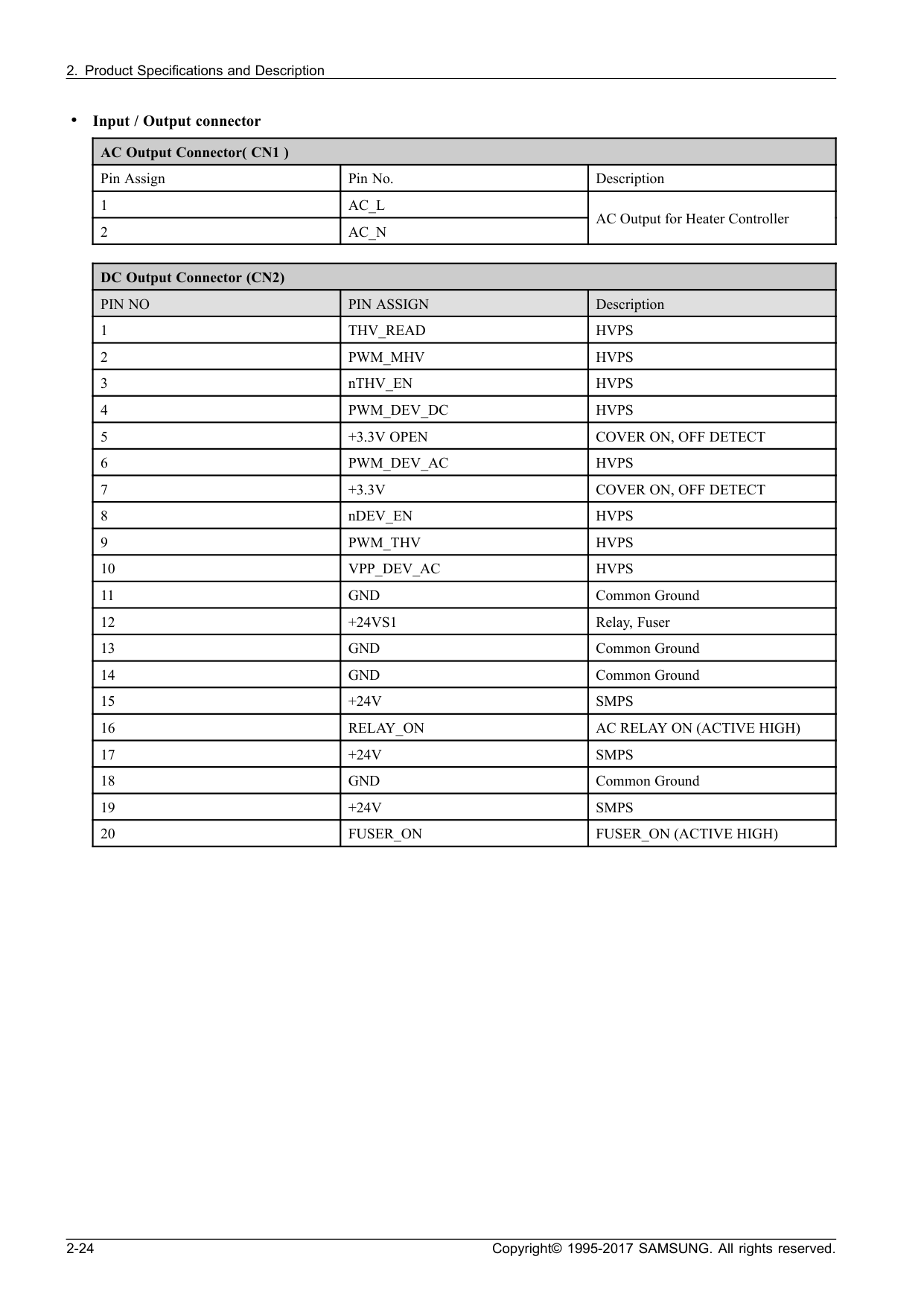
  • • Input / Output connector AC Output Connector( CN1 ) Pin Assign Pin No. Description 1

    Ac_L

    2

    Ac_N

    AC Output for Heater Controller DC Output Connector (CN2)

    Pin No

    Pin Assign

    Description 1

    Thv_Read

    Hvps

    2

    Pwm_Mhv

    Hvps

    3 nTHV_EN

    Hvps

    4

    Pwm_Dev_Dc

    Hvps

    5

    +3.3V Open

    Cover On, Off Detect

    6

    Pwm_Dev_Ac

    Hvps

    7

    +3.3V

    Cover On, Off Detect

    8 nDEV_EN

    Hvps

    9

    Pwm_Thv

    Hvps

    10

    Vpp_Dev_Ac

    Hvps

    11

    Gnd

    Common Ground 12

    +24Vs1

    Relay, Fuser 13

    Gnd

    Common Ground 14

    Gnd

    Common Ground 15

    +24V

    Smps

    16

    Relay_On

    Ac Relay On (Active High)

    17

    +24V

    Smps

    18

    Gnd

    Common Ground 19

    +24V

    Smps

    20

    Fuser_On

    Fuser_On (Active High)

    2-24 Copyright© 1995-2017 SAMSUNG. All rights reserved.
    Page 35

  • Product Specifications and Description
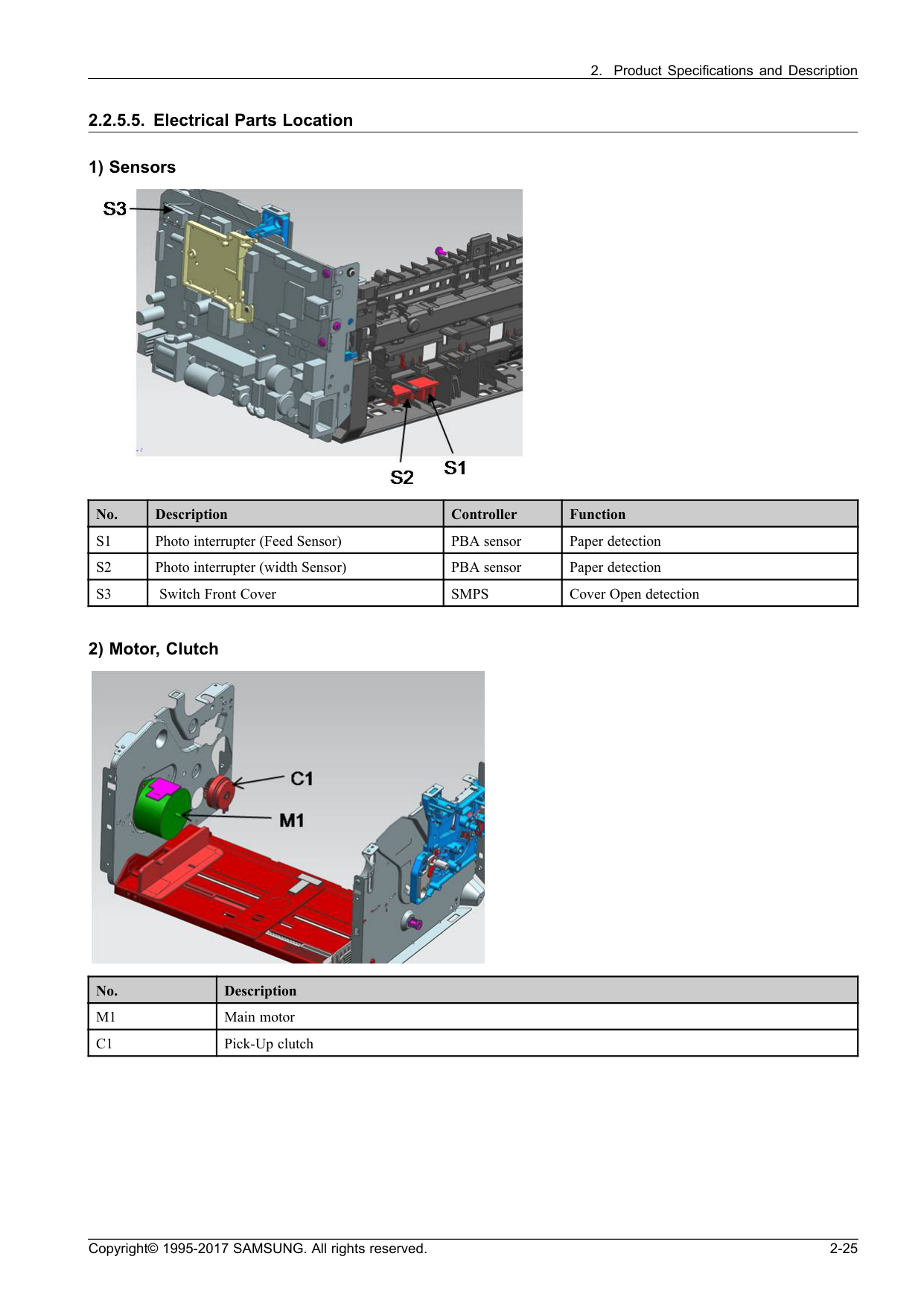
  • 2.2.5.5. Electrical Parts Location 1) Sensors No. Description Controller Function

    S1

    Photo interrupter (Feed Sensor) PBA sensor Paper detection

    S2

    Photo interrupter (width Sensor) PBA sensor Paper detection

    S3

    Switch Front Cover

    Smps

    Cover Open detection 2) Motor, Clutch No. Description

    M1

    Main motor

    C1

    Pick-Up clutch Copyright© 1995-2017 SAMSUNG. All rights reserved. 2-25
    Page 36

  • Product Specifications and Description
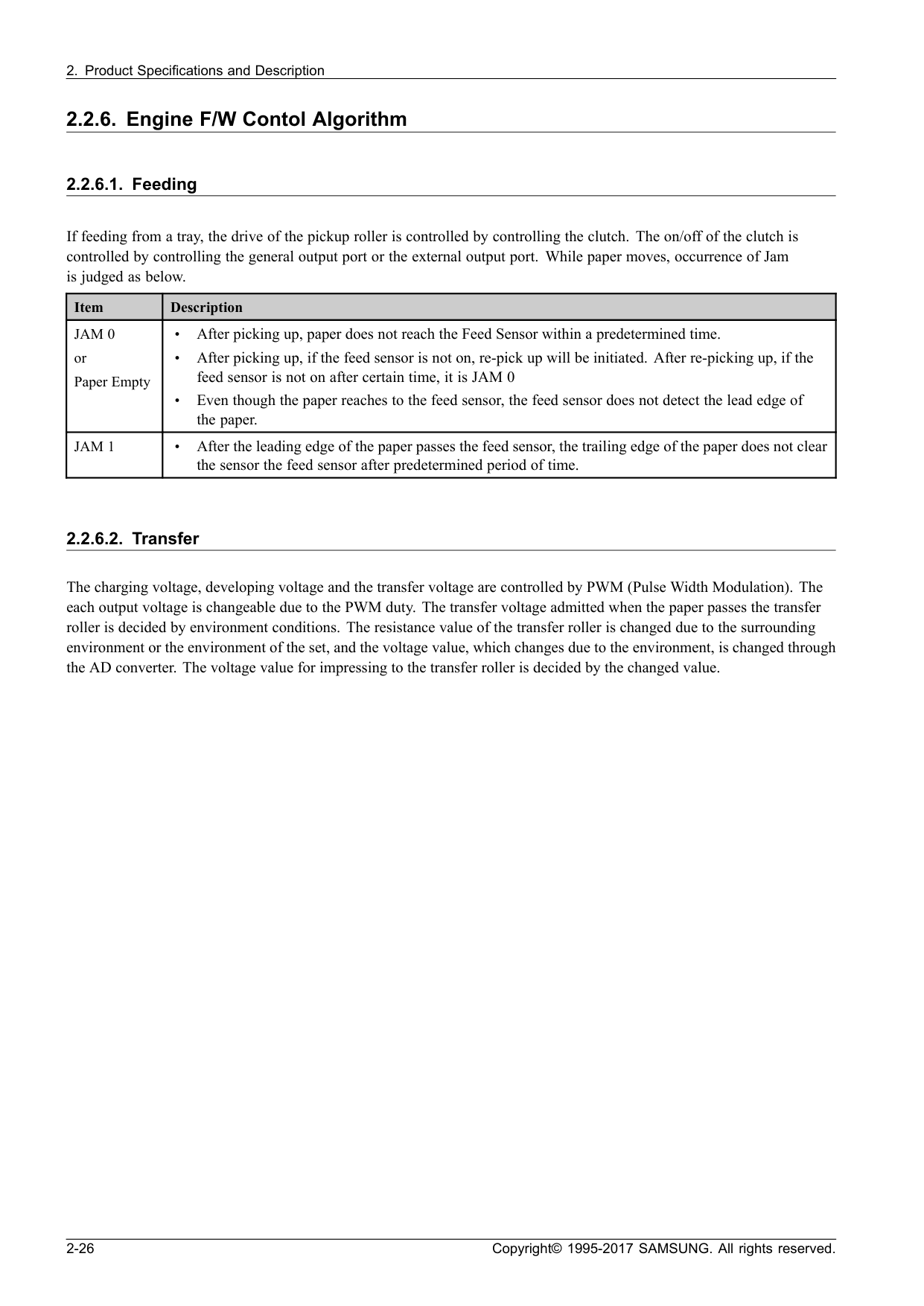
  • 2.2.6. Engine F/W Contol Algorithm 2.2.6.1. Feeding If feeding from a tray, the drive of the pickup roller is controlled by controlling the clutch. The on/off of the clutch is controlled by controlling the general output port or the external output port. While paper moves, occurrence of Jam is judged as below. Item Description

    Jam 0

    or Paper Empty • After picking up, paper does not reach the Feed Sensor within a predetermined time. • After picking up, if the feed sensor is not on, re-pick up will be initiated. After re-picking up, if the feed sensor is not on after certain time, it is JAM 0 • Even though the paper reaches to the feed sensor, the feed sensor does not detect the lead edge of the paper.

    Jam 1

    • After the leading edge of the paper passes the feed sensor, the trailing edge of the paper does not clear the sensor the feed sensor after predetermined period of time. 2.2.6.2. Transfer The charging voltage, developing voltage and the transfer voltage are controlled by PWM (Pulse Width Modulation). The each output voltage is changeable due to the PWM duty. The transfer voltage admitted when the paper passes the transfer roller is decided by environment conditions. The resistance value of the transfer roller is changed due to the surrounding environment or the environment of the set, and the voltage value, which changes due to the environment, is changed through the AD converter. The voltage value for impressing to the transfer roller is decided by the changed value. 2-26 Copyright© 1995-2017 SAMSUNG. All rights reserved.
    Page 37

  • Product Specifications and Description
  • 2.2.6.3. Fusing The temperature change of the heat roller’s surface is changed to the resistance value through the use of a thermistor. The Main Board uses the resistance value of the Thermistor and converts it to a voltage value through the use of an AD converter, the temperature is decided based on the voltage value read. The AC power is controlled by comparing the target temperature to the value from the thermistor. If the value from the thermistor is out of controlling range while controlling the fusing, the error stated in the below table occurs. • Open Heat Error When the engine operates the warm-up process, if the temperature of the fixing unit is not higher than a specified temperature within a predetermined time, the engine defines Open Heat Error. When this error is detected, the engine stops all functions and keeps the error state. Also, the engine informs the error status of the main system, so it can take appropriate action; and then the error message is displayed at LCD window or LED informing the error status of the user. • Low Heat Error When the engine is at stand-by, printing or warm-up mode, if the temperature of the fixing unit is lower than the specified temperature at each state and the lower temperature state is maintained during the specified time, the engine defines Low Heat Error. When this error is detected, the engine stops all functions and keeps it at the error state. Also, the engine informs the error status of the main system, so it can take appropriate action; and then the error message is displayed at LCD window or LED informing the error status of the user. • Over Heat Error For overall engine state, if the temperature of the fixing unit is higher than the specified temperature and the temperature state is detected for a specific duration, then the engine defines Over Heat Error. When this error is detected, the engine stops all functions and keeps it at the error state. Also, the engine informs the error status of the main system, so it can take appropriate action; and then the error message is displayed at LCD window or LED informing the error status of the user.

    2.2.6.4. Lsu

    LSU receives the image data from PVC or HPVC and make the latent image on OPC surface. It uses the single beam, LD. The errors related to LSU are as follows: • By Lready When the printing is started, the engine drives the polygon motor of LSU. After the specified time is elapsed, if the motor is not in a ready status, the engine detects the error that the polygon motor is not in a ready status. If this error happens, the engine stops all functions and keeps it at the error state. Also, the engine informs the error status of the main system and the error message is displayed at LCD window or LED informing the error status of the user. • By Hsync When the polygon motor is ready, the LSU sends out the signal called Hsync and used to synchronize with each image line. So, if the engine does not detect consecutively the signal for a fixed time, it defines the Hsync Error. If this error happens, the engine stops all functions and keeps it at the error state. Also, the engine informs the error status of the main system and then the error message is displayed at LCD window or LED informing the error status of the user. LSU Error Recovery: If the LReady or Hsync error happens, the paper is exited before the error code is initiated. The engine mode is changed to recovery mode and the engine informs the main system of the engine mode. The engine rechecks the LSU error, if the error does not reoccur printing is resumed. Copyright© 1995-2017 SAMSUNG. All rights reserved. 2-27
    Page 38

  • Product Specifications and Description
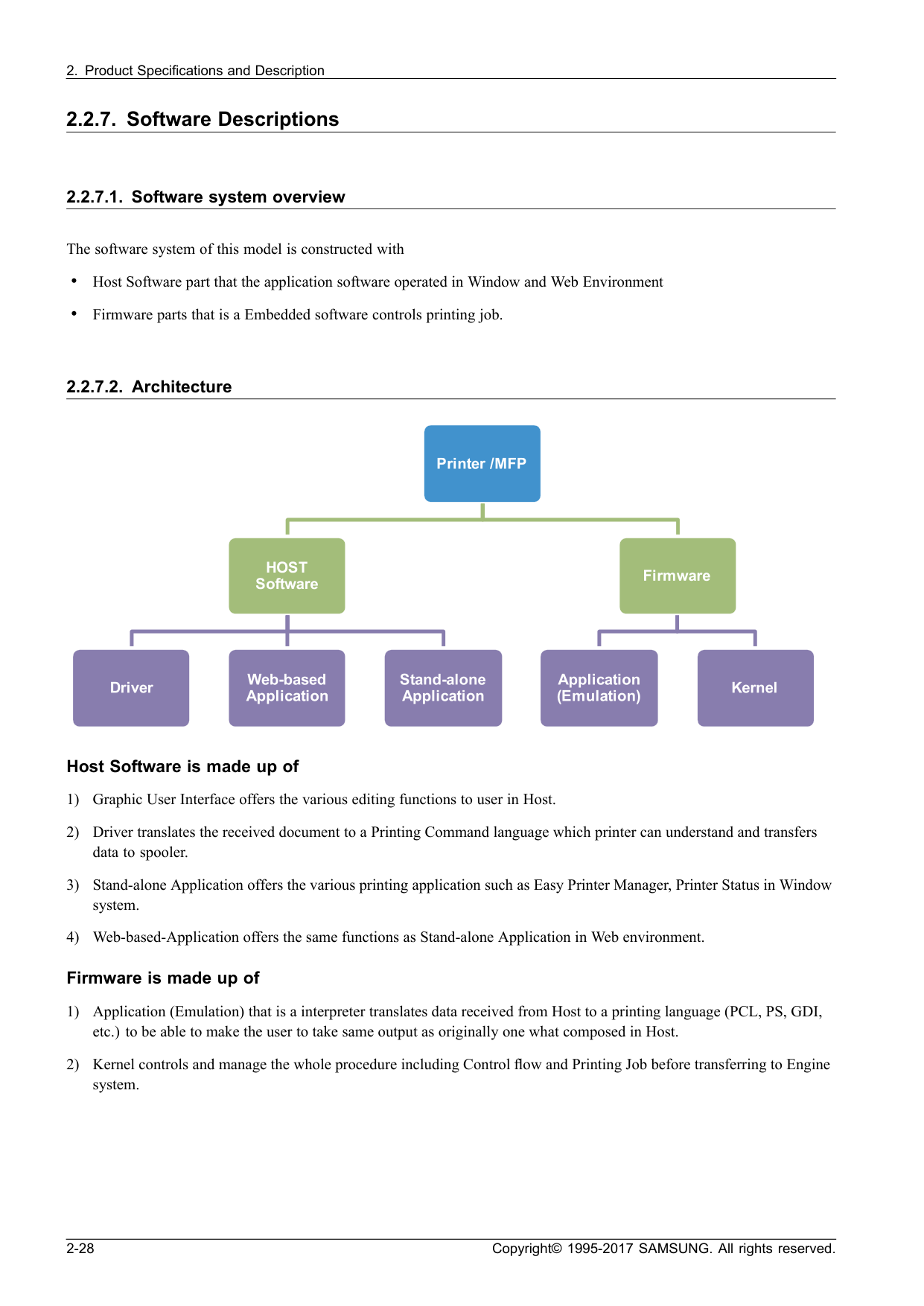
  • 2.2.7. Software Descriptions 2.2.7.1. Software system overview The software system of this model is constructed with • Host Software part that the application software operated in Window and Web Environment • Firmware parts that is a Embedded software controls printing job. 2.2.7.2. Architecture Host Software is made up of 1) Graphic User Interface offers the various editing functions to user in Host. 2) Driver translates the received document to a Printing Command language which printer can understand and transfers data to spooler. 3) Stand-alone Application offers the various printing application such as Easy Printer Manager, Printer Status in Window system. 4) Web-based-Application offers the same functions as Stand-alone Application in Web environment. Firmware is made up of 1) Application (Emulation) that is a interpreter translates data received from Host to a printing language (PCL, PS, GDI, etc.) to be able to make the user to take same output as originally one what composed in Host. 2) Kernel controls and manage the whole procedure including Control flow and Printing Job before transferring to Engine system. 2-28 Copyright© 1995-2017 SAMSUNG. All rights reserved.

    Page 39

  • Product Specifications and Description
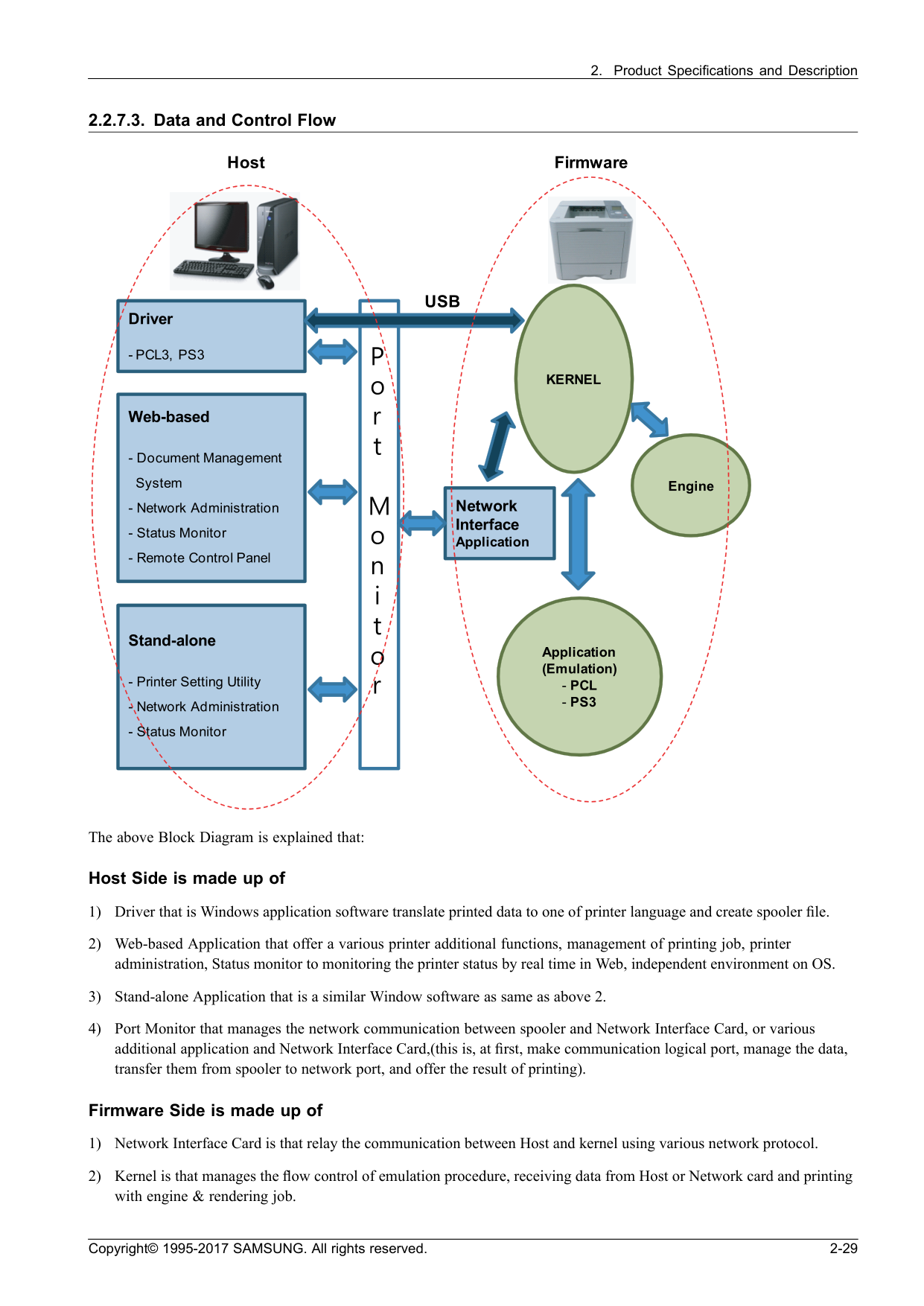
  • 2.2.7.3. Data and Control Flow The above Block Diagram is explained that: Host Side is made up of 1) Driver that is Windows application software translate printed data to one of printer language and create spooler file. 2) Web-based Application that offer a various printer additional functions, management of printing job, printer administration, Status monitor to monitoring the printer status by real time in Web, independent environment on OS. 3) Stand-alone Application that is a similar Window software as same as above 2. 4) Port Monitor that manages the network communication between spooler and Network Interface Card, or various additional application and Network Interface Card,(this is, at first, make communication logical port, manage the data, transfer them from spooler to network port, and offer the result of printing). Firmware Side is made up of 1) Network Interface Card is that relay the communication between Host and kernel using various network protocol. 2) Kernel is that manages the flow control of emulation procedure, receiving data from Host or Network card and printing with engine & rendering job. Copyright© 1995-2017 SAMSUNG. All rights reserved. 2-29

    Page 40

  • Product Specifications and Description
  • 3) Emulation is that interprets the various output data from selected emulation. 4) Engine is that prints rendered bit-map data to paper with required size and type by Kernel. And then, for Job Spooling function for Multi-User, Multi-Printing that is occurred in Network printing and various additional printing functions, this Kernel use max. 10 Queuing systems in a memory. In Printing, the two procedures are 1) Case of using USB Port • After user start to print the wanted document to PCL string or compressed GDI bit-map data, the Driver translates the all graphic data of the client PC and send data to host spooler. And then the spooler sends the data stream to the printer via USB port. • Kernel receives this data from Host, and then select emulation fit to data and start selected one. After emulation job end, Kernel sends the output bit-map data to Engine using Printer Video Controller (by clock type for LSU). • Engine print the received data to required paper with the sequential developing process. 2) Case of using Network Interface Card • After user start to print the wanted document to PCL string or compressed GDI bit-map data, Driver translate the all graphic data of it and send data to host spooler. • If so, Port monitor managing network port receives data from spooler and sends a data stream to the Network Interface Card. • Network interface card receives it and send to Kernel part. • Kernel receives this data from Host, and then select emulation fit to data and start selected one. After emulation job end, Kernel sends the output bit-map data to Engine using Printer Video Controller (by clock type for LSU). • Engine print the received data to required paper with the sequential developing process. 2-30 Copyright© 1995-2017 SAMSUNG. All rights reserved.

    Page 41

  • Disassembly and Reassembly
  • Disassembly and Reassembly
  • 3.1. Precautions when replacing parts 3.1.1. Precautions when assembling and disassembling • Use only approved Samsung spare parts. Ensure that part number, product name, any voltage, current or temperature rating are correct. Failure to do so could result in damage to the machine, circuit overload, fire or electric shock. • Do not make any unauthorized changes or additions to the printer, these could cause the printer to malfunction and create electric shock or fire hazards. • Take care when dismantling the unit to note where each screw goes. There are 19 different screws. Use of the wrong screw could lead to system failure, short circuit or electric shock. • Do not disassemble the LSU unit. Once it is disassembled dust is admitted to the mirror chamber and will seriously degrade print quality. There are no serviceable parts inside. • Regularly check the condition of the power cord, plug and socket. Bad contacts could lead to overheating and firfe. Damaged cables could lead to electric shock or unit malfunction. 3.1.2. Preautions when handling PBA Static electricity can damage a PBA, always used approved anti-static precautions when handling or storing a PBA. • Precautions when moving and storing PBA 1) Please keep PBA in a conductive case, anti-static bag, or wrapped in aluminum foil. 2) Do not store a PBA where it is exposed to direct sunlight. • Precautions when replacing PBA 1) Disconnect power connectors first, before disconnecting other cables. 2) Do not touch any soldered connections, connector terminals or other electronic parts when handling insulated parts. • Precautions when checking PBA 1) Before touching a PBA, please touch other grounded areas of the chassis to discharge any static electrical charge on the body. 2) Take care not to touch the PBA with your bare hands or metal objects as you could create a short circuit or get an electric shock. Take extra care when handling PBAs with moving parts fitted such as sensors, motors or lamps as they may get hot. 3) Take care when fitting, or removing, screws. Look out for hidden screws. Always ensure that the correct screw is used and always ensure that when toothed washers are removed they are refitted in their original positions. Copyright© 1995-2017 SAMSUNG. All rights reserved. 3-1

    Page 42

  • Disassembly and Reassembly
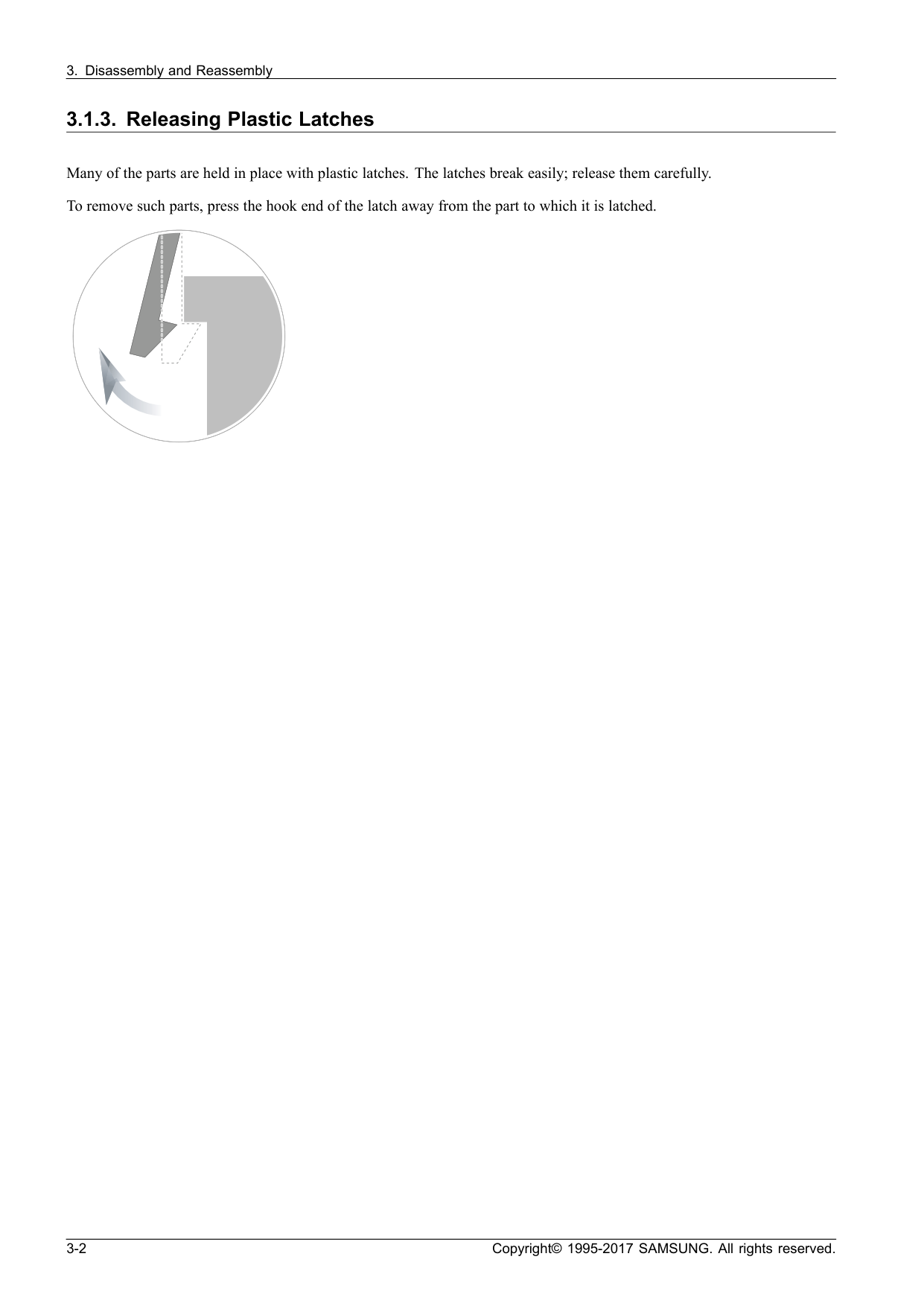
  • 3.1.3. Releasing Plastic Latches Many of the parts are held in place with plastic latches. The latches break easily; release them carefully. To remove such parts, press the hook end of the latch away from the part to which it is latched. 3-2 Copyright© 1995-2017 SAMSUNG. All rights reserved.

    Page 43

  • Disassembly and Reassembly
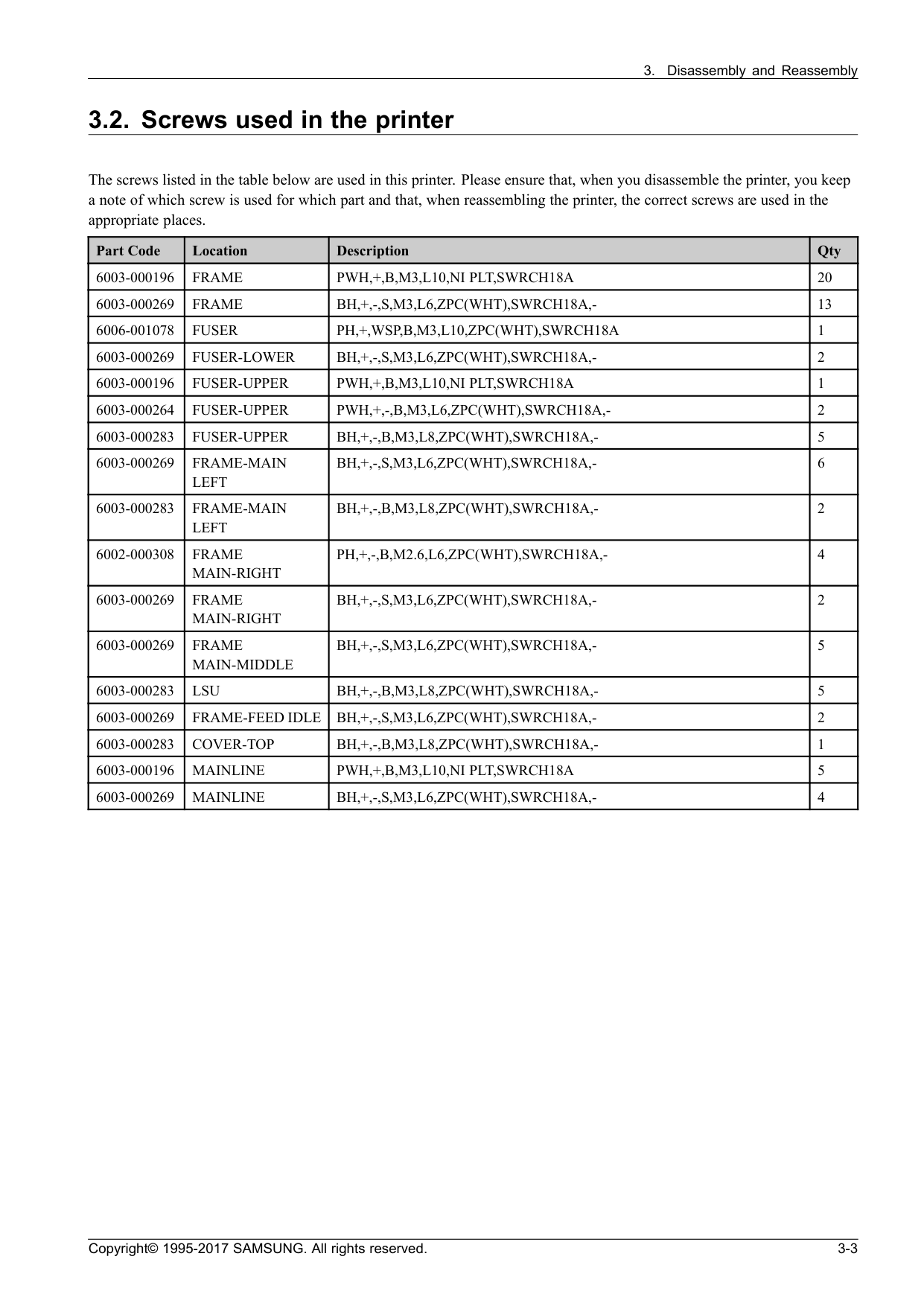
  • 3.2. Screws used in the printer The screws listed in the table below are used in this printer. Please ensure that, when you disassemble the printer, you keep a note of which screw is used for which part and that, when reassembling the printer, the correct screws are used in the appropriate places. Part Code Location Description Qty 6003-000196

    Frame

    Pwh,+,B,M3,L10,Ni Plt,Swrch18A

    20 6003-000269

    Frame

    Bh,+,-,S,M3,L6,Zpc(Wht),Swrch18A,-

    13 6006-001078

    Fuser

    Ph,+,Wsp,B,M3,L10,Zpc(Wht),Swrch18A

    1 6003-000269

    Fuser-Lower

    Bh,+,-,S,M3,L6,Zpc(Wht),Swrch18A,-

    2 6003-000196

    Fuser-Upper

    Pwh,+,B,M3,L10,Ni Plt,Swrch18A

    1 6003-000264

    Fuser-Upper

    Pwh,+,-,B,M3,L6,Zpc(Wht),Swrch18A,-

    2 6003-000283

    Fuser-Upper

    Bh,+,-,B,M3,L8,Zpc(Wht),Swrch18A,-

    5 6003-000269

    Frame-Main

    Left

    Bh,+,-,S,M3,L6,Zpc(Wht),Swrch18A,-

    6 6003-000283

    Frame-Main

    Left

    Bh,+,-,B,M3,L8,Zpc(Wht),Swrch18A,-

    2 6002-000308

    Frame

    Main-Right

    Ph,+,-,B,M2.6,L6,Zpc(Wht),Swrch18A,-

    4 6003-000269

    Frame

    Main-Right

    Bh,+,-,S,M3,L6,Zpc(Wht),Swrch18A,-

    2 6003-000269

    Frame

    Main-Middle

    Bh,+,-,S,M3,L6,Zpc(Wht),Swrch18A,-

    5 6003-000283

    Lsu

    Bh,+,-,B,M3,L8,Zpc(Wht),Swrch18A,-

    5 6003-000269

    Frame-Feed Idle

    Bh,+,-,S,M3,L6,Zpc(Wht),Swrch18A,-

    2 6003-000283

    Cover-Top

    Bh,+,-,B,M3,L8,Zpc(Wht),Swrch18A,-

    1 6003-000196

    Mainline

    Pwh,+,B,M3,L10,Ni Plt,Swrch18A

    5 6003-000269

    Mainline

    Bh,+,-,S,M3,L6,Zpc(Wht),Swrch18A,-

    4 Copyright© 1995-2017 SAMSUNG. All rights reserved. 3-3
    Page 44

  • Disassembly and Reassembly
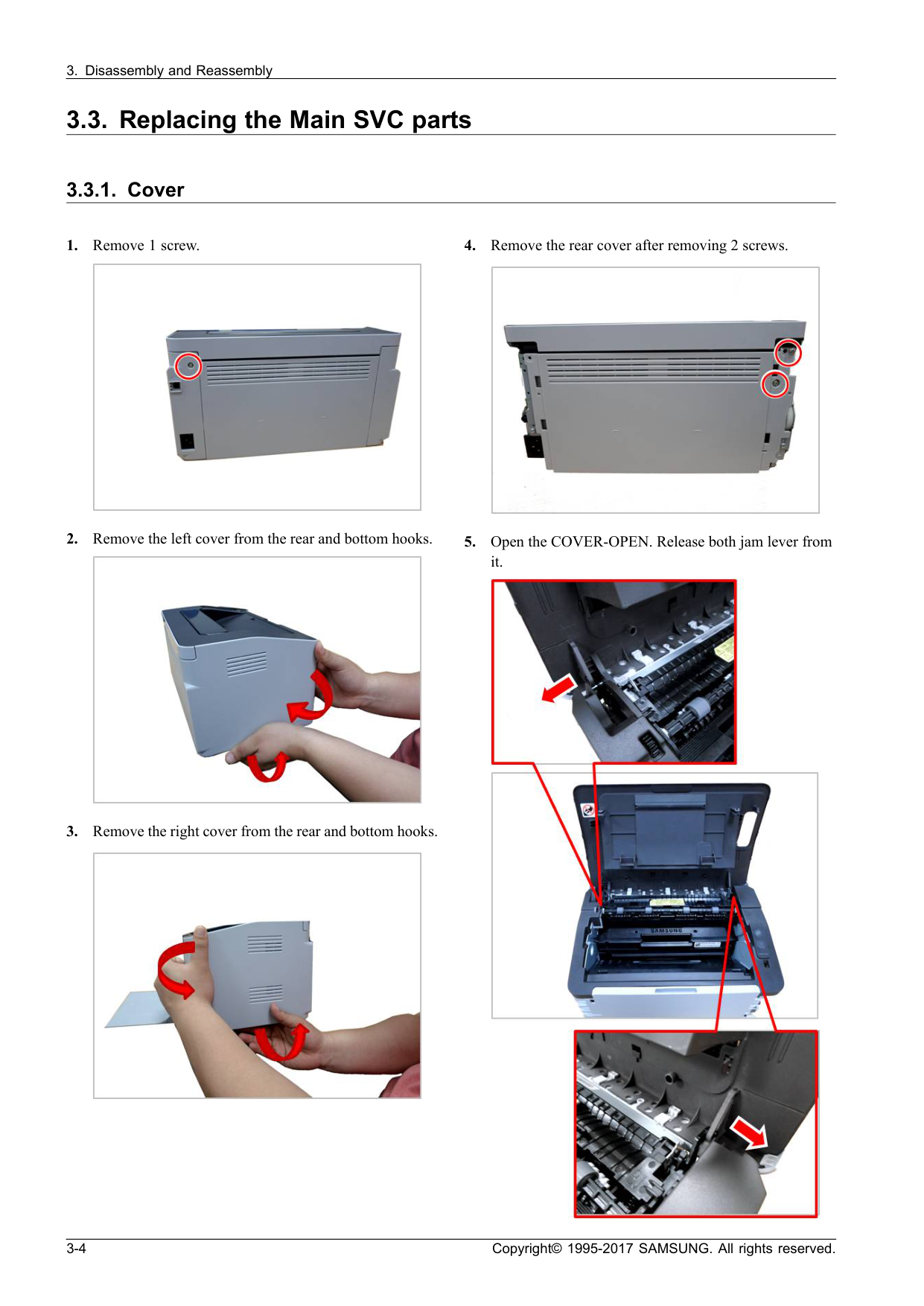
  • 3.3. Replacing the Main SVC parts 3.3.1. Cover
  • Remove 1 screw.
  • Remove the left cover from the rear and bottom hooks.
  • Remove the right cover from the rear and bottom hooks.
  • Remove the rear cover after removing 2 screws.
  • Open the COVER-OPEN. Release both jam lever from
  • it. 3-4 Copyright© 1995-2017 SAMSUNG. All rights reserved.

    Page 45

  • Disassembly and Reassembly
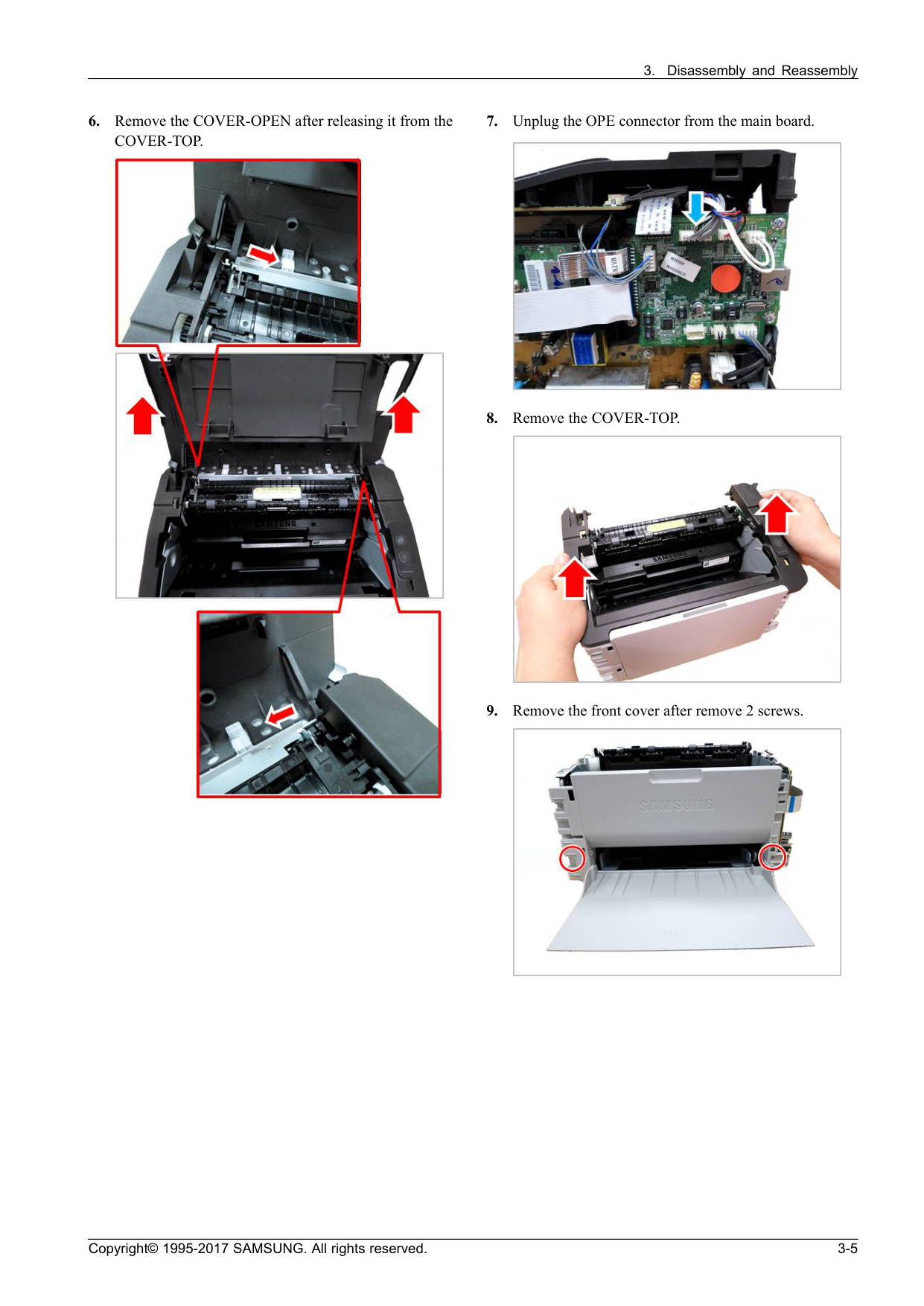
  • Remove the COVER-OPEN after releasing it from the
  • Cover-Top.

  • Unplug the OPE connector from the main board.
  • Remove the COVER-TOP.
  • Remove the front cover after remove 2 screws.
  • Copyright© 1995-2017 SAMSUNG. All rights reserved. 3-5

    Page 46

  • Disassembly and Reassembly
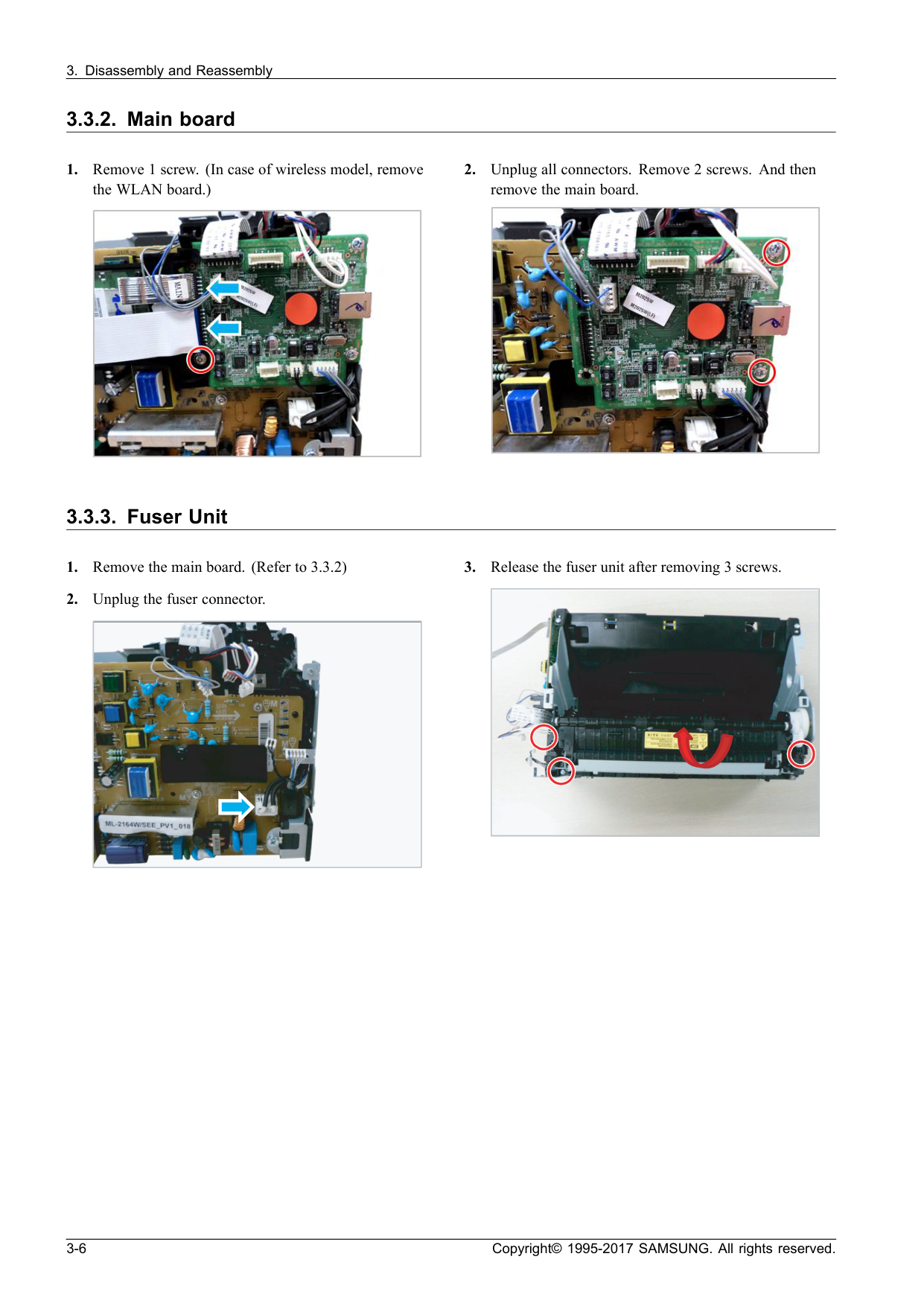
  • 3.3.2. Main board
  • Remove 1 screw. (In case of wireless model, remove
  • the WLAN board.)
  • Unplug all connectors. Remove 2 screws. And then
  • remove the main board. 3.3.3. Fuser Unit
  • Remove the main board. (Refer to 3.3.2)
  • Unplug the fuser connector.
  • Release the fuser unit after removing 3 screws.
  • 3-6 Copyright© 1995-2017 SAMSUNG. All rights reserved.

    Page 47

  • Disassembly and Reassembly
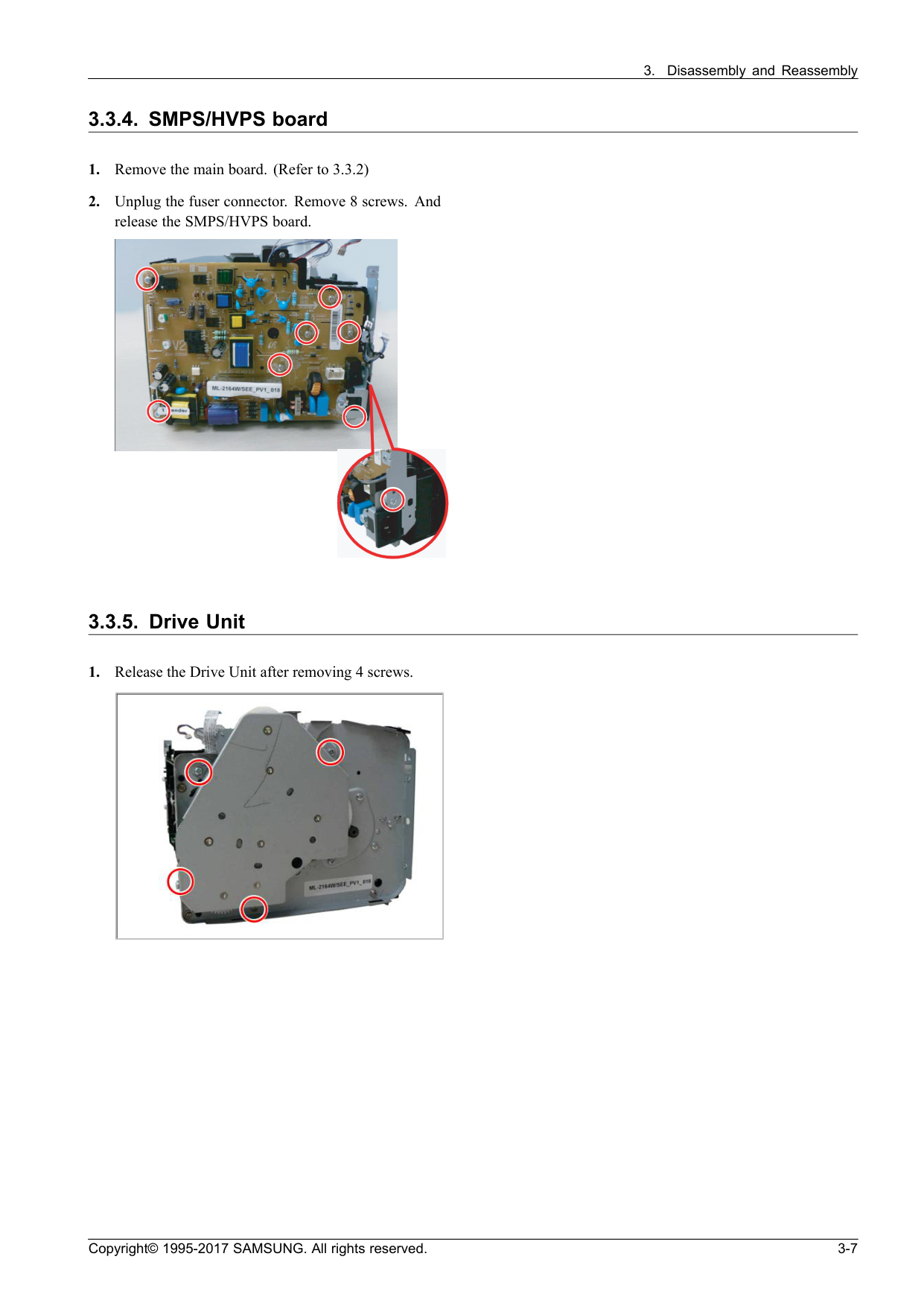
  • 3.3.4. SMPS/HVPS board
  • Remove the main board. (Refer to 3.3.2)
  • Unplug the fuser connector. Remove 8 screws. And
  • release the SMPS/HVPS board. 3.3.5. Drive Unit
  • Release the Drive Unit after removing 4 screws.
  • Copyright© 1995-2017 SAMSUNG. All rights reserved. 3-7

    Page 48

  • Disassembly and Reassembly
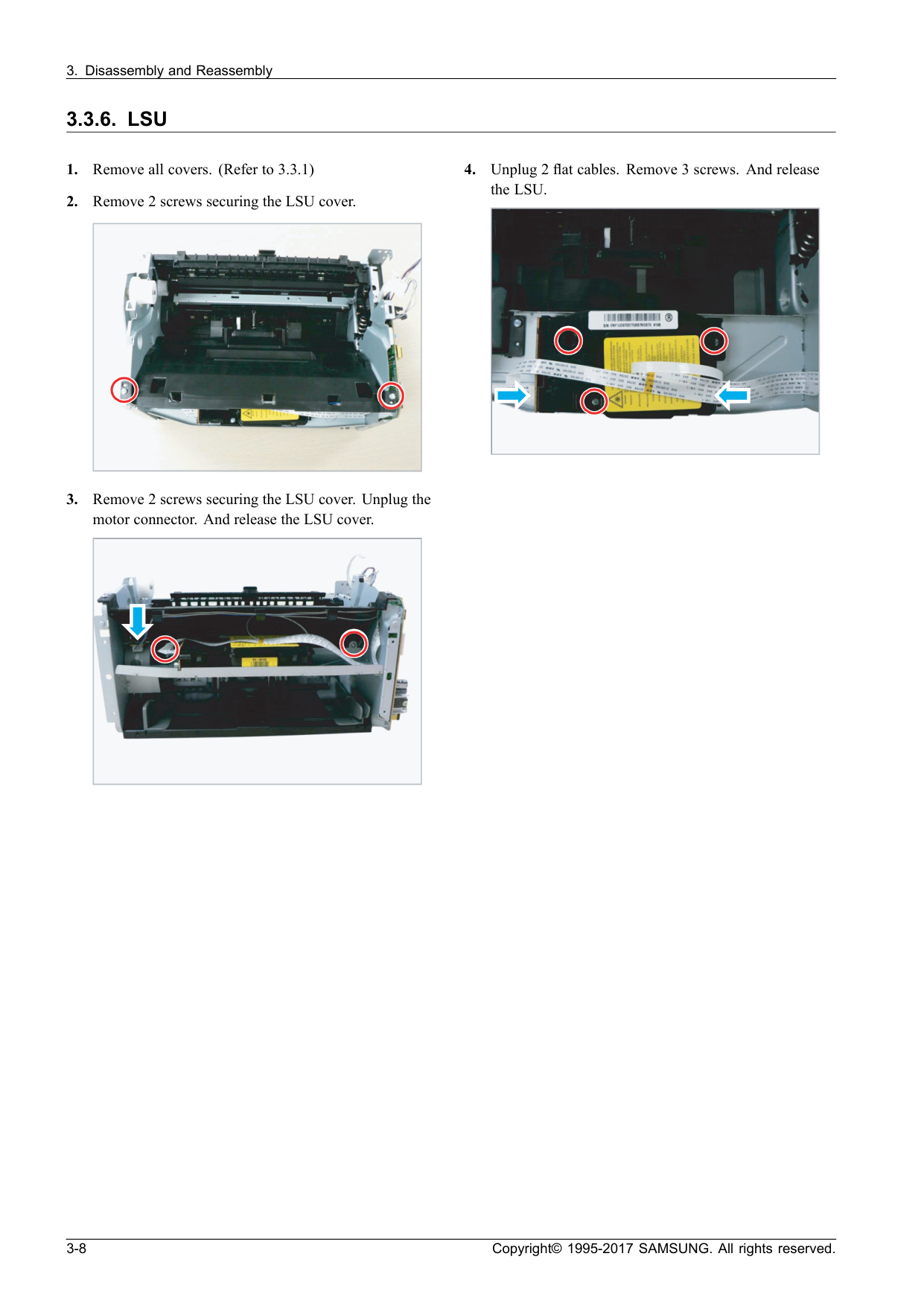
  • 3.3.6. Lsu

  • Remove all covers. (Refer to 3.3.1)
  • Remove 2 screws securing the LSU cover.
  • Remove 2 screws securing the LSU cover. Unplug the
  • motor connector. And release the LSU cover.
  • Unplug 2 flat cables. Remove 3 screws. And release
  • the LSU. 3-8 Copyright© 1995-2017 SAMSUNG. All rights reserved.

    Page 49

  • Disassembly and Reassembly
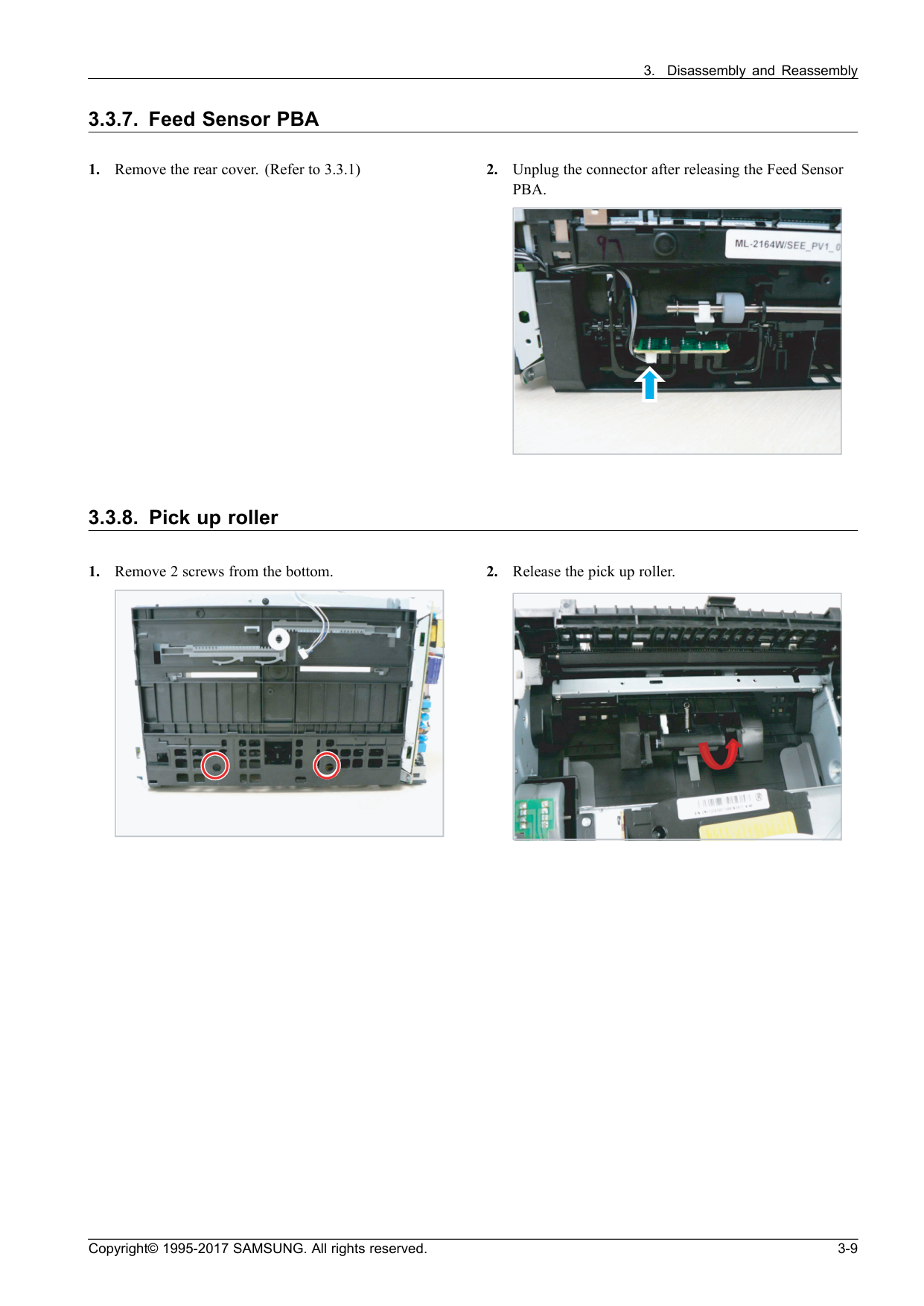
  • 3.3.7. Feed Sensor PBA
  • Remove the rear cover. (Refer to 3.3.1)
  • Unplug the connector after releasing the Feed Sensor
  • Pba.

    3.3.8. Pick up roller
  • Remove 2 screws from the bottom.
  • Release the pick up roller.
  • Copyright© 1995-2017 SAMSUNG. All rights reserved. 3-9

    Page 50

  • Disassembly and Reassembly
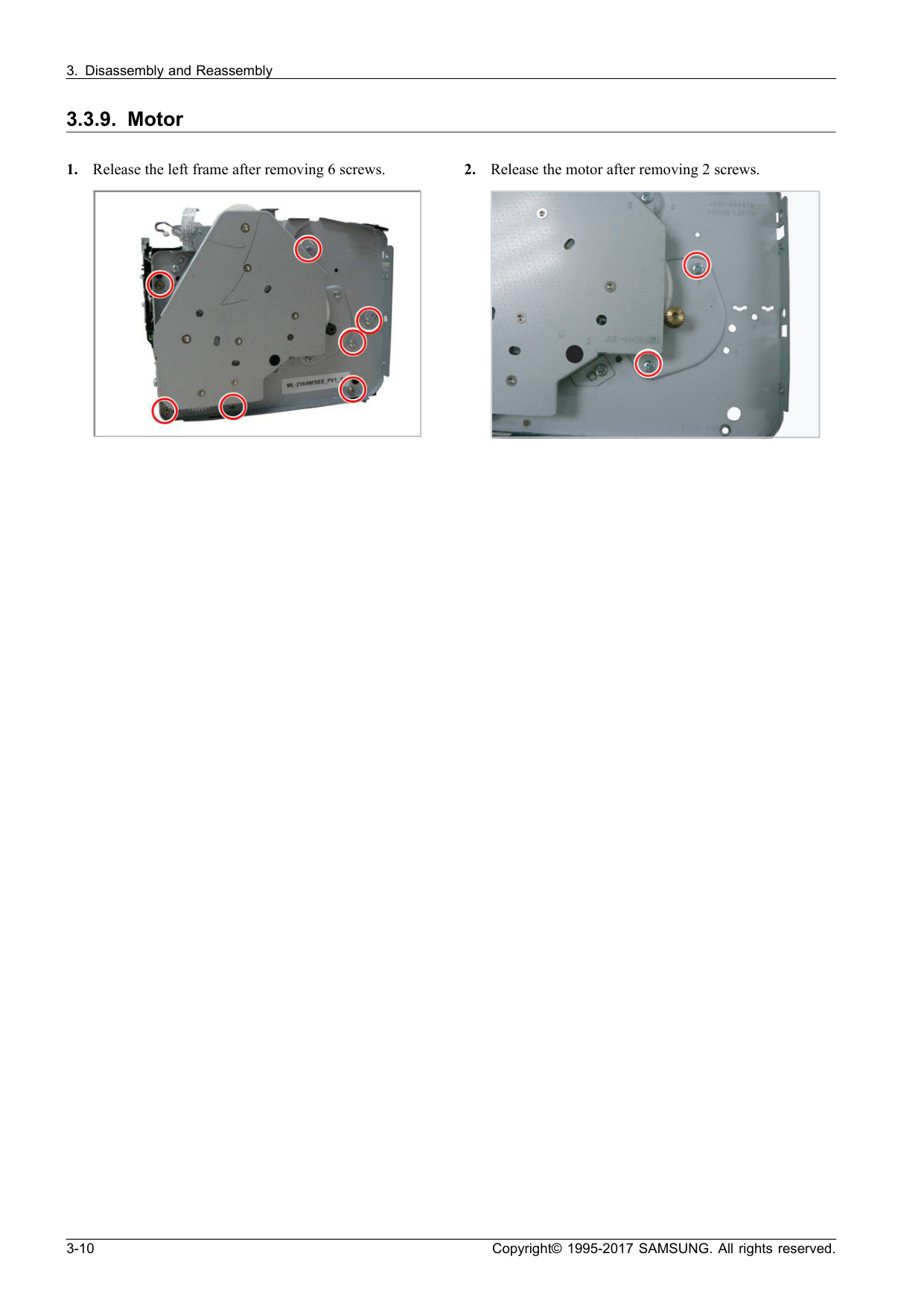
  • 3.3.9. Motor
  • Release the left frame after removing 6 screws.
  • Release the motor after removing 2 screws.
  • 3-10 Copyright© 1995-2017 SAMSUNG. All rights reserved.

    Page 51

  • Disassembly and Reassembly
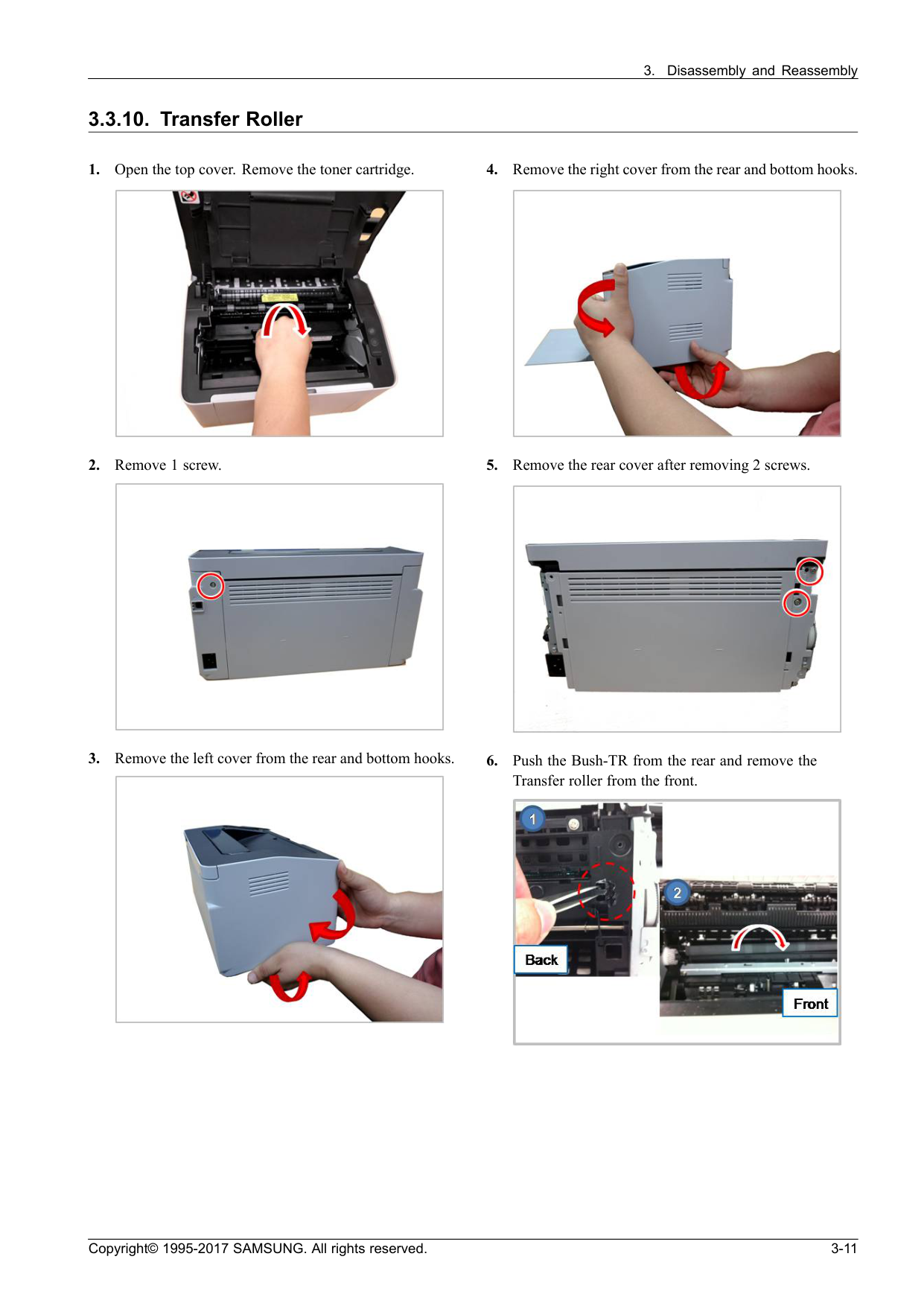
  • 3.3.10. Transfer Roller
  • Open the top cover. Remove the toner cartridge.
  • Remove 1 screw.
  • Remove the left cover from the rear and bottom hooks.
  • Remove the right cover from the rear and bottom hooks.
  • Remove the rear cover after removing 2 screws.
  • Push the Bush-TR from the rear and remove the
  • Transfer roller from the front. Copyright© 1995-2017 SAMSUNG. All rights reserved. 3-11

    Page 52

  • Disassembly and Reassembly
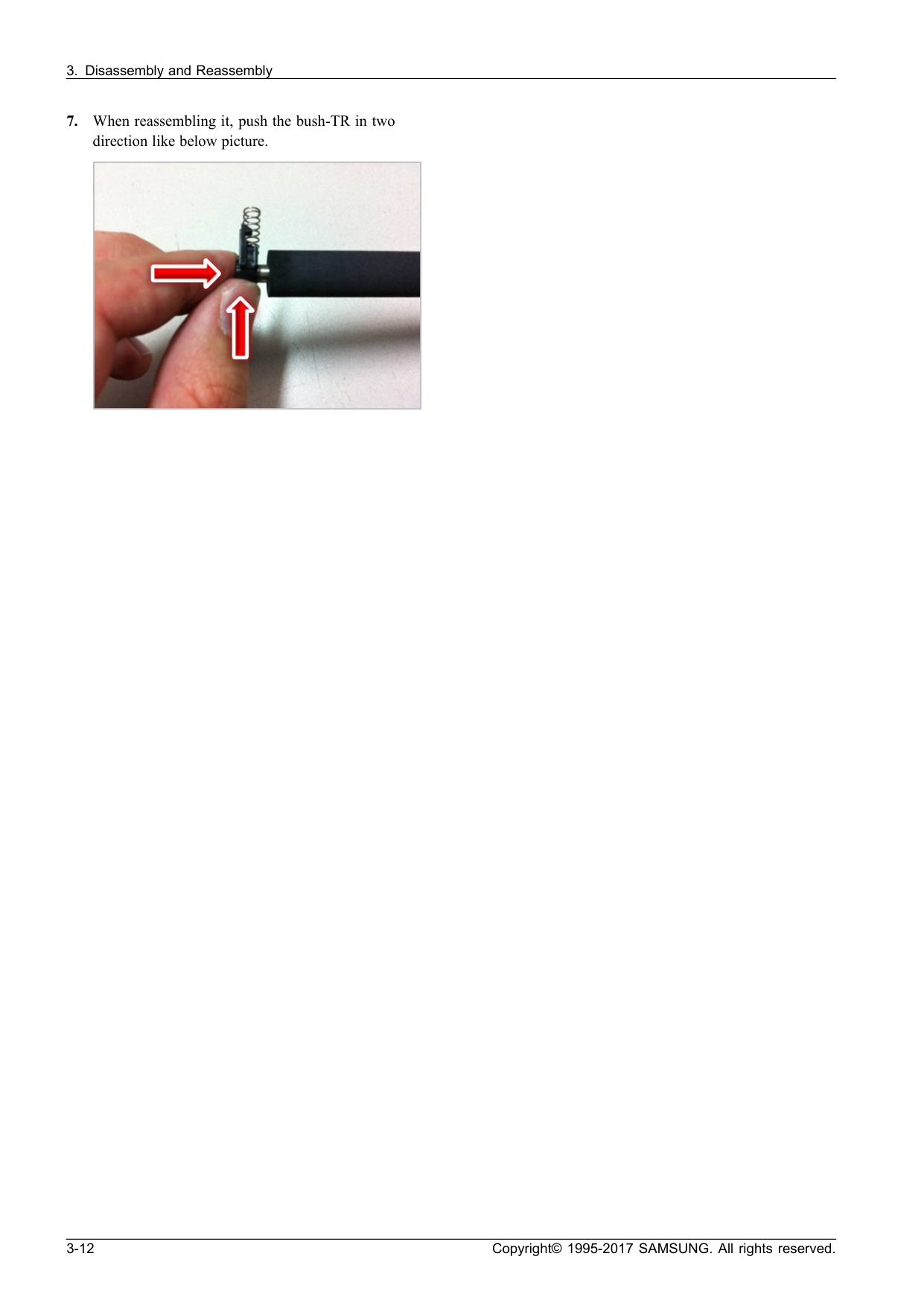
  • When reassembling it, push the bush-TR in two
  • direction like below picture. 3-12 Copyright© 1995-2017 SAMSUNG. All rights reserved.

    Page 53

  • Alignment and Troubleshooting
  • Alignment and Troubleshooting
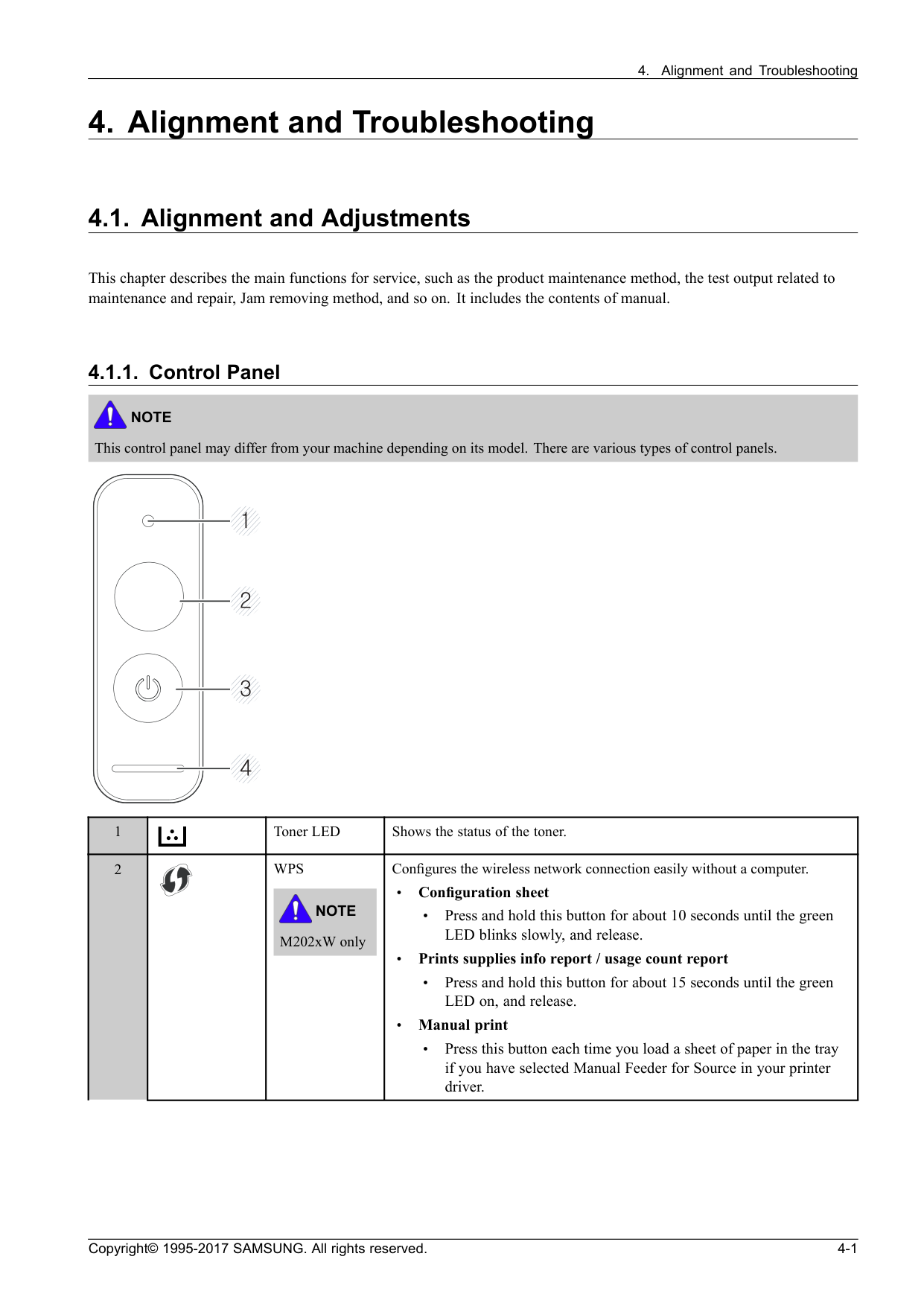
  • 4.1. Alignment and Adjustments This chapter describes the main functions for service, such as the product maintenance method, the test output related to maintenance and repair, Jam removing method, and so on. It includes the contents of manual. 4.1.1. Control Panel

    Note

    This control panel may differ from your machine depending on its model. There are various types of control panels. 1 Toner LED Shows the status of the toner.

    Wps

    Note

    M202xW only Configures the wireless network connection easily without a computer. • Configuration sheet • Press and hold this button for about 10 seconds until the green LED blinks slowly, and release. • Prints supplies info report / usage count report • Press and hold this button for about 15 seconds until the green LED on, and release. • Manual print • Press this button each time you load a sheet of paper in the tray if you have selected Manual Feeder for Source in your printer driver. 2 Copyright© 1995-2017 SAMSUNG. All rights reserved. 4-1
    Page 54

  • Alignment and Troubleshooting
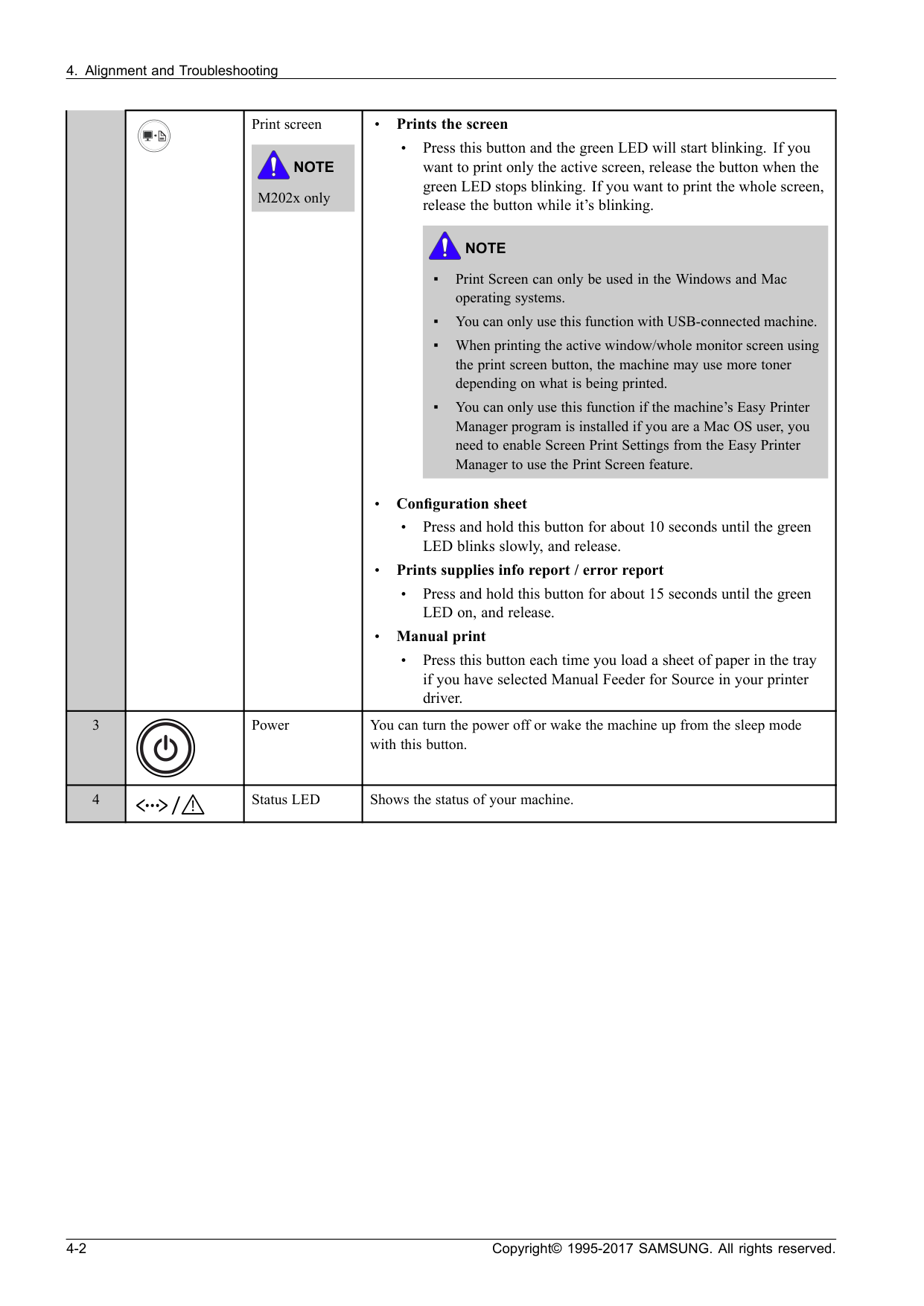
  • Print screen

    Note

    M202x only • Prints the screen • Press this button and the green LED will start blinking. If you want to print only the active screen, release the button when the green LED stops blinking. If you want to print the whole screen, release the button while it’s blinking.

    Note

    ▪ Print Screen can only be used in the Windows and Mac operating systems. ▪ You can only use this function with USB-connected machine. ▪ When printing the active window/whole monitor screen using the print screen button, the machine may use more toner depending on what is being printed. ▪ You can only use this function if the machine’s Easy Printer Manager program is installed if you are a Mac OS user, you need to enable Screen Print Settings from the Easy Printer Manager to use the Print Screen feature. • Configuration sheet • Press and hold this button for about 10 seconds until the green LED blinks slowly, and release. • Prints supplies info report / error report • Press and hold this button for about 15 seconds until the green LED on, and release. • Manual print • Press this button each time you load a sheet of paper in the tray if you have selected Manual Feeder for Source in your printer driver. 3 Power You can turn the power off or wake the machine up from the sleep mode with this button. 4 Status LED Shows the status of your machine. 4-2 Copyright© 1995-2017 SAMSUNG. All rights reserved.
    Page 55

  • Alignment and Troubleshooting
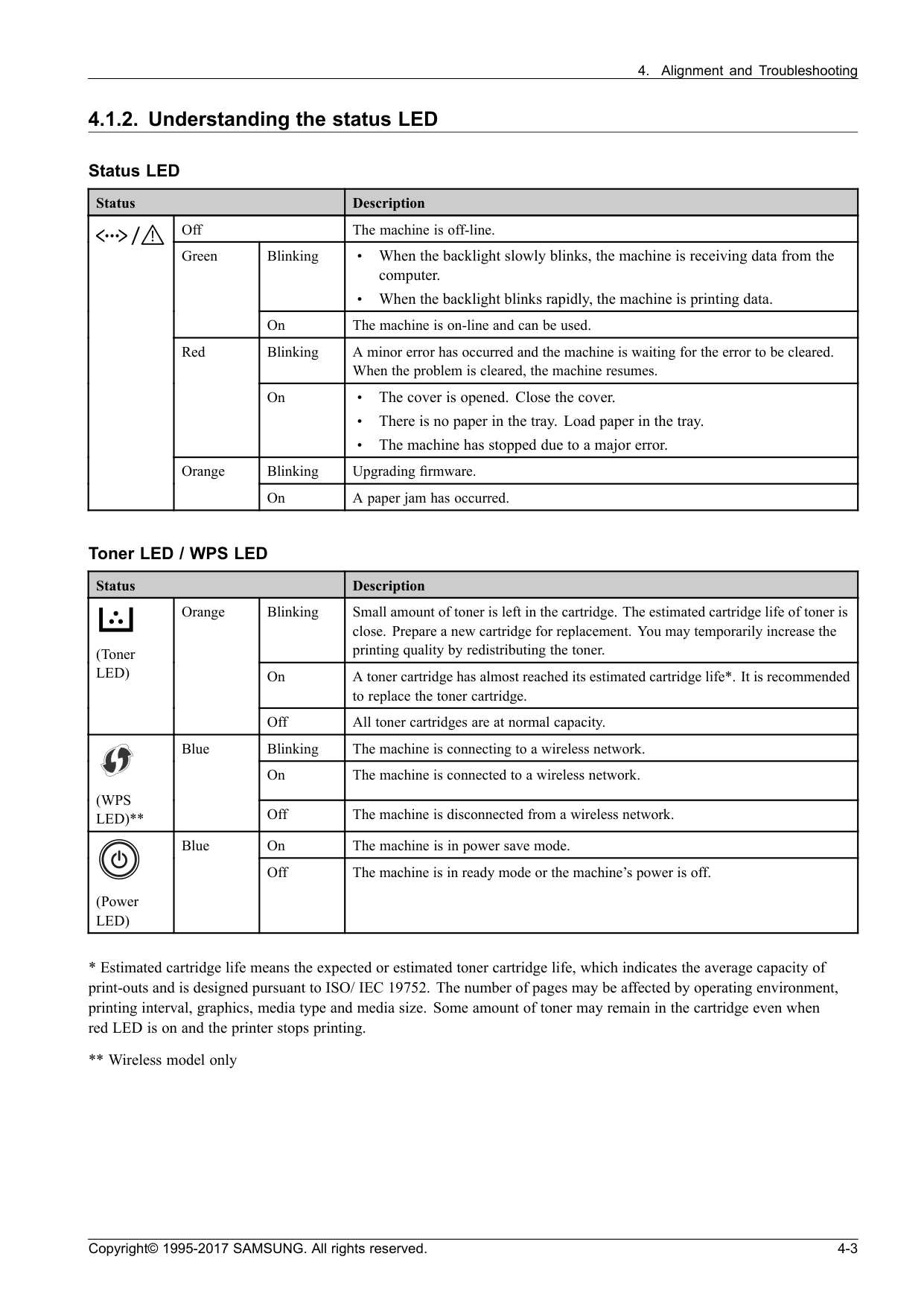
  • 4.1.2. Understanding the status LED Status LED Status Description Off The machine is off-line. Blinking • When the backlight slowly blinks, the machine is receiving data from the computer. • When the backlight blinks rapidly, the machine is printing data. Green On The machine is on-line and can be used. Blinking A minor error has occurred and the machine is waiting for the error to be cleared. When the problem is cleared, the machine resumes. Red On • The cover is opened. Close the cover. • There is no paper in the tray. Load paper in the tray. • The machine has stopped due to a major error. Blinking Upgrading firmware. Orange On A paper jam has occurred. Toner LED / WPS LED Status Description Blinking Small amount of toner is left in the cartridge. The estimated cartridge life of toner is close. Prepare a new cartridge for replacement. You may temporarily increase the printing quality by redistributing the toner. On A toner cartridge has almost reached its estimated cartridge life*. It is recommended to replace the toner cartridge. (Toner

    Led)

    Orange Off All toner cartridges are at normal capacity. Blinking The machine is connecting to a wireless network. On The machine is connected to a wireless network.

    (Wps

    Led)**

    Blue Off The machine is disconnected from a wireless network. On The machine is in power save mode. (Power

    Led)

    Blue Off The machine is in ready mode or the machine’s power is off.
  • Estimated cartridge life means the expected or estimated toner cartridge life, which indicates the average capacity of
  • print-outs and is designed pursuant to ISO/ IEC 19752. The number of pages may be affected by operating environment, printing interval, graphics, media type and media size. Some amount of toner may remain in the cartridge even when red LED is on and the printer stops printing. ** Wireless model only Copyright© 1995-2017 SAMSUNG. All rights reserved. 4-3

    Page 56

  • Alignment and Troubleshooting
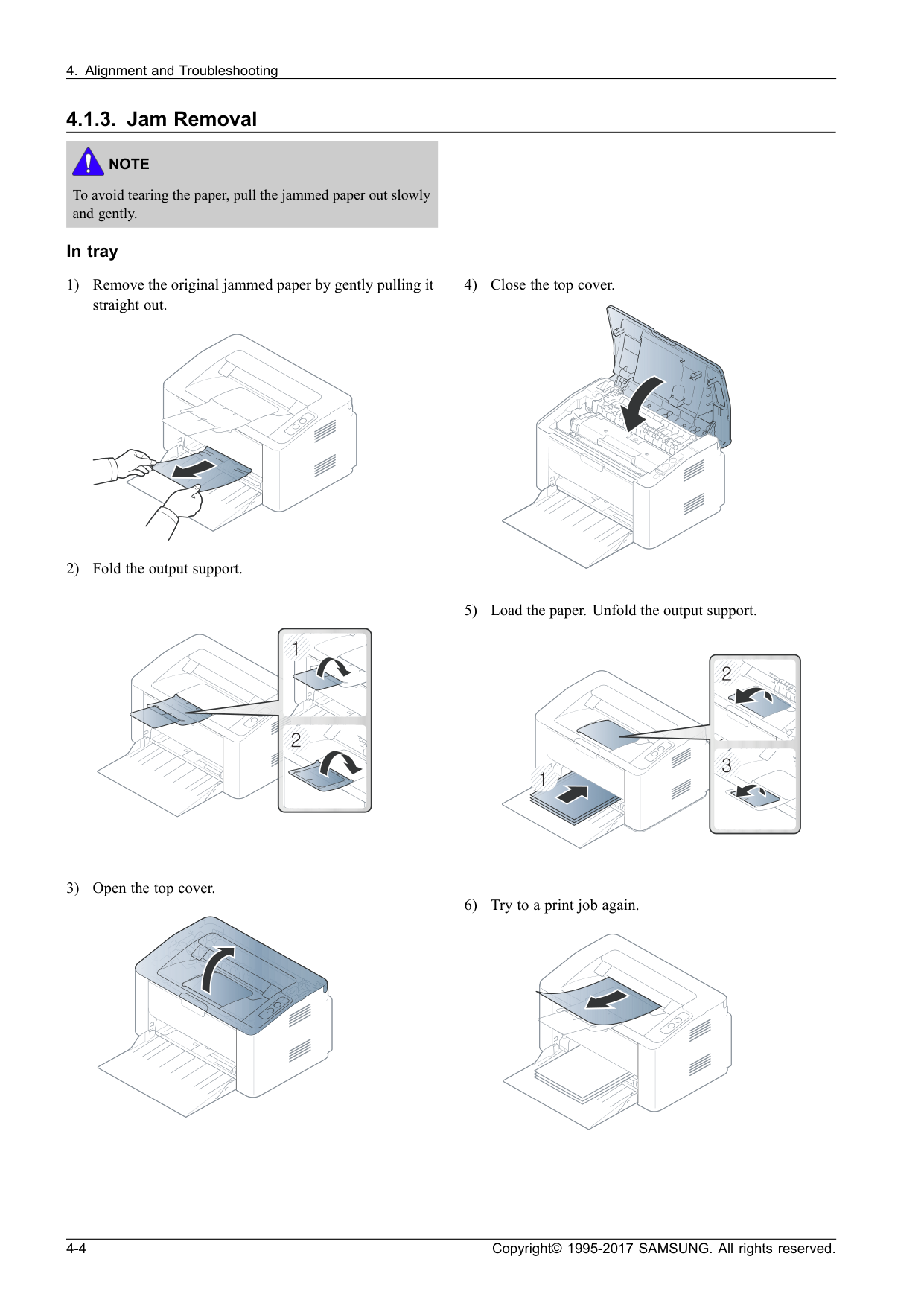
  • 4.1.3. Jam Removal

    Note

    To avoid tearing the paper, pull the jammed paper out slowly and gently. In tray 1) Remove the original jammed paper by gently pulling it straight out. 2) Fold the output support. 3) Open the top cover. 4) Close the top cover. 5) Load the paper. Unfold the output support. 6) Try to a print job again. 4-4 Copyright© 1995-2017 SAMSUNG. All rights reserved.
    Page 57

  • Alignment and Troubleshooting
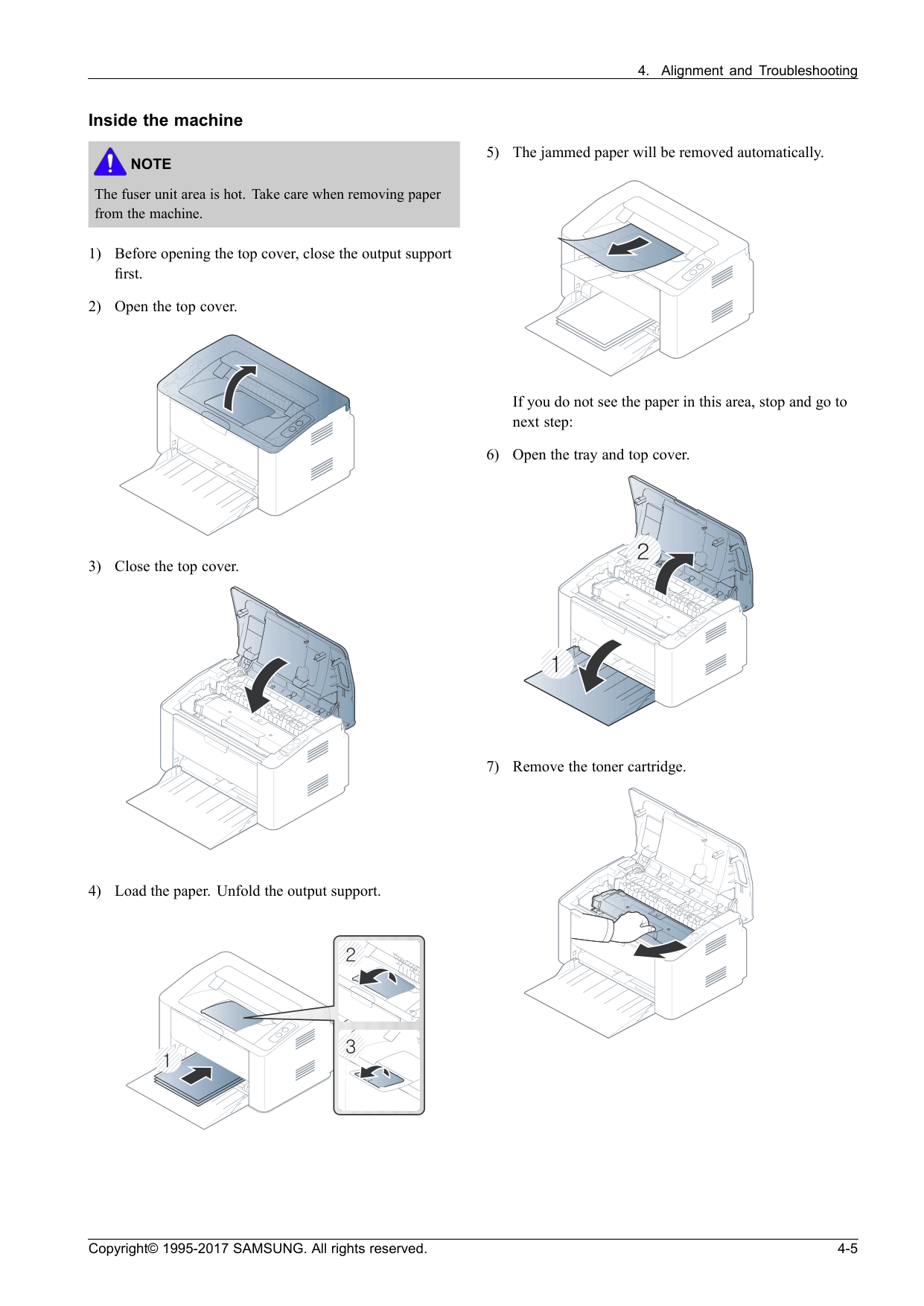
  • Inside the machine

    Note

    The fuser unit area is hot. Take care when removing paper from the machine. 1) Before opening the top cover, close the output support first. 2) Open the top cover. 3) Close the top cover. 4) Load the paper. Unfold the output support. 5) The jammed paper will be removed automatically. If you do not see the paper in this area, stop and go to next step: 6) Open the tray and top cover. 7) Remove the toner cartridge. Copyright© 1995-2017 SAMSUNG. All rights reserved. 4-5
    Page 58

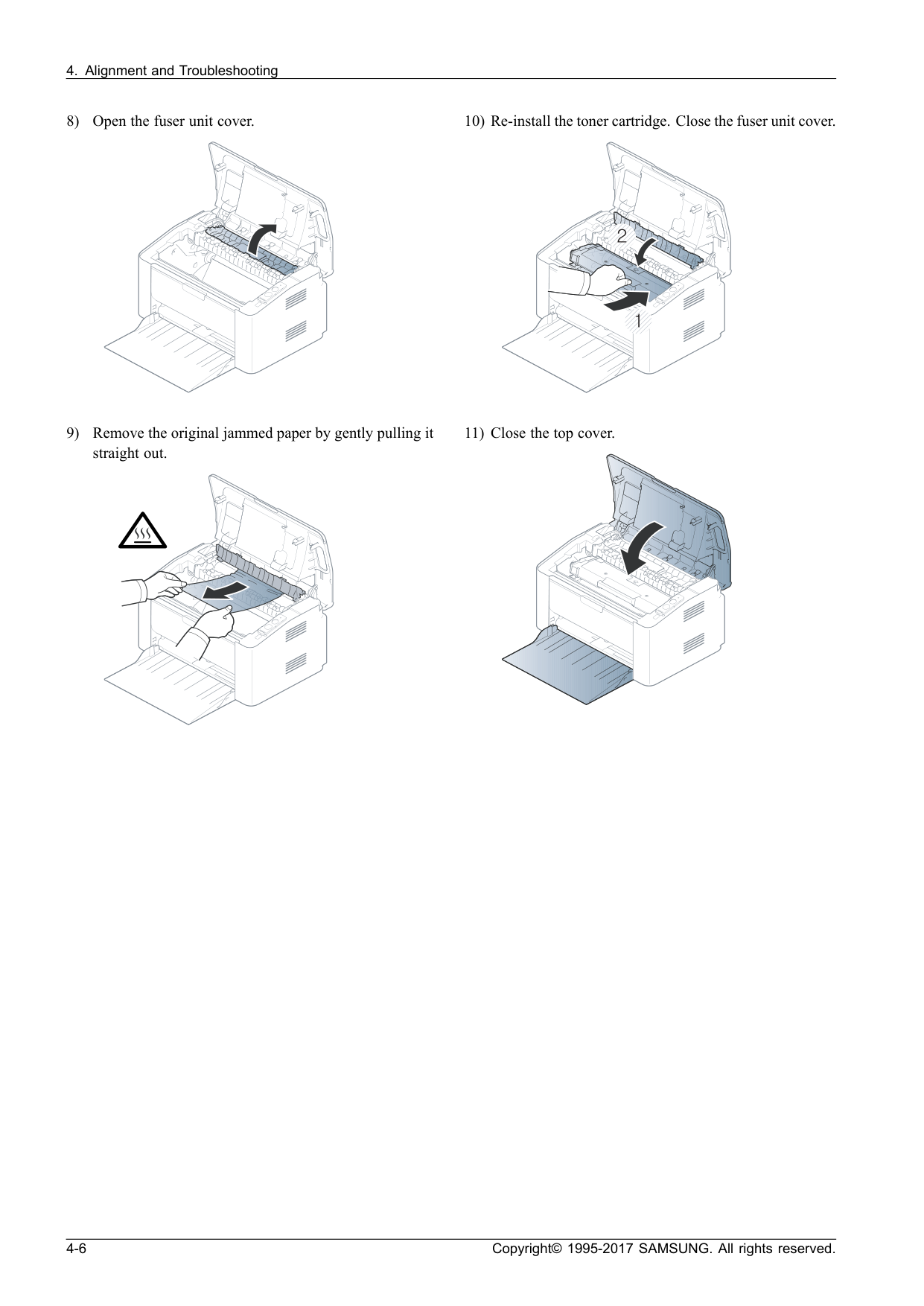
  • Alignment and Troubleshooting
  • 8) Open the fuser unit cover. 9) Remove the original jammed paper by gently pulling it straight out. 10) Re-install the toner cartridge. Close the fuser unit cover. 11) Close the top cover. 4-6 Copyright© 1995-2017 SAMSUNG. All rights reserved.

    Page 59

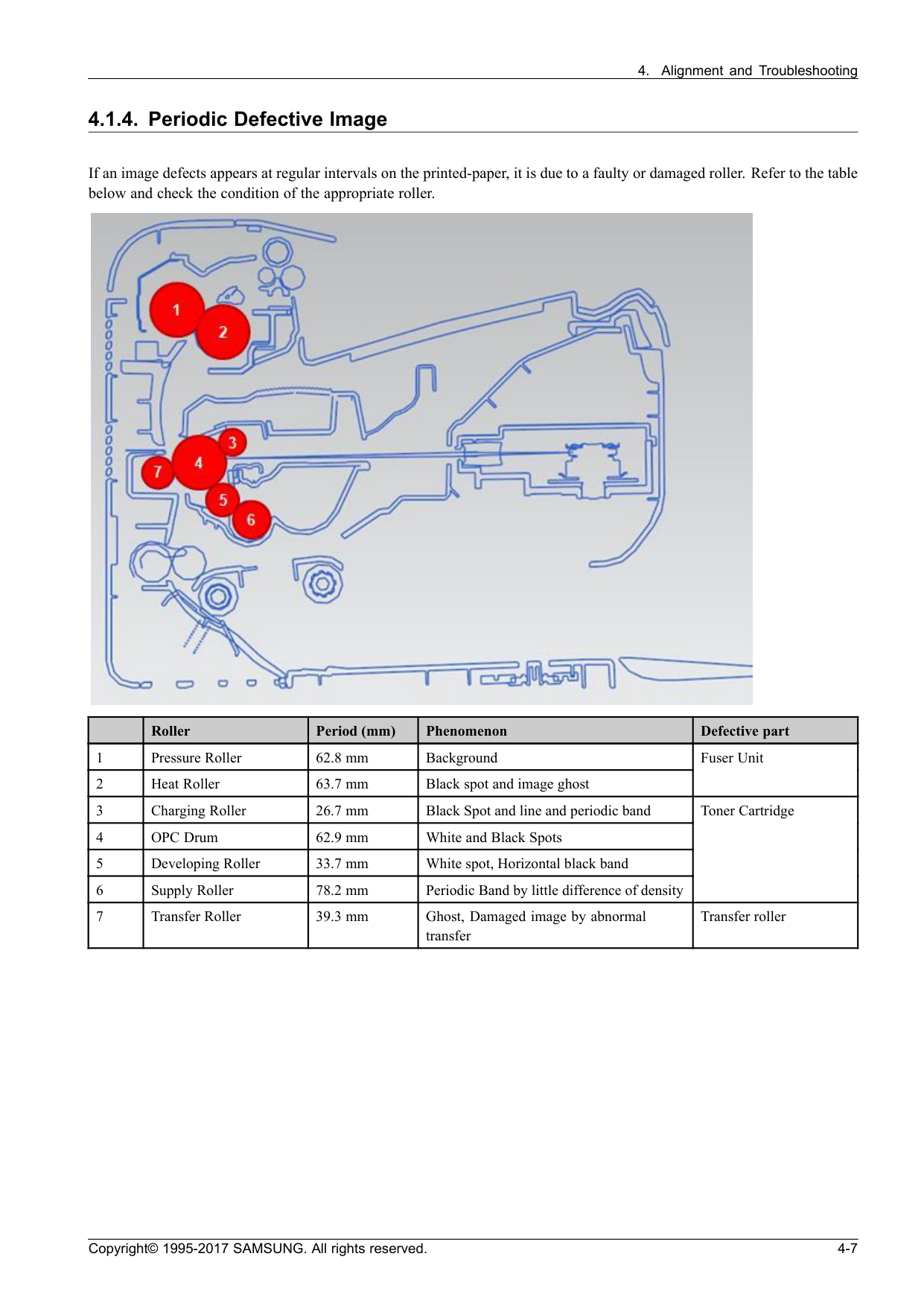
  • Alignment and Troubleshooting
  • 4.1.4. Periodic Defective Image If an image defects appears at regular intervals on the printed-paper, it is due to a faulty or damaged roller. Refer to the table below and check the condition of the appropriate roller. Roller Period (mm) Phenomenon Defective part 1 Pressure Roller 62.8 mm Background 2 Heat Roller 63.7 mm Black spot and image ghost Fuser Unit 3 Charging Roller 26.7 mm Black Spot and line and periodic band 4 OPC Drum 62.9 mm White and Black Spots 5 Developing Roller 33.7 mm White spot, Horizontal black band 6 Supply Roller 78.2 mm Periodic Band by little difference of density Toner Cartridge 7 Transfer Roller 39.3 mm Ghost, Damaged image by abnormal transfer Transfer roller Copyright© 1995-2017 SAMSUNG. All rights reserved. 4-7

    Page 60

  • Alignment and Troubleshooting
  • 4.1.5. Useful management tools 4.1.5.1. Using Samsung Easy Printer Manager (Windows and Macintosh only)

    Note

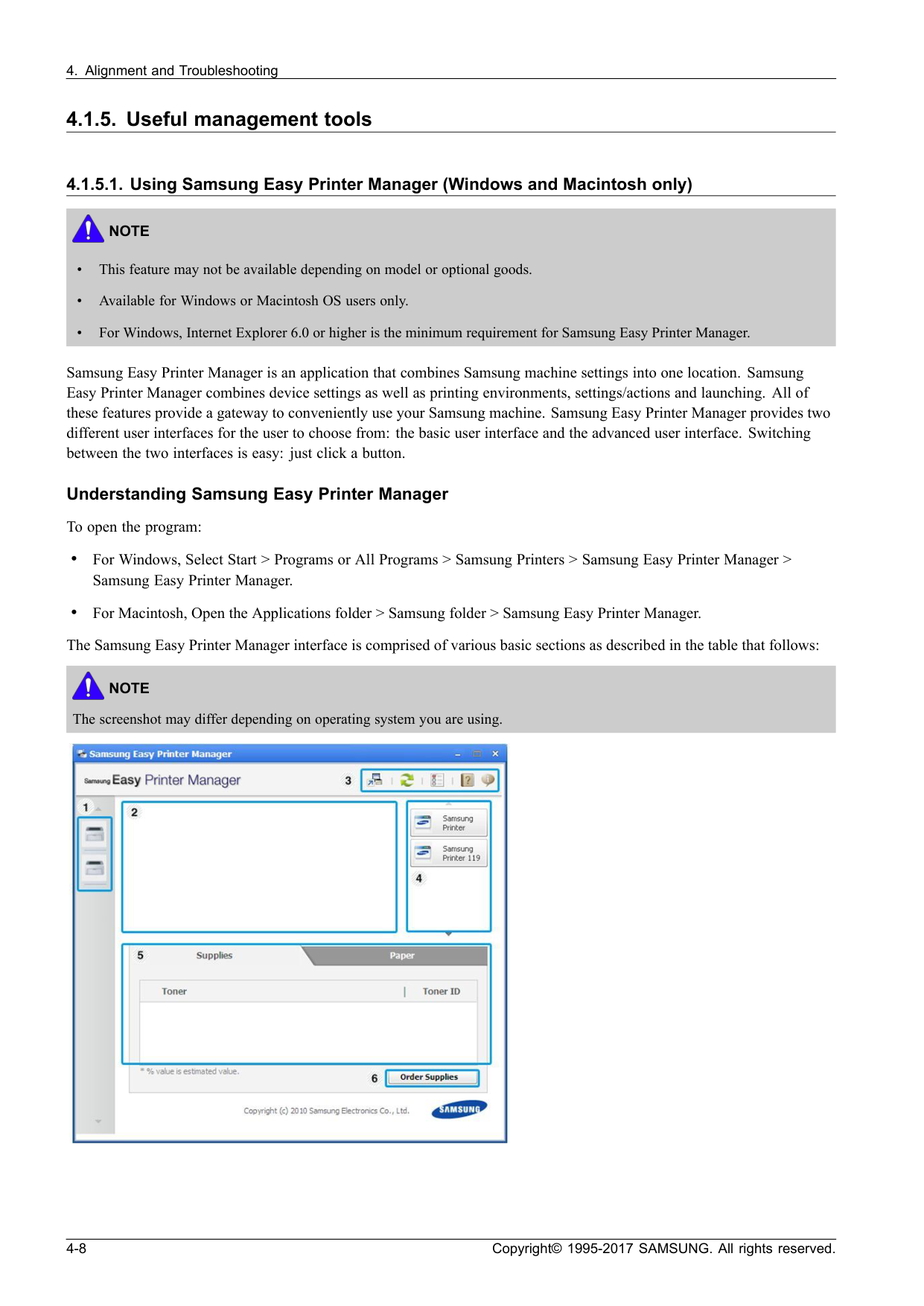
    • This feature may not be available depending on model or optional goods. • Available for Windows or Macintosh OS users only. • For Windows, Internet Explorer 6.0 or higher is the minimum requirement for Samsung Easy Printer Manager. Samsung Easy Printer Manager is an application that combines Samsung machine settings into one location. Samsung Easy Printer Manager combines device settings as well as printing environments, settings/actions and launching. All of these features provide a gateway to conveniently use your Samsung machine. Samsung Easy Printer Manager provides two different user interfaces for the user to choose from: the basic user interface and the advanced user interface. Switching between the two interfaces is easy: just click a button. Understanding Samsung Easy Printer Manager To open the program: • For Windows, Select Start > Programs or All Programs > Samsung Printers > Samsung Easy Printer Manager > Samsung Easy Printer Manager. • For Macintosh, Open the Applications folder > Samsung folder > Samsung Easy Printer Manager. The Samsung Easy Printer Manager interface is comprised of various basic sections as described in the table that follows:

    Note

    The screenshot may differ depending on operating system you are using. 4-8 Copyright© 1995-2017 SAMSUNG. All rights reserved.
    Page 61

  • Alignment and Troubleshooting
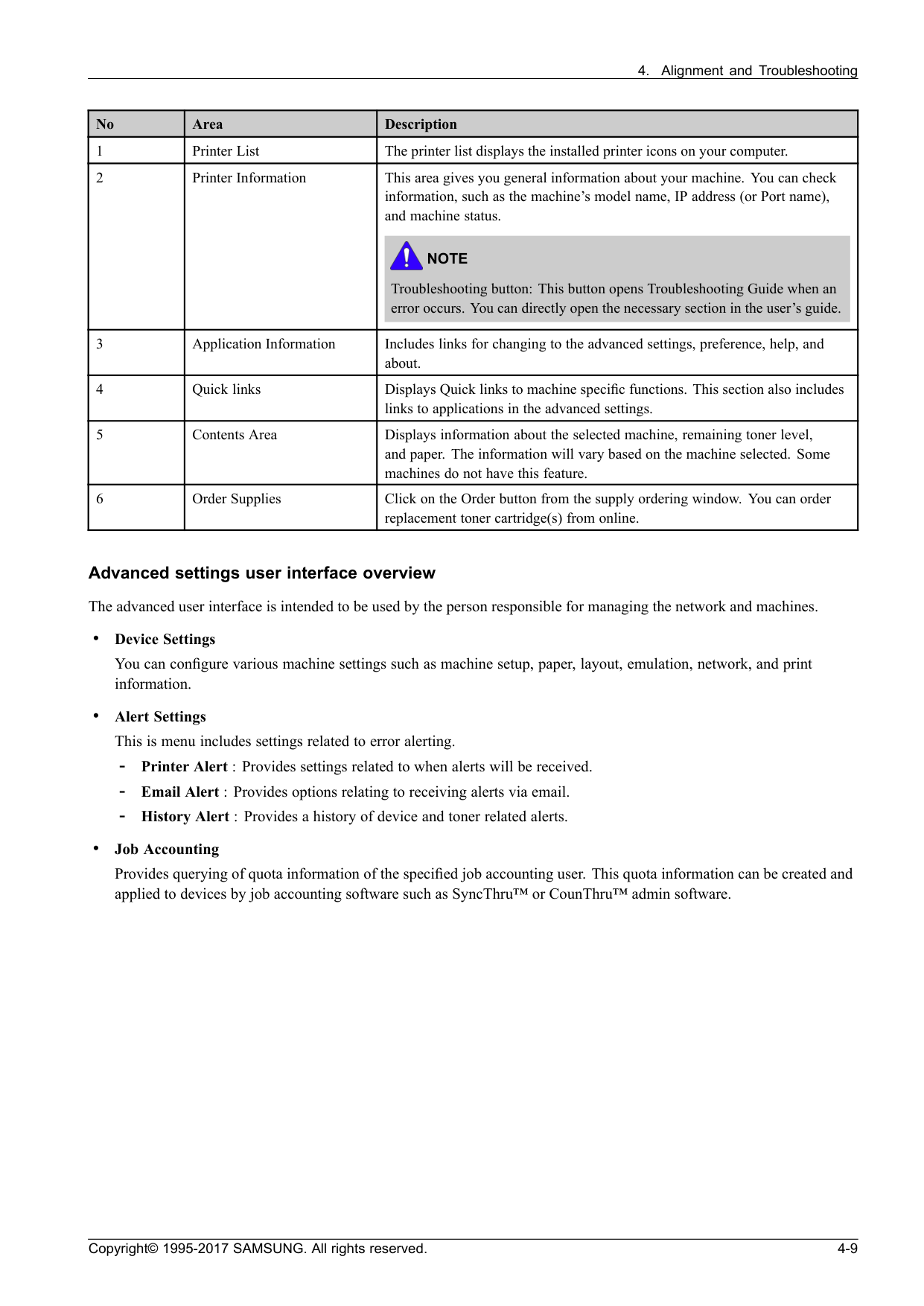
  • No Area Description 1 Printer List The printer list displays the installed printer icons on your computer. 2 Printer Information This area gives you general information about your machine. You can check information, such as the machine’s model name, IP address (or Port name), and machine status.

    Note

    Troubleshooting button: This button opens Troubleshooting Guide when an error occurs. You can directly open the necessary section in the user’s guide. 3 Application Information Includes links for changing to the advanced settings, preference, help, and about. 4 Quick links Displays Quick links to machine specific functions. This section also includes links to applications in the advanced settings. 5 Contents Area Displays information about the selected machine, remaining toner level, and paper. The information will vary based on the machine selected. Some machines do not have this feature. 6 Order Supplies Click on the Order button from the supply ordering window. You can order replacement toner cartridge(s) from online. Advanced settings user interface overview The advanced user interface is intended to be used by the person responsible for managing the network and machines. • Device Settings You can configure various machine settings such as machine setup, paper, layout, emulation, network, and print information. • Alert Settings This is menu includes settings related to error alerting.
  • Printer Alert : Provides settings related to when alerts will be received.
  • Email Alert : Provides options relating to receiving alerts via email.
  • History Alert : Provides a history of device and toner related alerts.
  • • Job Accounting Provides querying of quota information of the specified job accounting user. This quota information can be created and applied to devices by job accounting software such as SyncThru™or CounThru™admin software. Copyright© 1995-2017 SAMSUNG. All rights reserved. 4-9

    Page 62

  • Alignment and Troubleshooting
  • 4.1.5.2. Using Samsung Printer Status (Windows only) The Samsung Printer Status is a program that monitors and informs you of the machine status.

    Note

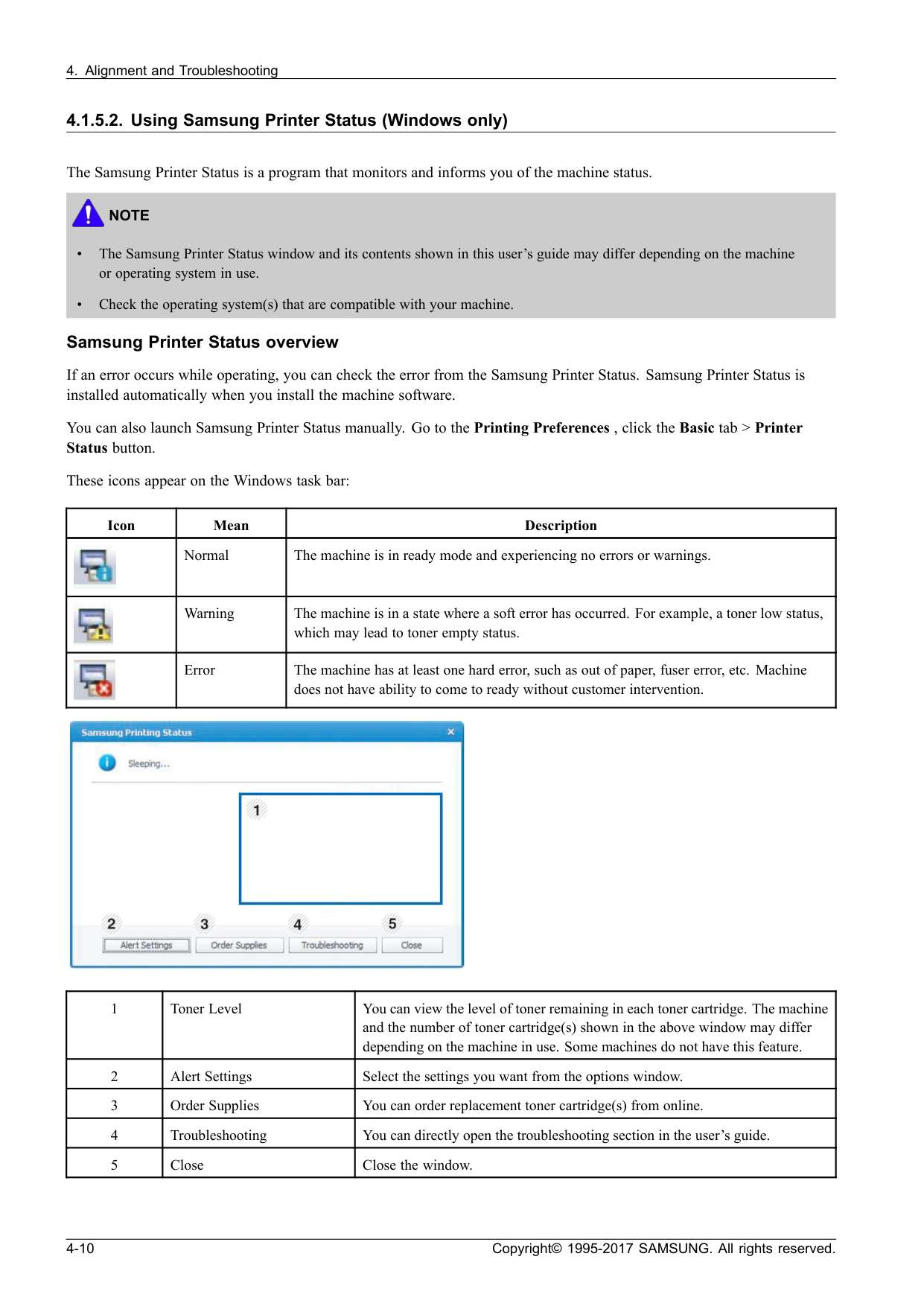
    • The Samsung Printer Status window and its contents shown in this user’s guide may differ depending on the machine or operating system in use. • Check the operating system(s) that are compatible with your machine. Samsung Printer Status overview If an error occurs while operating, you can check the error from the Samsung Printer Status. Samsung Printer Status is installed automatically when you install the machine software. You can also launch Samsung Printer Status manually. Go to the Printing Preferences , click the Basic tab > Printer Status button. These icons appear on the Windows task bar: Icon Mean Description Normal The machine is in ready mode and experiencing no errors or warnings. Warning The machine is in a state where a soft error has occurred. For example, a toner low status, which may lead to toner empty status. Error The machine has at least one hard error, such as out of paper, fuser error, etc. Machine does not have ability to come to ready without customer intervention. 1 Toner Level You can view the level of toner remaining in each toner cartridge. The machine and the number of toner cartridge(s) shown in the above window may differ depending on the machine in use. Some machines do not have this feature. 2 Alert Settings Select the settings you want from the options window. 3 Order Supplies You can order replacement toner cartridge(s) from online. 4 Troubleshooting You can directly open the troubleshooting section in the user’s guide. 5 Close Close the window. 4-10 Copyright© 1995-2017 SAMSUNG. All rights reserved.
    Page 63

  • Alignment and Troubleshooting
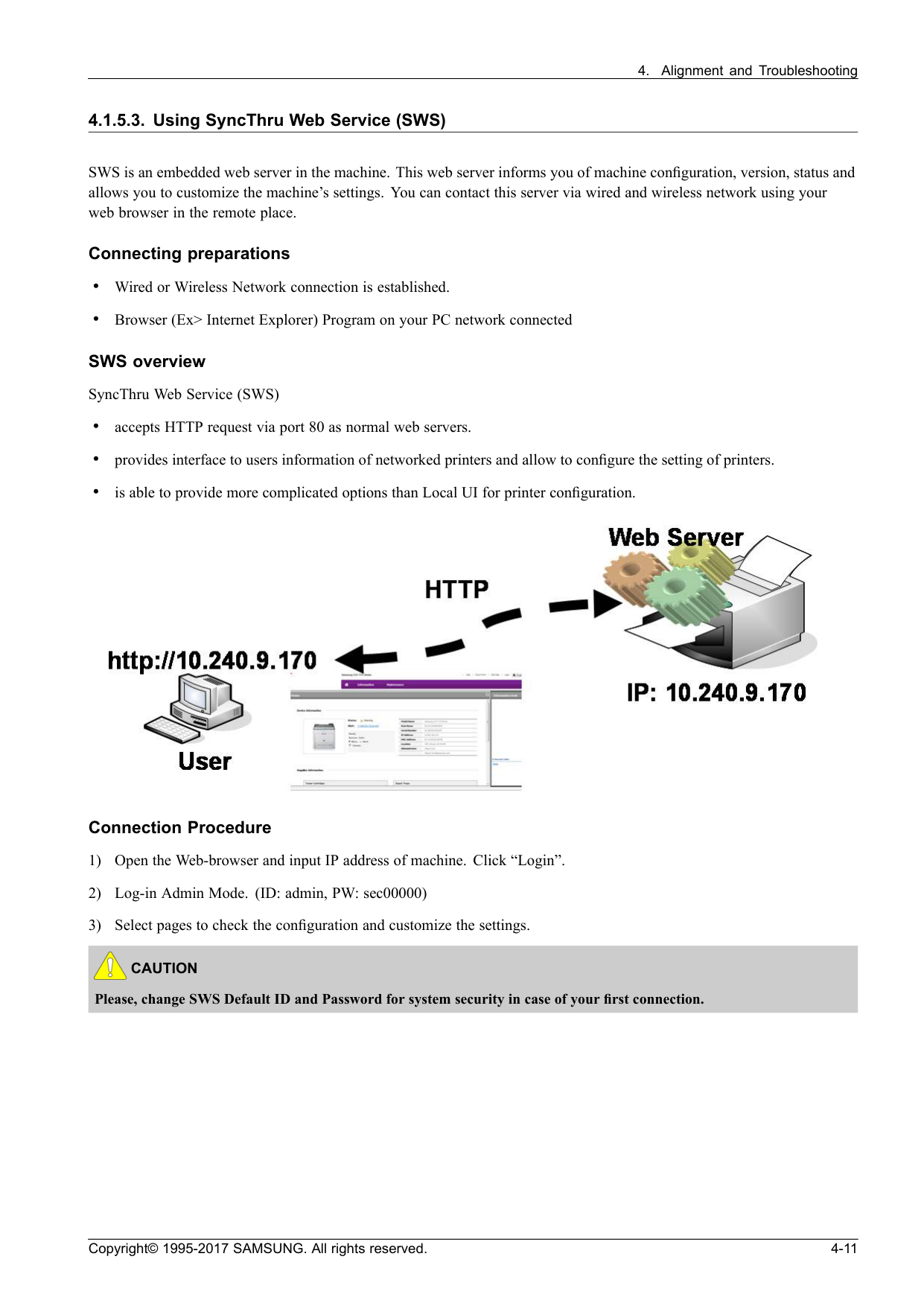
  • 4.1.5.3. Using SyncThru Web Service (SWS) SWS is an embedded web server in the machine. This web server informs you of machine configuration, version, status and allows you to customize the machine’s settings. You can contact this server via wired and wireless network using your web browser in the remote place. Connecting preparations • Wired or Wireless Network connection is established. • Browser (Ex> Internet Explorer) Program on your PC network connected SWS overview SyncThru Web Service (SWS) • accepts HTTP request via port 80 as normal web servers. • provides interface to users information of networked printers and allow to configure the setting of printers. • is able to provide more complicated options than Local UI for printer configuration. Connection Procedure 1) Open the Web-browser and input IP address of machine. Click “Login”. 2) Log-in Admin Mode. (ID: admin, PW: sec00000) 3) Select pages to check the configuration and customize the settings.

    Caution

    Please, change SWS Default ID and Password for system security in case of your first connection. Copyright© 1995-2017 SAMSUNG. All rights reserved. 4-11
    Page 64

  • Alignment and Troubleshooting
  • Note

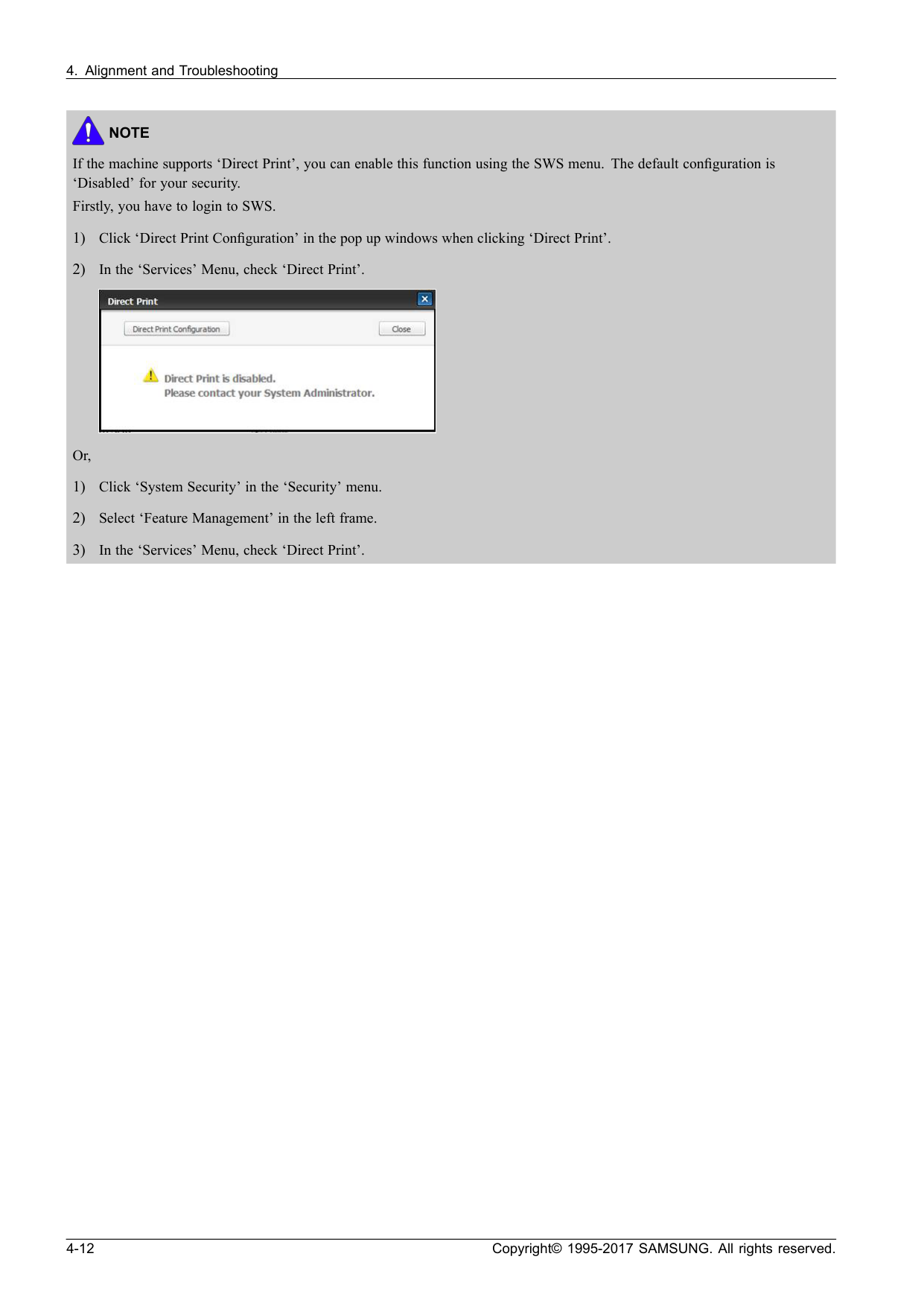
    If the machine supports ‘Direct Print’, you can enable this function using the SWS menu. The default configuration is ‘Disabled’ for your security. Firstly, you have to login to SWS. 1) Click ‘Direct Print Configuration’ in the pop up windows when clicking ‘Direct Print’. 2) In the ‘Services’ Menu, check ‘Direct Print’. Or, 1) Click ‘System Security’ in the ‘Security’ menu. 2) Select ‘Feature Management’ in the left frame. 3) In the ‘Services’ Menu, check ‘Direct Print’. 4-12 Copyright© 1995-2017 SAMSUNG. All rights reserved.
    Page 65

  • Alignment and Troubleshooting
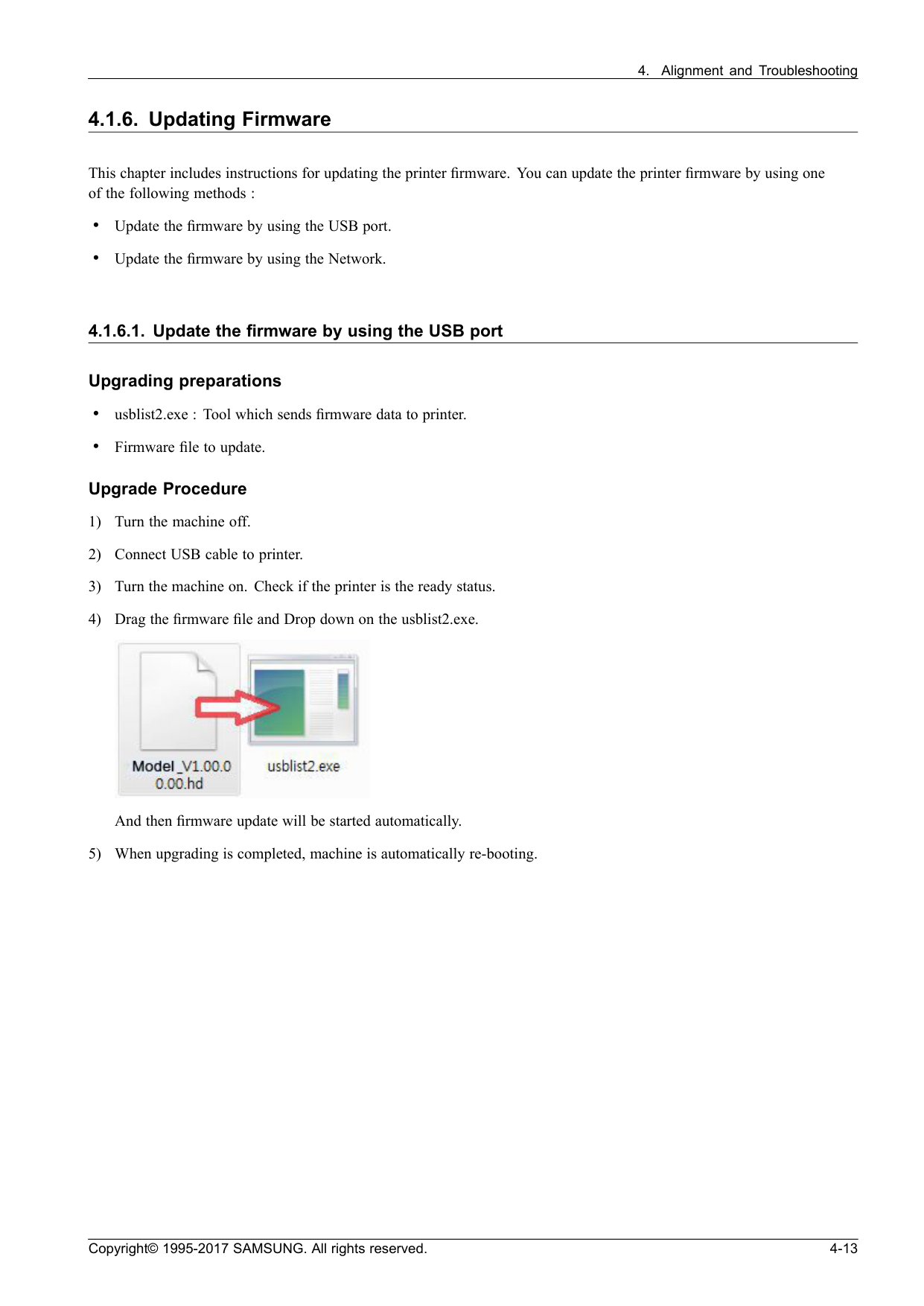
  • 4.1.6. Updating Firmware This chapter includes instructions for updating the printer firmware. You can update the printer firmware by using one of the following methods : • Update the firmware by using the USB port. • Update the firmware by using the Network. 4.1.6.1. Update the firmware by using the USB port Upgrading preparations • usblist2.exe : Tool which sends firmware data to printer. • Firmware file to update. Upgrade Procedure 1) Turn the machine off. 2) Connect USB cable to printer. 3) Turn the machine on. Check if the printer is the ready status. 4) Drag the firmware file and Drop down on the usblist2.exe. And then firmware update will be started automatically. 5) When upgrading is completed, machine is automatically re-booting. Copyright© 1995-2017 SAMSUNG. All rights reserved. 4-13
    Page 66

  • Alignment and Troubleshooting
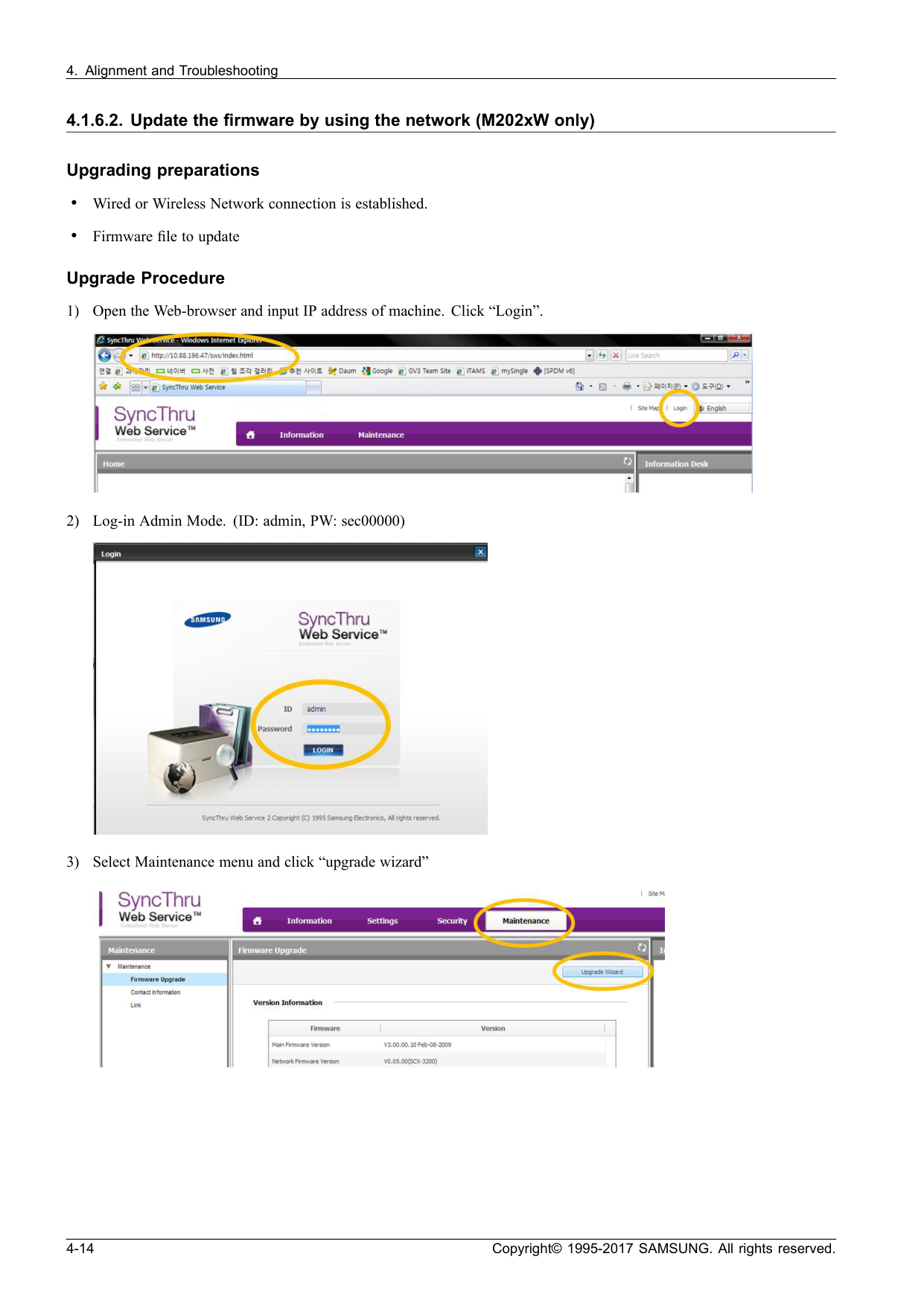
  • 4.1.6.2. Update the firmware by using the network (M202xW only) Upgrading preparations • Wired or Wireless Network connection is established. • Firmware file to update Upgrade Procedure 1) Open the Web-browser and input IP address of machine. Click “Login”. 2) Log-in Admin Mode. (ID: admin, PW: sec00000) 3) Select Maintenance menu and click “upgrade wizard” 4-14 Copyright© 1995-2017 SAMSUNG. All rights reserved.
    Page 67

  • Alignment and Troubleshooting
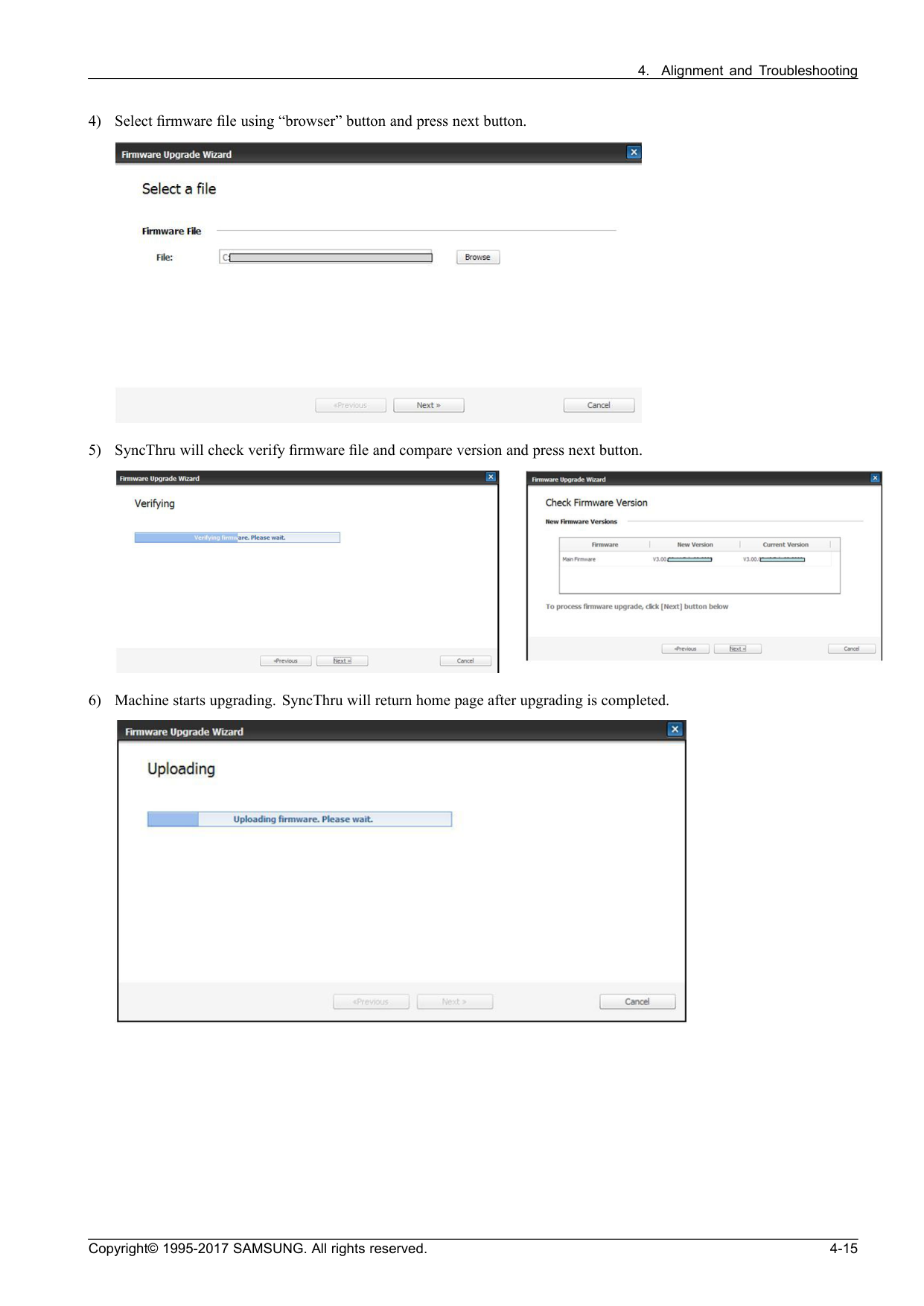
  • 4) Select firmware file using “browser” button and press next button. 5) SyncThru will check verify firmware file and compare version and press next button. 6) Machine starts upgrading. SyncThru will return home page after upgrading is completed. Copyright© 1995-2017 SAMSUNG. All rights reserved. 4-15
    Page 68

  • Alignment and Troubleshooting
  • 4.2. Troubleshooting 4.2.1. Procedure of checking the symptoms Before attempting to repair the printer first obtain a detailed description of the problem from the customer. 4-16 Copyright© 1995-2017 SAMSUNG. All rights reserved.

    Page 69

  • Alignment and Troubleshooting
  • 4.2.1.1. Basic Check List 1) Check the Power. • Check that the power switch is turned on. • Check that the power cable is plugged into the outlet and the printer. • Check the voltage of the power outlet. 2) Check the LED of Panel. • Is there OPE LED ON? › If not check power cable, switch SMPS or Main board. • Is the abnormal Lamp? › Check the Main board and cable harness. 3) Check the Paper Path • Is there a Paper Jam? › Remove any paper fragments caught in the paper path. • Paper Jam occurs repeatedly at a specific point in the Paper Path › Open the fuser cover, Jam clear. › Dismantle the machine and carefully inspect the region where the jam occurs. (Especially, check if paper fragments are caught in the Fuser 4) Print the Information Page (Configuration). • Try printing a test page from a computer. › If there is an error check cables and driver installation. 5) Check the Print Quality. • Is there are a Print Quality Problem? › Refer to image quality problem section. 6) Check consumables (toner etc.). • Using the keys print the Test Pattern. › Expected life of various consumable parts, compare this with the figures printed and replace as required Copyright© 1995-2017 SAMSUNG. All rights reserved. 4-17

    Page 70

  • Alignment and Troubleshooting
  • 4.2.2. Error Code and Troubleshooting Error in machine can be checked through “Event Log Information” report. Error Code Error Message Troubleshooting

    C2-1110

    Prepare new toner cartridge. Page 4–19

    C2-1150

    Replace with new toner cartridge. Page 4–19

    C2-1410

    Toner cartridge is not installed. Install the cartridge. Page 4–19

    C2-1510

    Toner cartridge is not compatible. Check user's guide. Page 4–20

    C2–1711

    Toner Cartridge Failure: #C2-1711. Call for service Page 4–19

    C2–1712

    Toner Cartridge Failure: #C2-1712. Call for service Page 4–19

    M2-1110

    Paper jam inside of machine. Page 4–20

    M2–1116

    Paper jam or empty in tray Page 4–20

    M2–1317

    Paper jam inside of machine Page 4–21

    S2-4110

    Door is open. Close it. Page 4–22

    S6-3123

    This IP address conflicts with that of other system. Check it. Page 4–22

    U1-2320

    Fuser Unit Failure #U1-2320. Turn off then on. Page 4–23

    U1-2330

    Fuser Unit Failure #U1-2330. Turn off then on. Page 4–23

    U1-2340

    Fuser Unit Failure #U1-2340. Turn off then on. Page 4–23

    U2-1112

    LSU Unit Failure: #U2-1112. Turn off then on. Page 4–24

    U2-1113

    LSU Unit Failure: #U2-1113. Turn off then on. Page 4–24 4-18 Copyright© 1995-2017 SAMSUNG. All rights reserved.
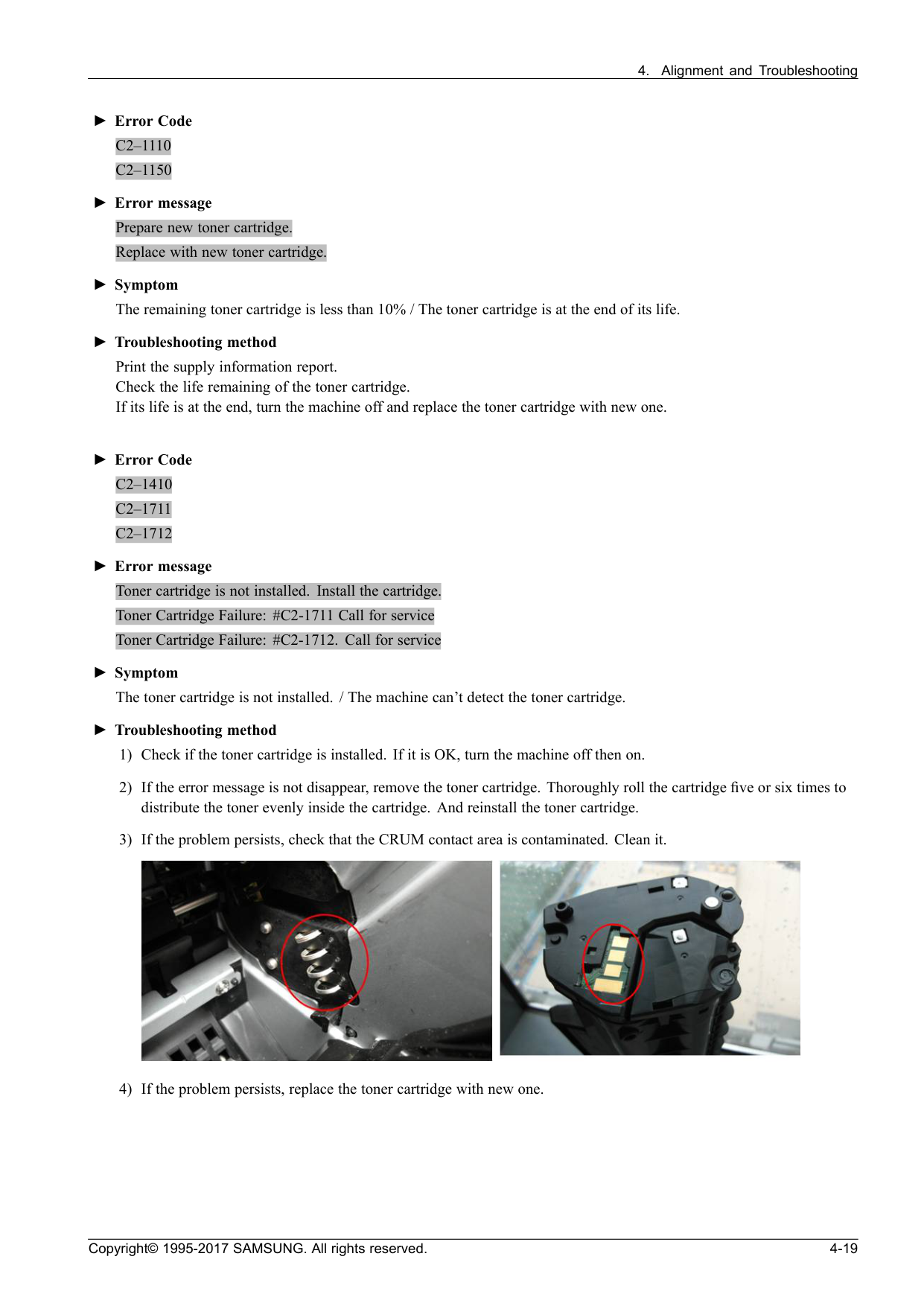
    Page 71

  • Alignment and Troubleshooting
  • ►Error Code

    C2–1110

    C2–1150

    ►Error message Prepare new toner cartridge. Replace with new toner cartridge. ►Symptom The remaining toner cartridge is less than 10% / The toner cartridge is at the end of its life. ►Troubleshooting method Print the supply information report. Check the life remaining of the toner cartridge. If its life is at the end, turn the machine off and replace the toner cartridge with new one. ►Error Code

    C2–1410

    C2–1711

    C2–1712

    ►Error message Toner cartridge is not installed. Install the cartridge. Toner Cartridge Failure: #C2-1711 Call for service Toner Cartridge Failure: #C2-1712. Call for service ►Symptom The toner cartridge is not installed. / The machine can’t detect the toner cartridge. ►Troubleshooting method 1) Check if the toner cartridge is installed. If it is OK, turn the machine off then on. 2) If the error message is not disappear, remove the toner cartridge. Thoroughly roll the cartridge five or six times to distribute the toner evenly inside the cartridge. And reinstall the toner cartridge. 3) If the problem persists, check that the CRUM contact area is contaminated. Clean it. 4) If the problem persists, replace the toner cartridge with new one. Copyright© 1995-2017 SAMSUNG. All rights reserved. 4-19
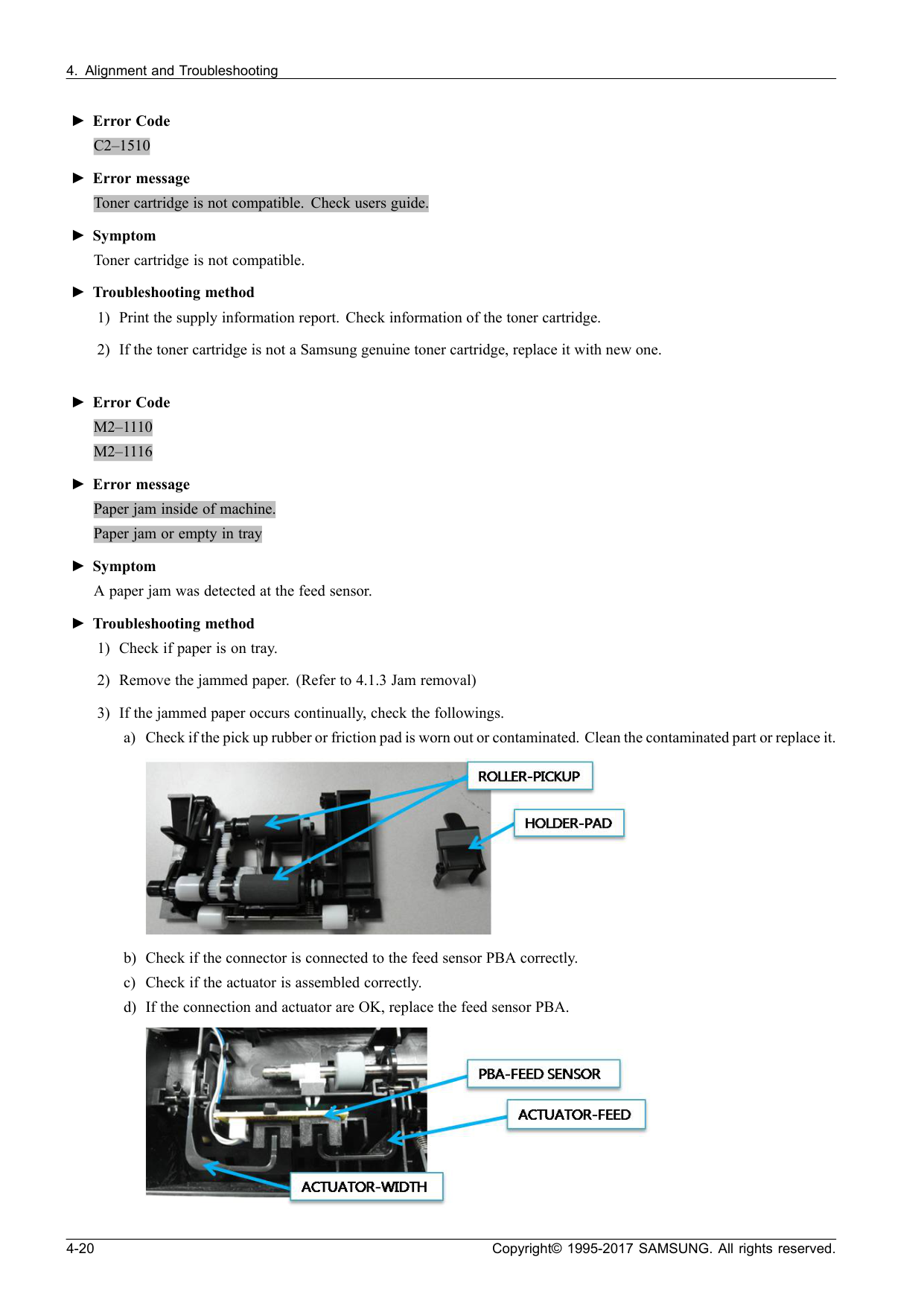
    Page 72

  • Alignment and Troubleshooting
  • ►Error Code

    C2–1510

    ►Error message Toner cartridge is not compatible. Check users guide. ►Symptom Toner cartridge is not compatible. ►Troubleshooting method 1) Print the supply information report. Check information of the toner cartridge. 2) If the toner cartridge is not a Samsung genuine toner cartridge, replace it with new one. ►Error Code

    M2–1110

    M2–1116

    ►Error message Paper jam inside of machine. Paper jam or empty in tray ►Symptom A paper jam was detected at the feed sensor. ►Troubleshooting method 1) Check if paper is on tray. 2) Remove the jammed paper. (Refer to 4.1.3 Jam removal) 3) If the jammed paper occurs continually, check the followings. a) Check if the pick up rubber or friction pad is worn out or contaminated. Clean the contaminated part or replace it. b) Check if the connector is connected to the feed sensor PBA correctly. c) Check if the actuator is assembled correctly. d) If the connection and actuator are OK, replace the feed sensor PBA. 4-20 Copyright© 1995-2017 SAMSUNG. All rights reserved.
    Page 73

  • Alignment and Troubleshooting
  • ►Error Code

    M2–1317

    ►Error message Paper jam inside of machine. ►Symptom A paper jam was detected in the fuser unit area. ►Troubleshooting method 1) Open the top cover. Remove the jammed paper. 2) Turn the machine off. 3) Turn the machine on while pushing the print screen button. (wireless model : WPS button) Wait for rebooting the machine. Copyright© 1995-2017 SAMSUNG. All rights reserved. 4-21
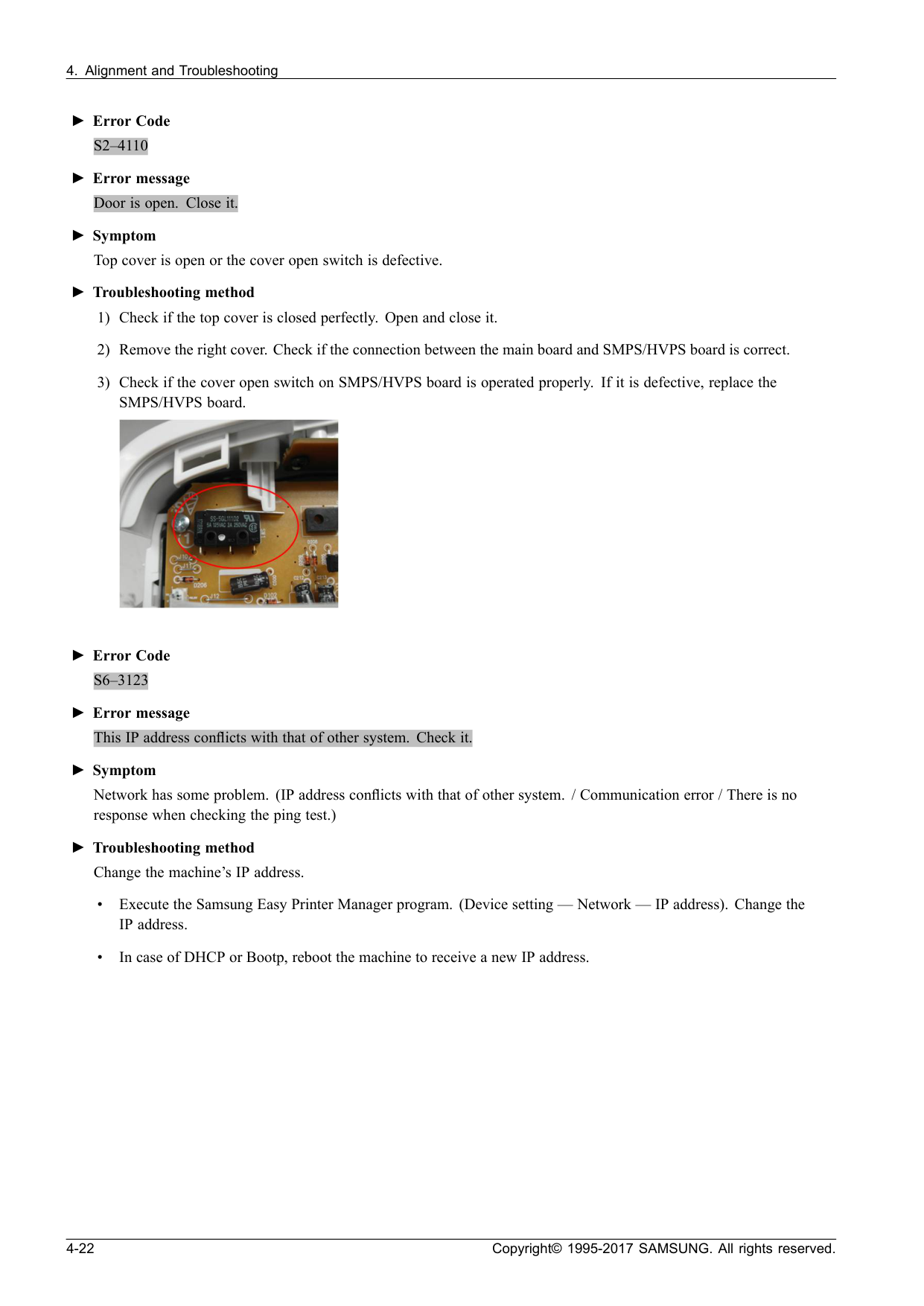
    Page 74

  • Alignment and Troubleshooting
  • ►Error Code

    S2–4110

    ►Error message Door is open. Close it. ►Symptom Top cover is open or the cover open switch is defective. ►Troubleshooting method 1) Check if the top cover is closed perfectly. Open and close it. 2) Remove the right cover. Check if the connection between the main board and SMPS/HVPS board is correct. 3) Check if the cover open switch on SMPS/HVPS board is operated properly. If it is defective, replace the SMPS/HVPS board. ►Error Code

    S6–3123

    ►Error message This IP address conflicts with that of other system. Check it. ►Symptom Network has some problem. (IP address conflicts with that of other system. / Communication error / There is no response when checking the ping test.) ►Troubleshooting method Change the machine’s IP address. • Execute the Samsung Easy Printer Manager program. (Device setting — Network — IP address). Change the IP address. • In case of DHCP or Bootp, reboot the machine to receive a new IP address. 4-22 Copyright© 1995-2017 SAMSUNG. All rights reserved.
    Page 75

  • Alignment and Troubleshooting
  • ►Error Code

    U1–2320

    U1–2330

    U1–2340

    ►Error message Fuser Unit Failure #U1-2320 : Turn off then on. Fuser Unit Failure #U1-2330 : Turn off then on. Fuser Unit Failure #U1-2340 : Turn off then on. ►Symptom The temperature control of fuser unit is abnormal. (U1–2320 : Open Heat Error / U1–2330 : Low Heat Error / U1–2340 : Over Heat Error) ►Troubleshooting method 1) Turn the machine off. Re-install the fuser unit. Then turn the machine on. Is the error message is disappeared? 2) If the problem persists, turn the machine off and remove the fuser unit. a) Check if the fuser connector is connected properly. b) Check if the input voltage is normal. c) Check if the thermistor is twisted or contaminated. 3) After confirming continuity in the fuser connector and the problem still exists; order an SMPS/HVPS and Fuser Unit and install as is necessary. Copyright© 1995-2017 SAMSUNG. All rights reserved. 4-23
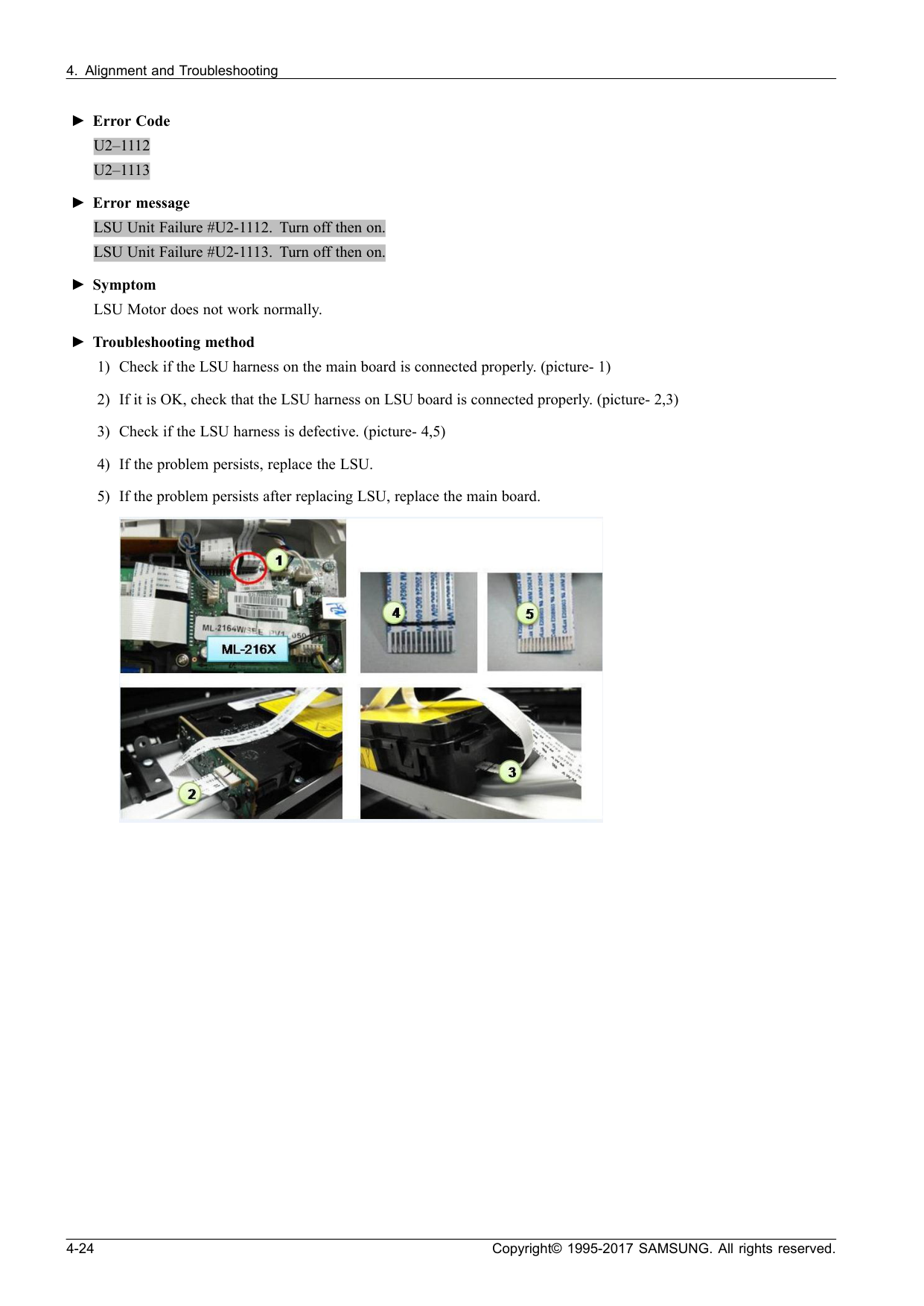
    Page 76

  • Alignment and Troubleshooting
  • ►Error Code

    U2–1112

    U2–1113

    ►Error message LSU Unit Failure #U2-1112. Turn off then on. LSU Unit Failure #U2-1113. Turn off then on. ►Symptom LSU Motor does not work normally. ►Troubleshooting method 1) Check if the LSU harness on the main board is connected properly. (picture- 1) 2) If it is OK, check that the LSU harness on LSU board is connected properly. (picture- 2,3) 3) Check if the LSU harness is defective. (picture- 4,5) 4) If the problem persists, replace the LSU. 5) If the problem persists after replacing LSU, replace the main board. 4-24 Copyright© 1995-2017 SAMSUNG. All rights reserved.
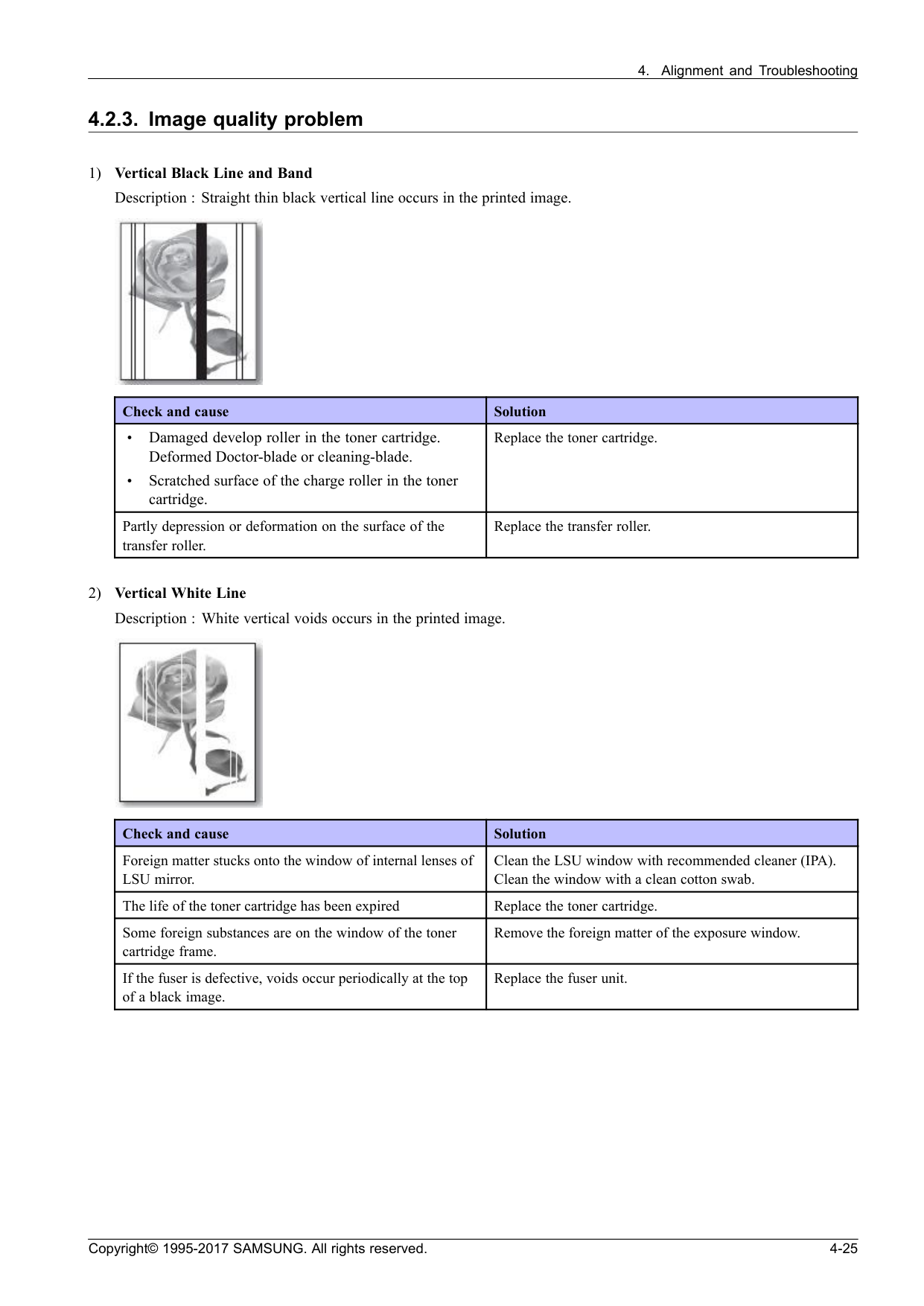
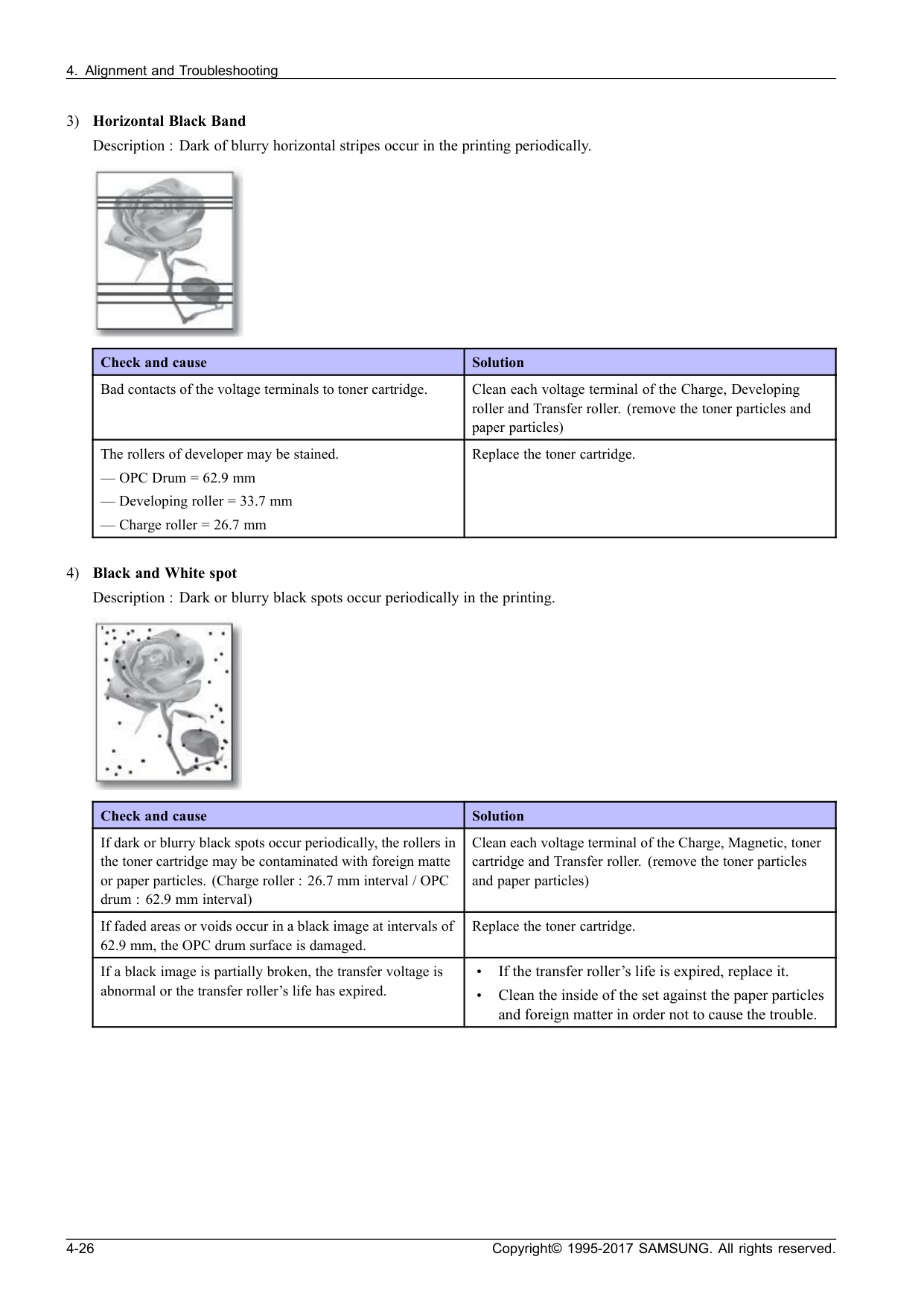
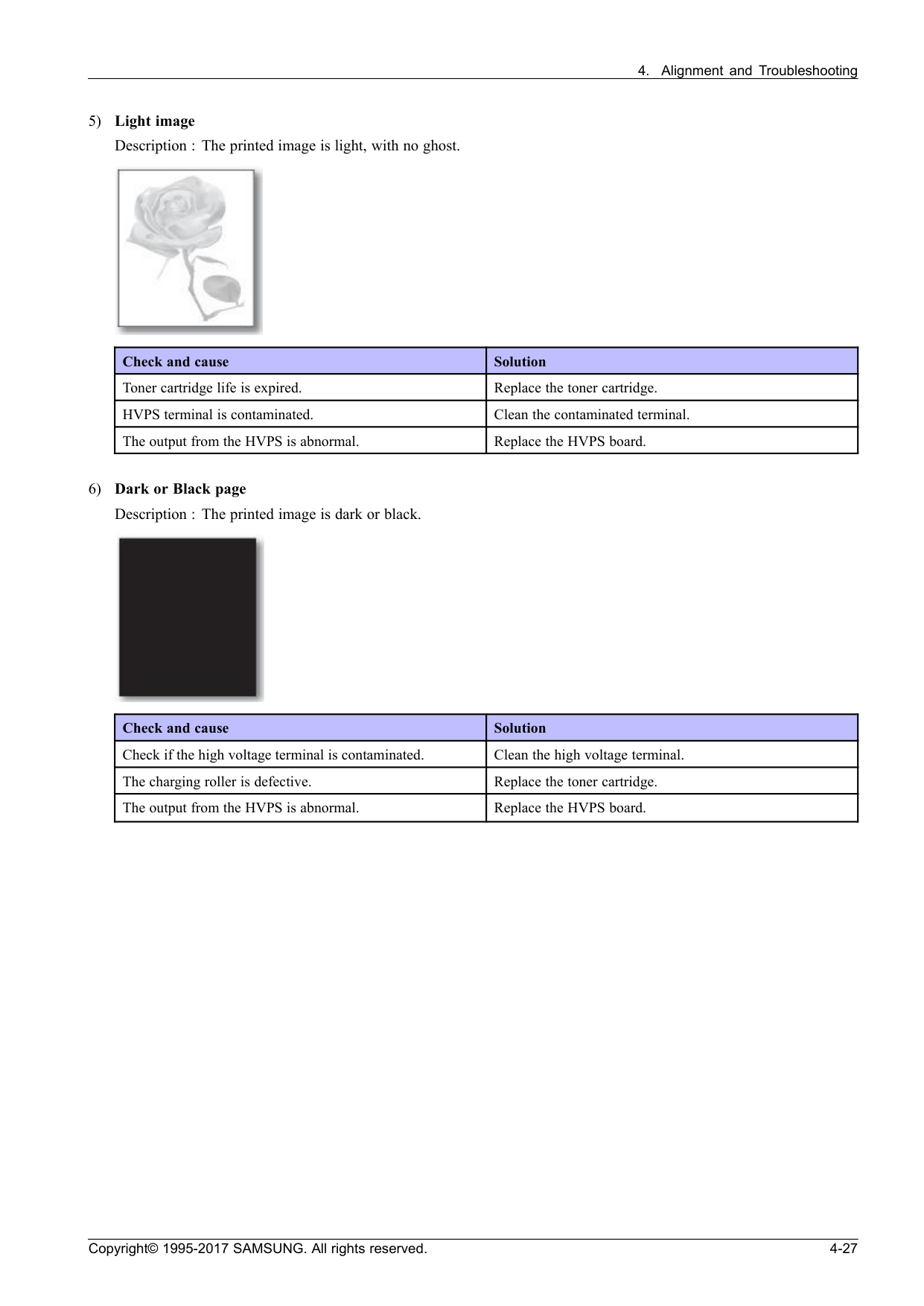
    Page 77

  • Alignment and Troubleshooting
  • 4.2.3. Image quality problem 1) Vertical Black Line and Band Description : Straight thin black vertical line occurs in the printed image. Check and cause Solution • Damaged develop roller in the toner cartridge. Deformed Doctor-blade or cleaning-blade. • Scratched surface of the charge roller in the toner cartridge. Replace the toner cartridge. Partly depression or deformation on the surface of the transfer roller. Replace the transfer roller. 2) Vertical White Line Description : White vertical voids occurs in the printed image. Check and cause Solution Foreign matter stucks onto the window of internal lenses of LSU mirror. Clean the LSU window with recommended cleaner (IPA). Clean the window with a clean cotton swab. The life of the toner cartridge has been expired Replace the toner cartridge. Some foreign substances are on the window of the toner cartridge frame. Remove the foreign matter of the exposure window. If the fuser is defective, voids occur periodically at the top of a black image. Replace the fuser unit. Copyright© 1995-2017 SAMSUNG. All rights reserved. 4-25
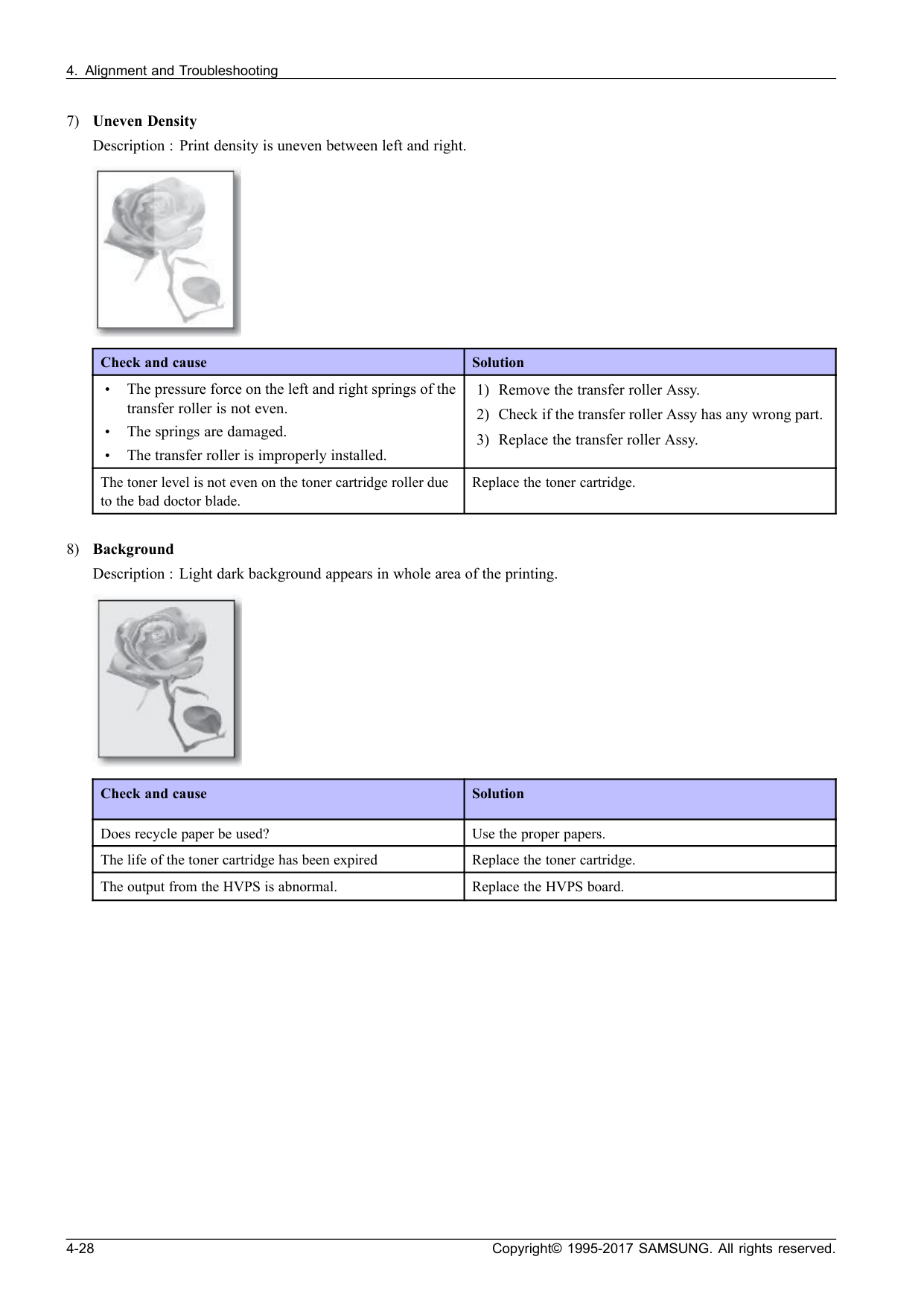
    Page 78

  • Alignment and Troubleshooting
  • 3) Horizontal Black Band Description : Dark of blurry horizontal stripes occur in the printing periodically. Check and cause Solution Bad contacts of the voltage terminals to toner cartridge. Clean each voltage terminal of the Charge, Developing roller and Transfer roller. (remove the toner particles and paper particles) The rollers of developer may be stained. — OPC Drum = 62.9 mm — Developing roller = 33.7 mm — Charge roller = 26.7 mm Replace the toner cartridge. 4) Black and White spot Description : Dark or blurry black spots occur periodically in the printing. Check and cause Solution If dark or blurry black spots occur periodically, the rollers in the toner cartridge may be contaminated with foreign matte or paper particles. (Charge roller : 26.7 mm interval / OPC drum : 62.9 mm interval) Clean each voltage terminal of the Charge, Magnetic, toner cartridge and Transfer roller. (remove the toner particles and paper particles) If faded areas or voids occur in a black image at intervals of 62.9 mm, the OPC drum surface is damaged. Replace the toner cartridge. If a black image is partially broken, the transfer voltage is abnormal or the transfer roller’s life has expired. • If the transfer roller’s life is expired, replace it. • Clean the inside of the set against the paper particles and foreign matter in order not to cause the trouble. 4-26 Copyright© 1995-2017 SAMSUNG. All rights reserved.
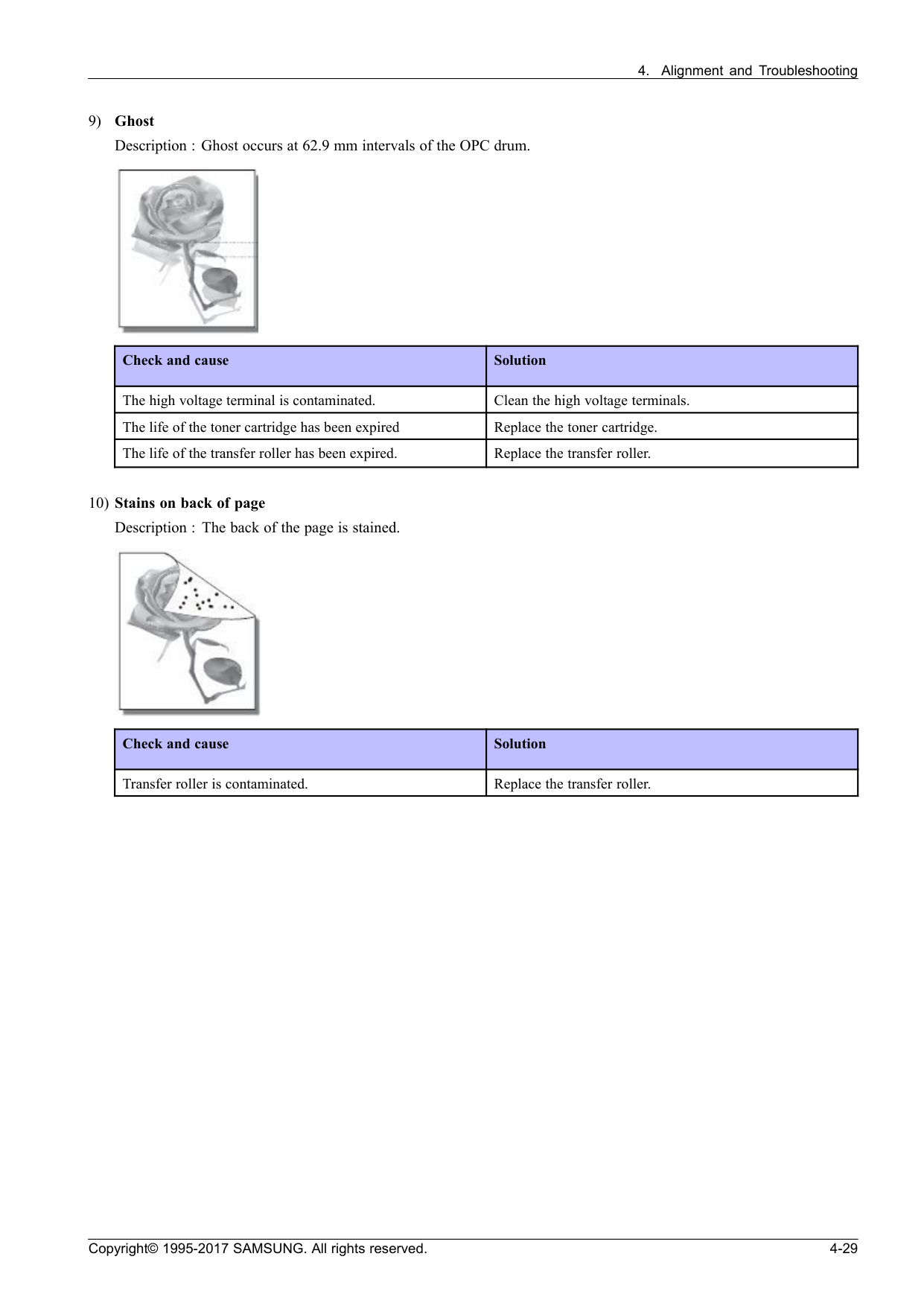
    Page 79

  • Alignment and Troubleshooting
  • 5) Light image Description : The printed image is light, with no ghost. Check and cause Solution Toner cartridge life is expired. Replace the toner cartridge. HVPS terminal is contaminated. Clean the contaminated terminal. The output from the HVPS is abnormal. Replace the HVPS board. 6) Dark or Black page Description : The printed image is dark or black. Check and cause Solution Check if the high voltage terminal is contaminated. Clean the high voltage terminal. The charging roller is defective. Replace the toner cartridge. The output from the HVPS is abnormal. Replace the HVPS board. Copyright© 1995-2017 SAMSUNG. All rights reserved. 4-27
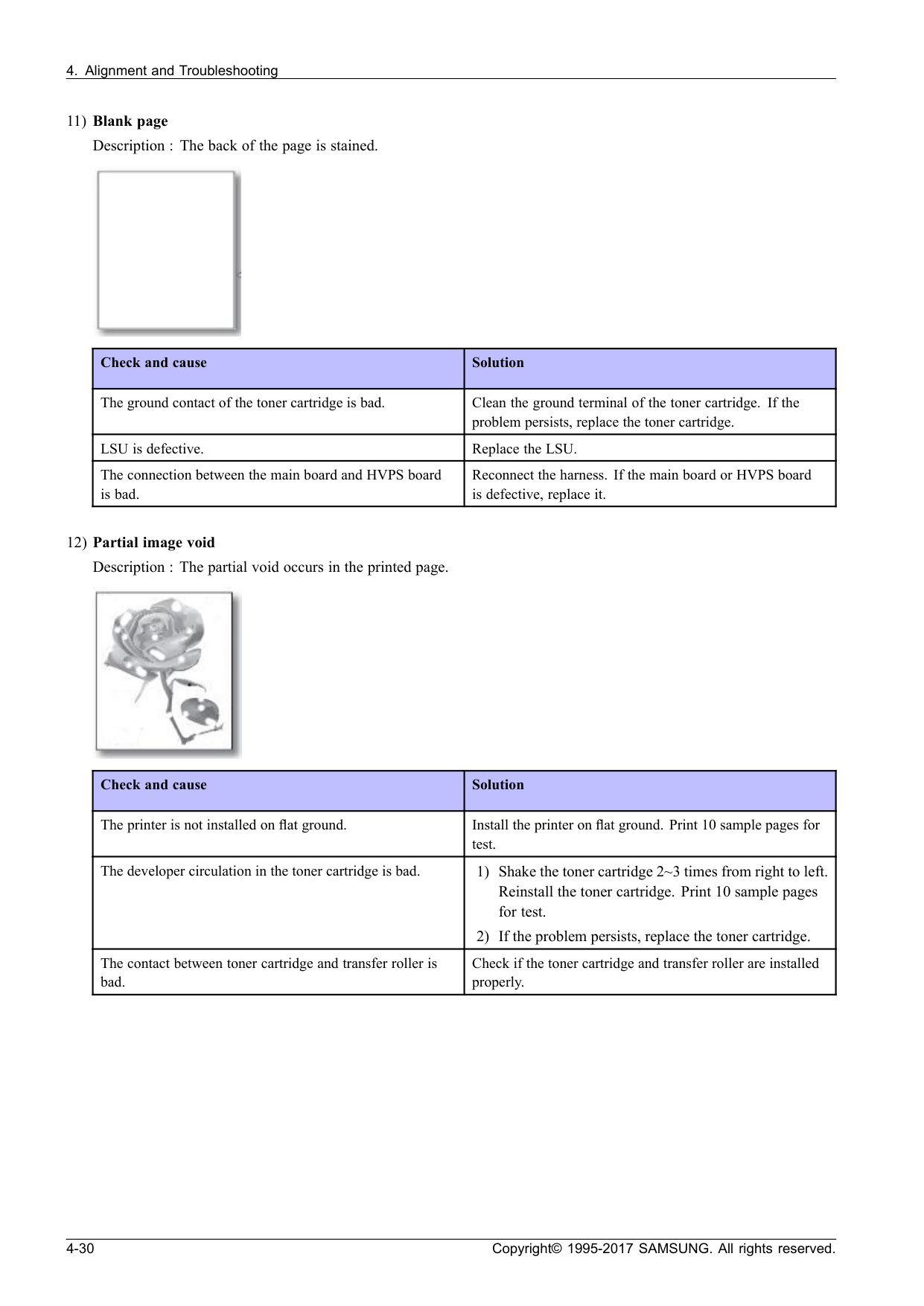
    Page 80

  • Alignment and Troubleshooting
  • 7) Uneven Density Description : Print density is uneven between left and right. Check and cause Solution • The pressure force on the left and right springs of the transfer roller is not even. • The springs are damaged. • The transfer roller is improperly installed. 1) Remove the transfer roller Assy. 2) Check if the transfer roller Assy has any wrong part. 3) Replace the transfer roller Assy. The toner level is not even on the toner cartridge roller due to the bad doctor blade. Replace the toner cartridge. 8) Background Description : Light dark background appears in whole area of the printing. Check and cause Solution Does recycle paper be used? Use the proper papers. The life of the toner cartridge has been expired Replace the toner cartridge. The output from the HVPS is abnormal. Replace the HVPS board. 4-28 Copyright© 1995-2017 SAMSUNG. All rights reserved.
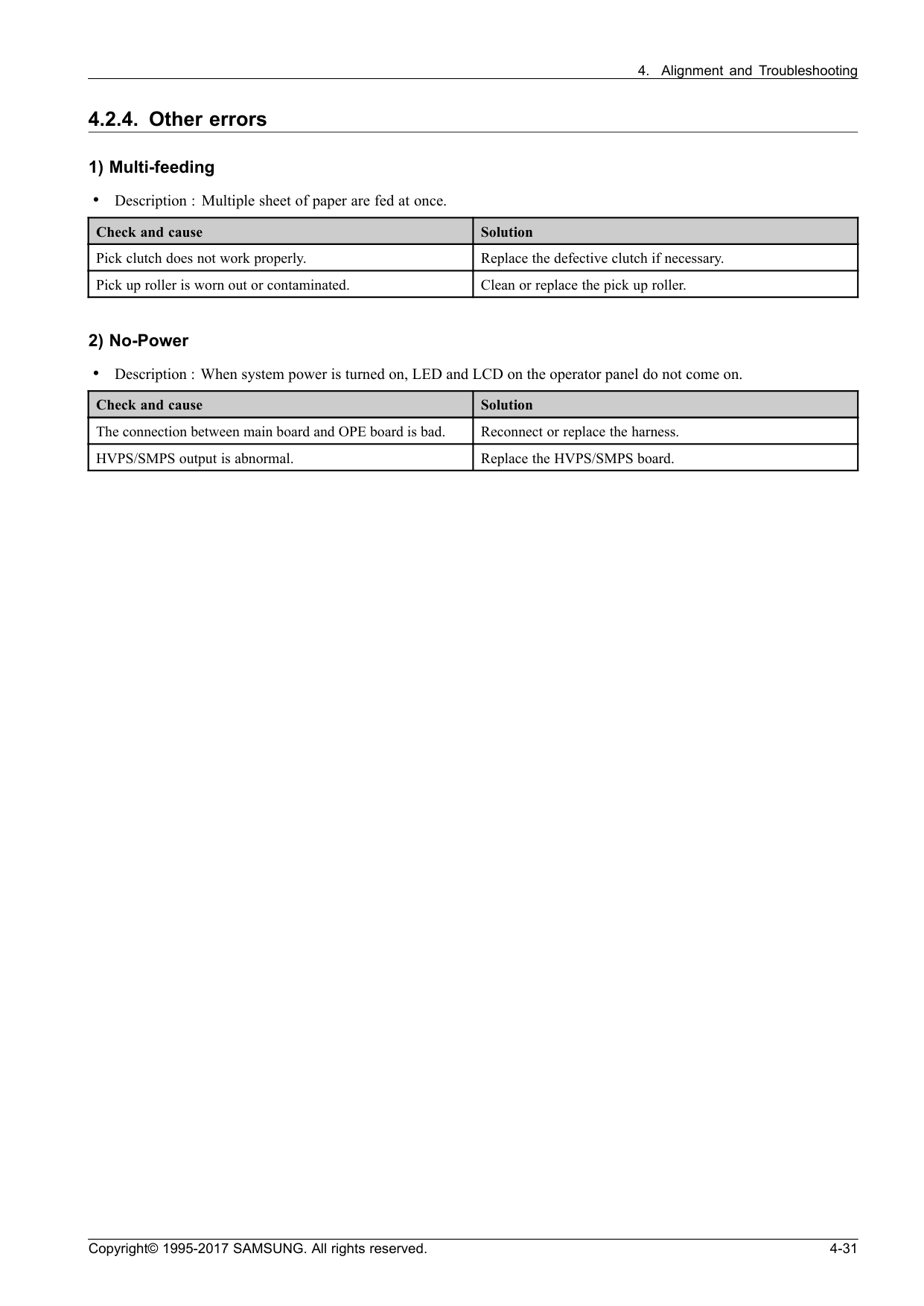
    Page 81

  • Alignment and Troubleshooting
  • 9) Ghost Description : Ghost occurs at 62.9 mm intervals of the OPC drum. Check and cause Solution The high voltage terminal is contaminated. Clean the high voltage terminals. The life of the toner cartridge has been expired Replace the toner cartridge. The life of the transfer roller has been expired. Replace the transfer roller. 10) Stains on back of page Description : The back of the page is stained. Check and cause Solution Transfer roller is contaminated. Replace the transfer roller. Copyright© 1995-2017 SAMSUNG. All rights reserved. 4-29
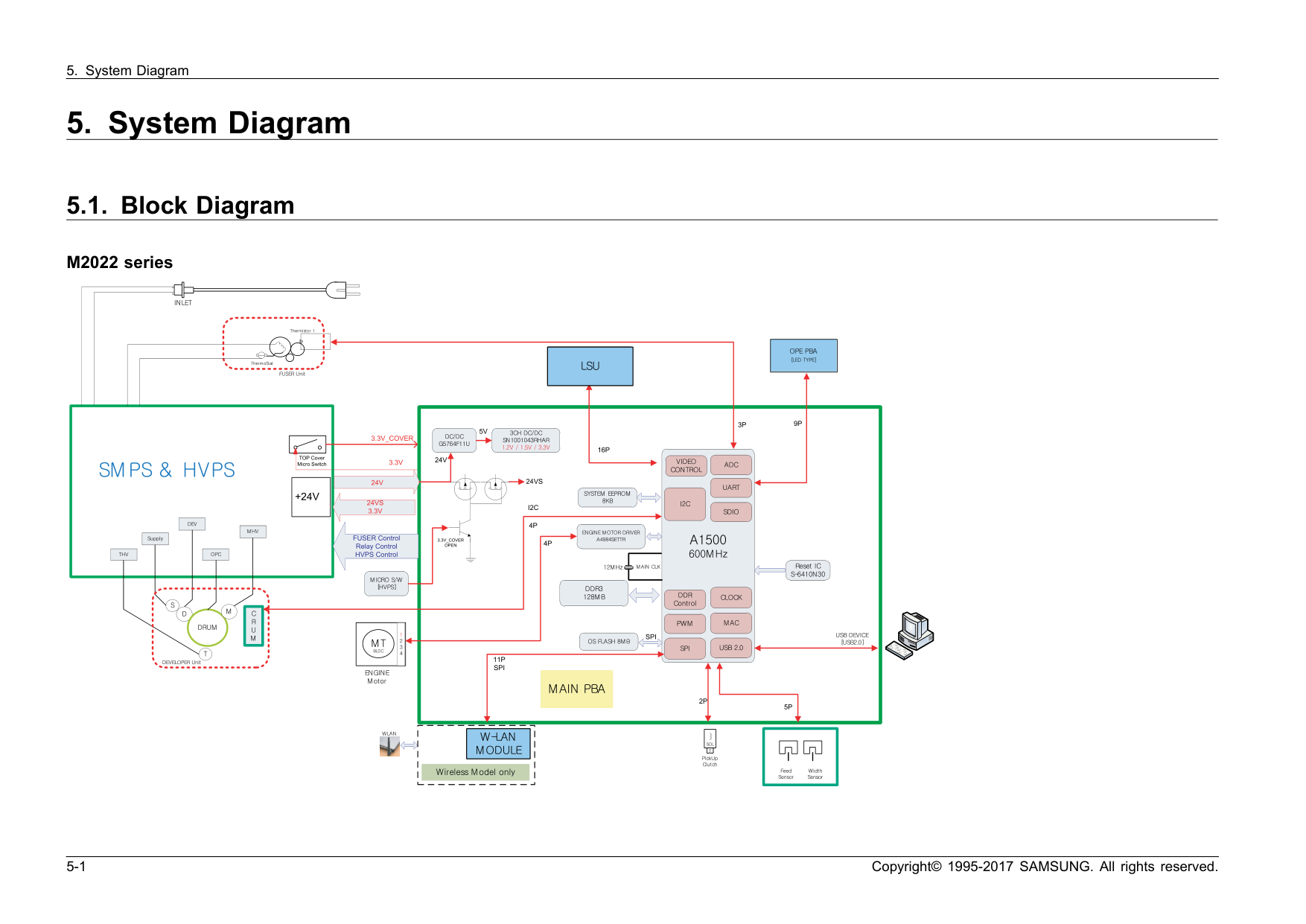
    Page 82

  • Alignment and Troubleshooting
  • 11) Blank page Description : The back of the page is stained. Check and cause Solution The ground contact of the toner cartridge is bad. Clean the ground terminal of the toner cartridge. If the problem persists, replace the toner cartridge. LSU is defective. Replace the LSU. The connection between the main board and HVPS board is bad. Reconnect the harness. If the main board or HVPS board is defective, replace it. 12) Partial image void Description : The partial void occurs in the printed page. Check and cause Solution The printer is not installed on flat ground. Install the printer on flat ground. Print 10 sample pages for test. The developer circulation in the toner cartridge is bad. 1) Shake the toner cartridge 2~3 times from right to left. Reinstall the toner cartridge. Print 10 sample pages for test. 2) If the problem persists, replace the toner cartridge. The contact between toner cartridge and transfer roller is bad. Check if the toner cartridge and transfer roller are installed properly. 4-30 Copyright© 1995-2017 SAMSUNG. All rights reserved.
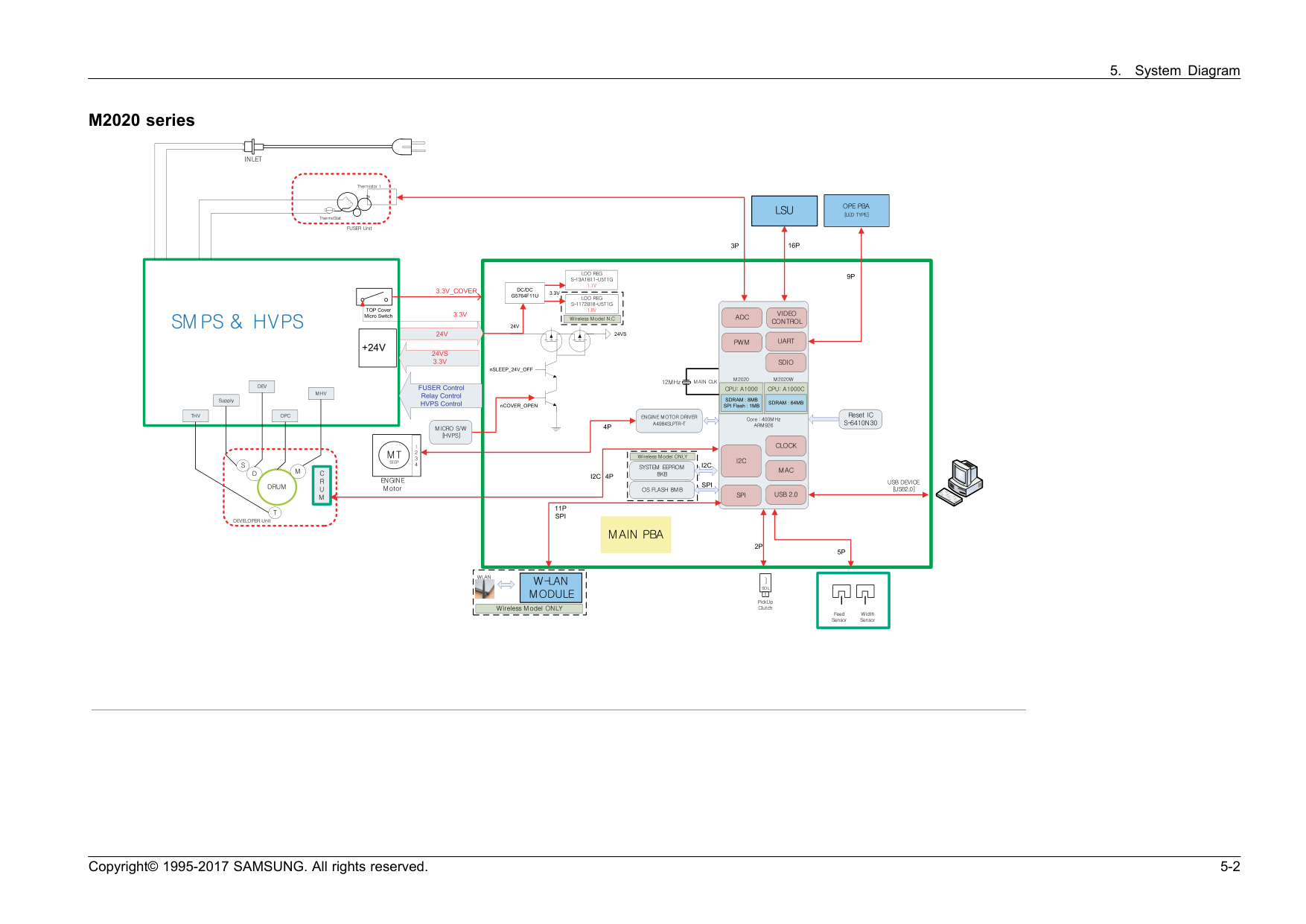
    Page 83

  • Alignment and Troubleshooting
  • 4.2.4. Other errors 1) Multi-feeding • Description : Multiple sheet of paper are fed at once. Check and cause Solution Pick clutch does not work properly. Replace the defective clutch if necessary. Pick up roller is worn out or contaminated. Clean or replace the pick up roller. 2) No-Power • Description : When system power is turned on, LED and LCD on the operator panel do not come on. Check and cause Solution The connection between main board and OPE board is bad. Reconnect or replace the harness. HVPS/SMPS output is abnormal. Replace the HVPS/SMPS board. Copyright© 1995-2017 SAMSUNG. All rights reserved. 4-31
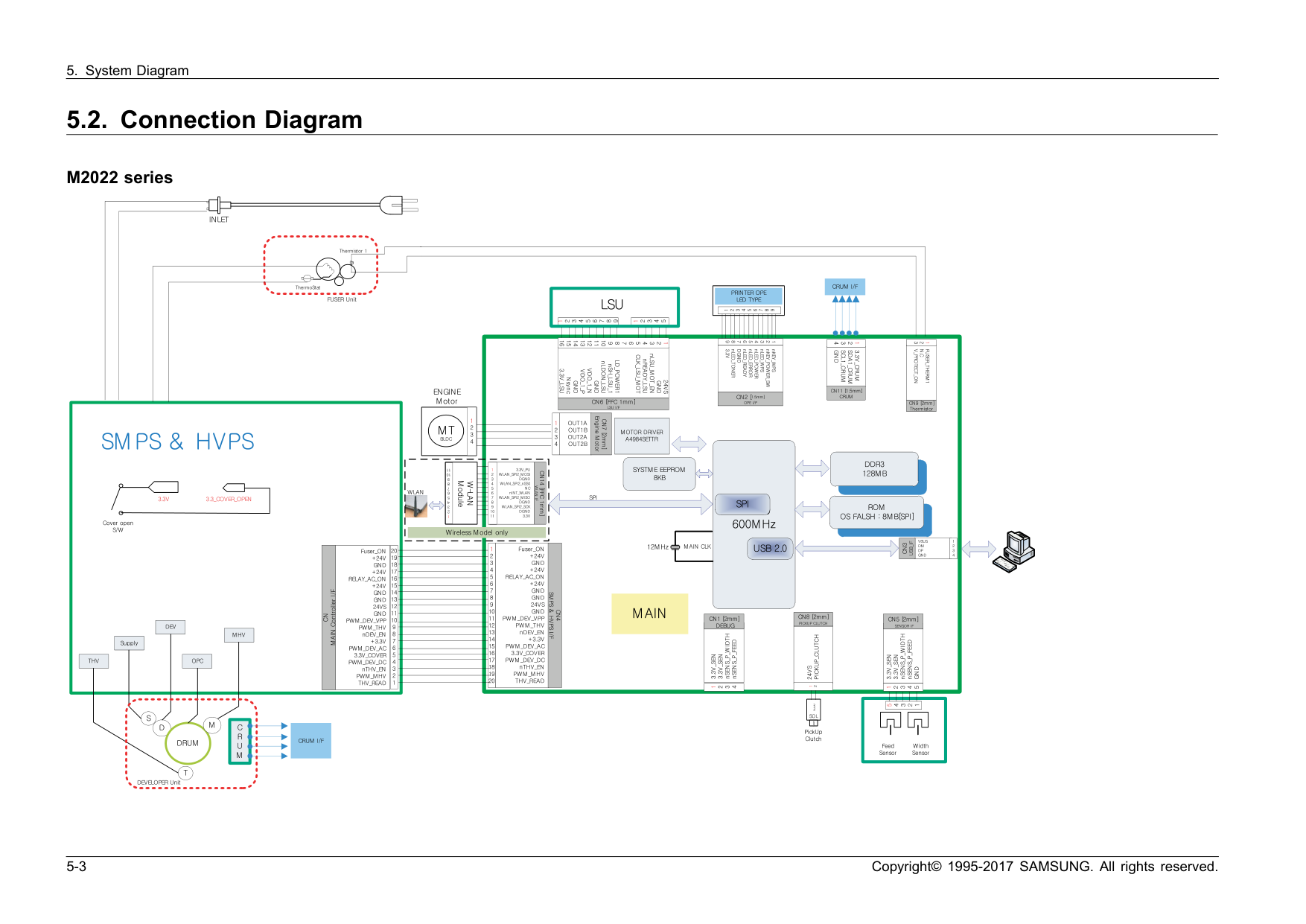
    Page 84

  • System Diagram
  • System Diagram
  • 5.1. Block Diagram M2022 series 5-1 Copyright© 1995-2017 SAMSUNG. All rights reserved.
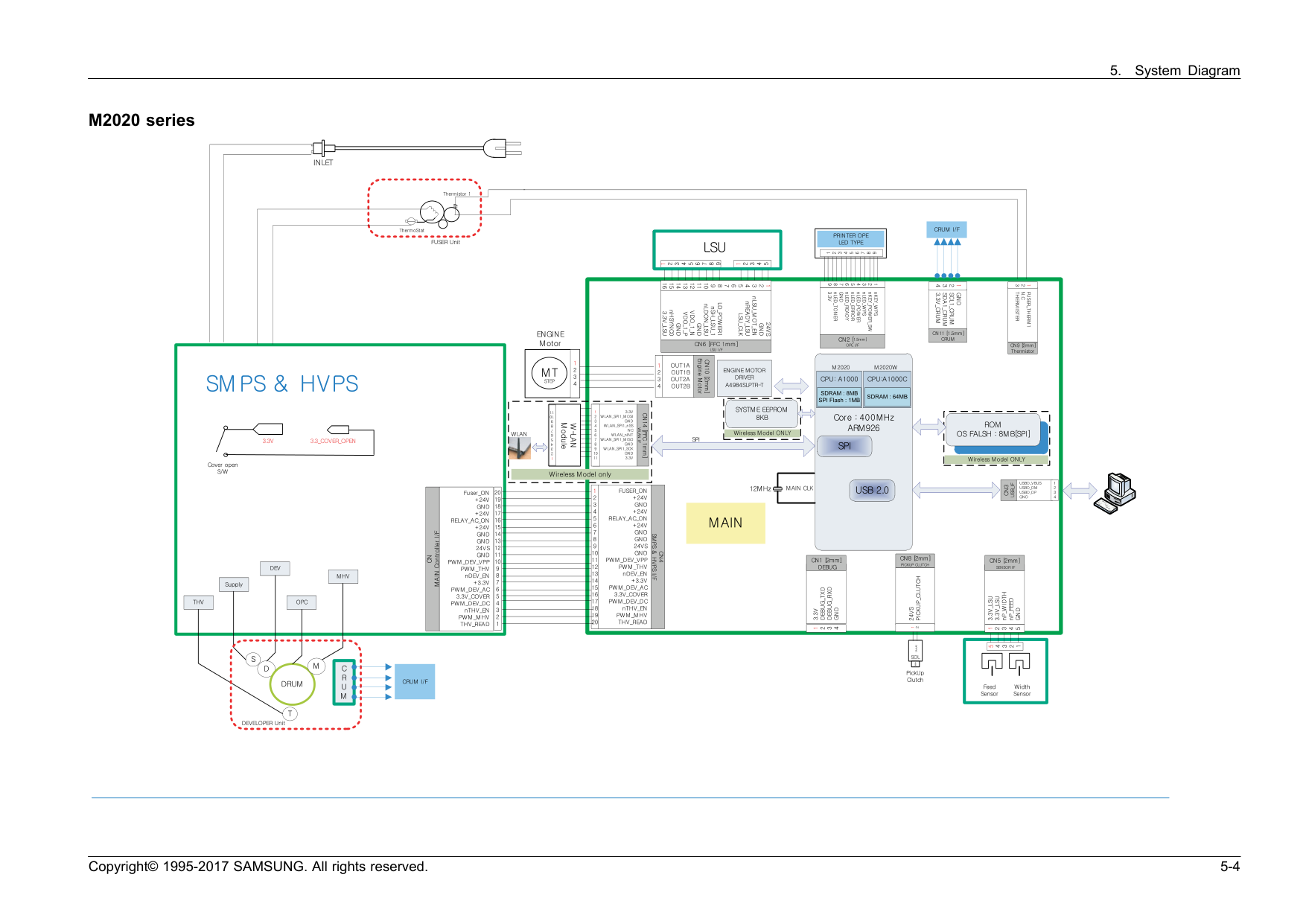
    Page 85

  • System Diagram
  • M2020 series Copyright© 1995-2017 SAMSUNG. All rights reserved. 5-2
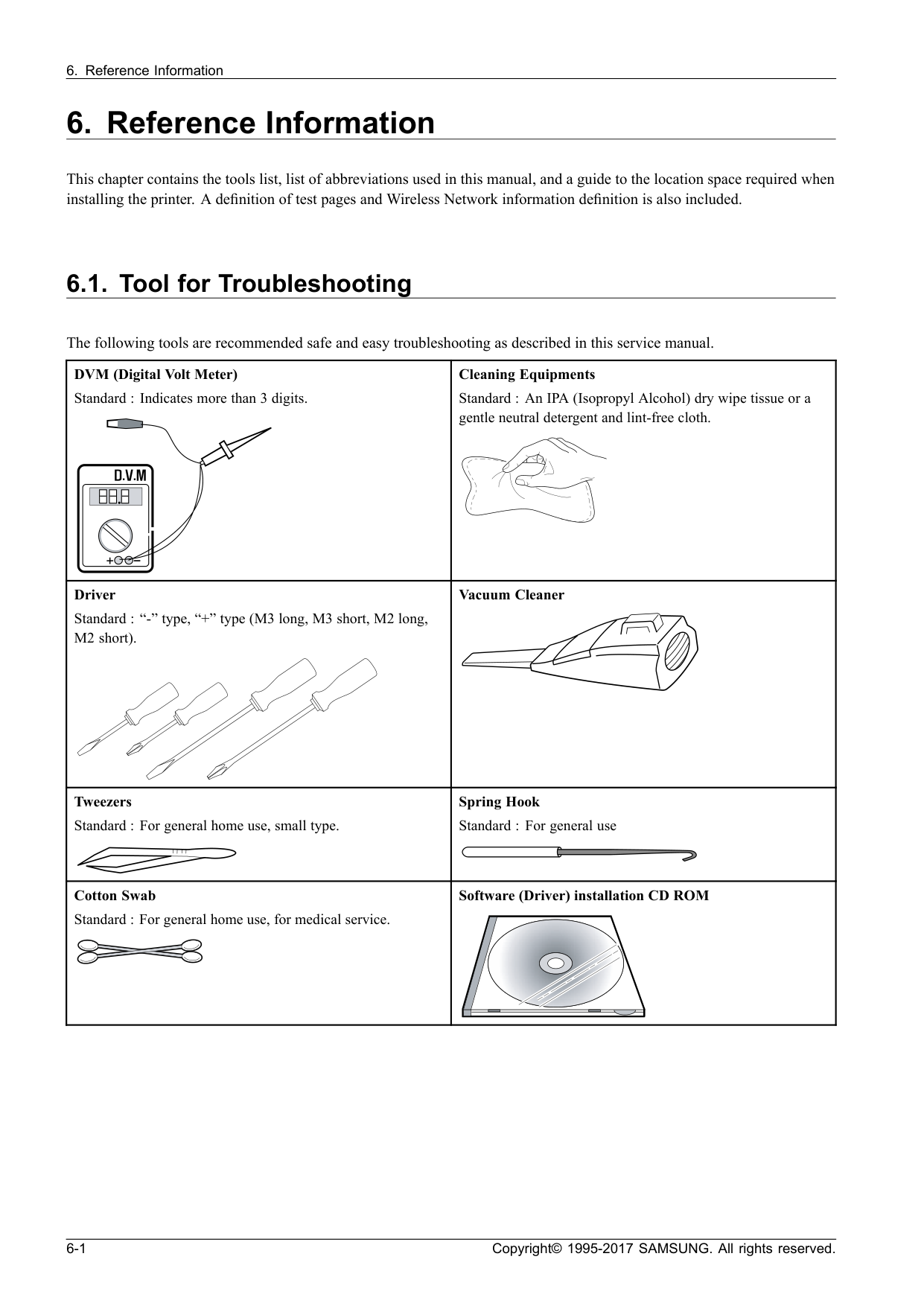
    Page 86

  • System Diagram
  • 5.2. Connection Diagram M2022 series 5-3 Copyright© 1995-2017 SAMSUNG. All rights reserved.
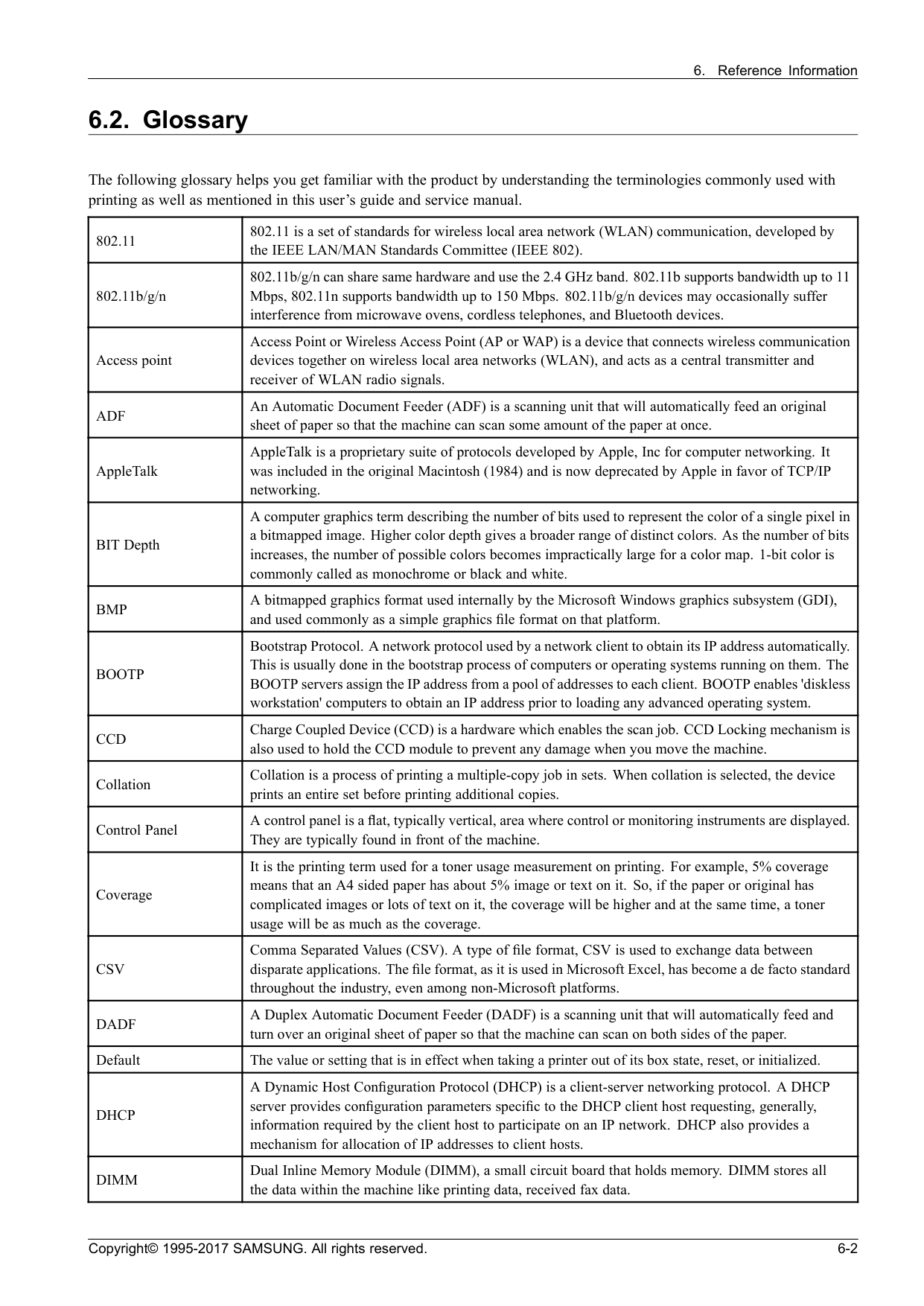
    Page 87

  • System Diagram
  • M2020 series Copyright© 1995-2017 SAMSUNG. All rights reserved. 5-4

    Page 88

  • Reference Information
  • Reference Information
  • This chapter contains the tools list, list of abbreviations used in this manual, and a guide to the location space required when installing the printer. A definition of test pages and Wireless Network information definition is also included. 6.1. Tool for Troubleshooting The following tools are recommended safe and easy troubleshooting as described in this service manual. DVM (Digital Volt Meter) Standard : Indicates more than 3 digits. Cleaning Equipments Standard : An IPA (Isopropyl Alcohol) dry wipe tissue or a gentle neutral detergent and lint-free cloth. Driver Standard : “-” type, “+” type (M3 long, M3 short, M2 long, M2 short). Vacuum Cleaner Tweezers Standard : For general home use, small type. Spring Hook Standard : For general use Cotton Swab Standard : For general home use, for medical service. Software (Driver) installation CD ROM 6-1 Copyright© 1995-2017 SAMSUNG. All rights reserved.

    Page 89

  • Reference Information
  • 6.2. Glossary The following glossary helps you get familiar with the product by understanding the terminologies commonly used with printing as well as mentioned in this user’s guide and service manual. 802.11 802.11 is a set of standards for wireless local area network (WLAN) communication, developed by the IEEE LAN/MAN Standards Committee (IEEE 802). 802.11b/g/n 802.11b/g/n can share same hardware and use the 2.4 GHz band. 802.11b supports bandwidth up to 11 Mbps, 802.11n supports bandwidth up to 150 Mbps. 802.11b/g/n devices may occasionally suffer interference from microwave ovens, cordless telephones, and Bluetooth devices. Access point Access Point or Wireless Access Point (AP or WAP) is a device that connects wireless communication devices together on wireless local area networks (WLAN), and acts as a central transmitter and receiver of WLAN radio signals.

    Adf

    An Automatic Document Feeder (ADF) is a scanning unit that will automatically feed an original sheet of paper so that the machine can scan some amount of the paper at once. AppleTalk AppleTalk is a proprietary suite of protocols developed by Apple, Inc for computer networking. It was included in the original Macintosh (1984) and is now deprecated by Apple in favor of TCP/IP networking. BIT Depth A computer graphics term describing the number of bits used to represent the color of a single pixel in a bitmapped image. Higher color depth gives a broader range of distinct colors. As the number of bits increases, the number of possible colors becomes impractically large for a color map. 1-bit color is commonly called as monochrome or black and white.

    Bmp

    A bitmapped graphics format used internally by the Microsoft Windows graphics subsystem (GDI), and used commonly as a simple graphics file format on that platform.

    Bootp

    Bootstrap Protocol. A network protocol used by a network client to obtain its IP address automatically. This is usually done in the bootstrap process of computers or operating systems running on them. The BOOTP servers assign the IP address from a pool of addresses to each client. BOOTP enables 'diskless workstation' computers to obtain an IP address prior to loading any advanced operating system.

    Ccd

    Charge Coupled Device (CCD) is a hardware which enables the scan job. CCD Locking mechanism is also used to hold the CCD module to prevent any damage when you move the machine. Collation Collation is a process of printing a multiple-copy job in sets. When collation is selected, the device prints an entire set before printing additional copies. Control Panel A control panel is a flat, typically vertical, area where control or monitoring instruments are displayed. They are typically found in front of the machine. Coverage It is the printing term used for a toner usage measurement on printing. For example, 5% coverage means that an A4 sided paper has about 5% image or text on it. So, if the paper or original has complicated images or lots of text on it, the coverage will be higher and at the same time, a toner usage will be as much as the coverage.

    Csv

    Comma Separated Values (CSV). A type of file format, CSV is used to exchange data between disparate applications. The file format, as it is used in Microsoft Excel, has become a de facto standard throughout the industry, even among non-Microsoft platforms.

    Dadf

    A Duplex Automatic Document Feeder (DADF) is a scanning unit that will automatically feed and turn over an original sheet of paper so that the machine can scan on both sides of the paper. Default The value or setting that is in effect when taking a printer out of its box state, reset, or initialized.

    Dhcp

    A Dynamic Host Configuration Protocol (DHCP) is a client-server networking protocol. A DHCP server provides configuration parameters specific to the DHCP client host requesting, generally, information required by the client host to participate on an IP network. DHCP also provides a mechanism for allocation of IP addresses to client hosts.

    Dimm

    Dual Inline Memory Module (DIMM), a small circuit board that holds memory. DIMM stores all the data within the machine like printing data, received fax data. Copyright© 1995-2017 SAMSUNG. All rights reserved. 6-2
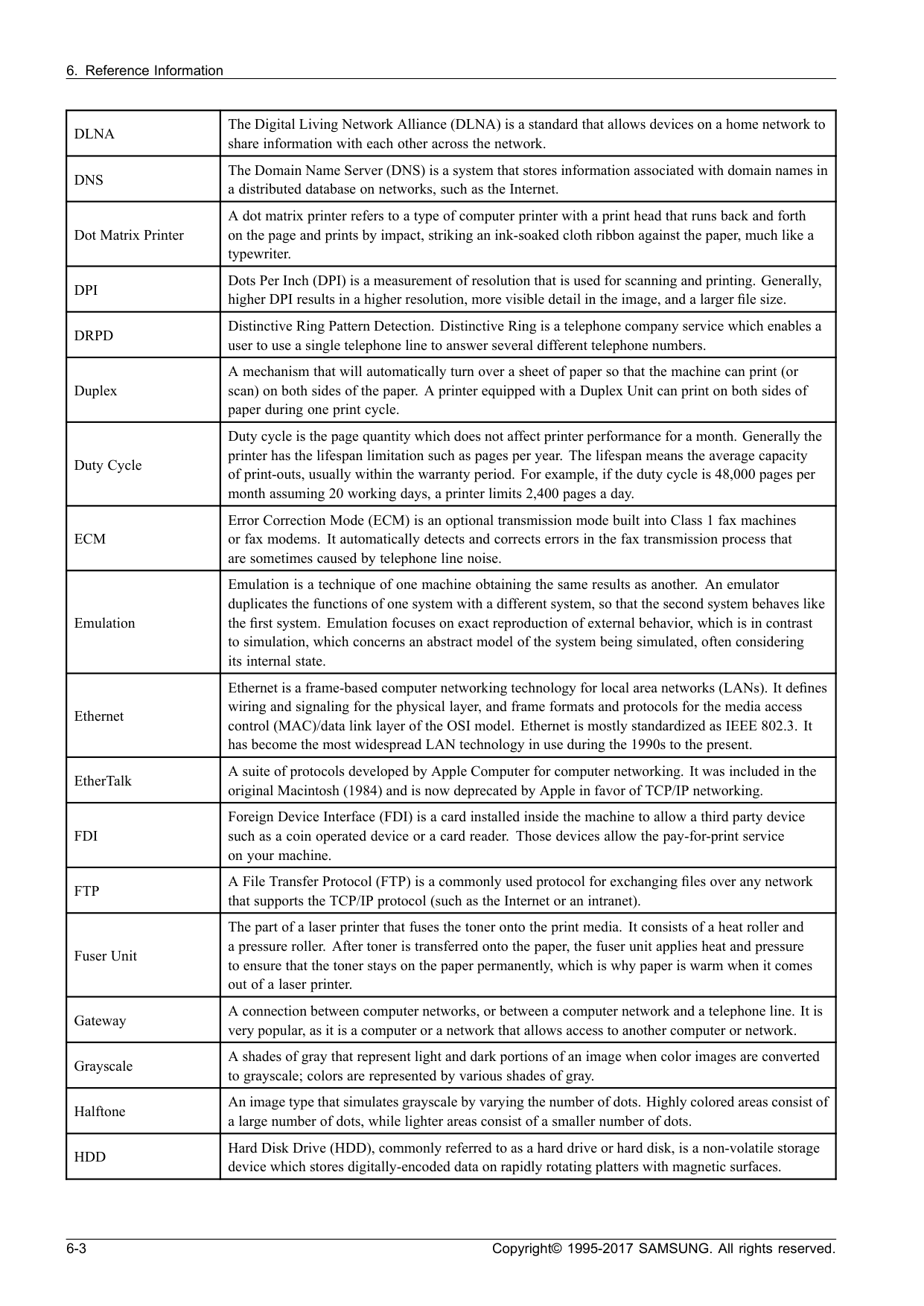
    Page 90

  • Reference Information
  • Dlna

    The Digital Living Network Alliance (DLNA) is a standard that allows devices on a home network to share information with each other across the network.

    Dns

    The Domain Name Server (DNS) is a system that stores information associated with domain names in a distributed database on networks, such as the Internet. Dot Matrix Printer A dot matrix printer refers to a type of computer printer with a print head that runs back and forth on the page and prints by impact, striking an ink-soaked cloth ribbon against the paper, much like a typewriter.

    Dpi

    Dots Per Inch (DPI) is a measurement of resolution that is used for scanning and printing. Generally, higher DPI results in a higher resolution, more visible detail in the image, and a larger file size.

    Drpd

    Distinctive Ring Pattern Detection. Distinctive Ring is a telephone company service which enables a user to use a single telephone line to answer several different telephone numbers. Duplex A mechanism that will automatically turn over a sheet of paper so that the machine can print (or scan) on both sides of the paper. A printer equipped with a Duplex Unit can print on both sides of paper during one print cycle. Duty Cycle Duty cycle is the page quantity which does not affect printer performance for a month. Generally the printer has the lifespan limitation such as pages per year. The lifespan means the average capacity of print-outs, usually within the warranty period. For example, if the duty cycle is 48,000 pages per month assuming 20 working days, a printer limits 2,400 pages a day.

    Ecm

    Error Correction Mode (ECM) is an optional transmission mode built into Class 1 fax machines or fax modems. It automatically detects and corrects errors in the fax transmission process that are sometimes caused by telephone line noise. Emulation Emulation is a technique of one machine obtaining the same results as another. An emulator duplicates the functions of one system with a different system, so that the second system behaves like the first system. Emulation focuses on exact reproduction of external behavior, which is in contrast to simulation, which concerns an abstract model of the system being simulated, often considering its internal state. Ethernet Ethernet is a frame-based computer networking technology for local area networks (LANs). It defines wiring and signaling for the physical layer, and frame formats and protocols for the media access control (MAC)/data link layer of the OSI model. Ethernet is mostly standardized as IEEE 802.3. It has become the most widespread LAN technology in use during the 1990s to the present. EtherTalk A suite of protocols developed by Apple Computer for computer networking. It was included in the original Macintosh (1984) and is now deprecated by Apple in favor of TCP/IP networking.

    Fdi

    Foreign Device Interface (FDI) is a card installed inside the machine to allow a third party device such as a coin operated device or a card reader. Those devices allow the pay-for-print service on your machine.

    Ftp

    A File Transfer Protocol (FTP) is a commonly used protocol for exchanging files over any network that supports the TCP/IP protocol (such as the Internet or an intranet). Fuser Unit The part of a laser printer that fuses the toner onto the print media. It consists of a heat roller and a pressure roller. After toner is transferred onto the paper, the fuser unit applies heat and pressure to ensure that the toner stays on the paper permanently, which is why paper is warm when it comes out of a laser printer. Gateway A connection between computer networks, or between a computer network and a telephone line. It is very popular, as it is a computer or a network that allows access to another computer or network. Grayscale A shades of gray that represent light and dark portions of an image when color images are converted to grayscale; colors are represented by various shades of gray. Halftone An image type that simulates grayscale by varying the number of dots. Highly colored areas consist of a large number of dots, while lighter areas consist of a smaller number of dots.

    Hdd

    Hard Disk Drive (HDD), commonly referred to as a hard drive or hard disk, is a non-volatile storage device which stores digitally-encoded data on rapidly rotating platters with magnetic surfaces. 6-3 Copyright© 1995-2017 SAMSUNG. All rights reserved.
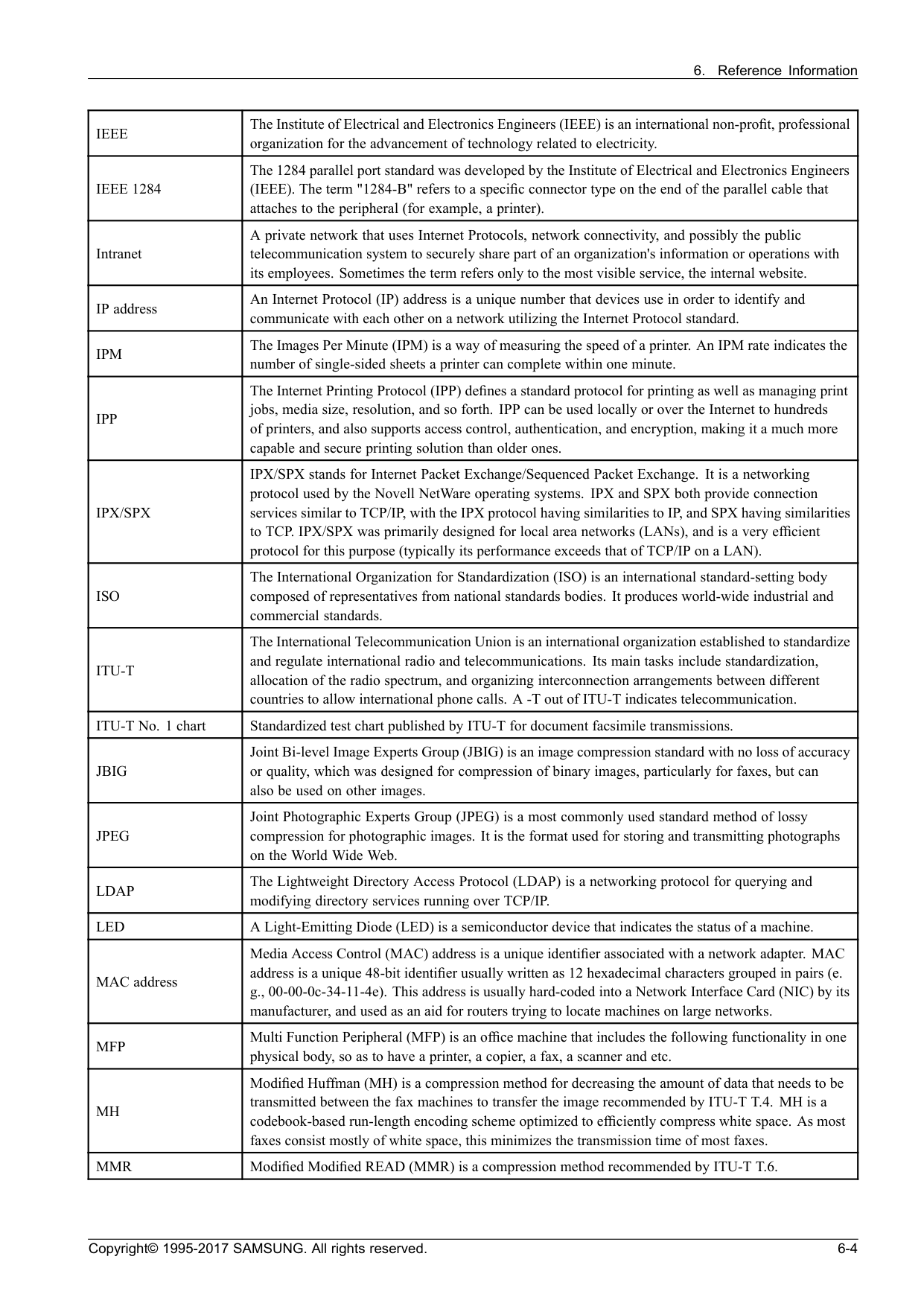
    Page 91

  • Reference Information
  • Ieee

    The Institute of Electrical and Electronics Engineers (IEEE) is an international non-profit, professional organization for the advancement of technology related to electricity.

    Ieee 1284

    The 1284 parallel port standard was developed by the Institute of Electrical and Electronics Engineers (IEEE). The term "1284-B" refers to a specific connector type on the end of the parallel cable that attaches to the peripheral (for example, a printer). Intranet A private network that uses Internet Protocols, network connectivity, and possibly the public telecommunication system to securely share part of an organization's information or operations with its employees. Sometimes the term refers only to the most visible service, the internal website. IP address An Internet Protocol (IP) address is a unique number that devices use in order to identify and communicate with each other on a network utilizing the Internet Protocol standard.

    Ipm

    The Images Per Minute (IPM) is a way of measuring the speed of a printer. An IPM rate indicates the number of single-sided sheets a printer can complete within one minute.

    Ipp

    The Internet Printing Protocol (IPP) defines a standard protocol for printing as well as managing print jobs, media size, resolution, and so forth. IPP can be used locally or over the Internet to hundreds of printers, and also supports access control, authentication, and encryption, making it a much more capable and secure printing solution than older ones.

    Ipx/Spx

    IPX/SPX stands for Internet Packet Exchange/Sequenced Packet Exchange. It is a networking protocol used by the Novell NetWare operating systems. IPX and SPX both provide connection services similar to TCP/IP, with the IPX protocol having similarities to IP, and SPX having similarities to TCP. IPX/SPX was primarily designed for local area networks (LANs), and is a very efficient protocol for this purpose (typically its performance exceeds that of TCP/IP on a LAN).

    Iso

    The International Organization for Standardization (ISO) is an international standard-setting body composed of representatives from national standards bodies. It produces world-wide industrial and commercial standards.

    Itu-T

    The International Telecommunication Union is an international organization established to standardize and regulate international radio and telecommunications. Its main tasks include standardization, allocation of the radio spectrum, and organizing interconnection arrangements between different countries to allow international phone calls. A -T out of ITU-T indicates telecommunication. ITU-T No. 1 chart Standardized test chart published by ITU-T for document facsimile transmissions.

    Jbig

    Joint Bi-level Image Experts Group (JBIG) is an image compression standard with no loss of accuracy or quality, which was designed for compression of binary images, particularly for faxes, but can also be used on other images.

    Jpeg

    Joint Photographic Experts Group (JPEG) is a most commonly used standard method of lossy compression for photographic images. It is the format used for storing and transmitting photographs on the World Wide Web.

    Ldap

    The Lightweight Directory Access Protocol (LDAP) is a networking protocol for querying and modifying directory services running over TCP/IP.

    Led

    A Light-Emitting Diode (LED) is a semiconductor device that indicates the status of a machine. MAC address Media Access Control (MAC) address is a unique identifier associated with a network adapter. MAC address is a unique 48-bit identifier usually written as 12 hexadecimal characters grouped in pairs (e. g., 00-00-0c-34-11-4e). This address is usually hard-coded into a Network Interface Card (NIC) by its manufacturer, and used as an aid for routers trying to locate machines on large networks.

    Mfp

    Multi Function Peripheral (MFP) is an office machine that includes the following functionality in one physical body, so as to have a printer, a copier, a fax, a scanner and etc.

    Mh

    Modified Huffman (MH) is a compression method for decreasing the amount of data that needs to be transmitted between the fax machines to transfer the image recommended by ITU-T T.4. MH is a codebook-based run-length encoding scheme optimized to efficiently compress white space. As most faxes consist mostly of white space, this minimizes the transmission time of most faxes.

    Mmr

    Modified Modified READ (MMR) is a compression method recommended by ITU-T T.6. Copyright© 1995-2017 SAMSUNG. All rights reserved. 6-4
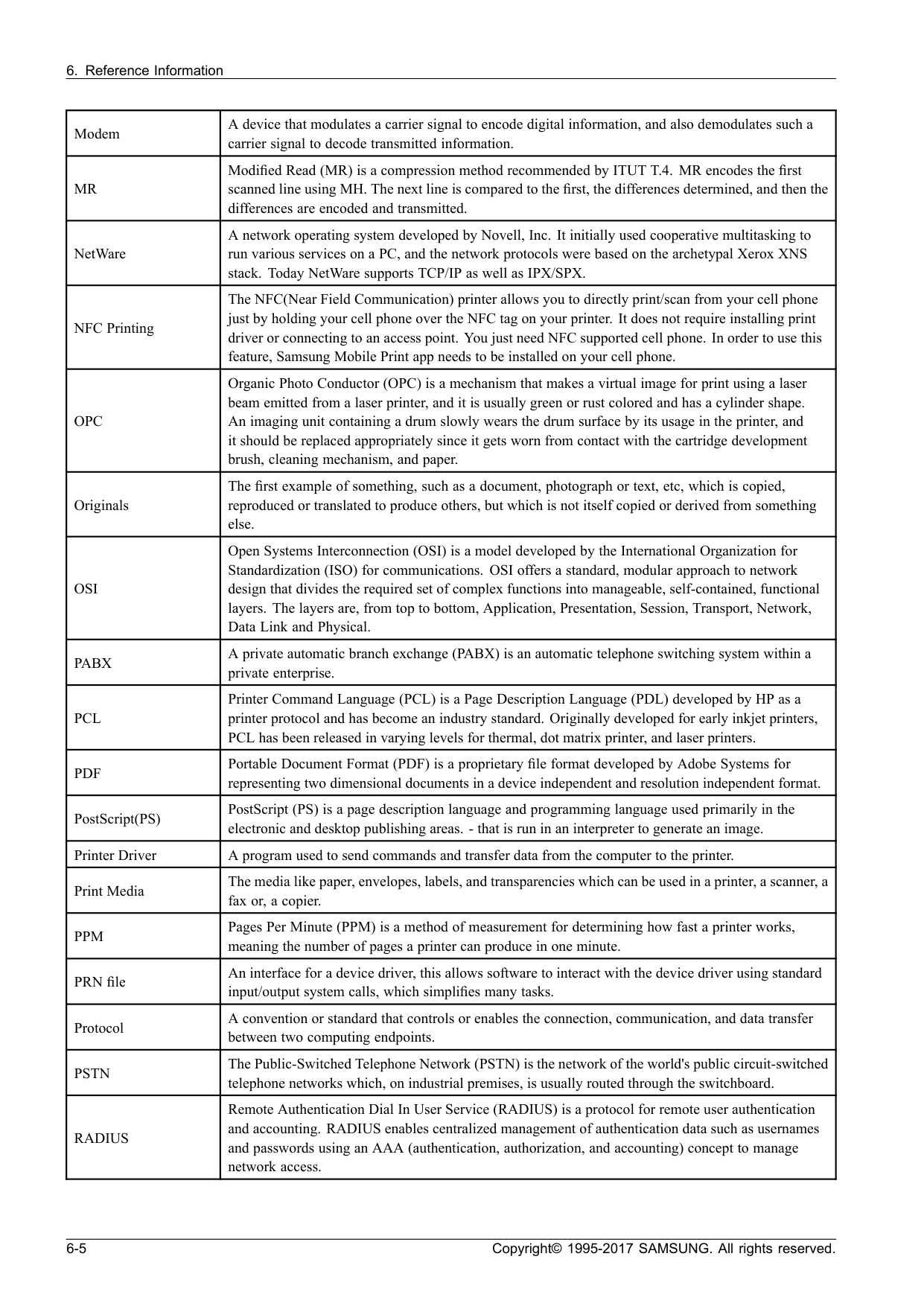
    Page 92

  • Reference Information
  • Modem A device that modulates a carrier signal to encode digital information, and also demodulates such a carrier signal to decode transmitted information.

    Mr

    Modified Read (MR) is a compression method recommended by ITUT T.4. MR encodes the first scanned line using MH. The next line is compared to the first, the differences determined, and then the differences are encoded and transmitted. NetWare A network operating system developed by Novell, Inc. It initially used cooperative multitasking to run various services on a PC, and the network protocols were based on the archetypal Xerox XNS stack. Today NetWare supports TCP/IP as well as IPX/SPX. NFC Printing The NFC(Near Field Communication) printer allows you to directly print/scan from your cell phone just by holding your cell phone over the NFC tag on your printer. It does not require installing print driver or connecting to an access point. You just need NFC supported cell phone. In order to use this feature, Samsung Mobile Print app needs to be installed on your cell phone.

    Opc

    Organic Photo Conductor (OPC) is a mechanism that makes a virtual image for print using a laser beam emitted from a laser printer, and it is usually green or rust colored and has a cylinder shape. An imaging unit containing a drum slowly wears the drum surface by its usage in the printer, and it should be replaced appropriately since it gets worn from contact with the cartridge development brush, cleaning mechanism, and paper. Originals The first example of something, such as a document, photograph or text, etc, which is copied, reproduced or translated to produce others, but which is not itself copied or derived from something else.

    Osi

    Open Systems Interconnection (OSI) is a model developed by the International Organization for Standardization (ISO) for communications. OSI offers a standard, modular approach to network design that divides the required set of complex functions into manageable, self-contained, functional layers. The layers are, from top to bottom, Application, Presentation, Session, Transport, Network, Data Link and Physical.

    Pabx

    A private automatic branch exchange (PABX) is an automatic telephone switching system within a private enterprise.

    Pcl

    Printer Command Language (PCL) is a Page Description Language (PDL) developed by HP as a printer protocol and has become an industry standard. Originally developed for early inkjet printers, PCL has been released in varying levels for thermal, dot matrix printer, and laser printers.

    Pdf

    Portable Document Format (PDF) is a proprietary file format developed by Adobe Systems for representing two dimensional documents in a device independent and resolution independent format. PostScript(PS) PostScript (PS) is a page description language and programming language used primarily in the electronic and desktop publishing areas. - that is run in an interpreter to generate an image. Printer Driver A program used to send commands and transfer data from the computer to the printer. Print Media The media like paper, envelopes, labels, and transparencies which can be used in a printer, a scanner, a fax or, a copier.

    Ppm

    Pages Per Minute (PPM) is a method of measurement for determining how fast a printer works, meaning the number of pages a printer can produce in one minute. PRN file An interface for a device driver, this allows software to interact with the device driver using standard input/output system calls, which simplifies many tasks. Protocol A convention or standard that controls or enables the connection, communication, and data transfer between two computing endpoints.

    Pstn

    The Public-Switched Telephone Network (PSTN) is the network of the world's public circuit-switched telephone networks which, on industrial premises, is usually routed through the switchboard.

    Radius

    Remote Authentication Dial In User Service (RADIUS) is a protocol for remote user authentication and accounting. RADIUS enables centralized management of authentication data such as usernames and passwords using an AAA (authentication, authorization, and accounting) concept to manage network access. 6-5 Copyright© 1995-2017 SAMSUNG. All rights reserved.
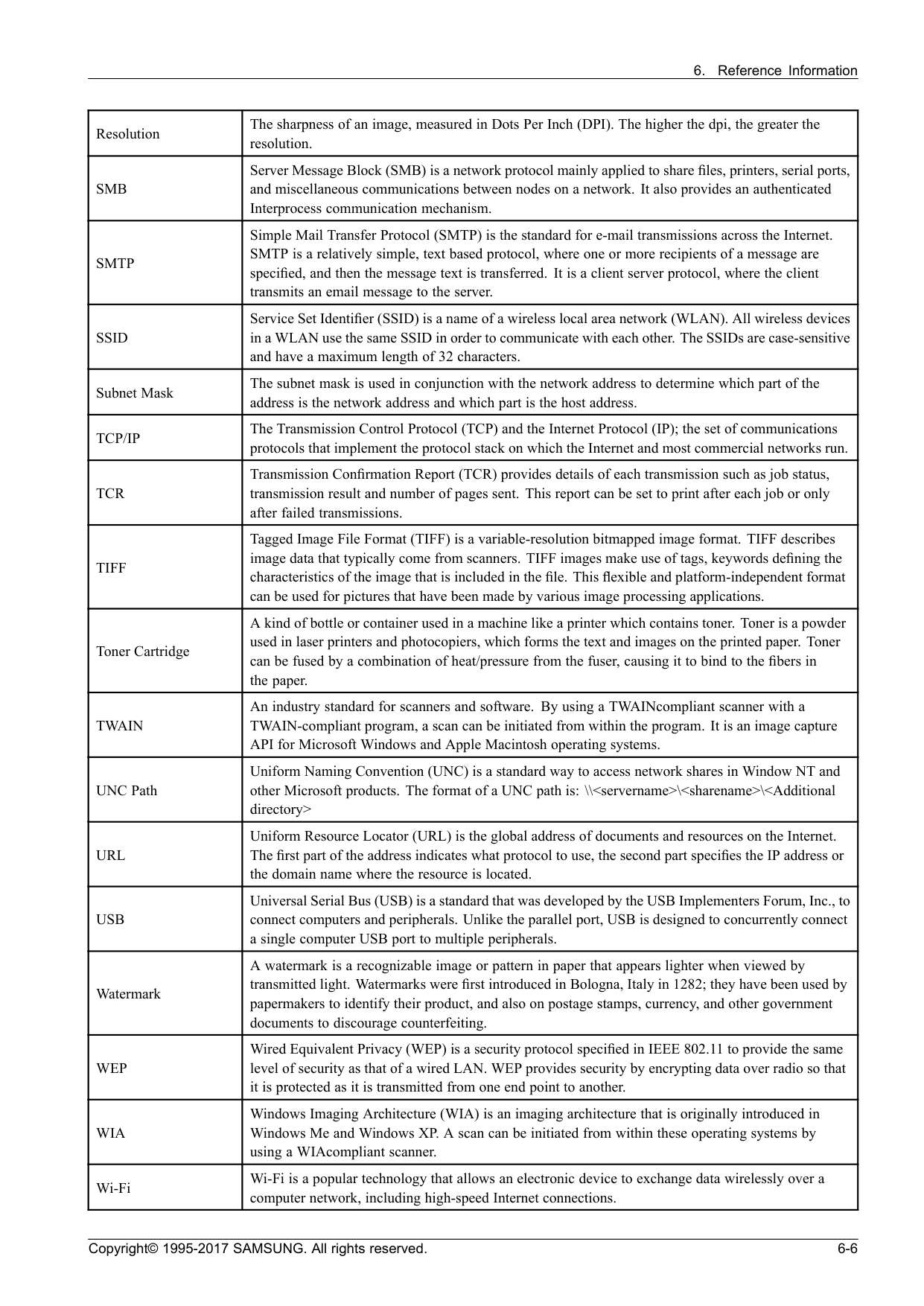
    Page 93

  • Reference Information
  • Resolution The sharpness of an image, measured in Dots Per Inch (DPI). The higher the dpi, the greater the resolution.

    Smb

    Server Message Block (SMB) is a network protocol mainly applied to share files, printers, serial ports, and miscellaneous communications between nodes on a network. It also provides an authenticated Interprocess communication mechanism.

    Smtp

    Simple Mail Transfer Protocol (SMTP) is the standard for e-mail transmissions across the Internet. SMTP is a relatively simple, text based protocol, where one or more recipients of a message are specified, and then the message text is transferred. It is a client server protocol, where the client transmits an email message to the server.

    Ssid

    Service Set Identifier (SSID) is a name of a wireless local area network (WLAN). All wireless devices in a WLAN use the same SSID in order to communicate with each other. The SSIDs are case-sensitive and have a maximum length of 32 characters. Subnet Mask The subnet mask is used in conjunction with the network address to determine which part of the address is the network address and which part is the host address.

    Tcp/Ip

    The Transmission Control Protocol (TCP) and the Internet Protocol (IP); the set of communications protocols that implement the protocol stack on which the Internet and most commercial networks run.

    Tcr

    Transmission Confirmation Report (TCR) provides details of each transmission such as job status, transmission result and number of pages sent. This report can be set to print after each job or only after failed transmissions.

    Tiff

    Tagged Image File Format (TIFF) is a variable-resolution bitmapped image format. TIFF describes image data that typically come from scanners. TIFF images make use of tags, keywords defining the characteristics of the image that is included in the file. This flexible and platform-independent format can be used for pictures that have been made by various image processing applications. Toner Cartridge A kind of bottle or container used in a machine like a printer which contains toner. Toner is a powder used in laser printers and photocopiers, which forms the text and images on the printed paper. Toner can be fused by a combination of heat/pressure from the fuser, causing it to bind to the fibers in the paper.

    Twain

    An industry standard for scanners and software. By using a TWAINcompliant scanner with a TWAIN-compliant program, a scan can be initiated from within the program. It is an image capture API for Microsoft Windows and Apple Macintosh operating systems. UNC Path Uniform Naming Convention (UNC) is a standard way to access network shares in Window NT and other Microsoft products. The format of a UNC path is: \\\\

    Url

    Uniform Resource Locator (URL) is the global address of documents and resources on the Internet. The first part of the address indicates what protocol to use, the second part specifies the IP address or the domain name where the resource is located.

    Usb

    Universal Serial Bus (USB) is a standard that was developed by the USB Implementers Forum, Inc., to connect computers and peripherals. Unlike the parallel port, USB is designed to concurrently connect a single computer USB port to multiple peripherals. Watermark A watermark is a recognizable image or pattern in paper that appears lighter when viewed by transmitted light. Watermarks were first introduced in Bologna, Italy in 1282; they have been used by papermakers to identify their product, and also on postage stamps, currency, and other government documents to discourage counterfeiting.

    Wep

    Wired Equivalent Privacy (WEP) is a security protocol specified in IEEE 802.11 to provide the same level of security as that of a wired LAN. WEP provides security by encrypting data over radio so that it is protected as it is transmitted from one end point to another.

    Wia

    Windows Imaging Architecture (WIA) is an imaging architecture that is originally introduced in Windows Me and Windows XP. A scan can be initiated from within these operating systems by using a WIAcompliant scanner. Wi-Fi Wi-Fi is a popular technology that allows an electronic device to exchange data wirelessly over a computer network, including high-speed Internet connections. Copyright© 1995-2017 SAMSUNG. All rights reserved. 6-6
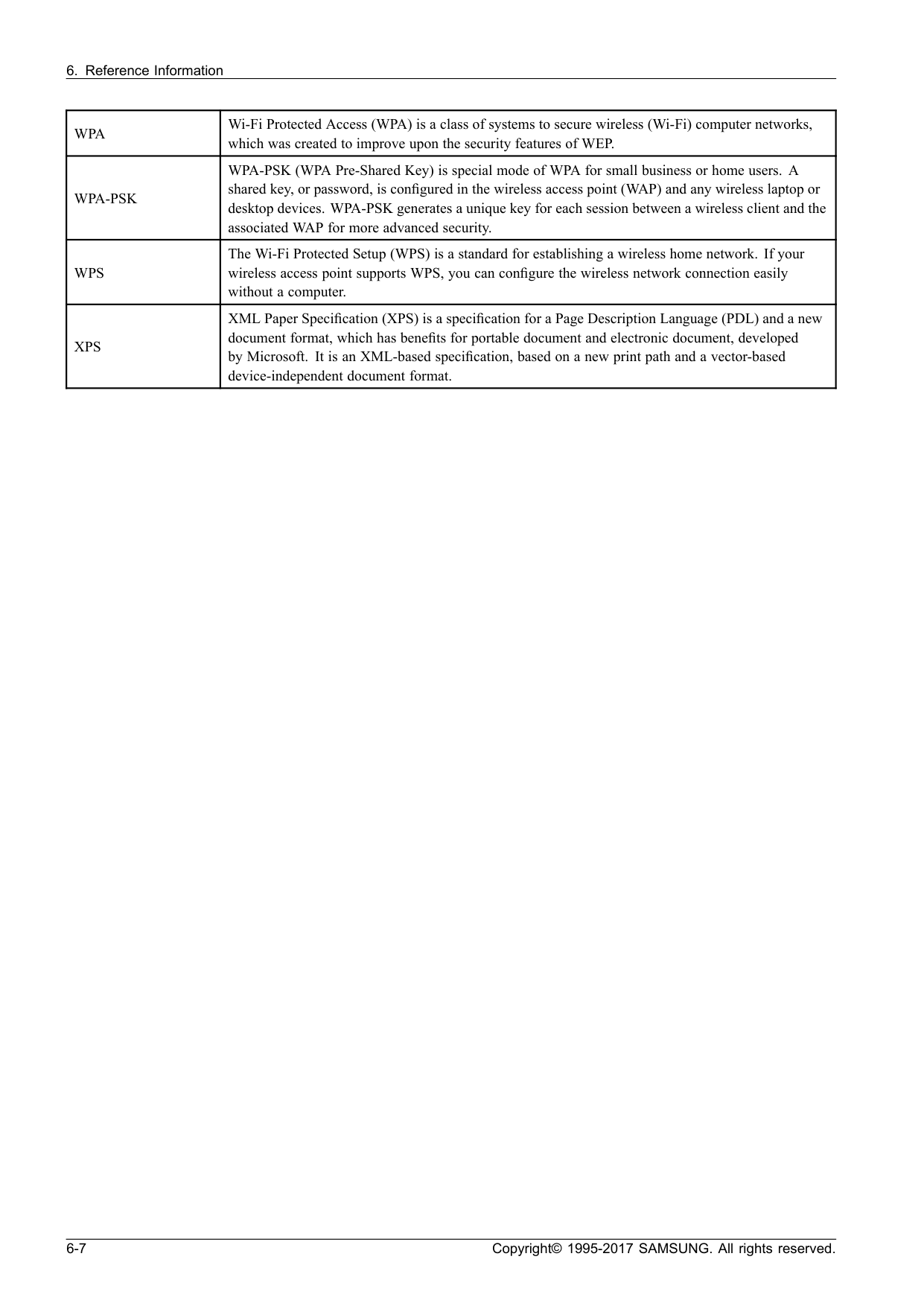
    Page 94

  • Reference Information
  • Wpa

    Wi-Fi Protected Access (WPA) is a class of systems to secure wireless (Wi-Fi) computer networks, which was created to improve upon the security features of WEP.

    Wpa-Psk

    WPA-PSK (WPA Pre-Shared Key) is special mode of WPA for small business or home users. A shared key, or password, is configured in the wireless access point (WAP) and any wireless laptop or desktop devices. WPA-PSK generates a unique key for each session between a wireless client and the associated WAP for more advanced security.

    Wps

    The Wi-Fi Protected Setup (WPS) is a standard for establishing a wireless home network. If your wireless access point supports WPS, you can configure the wireless network connection easily without a computer.

    Xps

    XML Paper Specification (XPS) is a specification for a Page Description Language (PDL) and a new document format, which has benefits for portable document and electronic document, developed by Microsoft. It is an XML-based specification, based on a new print path and a vector-based device-independent document format. 6-7 Copyright© 1995-2017 SAMSUNG. All rights reserved.
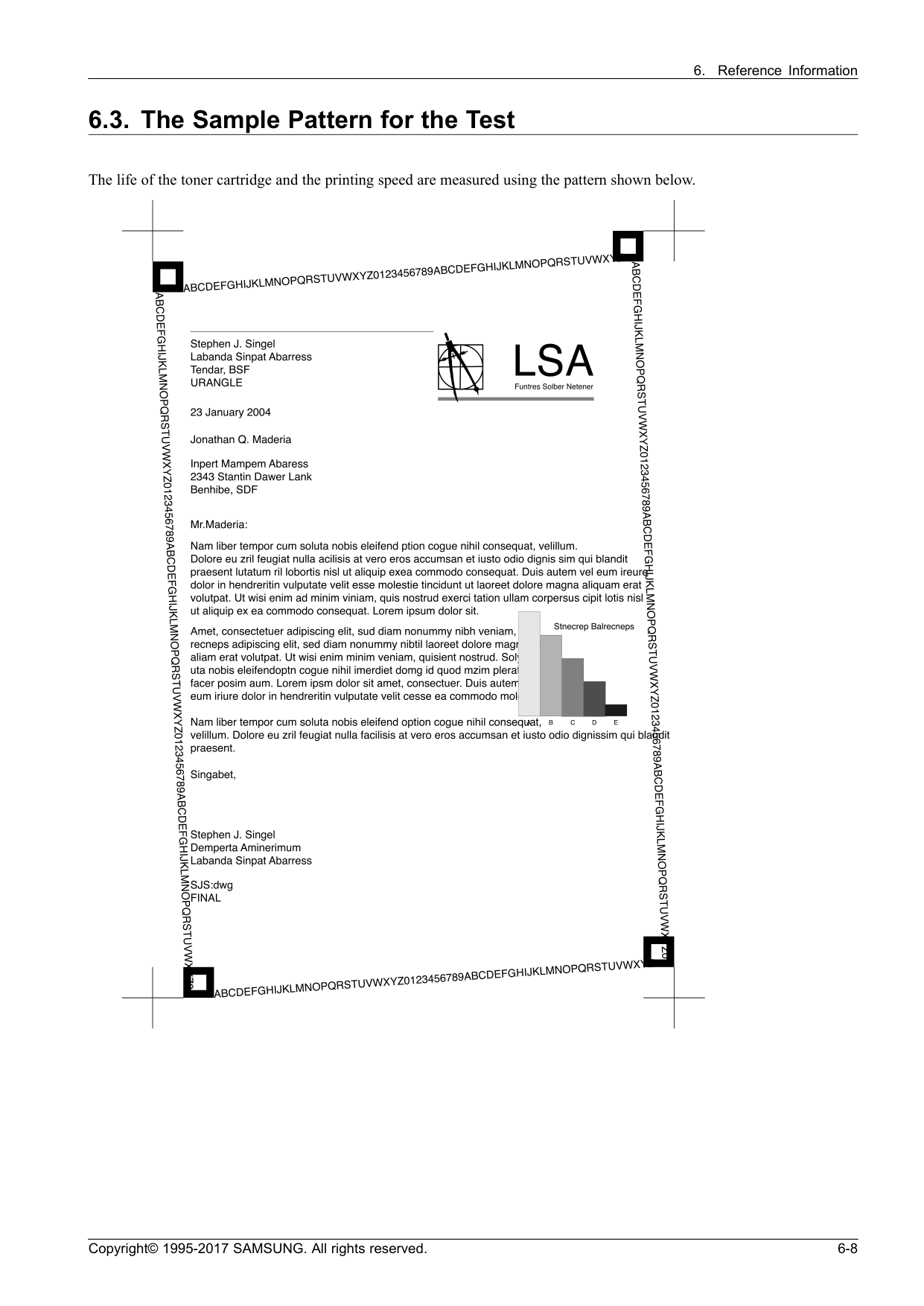
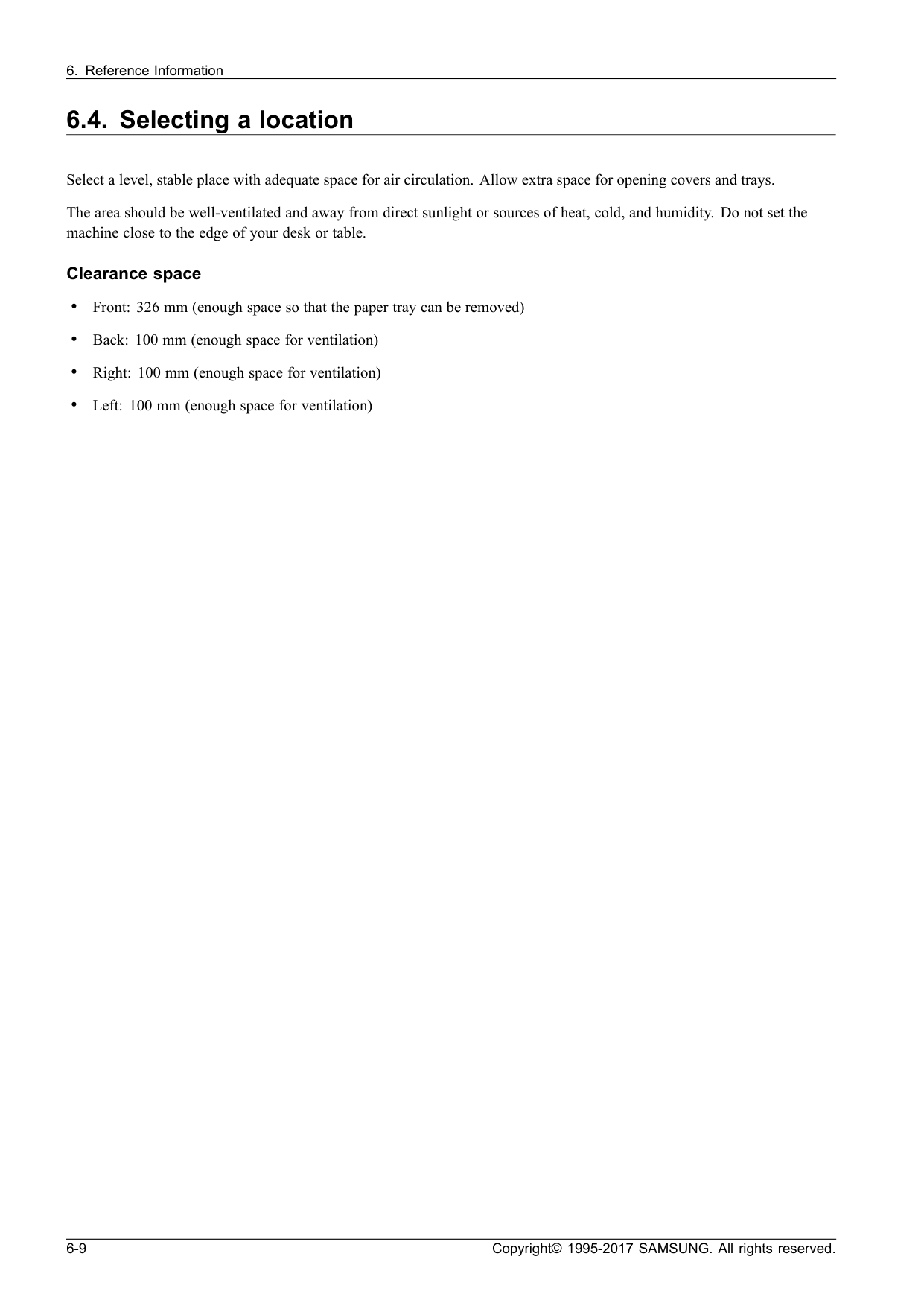
    Page 95

  • Reference Information
  • 6.3. The Sample Pattern for the Test The life of the toner cartridge and the printing speed are measured using the pattern shown below. Copyright© 1995-2017 SAMSUNG. All rights reserved. 6-8

    Page 96

  • Reference Information
  • 6.4. Selecting a location Select a level, stable place with adequate space for air circulation. Allow extra space for opening covers and trays. The area should be well-ventilated and away from direct sunlight or sources of heat, cold, and humidity. Do not set the machine close to the edge of your desk or table. Clearance space • Front: 326 mm (enough space so that the paper tray can be removed) • Back: 100 mm (enough space for ventilation) • Right: 100 mm (enough space for ventilation) • Left: 100 mm (enough space for ventilation) 6-9 Copyright© 1995-2017 SAMSUNG. All rights reserved.

    Page 97

    Gspn (Global Service Partner Network)

    Area Web Site Europe, MENA, CIS, Africa https://gspn1.samsungcsportal.com E.Asia, W.Asia, China, Japan https://gspn2.samsungcsportal.com N.America, S.America https://gspn3.samsungcsportal.com This Service Manual is a property of Samsung Electronics Co.,Ltd. Any unauthorized use of Manual can be punished under applicable International and/or domestic law. © 2017 Samsung Electronics Co.,Ltd. All rights reserved. Printed in Korea

    More from HP

    Similar Printers