
Ask AI
— answers from the official manualAnswers from the official manual.
Common questions
Common Questions
8 totalWhat should I do if my ZBook 15 G3 overheats?
To prevent overheating, use the computer only on a hard, flat surface and avoid blocking airflow vents. Consider cleaning dust accumulation inside or taking it to service for professional examination.
How do I troubleshoot no video issues on my HP ZBook 15 G3?
If there's no video, execute steps including checking if the computer is booting normally by pressing F9 to change boot order, verifying display cables are properly seated in connectors, or using diagnostic utilities such as 'HP PC Hardware Diagnostics (UEFI)' to test the display and video subsystems.
How can I update the BIOS on my HP ZBook 15 G3?
To update the BIOS, go to www.hp.com and navigate to Support & Drivers > click Drivers & Software. Enter your computer model information in the search box, select the correct OS version, then download the most recent BIOS from the provided links.
What is the recommended battery replacement process for HP ZBook 15 G3?
To replace the battery, first turn off your computer and unplug it. Remove the bottom cover by loosening nine captive Torx screws and lifting it off. Disconnect the battery cable from the system board; then unscrew three Phillips screws securing the battery and carefully remove it.
How do I replace a memory module in an HP ZBook 15 G3?
To replace a memory module, ensure the computer is powered off, disconnected from power sources, and external devices. Remove the bottom cover by loosening nine captive Torx screws and disconnecting the battery. Spread the retaining tabs on each side of the memory module slot to release the memory module, then pull it away from the slot.
How do I use WLAN in my HP ZBook 15 G3?
WLAN can be toggled on or off using both BIOS settings and software utilities such as 'HP Support Assistant'. In BIOS, navigate to computer setup where you can enable/disable wireless options; through software by utilizing control panels and configuration tools specific for integrated WLAN modules.
Full Manual
207 pages

HP ZBook 15 G3 Mobile Workstation
Maintenance and Service Guide
© Copyright 2016, 2017 HP Development Company, L.P.
AMD is a trademark of Advanced Micro Devices, Inc. Bluetooth is a trademark owned by its proprietor and used by HP Inc. under license. Intel, Celeron, and Pentium are trademarks of Intel Corporation in the U.S. and other countries. Microsoft and Windows are trademarks of the Microsoft group of companies.
The information contained herein is subject to change without notice. The only warranties for HP products and services are set forth in the express warranty statements accompanying such products and services. Nothing herein should be construed as constituting an additional warranty. HP shall not be liable for technical or editorial errors or omissions contained herein.
Second Edition: October 2017 First Edition: January 2016 Document Part number: 839656-002
######### Product notice
This user guide describes features that are common to most models. Some features may not be available on your computer.
Not all features are available in all editions of Windows. This computer may require upgraded and/or separately purchased hardware, drivers and/or software to take full advantage of Windows functionality. Go to http://www.microsoft.com for details.
######### Software terms
By installing, copying, downloading, or otherwise using any software product preinstalled on this computer, you agree to be bound by the terms of the HP End User License Agreement (EULA). If you do not accept these license terms, your sole remedy is to return the entire unused product (hardware and software) within 14 days for a full refund subject to the refund policy of your seller.
For any further information or to request a full refund of the price of the computer, please contact your seller.
#### Safety warning notice
WARNING! To reduce the possibility of heat-related injuries or of overheating the computer, do not place the computer directly on your lap or obstruct the computer air vents. Use the computer only on a hard, flat surface. Do not allow another hard surface, such as an adjoining optional printer, or a soft surface, such as pillows or rugs or clothing, to block airflow. Also, do not allow the AC adapter to contact the skin or a soft surface, such as pillows or rugs or clothing, during operation. The computer and the AC adapter comply with the user-accessible surface temperature limits defined by the International Standard for Safety of Information Technology Equipment (IEC 60950).
iii
####### iv Safety warning notice
Table of contents
TouchPad ............................................................................................................................................. 8 Lights ................................................................................................................................................... 9 Buttons and fingerprint reader ......................................................................................................... 10 Special function keys ........................................................................................................................ 11
Front ..................................................................................................................................................................... 12 Left ....................................................................................................................................................................... 13 Right ..................................................................................................................................................................... 14 Bottom ................................................................................................................................................................. 15 Labels ................................................................................................................................................................... 16
Plastic parts ....................................................................................................................................... 27 Cables and connectors ...................................................................................................................... 28 Drive handling ................................................................................................................................... 28
Grounding guidelines ........................................................................................................................................... 28 Electrostatic discharge damage ........................................................................................................ 28 Packaging and transporting guidelines .......................................................................... 30 Workstation guidelines ................................................................................ 30
v
###### 5 Removal and replacement procedures for Customer Self-Repair parts ............................................................. 32Component replacement procedures .................................................................................................................. 32
Bottom cover ..................................................................................................................................... 32 Battery ............................................................................................................................................... 34 SIM card ............................................................................................................................................. 35 Memory module ................................................................................................................................ 36
###### 6 Removal and replacement procedures for Authorized Service Provider parts ................................................... 38Component replacement procedures .................................................................................................................. 38
Display subcomponents (bezel, panel, webcam) ............................................................................. 38 Solid-state drive (M.2) ....................................................................................................................... 42 WLAN module .................................................................................................................................... 44 WWAN module ................................................................................................................................... 46 RTC battery ........................................................................................................................................ 47 Keyboard ........................................................................................................................................... 49 Speakers ............................................................................................................................................ 52 Touchpad module .............................................................................................................................. 53 LED board .......................................................................................................................................... 54 Fans ................................................................................................................................................... 55 Smart card reader .............................................................................................................................. 57 Hard drive .......................................................................................................................................... 58 Fingerprint reader board ................................................................................................................... 60 Heat sink assembly ........................................................................................................................... 62 Graphics board .................................................................................................................................. 66 System board .................................................................................................................................... 67 Buttons .............................................................................................................................................. 70 Display assembly ............................................................................................................................... 71 Lock bracket ...................................................................................................................................... 79
####### 7 Troubleshooting guide ................................................................................................................................. 80Resources ............................................................................................................................................................. 81General troubleshooting steps ............................................................................................................................ 81
Identify the issue ............................................................................................................................... 82
vi
Remotely deploying BIOS and drivers .......................................................... 85 Analyze the issue ............................................................................................................................... 85
Status lights .................................................................................................. 90 Interpreting system validation diagnostic front panel LEDs and audible codes ................................................................................................ 91 POST error messages ................................................................................... 92 Power Good (Troubleshooting) lights .......................................................... 93
Resolve the issue ............................................................................................................................... 94
Verify solution ................................................................................................................................... 98

Helpful Hints ........................................................................................................................................................ 98 At startup ........................................................................................................................................... 98 During operation ............................................................................................................................... 99 Consulting with HP Service ............................................................................................................. 100
Common issues and possible solutions ............................................................................................................ 100
Power-on issues .............................................................................................................................. 100 No Power ....................................................................................................................... 100 Intermittent power-on, shutdown, reboot ................................................................... 102 AC adapter issue ........................................................................................................... 103 Battery not recognized, not charging ........................................................................... 104 Battery discharges too fast .......................................................................................... 105 Burnt smell .................................................................................................................... 106
POST ................................................................................................................................................ 106 No video (with power) ................................................................................................... 106
vii
viii
Blinking lights ............................................................................................................... 107 Diagnostics error messages ......................................................................................... 108 BIOS password .............................................................................................................. 109
Performance (OS) ............................................................................................................................ 109 Intermittent shutdown ................................................................................................. 110 Blue screen .................................................................................................................... 111 Freeze at Windows Logo (hang/lockup) ....................................................................... 113 Electromagnetic Interference (EMI) .............................................................................. 114 No wake up .................................................................................................................... 114 Unresponsive ................................................................................................................ 116 Slow performance ......................................................................................................... 116 HP Smart Adapter warning message ........................................................................... 117 Incorrect time and date ................................................................................................ 117
Display ............................................................................................................................................. 118
Display anomalies ......................................................................................................... 118 Symptom .................................................................................................... 118 Quick check ................................................................................................. 119 HP PC Hardware Diagnostics (UEFI) for video test ..................................... 119 Display assembly diagram ......................................................................... 120
Dead pixel ..................................................................................................................... 120 No video (internal) ........................................................................................................ 120 No video (external) ....................................................................................................... 121 DisplayPort/VGA ........................................................................................................... 121 HDMI .............................................................................................................................. 121 No or bad external video via docking ........................................................................... 122 Incorrect or missing color/distorted image .................................................................. 122 Touch screen ................................................................................................................. 123
I/O devices ....................................................................................................................................... 124 Keyboard ....................................................................................................................... 124 Keyboard point stick ..................................................................................................... 125 Keyboard backlight ....................................................................................................... 125 TouchPad ....................................................................................................................... 126 Network Connectivity Ethernet (RJ-45 jack) ................................................................ 126 Network connectivity wireless (WLAN) ........................................................................ 127 WWAN ............................................................................................................................ 128 USB ................................................................................................................................ 129 Smart card reader ......................................................................................................... 130 Speaker, headphone - audio issues .............................................................................. 131 Thunderbolt (TB) ........................................................................................................... 132
Storage ............................................................................................................................................ 133 Hard drive/solid-state drive not recognized ................................................................ 134
No boot to operating system (no read/write error) ..................................................... 134 Read-write error ........................................................................................................... 135 Slow performance ......................................................................................................... 135 Blue screen (BSOD) error .............................................................................................. 135 Noisy hard drive ............................................................................................................ 136
Mechanical ....................................................................................................................................... 137 Fan error message - 90B .............................................................................................. 137 Noise (sound) ................................................................................................................ 138 Fan runs constantly ...................................................................................................... 139 Thermal shutdown (hot) ............................................................................................... 140 Stuck power button ...................................................................................................... 140
Additional information ...................................................................................................................................... 141 Acronyms ......................................................................................................................................... 141 Blinking lights and boot error codes ............................................................................................... 142
Processor not executing code ...................................................................................... 142 BIOS recovery code unable to find valid BIOS recovery image ..................................... 142 Memory module error ................................................................................................... 142 Graphics Controller Error (No Controller) ..................................................................... 143 Failure - System Board Error ........................................................................................ 143 Intel Trusted Execution Technology (TXT) Error .......................................................... 143 Sure Start unable to find valid BIOS Boot Block image ................................................ 143 Sure Start has identified a problem (Manual Recovery Policy Set) .............................. 144
POST Error Messages and User Actions .......................................................................................... 144 Routine Maintenance for Performance Improvement .................................................................... 146 Common Blue Screen Error Messages ............................................................................................ 146
Error message list ......................................................................................................... 146 Bug check symbolic names ........................................................................................... 146 Microsoft general troubleshooting of Windows bug check codes ............................... 147
Use Windows Debugging Tool ......................................................................................................... 147
Windows Software Development Kit (SDK) .................................................................. 148 Display Issue: Pixel Anomalies ........................................................................................................ 152 Cable management ......................................................................................................................... 153 Connector types .............................................................................................................................. 154
###### 8 Computer Setup (BIOS), TPM, and HP Sure Start in Windows 7 ........................................................................ 156Using Computer Setup ....................................................................................................................................... 156
Starting Computer Setup ................................................................................................................ 156 Navigating and selecting in Computer Setup ................................................................................. 156 Restoring factory settings in Computer Setup ............................................................................... 157 Updating the BIOS ........................................................................................................................... 157
Determining the BIOS version ...................................................................................... 157
ix
Downloading a BIOS update ......................................................................................... 158
Changing the boot order using the f9 prompt ................................................................................ 159 TPM BIOS settings (select products only) ......................................................................................................... 159 Using HP Sure Start (select products only) ....................................................................................................... 159
Starting Computer Setup ................................................................................................................ 160 Navigating and selecting in Computer Setup ................................................................................. 160 Restoring factory settings in Computer Setup ............................................................................... 161 Updating the BIOS ........................................................................................................................... 162
Determining the BIOS version ...................................................................................... 162 Downloading a BIOS update ......................................................................................... 162
Changing the boot order using the f9 prompt ................................................................................ 163 TPM BIOS settings (select products only) ......................................................................................................... 163 Using HP Sure Start (select products only) ....................................................................................................... 164
Guidelines ........................................................................................................................................ 167 Creating recovery media with HP Recovery Disc Creator ............................................................... 167
Creating recovery media ............................................................................................... 168 Backing up your information .......................................................................................................... 168
Performing a system recovery .......................................................................................................................... 169 Using the Windows recovery tools .................................................................................................. 169 Using f11 recovery tools (select products only) ............................................................................. 170 Using Windows 7 operating system media ..................................................................................... 170
Creating HP Recovery media (select products only) ....................................................................... 172 Using Windows tools ......................................................................................................................................... 173 Restore and recovery ......................................................................................................................................... 173
Recovering using HP Recovery Manager ........................................................................................ 174 What you need to know before you get started ........................................................... 174 Using the HP Recovery partition (select products only) .............................................. 175 Using HP Recovery media to recover ............................................................................ 175
x
Changing the computer boot order .............................................................................. 175 Removing the HP Recovery partition (select products only) ....................................... 176
###### Index ........................................................................................................................................................... 192
xi
####### xii
1 Product description
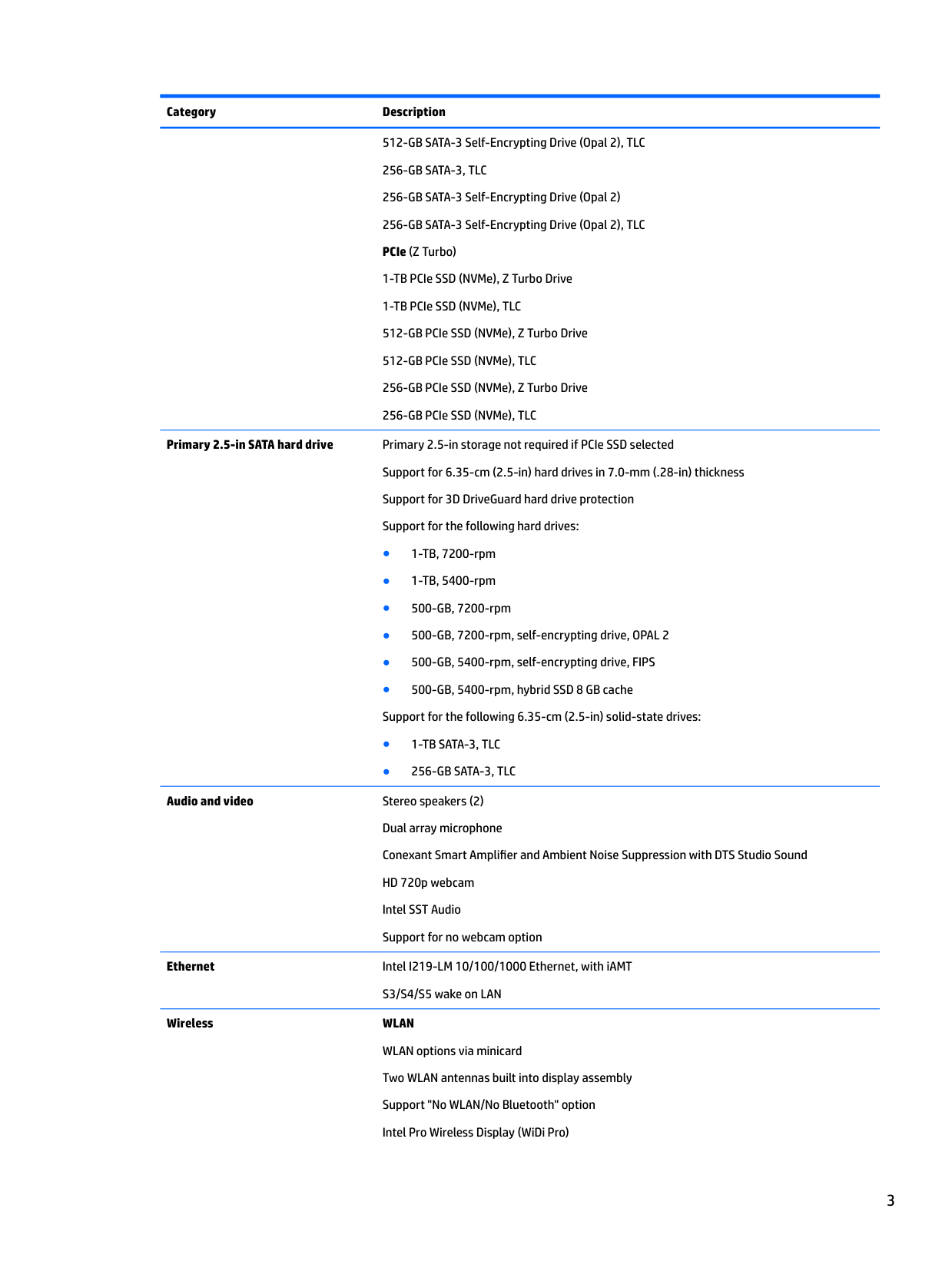
Category Description Product Name HP ZBook 15 G3 Mobile Workstation Processors 6th Generation Intel® Core™ processors
######### 6th Generation Intel Xeon processors
Chipset Mobile Intel CM236 chipset Graphics Intel UMA Graphics - with shared video memory
Intel HD Graphics 530 (for Core processors) Intel HD Graphics P530 (for Xeon processors) Discrete MXM daughter cards
Panel 39.6 cm (15.6 in), antiglare, LED backlight, 16:9 aspect ratio
Memory Four customer-accessible/upgradable memory module slots Support for DDR4 2133-MHz, dual channel memory Support for 64-GB of system RAM in the following configurations: DDR4-2133 (for Core processors only)
Primary M.2 M.2 (NGFF) SS/DS Solid State Drive (2280) SATA 512-GB SATA-3, TLC 512-GB SATA-3 Self-Encrypting Drive (Opal 2) 512-GB SATA-3 Self-Encrypting Drive (Opal 2), TLC 256-GB SATA-3, TLC 256-GB SATA-3 Self-Encrypting Drive (Opal 2) 256-GB SATA-3 Self-Encrypting Drive (Opal 2), TLC PCIe (Z Turbo) 1-TB PCIe SSD (NVMe), Z Turbo Drive 1-TB PCIe SSD (NVMe), TLC 512-GB PCIe SSD (NVMe), Z Turbo Drive 512-GB PCIe SSD (NVMe), TLC 256-GB PCIe SSD (NVMe), Z Turbo Drive 256-GB PCIe SSD (NVMe), TLC
Secondary M.2 M.2 (NGFF) SS/DS Solid State Drive (2280) SATA 512-GB SATA-3, TLC 512-GB SATA-3 Self-Encrypting Drive (Opal 2)
512-GB SATA-3 Self-Encrypting Drive (Opal 2), TLC 256-GB SATA-3, TLC 256-GB SATA-3 Self-Encrypting Drive (Opal 2) 256-GB SATA-3 Self-Encrypting Drive (Opal 2), TLC PCIe (Z Turbo) 1-TB PCIe SSD (NVMe), Z Turbo Drive 1-TB PCIe SSD (NVMe), TLC 512-GB PCIe SSD (NVMe), Z Turbo Drive 512-GB PCIe SSD (NVMe), TLC 256-GB PCIe SSD (NVMe), Z Turbo Drive 256-GB PCIe SSD (NVMe), TLC
Primary 2.5-in SATA hard drive Primary 2.5-in storage not required if PCIe SSD selected Support for 6.35-cm (2.5-in) hard drives in 7.0-mm (.28-in) thickness Support for 3D DriveGuard hard drive protection Support for the following hard drives:
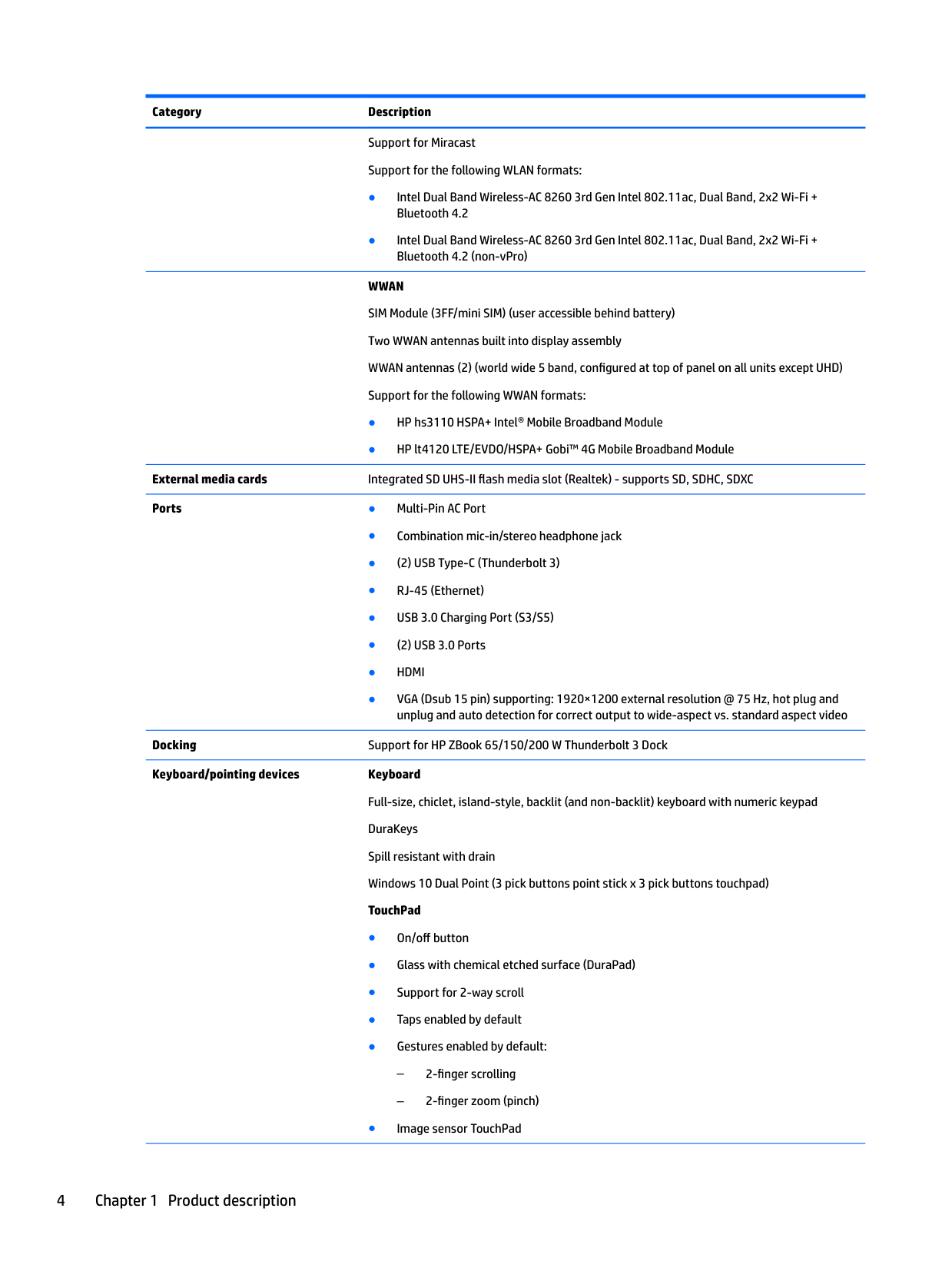
Audio and video Stereo speakers (2) Dual array microphone Conexant Smart Amplifier and Ambient Noise Suppression with DTS Studio Sound HD 720p webcam Intel SST Audio Support for no webcam option
Ethernet Intel I219-LM 10/100/1000 Ethernet, with iAMT
S3/S4/S5 wake on LAN
Wireless WLAN WLAN options via minicard Two WLAN antennas built into display assembly Support "No WLAN/No Bluetooth" option Intel Pro Wireless Display (WiDi Pro)
Support for Miracast Support for the following WLAN formats:
WWAN SIM Module (3FF/mini SIM) (user accessible behind battery) Two WWAN antennas built into display assembly WWAN antennas (2) (world wide 5 band, configured at top of panel on all units except UHD) Support for the following WWAN formats:
External media cards Integrated SD UHS-II flash media slot (Realtek) - supports SD, SDHC, SDXC Ports ● Multi-Pin AC Port
Docking Support for HP ZBook 65/150/200 W Thunderbolt 3 Dock Keyboard/pointing devices Keyboard
Full-size, chiclet, island-style, backlit (and non-backlit) keyboard with numeric keypad DuraKeys Spill resistant with drain Windows 10 Dual Point (3 pick buttons point stick x 3 pick buttons touchpad) TouchPad
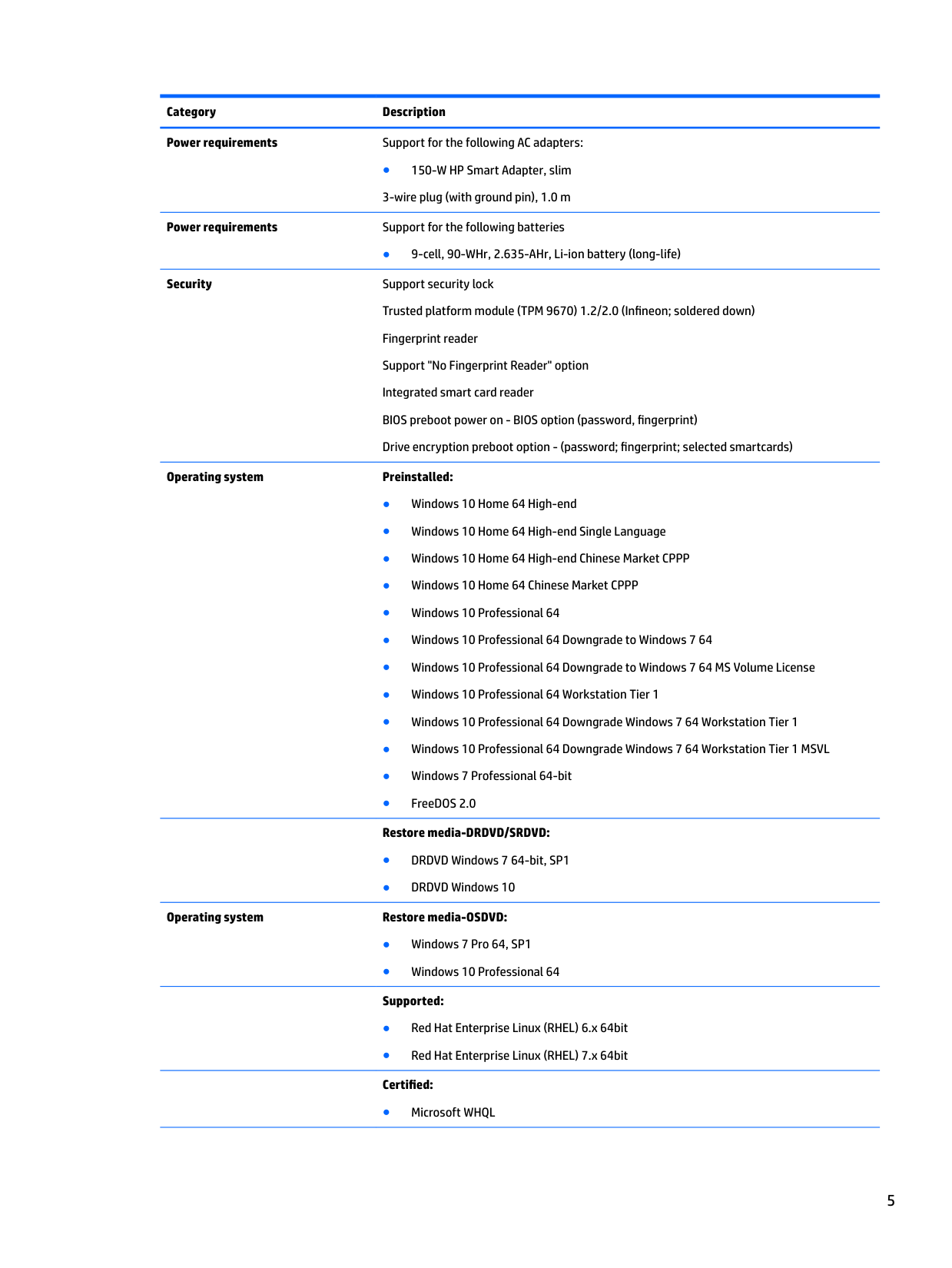
Power requirements Support for the following AC adapters:
● 150-W HP Smart Adapter, slim 3-wire plug (with ground pin), 1.0 m
Power requirements Support for the following batteries
● 9-cell, 90-WHr, 2.635-AHr, Li-ion battery (long-life)
Security Support security lock Trusted platform module (TPM 9670) 1.2/2.0 (Infineon; soldered down) Fingerprint reader Support "No Fingerprint Reader" option Integrated smart card reader BIOS preboot power on - BIOS option (password, fingerprint) Drive encryption preboot option - (password; fingerprint; selected smartcards)
######### Operating system Preinstalled:
######### Operating system Restore media-OSDVD:

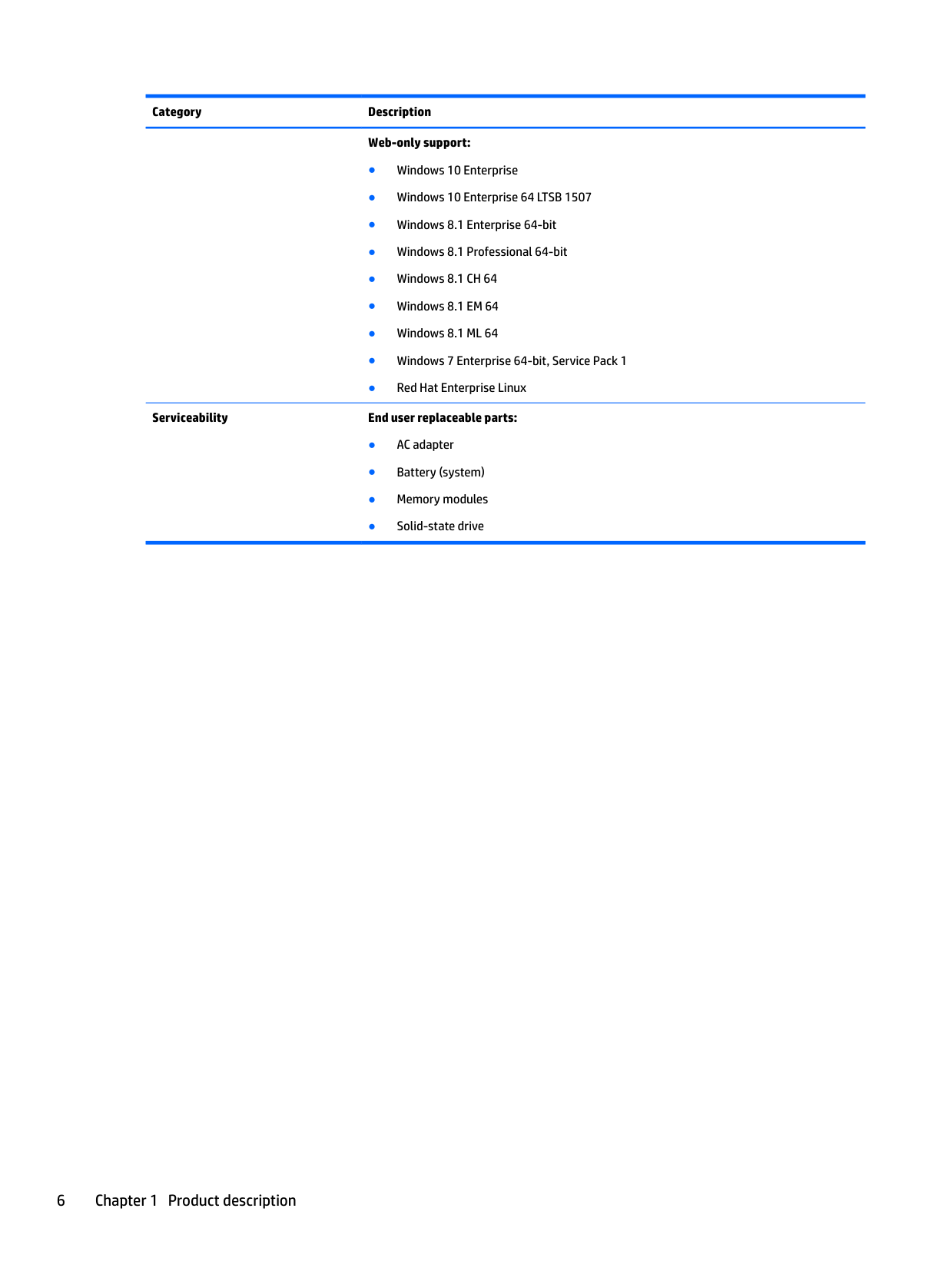
######### Serviceability End user replaceable parts:
2 External component identification
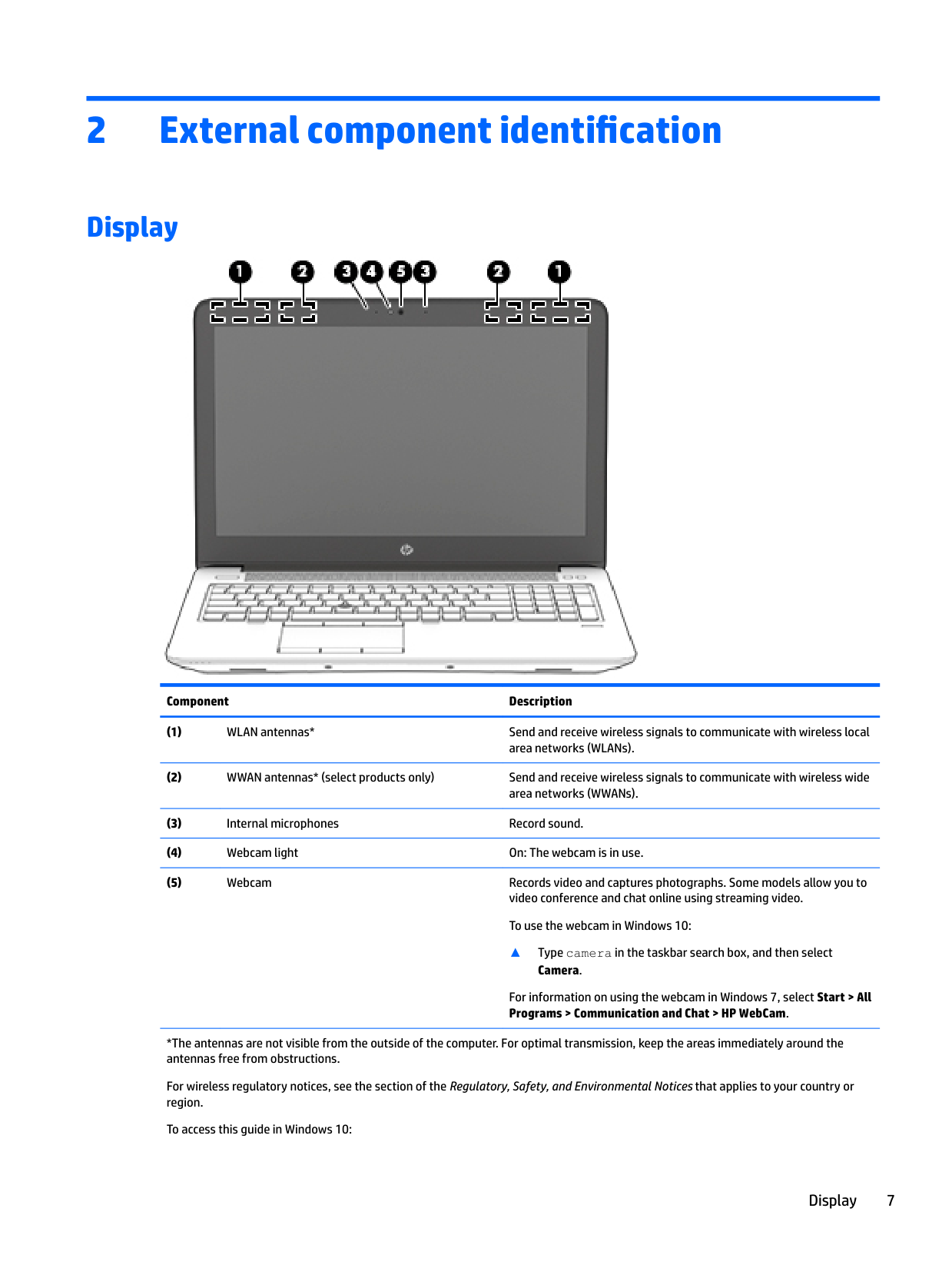
Display

######### Component Description
▲ Type camera in the taskbar search box, and then select Camera.
For information on using the webcam in Windows 7, select Start > All Programs > Communication and Chat > HP WebCam.
*The antennas are not visible from the outside of the computer. For optimal transmission, keep the areas immediately around the antennas free from obstructions.
For wireless regulatory notices, see the section of the Regulatory, Safety, and Environmental Notices that applies to your country or region.
To access this guide in Windows 10:
Display 7
######### Component Description
‒ or – Click the question mark icon in the taskbar.
Top
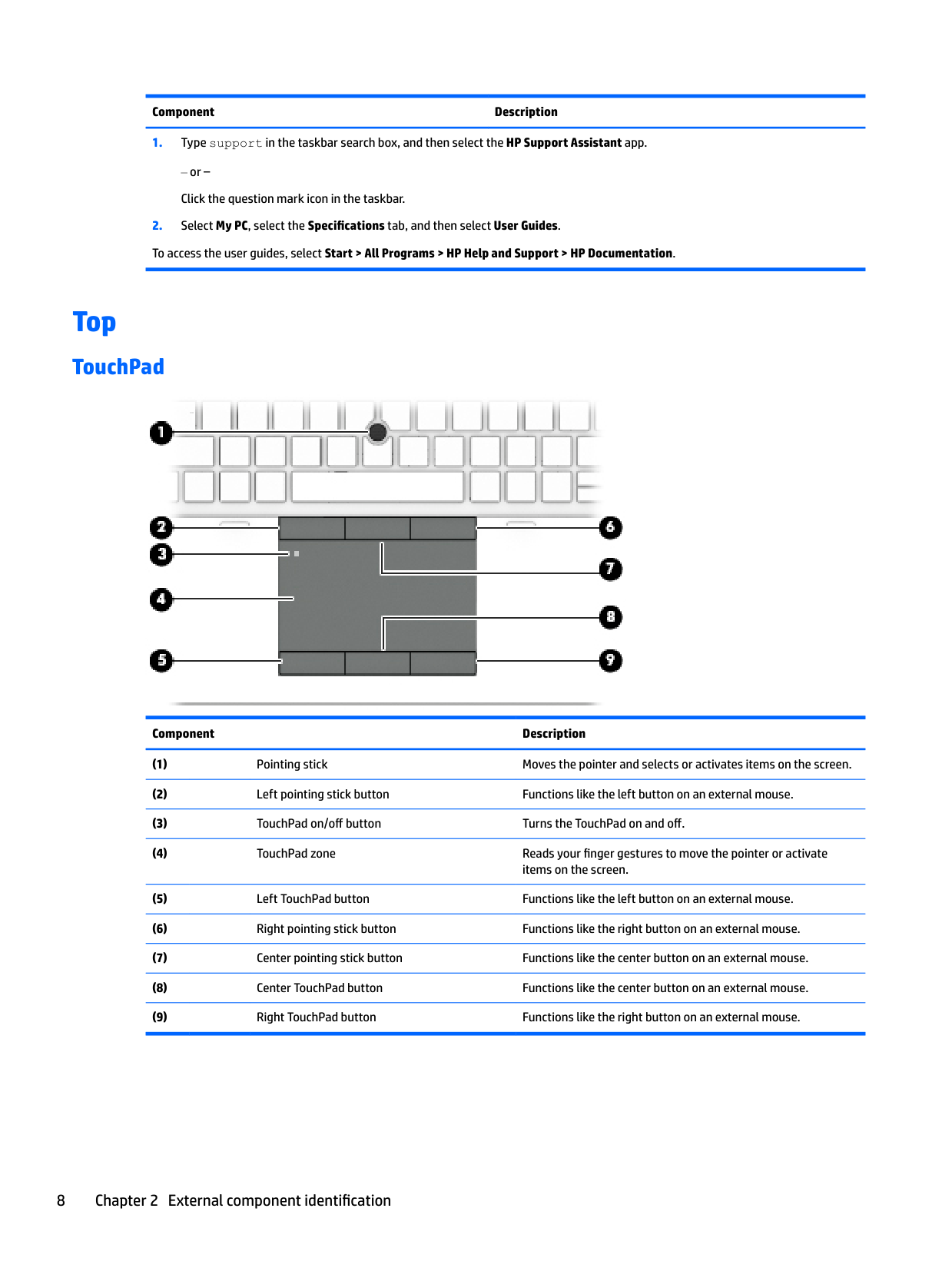
#### TouchPad

######### Component Description
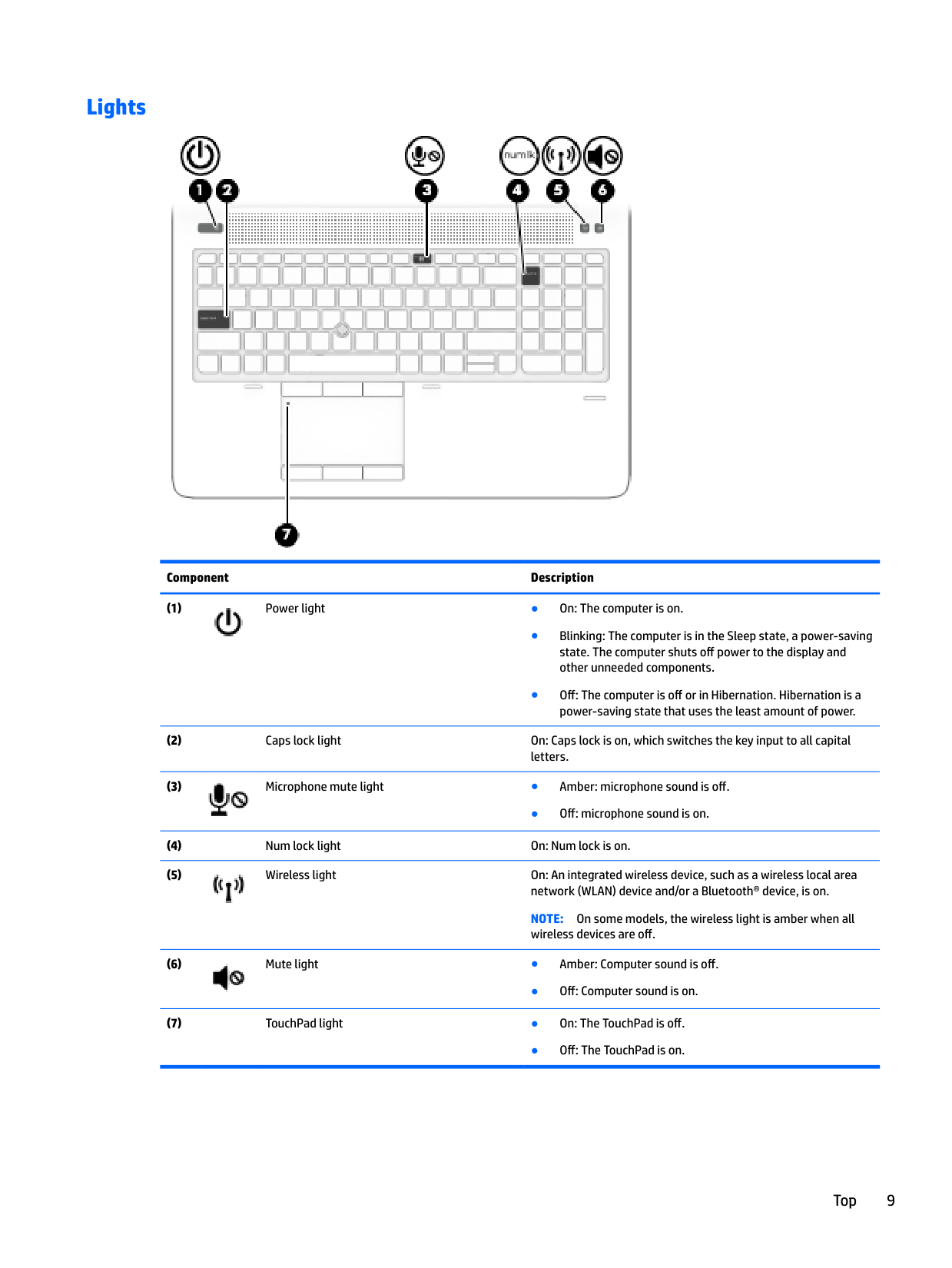
#### Lights

######### Component Description


● Off: microphone sound is on.

NOTE: On some models, the wireless light is amber when all wireless devices are off.

● Off: Computer sound is on.
● Off: The TouchPad is on.
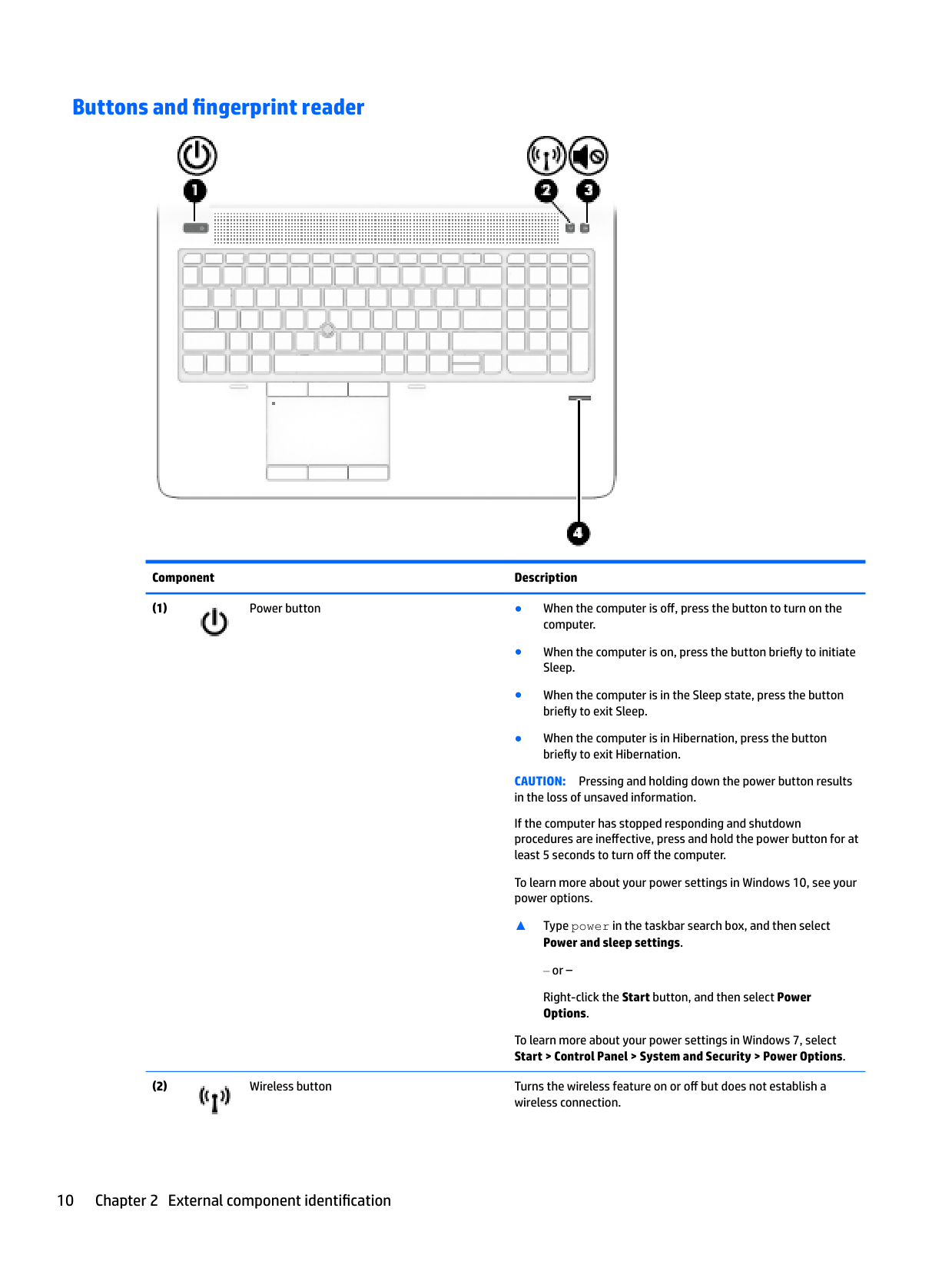
#### Buttons and fingerprint reader

######### Component Description

CAUTION: Pressing and holding down the power button results in the loss of unsaved information. If the computer has stopped responding and shutdown procedures are ineffective, press and hold the power button for at least 5 seconds to turn off the computer. To learn more about your power settings in Windows 10, see your power options.
▲ Type power in the taskbar search box, and then select Power and sleep settings.
or –
Right-click the Start button, and then select Power Options.
To learn more about your power settings in Windows 7, select Start > Control Panel > System and Security > Power Options.

######### Component Description
A wireless network must be set up before a wireless connection is possible.

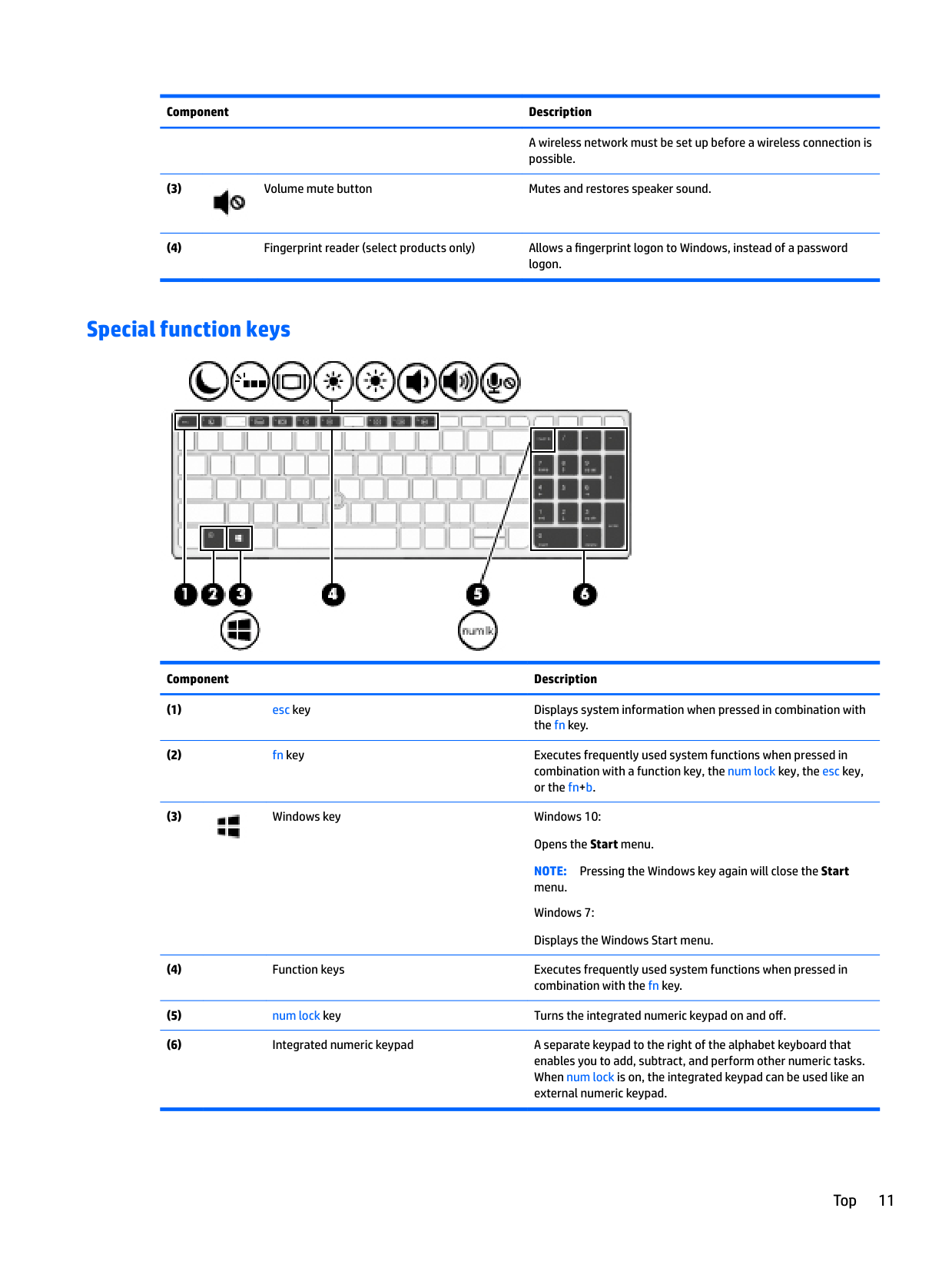
#### Special function keys

######### Component Description

NOTE: Pressing the Windows key again will close the Start menu. Windows 7: Displays the Windows Start menu.
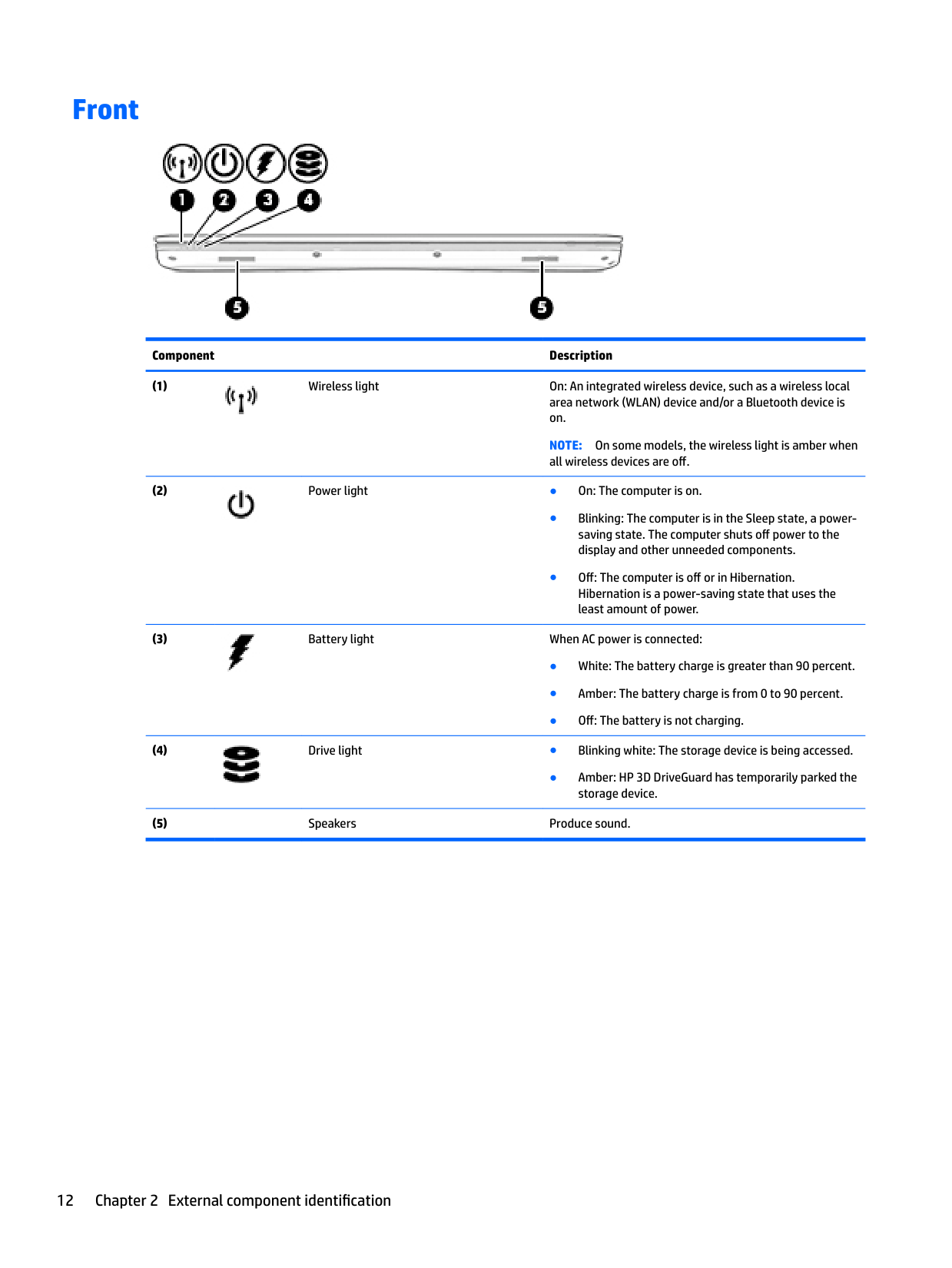
Front

######### Component Description

NOTE: On some models, the wireless light is amber when all wireless devices are off.



● Amber: HP 3D DriveGuard has temporarily parked the storage device.
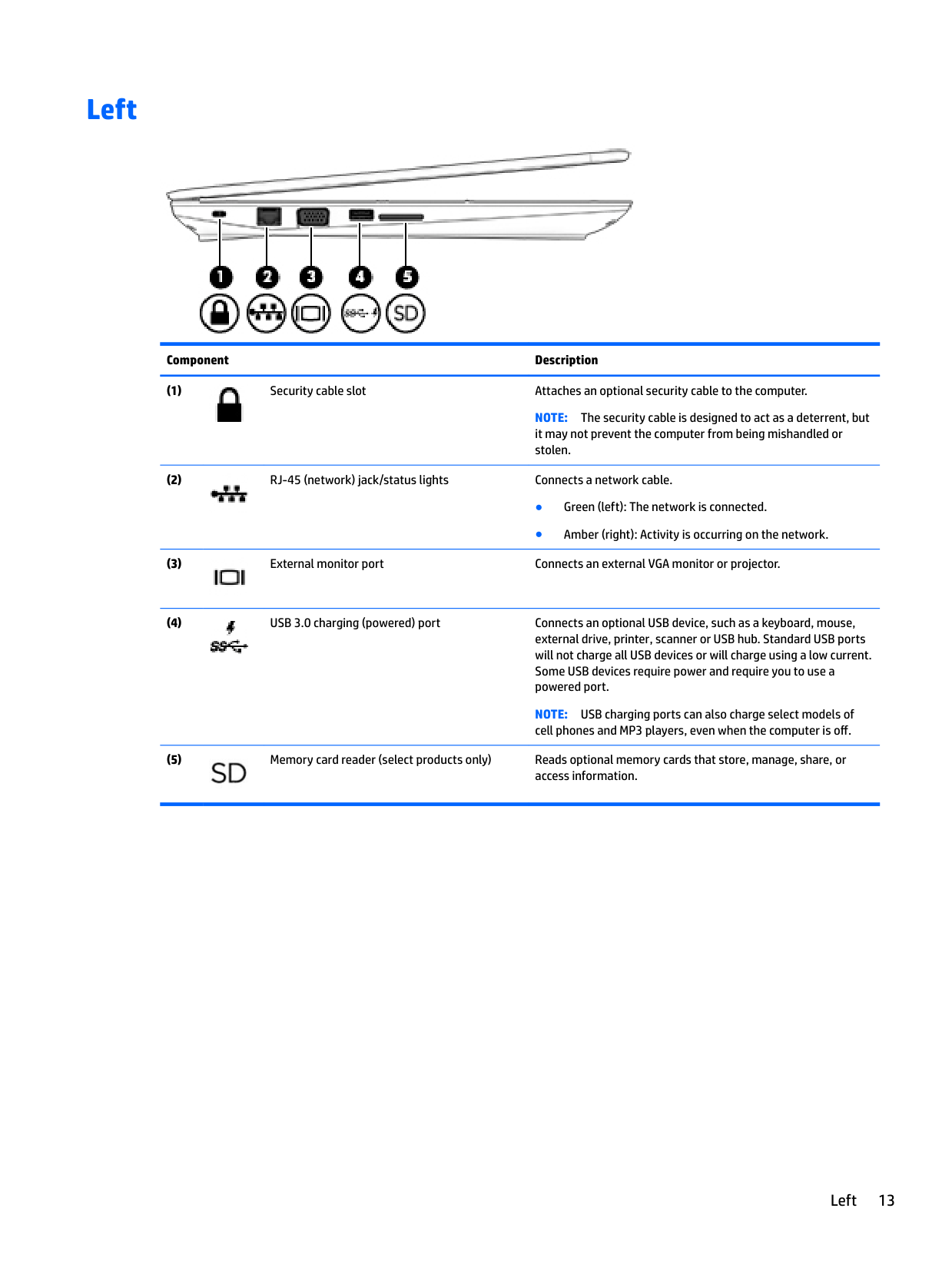
Left

######### Component Description

NOTE: The security cable is designed to act as a deterrent, but it may not prevent the computer from being mishandled or stolen.


NOTE: USB charging ports can also charge select models of cell phones and MP3 players, even when the computer is off.

Left 13
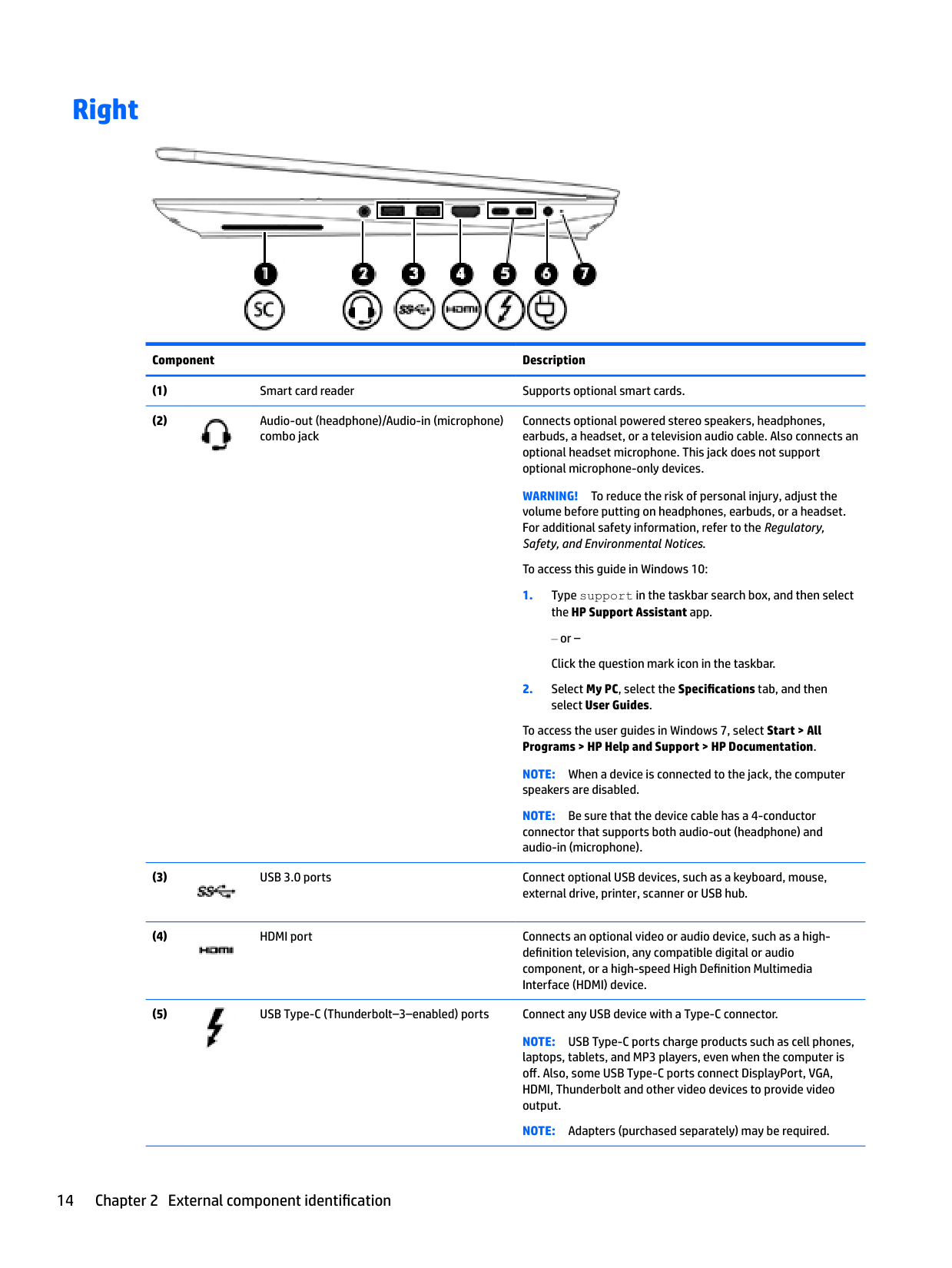
Right

######### Component Description

Connects optional powered stereo speakers, headphones, earbuds, a headset, or a television audio cable. Also connects an optional headset microphone. This jack does not support optional microphone-only devices.
WARNING! To reduce the risk of personal injury, adjust the volume before putting on headphones, earbuds, or a headset. For additional safety information, refer to the Regulatory,
Safety, and Environmental Notices. To access this guide in Windows 10:
or – Click the question mark icon in the taskbar.
To access the user guides in Windows 7, select Start > All Programs > HP Help and Support > HP Documentation.
NOTE: When a device is connected to the jack, the computer speakers are disabled.
NOTE: Be sure that the device cable has a 4-conductor connector that supports both audio-out (headphone) and audio-in (microphone).



NOTE: USB Type-C ports charge products such as cell phones, laptops, tablets, and MP3 players, even when the computer is off. Also, some USB Type-C ports connect DisplayPort, VGA, HDMI, Thunderbolt and other video devices to provide video output.
NOTE: Adapters (purchased separately) may be required.
######### Component Description


Bottom

######### Component Description
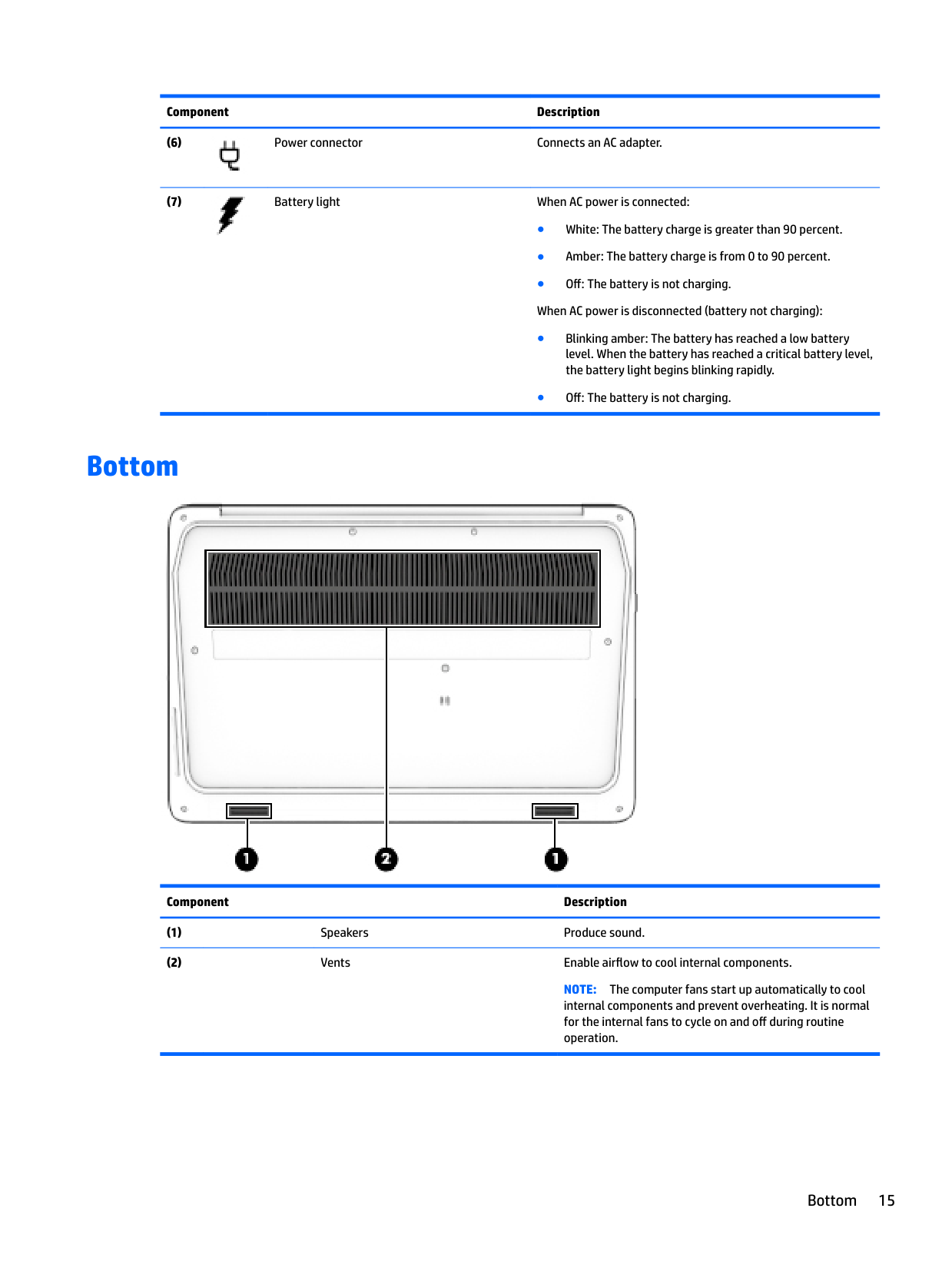
NOTE: The computer fans start up automatically to cool internal components and prevent overheating. It is normal for the internal fans to cycle on and off during routine operation.
Bottom 15
Labels
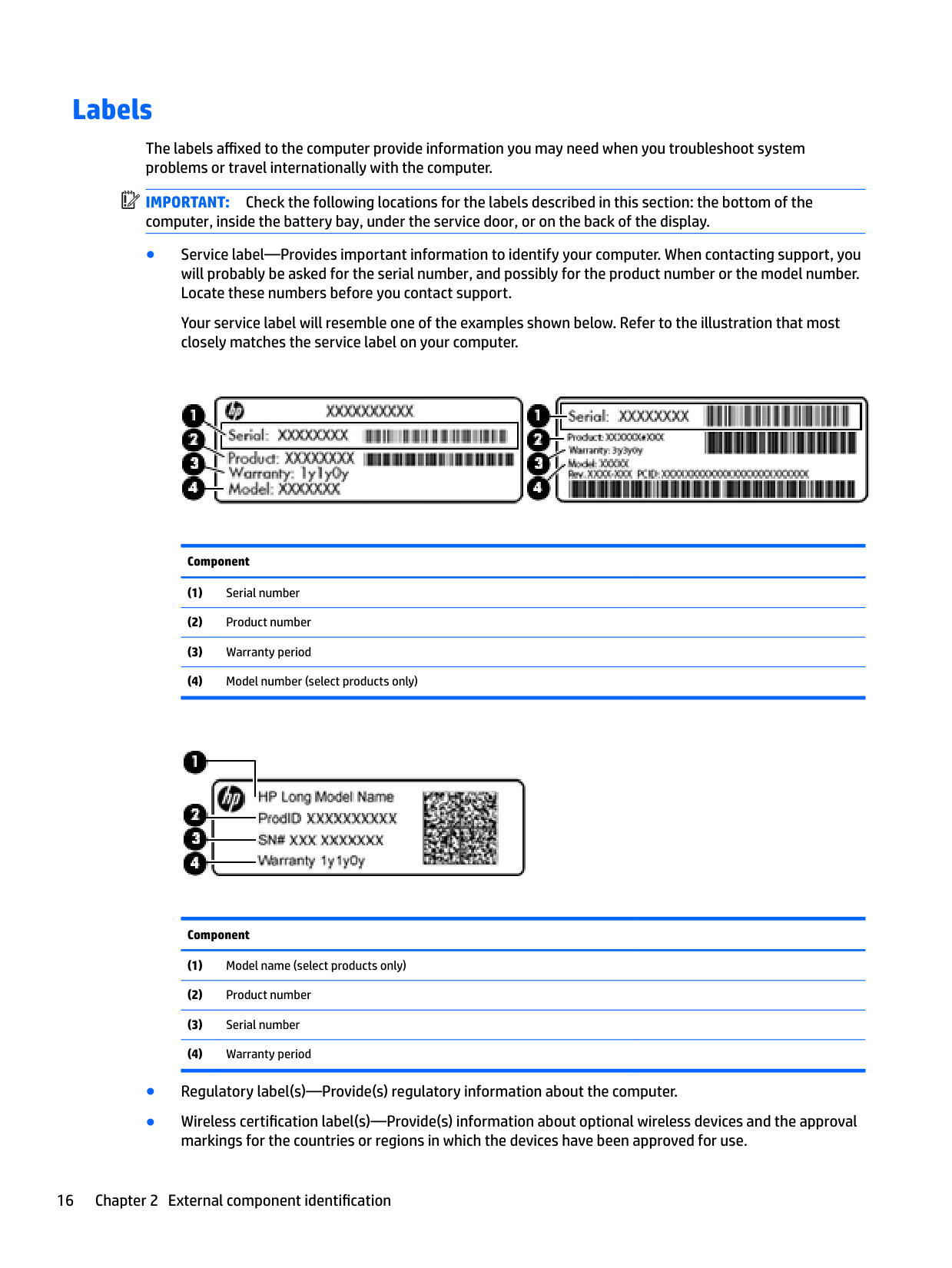
The labels affixed to the computer provide information you may need when you troubleshoot system problems or travel internationally with the computer.
| | |---|
IMPORTANT: Check the following locations for the labels described in this section: the bottom of the computer, inside the battery bay, under the service door, or on the back of the display.
Your service label will resemble one of the examples shown below. Refer to the illustration that most closely matches the service label on your computer.

Component

Component
3 Illustrated parts catalog
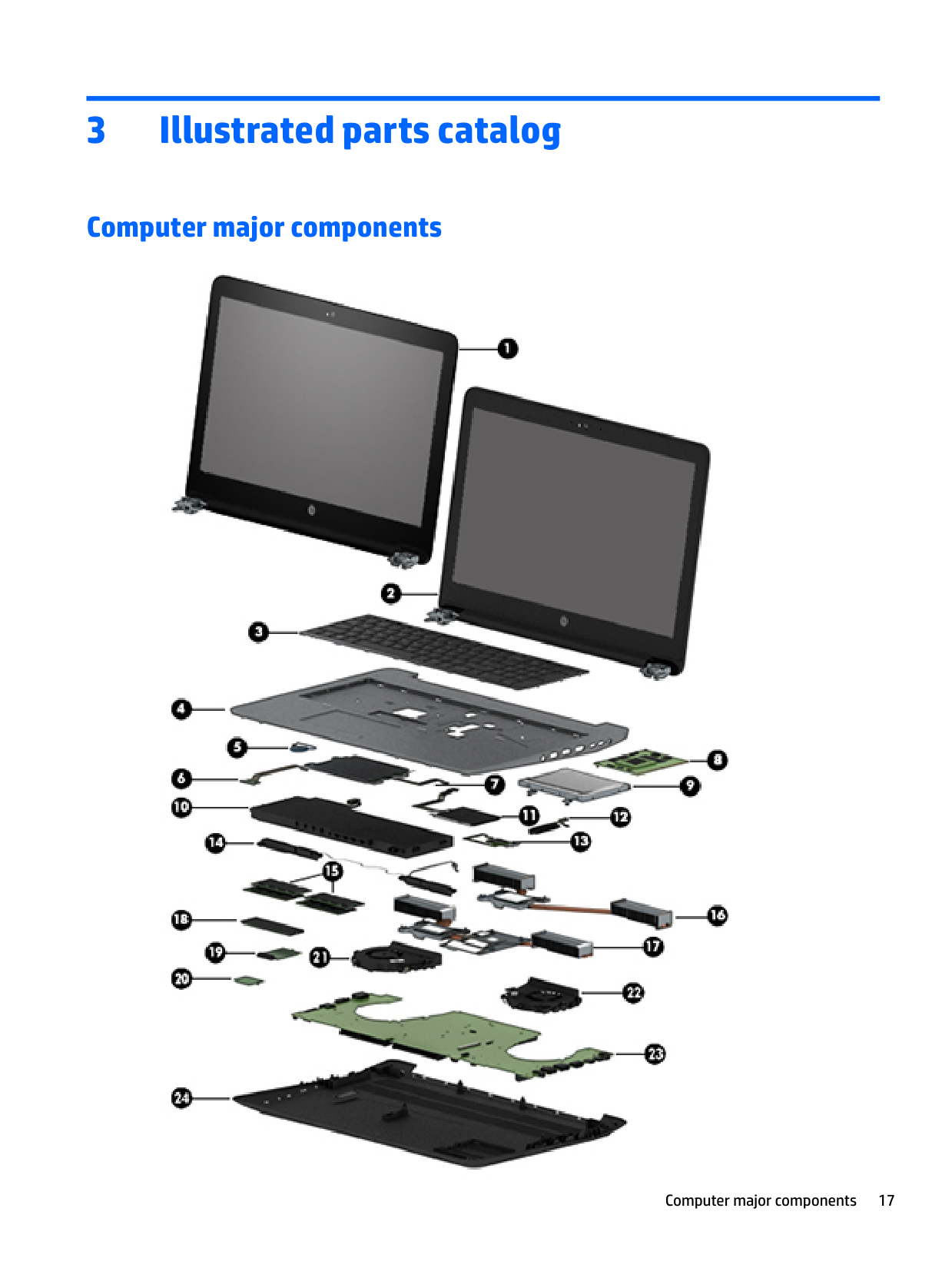
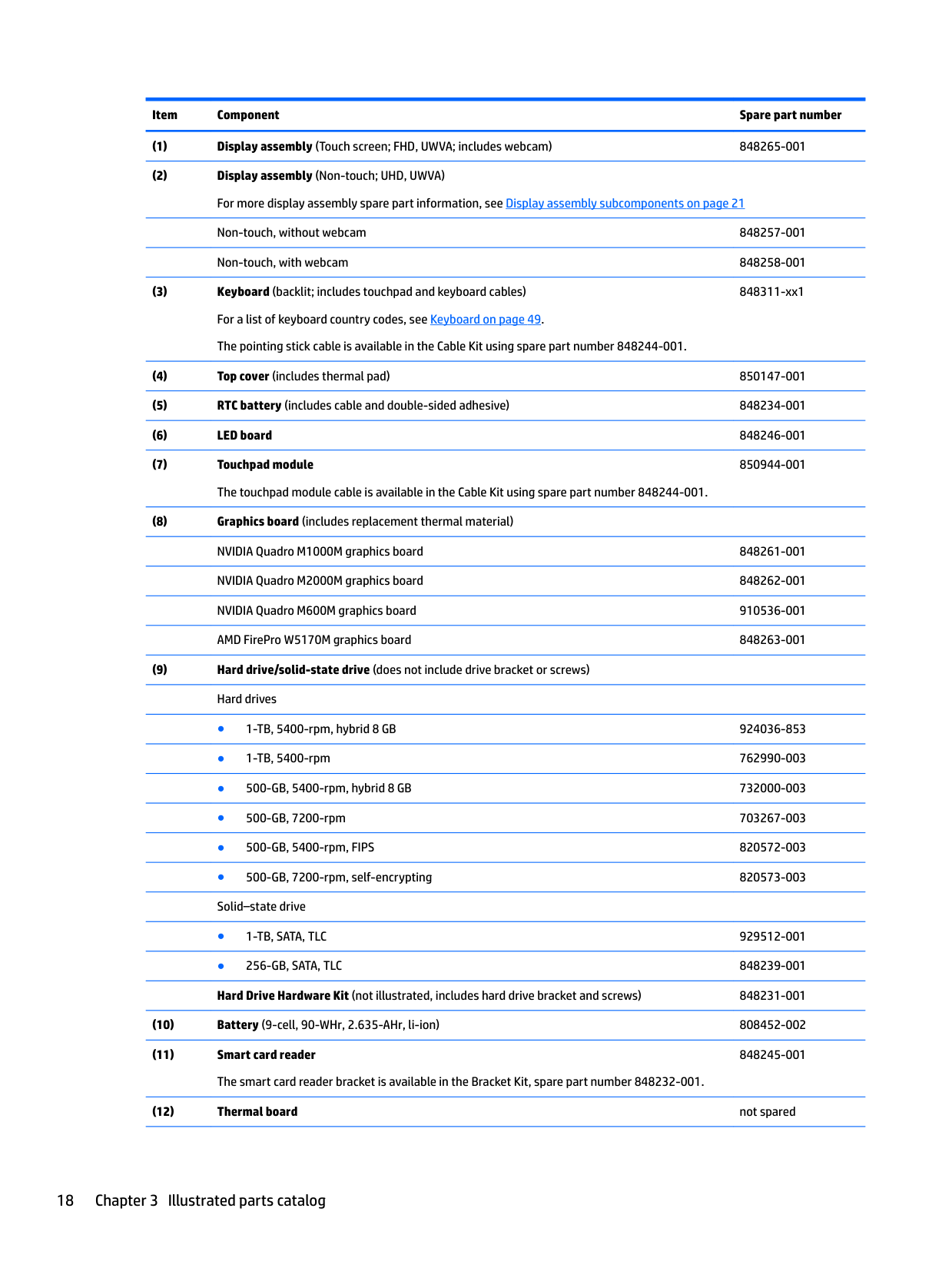
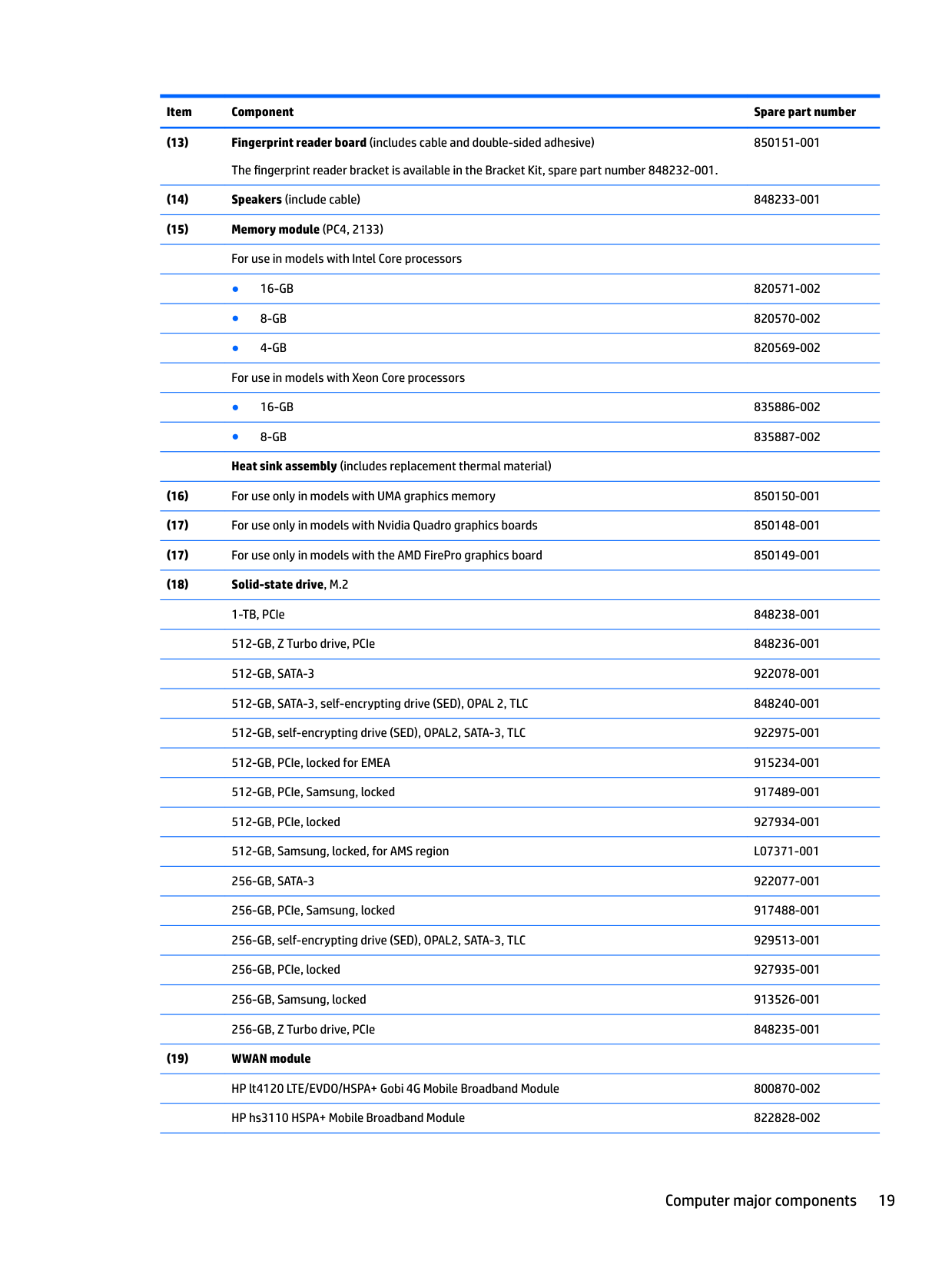
Computer major components

848311-xx1
850944-001
848245-001
850151-001
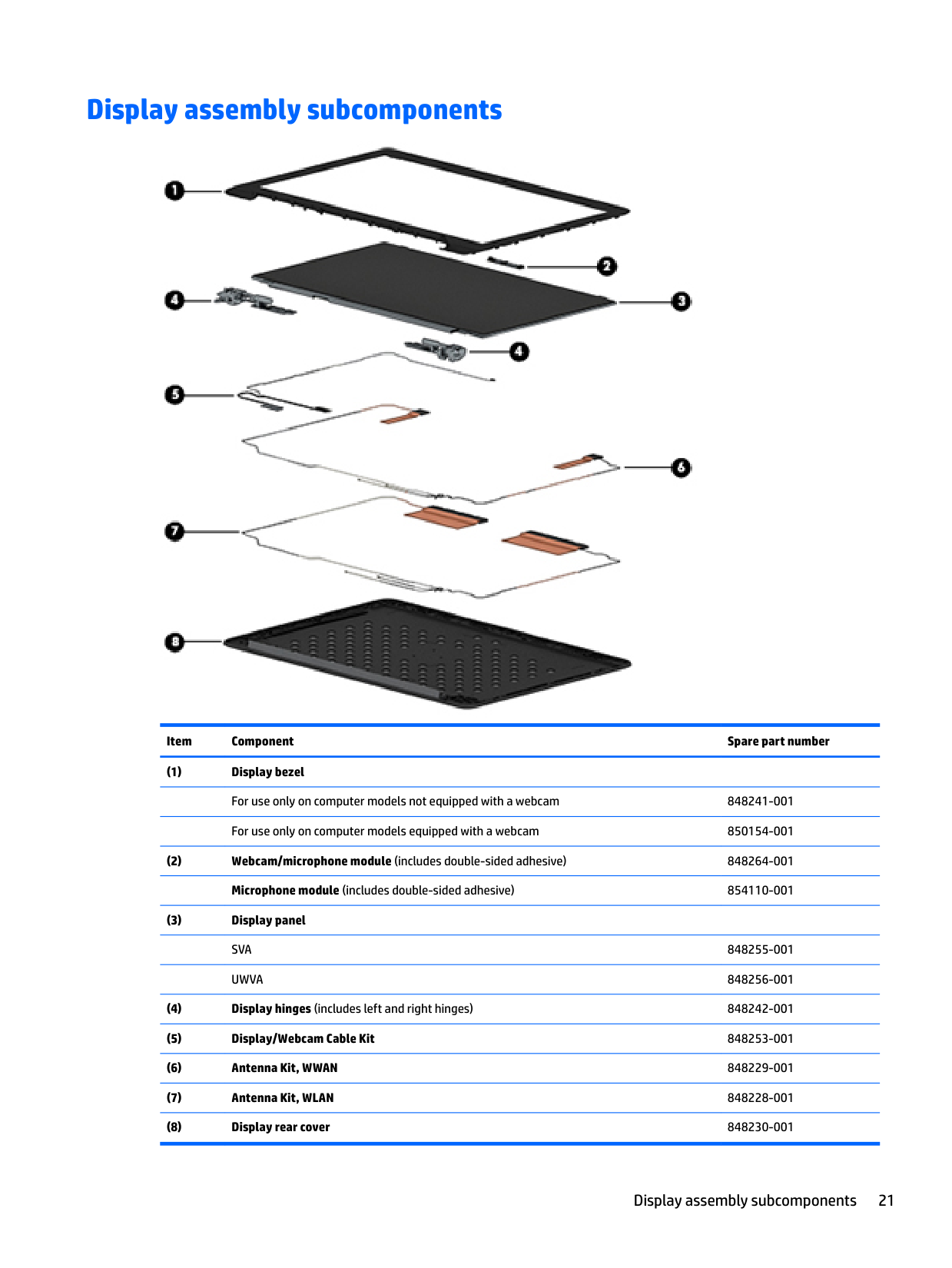
Display assembly subcomponents

######### Item Component Spare part number
Display assembly subcomponents 21
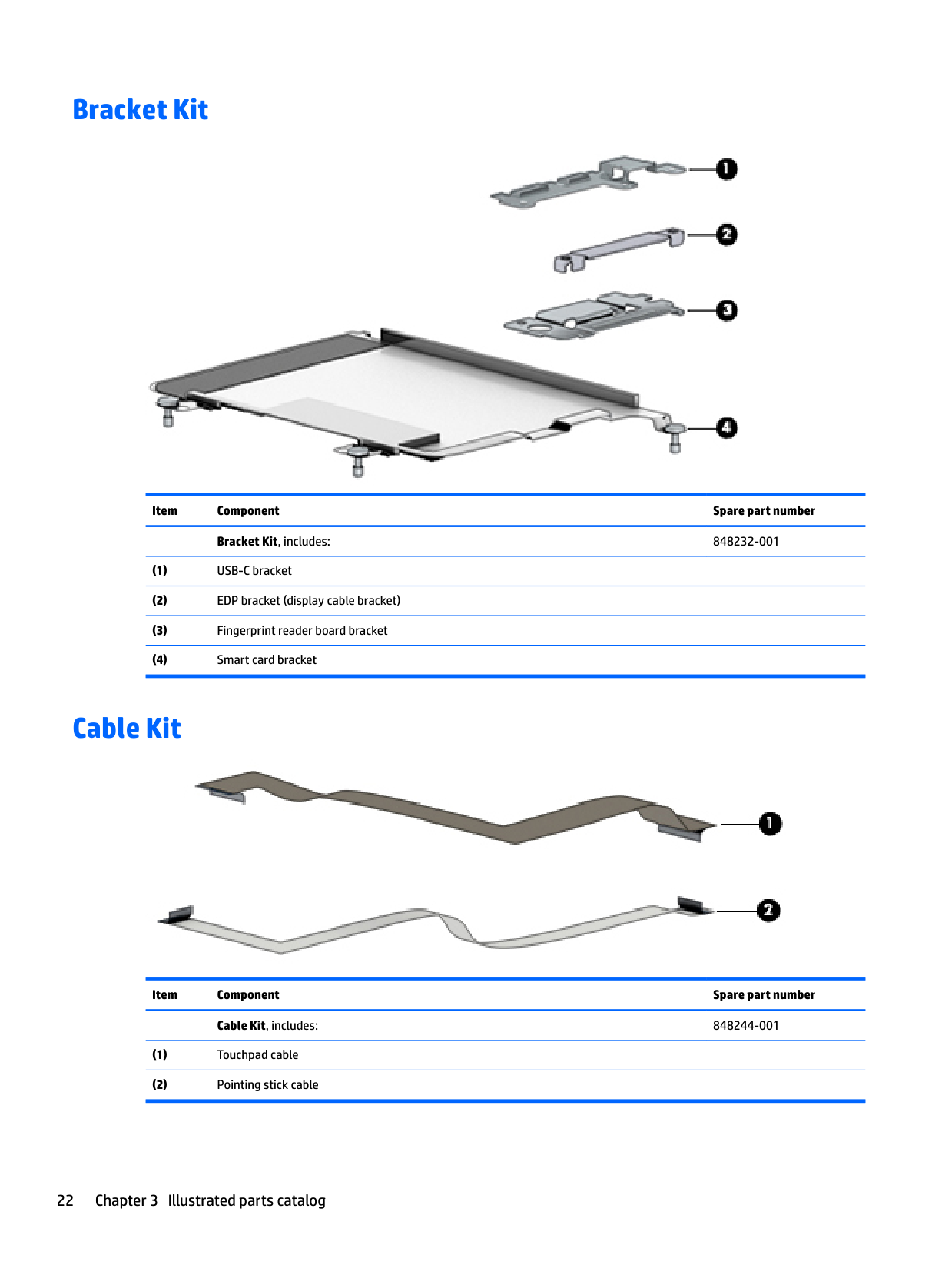
Bracket Kit

Item Component Spare part number Bracket Kit, includes: 848232-001
Cable Kit

Item Component Spare part number Cable Kit, includes: 848244-001
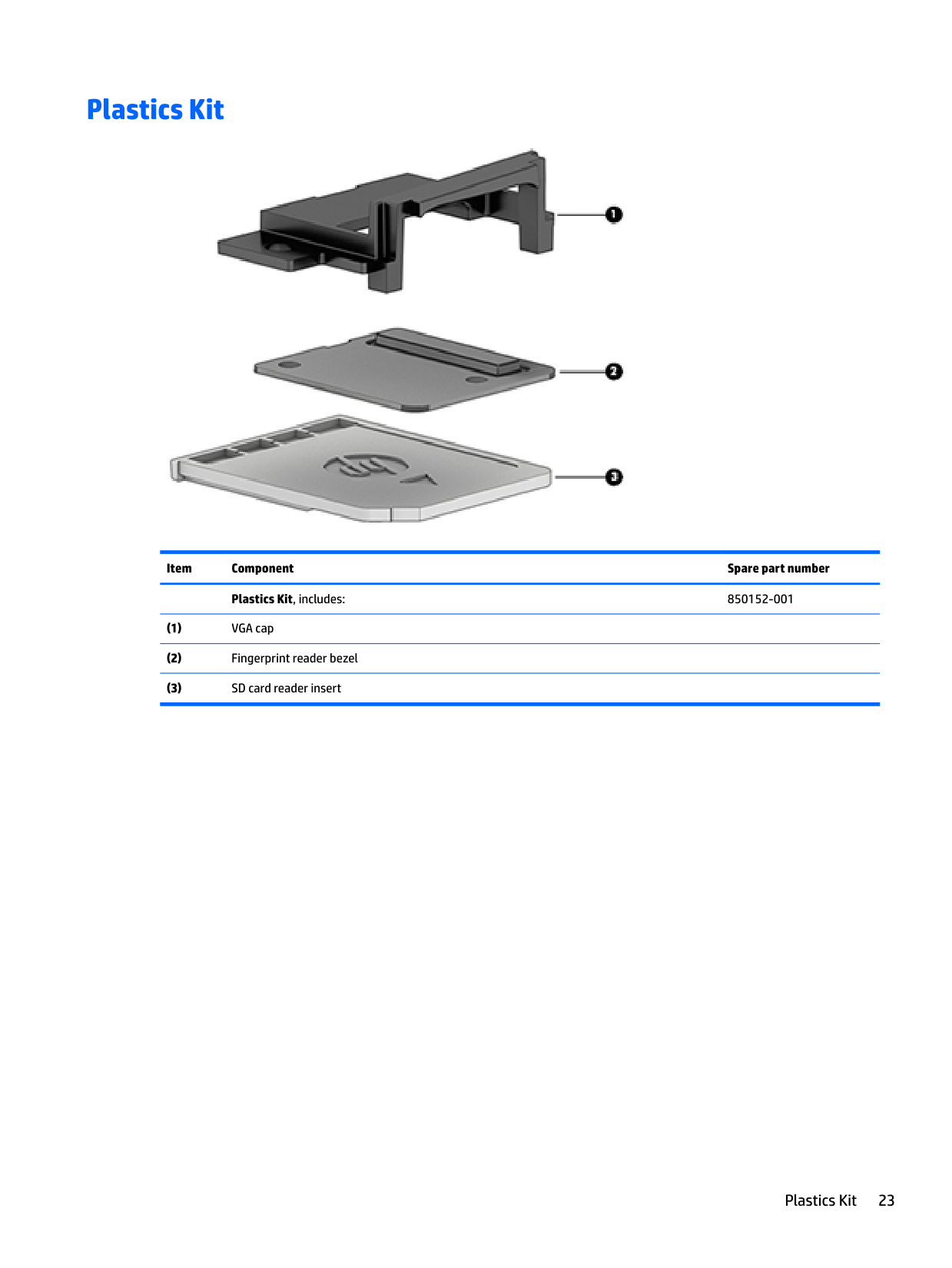
Plastics Kit

Item Component Spare part number Plastics Kit, includes: 850152-001
Plastics Kit 23
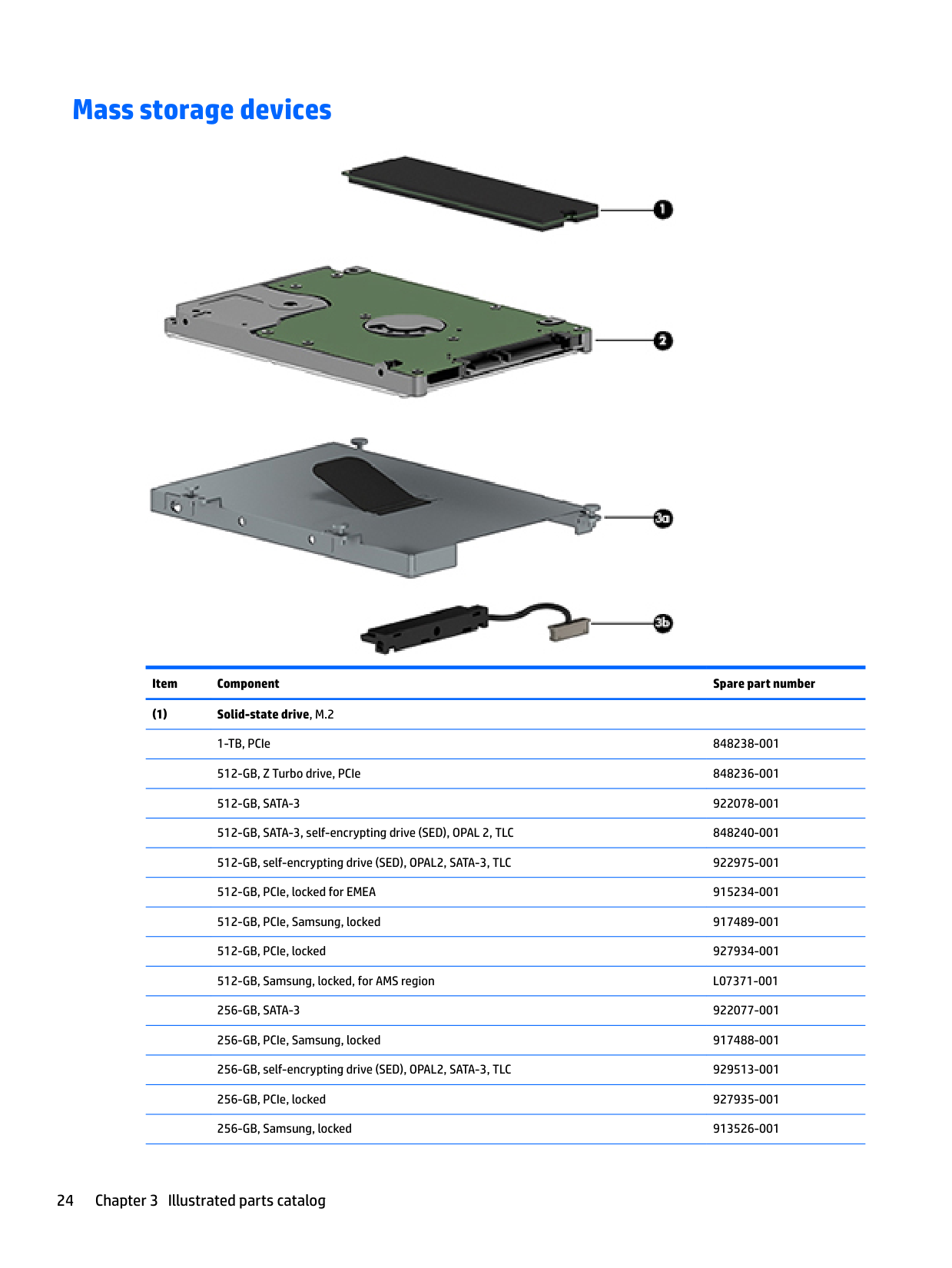
Mass storage devices

######### Item Component Spare part number
######### Item Component Spare part number
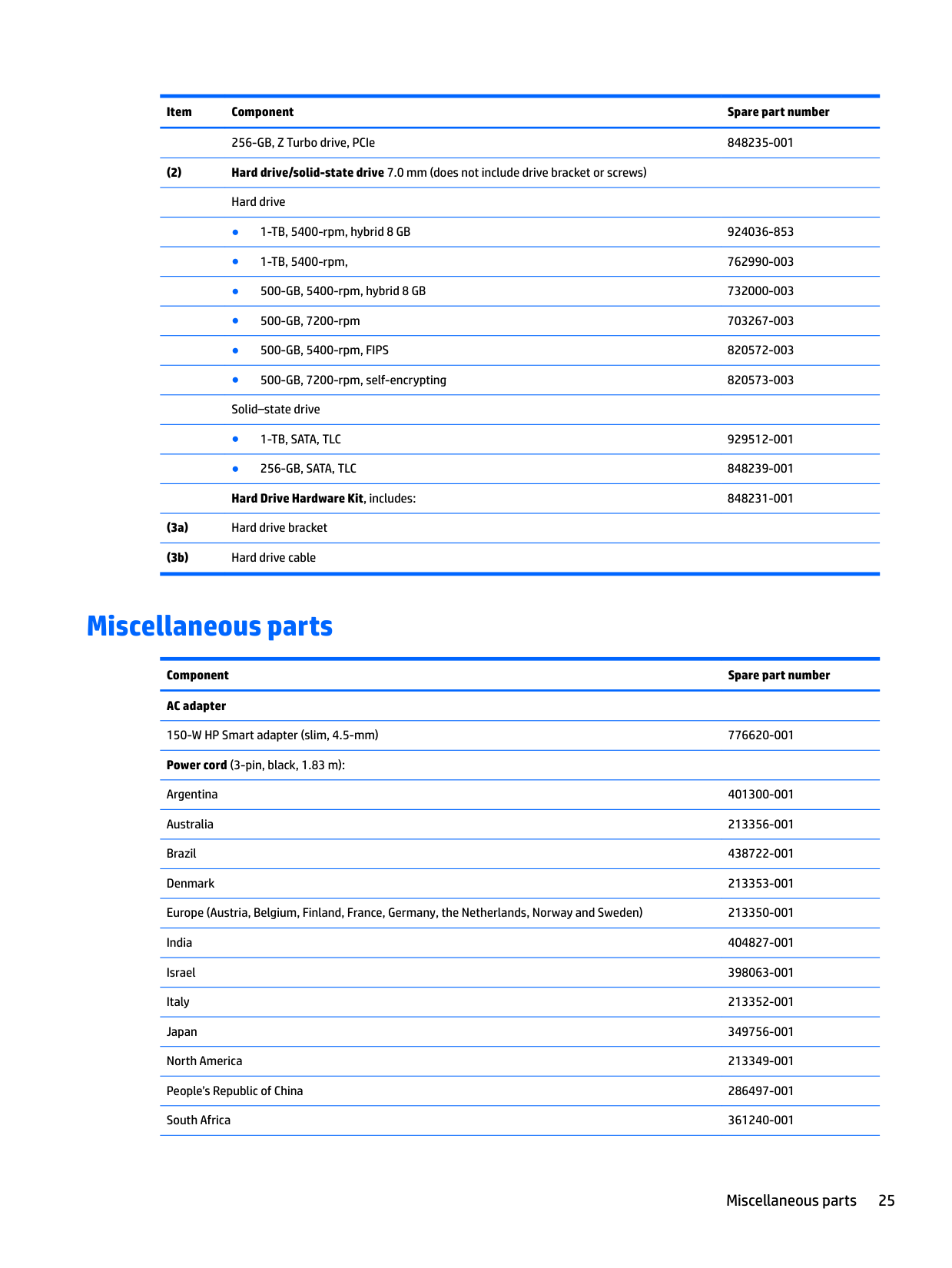
256-GB, Z Turbo drive, PCIe 848235-001
Miscellaneous parts
Component Spare part number AC adapter 150-W HP Smart adapter (slim, 4.5-mm) 776620-001 Power cord (3-pin, black, 1.83 m):
Argentina 401300-001 Australia 213356-001 Brazil 438722-001 Denmark 213353-001 Europe (Austria, Belgium, Finland, France, Germany, the Netherlands, Norway and Sweden) 213350-001 India 404827-001 Israel 398063-001 Italy 213352-001 Japan 349756-001 North America 213349-001 People’s Republic of China 286497-001 South Africa 361240-001
Miscellaneous parts 25
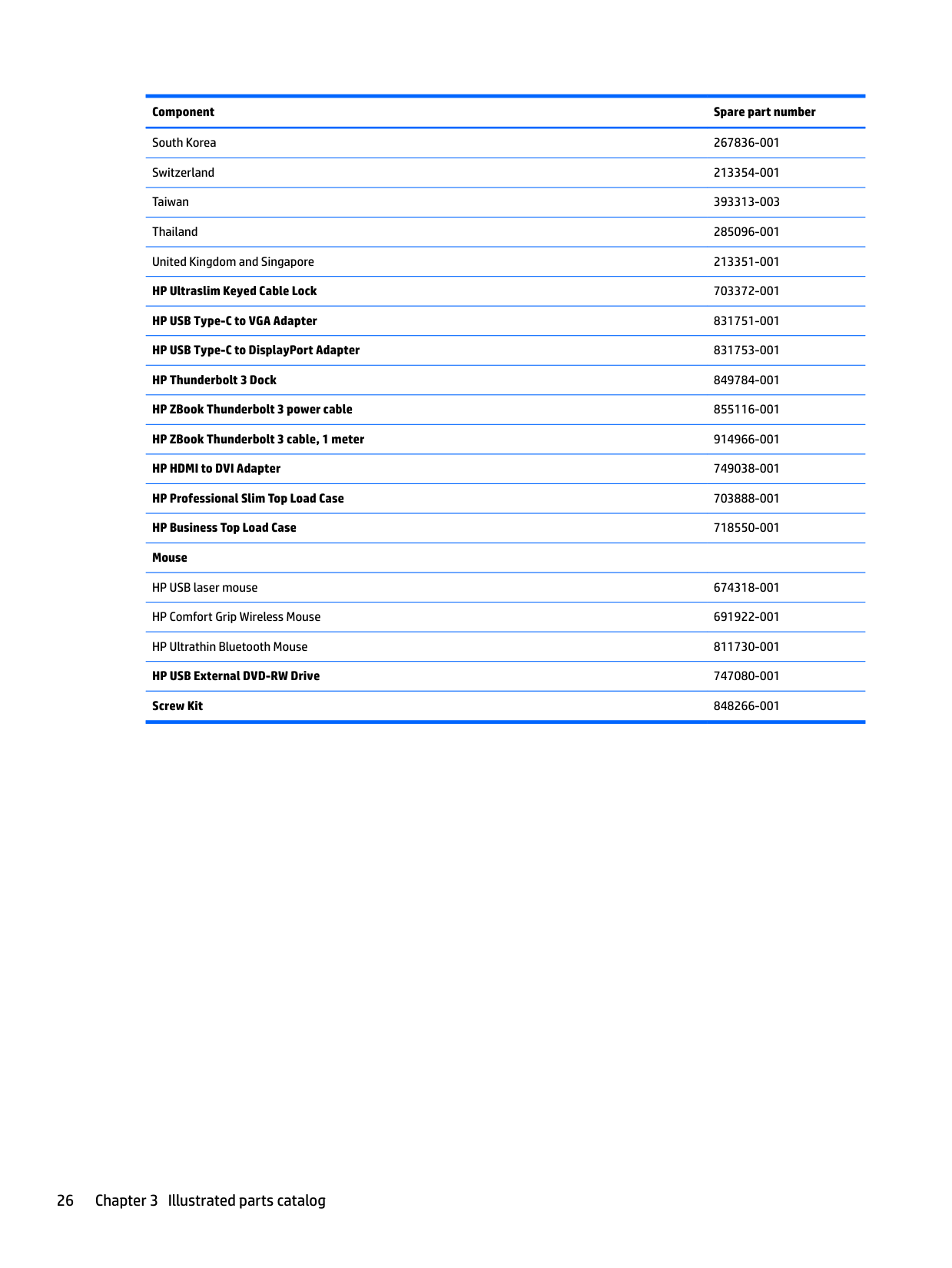
Component Spare part number
South Korea 267836-001 Switzerland 213354-001 Taiwan 393313-003 Thailand 285096-001 United Kingdom and Singapore 213351-001 HP Ultraslim Keyed Cable Lock 703372-001 HP USB Type-C to VGA Adapter 831751-001 HP USB Type-C to DisplayPort Adapter 831753-001 HP Thunderbolt 3 Dock 849784-001 HP ZBook Thunderbolt 3 power cable 855116-001 HP ZBook Thunderbolt 3 cable, 1 meter 914966-001 HP HDMI to DVI Adapter 749038-001 HP Professional Slim Top Load Case 703888-001 HP Business Top Load Case 718550-001 Mouse
HP USB laser mouse 674318-001 HP Comfort Grip Wireless Mouse 691922-001 HP Ultrathin Bluetooth Mouse 811730-001 HP USB External DVD-RW Drive 747080-001 Screw Kit 848266-001
4 Removal and replacement procedurespreliminary requirements
Tools required
You will need the following tools to complete the removal and replacement procedures:
Service considerations
The following sections include some of the considerations that you must keep in mind during disassembly and assembly procedures.
| | |---|
NOTE: As you remove each subassembly from the computer, place the subassembly (and all accompanying screws) away from the work area to prevent damage.
#### Plastic parts
CAUTION: Using excessive force during disassembly and reassembly can damage plastic parts. Use care when handling the plastic parts. Apply pressure only at the points designated in the maintenance instructions.
Tools required 27
#### Cables and connectors
CAUTION: When servicing the computer, be sure that cables are placed in their proper locations during the reassembly process. Improper cable placement can damage the computer.
Cables must be handled with extreme care to avoid damage. Apply only the tension required to unseat or seat the cables during removal and insertion. Handle cables by the connector whenever possible. In all cases, avoid bending, twisting, or tearing cables. Be sure that cables are routed in such a way that they cannot be caught or snagged by parts being removed or replaced. Handle flex cables with extreme care; these cables tear easily.
Drive handling CAUTION: Drives are fragile components that must be handled with care. To prevent damage to the computer, damage to a drive, or loss of information, observe these precautions: Before removing or inserting a storage device, shut down the computer. If you are unsure whether the computer is off or in Hibernation, turn the computer on, and then shut it down through the operating system. Before handling a drive, be sure that you are discharged of static electricity. While handling a drive, avoid touching the connector. Before removing a diskette drive or optical drive, be sure that a diskette or disc is not in the drive and be sure that the optical drive tray is closed. Handle drives on surfaces covered with at least one inch of shock-proof foam. Avoid dropping drives from any height onto any surface. After removing a storage device, an optical drive, or a diskette drive, place it in a static-proof bag. Avoid exposing an internal storage device to products that have magnetic fields, such as monitors or speakers. Avoid exposing a drive to temperature extremes or liquids. If a drive must be mailed, place the drive in a bubble pack mailer or other suitable form of protective packaging and label the package “FRAGILE.”
Grounding guidelines
#### Electrostatic discharge damage
Electronic components are sensitive to electrostatic discharge (ESD). Circuitry design and structure determine the degree of sensitivity. Networks built into many integrated circuits provide some protection, but in many cases, ESD contains enough power to alter device parameters or melt silicon junctions.
A discharge of static electricity from a finger or other conductor can destroy static-sensitive devices or microcircuitry. Even if the spark is neither felt nor heard, damage may have occurred.
An electronic device exposed to ESD may not be affected at all and can work perfectly throughout a normal cycle. Or the device may function normally for a while, then degrade in the internal layers, reducing its life expectancy.
CAUTION: To prevent damage to the computer when you are removing or installing internal components, observe these precautions: Keep components in their electrostatic-safe containers until you are ready to install them. Before touching an electronic component, discharge static electricity by using the guidelines described in this section. Avoid touching pins, leads, and circuitry. Handle electronic components as little as possible. If you remove a component, place it in an electrostatic-safe container. The following table shows how humidity affects the electrostatic voltage levels generated by different activities. CAUTION: A product can be degraded by as little as 700 V.
Typical electrostatic voltage levels
Relative humidity Event 10% 40% 55% Walking across carpet 35,000 V 15,000 V 7,500 V Walking across vinyl floor 12,000 V 5,000 V 3,000 V Motions of bench worker 6,000 V 800 V 400 V Removing DIPS from plastic tube 2,000 V 700 V 400 V Removing DIPS from vinyl tray 11,500 V 4,000 V 2,000 V Removing DIPS from Styrofoam 14,500 V 5,000 V 3,500 V Removing bubble pack from PCB 26,500 V 20,000 V 7,000 V Packing PCBs in foam-lined box 21,000 V 11,000 V 5,000 V
##### Packaging and transporting guidelines
Follow these grounding guidelines when packaging and transporting equipment:
###### Workstation guidelines
Follow these grounding workstation guidelines:
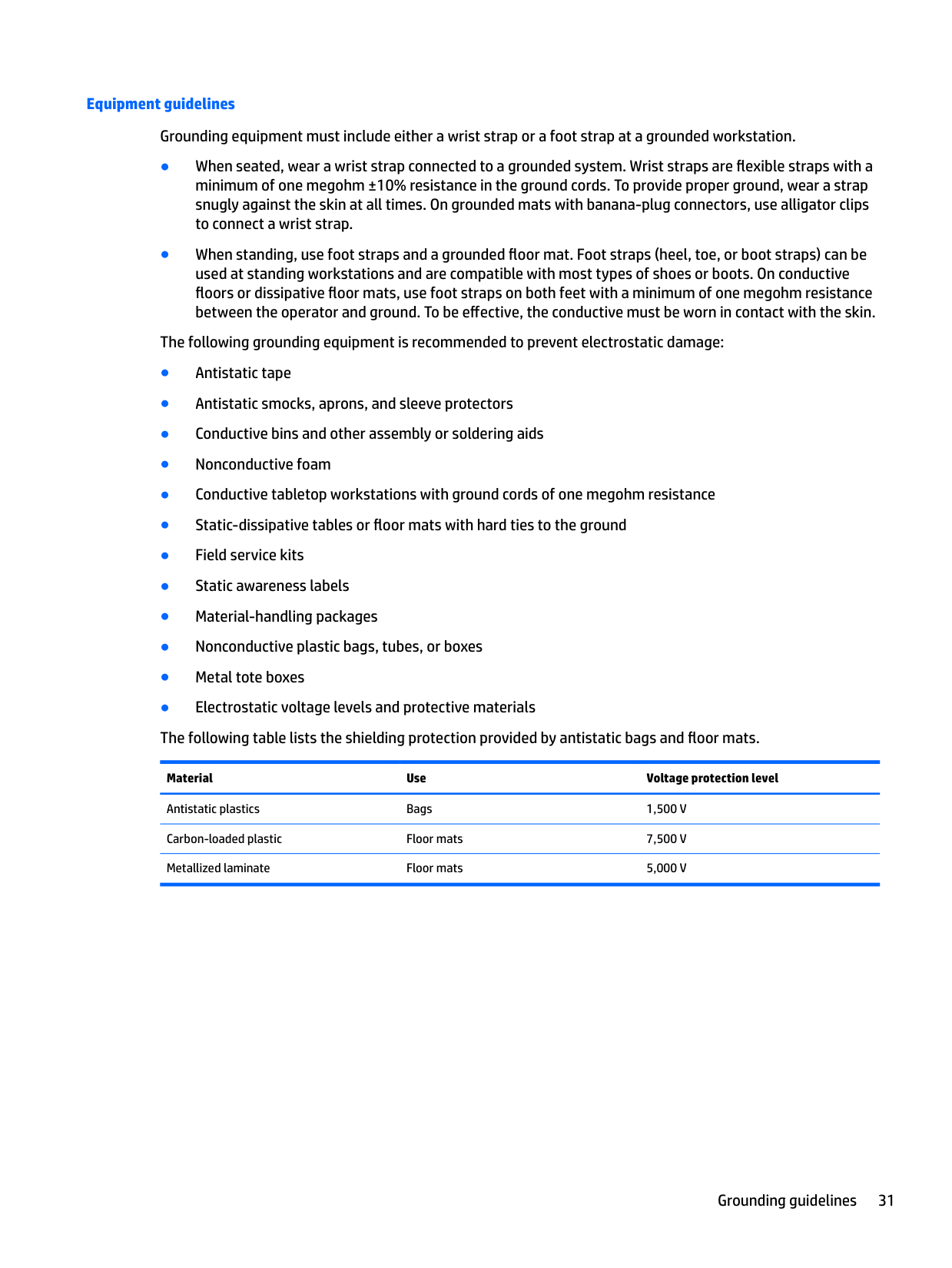
###### Equipment guidelines
Grounding equipment must include either a wrist strap or a foot strap at a grounded workstation.
Material Use Voltage protection level
Antistatic plastics Bags 1,500 V Carbon-loaded plastic Floor mats 7,500 V Metallized laminate Floor mats 5,000 V
5 Removal and replacement procedures forCustomer Self-Repair parts
| | |---|
NOTE: The Customer Self-Repair program is not available in all locations. Installing a part not supported by the Customer Self-Repair program may void your warranty. Check your warranty to determine if Customer Self-Repair is supported in your location.
Component replacement procedures
| | |---|
NOTE: Please read and follow the procedures described here to access and replace Customer Self-Repair parts successfully.
| | |---|
NOTE: Details about your computer, including model, serial number, product key, and length of warranty, are on the service tag at the bottom of your computer. See Service tag on page 16 for details. This chapter provides removal and replacement procedures for Customer Self-Repair parts. There are as many as 12 screws that must be removed, replaced, and/or loosened when servicing Customer Self-Repair parts. Make special note of each screw size and location during removal and replacement.
#### Bottom cover
Description Spare part number Bottom cover (includes SSD therrmal pad) 848227-001
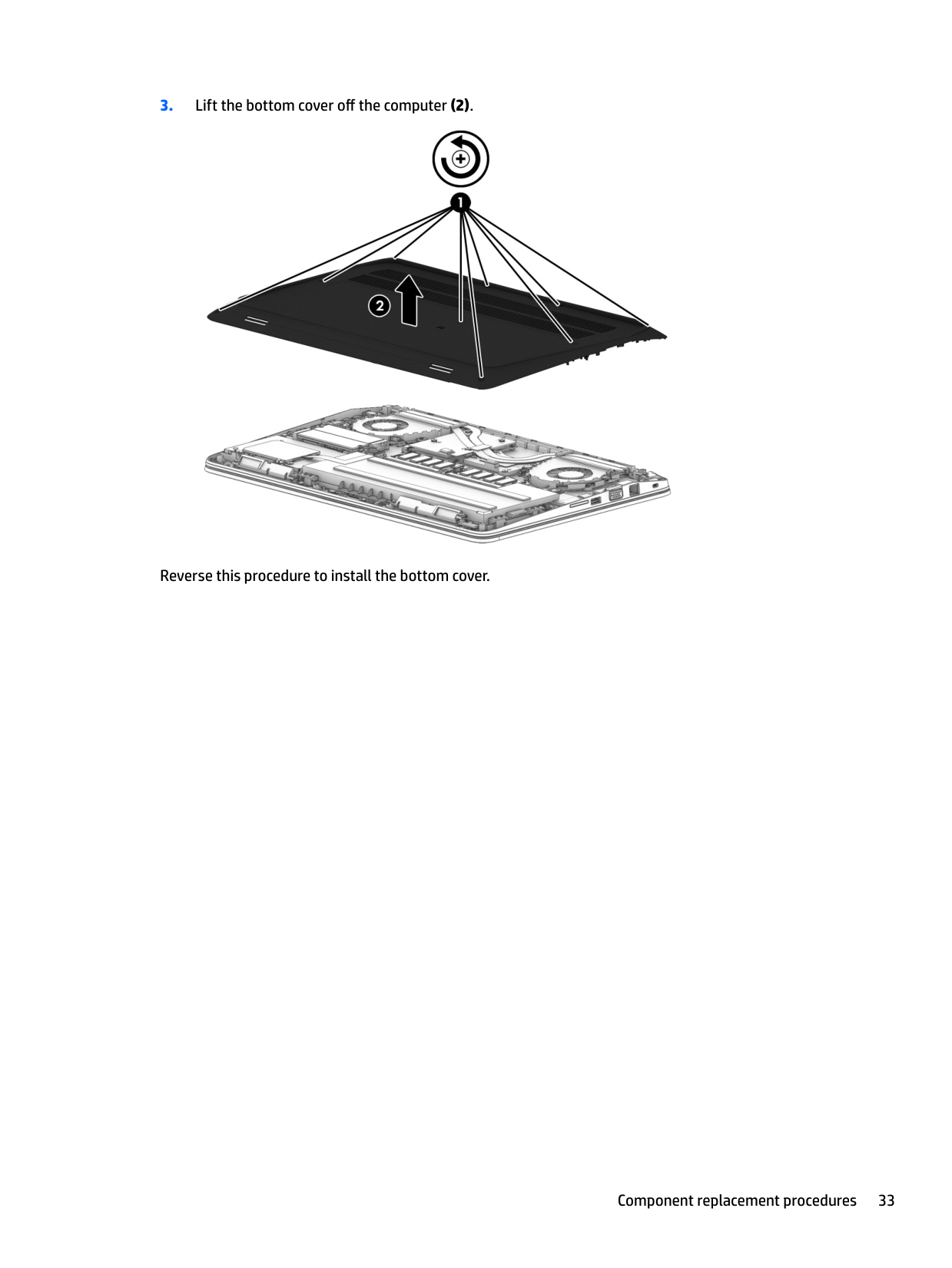
Before removing the bottom cover, follow these steps:

Reverse this procedure to install the bottom cover.
#### Battery
Description Spare part number 9-cell, 90-WHr, 2.635-AHr, li-ion battery 808452-002
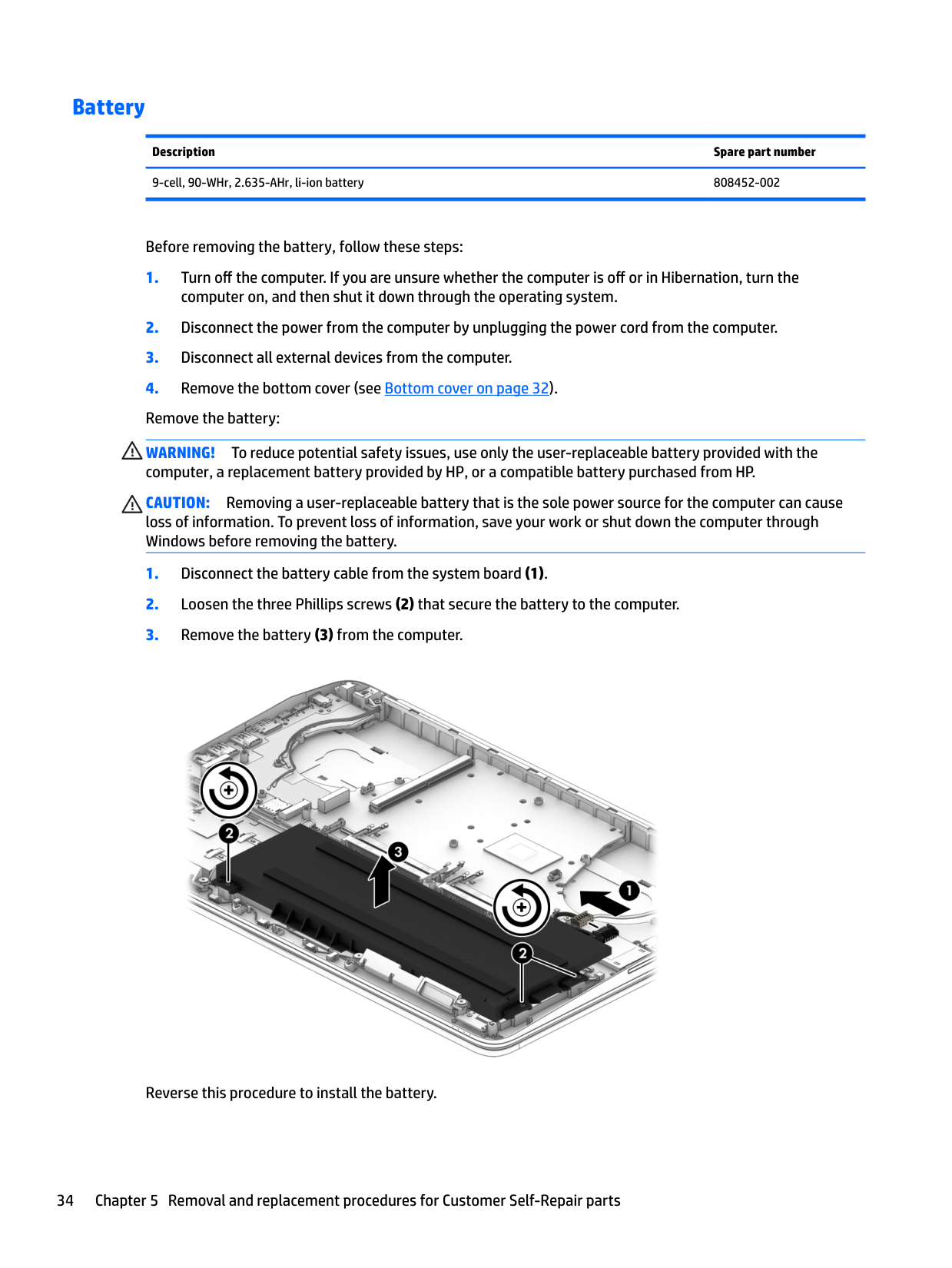
Before removing the battery, follow these steps:
WARNING! To reduce potential safety issues, use only the user-replaceable battery provided with the computer, a replacement battery provided by HP, or a compatible battery purchased from HP.
CAUTION: Removing a user-replaceable battery that is the sole power source for the computer can cause loss of information. To prevent loss of information, save your work or shut down the computer through Windows before removing the battery.

Reverse this procedure to install the battery.
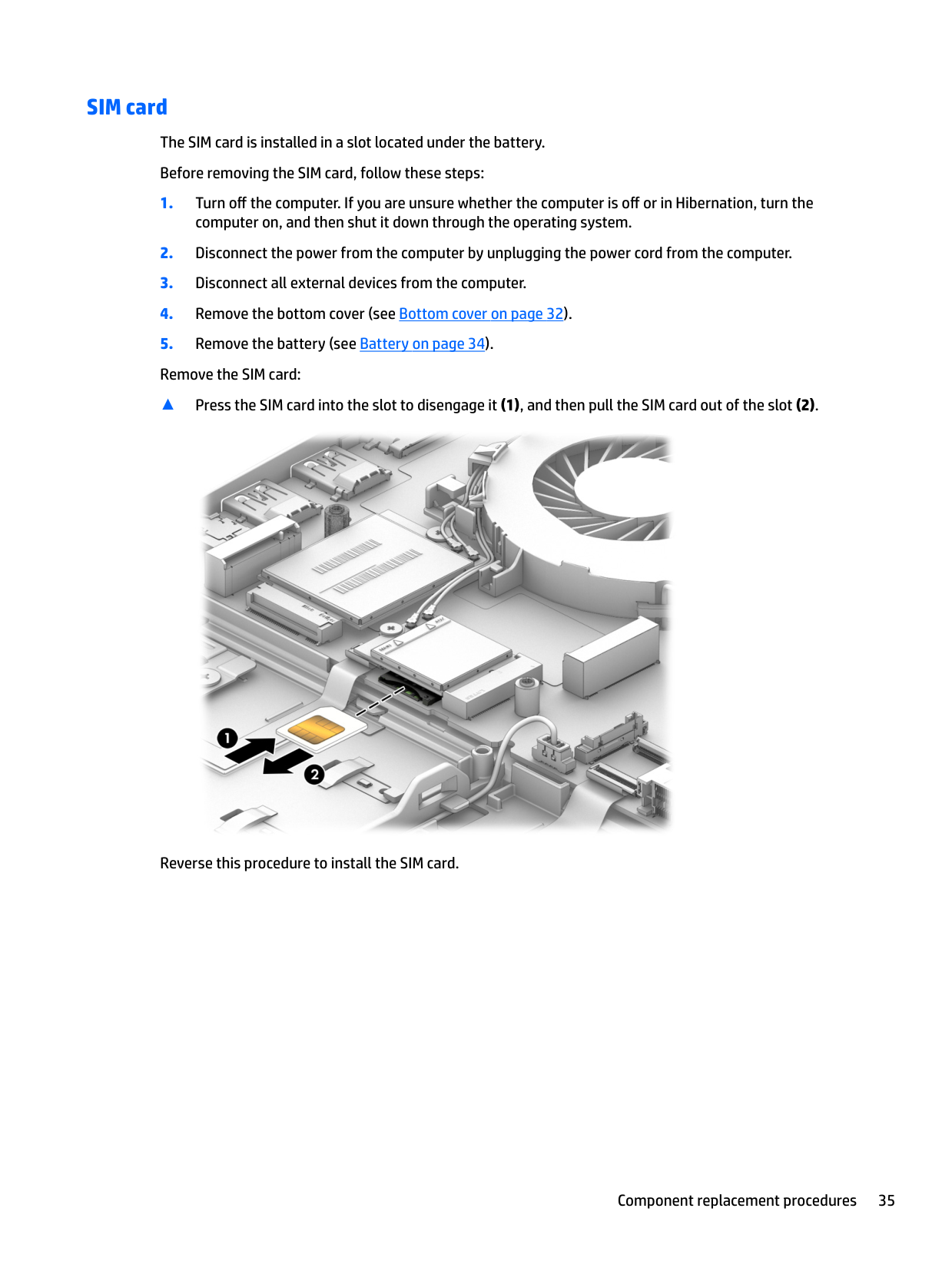
SIM card The SIM card is installed in a slot located under the battery. Before removing the SIM card, follow these steps:
▲ Press the SIM card into the slot to disengage it (1), and then pull the SIM card out of the slot (2).

Reverse this procedure to install the SIM card.
#### Memory module
Description Spare part number For use in models with Intel Core processors
16-GB 820571-002 8-GB 820570-002 4-GB 820569-002 For use in models with Xeon Core processors
16-GB 835886-002 8-GB 835887-002
Update BIOS before adding memory modules Before adding new memory, make sure you update the computer to the latest BIOS. CAUTION: Failure to update the computer to the latest BIOS prior to installing new memory may result in various system problems. To update BIOS:
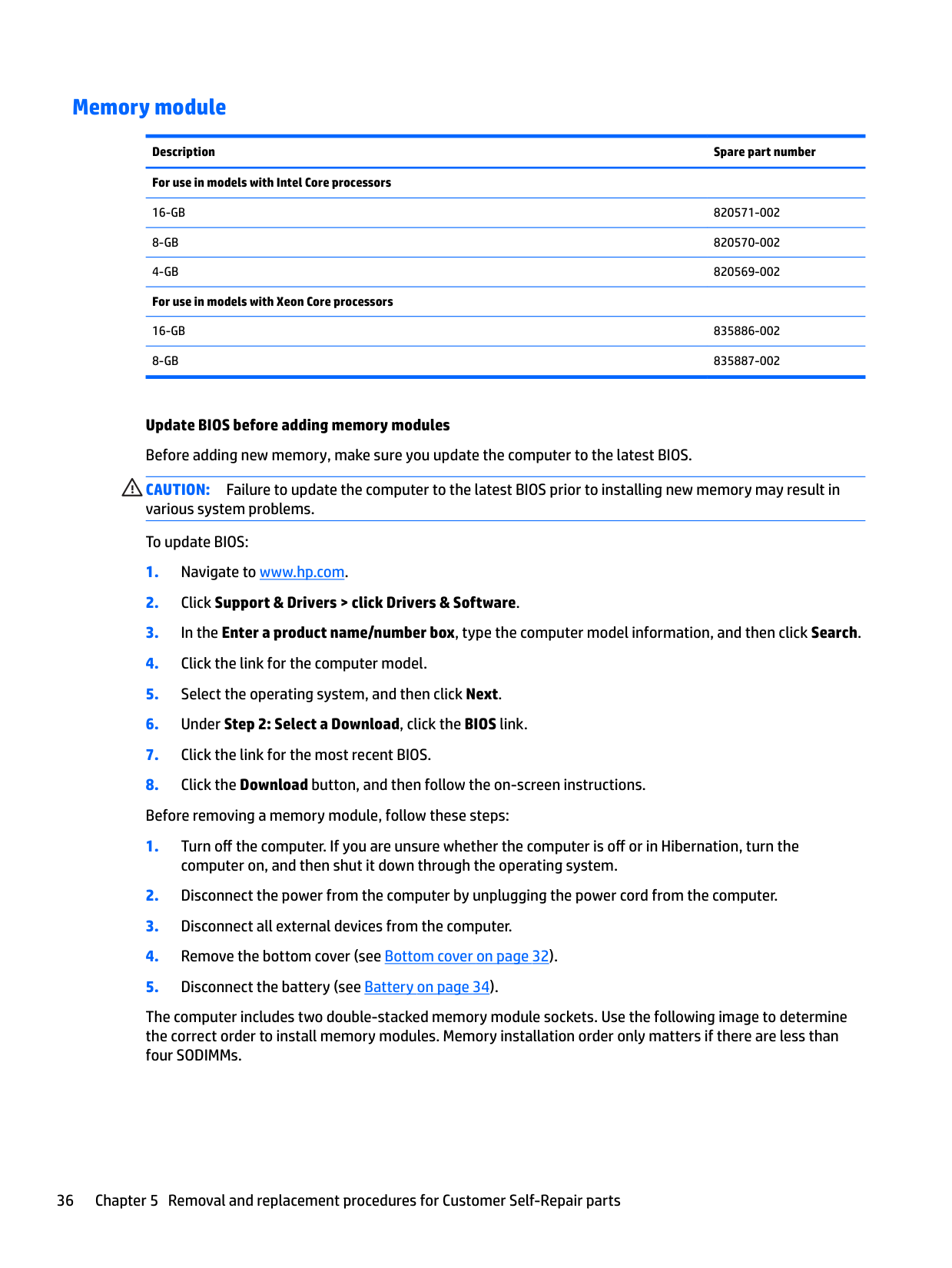
The computer includes two double-stacked memory module sockets. Use the following image to determine the correct order to install memory modules. Memory installation order only matters if there are less than four SODIMMs.

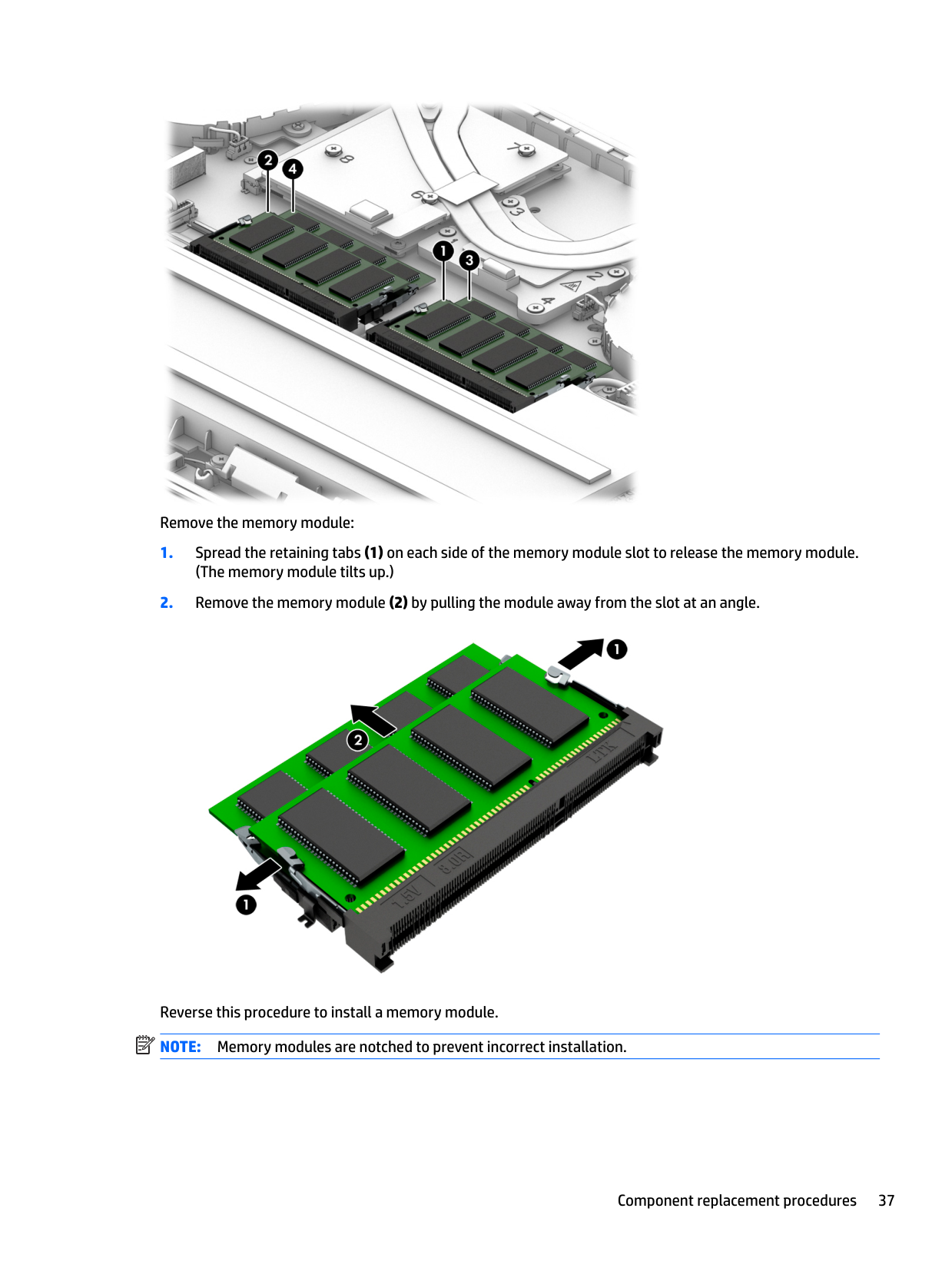
Remove the memory module:

| | |---|
Reverse this procedure to install a memory module. NOTE: Memory modules are notched to prevent incorrect installation.
6 Removal and replacement procedures forAuthorized Service Provider parts
CAUTION: Components described in this chapter should only be accessed by an authorized service provider. Accessing these parts can damage the computer or void the warranty.
Component replacement procedures This chapter provides removal and replacement procedures for Authorized Service Provider only parts. There are as many as 68 screws that must be removed, replaced, and/or loosened when servicing the computer. Make special note of each screw size and location during removal and replacement.
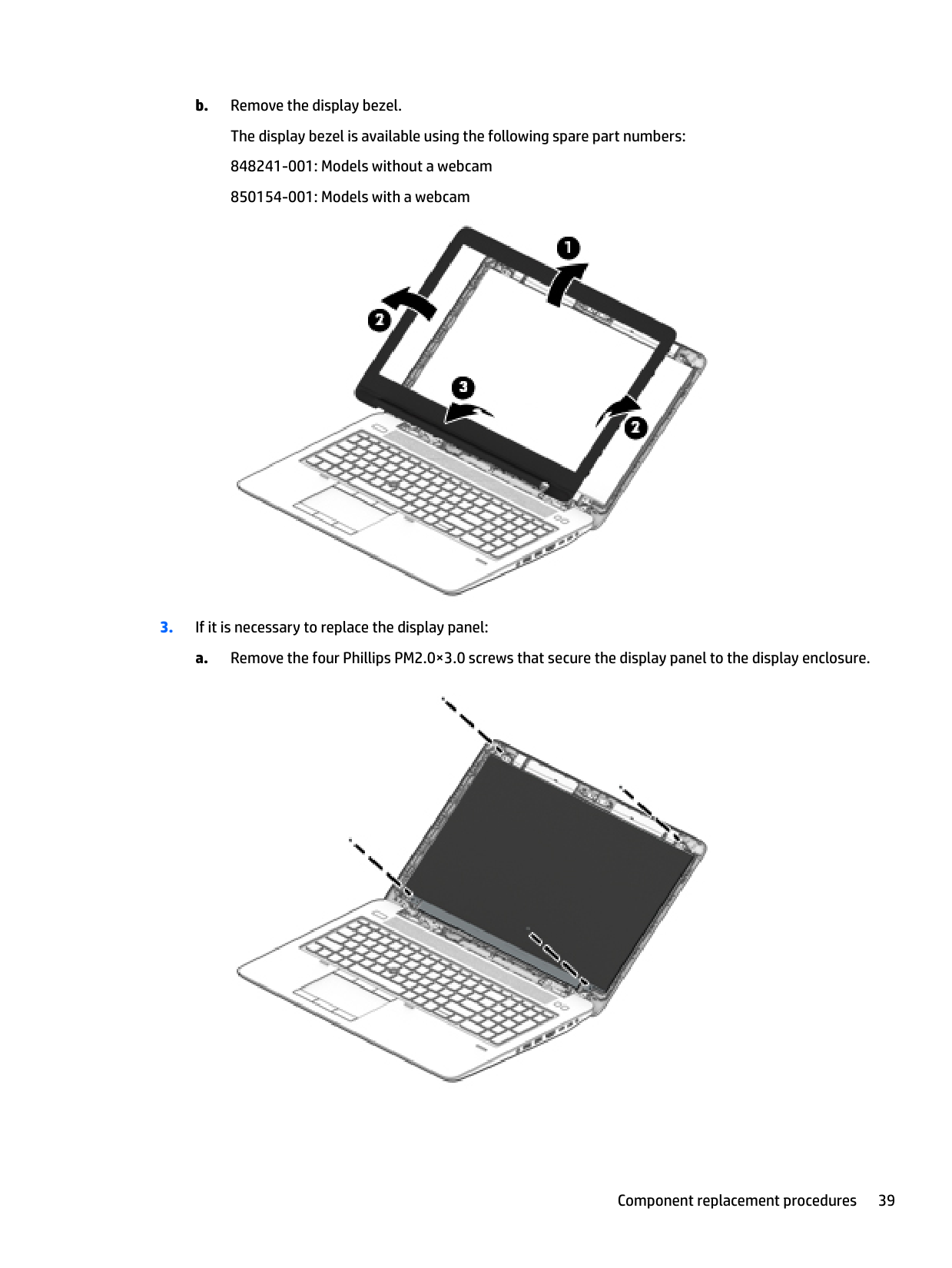
Display subcomponents (bezel, panel, webcam) NOTE: Touch display assemblies are spared as whole unit assemblies only. Non-touch display assemblies are spared at the subcomponent level and as whole unit assemblies. This section illustrates how to remove the display bezel, display panel, and webcam module without removing the display from the computer. The Display assembly on page 71 section illustrates removing all display subcomponents.
| | |---|
Description Spare part number
Display assembly, non-touch, UHD, UWVA, without webcam 848257-001 Display assembly, non-touch, UHD, UWVA, with webcam 848258-001 Display assembly, touch screen, FHD, UWVA, with webcam 848265-001
To remove the display assembly subcomponents, follow these steps:


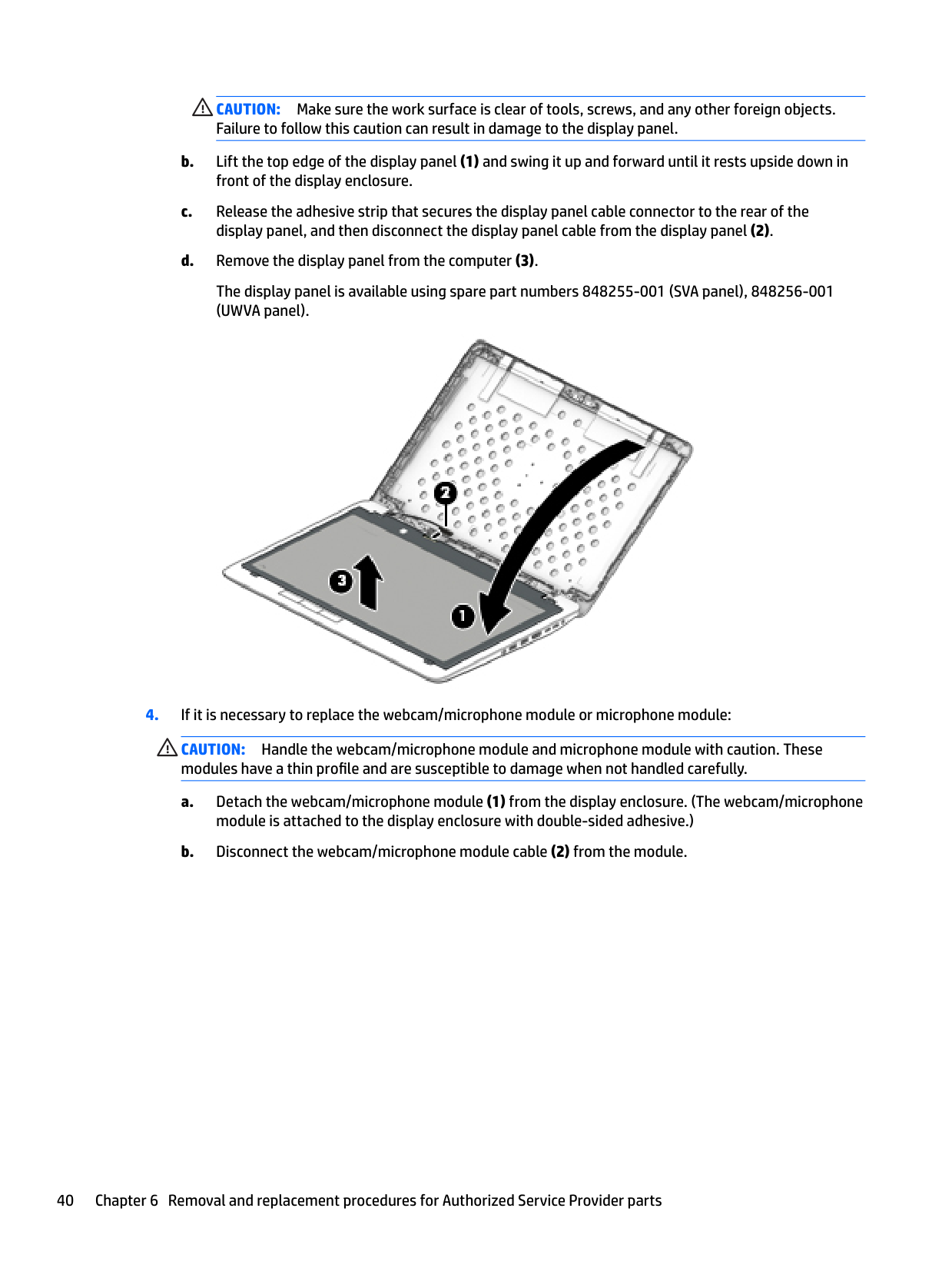
The display panel is available using spare part numbers 848255-001 (SVA panel), 848256-001 (UWVA panel).

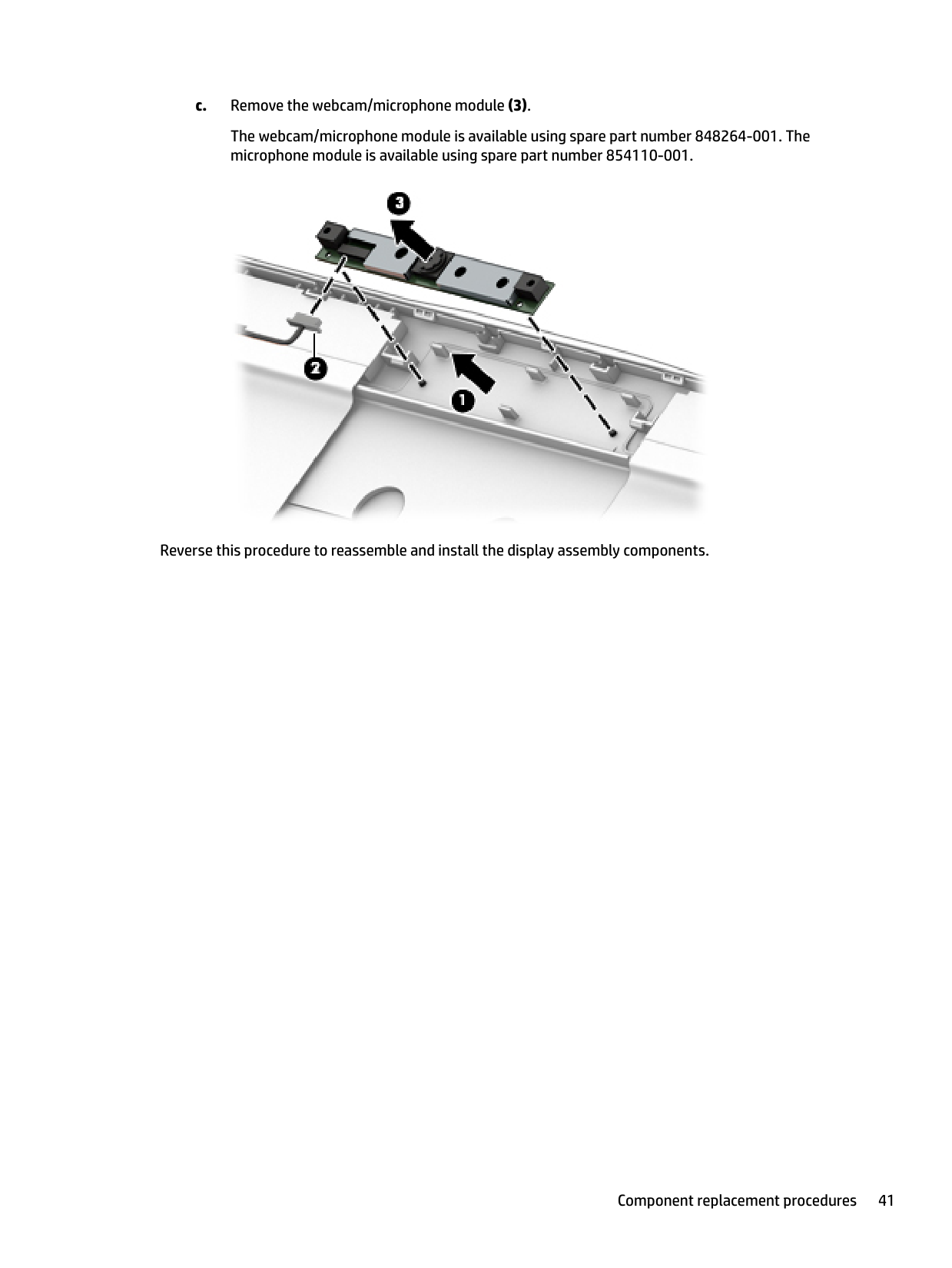
CAUTION: Handle the webcam/microphone module and microphone module with caution. These modules have a thin profile and are susceptible to damage when not handled carefully.
The webcam/microphone module is available using spare part number 848264-001. The microphone module is available using spare part number 854110-001.

Reverse this procedure to reassemble and install the display assembly components.
#### Solid-state drive (M.2)
######### Description Spare part number
1-TB, PCIe 848238-001 512-GB, SATA-3 922078-001 512-GB, PCIe, locked for EMEA 915234-001 512-GB, PCIe, Samsung, locked 917489-001 512-GB, self-encrypting drive (SED), OPAL2, SATA-3, TLC 922975-001 512-GB, PCIe, locked 927934-001 512-GB, Samsung, locked, for AMS region L07371-001 256-GB, SATA-3 922077-001 256-GB, PCIe, Samsung, locked 917488-001 256-GB, self-encrypting drive (SED), OPAL2, SATA-3, TLC 929513-001 256-GB, PCIe, locked 927935-001 256-GB, Samsung, locked 913526-001
Before removing the solid-state drive, follow these steps:

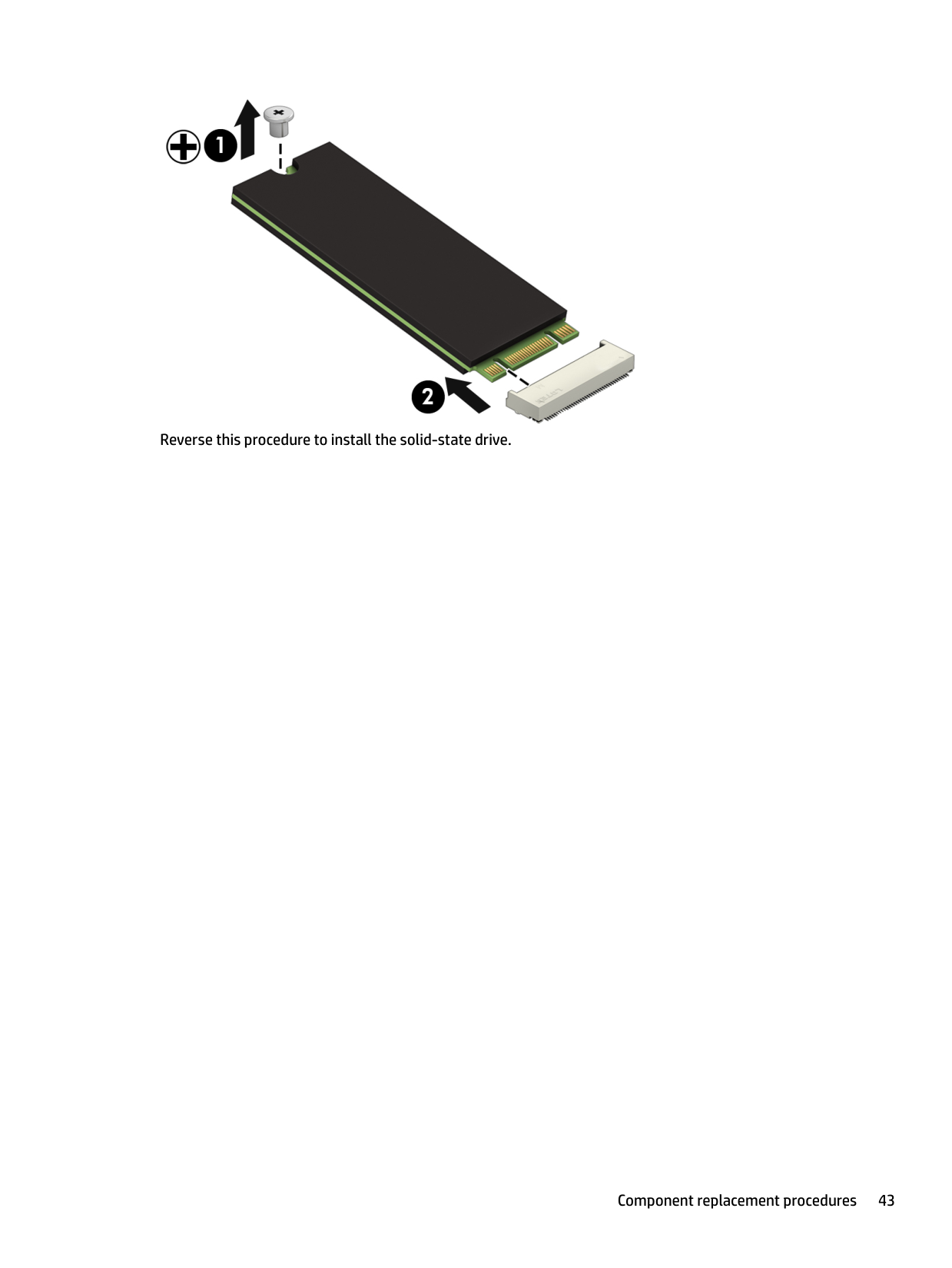
####### Reverse this procedure to install the solid-state drive.
#### WLAN module
######### Description Spare part number
Intel Dual Band Wireless-AC 8260 806721-002 Intel Dual Band Wireless-AC 8260 (non-vPro) 806722-002
CAUTION: To prevent an unresponsive system, replace the wireless module only with a wireless module authorized for use in the computer by the governmental agency that regulates wireless devices in your country or region. If you replace the module and then receive a warning message, remove the module to restore device functionality, and then contact technical support.
Before removing the WLAN module, follow these steps:
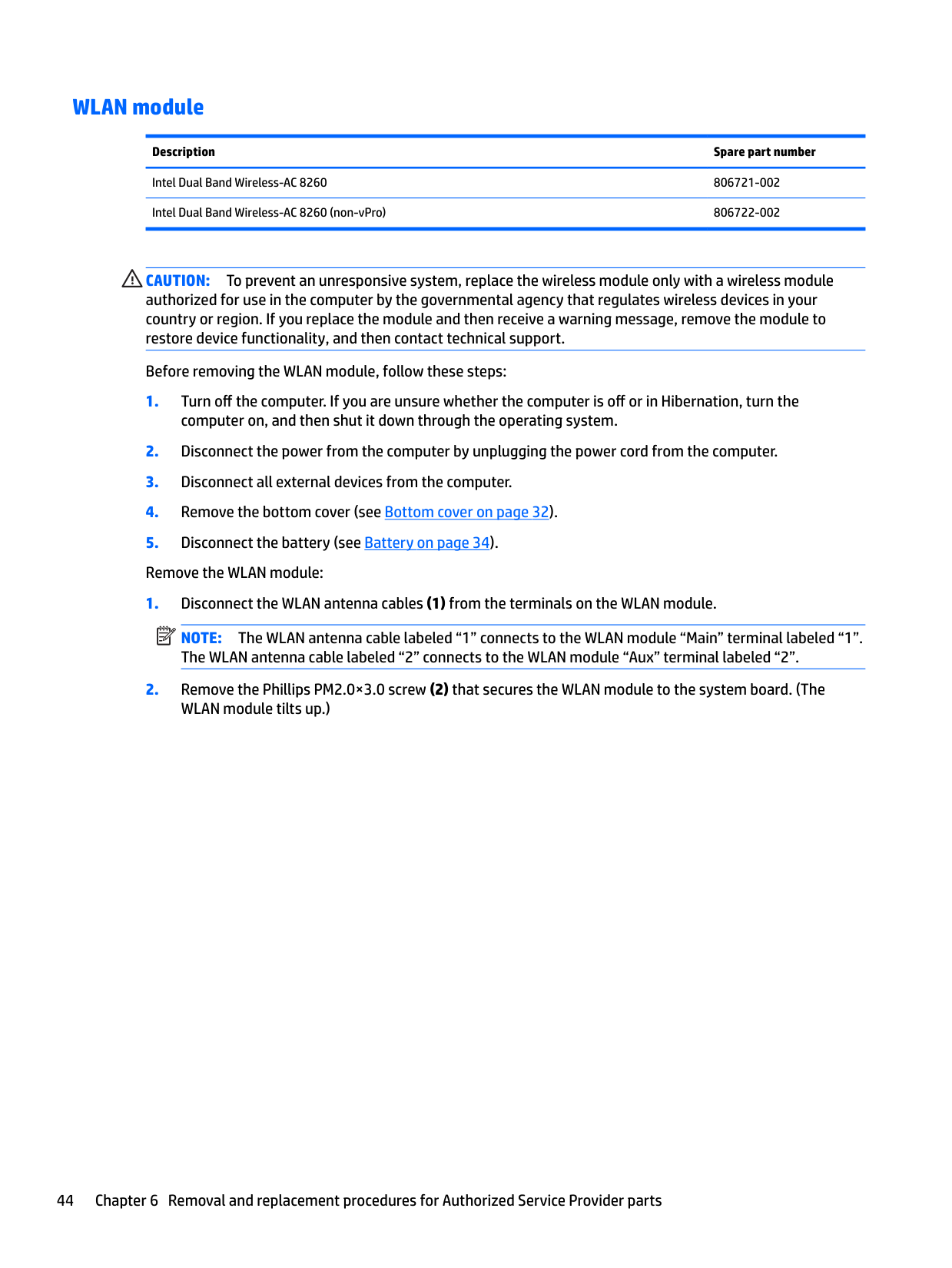
NOTE: The WLAN antenna cable labeled “1” connects to the WLAN module “Main” terminal labeled “1”. The WLAN antenna cable labeled “2” connects to the WLAN module “Aux” terminal labeled “2”.
| | |---|
| | |---|

| | |---|
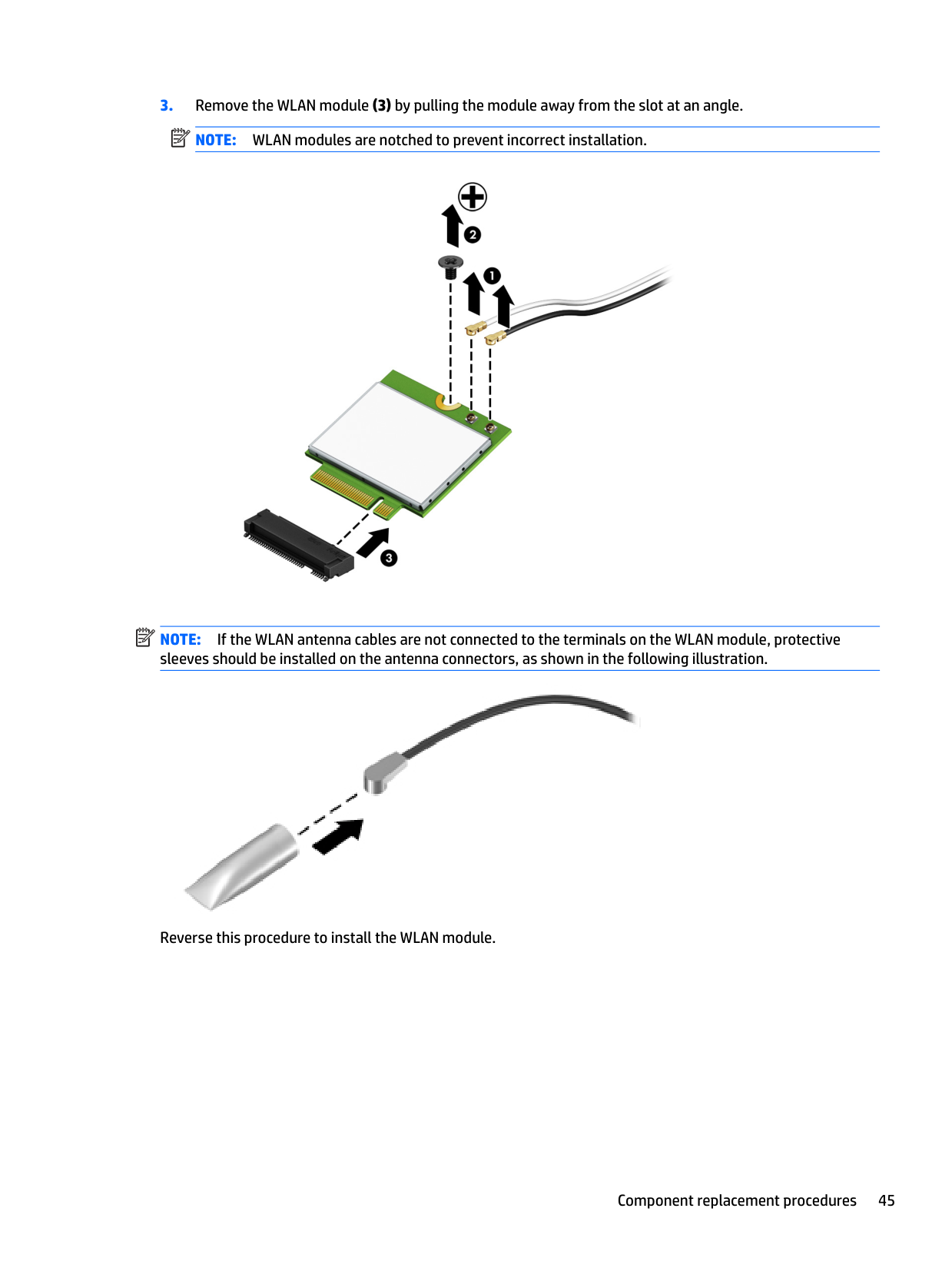
NOTE: If the WLAN antenna cables are not connected to the terminals on the WLAN module, protective sleeves should be installed on the antenna connectors, as shown in the following illustration.

Reverse this procedure to install the WLAN module.
#### WWAN module
######### Description Spare part number
HP lt4120 LTE/EVDO/HSPA+ Gobi 4G Mobile Broadband Module 800870-002 HP hs3110 HSPA+ Mobile Broadband Module 822828-002
CAUTION: To prevent an unresponsive system, replace the wireless module only with a wireless module authorized for use in the computer by the governmental agency that regulates wireless devices in your country or region. If you replace the module and then receive a warning message, remove the module to restore device functionality, and then contact technical support.
Before removing the WWAN module, follow these steps:
computer on, and then shut it down through the operating system.
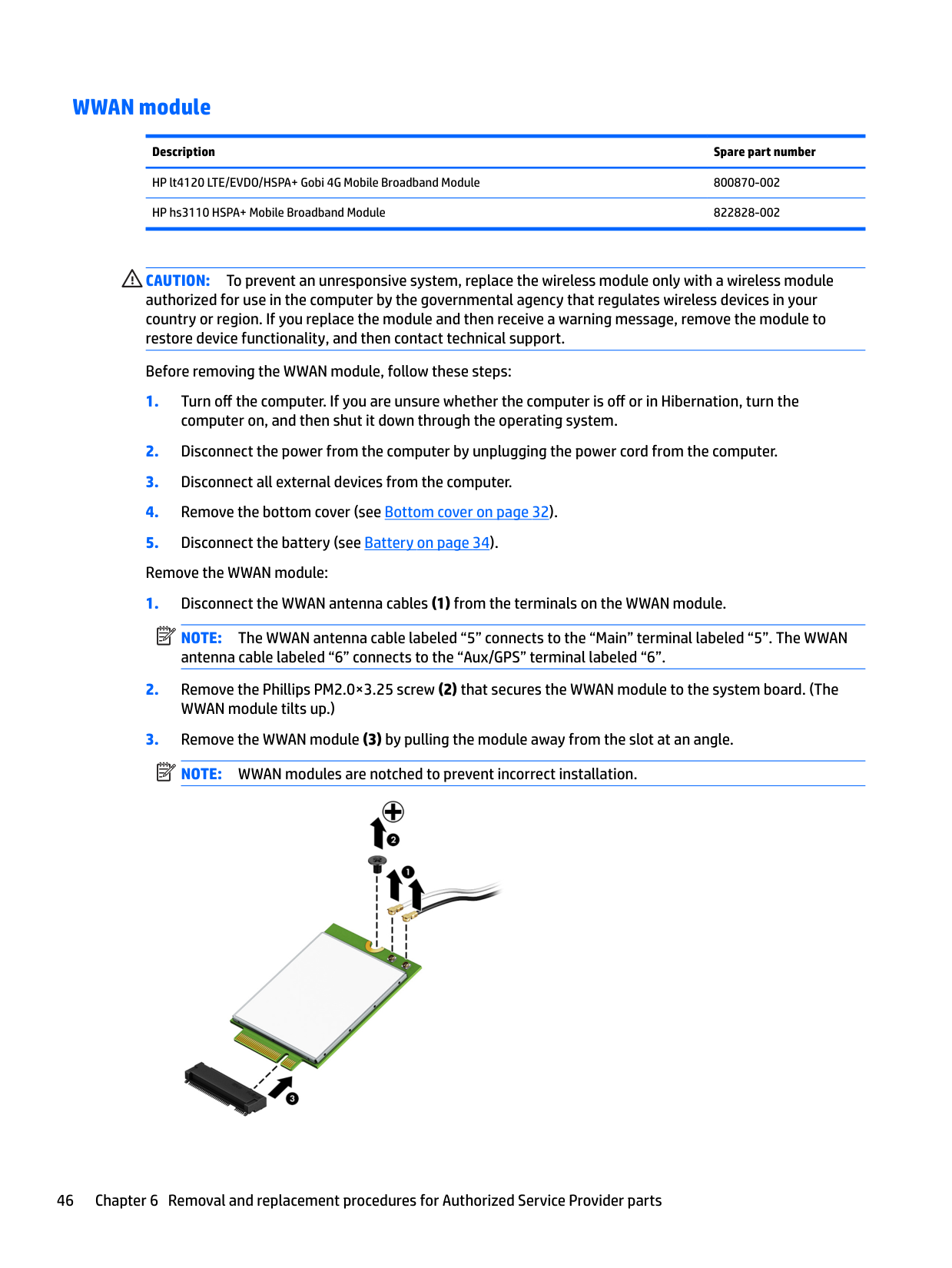
NOTE: The WWAN antenna cable labeled “5” connects to the “Main” terminal labeled “5”. The WWAN antenna cable labeled “6” connects to the “Aux/GPS” terminal labeled “6”.
| | |---|
| | |---|

| | |---|
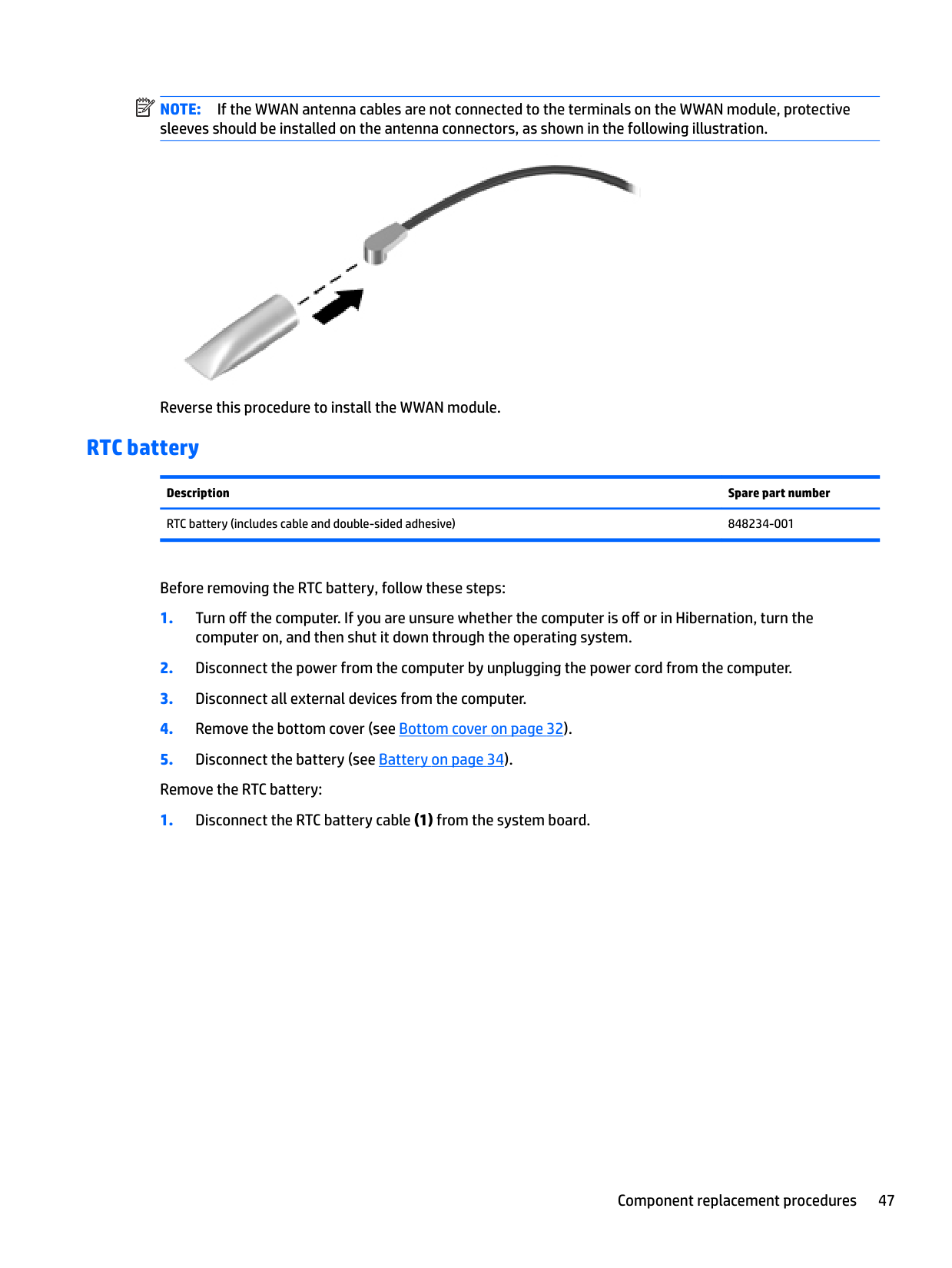
NOTE: If the WWAN antenna cables are not connected to the terminals on the WWAN module, protective sleeves should be installed on the antenna connectors, as shown in the following illustration.

Reverse this procedure to install the WWAN module.
#### RTC battery
Description Spare part number RTC battery (includes cable and double-sided adhesive) 848234-001
Before removing the RTC battery, follow these steps:
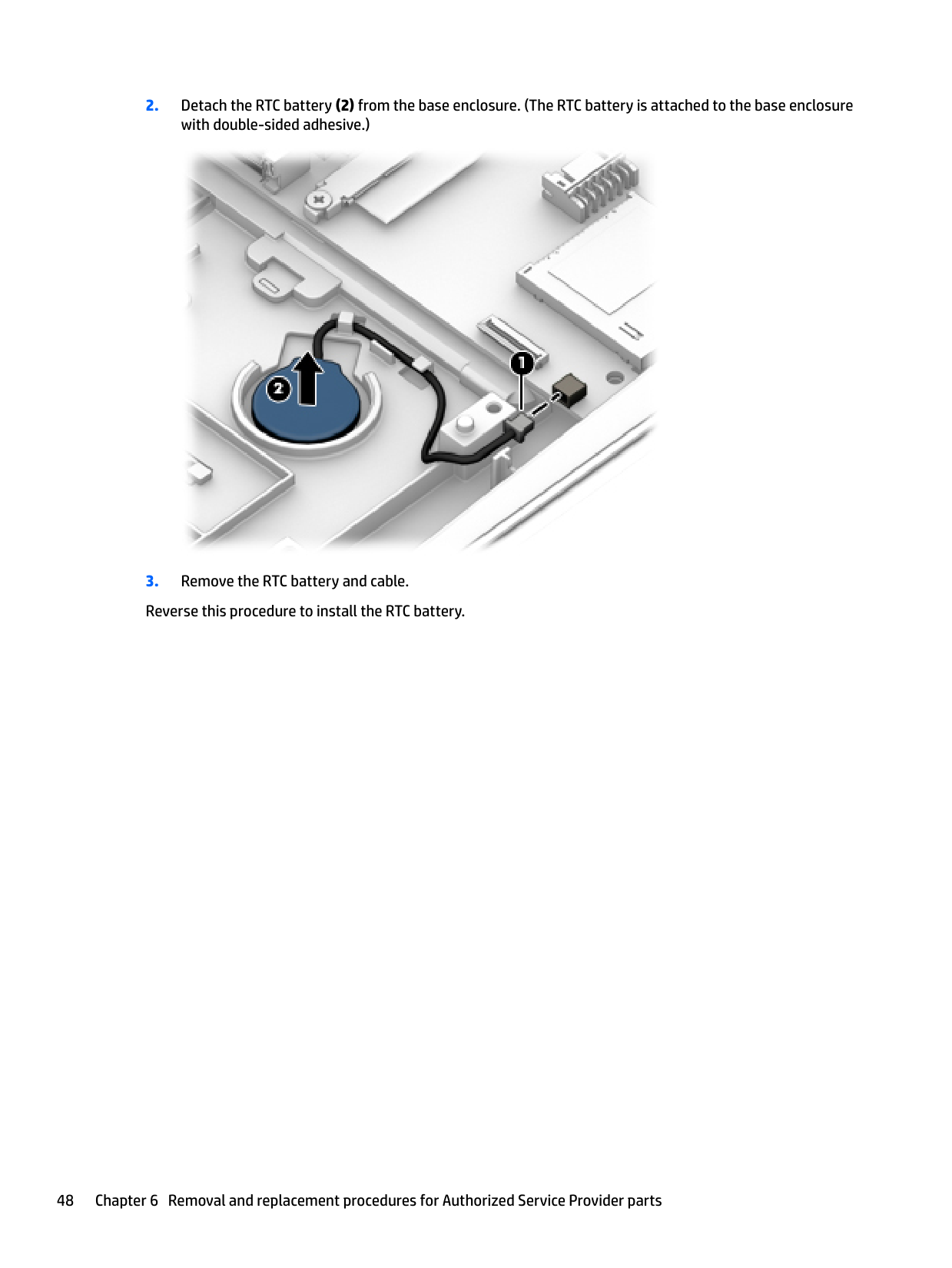
####### 2. Detach the RTC battery (2) from the base enclosure. (The RTC battery is attached to the base enclosurewith double-sided adhesive.)

####### 3. Remove the RTC battery and cable.Reverse this procedure to install the RTC battery.
#### Keyboard
For use in country or region Spare part number
For use in country or region
Spare part number
Keyboard with backlight and pointing stick (includes keyboard cable and backlight cable: The pointing stick cable is available in the Cable Kit using spare part number 848244-001. For use in Belgium 848311-A41 For use in Northwest Africa 848311-FP1 For use in Brazil 848311-201 For use in Norway 848311-091 For use in Bulgaria 848311-261 For use in Portugal 848311-131 For use in Canada 848311-DB1 For use in Romania 848311-271 For use in the Czech Republic and Slovakia 848311-FL1 For use in Russia 848311-251 For use in Denmark 848311-081 For use in Saudi Arabia 848311-171 For use in France 848311-051 For use in Slovenia 848311-BA1 For use in Germany 848311-041 For use in South Korea 848311-AD1 For use in Greece 848311-151 For use in Spain 848311-071 For use in Hungary 848311-211 For use in Sweden and Finland 848311-B71 For use in Iceland 848311-DD1 For use in Switzerland 848311-BG1 For use in India 848311-D61 For use in Taiwan 848311-AB1 For use in Israel 848311-BB1 For use in Thailand 848311-281 For use in Italy 848311-061 For use in Turkey 848311-141 For use in Japan 848311-291 For use in the United Kingdom
848311-031
and Singapore
For use in Latin America 848311-161 For use in the United States 848311-001 For use in the Netherlands 848311-B31
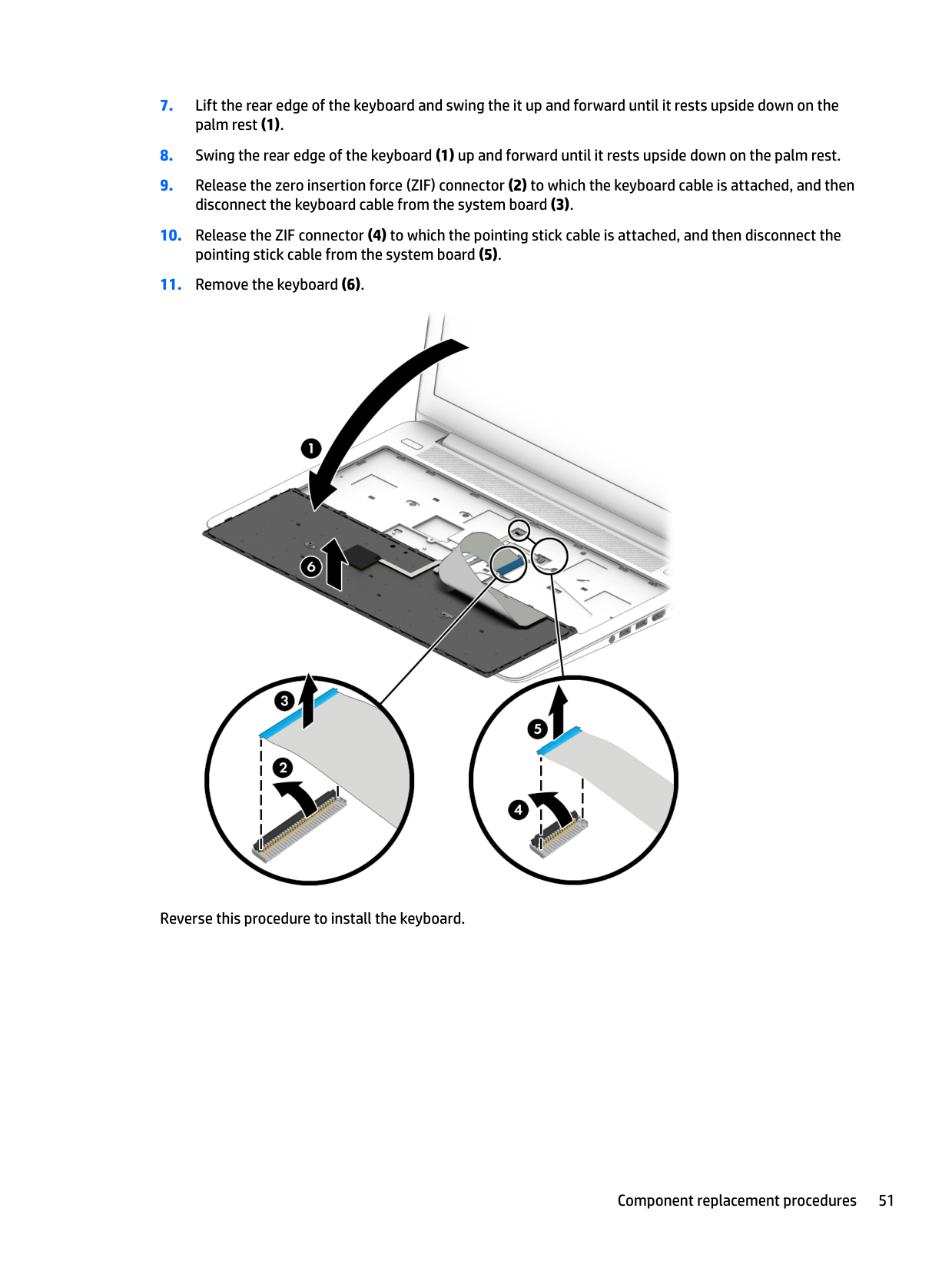
Before removing the keyboard, follow these steps:



Reverse this procedure to install the keyboard.
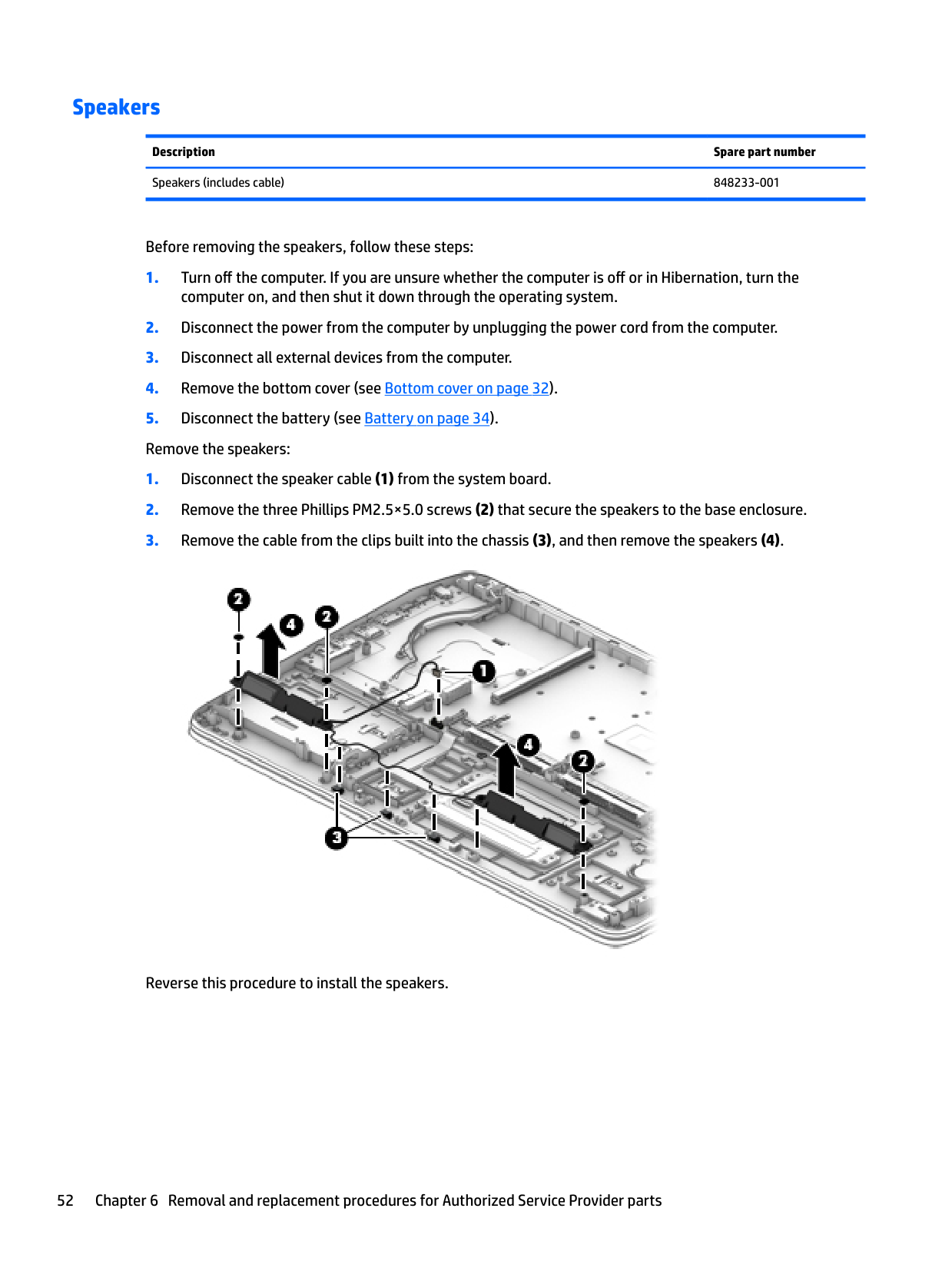
#### Speakers
Description Spare part number Speakers (includes cable) 848233-001
Before removing the speakers, follow these steps:

Reverse this procedure to install the speakers.
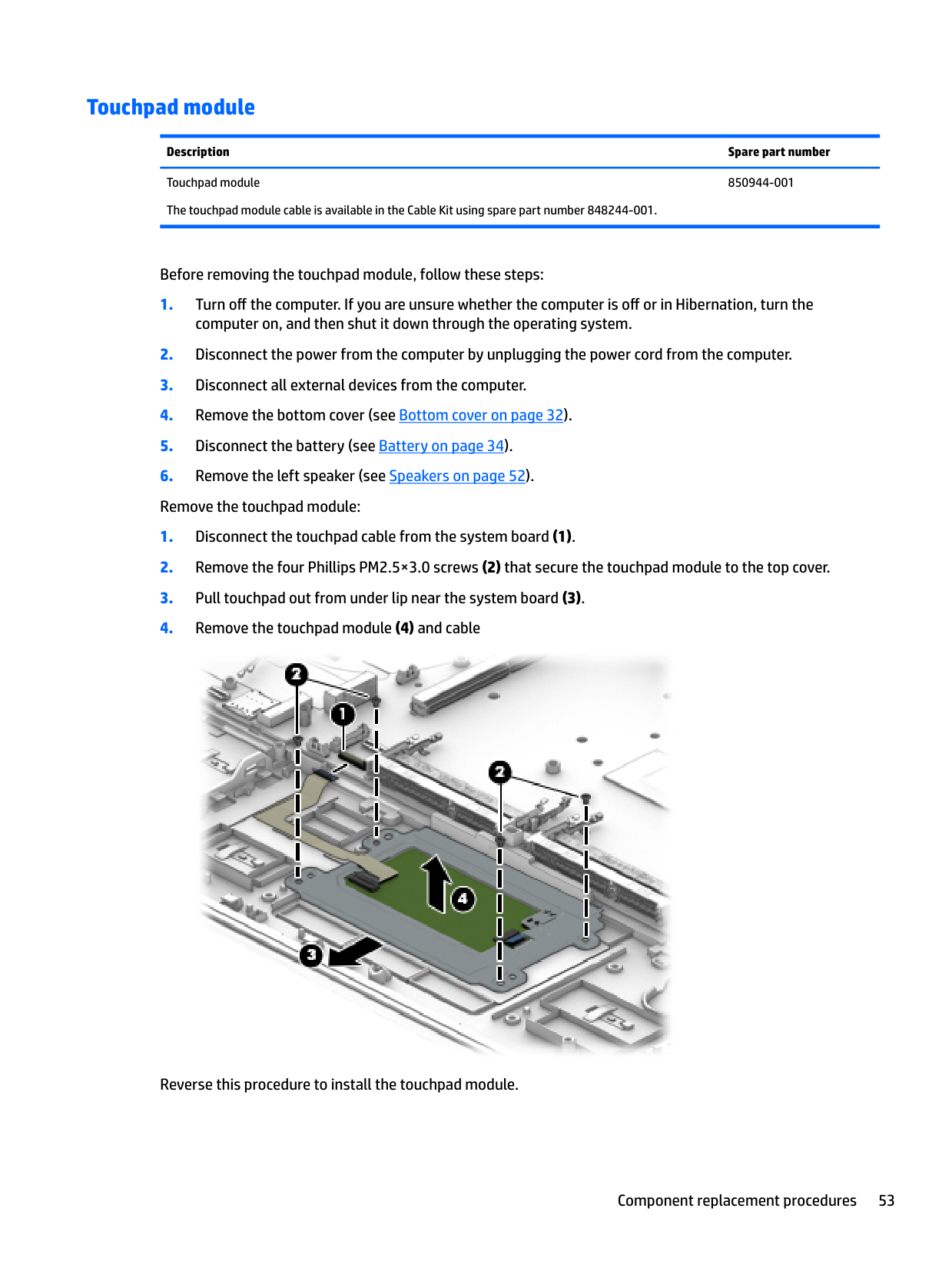
#### Touchpad module
Description Spare part number Touchpad module The touchpad module cable is available in the Cable Kit using spare part number 848244-001.
850944-001
Before removing the touchpad module, follow these steps:

Reverse this procedure to install the touchpad module.
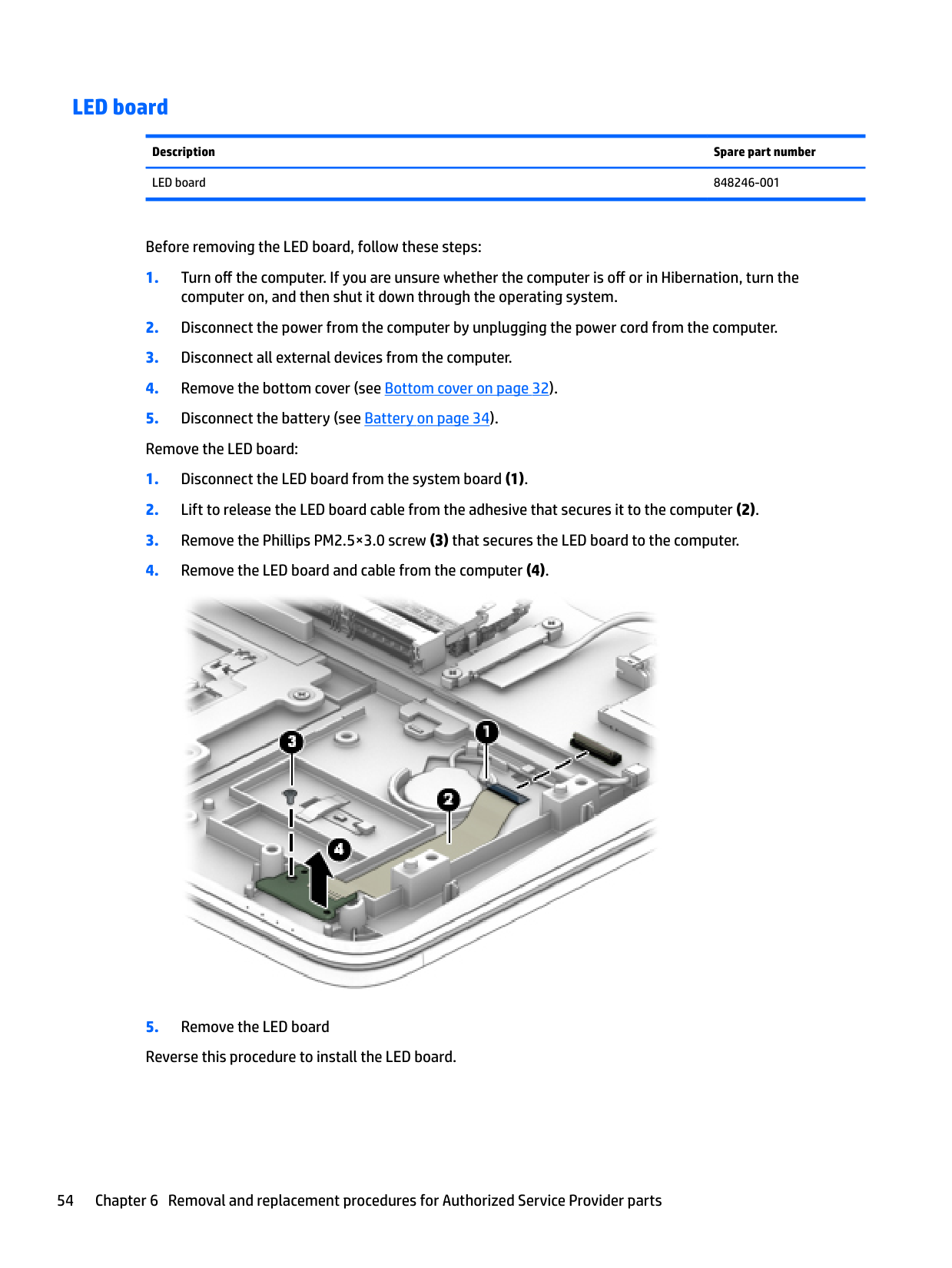
#### LED board
Description Spare part number LED board 848246-001
Before removing the LED board, follow these steps:
computer on, and then shut it down through the operating system.

#### Fans
######### Description Spare part number
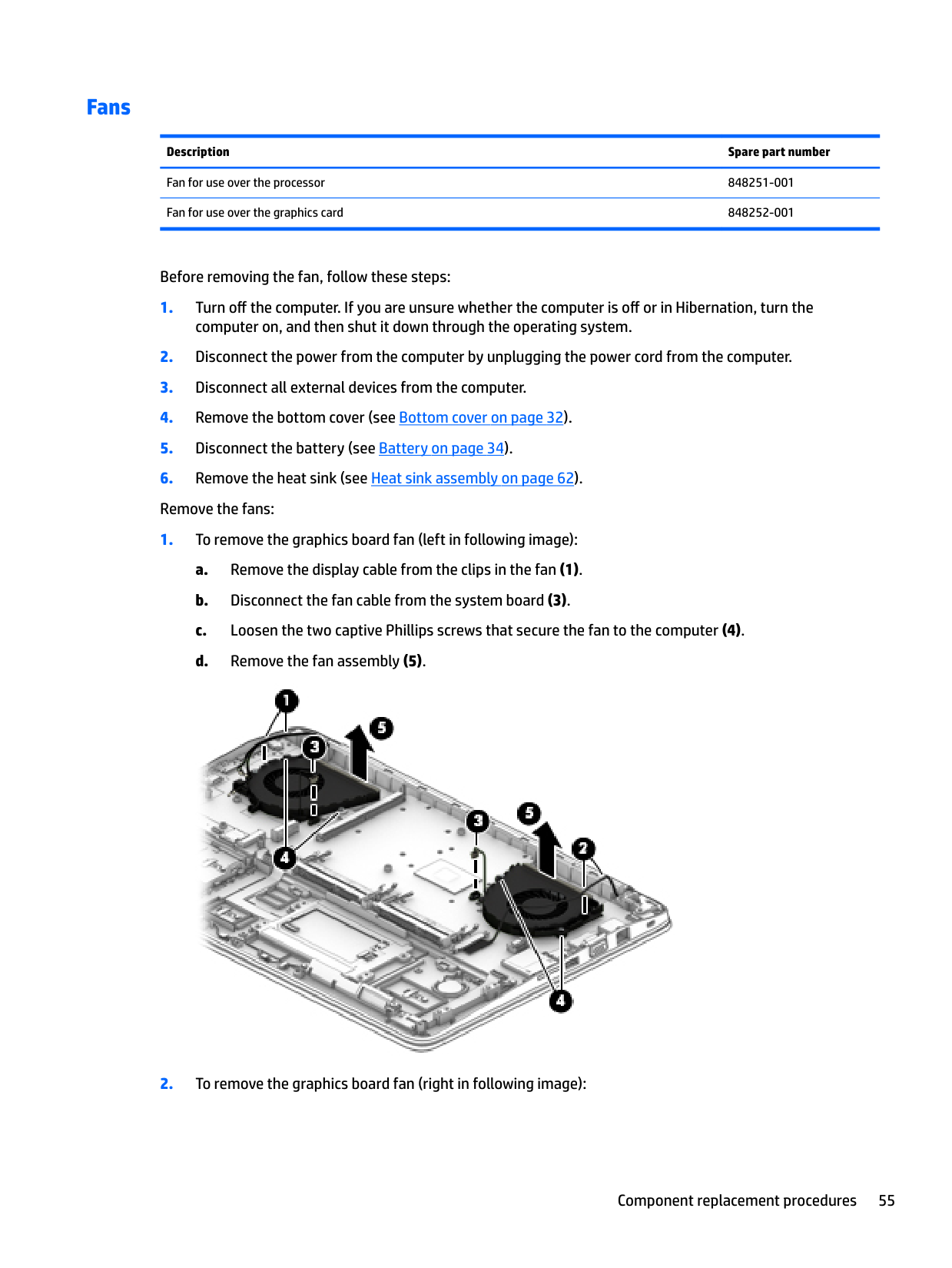
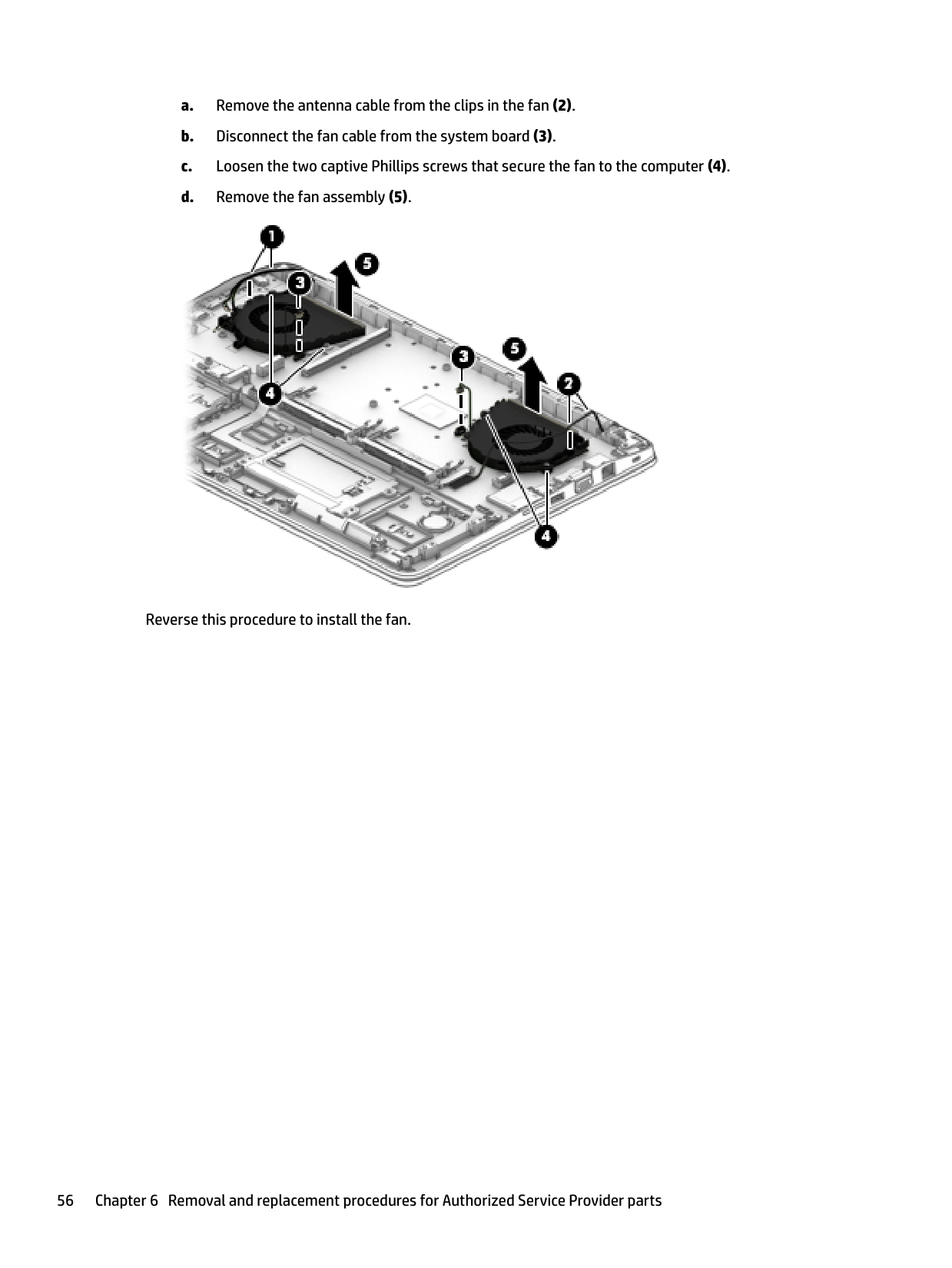
Fan for use over the processor 848251-001 Fan for use over the graphics card 848252-001
Before removing the fan, follow these steps:


Reverse this procedure to install the fan.
#### Smart card reader
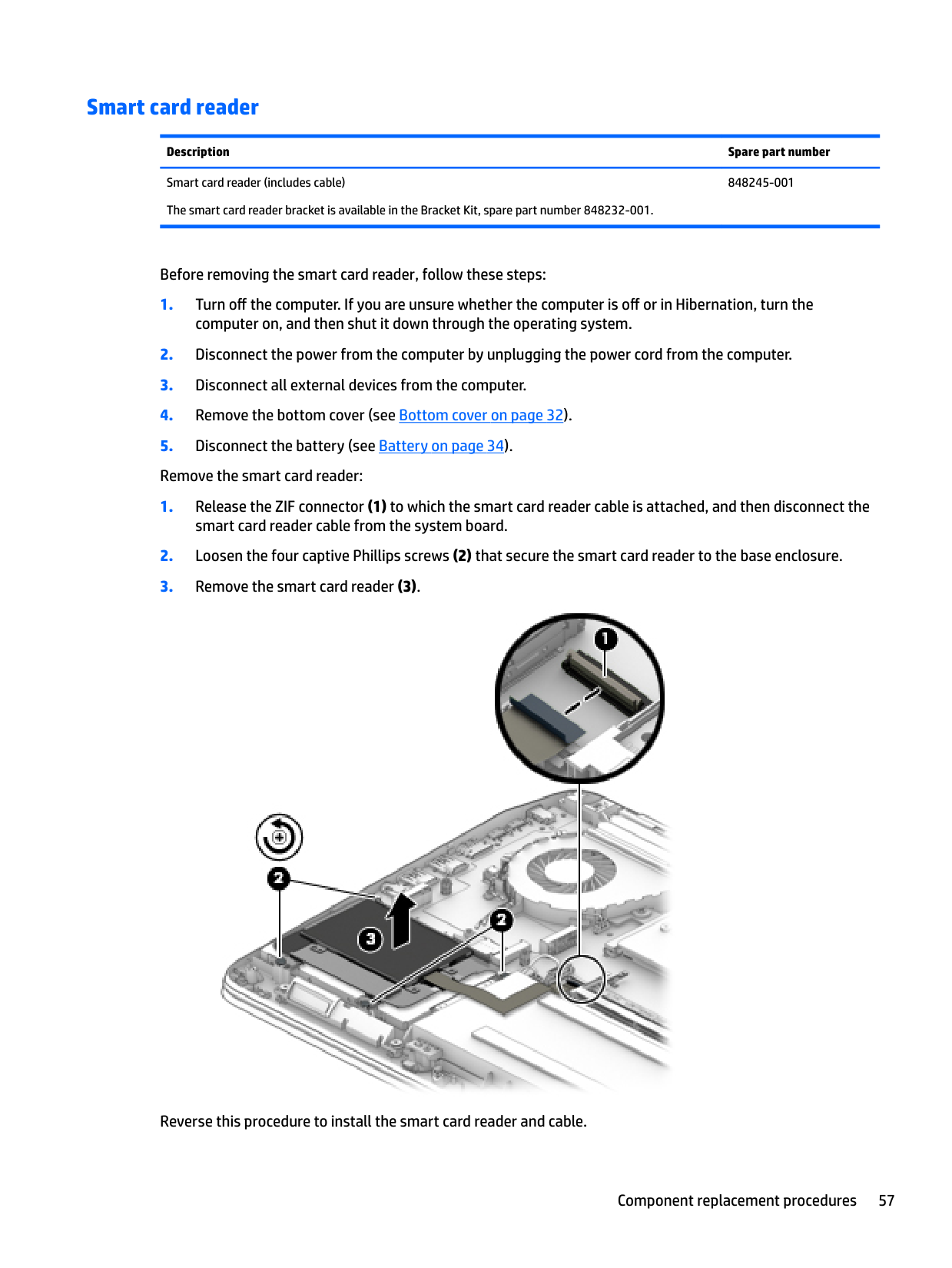
Description Spare part number Smart card reader (includes cable) The smart card reader bracket is available in the Bracket Kit, spare part number 848232-001.
848245-001
Before removing the smart card reader, follow these steps:

Reverse this procedure to install the smart card reader and cable.
#### Hard drive
| | |---|
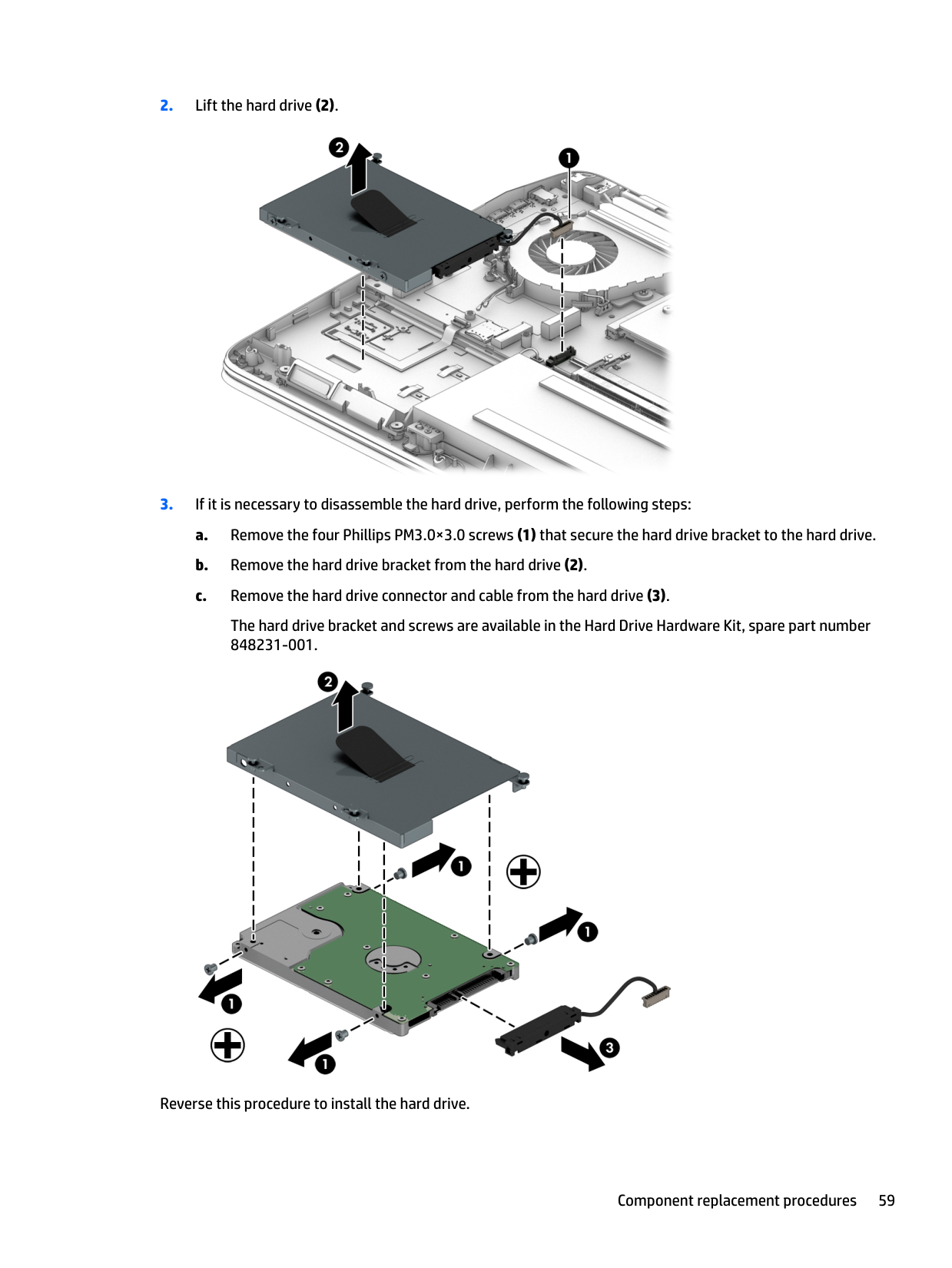
NOTE: The hard drive spare part kit does not include the hard drive bracket or screws. These components are included in the Hard Drive Hardware Kit, spare part number 848231-001.
Description Spare part number Hard drive
1-TB, 5400-rpm, hybrid 8 GB 924036-853 1-TB, 5400-rpm, 762990-003 500-GB, 5400-rpm, hybrid 8 GB 732000-003 500-GB, 7200-rpm 703267-003 500-GB, 5400-rpm, FIPS 820572-003 500-GB, 7200-rpm, self-encrypting 820573-003 Solid–state drive
1-TB, SATA, TLC 929512-001 256-GB, SATA, TLC 848239-001
Before removing the hard drive, follow these steps:

The hard drive bracket and screws are available in the Hard Drive Hardware Kit, spare part number 848231-001.

Reverse this procedure to install the hard drive.
#### Fingerprint reader board
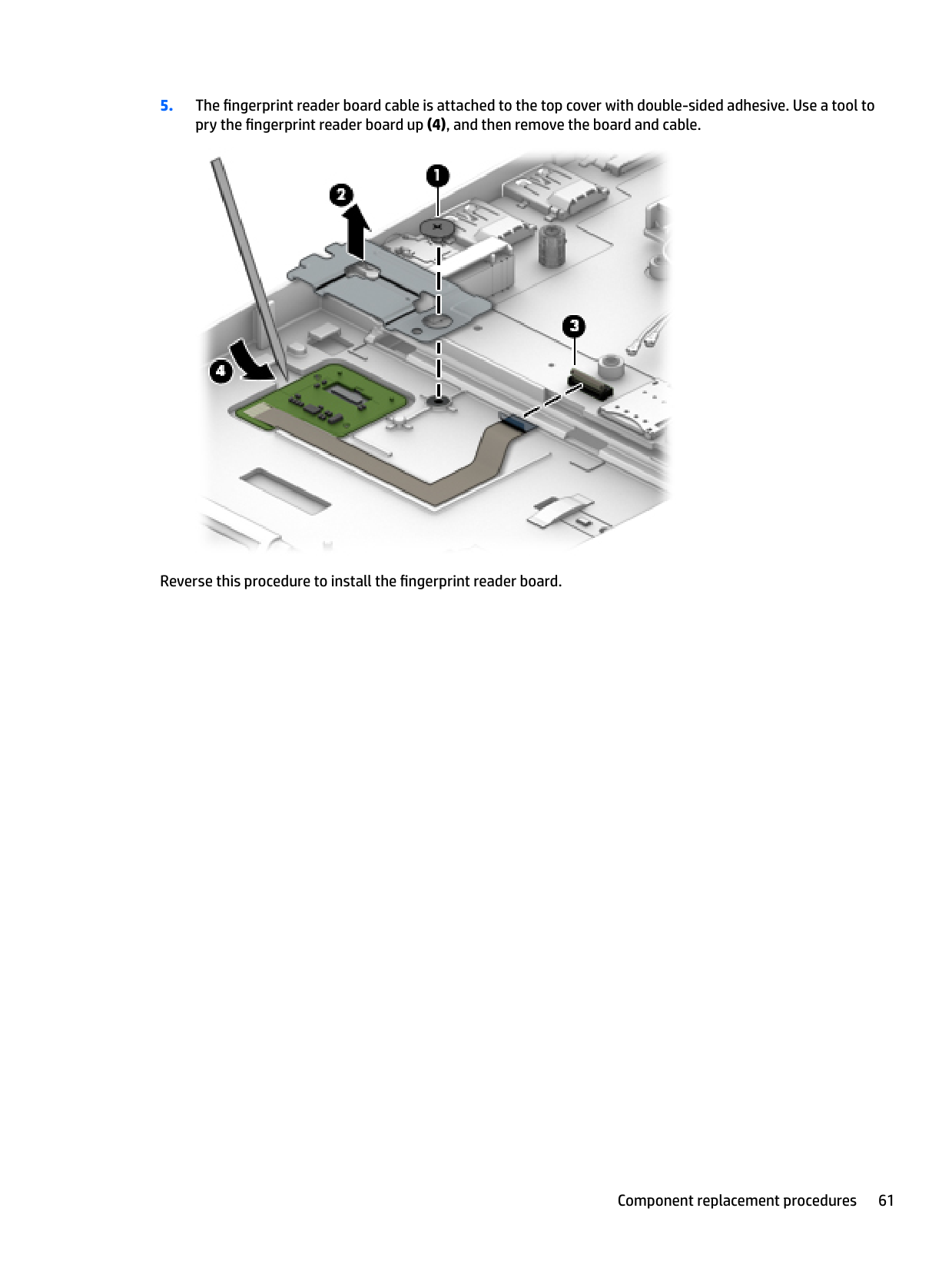
Description Spare part number Fingerprint reader board (includes bracket, cable, and double-sided adhesive) The fingerprint reader bracket is available in the Bracket Kit, spare part number 848232-001.
850151-001
Before removing the fingerprint reader board, follow these steps:

Reverse this procedure to install the fingerprint reader board.
#### Heat sink assembly
| | |---|
NOTE: Only remove the heat sink from the system board if its removal is required to remove other components. It is preferred to leave the heat sink connected to the system board when possible to preserve the thermal materials used between the heat sink and system board. Removal of the heat sink requires reapplication of this thermal material.
| | |---|
NOTE: The heat sink assembly spare part kit includes replacement thermal material.
Description Spare part number
Heat sink for use only in models with Nvidia Quadro graphics boards 850148-001 Heat sink for use only in models with the AMD FirePro graphics board 850149-001 Heat sink for use only in models with UMA graphics memory 850150-001
Before removing the heat sink assembly, follow these steps:
| | |---|
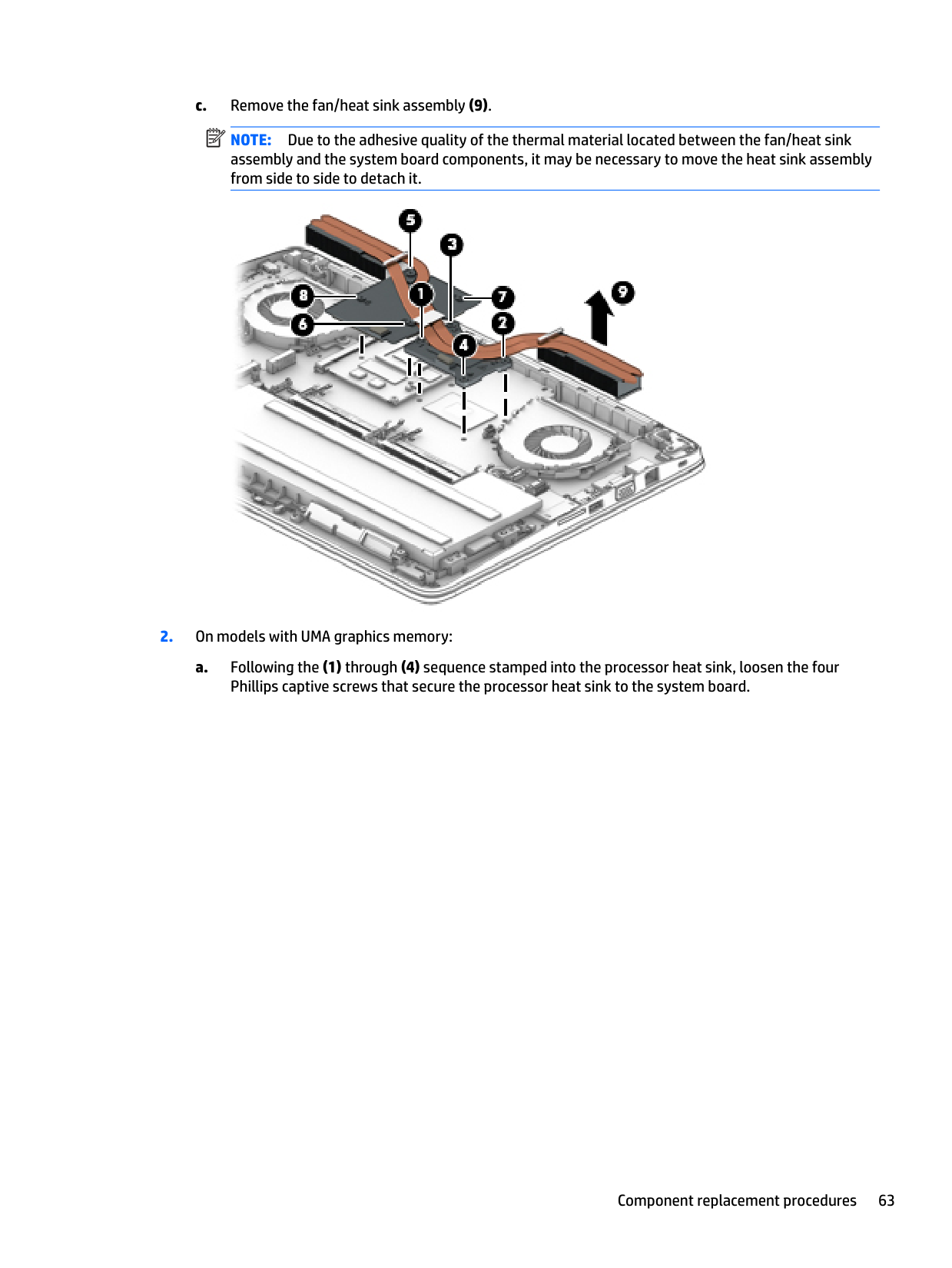
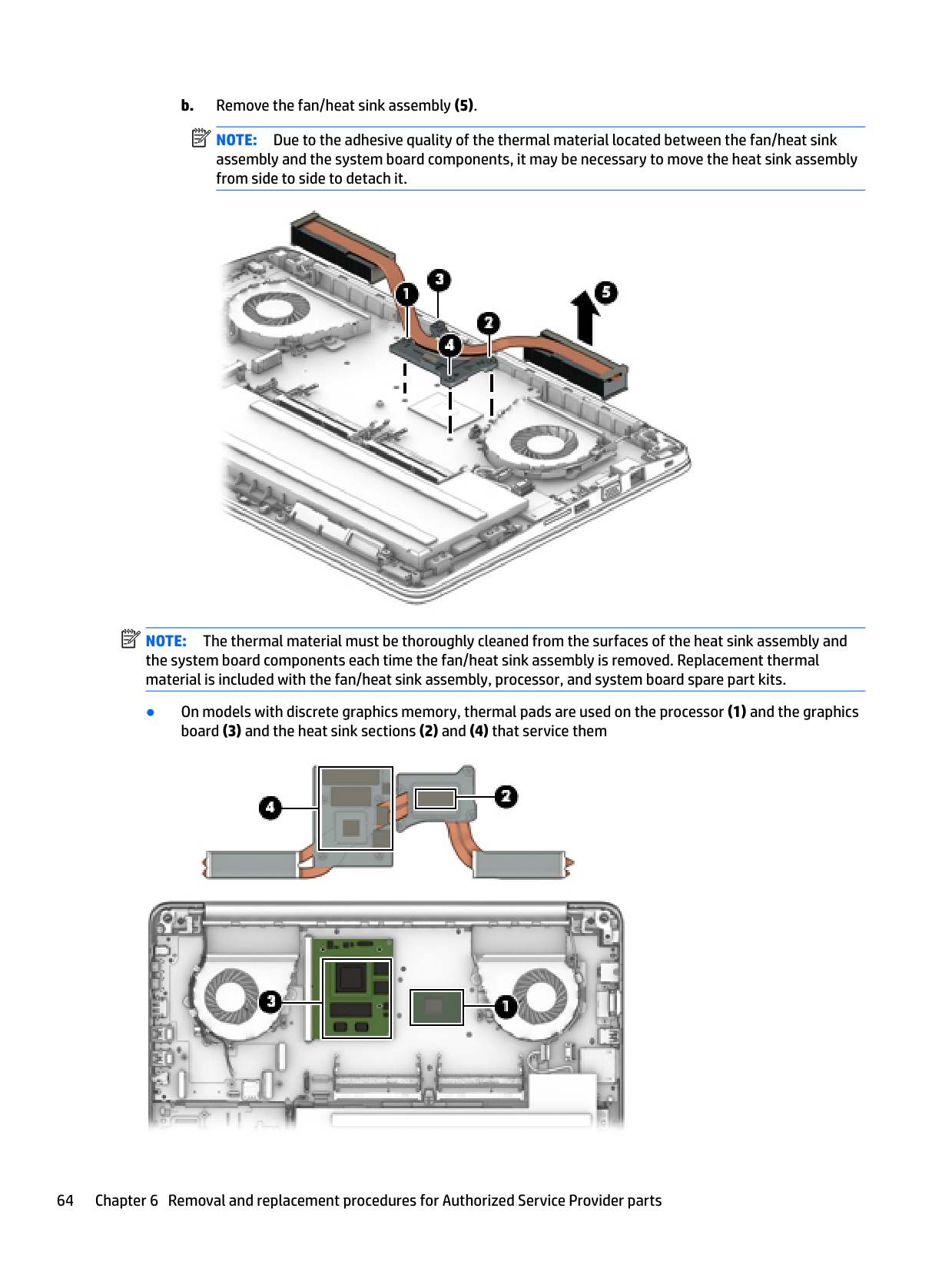
NOTE: Due to the adhesive quality of the thermal material located between the fan/heat sink assembly and the system board components, it may be necessary to move the heat sink assembly from side to side to detach it.

| | |---|
NOTE: Due to the adhesive quality of the thermal material located between the fan/heat sink assembly and the system board components, it may be necessary to move the heat sink assembly from side to side to detach it.

| | |---|
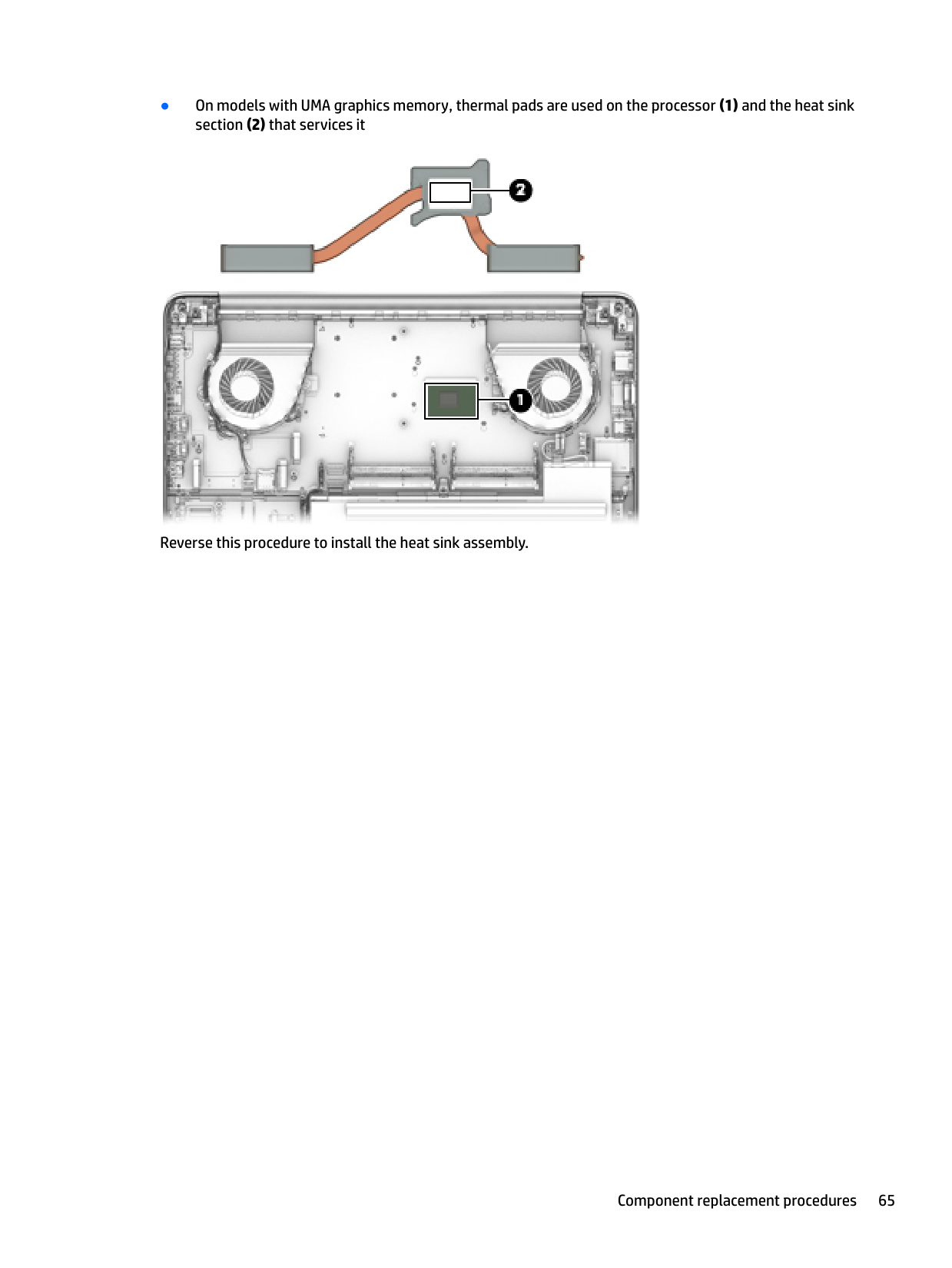
NOTE: The thermal material must be thoroughly cleaned from the surfaces of the heat sink assembly and the system board components each time the fan/heat sink assembly is removed. Replacement thermal material is included with the fan/heat sink assembly, processor, and system board spare part kits.


Reverse this procedure to install the heat sink assembly.
#### Graphics board
| | |---|
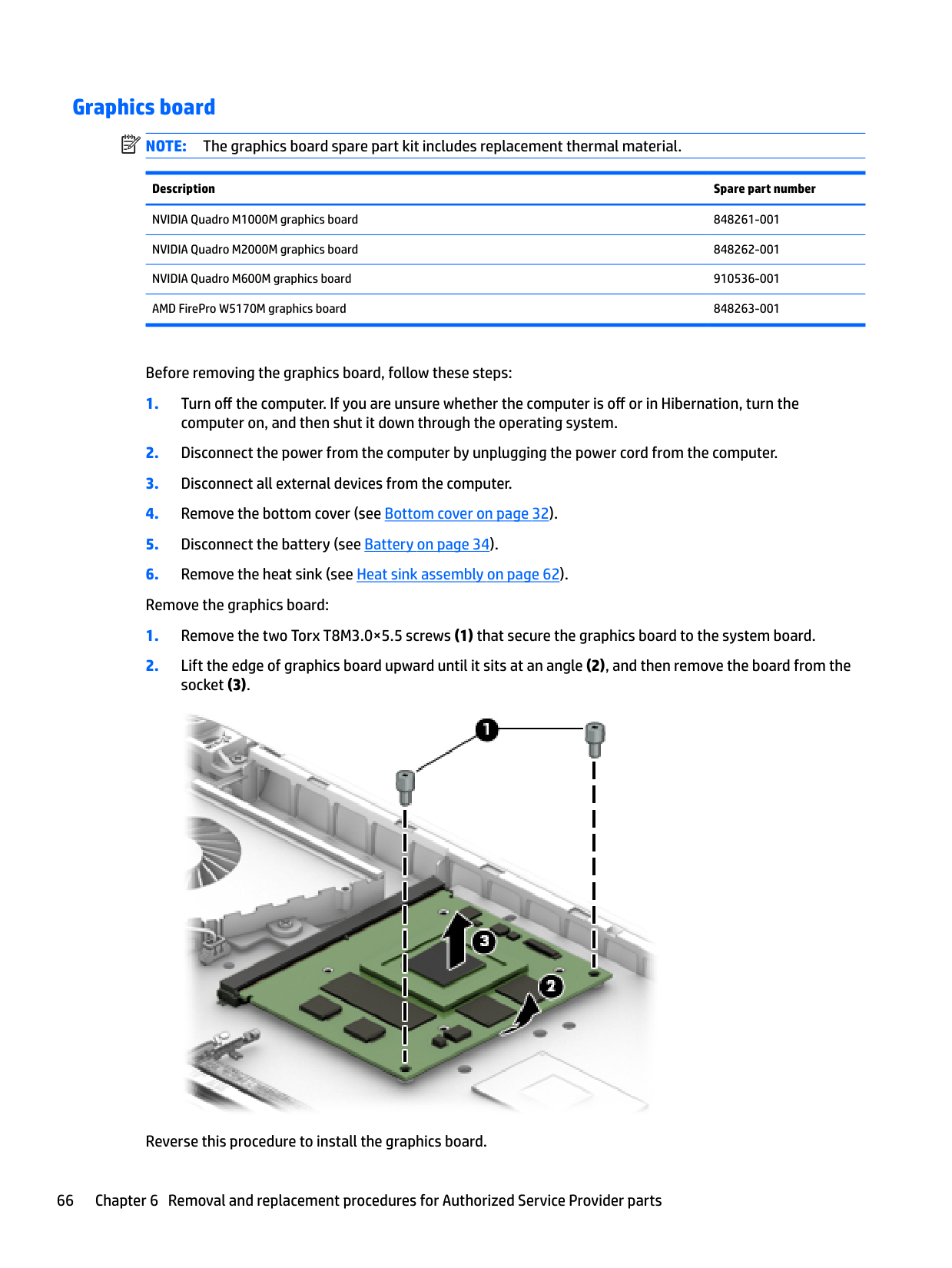
NOTE: The graphics board spare part kit includes replacement thermal material.
Description Spare part number
NVIDIA Quadro M1000M graphics board 848261-001 NVIDIA Quadro M2000M graphics board 848262-001 NVIDIA Quadro M600M graphics board 910536-001 AMD FirePro W5170M graphics board 848263-001
Before removing the graphics board, follow these steps:

Reverse this procedure to install the graphics board.
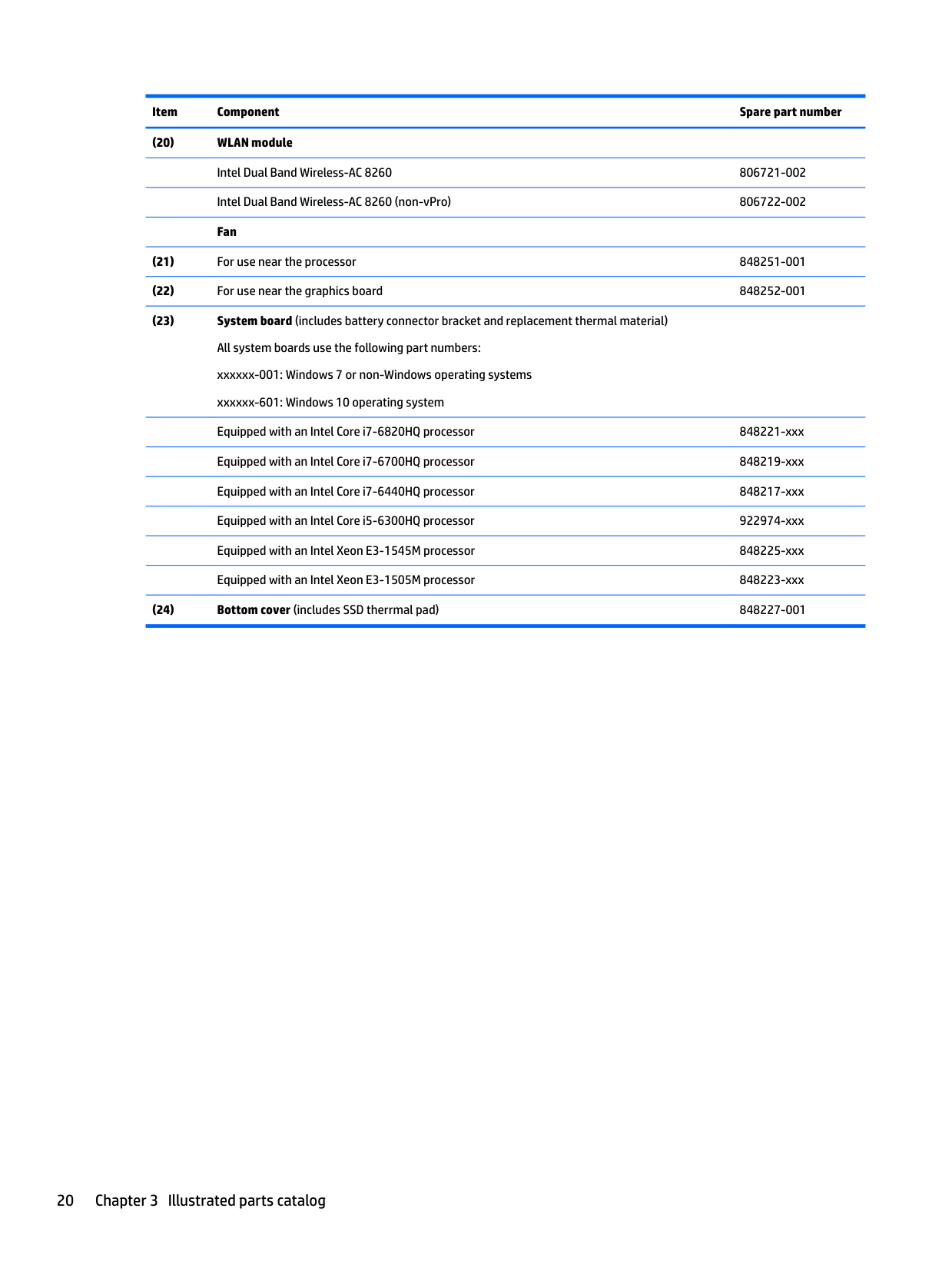
System board NOTE: The system board spare part kit includes battery connector bracket and replacement thermal material. All system boards use the following part numbers: xxxxxx-001: Windows 7 or non-Windows operating systems xxxxxx-601: Windows 10 operating system
| | |---|
Description Spare part number
System board equipped with an Intel Core i7-6820HQ processor 848221-xxx System board equipped with an Intel Core i7-6700HQ processor 848219-xxx System board equipped with an Intel Core i7-6440HQ processor 848217-xxx System board equipped with an Intel Core i5-6300HQ processor 922974-xxx System board equipped with an Intel Xeon E3-1545M processor 848225-xxx System board equipped with an Intel Xeon E3-1505M processor 848223-xxx
Before removing the system board, follow these steps:
| | |---|
NOTE: When replacing the system board, be sure that the following components are removed from the defective system board and installed on the replacement system board:

(4).


Reverse this procedure to install the system board.
#### Buttons
Before removing the buttons, follow these steps:

Display assembly NOTE: Touch display assemblies are spared as a whole unit assemblies only. Non-touch display assemblies are spared at the subcomponent level and as whole units. To remove the display assembly and non-touch display subcomponents, follow these steps:
| | |---|
computer on, and then shut it down through the operating system.


| | |---|
NOTE: The display assembly will not be connected to the computer as shown in the following image.

| | |---|
NOTE: The display assembly will not be connected to the computer as shown in the following image.

CAUTION: Before turning the display panel upside down, make sure the work surface is clear of tools, screws, and any other foreign objects. Failure to follow this caution can result in damage to the display panel.
NOTE: The display assembly will not be connected to the computer as shown in the following image.

| | |---|
The display panel is available using spare part numbers 848255-001 (SVA panel), 848256-001 (UWVA panel).
CAUTION: Handle the webcam/microphone module and microphone module with caution. These modules have a thin profile and are susceptible to damage when not handled carefully.

The webcam/microphone module is available using spare part number 848264-001. The microphone module is available using spare part number 854110-001.
The display hinges are available using spare part number 848242-001 and include the left and right hinges.


Reverse this procedure to reassemble and install the display assembly.
#### Lock bracket
Before removing the lock bracket, follow these steps:

Reverse this procedure to install the lock bracket.
7 Troubleshooting guide
This chapter is primarily focused on troubleshooting HP Mobile Workstations and HP Notebooks. The information is provided so that you can solve problems yourself or at least narrow down what may be causing the problem. Based on some of the most common symptoms, this chapter helps to identify logical steps and available resources or tools for resolving an issue. HP recommends that you follow the instructions carefully, observe safety precautions, and note any observations or results. Capturing this information may help identify and resolve the problem faster.
WARNING! To reduce the risk of electric shock or damage to the equipment:
CAUTION: Static electricity can damage the electronic components of the computer. To prevent damage to the computer, carefully observe the electrostatic discharge precautions.
CAUTION: The computer includes customer self-repair parts and parts that should only be accessed by an authorized service provider. See the chapter titled "Removal and replacement procedures for Customer SelfRepair parts," for details. Accessing parts described in the chapter titled "Removal and replacement procedures for authorized service provider only parts" can damage the computer or void the computer warranty.
Resources
HP Resource Tool Description Link HP Elite Support Provides live HP Premium support (available 24/7) to Elite computers.
http://www8.hp.com/us/en/ads/eliteproducts/overview.html
HP Support Center Provides important support, such as warranty, support cases, drivers, Customer Advisories, Customer and Security Bulletins, and Product Change Notices.
http://h20565.www2.hp.com/portal/site/ hpsc
HP Troubleshooting Support page Provides troubleshooting information for your specific HP computer.
http://www8.hp.com/us/en/ troubleshooting.html
Subscribers Choice Allows you to sign up for HP product updates. http://www8.hp.com/us/en/subscribe/ HP Support Forums Provide discussions about HP products and issues. http://h30434.www3.hp.com/psg/ Service Access Workbench (SAW) (Available for technicians and Business Partners only)
Provides navigable content intended for use by internal and outsourced call center staff and can be a resource for support and product division professionals.
http://sawpro.atlanta.hp.com/km/saw/ home.do
Vendors’ web sites Provide additional information for associated components such as Intel (processor, WLAN), Microsoft (Windows 7/8/10), AMD/NVidia (GPU), and so on.
http://www.intel.com/ content/www/us/en/homepage.html
http://www.microsoft.com http://www.amd.com http://www.nvidia.com
General troubleshooting steps
A basic logic should be used when troubleshooting computer issues. This section will help you become familiar with troubleshooting methodology and efficiently resolve problems. Proceed through the steps in the following table until the issue is resolved, and then move on to the next step that is relevant to the issue. For example, if you resolve a memory issue using the HP PC Diagnostics (UEFI) tool in step 6, you can then move on to step 10 to reseat the memory into its memory slot.
| | |---|
NOTE: General troubleshooting steps do not have to be followed in a specific order if an issue does not apply.
Table 7-1 Troubleshooting methodology and general troubleshooting steps
Identify issue Analyze issue Resolve issue Verify solution
Verify solution on page 98
####### Resources 81
######## Table 7-1 Troubleshooting methodology and general troubleshooting steps (continued)
#### Identify the issue
##### 1. Understand the issue
It is important to understand the issue that occurred, including related symptoms. It helps to understand the basic computer boot-up sequence as well as the failure itself. The boot-up sequence and associated failures are described below.
Boot up sequence The computer performs several steps after you press the power button or restart the computer. It is important to understand where in the boot-up sequence the symptoms occur. The following table lists the phases of the boot-up sequence and explains the symptoms that may occur in each phase. For example, a blue screen error (BSOD) often occurs during the performance phase. Table 7-2 Boot-up sequence
Power-on After power button is pressed, the computer boots after all internal power rails (i.e., 5V, 3.3V) are stable. Confirm that power lights are on fan is spinning. Next step: If the computer experiences a power-on issue, see “Verify Power Good (Troubleshooting) lights” in No Power on page 100. Common issues: all lights are off; troubleshooting lights are on; does not boot; video is absent.
POST (UEFI/BIOS) Power-On Self-Test (POST) verifies that hardware components (processor, storage device, memory, etc.) are functional. When POST is complete, the HP logo displays briefly and then disappears. If there are errors, the computer may exhibit blinking lights and POST error messages Common issues: lights blink, error message appears, hangs.
Performance (operating system)
System boots to operating system, and Windows logo screen appears.. Common issues: hangs (lock up/freezes), blue screen, video distorted, driver conflict, slow performance, display issue (dead pixel), I/O issue (no speaker sound), wireless/audio unavailable, noise. See Analyze the issue on page 85 table below for detailed troubleshooting information).
###### Failure classification
Failure classification is a breakdown of different types of failures and symptoms that could occur during the boot-up sequence. Table 3 and table 4 represent the failure classification for common notebook failures.
Table 3 categorizes failures by the boot-up sequence.
A single symptom can be listed under different groups. For example, No Video can belong to (1) Power-on or
(4) Display; but Flickering when powered should be listed in (4) Display. Or, in another example, a blue screen can be caused by a driver conflict in Performance (4), but it can also be caused by a defective storage device under (6) Storage. Therefore, failures that share similar symptoms are noted..
If possible, make a record of the failure symptom, the phase of the boot-up sequence where the failure occurs, and the most likely location in the failure tree (Table 7-3 Failure classification by boot-up sequence on page 83 and Table 7-4 Failure classification by hardware devices and mechanical on page 84). This will help isolate the issue and indicate the next steps. For example, when the computer is running the operating system, it may experience an issue with (4) Display, (5) I/O devices (keyboard, wireless, and so on), (6) Storage, or (7) Mechanical components (stuck buttons, thermal shutdown, and so on).
| | |---|
NOTE: “Uncategorized” is used if an issue found is not listed. For example, Bluetooth is offered on certain hardware configurations; therefore, a Bluetooth issue can be classified under “I/O Device” if needed.
###### Failure classification by boot-up sequence
######## Table 7-3 Failure classification by boot-up sequence
######### 1. Power-on 2. POST 3. Performance
a,b,c similar symptoms
###### Failure classification by hardware devices and mechanical
######## Table 7-4 Failure classification by hardware devices and mechanical
######### 4. Display 5. I/O devices 6. Storage 7. Mechanical
b,c,d similar symptoms
##### 2. Examine the environment
It is important to examine the computer’s environment. If you can quickly identify the cause of the issue, fewer resolution steps may be needed. Perform the following environment inspections:
IMPORTANT: Whenever possible, update to the latest BIOS, firmware, and drivers before troubleshooting. Note that some customer company policies prohibit updates. Check your company policy before taking action. The updates may include fixes for your computer issues, and they may also enhance system performance. HP continually improves the update process to make it easier. The BIOS update can be done locally through a manual process, through an automatic installation, or through a remote installation on multiple units.
Manually updating BIOS and drivers
Remotely deploying BIOS and drivers
Instead of manually searching for and downloading each SoftPaq, users and IT personnel can use two tools to identify and download all appropriate SoftPaqs for the selected HP models.
Analyze the issue
| | |---|
HP has designed this computer and validated it using a full-range hardware and software qualification matrix. If an issue appears to have started recently, it may be related to the recent addition of hardware or software. A good method to determine the root cause is to remove recently added components or uninstall applications one at a time and restart the computer when necessary.
| | |---|
IMPORTANT: After you have completed the process of uninstalling hardware or software and are ready to reinstall, when installing a new device be sure that it is seated properly and all cables are correctly connected. After installing the device, restart the computer and make sure the new device is powered on. In addition, if the new device is a root cause of a problem, it could cause a conflict in drivers or incompatibility issues with other programs installed. For any new hardware you have added, be sure to install the latest drivers available from the device vendor website.
##### 6. HP Hardware Diagnostics and Tools
HP offers different diagnostics and tools to diagnose hardware failure. This section describes how to use some of these tools. Make sure to check for the latest versions before use.
###### HP PC Hardware Diagnostics (UEFI)
HP PC Hardware Diagnostics is a Unified Extensible Firmware Interface (UEFI) that allows you to run diagnostic tests to determine whether the computer hardware is functioning properly. The HP PC Hardware Diagnostics (UEFI) tool is built within BIOS (basic memory and storage device diagnostics only), or within new storage devices themselves. These drives contain more advanced versions of the diagnostic tool than the BIOS-based version.
In addition, for HP authorized service partners and IT professionals who need to support a mixed environment of older and newer HP/Compaq PCs, the HP PC Diagnostics 3-in-1 USB Key is a diagnostic tool that supports a wide range of HP Desktop and Notebook computers.
The tool runs outside the operating system so that it can isolate hardware failures from issues that are caused by the operating system or other software components. In reality, many problems can be determined using this tool if the issue is a defective part or a loose connection (i.e., reseating keyboard cable after the tool reports a keyboard error).
The tool has three major functions:
To start HP PC Hardware Diagnostics (UEFI):


| | |---|
| | |---|
NOTE: Users should utilize this tool, especially when the computer cannot boot to Windows. NOTE: If a component fails a test, write down the information so it is available when contacting support. The information is also available in Test Logs on the Main Menu. For more information, see the chapter titled “Using HP PC Hardware Diagnostics (UEFI).”
###### HP Support Assistant (HPSA)
HP Support Assistant (HPSA) helps you maintain peak performance and resolve problems through automatic updates, built-in diagnostics, and a variety of assistance options. HPSA is preinstalled on every new HP PC with Windows 7, Windows 8, or Windows 10. HP is continually improving this tool. Please verify the latest version is installed to receive the most benefit. For more information, see HP Support Assistant.
| | |---|
NOTE: HPSA can be used only if the computer boots into Windows. If the computer does not boot into Windows, use HP PC Hardware Diagnostics (UEFI) instead. HPSA also integrates diagnostics and tools that help resolve issues. See example screen shots as follows.


###### HP BIOS Configuration Utility (BCU)
HP BCU is a free utility that captures the BIOS settings and their values. This tool provides a text file of the computer’s BIOS configuration. This can help identify any settings that may be contributing to an issue.
| | |---|
In some cases, it may help to compare this BIOS text file to the default settings of the computer. For more information, see the HP BIOS Configuration Utility (BCU) User guide. NOTE: HP recommends that you reset BIOS before trying BCU. Resetting the BIOS is always available and relatively quick to try, whereas BCU takes extra time and effort.
###### HP Image Diagnostic Tool
Available to HP Authorized Support Partners (ASPs) and users from the HP public ftp site, this tool collects information about the current state of the computer, including product serial number, platform and BIOS information, and information about user-installed software and hardware components. HP encourages you to review the report before sending it to support. The report may assist you with diagnostics and solutions to problems you encounter.
HP Thermal Monitor NOTE: Available only to authorized service providers/technicians.
| | |---|
Available only for HP internal use, HP Thermal Monitor can be used to stress the processor and GPU and monitor the temperature values of various components in the system. The components that are currently monitored include the processor, GPU, ACPI thermal zones, storage device, and battery. The tool reads the temperatures of the components, logs the data, and helps to determine whether the computer would overheat in the event of thermal shutdown, fan spinning loud, etc.
###### Non HP diagnostics tools
Windows-to-Go USB
Windows-To-Go USB is a Microsoft-based tool for Enterprise editions of Windows that can help in troubleshooting. You can find a process online about how to create a live Windows USB drive. For more information, see Windows To Go: Feature Overview.
Intel Processor Diagnostic Tool
Determine what processor is in your computer and verify the processor operating frequency. The tool also tests specific processor features and performs a stress test on the processor. For more information, see http://www.intel.com/support/processors/sb/CS-031726.htm?iid=subhdr+tools_procdiagtool.
##### 7. Status lights, blinking light codes, troubleshooting lights, and POST error messages
Carefully observe any behavior the computer may be exhibiting: status lights, blinking lights, and POST error messages during boot. It is important to understand what these indicators mean.
###### Status lights
See the chapter titled “External Component Identification” for light locations. The following table describes basic lights on the computer.
Component Description Power button When the computer is off, press the button to turn on the computer.
When the computer is on, press the button briefly to initiate Sleep (Windows) or Suspend (Linux).
When the computer is in the Sleep state, press the button briefly to exit Sleep (Windows) or Suspend (Linux).
When the computer is in Hibernation, press the button briefly to exit Hibernation. CAUTION: Pressing and holding down the power button results in the loss of unsaved information. If the computer has stopped responding and operating system shutdown procedures are ineffective, press and hold the power button.
Front power light On: The computer is on. Blinking: The computer is in the Sleep state. Off: The computer is off.
Front AC adapter and battery light White: The computer is connected to external power and the battery is charged from 90 to 99 percent. Amber: The computer is connected to external power and the battery is charged from 0 to 90 percent. Blinking amber: A battery that is the only available power source has reached a low battery level. When the battery reaches a critical battery level, the battery light begins blinking rapidly. By default, the critical battery level is defined in Power Options as 5%. Off: The battery is fully charged.
Front storage device light Blinking white: The storage device is being accessed.
Amber: HP 3D DriveGuard has temporarily parked the storage device. Rear AC adapter light White: The computer is connected to external power.
Off: The computer is not connected to external power.
###### Interpreting system validation diagnostic front panel LEDs and audible codes
During the system validation phase that occurs at system startup, the BIOS validates the functionality of the following subsystems and conditions:
| | |---|
If an error is detected, specific patterns of long and short blinks, accompanied by long and short beeps (where applicable) are used to identify the error. These patterns will make up a two part code:
Number of long beeps/blinks Error category
Patterns of blink/beep codes are determined by using the following parameters:
| | |---|
The red LED blinks to represent the major error category (long blinks). The white LED blinks to represent the minor error category (short blinks). For example, ‘2.3’ indicates 2 long red blinks and 3 short white blinks to communicate the processor is not detected. CAP/NUM Blink = 2 indicates CAP/NUM will blink 2 cycles, each cycle has one 2.3 sequence.
Component tested
Major/ minor
code Error condition
BIOS 2.2 The main area (DXE) of BIOS has become corrupted and there is no recovery binary image available
CAP/NUM Blink = 8
Perform SureStart manual recovery if boot block: Up Arrow + Down Arrow + ESC.
Hardware 3.2 The embedded controller has timed out waiting for BIOS to return from memory initialization
CAP/NUM Blink = 4
If the system has an MXM module, try a different MXM module. Otherwise, the board most likely needs to be replaced.
System board 5.2 The embedded controller cannot find valid firmware
5.3 The embedded controller has timed out waiting for the BIOS
Caps Lock/Num
Lock LED Action
CAP/NUM Blink = 2
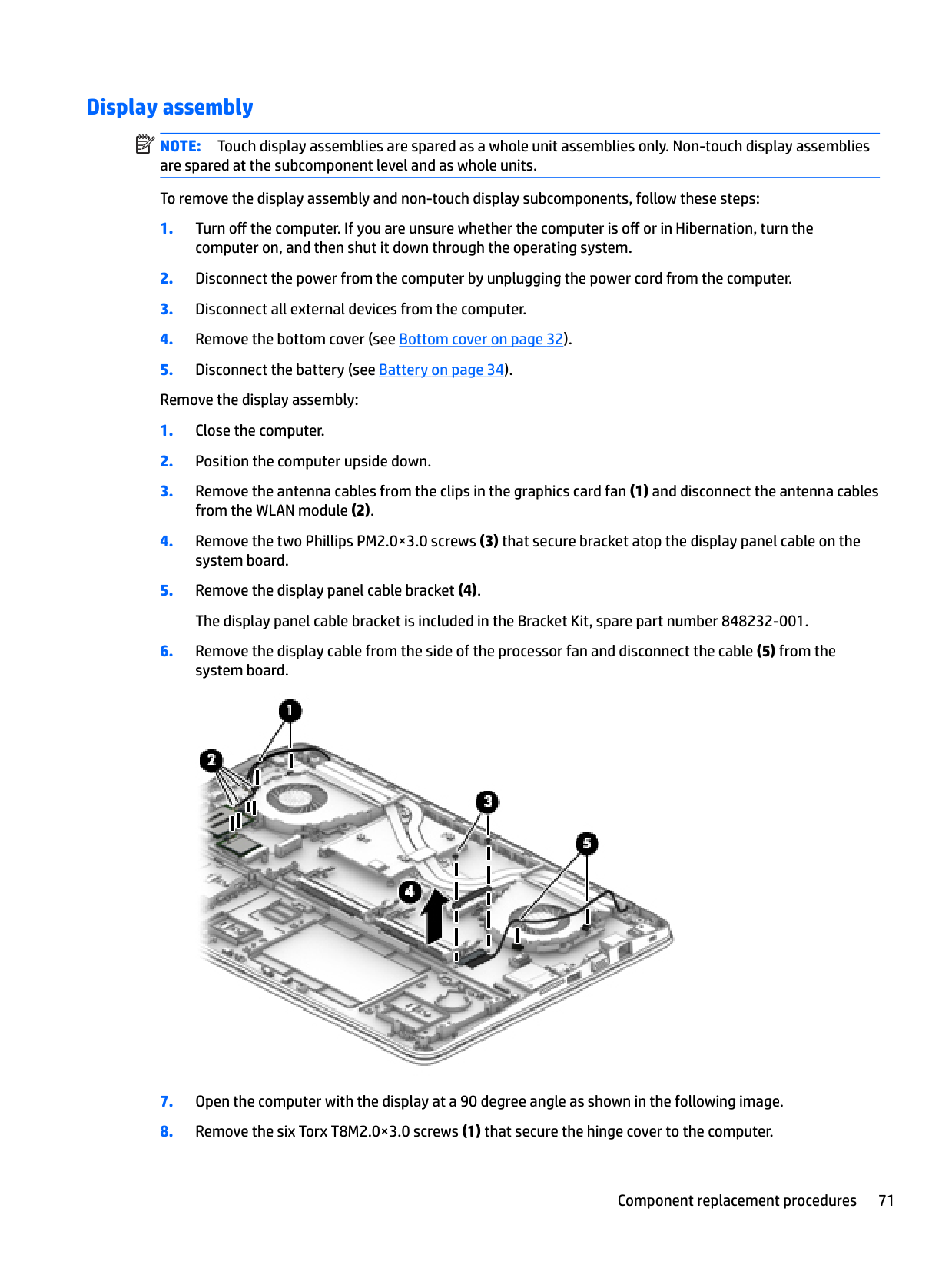
Contact service for system board replacement.
Battery LED White and Amber blinking
Wait for DXE recovery to complete.
CAP/NUM Blink = 3
Reseat the memory modules. If the issue persists, try replacing the memory modules. Possible RAM or system board failure.
CAP/NUM Blink = 5
Check power cable connections, or verify that any external power adapter has sufficient capacity for system.
CAP/NUM Blink = 7 (2 BB failure) Battery LED Blinking = 1 Hz (3 B failure)
Contact service for system board replacement.
CAP/NUM Blink = 1
Contact service for system board replacement.
###### POST error messages
The Power-On Self-Test (POST) is a series of diagnostic tests that runs automatically when the computer is powered on. If the POST encounters a problem, visual error messages are displayed before the operating system starts. POST checks the following items to ensure that the computer system is functioning properly:
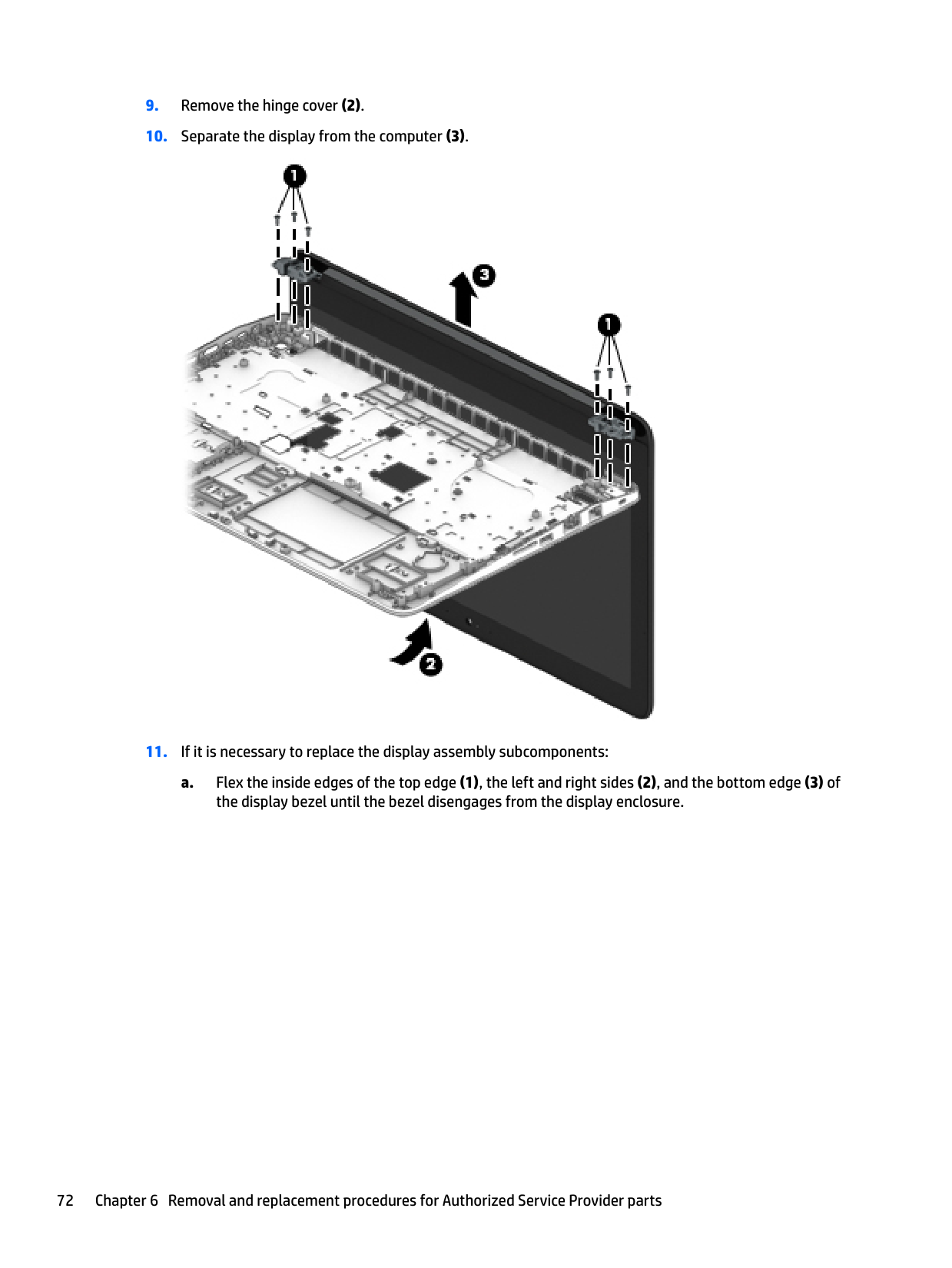
Error code Suggested user actions
Test description Failure description
Startup Test Memory module 200 Attempt to reseat the memory module and then repeat the test.
######## Table 7-5 System diagnostics failure codes and user actions (continued)
See the support document titled Overview of How to Troubleshoot Problems When a Computer Does Not Start Up or Boot Properly for details on troubleshooting issues related to the memory module.
Startup Test Hard Disk 1 SMART 301 Attempt to reseat the storage device and repeat the test. The
drive may have failed. Boot Device Manager Boot device not found 3F0 Reset BIOS. Then reseat the storage device and repeat the test. BIOS Recovery BIOS Recovery Occurred 500 This message indicates that BIOS recovery was completed
successfully. No further action is required.
BIOS Application BIOS Application Error 501 The BIOS installation may have become corrupted. Download the latest version of the BIOS and install it. If reinstalling the BIOS fails, contact support for further assistance.
CMOS Recovery CMOS Recovery Occurred 502 This message indicates that CMOS recovery was completed successfully. No further action is required.
Battery Check Primary Battery Replace 601 This message indicates that the primary battery has very low capacity. See Checking the Status of the Battery for details on using the HP Support Assistant to verify the battery capacity and, if necessary, order a replacement.
Wireless Modules Not installed or responding 701 Reseat the wireless LAN adapter module and antennas.
Because seating or reseating a wireless LAN adapter is unique to each computer model, see the WLAN module removal section in the removal and replacement chapter for further details.
Contact support if third-party wireless adapters are installed in the computer.
Fan Fan not operating correctly 90B The system fan may be malfunctioning. Replace the fan.
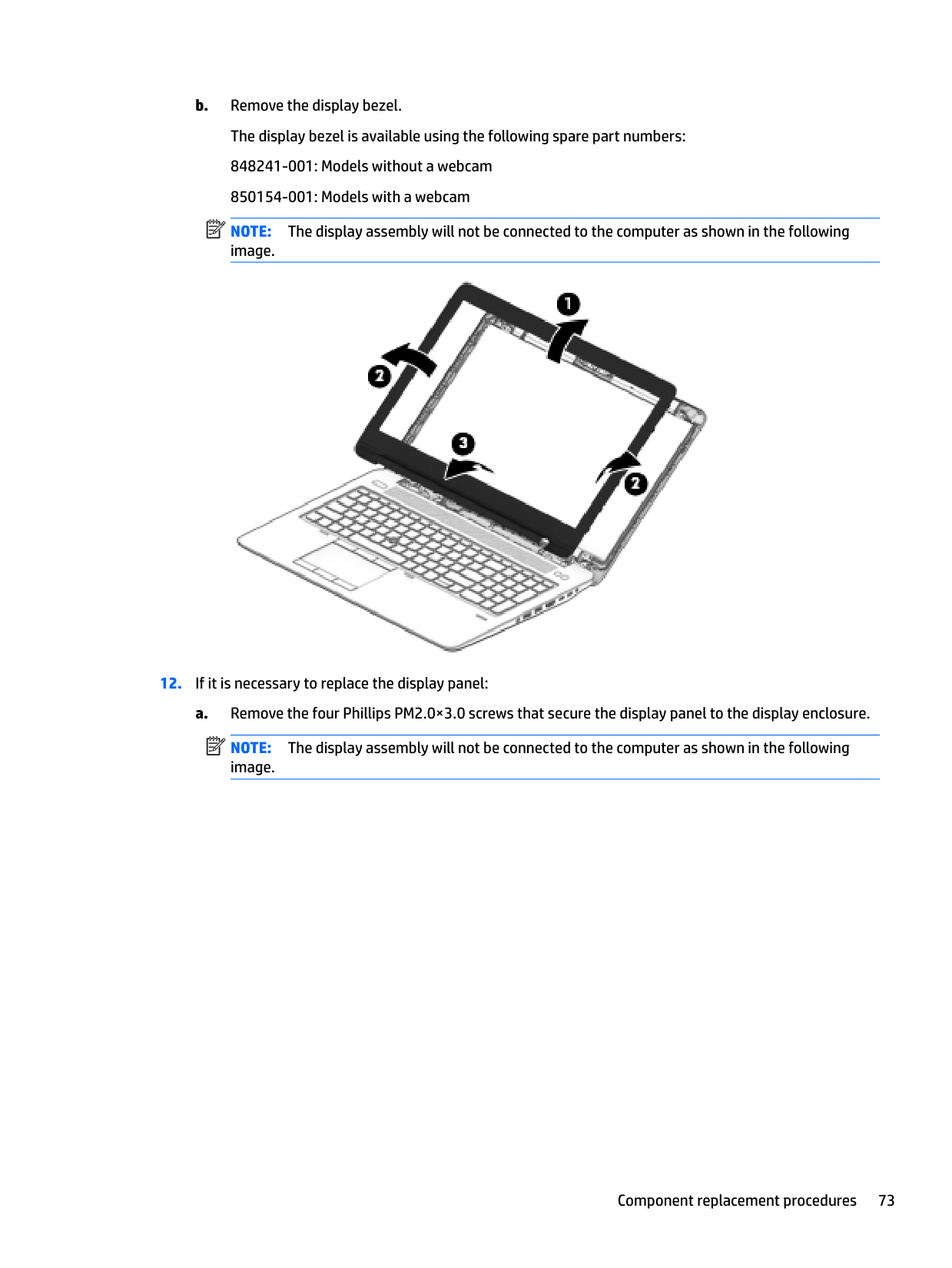
###### Power Good (Troubleshooting) lights
HP has added troubleshooting power lights to ZBook G3 Mobile Workstations (Studio, ZBook 15, and ZBook
17) to help troubleshoot power-on issues. The lights indicate when the system board power rails are unstable and/or the system needs a hardware reset.

These lights should be visible after removing the service door or bottom cover. Consult with support for platform-specific locations of the lights.

Troubleshooting lights diagram
####### ● Example: System board is good. Lights that turn on briefly (< 1 second) and immediately turn off indicatenormal function. In this case, system (3.3V), power good (3.3V), and system reset (3.3V) are all good and
troubleshooting lights should not be lit. However, other external lights should be lit as normal afterward.
Troubleshooting lights External lights Action Note Off On Do not replace system board No power-on issue On Off Replace board Power-on issue
(2) power good is low (0V), and troubleshooting lights will turn on. After you press the system power button, troubleshooting lights will turn on for 5 seconds and turn off. The system external lights will not light up. Follow general troubleshooting steps (i.e., remove recently added hardware, test with minimum configuration, etc.) prior to replacing the system board.

#### Resolve the issue
##### 8. Hard reset
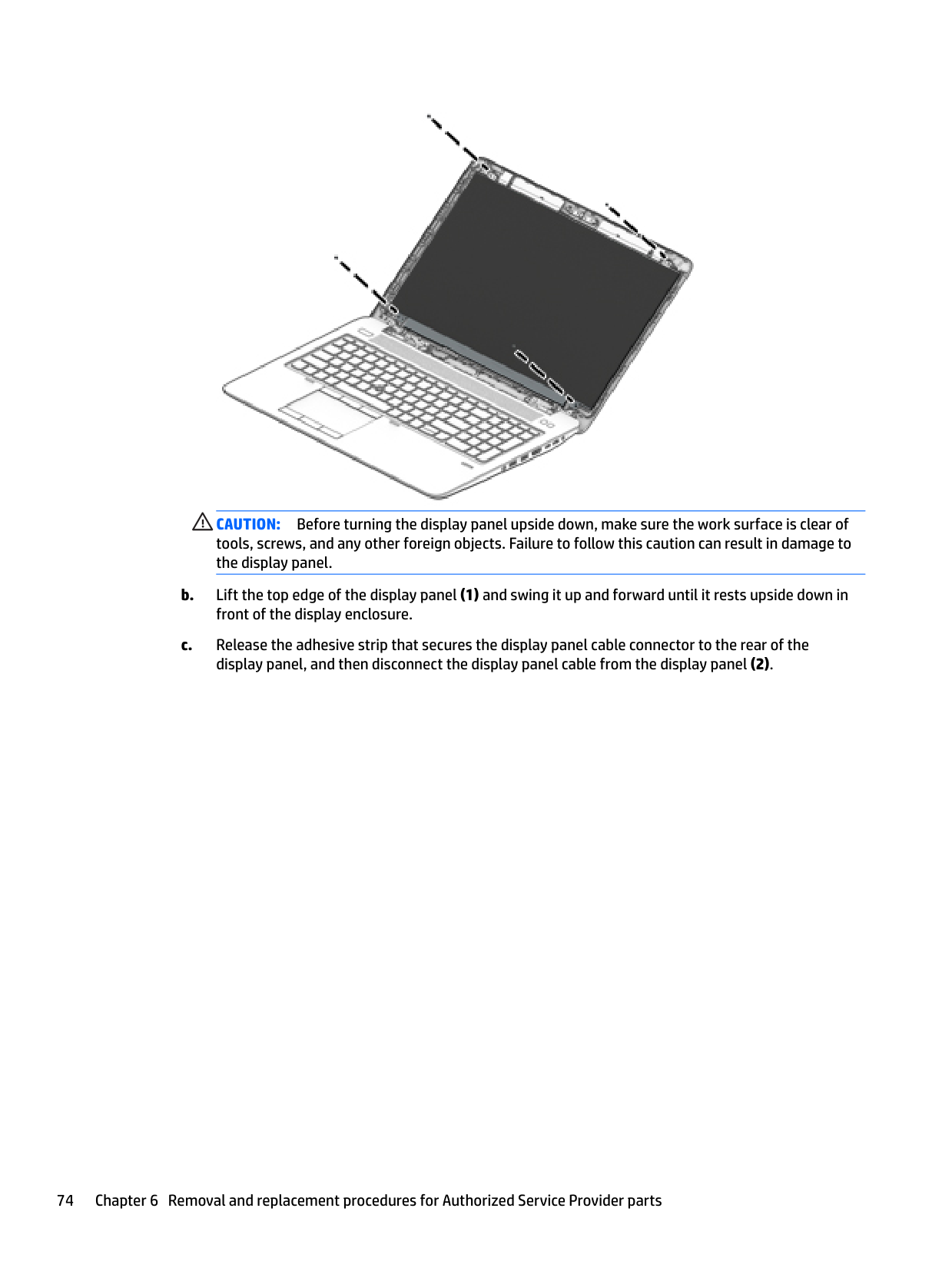
A hard reset (or forced reset) erases all information in the computer's memory and may restore functionality. Resetting the computer forces the system to clear and reestablish the connections between the BIOS and the hardware.
Performing a hard reset might fix the following common conditions:
Before performing a hard reset, you must disconnect or remove all peripheral devices. You should start and test the computer by itself, and if the problem is not resolved, reconnect one peripheral device at a time. To resolve the startup or operational problem, run HP Support Assistant, or manually install all updated drivers from Microsoft and HP.
Before beginning, turn the computer over and look for a battery compartment door (service door). For 2015 platforms, the battery is considered removable but not accessible. See the battery section for how to remove/ unplug the battery.
To perform a hard reset on a computer with a sealed or non removable battery, use the following steps:
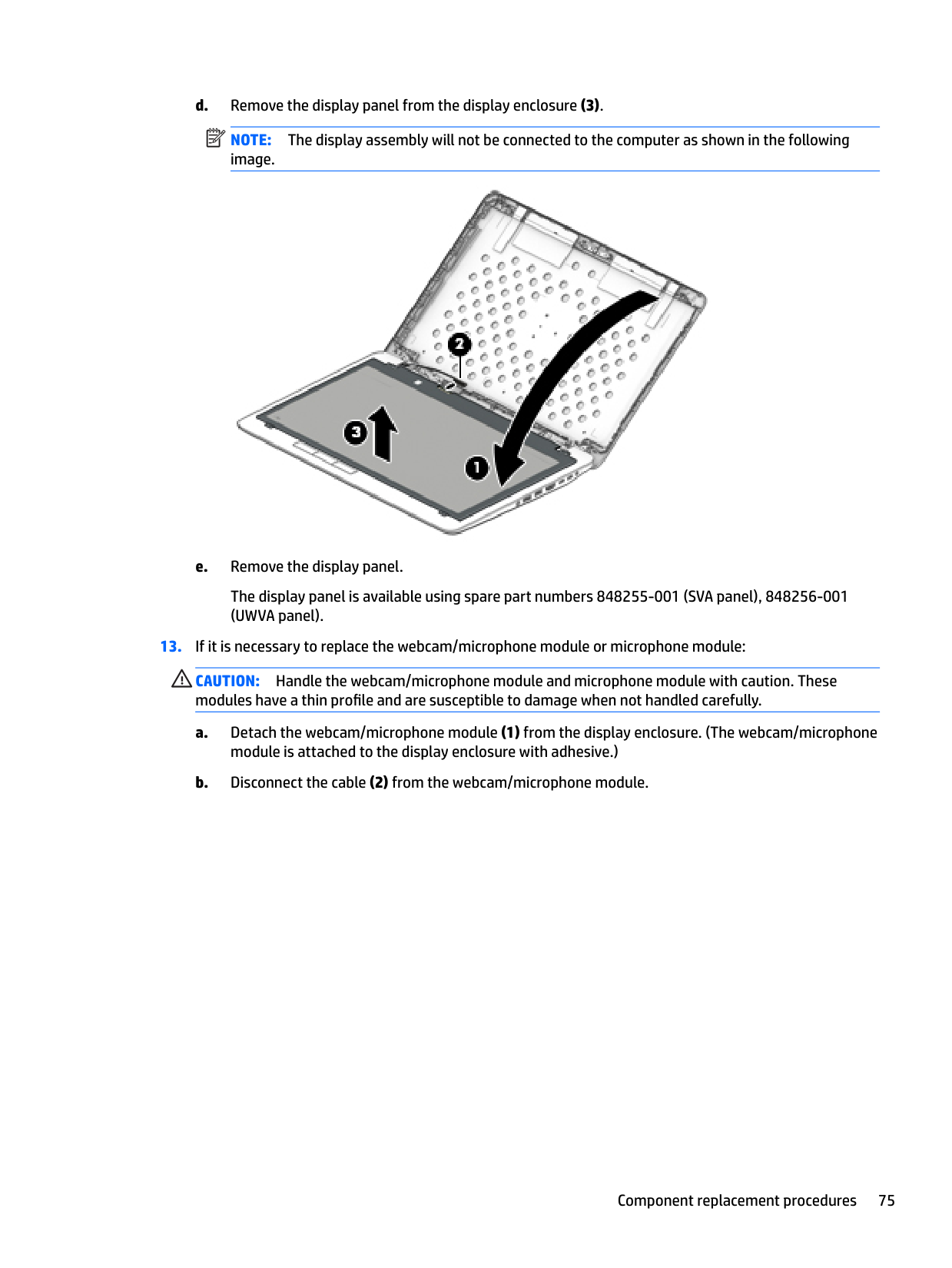
###### Clear CMOS
CMOS refers to the battery-powered, semiconductor chip located on computer's system board. Notebooks store low-level settings like the system time and hardware settings in CMOS. Sometimes it is necessary to clear CMOS, which requires removing and reinserting the 3V RTC battery for a short period of time (a few minutes before reinserting), in addition to removing the AC adapter and battery.
| | |---|
NOTE: Clearing the CMOS should only be performed for troubleshooting purposes. There is no reason to clear CMOS if the computer is working properly. The notebook service door must be removed to access the CMOS battery. See the RTC battery replacement section for the battery removal/replacement.
##### 9. Soft reset (Default Settings)
| | |---|
NOTE: Some company policies prohibit updates or changes. Check whether the computer has custom BIOS settings before taking action. If your computer is having issues booting, has errors during boot, is running into issues after adding hardware, or you are having other abnormal system behaviors that cannot be resolved through any other methods (i.e., hard reset), it may be necessary to reset the system BIOS to default settings. To load BIOS to default settings: Reboot the computer, and then press F10 > Main > Restore defaults. For more information, see the BIOS F10 Setup technical white paper at http://support.hp.com, enter your computer model, and then go to Manuals > White papers > HP PC BIOS F10 Setup Guide.
##### 10. Reseat cables and connections
| | |---|
NOTE: Before disassembling the computer to reseat cables and connections, always disconnect power and remove the battery or disconnect a non removable battery. Many problems are caused by improper connections or loose connections due to abnormal movement and vibration. See Cable management on page 153 and Connector types on page 154 for suggested cable management practices when removing and installing components.
You can access and reseat connections for Customer Self-Repair (CSR) parts (see the “Removal and replacement procedures for Customer Self-Repair parts” chapter for details). Examples of reseating hardware include:
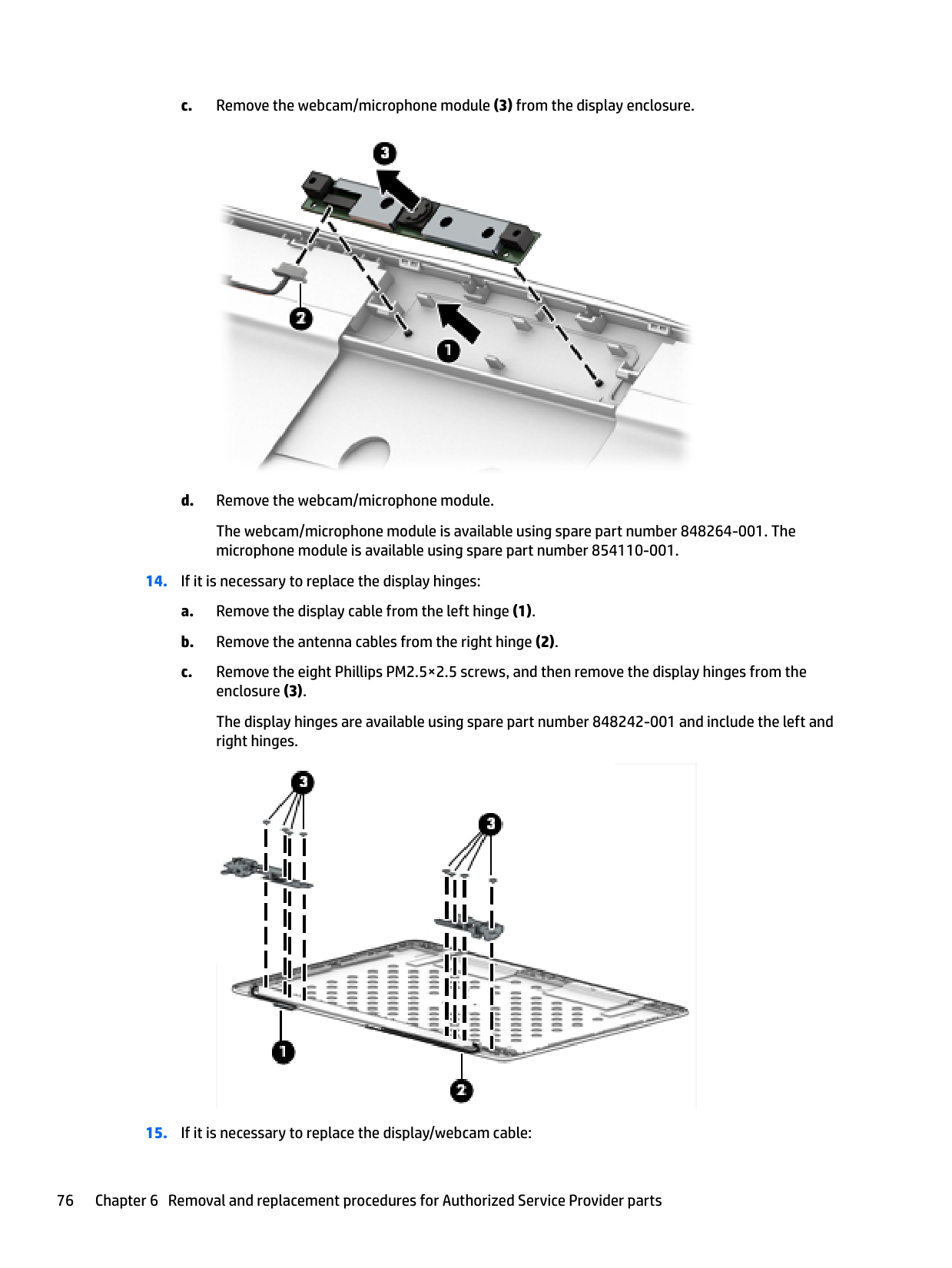
For field replaceable units (FRUs), authorized service providers can try the following steps (for more information, see the ”Removal and replacement procedures for authorized service provider parts” chapter).
##### 11. Test with minimum configuration
The factory-shipped computer (hardware configuration and preinstalled operating system image) is well tested and ready for use. Therefore, using the original factory hardware configuration and/or booting to operating system safe mode often resolves issues quickly.
Essential hardware configuration NOTE: This step is to be used by authorized service providers only. HP will not honor the warranty for a system tested with the system board removed without the heat sink, fan, etc. If none of the steps above resolve the issue, start the computer with essential hardware only. The purpose is to remove as much as hardware as possible while still maintaining the computer’s ability to turn on. This essential configuration is often used to troubleshoot power-on related issues, such as no-boot, reboot, and freezing issues. The essential hardware consists of the following:
| | |---|
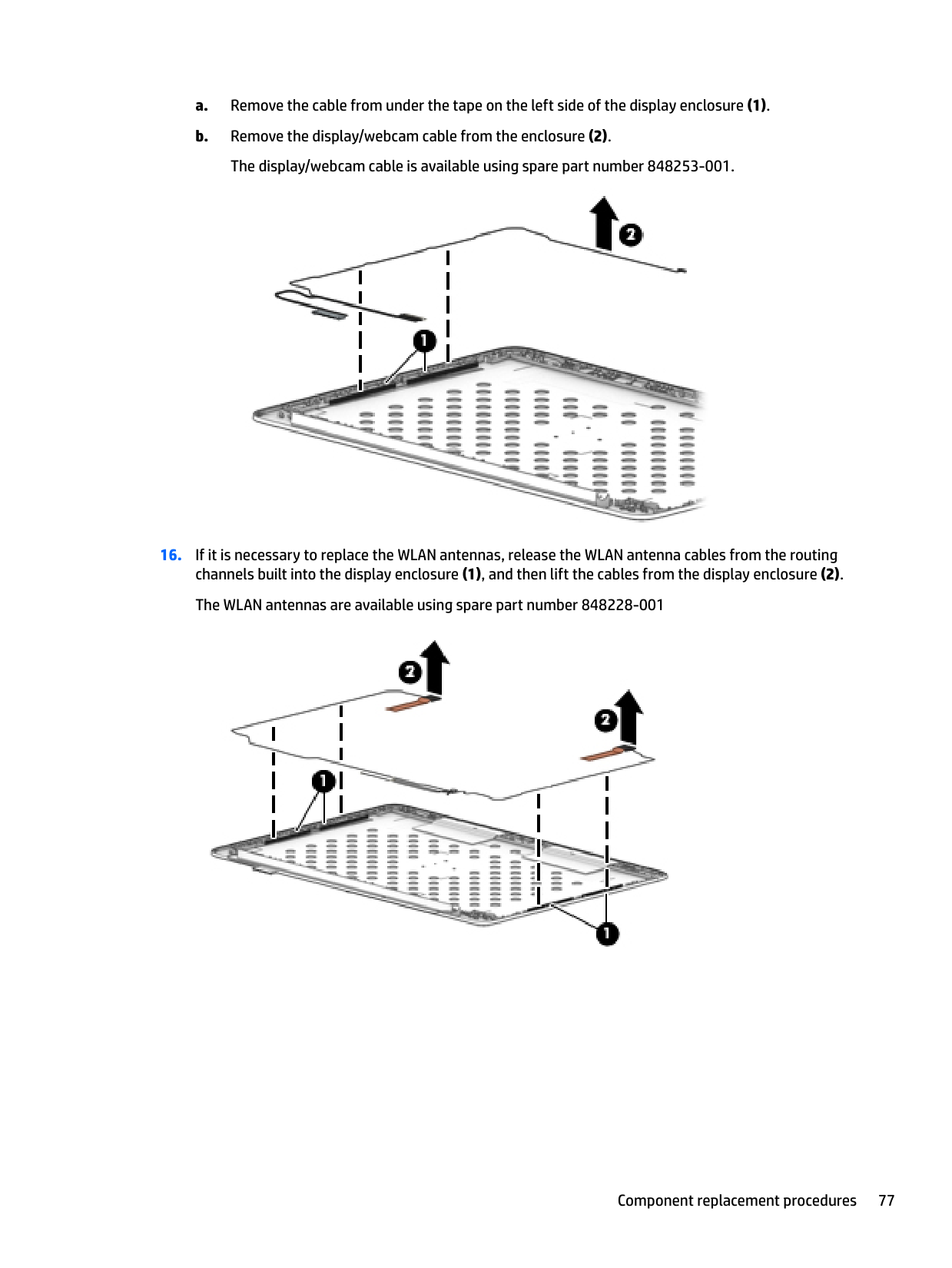
| | |---|
NOTE: After the service door is removed, disconnect all connections (internal keyboard, display, discrete GPU, hard drive/solid-state drive, daughterboards, etc.) to achieve the essential hardware configuration above. DO NOT disassemble the system board from its enclosure at this time.
Reverse the procedure above by reinstalling each piece of hardware removed, one piece at a time, and testing your computer after each installation. Since your computer works with only the essential hardware installed, those parts must be working properly. This means that one of the hardware components removed is causing the computer to not work properly. By installing each device back into the computer and testing each time, the failing hardware will eventually be identified.
###### Safe mode
A driver conflict often results in a blue screen error message. Therefore, booting in safe mode can resolve many issues in Windows because safe mode forces the computer to load a limited version of Windows which only contains essential files. Safe mode is useful for troubleshooting problems with programs and drivers that might not start correctly or that might prevent Windows from starting correctly.
If a problem does not reappear when you start in safe mode, eliminate the default settings and basic device drivers as possible causes. Refer to the links below for how to start your computer in safe mode:
##### 12. Test with verified working configuration (hardware and/or operating system)
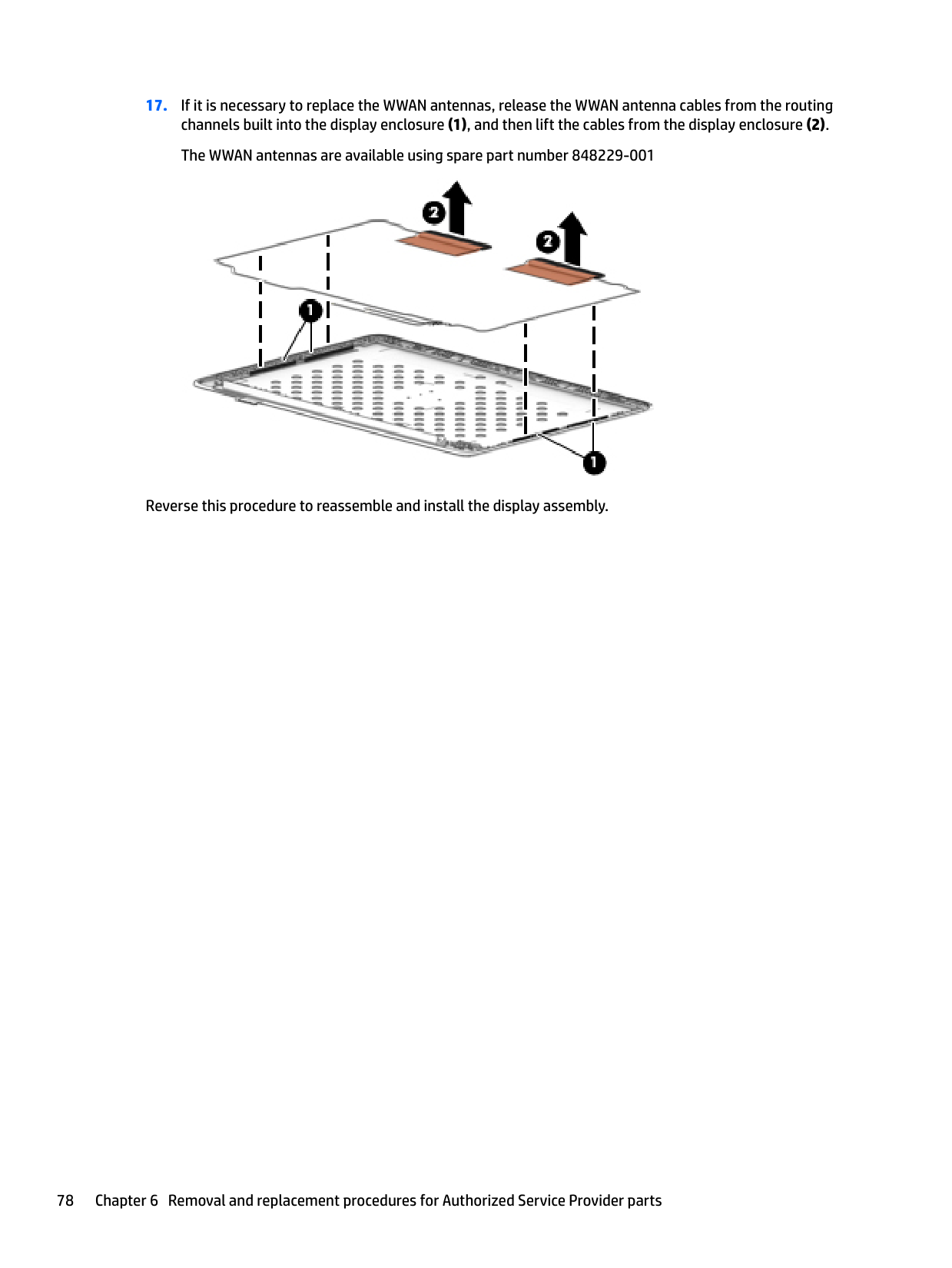
One troubleshooting technique that can quickly isolate an issue is using a verified working part while testing. A good example is to use an external keyboard, mouse, or VGA monitor when you have issues with an internal keyboard, TouchPad, or display. Testing with a verified working AC adapter can identify an error caused by a faulty one. Similarly, testing with a verified working operating system can determine bad behaviors of the current operating system. See Non HP diagnostics tools on page 89 for instructions about obtaining and using a Windows-To-Go USB.
| | |---|
NOTE: In some situations, more than one item may contribute to a problem.
##### 13. Replace the system board
The system board may be replaced only by authorized service providers. This should not be considered an initial step taken to resolve an issue. Review and perform all steps discussed previously before replacing the system board. 4. Update BIOS and drivers on page 85, 7. Status lights, blinking light codes, troubleshooting lights, and POST error messages on page 90, 8. Hard reset on page 94, and 9. Soft reset (Default Settings) on page 95, and/or 10. Reseat cables and connections on page 95 can resolve many system board issues without requiring the effort of replacing unnecessary hardware. Review Table 7-1 Troubleshooting methodology and general troubleshooting steps on page 81 for appropriate troubleshooting steps.
| | |---|
IMPORTANT: System board failure is not common. Do not replace the system board until you have tried all other troubleshooting options.
| | |---|
NOTE: Determine whether a previous service case might be related to the current problem. For example, a fan detection issue may be caused by a loose connection resulting from previous service.
TIP: Without an RTC battery (3V coin-cell battery), the computer automatically reboots. This is a useful feature when the power connector cable (between external AC adapter and system board) is defective.
| | |---|
NOTE: Most of the time, effective troubleshooting can prevent a system board replacement. Items that may prevent resolution of the issue:
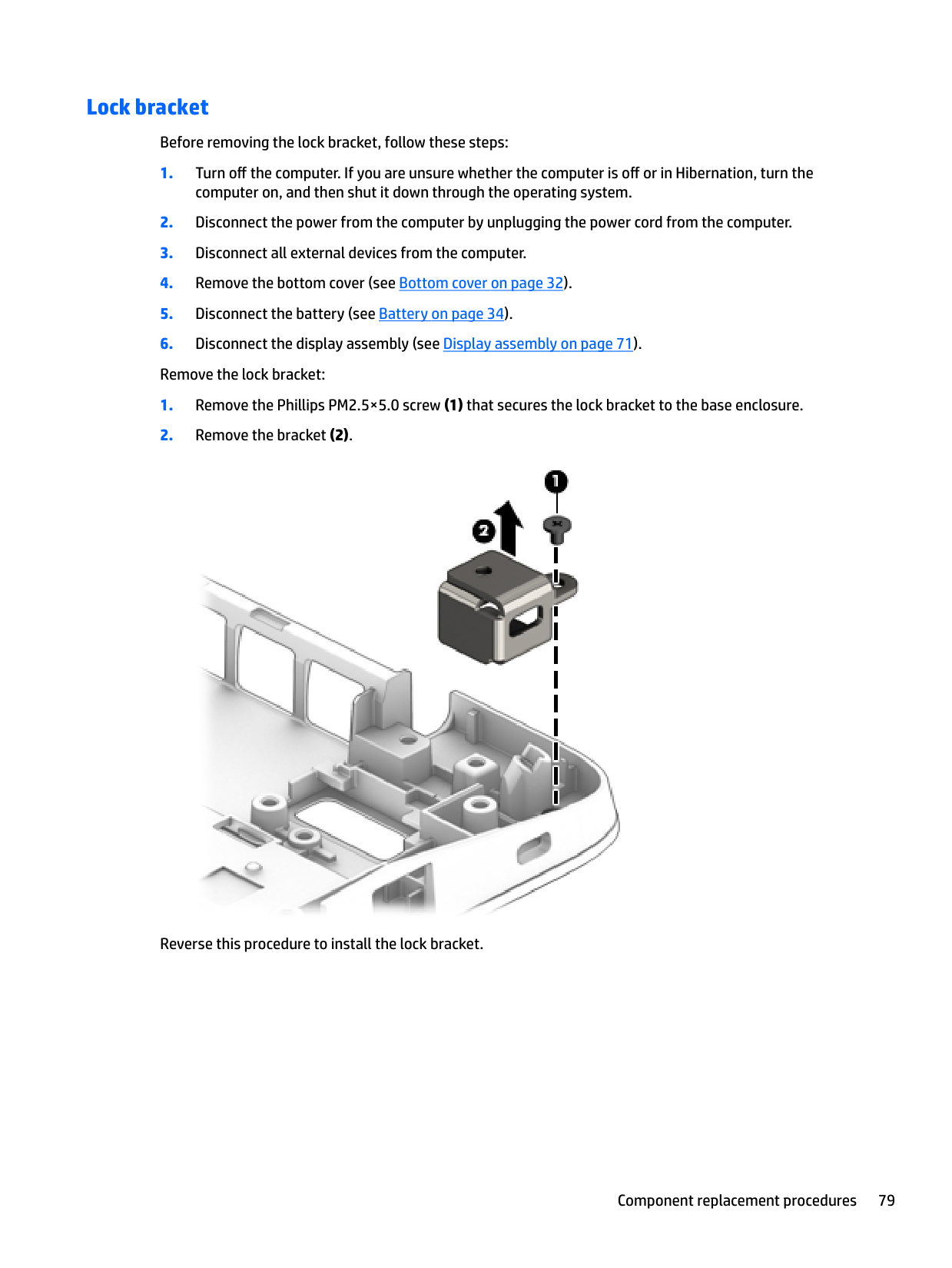
#### Verify solution
Helpful Hints
After you become familiar with the general troubleshooting steps above (General troubleshooting steps on page 81), follow the helpful hints below before running diagnostics and troubleshooting.
#### At startup
TIP: If you have installed an operating system other than the factory-installed operating system, go to http://http://www.hp.com/go/quickspecs and verify that it is supported on your system.
#### During operation

only. Or plug an external monitor into a different video port on the computer if one is available and close the computer lid.
Helpful Hints 99
#### Consulting with HP Service
If further HP support is required, a lot of the following information may be requested when you call, so it may be helpful to take notes.
Common issues and possible solutions
This section contains common issues, symptoms, and a series of tables that describe possible solutions to issues from Failure classification on page 82 tables. The following sections identify the issue with symptoms and solutions to resolve an issue.
#### Power-on issues No Power
When a unit experiences no power there are several contributing factors to consider. Be sure to consider all symptoms related to this behavior in troubleshooting.
Symptoms
Possible causes Failed power input to the computer (external power source, AC adapter, faulty battery). Bad connection to the computer (bad power button, power connector). Defective parts (memory, storage device, graphics) or failed system board.
Troubleshooting steps Perform quick check Remove all external devices, including docking station. Verify external power source (2. Examine the environment on page 84). Perform a hard reset (8. Hard reset on page 94).


######### Verify AC adapter
It is preferable to verify the battery before verifying the AC adapter. However, you can verify the AC adapter first, before opening the service door for a battery check.
NOTE: Refer to battery replacement section for removing/replacing the battery
######### Verify battery condition/status
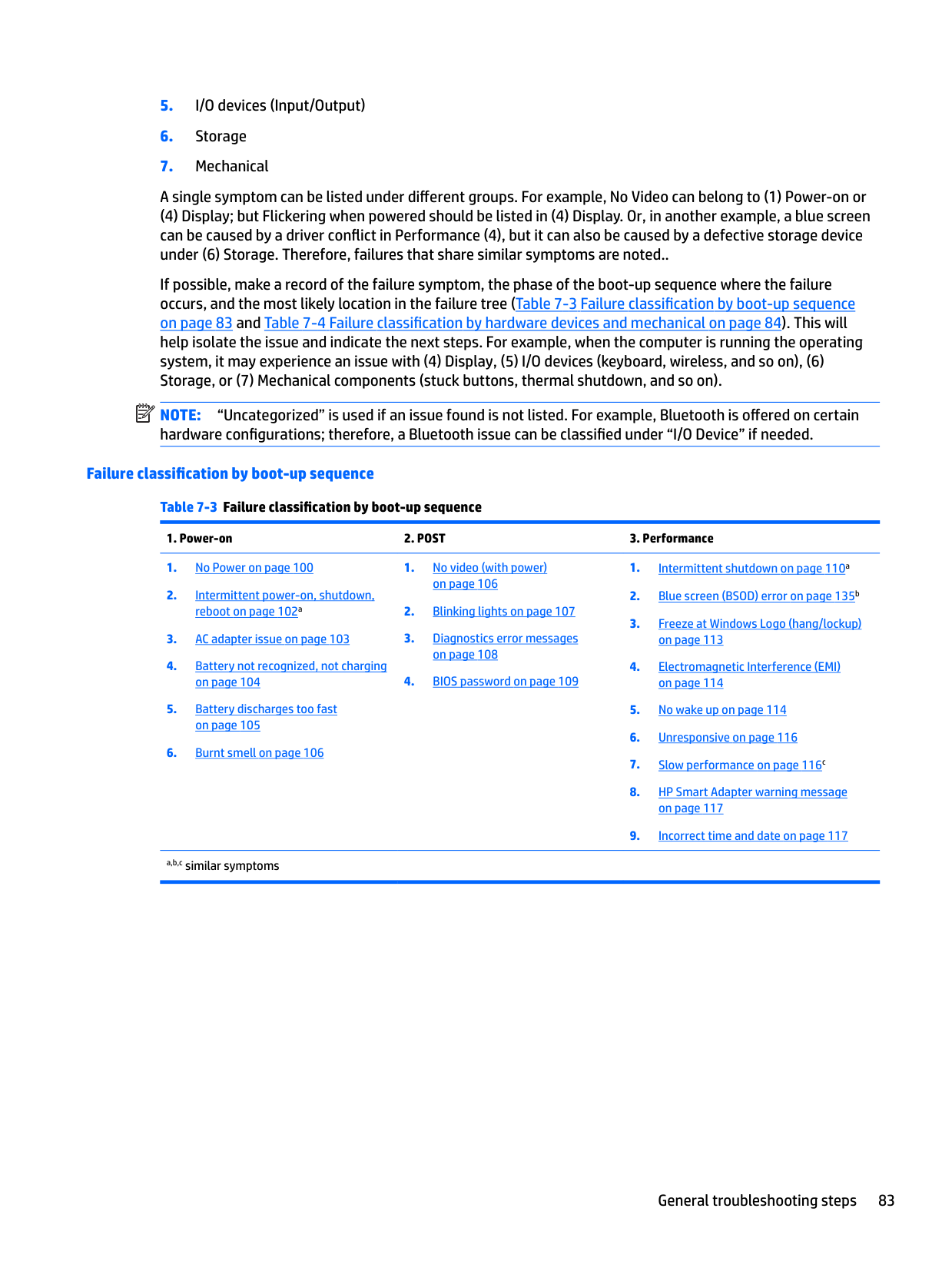
The sections below are intended for authorized service providers/technicians. Verify AC adapter – voltage
NOTE: 2015 mWS does not have the power cable between system board and power connector on chassis

######### Verify power button, power connector
Verify blinking lights (7. Status lights, blinking light codes, troubleshooting lights, and POST error messages on page 90)
At this point, there should be sufficient power from the AC adapter to the system board. Expect to hear the fan spinning and see blinking lights or error messages (i.e., faulty memory, HDD, etc)
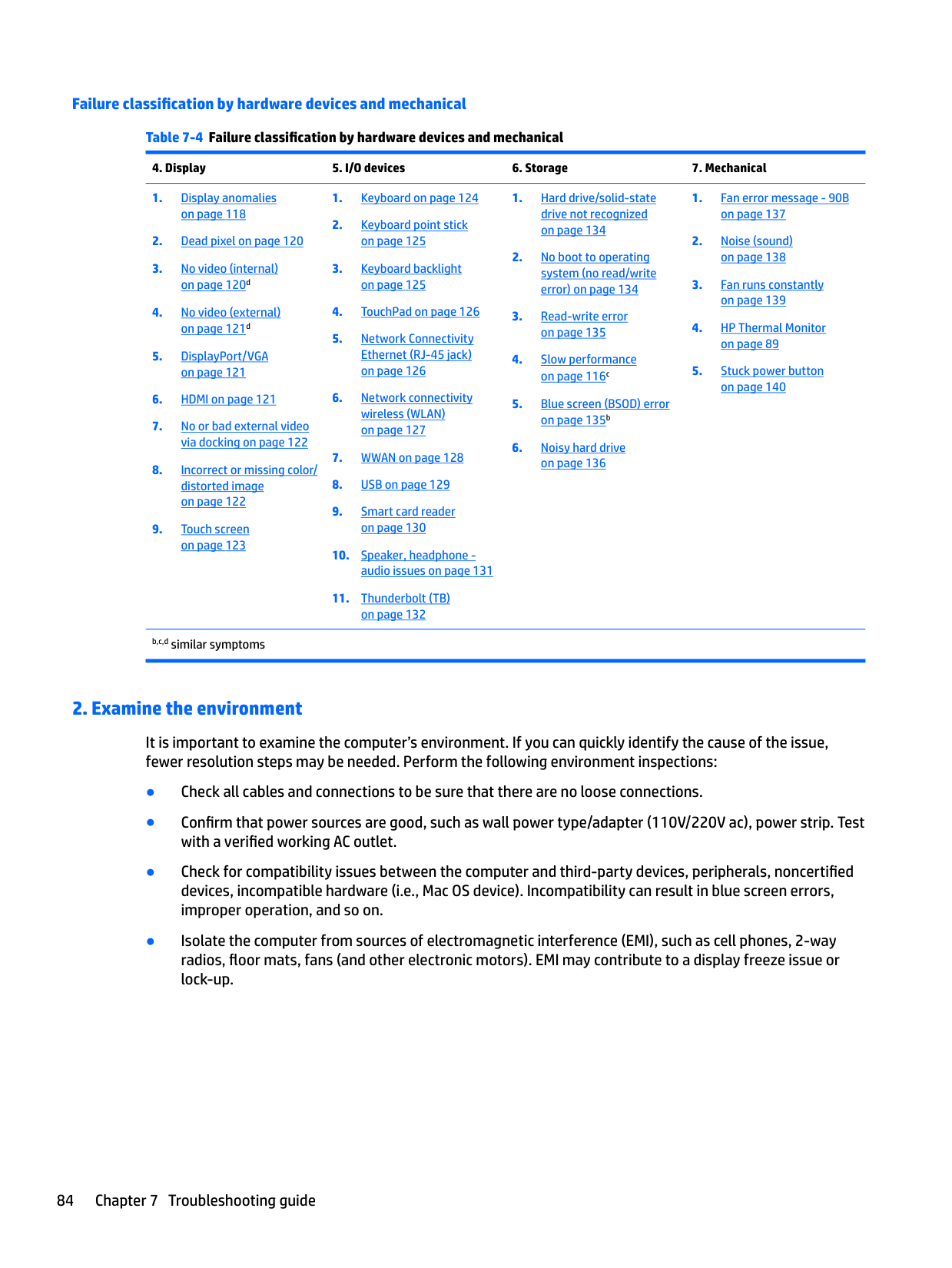
######### Verify Power Good (Troubleshooting) lights
######### Verify system board
Tips and tricks Computer automatically boots without pressing power button when RTC 3V battery has been removed. Therefore, after the service door and RTC 3V battery are removed, no need to press power button from top side.
In essential hardware configuration, mWS G1 and G2 may require discrete GPU to boot. However, mWS G3 can boot with integrated graphics.
See Overview of How to Troubleshoot Problems When a Computer Does Not Start Up or Boot Properly
##### Intermittent power-on, shutdown, reboot
Symptoms
Possible causes
Electrical short, fluctuating power source, unstable power rails, loose connections, bent pins, stray wires, dust, obvious damage, nearly faulty parts (bulging/leaking capacitor).
Potentially will turn into a no power issue soon (No Power on page 100).
Troubleshooting steps
######### The sections below are intended for authorized service providers/technicians.
##### AC adapter issue
Solution Symptoms
Possible causes AC adapter and others (i.e., external power source) Troubleshooting steps Quick check
######### Verify AC adapter
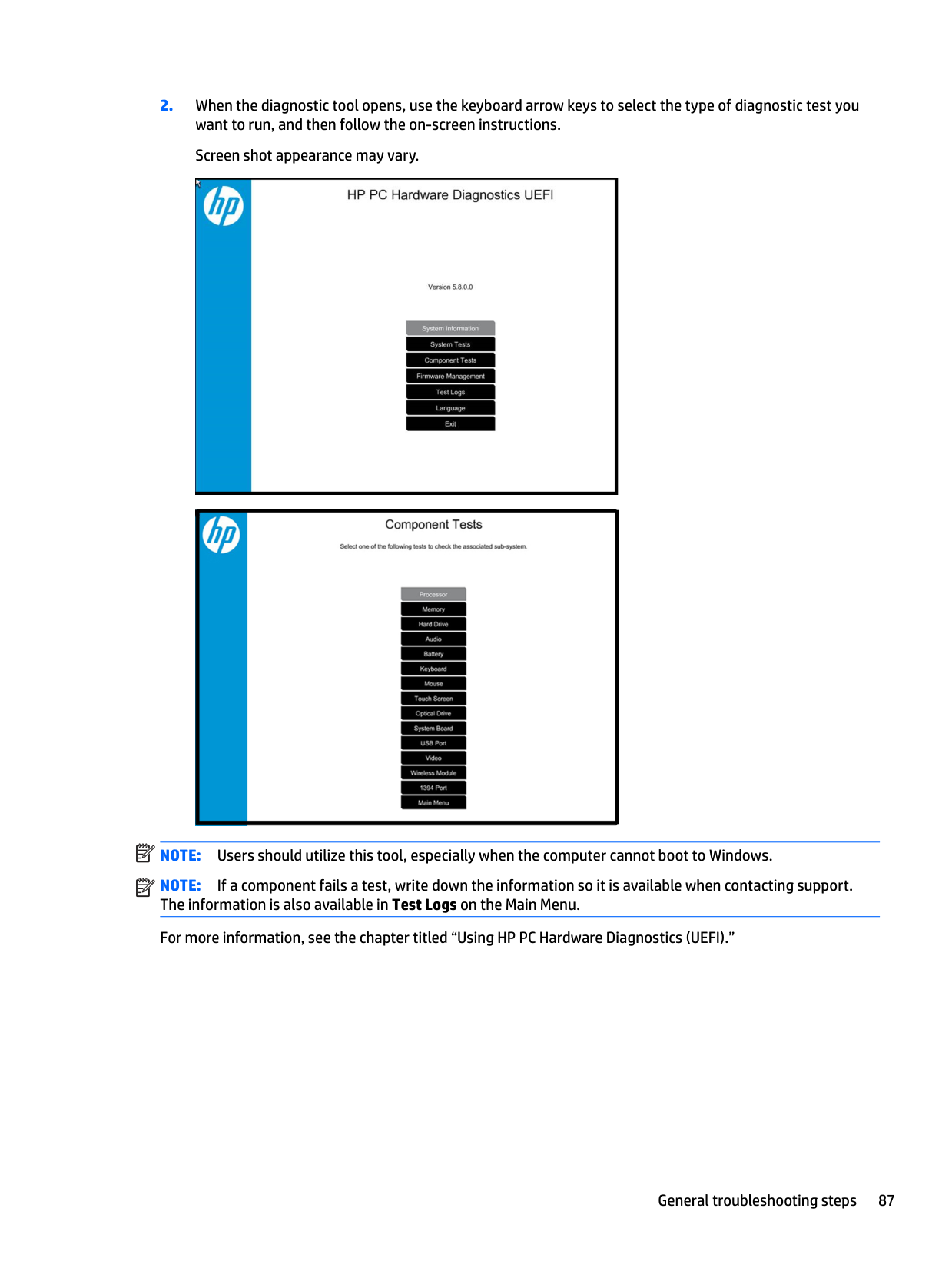
Tips and tricks The HP Smart AC adapter has a special pin in the middle, called the ID pin, for power rating and throttling purpose. If this pin is broken, the rear power light will be on but the power button and front power lights will blink continuously and the computer will not turn on. Third party AC adapter will not work on the computer.
Use the AC adapter that came with the computer for better performance. See HP Notebook PCs - Testing and Using the AC Power Adapter
##### Battery not recognized, not charging
Symptoms
Possible causes Defective AC adapter and/or battery. NOTE: Before proceeding, verify that the computer can boot to BIOS or Windows with a good AC adapter.
Troubleshooting steps Visual inspections
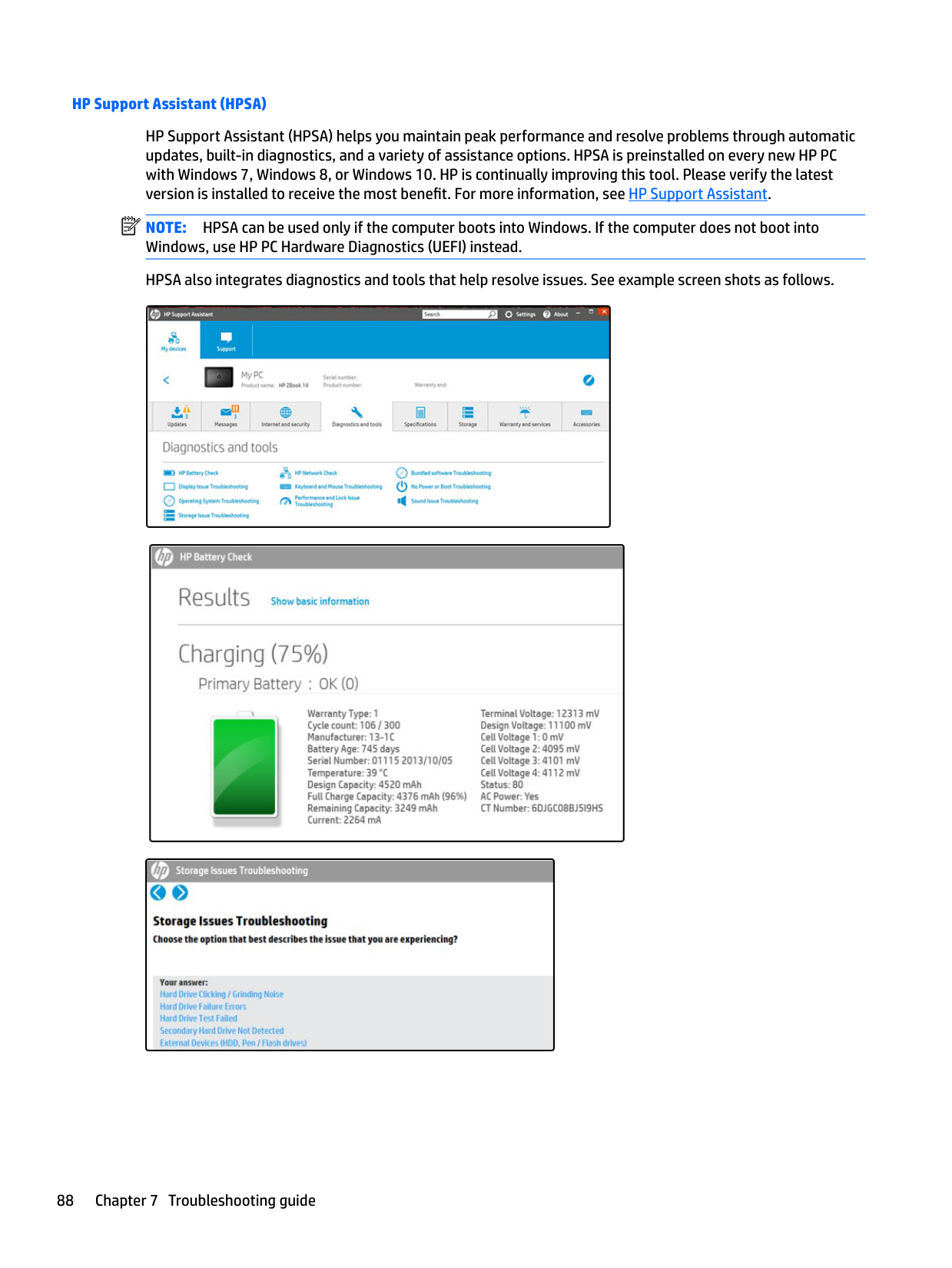
Check battery warranty to see whether the battery is new or its warranty is expired. Battery capacity degrades over time.
######### Verify front battery status light
Diagnostics: HP tools will report results such as passed, calibrate, weak, replace, no battery and unknown, and suggest corresponding actions.
Use HP Hardware Diagnostics (UEFI) (6. HP Hardware Diagnostics and Tools on page 86)
● HP PC Hardware Diagnostics (UEFI) is a good tool to use to isolate and determine faulty battery, especially for quickly discharging (short life) battery.
######### Use HP Support Assistant tools in Windows (HP Support Assistant (HPSA) on page 88)
Tips and tricks See the computer user guide for instructions regarding battery maintenance and increasing
battery life.
##### Battery discharges too fast
Symptoms
Battery has good status light but discharges too fast
Possible causes AC adapter and/or battery. Troubleshooting steps Verify AC adapter
Determine whether the computer needs the AC adapter to boot and operate. Sometimes, intermittently bad AC adapter and loose connection between adapter and computer results in inability to charge battery and causes short run time.
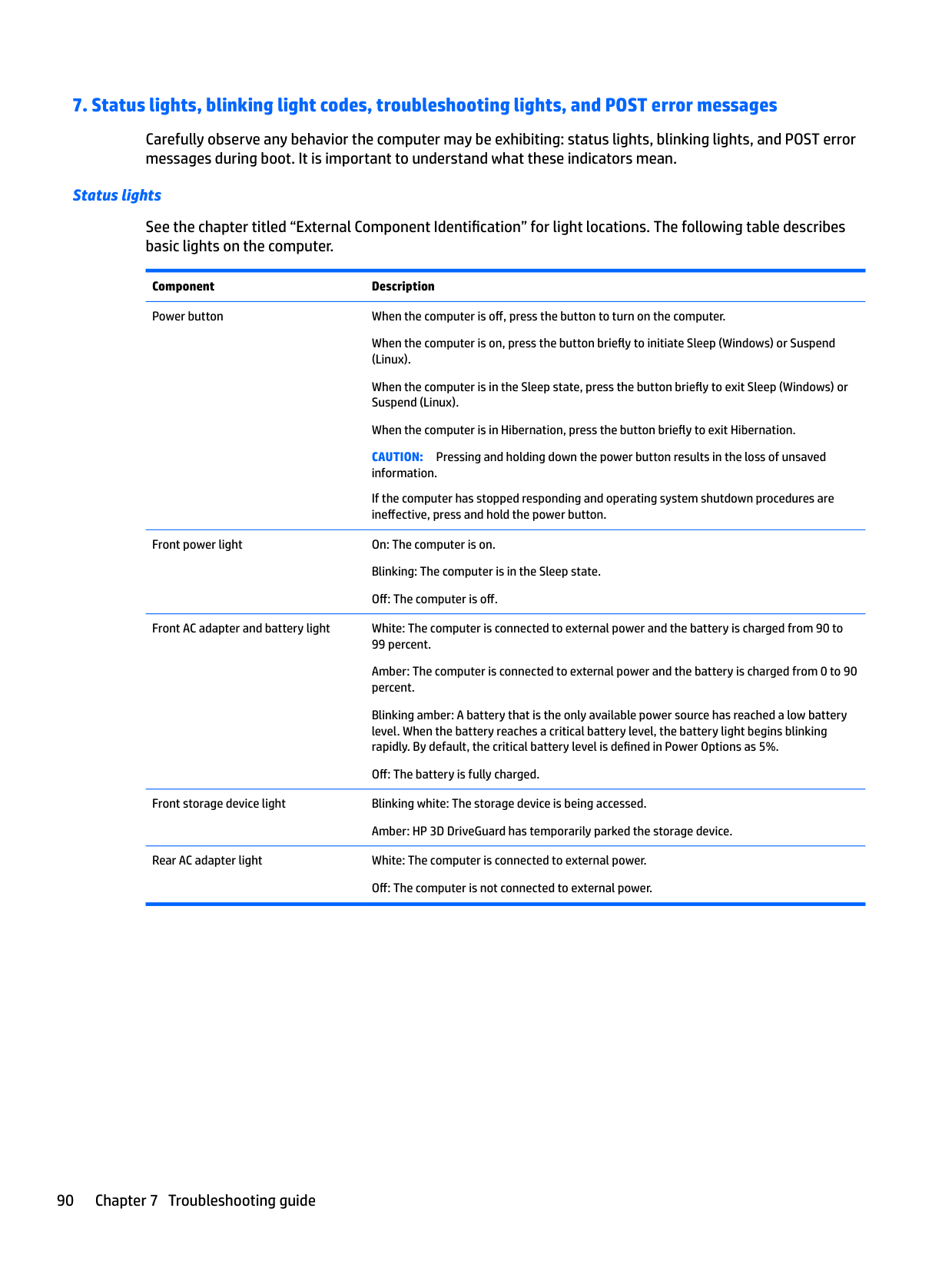
If battery cycle life is over specs (long life battery of 1000-cycle life and 3-year warranty), battery may have capacity loss beyond its lifecycle or warranty.
Tips and tricks To conserve battery power, turn off Wireless On-Off button and other peripherals/USB devices, applications, processes (in Task Manager) when not in use; also, reduce screen brightness.
Follow HP instructions of how to maintain battery and increase battery life. Reference: HP Notebook Mobile Workstations - Improving Battery Performance (Windows 10, 8, 7, Vista) Reference video: Testing and Calibrating the Battery on PC Notebooks
##### Burnt smell
Symptoms Emits smoke, burnt smell
Possible causes Defective on-board components. Troubleshooting steps General visual inspection
The sections below are intended for authorized service providers/technicians. Further inspection on components
#### POST No video (with power)
Symptoms
Possible causes Failed display Failed critical components (memory, storage device, system board) Loose connection Recently added hardware NOTE: Assume the computer has not previously been set up for multiple displays.
Troubleshooting steps Quick check
######### Verify display

######### The sections below are intended for authorized service providers/technicians.
Tips and tricks Swipe a metal piece (screwdriver) over wireless/mute buttons to act as if closing lid to force video output to external display device. See the “External component identification – Display” section for location of the magnetic sensor.
##### Blinking lights
Symptoms Lights blink on keyboard caps lock/num lock keys
Possible causes
Blinking lights on startup usually indicate a problem with basic functionality of a critical component (processor, BIOS, graphics cards, memory, etc.) due to loose connection, defective parts, or recently added parts.
Troubleshooting steps
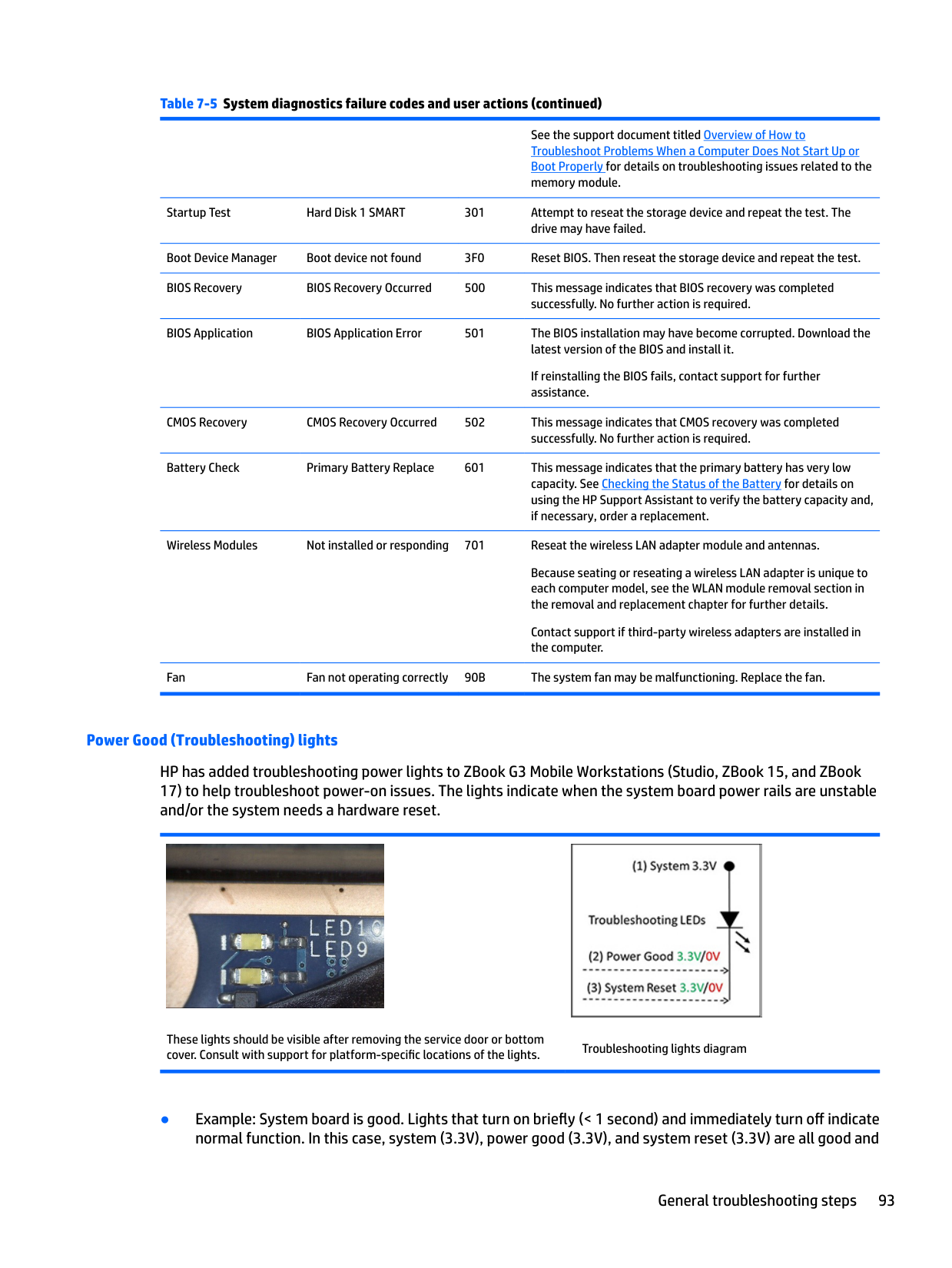
Note Since the display may not be functional, lights are used to indicate an error.
##### Diagnostics error messages
Symptoms
Possible causes
Diagnostic error messages indicate a problem. There may be a problem with the instruction being sent from the BIOS to a hardware component (e.g., keyboard failures), or incompatible hardware. Can usually be resolved by installing updated firmware for the component.
Troubleshooting steps

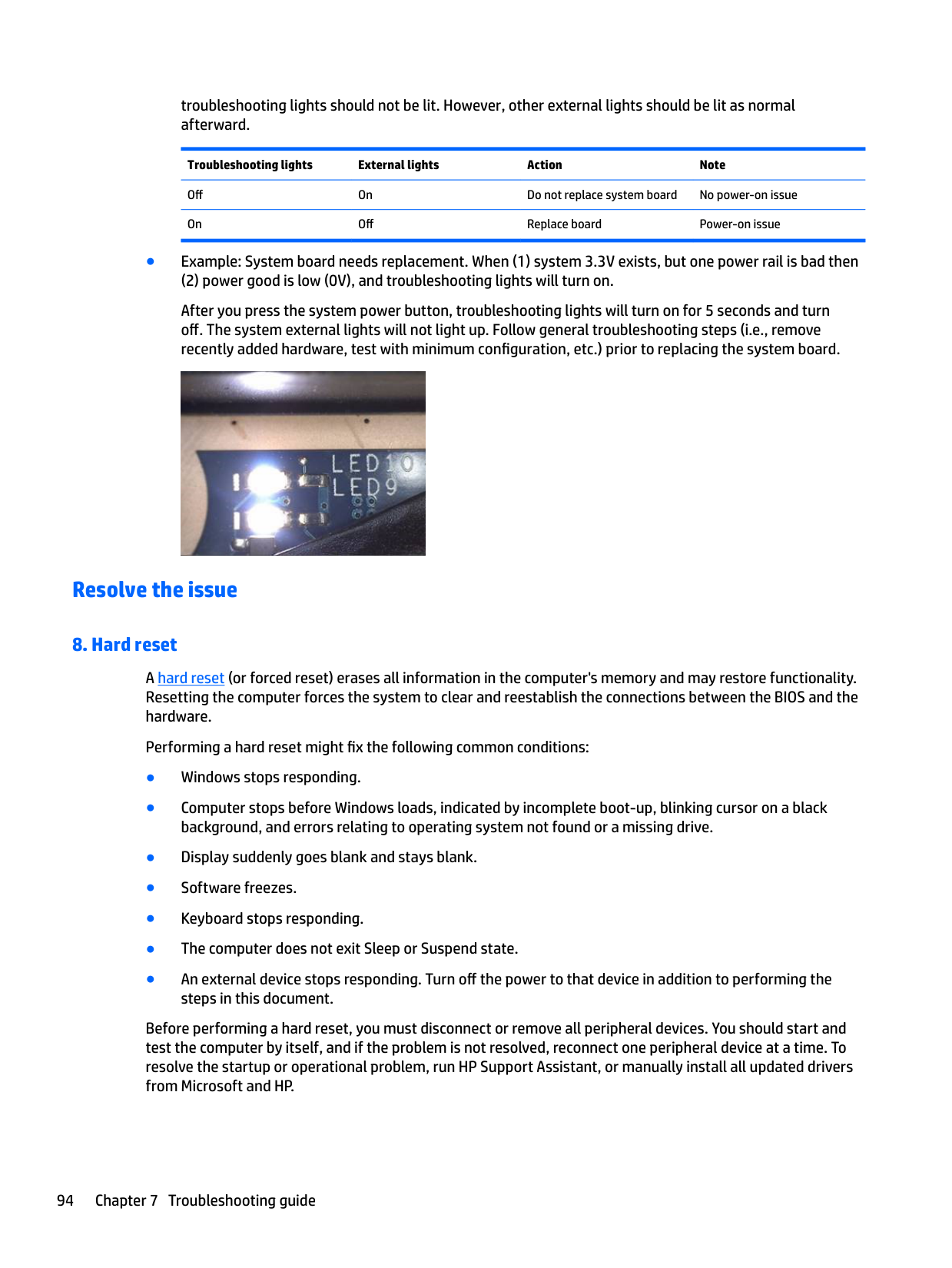
Note An Error Message means the system has finished BIOS hardware validation and is ready to launch the Startup Menu. To access the Startup Menu for further options, press the Esc key while restarting the computer.
##### BIOS password
Symptoms
Some sections are unavailable (grayed out)
Possible causes BIOS administration password is required.
Troubleshooting steps
######### Reference HP F10 Setup Overview
HP Business Notebook and Desktop PC F10 setup overview – 2012 and 2013 Business PC models
HP Business Notebook and Desktop PC F10 setup overview – 2014 Business PC models 2015 Business PC models – see the BIOS F10 Setup technical white paper at http://support.hp.com, enter your computer model, and then go to Manuals > White papers > HP PC BIOS F10 Setup Guide.
#### Performance (OS)
| | |---|
NOTE: Most software problems occur as a result of the following:
If an operating system other than the factory operating system is installed, check whether the operating system is supported and the application is certified for the version of the operating system.
HP ships and supports Windows 7 with BIOS Legacy boot mode and Windows 8, 10 with BIOS UEFI boot mode. Therefore, HP recommends that you switch BIOS boot mode from Legacy to UEFI Native for clean Windows 8, 10 installations, or to UEFI Hybrid (if available) for upgrading the option from Windows 7 to Windows 8, 10. UEFI Windows 8, 10 avoids many unexpected behaviors (i.e., blue screen error, graphics/video issues) in the BIOS Legacy setting.
##### Intermittent shutdown
Symptoms
Possible causes
It is often difficult to troubleshoot an intermittent issue. Possible causes include the following:
Power-related issue: defective or insufficient power sources, poor connection. OS Custom Setting: Energy Saver (Power Management). Thermal-related issue: thermal sensors reach limits. Hardware related issue: voltage, out-of-range current; electrical short. Troubleshooting steps
The sections below are intended for authorized service providers/technicians. Thermal-related issue
○ Use Thermal Monitor tool (available only to authorized service providers/ technicians) to perform stress test (processor and GPU) (6. HP Hardware Diagnostics and Tools on page 86) and verify that thermal sensors are within limits after thermal condition is serviced.
######### Hardware related issue
a. If no issue with hardware configuration, reinstall one non essential component at
a time to determine faulty hardware.
b. If issue persists, replace essential hardware with a confirmed working part, one at
a time. If no boot, replace system board.
Tips and tricks Intermittent issue is difficult to reproduce and troubleshoot. It is important to record details on shutdown frequencies, system configuration (3D video application) and operating conditions.
##### Blue screen
Symptoms
Possible causes
Recent changes: conflict of instructions from multiple programs or just added hardware.
Incompatible hardware and driver. Poor connection (storage device, memory). Hardware malfunctioning due to overheating (GPU, processor). Defective hardware (memory, storage device).
######### Important Notes & Resources Troubleshooting steps
There are many different ways to troubleshoot a blue screen error. Therefore, you need to identify working configuration (Windows 7/8/10) and specific symptoms of the failure in order to narrow down the issue. Refer to Blue screen (BSOD) error on page 135.

Recommended resources Microsoft knowledge base: Resolving Blue Screen errors in Windows HP Troubleshooting Error Messages on a blue screen:
HP Notebook PCs - Troubleshooting Error Messages on a Blue Screen that may Occur During Startup or Boot
###### Overview of General Troubleshooting Steps for a blue screen error
Tips & tricks In some cases, the computer may reboot automatically before you have time to read the blue screen. To identify the error message itself, disable the automatic restart using one of the following methods: Right-click on My Computer, and then select Properties > Advanced. Under Startup and Recovery, select Settings. Clear the Automatically Restart check box.

###### Windows Advanced Boot Option
##### Freeze at Windows Logo (hang/lockup)
Symptoms

Possible causes
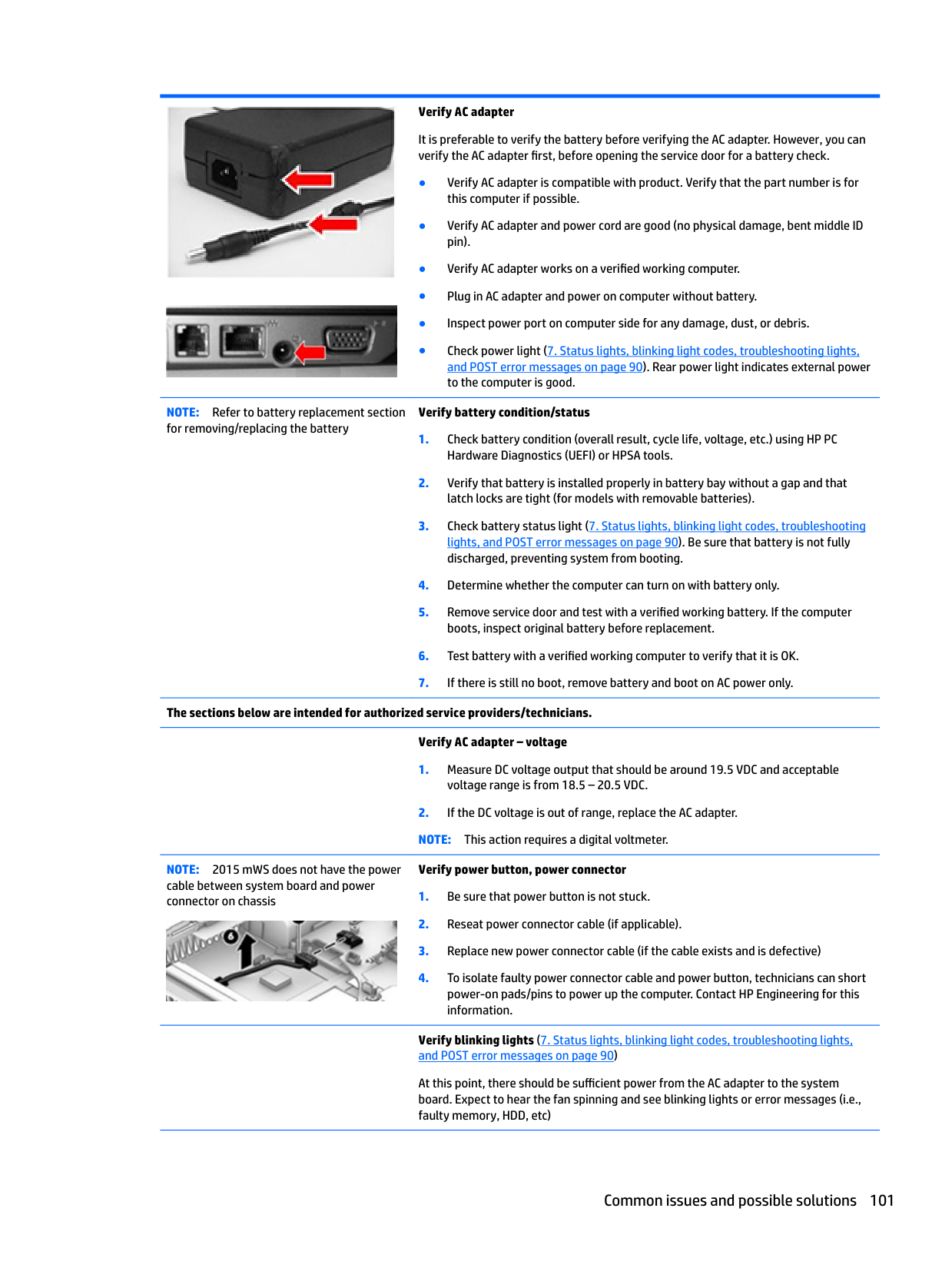
Conflict of instructions from multiple programs or drivers; installing a new hardware or program that is not compatible (may also cause a blue screen error—see blue screen issue).
Troubleshooting steps Follow suggested steps below one at a time to verify normal boot process:
Tips and tricks For more information, see HP PCs - Using Task Manager (Windows 10, 8).
##### Electromagnetic Interference (EMI)
Symptoms
System locks up, freezes in certain physical area or location
Possible causes Electromagnetic interference (EMI). Troubleshooting steps
##### No wake up
Symptoms
Possible causes Power-saving mode; multiple-display setting. Troubleshooting steps
When resuming from a power management state the computer may display:
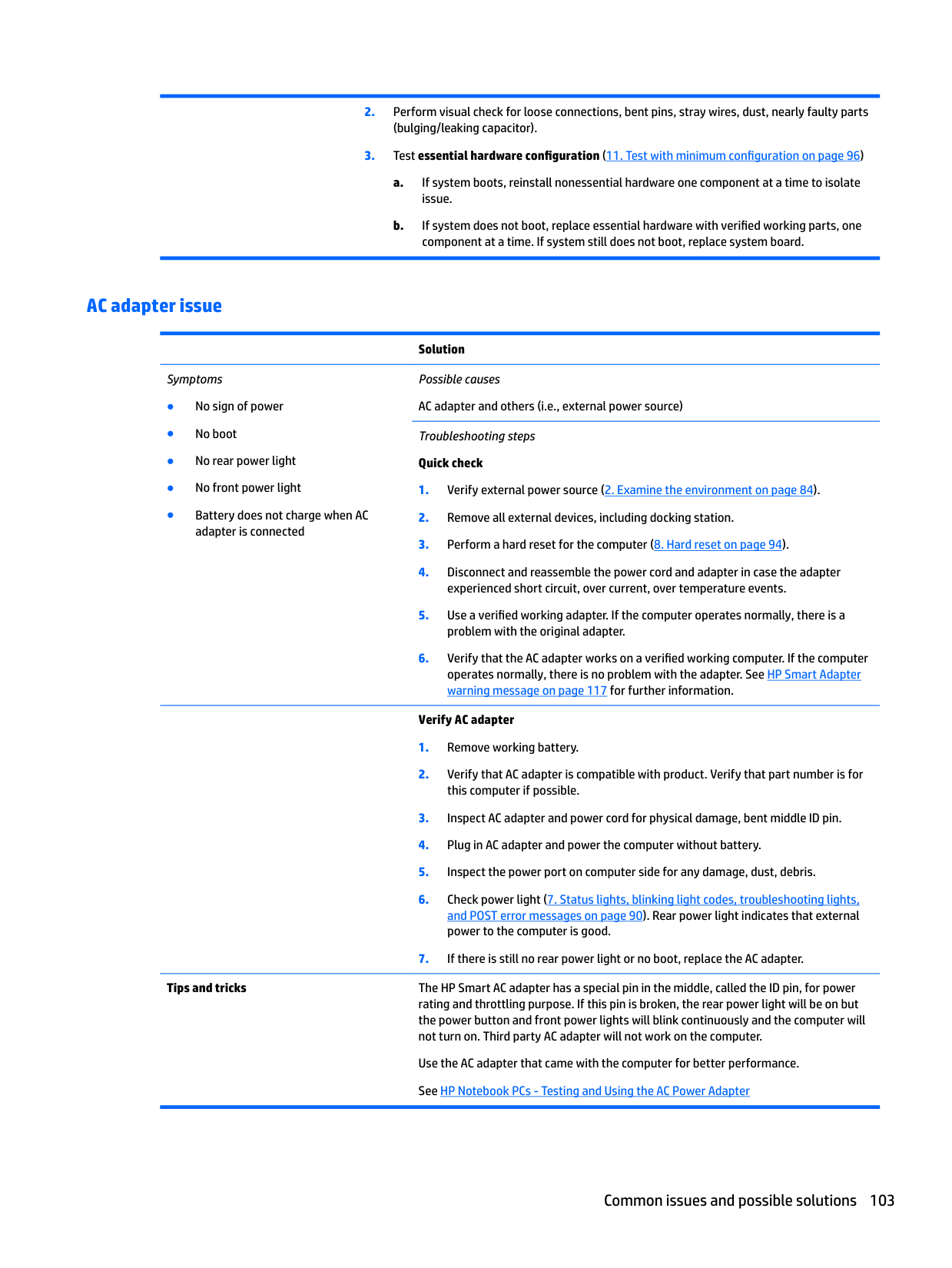


Tips and tricks If you are using a docking station, set your notebook display as a primary display. When the computer is undocked, you may think it is in a power-saving state, but the screen image may actually display on an external display device in the docking configuration.
##### Unresponsive
Symptom Unresponsive
##### Slow performance
Possible causes Program in use has stopped responding to commands. Troubleshooting steps
Symptom
Slow performance when performing small tasks, or even in idle mode
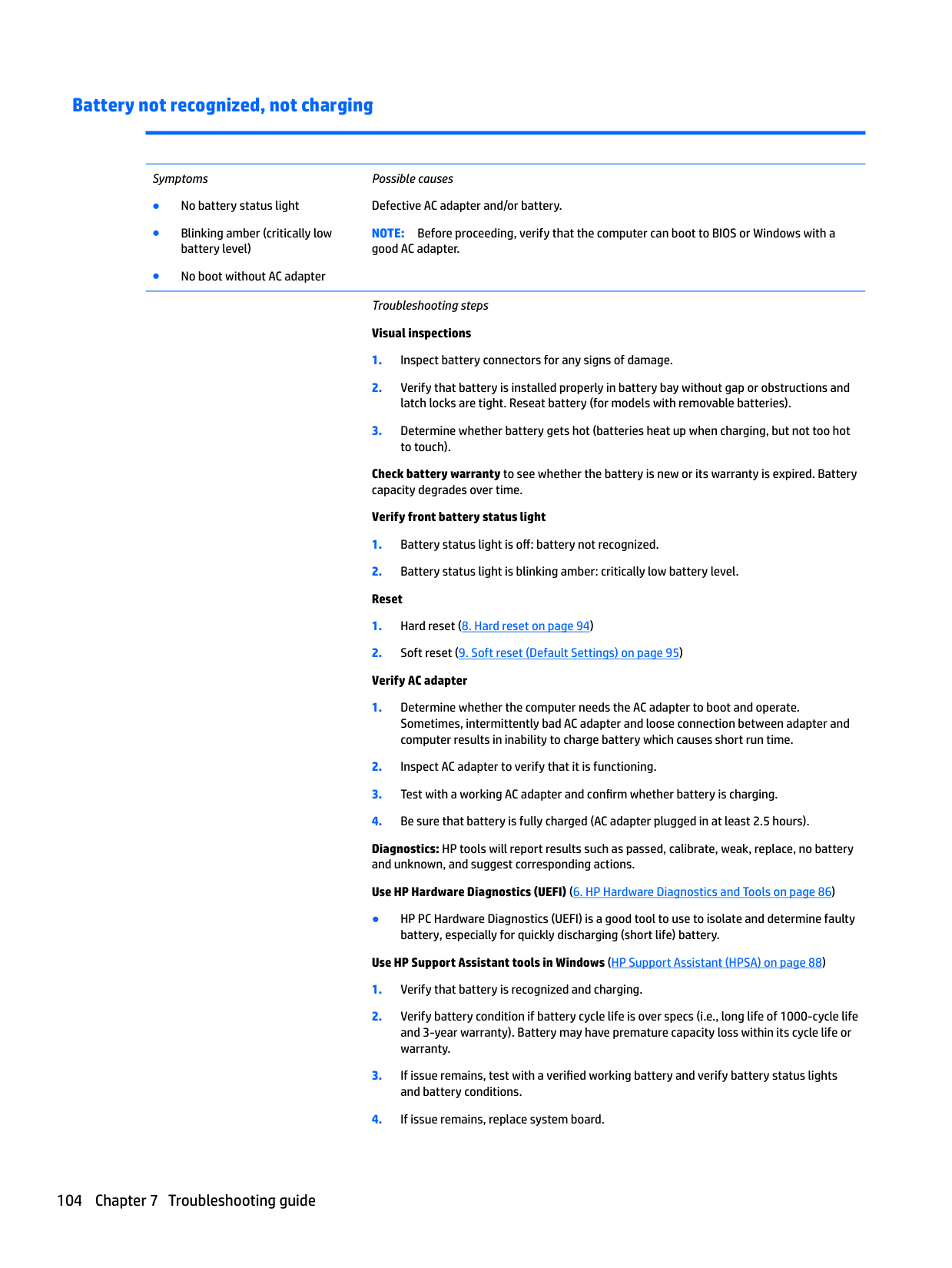
Possible causes Processor is hot or storage device is full.
Troubleshooting steps Processor is hot
Microsoft recommends at least 200 MB to sync system files.
it will work more efficiently. Also see Slow performance on page 135.
Tips and tricks See Improving System Performance (see Routine Maintenance for Performance Improvement on page 146). See Tips to free up drive space on your PC. See Optimize Windows for better performance.
##### HP Smart Adapter warning message
Symptom Warning message displayed in Window

Possible causes Less powerful AC adapter, BIOS out of date.
Troubleshooting steps
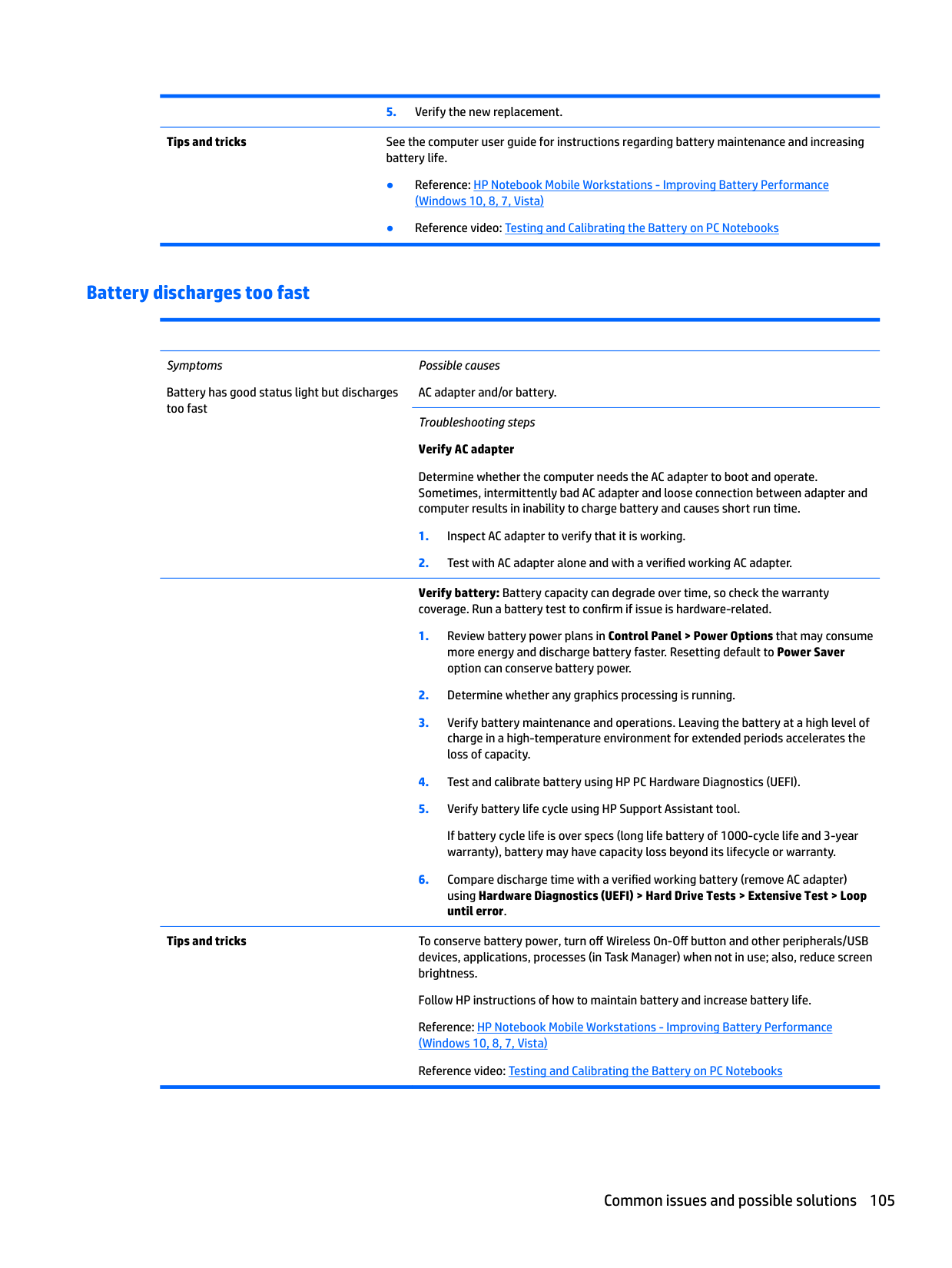
Note HP Smart AC adapter warning message: informs you that as power demands increase, the notebook may not perform at full capacity, which may result in longer battery-charging time. In cases of extreme power demands, the system may also throttle back the processor, or with systems that have a discrete video sub-system, a video balance mode may occur to further balance the power needs of the system.
System processor functions always have priority over battery charging, so charging delays will occur first.
##### Incorrect time and date
Symptom Incorrect date and time
Possible cause Real-time clock (RTC) battery might need replacement. Troubleshooting steps
#### Display Display anomalies
The display panel is a field replaceable unit (FRU) and must be replaced by only authorized technicians. However, HP highly recommends that users and technicians observe specific symptom vs. generic symptoms and utilize the HP PC Hardware Diagnostics (UEFI) tool before any replacement.
###### Symptom
Common display issues with symptoms:
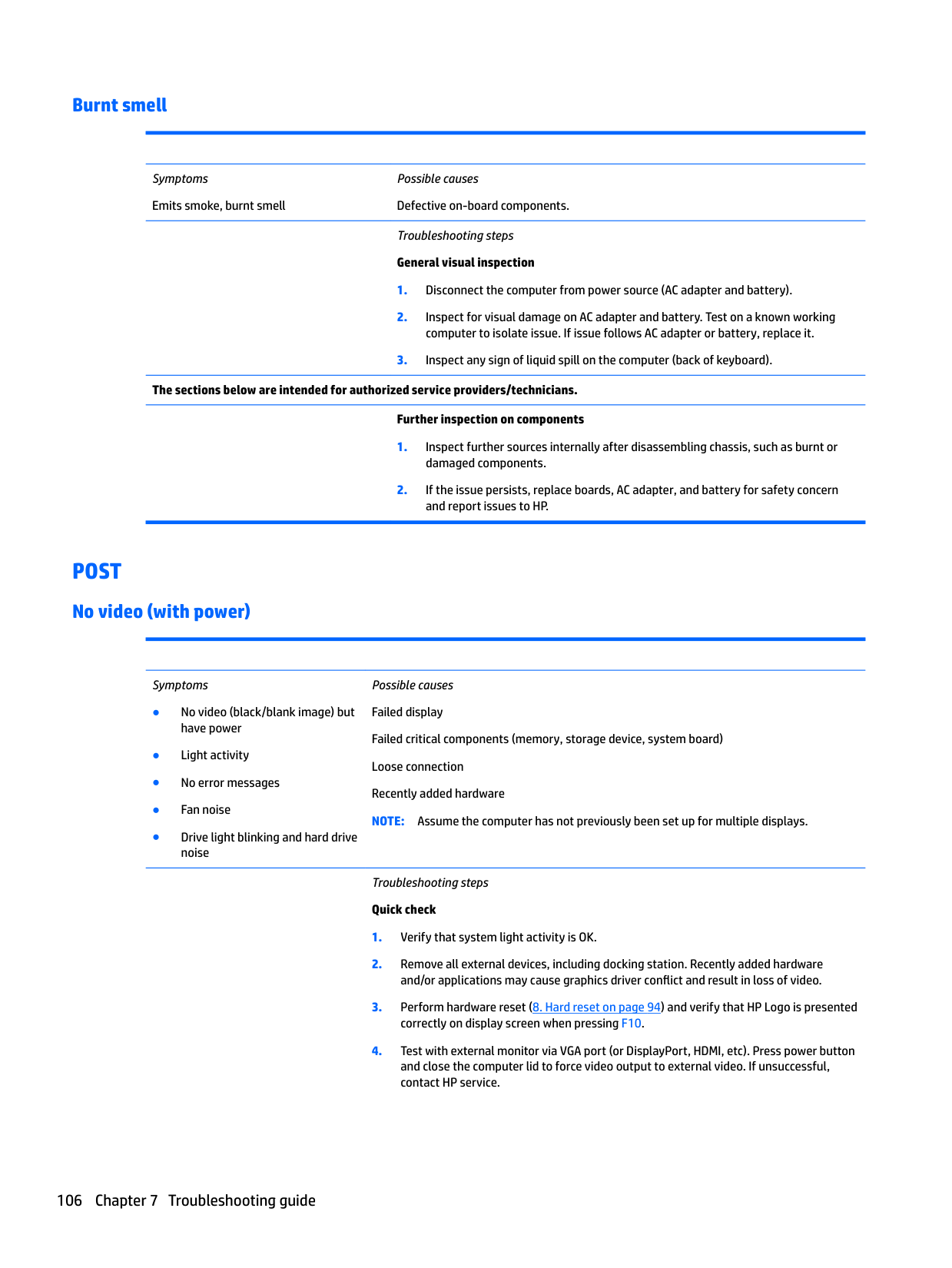


Cracked screen Cracked image Blurred image


Dead pixel Vertical lines Horizontal lines
###### Quick check
For custom images, HP highly recommends upgrading or installing Windows in UEFI mode (or Legacy disabled) to fully support hybrid graphics and avoid unexpected behaviors (i.e., blue screen error, graphics/video issues) in the BIOS Legacy setting.
HP PC Hardware Diagnostics (UEFI) for video test Use this tool to quickly determine if the display issue is related to a real hardware issue. To start HP PC Hardware Diagnostics (UEFI) (6. HP Hardware Diagnostics and Tools on page 86), when the computer is at boot, press the F2 key, select Component Tests, and then select Video. There are three options:
Review the video troubleshooting in the Display section below for specific issues and possible solutions. For additional information about display problems, refer to documentation provided by the product manufacturer.
###### Display assembly diagram
The display assembly diagram shows basic video components: system board, graphics cards, display cables, display connectors, operating system (OS), graphics driver, and LCD display panel. Any component or a combination of these components can contribute to a video issue.
| | |---|

NOTE: The lid close switch is a Hall-effect sensor located in the top cover. When the display is closed, the sensor acts like a switch is closed. A notebook can force a video output to an external monitor, or go to hibernation or standby mode through power management. If the display screen does not light up when the display is open, the lid close switch (Hall-effect sensor) could be faulty.
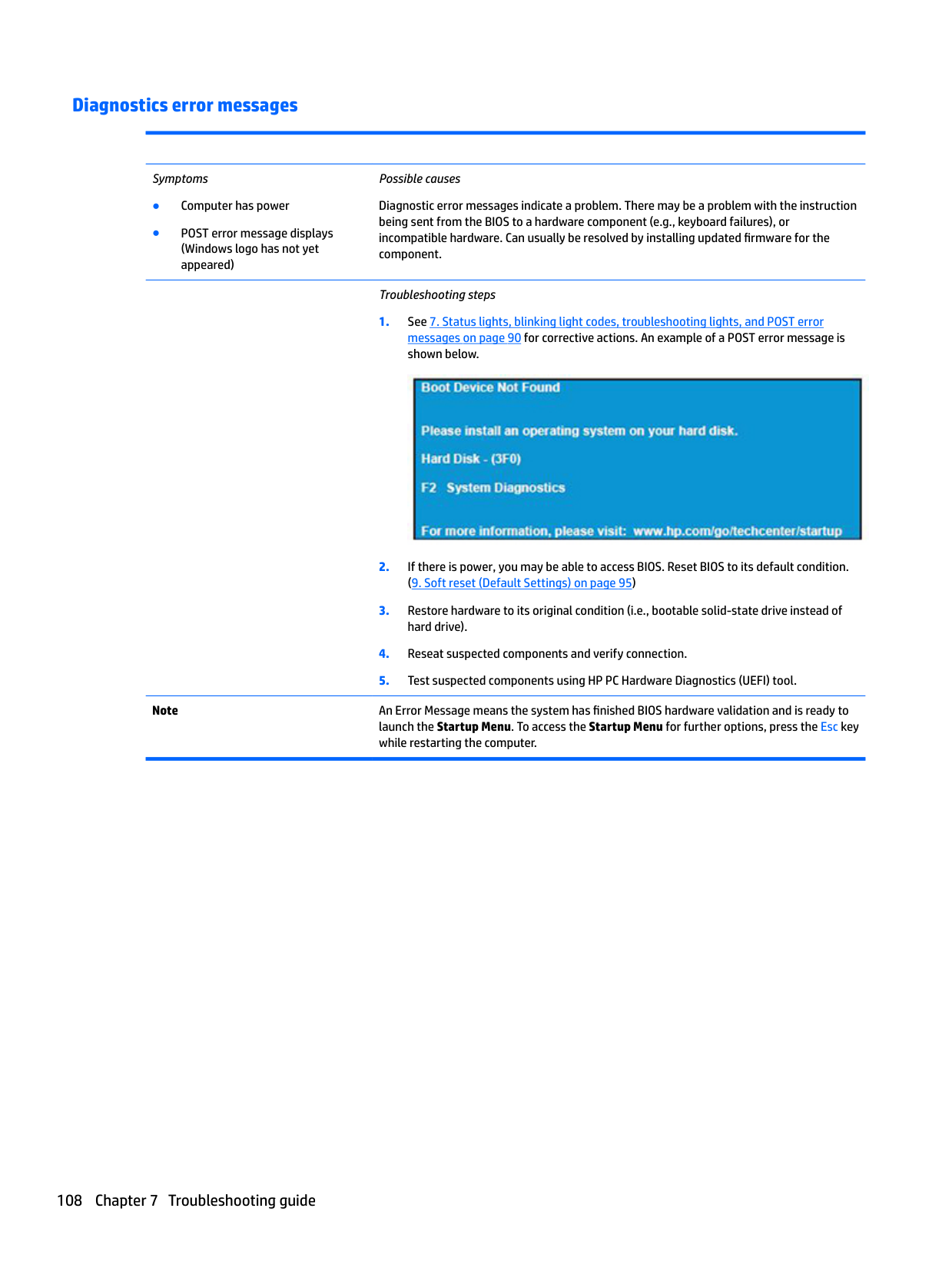
##### Dead pixel
Display panel may show one or more pixels that are not properly lit when displaying a single color over the screen area. Use HP PC Hardware Diagnostics (UEFI) tool to determine those defective pixels. There is no solution for dead pixels. Refer to Display Issue: Pixel Anomalies on page 152 for the HP dead pixel policy.
##### No video (internal)
Symptoms
No internal video with certain programs (i.e., video-intensive games)
Possible causes
Display resolution, brightness, faulty lid switch, running a program requiring a higher resolution than the display screen can support..
Faulty lid switch may put the system into Sleep or Hibernation mode. Troubleshooting steps Use an external monitor with higher resolution. Test with external monitor using HDMI or HP port. Press the power button and close the computer lid to force video output to external video. If there is still no video, contact support.
References See section No video (with power) on page 106 for display information.
##### No video (external)
Symptom No image on external monitor
Possible causes External monitor, resolution, display configuration, drivers. Troubleshooting steps
##### DisplayPort/VGA
See No video (external) on page 121. HDMI
Symptoms
Possible causes Cable, connection, settings.
Troubleshooting steps Quick Check
References HP Notebook PCs - Troubleshooting HDMI Display and Sound Issues
##### No or bad external video via docking
Symptoms
No or bad image on external monitor via ports of docking station (VGA, DP, TB, display port, etc.)
Possible causes
Rooted from system board, software/drivers, dock connectors, docking station hardware/ firmware, dock video ports (DP, VGA, etc).
Troubleshooting steps
For more information, see the technical white paper titled ”HP ZBook 65/150/200 W Thunderbolt 3 Dock User Guide.” Go to http://support.hp.com/, enter your model number, and then click Manuals > Technical white papers.
Note See the technical white paper titled “Multiple displays on HP ZBook Mobile Workstations” from HP platform support website. Go to http://support.hp.com/, enter your model number, and then click Manuals > Technical white papers.
##### Incorrect or missing color/distorted image
Symptoms
System works normally but the display shows:
Possible causes Loose connection, display cable, display, graphics card. Troubleshooting steps Verify with external monitor (i.e., VGA)
If the external monitor also shows incorrect color, it is graphics card issue. Test with a verified working graphics card.
Verify display cable and cable connection–Display disassembly is required. Be sure that external display cables are not pinched or damaged.
##### Touch screen
Be sure that external display cables have good connection at both ends (system board and display panel).
Symptoms Unresponsive Inaccurate
Possible causes Dirt and smudge, driver, touch display configuration, power management. Troubleshooting steps Quick check
Turn off the computer, spray glass cleaner onto a soft, damp cloth, and gently wipe the screen to remove dirt and smudge.
NOTE: Do not spray cleaner directly onto the screen.
Configure the touch display in Control Panel > Tablet PC Settings

If the diagnostics tests pass but the touch screen still does not respond, continue following the steps.
If the touch screen stops working after waking from sleep, adjust the power management settings so that the touch screen device stays active while the computer is in sleep mode.
References HP Notebook PCs - Touch Screen Issues (Windows 10)
HP Notebook PCs - Touch Screen Issues (Windows 8)
#### I/O devices
| | |---|
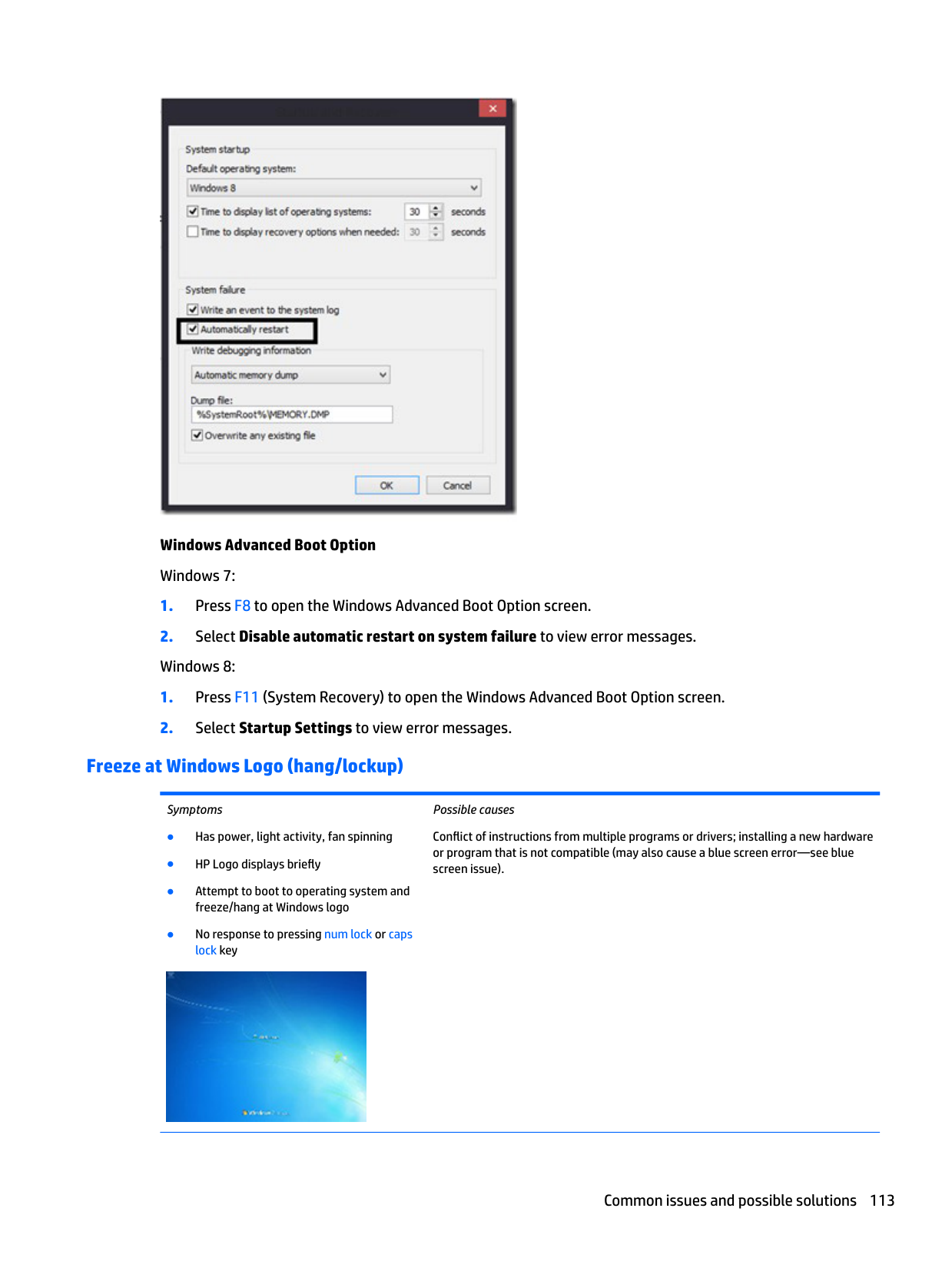
###### NOTE:
##### Keyboard
Symptoms Keystrokes not recognized Characters not matched
Possible causes Dust trapped under keycap, loose keycap, loose keyboard connection, defective keyboard.
Troubleshooting steps
Also test in Windows for special keys (Caps Lock, Shift, Ctrl, Fn, Windows, Alt) if necessary.
######### The sections below are intended for authorized service providers/technicians.
Tips and tricks A key only works when pressed with force. Inspect and remove debris trapped under keycap.
##### Keyboard point stick
Symptom Point stick not working properly
Possible causes Dust trapped under point stick, loose point stick cap. Troubleshooting steps

Example of back of keyboard, including keyboard, point stick, and backlight cables.
##### Keyboard backlight
Symptom
Backlight function not working properly
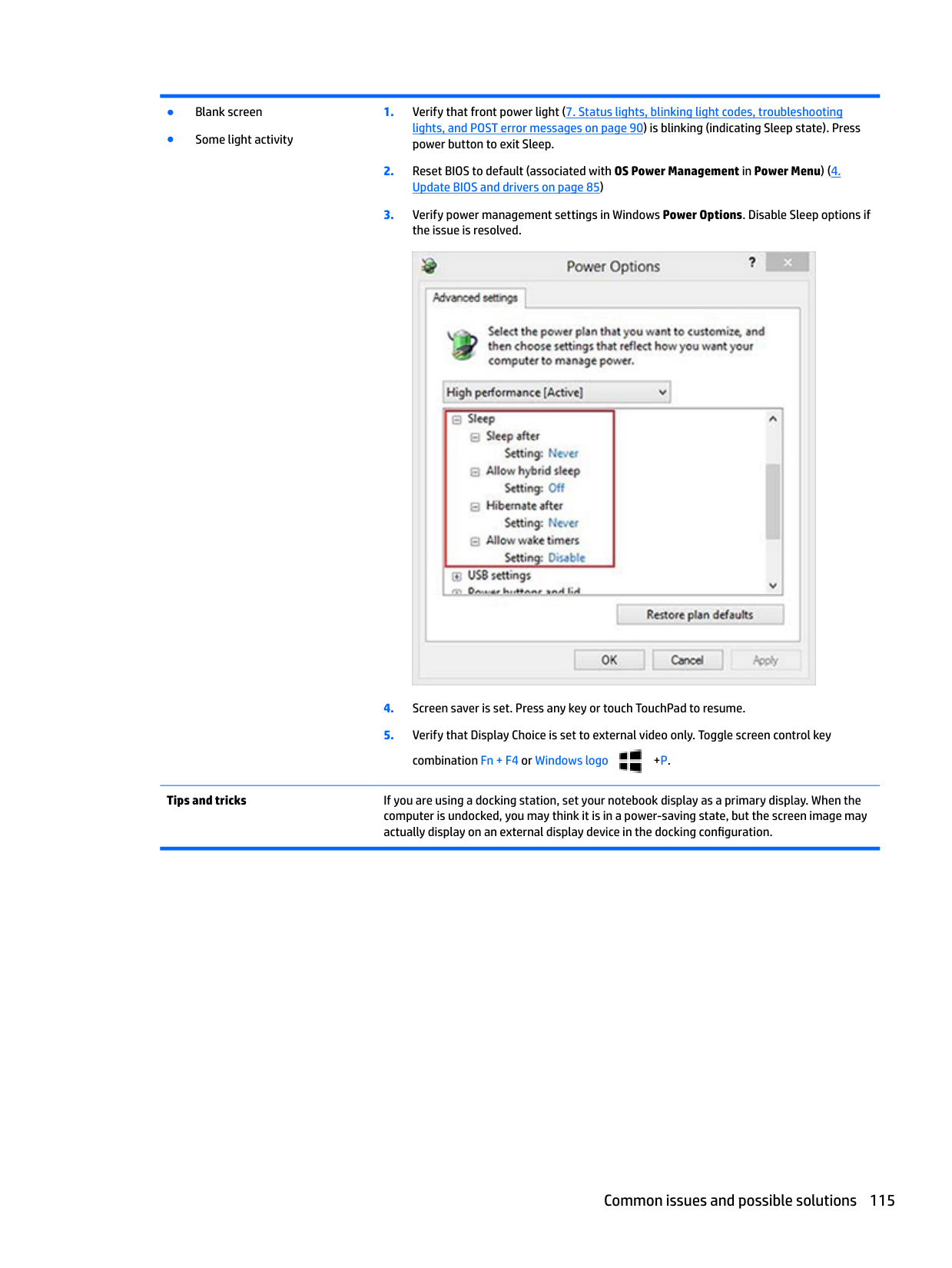
Possible causes Backlight disabled, loose connection.
Troubleshooting steps NOTE: Not all notebook computers have backlit keyboards.
A keyboard function key lets you turn the light on and off. Verify if backlit feature is not disabled by pressing a combination of Fn + Backlit key.
######### The sections below are intended for authorized service providers/technicians.
##### TouchPad
Symptoms Not working properly

Possible causes On/Off enabled, driver, settings. Troubleshooting steps
######### The sections below are intended for authorized service providers/technicians.
##### Network Connectivity Ethernet (RJ-45 jack)
Symptoms
HP Support Assistant tool - No network detected in HPSA

Possible causes Network source, cable, connection, RJ-45 port, driver, settings.
Troubleshooting steps Quick Check: verify the network status lights that supposed to flash when there is network activity.
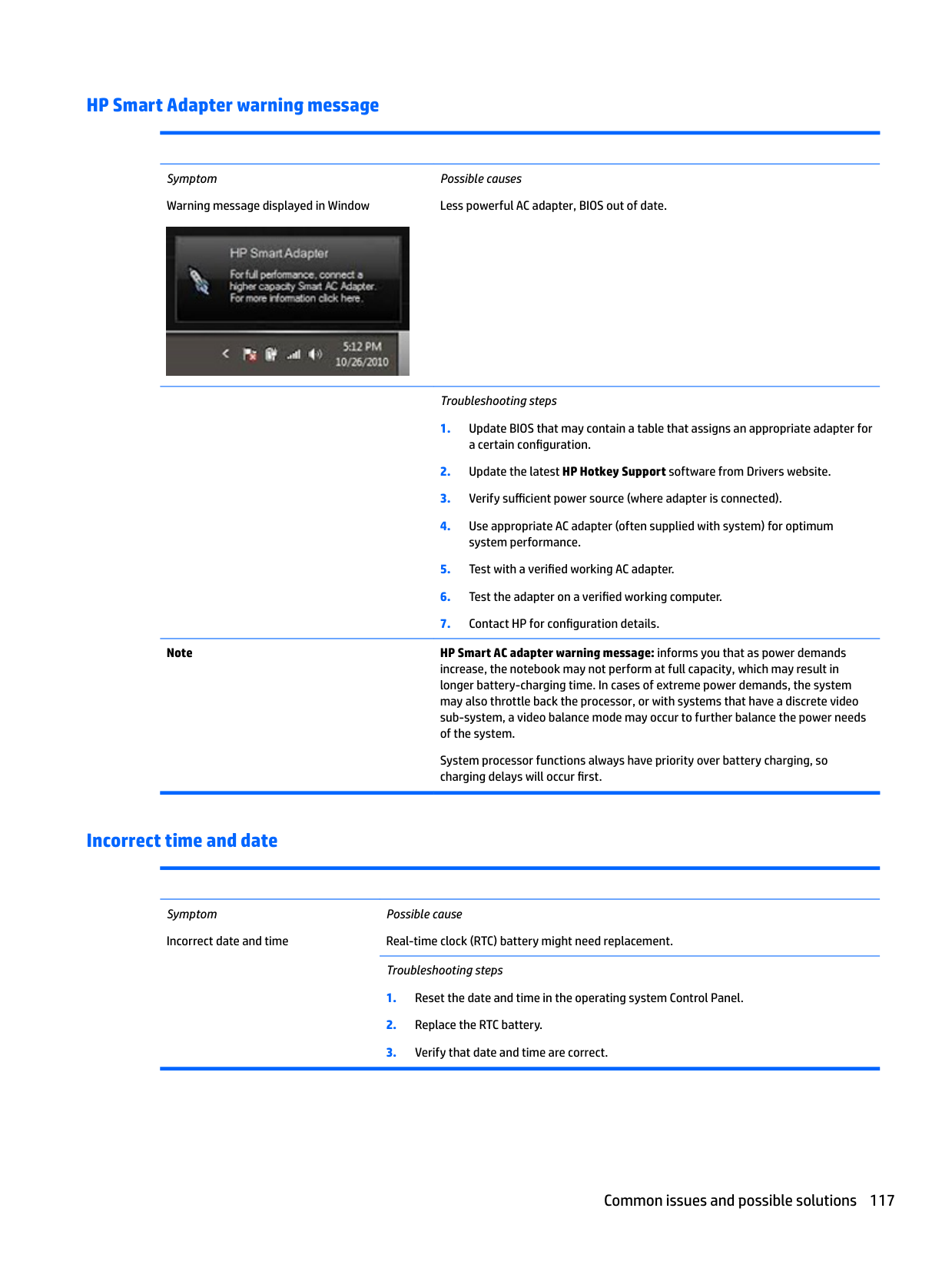
##### Network connectivity wireless (WLAN)
Symptoms
Possible causes Network source, cable, connection, wireless module, driver, settings.
HP Support Assistant tool - No network detected in HPSA

Wireless Adapter Properties - U-APSD support
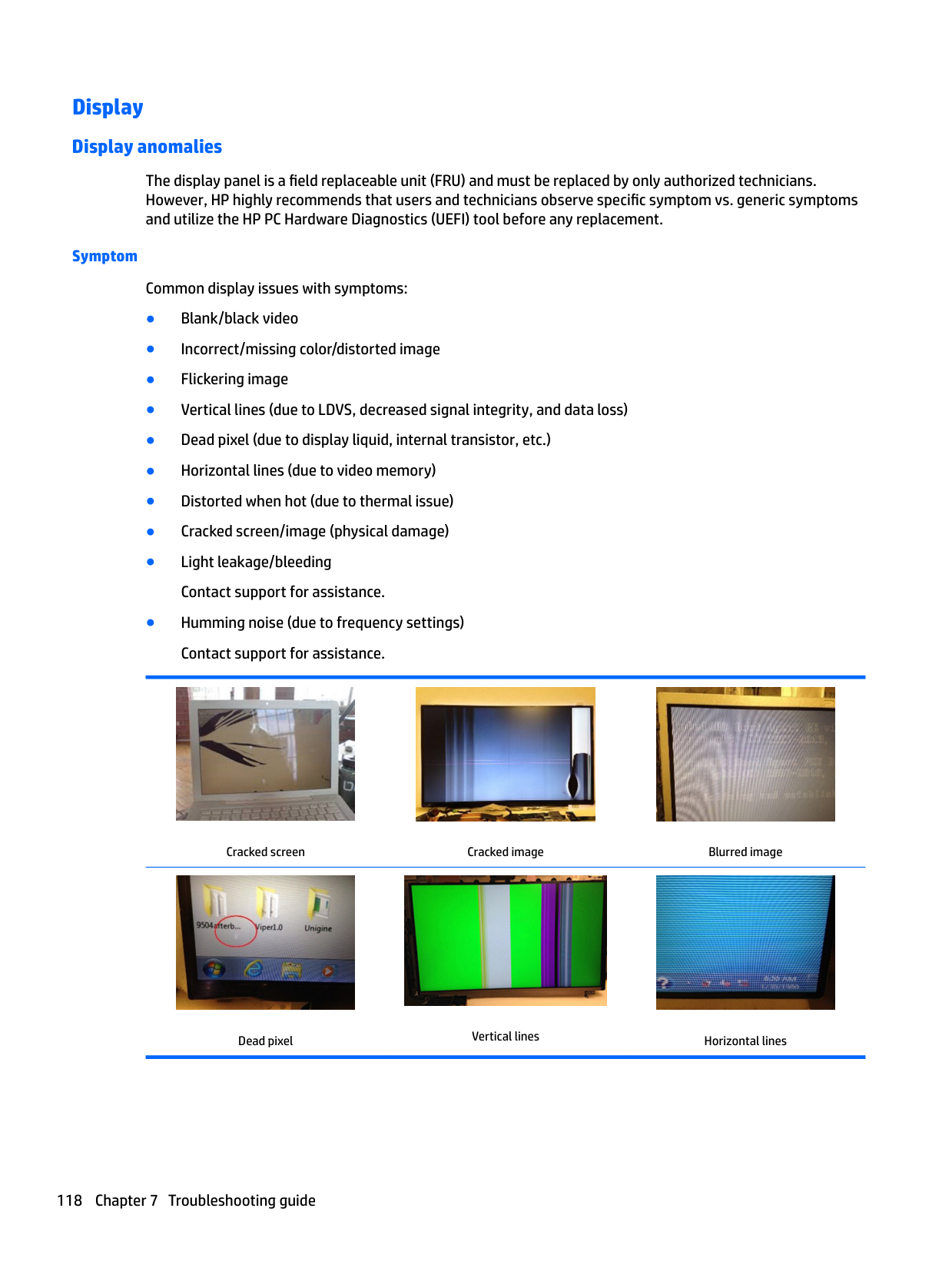
Troubleshooting steps
In the example to the left, U-APSD support (Unscheduled Automatic Power Save Delivery) is changed to Disabled to resolve an incompatible access

point. If disabling U-APSD improves the throughput issue, check with the access point provider for updated firmware that resolves the issue.
######### The sections below are intended for authorized service providers/technicians.
##### WWAN
Symptom Unable to find networks/service
Possible causes Network source, cable, connection, driver, settings. Troubleshooting steps

##### USB
Symptoms
Possible causes
USB devices do not have the latest software drivers, port insufficient power, or not compliant.
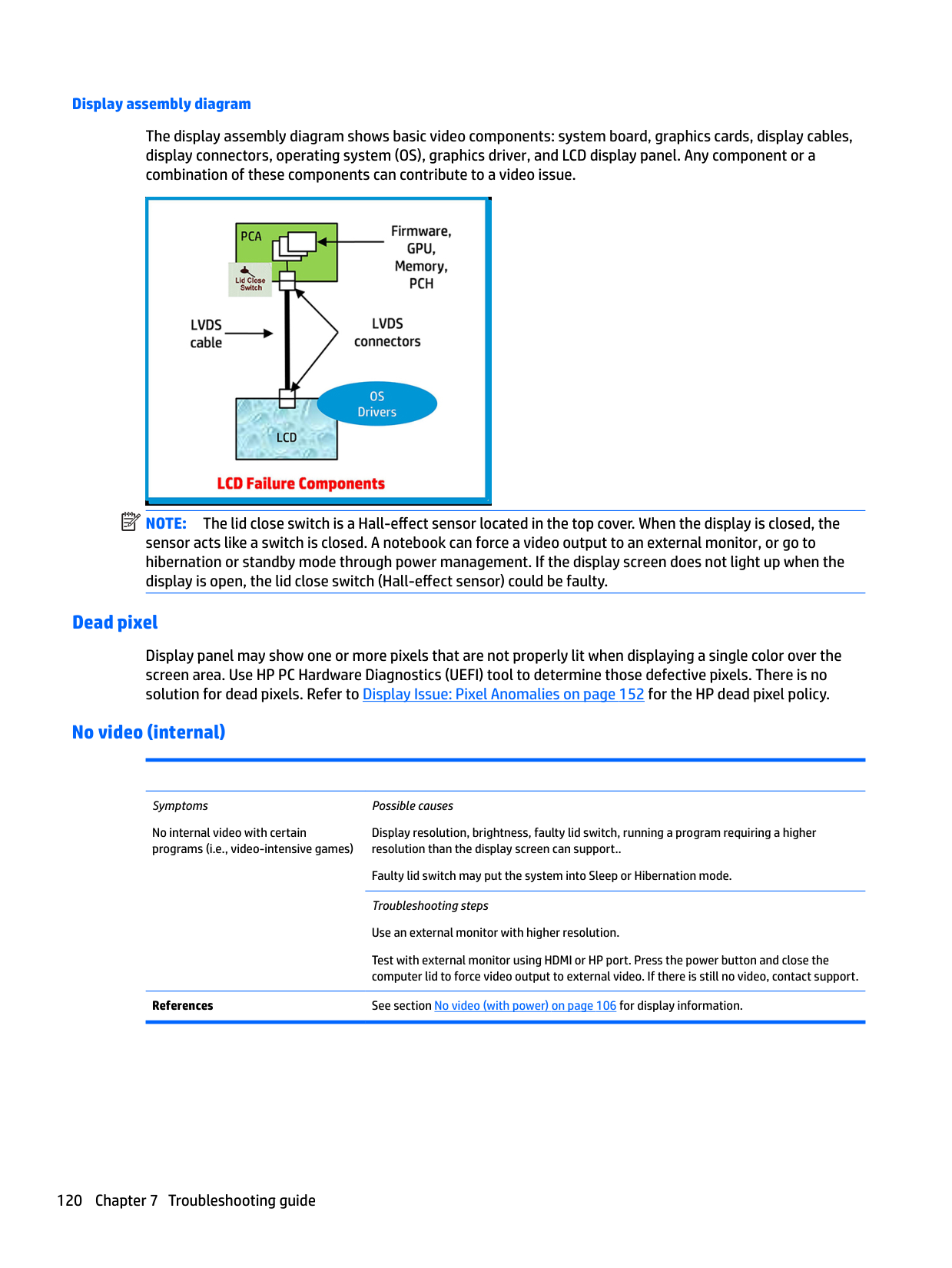
NOTE: USB Type-C uses a different connector entirely Examples of USB device Not Recognized Troubleshooting steps


##### Smart card reader
Symptoms
● Not recognized ● Unable to write
Possible causes Physical damage, incorrect insertion, dirt, driver, malfunctioning card reader. NOTE: Some cards have a read/write security switch on the card. Make sure that switch is set to “write enabled” before attempting to write data to it.
Card Reader Removal Policy Troubleshooting steps

CAUTION: If the card reader has an in-use indicator light, do not insert or remove memory cards while the light is flashing. Doing so may cause loss of data on the card or may permanently damage the card reader.
##### Speaker, headphone - audio issues
Symptoms
Possible causes
Volume turned down, sound card not recognized, malfunctioning hardware, electronic interference.
Troubleshooting steps
No sound from headphones 1. Adjust volume by pressing Fn + F8/F9. Be sure that volume button light is not amber (mute). Or adjust Windows volume control by clicking the speaker icon on the Windows taskbar. Be sure that the sound it not muted.
No sound from external speakers 1. Verify that external speakers are turned on.
##### Thunderbolt (TB)
Symptom Thunderbolt device not working
Possible causes BIOS, drivers, and user settings. Troubleshooting steps
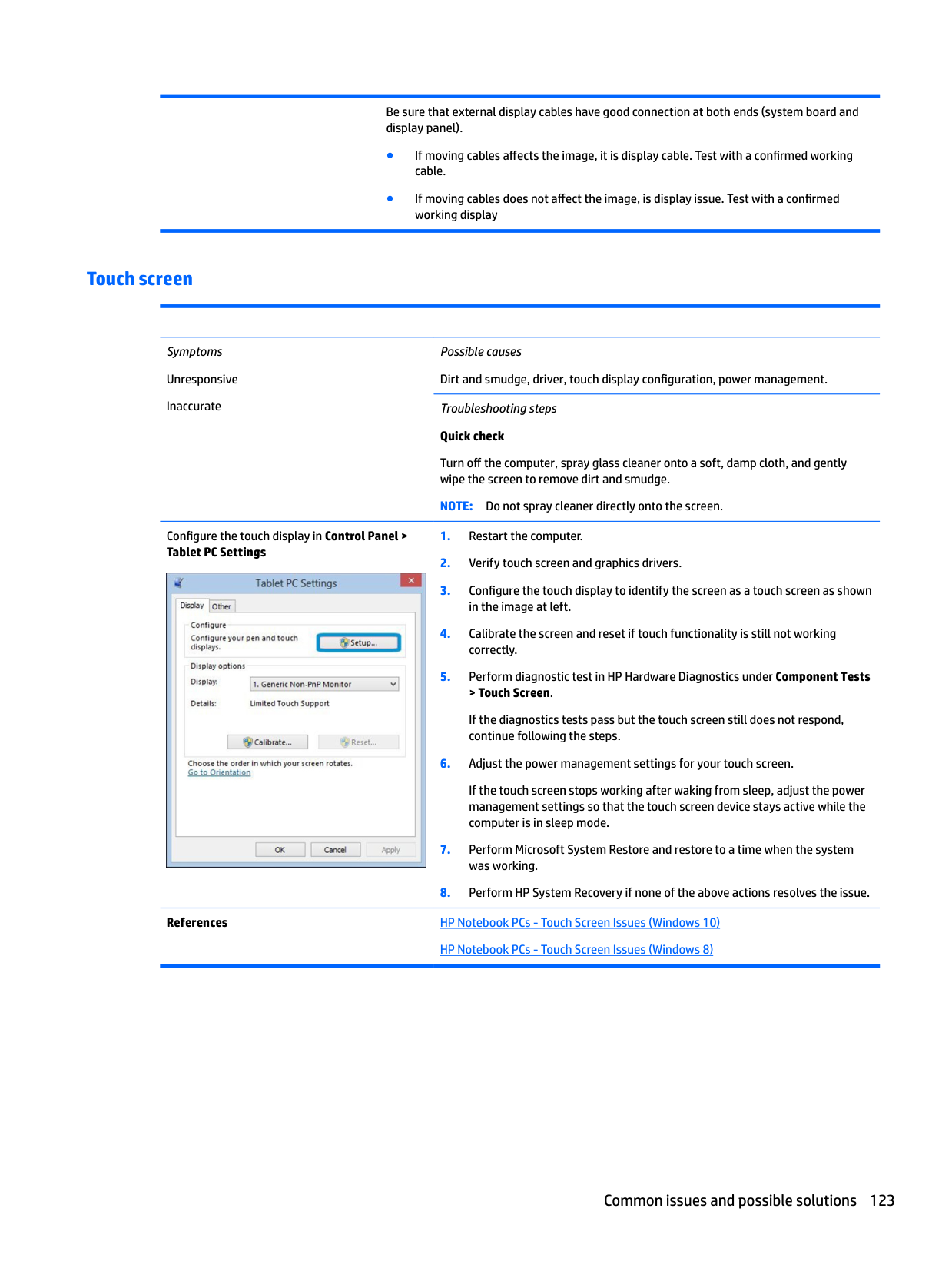

NOTE: Thunderbolt is new technology. Thunderbolt cable and Thunderbolt device must be compatible with Windows. To determine whether your device is Thunderbolt Certified for Windows, see https://thunderbolttechnology.net/products.
#### Storage
| | |---|
###### NOTE:
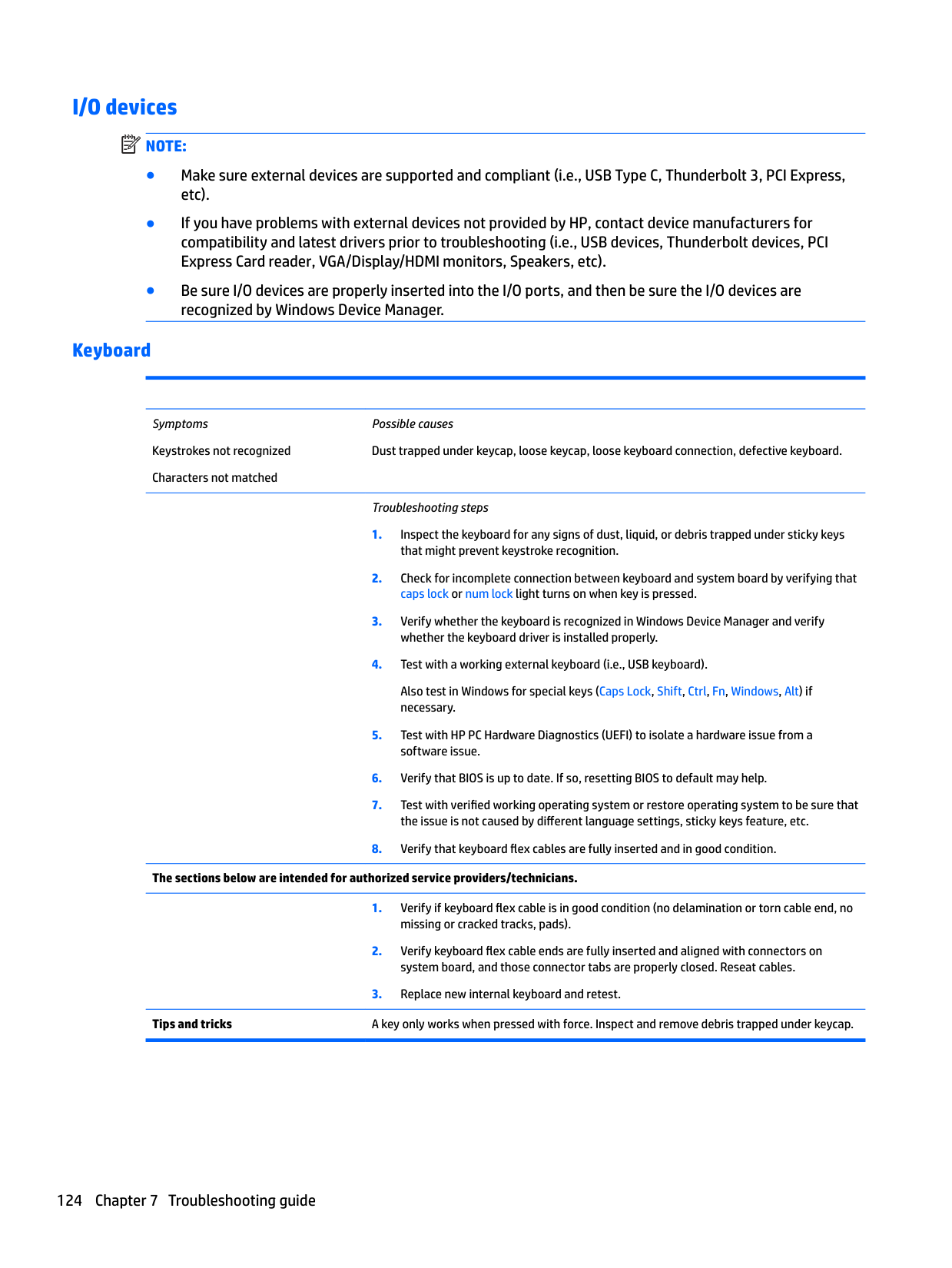

##### Hard drive/solid-state drive not recognized
Symptom
Hard drive is not recognized during POST
Possible causes Loose connection, faulty hard drive, faulty drive configuration/BIOS setting. Troubleshooting steps
NOTE: If the drive is seen in BIOS and Diagnostics, try a secure erase prior to replacing a drive as this may resolve related issues.
##### No boot to operating system (no read/write error)
Symptoms
Possible causes Operating system, loose connection, faulty storage device, BIOS configuration, Secure Boot. Troubleshooting steps
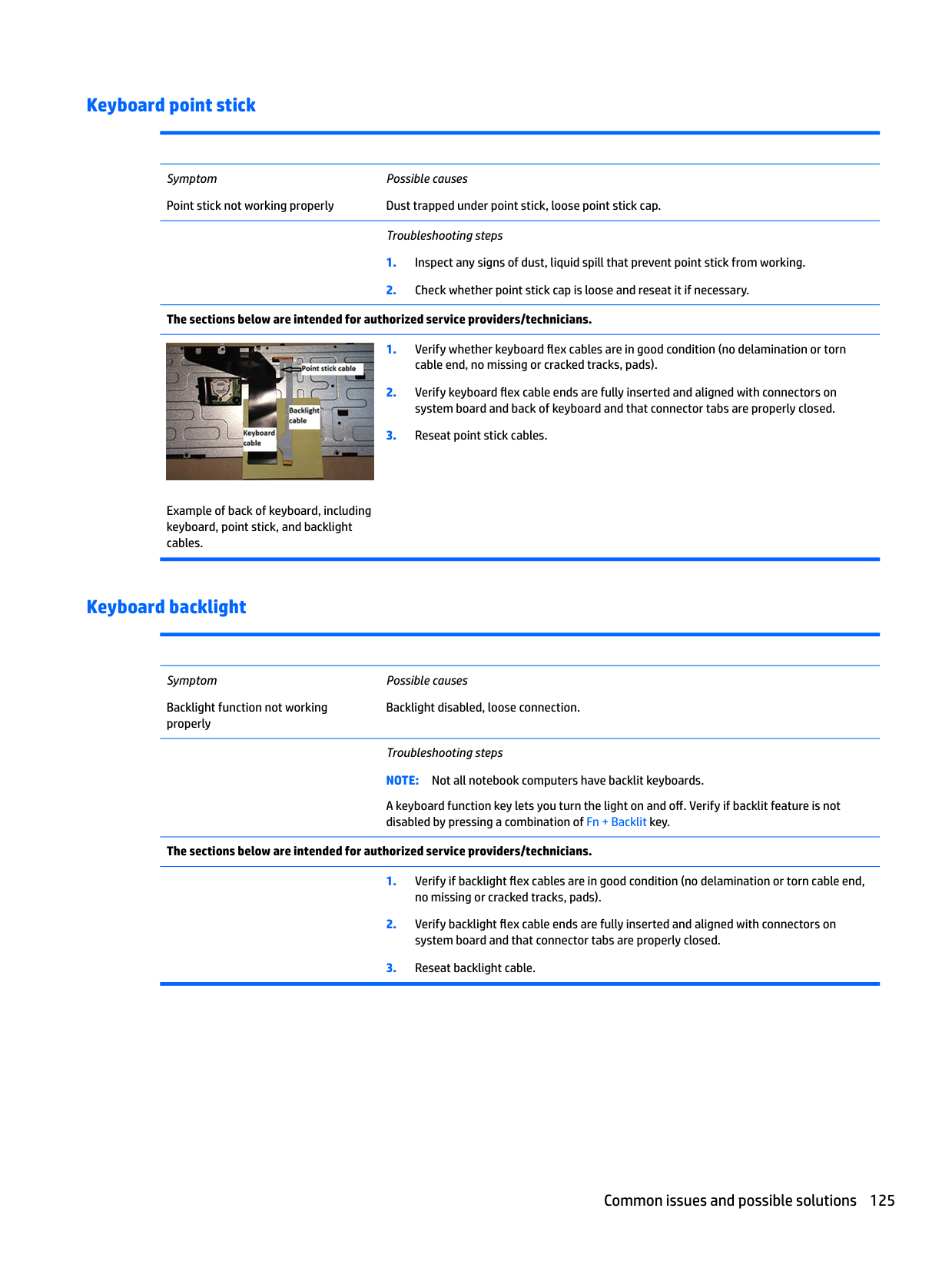
Another example, choosing Legacy Boot Order for an UEFI device will cause "Boot Device not found (3F0)" error.
Note If there is a drive POST error message, see POST Error Messages and User Actions
on page 144.
##### Read-write error
Symptoms
Possible causes Loose connection, faulty hardware. Troubleshooting steps
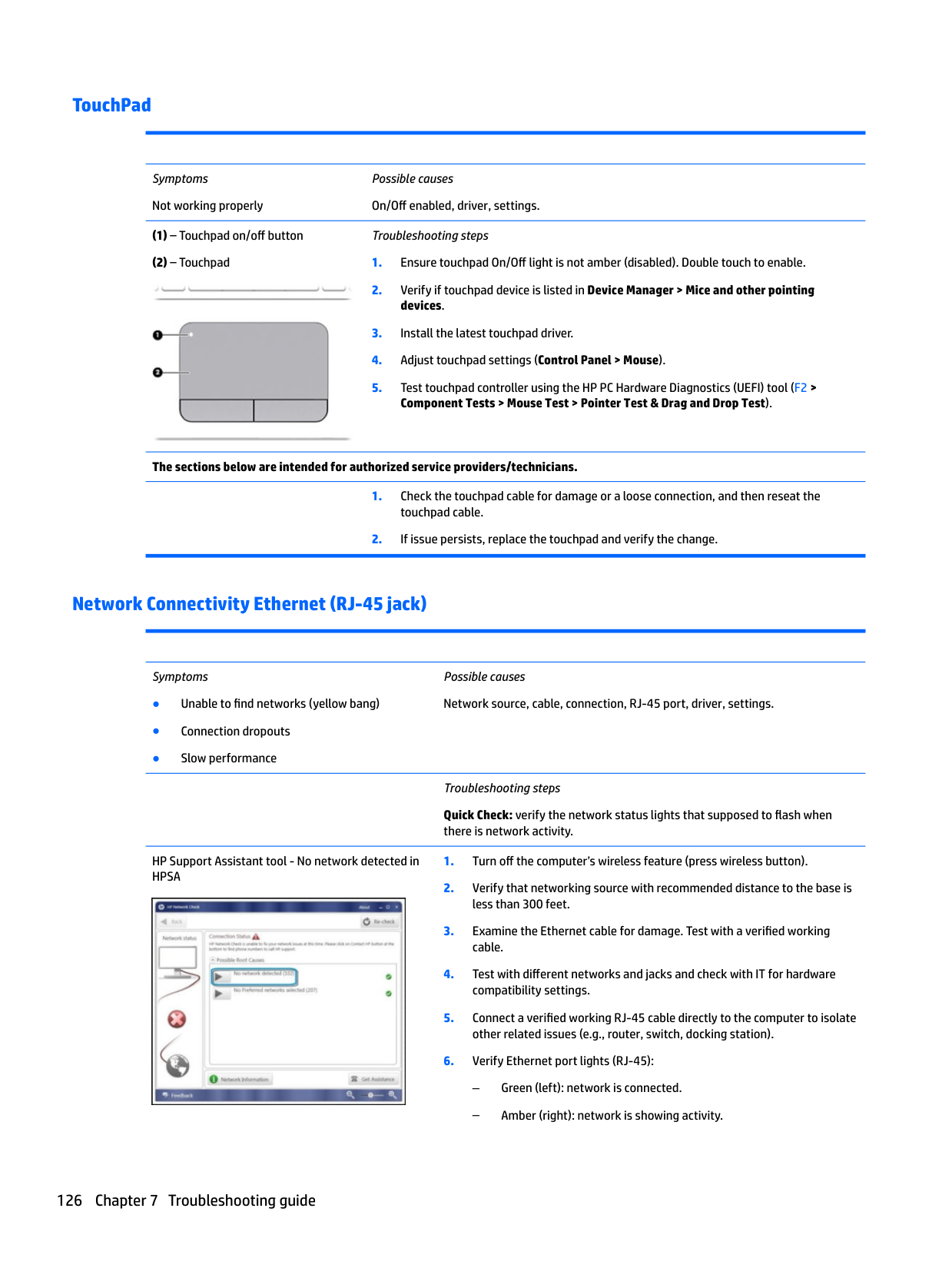
Note If there is a drive POST error message, see POST Error Messages and User Actions
on page 144.
##### Slow performance
Symptoms
Slow performance even when performing small read/write operations
Possible causes Operating system files, storage device is full. Troubleshooting steps
Tips & tricks For optimal system performance, you need to place your operating system and all of your most commonly used applications and files in the fastest hard drive (solid-state drive) and fastest areas on the drive (primary partition of 200 GB max).
See Improving System Performance. Also see Routine Maintenance for Performance Improvement on page 146).
##### Blue screen (BSOD) error
Faulty storage device may cause blue screen error. Perform the drive tests using the HP Diagnostics Tool to make sure the drive is functional. If all of the tests pass, see Common Blue Screen Error Messages on page 146 for detailed troubleshooting steps.
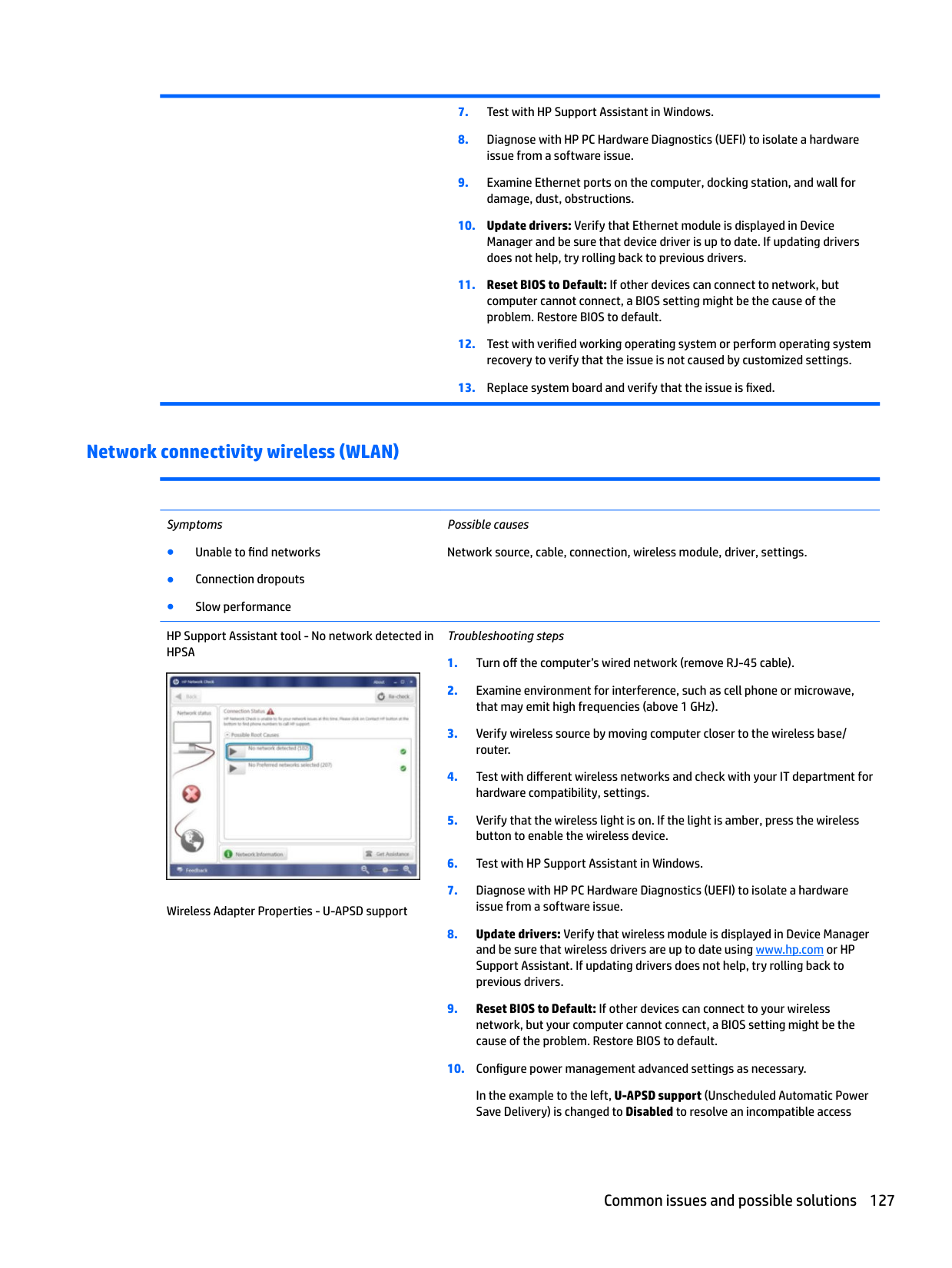
Noisy hard drive IMPORTANT: An SSD has no moving parts, so it does not make loud or clicking noise. Depending on type and rotational speed, some hard drives will make more noise than others. Not all noises are related to the fan or hard drive.
| | |---|
Symptoms
Possible causes BIOS, hard drive firmware, driver, faulty drive, power supply (AC adapter). Troubleshooting steps
Tips & tricks For optimal system performance, place your operating system and all of your most commonly used applications and files on the fastest hard drive or solid-state drive and on the fastest areas on the drive (primary partition of 200 GB max).
See Improving System Performance. Also, see Routine Maintenance for Performance Improvement on page 146).
#### Mechanical Fan error message - 90B
Symptoms Fan error 90B at boot CAUTION: May lead to system shutdown, data loss or possible system damage.
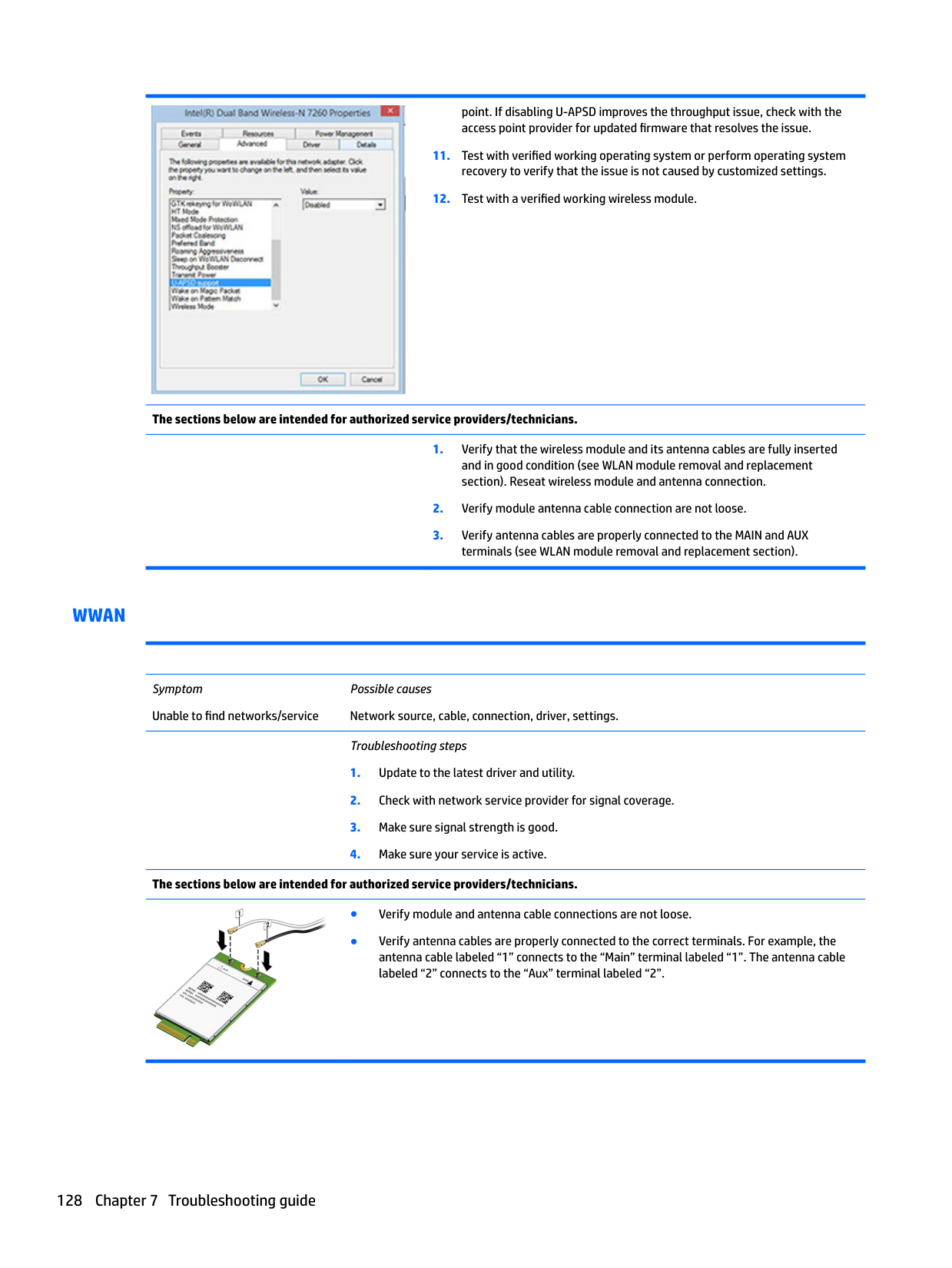
Possible causes Defective fan; out-of-date BIOS.

Troubleshooting steps General actions
######### Thermal-related issue
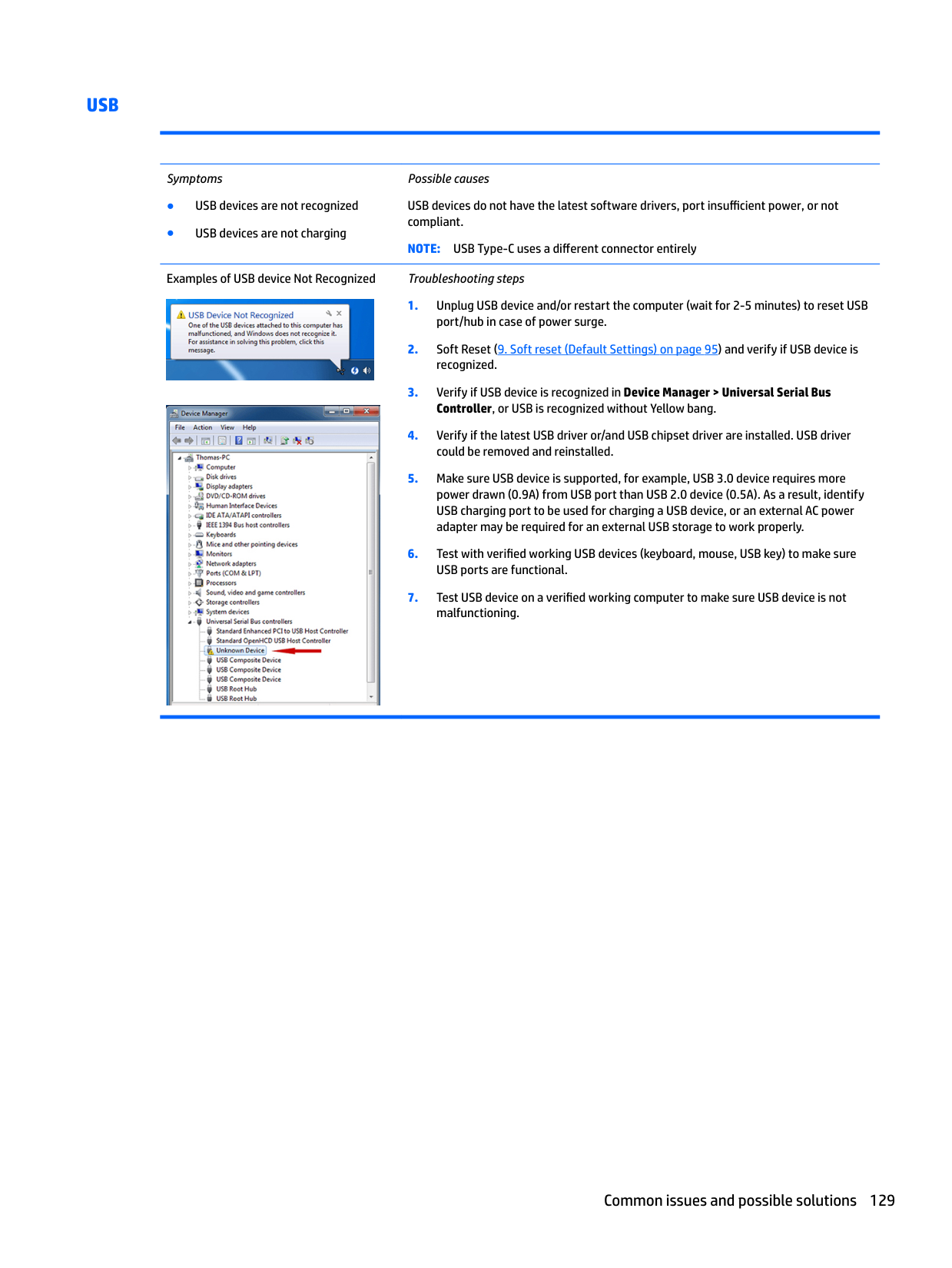
▲ Use Thermal Monitor tool (available only to authorized service providers/ technicians) to run stress test (processor and GPU) and verify that thermal sensors are within limits after thermal condition is serviced.
Note BIOS currently omits fan presence detection to shorten boot time delay less than four seconds. Therefore, the fan error is generated based on previous boot to operating system that found system fan error.
Fan often is part of thermal solution, including heat sink, fin/ muffler, and thermal grease. Fan replacement requires reboot and fan function verification using HP PC Hardware Diagnostics (UEFI) tool.
See Reducing Heat Inside the PC to Prevent Overheating.
##### Noise (sound)
Symptoms Computer emits abnormal noise
Possible causes
Aside from basic components (power adapter/supply, fan, speaker, hard drive, optical drive, display panel, external devices), it is also common for electronic components to produce noise.
Troubleshooting steps
Disconnect external devices and all cables connected to the computer to isolate issue to computer only.
Noisy fan Determine whether the noise comes from the fan. Disconnect the fan briefly to isolate whether noise originates from fan. If noise is absent with fan disconnected, refer to Fan runs constantly on page 139.
Noisy hard drive Determine whether the noise comes from the hard drive.
See Noisy hard drive on page 136.
Noisy optical drive 1. Determine whether the noise comes from an optical drive.
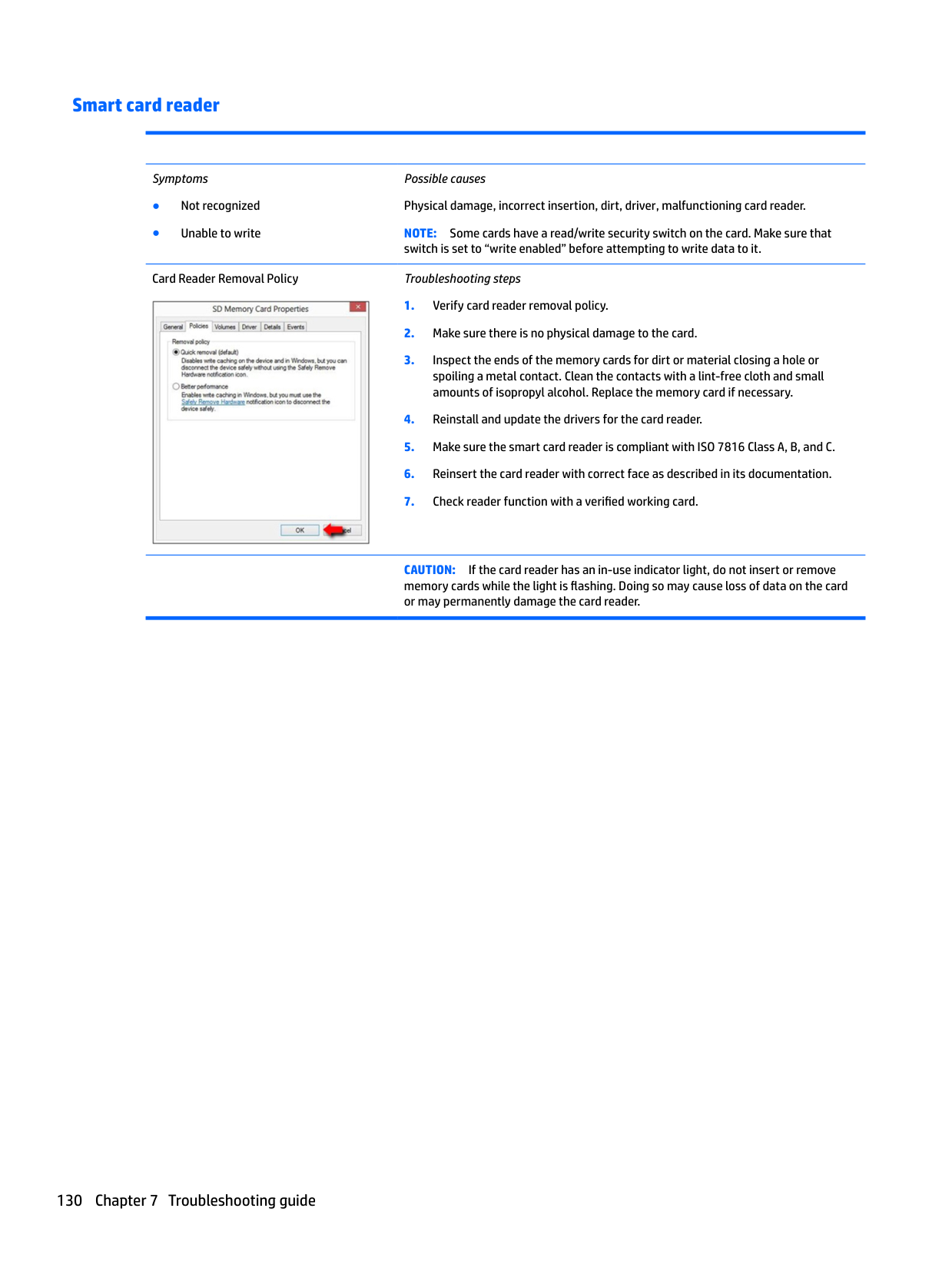
frequency settings. See Display on page 118. The section below is intended for authorized service providers/technicians.
##### Fan runs constantly
Symptoms
Possible causes
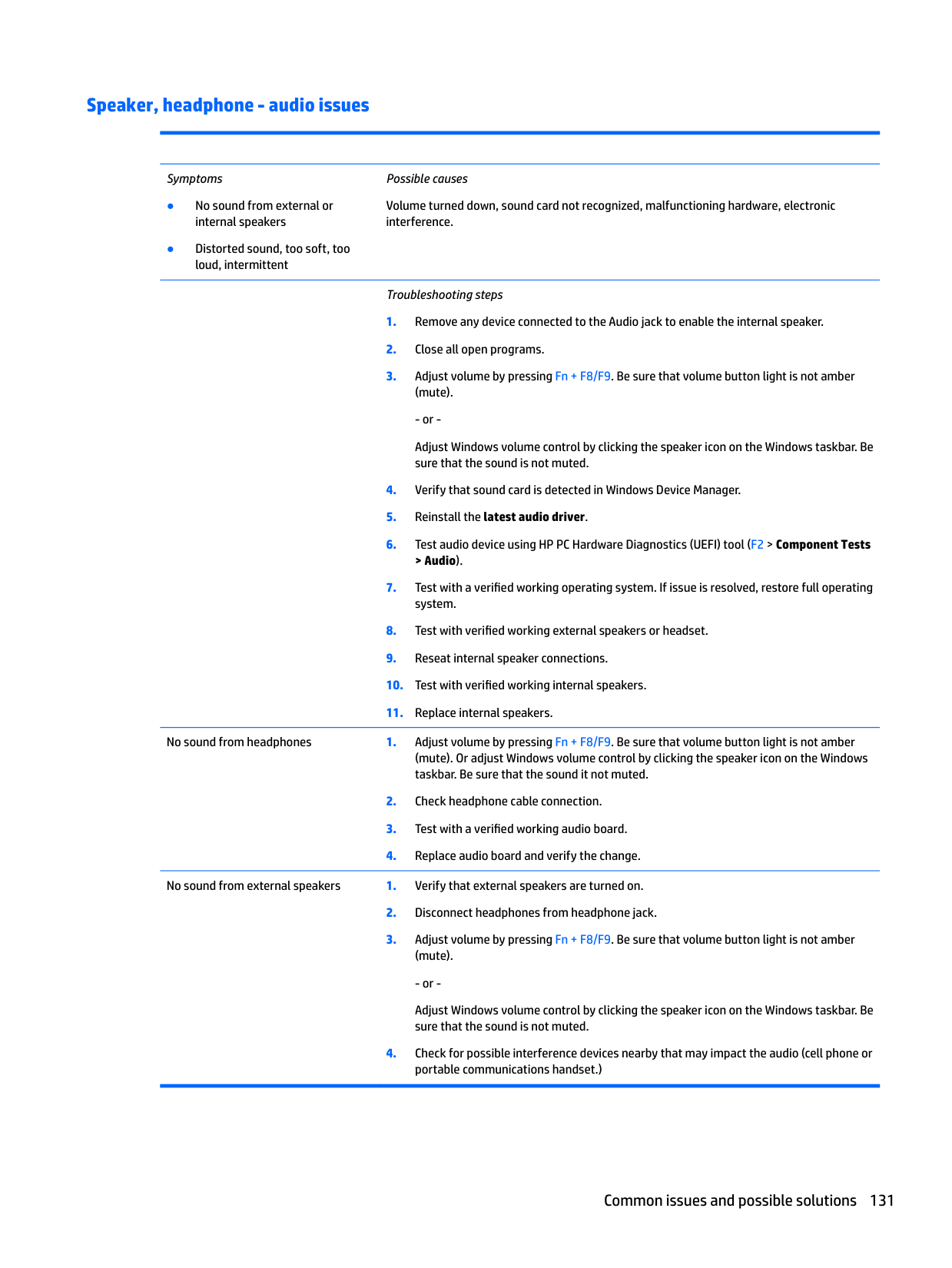
######### Thermal-related issue
Diagnostics and Tools on page 86). Be sure that the fan is not producing loud noise and that fan blades spin correctly.
d. Test with a verified working fan. e. Replace the fan.
Use Thermal Monitor tool (available only to authorized service providers/technicians) (HP Thermal Monitor on page 89) to run stress test (processor and GPU) and verify that thermal sensors are within limits after thermal condition is serviced.
User configuration Change Power Options in Windows (i.e., choosing Balanced mode instead of High performance). High performance and extensive graphics may cause the fan run constantly to release the heat.
Notes BIOS currently omits fan presence detection to shorten boot time delay less than four seconds. Therefore, the fan error is generated based on previous boot to operating system that found system fan error.
Fan often is part of thermal solution, including heat sink, heat sink fin/muffler, and thermal grease. Fan replacement requires reboot and fan function verification using HP PC Hardware Diagnostics (UEFI) tool.
For more information, see the following links:
##### Thermal shutdown (hot)
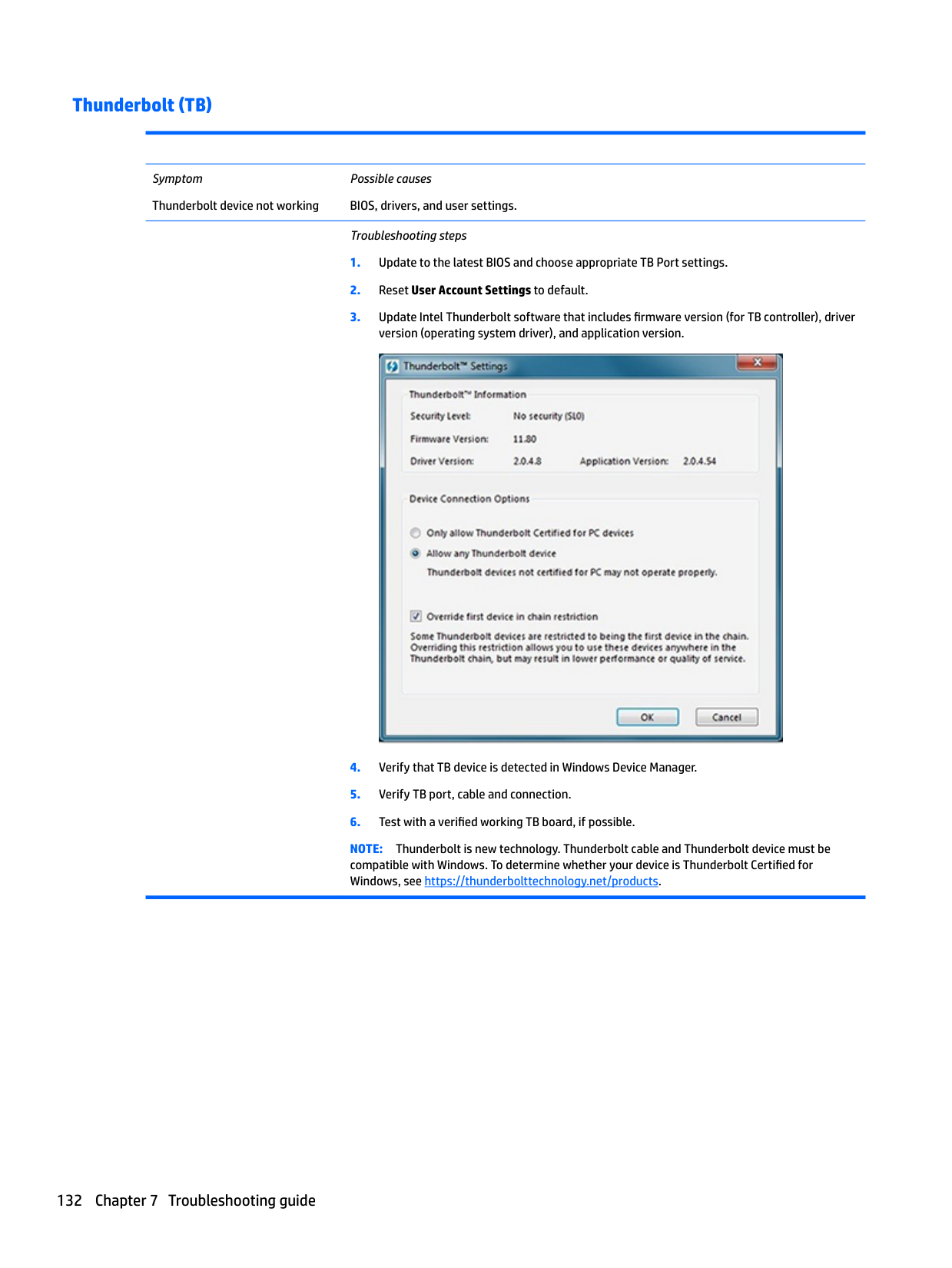
Symptoms
Similar to fan runs constantly issue (Fan runs constantly on page 139)


Possible causes BIOS not up to date, thermal condition (fan, air flow) Troubleshooting steps
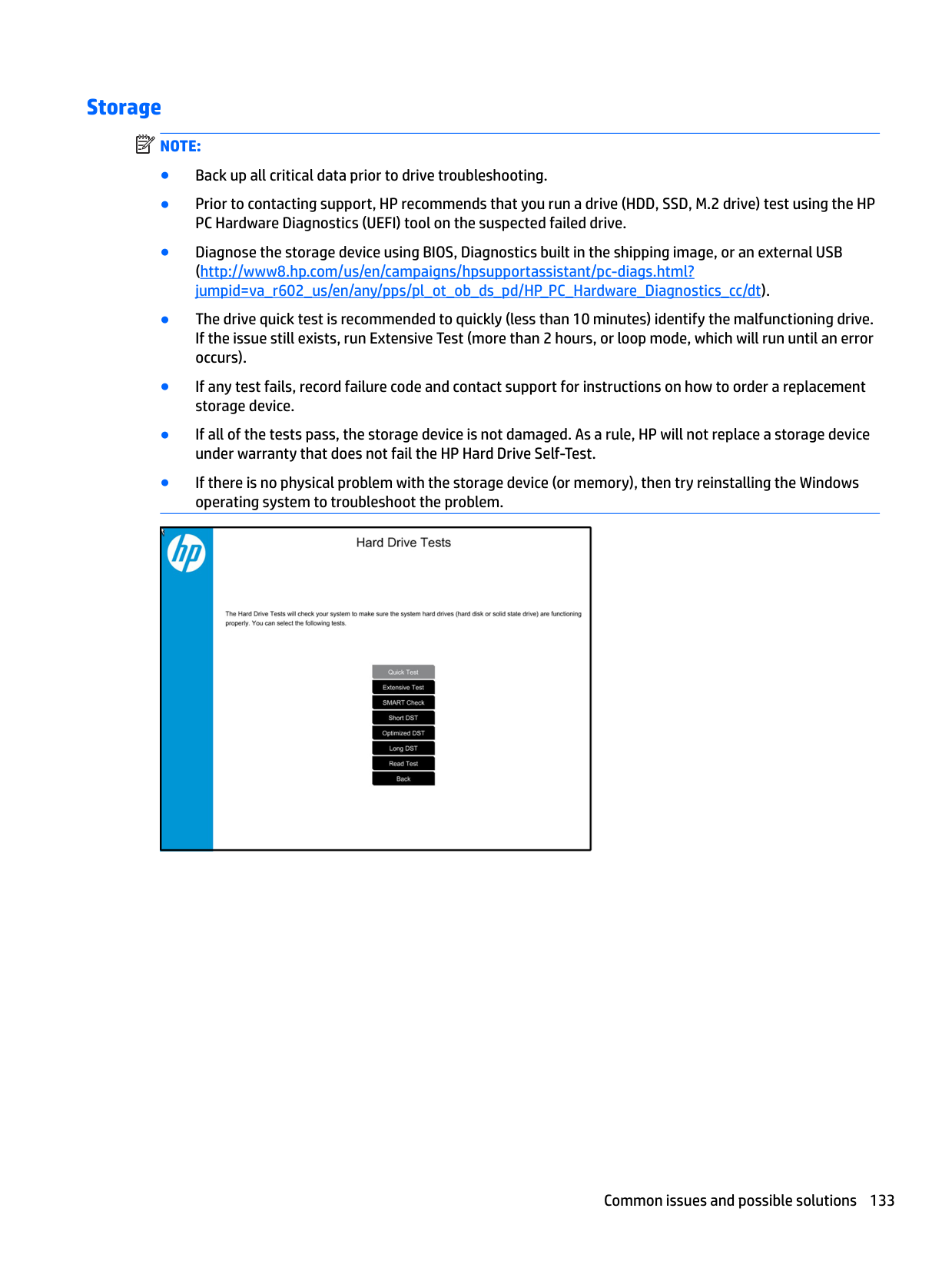
○ Use Thermal Monitor tool (available only to authorized service providers/ technicians) to run stress test (processor and GPU) and verify that thermal sensors are within limits after thermal condition is serviced.
Note See Reducing Heat Inside the PC to Prevent Overheating.
##### Stuck power button
Symptoms
Possible causes Sticky or defective power button. Troubleshooting steps General actions
######### The sections below are intended for authorized service providers/technicians.
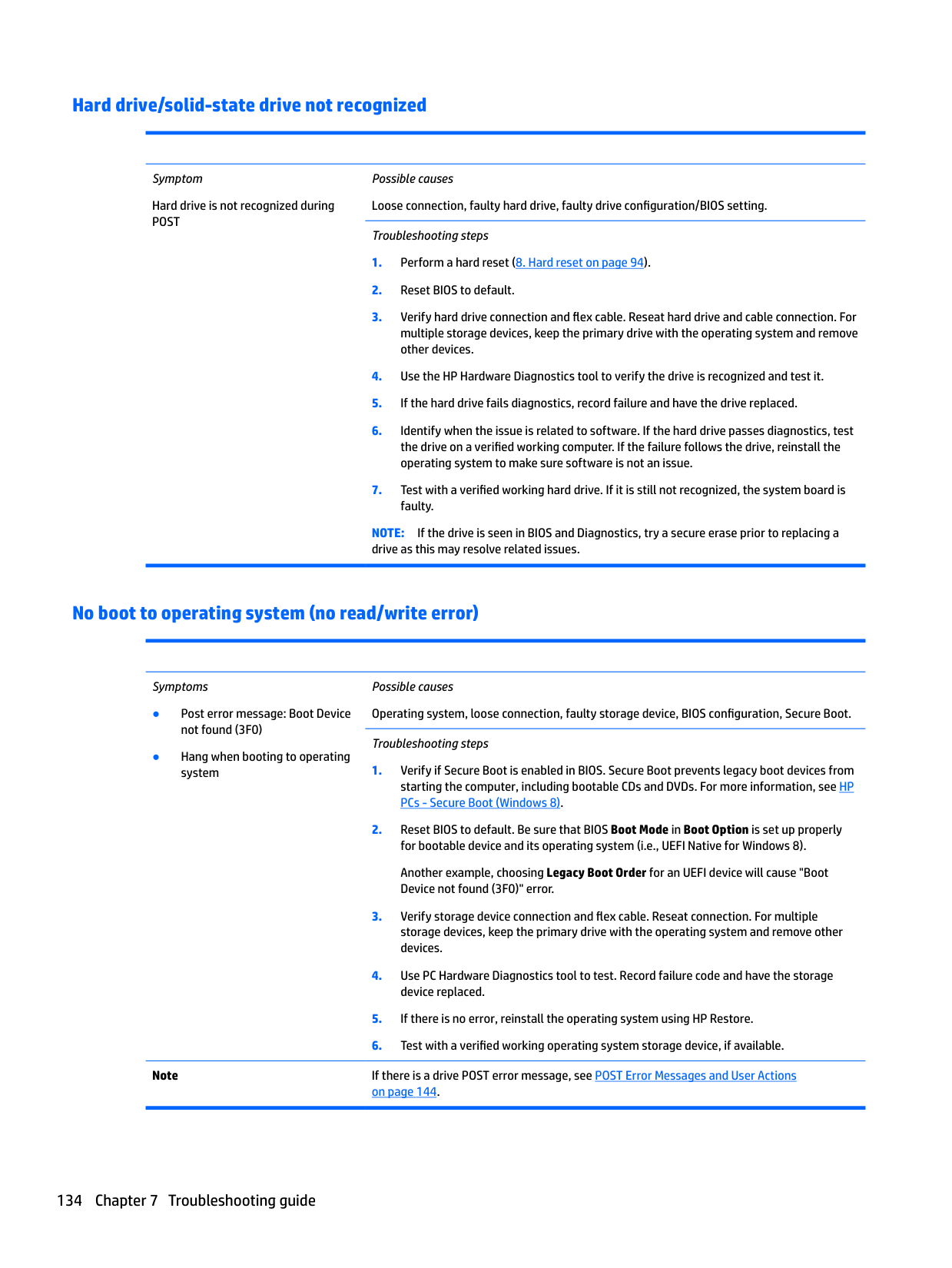
Additional information
The following sections provide additional information that can be used during the troubleshooting process.
Acronyms The following acronyms are used in this chapter. Blue screen (BSOD)—A Windows error screen that can occur if a problem causes your computer to shut down or restart unexpectedly. When you experience this type of error, you will not be able to see items such as the Start menu or the taskbar when your computer is turned on. Instead you might see a blue screen with a message that your computer ran into a problem and needs to restart. CPU—Central processing unit DIMM—Dual in-line memory module Daughterboard—Type of circuit board that plugs into or is attached to the system board or similar expansion card to extend its features and services. GPU–Graphics processor unit GTS–General Troubleshooting Step HDD–Hard drive KB–Keyboard LVDS–Low-Voltage Differential Signaling MSG–Maintenance and Service Guide mWS–Mobile Workstations WS–Workstations OS–Operating system PC–Personal computer POST–Power-On Self-Test SSD–Solid-state drive TSG–Troubleshooting Guide UEFI–Unified Extensible Firmware Interface WLAN–Wireless local area network WWAN–Wireless wide area network
#### Blinking lights and boot error codes
The information below is from the white paper HP Business Notebook and Desktop PC F10 Setup, 2014 Business PC models.
In some cases, when the host processor is not executing code or does not have the necessary code to drive the display, light blink codes inform you of a problem.
Table 7-6 Boot-error codes Blink codes Error Amber battery light: blinks 1 Hz continuously Embedded Controller unable to load firmware
##### Processor not executing code
This computer has experienced a problem due to the failure of certain code to execute, resulting in a failed startup of the processor. The issue could be related to the processor or the system board in the computer. If the processor is socketed, be sure that the processor is seated correctly in the socket. If this error reoccurs, refer to General troubleshooting steps on page 81.
| |
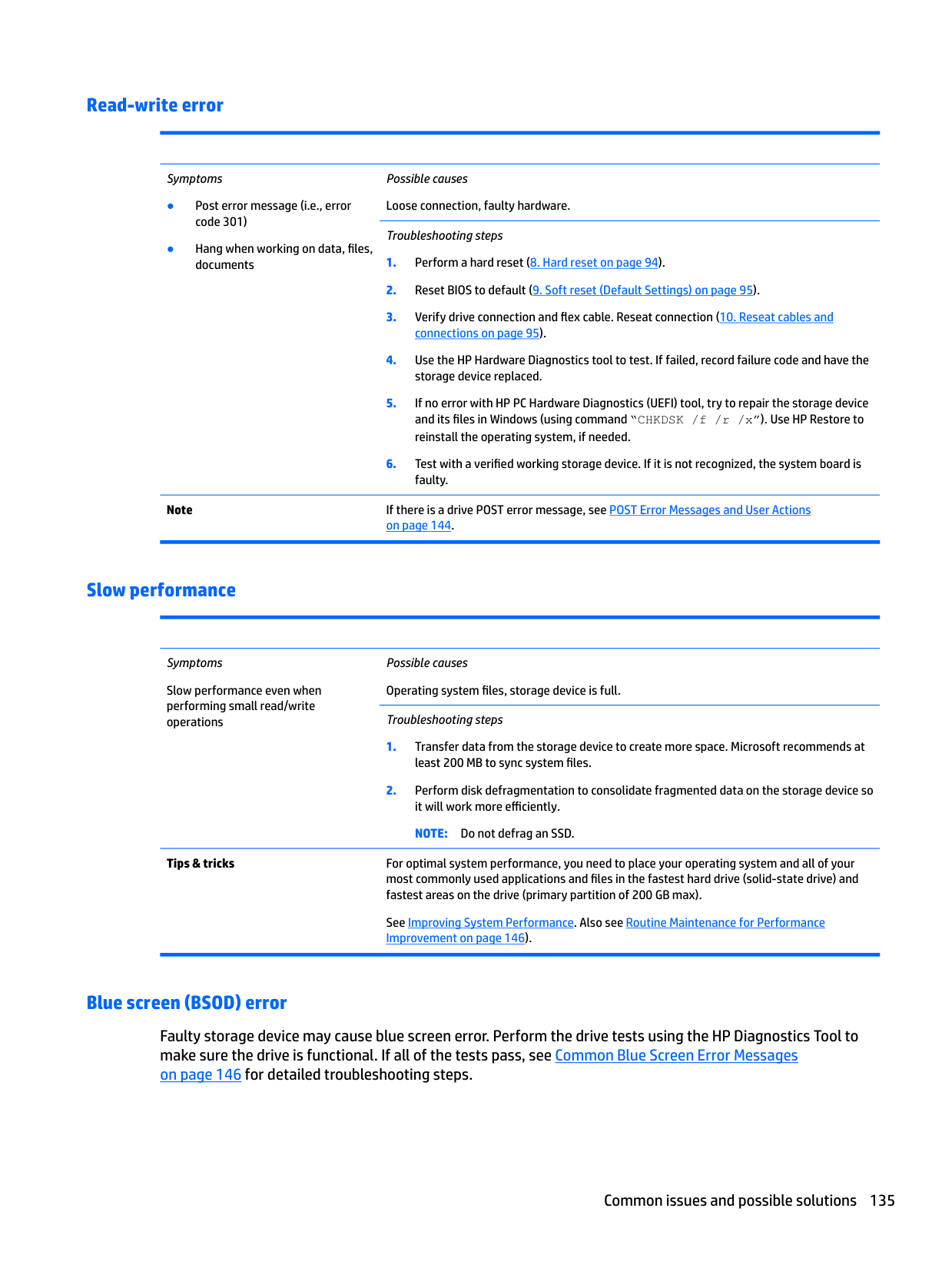
|---|
NOTE: The computer will attempt to notify you of this problem through a series of blinking lights. When you attempt to turn on the computer from an “Off” or “Hibernated” state, lights associated with the caps lock and num lock keys will both blink once followed by a pause, and then continue in a repeating pattern.
##### BIOS recovery code unable to find valid BIOS recovery image
This computer has experienced a problem in locating a valid BIOS image, resulting in a failed startup. This problem may be resolved by placing a clean copy of the system BIOS on a USB key or in the appropriate storage device directory and performing a reboot. If this error reoccurs, refer to General troubleshooting steps on page 81.
| | |---|
NOTE: The computer will attempt to notify you of this problem through a series of blinking lights. When you attempt to turn on the computer from an “Off” or “Hibernated” state, lights associated with the caps lock and num lock keys will both blink twice followed by a pause, and then continue in a repeating pattern.
##### Memory module error
This computer has experienced a memory initialization problem resulting in a failed startup. This issue may be related to the memory modules in the computer. This problem may be resolved by ensuring that memory modules are correctly inserted and seated. If this error reoccurs, a service event is required to determine the source of the error (memory modules or system board) and take the appropriate corrective action.
| | |---|
NOTE: The computer will attempt to notify you of this problem through a series of blinking lights. When you attempt to turn on the computer from an “Off” or “Hibernated” state, lights associated with the caps lock and num lock keys will both blink three times followed by a pause, then continue in a repeating pattern.
##### Graphics Controller Error (No Controller)
This computer has experienced a graphics controller initialization problem resulting in a failed startup. This issue may be related to the graphics controller in your machine. This problem may be resolved by ensuring that the graphics controller module is seated correctly in machines with modular graphics. If this error reoccurs, a service event is required to identify the source of the error and take the appropriate corrective action.
| | |---|
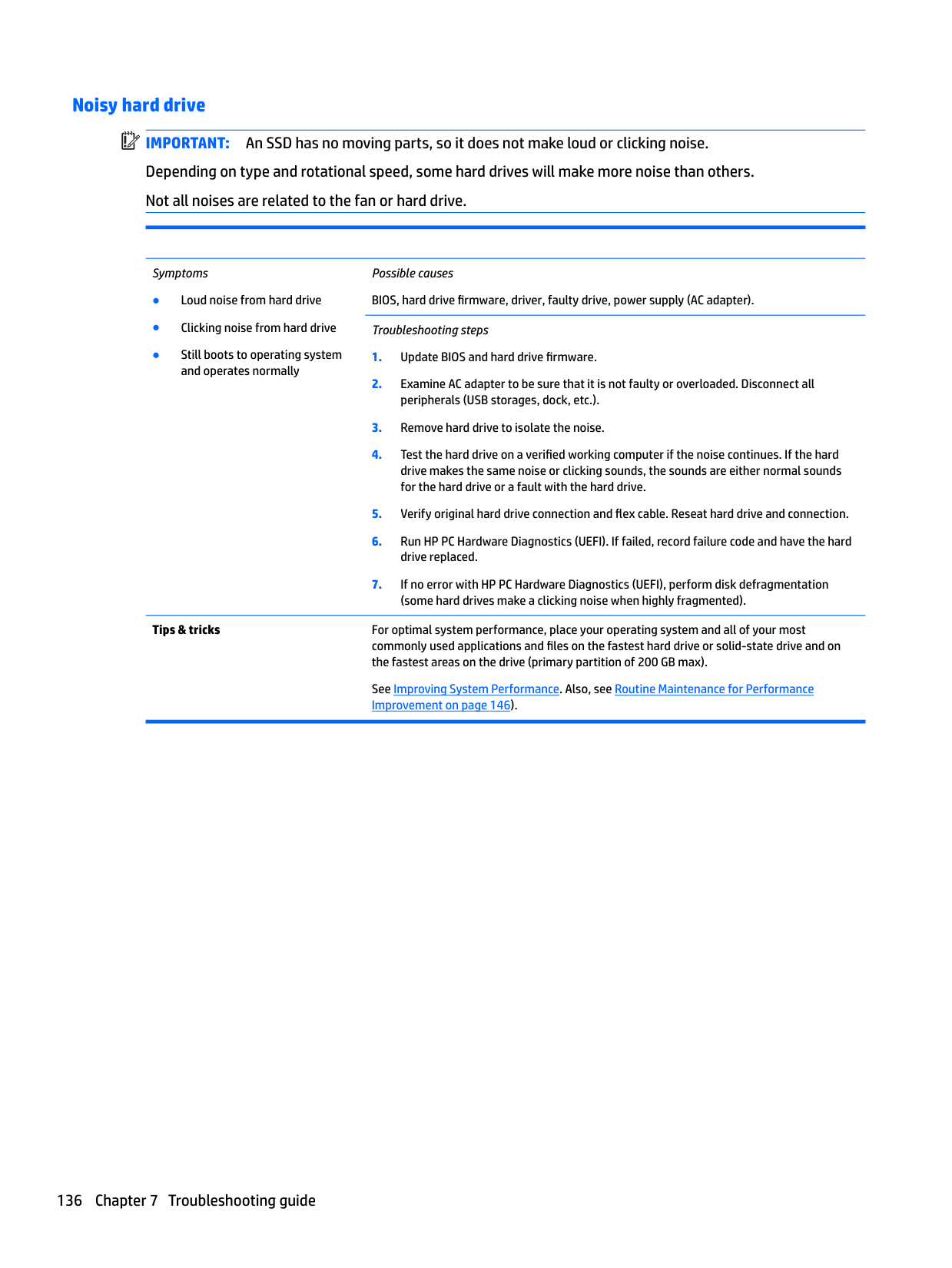
NOTE: The computer will attempt to notify you of this problem through a series of blinking lights. When you attempt to turn on the computer from an “Off” or “Hibernated” state, lights associated with the caps lock and num lock keys will both blink four times followed by a pause, then continue in a repeating pattern.
##### Failure - System Board Error
This computer has experienced a system board initialization problem resulting in a failed startup. This issue may be related to the system board in the computer. A service event is required to identify the source of the error and take the appropriate corrective action.
| | |---|
NOTE: The computer will attempt to notify you of this problem through a series of blinking lights. When you attempt to turn on the computer from an “Off” or “Hibernated” state, lights associated with the caps lock and num lock keys will both blink five times followed by a pause, then continue in a repeating pattern.
##### Intel Trusted Execution Technology (TXT) Error
This computer has experienced a problem related to the Intel Trusted Execution Technology resulting in a failed startup. The error occurs when all of the following are true:
| | |---|
NOTE: The computer will attempt to notify you of this problem through a series of blinking lights. When you attempt to turn on the computer from an “Off” or “Hibernated” state, lights associated with the caps lock and num lock keys will both blink six times followed by a pause, then continue in a repeating pattern.
##### Sure Start unable to find valid BIOS Boot Block image
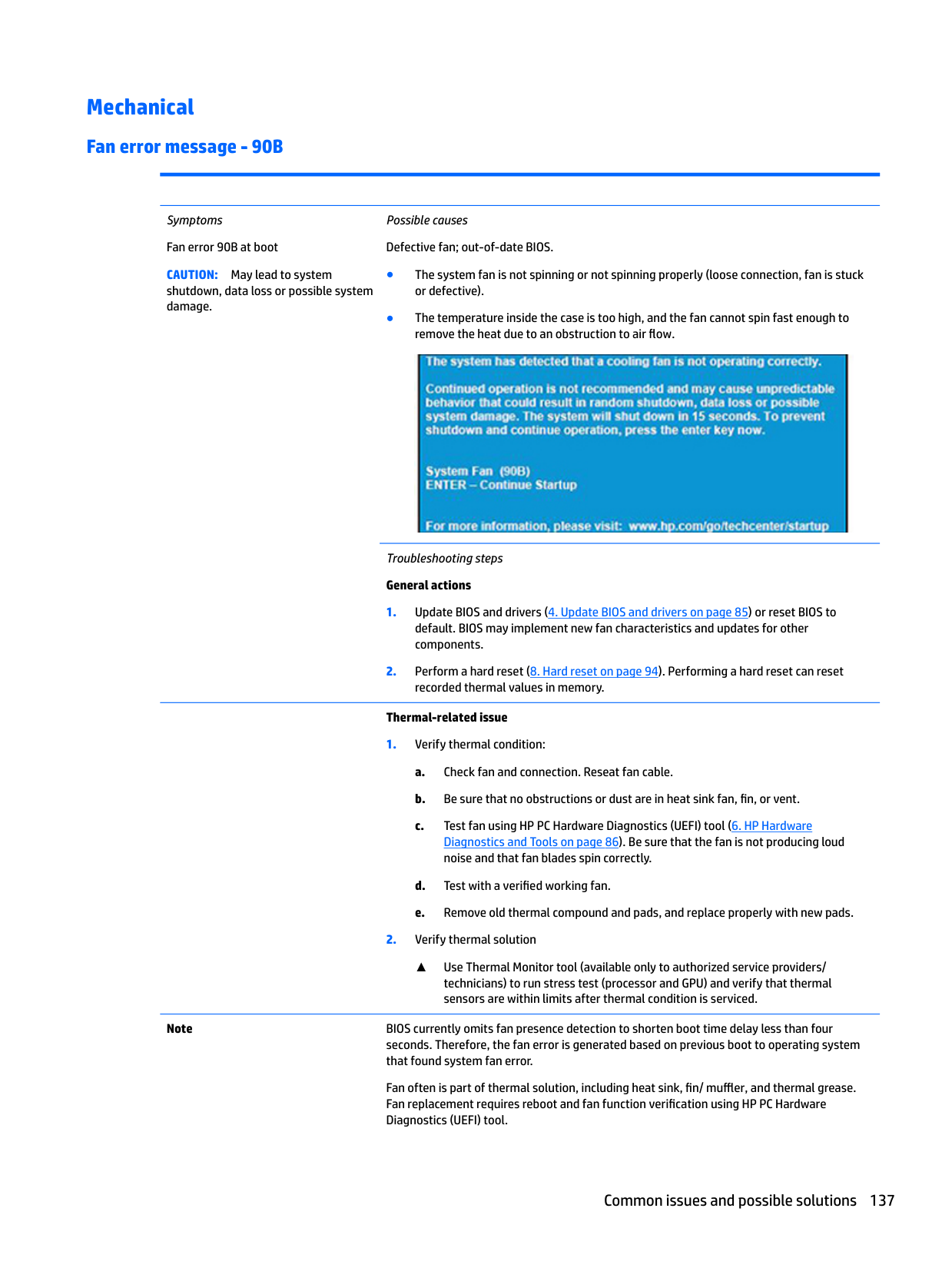
This computer has experienced a problem in locating a valid BIOS image, resulting in a failed startup. A service event is required to identify the source of the error and take appropriate corrective action.
| | |---|
NOTE: The computer will attempt to notify you of this problem through a series of blinking lights. When you attempt to turn on the computer from an “Off” or “Hibernated” state, lights associated with the caps lock and num lock keys will both blink seven times followed by a pause, then continue in a repeating pattern.
##### Sure Start has identified a problem (Manual Recovery Policy Set)
This computer has experienced a problem in locating a valid BIOS image, resulting in a failed startup. HP Sure Start will normally repair this type of issue; however, on this computer HP Sure Start has been configured to operate in manual mode key sequence. To proceed with the repair, press and hold the following keys:
| | |---|
NOTE: The computer will attempt to notify you of this problem through a series of blinking lights. When you attempt to turn on the computer from an “Off” or “Hibernated” state, lights associated with the caps lock and num lock keys will both blink eight times followed by a pause, then continue in a repeating pattern.
#### POST Error Messages and User Actions
######### Test description Failure descriptions Error code Possible user actions
Product information
Invalid value 00A Contact support for assistance.
Startup test Memory module 200 Attempt to reseat the memory module and then repeat the test. See Overview of How to Troubleshoot Problems When a Computer Does Not Start Up or Boot Properly for details on troubleshooting issues related to the memory module. If the memory module still fails, contact support.
Startup test Hard Disk 1 SMART 301 Attempt to reseat the storage device and repeat the test.
The hard disk drive may have failed. Contact support for assistance. Startup test Hard Disk 2 SMART 302 The storage device may have failed. Contact support for assistance. Startup test Hard Disk 1 Quick 303 The storage device may have failed. Contact support for assistance. Startup test Hard Disk 2 Quick 304 The storage device may have failed. Contact support for assistance. Run-in test Memory module 200 Attempt to reseat the memory module and then repeat the test.
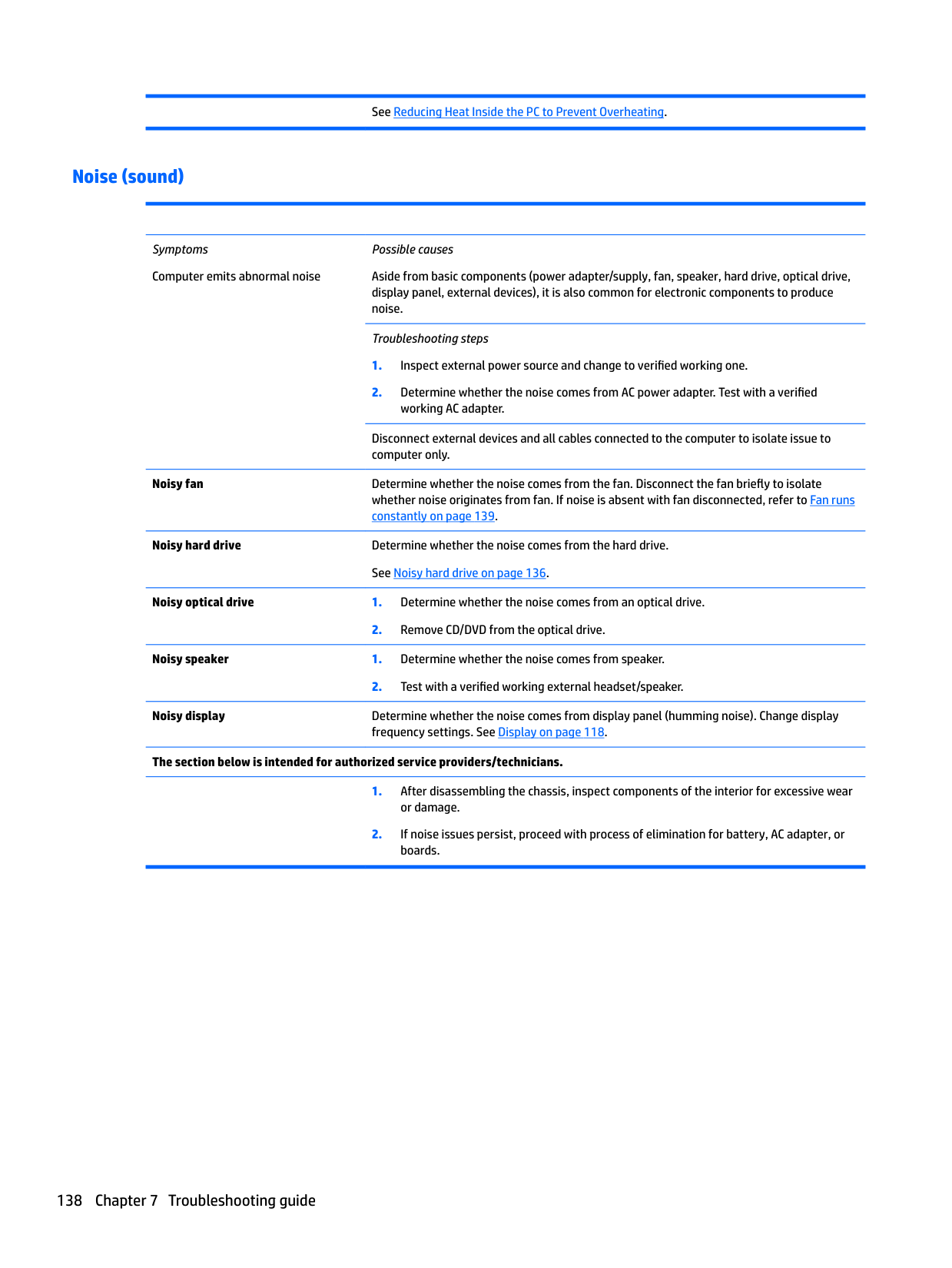
See Overview of How to Troubleshoot Problems When a Computer Does Not Start Up or Boot Properly for details on troubleshooting issues related to the memory module. If the memory module still fails, contact support.
The storage device may have failed. Contact support for assistance. Hard Disk Test Hard Disk 2 SMART 302 The storage device may have failed. Contact support for assistance. Hard Disk Test Hard Disk 1 Quick 303 The storage device may have failed. Contact support for assistance. Hard Disk Test Hard Disk 2 Quick 304 The storage device may have failed. Contact support for assistance.
Hard Disk Test Hard Disk 1 Full 305 The storage device may have failed. Contact support for assistance. Hard Disk Test Hard Disk 2 Full 306 The storage device may have failed. Contact support for assistance. Boot Device Manager
Boot device not found 3F0 Indicates a potential problem with the storage device. Please run the hard drive test. See Testing a Hard Disk using the Built in Self Test for more information.
Boot Device Manager
Hard Disk 1 Error 3F1 Indicates a potential problem with the storage device. Run the hard drive test. See Testing a Hard Disk using the Built in Self Test for more information.
Boot Device Manager
Hard Disk 2 Error 3F2 Indicates a potential problem with the storage device. Run the hard drive test. See Testing a Hard Disk using the Built in Self Test for more information.
Boot Device Manager
Hard Disk 1 SMART 301 Indicates a potential problem with the storage device. Run the hard drive test. See Testing a Hard Disk using the Built in Self Test for more information.
Boot Device Manager
Hard Disk 2 SMART 302 Indicates a potential problem with the storage device. Run the hard drive test. See Testing a Hard Disk using the Built in Self Test for more information.
BIOS Recovery BIOS Recovery Occurred
500 This message indicates that BIOS recovery was completed successfully. No further action is required.
BIOS Application BIOS Application Error 501 The BIOS installation may have become corrupted. Download the latest version of the BIOS and install it. See 4. Update BIOS and drivers on page 85 for more information.
If reinstalling the BIOS fails, contact support for further assistance. CMOS Recovery CMOS Recovery
502 This message indicates that CMOS recovery was completed successfully.
No further action is required. Battery Check Primary Battery
Occurred
601 This indicates that the primary battery has very low capacity. See Checking the Status of the Battery for details on using the HP Support Assistant to verify the battery capacity and, if necessary, order a replacement.
Replace
Battery Check Secondary Battery Replace
Wireless Module Not installed or responding
Fan Fan not operating correctly
602 This indicates that the secondary battery has very low capacity. See Checking the Status of the Battery for details on using the HP Support Assistant to verify the battery capacity and, if necessary, order a replacement.
701 Reseat the wireless LAN adapter module, if your notebook supports it.
Because seating or reseating a wireless LAN adapter is unique to each computer model. For more information, see the chapter titled “Removal and replacement procedures for Customer Self-Repair parts.”
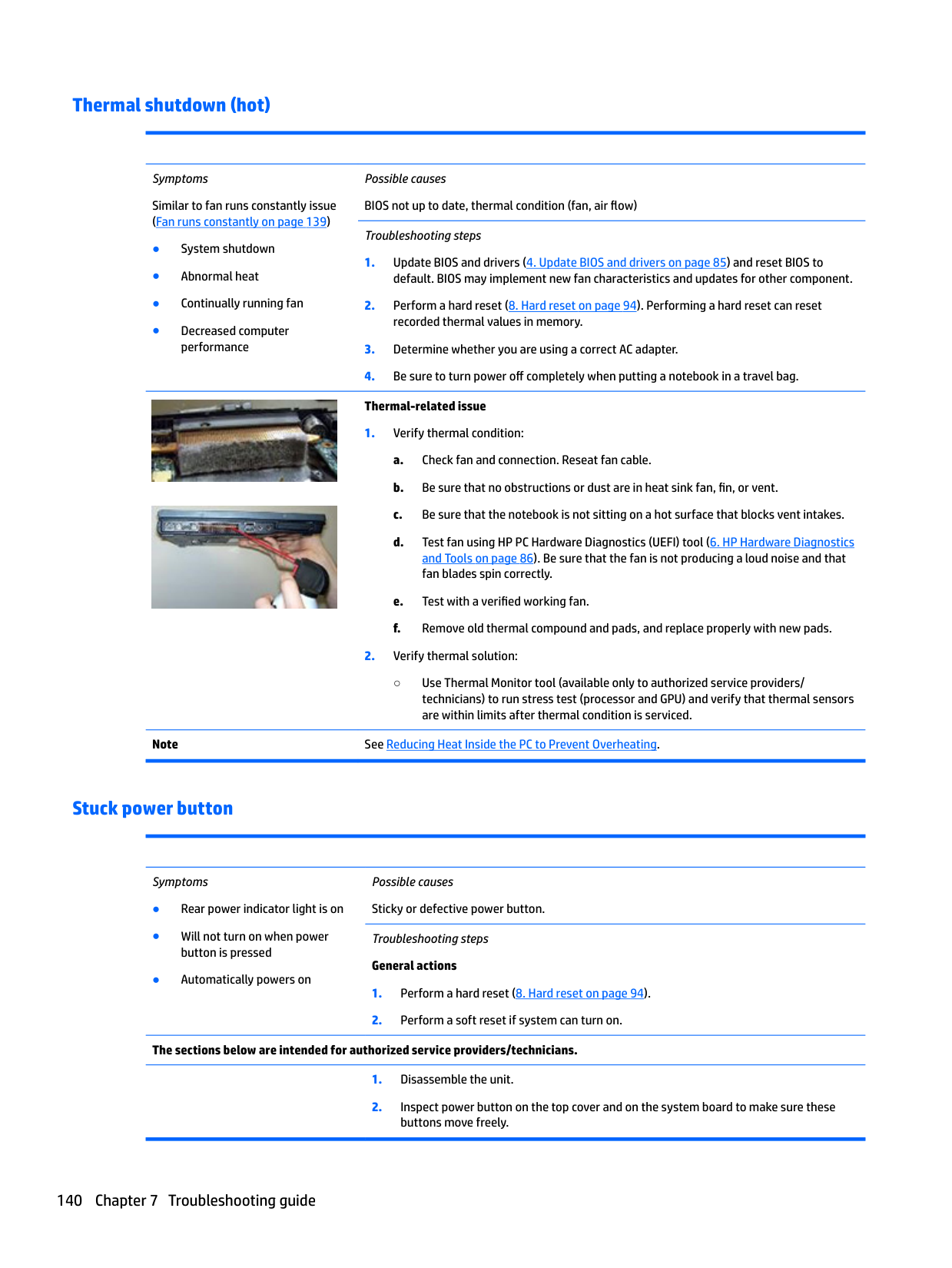
90B The system fan may be malfunctioning.
For information on troubleshooting heat-related issues, see HP Notebook PCs - Fan is Noisy and Spins Constantly, PC is Warmer than Normal.
A hard reset can sometimes restore the system fan to working order. See Use Hard Reset to Resolve Hardware and Software Issues for details.
If the system fan continues to malfunction, contact support.
Routine Maintenance for Performance Improvement See HP Notebook PCs - Improving the Performance of Your Computer. The following table presents a summary of the suggested times for performing the routine maintenance tasks described in this document.
Tasks Weekly Monthly Occasionally Perform a system tune up. X Run Windows Update. X Scan for and remove viruses. X Scan for and remove spyware and adware. X Empty the Recycle Bin. X Delete temporary Internet files. X Back up user files. X Create a restore point. X Defragment the hard drive. X Run Scan Disk. X Clean the exterior of the computer. X Close programs that are not being used. X Prevent programs from loading at startup. X
#### Common Blue Screen Error Messages Error message list
The following image shows an example of one possible “Bug Check (Blue Screen) Code Reference” from Microsoft:

The hexadecimal number following the word "STOP" is called the bug check code or Stop code. This is the most important item on the screen.
##### Bug check symbolic names
Each bug check code also has an associated symbolic name. In the example, the screen shows bug check 0x79 (MISMATCHED_HAL).
##### Microsoft general troubleshooting of Windows bug check codes
NOTE: Use safe mode when removing or disabling components. Safe mode loads only the minimum required drivers and system services during the Windows startup. To enter safe mode, restart your computer and press F8 at the menu that displays the operating system choices. At the resulting Windows Advanced Options menu, choose Safe Mode.
| | |---|
#### Use Windows Debugging Tool
The Windows Debugger is one of the primary tools used by Microsoft software developers to analyze and resolve errors that result in memory dumps. Use the tool to determine the cause of the error. Follow general steps for downloading, setting up, and using the Windows 10 debugging tool. A similar process is used for Windows 7 or Windows 8.
| | |---|
NOTE: The following screen shots provide only an example of the tool. Specifics shown are not representative of all applications of the debugging tool. This is a Microsoft tool supported by Microsoft.
##### Windows Software Development Kit (SDK)


####### 6. Open the crash dump file.

####### 7. Analyze the file. In the following memory dump sample, look for Bug Check 0x3B. The ATIKMAG driverneeds to be investigated for further root cause.Lookup for Bug Check 0xC2.


#### Display Issue: Pixel Anomalies
All HP notebook displays adhere to strict quality and reliability specifications. A small percentage of display panels may have minor cosmetic manufacturing anomalies or irregularities such as bright or dark dots in the viewable area. These cosmetic imperfections are common to all display panel types and are not specific to any HP model or product line.
All display panel defects should be examined at the highest possible resolution using both the brightest and darkest possible backgrounds, because some sub-pixel failures may not be readily visible under certain conditions.
Use the HP PC Hardware Diagnostics (UEFI) tool to determine numbers of pixels and their distance. HP uses the following set of criteria when damaged displays are submitted for warranty coverage.
Source: HP Notebook PCs and Tablets - About LCD Panel Defects and Terminology for Notebook PCs and Tablets
Table 7-7 Electrical defect allowances Panel resolution Accept Reject Sub-pixel faults VGA, SVGA, SD, WSVGA, XGA, 720p, SD+, WXGA, HD N ≤ 2 Type 1
N ≥ 3 Type 1
N ≤ 2 Type 2
WXGA+, SXGA+, HD+, SXGA+ N ≤ 3 Type 1 N ≤ 3 Type 2
N ≥ 4 Type 1
WSXGA+, UXGA, FHD, WUXGA N ≤ 4 Type 1 N ≤ 4 Type 2
N ≥ 5 Type 1
QHD, QHD+, WQXGA, UD N ≤ 5 Type 1 N ≤ 5 Type 2
N ≥ 6 Type 1
Electrical defect clusters (defects within a 5x5 pixel block) Minimum distance between ANY allowable defects (unless otherwise specified) S ≥ 25 mm S < 25 mm Cluster with 2 or more sub-pixels with sub-pixel faults Not allowed Dim lines Not allowed Cross line(s) on/off Not allowed Horizontal line(s) on/off Not allowed Vertical line(s) on/off Not allowed
| | |---|
NOTE: All LCD panel defects should be examined at the highest possible resolution using both the brightest and darkest possible backgrounds, as some sub-pixel failures may not be readily visible under certain conditions.
| | |---|
NOTE: Contact support for assistance if issues are not listed.
#### Cable management
Proper routing of the internal cables is critical to the operation of the computer. Follow good cable management practices when removing and installing components.
CAUTION: Always release connector latch before removing the cable. Otherwise, pulling the cable could damage the cable pins and result in a failed device.
#### Connector types
| | |---|
IMPORTANT: Connector pins and connector gold fingers should not be touched directly with bare hands. There are several different types of connectors on the system board with different requirements for cable removal or insertion.
Flex cable When connecting flex cables, push the cable completely, evenly into the connector. When removing flex cables from a ZIF connector on the system board, always follow these steps:
CAUTION: Always release connector latch before removing the cable. Otherwise, pulling the cable could damage the cable pins and result in a failed device.

Horizontal installation cable Use flat tool to pull connector evenly. Do not pull on cable to remove. Slide connector into receptacle on same horizontal plane as board and use flat tool to push evenly into receptacle.

Multi-pin horizontal insert connector (LVDS cable to display panel) Insert procedure:
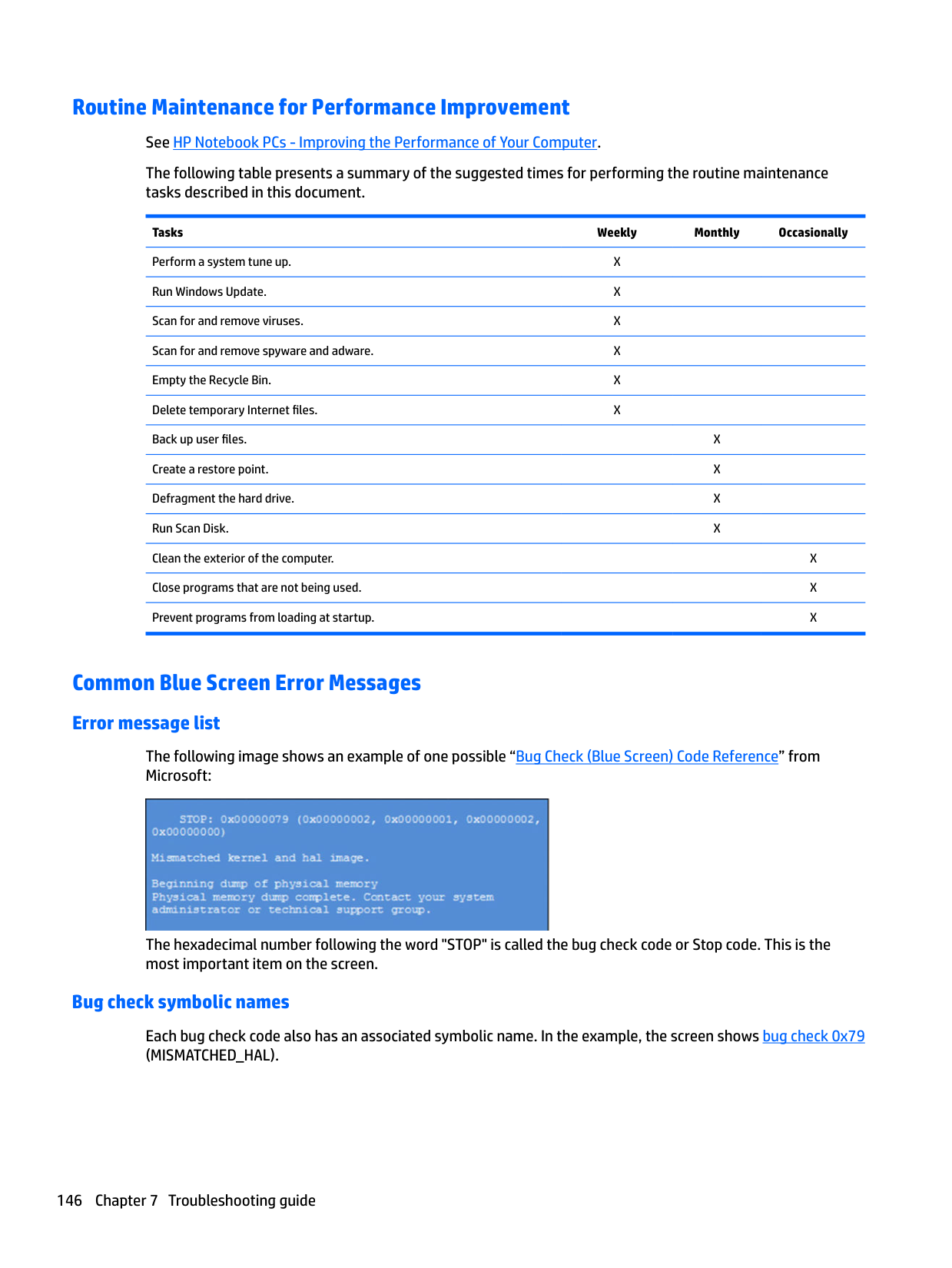

###### Multi-pin vertical insert connector (LVDS cable to system board)

For more information about cable management, see Cable management on page 153.
8 Computer Setup (BIOS), TPM, and HP SureStart in Windows 7
Using Computer Setup
Computer Setup, or Basic Input/Output System (BIOS), controls communication between all the input and output devices on the system (such as disk drives, display, keyboard, mouse, and printer). Computer Setup includes settings for the types of devices installed, the startup sequence of the computer, and the amount of system and extended memory.
| | |---|
NOTE: Use extreme care when making changes in Computer Setup. Errors can prevent the computer from operating properly.
Starting Computer Setup NOTE: An external keyboard or mouse connected to a USB port can be used with Computer Setup only if USB legacy support is enabled. To start Computer Setup, follow these steps:
| | |---|
▲ Start Computer Setup.
▲ Turn on or restart the computer, and when the HP logo appears, press f10 to enter Computer
Setup.
▲ Turn off the tablet. Press the power button in combination with the volume down button until
the Startup menu is displayed, and then tap F10 to enter Computer Setup.
#### Navigating and selecting in Computer Setup
| | |---|
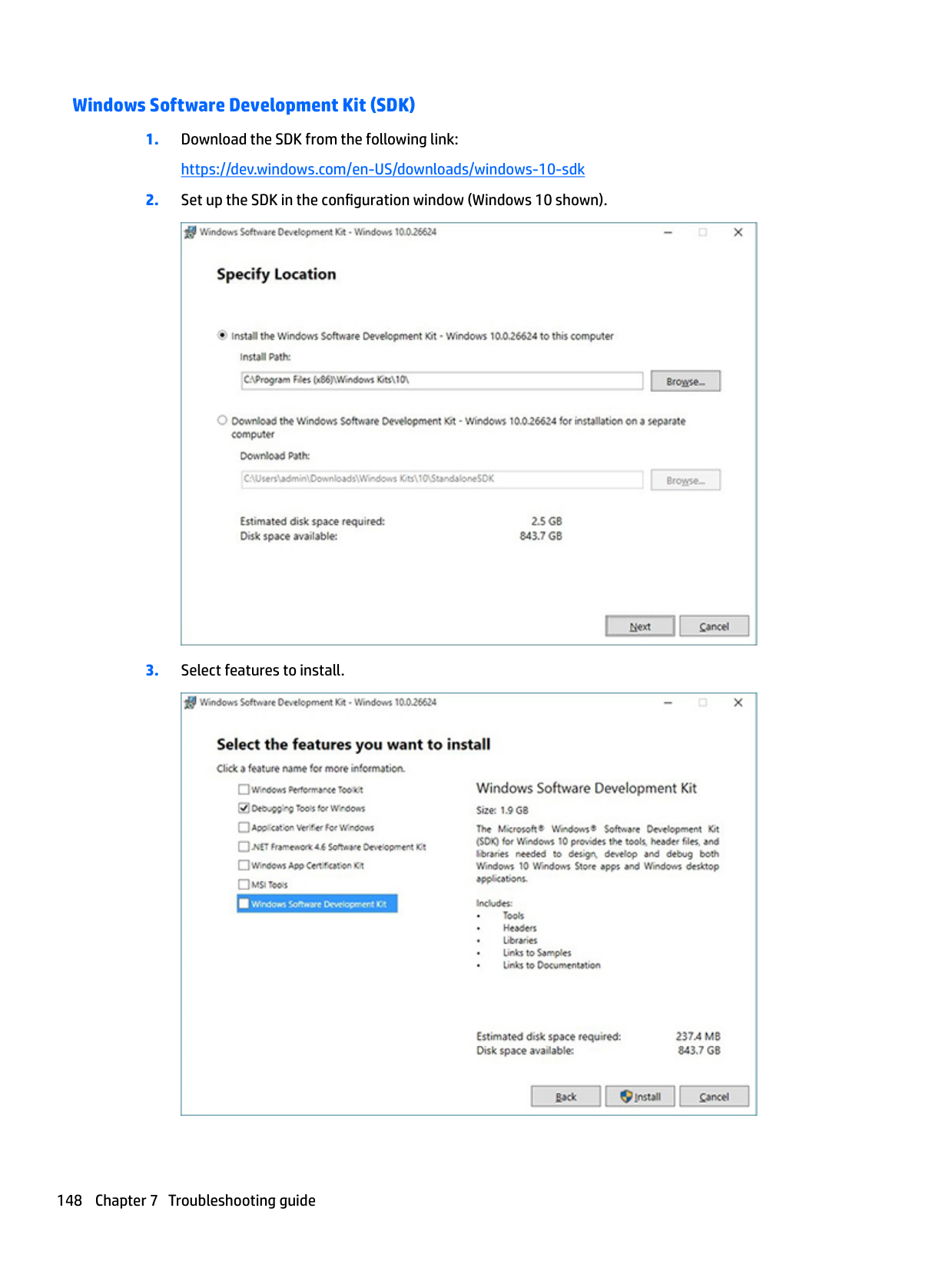
To exit Computer Setup menus, choose one of the following methods:
– or – Select Main, select Ignore Changes and Exit, and then press enter.
– or – Select Main, select Save Changes and Exit, and then press enter.
Your changes go into effect when the computer restarts.
Restoring factory settings in Computer Setup NOTE: Restoring defaults will not change the hard drive mode. To return all settings in Computer Setup to the values that were set at the factory, follow these steps:
| | |---|
NOTE: On select products, the selections may display Restore Defaults instead of Apply Factory Defaults and Exit.
| | |---|
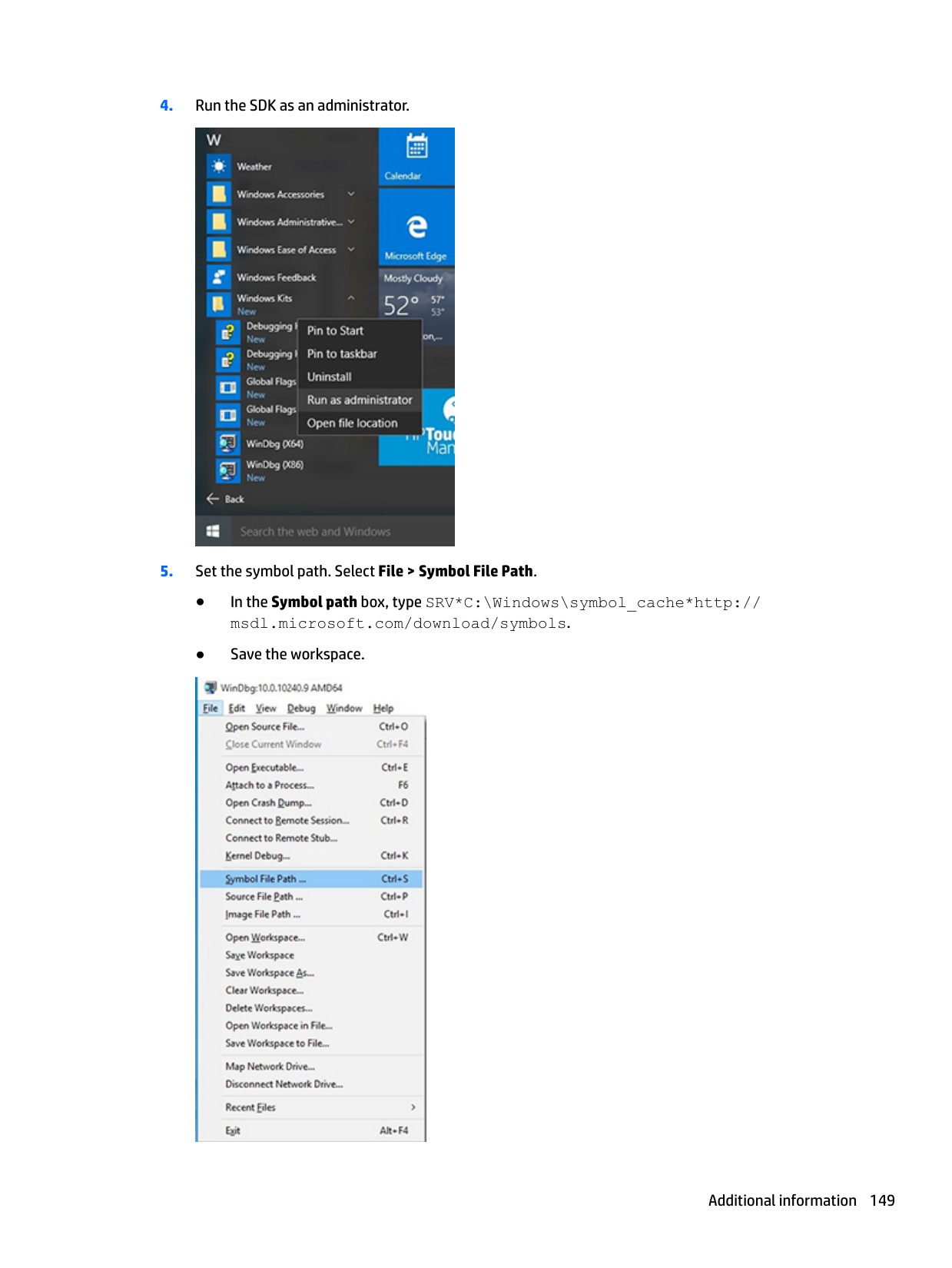
– or – Select Main, select Save Changes and Exit, and then press enter.
| | |---|
Your changes go into effect when the computer restarts. NOTE: Your password settings and security settings are not changed when you restore the factory settings.
Updating the BIOS Updated versions of the BIOS may be available on the HP website. Most BIOS updates on the HP website are packaged in compressed files called SoftPaqs. Some download packages contain a file named Readme.txt, which contains information regarding installing and troubleshooting the file.
##### Determining the BIOS version
To decide whether you need to update Computer Setup (BIOS), first determine the BIOS version on your computer.
BIOS version information (also known as ROM date and System BIOS) can be accessed by pressing fn+esc (if you are already in Windows) or by using Computer Setup.
Using Computer Setup 157
– or – Select Main, select Ignore Changes and Exit, and then press enter. To check for later BIOS versions, see Downloading a BIOS update on page 158. Downloading a BIOS update
CAUTION: To reduce the risk of damage to the computer or an unsuccessful installation, download and install a BIOS update only when the computer is connected to reliable external power using the AC adapter. Do not download or install a BIOS update while the computer is running on battery power, docked in an optional docking device, or connected to an optional power source. During the download and installation, follow these instructions:
Do not disconnect power on the computer by unplugging the power cord from the AC outlet. Do not shut down the computer or initiate Sleep. Do not insert, remove, connect, or disconnect any device, cable, or cord.
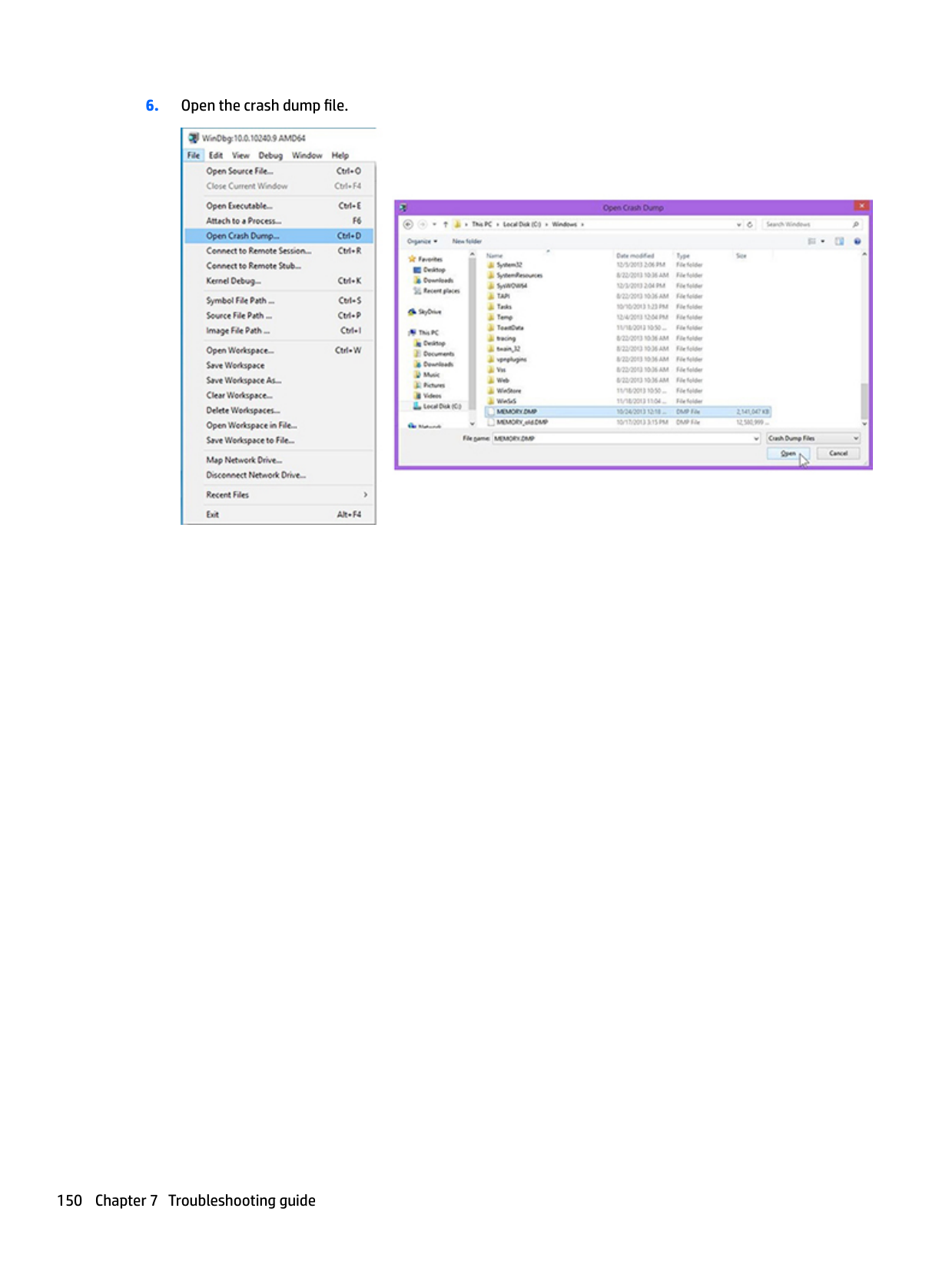
Make a note of the path to the location on your storage device where the BIOS update is downloaded. You will need to access this path when you are ready to install the update.
| | |---|
NOTE: If you connect your computer to a network, consult the network administrator before installing any software updates, especially system BIOS updates.
BIOS installation procedures vary. Follow any instructions that are revealed on the screen after the download is complete. If no instructions are revealed, follow these steps:
| | |---|
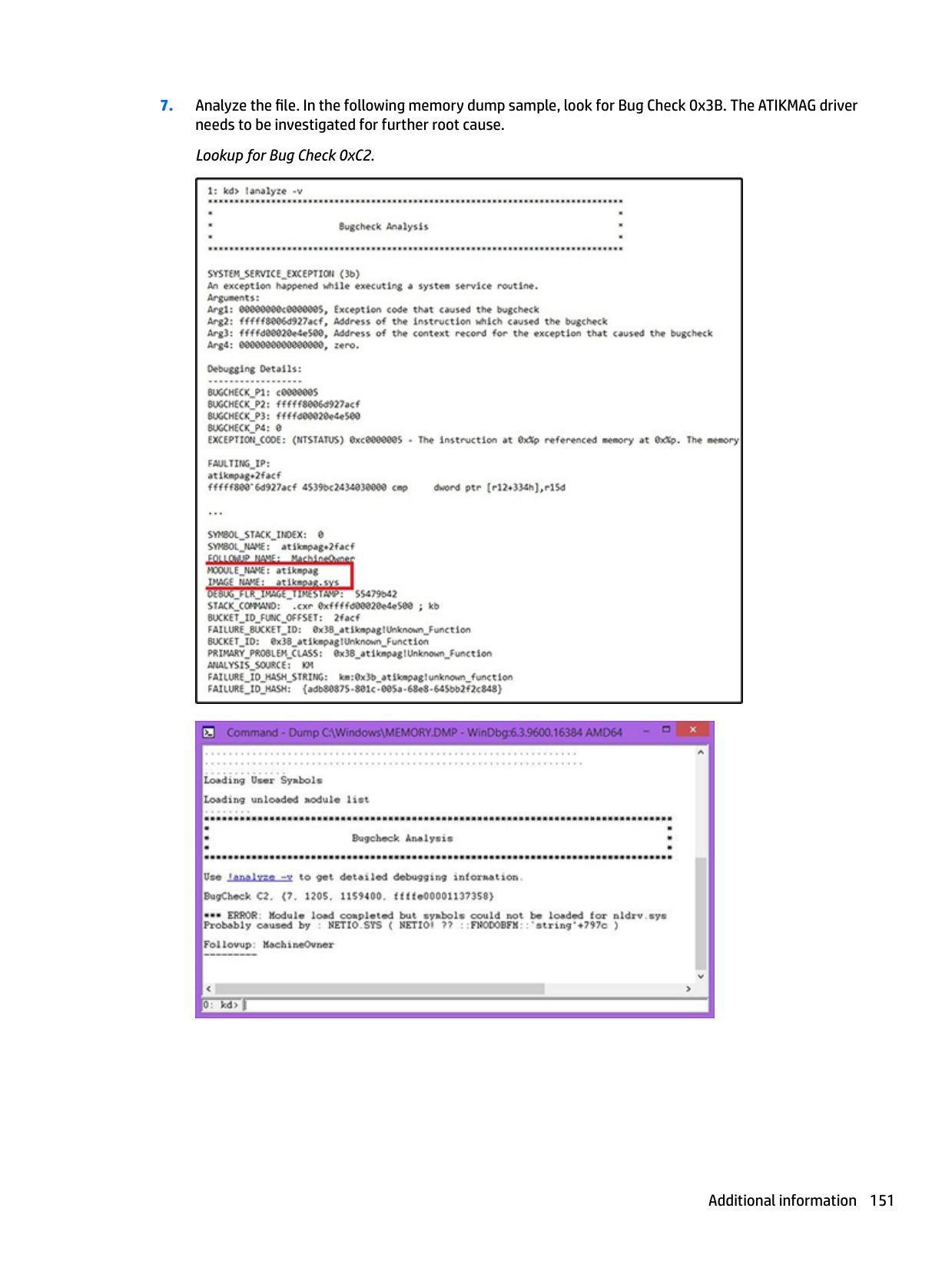
NOTE: After a message on the screen reports a successful installation, you can delete the downloaded file from your storage device.
#### Changing the boot order using the f9 prompt
To dynamically choose a boot device for the current startup sequence, follow these steps:
▲ Turn on or restart the computer, and when the HP logo appears, press f9 to enter the Boot
Device Options menu.
▲ Turn off the tablet. Press the power button in combination with the volume down button until
the Startup menu is displayed, and then tap F9 to enter the Boot Device Options menu.
TPM BIOS settings (select products only)
| | |---|
IMPORTANT: Before enabling Trusted Platform Module (TPM) functionality on this system, you must ensure that your intended use of TPM complies with relevant local laws, regulations and policies, and approvals or licenses must be obtained if applicable. For any compliance issues arising from your operation/usage of TPM which violates the above mentioned requirement, you shall bear all the liabilities wholly and solely. HP will not be responsible for any related liabilities.
TPM provides additional security for your computer. You can modify the TPM settings in Computer Setup (BIOS).
| | |---|
NOTE: If you change the TPM setting to Hidden, TPM is not visible in the operating system. To access TPM settings in Computer Setup:
Using HP Sure Start (select products only)
Select computer models are configured with HP Sure Start, a technology that continuously monitors the computer's BIOS for attacks or corruption. If the BIOS becomes corrupted or is attacked, HP Sure Start automatically restores the BIOS to its previously safe state, without user intervention.
HP Sure Start is configured and already enabled so that most users can use the HP Sure Start default configuration. The default configuration can be customized by advanced users.
To access the latest documentation on HP Sure Start, go to http://www.hp.com/support, and select your country. Select Drivers & Downloads, and then follow the on-screen instructions.
TPM BIOS settings (select products only) 159
9 Computer Setup (BIOS), TPM, and HP SureStart in Windows 10
Using Computer Setup
Computer Setup, or Basic Input/Output System (BIOS), controls communication between all the input and output devices on the system (such as disk drives, display, keyboard, mouse, and printer). Computer Setup includes settings for the types of devices installed, the startup sequence of the computer, and the amount of system and extended memory.
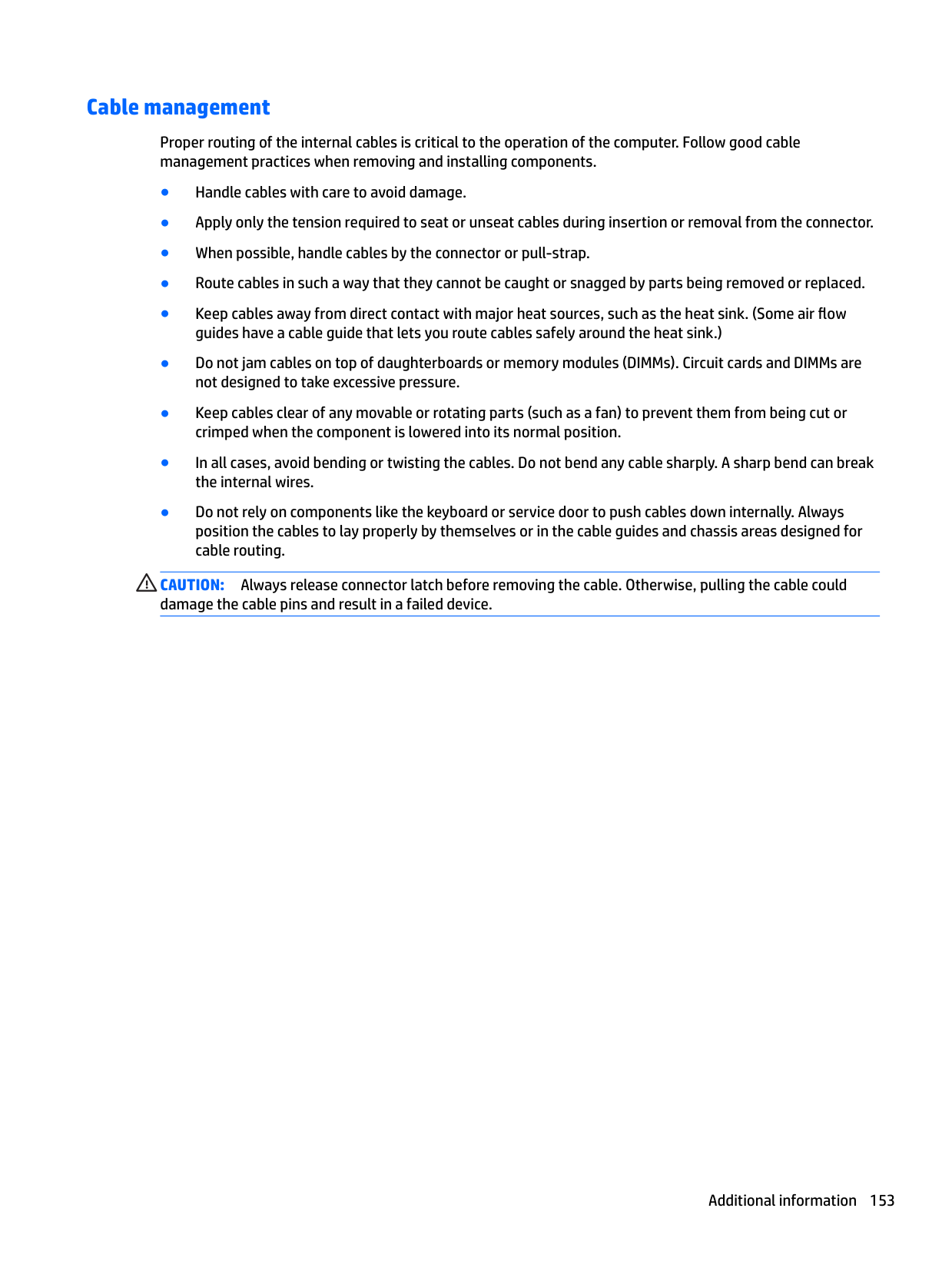
| | |---|
NOTE: Use extreme care when making changes in Computer Setup. Errors can prevent the computer from operating properly.
Starting Computer Setup NOTE: An external keyboard or mouse connected to a USB port can be used with Computer Setup only if USB legacy support is enabled. To start Computer Setup, follow these steps:
| | |---|
▲ Start Computer Setup.
● Computers or tablets with keyboards:
▲ Turn on or restart the computer, and when the HP logo appears, press f10 to enter Computer
Setup.
● Tablets without keyboards:
▲ Turn off the tablet. Press the power button in combination with the volume down button until
the Startup menu is displayed, and then tap F10 to enter Computer Setup.
#### Navigating and selecting in Computer Setup
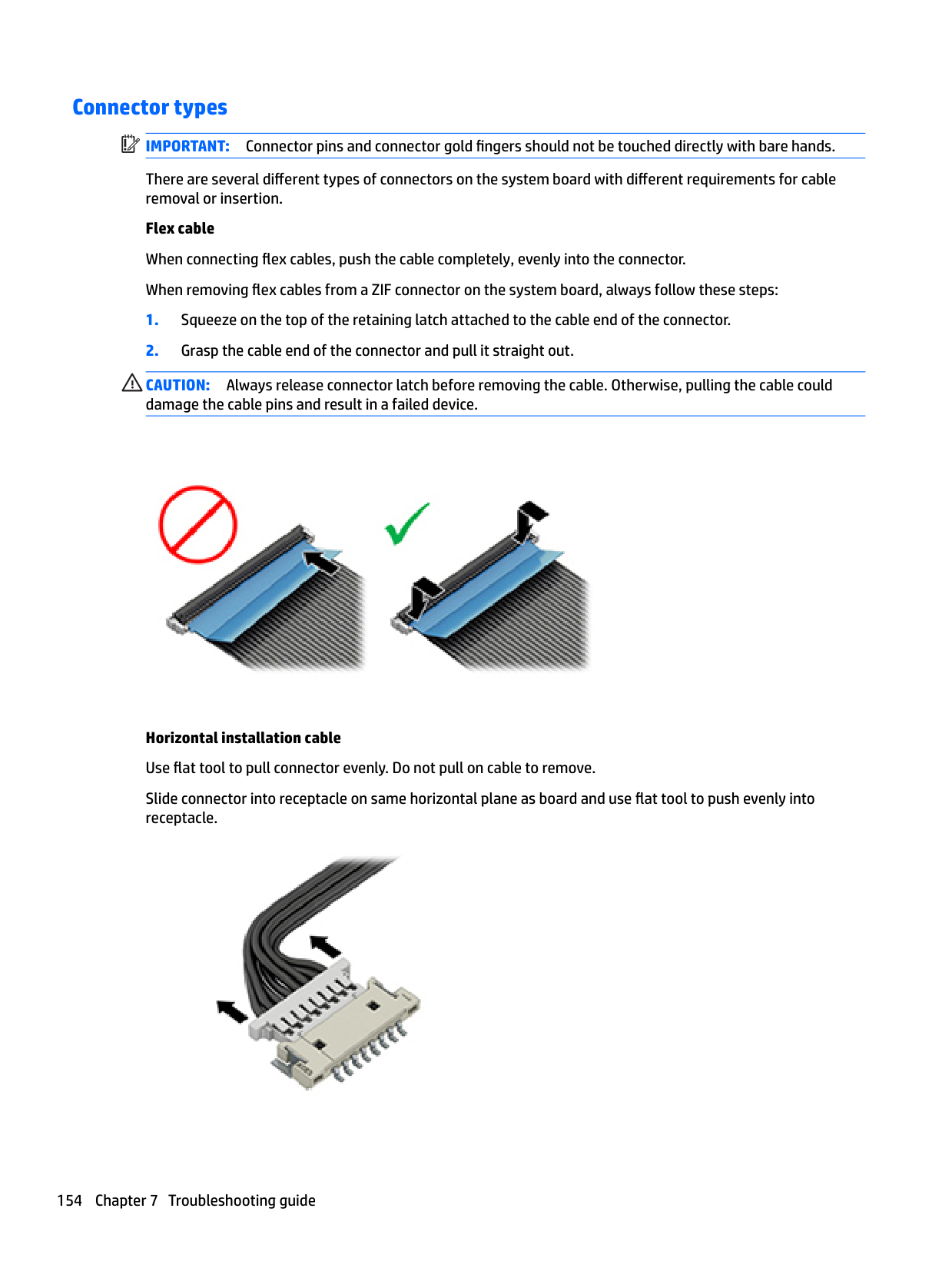
| | |---|
To exit Computer Setup menus, choose one of the following methods:
● To exit Computer Setup menus without saving your changes: Select the Exit icon in the lower-right corner of the screen, and then follow the on-screen instructions.
– or – Select Main, select Ignore Changes and Exit, and then press enter.
● To save your changes and exit Computer Setup menus: Select the Save icon in the lower-right corner of the screen, and then follow the on-screen instructions.
– or – Select Main, select Save Changes and Exit, and then press enter.
Your changes go into effect when the computer restarts.
Restoring factory settings in Computer Setup NOTE: Restoring defaults will not change the storage device mode. To return all settings in Computer Setup to the values that were set at the factory, follow these steps:
| | |---|
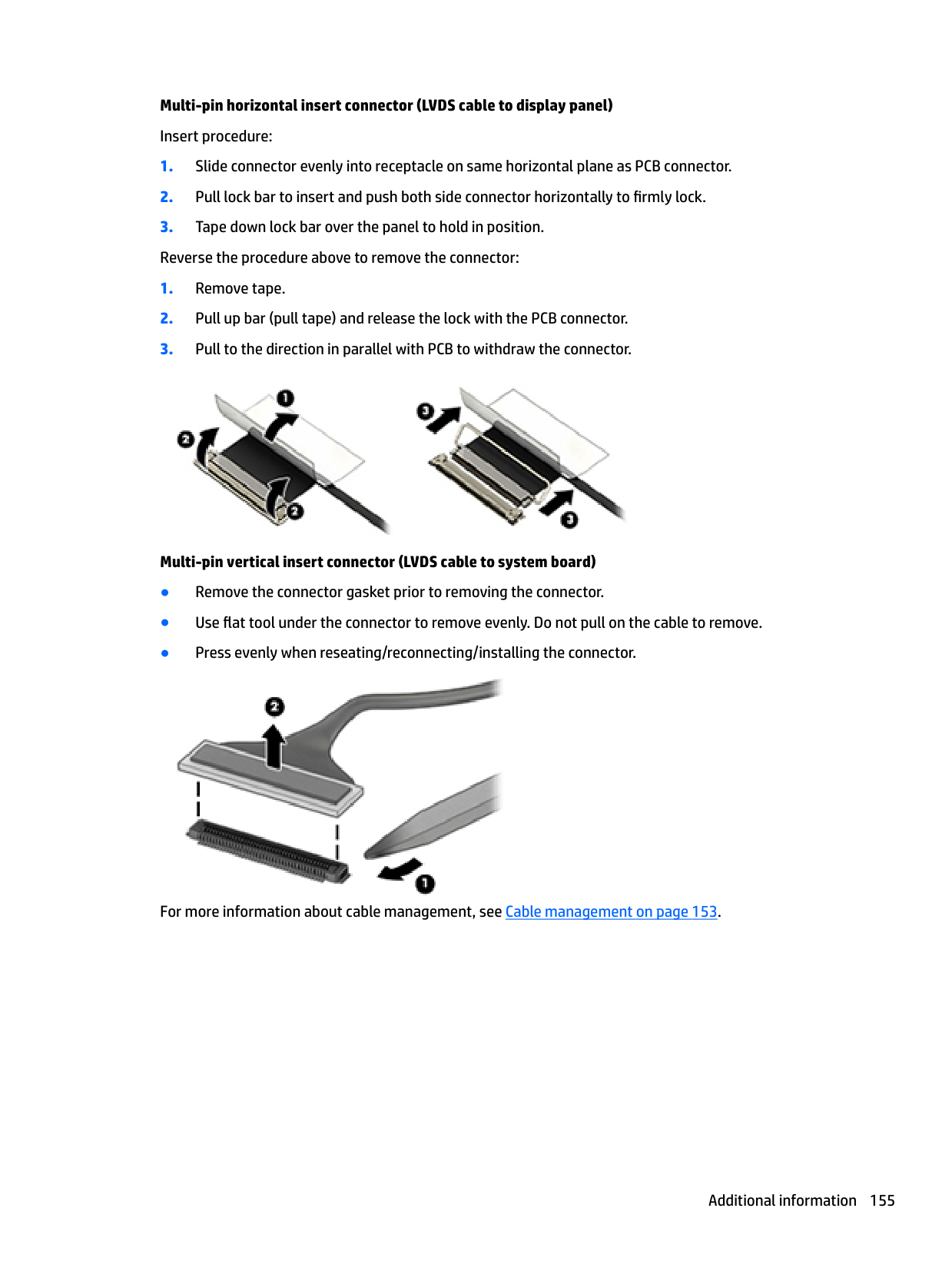
| | |---|
follow the on-screen instructions.
– or – Select Main, select Save Changes and Exit, and then press enter.
| | |---|
Your changes go into effect when the computer restarts. NOTE: Your password settings and security settings are not changed when you restore the factory settings.
Using Computer Setup 161
Updating the BIOS Updated versions of the BIOS may be available on the HP website. Most BIOS updates on the HP website are packaged in compressed files called SoftPaqs. Some download packages contain a file named Readme.txt, which contains information regarding installing and troubleshooting the file.
##### Determining the BIOS version
To decide whether you need to update Computer Setup (BIOS), first determine the BIOS version on your computer.
BIOS version information (also known as ROM date and System BIOS) can be accessed by pressing fn+esc (if you are already in Windows) or by using Computer Setup.
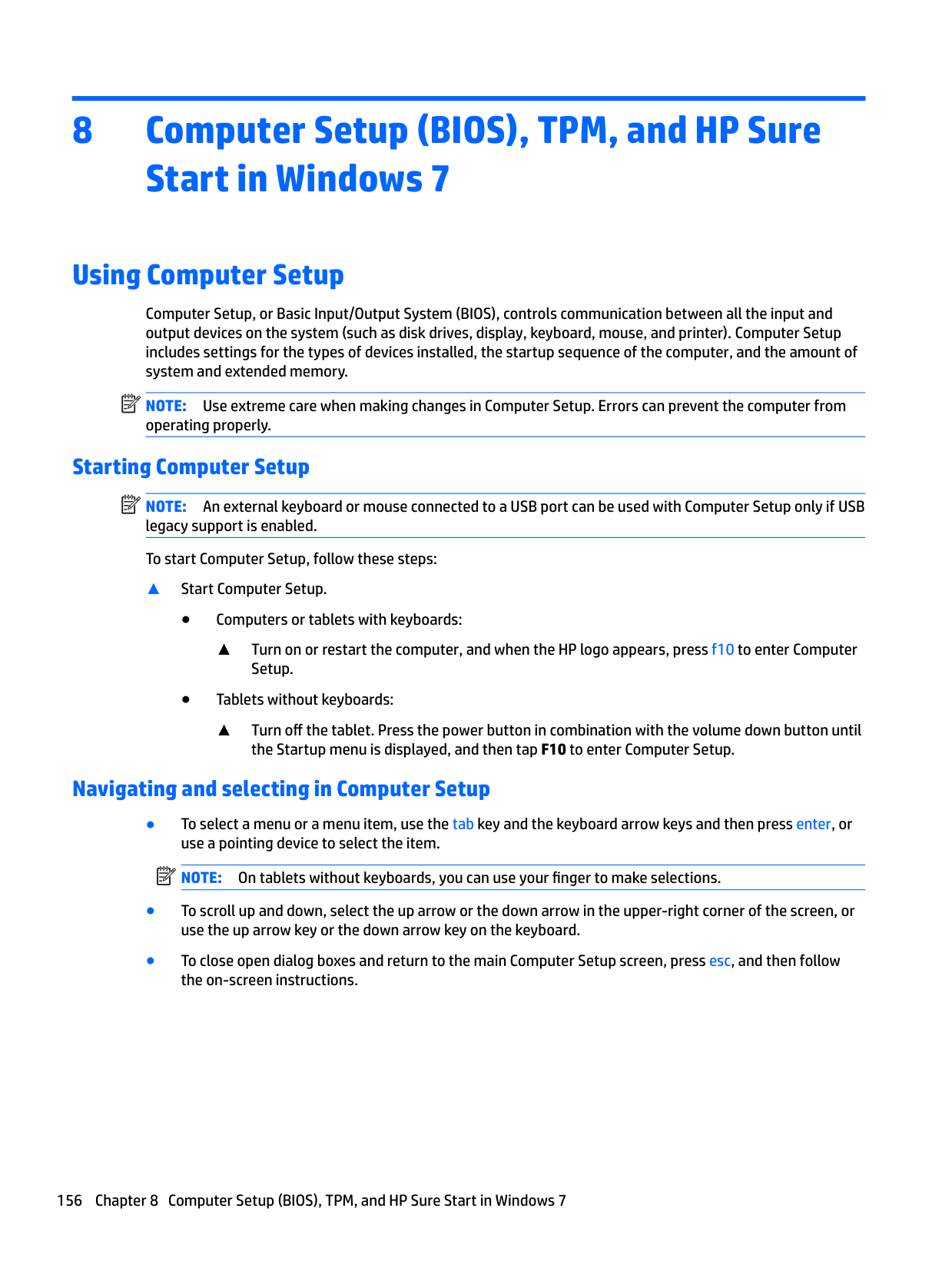
– or – Select Main, select Ignore Changes and Exit, and then press enter. To check for later BIOS versions, see Downloading a BIOS update on page 162. Downloading a BIOS update
CAUTION: To reduce the risk of damage to the computer or an unsuccessful installation, download and install a BIOS update only when the computer is connected to reliable external power using the AC adapter. Do not download or install a BIOS update while the computer is running on battery power, docked in an optional docking device, or connected to an optional power source. During the download and installation, follow these instructions:
Do not disconnect power on the computer by unplugging the power cord from the AC outlet. Do not shut down the computer or initiate Sleep. Do not insert, remove, connect, or disconnect any device, cable, or cord.
– or – Select the question mark icon in the taskbar.
Make a note of the path to the location on your storage device where the BIOS update is downloaded. You will need to access this path when you are ready to install the update.
| | |---|
NOTE: If you connect your computer to a network, consult the network administrator before installing any software updates, especially system BIOS updates.
BIOS installation procedures vary. Follow any instructions that are revealed on the screen after the download is complete. If no instructions are revealed, follow these steps:
| | |---|
NOTE: After a message on the screen reports a successful installation, you can delete the downloaded file from your storage device.
#### Changing the boot order using the f9 prompt
To dynamically choose a boot device for the current startup sequence, follow these steps:
● Computers or tablets with keyboards:
▲ Turn on or restart the computer, and when the HP logo appears, press f9 to enter the Boot
Device Options menu. ● Tablets without keyboards:
▲ Turn off the tablet. Press the power button in combination with the volume down button until
the Startup menu is displayed, and then tap F9 to enter the Boot Device Options menu.
TPM BIOS settings (select products only)
| | |---|
IMPORTANT: Before enabling Trusted Platform Module (TPM) functionality on this system, you must ensure that your intended use of TPM complies with relevant local laws, regulations and policies, and approvals or licenses must be obtained if applicable. For any compliance issues arising from your operation/usage of TPM which violates the above mentioned requirement, you shall bear all the liabilities wholly and solely. HP will not be responsible for any related liabilities.
TPM provides additional security for your computer. You can modify the TPM settings in Computer Setup (BIOS).
| | |---|
NOTE: If you change the TPM setting to Hidden, TPM is not visible in the operating system. To access TPM settings in Computer Setup:
TPM BIOS settings (select products only) 163
Using HP Sure Start (select products only)
Select computer models are configured with HP Sure Start, a technology that continuously monitors the computer's BIOS for attacks or corruption. If the BIOS becomes corrupted or is attacked, HP Sure Start automatically restores the BIOS to its previously safe state, without user intervention.
HP Sure Start is configured and already enabled so that most users can use the HP Sure Start default configuration. The default configuration can be customized by advanced users.
To access the latest documentation on HP Sure Start, go to http://www.hp.com/support, and select your country. Select Drivers & Downloads, and then follow the on-screen instructions.
10 Using HP PC Hardware Diagnostics (UEFI)
HP PC Hardware Diagnostics is a Unified Extensible Firmware Interface (UEFI) that allows you to run diagnostic tests to determine whether the computer hardware is functioning properly. The tool runs outside the operating system so that it can isolate hardware failures from issues that are caused by the operating system or other software components.
When HP PC Hardware Diagnostics (UEFI) detects a failure that requires hardware replacement, a 24-digit Failure ID code is generated. This ID code can then be provided to support to help determine how to correct the problem.
| | |---|
NOTE: To start diagnostics on a convertible computer, your computer must be in notebook mode and you must use the keyboard attached. To start HP PC Hardware Diagnostics (UEFI), follow these steps:
| | |---|
| | |---|
NOTE: If you need to stop a diagnostic test, press esc.
Downloading HP PC Hardware Diagnostics (UEFI) to a USB device
| | |---|
NOTE: The HP PC Hardware Diagnostics (UEFI) download instructions are provided in English only, and you must use a Windows computer to download and create the HP UEFI support environment because only .exe files are offered.
There are two options to download HP PC Hardware Diagnostics to a USB device. Download the latest UEFI version
Downloading HP PC Hardware Diagnostics (UEFI) to a USB device 165
– or – Click Find Now to let HP automatically detect your product.
166 Chapter 10 Using HP PC Hardware Diagnostics (UEFI)
11 Backup and recovery in Windows 7
Your computer includes HP and Windows tools to help you safeguard your information and retrieve it if you ever need to. These tools will help you return your computer to a proper working state, all with simple steps. This section provides information about the following processes:
Creating recovery media and backups
Recovery after a system failure is only as good as your most recent backup.
| | |---|
NOTE: This guide describes an overview of backing up, restoring, and recovering options. For more details about the tools provided, see Help and Support. To access Help and Support, select Start > Help and Support.
| | |---|
NOTE: HP recommends that you print the recovery procedures and save them for later use, in case of system instability. In case of system failure, you can use the backup files to restore the contents of your computer. See Backing up your information on page 168.
#### Guidelines
#### Creating recovery media with HP Recovery Disc Creator
HP Recovery Disc Creator is a software program that offers an alternative way to create recovery media. After you successfully set up the computer, you can create recovery media using HP Recovery Disc Creator. This recovery media allows you to reinstall your original operating system as well as select drivers and
Creating recovery media and backups 167
applications if the storage device becomes corrupted. HP Recovery Disc Creator can create two kinds of recovery DVDs:
Creating recovery media NOTE: The Windows 7 operating system DVD can be created only once. Thereafter, the option to create that media will not be available after you create a Windows DVD. To create the Windows DVD:
| | |---|
#### Backing up your information
You should create system repair media and your initial backup immediately after initial system setup. As you add new software and data files, you should continue to back up your system on a regular basis to maintain a reasonably current backup. You should also create Windows system repair media (select products only) which can be used to start up (boot) the computer and repair the operating system in case of system instability or failure. Your initial and subsequent backups allow you to restore your data and settings if a failure occurs.
You can back up your information to an optional external storage device, a network drive, or discs. Note the following when backing up:
| | |---|
NOTE: For detailed instructions on various backup and restore options, perform a search for these topics in Help and Support. To access Help and Support, select Start > Help and Support.
| |
|---|
NOTE: Windows includes the User Account Control feature to improve the security of your computer. You
may be prompted for your permission or password for tasks such as installing software, running utilities, or changing Windows settings. Refer to Help and Support. To access Help and Support, select Start > Help and Support.
| | |---|
To create a backup using Windows Backup and Restore: NOTE: The backup process may take over an hour, depending on file size and the speed of the computer.
or create system repair media (select products only).
Performing a system recovery
In case of system failure or instability, the computer provides the following tools to recover your files:
| | |---|
NOTE: If you are unable to boot (start up) your computer and you cannot use the system repair media you previously created (select products only), you must purchase Windows 7 operating system media to reboot the computer and repair the operating system. For additional information, see Using Windows 7 operating
system media on page 170.
#### Using the Windows recovery tools
Using the Windows recovery tools, you can:
| | |---|
| | |---|
may be prompted for your permission or password for tasks such as installing software, running utilities, or changing Windows settings. Refer to Help and Support. To access Help and Support, select Start > Help and Support.
To recover information you previously backed up:
or your files. To recover your information using Startup Repair, follow these steps: CAUTION: Some Startup Repair options will completely erase and reformat the storage device. All files you have created and any software installed on the computer are permanently removed. When reformatting is complete, the recovery process restores the operating system, as well as the drivers, software, and utilities from the backup used for recovery.
NOTE: If the Windows partition is not listed, you must recover your operating system and programs using the Windows 7 operating system DVD and the Driver Recovery media. For additional information, see Using Windows 7 operating system media on page 170.
| | |---|
| | |---|
NOTE: For additional information on recovering information using the Windows tools, select Start > Help and Support.
#### Using f11 recovery tools (select products only)
CAUTION: Using f11 completely erases storage device contents and reformats the storage device. All files that you have created and any software that you have installed on the computer are permanently removed. The f11 recovery tool reinstalls the operating system and HP programs and drivers that were installed at the factory. Software not installed at the factory must be reinstalled.
To recover the original storage device image using f11:
NOTE: If the HP Recovery partition is not listed, you must recover your operating system and programs using the Windows 7 operating system media and the Driver Recovery media. For additional information, see Using Windows 7 operating system media on page 170.
| | |---|
#### Using Windows 7 operating system media
If you cannot use the recovery media you previously created using the HP Recovery Disc Creator (select products only), you must purchase a Windows 7 operating system DVD to reboot the computer and repair the operating system.
To order a Windows 7 operating system DVD, go to the HP website. For U.S. support, go to http://www.hp.com/support. For worldwide support, go to http://welcome.hp.com/country/us/en/ wwcontact_us.html. You can also order the DVD by calling support. For contact information, see the Worldwide Telephone Numbers booklet included with the computer.
CAUTION: Using a Windows 7 operating system DVD completely erases storage device contents and
reformats the storage device. All files that you have created and any software that you have installed on the computer are permanently removed. When reformatting is complete, the recovery process helps you restore the operating system, as well as drivers, software, and utilities.
To initiate recovery using a Windows 7 operating system DVD:
| | |---|
NOTE: This process takes several minutes.
12 Backup and recovery in Windows 10
This chapter provides information about the following processes. The information in the chapter is standard procedure for most products.
▲ Type support in the taskbar search box, and then select the HP Support Assistant app.
‒ or – Click the question mark icon in the taskbar.
| | |---|
IMPORTANT: If you will be performing recovery procedures on a tablet, the tablet battery must be at least 70% charged before you start the recovery process.
IMPORTANT: For a tablet with a detachable keyboard, connect the keyboard to the keyboard dock before beginning any recovery process.
Creating recovery media and backups
The following methods of creating recovery media and backups are available on select products only. Choose the available method according to your computer model.
| | |---|
#### Creating HP Recovery media (select products only)
You can use Windows tools to create system restore points and create backups of personal information, see Using Windows tools on page 173.
configures the settings for the programs. HP Recovery media can also be used to customize the system or restore the factory image if you replace the storage device.
| | |---|
To create HP Recovery media: IMPORTANT: For a tablet with a detachable keyboard, connect the keyboard to the keyboard dock before beginning these steps.
Using Windows tools
You can create recovery media, system restore points, and backups of personal information using Windows tools.
| | |---|
NOTE: If storage is 32 GB or less, Microsoft System Restore is disabled by default. For more information and steps, see the Get started app.
▲ Select the Start button, and then select the Get started app.
Restore and recovery
There are several options for recovering your system. Choose the method that best matches your situation and level of expertise:
Using Windows tools 173
IMPORTANT: Not all methods are available on all products.
▲ Select the Start button, and then select the Get started app.
▲ Type recovery in the taskbar search box, select HP Recovery Manager, select Reinstall drivers and/or applications, and then follow the on-screen instructions.
#### Recovering using HP Recovery Manager
HP Recovery Manager software allows you to recover the computer to its original factory state by using the HP Recovery media that you either created or that you obtained from HP, or by using the HP Recovery partition (select products only). If you have not already created recovery media, see Creating HP Recovery media (select products only) on page 172.
##### What you need to know before you get started
IMPORTANT: Recovery through HP Recovery Manager should be used as a final attempt to correct computer issues.
| | |---|
| | |---|
IMPORTANT: HP Recovery Manager does not automatically provide backups of your personal data. Before beginning recovery, back up any personal data you want to retain. Using HP Recovery media, you can choose from one of the following recovery options:
| | |---|
NOTE: Only the options available for your computer display when you start the recovery process.
The HP Recovery partition (select products only) allows System Recovery only. Using the HP Recovery partition (select products only)
The HP Recovery partition allows you to perform a system recovery without the need for recovery discs or a recovery USB flash drive. This type of recovery can be used only if the storage device is still working.
| | |---|
To start HP Recovery Manager from the HP Recovery partition: IMPORTANT: For a tablet with a detachable keyboard, connect the keyboard to the keyboard dock before beginning these steps (select products only).
For computers or tablets with keyboards attached, press f11 while the computer boots, or press and hold f11 as you press the power button.
For tablets without keyboards: Turn on or restart the tablet, and then quickly hold down the volume down button; then select f11.
##### Using HP Recovery media to recover
You can use HP Recovery media to recover the original system. This method can be used if your system does not have an HP Recovery partition or if the storage device is not working properly.
NOTE: If the computer does not automatically restart in HP Recovery Manager, change the computer boot order. See Changing the computer boot order on page 175.
| | |---|
##### Changing the computer boot order
If your computer does not restart in HP Recovery Manager, you can change the computer boot order, which is the order of devices listed in BIOS where the computer looks for startup information. You can change the selection to an optical drive or a USB flash drive.
To change the boot order:
Restore and recovery 175
IMPORTANT: For a tablet with a detachable keyboard, connect the keyboard to the keyboard dock before beginning these steps.
▲ Turn on or restart the computer or tablet, quickly press esc, and then press f9 for boot options. For tablets without keyboards:
▲ Turn on or restart the tablet, and then quickly hold down the volume down button; then select f9.
##### Removing the HP Recovery partition (select products only)
HP Recovery Manager software allows you to remove the HP Recovery partition to free up storage device space.
| | |---|
IMPORTANT: After you remove the HP Recovery partition, you will not be able to perform System Recovery or create HP recovery media from the HP Recovery partition. So before you remove the Recovery partition, create HP Recovery media; see Creating HP Recovery media (select products only) on page 172.
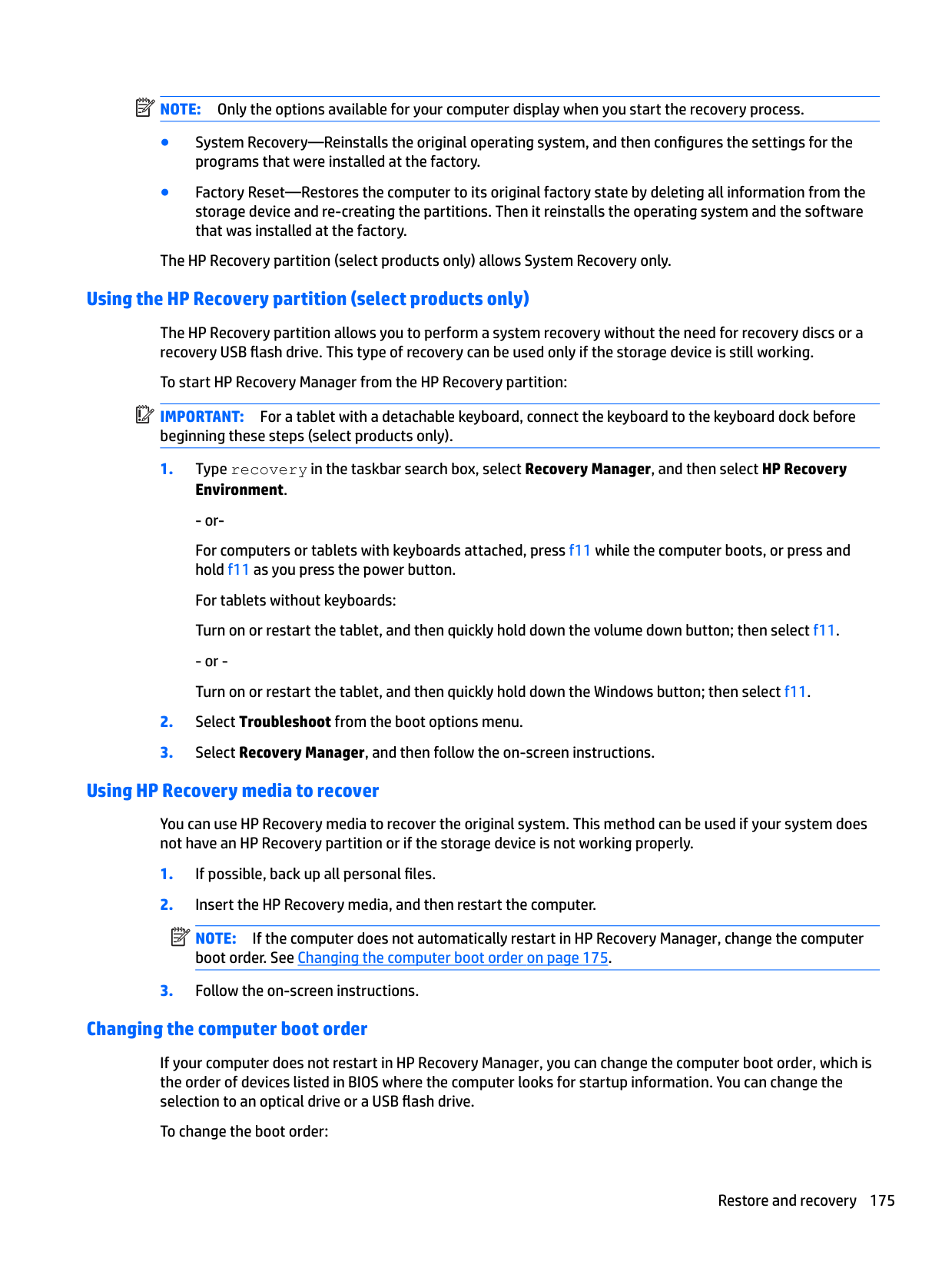
| | |---|
NOTE: The Remove Recovery Partition option is only available on products that support this function. Follow these steps to remove the HP Recovery partition:
13 Specifications
Computer specifications
######### Metric U.S.
Dimensions Width 38.6 cm 15.2 in Depth 26.4 cm 10.4 in Height (front) 2.6 cm 1.0 Weight (computer equipped with the lightest panel, Core i5 processor, discrete graphics, (1) 8-GB SODIMM, SATA SSD, WLAN module, WWAN module, no fingerprint reader, 9-cell battery, backlit keyboard, touchpad)
2.7 kg 5.95 lb
Input power Operating voltage and current 19.5 V dc @ 7.69 A - 150 W, Slim Smart AC Adapter Temperature Operating 5°C to 35°C 41°F to 95°F Nonoperating ‑20°C to 60°C ‑4°F to 140°F Relative humidity (non-condensing) Operating 10% to 90% Nonoperating 5% to 95% Maximum altitude (unpressurized)
Operating ‑15 m to 3,048 m ‑50 ft to 10,000 ft Nonoperating ‑15 m to 12,192 m ‑50 ft to 40,000 ft NOTE: Applicable product safety standards specify thermal limits for plastic surfaces. The device operates well within this range of
temperatures.
Computer specifications 177
Hard drive specifications
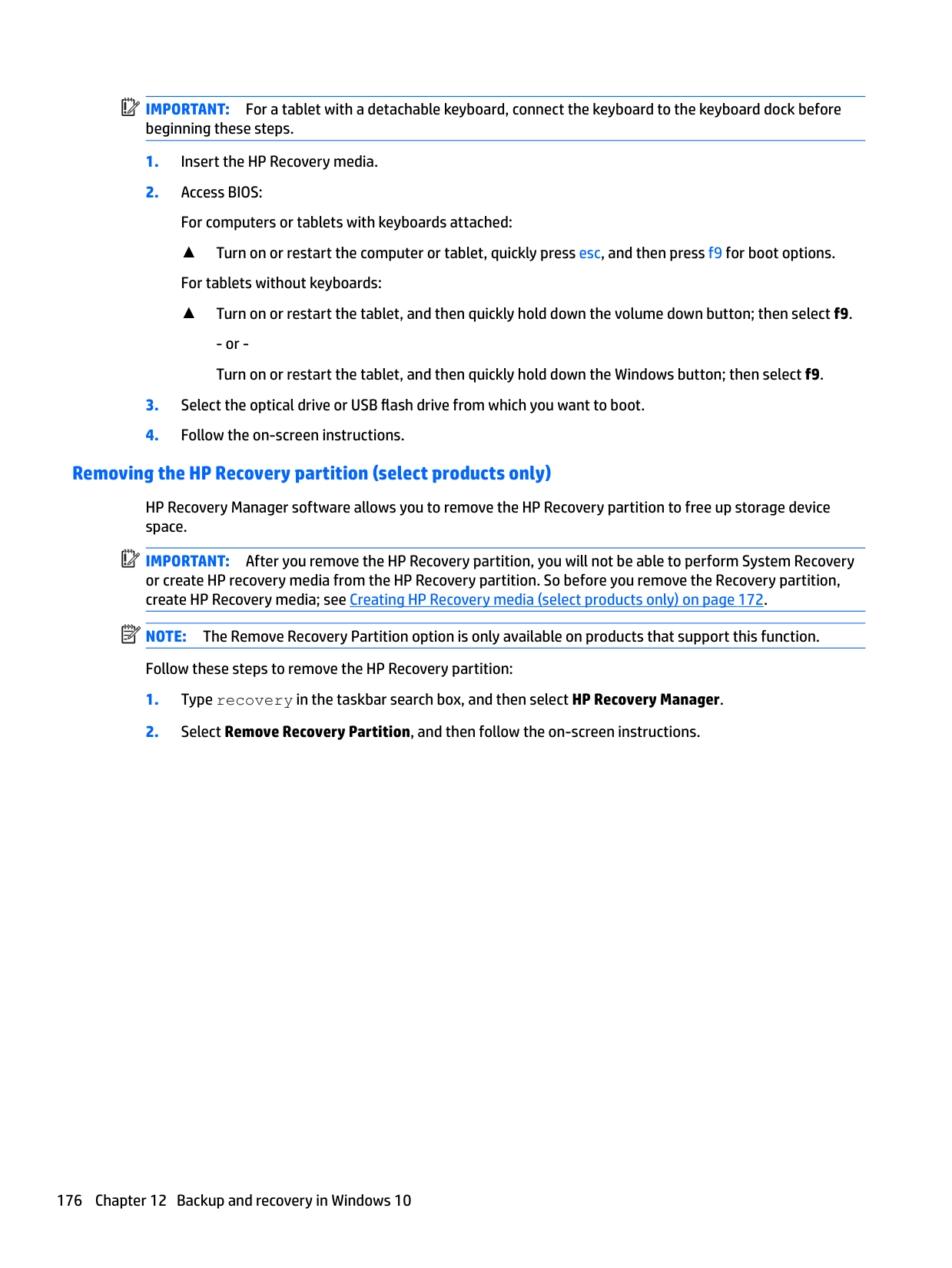
######### 1-TB* 500-GB**
Dimensions Height 9.5 mm 9.5 mm Length 100.4 mm 100.4 mm Width 69.9 mm 69.9 mm Weight 110 g 110 g Interface type SATA SATA Transfer rate Synchronous (maximum) 1.1 GB/sec 1.1 GB/sec Security ATA security ATA security Seek times (typical read, including setting) Single track 1.5 ms 1.5 ms Average (read/write) 11/13 ms 11/13 ms Maximum 22 ms 22 ms Logical blocks 1,953,525,168 976,773,168 Disk rotational speed 5400 rpm or 7200 rpm 5400 rpm or 7200 rpm Operating temperature 0°C to 60°C (32°F to 140°F)
M.2 solid-state drive specifications
######### 256-GB* 512-GB*
Dimensions Height 1 mm 1 mm Length 50.8 mm 50.8 mm Width 28.9 mm 28.9 mm Weight < 10 g < 10 g Interface type ATA-7 ATA-7 Transfer rate
Sequential Read Random Read
Up to 540 MB/s Up to 85K IOPs
Up to 500 MB/s Up to 84K IOPs
Sequential Write Random Write
Up to 280 MB/s Up to 67K IOPs
Up to 455 MB/s Up to 59K IOPs
Ready time, Maximum (to not busy) 1.0 s 3.0 s Access times Logical 0.1 0.1 Total logical sectors 500,118,192 1.000.215.216 Operating temperature Operating Non-operating
0° to 70°C (32°F to 158°F)
0° to 70°C (32°F to 158°F)
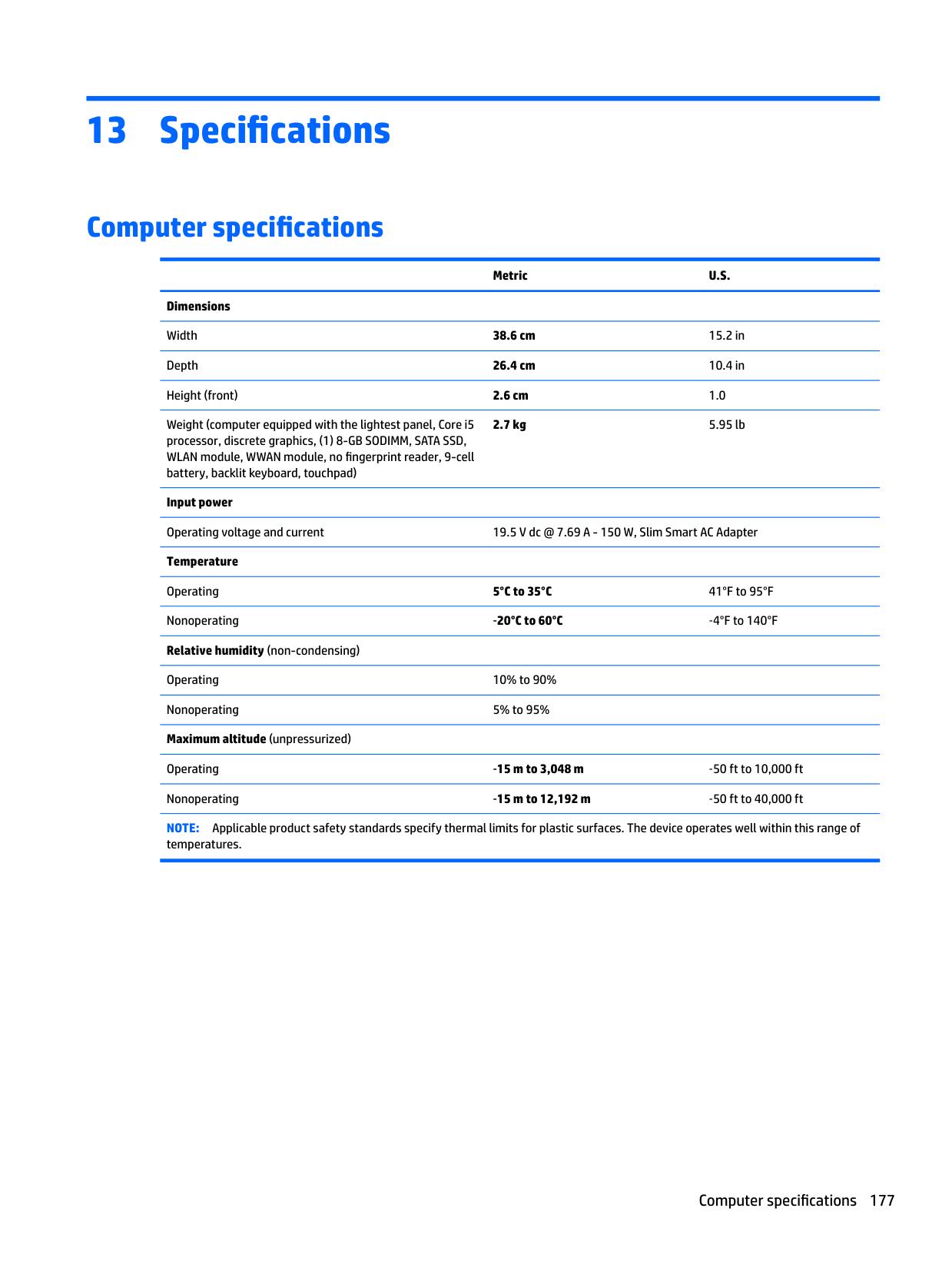
-55° to 90°C (-67°F to 194°F)
-40° to 85°C (-40°F to 185°F)
*1 GB = 1 billion bytes when referring to hard drive storage capacity. Actual accessible capacity is less. NOTE: Certain restrictions and exclusions apply. Contact technical support for details.
M.2 solid-state drive specifications 179
M.2 PCIe solid-state drive specifications
######### 256-GB* 512-GB*
Dimensions Height 1 mm 1 mm Length 50.8 mm 50.8 mm Width 28.9 mm 28.9 mm Weight < 10 g < 10 g Interface type ATA-7 ATA-7 Transfer rate
Sequential Read Random Read
Up to 2150 MB/s Up to 300,000 IOPs
Up to 2150 MB/s Up to 300,000 IOPs
Sequential Write Random Write
Up to 1260 MB/s Up to 100,000 IOPs
Up to 1550 MB/s Up to 100,000 IOPs
Ready time, Maximum (to not busy) 1.0 s 1.0 s Access times Logical 0.1 0.1 Total logical sectors 500,118,192 1,000,215,216 Operating temperature Operating Non-operating
0° to 70°C (32°F to 158°F)
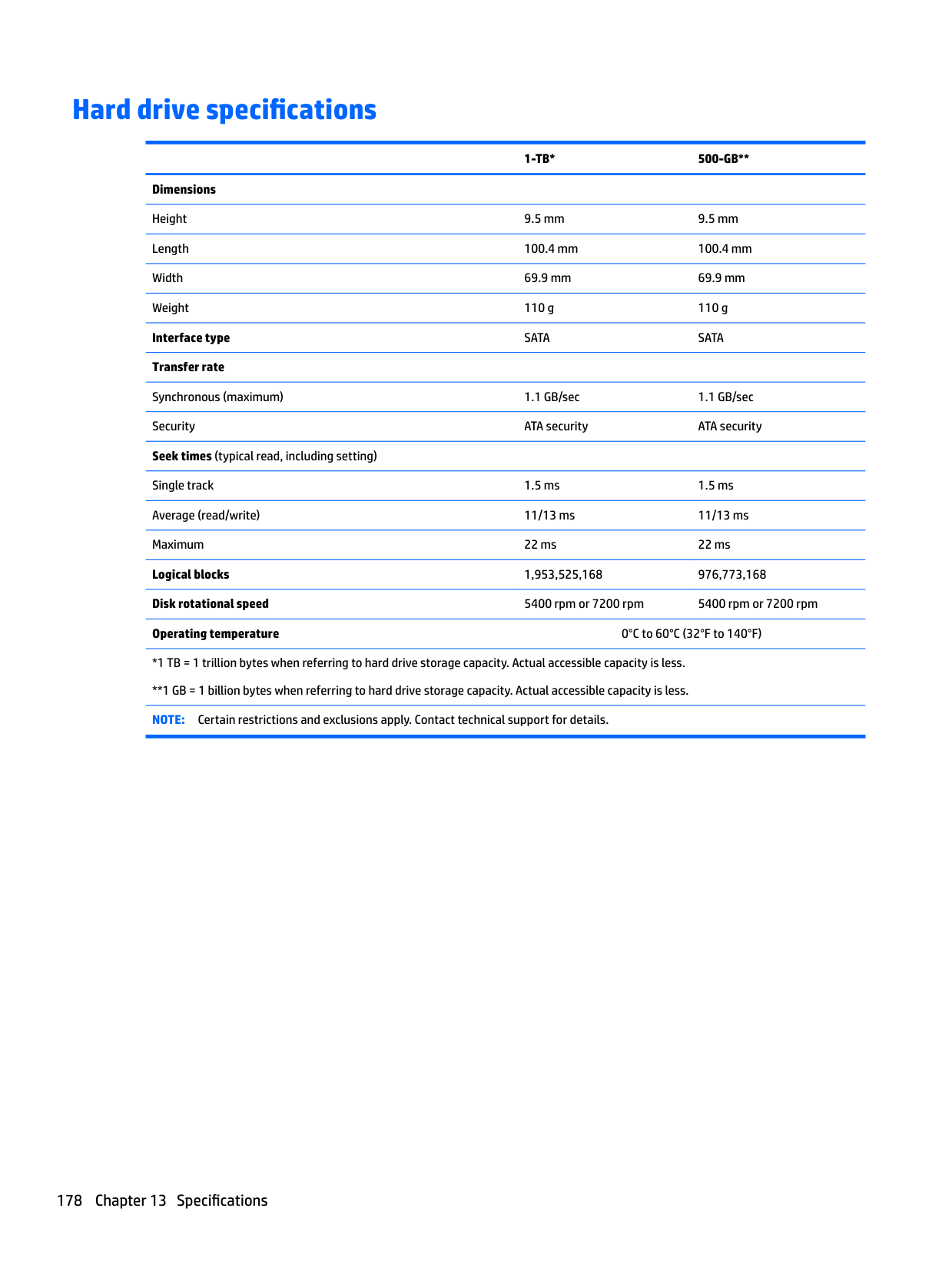
0° to 70°C (32°F to 158°F)
-40° to 80°C (-40°F to 176°F)
-40° to 85°C (-40°F to 185°F)
*1 GB = 1 billion bytes when referring to hard drive storage capacity. Actual accessible capacity is less. NOTE: Certain restrictions and exclusions apply. Contact technical support for details.
14 Statement of memory volatility
The purpose of this chapter is to provide general information regarding nonvolatile memory in HP Business PCs. This chapter also provides general instructions for restoring nonvolatile memory that can contain personal data after the system has been powered off and the storage device has been removed.
HP Business PC products that use Intel®-based or AMD®-based system boards contain volatile DDR memory. The amount of nonvolatile memory present in the system depends upon the system configuration. Intelbased and AMD-based system boards contain nonvolatile memory subcomponents as originally shipped from HP, assuming that no subsequent modifications have been made to the system and assuming that no applications, features, or functionality have been added to or installed on the system.
Following system shutdown and removal of all power sources from an HP Business PC system, personal data can remain on volatile system memory (DIMMs) for a finite period of time and will also remain in nonvolatile memory. Use the steps below to remove personal data from the PC, including the nonvolatile memory found in Intel-based and AMD-based system boards.
| | |---|
NOTE: If your tablet has a keyboard base, connect to the keyboard base before beginning steps in this chapter.
###### Current BIOS steps
IMPORTANT: If the Main menu displays Restore Defaults instead of Apply Factory Defaults and Exit, go to Legacy BIOS Steps on page 182.
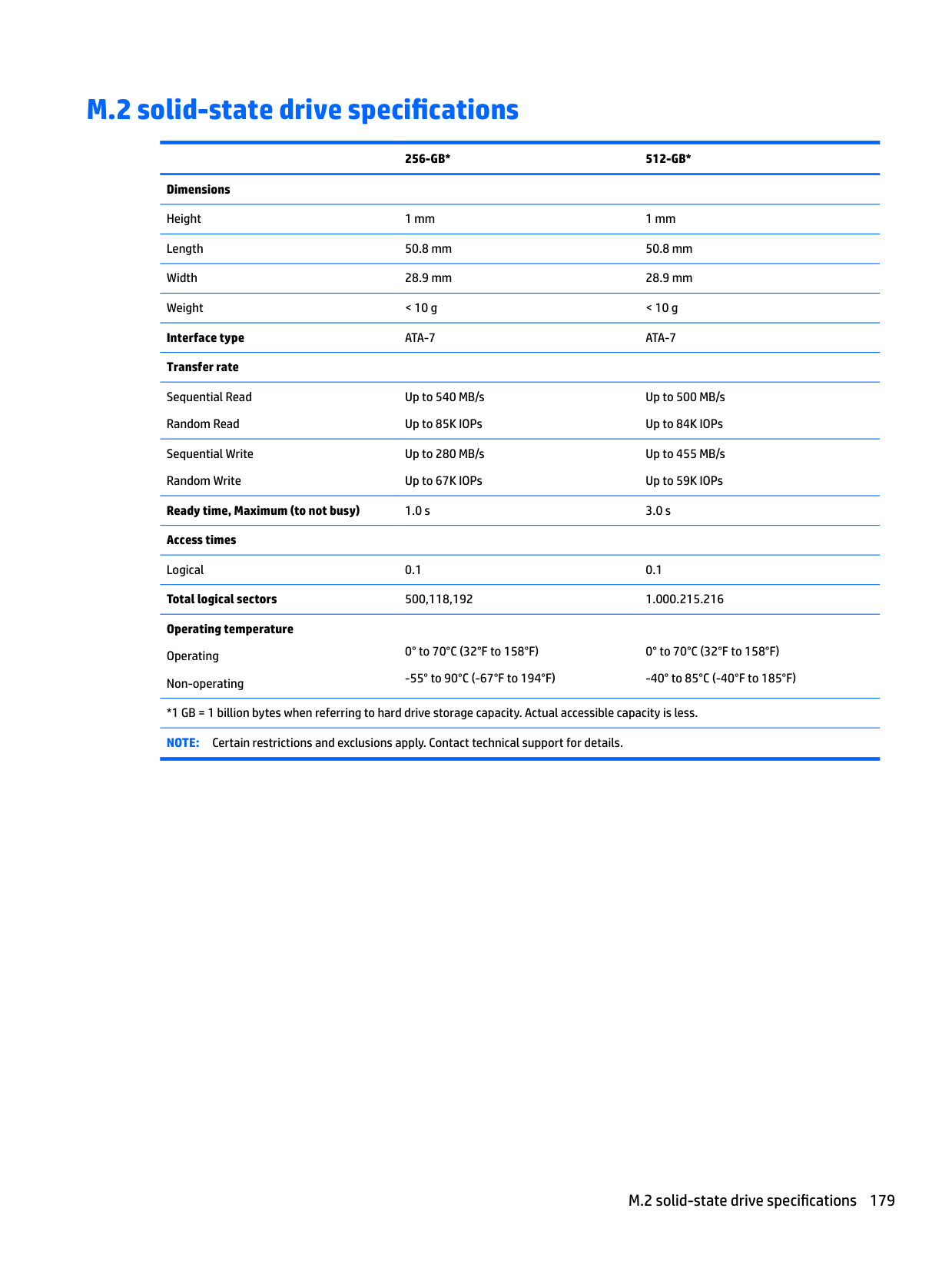
NOTE: If the system has a BIOS administrator password, enter the password at the prompt.
| | |---|
| | |---|
| | |---|
| | |---|
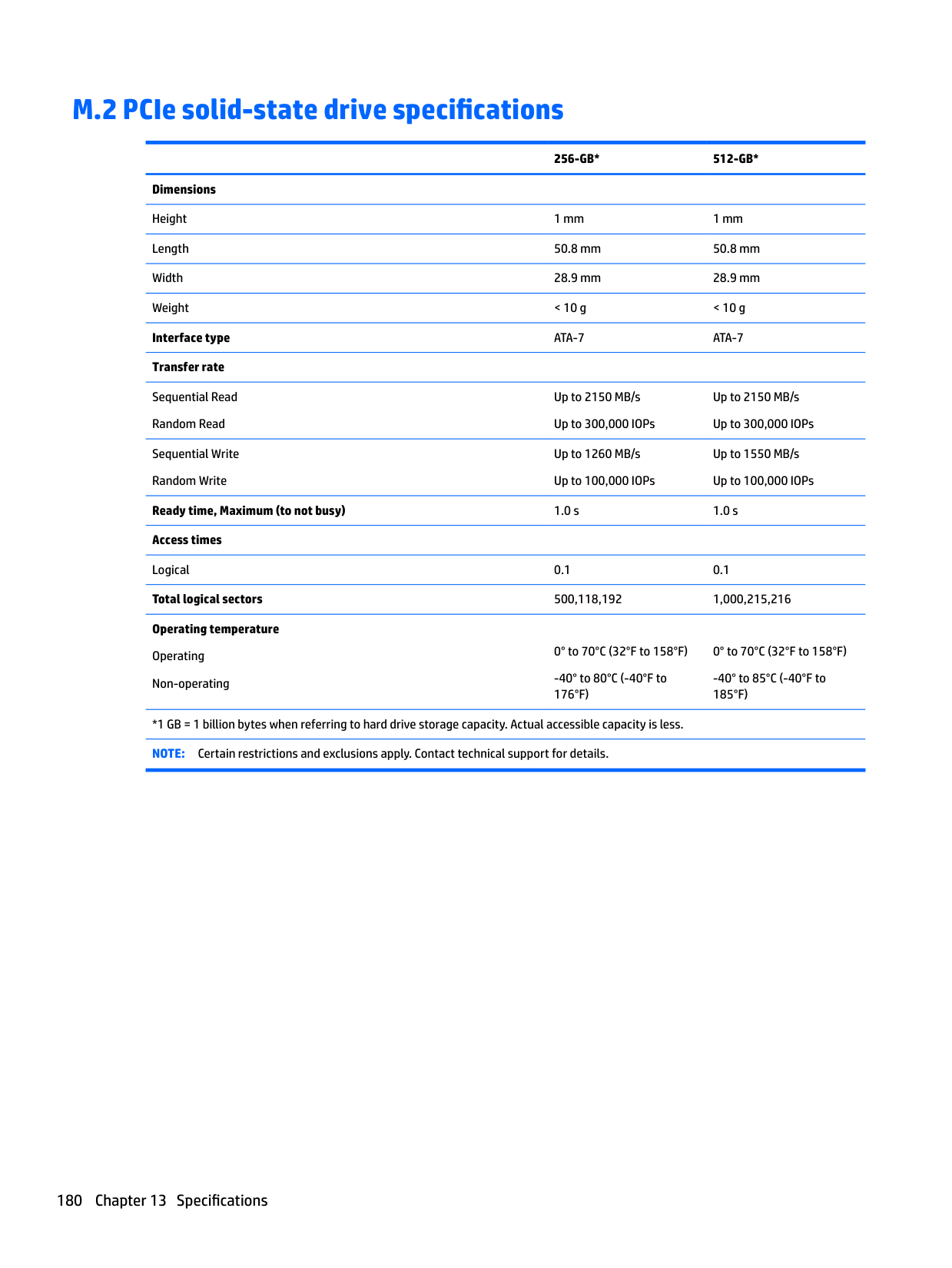
| | |---|
– or –
– or –
| | |---|
IMPORTANT: If you clear data using Secure Erase, it cannot be recovered.
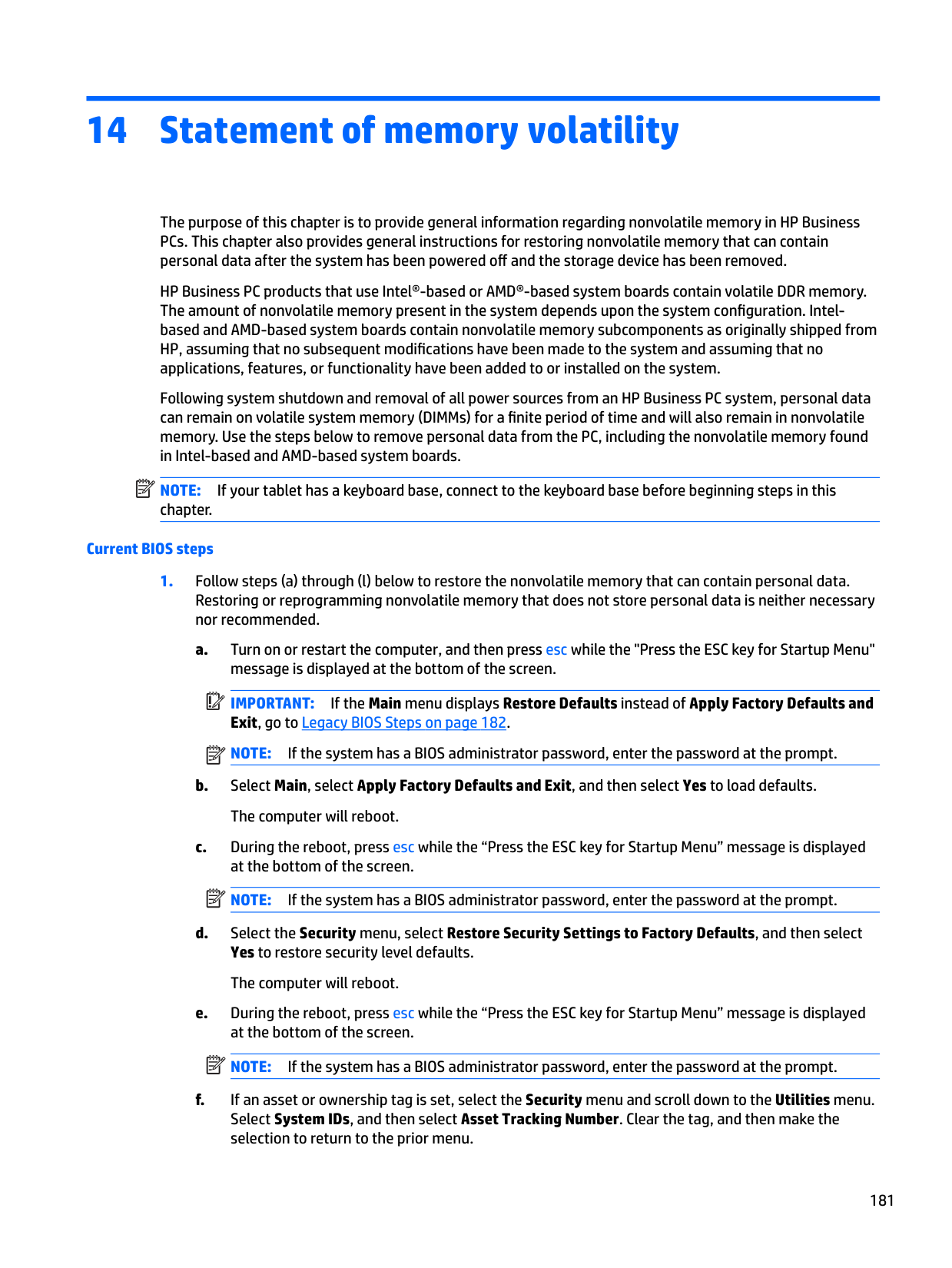
Legacy BIOS Steps Use the steps for older versions of BIOS. NOTE: If you already completed the steps in Current BIOS steps on page 181, skip this section.
| | |---|
| | |---|
● Turn on or restart the computer, and then press esc while the "Press the ESC key for Startup Menu" message is displayed at the bottom of the screen.
| | |---|
NOTE: If the system has a BIOS administrator password, enter the password at the prompt.
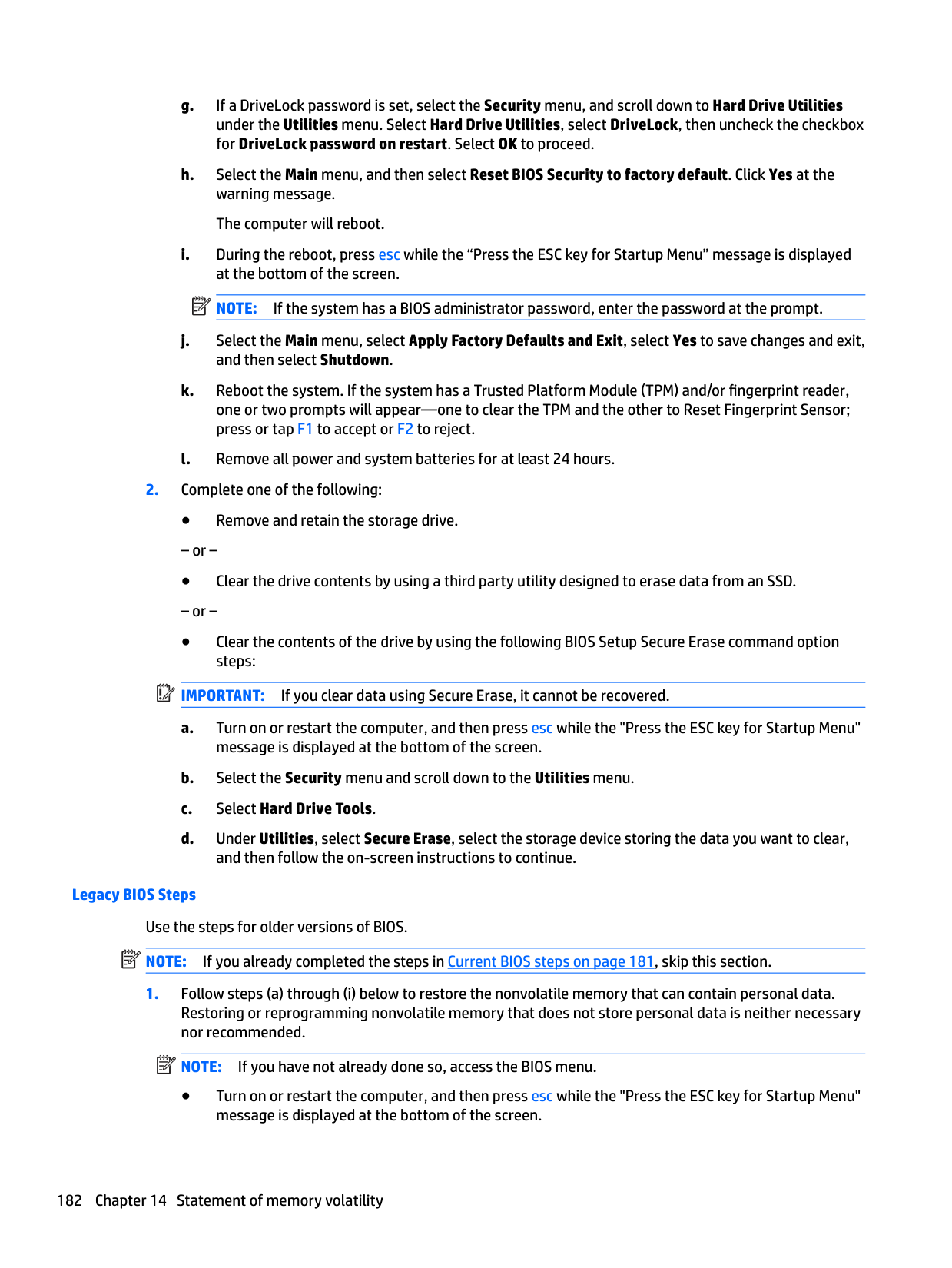
● Remove and retain the storage drive.
– or –
● Clear the drive contents by using a third party utility designed to erase data from an SSD.
– or –
● Clear the contents of the drive by using the following BIOS Setup Secure Erase command option steps:
| | |---|
IMPORTANT: If you clear data using Secure Erase, it cannot be recovered.
– or –
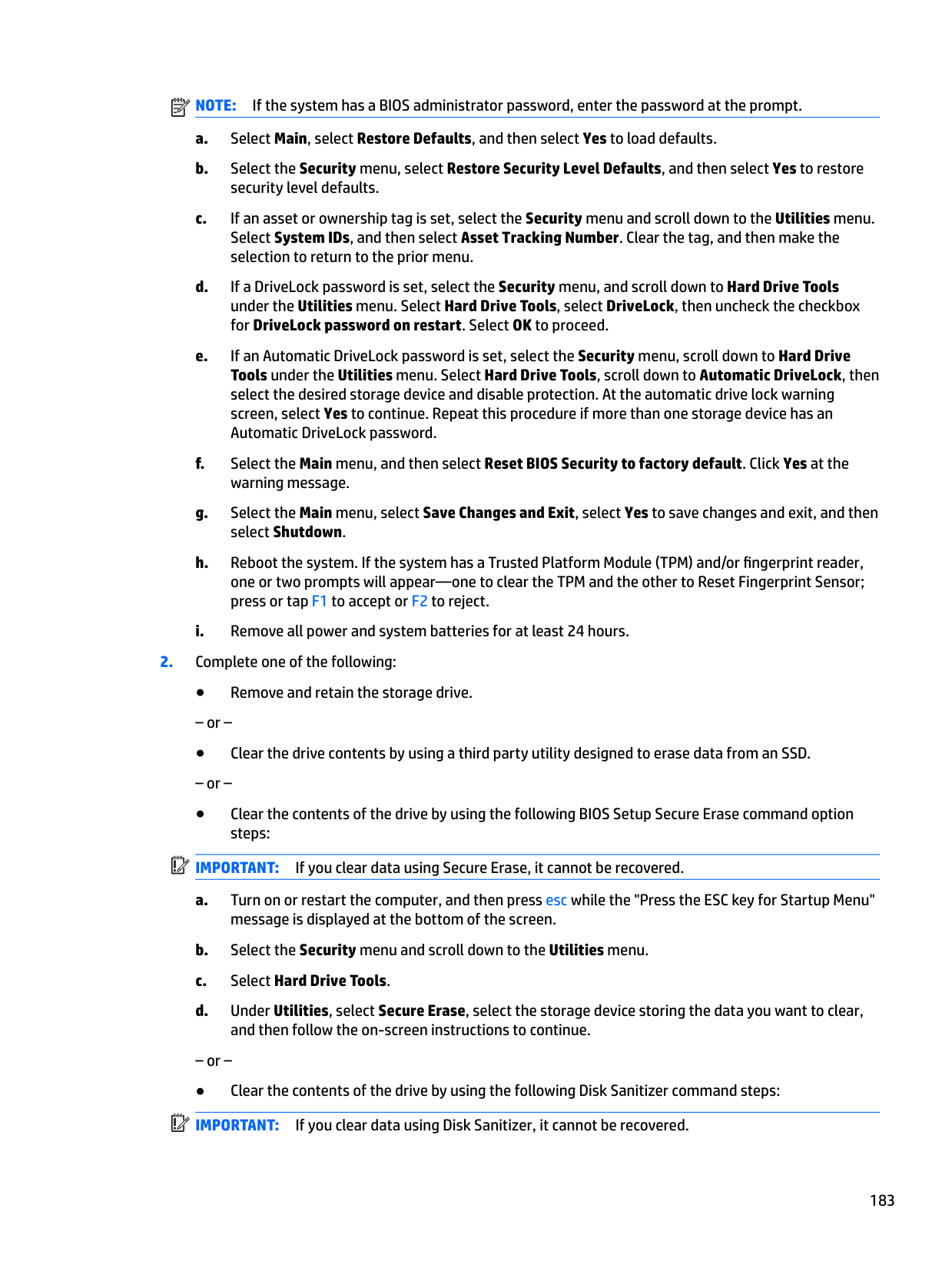
| | |---|
● Clear the contents of the drive by using the following Disk Sanitizer command steps: IMPORTANT: If you clear data using Disk Sanitizer, it cannot be recovered.
| | |---|
NOTE: The amount of time it takes for Disk Sanitizer to run can take several hours. Plug the computer into an AC outlet before starting.
Nonvolatile memory usage
Nonvolatile Memory Type Amount (Size)
Does this memory store customer data?
Does this memory retain data when power is removed?
What is the purpose of this memory?
How is data input into this memory?
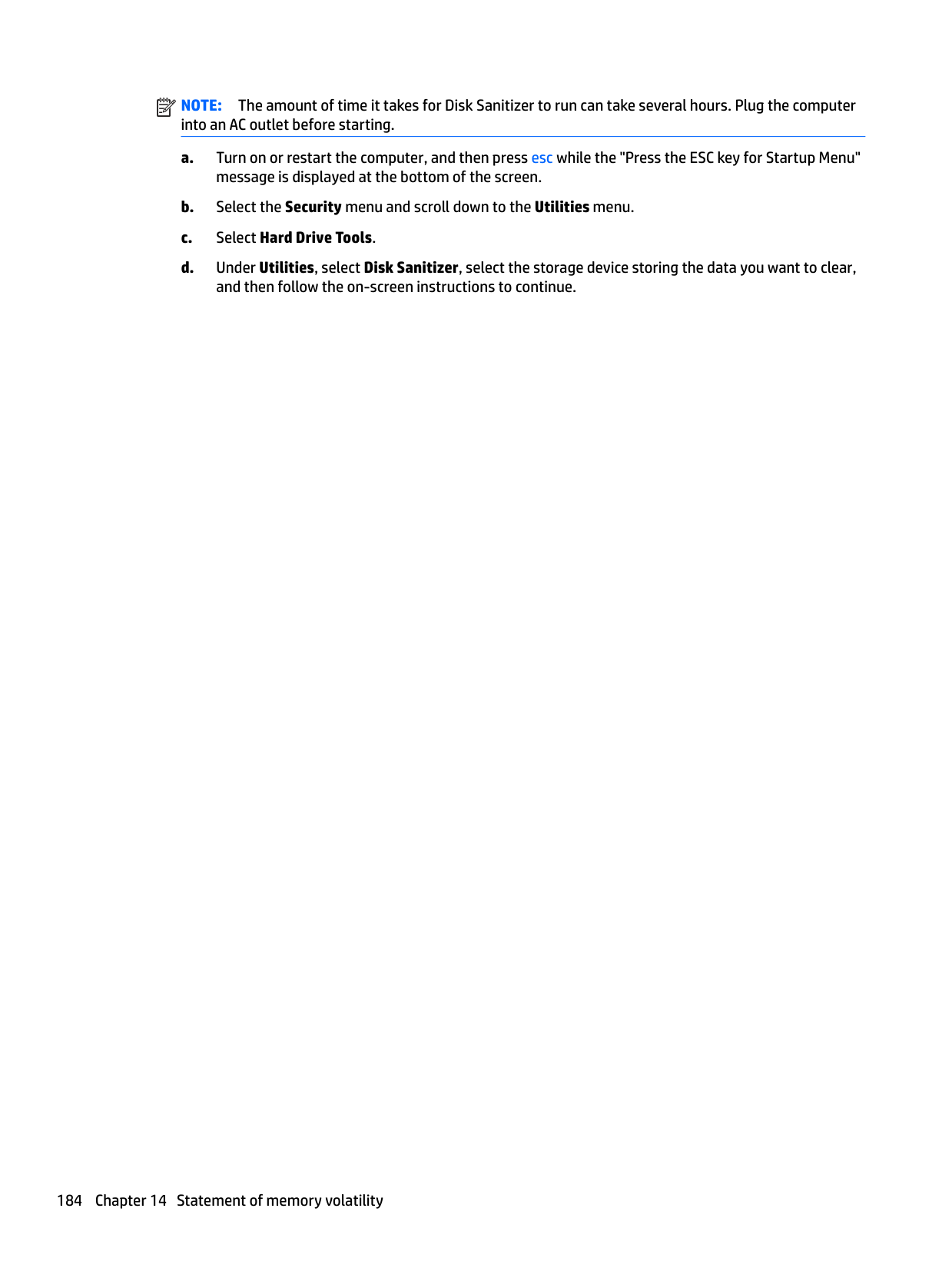
How is this memory write-protected?
HP Sure Start flash (select models only)
2 MBytes No Yes Provides protected backup of critical System BIOS code, EC firmware, and critical PC configuration data for select platforms that support HP Sure Start.
For more information, see Using HP Sure Start (select models only) on page 188.
Real Time Clock (RTC) battery backed-up CMOS configuration memory
Controller (NIC) EEPROM
256 Bytes No Yes Stores system date and time and noncritical data.
64 KBytes (not customer accessible)
No Yes Stores NIC configuration and NIC firmware.
DIMM Serial Presence Detect (SPD) configuration data
256 Bytes per memory module, 128 Bytes programmable (not customer accessible)
System BIOS 4 MBytes to 5 MBytes
No Yes Stores memory module information.
Yes Yes Stores system BIOS code and PC configuration data.
Data cannot be written to this device via the host processor. The content is managed solely by the HP Sure Start Embedded Controller.
This memory is protected by the HP Sure Start Embedded Controller.
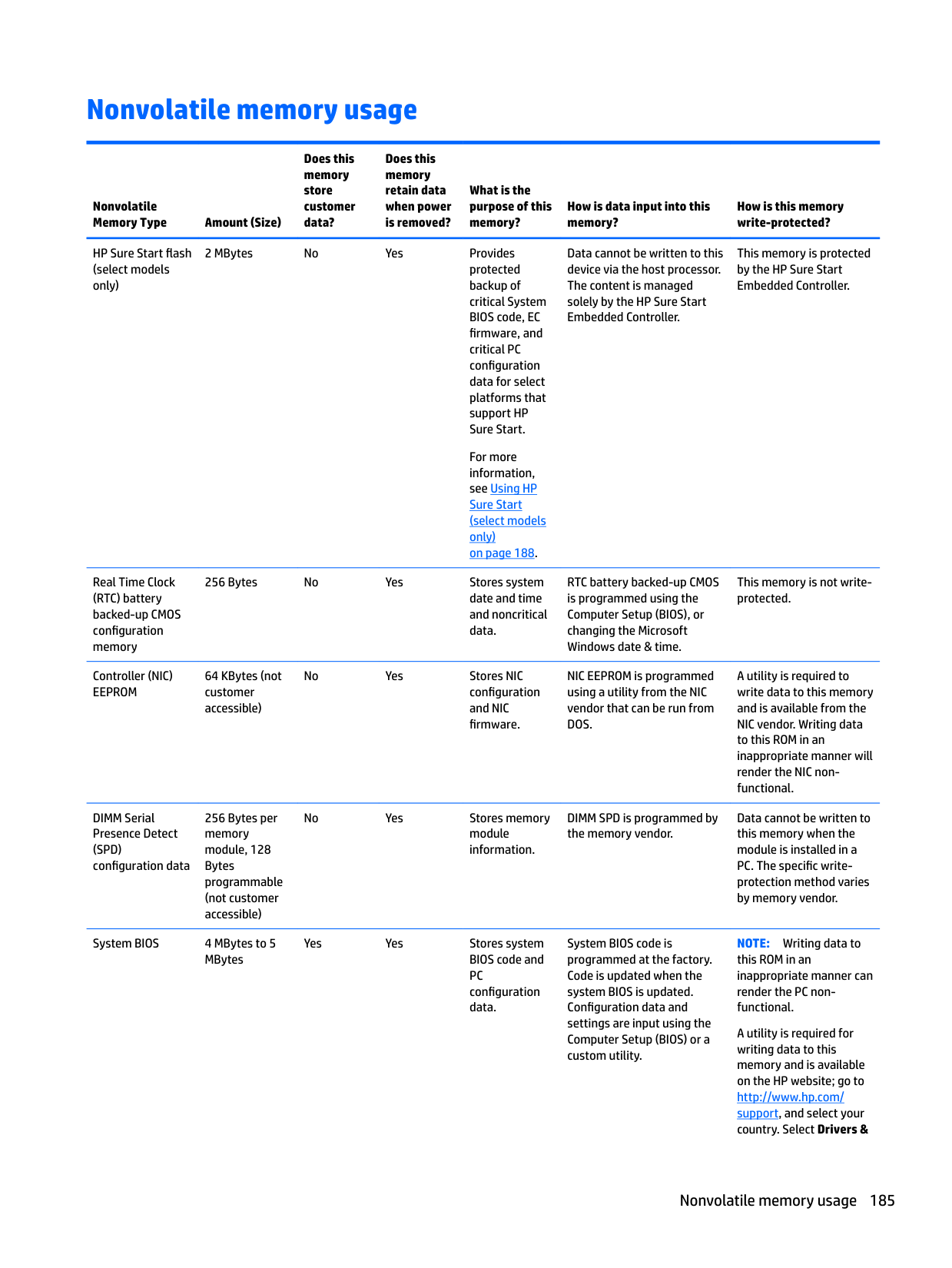
RTC battery backed-up CMOS is programmed using the Computer Setup (BIOS), or changing the Microsoft Windows date & time.
NIC EEPROM is programmed using a utility from the NIC vendor that can be run from DOS.
DIMM SPD is programmed by the memory vendor.
This memory is not writeprotected.
A utility is required to write data to this memory and is available from the NIC vendor. Writing data to this ROM in an inappropriate manner will render the NIC nonfunctional.
Data cannot be written to this memory when the module is installed in a PC. The specific writeprotection method varies by memory vendor.
System BIOS code is programmed at the factory. Code is updated when the system BIOS is updated. Configuration data and settings are input using the Computer Setup (BIOS) or a custom utility.
NOTE: Writing data to this ROM in an inappropriate manner can render the PC nonfunctional.
A utility is required for writing data to this memory and is available on the HP website; go to http://www.hp.com/ support, and select your country. Select Drivers &
Nonvolatile memory usage 185
Nonvolatile Memory Type Amount (Size)
Does this memory store customer data?
Does this memory retain data when power is removed?
What is the purpose of this memory?
How is data input into this memory?
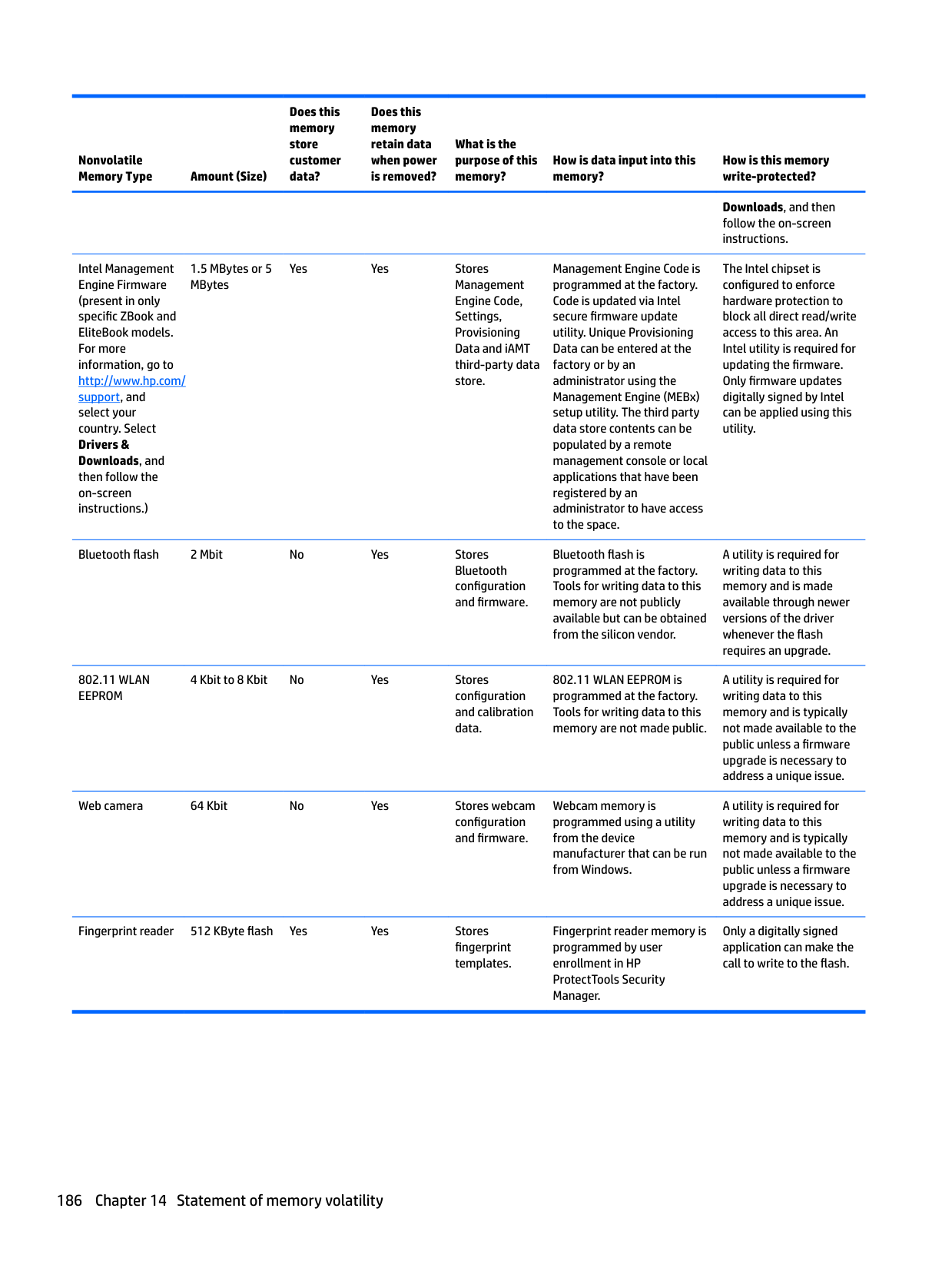
How is this memory write-protected?
Intel Management Engine Firmware (present in only specific ZBook and EliteBook models. For more information, go to http://www.hp.com/ support, and select your country. Select Drivers & Downloads, and then follow the on-screen instructions.)
1.5 MBytes or 5 MBytes
Yes Yes Stores Management Engine Code, Settings, Provisioning Data and iAMT third-party data store.
Management Engine Code is programmed at the factory. Code is updated via Intel secure firmware update utility. Unique Provisioning Data can be entered at the factory or by an administrator using the Management Engine (MEBx) setup utility. The third party data store contents can be populated by a remote management console or local applications that have been registered by an administrator to have access to the space.
Bluetooth flash 2 Mbit No Yes Stores Bluetooth configuration and firmware.
Bluetooth flash is programmed at the factory. Tools for writing data to this memory are not publicly available but can be obtained from the silicon vendor.
802.11 WLAN EEPROM
4 Kbit to 8 Kbit No Yes Stores configuration and calibration data.
802.11 WLAN EEPROM is programmed at the factory. Tools for writing data to this memory are not made public.
Web camera 64 Kbit No Yes Stores webcam configuration and firmware.
Webcam memory is programmed using a utility from the device manufacturer that can be run from Windows.
Fingerprint reader 512 KByte flash Yes Yes Stores
fingerprint templates.
Fingerprint reader memory is programmed by user enrollment in HP ProtectTools Security Manager.
Downloads, and then follow the on-screen instructions.
The Intel chipset is configured to enforce hardware protection to block all direct read/write access to this area. An Intel utility is required for updating the firmware. Only firmware updates digitally signed by Intel can be applied using this utility.
A utility is required for writing data to this memory and is made available through newer versions of the driver whenever the flash requires an upgrade.
A utility is required for writing data to this memory and is typically not made available to the public unless a firmware upgrade is necessary to address a unique issue.
A utility is required for writing data to this memory and is typically not made available to the public unless a firmware upgrade is necessary to address a unique issue.
Only a digitally signed application can make the call to write to the flash.
Questions and answers
IMPORTANT: Restore defaults does not securely erase any data on your storage device. See question and answer 6 for steps to securely erase data. Restore defaults does not reset the Custom Secure Boot keys. See question and answer 7 for information about resetting the keys.
The Unified Extensible Firmware Interface (UEFI) BIOS is an industry-standard software interface between the platform firmware and an operating system (OS). It is a replacement for the older BIOS architecture, but supports much of the legacy BIOS functionality.
Like the legacy BIOS, the UEFI BIOS provides an interface to display the system information and configuration settings and to change the configuration of your computer before an OS is loaded. BIOS provides a secure run-time environment that supports a Graphic User Interface (GUI). In this environment, you can use either a pointing device (Touchscreen, TouchPad, pointing stick, or USB mouse) or the keyboard to navigate and make menu and configuration selections. The UEFI BIOS also contains basic system diagnostics.
The UEFI BIOS provides functionality beyond that of the legacy BIOS. In addition, the UEFI BIOS works to initialize the computer’s hardware before loading and executing the OS; the run-time environment allows the loading and execution of software programs from storage devices to provide more functionality, such as advanced hardware diagnostics (with the ability to display more detailed system information) and advanced firmware management and recovery software.
HP has provided options in Computer Setup (BIOS) to allow you to run in legacy BIOS, if required by the operating system. Examples of this requirement would be if you upgrade or downgrade the OS.
The DIMM SPD memory contains information about the memory module, such as size, serial number, data width, speed/timing, voltage, and thermal information. This information is written by the module manufacturer and stored on an EEPROM. This EEPROM cannot be written to when the memory module is installed in a PC. Third-party tools do exist that can write to the EEPROM when the memory module is not installed in a PC. Various third-party tools are available to read SPD memory.
This message relates to clearing the Real Time Clock (RTC) CMOS memory that contains PC configuration data.
| | |---|
Questions and answers 187
| | |---|
IMPORTANT: Resetting will result in the loss of information.
These steps will not reset Custom Secure Boot Keys. See question and answer 7 for information about resetting the keys.
###### 7. How can the Custom Secure Boot Keys be reset?
Secure Boot is a feature to ensure that only authenticated code can start on a platform. If you enabled Secure Boot and created Custom Secure Boot Keys, simply disabling Secure Boot will not clear the keys. You must also select to clear the Custom Secure Boot Keys. Use the same Secure Boot access procedure you used to create the Custom Secure Boot Keys, but make the selection to clear or delete all Secure Boot Keys.
Using HP Sure Start (select models only)
Select computer models are configured with HP Sure Start, a technology that continuously monitors your computer's BIOS for attacks or corruption. If the BIOS becomes corrupted or is attacked, HP Sure Start restores the BIOS to its previously safe state, without user intervention. Those select computer models ship with HP Sure Start configured and enabled. HP Sure Start is configured and already enabled so that most users can use the HP Sure Start default configuration. The default configuration can be customized by advanced users.
To access the latest documentation on HP Sure Start, go to http://www.hp.com/support, and select your country. Select Drivers & Downloads, and then follow the on-screen instructions.
15 Power cord set requirements
The wide-range input feature of the computer permits it to operate from any line voltage from 100 to 120 volts AC, or from 220 to 240 volts AC.
The 3-conductor power cord set included with the computer meets the requirements for use in the country or region where the equipment is purchased.
Power cord sets for use in other countries and regions must meet the requirements of the country or region where the computer is used.
Requirements for all countries
The following requirements are applicable to all countries and regions:
Requirements for specific countries and regions
######### Country/region Accredited agency Applicable note number
Australia EANSW 1 Austria OVE 1 Belgium CEBC 1 Canada CSA 2 Denmark DEMKO 1 Finland FIMKO 1 France UTE 1 Germany VDE 1 Italy IMQ 1 Japan METI 3 The Netherlands KEMA 1 Norway NEMKO 1 The People's Republic of China COC 5
Requirements for all countries 189
######### Country/region Accredited agency Applicable note number
South Korea EK 4 Sweden CEMKO 1 Switzerland SEV 1 Taiwan BSMI 4 The United Kingdom BSI 1 The United States UL 2
190 Chapter 15 Power cord set requirements
16 Recycling
When a non-rechargeable or rechargeable battery has reached the end of its useful life, do not dispose of the battery in general household waste. Follow the local laws and regulations in your area for battery disposal.
HP encourages customers to recycle used electronic hardware, HP original print cartridges, and rechargeable batteries. For more information about recycling programs, see the HP Web site at http://www.hp.com/recycle.
191
Index
spare part number 21 Antenna Kit, WWAN
spare part number 21 audio, product description 3 audio-out (headphone)/audio-in
(microphone) combo jack, identifying 14
creating 168 recovering 169
battery removal 34 spare part numbers 18, 34
battery light 15 battery light, identifying 12 BIOS
determining version 157, 162 downloading an update 158,
162 updating 157, 162 Blu-ray R/RE DVD±RW SuperMulti Double-Layer Drive precautions 28 Blu-ray ROM DVD±RW SuperMulti Double-Layer Drive
precautions 28 Bluetooth label 16 boot order
changing 175 bottom 16 bottom cover
removal 32 spare part number 20, 32
Bracket Kit components 22 spare part number 22
buttons center pointing stick 8
center TouchPad 8 left TouchPad 8 power 10 removal 70 right pointing stick 8 right TouchPad 8 TouchPad on/off 8 volume mute 11 wireless 10
C Cable Kit
components 22 spare part number 22
cables, service considerations 28 caps lock light, identifying 9 chipset, product description 1 components
bottom 15 display 7 front 12 left side 13 right side 14 top 8
computer major components 17 specifications 177
Computer Setup navigating and selecting 156,
restoring factory settings 157,
connector, power 15 connectors, service considerations
28
D display assembly
removal 71 spare part numbers 18, 71
display bezel removal 38, 72 spare part numbers 21, 39, 73
display panel product description 2
removal 39, 73 spare part numbers 21
display rear cover spare part number 21
display subcomponents removal 38 spare part numbers 38
display/webcam cable removal 76 Display/Webcam Cable Kit
spare part number 21 docking
product description 4 drive light 12 Driver Recovery DVD, creating 167 using for restore 170
drives, preventing damage 28 DVD-ROM Drive
precautions 28 DVD±RW SuperMulti Double-Layer Drive precautions 28
illustrated 22 electrostatic discharge 28 equipment guidelines 31 esc key, identifying 11 Ethernet, product description 3 external monitor port 13
removal 55 spare part number 20 spare part numbers 55
fingerprint reader identifying 11 fingerprint reader bezel, illustrated 23
fingerprint reader board removal 60 spare part number 19, 60
fingerprint reader board bracket illustrated 22 removal 60
fn key, identifying 11 function keys 11
removal 66 spare part numbers 18, 66
graphics, product description 1 grounding guidelines 28 guidelines
equipment 31 grounding 28 packaging 30 transporting 30 workstation 30
product description 3 removal 58 spare part numbers 18, 25, 58 specifications 178
hard drive bracket illustrated 25 removal 59
Hard Drive Hardware Kit contents 25 spare part number 18, 25
HDMI port identifying 14
heat sink assembly removal 62 spare part numbers 19, 62
hinge removal 76 spare part number 21, 76, 77
hinge cover removal 71 HP PC Hardware Diagnostics (UEFI)
using 165 HP Recovery Disc Creator, using 167 HP Recovery Manager
correcting boot problems 175 starting 175
HP Recovery media
creating 172 recovery 175 HP Recovery partition checking for presence 170 recovery 175 removing 176 using for recovery 170
HP Sure Start 188
identifying 11 integrated webcam light, identifying 7 internal microphones, identifying 7
audio-out (headphone)/audio-in
(microphone) combo 14 network 13 RJ-45 (network) 13
product description 4 removal 49 spare part numbers 18, 49
keypad integrated numeric 11
keys esc 11 fn 11 function 11 num lock 11 Windows key 11
Bluetooth 16 regulatory 16 serial number 16 service 16 wireless certification 16 WLAN 16
LED board removal 54 spare part number 18
left pointing stick button, identifying 8
legacy support, USB 156, 160 lights
battery 12, 15 caps lock 9 drive 12 microphone mute 9 num lock 9 power 9, 12 RJ-45 (network) 13 TouchPad 9 webcam 7 wireless 9, 12
lock bracket removal 79
###### M
mass storage device illustrated 24 precautions 28 spare part numbers 24
memory nonvolatile 181 volatile 181
memory card reader, identifying 13 memory module
product description 2 removal 36 spare part numbers 19, 36
microphone product description 3
microphone module removal 40, 75 spare part number 21, 41, 76
microphone mute light, identifying
9 microphones, internal 7 minimized image recovery 175 minimized image, creating 174 model name 1
description 5
optical drive precautions 28 original system recovery 174
P packaging guidelines 30 plastic parts, service
considerations 27
Plastics Kit components 23 spare part number 23
pointing device, product
description 4 pointing stick 8 pointing stick cable
illustrated 22
ports external monitor 13 HDMI 14 product description 4 USB 3.0 14 USB 3.0 charging (powered) 13 USB Type-C (Thunderbolt–3–
enabled) 14 power button, identifying 10 power connector, identifying 15 power cord
set requirements 189 power lights 9, 12 power requirements, product
description 5 primary M.2
product description 2 processor
product description 1
product description audio 3 chipset 1 display panel 2 docking 4 Ethernet 3 external media cards 4 graphics 1 hard drive 3 keyboard 4 memory module 2 microphone 3 operating system 5 pointing device 4 ports 4
power requirements 5 processor 1 product name 1 security 5 serviceability 6 solid-state drive 2 video 3 wireless 3
product name 1 product name and number,
computer 16
R readers
memory card 13 smart card 14
rear corner cover
removal 68 recover
options 173
recovery discs 173, 175 HP Recovery Manager 174 media 175 starting 175 supported discs 173 system 174 USB flash drive 175 using HP Recovery media 173
recovery media creating 172 creating using HP Recovery
Manager 173 recovery media, creating 167 recovery media, using for restore
170 recovery partition 170
removing 176 recovery tools 167 recovery tools, Windows 169 recovery, system 169 regulatory information
regulatory label 16 wireless certification labels 16
removal/replacement procedures 32, 38 removing personal data from volatile
system memory 181 restoring the storage device 170 RJ-45 (network) jack, identifying 13
RJ-45 (network) lights, identifying 13
RTC battery removal 47 spare part number 18, 47
S Screw Kit, spare part number 26 SD card reader insert, illustrated 23 secondary M.2
product description 2 security cable slot, identifying 13 security, product description 5 serial number 16 serial number, computer 16 service considerations
cables 28 connectors 28 plastic parts 27
service labels, locating 16 serviceability, product description 6 setup utility
navigating and selecting 156,
restoring factory settings 157,
SIM card
removal 35 slots
security cable 13 smart card bracket
illustrated 22
smart card reader removal 57 spare part number 18, 57 smart card reader, identifying 14 solid-state drive
precautions 28 product description 2 removal 42 spare part numbers 19, 24, 42
Speaker Kit, spare part number 19 speakers
removal 52 spare part number 19, 52
speakers, identifying 12, 15 specifications
computer 177 hard drive 178 M.2 solid-state drive 179, 180
Startup Repair, using 169 storage device
precautions 28 storage device recovery 170 supported discs, recovery 173 Sure Start
using 159, 164
system board removal 67 spare part numbers 20, 67 system memory, removing personal
data from volatile 181 system recovery 174 system restore point creating 173
system restore point, creating 172
spare part number 18 tools required 27 top cover
spare part number 18 TouchPad
buttons 8 touchpad cable
illustrated 22 TouchPad light, identifying 9 touchpad module
removal 53 spare part number 18, 53
TouchPad on/off button,
identifying 8 TouchPad zone
identifying 8 TPM settings 159, 163 transporting guidelines 30 traveling with the computer 16
identifying 13 USB 3.0 ports 14 USB legacy support 156, 160 USB ports, identifying 14 USB Type-C (Thunderbolt-3–enabled
ports, identifying 14 USB-C bracket
illustrated 22
removal 40, 75 spare part number 21, 41, 76
Windows system restore point 172, 173
Windows 7 operating system DVD creating 167 using for restore 170
Windows 7 operating system media creating 167 using for restore 170 Windows key, identifying 11 Windows Startup Repair, using 169 Windows tools
using 173 wireless antennas identifying 7 WLAN 7 WWAN 7
wireless button, identifying 10 wireless certification label 16 wireless light 9 wireless light, identifying 12 wireless, product description 3 WLAN antennas, identifying 7 WLAN device 16 WLAN label 16 WLAN module
removal 44 spare part numbers 20, 44
workstation guidelines 30 WWAN antennas, identifying 7 WWAN module
removal 46 spare part numbers 19, 46