
Ikea 804 756 07 Rengora Integrated Dishwasher
Ask AI
— answers from the official manualAnswers from the official manual.
Common questions
Common Questions
28 totalWhat should I do if my dishwasher starts stopping and restarting during a wash?
This behavior is normal as it provides optimal cleaning results and energy savings. Continue the cycle without concern (Page 23).
How do I set a delay start on the Rengora dishwasher?
First set a programme, then press the delay button repeatedly until the indicator for your desired delay time (3, 6, or 9 hours) comes on. Close the appliance door to start the countdown, and when the countdown is completed, the programme will start automatically. Note that while a countdown is running you can increase the delay time but cannot change the programme selection. (Page 11)
Can I use multi-tablets instead of separate detergent and rinse aid?
Yes, you can use multi-tablets instead of separate detergent and rinse aid. When using multi-tablets, it is not necessary to fill the rinse aid dispenser — set the rinse aid dispenser to the lowest position. Note that detergent tablets do not fully dissolve with short programmes, so it is recommended to use tablets with long programmes. (Page 11-12)
Why are my dishes coming out wet after the cycle, and how do I fix it?
Dishes may come out wet if the selected programme does not have a drying phase or has a drying phase with low temperature, if the rinse aid dispenser is empty, or if the quality of the rinse aid is the cause. For better drying results, the manual also recommends keeping the appliance door ajar for a few minutes before removing the dishes. (Page 16)
How long is the IKEA guarantee for the Rengora dishwasher and what does it cover?
The IKEA guarantee is valid for five (5) years from the original date of purchase, and the original sales receipt is required as proof. The guarantee covers faults caused by faulty construction or material defects and applies to domestic use only, covering costs for repairs, parts, labour, and travel provided the appliance is accessible for repair. (Page 17-18)
What items should never be placed in the Rengora dishwasher?
Do not put items made of wood, horn, aluminium, pewter, or copper in the dishwasher. Items that can absorb water, such as sponges and household cloths, should also never be placed in the appliance. Only use the appliance to wash items that are dishwasher-safe. (Page 13)
Show 22 more questions
How do I factory reset the [product]?
What should I do if my dishwasher won’t turn on?
Why isn't water filling into my dishwasher?
What do I do if my dishwasher doesn't start draining water?
How can I clean filters in my dishwasher?
How can I adjust settings on my dishwasher?
How do I clean my dishwasher inside?
What is causing poor washing and drying results?
What steps should I take before using the dishwasher for the first time?
What do the flashing end indicator codes mean on the Rengora dishwasher?
What should I do if the dishwasher is not filling with water?
What should I do if the anti-flood device is activated?
How do I clean the filters on the Rengora dishwasher?
How do I start the Rengöra dishwasher if it doesn’t respond to the on/off button?
How can I ensure better drying performance in my Rengöra dishwasher?
Why does my washer door open by itself in the middle of a cycle?
What should I do if my dishwasher door won't close properly during or after a cycle?
If water leaks into my dishwasher compartment, how do I address this issue?
Why won't the salt container light shut off after refilling?
Why is my dishwasher making unusual noises during operation?
What causes rust spots on my cutlery after washing?
How often should I clean the spray arms and inlet hose filter to maintain optimal washing performance?
Full Manual
56 pages

RENGÖRA
GB DE
ENGLISH Please refer to the last page of this manual for the full list of IKEA appointed After Sales Service Provider and relative national phone numbers.
DEUTSCH Auf der letzten Seite dieser Broschüre finden Sie eine vollständige Liste der offiziellen IKEA After-Sales-Dienstleister mit den jeweiligen nationalen Telefonnummern.
###### ENGLISH 4 DEUTSCH 27
###### Contents
Safety information 4 Safety instructions 6 Product description 7 Control panel 8 Programmes 8 Settings 9 Before first use 12
Daily use 14 Hints and tips 16 Care and cleaning 17 Troubleshooting 19 Technical information 23 Environmental concerns 24 IKEA guarantee 24
Subject to change without notice. Safety information
Before the installation and use of the appliance, carefully read the supplied instructions. The manufacturer is not responsible for any injuries or damage that are the result of incorrect installation or usage. Always keep the instructions in a safe and accessible location for future reference.
Children and vulnerable people safety
General Safety
###### Safety instructions
####### Installation
Warning! Only a qualified person must install this appliance.

####### Electrical connection
Warning! Risk of fire and electric shock.
####### Water connection
| | |---|
Warning! Dangerous voltage.
####### Use
####### Service
Warning! Risk of injury or suffocation.
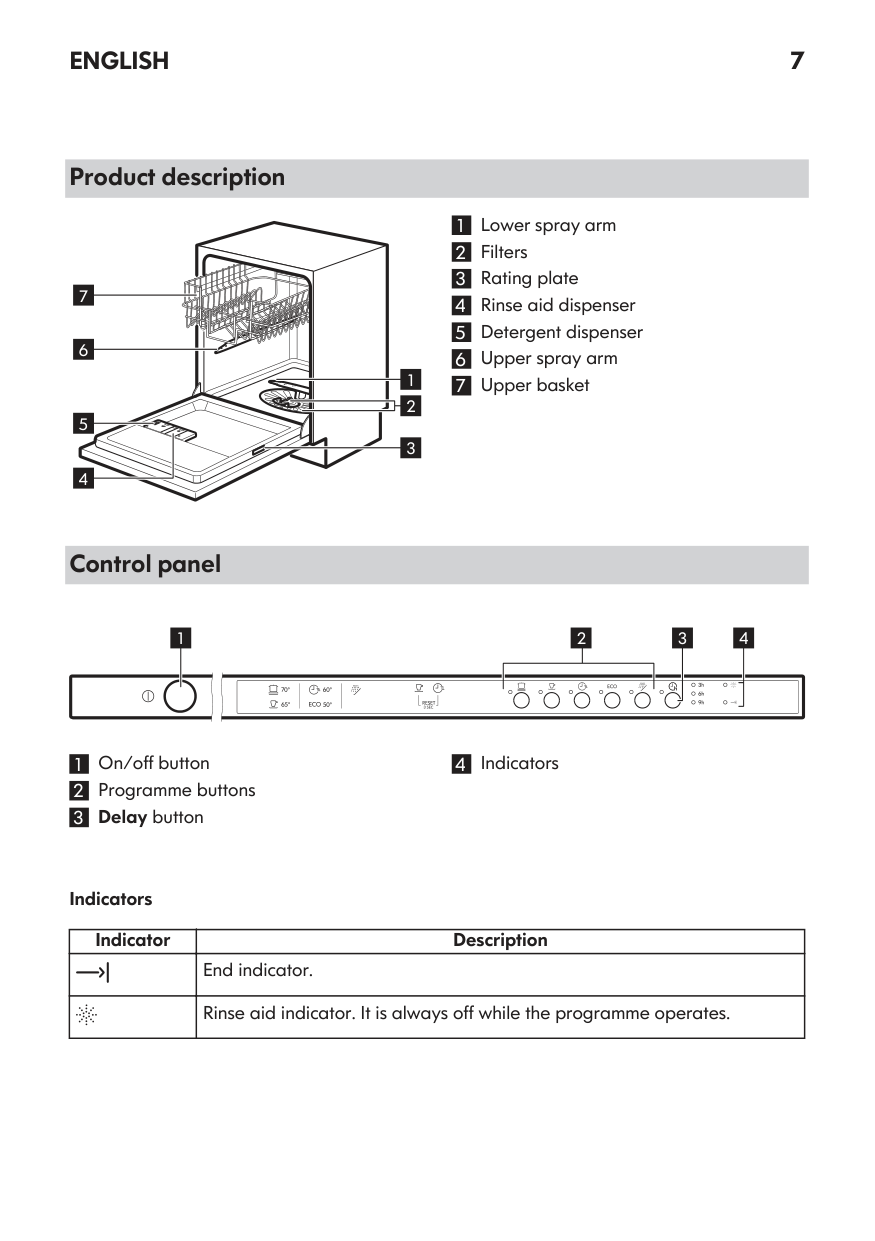
###### Product description
8
7 6 5
| | | |---|---| | |3|
4
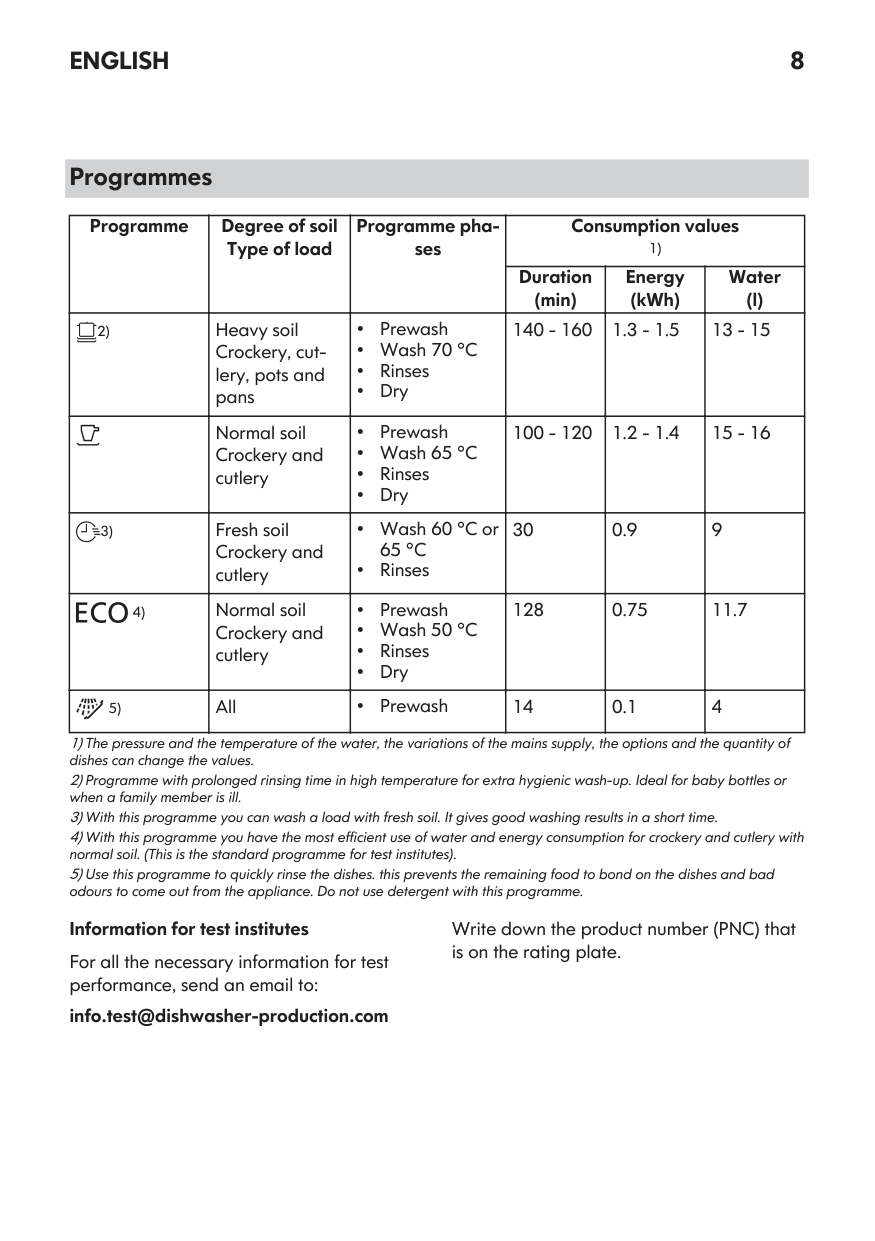
###### Control panel
1 32 4
4 Indicators
Indicators
|Indicator|Description| |---|---| | |End indicator.| | |Rinse aid indicator. It is always off while the programme operates.| | |Salt indicator. It is always off while the programme operates.|
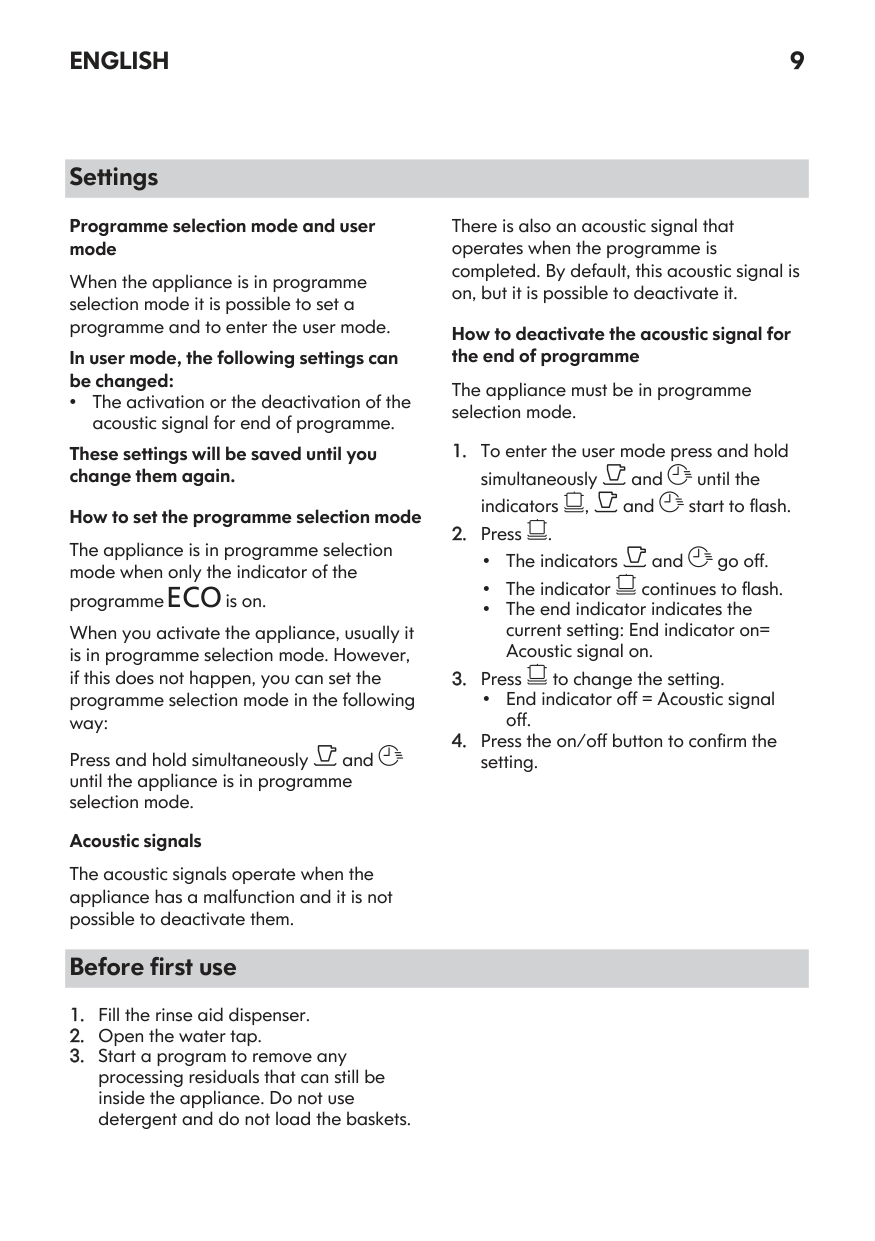
###### Programmes
|Programme|Degree of soil Type of load|Programme phases|Consumption values 1)|Consumption values 1)|Consumption values 1)| |---|---|---|---|---|---| |Programme|Degree of soil Type of load|Programme phases|Duration (min)|Energy (kWh)|Water (l)| |2)
70 °C|Heavy soil Crockery, cutlery, pots and pans|• Prewash
• Wash 70 °C
• Rinses
• Dry
|155 - 170|1.5 - 1.7|14-15| |65 °C|Normal soil Crockery and cutlery|• Prewash
• Wash 65 °C
• Rinses
• Dry
|130 - 140|1.4 - 1.6|15-17| |3)
60 °C or 65 °C|Fresh soil Crockery and cutlery|• Wash 60 °C or 65 °C
• Rinses
|38|0.8|10|
|Programme|Degree of soil Type of load|Programme phases|Consumption values 1)|Consumption values 1)|Consumption values 1)|
|---|---|---|---|---|---| |Programme|Degree of soil Type of load|Programme phases|Duration (min)|Energy (kWh)|Water (l)| |4) 50 °C|Normal soil Crockery and cutlery|• Prewash
• Wash 50 °C
• Rinses
• Dry
|227|1.039|12| |5)|All|• Prewash|14|0.1|5|
For any other questions regarding your dishwasher please refer to the service book provided with your appliance.
To receive the necessary information for conducting performance tests (e.g. according to EN60436), send an email to:
####### info.test@dishwasher-production.com
In your request please include the product number code (PNC) found on the rating plate.
###### Settings
Programme selection mode and user mode
When the appliance is in programme selection mode it is possible to set a programme and to enter the user mode.
####### Settings available in the user mode:
As the appliance stores the saved settings, there is no need to configure it before every cycle.
How to set the programme selection mode The appliance is in programme selection mode when only the indicator of the programme is on. After activation, the appliance is in programme selection mode by default. If not, set the programme selection mode the following way:
Press and hold simultaneously and until the appliance is in programme selection mode.
####### The water softener
The water softener removes minerals from the water supply, which would have a negative effect on the washing results and on the appliance.
The higher the content of these minerals, the harder your water is. Water hardness is measured in equivalent scales.
The water softener should be adjusted according to the hardness of the water in your area. Your local water authority can advise you on the hardness of the water in your area. It is important to set the right level of the water softener to assure good washing results.
Water hardness
|German degrees (°dH)|French degrees (°fH)|mmol/l|Clarke degrees|Water softener level| |---|---|---|---|---| |47 - 50|84 - 90|8.4 - 9.0|58 - 63|10| |43 - 46|76 - 83|7.6 - 8.3|53 - 57|9| |37 - 42|65 - 75|6.5 - 7.5|46 - 52|8| |29 - 36|51 - 64|5.1 - 6.4|36 - 45|7| |23 - 28|40 - 50|4.0 - 5.0|28 - 35|6| |19 - 22|33 - 39|3.3 - 3.9|23 - 27|5 1)| |15 - 18|26 - 32|2.6 - 3.2|18 - 22|4| |11 - 14|19 - 25|1.9 - 2.5|13 - 17|3| |4 - 10|7 - 18|0.7 - 1.8|5 - 12|2| |<4|<7|<0.7|< 5|1 2)|
Regardless of the type of detergent used, set the proper water hardness level to keep the salt refill indicator active.
Multi-tabs containing salt are not effective enough to soften hard water.
####### How to set the water softener level
Make sure the appliance is in the programme selection mode.
to enter the user mode.
The indicators: , , and start flashing.
####### The rinse aid empty notification
The rinse aid helps to dry the dishes without streaks and stains.
The rinse aid is automatically released during the hot rinse phase.
When rinse aid chamber is empty, the rinse aid indicator is turned on notifying to refill rinse aid. If the drying results are satisfactory while using multi-tablets only, it is possible to deactivate the notification for refilling rinse aid. However, for best drying performance, always use rinse aid.
If standard detergent or multi-tablets without rinse aid are used, activate the notification to keep the rinse aid refill indicator active.
How to deactivate the rinse aid empty notification
Make sure the appliance is in the programme selection mode.
to enter the user mode.
The indicators: , , and start flashing.
The indicators: , and are off. The indicator still flashes. The indicator shows the current setting. If on = rinse aid empty notification is on, if off = rinse aid empty notification is off.
####### Acoustic signals
Acoustic signals sound when a malfunction of the appliance occurs. It is not possible to deactivate these acoustic signals.
There is also an acoustic signal that sounds when the programme is complete. This acoustic signal is activated by default and you can deactivate it.
When you press the main switch to turn on the dishwasher, it makes a short beep sound. The beep is activated by default and you can deactivate it along with the acoustic signal for the end of a programme.
In addition, an acoustic signal sounds before the AutoOpen opens the door. This acoustic signal stops only if AutoOpen is deactivated.
####### How to deactivate the acoustic signals
Make sure the appliance is in the programme selection mode.
The indicators: , , and start flashing.
The indicator shows the current setting. If on = the acoustic signal is active. If off = the acoustic signal is disabled.
####### AutoOpen
AutoOpen improves the drying results with less energy consumption.
| | |---|
During the drying phase, the door opens automatically and remains ajar.
Caution! Do not try to close the appliance door within 2 minutes after automatic opening. This can cause damage to the appliance.
AutoOpen is automatically activated with all programmes excluding .
To avoid possible hazards inside the appliance (such as knives, sharp objects or chemicals) for children, pets or people with disabilities deactivate the function.
####### How to deactivate AutoOpen
The appliance must be in the programme selection mode.
to enter the user mode.
The indicators: , , and start flashing.
###### Before first use
After starting a programme, it may take up to 5 minutes for the appliance to recharge the resin in the water softener. It seems that the appliance is not working. The washing phase starts only after this procedure is completed. The procedure is repeated periodically.
####### The salt container
Caution! Use rough salt designed for dishwashers only. Fine salt increases the risk of corrosion.
The salt is used to recharge the resin in the water softener and to assure good washing results in daily use.
Filling the salt container 1 2
####### 4
Put 1 litre of water in the salt container (only for the first time).
Put 1 kg of salt in the salt container.
####### 5
Turn the cap of the salt container clockwise to close the salt container.
Caution! Water and salt may come out of the salt container when you fill it. After you fill the salt container, immediately start a programme to prevent corrosion.
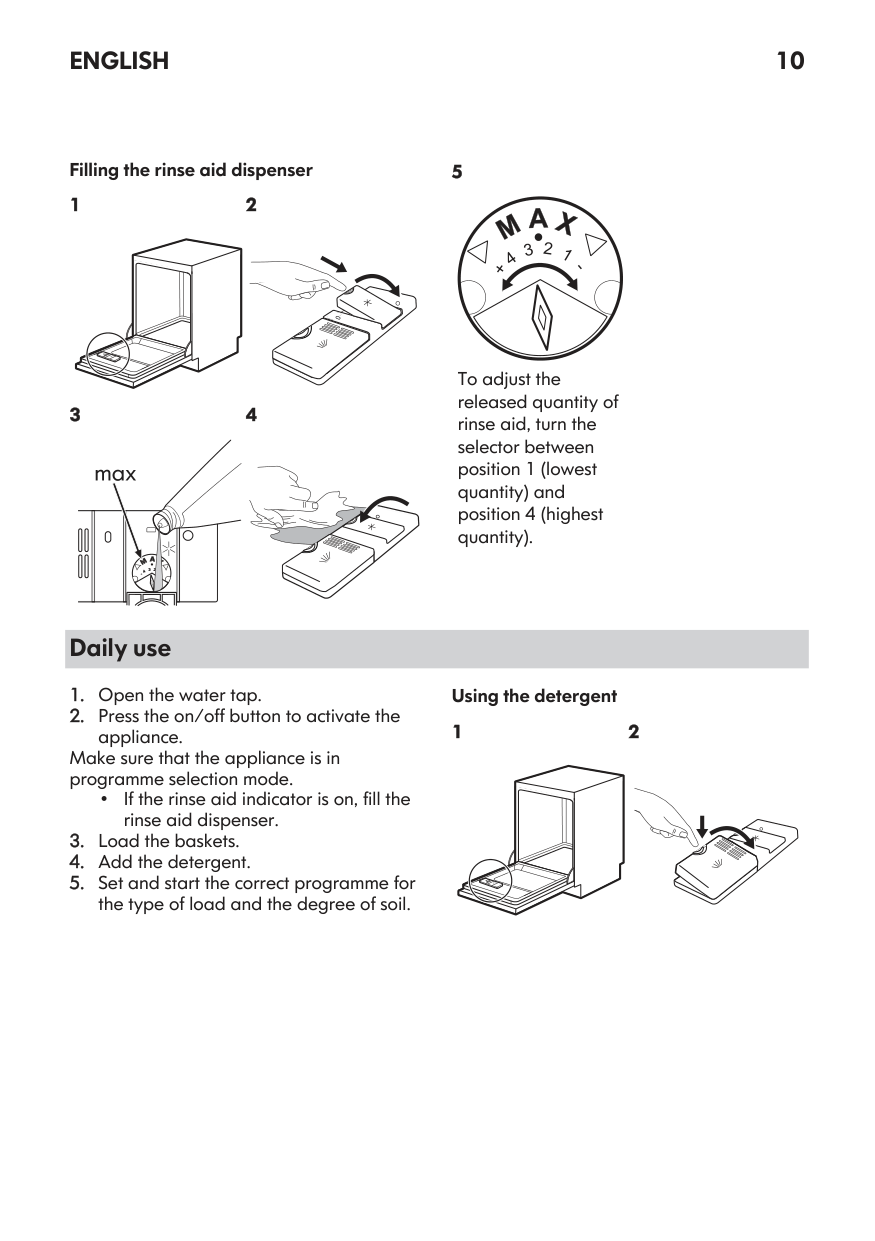
Filling the rinse aid dispenser 1 2
3
####### 4
A
M
X
A
#### X
M
2
3
1
4
To adjust the released quantity of rinse aid, turn the selector between position 1 (lowest quantity) and position 4 (highest quantity).
###### Daily use
Make sure that the appliance is in programme selection mode.
Using the detergent 1 2
3
####### 4
########## B
A
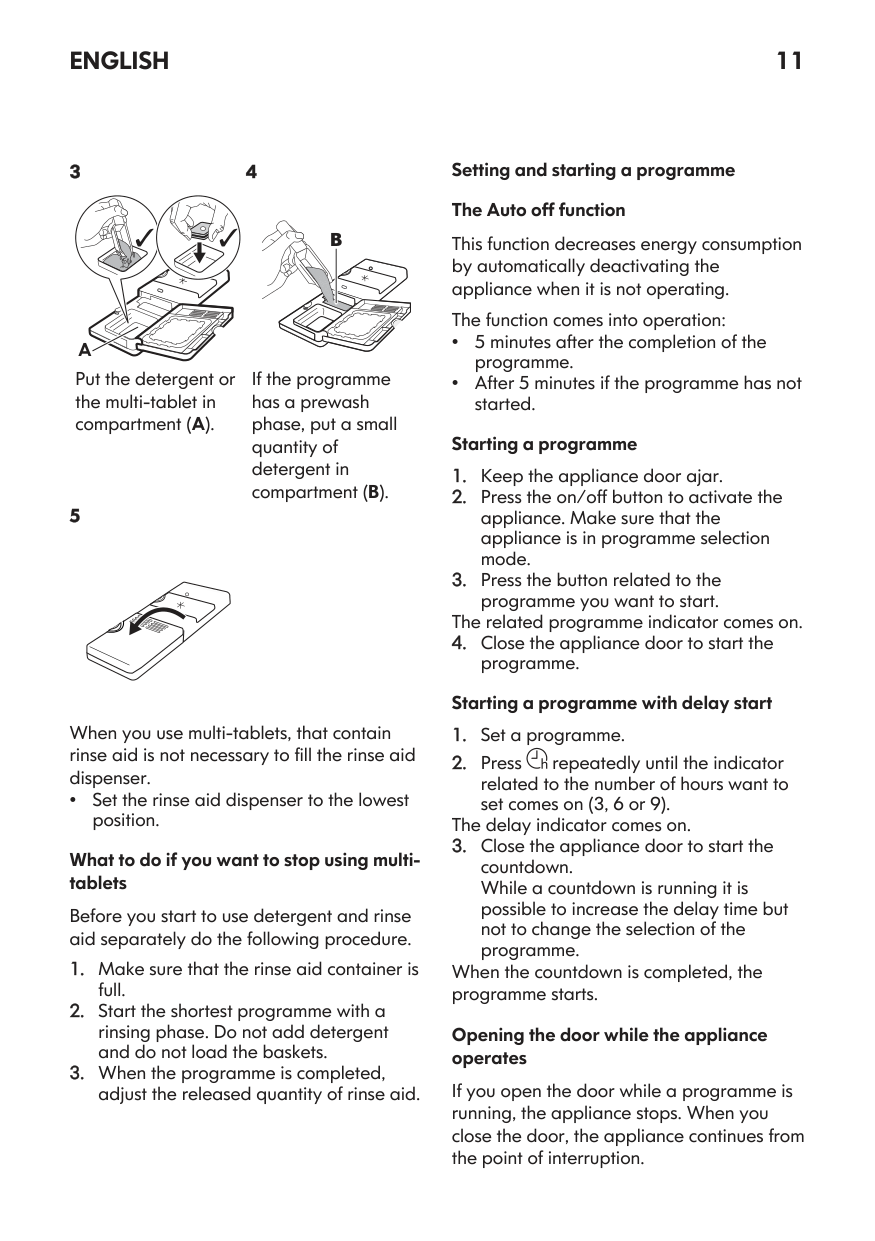
Put the detergent or the multi-tablet in compartment (A).
If the programme has a prewash phase, put a small quantity of detergent in compartment (B).
####### 5
When you use multi-tablets, that contain salt and rinse aid, is not necessary to fill the salt container and the rinse aid dispenser.
What to do if you want to stop using multitablets
Before you start to use detergent, salt and rinse aid separately do the following procedure.
The Auto Off function This function decreases energy consumption by automatically deactivating the appliance when it is not operating. The function comes into operation: • 5 minutes after the completion of the
programme.
• After 5 minutes if the programme has not started.
####### Starting a programme
The related programme indicator comes on.
####### Starting a programme with delay start
The delay indicator comes on.
When the countdown is completed, the programme starts.
Opening the door while the appliance operates
If you open the door while a programme is running, the appliance stops. It may affect the energy consumption and the programme duration. When you close the door, the appliance continues from the point of interruption.
Cancelling the delay start while the countdown operates
When you cancel the delay start you have to set the programme and options again.
Press and hold simultaneously and until the appliance is in programme selection mode.
####### Cancelling the programme
Press and hold simultaneously and until the appliance is in programme selection mode. Make sure that there is detergent in the detergent dispenser before you start a new programme.
End of the programme When the programme is completed the indicator comes on. If you do not
deactivate the appliance within 5 minutes, all indicators go off to decrease the energy consumption.
###### Hints and tips
####### General
Follow the hints below to ensure optimal cleaning and drying results in daily use and to help you protect the environment.
offers the most efficient use of water and energy consumption.
####### Using salt, rinse aid and detergent
####### Loading the baskets
Refer to the supplied leaflet with examples of the load of the baskets.
####### Before starting a programme
Before you start the selected programme, make sure that:
After the programme is completed, water can still remain on the inside surfaces of the appliance.
###### Care and cleaning
Warning! Before maintenance, deactivate the appliance and disconnect the mains plug from the main socket.
Dirty filters and clogged spray arms decrease the washing results. Make a check regularly and, if necessary, clean them.
Cleaning the filters
2
C
B
A
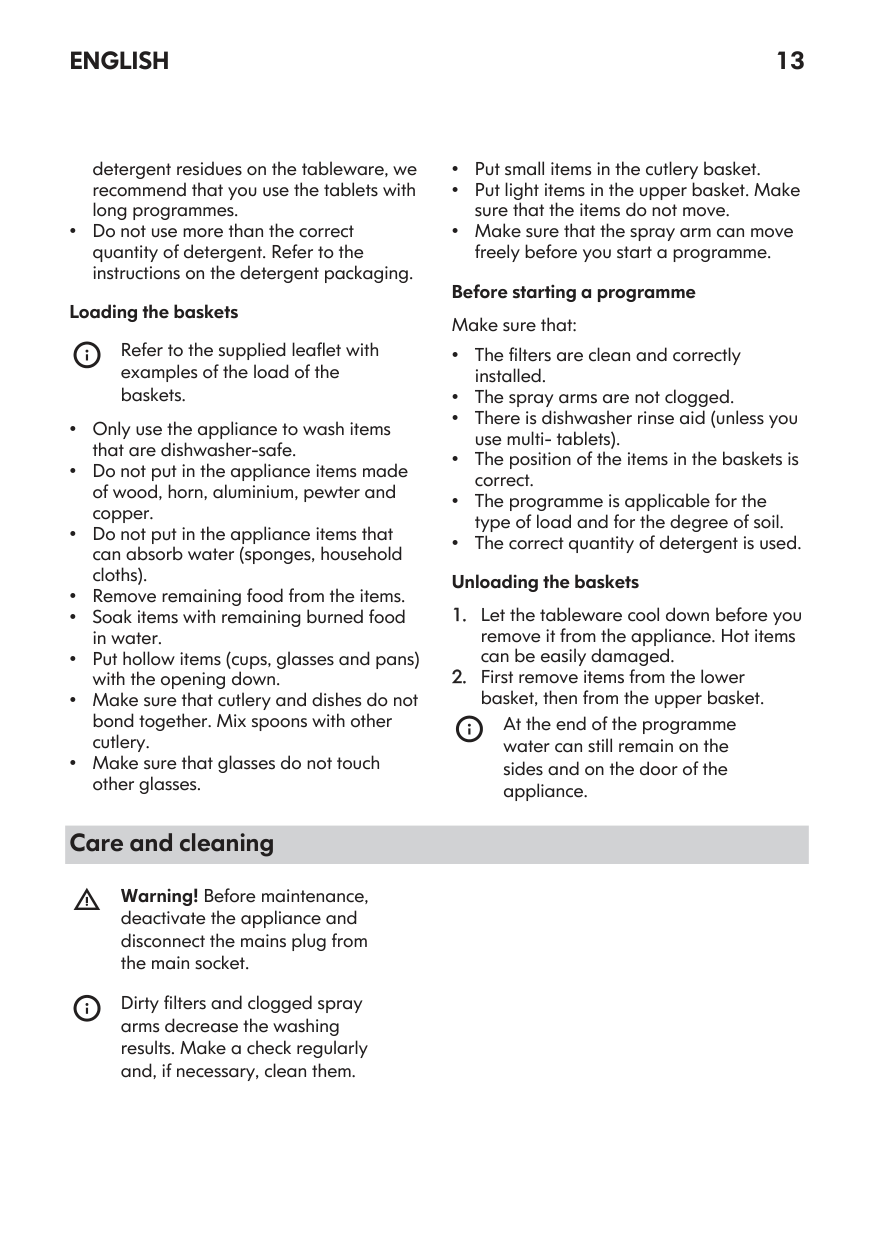
Make sure that there are no residues of food or soil in or around the edge of the sump.
The filter system is made of three parts.
####### 3
####### 4
To remove filters (B) and (C), turn the handle counterclockwise and pull it upwards. Remove the filter (C) out of filter (B). Wash the filters with water.
Remove the flat filter (A). Wash the filter with water.
####### 5
####### 6
########### D
Put the flat filter (A) back in place. Make sure that it is correctly positioned under the 2 guides (D).
Reassemble the filters (B) and (C). Put them back in the filter (A). Turn the handle clockwise until it locks.
An incorrect position of the filters can cause bad washing results and damage to the appliance
Cleaning the filter of the inlet hose 1
2
A
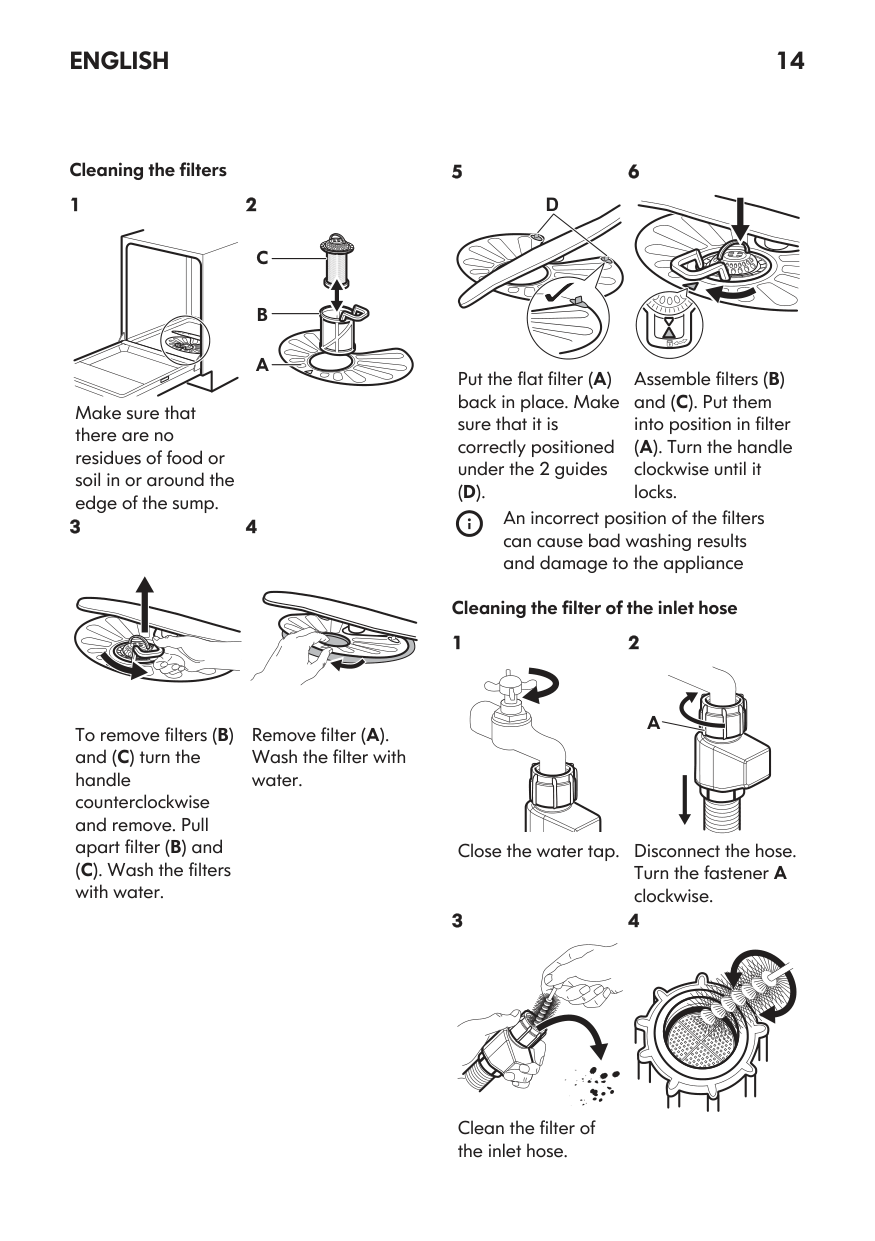
Close the water tap.
Disconnect the hose. Turn the fastener A clockwise.
####### 3
####### 4
Clean the filter of the inlet hose.
####### Cleaning the spray arms
Do not remove the spray arms. If the holes in the spray arms are clogged, remove remaining parts of soil with a thin pointed object.
####### External cleaning
####### Internal cleaning
• Carefully clean the appliance, including the rubber gasket of the door, with a soft damp cloth.
###### Troubleshooting
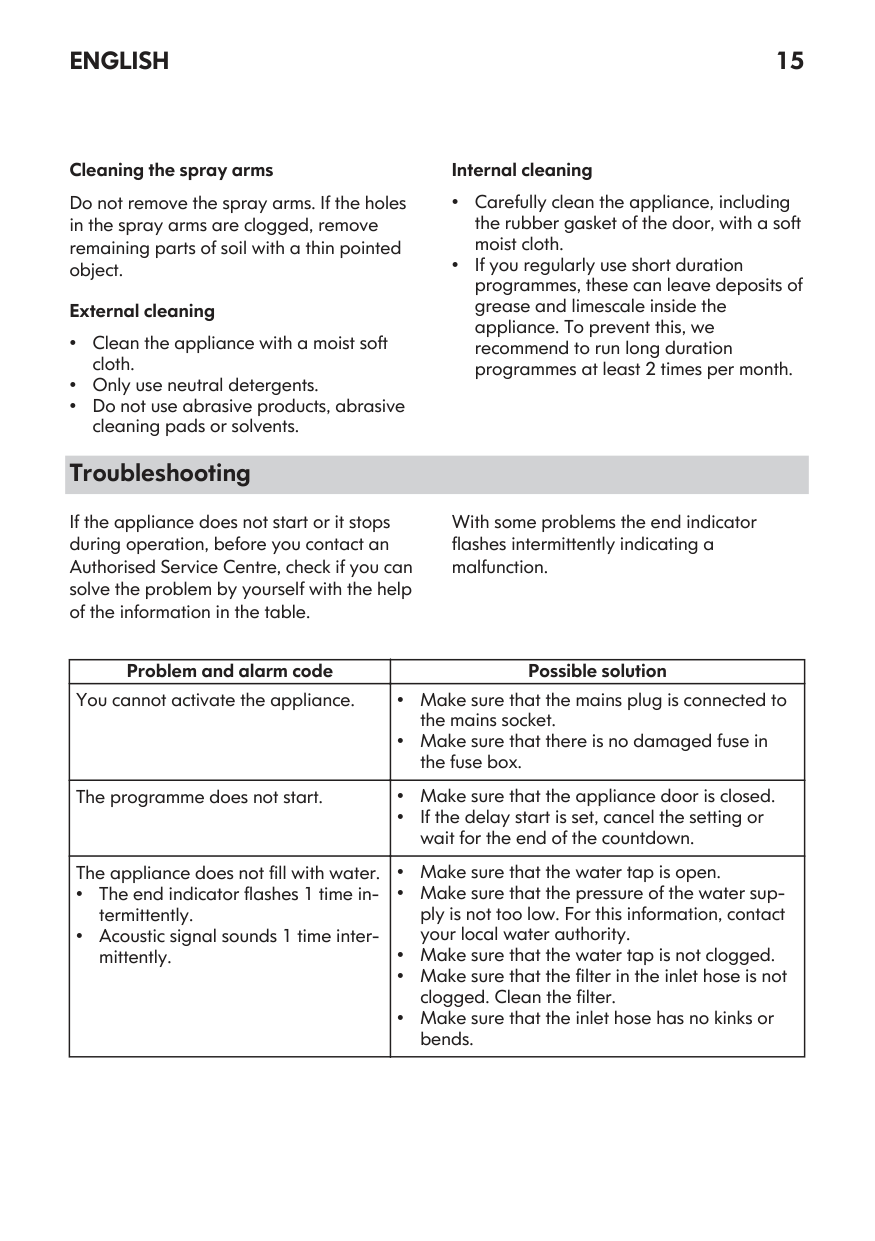
If the appliance does not start or it stops during operation, before you contact an Authorised Service Centre, check if you can solve the problem by yourself with the help of the information in the table.
Warning! Repairs not properly done may result in serious risk to the safety of the user. Any repairs must be performed by qualified personnel.
With some problems the end indicator flashes intermittently indicating a malfunction.
The majority of problems that can occur can be solved without the need to contact an Authorised Service Centre.
|Problem and alarm code|Possible cause and solution| |---|---| |You cannot activate the appliance.|• Make sure that the mains plug is connected to the mains socket.
• Make sure that there is no damaged fuse in the fuse box.
|
|Problem and alarm code|Possible cause and solution| |---|---| |The programme does not start.|• Make sure that the appliance door is closed.
• If the delay start is set, cancel the setting or wait for the end of the countdown.
• The appliance has started the procedure to recharge the resin inside the water softener. The duration of the procedure is approximately 5 minutes.
| |The appliance does not fill with water.
• The end indicator flashes 1 time intermittently.
• Acoustic signal sounds 1 time intermittently.
|• Make sure that the water tap is open.
• Make sure that the pressure of the water supply is not too low. For this information, contact your local water authority.
• Make sure that the water tap is not clogged.
• Make sure that the filter in the inlet hose is not clogged.
• Make sure that the inlet hose has no kinks or bends.
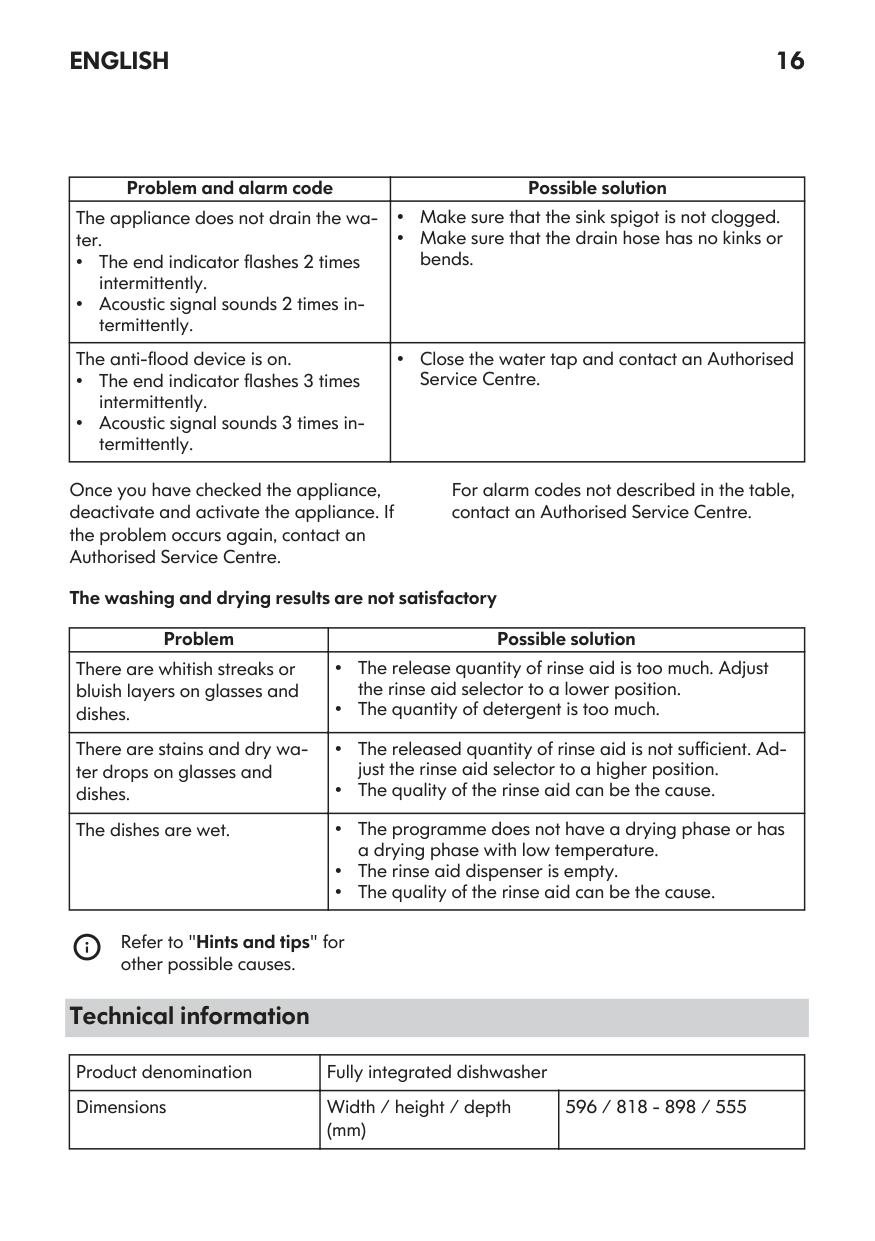
| |The appliance does not drain the water.
• The end indicator flashes 2 times intermittently.
• Acoustic signal sounds 2 times intermittently.
|• Make sure that the sink spigot is not clogged.
• Make sure that the drain hose has no kinks or bends.
| |The anti-flood device is on.
• The end indicator flashes 3 times intermittently.
• Acoustic signal sounds 3 times intermittently.
|• Close the water tap and contact an Authorised Service Centre.|
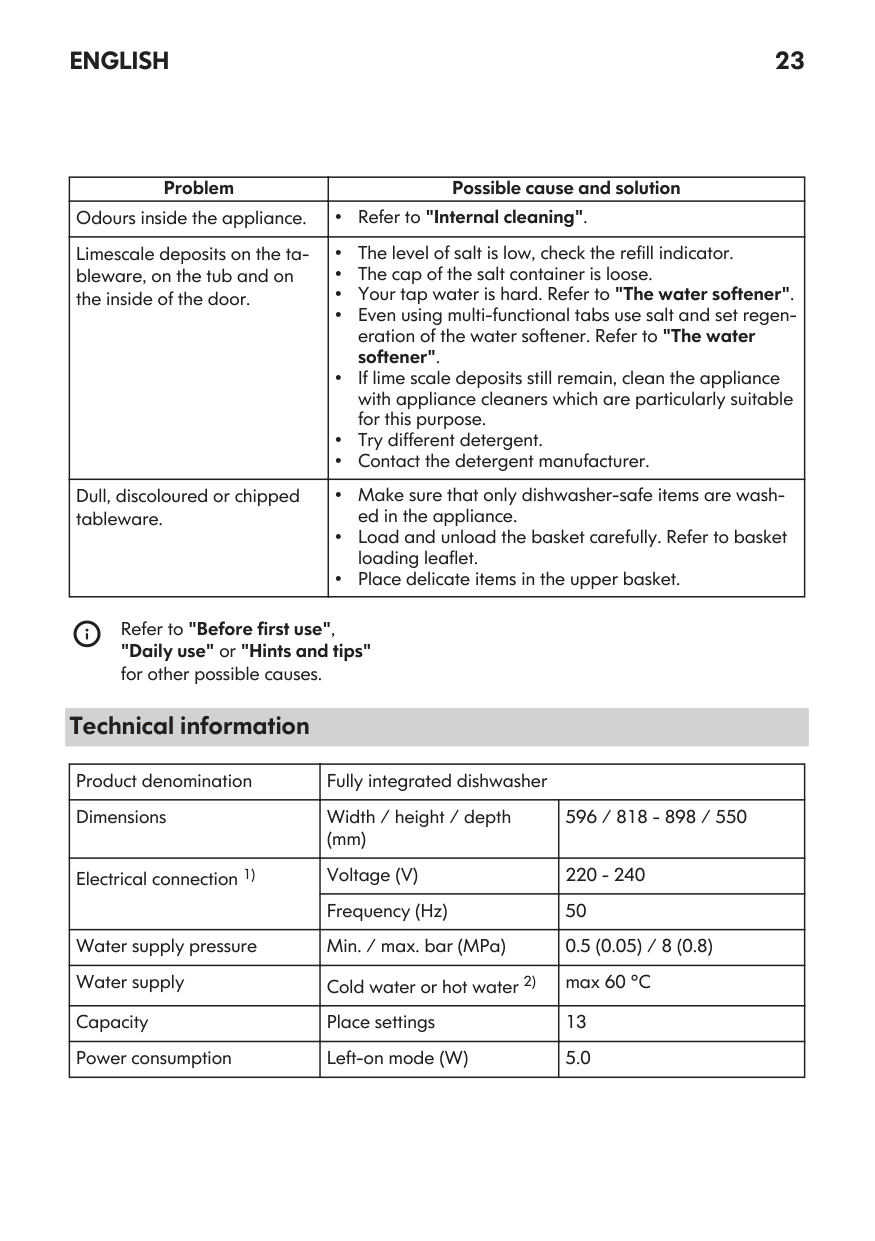
|The salt indicator continues to stay on after the replenishment of the salt container.|• If after 3 or 4 programmes, the salt indicator continues to stay on, contact an Authorised Service Centre. This can occur when you are using salt that needs more time to dissolve. There is no unwanted effect on the performance of the appliance.| |The appliance stops and starts more times during operation.|• It is normal. It provides optimal cleaning results and energy savings.| |The program lasts too long.|• If the delayed start option is set, cancel the delay setting or wait for the end of the countdown.|
|Problem and alarm code|Possible cause and solution| |---|---| |Small leak from the appliance door.|• The appliance is not levelled. Loosen or tighten the adjustable feet (if applicable).
• The appliance door is not centred on the tub. Adjust the rear foot (if applicable).
| |The appliance door is difficult to close.|• The appliance is not levelled. Loosen or tighten the adjustable feet (if applicable).
• Parts of the tableware are protruding from the baskets.
| |Rattling/knocking sounds from inside the appliance.|• The tableware is not properly arranged in the baskets. Refer to basket loading leaflet.
• Make sure that the spray arms can rotate freely.
| |The appliance trips the circuit-beaker.|• The amperage is insufficient to supply simultaneously all the appliances in use. Check the socket amperage and the capacity of the meter or turn off one of the appliances in use.
• Internal electrical fault of the appliance. Contact an Authorised Service Centre.
|
####### Refer to "Before first use", "Daily use", or "Hints and tips" for other possible causes.
Once you have checked the appliance, deactivate and activate the appliance. If
the problem occurs again, contact an Authorised Service Centre.
For alarm codes not described in the table, contact an Authorised Service Centre.
####### The washing and drying results are not satisfactory
|Problem|Possible cause and solution| |---|---| |Poor washing results.|• Refer to "Daily use", "Hints and tips" and basket loading leaflet.
• Use more intensive washing programmes.
• Clean spray arm jets and filter. Refer to "Care and Cleaning".
|
|Problem|Possible cause and solution| |---|---| |Poor drying results.|• Tableware has been left for too long inside a closed appliance.
• There is no rinse aid or the dosage of rinse aid is not enough. Set the rinse aid dispenser to a higher level.
• Plastic items may need to be towel dried.
• For the best drying performance activate AutoOpen.
• We recommend to always use rinse aid, even in combination with multi-tablets.
| |There are whitish streaks or bluish layers on glasses and dishes.|• The release quantity of rinse aid is too much. Adjust the rinse aid level to a lower level.
• The quantity of detergent is too much.
|
|There are stains and dry water drops on glasses and dishes.|• The released quantity of rinse aid is not sufficient. Adjust the rinse aid level to a higher level.
• The quality of the rinse aid can be the cause.
| |The dishes are wet.|• For the best drying performance activate AutoOpen.
• The programme does not have a drying phase or has a drying phase with low temperature.
• The rinse aid dispenser is empty.
• The quality of the rinse aid can be the cause.
• The quality of the multi-tablets can be the cause. Try a different brand or activate the rinse aid dispenser and use rinse aid and multi-tablets together.
| |The interior of the appliance is wet.|• This is not a defect of the appliance. it is caused by the humidity in the air that condenses on the walls.| |Unusual foam during washing.|• Use the detergent for dishwashers only.
• There is a leak in the rinse aid dispenser. Contact an Authorised Service Centre.
| |Traces of rust on cutlery.|• There is too much salt in the water used for washing. Refer to "The water softener".
• Silver and stainless steel cutlery were placed together. Avoid to put silver and stainless steel items close together.
| |There are residues of detergent in the dispenser at the end of the programme.|• The detergent tablet got stuck in the dispenser and therefore was not completely washed away by water.
• Water cannot wash away the detergent from the dispenser. Make sure that the spray arm is not blocked or clogged.
• Make sure that items in the baskets do not impede the lid of the detergent dispenser from opening.
|
|Problem|Possible cause and solution| |---|---| |Odours inside the appliance.|• Refer to "Internal cleaning".| |Limescale deposits on the tableware, on the tub and on the inside of the door.|• The level of salt is low, check the refill indicator.
• The cap of the salt container is loose.
• Your tap water is hard. Refer to "The water softener".
• Even using multi-functional tabs use salt and set regeneration of the water softener. Refer to "The water softener".
• If lime scale deposits still remain, clean the appliance with appliance cleaners which are particularly suitable for this purpose.
• Try different detergent.
• Contact the detergent manufacturer.
| |Dull, discoloured or chipped tableware.|• Make sure that only dishwasher-safe items are washed in the appliance.
• Load and unload the basket carefully. Refer to basket loading leaflet.
• Place delicate items in the upper basket.
|
Refer to "Before first use", "Daily use" or "Hints and tips" for other possible causes.
###### Technical information
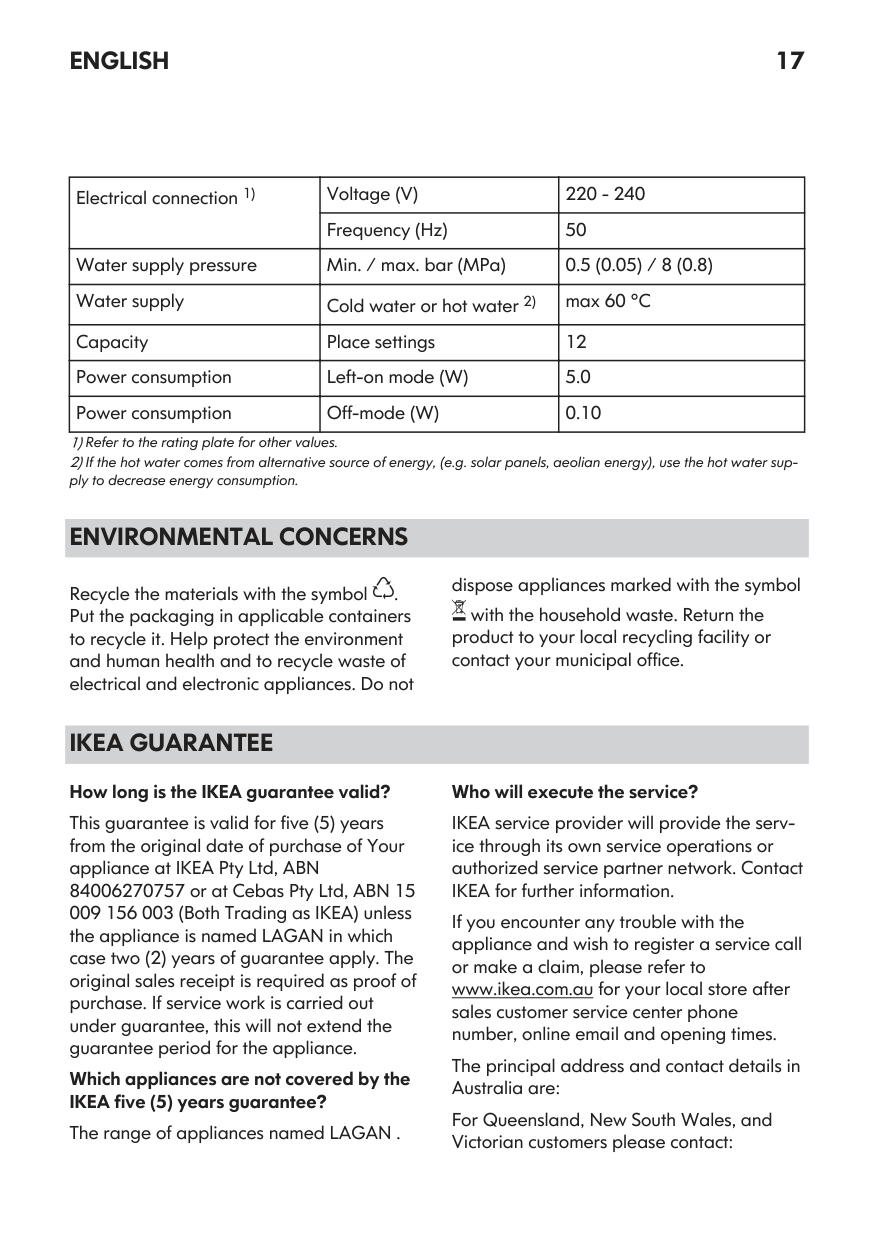
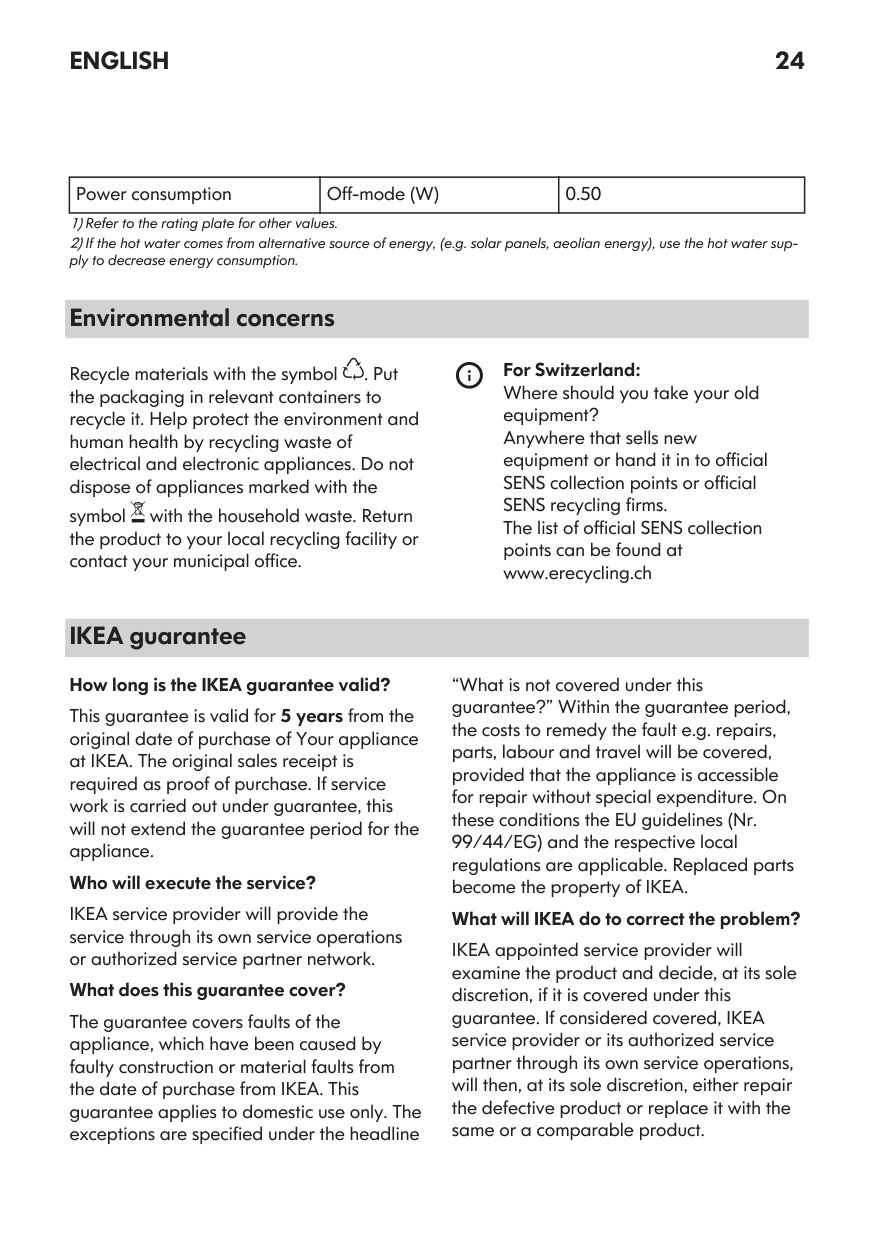
|Product denomination|Fully integrated dishwasher|Fully integrated dishwasher| |---|---|---| |Dimensions|Width / height / depth (mm)|596 / 818 - 898 / 550| |Electrical connection 1)|Voltage (V)|220 - 240| |Electrical connection 1)|Frequency (Hz)|50| |Water supply pressure|Min. / max. bar (MPa)|0.5 (0.05) / 8 (0.8)| |Water supply|Cold water or hot water 2)|max 60 °C| |Capacity|Place settings|13| |Power consumption|Left-on mode (W)|5.0|
|Power consumption|Off-mode (W)|0.50| |---|---|---|
###### Environmental concerns
Recycle materials with the symbol . Put the packaging in relevant containers to recycle it. Help protect the environment and human health by recycling waste of electrical and electronic appliances. Do not dispose of appliances marked with the
symbol with the household waste. Return the product to your local recycling facility or contact your municipal office.
For Switzerland: Where should you take your old equipment? Anywhere that sells new equipment or hand it in to official SENS collection points or official SENS recycling firms. The list of official SENS collection points can be found at www.erecycling.ch
###### IKEA guarantee
####### How long is the IKEA guarantee valid?
This guarantee is valid for 5 years from the original date of purchase of Your appliance at IKEA. The original sales receipt is required as proof of purchase. If service work is carried out under guarantee, this will not extend the guarantee period for the appliance.
####### Who will execute the service?
IKEA service provider will provide the service through its own service operations or authorized service partner network.
####### What does this guarantee cover?
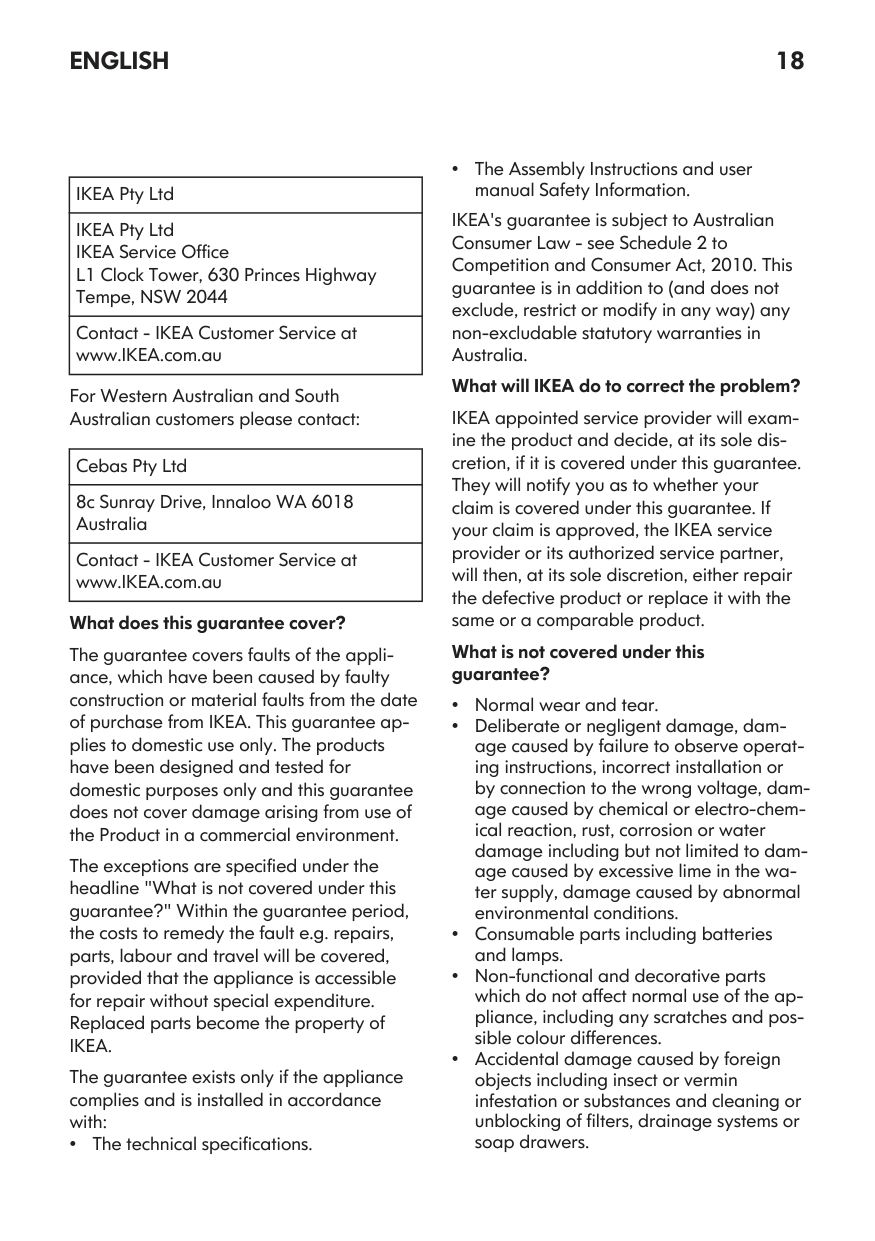
The guarantee covers faults of the appliance, which have been caused by faulty construction or material faults from the date of purchase from IKEA. This guarantee applies to domestic use only. The exceptions are specified under the headline
“What is not covered under this guarantee?” Within the guarantee period, the costs to remedy the fault e.g. repairs, parts, labour and travel will be covered, provided that the appliance is accessible for repair without special expenditure. On these conditions the EU guidelines (Nr. 99/44/EG) and the respective local regulations are applicable. Replaced parts become the property of IKEA.
####### What will IKEA do to correct the problem?
IKEA appointed service provider will examine the product and decide, at its sole discretion, if it is covered under this guarantee. If considered covered, IKEA service provider or its authorized service partner through its own service operations, will then, at its sole discretion, either repair the defective product or replace it with the same or a comparable product.
What is not covered under this guarantee?
damage to the product that occurs during this delivery will be covered by this guarantee.
• Cost for carrying out the initial installation of the IKEA appliance. However, if an IKEA service provider or its authorized service partner repairs or replaces the appliance under the terms of this guarantee, the service provider or its authorized service partner will reinstall the repaired appliance or install the replacement, if necessary.
This restriction do not apply to fault-free work carried out by a qualified specialist using our original parts in order to adapt the appliance to the technical safety specifications of another EU country.
####### How country law applies
The IKEA guarantee gives You specific legal rights, which covers or exceed local demands. However these conditions do not limit in any way consumer rights described in the local legislation.
####### Area of validity
For appliances which are purchased in one EU country and taken to another EU country, the services will be provided in the framework of the guarantee conditions normal in the new country. An obligation to carry out services in the framework of the guarantee exists only if the appliance complies and is installed in accordance with:
The dedicated After Sales Service for IKEA appliances:
Please do not hesitate to contact IKEA After Sales Service to:
guarantee;
To ensure that we provide you with the best assistance, please read carefully the Assembly Instructions and/or the User Manual section of this booklet before contacting us.
####### How to reach us if You need our service
| | | | | |---|---|---|---| | | | | |
Please refer to the last page of this manual for the full list of IKEA appointed contacts and relative national phone numbers.
In order to provide You with a quicker service, we recommend that You use the specific phone numbers listed at the end of this manual. Always refer to the numbers listed in the booklet of the specific appliance You need an assistance for. Before calling us, assure that You have to hand the IKEA article number (8 digit code) and the Serial Number (8 digit code that can be found on the rating plate) for the appliance of which you need our assistance.
SAVE THE SALES RECEIPT! It is Your proof of purchase and required for the guarantee to apply. Note that the receipt reports also the IKEA article name and number (8 digit code) for each of the appliances you have purchased.
####### Do You need extra help?
For any additional questions not related to After Sales of your appliances, please contact our nearest IKEA store call centre. We recommend you read the appliance documentation carefully before contacting us.
###### Inhaltsverzeichnis
Sicherheitshinweise 27 Sicherheitsanweisungen 29 Gerätebeschreibung 31 Bedienfeld 31 Programme 32 Einstellungen 33 Vor der ersten Inbetriebnahme 36
Täglicher Gebrauch 38 Tipps und Hinweise 40 Reinigung und Pflege 42 Fehlersuche 44 Technische Informationen 48 Umwelttipps 49 IKEA Garantie 49
Änderungen vorbehalten.
Sicherheitshinweise
Lesen Sie vor der Montage und dem Gebrauch des Geräts zuerst die Bedienungsanleitung. Bei Verletzungen oder Schäden infolge nicht ordnungsgemäßer Montage oder Verwendung übernimmt der Hersteller keine Haftung. Bewahren Sie die Anleitung zum Nachschlagen an einem sicheren und zugänglichen Ort auf.
Sicherheit von Kindern und schutzbedürftigen Personen
Allgemeine Sicherheit
##### • Das Gerät muss mit den mitgelieferten neuen Schläuchen andie Wasserversorgung angeschlossen werden. Alte Schläuchedürfen nicht wiederverwendet werden.
###### Sicherheitsanweisungen
####### Montage
WARNUNG! Die Montage des Geräts darf nur von einer qualifizierten Fachkraft durchgeführt werden.
####### Elektrischer Anschluss
WARNUNG! Brand- und Stromschlaggefahr.
####### Wasseranschluss
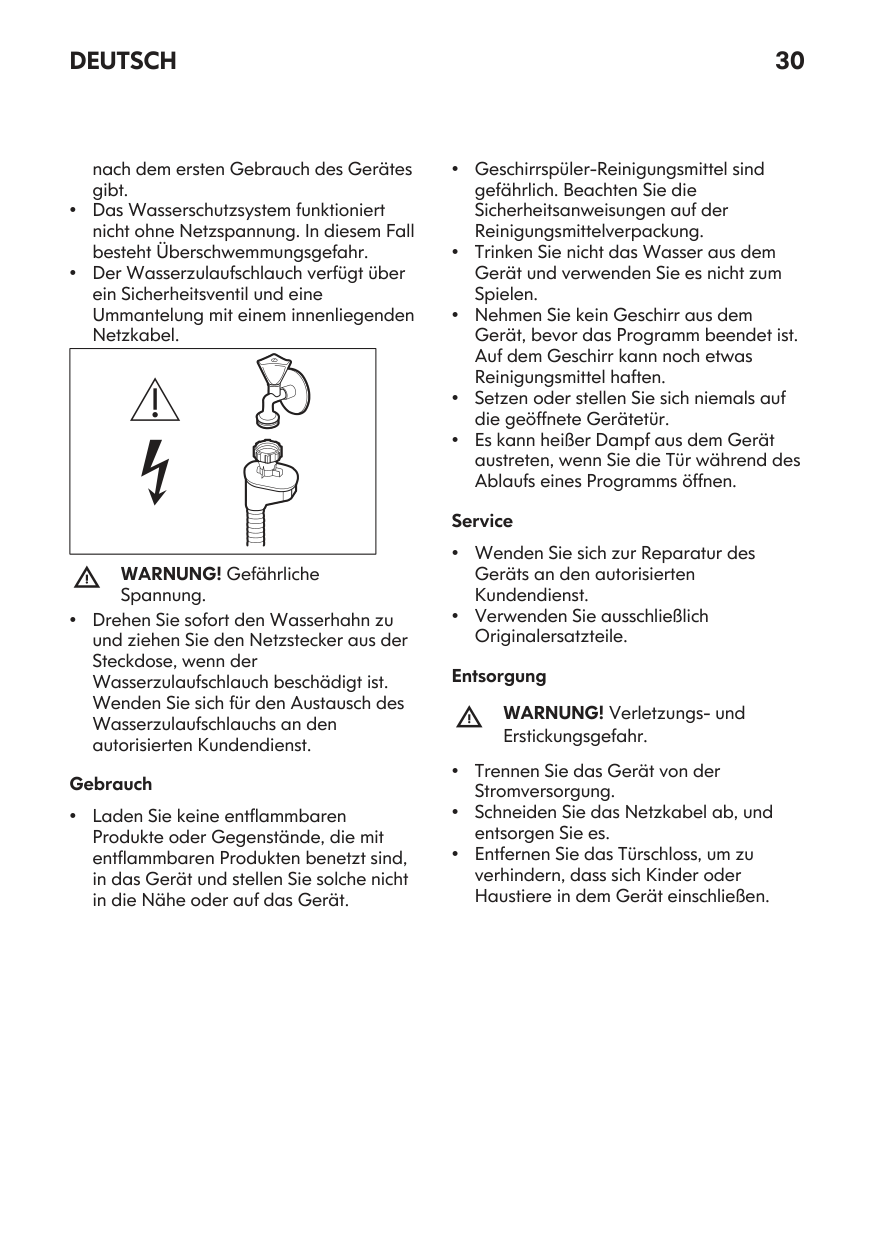
nach dem ersten Gebrauch des Gerätes gibt.
| | |---|
WARNUNG! Gefährliche Spannung.
####### Gebrauch
• Laden Sie keine entflammbaren Produkte oder Gegenstände, die mit entflammbaren Produkten benetzt sind, in das Gerät und stellen Sie solche nicht in die Nähe oder auf das Gerät.
####### Service
Originalersatzteile. Entsorgung
WARNUNG! Verletzungs- und Erstickungsgefahr.
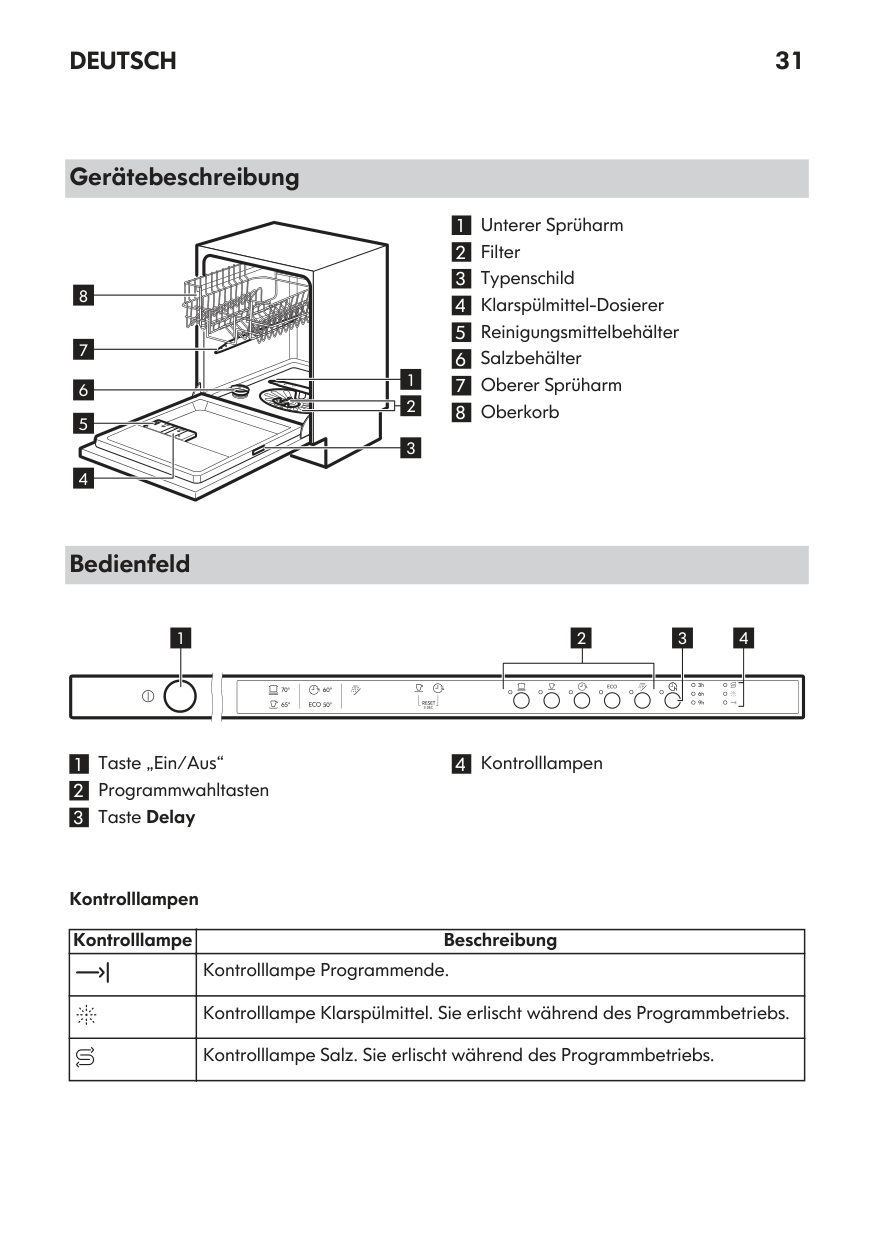
###### Gerätebeschreibung
8
7 6 5
| | | |---|---| | |3|
4
###### Bedienfeld
1 32 4
4 Kontrolllampen
####### Kontrolllampen
|Kontrolllampe|Beschreibung| |---|---| | |Kontrolllampe Programmende.| | |Kontrolllampe Klarspülmittel. Sie erlischt während des Programmbetriebs.| | |Kontrolllampe Salz. Sie erlischt während des Programmbetriebs.|
###### Programme
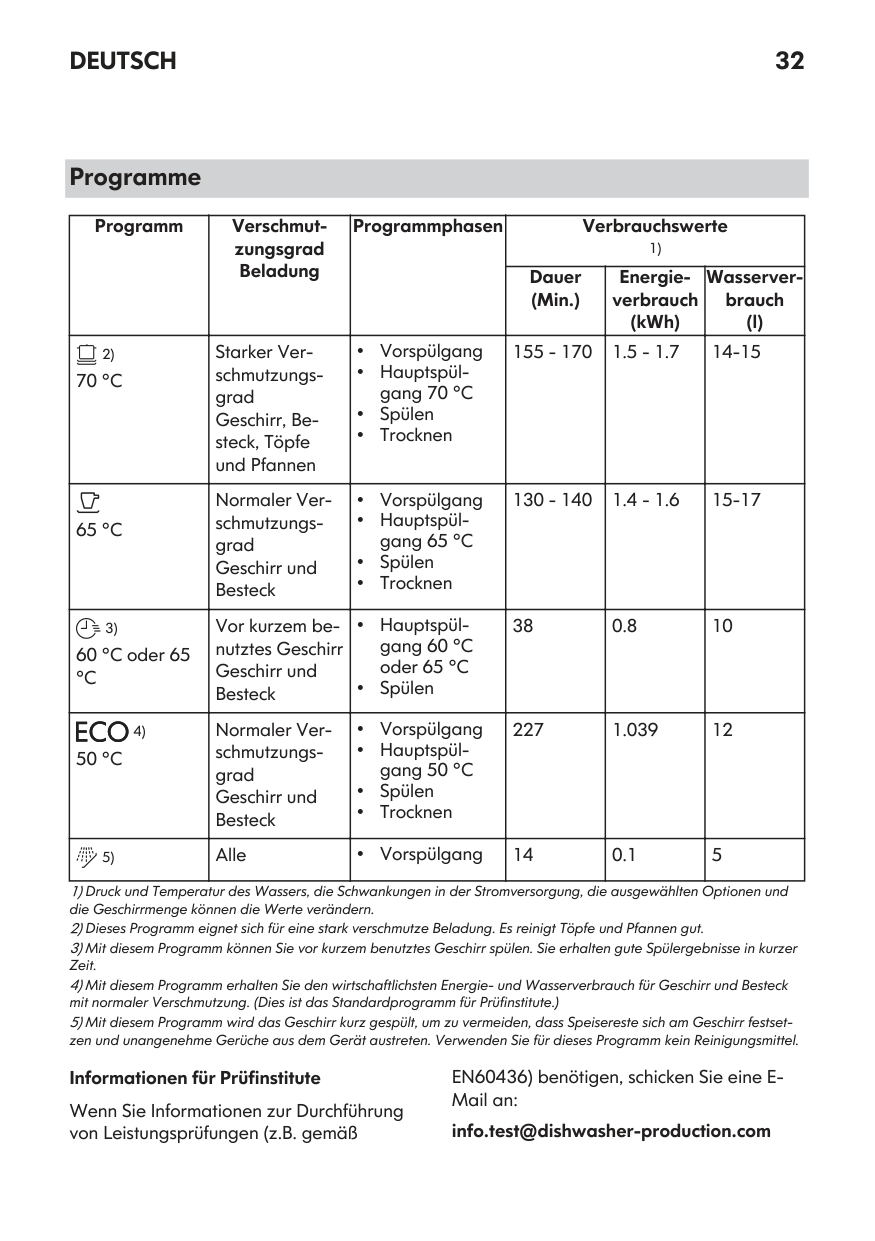
|Programm|Verschmutzungsgrad Beladung|Programmphasen|Verbrauchswerte 1)|Verbrauchswerte 1)|Verbrauchswerte 1)| |---|---|---|---|---|---| |Programm|Verschmutzungsgrad Beladung|Programmphasen|Dauer (Min.)|Energieverbrauch (kWh)|Wasserverbrauch (l)| |2)
70 °C|Starker Verschmutzungsgrad Geschirr, Besteck, Töpfe und Pfannen|• Vorspülgang
• Hauptspülgang 70 °C
• Spülen
• Trocknen
|155 - 170|1.5 - 1.7|14-15| |65 °C|Normaler Verschmutzungsgrad Geschirr und Besteck|• Vorspülgang
• Hauptspülgang 65 °C
• Spülen
• Trocknen
|130 - 140|1.4 - 1.6|15-17| |3) 60 °C oder 65 °C|Vor kurzem benutztes Geschirr Geschirr und Besteck|• Hauptspülgang 60 °C oder 65 °C
• Spülen
|38|0.8|10| |4) 50 °C|Normaler Verschmutzungsgrad Geschirr und Besteck|• Vorspülgang
• Hauptspülgang 50 °C
• Spülen
• Trocknen
|227|1.039|12| |5)|Alle|• Vorspülgang|14|0.1|5|
EN60436) benötigen, schicken Sie eine EMail an:
Wenn Sie Informationen zur Durchführung von Leistungsprüfungen (z.B. gemäß
####### info.test@dishwasher-production.com
Geben Sie in Ihrer Anfrage den Produktnummerncode (PNC) an, den Sie auf
Bezüglich anderer Fragen zu Ihrem Geschirrspüler siehe die mit dem Gerät gelieferte Bedienungsanleitung.
###### Einstellungen
Programmwahlmodus und Benutzermodus
Wenn sich das Gerät im Programmwahlmodus befindet, kann ein Programm eingestellt und der Benutzermodus aufgerufen werden.
Einstellungen, die im Benutzermodus verfügbar sind:
Da das Gerät die Einstellungen speichert, müssen sie nicht vor jedem Programmstart erneut konfiguriert werden.
Einstellen des Programmwahlmodus Das Gerät befindet sich im Programmwahlmodus, wenn nur die Programmkontrolllampe leuchtet.
Nach dem Einschalten befindet sich das Gerät standardmäßig im Programmwahlmodus. Anderenfalls stellen Sie den Programmwahlmodus folgendermaßen ein:
Halten Sie und gleichzeitig gedrückt, bis sich das Gerät im Programmwahlmodus befindet.
####### Wasserenthärter
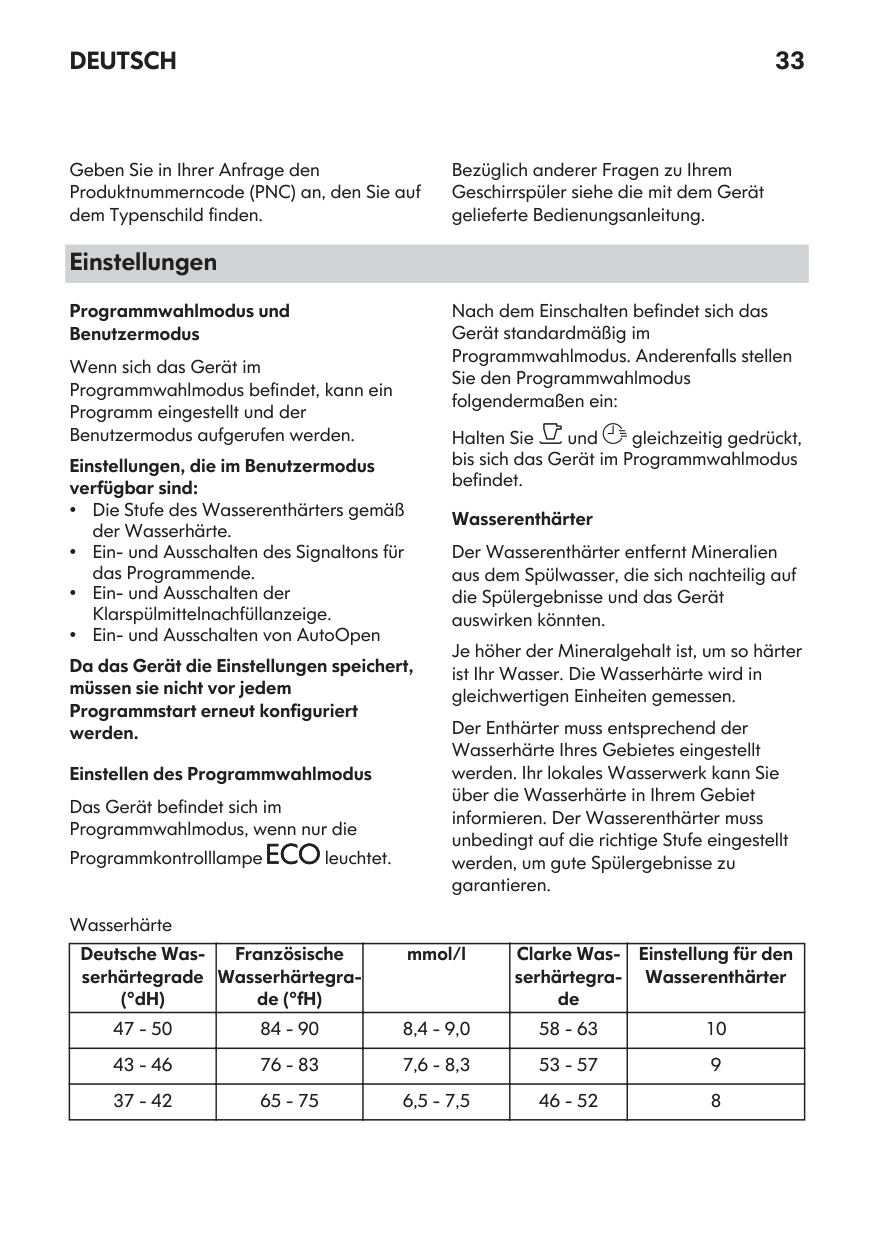
Der Wasserenthärter entfernt Mineralien aus dem Spülwasser, die sich nachteilig auf die Spülergebnisse und das Gerät auswirken könnten.
Je höher der Mineralgehalt ist, um so härter ist Ihr Wasser. Die Wasserhärte wird in gleichwertigen Einheiten gemessen.
Der Enthärter muss entsprechend der Wasserhärte Ihres Gebietes eingestellt werden. Ihr lokales Wasserwerk kann Sie über die Wasserhärte in Ihrem Gebiet informieren. Der Wasserenthärter muss unbedingt auf die richtige Stufe eingestellt werden, um gute Spülergebnisse zu garantieren.
Wasserhärte
|Deutsche Wasserhärtegrade (°dH)|Französische Wasserhärtegrade (°fH)|mmol/l|Clarke Wasserhärtegrade|Einstellung für den Wasserenthärter| |---|---|---|---|---| |47 - 50|84 - 90|8,4 - 9,0|58 - 63|10| |43 - 46|76 - 83|7,6 - 8,3|53 - 57|9| |37 - 42|65 - 75|6,5 - 7,5|46 - 52|8|
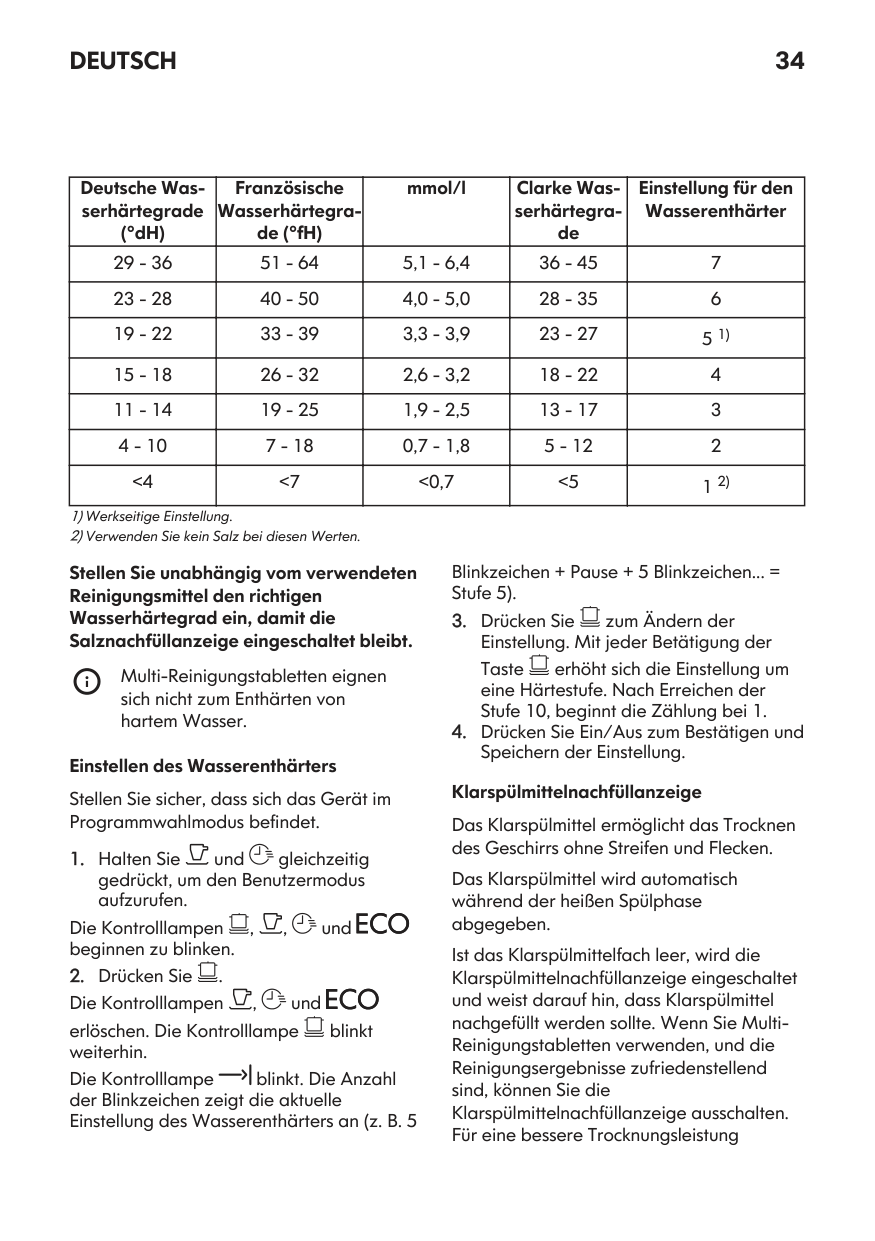
|Deutsche Wasserhärtegrade (°dH)|Französische Wasserhärtegrade (°fH)|mmol/l|Clarke Wasserhärtegrade|Einstellung für den Wasserenthärter| |---|---|---|---|---| |29 - 36|51 - 64|5,1 - 6,4|36 - 45|7| |23 - 28|40 - 50|4,0 - 5,0|28 - 35|6| |19 - 22|33 - 39|3,3 - 3,9|23 - 27|5 1)| |15 - 18|26 - 32|2,6 - 3,2|18 - 22|4| |11 - 14|19 - 25|1,9 - 2,5|13 - 17|3| |4 - 10|7 - 18|0,7 - 1,8|5 - 12|2| |<4|<7|<0,7|<5|1 2)|
Stellen Sie unabhängig vom verwendeten Reinigungsmittel den richtigen Wasserhärtegrad ein, damit die Salznachfüllanzeige eingeschaltet bleibt.
Multi-Reinigungstabletten eignen sich nicht zum Enthärten von hartem Wasser.
####### Einstellen des Wasserenthärters
Stellen Sie sicher, dass sich das Gerät im Programmwahlmodus befindet.
Die Kontrolllampen , , und beginnen zu blinken.
erlöschen. Die Kontrolllampe blinkt weiterhin.
Die Kontrolllampe blinkt. Die Anzahl der Blinkzeichen zeigt die aktuelle Einstellung des Wasserenthärters an (z. B. 5
Blinkzeichen + Pause + 5 Blinkzeichen... = Stufe 5).
####### Klarspülmittelnachfüllanzeige
Das Klarspülmittel ermöglicht das Trocknen des Geschirrs ohne Streifen und Flecken.
Das Klarspülmittel wird automatisch während der heißen Spülphase abgegeben.
Ist das Klarspülmittelfach leer, wird die Klarspülmittelnachfüllanzeige eingeschaltet und weist darauf hin, dass Klarspülmittel nachgefüllt werden sollte. Wenn Sie MultiReinigungstabletten verwenden, und die Reinigungsergebnisse zufriedenstellend sind, können Sie die Klarspülmittelnachfüllanzeige ausschalten. Für eine bessere Trocknungsleistung
empfehlen wir jedoch stets Klarspülmittel zu verwenden.
Verwenden Sie die üblichen Reinigungsmittel oder MultiReinigungstabletten ohne Klarspülmittel, schalten Sie die Klarspülmittelnachfüllanzeige ein.
Ausschalten der Klarspülmittelnachfüllanzeige
Stellen Sie sicher, dass sich das Gerät im Programmwahlmodus befindet.
Die Kontrolllampen , , und beginnen zu blinken.
####### Signaltöne
Bei einer Störung des Geräts ertönen akustische Signale. Es ist nicht möglich, diese Signaltöne auszuschalten.
Es ertönt auch ein Signalton, wenn das Programm beendet ist. Dieser Signalton ist standardmäßig eingeschaltet, sie können ihn aber ausschalten.
Wenn Sie den Hauptschalter zum Einschalten des Geschirrspülers drücken, ertönt ein kurzer Piepton. Dieser Piepton ist standardmäßig eingeschaltet, sie können ihn aber zusammen mit dem Signalton am Programmende ausschalten.
Zusätzlich ertönt ein Signalton, bevor AutoOpen die Tür öffnet. Dieser Signalton ertönt nicht, wenn AutoOpen ausgeschaltet ist.
####### Ausschalten der Signaltöne
Stellen Sie sicher, dass sich das Gerät im Programmwahlmodus befindet.
Die Kontrolllampen , , und beginnen zu blinken.
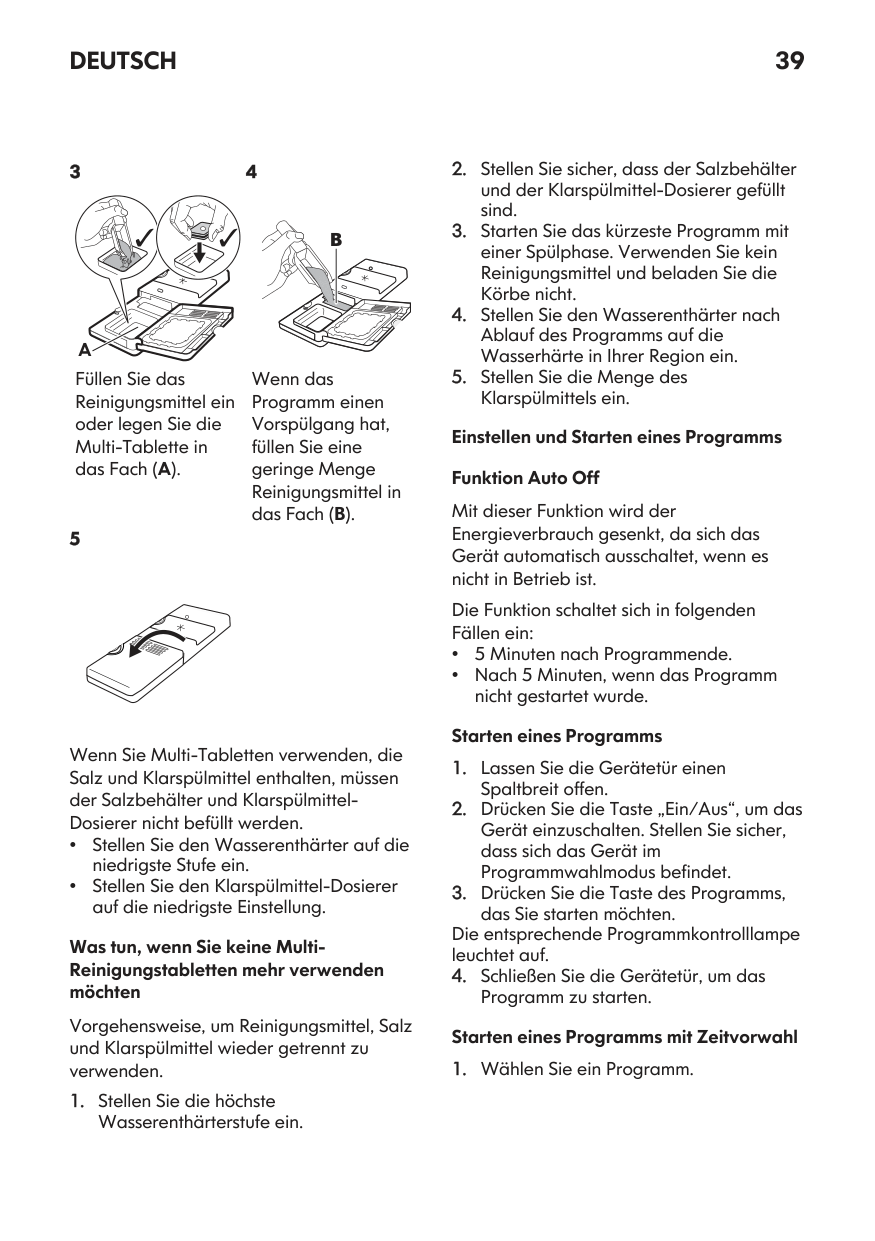
####### AutoOpen
AutoOpen verbessert die Trockenergebnisse bei einem geringeren Energieverbrauch.
| | |---|
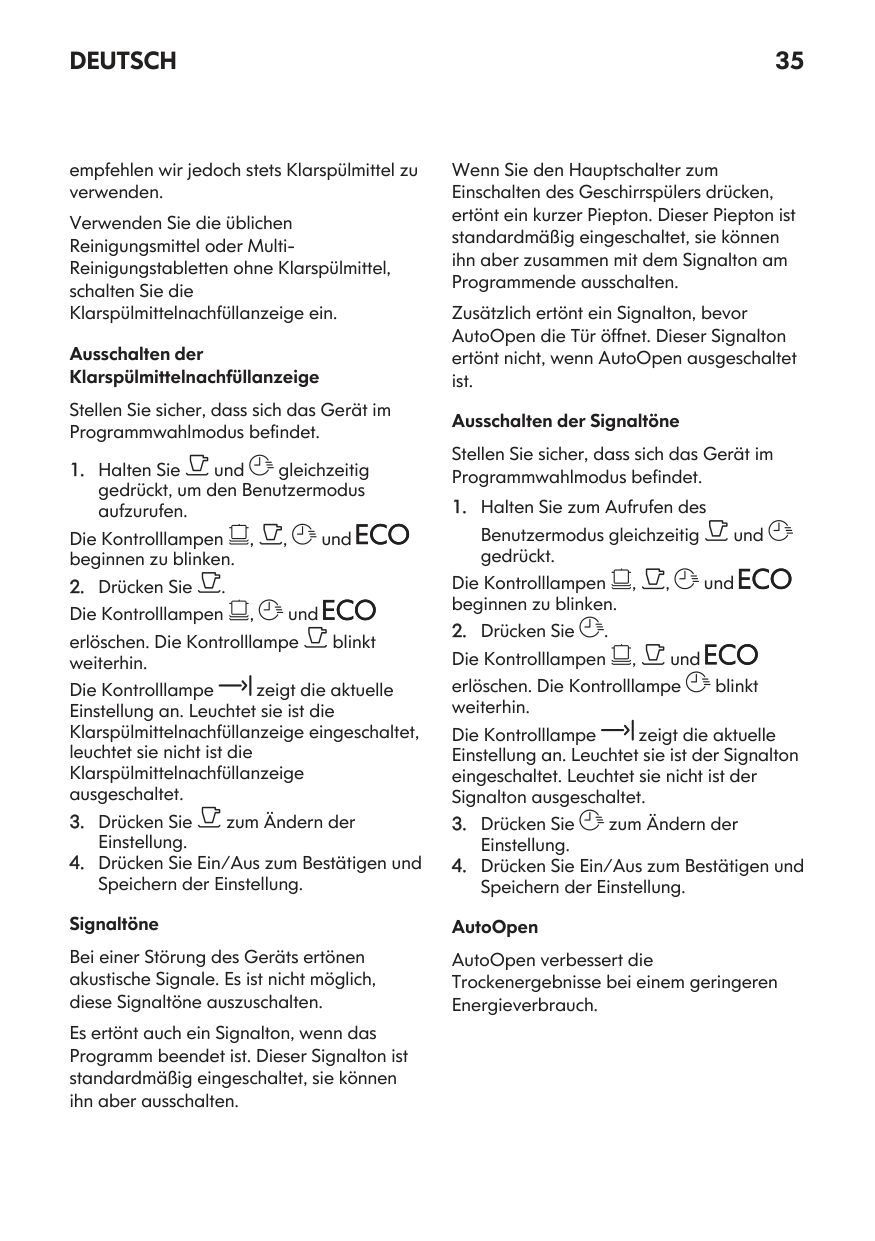
Während der Trockenphase wird die Tür automatisch geöffnet und bleibt einen Spaltbreit offen.
Vorsicht! Versuchen Sie nicht, die Gerätetür innerhalb der ersten 2 Minuten nach der automatischen Öffnung zu schließen. Andernfalls kann das Gerät beschädigt werden.
AutoOpen wird bei allen Programmen mit Ausnahme von automatisch eingeschaltet.
Schalten Sie die Funktion aus, um mögliche Gefahren (wie Messer, scharfe Gegenstände oder Chemikalien) für Kinder, Tiere oder Menschen mit Behinderungen zu verhindern.
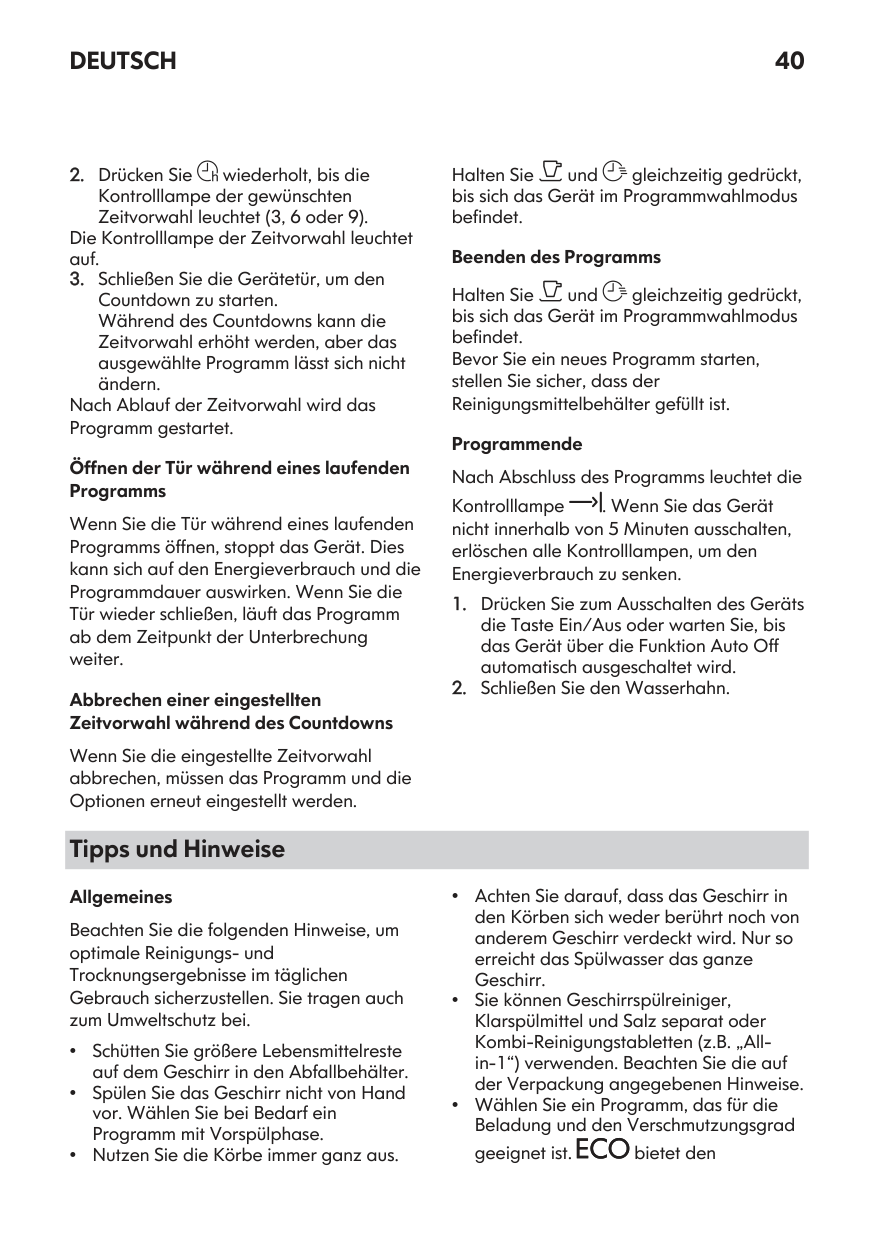
####### So schalten Sie AutoOpen aus
Das Gerät muss sich im Programmwahlmodus befinden.
Die Kontrolllampen , , und beginnen zu blinken.
###### Vor der ersten Inbetriebnahme
Wenn Sie ein Programm starten, kann es bis zu 5 Minuten dauern das Filterharz des Wasserenthärters zu regenerieren. Das Gerät scheint nicht zu arbeiten. Die Spülphase startet erst nach Abschluss dieses Vorgangs. Dieser Vorgang wird regelmäßig wiederholt.
####### Salzbehälter
Vorsicht! Verwenden Sie ausschließlich speziell für Geschirrspüler bestimmtes grobkörniges Salz. Mit feinem Salz besteht erhöhte Korrosionsgefahr.
Das Salz wird für die Regenerierung des Filterharzes im Wasserenthärter und zur Erzielung guter Spülergebnisse im täglichen Gebrauch benötigt.
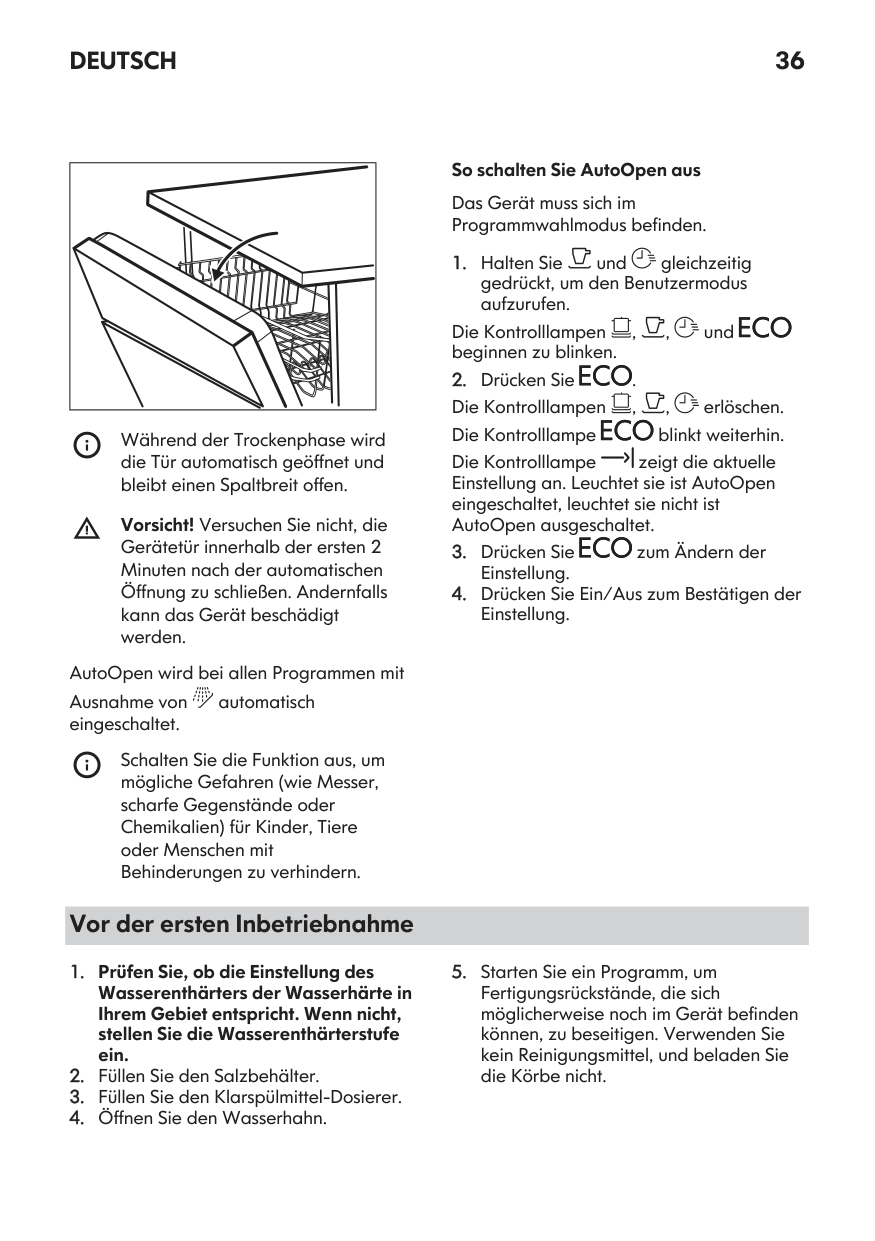
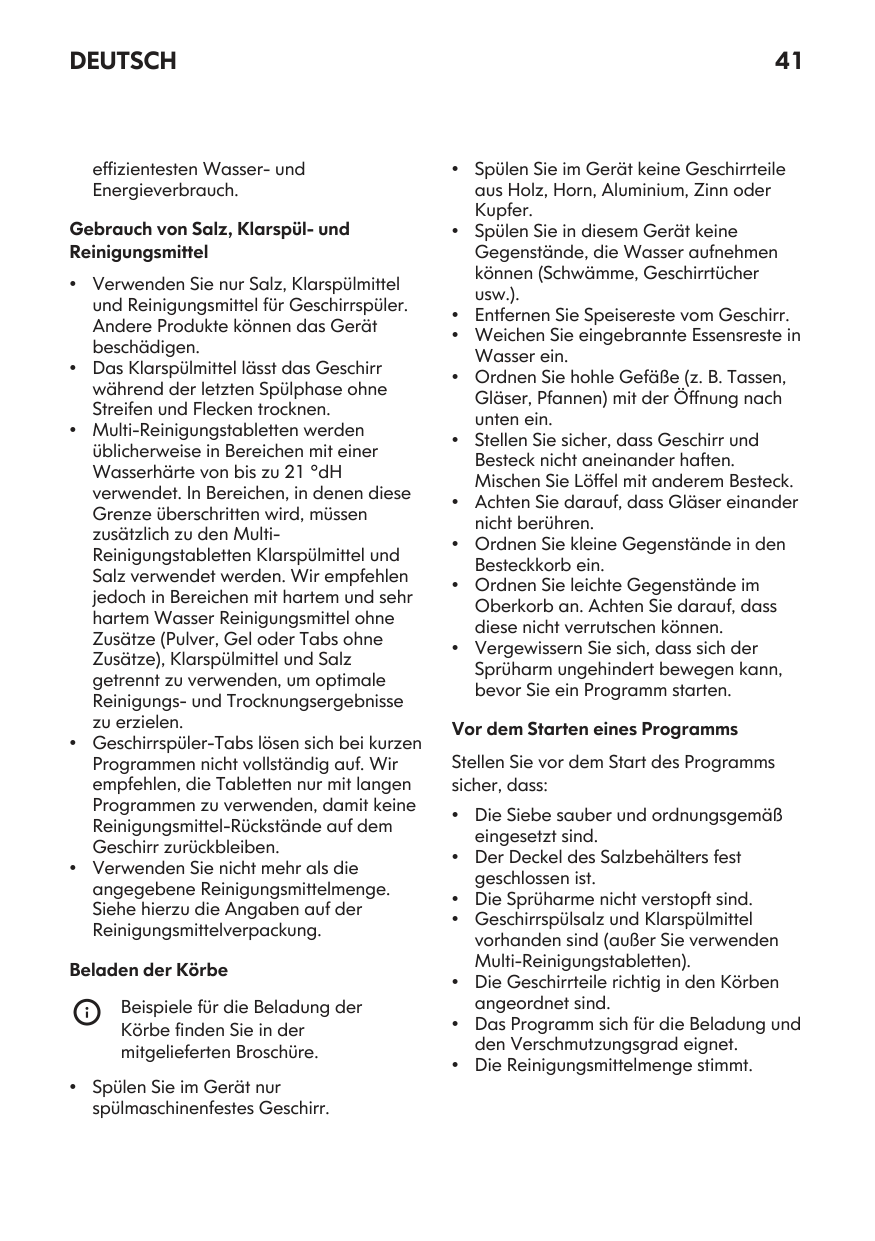
Befüllen des Salzbehälters 1 2
3
####### 4
Füllen Sie 1 Liter Wasser in den Salzbehälter (nur beim ersten Mal).
Füllen Sie 1 kg Salz in den Salzbehälter.
####### 5
Drehen Sie den Deckel des Salzbehälters im Uhrzeigersinn, um den Salzbehälter zu schließen.
Vorsicht! Beim Befüllen des Salzbehälters können Wasser und Salz austreten. Starten Sie nach dem Füllen des Salzbehälters umgehend ein Programm, um Korrosion zu verhindern.
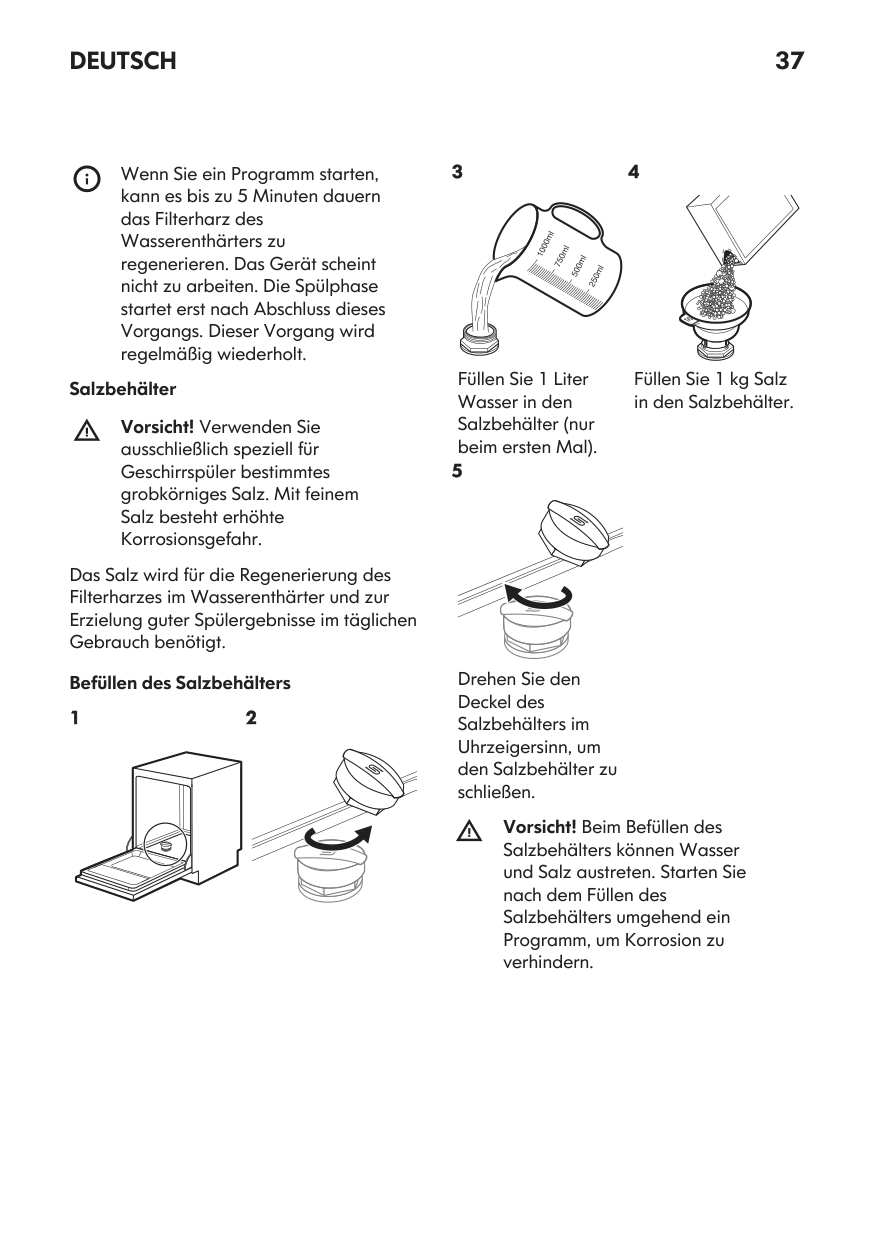
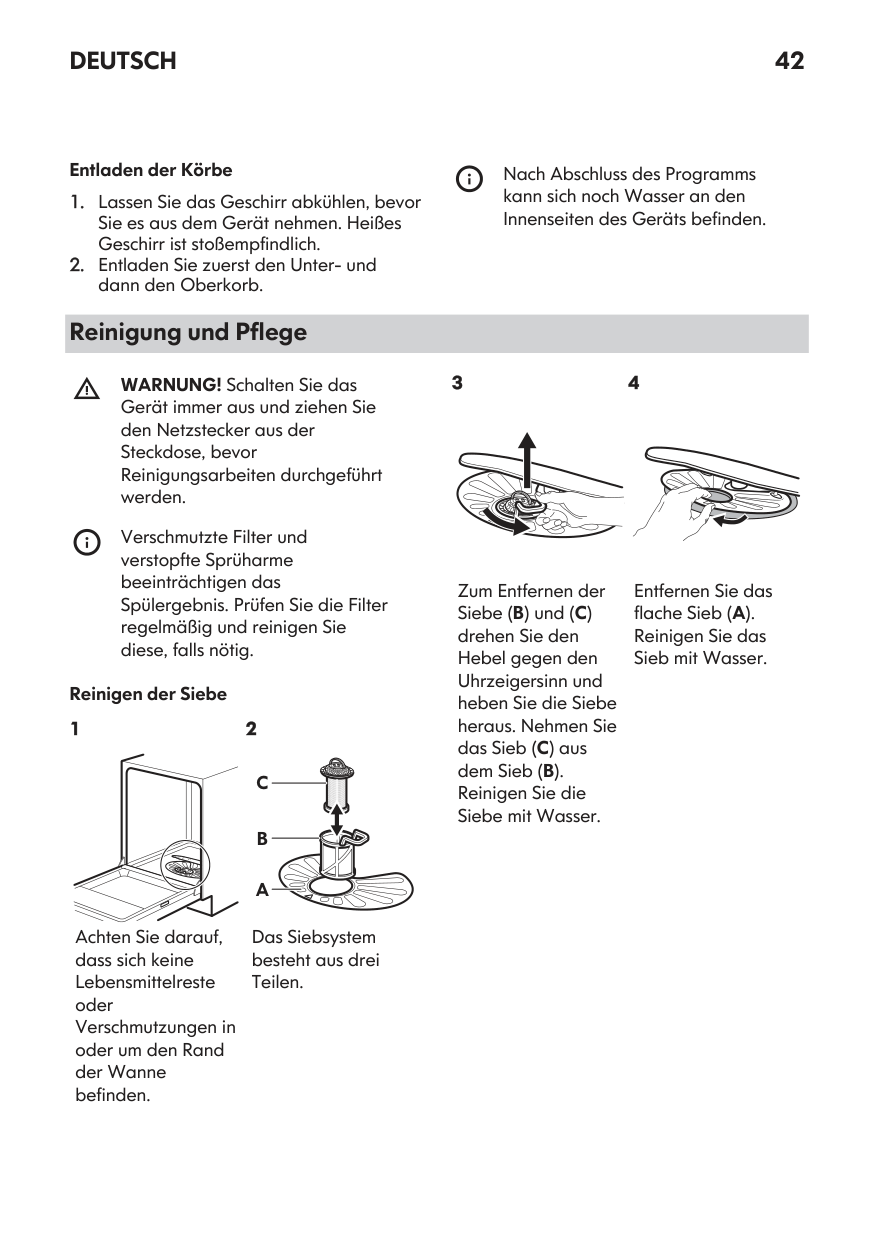
Befüllen des Klarspülmittel-Dosierers 1 2
5
A
#### X
M
2
3
1
4
Sie können die Zugabemenge des Klarspülmittels einstellen, indem Sie den entsprechenden Regler zwischen Position 1 (geringste Menge) und Position 4 (größte Menge) einstellen.
4
A
M
X
+ -
###### Täglicher Gebrauch
Stellen Sie sicher, dass sich das Gerät im Programmwahlmodus befindet.
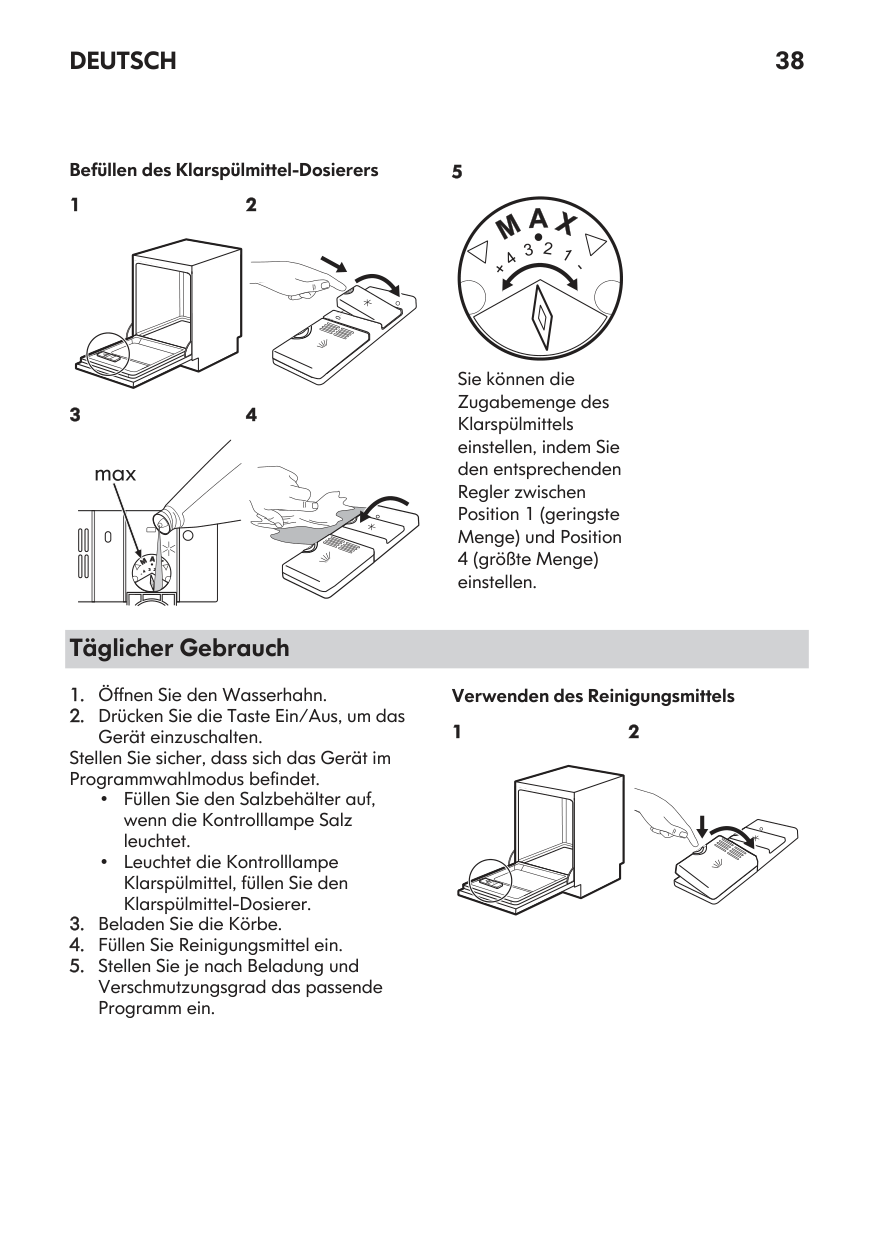
Verwenden des Reinigungsmittels 1 2
####### 4
########## B
A
Füllen Sie das Reinigungsmittel ein oder legen Sie die Multi-Tablette in das Fach (A).
Wenn das Programm einen Vorspülgang hat, füllen Sie eine geringe Menge Reinigungsmittel in das Fach (B).
####### 5
Wenn Sie Multi-Tabletten verwenden, die Salz und Klarspülmittel enthalten, müssen der Salzbehälter und KlarspülmittelDosierer nicht befüllt werden.
Was tun, wenn Sie keine MultiReinigungstabletten mehr verwenden möchten
Vorgehensweise, um Reinigungsmittel, Salz und Klarspülmittel wieder getrennt zu verwenden.
Einstellen und Starten eines Programms Funktion Auto Off
Mit dieser Funktion wird der Energieverbrauch gesenkt, da sich das Gerät automatisch ausschaltet, wenn es nicht in Betrieb ist.
Die Funktion schaltet sich in folgenden Fällen ein:
####### Starten eines Programms
Die entsprechende Programmkontrolllampe leuchtet auf.
####### Starten eines Programms mit Zeitvorwahl
Die Kontrolllampe der Zeitvorwahl leuchtet auf.
Nach Ablauf der Zeitvorwahl wird das Programm gestartet.
Öffnen der Tür während eines laufenden Programms
Wenn Sie die Tür während eines laufenden Programms öffnen, stoppt das Gerät. Dies kann sich auf den Energieverbrauch und die Programmdauer auswirken. Wenn Sie die Tür wieder schließen, läuft das Programm ab dem Zeitpunkt der Unterbrechung weiter.
Abbrechen einer eingestellten Zeitvorwahl während des Countdowns
Wenn Sie die eingestellte Zeitvorwahl abbrechen, müssen das Programm und die Optionen erneut eingestellt werden.
Halten Sie und gleichzeitig gedrückt, bis sich das Gerät im Programmwahlmodus befindet.
####### Beenden des Programms
Halten Sie und gleichzeitig gedrückt, bis sich das Gerät im Programmwahlmodus befindet. Bevor Sie ein neues Programm starten, stellen Sie sicher, dass der Reinigungsmittelbehälter gefüllt ist.
Programmende Nach Abschluss des Programms leuchtet die Kontrolllampe . Wenn Sie das Gerät nicht innerhalb von 5 Minuten ausschalten, erlöschen alle Kontrolllampen, um den Energieverbrauch zu senken.
###### Tipps und Hinweise
####### Allgemeines
Beachten Sie die folgenden Hinweise, um optimale Reinigungs- und Trocknungsergebnisse im täglichen Gebrauch sicherzustellen. Sie tragen auch zum Umweltschutz bei.
effizientesten Wasser- und Energieverbrauch.
Gebrauch von Salz, Klarspül- und Reinigungsmittel
####### Beladen der Körbe
Beispiele für die Beladung der Körbe finden Sie in der mitgelieferten Broschüre.
• Spülen Sie im Gerät nur spülmaschinenfestes Geschirr.
####### Vor dem Starten eines Programms
Stellen Sie vor dem Start des Programms sicher, dass:
####### Entladen der Körbe
Nach Abschluss des Programms kann sich noch Wasser an den Innenseiten des Geräts befinden.
###### Reinigung und Pflege
WARNUNG! Schalten Sie das Gerät immer aus und ziehen Sie den Netzstecker aus der Steckdose, bevor Reinigungsarbeiten durchgeführt werden.
Verschmutzte Filter und verstopfte Sprüharme beeinträchtigen das Spülergebnis. Prüfen Sie die Filter regelmäßig und reinigen Sie diese, falls nötig.
2
C
B
A
Achten Sie darauf, dass sich keine Lebensmittelreste oder Verschmutzungen in oder um den Rand
Das Siebsystem besteht aus drei Teilen.
####### 3
####### 4
Zum Entfernen der Siebe (B) und (C) drehen Sie den Hebel gegen den Uhrzeigersinn und heben Sie die Siebe heraus. Nehmen Sie das Sieb (C) aus dem Sieb (B). Reinigen Sie die Siebe mit Wasser.
Entfernen Sie das flache Sieb (A). Reinigen Sie das Sieb mit Wasser.
######## 5D
####### 6
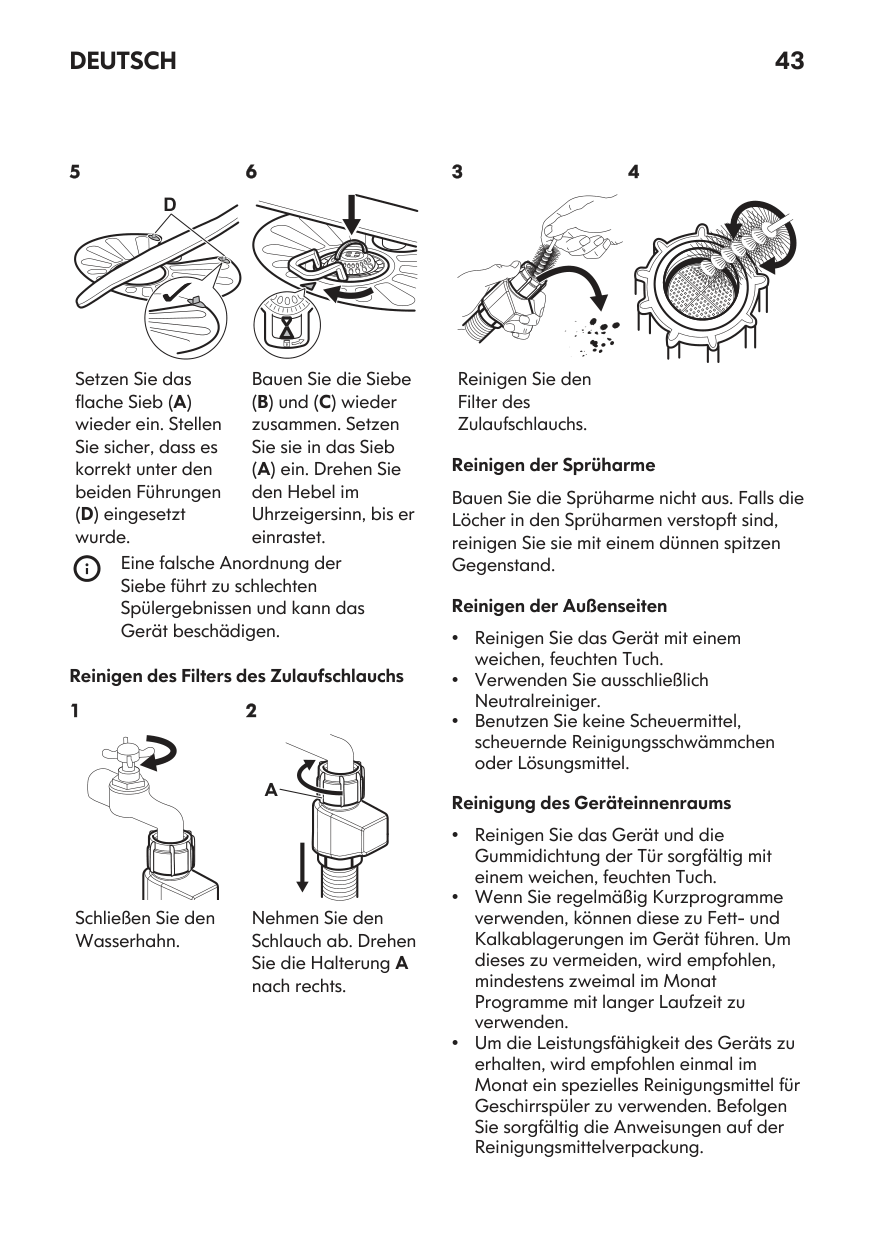
Setzen Sie das flache Sieb (A) wieder ein. Stellen Sie sicher, dass es korrekt unter den beiden Führungen (D) eingesetzt wurde.
Bauen Sie die Siebe (B) und (C) wieder zusammen. Setzen Sie sie in das Sieb (A) ein. Drehen Sie den Hebel im Uhrzeigersinn, bis er einrastet.
Eine falsche Anordnung der Siebe führt zu schlechten Spülergebnissen und kann das Gerät beschädigen.
2
A
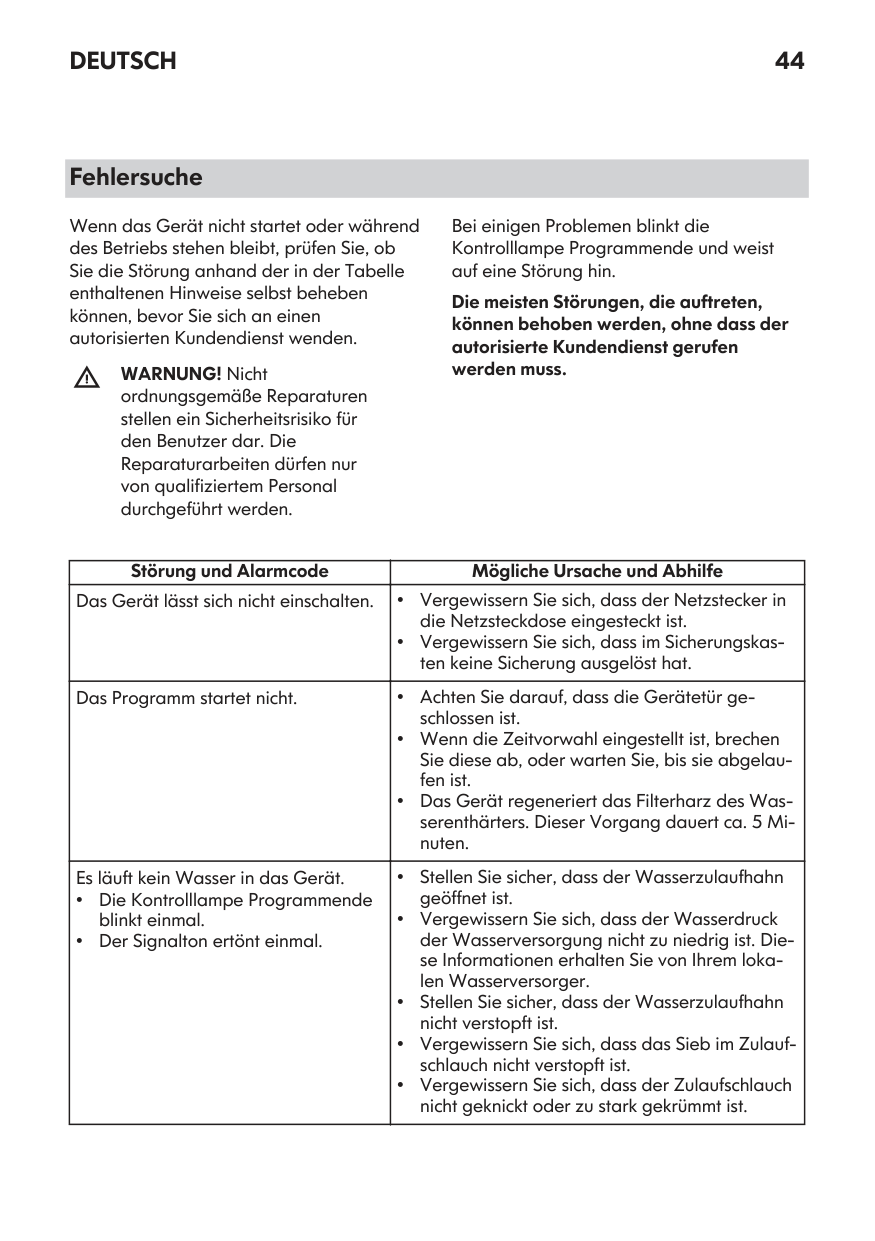
Schließen Sie den Wasserhahn.
Nehmen Sie den Schlauch ab. Drehen Sie die Halterung A nach rechts.
####### 3
4
Reinigen Sie den Filter des Zulaufschlauchs.
Reinigen der Sprüharme
Bauen Sie die Sprüharme nicht aus. Falls die Löcher in den Sprüharmen verstopft sind, reinigen Sie sie mit einem dünnen spitzen Gegenstand.
####### Reinigen der Außenseiten
####### Reinigung des Geräteinnenraums
###### Fehlersuche
Wenn das Gerät nicht startet oder während
WARNUNG! Nicht ordnungsgemäße Reparaturen stellen ein Sicherheitsrisiko für den Benutzer dar. Die Reparaturarbeiten dürfen nur von qualifiziertem Personal durchgeführt werden.
Bei einigen Problemen blinkt die Kontrolllampe Programmende und weist auf eine Störung hin.
Die meisten Störungen, die auftreten, können behoben werden, ohne dass der autorisierte Kundendienst gerufen werden muss.
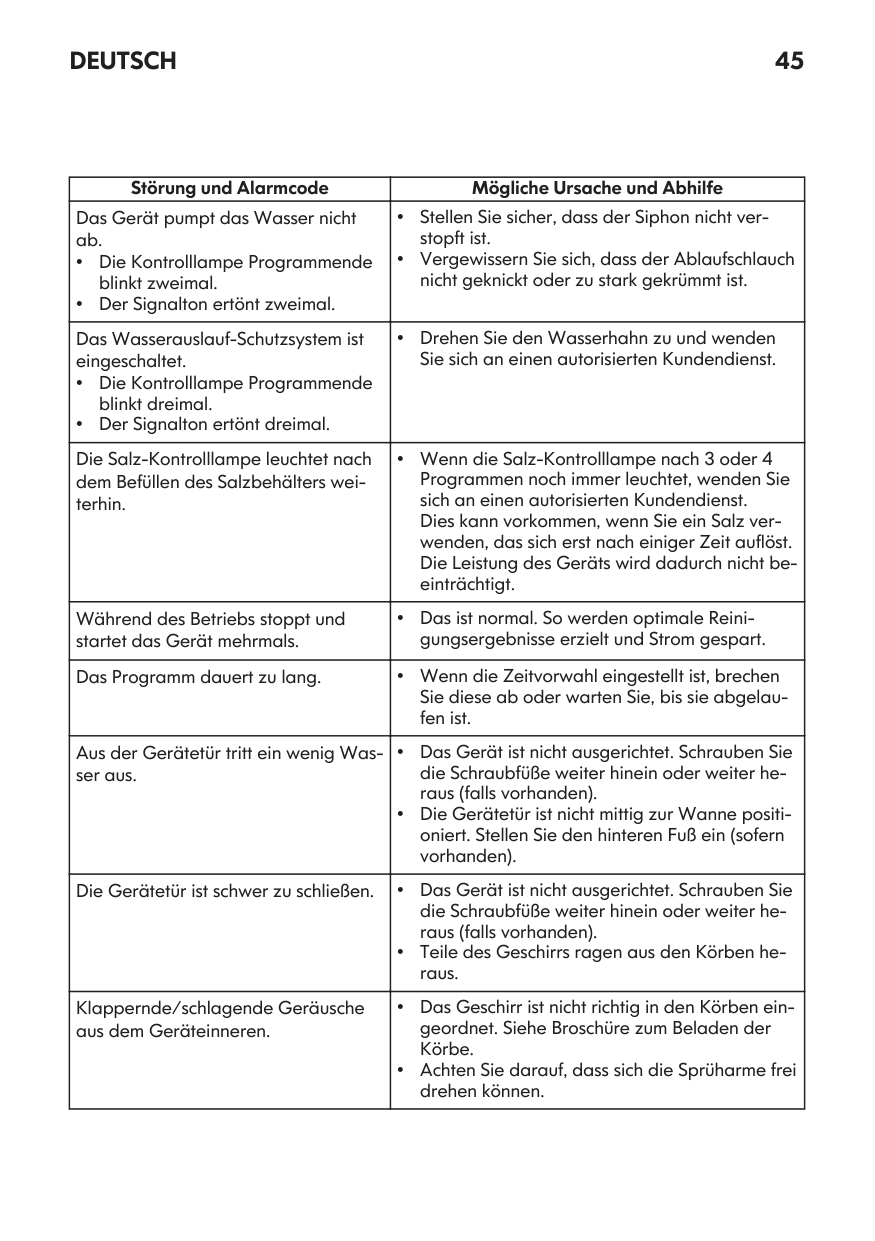
|Störung und Alarmcode|Mögliche Ursache und Abhilfe| |---|---| |Das Gerät lässt sich nicht einschalten.|• Vergewissern Sie sich, dass der Netzstecker in die Netzsteckdose eingesteckt ist.
• Vergewissern Sie sich, dass im Sicherungskasten keine Sicherung ausgelöst hat.
| |Das Programm startet nicht.|• Achten Sie darauf, dass die Gerätetür geschlossen ist.
• Wenn die Zeitvorwahl eingestellt ist, brechen Sie diese ab, oder warten Sie, bis sie abgelaufen ist.
• Das Gerät regeneriert das Filterharz des Wasserenthärters. Dieser Vorgang dauert ca. 5 Minuten.
| |Es läuft kein Wasser in das Gerät.
• Die Kontrolllampe Programmende blinkt einmal.
• Der Signalton ertönt einmal.
|• Stellen Sie sicher, dass der Wasserzulaufhahn geöffnet ist.
• Vergewissern Sie sich, dass der Wasserdruck der Wasserversorgung nicht zu niedrig ist. Diese Informationen erhalten Sie von Ihrem lokalen Wasserversorger.
• Stellen Sie sicher, dass der Wasserzulaufhahn nicht verstopft ist.
• Vergewissern Sie sich, dass das Sieb im Zulaufschlauch nicht verstopft ist.
• Vergewissern Sie sich, dass der Zulaufschlauch nicht geknickt oder zu stark gekrümmt ist.
|
|Störung und Alarmcode|Mögliche Ursache und Abhilfe| |---|---| |Das Gerät pumpt das Wasser nicht ab.
• Die Kontrolllampe Programmende blinkt zweimal.
• Der Signalton ertönt zweimal.
|• Stellen Sie sicher, dass der Siphon nicht verstopft ist.
• Vergewissern Sie sich, dass der Ablaufschlauch nicht geknickt oder zu stark gekrümmt ist.
| |Das Wasserauslauf-Schutzsystem ist eingeschaltet.
• Die Kontrolllampe Programmende blinkt dreimal.
• Der Signalton ertönt dreimal.
|• Drehen Sie den Wasserhahn zu und wenden Sie sich an einen autorisierten Kundendienst.| |Die Salz-Kontrolllampe leuchtet nach dem Befüllen des Salzbehälters weiterhin.|• Wenn die Salz-Kontrolllampe nach 3 oder 4 Programmen noch immer leuchtet, wenden Sie sich an einen autorisierten Kundendienst. Dies kann vorkommen, wenn Sie ein Salz verwenden, das sich erst nach einiger Zeit auflöst. Die Leistung des Geräts wird dadurch nicht beeinträchtigt.| |Während des Betriebs stoppt und startet das Gerät mehrmals.|• Das ist normal. So werden optimale Reinigungsergebnisse erzielt und Strom gespart.| |Das Programm dauert zu lang.|• Wenn die Zeitvorwahl eingestellt ist, brechen Sie diese ab oder warten Sie, bis sie abgelaufen ist.| |Aus der Gerätetür tritt ein wenig Wasser aus.|• Das Gerät ist nicht ausgerichtet. Schrauben Sie die Schraubfüße weiter hinein oder weiter heraus (falls vorhanden).
• Die Gerätetür ist nicht mittig zur Wanne positioniert. Stellen Sie den hinteren Fuß ein (sofern vorhanden).
|
|Die Gerätetür ist schwer zu schließen.|• Das Gerät ist nicht ausgerichtet. Schrauben Sie die Schraubfüße weiter hinein oder weiter heraus (falls vorhanden).
• Teile des Geschirrs ragen aus den Körben heraus.
| |Klappernde/schlagende Geräusche aus dem Geräteinneren.|• Das Geschirr ist nicht richtig in den Körben eingeordnet. Siehe Broschüre zum Beladen der Körbe.
• Achten Sie darauf, dass sich die Sprüharme frei drehen können.
|
|Störung und Alarmcode|Mögliche Ursache und Abhilfe| |---|---| |Das Gerät löst die Sicherung aus.|• Die abgesicherte Stromstärke reicht nicht für den gleichzeitigen Betrieb aller eingeschalteten Geräte. Überprüfen Sie, für welche Stromstärke die Steckdose bzw. der Stromzähler zugelassen ist, und schalten Sie eines der eingeschalteten Geräte aus.
• Ein Fehler in der Elektrik des Geräts. Wenden Sie sich an den autorisierten Kundendienst.
|
Siehe „Vor der ersten Inbetriebnahme“, „Täglicher Gebrauch“ oder „Tipps und Hinweise“ bezüglich anderer möglicher Ursachen.
Schalten Sie nach der Überprüfung das Gerät aus und wieder ein. Tritt das Problem
erneut auf, wenden Sie sich an einen autorisierten Kundendienst.
Wenden Sie sich an einen autorisierten Kundendienst, wenn Alarmcodes angezeigt werden, die nicht in der Tabelle angegeben sind.
####### Die Spül- und Trocknungsergebnisse sind nicht zufriedenstellend
|Störung|Mögliche Ursache und Abhilfe| |---|---| |Nicht zufriedenstellende Spülergebnisse.|• Siehe „Täglicher Gebrauch“, „Tipps und Hinweise“ sowie die Broschüre zum Beladen der Körbe.
• Nutzen Sie intensivere Spülprogramme.
• Reinigen Sie die Austrittsdüsen der Sprüharme und das Sieb. Siehe „Reinigung und Pflege“.
| |Nicht zufriedenstellende Trocknungsergebnisse.|• Das Geschirr stand zu lange im geschlossenen Gerät.
• Es ist kein Klarspülmittel vorhanden oder die Klarspülmittelmenge ist nicht ausreichend. Stellen Sie den Klarspülmittel-Dosierer auf eine höhere Einstellung.
• Kunststoffteile müssen eventuell mit einem Tuch abgetrocknet werden.
• Schalten Sie AutoOpen ein, um die beste Trocknungsleistung zu erzielen.
• Wir empfehlen Ihnen stets Klarspülmittel zu verwenden, auch wenn Sie Multi-Reinigungstabletten benutzen.
| |Weiße Streifen oder blau schimmernder Belag auf Gläsern und Geschirr.|• Die zugegebene Klarspülmittelmenge ist zu hoch. Stellen Sie eine geringere Klarspülmittelmenge ein.
• Die Reinigungsmittelmenge ist zu hoch.
|
|Störung|Mögliche Ursache und Abhilfe| |---|---| |Wasserflecken und andere Flecken auf Gläsern und Geschirr.|• Die zugegebene Klarspülmittelmenge ist zu niedrig. Stellen Sie eine höhere Klarspülmittelmenge ein.
• Die Ursache kann in der Qualität des Klarspülmittels liegen.
| |Das Geschirr ist nass.|• Schalten Sie AutoOpen ein, um die beste Trocknungsleistung zu erzielen.
• Das Programm enthält keine Trocknungsphase oder eine Trocknungsphase mit niedriger Temperatur.
• Der Klarspülmittel-Dosierer ist leer.
• Die Ursache kann in der Qualität des Klarspülmittels liegen.
• Die Ursache kann in der Qualität der Multi-Reinigungstabletten liegen. Probieren Sie eine andere Marke aus oder schalten Sie den Klarspülmittel-Dosierer ein und verwenden Sie ihn zusammen mit den MultiReinigungstabletten.
| |Der Geräteinnenraum ist nass.|• Dies ist keine Gerätestörung. Die Ursache ist die Luftfeuchtigkeit, die an den Wänden kondensiert.| |Ungewöhnliche Schaumbildung während des Spülgangs.|• Verwenden Sie ausschließlich speziell für Geschirrspüler bestimmte Reinigungsmittel.
• Der Klarspülmittel-Dosierer hat ein Leck. Wenden Sie sich an den autorisierten Kundendienst.
|
|Rostspuren am Besteck.|• Das Spülwasser enthält zu viel Salz. Siehe „Wasserenthärter“.
• Silber- und Edelstahlbesteck wurden zusammen eingeordnet. Ordnen Sie nicht Silber- und Edelstahlbesteck zusammen ein.
| |Am Ende des Programms befinden sich Reinigungsmittelreste im Behälter.|• Das Reinigungsmittel-Tab blieb im Behälter stecken und wurde daher nicht vollständig vom Wasser mitgenommen.
• Das Wasser kann das Reinigungsmittel nicht aus dem Behälter ausspülen. Achten Sie darauf, dass der Sprüharm nicht blockiert oder verstopft ist.
• Stellen Sie sicher, dass die im Korb eingeordneten Gegenstände ein Öffnen des Reinigungsmittelbehälters nicht verhindern.
| |Gerüche im Gerät.|• Siehe „Reinigung des Geräteinnenraums“.|
|Störung|Mögliche Ursache und Abhilfe| |---|---| |Kalkablagerungen auf dem Geschirr, im Innenraum und auf der Türinnenseite.|• Es befindet sich zu wenig Salz im Behälter, prüfen Sie die Nachfüllanzeige.
• Der Deckel des Salzbehälters ist locker.
• Ihr Leitungswasser ist hart. Siehe „Wasserenthärter“.
• Verwenden Sie stets Salz, auch wenn Sie Multi-Reinigungstabletten nutzen und stellen Sie die Regenerierung des Wasserenthärters ein. Siehe „Wasserenthärter“.
• Sind noch Kalkrückstände vorhanden, reinigen Sie das Gerät mit Pflegemitteln, die speziell für diesen Zweck vorgesehen sind.
• Probieren Sie ein anderes Reinigungsmittel aus.
• Wenden Sie sich an den Reinigungsmittelhersteller.
| |Das Geschirr ist glanzlos, verfärbt sich oder ist angeschlagen.|• Achten Sie darauf, dass nur spülmaschinenfestes Geschirr im Gerät gespült wird.
• Laden und entladen Sie den Korb vorsichtig. Siehe Broschüre zum Beladen der Körbe.
• Ordnen Sie empfindliche Gegenstände im Oberkorb an.
|
Siehe „Vor der ersten Inbetriebnahme“, „Täglicher Gebrauch“ oder „Tipps und Hinweise“ bezüglich anderer möglicher Ursachen.
###### Technische Informationen
|Produktbezeichnung|Voll integrierter Geschirrspüler|Voll integrierter Geschirrspüler| |---|---|---| |Abmessungen|Breite/Höhe/Tiefe (mm)|596 / 818 - 898 / 550| |Elektrischer Anschluss 1)|Spannung (V)|220 - 240| |Elektrischer Anschluss 1)|Frequenz (Hz)|50| |Wasserdruck|Min./max. bar (MPa)|0.5 (0.05) / 8 (0.8)| |Wasserzufuhr|Kalt- oder Warmwasser2)|max. 60 °C| |Fassungsvermögen|Maßgedecke|13| |Leistungsaufnahme|Ein-Zustand (W)|5.0|
|Leistungsaufnahme|Aus-Zustand (W)|0.50| |---|---|---|
1)Weitere Angaben finden Sie auf dem Typenschild. 2)Wenn Sie Heißwasser mit umweltfreundlichen, alternativen Energiequellen (z. B. Solaranlagen oder Windkraft) aufbereiten, können Sie durch den Anschluss des Geräts an die Heißwasserversorgung Energie sparen.
###### Umwelttipps
Recyceln Sie Materialien mit dem Symbol
. Entsorgen Sie die Verpackung in den entsprechenden Recyclingbehältern. Recyceln Sie zum Umwelt- und Gesundheitsschutz elektrische und elektronische Geräte. Entsorgen Sie Geräte
mit diesem Symbol nicht mit dem Hausmüll. Bringen Sie das Gerät zu Ihrer örtlichen Sammelstelle oder wenden Sie sich an Ihr Gemeindeamt.
Für die Schweiz: Wohin mit den Altgeräten? Überall dort wo neue Geräte verkauft werden oder Abgabe bei den offiziellen SENSSammelstellen oder offiziellen SENS-Recyclern. Die Liste der offiziellen SENSSammelstellen findet sich unter www.erecycling.ch
###### IKEA Garantie
####### Wie lang ist die IKEA Garantie gültig?
Diese Garantie ist 5 Jahre ab dem Originalkaufdatum Ihres Gerätes bei IKEA gültig. Als Kaufnachweis müssen der Originalkassenbon oder die Originalrechnung vorgelegt werden. Arbeiten, die im Rahmen der Garantie ausgeführt werden, verlängern nicht die Garantiezeit für das Gerät.
####### Wer übernimmt den Kundendienst?
Der IKEA Kundendienst wird diesen Service über seinen eigenen Kundendienst oder über ein autorisiertes Partner-Netzwerk durchführen lassen.
####### Was deckt die Garantie ab?
Die Garantie deckt Material- und Produktionfehler ab. Sie gilt ab dem Datum, an dem das Elektrogerät bei IKEA gekauft wurde. Diese Garantie gilt nur für private
Haushalte. Die Ausnahmen sind unter der Rubrik “Was ist nicht durch diese Garantie abgedeckt?” beschrieben. Innerhalb des Garantiezeitraums werden die Kosten zur Behebung eines Fehlers wie Reparaturen, Ersatzteile, Arbeitszeit und Fahrtkosten abgedeckt, vorausgesetzt, dass das Gerät ohne besonderen Kostenaufwand für die Reparatur zugänglich ist und dass der Fehler direkt auf einen Konstruktionsfehler oder einen Materialfehler zurückgeht, der durch die Garantie abgedeckt ist. Bei diesen Bedingungen gelten die EURichtlinien (Nr. 99/44/EG) und die entsprechenden gesetzlichen Vorschriften. Teile, die ersetzt wurden, gehen in das Eigentum von IKEA über.
Was wird IKEA zur Lösung des Problems tun?
IKEA hat Kundendienste, die das Produkt untersuchen und eigenständig entscheiden, ob das Problem durch die Garantie abgedeckt ist oder nicht. Wenn entschieden wird, dass der Fall unter die Garantie fällt, repariert der IKEA Kundendienst oder ein autorisierter Service-Partner über seinen eigenen Service eigenständig das defekte Produkt, oder sie ersetzen es durch ein gleiches oder durch ein gleichwertiges Produkt.
Was ist nicht durch diese Garantie abgedeckt?

Diese Einschränkung gilt nicht für fehlerfreie Arbeiten, die von qualifiziertem Fachpersonal durchgeführt wurden, um das Gerät an den technischen Sicherheitsstandard eines anderen EULandes anzupassen.
Wie gilt die geltende Gesetzgebung des Landes
Die IKEA Garantie gibt Ihnen spezielle gesetzliche Rechte, die alle lokalen gesetzlichen Anforderungen abdecken oder übertreffen, die einer Änderung von Land zu Land unterworfen sind.
####### Gültigkeitsbereich
Für Geräte, die in einem EU-Land gekauft und in ein anderes EU-Land mitgenommen werden, stehen die Kundendienstleistungen im Rahmen der Garantiebedingungen bereit, die im neuen Land gültig sind. Eine Verpflichtung, Dienstleistungen im Rahmen der Garantie auszuführen, besteht nur dann, wenn:
Der spezielle Kundendienst (Service) für IKEA Geräte:

Bitte zögern Sie nicht, den speziellen IKEA Kundendienst (Service) zu kontaktieren für:
Um sicherzustellen, dass wir Sie stets optimal unterstützen, lesen Sie bitte die Montageanleitung und/oder den Bedienungsanleitungsabschnitt dieser Broschüre durch, bevor Sie sich an uns wenden.
Wie können Sie uns erreichen, wenn Sie uns benötigen?
| | | | | |---|---|---|---| | | | | |
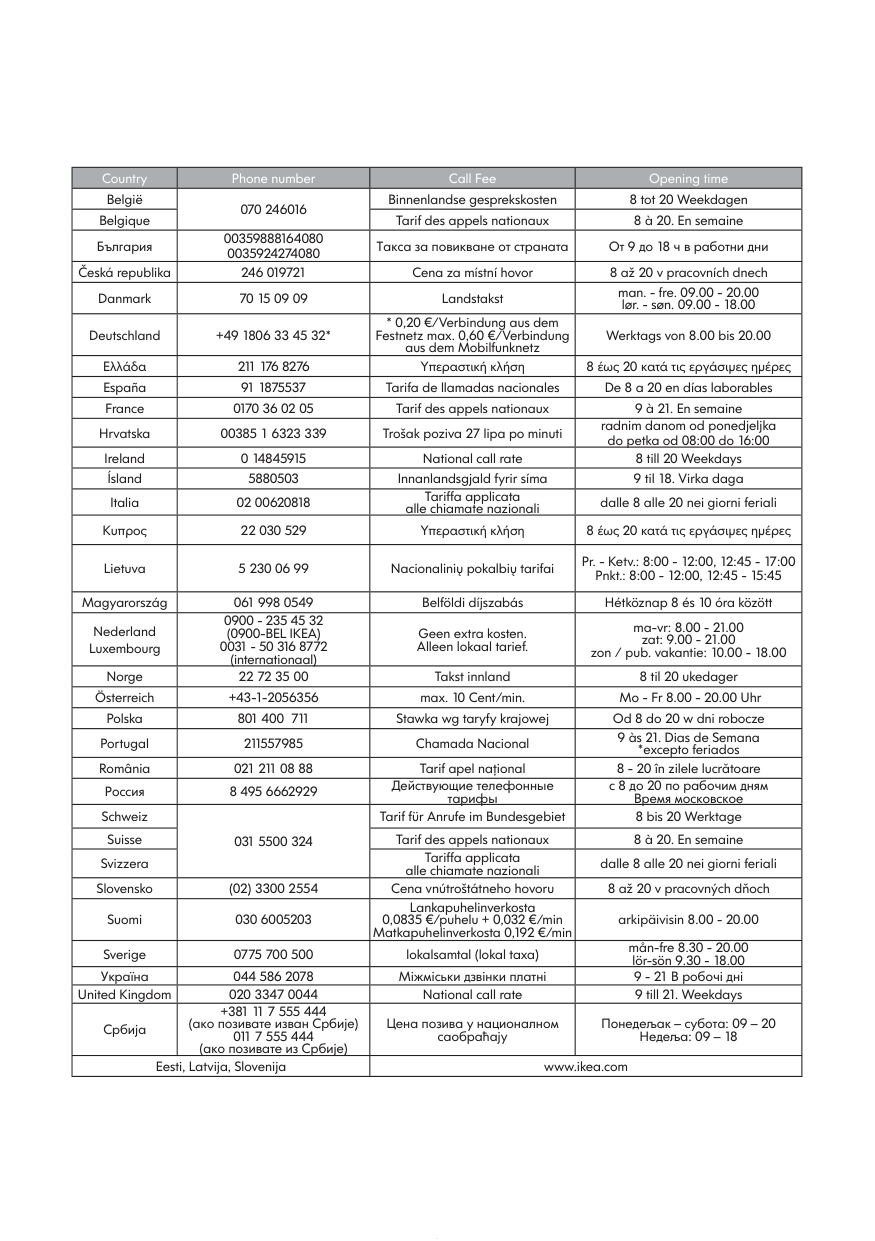
Auf der letzten Seite dieser Broschüre finden Sie eine vollständige Liste mit offiziellen IKEA Kundendienststellen und den jeweiligen nationalen Telefonnummern.
Damit Sie bei Fragen rasch die zuständige Stelle erreichen, empfehlen wir Ihnen, die am Ende dieser Broschüre aufgelisteten speziellen Telefonnummern zu benutzen. Beziehen Sie sich bitte stets auf die Telefonnummern, die in der Broschüre zu dem jeweiligen Gerät aufgelistet sind, zu dem Sie Fragen haben. Bevor Sie uns anrufen, vergewissern Sie sich, dass Sie die IKEA-Artikelnummer (8-stelliger Code) und die Seriennummer (8-stelliger Code, der auf dem Typenschild zu finden ist) für das Gerät, für das Sie unsere Hilfe benötigen, abgeben müssen.
BITTE BEWAHREN SIE DEN KAUFBELEG AUF! Er ist Ihr Kaufnachweis und für einen Garantieanspruch unerlässlich. Bitte beachten Sie, dass auf diesem Kaufbeleg auch die IKEA Artikelbezeichnung und die Nummer (der 8-stellige Zifferncode) für jedes der Geräte, die Sie gekauft haben, vermerkt sind.
Benötigen Sie zusätzlich Hilfe? Für alle weiteren Fragen, die sich nicht auf

|Country|Phone number|Call Fee|Opening time| |---|---|---|---| |België|070 246016|Binnenlandse gesprekskosten|8 tot 20 Weekdagen| | |070 246016| | | |България|00359888164080 0035924274080|Такса за повикване от страната|От 9 до 18 ч в работни дни| |Česká republika|246 019721|Cena za místní hovor|8 až 20 v pracovních dnech| |Danmark|70 15 09 09|Landstakst|man. - fre. 09.00 - 20.00 lør. - søn. 09.00 - 18.00| |Deutschland|+49 1806 33 45 32*|* 0,20 €/Verbindung aus d em Festnetz max. 0,60 €/Verbindung aus dem Mobilfunknetz|Werktags von 8.00 bis 20.00| |Ελλάδα|211 176 8276|Υπεραστική κλήση|8 έως 20 κατά τις εργάσιμες ημέρες| |España|91 1875537|Tarifa de llamadas nacionales|De 8 a 20 en días laborables| |France|0170 36 02 05|Tarif des appels nationaux|9 à 21. En semaine| |Hrvatska|00385 1 6323 339|Trošak poziva 27 lipa po minuti|radnim danom od ponedjeljka do petka od 08:00 do 16:00| |Ireland|0 14845915|National call rate|8 till 20 Weekdays| |Ísland|5880503|Innanlandsgjald fyrir síma|9 til 18. Virka daga| |Italia|02 00620818|Tariffa applicata alle chiamate nazionali|dalle 8 alle 20 nei giorni feriali| |Κυπρος|22 030 529|Υπεραστική κλήση|8 έως 20 κατά τις εργάσιμες ημέρες| |Lietuva|5 230 06 99|Nacionalinių pokalbių tarifai|Pr. - Ketv.: 8:00 - 12:00, 12:45 - 17:00 Pnkt.: 8:00 - 12:00, 12:45 - 15:45| |Magyarország|061 998 0549|Belföldi díjszabás|Hétköznap 8 és 10 óra között| |Nederland Luxembourg|0900 - 235 45 32 (0900-BEL IKEA) 0031 - 50 316 8772 (internationaal)|Geen extra kosten. Alleen lokaal tarief.|ma-vr: 8.00 - 21.00 zat: 9.00 - 21.00 zon / pub. vakantie: 10.00 - 18.00| |Norge|22 72 35 00|Takst innland|8 til 20 ukedager| |Österreich|+43-1-2056356|max. 10 Cent/min.|Mo - Fr 8.00 - 20.00 Uhr| |Polska|801 400 711|Stawka wg taryfy krajowej|Od 8 do 20 w dni robocze| |Portugal|211557985|Chamada Nacional|9 às 21. Dias de Semana *excepto feriados| |România|021 211 08 88|Tarif apel naţional|8 - 20 în zilele lucrătoare| |Россия|8 495 6662929|Действующие телефонные тарифы|с 8 до 20 по рабочим дням Время московское| |Schweiz|031 5500 324|Tarif für Anrufe im Bundesgebiet|8 bis 20 Werktage| | |031 5500 324| | | |Svizzera|031 5500 324|Tariffa applicata alle chiamate nazionali|dalle 8 alle 20 nei giorni feriali| |Slovensko|(02) 3300 2554|Cena vnútroštátneho hovoru|8 až 20 v pracovných dňoch| |Suomi|030 6005203|Lankapuhelinverkosta 0,0835 €/puhelu + 0,032 €/min Matkapuhelinverkosta 0,192 €/min|arkipäivisin 8.00 - 20.00| |Sverige|0775 700 500|lokalsamtal (lokal taxa)|mån-fre 8.30 - 20.00 lör-sön 9.30 - 18.00| |Україна|044 586 2078|Міжміськи дзвінки платні|9 - 21 В робочі дні| |United Kingdom|020 3347 0044|National call rate|9 till 21. Weekdays| |Србија|+381 11 7 555 444 (ако позивате изван Србије) 011 7 555 444 (ако позивате из Србије)|Цена позива у националном саобраћају|Понедељак – субота: 09 – 20 Недеља: 09 – 18| |Eesti, Latvija, Slovenija|Eesti, Latvija, Slovenija|www.ikea.com|www.ikea.com|
8 à 20. En semaineTarif des appels nationauxBelgique
8 à 20. En semaineTarif des appels nationauxSuisse
© Inter IKEA Systems B.V. 2019
|21552| |---|
AA-2003794-3