
Ask AI
— answers from the official manualAnswers from the official manual.
Common questions
Common Questions
9 totalHow do I set the water hardness level on my Indesit DIF 04 dishwasher?
Set the water hardness by switching the dishwasher on and off three times, pressing button P for five seconds until you hear a beep, and then selecting the desired hardness level using button P. Turn it off once settings are complete (Page 9).
What happens if I don't add salt or rinse aid to my dishwasher?
If you do not add salt or rinse aid, the LOW SALT and LOW RINSE AID indicator lights will remain lit (Page 8).
How do I clean the sprayer arms in my Indesit DIF 04?
Food residue can encrust onto the sprayer arms, so periodically check and thoroughly clean them with a non-metallic brush to prevent blockage (Page 16).
What types of crockery should not be placed in my Indesit DIF 04?
Do not place wooden crockery, delicate decorated glasses, synthetic materials that do not withstand high temperatures, copper and tin crockery, or items soiled with ash, wax, grease, or ink inside the dishwasher (Page 13).
What should I do if my dishwasher does not load any water?
Ensure the tap is on and check that there is no blockage in the inlet hose or filters. Clean them as needed, then restart a new wash cycle after checking (Page 18).
How should I dispose of my Indesit Dif 04 when it's no longer needed?
Ensure you remove the door, plug off and cut the mains cable flush with the appliance to prevent misuse. Dispose of these parts separately (Page 23).
Full Manual
20 pages
DIF 04B1
GB English
#### Operating instructions
DISHWASHER - Contents Operating instructions, 1 Precautions and advice, 2-3 Product Data, 4 Installation, 5-6 Electrical connection, 7 Description of the appliance, 8 Refined salt and rinse aid, 9 Loading the racks, 10-11 Detergent and dishwasher use, 12 Wash cycles, 13 Care and maintenance, 14 Troubleshooting, 15 Guarantee, 16 After-Sales Service, 17
Precautions and advice
GB
#### Precautions and advice
This appliance was designed and manufactured in compliance with international safety standards. The following information has been provided for safety reasons and should be read carefully.
Keep this instruction manual in a safe place for future reference. If the appliance is sold, given away or moved, make sure the manual is kept with the machine.
Read the instructions carefully, as they include important information on safe installation, use and maintenance.
This appliance was designed for domestic use or similar applications, for example:
Remove the appliance from all packaging and make sure it was not damaged during transportation. If it was damaged, contact the retailer and do not proceed any further with the installation process.
##### General safety
##### Disposal
GBappliances, owners may contact the relevant public authority or the local appliance dealer.
##### Saving energy and respecting the environment
Saving water and energy
3
GB
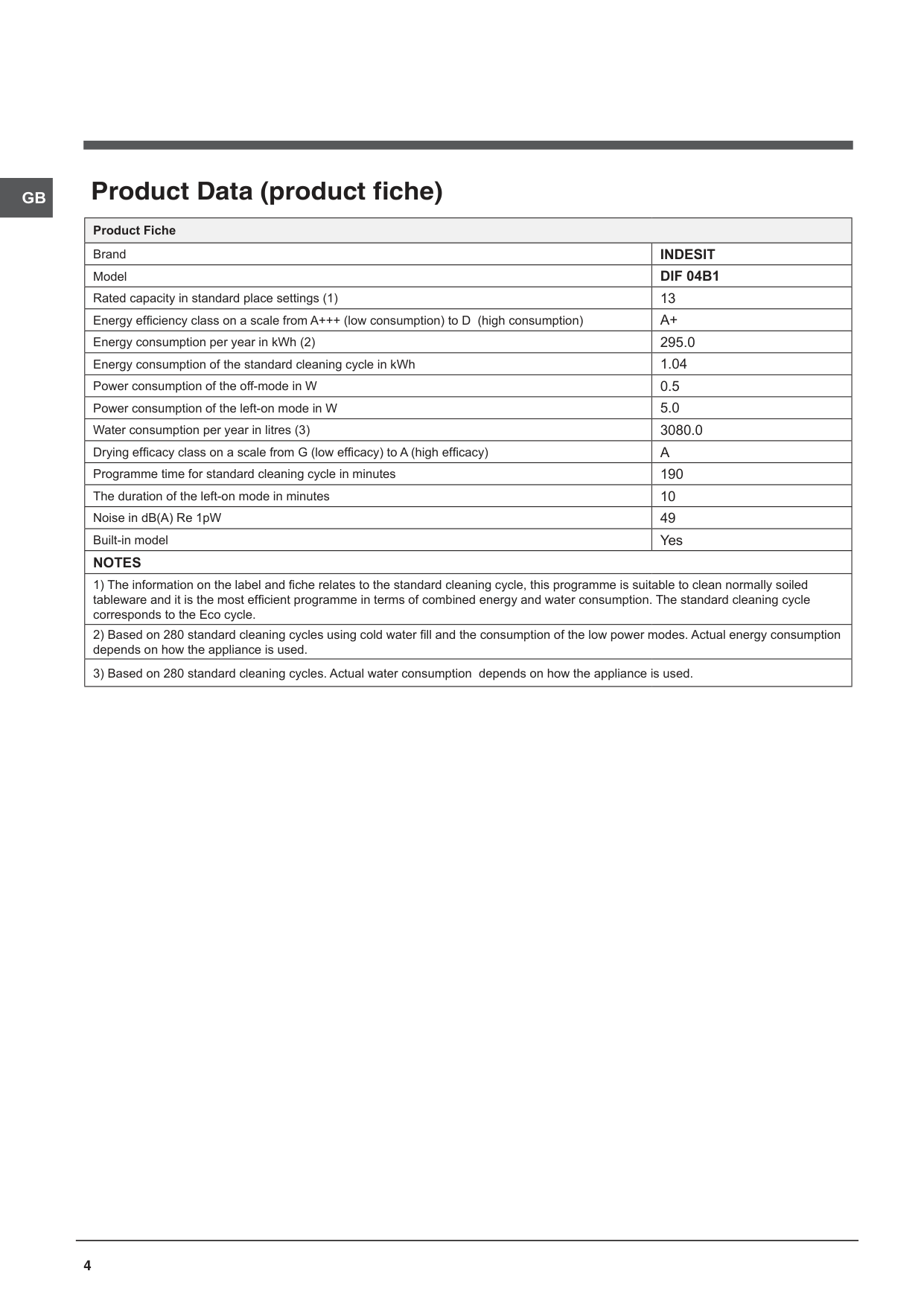
#### Product Data (product fiche)
|Product Fiche|Product Fiche| |---|---| |Brand|INDESIT| |Model|DIF 04B1| |Rated capacity in standard place settings (1)|13| |Energy efficiency class on a scale from A+++ (low consumption) to D (high consumption)|A+| |Energy consumption per year in kWh (2)|295.0| |Energy consumption of the standard cleaning cycle in kWh|1.04| |Power consumption of the off-mode in W|0.5| |Power consumption of the left-on mode in W|5.0| |Water consumption per year in litres (3)|3080.0| |Drying efficacy class on a scale from G (low efficacy) to A (high efficacy)|A| |Programme time for standard cleaning cycle in minutes|190| |The duration of the left-on mode in minutes|10| |Noise in dB(A) Re 1pW|49| |Built-in model|Yes| |NOTES|NOTES| |1) The information on the label and fiche relates to the standard cleaning cycle, this programme is suitable to clean normally soiled tableware and it is the most efficient programme in terms of combined energy and water consumption. The standard cleaning cycle corresponds to the Eco cycle.|1) The information on the label and fiche relates to the standard cleaning cycle, this programme is suitable to clean normally soiled tableware and it is the most efficient programme in terms of combined energy and water consumption. The standard cleaning cycle corresponds to the Eco cycle.| |2) Based on 280 standard cleaning cycles using cold water fill and the consumption of the low power modes. Actual energy consumption depends on how the appliance is used.|2) Based on 280 standard cleaning cycles using cold water fill and the consumption of the low power modes. Actual energy consumption depends on how the appliance is used.| |3) Based on 280 standard cleaning cycles. Actual water consumption depends on how the appliance is used.|3) Based on 280 standard cleaning cycles. Actual water consumption depends on how the appliance is used.|
Installation
If the appliance must be moved at any time, keep it in an upright position; if absolutely necessary, it may be tilted onto its back.
####### Connecting the water supply
Adaptation of the water supply for installation should only be performed by a qualified technician.
The water inlet and outlet hoses may be positioned towards the right or the left in order to achieve the best possible installation. Make sure the dishwasher does not bend or squash the hoses.
####### Connecting the water inlet hose
If the inlet hose is not long enough, contact a specialist store or an authorised technician (see Assistance).
The water pressure must be within the values indicated in the Technical Data table - otherwise the dishwasher may be function properly.
Make sure the hose is not bent or compressed.
Connecting the water outlet hose Connect the outlet hose to a drain duct with a minimum diameter of 2 cm. (A) The outlet hose connection must be at a height ranging from 40 to 80 cm from the floor or surface where the dishwasher rests.
|MIN 40 cm
MAX 80 cm| |---|
Before connecting the water outlet hose to the sink drain, remove the plastic plug (B).
Anti-flooding protection To ensure floods do not occur, the dishwasher:
| | |---|
######### WARNING: HAZARDOUS VOLTAGE!
Under no circumstances should the water inlet hose be cut as it contains live electrical parts.
Electrical connection Before inserting the plug into the electrical socket, make sure that:
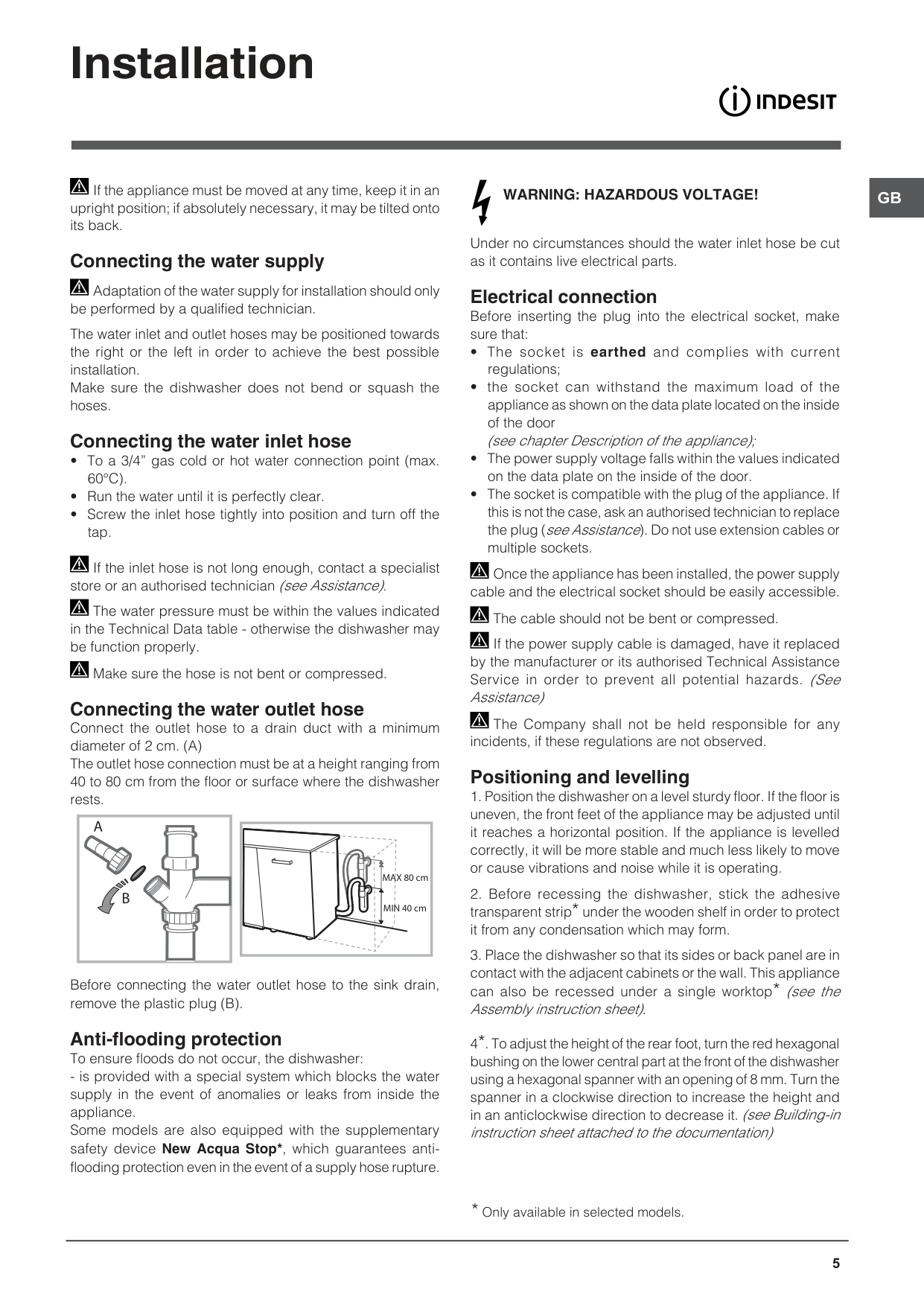
Once the appliance has been installed, the power supply cable and the electrical socket should be easily accessible.
The cable should not be bent or compressed.
If the power supply cable is damaged, have it replaced by the manufacturer or its authorised Technical Assistance Service in order to prevent all potential hazards. (See Assistance)
The Company shall not be held responsible for any incidents, if these regulations are not observed. Positioning and levelling
GB
GB
Advice regarding the first wash cycle After the installation, remove the stoppers from the racks and the retaining elastic elements from the upper rack (if any).
Water softener settings Before starting the first wash cycle, set the hardness level of the water from the mains supply. (see chapter Rinse aid and refined salt). First load the softener tank with water, then introduce about 1 kg of salt. It is perfectly normal for water to flow out. As soon as this procedure is complete, run a wash cycle. Only use salt that has been specifically designed for dishwashers. After the salt has been poured into the machine, the LOW SALT indicator light* switches off.
If the salt container is not filled, the water softener and the heating element may be damaged as a result.
The machine has a buzzer/set of tones (depending on the dishwasher model) to inform the user that a command has been implemented: power on, cycle end etc.
The symbols/indicator lights/LEDs on the control panel/ display may vary in colour and may have a flashing or fixed light (depending on the dishwasher model).
The display* provides useful information concerning the type of wash cycle, drying/wash-cycle phase, remaining time, temperature etc.
|Technical data| |---| |Dimensions
width 59.5 cm height 82 cm depth 57 cm| |Capacity 13 standard place-settings|
|Water supply pressure
0,05 ÷ 1MPa (0.5 ÷ 10 bar) 7,25 psi – 145 psi| |Power supply voltage See appliance data plate| |Total absorbed power See appliance data plate| |Fuse See appliance data plate| |This dishwasher conforms to the following European Community Directives:
-2006/95/EC (Low Voltage)
-2004/108/EC (Electromagnetic Compatibility)
-2009/125/EC (Comm. Reg. 1016/2010) (Ecodesign)
-97/17/EC (Labelling)
-2012/19/CE Waste Electrical and Electronic Equipment (WEEE)
|
Electrical Connection
######## Electrical Connection
If your appliance is supplied with a 13 amp. fused plug it can be plugged into a 13 amp socket for immediate use. Before using the appliance please read the instruction below.
WARNING: THIS APPLIANCE MUST BE EARTHED. THE FOLLOWING OPERATIONS SHOULD BE CARRIED OUT BY A QUALIFIED ELECTRICIAN.
######## Replacing the fuse:
When replacing a faulty fuse, a 13 amp ASTA approved fuse to BS 1362 should always be used, and the fuse cover re-fitted. If the fuse cover is lost, the plug must not be used until a replacement is obtained.
######## Replacemente fuse covers:
If a replacement fuse cover is fitted, it must be of the correct colours as indicated by the coloured marking or the colour that is embossed in words on the base of the plug. Replacements can be obtained directly from your nearest Service Depot.
######## Removing the plug:
Ifyour appliance has a non-rewireable moulded plug and you should wish to remove it to re-route the mains cable through partitions, units etc., please esure that either:
Disposing of the plug:
Ensure that before disposing of the plug itself, you make the pins unusable so that it cannot be accidentally inserted into a socket.
Instruction for connecting cable to an altenative plug: Important: the wires in the mains lead are coloured in accordance with the following code: Green & Yellow - Earth Blue - Neutral Brown - Live
CAUTION:
As the colours of the wires in the mains lead may not correspond with the coloured markings identifying the terminal in your plug, proceed as follows: connect Green & Yellow wire to terminal market “E” or coloured Green or Green & Yellow. Connect Brown wire to terminal marked “L” or coloured Red. Connect Blue wire to terminal marked “N” or coloured Black.
If a 13 amp plug (BS 1363) is used it must be fitted with a 13 amp fuse. A15 amp plug must be protected by a 15 amp fuse, either in the plug or adaptor or at the distribution board. If you are in any doubt about the electrical supply to your machine, consult a qualified electrician before use.
GB
How to connect an alternative plug: The wires in this mains lead are coloured in accordance with the following code:
BLUE “NEUTRAL” (“N”) BROWN “LIVE” (“L”) GREEN AND YELLOW “EARTH” (“E”) or
| | |---|
######## Disposing of the appliance:
When disposing of the appliance please remove the plug by cutting the mains cable as close as possible to the plug body and dispose of it as described above.
Description of the appliance
GB Overall view
| | | | |---|---|---| | | | |
| | | |---|---| | | |
####### Control panel
Select wash cycle button ON-OFF/Reset button
and indicator light Wash cycle indicator light
***Only in completely built-in models.
Refined Salt and Rinse Aid
Only use products which have been specifically designed for dishwashers. Do not use table salt or industrial salt. Follow the instructions given on the packaging.
If you are using a multi-function product, we recommend that you add salt in any case, especially if the water is hard or very hard. (Follow the instructions given on the packaging.)
If you do not add salt or rinse aid, the LOW SALT* and LOW RINSE AID* indicator lights will remain lit. Measuring out the refined salt The use of salt prevents the formation of LIMESCALE on the dishes and on the machine's functional components.
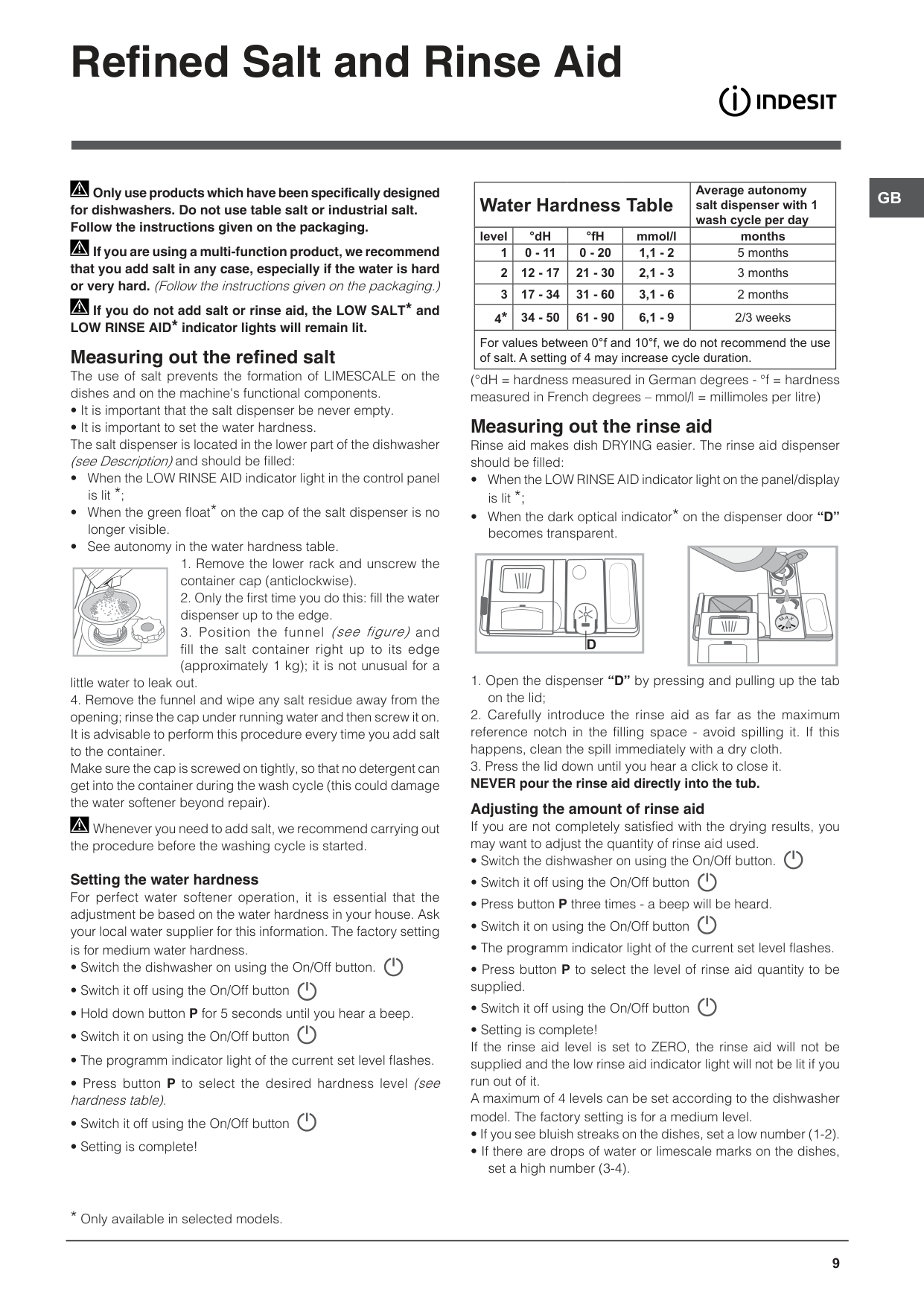
| | |---|
little water to leak out.
Whenever you need to add salt, we recommend carrying out the procedure before the washing cycle is started. Setting the water hardness
For perfect water softener operation, it is essential that the adjustment be based on the water hardness in your house. Ask your local water supplier for this information. The factory setting is for medium water hardness.
|Water Hardness Table|Water Hardness Table|Water Hardness Table|Water Hardness Table|Average autonomy salt dispenser with 1 wash cycle per day| |---|---|---|---|---| |level|°dH|°fH|mmol/l|months| |1|0 - 11|0 - 20|1,1 - 2|5 months| |2|12 - 17|21 - 30|2,1 - 3|3 months| |3|17 - 34|31 - 60|3,1 - 6|2 months| |4*|34 - 50|61 - 90|6,1 - 9|2/3 weeks|
|For values between 0°f and 10°f, we do not recommend the use of salt. A setting of 4 may increase cycle duration.|For values between 0°f and 10°f, we do not recommend the use of salt. A setting of 4 may increase cycle duration.|For values between 0°f and 10°f, we do not recommend the use of salt. A setting of 4 may increase cycle duration.|For values between 0°f and 10°f, we do not recommend the use of salt. A setting of 4 may increase cycle duration.|For values between 0°f and 10°f, we do not recommend the use of salt. A setting of 4 may increase cycle duration.|
(°dH = hardness measured in German degrees - °f = hardness measured in French degrees – mmol/l = millimoles per litre)
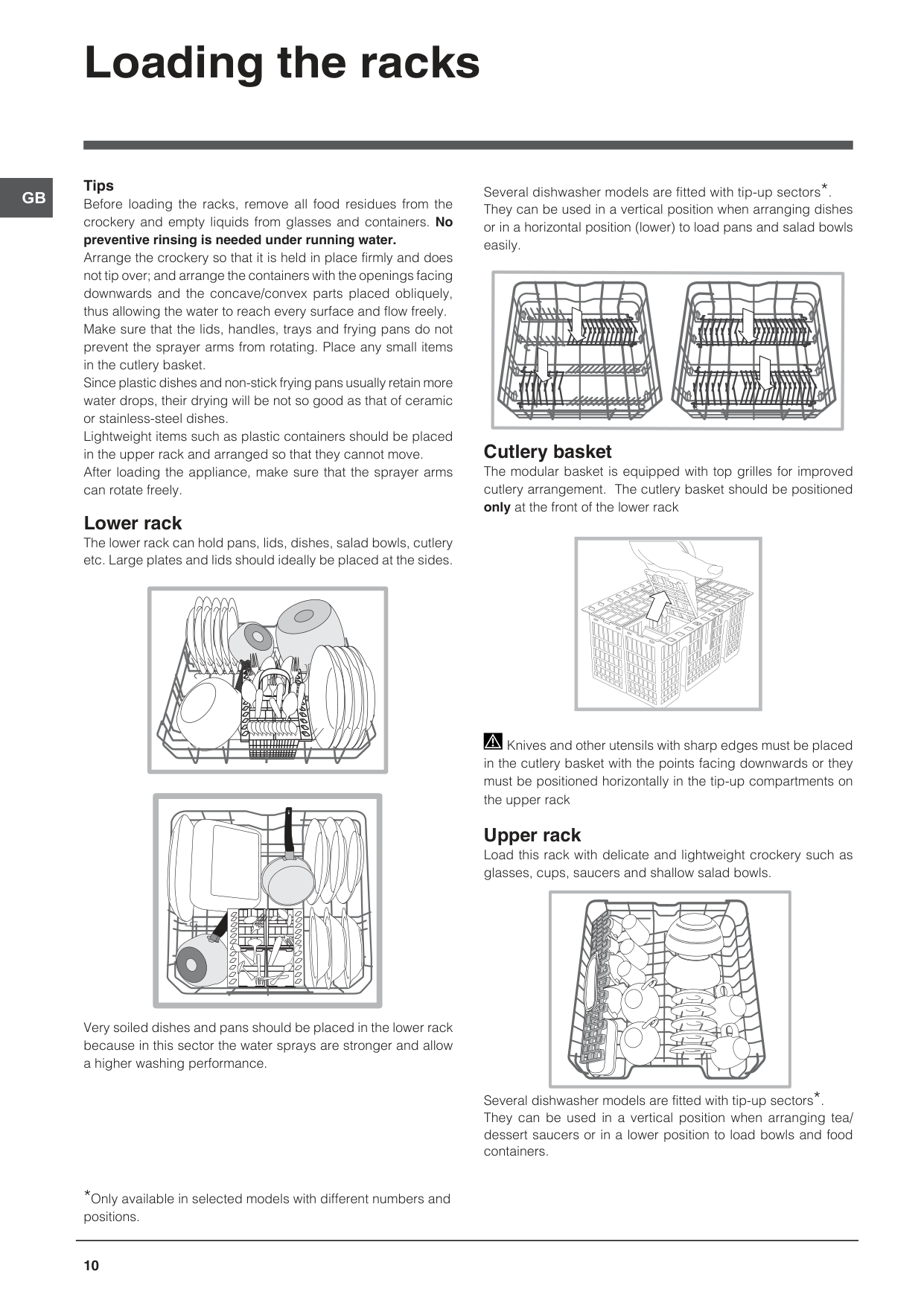
Measuring out the rinse aid Rinse aid makes dish DRYING easier. The rinse aid dispenser should be filled:
|M
A
X| |---|
| | |---|
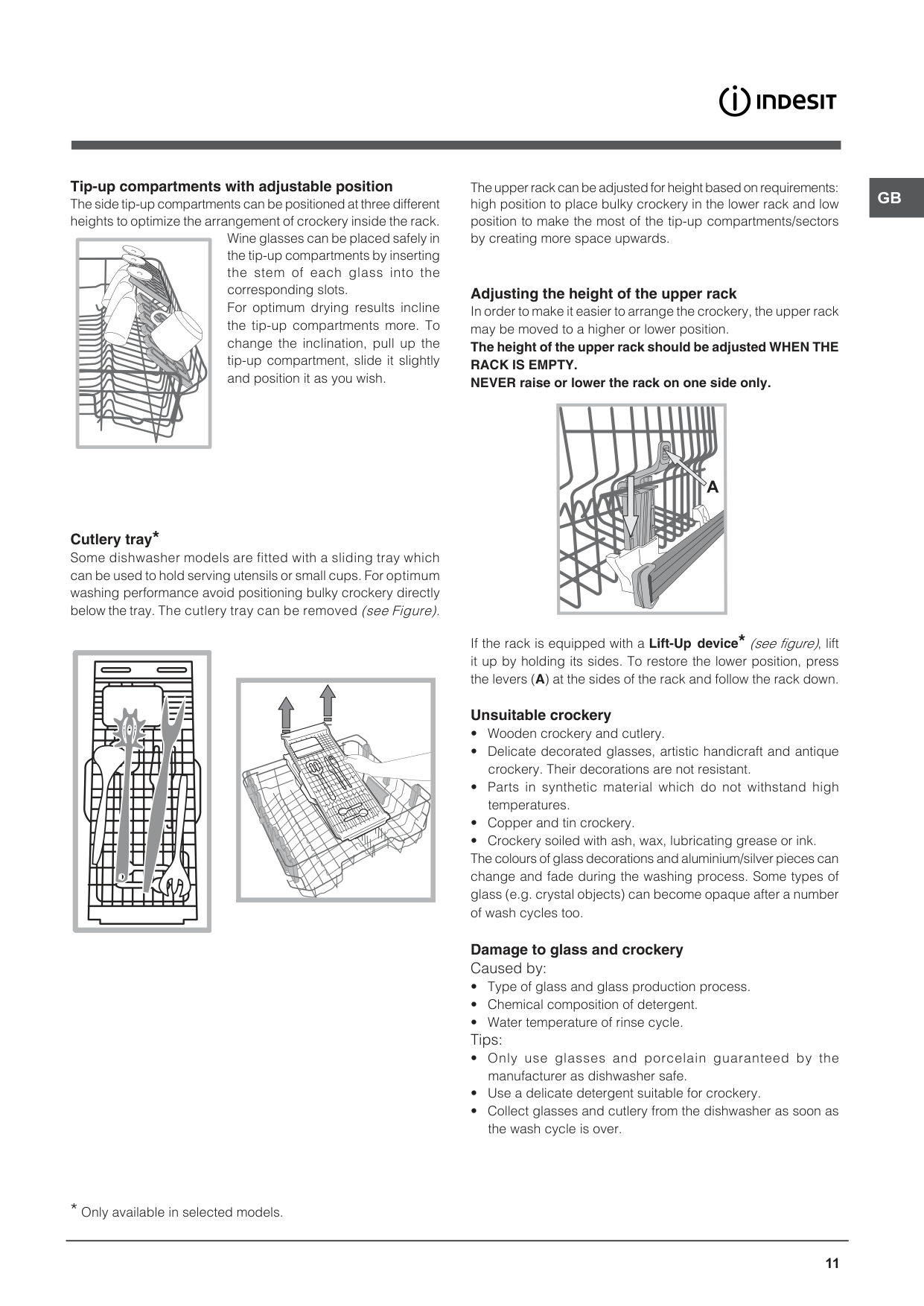
Adjusting the amount of rinse aid If you are not completely satisfied with the drying results, you may want to adjust the quantity of rinse aid used.
GB
Loading the racks
GB
######### Tips
Before loading the racks, remove all food residues from the crockery and empty liquids from glasses and containers. No preventive rinsing is needed under running water.
Arrange the crockery so that it is held in place firmly and does not tip over; and arrange the containers with the openings facing downwards and the concave/convex parts placed obliquely, thus allowing the water to reach every surface and flow freely. Make sure that the lids, handles, trays and frying pans do not prevent the sprayer arms from rotating. Place any small items in the cutlery basket. Since plastic dishes and non-stick frying pans usually retain more water drops, their drying will be not so good as that of ceramic or stainless-steel dishes. Lightweight items such as plastic containers should be placed in the upper rack and arranged so that they cannot move. After loading the appliance, make sure that the sprayer arms can rotate freely. Lower rack
The lower rack can hold pans, lids, dishes, salad bowls, cutlery etc. Large plates and lids should ideally be placed at the sides.
| | |---|
| | |---|
Very soiled dishes and pans should be placed in the lower rack because in this sector the water sprays are stronger and allow a higher washing performance.
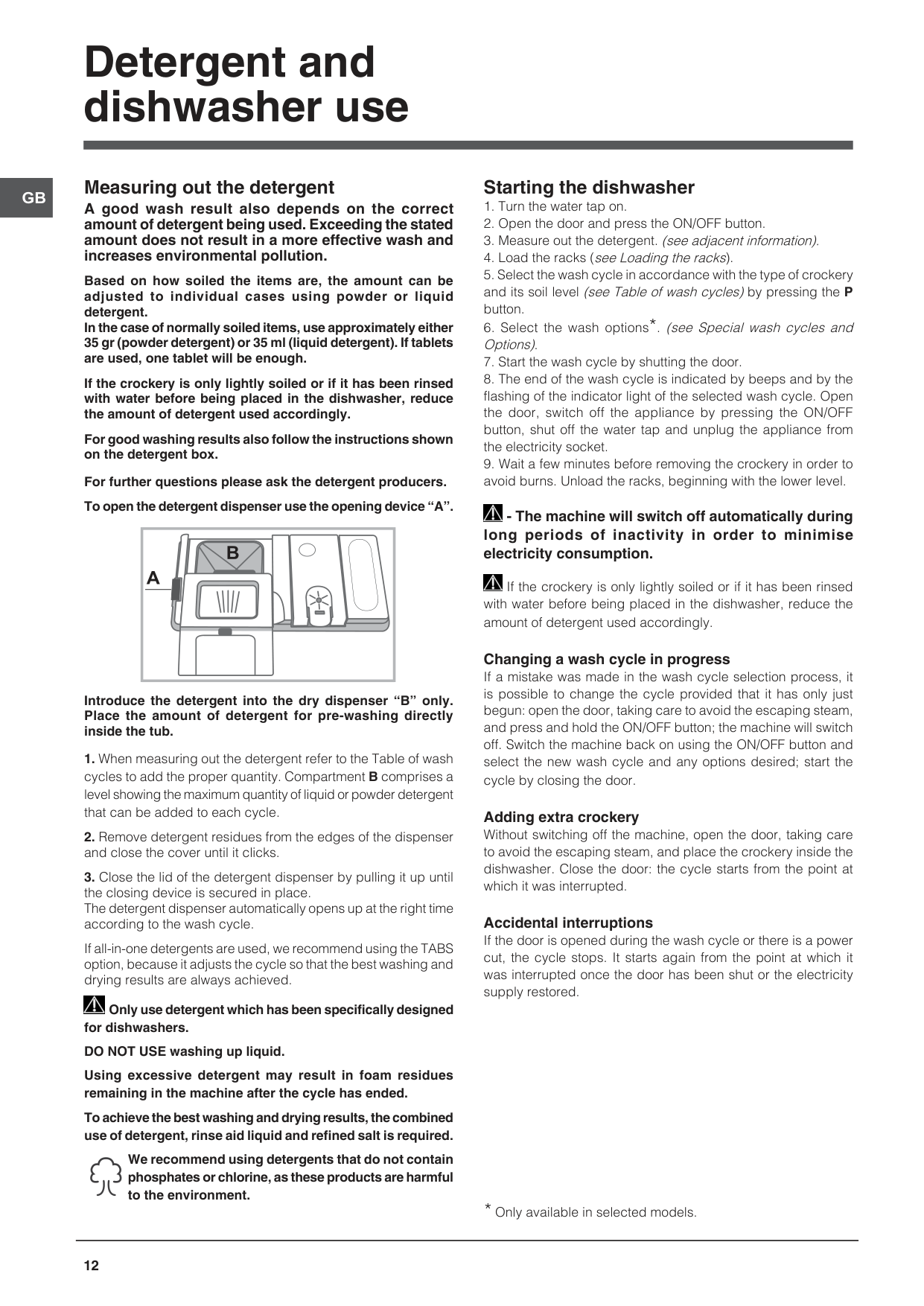
Several dishwasher models are fitted with tip-up sectors*. They can be used in a vertical position when arranging dishes or in a horizontal position (lower) to load pans and salad bowls easily.
| | |---|
####### Cutlery basket
The modular basket is equipped with top grilles for improved cutlery arrangement. The cutlery basket should be positioned only at the front of the lower rack
| | |---|
Knives and other utensils with sharp edges must be placed in the cutlery basket with the points facing downwards or they must be positioned horizontally in the tip-up compartments on the upper rack
Upper rack Load this rack with delicate and lightweight crockery such as glasses, cups, saucers and shallow salad bowls.
| | |---|
Several dishwasher models are fitted with tip-up sectors*. They can be used in a vertical position when arranging tea/ dessert saucers or in a lower position to load bowls and food containers.
######### Tip-up compartments with adjustable position
The side tip-up compartments can be positioned at three different heights to optimize the arrangement of crockery inside the rack.
Wine glasses can be placed safely in the tip-up compartments by inserting the stem of each glass into the corresponding slots. For optimum drying results incline the tip-up compartments more. To change the inclination, pull up the tip-up compartment, slide it slightly and position it as you wish.
####### Cutlery tray*
Some dishwasher models are fitted with a sliding tray which can be used to hold serving utensils or small cups. For optimum washing performance avoid positioning bulky crockery directly below the tray. The cutlery tray can be removed (see Figure).
| | |---|
| | |---|
The upper rack can be adjusted for height based on requirements: high position to place bulky crockery in the lower rack and low position to make the most of the tip-up compartments/sectors by creating more space upwards.
Adjusting the height of the upper rack In order to make it easier to arrange the crockery, the upper rack may be moved to a higher or lower position. The height of the upper rack should be adjusted WHEN THE RACK IS EMPTY. NEVER raise or lower the rack on one side only.
| | |---|
If the rack is equipped with a Lift-Up device* (see figure), lift it up by holding its sides. To restore the lower position, press the levers (A) at the sides of the rack and follow the rack down.
######### Unsuitable crockery
Damage to glass and crockery Caused by:
######## GB
Detergent and dishwasher use
GB
####### Measuring out the detergent
A good wash result also depends on the correct amount of detergent being used. Exceeding the stated amount does not result in a more effective wash and increases environmental pollution.
Based on how soiled the items are, the amount can be adjusted to individual cases using powder or liquid detergent. In the case of normally soiled items, use approximately either 35 gr (powder detergent) or 35 ml (liquid detergent). If tablets are used, one tablet will be enough.
If the crockery is only lightly soiled or if it has been rinsed with water before being placed in the dishwasher, reduce the amount of detergent used accordingly.
For good washing results also follow the instructions shown on the detergent box.
For further questions please ask the detergent producers. To open the detergent dispenser use the opening device “A”.
| | |---|
Introduce the detergent into the dry dispenser “B” only. Place the amount of detergent for pre-washing directly inside the tub.
If all-in-one detergents are used, we recommend using the TABS option, because it adjusts the cycle so that the best washing and drying results are always achieved.

Only use detergent which has been specifically designed for dishwashers. DO NOT USE washing up liquid. Using excessive detergent may result in foam residues remaining in the machine after the cycle has ended.
####### Starting the dishwasher

######### - The machine will switch off automatically during long periods of inactivity in order to minimise electricity consumption.

If the crockery is only lightly soiled or if it has been rinsed with water before being placed in the dishwasher, reduce the amount of detergent used accordingly.
######### Changing a wash cycle in progress
If a mistake was made in the wash cycle selection process, it is possible to change the cycle provided that it has only just begun: open the door, taking care to avoid the escaping steam, and press and hold the ON/OFF button; the machine will switch off. Switch the machine back on using the ON/OFF button and select the new wash cycle and any options desired; start the cycle by closing the door.
######### Adding extra crockery
Without switching off the machine, open the door, taking care to avoid the escaping steam, and place the crockery inside the dishwasher. Close the door: the cycle starts from the point at which it was interrupted.
######### Accidental interruptions
If the door is opened during the wash cycle or there is a power cut, the cycle stops. It starts again from the point at which it was interrupted once the door has been shut or the electricity supply restored.
To achieve the best washing and drying results, the combined use of detergent, rinse aid liquid and refined salt is required.
We recommend using detergents that do not contain phosphates or chlorine, as these products are harmful to the environment.
Wash cycles
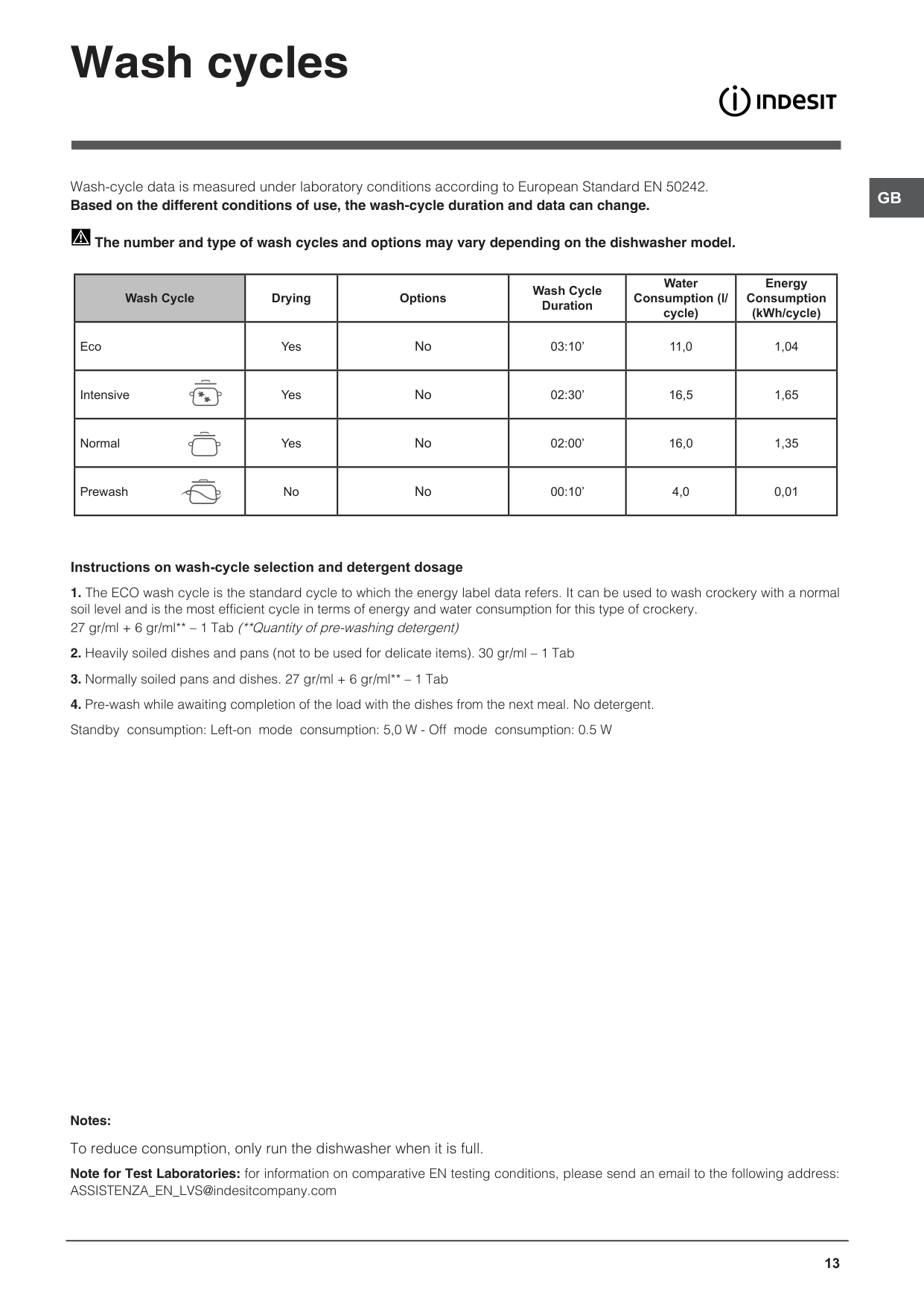
Wash-cycle data is measured under laboratory conditions according to European Standard EN 50242. Based on the different conditions of use, the wash-cycle duration and data can change.
The number and type of wash cycles and options may vary depending on the dishwasher model.
|Wash Cycle|Drying|Options|Wash Cycle Duration|Water Consumption (l/ cycle)|Energy Consumption (kWh/cycle)| |---|---|---|---|---|---| |Eco|Yes|No|03:10’|11,0|1,04| |Intensive|Yes|No|02:30’|16,5|1,65| |Normal|Yes|No|02:00’|16,0|1,35| |Prewash|No|No|00:10’|4,0|0,01|
GB
########## Instructions on wash-cycle selection and detergent dosage
Notes: To reduce consumption, only run the dishwasher when it is full. Note for Test Laboratories: for information on comparative EN testing conditions, please send an email to the following address: ASSISTENZA_EN_LVS@indesitcompany.com
Care and maintenance
GB
###### Shutting off the water and electricity supplies
###### Cleaning the dishwasher
###### Preventing unpleasant odours
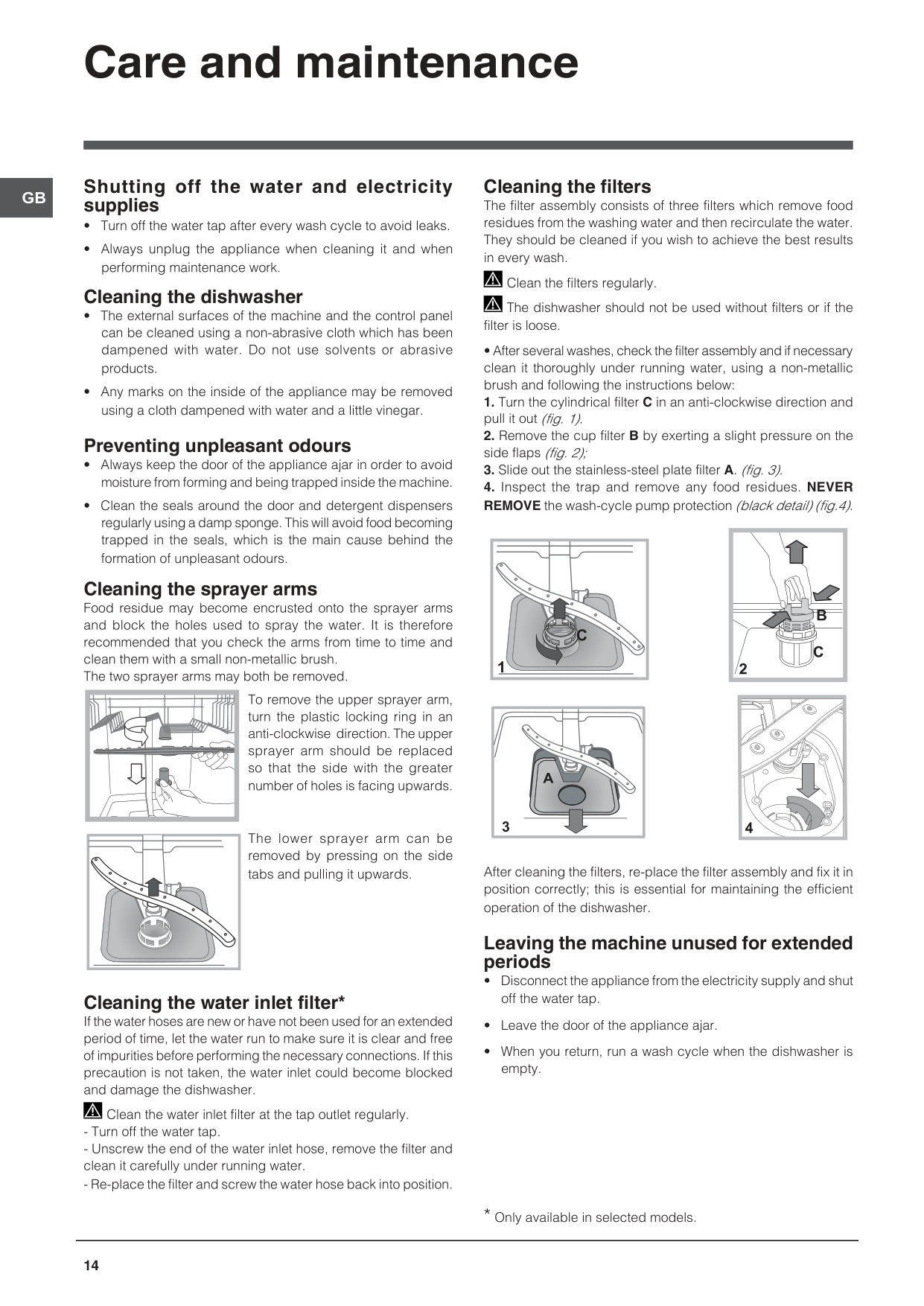
Cleaning the sprayer arms Food residue may become encrusted onto the sprayer arms and block the holes used to spray the water. It is therefore recommended that you check the arms from time to time and clean them with a small non-metallic brush. The two sprayer arms may both be removed.
To remove the upper sprayer arm, turn the plastic locking ring in an anti-clockwise direction. The upper sprayer arm should be replaced so that the side with the greater number of holes is facing upwards.
The lower sprayer arm can be removed by pressing on the side tabs and pulling it upwards.
###### Cleaning the water inlet filter*
If the water hoses are new or have not been used for an extended period of time, let the water run to make sure it is clear and free of impurities before performing the necessary connections. If this precaution is not taken, the water inlet could become blocked and damage the dishwasher.
Clean the water inlet filter at the tap outlet regularly.
####### Cleaning the filters
The filter assembly consists of three filters which remove food residues from the washing water and then recirculate the water. They should be cleaned if you wish to achieve the best results in every wash.
Clean the filters regularly.
The dishwasher should not be used without filters or if the filter is loose.
• After several washes, check the filter assembly and if necessary clean it thoroughly under running water, using a non-metallic brush and following the instructions below:
| | |---| | |
| | | | |---|---|---|

| | | |
| | |---|
After cleaning the filters, re-place the filter assembly and fix it in position correctly; this is essential for maintaining the efficient operation of the dishwasher.
####### Leaving the machine unused for extended periods
Troubleshooting
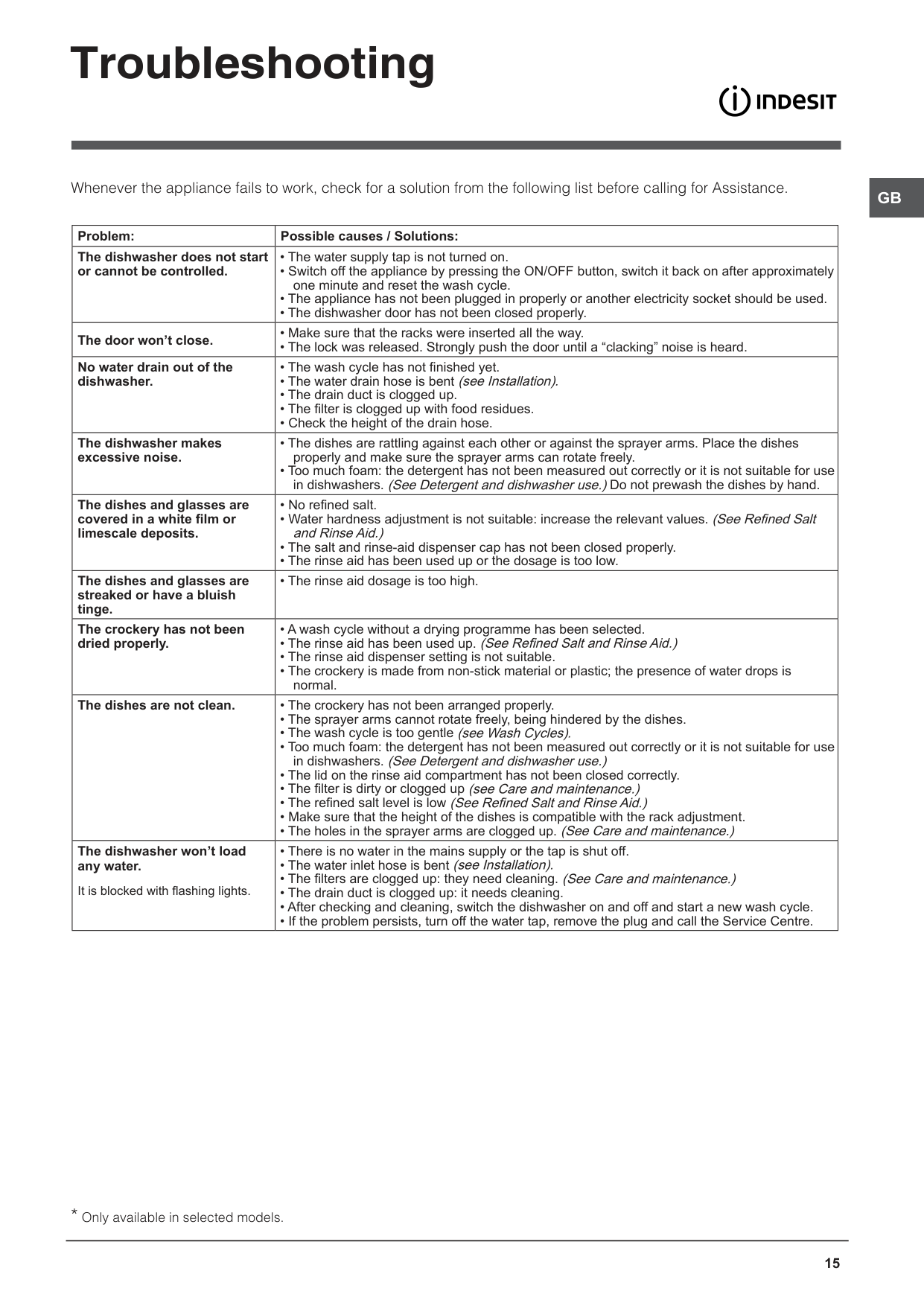
Whenever the appliance fails to work, check for a solution from the following list before calling for Assistance.
|Problem:|Possible causes / Solutions:| |---|---| |The dishwasher does not start or cannot be controlled.|• The water supply tap is not turned on.
• Switch off the appliance by pressing the ON/OFF button, switch it back on after approximately one minute and reset the wash cycle.
• The appliance has not been plugged in properly or another electricity socket should be used.
• The dishwasher door has not been closed properly.
| |The door won’t close.|• Make sure that the racks were inserted all the way.
• The lock was released. Strongly push the door until a “clacking” noise is heard.
| |No water drain out of the dishwasher.|• The wash cycle has not finished yet.
• The water drain hose is bent (see Installation).
• The drain duct is clogged up.
• The filter is clogged up with food residues.
• Check the height of the drain hose.
| |The dishwasher makes excessive noise.|• The dishes are rattling against each other or against the sprayer arms. Place the dishes properly and make sure the sprayer arms can rotate freely.
• Too much foam: the detergent has not been measured out correctly or it is not suitable for use in dishwashers. (See Detergent and dishwasher use.)Do not prewash the dishes by hand.
| |The dishes and glasses are covered in a white film or limescale deposits.|• No refined salt.
• Water hardness adjustment is not suitable: increase the relevant values. (See Refined Salt and Rinse Aid.)
• The salt and rinse-aid dispenser cap has not been closed properly.
• The rinse aid has been used up or the dosage is too low.
| |The dishes and glasses are streaked or have a bluish tinge.|• The rinse aid dosage is too high.| |The crockery has not been dried properly.|• A wash cycle without a drying programme has been selected.
• The rinse aid has been used up. (See Refined Salt and Rinse Aid.)
• The rinse aid dispenser setting is not suitable.
• The crockery is made from non-stick material or plastic; the presence of water drops is normal.
| |The dishes are not clean.|• The crockery has not been arranged properly.
• The sprayer arms cannot rotate freely, being hindered by the dishes.
• The wash cycle is too gentle (see Wash Cycles).
• Too much foam: the detergent has not been measured out correctly or it is not suitable for use in dishwashers. (See Detergent and dishwasher use.)
• The lid on the rinse aid compartment has not been closed correctly.
• The filter is dirty or clogged up (see Care and maintenance.)
• The refined salt level is low (See Refined Salt and Rinse Aid.)
• Make sure that the height of the dishes is compatible with the rack adjustment.
• The holes in the sprayer arms are clogged up. (See Care and maintenance.)
| |The dishwasher won’t load any water.
It is blocked with flashing lights.|• There is no water in the mains supply or the tap is shut off.
• The water inlet hose is bent (see Installation).
• The filters are clogged up: they need cleaning. (See Care and maintenance.)
• The drain duct is clogged up: it needs cleaning.
• After checking and cleaning, switch the dishwasher on and off and start a new wash cycle.
• If the problem persists, turn off the water tap, remove the plug and call the Service Centre.
|
GB
Guarantee

GB Guarantee
####### 12 months Parts and Labour Guarantee
Your appliance has the benefit of our manufacturer’s guarantee, which covers the cost of breakdown repairs for twelve months from the date of purchase.
This gives you the reassurance that if, within that time, your appliance is proven to be defective because of either workmanship or materials, we will, at our discretion, either repair or replace the appliance at no cost to you.
######### This guarantee is subject to the following conditions:
The guarantee does not cover:
THIS GUARANTEE WILL NOT APPLY IF THE APPLIANCE HAS BEEN USED IN COMMERCIAL OR NONDOMESTIC PREMISES.
####### 5 Year Parts Guarantee
Indesit also offers you a free 5 year parts guarantee. This additional guarantee is conditional on you registering your appliance with us and the parts being fitted by one of our authorised engineers. There will be a charge for our engineer’s time. To activate the extra parts warranty on your appliance, simply call our registration line on 08448 24 24 24 (Republic of Ireland 01 230 0800)
####### Extended Guarantees
We offer a selection of protection plans that enable you to fully cover yourself against the expense of repair bills for the life of your policy. To find the ideal plan for you please call our advice line on 08448 226 226 (Republic of Ireland 01 230 0233).
####### Free Helpdesk Service
We have a dedicated team who can provide free advice and assistance with your appliance if you experience any technical difficulties within the first 90 days of ownership. Simply call our Indesit Service Hotline on 08448 224 224 (Republic of Ireland 0818 313 413) for telephone assistance, or, where necessary, to arrange for an engineer to call.
After Sales Service
GBAfter Sales Service
No one is better placed to care for your Indesit appliance during the course of its working life than us – the manufacturer.
Essential Contact Information
####### Indesit Service
We are the largest service team in the UK and Ireland offering you access to 400 skilled telephone advisors and 1000 fully qualified engineers on call to ensure you receive fast, reliable, local service.
UK: 08448 224 224 Republic of Ireland: 0818 313 413 www.indesitservice.co.uk
Please note: Our advisors will require the following information: Model number: Serial number:
####### Parts and Accessories
We supply a full range of genuine replacement parts as well as accessory products that protect and hygienically clean your appliance to keep it looking good and functioning efficiently throughout its life.
UK: 08448 225 225 Republic of Ireland: 0818 313 413 www.indesitservice.co.uk
Appliance Registration We want to give you additional benefits of Indesit ownership. To activate your free 5 year parts guarantee you must register your appliance with us. UK: 08448 24 24 24 Republic of Ireland: 01 230 0800 www.indesitservice.co.uk Indesit Company UK Ltd. Morley Way, Peterborough, PE2 9JB Indesit Company Unit 49 Airways Industrial Estate, Dublin 17
Recycling and Disposal Information As part of Indesit’s continued commitment to helping the environment, Indesit reserves the right to use quality, recycled components to keep down customer costs and minimise material wastage.
Please dispose of packaging and old appliances carefully. To minimise the risk of injury to children, remove the door, plug, and cut the mains cable off flush with the appliance. Dispose of these parts separately to ensure that the appliance can no longer be plugged into mains socket, and the door cannot be locked shut.
######## GB
######## GB
GB
195115101.02 - NC 01/2015 jk - Xerox Fabriano

Indesit Company Spa Viale Aristide Merloni 47 60044 Fabriano (AN) Italy
www.indesit.co.uk