
Ask AI
— answers from the official manualAnswers from the official manual.
Common questions
Common Questions
9 totalWhat temperatures should I set for the fresh food compartment and freezer?
The recommended setting is 37°F for the fresh food compartment and 0°F for the freezer. Adjust as needed based on usage (Page 19).
How do I factory reset my Kenmore if it gives an error code?
Press and hold the 'set' key for three seconds to reset all refrigerator settings. If you see error codes on digital temperature display contact service (Page 20).
How do I install a water line to my Kenmore refrigerator?
Connect the copper or stainless steel tubing directly to your home's cold water supply and secure it with an approved nut and ferrule. Ensure a clear distance for movement if cleaning is needed (Page 14).
How do I change the water filter on my Kenmore refrigerator?
Unplug the fridge, turn off ice maker, remove the old cartridge by pushing it out then slide a new one in until you hear a click. Reset via control panel (Page 32).
How do I clean my glass shelves?
Lift front edge and pull shelf out, rinse with mild detergent then allow to air dry, return it once fully dry. Handle cautiously as they can break if nicked or exposed to sudden temperature change (Page 24).
How do I adjust the door bins?
Remove items, grip bin and lift upwards then place in new position and lower onto supports until locked in. Ensure it aligns properly with support slots (Page 26-27).
Full Manual
39 pages
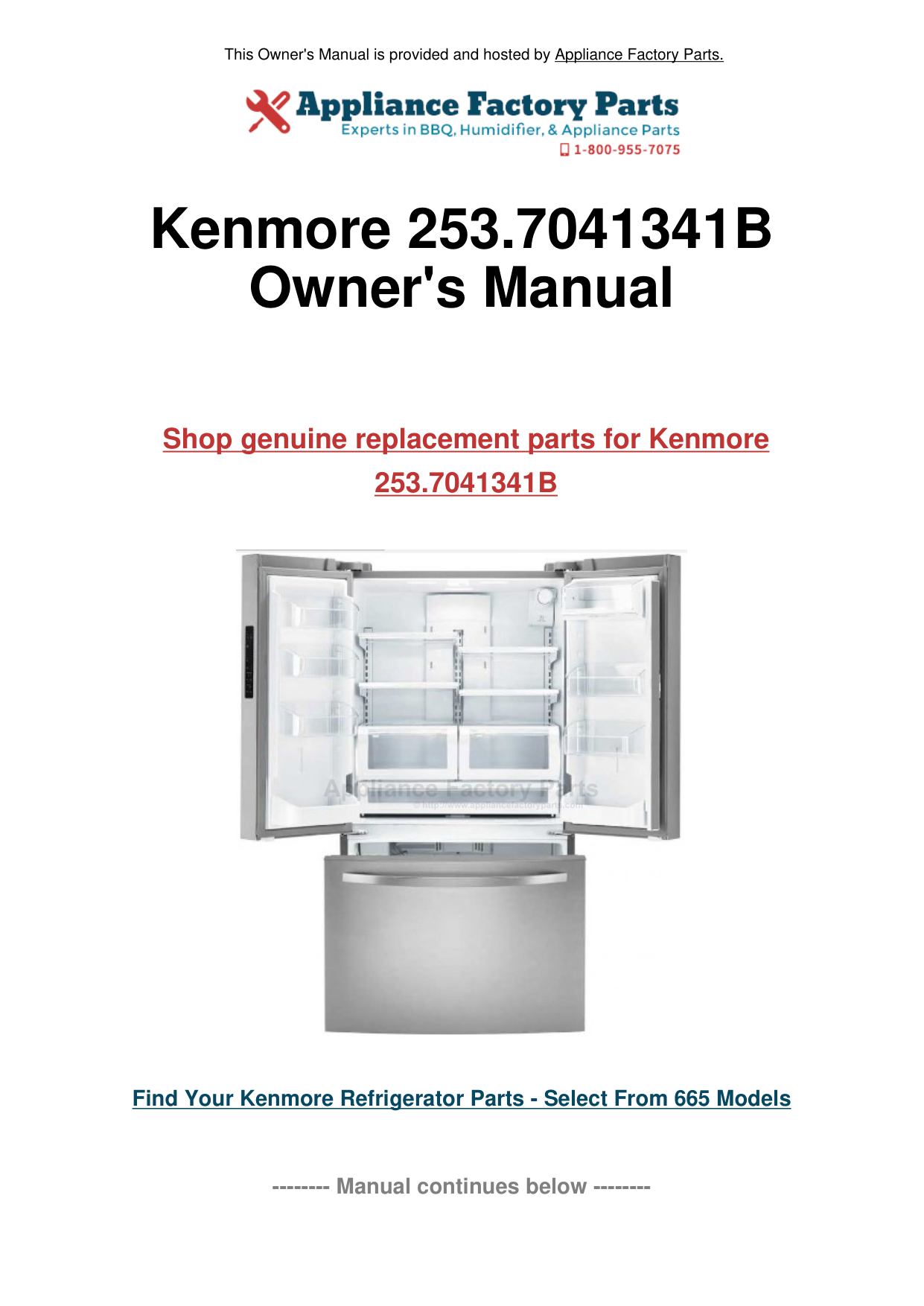
This Owner's Manual is provided and hosted by Appliance Factory Parts. Kenmore 253.7041341B Owner's Manual Shop genuine replacement parts for Kenmore
253.7041341B
Find Your Kenmore Refrigerator Parts - Select From 665 Models -------- Manual continues below --------
Use & Care Guide Manual de Uso y Cuidado Guide d’utilisation et d’entretien English / Español / Français Models/Modelos/Modèles: 253.7034*, 7041*, 7042*, 7044*
P/N A05963501 (1611)
Sears Brands Management Corporation Hoffman Estates, IL 60179 U.S.A. www.kenmore.com www.sears.com Sears Canada Inc. Toronto, Ontario, Canada M5B 2C3 www.sears.ca ® Kenmore French Door Bottom Freezer Congelador Inferior de Puerta Doble
2 Record Model/Serial Numbers Please read and save these instructions. This Use & Care Guide provides specific operating instructions for your model. Use your unit only as instructed in this guide. These instructions are not meant to cover every possible condition and situation that may occur. Common sense and caution must be practiced when installing, operating, and maintaining any appliance. Please record your model and serial numbers below for future reference. This information is found on the serial plate located inside the refrigerator compartment. Model Number: Serial Number: Purchase Date:
Important
Use only soap and water to clean serial plate. Important Safety InstructionsImportant
Indicates installation, operation, or maintenance information which is important but not hazard-related.Caution
CAUTION indicates a potentially hazardous situation which, if not avoided, may result in minor or moderate injury.Warning
WARNING indicates a potentially hazardous situation which, if not avoided, could result in death or serious injury.Danger
DANGER indicates an imminently hazardous situation which, if not avoided, will result in death or serious injury. Table of Contents Record Model/Serial Numbers.................2 Important Safety Instructions................2-4 Warranty Information.............................5 Master Protection Agreements.................6 Features at a Glance...............................7 Installation...................................... 8-10 Door Removal Instructions................ 11-12 Installing Door Handles........................ 13 Connecting the Water Supply............. 14-15 Controls......................................... 16-20 Automatic Ice & Water Dispenser....... 21-23 Storage Features............................. 24-27 Storing Food and Saving Energy............. 28 Normal Operating Sounds..................... 29 Changing the Filter.......................... 30-31 Care & Cleaning.............................. 32-33 Before You Call............................... 34-38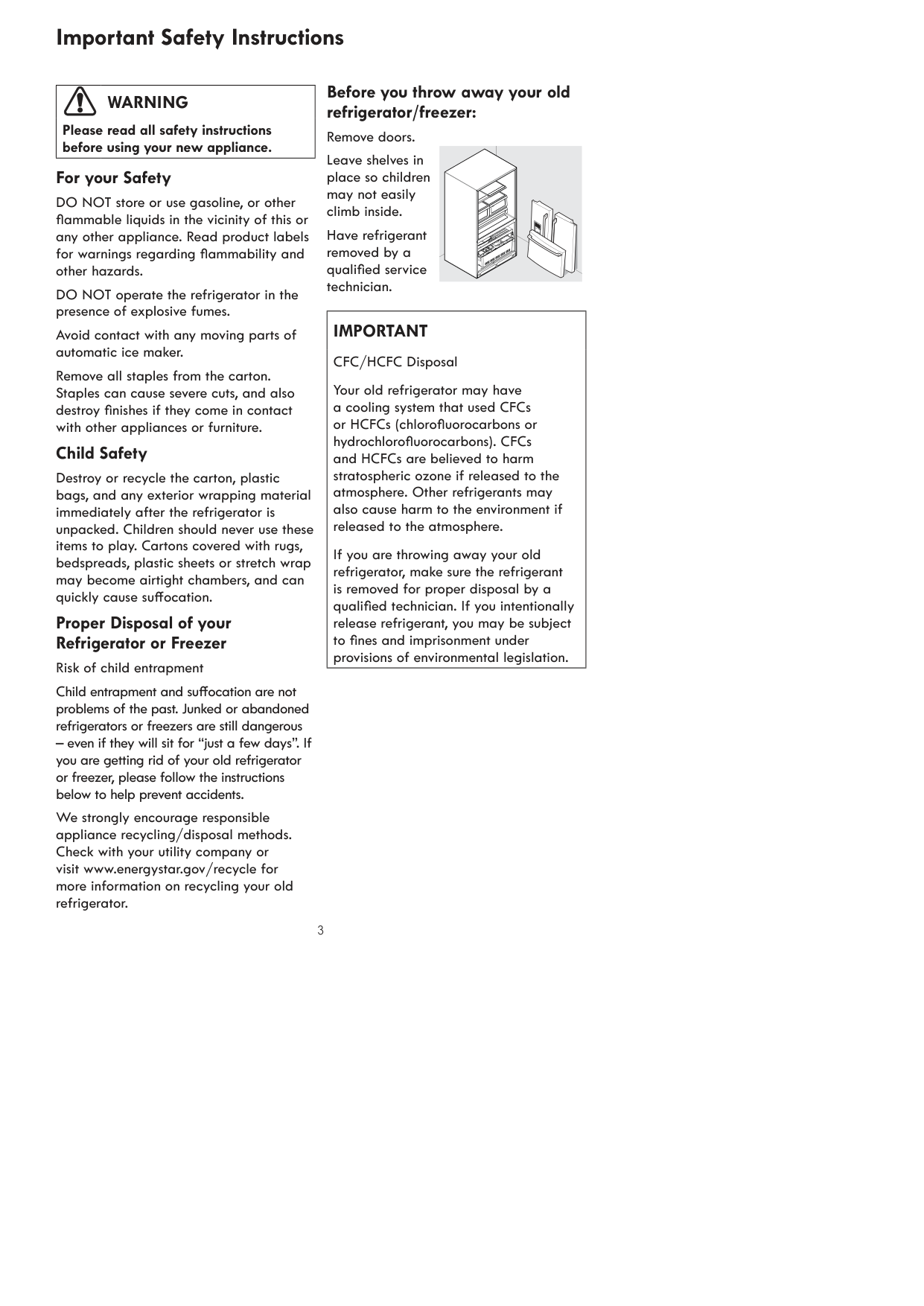
3 Important Safety Instructions For your Safety DO NOT store or use gasoline, or other flammable liquids in the vicinity of this or any other appliance. Read product labels for warnings regarding flammability and other hazards. DO NOT operate the refrigerator in the presence of explosive fumes. Avoid contact with any moving parts of automatic ice maker. Remove all staples from the carton. Staples can cause severe cuts, and also destroy finishes if they come in contact with other appliances or furniture. Child Safety Destroy or recycle the carton, plastic bags, and any exterior wrapping material immediately after the refrigerator is unpacked. Children should never use these items to play. Cartons covered with rugs, bedspreads, plastic sheets or stretch wrap may become airtight chambers, and can quickly cause suffocation. Proper Disposal of your Refrigerator or Freezer Risk of child entrapment Child entrapment and suffocation are not problems of the past. Junked or abandoned refrigerators or freezers are still dangerous – even if they will sit for “just a few days”. If you are getting rid of your old refrigerator or freezer, please follow the instructions below to help prevent accidents. We strongly encourage responsible appliance recycling/disposal methods. Check with your utility company or visit www.energystar.gov/recycle for more information on recycling your old refrigerator.
Important
CFC/HCFC Disposal Your old refrigerator may have a cooling system that used CFCs or HCFCs (chlorofluorocarbons or hydrochlorofluorocarbons). CFCs and HCFCs are believed to harm stratospheric ozone if released to the atmosphere. Other refrigerants may also cause harm to the environment if released to the atmosphere. If you are throwing away your old refrigerator, make sure the refrigerant is removed for proper disposal by a qualified technician. If you intentionally release refrigerant, you may be subject to fines and imprisonment under provisions of environmental legislation.Warning
Please read all safety instructions before using your new appliance. Before you throw away your old refrigerator/freezer: Remove doors. Leave shelves in place so children may not easily climb inside. Have refrigerant removed by a qualified service technician.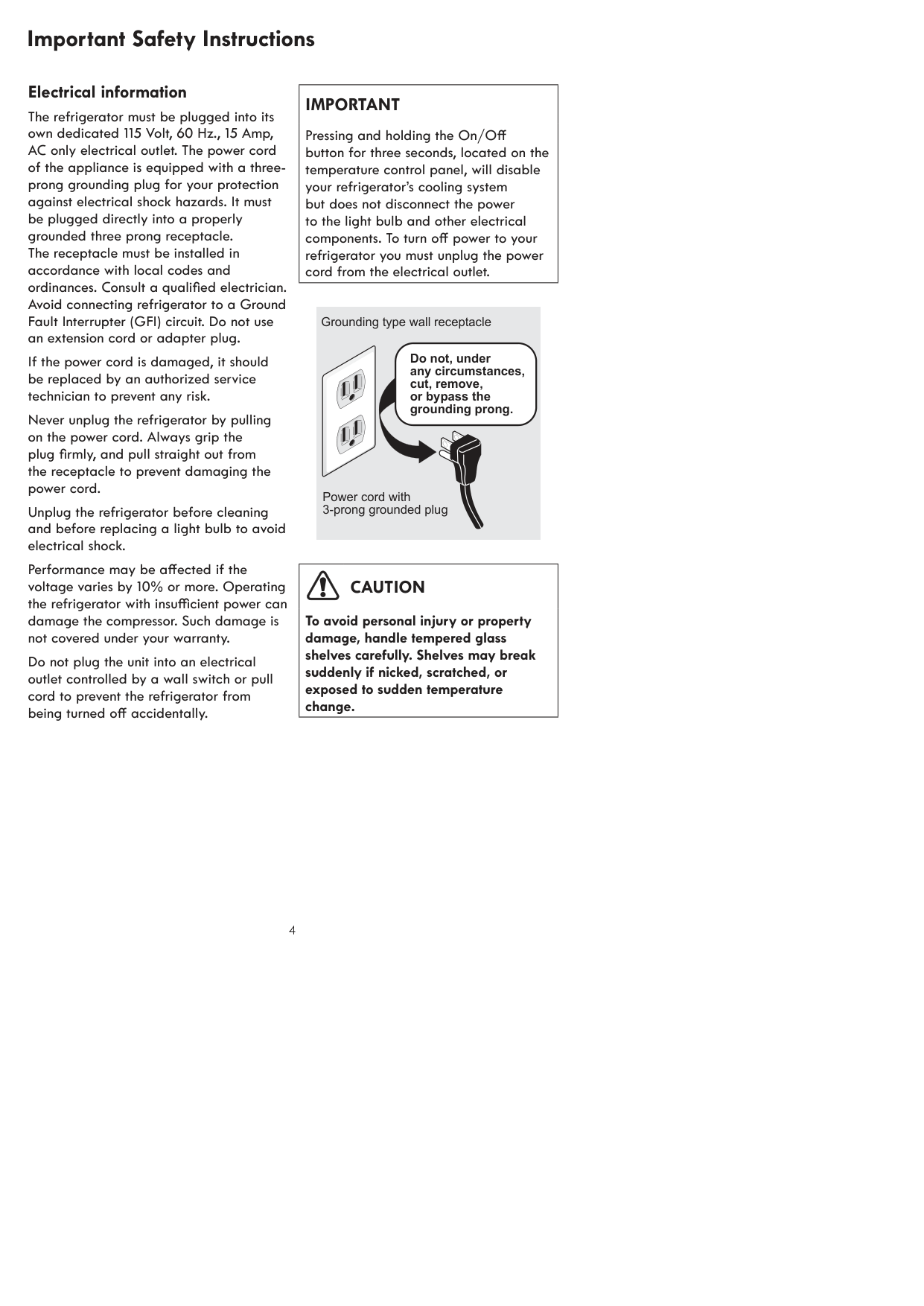
4 Grounding type wall receptacle Power cord with 3-prong grounded plug Do not, under any circumstances, cut, remove, or bypass the grounding prong. Electrical information The refrigerator must be plugged into its own dedicated 115 Volt, 60 Hz., 15 Amp, AC only electrical outlet. The power cord of the appliance is equipped with a three- prong grounding plug for your protection against electrical shock hazards. It must be plugged directly into a properly grounded three prong receptacle. The receptacle must be installed in accordance with local codes and ordinances. Consult a qualified electrician. Avoid connecting refrigerator to a Ground Fault Interrupter (GFI) circuit. Do not use an extension cord or adapter plug. If the power cord is damaged, it should be replaced by an authorized service technician to prevent any risk. Never unplug the refrigerator by pulling on the power cord. Always grip the plug firmly, and pull straight out from the receptacle to prevent damaging the power cord. Unplug the refrigerator before cleaning and before replacing a light bulb to avoid electrical shock. Performance may be affected if the voltage varies by 10% or more. Operating the refrigerator with insufficient power can damage the compressor. Such damage is not covered under your warranty. Do not plug the unit into an electrical outlet controlled by a wall switch or pull cord to prevent the refrigerator from being turned off accidentally. Important Safety Instructions
Important
Pressing and holding the On/Off button for three seconds, located on the temperature control panel, will disable your refrigerator’s cooling system but does not disconnect the power to the light bulb and other electrical components. To turn off power to your refrigerator you must unplug the power cord from the electrical outlet.Caution
To avoid personal injury or property damage, handle tempered glass shelves carefully. Shelves may break suddenly if nicked, scratched, or exposed to sudden temperature change.
5 Warranty Information
Kenmore Limited Warranty
FOR ONE YEAR from the date of sale this appliance is warranted against defects in material or workmanship when it is correctly installed, operated and maintained according to all supplied instructions. WITH PROOF OF SALE, a defective appliance will receive free repair or replacement at option of seller. For warranty coverage details to obtain free repair or replacement, visit the web page: www.kenmore.com/warranty This warranty applies for only 90 DAYS from the sale date in the United States, and is void in Canada, if this appliance is ever used for other than private household purposes. This warranty covers ONLY defects in material and workmanship, and will NOT pay for:
6 Master Protection Agreements Congratulations on making a smart purchase. Your new Kenmore® product is designed and manufactured for years of dependable operation. But like all products, it may require preventive maintenance or repair from time to time. That’s when having a Master Protection Agreement can save you money and aggravation. The Master Protection Agreement also helps extend the life of your new product. Here’s what the Agreement* includes: Parts and labor not just for repairing defects, but to help keep products operating properly under normal use. Our coverage goes well beyond the product warranty. No deductibles, no functional failure excluded from coverage— real protection. Expert service by a force of more than 10,000 authorized Sears service technicians, which means someone you can trust will be working on your product. Unlimited service calls and nationwide service, as often as you want us, whenever you want us. “No-lemon” guarantee – replacement of your covered product if four or more product failures occur within twelve months. Product replacement if your covered product can’t be fixed. Annual Preventive Maintenance Check at your request – no extra charge. Fast help by phone – we call it Rapid Resolution – phone support from a Sears representative on all products. Think of us as a “talking owner’s manual.” Power surge protection against electrical damage due to power fluctuations. $250 Food Loss Protection annually for any food spoilage that is the result of mechanical failure of any covered refrigerator or freezer. Rental reimbursement if repair of your covered product takes longer than promised. 25% discount off the regular price of any non-covered repair service and related installed parts. Once you purchase the Agreement, a simple phone call is all that it takes for you to schedule service. You can call anytime day or night, or schedule a service appointment online. The Master Protection Agreement is a risk free purchase. If you cancel for any reason during the product warranty period, we will provide a full refund. Or, a prorated refund anytime after the product warranty period expires. Purchase your Master Protection Agreement today! Some limitations and exclusions apply. For prices and additional information in the U.S.A. call 1-800-827-6655.
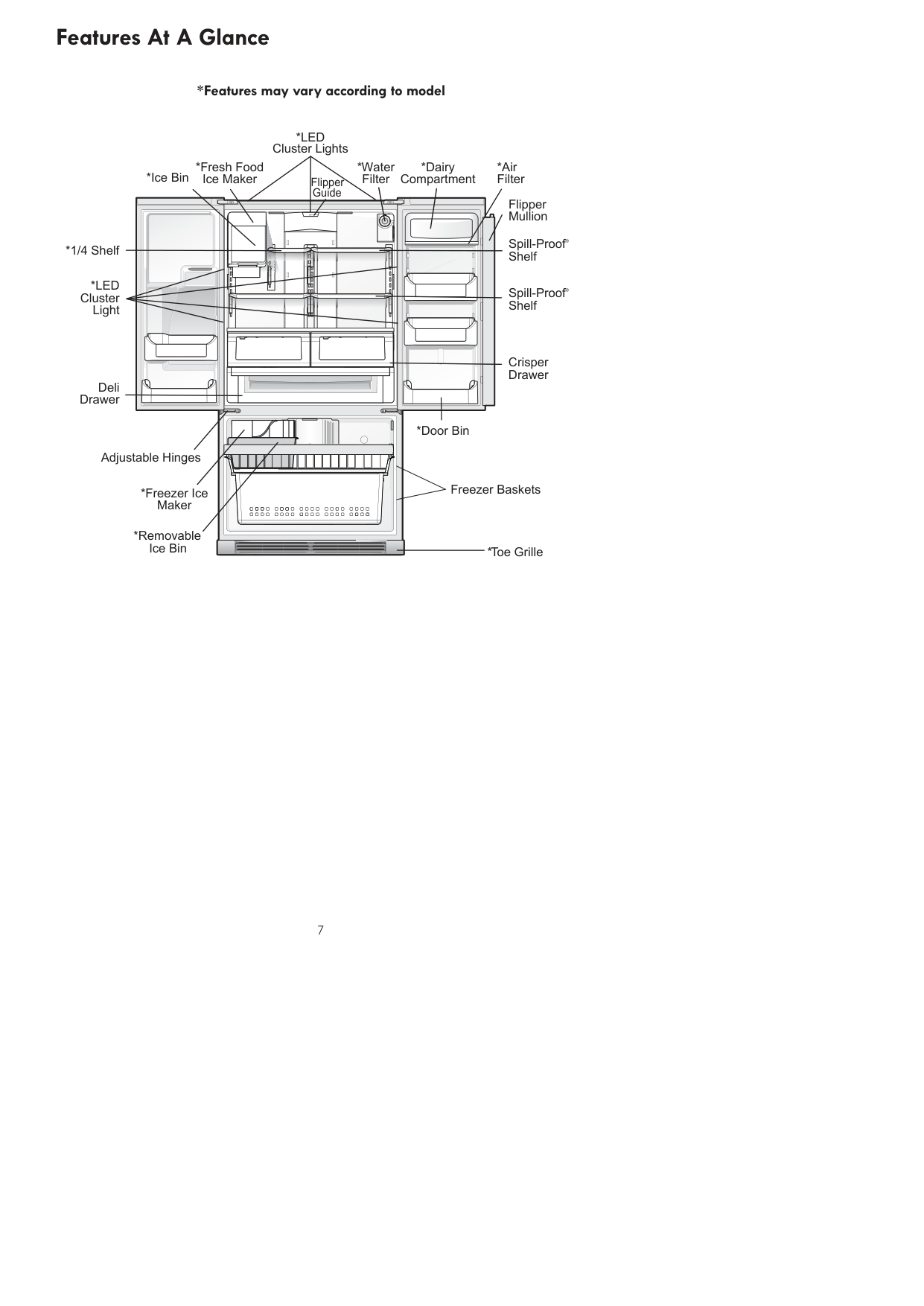
7 Features At A Glance *Features may vary according to model
*1/4 Shelf Deli Drawer *Water Filter *Removable Ice Bin *Freezer Ice Maker Adjustable Hinges Freezer Baskets *Toe Grille *Door Bin Spill-Proof ® Shelf Flipper Mullion *Air Filter Flipper Guide *Fresh Food Ice Maker *Ice Bin Crisper Drawer *Dairy Compartment
*Led
Cluster Lights Spill-Proof ® Shelf*Led
Cluster Light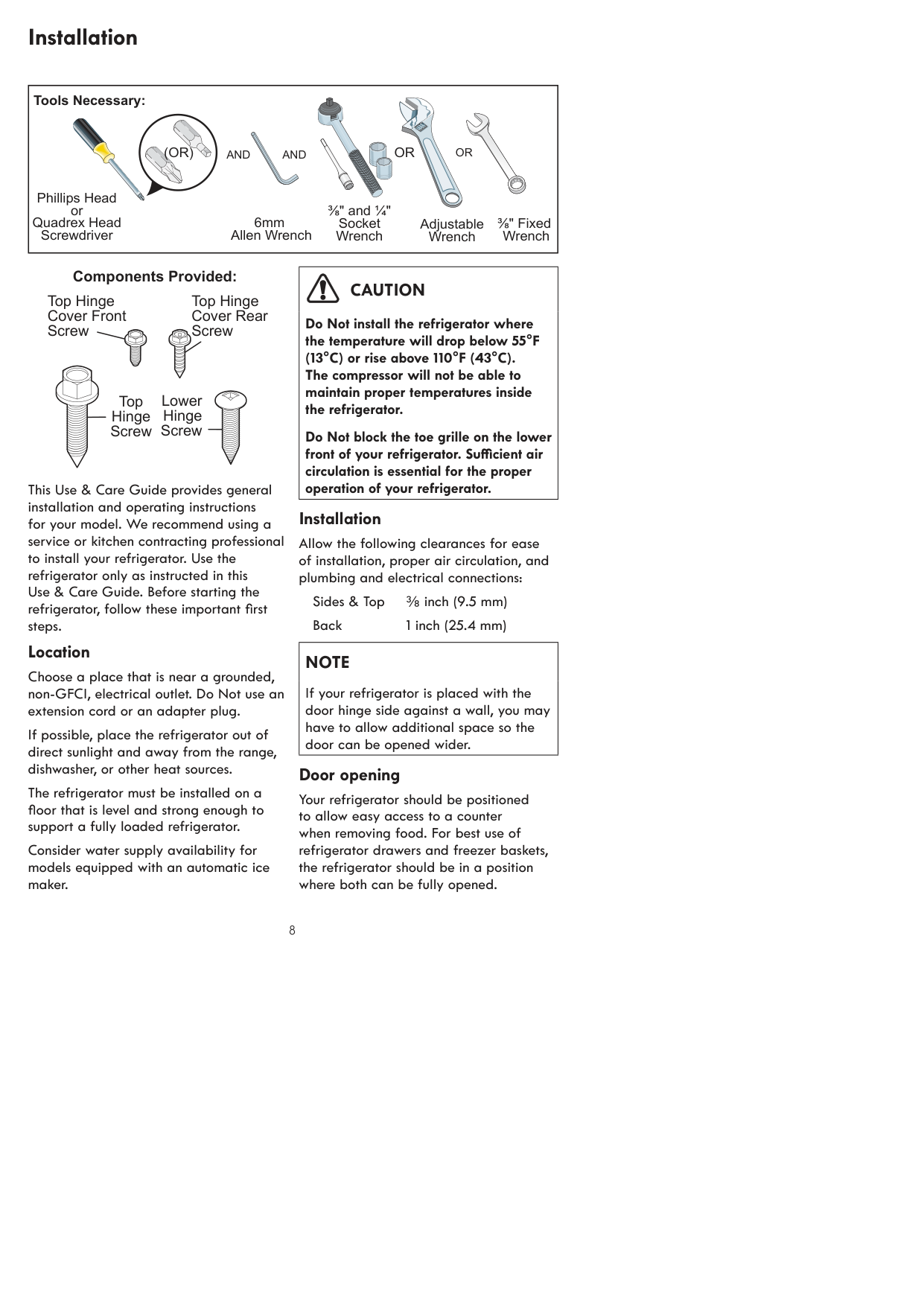
8 Installation This Use & Care Guide provides general installation and operating instructions for your model. We recommend using a service or kitchen contracting professional to install your refrigerator. Use the refrigerator only as instructed in this Use & Care Guide. Before starting the refrigerator, follow these important first steps. Location Choose a place that is near a grounded, non-GFCI, electrical outlet. Do Not use an extension cord or an adapter plug. If possible, place the refrigerator out of direct sunlight and away from the range, dishwasher, or other heat sources. The refrigerator must be installed on a floor that is level and strong enough to support a fully loaded refrigerator. Consider water supply availability for models equipped with an automatic ice maker. Installation Allow the following clearances for ease of installation, proper air circulation, and plumbing and electrical connections: Sides & Top ⅜ inch (9.5 mm) Back 1 inch (25.4 mm) Door opening Your refrigerator should be positioned to allow easy access to a counter when removing food. For best use of refrigerator drawers and freezer baskets, the refrigerator should be in a position where both can be fully opened. Top Hinge Cover Front Screw Top Hinge Cover Rear Screw Lower Hinge Screw Top Hinge Screw Components Provided: Tools Necessary: Phillips Head or Quadrex Head Screwdriver
(Or)
Or
⅜" and ¼" Socket Wrench Adjustable WrenchOr
⅜" Fixed WrenchAnd
And
6mm Allen WrenchCaution
Do Not install the refrigerator where the temperature will drop below 55°F (13°C) or rise above 110°F (43°C). The compressor will not be able to maintain proper temperatures inside the refrigerator. Do Not block the toe grille on the lower front of your refrigerator. Sufficient air circulation is essential for the proper operation of your refrigerator.Note
If your refrigerator is placed with the door hinge side against a wall, you may have to allow additional space so the door can be opened wider.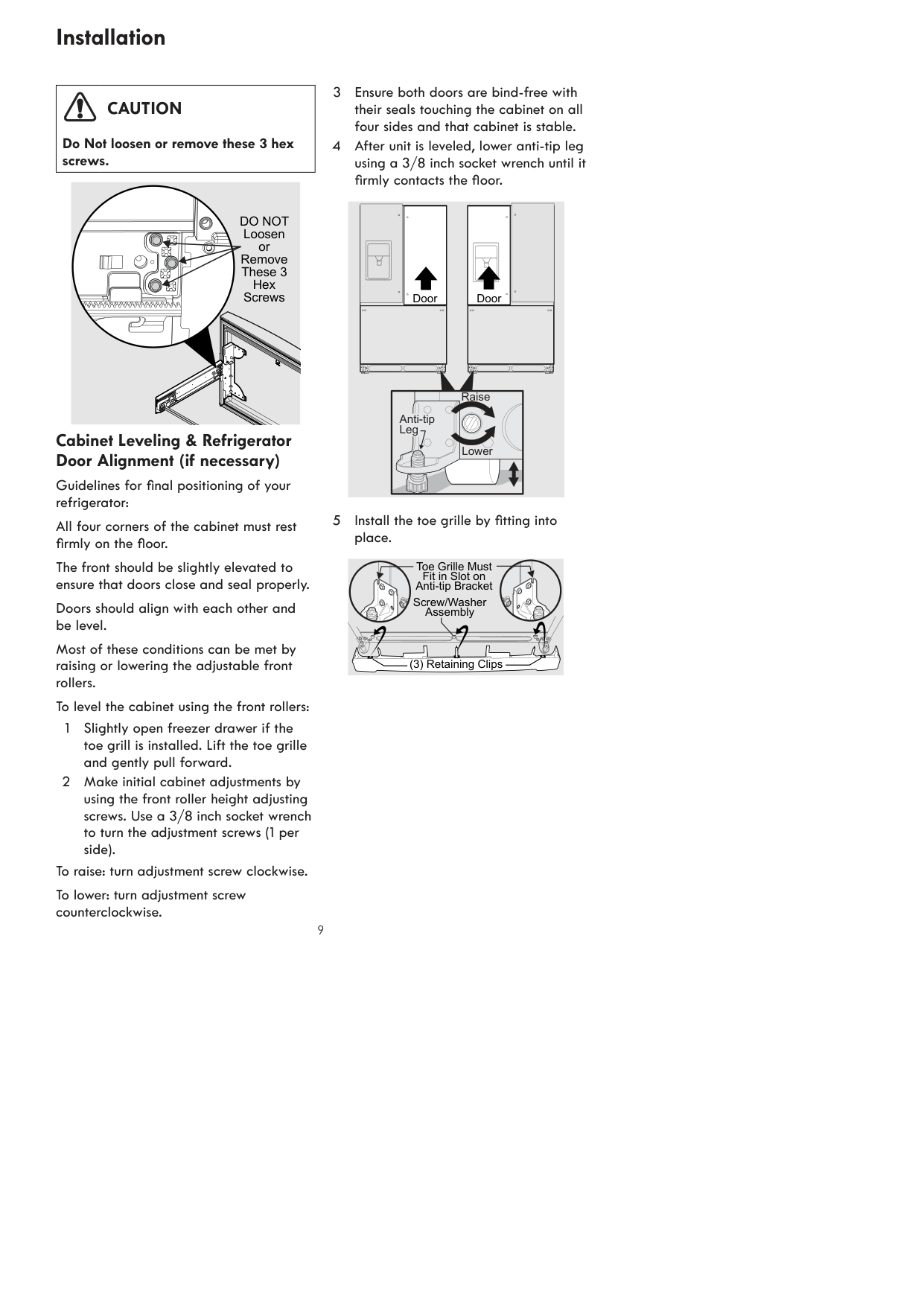
9 Installation Toe Grille Must Fit in Slot on Anti-tip Bracket Screw/Washer Assembly (3) Retaining Clips 3 Ensure both doors are bind-free with their seals touching the cabinet on all four sides and that cabinet is stable. 4 After unit is leveled, lower anti-tip leg using a 3/8 inch socket wrench until it firmly contacts the floor. Cabinet Leveling & Refrigerator Door Alignment (if necessary) Guidelines for final positioning of your refrigerator: All four corners of the cabinet must rest firmly on the floor. The front should be slightly elevated to ensure that doors close and seal properly. Doors should align with each other and be level. Most of these conditions can be met by raising or lowering the adjustable front rollers. To level the cabinet using the front rollers: 1 Slightly open freezer drawer if the toe grill is installed. Lift the toe grille and gently pull forward. 2 Make initial cabinet adjustments by using the front roller height adjusting screws. Use a 3/8 inch socket wrench to turn the adjustment screws (1 per side). To raise: turn adjustment screw clockwise. To lower: turn adjustment screw counterclockwise. Raise Lower Anti-tip Leg Door Door 5 Install the toe grille by fitting into place.
Do Not
Loosen or Remove These 3 Hex ScrewsCaution
Do Not loosen or remove these 3 hex screws.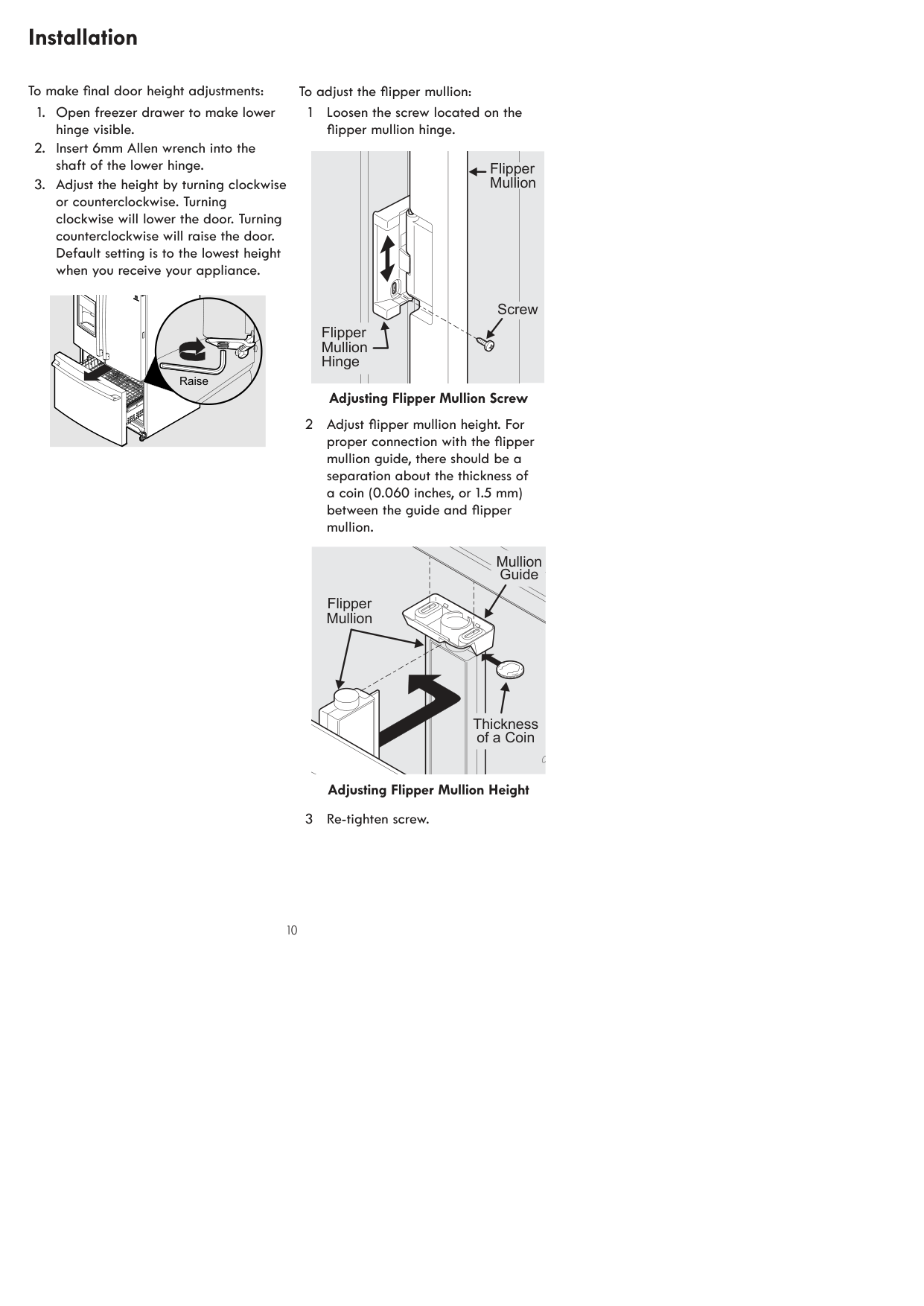
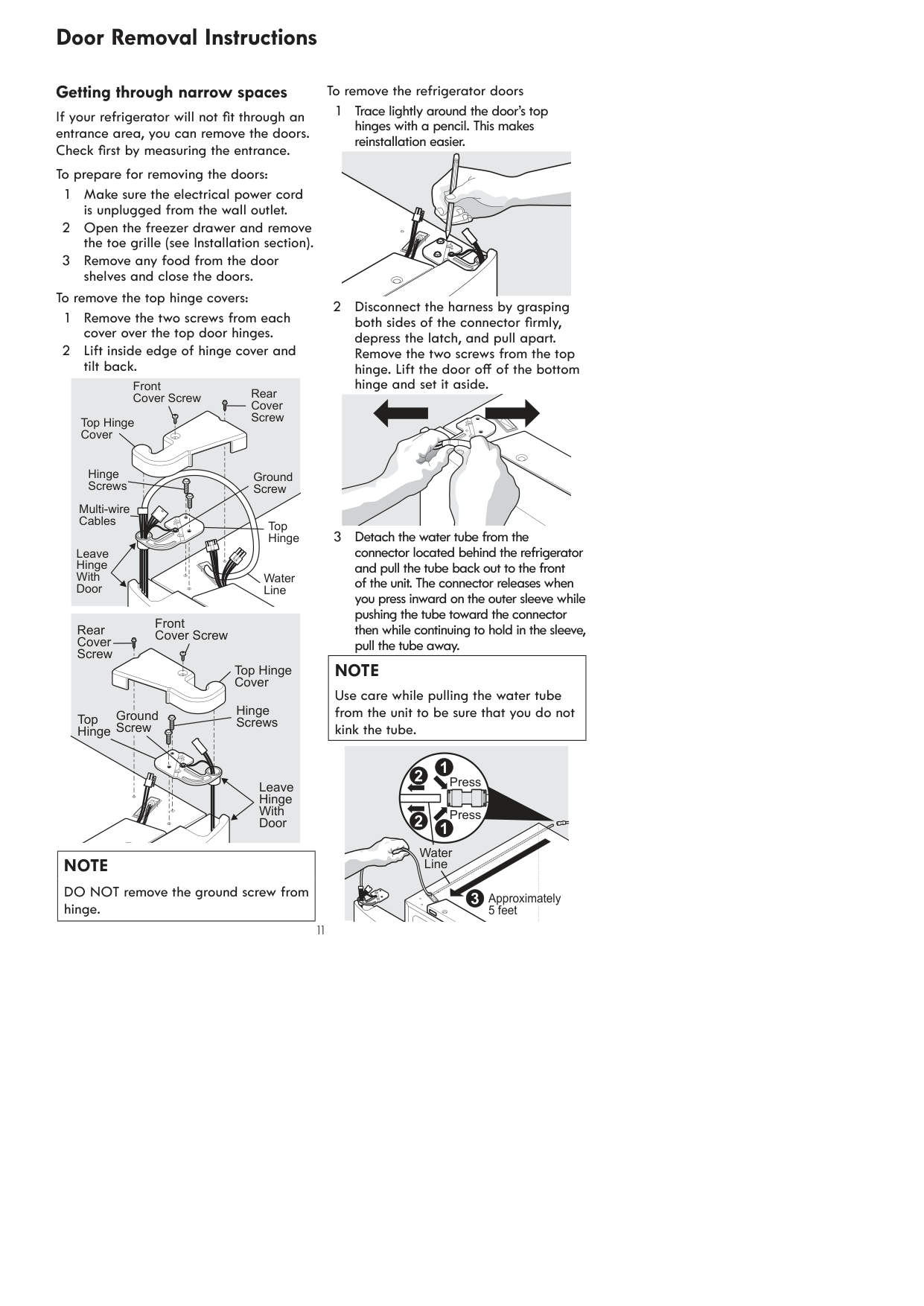
10 Flipper Mullion Screw Flipper Mullion Hinge Adjusting Flipper Mullion Screw 2 Adjust flipper mullion height. For proper connection with the flipper mullion guide, there should be a separation about the thickness of a coin (0.060 inches, or 1.5 mm) between the guide and flipper mullion. 3 Re-tighten screw. To adjust the flipper mullion: 1 Loosen the screw located on the flipper mullion hinge. Flipper Mullion Mullion Guide Thickness of a Coin Adjusting Flipper Mullion Height Installation Raise To make final door height adjustments:
11 Door Removal Instructions 2 Disconnect the harness by grasping both sides of the connector firmly, depress the latch, and pull apart. Remove the two screws from the top hinge. Lift the door off of the bottom hinge and set it aside. 3 Detach the water tube from the connector located behind the refrigerator and pull the tube back out to the front of the unit. The connector releases when you press inward on the outer sleeve while pushing the tube toward the connector then while continuing to hold in the sleeve, pull the tube away. Getting through narrow spaces If your refrigerator will not fit through an entrance area, you can remove the doors. Check first by measuring the entrance. To prepare for removing the doors: 1 Make sure the electrical power cord is unplugged from the wall outlet. 2 Open the freezer drawer and remove the toe grille (see Installation section). 3 Remove any food from the door shelves and close the doors. To remove the top hinge covers: 1 Remove the two screws from each cover over the top door hinges. 2 Lift inside edge of hinge cover and tilt back. Rear Cover Screw Ground Screw Top Hinge Top Hinge Cover Hinge Screws Multi-wire Cables Leave Hinge With Door Front Cover Screw Water Line Rear Cover Screw Top Hinge Ground Screw Front Cover Screw Top Hinge Cover Hinge Screws Leave Hinge With Door To remove the refrigerator doors 1 Trace lightly around the door’s top hinges with a pencil. This makes reinstallation easier. Press Press Approximately 5 feet Water Line
Note
DO NOT remove the ground screw from hinge.Note
Use care while pulling the water tube from the unit to be sure that you do not kink the tube.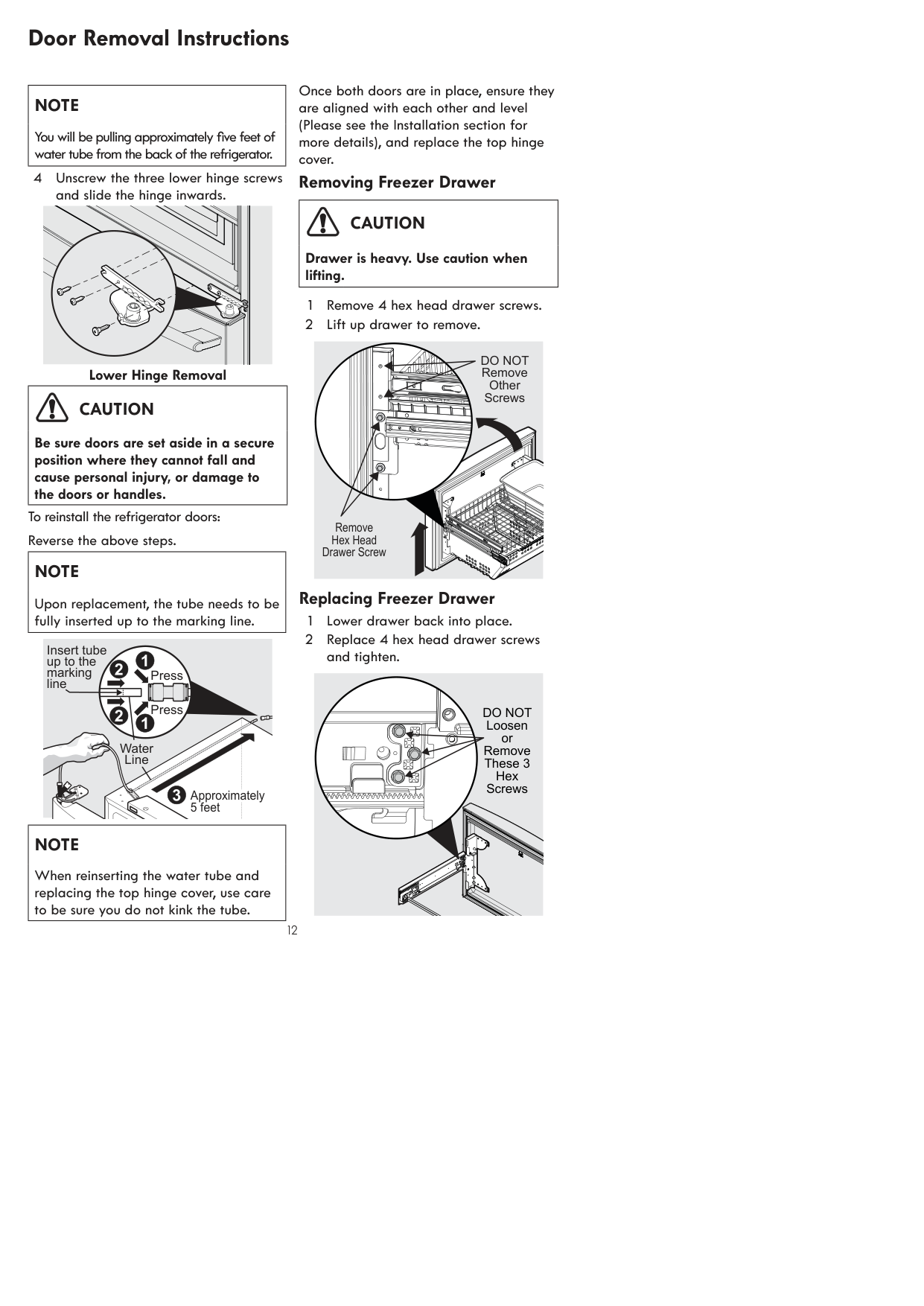
12 Door Removal Instructions Lower Hinge Removal 4 Unscrew the three lower hinge screws and slide the hinge inwards. Once both doors are in place, ensure they are aligned with each other and level (Please see the Installation section for more details), and replace the top hinge cover. Press Press Approximately 5 feet Water Line Insert tube up to the marking line To reinstall the refrigerator doors: Reverse the above steps. Remove Hex Head Drawer Screw
Do Not
Remove Other ScrewsDo Not
Loosen or Remove These 3 Hex Screws 1 Remove 4 hex head drawer screws. 2 Lift up drawer to remove. Removing Freezer Drawer Replacing Freezer Drawer 1 Lower drawer back into place. 2 Replace 4 hex head drawer screws and tighten.Note
You will be pulling approximately five feet of water tube from the back of the refrigerator.Caution
Be sure doors are set aside in a secure position where they cannot fall and cause personal injury, or damage to the doors or handles.Note
Upon replacement, the tube needs to be fully inserted up to the marking line.Note
When reinserting the water tube and replacing the top hinge cover, use care to be sure you do not kink the tube.Caution
Drawer is heavy. Use caution when lifting.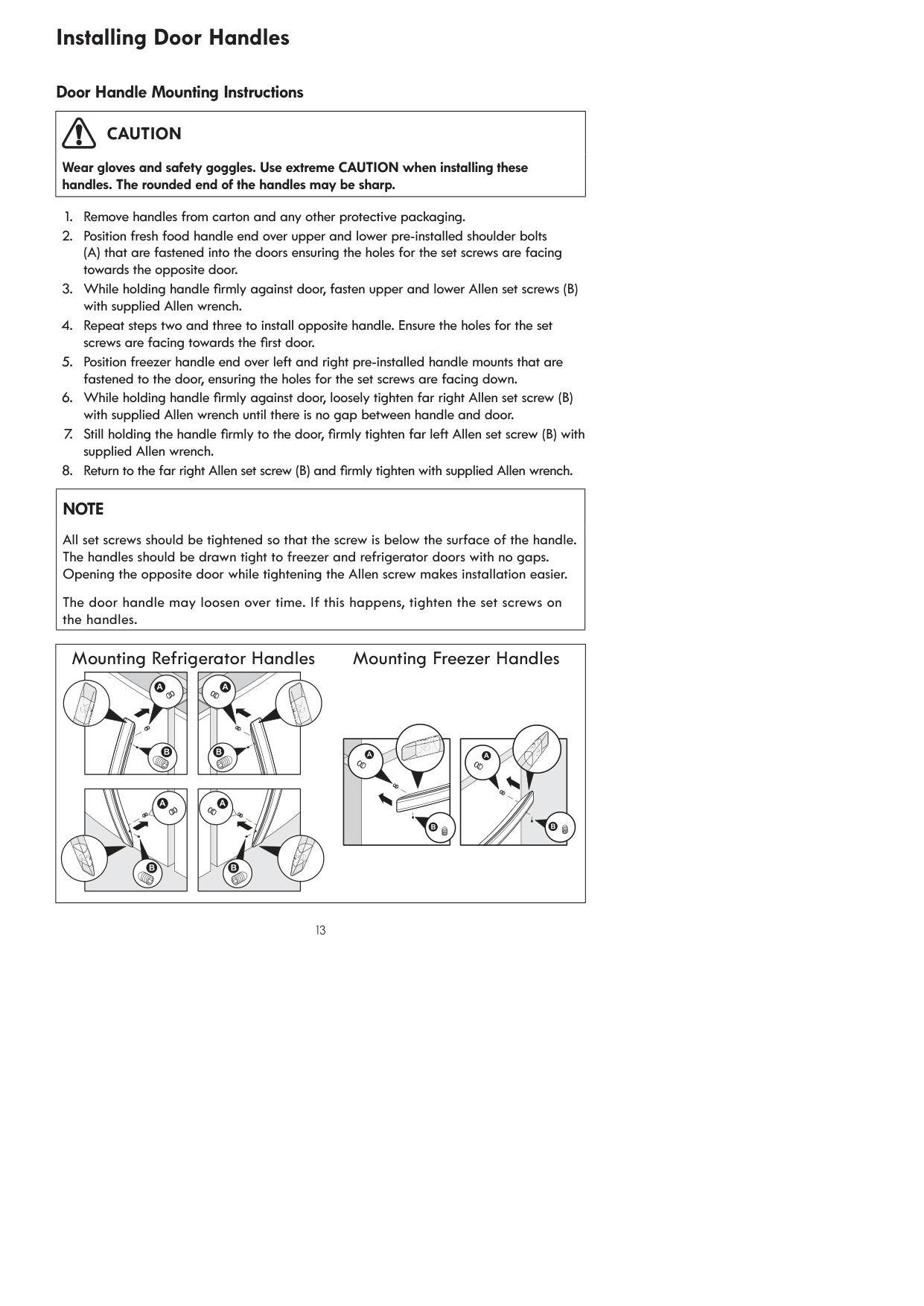
13 Installing Door Handles
Caution
Wear gloves and safety goggles. Use extreme CAUTION when installing these handles. The rounded end of the handles may be sharp.Note
All set screws should be tightened so that the screw is below the surface of the handle. The handles should be drawn tight to freezer and refrigerator doors with no gaps. Opening the opposite door while tightening the Allen screw makes installation easier. The door handle may loosen over time. If this happens, tighten the set screws on the handles. Mounting Freezer Handles Mounting Refrigerator Handles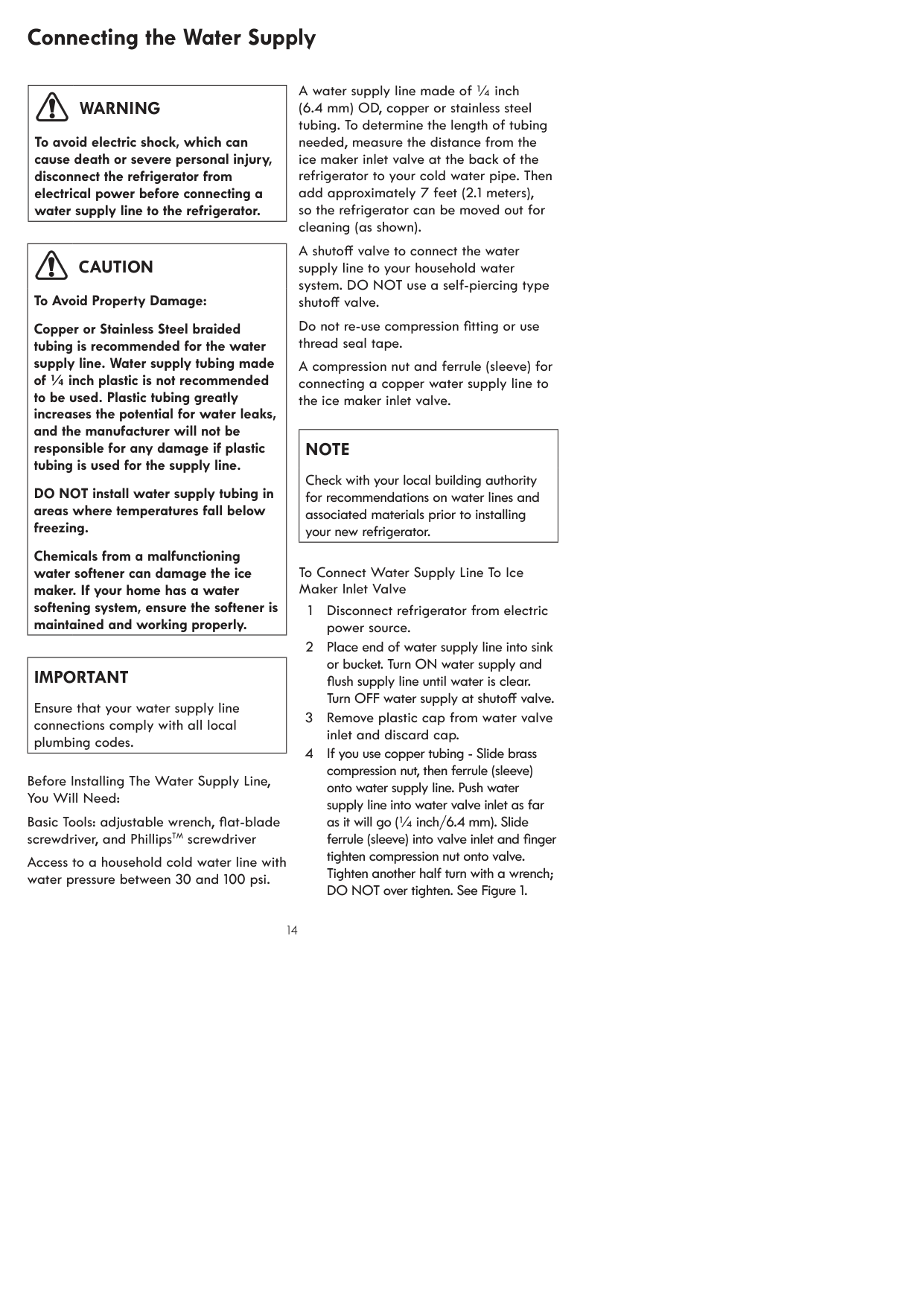
14 Connecting the Water Supply Before Installing The Water Supply Line, You Will Need: Basic Tools: adjustable wrench, flat-blade screwdriver, and PhillipsTM screwdriver Access to a household cold water line with water pressure between 30 and 100 psi. A water supply line made of ¼ inch (6.4 mm) OD, copper or stainless steel tubing. To determine the length of tubing needed, measure the distance from the ice maker inlet valve at the back of the refrigerator to your cold water pipe. Then add approximately 7 feet (2.1 meters), so the refrigerator can be moved out for cleaning (as shown). A shutoff valve to connect the water supply line to your household water system. DO NOT use a self-piercing type shutoff valve. Do not re-use compression fitting or use thread seal tape. A compression nut and ferrule (sleeve) for connecting a copper water supply line to the ice maker inlet valve.
Warning
To avoid electric shock, which can cause death or severe personal injury, disconnect the refrigerator from electrical power before connecting a water supply line to the refrigerator.Caution
To Avoid Property Damage: Copper or Stainless Steel braided tubing is recommended for the water supply line. Water supply tubing made of ¼ inch plastic is not recommended to be used. Plastic tubing greatly increases the potential for water leaks, and the manufacturer will not be responsible for any damage if plastic tubing is used for the supply line. DO NOT install water supply tubing in areas where temperatures fall below freezing. Chemicals from a malfunctioning water softener can damage the ice maker. If your home has a water softening system, ensure the softener is maintained and working properly.Important
Ensure that your water supply line connections comply with all local plumbing codes. To Connect Water Supply Line To Ice Maker Inlet Valve 1 Disconnect refrigerator from electric power source. 2 Place end of water supply line into sink or bucket. Turn ON water supply and flush supply line until water is clear. Turn OFF water supply at shutoff valve. 3 Remove plastic cap from water valve inlet and discard cap. 4 If you use copper tubing - Slide brass compression nut, then ferrule (sleeve) onto water supply line. Push water supply line into water valve inlet as far as it will go (¼ inch/6.4 mm). Slide ferrule (sleeve) into valve inlet and finger tighten compression nut onto valve. Tighten another half turn with a wrench; DO NOT over tighten. See Figure 1.Note
Check with your local building authority for recommendations on water lines and associated materials prior to installing your new refrigerator.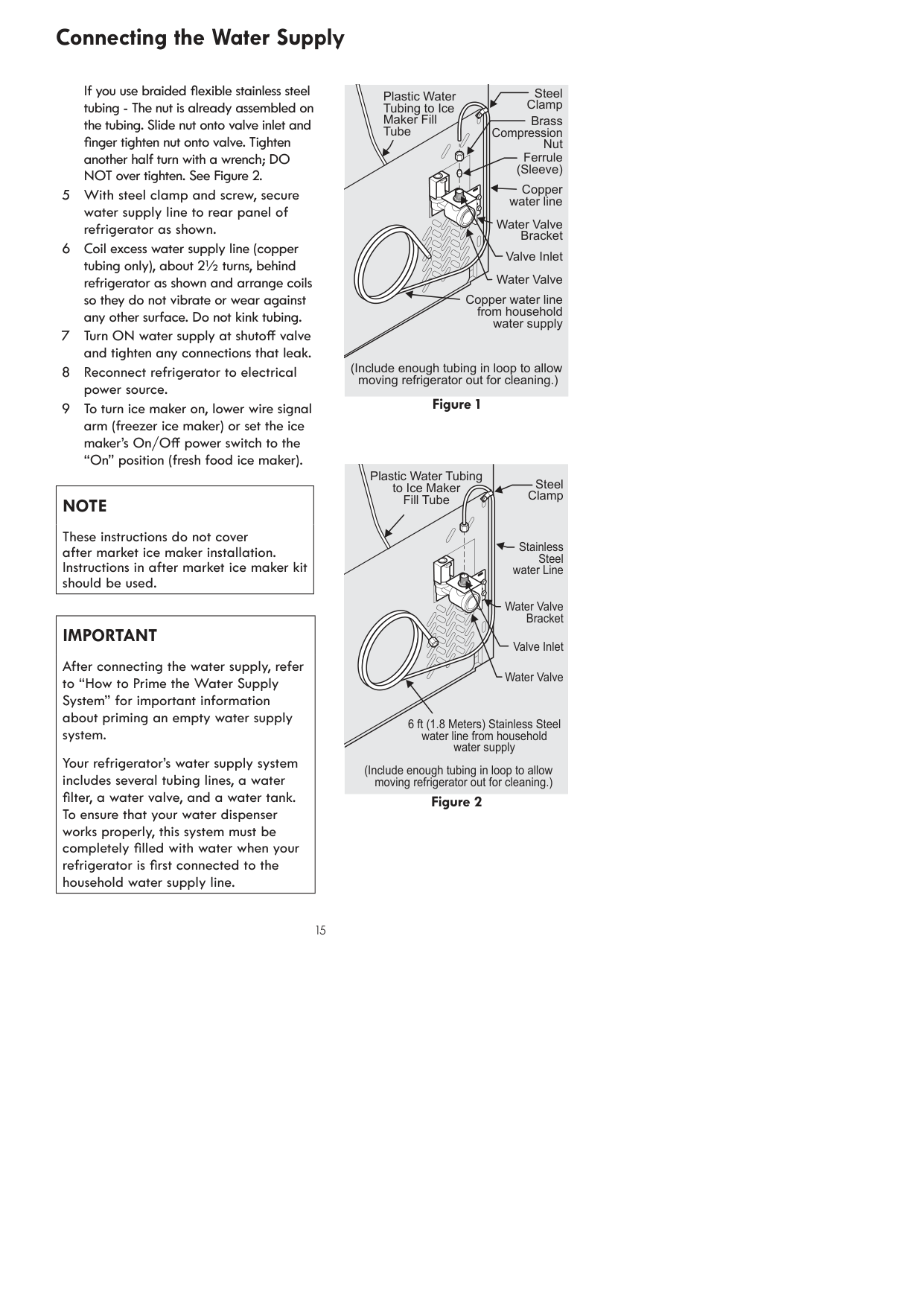
15 Connecting the Water Supply Figure 1 Plastic Water Tubing to Ice Maker Fill Tube Steel Clamp Brass Compression Nut Ferrule (Sleeve) Copper water line Water Valve Bracket Valve Inlet Water Valve Copper water line from household water supply (Include enough tubing in loop to allow moving refrigerator out for cleaning.) Steel Clamp Stainless Steel water Line Water Valve Bracket Valve Inlet Water Valve 6 ft (1.8 Meters) Stainless Steel water line from household water supply Plastic Water Tubing to Ice Maker Fill Tube (Include enough tubing in loop to allow moving refrigerator out for cleaning.) Figure 2
Note
These instructions do not cover after market ice maker installation. Instructions in after market ice maker kit should be used.Important
After connecting the water supply, refer to “How to Prime the Water Supply System” for important information about priming an empty water supply system. Your refrigerator’s water supply system includes several tubing lines, a water filter, a water valve, and a water tank. To ensure that your water dispenser works properly, this system must be completely filled with water when your refrigerator is first connected to the household water supply line. If you use braided flexible stainless steel tubing - The nut is already assembled on the tubing. Slide nut onto valve inlet and finger tighten nut onto valve. Tighten another half turn with a wrench; DO NOT over tighten. See Figure 2. 5 With steel clamp and screw, secure water supply line to rear panel of refrigerator as shown. 6 Coil excess water supply line (copper tubing only), about 2½ turns, behind refrigerator as shown and arrange coils so they do not vibrate or wear against any other surface. Do not kink tubing. 7 Turn ON water supply at shutoff valve and tighten any connections that leak. 8 Reconnect refrigerator to electrical power source. 9 To turn ice maker on, lower wire signal arm (freezer ice maker) or set the ice maker’s On/Off power switch to the “On” position (fresh food ice maker).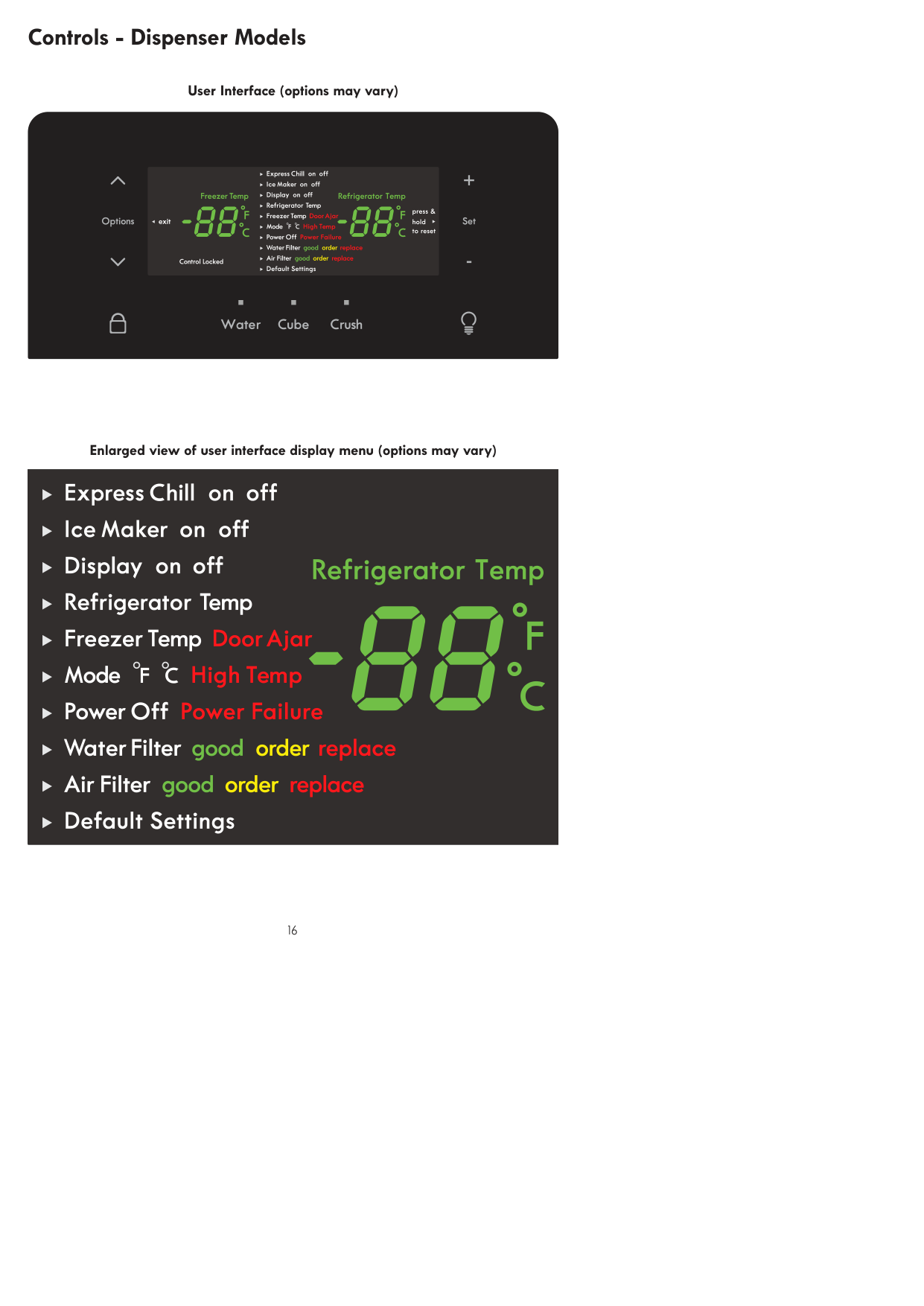
16 Controls - Dispenser Models Enlarged view of user interface display menu (options may vary) User Interface (options may vary)
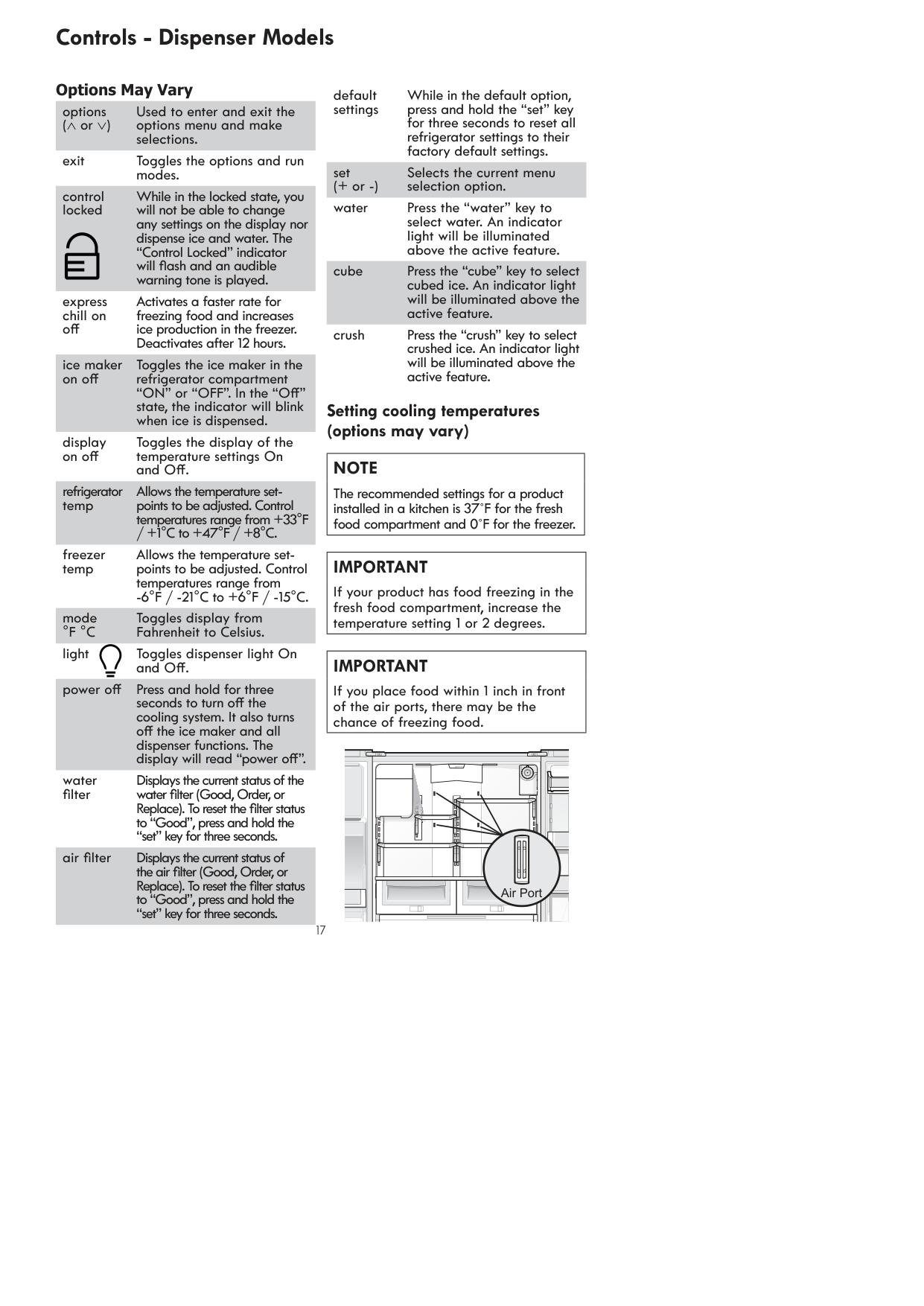
17 default settings While in the default option, press and hold the “set” key for three seconds to reset all refrigerator settings to their factory default settings. set (+ or -) Selects the current menu selection option. water Press the “water” key to select water. An indicator light will be illuminated above the active feature. cube Press the “cube” key to select cubed ice. An indicator light will be illuminated above the active feature. crush Press the “crush” key to select crushed ice. An indicator light will be illuminated above the active feature. options (∧ or ∨) Used to enter and exit the options menu and make selections. exit Toggles the options and run modes. control locked While in the locked state, you will not be able to change any settings on the display nor dispense ice and water. The “Control Locked” indicator will flash and an audible warning tone is played. express chill on off Activates a faster rate for freezing food and increases ice production in the freezer. Deactivates after 12 hours. ice maker on off Toggles the ice maker in the refrigerator compartment “ON” or “OFF”. In the “Off” state, the indicator will blink when ice is dispensed. display on off Toggles the display of the temperature settings On and Off. refrigerator temp Allows the temperature set- points to be adjusted. Control temperatures range from +33°F / +1°C to +47°F / +8°C. freezer temp Allows the temperature set- points to be adjusted. Control temperatures range from -6°F / -21°C to +6°F / -15°C. mode
°F °C
Toggles display from Fahrenheit to Celsius. light Toggles dispenser light On and Off. power off Press and hold for three seconds to turn off the cooling system. It also turns off the ice maker and all dispenser functions. The display will read “power off”. water filter Displays the current status of the water filter (Good, Order, or Replace). To reset the filter status to “Good”, press and hold the “set” key for three seconds. air filter Displays the current status of the air filter (Good, Order, or Replace). To reset the filter status to “Good”, press and hold the “set” key for three seconds. Setting cooling temperatures (options may vary) Options May Vary Air PortNote
The recommended settings for a product installed in a kitchen is 37˚F for the fresh food compartment and 0˚F for the freezer.Important
If your product has food freezing in the fresh food compartment, increase the temperature setting 1 or 2 degrees.Important
If you place food within 1 inch in front of the air ports, there may be the chance of freezing food. Controls - Dispenser Models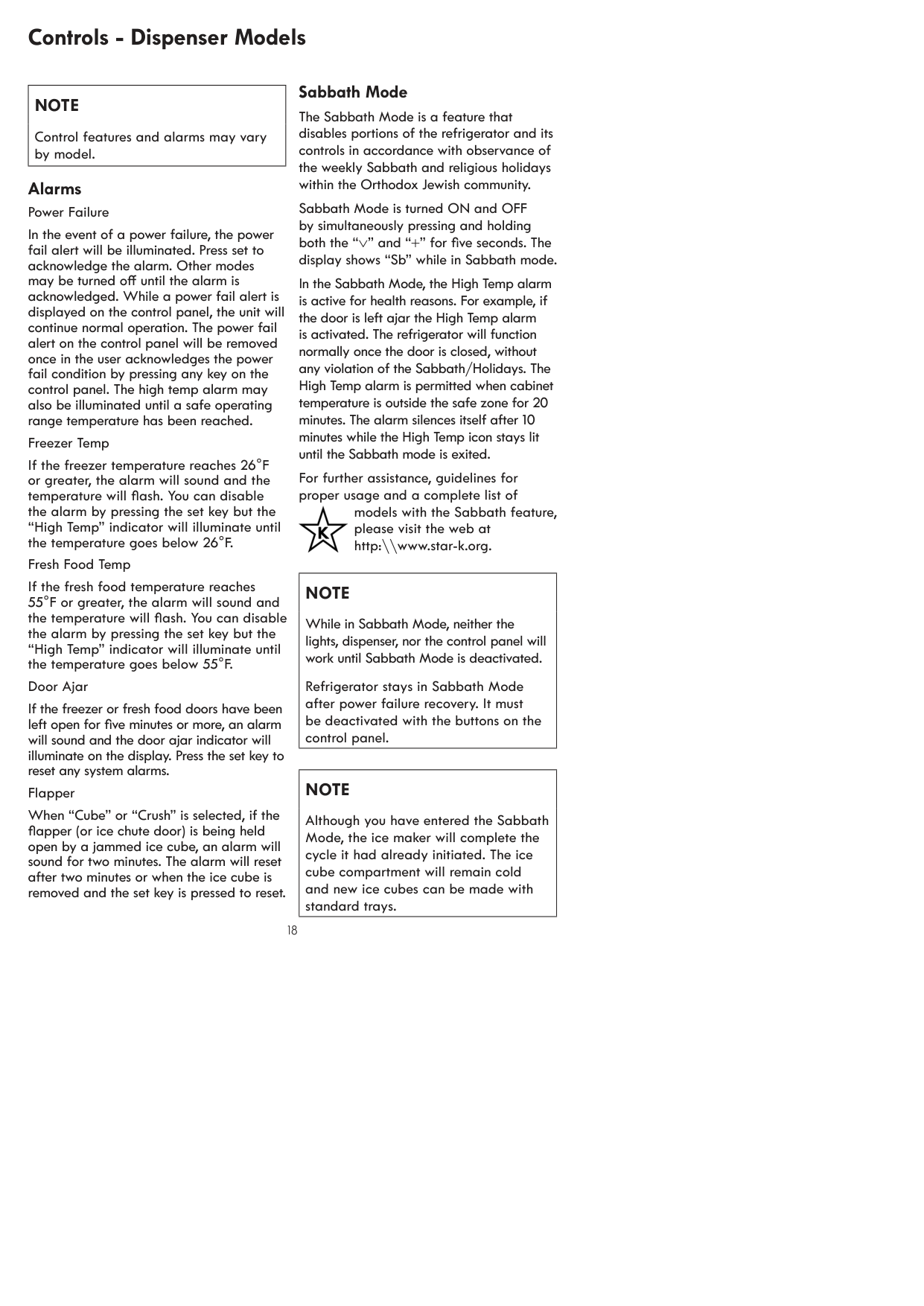
18 Alarms Power Failure In the event of a power failure, the power fail alert will be illuminated. Press set to acknowledge the alarm. Other modes may be turned off until the alarm is acknowledged. While a power fail alert is displayed on the control panel, the unit will continue normal operation. The power fail alert on the control panel will be removed once in the user acknowledges the power fail condition by pressing any key on the control panel. The high temp alarm may also be illuminated until a safe operating range temperature has been reached. Freezer Temp If the freezer temperature reaches 26°F or greater, the alarm will sound and the temperature will flash. You can disable the alarm by pressing the set key but the “High Temp” indicator will illuminate until the temperature goes below 26°F. Fresh Food Temp If the fresh food temperature reaches 55°F or greater, the alarm will sound and the temperature will flash. You can disable the alarm by pressing the set key but the “High Temp” indicator will illuminate until the temperature goes below 55°F. Door Ajar If the freezer or fresh food doors have been left open for five minutes or more, an alarm will sound and the door ajar indicator will illuminate on the display. Press the set key to reset any system alarms. Flapper When “Cube” or “Crush” is selected, if the flapper (or ice chute door) is being held open by a jammed ice cube, an alarm will sound for two minutes. The alarm will reset after two minutes or when the ice cube is removed and the set key is pressed to reset. Sabbath Mode The Sabbath Mode is a feature that disables portions of the refrigerator and its controls in accordance with observance of the weekly Sabbath and religious holidays within the Orthodox Jewish community. Sabbath Mode is turned ON and OFF by simultaneously pressing and holding both the “∨” and “+” for five seconds. The display shows “Sb” while in Sabbath mode. In the Sabbath Mode, the High Temp alarm is active for health reasons. For example, if the door is left ajar the High Temp alarm is activated. The refrigerator will function normally once the door is closed, without any violation of the Sabbath/Holidays. The High Temp alarm is permitted when cabinet temperature is outside the safe zone for 20 minutes. The alarm silences itself after 10 minutes while the High Temp icon stays lit until the Sabbath mode is exited. For further assistance, guidelines for proper usage and a complete list of models with the Sabbath feature, please visit the web at http:\\www.star-k.org.
Note
Control features and alarms may vary by model.Note
While in Sabbath Mode, neither the lights, dispenser, nor the control panel will work until Sabbath Mode is deactivated. Refrigerator stays in Sabbath Mode after power failure recovery. It must be deactivated with the buttons on the control panel.Note
Although you have entered the Sabbath Mode, the ice maker will complete the cycle it had already initiated. The ice cube compartment will remain cold and new ice cubes can be made with standard trays. Controls - Dispenser Models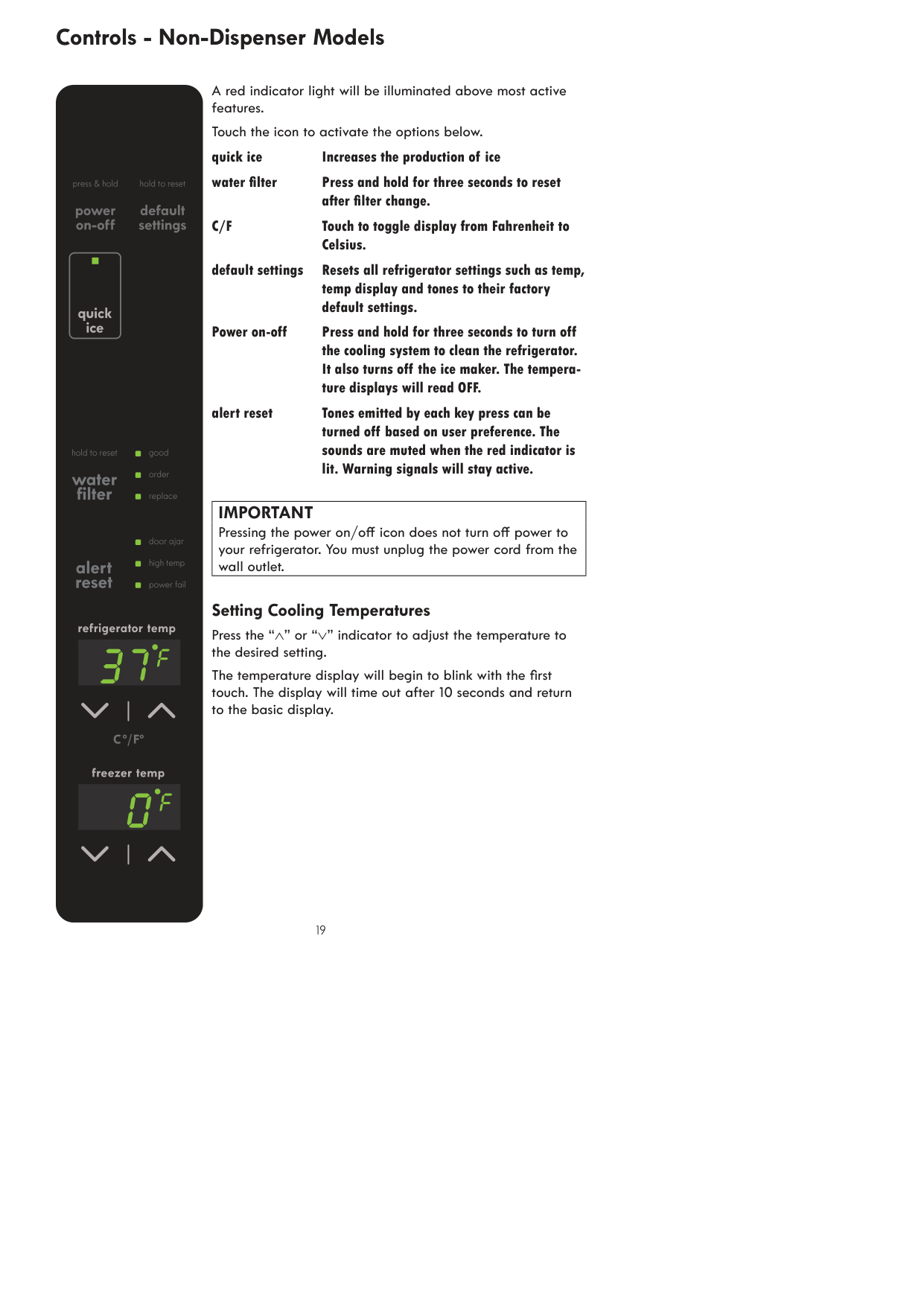
19 Controls - Non-Dispenser Models
Important
Pressing the power on/off icon does not turn off power to your refrigerator. You must unplug the power cord from the wall outlet. A red indicator light will be illuminated above most active features. Touch the icon to activate the options below. quick ice Increases the production of ice water filter Press and hold for three seconds to reset after filter change.C/F
Touch to toggle display from Fahrenheit to Celsius. default settings Resets all refrigerator settings such as temp, temp display and tones to their factory default settings. Power on-off Press and hold for three seconds to turn off the cooling system to clean the refrigerator. It also turns off the ice maker. The tempera- ture displays will read OFF. alert reset Tones emitted by each key press can be turned off based on user preference. The sounds are muted when the red indicator is lit. Warning signals will stay active. Setting Cooling Temperatures Press the “∧” or “∨” indicator to adjust the temperature to the desired setting. The temperature display will begin to blink with the first touch. The display will time out after 10 seconds and return to the basic display.
20 Controls - Non-Dispenser Models
Note
During the Sabbath Mode, the automatic ice maker will continue to work and must be manually turned off to be compliant with the Sabbath observances. Sabbath Mode The Sabbath Mode is a feature that disables portions of the refrigerator and its controls in accordance with observance of the weekly Sabbath and religious holidays within the Orthodox Jewish community. Sabbath Mode is turned ON and OFF by simultaneously pressing and holding both the freezer “ ∨ ” and refrigerator “ ∧ ” indicators for five seconds. The display shows “Sb” while in Sabbath mode. In the Sabbath Mode, the High Temp alarm is active for health reasons. For example, if the door is left ajar the High Temp alarm is activated. The refrigerator will function normally once the door is closed, without any violation of the Sabbath/Holidays. The High Temp alarm is permitted when cabinet temperature is outside the safe zone for 20 minutes. The alarm silences itself after 10 minutes while the High Temp icon stays lit until the Sabbath mode is exited. For further assistance, guidelines for proper usage and a complete list of models with the Sabbath feature, please visit the web at http:\\www.star-k.org.Note
While in Sabbath Mode, neither the lights, nor the control panel will work until Sabbath Mode is deactivated. Refrigerator stays in Sabbath Mode after power failure recovery. It must be deactivated with the buttons on the control panel. Alarms Door Ajar If the door has been left open for an extended period of time, an alarm will sound and the door ajar indicator will display on the bottom display of the control panel. The alarm is turned off by closing the door. The mute sounds key will blink to prompt the reset of any active alarms. Press this key to reset any system alarms. High Temp In the event of a high tempera- ture condition, the temperature display will blink and display “HI”. After 20 minutes, the alarm will sound and the high temp indicator will be red on the bottom of the control panel. The mute sounds icon will illuminate until pressed, acknowledging the alarm, at which time the highest temperature reached will be displayed and the refrigerator will resume normal operation. In case the high temp alarm is not acknowledged at the first alarm sound time out, when the door is first opened, the alarm sound will be repeated. Power Fail In the event of a power failure, the power fail alert will be displayed and the temperature display will blink until the mute sounds icon is pressed, ac- knowledging the alarm. Other modes may be turned off until the alarm is acknowledged. The power fail alert is turned off and the refrigerator will resume normal operation. The high temp alarm may also be illuminated until a safe operat- ing range temperature has been reached.
21 Automatic Ice & Water Dispenser (select models) Ice maker operation & care After the refrigerator is installed properly and has cooled for several hours, the ice maker can produce ice within 24 hours. The ice maker will fill the ice bin from the rear. You must dispense some ice to force the ice forward in the bin. This will allow the bin to fill completely. Ice Maker and Storage Bin Capacity This ice maker should produce 2.5 to 3 pounds of ice per 24 hours. In a Standard Depth model, the ice bin will hold about 6.5 pounds of ice. In a Counter Depth model, the ice bin will hold about 4 pounds of ice. Turning the fresh food ice maker on and off Ice production is controlled by the ice maker’s On/Off feature on the control panel. Pressing the On/Off feature turns the ice maker on & off. Using the ice maker after installation Before making ice for the first time, be sure to prime the water supply system. Air in new plumbing lines can result in two or three empty ice maker cycles. Furthermore, if the system is not flushed, the first ice cubes may be discolored or have an odd flavor. Priming the water supply system 1 Begin filling the system by pressing and holding a drinking glass against the water dispenser paddle. 2 Keep the glass in this position until water comes out of the dispenser. It may take about 1½ minutes. 3 Continue dispensing water for about four minutes to flush the system and plumbing connections of any impurities (stopping to empty the glass as necessary). Dispenser (varies by model)
Caution
For proper dispenser operation, recommended water supply pressure should fall between 30 psi and 100 psi. Excessive pressure may cause the system to malfunction.Note
The water dispenser has a built-in device that shuts off the water flow after three minutes of continuous use. To reset this shutoff device, simply release the dispenser paddle.Note
Dispensed water is not chilled. For colder water, add ice to cup or container before dispensing water.Important
Turning off the ice maker simply disables ice making. You will still be able to dispense existing ice, and you will still be able to dispense water.Note
The ice maker also has a built-in plastic signal arm that automatically stops ice production when the ice bin is full. This signal arm should not be used to manually stop the ice maker.Important
Your ice maker is turned on at the factory so it can work as soon as you install your refrigerator. If you cannot connect a water supply, set the ice maker’s On/Off feature to Off; otherwise, the ice maker’s fill valve may make a loud chattering noise when it attempts to operate without water.Important
On occasion, unusually small ice cubes may be noticed in the bucket or in dispensed ice. This could occur in normal operation of the ice maker. If you start seeing these more frequently, it may be an indication of low water pressure or the water filter needs to be replaced. As the water filter nears the end of its useful life and becomes clogged with particles, less water is delivered to the ice maker during each cycle. Remember, if it’s been six months or longer since you last changed your water filter, replace the water filter with a new one. Poor quality household water may require the filter to be changed more frequently.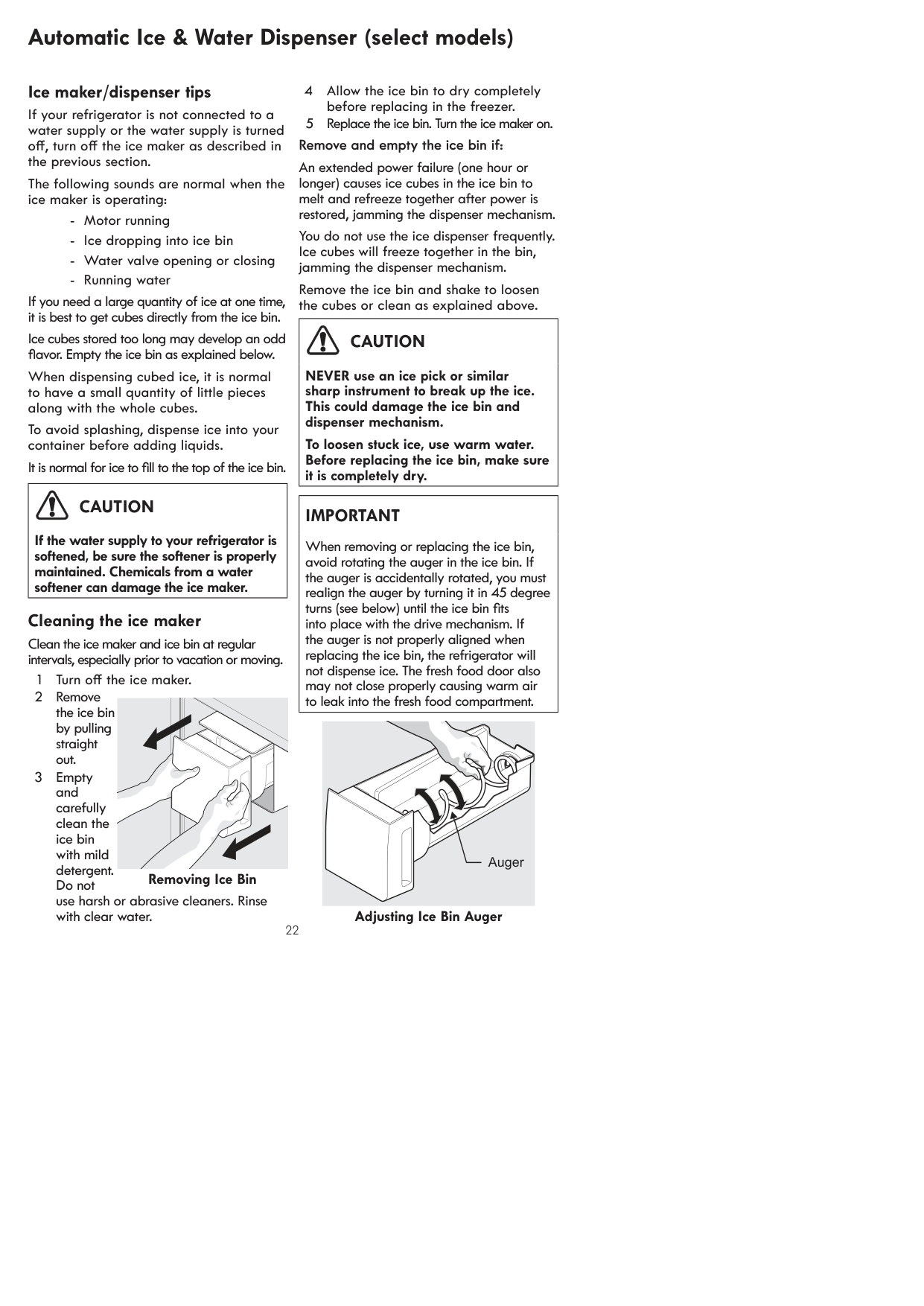
22 Automatic Ice & Water Dispenser (select models) Ice maker/dispenser tips If your refrigerator is not connected to a water supply or the water supply is turned off, turn off the ice maker as described in the previous section. The following sounds are normal when the ice maker is operating:
Caution
If the water supply to your refrigerator is softened, be sure the softener is properly maintained. Chemicals from a water softener can damage the ice maker.Caution
NEVER use an ice pick or similar sharp instrument to break up the ice. This could damage the ice bin and dispenser mechanism. To loosen stuck ice, use warm water. Before replacing the ice bin, make sure it is completely dry.Important
When removing or replacing the ice bin, avoid rotating the auger in the ice bin. If the auger is accidentally rotated, you must realign the auger by turning it in 45 degree turns (see below) until the ice bin fits into place with the drive mechanism. If the auger is not properly aligned when replacing the ice bin, the refrigerator will not dispense ice. The fresh food door also may not close properly causing warm air to leak into the fresh food compartment.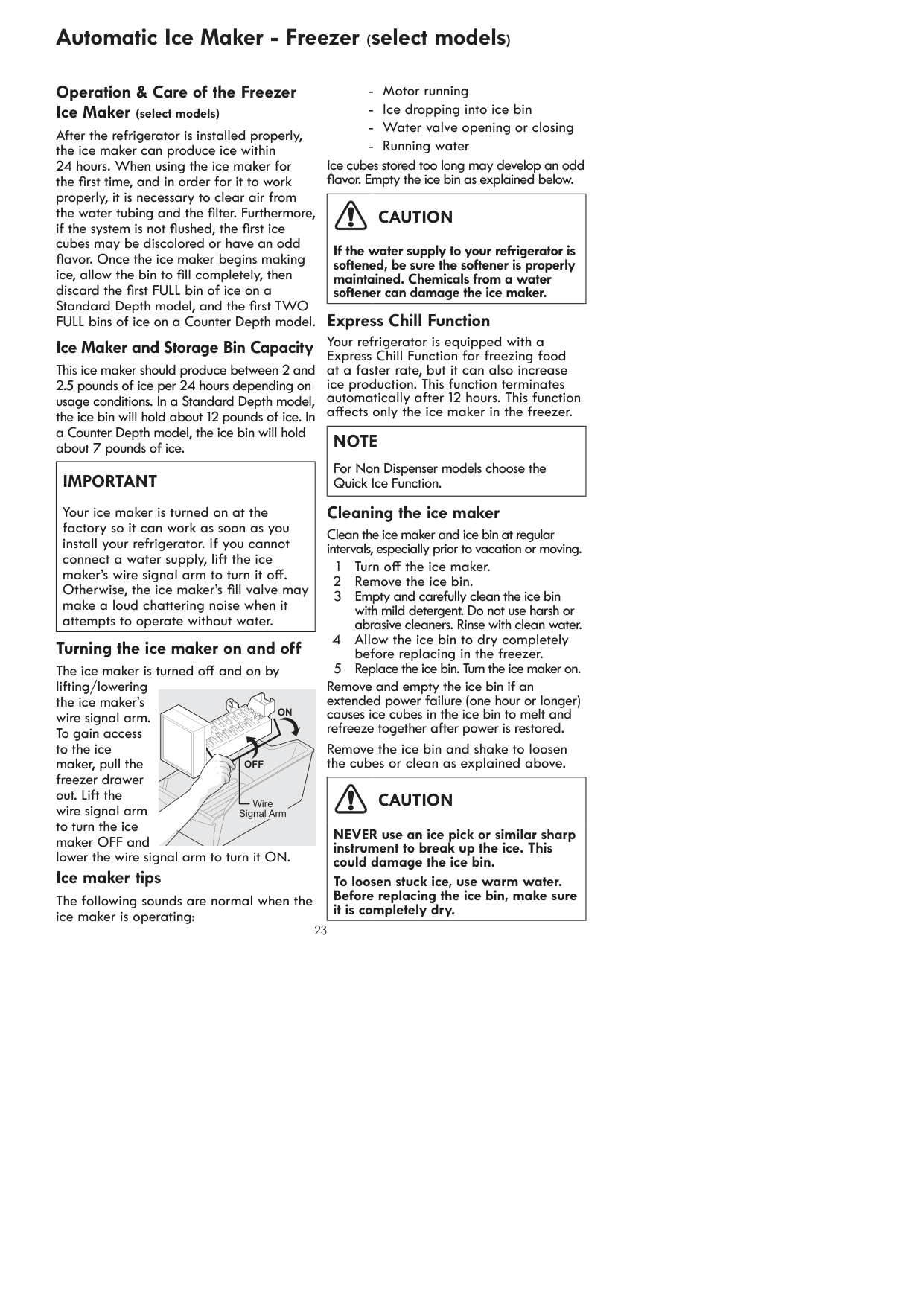
23 Automatic Ice Maker - Freezer (select models) Express Chill Function Your refrigerator is equipped with a Express Chill Function for freezing food at a faster rate, but it can also increase ice production. This function terminates automatically after 12 hours. This function affects only the ice maker in the freezer. Ice maker tips The following sounds are normal when the ice maker is operating: Turning the ice maker on and off The ice maker is turned off and on by lifting/lowering the ice maker’s wire signal arm. To gain access to the ice maker, pull the freezer drawer out. Lift the wire signal arm to turn the ice maker OFF and lower the wire signal arm to turn it ON. Wire Signal Arm
On
Off
Operation & Care of the Freezer Ice Maker (select models) After the refrigerator is installed properly, the ice maker can produce ice within 24 hours. When using the ice maker for the first time, and in order for it to work properly, it is necessary to clear air from the water tubing and the filter. Furthermore, if the system is not flushed, the first ice cubes may be discolored or have an odd flavor. Once the ice maker begins making ice, allow the bin to fill completely, then discard the first FULL bin of ice on a Standard Depth model, and the first TWO FULL bins of ice on a Counter Depth model. Ice Maker and Storage Bin Capacity This ice maker should produce between 2 and 2.5 pounds of ice per 24 hours depending on usage conditions. In a Standard Depth model, the ice bin will hold about 12 pounds of ice. In a Counter Depth model, the ice bin will hold about 7 pounds of ice.Important
Your ice maker is turned on at the factory so it can work as soon as you install your refrigerator. If you cannot connect a water supply, lift the ice maker’s wire signal arm to turn it off. Otherwise, the ice maker’s fill valve may make a loud chattering noise when it attempts to operate without water.Caution
If the water supply to your refrigerator is softened, be sure the softener is properly maintained. Chemicals from a water softener can damage the ice maker.Caution
NEVER use an ice pick or similar sharp instrument to break up the ice. This could damage the ice bin. To loosen stuck ice, use warm water. Before replacing the ice bin, make sure it is completely dry.Note
For Non Dispenser models choose the Quick Ice Function. Cleaning the ice maker Clean the ice maker and ice bin at regular intervals, especially prior to vacation or moving. 1 Turn off the ice maker. 2 Remove the ice bin. 3 Empty and carefully clean the ice bin with mild detergent. Do not use harsh or abrasive cleaners. Rinse with clean water. 4 Allow the ice bin to dry completely before replacing in the freezer. 5 Replace the ice bin. Turn the ice maker on. Remove and empty the ice bin if an extended power failure (one hour or longer) causes ice cubes in the ice bin to melt and refreeze together after power is restored. Remove the ice bin and shake to loosen the cubes or clean as explained above.
24 Storage Features Your refrigerator includes Spill-ProofTM glass shelves that are designed to catch and hold accidental spills. You can easily adjust shelf positions in the fresh food compartments to suit your needs. The shelves have mounting brackets that attach to slotted supports at the rear of each compartment. Change the Position of a Shelf 1 Remove all food from shelf. 2 Lift the front edge up and pull the shelf out. 3 Replace by inserting the mounting bracket hooks into the desired support slots. 4 Lower the shelf and lock into position. Reposition the Air Seal For slide-out shelves & crisper shelves: 1 Remove air seal by pushing down on the flap with a downward rotation. 2 Position the air seal towards the outside end of the shelf to avoid the air tower when shelf is pushed back into place. 3 Install seal by sliding lower tab of seal up into bottom rear slot of shelf with seal at a downward angle then pulling up on seal flap until seal sits snug on back of shelf and flap sits at about a 10 degree angle from shelf surface.
Caution
To avoid personal injury or property damage, handle tempered glass shelves carefully. Shelves may break suddenly if nicked, scratched, or exposed to sudden temperature change. Allow the glass shelves to stabilize to room temperature before cleaning. Do not wash in dishwasher.Note
Features may vary according to model.Important
Be aware of the air seal located at the rear of the shelf. Shelves located on the left side should have the air seal mounted on the far left side. Shelves located on the right side should have the air seal mounted on the far right side. This is to ensure there is no interference with the large air tower on the back wall of the cabinet. This also applies to the crisper shelves. Half Spill-ProofTM Shelf Full Spill-ProofTM Shelf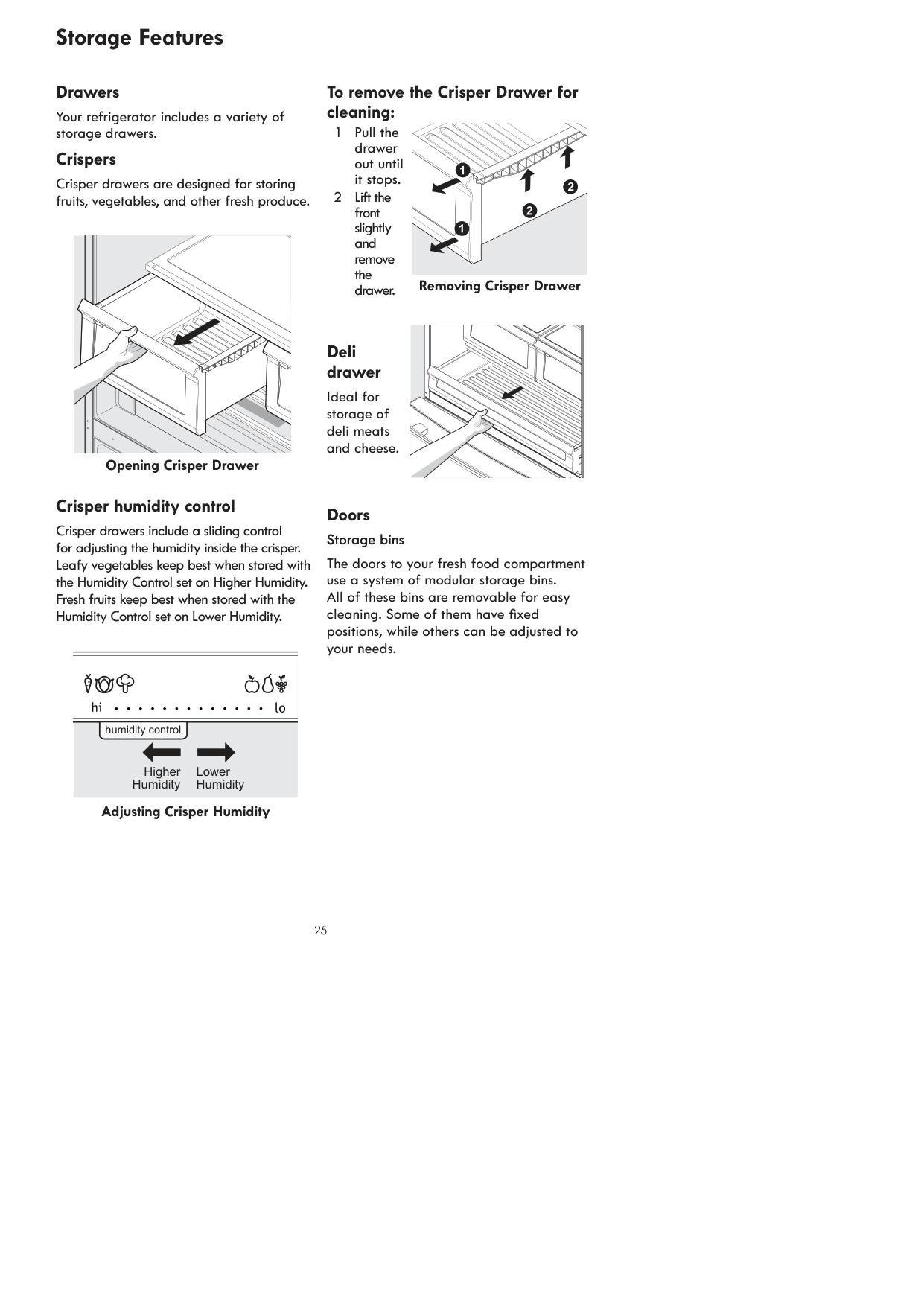
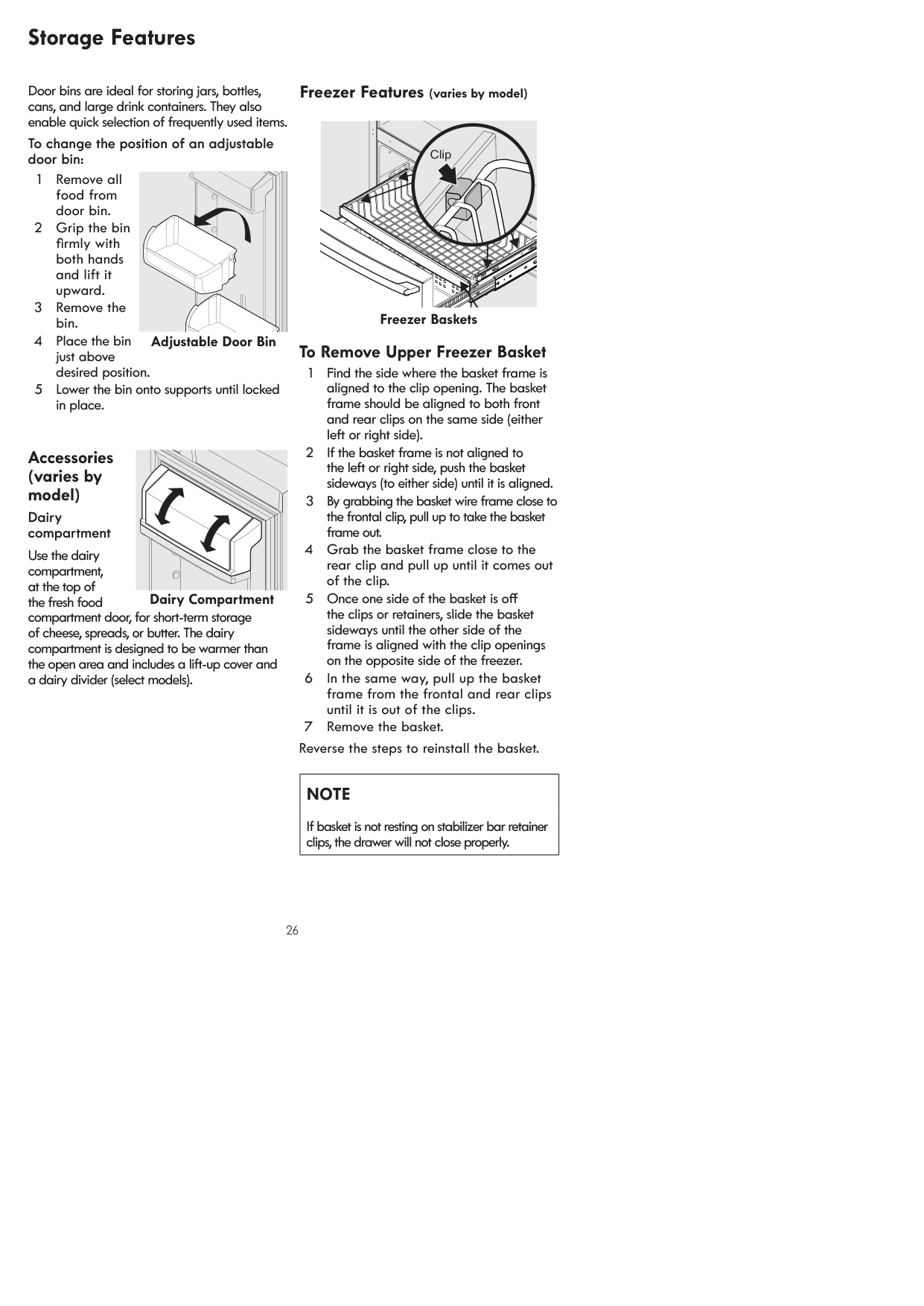
25 Storage Features Doors Storage bins The doors to your fresh food compartment use a system of modular storage bins. All of these bins are removable for easy cleaning. Some of them have fixed positions, while others can be adjusted to your needs. Deli drawer Ideal for storage of deli meats and cheese. Drawers Your refrigerator includes a variety of storage drawers. Crispers Crisper drawers are designed for storing fruits, vegetables, and other fresh produce. Crisper humidity control Crisper drawers include a sliding control for adjusting the humidity inside the crisper. Leafy vegetables keep best when stored with the Humidity Control set on Higher Humidity. Fresh fruits keep best when stored with the Humidity Control set on Lower Humidity. Removing Crisper Drawer To remove the Crisper Drawer for cleaning: 1 Pull the drawer out until it stops. 2 Lift the front slightly and remove the drawer. Opening Crisper Drawer Adjusting Crisper Humidity Higher Humidity Lower Humidity humidity control
26 Door bins are ideal for storing jars, bottles, cans, and large drink containers. They also enable quick selection of frequently used items. To change the position of an adjustable door bin: 1 Remove all food from door bin. 2 Grip the bin firmly with both hands and lift it upward. 3 Remove the bin. 4 Place the bin just above desired position. 5 Lower the bin onto supports until locked in place. Adjustable Door Bin Accessories (varies by model) Dairy compartment Use the dairy compartment, at the top of the fresh food compartment door, for short-term storage of cheese, spreads, or butter. The dairy compartment is designed to be warmer than the open area and includes a lift-up cover and a dairy divider (select models). Dairy Compartment Storage Features To Remove Upper Freezer Basket 1 Find the side where the basket frame is aligned to the clip opening. The basket frame should be aligned to both front and rear clips on the same side (either left or right side). 2 If the basket frame is not aligned to the left or right side, push the basket sideways (to either side) until it is aligned. 3 By grabbing the basket wire frame close to the frontal clip, pull up to take the basket frame out. 4 Grab the basket frame close to the rear clip and pull up until it comes out of the clip. 5 Once one side of the basket is off the clips or retainers, slide the basket sideways until the other side of the frame is aligned with the clip openings on the opposite side of the freezer. 6 In the same way, pull up the basket frame from the frontal and rear clips until it is out of the clips. 7 Remove the basket. Reverse the steps to reinstall the basket. Freezer Baskets Clip Freezer Features (varies by model)
Note
If basket is not resting on stabilizer bar retainer clips, the drawer will not close properly.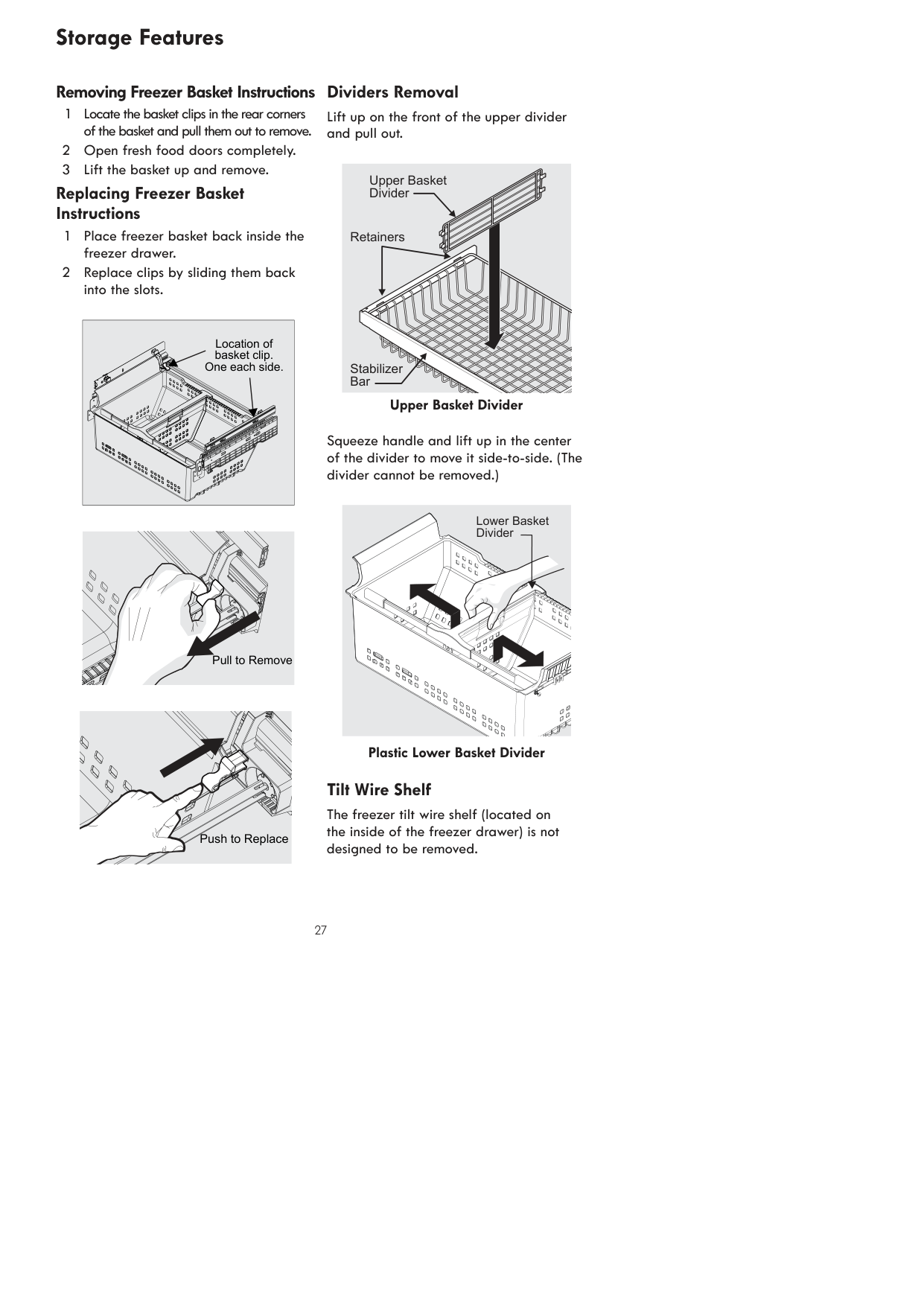
27 Storage Features Dividers Removal Lift up on the front of the upper divider and pull out. Squeeze handle and lift up in the center of the divider to move it side-to-side. (The divider cannot be removed.) Upper Basket Divider Upper Basket Divider Retainers Stabilizer Bar Plastic Lower Basket Divider Lower Basket Divider Pull to Remove Push to Replace Removing Freezer Basket Instructions 1 Locate the basket clips in the rear corners of the basket and pull them out to remove. 2 Open fresh food doors completely. 3 Lift the basket up and remove. Replacing Freezer Basket Instructions 1 Place freezer basket back inside the freezer drawer. 2 Replace clips by sliding them back into the slots. Location of basket clip. One each side. Tilt Wire Shelf The freezer tilt wire shelf (located on the inside of the freezer drawer) is not designed to be removed.
28 Storing Food and Saving Energy Ideas for storing foods Fresh food storage
29 Normal Operating Sounds and Sights Understanding the sounds you may hear Your new, high-efficiency refrigerator may introduce unfamiliar sounds. These sounds normally indicate your refrigerator is operating correctly. Some surfaces on floors, walls, and kitchen cabinets may make these sounds more noticeable. The following is a list of major components in your refrigerator and the sounds they can cause: A Evaporator - Refrigerant through the evaporator may create a boiling or gurgling sound. B Evaporator fan - You may hear air being forced through the refrigerator by the evaporator fan. C Defrost heater - During defrost cycles, water dripping onto the defrost heater may cause a hissing or sizzling sound. After defrosting, a popping sound may occur. D Automatic ice maker - When ice has been produced, you will hear ice cubes falling into the ice bin. Ice maker fan, water valve activation, and refrigerant gas fluid may create sounds from its operation. E Electronic control & automatic defrost control - These parts can produce a snapping or clicking sound when turning the cooling system on and off. F Condenser fan - You may hear air being forced through the condenser. G Compressor - Modern, high-efficiency compressors run much faster than older models. The compressor may have a high-pitched hum or pulsating sound. H Water valve - Makes a buzzing sound each time it opens to fill the ice maker. I Drain pan (not removable) - You may hear water dripping into the drain pan during the defrost cycle. J Condenser - May create minimal sounds from forced air. L Ice dispensing paddle - When dispensing ice, you will hear a snapping, clicking, or popping sound. M Motorized damper - May produce a light humming during operation.
Note
Energy efficient foam in your refrigerator is not a sound insulator.Note
During automatic defrost cycle, a red glow in the back wall vents of your freezer compartment is normal. Features vary by model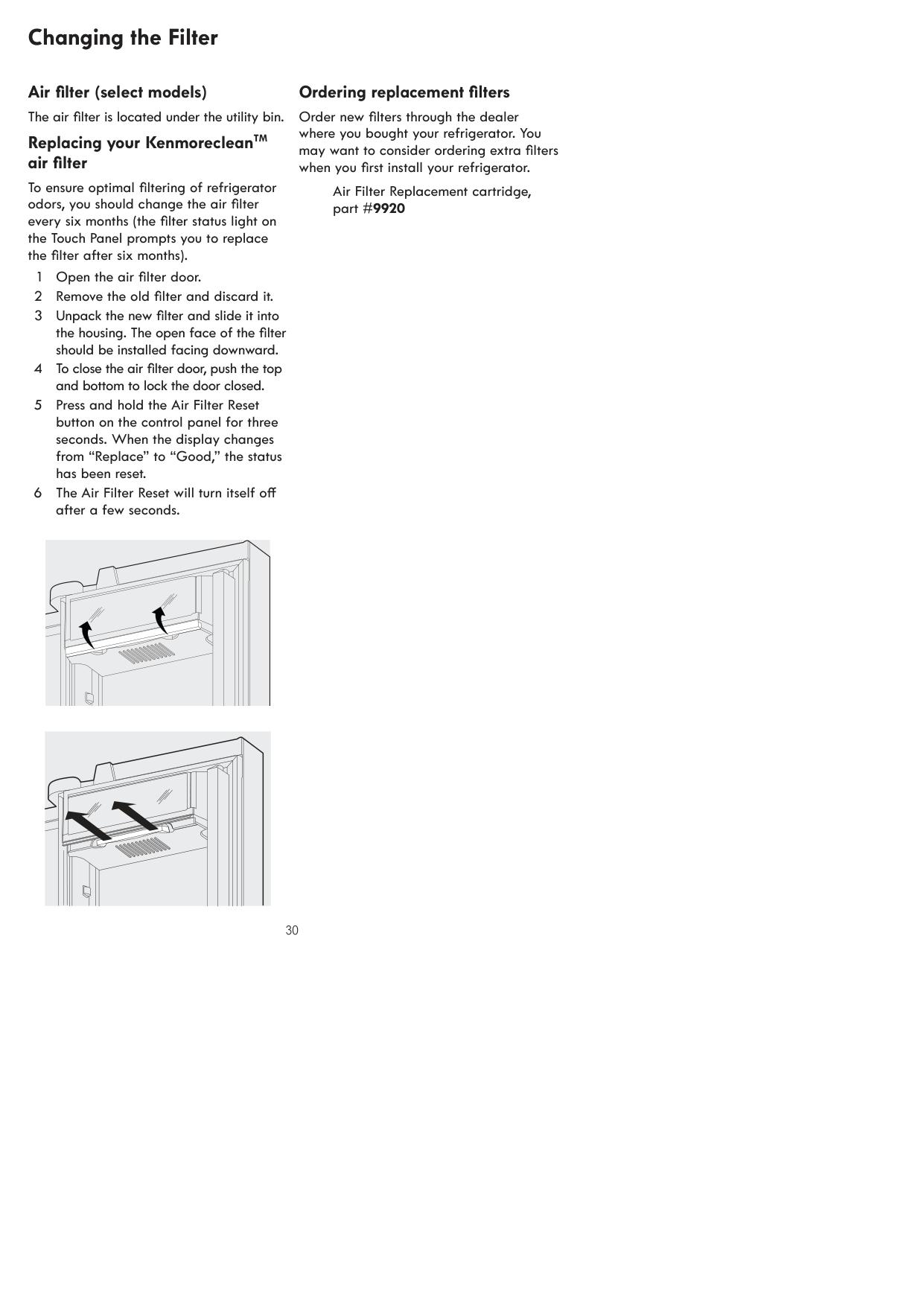
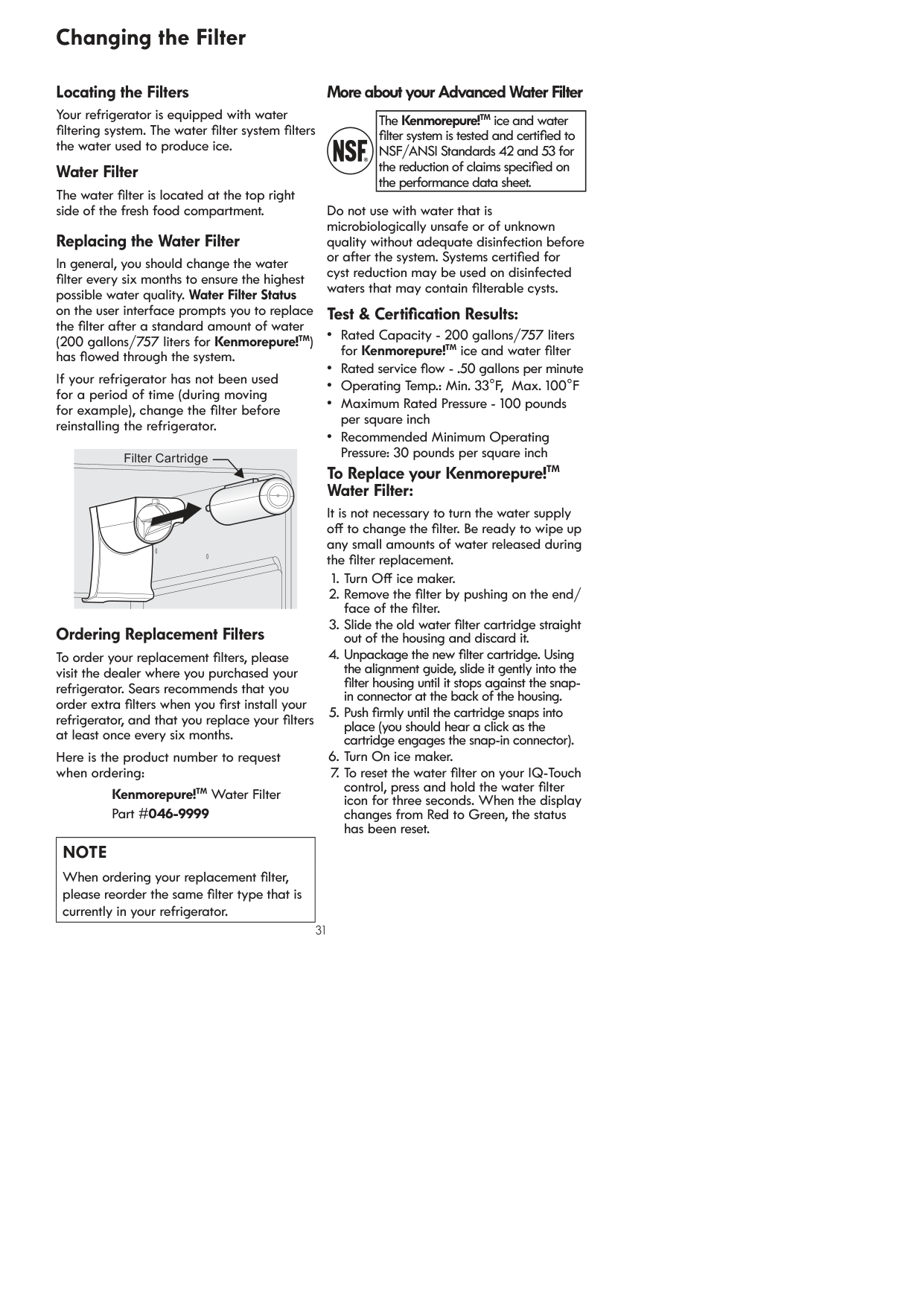
30 Changing the Filter Ordering replacement filters Order new filters through the dealer where you bought your refrigerator. You may want to consider ordering extra filters when you first install your refrigerator. Air Filter Replacement cartridge, part #9920 Air filter (select models) The air filter is located under the utility bin. Replacing your KenmorecleanTM air filter To ensure optimal filtering of refrigerator odors, you should change the air filter every six months (the filter status light on the Touch Panel prompts you to replace the filter after six months). 1 Open the air filter door. 2 Remove the old filter and discard it. 3 Unpack the new filter and slide it into the housing. The open face of the filter should be installed facing downward. 4 To close the air filter door, push the top and bottom to lock the door closed. 5 Press and hold the Air Filter Reset button on the control panel for three seconds. When the display changes from “Replace” to “Good,” the status has been reset. 6 The Air Filter Reset will turn itself off after a few seconds.
31 Changing the Filter Locating the Filters Your refrigerator is equipped with water filtering system. The water filter system filters the water used to produce ice. Water Filter The water filter is located at the top right side of the fresh food compartment. Ordering Replacement Filters To order your replacement filters, please visit the dealer where you purchased your refrigerator. Sears recommends that you order extra filters when you first install your refrigerator, and that you replace your filters at least once every six months. Here is the product number to request when ordering:
Kenmorepure!TM Water Filter
Part #046-9999 Replacing the Water Filter In general, you should change the water filter every six months to ensure the highest possible water quality. Water Filter Status on the user interface prompts you to replace the filter after a standard amount of water (200 gallons/757 liters for Kenmorepure!TM) has flowed through the system. If your refrigerator has not been used for a period of time (during moving for example), change the filter before reinstalling the refrigerator. Filter Cartridge Do not use with water that is microbiologically unsafe or of unknown quality without adequate disinfection before or after the system. Systems certified for cyst reduction may be used on disinfected waters that may contain filterable cysts. Test & Certification Results:
Note
When ordering your replacement filter, please reorder the same filter type that is currently in your refrigerator.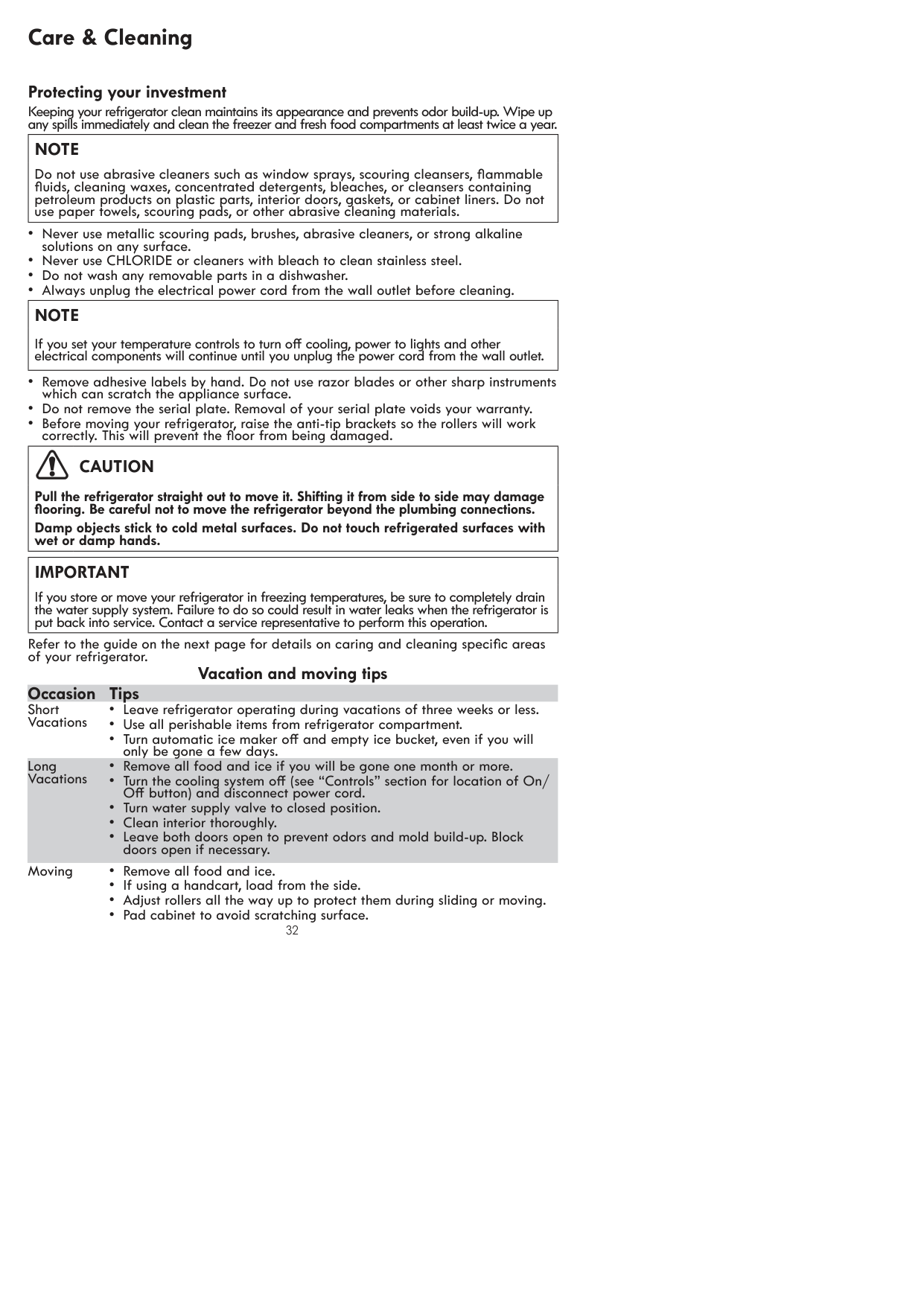
32 Care & Cleaning Protecting your investment Keeping your refrigerator clean maintains its appearance and prevents odor build-up. Wipe up any spills immediately and clean the freezer and fresh food compartments at least twice a year.
Note
Do not use abrasive cleaners such as window sprays, scouring cleansers, flammable fluids, cleaning waxes, concentrated detergents, bleaches, or cleansers containing petroleum products on plastic parts, interior doors, gaskets, or cabinet liners. Do not use paper towels, scouring pads, or other abrasive cleaning materials.Note
If you set your temperature controls to turn off cooling, power to lights and other electrical components will continue until you unplug the power cord from the wall outlet.Caution
Pull the refrigerator straight out to move it. Shifting it from side to side may damage flooring. Be careful not to move the refrigerator beyond the plumbing connections. Damp objects stick to cold metal surfaces. Do not touch refrigerated surfaces with wet or damp hands.Important
If you store or move your refrigerator in freezing temperatures, be sure to completely drain the water supply system. Failure to do so could result in water leaks when the refrigerator is put back into service. Contact a service representative to perform this operation. Refer to the guide on the next page for details on caring and cleaning specific areas of your refrigerator. Vacation and moving tips Occasion Tips Short Vacations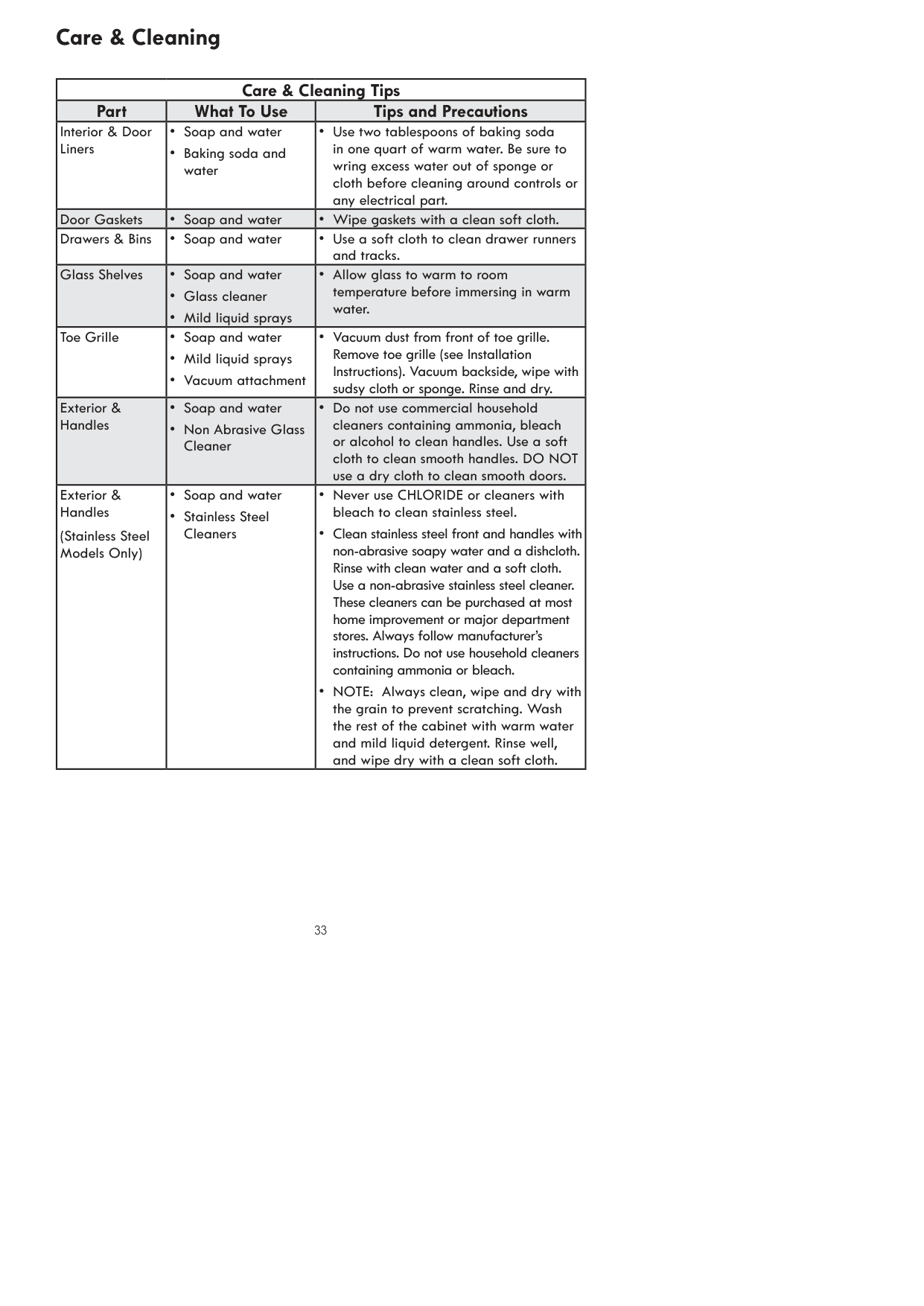
33 Care & Cleaning Care & Cleaning Tips Part What To Use Tips and Precautions Interior & Door Liners
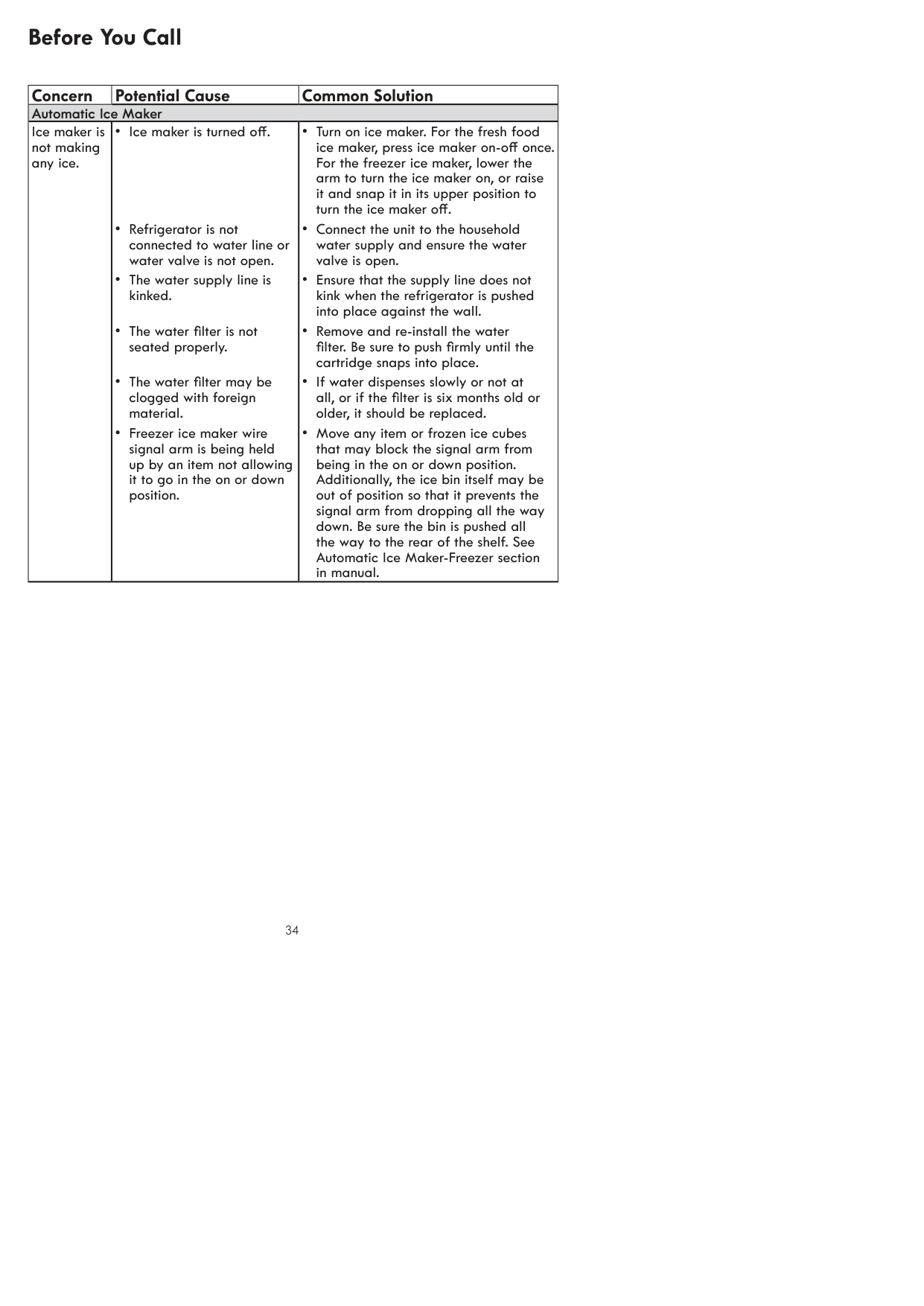
34 Before You Call Concern Potential Cause Common Solution Automatic Ice Maker Ice maker is not making any ice.
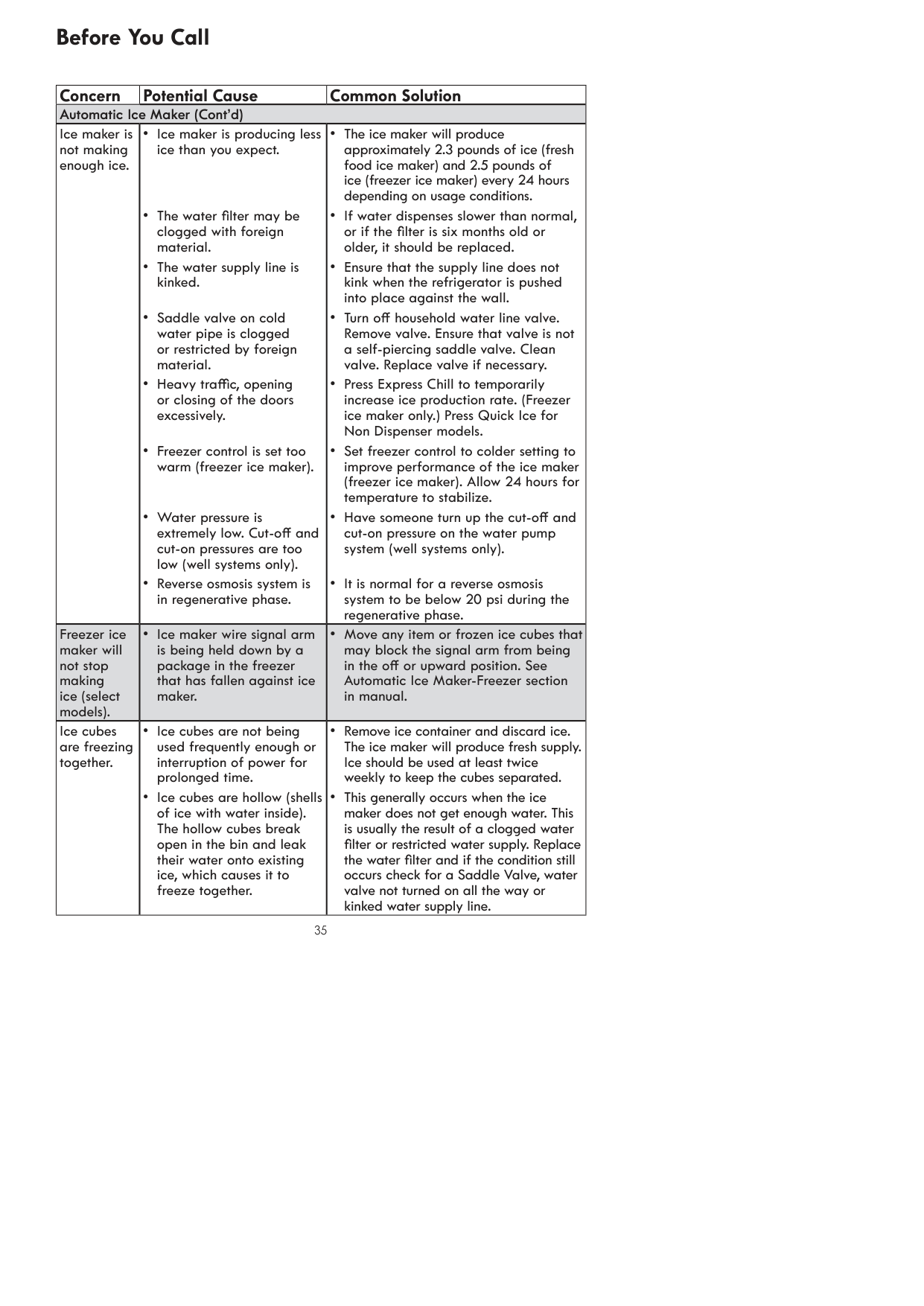
35 Before You Call Concern Potential Cause Common Solution Automatic Ice Maker (Cont’d) Ice maker is not making enough ice.
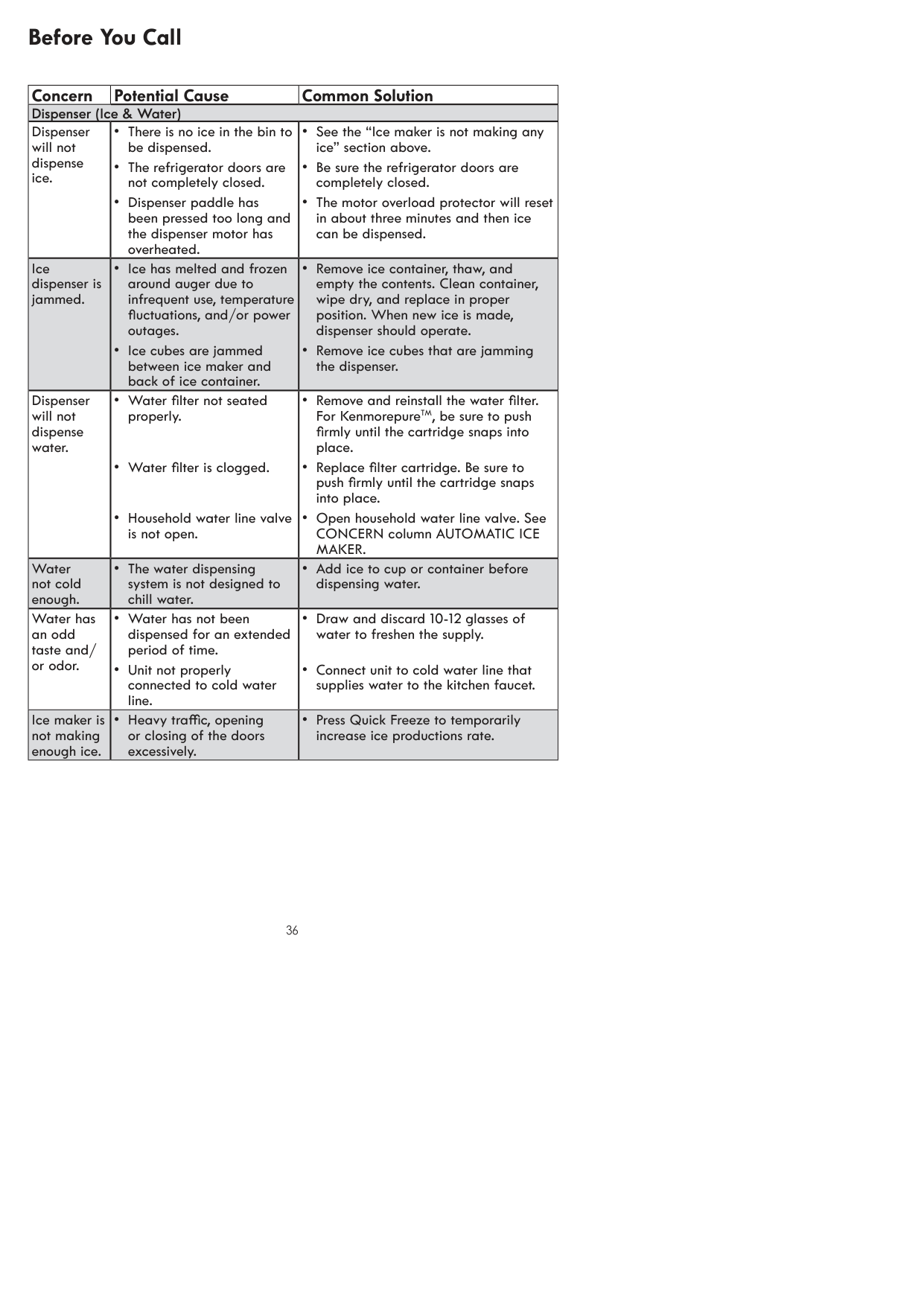
36 Before You Call Concern Potential Cause Common Solution Dispenser (Ice & Water) Dispenser will not dispense ice.
Maker.
Water not cold enough.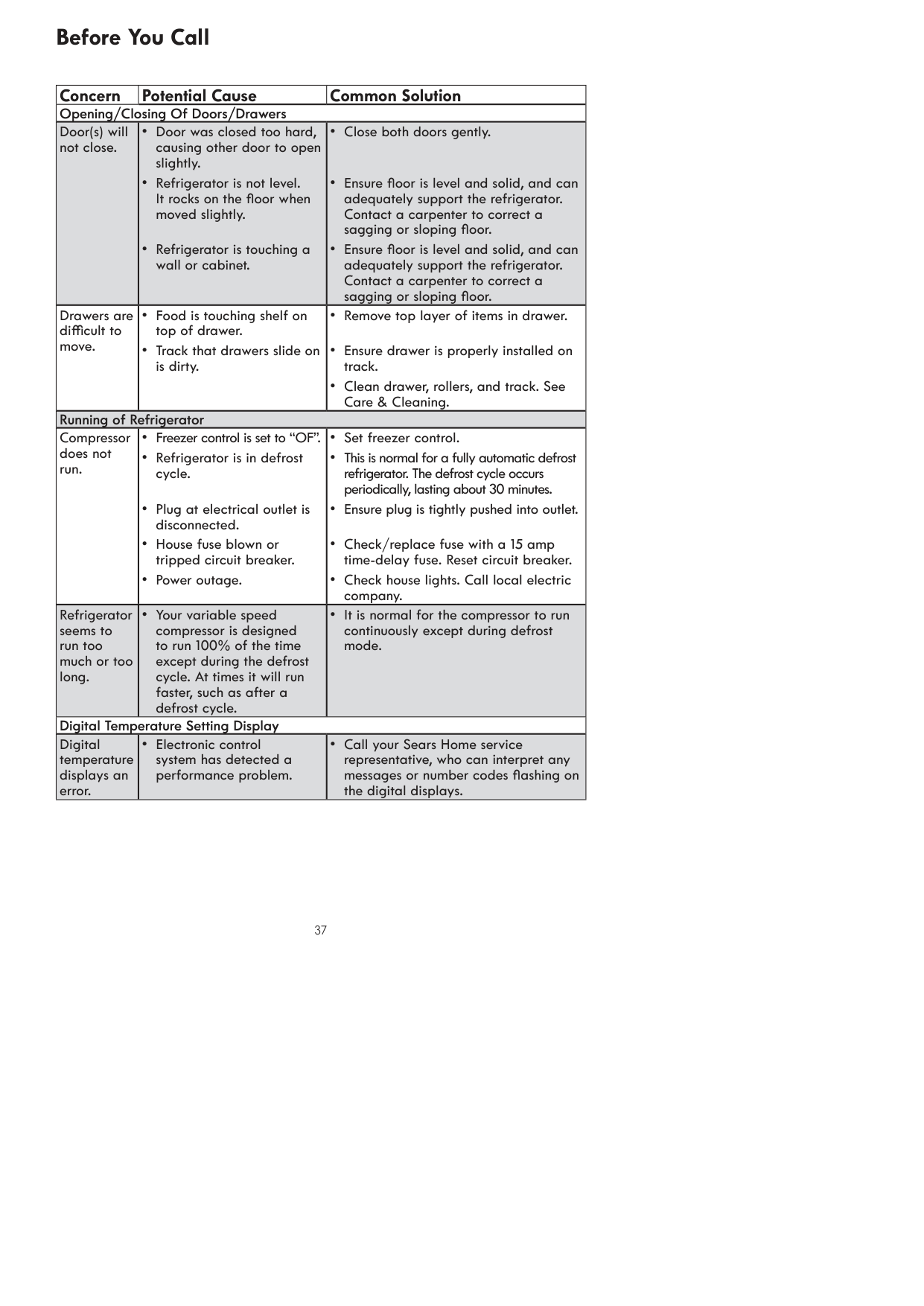
37 Before You Call Concern Potential Cause Common Solution Opening/Closing Of Doors/Drawers Door(s) will not close.
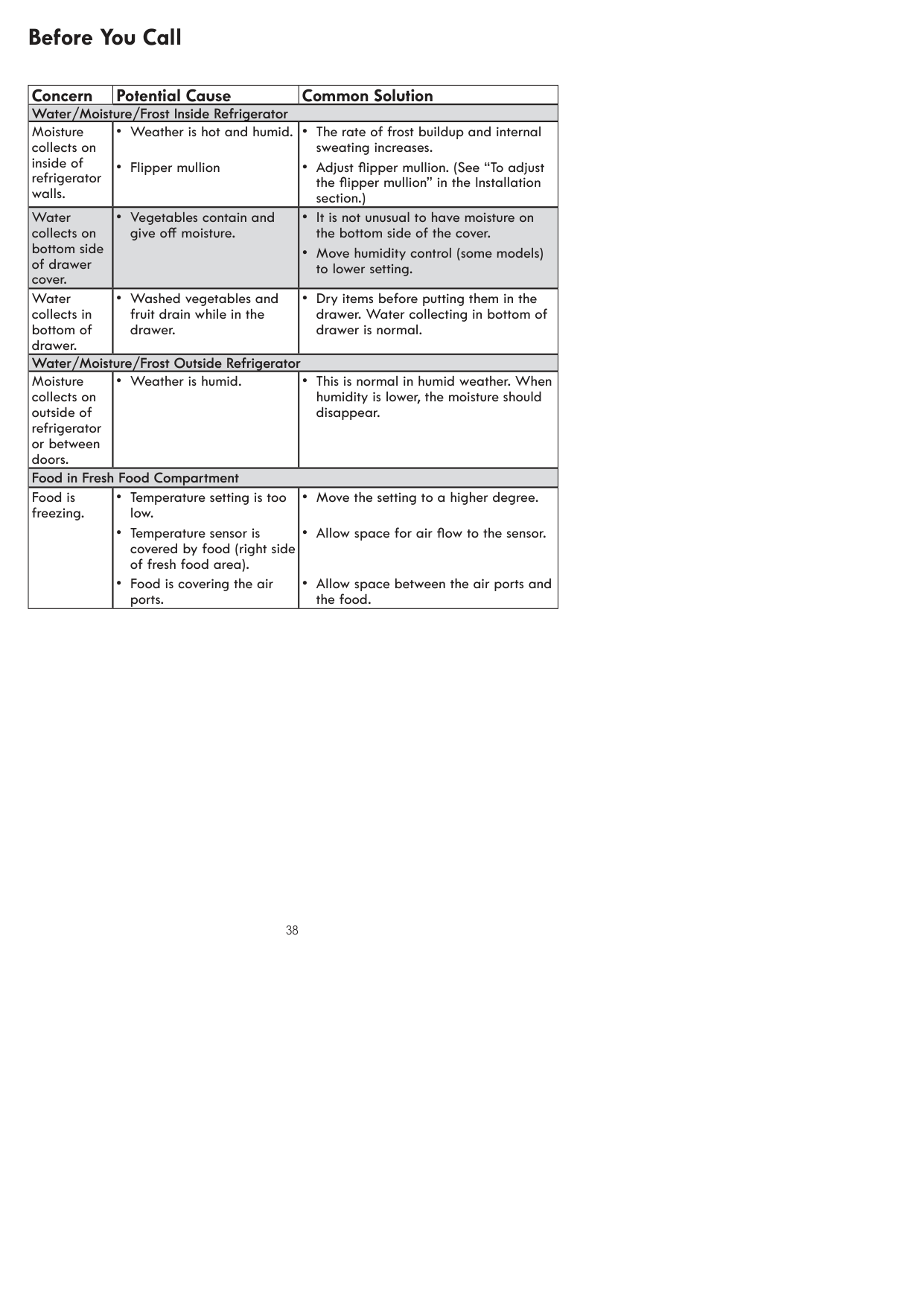
38 Concern Potential Cause Common Solution Water/Moisture/Frost Inside Refrigerator Moisture collects on inside of refrigerator walls.