
Ask AI
— answers from the official manualAnswers from the official manual.
Common questions
Common Questions
9 totalHow do I change the needle on my sewing machine?
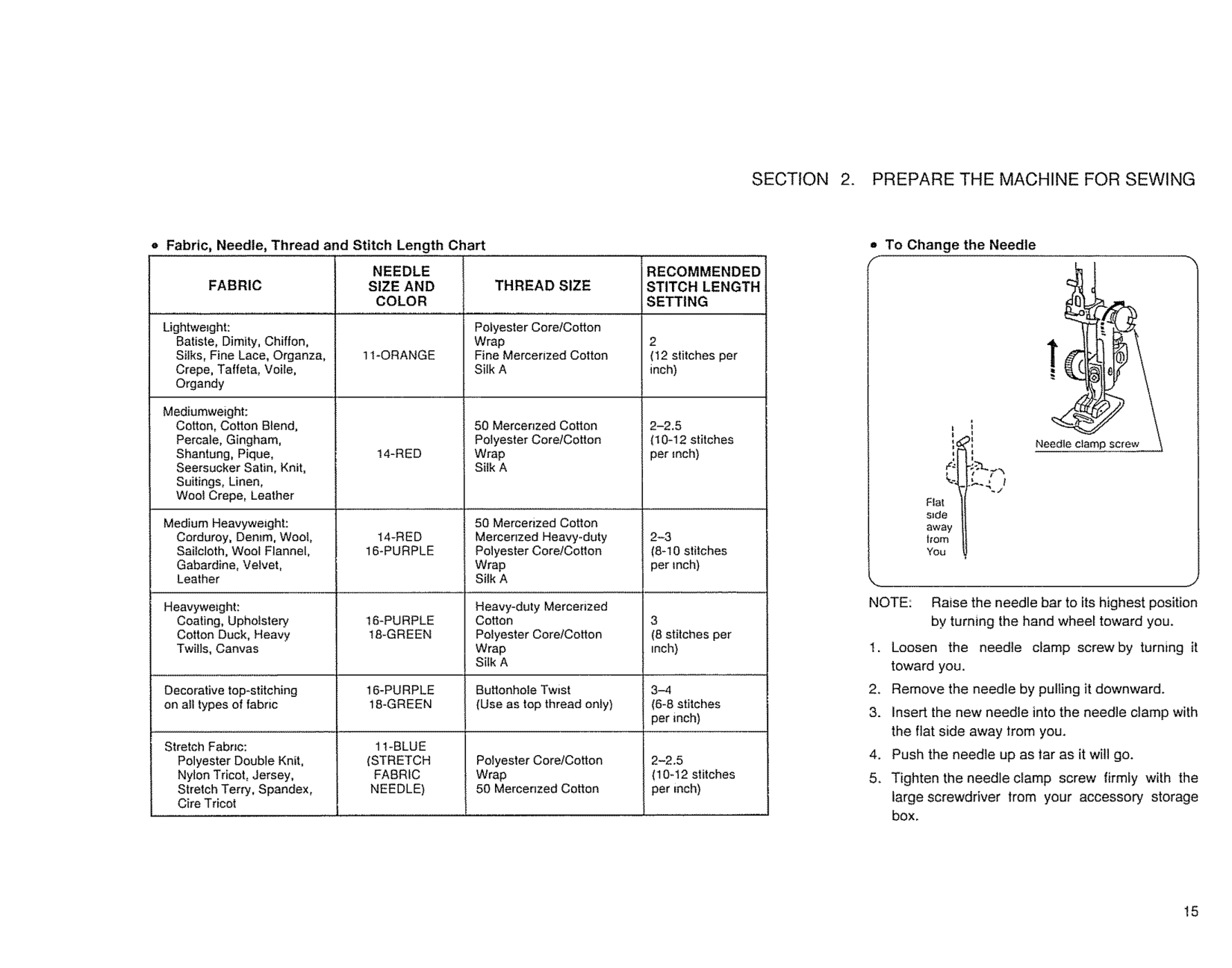
Loosen the needle clamp screw by turning it clockwise toward yourself. Remove the old needle and insert a new one into the needle clamp, with the flat side away from you. Push the needle up as far as possible and tighten the needle clamp screw securely.
What should I do if my machine jams or makes knocking noises?
First, unplug the machine to ensure safety. Check for threads caught in the hook race, clean lint from bobbin case and shuttle. Disassemble components gently and thoroughly clean these areas before reassembling.
How often should I oil my sewing machine?
Oiling is necessary at least once a year, focusing on the two critical points under the face cover plate. Only use a few drops of sewing machine oil and remove excess to prevent fabric staining.
What are some common troubleshooting tips for repairing bobbin thread breakage?
Check if there is lint in the bobbin holder or hook race, and disassemble these parts to clean thoroughly. Ensure the darning plate has been removed and reset the stitch length control if necessary.
How do I attach a new light bulb to my sewing machine?
Unplug the machine, slide open the lace cover plate, push up and turn counterclockwise to remove the old bulb. Replace with a new bulb by pushing it in and turning clockwise until secure.
How do I remove the extension table for free-arm sewing?
To remove the extension table, grip the table near its edge with your index finger and thumb. Pull gently toward you to detach it from the machine.
Full Manual
76 pages
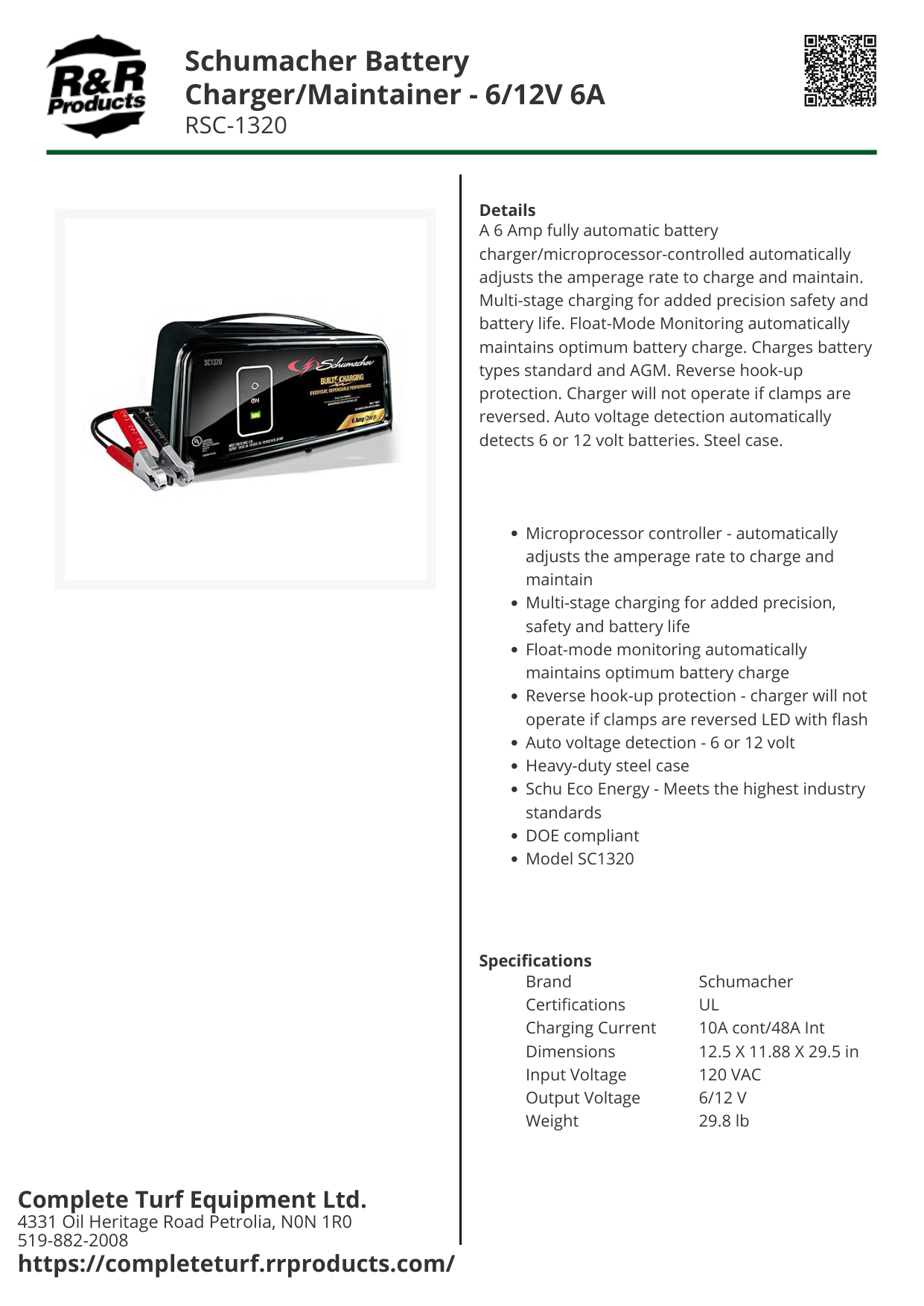

###### OWNER'S
MODEL 385. 17526

################### SEARS, ROEBUCK AND CO.
Dear Customer:
You have just invested in a very fine zigzag sewing machine. Before using your new Kenmore machine, please pause for a moment and carefully read this booklet which contains instructions on how to operate and care for your machine.
Specific instructions are given on threading, tension adjustments, cleaning, oiling, etc. This will help you obtain the best sewing results and avoid unnecessary service expense for conditions beyond our control.
Advice on the operation and care of your machine is always available at your nearest Sears Retail Store. Please remember, ifyou have questions about your machine or need parts and service, always mention the model number and serial number when you inquire.
################### Kenmore Sewing, Machine
Record in space provided below the model number and serial number of this appliance. The model number and serial number are located on the nomenclature plate, as identified on Page 4 of this booklet.
Model No. 385. Serial No, Retain these numbers for future reterence.
THIS MODEL 1SA CENTER NEEDLE, LOW BAR SEWING MACHINE.

######## iMPORTANT SAFETY INSTRUCTIONS
4o
,
Never operate the appliance with any air opening blocked. Keep ventilation openings of the sewing machine and toot controller free from accumulation of lint, dust, and loose cloth.
Never drop or insert any object into any opening. Do not use outdoors. Do not operate where aerosol (spray) products are being used or where oxygen is being administered. To disconnect, turn all controls to the off I"0") position, then remove plug trom outlet.
Your sewing machine is designed and constructed only for HOUSEHOLD use. Read all instruction before using this sewing machine.
DANGER- o reduce the risk ot electric shock:
An appliance should never be left unattended when plugged in. Always unplug this appliance from the electric outlet immediately after using and betore cleaning.
Always unplug before refamping. Replace bulb with same type rated 15 Watts.
Always use the proper needle plate. The wrong plate can cause the needle to break.
Do not reach for the appliance that has tallen into water. Unplug immediately. Do not place or store appliance where it can tall or be pulled into a tub or sink. Do not place in or drop into water or other liquid.
t2. 13.
Do not use bent needles. Do not pull or push labric while stitching. It may deflect the needle causing it to break. Switch the sewing machine off ("0") when making any adjustment in the needle area, such as threading needle, changing needle, threading bobbin, or changing presser foot, and the like. Always unplug the sewing machine from the electrical outlet when removing covers, lubricating, or when making any other adjustments mentioned in the instruction manual.
WA RNING- Toreduce the risk ot burns, fire, electric shock,
or injury to persons.
Do not allow to be used as a toy. Close attention is necessary when this appliance is used by or near children.
######### SAVE THESE INSTRUCTIONS
Use this appliance only for its intended use as described in this manual. Use only attachments recommended by the manufacturer as contained in this manual.
2,
Never operate this appliance if it has a damaged cord or plug, if it is not working properly, if it has been dropped or damaged, or dropped into water. Return the appliance to the nearest authorized dealer or service center torexamination, repair, electrical or mechanical adjustment.

TABLE OF CONTENTS
SECTION
Plug in the Machine and Switch on the Power ....................FootControlUse.................................................................. 6 ,= Set the Pressure Dial ........................................................... 7
Know What the Presser Feet Will Do ............................. ! I - 14
= Presser Foot Types .................................................... 12 ~ 14 Choose the Needle and Thread ...................................... 14 - 15
Stitch Length Control .............................................................. 24 Adjusting Stretch Stitch Balance ............................................ 24 Reverse Stitch Control ............................................................ 25 Starting To Sew ....................................................................... 25
Dropping the feed Dogs ..................................................... 35
=0Darning ............................................................................... 35 Zigzag Stitches ................................................................ 36 - 48
e Basic Zigzag ....................................................................... 36
SECTION
Applique .............................................................................. 38 Bar Tacking ......................................................................... 38
= Embroidery ......................................................................... 39
= Two-Point Box Stitch .......................................................... 47 = Overedging Stitch ............................................................... 47
,=,Straight Stretch ................................................................... 49 • Rick-Ruck Stretch ............................................................... 49
• Herring Bone Stitch ........................................................... 52 • Decorative Stretch Patterns .............................................. 53
Buttonholes Making ........................................................ 54 - 60
= Built-in System ............................................................ 55 - 56
SECTION
##################### 4. PERFORMANCE PROBLEMS CHART
What to Do When ............................................................ 62 - 63 SECTION 5. CARE FOR THE MACHINE
SECTION
Replacing the Light Bulb ......................................................... 64 Clean the Bobbin Holder ......................................................... 64 Clean the Hook Race and Feed Dogs .................................... 65 Oiling the Machine .................................................................. 65
Practical Stitch Chart ...................................................... 26 - 23 Straight Stitches .............................................................. 3t - 35 e Straight Stitch ..................................................................... 31
PARTS LIST .......................................................................................... 66 - 67
• Topstitching ........................................................................ 32 ® Sew in a Zipper ........................................................... 33 ~ 34

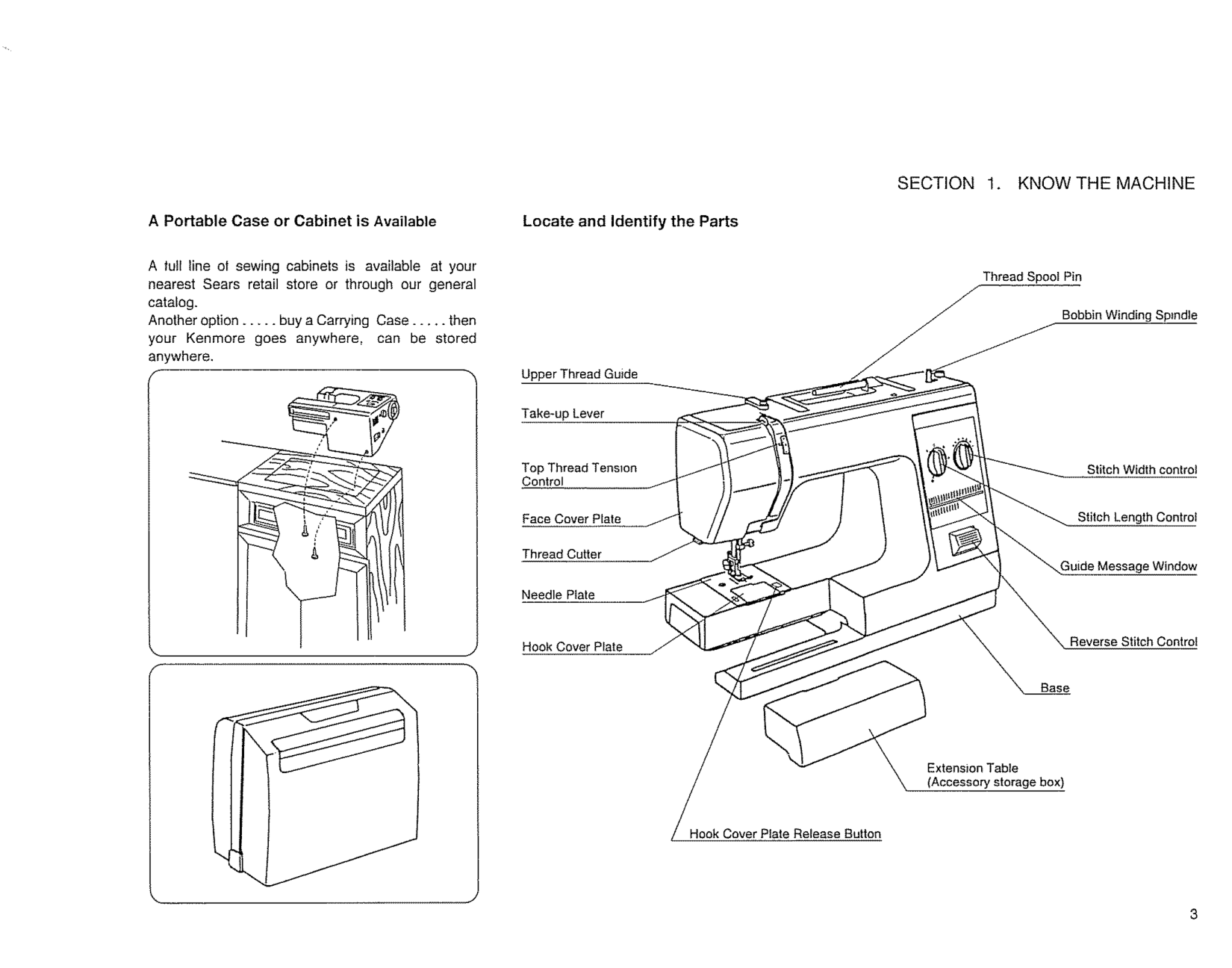
A Portable Case or Cabinet is Available Locate and Identify the Parts
A full fine ot sewing cabinets is available at your nearest Sears retail store or through our general catalog. Another option ..... buy a Carrying Case ..... then your Kenmore goes anywhere, can be stored anywhere.
Thread Spool Pin
Bobbin Winding Sptndle
Upper Thread Guide
Take-up Lever
Top Thread Tension Control
Stitch Width control
####################### ;over Plate
Stitch Length Control
Thread Cutter
Guide Messa_
Needle Plate
Hook Cover Plate
Extension Table {Accessory storage box)

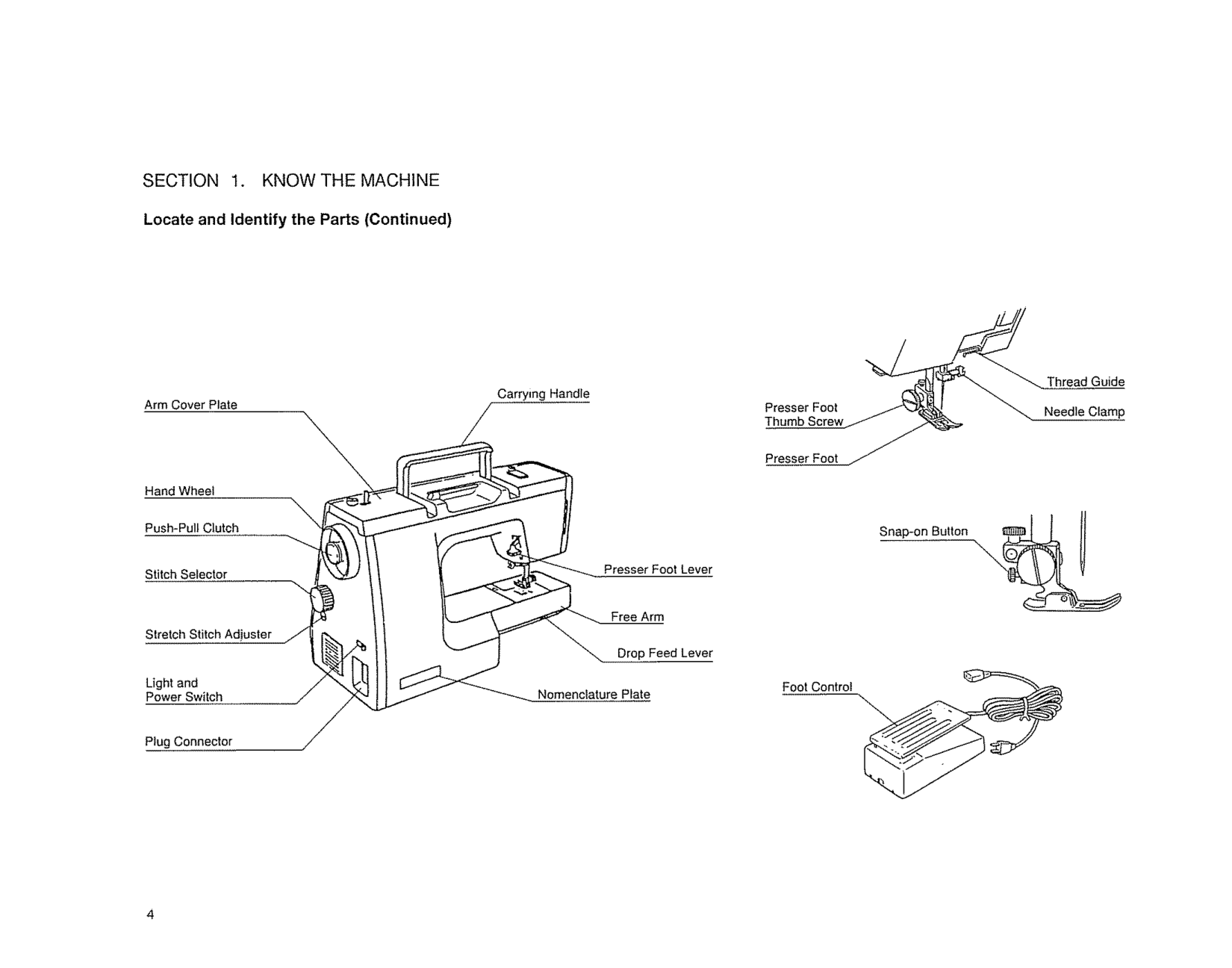
Locate and Identify the Parts (Continued)
Thread Guide
Carrying Handle
Arm Cover Plate
Presser Foot Thumb Screw
Needle
Presser Foot
Hand Wheel
####### \
Push-Pull Clutch
Snap-on Button
Presser Foot Lever
Stitch Selector
Free Arm
Stretch Stitch Adiuster
Drop Feed Lever
Light and Power Switch
Foot Control
Nomenclature Plate
Plug Connector

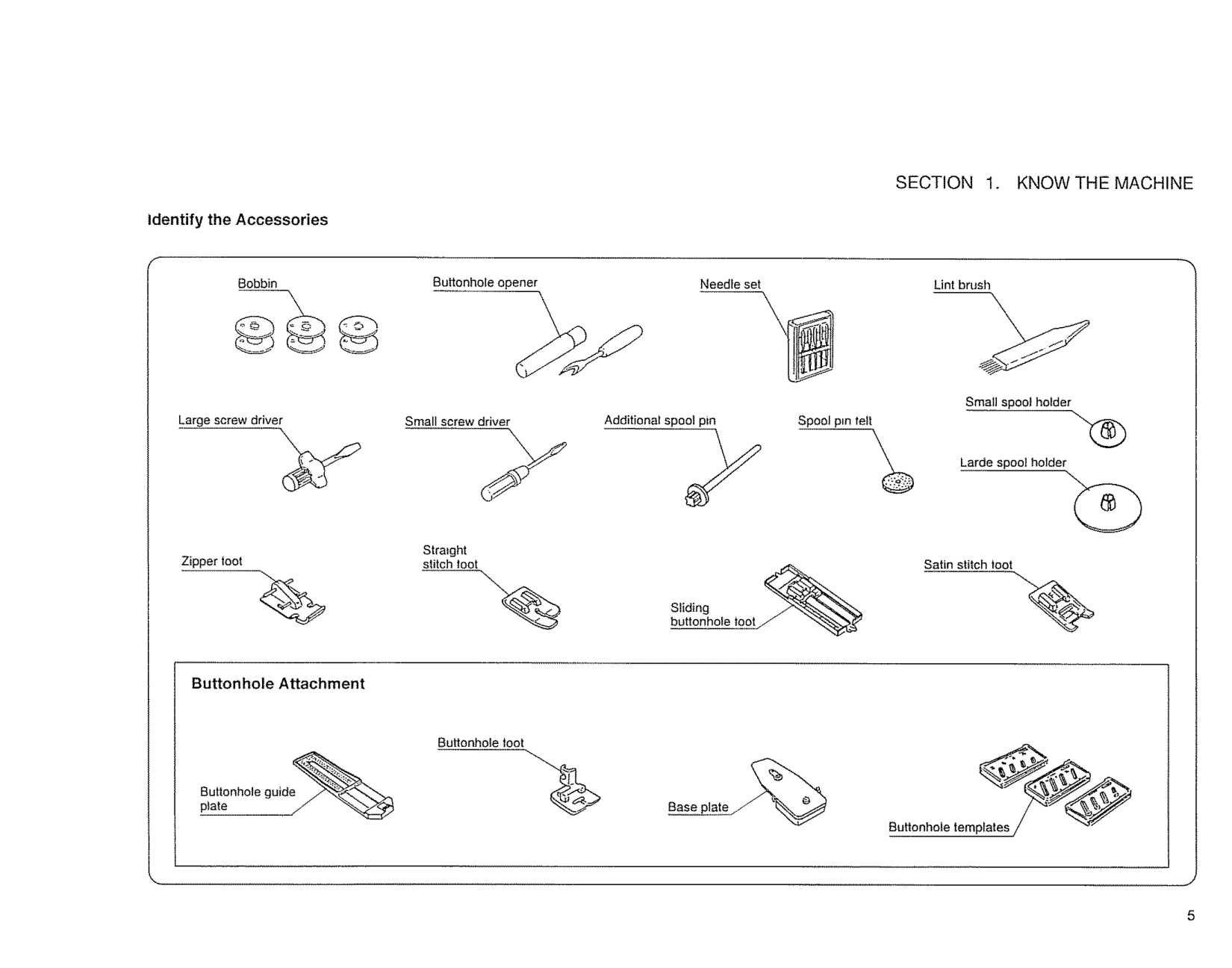
################### identify the Accessories
\
Buttonhole opener
Needle set
Lint brush
Small spoof holder
Y
Large screw driver
Small screw driver
Additional spool pin
Spool pm tell
Larde spool holder
Straight Zipper ioot stitch toot
-%
Satin stitch loot
Sliding buttonhole loot
Buttonhole Attachment
Buttonhole toot
Buttonhole guid_ p_ate ._//
Base plate __
Buttonhole templates

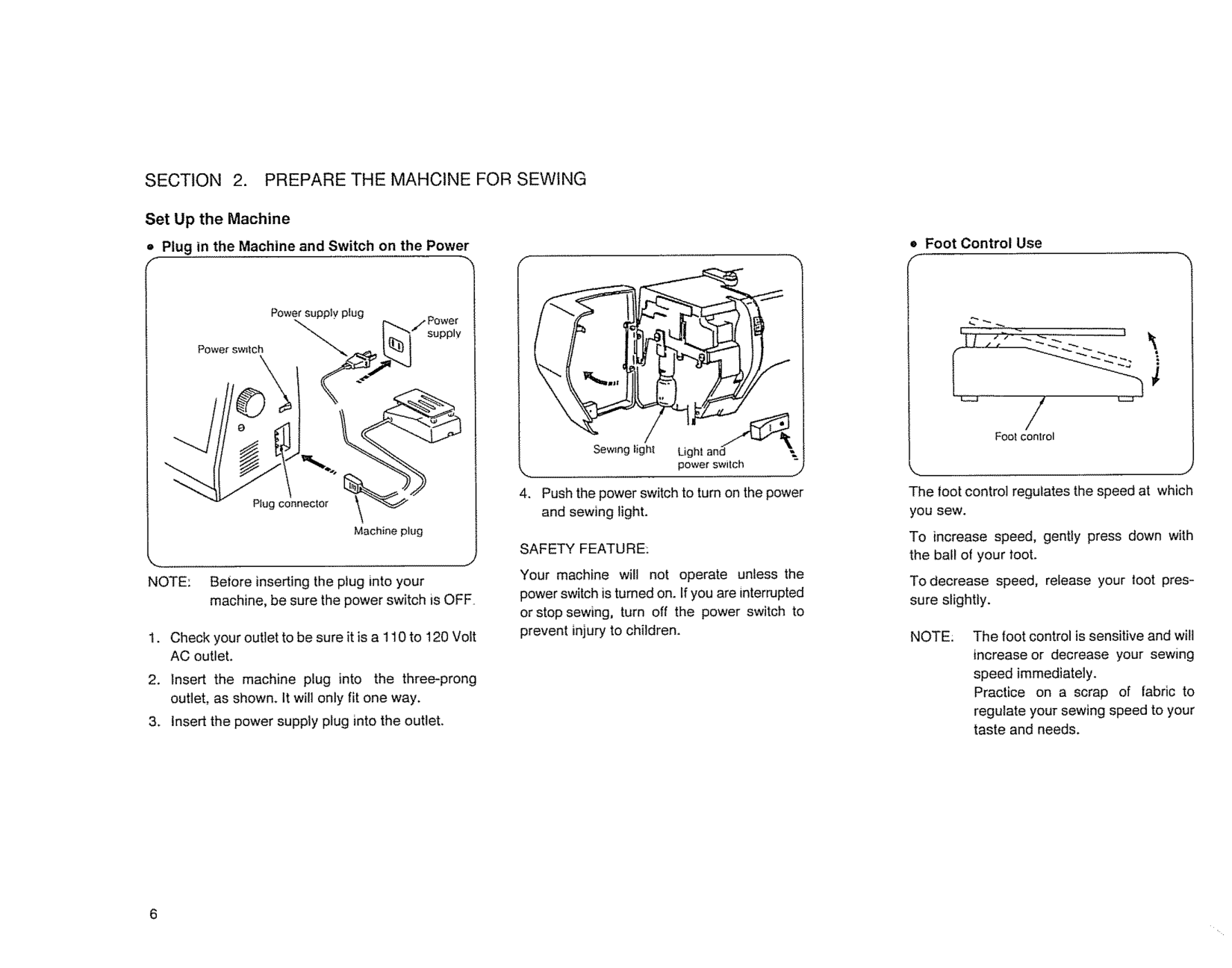
Set Up the Machine o Plug in the Machine and Switch on the Power • Foot Control Use
Power suppiy pIug
E-- -...... ,- < ]
Power sw_tch
/
Foot control
Sewing light
........................ power switch j Push the power switch to turn on the power and sewing light.
Plug connecter \
Machine plug
SAFETY FEATURE: Your machine wilt not operate unless the power switch is turned on. If you are interrupted or stop sewing, turn off the power switch to prevent injury to children.
J
NOTE: Before inserting the plug into your machine, be sure the power switch is OFF_
NOTE: The foot control is sensitive and wilt increase or decrease your sewing speed immediately. Practice on a scrap of fabric to regulate your sewing speed to your taste and needs.
Check your outlet to be sure itis a 110 to t 20 Volt AC outlet.
Insert the machine plug into the three-prong outlet, as shown. It will only fit one way. Insert the power supply plug into the outlet.

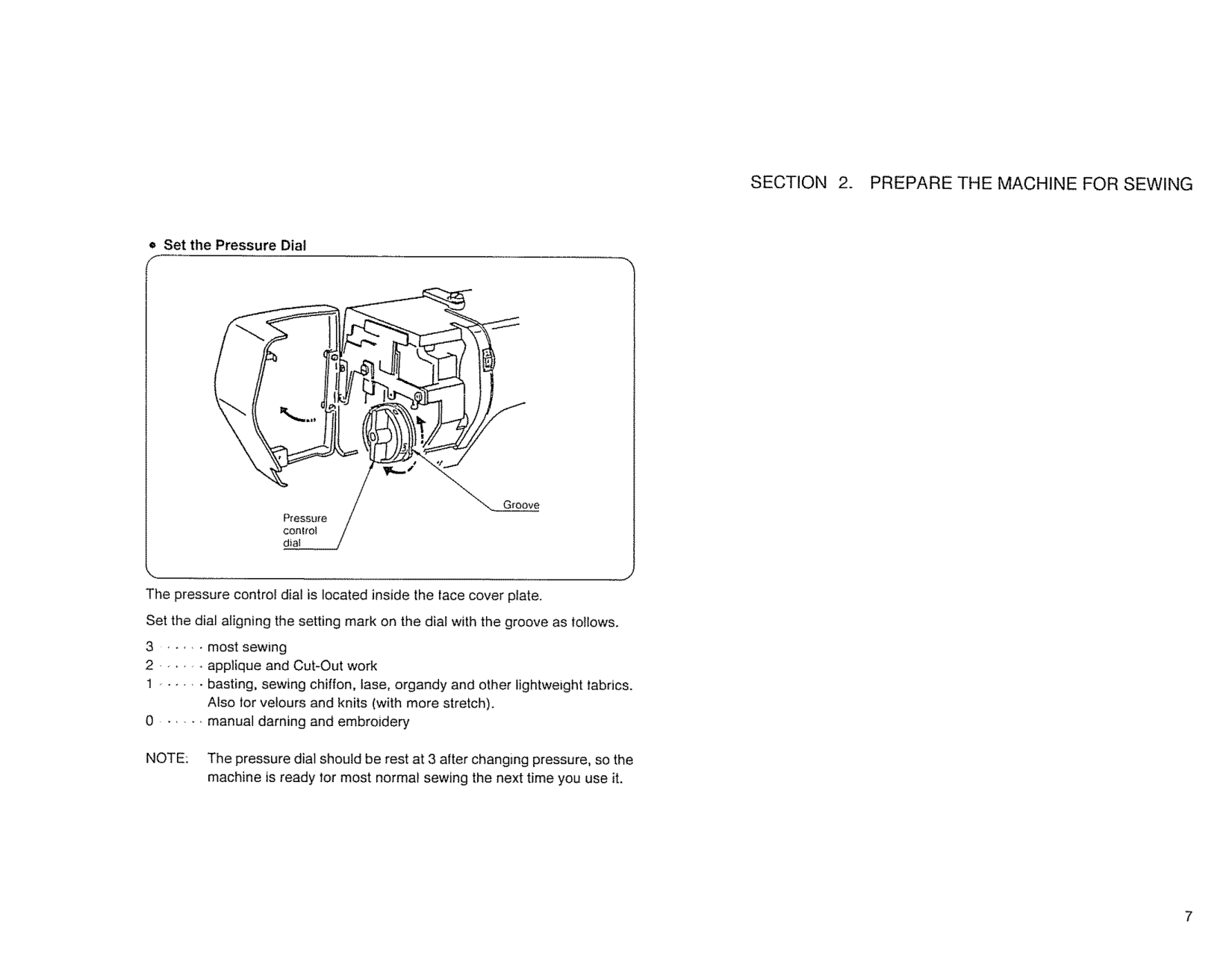
##################### • Set the Pressure Dia!
The pressure control dial is located inside the race cover plate. Set the dial aligning the setting mark on the dial with the groove as follows.
Also tor velours and knits (with more stretch). 0 ...... manual darning and embroidery
NOTE: The pressure dial should be rest at 3 after changing pressure, so the machine is ready tot most normal sewing the next time you use it.
7

##################### Set Up the Machine (Continued) • Adjust the Presser Foot Lever
##################### o Thread Cutter
__ _._
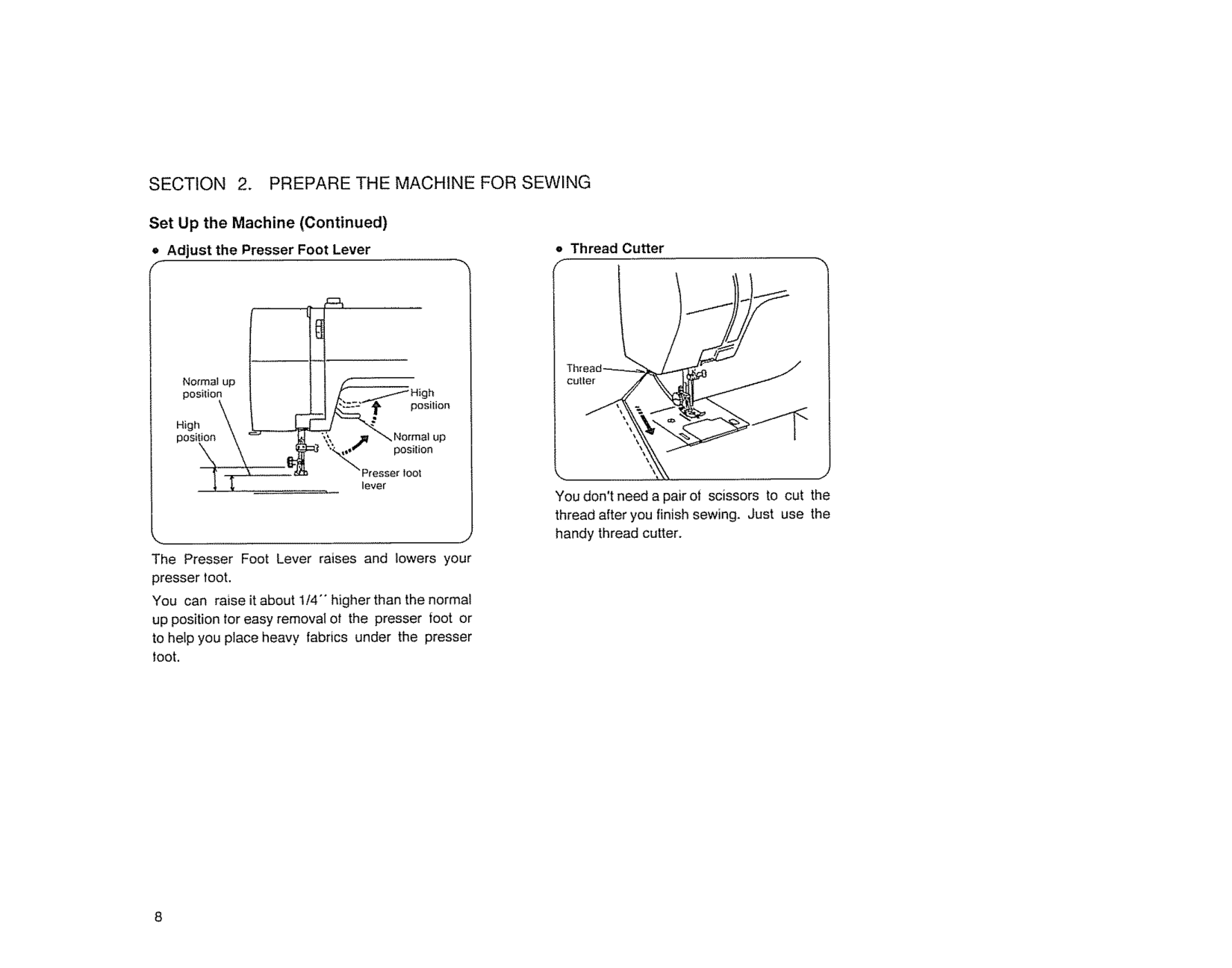
You don't need a pair o| scissors to cut the thread after you finish sewing. Just use the handy thread cutter.
The Presser Foot Lever raises and lowers your presser loot. You can raise it about I/4- higher than the normal up position for easy removal of the presser foot or to help you place heavy fabrics under the presser loot.
8

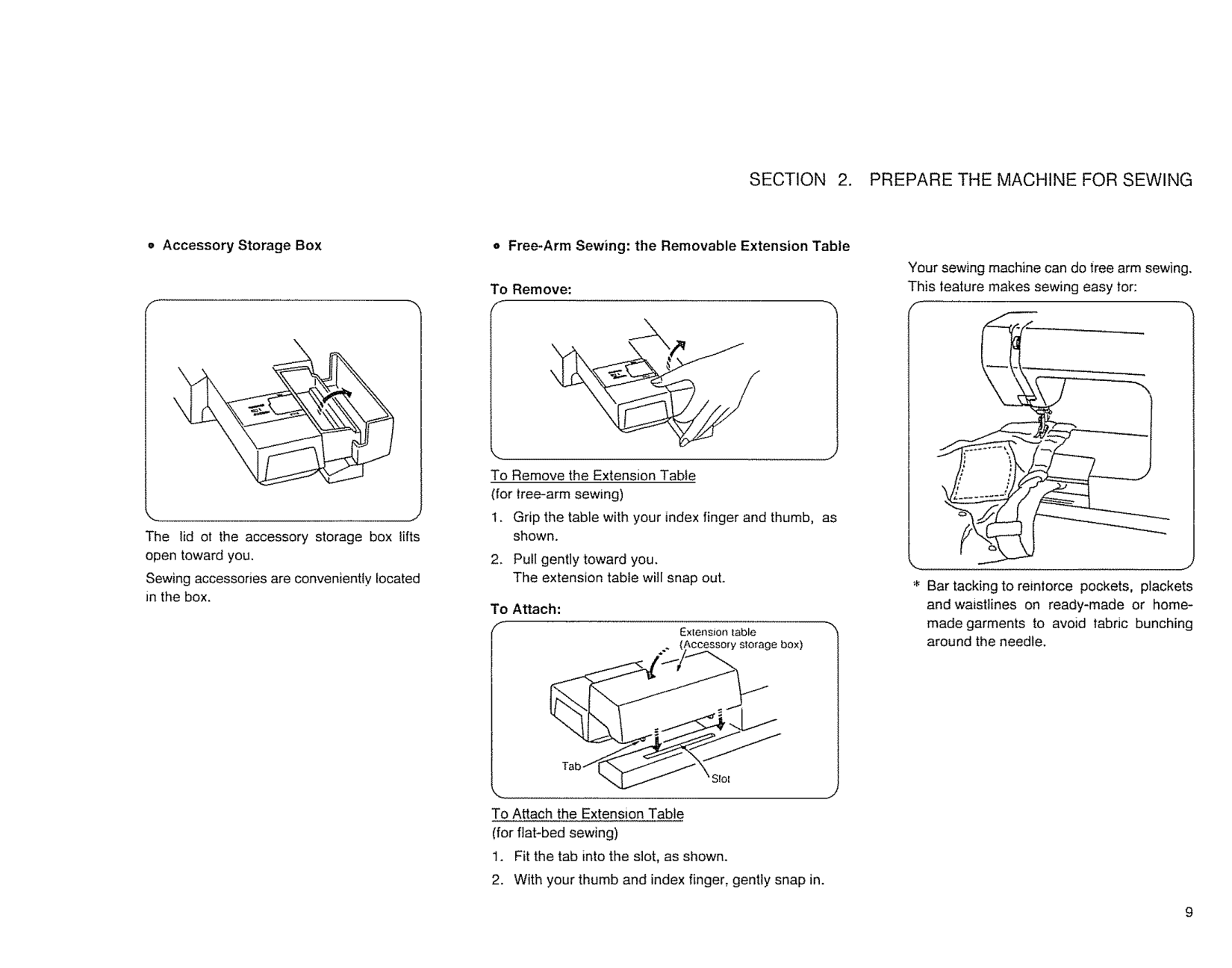
##################### Accessory Storage Box
o Free-Arm Sewing: the Removable Extension Table
Your sewing machine can do tree arm sewing.
To Remove: f
This feature makes sewing easy for:
f
\ \
To Remove the Extension Table (for tree-arm sewing) t. Grip the table with your index finger and thumb, as
shown.
The lid ot the accessory storage box lifts open toward you. Sewing accessories are conveniently Iocated in the box.
The extension table will snap out. To Attach: / Extension_,able
l_Accessory
To Attach the Extension Table _for ftat-bed sewing)

Set Up the Machine (Continued)
f
J
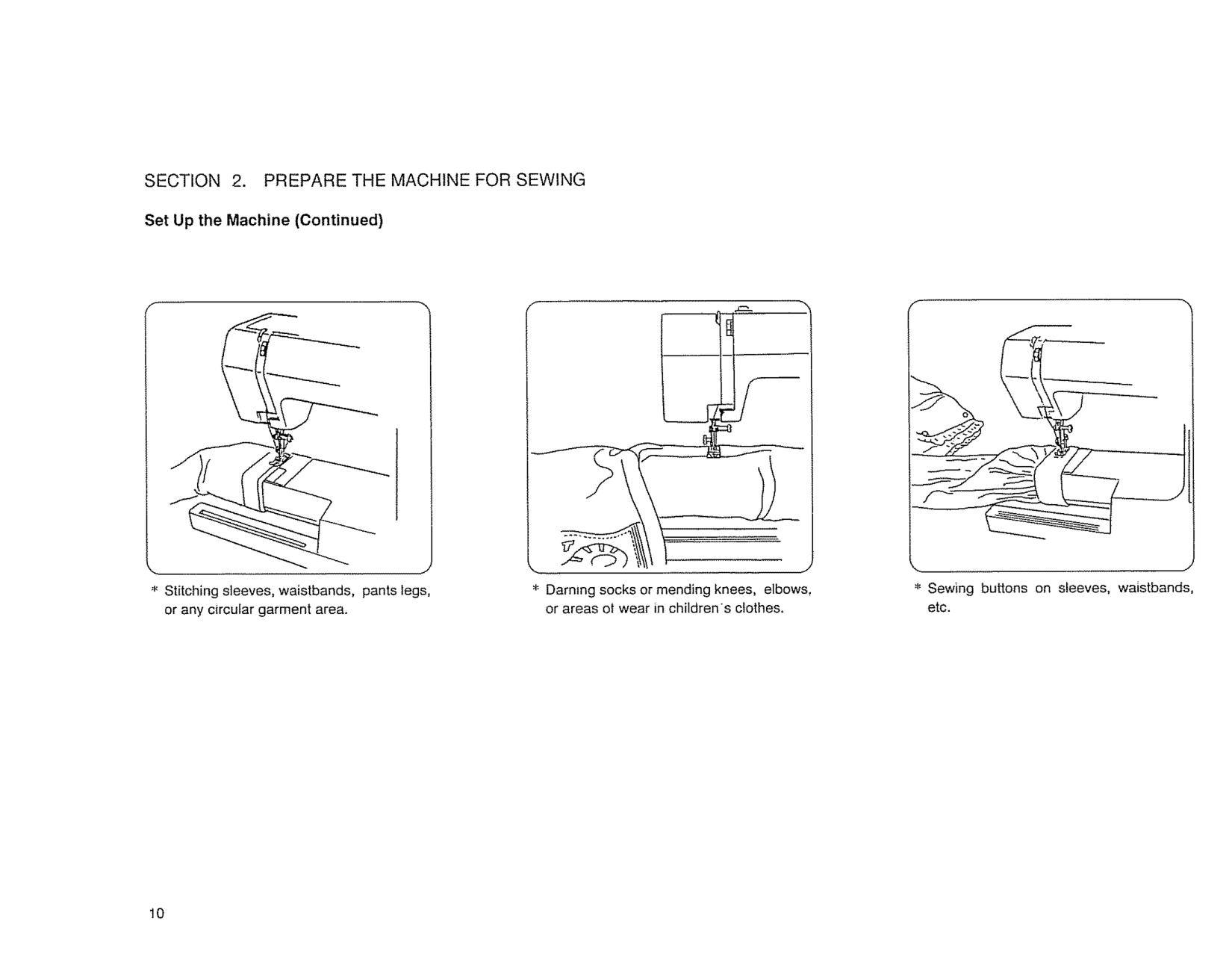
###################### '_'Sewing buttons on sleeves, waistbands, etc.
_- Darning socks or mending knees, elbows, or areas ol wear in children's clothes.
'* Stitching sleeves, waistbands, pants legs, or any circular garment area.

KnowWhatthe Presser Feet Will Do
##################### = Check The Presser Foot
##################### • Change the Presser Foot
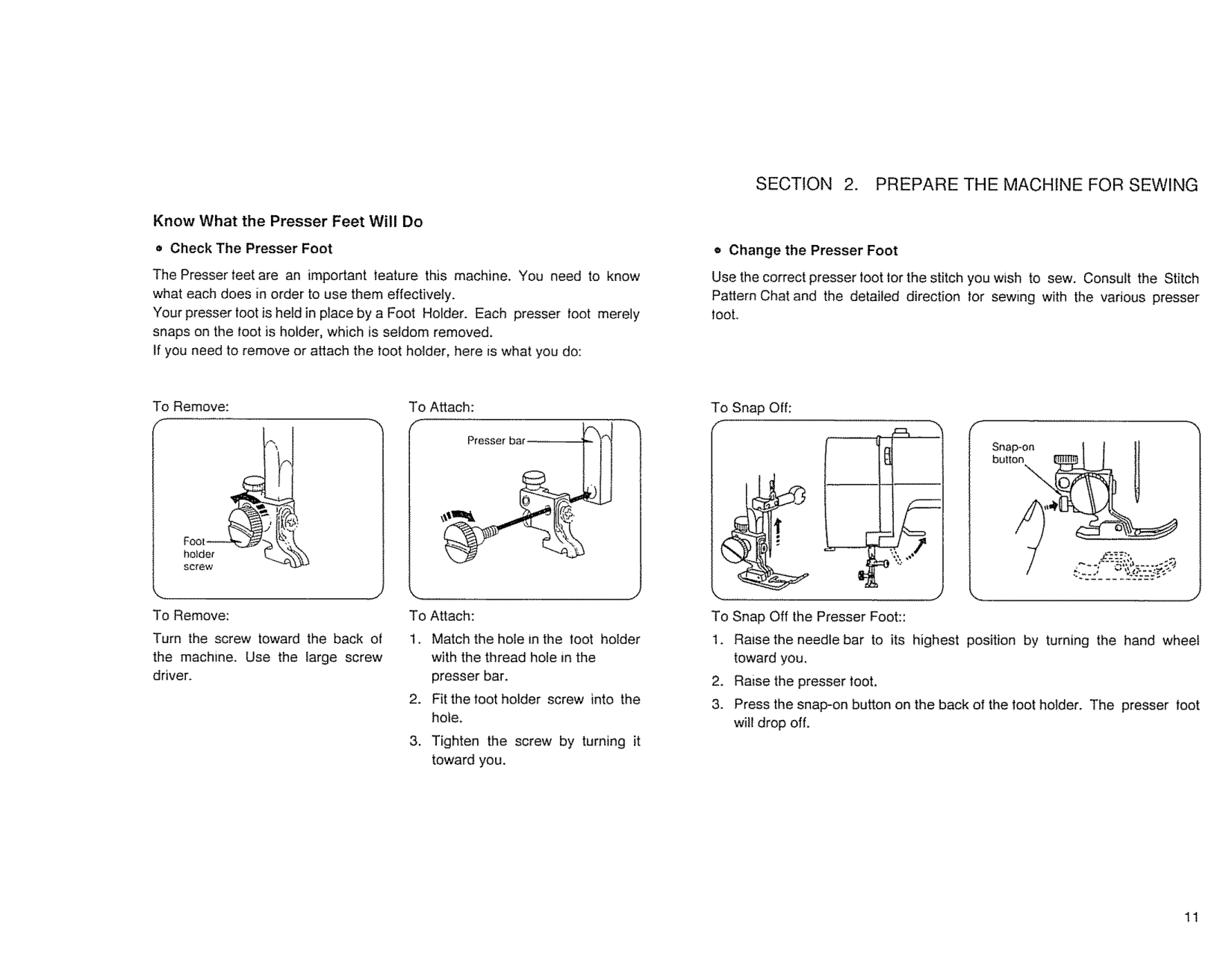
The Presser leer are an important feature this machine. You need to know what each does in order to use them effectively. Your presser foot is held in place by a Foot Holder. Each presser foot merely snaps on the toot is holder, which is seldom removed. If you need to remove or attach the toot holder, here is what you do:
Use the correct presser loot tor the stitch you wish to sew. Consult the Stitch Pattern Chat and the detailed direction tor sewing with the various presser toot.
To Remove: ,1-
To Attach:
To Snap Off:
f
Presser I:
Snap-on button
Foot
! y,,
J To Attach:
J
To Remove: Turn the screw toward the back of the machine. Use the large screw driver.
To Snap Off the Presser Foot:: t. Raise the needle bar to its highest position by turning the hand wheei
toward you.

Know What the Presser Feet Will Do (Continued)
Straight Foot
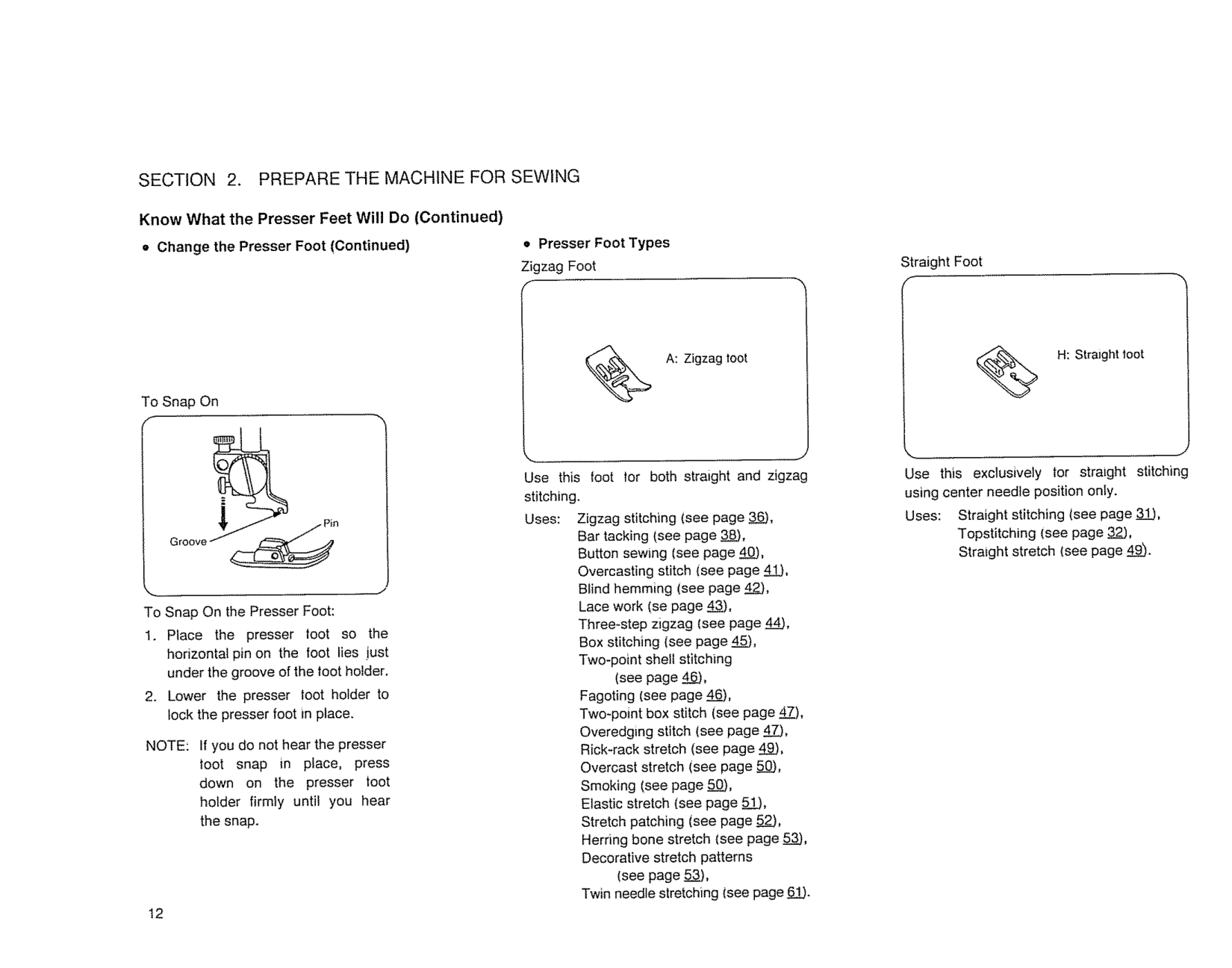
Zigzag Foot
f
To Snap On ,- .._
Use this exclusively for straight stitching using center needle position only. Uses: Straight stitching (see page 3_!),
Use this foot lor both straight and zigzag stitching. Uses: Zigzag stitching (see page 3_,
_n_
Topstitching (see page 3_, Straight stretch (see page 4__.
Bar tacking (see page 3_, Button sewing (see page 4_, Overcasting stitch (see page 4_, Blind hemming (see page 4_2.), Lace work (se page 4_, Three-step zigzag (see page 4__, Box stitching {see page 4__, Two-point shell stitching
_ ..... J To Snap On the Presser Foot:
(see page 4_.6_), Fagoting (see page 46), Two-point box stitch (see page 4_Z), Overedging stitch (see page 4_Z), Rick-rack stretch (see page __), Overcast stretch (see page 50_, Smoking (see page 5_.03, Elastic stretch (see page 5_.!_), Stretch patching (see page 5_, Herring bone stretch (see page 53t, Decorative stretch patterns (see page _._.),
NOTE: If you do not hear the presser
toot snap in place, press down on the presser toot holder firmly until you hear the snap.
Twin needle stretching (see page 61_.

= Presser Foot Types (Continued) Sliding Buttonhole Foot f--
Satin Stitch Foot
Zigzag Foot
f
Sliding buttonhole toot E; Zigzag toot
....... J This toot can be set sew on each side ot your zipper. The edges of the toot guide the zipper and keep the straight. Uses: Zipper application (see page 331
Use this for buttonholes of built-in system. It is marked to measure your buttonholes accurately. Uses: Buttonhole making (see page 54_)
Use this transparent toot for satin stitch and outlining applique. Uses: Darning (see page 35.),
Monogramming (see page _, Satin stitch (see page 3_Z), Applique (see page 3__, Shell stitching (see page 4__53, Geometnc decorative stitching
(see page 4_.8), Twin needle stitching (see page 61).

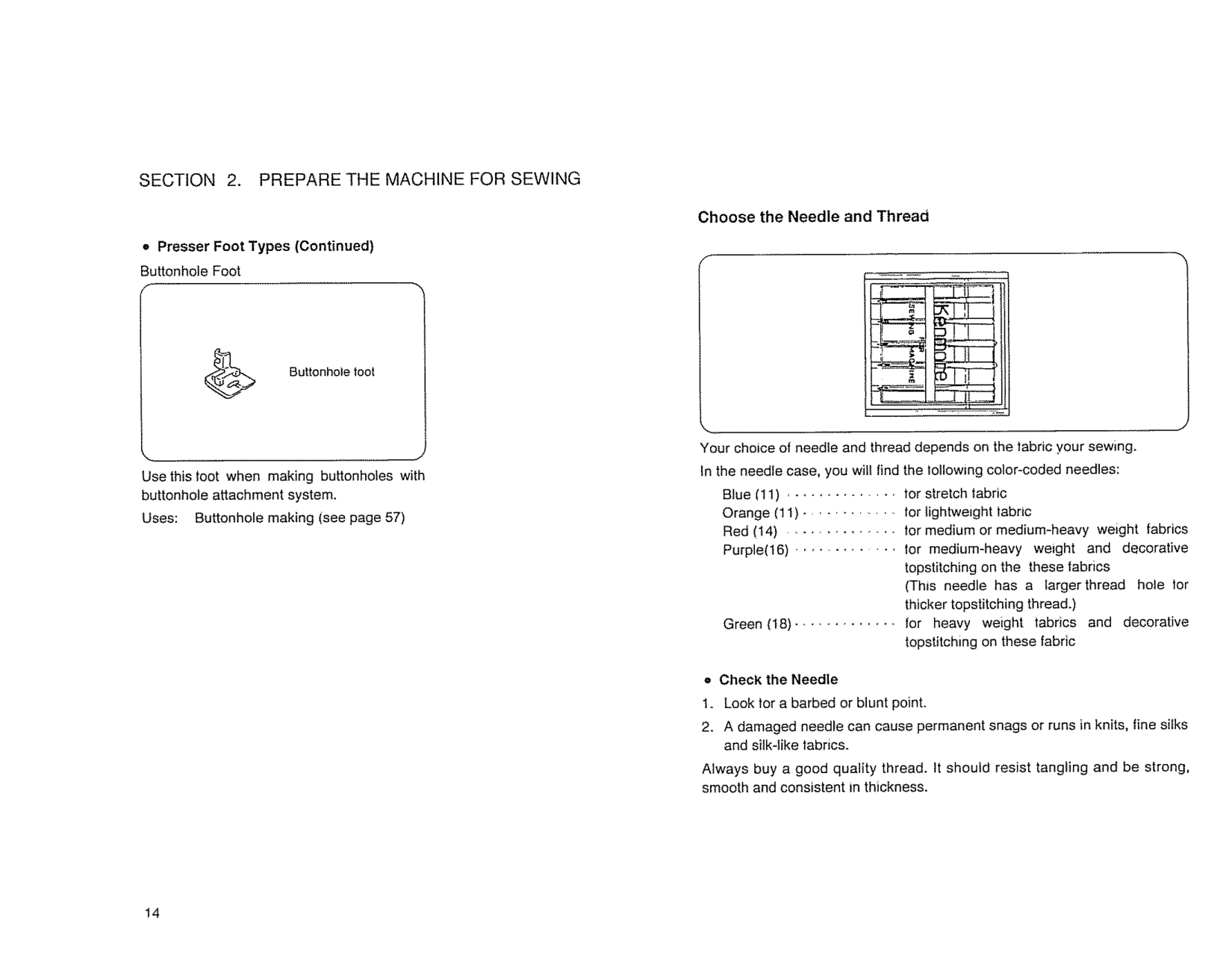
Choose the Needle and Thread
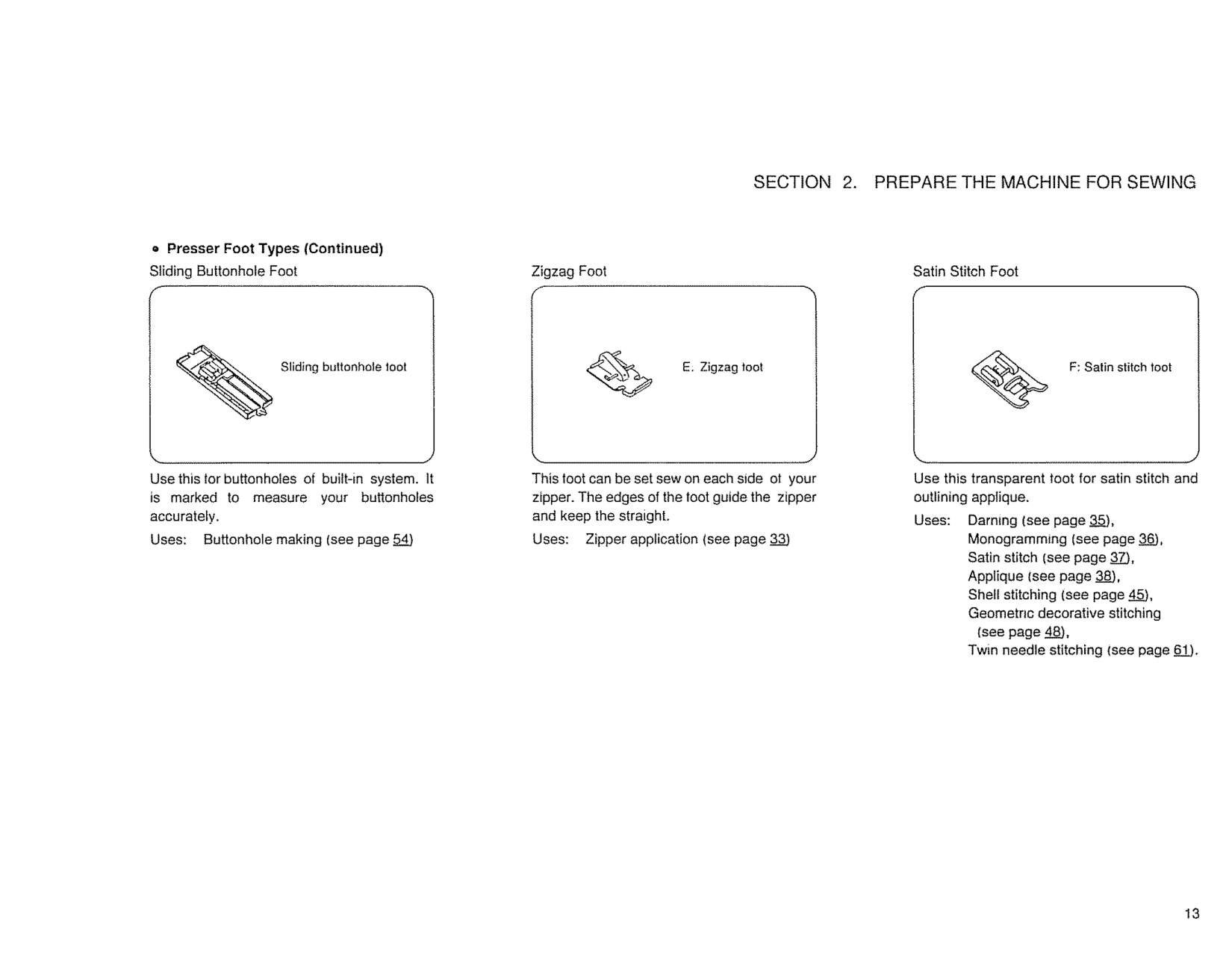
##################### = Presser Foot Types (Continued) Buttonhole Foot
f-
Buttonhole toot
,,,,,.... .--
Your choice of needle and thread depends on the labric your sewing. In the needle case, you wilt find the tollowing color-coded needles:
Use this loot when making buttonholes with buttonhole attachment system. Uses: Buttonhole making (see page 57)
Blue (11) .............. tot stretch tabric Orange (11) ............ tot lightweight fabric Red (t4) .............. for medium or medium-heavy weight fabrics Purple(16) ............ lor medium-heavy weight and decorative
topstitching on the these labrics (This needle has a larger thread hole tor thicker topstitching thread.)
Green (18) ............. for heavy weight tabrics and decorative topstitching on these fabric
• Check the Needle
Always buy a good quality thread. It should resist tangling and be strong, smooth and consistent in thickness.
t4

o Fabric, Needle, Thread and Stitch Length Chart
o To Changethe Needle f
NEEDLE FABRIC SIZE AND THREAD SIZE COLOR
##################### RECOMMENDED STITCH LENGTH SETTING
Lightwe{ght: Batiste, Dimity, Chiffon, Silks, Fine Lace, Organza, Crepe, Taffeta, Voile, Organdy
Pofyester CoretCotton Wrap Fine Mercerized Cotton Silk A
##### f
2 (12 stitches per inch)
11-ORANGE
Mediurnweight, Cotton, Cotton Blend, Percale, Gingham, Shantung, Pique, Seersucker Satin, Knit, Suitings, Linen, Wool Crepe, Leather
50 Mercenzed Cotton Polyester CorelCotton Wrap Silk A
Needle clamp screw
14-RED
Flal stde away ttom You
50 Mercerized Cotton Mercenzed Heavy-duty Polyester Core/Cotton Wrap Silk A
Medium Heavyweight: Corduroy, Denim, Wool, Sailcloth, Woof Flannel, Gabardine, Velvet, Leather
14-RED 16-PURPLE
.o
NOTE:
Raise the needle bar to its highest position by turning the hand wheel toward you.
Heavyweight: Coating, Upholstery. Cotton Duck, Heavy Twills, Canvas
Heavy-duty Mercerized !6-PURPLE
3 (8 stitches per Inch)
Cotton PoLyester Core/Cotton Wrap Silk A
!8-GREEN
I.
Loosen the needle clamp screw by turning it toward you. Remove the needle by pulling it downward. Insert the new needle into the needle clamp with the flat side away trom you. Push the needle up as tar as it will go. Tighten the needle clamp screw firmly with the large screwdriver from your accessory storage box.
16-PU RPLE 18-GREEN
Buttonhole Twist (Use as top thread only)
3-4 (6-8 stitches per inch)
Decorative top-stitching on all types of fabric
1t-BLUE (STRETCH FABRIC NEEDLE)
Stretch Fabnc: Polyester Double Knit, Nylon Tricot, Jersey, Stretch Terry, Spandex, Cire Tricot
4, 5.
2-2.5 (10q2 stitches per inch)
Polyester Core/Cotton Wrap 50 Mercenzed Cotton

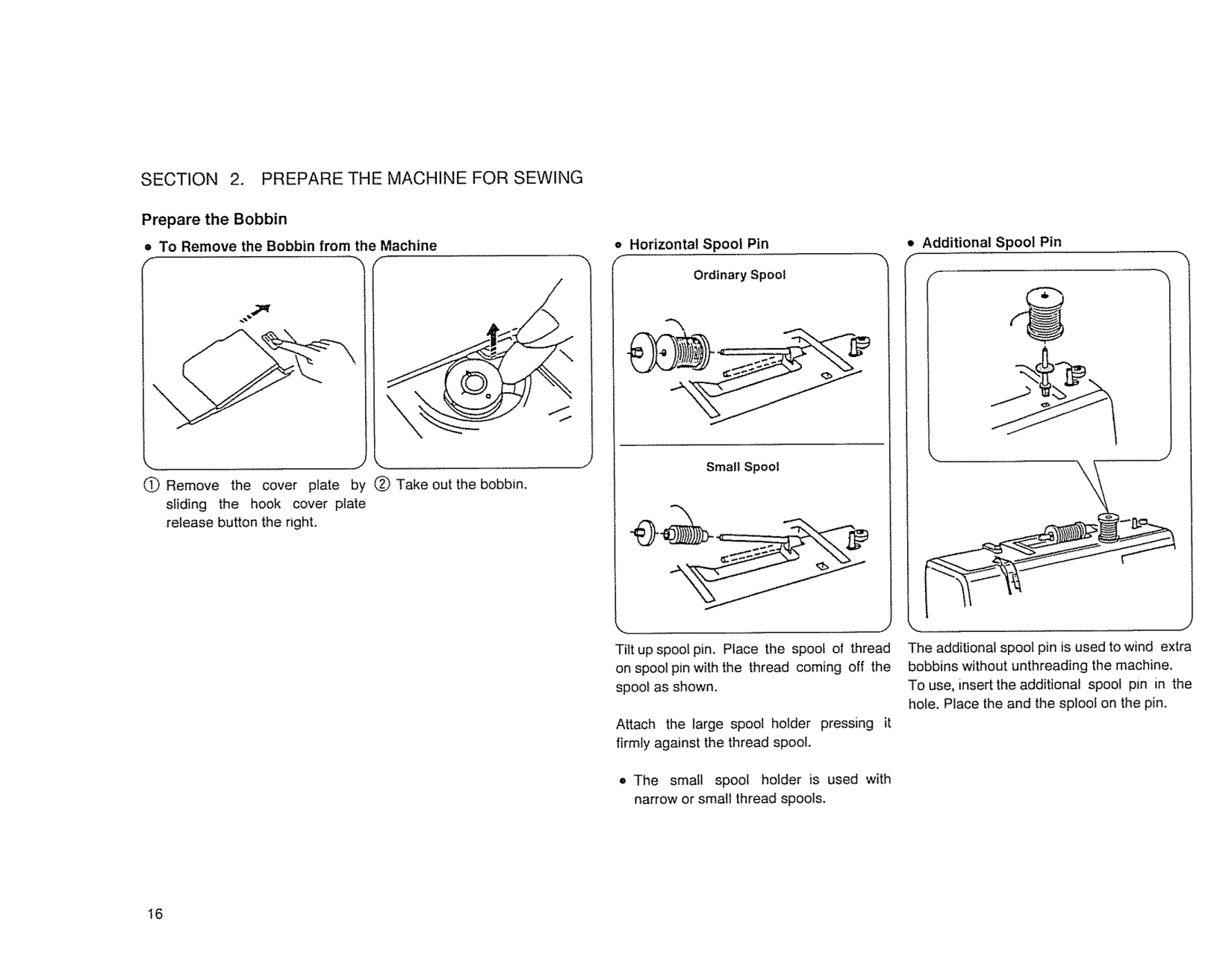
Prepare the Bobbin
e Additional Spool Pin
• To Remove the Bobbin from the Machine
o Horizontal Spool Pin
Ordinary Spool
.-.,,
Small Spool
(_ Remove the cover plate by (_ Take out the bobbin, sliding the hook cover plate release button the right.
The additional spool pin is used to wind extra bobbins without unthreadhg the machine. To use, insert the additional spool pin in the hole. Place the and the spioot on the pin.
Tilt up spool pin. Place the spool of thread on spool pin with the thread coming off the spool as shown.
Attach the large spool holder pressing it firmly against the thread spool.
o The small spool holder is used with
narrow or small thread spools.

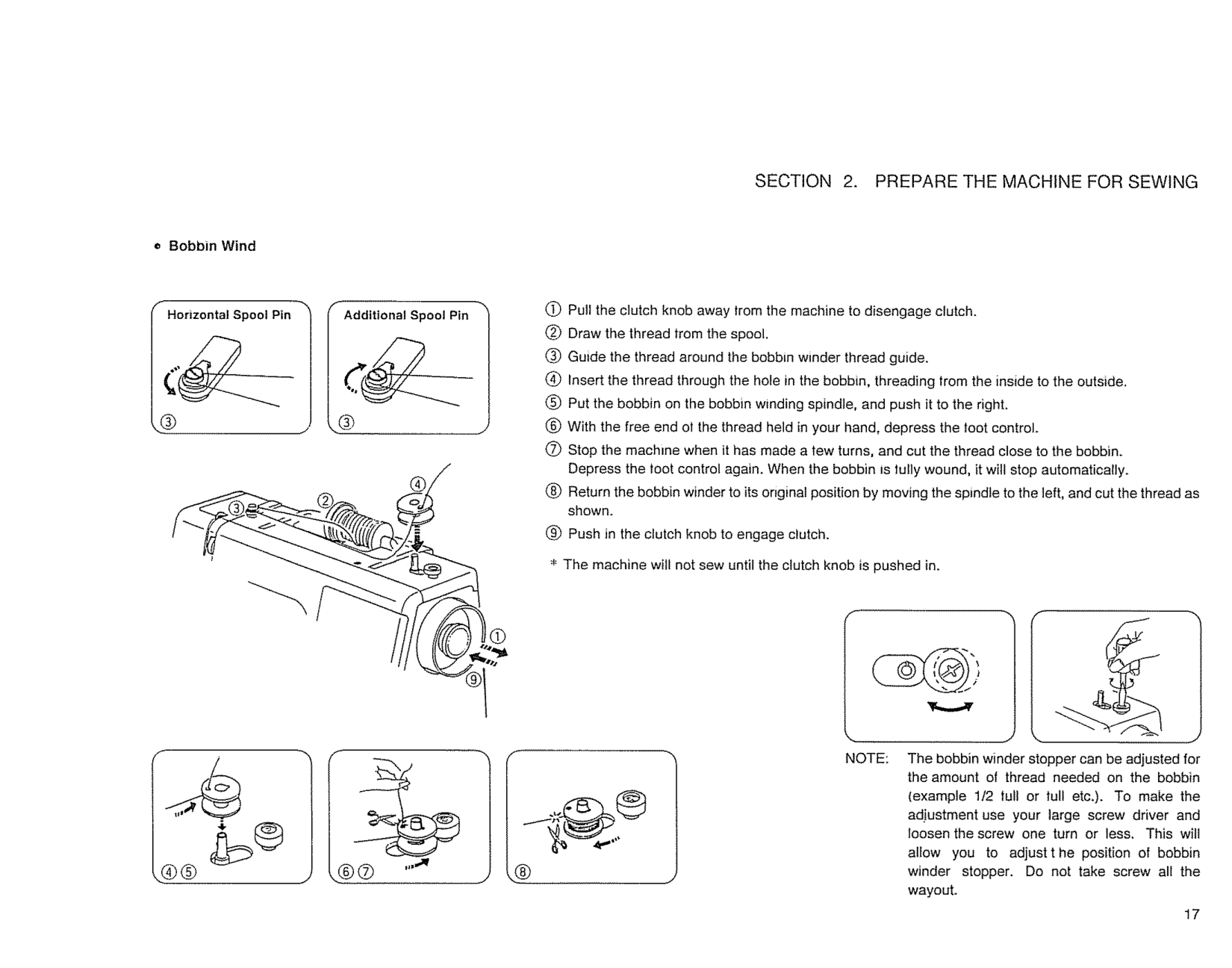
###################### Bobbin Wind
f
(_ Pull the clutch knob away trom the machine to disengage clutch. (_ Draw the thread from the spool, (_ Guide the thread around the bobbin winder thread guide. (_ Insert the thread through the hole in the bobbin, threading lrom the inside to the outside. (_) Put the bobbin on the bobbin winding spindle, and push it to the right. (_ With the free end ol the thread held in your hand, depress the loot control. (_ Stop the mach=ne when it has made a few turns, and cut the thread close to the bobbin.
Horizontal Spool Pin
Additional Spool Pin
Depress the toot control again. When the bobbin Jstully wound, it wilt stop automatically. Return the bobbin winder to its original position by moving the spindle to the left, and cut the thread as shown.
®
(_ Push in the clutch knob to engage clutch.
_" The machine witl not sew until the clutch knob is pushed in.
f
NOTE: The bobbin winder stopper can be adjusted for the amount of thread needed on the bobbin (example t/2 tuli or tult etc.). To make the adiustment use your large screw driver and loosen the screw one turn or less, This will a!low you to adjust t he position of bobbin winder stopper. Do not take screw all the wayout.
®@
(_)0 ,,,,A

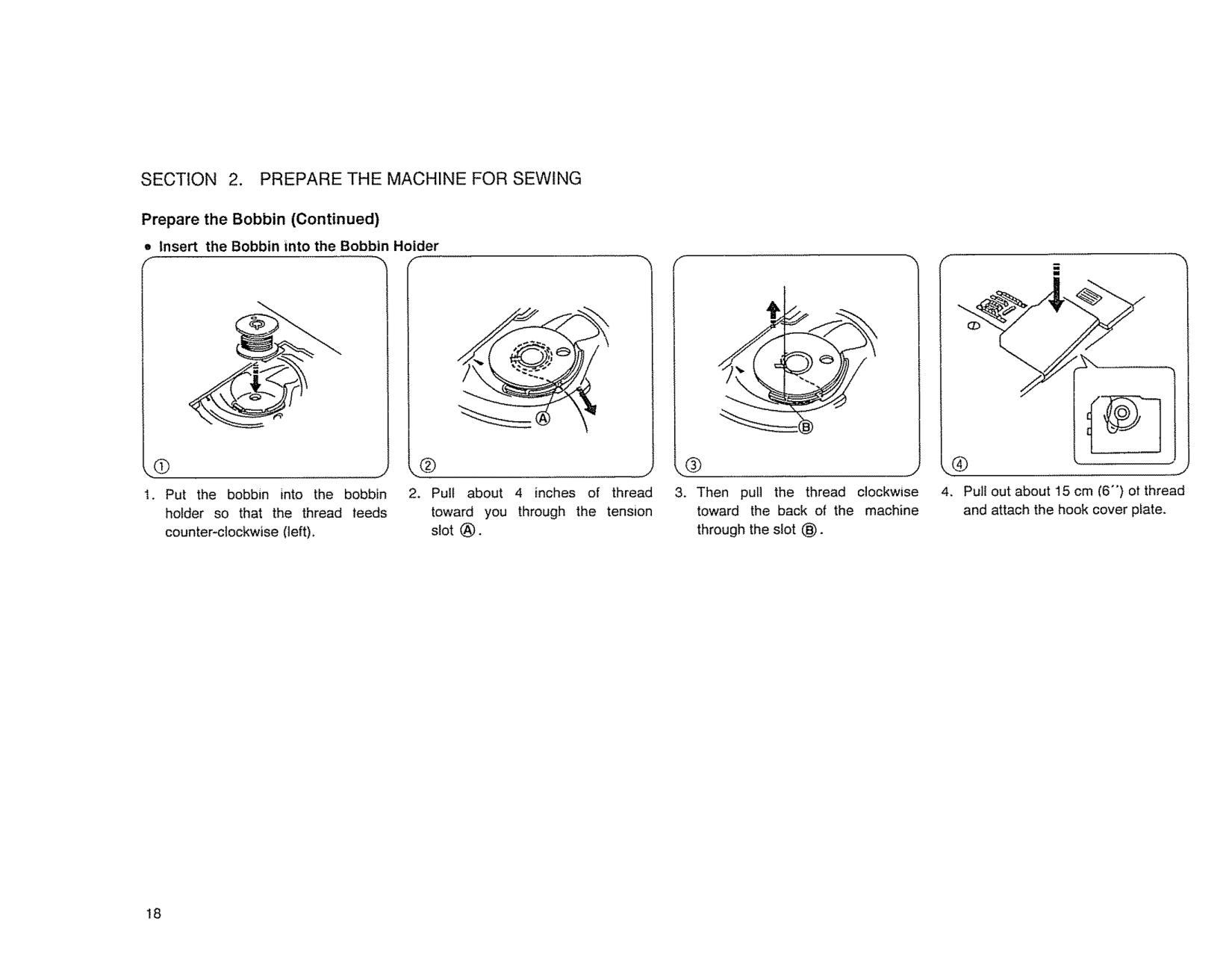
Prepare the Bobbin (Continued) e Insert the Bobbin into the Bobbin Holder
I. Put the bobbin into the bobbin 2. Pult about 4 inches of thread holder so that the thread reeds toward you through the tension counter-clockwise (left). slot @.

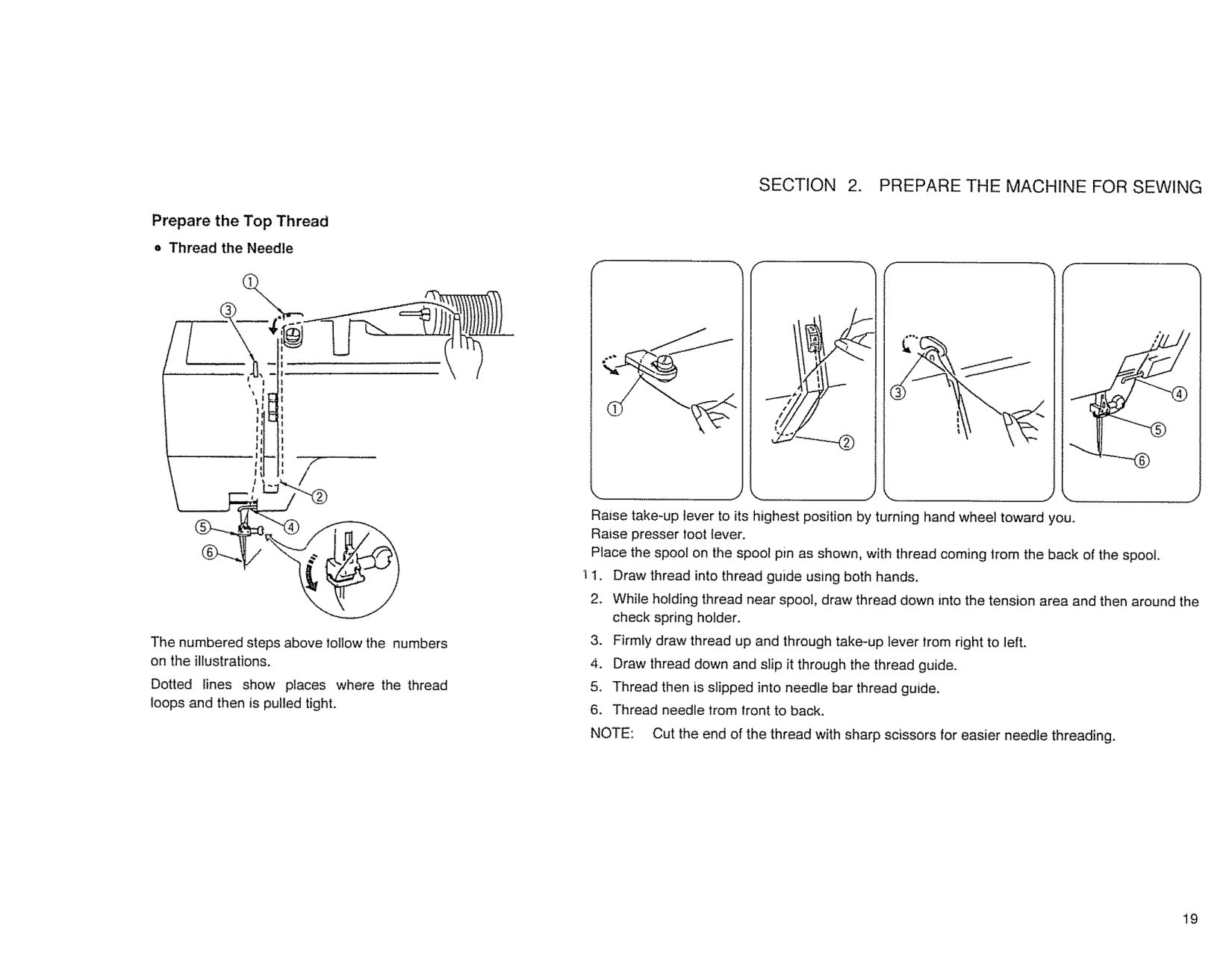
############## Preparethe Top Thread
The numbered steps above follow the numbers
Raise take-up lever to its highest position by turning hand wheel toward you, Raise presser toot lever, Place the spool on the spool pin as shown, with thread coming lrom the back of the spool.
tl.
Draw thread into thread guide using both hands. While holding thread near spool, draw thread down into the tension area and then around the check spring holder. Firmly draw thread up and through take-up lever from right to left. Draw thread down and slip it through the thread guide. Thread then is slipped into needle bar thread guide. Thread needle from front to back.
Dotted lines show places where the thread loops and then is pulled tight.
Cut the end of the thread with sharp scissors for easier needle threading.

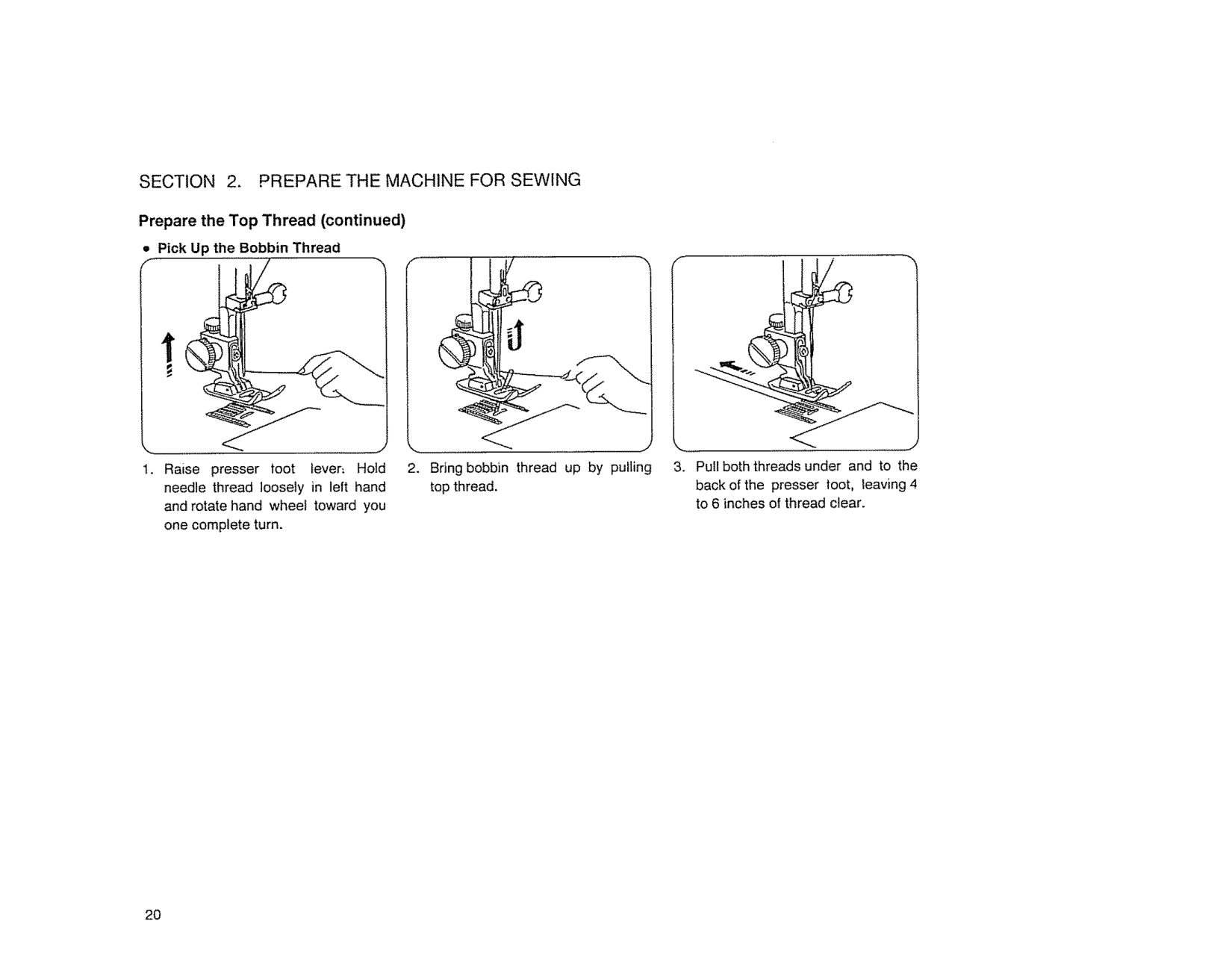
################### Prepare the Top Thread (continued)
##################### • Pick Up the Bobbin Thread
!
k.. ........... ",-._ J
to 6 inches of thread clear.
#################### 2O

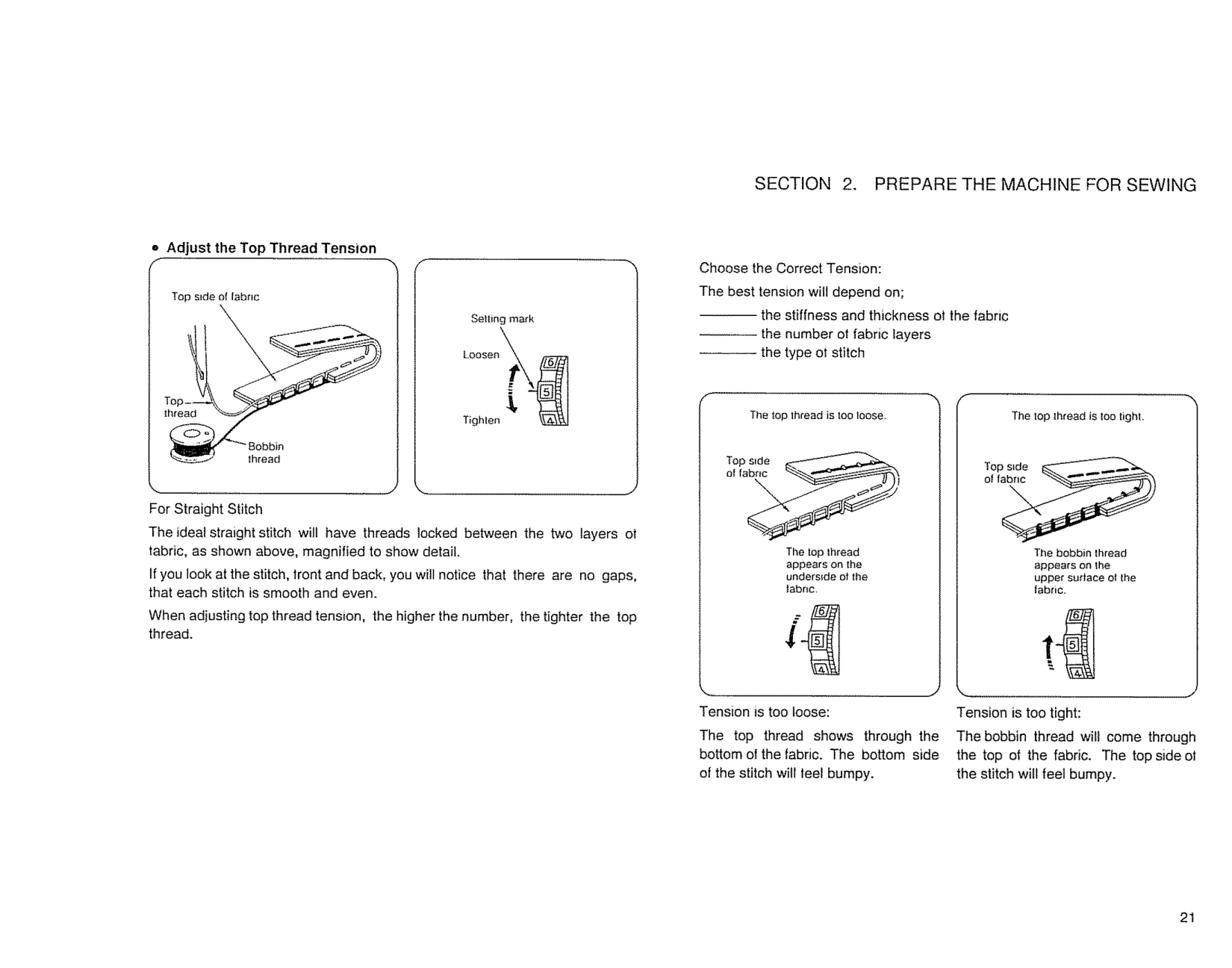
##################### o Adjust the Top Thread Tension
Choose the Correct Tension: The best tension will depend on;
Top side o! labnc
the stiffness and thickness el the fabric the number o! fabric layers the type el stitch
Selling mark
_
The top thread is 1oo loose.
The top lhread is 1oo tight.
Top side of fabr,c __
For Straight Stitch The ideal straight stitch will have threads locked between the two layers ot tabric, as shown above, magnified to show detail. If you look at the stitch, trent and back, you will notice that there are no gaps, that each stitch is smooth and even. When adjusting top thread tension, the higher the number, the tighter the top thread.
The top thread appears on the underside el the tabnc.
The bobbin thread appears on the upper surtace o! the labric.
J
Tension is too loose:
Tension is too tight: The bobbin thread will come through the top of the fabric. The top side el the stitch will feel bumpy.
The top thread shows through the bottom el the tabric. The bottom side of the stitch will reel bumpy.

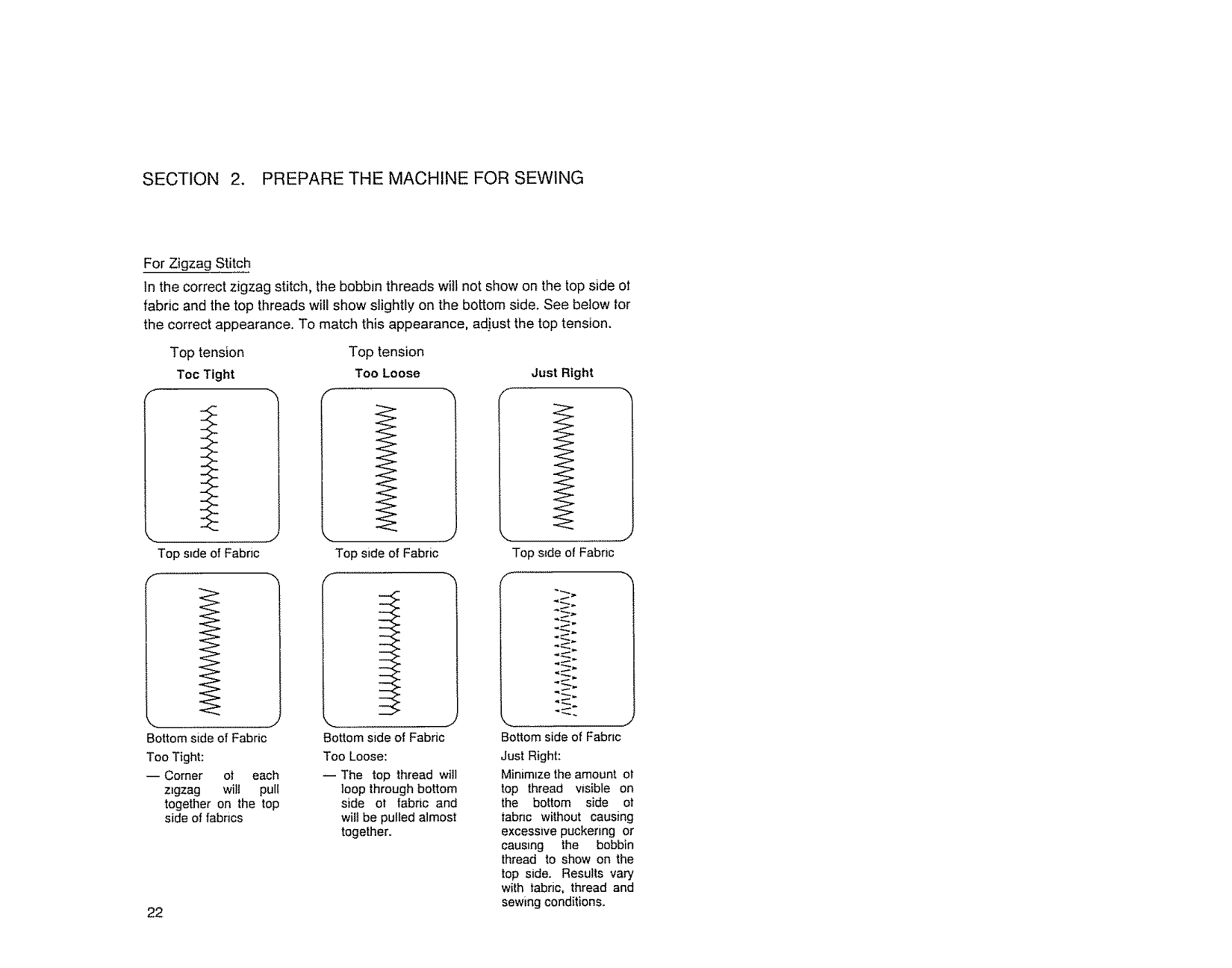
For Zigzag Stitch
in the correct zigzag stitch, the bobbin threads wilt not show on the top side ol fabric and the top threads will show slightly on the bottom side. See below lor the correct appearance. To match this appearance, a_ust the top tension.
Top tension Too Loose Just Right
Top tension Toc Tight
I
%., , ,.- _
Top side of Fabric Top s_de of Fabric
Top s_de of Fabric
f _ f -,,
k_ j j Bottom side of Fabric Bottom side of Fabric Too Loose: Just Right:
Bottom side of Fabric Too Tight:
-- Comer ot each ztgzag will pull together on the top side of fabrics
m The top thread will Minimize the amount ot loop through bottom top thread visible on side ot labric and the bottom side ot will be pulled almost |abnc without causing together, excesslve puckering or
causing the bobbin thread to show on the top side. Results vary with |abric, thread and sewing conditions.
22

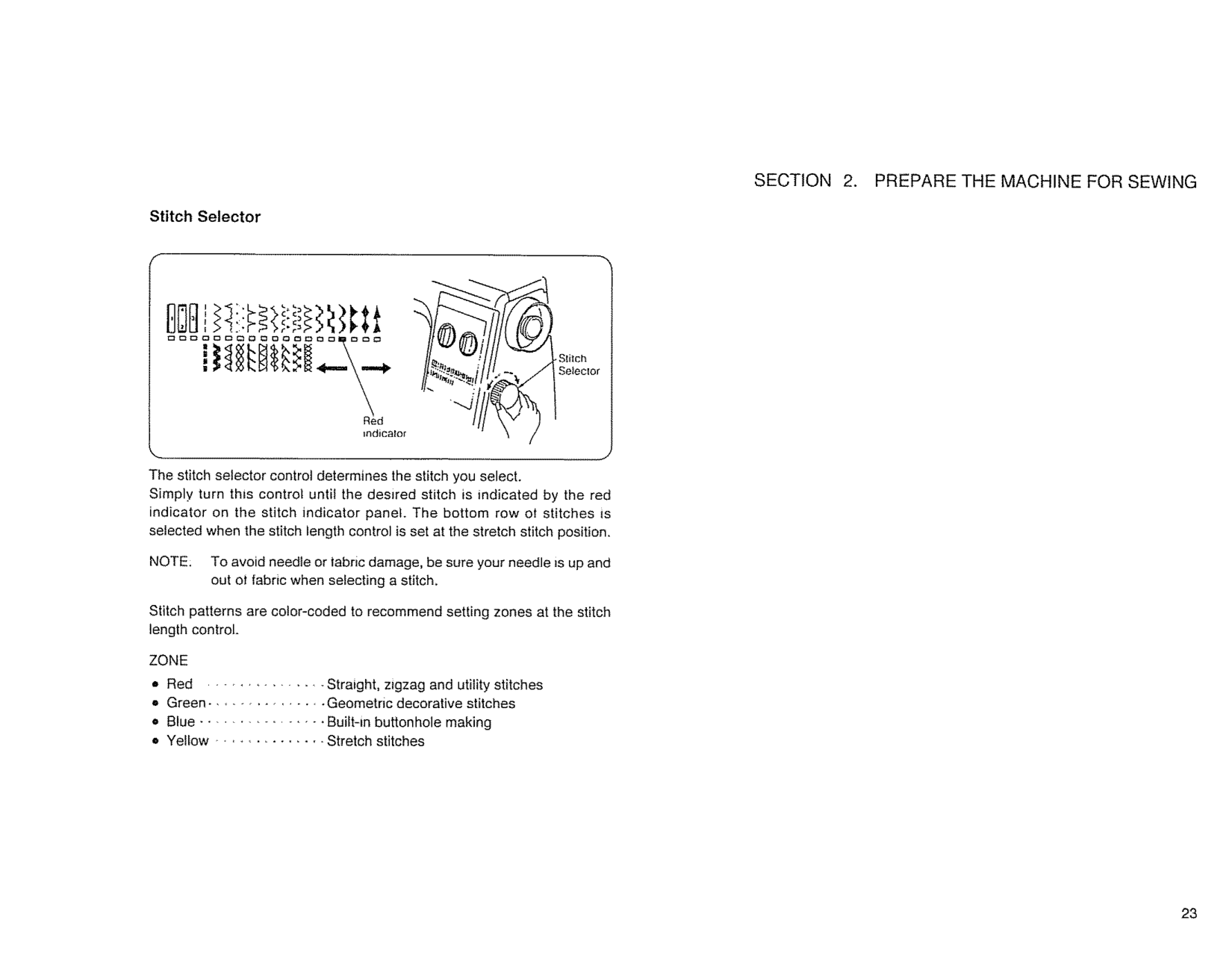
Stitch Selector
Stitch Se[eclor
.........................J
The stitch selector controt determines the stitch you select.
Simply turn this control untii the desired stitch is indicated by the red indicator on the stitch indicator panef. The bottom row ot stitches is selected when the stitch iength control is set at the stretch stitch position.
NOTE: To avoid needle or tabric damage, be sure your needle is up and out ot fabric when selecting a stitch,
Stitch patterns are color-coded to recommend setting zones at the stitch length controL.
ZONE

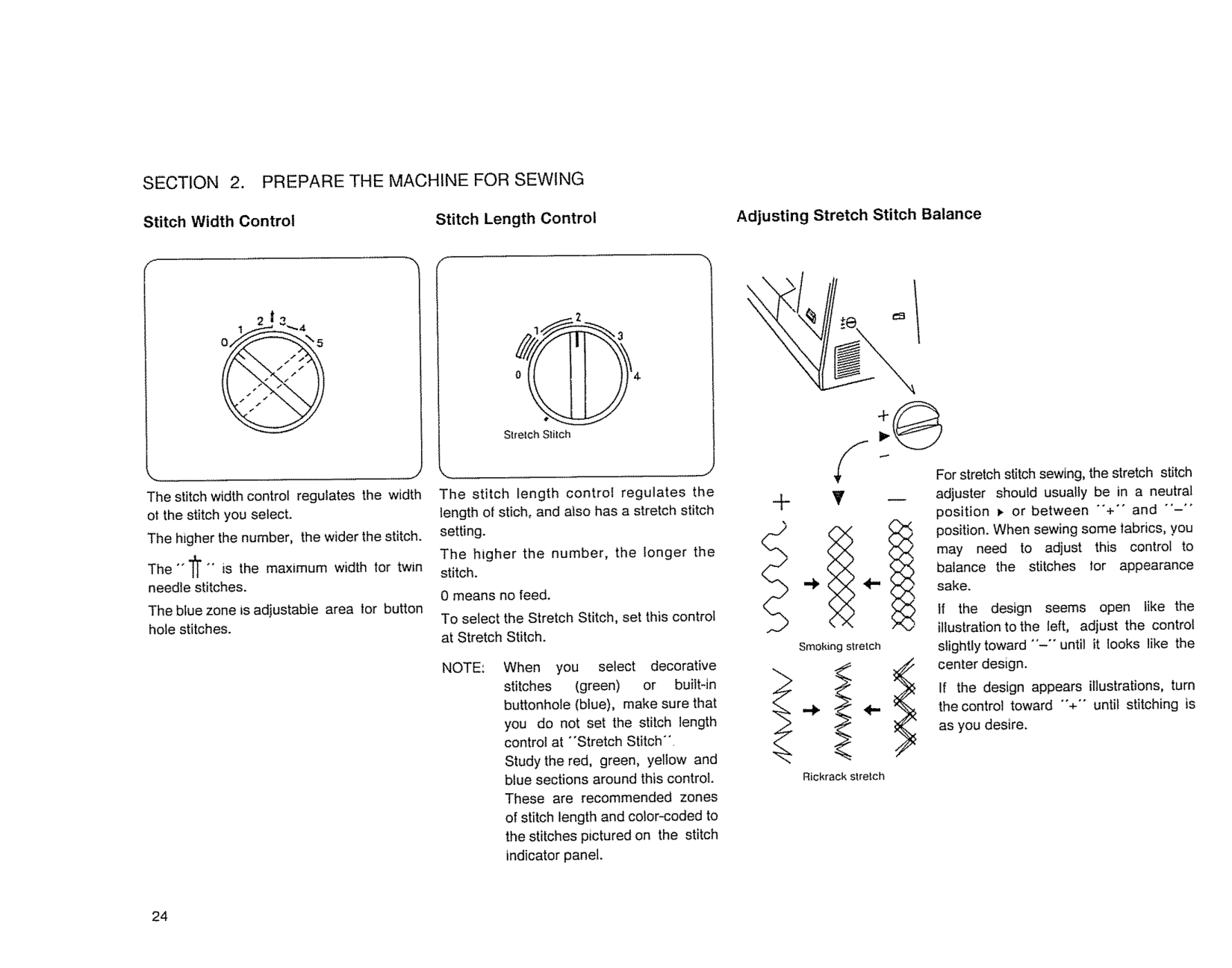
Stitch Width Control Stitch Length Control Adjusting Stretch Stitch Balance
##################### z
S_,relch _;fitch
stretch stitch sewing, the stretch stitch adjuster should usually be in a neutral position _ or between "'+'" and °'-"
stitch width control regulates the width the stitch you select.
The stitch Iength control regulates the length of stich, and also has a stretch stitch setting.
higher the number, the wider the stitch. ""_ "' is the maximum width tot twin
The higher the number, the longer the stitch.
may need to adjust this control to balance the stitches for appearance
needle stitches. blue zone is adjustable area for button stitches.
4"" sake.
0 means no teed.
position. When sewing some _abrics, you
If the design seems open like the illustration to the left, adjust the control slightly toward "'-'" it looks like
select the Stretch Stitch, set this control Stretch Stitch.
Smoking stretch
NOTE: When you select decorative
stitches (green) or built-in buttonhole (blue), make sure that
If the design appears illustrations, turn the control toward "°+" until stitching is as you desire.
do not set the stitch length control at "Stretch Stitch".
center design.
the red, green, yellow and sections around this control.
Rickrack s_,retch
are recommended zones
stitch length and color-coded to stitches pictured on the stitch indicator panel.

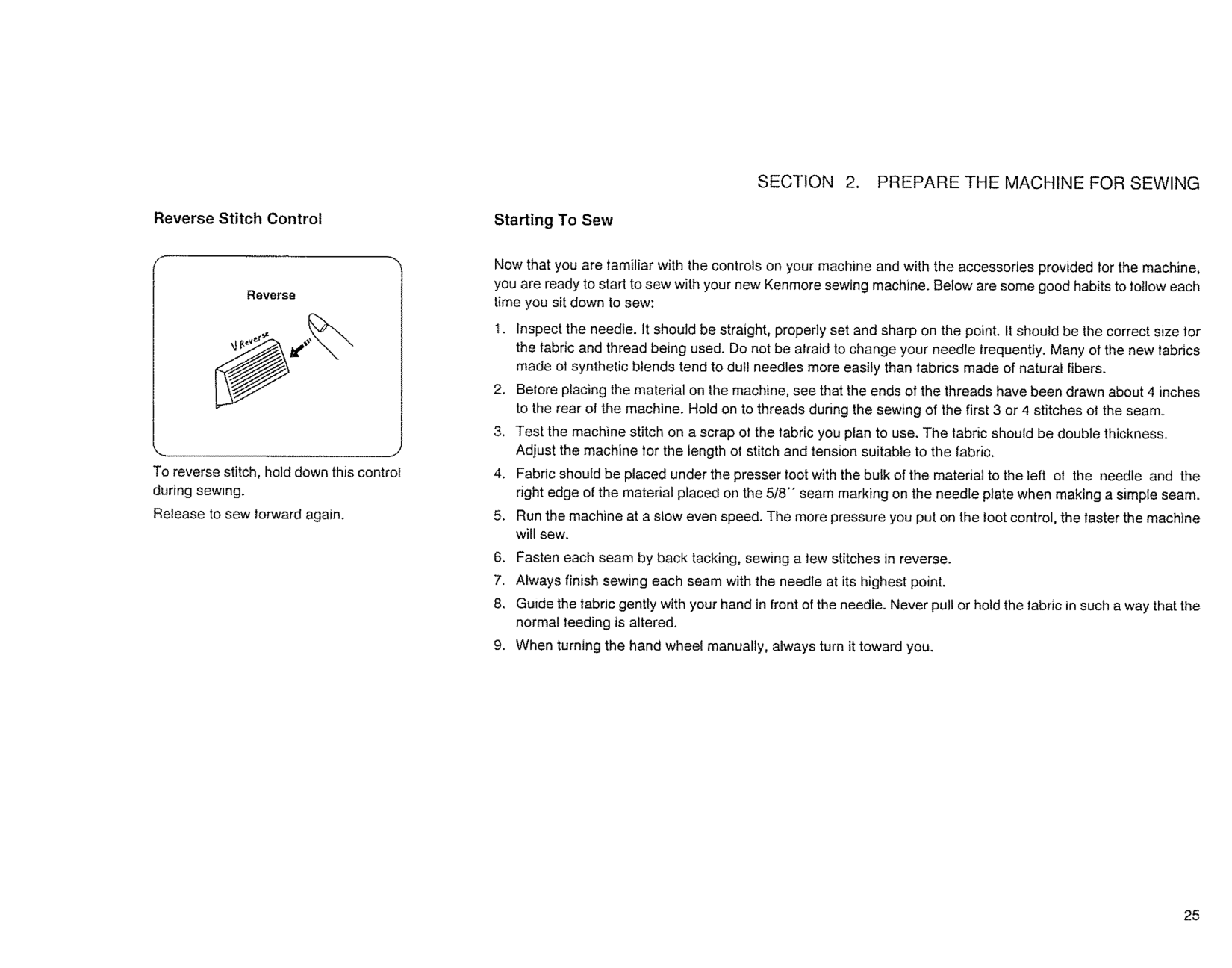
##################### Reverse Stitch Control
Starting To Sew
f
Now that you are familiar with the controls on your machine and with the accessories provided for the machine, you are ready to start to sew with your new Kenmore sewing machine. Below are some good habits to tolfow each time you sit down to sew:
Rev_rs_
t. Inspect the needle. It should be straight, properly set and sharp on the point. It should be the correct size for the fabric and thread being used. Do not be afraid to change your needle frequently. Many of the new fabrics made of synthetic blends tend to dull needles more easily than fabrics made of natural fibers.
To reverse stitch, hold down this control during sewing. Release to sew forward again.

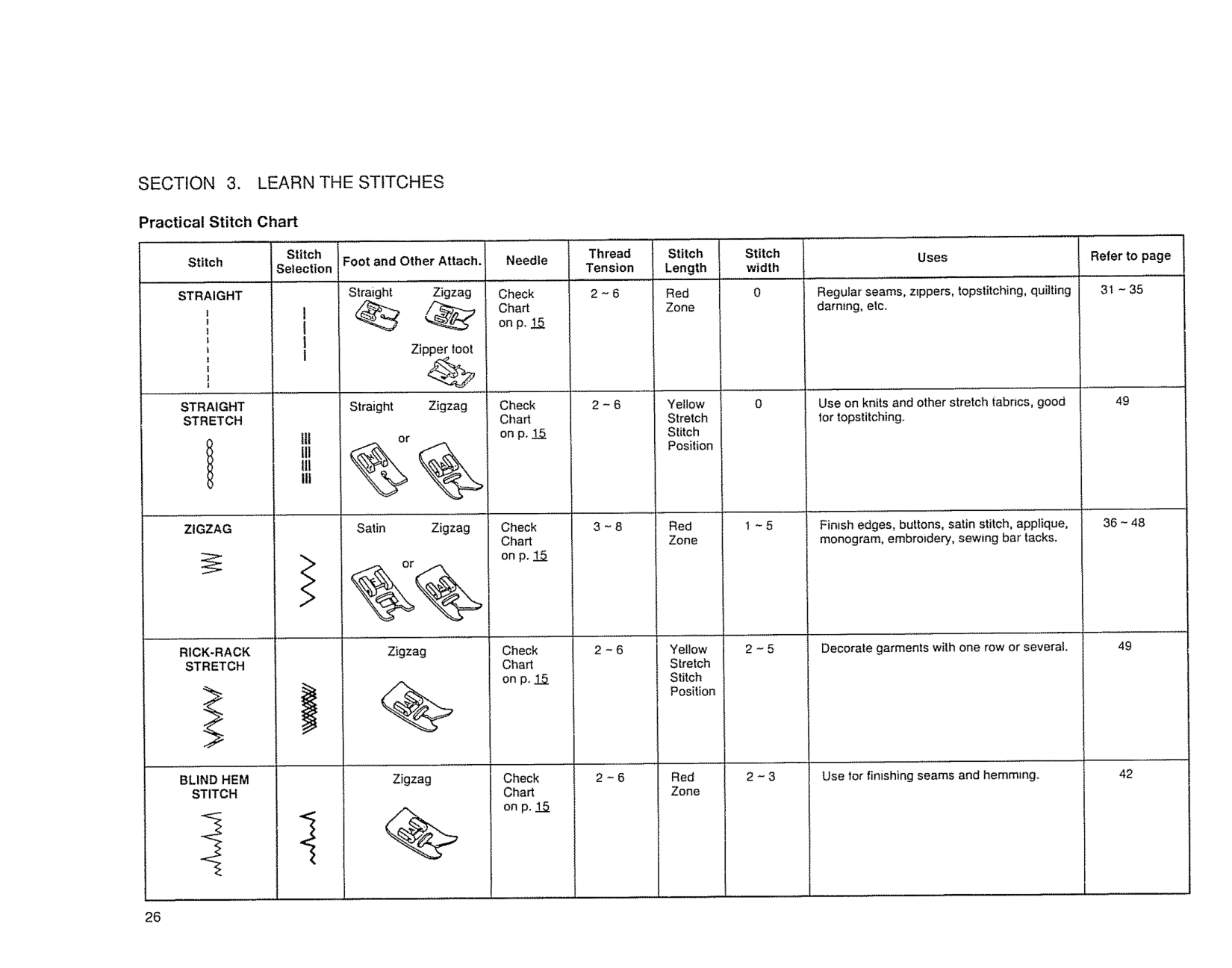
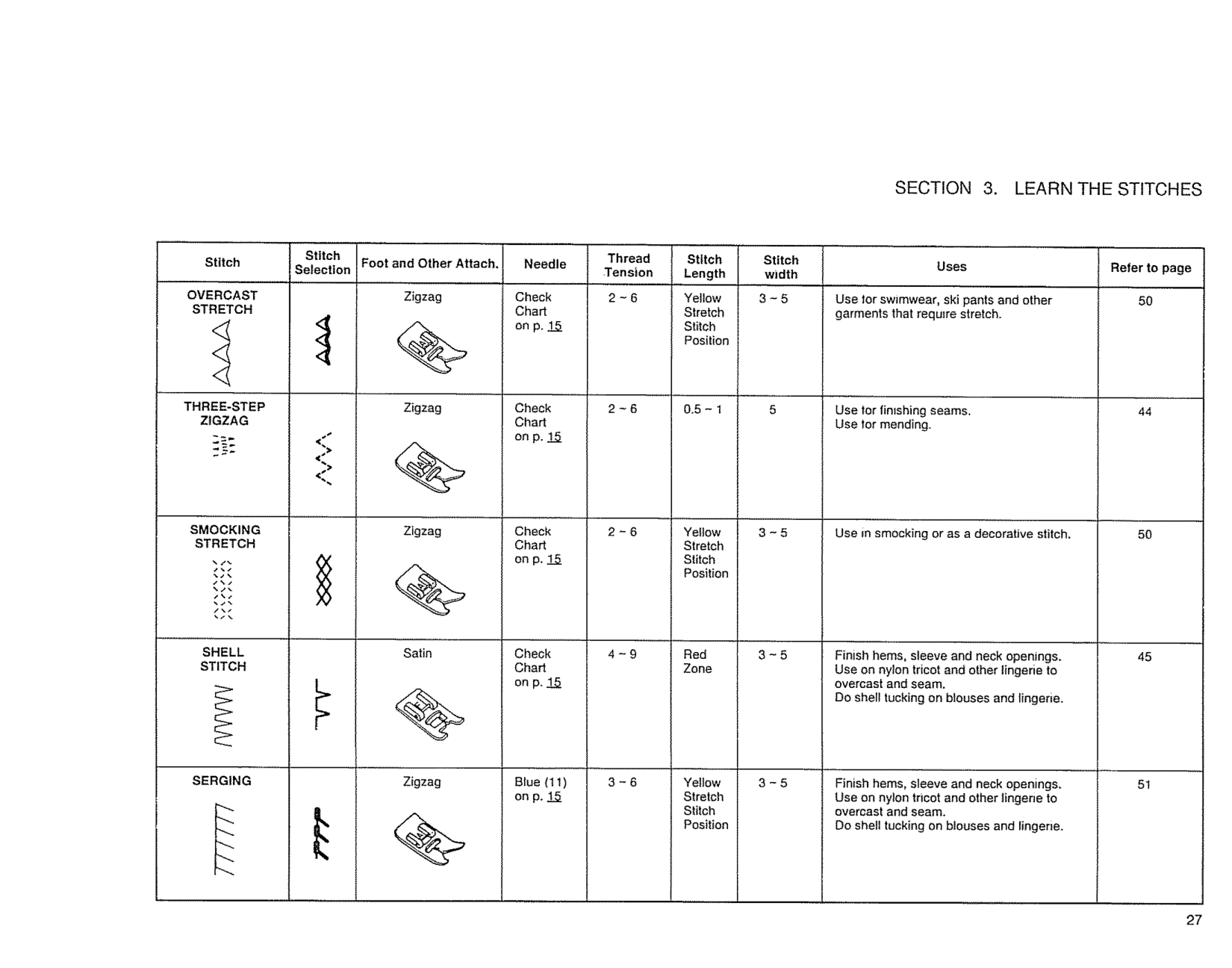
Practical Stitch Chart
Stitch Length
####################### Stitch width
Stitch Selection STRAIGHT
Thread Tension
Reter to page
##################### Needle
Foot and Other Attach.
Stitch
####################### j Uses
3t - 35
2N6
Red Zone
Regular seams, z_ppers, topstitching, quilting darning, etc.
Straight Zigzag
Check Chart onp. 15
I I I I
! J l |
Zipper toot
| | ! 1
49
Use on knits and other stretch {abncs, good for topstitching.
Yetlow Stretch Stitch Position
STRAIGHT STRETCH
Straight
Zigzag Check Chart on p. !__
%%
III Ul III III
or
36 - 48
Red Zone
Finish edges, buttons, satin stitch, applique, monogram, embroidery, sewing bar tacks.
Check Chart on p. 1__
ZIGZAG
Satin Zigzag
49
Decorate garments with one row or several.
2-6
YeiLow Stretch Stitch Position
Check Chart on p. 15
RICK-RACK STRETCH
Zigzag
%
42
Red Zone
Use tot finishing seams and hemmlng.
Check Chart on p. 15
2-6
BLIND HEM STITCH
Zigzag
26

Stitch Thread Stitch Stitch Selection Needle Uses Refer to page=TensionLengthwidth
Foot and Other Attach.
OVERCAST STRETCH
Zigzag
Check 2 - 6 Yellow 3 - 5 Use tor swimwear, ski pants and other 50 garments that require stretch.
%
Chad on p° 1_
Stretch Stitch Position
THREE-STEP ZIGZAG
Check Chart on p. 15
2-6
Zigzag
0.5- t
5
5O
Use tot fintshing seams. Use tot mending.
############# <,
,€
SMOCKING STRETCH
Check Chart on p. 15
Zigzag
4-9
Yettow Stretch Stitch Position
3-5
Use in smocking or as a decorative stitch.
%
####################### SHELL STITCH
Red Zone
Satin
Check Chart on p. 15
3-5
Finish hems, sleeve and neck openings. Use on nylon tricot and other lingerie to overcast and seam. Do shell tucking on blouses and lingerie.
SERGING
3-5
Zigzag
Blue (1 t) on p. 15
Yellow Stretch Stitch Position
51
Finish hems, sleeve and neck openings. Use on nylon tricot and other lingene to overcast and seam.
%
tkI"
Do shell tucking on blouses and lingerie.

Stitch Selection
Stitch width
##################### Stitch Length
Thread Tension
####################### Refer to page
Uses
Foot and Other Attach.
Needle
Stitch
5t
3-5
Use for overlapping seams.
Check Chart on p. t5
3-8
Red Zone
BOX STITCHING
Zigzag
%
Yellow Stretch Stitch Position
3-5
Use tor applying elastic.
ELASTIC STRETCH
Check Chart onp. 15
Zigzag
%
########## J> >
Join two _otded edges tot decorative open-work appearance.
Check Chart onp. 15
3-8
0.5 - 2
5
FAGOTING
Zigzag
%
52
Check Chart onp. I_
Yellow Stretch Stitch Position
5
Use tot patchwork quilting and patching.
STRETCH PATCHING
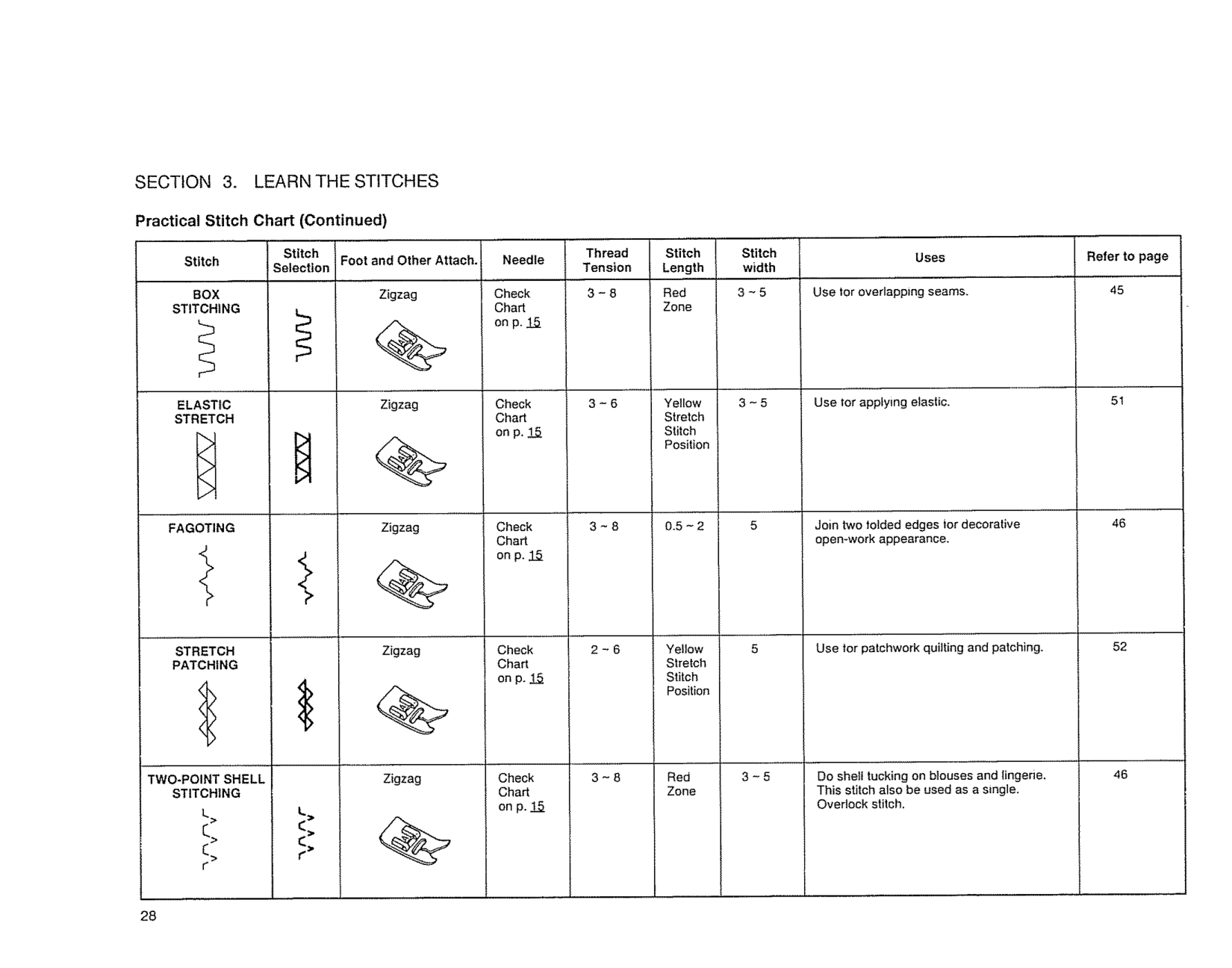
Zigzag
%
>
<>
46
Red Zone
3-5
Do shell tucking on blouses and lingene, This stitch also be used as a single. Overtock stitch.
Check Chart on p. 15
TWO-POINT SHELL STITCHING
Zigzag
L

Stitch Selection
Thread Tension
Stitch Stitch Length width Yellow
Stitch
Foot and Other Attach.
Needle
Uses
####################### Refer to page
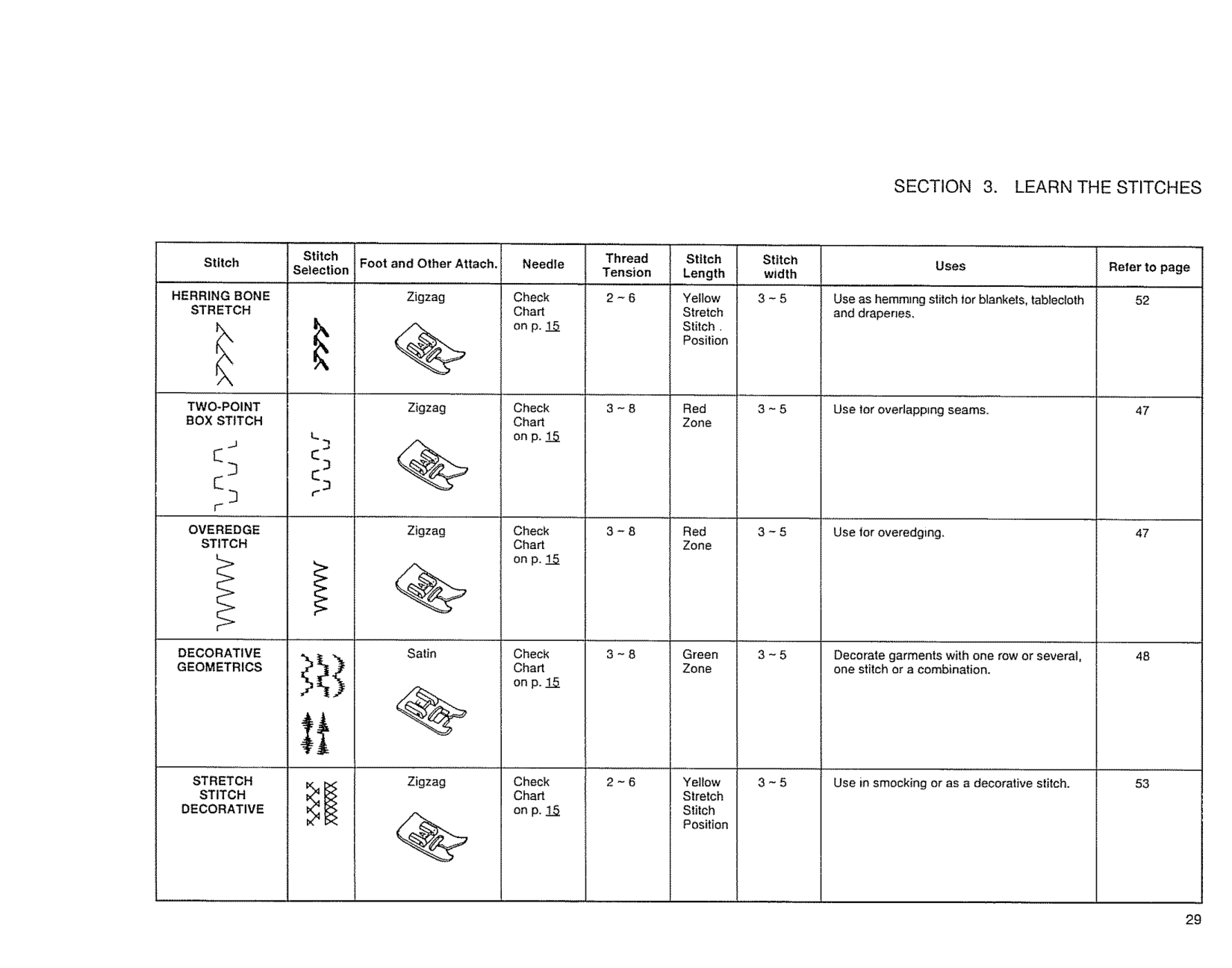
HERRING BONE STRETCH
Check Cha_ on p. 15
2-6
3-5
Zigzag
Use as hemming stitch for blankets, tablecloth and d_penes,
52
%
Stretch Stitch Position
x, x, X
TWO*POINT BOX STITCH
Check Cha_ on p, 15
Red Zone
Zigzag
3-5
Use tot ovedappJng seams.
47
%
t_
.J
r-
OVEREDGE STITCH
Check Cha_
3-8
Zigzag
Red Zone
3-5
Use |or overedging.
on p. 15
DECORATIVE GEOMETRICS
Satin
Check Cha_ on p. 15
3-8 Green Zone
3-5
Decorate garments with one row or several, one stitch or a combination.
%
STRETCH STITCH
Check Chad onp._
2-6 Yellow Stretch Stitch Position
3-5
Zigzag
Use in smocking or as a decorative stitch. 53
DECORATIVE

Stitch 'Selection
Stitch width
Thread Tension
Stitch
Refer to page
####################### Uses
Foot and Other Attach. Needle
Stitch
####################### Length
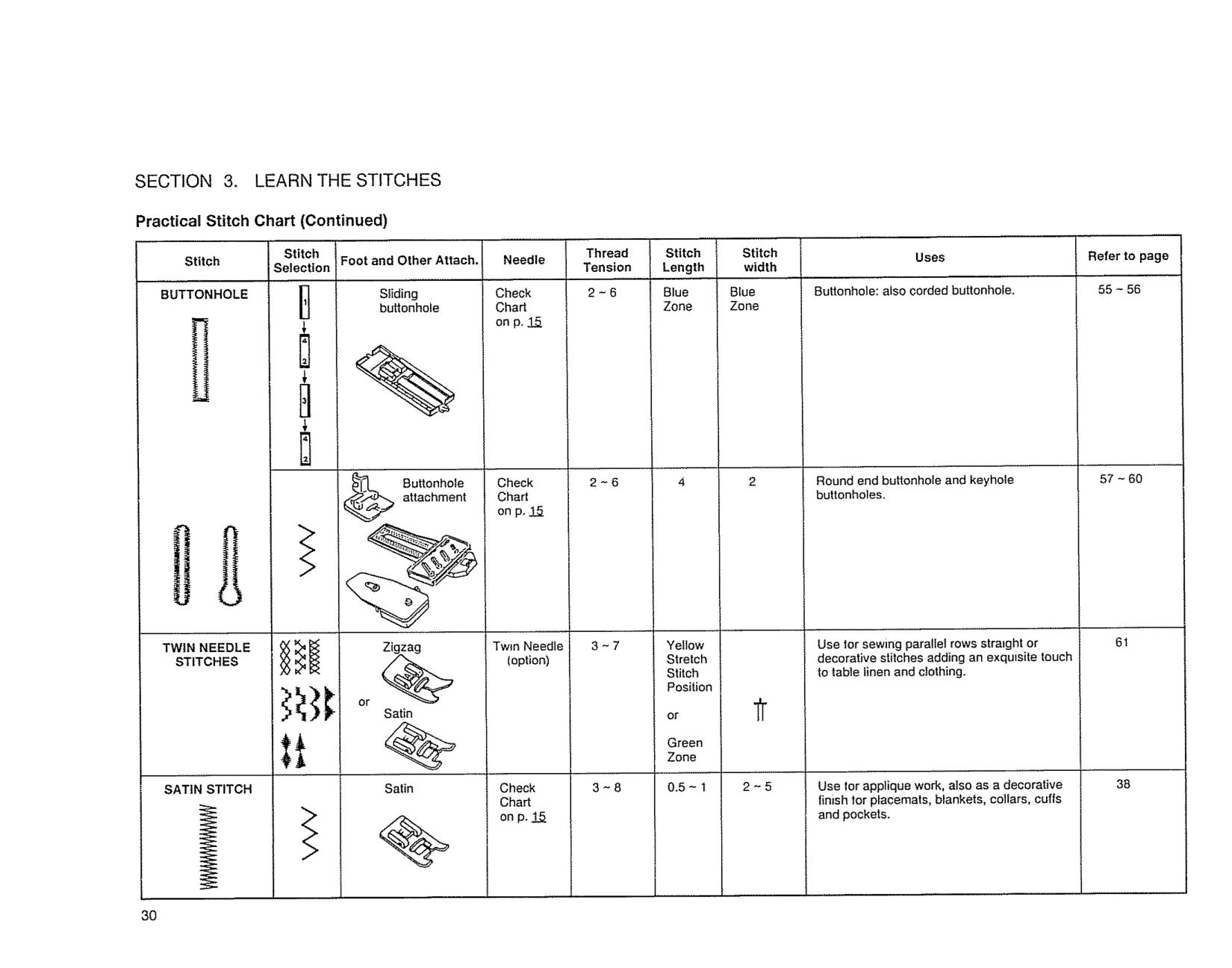
55 - 56
Buttonhole: a_so corded buttonhole.
Blue Zone
Check Chart onp. 1_
2-6
Blue Zone
BUTTONHOLE
Sliding buttonhole
57 - 60
4
2
Round end buttonhole and keyhole buttonholes.
Check Chart onp. t5
attachment
Buttonhole
######### 0
6t
Use lor sewing parallel rows straight or decorative stitches adding an exquisite touch to table linen and clothing.
Twin Needle
Yellow Stretch Stitch Position
TWiN NEEDLE STITCHES
####################### (option)
######### ir
%
Satin
or
Green Zone
38
2-5
Check Chart onp. 15
0.5- t
Use lor applique work, also as a decorative finish lor placemats, blankets, collars, cuffs and pockets.
SATIN STITCH
Satin

Straight Stitches
o Straight Stitch f
##################### • Use the Seam Guides ,,..-
Set the Machine
######## !
Stitch w_dth control 0
Comenng guide
Top thread tension control 2 to 6
The seam guides on the needle plate are engraved to help you measure seam width. The lines are 1t8"" apart, with the 5/8"" and 7/8 °" lines marked.
Slitch tength controt red Zone
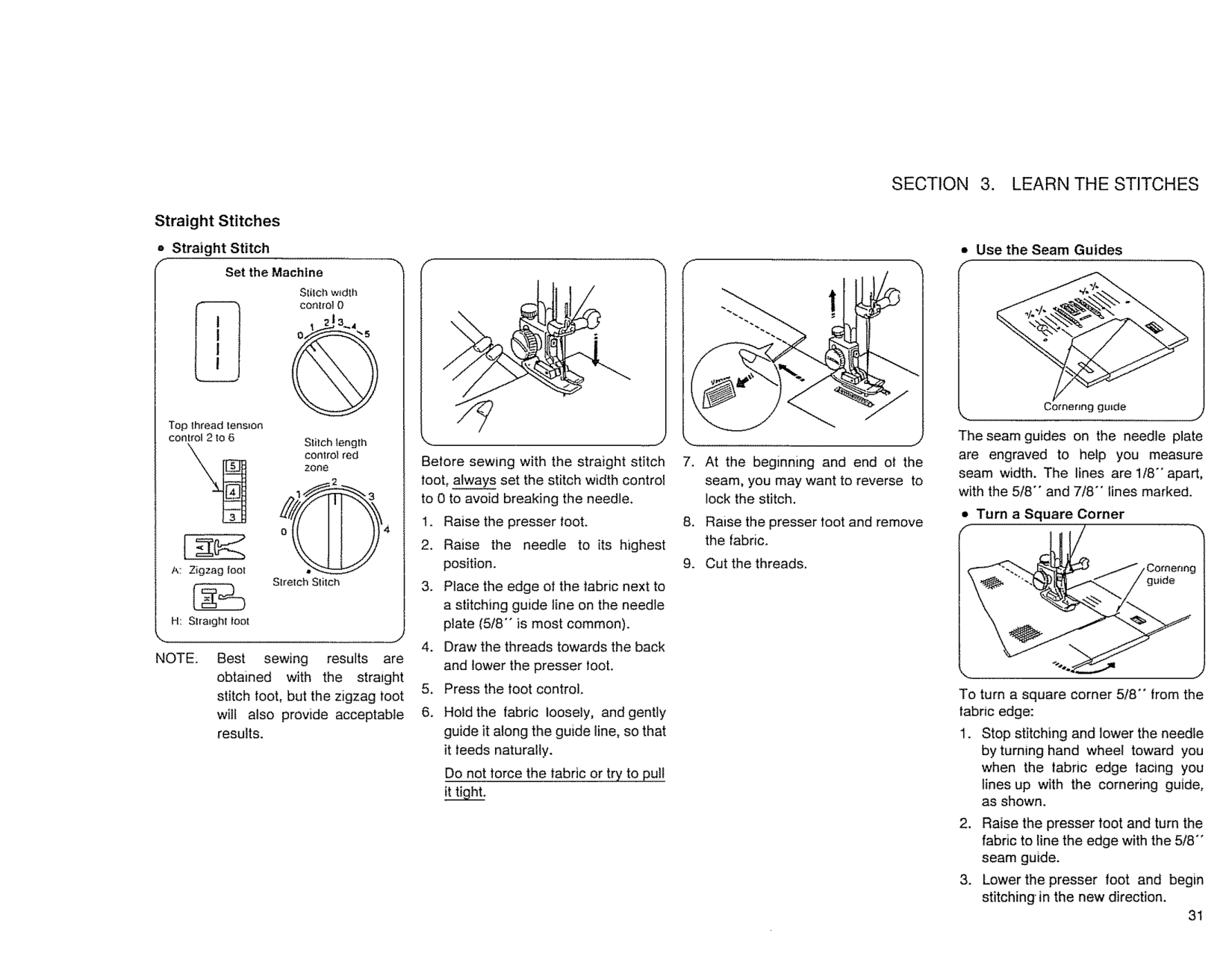
J Betore sewing with the straight stitch loot, always set the stitch width control to 0 to avoid breaking the needle,
At the beginning and end of the seam, you may want to reverse to lock the stitch.
2
##################### • Turn a Square Corner
Raise the presser toot and remove the fabric.
Cut the threads,
A: Zigzag foot
Stretch Stitch
guide
H: Slralgh! loot
J
NOTE Best sewing results are obtained with the straight stitch loot, but the zigzag toot witf also provide acceptable results.
To turn a square corner 5/8- from the fabric edge:

• Topstitching
Set the Machine
Stitch w_dth
_ contro__
Top thread tension control 2 to 6
Stitch length control red ZORO
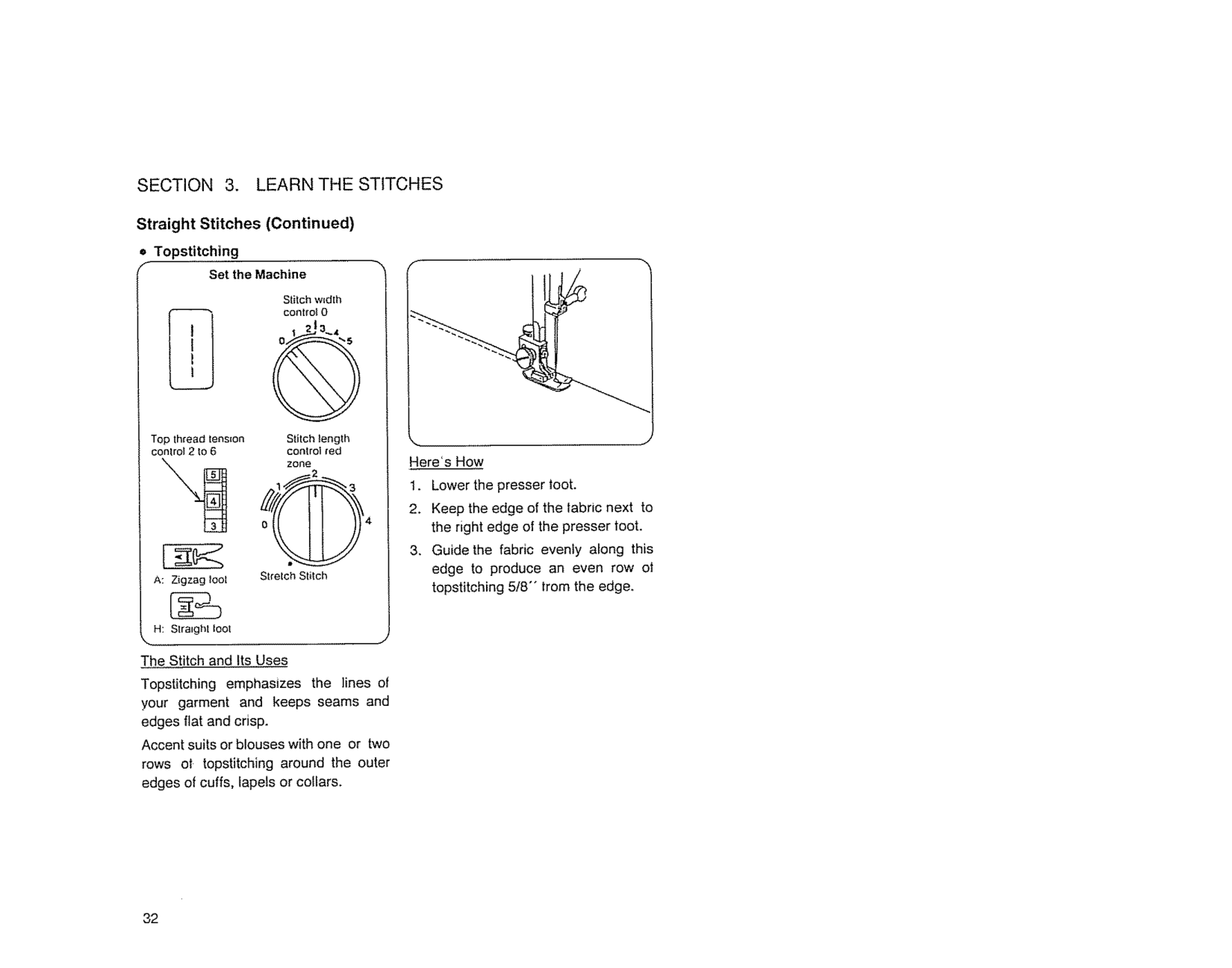
Here's How
the right edge of the presser toot.
Stretch Stitch
A: Zigzag loot
H: Straight toot
The Stitch and Its Uses
Topstitching emphasizes the lines of your garmenL and keeps seams and edges flat and crisp.
Accent suits or blouses with one or two rows ol topstitching around the outer edges of cuffs, lapels or collars,

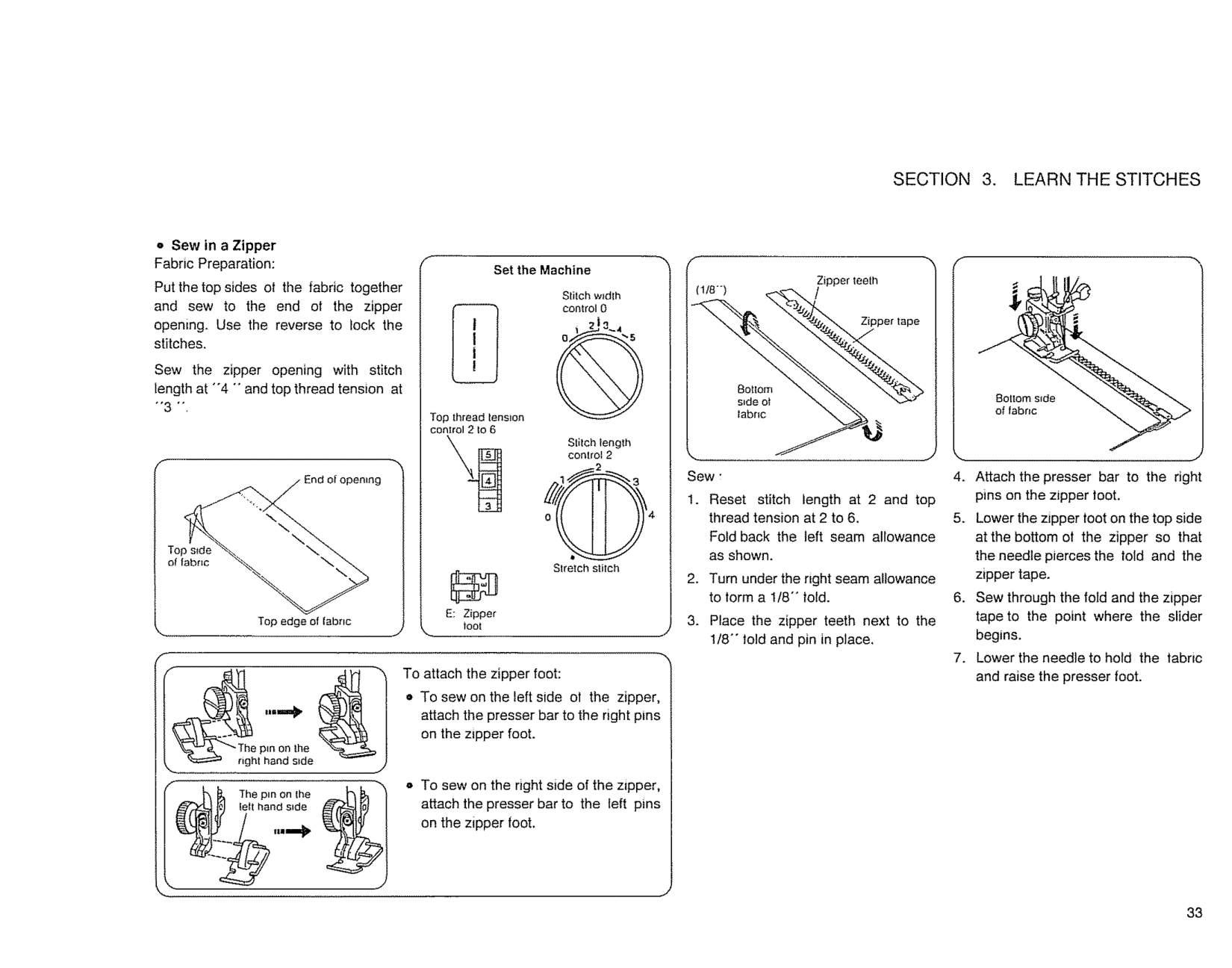
Put the top sides o! the fabric together and sew to the end ot the zipper
####################### Set the Machine
ipper
Slitch w_dth control 0
Zipper tape
Sew the zipper opening with stitch length at -4 ""and top thread tension at
8ottom s_de of fabric
Top thread tension control 2 to 6
Stitch length control 2
Sew •
End of opemng
Top side of fabric
Stretch stitch
E: Zipper loot
Top edge of fabric J
To attach the zipper foot:
"_"_ _"" The pm on the right hand side
[he pin On the felt hand s_de
33

f
Top s_de o! Iabnc
of fabric
Top s_de of labr_c
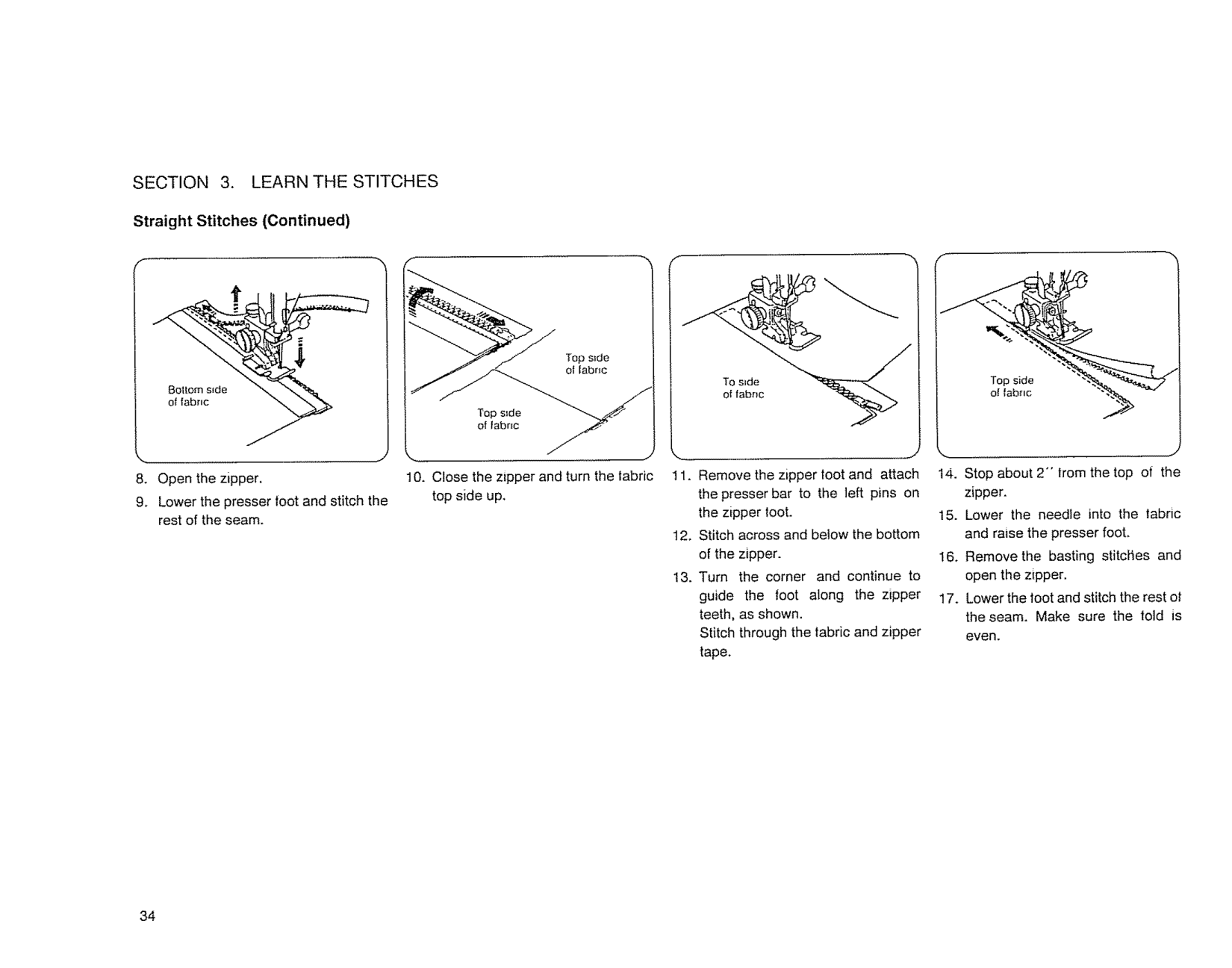
k. lO. Close the zipper and turn the fabric
top side up,
I6, Remove the basting stitches and open the zipper.
34

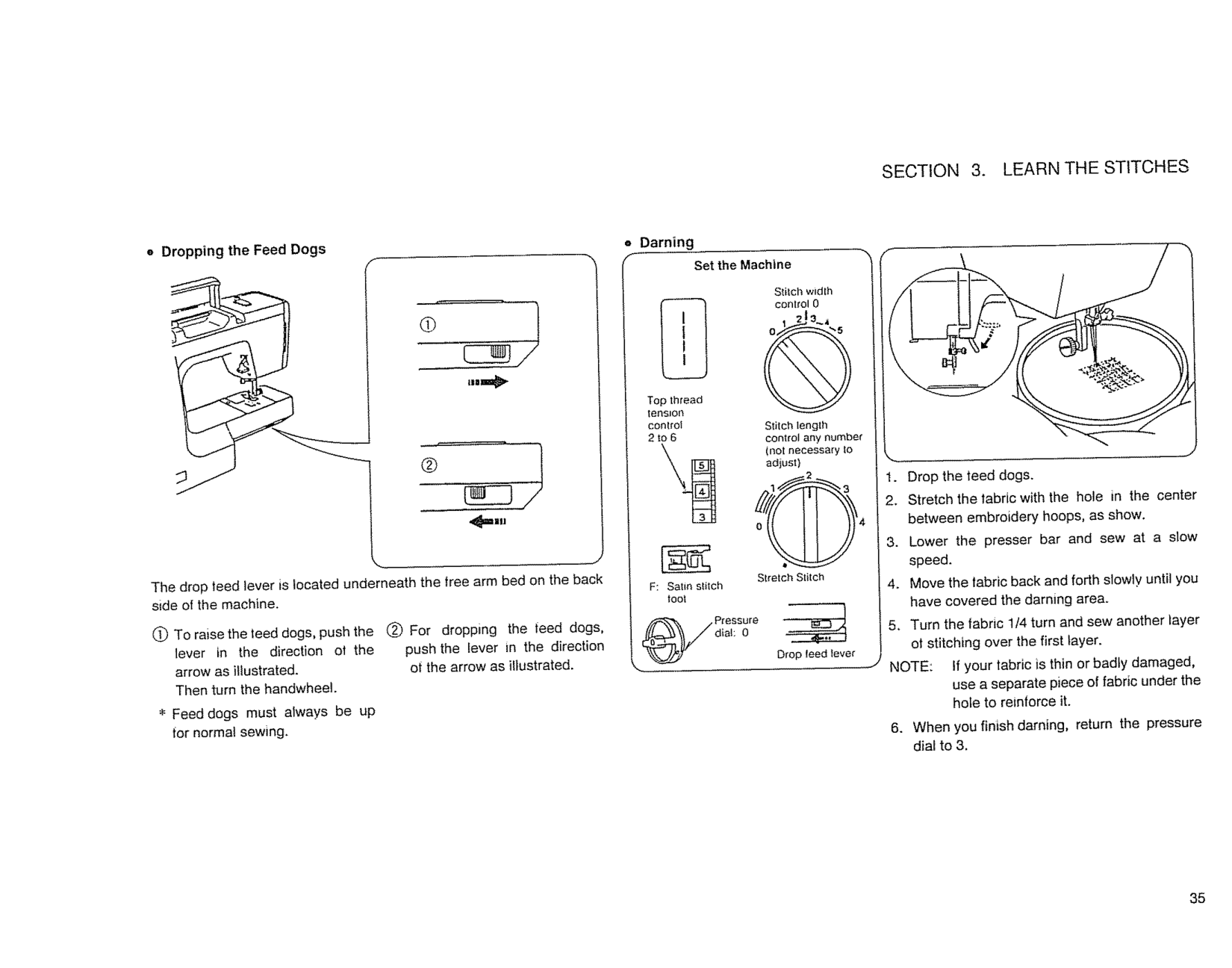
Dropping the Feed Dogs
Darning
##################### the Machine
widlh
Top thread tension control 2to6
I
length
any number necessary
Drop the teed dogs. Stretch the fabric with the hole in the center between embroidery hoops, as show. Lower the speed. Move the fabric back and forth slowly have covered the darning area. Turn the fabric 1/4 turn and sew another of stitching over the first layer.
stitch
################ ---7
To raise the teed dogs, push the
(_ For dropping the teed dogs, push the lever in the direction arrow as illustrated.
Pressure
in the direction ol the as illustrated.
Drop leed fever
your fabric is thin or badty damaged,
turn the handwheel. Feed dogs must always be up
separate piece of fabric hote to reinforce it. you finish
normal sewing.

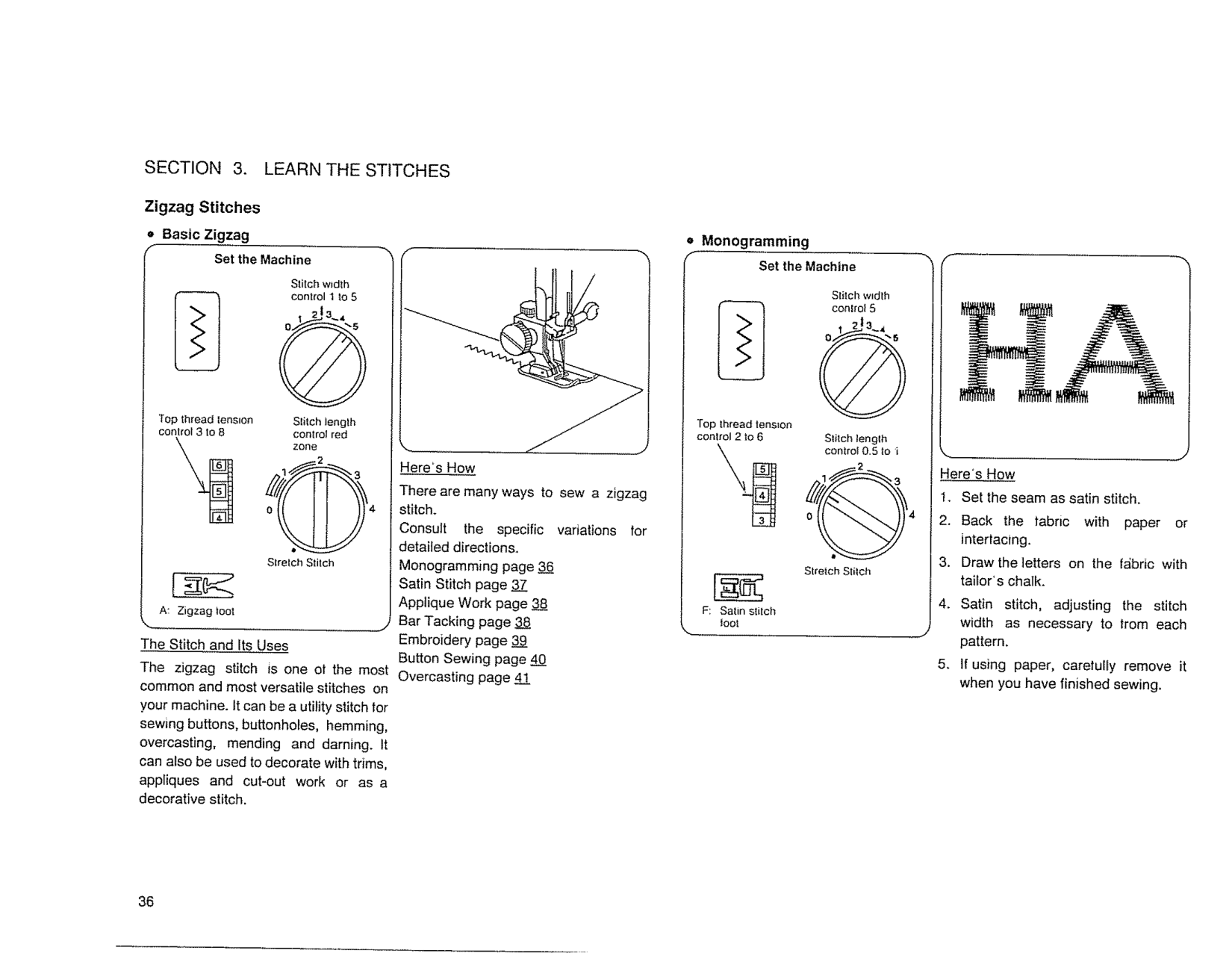
################### Zigzag Stitches
##################### Basic Zigzag the Machine
##################### Monogramming Set the Machine
######################## w_dth
Sti_.ch conl_oI 5
control 1 lo 5
Top thread tension conlroI 2 to 6
TOp thread lens_on control 3 to 8
Iength control red
length
control 0.5 to i 2
Here's How There are many ways to sew a zigzag stitch. Consult the specific variations for detailed directions. Monogramming page 3_.6. Satin Stitch page 37 Apptique Work page 38 Bar Tacking page 38 Embroidery page 3.3_9_ Button Sewing page 4(3 Overcasting page 451
Here's How Set the seam Back the fabric with paper interfacing. Draw the letters taitor's chalk. Satin stitch, adjusting width as necessary to lrom each pattern. If using remove when you have finished sewing.
Stretch Stitch
Stretch Stilch
F: Satin stitch
A: Zigzag toot
!ool
Stitch and Its Uses
zigzag stitch is one ot the most common and most versatile stitches on your machine, it can be a utility stitch for sewing buttons, buttonholes, hemming, overcasting, mending and darning. It
also be used to decorate with trims, appliques and cut-out work or as a decorative stitch.

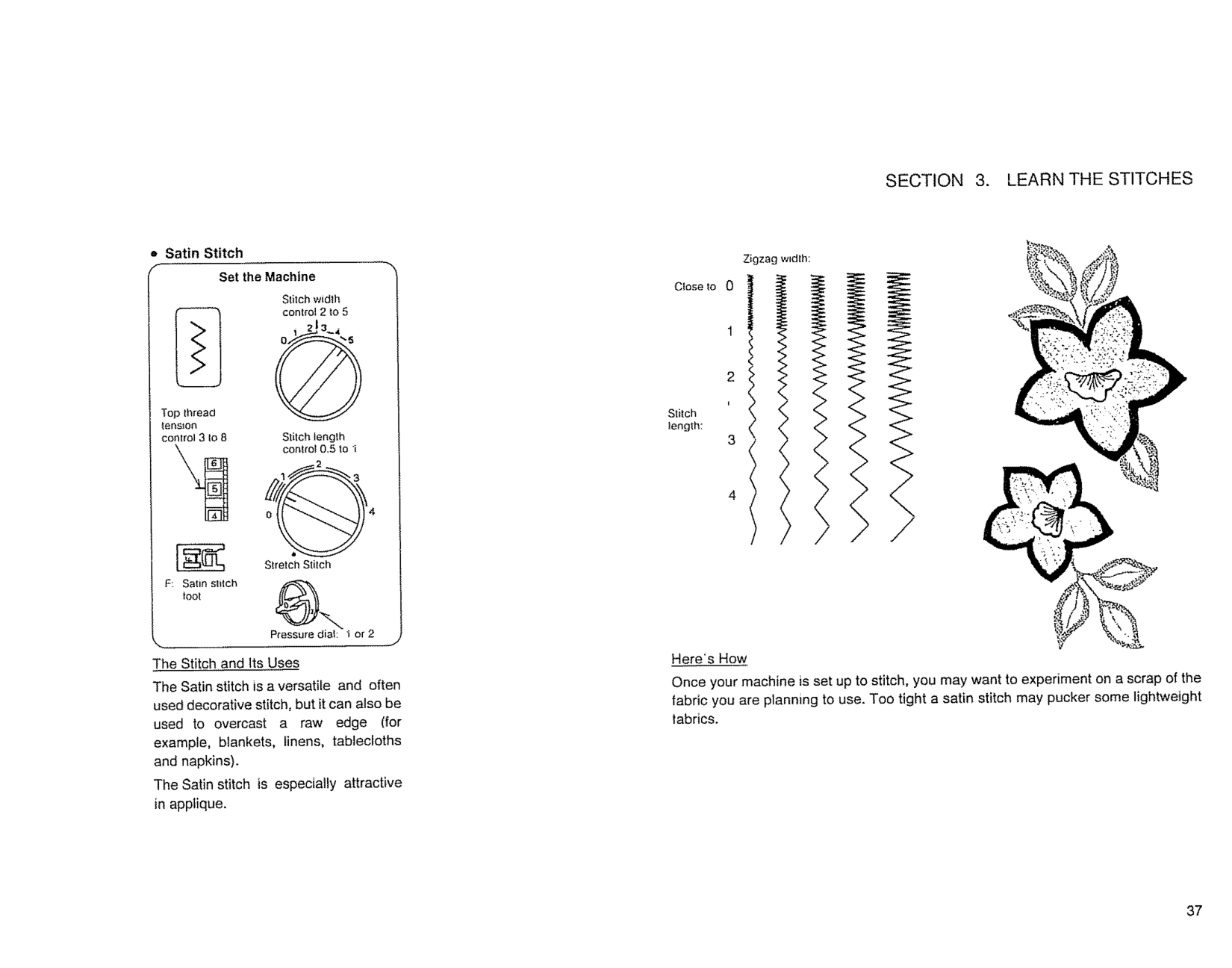
Satin Stitch
width: Closeto 0
##################### the Machine
widlh
> >
thread
_
tenston control 3 to 8 length
0.5 to i
>
>
((
#### >
/
Stitch
Satin slttch 1ool
Pressure dial: or 2 Stitch and Its Uses Satin stitch is a versatile and often
Here's How
your machine is set up to stitch, you may want to experiment on a scrap of the you are planning to use. Too tight a satin stitch may pucker some lightweight labdcs.
decorative stitch, but it can also be to overcast a raw edge {'for
example, blankets, linens, tablecloths napkins). Satin stitch is especially attractive
applique,

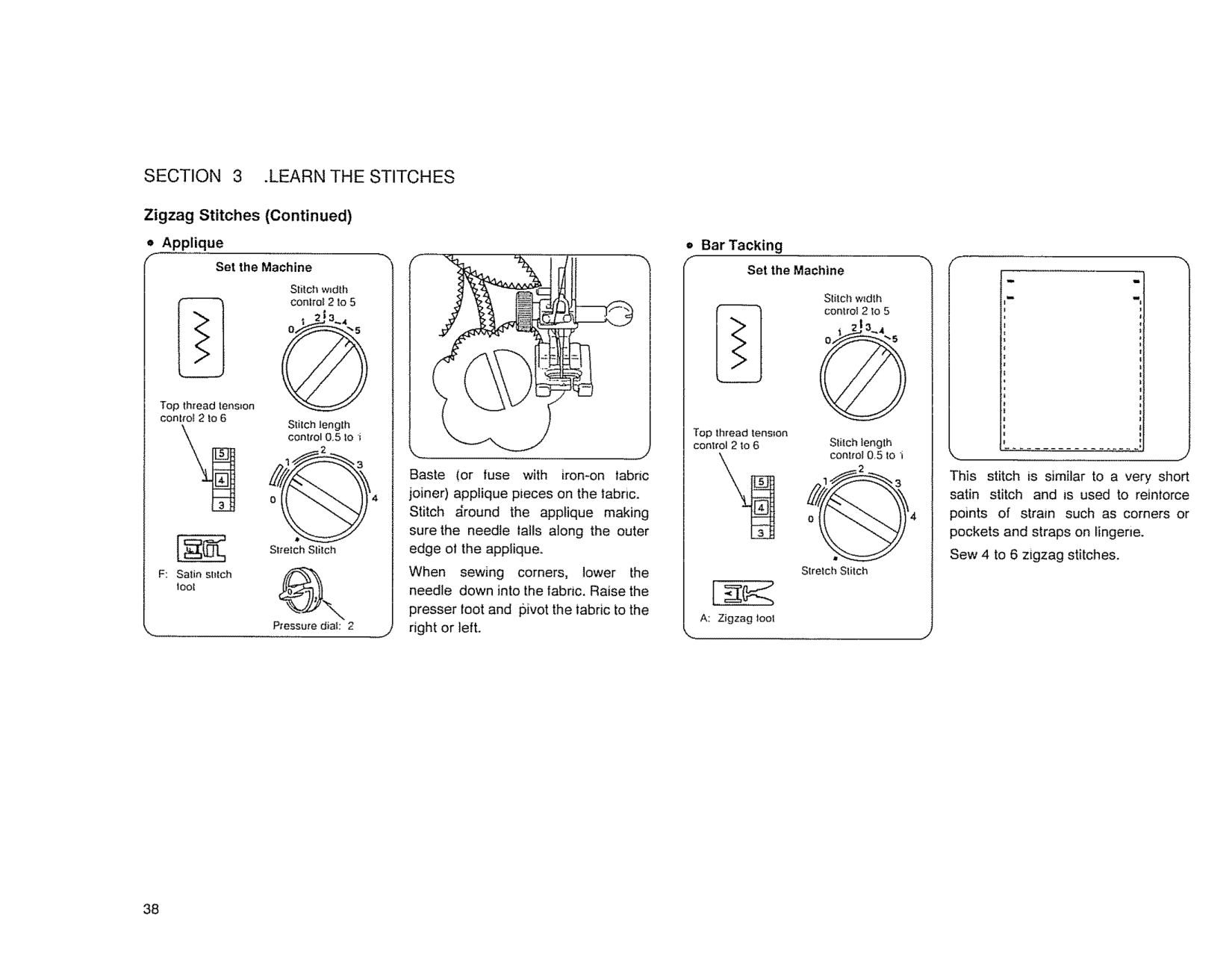
################### Zigzag Stitches (Continued)
##################### • Applique f Set the Machine
##################### • Bar Tacking
f
##################### Set the Machine
i
Stitch w+dth control 2 to 5
Stitch w+dth control 2 to 5
@
2 ! 34
Top thread tenston conlrof 2 to 6
Stitch lenglh conb'ol 0+5 to
Top thread tens+on control 2 to 6
Stitch length control 0+5 1o +i
2
######################## 2
Baste (or tuse with iron-on tabric joiner) applique pieces on the tabric.
This stitch is similar to a very short satin stitch and is used to reiniorce points of stra+n such as corners or pockets and straps on lingerie. Sew 4 to 6 zigzag stitches.
Stitch ground the applique making surethe needle lalls along the outer edge ol the applique.
Slretch Slitch
Strelch Stitch
When sewing corners, lower the needle down into the fabr+c. Raise the presser toot and tSivot the fabric to the right or left.
F: Satin st+tch
loot
A: Zigzag 1ool
P[essure dial: 2

o Embroidery
f
##################### Set the Machine
Stitch width
Top thread tension Stitch length conirot control 2 to 6 any number (not
necessary _o adiust)
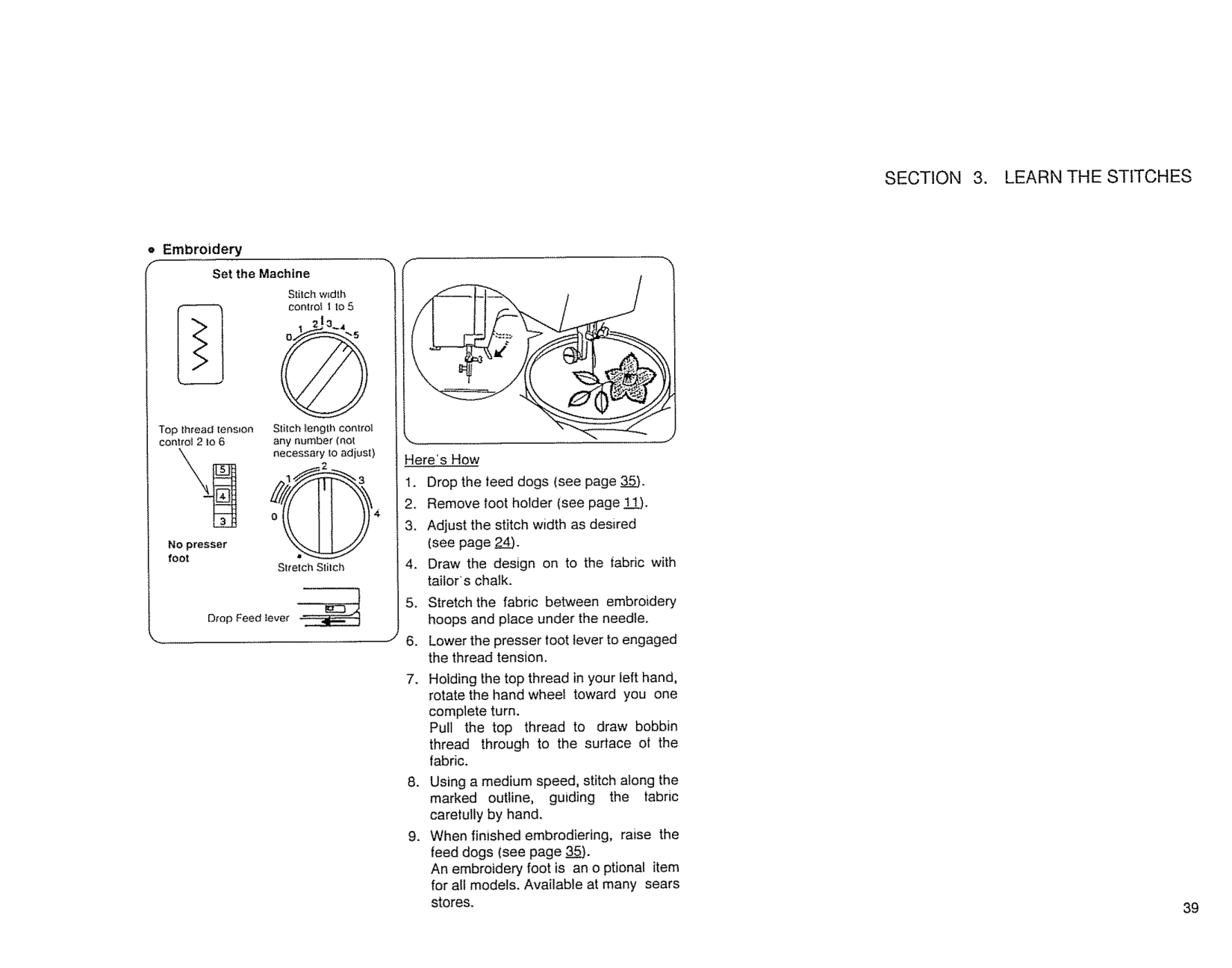
Drop the teed dogs (see page 3__5_). Remove toot holder (see page 1_. Adjust the stitch width as desired (see page 2_A). Draw the design on to the fabric with taiior's chalk. Stretch the fabric between embroidery hoops and place under the needle. Lower the presser toot lever to engaged the thread tension.
No presser _'_1 1j.ii foot
Strelch Stitch
Drop Feed lever
Holding the top thread in your left hand, rotate the hand wheel toward you one complete turn. Pull the top thread to draw bobbin thread through to the sudace ot the fabric.
Using a medium speed, stitch along the marked outline, guiding the labric caretully by hand.
°
When finished embrodiering, raise the feed dogs (see page 3_..5.). An embroidery foot is an o ptional item for a!t models. Available at many sears stores.
g.
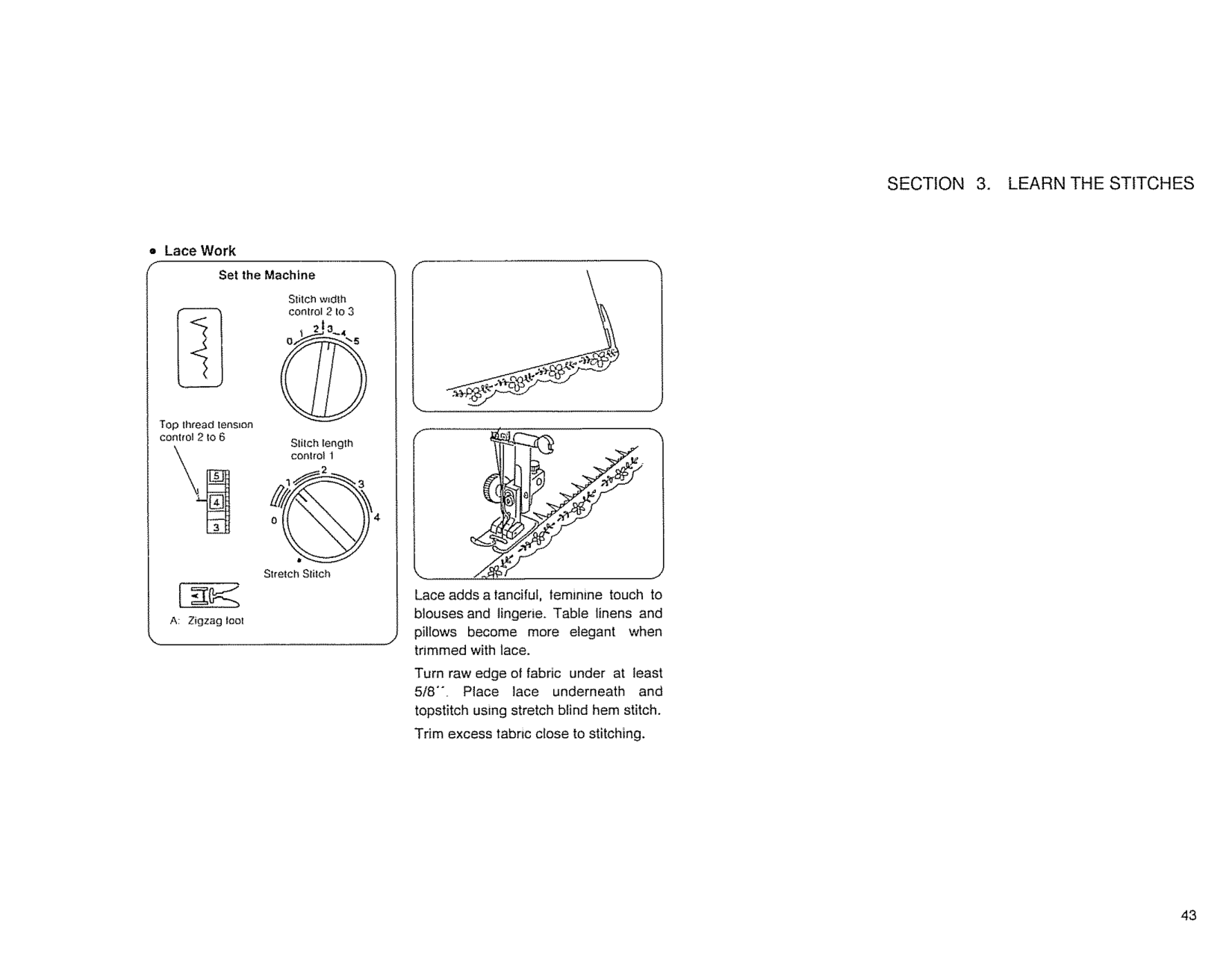
39

##################### • Sew a ButtonSet the Machine
Stitch width control Must be adjusted I 2i3-4
J
Top thread tens=on control 2 to 6
Stitch leng_,h conlrol Any number (not necessary to adjust)
. k._
k. ................... j
2
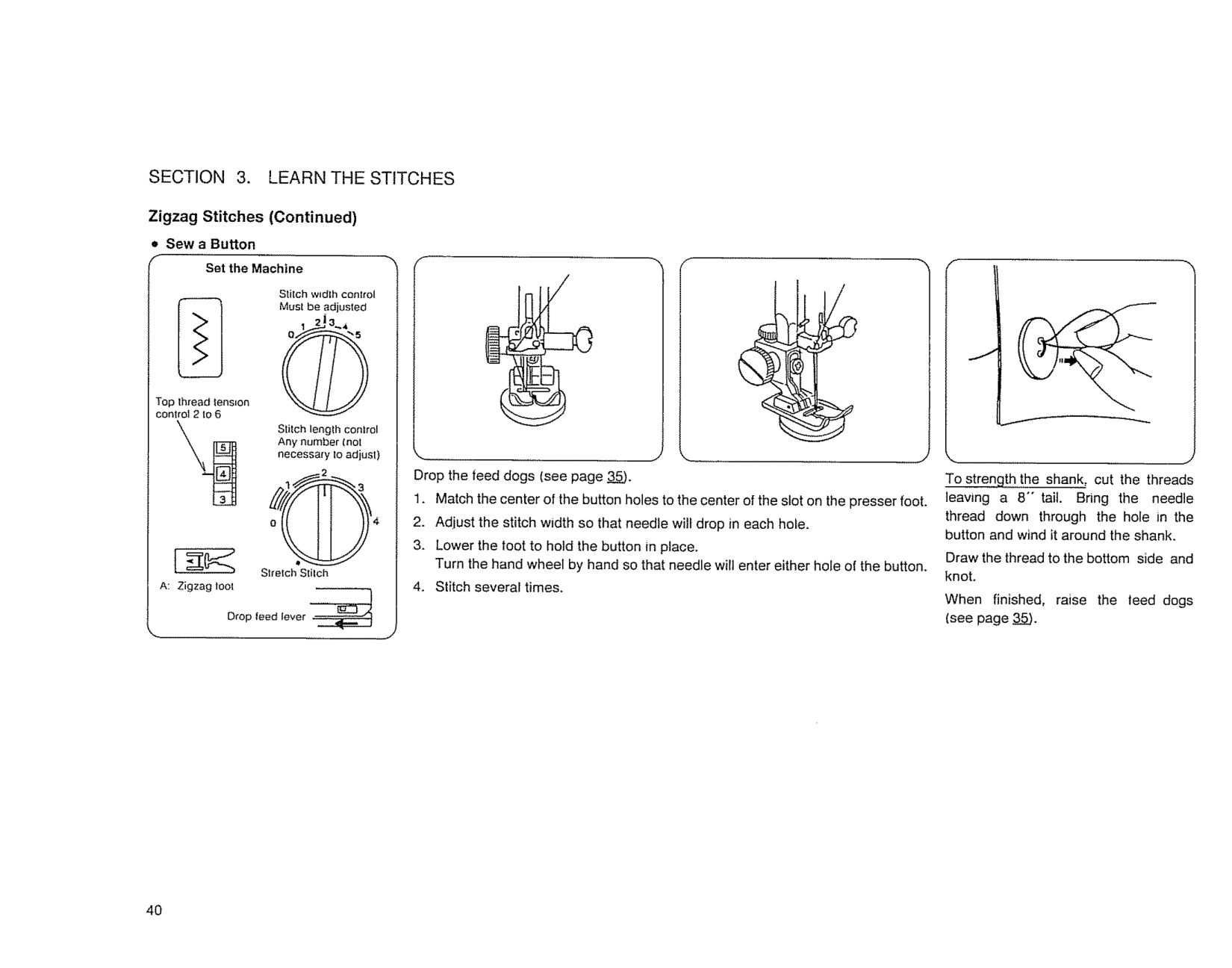
Drop the feed dogs (see page 3_.).
To strength the shank, cut the threads teavJng a 8"" tail. Bring the needle thread down through the hole in the button and wind it around the shank.
Draw the thread to the bottom side and knot.
St_'etch Stitch
A: Zigzag loot
When finished, raise the teed dogs (see page 3_.
Orop _eed lever

################## SECTION 3. LEARN THE STITCHES
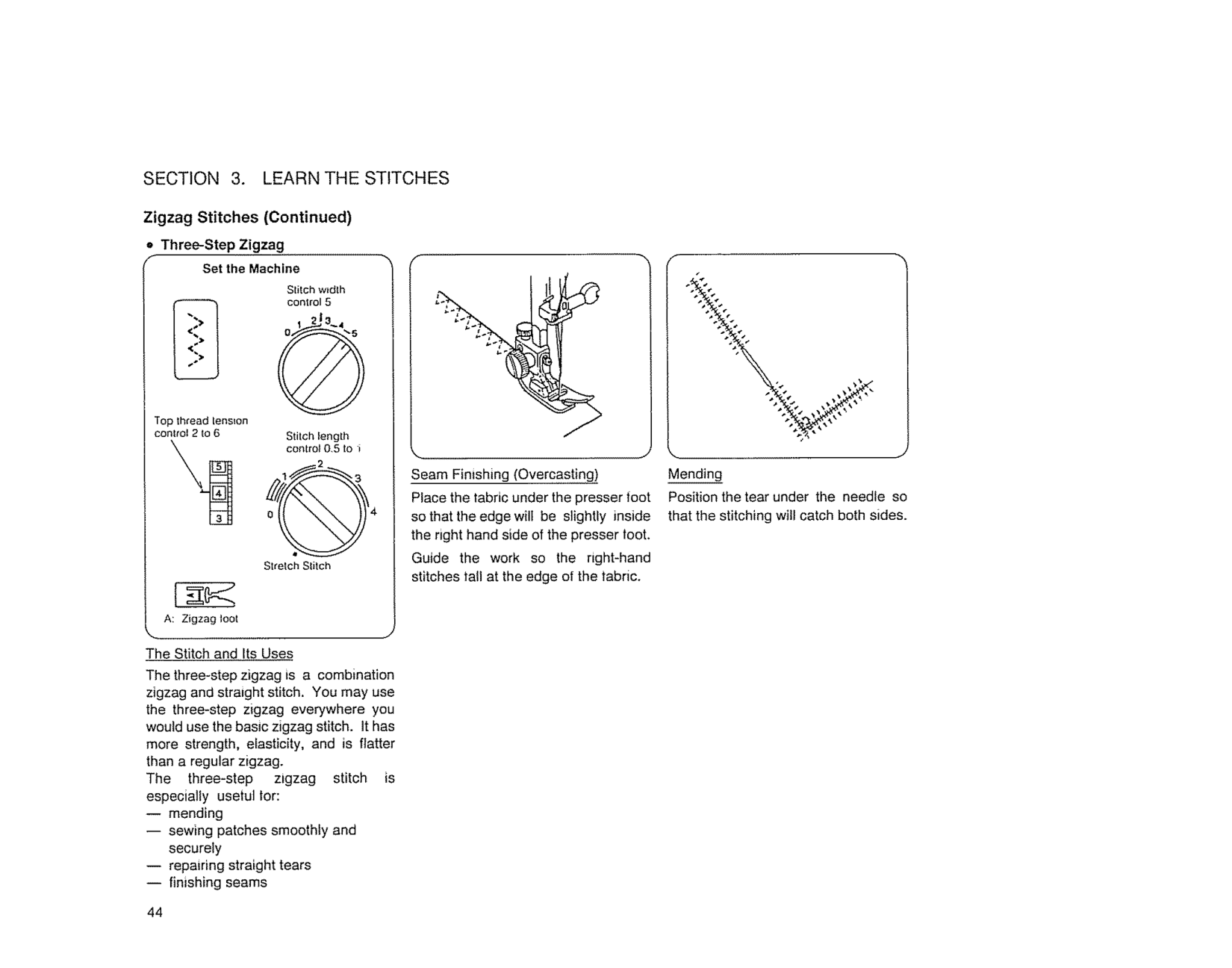
##################### • Overcasting Stitchf Set the Machine
Stitch w+dth control 3 to 5
Top thread tenmon Control 3 to 8
Stitch length control red zonE,
2
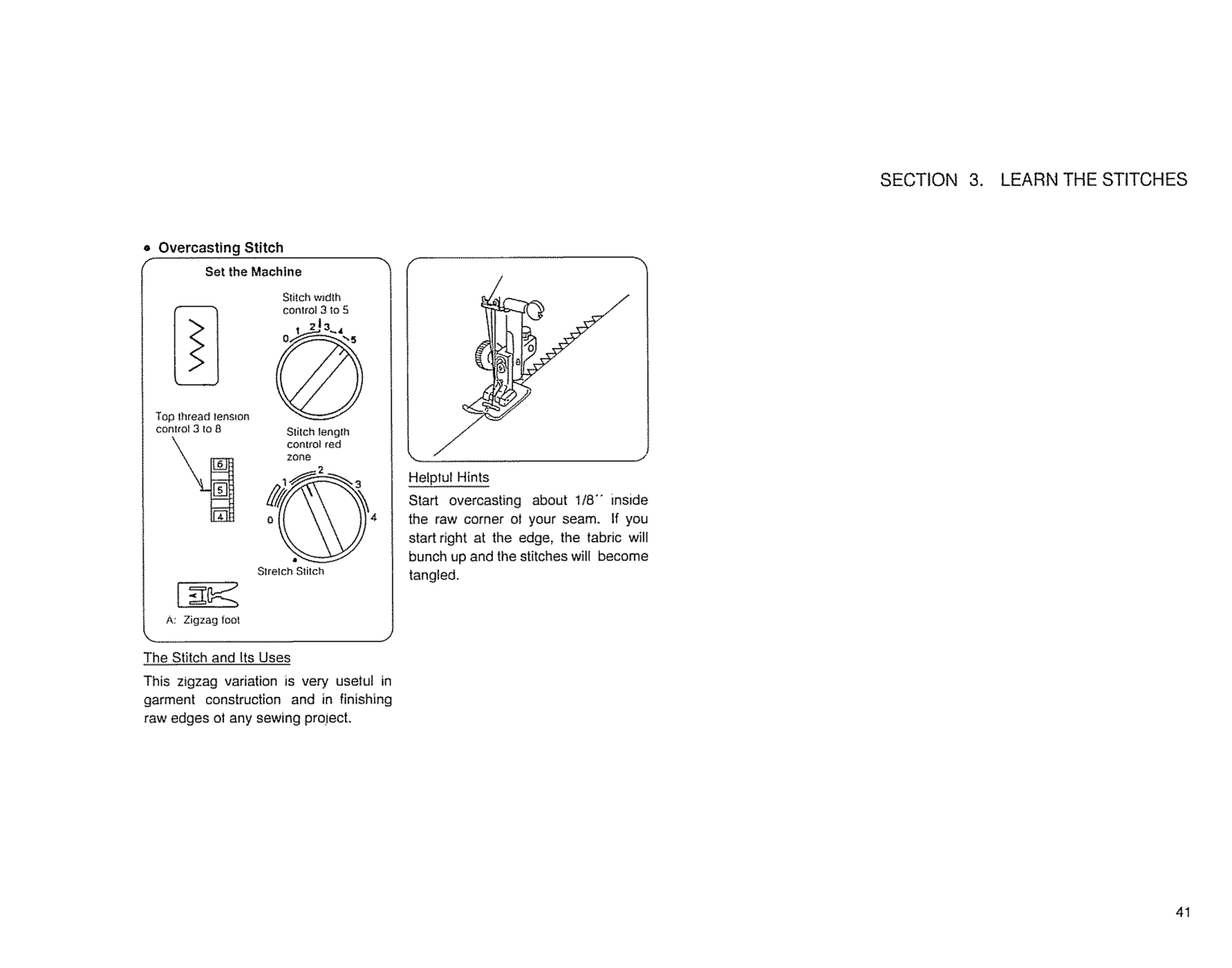
Helptul Hints Start overcasting about t/8"" inside the raw corner ot your seam, If you start right at the edge, the labric will bunch up and the stitches will become tangled.
Slre_ch Stitch
A: Zigzag foot
The Stitch and Its Uses This zigzag variation is very usetul in garment construction and in finishing raw edges ot any sewing project.
41

Set the Machine
######################## Lightweighl
Stitch w=dlh conlro! 2 to 3
########## /
Top thread tension con#ol 2 to 6
Stitch length con|roI red zone
######################## 2
Hea
4
Slretch Slitch
A: Zigzag loot

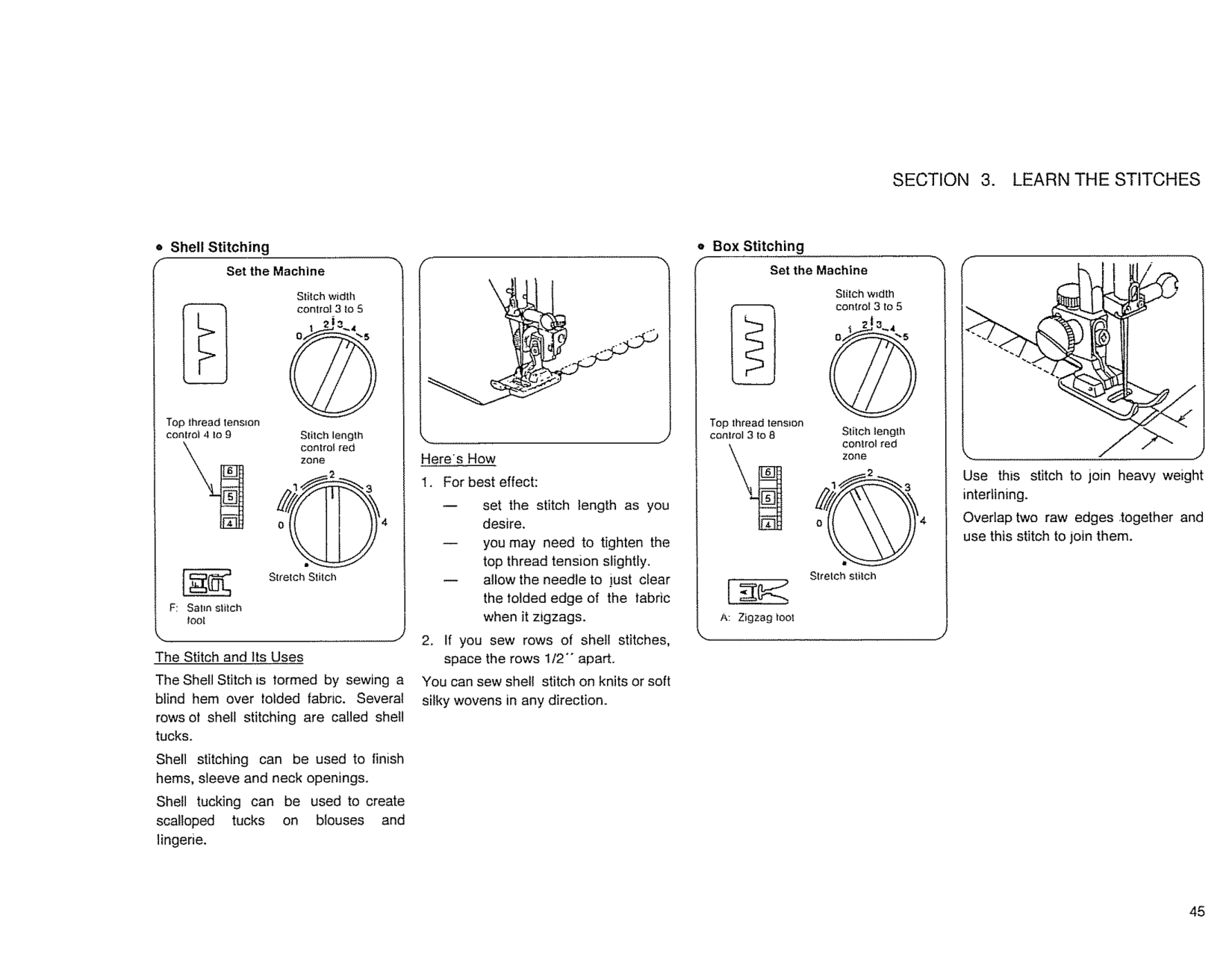
Set the Machine
Stitch w_dth control 2 to 3
J
Top thread tension cont[oI 2 to 6
Stitch [ength contro} 1
Stretch Stitch
Lace adds a |ancifut, feminine touch to blouses and lingerie. Table linens and pillows become more elegant when trimmed with lace.
Turn raw edge of fabric under at teast 5/8"" Place lace underneath and topstitch using stretch bFind hem stitch. Trim excess tabric close to stitching.

Stitch w_dth control 5
####### f
Top thread lens_on control 2 to 6
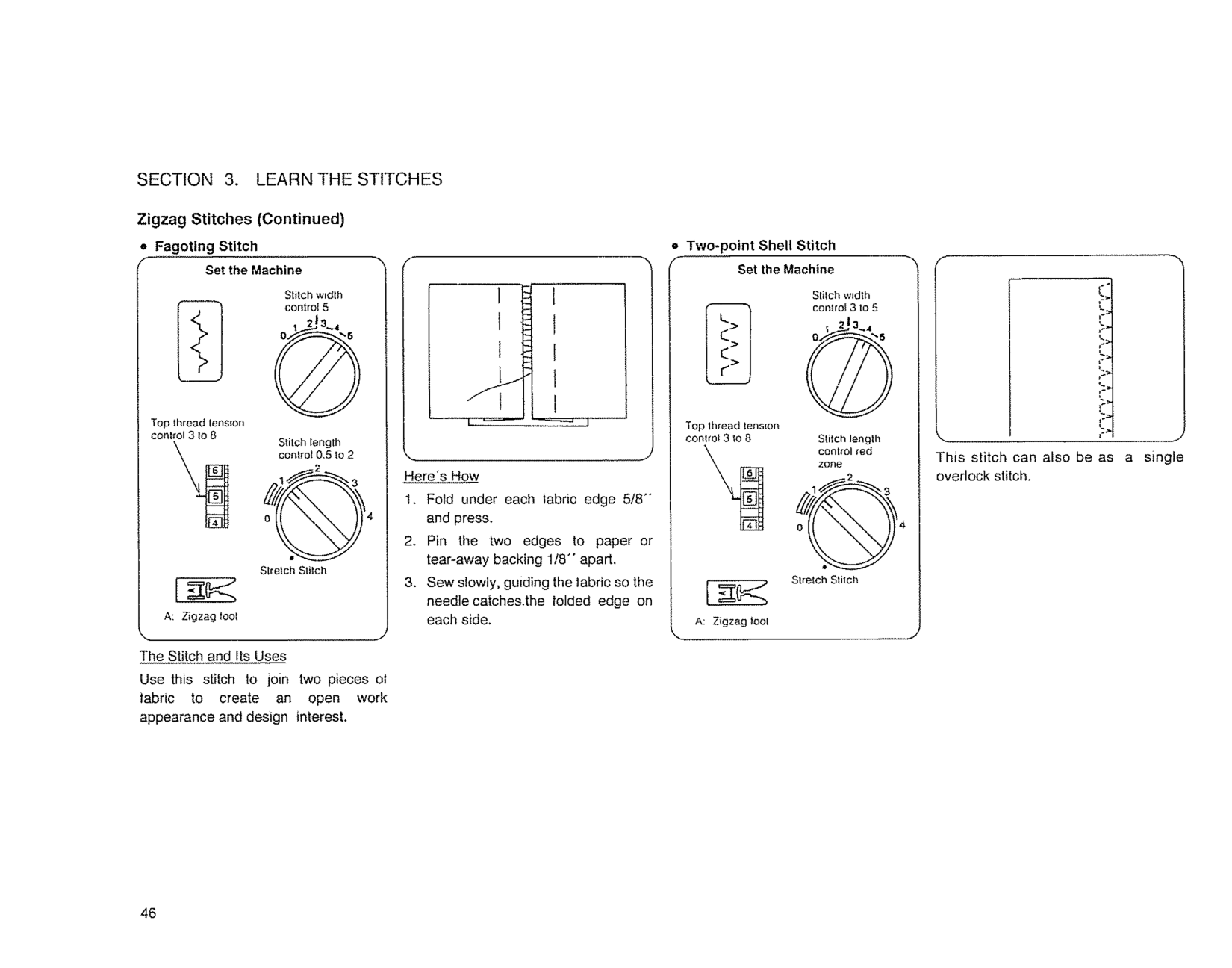
Stitch length control 0.5 to i
Seam Finishing (Overcasting) Place the tabric under the presser foot so that the edge wilt be slightly inside the right hand side of the presser loot, Guide the work so the right-hand stitches tall at the edge of the fabric.
Mending Position the tear under the needle so that the stitching will catch both sides.
Stretch Sli|ch
A: Zigzag loot
The Stitch and Its Uses The three-step zigzag is a combination zigzag and straight stitch. You may use the three-step zigzag everywhere you would use the basic zigzag stitch, it has more strength, elasticity, and is flatter than a regular zigzag. The three-step zigzag stitch is especially uselut for:
-- mending
-- sewing patches smoothly and securely
-- repairing straight tears
= finishing seams

o Shell Stitching
##################### o Box Stitching
f-
"N f
/
Set the Machine
##################### Set the Machine
Stitch w+dth
Stitch width cont[ol 3 to 5
Top thread tens+on cont_-ol 4 to 9
Top thread tension conirol 3 to 8 Stitch tength
Stitch length control red zone
control red zone
Heres How
Use this stitch to join heavy weight interlining. Overlap two raw edges .together and use this stitch to join them.
I. For best effect:
set the stitch length as you desire.
-- you may need to tighten the top thread tension slightly.
Stretch stitch
Stretch Stitch
-- allow the needle to just clear the tolded edge of the tabric when it zigzags.
F: Salm slitcl_ tool
A: Zigzag toot k.
The Stitch and Its Uses The Shell Stitch is tormed by sewing a blind hem over totded fabric. Several rows ot shell stitching are called shell tucks. Shell stitching can be used to finish hems, sleeve and neck openings.
space the rows 1/2- apart. You can sew shet! stitch on knits or soft silky wovens in any direction.
Shell tucking can be used to create scaiioped tucks on blouses and lingerie.

o Two-point Shell Stitch Set the Machine
• Fagoting Stitch p-
##################### Set the Machine
c_
l 1 I 1 I
1 I 1
Sli|ch width conlroi 3 to 5
Stitch widlh control 5
~ t÷
L
Top thread tension control 3 1o 8
.........I"
Top thread tension control 3 to 8
Stitch lenglh control red zone
Stitch length conlrof 0.5 Io 2
This stitch can also be as a overlock stitch.
single
J
Here's How 1, Fold under each |abric edge 5!8-
and press.
Slreich Stitch
Stretch Stitch
A: Zigzag loot
A: Zigzag fool
x._
The Stitch and Its Uses
Use this stitch to join two pieces ol tabric to create an open work appearance and design interest.

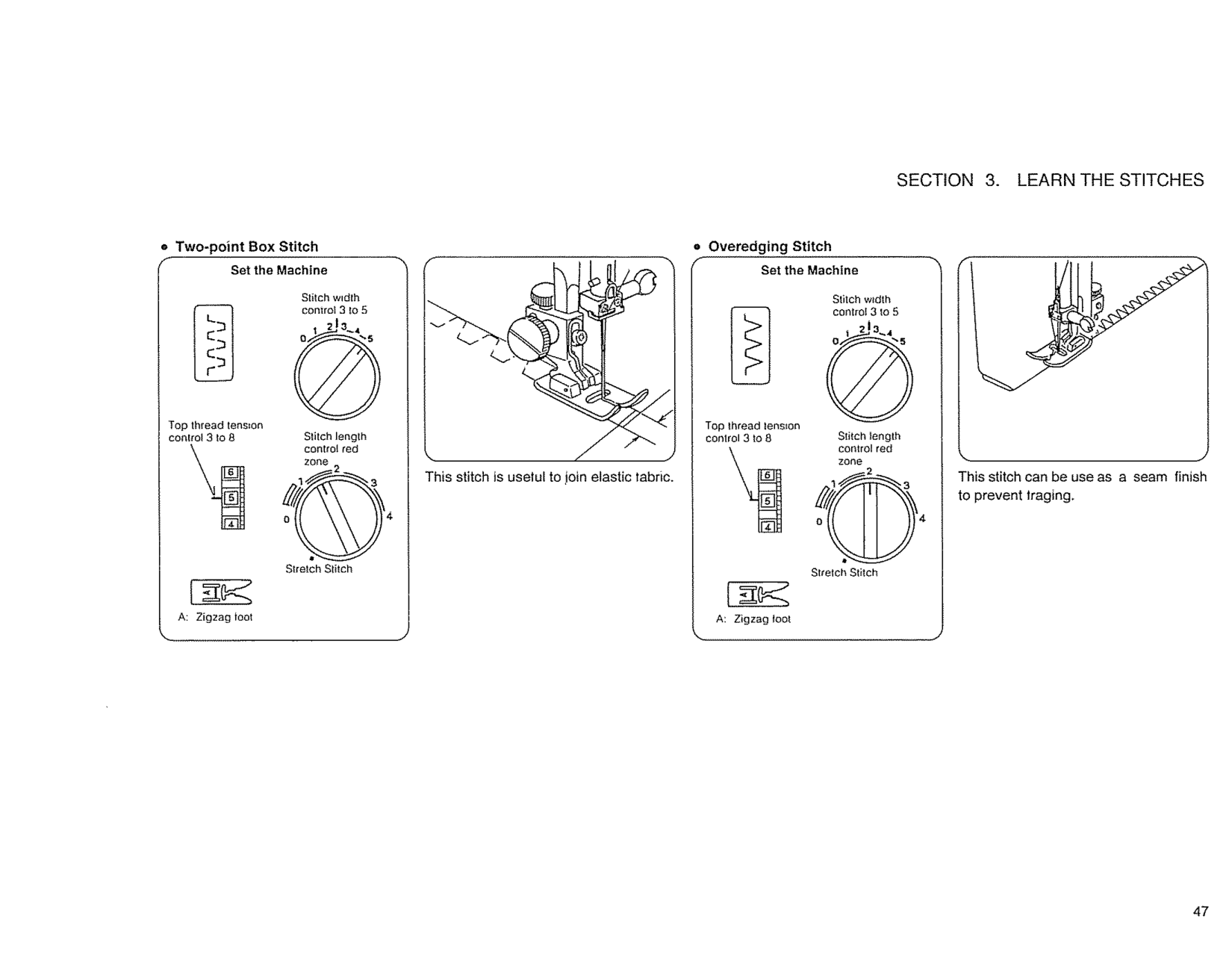
o Two-point Box Stitch
##################### = Overedging Stitch
Set the Machtne
######################## Set the Machine
Stitch width controt 3 to 5
Stitch w_dlh
Top thread tens=on conlrol 3 to 8
Top lhread lens_on control 3 to 8 Stitch length
Stitch length control red zone
control red zone
This stitch can be use as a seam finish to prevent traging.
This stitch is useful to join elastic tabric.
Stretch Stitch
Stretch Slitch
A: Zigzag toot
A: Zigzag loot

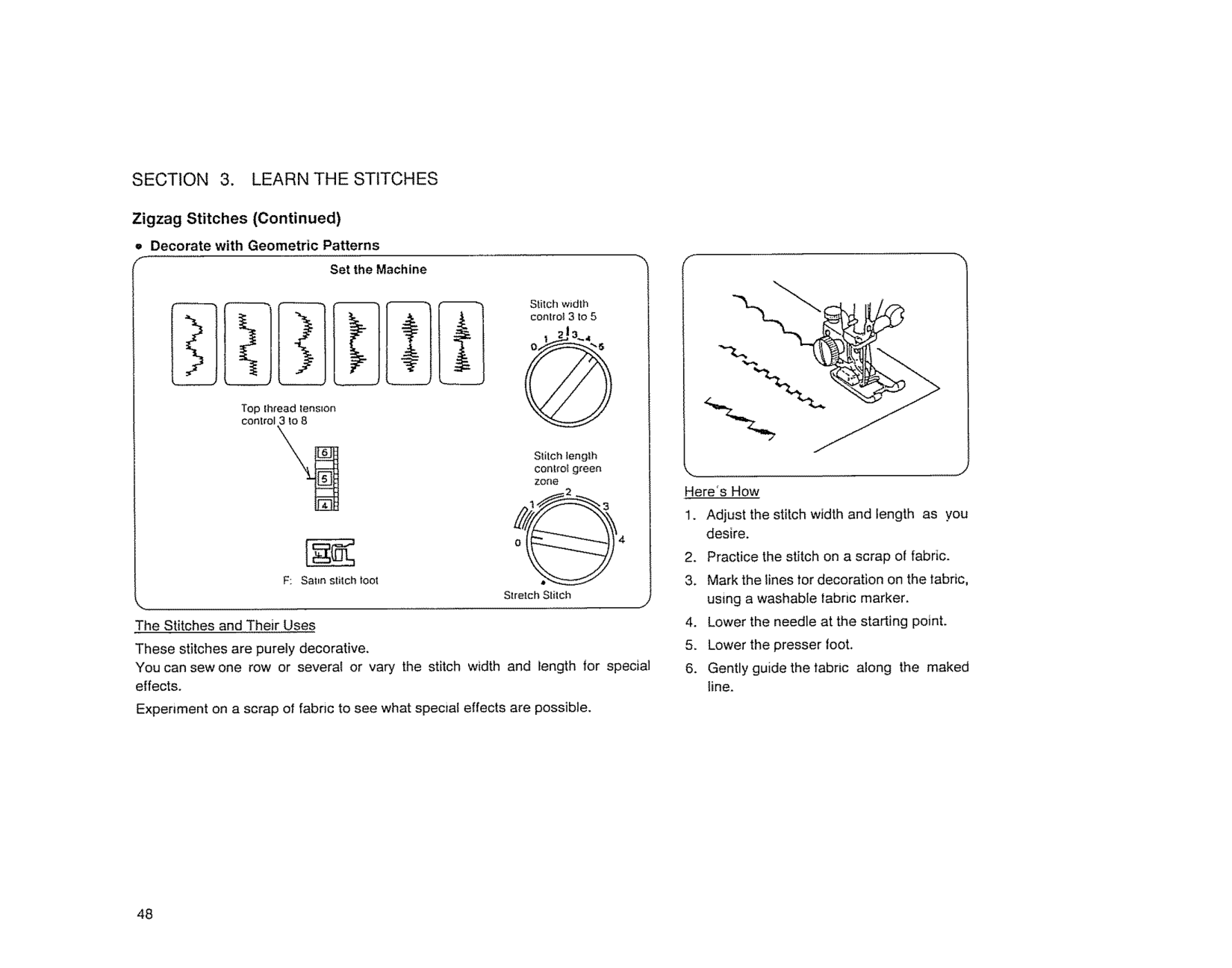
##################### o Decorate with Geometric Patterns f Set the Machine
Stitch width control 3 to 5
Top thread tension control 3 to 8
Stitch length control green zone
%.................
Here's How
Stretch Stitch
The Stitches and Their Uses These stitches are purely decorative, You can sew one row or several or vary the stitch width and length tor specia] effects. Experiment on a scrap of fabric to see what special effects are possible.
48

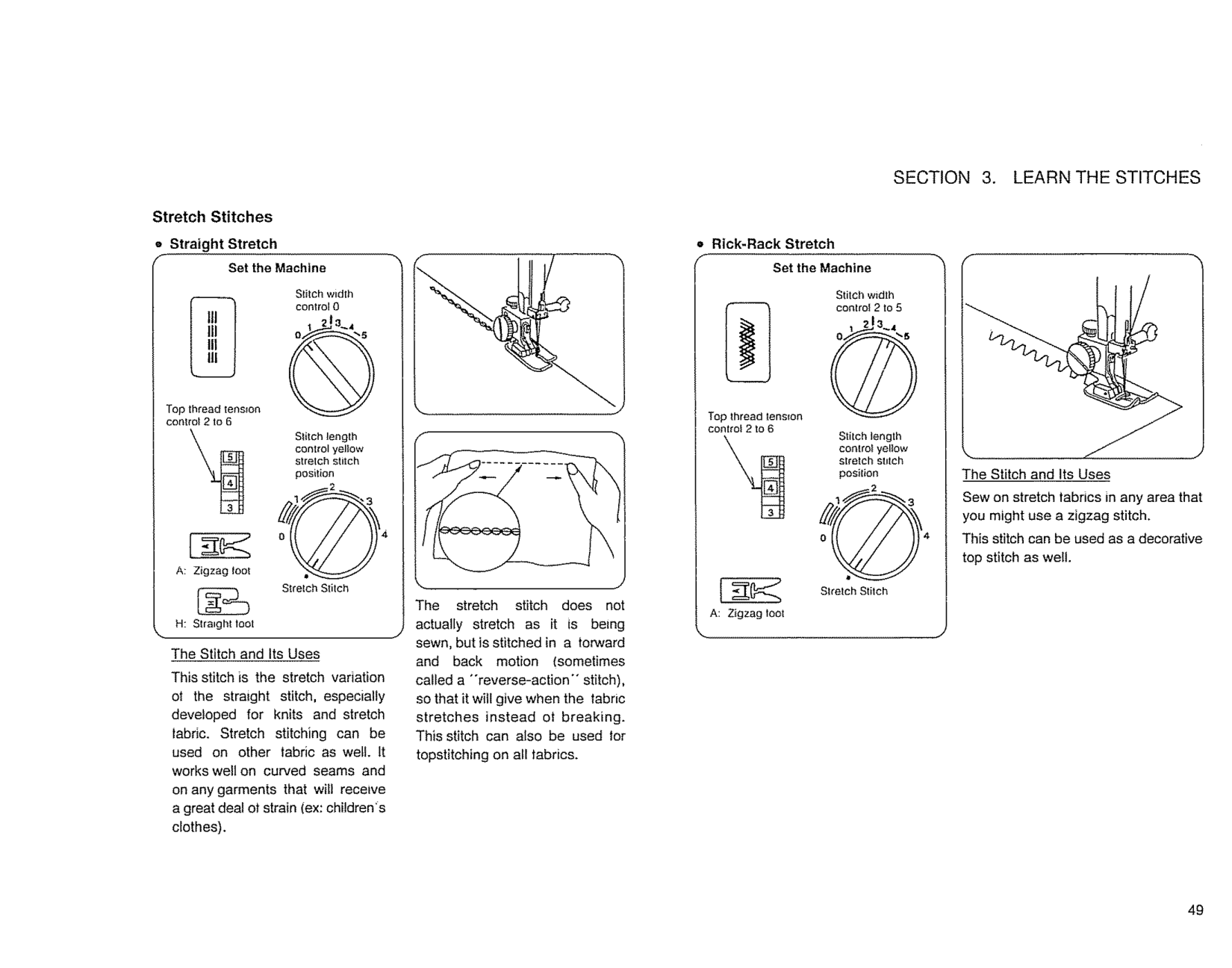
Stretch Stitches
= Rick-Rack Stretch f
= Straight Stretch f
##################### Set the Machine
Set the Machine
####### 1
Stitch width control 0
Stitch width controI 2 to 5
Top thread tension controt 2 to 6
Top thread tension control 2 to 6
Stitch length control yellow stretch stiLch
Stitch length control yellow stretch stitch posilion
The Stitch and Its Uses Sew on stretch fabrics in any area that you might use a zigzag stitch. This stitch can be used as a decorative top stitch as well.
position
A: Zigzag toot
Stretch Stitch
Stretch Stitch
The stretch stitch does not actually stretch as it is being sewn, but isstitched in a forward and back motion (sometimes called a "reverse-action'" stitch), so that it will give when the tabric stretches instead ot breaking. This stitch can also be used for topstitching on ail tabrics.
H: Stralgl_t toot
The Stitch and Its Uses
This stitch is the stretch variation ot the straight stitch, especially developed for knits and stretch
tabric. Stretch stitching can be used on other fabric as welt. It
works well on curved seams and on any garments that wilt receive a great deal ot strain (ex: children's clothes).

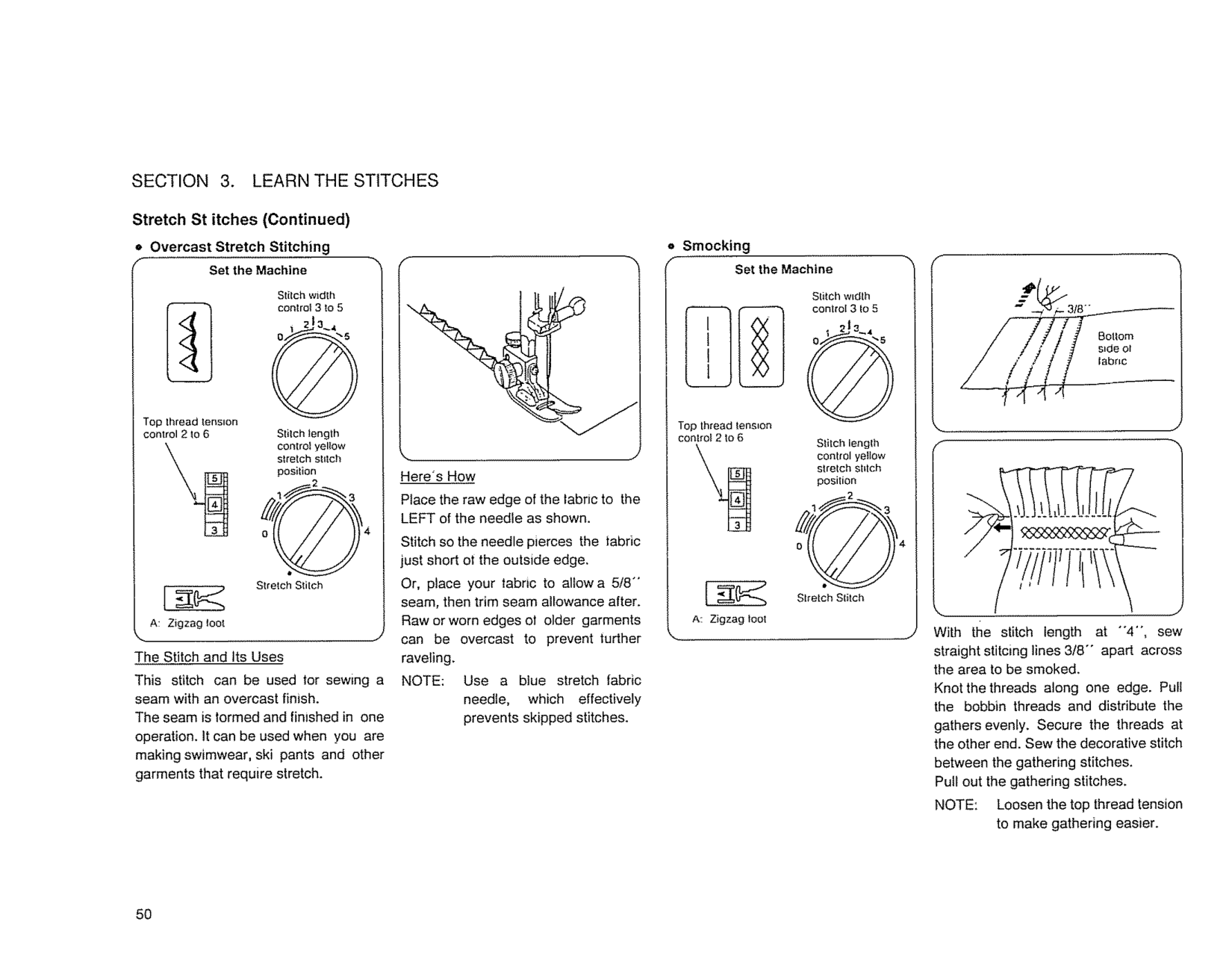
################### Stretch St itches (Continued)
##################### = Smocking
##################### • Overcast Stretch Stitching f Set the Machine
p-
##################### Set the Machine
f
######################## Stitch width
Stitch w_dth
Top lhread lenslon control 2 to 6 Stilch length
Top thread tension COntrOl 2 to 6 Stitch ienglh
J
control yellow stretch sltlch position
j,
control yeiiow stretch stitch position
Here's How
Place the raw edge of the labrJc to the LEFT of the needle as shown.
_c
Stitch so the needle pierces the fabric just short ot the outside edge.
Or, place your fabric to allow a 5/8"" seam, then trim seam allowance after.
Stretch Slitch
•,.. ,,................... With the stitch length at "'4", sew straight stitcing lines 3t8- apart across the area to be smoked. Knot the threads along one edge. Pull the bobbin threads and distribute the gathers evenly. Secure the threads at the other end. Sew the decorative stitch between the gathering stitches. Pull out the gathering stitches. NOTE: Loosen the top thread tension
A: Zigzag loot
Raw or worn edges ol older garments can be overcast to prevent turther raveling.
A: Zigzag too_.
%. The Stitch and Its Uses This stitch can be used tot sewing a seam with an overcast finish. The seam is formed and finished in one operation, it can be used when you are making swimwear, ski pants and other garments that require stretch.
,,,J
NOTE: Use a blue stretch fabric needte, which effectively prevents skipped stitches.
to make gathering easier.
#################### 5O

##################### = Elastic Stretch Stitch
##################### • Serging or Pine Leaf Stretch Stitching f _ fSettheMachine
f
##################### Set the Machine
######################## Stitch w+dlh
Stilch w+dth control 3 to 5
t 213 •
Top thread tenmon control 3 to 6 Stitch length
Top thread tens+on control 3 to 6
Stitch length control yellow stretch stitch position
control yellow stretch stitch position
Herds How
Place the tabric under the presser toot so that the stitches are made over the edge.
NOTE: When using stretch knit fabric, use a blue stretch fabric needle which effectively prevents skipped stitches.
Stretch Stitch
Stretch Stitch
A: Zigzag foot
A: Zigzag fool
J The Stitch and Its Uses
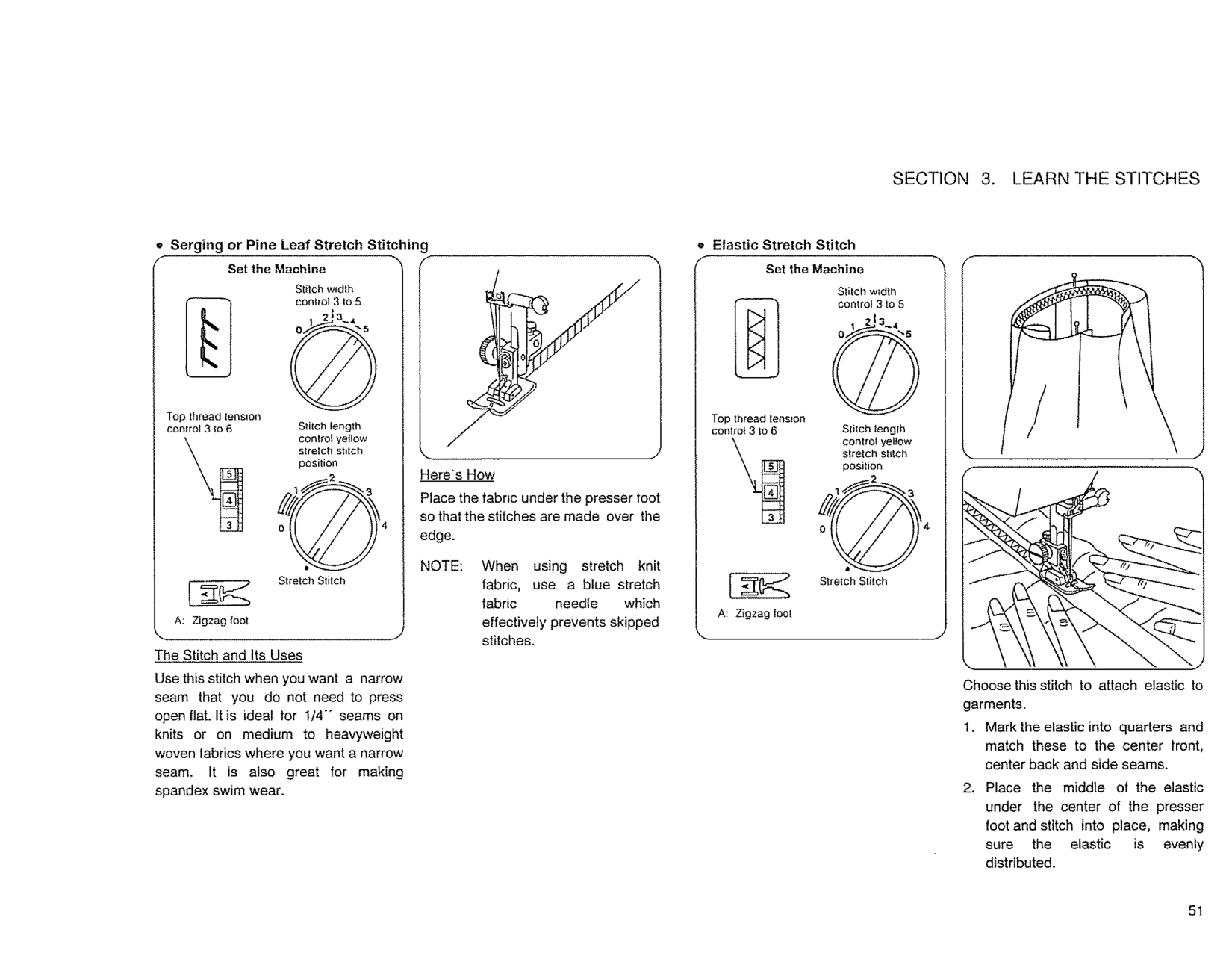
Use this stitch when you want a narrow seam that you do not need to press open flat. It is ideal for 1/4- seams on knits or on medium to heavyweight woven labrics where you want a narrow seam. It is also great for making spandex swim wear.
Choose this stitch to attach elastic to garments.
51

Stretch Stitches (Continued)
= Herring Bone Stretch
=, Stretch Patching
SettheMachine
Set the Machine
Stitch wldlh
Stitch width control 5
Top thread tension cont[ol 2 to 6
Top thread tension control 2 1o 6 Stitch length
Stitch length control yeI!ow stretch stilch position
control yellow stretcf_ stitch position
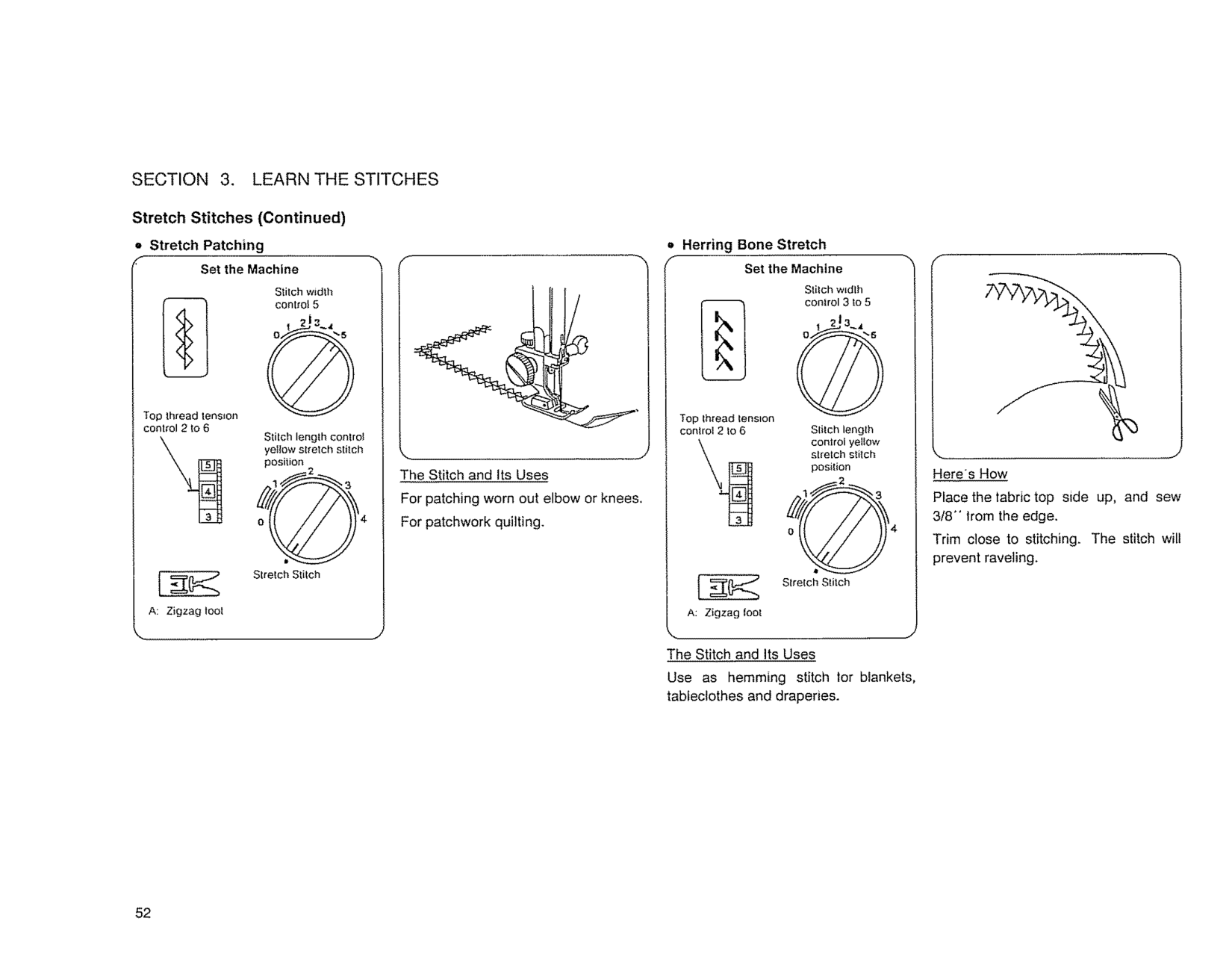
%..................................... ..., Heres How PLacethe tabdc top side up, and sew 3!8 °' lrom the edge. Trim close to stitching. The stitch will prevent raveling.
The Stitch and Its Uses For patching worn out elbow or knees. For patchwork quilting.
Stretch Stitch
Stretch Stitch A: Zigzag toot
A: Zigzag tool
The Stitch and Its Uses Use as hemming stitch tor blankets, tabfeclothes and draperies.
52

###################### = Decorative Stretch Patterns F Set the Machine
.-%
######################## Top thread tension controt 2 to 6
Stitch width contro! 3to5
The Stitch and Its Uses
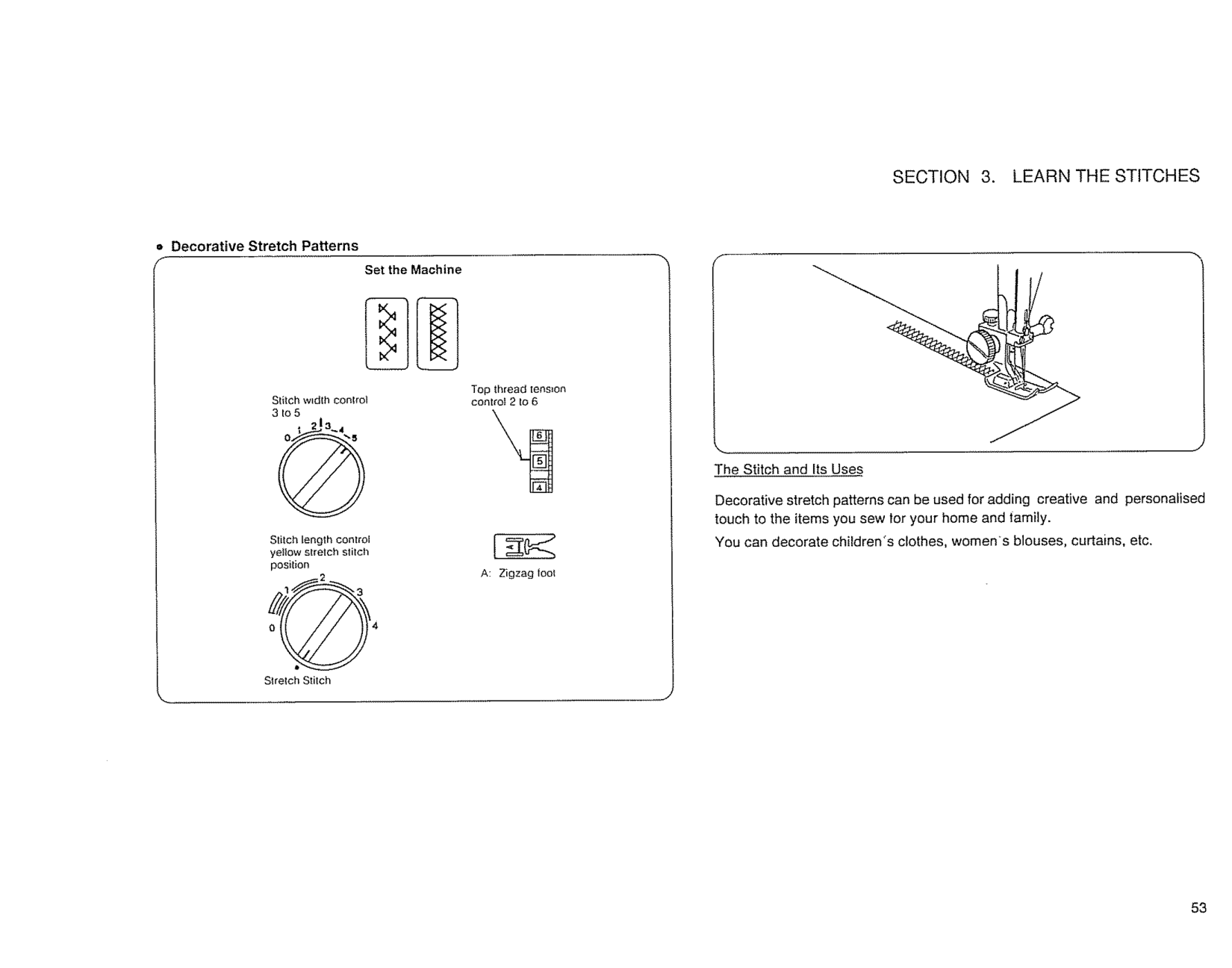
###################### Decorative stretch patterns can be used for adding creative and personafised touch to the items you sew lor your home and tamily. You can decorate children's clothes, womens blouses, curtains, etc.
StitCh length control ye}low stretch stitcll pos}tion
A: Zigzag foot
2
Slrelch Stitch

Buttonhole Making ,D Learning to Sew Buttonholes
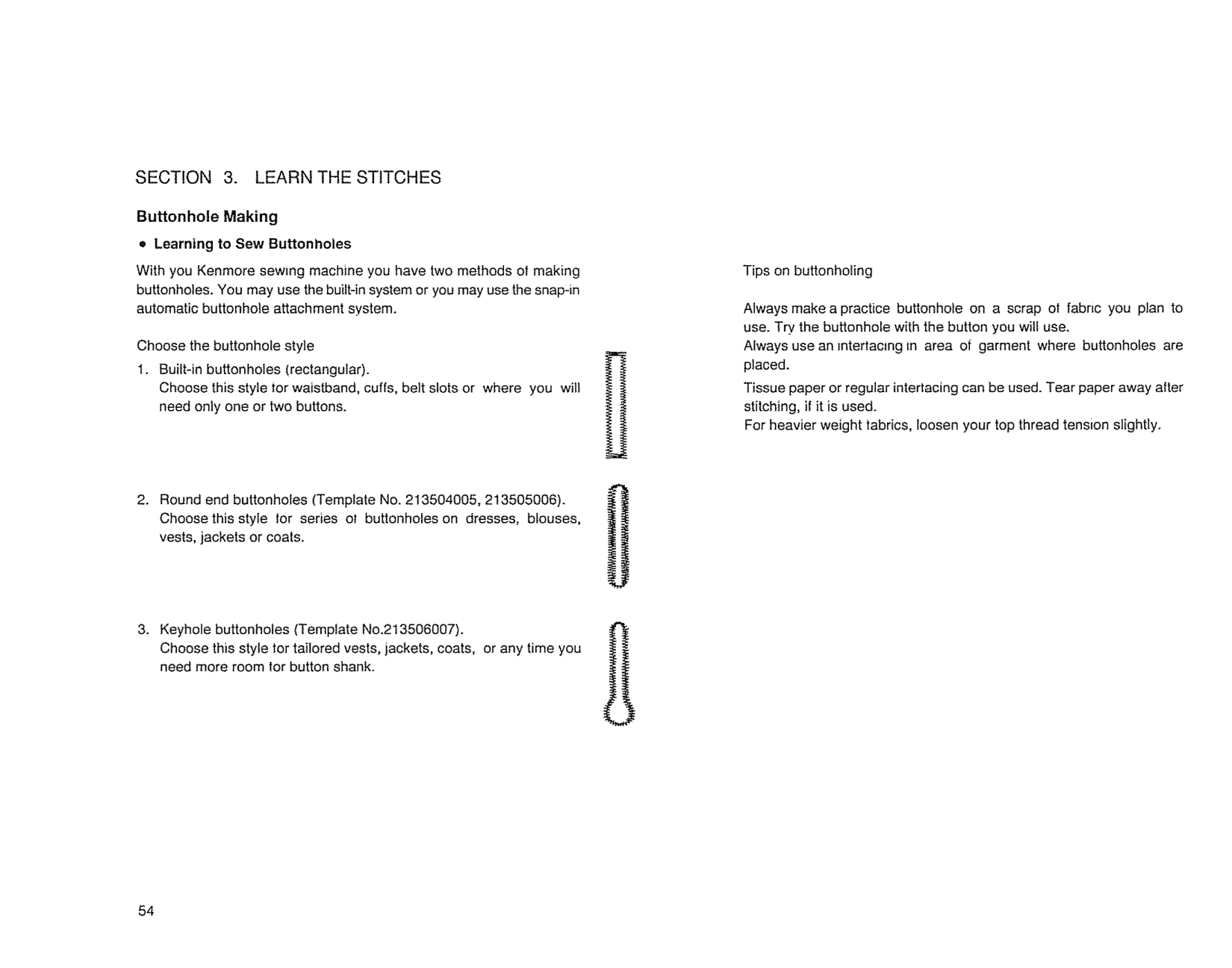
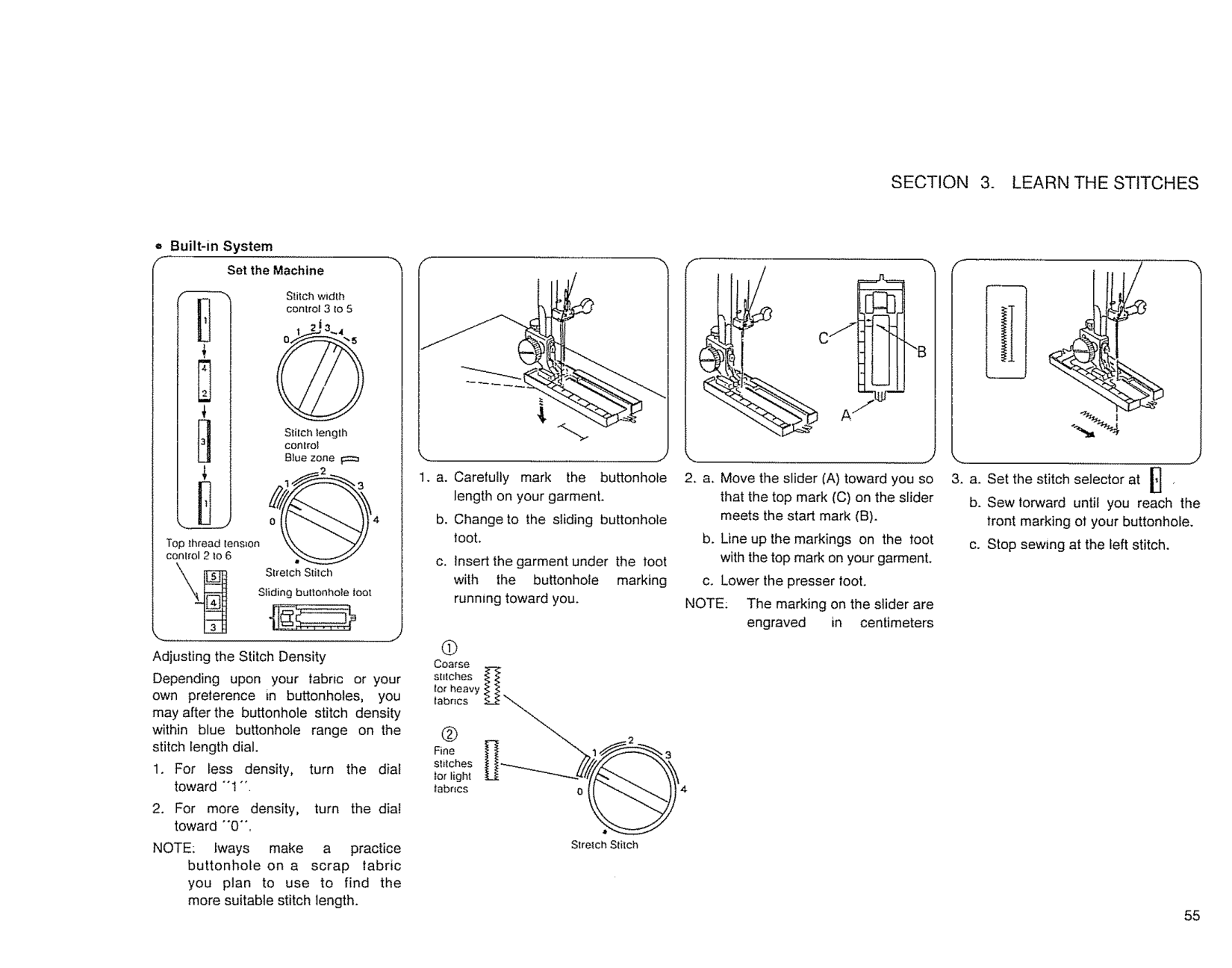
With you Kenmore sewing machine you have two methods ol making buttonholes. You may use the built-in system or you may use the snap-in automatic buttonhole attachment system.
Choose the buttonhole style
Tips on buttonholing
Always make a practice buttonhole on a scrap o| fabric you plan to use. Try.the buttonhole with the button you will use. Always use an interfacing in area of garment where buttonholes are placed. Tissue paper or regular interfacing can be used. Tear paper away after stitching, if it is used. For heavier weight fabrics, loosen your top thread tension slightly.
54

f
%
!t I 0oo,+.3,o
Stitch w+dth
I Stilch length conlro! Blue zone F:== 2
....................J
"'- ,............... J
t
TOp Ihread tension control 2 lo 6
Strelch Stilch Sliding buttonhole loot
NOTE: The marking on the slider are engraved in centimeters
@ Coarse st+tches lot heavy labr+cs
Adjusting the Stitch Density Depending upon your tabric or your own prelerence in buttonholes, you may after the buttonhole stitch density within blue buttonhole range on the stitch length dial.
® Fine slilches lot lighl labr+cs Oi
Stretch Slitch
NOTE: lways make a practice buttonhole on a scrap labric you plan to use to find the more suitable stitch length.

f
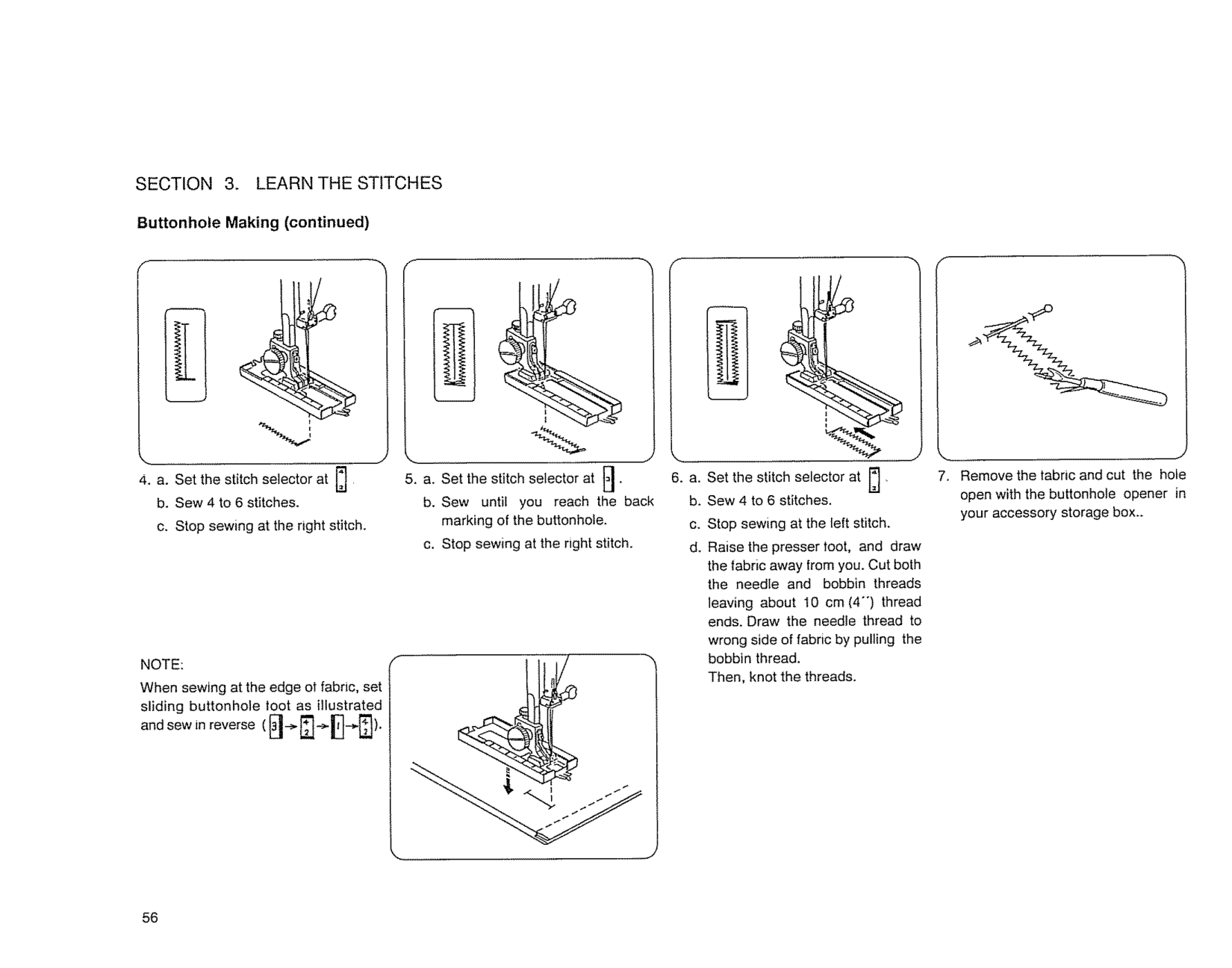
leaving about I0 cm (4"') thread ends. Draw the needle thread to wrong side of fabric by pulling the bobbin thread. Then, knot the threads.
NOTE: When sewing at the edge of fabric, set sliding buttonhole loot as illustrated and sew in reverse ( _-> _ _ _]--,,.['_).
........J

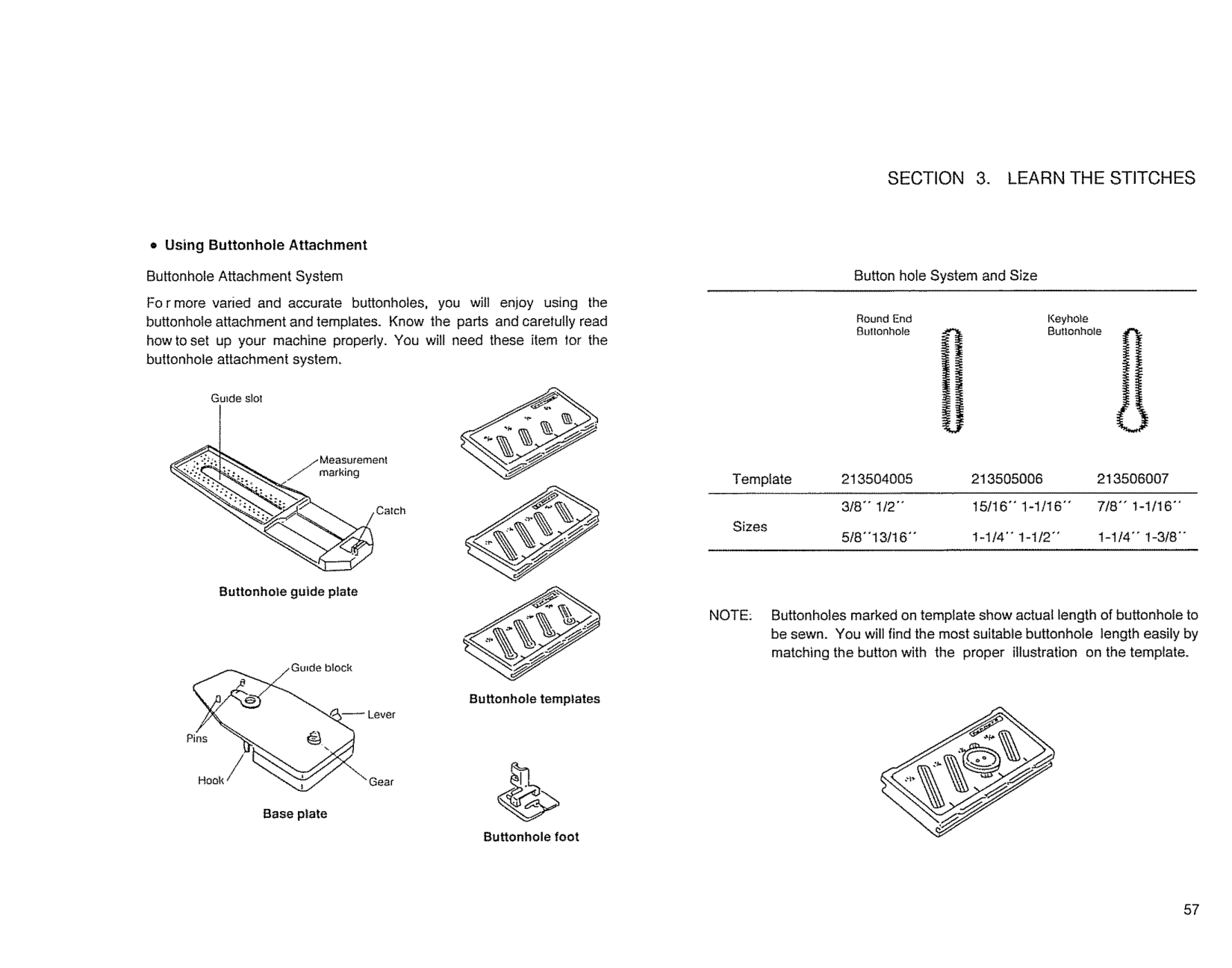
##################### o Using Buttonhole Attachment
Button hole System and Size
Buttonhole Attachment System
For more varied and accurate buttonholes, you will enioy using the buttonhole attachment and templates. Know the parts and carefully read how to set up your machine properly. You wilt need these item tot the buttonhole attachment system.
Round End Keyhole Bullonhole Butlonhole
Guide s!c!
O
213504005 213505006 213506007 3f8"" 1t2"" 15ft6"" 1-1116"" 7!8"" 1-1/16"" 518"'13/16 "° t-1/4- 1-1/2- 1-1/4- 1-318-
Template
Sizes
####################### Buttonhole guide plate
NOTE:
Buttonholes marked on template show actual length of buttonhole to be sewn. You will find the most suitable buttonhole length easily by matching the button with the proper illustration on the template.
####################### Buttonhole templates
Pins
Hook /
Base plate
Buttonhole foot

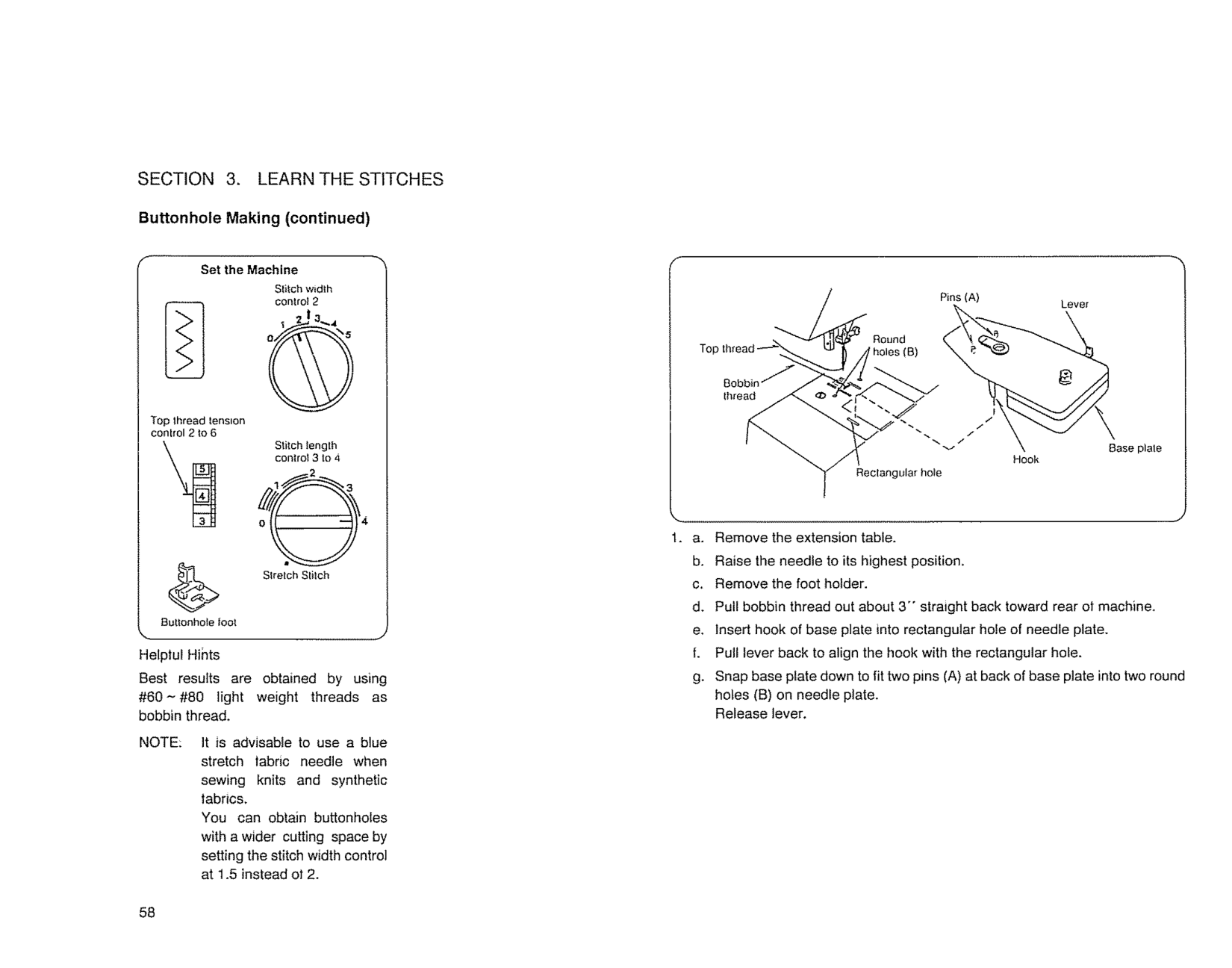
##################### Set the Machine
Stitch width control 2
Pins (A)
Lever
Round To!: ' holes {B)
thread
Top thread tension control 2 to 6
Stitch _ength conlro_ 3 to 4
v
Base plale
Hook
2
Reclangular hole
4
Slretoh Stitch
Buttonhole _oot
Helptui Hihts Best results are #60 ~#80 light bobbin thread.
g, Snap base plate down to fit two pins (A) at back of base plate into two round holes (B) on needle plate, Release lever.
obtained by using weight threads as
NOTE: It is advisable to use a blue stretch labric needle when sewing knits and synthetic tabrics, You can obtain buttonholes with a wider cutting space by setting the stitch width control at 1.5 instead ot 2.

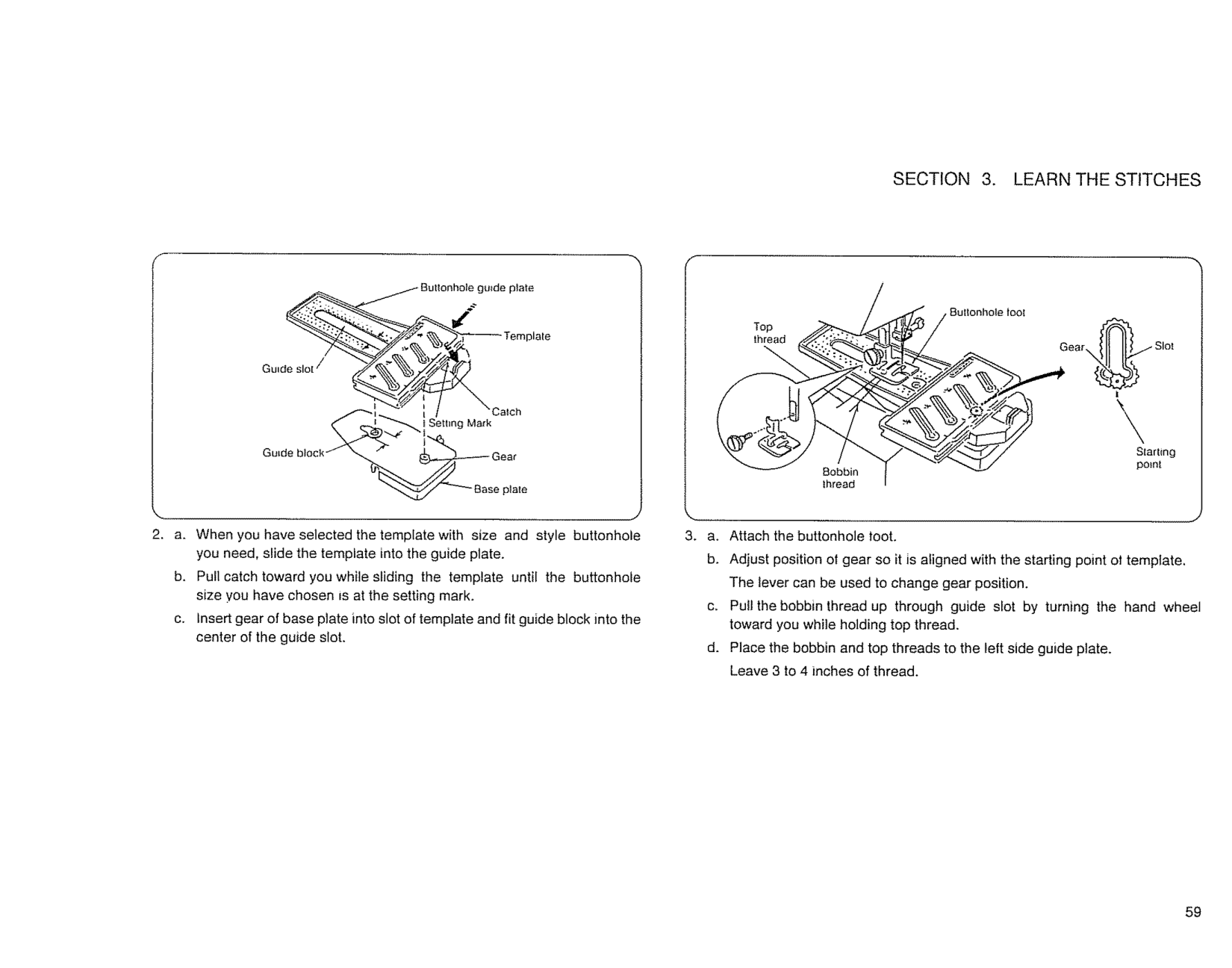
_-_Butlonhole guide plate
Gear r_ JSIot
######### Mo,
_Geat
thread
-'-'---Base p_ale
Attach the buttonhole toot. Adjust position of gear so it is aligned with the starting point of template. The lever can be used to change gear position. Pull the bobbin thread up through guide slot by turning the hand wheel toward you while holding top thread. Place the bobbin and top threads to the left side guide plate. Leave 3 to 4 inches of thread.
########################## C_
d.

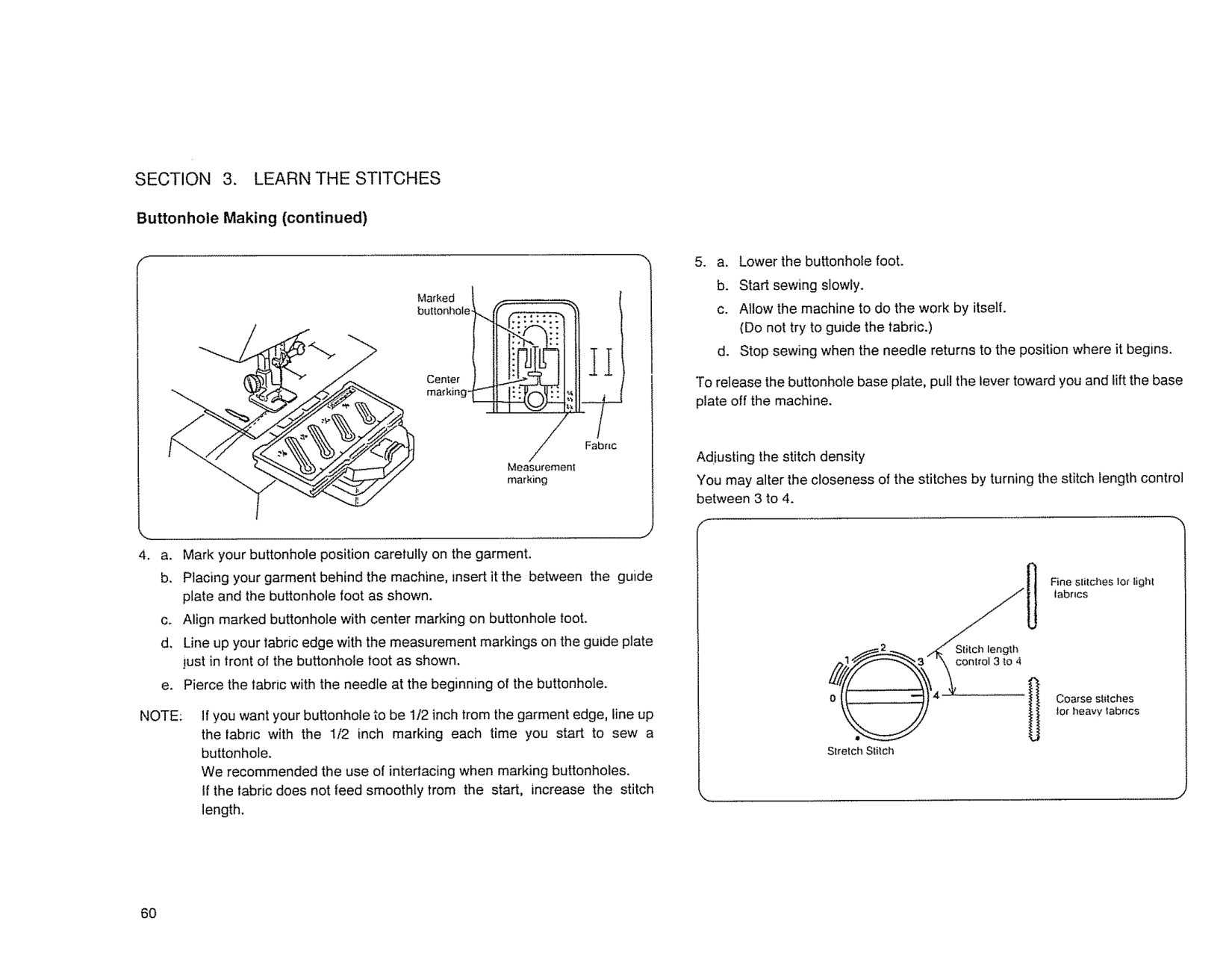
Marked _
To release the buttonhole base plate, pull the lever toward you and lift the base plate off the machine.
Fabric
Adiusting the stitch density You may alter the closeness of the stitches by turning the stitch length control between 3 to 4.
Measurement marking
Mark your buttonhole position caretully on the garment, Placing your garment behind the machine, insert it the between the guide plate and the buttonhole foot as shown.
Fine slitches tot tighl labncs
c. Align marked buttonhole with center marking on buttonhole toot. d, Line up your labric edge with the measurement markings on the guide plate
just in tront of the buttonhole loot as shown. Pierce the labric with the needle at the beginning of the buttonhole.
e.
Coarse s_itches tor heavy tabncs
NOTE;
if you want your buttonhole to be 1/2 inch from the garment edge, line up the labnc with the t/2 inch marking each time you start to sew a buttonhole,
Stretch SLi|ch
We recommended the use of interlacing when marking buttonholes. If the labdc does not feed smoothly from the start, increase the stitch length.

################### Twin Needle Stitching
##################### Set the Machine for any of these stitch
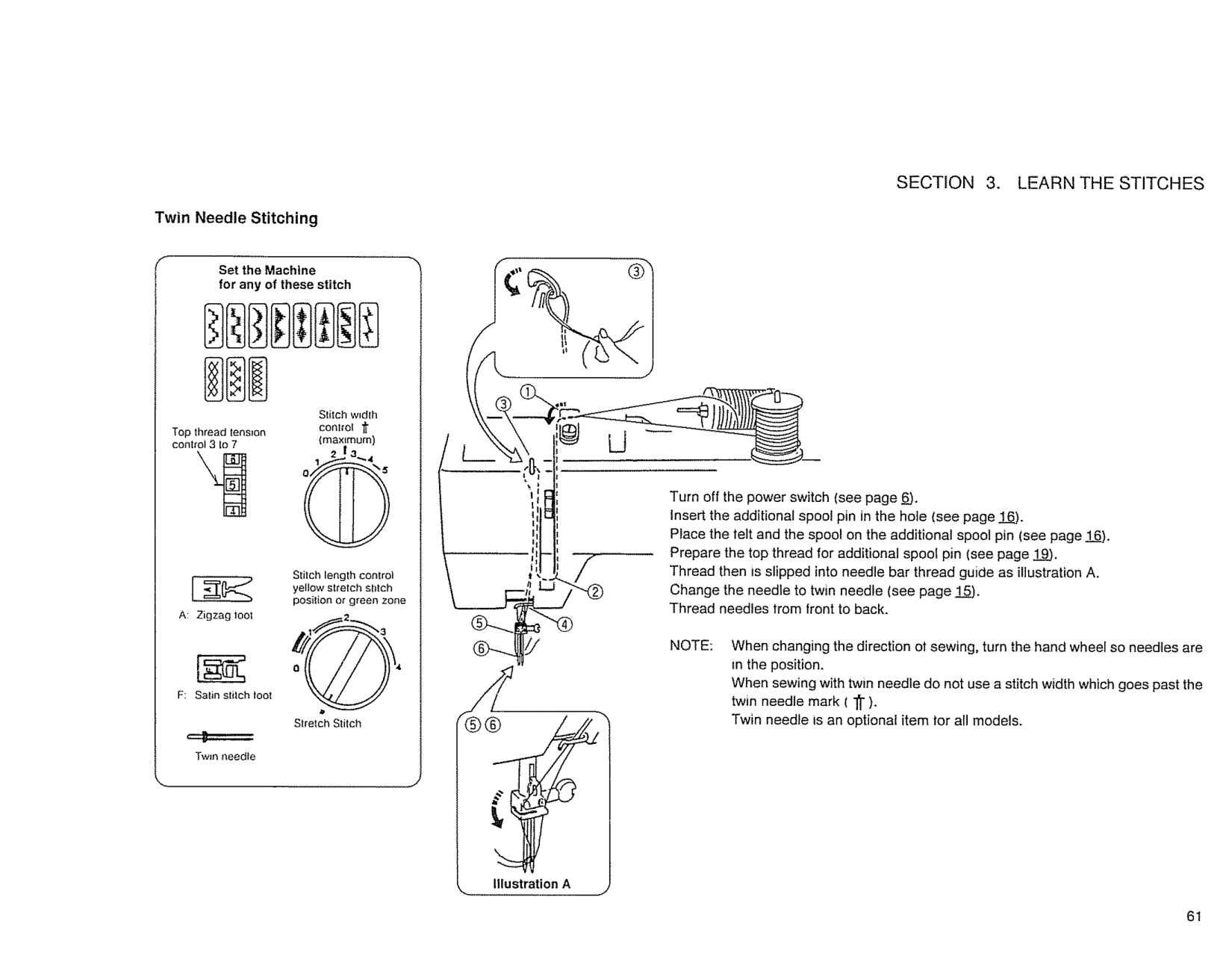
Top thread tension control 3 to 7
| !it _', Turn off the power switch (see page 6_). II1_I Insert the additional spool pin in the hote (see page 1_.
III I ,,II,IIPlacethefeltandthespoolontheadditional spool pin (see page 1__.
t-------:,H', _ Prepare the top thread for additional spool pin (see page 1__9_).
Stitch length control yellow stitchstretch position or green zone
\\ __,_-i_£-__/"_ Thhraeadet_hng n_SeeS_tPePtodtiwnln°'_eeeeddllee(berth_:dpg l_.guide _---J_ Thread needles from front to back. (_._/j NOTE: When changing the direction of sewing, turn the hand wheel so needles are
..I_3
_ in the position. When sewing with twin needle do not use a stitch width which goes past the twin needle mark ( "_ ). Twin needle is an optional item for all models.
F: Satin stilch toot
Stretch Stitch
Twin needle
J
Illustration A

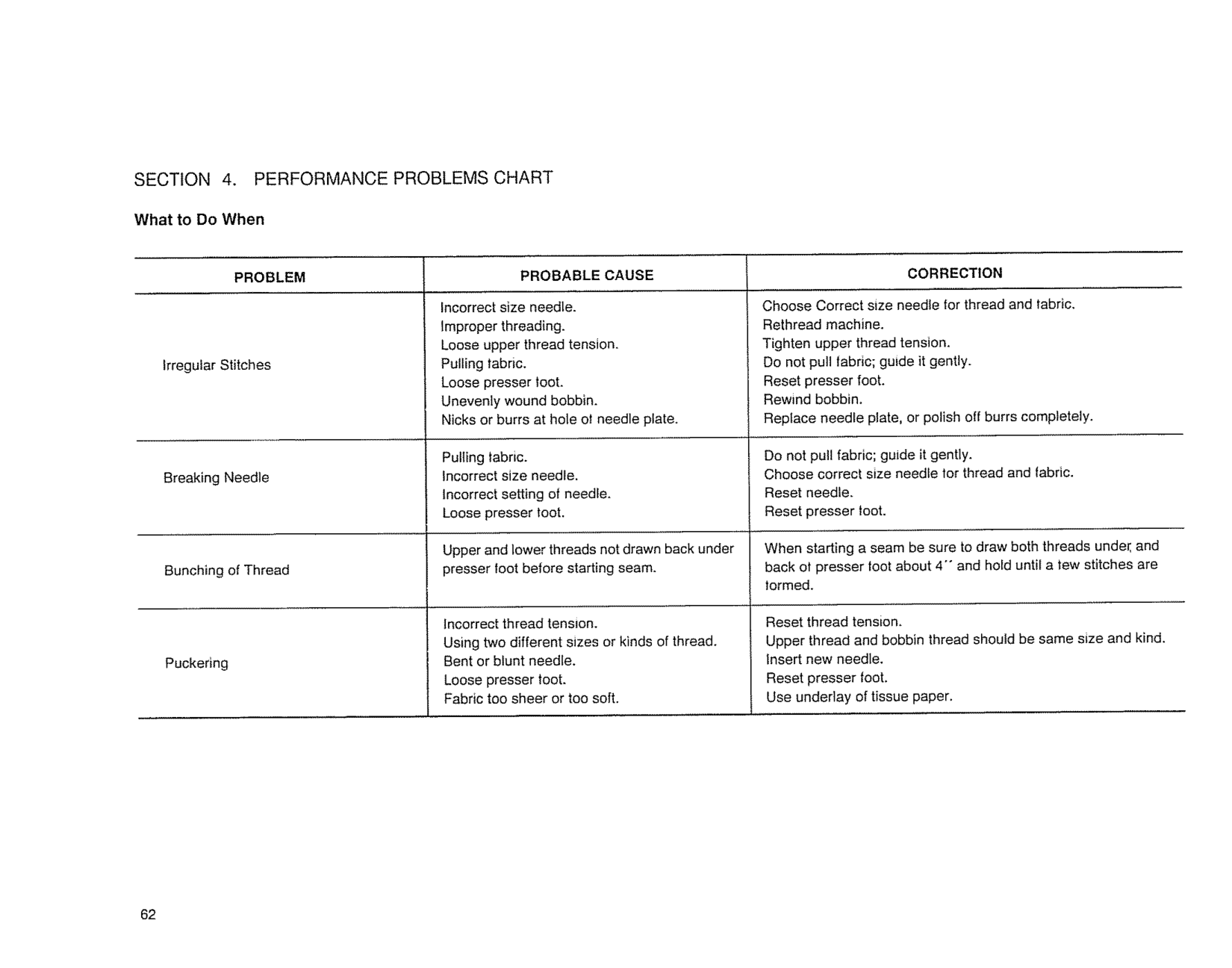
What to Do When
CORRECTION
##################### PROBLEM PROBABLE CAUSE
Choose Correct size needle for thread and fabric. Rethread machine. Tighten upper thread tension. Do not pull fabric; guide it gently. Reset presser foot. Rewind bobbin, Replace needle plate, or polish off burrs completely.
Incorrect size needle. improper threading. Loose upper thread tension. Pulling fabric. Loose presser foot. Unevenly wound bobbin. Nicks or burrs at hole ot needle plate.
Irregular Stitches
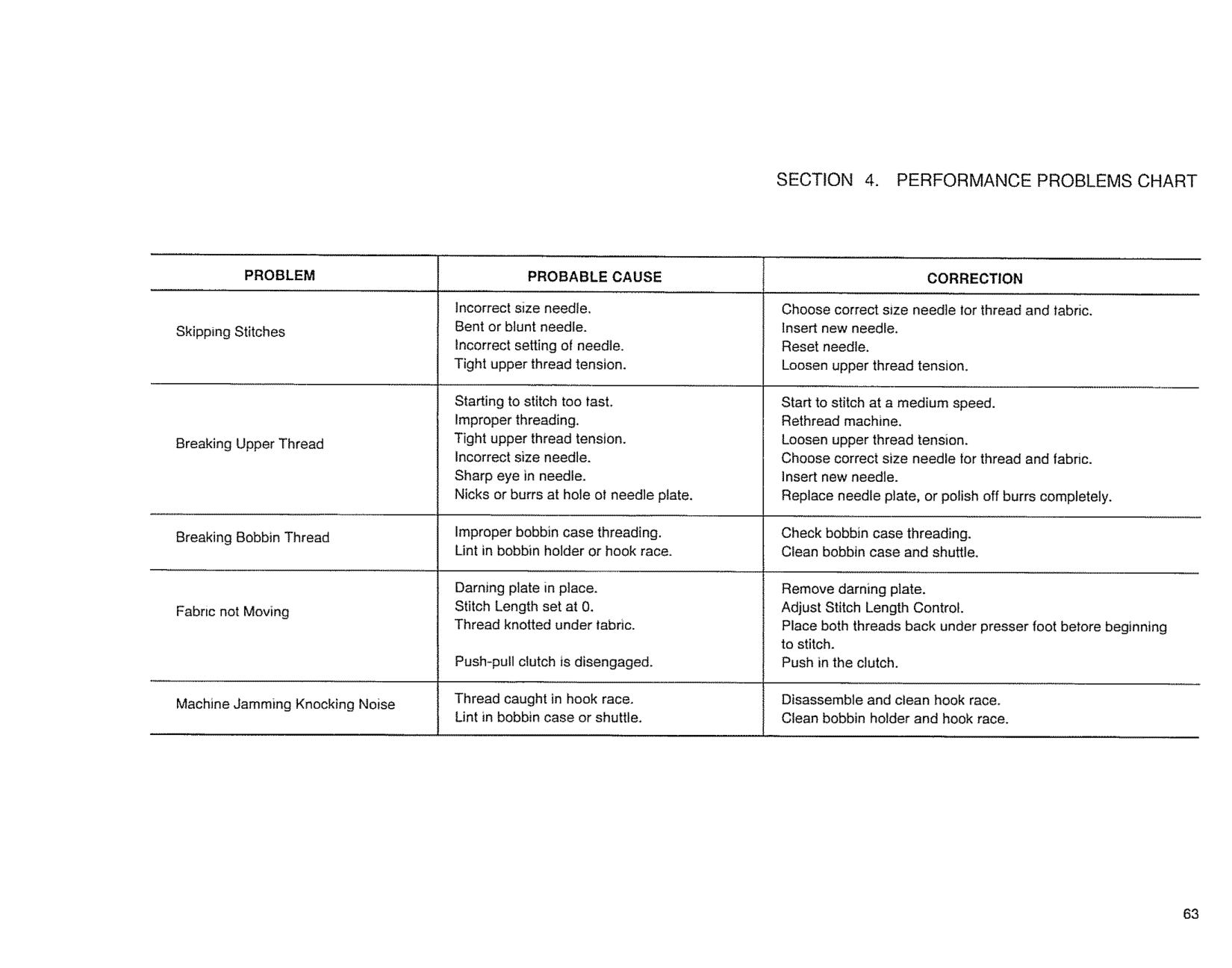
Do not pull fabric; guide it gently. Choose correct size needle lot thread and fabric. Reset needle. Reset presser toot.
Pulling tabric. Incorrect size needle. Incorrect setting of needle. Loose presser toot.
Breaking Needle
When starting a seam be sure to draw both threads under, and back ot presser loot about 4"" and hold until a few stitches are iormed.
Upper and lower threads not drawn back under presser foot before starting seam.
Bunching of Thread
Reset thread tension. Upper thread and bobbin thread should be same size and kind. Insert new needle, Reset presser foot. Use underlay of tissue paper,
Incorrect thread tension. Using two different sizes or kinds of thread. Bent or blunt needle. Loose presser toot. Fabric too sheer or too soft.
Puckering

SECTION 4. PERFORMANCE PROBLEMS CHART
PROBLEM PROBABLE CAUSE CORRECTION
incorrect size needle, Bent or blunt needle. incorrect setting of needle.
Choose correct s+ze needle tot thread and fabric. Insert new needle. Reset needle. Loosen upper thread tension.
Skipping Stitches
Tight upper thread tension.
Starting to stitch too fast. Improper threading.
Start to stitch at a medium speed. Rethread machine. Loosen upper thread tension. Choose correct size needle for thread and fabric. Insert new needle. Replace needle ptate, or polish off burrs completely.
Tight upper thread tension. Incorrect size needle. Sharp eye in needle. Nicks or burrs at hole of needle plate+
Breaking Upper Thread
Improper bobbin case threading. Lint in bobbin holder or hook race.
Check bobbin case threading. Clean bobbin case and shuttle+
Breaking Bobbin Thread
Darning plate in place. Stitch Length set at 0+ Thread knotted under fabric.
Remove darning plate. Adjust Stitch Length Control. PLace both threads back under presser foot before beginning to stitch. Push in the clutch.
Fabric not Moving
Push-pull clutch is disengaged.
Thread caught in hook race. Lint in bobbin case or shuttle.
Disassemble and clean hook race, Clean bobbin holder and hook race.
Machine Jamming Knocking Noise

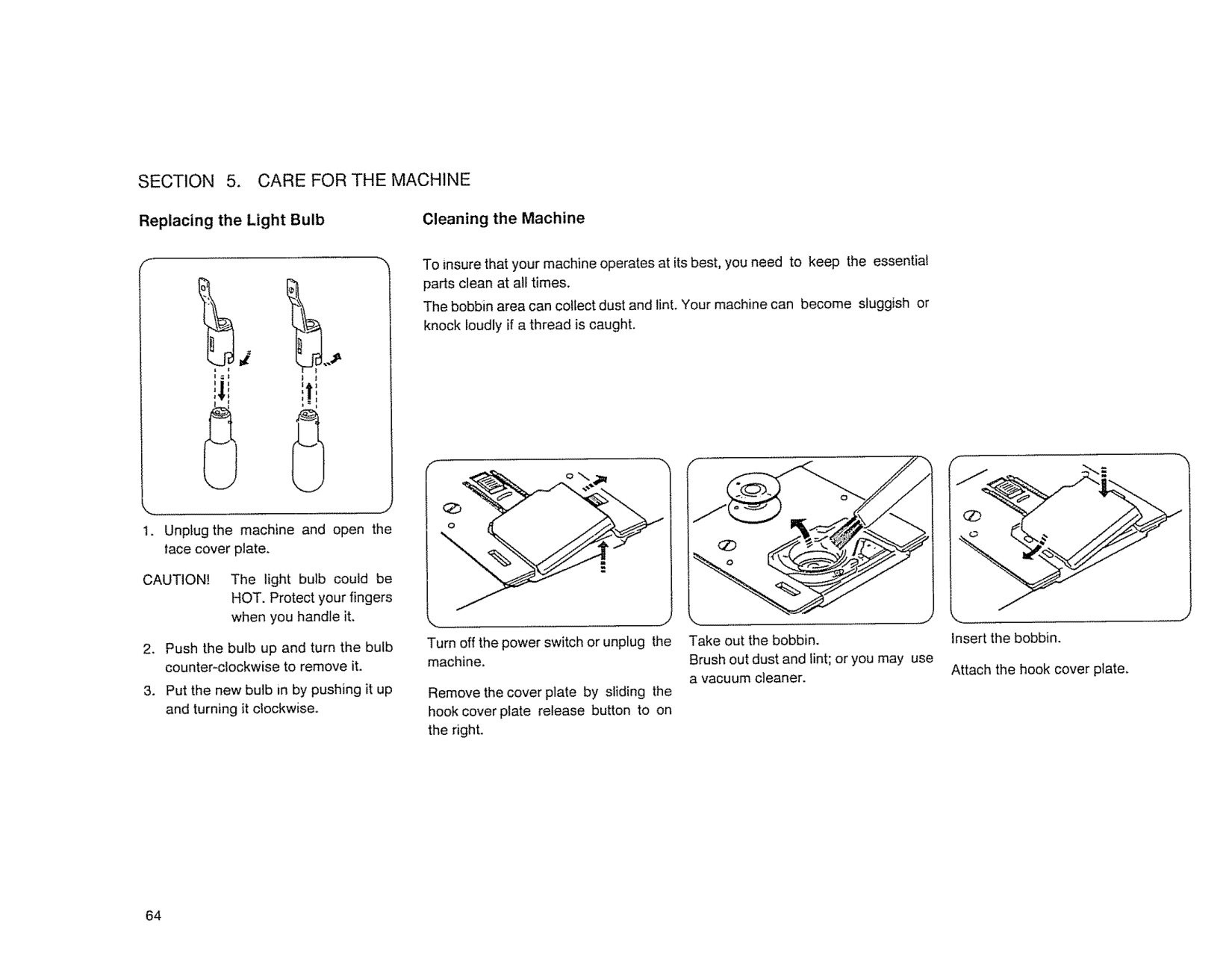
################### Replacing the Light Bulb Cleaning the Machine
To insure that your machine operates at its best, you need to keep the essential parts clean at all times, The bobbin area can collect dust and lint, Your machine can become sluggish or knock loudly if a thread is caught.
Ial } I
############ T Titti
lace cover plate.
CAUTION! The light bulb could be HOT. Protect your fingers when you handle it,
Insert the bobbin.
Take out the bobbin. Brush out dust and lint; or you may use a vacuum cleaner.
Turn off the power switch or unplug the machine,
Attach the hook cover plate,
Remove the cover plate by sliding the hook cover plate release button to on the right.

SECTION 5. CARE FOR THE MACHINE
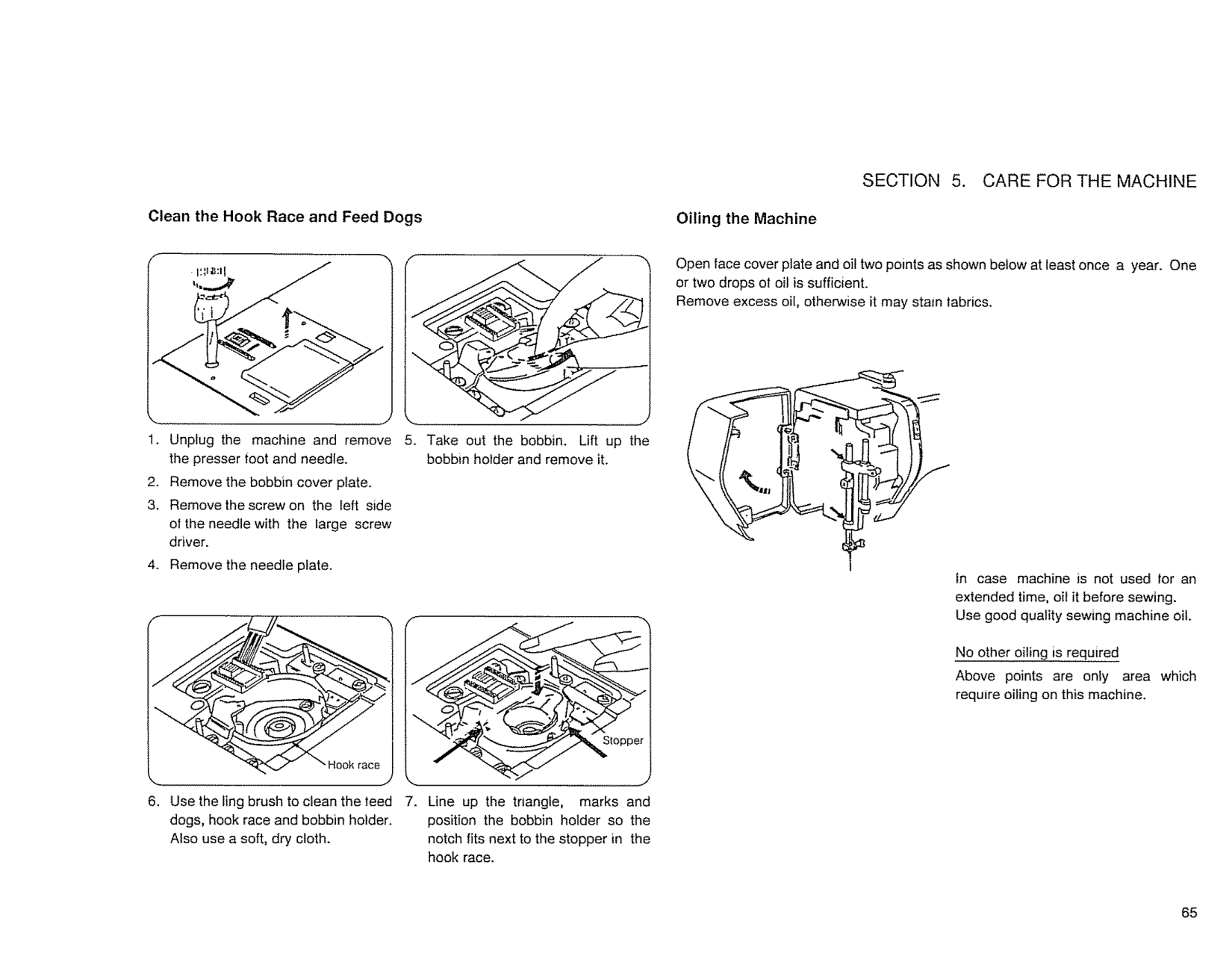
################### Clean the Hook Race and Feed Dogs
Oiling the Machine
Open face cover plate and oil two points as shown below at least once a year. One or two drops ol oil is sufficient. Remove excess oil, otherwise it may stain fabrics.
.....,J
Unplug the machine and remove the presser foot and needle. Remove the bobbin cover plate.
:IWf
21
###################### 3.
Remove the screw on the left side ol the needle with the large screw driver.
###################### 4. Remove the needle plate.
in case machine is not used tor an extended time, oil it before sewing. Use good quality sewing machine oil.
f ......
No other oiling is required Above points are only area which require oiling on this machine.
k._ j
marks and position the bobbin holder so the notch fits next to the stopper in the hook race.
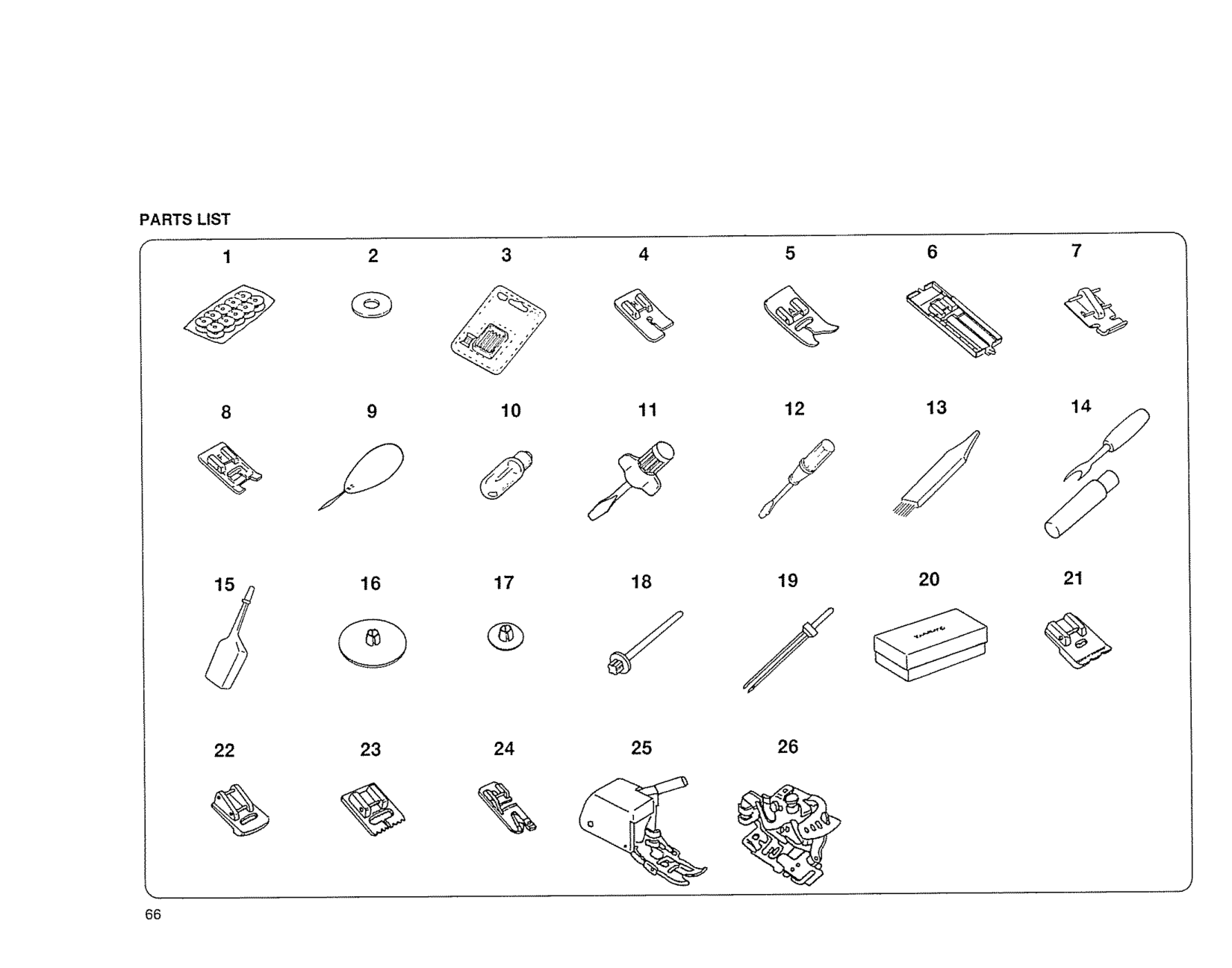

PARTS LIST
7
4 5 6
3
1
2
14
9
10
############### 21
16 20
23 25 26
22
66

All parts listed herein may be ordered lrom any Sears Roebuck and Co. store or service center.
Ret. No.
Part No. 102869107 102403202 813404013 647814020 647814031 647814042 647814053 652806014 685502019 825813005 823803006 822804118 784805004 000009906 820832005 647803004 8O2424O04 647808009 131402005 822020503 822019509 6250315OO
Description
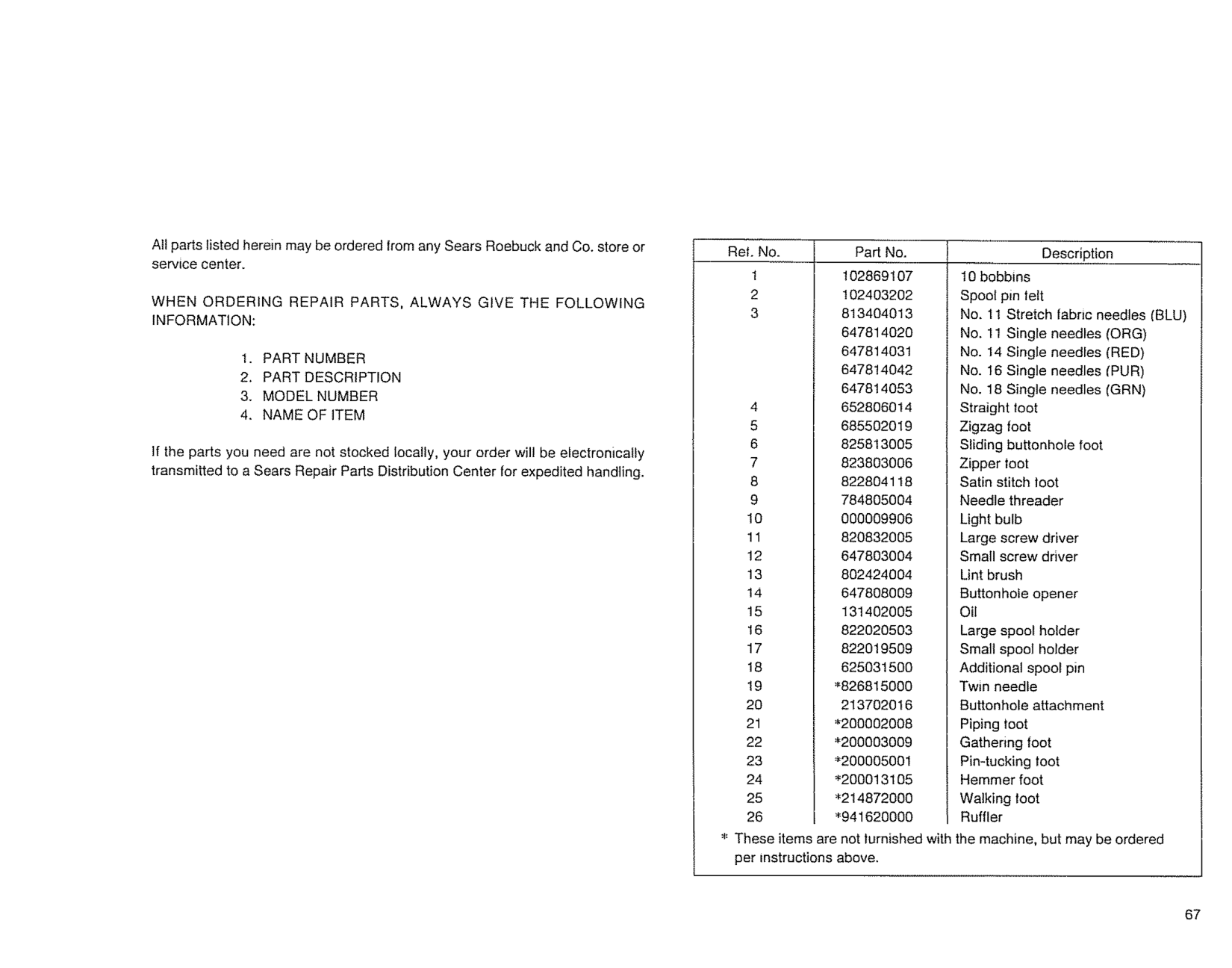
10 bobbins Spool pin telt No. 1! Stretch fabric needles CBLU)
WHEN ORDERING REPAIR PARTS, ALWAYS GIVE THE FOLLOWING INFORMATION:
No. 11 Single needles _ORG) No. 14 Single needles _RED)
No. t6 Single needles (PUR) No. 18 Single needles IGRN) Straight toot Zigzag foot Sliding buttonhole foot Zipper loot Satin stitch loot Needle threader Light bulb
If the parts you need are not stocked locally, your order will be electronically transmitted to a Sears Repair Parts Distribution Center for expedited handling.
Large screw driver Small screw driver Lint brush
Buttonhole opener Oil
Large spool holder Small spool holder Additional spool pin Twin needle Buttonhole attachment Piping toot Gathering foot Pin-tucking loot Hemmer foot Walking loot Ruffler
'_826815000 213702016 _200002008 _200003009 _200005001 _200013105 _2t4872000 _941620000
7: These items are not lumished with per instructions above.
the machine, but may be ordered

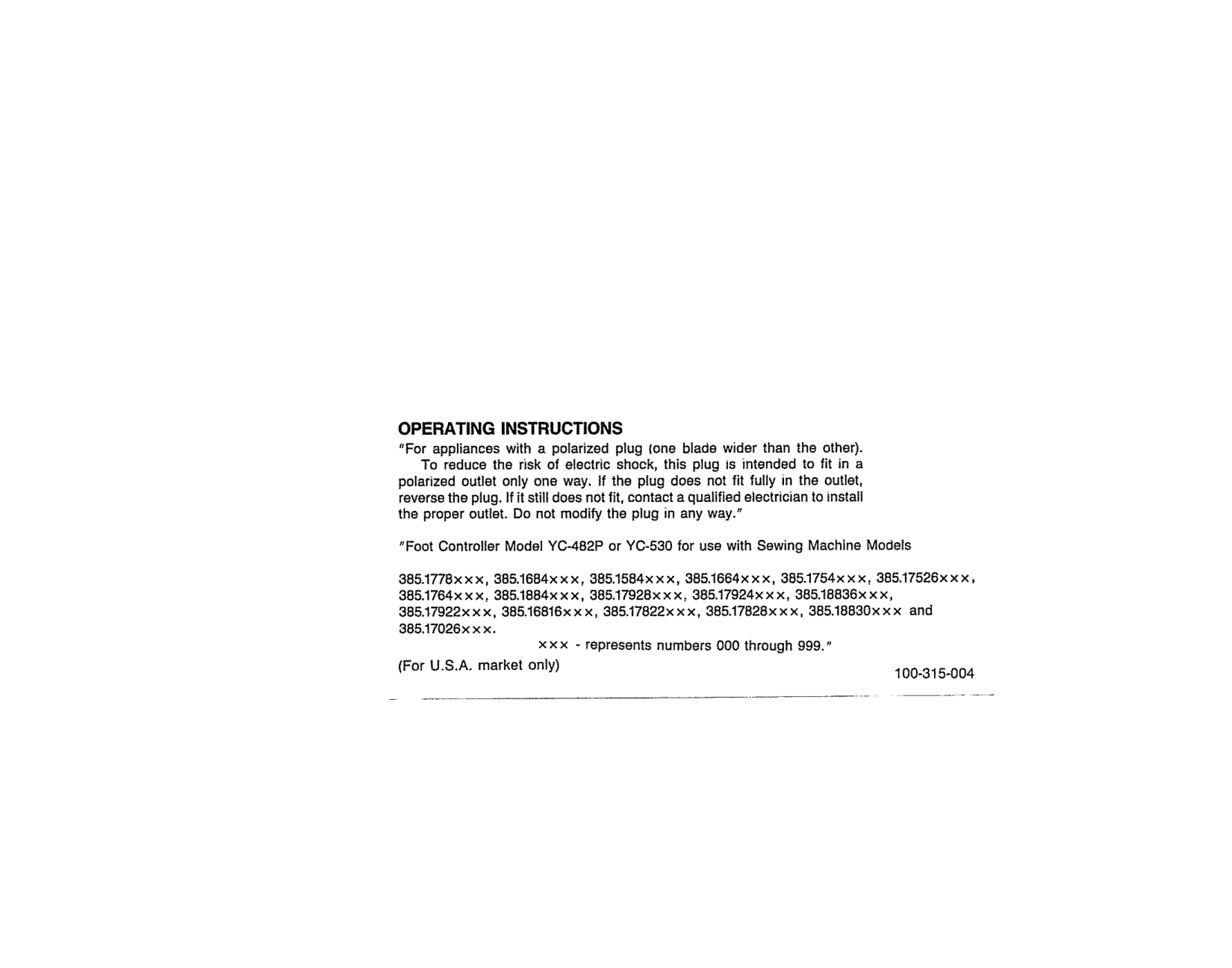
OPERATING INSTRUCTIONS "For appliances with a polarized plug {one blade wider than the other).
To reduce the risk of eiectdc shock, this plug is intended to fit in a polarized outlet only one way. ff the plug does not fit fully in the outlet, reverse the plug. If it stilldoes not fit, contact a qualified electrician to install the proper outlet. Do not modify the plug in any way."
"Foot Controller Model YC-482P or YC-530 for use with Sewing Machine Models
385.!778x x x, 385.1684x x x, 385.1584x x x, 385.1664 x x x, 385.1754x x ×, 385.17526x x x, 385.1764x x x, 385.1884x x x, 385.17928x x x, 385.17924x x x, 385.t8836x x x, 385.17922x x x, 385.16816x x x, 385.17822x x x, 385.17828x x x, 385_18830x x x and 385.17026x x x.
x xx - represents numbers 000 through 999." (For U.S.A. market only) 100-315-004

+ ÷ _' WARRANTY _' + +
FULL 25-YEAR WARRANTY ON SEWING MACHINE HEAD 0
_ For 25 years from the date of purchase, Sears wilt, free of charge, repair detects in material or workmanship which appear in # the mechanical components of the sewing machine head.
p _) FULL TWO YEAR WARRANTY ON ELECTRICAL EQUIPMENT OF SEWING MACHINE #
(_ For two years trom the date of purchase, Sears will, free ot charge, repair defects in material or workmanship which appear + in the electrical equipment of the sewing machine, including electronic components, motor, wiring, switch and speed control.
##################### FULL 90-DAY WARRANTY ON ALL PARTS AND MECHANICAL ADJUSTMENTS
For 90 days from the date of purchase, Sears will, lree of charge, replace any parts and provide mechanical service _) necessary tor proper operation of the sewing machine, except for normal maintenance.
WARRANTY SERVICE IS AVAILABLE BY RETURNING THE SEWING MACHINE TO THE NEAREST SEARS SERVICE CENTER/DEPARTMENT IN THE UNITED STATES. _1
#_ This warranty gives you specific _egai rights, and you may also have other rights which vary from state to state. # #
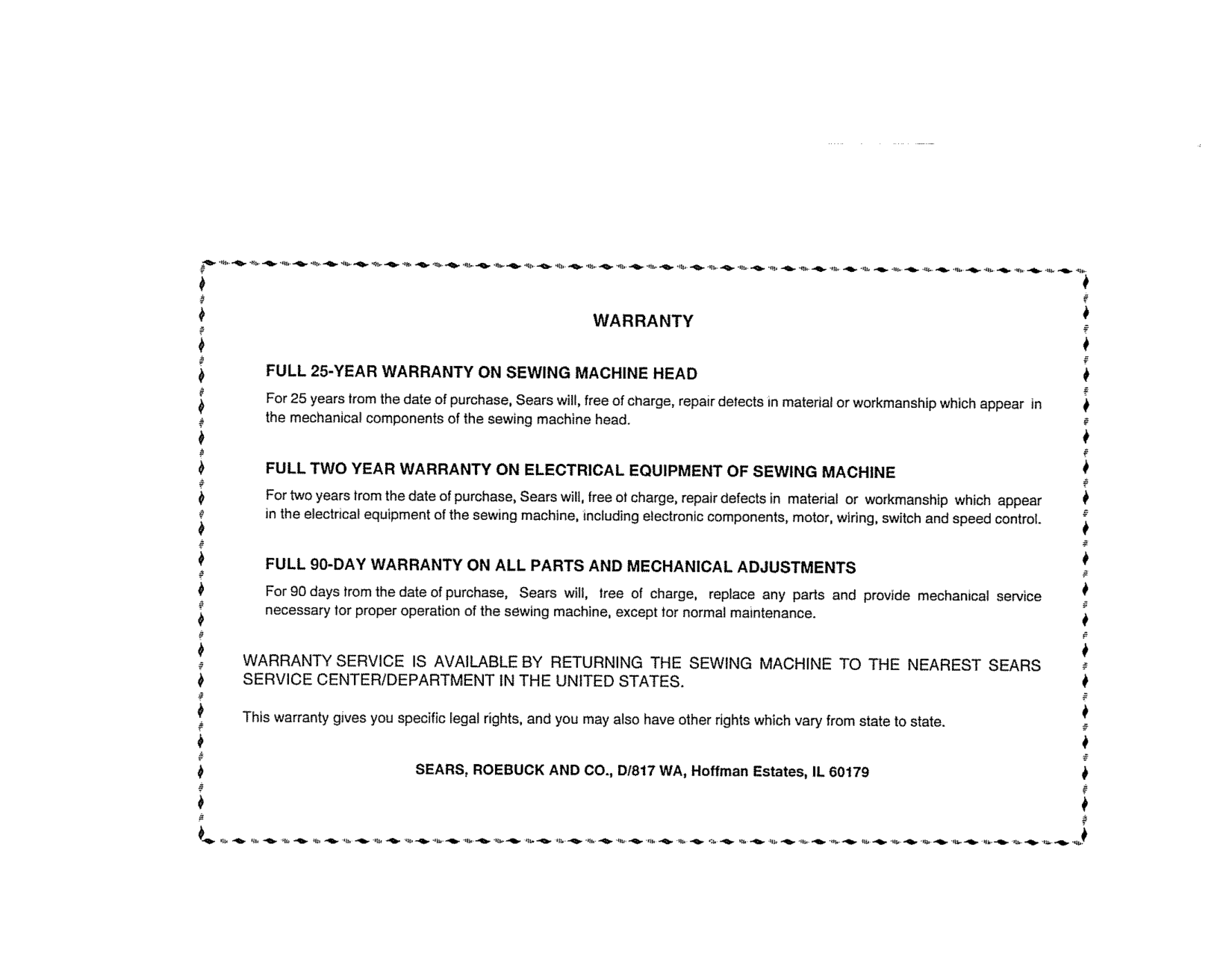
##################### _) SEARS, ROEBUCK AND CO., D1817 WA, Hoffman Estates, IL 60179
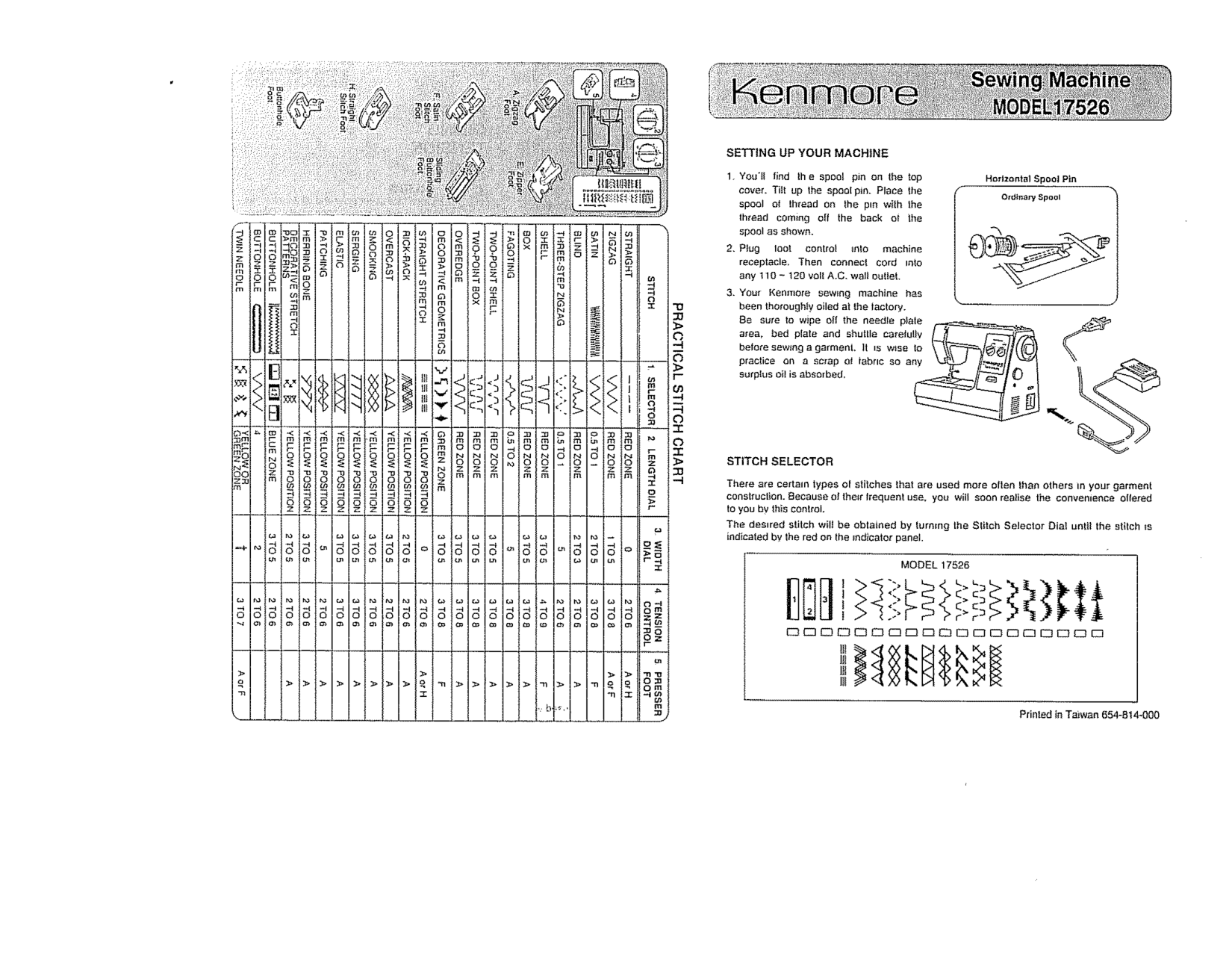
_,-_k+ m, _ m+ _ +It+ _ +++,+'++4_+,++._ +++_+_ _=+,+-,q_++m+++-.l_ _It+-+..'l_ *+_+-  ######################## SETTING UP YOUR MACHINE 1o You'll find lh e spool pm on the top cover. Tilt up the spoo[ pin. Place the spool ot thread on lhe pm with the thread coming o[f the back ot the Hodzontal Spool P}n spool as shown. _o _. NI_i _ _,m_ m #### i m
o_
_-)_ o i i
z O m z m I
>__i__ -.___im_
z..__i
mlo rni :1:
re m
*o N N
3: "O
P
t|
############# Jl
V
m_
---1
i|
&.-'S
f
€>';* >
G3-.<-_ m_
-. b, m m L_ _' p p STITCH SELECTOR o_o_ _00=z_oo__'___=_ 3o go There ere certain types of stitches that are used mo_'e often than others in your garment construct}on. Because o! the,r lrequent use, yo_ wit_ soon realise the convenience altered to you by this control The des=red stitch wilt be obtained by _urmng the Stitch Selector Dial until the stitch _s indicated by lhe red on the _ndicator panel. _m
gozzi-
########### o
MODEL 17526
o
0 0_
__ Io=o
######################### o
>i>
_ Oft!
-n
Printed in Ta}wan 654-814--000

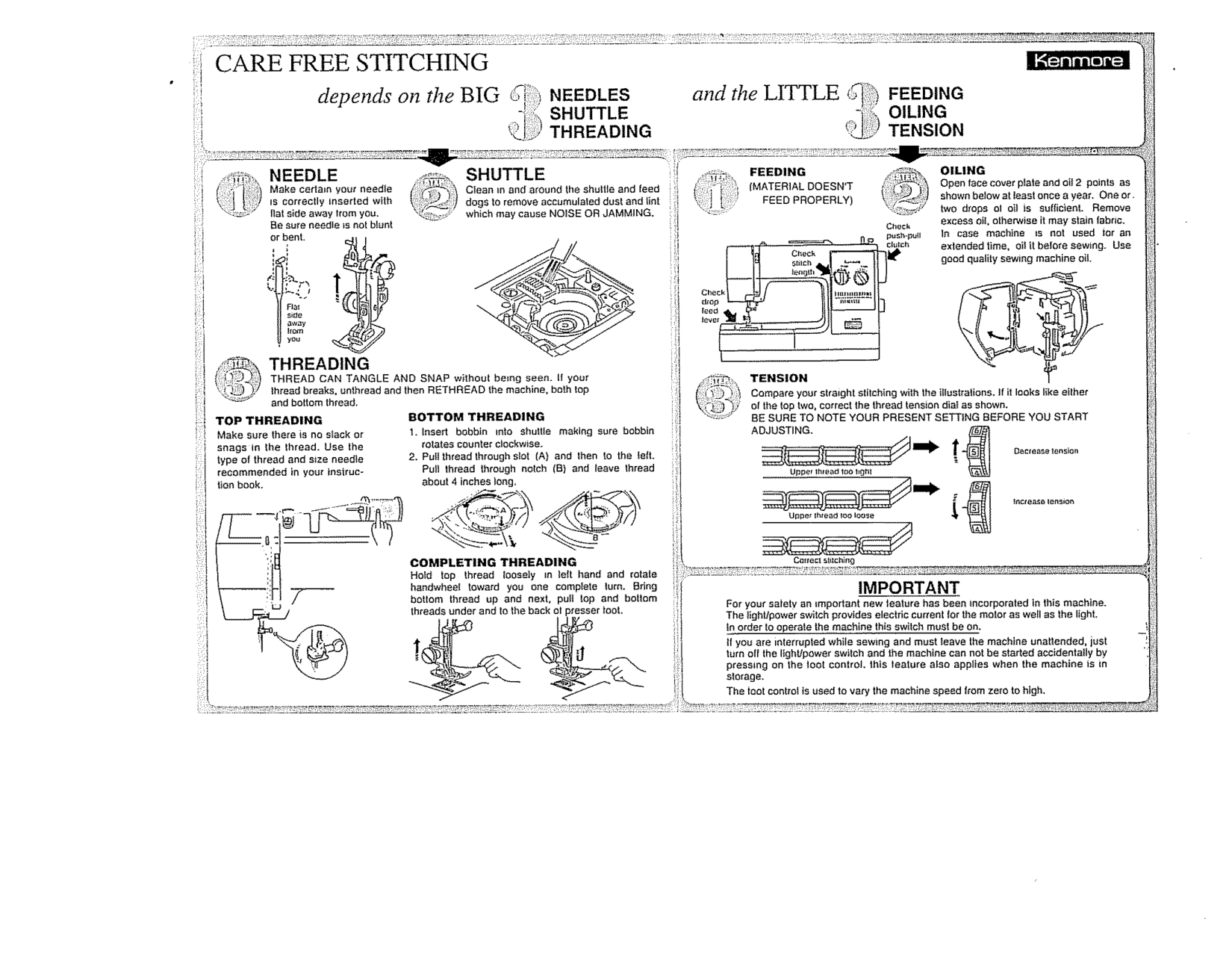
i::::_Makesurethereisnostack or t. insert bobbin into shuttle making sure bobbin
####### ! o.........o
:il;i snags in the thread Use the rotates counter c ockwse, i_ij i type of thread andsze neede 2 Pul thread through slat (A) and then to the left. _:; ']' recommended in your instruc- Pal thread through notch (B) and leave thread
ADJUSTING.
Upper lhtBa_ If_ Ii_I_I
!; t on book about4 incheslong. i
Upper Ih/ei_ I_ loose
:it\ :!,i OM ET,.GTHREAD,.G i.... :: l ! Hod lop thread oosely tn teIt hand and rotate ::: _"_:H _ handwheeI toward you one complete turn. Bring ; _!:,_ _ bottom thread up and next,pulltop and bottom i:::] ____,_,,=4__ threads under and to the back el presser toot,
Collect _ilChilI_
IMPORTANT For your saiety an _mportant new lecture has been incorporated in this machine. The fghltpawer switch provides electric current {or the motor as well as the light,
If you are intelrupted while sewing and must leave the machine unattended, just turn off the Iightipawer switch and the machine can not be started accidentally by pressing on the loot control, this lecture afso apples when the machine is in storage,
_norder
The toot control is used to vary the machine speed Item zero to high,

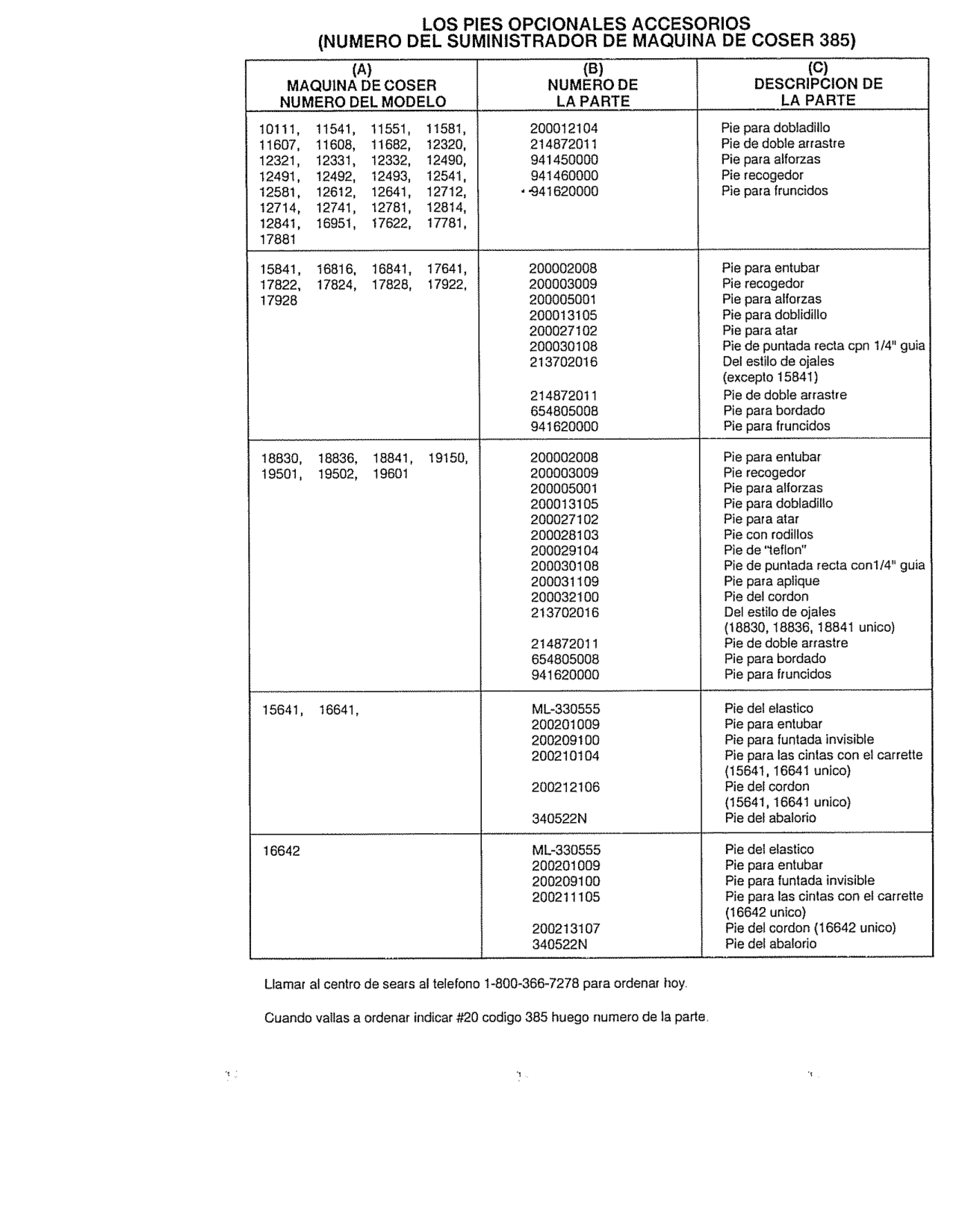
################### LOS PIES OPCIONALES ACCESORIOS
(NUMERO DEL SUMINiSTRADOR DE MAQUINA DE COSER 385)
################ (A) (C)
(B)
MAQU1NA DE COSER DESCRIPClON DE NUMERO DEL MODELO LA PARTE
NUMERO DE LA PARTE 2OOO12104
Pie para dobiadillo Pie de doble arrastre
10111, 11541, 11551, 11581, 11687, 11608, 1t682, 12320, 12321, 12331, 12332, 12490, 12491, 12492, 12493, 12541, 12581, 12612, 12641, 12712, 12714, 12741, 12781, 12814, 12841, 16951, 17622, 17781, 17881
214872011 941450000 94146OOOO
Pie para alforzas Pie recogedor Pie para fruncidos
, "941620000
200002008 200003009 200005001 200013105 2O0027102 200030108 213702016
Pie para entubar Pie recogedor Pie para alforzas Pie para doblidillo Pie para atar Pie de puntada recta cpn 1/4" guia Del estilo de ojales (excepto 1584t) Pie de doble arrastre Pie para bordado Pie para fruncidos
15841, 16816, 16841, 17641, 17822, 17824, 17828, 17922, 17928
214872011 654805008 941620000
200002008 2O0003009 200005001 200013105 200027102 200028103 200029104 200030108 200031109 200032100 213702016
18830, 18836, 18841, 19501, 19502, 19601
19150,
Pie para entubar Pie recegedor Pie para alforzas Pie para dobladiI!o Pie para atar Pie con rodillos Pie de 'leflon" Pie de puntada recta conl/4" guia Pie para aplique Pie del cordon Del estilode ojales (t8830, 18836, 18841 unico) Pie de doble arrastre Pie para bordado Pie para fruncidos
214872011 654805008 94162000O
Pie del elastico Pie para entubar Pie para funtada invisible Pie para las cintas con el carrette (15641, 16641 unJco) Pie de[ cordon (15641, 16641 unico) Pie del abatorio
M_330555 200201009 200209100 200210104
15641, 16641,
200212106
340522N
Pie de1elastico Pie para entubar Pie para funtada invisible Pie para las cintas con el carrette (16642 unico) Pie del cordon (16642 unico) Pie del abatorio
16642
M_330555 200201009 200209100 200211105
200213107 340522N
Llamar al centro de sears al telefono 1-800-366-7278 para ordenar boy,
Cuando vallas a ordenar indicar #20 codigo 385 huego numero de ta parte,

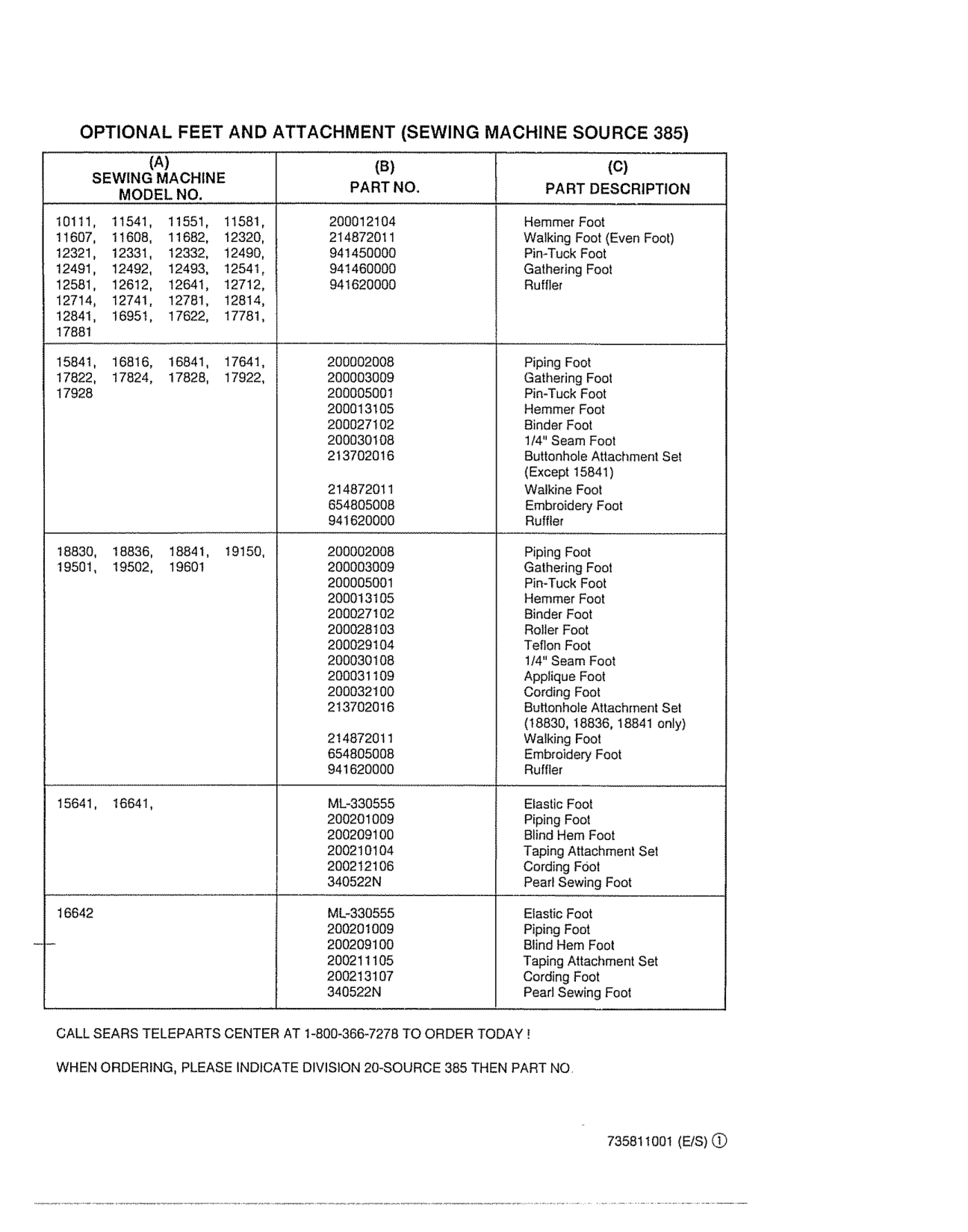
################# OPTIONAL FEET AND ATTACHMENT (SEWING MACHINE SOURCE 385)
(A) (B) SEWING MACHINE
################ (c)
PART DESCRIPTION
MODEL NO. PART NO.
, ,, _ ,,, ,,,,,, ,,,,,,, ,, ,, ,,,,, ,,,,, ,, ,, .......... ,
200012104 214872011 941450000 94146000O 941620000
10111, 11541, 11551, 11581, 11607, 11608, 11682, 12320, 12321, 12331, 12332, 12490, 12491, 12492, 12493, 12541, 12581, 12612, 12641, 12712, 12714, 12741, 12781, 12814, 12841, 16951, 17622, 17781, 17881
Hemmer Foot Walking Foot (Even Foot) PimTuck Foot Gathering Foot Ruffler
15841, 16816, 16841, 17641, 17822, 17824, 17828, 17922, 17928
200002008 200003009 200005001 200013105 200027102 200030108 213702016
Piping Foot Gathering Foot Pin-Tuck Foot Hemmer Foot Binder Foot 114"Seam Foot Buttonhole Attachment Set (Except 15841) Walkine Foot Embroidery Foot Ruffler
214872011 654805008 941620000
200002008 200003009 200005001 200013105 200027102 200028103 200029104 200030108 200031109 200032100 213702016
Piping Foot Gathering Foot Pin-Tuck Foot Hemmer Foot Binder Foot Roller Foot Teflon Foot 1/4" Seam Foot Applique Foot Cording Foot Buttonhole Attachment Set (18830, 18836, 18841 only) Walking Foot Embroidery Foot Ruffler
18830, 18836, 18841, 19150, 19501, 19502, 19601
214872011 654805008 941620000
ML-330555 200201009 200209100 200210104 200212106 340522N
Elastic Foot Piping Foot BlindHem Foot
Taping Attachment Set Cording Foot Pearl Sewing Foot
ML-330555 200201009 200209100 200211105 200213107 340522N
Elastic Foot Piping Foot Blind Hem Foot Taping Attachment Set Cording Foot Pearl Sewing Foot
CALL SEARS TELEPARTS CENTER AT 1-800-366-7278 TO ORDER TODAY !
WHEN ORDERING, PLEASE INDICATE DIVISION 20-SOURCE 385 THEN PART NO,
73581 t001 (E/S) (_

################### SEWING MACHINE
Now that you have purchased your Kenmore Sewing Machine, should a need ever exist for repair parts or service, sJmpty contact your nearest Sears Service Center. Be sure to provide all pertinent facts when
call or visit.
model number will be shown on the nomenclature plate on the back of your sewing machine. See page 4 for location.
WHEN ORDERING REPAIR PARTS, ALWAYS GIVE THE FOLLOWING INFORMATION:
-_MODEL NUMBER_NAMEOFITEM_PART DESCRIPTION
the parts you need are not stocked locally, your order will be electronically transmitted to a Sears Repair Parts Distribution Center tor handling.
################### SEARS, ROEBUCK AND CO., D1817WA, HOFFMAN ESTATES, IL 60179
;! .....
################### Printed inTaiwan