Mam Electric Steriliser And Express Bottle Warmer manual
Unknown · 29 Q&As

Mam Electric Steriliser And Express Bottle Warmer

Ask AI

— answers from the official manual

Answers from the official manual.

Common questions

Common Questions

29 total
1

How much water do I need to add when using the Electric Steriliser?

Pour exactly 200ml (7 fl oz) of tap water directly into the Base before each sterilising cycle. Using too much or too little water can result in incomplete sterilising and can damage the device. Always ensure the sealing ring is firmly pressed into place before adding water. (Page 4)

2

How long does the electric sterilising programme take, and how will I know it has finished?

The sterilising programme runs for 7 minutes and then automatically stops, signalled by 3 long beeps and the light stopping its flashing. After the programme ends, a 4-minute cooling down period begins with all 4 LEDs lit, which also ends with 3 long beeps. You should allow the Steriliser to cool before removing the lid. (Page 4)

3

How long will items stay sterile inside the Electric Steriliser?

Sterilised products kept in an unopened Steriliser stay disinfected for up to 48 hours. To maintain this disinfection period, the number of items sterilised together must not exceed the maximum quantities listed in the product charts. For a 24-hour disinfection effect, higher quantities of bottles can be sterilised at once. (Pages 3–4)

4

How do I use the Express Bottle Warming programme?

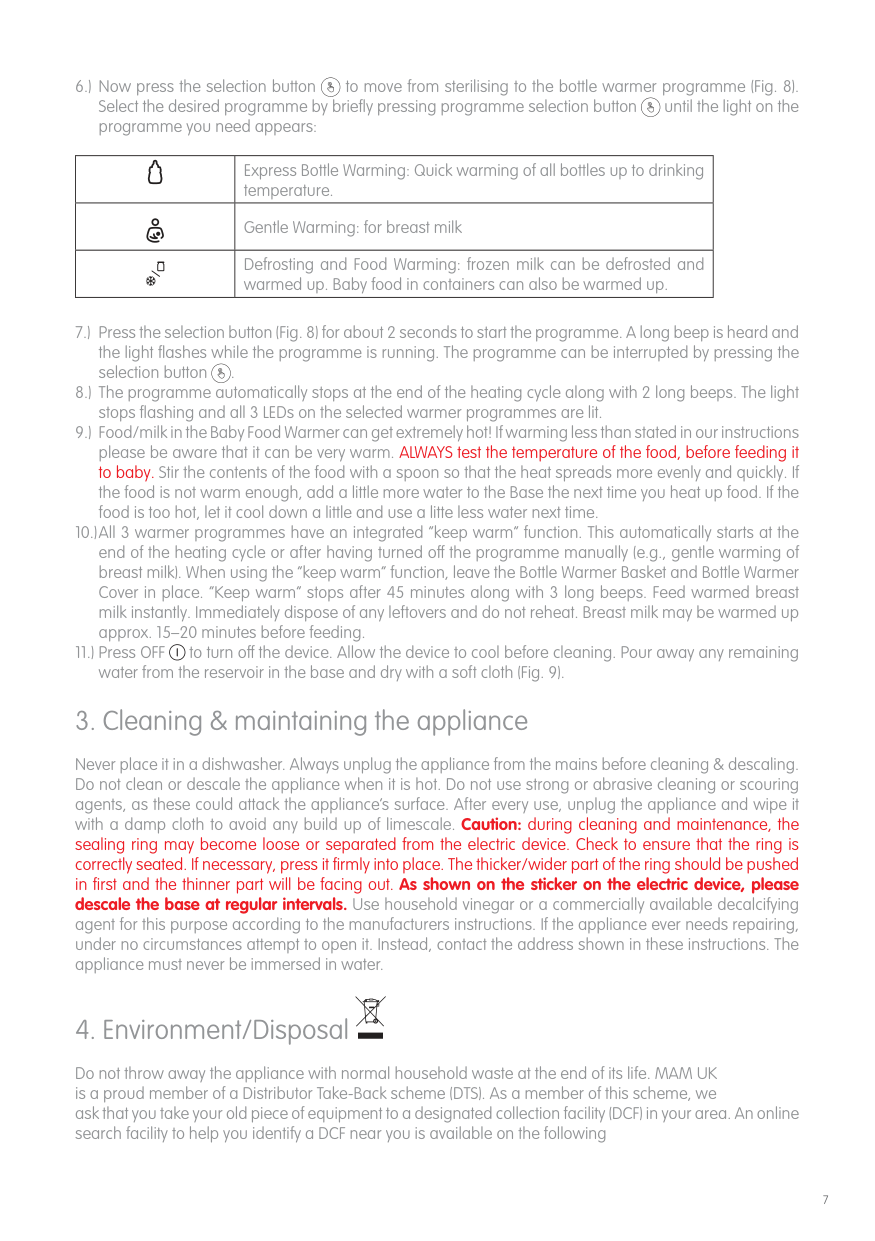
Select the Express Warming programme using the selection button and press it for about 2 seconds to start; a long beep will sound and the light will flash while running. Use the Bottle & Food Warmer Chart to determine the correct water quantity based on bottle size and initial temperature — for example, a 130ml plastic bottle at room temperature requires approximately 35ml of water. The programme automatically stops at the end of the heating cycle with 2 long beeps. (Pages 5–6)

5

What is the 'keep warm' function and how long does it last?

All three warmer programmes have an integrated 'keep warm' function that automatically starts at the end of the heating cycle or after manually stopping the programme. The keep warm function stops automatically after 45 minutes, signalled by 3 long beeps. When using this function, the Bottle Warmer Basket and Bottle Warmer Cover should be left in place. (Page 7)

6

How do I descale and clean the Electric Steriliser & Bottle Warmer?

After every use, unplug the appliance and wipe it with a damp cloth to avoid limescale build-up. At regular intervals, descale the base using household vinegar or a commercially available decalcifying agent according to the manufacturer's instructions. Never place the appliance in a dishwasher or immerse it in water, and do not use strong or abrasive cleaning agents. (Page 7)

Show 23 more questions

What is the warranty period for the Electric Steriliser & Express Bottle Warmer?

What are the power requirements for the Electric Steriliser & Express Bottle Warmer?

Is it safe for children to use the Electric Steriliser & Express Bottle Warmer?

How do I clean and maintain my MAM Electric Steriliser & Express Bottle Warmer?

What should I do if my MAM Electric Steriliser doesn't appear to be working at all?

How often do I need to descale my MAM Electric Steriliser & Express Bottle Warmer?

Why does my MAM Easy Start bottle feel loose after filling it with boiled water?

What safety precautions should I follow when opening the Steriliser after a cycle?

How do I warm a bottle with the Bottle Warmer?

How do I clean the Electric Steriliser and Bottle Warmer?

How long should I boil milk storage containers to sterilize them?

What are key maintenance practices needed for the MAM Easy Start bottle?

What is the process to factory reset my device?

How do I properly set up and assemble my electric breast pump?

What is the recommended frequency for descaling my electric appliances?

What is the cooling period after using my MAM Electric Steriliser?

How do I correctly assemble the MAM Electric Steriliser?

What should I do if there's leftover water after using my MAM Electric Steriliser?

How hot does the bottle warmer get during use?

What are the sterilizing times for different wattages of microwave?

How do I safely store sterilized bottles to ensure they remain disinfected?

How do I sterilize bottles using the Electric Steriliser?

What are some safety precautions when using the Electric Steriliser?

Full Manual

36 pages
Page 1

Online Shop Electrical Products English

Content

####### Electric Steriliser & Express Bottle Warmer

  • 1. General sterilising instructions ............................................ 3
  • 1.1. Using the Electric Steriliser ................................................... 4
  • 1.2. Using the Microwave Steriliser ............................................ 4
  • 2. Bottle & Food Warmer instruction ........................................5
  • 3. Cleaning and maintaining the appliance ...........................7
  • 4. Environment/Disposal 7
  • 5. Warranty .................................................................................8
  • 6. Repair notes ...........................................................................8
  • 7. Technical data ........................................................................8
  • 8. Safety notes ............................................................................8
  • 9. MAM Easy Start™ Anti-Colic ................................................10
  • 10. MAM Start ............................................................................. 11 2in1 Single Breast Pump/Upgrade Set
  • ![image 1](EN_WEB_Leaflet_online_shop_electrical_products_GGH1A9ZA001.AAL_images/imageFile1.png)

    ![image 2](EN_WEB_Leaflet_online_shop_electrical_products_GGH1A9ZA001.AAL_images/imageFile2.png)

  • 1. Product description ............................................................. 12
  • 2. Safety notes .......................................................................... 12
  • 3. Cleaning and maintaining the appliance ......................... 15
  • 4. Using the appliance ............................................................ 16
  • 4.1. Electric pumping .................................................................. 16
  • 4.2. Manual pumping ................................................................ 17
  • 4.3. Use in combination with the MAM Storage Solution ....... 19
  • 5. Storing and warming breast milk ...................................... 19
  • 6. Feeding ................................................................................ 20
  • ![image 3](EN_WEB_Leaflet_online_shop_electrical_products_GGH1A9ZA001.AAL_images/imageFile3.png)

    ![image 4](EN_WEB_Leaflet_online_shop_electrical_products_GGH1A9ZA001.AAL_images/imageFile4.png)

  • 6.1. MAM Easy Start™ Anti-Colic bottle .................................. 20
  • 7. Troubleshooting for breast pump ..................................... 22
  • 8. Environment/Disposal ....................................................... 23
  • 9. Warranty .............................................................................. 23
  • Page 2

  • 10. Repair notes ........................................................................ 23
  • 11. Technical data .......................................................................23 2in1 Double Breast Pump
  • ![image 5](EN_WEB_Leaflet_online_shop_electrical_products_GGH1A9ZA001.AAL_images/imageFile5.png)

    ![image 6](EN_WEB_Leaflet_online_shop_electrical_products_GGH1A9ZA001.AAL_images/imageFile6.png)

  • 1. Product description ............................................................ 24
  • 2. Safety notes ......................................................................... 24
  • 3. Cleaning and maintaining the appliance ........................ 27
  • 4. Using the appliance ........................................................... 28
  • 4.1. Electric pumping ................................................................. 28
  • 4.2. Manual pumping ............................................................... 30
  • 4.3. Use in combination with the MAM Storage Solution ....... 31
  • 5. Storing and warming breast milk ...................................... 31
  • 6. Feeding ................................................................................ 32
  • 6.1. MAM Easy Start™ Anti-Colic bottle .................................. 32
  • 7. Troubleshooting ...................................................................35
  • 8. Disposal .............................................................................. 35
  • 9. Warranty .............................................................................. 36
  • 10. Repair notes ........................................................................ 36
  • 11. Technical data ..................................................................... 36
  • Electric Steriliser & Express Bottle Warmer

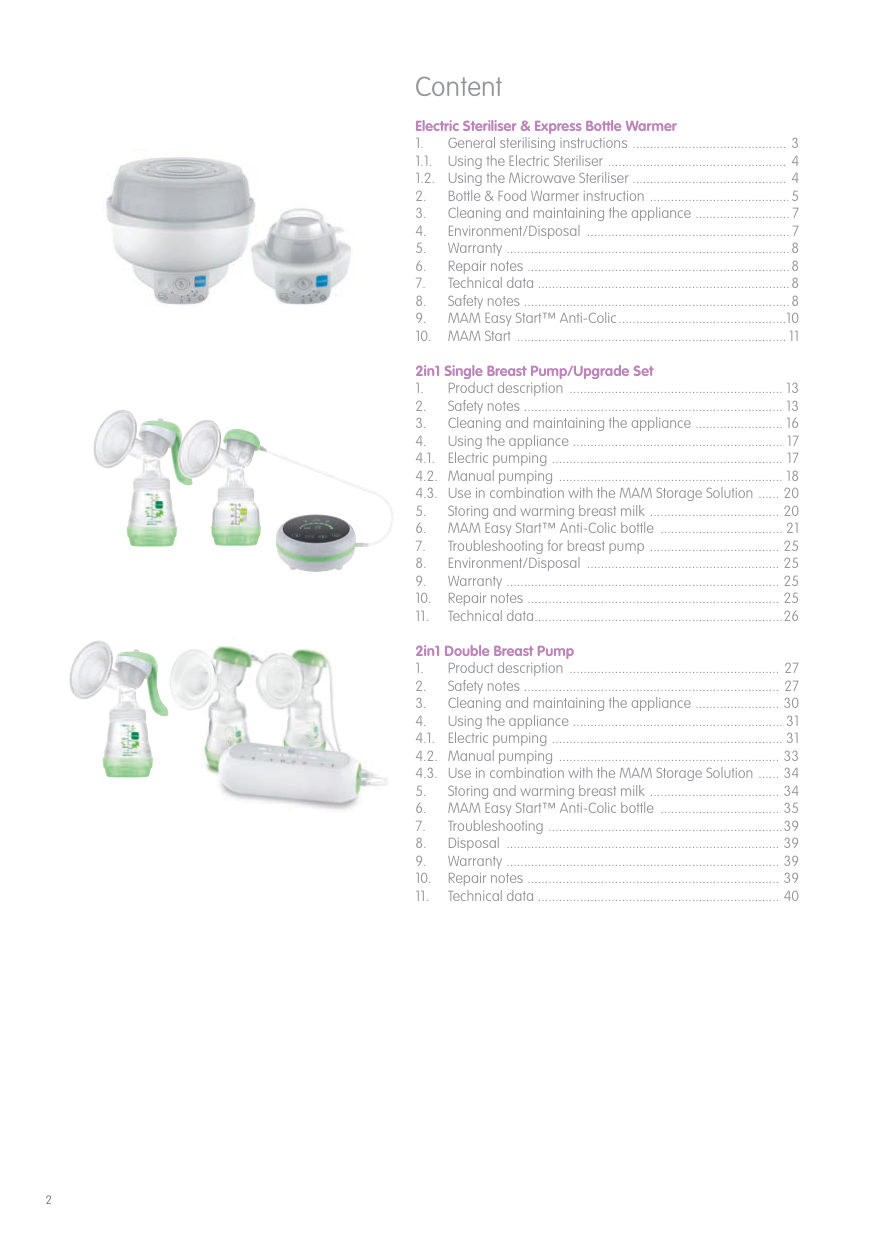
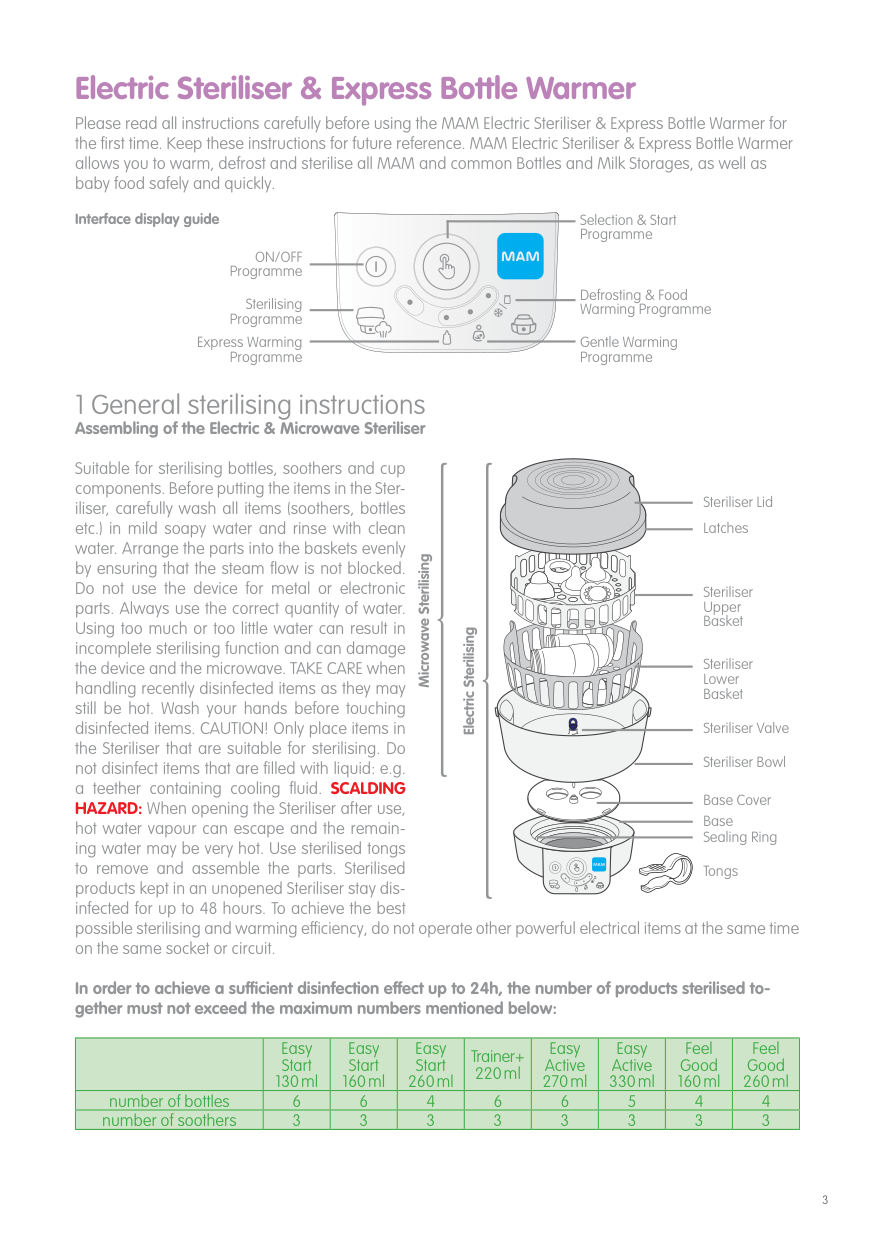
    Please read all instructions carefully before using the MAM Electric Steriliser & Express Bottle Warmer for the first time. Keep these instructions for future reference. MAM Electric Steriliser & Express Bottle Warmer allows you to warm, defrost and sterilise all MAM and common Bottles and Milk Storages, as well as baby food safely and quickly.

    ####### Interface display guide

    ON/OFF Programme

    Sterilising Programme

    Express Warming Programme

    Selection & Start Programme

    Defrosting & Food Warming Programme

    Gentle Warming Programme
  • 1. General sterilising instructions
  • Page 3

    Assembling of the Electric & Microwave Steriliser

    Suitable for sterilising bottles, soothers and cup components. Before putting the items in the Steriliser, carefully wash all items (soothers, bottles etc.) in mild soapy water and rinse with clean water. Arrange the parts into the baskets evenly by ensuring that the steam flow is not blocked. Do not use the device for metal or electronic parts. Always use the correct quantity of water. Using too much or too little water can result in incomplete sterilising function and can damage the device and the microwave. TAKE CARE when handling recently disinfected items as they may still be hot. Wash your hands before touching disinfected items. CAUTION! Only place items in the Steriliser that are suitable for sterilising. Do not disinfect items that are filled with liquid: e.g. a teether containing cooling fluid.

    Steriliser Lid

    Latches

    Microwave Sterilising

    Steriliser Upper Basket

    Electric Sterilising

    Steriliser Lower Basket

    Steriliser Valve

    Steriliser Bowl

    Base Cover Base Sealing Ring

    SCALDING HAZARD: When opening the Steriliser after use, hot water vapour can escape and the remaining water may be very hot. Use sterilised tongs to remove and assemble the parts. Sterilised products kept in unopened Steriliser stay disinfected for up to 48 hours. To achieve the best possible sterilising and warming efficiency, do not operate other powerful electrical items at the same time on the same socket or circuit.

    Tongs

    ###### In order to achieve a sufficient disinfection effect up to 24h, the number of products sterilised together must not exceed the maximum numbers mentioned below:

    | |Easy Start 130 ml|Easy Start 160 ml|Easy Start 260 ml|Easy Start 320 ml|Trainer+ 220 ml|Easy Active 270 ml|Easy Active 330 ml|Feel Good 160 ml|Feel Good 260 ml| |---|---|---|---|---|---|---|---|---|---| |number of bottles|6|6|4|4|6|6|5|4|4| |number of pacifiers|3|3|3|3|3|3|3|3|3|

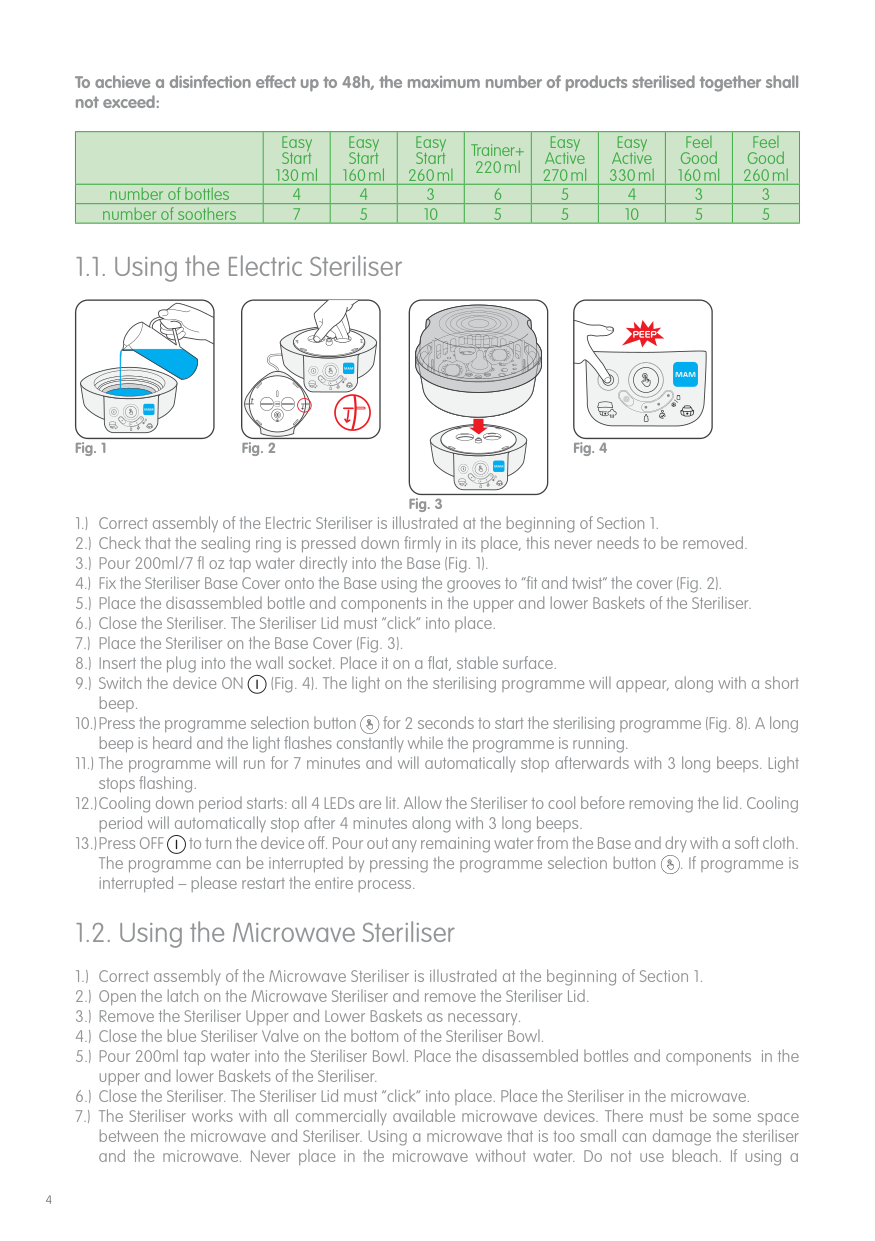
    ###### To achieve a disinfection effect up to 48h, the maximum number of products sterilised together shall not exceed:

    | |Easy Start 130 ml|Easy Start 160 ml|Easy Start 260 ml|Easy Start 320 ml|Trainer+ 220 ml|Easy Active 270 ml|Easy Active 330 ml|Feel Good 160 ml|Feel Good 260 ml| |---|---|---|---|---|---|---|---|---|---| |number of bottles|4|4|3|3|6|5|4|3|3| |number of pacifiers|7|5|10|8|5|5|10|5|5|

    #### 1.1. Using the Electric Steriliser

    Fig. 1 Fig. 2

    Fig. 4
    Page 4

    Fig. 3

  • 1.) Correct assembly of the Electric Steriliser is illustrated at the beginning of Section 1.
  • 2.) Check that the sealing ring is pressed down firmly in its place, this never needs to be removed.
  • 3.) Pour 200ml/7 fl oz tap water directly into the Base (Fig. 1).
  • 4.) Fix the Steriliser Base Cover onto the Base using the grooves to “fit and twist” the cover (Fig. 2).
  • 5.) Place the disassembled bottle and components in the upper and lower Baskets of the Steriliser.
  • 6.) Close the Steriliser. The Steriliser Lid must “click“ into place.
  • 7.) Place the Steriliser on the Base Cover (Fig. 3).
  • 8.) Insert the plug into the wall socket. Place it on a flat, stable surface.
  • 9.) Switch the device ON (Fig. 4). The light on the sterilising programme will appear, along with a short beep.
  • 10.) Press the programme selection button for 2 seconds to start the sterilising programme (Fig. 8). A long beep is heard and the light flashes constantly while the programme is running.
  • 11.) The programme will run for 7 minutes and will automatically stop afterwards with 3 long beeps. Light stops flashing.
  • 12.)Cooling down period starts: all 4 LEDs are lit. Allow the Steriliser to cool before removing the lid. Cooling period will automatically stop after 4 minutes along with 3 long beeps.
  • 13.) Press OFF to turn the device off. Pour out any remaining water from the Base and dry with a soft cloth. The programme can be interrupted by pressing the programme selection button . If programme is interrupted – please restart the entire process.
  • #### 1.2. Using the Microwave Steriliser

  • 1.) Correct assembly of the Microwave Steriliser is illustrated at the beginning of Section 1.
  • 2.) Open the latch on the Microwave Steriliser and remove the Steriliser Lid.
  • 3.) Remove the Steriliser Upper and Lower Baskets as necessary.
  • 4.) Close the blue Steriliser Valve on the bottom of the Steriliser Bowl.
  • 5.) Pour 200 ml tap water into the Steriliser Bowl. Place the disassembled bottles and components in the upper and lower Baskets of the Steriliser.
  • 6.) Close the Steriliser. The Steriliser Lid must “click“ into place. Place the Steriliser in the microwave.
  • 7.) The Steriliser works with all commercially available microwave devices. There must be some space between the microwave and Steriliser. Using a microwave that is too small can damage the steriliser
  • and the microwave. Never place in the microwave without water. Do not use bleach. If using a combination microwave oven, ensure that the Microwave Steriliser is not exposed to the heat of the grill because this could damage steriliser, products and microwave.

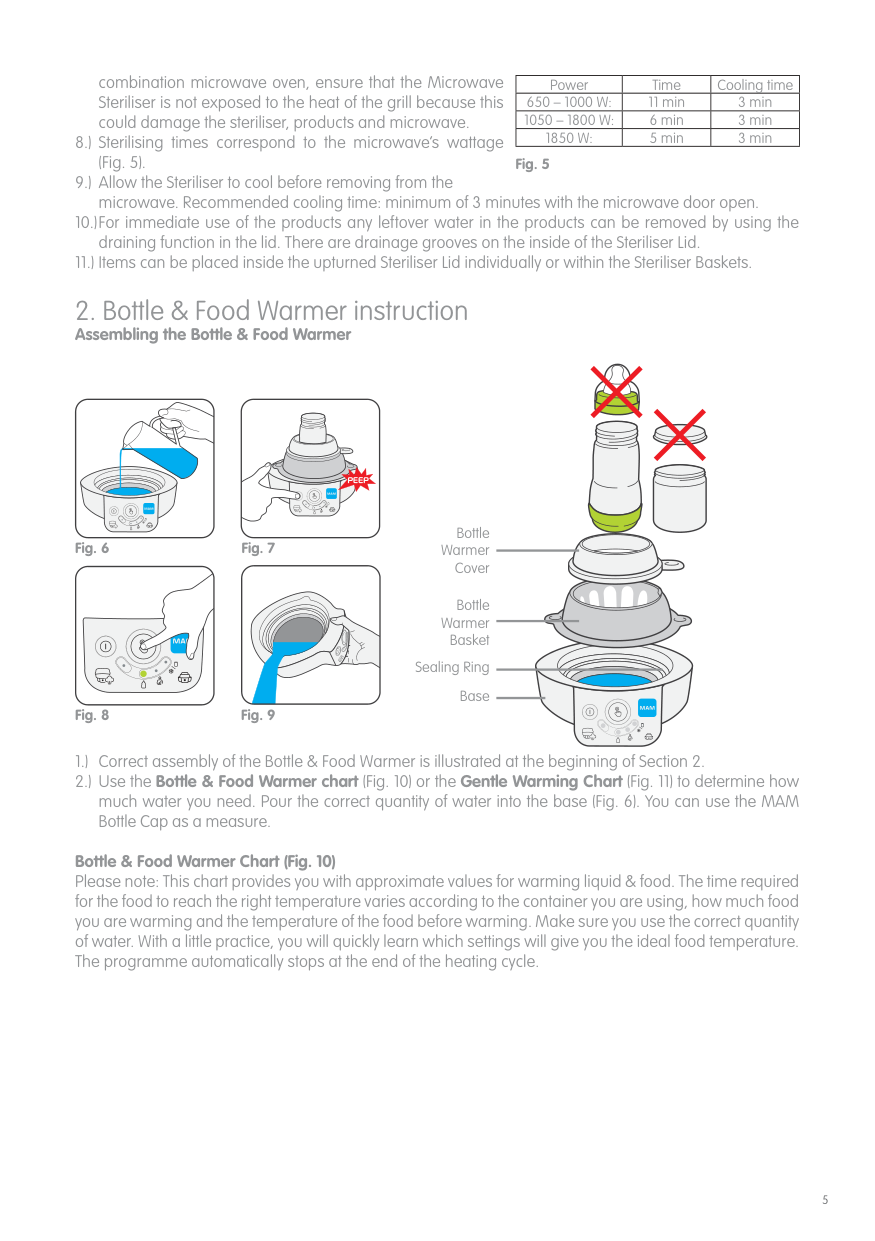
  • 8.) Sterilising times correspond to the microwave’s wattage (Fig. 5).
  • 9.) Allow the Steriliser to cool before removing from the microwave. Recommended cooling time: minimum of 3 minutes with the microwave door open.
  • 10.)For immediate use of the products any leftover water in the products can be removed by using the draining function in the lid. There are drainage grooves on the inside of the Steriliser Lid.
  • 11.) Items can be placed inside the upturned Steriliser Lid individually or with in the Steriliser Baskets.
  • |Power|Time|Cooling time| |---|---|---| |650 – 1000 W:|11 min|3 min| |1050 – 1800 W:|6 min|3 min| |1850 W:|5 min|3 min|

    Fig. 5
  • 2. Bottle & Food Warmer instruction
  • Page 5

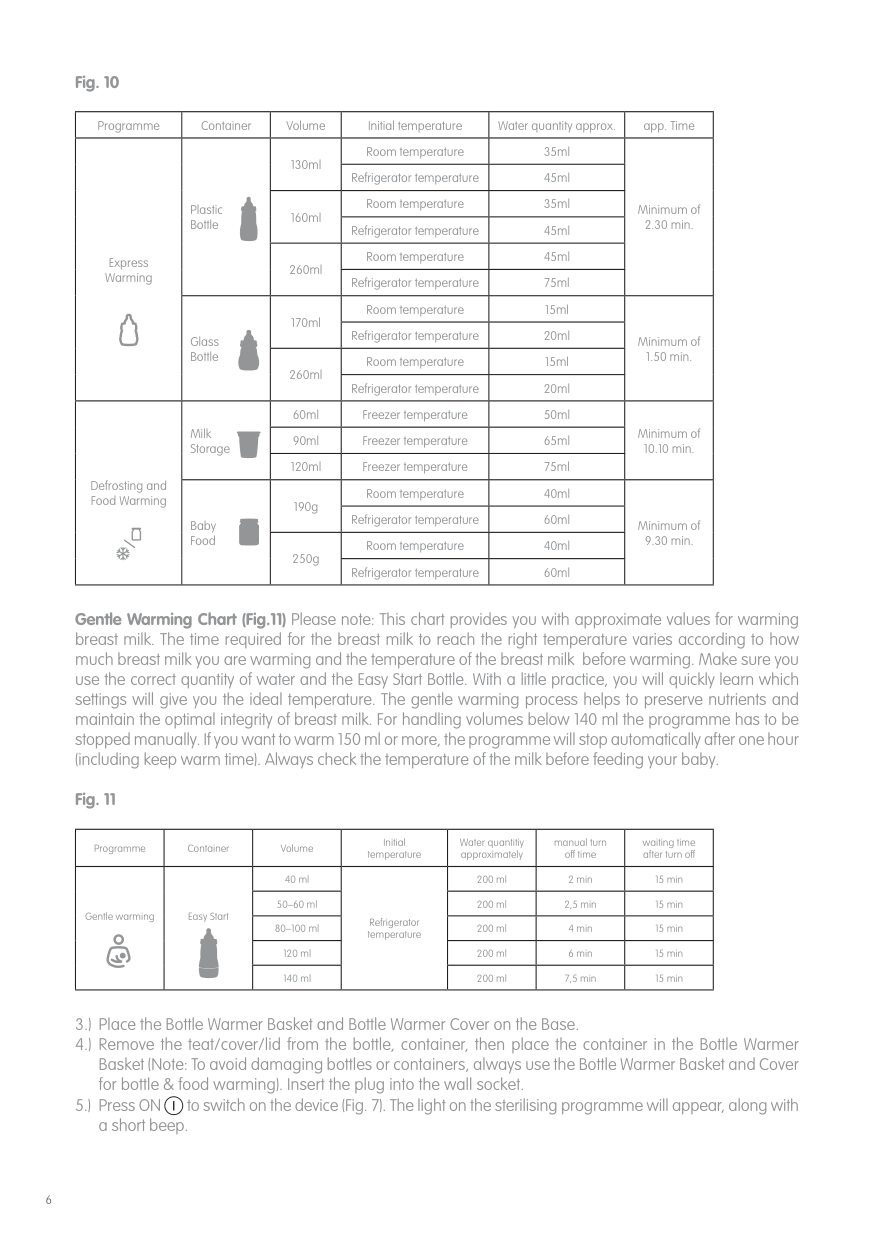
    Assembling the Bottle & Food Warmer

    Bottle Warmer

    Fig. 6 Fig. 7

    Cover

    Bottle Warmer

    Basket

    Sealing Ring

    Base

    Fig. 8 Fig. 9

  • 1.) Correct assembly of the Bottle & Food Warmer is illustrated at the beginning of Section 2.
  • 2.) Use the Bottle & Food Warmer chart (Fig. 10) or the Gentle Warming Chart (Fig. 11) to determine how much water you need. Pour the correct quantity of water into the base (Fig. 6). You can use the MAM Bottle Cap as a measure.
  • ###### Bottle & Food Warmer Chart (Fig. 10)

    Please note: This chart provides you with approximate values for warming liquid & food. The time required for the food to reach the right temperature varies according to the container you are using, how much food you are warming and the temperature of the food before warming. Make sure you use the correct quantity of water. With a little practice, you will quickly learn which settings will give you the ideal food temperature. The programme automatically stops at the end of the heating cycle.

  • Fig. 10
  • Fig. 11
  • |Programme|Container|Volume|Initial temperature|Water quantity approx.|app. Time| |---|---|---|---|---|---| |Express Warming|Plastic Bottle|130ml|Room temperature|35ml|Minimum of 2.30 min.| |Express Warming|Plastic Bottle|130ml|Refrigerator temperature|45ml|Minimum of 2.30 min.| |Express Warming|Plastic Bottle|160ml|Room temperature|35ml|Minimum of 2.30 min.| |Express Warming|Plastic Bottle|160ml|Refrigerator temperature|45ml|Minimum of 2.30 min.| |Express Warming|Plastic Bottle|260ml|Room temperature|45ml|Minimum of 2.30 min.| |Express Warming|Plastic Bottle|260ml|Refrigerator temperature|75ml|Minimum of 2.30 min.| |Express Warming|Glass Bottle|170ml|Room temperature|15ml|Minimum of 1.50 min.| |Express Warming|Glass Bottle|170ml|Refrigerator temperature|20ml|Minimum of 1.50 min.| |Express Warming|Glass Bottle|260ml|Room temperature|15ml|Minimum of 1.50 min.| |Express Warming|Glass Bottle|260ml|Refrigerator temperature|20ml|Minimum of 1.50 min.| |Defrosting and Food Warming|Milk Storage

    |60ml|Freezer temperature|50ml|Minimum of 10.10 min.| |Defrosting and Food Warming|Milk Storage

    |90ml|Freezer temperature|65ml|Minimum of 10.10 min.| |Defrosting and Food Warming|Milk Storage

    |120ml|Freezer temperature|75ml|Minimum of 10.10 min.| |Defrosting and Food Warming|Baby Food|190g|Room temperature|40ml|Minimum of 9.30 min.| |Defrosting and Food Warming|Baby Food|190g|Refrigerator temperature|60ml|Minimum of 9.30 min.|
    Page 6

    |Defrosting and Food Warming|Baby Food|250g|Room temperature|40ml|Minimum of 9.30 min.| |Defrosting and Food Warming|Baby Food|250g|Refrigerator temperature|60ml|Minimum of 9.30 min.|

    Gentle Warming Chart (Fig.11) Please note: This chart provides you with approximate values for warming breast milk. The time required for the breast milk to reach the right temperature varies according to how much breast milk you are warming and the temperature of the breast milk before warming. Make sure you use the correct quantity of water and the Easy Start Bottle. With a little practice, you will quickly learn which settings will give you the ideal temperature. The gentle warming process helps to preserve nutrients and maintain the optimal integrity of breast milk. For handling volumes below 140 ml the programme has to be stopped manually. If you want to warm 150 ml or more, the programme will stop automatically after one hour. Always check the temperature of the milk before feeding your baby.

    |Programme|Container|Volume|Initial temperature|Water quantitiy approximately|manual turn off time|waiting time after turn off| |---|---|---|---|---|---|---| |Gentle warming|Easy Start

    |40 ml|Refrigerator temperature|200 ml|2 min|15 min| |Gentle warming|Easy Start

    |50–60 ml|Refrigerator temperature|200 ml|2,5 min|15 min| |Gentle warming|Easy Start

    |80–100 ml|Refrigerator temperature|200 ml|4 min|15 min| |Gentle warming|Easy Start

    |120 ml|Refrigerator temperature|200 ml|6 min|15 min| |Gentle warming|Easy Start

    |140 ml|Refrigerator temperature|200 ml|7,5 min|15 min|

  • 3.) Place the Bottle Warmer Basket and Bottle Warmer Cover on the Base.
  • 4.) Remove the teat/cover/lid from the bottle, container, then place the container in the Bottle Warmer Basket (Note: To avoid damaging bottles or containers, always use the Bottle Warmer Basket and Cover for bottle & food warming). Insert the plug into the wall socket.
  • 5.) Press ON to switch on the device (Fig. 7). The light on the sterilising programme will appear, along with a short beep.
  • 6.) Now press the selection button to move from sterilising to the bottle warmer programme (Fig. 8). Select the desired programme by briefly pressing programme selection button until the light on the programme you need appears:
  • 7.) Press the selection button (Fig. 8) for about 2 seconds to start the programme. A long beep is heard and the light flashes while programme is running. Programme can be interrupted by pressing the selection button .
  • 8.) The programme automatically stops at the end of the heating cycle along with 2 long beeps. The light stops flashing and all 3 LEDs on the selected warmer programmes are lit.
  • 9.) Food/milk in the Baby Food Warmer can get extremely hot! If warming less than stated in our instructions please be aware that it can be very warm. ALWAYS test the temperature of the food, before feeding it to baby. Stir the contents of the food with a spoon so that the heat spreads more evenly and quickly. If the food is not warm enough, add a little more water to the Base the next time you heat up food. If the food is too hot, let it cool down a little and use a litte less water next time.
  • 10.)All 3 warmer programmes have an integrated “keep warm” function. This automatically starts at the end of the heating cycle or after having turned off the programme manually (e.g., gentle warming of breast milk). When using the “keep warm” function, leave the Bottle Warmer Basket and Bottle Warmer Cover in place. “Keep warm” stops after 45 minutes along with 3 long beeps. Feed warmed breast milk instantly. Immediately dispose of any leftovers and do not reheat. Breast milk may be warmed up approx. 15–20 minutes before feeding.
  • 11.) Press OFF to turn off the device. Allow the device to cool before cleaning. Pour away any remaining water from the reservoir in the base and dry with a soft cloth (Fig. 9).
  • | |Express Bottle Warming: Quick warming of all bottles up to drinking temperature.| |---|---| | |Gentle Warming: for breast milk| | |Defrosting and Food Warming: frozen milk can be defrosted and warmed up. Baby food in containers can also be warmed up.|

    #### 3. Cleaning & maintaining the appliance

    Never place it in a dishwasher. Always unplug the appliance from the mains before cleaning & descaling. Do not clean or descale the appliance when it is hot. Do not use strong or abrasive cleaning or scouring agents, as these could attack the appliance’s surface. After every use, unplug the appliance and wipe it with a damp cloth to avoid any build up of limescale. Caution: during cleaning and maintenance, the sealing ring may become loose or separated from the electric device. Check to ensure that the ring is correctly seated. If necessary, press it firmly into place. The wider part of the ring should be outside and the thicker part inside the base. As shown on the sticker on the electric device, please descale the base at regular intervals. Use household vinegar or a commercially available decalcifying agent for this purpose according the manufacturers instructions. If the appliance ever needs repairing, under no circumstances attempt to open it. Instead, contact the address shown in these instructions. The appliance must never be immersed in water.

    #### 4. Environment/Disposal

    Do not throw away the appliance with the normal household waste at the end of its life, but hand it in at an official collection point for recycling. By doing this, you help to preserve the environment. Please contact your local authority for further details of your nearest collection point for WEEE.

  • 5. Warranty
  • In addition to the seller’s warranty obligations arising from the contract to purchase, we as the manufacturers provide a warranty of 24 months from purchase of the appliance so as long as the appliance has been used properly and the operating instructions have been followed. Evidence of the date of purchase and the type of appliance should be provided by means of a receipt. The purchaser’s statutory rights are unaffected by this manufacturer warranty. During the warranty period, we undertake to remedy any defects attributable to poor materials or workmanship. This does not include damage that is attributable to normal wear and tear, improper use and insufficient or incorrect maintenance.
  • 6. Repair notes
  • Page 7

    The appliance should never be opened by anyone other than properly trained and certified personnel within MAM Baby. Otherwise the warranty will be invalidated. Improper repairs or tampering can result in significant safety hazards for users. If the supply cord is damaged, it must be replaced by the manufacturer, its service agent or similarly qualified persons in order to avoid a hazard.

  • 7. Technical data !
  • EU: Voltage: 220–240 V; 50–60 Hz / Power consumption: 1000–1200 Watts. The product is fitted with a CEE 7/7 mains plug. UK/IRL: Voltage: Type:112, 220–240 V; 50–60 Hz / Power consumption: 1000–1200 Watts. The product is fitted with a BS 1363 mains plug containing a 13A fuse. If it ever becomes necessary to replace the fuse, only use fuses that are marked BS 1362, and rated at 13A.

  • 8. Safety notes
  • 1. Children must never play with the appliance.
  • 2. Children should never use this appliance, even under supervision.
  • 3. This appliance cannot be used by children because children do not understand the risks involved. Cleaning and maintenance must never be carried out by children. Keep the appliance and cord out of reach of children.
  • 4. The appliance may be used by people with reduced physical, sensory or mental capabilities or lack of experience and knowledge, provided that they have been given supervision or instruction concerning the safe use of the appliance in a safe way and understand the hazards involved.
  • 5. This appliance is intended for household use only.
  • 6. Food should not be heated for too long.
  • 7. Without regular descaling, sterilising or bottle & food warming cannot be guaranteed.
  • 8. Please do not put other appliances into the Steriliser.
  • 9. Prior to using the appliance for the first time, be sure to remove all packaging material and any components not used,
  • to ensure that your child cannot injure him or herself or swallow anything.
  • 10. The food should not be heated for too long and its temperature should be checked on a sensitive part of your skin before serving the baby.
  • 11. To avoid potential injury, only use this appliance for its intended use.
  • 12. Caution: the heating element surface is hot during operation and remains hot for a while after use.
  • 13. Only connect appliance to voltages in accordance with the rating plate on the base of the appliance.
  • 14. Do not use the appliance within the reach of children. Secure the power cord and make sure that it cannot be pulled by a child, causing the appliance to fall onto the floor.
  • 15. To operate the appliance, it must be placed on a dry and level surface.
  • 16. Always use a sufficient quantity of water for warming.
  • 17. Never fill the appliance with water up to the top edge.
  • 18. Never operate the appliance without water or carry it during operation. When the appliance is not in use, always disconnect the mains plug and empty out the water.
  • 19. SCALDING RISK: the water inside the Steriliser or Bottle & Food Warmer can get extremely hot.
  • 20.Check the Steriliser or Bottle & Food Warmer each time before use and only use it if the appliance and power cord are intact. If the supply cord is damaged, it must be replaced by the manufacturer, its service agent or similarly qualified persons in order to avoid a hazard.
  • 21. This appliance must not be immersed in water or washed in a dishwasher.
  • 22.Never place the base of the device in the microwave.
  • 23.Always keep the instruction manual in a safe place.
  • Easy Start™ Anti-Colic

    Instructions for use:

    Clean before first and each subsequent use.

    Before first use separate all 6 parts and place them in boiling water for 5 minutes. This is to ensure hygiene.

    Inspect all individual bottle parts before each use and pull the feeding teat in all directions. Throw away at the first signs of damage or weakness.

    To ensure proper cleaning/sterilising all bottle parts MUST be disassembled.
    Page 8

    Cleaning/sterilising while assembled can damage the bottle.

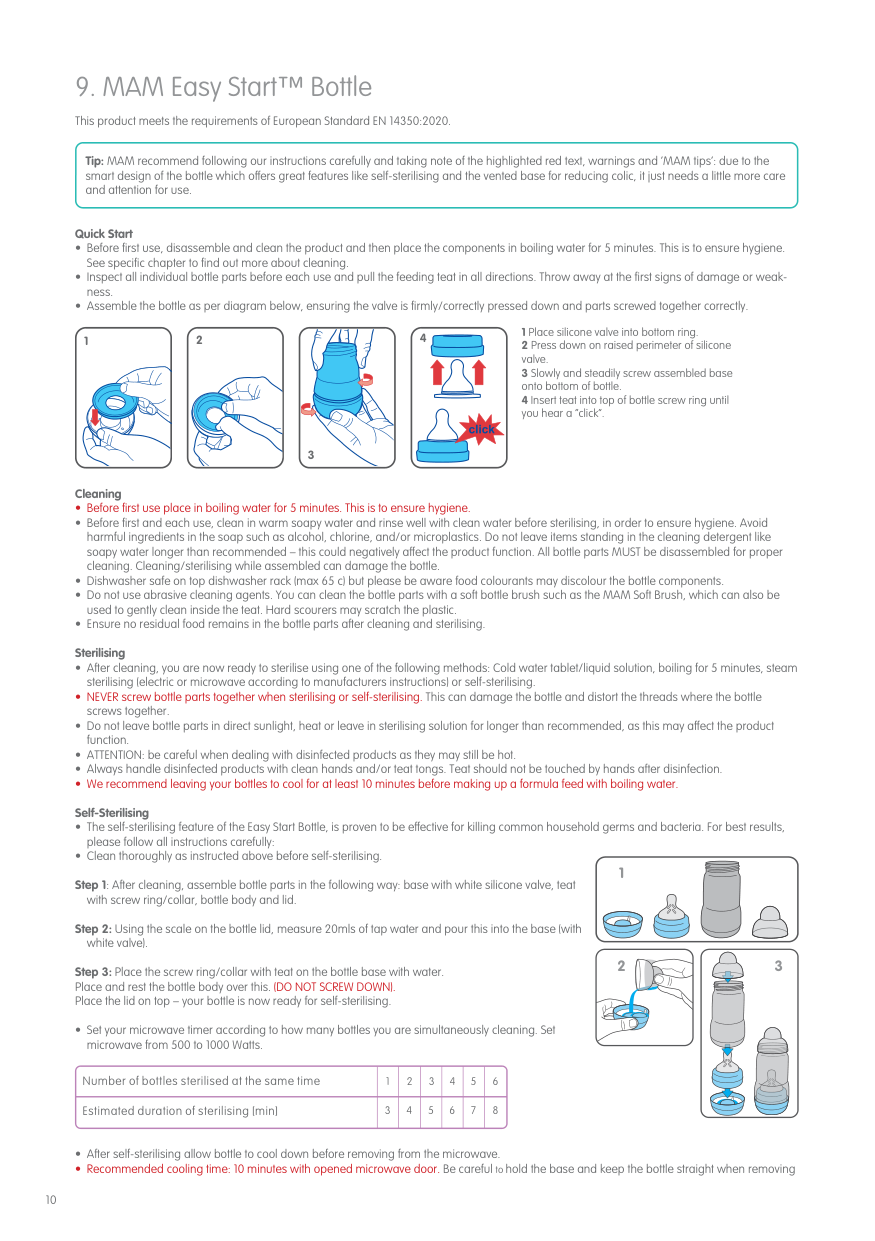
    1 Place silicone valve into bottom ring.

    2 Press down on raised perimeter of silicone valve.

    Dishwasher safe on top dishwasher rack (max. 65° C / 149 F) but food colourings may discolour components.

    Do not use abrasive cleaning agents. Only soft bristle brushes or soft sponges should be used. Hard scourers may scratch the plastic.

    Sterilising using one of the following methods: steam sterilising (electric or microwave according to manufacturer’s instructions), boiling in water for at least 5 minutes or immersing in a liquid sterilising solution.

    Do not leave items standing in any cleaning solution for longer than recommended - this could negatively affect the product function.

    The bottle is made of polypropylene which is hygienic, easy to clean and relatively soft. Avoid any heavy pressure on it, as this could affect the function.

    ######## 3

    4 Insert teat into top of bottle screw ring until you hear a ”click“.

    Screw assembled base onto bottom of bottle in slow steady manner.

    Do not use pin or sharp object to enlarge feeding hole of teat.

    When first used and sometimes during use, the ventilation slit (in the raised bubble on the underside of the teat base) can stick together. This will prevent air from entering the bottle during feeding and as a result, cause the teat to collapse. Slowly brush over the bubble (ventilation) a few times with your thumb or fingers to re-open the slit.

    Ensure valve is assembled correctly and the base of the bottle is firmly attached prior to filling bottle with liquid (see figure 1, 2 &3).

    Do not let babies self-feed.

    Store teats and valves in a dry sealed container.

    Do not leave single bottle parts in direct sunlight or heat.

    Always use only MAM Teats with the MAM Bottles.

    Use sugar free food or liquids only.

    To avoid injury, do not let baby walk with bottle.

    Do not put your baby to bed with bottle. Prolonged contact with liquids may cause severe tooth decay.

    Bottle teat fits all MAM Bottles and the Trainer+.

    ##### HEATING Instructions:

    NEVER pour boiling water into the bottle.
    Page 9

    Place in a bottle warmer, under hot running water or in a container of heated water.

    NEVER heat or cool a sealed bottle. Remove the protective cap and teat (with screw ring) before heating, especially before bottle warmer and microwave heating. Do not overheat as this may

    damage the bottle.

    Take extra care when heating in the microwave.

    Stir thoroughly after heating to evenly distribute heat. Allow the standing time recommended by the microwave manufacturer. Test the temperature before serving.

    Wrap cloth or towel around bottom of bottle and shake to absorb any excess water after warming in a bottle warmer, under hot running or in heated water.

    After warming the bottle in a bottle warmer, under hot running or in heated water it is recommended to tighten the bottom of the bottle.

    Do not place bottle in heated oven.

    ##### For your child’s safety and health WARNING!

    Always use this product with adult supervision.

    Never use feeding teats as a soother.

    Continuous and prolonged sucking of fluids will cause tooth decay.

    Always check food temperature before feeding.

    Keep all components not in use out of the reach of children.

    Start

    ##### Instructions for use:

    Before first use boil in water for 5 minutes. Allow to stand for a further 5 minutes before giving it to the baby.

    During cleaning a small amount of water may enter the teat. This can be expelled by squeezing the teat. This is to ensure hygiene.

    Clean before each use.

    Do not use aggressive cleaning agents.

    Never dip the teat in sweet substances or medication. This can cause tooth decay.

    To ensure safety and hygiene replace the soother every 1–2 months.

    Do not worry if the soother becomes lodged in the mouth. It can not be swallowed and is designed to cope with such an event. Remove as gently as possible.

    MAM recommends giving up soother usage at 3 years of age.

    ##### For your child’s safety WARNING!
    Page 10

    Inspect carefully before each use. Pull the soother in all directions. Throw away at the first signs of damage or weakness.

    Only use dedicated soother holders tested to EN 12586. Never attach other ribbons or cords to a soother, your child may be strangled by them.

    Do not leave a soother in direct sunlight or near a source of heat or leave in sterilising solution for longer than recommended, as this may weaken the teat.

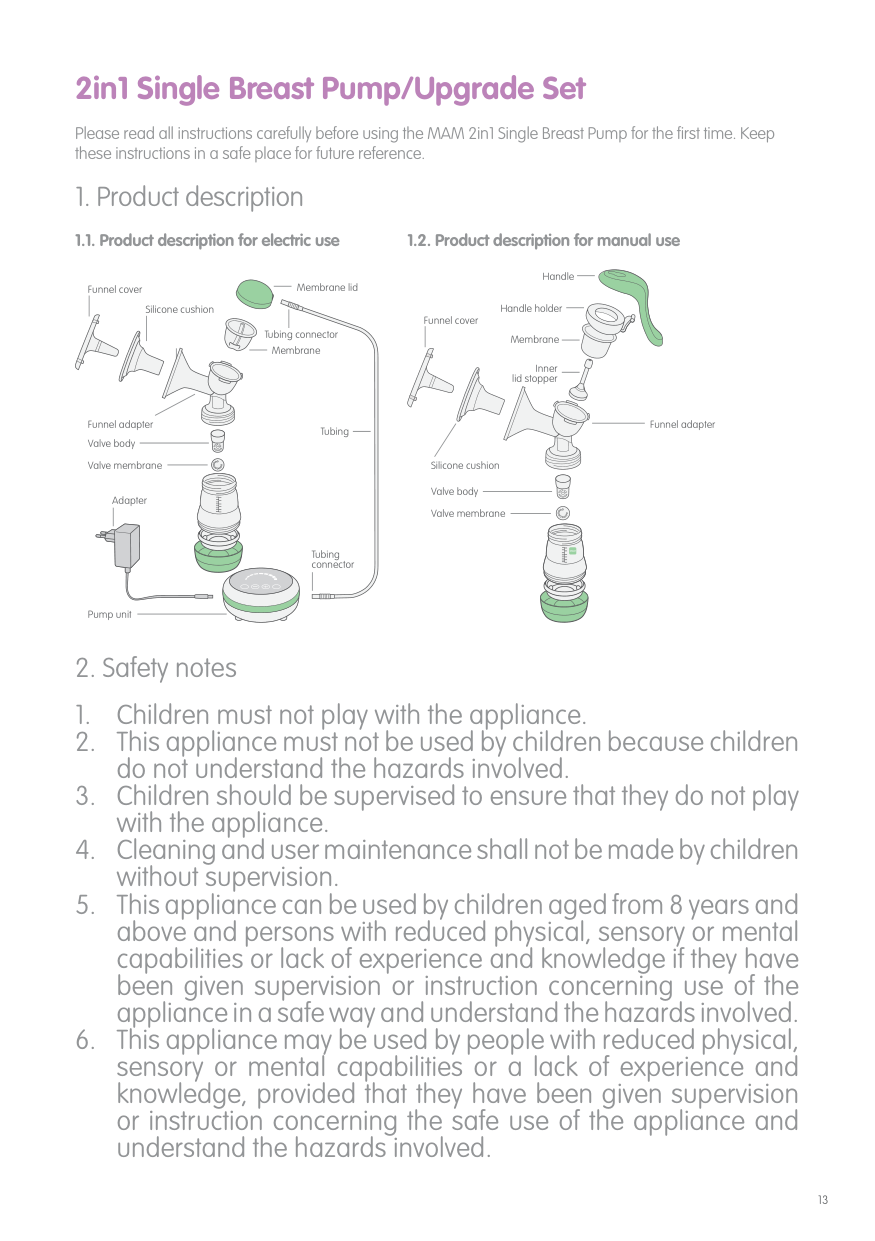
    2in1 Single Breast Pump/Upgrade Set

    Please read all instructions carefully before using the MAM 2in1 Single Breast Pump for the first time. Keep these instructions in a safe place for future reference.

  • Product description
  • 1.1. Product description for electric use
  • 2. Safety notes
  • Membrane capFunnel cover

    Silicone cushion

    Tubing connector

    Membrane

    Funnel adapter Valve body Valve membrane

    Tubing

    Adapter

    | | | |---|---| | | | | | | | | | | | |

    Tubing connector

    Pump unit

    ###### 1.2. Product description for manual use

    Handle

    Handle holder
    Page 11

    Funnel cover

    Membrane

    Inner cap stopper

    Funnel adapter

    Silicone cushion

    Valve body

    Valve membrane

    | | | |---|---| | | | | | | | | | | | |
  • 1. Children must not play with the appliance.
  • 2. This appliance must not be used by children because children do not understand the hazards involved.
  • 3. Children should be supervised to ensure that they do not play with the appliance.
  • 4. Cleaning and user maintenance shall not be made by children without supervision.
  • 5. This appliance can be used by children aged from 8 years and above and persons with reduced physical, sensory or mental capabilities or lack of experience and knowledge if they have been given supervision or instruction concerning use of the appliance in a safe way and understand the hazards involved.
  • 6. This appliance may be used by people with reduced physical, sensory or mental capabilities or a lack of experience and knowledge, provided that they have been given supervision or instruction concerning the safe use of the appliance and understand the hazards involved.
  • 7. This appliance is not intended for use by persons (including children) with reduced physical, sensory or mental capabilities, or lack of experience and knowledge unless they have been given supervision or instruction concerning use of the appliance by a person responsible for their safety.
  • 8. This appliance is intended for domestic use only.
  • 9. Use this product only for its intended use, as described in this manual. Never use attachments that are not recommended by the manufacturer.
  • 10. Never use any electric adapter or battery that was not supplied with the pump.
  • 11. Only connect appliance to voltages in accordance with the rating plate on the electric adapter.
  • 12. Before using the appliance for the first time, be sure to remove all the packaging materials and any components not used, so that your child cannot injure him or herself or swallow anything.
  • 13. Do not use the appliance within the reach of children. Secure the power cord and make sure that it cannot be pulled inadvertently, causing the appliance to fall onto the floor.
  • 14. Check the breast pump each time before use and only use it if the appliance and power cord are intact. At the first sign of any damage, the component in question must be either disposed of or repaired.
  • 15. The appliance may only be opened by an authorized service center. Opening by any unauthorized person will automatically make the warranty invalid. Repairs may only be performed by specialist personnel. Improper repairs can create serious safety hazards for users. This also applies to the replacement of the power cord.
  • 16. This electric appliance must not be immersed in water or washed in a dishwasher. If it accidentally falls into water, do not reach for it. Unplug immediately.
  • 17. When cleaning the pump unit, unplug the adapter.
  • 18. Ensure that the tubing is clean and does not contain any drops of water.
  • 19. Never place the device’s electric pumping unit or adapter in the microwave or expose to high temperatures.
  • 20. Turn the toggle switch off if the device is out of use for long time.
  • 21. Charge the battery at least once a month. To maximize the working life of the device, charging time should not exceed 6 hours.
  • 22. Always unplug the power cord from the outlet after each use.
  • 23. Always keep the instruction manual in a safe place.
  • Page 12

  • 24. Appliance is only to be used with the power supply unit provided with the appliance.
  • 25. This appliance contains batteries that are only replaceable by skilled persons.
  • 26. This appliance contains batteries that are nonreplaceable.
  • 27. For the purposes of recharging the battery, only use the detachable supply unit provided with this appliance.
  • 28. This appliance is intended for domestic use only. Do not use outdoors.
  • 29. Use of accessories, transducers and cables other than those specified or provided by the manufacturer of this equipment could result in improper operation.
  • 30. Never operate this product if it has a damage cord or plug, if it is not working properly, if it has been dropped or damaged or dropped into water.
  • 31. If the electric adapter or supply cord is damaged, it must be replaced by manufacturer, an approved service agent or similarly qualified person in order to avoid a hazard. Separation of the casing can result in electric shock.
  • 32. DO NOT remove the battery yourself. Inbuilt lithium battery is non-removable, it’s prohibited to discharge for use. As the battery needs to be collected, please ask for help to remove the battery from the appliance at the recycling location.
  • 33. This breast pump should not be operated while traveling on an airplane.
  • 34. The device is not suitable for use in the presence of flammable anesthetic mixtures with air or with oxygen or nitrous oxide.
  • 35. This product should never be left unattended when plugged in.
  • 36. If the power adapter outer casings become loose or are separating, stop use and contact the device manufacturer immediately. Separation of the casing can result in electric shock.
  • 37. Do not place the product in direct sunlight.
  • 38. Do not use while bathing.
  • 39. Portable RF communications equipment (including peripher-
  • als such as antenna cables and external antennas) should be used no closer than 30 cm (12 inches) to any part of the 2in1 Double Breast Pump, including cables specified by the manufacturer. Otherwise, degradation of the performance of this equipment could result.
  • 40. Use of this equipment adjacent to or stacked with other equipment should be avoided because it could result in improper operation. If such use is necessary, this equipment and the other equipment should be observed to verify that they are operating normally.
  • 3. Cleaning and maintaining the appliance
  • Before using your MAM 2in1 Single Breast Pump for the first time and after each use, all parts that come into contact with the breast and breast milk must be separated, cleaned and sterilised.
  • • Only drinking-quality water must be used for cleaning.
  • • Do NOT sterilise the tubing or pump unit.
  • • Do NOT clean the inside of the tubing as no milk should enter it!
  • • Completely air dry or towel dry before reassembly and next use. Partially wet components may affect the operation of the electric breast pump.
  • • Ensure that the tubing is free from any liquid. Do not operate the electric breast pump if any liquid is visible in the tubing (see chapter 6 – Troubleshooting).
  • • Take care not to damage parts of the pump set during cleaning.
  • 3.1. Cleaning the electric pump unit To clean the electric pump unit, unplug the appliance, switch it off and wipe it with a clean, damp cloth. Never place it in a dishwasher for cleaning. The appliance must not be immersed in water.
  • 3.2. Cleaning by hand Before cleaning, all parts of the pump must be separated. Begin by rinsing all parts in cold, clear water. Then wash all parts in warm soapy water with a damp cloth or sponge and rinse thoroughly with cold water afterwards. Do not use any abrasive cleaning agents such as anti-bacterial solutions, as these could attack the appliance’s surface. Leave the separated parts to drip dry or use clean paper towel.
  • 3.3. Cleaning in the dishwasher To clean the breast pump in the dishwasher, place the separated parts on the top rack of the dishwasher or in the cutlery section. When washing the pump parts in the dishwasher, the components may become discoloured by food pigments – this does not affect their function. We recommend to carefully clean the valve body and valve membrane by hand to prevent damages and to ensure that those small components do not get lost.
  • 3.4. Sterilising the breast pump Before using the pump for the first time and once a day, all parts of the pump except the tubing and the electric pump unit must be sterilised. The separated pump parts can be sterilised in boiling water, in an electric or microwave steam steriliser as well as in cold sterilising liquid. Store the pump set in a clean bag / container and use the funnel cover for further protection of the silicone cushion until next use. Please note: never sterilise the assembled pump – always separate the parts. Important: allow all parts of the breast pump to fully cool and dry before use.
  • 4. Using the appliance
  • 4.1. Electric pumping
  • Page 13

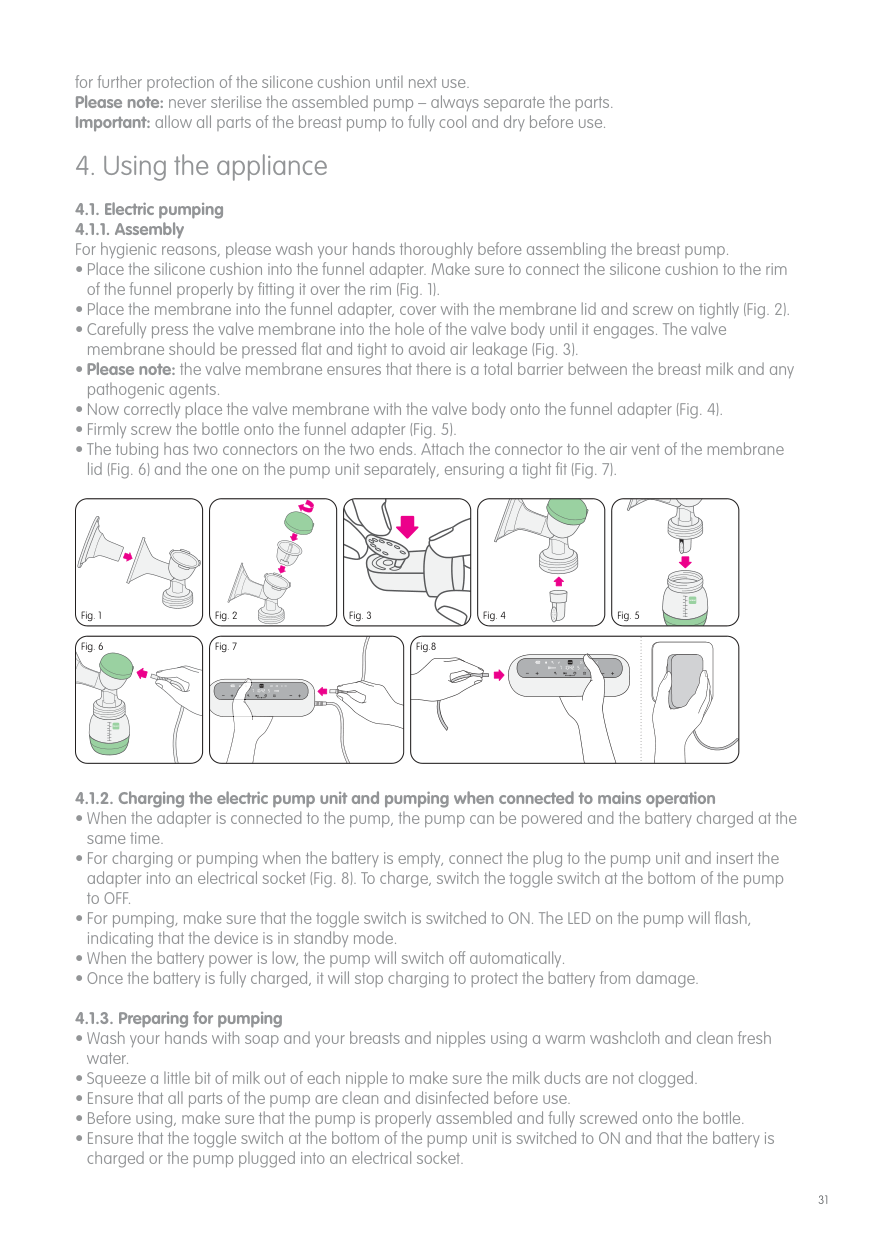
  • 4.1.1. Assembly For hygienic reasons, please wash your hands thoroughly before assembling the breast pump.
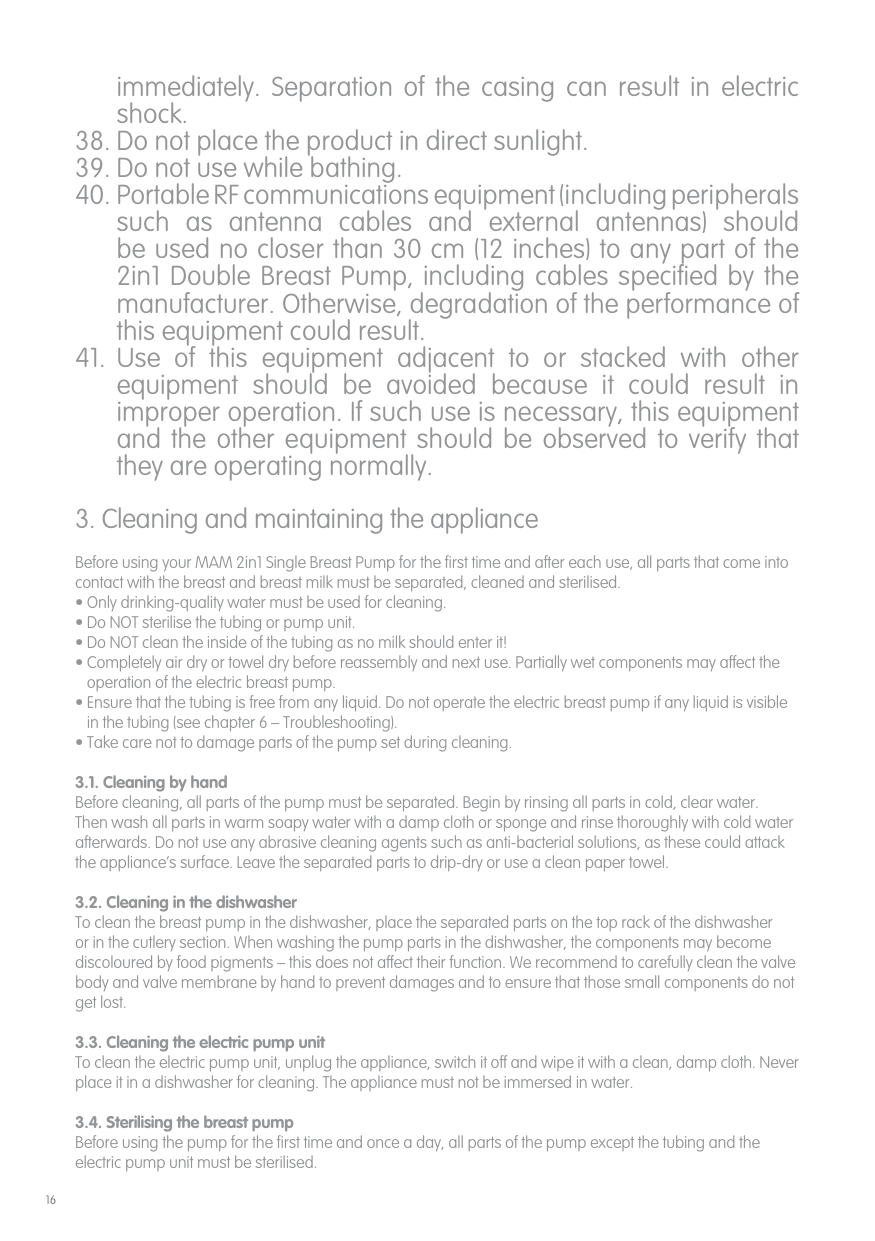
  • • Place the silicone cushion into the funnel adapter. Make sure to connect the silicone cushion to the rim of the funnel properly by fitting it over the rim (Fig. 1).
  • • Place the membrane into the funnel adapter, cover with the membrane cap and screw on tightly (Fig.
  • 2).
  • • Carefully press the valve membrane into the hole of the valve body until it engages. The valve membrane should be pressed flat and tight to avoid air leakage (Fig. 3).
  • • Please note: the valve membrane ensures that there is a total barrier between the breast milk and any pathogenic agents.
  • • Now correctly place the valve membrane with the valve body onto the funnel adapter (Fig. 4).
  • • Firmly screw the bottle onto the funnel adapter (Fig. 5).
  • • The tubing has two connectors on the two ends. Attach the connector to the air vent of the membrane cap (Fig. 6) and the one on the pump unit separately, ensuring a tight fit (Fig. 7).
  • | | | |---|---| | | | | | | | | | | | | | | | | | | | | |

    Fig. 6 Fig. 7 Fig. 8

    | | | |---|---| | | | | | | | | | | | | | | | | | | | | |

    Fig. 1 Fig. 3Fig. 2 Fig. 4 Fig. 5
  • 4.1.2. Charging the electric pump unit and pumping in mains operation
  • • When the adapter is connected to the pump, the pump can be powered and the battery charged at the same time.
  • • For charging or pumping when the battery is empty, connect the plug to the pump unit and insert the adapter into an electrical socket (Fig. 8). To charge, switch the toggle switch at the bottom of the pump to OFF.
  • • For pumping, make sure that the toggle switch is switched to ON. The LED on the pump will flash, indicating that the device is in standby mode.
  • • When the battery power is low, the pump will switch off automatically.
  • • Once the battery is fully charged, it will stop charging to protect the battery from damage.
  • Page 14

  • 4.1.3. Preparing for pumping
  • • Wash your hands with soap and your breasts and nipples using a warm washcloth and clean fresh water.
  • • Squeeze a little bit of milk out of each nipple to make sure the milk ducts are not clogged.
  • • Ensure that all parts of the pump are clean and disinfected before use.
  • • Before using, make sure that the pump is properly assembled and fully screwed onto the bottle.
  • • Ensure that the toggle switch at the bottom of the pump unit is switched to ON and that the battery is charged or the pump plugged into an electrical socket.
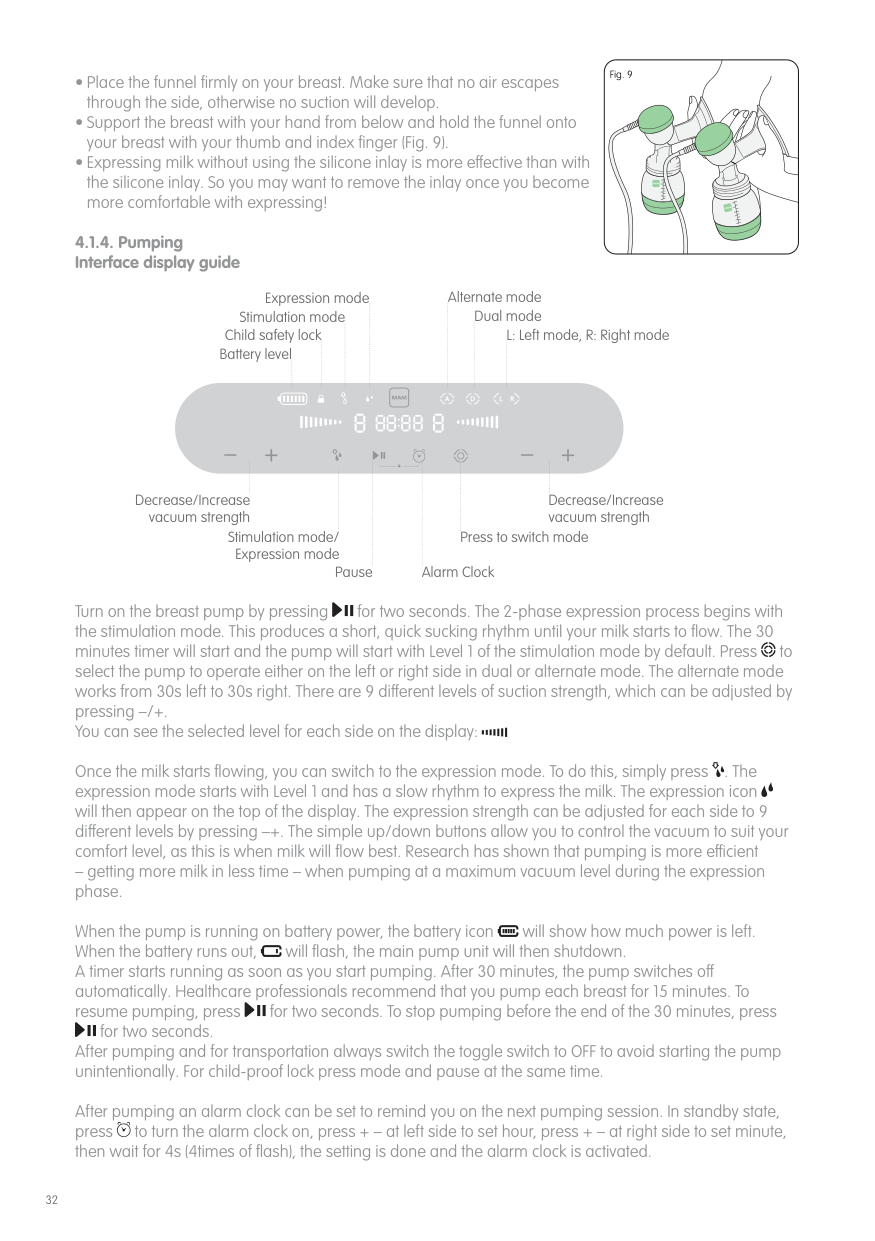
  • • Place the funnel firmly on your breast. Make sure that no air escapes through the side, otherwise no suction will develop.
  • • Support the breast with your hand from below and hold the funnel onto your breast with your thumb and index finger (Fig. 9).
  • • Expressing milk without using the silicone inlay is more effective than with the silicone inlay. So you may want to remove the inlay once you become more comfortable with expressing!
  • Fig. 9

    ###### 4.1.4. PumpingInterface display guide

    | | | |---|---| | | | | | | | | | | | | | | | | | | | | |

    Stimulation mode

    Expression mode

    Vacuum strength Battery level

    Timer

    Switch between stimulation and expression mode

    Power button

    Increase vacuum strength

    Decrease vacuum strength

    Turn on the breast pump by pressing . The 2-phase expression process begins with the stimulation mode. This produces a short, quick sucking rhythm until your milk starts to flow. The pump will start with Level 1 of the stimulation mode by default. There are 9 different levels of suction strength, which can be adjusted by pressing . You can see the selected level on the display:
    Page 15

    Once the milk starts flowing, you can switch to the expression mode. To do this, simply press . The expression mode starts with Level 1 and has a slow rhythm to express the milk. The expression icon will then appear on the right of the display. The expression strength can be adjusted to 9 different levels by pressing . The simple up/down buttons allow you to control the vacuum to suit your comfort level, as this is when milk will flow best. Research has shown that pumping is more efficient – getting more milk in less time – when pumping at a maximum vacuum level during the expression phase.

    When the pump is running on battery power, the battery icon will show how much power is left. When the battery runs out, will flash. A timer starts running as soon as you start pumping. After 30 minutes, the pump switches off automatically. Healthcare professionals recommend that you pump for 15 minutes per breast. To resume pumping, press . To stop pumping before the end of the 30 minutes, press . After pumping and for transportation always switch the toggle switch to OFF to avoid starting the pump unintentionally.

    Expressing milk or stimulating does not come easily to everyone. If you find it is less comfortable than you had hoped, ask your midwife or other healthcare professional for advice.

    ###### 4.2. Manual pumping

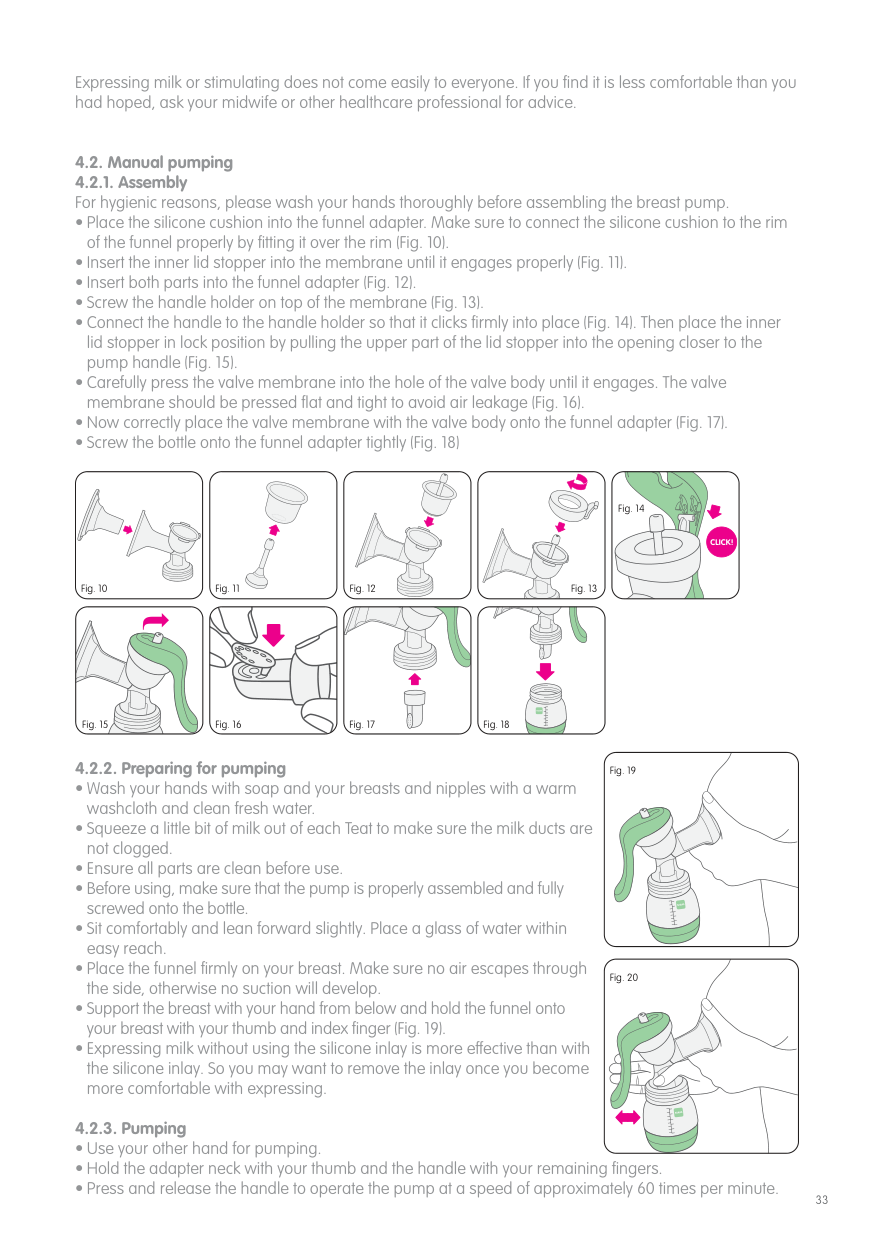
  • 4.2.1. Assembly For hygienic reasons, please wash your hands thoroughly before assembling the breast pump.
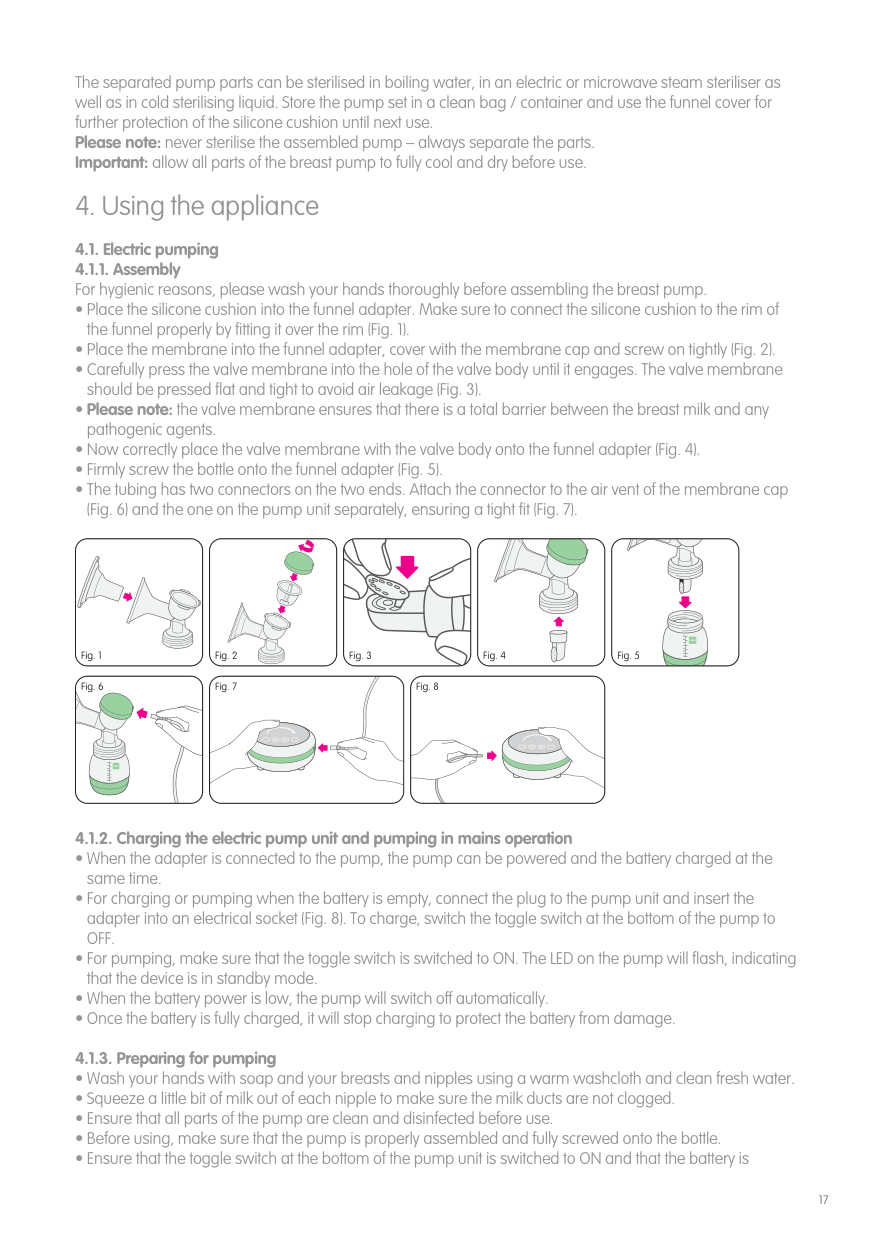
  • • Place the silicone cushion into the funnel adapter. Make sure to connect the silicone cushion to the rim of the funnel properly by fitting it over the rim (Fig. 10).
  • • Insert the inner cap stopper into the membrane until it engages properly (Fig. 11).
  • • Insert both parts into the funnel adaptor (Fig. 12).
  • • Screw the handle holder on top of the membrane (Fig. 13).
  • • Connect the handle to the handle holder so that it clicks firmly into place (Fig. 14). Then place the inner cap stopper in lock position by pulling the upper part of the cap stopper into the opening closer to the pump handle (Fig. 15).
  • • Carefully press the valve membrane into the hole of the valve body until it engages. The valve membrane should be pressed flat and tight to avoid air leakage (Fig. 16).
  • • Now correctly place the valve membrane with the valve body onto the funnel adapter (Fig. 17).
  • • Screw the bottle onto the funnel adaptor tightly (Fig. 18).
  • Fig. 14

    ########## CLICK!

    Fig. 10

    Fig. 11 Fig. 12

    Fig. 13

    | | | |---|---| | | | | | | | | | | | | | | | | | | | | |

    Fig. 16Fig. 15

    Fig. 17 Fig. 18

    ###### 4.2.2. Preparing for pumping
    Page 16

  • • Wash your hands with soap and your breasts and nipples with a warm washcloth and clean fresh water.
  • • Squeeze a little bit of milk out of each nipple to make sure the milk ducts are not clogged.
  • • Ensure all parts are clean before use.
  • • Before using, make sure that the pump is properly assembled and fully screwed onto the bottle.
  • • Sit comfortably and lean forward slightly. Place a glass of water within easy reach.
  • • Place the funnel firmly on your breast. Make sure no air escapes through the side, otherwise no suction will develop.
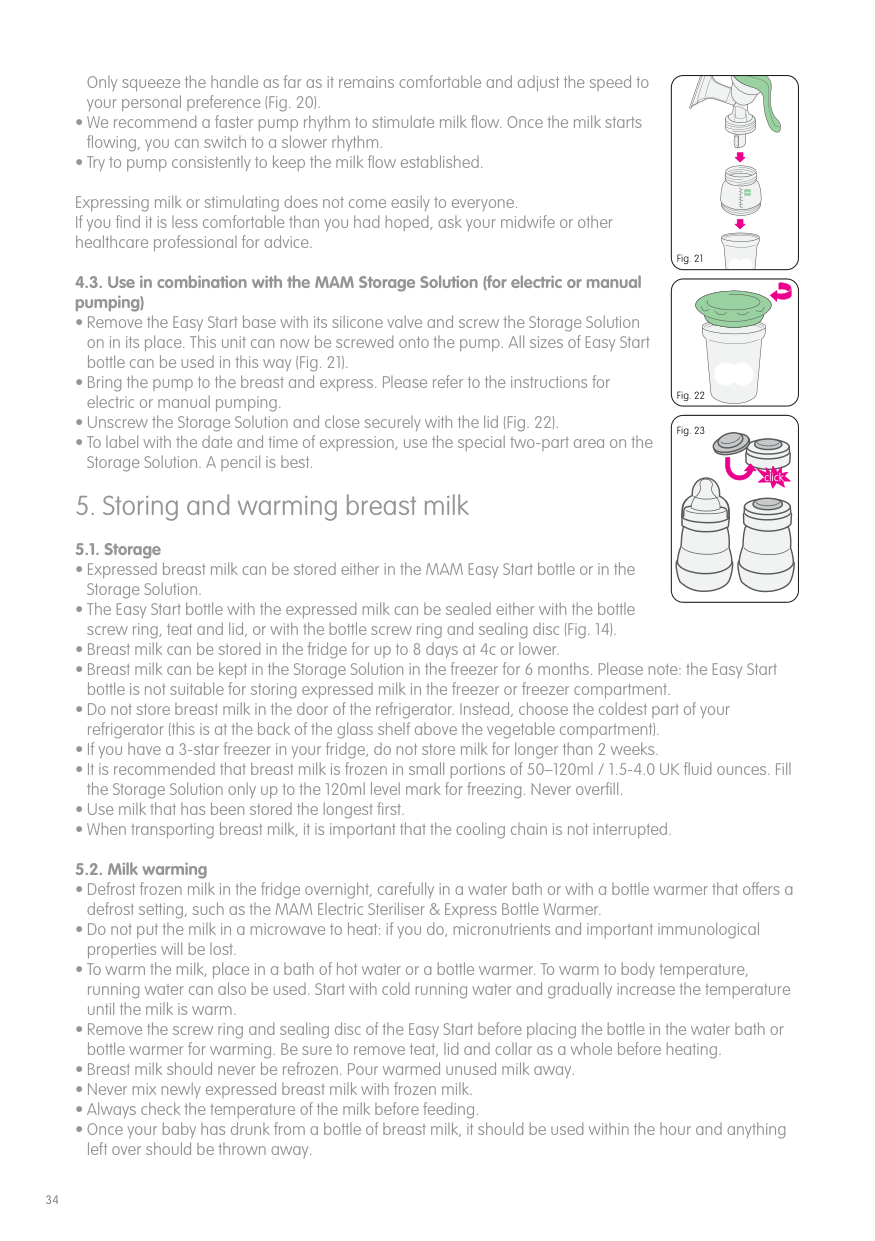
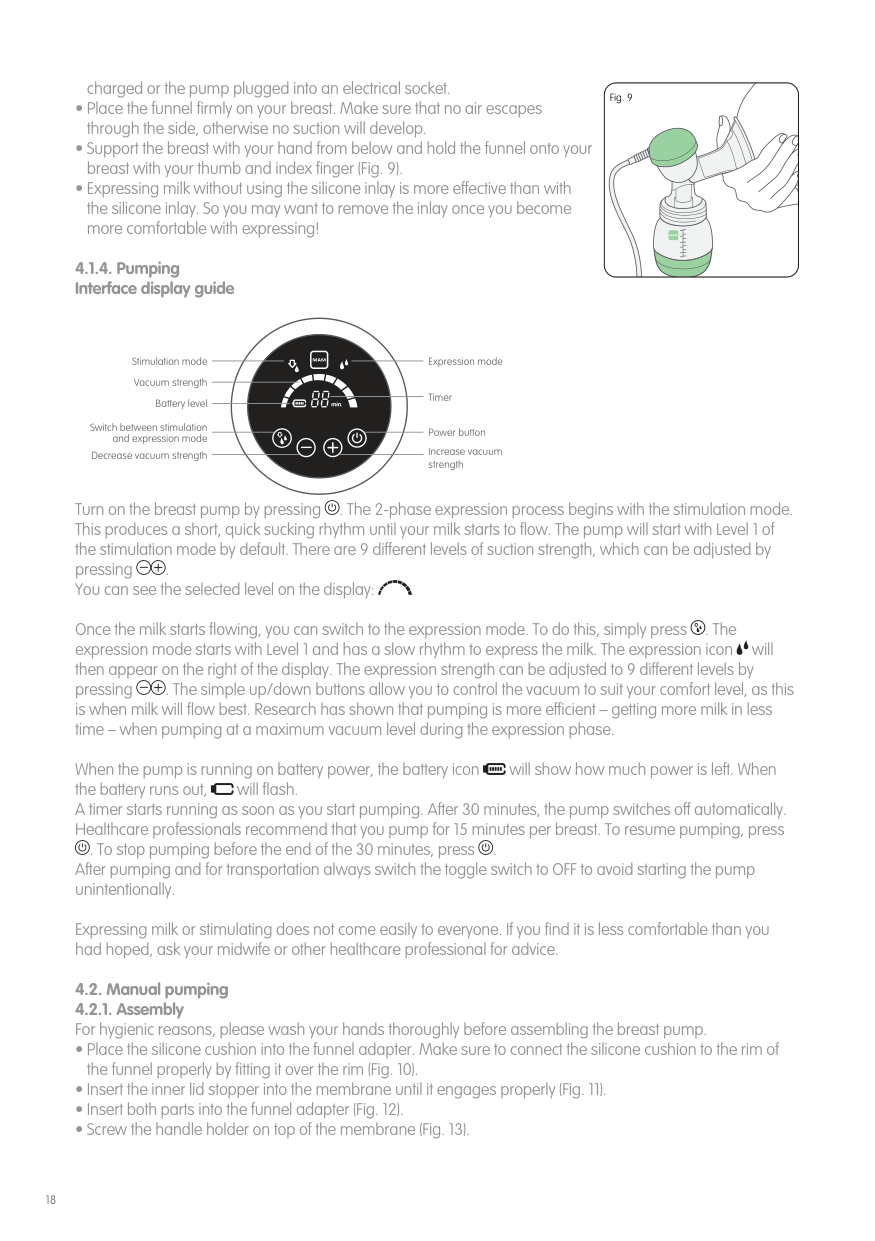
  • • Support the breast with your hand from below and hold the funnel onto your breast with your thumb and index finger (Fig. 19).
  • • Expressing milk without using the silicone inlay is more effective than with the silicone inlay. So you may want to remove the inlay once you become more comfortable with expressing.
  • Fig. 19

    ###### 4.2.3. Pumping

  • • Use your other hand for pumping.
  • • Hold the adaptor neck with your thumb and the handle with your remaining fingers.
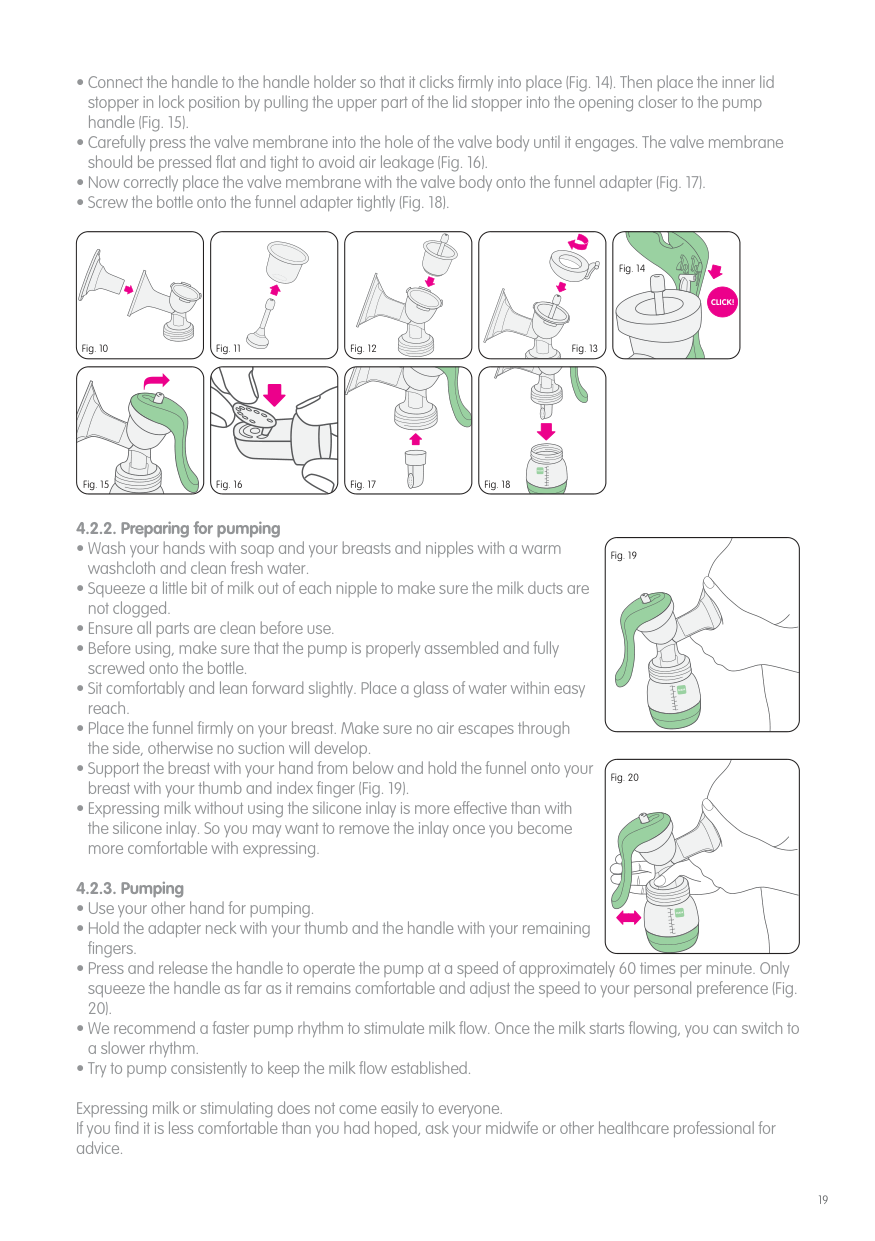
  • • Press and release the handle to operate the pump at a speed of approximately 60 times per minute. Only squeeze the handle as far as it remains comfortable and adjust the speed to your personal preference (Fig. 20).
  • • We recommend a faster pump rhythm to stimulate milk flow. Once the milk starts flowing, you can switch to a slower rhythm.
  • • Try to pump consistently to keep the milk flow established.
  • Fig. 20

    Expressing milk or stimulating does not come easily to everyone. If you find it is less comfortable than you had hoped, ask your midwife or other healthcare professional for advice.

    ###### 4.3. Use in combination with the MAM Storage Solution (for electric or manual pumping)
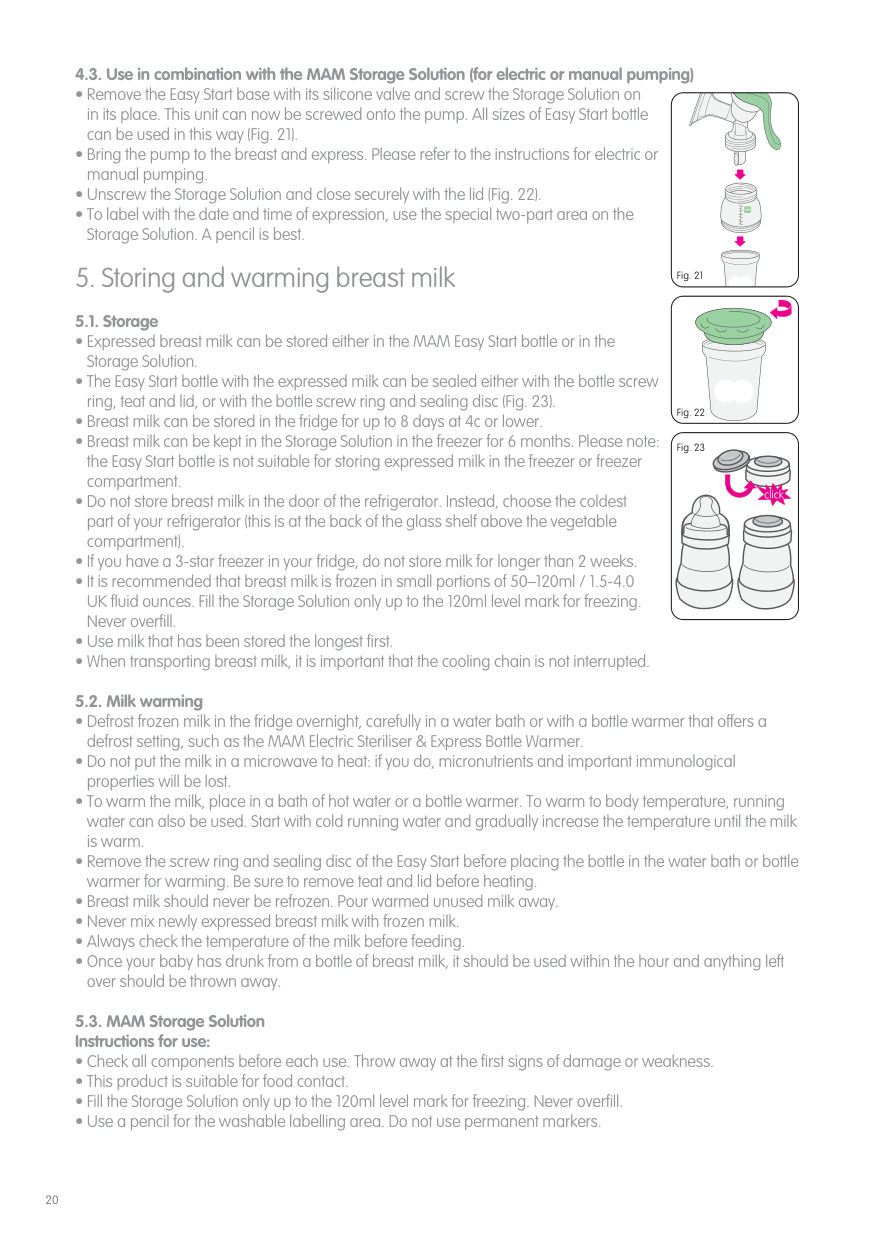
  • • Remove the Easy Start base with its silicone valve and screw the Storage Solution on in its place. This unit can now be screwed onto the pump. All sizes of Easy Start bottle can be used in this way (Fig. 21).
  • • Bring the pump to the breast and express. Please refer to the instructions for electric or manual pumping.
  • • Unscrew the Storage Solution and close securely with the lid (Fig. 22).
  • • To label with the date and time of expression, use the special two-part area on the Storage Solution. A pencil is best.
  • 5. Storing and warming breast milk
  • 5.1. Storage
  • • Expressed breast milk can be stored either in the MAM Easy Start bottle or in the Storage Solution.
  • • The Easy Start bottle with the expressed milk can be sealed either with the bottle screw ring, teat and cap, or with the bottle screw ring and sealing disc (Fig. 23).
  • • Breast milk can be stored in the fridge in the Easy Start bottle or Storage Solution for up to 24 hours.
  • • Breast milk can be kept in the Storage Solution in the freezer for 3 months. Please note: the Easy Start bottle is not suitable for storing expressed milk in the freezer or freezer compartment.
  • • Do not store breast milk in the door of the refrigerator. Instead, choose the coldest part of your refrigerator (this is at the back of the glass shelf above the vegetable compartment).
  • • If you have a 3-star freezer in your fridge, do not store milk for longer than 2 weeks.
  • • It is recommended that breast milk is frozen in small portions of 50-120ml / 1.5-
  • 4.0 UK fluid ounces. Fill the Storage Solution only up to the 120ml level mark for freezing. Never overfill.
  • Page 17

  • • Use milk that has been stored the longest first.
  • • When transporting breast milk, it is important that the cooling chain is not interrupted.
  • 5.2. Milk warming
  • • Defrost frozen milk in the fridge overnight, carefully in a water bath or with a bottle warmer that offers a defrost setting, such as the MAM Electric Steriliser & Express Bottle Warmer.
  • • Do not put the milk in a microwave to heat: if you do, micronutrients and important immunological properties will be lost.
  • • To warm the milk, place in a bath of hot water or a bottle warmer. To warm to body temperature, running water can also be used. Start with cold running water and gradually increase the temperature until the milk is warm.
  • • Remove the screw ring and sealing disc of the Easy Start before placing the bottle in the water bath or bottle warmer for warming. Be sure to remove teat and cap before heating.
  • • Breast milk should never be refrozen. Pour warmed unused milk away.
  • • Never mix newly expressed breast milk with frozen milk.
  • • Always check the temperature of the milk before feeding.
  • • Once your baby has drunk from a bottle of breast milk, it should be used within the hour and anything left over should be thrown away.
  • | | | |---|---| | | | | | | | | | | | | | | | | | | | | | | | |
  • Fig. 21
  • Fig. 22
  • Fig. 23
  • 5.3. MAM Storage Solution Instructions for use:
  • • Check all components before each use. Throw away at the first signs of damage or weakness.
  • • This product is suitable for food contact.
  • • Fill the Storage Solution only up to the 120ml level mark for freezing. Never overfill.
  • • Use a pencil for the washable labelling area. Do not use permanent markers. Cleaning & Sterilising
  • • Before first use, separate all parts and place them in boiling water for 5 minutes. This is to ensure hygiene.
  • • All components are top rack dishwasher safe (max. 65°C / 149°F).
  • • Components may become discoloured as a result of food contact or cleaning in the dishwasher. This does not affect their performance.
  • Page 18

  • • Do not use abrasive cleaning agents. Use only soft bristle brushes or soft sponges. Rough/hard scourers can scratch the plastic.
  • • Sterilise using one of the following methods: steam sterilising (electric or microwave, according to the manufacturer’s instructions), boiling in water for at least 5 minutes or immersing in a liquid sterilising solution.
  • • Can be stacked after cleaning when dry. Warming baby food (do not overheat):
  • • To warm baby food, we recommend placing it in a bath of hot water or a bottle warmer.
  • • Remove the lid of the Storage Solution before placing the cup in a bath of hot water or a bottle warmer.
  • • To distribute heat evenly, stir the baby food thoroughly after heating and allow time to cool.
  • For your child’s safety and health: WARNING!

  • • Always use this product with adult supervision.
  • • Keep all components not in use out of the reach of children.
  • #### 6. Feeding

    MAM recommends the MAM Easy Start™ Anti-Colic Bottle for feeding breast milk.

  • 6.1. Easy Start™ Anti-Colic bottle Instructions for use:
  • • Clean before first and each subsequent use.
  • • Before first use separate all 6 parts and place them in boiling water for 5 minutes. This is to ensure hygiene.
  • • Inspect all individual bottle parts before each use and pull the feeding teat in all directions. Throw away at the first signs of damage or weakness.
  • • To ensure proper cleaning/sterilising all bottle parts MUST be disassembled.
  • • Cleaning/sterilising while assembled can damage the bottle.
  • • Dishwasher safe on top dishwasher rack (max. 65° C / 149° F) but food colourings may discolour components.
  • • Do not use abrasive cleaning agents. Only soft bristle brushes or soft sponges should be used. Hard scourers may scratch the plastic.
  • • Sterilise using one of the following methods: steam sterilising (electric or microwave according to manufacturer’s instructions), boiling in water for at least 5 minutes or immersing in a liquid sterilising solution.
  • • Do not leave items standing in any cleaning solution for longer than recommended – this could negatively affect the product function
  • • The bottle is made of polypropylene which is hygienic, easy to clean and relatively soft. Avoid any heavy pressure on it, as this could affect the function.
  • • Do not use pin or sharp object to enlarge feeding hole of teat.
  • • When first used and sometimes during use, the ventilation slit (in the raised bubble on the underside of the teat base) can stick together. This will prevent air from entering the bottle during feeding and as a result, cause the teat to collapse. Slowly brush over the bubble (ventilation) a few times with your thumb or fingers to re-open the slit.
  • • Ensure valve is assembled correctly and the base of the bottle
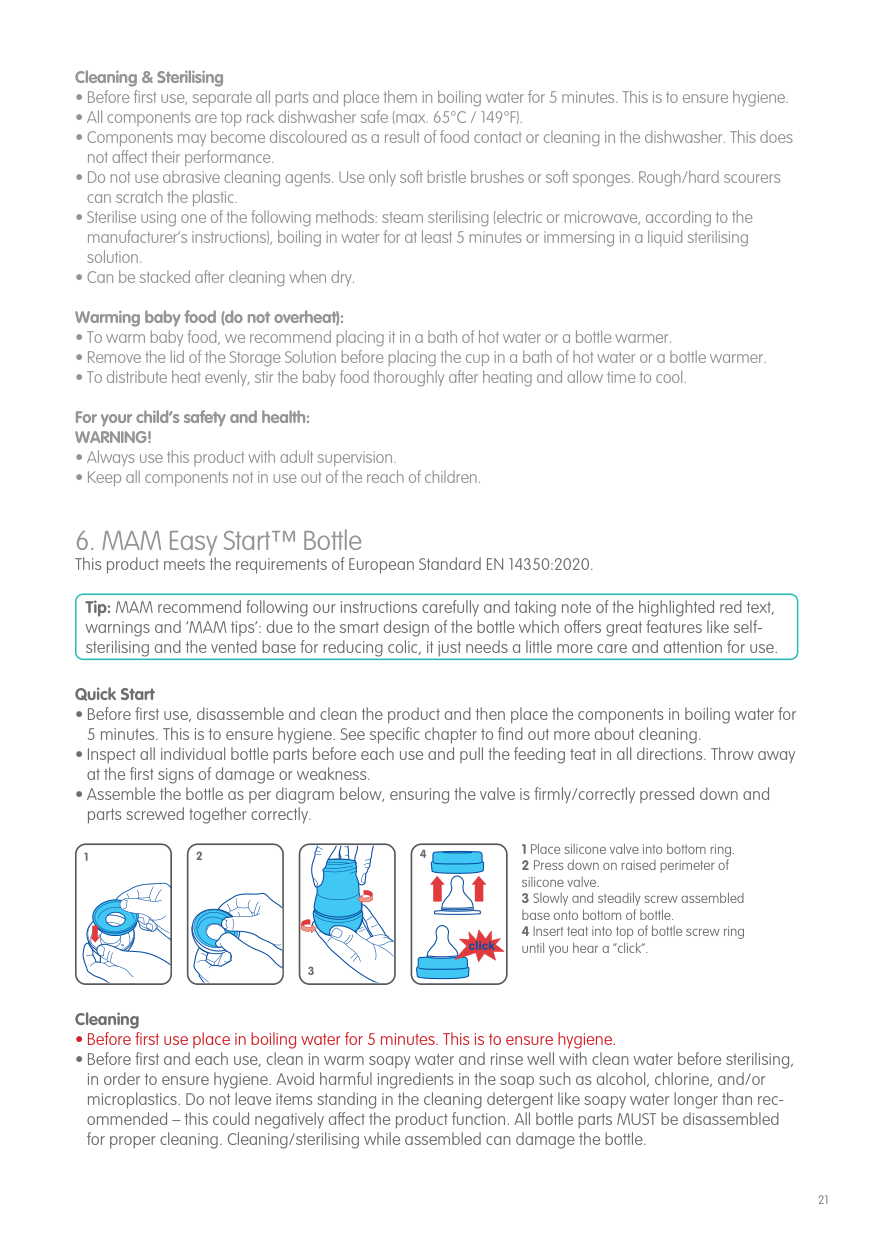
  • 1 Place silicone valve into bottom ring.

    2 Press down on raised perimeter of silicone valve.

    ######## 3

    4 Insert teat into top of bottle screw ring until you hear a ”click“.

    Screw assembled base onto bottom of bottle in slow steady manner.

    is firmly attached prior to filling bottle with liquid (see figure 1, 2 &3).
  • • Do not let babies self-feed.
  • • Store teats and valves in a dry sealed container.
  • Page 19

  • • Do not leave single bottle parts in direct sunlight or heat.
  • • Always use only MAM teats with the MAM bottles.
  • • Use only sugar free food or liquids.
  • • To avoid injury, do not let baby walk with bottle.
  • • Do not put your baby to bed with bottle. Prolonged contact with liquids may cause severe tooth decay.
  • • Bottle teat fits all MAM wide neck bottles and the Trainer. HEATING INSTRUCTIONS:
  • • NEVER pour boiling water into the bottle.
  • • Place in a bottle warmer, under hot running water or in a container of heated water.
  • • NEVER heat or cool a sealed bottle. Remove the protective cap and teat (with screw ring) before heating, especially before using a bottle warmer and microwave heating. Do not overheat as this may damage the bottle.
  • • Take extra care when heating in the microwave.
  • • Stir thoroughly after heating to evenly distribute heat. Allow the standing time recommended by the microwave manufacturer. Test the temperature before serving.
  • • Wrap cloth or towel around bottom of bottle and shake to absorb any excess water after warming in a bottle warmer or boiling water.
  • • After warming the bottle in a bottle warmer or boiling water it is recommended to tighten the bottom of the bottle.
  • • Do not place bottle in heated oven.
  • For your child’s safety and health: WARNING!

  • • Always use this product with adult supervision.
  • • Never use feeding teats as a soother.
  • • Continuous and prolonged sucking of fluids will cause tooth decay.
  • • Always check food temperature before feeding.
  • • Keep all components not in use out of the reach of children.
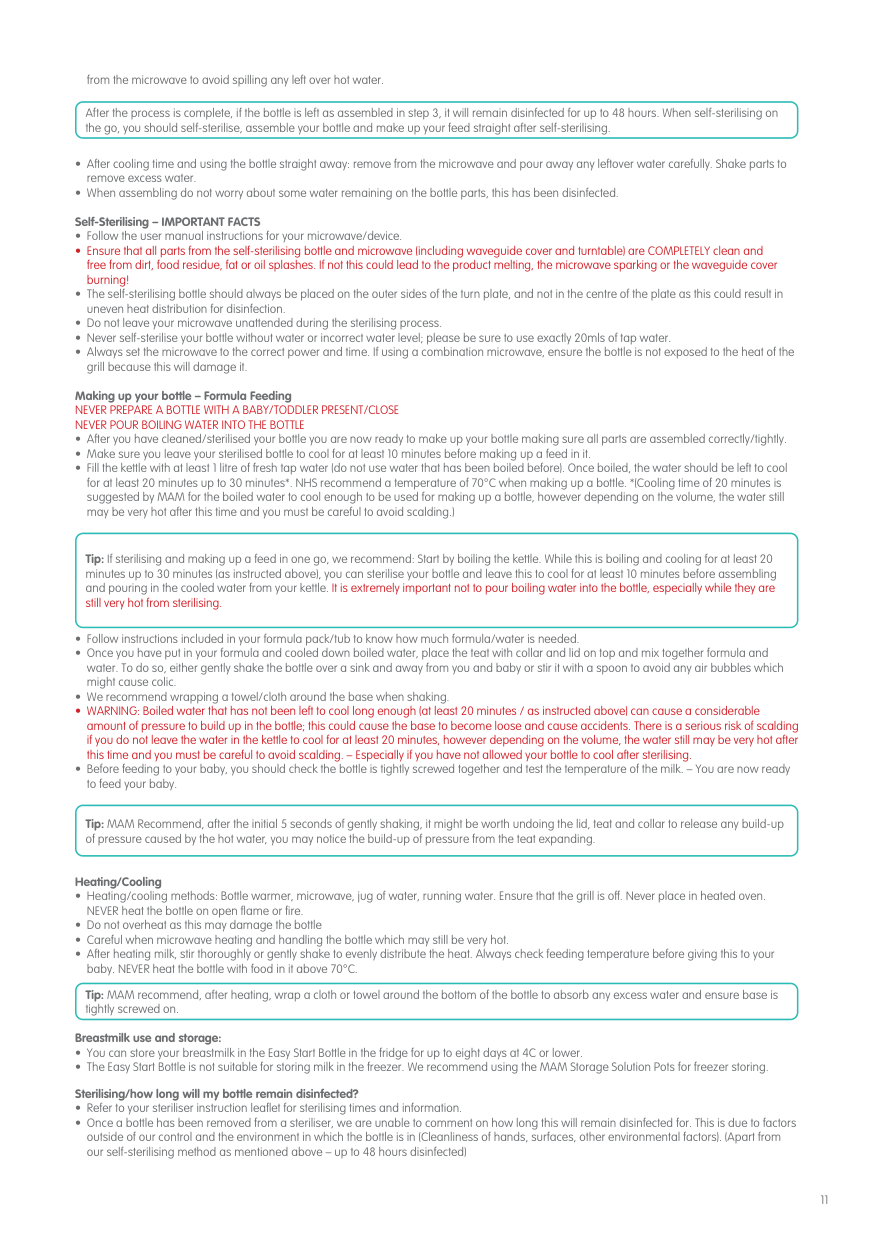
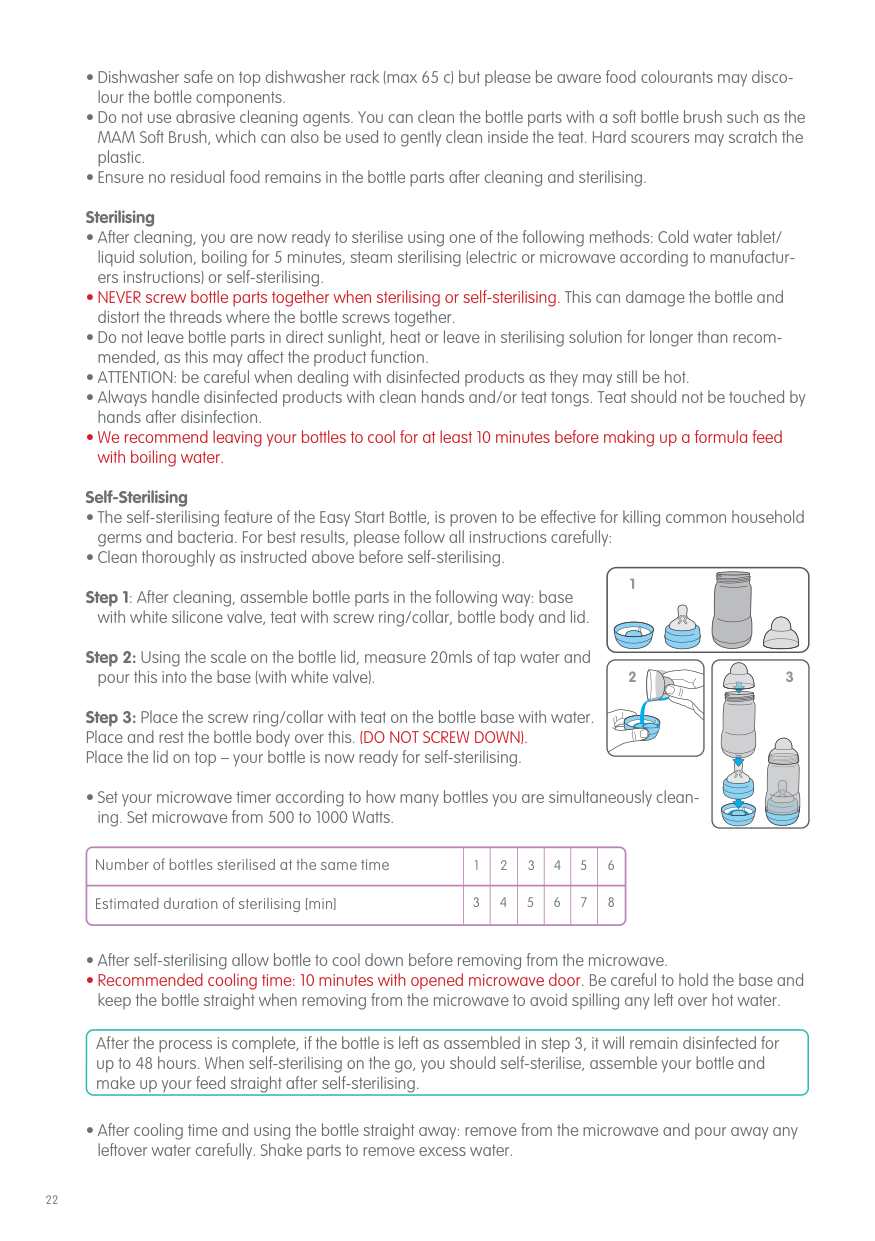
  • Self-sterilising function of Easy Start: The self-sterilising function of the Easy Start is proven to be effective for killing common household germs and bacteria. This method is completely sufficient and safe. For the best results, please follow all instructions carefully and use only as directed. This practical and time-saving function can be achieved in 3 simple steps. Always thoroughly clean individual bottle parts before beginning this process!

  • Step 1: Assemble clean bottle parts as follows: base with silicone valve, teat with screw ring, bottle body and protective cap.
  • Step 2: Fill the base with silicone valve with 20 ml of cool water. The protective cap makes a practical measuring cup.
  • Step 3:
  • • Place the screw ring with teat in the bottle base.
  • • Place the bottle body on it (optionally screw in slightly to avoid pouring out hot water by removing the bottle from microwave).
  • • Place the protective cap on top.
  • ###### Sterilising in the microwave:

  • • Set the microwave timer according to the number of bottles being simultaneously cleaned. Set microwave from 500 to 1000 Watts.
  • |Number of bottles sterilised at the same time|1|2|3|4|5|6| |---|---|---|---|---|---|---| |Estimated duration of sterilising [min]|3|4|5|6|7|8|

  • • Allow bottle to cool down before removing from microwave. Recommended cooling time: 10 minutes at opened microwave door.
  • After the process is complete, the Easy Start bottle remains disinfected up to 48 hours after self-sterilising in the microwave, provided that it stays assembled as shown on Step 3.
    Page 20

  • • For immediate usage: Pour away the leftover water from the base. Allow bottle parts to dry.
  • • Always store bottle assembled. Additional instructions:
  • • Follow the instructions in the user manual of your microwave or multifunctional device.
  • • Ensure that all parts from the self-sterilising bottle and microwave (including waveguide cover and turntable) are COMPLETELY clean and free from dirt, food residue, fat or oil splashes. If not this could lead to the product melting, the microwave sparking or the waveguide-cover burning!
  • • The self-sterilising bottle should only be placed on solid and flat surfaces.
  • • Do not put the self-sterilising bottle in the center of the turntable as this could result in an uneven heat distribution.
  • • Do not leave your microwave unattended during the sterilising process.
  • • Never place the device in the microwave without water.
  • • Stop the microwaving process immediately if all the water has been vaporised!
  • • Filling the base with too much or not enough water can damage the bottle.
  • • Always set the microwave to the correct power and time.
  • • If using a combination microwave oven, ensure that the self-sterilising bottle is not exposed to the heat of the grill because this will damage it.
  • • TAKE CARE when handling recently disinfected items: they may still be hot.
  • • Wash hands before touching disinfected items.
  • • Always store the bottle dry.
  • • Hold the self-sterilising bottle upright when removing from microwave to avoid spilling out hot residual water.
  • • Do not wash self-sterilising bottle after disinfection.
  • • Do not touch the teat after disinfection. Handle teat by using the screw ring.
  • 7. Troubleshooting for breast pump
  • If the monitor is not running

  • • Check to see that the power cord is properly attached to the pump if you want to use the pump in plugged in mode.
  • • Check to see if the toggle switch is ON without the adapter.
  • • Ensure battery power is available without the adapter. If not, plug in for charging or pumping. If there is low or no suction
  • • Check that all connections are properly attached at all connection points.
  • • Check that the silicone cushion is firmly seated in the funnel adapter.
  • • Check that the valve body is firmly connected to the funnel adapter.
  • • Check that the valve membrane is securely seated and flat on the valve body.
  • • Check that the membrane cap/handle holder is properly connected.
  • • Check that the tubing is not bent and there is no liquid in the tubing.
  • • Ensure that the breast shield forms a complete seal around the breast. Milk backflow
  • • If milk or water is found in the membrane or tubing, rinse the tubing with clean, hot water. Hang up to air dry completely before using.
  • • Check to ensure that the membrane is not damaged.
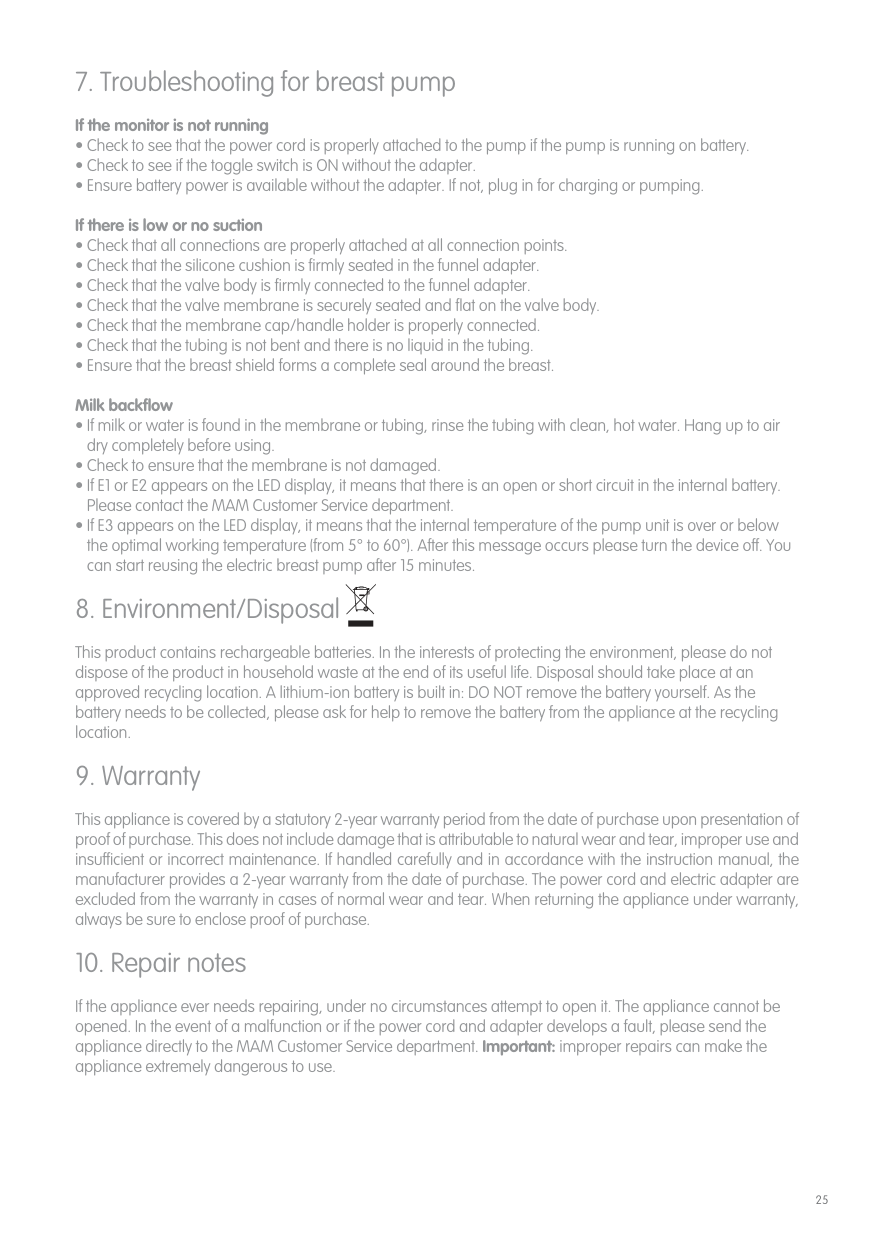
  • • If E1 or E2 appears on the LED display, it means that there is an open or short circuit in the internal battery. Please contact the MAM Customer Service department.
  • • If E3 appears on the LED display, it means that the internal temperature of the pump unit is over or below the optimal working temperature (from 5° to 60°). After this message occurs please turn the device off. You can start reusing the electric breast pump after 15 minutes in a surrounding concerning the operation conditions.
  • #### 8. Environment/Disposal

    This product contains rechargeable batteries. In the interests of protecting the environment, please do not dispose of the product in household waste at the end of its useful life. Disposal should take place at an approved recycling location. A lithium-ion battery is built in: DO NOT remove the battery yourself. As the battery needs to be collected, please ask for help to remove the battery from the appliance at the recycling location.

    #### 9. Warranty
    Page 21

    This appliance is covered by a statutory 2-year warranty period from the date of purchase upon presentation of proof of purchase. This does not include damage that is attributable to natural wear and tear, improper use and insufficient or incorrect maintenance. If handled carefully and in accordance with the instruction manual, the manufacturer provides a 2-year warranty from the date of purchase. The power cord and electric adapter are excluded from the warranty in cases of normal wear and tear. When returning the appliance under warranty, always be sure to enclose proof of purchase.

    #### 10. Repair notes

    If the appliance ever needs repairing, under no circumstances attempt to open it. The appliance cannot be opened. In the event of a malfunction or if the power cord and adapter develops a fault, please send the appliance directly to the MAM Customer Service department. Important: improper repairs can make the appliance extremely dangerous to use.

    #### 11. Technical data !

    Power adapter: Power input: 100–240 V; 50–60 Hz / Power output: 10V 1,5A Power rating: 15W

    Pump unit Lithium battery: 1750mAh Stimulation speed: 100CPM Stimulation vacuum: –0,002MPa to –0,018MPa Expression speed: 26 – 60 CPM Expression vacuum: –0,013 to –0,036MPa Timer: 30 min

    ###### Operation conditions:

    +5°C to +40°C, relative humidity ≤ 90%

    2in1 Double Breast Pump

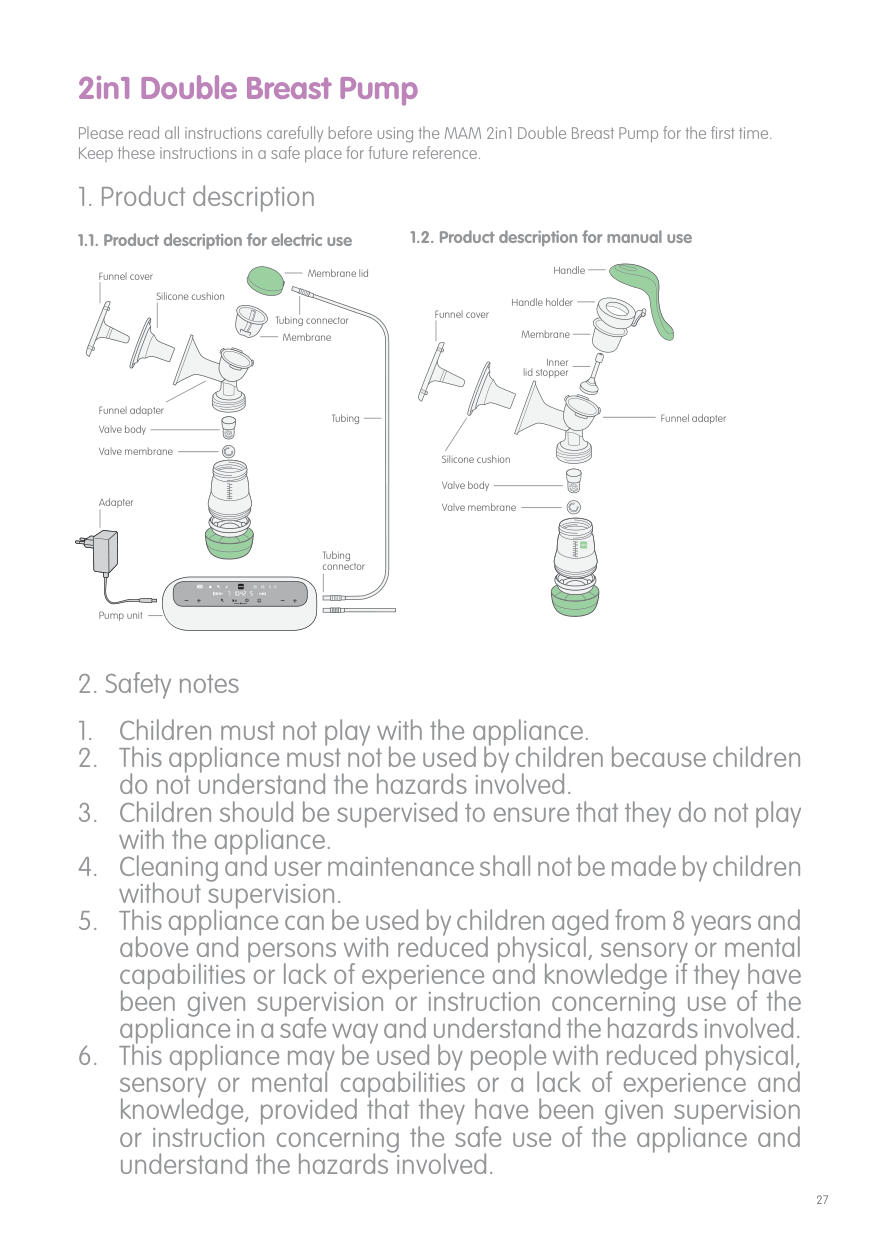
    Please read all instructions carefully before using the MAM 2in1 Double Breast Pump for the first time. Keep these instructions in a safe place for future reference.

  • Product description
  • 1.1. Product description for electric double/single use
  • 2. Safety notes
  • Membrane capFunnel cover

    Silicone cushion

    Tubing connector

    Membrane

    Funnel adapter Valve body Valve membrane

    Tubing

    | | | |---|---| | | | | | | | | | | | |

    Adapter

    Tubing connector
    Page 22

    Pump unit

    ###### 1.2. Product description for manual use

    Handle

    Handle holder

    Funnel cover

    Membrane

    Inner cap stopper

    Funnel adapter

    Silicone cushion

    Valve body

    Valve membrane

    | | | |---|---| | | | | | | | | | | | |

  • 1. Children must not play with the appliance.
  • 2. This appliance must not be used by children because children do not understand the hazards involved.
  • 3. Children should be supervised to ensure that they do not play with the appliance.
  • 4. Cleaning and user maintenance shall not be made by children without supervision.
  • 5. This appliance can be used by children aged from 8 years and above and persons with reduced physical, sensory or mental capabilities or lack of experience and knowledge if they have been given supervision or instruction concerning use of the appliance in a safe way and understand the hazards involved.
  • 6. This appliance may be used by people with reduced physical, sensory or mental capabilities or a lack of experience and
  • knowledge, provided that they have been given supervision or instruction concerning the safe use of the appliance and understand the hazards involved.
  • 7. This appliance is not intended for use by persons (including children) with reduced physical, sensory or mental capabilities, or lack of experience and knowledge unless they have been given supervision or instruction concerning use of the appliance by a person responsible for their safety.
  • 8. This appliance is intended for domestic use only.
  • 9. Use this product only for its intended use, as described in this manual. Never use attachments that are not recommended by the manufacturer.
  • 10. Never use any electric adapter or battery that was not supplied with the pump.
  • 11. Only connect appliance to voltages in accordance with the rating plate on the electric adapter.
  • 12. Before using the appliance for the first time, be sure to remove all the packaging materials and any components not used, so that your child cannot injure him or herself or swallow anything.
  • 13. Do not use the appliance within the reach of children. Secure the power cord and make sure that it cannot be pulled inadvertently, causing the appliance to fall onto the floor.
  • 14. Check the breast pump each time before use and only use it if the appliance and power cord are intact. At the first sign of any damage, the component in question must be either disposed of or repaired.
  • Page 23

  • 15. The appliance may only be opened by an authorized service center. Opening by any unauthorized person will automatically make the warranty invalid. Repairs may only be performed by specialist personnel. Improper repairs can create serious safety hazards for users. This also applies to the replacement of the power cord.
  • 16. This electric appliance must not be immersed in water or washed in a dishwasher. If it accidentally falls into water, do not reach for it. Unplug immediately.
  • 17. When cleaning the pump unit, unplug the adapter.
  • 18. Ensure that the tubing is clean and does not contain any drops of water.
  • 19. Never place the device’s electric pumping unit or adapter in
  • the microwave or expose to high temperatures.
  • 20. Turn the toggle switch off if the device is out of use for long time.
  • 21. Charge the battery at least once a month. To maximize the working life of the device, charging time should not exceed 6 hours.
  • 22. Always unplug the power cord from the outlet after each use.
  • 23. Always keep the instruction manual in a safe place.
  • 24. Appliance is only to be used with the power supply unit provided with the appliance.
  • 25. This appliance contains batteries that are only replaceable by skilled persons.
  • 26. This appliance contains batteries that are nonreplaceable.
  • 27. For the purposes of recharging the battery, only use the detachable supply unit provided with this appliance.
  • 28. This appliance is intended for domestic use only. Do not use outdoors.
  • 29. Use of accessories, transducers and cables other than those specified or provided by the manufacturer of this equipment could result in improper operation.
  • 30. Never operate this product if it has a damage cord or plug, if it is not working properly, if it has been dropped or damaged or dropped into water.
  • 31. If the electric adapter or supply cord is damaged, it must be replaced by manufacturer, an approved service agent or similarly qualified person in order to avoid a hazard. Separation of the casing can result in electric shock.
  • 32. DO NOT remove the battery yourself. Inbuilt lithium battery is non-removable, it’s prohibited to discharge for use. As the battery needs to be collected, please ask for help to remove the battery from the appliance at the recycling location.
  • 33. This breast pump should not be operated while traveling on an airplane.
  • 34. The device is not suitable for use in the presence of flammable anesthetic mixtures with air or with oxygen or nitrous oxide.
  • 35. This product should never be left unattended when plugged in.
  • 36. If the power adapter outer casings become loose or are separating, stop use and contact the device manufacturer immediately. Separation of the casing can result in electric shock.
  • 37. Do not place the product in direct sunlight.
  • 38. Do not use while bathing.
  • 39. Portable RF communications equipment (including peripherals such as antenna cables and external antennas) should be used no closer than 30 cm (12 inches) to any part of the 2in1 Double Breast Pump, including cables specified by the manufacturer. Otherwise, degradation of the performance of this equipment could result.
  • 40. Use of this equipment adjacent to or stacked with other equipment should be avoided because it could result in improper operation. If such use is necessary, this equipment and the other equipment should be observed to verify that they are operating normally.
  • 3. Cleaning and maintaining the appliance
  • Before using your MAM 2in1 Double Breast Pump for the first time and after each use, all parts that come into contact with the breast and breast milk must be separated, cleaned and sterilised.
  • • Only drinking-quality water must be used for cleaning.
  • • Do NOT sterilise the tubing or pump unit.
  • • Do NOT clean the inside of the tubing as no milk should enter it!
  • • Completely air dry or towel dry before reassembly and next use. Partially wet components may affect the operation of the electric breast pump.
  • • Ensure that the tubing is free from any liquid. Do not operate the electric breast pump if any liquid is visible in the tubing (see chapter 6 – Troubleshooting).
  • • Take care not to damage parts of the pump set during cleaning.
  • 3.1. Cleaning the electric pump unit To clean the electric pump unit, unplug the appliance, switch it off and wipe it with a clean, damp cloth. Never place it in a dishwasher for cleaning. The appliance must not be immersed in water.
  • 3.2. Cleaning by hand Before cleaning, all parts of the pump must be separated. Begin by rinsing all parts in cold, clear water. Then wash all parts in warm soapy water with a damp cloth or sponge and rinse thoroughly with cold water afterwards. Do not use any abrasive cleaning agents such as anti-bacterial solutions, as these could attack the appliance’s surface. Leave the separated parts to drip dry or use clean paper towel.
  • Page 24

  • 3.1. Cleaning in the dishwasher To clean the breast pump in the dishwasher, place the separated parts on the top rack of the dishwasher or in the cutlery section. When washing the pump parts in the dishwasher, the components may become discolored by food coloring – this does not affect their function. We recommend to carefully clean the valve body and valve membrane by hand to prevent damages and to ensure that those small components do not get lost.
  • 3.4. Sterilising the breast pump Before using the pump for the first time and once a day, all parts of the pump except the tubing and the electric pump unit must be sterilised. The separated pump parts can be sterilised in boiling water, in an electric or microwave steam steriliser as well as in cold sterilising liquid. Store the pump set in a clean bag / container and use the funnel cover for further protection of the silicone cushion until next use.
  • Please note: never sterilise the assembled pump – always separate the parts. Important: allow all parts of the breast pump to fully cool and dry before use.

  • 4. Using the appliance
  • 4.1. Electric pumping
  • 4.1.1. Assembly For hygienic reasons, please wash your hands thoroughly before assembling the breast pump.
  • • Place the silicone cushion into the funnel adapter. Make sure to connect the silicone cushion to the rim of the funnel properly by fitting it over the rim (Fig. 1).
  • • Place the membrane into the funnel adapter, cover with the membrane cap and screw on tightly (Fig. 2).
  • • Carefully press the valve membrane into the hole of the valve body until it engages. The valve membrane should be pressed flat and tight to avoid air leakage (Fig. 3).
  • • Please note: the valve membrane ensures that there is a total barrier between the breast milk and any pathogenic agents.
  • • Now correctly place the valve membrane with the valve body onto the funnel adapter (Fig. 4).
  • • Firmly screw the bottle onto the funnel adapter (Fig. 5).
  • • The tubing has two connectors on the two ends. Attach the connector to the air vent of the membrane cap (Fig. 6) and the one on the pump unit separately, ensuring a tight fit (Fig. 7).
  • | | | |---|---| | | | | | | | | | | | | | | | | | | | | |

    Fig. 1 Fig. 3Fig. 2 Fig. 4 Fig. 5

    ![image 7](EN_WEB_Leaflet_online_shop_electrical_products_GGH1A9ZA001.AAL_images/imageFile7.png)

    ![image 8](EN_WEB_Leaflet_online_shop_electrical_products_GGH1A9ZA001.AAL_images/imageFile8.png)

    Fig. 6

    Fig.8Fig. 7

    Page 25

    ![image 9](EN_WEB_Leaflet_online_shop_electrical_products_GGH1A9ZA001.AAL_images/imageFile9.png)

    ![image 10](EN_WEB_Leaflet_online_shop_electrical_products_GGH1A9ZA001.AAL_images/imageFile10.png)

    ![image 11](EN_WEB_Leaflet_online_shop_electrical_products_GGH1A9ZA001.AAL_images/imageFile11.png)

    ![image 12](EN_WEB_Leaflet_online_shop_electrical_products_GGH1A9ZA001.AAL_images/imageFile12.png)

    ![image 13](EN_WEB_Leaflet_online_shop_electrical_products_GGH1A9ZA001.AAL_images/imageFile13.png)

    ![image 14](EN_WEB_Leaflet_online_shop_electrical_products_GGH1A9ZA001.AAL_images/imageFile14.png)

    ![image 15](EN_WEB_Leaflet_online_shop_electrical_products_GGH1A9ZA001.AAL_images/imageFile15.png)

    ![image 16](EN_WEB_Leaflet_online_shop_electrical_products_GGH1A9ZA001.AAL_images/imageFile16.png)

    ![image 17](EN_WEB_Leaflet_online_shop_electrical_products_GGH1A9ZA001.AAL_images/imageFile17.png)

    ![image 18](EN_WEB_Leaflet_online_shop_electrical_products_GGH1A9ZA001.AAL_images/imageFile18.png)

    ![image 19](EN_WEB_Leaflet_online_shop_electrical_products_GGH1A9ZA001.AAL_images/imageFile19.png)

    ![image 20](EN_WEB_Leaflet_online_shop_electrical_products_GGH1A9ZA001.AAL_images/imageFile20.png)

    ![image 21](EN_WEB_Leaflet_online_shop_electrical_products_GGH1A9ZA001.AAL_images/imageFile21.png)

    ![image 22](EN_WEB_Leaflet_online_shop_electrical_products_GGH1A9ZA001.AAL_images/imageFile22.png)

    ![image 23](EN_WEB_Leaflet_online_shop_electrical_products_GGH1A9ZA001.AAL_images/imageFile23.png)

    ![image 24](EN_WEB_Leaflet_online_shop_electrical_products_GGH1A9ZA001.AAL_images/imageFile24.png)

    ![image 25](EN_WEB_Leaflet_online_shop_electrical_products_GGH1A9ZA001.AAL_images/imageFile25.png)

    ![image 26](EN_WEB_Leaflet_online_shop_electrical_products_GGH1A9ZA001.AAL_images/imageFile26.png)

    ![image 27](EN_WEB_Leaflet_online_shop_electrical_products_GGH1A9ZA001.AAL_images/imageFile27.png)

    ![image 28](EN_WEB_Leaflet_online_shop_electrical_products_GGH1A9ZA001.AAL_images/imageFile28.png)

    ![image 29](EN_WEB_Leaflet_online_shop_electrical_products_GGH1A9ZA001.AAL_images/imageFile29.png)

    ![image 30](EN_WEB_Leaflet_online_shop_electrical_products_GGH1A9ZA001.AAL_images/imageFile30.png)

    ![image 31](EN_WEB_Leaflet_online_shop_electrical_products_GGH1A9ZA001.AAL_images/imageFile31.png)

    ![image 32](EN_WEB_Leaflet_online_shop_electrical_products_GGH1A9ZA001.AAL_images/imageFile32.png)

    ![image 33](EN_WEB_Leaflet_online_shop_electrical_products_GGH1A9ZA001.AAL_images/imageFile33.png)

    Page 26

    ![image 34](EN_WEB_Leaflet_online_shop_electrical_products_GGH1A9ZA001.AAL_images/imageFile34.png)

    ![image 35](EN_WEB_Leaflet_online_shop_electrical_products_GGH1A9ZA001.AAL_images/imageFile35.png)

    ![image 36](EN_WEB_Leaflet_online_shop_electrical_products_GGH1A9ZA001.AAL_images/imageFile36.png)

    ![image 37](EN_WEB_Leaflet_online_shop_electrical_products_GGH1A9ZA001.AAL_images/imageFile37.png)

    ![image 38](EN_WEB_Leaflet_online_shop_electrical_products_GGH1A9ZA001.AAL_images/imageFile38.png)

    ![image 39](EN_WEB_Leaflet_online_shop_electrical_products_GGH1A9ZA001.AAL_images/imageFile39.png)

    ![image 40](EN_WEB_Leaflet_online_shop_electrical_products_GGH1A9ZA001.AAL_images/imageFile40.png)

    ![image 41](EN_WEB_Leaflet_online_shop_electrical_products_GGH1A9ZA001.AAL_images/imageFile41.png)

    ![image 42](EN_WEB_Leaflet_online_shop_electrical_products_GGH1A9ZA001.AAL_images/imageFile42.png)

    ![image 43](EN_WEB_Leaflet_online_shop_electrical_products_GGH1A9ZA001.AAL_images/imageFile43.png)

    ![image 44](EN_WEB_Leaflet_online_shop_electrical_products_GGH1A9ZA001.AAL_images/imageFile44.png)

    ![image 45](EN_WEB_Leaflet_online_shop_electrical_products_GGH1A9ZA001.AAL_images/imageFile45.png)

    ![image 46](EN_WEB_Leaflet_online_shop_electrical_products_GGH1A9ZA001.AAL_images/imageFile46.png)

    ![image 47](EN_WEB_Leaflet_online_shop_electrical_products_GGH1A9ZA001.AAL_images/imageFile47.png)

    ![image 48](EN_WEB_Leaflet_online_shop_electrical_products_GGH1A9ZA001.AAL_images/imageFile48.png)

    ![image 49](EN_WEB_Leaflet_online_shop_electrical_products_GGH1A9ZA001.AAL_images/imageFile49.png)

    ![image 50](EN_WEB_Leaflet_online_shop_electrical_products_GGH1A9ZA001.AAL_images/imageFile50.png)

    ![image 51](EN_WEB_Leaflet_online_shop_electrical_products_GGH1A9ZA001.AAL_images/imageFile51.png)

    ![image 52](EN_WEB_Leaflet_online_shop_electrical_products_GGH1A9ZA001.AAL_images/imageFile52.png)

    ![image 53](EN_WEB_Leaflet_online_shop_electrical_products_GGH1A9ZA001.AAL_images/imageFile53.png)

    ![image 54](EN_WEB_Leaflet_online_shop_electrical_products_GGH1A9ZA001.AAL_images/imageFile54.png)

    ![image 55](EN_WEB_Leaflet_online_shop_electrical_products_GGH1A9ZA001.AAL_images/imageFile55.png)

    ![image 56](EN_WEB_Leaflet_online_shop_electrical_products_GGH1A9ZA001.AAL_images/imageFile56.png)

    ![image 57](EN_WEB_Leaflet_online_shop_electrical_products_GGH1A9ZA001.AAL_images/imageFile57.png)

    Page 27

    ![image 58](EN_WEB_Leaflet_online_shop_electrical_products_GGH1A9ZA001.AAL_images/imageFile58.png)

    ![image 59](EN_WEB_Leaflet_online_shop_electrical_products_GGH1A9ZA001.AAL_images/imageFile59.png)

    ![image 60](EN_WEB_Leaflet_online_shop_electrical_products_GGH1A9ZA001.AAL_images/imageFile60.png)

    ![image 61](EN_WEB_Leaflet_online_shop_electrical_products_GGH1A9ZA001.AAL_images/imageFile61.png)

    ![image 62](EN_WEB_Leaflet_online_shop_electrical_products_GGH1A9ZA001.AAL_images/imageFile62.png)

    ![image 63](EN_WEB_Leaflet_online_shop_electrical_products_GGH1A9ZA001.AAL_images/imageFile63.png)

    ![image 64](EN_WEB_Leaflet_online_shop_electrical_products_GGH1A9ZA001.AAL_images/imageFile64.png)

    ![image 65](EN_WEB_Leaflet_online_shop_electrical_products_GGH1A9ZA001.AAL_images/imageFile65.png)

    ![image 66](EN_WEB_Leaflet_online_shop_electrical_products_GGH1A9ZA001.AAL_images/imageFile66.png)

    ![image 67](EN_WEB_Leaflet_online_shop_electrical_products_GGH1A9ZA001.AAL_images/imageFile67.png)

    ![image 68](EN_WEB_Leaflet_online_shop_electrical_products_GGH1A9ZA001.AAL_images/imageFile68.png)

    ![image 69](EN_WEB_Leaflet_online_shop_electrical_products_GGH1A9ZA001.AAL_images/imageFile69.png)

    ![image 70](EN_WEB_Leaflet_online_shop_electrical_products_GGH1A9ZA001.AAL_images/imageFile70.png)

    ![image 71](EN_WEB_Leaflet_online_shop_electrical_products_GGH1A9ZA001.AAL_images/imageFile71.png)

    ![image 72](EN_WEB_Leaflet_online_shop_electrical_products_GGH1A9ZA001.AAL_images/imageFile72.png)

    ![image 73](EN_WEB_Leaflet_online_shop_electrical_products_GGH1A9ZA001.AAL_images/imageFile73.png)

    ![image 74](EN_WEB_Leaflet_online_shop_electrical_products_GGH1A9ZA001.AAL_images/imageFile74.png)

    ![image 75](EN_WEB_Leaflet_online_shop_electrical_products_GGH1A9ZA001.AAL_images/imageFile75.png)

    ![image 76](EN_WEB_Leaflet_online_shop_electrical_products_GGH1A9ZA001.AAL_images/imageFile76.png)

    ![image 77](EN_WEB_Leaflet_online_shop_electrical_products_GGH1A9ZA001.AAL_images/imageFile77.png)

    ![image 78](EN_WEB_Leaflet_online_shop_electrical_products_GGH1A9ZA001.AAL_images/imageFile78.png)

    ![image 79](EN_WEB_Leaflet_online_shop_electrical_products_GGH1A9ZA001.AAL_images/imageFile79.png)

    ![image 80](EN_WEB_Leaflet_online_shop_electrical_products_GGH1A9ZA001.AAL_images/imageFile80.png)

    ![image 81](EN_WEB_Leaflet_online_shop_electrical_products_GGH1A9ZA001.AAL_images/imageFile81.png)

    ![image 82](EN_WEB_Leaflet_online_shop_electrical_products_GGH1A9ZA001.AAL_images/imageFile82.png)

    Page 28

    ![image 83](EN_WEB_Leaflet_online_shop_electrical_products_GGH1A9ZA001.AAL_images/imageFile83.png)

    ![image 84](EN_WEB_Leaflet_online_shop_electrical_products_GGH1A9ZA001.AAL_images/imageFile84.png)

    ![image 85](EN_WEB_Leaflet_online_shop_electrical_products_GGH1A9ZA001.AAL_images/imageFile85.png)

    ![image 86](EN_WEB_Leaflet_online_shop_electrical_products_GGH1A9ZA001.AAL_images/imageFile86.png)

    ![image 87](EN_WEB_Leaflet_online_shop_electrical_products_GGH1A9ZA001.AAL_images/imageFile87.png)

    ![image 88](EN_WEB_Leaflet_online_shop_electrical_products_GGH1A9ZA001.AAL_images/imageFile88.png)

    ![image 89](EN_WEB_Leaflet_online_shop_electrical_products_GGH1A9ZA001.AAL_images/imageFile89.png)

    ![image 90](EN_WEB_Leaflet_online_shop_electrical_products_GGH1A9ZA001.AAL_images/imageFile90.png)

    ![image 91](EN_WEB_Leaflet_online_shop_electrical_products_GGH1A9ZA001.AAL_images/imageFile91.png)

    ![image 92](EN_WEB_Leaflet_online_shop_electrical_products_GGH1A9ZA001.AAL_images/imageFile92.png)

    ![image 93](EN_WEB_Leaflet_online_shop_electrical_products_GGH1A9ZA001.AAL_images/imageFile93.png)

    ![image 94](EN_WEB_Leaflet_online_shop_electrical_products_GGH1A9ZA001.AAL_images/imageFile94.png)

    ![image 95](EN_WEB_Leaflet_online_shop_electrical_products_GGH1A9ZA001.AAL_images/imageFile95.png)

    ![image 96](EN_WEB_Leaflet_online_shop_electrical_products_GGH1A9ZA001.AAL_images/imageFile96.png)

    ![image 97](EN_WEB_Leaflet_online_shop_electrical_products_GGH1A9ZA001.AAL_images/imageFile97.png)

    ![image 98](EN_WEB_Leaflet_online_shop_electrical_products_GGH1A9ZA001.AAL_images/imageFile98.png)

    ![image 99](EN_WEB_Leaflet_online_shop_electrical_products_GGH1A9ZA001.AAL_images/imageFile99.png)

    ![image 100](EN_WEB_Leaflet_online_shop_electrical_products_GGH1A9ZA001.AAL_images/imageFile100.png)

    ![image 101](EN_WEB_Leaflet_online_shop_electrical_products_GGH1A9ZA001.AAL_images/imageFile101.png)

    ![image 102](EN_WEB_Leaflet_online_shop_electrical_products_GGH1A9ZA001.AAL_images/imageFile102.png)

    ![image 103](EN_WEB_Leaflet_online_shop_electrical_products_GGH1A9ZA001.AAL_images/imageFile103.png)

    ![image 104](EN_WEB_Leaflet_online_shop_electrical_products_GGH1A9ZA001.AAL_images/imageFile104.png)

    ![image 105](EN_WEB_Leaflet_online_shop_electrical_products_GGH1A9ZA001.AAL_images/imageFile105.png)

    ![image 106](EN_WEB_Leaflet_online_shop_electrical_products_GGH1A9ZA001.AAL_images/imageFile106.png)

    Page 29

    ![image 107](EN_WEB_Leaflet_online_shop_electrical_products_GGH1A9ZA001.AAL_images/imageFile107.png)

    ![image 108](EN_WEB_Leaflet_online_shop_electrical_products_GGH1A9ZA001.AAL_images/imageFile108.png)

    ![image 109](EN_WEB_Leaflet_online_shop_electrical_products_GGH1A9ZA001.AAL_images/imageFile109.png)

    ![image 110](EN_WEB_Leaflet_online_shop_electrical_products_GGH1A9ZA001.AAL_images/imageFile110.png)

    ![image 111](EN_WEB_Leaflet_online_shop_electrical_products_GGH1A9ZA001.AAL_images/imageFile111.png)

    ![image 112](EN_WEB_Leaflet_online_shop_electrical_products_GGH1A9ZA001.AAL_images/imageFile112.png)

    ![image 113](EN_WEB_Leaflet_online_shop_electrical_products_GGH1A9ZA001.AAL_images/imageFile113.png)

    ![image 114](EN_WEB_Leaflet_online_shop_electrical_products_GGH1A9ZA001.AAL_images/imageFile114.png)

    ![image 115](EN_WEB_Leaflet_online_shop_electrical_products_GGH1A9ZA001.AAL_images/imageFile115.png)

    ![image 116](EN_WEB_Leaflet_online_shop_electrical_products_GGH1A9ZA001.AAL_images/imageFile116.png)

    ![image 117](EN_WEB_Leaflet_online_shop_electrical_products_GGH1A9ZA001.AAL_images/imageFile117.png)

    ![image 118](EN_WEB_Leaflet_online_shop_electrical_products_GGH1A9ZA001.AAL_images/imageFile118.png)

    ![image 119](EN_WEB_Leaflet_online_shop_electrical_products_GGH1A9ZA001.AAL_images/imageFile119.png)

    ![image 120](EN_WEB_Leaflet_online_shop_electrical_products_GGH1A9ZA001.AAL_images/imageFile120.png)

    ![image 121](EN_WEB_Leaflet_online_shop_electrical_products_GGH1A9ZA001.AAL_images/imageFile121.png)

    ![image 122](EN_WEB_Leaflet_online_shop_electrical_products_GGH1A9ZA001.AAL_images/imageFile122.png)

    ![image 123](EN_WEB_Leaflet_online_shop_electrical_products_GGH1A9ZA001.AAL_images/imageFile123.png)

    ![image 124](EN_WEB_Leaflet_online_shop_electrical_products_GGH1A9ZA001.AAL_images/imageFile124.png)

    | | | |---|---| | | | | | | | | | | | | | | | | | | | | |

    ![image 125](EN_WEB_Leaflet_online_shop_electrical_products_GGH1A9ZA001.AAL_images/imageFile125.png)

    Page 30

    ![image 126](EN_WEB_Leaflet_online_shop_electrical_products_GGH1A9ZA001.AAL_images/imageFile126.png)

    ![image 127](EN_WEB_Leaflet_online_shop_electrical_products_GGH1A9ZA001.AAL_images/imageFile127.png)

    ###### 4.1.2. Charging the electric pump unit and pumping when connected to mains operation

  • • When the adapter is connected to the pump, the pump can be powered and the battery charged at the same time.
  • • For charging or pumping when the battery is empty, connect the plug to the pump unit and insert the adapter into an electrical socket (Fig. 8). To charge, switch the toggle switch at the bottom of the pump to OFF.
  • • For pumping, make sure that the toggle switch is switched to ON. The LED on the pump will flash, indicating that the device is in standby mode.
  • • When the battery power is low, the pump will switch off automatically.
  • • Once the battery is fully charged, it will stop charging to protect the battery from damage.
  • ###### 4.1.3. Preparing for pumping

  • • Wash your hands with soap and your breasts and teats using a warm washcloth and clean fresh water.
  • • Squeeze a little bit of milk out of each teat to make sure the milk ducts are not clogged.
  • • Ensure that all parts of the pump are clean and disinfected before use.
  • • Before using, make sure that the pump is properly assembled and fully screwed onto the bottle.
  • • Ensure that the toggle switch at the bottom of the pump unit is switched to ON and that the battery is charged or the pump plugged into an electrical socket.
  • • Place the funnel firmly on your breast. Make sure that no air escapes through the side, otherwise no suction will develop.
  • • Support the breast with your hand from below and hold the funnel onto your breast with your thumb and index finger (Fig. 9).
  • • Expressing milk without using the silicone inlay is more effective than with the silicone inlay. So you may want to remove the inlay once you become more comfortable with expressing!
  • Fig. 9

    ###### 4.1.4. PumpingInterface display guide

    Alternate modeExpression mode

    Duet modeStimulation mode

    L: Left mode, R: Right modeChild safety lock

    Battery level

    Decrease/Increase vacuum strength

    Decrease/Increase vacuum strength

    Press to switch modeStimulation mode/ Expression mode

    Alarm ClockPause

    Turn on the breast pump by pressing for two seconds. The 2-phase expression process begins with the stimulation mode. This produces a short, quick sucking rhythm until your milk starts to flow. The 30 minutes timer will start and the pump will start with Level 1 of the stimulation mode by default. Press to select the pump to operate either on the left or right side in duet or alternate mode. The alternate mode works from 30s left to 30s right. There are 9 different levels of suction strength, which can be adjusted by pressing –/+. You can see the selected level for each side on the display:

    Page 31

    Once the milk starts flowing, you can switch to the expression mode. To do this, simply press . The expression mode starts with Level 1 and has a slow rhythm to express the milk. The expression icon will then appear on the top of the display. The expression strength can be adjusted for each side to 9 different levels by pressing –/+. The simple up/down buttons allow you to control the vacuum to suit your comfort level, as this is when milk will flow best. Research has shown that pumping is more efficient

    – getting more milk in less time – when pumping at a maximum vacuum level during the expression phase.

    When the pump is running on battery power, the battery icon will show how much power is left. When the battery runs out, will flash, the main pump unit will then shutdown. A timer starts running as soon as you start pumping. After 30 minutes, the pump switches off automatically. Healthcare professionals recommend that you pump for each breast 15 minutes. To resume pumping, press for 2 seconds. To stop pumping before the end of the 30 minutes, press for 2 seconds. After pumping and for transportation always switch the toggle switch to OFF to avoid starting the pump unintentionally. For Child safety lock press alarm clock and pause at the same time.

    After pumping an alarm clock can be set to remind you on the next pumping session. In standby state, press to turn the alarm clock on, press +/– at left side to set hour, press +/– at right side to set minute, then wait for 4s (4times of flash), the setting is done and the alarm clock is activated.

    Expressing milk or stimulating does not come easily to everyone. If you find it is less comfortable than you

    had hoped, ask your midwife or other healthcare professional for advice. Switches to a manual pump in two easy steps

    ![image 128](EN_WEB_Leaflet_online_shop_electrical_products_GGH1A9ZA001.AAL_images/imageFile128.png)

    ![image 129](EN_WEB_Leaflet_online_shop_electrical_products_GGH1A9ZA001.AAL_images/imageFile129.png)

    ![image 130](EN_WEB_Leaflet_online_shop_electrical_products_GGH1A9ZA001.AAL_images/imageFile130.png)

    ![image 131](EN_WEB_Leaflet_online_shop_electrical_products_GGH1A9ZA001.AAL_images/imageFile131.png)

    ###### 4.2. Manual pumping

  • 4.2.1. Assembly For hygienic reasons, please wash your hands thoroughly before assembling the breast pump.
  • • Place the silicone cushion into the funnel adapter. Make sure to connect the silicone cushion to the rim of the funnel properly by fitting it over the rim (Fig. 10).
  • • Insert the inner cap stopper into the membrane until it engages properly (Fig. 11).
  • • Insert both parts into the funnel adaptor (Fig. 12).
  • • Screw the handle holder on top of the membrane (Fig. 13).
  • • Connect the handle to the handle holder so that it clicks firmly into place (Fig. 14). Then place the inner cap stopper in lock position by pulling the upper part of the cap stopper into the opening closer to the pump handle (Fig. 15).
  • • Carefully press the valve membrane into the hole of the valve body until it engages. The valve membrane should be pressed flat and tight to avoid air leakage (Fig. 16).
  • • Now correctly place the valve membrane with the valve body onto the funnel adapter (Fig. 17).
  • • Screw the bottle onto the funnel adaptor tightly (Fig. 18).
  • | | | |---|---| | | | | | | | | | | | | | | | | | | | | |

    CLICK!

    Fig. 10

    Page 32

    Fig. 17 Fig. 18

    Fig. 11 Fig. 12

    Fig. 14

    Fig. 13

    Fig. 16Fig. 15

  • 4.2.2. Preparing for pumping
  • • Wash your hands with soap and your breasts and teats with a warm washcloth and clean fresh water.
  • • Squeeze a little bit of milk out of each teat to make sure the milk ducts are not clogged.
  • • Ensure all parts are clean before use.
  • • Before using, make sure that the pump is properly assembled and fully screwed onto the bottle.
  • • Sit comfortably and lean forward slightly. Place a glass of water within easy reach.
  • • Place the funnel firmly on your breast. Make sure no air escapes through the side, otherwise no suction will develop.
  • • Support the breast with your hand from below and hold the funnel onto your breast with your thumb and index finger (Fig. 19).
  • • Expressing milk without using the silicone inlay is more effective than with the silicone inlay. So you
  • may want to remove the inlay once you become more comfortable with expressing.

    ###### 4.2.3. Pumping

  • • Use your other hand for pumping.
  • • Hold the adaptor neck with your thumb and the handle with your remaining fingers.
  • • Press and release the handle to operate the pump at a speed of approximately 60 times per minute. Only squeeze the handle as far as it remains comfortable and adjust the speed to your personal preference (Fig. 20).
  • • We recommend a faster pump rhythm to stimulate milk flow. Once the milk starts flowing, you can switch to a slower rhythm.
  • • Try to pump consistently to keep the milk flow established.
  • Fig. 19
  • Fig. 20
  • Expressing milk or stimulating does not come easily to everyone. If you find it is less comfortable than you had hoped, ask your midwife or other healthcare professional for advice.

  • 4.3. Use in combination with the MAM Storage Solution (for electric or manual pumping)
  • • Remove the Easy Start base with its silicone valve and screw the Storage Solution on in its place. This unit can now be screwed onto the pump. All sizes of Easy Start bottle can be used in this way (Fig. 21).
  • • Bring the pump to the breast and express. Please refer to the instructions for electric or manual pumping.
  • • Unscrew the Storage Solution and close securely with the lid (Fig. 22).
  • • To label with the date and time of expression, use the special two-part area on the Storage Solution. A pencil is best.
  • Page 33

    | | | |---|---| | | | | | | | | | | | | | | | | | | | | | | | |
  • Fig. 21
  • Fig. 22
  • Fig. 23
  • 5. Storing and warming breast milk
  • 5.1. Storage
  • • Expressed breast milk can be stored either in the MAM Easy Start bottle or in the Storage Solution.
  • • The Easy Start bottle with the expressed milk can be sealed either with the bottle screw ring, teat and cap, or with the bottle screw ring and sealing disc (Fig. 23).
  • • Breast milk can be stored in the fridge in the Easy Start bottle or Storage Solution for up to 24 hours.
  • • Breast milk can be kept in the Storage Solution in the freezer for 3 months. Please note: the Easy Start bottle is not suitable for storing expressed milk in the freezer or freezer compartment.
  • • Do not store breast milk in the door of the refrigerator. Instead, choose the coldest part of your refrigerator (this is at the back of the glass shelf above the vegetable compartment).
  • • It is recommended that breast milk is frozen in small portions of 50–120ml. Fill the Storage Solution only up to the 120ml level mark for freezing. Never overfill.
  • • Use milk that has been stored the longest first.
  • • When transporting breast milk, it is important that the cooling chain is not interrupted.
  • ###### 5.2. Milk warming

  • • Defrost frozen milk in the fridge overnight, carefully in a water bath or with a bottle warmer that offers a defrost setting.
  • • Do not put the milk in a microwave to heat: if you do, micronutrients and important immunological
  • properties will be lost.

  • • To warm the milk, place in a bath of hot water or a bottle warmer. To warm to body temperature, running water can also be used. Start with cold running water and gradually increase the temperature until the milk is warm.
  • • Remove the screw ring and sealing disc of the Easy Start before placing the bottle in the water bath or bottle warmer for warming. Be sure to remove teat and cap before heating.
  • • Breast milk should never be refrozen. Pour warmed unused milk away.
  • • Never mix newly expressed breast milk with frozen milk.
  • • Always check the temperature of the milk before feeding.
  • Page 34

  • • Once your baby has drunk from a bottle of breast milk, it should be used within the hour and anything left over should be thrown away. 5.3. MAM Storage Solution Instructions for use:
  • • Check all components before each use. Throw away at the first signs of damage or weakness.
  • • This product is suitable for food contact.
  • • Fill the Storage Solution only up to the 120ml level mark for freezing. Never overfill.
  • • Use a pencil for the washable labelling area. Do not use permanent markers. Cleaning & Sterilising
  • • Before first use, separate all parts and place them in boiling water for 5 minutes. This is to ensure hygiene.
  • • All components are top rack dishwasher safe (max. 149°F / 65°C).
  • • Components may become discolored as a result of food contact or cleaning in the dishwasher. This does not affect their performance.
  • • Do not use abrasive cleaning agents. Use only soft bristle brushes or soft sponges. Rough/hard scourers can scratch the plastic.
  • • Sterilise using one of the following methods: steam sterilising (electric or microwave, according to the manufacturer’s instructions), boiling in water for at least 5 minutes or immersing in a liquid sterilising solution.
  • • Can be stacked after cleaning when dry. Warming baby food (do not overheat):
  • • To warm baby food, we recommend placing it in a bath of hot water or a bottle warmer.
  • • Remove the lid of the Storage Solution before placing the cup in a bath of hot water or a bottle warmer.
  • • To distribute heat evenly, stir the baby food thoroughly after heating and allow time to cool.
  • For your child’s safety and health: WARNING!

  • • Always use this product with adult supervision.
  • • Keep all components not in use out of the reach of children.
  • #### 6. Feeding

    MAM recommends the MAM Easy Start™ Anti-Colic bottle for feeding breast milk.
  • 6.1. Easy Start™ Anti-Colic bottle Instructions for use:
  • • Clean before first and each subsequent use.
  • • Before first use separate all 6 parts and place them in boiling water for 5 minutes. This is to ensure hygiene.
  • • Inspect all individual bottle parts before each use and pull the feeding teat in all directions. Throw away at the first signs of damage or weakness.
  • • To ensure proper cleaning/sterilising all bottle parts MUST be disassembled.
  • • Cleaning/sterilising while assembled can damage the bottle.
  • • Dishwasher safe on top dishwasher rack (max. 149° F / 65° C) but food colorings may discolor components.
  • • Do not use abrasive cleaning agents. Only soft bristle brushes or soft sponges should be used. Hard scourers may scratch the plastic.
  • • Sterilise using one of the following methods: steam sterilising (electric or microwave according to manufacturer’s instructions), boiling in water for at least 5 minutes or immersing in a liquid sterilising solution.
  • • Do not leave items standing in any cleaning solution for longer than recommended – this could negatively affect the product function
  • • The bottle is made of polypropylene which is hygienic, easy to clean and relatively soft. Avoid any heavy pressure on it, as this could affect the function.
  • • Do not use pin or sharp object to enlarge feeding hole of teat.
  • • When first used and sometimes during use, the ventilation slit (in the raised bubble on the underside of the teat base) can stick together. This will prevent air from entering the bottle during feeding and as a result, cause the teat to collapse. Slowly brush over the bubble (ventilation) a few times with your thumb or fingers to re-open the slit.
  • • Ensure valve is assembled correctly and the base of the bottle is firmly attached prior to filling bottle with liquid (see figure 1, 2 &3).
  • • Do not let babies self-feed.
  • • Store teats and valves in a dry sealed container.
  • • Do not leave single bottle parts in direct sunlight or heat.
  • • Always use only MAM teats with the MAM bottles.
  • • Use only sugar free food or liquids.
  • • To avoid injury, do not let baby walk with bottle.
  • Page 35

  • • Do not put your baby to bed with bottle. Prolonged contact with liquids may cause severe tooth decay.
  • • Bottle teat fits all MAM wide neck bottles and the Trainer. HEATING INSTRUCTIONS:
  • • NEVER pour boiling water into the bottle.
  • • Place in a bottle warmer, under hot running water or in a container of heated water.
  • • NEVER heat or cool a sealed bottle. Remove the protective cap and teat (with screw ring) before heating, especially before using a bottle warmer and microwave heating. Do not overheat as this may damage the bottle.
  • • Take extra care when heating in the microwave.
  • • Stir thoroughly after heating to evenly distribute heat. Allow the standing time recommended by the microwave manufacturer. Test the temperature before serving.
  • • Wrap cloth or towel around bottom of bottle and shake to absorb any excess water after warming in a bottle warmer or boiling water.
  • • After warming the bottle in a bottle warmer or boiling water it is recommended to tighten the bottom of the bottle.
  • • Do not place bottle in heated oven.
  • For your child’s safety and health WARNING!

  • • Always use this product with adult supervision.
  • • Never use feeding teats as a soother.
  • 1 Place silicone valve into bottom ring.

    2 Press down on raised perimeter of silicone valve.

    ######## 3

    4 Insert teat into top of bottle screw ring until you hear a ”click“.

    Screw assembled base onto bottom of bottle in slow steady manner.

  • • Continuous and prolonged sucking of fluids will cause tooth decay.
  • • Always check food temperature before feeding.
  • • Keep all components not in use out of the reach of children.
  • Self-sterilising function of Easy Start: The self-sterilising function of the Easy Start is proven to be effective for killing common household germs and bacteria. This method is completely sufficient and safe. For the best results, please follow all instructions carefully and use only as directed. This practical and time-saving function can be achieved in 3 simple steps. Always thoroughly clean individual bottle parts before beginning this process!

  • Step 1: Assemble clean bottle parts as follows: base with silicone valve, teat with screw ring, bottle body and protective cap.
  • Step 2: Fill the base with silicone valve with 20ml of cool water. The protective cap makes a practical measuring cup.
  • Step 3:
  • • Place the screw ring with teat in the bottle base.
  • • Place the bottle body on it (optionally screw in slightly to avoid pouring out hot water by removing the bottle from microwave).
  • • Place the protective cap on top. Sterilising in the microwave:
  • • Set the microwave timer according to the number of bottles being simultaneously cleaned. Set microwave from 500 to 1000 Watts.
  • |Number of bottles sterilised at the same time|1|2|3|4|5|6| |---|---|---|---|---|---|---| |Estimated duration of sterilising [min]|3|4|5|6|7|8|
    Page 36

  • • Allow bottle to cool down before removing from microwave. Recommended cooling time: 10 minutes at opened microwave door.
  • After the process is complete, the Easy Start bottle remains disinfected up to 48 hours after self-sterilising in the microwave, provided that it stays assembled as shown on Step 3.

  • • For immediate usage: Pour away the leftover water from the base. Allow bottle parts to dry.
  • • Always store bottle assembled. Additional instructions:
  • • Follow the instructions in the user manual of your microwave or multifunctional device.
  • • Ensure that all parts from the self-sterilising bottle and microwave (including waveguide cover and turntable) are COMPLETELY clean and free from dirt, food residue, fat or oil splashes. If not this could lead to the product melting, the microwave sparking or the waveguide-cover burning!
  • • The self-sterilising bottle should only be placed on solid and flat surfaces.
  • • Do not put the self-sterilising bottle in the center of the turntable as this could result in an uneven heat distribution.
  • • Do not leave your microwave unattended during the sterilising process.
  • • Never place the device in the microwave without water.
  • • Stop the microwaving process immediately if all the water has been vaporized!
  • • Filling the base with too much or not enough water can damage the bottle.
  • • Always set the microwave to the correct power and time.
  • • If using a combination microwave oven, ensure that the self-sterilising bottle is not exposed to the heat of the grill because this will damage it.
  • • TAKE CARE when handling recently disinfected items: they may still be hot.
  • • Wash hands before touching disinfected items.
  • • Always store the bottle dry.
  • • Hold the self-sterilising bottle upright when removing from microwave to avoid spilling out hot residual water.
  • • Do not wash self-sterilising bottle after disinfection.
  • • Do not touch the teat after disinfection. Handle teat by using the screw ring.
  • #### 7. Troubleshooting

    If the monitor is not running

  • • Check to see that the power cord is properly attached to the pump if you want to use the pump in plugged in mode.
  • • Check to see if the toggle switch is ON without the adapter.
  • • Ensure battery power is available without the adapter. If not, plug in for charging or pumping. If there is low or no suction
  • • Check that all connections are properly attached at all connection points.
  • • Check that the silicone cushion is firmly seated in the funnel adapter.
  • • Check that the valve body is firmly connected to the funnel adapter.
  • • Check that the valve membrane is securely seated and flat on the valve body.
  • • Check that the membrane cap/handle holder is properly connected.
  • • Check that the tubing is not bent and there is no liquid in the tubing.
  • • Ensure that the breast shield forms a complete seal around the breast. Milk backflow
  • • If milk or water is found in the membrane or tubing, rinse the tubing with clean, hot water. Hang up to air dry completely before using.
  • • Check to ensure that the membrane is not damaged.
  • • If E1 or E2 appears on the LED display, it means that there is an open or short circuit in the internal battery. Please contact the MAM Customer Service department.
  • • If E3 appears on the LED display, it means that the internal temperature of the pump unit is over or below the optimal working temperature (from 5° to 60° F). After this message occurs please turn the device off. You can start reusing the electric breast pump after 15 minutes in a surrounding concerning the operation conditions.
  • #### 8. Environment/Disposal

    This product contains rechargeable batteries. In the interests of protecting the environment, please do not dispose of the product in household waste at the end of its useful life. Disposal should take place at an approved recycling location. A lithium-ion battery is built in: DO NOT remove the battery yourself. As the battery needs to be collected, please ask for help to remove the battery from the appliance at the recycling location.

    #### 9. Warranty

    This appliance is covered by a statutory 2-year warranty period from the date of purchase upon presentation of proof of purchase. This does not include damage that is attributable to natural wear and tear, improper use and insufficient or incorrect maintenance. If handled carefully and in accordance with the instruction manual, the manufacturer provides a 2-year warranty from the date of purchase. The power cord and electric adapter are excluded from the warranty in cases of normal wear and tear. When returning the appliance under warranty, always be sure to enclose proof of purchase.

    #### 10. Repair notes

    If the appliance ever needs repairing, under no circumstances attempt to open it. The appliance cannot be opened. In the event of a malfunction or if the power cord and adapter develops a fault, please send the appliance directly to the MAM Customer Service department. Important: improper repairs can make the appliance extremely dangerous to use.

    #### 11. Technical data !

    AC adapter: input 100–240, 50/60Hz, output 10V/1.5A Total power: 15W Battery: 7.4V 1750mAh Stimulating velocity: 100T/min, Stimulating intensity: ≤–0.018Mpa, 9 Ievels vacuum Sucking velocity, 26–60T/min, Stimulating intensity: ≤–0.036 Mpa, 9 levels vacuum. Timer 30 minutes. Overall noise: ≤60dB(A) Operating conditions: +5°C to 40°C, relative humidity ≤90% Electric shock protection: AC adapter Class II, host machine Class III

    | |WEEE registration number| |---|---| |Austria|9008391885917| |Germany|DE 72007615| |Italy|EEE: IT19090000011715; Battery: IT19090P00005687| |Spain|EEE: 7040; Battery: 1912| |Ireland|02970WB| |Portugal|EEE: PT101327; Battery: PT06001436|

    Bamed AG, Sihleggstrasse 15, CH – 8832 Wollerau Phone (German): +49 711 7252304 276 (English): +49 711 7252304 277

    GGH1A9ZA001.AAR

    Similar Unknown