
Ask AI
— answers from the official manualAnswers from the official manual.
Common questions
Common Questions
10 totalWhat communication protocols does the SEL-2414 support?
The device supports standard protocols including Modbus RTU, DNP3 LAN/WAN, FTP, Telnet, IEC 61850, SEL ASCII, and several others as listed in Chapter 12 of the manual (Page 9).
Is there a user interface for troubleshooting on-site?
Yes, the front panel provides visual aids to check field data and calculated values in real-time without needing separate devices. It simplifies commissioning by allowing immediate feedback during setup (Page 7).
How do I protect my SEL-2414 Transformer Monitor from environmental hazards?
The device offers robust protection standards such as enclosure ratings and conformal coating for chemically harsh environments or high humidity settings. Always ensure it complies with appropriate UL, cUL, CSA, and CE guidelines (Page 9).
How can I reset the SEL-2414 Transformer Monitor to factory defaults?
Press and hold the Power button for 10 seconds until the LED flashes red. This clears all settings and returns the device to factory defaults (Page 23).
What I/O options are available for monitoring transformer status?
The SEL-2414 Transformer Monitor includes digital inputs (DI) for measuring critical transformer alarms and status points, such as oil level, pressure, gas accumulation, fans on/off, breakers open/closed, and fault temperature. (Page 3)
How do I set up thermal monitoring in the SEL-2414 Transformer Monitor?
Configure the thermal model by selecting ambient and top-oil temperatures or just ambient temperature inputs, based on availability. Temperature data can be received from an RTD/thermocouple card or external modules for precise calculation of hot-spot temperature and insulation aging factors (Page 5).
Full Manual
20 pages
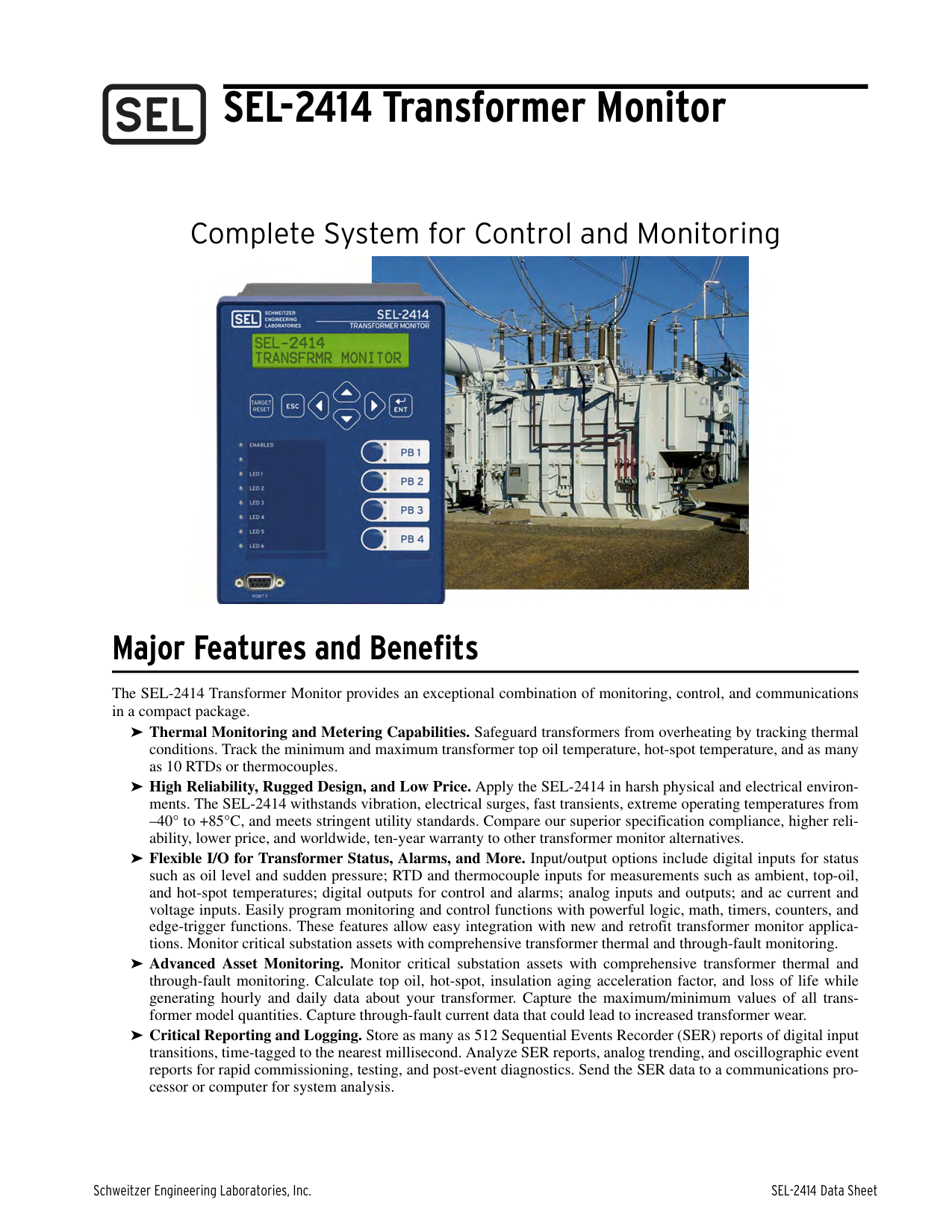
SEL-2414 Transformer Monitor
Complete System for Control and Monitoring

Major Features and Benefits
The SEL-2414 Transformer Monitor provides an exceptional combination of monitoring, control, and communications in a compact package.
➤ Thermal Monitoring and Metering Capabilities. Safeguard transformers from overheating by tracking thermal conditions. Track the minimum and maximum transformer top oil temperature, hot-spot temperature, and as many as 10 RTDs or thermocouples.
➤ High Reliability, Rugged Design, and Low Price. Apply the SEL-2414 in harsh physical and electrical environments. The SEL-2414 withstands vibration, electrical surges, fast transients, extreme operating temperatures from –40° to +85°C, and meets stringent utility standards. Compare our superior specification compliance, higher reliability, lower price, and worldwide, ten-year warranty to other transformer monitor alternatives.
➤ Flexible I/O for Transformer Status, Alarms, and More. Input/output options include digital inputs for status such as oil level and sudden pressure; RTD and thermocouple inputs for measurements such as ambient, top-oil, and hot-spot temperatures; digital outputs for control and alarms; analog inputs and outputs; and ac current and voltage inputs. Easily program monitoring and control functions with powerful logic, math, timers, counters, and edge-trigger functions. These features allow easy integration with new and retrofit transformer monitor applications. Monitor critical substation assets with comprehensive transformer thermal and through-fault monitoring.
➤ Advanced Asset Monitoring. Monitor critical substation assets with comprehensive transformer thermal and through-fault monitoring. Calculate top oil, hot-spot, insulation aging acceleration factor, and loss of life while generating hourly and daily data about your transformer. Capture the maximum/minimum values of all transformer model quantities. Capture through-fault current data that could lead to increased transformer wear.
➤ Critical Reporting and Logging. Store as many as 512 Sequential Events Recorder (SER) reports of digital input transitions, time-tagged to the nearest millisecond. Analyze SER reports, analog trending, and oscillographic event reports for rapid commissioning, testing, and post-event diagnostics. Send the SER data to a communications processor or computer for system analysis.
➤ Communications and Integration. Automate fan bank control with flexible communication options that provide easy integration with SCADA. Choose from single and dual Ethernet, Modbus® TCP, DNP3 LAN/WAN, IEC 61850, Modbus Serial, EIA-232, EIA-485, Telnet, and File Transfer protocols.
➤ AC Metering Capabilities. The SEL-2414 provides extensive ac metering and monitoring capabilities. Voltage, current, power, energy, power factor, frequency; demand/peak demand metering; and maximum/minimum metering are measured and recorded. Values can be used in programmable calculations and triggers within the meter. ➤ Simple Commissioning Tools. Front-panel HMI provides complete configuration access and displays settings,
measurements, and calculated values. Easily set with ACSELERATOR QuickSet® SEL-5030 Software.
Product Summary
The SEL-2414 Transformer Monitor withstands harsh physical and electrical environments and is built and tested to meet mission-critical IEEE and IEC protective relay standards. Apply the SEL-2414 to satisfy standalone or distributed monitoring and control of transformers, or choose from the flexible communications options to connect to a substation distributed SCADA or automation system, or a SCADA master. Communications options include serial, fiber-optic, and Ethernet connections and ASCII, SEL Fast Message, MIRRORED BITS
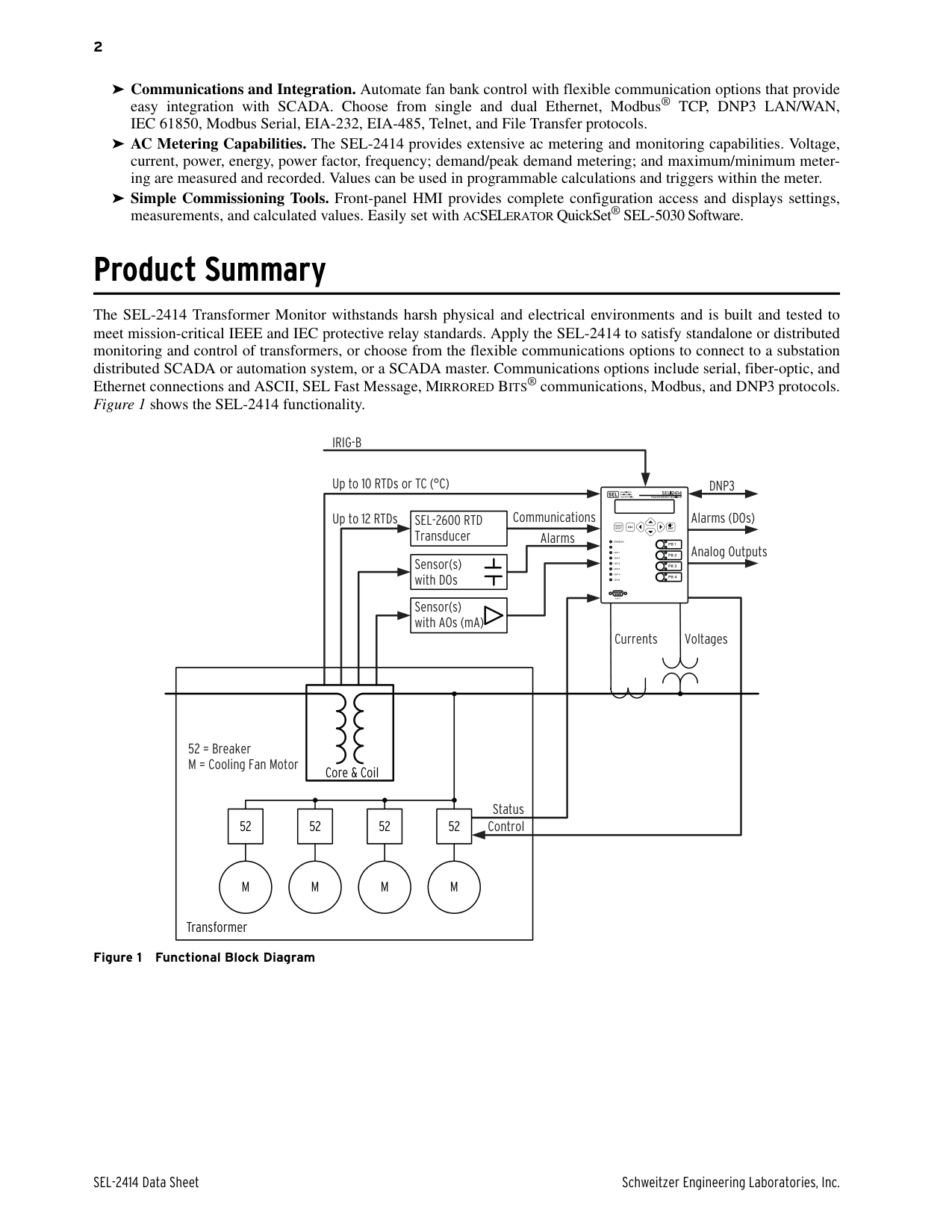
® communications, Modbus, and DNP3 protocols. Figure 1 shows the SEL-2414 functionality.
IRIG-B
Up to 10 RTDs or TC (°C)
Up to 12 RTDs
|SEL-2600 RTD Transducer|Communications| |---|---| |SEL-2600 RTD Transducer|Alarms|
Sensor(s) with DOs
Sensor(s) with AOs (mA)
DNP3 Alarms (DOs) Analog Outputs
Currents Voltages
52 = Breaker M = Cooling Fan Motor
Core & Coil
52
52
52
M
M
Transformer
Figure 1 Functional Block Diagram
M
52
Status
Control
M
Monitoring and Control Features
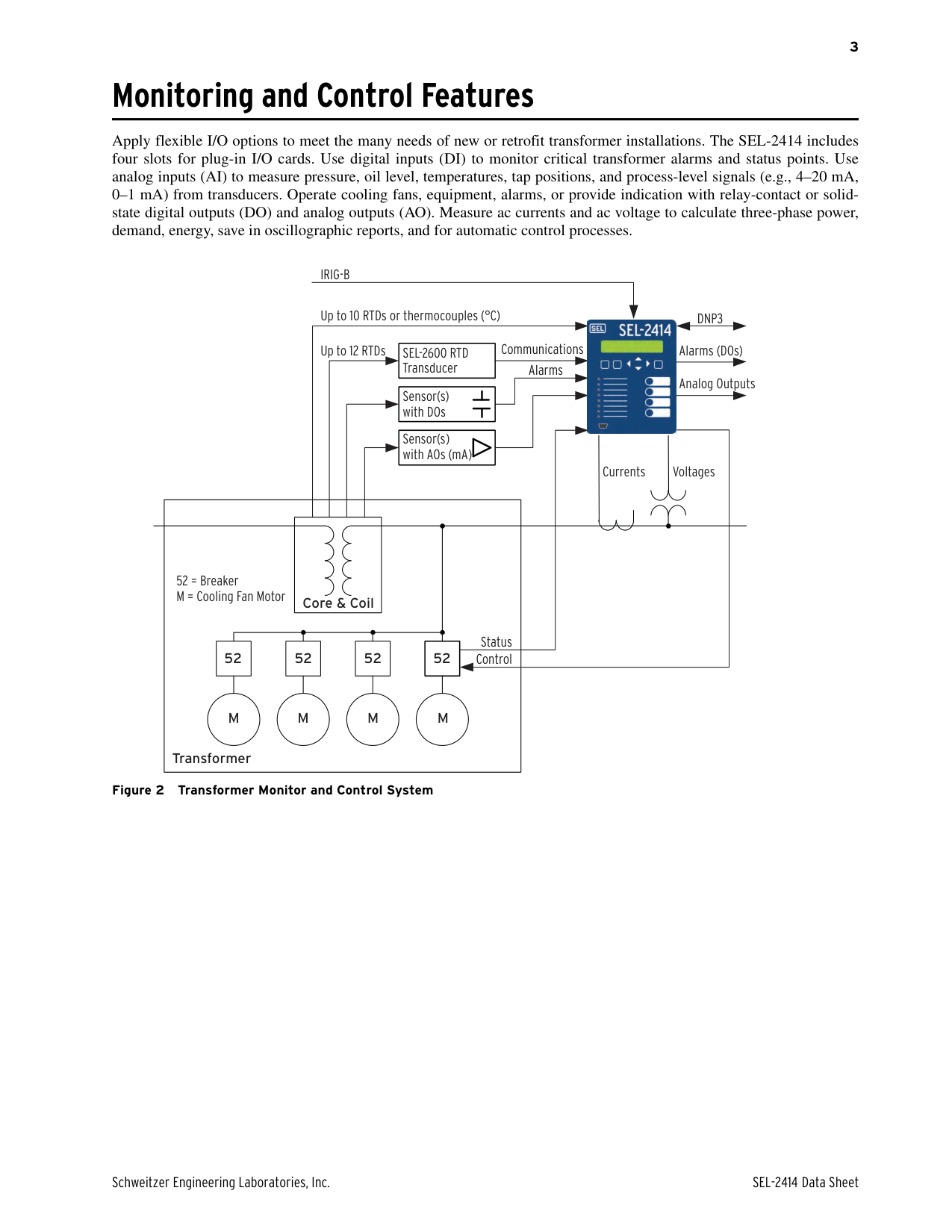
Apply flexible I/O options to meet the many needs of new or retrofit transformer installations. The SEL-2414 includes four slots for plug-in I/O cards. Use digital inputs (DI) to monitor critical transformer alarms and status points. Use analog inputs (AI) to measure pressure, oil level, temperatures, tap positions, and process-level signals (e.g., 4–20 mA, 0–1 mA) from transducers. Operate cooling fans, equipment, alarms, or provide indication with relay-contact or solidstate digital outputs (DO) and analog outputs (AO). Measure ac currents and ac voltage to calculate three-phase power, demand, energy, save in oscillographic reports, and for automatic control processes.
IRIG-B
Up to 10 RTDs or thermocouples (°C)
Up to 12 RTDs
|SEL-2600 RTD Transducer|Communications| |---|---| |SEL-2600 RTD Transducer|Alarms|
Sensor(s) with DOs
Sensor(s) with AOs (mA)
DNP3 Alarms (DOs) Analog Outputs

Currents Voltages
52 = Breaker M = Cooling Fan Motor
Core & Coil
52 52 52 52
Status
Control
MMMM
Transformer
Figure 2 Transformer Monitor and Control System
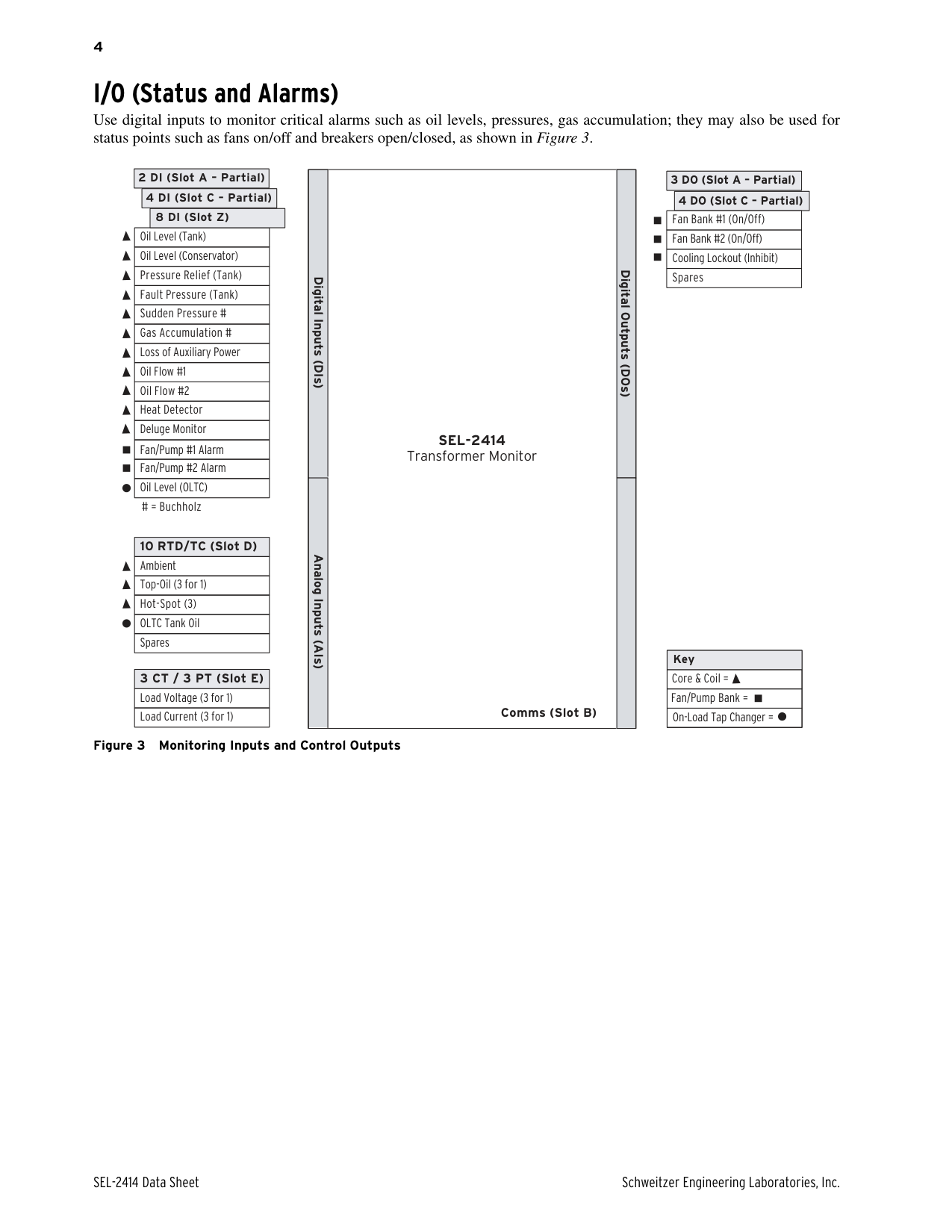
I/O (Status and Alarms) Use digital inputs to monitor critical alarms such as oil levels, pressures, gas accumulation; they may also be used for status points such as fans on/off and breakers open/closed, as shown in Figure 3.
2 DI (Slot A – Partial)
4 DI (Slot C – Partial)
8 DI (Slot Z)
Oil Level (Tank)
Oil Level (Conservator)
Pressure Relief (Tank)
Fault Pressure (Tank)
Sudden Pressure # Gas Accumulation #
Loss of Auxiliary Power
Oil Flow #1
Oil Flow #2
Heat Detector
Deluge Monitor
Fan/Pump #1 Alarm
Fan/Pump #2 Alarm
Oil Level (OLTC)
= Buchholz
|10 RTD/TC (Slot D)| |---| |Ambient| |Top-Oil (3 for 1)| |Hot-Spot (3)| |OLTC Tank Oil| |Spares|
|3 CT / 3 PT (Slot E)| |---| |Load Voltage (3 for 1)| |Load Current (3 for 1)|
|Digital Inputs (DIs)|SEL-2414 Transformer Monitor
Comms (Slot B)|Digital Outputs (DOs)| |---|---|---| |Analog Inputs (AIs)|SEL-2414 Transformer Monitor
Comms (Slot B)| |
Figure 3 Monitoring Inputs and Control Outputs
|3 DO (Slot A – Partial)| |---|
| |4 DO (Slot C – Partial)|4 DO (Slot C – Partial)| |---|---|---| |Fan Bank #1 (On/Off)|Fan Bank #1 (On/Off)| | |Fan Bank #2 (On/Off)|Fan Bank #2 (On/Off)| | |Cooling Lockout (Inhibit)|Cooling Lockout (Inhibit)| | |Spares|Spares| |
|Key| |---| |Core & Coil =| |Fan/Pump Bank =| |On-Load Tap Changer =|
#### Analyze Transformer Sequence-of-Events
Record sequence-of-events related to transformer events or operations with the Sequential Events Recorder (SER) function. With this function, you can analyze assertions and deassertions of digital inputs and outputs; as many as 512 state changes to the millisecond for as many as 96 different digital points. The function also captures when the device powers up and a settings change occurs.
SEL-2414 Date: 04/03/2005 Time: 07:21:19 DEVICE
DATE TIME ELEMENT STATE 17 04/03/2005 06:25:51.120 RB01 Deasserted 16 04/03/2005 06:25:51.125 OUT102 Deasserted 15 04/03/2005 06:26:03.049 RB01 Asserted 14 04/03/2005 06:26:03.053 OUT102 Asserted 13 04/03/2005 06:51:17.748 Device Powered Up 12 04/03/2005 06:51:20.361 OUT101 Asserted 11 04/03/2005 06:51:21.366 OUT101 Deasserted 10 04/03/2005 06:54:10.753 Device Settings Changed 9 04/03/2005 06:54:10.762 FAN BANK #2 OFF Asserted 8 04/03/2005 06:54:11.737 OUT101 Deasserted 7 04/03/2005 07:06:01.739 FAN BANK #2 ON Asserted 6 04/03/2005 07:06:02.744 OUT101 Deasserted 5 04/03/2005 07:06:14.993 Device Settings Changed 4 04/03/2005 07:06:15.002 OUT101 Asserted 3 04/03/2005 07:06:15.977 FAN BANK #1 ON Deasserted 2 04/03/2005 07:13:22.947 OUT101 Asserted 1 04/03/2005 07:13:23.951 OUT101 Deasserted
SER Number
Element or Condition
Combine SER data from individual SEL-2414 Transformer Monitors into a system-wide log. Synchronize the system with IRIG-B time code and the report data will align perfectly.

Element State
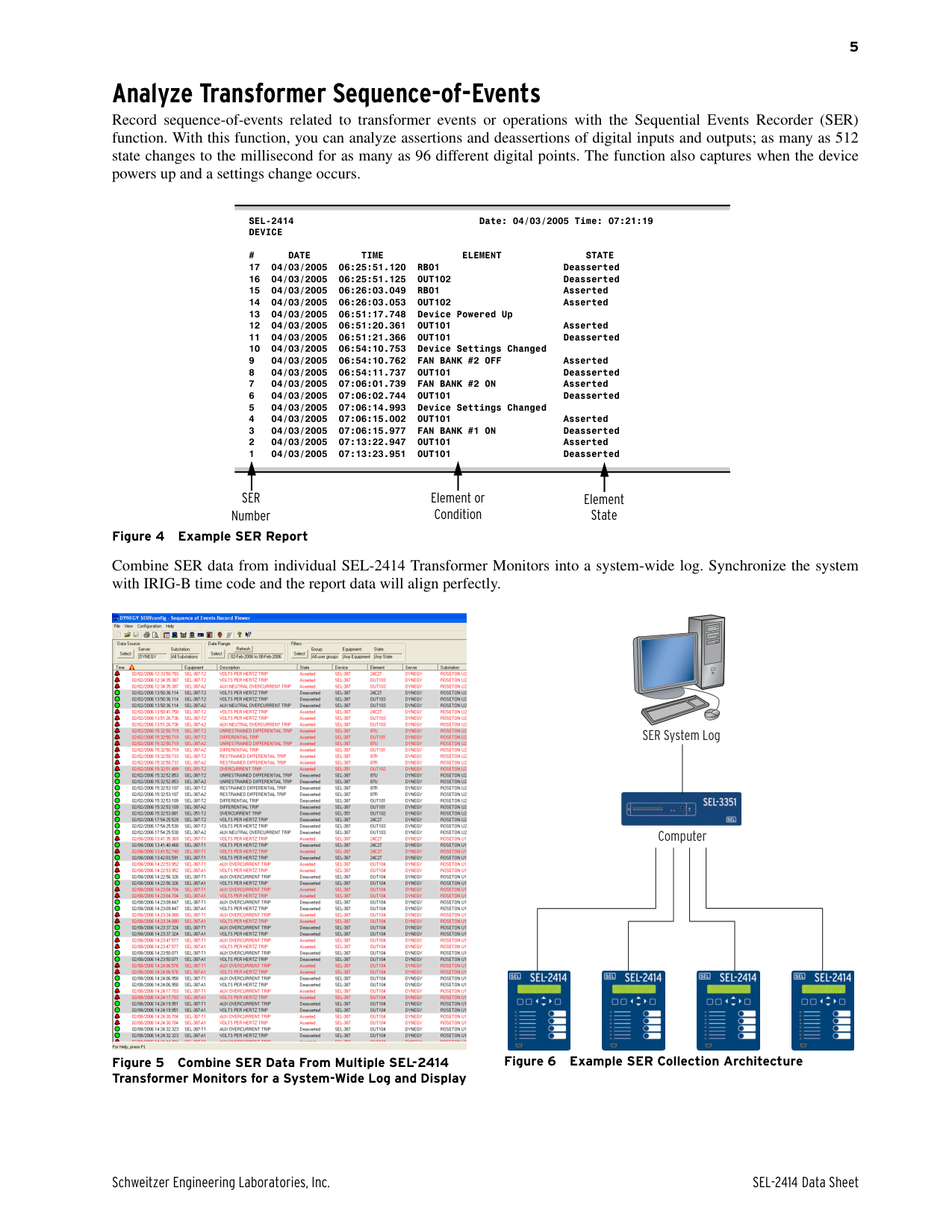
SER System Log

Computer


Figure 6 Example SER Collection Architecture
#### Analyze Transformer Event Waveforms
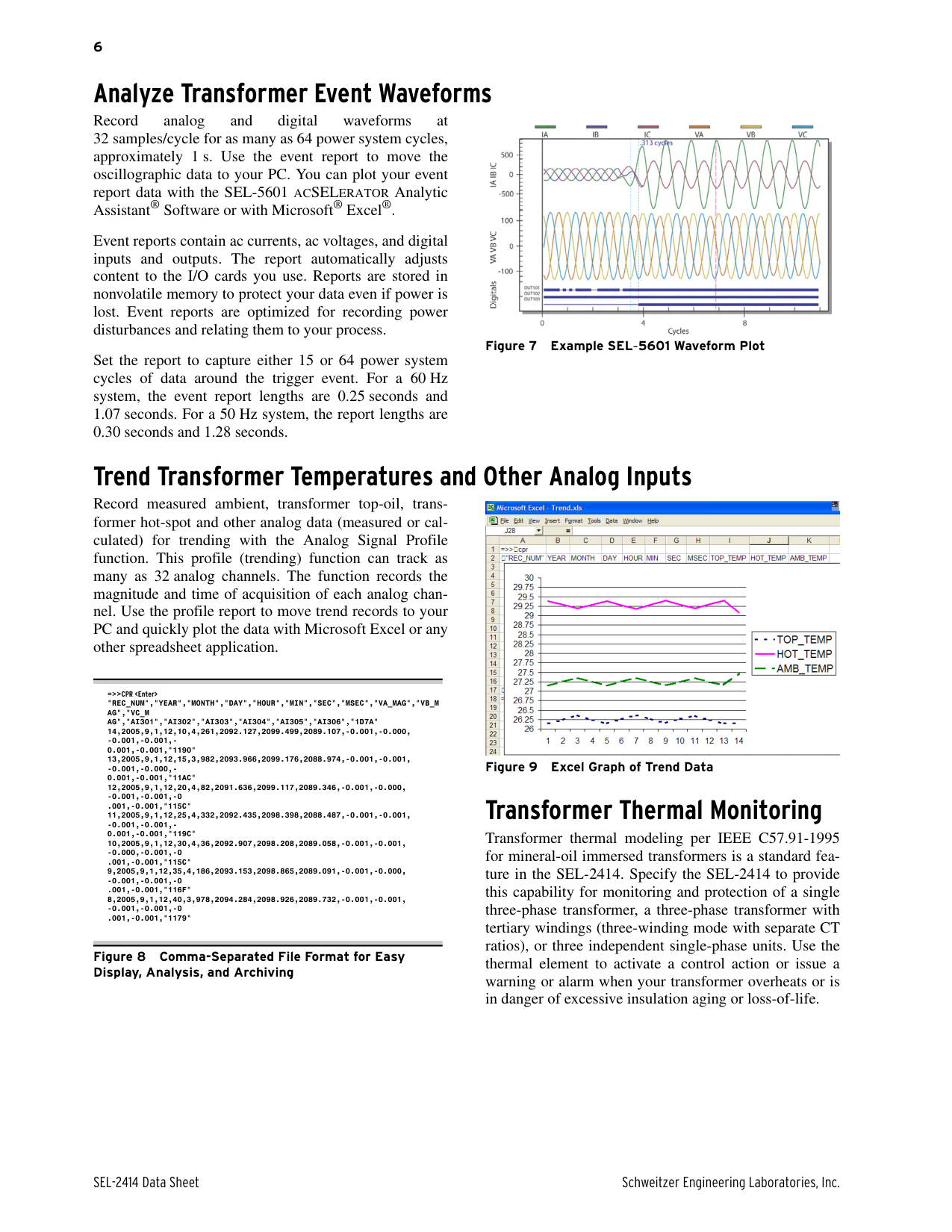
Record analog and digital waveforms at 32 samples/cycle for as many as 64 power system cycles, approximately 1 s. Use the event report to move the oscillographic data to your PC. You can plot your event report data with the SEL-5601 ACSELERATOR Analytic Assistant® Software or with Microsoft® Excel®.

Event reports contain ac currents, ac voltages, and digital inputs and outputs. The report automatically adjusts content to the I/O cards you use. Reports are stored in nonvolatile memory to protect your data even if power is lost. Event reports are optimized for recording power disturbances and relating them to your process.
Figure 7 Example SEL-5601 Waveform Plot
Set the report to capture either 15 or 64 power system cycles of data around the trigger event. For a 60 Hz system, the event report lengths are 0.25 seconds and 1.07 seconds. For a 50 Hz system, the report lengths are 0.30 seconds and 1.28 seconds.
#### Trend Transformer Temperatures and Other Analog Inputs
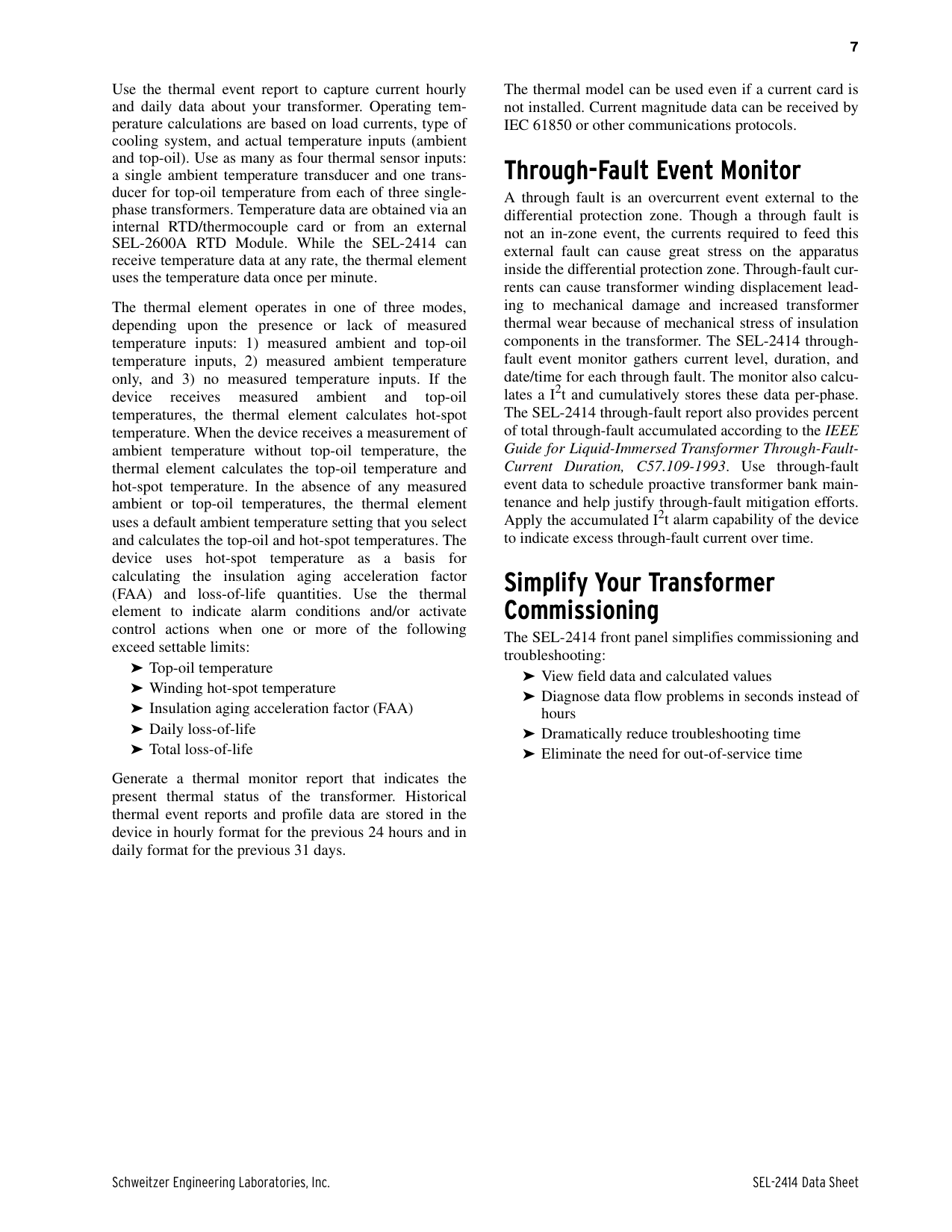
Record measured ambient, transformer top-oil, transformer hot-spot and other analog data (measured or calculated) for trending with the Analog Signal Profile function. This profile (trending) function can track as many as 32 analog channels. The function records the magnitude and time of acquisition of each analog channel. Use the profile report to move trend records to your PC and quickly plot the data with Microsoft Excel or any other spreadsheet application.

=>>CPR
.001,-0.001,"115C" 11,2005,9,1,12,25,4,332,2092.435,2098.398,2088.487,-0.001,-0.001,
.001,-0.001,"115C" 9,2005,9,1,12,35,4,186,2093.153,2098.865,2089.091,-0.001,-0.000,
.001,-0.001,"116F" 8,2005,9,1,12,40,3,978,2094.284,2098.926,2089.732,-0.001,-0.001,
Figure 9 Excel Graph of Trend Data
#### Transformer Thermal Monitoring
Transformer thermal modeling per IEEE C57.91-1995 for mineral-oil immersed transformers is a standard feature in the SEL-2414. Specify the SEL-2414 to provide this capability for monitoring and protection of a single three-phase transformer, a three-phase transformer with tertiary windings (three-winding mode with separate CT ratios), or three independent single-phase units. Use the thermal element to activate a control action or issue a warning or alarm when your transformer overheats or is in danger of excessive insulation aging or loss-of-life.
.001,-0.001,"1179"
Figure 8 Comma-Separated File Format for Easy Display, Analysis, and Archiving
Use the thermal event report to capture current hourly and daily data about your transformer. Operating temperature calculations are based on load currents, type of cooling system, and actual temperature inputs (ambient and top-oil). Use as many as four thermal sensor inputs: a single ambient temperature transducer and one transducer for top-oil temperature from each of three singlephase transformers. Temperature data are obtained via an internal RTD/thermocouple card or from an external SEL-2600A RTD Module. While the SEL-2414 can receive temperature data at any rate, the thermal element uses the temperature data once per minute.
The thermal element operates in one of three modes, depending upon the presence or lack of measured temperature inputs: 1) measured ambient and top-oil temperature inputs, 2) measured ambient temperature only, and 3) no measured temperature inputs. If the device receives measured ambient and top-oil temperatures, the thermal element calculates hot-spot temperature. When the device receives a measurement of ambient temperature without top-oil temperature, the thermal element calculates the top-oil temperature and hot-spot temperature. In the absence of any measured ambient or top-oil temperatures, the thermal element uses a default ambient temperature setting that you select and calculates the top-oil and hot-spot temperatures. The device uses hot-spot temperature as a basis for calculating the insulation aging acceleration factor (FAA) and loss-of-life quantities. Use the thermal element to indicate alarm conditions and/or activate control actions when one or more of the following exceed settable limits:
➤ Top-oil temperature
➤ Winding hot-spot temperature
➤ Insulation aging acceleration factor (FAA)
➤ Daily loss-of-life ➤ Total loss-of-life
Generate a thermal monitor report that indicates the present thermal status of the transformer. Historical thermal event reports and profile data are stored in the device in hourly format for the previous 24 hours and in daily format for the previous 31 days.
The thermal model can be used even if a current card is not installed. Current magnitude data can be received by IEC 61850 or other communications protocols.
#### Through-Fault Event Monitor
A through fault is an overcurrent event external to the differential protection zone. Though a through fault is not an in-zone event, the currents required to feed this external fault can cause great stress on the apparatus inside the differential protection zone. Through-fault currents can cause transformer winding displacement leading to mechanical damage and increased transformer thermal wear because of mechanical stress of insulation components in the transformer. The SEL-2414 throughfault event monitor gathers current level, duration, and date/time for each through fault. The monitor also calculates a I2t and cumulatively stores these data per-phase. The SEL-2414 through-fault report also provides percent of total through-fault accumulated according to the IEEE Guide for Liquid-Immersed Transformer Through-FaultCurrent Duration, C57.109-1993. Use through-fault event data to schedule proactive transformer bank maintenance and help justify through-fault mitigation efforts. Apply the accumulated I2t alarm capability of the device to indicate excess through-fault current over time.
#### Simplify Your Transformer Commissioning
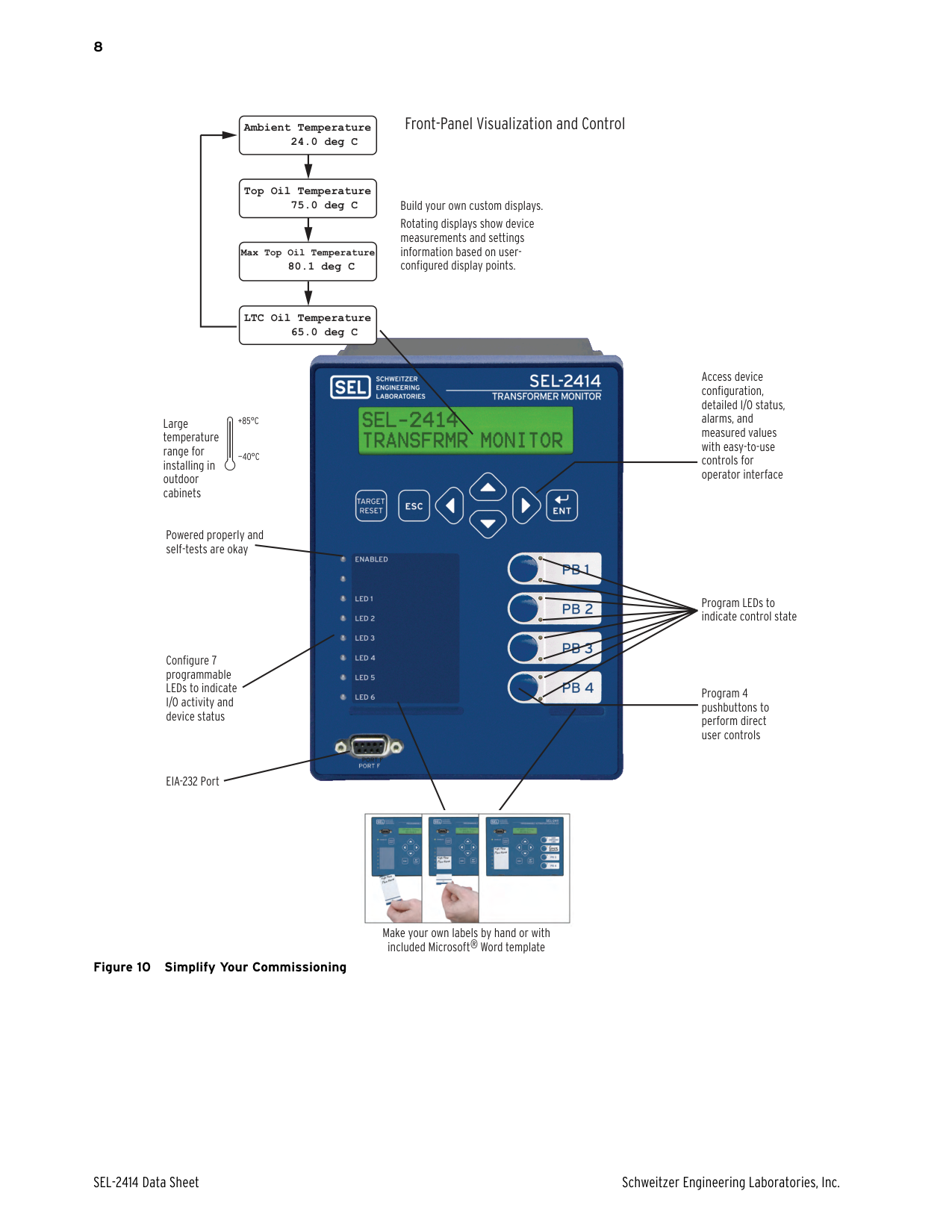
The SEL-2414 front panel simplifies commissioning and troubleshooting:
➤ View field data and calculated values
➤ Diagnose data flow problems in seconds instead of
hours
➤ Dramatically reduce troubleshooting time ➤ Eliminate the need for out-of-service time
Front-Panel Visualization and Control
Ambient Temperature 24.0 deg C
Top Oil Temperature 75.0 deg C
Build your own custom displays. Rotating displays show device measurements and settings information based on userconfigured display points.
Max Top Oil Temperature
80.1 deg C
LTC Oil Temperature 65.0 deg C

Access device configuration, detailed I/O status, alarms, and measured values with easy-to-use controls for operator interface
+85°C
Large temperature range for installing in outdoor cabinets
—40°C
Powered properly and self-tests are okay
Program LEDs to indicate control state
Configure 7 programmable LEDs to indicate I/O activity and device status
Program 4 pushbuttons to perform direct user controls
EIA-232 Port
Figure 10 Simplify Your Commissioning

Make your own labels by hand or with included Microsoft® Word template
Configuration and Commissioning Software
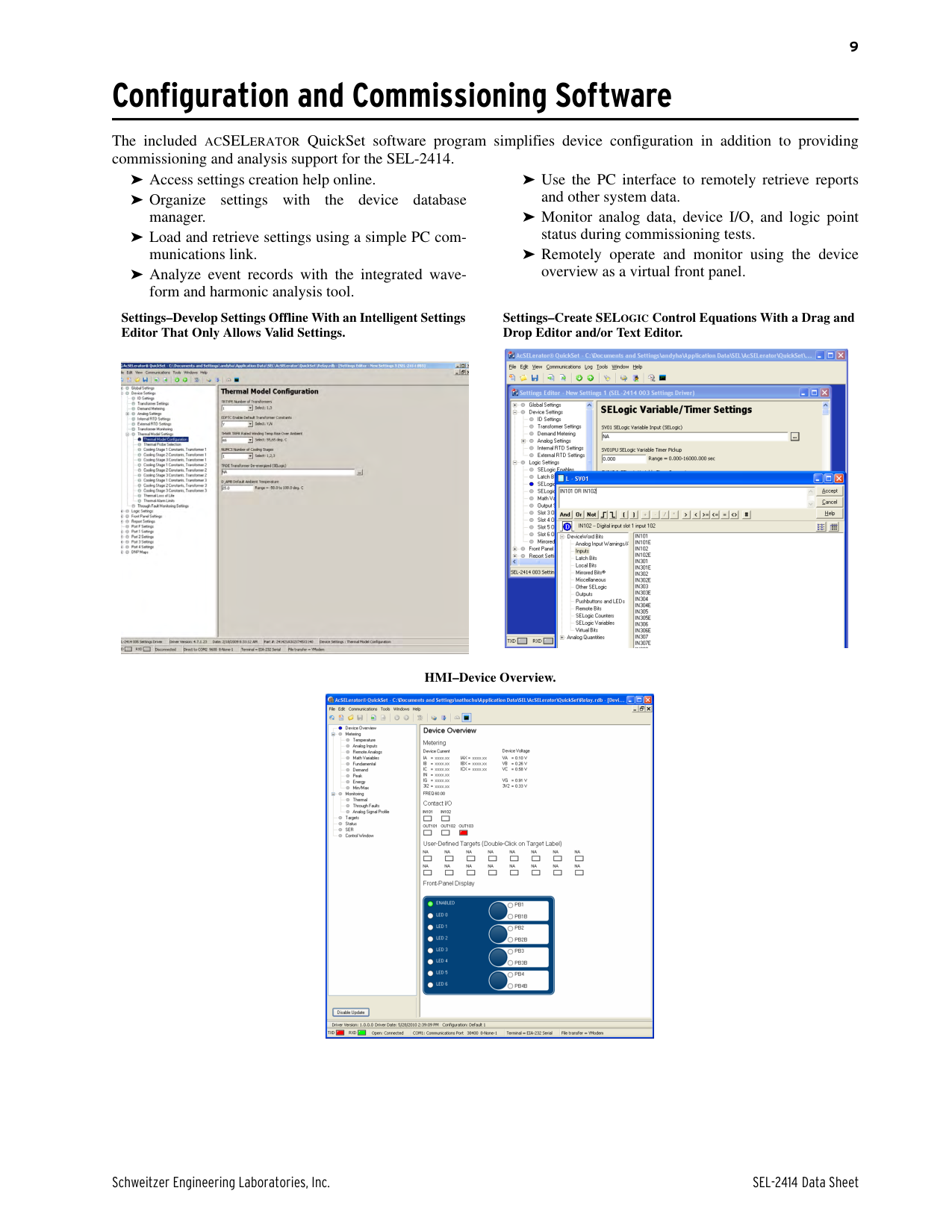
The included ACSELERATOR QuickSet software program simplifies device configuration in addition to providing commissioning and analysis support for the SEL-2414.
➤ Access settings creation help online.
➤ Use the PC interface to remotely retrieve reports
and other system data.
➤ Organize settings with the device database
manager.
➤ Monitor analog data, device I/O, and logic point
status during commissioning tests.
➤ Load and retrieve settings using a simple PC com-
munications link.
➤ Remotely operate and monitor using the device
overview as a virtual front panel.
➤ Analyze event records with the integrated wave-
form and harmonic analysis tool.
Settings–Develop Settings Offline With an Intelligent Settings Editor That Only Allows Valid Settings.
Settings–Create SELOGIC Control Equations With a Drag and Drop Editor and/or Text Editor.


HMI–Device Overview.

Metering
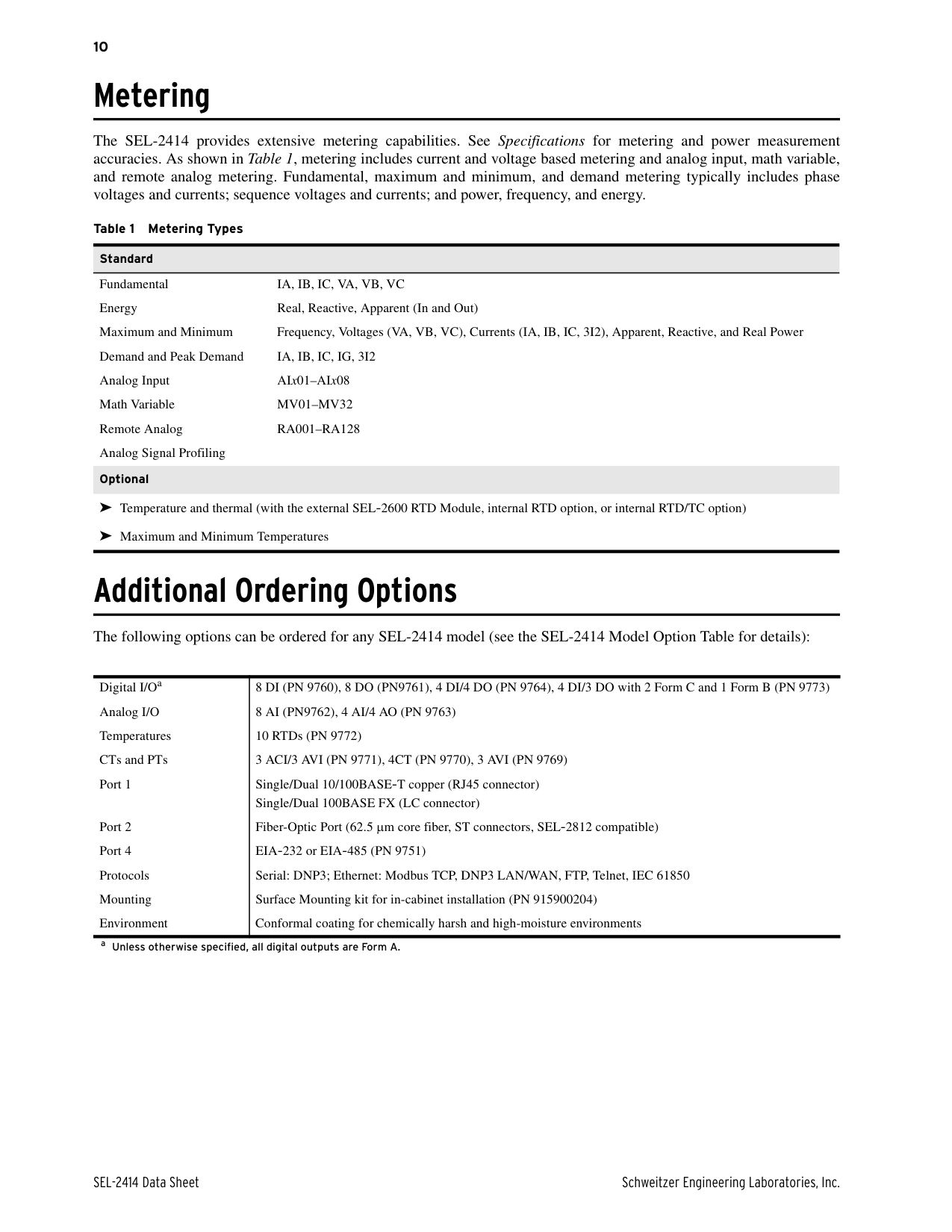
The SEL-2414 provides extensive metering capabilities. See Specifications for metering and power measurement accuracies. As shown in Table 1, metering includes current and voltage based metering and analog input, math variable, and remote analog metering. Fundamental, maximum and minimum, and demand metering typically includes phase voltages and currents; sequence voltages and currents; and power, frequency, and energy.
Table 1 Metering Types Standard Fundamental IA, IB, IC, VA, VB, VC Energy Real, Reactive, Apparent (In and Out) Maximum and Minimum Frequency, Voltages (VA, VB, VC), Currents (IA, IB, IC, 3I2), Apparent, Reactive, and Real Power Demand and Peak Demand IA, IB, IC, IG, 3I2 Analog Input AIx01–AIx08 Math Variable MV01–MV32 Remote Analog RA001–RA128 Analog Signal Profiling Optional
➤ Temperature and thermal (with the external SEL-2600 RTD Module, internal RTD option, or internal RTD/TC option)
➤ Maximum and Minimum Temperatures
Additional Ordering Options
The following options can be ordered for any SEL-2414 model (see the SEL-2414 Model Option Table for details):
Digital I/Oa 8 DI (PN 9760), 8 DO (PN9761), 4 DI/4 DO (PN 9764), 4 DI/3 DO with 2 Form C and 1 Form B (PN 9773) Analog I/O 8 AI (PN9762), 4 AI/4 AO (PN 9763) Temperatures 10 RTDs (PN 9772) CTs and PTs 3 ACI/3 AVI (PN 9771), 4CT (PN 9770), 3 AVI (PN 9769)
Automation
#### Flexible Control Logic and Integration Features
Replaces Traditional Temperature Gauges
The SEL-2414 is equipped with as many as four independently operated serial ports: one EIA-232 port on the front, one EIA-232 or EIA-485 port on the rear, one fiber-optic port, and one EIA-232 or EIA-485 port option card. The device does not require special communications software. Use any system that emulates a standard terminal system for engineering access to the device. Establish communication by connecting computers, modems, protocol converters, printers, an SEL communications processor, SCADA serial port, and an RTU for local or remote communication. Apply an SEL communications processor as the hub of a star network, with point-to-point fiber or copper connection between the hub and the SEL-2414. Included communications protocols are listed below.
Replace traditional temperature gauges that show the temperature, and the maximum and minimum temperature since last reset. The SEL-2414 Max/Min metering records and time stamps the maximum and minimum temperatures and transformer thermal model quantities.
Replaces Traditional Latching Relays
Replace as many as 32 traditional latching relays for such functions as “remote control enable” with latch bits. Program latch set and latch reset conditions with SELOGIC control equations. Set or reset the nonvolatile latch bits using optoisolated inputs, remote bits, local bits, or any programmable logic condition. The latch bits retain their state when the device loses power.
Standard Protocols
Eliminates External Timers
➤ Modbus RTU
Eliminate external timers for custom protection or control schemes with 32 general purpose SELOGIC control equation timers. Each timer has independent time-delay pickup and dropout settings. Program each timer input with any desired element (e.g., time qualify a current element). Assign the timer output to control scheme logic.
➤ SEL ASCII
➤ SEL Compressed ASCII
➤ SEL Fast Meter
➤ SEL Fast Operate
➤ SEL Fast SER
➤ SEL Fast Message
Eliminates RTU-to-Device Wiring
➤ SEL MIRRORED BITS
Eliminate RTU-to-Device wiring with 32 remote bits. Set, clear, or pulse remote bits using serial port commands. Program the remote bits into your control scheme with SELOGIC control equations. Use remote bits for SCADA-type control operations such as trip and close.
SEL-2414 logic improves integration in the following ways.
Replaces Traditional Panel Control Switches
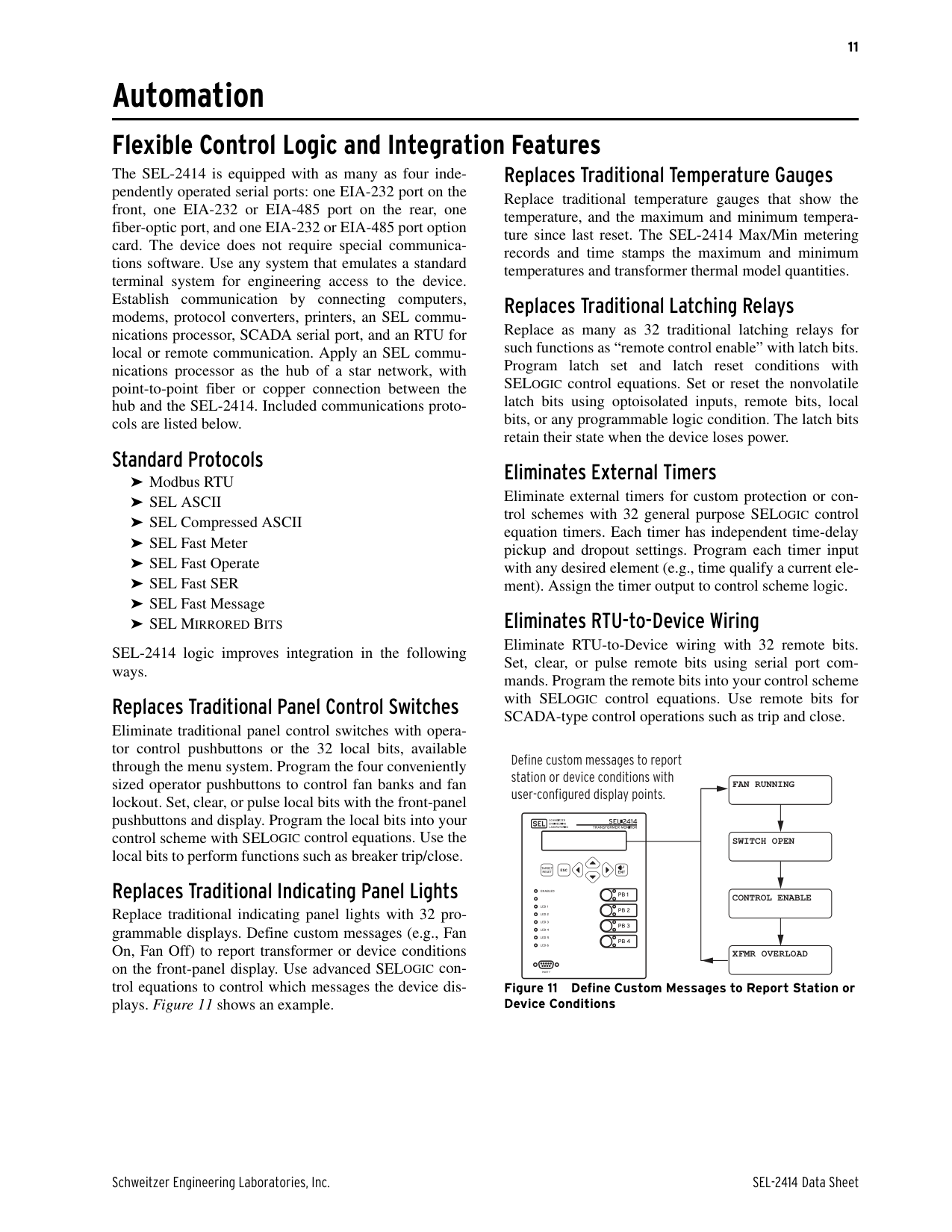
Eliminate traditional panel control switches with operator control pushbuttons or the 32 local bits, available through the menu system. Program the four conveniently sized operator pushbuttons to control fan banks and fan lockout. Set, clear, or pulse local bits with the front-panel pushbuttons and display. Program the local bits into your control scheme with SELOGIC control equations. Use the local bits to perform functions such as breaker trip/close.
Define custom messages to report station or device conditions with user-configured display points.
FAN RUNNING
SWITCH OPEN
Replaces Traditional Indicating Panel Lights
CONTROL ENABLE
Replace traditional indicating panel lights with 32 programmable displays. Define custom messages (e.g., Fan On, Fan Off) to report transformer or device conditions on the front-panel display. Use advanced SELOGIC control equations to control which messages the device displays. Figure 11 shows an example.
XFMR OVERLOAD
Figure 11 Define Custom Messages to Report Station or Device Conditions
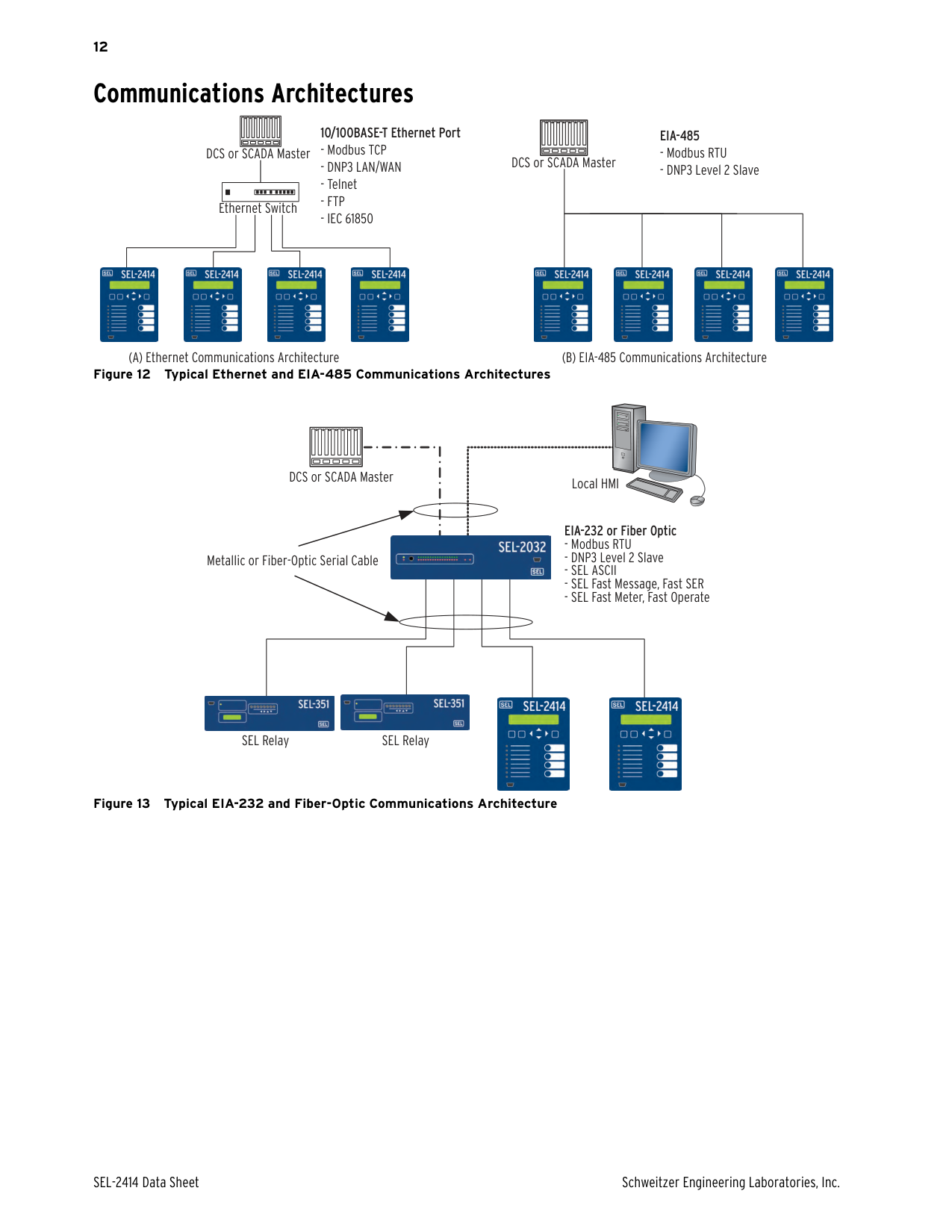
#### Communications Architectures
10/100BASE-T Ethernet Port
DCS or SCADA Master
| | | |---|---|
| | |
Ethernet Switch


EIA-485 DCS or SCADA Master
| | | | |---|---|---| | | | |


(A) Ethernet Communications Architecture (B) EIA-485 Communications Architecture
DCS or SCADA Master
Local HMI
EIA-232 or Fiber Optic

Metallic or Fiber-Optic Serial Cable


SEL RelaySEL Relay
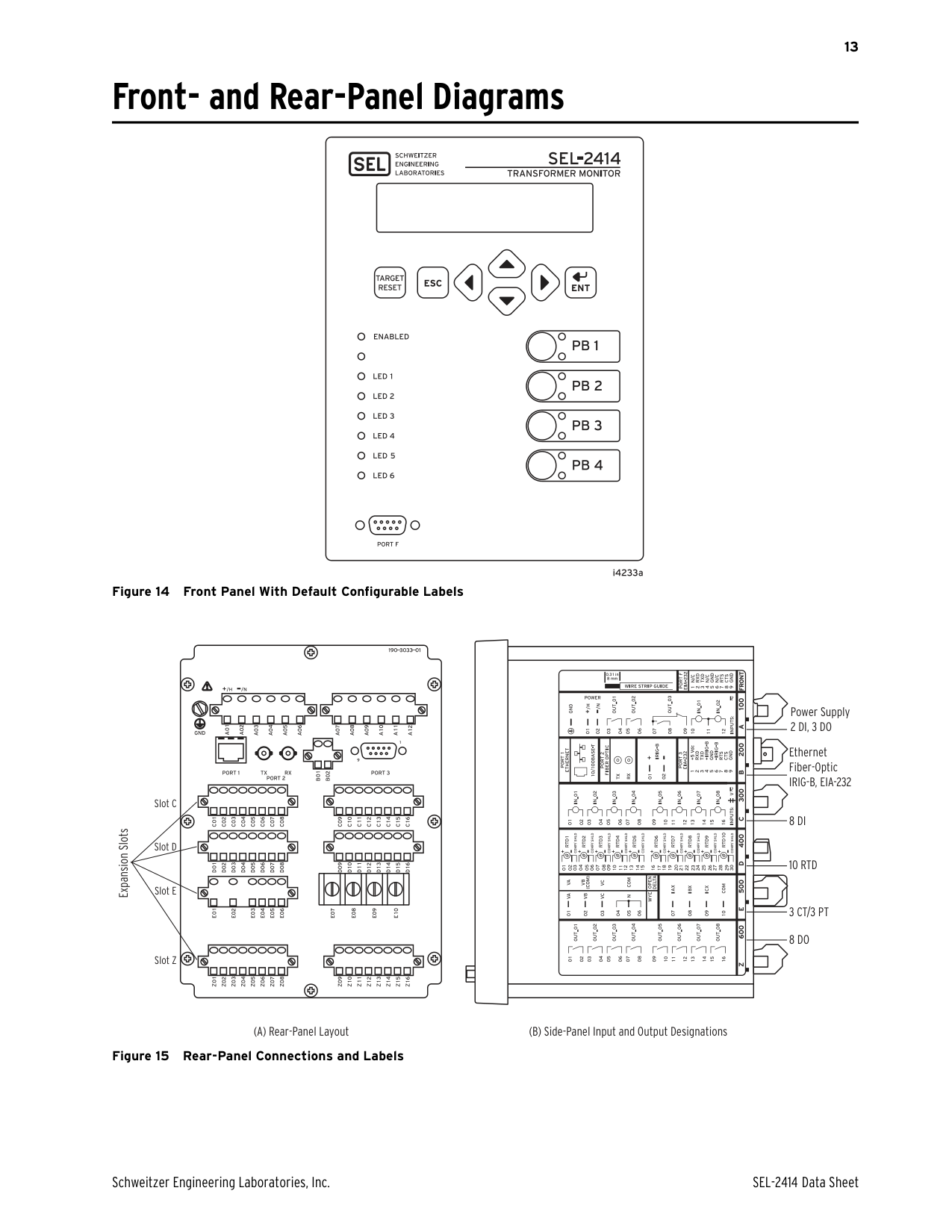
Front- and Rear-Panel Diagrams
| | | | | | | | | | | |---|---|---|---|---|---|---|---|---|---| | | | | | | | | | | | | | | | | | | | | | | | | | | | | | | | | | | | | | | | | | | | | | | | | | | | | | | | | | | | | | | | | | | | | | | | | | | | | |
| | | | |---|---|---| | | | |
Power Supply
Ethernet Fiber-Optic IRIG-B, EIA-232
8 DI
10 RTD
Slot C
Expansion Slots
Slot D
| | | | | | | | | | |---|---|---|---|---|---|---|---|---|
Slot E
| | | | | |---|---|---|---| | | | | |
Slot Z
(A) Rear-Panel Layout (B) Side-Panel Input and Output Designations
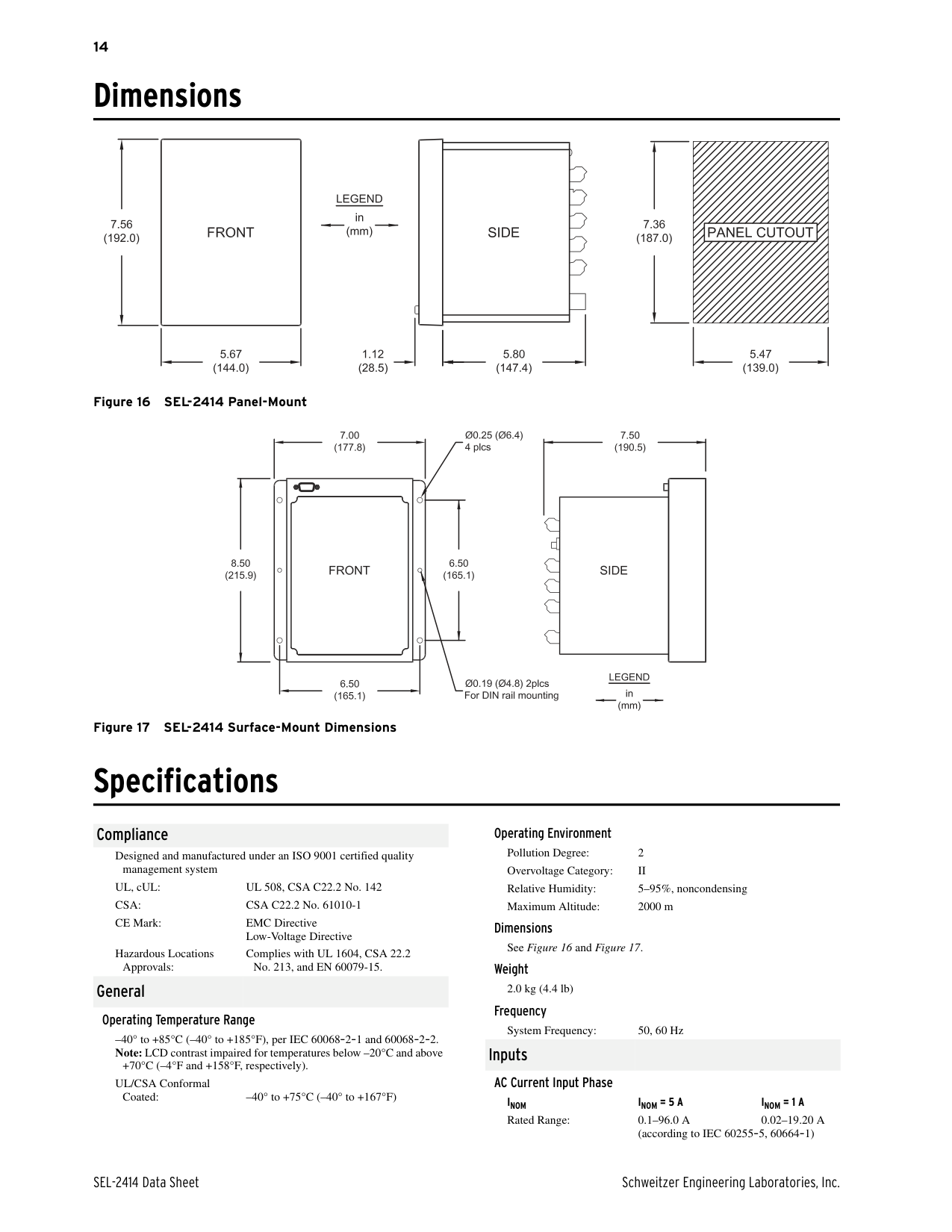
Dimensions
| | | | |---|---|---| | | | |
Specifications
Compliance
Designed and manufactured under an ISO 9001 certified quality
management system UL, cUL: UL 508, CSA C22.2 No. 142 CSA: CSA C22.2 No. 61010-1 CE Mark: EMC Directive
Low-Voltage Directive Hazardous Locations
Complies with UL 1604, CSA 22.2
No. 213, and EN 60079-15. General
Approvals:
Operating Temperature Range
–40° to +85°C (–40° to +185°F), per IEC 60068-2-1 and 60068-2-2. Note: LCD contrast impaired for temperatures below –20°C and above
+70°C (–4°F and +158°F, respectively). UL/CSA Conformal
Coated: –40° to +75°C (–40° to +167°F)
Operating Environment Pollution Degree: 2 Overvoltage Category: II Relative Humidity: 5–95%, noncondensing Maximum Altitude: 2000 m
Dimensions
See Figure 16 and Figure 17. Weight
2.0 kg (4.4 lb) Frequency
System Frequency: 50, 60 Hz Inputs
AC Current Input Phase
INOM INOM = 5 A INOM = 1 A Rated Range: 0.1–96.0 A 0.02–19.20 A
(according to IEC 60255-5, 60664-1)
Note: This is a linearity specification and is not meant to imply
continuous operation. Continuous Thermal
Rating: 15 A 3 A
(according to IEC 60255-6, IEEE C37.90-1989)
1 Second Thermal: 500 A 100 A
(according to IEC 60255-6) Rated Frequency: 50/60 ±5 Hz 50/60 ±5 Hz Burden (per phase): <0.050 VA <0.002 VA Measurement Category: II
AC Current Input Neutral
INOM INOM = 5 A INOM = 1 A Rated Range: 0.05–10.00 A 0.01–2.00 A
(according to IEC 60255-5, 60664-1) Note: This is a linearity specification and is not meant to imply
continuous operation. Continuous Thermal
15 A 3 A (according to IEC 60255-6,
Rating:
IEEE C37.90-1989)
1 Second Thermal: 500 A 100 A
(according to IEC 60255-6) Rated Frequency: 50/60 ±5 Hz 50/60 ±5 Hz Burden (per phase): <0.1 VA <0.01 VA Measurement Category: II
AC Voltage Input (300 V)
Rated Operating
Voltage (Ue): 100–250 Vac Rated Insulation Voltage: 300 Vac 10-Second Thermal: 600 Vac Rated Frequency: 50/60 ±5 Hz Burden: <0.1 W
DC Transducer (Analog) Inputs
Input Impedance: Current Mode: 200 Voltage Mode: >10 k
Input Range (Maximum): Current Mode: ±20 mA Voltage Mode: ±10 V
Sampling Rate: At least 5 ms Step Response: 1 s Accuracy at 25°C:
ADC: 16 bit With user calibration: 0.05% of full scale (current mode)
0.025% of full scale (voltage mode)
Without calibration: Better than 0.5% of full scale at 25°C Accuracy Variation With Temperature:
±0.015% per °C of full scale (±20 mA or ±10 V) DC Transducer (Analog) Inputs Extended Range Option
Input Impedance:
Voltage Mode: >10 k Input Range (Maximum):
Voltage Mode: ±300 V Sampling Rate: At least 5 ms Step Response: 1 s Accuracy at 25°C:
ADC: 16 bit With user calibration: 0.025% of full scale (voltage mode) Without calibration: Better than 0.5% of full scale at 25°C
Accuracy Variation With Temperature: ±0.015% per °C of full scale (±10 V)
CMRR Typical: 65 db at 60 Hz Optoisolated Control Inputs
When Used With DC Control Signals:
250 V ON for 200–275 Vdc OFF below 150 Vdc 220 V ON for 176–242 Vdc OFF below 132 Vdc 125 V ON for 100–135.5 Vdc OFF below 75 Vdc 110 V ON for 88–121 Vdc OFF below 66 Vdc 48 V ON for 38.4–52.8 Vdc OFF below 28.8 Vdc 24 V ON for 15–30 Vdc OFF for < 5 Vdc
When Used With AC Control Signals:
250 V ON for 170.6–275 Vac OFF below 106 Vac 220 V ON for 150.3–264 Vac OFF below 93.2 Vac 125 V ON for 85–150 Vac OFF below 53 Vac 110 V ON for 75.1–132 Vac OFF below 46.6 Vac 48 V ON for 32.8–60 Vac OFF below 20.3 Vac 24 V ON for 14–27 Vac OFF below 5 Vac
Current Draw at Nominal
DC Voltage: 2–4 mA (Except for 240 V, 8 mA) Rated Insulation Voltage: 300 Vac Rated Impulse
Withstand Voltage (Uimp): 4000 V
RTD Input Card Number of Channels: Ten 3-wire RTDs Input Type: Supports the following RTD types on each independent input.
100 platinum (PT100) 100 nickel (NI100) 120 nickel (NI120) 10 copper (CU10)
Measuring Range: –50°C to 250°C ADC Resolution: 24 bit Accuracy:
CU10: ±1°C typical at 25°C PT100, NI100, NI120: ±1°C typical at 25°C CU10, PT100, NI100,
NI120: ±2°C worst case Resolution: ±1°C Update Rate: <3 s
CMRR (typical): 100 dBv Noise Rejection: Up to 1 Vrms 50/60 Hz
Universal Temperature Input Card Number of Channels: Ten (thermocouples or 3-wire RTDs) Input Type: Supports the following RTD or TC types on each independent input.
100 platinum (PT100) 100 nickel (NI100) 120 nickel (NI120) 10 copper (CU10) J, K, T, E
Measuring Range RTDs: –50° to 250°C Thermocouples (TCs)
ADC Resolution: 24 bit Accuracy RTDs CU10: ±1°C typical at 25°C PT100, NI100, NI120,
CU10: ±0.1°C typical at 25°C CU10, PT100, NI100,
NI120: ±2°C worst case
TCs J, K, T, E: ±1°C with field calibration
±3°C without field calibration Resolution: ±0.1°C Update Rate: <3 s
CMRR (typical): 100 dBv Noise Rejection: Up to 1 Vrms 50/60 Hz Isolation
Number of Banks: Two Banks (5 channels each) Max. Working
Common Mode: 250 Vdc Cold Junction
Compensation: Automatic
Time-Code Input Format: Demodulated IRIG-B On (1) State: Vih 2.2 V Off (0) State: Vil 0.8 V Input Impedance: 2 k Accuracy: ±3 milliseconds
Time-Code Input (SNTP)
High-Priority Server Accuracy: ±5 ms
Accuracy: ±25 ms Outputs
General OUT103 is Form C Trip Output, all other outputs are Form A. Dielectric Test Voltage: 2000 Vac Impulse Withstand
Voltage (Uimp): 4000 V
Mechanical Durability: 10M no load operations DC Output Ratings
Electromechanical Rated Operational
Voltage: 250 Vdc Rated Voltage Range: 19.2–275 Vdc Rated Insulation Voltage: 300 Vdc Make: 30 A @ 250 Vdc per IEEE C37.90 Continuous Carry: 6 A @ 70°C; 4 A @ 85°C Continuous Carry
(UL/CSA Derating with All Outputs Asserted): 5 A @ <60°C; 2.5 A 60 to 70°C
Thermal: 50 A for 1 s Contact Protection: 360 Vdc, 40 J MOV protection across
open contacts
Operating Time (coil energization to contact closure, resistive load): Pickup or Dropout time 8 ms typical
Breaking Capacity (10,000 operations) per IEC 60255-0-20:1974:
24 Vdc 0.75 A L/R = 40 ms 48 Vdc 0.50 A L/R = 40 ms 125 Vdc 0.30 A L/R = 40 ms 250 Vdc 0.20 A L/R = 40 ms
Cyclic Capacity
24 Vdc 0.75 A L/R = 40 ms 48 Vdc 0.50 A L/R = 40 ms 125 Vdc 0.30 A L/R = 40 ms 250 Vdc 0.20 A L/R = 40 ms
(2.5 cycles/second) per IEC 60255-0-20:1974:
Fast Hybrid (high-speed high current interrupting) Make: 30 A Carry: 6 A continuous carry at 70°C
4 A continuous carry at 85°C 1 s Rating: 50 A MOV Protection
(maximum voltage): 250 Vac/330 Vdc
Pickup Time: <50 s, resistive load Dropout Time: 8 ms, resistive load Update Rate: 1/8 cycle Breaking Capacity (10000 operations):
48 Vdc 10.0 A L/R = 40 ms 125 Vdc 10.0 A L/R = 40 ms 250 Vdc 10.0 A L/R = 20 ms
Cyclic Capacity (4 cycles in 1 second, followed by 2 minutes idle for thermal dissipation):
48 Vdc 10.0 A L/R = 40 ms 125 Vdc 10.0 A L/R = 40 ms 250 Vdc 10.0 A L/R = 20 ms
Note: Per IEC 60255-23:1994, using the simplified method of
assessment.
Note: Make rating per IEEE C37.90-1989. AC Output Ratings
Electromechanical Maximum Operational Voltage (Ue) Rating: 240 Vac
Insulation Voltage (Ui) Rating (excluding EN 61010-1): 300 Vac
Utilization Category: AC-15 (control of electromagnetic loads >
72 VA) Contact Rating Designation:
B300 (B = 5 A, 300 = rated insulation
voltage) Voltage Protection Across
Open Contacts: 270 Vac, 40 J Rated Operational Current
3A @ 120Vac 1.5 A @ 240 Vac
(Ie):
Conventional Enclosed
Thermal Current (Ithe) Rating: 5 A
Rated Frequency: 50/60 ±5 Hz Pickup/Dropout Time: 8 ms (coil energization to contact
closure) Electrical Durability Make
VA Rating: 3600 VA, cos = 0.3 Electrical Durability
Break VA Rating: 360 VA, cos = 0.3
Fast Hybrid (high-speed high current interrupting) Make: 30 A Carry: 6 A continuous carry at 70°C
4 A continuous carry at 85°C 1 s Rating: 50 A MOV Protection
(maximum voltage): 250 Vac/330 Vdc Pickup Time: <50 s, resistive load Dropout Time: 8 ms, resistive load Update Rate: 1/8 cycle Breaking Capacity (10000 operations):
48 Vac 10.0 A L/R = 40 ms 125 Vac 10.0 A L/R = 40 ms 250 Vac 10.0 A L/R = 20 ms
Cyclic Capacity (4 cycles in 1 second, followed by 2 minutes idle for thermal dissipation):
48 Vac 10.0 A L/R = 40 ms 125 Vac 10.0 A L/R = 40 ms 250 Vac 10.0 A L/R = 20 ms
Note: Per IEC 60255-23:1994, using the simplified method of
assessment.
Note: Make rating per IEEE C37.90-1989.
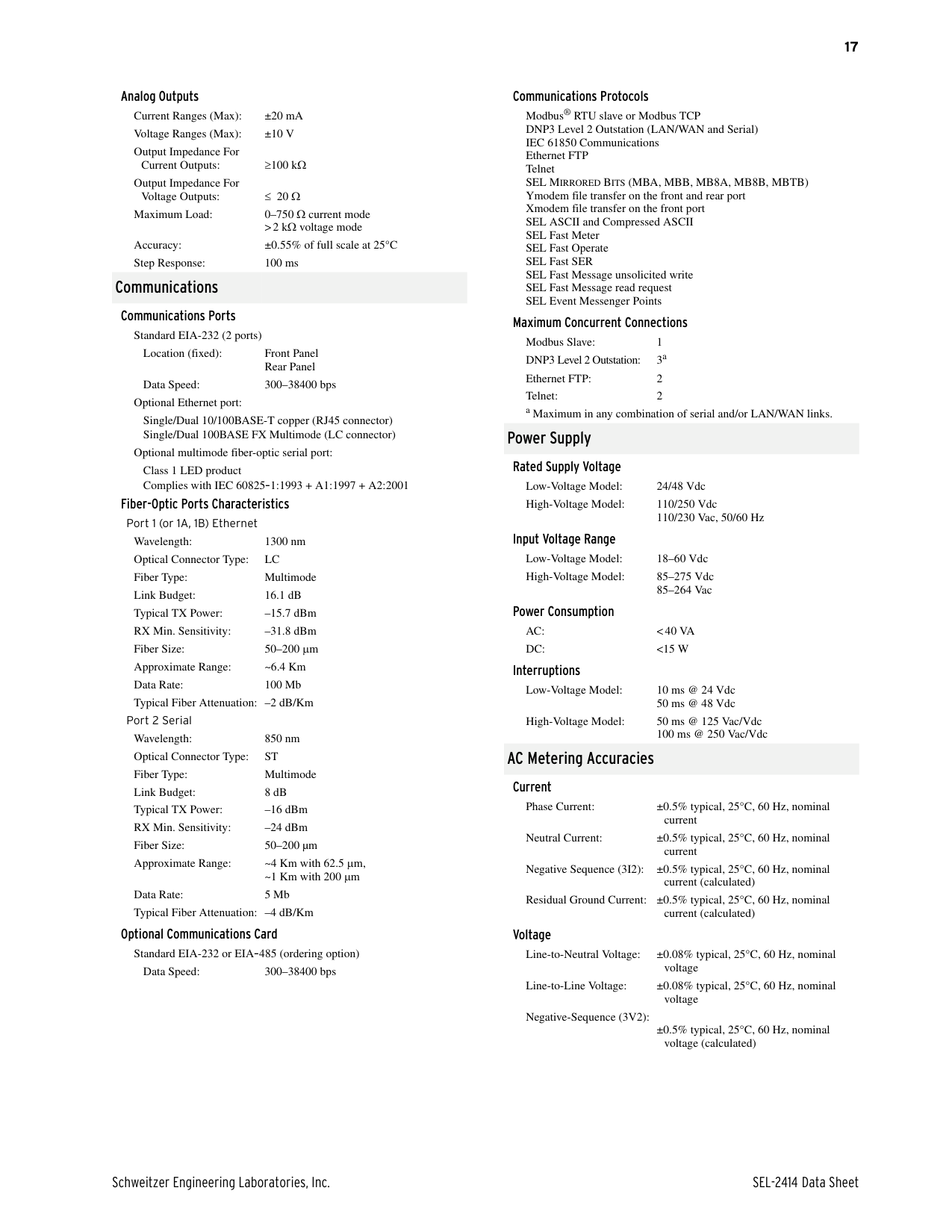
Analog Outputs Current Ranges (Max): ±20 mA Voltage Ranges (Max): ±10 V Output Impedance For
Current Outputs: 100 k Output Impedance For
Voltage Outputs: 20 Maximum Load: 0–750 current mode
>2k voltage mode Accuracy: ±0.55% of full scale at 25°C Step Response: 100 ms
Communications
Communications Ports
Standard EIA-232 (2 ports) Location (fixed): Front Panel Rear Panel Data Speed: 300–38400 bps
Optional Ethernet port: Single/Dual 10/100BASE-T copper (RJ45 connector) Single/Dual 100BASE FX Multimode (LC connector)
Optional multimode fiber-optic serial port: Class 1 LED product Complies with IEC 60825-1:1993 + A1:1997 + A2:2001
Fiber-Optic Ports Characteristics
Approximate Range: ~4 Km with 62.5 m,
~1 Km with 200 m Data Rate: 5 Mb Typical Fiber Attenuation: –4 dB/Km
Optional Communications Card
Standard EIA-232 or EIA-485 (ordering option)
Data Speed: 300–38400 bps
Communications Protocols
Modbus® RTU slave or Modbus TCP DNP3 Level 2 Outstation (LAN/WAN and Serial) IEC 61850 Communications Ethernet FTP Telnet SEL MIRRORED BITS (MBA, MBB, MB8A, MB8B, MBTB) Ymodem file transfer on the front and rear port Xmodem file transfer on the front port SEL ASCII and Compressed ASCII SEL Fast Meter SEL Fast Operate SEL Fast SER SEL Fast Message unsolicited write SEL Fast Message read request SEL Event Messenger Points
Maximum Concurrent Connections Modbus Slave: 1 DNP3 Level 2 Outstation: 3a Ethernet FTP: 2 Telnet: 2 a Maximum in any combination of serial and/or LAN/WAN links.
Power Supply
Rated Supply Voltage Low-Voltage Model: 24/48 Vdc High-Voltage Model: 110/250 Vdc
110/230 Vac, 50/60 Hz
Input Voltage Range Low-Voltage Model: 18–60 Vdc High-Voltage Model: 85–275 Vdc
85–264 Vac
Power Consumption AC: < 40 VA DC: <15 W
Interruptions
Low-Voltage Model: 10 ms @ 24 Vdc 50 ms @ 48 Vdc
High-Voltage Model: 50 ms @ 125 Vac/Vdc
100 ms @ 250 Vac/Vdc AC Metering Accuracies
Current
Phase Current: ±0.5% typical, 25°C, 60 Hz, nominal current
Neutral Current: ±0.5% typical, 25°C, 60 Hz, nominal current
Negative Sequence (3I2): ±0.5% typical, 25°C, 60 Hz, nominal current (calculated)
Residual Ground Current: ±0.5% typical, 25°C, 60 Hz, nominal
current (calculated) Voltage
Line-to-Neutral Voltage: ±0.08% typical, 25°C, 60 Hz, nominal voltage
Line-to-Line Voltage: ±0.08% typical, 25°C, 60 Hz, nominal voltage Negative-Sequence (3V2):
±0.5% typical, 25°C, 60 Hz, nominal voltage (calculated)
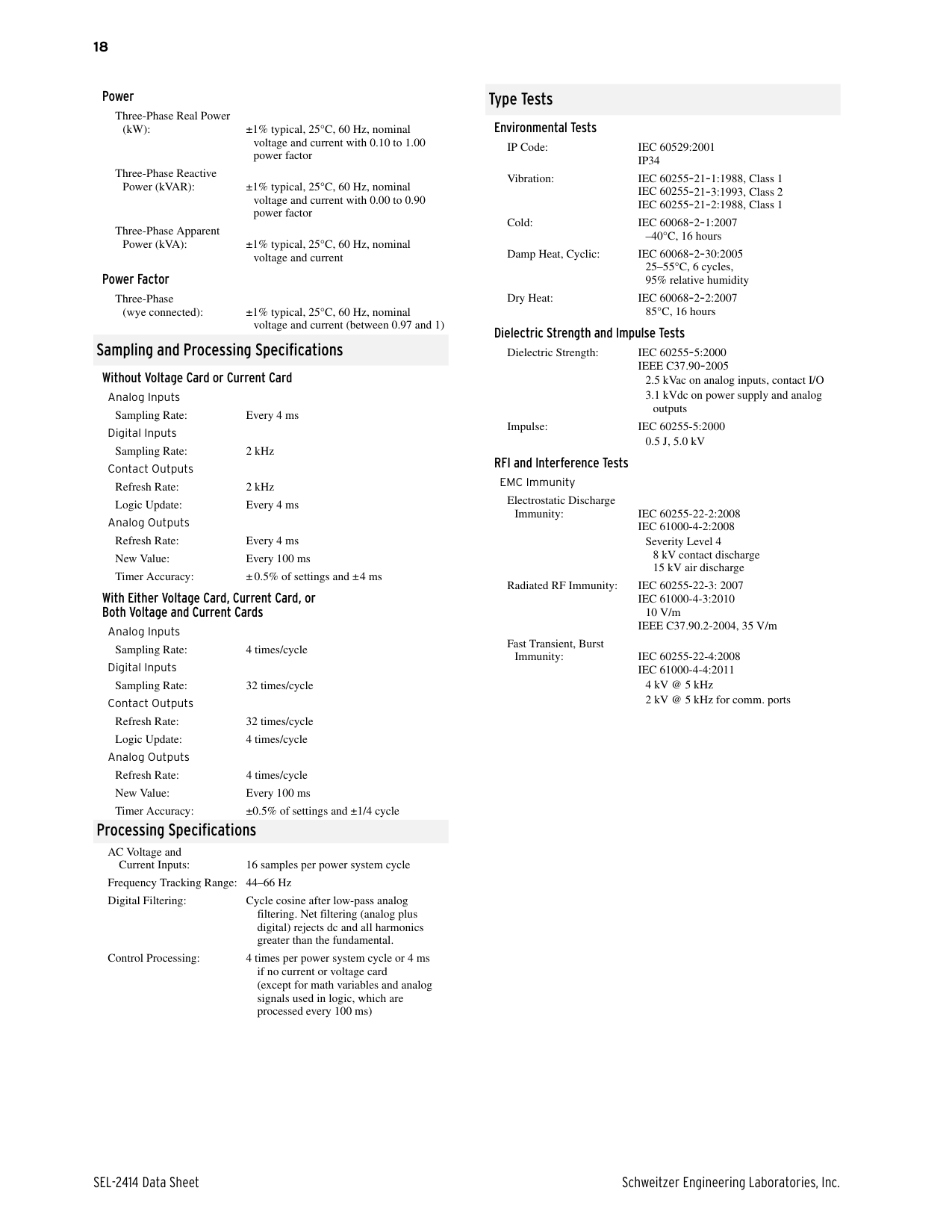
Power
Three-Phase Real Power
(kW): ±1% typical, 25°C, 60 Hz, nominal voltage and current with 0.10 to 1.00 power factor
Three-Phase Reactive
Power (kVAR): ±1% typical, 25°C, 60 Hz, nominal voltage and current with 0.00 to 0.90 power factor
Three-Phase Apparent Power (kVA): ±1% typical, 25°C, 60 Hz, nominal
voltage and current Power Factor
Three-Phase (wye connected): ±1% typical, 25°C, 60 Hz, nominal
voltage and current (between 0.97 and 1) Sampling and Processing Specifications
Without Voltage Card or Current Card
Analog Inputs
Sampling Rate: Every 4 ms Digital Inputs
Sampling Rate: 2 kHz
Contact Outputs Refresh Rate: 2 kHz Logic Update: Every 4 ms
Analog Outputs Refresh Rate: Every 4 ms New Value: Every 100 ms Timer Accuracy: ±0.5% of settings and ±4 ms
With Either Voltage Card, Current Card, or Both Voltage and Current Cards
Analog Inputs
Sampling Rate: 4 times/cycle Digital Inputs
Sampling Rate: 32 times/cycle
Contact Outputs Refresh Rate: 32 times/cycle Logic Update: 4 times/cycle
Analog Outputs Refresh Rate: 4 times/cycle New Value: Every 100 ms Timer Accuracy: ±0.5% of settings and ±1/4 cycle
Processing Specifications
AC Voltage and
Current Inputs: 16 samples per power system cycle Frequency Tracking Range: 44–66 Hz Digital Filtering: Cycle cosine after low-pass analog
filtering. Net filtering (analog plus digital) rejects dc and all harmonics greater than the fundamental.
Control Processing: 4 times per power system cycle or 4 ms if no current or voltage card (except for math variables and analog signals used in logic, which are processed every 100 ms)
Type Tests
Environmental Tests
IP Code: IEC 60529:2001 IP34
Vibration: IEC 60255-21-1:1988, Class 1 IEC 60255-21-3:1993, Class 2 IEC 60255-21-2:1988, Class 1
Cold: IEC 60068-2-1:2007
–40°C, 16 hours
Damp Heat, Cyclic: IEC 60068-2-30:2005 25–55°C, 6 cycles, 95% relative humidity
Dry Heat: IEC 60068-2-2:2007
85°C, 16 hours Dielectric Strength and Impulse Tests
Dielectric Strength: IEC 60255-5:2000 IEEE C37.90-2005
Impulse: IEC 60255-5:2000

0.5 J, 5.0 kV RFI and Interference Tests
EMC Immunity Electrostatic Discharge Immunity: IEC 60255-22-2:2008 IEC 61000-4-2:2008
Severity Level 4 8 kV contact discharge 15 kV air discharge
Radiated RF Immunity: IEC 60255-22-3: 2007 IEC 61000-4-3:2010 10 V/m
IEEE C37.90.2-2004, 35 V/m Fast Transient, Burst
Immunity: IEC 60255-22-4:2008
IEC 61000-4-4:2011 4 kV @ 5 kHz 2 kV @ 5 kHz for comm. ports
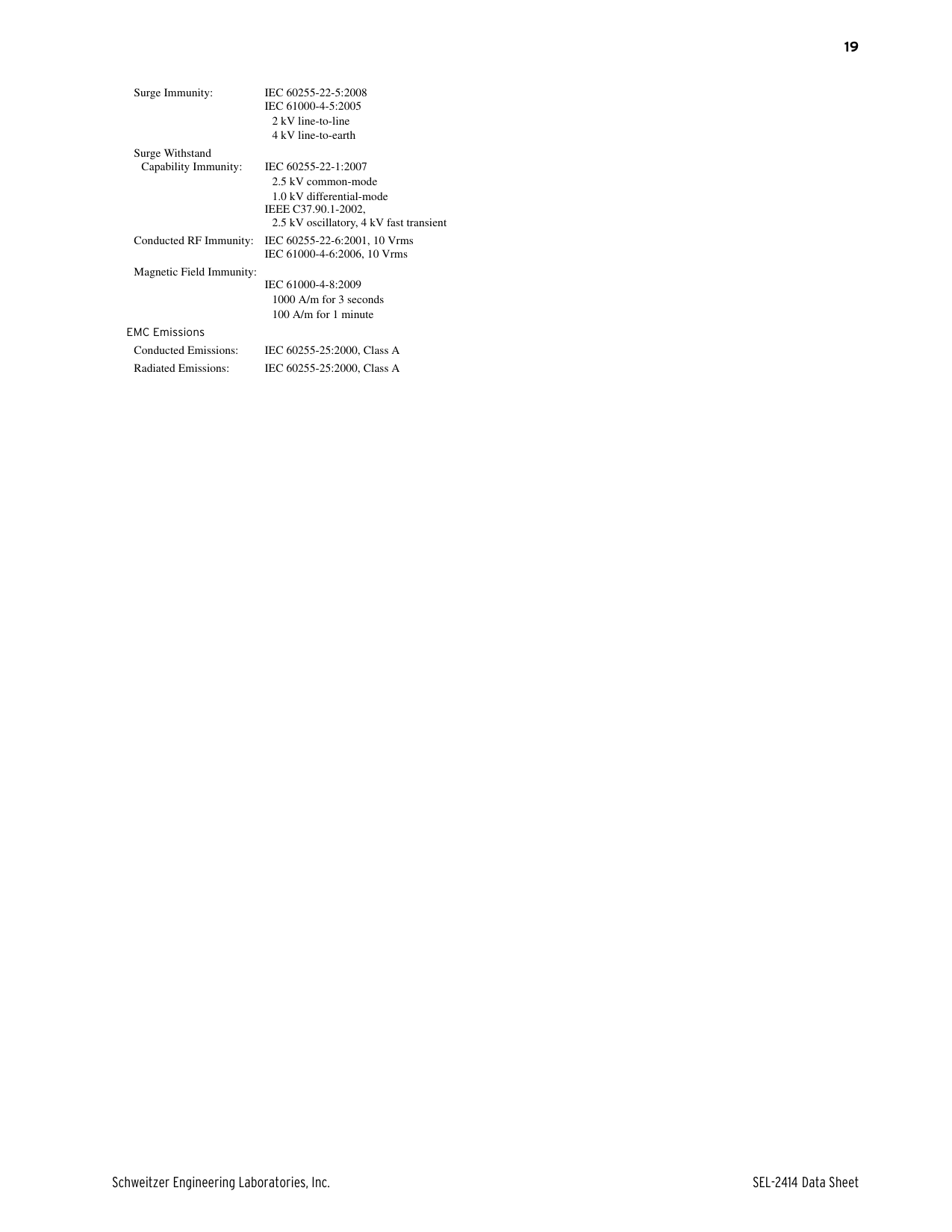
Surge Immunity: IEC 60255-22-5:2008
IEC 61000-4-5:2005 2 kV line-to-line 4 kV line-to-earth
Surge Withstand Capability Immunity: IEC 60255-22-1:2007 2.5 kV common-mode
IEEE C37.90.1-2002,
Conducted RF Immunity: IEC 60255-22-6:2001, 10 Vrms
IEC 61000-4-6:2006, 10 Vrms Magnetic Field Immunity:
IEC 61000-4-8:2009 1000 A/m for 3 seconds 100 A/m for 1 minute
EMC Emissions
Conducted Emissions: IEC 60255-25:2000, Class A Radiated Emissions: IEC 60255-25:2000, Class A
© 2008–2018 by Schweitzer Engineering Laboratories, Inc. All rights reserved.
All brand or product names appearing in this document are the trademark or registered trademark of their respective holders. No SEL trademarks may be used without written permission. SEL products appearing in this document may be covered by U.S. and Foreign patents.
2350 NE Hopkins Court • Pullman, WA 99163-5603 U.S.A. Tel: +1.509.332.1890 • Fax: +1.509.332.7990 selinc.com • info@selinc.com
Schweitzer Engineering Laboratories, Inc. reserves all rights and benefits afforded under federal and international copyright and patent laws in its products, including without limitation software, firmware, and documentation.

The information in this document is provided for informational use only and is subject to change without notice. Schweitzer Engineering Laboratories, Inc. has approved only the English language document.
This product is covered by the standard SEL 10-year warranty. For warranty details, visit selinc.com or contact your customer service representative.
*PDS2414-01*
##### SEL-2414 Data Sheet Date Code 20180321