Ask AI
— answers from the official manualAnswers from the official manual.
Common questions
Common Questions
10 totalHow do I properly load clothes into my GE Profile Washer?
Load dry items loosely, no higher than the top row of holes in the washer tub. When loading wet items, set the load/water level high enough to allow the items to move freely, with water level just covering the clothes. Do not wrap large items like sheets around the agitator. (Page 8)
What should I do if my GE Profile Washer won't operate?
Check that the washer is plugged securely into a working outlet, both hot and cold water faucets are fully on, the Cycle knob is pulled out to the ON position, the lid is closed, and the circuit breaker/fuse has not been tripped or blown. Make sure the washer has a separate outlet. (Page 11)
How do I use the fabric softener dispenser on my GE Profile Washer?
Make sure the dispenser is securely attached to the agitator, use only liquid fabric softener, and pour the recommended amount into the dispenser. Add water until it reaches the maximum fill line. Never pour fabric softener directly on clothes as it may stain them, and do not stop the washer during the first spin as this will cause the dispenser to empty too soon. (Page 7)
What is the proper way to use the liquid bleach dispenser?
Pour the measured amount of liquid bleach directly into the bleach dispenser before starting the washer, avoiding splashing or overfilling. Never pour undiluted liquid bleach directly onto clothes or into the wash basket, and do not pour powdered bleach into the dispenser. If you prefer powdered bleach, add it into the wash basket with your detergent. (Page 6)
How often should I replace the fill hoses on my GE Profile Washer?
Fill hoses connecting the washer to the faucet should be replaced every 5 years. You should also check the condition of the fill hoses regularly and turn off water faucets to relieve pressure on hoses and valves to minimize leakage if a break or rupture should occur. (Pages 3, 9)
What does the SensorWash feature do on my GE Profile Washer?
The SensorWash senses the incoming water temperature and adjusts the fill water to obtain a more precise temperature range for all three wash temperatures (cold, warm, or hot). For example, some warm water may be added to a Cold Wash selection to reach the temperature needed to better dissolve detergents. The SensorWash will not adjust the fill on warm wash unless the washer lid is closed. (Page 6)
Full Manual
16 pages
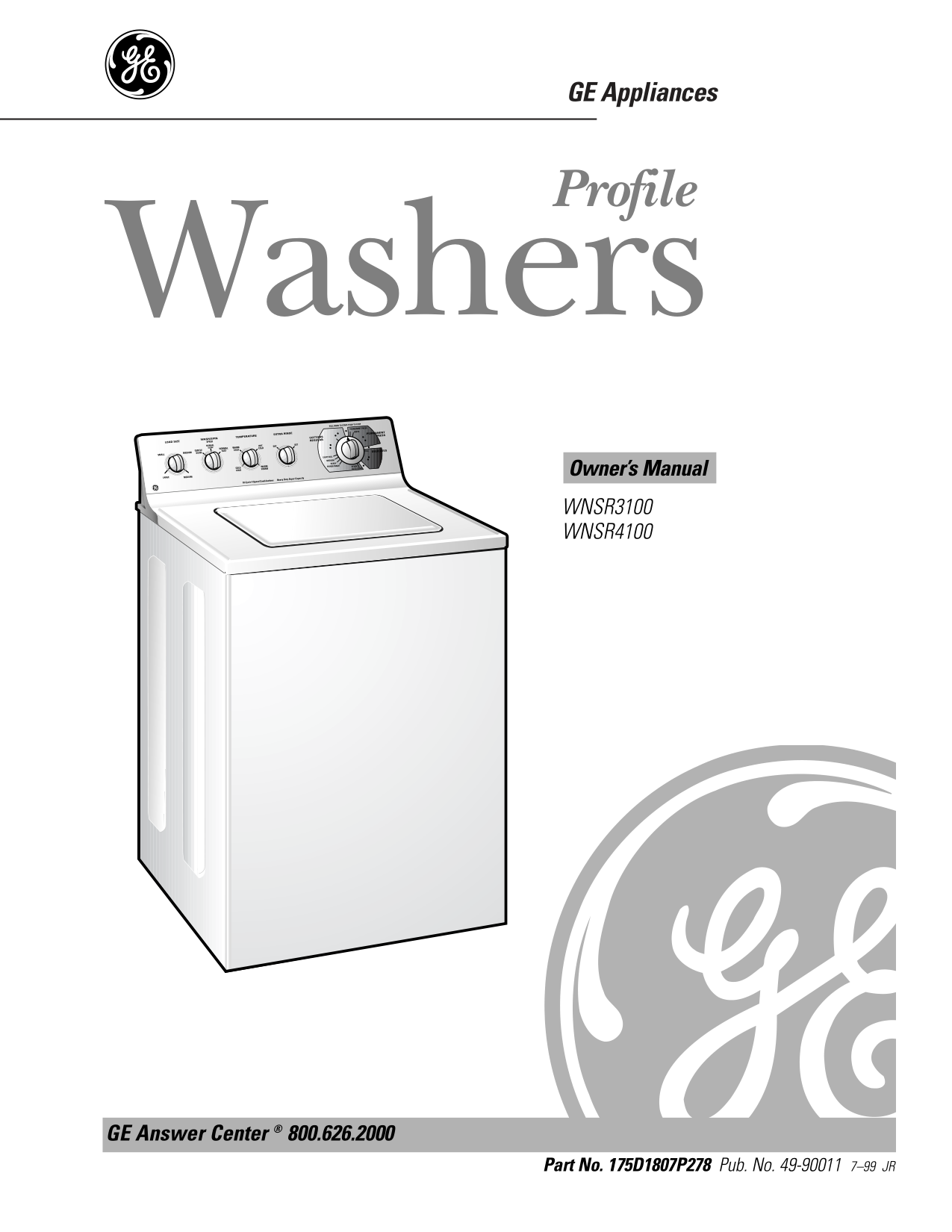
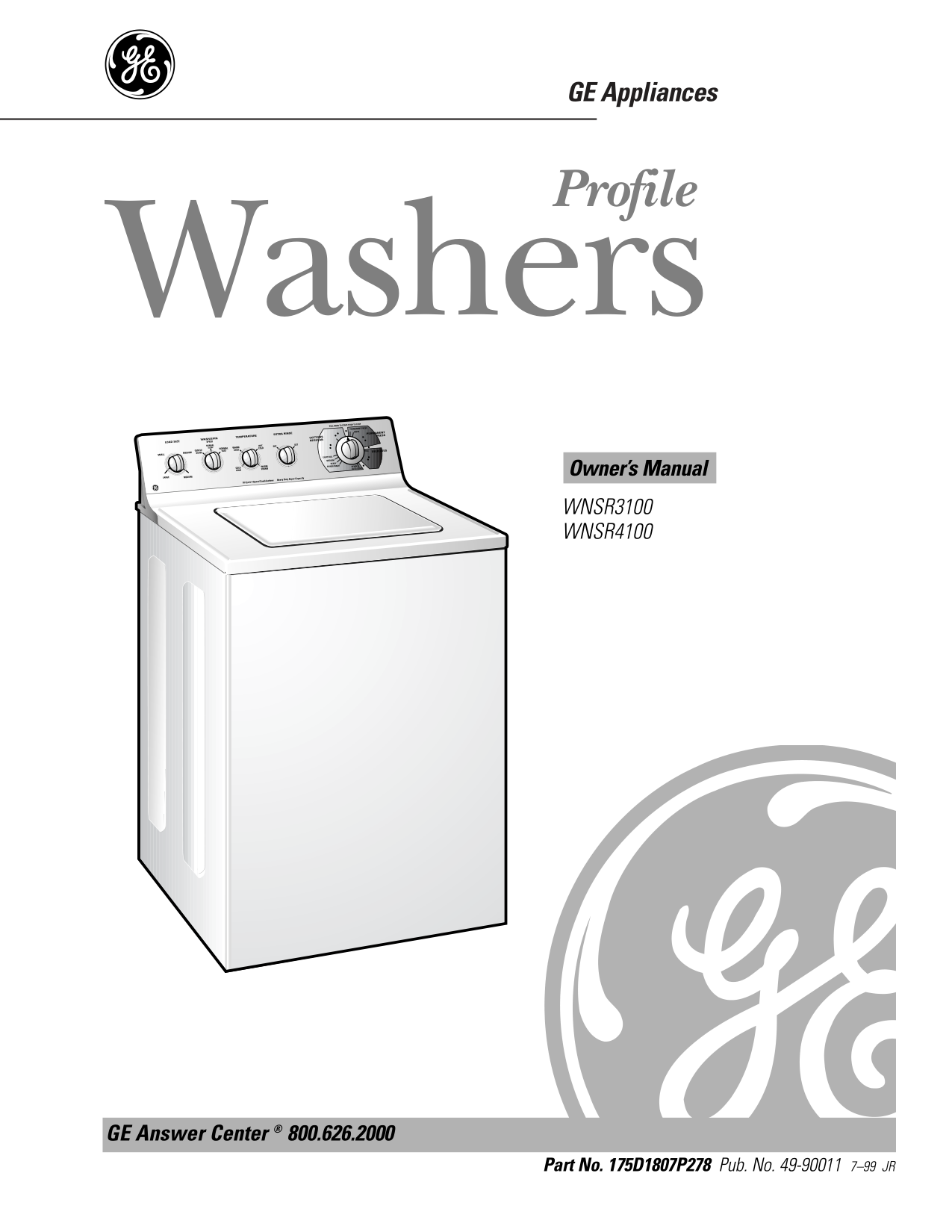
GE Appliances Washers Profile Part No. 175D1807P278 Pub. No. 49-90011 7–99 JR GE Answer Center ® 800.626.2000
Wnsr3100
Wnsr4100
Owner’s Manual
Congratulations! You Are Now Part of the GE Family. Welcome to the GE family. We’re proud of our quality products and we are committed to providing dependable service. You’ll see it in this easy-to-use Owner’s Manual and you’ll hear it in the friendly voices of our customer service department. Best of all, you’ll experience these values each time you use your washer. That’s important, because your new washer will be part of your family for many years. And we hope you will be part of ours for a long time to come. We thank you for buying GE. We appreciate your purchase, and hope you will continue to rely on us whenever you need quality appliances for your home. A Service Partnership. Safety Information . . . . . . . .3 Operating Instructions Control Panels . . . . . . . . . . . . . . . . .4 Control Settings . . . . . . . . . . . . . . . .5 Features . . . . . . . . . . . . . . . . . . . .6, 7 Loading and Using the Washer . .8, 9 Troubleshooting Tips Before You Call For Service . . . 10–12 Customer Service U.S. Warranty . . . . . . . . . . . . . . . . .13 Service Telephone Numbers . . . . . . . . . . . . . .Back Cover
For Your Records
Write the model and serial numbers here: # # You can find them in the upper right corner on the back of your washer.Important!
Staple sales slip or cancelled check here. Proof of the original purchase date is needed to obtain service under the warranty. 2 Operating Instructions Safety Instructions Customer Service Troubleshooting Tips Inside you will find many helpful hints on how to use and maintain your washer properly. Just a little preventive care on your part can save you a great deal of time and money over the life of your washer.Read This Manual
If You Need Service
You’ll find many answers to common problems in the Before You Call For Service section. If you review our chart of Troubleshooting Tips first, you may not need to call for service at all. If you do need service, you can relax knowing help is only a phone call away. A list of toll-free customer service numbers is included in the back section. Or, in the United States, you can always call the GE Answer Center®, at 800.626.2000, 24 hours a day, 7 days a week.
IInstall or store where it will not be exposed to temperatures below freezing or exposed to the weather. IProperly ground washer to conform with all governing codes and ordinances. Follow details in Installation Instructions.
Important Safety Information.
Read All Instructions Before Using.
Warning!
For your safety, the information in this manual must be followed to minimize the risk of fire or explosion, electric shock, or to prevent property damage, personal injury, or loss of life.Water Heater Safety
Under certain conditions hydrogen gas may be produced in a water heater that has not been used for two weeks or more. Hydrogen gas can be explosive under these circumstances. If the hot water has not been used for two weeks or more, prevent the possibility of damage or injury by turning on all hot water faucets and allowing them to run for several minutes. Do this before using any electrical appliance which is connected to the hot water system. This simple procedure will allow any built-up hydrogen gas to escape. Since the gas is flammable, do not smoke or use an open flame or appliance during this process.Proper Installation
This washer must be properly installed and located in accordance with the Installation Instructions before it is used. If you did not receive an Installation Instructions sheet, you can receive one by calling, toll-free, in the United States the GE Answer Center®, 800.626.2000. Customer Service Troubleshooting Tips Operating Instructions Safety Instructions IKeep the area underneath and around your appliances free of combustible materials such as lint, paper, rags, chemicals, etc. IClose supervision is necessary if this appliance is used by or near children. Do not allow children to play on, with, or inside this or any other appliance.Your Laundry Area
INever reach into washer while it is moving. Wait until the machine has completely stopped before opening the lid. IDo not mix chlorine bleach with ammonia or acids such as vinegar and/or rust remover. Mixing different chemicals can produce a toxic gas which may cause death. IDo not wash or dry articles that have been cleaned in, washed in, soaked in, or spotted with combustible or explosive substances (such as wax, oil, paint, gasoline, degreasers, dry-cleaning solvents, kerosene, etc.) which may ignite or explode. Do not add these substances to the wash water. Do not use or place these substances around your washer or dryer during operation. IThe laundry process can reduce the flame retardancy of fabrics. To avoid such a result, carefully follow the garment manufacturer’s wash and care instructions. ITo minimize the possibility of electric shock, unplug this appliance from the power supply or disconnect the washer at the household distribution panel by removing the fuse or switching off the circuit breaker before attempting any maintenance or cleaning. NOTE: Turning the Cycle Selector knob to an off position does NOT disconnect the appliance from the power supply. INever attempt to operate this appliance if it is damaged, malfunctioning, partially disassembled, or has missing or broken parts, including a damaged cord or plug.When Using The Washer
ITurn off water faucets to relieve pressure on hoses and valves and to minimize leakage if a break or rupture should occur. Check the condition of the fill hoses; they may need replacement after 5 years. IBefore discarding a washer, or removing it from service, remove the washer lid to prevent children from hiding inside. IDo not attempt to repair or replace any part of this appliance unless specifically recommended in this Owner’s Manual, or in published user-repair instructions that you understand and have the skills to carry out. IDo not tamper with controls.When Not In Use
Read and follow this Safety Information carefully.Save These Instructions
3 Use this appliance only for its intended purpose as described in this Owner’s Manual.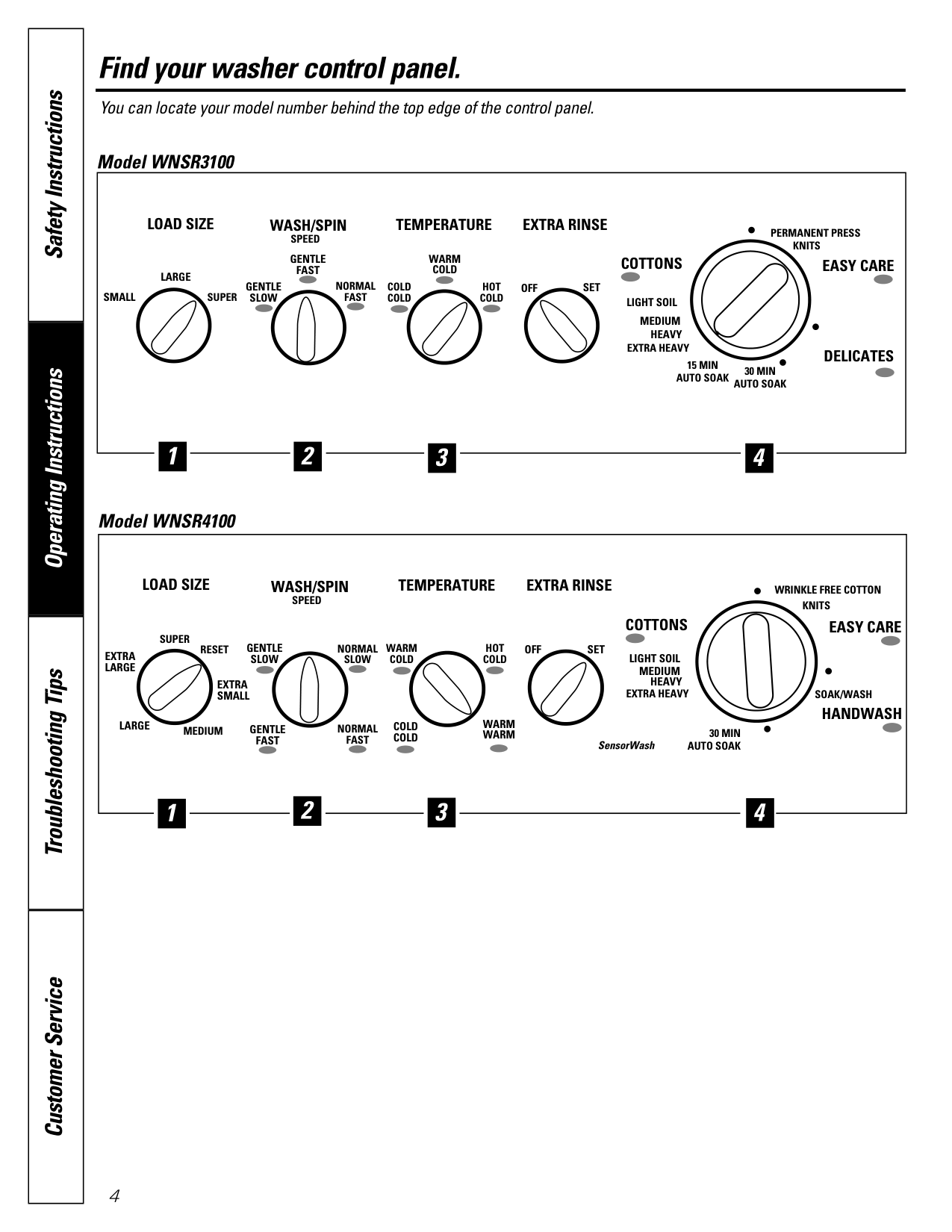
Heavy
Medium
Light Soil
Wrinkle Free Cotton
Knits
30 Min
Auto Soak
Extra Heavy
Soak/Wash
Cottons
Handwash
Easy Care
Off
Set
Warm
Cold
Hot
Cold
Cold
Cold
Warm
Warm
Gentle
Slow
Normal
Slow
Gentle
Fast
Normal
Fast
Load Size
Temperature
Extra Rinse
Wash/Spin
Speed
SensorWashExtra
Small
Large
Extra
Large
Super
Reset
Medium
Model WNSR4100Heavy
Medium
Light Soil
Permanent Press
Knits
15 Min
Auto Soak
30 Min
Auto Soak
Extra Heavy
Cottons
Delicates
Easy Care
Off
Set
Cold
Cold
Hot
Cold
Warm
Cold
Gentle
Slow
Normal
Fast
Gentle
Fast
Small
Large
Load Size
Temperature
Extra Rinse
Super
Wash/Spin
Speed
Find your washer control panel. Operating Instructions Safety Instructions Customer Service Troubleshooting Tips You can locate your model number behind the top edge of the control panel. 4 Model WNSR3100 1 1 2 3 4 2 3 4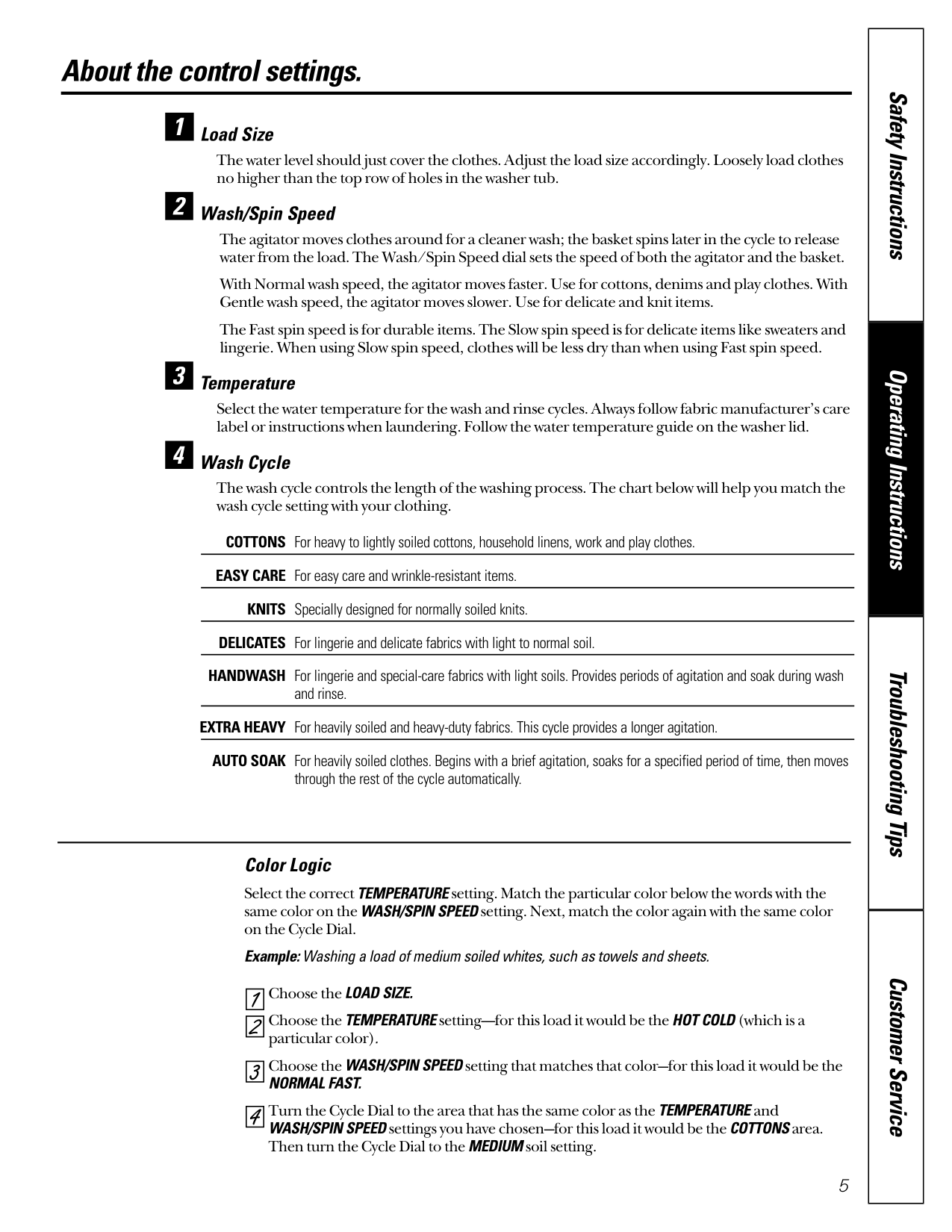
Customer Service Troubleshooting Tips Operating Instructions Safety Instructions 5 About the control settings. Color Logic Select the correct TEMPERATURE setting. Match the particular color below the words with the same color on the WASH/SPIN SPEED setting. Next, match the color again with the same color on the Cycle Dial. Example: Washing a load of medium soiled whites, such as towels and sheets. Choose the LOAD SIZE. Choose the TEMPERATURE setting-—for this load it would be the HOT COLD (which is a particular color). Choose the WASH/SPIN SPEED setting that matches that color—for this load it would be the
Normal Fast.
Turn the Cycle Dial to the area that has the same color as the TEMPERATURE and WASH/SPIN SPEED settings you have chosen—for this load it would be the COTTONS area. Then turn the Cycle Dial to the MEDIUM soil setting. 4 3 2 1 Load Size The water level should just cover the clothes. Adjust the load size accordingly. Loosely load clothes no higher than the top row of holes in the washer tub. Wash/Spin Speed The agitator moves clothes around for a cleaner wash; the basket spins later in the cycle to release water from the load. The Wash/Spin Speed dial sets the speed of both the agitator and the basket. With Normal wash speed, the agitator moves faster. Use for cottons, denims and play clothes. With Gentle wash speed, the agitator moves slower. Use for delicate and knit items. The Fast spin speed is for durable items. The Slow spin speed is for delicate items like sweaters and lingerie. When using Slow spin speed, clothes will be less dry than when using Fast spin speed. Temperature Select the water temperature for the wash and rinse cycles. Always follow fabric manufacturer’s care label or instructions when laundering. Follow the water temperature guide on the washer lid. Wash Cycle The wash cycle controls the length of the washing process. The chart below will help you match the wash cycle setting with your clothing. COTTONS For heavy to lightly soiled cottons, household linens, work and play clothes. EASY CARE For easy care and wrinkle-resistant items. KNITS Specially designed for normally soiled knits. DELICATES For lingerie and delicate fabrics with light to normal soil. HANDWASH For lingerie and special-care fabrics with light soils. Provides periods of agitation and soak during wash and rinse. EXTRA HEAVY For heavily soiled and heavy-duty fabrics. This cycle provides a longer agitation. AUTO SOAK For heavily soiled clothes. Begins with a brief agitation, soaks for a specified period of time, then moves through the rest of the cycle automatically. 4 3 2 1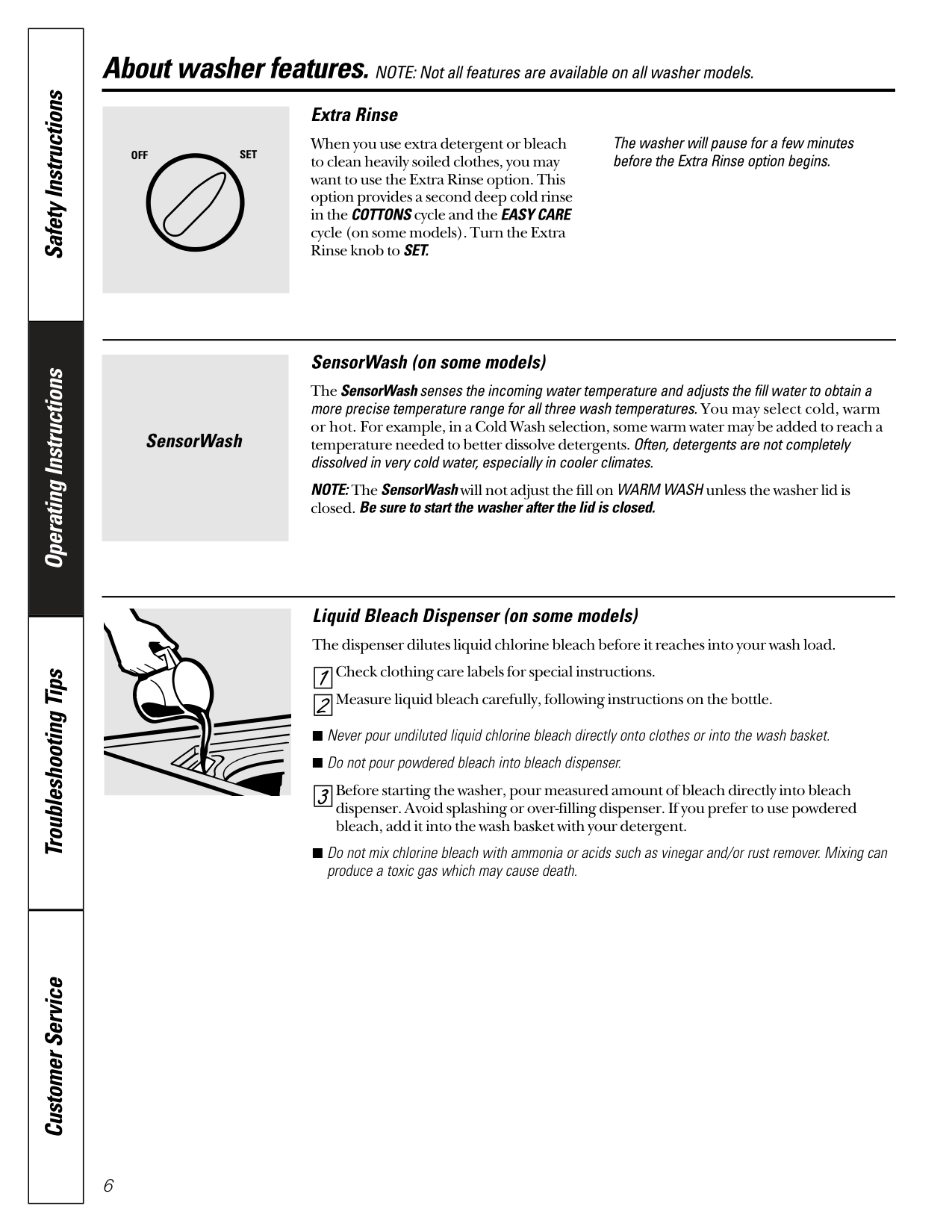
Operating Instructions Safety Instructions Customer Service Troubleshooting Tips About washer features. NOTE: Not all features are available on all washer models. Extra Rinse When you use extra detergent or bleach to clean heavily soiled clothes, you may want to use the Extra Rinse option. This option provides a second deep cold rinse in the COTTONS cycle and the EASY CARE cycle (on some models). Turn the Extra Rinse knob to SET. The washer will pause for a few minutes before the Extra Rinse option begins.
Off
Set
SensorWash (on some models) The SensorWash senses the incoming water temperature and adjusts the fill water to obtain a more precise temperature range for all three wash temperatures. You may select cold, warm or hot. For example, in a Cold Wash selection, some warm water may be added to reach a temperature needed to better dissolve detergents. Often, detergents are not completely dissolved in very cold water, especially in cooler climates. NOTE: The SensorWash will not adjust the fill on WARM WASH unless the washer lid is closed. Be sure to start the washer after the lid is closed. Liquid Bleach Dispenser (on some models) The dispenser dilutes liquid chlorine bleach before it reaches into your wash load. Check clothing care labels for special instructions. Measure liquid bleach carefully, following instructions on the bottle. I Never pour undiluted liquid chlorine bleach directly onto clothes or into the wash basket. I Do not pour powdered bleach into bleach dispenser. Before starting the washer, pour measured amount of bleach directly into bleach dispenser. Avoid splashing or over-filling dispenser. If you prefer to use powdered bleach, add it into the wash basket with your detergent. I Do not mix chlorine bleach with ammonia or acids such as vinegar and/or rust remover. Mixing can produce a toxic gas which may cause death. 3 2 1 6 SensorWash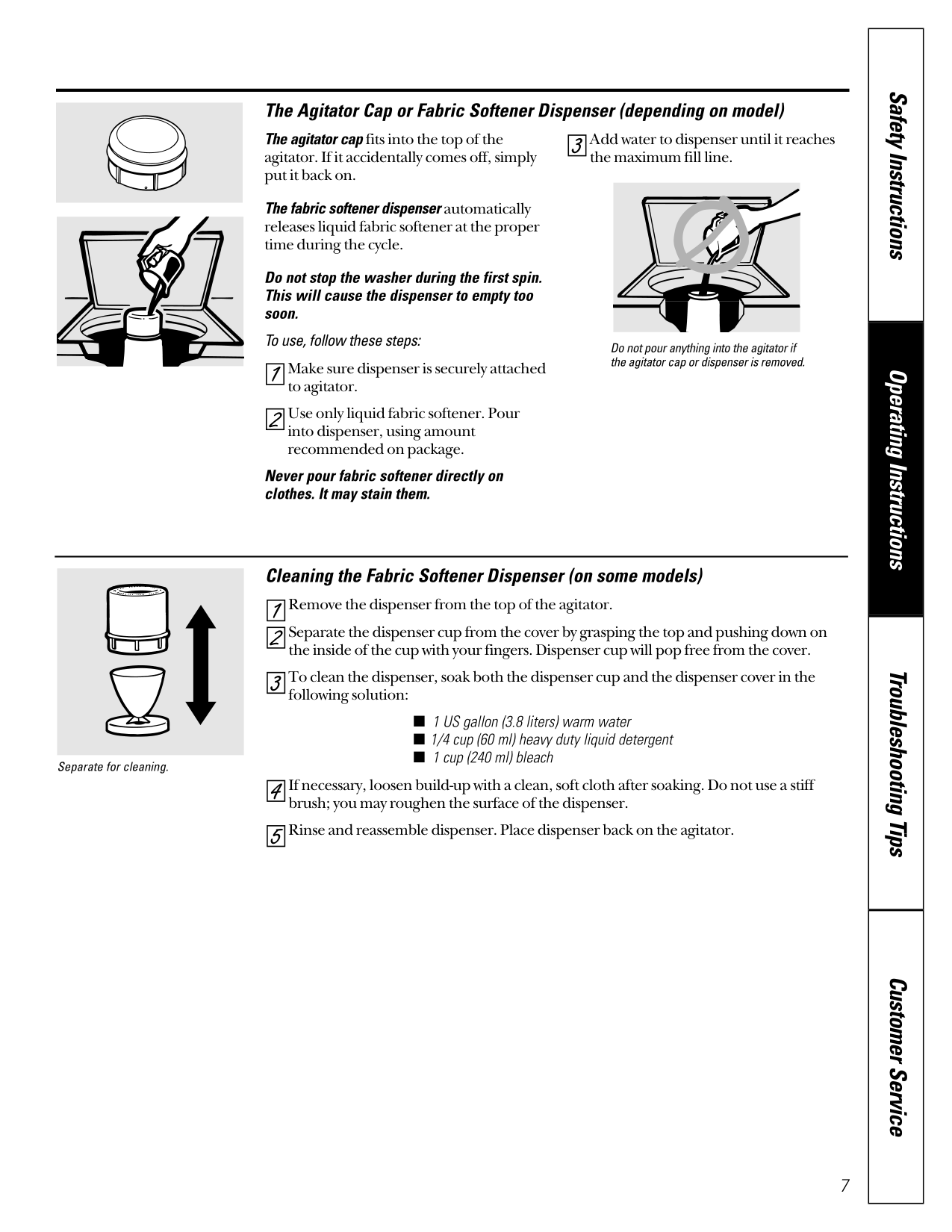
Customer Service Troubleshooting Tips Operating Instructions Safety Instructions 7 The Agitator Cap or Fabric Softener Dispenser (depending on model) The agitator cap fits into the top of the agitator. If it accidentally comes off, simply put it back on. The fabric softener dispenser automatically releases liquid fabric softener at the proper time during the cycle. Do not stop the washer during the first spin. This will cause the dispenser to empty too soon. To use, follow these steps: Make sure dispenser is securely attached to agitator. Use only liquid fabric softener. Pour into dispenser, using amount recommended on package. Never pour fabric softener directly on clothes. It may stain them. Add water to dispenser until it reaches the maximum fill line. 3 2 1 Do not pour anything into the agitator if the agitator cap or dispenser is removed. Cleaning the Fabric Softener Dispenser (on some models) Remove the dispenser from the top of the agitator. Separate the dispenser cup from the cover by grasping the top and pushing down on the inside of the cup with your fingers. Dispenser cup will pop free from the cover. To clean the dispenser, soak both the dispenser cup and the dispenser cover in the following solution: I 1 US gallon (3.8 liters) warm water I 1/4 cup (60 ml) heavy duty liquid detergent I 1 cup (240 ml) bleach If necessary, loosen build-up with a clean, soft cloth after soaking. Do not use a stiff brush; you may roughen the surface of the dispenser. Rinse and reassemble dispenser. Place dispenser back on the agitator. 5 4 3 2 1 Separate for cleaning.
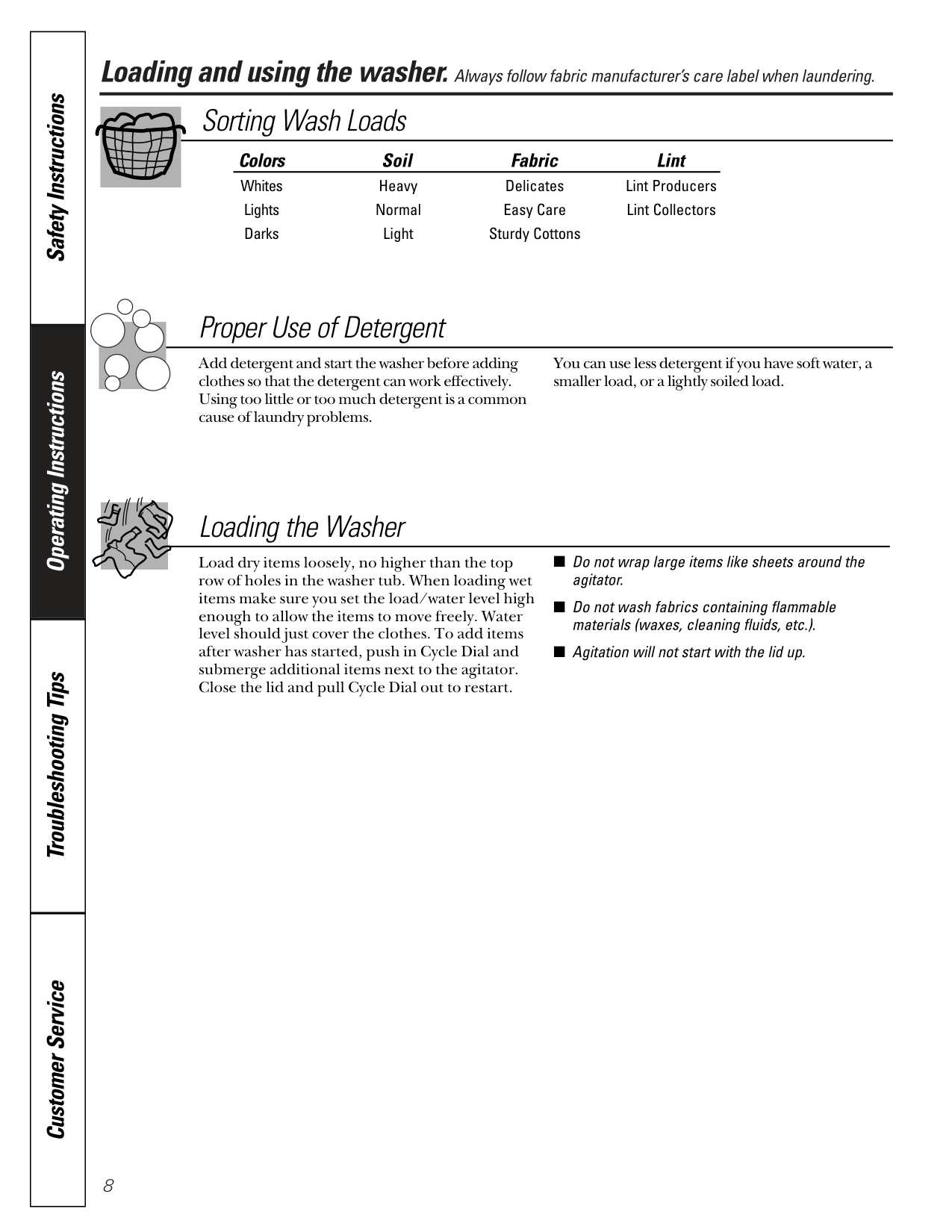
Loading and using the washer. Always follow fabric manufacturer’s care label when laundering. 8 Operating Instructions Safety Instructions Customer Service Troubleshooting Tips Sorting Wash Loads Proper Use of Detergent Add detergent and start the washer before adding clothes so that the detergent can work effectively. Using too little or too much detergent is a common cause of laundry problems. You can use less detergent if you have soft water, a smaller load, or a lightly soiled load. Loading the Washer Load dry items loosely, no higher than the top row of holes in the washer tub. When loading wet items make sure you set the load/water level high enough to allow the items to move freely. Water level should just cover the clothes. To add items after washer has started, push in Cycle Dial and submerge additional items next to the agitator. Close the lid and pull Cycle Dial out to restart. I Do not wrap large items like sheets around the agitator. I Do not wash fabrics containing flammable materials (waxes, cleaning fluids, etc.). I Agitation will not start with the lid up. Colors Whites Lights Darks Soil Heavy Normal Light Fabric Delicates Easy Care Sturdy Cottons Lint Lint Producers Lint Collectors
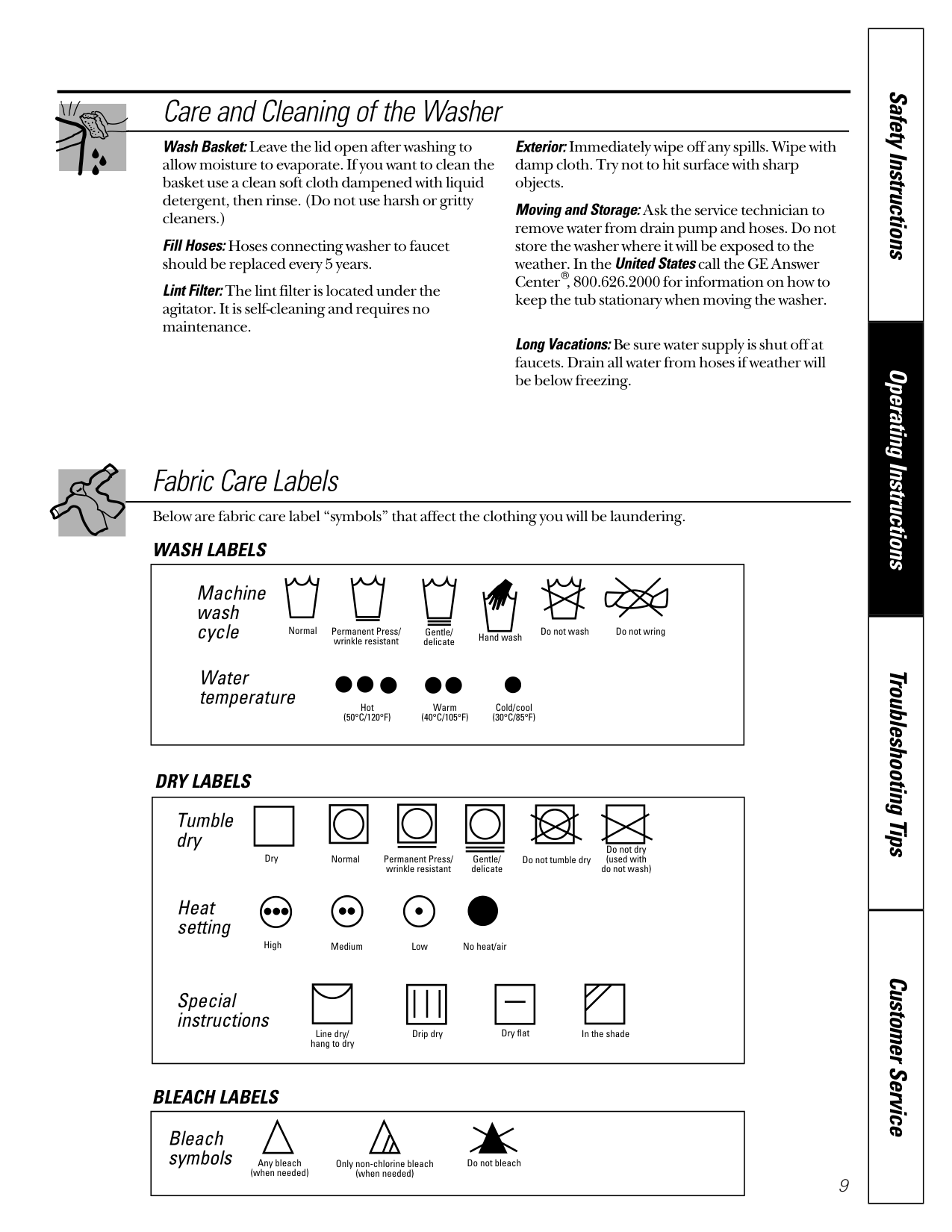
9 Customer Service Troubleshooting Tips Operating Instructions Safety Instructions Care and Cleaning of the Washer Wash Basket: Leave the lid open after washing to allow moisture to evaporate. If you want to clean the basket use a clean soft cloth dampened with liquid detergent, then rinse. (Do not use harsh or gritty cleaners.) Fill Hoses: Hoses connecting washer to faucet should be replaced every 5 years. Lint Filter: The lint filter is located under the agitator. It is self-cleaning and requires no maintenance. Exterior: Immediately wipe off any spills. Wipe with damp cloth. Try not to hit surface with sharp objects. Moving and Storage: Ask the service technician to remove water from drain pump and hoses. Do not store the washer where it will be exposed to the weather. In the United States call the GE Answer Center®, 800.626.2000 for information on how to keep the tub stationary when moving the washer. Long Vacations: Be sure water supply is shut off at faucets. Drain all water from hoses if weather will be below freezing. Fabric Care Labels Machine wash cycle Normal Permanent Press/ wrinkle resistant Gentle/ delicate Hand wash Do not wash Do not wring Water temperature Hot
(50°C/120°F)
Warm(40°C/105°F)
Cold/cool(30°C/85°F)
Tumble dry Dry Normal Permanent Press/ wrinkle resistant Gentle/ delicate Do not tumble dry Do not dry (used with do not wash) Heat setting High Medium Low No heat/air Special instructions Line dry/ hang to dry Drip dry Dry flat In the shade Bleach symbols Any bleach (when needed) Only non-chlorine bleach (when needed) Do not bleach Below are fabric care label “symbols” that affect the clothing you will be laundering.Wash Labels
Dry Labels
Bleach Labels
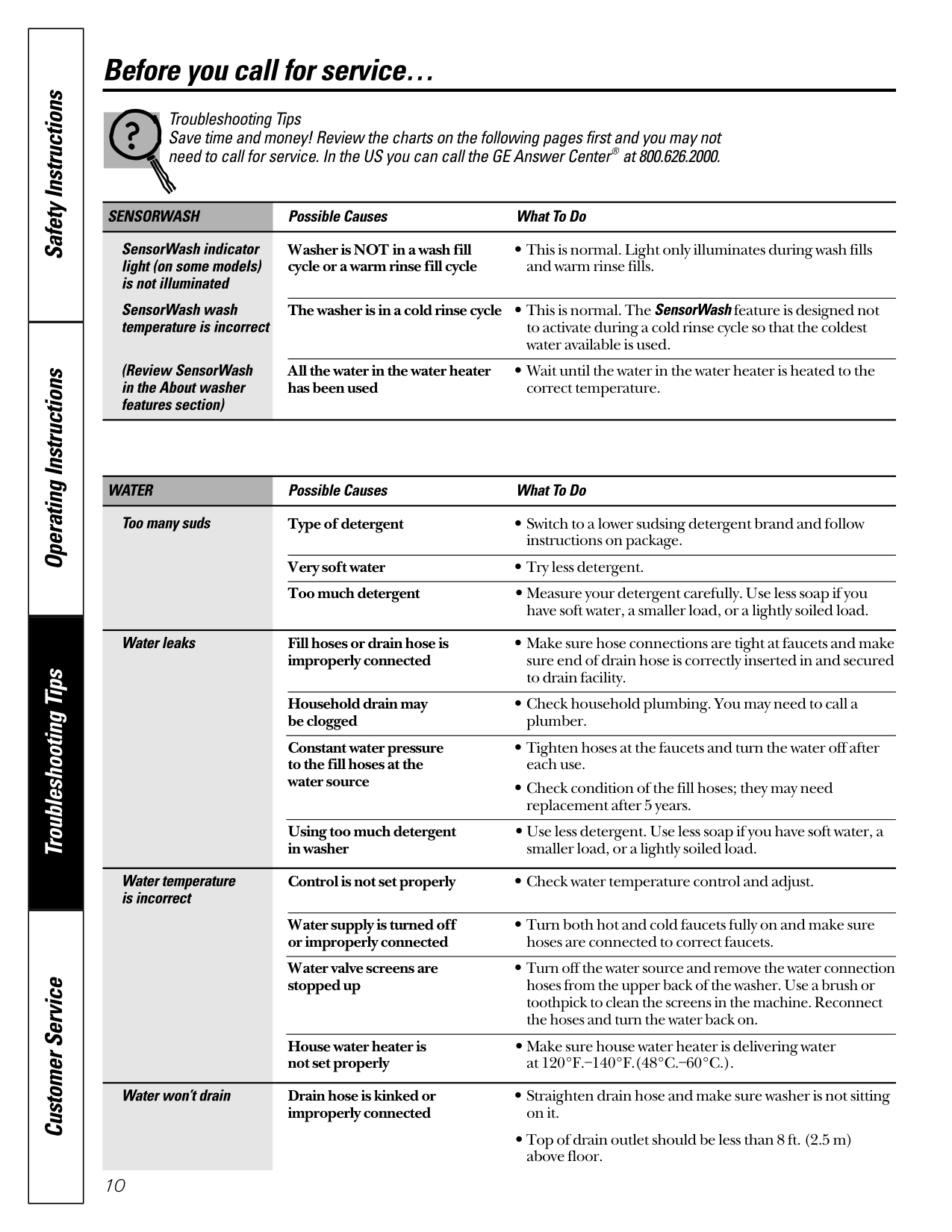
Operating Instructions Safety Instructions Customer Service Troubleshooting Tips Troubleshooting Tips Save time and money! Review the charts on the following pages first and you may not need to call for service. In the US you can call the GE Answer Center ® at 800.626.2000. Before you call for service…
Sensorwash
Possible Causes What To Do SensorWash indicator Washer is NOT in a wash fillWater
Possible Causes What To Do Too many suds Type of detergent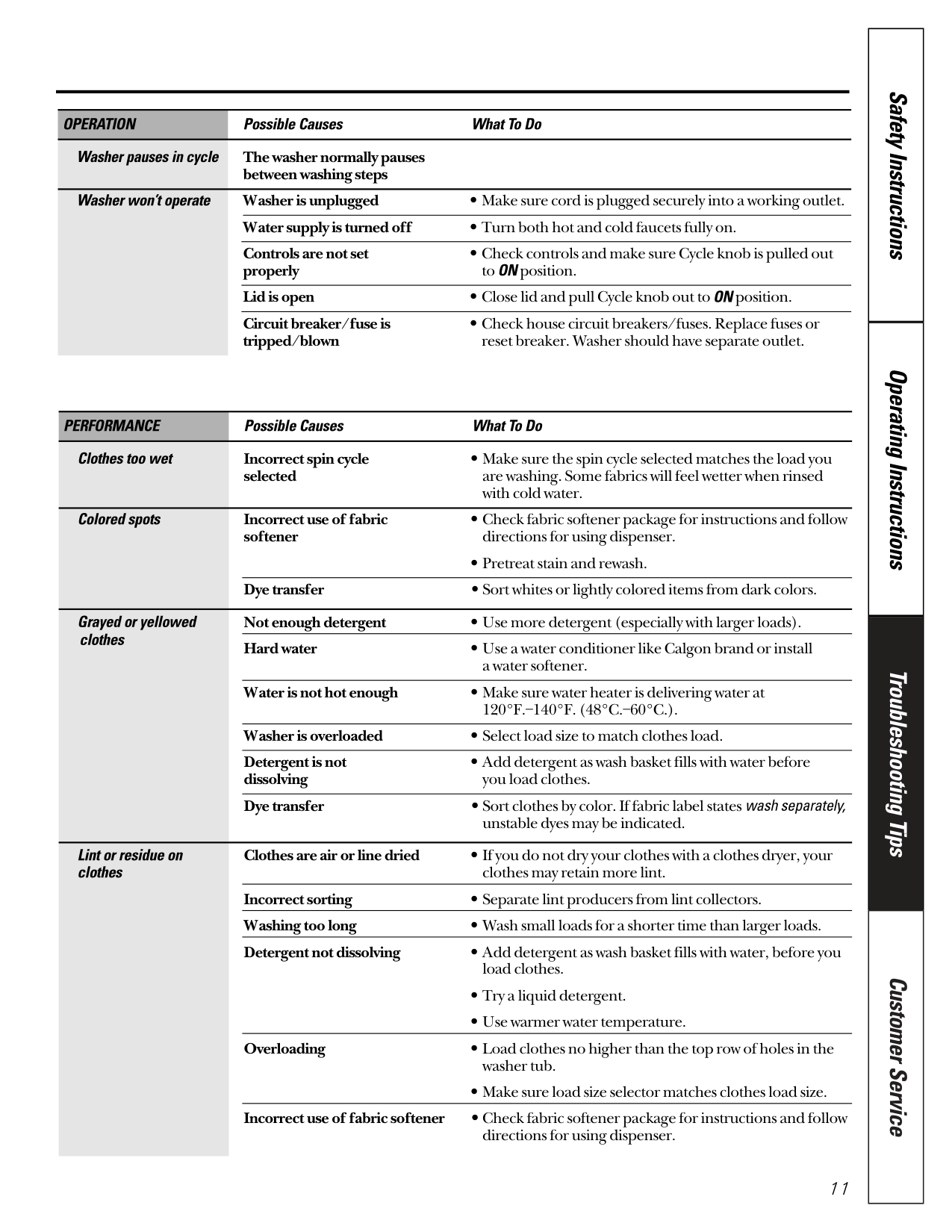
Customer Service Troubleshooting Tips Operating Instructions Safety Instructions 11
Operation
Possible Causes What To Do Washer pauses in cycle The washer normally pauses between washing steps Washer won’t operate Washer is unpluggedPerformance
Possible Causes What To Do Clothes too wet Incorrect spin cycle120°F.–140°F. (48°C.–60°C.).
Washer is overloaded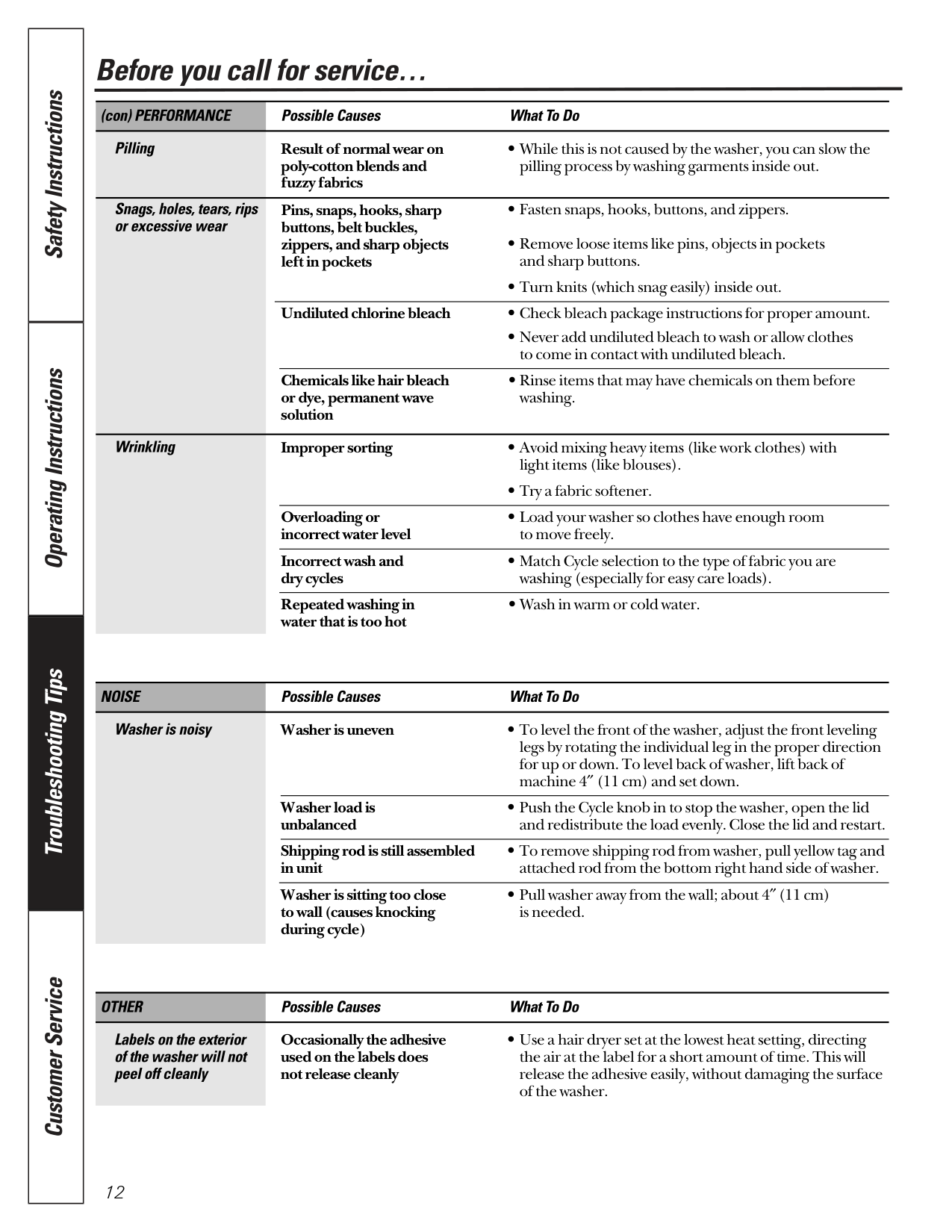
Before you call for service… Operating Instructions Safety Instructions Customer Service Troubleshooting Tips 12
Noise
Possible Causes What To Do Washer is noisy Washer is unevenOther
Possible Causes What To Do Labels on the exterior Occasionally the adhesive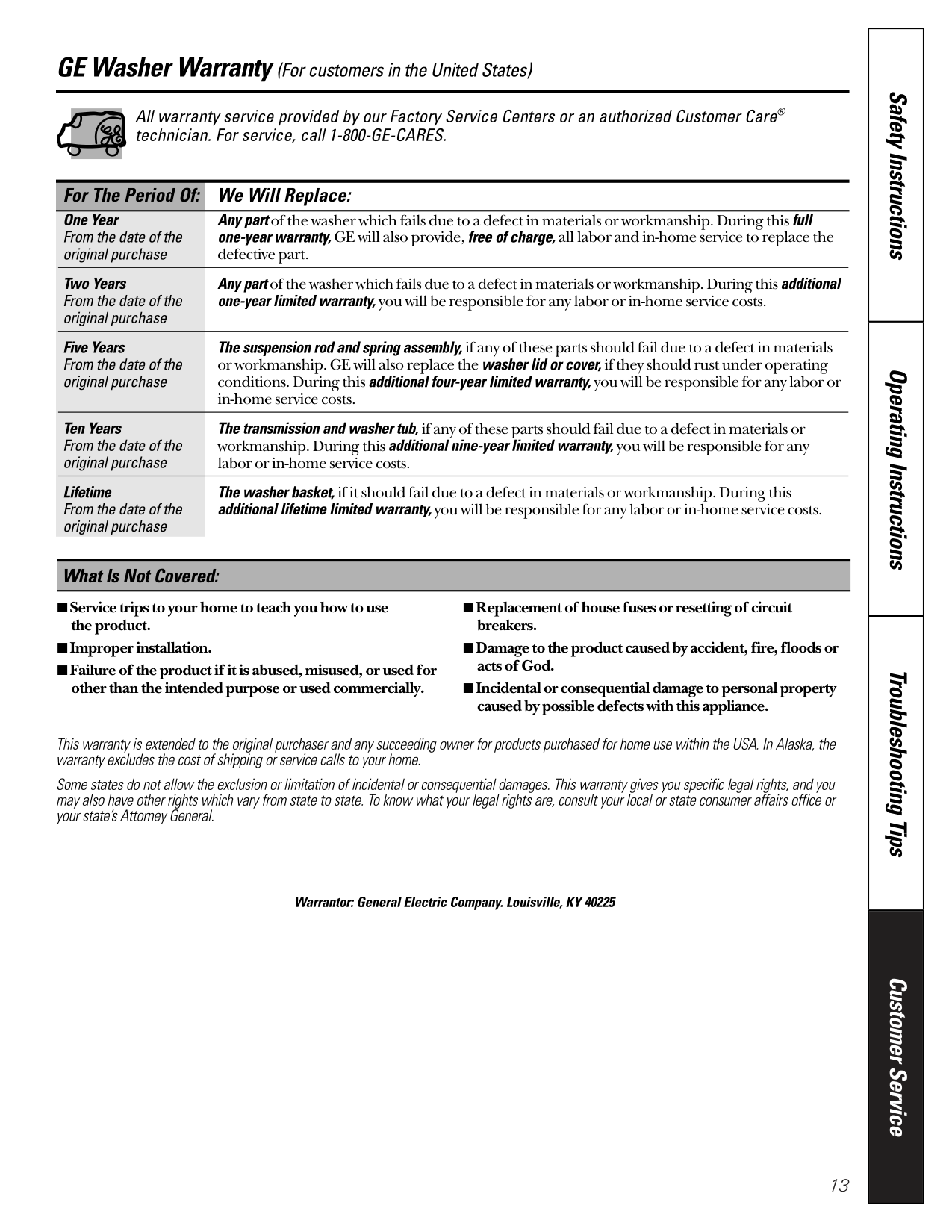
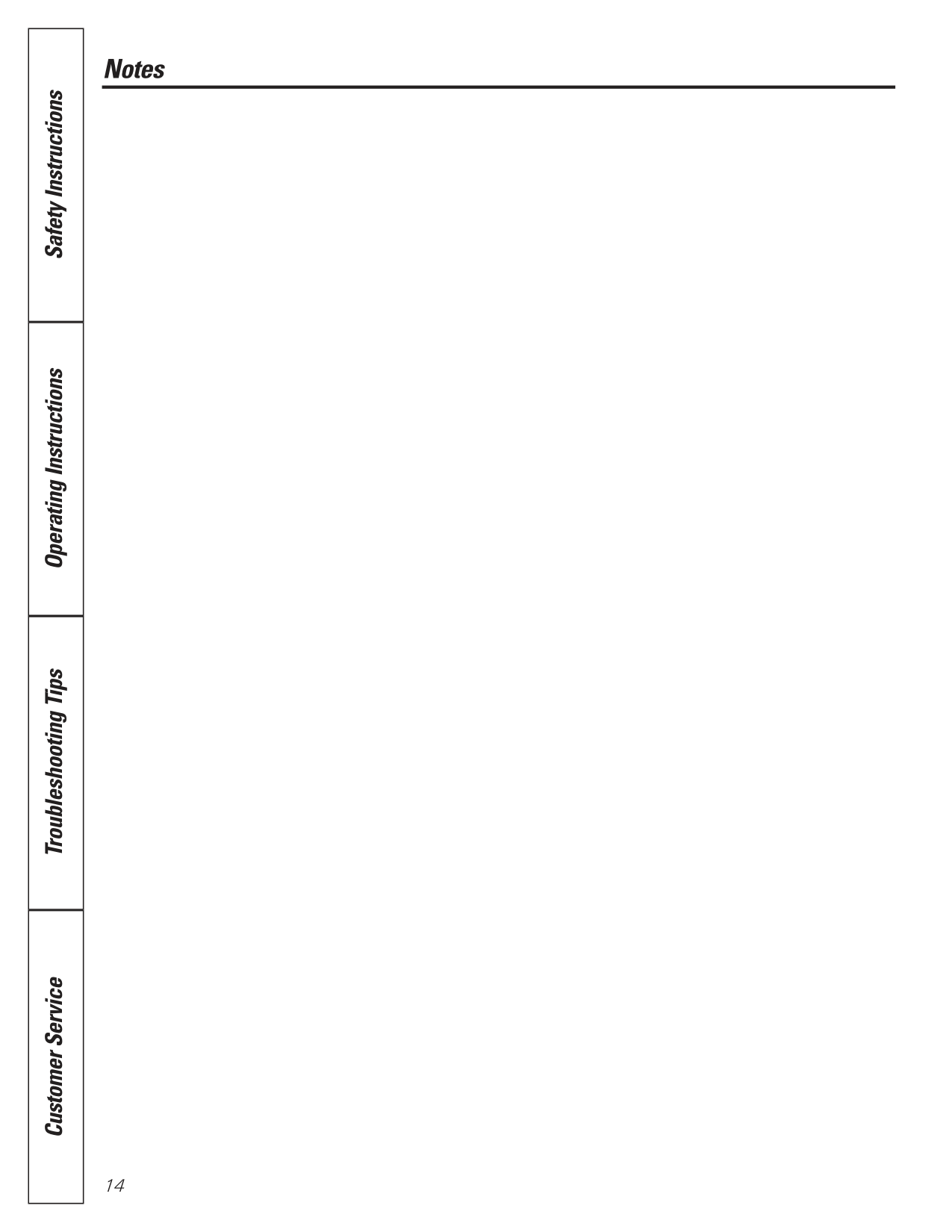
13 Customer Service Troubleshooting Tips Operating Instructions Safety Instructions GE Washer Warranty (For customers in the United States) All warranty service provided by our Factory Service Centers or an authorized Customer Care® technician. For service, call 1-800-GE-CARES. One Year Any part of the washer which fails due to a defect in materials or workmanship. During this full From the date of the one-year warranty, GE will also provide, free of charge, all labor and in-home service to replace the original purchase defective part. Two Years Any part of the washer which fails due to a defect in materials or workmanship. During this additional From the date of the one-year limited warranty, you will be responsible for any labor or in-home service costs. original purchase Five Years The suspension rod and spring assembly, if any of these parts should fail due to a defect in materials From the date of the or workmanship. GE will also replace the washer lid or cover, if they should rust under operating original purchase conditions. During this additional four-year limited warranty, you will be responsible for any labor or in-home service costs. Ten Years The transmission and washer tub, if any of these parts should fail due to a defect in materials or From the date of the workmanship. During this additional nine-year limited warranty, you will be responsible for any original purchase labor or in-home service costs. Lifetime The washer basket, if it should fail due to a defect in materials or workmanship. During this From the date of the additional lifetime limited warranty, you will be responsible for any labor or in-home service costs. original purchase For The Period Of: We Will Replace: This warranty is extended to the original purchaser and any succeeding owner for products purchased for home use within the USA. In Alaska, the warranty excludes the cost of shipping or service calls to your home. Some states do not allow the exclusion or limitation of incidental or consequential damages. This warranty gives you specific legal rights, and you may also have other rights which vary from state to state. To know what your legal rights are, consult your local or state consumer affairs office or your state’s Attorney General. IService trips to your home to teach you how to use the product. IImproper installation. IFailure of the product if it is abused, misused, or used for other than the intended purpose or used commercially. IReplacement of house fuses or resetting of circuit breakers. IDamage to the product caused by accident, fire, floods or acts of God. IIncidental or consequential damage to personal property caused by possible defects with this appliance. What Is Not Covered: Warrantor: General Electric Company. Louisville, KY 40225
Operating Instructions Safety Instructions Troubleshooting Tips 14 Notes Customer Service
15 Customer Service Troubleshooting Tips Operating Instructions Safety Instructions Notes
Service Telephone Numbers. GE Answer Center® In the U.S.: 800-626-2000 The GE Answer Center® is open 24 hours a day, 7 days a week. In-Home Repair Service In the U.S.: 800-432-2737 Expert GE repair service is only a phone call away. Special Needs Service In the U.S.: 800-626-2000 GE offers, free of charge, a brochure to assist in planning a barrier-free kitchen for persons with limited mobility. In the U.S., call 800-TDD-GEAC (800-833-4322). Service Contracts In the U.S.: 800-626-2224 Purchase a GE service contract while your warranty is still in effect and you’ll receive a substantial discount. GE Consumer Service will still be there after your warranty expires. Parts and Accessories In the U.S.: 800-626-2002 Individuals qualified to service their own appliances can have parts or accessories sent directly to their homes (VISA, MasterCard and Discover cards are accepted). Instructions contained in this manual cover procedures to be performed by any user. Other servicing generally should be referred to qualified service personnel. Caution must be exercised, since improper servicing may cause unsafe operation. Service Satisfaction If you are not satisfied with the service you receive from GE: First, contact the people who serviced your appliance. Next, if you are still not pleased, in the U.S., write all the details—including your phone number—to: Manager, Customer Relations, GE Appliances, Appliance Park, Louisville, KY 40225 Printed in Louisville, KY Operating Instructions Safety Instructions Customer Service Troubleshooting Tips 16