
Ask AI
— answers from the official manualAnswers from the official manual.
Common questions
Common Questions
18 totalWhat water pressure and temperature requirements does the washer need?
Hot and cold water faucets must be within 4 feet of the back of the washer/dryer and provide water pressure of 5–100 PSI. The water heater should be set to deliver 140°F water to the washer. (Page 2)
How do I check for gas leaks after connecting the gas supply line?
Use a brush and liquid detergent to test all gas connections for leaks after wrench-tightening all connections and opening the shutoff valve. Bubbles forming around connections will indicate a leak. If a leak appears, shut off the gas valve controls, adjust the connections, and then check the connections again. (Page 6)
What should I do if the dryer burner does not ignite during the first use?
Run the dryer on a full heat cycle (not air cycle) for at least five minutes to purge air from the gas supply line. If the burner does not ignite and no heat is felt inside the dryer, shut off the dryer for five minutes, check that all supply valve controls are in the 'ON' position and the power supply cord is plugged in, then repeat the five-minute test. (Page 6)
How do I level the Thin Twin washer/dryer after installation?
Tilt the washer/dryer forward to raise the back legs 1 inch off the floor, allowing the rear self-leveling legs to adjust, then gently lower it and check levelness with a carpenter's level placed on top — first side to side, then front to back. If not level, tilt the unit backward until the front is 3–4 inches off the floor, insert corner posts about 6 inches from the left leg, and adjust the front legs up or down. Once level, tighten the nuts on the front legs firmly against the base to prevent vibration. (Page 5)
How should I secure the drain hose to prevent it from coming off or leaking?
Wet the inside end of the drain hose with tap water (no other lubricant), squeeze the clamp ears open with pliers, and work the hose end onto the drain connector. Position the clamp over the area marked 'clamp' and release it so it sits 1/4 inch from the end of the drain hose. Do not force excess drain hose length down the standpipe, as this could cause siphoning. (Page 5)
What should I check first if the washer/dryer does not operate properly?
Check that the electric supply is connected, the house fuse or circuit breaker is intact and tight, and that the washer lid or dryer door is fully closed. Also verify that the controls are set to a running or 'ON' position, the dryer start button has been firmly pushed, the shipping strap has been completely removed, and the gas shutoff valve is open in the supply line. (Page 7)
Show 12 more questions
What safety measures should I follow if I smell gas?
How do I properly exhaust my dryer?
What are the electricity requirements for my washer/dryer?
How do I adjust the levelness of my washer/dryer?
Where can I find the correct burner type for my home’s gas supply?
What is the installation space required if I’m installing this washer/dryer in a closet?
How often should I replace the water inlet hoses?
What are common troubleshooting steps if my washer or dryer does not operate properly?
What are the electrical requirements for the Whirlpool Thin Twin?
What should I do if I smell gas near the washer/dryer?
What type of exhaust vent is required for the Thin Twin dryer?
How long can the exhaust vent run be for the Thin Twin?
Full Manual
9 pages
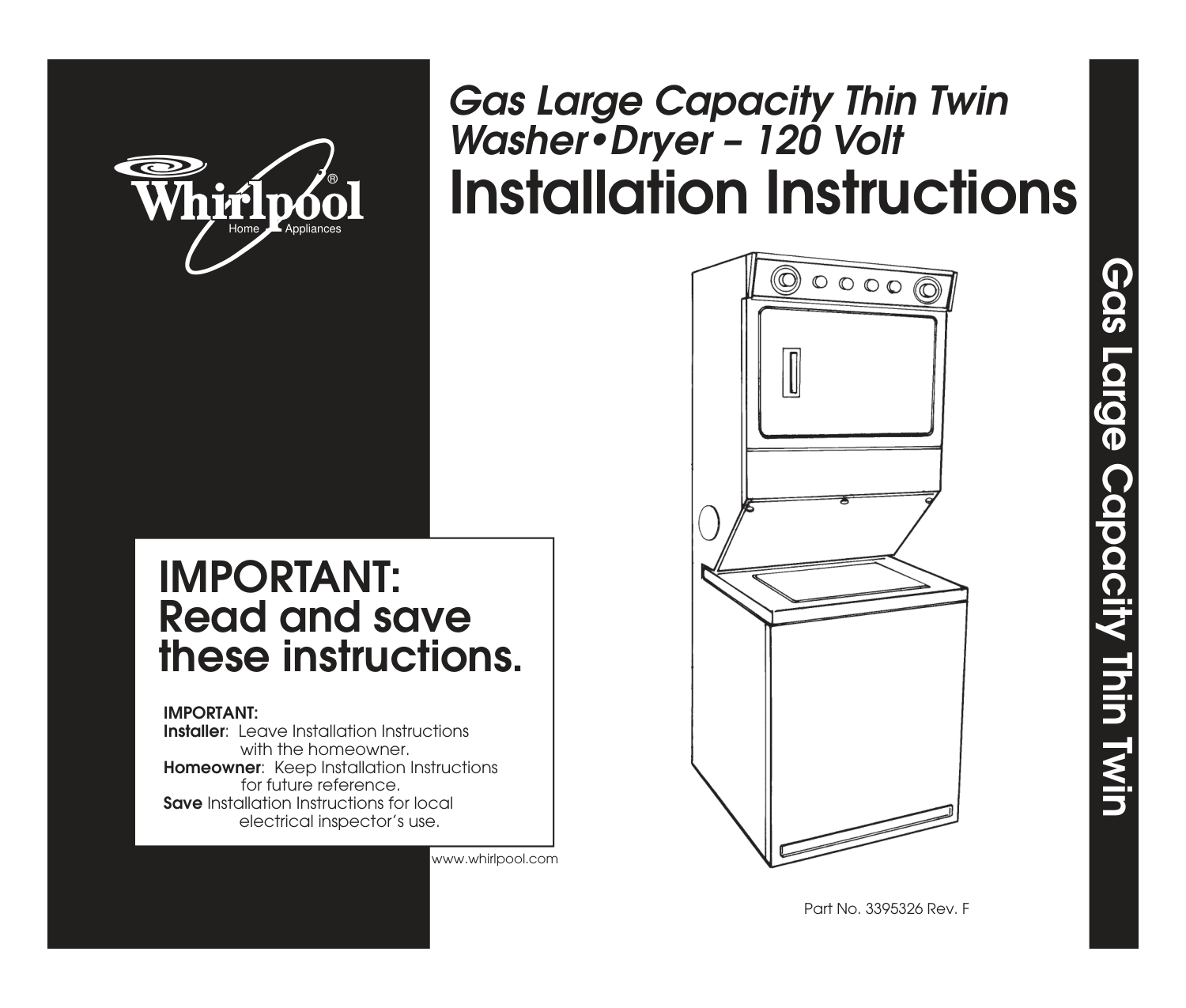
Part No. 3395326 Rev. F Gas Large Capacity Thin Twin Washer•Dryer – 120 Volt Installation Instructions Gas Large Capacity Thin Twin
Important:
Installer: Leave Installation Instructions with the homeowner. Homeowner: Keep Installation Instructions for future reference. Save Installation Instructions for local electrical inspector’s use.Important:
Read and save these instructions. Home Appliances ® www.whirlpool.com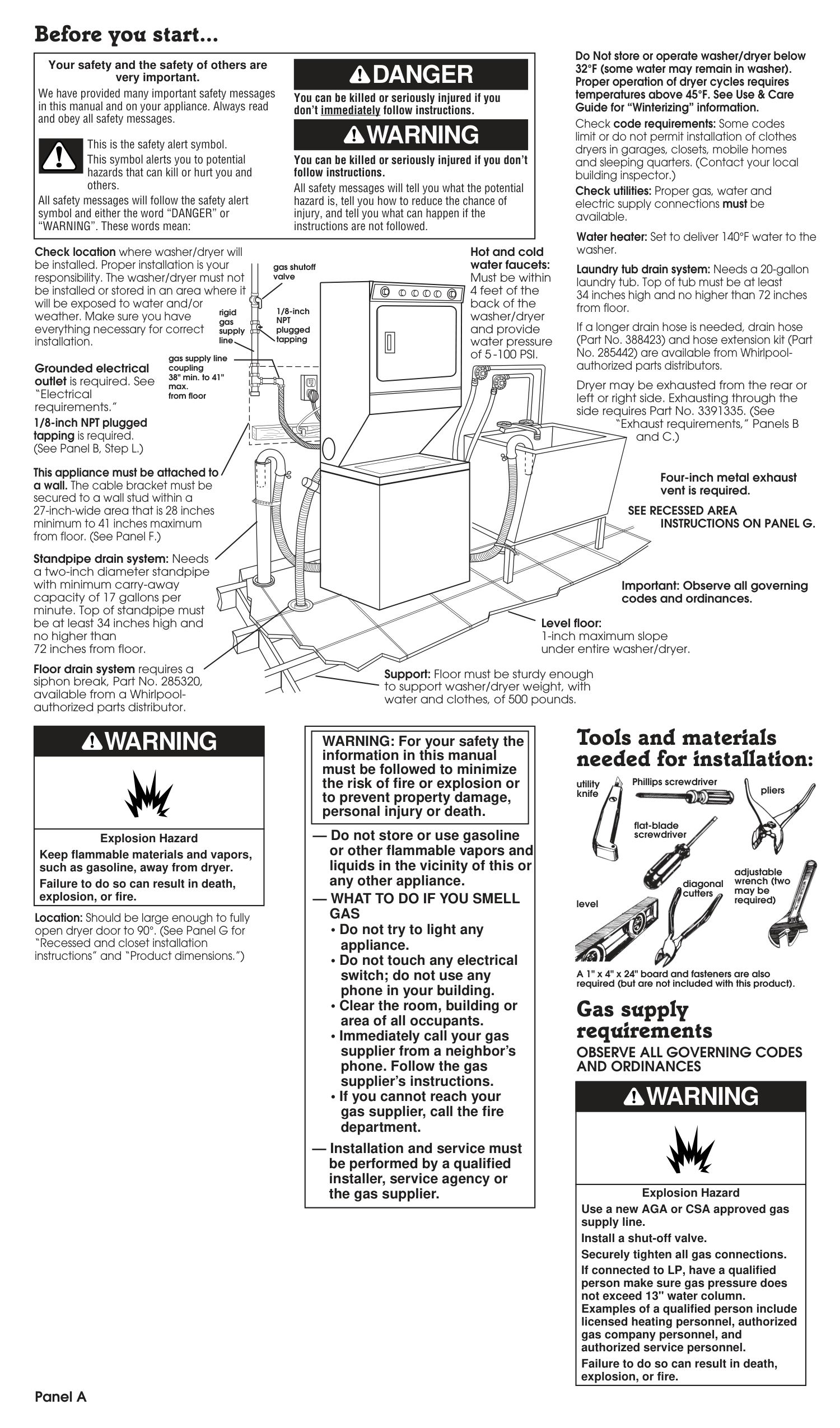
Panel A Tools and materials needed for installation: Phillips screwdriver diagonal cutters utility knife adjustable wrench (two may be required) flat-blade screwdriver level pliers A 1" x 4" x 24" board and fasteners are also required (but are not included with this product). Gas supply requirements
Observe All Governing Codes
And Ordinances
Before you start... Location: Should be large enough to fully open dryer door to 90°. (See Panel G for “Recessed and closet installation instructions” and “Product dimensions.”)Warning
Explosion Hazard Keep flammable materials and vapors, such as gasoline, away from dryer. Failure to do so can result in death, explosion, or fire. Grounded electrical outlet is required. See “Electrical requirements.” Check location where washer/dryer will be installed. Proper installation is your responsibility. The washer/dryer must not be installed or stored in an area where it will be exposed to water and/or weather. Make sure you have everything necessary for correct installation. Water heater: Set to deliver 140°F water to the washer. Laundry tub drain system: Needs a 20-gallon laundry tub. Top of tub must be at least 34 inches high and no higher than 72 inches from floor. If a longer drain hose is needed, drain hose (Part No. 388423) and hose extension kit (Part No. 285442) are available from Whirlpool- authorized parts distributors. Dryer may be exhausted from the rear or left or right side. Exhausting through the side requires Part No. 3391335. (See “Exhaust requirements,” Panels B and C.) Four-inch metal exhaust vent is required.See Recessed Area
Instructions On Panel G.
Important: Observe all governing codes and ordinances. gas supply line coupling 38" min. to 41" max. from floor Support: Floor must be sturdy enough to support washer/dryer weight, with water and clothes, of 500 pounds. Level floor: 1-inch maximum slope under entire washer/dryer. gas shutoff valve Hot and cold water faucets: Must be within 4 feet of the back of the washer/dryer and provide water pressure of 5 -100 PSI. 1/8-inchNpt
plugged tapping rigid gas supply line Standpipe drain system: Needs a two-inch diameter standpipe with minimum carry-away capacity of 17 gallons per minute. Top of standpipe must be at least 34 inches high and no higher than 72 inches from floor. Floor drain system requires a siphon break, Part No. 285320, available from a Whirlpool- authorized parts distributor. This appliance must be attached to a wall. The cable bracket must be secured to a wall stud within a 27-inch-wide area that is 28 inches minimum to 41 inches maximum from floor. (See Panel F.) 1/8-inch NPT plugged tapping is required. (See Panel B, Step L.) Do Not store or operate washer/dryer below 32°F (some water may remain in washer). Proper operation of dryer cycles requires temperatures above 45°F. See Use & Care Guide for “Winterizing” information. Check code requirements: Some codes limit or do not permit installation of clothes dryers in garages, closets, mobile homes and sleeping quarters. (Contact your local building inspector.) Check utilities: Proper gas, water and electric supply connections must be available. WARNING: For your safety the information in this manual must be followed to minimize the risk of fire or explosion or to prevent property damage, personal injury or death. — Do not store or use gasoline or other flammable vapors and liquids in the vicinity of this or any other appliance.— What To Do If You Smell
Gas
Warning
Explosion Hazard Use a new AGA or CSA approved gas supply line. Install a shut-off valve. Securely tighten all gas connections. If connected to LP, have a qualified person make sure gas pressure does not exceed 13" water column. Examples of a qualified person include licensed heating personnel, authorized gas company personnel, and authorized service personnel. Failure to do so can result in death, explosion, or fire. Your safety and the safety of others are very important. We have provided many important safety messages in this manual and on your appliance. Always read and obey all safety messages. This is the safety alert symbol. This symbol alerts you to potential hazards that can kill or hurt you and others. All safety messages will follow the safety alert symbol and either the word “DANGER” or “WARNING”. These words mean: All safety messages will tell you what the potential hazard is, tell you how to reduce the chance of injury, and tell you what can happen if the instructions are not followed. You can be killed or seriously injured if you don’t immediately follow instructions. You can be killed or seriously injured if you don’t follow instructions.Warning
Danger
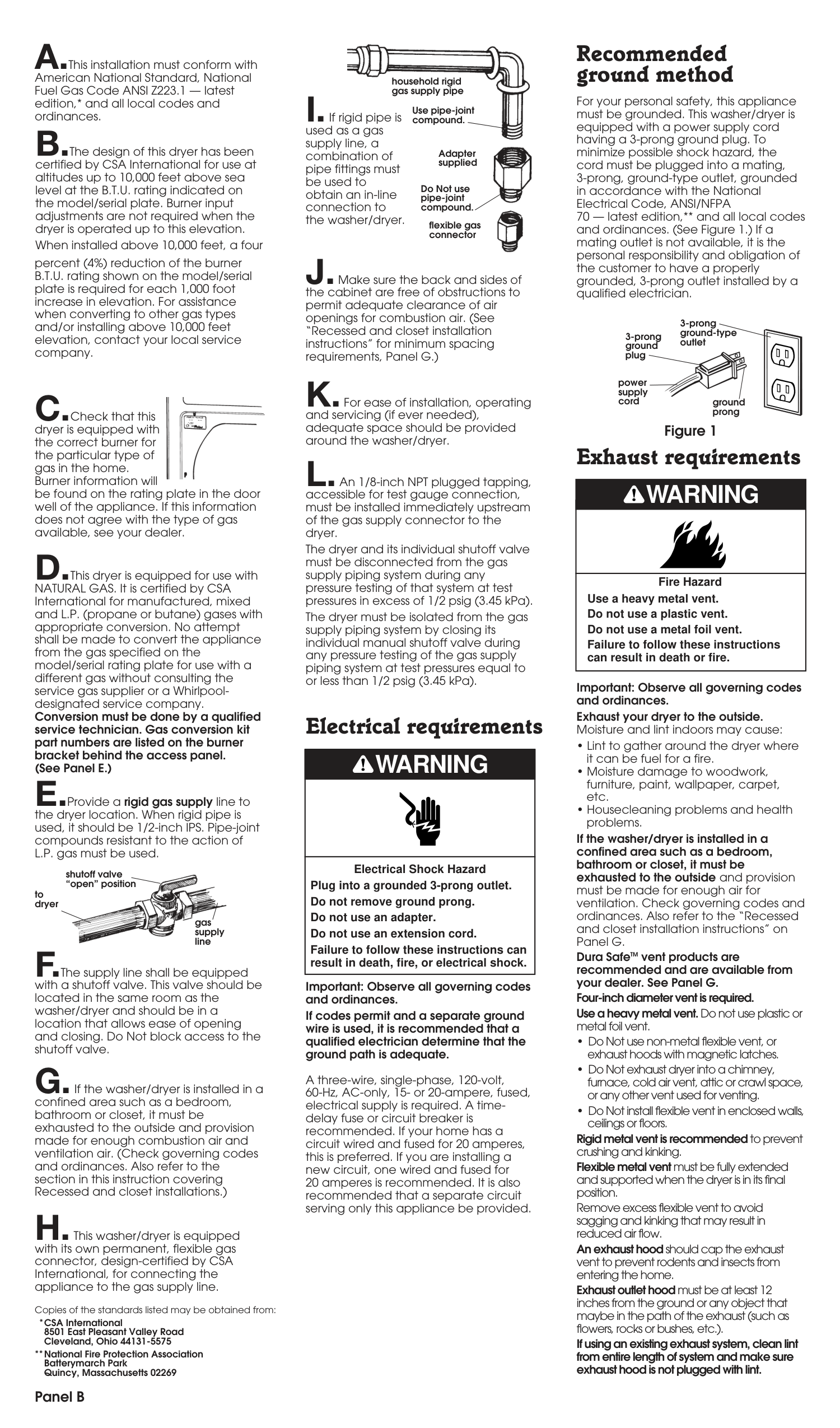
Important: Observe all governing codes and ordinances. Exhaust your dryer to the outside. Moisture and lint indoors may cause:
Warning
Electrical Shock Hazard Plug into a grounded 3-prong outlet. Do not remove ground prong. Do not use an adapter. Do not use an extension cord. Failure to follow these instructions can result in death, fire, or electrical shock. Fire Hazard Use a heavy metal vent. Do not use a plastic vent. Do not use a metal foil vent. Failure to follow these instructions can result in death or fire. percent (4%) reduction of the burner B.T.U. rating shown on the model/serial plate is required for each 1,000 foot increase in elevation. For assistance when converting to other gas types and/or installing above 10,000 feet elevation, contact your local service company.Warning
Copies of the standards listed may be obtained from: *CSA International 8501 East Pleasant Valley Road Cleveland, Ohio 44131-5575 **National Fire Protection Association Batterymarch Park Quincy, Massachusetts 02269 Use pipe-joint compound. Adapter supplied Do Not use pipe-joint compound. flexible gas connector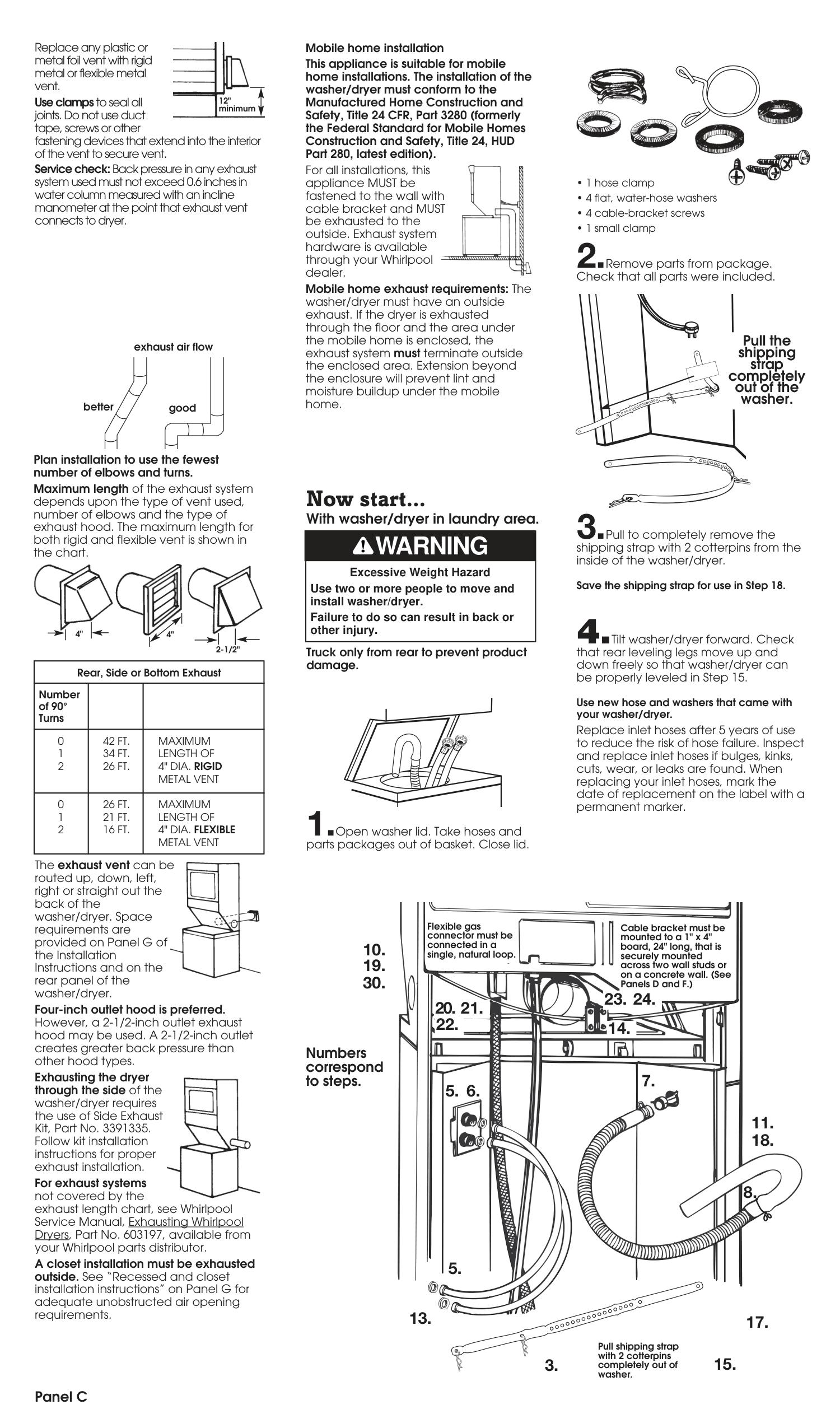
The exhaust vent can be routed up, down, left, right or straight out the back of the washer/dryer. Space requirements are provided on Panel G of the Installation Instructions and on the rear panel of the washer/dryer. Four-inch outlet hood is preferred. However, a 2-1/2-inch outlet exhaust hood may be used. A 2-1/2-inch outlet creates greater back pressure than other hood types. Exhausting the dryer through the side of the washer/dryer requires the use of Side Exhaust Kit, Part No. 3391335. Follow kit installation instructions for proper exhaust installation. For exhaust systems not covered by the exhaust length chart, see Whirlpool Service Manual, Exhausting Whirlpool Dryers, Part No. 603197, available from your Whirlpool parts distributor. A closet installation must be exhausted outside. See “Recessed and closet installation instructions” on Panel G for adequate unobstructed air opening requirements. Panel C 4" 4" Rear, Side or Bottom Exhaust 2-1/2"
Maximum
Length Of
4" Dia. Rigid
Metal Vent
Maximum
Length Of
4" Dia. Flexible
Metal Vent
42 Ft.
34 Ft.
26 Ft.
26 Ft.
21 Ft.
16 Ft.
0 1 2 0 1 2 Number of 90° Turns Now start... With washer/dryer in laundry area. Truck only from rear to prevent product damage. 1.Open washer lid. Take hoses and parts packages out of basket. Close lid.Warning
better good exhaust air flow Plan installation to use the fewest number of elbows and turns. Maximum length of the exhaust system depends upon the type of vent used, number of elbows and the type of exhaust hood. The maximum length for both rigid and flexible vent is shown in the chart. Replace any plastic or metal foil vent with rigid metal or flexible metal vent. Use clamps to seal all joints. Do not use duct tape, screws or other fastening devices that extend into the interior of the vent to secure vent. Service check: Back pressure in any exhaust system used must not exceed 0.6 inches in water column measured with an incline manometer at the point that exhaust vent connects to dryer. 12" minimum Mobile home installation This appliance is suitable for mobile home installations. The installation of the washer/dryer must conform to the Manufactured Home Construction and Safety, Title 24 CFR, Part 3280 (formerly the Federal Standard for Mobile Homes Construction and Safety, Title 24, HUD Part 280, latest edition). For all installations, this appliance MUST be fastened to the wall with cable bracket and MUST be exhausted to the outside. Exhaust system hardware is available through your Whirlpool dealer. Mobile home exhaust requirements: The washer/dryer must have an outside exhaust. If the dryer is exhausted through the floor and the area under the mobile home is enclosed, the exhaust system must terminate outside the enclosed area. Extension beyond the enclosure will prevent lint and moisture buildup under the mobile home. 4.Tilt washer/dryer forward. Check that rear leveling legs move up and down freely so that washer/dryer can be properly leveled in Step 15.
Panel D Inlet valves are plastic. Do not strip or crossthread. 6.Attach hose to bottom inlet valve opening first; then second hose to top inlet valve. Tighten couplings by hand. Then use pliers to make an additional two-thirds turn.
Important: This Procedure
Must Be Followed To Assure
Proper Installation.
8.Standpipe or laundry tub drain system: Open clamp and slide over “hook” end of drain hose to secure the rigid and corrugated sections together. 7.To prevent the drain hose from coming off or leaking, it must be installed per the following instructions:Any Other Lubricant.
Do Not Force Excess Length Of
Drain Hose Down The Standpipe. This
Could Cause Siphoning.
12.Before attaching water inlet hoses, run water through both faucets into a bucket. This will get rid of particles in water lines that might clog hoses. Mark which is the hot water faucet. Replace inlet hoses after 5 years of use to reduce the risk of hose failure. Inspect and replace inlet hoses if bulges, kinks, cuts, wear, or leaks are found. When replacing your inlet hoses, mark the date of replacement on the label with a permanent marker. 13.Attach bottom hose (inlet marked “H”) to hot water faucet. Attach top hose (inlet marked “C”) to cold water faucet. Tighten the coupling to the faucet by hand. Use pliers to make final two-thirds turn. Move washer/dryer to its permanent location. Remove cardboard from under washer/dryer. 14.Cut the plastic strap securing the cable wire bracket to the power supply cord and discard. DO NOT CUT CABLE. Remove the power supply cord from the bracket. Attach the cable wire bracket to the wall. Check that bracket is secure. (See Panel F.) 15.Tilt washer/dryer forward raising back legs 1 inch off of floor to adjust rear, self-leveling legs. Gently lower washer/dryer to floor. Check levelness of the washer/dryer by placing a carpenter’s level on top of the washer, first side to side; then front to back. If washer/dryer not level, check that rear leveling legs move up and down freely. If washer/dryer is level, go to Step 17. Insert corner posts 6 inches from left leg. Do Not insert corner posts in the center of the washer/dryer. 16.If it is not level, carefully tilt washer/dryer backward until front of washer/dryer is 3-4 inches off of floor. Insert 4 corner posts under washer/dryer about 6 inches from the left leg. Loosen nuts on each front leg. Adjust the front legs up or down. Tilt washer/dryer backward and remove corner posts. Gently lower the washer/dryer to the floor. Repeat Step 15. If it is still not level, repeat Step 16 and then Step 15 until washer/dryer is level. 17.When washer/dryer is level, use wrench to turn nuts on front legs up tightly against washer/dryer base. If nuts are not tight against washer/dryer base, the washer/dryer may vibrate. 18.Measure and mark a point approximately 16 inches from the plug end of the shipping strap. Cut the shipping strap at this point. Check that hose is not twisted or kinked and is securely in place.A
B
C
strap strap Put “hook” end of drain hose in tub or standpipe. Tightly wrap the shipping strap around the drain hose and tub or standpipe or inlet hose as shown in Figures A-C. Push plug into the nearest hole in the shipping strap. Hose must be cut exactly to length so “hook” end is held tightly over edge of standpipe. If drain hose cannot be strapped in place, it must be cut exactly to length so the “hook” end is held tightly over the edge of the tub or standpipe. If a longer drain hose is needed, drain hose (Part No. 388423) and hose extension kit (Part No. 285442) are available from authorized parts distributors. If drain hose must be shortened, use hose kit (Part No. 285442). Note: If washer/dryer is moved to adjust drain hose, the washer/dryer must be leveled again. Repeat Steps 15-17. Place cardboard under the washer/dryer and carefully move washer/dryer to avoid damaging floor covering. strap 19.If you did not remove the access panel in Step 10, remove three Phillips-head screws and one bumper, located at the top of the access panel. Set the panel, screws and bumper aside. Figure D 16" 16" drain hose connector clamp drain hose 1/4" 1/4" max. 16" 5.Insert a flat washer into each end of the inlet hoses. Check that washers are firmly seated in couplings. washer coupling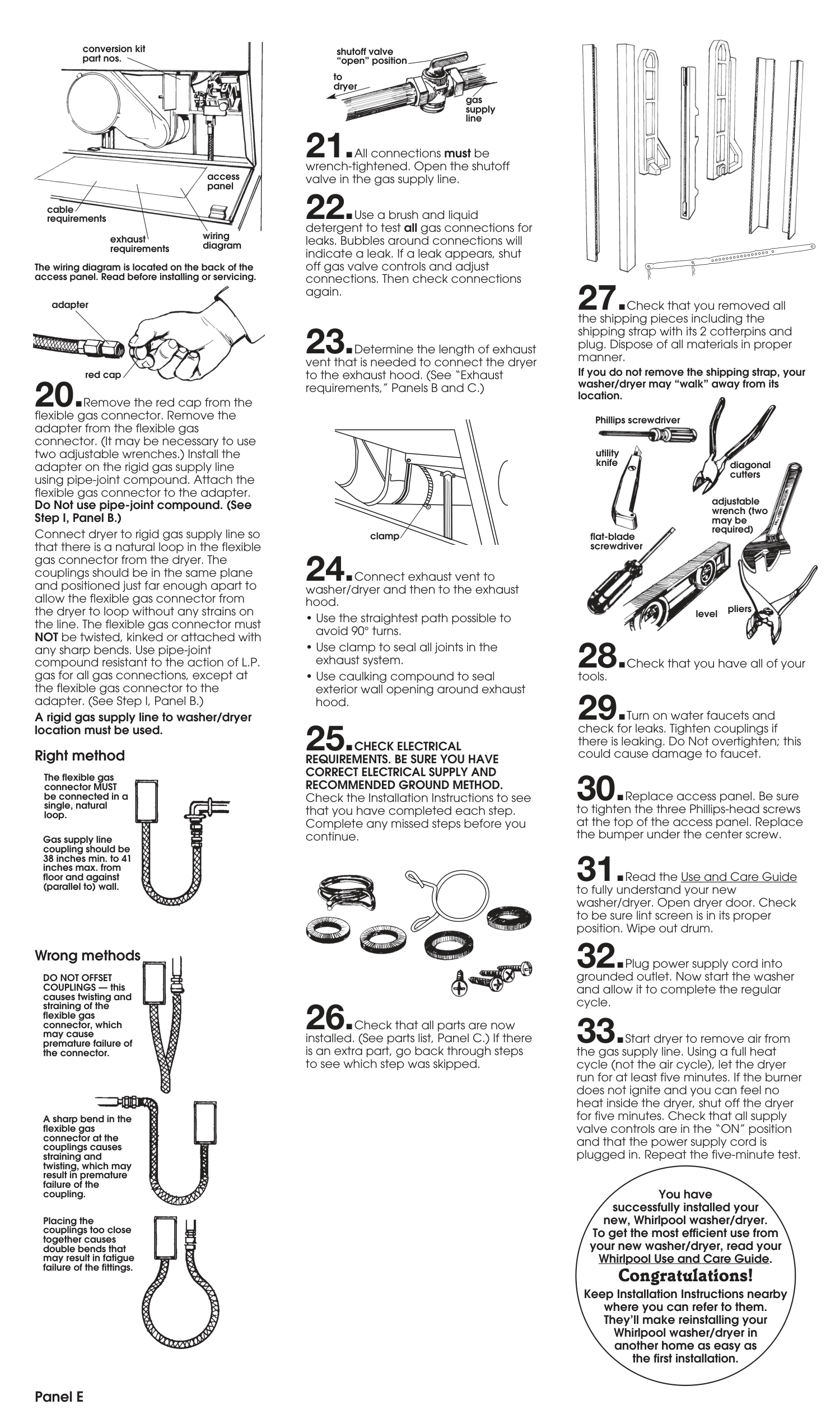
Panel E 20.Remove the red cap from the flexible gas connector. Remove the adapter from the flexible gas connector. (It may be necessary to use two adjustable wrenches.) Install the adapter on the rigid gas supply line using pipe-joint compound. Attach the flexible gas connector to the adapter. Do Not use pipe-joint compound. (See Step I, Panel B.) Connect dryer to rigid gas supply line so that there is a natural loop in the flexible gas connector from the dryer. The couplings should be in the same plane and positioned just far enough apart to allow the flexible gas connector from the dryer to loop without any strains on the line. The flexible gas connector must NOT be twisted, kinked or attached with any sharp bends. Use pipe-joint compound resistant to the action of L.P. gas for all gas connections, except at the flexible gas connector to the adapter. (See Step I, Panel B.) A rigid gas supply line to washer/dryer location must be used. conversion kit part nos. access panel cable requirements exhaust requirements wiring diagram The wiring diagram is located on the back of the access panel. Read before installing or servicing. adapter red cap Right method Wrong methods The flexible gas connector MUST be connected in a single, natural loop. Gas supply line coupling should be 38 inches min. to 41 inches max. from floor and against (parallel to) wall.
Do Not Offset
COUPLINGS — this causes twisting and straining of the flexible gas connector, which may cause premature failure of the connector. A sharp bend in the flexible gas connector at the couplings causes straining and twisting, which may result in premature failure of the coupling. Placing the couplings too close together causes double bends that may result in fatigue failure of the fittings. 21.All connections must be wrench-tightened. Open the shutoff valve in the gas supply line. 23.Determine the length of exhaust vent that is needed to connect the dryer to the exhaust hood. (See “Exhaust requirements,” Panels B and C.) 22.Use a brush and liquid detergent to test all gas connections for leaks. Bubbles around connections will indicate a leak. If a leak appears, shut off gas valve controls and adjust connections. Then check connections again. 24.Connect exhaust vent to washer/dryer and then to the exhaust hood.25.Check Electrical
Requirements. Be Sure You Have
Correct Electrical Supply And
Recommended Ground Method.
Check the Installation Instructions to see that you have completed each step. Complete any missed steps before you continue. 26.Check that all parts are now installed. (See parts list, Panel C.) If there is an extra part, go back through steps to see which step was skipped. 27.Check that you removed all the shipping pieces including the shipping strap with its 2 cotterpins and plug. Dispose of all materials in proper manner. If you do not remove the shipping strap, your washer/dryer may “walk” away from its location. 28.Check that you have all of your tools. 29.Turn on water faucets and check for leaks. Tighten couplings if there is leaking. Do Not overtighten; this could cause damage to faucet. 30.Replace access panel. Be sure to tighten the three Phillips-head screws at the top of the access panel. Replace the bumper under the center screw. 31.Read the Use and Care Guide to fully understand your new washer/dryer. Open dryer door. Check to be sure lint screen is in its proper position. Wipe out drum. 32.Plug power supply cord into grounded outlet. Now start the washer and allow it to complete the regular cycle. 33.Start dryer to remove air from the gas supply line. Using a full heat cycle (not the air cycle), let the dryer run for at least five minutes. If the burner does not ignite and you can feel no heat inside the dryer, shut off the dryer for five minutes. Check that all supply valve controls are in the “ON” position and that the power supply cord is plugged in. Repeat the five-minute test. You have successfully installed your new, Whirlpool washer/dryer. To get the most efficient use from your new washer/dryer, read your Whirlpool Use and Care Guide. Congratulations! Keep Installation Instructions nearby where you can refer to them. They’ll make reinstalling your Whirlpool washer/dryer in another home as easy as the first installation. Phillips screwdriver diagonal cutters utility knife adjustable wrench (two may be required) flat-blade screwdriver level pliers gas supply line to dryer shutoff valve “open” position clamp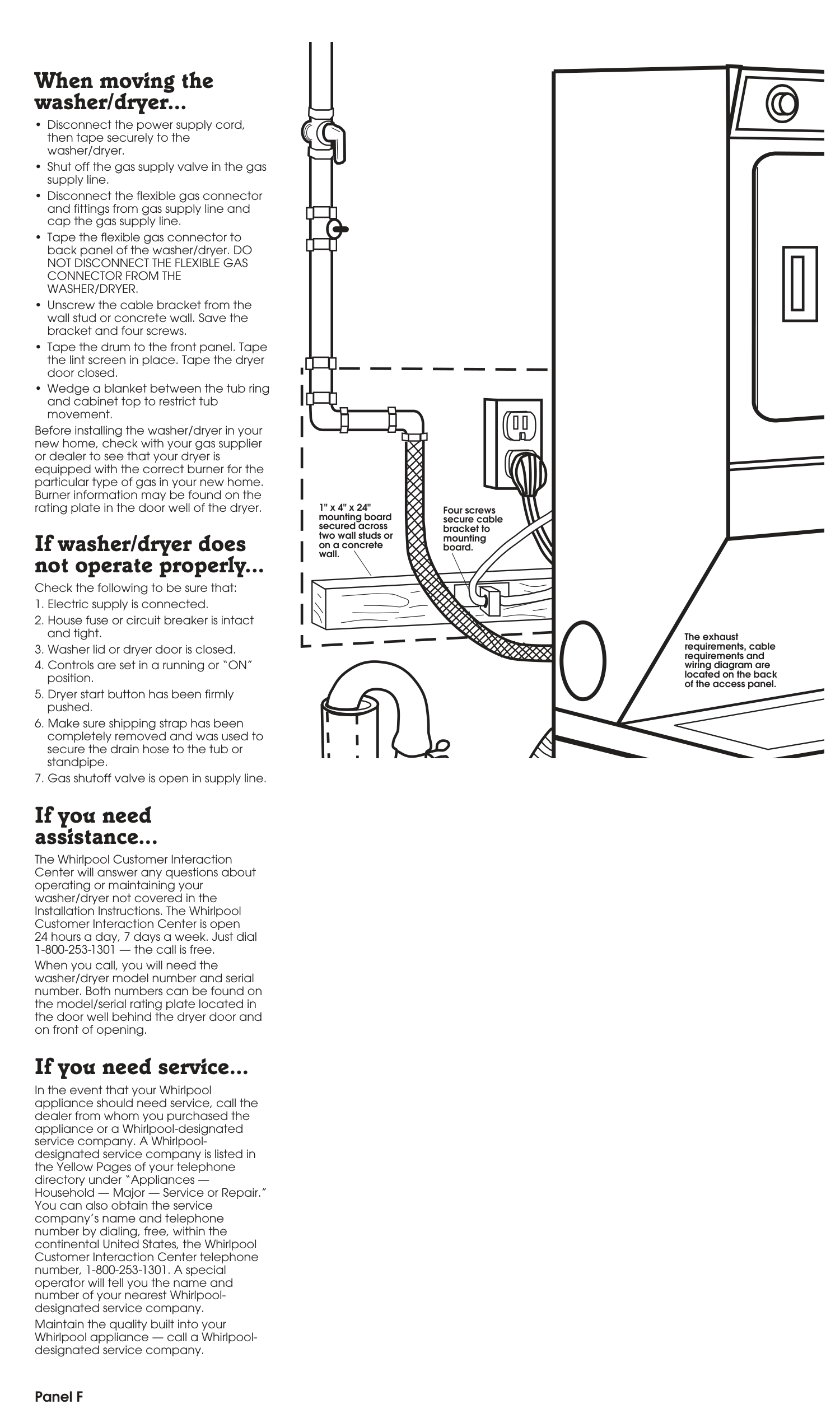
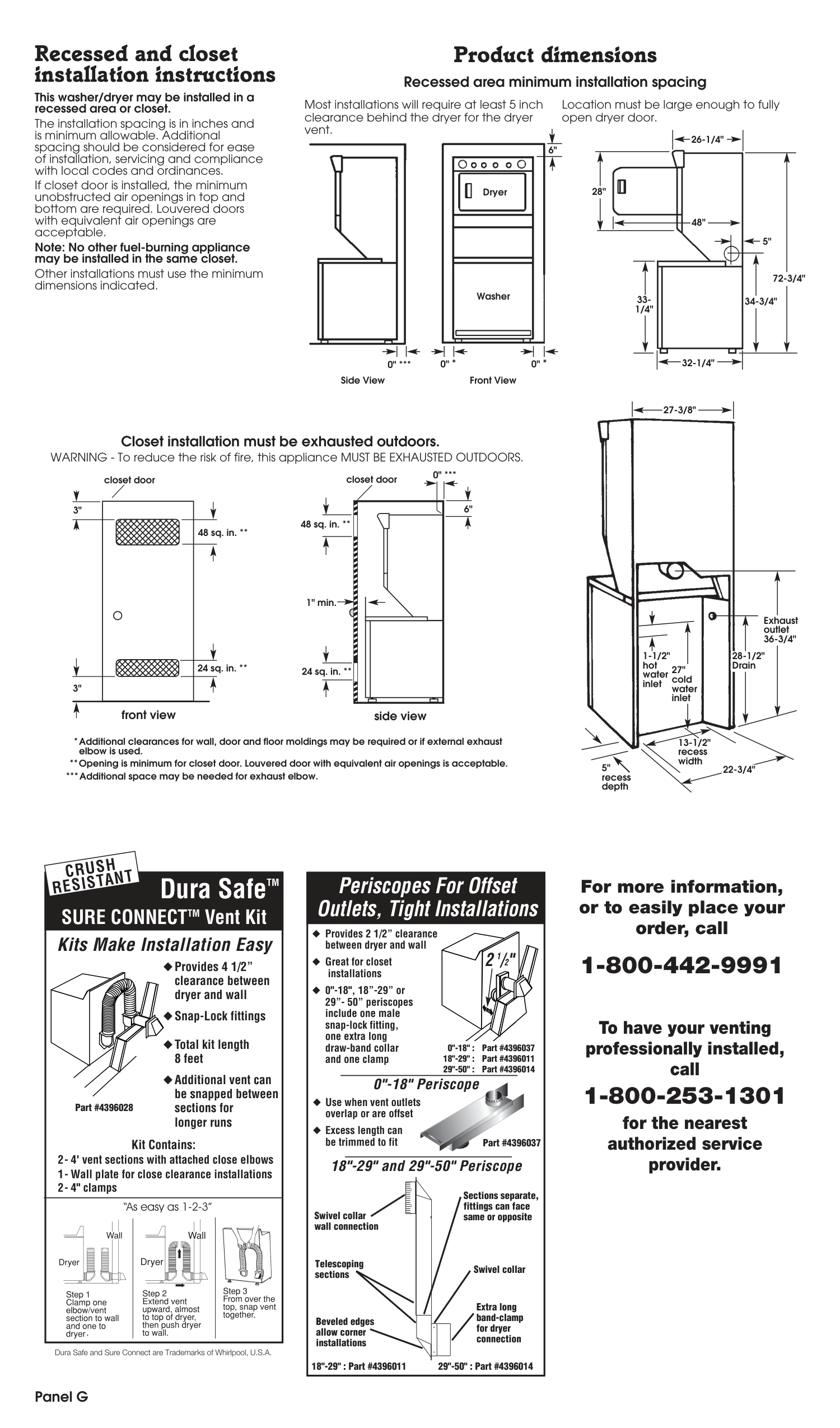
Panel F When moving the washer/dryer...
Not Disconnect The Flexible Gas
Connector From The
Washer/Dryer.
Panel G Recessed and closet installation instructions This washer/dryer may be installed in a recessed area or closet. The installation spacing is in inches and is minimum allowable. Additional spacing should be considered for ease of installation, servicing and compliance with local codes and ordinances. If closet door is installed, the minimum unobstructed air openings in top and bottom are required. Louvered doors with equivalent air openings are acceptable. Note: No other fuel-burning appliance may be installed in the same closet. Other installations must use the minimum dimensions indicated. Product dimensions Dryer Washer 0" * 0" * Front View 6" Recessed area minimum installation spacing 28" 48" 72-3/4" 5" 33- 1/4" 26-1/4" 32-1/4" 0" *** Side View 27-3/8" 1-1/2" hot water inlet 13-1/2" recess width 5" recess depth 28-1/2" Drain Exhaust outlet 36-3/4" 27" cold water inlet 34-3/4" 22-3/4" Most installations will require at least 5 inch clearance behind the dryer for the dryer vent. Location must be large enough to fully open dryer door. *Additional clearances for wall, door and floor moldings may be required or if external exhaust elbow is used. **Opening is minimum for closet door. Louvered door with equivalent air openings is acceptable. ***Additional space may be needed for exhaust elbow. 6" 0" *** Closet installation must be exhausted outdoors. closet door 48 sq. in. ** 24 sq. in. ** 1" min. 3" 3" 48 sq. in. ** front view side view closet door 24 sq. in. ** WARNING - To reduce the risk of fire, this appliance MUST BE EXHAUSTED OUTDOORS. SURE CONNECTTM Vent Kit
Crush
Resistant
Dura SafeTm
Kits Make Installation Easy NProvides 4 1/2” clearance between dryer and wall NSnap-Lock fittings NTotal kit length 8 feet NAdditional vent can be snapped between sections for longer runs Kit Contains: 2- 4' vent sections with attached close elbows 1- Wall plate for close clearance installations 2- 4" clamps Part #4396028 Sections separate, fittings can face same or opposite Extra long band-clamp for dryer connection Swivel collar Beveled edges allow corner installations Telescoping sections Swivel collar wall connection N Provides 2 1/2” clearance between dryer and wall N Great for closet installations N 0"-18", 18”-29” or 29”- 50” periscopes include one male snap-lock fitting, one extra long draw-band collar and one clamp 2 1/2" 2 1/2" Periscopes For Offset Outlets, Tight Installations N Use when vent outlets overlap or are offset N Excess length can be trimmed to fit 18"-29" and 29"-50" Periscope 0"-18" Periscope 0"-18" : Part #4396037 18"-29" : Part #4396011 29"-50" : Part #4396014 Part #4396037 18"-29" : Part #4396011 29"-50" : Part #4396014 Dura Safe and Sure Connect are Trademarks of Whirlpool, U.S.A. For more information, or to easily place your order, call 1-800-442-9991 To have your venting professionally installed, call 1-800-253-1301 for the nearest authorized service provider. .
Prepared by Whirlpool Corporation, Benton Harbor, Michigan 49022 Part No. 3395326 Rev. F © 2000 Whirlpool Corporation ® Registered Trademark of Whirlpool, U.S.A. Printed in U.S.A.