
Ask AI
— answers from the official manualAnswers from the official manual.
Common questions
Common Questions
9 totalHow can I troubleshoot if my machine won't operate?
Check that the power plug is securely inserted, ensure the kneading blade is correctly installed on the shaft in the bread pan, verify that you have selected a valid setting, and confirm there was no power interruption during use. The LCD may also show error messages for further guidance. (Page 24)
How do I remove ingredients that fell into the baking chamber?
If any of your ingredients spill or drop out of the bread pan, immediately use a damp cloth to carefully clean them up from inside the baking chamber. Ensure all parts are thoroughly dried before reuse. (Page 19)
Why should I not press the START/STOP button to add ingredients?
Pressing the START/STOP button during operation will cancel the selected program, interrupting bread-making and requiring you to reset it from the beginning. Always use the designated time in the second kneading cycle for ingredient addition. (Page 10)
How do I properly store the machine?
Store the machine upright with dry parts inside and close the lid. Do not place heavy objects on top of it, ensuring no condensation occurs to avoid damaging internal components. (Page 25)
What happens if my bread doesn’t rise properly?
Poor rising can occur due to various reasons: incorrect flour protein levels or yeast failure. Check the use-by-date of ingredients and ensure accurate measurements for best results in bread rising. (Page 18)
Why is it important to add ingredients in a specific order?
Incorrect order can lead to premature activation of yeast, poor mixing or uneven distribution of baking powder when using the PRESET TIMER. Always follow recipe instructions carefully regarding ingredient placement. (Page 18)
Full Manual
48 pages
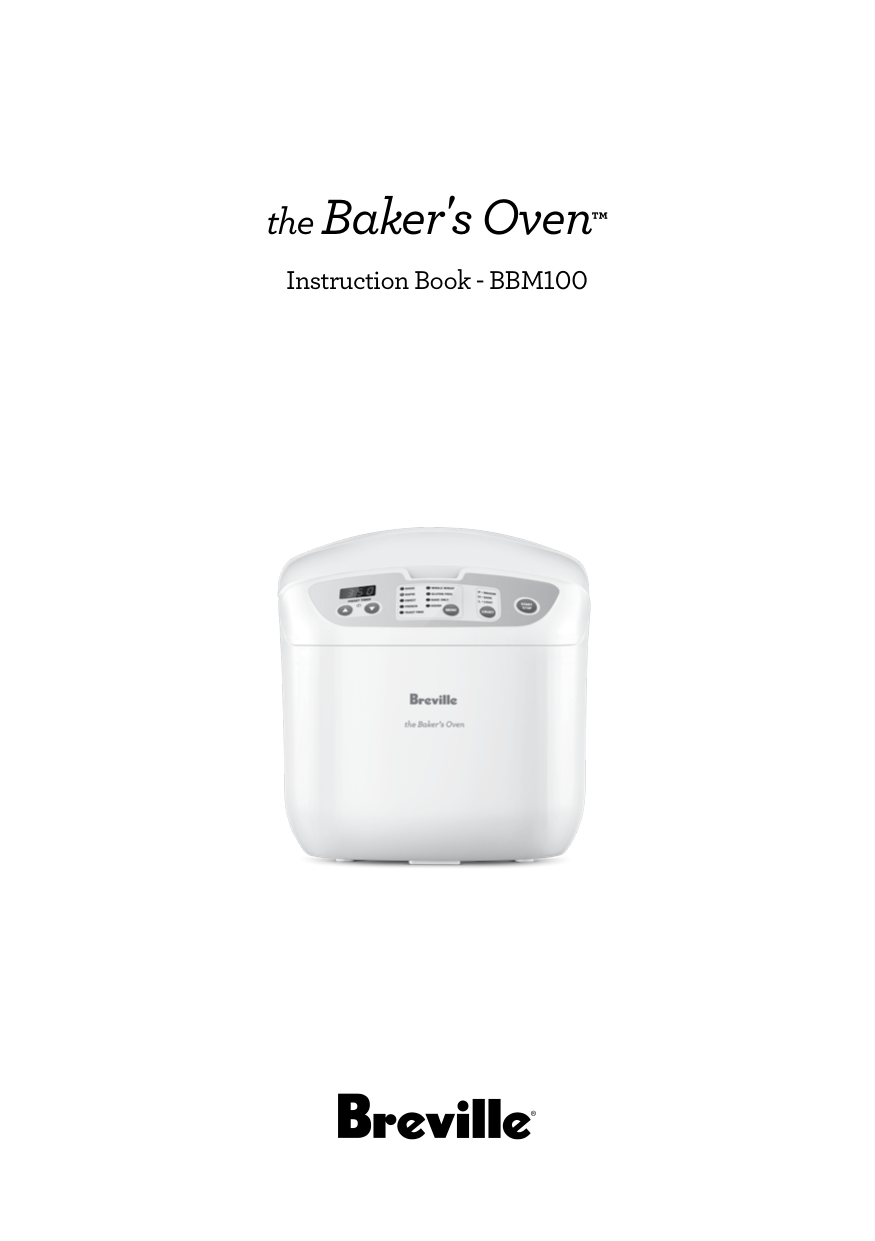
the Baker's Oven™
Instruction Book - BBM100

BREVILLE RECOMMENDS SAFETY FIRST
At Breville we are very safety conscious. We design and manufacture consumer products with the safety of you, our valued customer, foremost in mind. In addition we ask that you exercise a degree of care when using any electrical appliance and adhere to the following precautions.
IMPORTANT SAFEGUARDS
####### READ ALL INSTRUCTIONS BEFORE USE AND SAVE FOR FUTURE REFERENCE
IMPORTANT SAFEGUARDS FOR ALL ELECTRICAL APPLIANCES
• The installation of a residual current device (safety switch is recommended to provide additional safety protection when using electrical appliances. It is advisable that a safety switch with a rated residual operating current not exceeding 30mA be installed in the electrical circuit supplying the appliance. See your electrician for professional advice.
######### CAUTION
The lid and the outer surface may get hot when the appliance is operating. The temperature of accessible surfaces may be high when the appliance is operating.
Steam vents are very hot during baking.
FOR HOUSEHOLD USE ONLY SAVE THESE INSTRUCTIONS
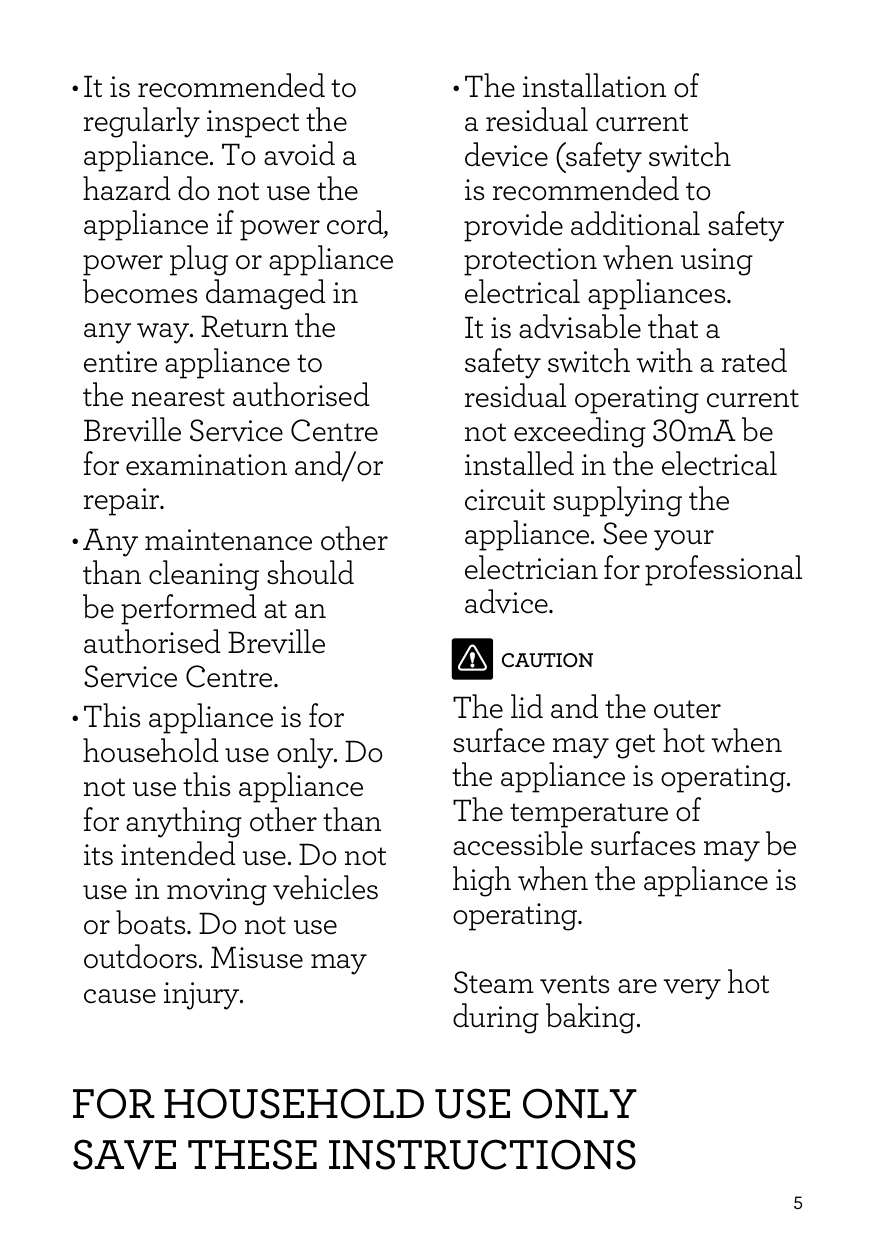
###### Components

A
B
E
C
FD
G
###### Functions
######### THE CONTROL PANEL
The Control Panel is designed to perform several functions and is activated by switching the bread machine on at the power outlet. The LED Screen indicates the setting and crust colour selection then the completion time for the setting. The various buttons are used to set the functions and to start or stop the bread machine. The buttons should be pressed firmly. A soft beep sound is made as each button is pressed.
######### LED SCREEN
The LED Screen shows firstly a setting (1 –9) and crust colour (P, H or L) selected, then automatically changes to show the total time for the setting. When the START/STOP button is pressed to commence operation, the time displayed (in hours and minutes) is the time remaining until the selected setting is completed.
######### MENU
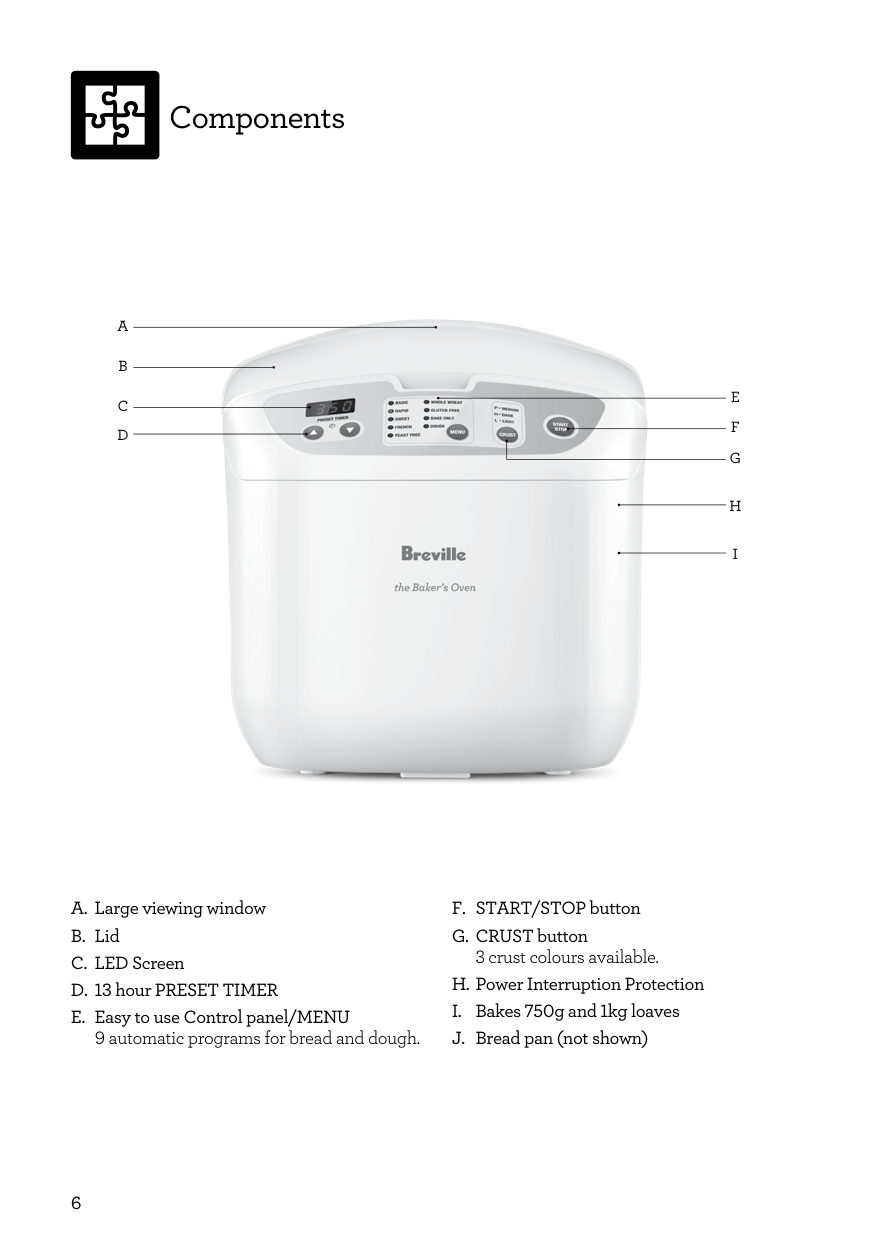
Press this button to select one of the 9 automatic settings available. These settings are listed on the next page. Each time the MENU button is pressed, the setting is changed and a red light illuminates alongside the setting selected. The setting selected is also shown on the LED Screen between 1 to 9.
######### CRUST
Press the CRUST button to select the 3 crust colours available for the bread settings only. The colour selected is show on the LED Screen
######### PRESET TIMER
Use the PRESET TIMER to delay the start of the selected program. Press the s or t buttons (which will move time up or down in 10 minute increments) to preset the timer (refer page 11).
START/STOP The oven features a combined START/STOP button. To START: Press the START/STOP button to commence the selected program or begin timer countdown for the PRESET TIMER.
To STOP: To stop and cancel the program in the mid-cycle the START/STOP button must be pressed down and held for approx. 2 seconds until the beep sounds and the LED Screen is reset. DO NOT PRESS THE START/ STOP BUTTON when checking the bread as this will cancel the program. The machine will not continue to operate, in the selected program.
########## POWER INTERRUPTION PROTECTION
The Breville Baker’s Oven has an in-built Power Interruption Protection system. If the power is interrupted for 5 minutes or less (by a power failure or accidentally switching off at the power outlet), the program will be automatically resumed when the power is restored.
######### BREAD AND DOUGH SETTINGS
############ SETTING RANGE
This setting is suitable for sweeter style breads as the rising times are longer and the baking temperature is lower.
The setting is suitable for breads lower in fat and sugar as the rising times are longer and the baking temperature higher. It will produce a coarsely textured crumb with a harder crust.
This setting uses doughs that rely on baking powder or bicarbonate of soda as the raising agent are used for this setting. Recipes for this cycle can be found in the Yeast free section of this book.
This setting is designed to allow extra baking of up to 1 hour if required. For those who enjoy a crispier crust, extend the baking time.
This setting takes 1 hour 30 minutes to complete. Remove the dough from the bread machine, hand shape, allow to rise again in a warm area then bake in a conventional oven. Instructions and recipes for Bread Rolls, Buns, Pizza and Focaccia are also included in the Dough section of this book.
######### USING THE BAKE ONLY SETTING
The BAKE ONLY setting of the oven gives more versatility to your bread making. The BAKE ONLY setting is useful when wishing to:
USING THE PRESET TIMER The oven PRESET TIMER lets you wake to the aroma of freshly baked bread in the morning. You can set the timer up to 13 hours in advance before you require the baked loaf. Recipes using perishable ingredients should not be made using the PRESET TIMER.
########## Step 1
To bake a loaf of bread on the BASIC MEDIUM Bread setting using the PRESET TIMER, follow steps in the baking guide to choose the type of bread you want to bake. Once bread setting and crust colour is chosen go to step 2.
########## Step 2
To preset the timer use the s or t buttons on the control panel to enter the number of hours in which you want your bread to be ready (the amount of time shown in the LED Screen will include the total setting time).
To set the time, press the s button or t button the appropriate number of times until you see the number of hours and minutes displayed. Each time the s button, the timer advances 10 minutes. Each time you press the t button, the timer is set back 10 minutes. Hold down the s or t buttons for speedier adjustments.
########## Step 3
Press the START/STOP button to commence operation. The colon (:) in the time displayed begins to flash indicating that the PRESET TIMER has started. The remaining time will count down in one minute increments. When the time display indicates ‘0:00’, baking is complete.
######### NOTE
Baking Guide
The following instructions are to be used when making Bread or Dough recipes from the recipe section of this book. All recipes use local ingredients and Australian Standard Metric Measuring tools (cup, spoons and weighing scales) for accuracy in producing a 750g or 1kg loaf of bread. The actual weight of the baked loaf will vary depending on the weight of raw ingredients used. Remove and safely discard any packaging materials and promotional labels before using the oven for the first time.
######### OPEN THE LID AND REMOVE THE BREAD PAN
Open the lid and remove the bread pan from the oven by holding the handle and lifting straight up. Always remove the bread pan from the oven before adding ingredients to ensure ingredients are not spilt into the baking chamber and the element. Before using for the first time, we recommend that the inside of the bread pan and the kneading blades are washed with warm soapy water, rinsed and dried thoroughly. Do not immerse the bread pan in water.
######### INSERT THE KNEADING BLADE
It is important that the kneading blade is properly inserted on the shaft in the base of the bread pan by aligning the flat edge on the inside of the kneading blade with the flat side of the shaft. If the blade is not inserted correctly the ingredients may not be mixed and kneaded properly.
######### ADD INGREDIENTS INTO THE BREAD PAN
It is IMPORTANT that the ingredients are added in the correct order listed in the recipe and that the ingredients are measured and weighed accurately or the dough may not mix correctly or rise sufficiently. All ingredients should be at room temperature 20 –25°C. Ingredients should be added in the following order:
######### NOTE
Mound the flour into the pan, make a small hollow in the centre and place the yeast there. If the yeast contacts the water before the kneading, the bread may not rise well. This is important when using the PRESET TIMER.
######### RETURN THE BREAD PAN TO THE MACHINE
Insert the bread pan into the machine as follows:
######### CLOSE THE LID
It is not recommended to open the lid during operation except to check the consistency of the dough and add additional ingredients in the kneading cycle, or to glaze and add seeds to the top of the loaf in the baking cycle.
PLUG IN THE BREAD MACHINE Insert the power plug into a 230/240V volt power outlet. Switch on at the power outlet. The LED Screen will show 1P then automatically change to show the total time
######### SELECT THE BREAD SETTING AND CRUST COLOUR
Press the MENU button until the LED Screen indicates the number of the required setting. The red light on the MENU list will also indicate the setting selected. The letter P (MEDIUM crust) will also show in the LED Screen when a bread setting is selected.
Press the CRUST button once to select H (DARK crust) or twice to select L (LIGHT crust).
The crust selection is available on bread settings 1–7.
######### START THE BREAD MACHINE
Press the START/STOP button to commence operation. The total setting time will appear on the LED Screen. The setting time will count down in one minute increments. The colon : between the hour and the minutes displayed will flash throughout the kneading, rising and baking cycles.
The kneading cycles commence. During the kneading cycles beeps will sound indicating the correct time to add other ingredients.
######### ADD-IN INGREDIENT BEEPER
The oven features an ‘Add-In Ingredient Beeper’ which operates in the BASIC, RAPID, SWEET, FRENCH, WHOLE WHEAT and DOUGH settings. The bread machine will sound 10 beeps at approximately 8 minutes before the end of the second kneading cycle, indicating the time to add any additional fruit, nuts, herbs, chocolate, etc. required or as specified in the recipes.
The addition of ingredients at this time assists with keeping fruits, etc. whole, rather than being mashed through the dough making it heavy.
Open the lid, gradually add the additional ingredients to the dough as it is kneading. Take care not to drop the ingredients over the side of the bread pan into the baking chamber, as these may burn and smoke during the baking cycle. Close the lid. The rising cycles begin when the kneading cycles end and the dough will start to rise. During the rising cycles, the dough will be degassed twice by the blade moving at the end of the first and second rising cycles. The dough rises fully in the third rising cycle. The baking cycle commences when rising cycles end. The dough may rise a little more at this time due to the increasing heat expanding the gasses entrapped in the dough.
######### NOTE
Steam may also come out of the vents on the lid and obscure the viewing window for a short time. This is a normal part of the bread making process. When the baking cycle has ended, the bread machine will sound 5 beeps and the LED Screen will read 0:00. The bread is now ready to remove.
######### REMOVE THE BREAD PAN
It is recommended to remove the bread at the end of the baking cycle to retain the crispness of the crust. However, if you do not wish to remove the bread immediately, the oven will automatically go into a Keep Warm cycle, holding the temperature of the bread for up to 60 minutes (except on the dough setting). Five beeps will sound every five minutes throughout the Keep Warm cycle.
######### TAKE THE BREAD OUT OF THE BREAD PAN
Use oven mitts to remove the bread pan from the bread maker and then gently shake the bread out of the bread pan onto a wire rack. Check that the kneading blade has remained on the shaft in the pan. Place the bread upright on the wire rack to cool. It is recommended to allow the bread sufficient time to cool before slicing.
######### NOTE
When baking is finished and the bread has been removed from the bread pan, remove the kneading blade from the pan using oven mitts. Do not remove the blade with bare hands, as it is very hot! If the kneading blade is difficult to remove from the driveshaft, pour some warm water with detergent into the pan and allow to stand for 10 minutes. The kneading blade should then be easily removed from the shaft.
######### SWITCH OFF AND UNPLUG THE BREAD MACHINE
Press the START/STOP button on the oven. The LED Screen will reset to 1P. Switch off at the power and remove the plug.
If wishing to make another loaf of bread, allow approximately one hour for the oven to cool before using again. Leave the lid open to help the machine cool.
If the oven is too hot it will display an error code E01 and rapid beeps will sound. The oven cannot be reprogrammed until the correct operating temperature for kneading has been reached. To store the bread machine ensure it is completely cool, clean and dry. Place the bread pan and kneading blade into the baking chamber and close the lid. Do not place heavy objects on the lid. Store the bread machine upright.
######### SLICE THE BREAD
When the bread has cooled sufficiently, place the bread onto a firmly seated bread board.
######### TIPS
Bread slices best when allowed to cool for a minimum of 20 minutes (preferably longer). This allows the steam to escape. If you wish to serve bread warm, wrap it in foil and re-heat in an oven and not the bread maker. Ensure the paddle is not in the bottom of the baked bread loaf and slice using a serrated bread knife or electric knife. A standard flat-bladed kitchen knife is likely to tear the bread. For longer slices, place the loaf on its side and slice across.
######### STORE THE BREAD
Store unused bread tightly covered at room temperature for up to 2 days. Sealable plastic bags, plastic containers or a sealable bread box work well. Since homemade bread has no preservatives, it tends to dry out and become stale faster than commercially-made bread. For longer storage, place bread in a sealable plastic bag, removing any air before sealing, then place in the freezer. Bread may be frozen for up to 1 month.
######### TIPS
Leftover or slightly hardened bread can be used to make croutons, bread crumbs, crostini, bread pudding or stuffings.
###### Tips
######### MEASURING AND WEIGHING INGREDIENTS
With bread maker baking, the most important step is accurately measuring and weighing ingredients. The bread pan has a limited capacity so ingredients must be measured accurately to prevent overflow onto the heating elements and to ensure the recipes rise and taste properly. For best results, always accurately measure and weigh ingredients and add them to the bread pan in the order listed in the recipe.
########## Liquid Measuring Cups
For liquid ingredients, use transparent plastic or glass liquid measuring cups with the measurements marked clearly on the side. Do not use non-transparent plastic or metal measuring cups unless they have measurement markings on the side. Place the cup on a horizontal flat surface and view markings
########## Dry Measuring Cups and Spoons
For dry ingredients, use plastic or metal dry measuring cups and spoons. Do not use tableware cups or spoons. It is important to spoon or scoop the dry ingredients loosely into the cup. There is no need to sift flour. Do not tap the cup or pack the ingredients into the cup unless otherwise directed eg. packed brown sugar. This extra amount can affect the critical balance of the recipe. Level the top of the cup by sweeping the excess with the back of a knife or spoon handle. Dry ingredients should be at room temperature 20°C –25°C unless stated otherwise. When using measuring spoons for either liquid or dry ingredients such as yeast, sugar, salt, dry milk or honey, measurements should be level, not heaped.
Weighing Scales For consistent results it is recommended to use weighing scales if possible as they provide greater accuracy than measuring cups. Place a container onto the scale, tare (or zero) the scales, then spoon or pour ingredients in until the desired weight is achieved.
All recipes use local ingredients and Australian Standard Metric measuring tools (cups, spoons and weighing scales) for accuracy in producing a 1 kg (1000g) or 750g or 500g loaf of bread.
As a general guide: 1 cup bread flour = 150g 1 cup wholemeal flour = 150g 1 cup plain flour = 150g
Measurement Conversion Chart Bread maker recipes often call for some less common measurements such as an 1⁄8 cup. Use this chart to familiarize yourself with their equivalents. 1 teaspoon = 5g 1 tablespoon = 20g US 1 tablespoon = 15g ¼ cup = 60ml 1⁄3 cup = 80ml ½ cup = 125ml ¾ cup = 180ml 1 cup = 250ml
MEASURING INGREDIENTS WHEN DEVELOPING YOUR OWN RECIPES Use these tips to make developing or adapting a recipe easier. LOAF SIZES As a general formula:
######### NOTE
Do not under fill or over fill the bread pan as the bread may not mix properly. The recipes in this book have been especially designed and tested to produce 500g to 1kg loaves, so may have slightly more or less flour than the general formula above. However if developing your own recipes, as a general guide, a minimum 300g and maximum 675g of total dry ingredients is recommended to ensure the dough does not rise over the bread pan.
THE VITAL INGREDIENTS Yeast Through a fermentation process, yeast
produces carbon dioxide C02 gas necessary to make bread rise. Yeast feeds on carbohydrates
in sugar and flour to produce this gas and requires liquid and warmth to activate. Active dry yeast (also known as instant dried yeast) is used for breadmaking. We recommend using active dry yeast, added directly into the flour (no dissolving necessary) if the liquid ingredients are 27°C, unless stated otherwise. When using the pre-set timer, which delays the cooking cycle; this is particularly important as the yeast should not be placed in direct contact with water, salt or sugar. This can prematurely activate or decrease the activity of the yeast and the bread may not rise. When using the pre-set timer feature, we recommend layering the ingredients in the order listed in the recipe, making a small hollow in the centre of the flour (ensuring the hollow does not touch the water, salt or sugar layer) then placing the yeast in the hollow.
######### NOTE
########## Bread Improver – Ascorbic Acid (Vitamin C)
Bread improver will help strengthen the framework of the bread resulting in a loaf that is lighter in texture, higher in volume, more stable and with enhanced keeping qualities. The ingredients in a bread improver are usually a food acid such as ascorbic acid (vitamin C) and other enzymes (amylases) extracted from wheat flours. An unflavoured, crushed vitamin C tablet or vitamin C powder can be used as a bread improver and added to the dry ingredients. As a general guide, use
########## Fats
Fats, such as butter, olive oil or vegetable oil, add taste, texture, moisture and enhanced keeping qualities to breads. If butter is used, it should be cut into 2cm pieces and brought to room temperature before adding to the bread pan unless stated otherwise. Breads baked on the CRUSTY LOAF setting generally get their crisp crust and texture from the lack of fat added. However if called for, use good quality oils as the flavour of the flour and fats will be very apparent.
Milk Milk enhances the flavour and increases the nutritional value of bread. All liquids, including milk, should be 27°C before adding to the bread pan unless stated otherwise. Fresh milk should not be substituted for dry milk unless stated in the recipe. Dry milk (fat-free or regular) is convenient and enables you to use the pre-set timer. When using this feature with dried substitutions, add the water to the bread pan first, then add the dried substitution after the flour to keep them separate.
########## As a general formula:
Salt Salt is an important ingredient in yeast bread recipes. It not only enhances flavour, but limits the growth of yeast and inhibits rising, so be careful when measuring. Do not increase or decrease the amount of salt shown in the recipes unless suggested. Table salt or sea salt can be used.
########## Sugar
Sugar provides food for the yeast, sweetness and flavour to the crumb and helps brown the crust. White sugar, brown sugar, honey and golden syrup are all suitable to use. When using honey or golden syrup it must be counted as additional liquid.
########## Eggs
Where eggs have been used we have used eggs with a min mass of 59g. These are best from a 700g doz. Eggs should be at room temperature before using.
########## Water
When bread maker baking, all liquids, particularly water, should be 27°C unless stated otherwise. This is a luke warm water. Temperatures too cool or too warm can prevent the yeast from activating.
########## Xanthan Gum
Xanthan gum is a thickening agent used in gluten free baking to add volume and act as a binder to retain moisture. Xanthan gum can be replaced by guar gum.
######### WARNING
Never use the pre-set timer for recipes that contain perishable items, such as eggs, cheese, milk, cream and meats.
FLOURS Bread Flour
Flour is the most important ingredient used for bread making. It provides food for the yeast and structures the loaf. When mixed with liquid, the protein in the flour starts to form gluten. Gluten is a network of elastic strands which interlock to trap the gases produced by yeast. This process increases as the dough undergoes kneading and provides the dough with the structure required to produce the weight and shape of the bread. Bread flour, also known as bakers flour or bread maker flour is a high protein (gluten), white flour. For bread maker baking, we recommend using bread flour over plain flour as it produces a tall, springy loaf.
Keep flour in a secure, airtight container. There is no need to sift flour when bread maker baking.
########## Rye Flour
Rye flour is alow protein (gluten) flour traditionally used to make pumpernickel and black breads. Rye flour must generally always be mixed with a high proportion of bread flour as it does not contain enough gluten to develop the structure for a high, even-grained loaf.
########## Self-raising Flour
Self-raising flour is not recommended for bread maker baking except for cakes as it contains leavening ingredients that interfere with bread making. This flour is more suited for biscuits, scones, shortcakes, pancakes or waffles.
########## Wholemeal Flour
Wholemeal flour is milled from the entire wheat kernel, hence it contains all the bran, germ and flour of the whole wheat grain. Although breads baked with wholemeal will be higher in fibre, the loaf is generally smaller and heavier than white loaves.
########## GLAZES
Glazes enhance the flavour of baked breads and give them a professional finish. After glazing, breads can be sprinkled with your favorite seeds and toppings eg. poppy, sesame or caraway seeds.
########## Egg Glaze
Use 1 egg white or 1 whole egg plus 1 tablespoon of water. Brush over dough before baking.
########## Melted Butter Crust
Brush melted butter over just-baked bread for a softer, more tender crust.
Milk Glaze Brush milk or cream over just-baked bread for a softer, shiny crust. Sweet Icing Glaze Mix 1 cup sifted icing sugar with 1 to 2 tablespoons of milk until smooth. Drizzle over raisin bread or sweet breads when they are almost cool.
###### FAQ
######### ABOUT INGREDIENTS
Can other bread recipes be made in this machine?
The recipes in this book are sized so that the dough is kneaded properly and the finished bread does not exceed the bread pan capacity. Use only recipes will similar quantities of ingredients.
########## Can fresh milk be used instead of dry milk?
Yes, but not when using the PRESET TIMER. Bread made with fresh milk will have a heavier texture than bread made with milk powder. If using fresh milk substitute the water with fresh milk and omit the milk powder. Scald the milk then cool before adding to the other dough ingredients.
Can butter or margarine be used in place of oil?
Yes, but the bread crumb may appear a more creamy or yellow colour. For 1 tablespoon oil use 20g butter or margarine.
Can other sweetening agents be used in place of sugar?
Yes, honey, golden syrup or brown sugar can be used. Do not use powdered or liquid artificial sweeteners. However granulated SPLENDA was successfully tested during recipe development. When substituting honey or similar sweet liquids for sugar, reduce the water by the same amount.
########## Can salt be omitted?
Salt plays a very important part in bread making. Omitting it will decrease water retention in the dough, as well as affect mixing, the strength of the gluten development and the fermentation of the yeast. In the finished bread, salt improves the loaf shape, crumb structure and crust colour, as well as extending shelf life and enhancing flavour.
Why do the ingredients need to be placed into the pan in the specified order?
To ensure all dry ingredients are mixed with water and to avoid the yeast activating prematurely with the water when using the PRESET TIMER.
######### ABOUT BAKING BREAD
The programmed setting has been interrupted by a power failure or switched off at the power outlet during the bread making process. What can I do?
If the power is accidentally turned off for 5 minutes or less during the operation, the oven has a 5 minute memory function, that will automatically resume bread making, where it was interrupted, when power is restored. If the operation cannot be resumed or the setting is cancelled during the kneading stage
– Re-select the bread setting again and allow dough to re knead and continue through the rising and baking process. The result may be a loaf higher in volume and lighter in texture. During the rising stage – Turn the bread maker off. Leave the dough in the pan and in the baking chamber with the lid closed. Allow the dough to rise until almost near the top of the pan. Turn the bread maker on. Select the BAKE ONLY setting. Press the START/STOP button. During the baking cycle – Select the BAKE ONLY setting. Press the START/STOP button.
What happens if the bread isn’t removed when the bake cycle is complete?
The bread machine will automatically go into a keep warm cycle, (in the BASIC, RAPID, WHOLE WHEAT, YEAST FREE, GLUTEN FREE, FRENCH and SWEET settings) holding the temperature of the bread for up to 60 minutes. However, as the loaf cools it gives off steam which cannot escape from the bread pan. The bread crust may become soft and the loaf may slightly lose its shape.
########## Why did the bread not rise?
There may be several reasons. Check the protein level of the flour and the use-by-date of the yeast and the flour. The yeast may have failed to activate, the yeast measurements may be inaccurate or sometimes people just forget to add the yeast.
Why do large holes appear inside the bread? Occasionally air bubbles will concentrate at a certain location during the last rising and will bake in that state. This could be caused by too much water and/or yeast or insufficient flour. Check the recipe ingredients and method of weighing/ measuring.
########## Why does the top of the bread collapse?
Usually this is because the ingredients are not in balance or a low protein flour is used. Check the method of weighing/measuring the ingredients. Too much yeast, water or other liquid ingredients, or insufficient flour, may cause the bread to be pale on top and collapse while baking.
########## Why does bread colour differ?
This is probably because the ingredients in each recipe differs. A different crust colour may also have been selected.
Are the room and water temperatures important?
Yes, room and water temperature influences yeast activity and therefore can affect the quality of your bread. The average room temperature is approximately 20–25°C. Water at room temperature should also be used.
######### NOTE
NEVER use hot water as it will kill the yeast.
ABOUT USING THE PRESET TIMER Why can’t the PRESET TIMER be set past 13 hours?
The ingredients may deteriorate in quality or ferment if they are left inside the bread pan for many hours. This is especially the case during summer, when the PRESET TIMER should be set to a shorter period of time.
Why can’t some ingredients be used with the PRESET TIMER?
Most protein foods such as milk, cheese, eggs, bacon, etc., are perishable and will deteriorate if left unrefrigerated for more than one hour.
Why did the packet bread mix not work when I used the correct measurements?
When using a pre packed bread mix you may still need to adjust the water or yeast quantities depending on the results. If your bread sinks in the middle try reducing the water by 20–40ml and increasing the yeast by ¼ teaspoon. This may help.
###### Care & Cleaning
Before cleaning your bread maker, switch off and then unplug from the power outlet and allow the bread maker to cool completely.
######### BREAD MAKER
The inside and outside of the bread maker and lid should be wiped with a soft, damp cloth then dried thoroughly. If overspills, such as flour, nuts, sultanas, etc. occur in the baking chamber, carefully remove, using a damp cloth. Before re-using your bread machine ensure that all parts are completely dry.
######### NOTE
NEVER immerse the bread maker or the bread pan in water.
BREAD PAN AND KNEADING BLADE The inside of the bread pan and kneading blade are coated with a high quality, non-stick coating. As with any non-stick coated surface, NEVER use metal utensils or abrasive cleaners on these items. To clean the bread pan and blades:
######### NOTE
######### STORAGE
When storing the bread maker, switch off and then remove the power plug from the power outlet. Ensure it is completely cool, clean and dry. Place the bread pan and kneading blades into the baking chamber and close the lid. Do not place heavy objects on top of the lid. Store the bread machine upright.
######### REPLACEMENT BREAD PAN AND BLADES
Both the blade and bread pan coating are operating parts of the bread maker and as such are subject to normal wear and tear over the life of the machine. Depending on your usage of the bread maker they may need replacement if the bread begins to stick.
######### SPARE PARTS
Replacement parts are available from Breville Spare Parts:
###### Troubleshooting
PROBLEM
Flour
BREAD SINKS IN THE CENTRE
OVER BROWNED
STICKY PATCH ON TOP OFBREAD
DOUGHY CENTRE
Not measured correctly • • • Low % protein • • Passed use-by-date • Self raising flour used • •
Sugar Not measuredcorrectly • • • • Salt Not measuredcorrectly •
Water/liquid
Not measured correctly • • Too hot • Too cold
Yeast Not measuredcorrectly • •
Bread mix
correctly • • •
Not measured
#### flour • • • •
Used in place of
Room Temperature
Too hot • Too hot •
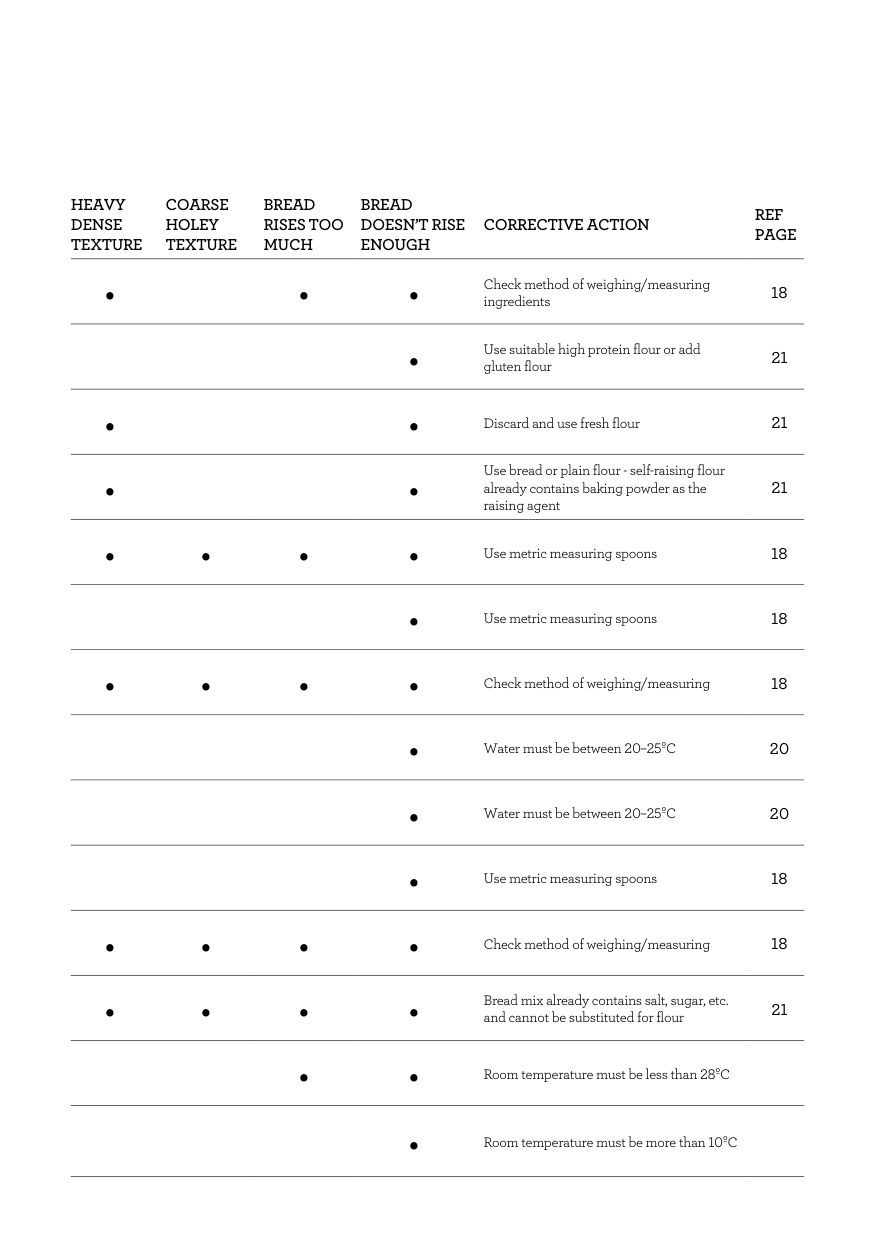
HEAVY DENSE TEXTURE
COARSE HOLEY TEXTURE
BREAD RISES TOO MUCH
BREAD DOESN’T RISE ENOUGH
CORRECTIVE ACTION
REF PAGE
Check method of weighing/measuring ingredients 18
•
Use suitable high protein flour or add gluten flour 21

Use bread or plain flour - self-raising flour already contains baking powder as the raising agent
21
• Use metric measuring spoons 18
Bread mix already contains salt, sugar, etc. and cannot be substituted for flour 21
• • Room temperature must be less than 28ºC
• Room temperature must be more than 10ºC
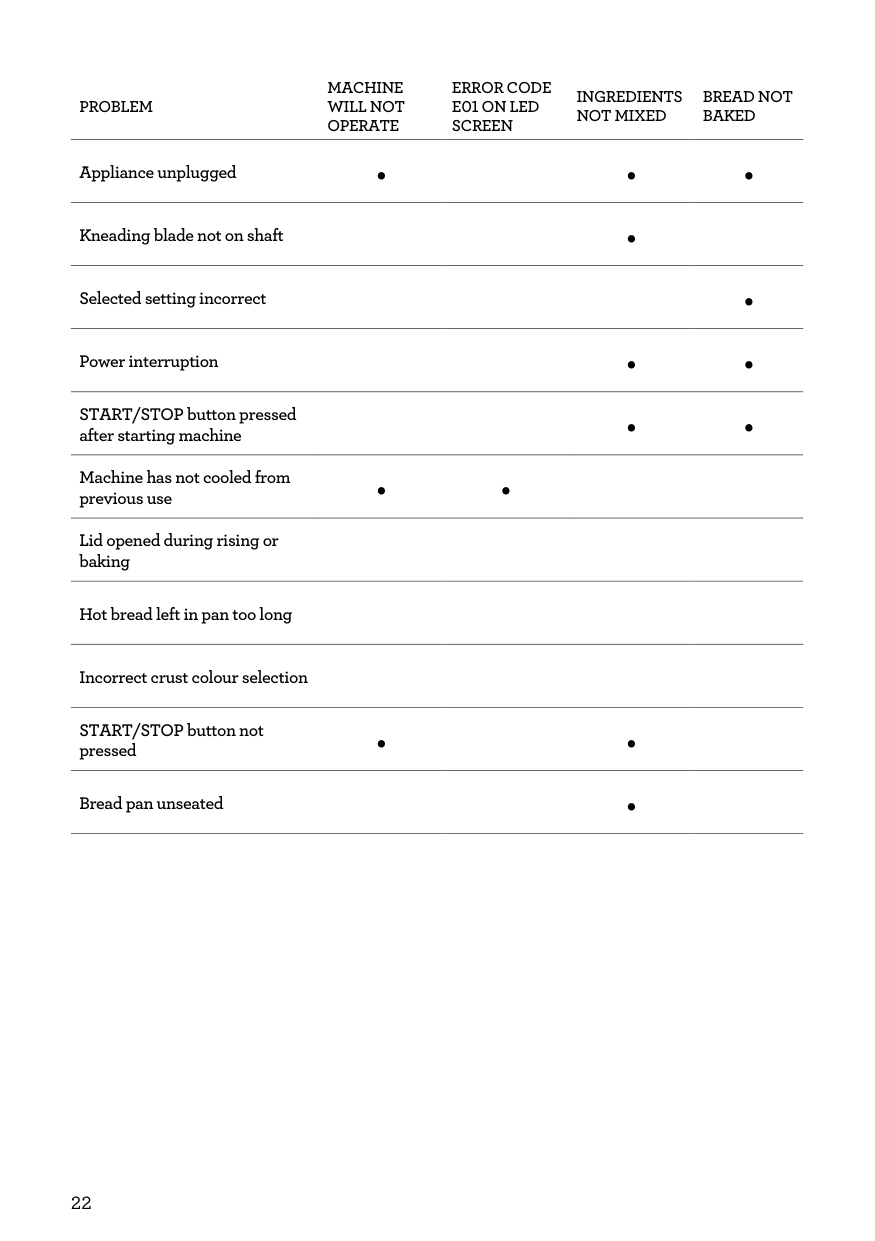
PROBLEM
MACHINE WILL NOT OPERATE
ERROR CODE E01 ON LED SCREEN
INGREDIENTS NOT MIXED
BREAD NOT BAKED
Appliance unplugged • • • Kneading blade not on shaft • Selected setting incorrect • Power interruption • • START/STOP button pressed after starting machine • • Machine has not cooled from previous use • • Lid opened during rising or baking Hot bread left in pan too long Incorrect crust colour selection START/STOP button not pressed • • Bread pan unseated •
BREAD RISES TOO MUCH
BAKED BREAD IS DAMP
UNDER BROWNED CRUST
PRESET TIMER DID NOT FUNCTION
#### •
BREAD NOT SUFFICIENTLY BAKED
LOAF IS SMALL
•
•
•
•
• • •
•
•
•
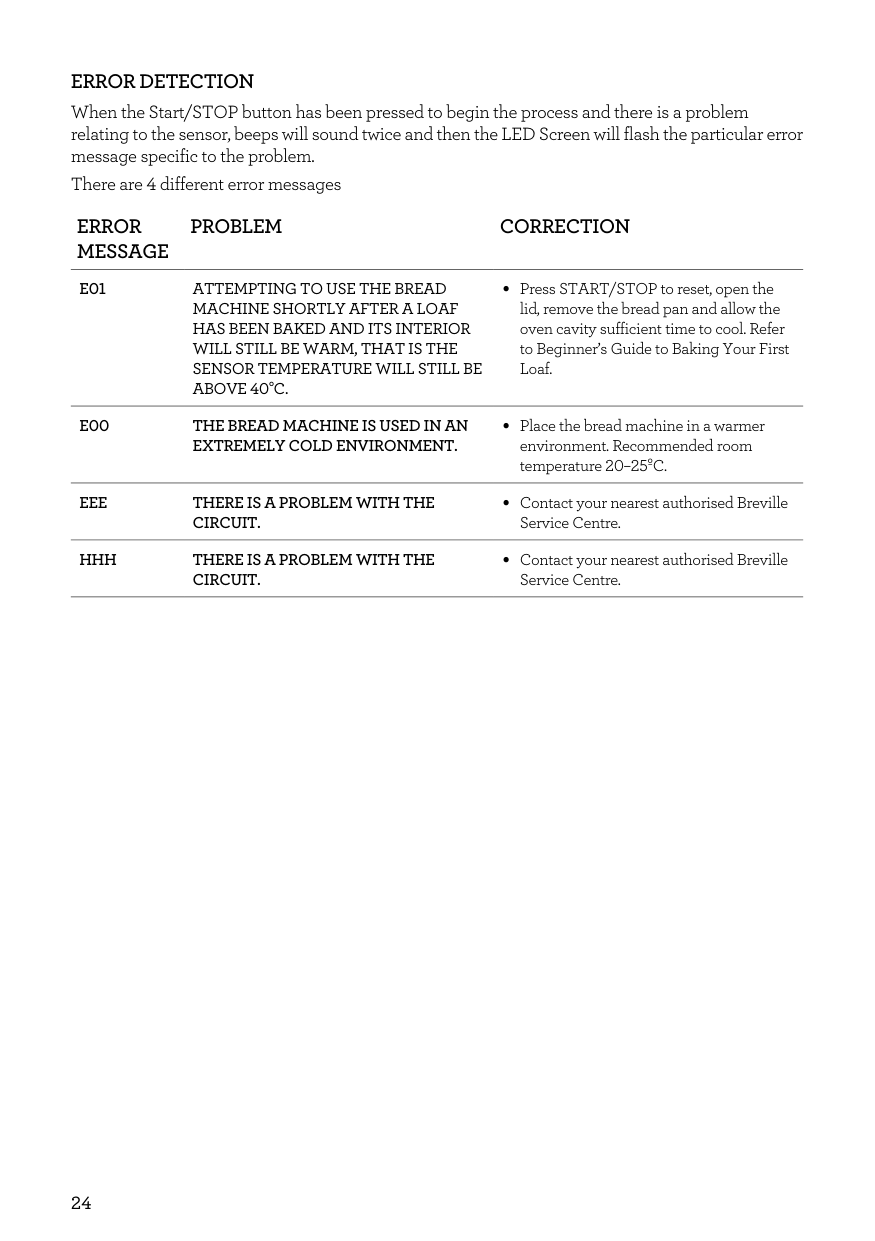
ERROR DETECTION When the Start/STOP button has been pressed to begin the process and there is a problem relating to the sensor, beeps will sound twice and then the LED Screen will flash the particular error message specific to the problem. There are 4 different error messages
ERROR MESSAGE
PROBLEM CORRECTION
• Press START/STOP to reset, open the lid, remove the bread pan and allow the oven cavity sufficient time to cool. Refer to Beginner’s Guide to Baking Your First Loaf.
E01 ATTEMPTING TO USE THE BREAD MACHINE SHORTLY AFTER A LOAF HAS BEEN BAKED AND ITS INTERIOR WILL STILL BE WARM, THAT IS THE SENSOR TEMPERATURE WILL STILL BE ABOVE 40°C.
• Place the bread machine in a warmer environment. Recommended room temperature 20–25ºC.
E00 THE BREAD MACHINE IS USED IN AN EXTREMELY COLD ENVIRONMENT.
• Contact your nearest authorised Breville
EEE THERE IS A PROBLEM WITH THE CIRCUIT.
Service Centre. HHH THERE IS A PROBLEM WITH THE
• Contact your nearest authorised Breville
CIRCUIT.
Service Centre.
###### Recipes
TRADITIONAL FAVOURITES
NOTE
Two loaf sizes 1kg and 750g can be made. When making the 750g size, remove the loaf 10 minutes before completion of the baking cycle
########## Method
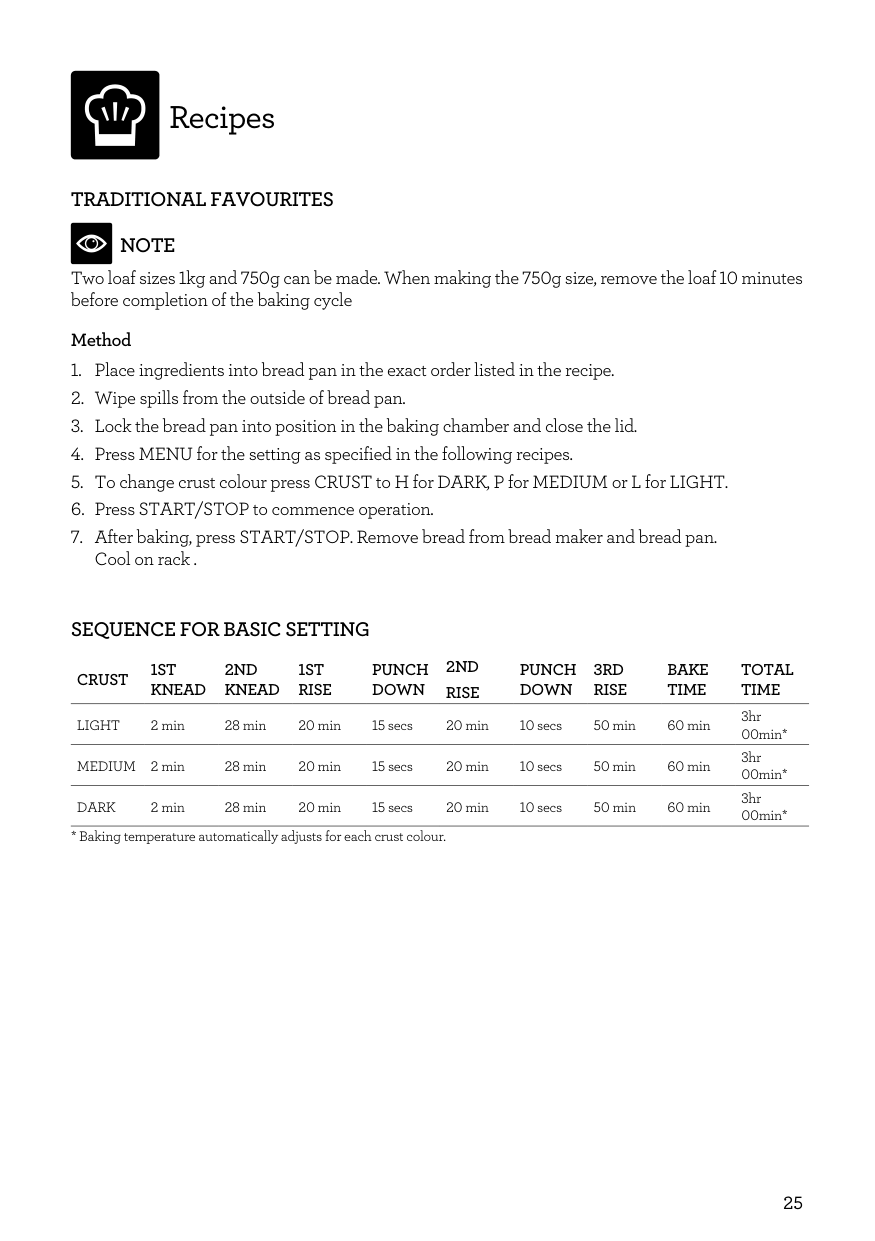
######### SEQUENCE FOR BASIC SETTING
2ND RISE
1ST KNEAD
2ND KNEAD
1ST RISE
PUNCH DOWN
PUNCH DOWN
3RD RISE
BAKE TIME
TOTAL TIME
CRUST
3hr 00min*
LIGHT 2 min 28 min 20 min 15 secs 20 min 10 secs 50 min 60 min
3hr 00min*
MEDIUM 2 min 28 min 20 min 15 secs 20 min 10 secs 50 min 60 min
3hr 00min*
DARK 2 min 28 min 20 min 15 secs 20 min 10 secs 50 min 60 min
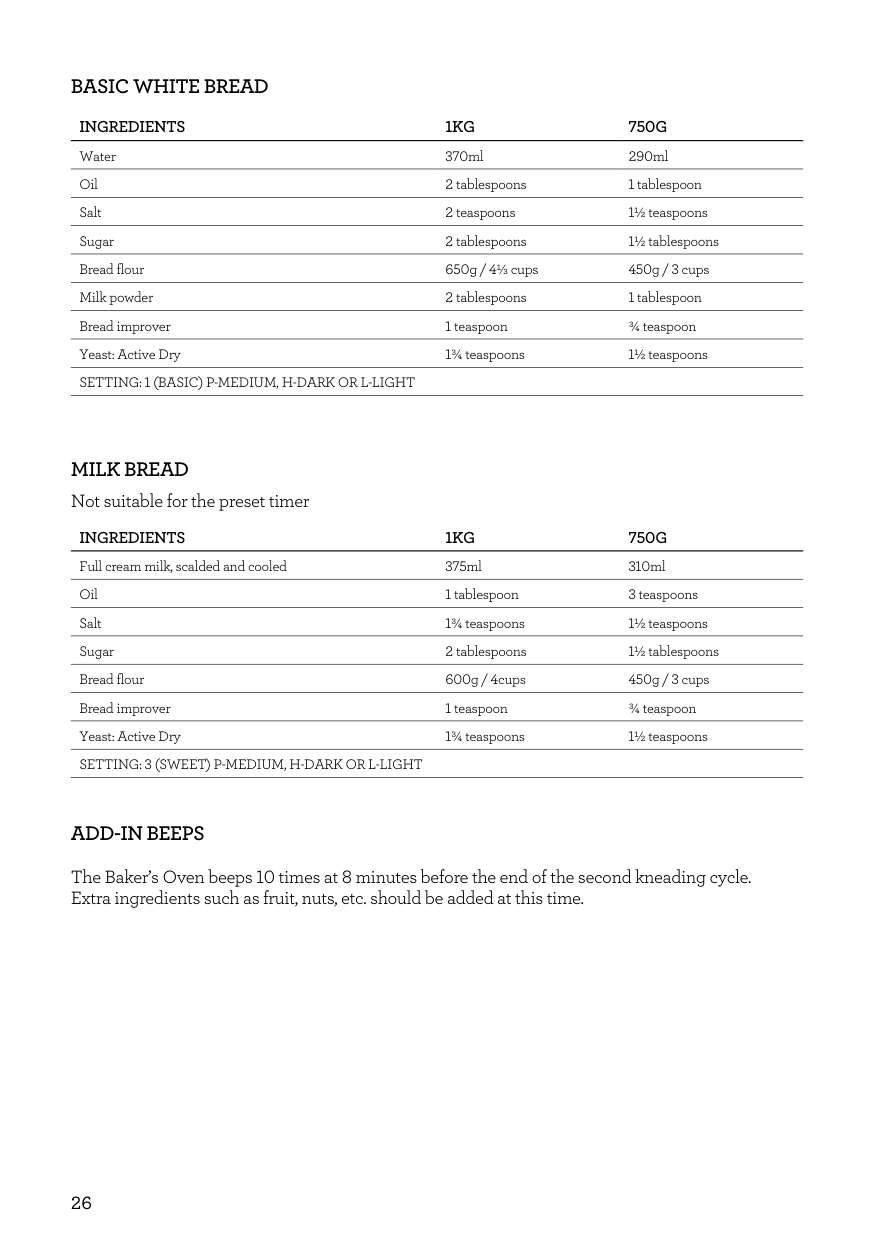
######### BASIC WHITE BREAD
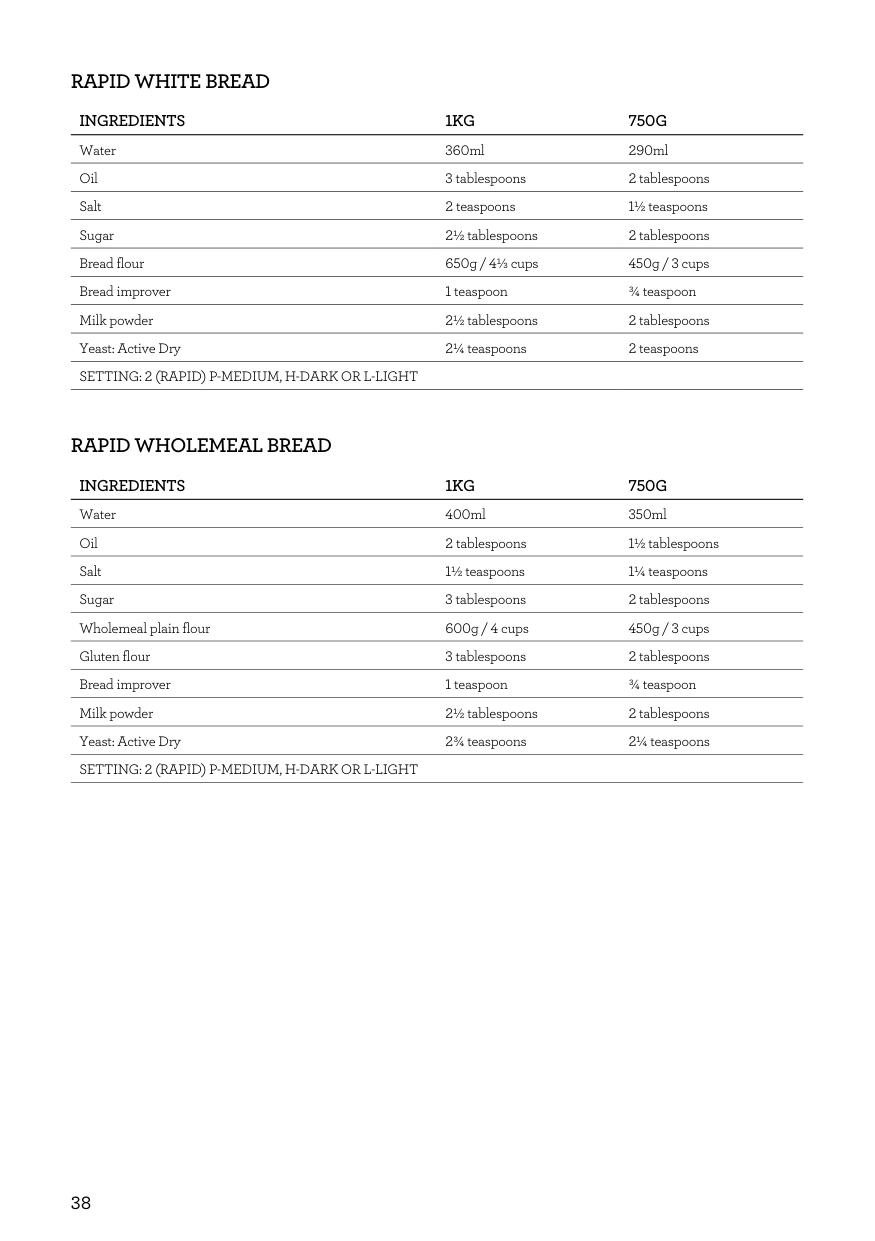
INGREDIENTS 1KG 750G Water 370ml 290ml Oil 2 tablespoons 1 tablespoon Salt 2 teaspoons 1½ teaspoons Sugar 2 tablespoons 1½ tablespoons Bread flour 650g / 4L cups 450g / 3 cups Milk powder 2 tablespoons 1 tablespoon Bread improver 1 teaspoon O teaspoon Yeast: Active Dry 1¾ teaspoons 1½ teaspoons SETTING: 1 (BASIC) P-MEDIUM, H-DARK OR L-LIGHT
MILK BREAD Not suitable for the preset timer
INGREDIENTS 1KG 750G Full cream milk, scalded and cooled 375ml 310ml Oil 1 tablespoon 3 teaspoons Salt 1O teaspoons 1½ teaspoons Sugar 2 tablespoons 1½ tablespoons Bread flour 600g / 4cups 450g / 3 cups Bread improver 1 teaspoon O teaspoon Yeast: Active Dry 1O teaspoons 1½ teaspoons SETTING: 3 (SWEET) P-MEDIUM, H-DARK OR L-LIGHT
######### ADD-IN BEEPS
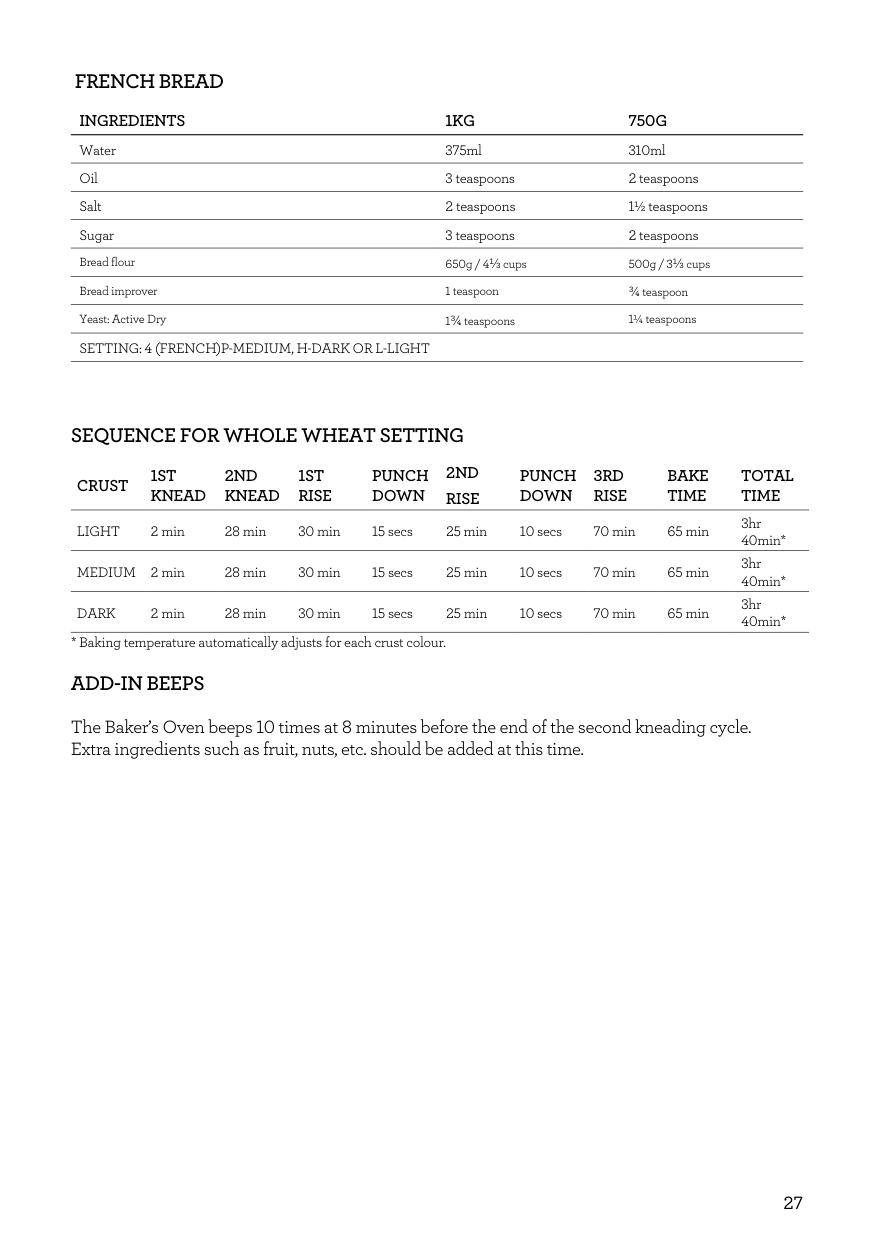
The Baker’s Oven beeps 10 times at 8 minutes before the end of the second kneading cycle. Extra ingredients such as fruit, nuts, etc. should be added at this time.
######### FRENCH BREAD
INGREDIENTS 1KG 750G Water 375ml 310ml Oil 3 teaspoons 2 teaspoons Salt 2 teaspoons 1½ teaspoons Sugar 3 teaspoons 2 teaspoons Bread flour 650g / 4Lcups 500g / 3Lcups Bread improver 1 teaspoon Oteaspoon Yeast: Active Dry 1Oteaspoons 1¼ teaspoons SETTING: 4 (FRENCH)P-MEDIUM, H-DARK OR L-LIGHT
######### SEQUENCE FOR WHOLE WHEAT SETTING
2ND RISE
1ST KNEAD
2ND KNEAD
1ST RISE
PUNCH DOWN
PUNCH DOWN
3RD RISE
BAKE TIME
TOTAL TIME
CRUST
3hr 40min*
LIGHT 2 min 28 min 30 min 15 secs 25 min 10 secs 70 min 65 min
3hr 40min*
MEDIUM 2 min 28 min 30 min 15 secs 25 min 10 secs 70 min 65 min
3hr 40min*
DARK 2 min 28 min 30 min 15 secs 25 min 10 secs 70 min 65 min
The Baker’s Oven beeps 10 times at 8 minutes before the end of the second kneading cycle. Extra ingredients such as fruit, nuts, etc. should be added at this time.
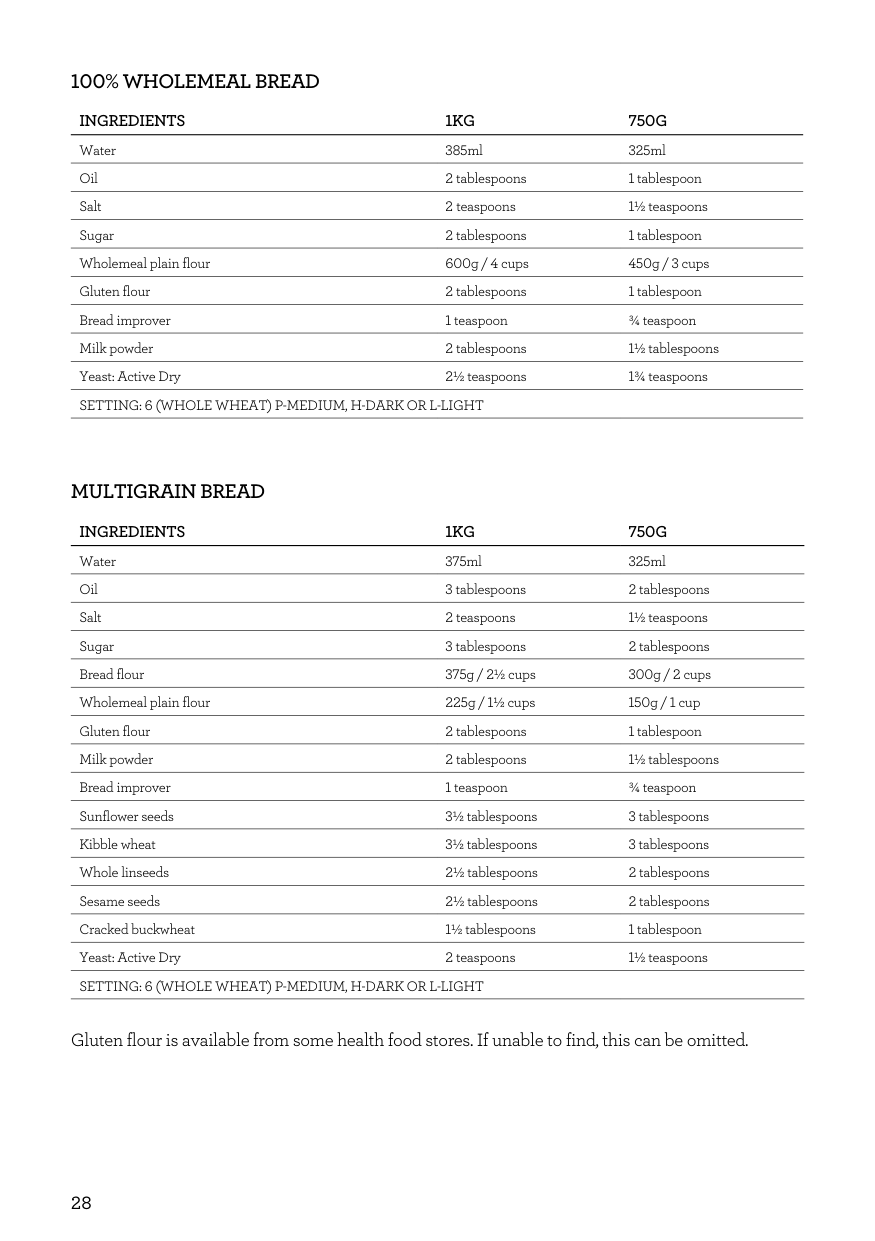
######### 100% WHOLEMEAL BREAD
INGREDIENTS 1KG 750G Water 385ml 325ml Oil 2 tablespoons 1 tablespoon Salt 2 teaspoons 1½ teaspoons Sugar 2 tablespoons 1 tablespoon Wholemeal plain flour 600g / 4 cups 450g / 3 cups Gluten flour 2 tablespoons 1 tablespoon Bread improver 1 teaspoon O teaspoon Milk powder 2 tablespoons 1½ tablespoons Yeast: Active Dry 2½ teaspoons 1O teaspoons SETTING: 6 (WHOLE WHEAT) P-MEDIUM, H-DARK OR L-LIGHT
######### MULTIGRAIN BREAD
INGREDIENTS 1KG 750G Water 375ml 325ml Oil 3 tablespoons 2 tablespoons Salt 2 teaspoons 1½ teaspoons Sugar 3 tablespoons 2 tablespoons Bread flour 375g / 2½ cups 300g / 2 cups Wholemeal plain flour 225g / 1½ cups 150g / 1 cup Gluten flour 2 tablespoons 1 tablespoon Milk powder 2 tablespoons 1½ tablespoons Bread improver 1 teaspoon O teaspoon Sunflower seeds 3½ tablespoons 3 tablespoons Kibble wheat 3½ tablespoons 3 tablespoons Whole linseeds 2½ tablespoons 2 tablespoons Sesame seeds 2½ tablespoons 2 tablespoons Cracked buckwheat 1½ tablespoons 1 tablespoon Yeast: Active Dry 2 teaspoons 1½ teaspoons SETTING: 6 (WHOLE WHEAT) P-MEDIUM, H-DARK OR L-LIGHT
Gluten flour is available from some health food stores. If unable to find, this can be omitted.
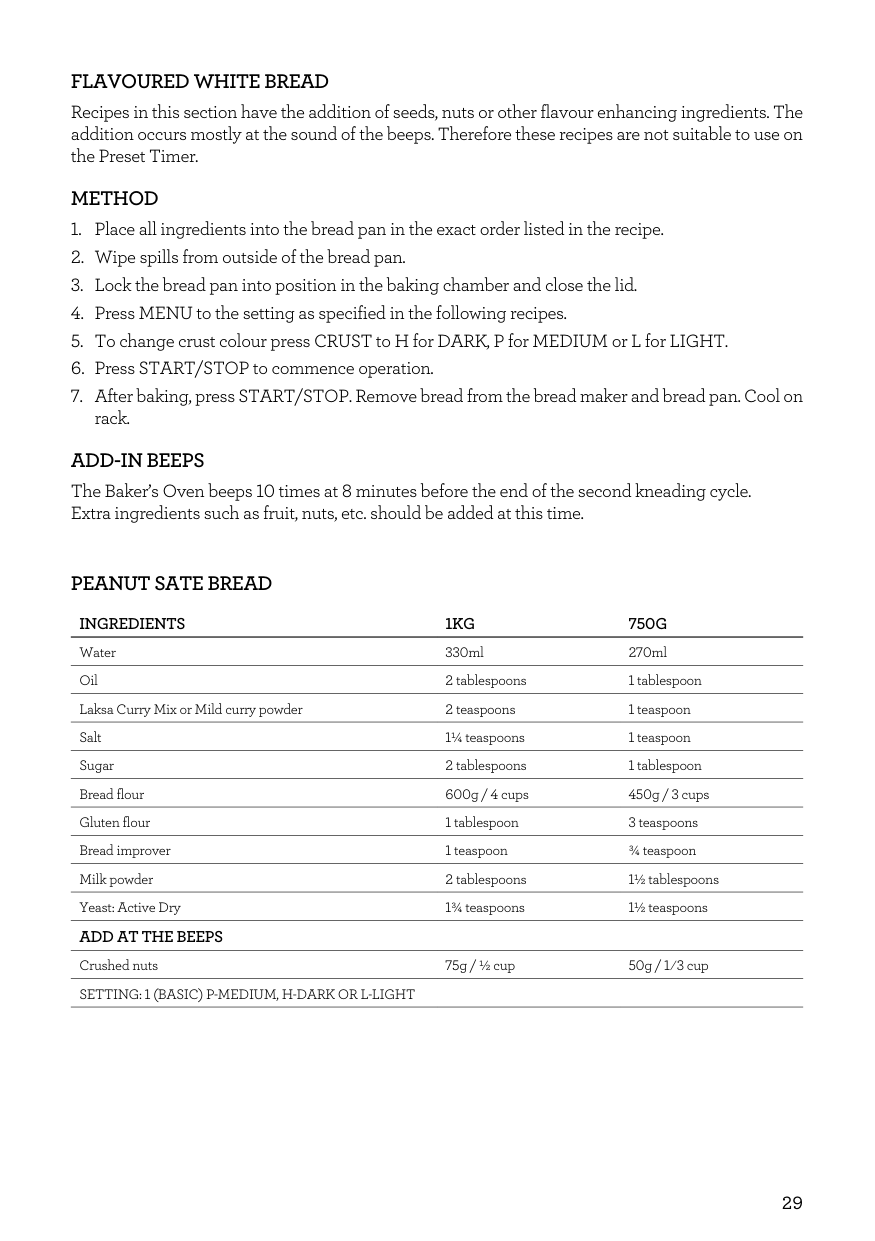
######### FLAVOURED WHITE BREAD
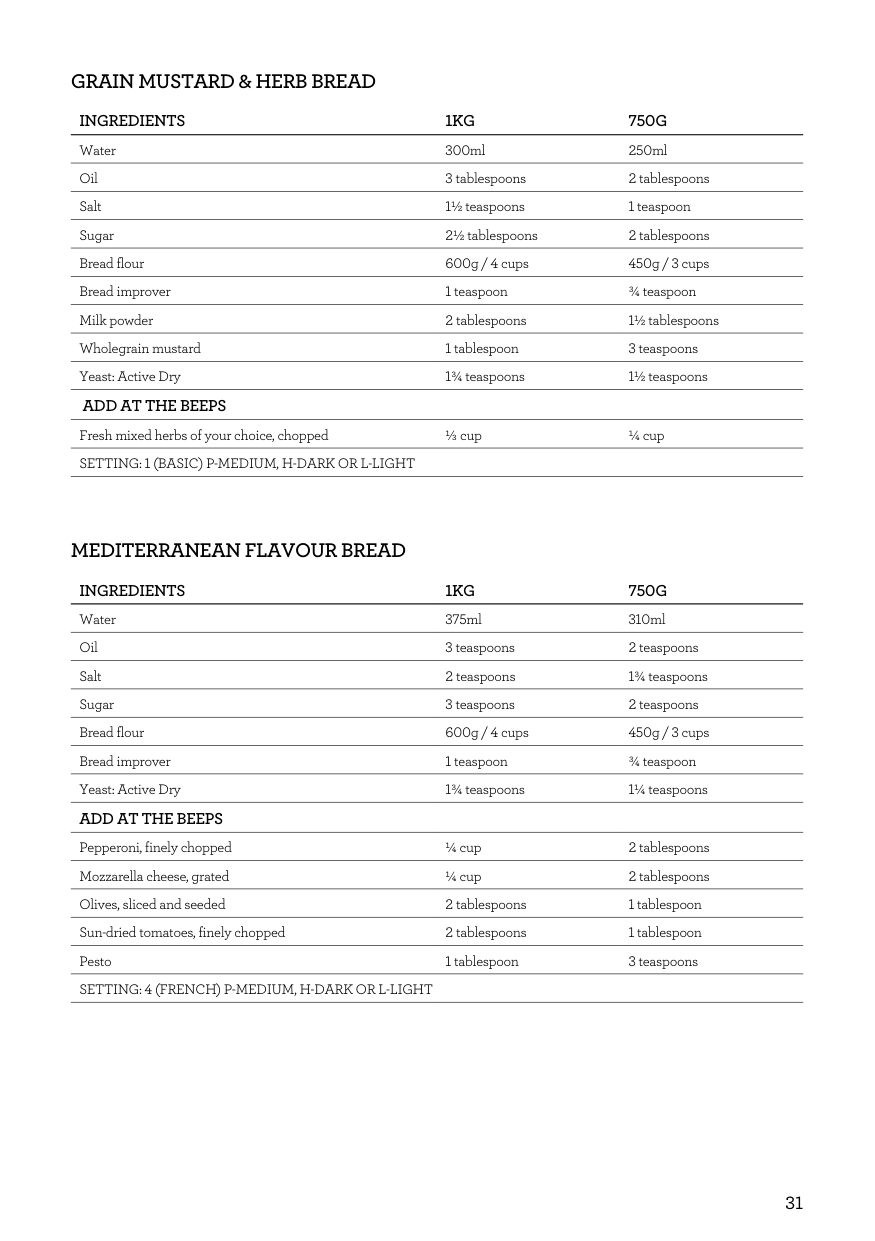
Recipes in this section have the addition of seeds, nuts or other flavour enhancing ingredients. The addition occurs mostly at the sound of the beeps. Therefore these recipes are not suitable to use on the Preset Timer.
######### METHOD
######### ADD-IN BEEPS
The Baker’s Oven beeps 10 times at 8 minutes before the end of the second kneading cycle. Extra ingredients such as fruit, nuts, etc. should be added at this time.
PEANUT SATE BREAD INGREDIENTS 1KG 750G Water 330ml 270ml Oil 2 tablespoons 1 tablespoon Laksa Curry Mix or Mild curry powder 2 teaspoons 1 teaspoon Salt 1¼ teaspoons 1 teaspoon Sugar 2 tablespoons 1 tablespoon Bread flour 600g / 4 cups 450g / 3 cups Gluten flour 1 tablespoon 3 teaspoons Bread improver 1 teaspoon O teaspoon Milk powder 2 tablespoons 1½ tablespoons Yeast: Active Dry 1¾ teaspoons 1½ teaspoons ADD AT THE BEEPS Crushed nuts 75g / ½ cup 50g / 1⁄3 cup SETTING: 1 (BASIC) P-MEDIUM, H-DARK OR L-LIGHT
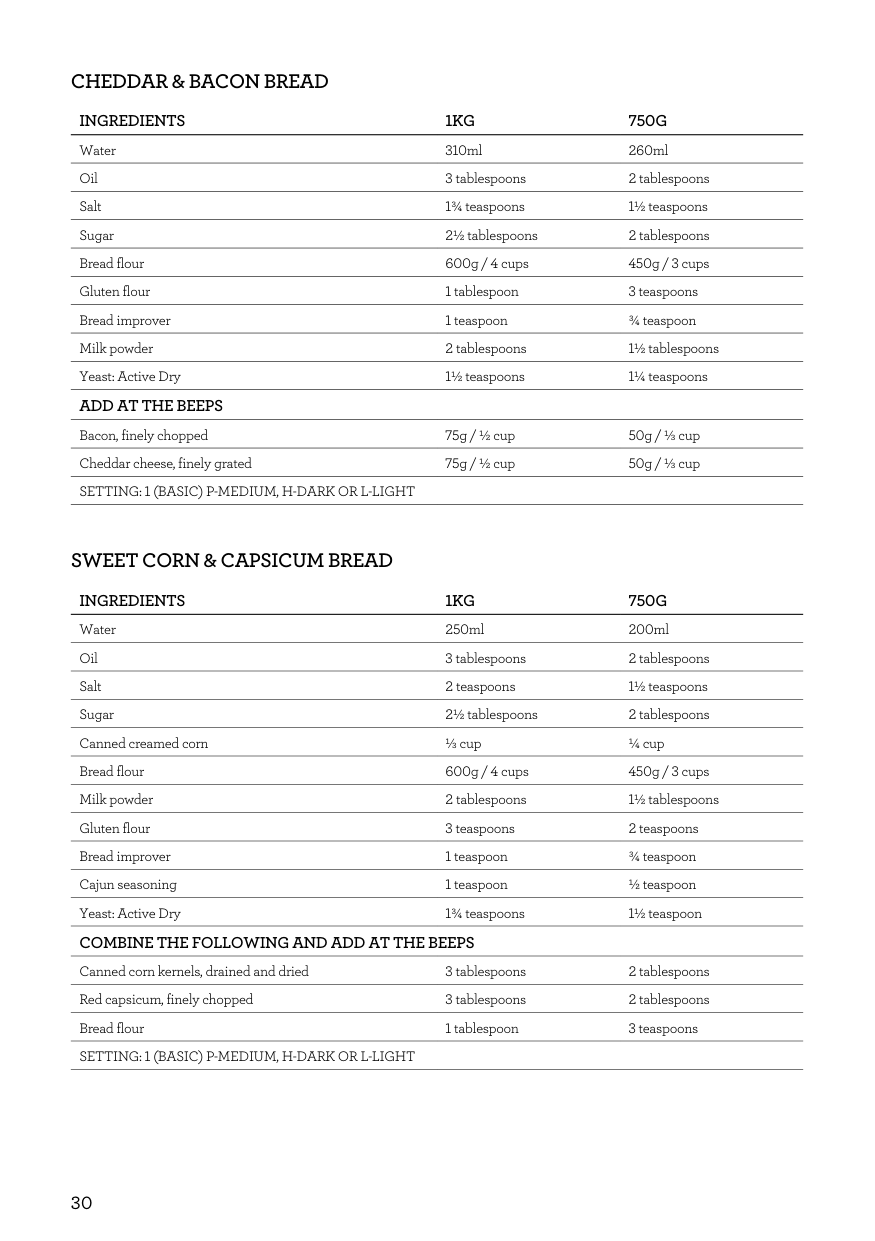
CHEDDAR & BACON BREAD INGREDIENTS 1KG 750G Water 310ml 260ml Oil 3 tablespoons 2 tablespoons Salt 1O teaspoons 1½ teaspoons Sugar 2½ tablespoons 2 tablespoons Bread flour 600g / 4 cups 450g / 3 cups Gluten flour 1 tablespoon 3 teaspoons Bread improver 1 teaspoon ¾ teaspoon Milk powder 2 tablespoons 1½ tablespoons Yeast: Active Dry 1½ teaspoons 1¼ teaspoons ADD AT THE BEEPS
Bacon, finely chopped 75g / ½ cup 50g / L cup Cheddar cheese, finely grated 75g / ½ cup 50g / L cup SETTING: 1 (BASIC) P-MEDIUM, H-DARK OR L-LIGHT
SWEET CORN & CAPSICUM BREAD INGREDIENTS 1KG 750G Water 250ml 200ml Oil 3 tablespoons 2 tablespoons Salt 2 teaspoons 1½ teaspoons Sugar 2½ tablespoons 2 tablespoons Canned creamed corn L cup ¼ cup Bread flour 600g / 4 cups 450g / 3 cups Milk powder 2 tablespoons 1½ tablespoons Gluten flour 3 teaspoons 2 teaspoons Bread improver 1 teaspoon ¾ teaspoon Cajun seasoning 1 teaspoon ½ teaspoon Yeast: Active Dry 1¾ teaspoons 1½ teaspoon COMBINE THE FOLLOWING AND ADD AT THE BEEPS Canned corn kernels, drained and dried 3 tablespoons 2 tablespoons Red capsicum, finely chopped 3 tablespoons 2 tablespoons Bread flour 1 tablespoon 3 teaspoons SETTING: 1 (BASIC) P-MEDIUM, H-DARK OR L-LIGHT
GRAIN MUSTARD & HERB BREAD INGREDIENTS 1KG 750G Water 300ml 250ml Oil 3 tablespoons 2 tablespoons Salt 1½ teaspoons 1 teaspoon Sugar 2½ tablespoons 2 tablespoons Bread flour 600g / 4 cups 450g / 3 cups Bread improver 1 teaspoon ¾ teaspoon Milk powder 2 tablespoons 1½ tablespoons Wholegrain mustard 1 tablespoon 3 teaspoons Yeast: Active Dry 1¾ teaspoons 1½ teaspoons ADD AT THE BEEPS Fresh mixed herbs of your choice, chopped L cup ¼ cup SETTING: 1 (BASIC) P-MEDIUM, H-DARK OR L-LIGHT
MEDITERRANEAN FLAVOUR BREAD INGREDIENTS 1KG 750G Water 375ml 310ml Oil 3 teaspoons 2 teaspoons Salt 2 teaspoons 1¾ teaspoons Sugar 3 teaspoons 2 teaspoons Bread flour 600g / 4 cups 450g / 3 cups Bread improver 1 teaspoon ¾ teaspoon Yeast: Active Dry 1¾ teaspoons 1¼ teaspoons ADD AT THE BEEPS Pepperoni, finely chopped ¼ cup 2 tablespoons Mozzarella cheese, grated ¼ cup 2 tablespoons Olives, sliced and seeded 2 tablespoons 1 tablespoon Sun-dried tomatoes, finely chopped 2 tablespoons 1 tablespoon Pesto 1 tablespoon 3 teaspoons SETTING: 4 (FRENCH) P-MEDIUM, H-DARK OR L-LIGHT
######### FLAVOURED SWEET BREAD
Most of the recipes in this section have the addition of nuts, chocolate, sultanas or other flavour enhancing ingredients. The addition occurs mostly at the sound of the beeps towards the end of the second kneading cycle. Therefore these recipes are not suitable to use with the PRESET TIMER.
######### NOTE
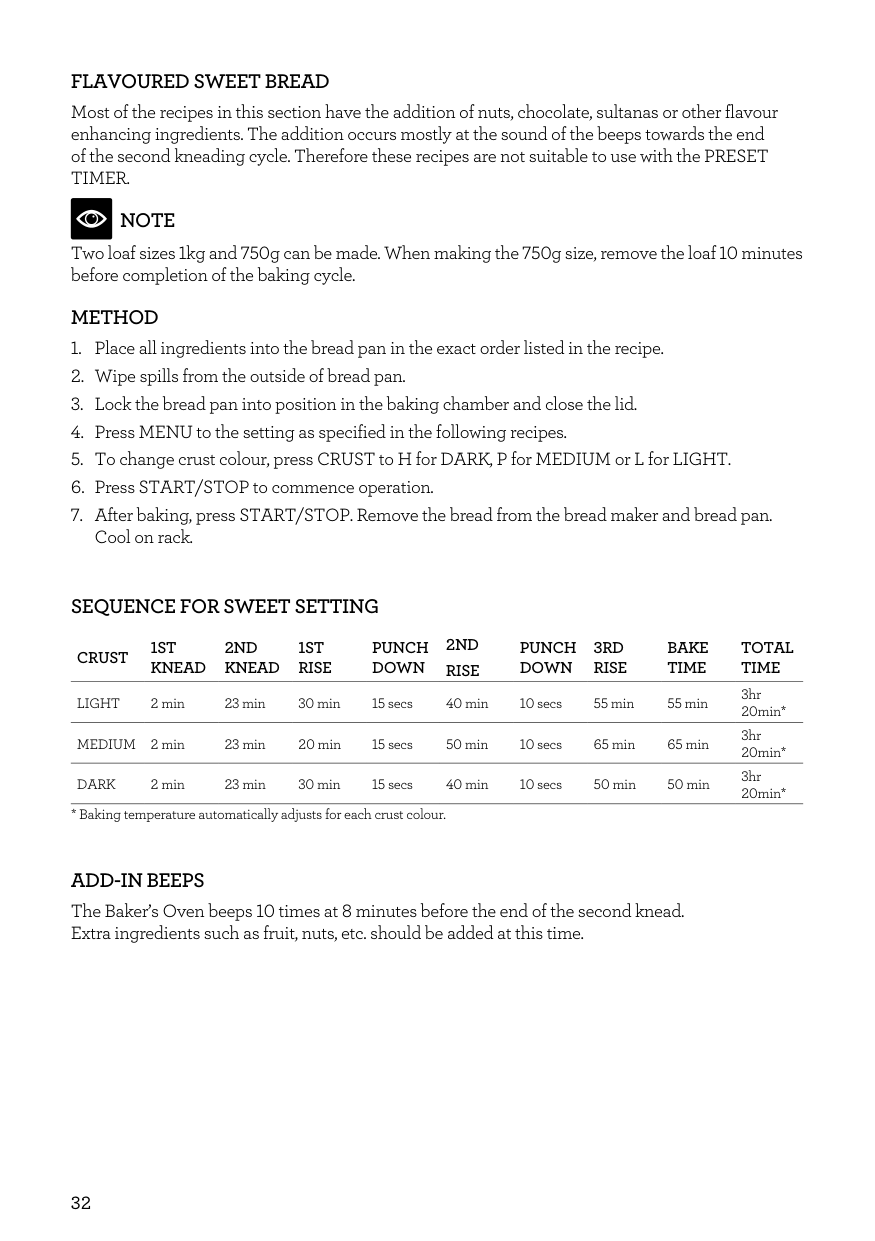
Two loaf sizes 1kg and 750g can be made. When making the 750g size, remove the loaf 10 minutes before completion of the baking cycle.
######### METHOD
######### SEQUENCE FOR SWEET SETTING
2ND RISE
1ST KNEAD
2ND KNEAD
1ST RISE
PUNCH DOWN
PUNCH DOWN
3RD RISE
BAKE TIME
TOTAL TIME
CRUST
3hr 20min*
LIGHT 2 min 23 min 30 min 15 secs 40 min 10 secs 55 min 55 min
3hr 20min*
MEDIUM 2 min 23 min 20 min 15 secs 50 min 10 secs 65 min 65 min
3hr 20min*
DARK 2 min 23 min 30 min 15 secs 40 min 10 secs 50 min 50 min
######### ADD-IN BEEPS
The Baker’s Oven beeps 10 times at 8 minutes before the end of the second knead. Extra ingredients such as fruit, nuts, etc. should be added at this time.
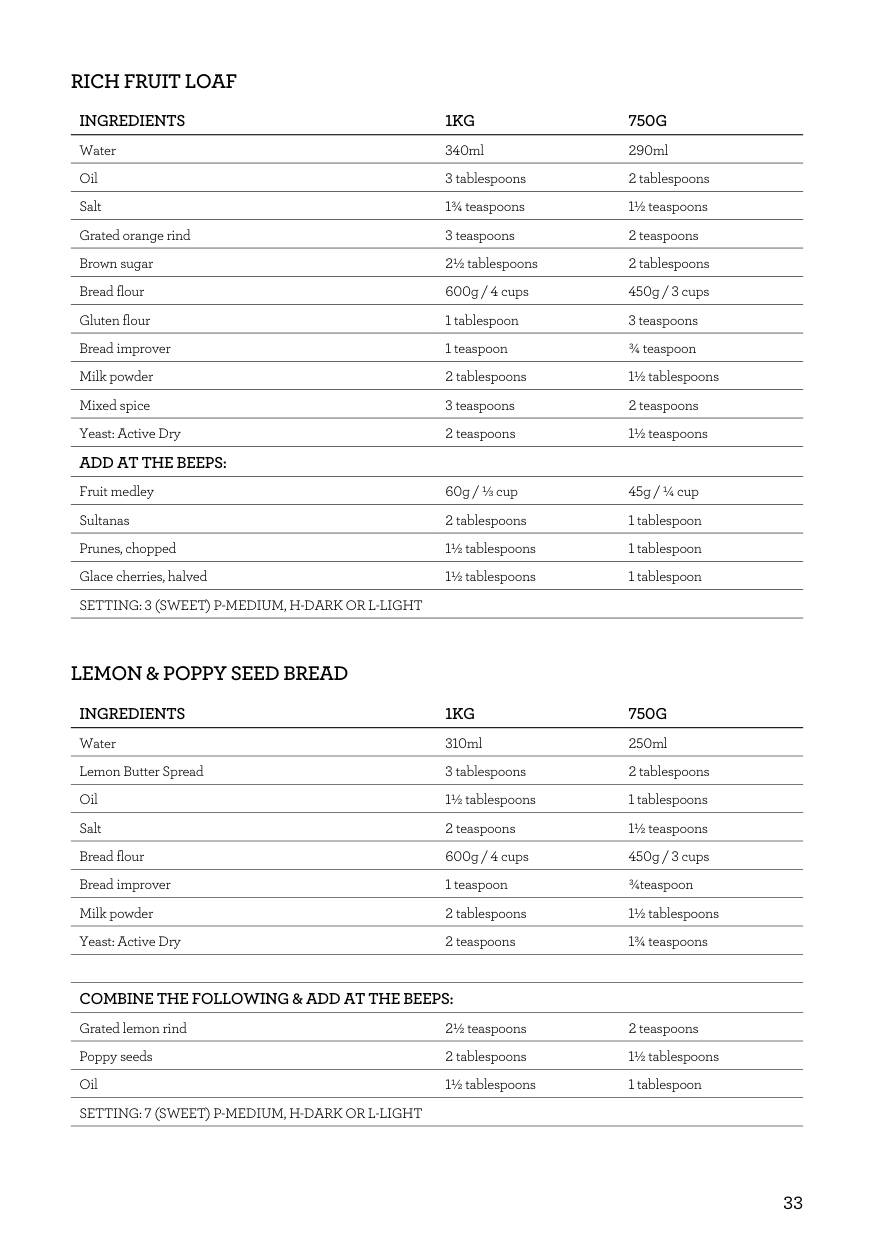
RICH FRUIT LOAF INGREDIENTS 1KG 750G Water 340ml 290ml Oil 3 tablespoons 2 tablespoons Salt 1O teaspoons 1½ teaspoons Grated orange rind 3 teaspoons 2 teaspoons Brown sugar 2½ tablespoons 2 tablespoons Bread flour 600g / 4 cups 450g / 3 cups Gluten flour 1 tablespoon 3 teaspoons Bread improver 1 teaspoon ¾ teaspoon Milk powder 2 tablespoons 1½ tablespoons Mixed spice 3 teaspoons 2 teaspoons Yeast: Active Dry 2 teaspoons 1½ teaspoons ADD AT THE BEEPS: Fruit medley 60g / L cup 45g / ¼ cup Sultanas 2 tablespoons 1 tablespoon Prunes, chopped 1½ tablespoons 1 tablespoon Glace cherries, halved 1½ tablespoons 1 tablespoon SETTING: 3 (SWEET) P-MEDIUM, H-DARK OR L-LIGHT
######### LEMON & POPPY SEED BREAD
INGREDIENTS 1KG 750G Water 310ml 250ml Lemon Butter Spread 3 tablespoons 2 tablespoons Oil 1½ tablespoons 1 tablespoons Salt 2 teaspoons 1½ teaspoons Bread flour 600g / 4 cups 450g / 3 cups Bread improver 1 teaspoon ¾teaspoon Milk powder 2 tablespoons 1½ tablespoons Yeast: Active Dry 2 teaspoons 1¾ teaspoons
COMBINE THE FOLLOWING & ADD AT THE BEEPS: Grated lemon rind 2½ teaspoons 2 teaspoons Poppy seeds 2 tablespoons 1½ tablespoons Oil 1½ tablespoons 1 tablespoon SETTING: 7 (SWEET) P-MEDIUM, H-DARK OR L-LIGHT
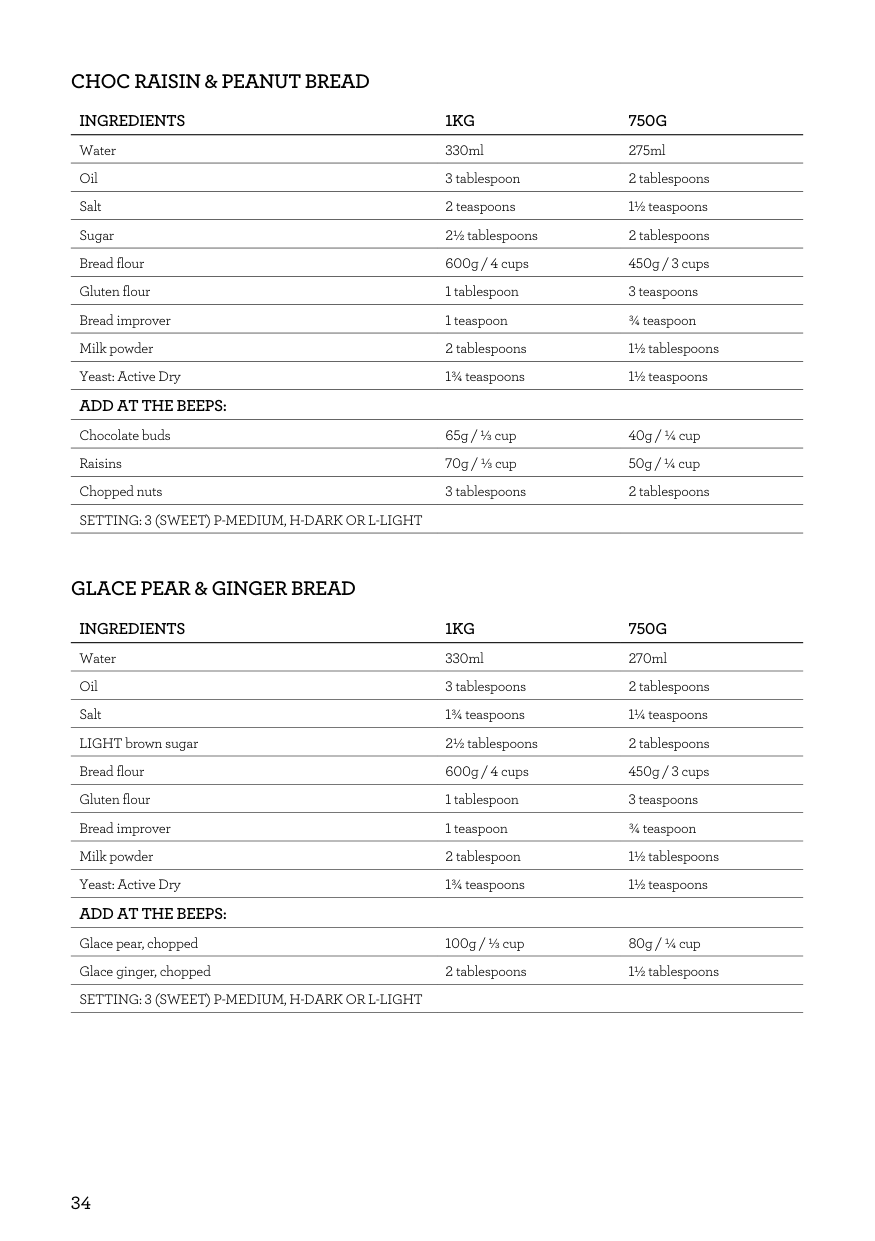
CHOC RAISIN & PEANUT BREAD INGREDIENTS 1KG 750G Water 330ml 275ml Oil 3 tablespoon 2 tablespoons Salt 2 teaspoons 1½ teaspoons Sugar 2½ tablespoons 2 tablespoons Bread flour 600g / 4 cups 450g / 3 cups Gluten flour 1 tablespoon 3 teaspoons Bread improver 1 teaspoon ¾ teaspoon Milk powder 2 tablespoons 1½ tablespoons Yeast: Active Dry 1¾ teaspoons 1½ teaspoons ADD AT THE BEEPS: Chocolate buds 65g / L cup 40g / ¼ cup Raisins 70g / L cup 50g / ¼ cup Chopped nuts 3 tablespoons 2 tablespoons SETTING: 3 (SWEET) P-MEDIUM, H-DARK OR L-LIGHT
GLACE PEAR & GINGER BREAD INGREDIENTS 1KG 750G Water 330ml 270ml Oil 3 tablespoons 2 tablespoons Salt 1¾ teaspoons 1¼ teaspoons LIGHT brown sugar 2½ tablespoons 2 tablespoons Bread flour 600g / 4 cups 450g / 3 cups Gluten flour 1 tablespoon 3 teaspoons Bread improver 1 teaspoon ¾ teaspoon Milk powder 2 tablespoon 1½ tablespoons Yeast: Active Dry 1¾ teaspoons 1½ teaspoons ADD AT THE BEEPS: Glace pear, chopped 100g / L cup 80g / ¼ cup Glace ginger, chopped 2 tablespoons 1½ tablespoons SETTING: 3 (SWEET) P-MEDIUM, H-DARK OR L-LIGHT
######### FLAVOURED WHOLEMEAL BREAD
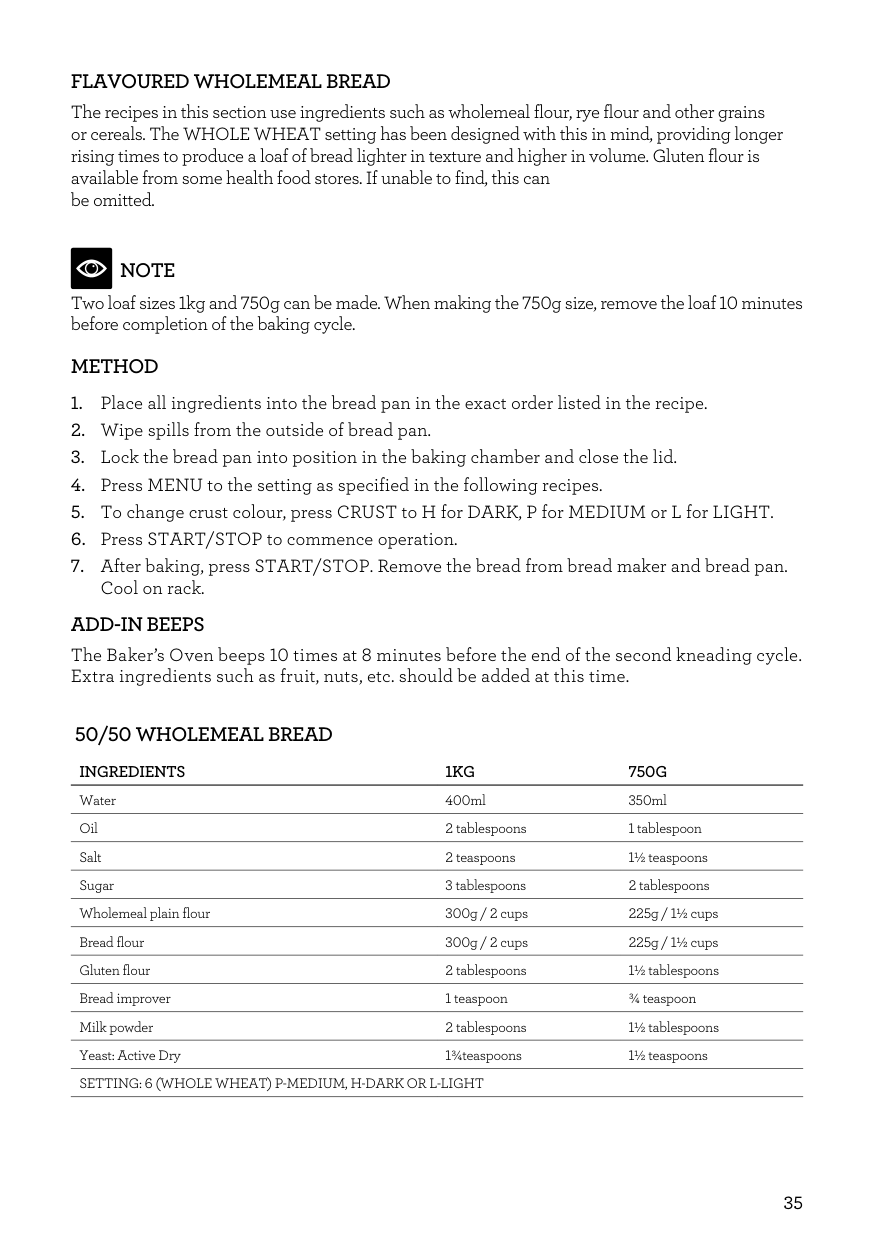
The recipes in this section use ingredients such as wholemeal flour, rye flour and other grains or cereals. The WHOLE WHEAT setting has been designed with this in mind, providing longer rising times to produce a loaf of bread lighter in texture and higher in volume. Gluten flour is available from some health food stores. If unable to find, this can be omitted.
######### NOTE
Two loaf sizes 1kg and 750g can be made. When making the 750g size, remove the loaf 10 minutes before completion of the baking cycle.
######### METHOD
######### ADD-IN BEEPS
The Baker’s Oven beeps 10 times at 8 minutes before the end of the second kneading cycle. Extra ingredients such as fruit, nuts, etc. should be added at this time.
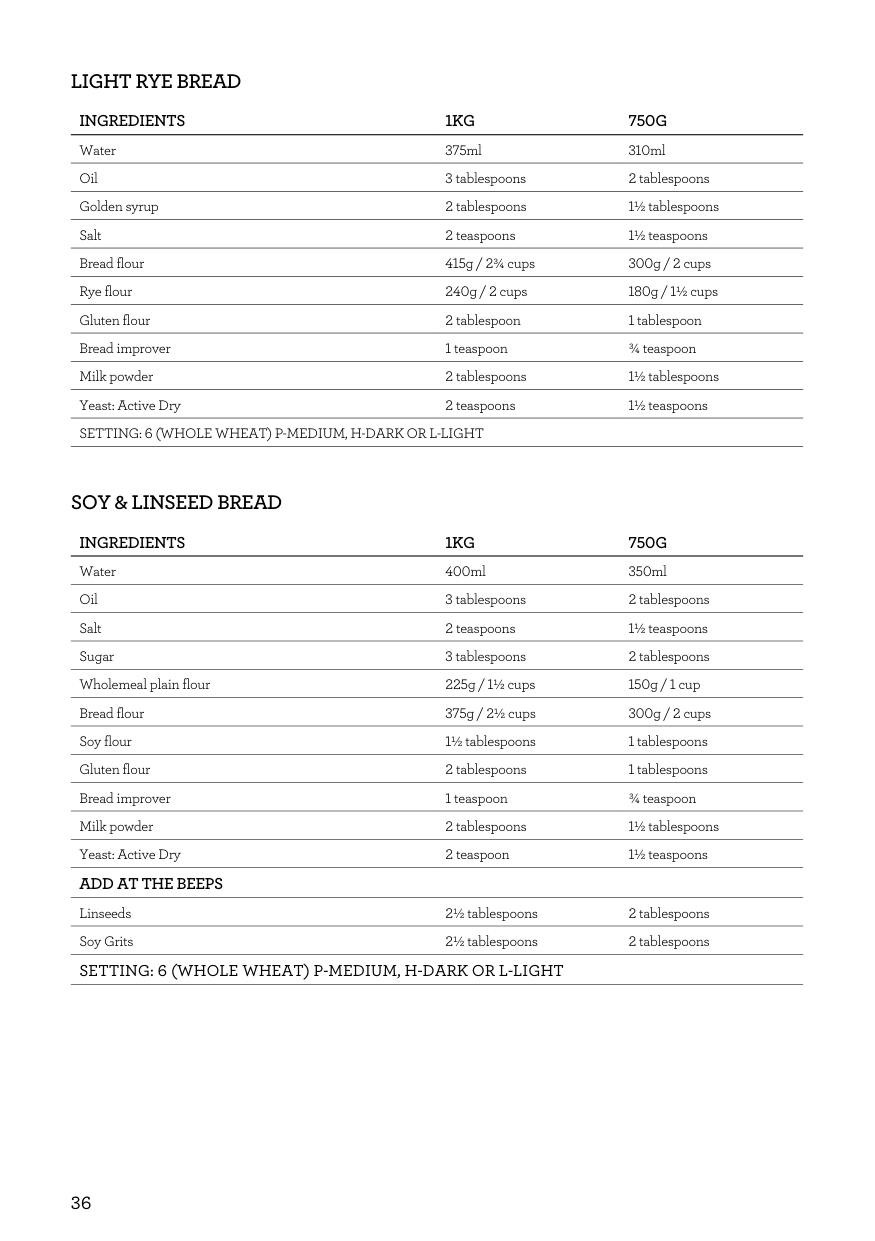
50/50 WHOLEMEAL BREAD INGREDIENTS 1KG 750G Water 400ml 350ml Oil 2 tablespoons 1 tablespoon Salt 2 teaspoons 1½ teaspoons Sugar 3 tablespoons 2 tablespoons Wholemeal plain flour 300g / 2 cups 225g / 1½ cups Bread flour 300g / 2 cups 225g / 1½ cups Gluten flour 2 tablespoons 1½ tablespoons Bread improver 1 teaspoon ¾ teaspoon Milk powder 2 tablespoons 1½ tablespoons Yeast: Active Dry 1¾teaspoons 1½ teaspoons SETTING: 6 (WHOLE WHEAT) P-MEDIUM, H-DARK OR L-LIGHT
######### LIGHT RYE BREAD
INGREDIENTS 1KG 750G Water 375ml 310ml Oil 3 tablespoons 2 tablespoons Golden syrup 2 tablespoons 1½ tablespoons Salt 2 teaspoons 1½ teaspoons Bread flour 415g / 2¾ cups 300g / 2 cups Rye flour 240g / 2 cups 180g / 1½ cups Gluten flour 2 tablespoon 1 tablespoon Bread improver 1 teaspoon ¾ teaspoon Milk powder 2 tablespoons 1½ tablespoons Yeast: Active Dry 2 teaspoons 1½ teaspoons SETTING: 6 (WHOLE WHEAT) P-MEDIUM, H-DARK OR L-LIGHT
SOY & LINSEED BREAD INGREDIENTS 1KG 750G Water 400ml 350ml Oil 3 tablespoons 2 tablespoons Salt 2 teaspoons 1½ teaspoons Sugar 3 tablespoons 2 tablespoons Wholemeal plain flour 225g / 1½ cups 150g / 1 cup Bread flour 375g / 2½ cups 300g / 2 cups Soy flour 1½ tablespoons 1 tablespoons Gluten flour 2 tablespoons 1 tablespoons Bread improver 1 teaspoon ¾ teaspoon Milk powder 2 tablespoons 1½ tablespoons Yeast: Active Dry 2 teaspoon 1½ teaspoons ADD AT THE BEEPS
############# Linseeds 2½ tablespoons 2 tablespoons Soy Grits 2½ tablespoons 2 tablespoons SETTING: 6 (WHOLE WHEAT) P-MEDIUM, H-DARK OR L-LIGHT
######### RAPID BREAD
The recipes in this section have been developed to produce a loaf of bread similar in volume to that of bread made on any of the longer bread cycles. Unless otherwise stated, most of the yeasted bread recipes can be baked on this cycle, however the volume will be slightly reduced and the texture a little more dense.
######### NOTE
Two loaf sizes 1kg and 750g can be made. When making the 750g size, remove the loaf 10 minutes before completion of the baking cycle.
######### METHOD
######### SEQUENCE FOR BASIC RAPID SETTING
2ND RISE
1ST KNEAD
2ND KNEAD
1ST RISE
PUNCH DOWN
PUNCH DOWN
3RD RISE
BAKE TIME
TOTAL TIME
CRUST
2hr 20min*
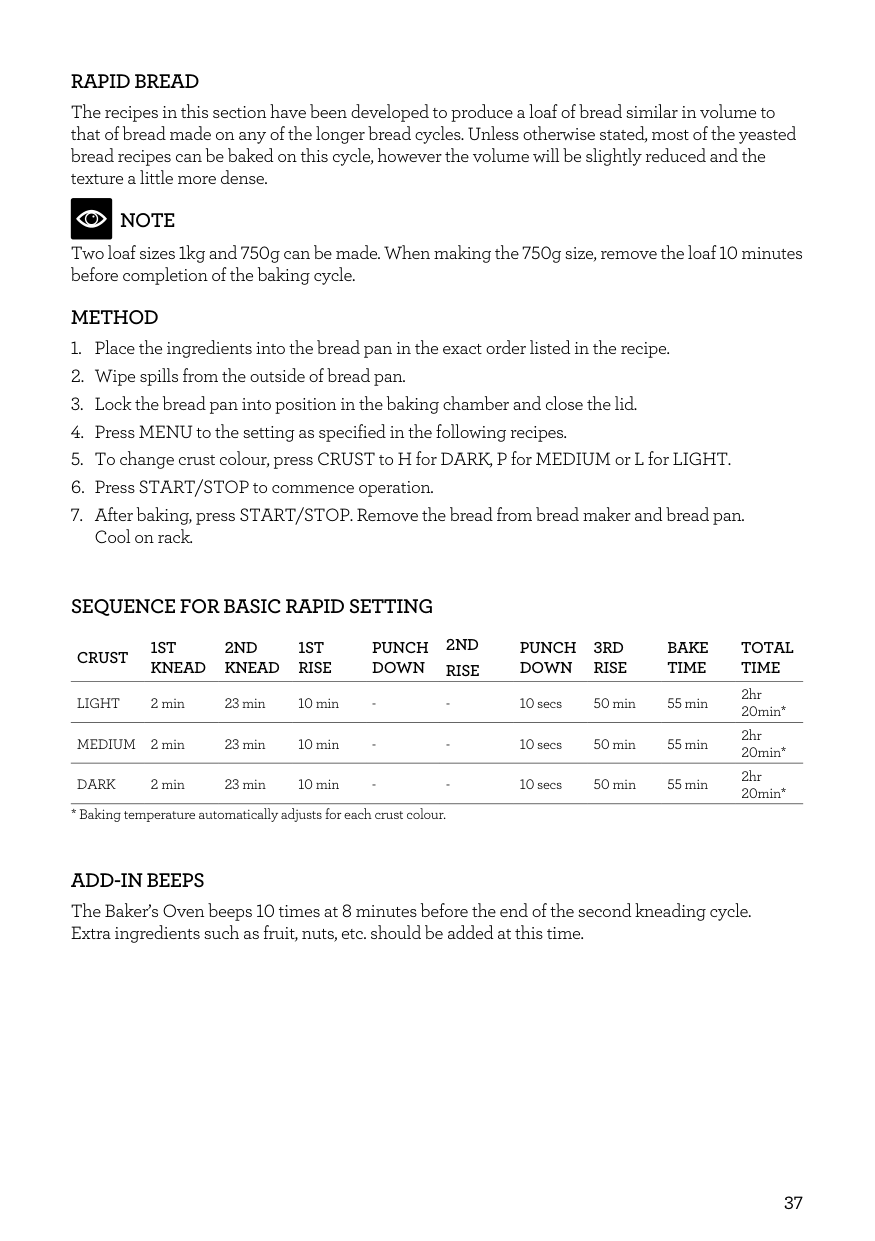
LIGHT 2 min 23 min 10 min 10 secs 50 min 55 min
2hr 20min*
MEDIUM 2 min 23 min 10 min - - 10 secs 50 min 55 min
2hr 20min*
DARK 2 min 23 min 10 min - - 10 secs 50 min 55 min
######### ADD-IN BEEPS
The Baker’s Oven beeps 10 times at 8 minutes before the end of the second kneading cycle. Extra ingredients such as fruit, nuts, etc. should be added at this time.
######### RAPID WHITE BREAD
INGREDIENTS 1KG 750G Water 360ml 290ml Oil 3 tablespoons 2 tablespoons Salt 2 teaspoons 1½ teaspoons Sugar 2½ tablespoons 2 tablespoons Bread flour 650g / 4L cups 450g / 3 cups Bread improver 1 teaspoon ¾ teaspoon Milk powder 2½ tablespoons 2 tablespoons Yeast: Active Dry 2¼ teaspoons 2 teaspoons SETTING: 2 (RAPID) P-MEDIUM, H-DARK OR L-LIGHT
######### RAPID WHOLEMEAL BREAD
INGREDIENTS 1KG 750G Water 400ml 350ml Oil 2 tablespoons 1½ tablespoons Salt 1½ teaspoons 1¼ teaspoons Sugar 3 tablespoons 2 tablespoons Wholemeal plain flour 600g / 4 cups 450g / 3 cups Gluten flour 3 tablespoons 2 tablespoons Bread improver 1 teaspoon ¾ teaspoon Milk powder 2½ tablespoons 2 tablespoons Yeast: Active Dry 2¾ teaspoons 2¼ teaspoons SETTING: 2 (RAPID) P-MEDIUM, H-DARK OR L-LIGHT
YEAST FREE Yeast Free Bread is made using baking powder as the main raising agent (it does not have the same strength as yeast). The following recipes will give Damper or Muffin-Style Breads, which will be heavy in texture and not as highly risen as yeasted breads. To ensure a well baked loaf is achieved, check the dough in the first 5 minutes of kneading. If the dough is too slack and running down onto the base of the pan, add small amounts of flour to ensure the dough forms into a round ball. If the dough is too slack it may give the baked loaf the appearance of being overcooked or laminated on the base and having a heavy, doughy top. If the dough is too dry just add 1–2 teaspoons of water extra. All recipes use local ingredients and Australian Standard Metric measuring tools (cups, spoons and weighing scales) for accuracy. There will be a weight variance in each baked loaf in this section.
######### METHOD
######### NOTE
The PRESET TIMER cannot be used for recipes in this section. The raising agents used in place of yeast in these recipes could be prematurely activated and prevent the loaf from rising.
######### NOTE
All ingredients must be at room temperature and added in the order listed in the recipe, however sifting the dry ingredients together may assist the baking powder with the rising of the bread.
######### SEQUENCE FOR YEAST FREE SETTING
1ST KNEAD
2ND KNEAD
BAKE TIME
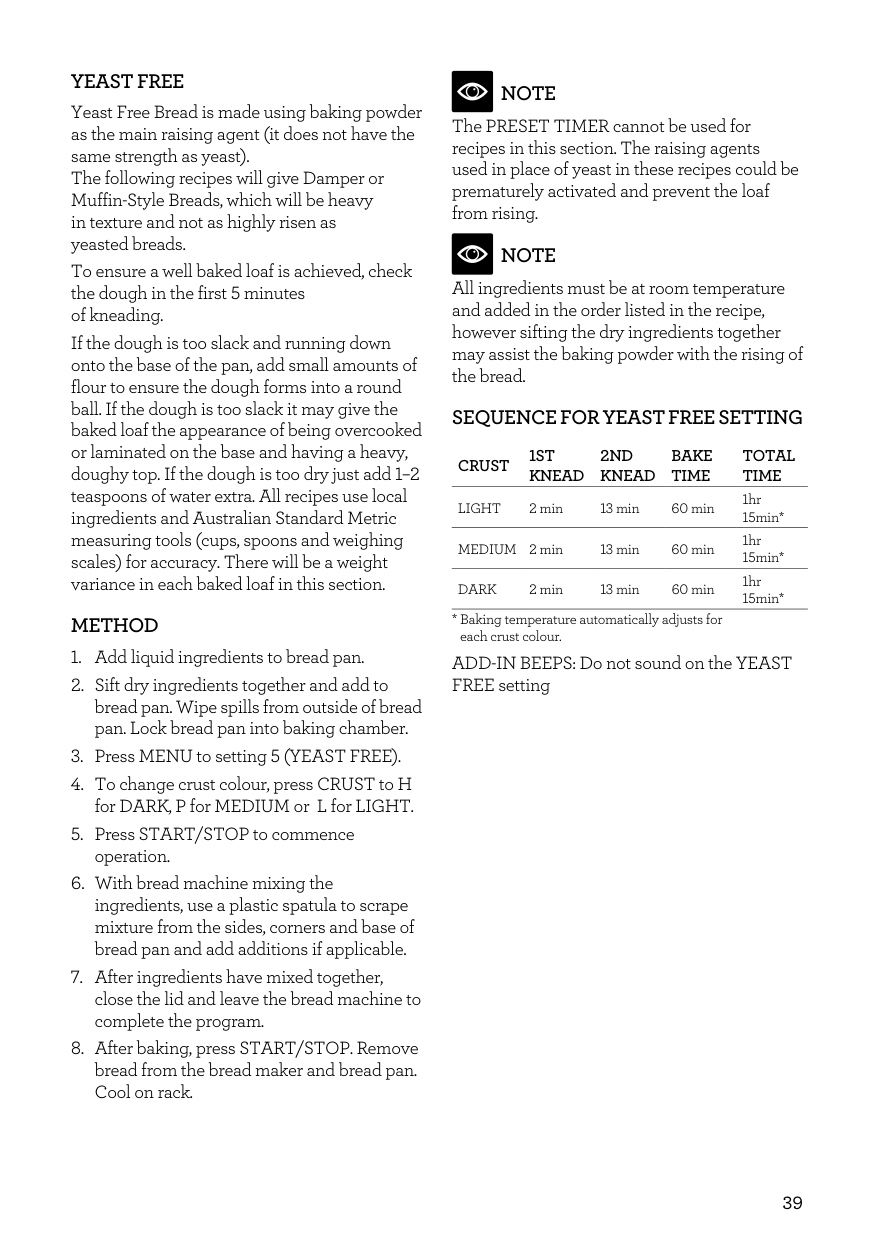
TOTAL TIME
CRUST
1hr 15min*
LIGHT 2 min 13 min 60 min
1hr 15min*
MEDIUM 2 min 13 min 60 min
1hr 15min*
DARK 2 min 13 min 60 min
each crust colour. ADD-IN BEEPS: Do not sound on the YEAST FREE setting
PLAIN WHITE DAMPER LIQUID INGREDIENTS 1KG Water 400ml Oil 2 tablespoons DRY INGREDIENTS White bread flour 600g / 4 cups Bread improver 1 teaspoon Sugar 1 tablespoon Salt 1 teaspoon Milk powder 2 tablespoons Baking powder 2 tablespoons SETTING: 5 (YEAST FREE) P-MEDIUM, H-DARK OR L-LIGHT
PLAIN WHOLEMEAL DAMPER LIQUID INGREDIENTS 1KG Water 400ml Oil 2 tablespoons DRY INGREDIENTS Wholemeal plain flour 450g / 3 cups White bread flour 150g / 1 cup Bread improver 1 teaspoon Sugar 1 tablespoon Salt 1 teaspoon Milk powder 2 tablespoons Baking powder 2 tablespoons SETTING: 5 (YEAST FREE) P-MEDIUM, H-DARK OR L-LIGHT
######### CHEESE & SPRING VEGETABLE BREAD
LIQUID INGREDIENTS 1KG Water 400ml Oil 2 tablespoons DRY INGREDIENTS White bread flour 600g / 4cups Bread improver 1 teaspoon Sugar 2 tablespoons Salt 1 teaspoon Spring vegetable soup mix 40g / 1 tablespoon Baking powder 2 tablespoons ADDITIONS Grated Cheddar cheese 75g / K cup SETTING: 5 (YEAST FREE) P-MEDIUM, H-DARK OR L-LIGHT
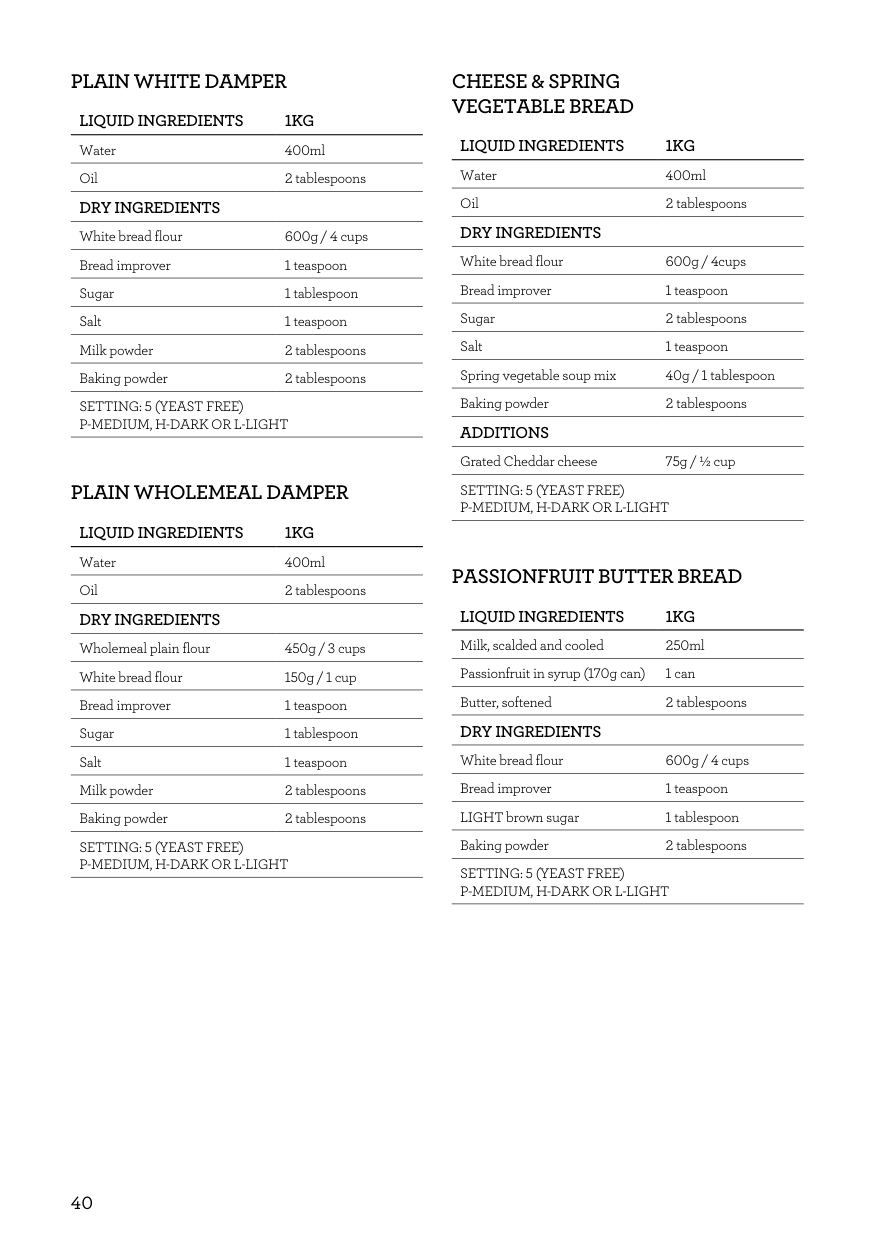
PASSIONFRUIT BUTTER BREAD LIQUID INGREDIENTS 1KG Milk, scalded and cooled 250ml Passionfruit in syrup (170g can) 1 can Butter, softened 2 tablespoons DRY INGREDIENTS White bread flour 600g / 4 cups Bread improver 1 teaspoon LIGHT brown sugar 1 tablespoon Baking powder 2 tablespoons SETTING: 5 (YEAST FREE) P-MEDIUM, H-DARK OR L-LIGHT
######### GLUTEN FREE METHOD
NOTE
Batter should resemble a thick batter. If necessary add 1–2 tablespoons of rice flour or water.
NOTE
For best results remove bread pan as soon as cycle has finished.
######### GLUTEN FREE BREAD
INGREDIENTS 1KG Luke warm water 520ml Oil 80ml Eggs 3 large White vinegar 1 teaspoon White rice flour 300g Brown rice flour 150g Besan or soy flour 70g Arrowroot 150g Organ Gluten Substitute 1 tablespoon Xanthan gum 2 teaspoons White sugar 3 teaspoons Salt 1 ½ teaspoons Yeast: Active Dry 3 teaspoons
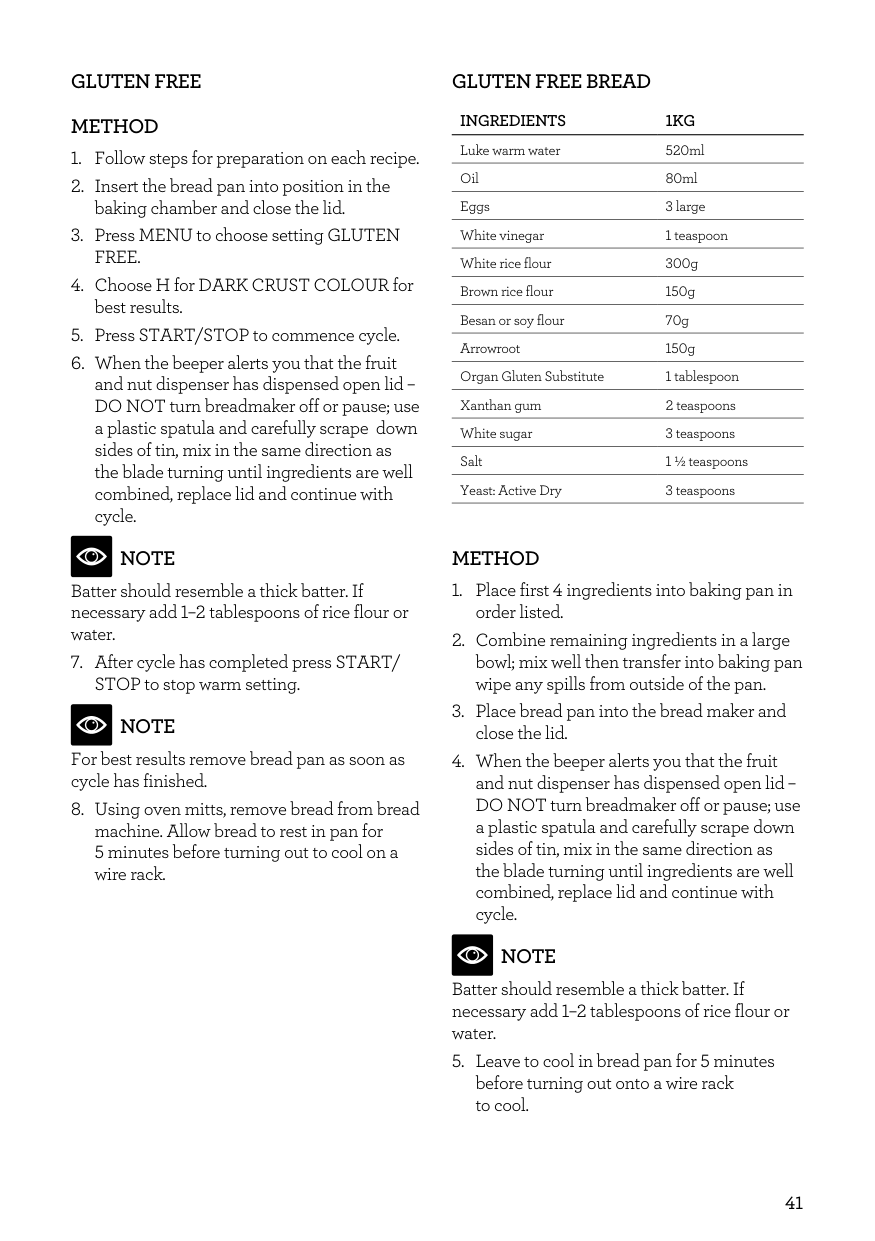
######### METHOD
NOTE
Batter should resemble a thick batter. If necessary add 1–2 tablespoons of rice flour or water.
######### GLUTEN FREE GRAIN BREAD
INGREDIENTS 1KG water 530ml Oil 80ml Eggs 3 large White vinegar 1 teaspoon White rice flour 300g Brown rice flour 150g Besan or soy flour 70g Arrowroot 150g Organ Gluten Substitute 1 tablespoon Xanthan gum 2 teaspoons White sugar 3 teaspoons Salt 1 ½ teaspoons Linseed 2 tablespoons Quinoa 2 tablespoons Chia 2 tablespoons Yeast: Active Dry 3 teaspoons
######### METHOD
NOTE
Batter should resemble a thick batter. If necessary add 1–2 tablespoons of rice flour or water.
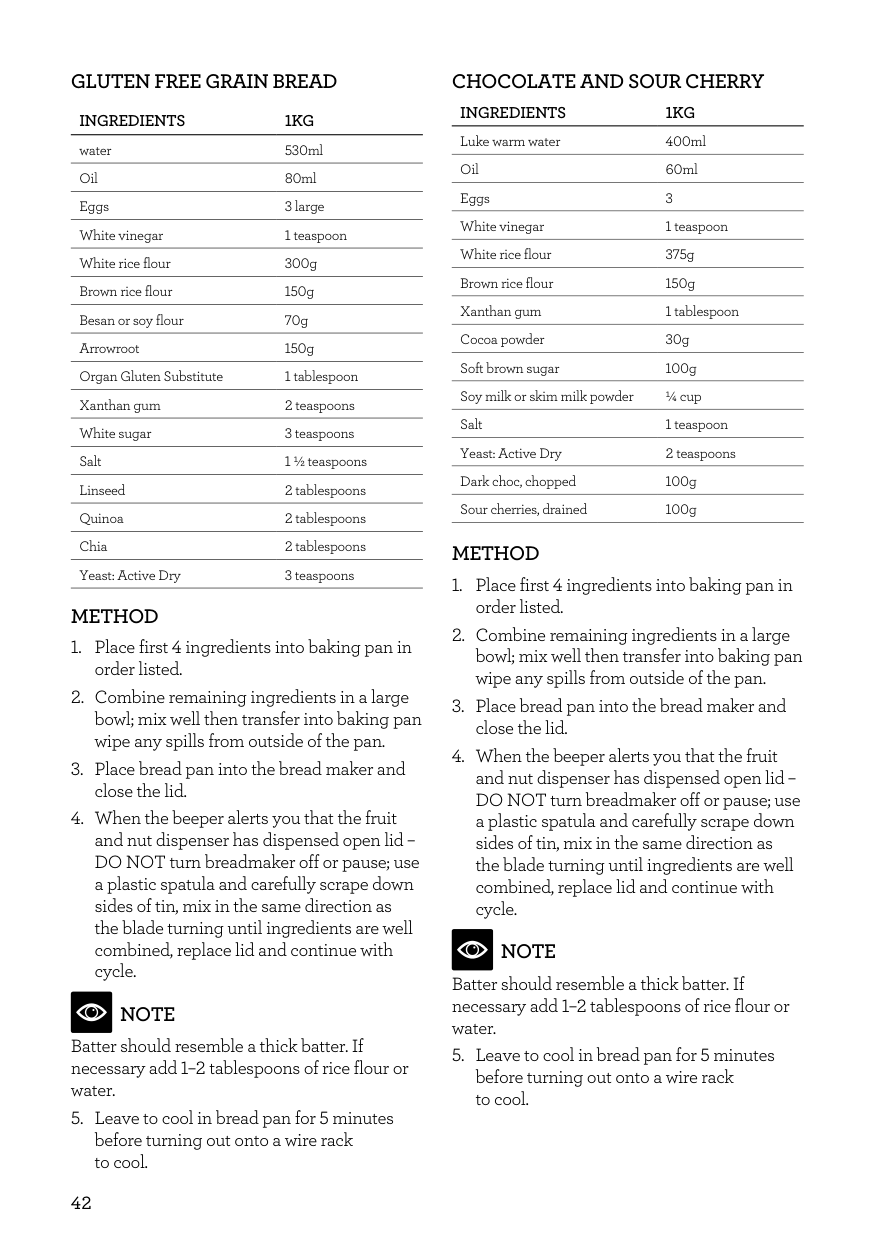
CHOCOLATE AND SOUR CHERRY INGREDIENTS 1KG Luke warm water 400ml Oil 60ml Eggs 3 White vinegar 1 teaspoon White rice flour 375g Brown rice flour 150g Xanthan gum 1 tablespoon Cocoa powder 30g Soft brown sugar 100g Soy milk or skim milk powder ¼ cup Salt 1 teaspoon Yeast: Active Dry 2 teaspoons Dark choc, chopped 100g Sour cherries, drained 100g
######### METHOD
NOTE
Batter should resemble a thick batter. If necessary add 1–2 tablespoons of rice flour or water.
GLUTEN FREE FRUIT LOAF INGREDIENTS 1KG Luke warm water 360ml Oil 60ml Eggs 2 White vinegar 1 teaspoon White rice flour 360g Arrowroot 80g White sugar 3 teaspoons Brown sugar 2 tablespoons Xanthan gum 3 teaspoons Salt 1 teaspoon Yeast: Active Dry 2 teaspoons Sultanas ¼ cup Dates, chopped ¼ cup Dried Cranberries ¼ cup
######### METHOD
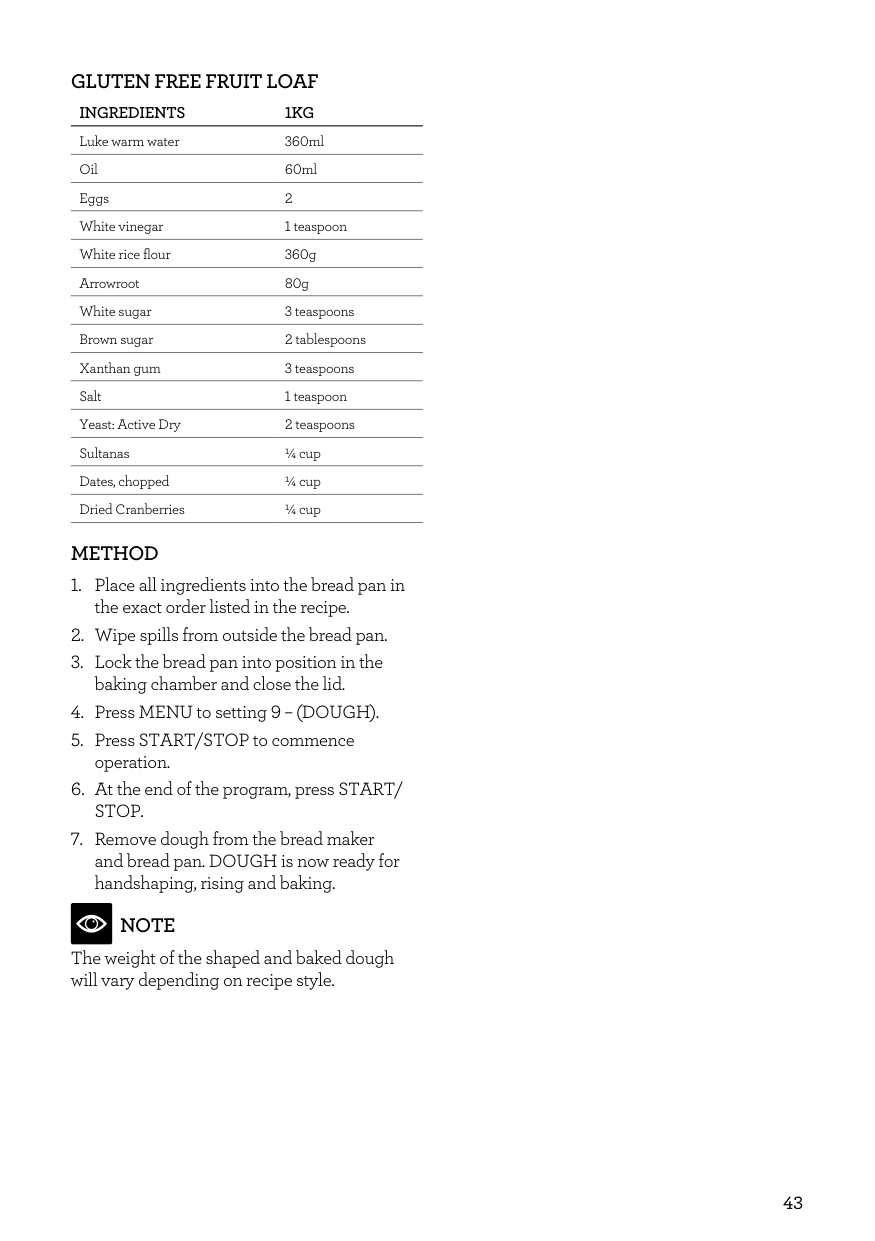
######### NOTE
The weight of the shaped and baked dough will vary depending on recipe style.
######### DOUGH SEQUENCE FOR DOUGH SETTING
PUNCH DOWN
1ST KNEAD 2ND KNEAD 1ST RISE
2ND RISE TOTAL TIME 2 min 28 min 10 min 10 secs 50 min 1hr 30min
######### ADD-IN BEEPS
The Baker’s Oven beeps 10 times at 8 minutes before the end of the second kneading cycle. Extra ingredients such as fruit, nuts, etc. should be added at this time. To make a master dough:
WHITE BREAD DOUGH Not suitable for the PRESET TIMER
############ INGREDIENTS 1KG
Full cream milk, scalded and cooled
350ml
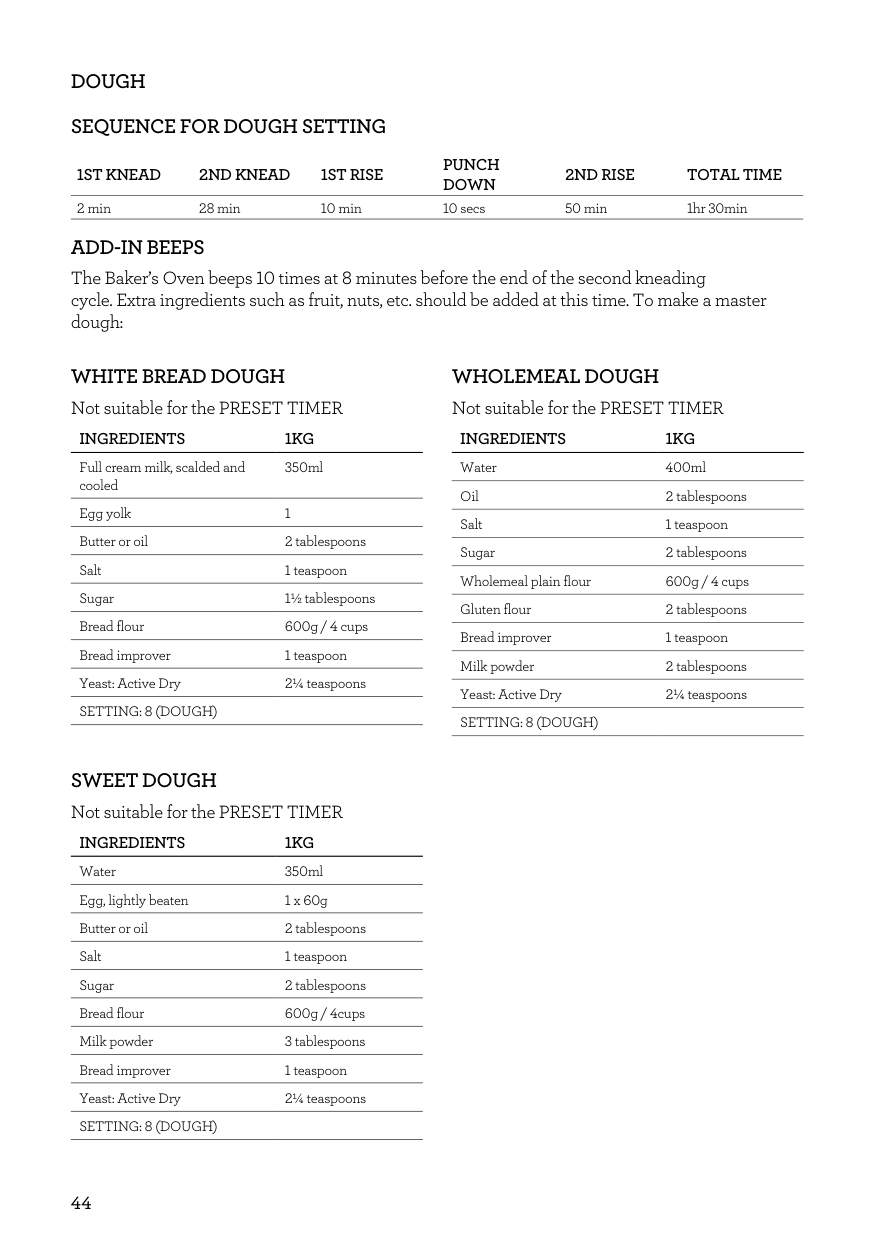
Egg yolk 1 Butter or oil 2 tablespoons Salt 1 teaspoon Sugar 1K tablespoons Bread flour 600g / 4 cups Bread improver 1 teaspoon Yeast: Active Dry 2¼ teaspoons SETTING: 8 (DOUGH)
WHOLEMEAL DOUGH Not suitable for the PRESET TIMER
INGREDIENTS 1KG Water 400ml Oil 2 tablespoons Salt 1 teaspoon Sugar 2 tablespoons Wholemeal plain flour 600g / 4 cups Gluten flour 2 tablespoons Bread improver 1 teaspoon Milk powder 2 tablespoons Yeast: Active Dry 2¼ teaspoons SETTING: 8 (DOUGH)
SWEET DOUGH Not suitable for the PRESET TIMER
INGREDIENTS 1KG Water 350ml Egg, lightly beaten 1 x 60g Butter or oil 2 tablespoons Salt 1 teaspoon Sugar 2 tablespoons Bread flour 600g / 4cups Milk powder 3 tablespoons Bread improver 1 teaspoon Yeast: Active Dry 2¼ teaspoons SETTING: 8 (DOUGH)
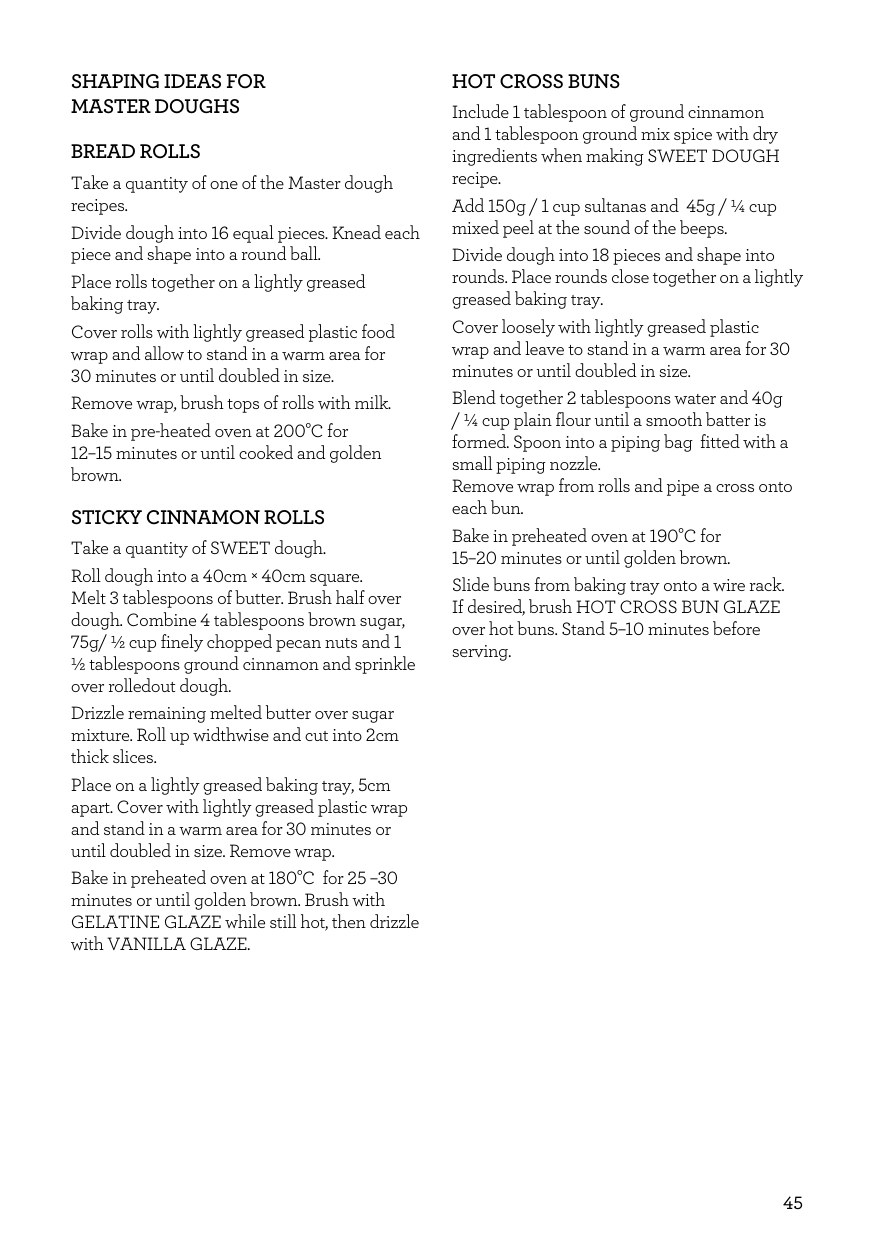
######### SHAPING IDEAS FOR MASTER DOUGHS
BREAD ROLLS Take a quantity of one of the Master dough recipes. Divide dough into 16 equal pieces. Knead each piece and shape into a round ball. Place rolls together on a lightly greased baking tray. Cover rolls with lightly greased plastic food wrap and allow to stand in a warm area for 30 minutes or until doubled in size. Remove wrap, brush tops of rolls with milk. Bake in pre-heated oven at 200°C for 12–15 minutes or until cooked and golden brown.
STICKY CINNAMON ROLLS Take a quantity of SWEET dough. Roll dough into a 40cm × 40cm square. Melt 3 tablespoons of butter. Brush half over dough. Combine 4 tablespoons brown sugar, 75g/ ½ cup finely chopped pecan nuts and 1 ½ tablespoons ground cinnamon and sprinkle over rolledout dough. Drizzle remaining melted butter over sugar mixture. Roll up widthwise and cut into 2cm thick slices. Place on a lightly greased baking tray, 5cm apart. Cover with lightly greased plastic wrap and stand in a warm area for 30 minutes or until doubled in size. Remove wrap. Bake in preheated oven at 180°C for 25 –30 minutes or until golden brown. Brush with GELATINE GLAZE while still hot, then drizzle with VANILLA GLAZE.
HOT CROSS BUNS Include 1 tablespoon of ground cinnamon and 1 tablespoon ground mix spice with dry ingredients when making SWEET DOUGH recipe. Add 150g / 1 cup sultanas and 45g / ¼ cup mixed peel at the sound of the beeps. Divide dough into 18 pieces and shape into rounds. Place rounds close together on a lightly greased baking tray. Cover loosely with lightly greased plastic wrap and leave to stand in a warm area for 30 minutes or until doubled in size. Blend together 2 tablespoons water and 40g / ¼ cup plain flour until a smooth batter is formed. Spoon into a piping bag fitted with a small piping nozzle. Remove wrap from rolls and pipe a cross onto each bun. Bake in preheated oven at 190°C for 15–20 minutes or until golden brown.
Slide buns from baking tray onto a wire rack. If desired, brush HOT CROSS BUN GLAZE over hot buns. Stand 5–10 minutes before serving.
######### PIZZA & FOCACCIA DOUGHS
The DOUGH setting is suitable for all your favourite pizza and focaccia recipes.
######### METHOD
######### PIZZA DOUGH
INGREDIENTS 1KG Water 250ml Olive oil 1 tablespoon Salt 3 teaspoons Bread flour 500g Yeast: Active Dry 3 teaspoons Sugar 3 teaspoons SETTING: 8 (DOUGH)
######### SUGGESTED TOPPINGS
Tomato paste, mushrooms, capsicums, onions, tomatoes, capers, pineapple pieces, olives, herbs, salami, ham, anchovies, sardines, cheese (i.e. grated mozzarella, Parmesan).
######### HANDSHAPING
######### FOCACCIA DOUGH
INGREDIENTS 1KG Water 250ml Olive oil 2 tablespoons Salt 1 teaspoon Sugar 2 teaspoons Bread flour 450g / 3 cups Yeast: Active Dry 2 teaspoons SETTING: 8 (DOUGH)
######### SUGGESTED TOPPINGS
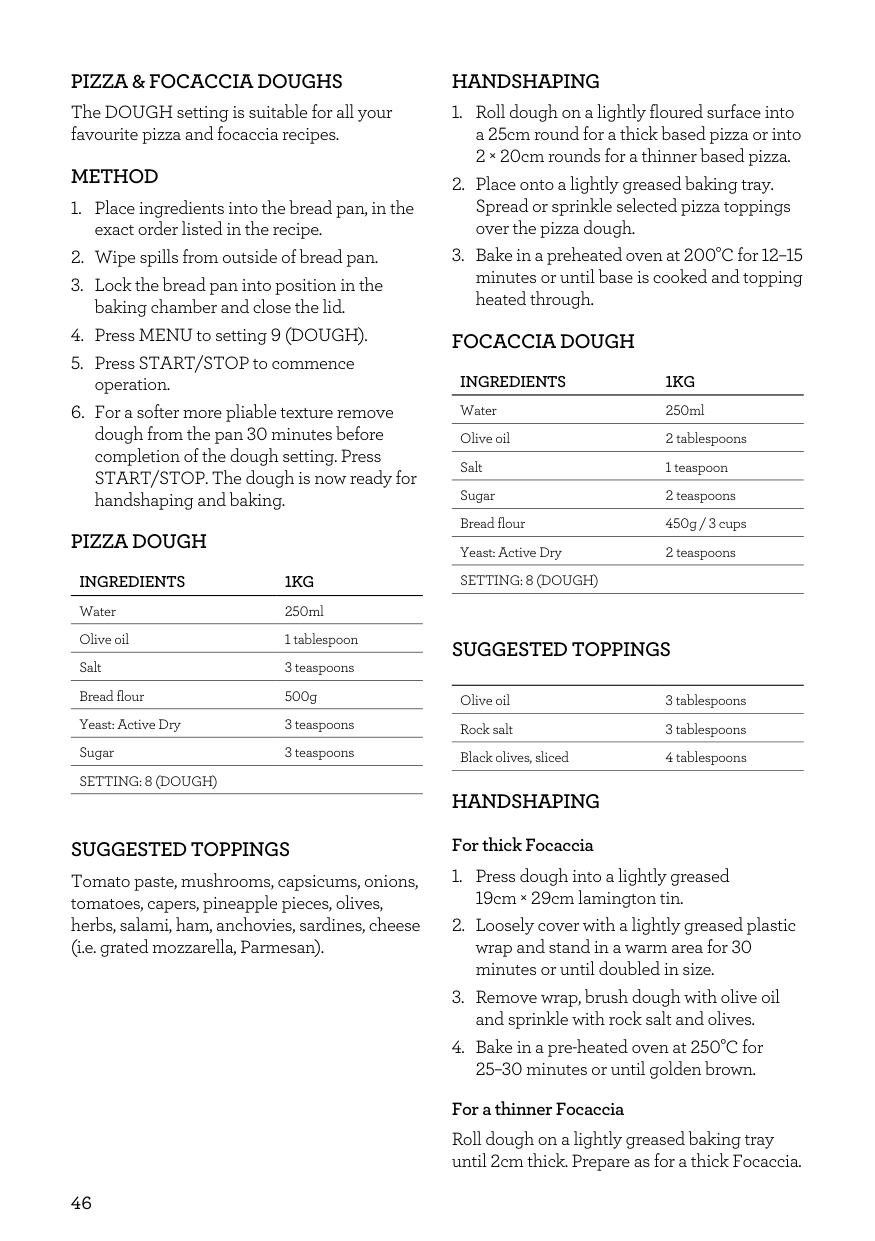
Olive oil 3 tablespoons Rock salt 3 tablespoons Black olives, sliced 4 tablespoons
######### HANDSHAPING For thick Focaccia
########## For a thinner Focaccia
Roll dough on a lightly greased baking tray until 2cm thick. Prepare as for a thick Focaccia.
######### GLAZES
The following Glazes are easy and quick to prepare and will enhance the flavour and appearance of your breads.
######### CHOCOLATE GLAZE INGREDIENTS
######### HOT CROSS BUN AND BROWN BUN GLAZE INGREDIENTS
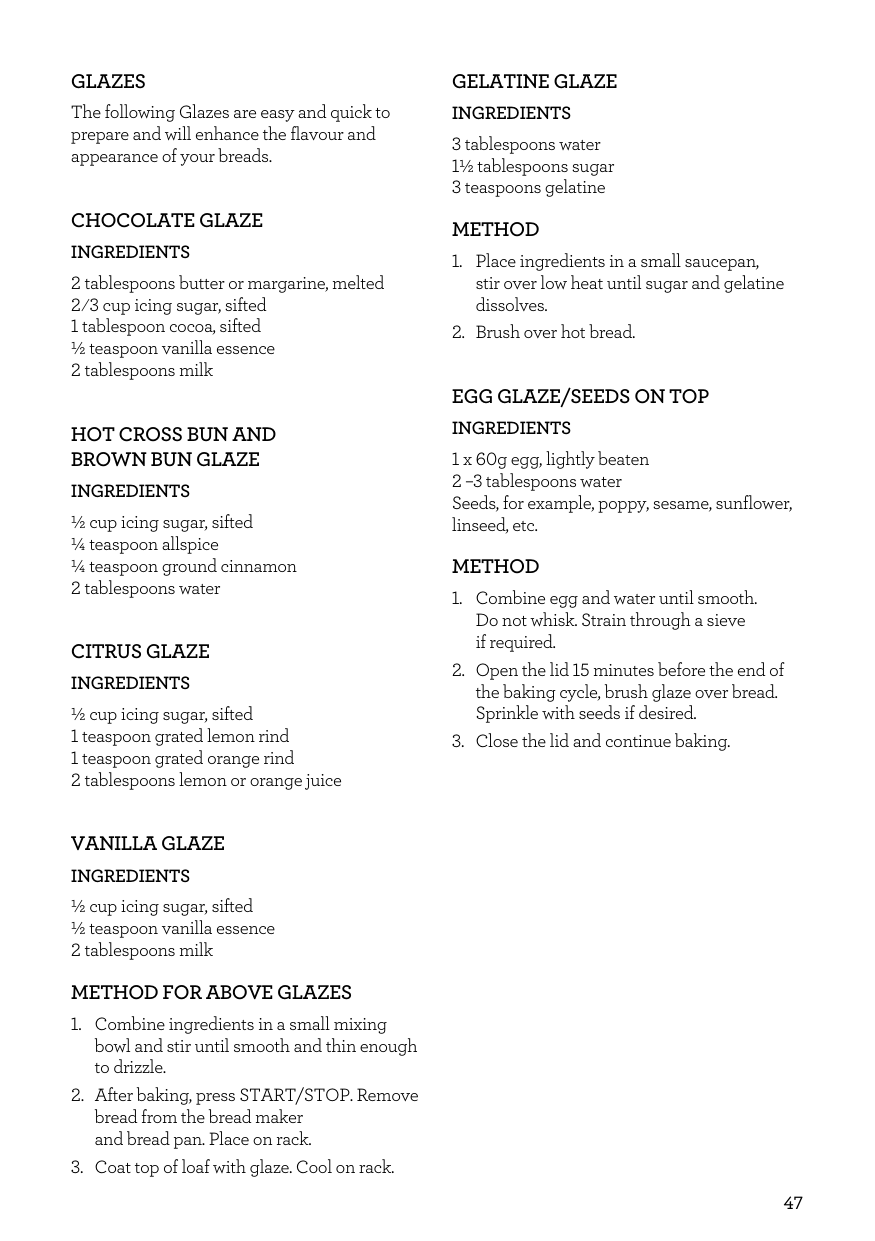
½ cup icing sugar, sifted ¼ teaspoon allspice ¼ teaspoon ground cinnamon
CITRUS GLAZE INGREDIENTS ½ cup icing sugar, sifted
VANILLA GLAZE INGREDIENTS
½ cup icing sugar, sifted ½ teaspoon vanilla essence
######### GELATINE GLAZE INGREDIENTS

3 tablespoons water 1½ tablespoons sugar 3 teaspoons gelatine
######### METHOD
######### EGG GLAZE/SEEDS ON TOP INGREDIENTS
##### Breville Customer Service Centre
Australian Customers Mail: Locked Bag 2000
Botany NSW 1455 AUSTRALIA
Phone: 1300 139 798 Fax: (02) 9700 1342 Email: Customer Service:
askus@breville.com.au
New Zealand Customers Mail: Private Bag 94411
Botany Manukau 2163 Auckland NEW ZEALAND
Phone: 0800 273 845 Fax: 0800 288 513 Email: Customer Service:
askus@breville.co.nz
######## Web: www.breville.co.nzWeb:www.breville.com.au
Breville is a registered trademark of Breville Pty. Ltd. A.B.N. 98 000 092 928. Copyright Breville Pty. Ltd. 2016.
Due to continued product improvement, the products illustrated/photographed in this brochure may vary slightly from the actual product.
BBM100 ANZ – D22