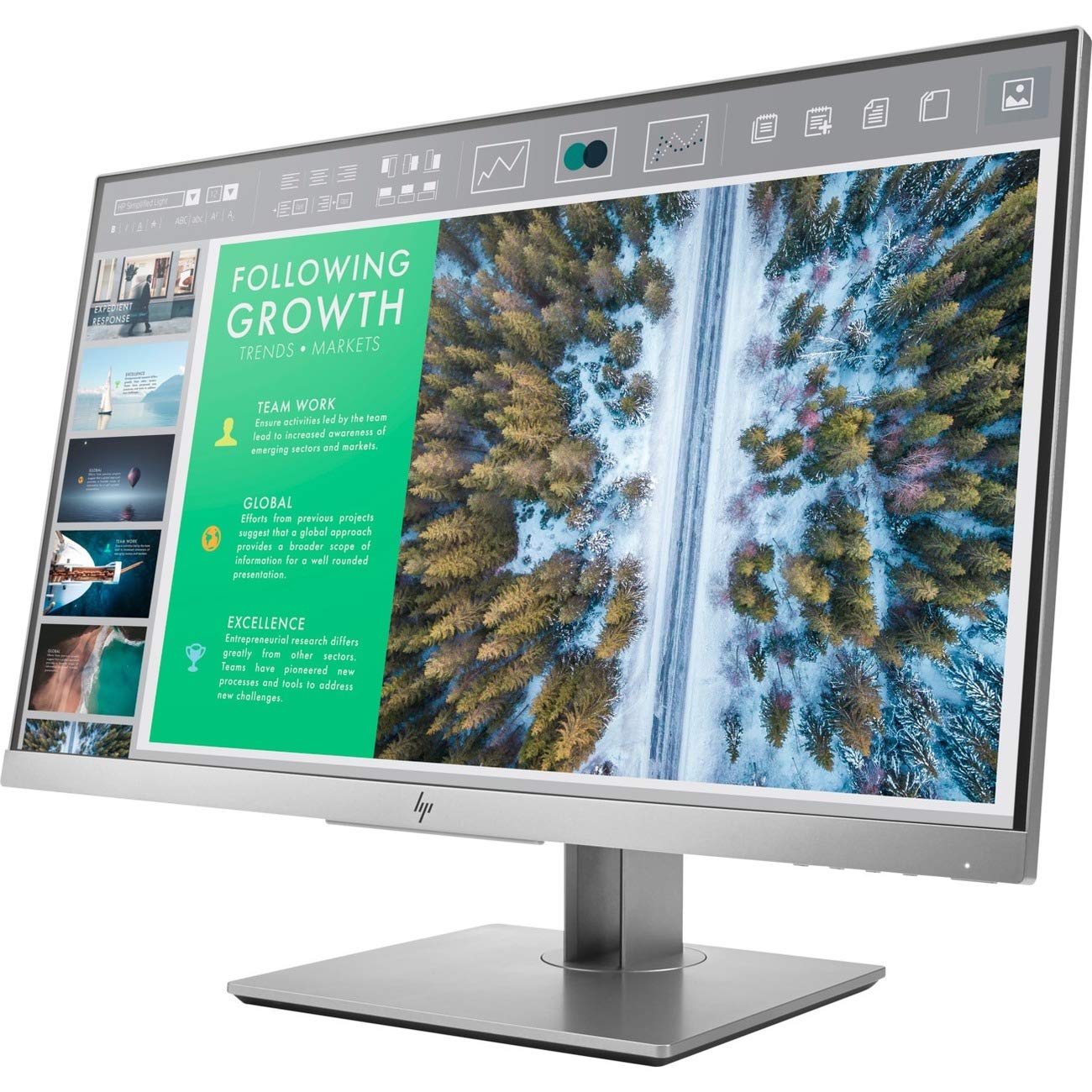
HP Elitedisplay E243 23.8 Inch Monitor
Ask AI
— answers from the official manualAnswers from the official manual.
Common questions
Common Questions
10 totalHow do I adjust the brightness on my monitor?
Access the OSD menu by pressing the Menu button, select Brightness to adjust the level based on your preferences. The default setting is 90 (Page 19)
What should I do if the monitor is not turning on?
Press and hold the power button for 10 seconds to disable Power Button Lockout if pressing it once has no effect, then connect all cables properly and ensure the power cord is plugged in securely. (Page 23)
What cables come with my monitor?
The monitor comes with VGA and DisplayPort cables, while HDMI and USB cables are not provided.
How can I adjust the viewing angle of the monitor?
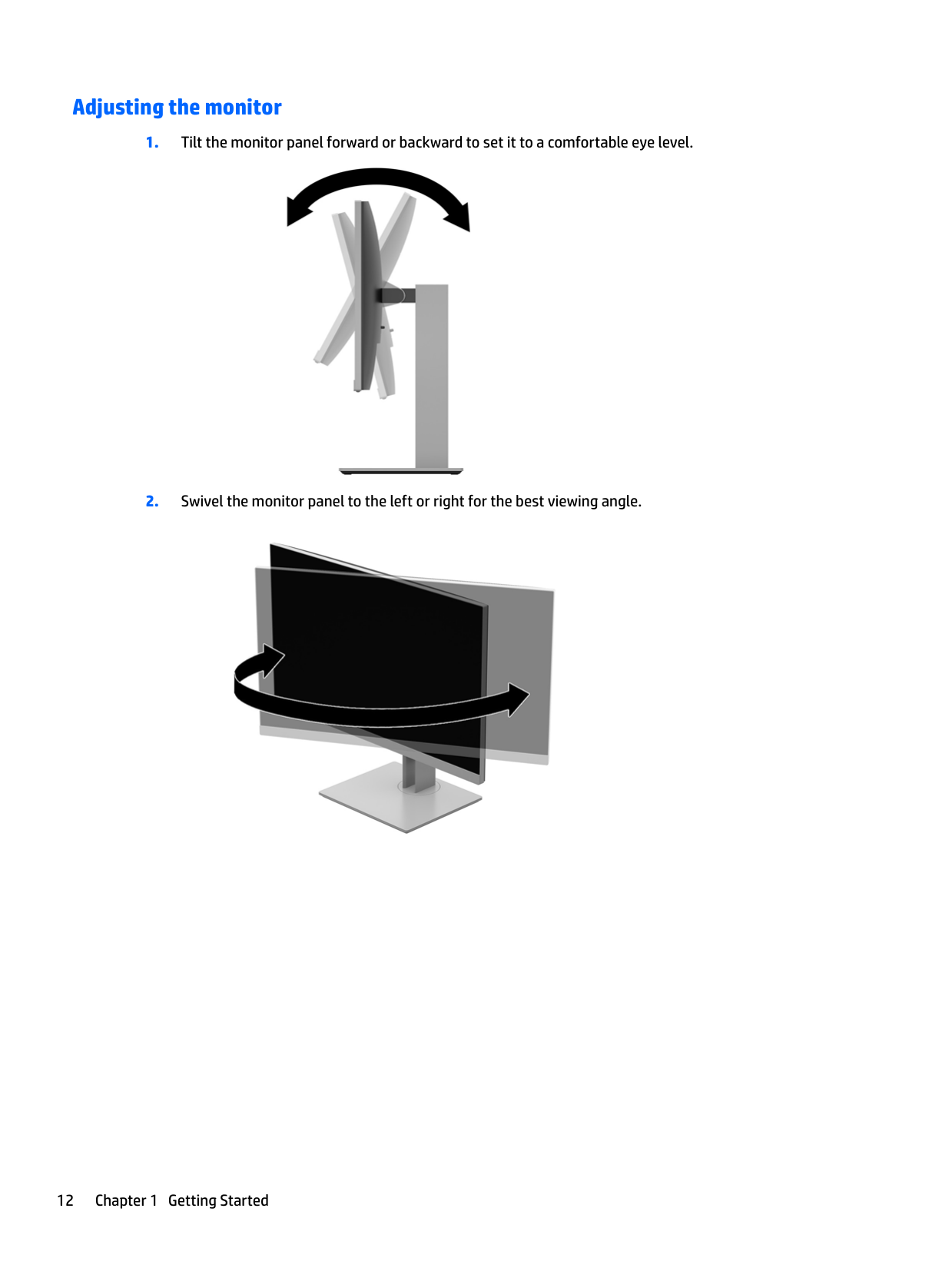
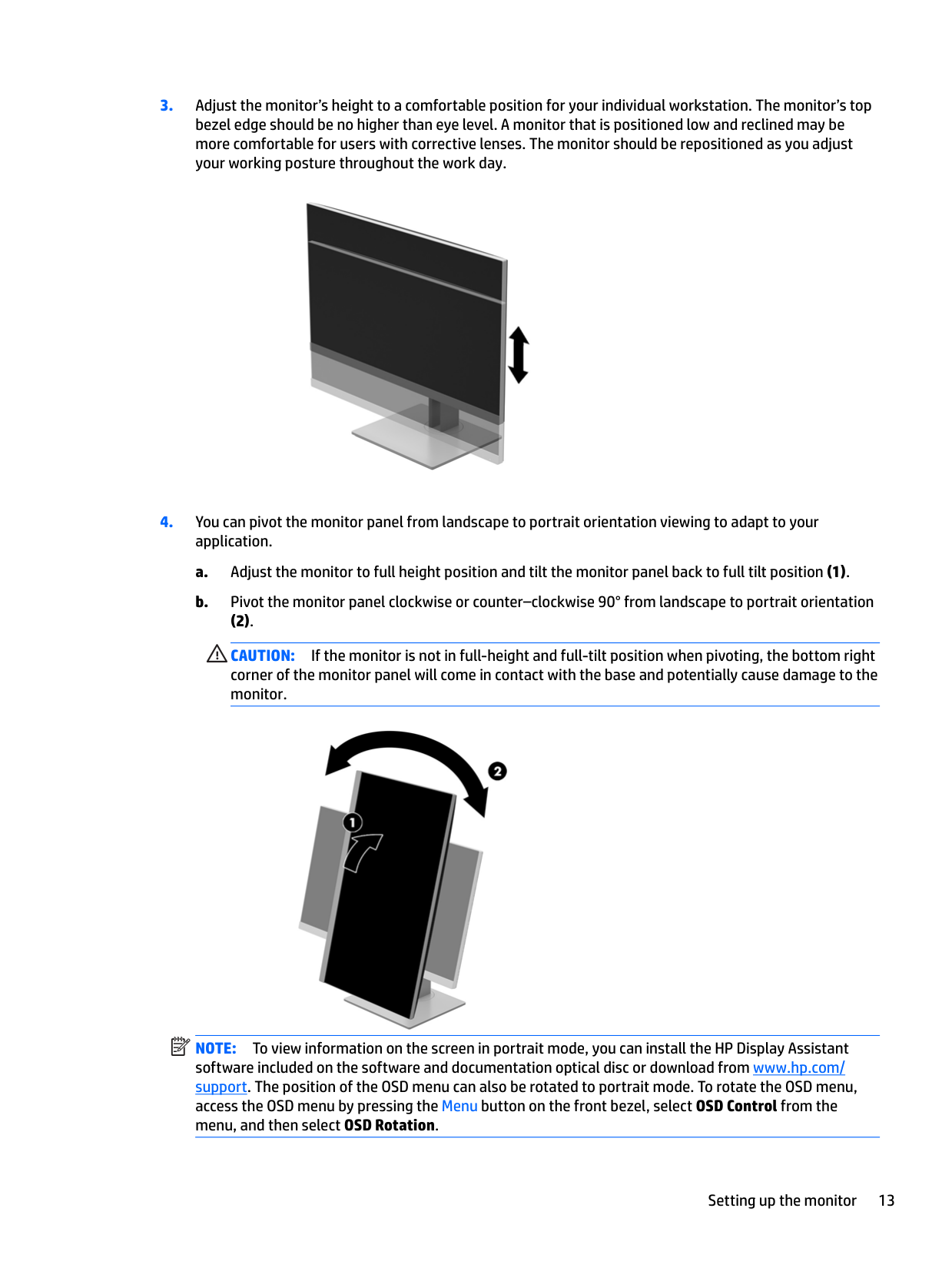
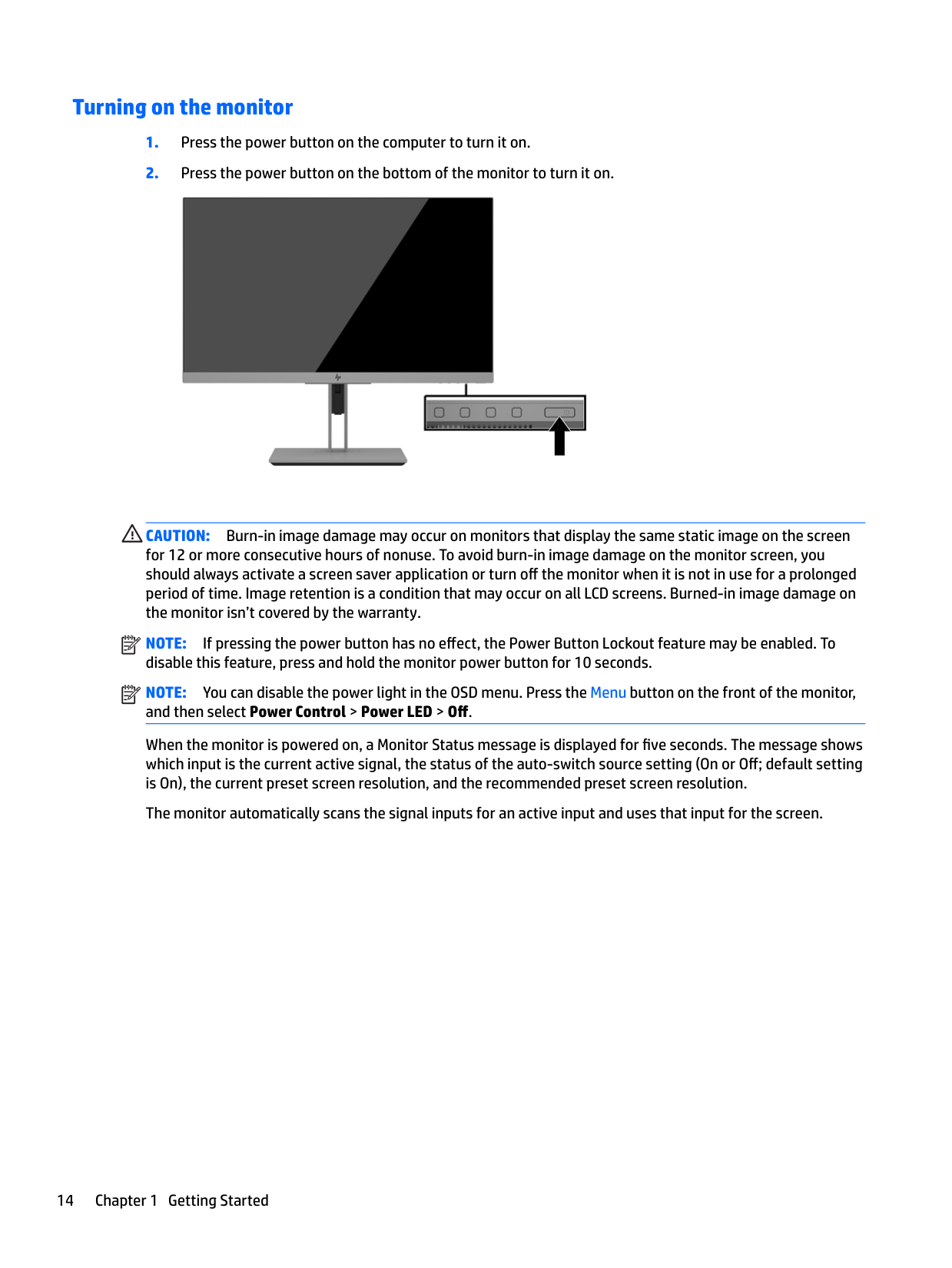
You can tilt the monitor panel forward or backward for comfortable eye level, swivel to left or right for best viewing angle, and pivot from landscape to portrait orientation.
What is Auto-Sleep Mode and how do I disable it?
Auto-Sleep Mode enables a reduced power state when the host PC signals low-power mode. To disable, press function buttons, select Power Control > Power Mode > Performance, then select Off.
How do I attach a security cable to my monitor?
There is a provision for an optional security cable on the rear of the monitor. Install it by securing the provided slot with an HP recommended security cable.
Full Manual
38 pages


User Guide
© Copyright 2017 HP Development Company, L.P.
HDMI, the HDMI Logo and High-Definition Multimedia Interface are trademarks or registered trademarks of HDMI Licensing LLC. Windows is either a registered trademark or trademark of Microsoft Corporation in the United States and/or other countries.
The information contained herein is subject to change without notice. The only warranties for HP products and services are set forth in the express warranty statements accompanying such products and services. Nothing herein should be construed as constituting an additional warranty. HP shall not be liable for technical or editorial errors or omissions contained herein.
Product notice This guide describes features that are common to most models. Some features may not be available on your product. To access the latest user guide, go to http://www.hp.com/support, and select your country. Select Find your product, and then follow the on-screen instructions. First Edition: July 2017 Document Part Number: 926258-001
#### About This Guide
This guide provides information on monitor features, setting up the monitor, using the software and technical specifications.
WARNING! Indicates a hazardous situation that, if not avoided, could result in death or serious injury. CAUTION: Indicates a hazardous situation that, if not avoided, could result in minor or moderate injury.
| | |---|
IMPORTANT: Indicates information considered important but not hazard-related (for example, messages related to property damage). A notice alerts the user that failure to follow a procedure exactly as described could result in loss of data or in damage to hardware or software. Also contains essential information to explain a concept or to complete a task.
| |
|---|
NOTE: Contains additional information to emphasize or supplement important points of the main text. TIP: Provides helpful hints for completing a task.

This product incorporates HDMI technology.
iii
####### iv About This Guide
Table of contents
Features ............................................................................................................................................... 2 Rear and side components .................................................................................................................. 3 Front bezel controls ............................................................................................................................ 5
Setting up the monitor .......................................................................................................................................... 6 Installing the monitor stand ................................................................................................................ 6 Connecting the cables ......................................................................................................................... 7 Adjusting the monitor ....................................................................................................................... 12 Turning on the monitor ..................................................................................................................... 14 Installing a security cable ................................................................................................................. 15 Mounting the monitor ....................................................................................................................... 15
Removing the monitor stand .......................................................................................... 16 Attaching the VESA mounting bracket ........................................................................... 17
The Information file ........................................................................................................................... 18 The Image Color Matching file ........................................................................................................... 18
Installing the INF and ICM files ............................................................................................................................ 18 Installing from the optical disc (available in select regions) ............................................................ 18 Downloading from the web ............................................................................................................... 18
Using the on-screen display (OSD) menu ............................................................................................................ 19 Assigning the function buttons ........................................................................................................................... 20 Camera ................................................................................................................................................................. 21 Using Auto-Sleep Mode ....................................................................................................................................... 22 Adjusting Low Blue Light Mode ........................................................................................................................... 22
v
Locating the serial number and product number ............................................................................................... 27
Entering user modes ............................................................................................................................................ 31 Energy saver feature ........................................................................................................................................... 31

vi
1 Getting Started
Important safety information
An AC power adapter and cord may be included with the monitor. If another cord is used, use only a power source and connection appropriate for this monitor. For information on the correct power cord set to use with the monitor, refer to the Product Notices provided on the optical disc or in your documentation kit.
WARNING! To reduce the risk of electric shock or damage to the equipment:
For your safety, do not place anything on power cords or cables. Arrange them so that no one may accidentally step on or trip over them. Do not pull on a cord or cable. When unplugging from the AC outlet, grasp the cord by the plug.
To reduce the risk of serious injury, read the Safety & Comfort Guide. It describes proper workstation setup, and proper posture, health, and work habits for computer users. The Safety & Comfort Guide also provides important electrical and mechanical safety information. The Safety & Comfort Guide is available on the Web at http://www.hp.com/ergo.
| | |---|
IMPORTANT: For the protection of the monitor, as well as the computer, connect all power cords for the computer and its peripheral devices (such as a monitor, printer, scanner) to some form of surge protection device such as a power strip or uninterruptible power supply (UPS). Not all power strips provide surge protection; the power strips must be specifically labeled as having this capability. Use a power strip whose manufacturer offers a damage replacement policy so you can replace the equipment if surge protection fails.
Use the appropriate and correctly sized furniture designed to properly support your HP LCD monitor. WARNING! LCD monitors that are inappropriately situated on dressers, bookcases, shelves, desks, speakers, chests, or carts may fall over and cause personal injury. Care should be taken to route all cords and cables connected to the LCD monitor so that they cannot be pulled, grabbed, or tripped over. Be sure that the total ampere rating of the products connected to the AC outlet does not exceed the current rating of the outlet, and that the total ampere rating of the products connected to the cord does not exceed the rating of the cord. Look on the power label to determine the ampere rating (AMPS or A) for each device. Install the monitor near an AC outlet that you can easily reach. Disconnect the monitor by grasping the plug firmly and pulling it from the AC outlet. Never disconnect the monitor by pulling the cord. Do not drop the monitor or place it on an unstable surface. NOTE: This product is suitable for entertainment purposes. Consider placing the monitor in a controlled luminous environment to avoid interference from surrounding light and bright surfaces that may cause disturbing reflections from the screen.
| | |---|
Important safety information 1
Product features and components
#### Features
This guide describes features of the following monitors:
The monitor features include the following:
| | |---|
NOTE: For safety and regulatory information, refer to the Product Notices provided on your optical disc, if one is included, or in your documentation kit. To locate updates to the user guide for your product, go to http://www.hp.com/support. Select Find your product, and then follow the on-screen instructions.
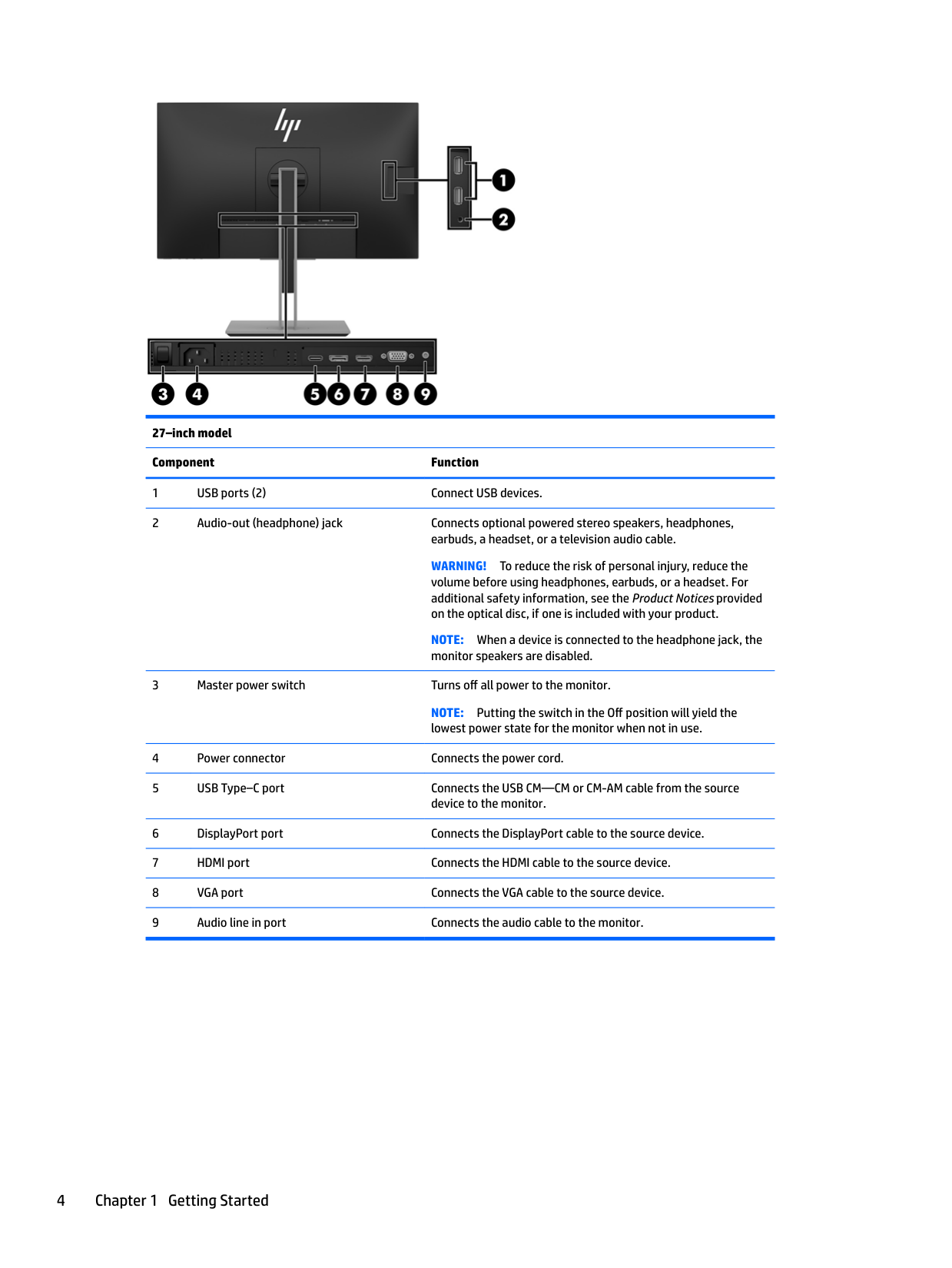
#### Rear and side components

23.8–inch model Component Function
WARNING! To reduce the risk of personal injury, reduce the volume before using headphones, earbuds, or a headset. For additional safety information, see the Product Notices provided on the optical disc, if one is included with your product.
NOTE: When a device is connected to the headphone jack, the monitor speakers are disabled.

27–inch model Component Function
WARNING! To reduce the risk of personal injury, reduce the volume before using headphones, earbuds, or a headset. For additional safety information, see the Product Notices provided on the optical disc, if one is included with your product.
NOTE: When a device is connected to the headphone jack, the monitor speakers are disabled.
NOTE: Putting the switch in the Off position will yield the lowest power state for the monitor when not in use.
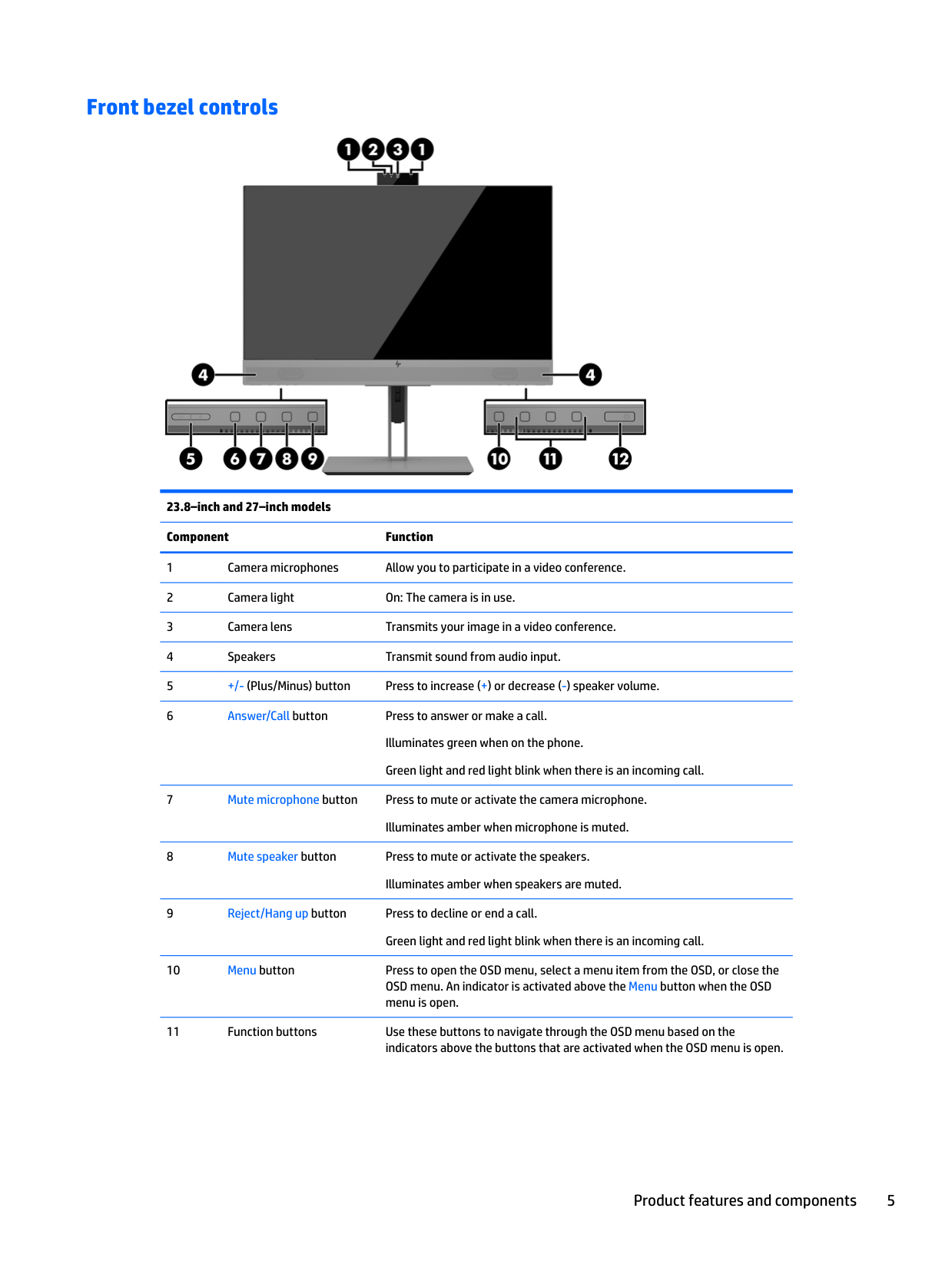
#### Front bezel controls

23.8–inch and 27–inch models Component Function
23.8–inch and 27–inch models Component Function
NOTE: You can reconfigure the Function buttons in the OSD menu to quickly select the most commonly used operations. See Assigning the function buttons on page 20 for more information.
| | |---|
NOTE: To view an OSD menu simulator, visit the HP Customer Self Repair Services Media Library at http://www.hp.com/go/sml.
Setting up the monitor
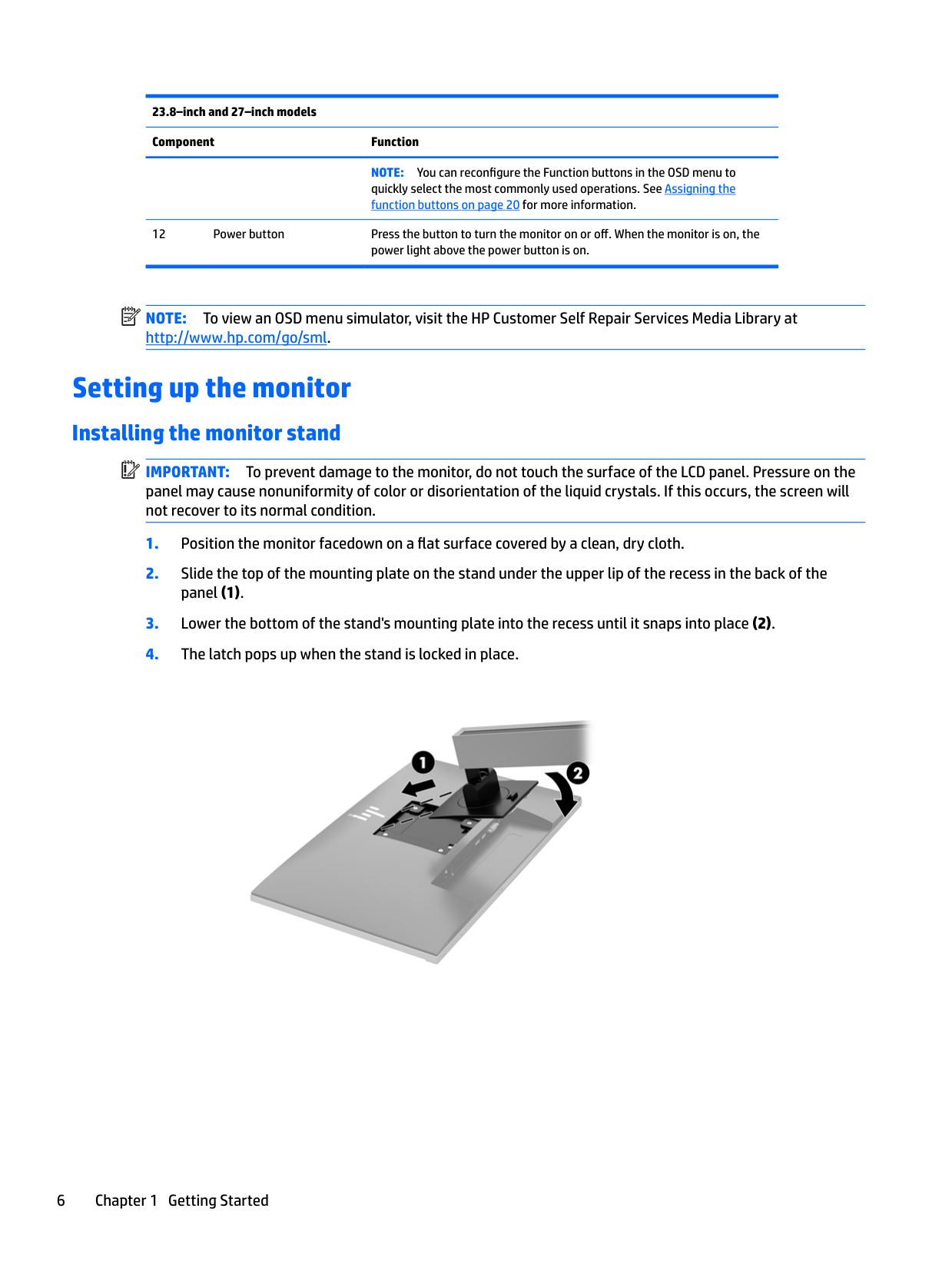
#### Installing the monitor stand
| | |---|
IMPORTANT: To prevent damage to the monitor, do not touch the surface of the LCD panel. Pressure on the panel may cause nonuniformity of color or disorientation of the liquid crystals. If this occurs, the screen will not recover to its normal condition.

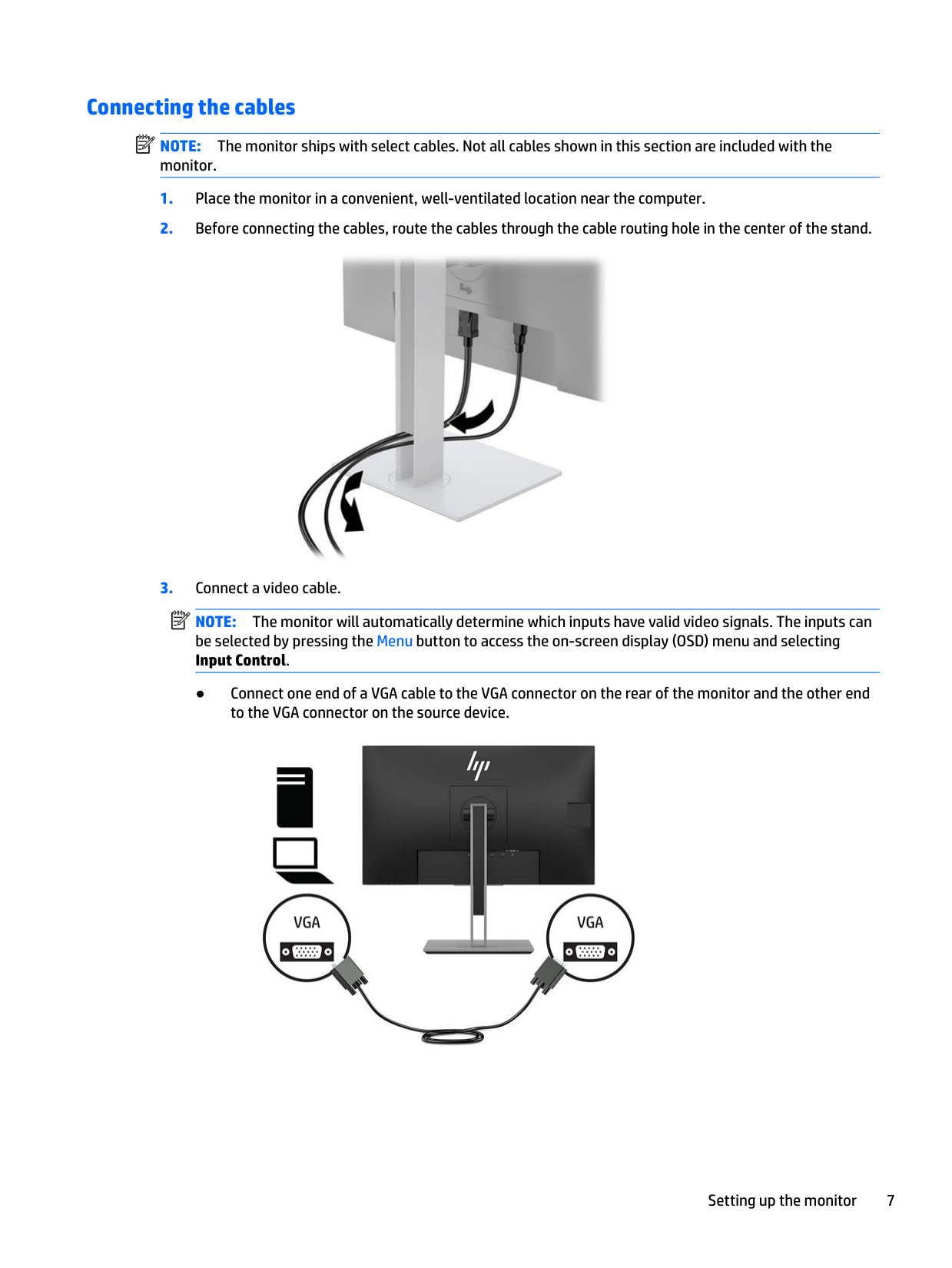
#### Connecting the cables
| | |---|
NOTE: The monitor ships with select cables. Not all cables shown in this section are included with the monitor.

| | |---|
NOTE: The monitor will automatically determine which inputs have valid video signals. The inputs can be selected by pressing the Menu button to access the on-screen display (OSD) menu and selecting Input Control.

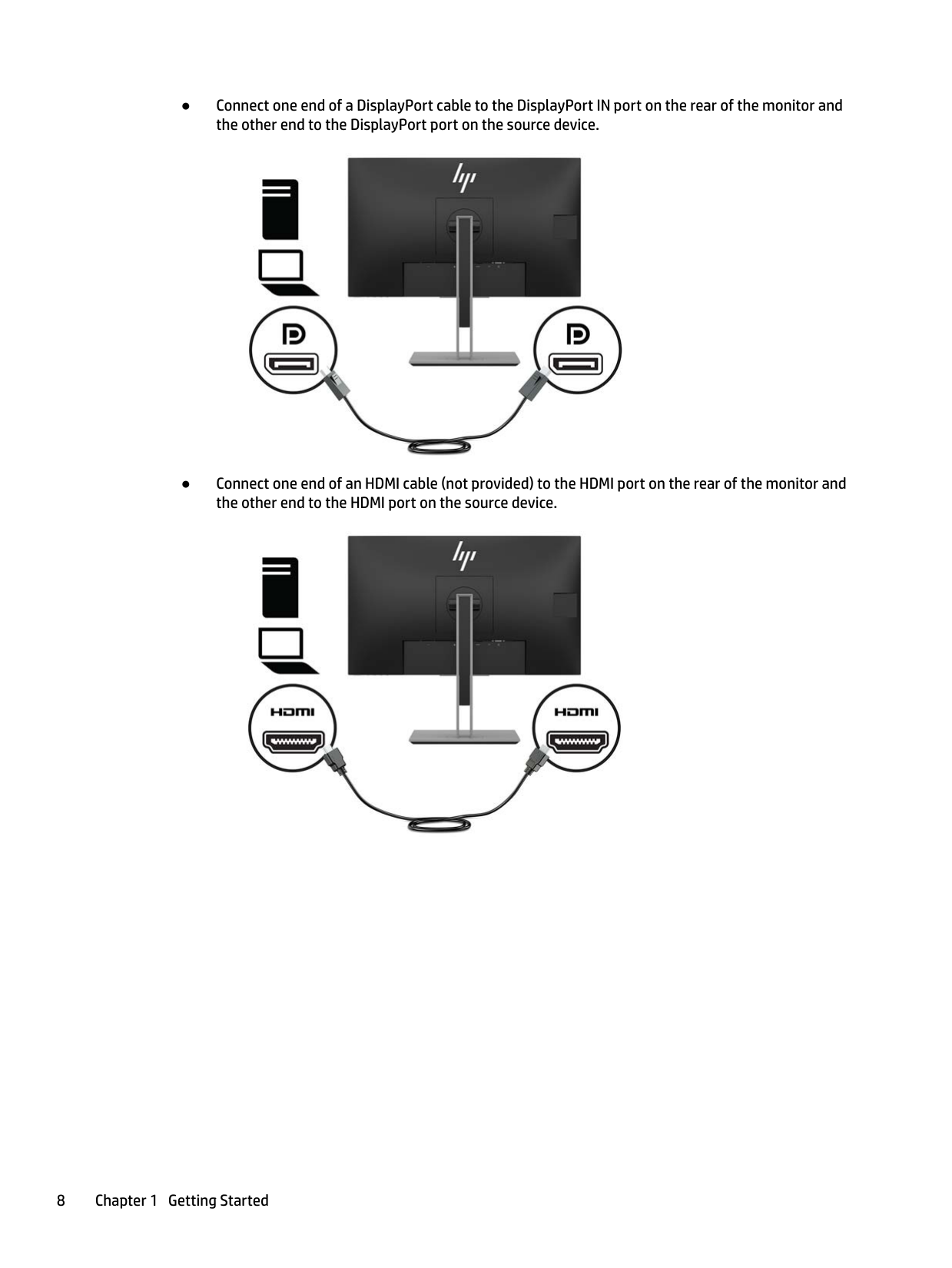
####### ● Connect one end of a DisplayPort cable to the DisplayPort IN port on the rear of the monitor andthe other end to the DisplayPort port on the source device.

####### ● Connect one end of an HDMI cable (not provided) to the HDMI port on the rear of the monitor andthe other end to the HDMI port on the source device.


| | |---|
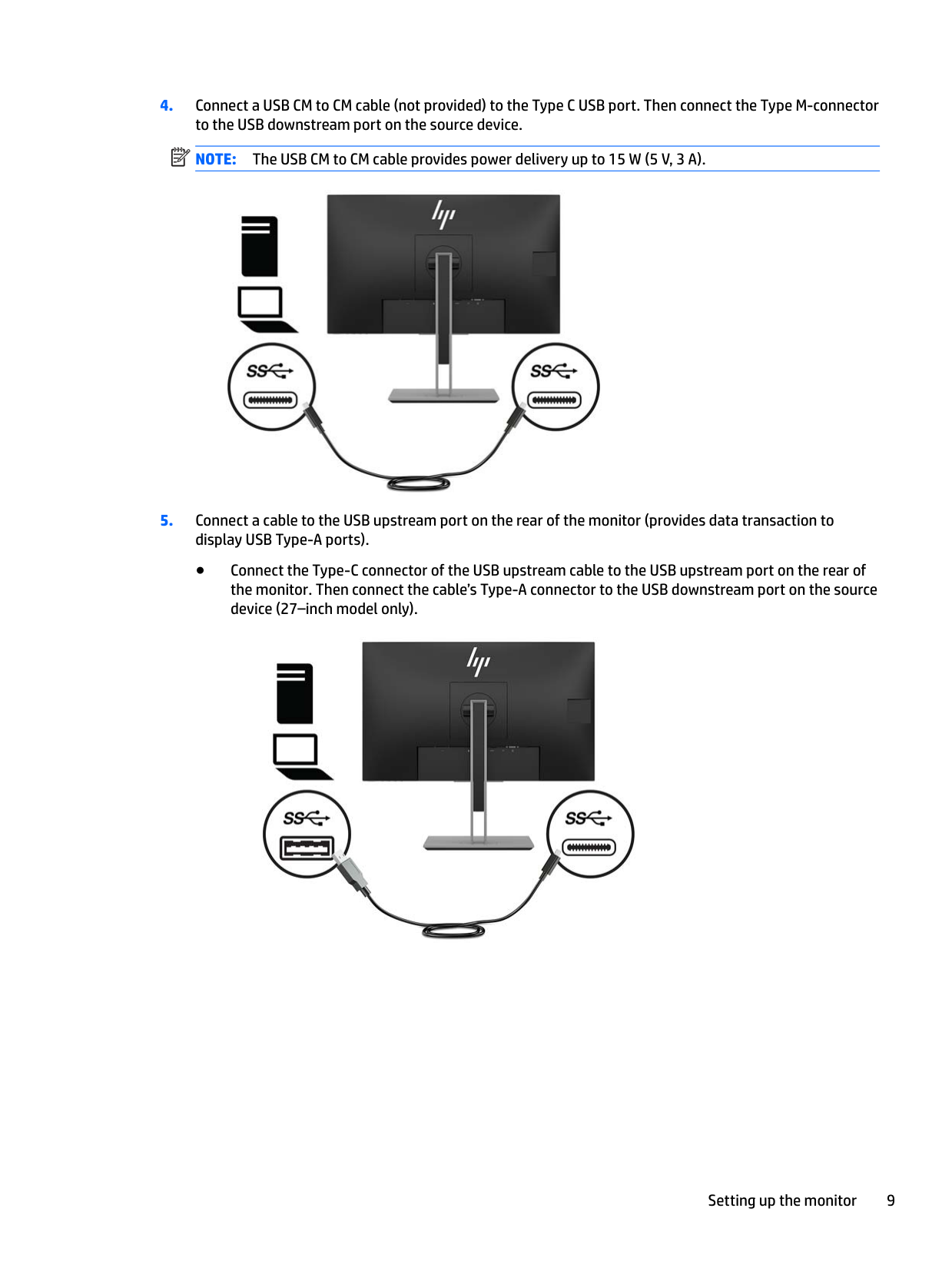
● Connect the Type-C connector of the USB upstream cable to the USB upstream port on the rear of the monitor. Then connect the cable’s Type-A connector to the USB downstream port on the source device (27–inch model only).

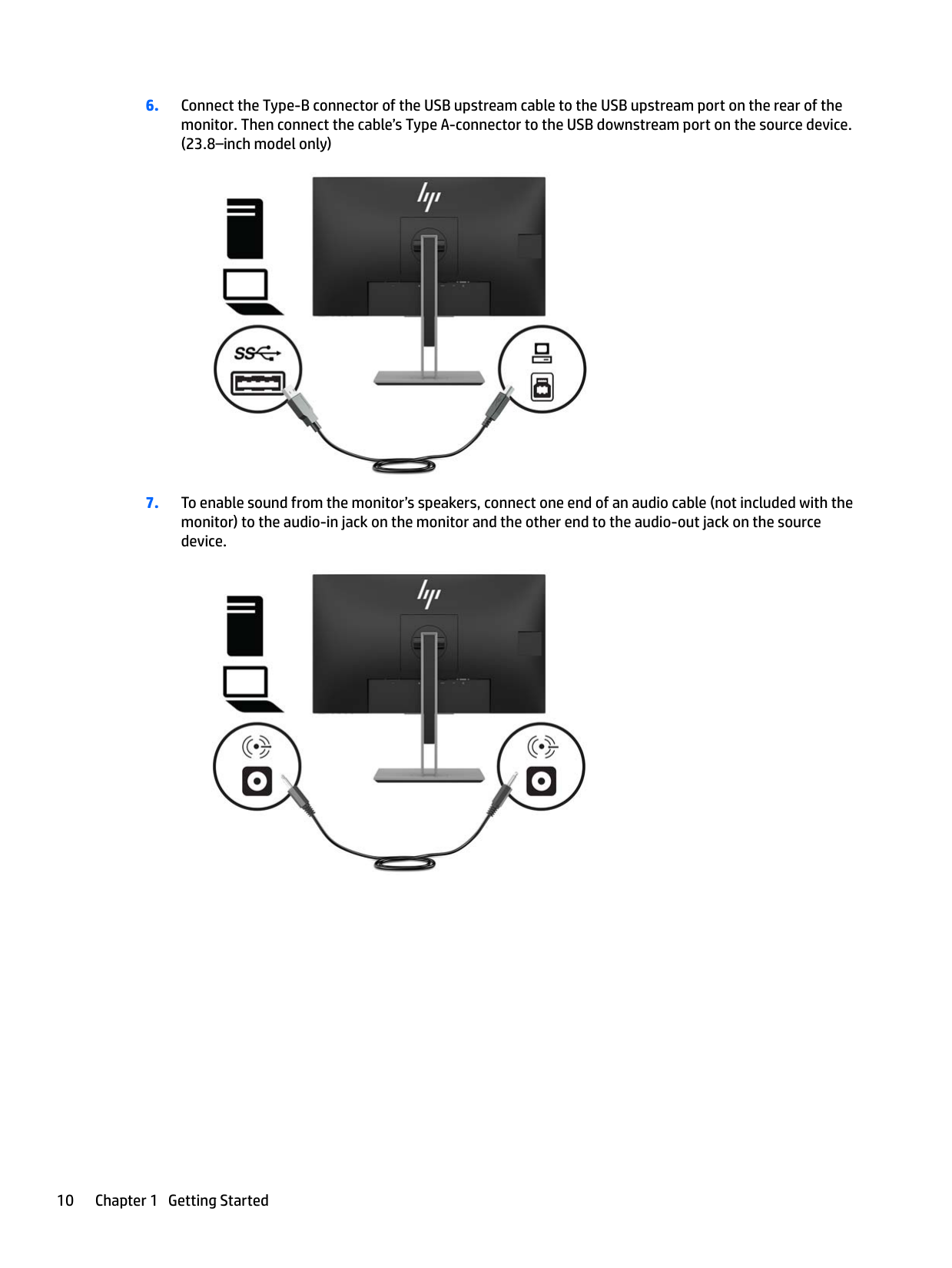
####### 6. Connect the Type-B connector of the USB upstream cable to the USB upstream port on the rear of themonitor. Then connect the cable’s Type A-connector to the USB downstream port on the source device.(23.8–inch model only)

####### 7. To enable sound from the monitor’s speakers, connect one end of an audio cable (not included with themonitor) to the audio-in jack on the monitor and the other end to the audio-out jack on the sourcedevice.


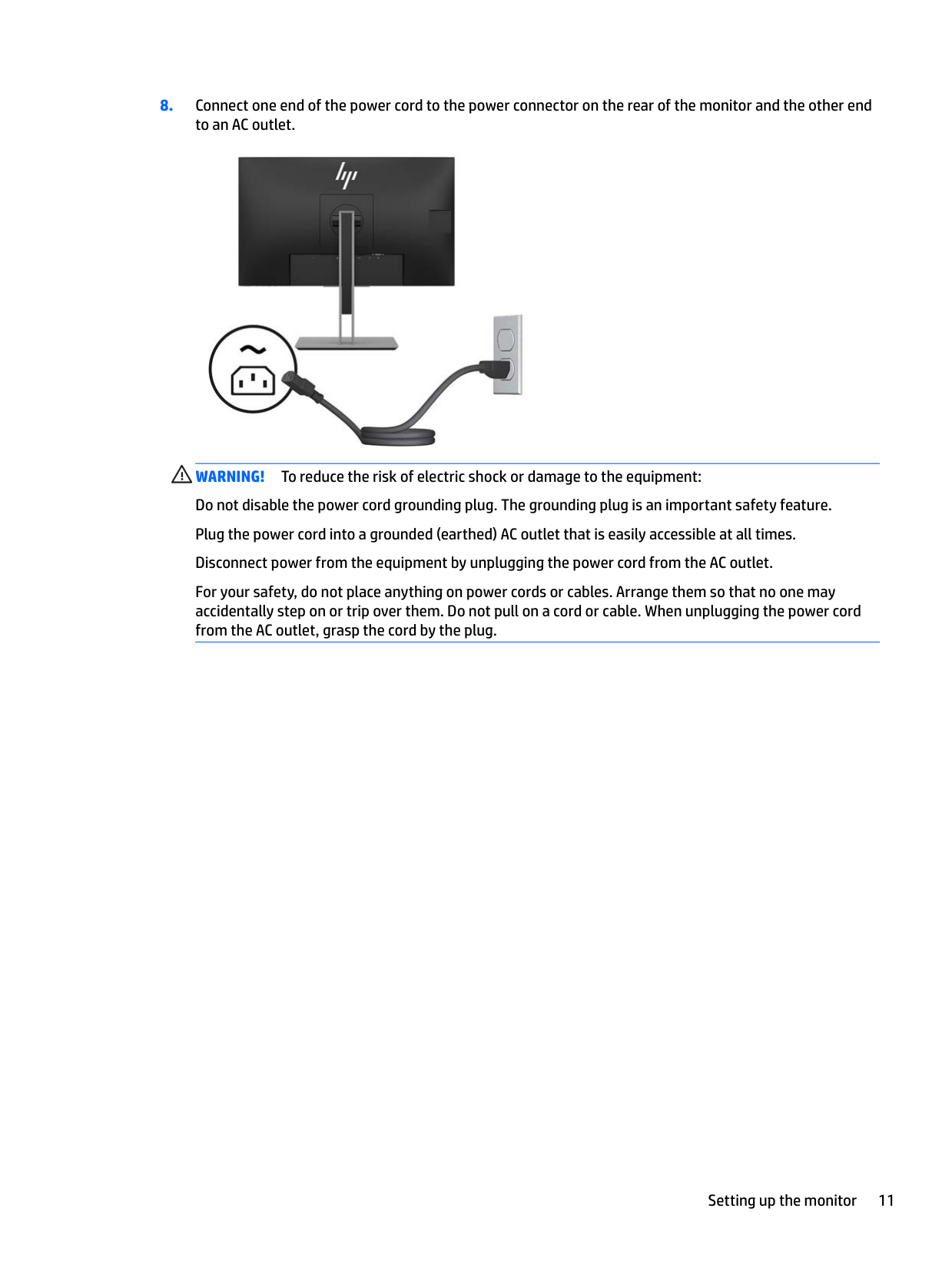
WARNING! To reduce the risk of electric shock or damage to the equipment: Do not disable the power cord grounding plug. The grounding plug is an important safety feature. Plug the power cord into a grounded (earthed) AC outlet that is easily accessible at all times. Disconnect power from the equipment by unplugging the power cord from the AC outlet. For your safety, do not place anything on power cords or cables. Arrange them so that no one may accidentally step on or trip over them. Do not pull on a cord or cable. When unplugging the power cord from the AC outlet, grasp the cord by the plug.
#### Adjusting the monitor


###### (2).
CAUTION: If the monitor is not in full-height and full-tilt position when pivoting, the bottom right corner of the monitor panel will come in contact with the base and potentially cause damage to the monitor.
| | |---|

NOTE: To view information on the screen in portrait mode, you can install the HP Display Assistant software included on the software and documentation optical disc or download from www.hp.com/ support. The position of the OSD menu can also be rotated to portrait mode. To rotate the OSD menu, access the OSD menu by pressing the Menu button on the front bezel, select OSD Control from the menu, and then select OSD Rotation.
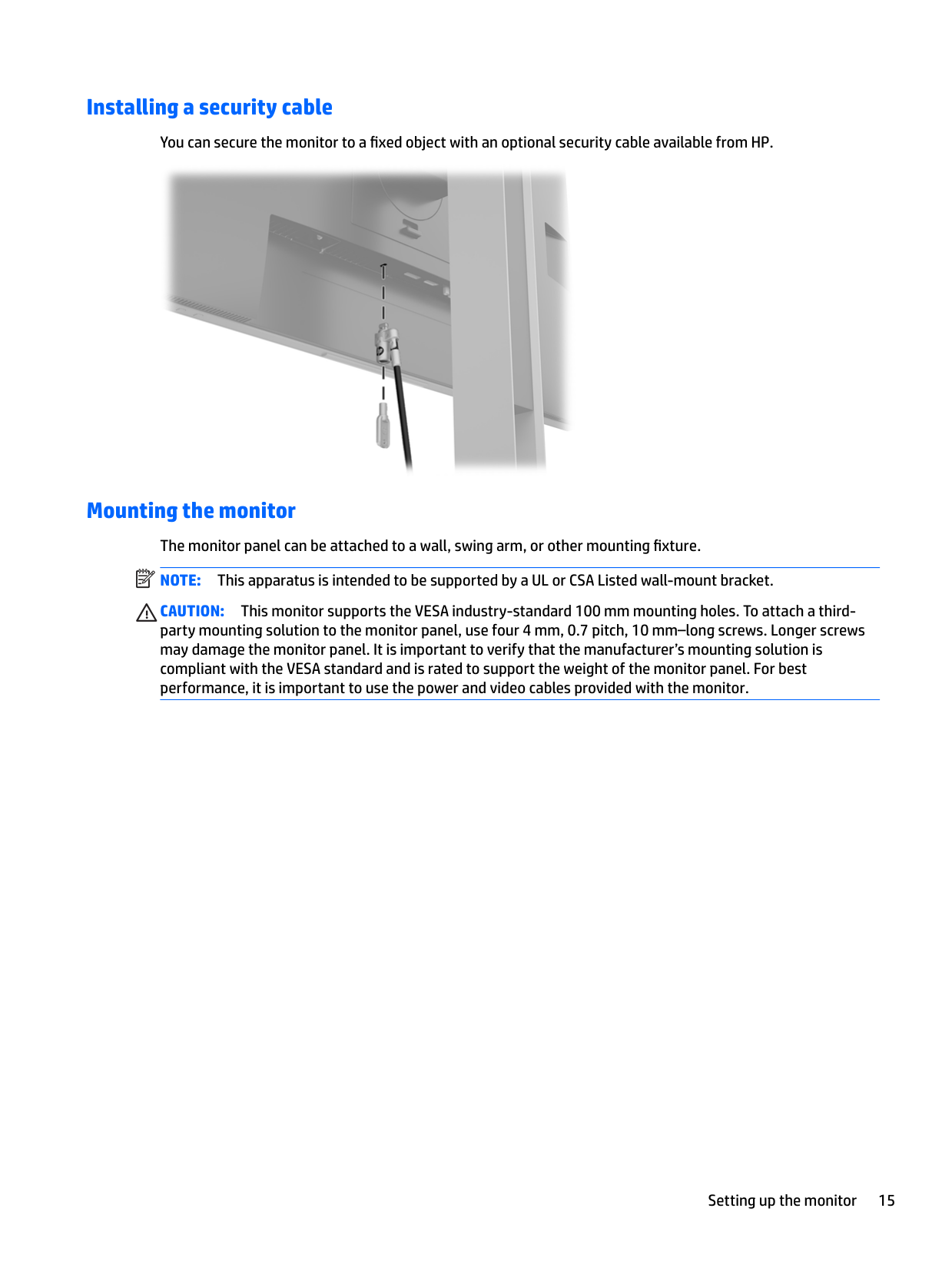
#### Turning on the monitor

CAUTION: Burn-in image damage may occur on monitors that display the same static image on the screen for 12 or more consecutive hours of nonuse. To avoid burn-in image damage on the monitor screen, you should always activate a screen saver application or turn off the monitor when it is not in use for a prolonged period of time. Image retention is a condition that may occur on all LCD screens. Burned-in image damage on the monitor isn’t covered by the warranty.
| | |---|
| | |---|
NOTE: If pressing the power button has no effect, the Power Button Lockout feature may be enabled. To disable this feature, press and hold the monitor power button for 10 seconds.
NOTE: You can disable the power light in the OSD menu. Press the Menu button on the front of the monitor, and then select Power Control > Power LED > Off.
When the monitor is powered on, a Monitor Status message is displayed for five seconds. The message shows which input is the current active signal, the status of the auto-switch source setting (On or Off; default setting is On), the current preset screen resolution, and the recommended preset screen resolution.
The monitor automatically scans the signal inputs for an active input and uses that input for the screen.
#### Installing a security cable
You can secure the monitor to a fixed object with an optional security cable available from HP.

Mounting the monitor The monitor panel can be attached to a wall, swing arm, or other mounting fixture. NOTE: This apparatus is intended to be supported by a UL or CSA Listed wall-mount bracket. CAUTION: This monitor supports the VESA industry-standard 100 mm mounting holes. To attach a thirdparty mounting solution to the monitor panel, use four 4 mm, 0.7 pitch, 10 mm–long screws. Longer screws may damage the monitor panel. It is important to verify that the manufacturer’s mounting solution is compliant with the VESA standard and is rated to support the weight of the monitor panel. For best performance, it is important to use the power and video cables provided with the monitor.
| | |---|
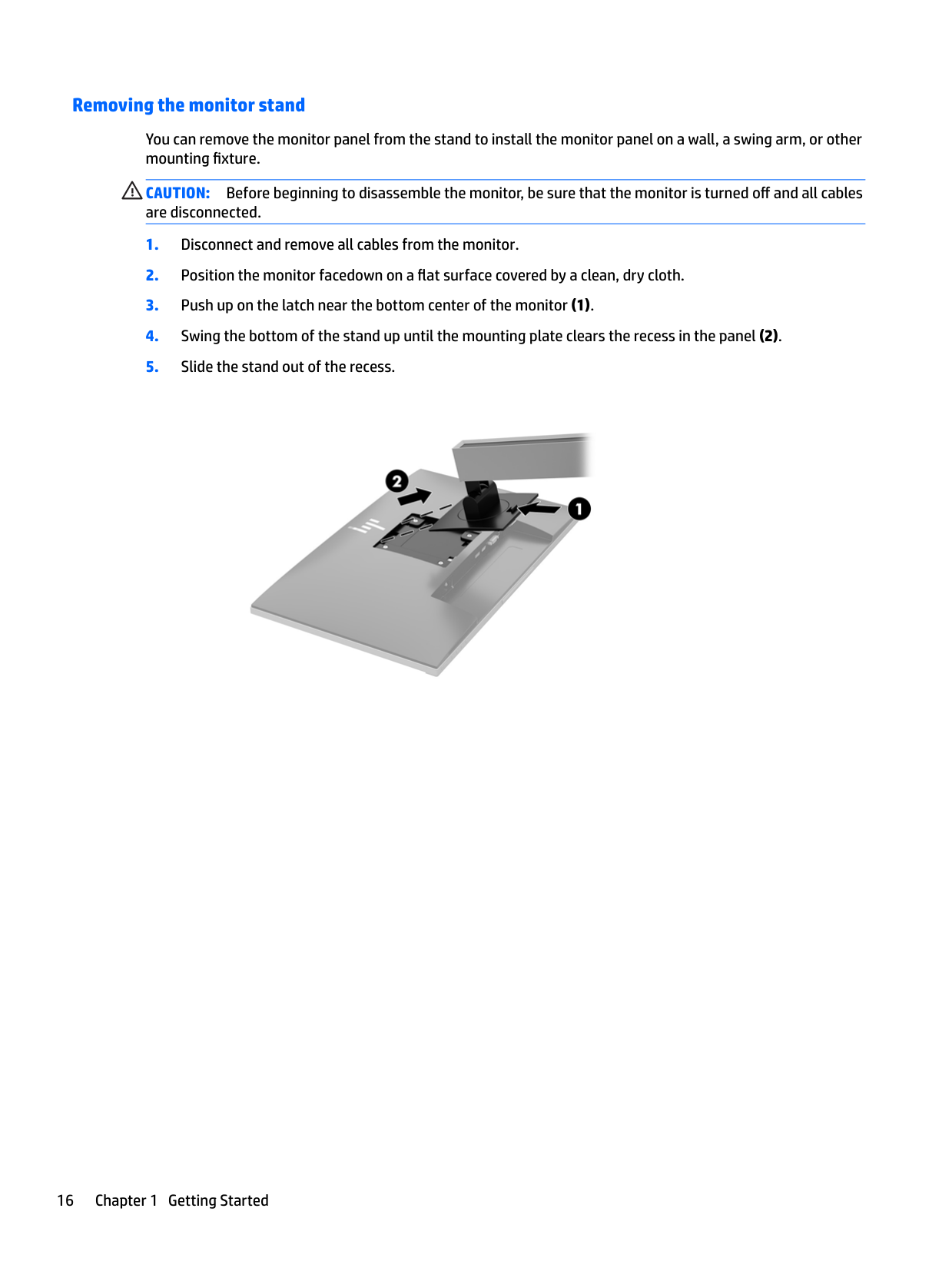
##### Removing the monitor stand
You can remove the monitor panel from the stand to install the monitor panel on a wall, a swing arm, or other mounting fixture.
CAUTION: Before beginning to disassemble the monitor, be sure that the monitor is turned off and all cables are disconnected.

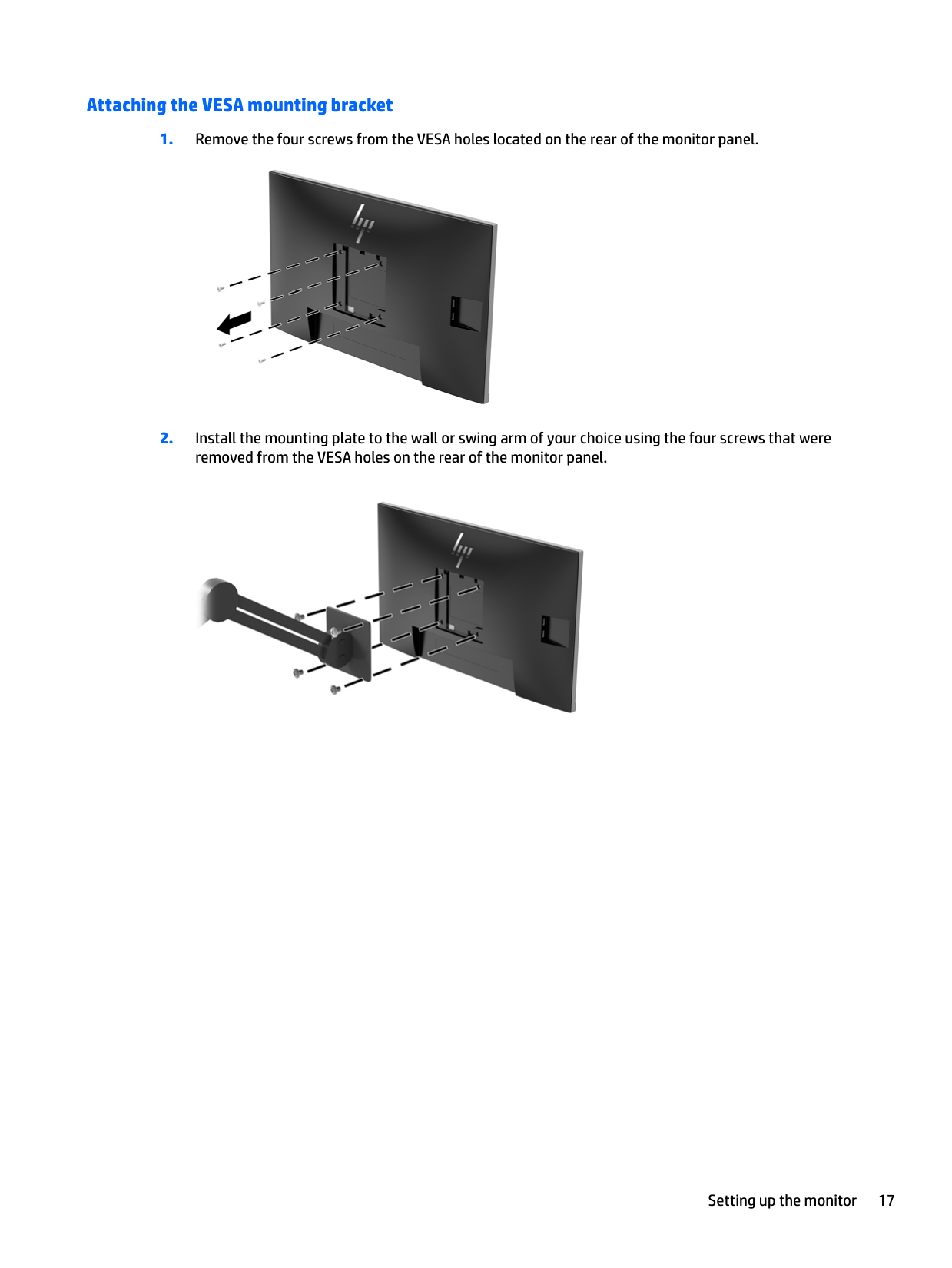
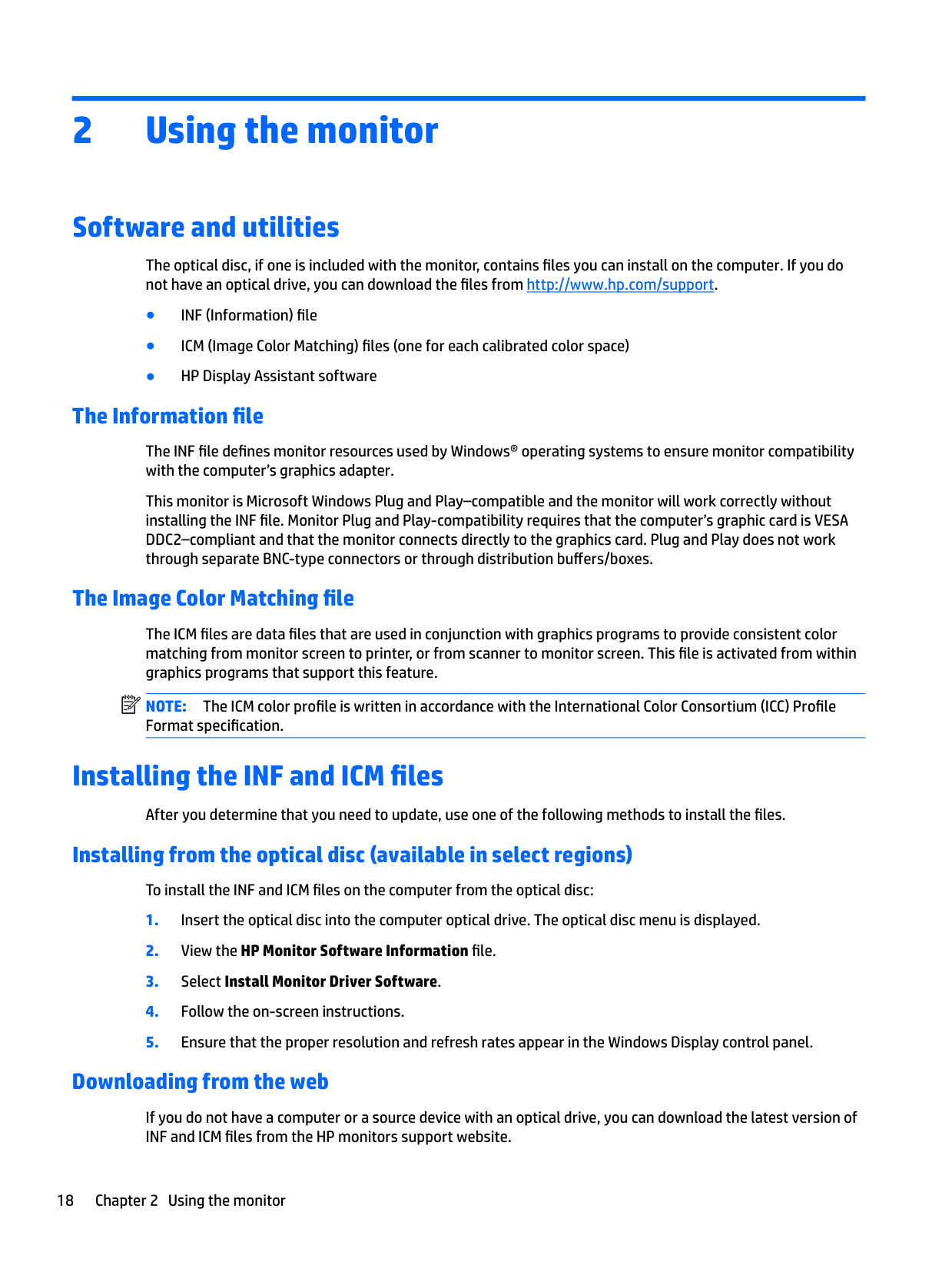
##### Attaching the VESA mounting bracket


2 Using the monitor
Software and utilities
The optical disc, if one is included with the monitor, contains files you can install on the computer. If you do not have an optical drive, you can download the files from http://www.hp.com/support.
#### The Information file
The INF file defines monitor resources used by Windows® operating systems to ensure monitor compatibility with the computer’s graphics adapter.
This monitor is Microsoft Windows Plug and Play–compatible and the monitor will work correctly without installing the INF file. Monitor Plug and Play-compatibility requires that the computer’s graphic card is VESA DDC2–compliant and that the monitor connects directly to the graphics card. Plug and Play does not work through separate BNC-type connectors or through distribution buffers/boxes.
#### The Image Color Matching file
The ICM files are data files that are used in conjunction with graphics programs to provide consistent color matching from monitor screen to printer, or from scanner to monitor screen. This file is activated from within graphics programs that support this feature.
| | |---|
NOTE: The ICM color profile is written in accordance with the International Color Consortium (ICC) Profile Format specification.
Installing the INF and ICM files
After you determine that you need to update, use one of the following methods to install the files.
#### Installing from the optical disc (available in select regions)
To install the INF and ICM files on the computer from the optical disc:
#### Downloading from the web
If you do not have a computer or a source device with an optical drive, you can download the latest version of INF and ICM files from the HP monitors support website.
Using the on-screen display (OSD) menu
Use the OSD menu to adjust the monitor screen image based on your preferences. You can access and make adjustments in the OSD menu using the buttons on the monitor's bezel.
To access the OSD menu and make adjustments, do the following:
The following table lists the menu selections in the OSD main menu. Main Menu Description Brightness Adjusts the brightness level of the screen. The factory default is 90. Contrast Adjusts the contrast level of the screen. The factory default is 80. Color Control Selects and adjusts the screen color. Input Control Selects the video input signal. Image Control Adjusts the screen image. Audio Control Adjusts the audio settings. Power Control Adjusts the power settings. Menu Control Adjusts the on-screen display (OSD) and function button controls. Management Adjusts the DDC/CI settings, selects the language,and returns all OSD menu settings to the factory default
settings. Information Selects and displays important information about the monitor. Exit Exits the OSD menu screen.
Using the on-screen display (OSD) menu 19
Assigning the function buttons
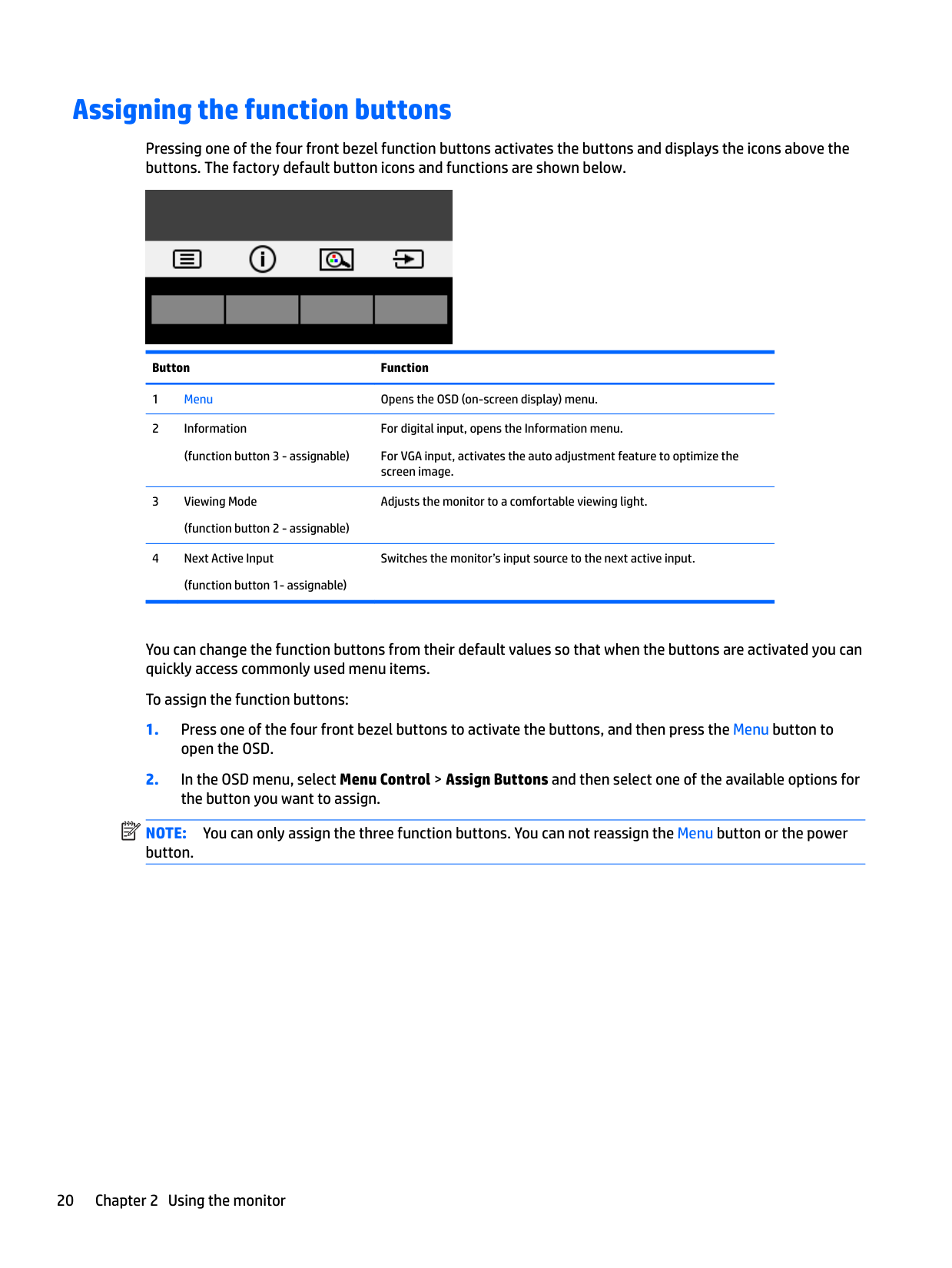
Pressing one of the four front bezel function buttons activates the buttons and displays the icons above the buttons. The factory default button icons and functions are shown below.

Button Function
For digital input, opens the Information menu. For VGA input, activates the auto adjustment feature to optimize the screen image.
Adjusts the monitor to a comfortable viewing light.
Switches the monitor’s input source to the next active input.
You can change the function buttons from their default values so that when the buttons are activated you can quickly access commonly used menu items.
To assign the function buttons:
| | |---|
NOTE: You can only assign the three function buttons. You can not reassign the Menu button or the power button.
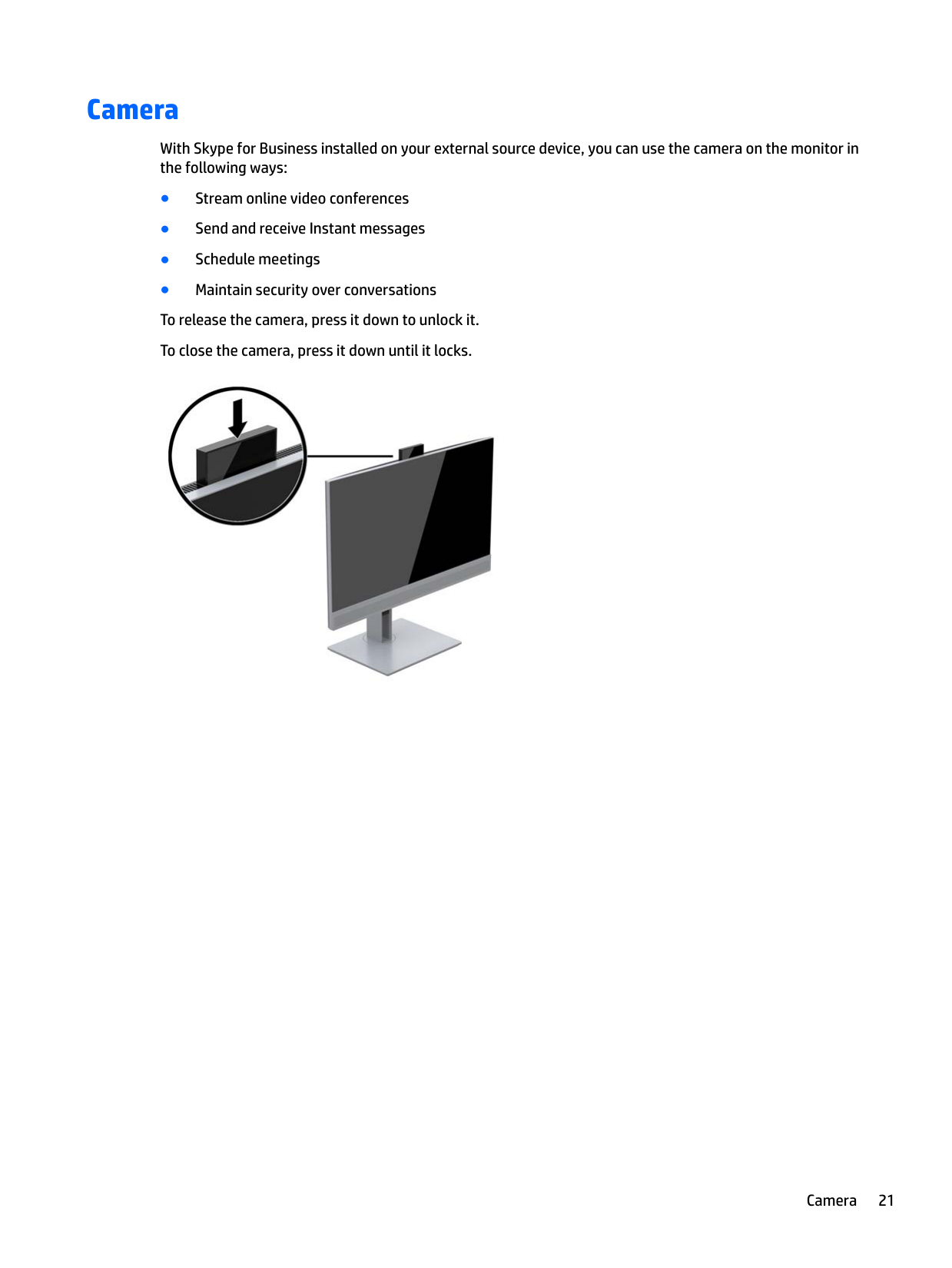
Camera
With Skype for Business installed on your external source device, you can use the camera on the monitor in the following ways:

Camera 21
Using Auto-Sleep Mode
The monitor supports an OSD option called Auto-Sleep Mode that allows you to enable or disable a reduced power state for the display. When Auto-Sleep Mode is enabled (enabled by default), the monitor will enter a reduced power state when the host PC signals low power mode (absence of either horizontal or vertical sync signal).
Upon entering this reduced power state (sleep mode), the monitor screen is blanked, the backlight is turned off, and the power light indicator turns amber. The monitor draws less than 0.5 W of power when in this reduced power state. The monitor will wake from the sleep mode when the host PC sends an active signal to the monitor (for example, if you activate the mouse or keyboard).
You can disable Auto-Sleep Mode in the OSD. Press one of the four front bezel function buttons to activate the buttons, and then press the Menu button to open the OSD.
Adjusting Low Blue Light Mode
Decreasing the blue light emitting from the display reduces the blue light exposure to your eyes. HP monitors provide a setting to reduce blue light output and create a more relaxing and less stimulating image while you read content on the screen. To adjust your monitor to a comfortable viewing light, follow the steps below.
To adjust the blue light output from the display:
WARNING! To reduce the risk of serious injury, read the Safety & Comfort Guide. It describes proper workstation setup, and proper posture, health, and work habits for computer users. The Safety & Comfort Guide also provides important electrical and mechanical safety information. The Safety & Comfort Guide is located on the Web at http://www.hp.com/ergo.
3 Support and troubleshooting
Solving common problems
The following table lists possible problems, the possible cause of each problem, and the recommended solutions.
Problem Possible Cause Solution
Screen is blank or video is flashing.
Power cord is disconnected. Connect the power cord.
Monitor is turned off. Press the front bezel power button.
NOTE: If pressing the power button is ineffective, press and hold the power button for 10 seconds to disable the Power Button Lockout feature.
Video cable is improperly connected. Connect the video cable properly. See Connecting the cables on page 7 for more information.
System is in sleep mode. Press any key on the keyboard or move the mouse to exit sleep mode.
Video card is incompatible. Open the OSD menu and select the Input Control menu. Set
Auto-Switch Input to Off and manually select the input.
Image appears blurred, indistinct, or too dark.
Brightness setting is too low. Open the OSD menu and select Brightness to adjust the brightness scale as needed.
No speaker volume or low speaker volume.
Volume control is turned down. Adjust the volume control on the bottom left of the front
panel. Volume is muted. Press up on the volume control to unmute the volume. Volume is turned down in the OSD. Open the OSD, select Audio Control > Volume, and adjust the
volume scale. Headphones are plugged in. Unplug the headphones. The speakers are disabled when the headphones are plugged in.
Check Video Cable is displayed on the screen.
Monitor video cable is disconnected. Connect the appropriate video signal cable between the computer and monitor. Be sure that the computer power is off while you connect the video cable.
Input Signal Out of Range is displayed on the screen.
Video resolution and/or refresh rate are set higher than the monitor supports.
The monitor is off but it did not seem to enter into sleep mode.
The monitor's power saving control is disabled.
OSD Lockout is displayed. The monitor's OSD Lockout function
is enabled.
Change the settings to a supported setting. See Preset display resolutions on page 30 for more information.
Open the OSD menu and select Power Control > Auto-Sleep Mode and set auto-sleep to On.
Press and hold the Menu button on the front bezel for 10 seconds to disable the OSD Lockout function.
Power Button Lockout is displayed.
The monitor's Power Button Lockout function is enabled.
Press and hold the power button for 10 seconds to disable the Power Button Lockout function.
Solving common problems 23
Using the auto-adjustment function (analog input)
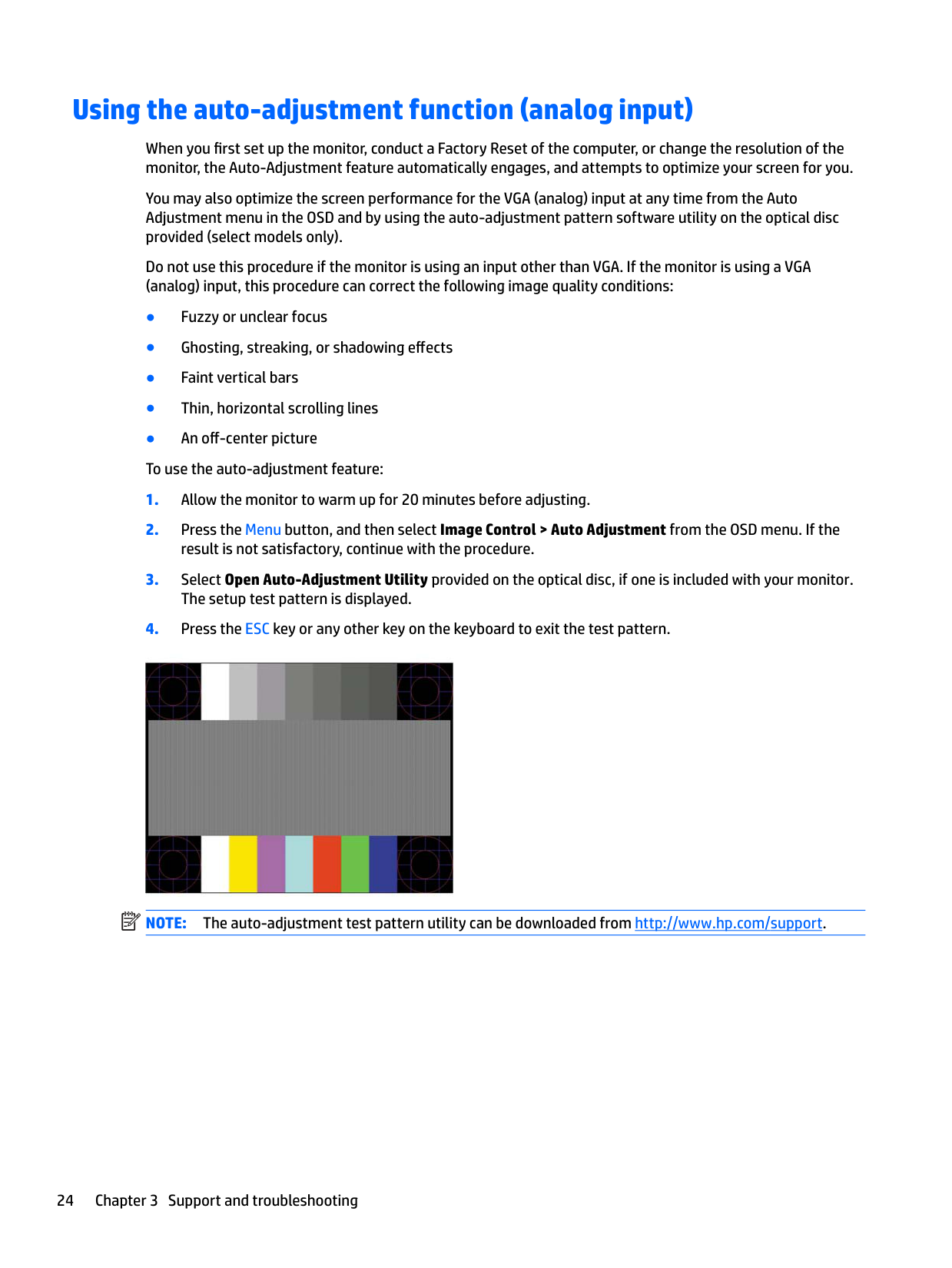
When you first set up the monitor, conduct a Factory Reset of the computer, or change the resolution of the monitor, the Auto-Adjustment feature automatically engages, and attempts to optimize your screen for you.
You may also optimize the screen performance for the VGA (analog) input at any time from the Auto Adjustment menu in the OSD and by using the auto-adjustment pattern software utility on the optical disc provided (select models only).
Do not use this procedure if the monitor is using an input other than VGA. If the monitor is using a VGA (analog) input, this procedure can correct the following image quality conditions:
| | |---|

NOTE: The auto-adjustment test pattern utility can be downloaded from http://www.hp.com/support.
Optimizing image performance (analog input)
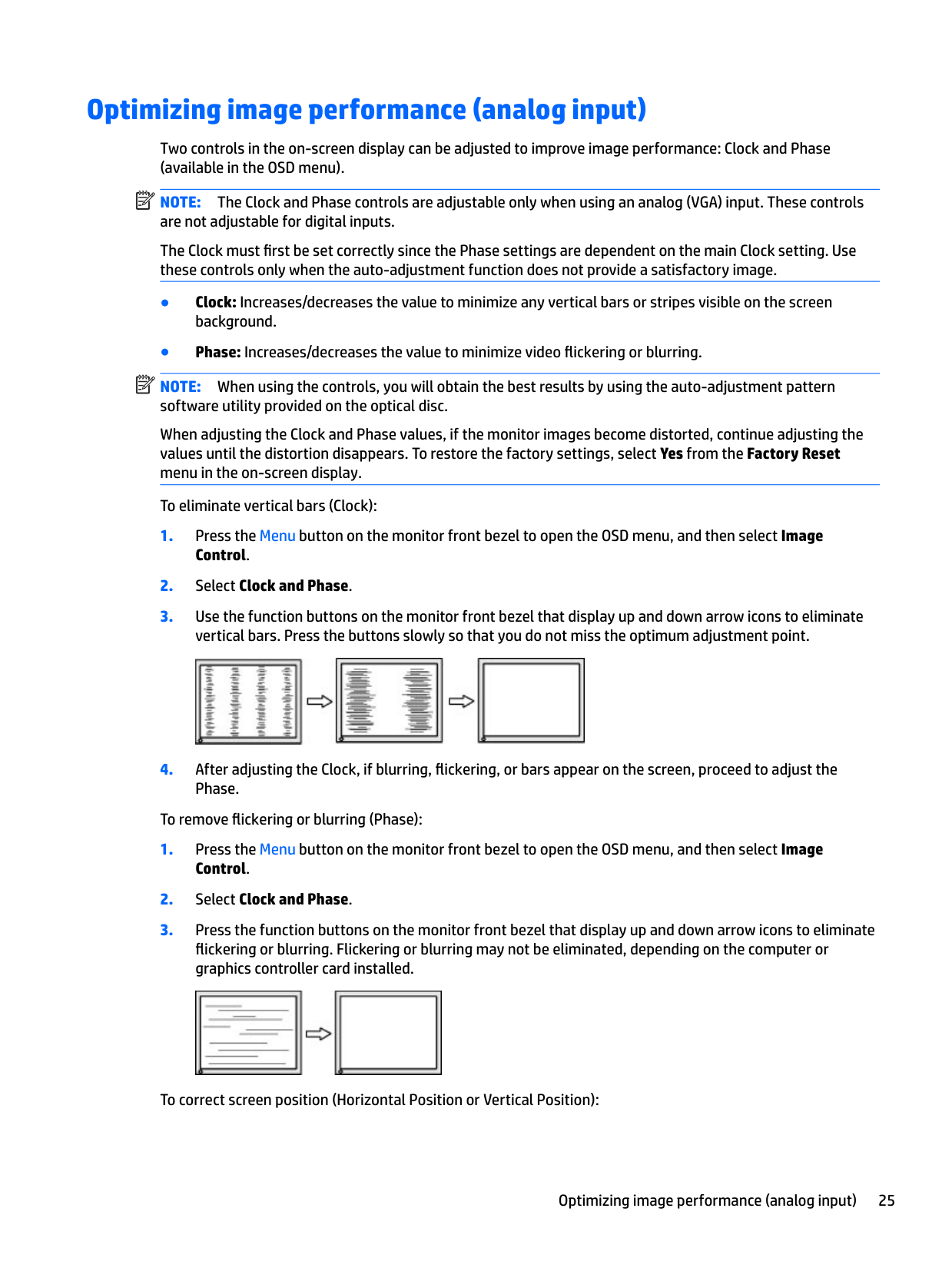
Two controls in the on-screen display can be adjusted to improve image performance: Clock and Phase (available in the OSD menu).
| | |---|
NOTE: The Clock and Phase controls are adjustable only when using an analog (VGA) input. These controls are not adjustable for digital inputs. The Clock must first be set correctly since the Phase settings are dependent on the main Clock setting. Use these controls only when the auto-adjustment function does not provide a satisfactory image.
| | |---|
NOTE: When using the controls, you will obtain the best results by using the auto-adjustment pattern software utility provided on the optical disc. When adjusting the Clock and Phase values, if the monitor images become distorted, continue adjusting the values until the distortion disappears. To restore the factory settings, select Yes from the Factory Reset menu in the on-screen display. To eliminate vertical bars (Clock):

To remove flickering or blurring (Phase):

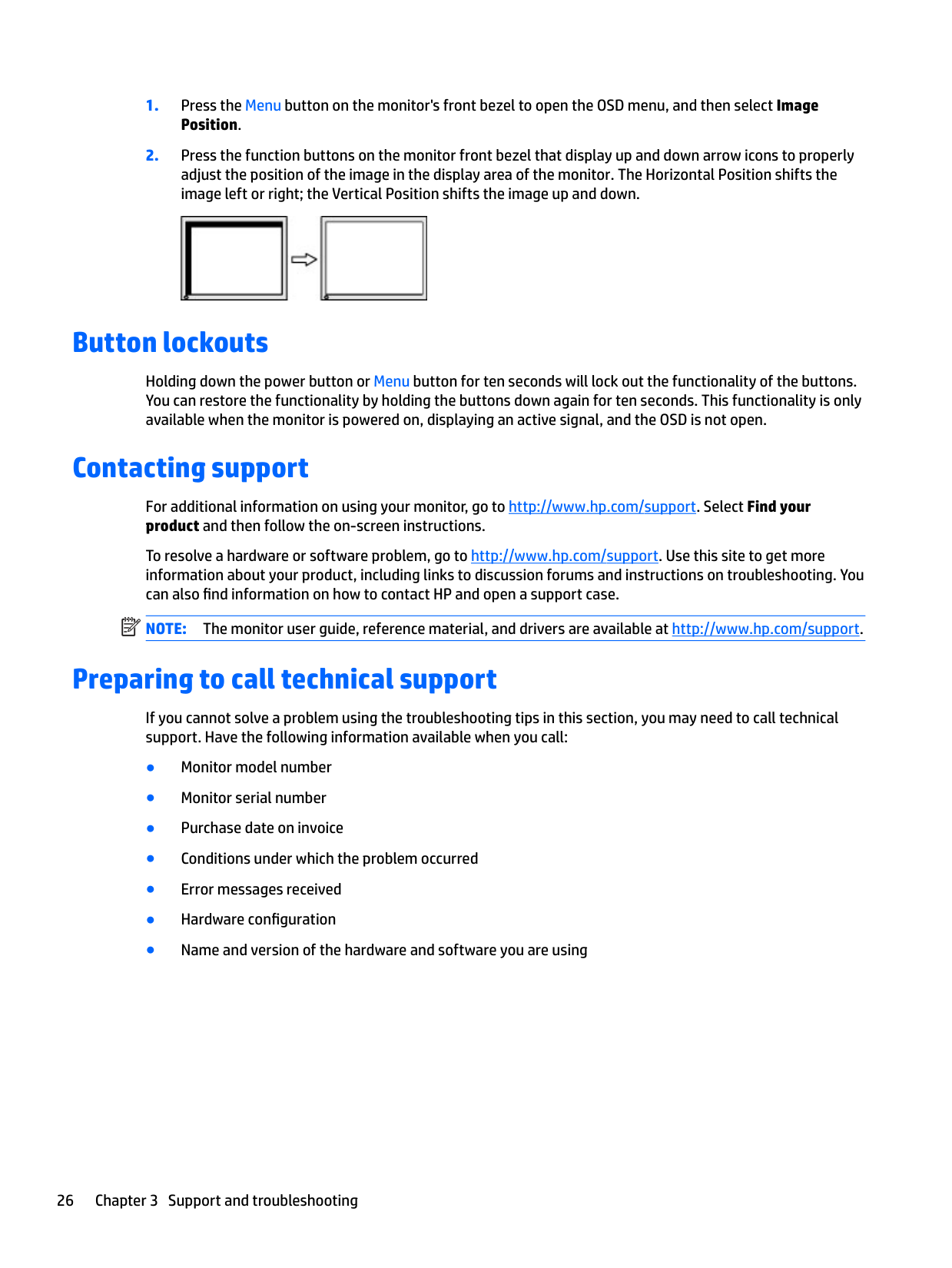
To correct screen position (Horizontal Position or Vertical Position):
Optimizing image performance (analog input) 25

Button lockouts
Holding down the power button or Menu button for ten seconds will lock out the functionality of the buttons. You can restore the functionality by holding the buttons down again for ten seconds. This functionality is only available when the monitor is powered on, displaying an active signal, and the OSD is not open.
Contacting support
For additional information on using your monitor, go to http://www.hp.com/support. Select Find your product and then follow the on-screen instructions.
To resolve a hardware or software problem, go to http://www.hp.com/support. Use this site to get more information about your product, including links to discussion forums and instructions on troubleshooting. You can also find information on how to contact HP and open a support case.
| | |---|
NOTE: The monitor user guide, reference material, and drivers are available at http://www.hp.com/support.
Preparing to call technical support
If you cannot solve a problem using the troubleshooting tips in this section, you may need to call technical support. Have the following information available when you call:
Locating the serial number and product number
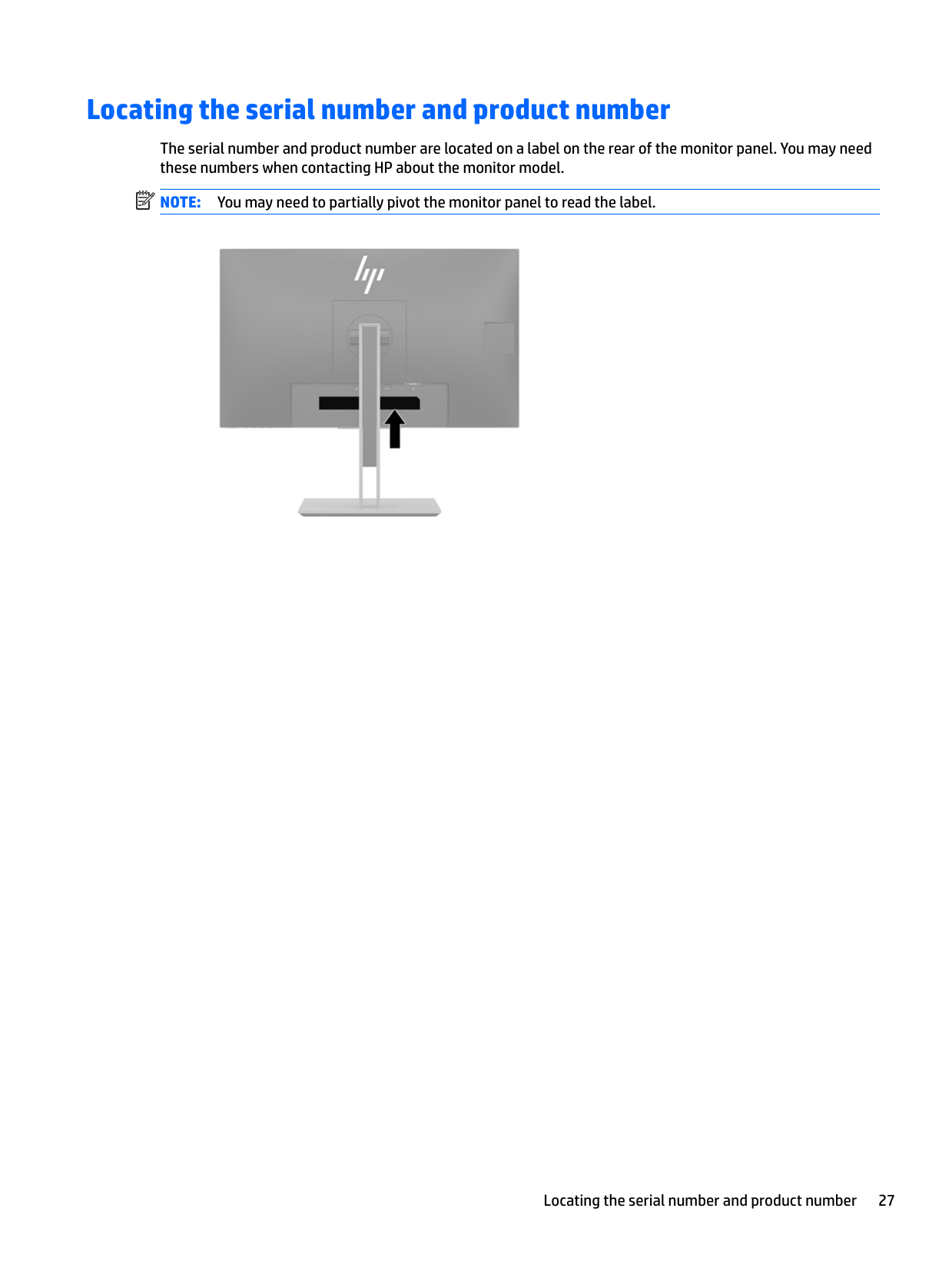
The serial number and product number are located on a label on the rear of the monitor panel. You may need these numbers when contacting HP about the monitor model.
| | |---|
NOTE: You may need to partially pivot the monitor panel to read the label.

Locating the serial number and product number 27
4 Maintaining the monitor
Maintenance guidelines
To enhance the performance and extend the life of the monitor:
| | |---|
Cleaning the monitor
| | |---|
IMPORTANT: Spray the cleaner onto a cloth and use the damp cloth to gently wipe the screen surface. Never spray the cleaner directly on the screen surface. It may run behind the bezel and damage the electronics.
IMPORTANT: Do not use cleaners that contain any petroleum-based materials such as benzene, thinner, or any volatile substance to clean the monitor screen or cabinet. These chemicals may damage the monitor.
Shipping the monitor
Keep the original packing box in a storage area. You may need it later if you move or ship the monitor.
28 Chapter 4 Maintaining the monitor
A Technical specifications
| | |---|
NOTE: All specifications represent the typical specifications provided by HP’s component manufacturers; actual performance may vary either higher or lower. For the latest specifications or additional specifications on this product, go to http://www.hp.com/go/ quickspecs/ and search for your specific monitor model to find the model-specific QuickSpecs.
60.5 cm/23.8-inch model
Display, wide-screen Type
60.5 cm IPS
23.8-inch
Viewable image size 60.5 cm diagonal 23.8-inch diagonal Maximum weight (unpacked) 6.6 kg 14.55 lbs Dimensions (include base) Height (highest position) Height (lowest position) Depth Width
51.37 cm 36.37 cm 21.40 cm 53.88 cm
Tilt -5° to 22° Swivel 45° ± 2°
Maximum graphic resolution 1920 x 1080 Optimum graphic resolution 1920 x 1080 Environmental requirements
Operating temperature Storage temperature Storage humidity Operating humidity
5 to 35° C
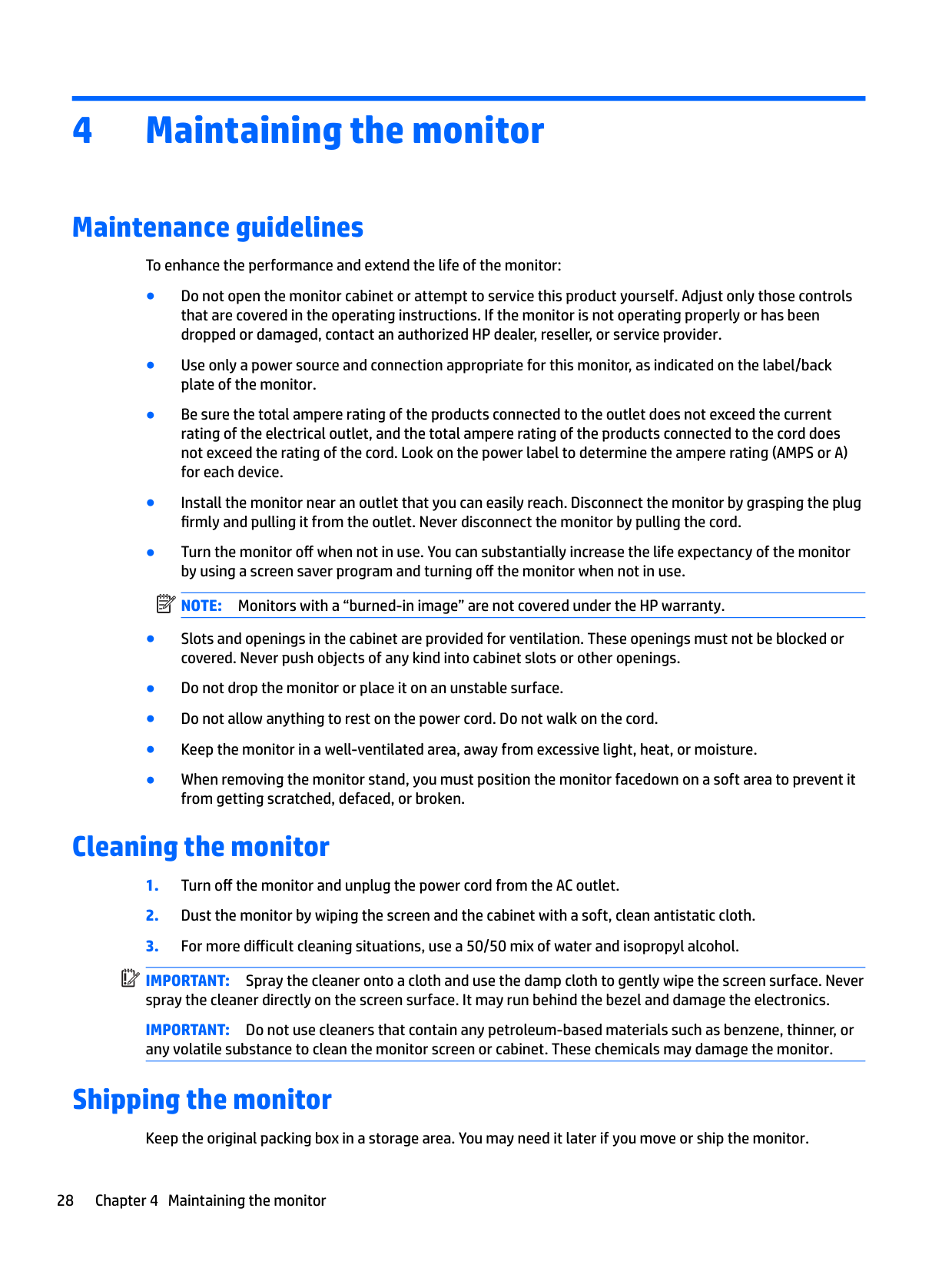
-20 to 60° C
Power source 100–240 VAC 50/60 Hz Input terminal One USB Type-B connector, one HDMI
connector, one DisplayPort connector, one VGA connector
41 to 95° F
-4 to 140° F 5% to 95% (non-condensing) 20% to 80% (non-condensing)
60.5 cm/23.8-inch model 29
68.5 cm/27-inch model
Display, wide-screen Type
68.5 cm IPS
27-inch
Viewable image size 68.5 cm diagonal 27-inch diagonal Maximum weight (unpacked) 7.9 kg 17.4 lbs Dimensions (include base) Height (highest position) Height (lowest position) Depth Width
53.39 cm 38.39 cm 21.4 cm 61.094 cm
21.02 inches 15.11 inches 8.43 inches 24.1 inches
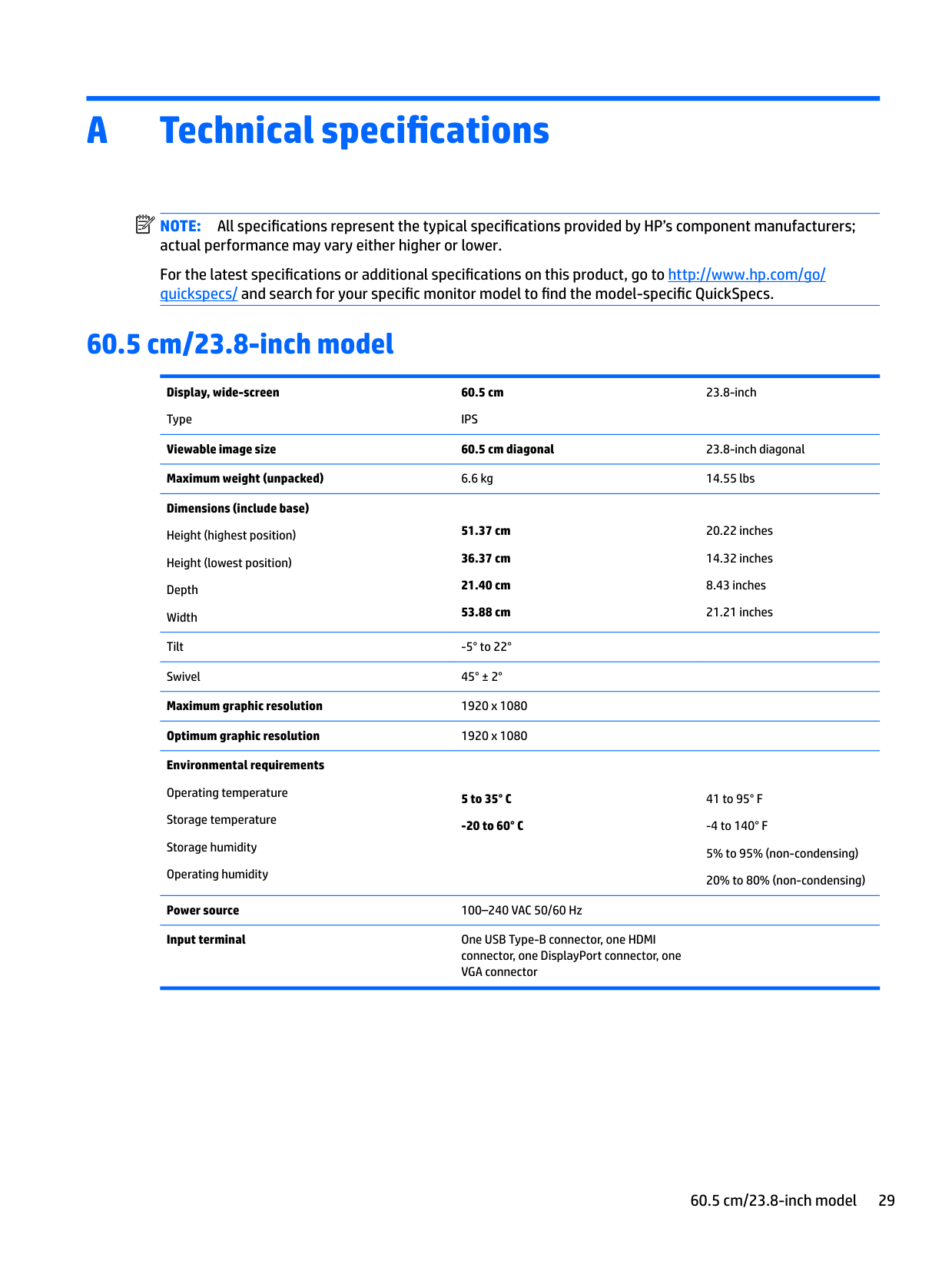
Tilt -5° to 22° Swivel 45° ± 2°
Maximum graphic resolution 1920 x 1080 Optimum graphic resolution 1920 x 1080 Environmental requirements temperature
Operating temperature Storage temperature Storage humidity Operating humidity
5 to 35° C
-20 to 60° C
Power source 100–240 VAC 50/60 Hz Input terminal One Type C connector, HDMI connector, one
DisplayPort connector, one VGA connector
41 to 95° F
-4 to 140° F 5% to 95% (non-condensing) 20% to 80% (non-condensing)
Preset display resolutions
The display resolutions listed below are the most commonly used modes and are set as factory defaults. The monitor automatically recognizes these preset modes and they will appear properly sized and centered on the screen.
#### 60.5 cm/23.8-inch and 68.5 cm/27-inch models
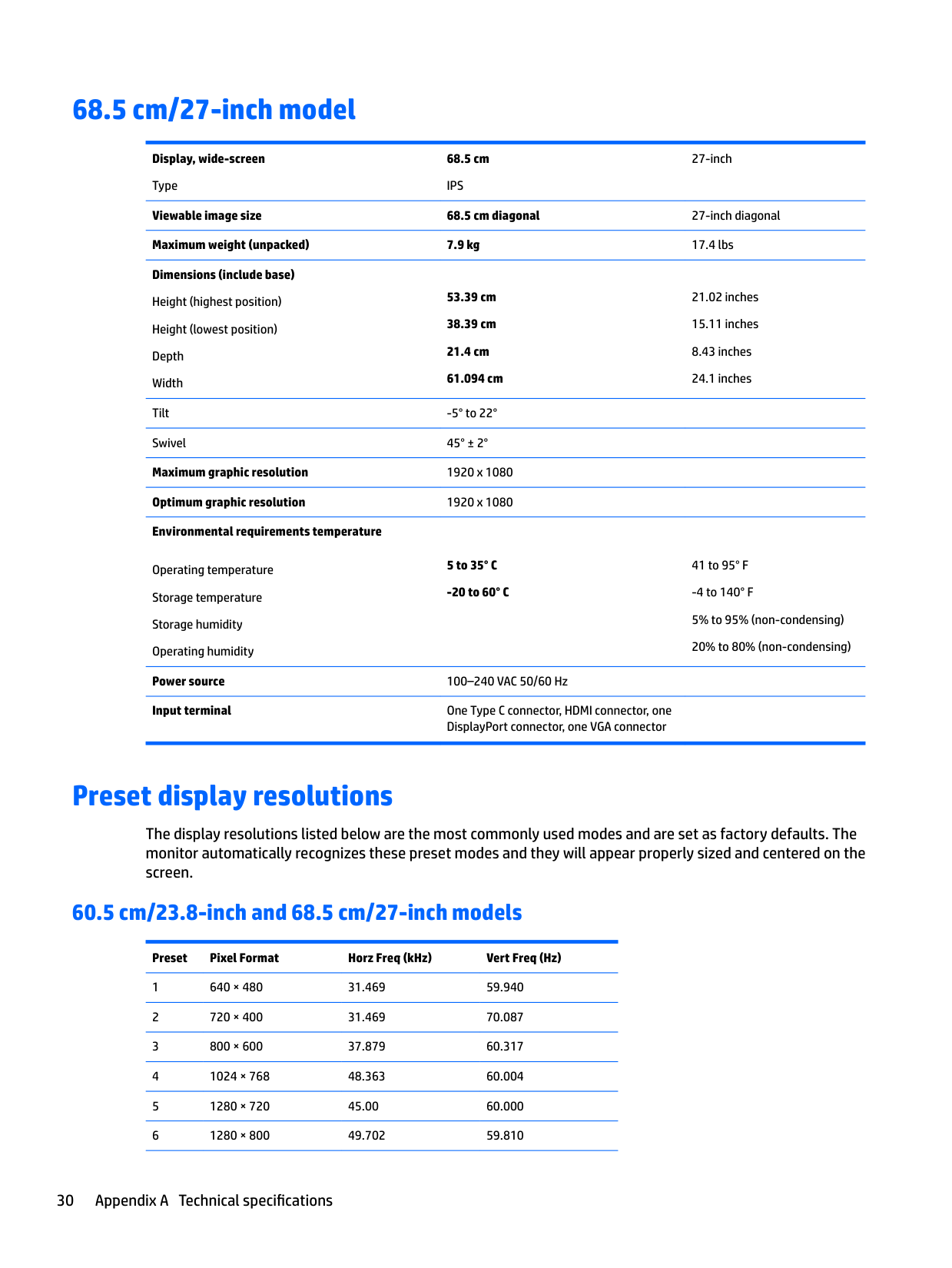
######## Preset Pixel Format Horz Freq (kHz) Vert Freq (Hz)
30 Appendix A Technical specifications
#### 60.5 cm/23.8-inch and 68.5 cm/27-inch models
######## Preset Timing name Pixel format Horz freq (kHz) Vert freq (Hz)
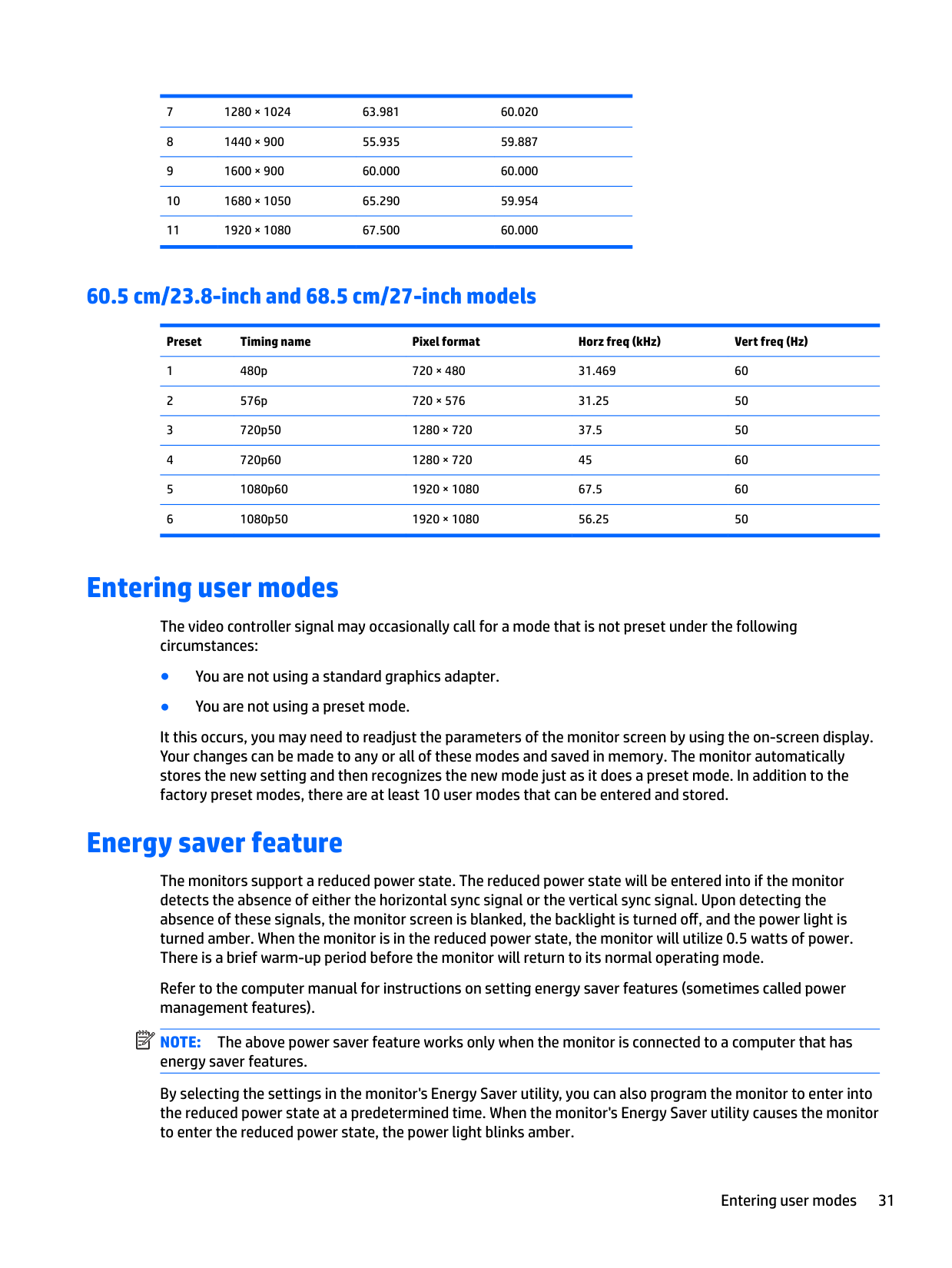
Entering user modes
The video controller signal may occasionally call for a mode that is not preset under the following circumstances:
It this occurs, you may need to readjust the parameters of the monitor screen by using the on-screen display. Your changes can be made to any or all of these modes and saved in memory. The monitor automatically stores the new setting and then recognizes the new mode just as it does a preset mode. In addition to the factory preset modes, there are at least 10 user modes that can be entered and stored.
Energy saver feature
The monitors support a reduced power state. The reduced power state will be entered into if the monitor detects the absence of either the horizontal sync signal or the vertical sync signal. Upon detecting the absence of these signals, the monitor screen is blanked, the backlight is turned off, and the power light is turned amber. When the monitor is in the reduced power state, the monitor will utilize 0.5 watts of power. There is a brief warm-up period before the monitor will return to its normal operating mode.
Refer to the computer manual for instructions on setting energy saver features (sometimes called power management features).
| | |---|
NOTE: The above power saver feature works only when the monitor is connected to a computer that has energy saver features. By selecting the settings in the monitor's Energy Saver utility, you can also program the monitor to enter into the reduced power state at a predetermined time. When the monitor's Energy Saver utility causes the monitor to enter the reduced power state, the power light blinks amber.
Entering user modes 31
B Accessibility
HP designs, produces, and markets products and services that can be used by everyone, including people with disabilities, either on a stand-alone basis or with appropriate assistive devices.
Supported assistive technologies
HP products support a wide variety of operating system assistive technologies and can be configured to work with additional assistive technologies. Use the Search feature on your source device that is connected to the monitor to locate more information about assistive features.
| | |---|
NOTE: For additional information about a particular assistive technology product, contact customer support for that product.
Contacting support
We are constantly refining the accessibility of our products and services and welcome feedback from users. If you have an issue with a product or would like to tell us about accessibility features that have helped you, please contact us at (888) 259-5707, Monday through Friday, 6 a.m. to 9 p.m. Mountain Time. If you are deaf or hard-of-hearing and use TRS/VRS/WebCapTel, contact us if you require technical support or have accessibility questions by calling (877) 656-7058, Monday through Friday, 6 a.m. to 9 p.m. Mountain Time.
32 Appendix B Accessibility