
Ask AI
— answers from the official manualAnswers from the official manual.
Common questions
Common Questions
45 totalHow do I cable and set up the R7000p for the first time?
First, unplug your modem's power and remove its battery if it has one, then plug the modem back in. Connect your modem to the Internet port on the router using the included yellow Ethernet cable, then connect the power adapter to the router and plug it into an outlet. Finally, press the Power On/Off button on the rear panel to power on the router. (Page 14)
What is the default username and password to log in to the router's web interface?
The default username is admin and the default password is password. Both the username and password are case-sensitive. You can log in by entering http://www.routerlogin.net in your browser while connected to the network. (Page 20)
How do I factory reset the Nighthawk R7000p?
Press and hold the Reset button on the rear panel for at least seven seconds until the Power LED blinks white, and the router returns to its factory settings. The Reset button is located on the back of the router. All custom settings will be erased and you will need to reconfigure the router after the reset. (Page 12)
Where can I find the WiFi network name and password for my router?
The WiFi network name (SSID) and password (network key) are printed on the label located on the router itself. The label also includes the router's login information, MAC address, and serial number. (Page 18)
How do I connect to the router's WiFi network using WPS?
Press the WPS button on the router, then within two minutes press the WPS button on your computer or WiFi device or follow its WPS connection instructions. Your device will then connect to the WiFi network automatically without needing to enter the WiFi password. (Page 17)
How do I disable LED blinking or turn off the LEDs on my router?
Log in to the router at http://www.routerlogin.net using the admin credentials, then navigate to ADVANCED > Advanced Setup > LED Control Settings. From there you can choose to disable blinking on the Internet, LAN, Wireless, and USB LEDs, or turn off all LEDs except the Power LED, then click Apply to save your settings. (Page 14)
Show 39 more questions
Can I use Circle with Disney parental controls if my router is in Access Point or Bridge mode?
What is the default admin username and password for the R7000p?
How do I connect to the R7000p using WPS instead of entering a password?
Where is the WiFi network name and password for my R7000p located?
What do the different Power LED colors and behaviors mean on the R7000p?
Where should I place my R7000p router for the best WiFi performance?
How do I turn off or disable the blinking LEDs on the R7000p?
What does a solid amber Internet LED indicate on the R7000p?
How do I set up parental controls on the R7000p?
How do I factory reset the Nighthawk R7000P to restore original settings?
What should I do if I cannot log in to the router?
How do I position the antennas for best WiFi performance?
What does it mean when the Power LED is blinking white?
How do I disable LED blinking or turn off the LEDs?
What Internet connection information do I need from my ISP?
How do I connect my computer to the router using an Ethernet cable?
How do I change the MTU size if I'm experiencing connection problems?
How do I use WPS to connect a device to the WiFi network?
What does a solid amber Internet LED indicate?
How do I cable and set up my Nighthawk R7000P for the first time?
How should I position my router for the best WiFi performance?
How do I connect my router to the network?
How do I access my router using a web browser?
Can I install the router using a mobile app?
Can I disable the DHCP server on my router?
Can I turn off the LED lights on my Nighthawk router?
How do I reserve a specific IP address for a device on my network?
What should I do before connecting the power supply to my router?
What are the different ways to log in to the router?
What is the model number and WiFi standard for this Netgear router?
How do I connect to my Netgear R7000P router for the first time?
How do I get technical support for my Netgear Nighthawk R7000P router?
Does the R7000P have parental controls?
Can I control when my router blocks internet sites?
What are the different ways to set up my internet connection?
What WiFi settings can I customize on the R7000P?
How do I set up parental controls on the Nighthawk R7000P?
Can I change my router's WiFi settings after initial setup?
How do I find information about my router's regulatory compliance and Declaration of Conformity?
Full Manual
155 pages
Nighthawk AC2300 Smart WiFi Router User Manual Model R7000P July 2017 202-11702-02 350 E. Plumeria Drive San Jose, CA 95134
Usa
Support Thank you for purchasing this NETGEAR product.You can visit www.netgear.com/support to register your product, get help, access the latest downloads and user manuals, and join our community. We recommend that you use only official NETGEAR support resources. Conformity For the current EU Declaration of Conformity, visit http://kb.netgear.com/app/answers/detail/a_id/11621. Compliance For regulatory compliance information, visit http://www.netgear.com/about/regulatory. See the regulatory compliance document before connecting the power supply. Trademarks © NETGEAR, Inc., NETGEAR and the NETGEAR Logo are trademarks of NETGEAR, Inc. Any non_NETGEAR trademarks are used for reference purposes only. 2 Nighthawk AC2300 Smart WiFi Router
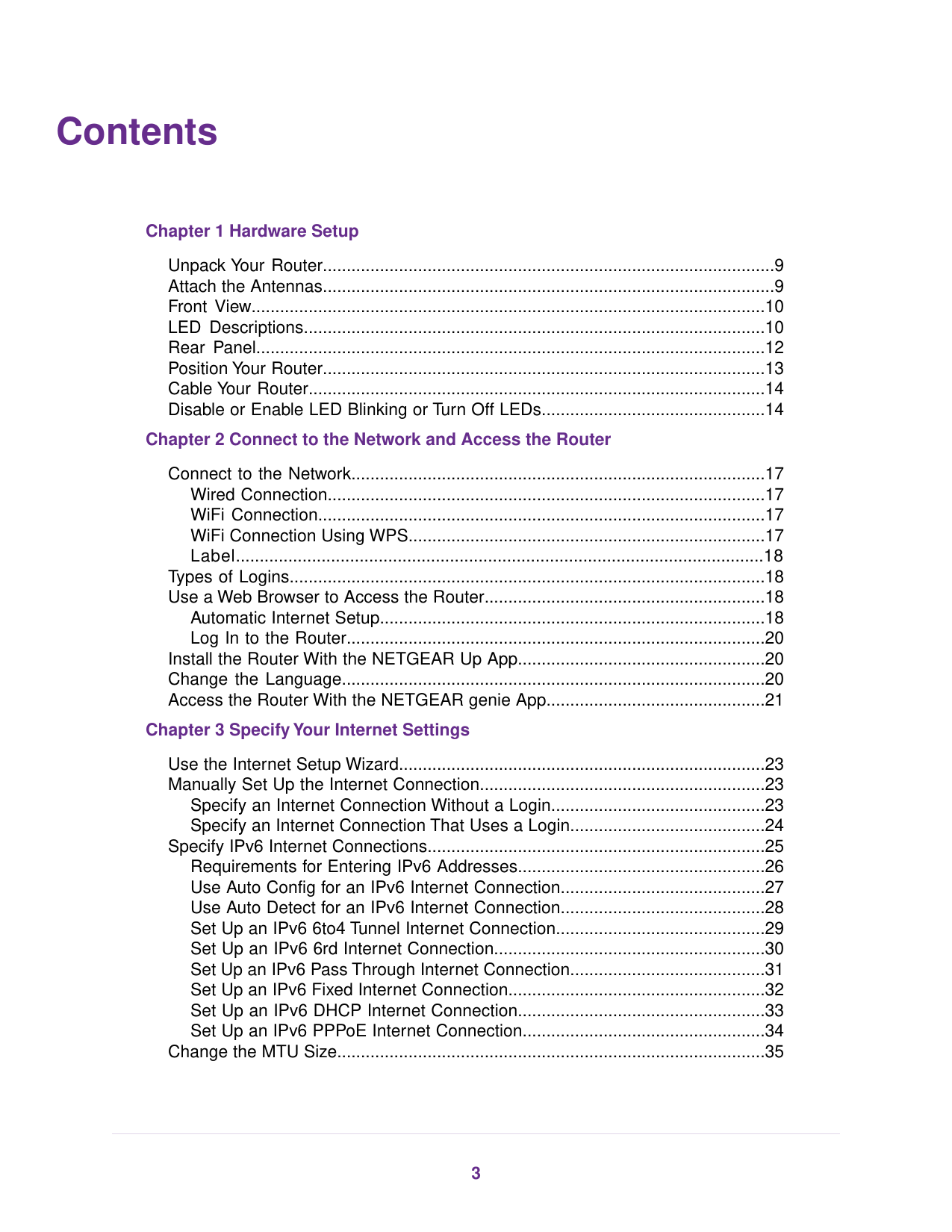
Contents Chapter 1 Hardware Setup Unpack Your Router...............................................................................................9 Attach the Antennas...............................................................................................9 Front View............................................................................................................10 LED Descriptions.................................................................................................10 Rear Panel...........................................................................................................12 Position Your Router.............................................................................................13 Cable Your Router................................................................................................14 Disable or Enable LED Blinking or Turn Off LEDs...............................................14 Chapter 2 Connect to the Network and Access the Router Connect to the Network.......................................................................................17 Wired Connection............................................................................................17 WiFi Connection..............................................................................................17 WiFi Connection Using WPS...........................................................................17 Label...............................................................................................................18 Types of Logins....................................................................................................18 Use a Web Browser to Access the Router...........................................................18 Automatic Internet Setup.................................................................................18 Log In to the Router........................................................................................20 Install the Router With the NETGEAR Up App....................................................20 Change the Language.........................................................................................20 Access the Router With the NETGEAR genie App..............................................21 Chapter 3 Specify Your Internet Settings Use the Internet Setup Wizard.............................................................................23 Manually Set Up the Internet Connection............................................................23 Specify an Internet Connection Without a Login.............................................23 Specify an Internet Connection That Uses a Login.........................................24 Specify IPv6 Internet Connections.......................................................................25 Requirements for Entering IPv6 Addresses....................................................26 Use Auto Config for an IPv6 Internet Connection...........................................27 Use Auto Detect for an IPv6 Internet Connection...........................................28 Set Up an IPv6 6to4 Tunnel Internet Connection............................................29 Set Up an IPv6 6rd Internet Connection.........................................................30 Set Up an IPv6 Pass Through Internet Connection.........................................31 Set Up an IPv6 Fixed Internet Connection......................................................32 Set Up an IPv6 DHCP Internet Connection....................................................33 Set Up an IPv6 PPPoE Internet Connection...................................................34 Change the MTU Size..........................................................................................35 3
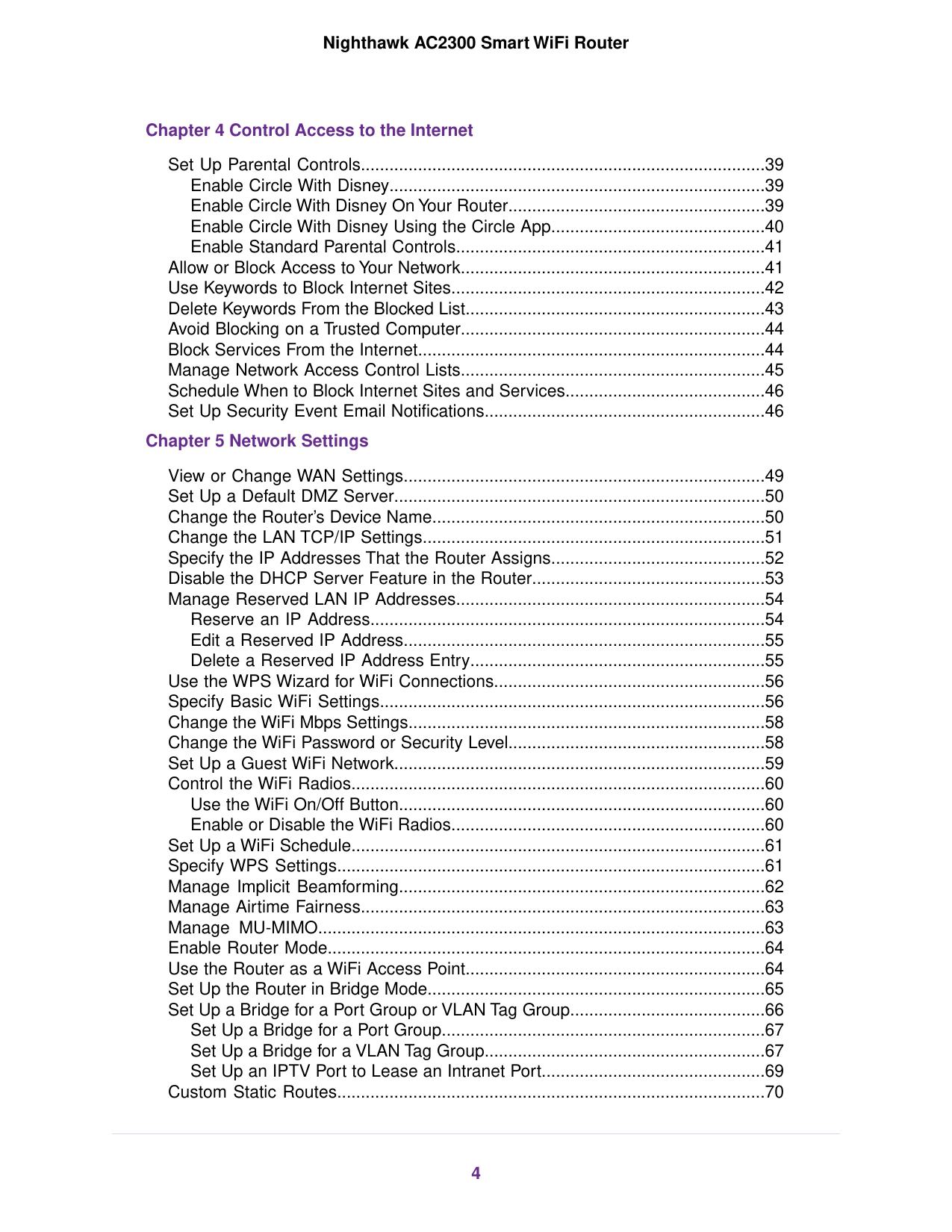
Chapter 4 Control Access to the Internet Set Up Parental Controls.....................................................................................39 Enable Circle With Disney...............................................................................39 Enable Circle With Disney On Your Router......................................................39 Enable Circle With Disney Using the Circle App.............................................40 Enable Standard Parental Controls.................................................................41 Allow or Block Access to Your Network................................................................41 Use Keywords to Block Internet Sites..................................................................42 Delete Keywords From the Blocked List...............................................................43 Avoid Blocking on a Trusted Computer................................................................44 Block Services From the Internet.........................................................................44 Manage Network Access Control Lists................................................................45 Schedule When to Block Internet Sites and Services..........................................46 Set Up Security Event Email Notifications...........................................................46 Chapter 5 Network Settings View or Change WAN Settings............................................................................49 Set Up a Default DMZ Server..............................................................................50 Change the Router’s Device Name......................................................................50 Change the LAN TCP/IP Settings........................................................................51 Specify the IP Addresses That the Router Assigns.............................................52 Disable the DHCP Server Feature in the Router.................................................53 Manage Reserved LAN IP Addresses.................................................................54 Reserve an IP Address...................................................................................54 Edit a Reserved IP Address............................................................................55 Delete a Reserved IP Address Entry..............................................................55 Use the WPS Wizard for WiFi Connections.........................................................56 Specify Basic WiFi Settings.................................................................................56 Change the WiFi Mbps Settings...........................................................................58 Change the WiFi Password or Security Level......................................................58 Set Up a Guest WiFi Network..............................................................................59 Control the WiFi Radios.......................................................................................60 Use the WiFi On/Off Button.............................................................................60 Enable or Disable the WiFi Radios..................................................................60 Set Up a WiFi Schedule.......................................................................................61 Specify WPS Settings..........................................................................................61 Manage Implicit Beamforming.............................................................................62 Manage Airtime Fairness.....................................................................................63 Manage MU-MIMO..............................................................................................63 Enable Router Mode............................................................................................64 Use the Router as a WiFi Access Point...............................................................64 Set Up the Router in Bridge Mode.......................................................................65 Set Up a Bridge for a Port Group or VLAN Tag Group.........................................66 Set Up a Bridge for a Port Group....................................................................67 Set Up a Bridge for a VLAN Tag Group...........................................................67 Set Up an IPTV Port to Lease an Intranet Port...............................................69 Custom Static Routes..........................................................................................70 4 Nighthawk AC2300 Smart WiFi Router
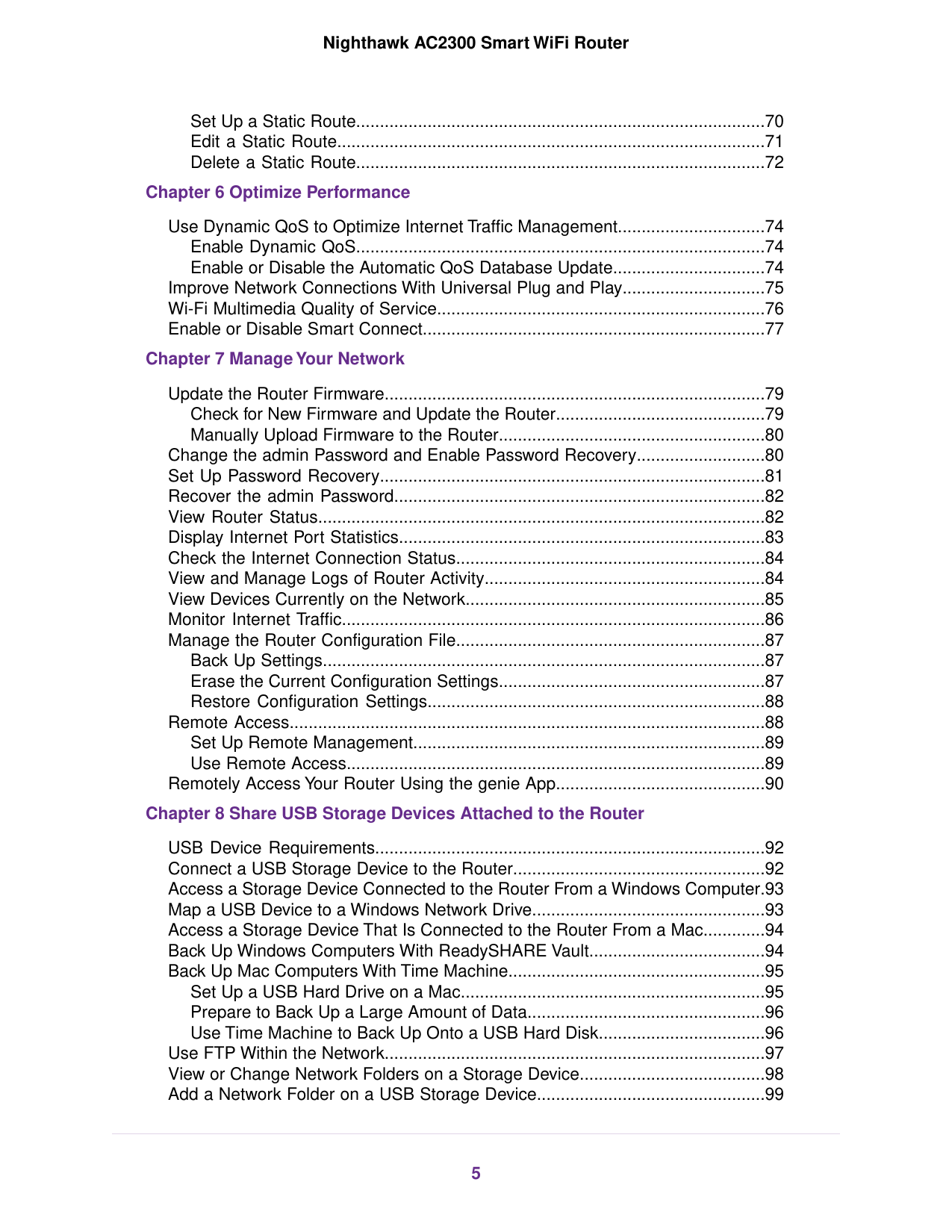
Set Up a Static Route......................................................................................70 Edit a Static Route..........................................................................................71 Delete a Static Route......................................................................................72 Chapter 6 Optimize Performance Use Dynamic QoS to Optimize Internet Traffic Management...............................74 Enable Dynamic QoS......................................................................................74 Enable or Disable the Automatic QoS Database Update................................74 Improve Network Connections With Universal Plug and Play..............................75 Wi-Fi Multimedia Quality of Service.....................................................................76 Enable or Disable Smart Connect........................................................................77 Chapter 7 Manage Your Network Update the Router Firmware................................................................................79 Check for New Firmware and Update the Router............................................79 Manually Upload Firmware to the Router........................................................80 Change the admin Password and Enable Password Recovery...........................80 Set Up Password Recovery.................................................................................81 Recover the admin Password..............................................................................82 View Router Status..............................................................................................82 Display Internet Port Statistics.............................................................................83 Check the Internet Connection Status.................................................................84 View and Manage Logs of Router Activity...........................................................84 View Devices Currently on the Network...............................................................85 Monitor Internet Traffic.........................................................................................86 Manage the Router Configuration File.................................................................87 Back Up Settings.............................................................................................87 Erase the Current Configuration Settings........................................................87 Restore Configuration Settings.......................................................................88 Remote Access....................................................................................................88 Set Up Remote Management..........................................................................89 Use Remote Access........................................................................................89 Remotely Access Your Router Using the genie App............................................90 Chapter 8 Share USB Storage Devices Attached to the Router USB Device Requirements..................................................................................92 Connect a USB Storage Device to the Router.....................................................92 Access a Storage Device Connected to the Router From a Windows Computer.93 Map a USB Device to a Windows Network Drive.................................................93 Access a Storage Device That Is Connected to the Router From a Mac.............94 Back Up Windows Computers With ReadySHARE Vault.....................................94 Back Up Mac Computers With Time Machine......................................................95 Set Up a USB Hard Drive on a Mac................................................................95 Prepare to Back Up a Large Amount of Data..................................................96 Use Time Machine to Back Up Onto a USB Hard Disk...................................96 Use FTP Within the Network................................................................................97 View or Change Network Folders on a Storage Device.......................................98 Add a Network Folder on a USB Storage Device................................................99 5 Nighthawk AC2300 Smart WiFi Router
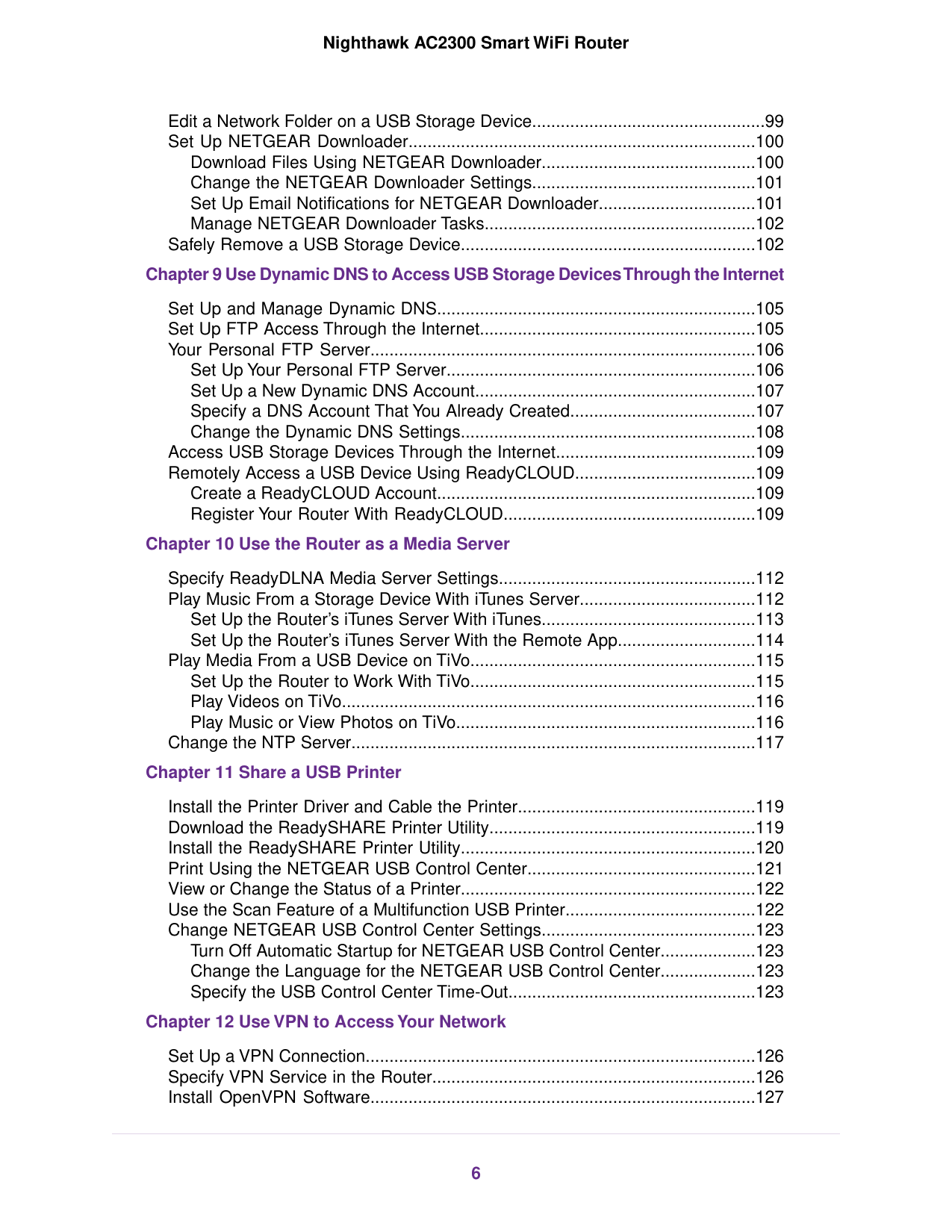
Edit a Network Folder on a USB Storage Device.................................................99 Set Up NETGEAR Downloader.........................................................................100 Download Files Using NETGEAR Downloader.............................................100 Change the NETGEAR Downloader Settings...............................................101 Set Up Email Notifications for NETGEAR Downloader.................................101 Manage NETGEAR Downloader Tasks.........................................................102 Safely Remove a USB Storage Device..............................................................102 Chapter 9 Use Dynamic DNS to Access USB Storage Devices Through the Internet Set Up and Manage Dynamic DNS...................................................................105 Set Up FTP Access Through the Internet..........................................................105 Your Personal FTP Server.................................................................................106 Set Up Your Personal FTP Server.................................................................106 Set Up a New Dynamic DNS Account...........................................................107 Specify a DNS Account That You Already Created.......................................107 Change the Dynamic DNS Settings..............................................................108 Access USB Storage Devices Through the Internet..........................................109 Remotely Access a USB Device Using ReadyCLOUD......................................109 Create a ReadyCLOUD Account...................................................................109 Register Your Router With ReadyCLOUD.....................................................109 Chapter 10 Use the Router as a Media Server Specify ReadyDLNA Media Server Settings......................................................112 Play Music From a Storage Device With iTunes Server.....................................112 Set Up the Router’s iTunes Server With iTunes.............................................113 Set Up the Router’s iTunes Server With the Remote App.............................114 Play Media From a USB Device on TiVo............................................................115 Set Up the Router to Work With TiVo............................................................115 Play Videos on TiVo.......................................................................................116 Play Music or View Photos on TiVo...............................................................116 Change the NTP Server.....................................................................................117 Chapter 11 Share a USB Printer Install the Printer Driver and Cable the Printer..................................................119 Download the ReadySHARE Printer Utility........................................................119 Install the ReadySHARE Printer Utility..............................................................120 Print Using the NETGEAR USB Control Center................................................121 View or Change the Status of a Printer..............................................................122 Use the Scan Feature of a Multifunction USB Printer........................................122 Change NETGEAR USB Control Center Settings.............................................123 Turn Off Automatic Startup for NETGEAR USB Control Center....................123 Change the Language for the NETGEAR USB Control Center....................123 Specify the USB Control Center Time-Out....................................................123 Chapter 12 Use VPN to Access Your Network Set Up a VPN Connection..................................................................................126 Specify VPN Service in the Router....................................................................126 Install OpenVPN Software.................................................................................127 6 Nighthawk AC2300 Smart WiFi Router
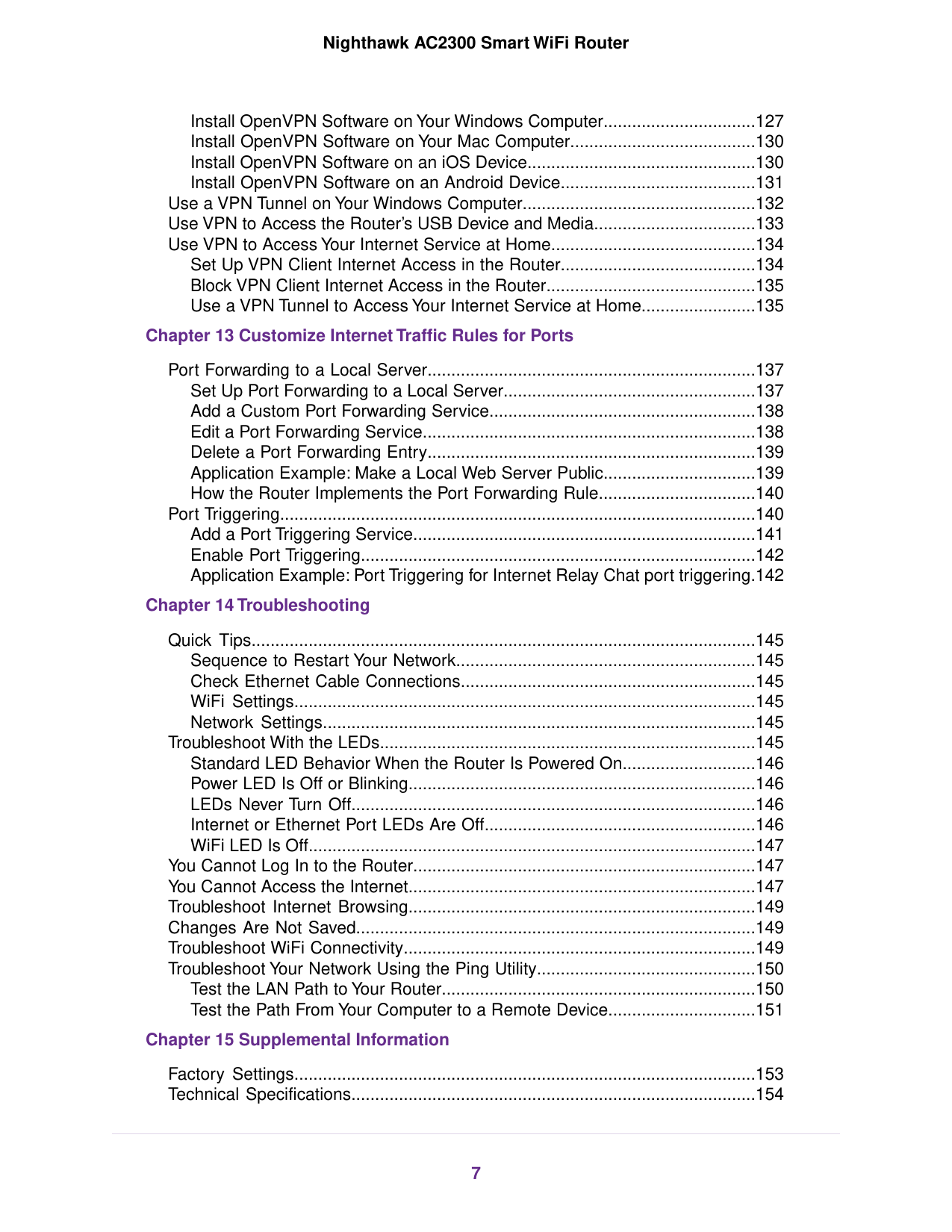
Install OpenVPN Software on Your Windows Computer................................127 Install OpenVPN Software on Your Mac Computer.......................................130 Install OpenVPN Software on an iOS Device................................................130 Install OpenVPN Software on an Android Device.........................................131 Use a VPN Tunnel on Your Windows Computer.................................................132 Use VPN to Access the Router’s USB Device and Media..................................133 Use VPN to Access Your Internet Service at Home...........................................134 Set Up VPN Client Internet Access in the Router.........................................134 Block VPN Client Internet Access in the Router............................................135 Use a VPN Tunnel to Access Your Internet Service at Home........................135 Chapter 13 Customize Internet Traffic Rules for Ports Port Forwarding to a Local Server.....................................................................137 Set Up Port Forwarding to a Local Server.....................................................137 Add a Custom Port Forwarding Service........................................................138 Edit a Port Forwarding Service......................................................................138 Delete a Port Forwarding Entry.....................................................................139 Application Example: Make a Local Web Server Public................................139 How the Router Implements the Port Forwarding Rule.................................140 Port Triggering....................................................................................................140 Add a Port Triggering Service........................................................................141 Enable Port Triggering...................................................................................142 Application Example: Port Triggering for Internet Relay Chat port triggering.142 Chapter 14 Troubleshooting Quick Tips..........................................................................................................145 Sequence to Restart Your Network...............................................................145 Check Ethernet Cable Connections..............................................................145 WiFi Settings.................................................................................................145 Network Settings...........................................................................................145 Troubleshoot With the LEDs...............................................................................145 Standard LED Behavior When the Router Is Powered On............................146 Power LED Is Off or Blinking.........................................................................146 LEDs Never Turn Off.....................................................................................146 Internet or Ethernet Port LEDs Are Off.........................................................146 WiFi LED Is Off..............................................................................................147 You Cannot Log In to the Router........................................................................147 You Cannot Access the Internet.........................................................................147 Troubleshoot Internet Browsing.........................................................................149 Changes Are Not Saved....................................................................................149 Troubleshoot WiFi Connectivity..........................................................................149 Troubleshoot Your Network Using the Ping Utility..............................................150 Test the LAN Path to Your Router..................................................................150 Test the Path From Your Computer to a Remote Device...............................151 Chapter 15 Supplemental Information Factory Settings.................................................................................................153 Technical Specifications.....................................................................................154 7 Nighthawk AC2300 Smart WiFi Router
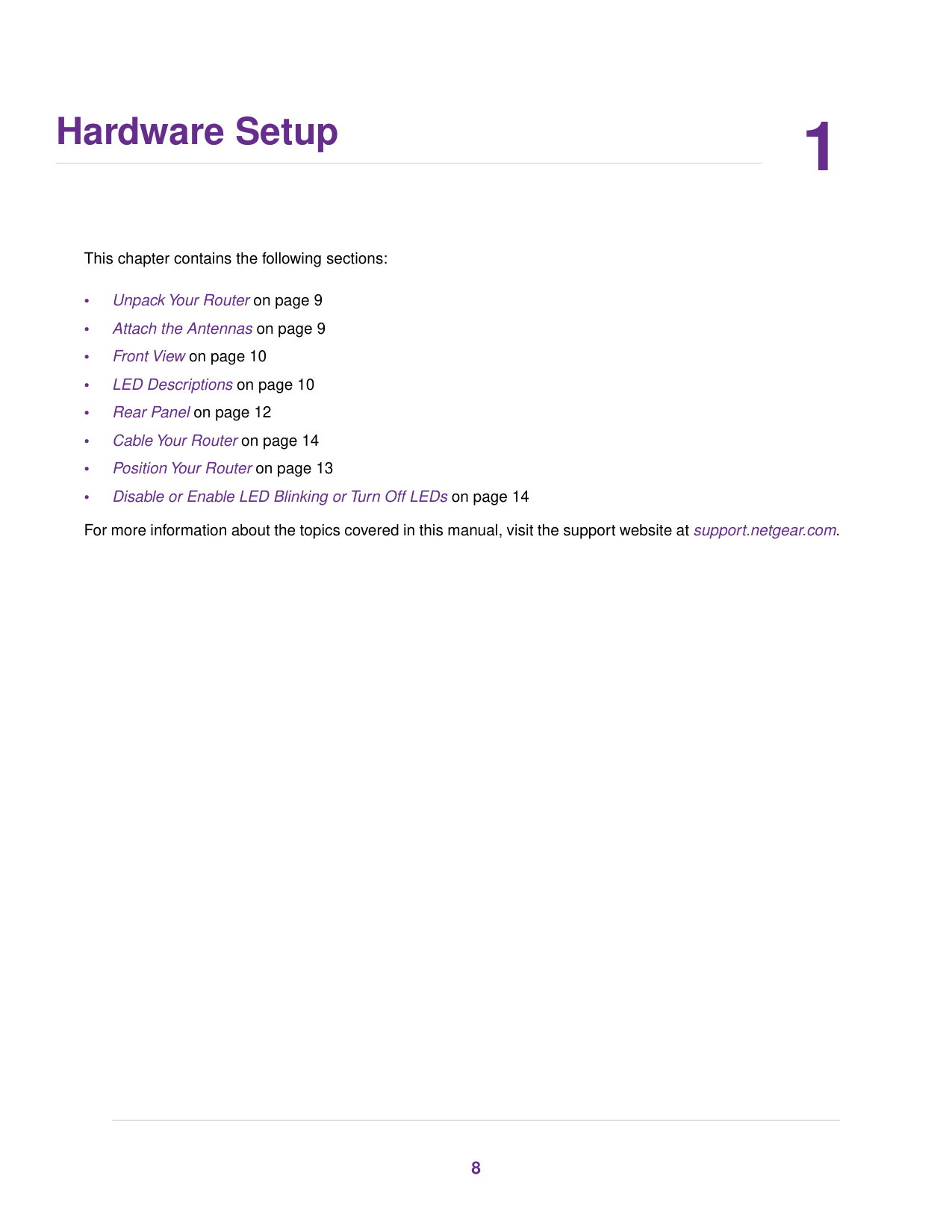
1 Hardware Setup This chapter contains the following sections: • Unpack Your Router on page 9 • Attach the Antennas on page 9 • Front View on page 10 • LED Descriptions on page 10 • Rear Panel on page 12 • Cable Your Router on page 14 • Position Your Router on page 13 • Disable or Enable LED Blinking or Turn Off LEDs on page 14 For more information about the topics covered in this manual, visit the support website at support.netgear.com. 8
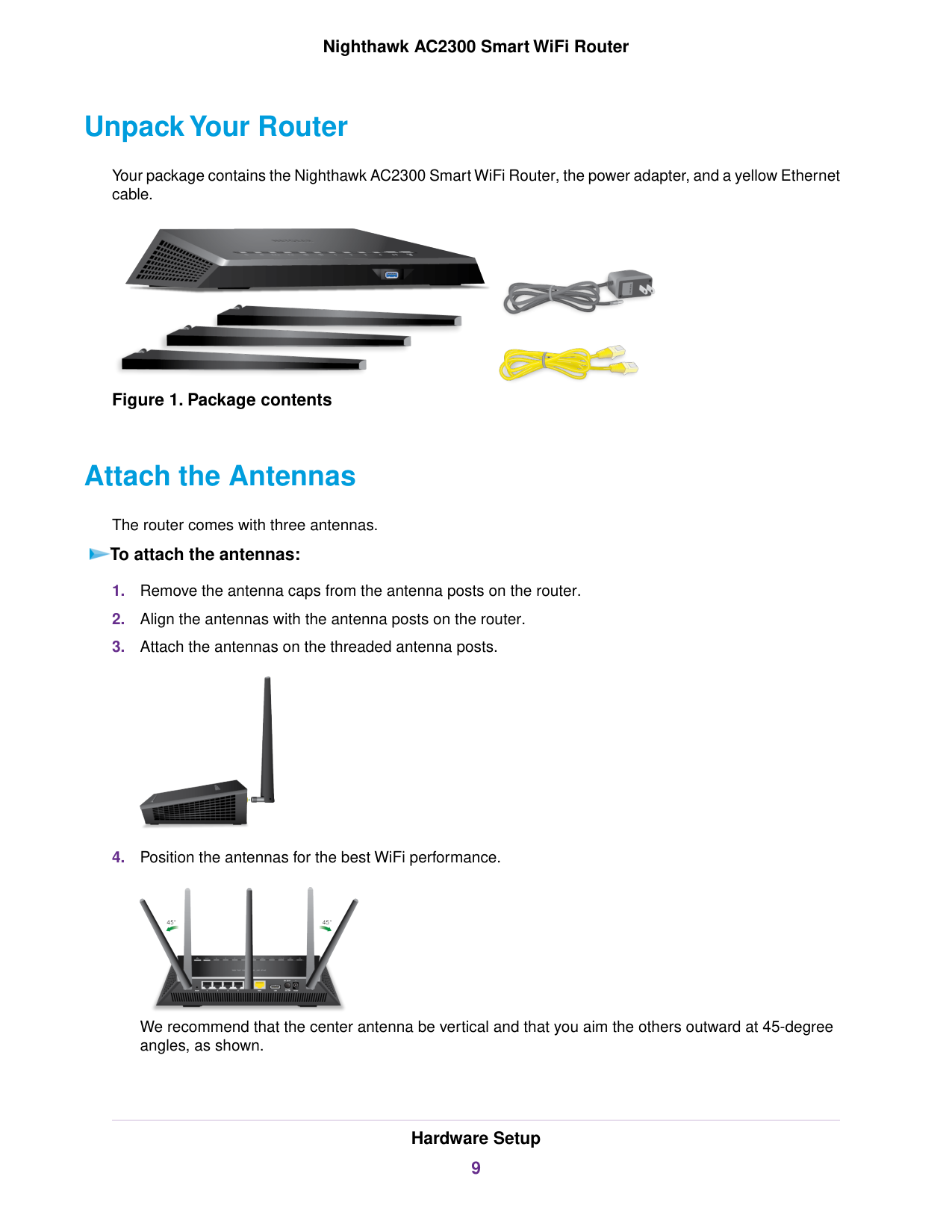
Unpack Your Router Your package contains the Nighthawk AC2300 Smart WiFi Router, the power adapter, and a yellow Ethernet cable. Figure 1. Package contents Attach the Antennas The router comes with three antennas. To attach the antennas:
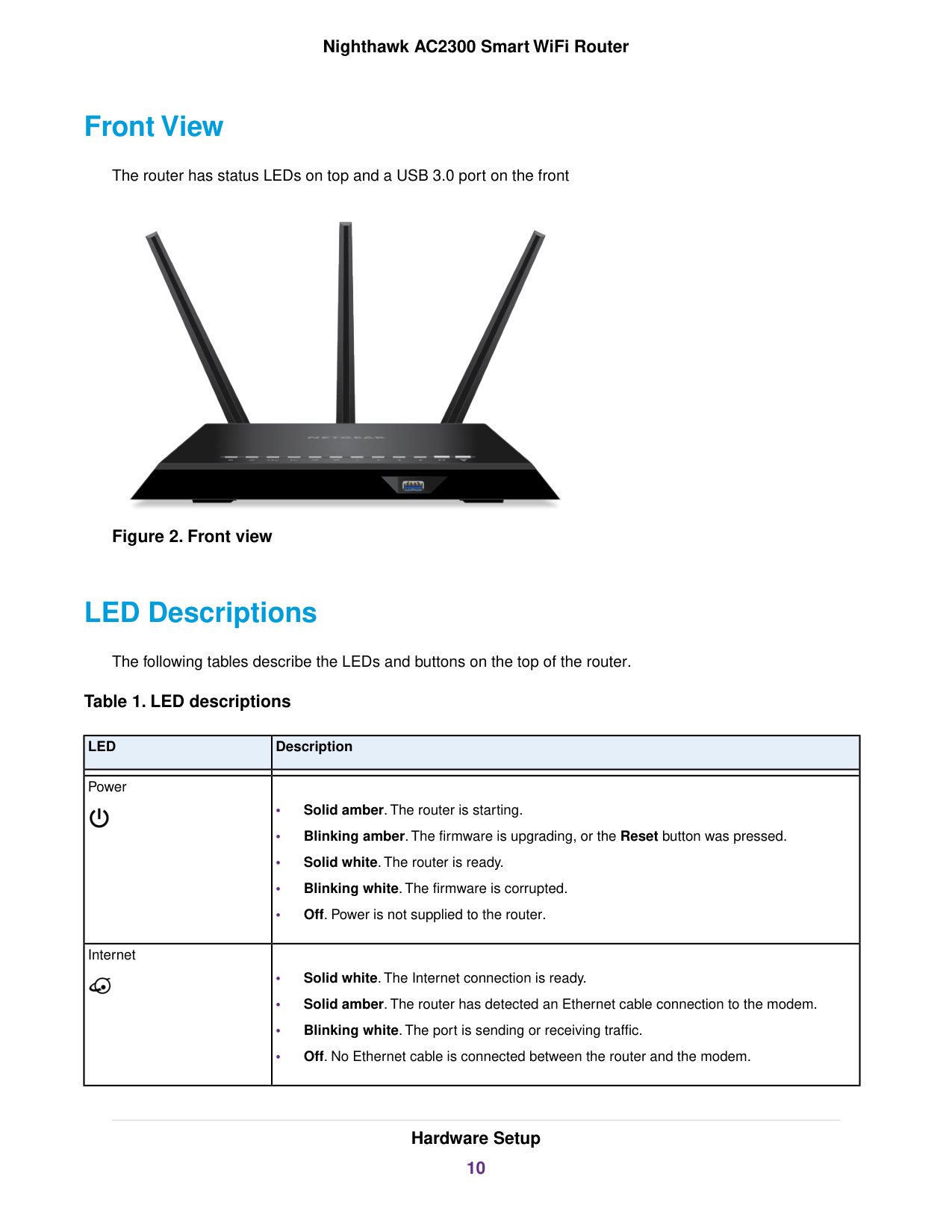
Front View The router has status LEDs on top and a USB 3.0 port on the front Figure 2. Front view LED Descriptions The following tables describe the LEDs and buttons on the top of the router. Table 1. LED descriptions Description
Led
• Solid amber. The router is starting. • Blinking amber. The firmware is upgrading, or the Reset button was pressed. • Solid white. The router is ready. • Blinking white. The firmware is corrupted. • Off. Power is not supplied to the router. Power • Solid white. The Internet connection is ready. • Solid amber. The router has detected an Ethernet cable connection to the modem. • Blinking white. The port is sending or receiving traffic. • Off. No Ethernet cable is connected between the router and the modem. Internet Hardware Setup 10 Nighthawk AC2300 Smart WiFi Router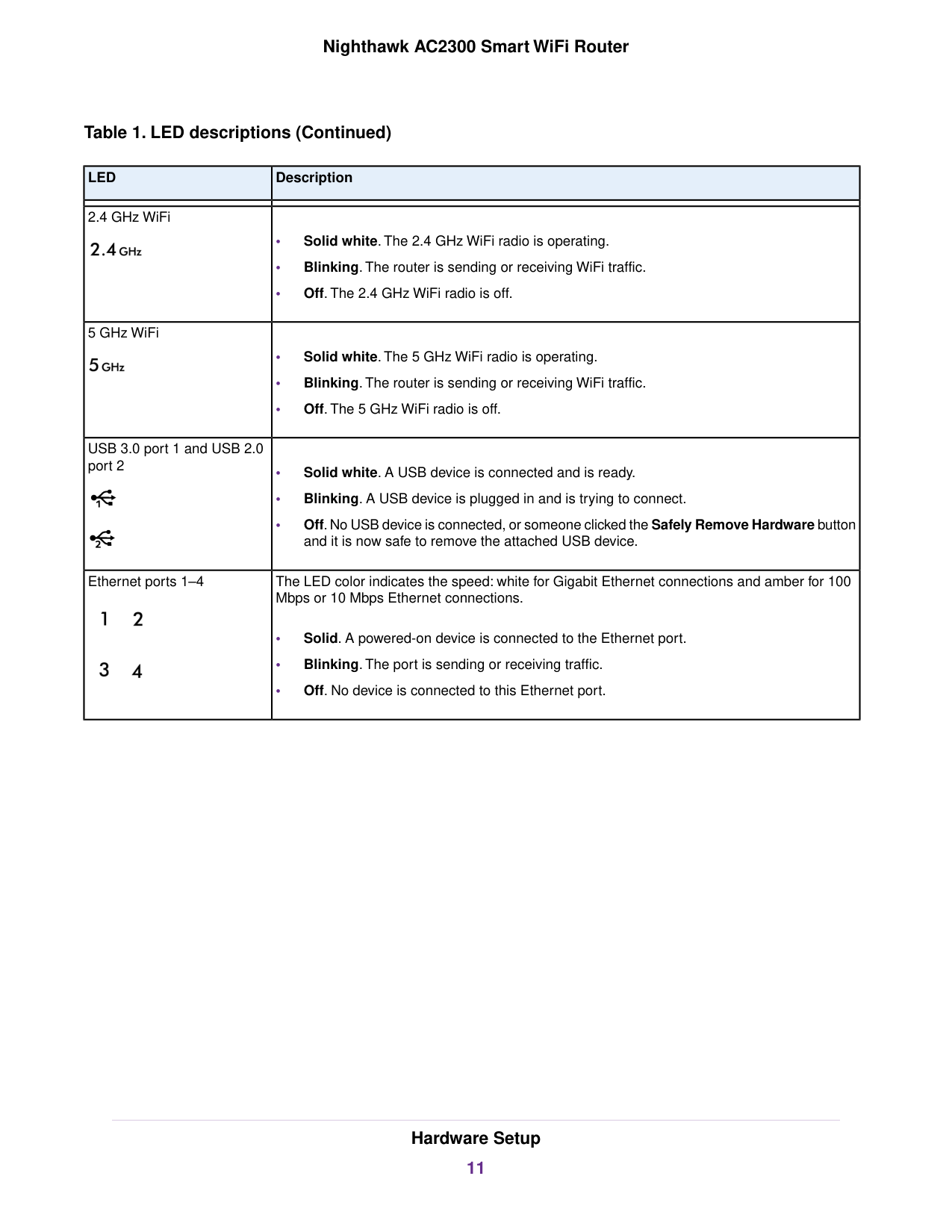
Table 1. LED descriptions (Continued) Description
Led
• Solid white. The 2.4 GHz WiFi radio is operating. • Blinking. The router is sending or receiving WiFi traffic. • Off. The 2.4 GHz WiFi radio is off. 2.4 GHz WiFi • Solid white. The 5 GHz WiFi radio is operating. • Blinking. The router is sending or receiving WiFi traffic. • Off. The 5 GHz WiFi radio is off. 5 GHz WiFi • Solid white. A USB device is connected and is ready. • Blinking. A USB device is plugged in and is trying to connect. • Off. No USB device is connected, or someone clicked the Safely Remove Hardware button and it is now safe to remove the attached USB device. USB 3.0 port 1 and USB 2.0 port 2 The LED color indicates the speed: white for Gigabit Ethernet connections and amber for 100 Mbps or 10 Mbps Ethernet connections. • Solid. A powered-on device is connected to the Ethernet port. • Blinking. The port is sending or receiving traffic. • Off. No device is connected to this Ethernet port. Ethernet ports 1–4 Hardware Setup 11 Nighthawk AC2300 Smart WiFi Router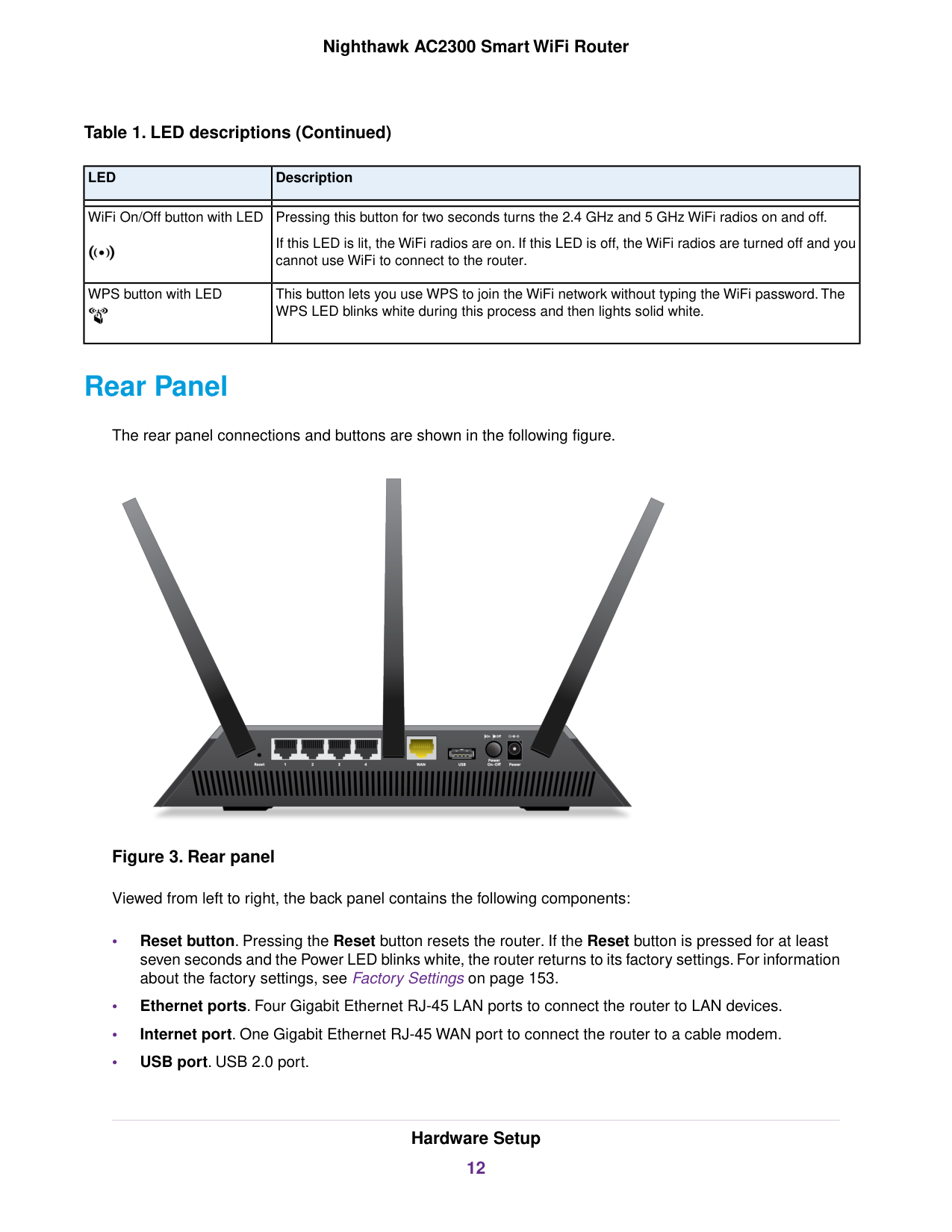
Table 1. LED descriptions (Continued) Description
Led
Pressing this button for two seconds turns the 2.4 GHz and 5 GHz WiFi radios on and off. If this LED is lit, the WiFi radios are on. If this LED is off, the WiFi radios are turned off and you cannot use WiFi to connect to the router. WiFi On/Off button with LED This button lets you use WPS to join the WiFi network without typing the WiFi password. The WPS LED blinks white during this process and then lights solid white. WPS button with LED Rear Panel The rear panel connections and buttons are shown in the following figure. Figure 3. Rear panel Viewed from left to right, the back panel contains the following components: • Reset button. Pressing the Reset button resets the router. If the Reset button is pressed for at least seven seconds and the Power LED blinks white, the router returns to its factory settings. For information about the factory settings, see Factory Settings on page 153. • Ethernet ports. Four Gigabit Ethernet RJ-45 LAN ports to connect the router to LAN devices. • Internet port. One Gigabit Ethernet RJ-45 WAN port to connect the router to a cable modem. • USB port. USB 2.0 port. Hardware Setup 12 Nighthawk AC2300 Smart WiFi Router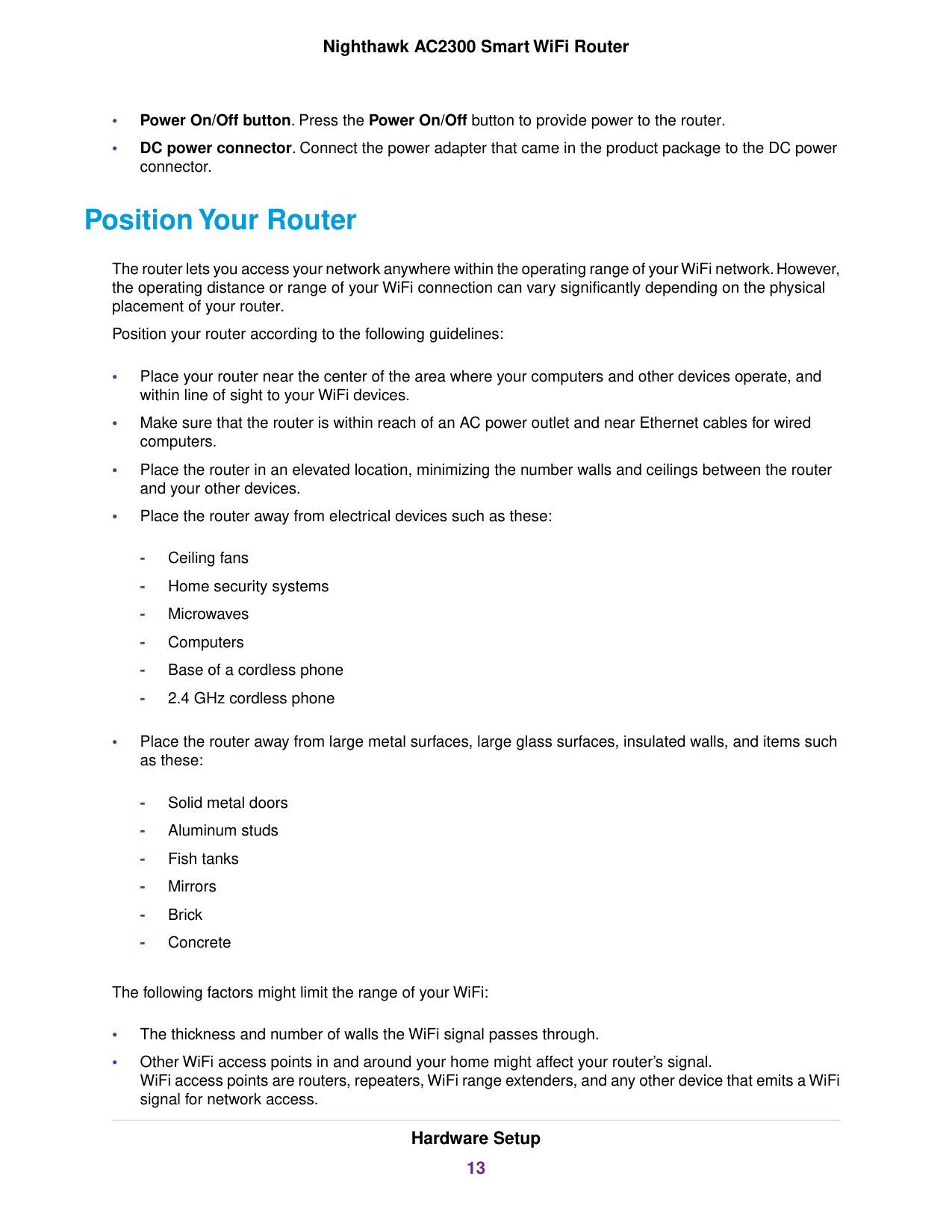
• Power On/Off button. Press the Power On/Off button to provide power to the router. • DC power connector. Connect the power adapter that came in the product package to the DC power connector. Position Your Router The router lets you access your network anywhere within the operating range of your WiFi network. However, the operating distance or range of your WiFi connection can vary significantly depending on the physical placement of your router. Position your router according to the following guidelines: • Place your router near the center of the area where your computers and other devices operate, and within line of sight to your WiFi devices. • Make sure that the router is within reach of an AC power outlet and near Ethernet cables for wired computers. • Place the router in an elevated location, minimizing the number walls and ceilings between the router and your other devices. • Place the router away from electrical devices such as these:
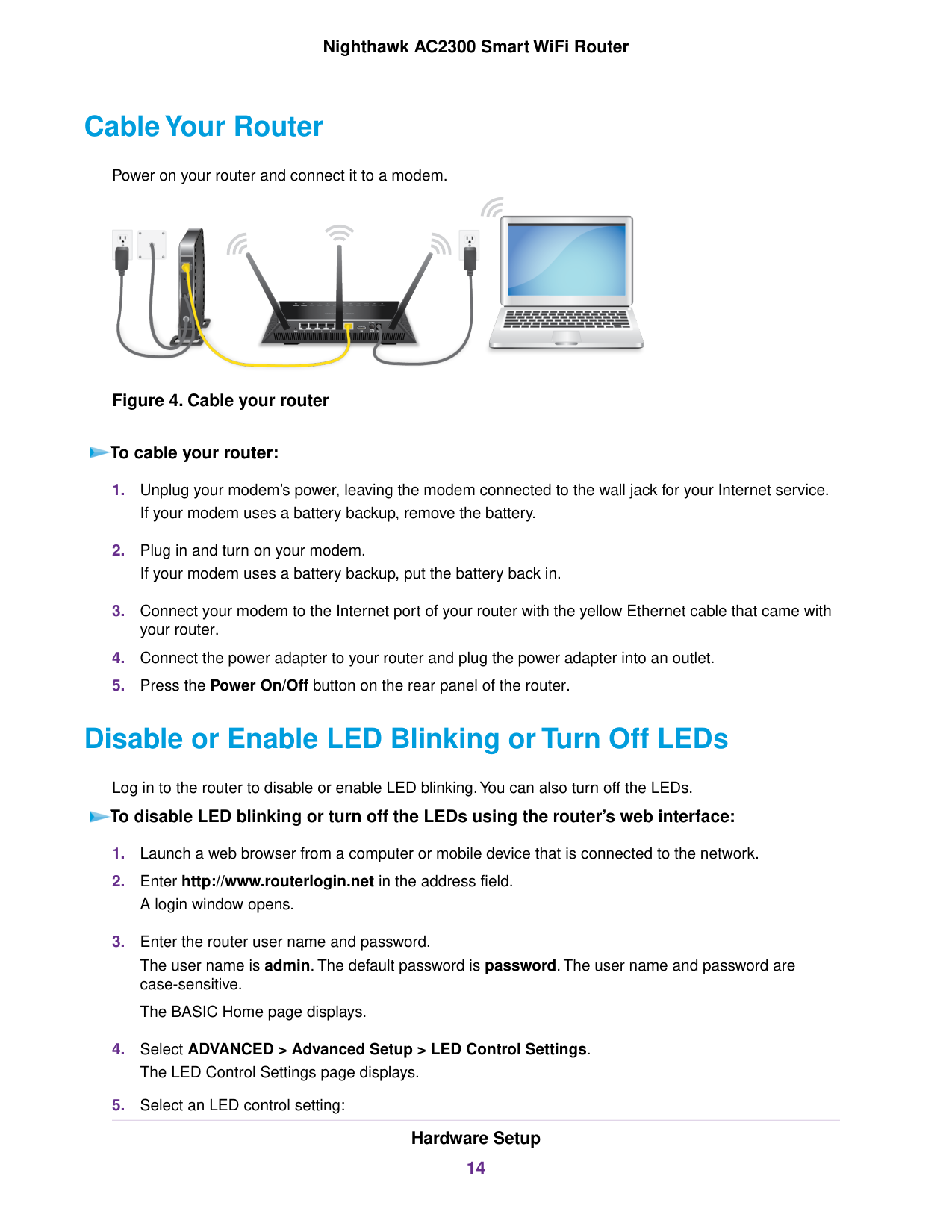
Cable Your Router Power on your router and connect it to a modem. Figure 4. Cable your router To cable your router:
• Enable blinking on Internet LED, LAN LED, Wireless LED and USB LED when data traffic is detected. Allows standard LED behavior. This feature is selected by default. • Disable blinking on Internet LED, LAN LED, Wireless LED and USB LED when data traffic is detected. Blinking is disabled when data traffic is detected. • Turn off all LEDs except Power LED. All the LEDs, except the Power LED, are turned off.
2 Connect to the Network and Access the Router You can connect to the router’s WiFi networks or use a wired Ethernet connection. This chapter explains the ways you can connect and how to access the router and log in. The chapter contains the following sections: • Connect to the Network on page 17 • Types of Logins on page 18 • Use a Web Browser to Access the Router on page 18 • Install the Router With the NETGEAR Up App on page 20 • Change the Language on page 20 • Access the Router With the NETGEAR genie App on page 21 16
Connect to the Network You can connect to the router’s network through a wired or WiFi connection. If you set up your computer to use a static IP address, change the settings so that it uses Dynamic Host Configuration Protocol (DHCP). Wired Connection You can connect your computer to the router using an Ethernet cable and join the router’s local area network
(Lan).
To connect your computer to the router with an Ethernet cable:
Label The label on the router shows the login information, WiFi network name and network key (password), MAC address, and serial number. Figure 5. Product label Types of Logins Separate types of logins serve different purposes. It is important that you understand the difference so that you know which login to use when. Several types of logins are associated with the router: • ISP login. The login that your ISP gave you logs you in to your Internet service.Your service provider gave you this login information in a letter or some other way. If you cannot find this login information, contact your service provider. • WiFi network key or password.Your router is preset with a unique WiFi network name (SSID) and password for WiFi access. This information is on the router label. • Router login. This logs you in to the router interface from a web browser as admin. Use a Web Browser to Access the Router When you connect to the network (either with WiFi or with an Ethernet cable), you can use a web browser to access the router to view or change its settings. When you access the router, the software automatically checks to see if your router can connect to your Internet service. Automatic Internet Setup You can set up your router automatically, or you can use a web browser to access the router and set up your router manually. Before you start the setup process, get your ISP information and make sure that the computers and devices in the network are using the settings described here. When your Internet service starts, your Internet service provider (ISP) typically gives you all the information needed to connect to the Internet. For DSL service, you might need the following information to set up your router: Connect to the Network and Access the Router 18 Nighthawk AC2300 Smart WiFi Router
• The ISP configuration information for your DSL account • ISP login name and password • Fixed or static IP address setting (special deployment by ISP; this setting is rare) If you cannot locate this information, ask your ISP to provide it. When your Internet connection is working, you no longer need to launch the ISP login program on your computer to access the Internet. When you start an Internet application, your router automatically logs you in. NETGEAR genie runs on any device with a web browser. Installation and basic setup takes about 15 minutes to complete. To automatically set up your router:
Log In to the Router When you first connect to your router and launch a web browser, the browser automatically displays the router’s web page. If you want to view or change settings for the router later, you can use a browser to log in to the router’s web page. To log in to the router:
Netgear.
The NETGEAR Up app is available for iOS and Android mobile devices. To install your router using the NETGEAR Up app:
To change the language:
3 Specify Your Internet Settings Usually, the quickest way to set up the router to use your Internet connection is to allow the genie to detect the Internet connection when you first access the router with a web browser.You can also customize or specify your Internet settings. This chapter contains the following sections: • Use the Internet Setup Wizard on page 23 • Manually Set Up the Internet Connection on page 23 • Specify IPv6 Internet Connections on page 25 • Change the MTU Size on page 35 22
Use the Internet Setup Wizard You can use the Setup Wizard to detect your Internet settings and automatically set up your router. The Setup Wizard is not the same as the pages that display the first time you connect to your router to set it up. To use the Setup Wizard:
To set up an IPv6 Internet connection:
Use Auto Config for an IPv6 Internet Connection To set up an IPv6 Internet connection through autoconfiguration:
Lan).
If you do not specify an ID here, the router generates one automatically from its MAC address.
Lan).
If you do not specify an ID here, the router generates one automatically from its MAC address.
Lan).
Specify Your Internet Settings 29 Nighthawk AC2300 Smart WiFi Router
• 6rd (IPv6 Rapid Development) Configuration. The router detects the service provider’s IPv4 network and attempts to establish an IPv6 6rd tunnel connection. If the IPv4 network returns 6rd parameters to the router, the page adjusts to display the correct settings in this section. • Router’s IPv6 Address on LAN. This field shows the IPv6 address that is acquired for the router’s LAN interface. The number after the slash (/) is the length of the prefix, which is also indicated by the underline (_) under the IPv6 address. If no address is acquired, the field displays Not Available.
The IPv6 page displays.
This setting specifies how the router assigns IPv6 addresses to the devices on your home network (the
Lan).
You can type the domain name of your IPv6 ISP. Do not enter the domain name for the IPv4 ISP here. For example, if your ISP’s mail server is mail.xxx.yyy.zzz, type xxx.yyy.zzz as the domain name. If your ISP provided a domain name, type it in this field. For example, Earthlink Cable might require a host name of home, and Comcast sometimes supplies a domain name.
Lan).
indicated by the underline (_) under the IPv6 address. If no address is acquired, the field displays Not Available. • Router’s IPv6 Address on LAN. This field shows the IPv6 address that is acquired for the router’s LAN interface. The number after the slash (/) is the length of the prefix, which is also indicated by the underline (_) under the IPv6 address. If no address is acquired, the field displays Not Available.
Lan).
along the way. If a device in the data path uses a lower MTU setting than the other devices, the data packets must be split or “fragmented” to accommodate the device with the smallest MTU. The best MTU setting for NETGEAR equipment is often the default value. In some situations, changing the value fixes one problem but causes another. Leave the MTU unchanged unless one of these situations occurs: • You experience problems connecting to your ISP or other Internet service, and the technical support of either the ISP or NETGEAR recommends changing the MTU setting. These web-based applications might require an MTU change:
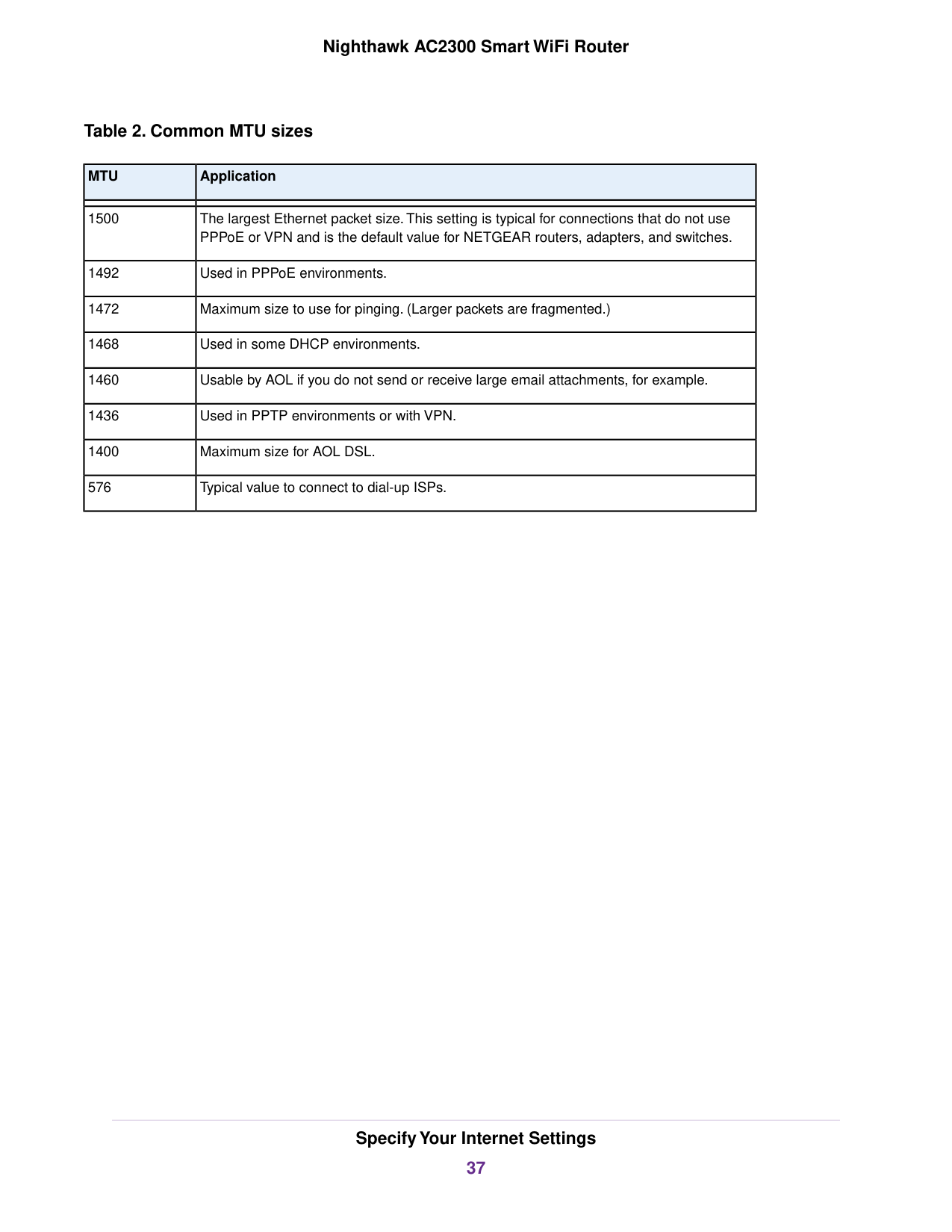
Table 2. Common MTU sizes Application
Mtu
The largest Ethernet packet size. This setting is typical for connections that do not use PPPoE or VPN and is the default value for NETGEAR routers, adapters, and switches. 1500 Used in PPPoE environments. 1492 Maximum size to use for pinging. (Larger packets are fragmented.) 1472 Used in some DHCP environments. 1468 Usable by AOL if you do not send or receive large email attachments, for example. 1460 Used in PPTP environments or with VPN. 1436 Maximum size for AOL DSL. 1400 Typical value to connect to dial-up ISPs. 576 Specify Your Internet Settings 37 Nighthawk AC2300 Smart WiFi Router
4 Control Access to the Internet The router comes with a built-in firewall that helps protect your home network from unwanted intrusions from the Internet. This chapter includes the following sections: • Set Up Parental Controls on page 39 • Allow or Block Access to Your Network on page 41 • Use Keywords to Block Internet Sites on page 42 • Manage Network Access Control Lists on page 45 • Schedule When to Block Internet Sites and Services on page 46 • Set Up Security Event Email Notifications on page 46 38
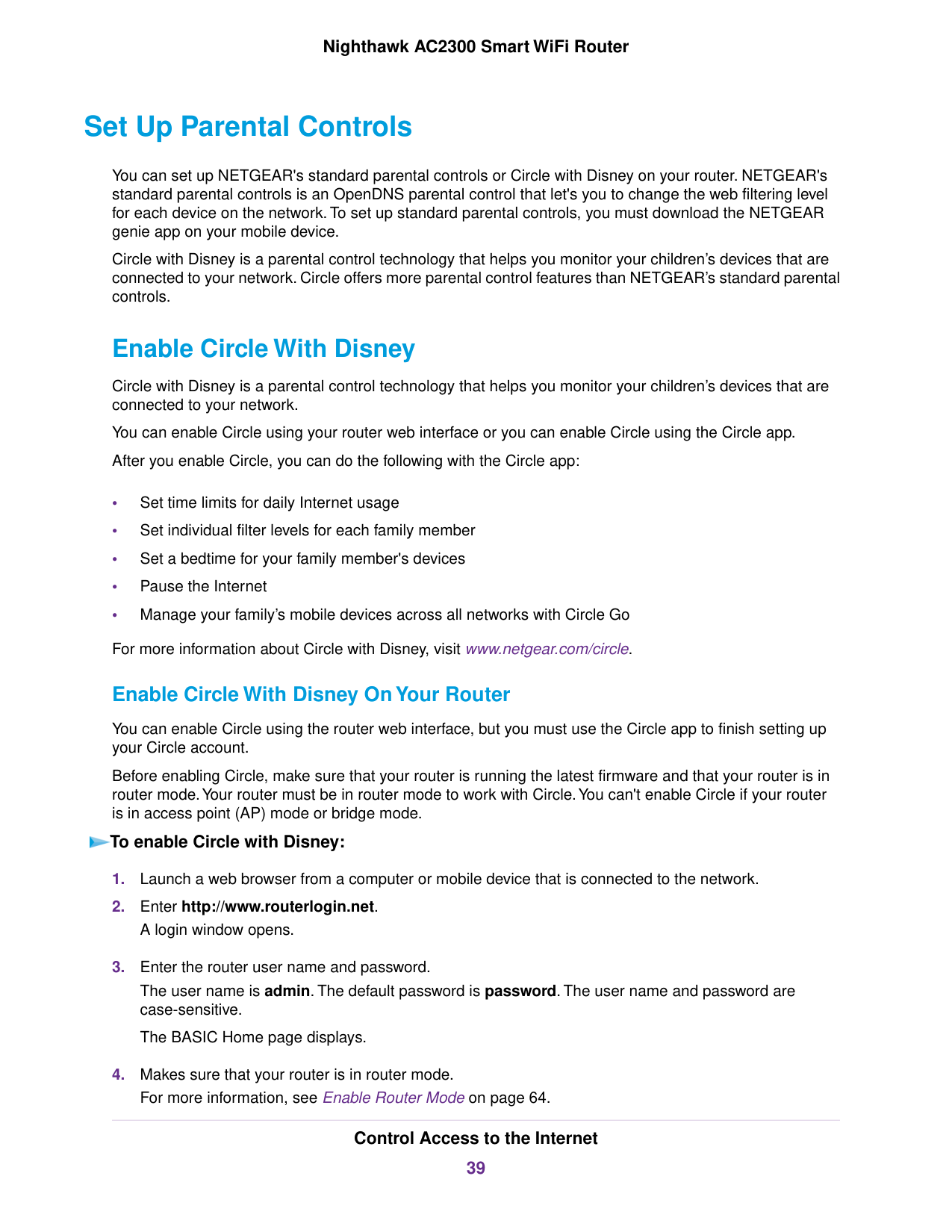
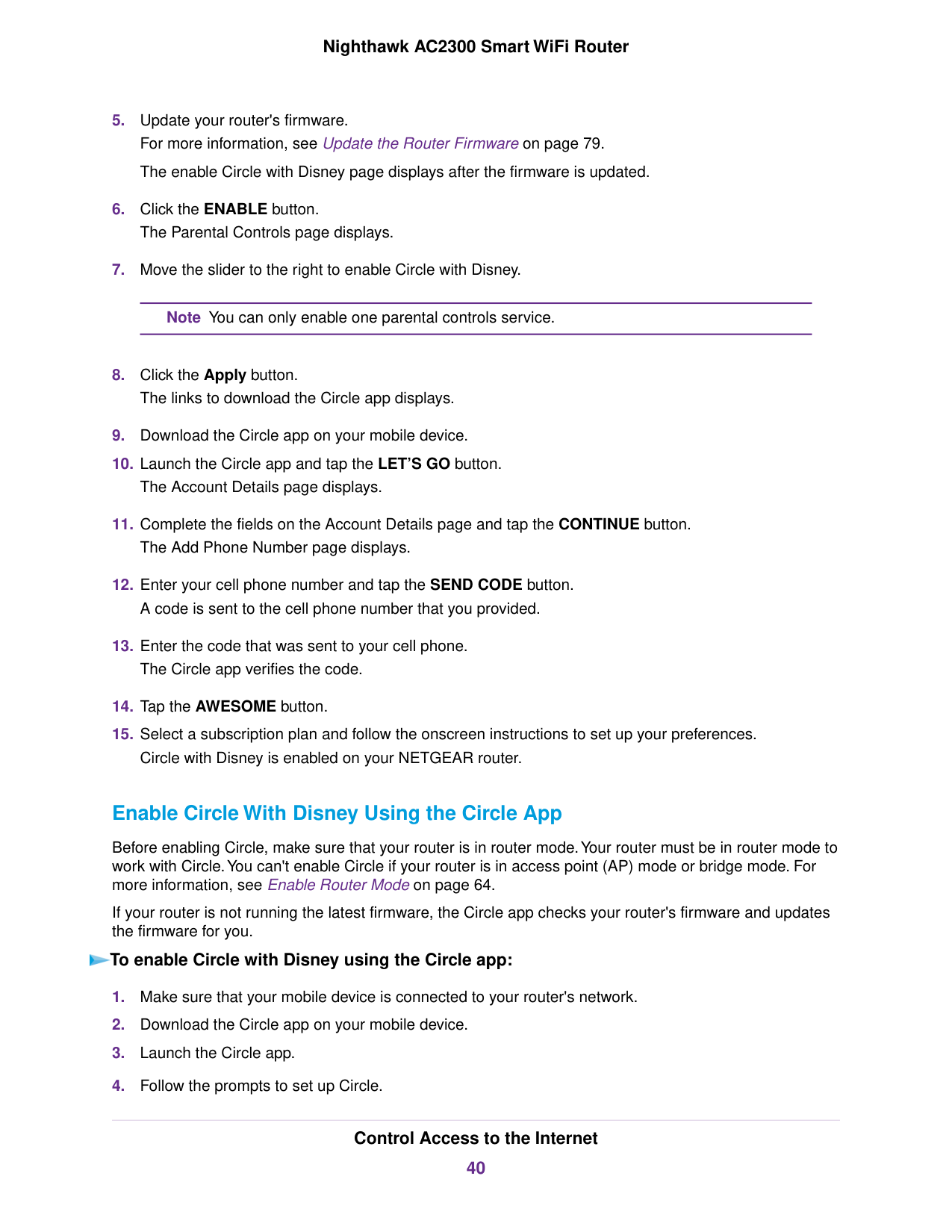
Set Up Parental Controls You can set up NETGEAR's standard parental controls or Circle with Disney on your router. NETGEAR's standard parental controls is an OpenDNS parental control that let's you to change the web filtering level for each device on the network. To set up standard parental controls, you must download the NETGEAR genie app on your mobile device. Circle with Disney is a parental control technology that helps you monitor your children’s devices that are connected to your network. Circle offers more parental control features than NETGEAR’s standard parental controls. Enable Circle With Disney Circle with Disney is a parental control technology that helps you monitor your children’s devices that are connected to your network. You can enable Circle using your router web interface or you can enable Circle using the Circle app. After you enable Circle, you can do the following with the Circle app: • Set time limits for daily Internet usage • Set individual filter levels for each family member • Set a bedtime for your family member's devices • Pause the Internet • Manage your family’s mobile devices across all networks with Circle Go For more information about Circle with Disney, visit www.netgear.com/circle. Enable Circle With Disney On Your Router You can enable Circle using the router web interface, but you must use the Circle app to finish setting up your Circle account. Before enabling Circle, make sure that your router is running the latest firmware and that your router is in router mode.Your router must be in router mode to work with Circle.You can't enable Circle if your router is in access point (AP) mode or bridge mode. To enable Circle with Disney:
Enable Standard Parental Controls NETGEAR's standard parental controls is an OpenDNS parental control that let's you to change the web filtering level for each device on the network. To set up standard parental controls, you must download the NETGEAR genie app on your mobile device. For more information about NETGEAR's standard parental controls, visit http://www.netgear.com/lpc. To enable standard parental controls:
The BASIC Home page displays.
The Block Sites page displays.
Avoid Blocking on a Trusted Computer You can exempt one trusted computer from blocking. The computer that you exempt must be assigned a fixed IP address.You can use the reserved IP address feature to specify the IP address. See Manage Reserved LAN IP Addresses on page 54. To specify a trusted computer:
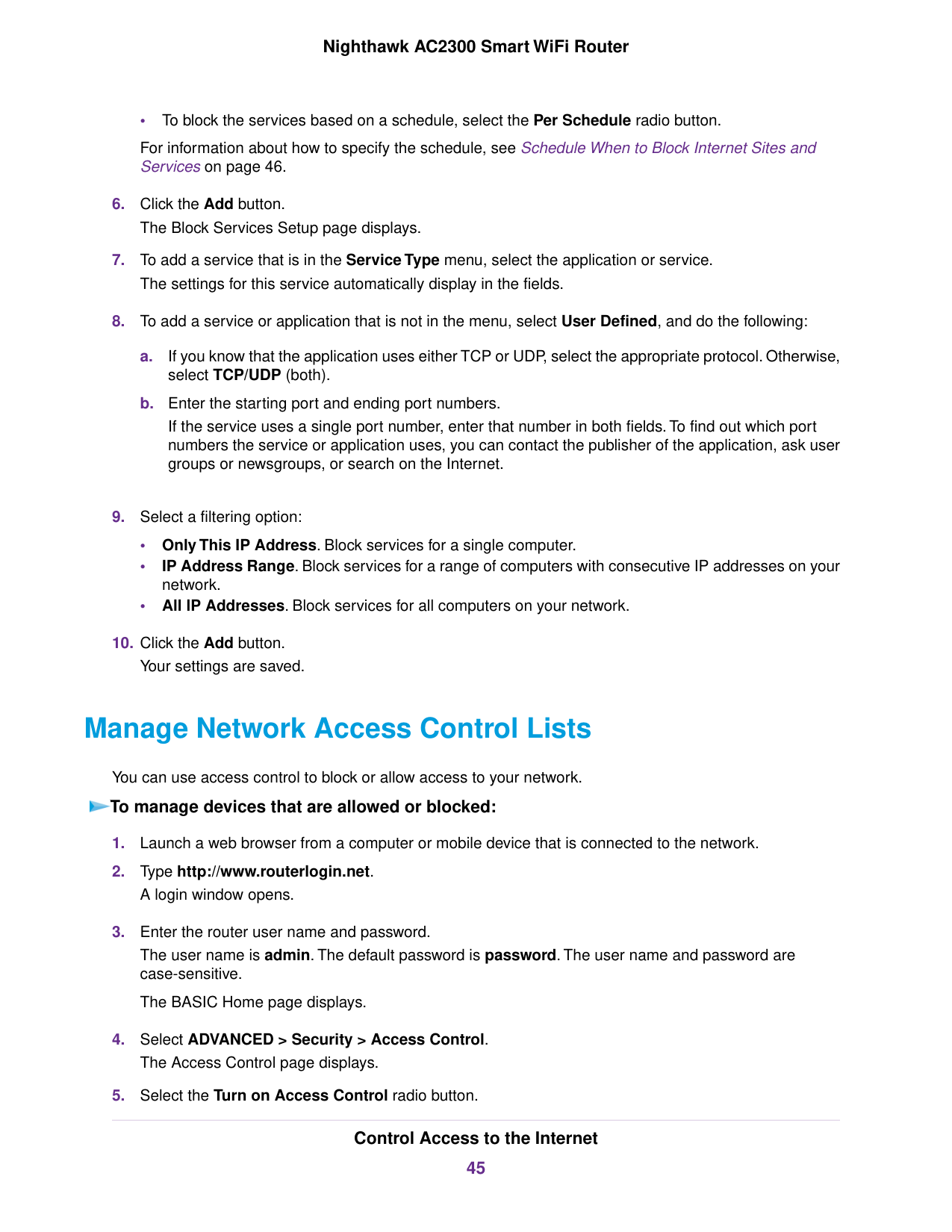
• To block the services based on a schedule, select the Per Schedule radio button. For information about how to specify the schedule, see Schedule When to Block Internet Sites and Services on page 46.
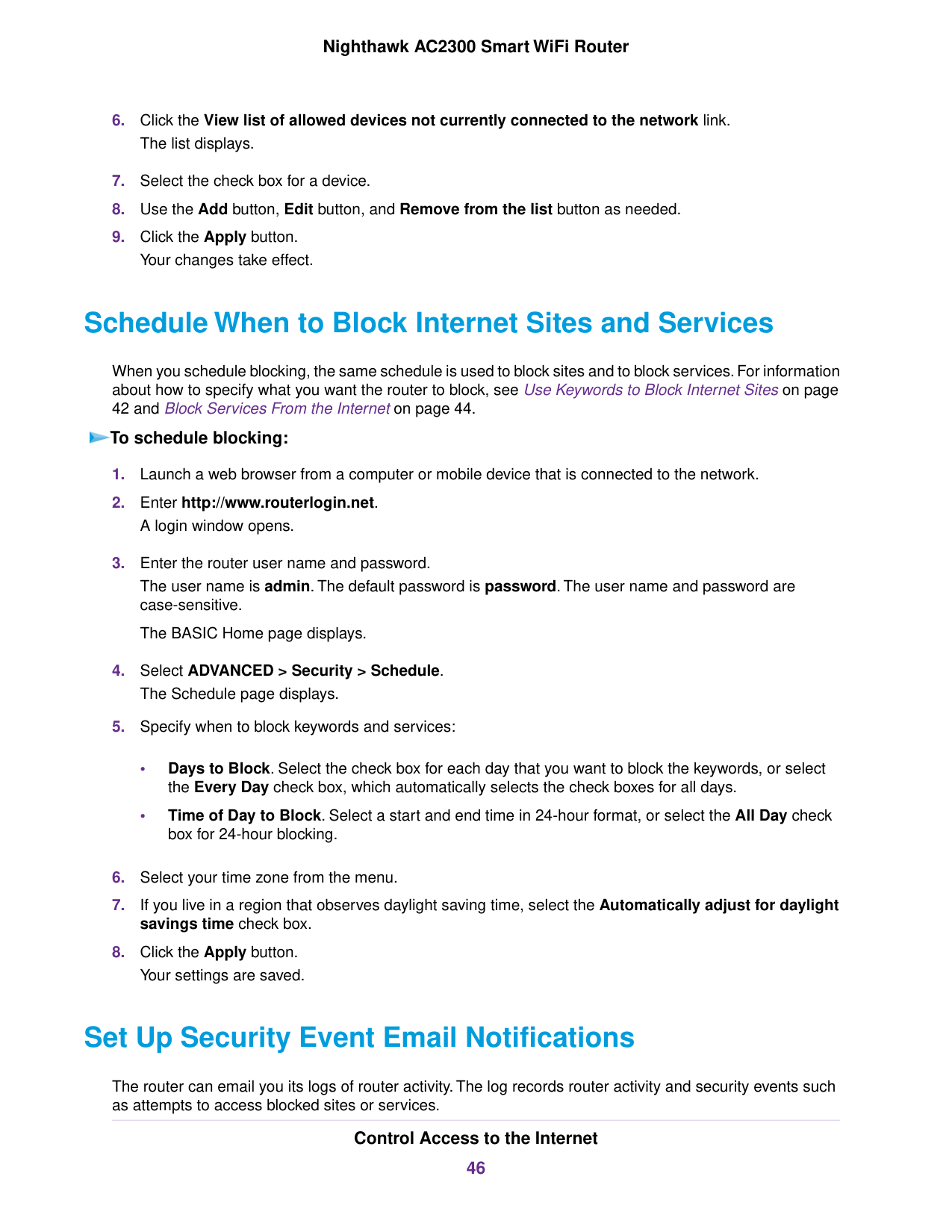
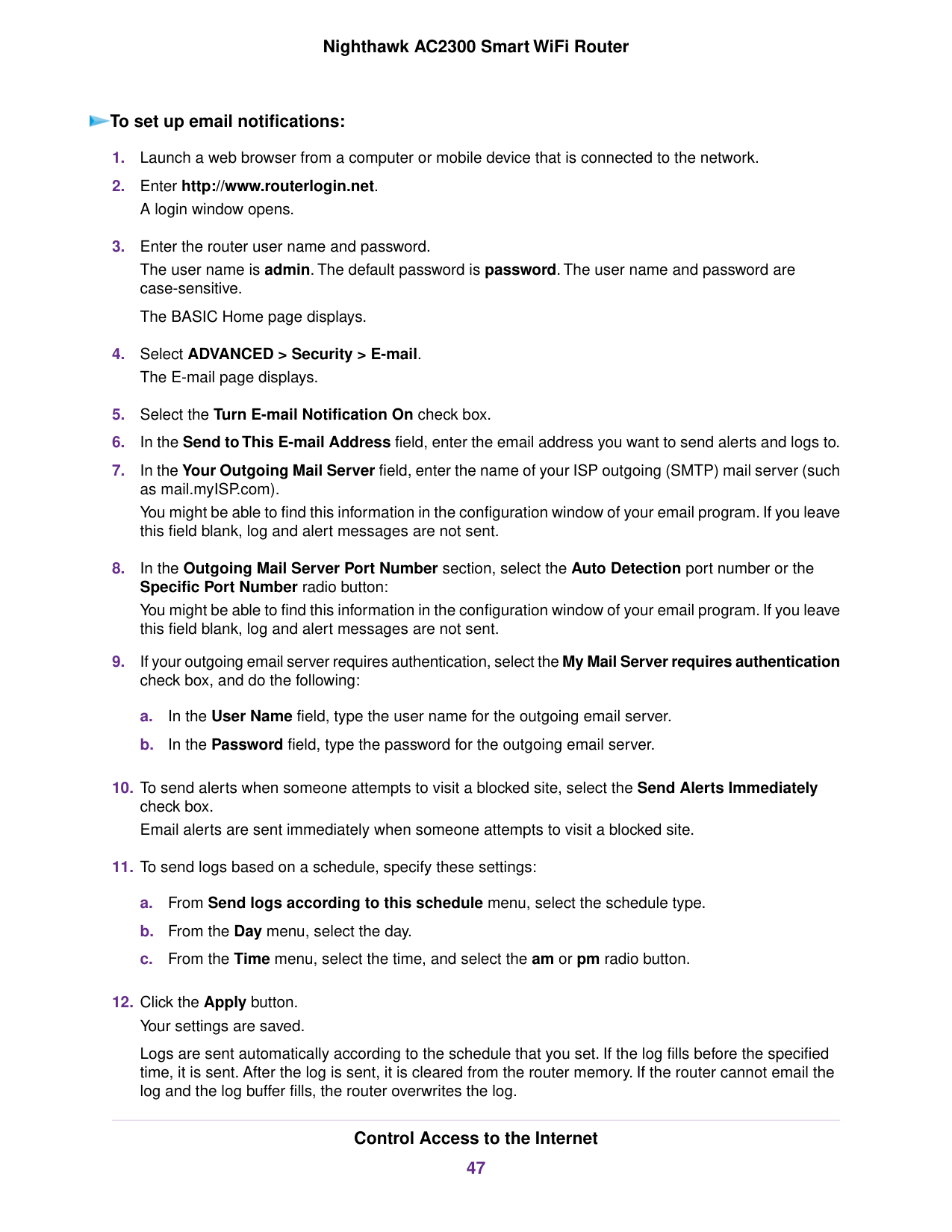
To set up email notifications:
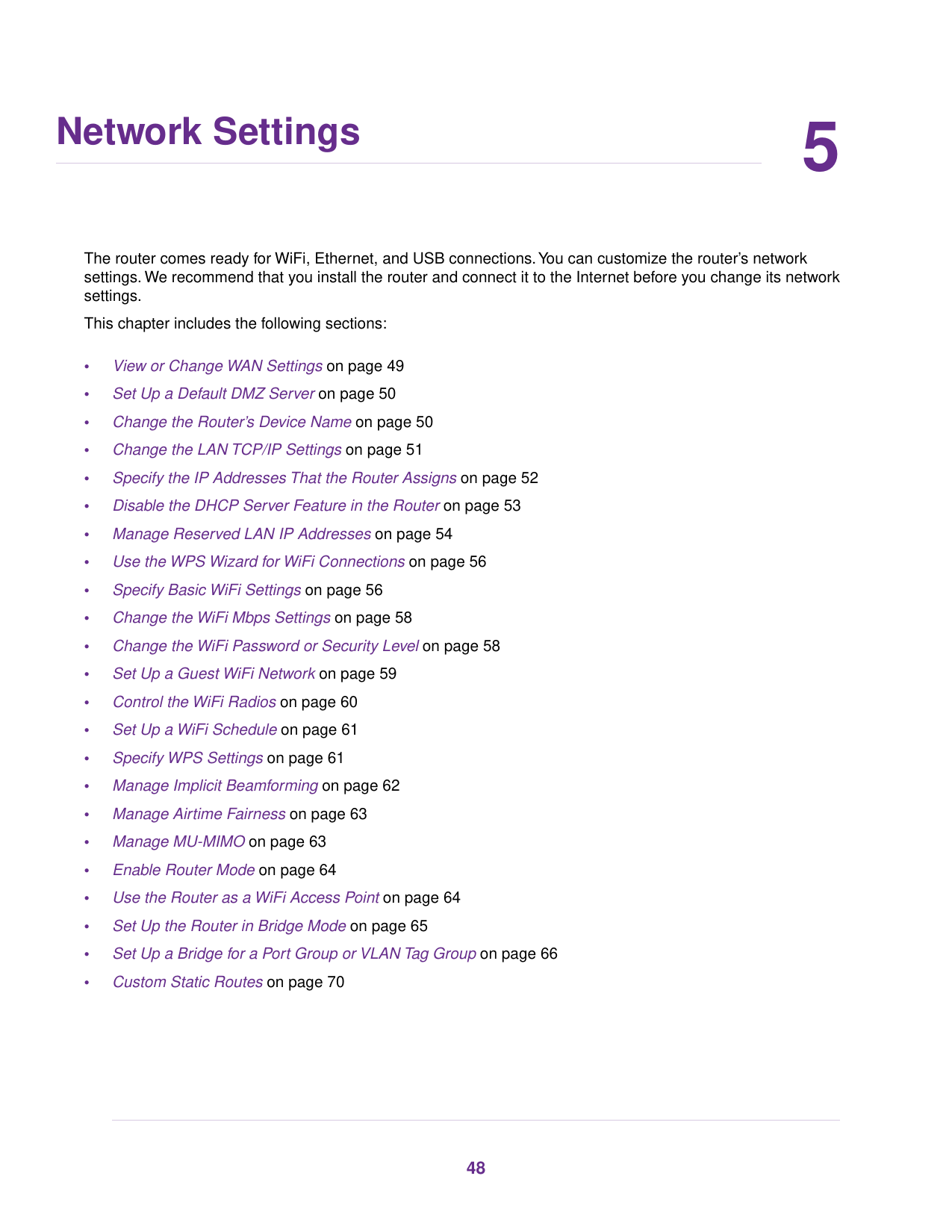
5 Network Settings The router comes ready for WiFi, Ethernet, and USB connections.You can customize the router’s network settings. We recommend that you install the router and connect it to the Internet before you change its network settings. This chapter includes the following sections: • View or Change WAN Settings on page 49 • Set Up a Default DMZ Server on page 50 • Change the Router’s Device Name on page 50 • Change the LAN TCP/IP Settings on page 51 • Specify the IP Addresses That the Router Assigns on page 52 • Disable the DHCP Server Feature in the Router on page 53 • Manage Reserved LAN IP Addresses on page 54 • Use the WPS Wizard for WiFi Connections on page 56 • Specify Basic WiFi Settings on page 56 • Change the WiFi Mbps Settings on page 58 • Change the WiFi Password or Security Level on page 58 • Set Up a Guest WiFi Network on page 59 • Control the WiFi Radios on page 60 • Set Up a WiFi Schedule on page 61 • Specify WPS Settings on page 61 • Manage Implicit Beamforming on page 62 • Manage Airtime Fairness on page 63 • Manage MU-MIMO on page 63 • Enable Router Mode on page 64 • Use the Router as a WiFi Access Point on page 64 • Set Up the Router in Bridge Mode on page 65 • Set Up a Bridge for a Port Group or VLAN Tag Group on page 66 • Custom Static Routes on page 70 48
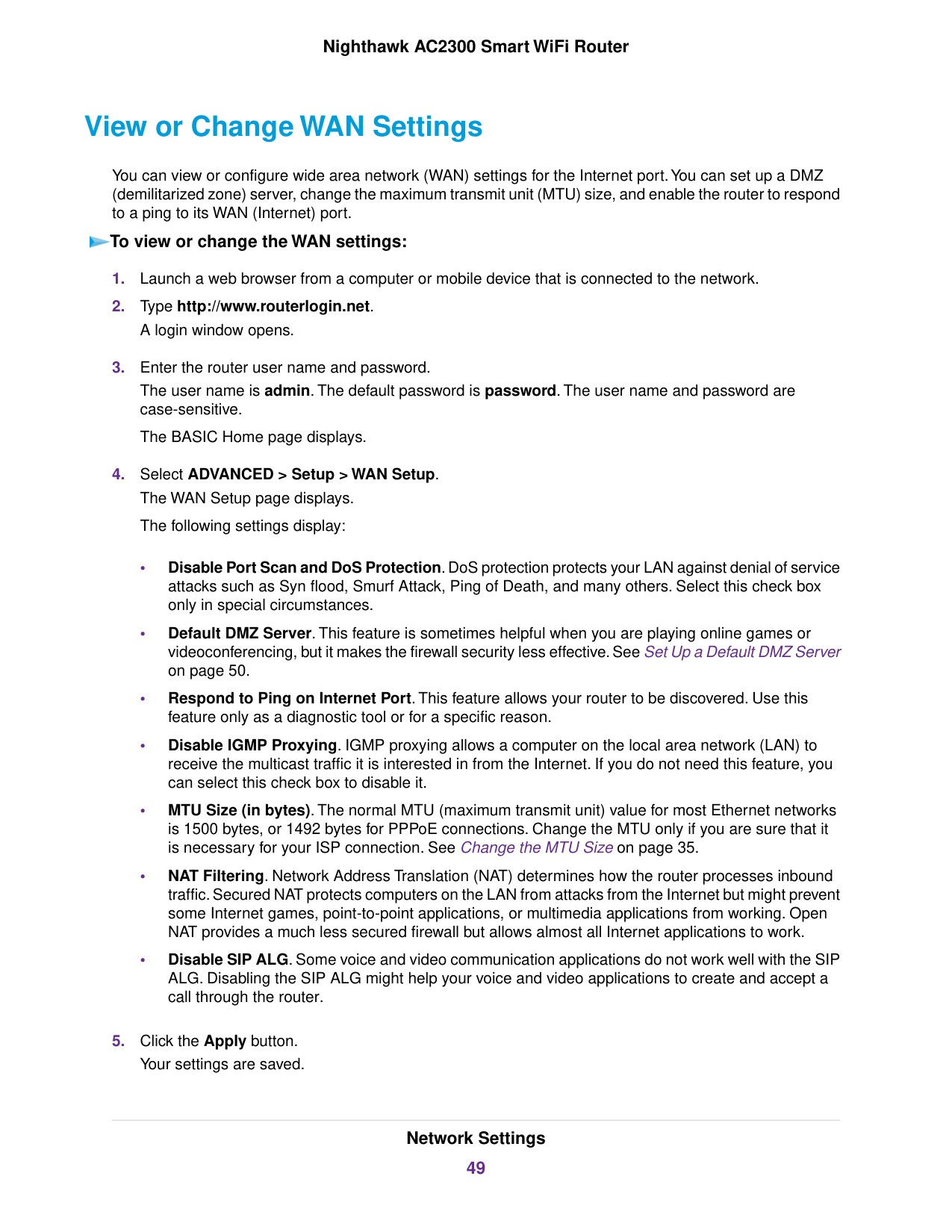
View or Change WAN Settings You can view or configure wide area network (WAN) settings for the Internet port.You can set up a DMZ (demilitarized zone) server, change the maximum transmit unit (MTU) size, and enable the router to respond to a ping to its WAN (Internet) port. To view or change the WAN settings:
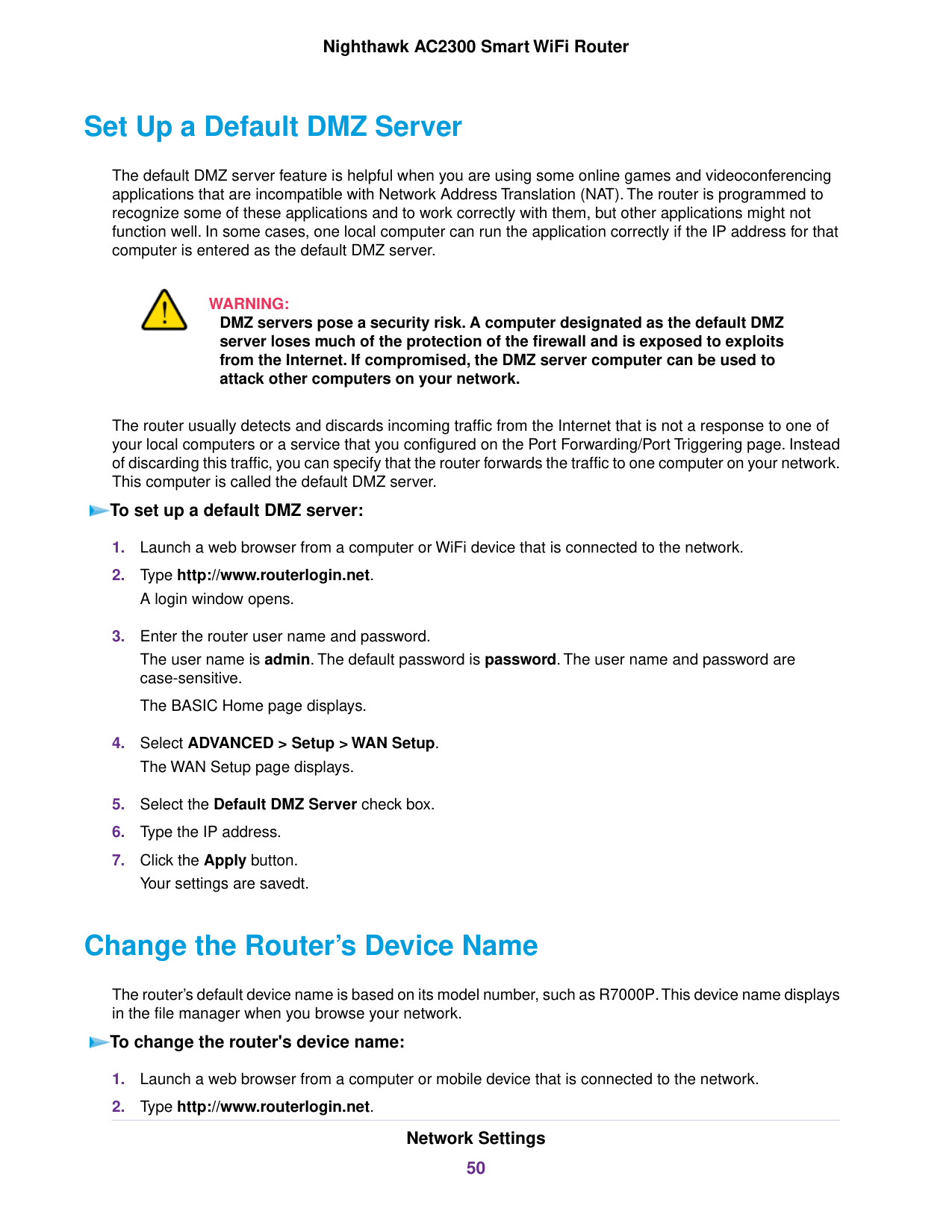
Set Up a Default DMZ Server The default DMZ server feature is helpful when you are using some online games and videoconferencing applications that are incompatible with Network Address Translation (NAT). The router is programmed to recognize some of these applications and to work correctly with them, but other applications might not function well. In some cases, one local computer can run the application correctly if the IP address for that computer is entered as the default DMZ server.
Warning:
DMZ servers pose a security risk. A computer designated as the default DMZ server loses much of the protection of the firewall and is exposed to exploits from the Internet. If compromised, the DMZ server computer can be used to attack other computers on your network. The router usually detects and discards incoming traffic from the Internet that is not a response to one of your local computers or a service that you configured on the Port Forwarding/Port Triggering page. Instead of discarding this traffic, you can specify that the router forwards the traffic to one computer on your network. This computer is called the default DMZ server. To set up a default DMZ server: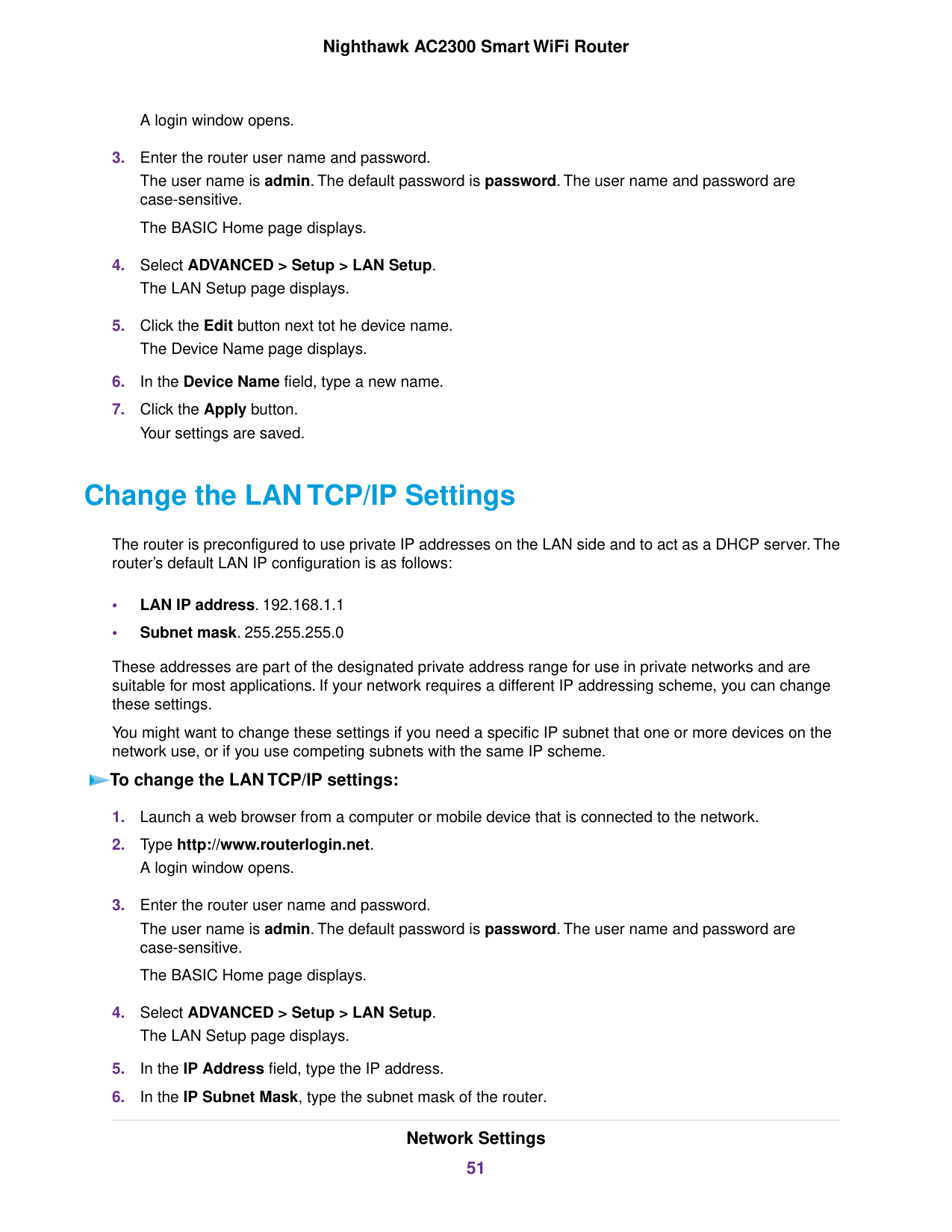
A login window opens.
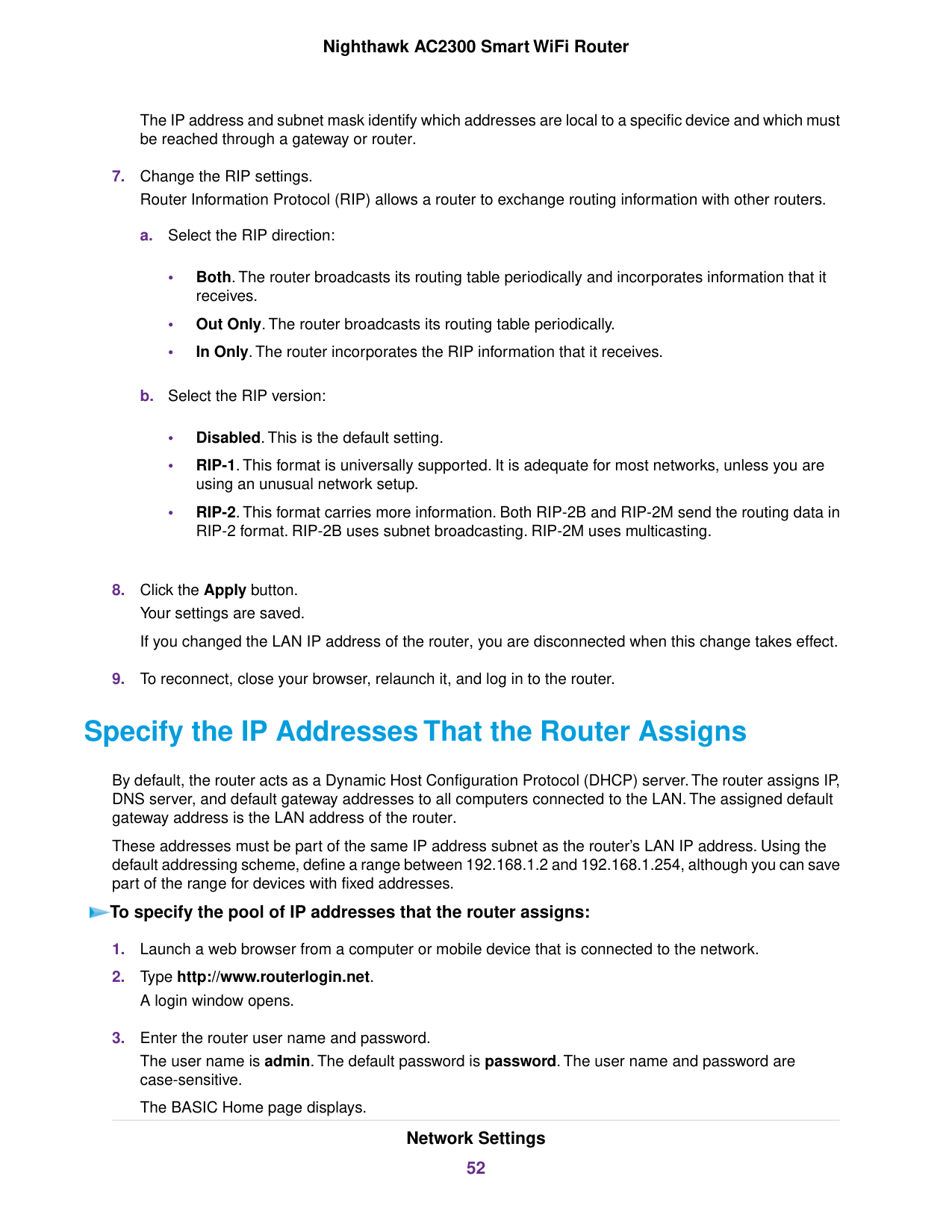
The IP address and subnet mask identify which addresses are local to a specific device and which must be reached through a gateway or router.
Your settings are saved.
Edit a Reserved IP Address To edit a reserved address entry:
Use the WPS Wizard for WiFi Connections The WPS Wizard helps you add a WPS-enabled device to your WiFi network without typing the WiFi password. To use the WPS Wizard:
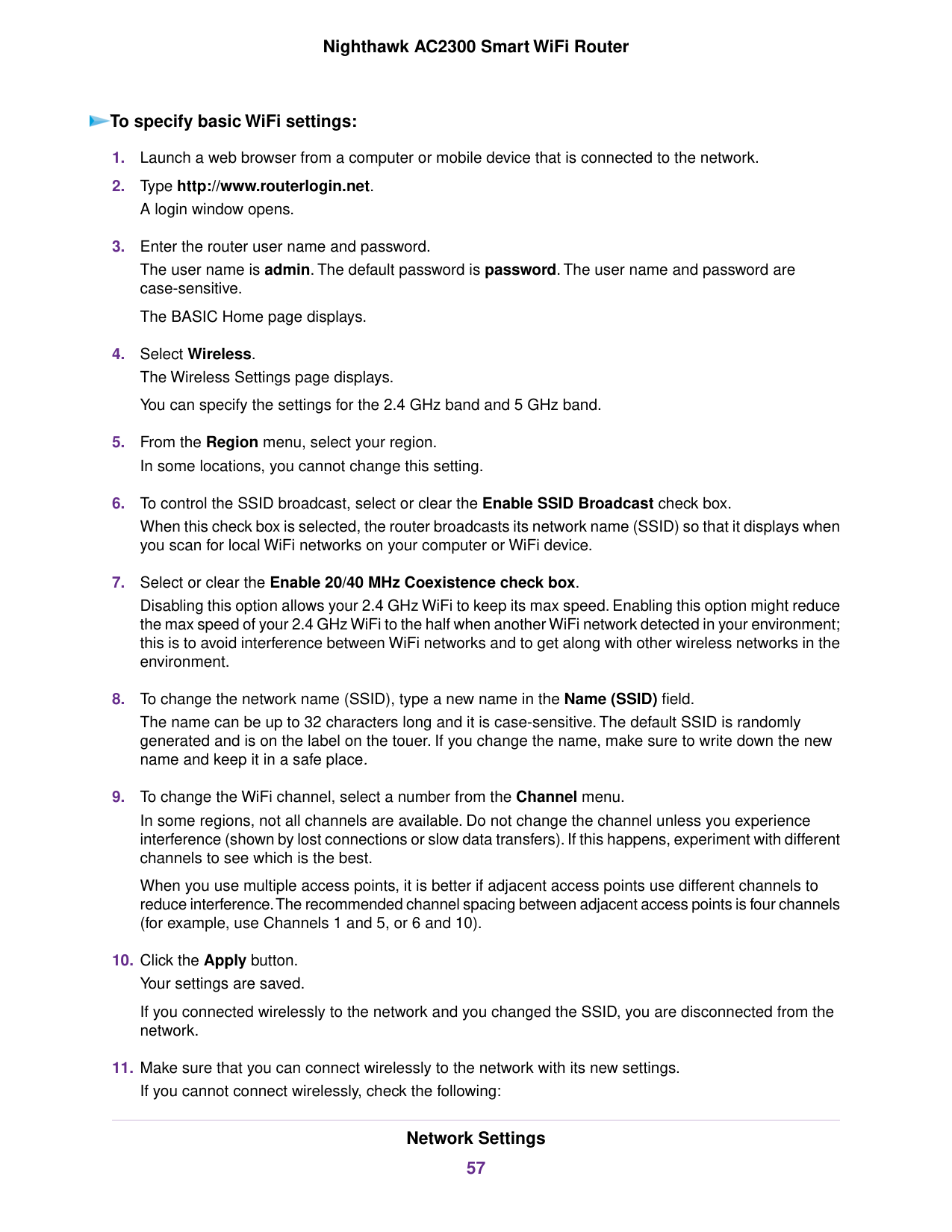
To specify basic WiFi settings:
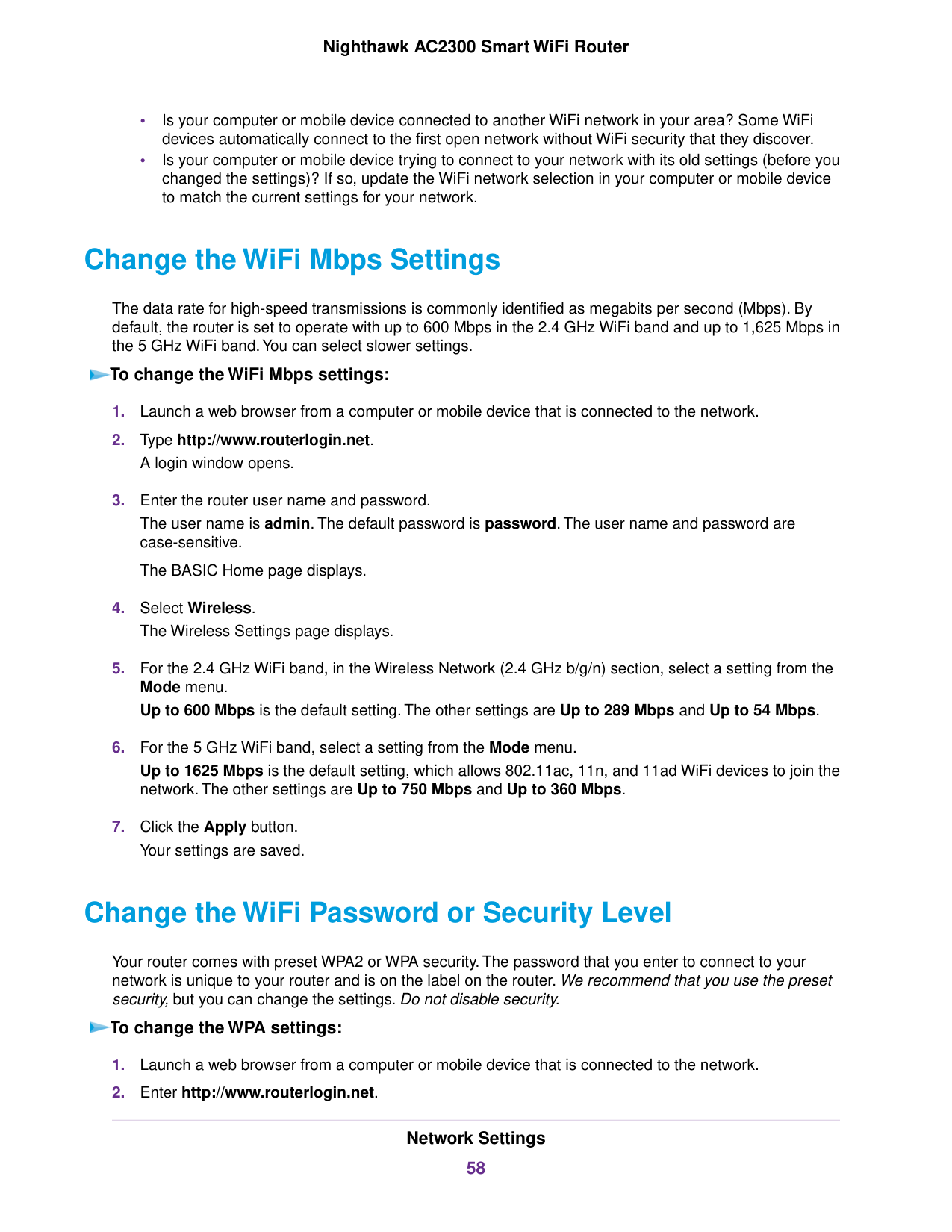
• Is your computer or mobile device connected to another WiFi network in your area? Some WiFi devices automatically connect to the first open network without WiFi security that they discover. • Is your computer or mobile device trying to connect to your network with its old settings (before you changed the settings)? If so, update the WiFi network selection in your computer or mobile device to match the current settings for your network. Change the WiFi Mbps Settings The data rate for high-speed transmissions is commonly identified as megabits per second (Mbps). By default, the router is set to operate with up to 600 Mbps in the 2.4 GHz WiFi band and up to 1,625 Mbps in the 5 GHz WiFi band.You can select slower settings. To change the WiFi Mbps settings:
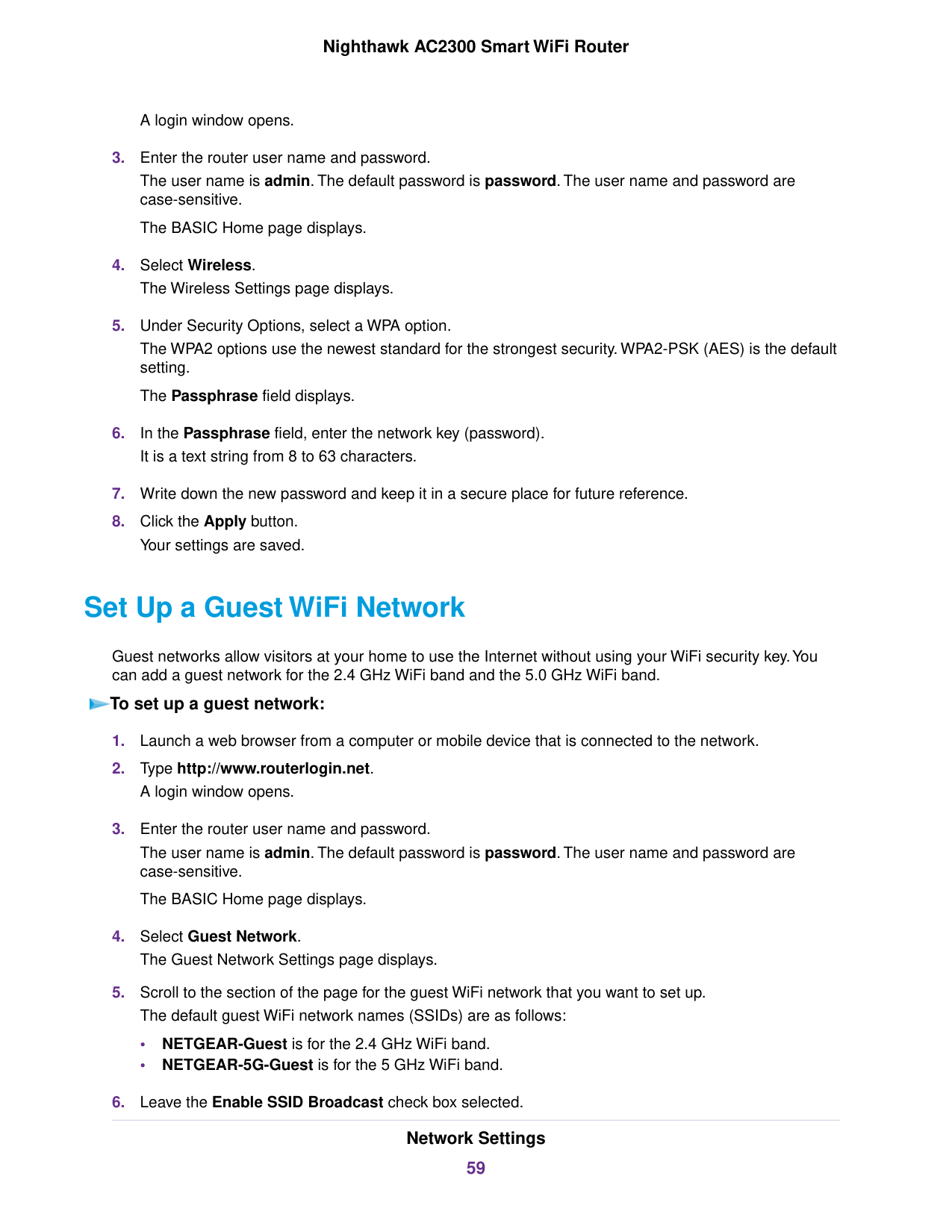
A login window opens.
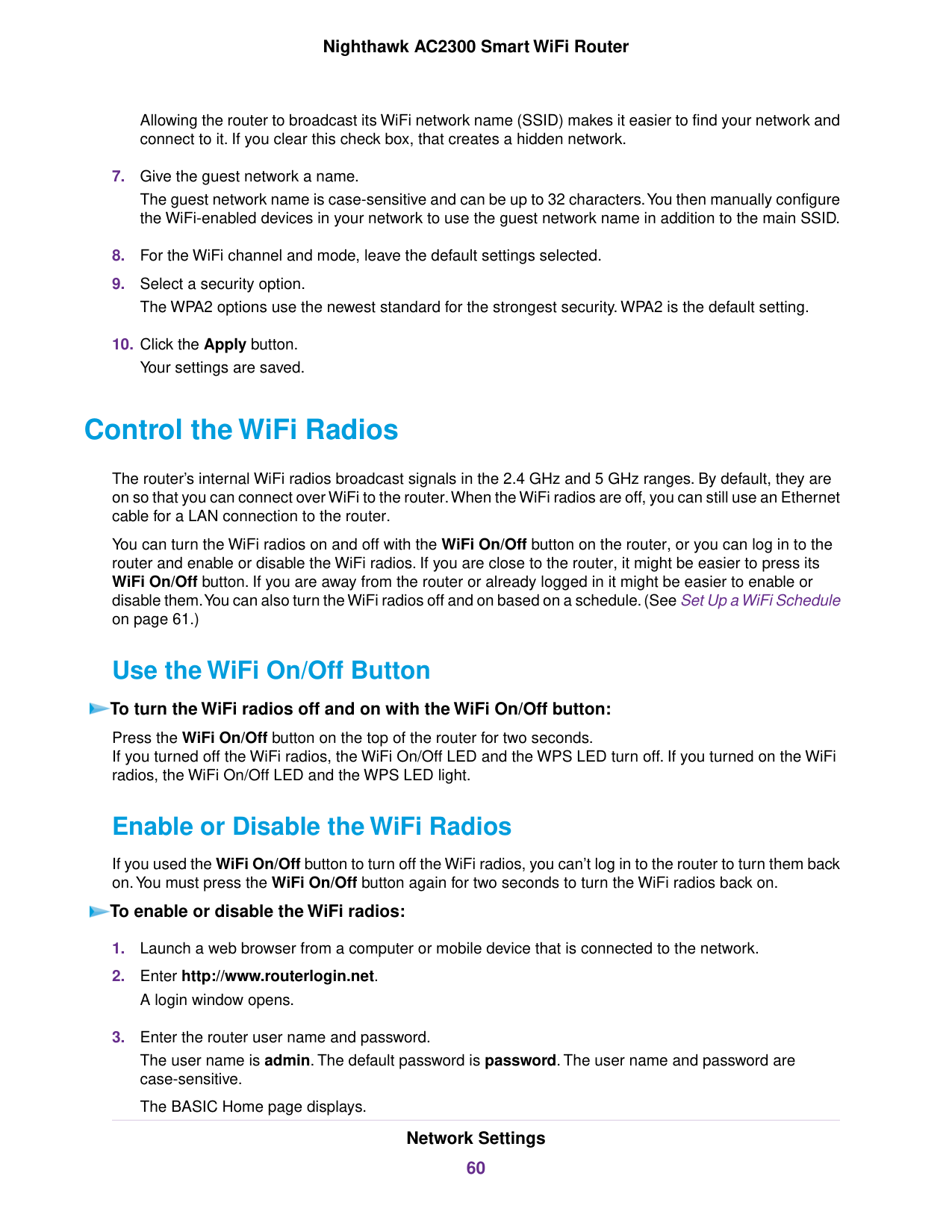
Allowing the router to broadcast its WiFi network name (SSID) makes it easier to find your network and connect to it. If you clear this check box, that creates a hidden network.
To specify WPS settings:
The user name is admin. The default password is password. The user name and password are case-sensitive. The BASIC Home page displays.
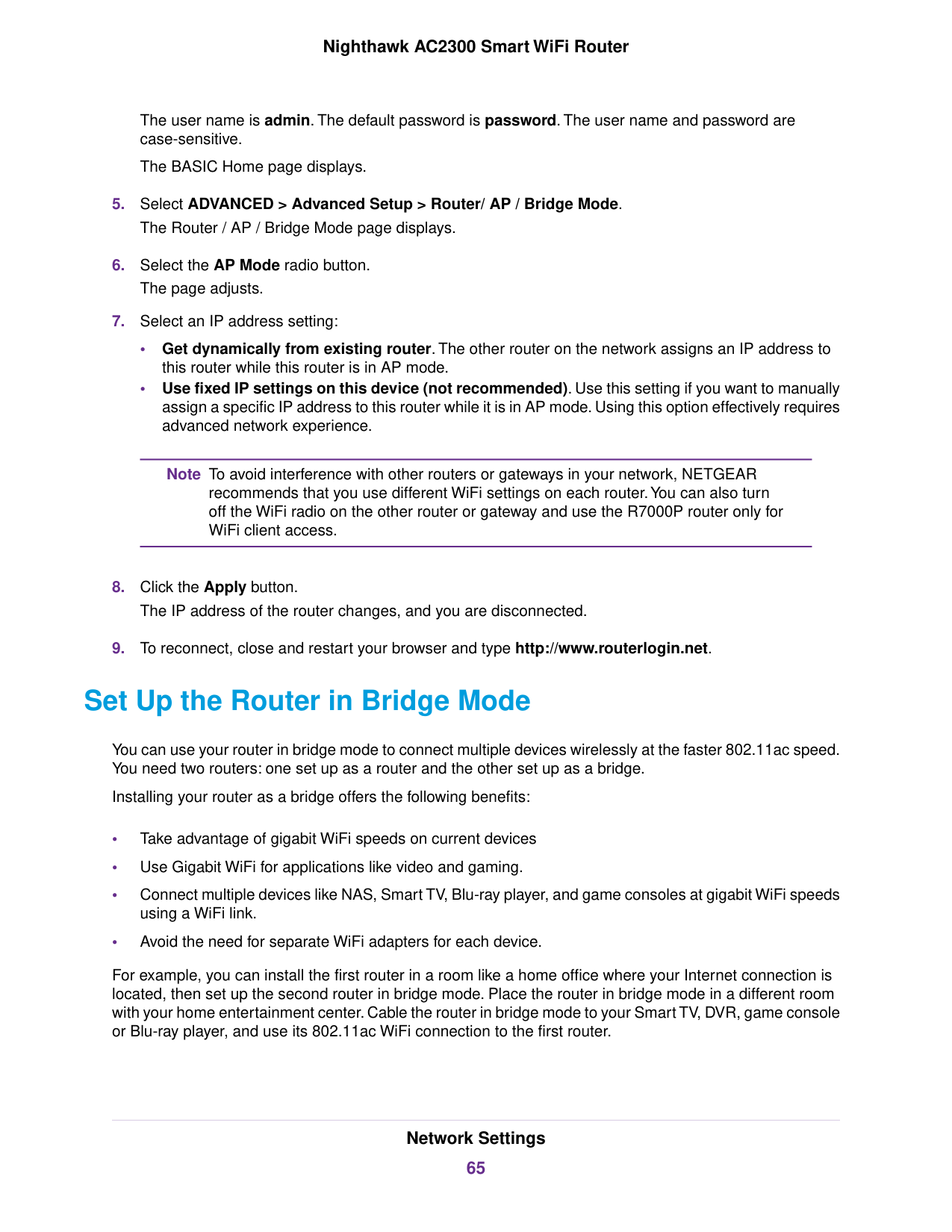
The user name is admin. The default password is password. The user name and password are case-sensitive. The BASIC Home page displays.
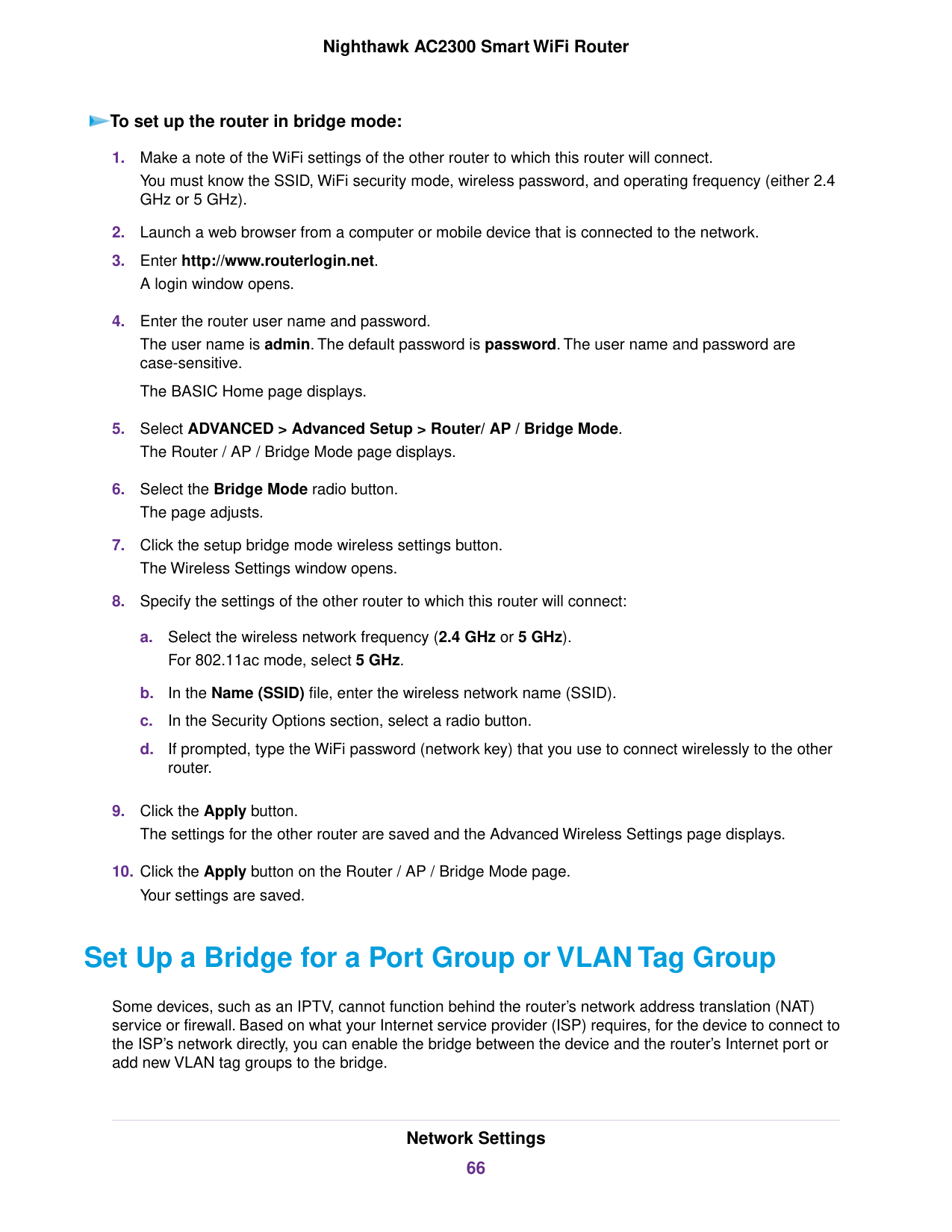
To set up the router in bridge mode:
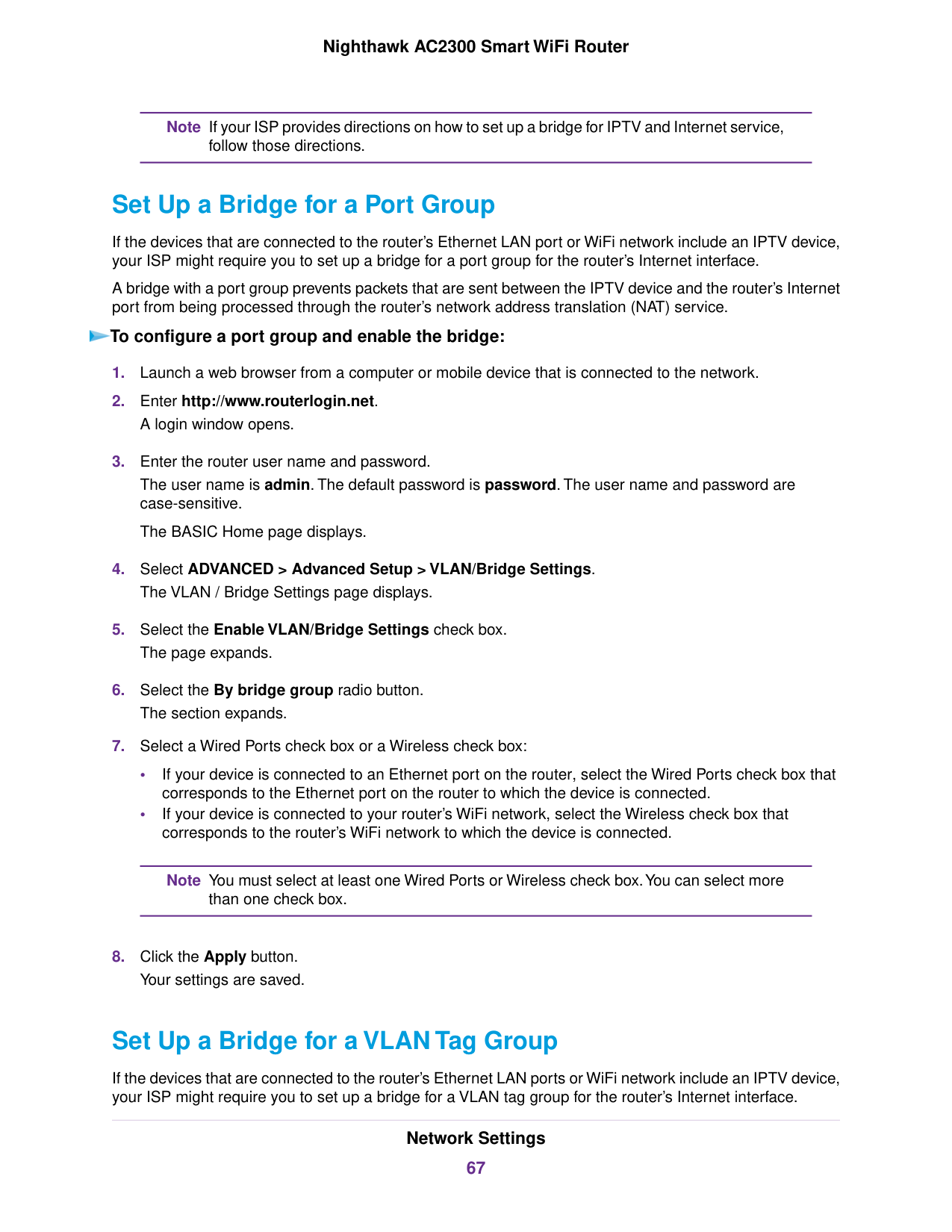
If your ISP provides directions on how to set up a bridge for IPTV and Internet service, follow those directions. Note Set Up a Bridge for a Port Group If the devices that are connected to the router’s Ethernet LAN port or WiFi network include an IPTV device, your ISP might require you to set up a bridge for a port group for the router’s Internet interface. A bridge with a port group prevents packets that are sent between the IPTV device and the router’s Internet port from being processed through the router’s network address translation (NAT) service. To configure a port group and enable the bridge:
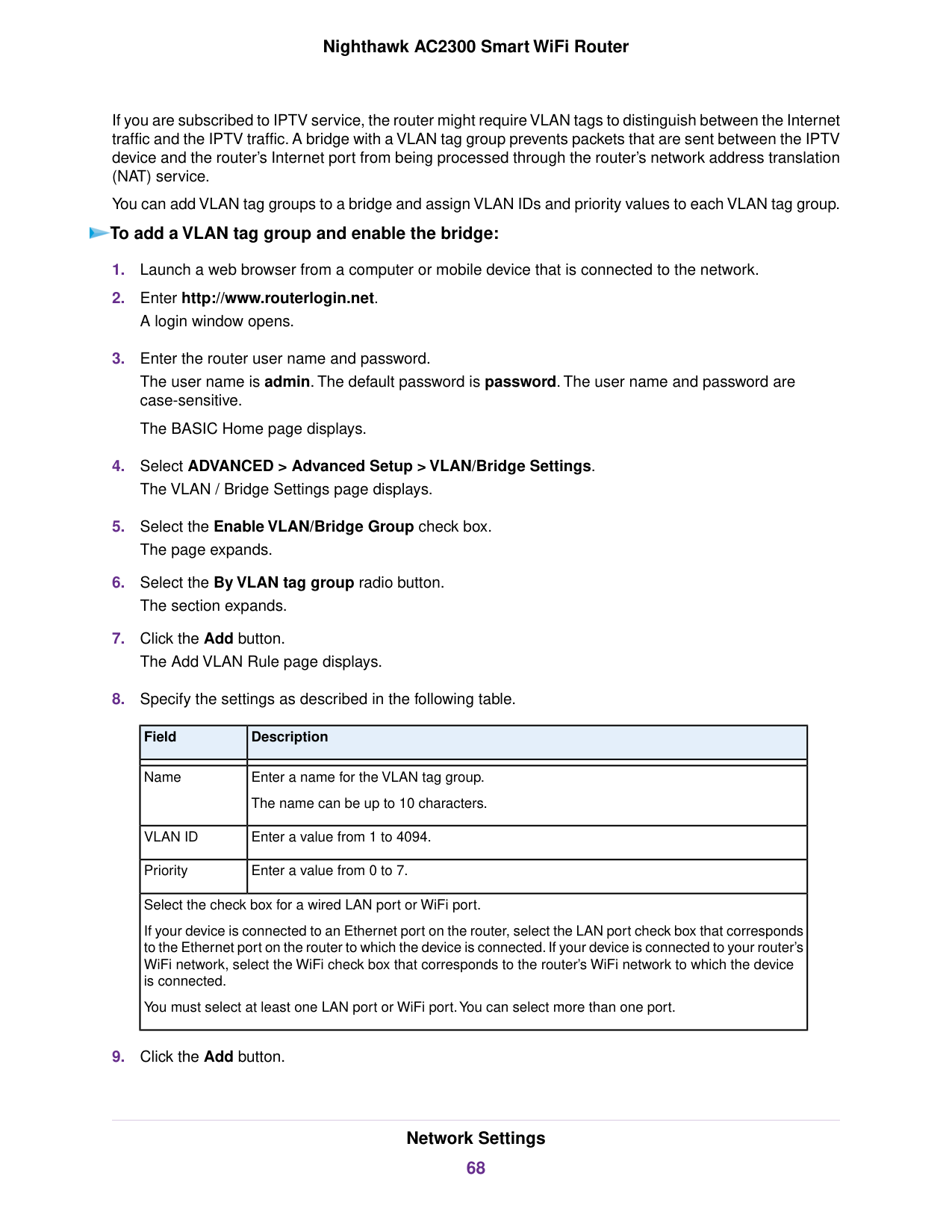
If you are subscribed to IPTV service, the router might require VLAN tags to distinguish between the Internet traffic and the IPTV traffic. A bridge with a VLAN tag group prevents packets that are sent between the IPTV device and the router’s Internet port from being processed through the router’s network address translation (NAT) service. You can add VLAN tag groups to a bridge and assign VLAN IDs and priority values to each VLAN tag group. To add a VLAN tag group and enable the bridge:
Vlan Id
Enter a value from 0 to 7. Priority Select the check box for a wired LAN port or WiFi port. If your device is connected to an Ethernet port on the router, select the LAN port check box that corresponds to the Ethernet port on the router to which the device is connected. If your device is connected to your router’s WiFi network, select the WiFi check box that corresponds to the router’s WiFi network to which the device is connected. You must select at least one LAN port or WiFi port.You can select more than one port.
The VLAN tag group is added.
Custom Static Routes Typically, you do not need to add static routes unless you use multiple routers or multiple IP subnets on your network. As an example of when a static route is needed, consider the following case: • Your main Internet access is through a cable modem to an ISP. • Your home network includes an ISDN router for connecting to the company where you are employed. This router’s address on your LAN is 192.168.1.100. • Your company’s network address is 134.177.0.0. When you set up your router, two implicit static routes were created. A default route was created with your ISP as the gateway, and a second static route was created to your local network for all 192.168.1.x addresses. With this configuration, if you try to access a device on the 134.177.0.0 network, your router forwards your request to the ISP.The ISP forwards your request to the company where you are employed, and the company firewall is likely to deny the request. In this case you must define a static route, telling your router to access 134.177.0.0 through the ISDN router at 192.168.1.100. Here is an example: • The Destination IP Address and IP Subnet Mask fields specify that this static route applies to all 134.177.x.x addresses. • The Gateway IP Address field specifies that all traffic for these addresses will be forwarded to the ISDN router at 192.168.1.100. • A metric value of 1 works because the ISDN router is on the LAN. • The Private check box is selected only as a precautionary security measure in case RIP is activated. Set Up a Static Route To set up a static route:
Delete a Static Route To delete a static route:
6 Optimize Performance You can set up the router to optimize performance for applications such as Internet gaming, high-definition video streaming, and VoIP communication. By default, the router uses Wi-Fi Multimedia Quality of Service (WMM QoS). This chapter contains the following sections: • Use Dynamic QoS to Optimize Internet Traffic Management on page 74 • Improve Network Connections With Universal Plug and Play on page 75 • Wi-Fi Multimedia Quality of Service on page 76 • Enable or Disable Smart Connect on page 77 73
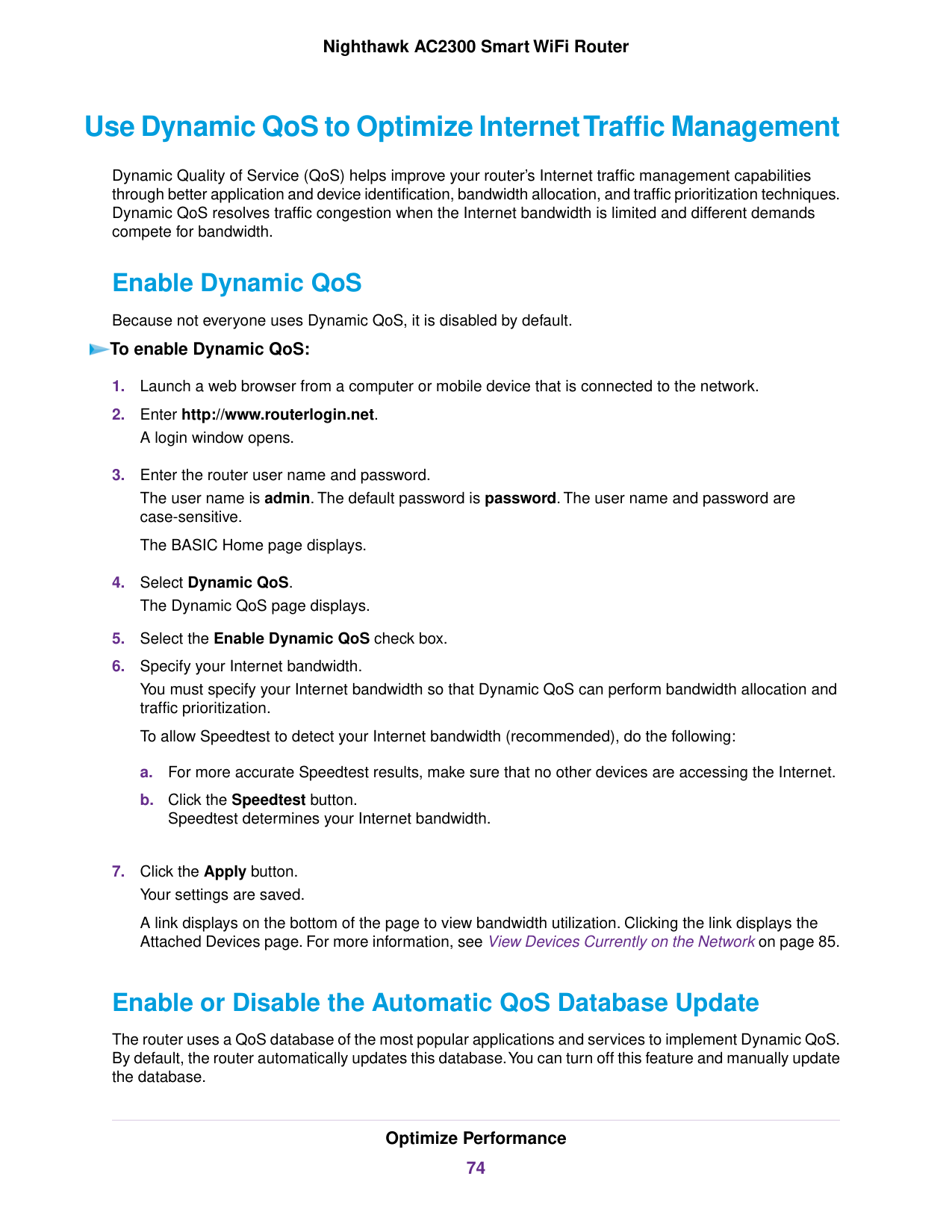
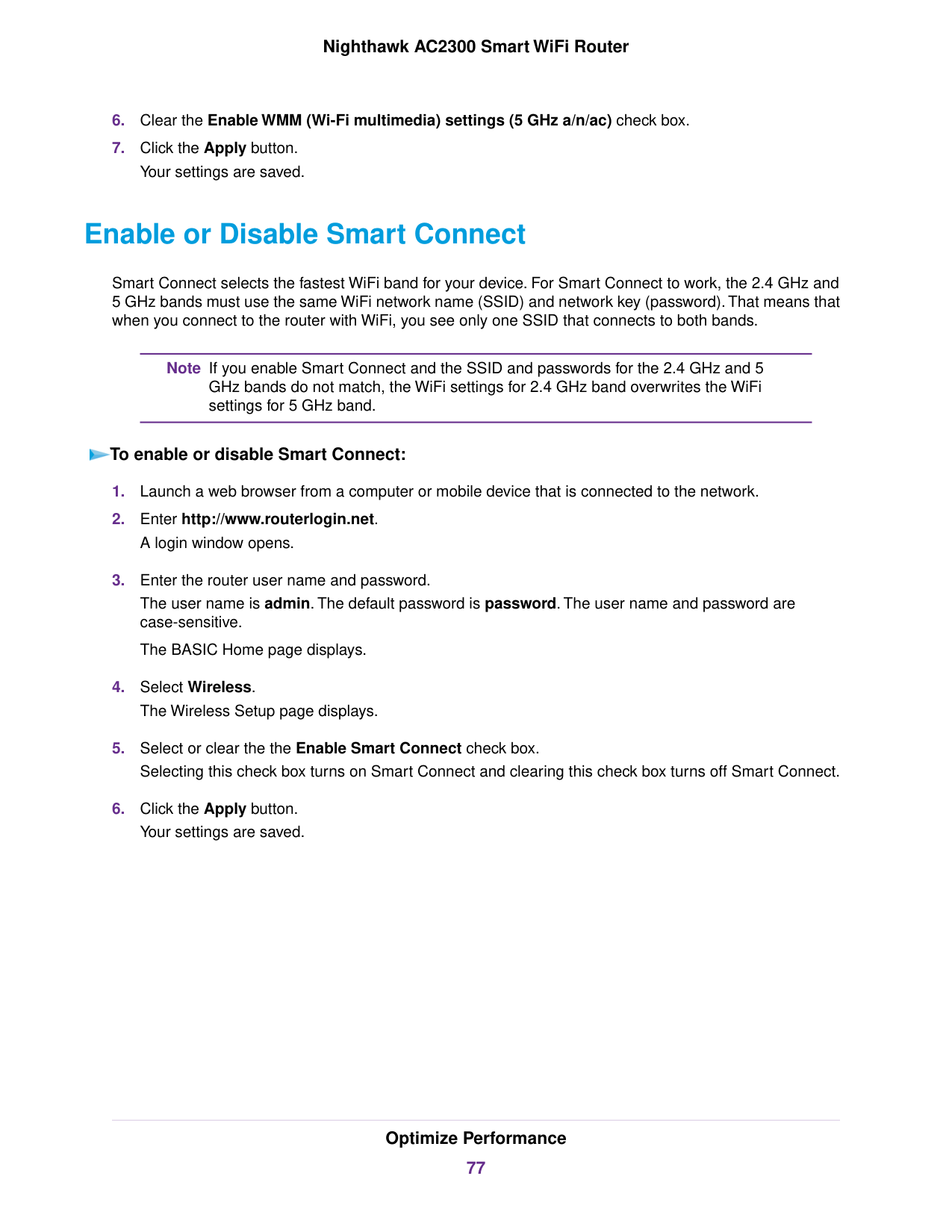
Use Dynamic QoS to Optimize Internet Traffic Management Dynamic Quality of Service (QoS) helps improve your router’s Internet traffic management capabilities through better application and device identification, bandwidth allocation, and traffic prioritization techniques. Dynamic QoS resolves traffic congestion when the Internet bandwidth is limited and different demands compete for bandwidth. Enable Dynamic QoS Because not everyone uses Dynamic QoS, it is disabled by default. To enable Dynamic QoS:
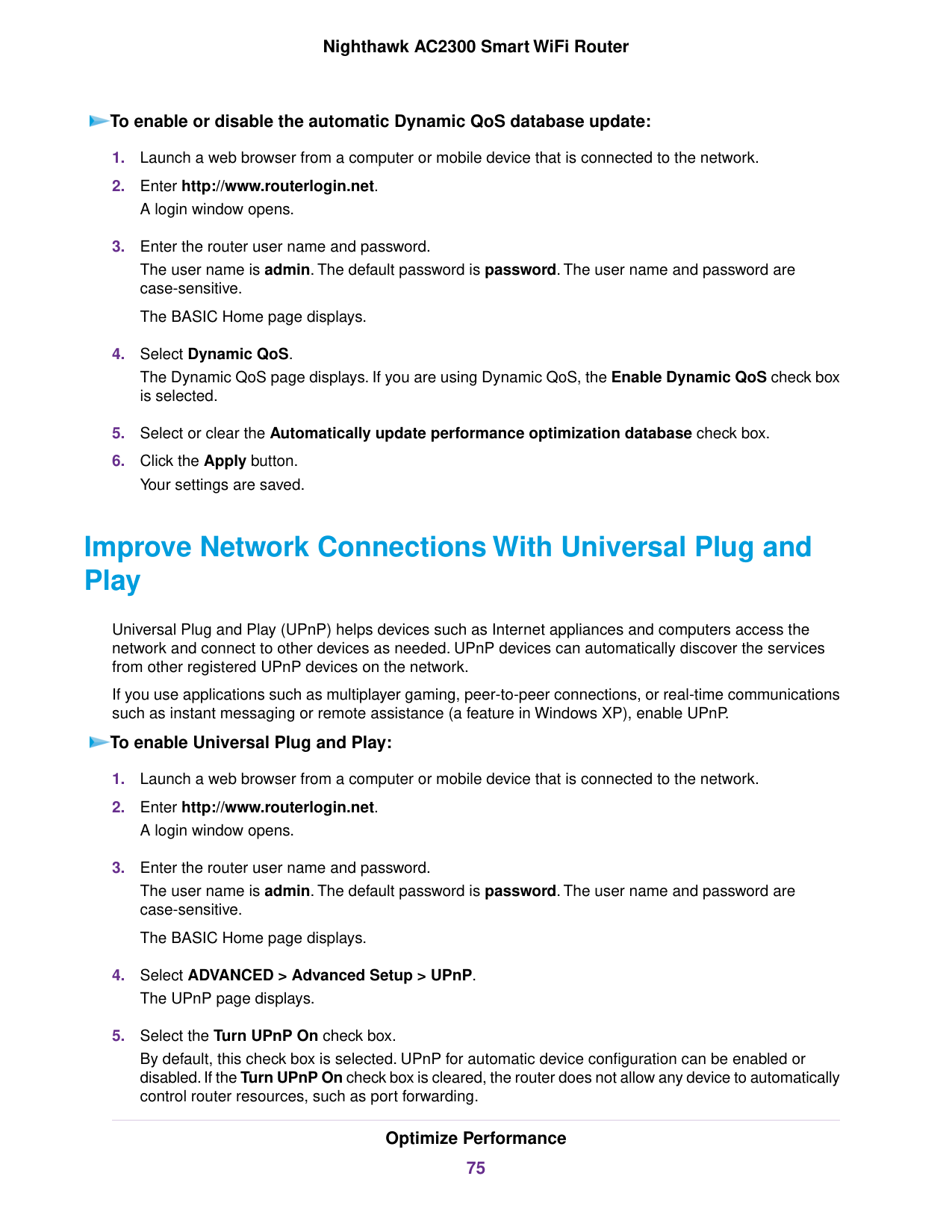
To enable or disable the automatic Dynamic QoS database update:
7 Manage Your Network This chapter describes the router settings for administering and maintaining your router and home network. The chapter includes the following sections: • Update the Router Firmware on page 79 • Change the admin Password and Enable Password Recovery on page 80 • Set Up Password Recovery on page 81 • Recover the admin Password on page 82 • View Router Status on page 82 • Display Internet Port Statistics on page 83 • Check the Internet Connection Status on page 84 • View and Manage Logs of Router Activity on page 84 • View Devices Currently on the Network on page 85 • Monitor Internet Traffic on page 86 • Manage the Router Configuration File on page 87 • Remote Access on page 88 • Remotely Access Your Router Using the genie App on page 90 78
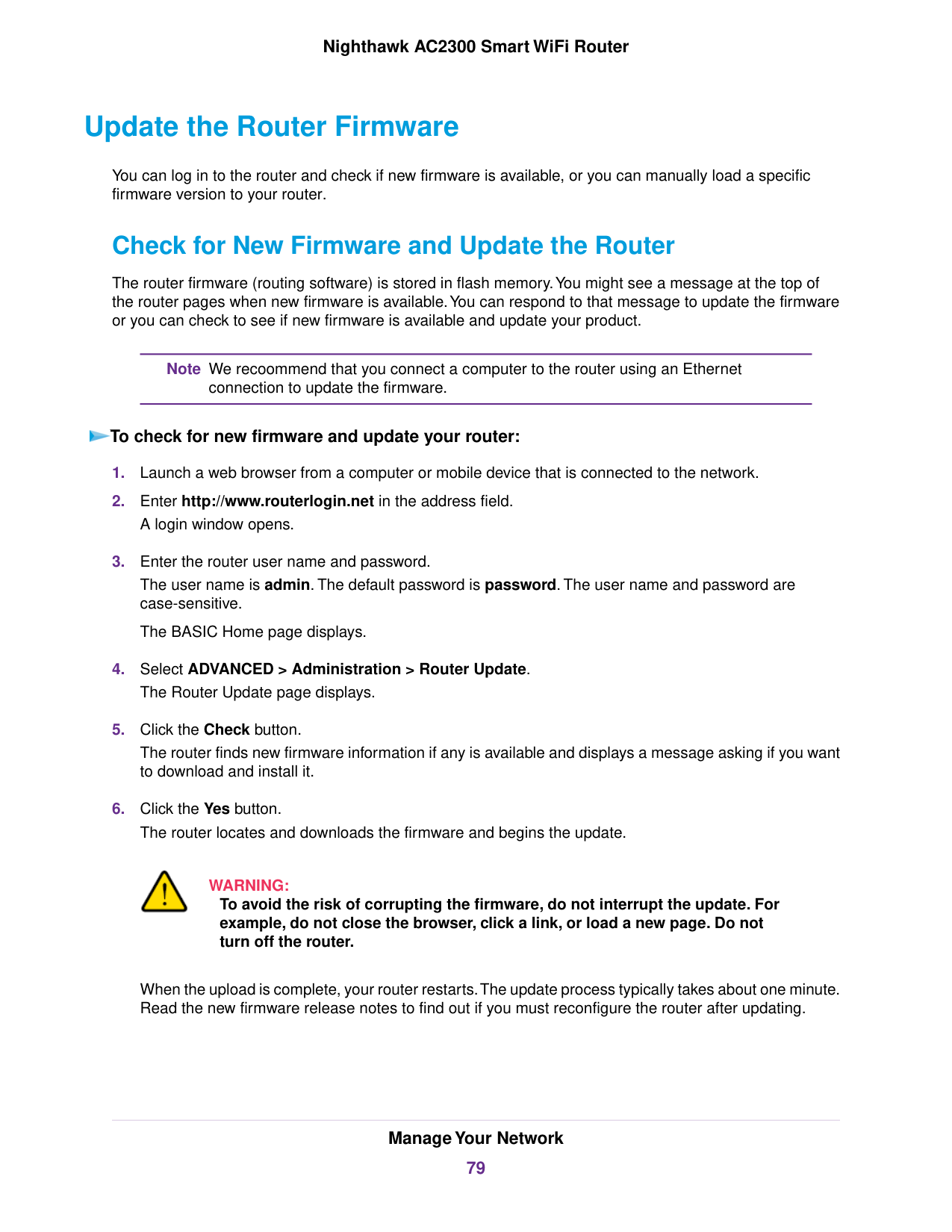
Update the Router Firmware You can log in to the router and check if new firmware is available, or you can manually load a specific firmware version to your router. Check for New Firmware and Update the Router The router firmware (routing software) is stored in flash memory.You might see a message at the top of the router pages when new firmware is available.You can respond to that message to update the firmware or you can check to see if new firmware is available and update your product. We recoommend that you connect a computer to the router using an Ethernet connection to update the firmware. Note To check for new firmware and update your router:
Warning:
To avoid the risk of corrupting the firmware, do not interrupt the update. For example, do not close the browser, click a link, or load a new page. Do not turn off the router. When the upload is complete, your router restarts.The update process typically takes about one minute. Read the new firmware release notes to find out if you must reconfigure the router after updating. Manage Your Network 79 Nighthawk AC2300 Smart WiFi Router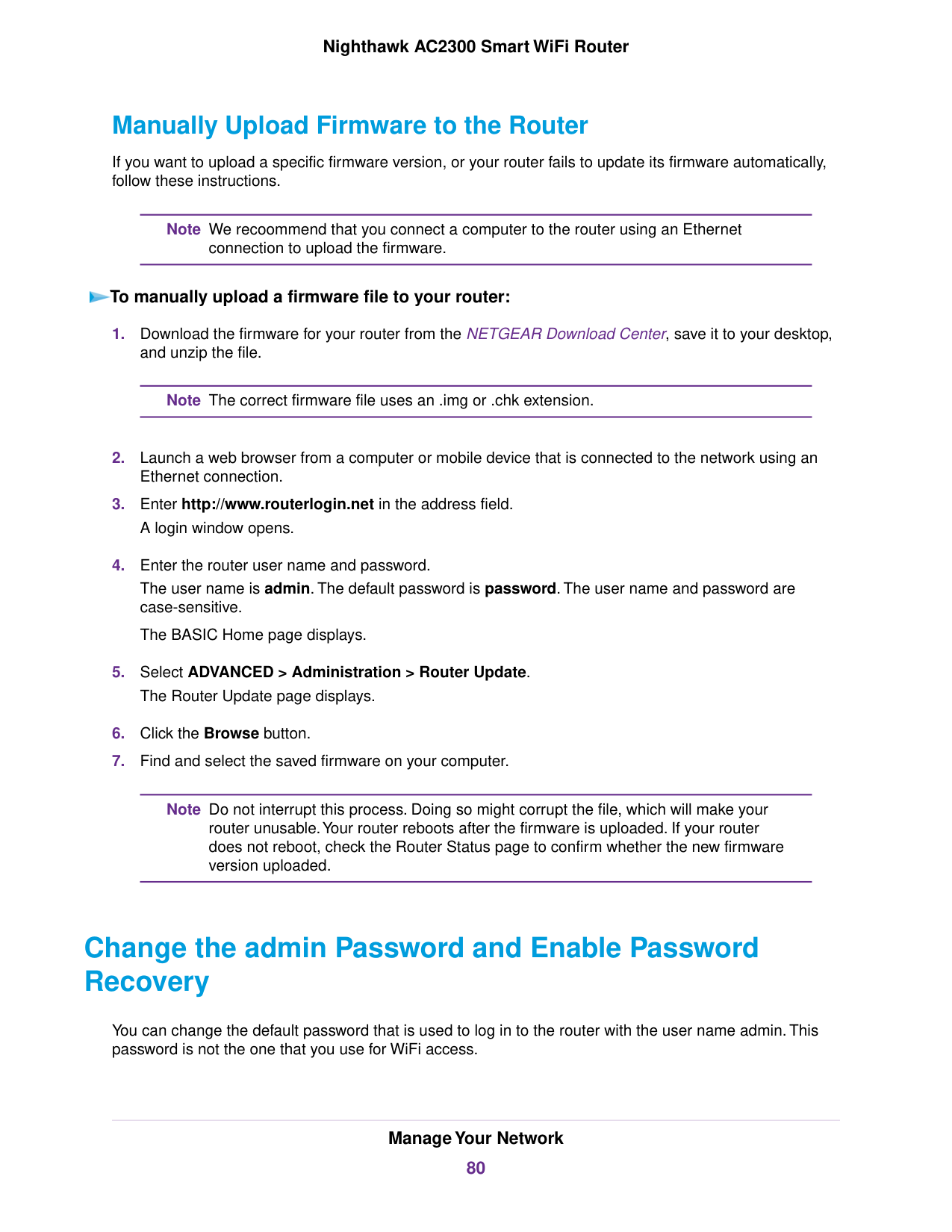
Manually Upload Firmware to the Router If you want to upload a specific firmware version, or your router fails to update its firmware automatically, follow these instructions. We recoommend that you connect a computer to the router using an Ethernet connection to upload the firmware. Note To manually upload a firmware file to your router:
Be sure to change the password for the user name admin to a secure password.The ideal password contains no dictionary words from any language and contains uppercase and lowercase letters, numbers, and symbols. It can be up to 30 characters. Note To change the admin user name and enable password recovery:
Your router's status displays. If your router is set up to lease an intranet address from your Internet service provider (ISP), the Internet Port pane displays the IP Address, Connection, and Subnet Mask intranet values in parentheses. Display Internet Port Statistics To display Internet port statistics:
Check the Internet Connection Status To check the Internet connection status if the router is connected to a WAN Ethernet connection:
Monitor Internet Traffic Traffic metering allows you to monitor the volume of Internet traffic that passes through the router Internet port.You can set limits for traffic volume. To monitor Internet traffic:
The Backup Settings page displays.
Warning:
Do not interrupt the reboot process. Remote Access You can access your router over the Internet to view or change its settings.You must know the router’s WAN IP address to use this feature. For information about remote access using Dynamic DNS, see Set Up and Manage Dynamic DNS on page 105. Be sure to change the password for the user name admin to a secure password. The ideal password contains no dictionary words from any language and contains uppercase and lowercase letters, numbers, and symbols. It can be up to 30 characters. See Change the admin Password and Enable Password Recovery on page 80. Note Manage Your Network 88 Nighthawk AC2300 Smart WiFi Router
Set Up Remote Management To set up remote management:
Remotely Access Your Router Using the genie App You can use the genie app to remotely access your router and change its settings. Before you can use remote access with the genie app, you must update your router’s firmware and download the latest genie app for your computer or mobile device. Remote access with the genie app is supported for Windows computers, iOS mobile devices, and Android mobile devices. For more information about how to update your router’s firmware, see Check for New Firmware and Update the Router on page 79. To download the latest genie app for your computer or mobile device, visit NETGEAR.com/genie. For more information about how to set up remote access using the genie app, see the genie app user manual, which is available at downloadcenter.netgear.com/. Manage Your Network 90 Nighthawk AC2300 Smart WiFi Router
8 Share USB Storage Devices Attached to the Router This chapter describes how to access and manage storage devices attached to your router. ReadySHARE lets you access and share USB storage devices connected to the router. (If your storage device uses special drivers, it is not compatible.) The USB ports on the router can be used only to connect USB storage devices like flash drives or hard drives or a printer. Do not connect computers, USB modems, CD drives, or DVD drives to the router USB port. Note This chapter contains the following sections: • USB Device Requirements on page 92 • Connect a USB Storage Device to the Router on page 92 • Access a Storage Device Connected to the Router From a Windows Computer on page 93 • Map a USB Device to a Windows Network Drive on page 93 • Access a Storage Device That Is Connected to the Router From a Mac on page 94 • Back Up Windows Computers With ReadySHARE Vault on page 94 • Back Up Mac Computers With Time Machine on page 95 • Use FTP Within the Network on page 97 • View or Change Network Folders on a Storage Device on page 98 • Add a Network Folder on a USB Storage Device on page 99 • Edit a Network Folder on a USB Storage Device on page 99 • Set Up NETGEAR Downloader on page 100 • Safely Remove a USB Storage Device on page 102 For more information about ReadySHARE features, visit netgear.com/readyshare. 91
USB Device Requirements The router works with most USB-compliant external flash and hard drives. For the most up-to-date list of USB devices that the router supports, visit kb.netgear.com/app/answers/detail/a_id/18985/~/readyshare-usb-drives-compatibility-list. Some USB external hard drives and flash drives require you to load the drivers onto the computer before the computer can access the USB storage device. Such USB storage devices do not work with the router. The router supports the following file system types for full read/write access: •
Fat16
•Fat32
•Ntfs
• NTFS with compression format enabled • Ext2 • Ext3 • Ext4 •Hfs
•Hfs+
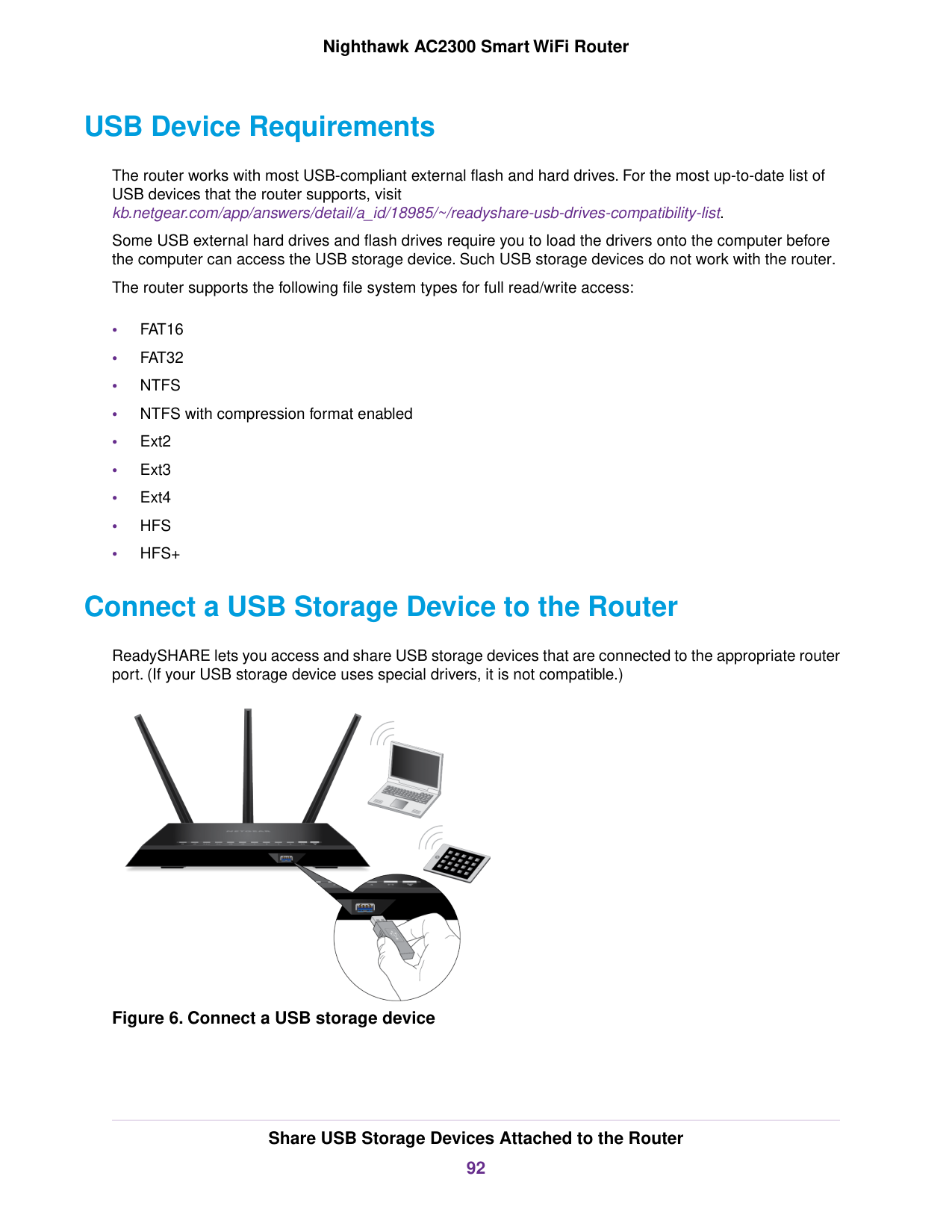
Connect a USB Storage Device to the Router ReadySHARE lets you access and share USB storage devices that are connected to the appropriate router port. (If your USB storage device uses special drivers, it is not compatible.) Figure 6. Connect a USB storage device Share USB Storage Devices Attached to the Router 92 Nighthawk AC2300 Smart WiFi Router
To connect a USB device:
(Lan).
• Windows XP SP3 • Windows 7 • Windows 8 • Windows 8.1 • Windows 10 To back up your Windows computer:
To back up your Mac onto a USB hard disk drive:
A login window opens.
Your settings are saved. Add a Network Folder on a USB Storage Device You can add network folders on a USB storage device connected to a router USB port. To add a network folder:
The BASIC Home page displays.
(Lan).
The user name is admin. The default password is password. The user name and password are case-sensitive. The BASIC Home page displays.
The user name is admin. The default password is password. The user name and password are case-sensitive. The BASIC Home page displays.
9 Use Dynamic DNS to Access USB Storage Devices Through the Internet With Dynamic DNS, you can use the Internet to access USB devices attached to the router’s USB ports when you’re not home. This chapter includes the following sections: • Set Up and Manage Dynamic DNS on page 105 • Set Up FTP Access Through the Internet on page 105 • Your Personal FTP Server on page 106 • Access USB Storage Devices Through the Internet on page 109 • Remotely Access a USB Device Using ReadyCLOUD on page 109 For information about how to connect the device and specify its settings, see View Devices Currently on the Network on page 85. 104
Set Up and Manage Dynamic DNS Internet service providers (ISPs) assign numbers called IP addresses to identify each Internet account. Most ISPs use dynamically assigned IP addresses. This means that the IP address can change at any time.You can use the IP address to access your network remotely, but most people don’t know what their IP addresses are or when this number changes. To make it easier to connect, you can get a free account with a Dynamic DNS service that lets you use a domain name to access your home network.To use this account, you must set up the router to use Dynamic DNS. Then the router notifies the Dynamic DNS service provider whenever its IP address changes. When you access your Dynamic DNS account, the service finds the current IP address of your home network and automatically connects you. If your ISP assigns a private WAN IP address (such as 192.168.x.x or 10.x.x.x), the Dynamic DNS service does not work because private addresses are not routed on the Internet. Set Up FTP Access Through the Internet To set up FTP access:
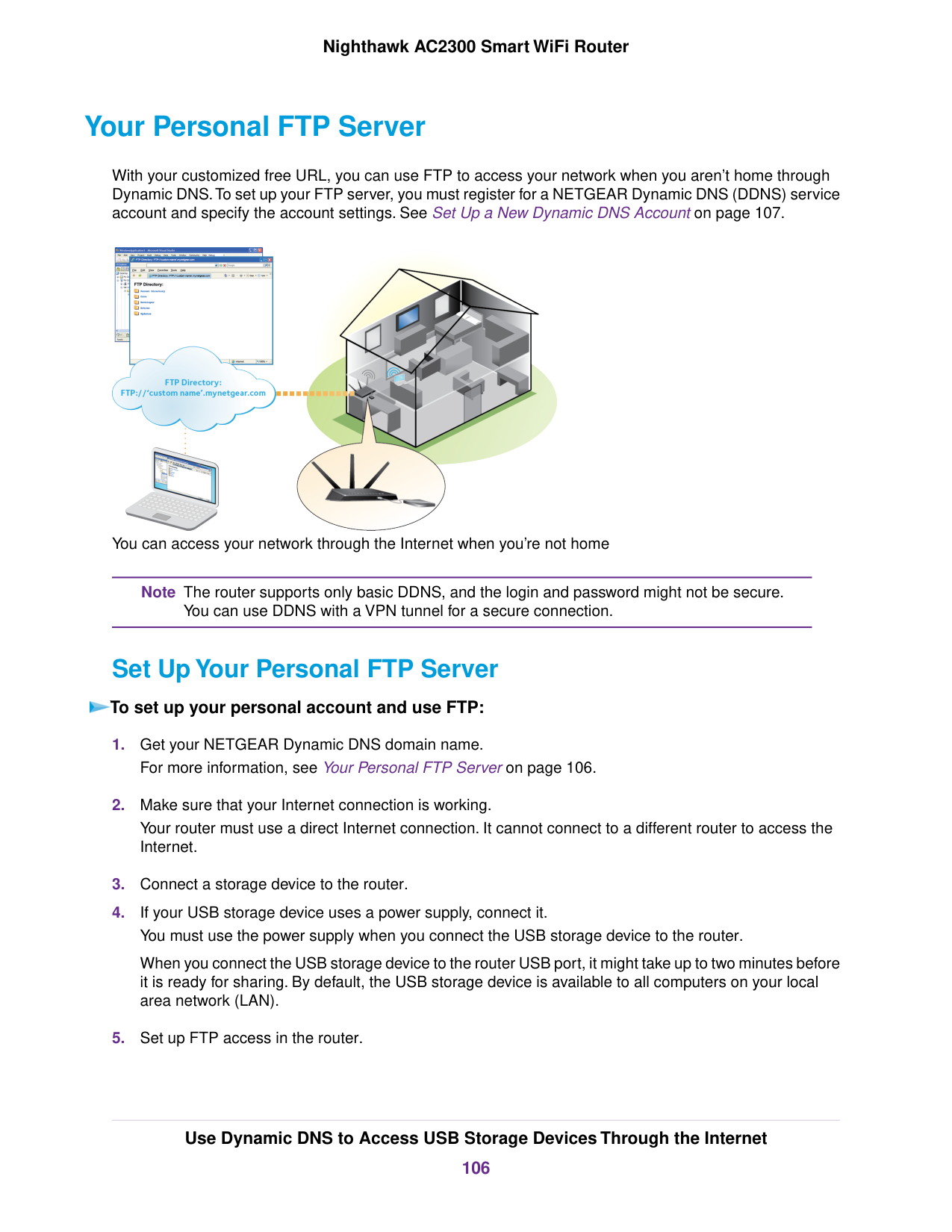
Your Personal FTP Server With your customized free URL, you can use FTP to access your network when you aren’t home through Dynamic DNS.To set up your FTP server, you must register for a NETGEAR Dynamic DNS (DDNS) service account and specify the account settings. See Set Up a New Dynamic DNS Account on page 107. You can access your network through the Internet when you’re not home The router supports only basic DDNS, and the login and password might not be secure. You can use DDNS with a VPN tunnel for a secure connection. Note Set Up Your Personal FTP Server To set up your personal account and use FTP:
See Set Up FTP Access Through the Internet on page 105.
The BASIC Home page displays.
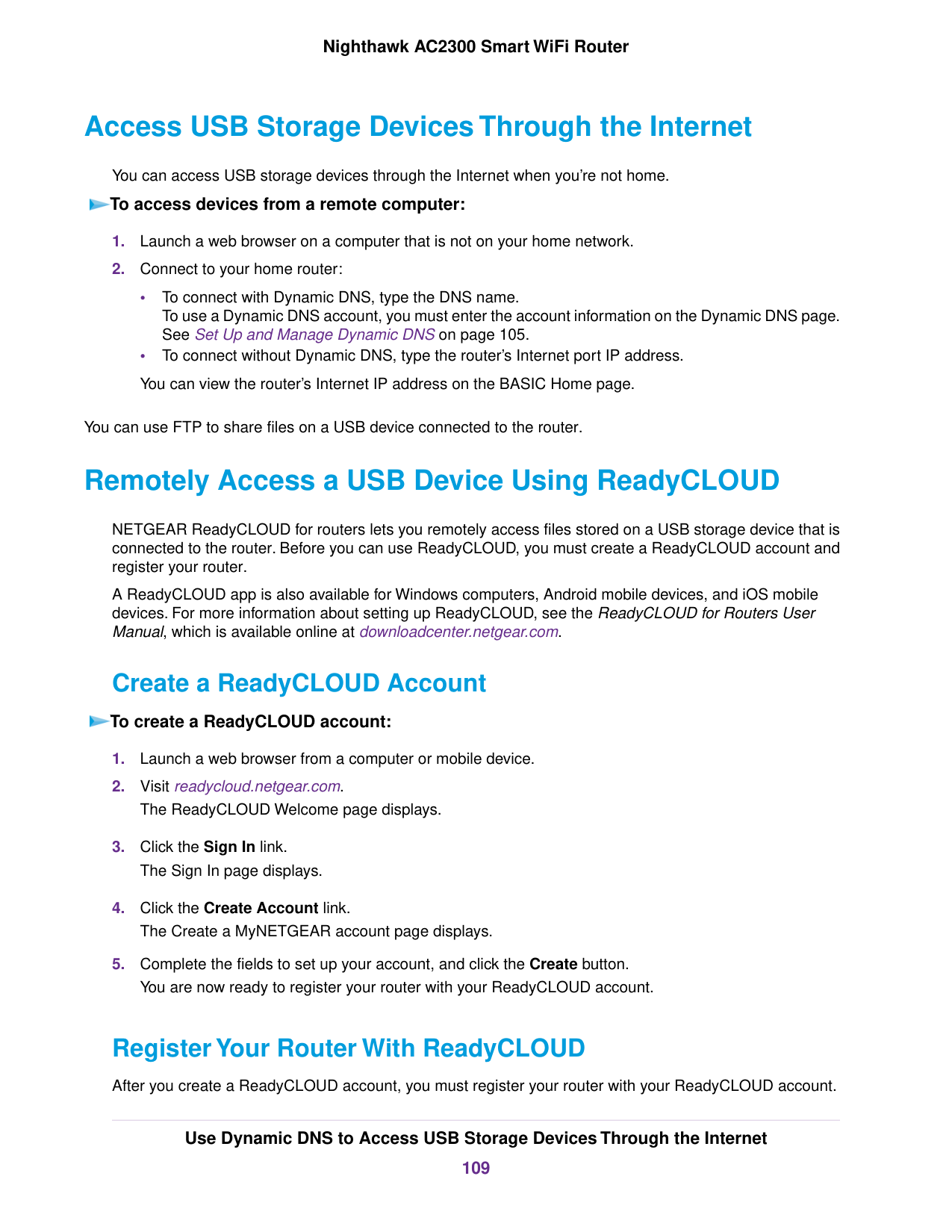
Access USB Storage Devices Through the Internet You can access USB storage devices through the Internet when you’re not home. To access devices from a remote computer:
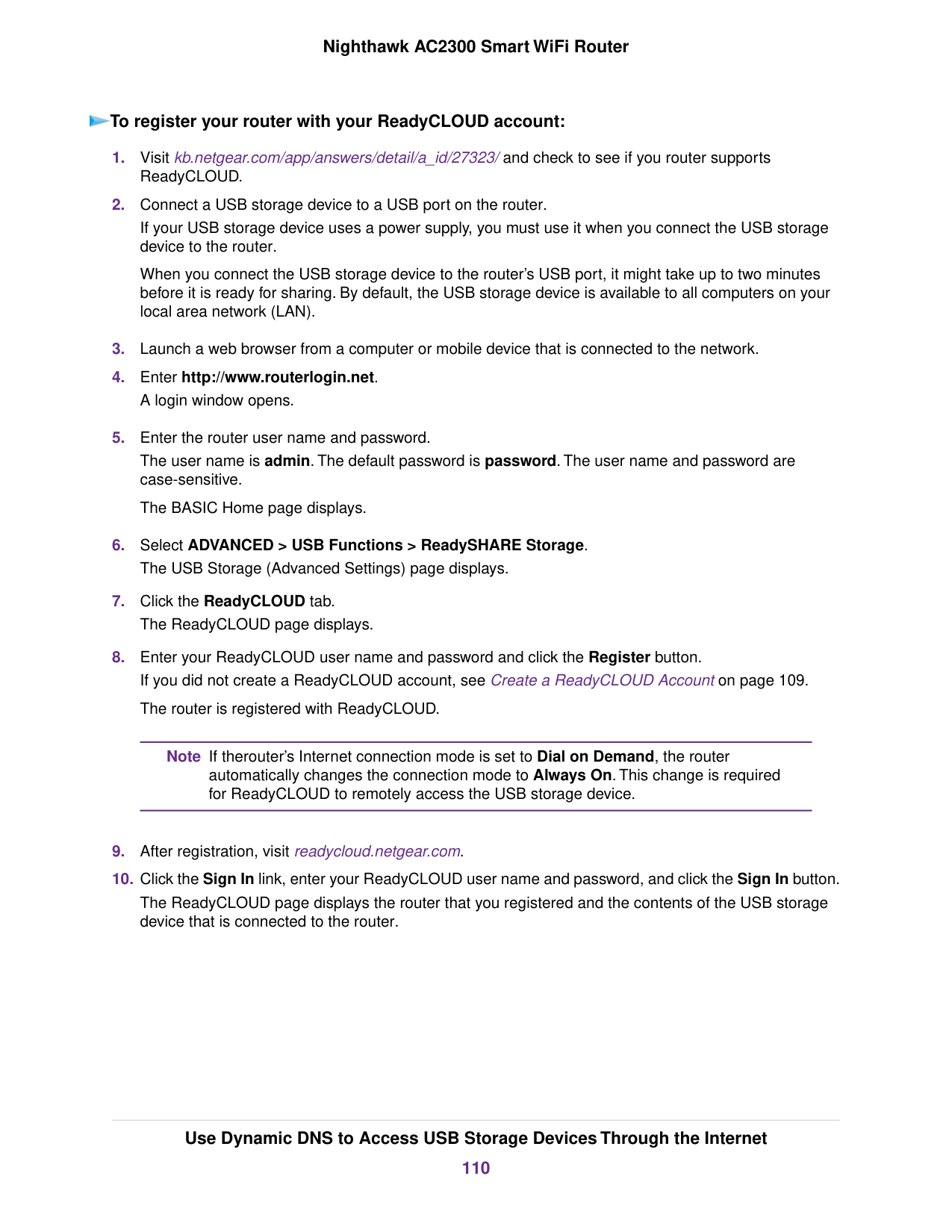
To register your router with your ReadyCLOUD account:
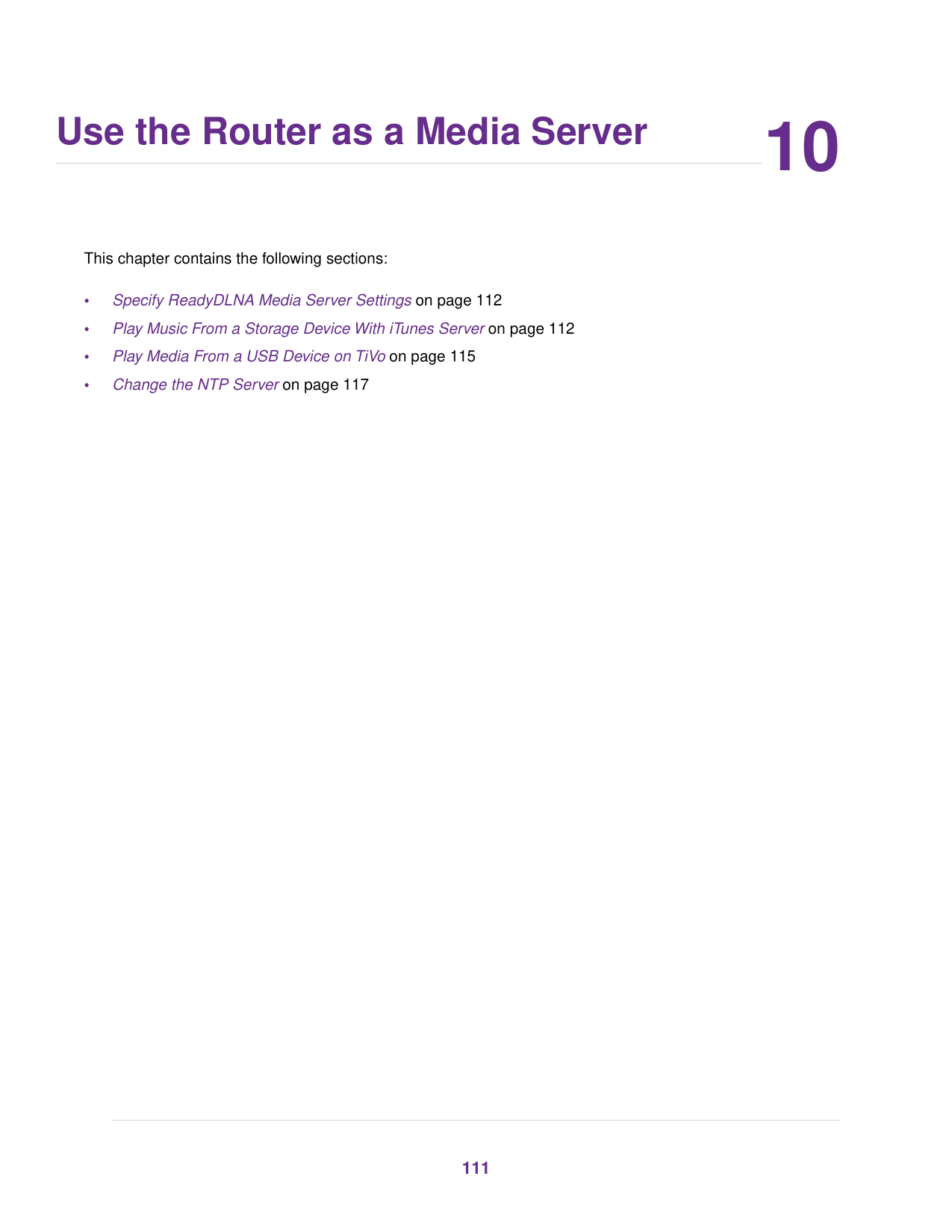
10 Use the Router as a Media Server This chapter contains the following sections: • Specify ReadyDLNA Media Server Settings on page 112 • Play Music From a Storage Device With iTunes Server on page 112 • Play Media From a USB Device on TiVo on page 115 • Change the NTP Server on page 117 111
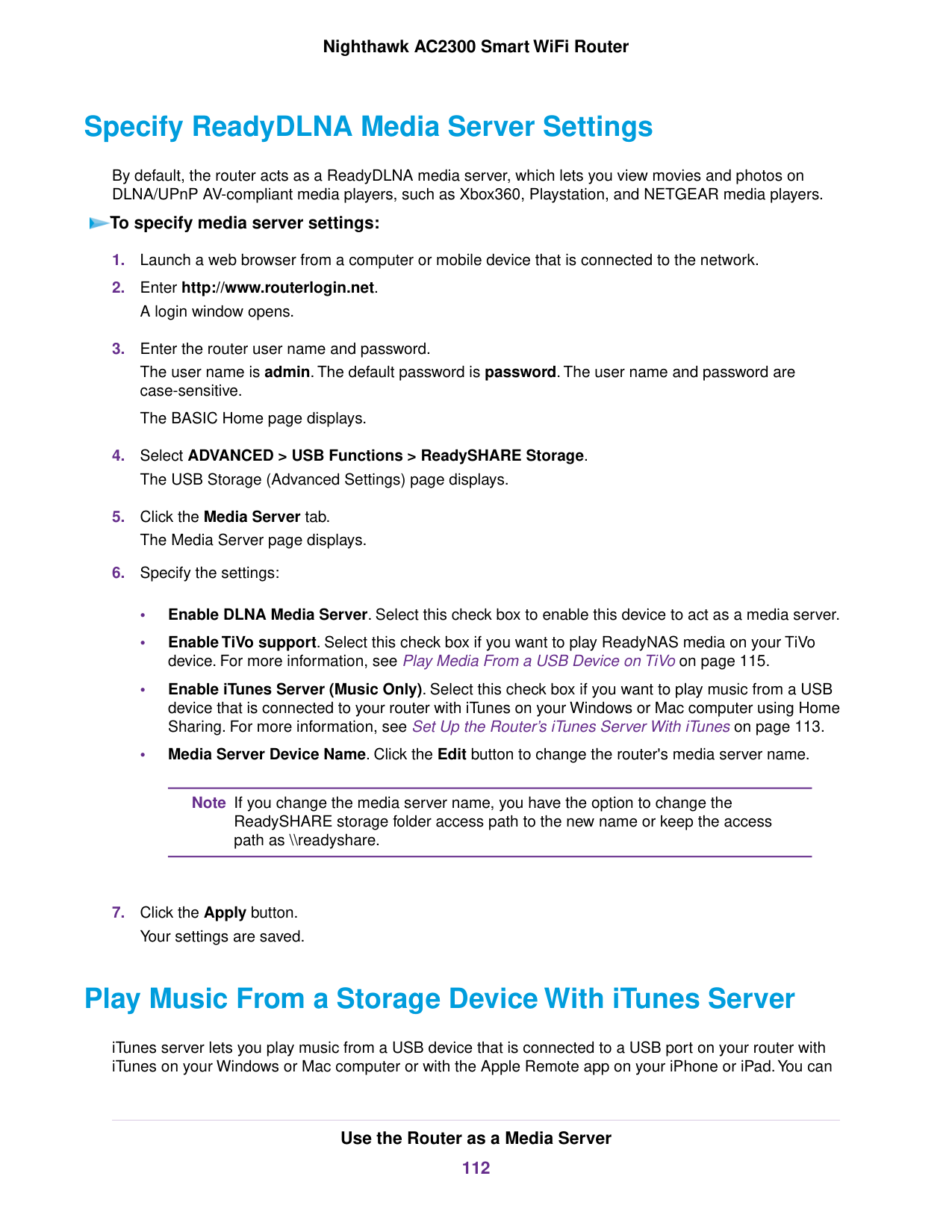
Specify ReadyDLNA Media Server Settings By default, the router acts as a ReadyDLNA media server, which lets you view movies and photos on DLNA/UPnP AV-compliant media players, such as Xbox360, Playstation, and NETGEAR media players. To specify media server settings:
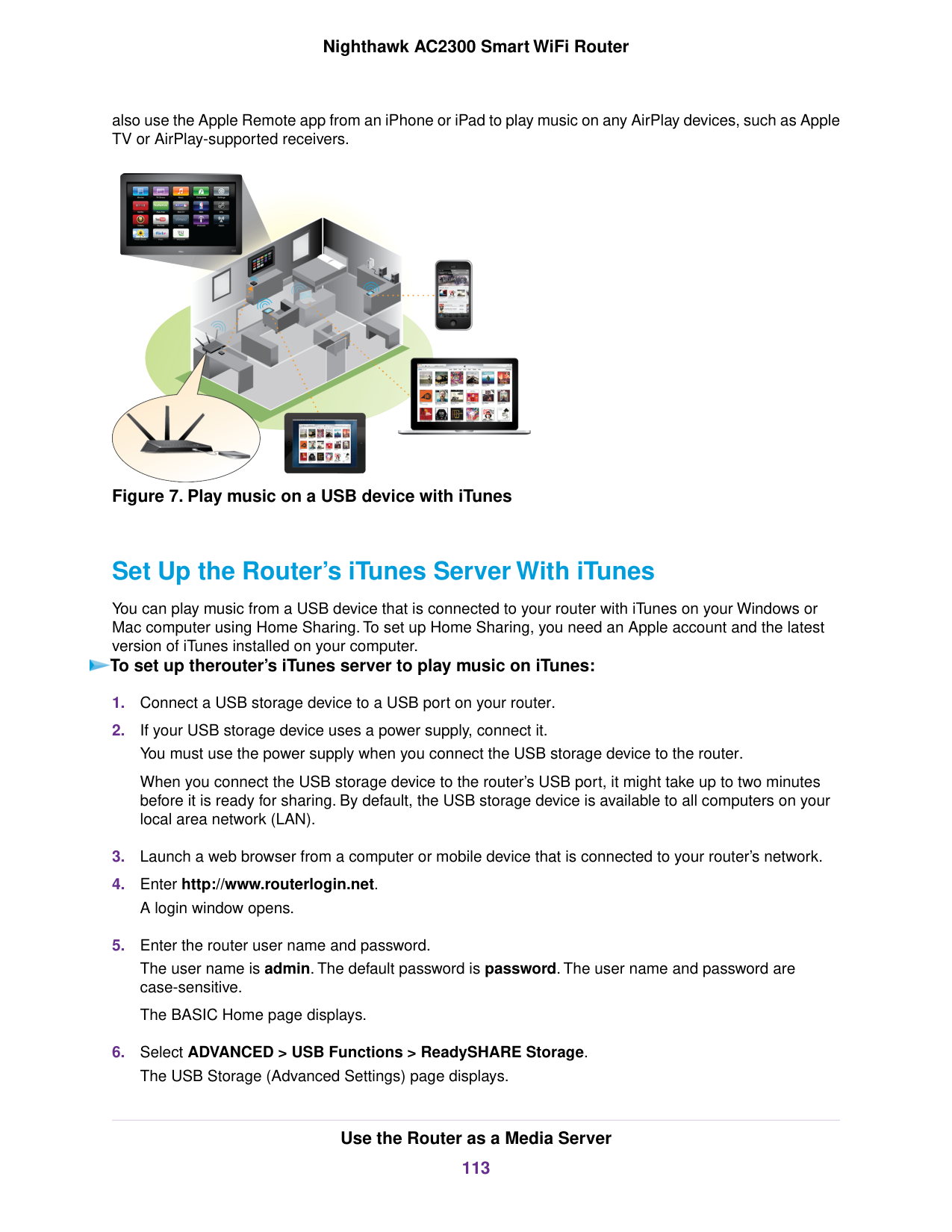
also use the Apple Remote app from an iPhone or iPad to play music on any AirPlay devices, such as Apple TV or AirPlay-supported receivers. Figure 7. Play music on a USB device with iTunes Set Up the Router’s iTunes Server With iTunes You can play music from a USB device that is connected to your router with iTunes on your Windows or Mac computer using Home Sharing. To set up Home Sharing, you need an Apple account and the latest version of iTunes installed on your computer. To set up therouter’s iTunes server to play music on iTunes:
The user name is admin. The default password is password. The user name and password are case-sensitive. The BASIC Home page displays. d. Select ADVANCED > ReadySHARE > ReadySHARE Storage. The USB Storage (Advanced Settings) page displays. e. Click the Media Server tab. The Media Server (Settings) page displays. f. Select the Enable iTunes Server (Music Only) check box. g. Click the Apply button. h. Enter the passcode. i. Click the Allow Control button. Your settings are saved. Your iPhone or iPad pairs with the router and the iTunes Server is ready. The router displays in the Remote app.
Change the NTP Server By default, the router uses the NETGEAR NTP server to sync the network time.You can change the NTP server to your preferred NTP server. To change the NTP server to your preferred NTP server:
11 Share a USB Printer The ReadySHARE Printer utility lets you share a USB printer that is connected to the USB port on your router. You can share this USB printer among the Windows and Mac computers on your network. For more information about the features available in the NETGEAR USB Control Center, see the ReadySHARE Printer User Manual, which is available at http://downloadcenter.netgear.com. This chapter contains the following sections: • Install the Printer Driver and Cable the Printer on page 119 • Download the ReadySHARE Printer Utility on page 119 • Install the ReadySHARE Printer Utility on page 120 • Print Using the NETGEAR USB Control Center on page 121 • View or Change the Status of a Printer on page 122 • Use the Scan Feature of a Multifunction USB Printer on page 122 • Change NETGEAR USB Control Center Settings on page 123 118
Install the Printer Driver and Cable the Printer Some USB printer manufacturers (for example, HP and Lexmark) request that you do not connect the USB cable until the installation software prompts you to do so. To install the driver and cable the printer:
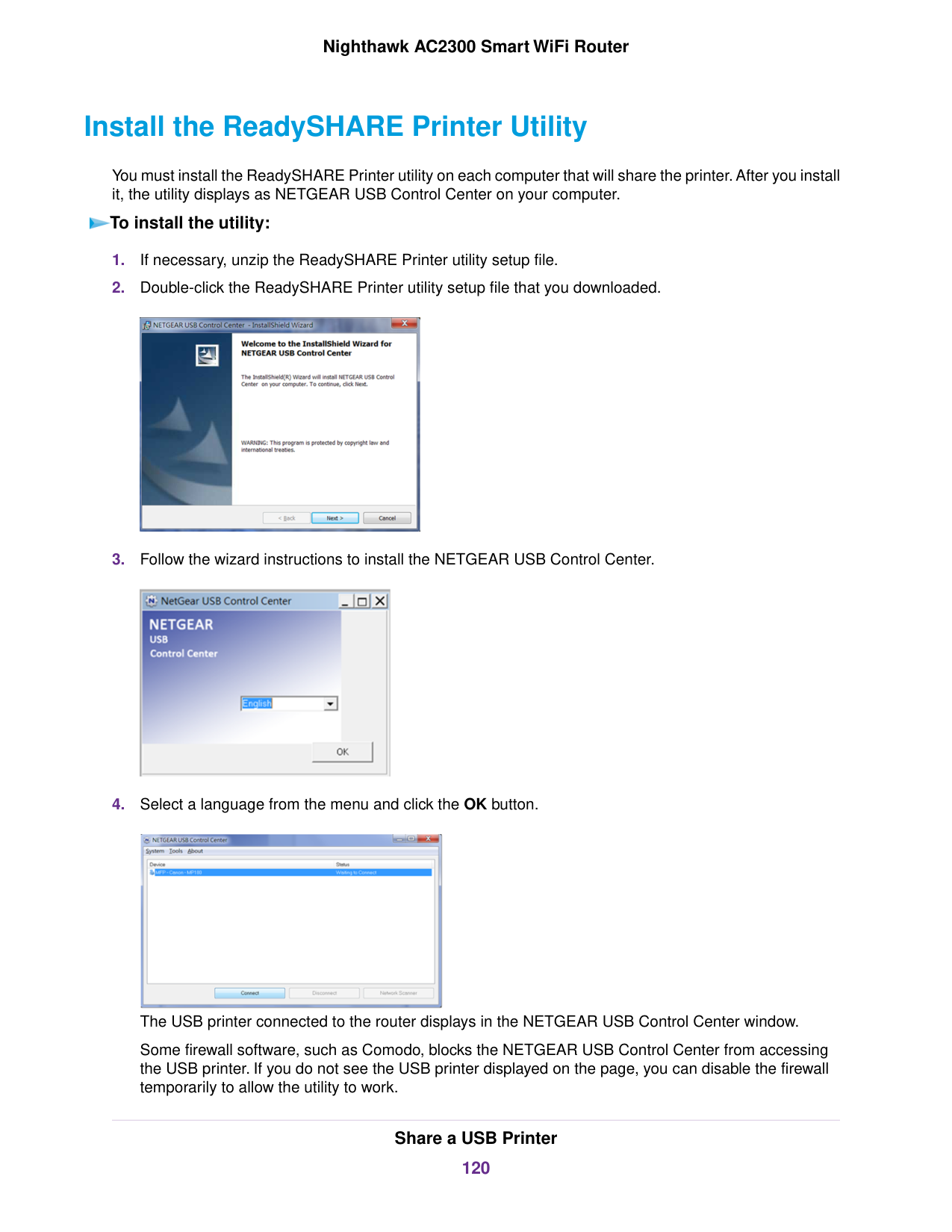
Install the ReadySHARE Printer Utility You must install the ReadySHARE Printer utility on each computer that will share the printer. After you install it, the utility displays as NETGEAR USB Control Center on your computer. To install the utility:
Print Using the NETGEAR USB Control Center For each computer, after you click the Connect and Disconnect buttons once, the utility automatically manages the printing queue and handling. By default, the utility starts automatically whenever you log on to Windows and runs in the background. To print a document using the NETGEAR USB Control Center:
View or Change the Status of a Printer To view or change the status:
12 Use VPN to Access Your Network You can use OpenVPN software to remotely access your router using virtual private networking (VPN). This chapter explains how to set up and use VPN access. The chapter includes the following sections: • Set Up a VPN Connection on page 126 • Specify VPN Service in the Router on page 126 • Install OpenVPN Software on page 127 • Use a VPN Tunnel on Your Windows Computer on page 132 • Use VPN to Access the Router’s USB Device and Media on page 133 • Use a VPN Tunnel to Access Your Internet Service at Home on page 135 125
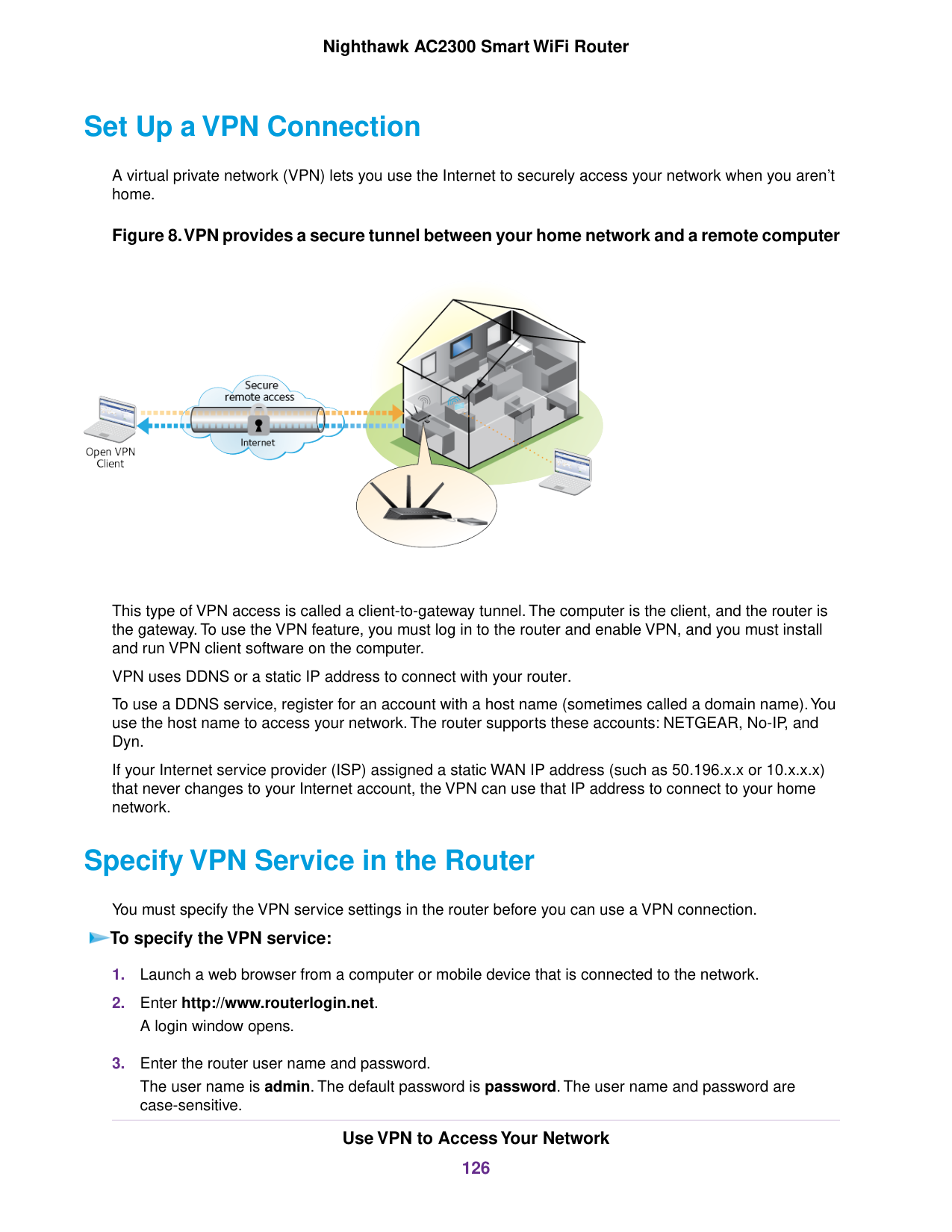
Set Up a VPN Connection A virtual private network (VPN) lets you use the Internet to securely access your network when you aren’t home. Figure 8.VPN provides a secure tunnel between your home network and a remote computer This type of VPN access is called a client-to-gateway tunnel. The computer is the client, and the router is the gateway. To use the VPN feature, you must log in to the router and enable VPN, and you must install and run VPN client software on the computer. VPN uses DDNS or a static IP address to connect with your router. To use a DDNS service, register for an account with a host name (sometimes called a domain name).You use the host name to access your network. The router supports these accounts: NETGEAR, No-IP, and Dyn. If your Internet service provider (ISP) assigned a static WAN IP address (such as 50.196.x.x or 10.x.x.x) that never changes to your Internet account, the VPN can use that IP address to connect to your home network. Specify VPN Service in the Router You must specify the VPN service settings in the router before you can use a VPN connection. To specify the VPN service:
The BASIC Home page displays.
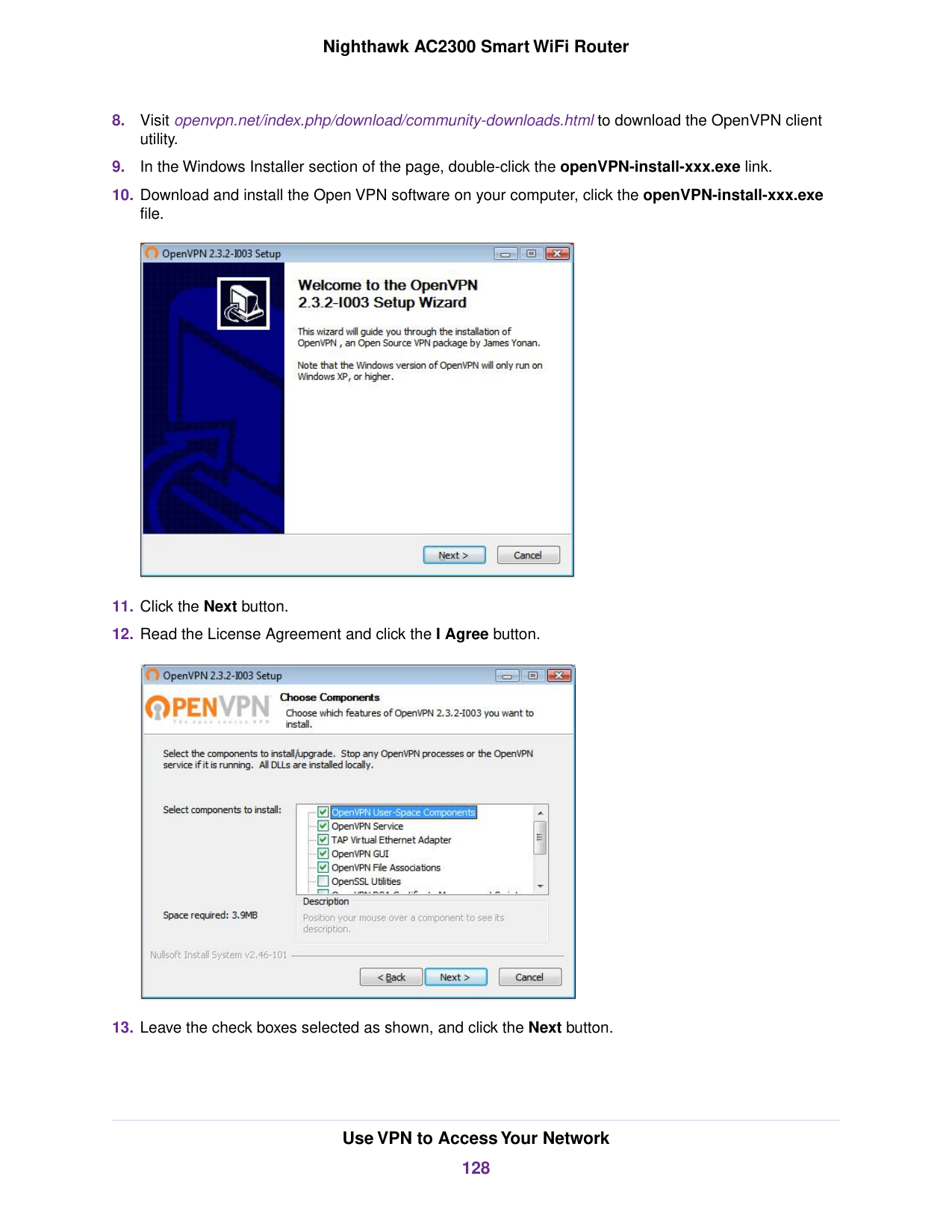
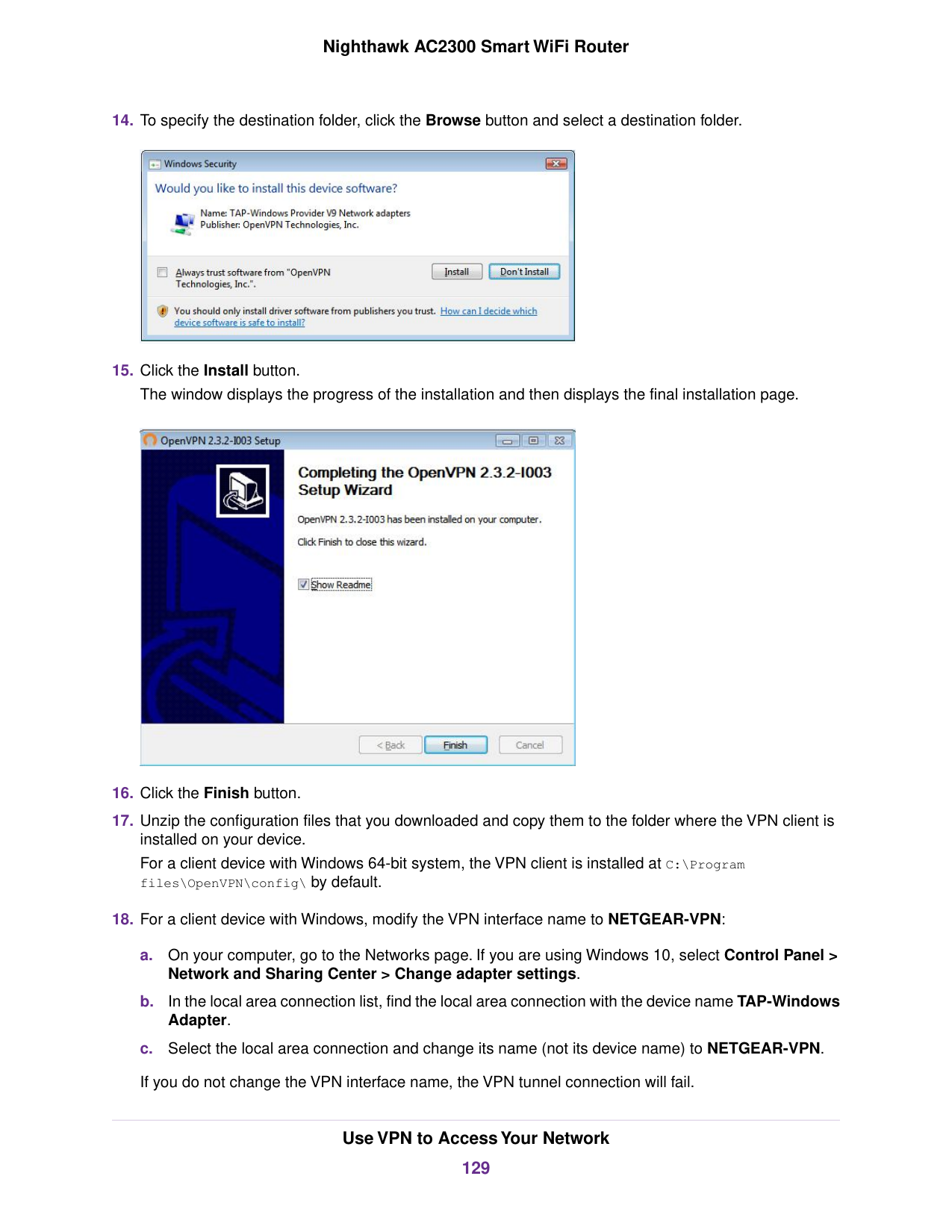
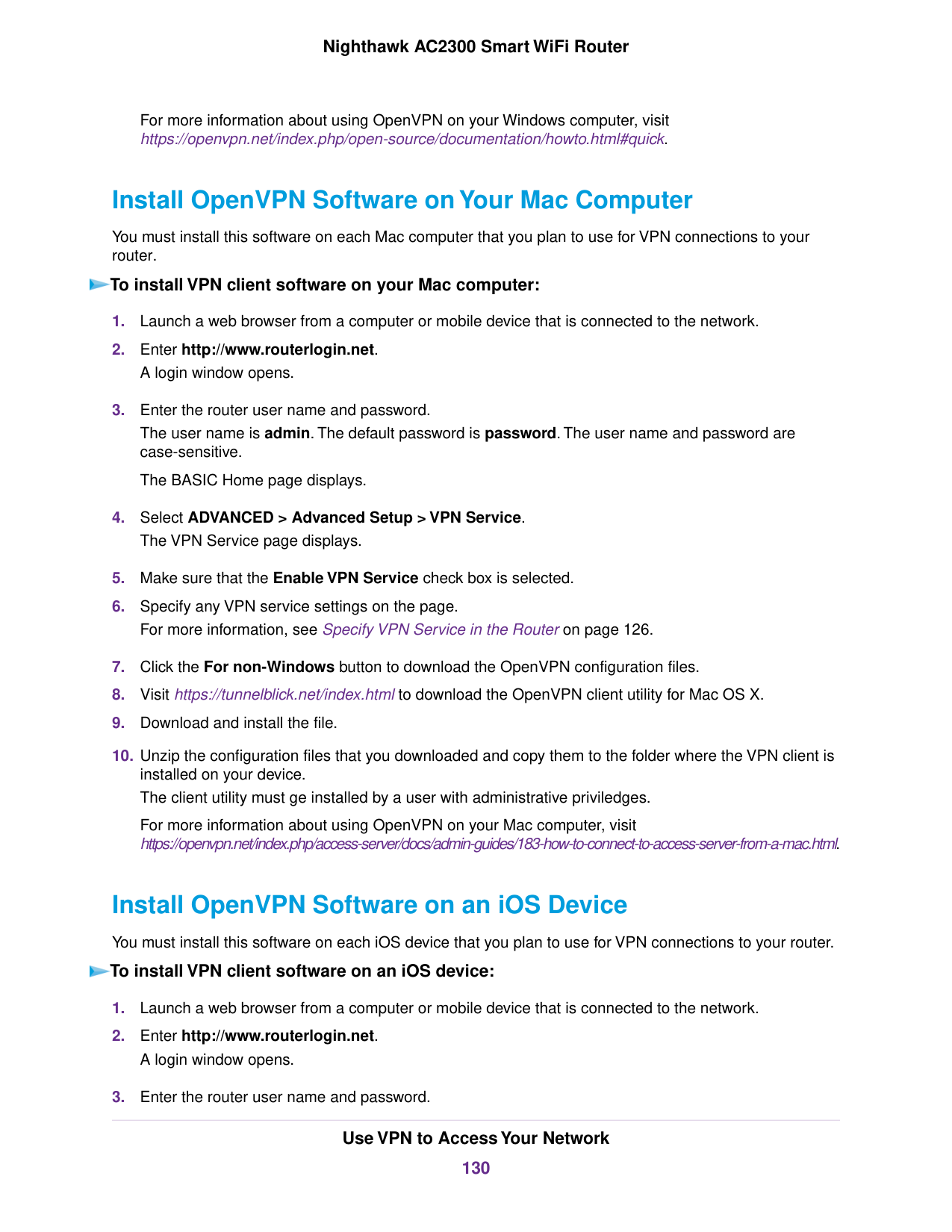
For more information about using OpenVPN on your Windows computer, visit https://openvpn.net/index.php/open-source/documentation/howto.html#quick. Install OpenVPN Software on Your Mac Computer You must install this software on each Mac computer that you plan to use for VPN connections to your router. To install VPN client software on your Mac computer:
The user name is admin. The default password is password. The user name and password are case-sensitive. The BASIC Home page displays.
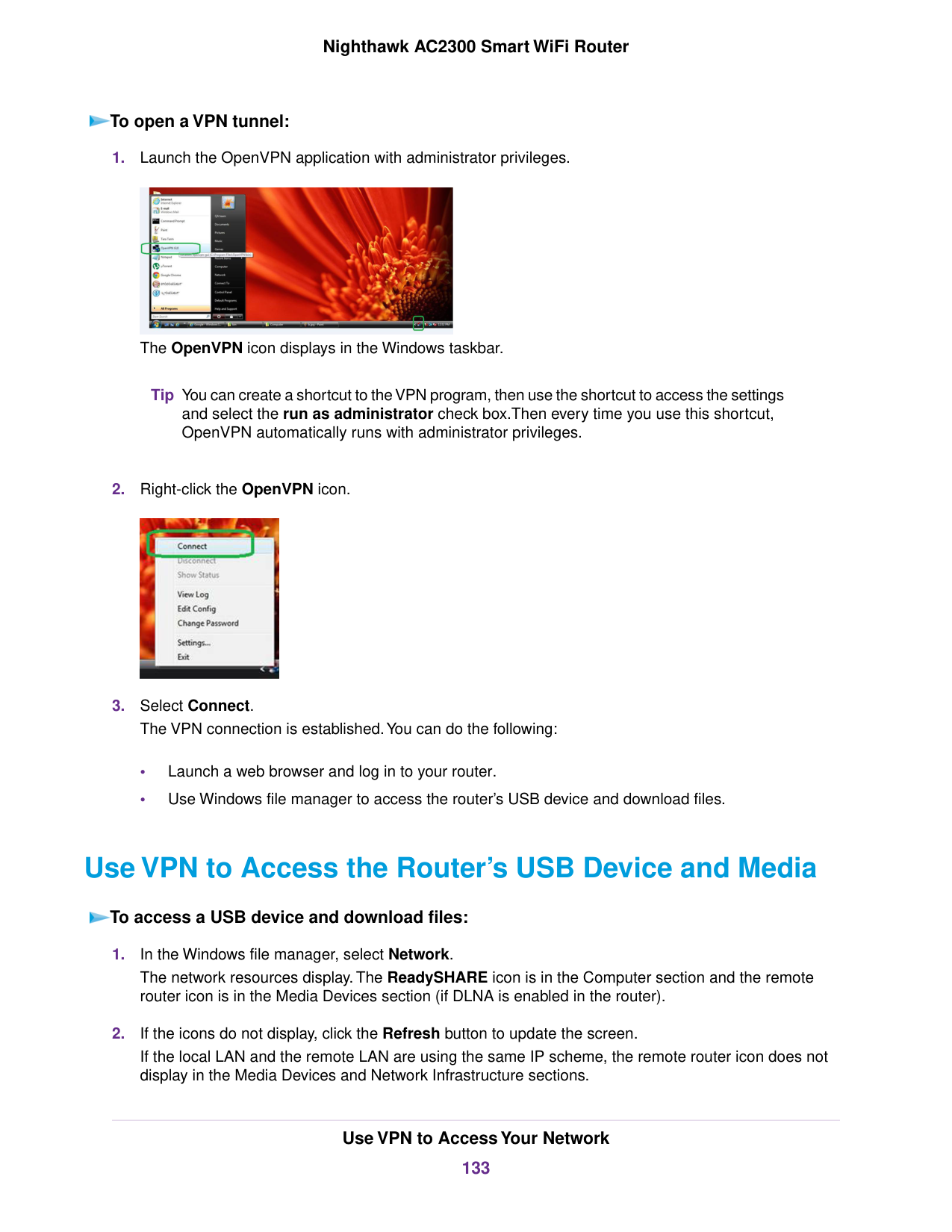
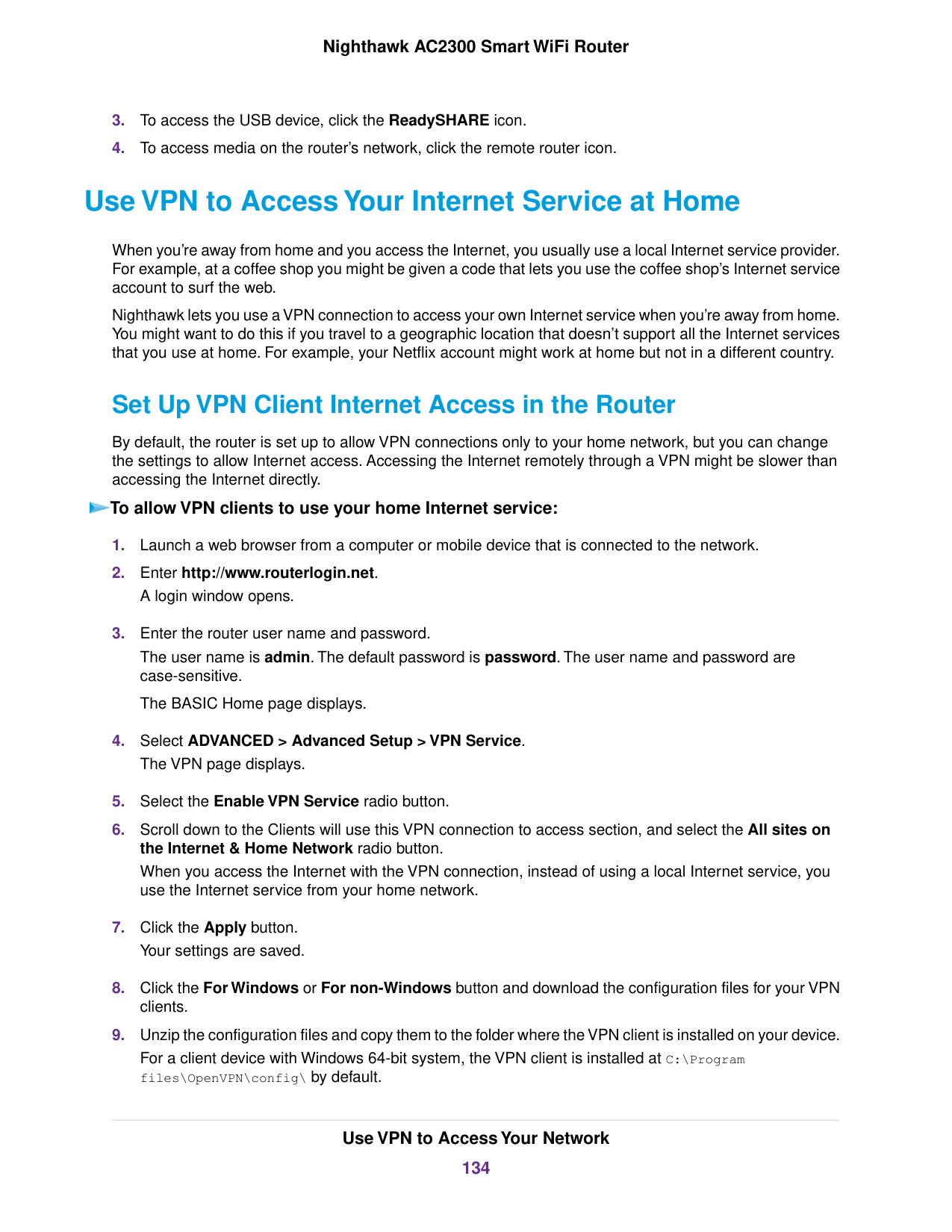
To open a VPN tunnel:
Block VPN Client Internet Access in the Router By default, the router is set up to allow VPN connections only to your home network, not to the Internet service for your home network. If you changed this setting to allow Internet access, you can change it back. To allow VPN clients to access only your home network:
13 Customize Internet Traffic Rules for Ports You can use port forwarding and port triggering to set up rules for Internet traffic.You need networking knowledge to set up these features. This chapter includes the following sections: • Port Forwarding to a Local Server on page 137 • Port Triggering on page 140 136
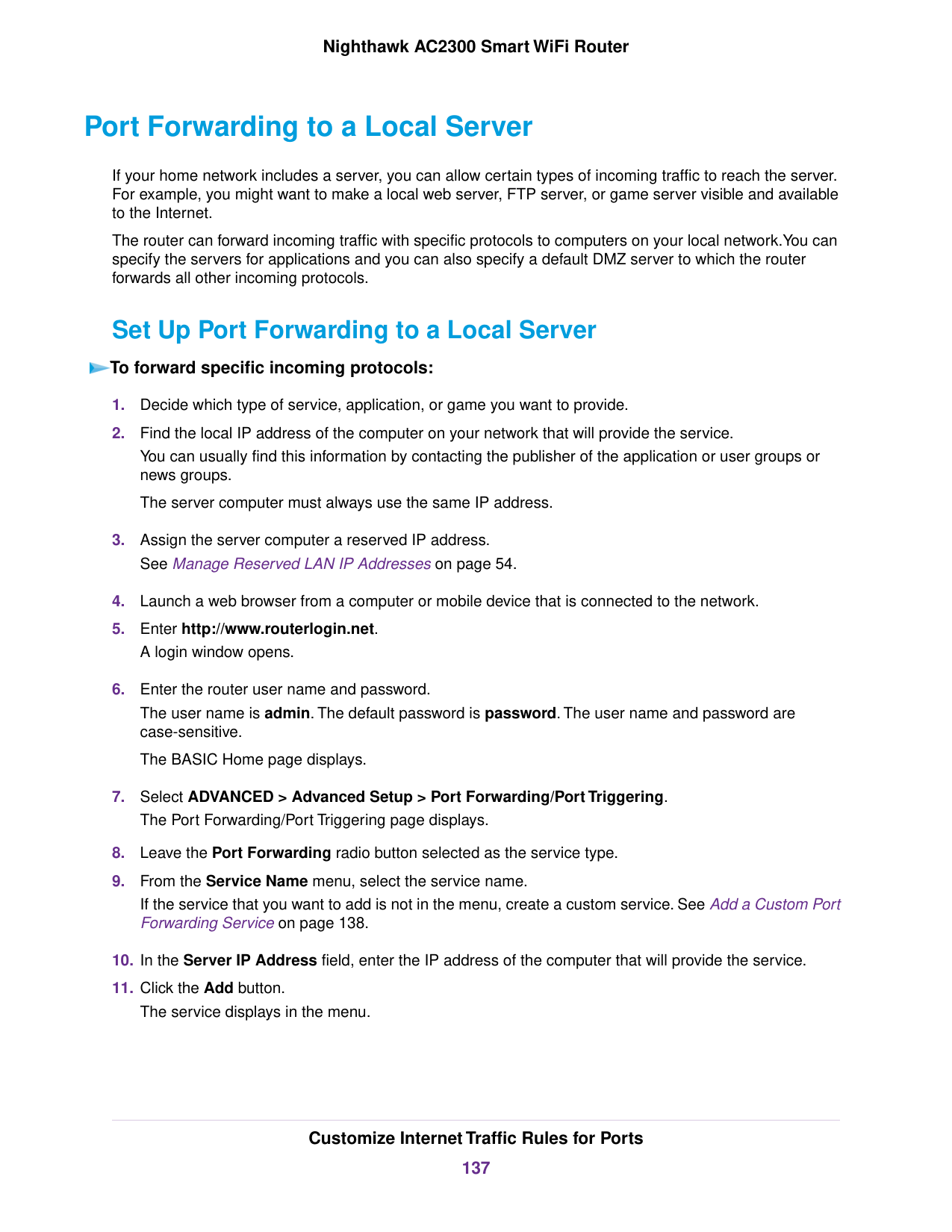
Port Forwarding to a Local Server If your home network includes a server, you can allow certain types of incoming traffic to reach the server. For example, you might want to make a local web server, FTP server, or game server visible and available to the Internet. The router can forward incoming traffic with specific protocols to computers on your local network.You can specify the servers for applications and you can also specify a default DMZ server to which the router forwards all other incoming protocols. Set Up Port Forwarding to a Local Server To forward specific incoming protocols:
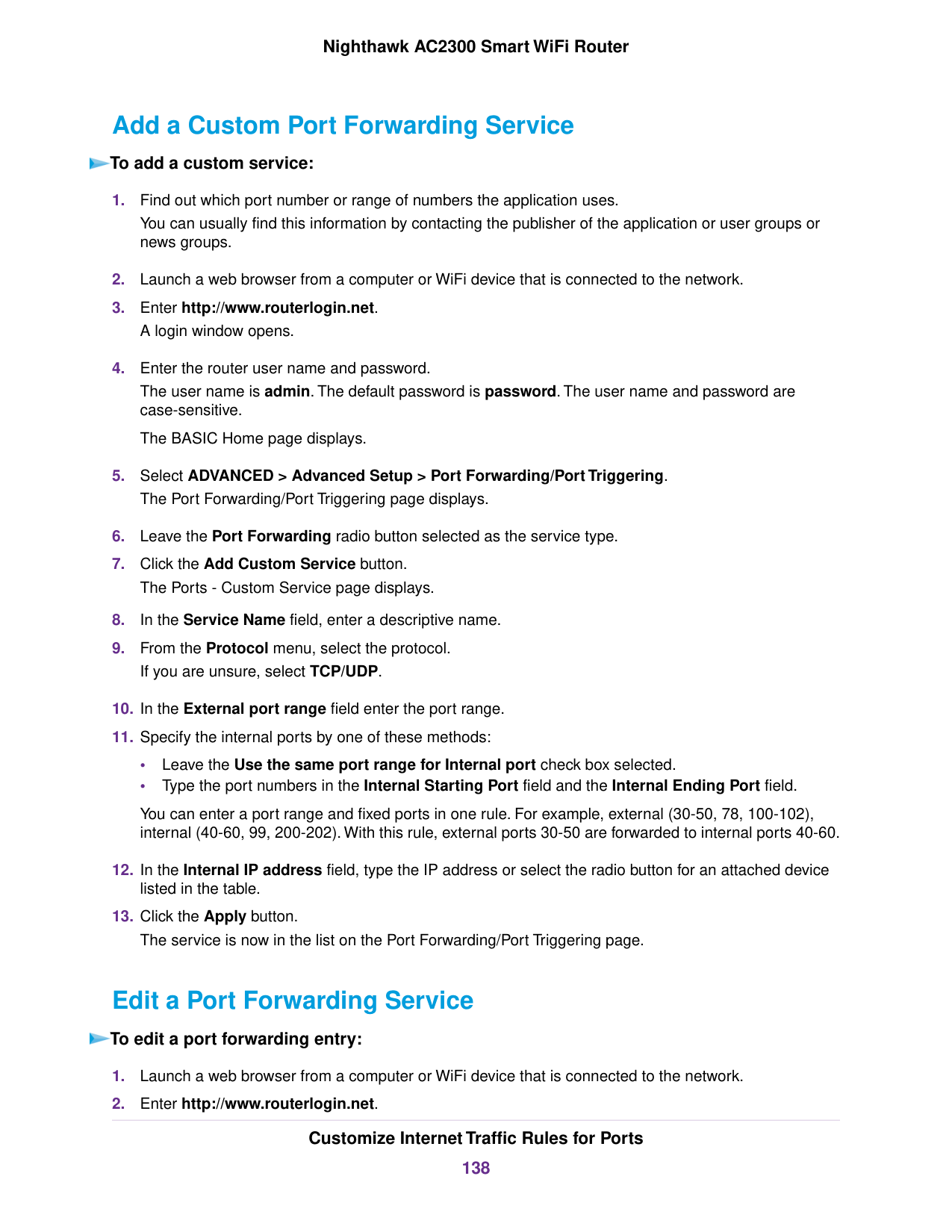
Add a Custom Port Forwarding Service To add a custom service:
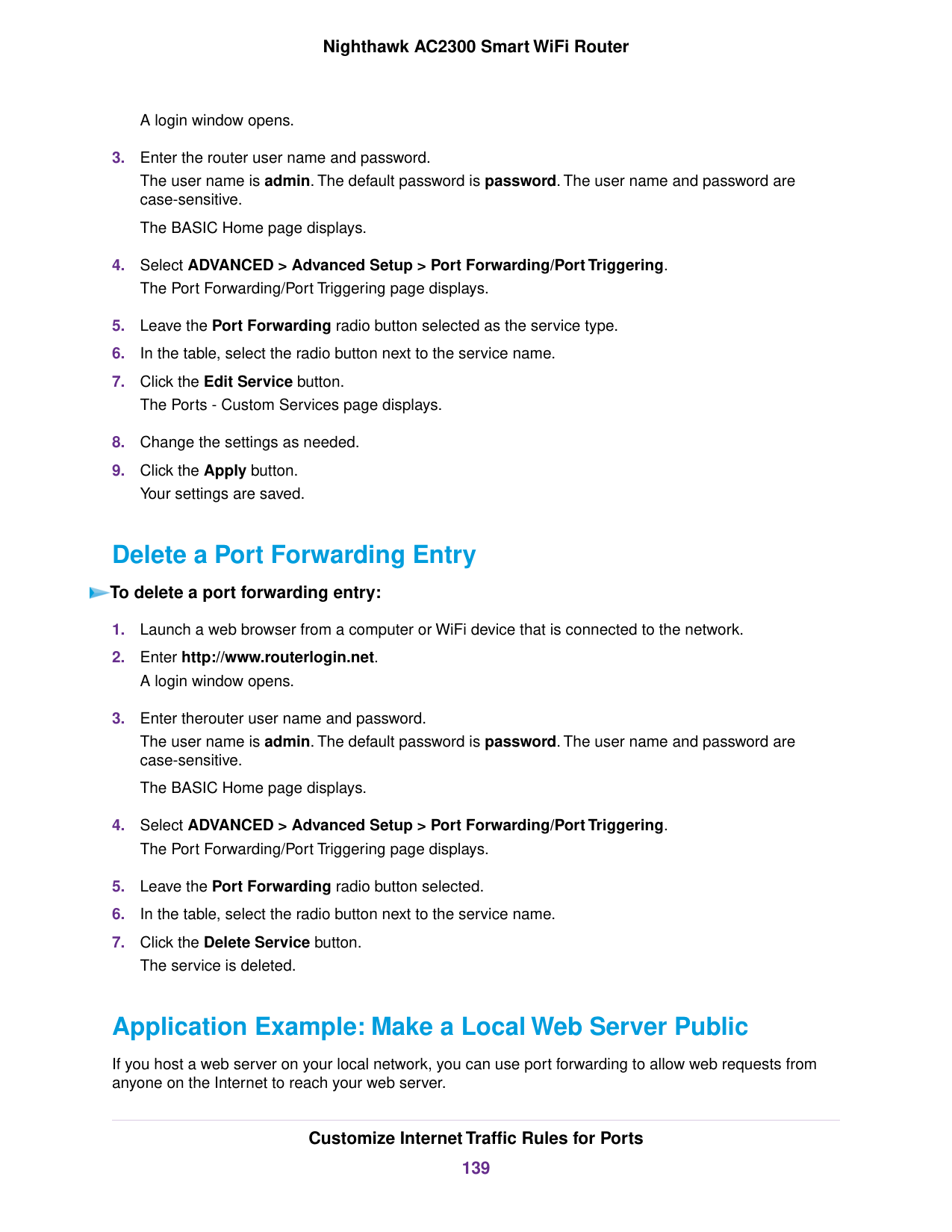
A login window opens.
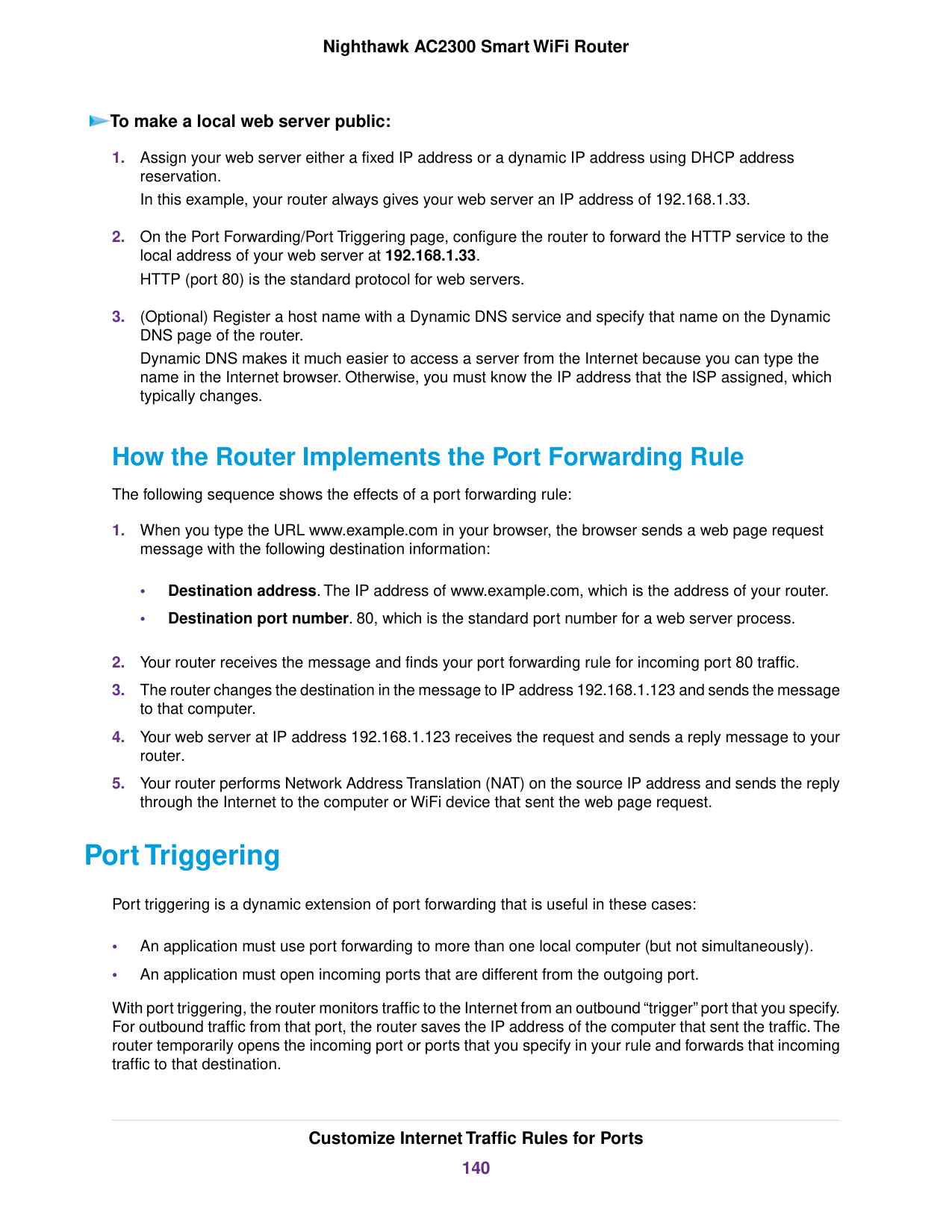
To make a local web server public:
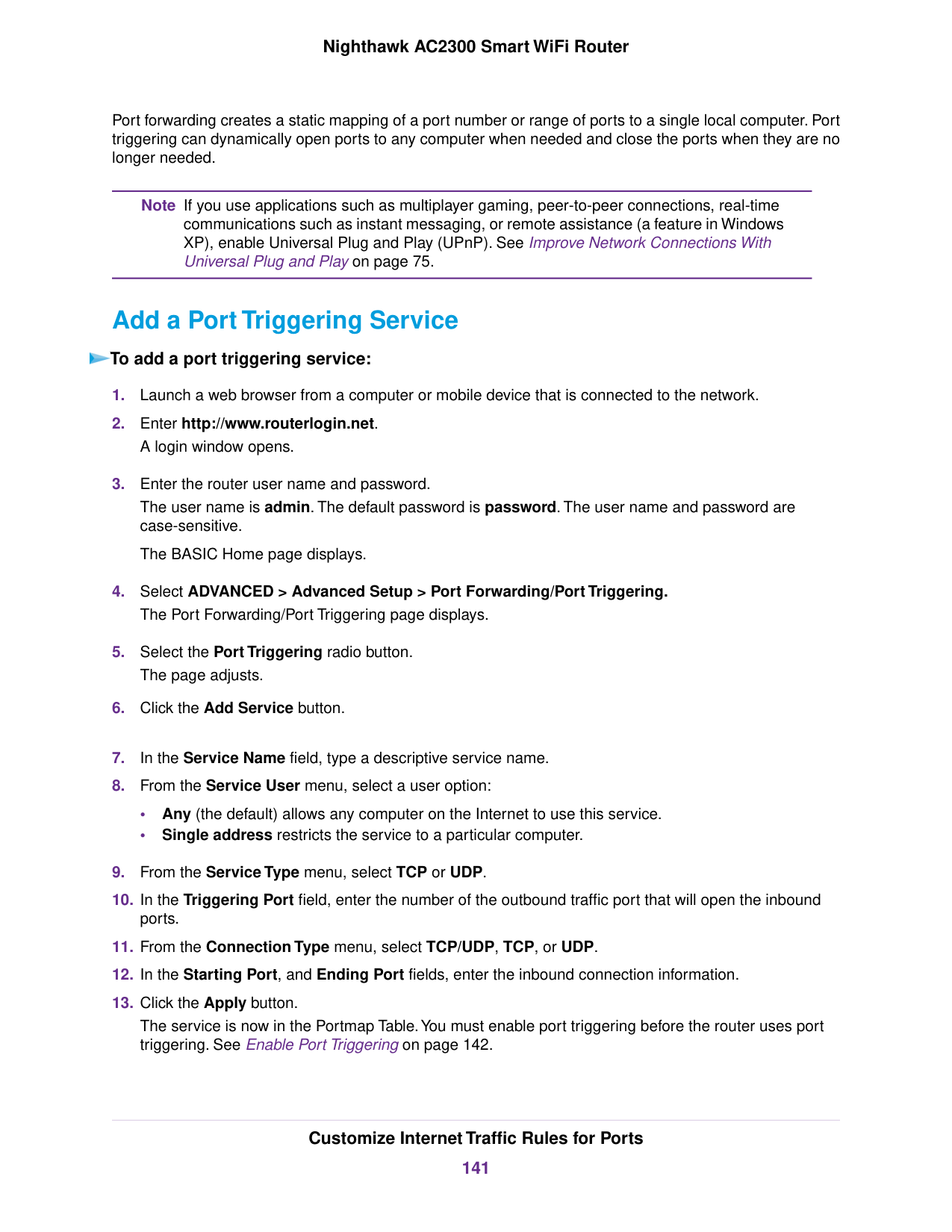
Port forwarding creates a static mapping of a port number or range of ports to a single local computer. Port triggering can dynamically open ports to any computer when needed and close the ports when they are no longer needed. If you use applications such as multiplayer gaming, peer-to-peer connections, real-time communications such as instant messaging, or remote assistance (a feature in Windows XP), enable Universal Plug and Play (UPnP). See Improve Network Connections With Universal Plug and Play on page 75. Note Add a Port Triggering Service To add a port triggering service:
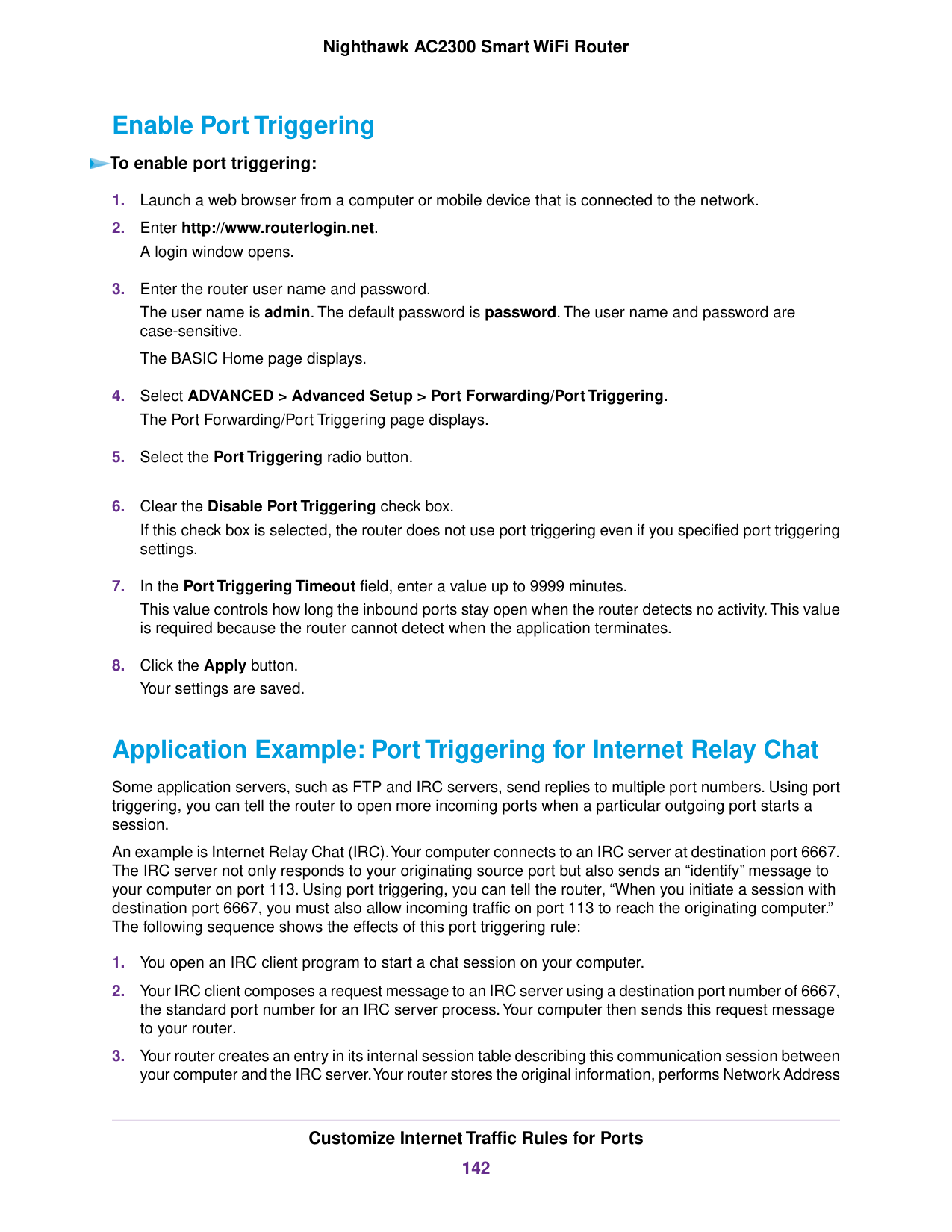
Enable Port Triggering To enable port triggering:
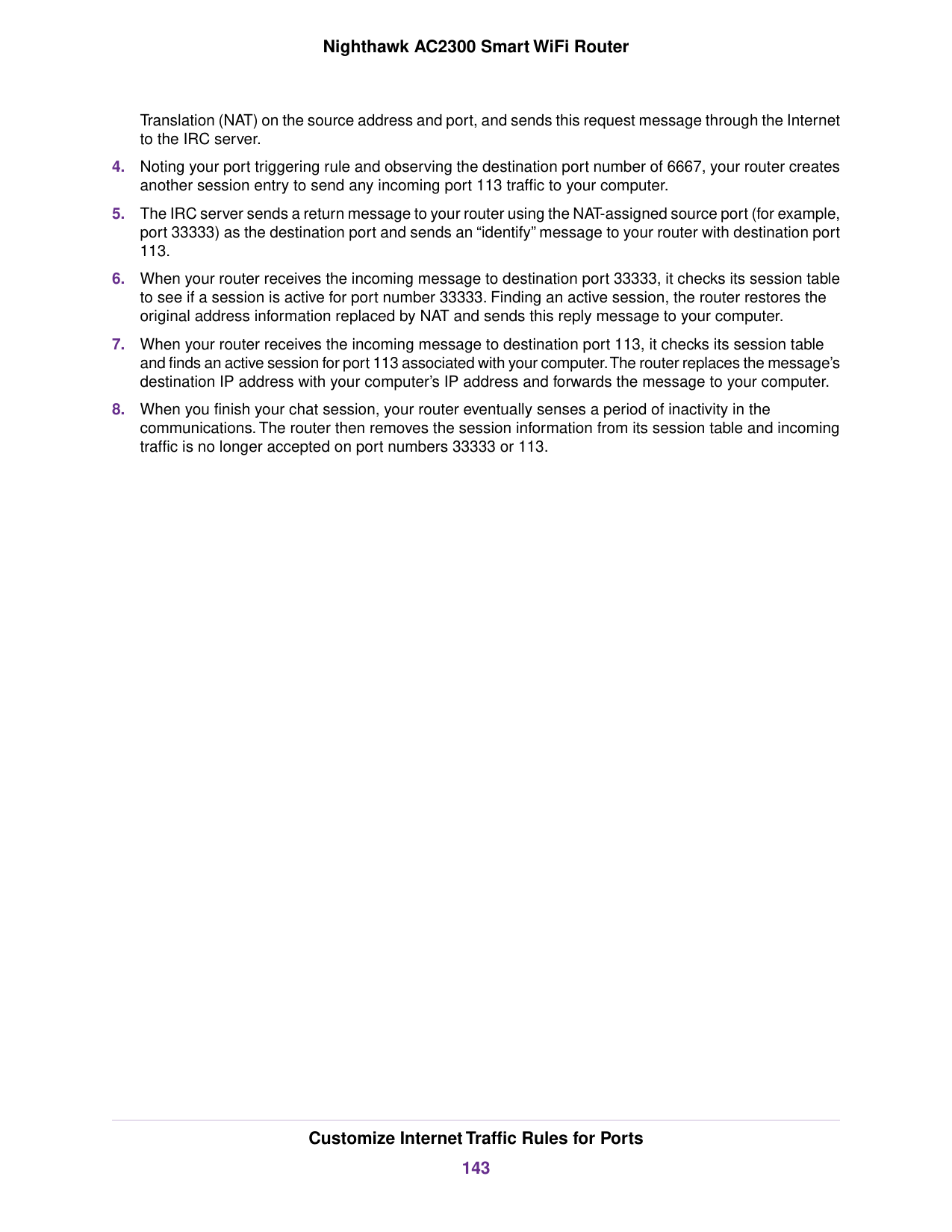
Translation (NAT) on the source address and port, and sends this request message through the Internet to the IRC server.
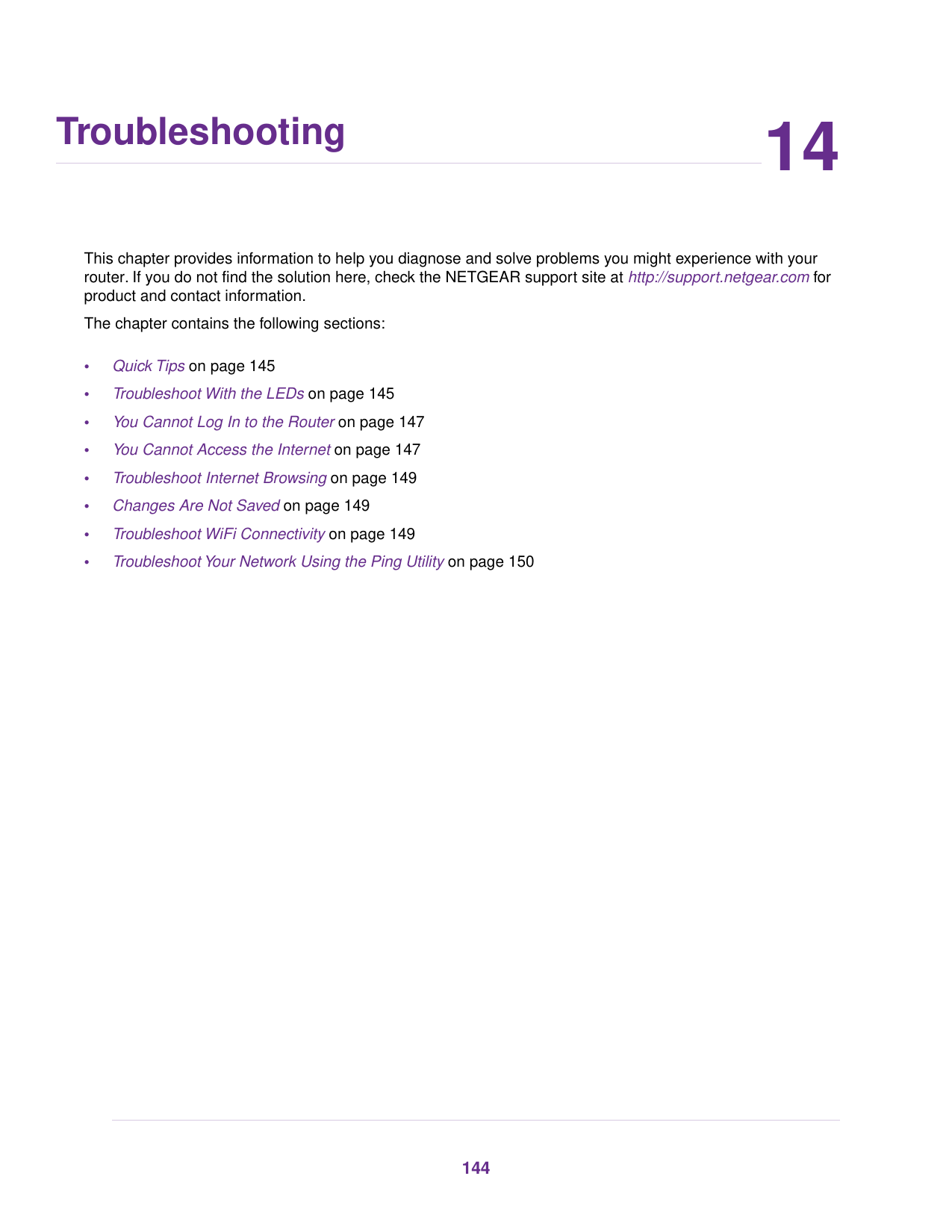
14 Troubleshooting This chapter provides information to help you diagnose and solve problems you might experience with your router. If you do not find the solution here, check the NETGEAR support site at http://support.netgear.com for product and contact information. The chapter contains the following sections: • Quick Tips on page 145 • Troubleshoot With the LEDs on page 145 • You Cannot Log In to the Router on page 147 • You Cannot Access the Internet on page 147 • Troubleshoot Internet Browsing on page 149 • Changes Are Not Saved on page 149 • Troubleshoot WiFi Connectivity on page 149 • Troubleshoot Your Network Using the Ping Utility on page 150 144
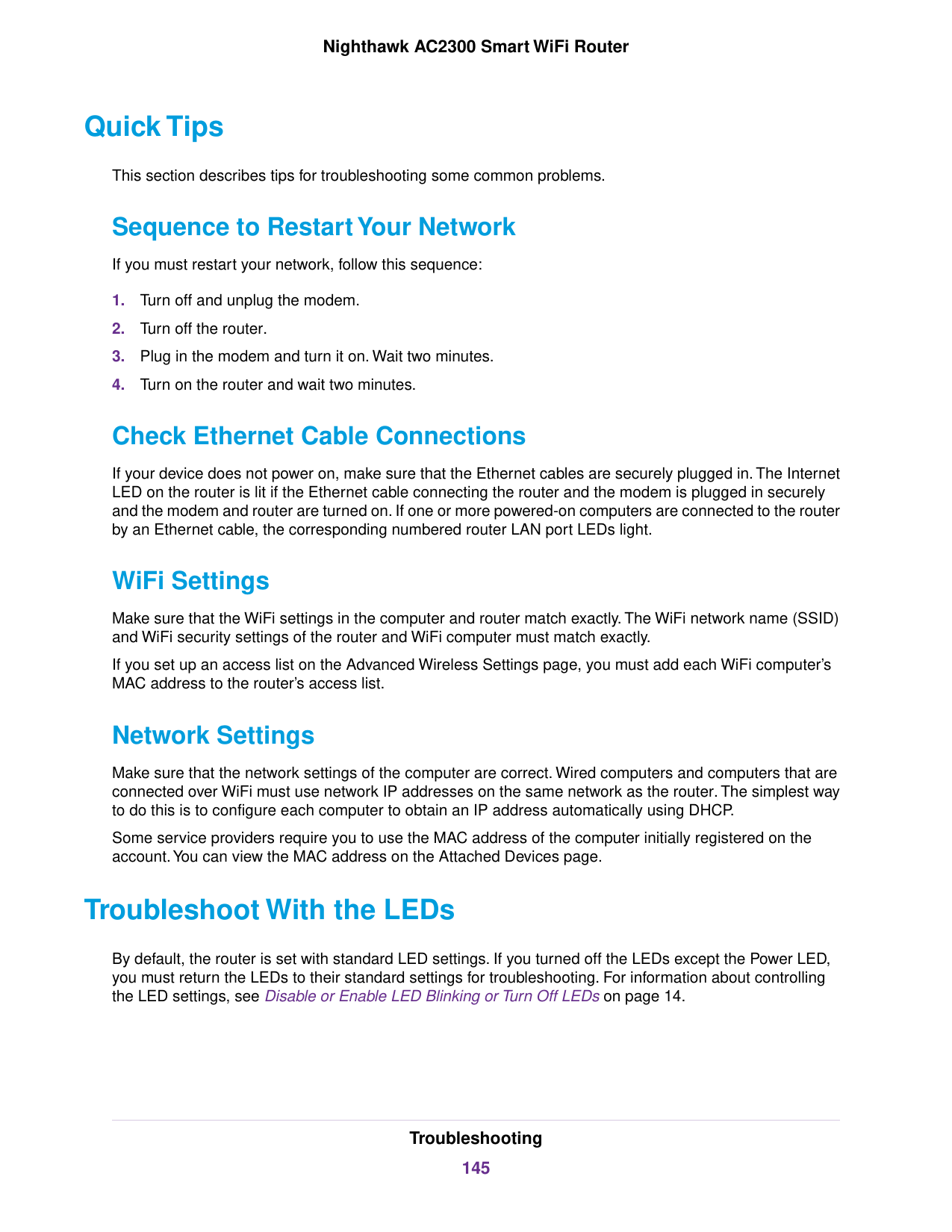
Quick Tips This section describes tips for troubleshooting some common problems. Sequence to Restart Your Network If you must restart your network, follow this sequence:
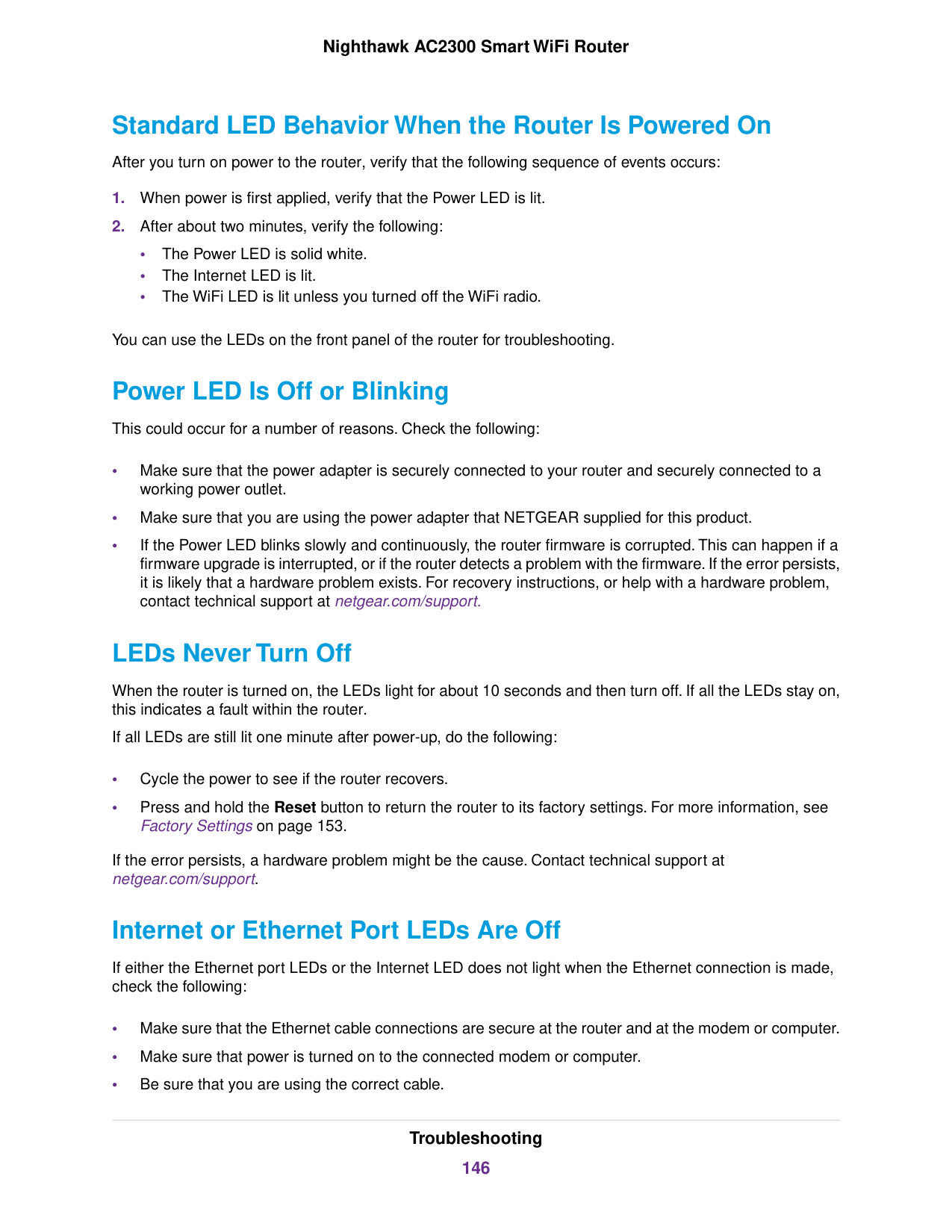
Standard LED Behavior When the Router Is Powered On After you turn on power to the router, verify that the following sequence of events occurs:
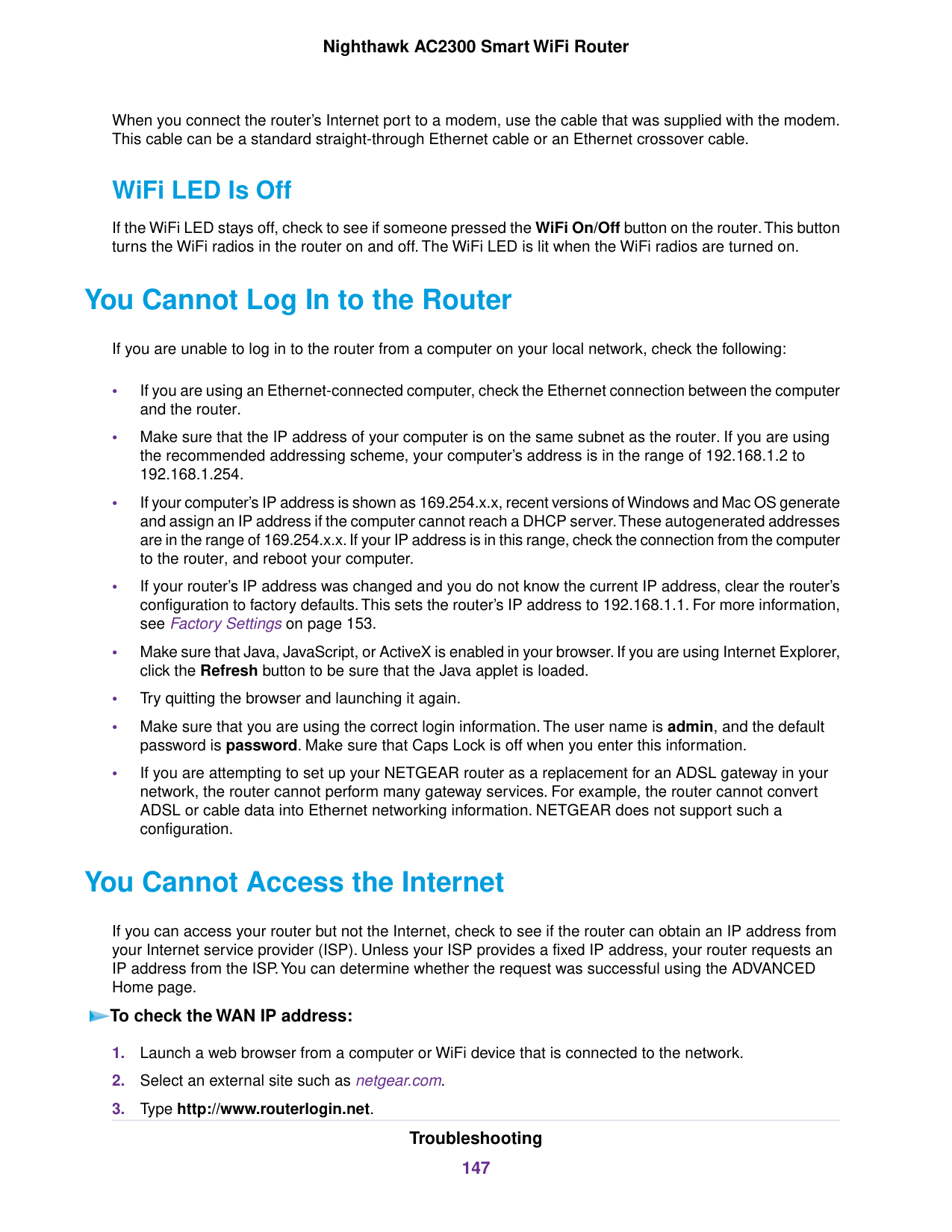
When you connect the router’s Internet port to a modem, use the cable that was supplied with the modem. This cable can be a standard straight-through Ethernet cable or an Ethernet crossover cable. WiFi LED Is Off If the WiFi LED stays off, check to see if someone pressed the WiFi On/Off button on the router.This button turns the WiFi radios in the router on and off. The WiFi LED is lit when the WiFi radios are turned on. You Cannot Log In to the Router If you are unable to log in to the router from a computer on your local network, check the following: • If you are using an Ethernet-connected computer, check the Ethernet connection between the computer and the router. • Make sure that the IP address of your computer is on the same subnet as the router. If you are using the recommended addressing scheme, your computer’s address is in the range of 192.168.1.2 to 192.168.1.254. • If your computer’s IP address is shown as 169.254.x.x, recent versions of Windows and Mac OS generate and assign an IP address if the computer cannot reach a DHCP server.These autogenerated addresses are in the range of 169.254.x.x. If your IP address is in this range, check the connection from the computer to the router, and reboot your computer. • If your router’s IP address was changed and you do not know the current IP address, clear the router’s configuration to factory defaults.This sets the router’s IP address to 192.168.1.1. For more information, see Factory Settings on page 153. • Make sure that Java, JavaScript, or ActiveX is enabled in your browser. If you are using Internet Explorer, click the Refresh button to be sure that the Java applet is loaded. • Try quitting the browser and launching it again. • Make sure that you are using the correct login information. The user name is admin, and the default password is password. Make sure that Caps Lock is off when you enter this information. • If you are attempting to set up your NETGEAR router as a replacement for an ADSL gateway in your network, the router cannot perform many gateway services. For example, the router cannot convert ADSL or cable data into Ethernet networking information. NETGEAR does not support such a configuration. You Cannot Access the Internet If you can access your router but not the Internet, check to see if the router can obtain an IP address from your Internet service provider (ISP). Unless your ISP provides a fixed IP address, your router requests an IP address from the ISP.You can determine whether the request was successful using the ADVANCED Home page. To check the WAN IP address:
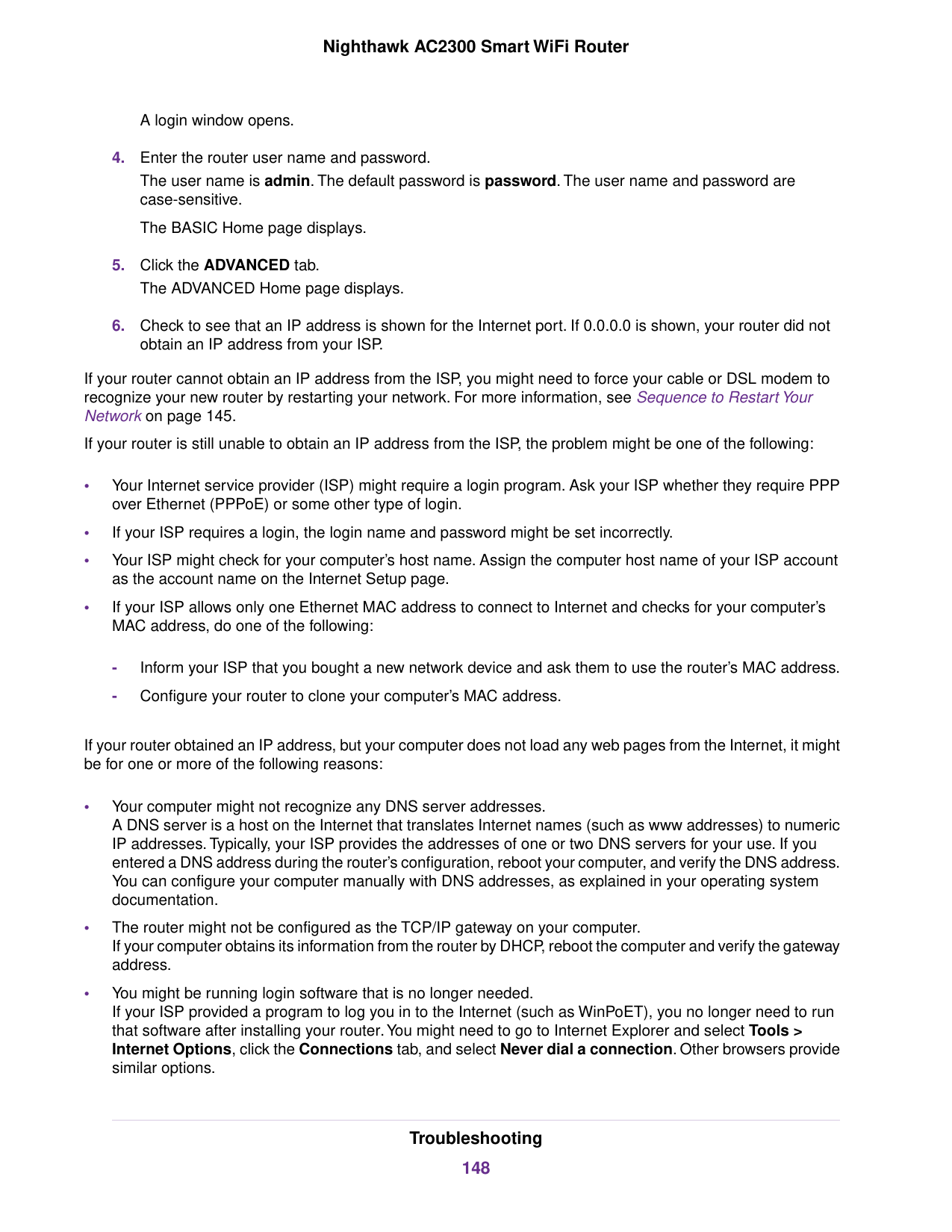
A login window opens.
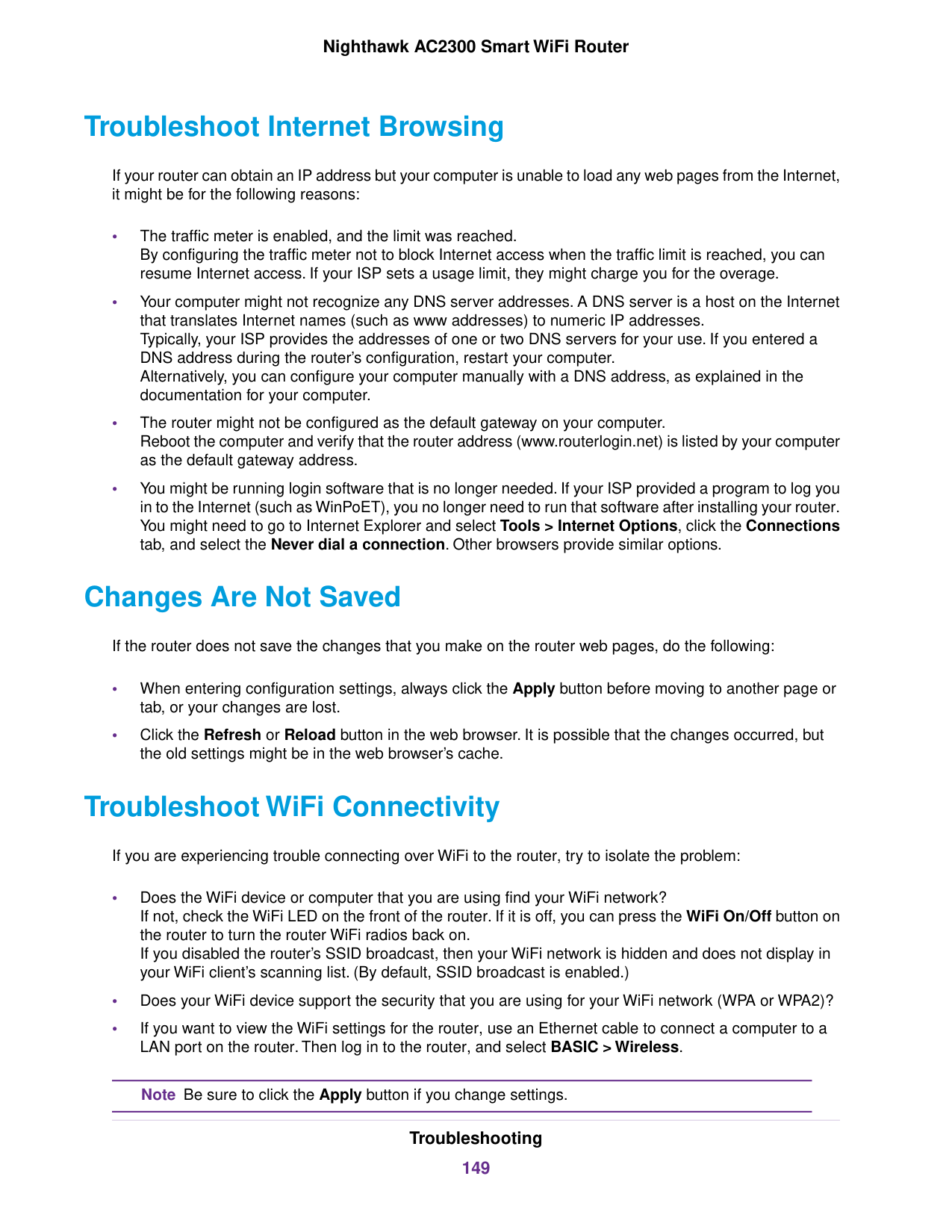
Troubleshoot Internet Browsing If your router can obtain an IP address but your computer is unable to load any web pages from the Internet, it might be for the following reasons: • The traffic meter is enabled, and the limit was reached. By configuring the traffic meter not to block Internet access when the traffic limit is reached, you can resume Internet access. If your ISP sets a usage limit, they might charge you for the overage. • Your computer might not recognize any DNS server addresses. A DNS server is a host on the Internet that translates Internet names (such as www addresses) to numeric IP addresses. Typically, your ISP provides the addresses of one or two DNS servers for your use. If you entered a DNS address during the router’s configuration, restart your computer. Alternatively, you can configure your computer manually with a DNS address, as explained in the documentation for your computer. • The router might not be configured as the default gateway on your computer. Reboot the computer and verify that the router address (www.routerlogin.net) is listed by your computer as the default gateway address. • You might be running login software that is no longer needed. If your ISP provided a program to log you in to the Internet (such as WinPoET), you no longer need to run that software after installing your router. You might need to go to Internet Explorer and select Tools > Internet Options, click the Connections tab, and select the Never dial a connection. Other browsers provide similar options. Changes Are Not Saved If the router does not save the changes that you make on the router web pages, do the following: • When entering configuration settings, always click the Apply button before moving to another page or tab, or your changes are lost. • Click the Refresh or Reload button in the web browser. It is possible that the changes occurred, but the old settings might be in the web browser’s cache. Troubleshoot WiFi Connectivity If you are experiencing trouble connecting over WiFi to the router, try to isolate the problem: • Does the WiFi device or computer that you are using find your WiFi network? If not, check the WiFi LED on the front of the router. If it is off, you can press the WiFi On/Off button on the router to turn the router WiFi radios back on. If you disabled the router’s SSID broadcast, then your WiFi network is hidden and does not display in your WiFi client’s scanning list. (By default, SSID broadcast is enabled.) • Does your WiFi device support the security that you are using for your WiFi network (WPA or WPA2)? • If you want to view the WiFi settings for the router, use an Ethernet cable to connect a computer to a LAN port on the router. Then log in to the router, and select BASIC > Wireless. Be sure to click the Apply button if you change settings. Note Troubleshooting 149 Nighthawk AC2300 Smart WiFi Router
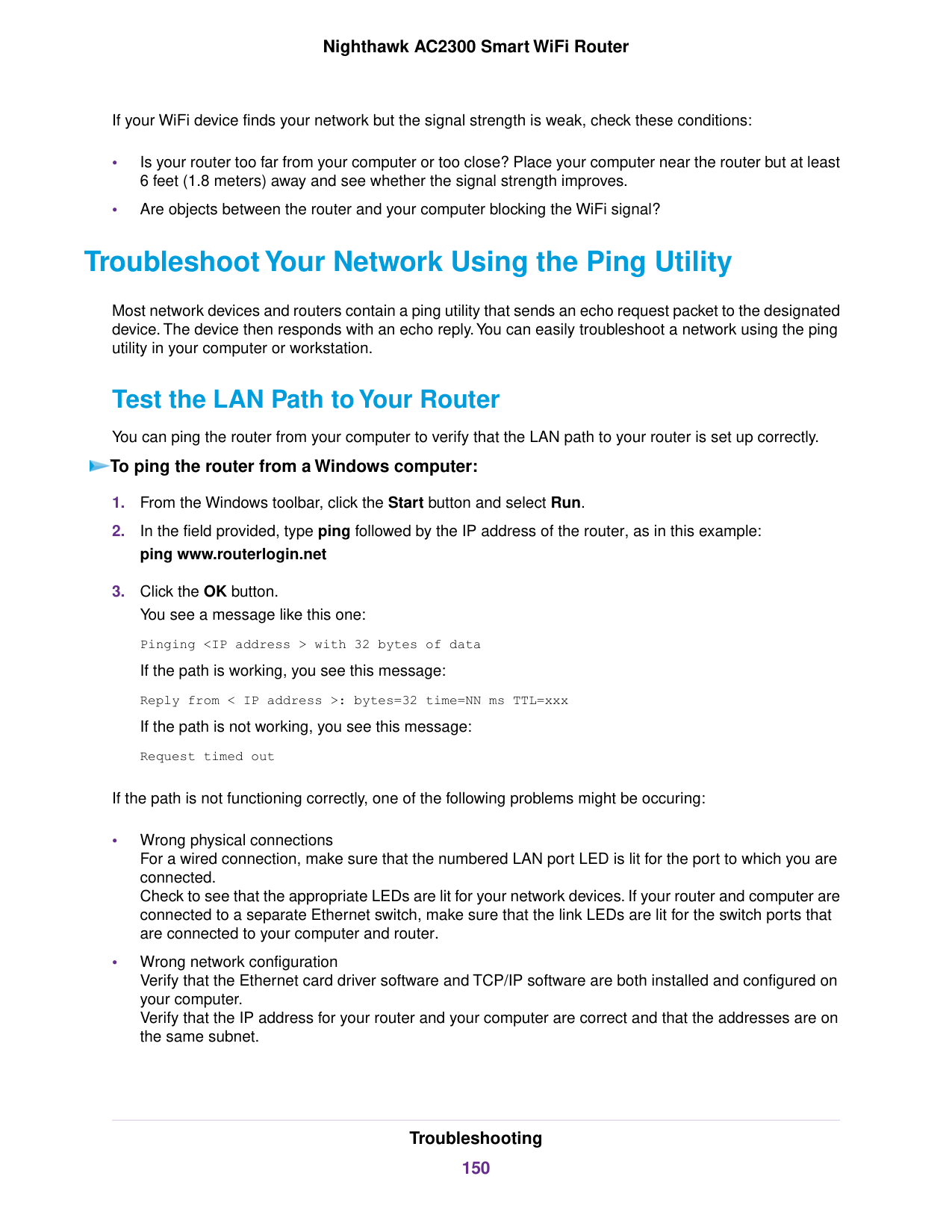
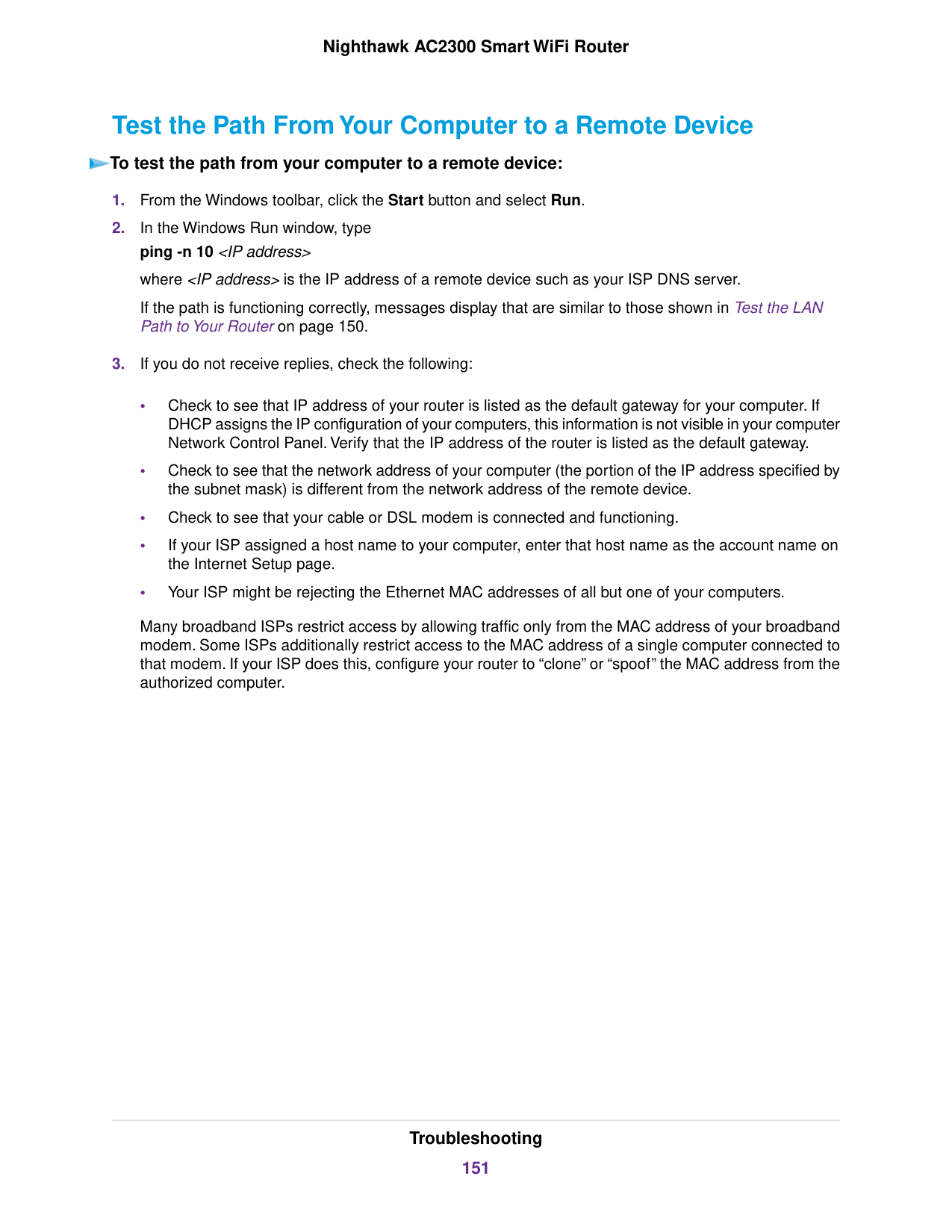
If your WiFi device finds your network but the signal strength is weak, check these conditions: • Is your router too far from your computer or too close? Place your computer near the router but at least 6 feet (1.8 meters) away and see whether the signal strength improves. • Are objects between the router and your computer blocking the WiFi signal? Troubleshoot Your Network Using the Ping Utility Most network devices and routers contain a ping utility that sends an echo request packet to the designated device. The device then responds with an echo reply.You can easily troubleshoot a network using the ping utility in your computer or workstation. Test the LAN Path to Your Router You can ping the router from your computer to verify that the LAN path to your router is set up correctly. To ping the router from a Windows computer:
Test the Path From Your Computer to a Remote Device To test the path from your computer to a remote device:
15 Supplemental Information This chapter includes technical information about your router. The chapter covers the following topics: • Factory Settings on page 153 • Technical Specifications on page 154 152
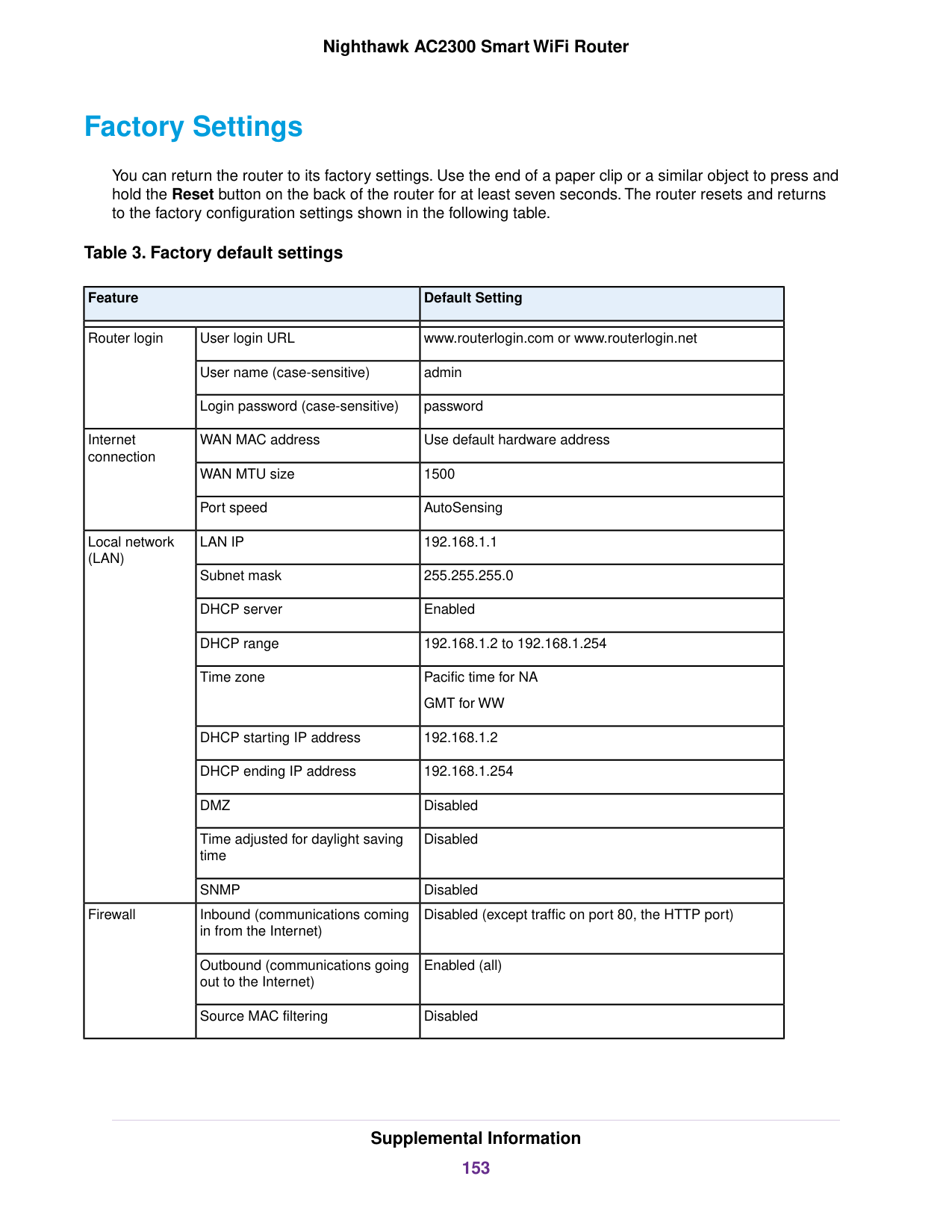
Factory Settings You can return the router to its factory settings. Use the end of a paper clip or a similar object to press and hold the Reset button on the back of the router for at least seven seconds. The router resets and returns to the factory configuration settings shown in the following table. Table 3. Factory default settings Default Setting Feature www.routerlogin.com or www.routerlogin.net User login URL Router login admin User name (case-sensitive) password Login password (case-sensitive) Use default hardware address WAN MAC address Internet connection 1500 WAN MTU size AutoSensing Port speed 192.168.1.1
Lan Ip
Local network(Lan)
255.255.255.0 Subnet mask Enabled DHCP server 192.168.1.2 to 192.168.1.254 DHCP range Pacific time for NA GMT for WW Time zone 192.168.1.2 DHCP starting IP address 192.168.1.254 DHCP ending IP address DisabledDmz
Disabled Time adjusted for daylight saving time DisabledSnmp
Disabled (except traffic on port 80, the HTTP port) Inbound (communications coming in from the Internet) Firewall Enabled (all) Outbound (communications going out to the Internet) Disabled Source MAC filtering Supplemental Information 153 Nighthawk AC2300 Smart WiFi Router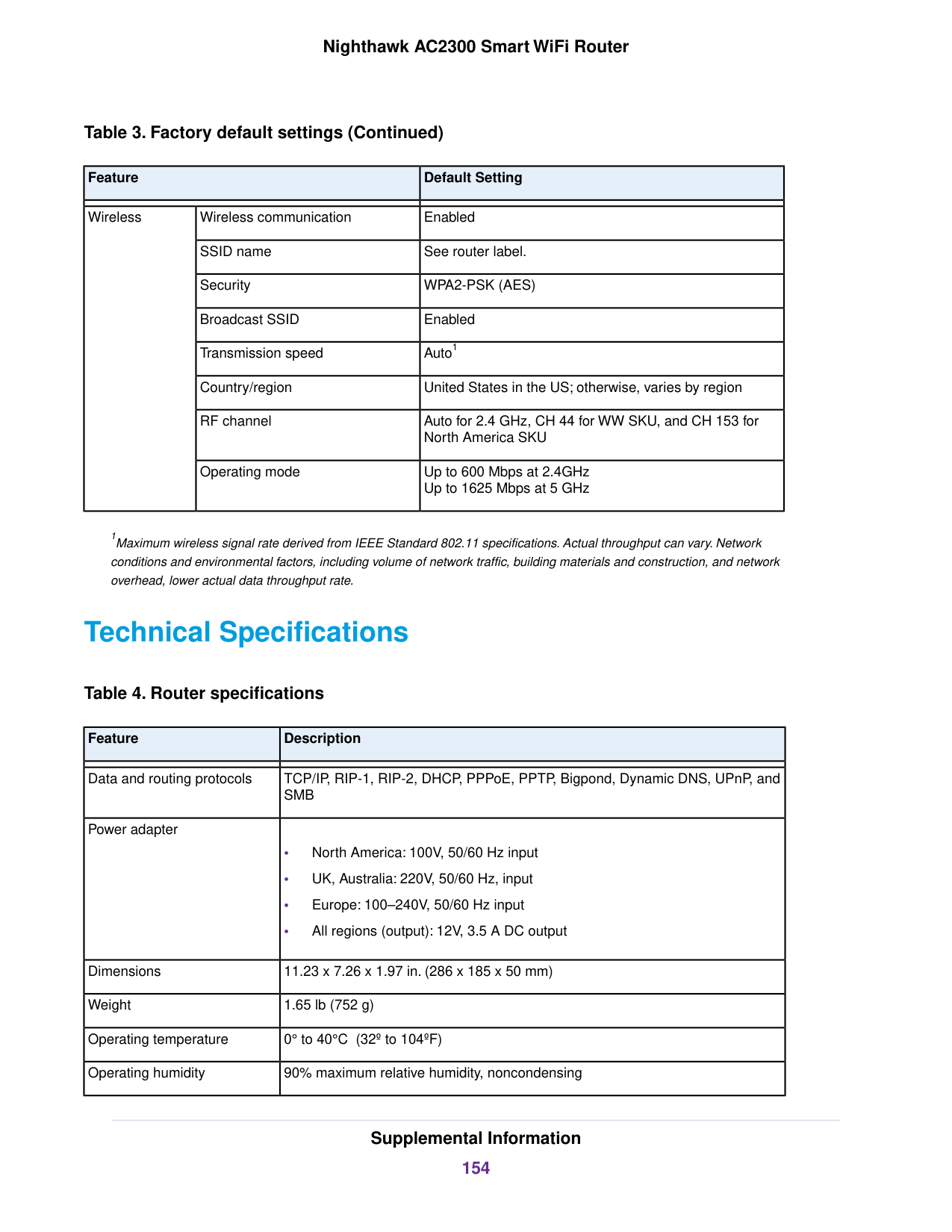
Table 3. Factory default settings (Continued) Default Setting Feature Enabled Wireless communication Wireless See router label. SSID name
Wpa2-Psk (Aes)
Security Enabled Broadcast SSID Auto1 Transmission speed United States in the US; otherwise, varies by region Country/region Auto for 2.4 GHz, CH 44 for WW SKU, and CH 153 for North America SKU RF channel Up to 600 Mbps at 2.4GHz Up to 1625 Mbps at 5 GHz Operating mode 1Maximum wireless signal rate derived from IEEE Standard 802.11 specifications. Actual throughput can vary. Network conditions and environmental factors, including volume of network traffic, building materials and construction, and network overhead, lower actual data throughput rate. Technical Specifications Table 4. Router specifications Description Feature TCP/IP, RIP-1, RIP-2, DHCP, PPPoE, PPTP, Bigpond, Dynamic DNS, UPnP, andSmb
Data and routing protocols • North America: 100V, 50/60 Hz input • UK, Australia: 220V, 50/60 Hz, input • Europe: 100–240V, 50/60 Hz input • All regions (output): 12V, 3.5 A DC output Power adapter 11.23 x 7.26 x 1.97 in. (286 x 185 x 50 mm) Dimensions 1.65 lb (752 g) Weight 0° to 40°C (32º to 104ºF) Operating temperature 90% maximum relative humidity, noncondensing Operating humidity Supplemental Information 154 Nighthawk AC2300 Smart WiFi Router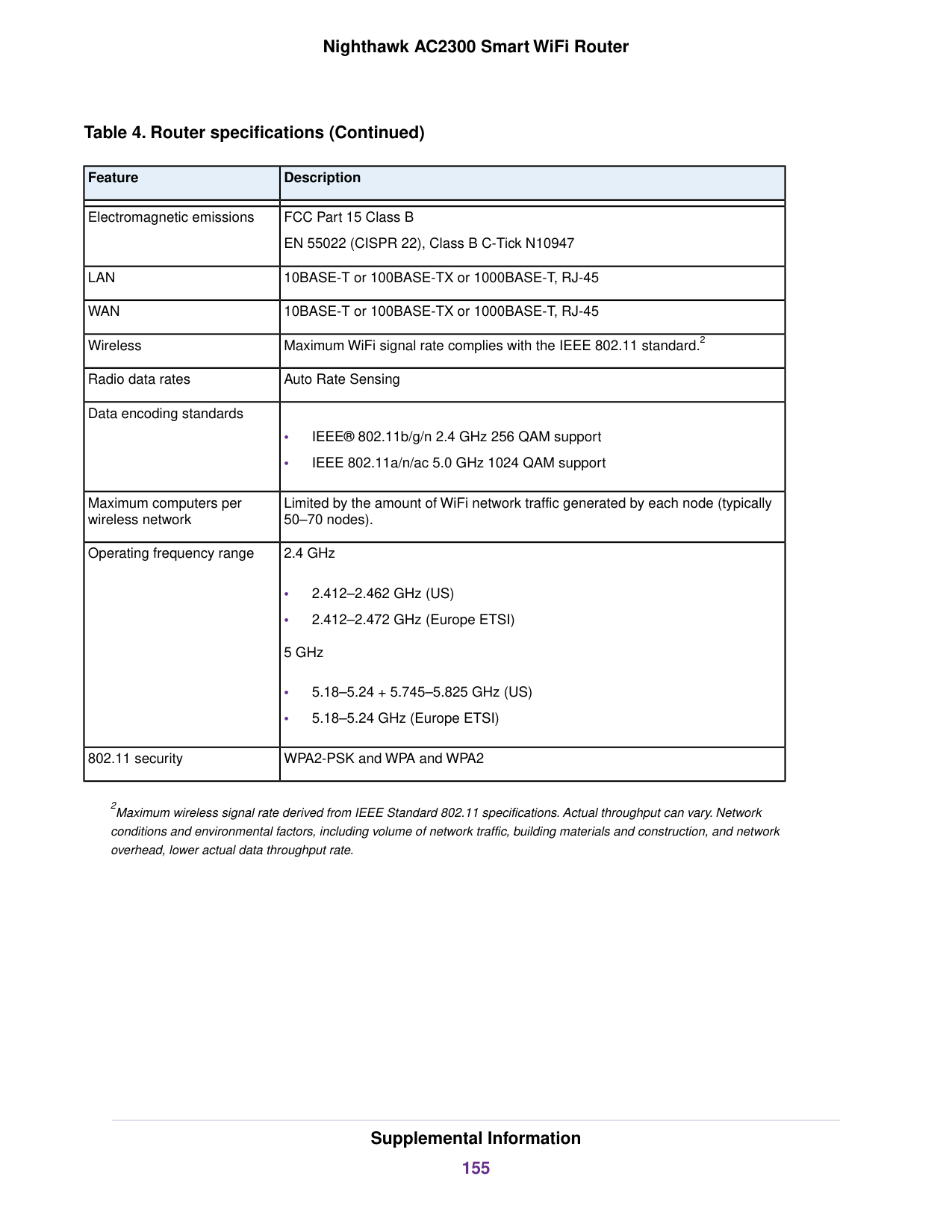
Table 4. Router specifications (Continued) Description Feature FCC Part 15 Class B EN 55022 (CISPR 22), Class B C-Tick N10947 Electromagnetic emissions 10BASE-T or 100BASE-TX or 1000BASE-T, RJ-45