
Ask AI
— answers from the official manualAnswers from the official manual.
Common questions
Common Questions
20 totalWhat are the recommended temperature settings for the refrigerator and freezer compartments?
The recommended temperature for the refrigerator compartment is 37°F (3°C). The recommended temperature for the freezer compartment is 0°F (−18°C). For long-term food storage in the freezer, the temperature should be at 0°F (−18°C) or lower.
What does it mean when 'E' or 'd' appears on the temperature display?
When 'E' or 'd' appears on the temperature display, the electronics have detected a fault. To resolve this, switch off the appliance, unplug it or switch off the circuit breaker, reconnect after 5 minutes, and switch it back on. If the message still appears, call Customer Service.
How often should I change the water filter, and how do I reset the filter change notification?
The water filter should be changed every 6 months, or when the filter indicator lights up, or if water output has visibly reduced. After replacing the filter, press and hold the filter button for 3 seconds to turn off the notification and reset the filter change status.
How do I activate Super Freezing and how long does it stay on?
Press the Super Freezing button on the control panel to switch it on — the indicator light will illuminate. It is recommended to switch on Super Freezing 1 to 2 hours before placing food weighing 4.4 lbs (2 kg) or more into the freezer compartment. After approximately 8 hours, the appliance automatically switches back to normal operation.
What should I do if the appliance is not cooling but the displays and lighting are on?
This is likely caused by Showroom mode being switched on. Press and hold the power button for 15 seconds until three audible signals sound, then press the alarm button. After a short time, check whether the appliance is cooling.
What functions are disabled when Sabbath mode is activated?
During Sabbath mode, the following functions are switched off: Super cooling, Super freezing, alarm, water dispensing, ice cube production, interior lighting, audible signals, and messages on the control panel. The brightness of the control panel lighting is also reduced. After approximately 80 hours, the appliance automatically switches back to normal mode.
Show 14 more questions
How do I clean the appliance, and what cleaning products should I avoid?
What should I do with food after a power failure?
What water pressure is required for the water dispenser and ice maker to work properly?
What should I do if water is leaking from the appliance?
How do I set up and reset the Home Connect® Wi-Fi settings?
How do I turn on the B36CT Freezer Refrigerator for the first time?
What should I do if an error code 'E' or 'd' appears on the temperature display?
How often should I change the water filter?
What is Sabbath mode and how do I activate it?
What temperature should I set for the refrigerator and freezer compartments?
How do I fix reduced water output from the dispenser?
How long does it take for ice cubes to be produced after connecting the appliance?
What should I do if the appliance is cooling but displays and lighting are not working?
How do I prepare the appliance for cleaning?
Full Manual
70 pages
Register your appliance and join the Bosch family of perks: bosch-home.com/us/ mybosch Freezer refrigerator
B36CT
Use and Care Manual Freezer refrigerator
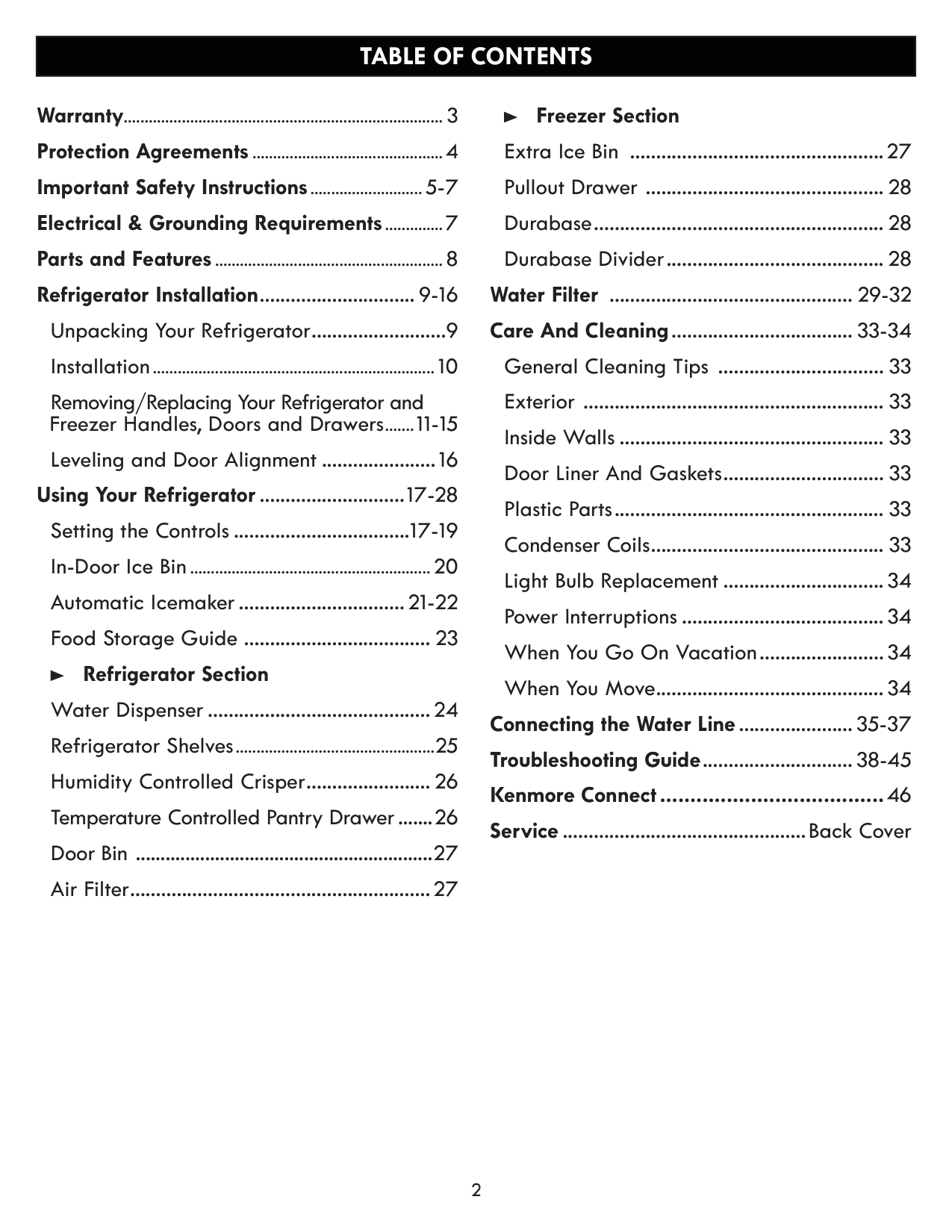
2 Table of contents 1 Safety......................................................................... 4 1.1 Safety definitions....................................................... 4 1.2 General information................................................... 4 1.3 Intended use ............................................................. 4 1.4 Restrictive Use.......................................................... 4 1.5 Safe transport ........................................................... 4 1.6 Safe installation......................................................... 4 1.7 Safe use.................................................................... 5 1.8 Damaged appliance .................................................. 5 1.9 State of California Proposition 65 Warnings .............. 6 2 Preventing material damage .................................... 7 3 Environmental protection and energy-saving ........ 7 3.1 Disposal of packaging............................................... 7 3.2 Saving energy........................................................... 7 4 Installation and connection...................................... 7 4.1 Included in delivery ................................................... 7 4.2 Criteria for the installation location ............................ 8 4.3 Installing the appliance.............................................. 8 4.4 Preparing the appliance for first use.......................... 8 4.5 Connecting the appliance to the drinking water connection ................................................................ 8 4.6 Connecting the appliance to the electricity supply ..... 8 5 Familiarizing yourself with your appliance ............. 9 5.1 Appliance.................................................................. 9 5.2 Control panel........................................................... 10 5.3 Control panel (submenu)......................................... 11 5.4 Control panel (cool-fresh compartment) .................. 12 6 Features................................................................... 12 6.1 Shelf ....................................................................... 12 6.2 Equipment bar......................................................... 12 6.3 Fixed shelf .............................................................. 13 6.4 Pull-out container .................................................... 13 6.5 Cool-fresh container................................................ 13 6.6 Container divider..................................................... 13 6.7 Flat frozen food container........................................ 13 6.8 Frozen food pull-out container................................. 13 6.9 Suspended frozen food container............................ 13 6.10 Butter and cheese compartment ........................... 13 6.11 Door tray............................................................... 13 6.12 Ice storage container............................................. 13 6.13 Accessories .......................................................... 14 7 Basic Operation ...................................................... 14 7.1 Switching on the appliance...................................... 14 7.2 Operating tips.......................................................... 14 7.3 Switching off the appliance...................................... 14 7.4 Setting the temperature unit.................................... 14 7.5 Setting the temperature........................................... 14 7.6 Cool-fresh compartment storage setting.................. 14 8 Additional functions................................................. 15 8.1 Super cooling .......................................................... 15 8.2 Super freezing.......................................................... 15 8.3 Vacation mode ......................................................... 15 8.4 Energy-savi
3 17 Troubleshooting.................................................... 28 17.1 Power failure......................................................... 30 17.2 Conducting an appliance self-test ......................... 30 18 Storage and disposal............................................ 31 18.1 Taking the appliance out of operation ................... 31 18.2 Disposal of your old appliance .............................. 31 19 Customer Service ................................................. 31 19.1 Model number (E-Nr.) and production number
(Fd) ...................................................................... 31
20 Technical specifications....................................... 31
4 Observe the following safety instructions. 1.1 Safety definitions Here you can find explanations of the safety signal words used in this manual.
Warning
This indicates that death or serious injuries may occur as a result of non-observance of this warning.Caution
This indicates that minor or moderate injuries may occur as a result of non-observance of this warning.Notice:
This indicates that damage to the appliance or property may occur as a result of non-compliance with this advisory. Note: This alerts you to important information and/or tips. 1.2 General information • Read this manual carefully. • Keep the manual and the product information in a safe place for future reference or for the next owner. • Do not connect the appliance if it has been damaged in transit. 1.3 Intended use Only use this appliance: • for chilling and freezing food, making ice and dispensing water. • for normal household use and in enclosed spaces in a residential environment. • Up to an altitude of 13,100 ft (4000 m) above sea level. 1.4 Restrictive Use This appliance is not intended for use by persons (including children) with reduced physical, sensory or mental capabilities, or lack of experience and knowledge, unless they have been given supervision or instruction concerning use of the appliance by a person responsible for their safety. Do not let children play with the appliance. Cleaning and user maintenance must not be performed by children unless they are being supervised. 1.5 Safe transportWarning
The heavy weight of the appliance may result in injury when lifted. ▶Do not lift the appliance on your own. 1.6 Safe installationWarning
Incorrect installation is dangerous. ▶Connect and operate the appliance only in accordance with the specifications on the rating plate. ▶Connect the appliance to a power supply with alternating current only via a correctly installed socket outlet with grounding. ▶The protective conductor system of the domestic electrical installation must be properly installed. ▶Never equip the appliance with an external switching device, e.g. a timer or remote control. ▶When the appliance is installed, the mains plug of the power cord must be freely accessible. If free access is not possible, an isolating switch must be integrated into the permanent electrical installation according to the installation regulations. ▶When installing the appliance, check that the power cord is not trapped or damaged. If the insulation of the power cord is damaged, that can be dangerous. ▶Never let the power cord come into contact with heat sources.Warning
If the appliance's ventilation openings are closed off, a leak in the refrigeration circuit may result in a flammable mixture of gas and air. ▶Keep ventilation openings in the appliance casing or in the integrated casing clear of obstruction.Warning
It is dangerous to use an extended power cord and non- approved adapters. ▶Do not use extension cords or multiple socket strips. ▶Only use adapters and power cords approved by the manufacturer. ▶If the power cord is too short and a longer one is not available, please contact an electrician to have the domestic installation adapted.Important Safety Instructions
Read And Save These Instructions
5 Portable multiple socket strips or portable power supply units may overheat and cause a fire. ▶Do not place portable multiple socket strips or power supply units on the back of the appliance. 1.7 Safe use
Warning
Moisture intrusion may cause an electric shock. ▶Use the appliance in enclosed spaces only. ▶Never expose the appliance to intense heat or humidity. ▶Do not use any steam cleaners or high-pressure cleaners to clean the appliance.Warning
Children may pull packaging material over their heads, or wrap themselves up in it and suffocate. ▶Keep packaging material away from children. ▶Do not allow children to play with packaging material. Children may breathe in or swallow small parts, causing them to suffocate. ▶Keep small parts away from children. ▶Do not allow children to play with small parts.Warning
If the cooling circuit is damaged, flammable refrigerant may escape and explode. ▶To accelerate the defrosting process, do not use any other mechanical devices or means other than those recommended by the manufacturer. ▶If food is stuck to the freezer compartment, loosen it with a blunt implement such as the handle of a wooden spoon. Products which contain flammable propellants and explosive substances may explode, e.g. spray cans. ▶Do not store products which contain flammable propellants (e.g. spray cans) or explosive substances in the appliance.Warning
Electrical devices placed inside the appliance may cause a fire, e.g. heaters or electric ice makers. ▶Do not operate electrical devices within the appliance.Warning
Containers which contain carbonated drinks may burst. ▶Do not store containers that contain carbonated drinks in the cool-fresh compartment below 34 °F (1 °C). ▶Do not store containers which contain carbonated drinks in the freezer compartment. Injury to the eyes caused by escaping flammable refrigerant and hazardous gases. ▶Do not damage the tubes of the refrigerant circuit or the insulation. The appliance may tip. ▶Do not stand or lean on the base, runners or doors.Warning
Contact with frozen food and cold surfaces may cause burns by refrigeration. ▶Never put frozen food straight from the freezer compartment into your mouth. ▶Avoid prolonged skin contact with frozen food, ice and surfaces in the freezer compartment.Caution
To prevent food from being contaminated, you must observe the following instructions. ▶Leaving the door open for an extended period of time may lead to a considerable temperature increase in the compartments of the appliance. ▶Regularly clean the surfaces that may come into contact with food and accessible drain systems. ▶If water has not been dispensed for 5 days, flush the water system. ▶Store raw meat and fish in suitable containers in the refrigerator so that they do not touch or drip on other food. ▶If the fridge/freezer is empty for an extended period of time, switch off the appliance, defrost it, clean it and leave the door open to prevent the formation of mold. Metal or metal-style parts in the appliance may contain aluminum. If acidic food comes into contact with aluminum in the appliance, aluminum ions may pass into the food. ▶Do not consume soiled food. 1.8 Damaged applianceWarning
If the appliance or the power cord is damaged, this is dangerous. ▶Never operate a damaged appliance. ▶Never pull on the power cord to unplug the appliance. Always unplug the appliance at the power outlet. ▶If the appliance or the power cord is damaged, immediately unplug the power cord or switch off the breaker in the circuit breaker box and turn off the water tap. ▶Call Customer Service. → Page 31Important Safety Instructions
Read And Save These Instructions
6 Improper repairs are dangerous. ▶Repairs to the appliance should only be performed by authorized service providers. ▶Only original spare parts may be used to repair the appliance. ▶If the power cord or the appliance power cable of this appliance becomes damaged, it must be replaced with a special power cord or special appliance power cable, which is available from the manufacturer or the manufacturer's Customer Service.
Warning
If the tubes are damaged, flammable refrigerant and harmful gases may escape and ignite. ▶Keep open flames and ignition sources away from the appliance. ▶Ventilate the room. ▶Switch off the appliance. → Page 14 ▶Unplug the appliance from the power source or switch off the circuit breaker in the fuse box. ▶Call Customer Service. → Page 31 1.9 State of California Proposition 65 Warnings This product may contain a chemical known to the State of California, which can cause cancer or reproductive harm. Therefore, the packaging of your product may bear the following label as required by California:Important Safety Instructions
Read And Save These Instructions
Preventing material damage
Notice:
The high weight of the appliance or, if not rolled in a straight line, the appliance's castors may damage the floor when the appliance is moved. ▶Transport the appliance using a hand-cart. ▶Use floor protection when moving the appliance, and do not move it in a zigzag fashion.When the appliance door is closed, the mullion rail should be closed (flush with the door edge) or damage may occur. ▶Never open the mullion rail manually. ▶If the mullion rail has been opened, rotate it closed (flush with the door edge) before closing the appliance door.
Using the appliance, base, runners or doors as a seat or climbing surface may damage the appliance. ▶Do not stand or lean on the appliance, base, runners or doors.
If the water pressure is too high or too low, this may impair functioning of the appliance. ▶Make sure that the water pressure in the water supply system is at least 29 psi (200 kPa) and max. 116 psi (800 kPa). ▶If the water pressure exceeds the maximum value specified, a pressure-reducing valve must be installed between the drinking water connection and the hose set of the appliance.
Modified or damaged water hoses may result in material damage and damage to the appliance. ▶Never kink, crush, modify or cut through water hoses. ▶Never re-use water hoses that have been used before. ▶Never pull on the water hose on the rear panel of the appliance.
Contamination with oil or fat may cause plastic parts and door seals to become porous. ▶Keep plastic parts and door seals free of oil and grease.
Metal or metal-style parts in the appliance may contain aluminum. When aluminum comes into contact with acidic foods, it corrodes and discolors. ▶Only store packaged food in the appliance.
If you clean fittings and accessories in the dishwasher, this may cause them to become deformed or discolor. ▶Never clean fittings and accessories in the dishwasher.
Environmental protection and energy-saving
3.1 Disposal of packaging The packaging materials are environmentally compatible and can be recycled. ▶Sort the individual components by type and dispose of them separately.
3.2 Saving energy If you follow these instructions, your appliance will use less power.
Selecting the installation location ¡ Keep the appliance out of direct sunlight. ¡ Install the appliance as far away as possible from heating elements, stoves and other heat sources: – Maintain a 1 1/4" (30 mm) clearance to electric or gas stoves. – Maintain an 11 13/16" (300 mm) clearance to oil or solid-fuel stoves. ¡ Never cover or block the external ventilation openings.
Saving energy during use Note: The arrangement of the fittings does not affect the energy consumption of the appliance. ¡ Open the appliance only briefly and then close it carefully. ¡ Never cover or block the interior ventilation openings or the exterior ventilation openings. ¡ Transport purchased food in a cooler and place quickly in the appliance. ¡ Allow warm food and drinks to cool down before storing them. ¡ Thaw frozen food in the refrigerator compartment to utilize the low temperature of the food. ¡ Always leave some space between the food and to the back panel. ¡ Vacuum the external ventilation grilles when they are dusty.
Installation and connection
4.1 Included in delivery After unpacking all the parts, check for any damage in transit and for completeness of delivery. If you have any concerns, contact your dealer or our Customer Service → Page 31.
The delivery consists of the following: ¡ Free-standing appliance ¡ Equipment and accessories1
1 Depending on the appliance specifications
Installation and connection 8 ¡ Installation material ¡ Installation instructions ¡ User manual ¡ Explanation of the limited product warranty ¡ Warranty enclosure1 ¡ Energy label ¡ Information on energy consumption and noises ¡ Information about Home Connect® 4.2 Criteria for the installation location
Warning
If the appliance is in a space that is too small, a leak in the refrigeration circuit may result in a flammable mixture of gas and air. ▶Only install the appliance in a space with a volume of at least 35 ft3 (1 m3) per 0.3 oz (8 g) refrigerant. The amount of refrigerant is indicated on the rating label. → "Appliance", Fig. 1 /13, Page 10 The weight of the appliance from factory may be up to 345 lbs (155 kg) depending on the model. The subfloor must be sufficiently stable to bear the weight of the appliance. The surface must be level. Over-and-under and side-by-side installation If you want to install 2 refrigerating appliances one over the other or side by side, you must maintain a clearance of at least 150 mm between the appliances. Selected appliances can be installed without a minimum clearance. Ask your dealer or kitchen planner about this. 4.3 Installing the appliance ▶Install the appliance in accordance with the enclosed installation instructions. 4.4 Preparing the appliance for first use
Familiarizing yourself with your appliance
5 Familiarizing yourself with your appliance
5.1 Appliance
Here you can find an overview of the parts of your appliance.
A
B
C
1 2 3 4 5 6 7 8 9 10 11 12 13 14 15 16 17 18 19 20
1 Your appliance may differ from the diagrams with regard to cosmetic features and dimensions.
A
Refrigerator compartment → Page 18B
Cool-fresh compartment → Page 19C
Freezer compartment → Page 191 Control panel → Page 10
2 Equipment bar → Page 12
3 Water dispenser → Page 21
Familiarizing yourself with your appliance
5.2 Control panel
You can use the control panel to configure all functions of your appliance and to obtain information about the operating status.
Familiarizing yourself with your appliance 11 5.3 Control panel (submenu) You can configure further settings in the submenu. 1 2 3 4 5 6 7 8 9 3 1 Displays the selected submenu. 2 / is used to navigate through the submenu. 3 opens the menu for setting Home Connect. 4 opens the menu for setting the lighting. 5 opens the menu for changing the temperature unit. 6 Displays the settings of the submenu. 7 / changes the submenu setting. 8 opens the menu for setting the door alarm. 9 opens the menu for setting the filter.
Features 12 5.4 Control panel (cool-fresh compartment) Using the control panel for the cool-fresh compartment, you can set the temperature and humidity in the cool-fresh compartment. 1 2 3 4 5 6 7 4 1 sets the cool-fresh compartment storage setting for meat and fish. 2 sets the cool-fresh compartment storage setting for fruit. 3 sets the cool-fresh compartment storage setting for vegetables. 4 sets the cool-fresh compartment storage setting for beverages. 5 sets the cool-fresh compartment storage setting for snacks. 6 lights up if user-defined settings have been set via the Home Connect® app. You can find more information in the Home Connect® app. 7 switches the button lock for the control panel (cool- fresh compartment) off. Features 6 Features Features The features of your appliance depend on the model. 6.1 Shelf Notice: If fitted at an angle, the hooks on the shelf can scratch the rear panel of the refrigerator compartment. ▶ Ensure that the shelf is horizontal and that the hooks are properly fitted in place. To vary the shelf as desired, you can remove the shelf and re-insert it elsewhere. → "Removing the shelf", Page 23 Note To avoid impeding the circulation of air, do not cover the inner ventilation openings. 6.2 Equipment bar The fittings on the equipment bar provide additional storage space in the refrigerator compartment: ¡ Store a bottle securely on the bottle shelf. ¡ Store preserving jars in the container. ¡ Store an egg carton on the shelf.
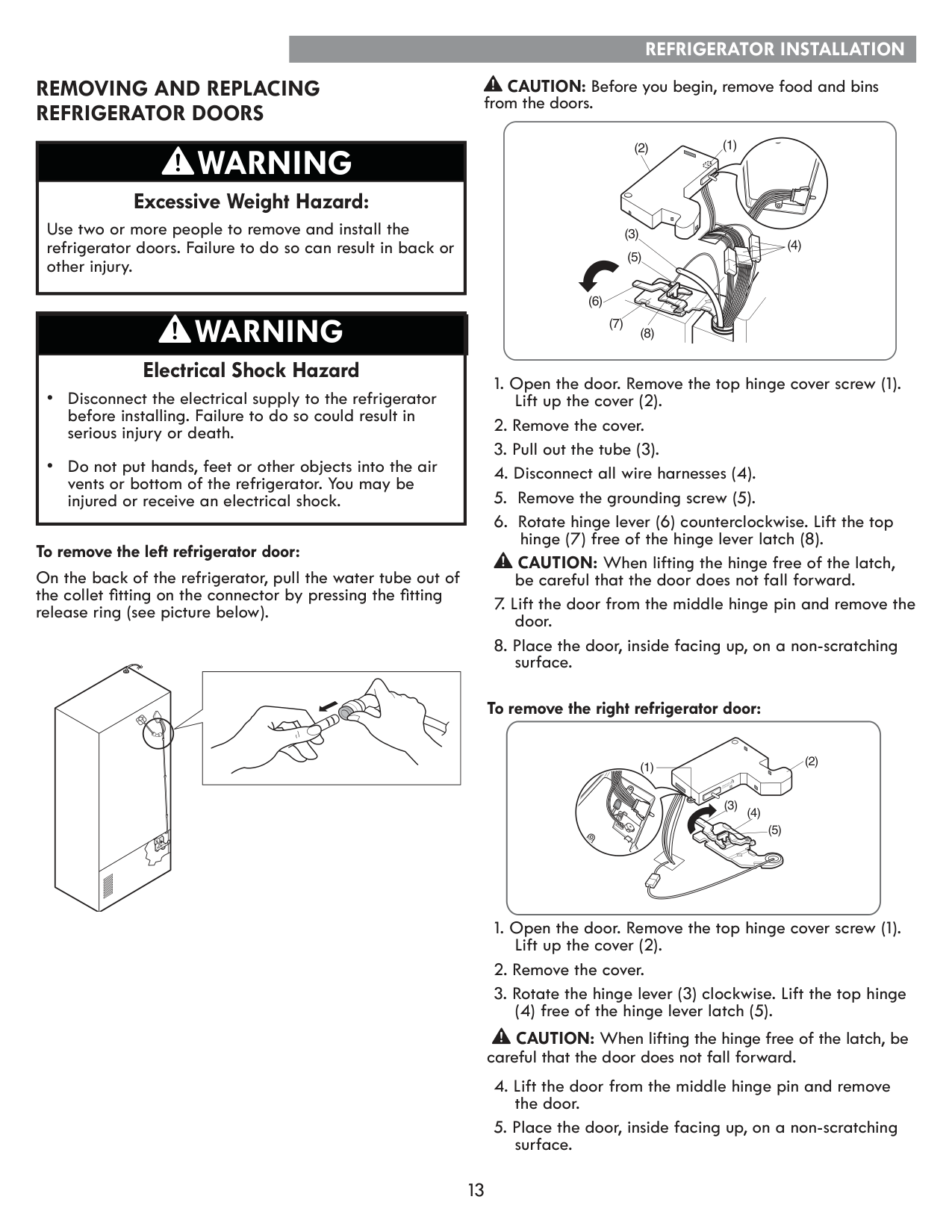
Features 13 You can position the fittings anywhere along the equipment bar.
Notice:
If fitted at an angle, the hooks on the equipment bar can scratch the rear panel of the refrigerator compartment. ▶Ensure that the equipment bar is horizontal and that the hooks are properly fitted in place. You can remove the equipment bar and re-insert it at a different location. → "Removing the equipment bar", Page 23 Tip: Position the equipment bar in the centre of the refrigerator compartment. 6.3 Fixed shelf Always put the fixed shelf in the specified position. 6.4 Pull-out container Store large plates or containers with processed food which has been covered in the pull-out container. 6.5 Cool-fresh container Use the lower temperatures in the cool-fresh container to store highly perishable food, e.g. fish, meat and sausages. 6.6 Container dividerWarning
Children may climb into the appliance and suffocate. ▶Never remove the container divider from the suspended frozen food container.Notice:
The container divider for the suspended frozen food container will be damaged if removed. ▶Never remove the container divider from the suspended frozen food container. To vary the division of the suspended frozen food container you can move the container divider. 6.7 Flat frozen food container Store flat frozen items, the ice storage container and the ice scoop in the flat frozen food container. 6.8 Frozen food pull-out container In order to achieve an improved overview and to remove frozen food more quickly, remove the frozen food pull-out container. 6.9 Suspended frozen food container Store large frozen items in the suspended frozen food container. 6.10 Butter and cheese compartment Store butter and hard cheese in the butter and cheese compartment. 6.11 Door tray To adjust the door tray as desired, you can remove the door tray, and re-insert it elsewhere. → "Removing the door tray", Page 23 6.12 Ice storage container If ice cube production is switched on, the ice cubes are automatically stored in the ice storage container.Notice:
The ice maker may become blocked or damaged by food or objects stored in the ice storage container. ▶Never store food or objects in the ice storage container. Note: To prevent the ice storage container from being overfilled, do not manually distribute the ice cubes throughout the ice storage container. Tip: To ensure that no ice cubes fall into the freezer compartment from the ice storage container, do not slam the freezer compartment drawer shut.
Basic Operation 14 6.13 Accessories Only use original accessories. These are designed especially for your appliance. The accessories for your appliance depend on the model. Ethylene absorber For important safety instructions and information about installation and use, see the enclosed installation instructions for the ethylene absorber. The ethylene absorber slows down the ripening of ethylene-sensitive fruit and vegetables to keep them fresher for longer. Installing the ethylene absorber ▶Install the ethylene absorber in accordance with the installation instructions for the ethylene absorber. Using the refill set
Additional functions 15 Additional functions 8 Additional functions Additional functions Find out which additional functions can be used for your appliance. 8.1 Super cooling With Super cooling, the refrigerator compartment cools as cold as possible. Switch on Super cooling before placing large quantities of food in the refrigerator compartment. Note: When Super cooling is switched on, increased noise may occur. Switching on Super cooling ▶Press . a lights up. Note: After approximately 6 hours, the appliance switches to normal operation. Switching off Super cooling ▶Press . a The previously set temperature is displayed. 8.2 Super freezing With Super freezing, the freezer compartment cools as cold as possible. Switch on Super freezing 1 to 2 hours before placing food weighing 4.4 lbs (2 kg) or more into the freezer compartment. Use Super freezing to accelerate ice cube production. Note: When Super freezing is switched on, increased noise may occur. Switching on Super freezing ▶Press . a lights up. Note: After approximately 8 hours, the appliance switches to normal operation. Switching off Super freezing ▶Press . a The previously set temperature is displayed. 8.3 Vacation mode If you are going to be away for a long time, you can switch on energy-saving vacation mode on the appliance. Caution The refrigerator compartment heats up while the vacation mode is switched on. The increased temperature may cause bacteria to increase and spoil the food. ▶When the vacation mode is switched on, do not store any food in the refrigerator compartment. The appliance automatically sets the temperatures. Refrigerator compartment 43 °F (6 °C) Cool-fresh compartment 40 °F (4 °C) Freezer compartment Temperature remains unchanged Note: While the vacation mode is activated, the ice cube production and the water dispenser are switched off. Switching on vacation mode ▶Press . a lights up. Switching off vacation mode ▶Press . a The previously set temperature is displayed. 8.4 Energy-saving mode You can set the appliance to save energy with the energy- saving mode. The appliance automatically sets the temperatures. Refrigerator compartment 43 °F (6 °C) Cool-fresh compartment 32 °F (0 °C) Freezer compartment 6 °F (−14 °C) Switching on energy-saving mode ▶Press . a lights up. Switching off energy-saving mode ▶Press . a The previously set temperature is displayed. 8.5 Freshness mode In order to keep the food fresh longer, you can switch on the freshness mode on the appliance. The appliance automatically sets the temperatures. Refrigerator compartment 36 °F (2 °C) Cool-fresh compartment 32 °F (0 °C) Freezer compartment Temperature remains unchanged Switching on freshness mode ▶Press . a lights up. Switching off freshness mode ▶Press . a The previously set temperature is displayed.
Alarm 16
8.6 Interior lighting You can switch the interior lighting off or set the brightness. 0 The interior lighting is switched off 1 Minimum brightness 5 Maximum brightness
Setting the interior lighting
8.7 Sabbath mode To ensure that you can also use the appliance on the Sabbath, the Sabbath mode switches off all non-essential functions.
During Sabbath mode, the following functions are switched off: ¡ Super cooling ¡ Super freezing ¡ Alarm ¡ Water dispensing ¡ Ice cube production ¡ Interior lighting ¡ Audible signals ¡ Messages on the control panel
Note: The brightness of the control panel lighting is reduced during the Sabbath mode.
Switching on Sabbath mode ▶Press and hold for 10 seconds until an audible signal sounds. a lights up.
Note: After approx. 80 hours, the appliance switches to normal mode.
Switching off Sabbath mode ▶Press and hold for 5 seconds until an audible signal sounds.
8.8 Filter change notification Every 6 months, the filter change notification will come on. lights up.
Note: Increased water consumption switches the filter change notification on sooner.
Switching off the filter change notification
8.9 Filter change status If you replace the filter before the filter change notification, reset the filter change status.
1 The measurement of the filter change status is running 0 Reset the filter change status
Resetting the filter change status
9 Alarm
9.1 Door alarm If the appliance door is open for a while, the door alarm switches on.
A warning tone sounds and flashes.
Switching off the door alarm ▶Close the appliance door or press . a The warning tone is switched off. a goes out.
Door alarm warning signal You can activate or deactivate the door alarm warning tone.
On Door alarm warning tone activated
Off Door alarm warning tone deactivated
Activating the door alarm warning signal
Deactivating the door alarm warning signal
17 9.2 Temperature alarm If the freezer compartment becomes too warm, the temperature alarm will switch on. A warning tone sounds and the set temperature (freezer compartment) and flash.
Caution
During the thawing process, bacteria may multiply and spoil the frozen food. ▶Do not refreeze partly or completely thawed food. ▶Refreeze food only after cooking. ▶The frozen items should no longer be stored for the maximum storage period.The temperature alarm can be switched on in the following cases: ¡ The appliance is switched on. Do not store any food until the appliance has reached the set temperature. ¡ Large quantities of fresh food are being placed inside. Switch on Super freezing before placing large quantities of food in the appliance. ¡ The freezer compartment door is open for too long. Check whether the frozen food has defrosted or thawed.
Switching off the temperature alarm ▶Press . a The warning tone is switched off. a The temperature display (freezer compartment) briefly indicates the warmest temperature reached in the freezer compartment. The temperature display (freezer compartment) then indicates the set temperature again. a From this time on, the warmest temperature is recalculated and saved.
10 Home Connect®
Home Connect®
This appliance is network-capable. Connecting your appliance to a mobile device lets you control its functions via the Home Connect® app.
The Home Connect® services are not available in every country. The availability of the Home Connect® function depends on the availability of Home Connect® services in your country. You can find information on this at: www.home-connect.com.
To be able to use Home Connect®, you must first set up the connection to the WLAN home network (Wi-Fi 1) and to the Home Connect® app.
After switching on the appliance, wait at least 2 minutes until internal device initialization is complete. Only then should you set up Home Connect®.
The Home Connect® app guides you through the entire registration process. Follow the instructions in the Home Connect® app to implement the settings.
Tip: Follow the instructions in the Home Connect® app as well.
Notes ¡ Also note the safety information in this instruction manual and ensure that it is also observed when operating the appliance using the Home Connect® app. → "Safety", Page 4 ¡ Operating the appliance on the appliance itself always takes priority. It is not possible to operate the appliance using the Home Connect® app during this time.
10.1 Setting up the Home Connect® app
10.2 Setting up Home Connect® Requirements ¡ The Home Connect® app is installed on your mobile device. ¡ The appliance receives signals from the WLAN home network (Wi-Fi) at its installation location.
10.3 Checking the signal strength You should check the signal strength if no connection could be established.
1 Wi-Fi is a registered trade mark of the Wi-Fi Alliance.
Refrigerator compartment
Improving the reception If the signal strength is too weak, the connection may be interrupted. ▶Carry out one of the solution options: ‒ Place the router and refrigerator closer together. ‒ Ensure that the connection is not interfered with by screening walls. ‒ Install a repeater to strengthen the signal.
10.4 Installing updates for the Home Connect software The appliance searches for updates to the Home Connect® software at regular intervals. Note: If updates are available, the submenu display shows . To cancel the update and reset the submenu display to the set temperature, press any touch field.
10.5 Resetting the Home Connect® settings If your appliance experiences connection problems with the WLAN home network (Wi-Fi) or your appliance wants to log into a different WLAN home network (Wi-Fi), you can reset the Home Connect® settings.
10.6 Remote diagnostics Customer Service can access your appliance via Remote Diagnostics if you ask them to do so, if your appliance is connected to the Home Connect® server and if Remote Diagnostics is available in the country where you are using the appliance. Tip: Further information and details about the availability of Remote Diagnostics in your country can be found in the Service/Support section of your local website: www.home- connect.com.
10.7 Data Protection Please read this information on data protection. The first time your appliance is registered on a home network connected to the Internet, your appliance transmits the following types of data to the Home Connect® server (initial registration): ¡ Unique appliance identification (consisting of appliance codes as well as the MAC address of the installed Wi-Fi communication module). ¡ Security certificate of the Wi-Fi communication module (to ensure a secure data connection). ¡ The current software and hardware version of your home appliance. ¡ Status of any previous reset to factory settings. This initial registration prepares the Home Connect® functions for use and is only required when you want to use the Home Connect® functions for the first time. Note: Please note that the Home Connect® functions can only be used in conjunction with the Home Connect® app. Information on data protection can be retrieved in the Home Connect® app.
11 Refrigerator compartment
You can keep dairy products, eggs, prepared meals, pastries, open preserves and hard cheese in the refrigerator compartment. The temperature can be set from 33 °F (1 °C) to 43 °F (6 °C). The refrigerator compartment can also be used to store highly perishable foods in the short to medium term. The lower the selected temperature, the longer the food remains fresh.
11.1 Tips for storing food in the refrigerator compartment ¡ Only store food when fresh and undamaged. ¡ Store food covered or in air-tight packaging. ¡ To avoid impeding the circulation of air and to prevent food from freezing, do not place food in front of the inner ventilation openings or in direct
Cool-fresh compartment 19 ¡ Observe the best-before date or expiration date specified by the manufacturer. 11.2 Chill zones in the refrigerator compartment The air circulation in the refrigerator compartment creates different chill zones. Coldest zone The coldest zone is in the pull-out container. Tip: Store highly perishable food such as fish, sausages and meat in the cool-fresh compartment. → "Cool-fresh compartment", Page 19 Warmest zone The warmest zone is at the very top of the door. Tip: Store groceries that do not spoil easily in the warmest zone, e.g. hard cheese and butter. Cheese can then continue to release its flavor and the butter will still be easy to spread. Cool-fresh compartment 12 Cool-fresh compartment Cool-fresh compartment In the cool-fresh compartment, you can keep fresh food fresh up to three times longer than in the refrigerator compartment. The temperature can be set from 29 °F (−2 °C) to 40 °F (4 °C) using pre-defined storage settings. Storing food in the cool-fresh compartment retains the quality of the food better. The low temperature and the optimum moisture provide ideal storage conditions for fresh food. 12.1 Storage recommendations for the cool- fresh compartment Storage setting Food Meat, fish and seafood Fruit, mixed load with fruit and vegetables, sausage, cheese and dairy products Vegetables Beverages Snacks and other items Tip: Fruit, vegetables, drinks and snacks may freeze below 32 °F (0 °C). Only use the storage setting for meat and fish. Freezer compartment 13 Freezer compartment Freezer compartment You can store frozen food, freeze food and make ice cubes in the freezer compartment. The temperature can be set from 6 °F (−14 °C) to −7 °F (−22 °C). Long-term storage of food should be at 0 °F (−18 °C) or lower. The freezer compartment can be used to store perishable food long-term. The low temperatures slow down or stop the spoilage. 13.1 Tips for storing food in the freezer compartment ¡ Store food in air-tight packaging. ¡ Do not bring food which is to be frozen into contact with frozen food. ¡ Distribute the food over a wide area in the suspended frozen food container. 13.2 Tips for freezing fresh food ¡ Freeze fresh and undamaged food only. ¡ Freeze food in portions. ¡ Cooked food is more suitable for freezing than food that can be eaten raw. ¡ Vegetables: Wash, chop up and blanch before freezing. ¡ Fruit: Wash, pit and perhaps peel, possibly add sugar or ascorbic acid solution. ¡ Food that is suitable for freezing includes baked items, fish and seafood, meat, game, poultry, eggs without shells, cheese, butter and curd cheese, prepared meals and leftovers. ¡ Food that is unsuitable for freezing includes lettuce, radishes, eggs in shells, grapes, raw apples and pears, yogurt, sour cream, crème fraîche and mayonnaise. Packing frozen food If you select suitable packaging material and the correct type of packaging, you can determine the product quality and prevent freezer burn.
Water system
Water system
Your appliance is equipped with water-carrying components.
The water system only works if a water filter or a bypass cap is installed.
Switch off ice cube production before disconnecting the appliance from the drinking water connection. → Page 22
Water filter
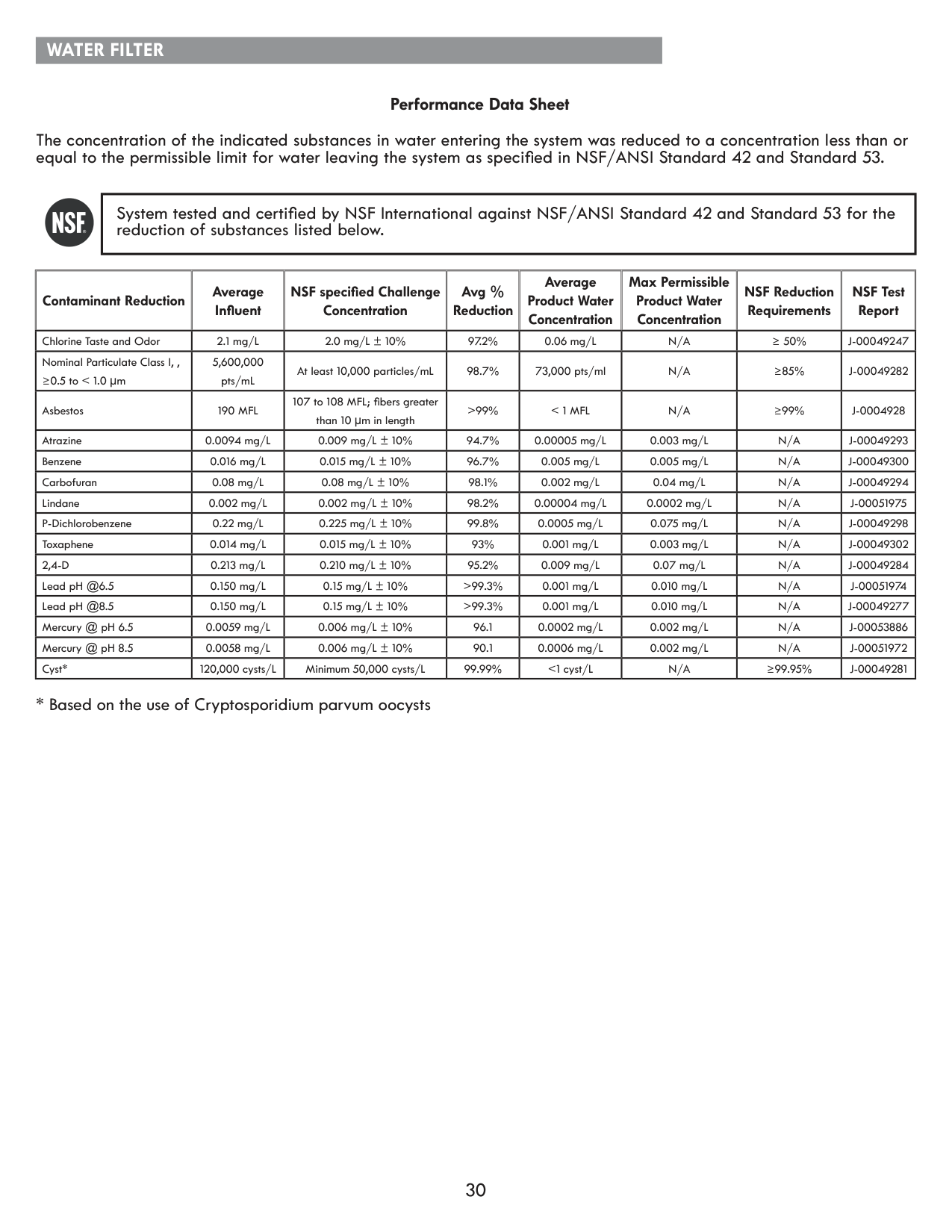
The water filter filters particles and the taste of chlorine out of the water.
The water filter reduces further contamination, e.g. from chloramines, lead and pharmaceutical products.
Note: The water filter does not filter bacteria or microbes out of the water.
Change the water filter: ¡ Every 6 months. ¡ If lights up. ¡ If the water output has visibly reduced.
Tips ¡ A new water filter can be purchased from our customer service, your dealer or our website. ¡ If you do not want to use a water filter in your appliance or an external water filter system is installed, you can permanently replace the water filter with a bypass cap. The bypass cap filters only large particles out of the water and can be cleaned as required. A bypass cap can be purchased from customer service or our website.
Filter change notification
Every 6 months, the filter change notification will come on. lights up.
Note: Increased water consumption switches the filter change notification on sooner.
Switching off the filter change notification
Filter change status
If you replace the filter before the filter change notification, reset the filter change status.
1 The measurement of the filter change status is running 0 Reset the filter change status
Resetting the filter change status
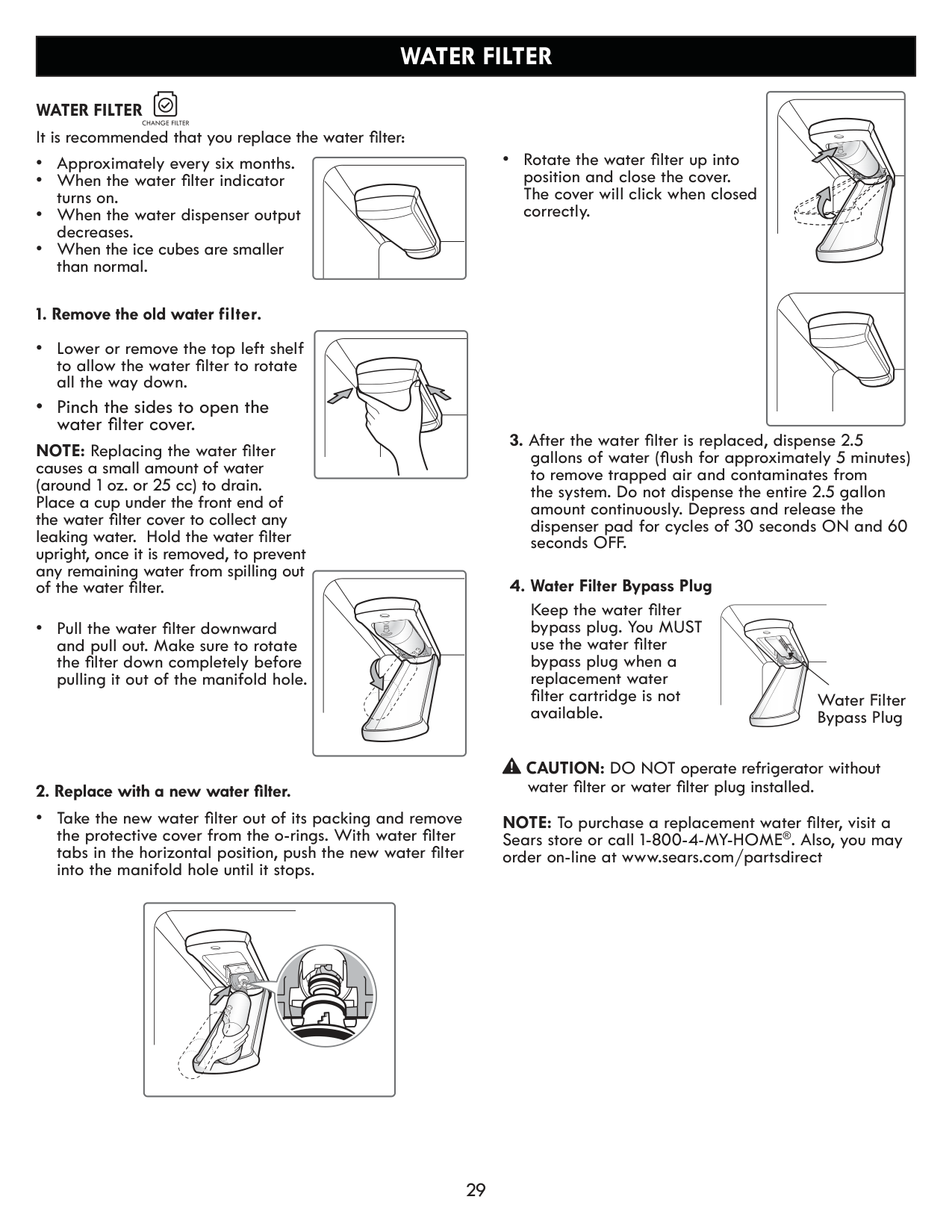
Changing the water filter or replacing it with a bypass cap
Note: When removing it, a small amount of water may drip out of the water filter. Remove the drips of water with a dry cloth.
Tip: You can dispose of the old water filter with your household garbage.
Water system 21 14.2 Water dispenser Dispense cold water via the water dispenser. Putting the water dispenser into operation Note: Once the appliance has been connected or a new water filter has been installed, there will be air in the water system. Requirement: The appliance is connected to the drinking water connection.
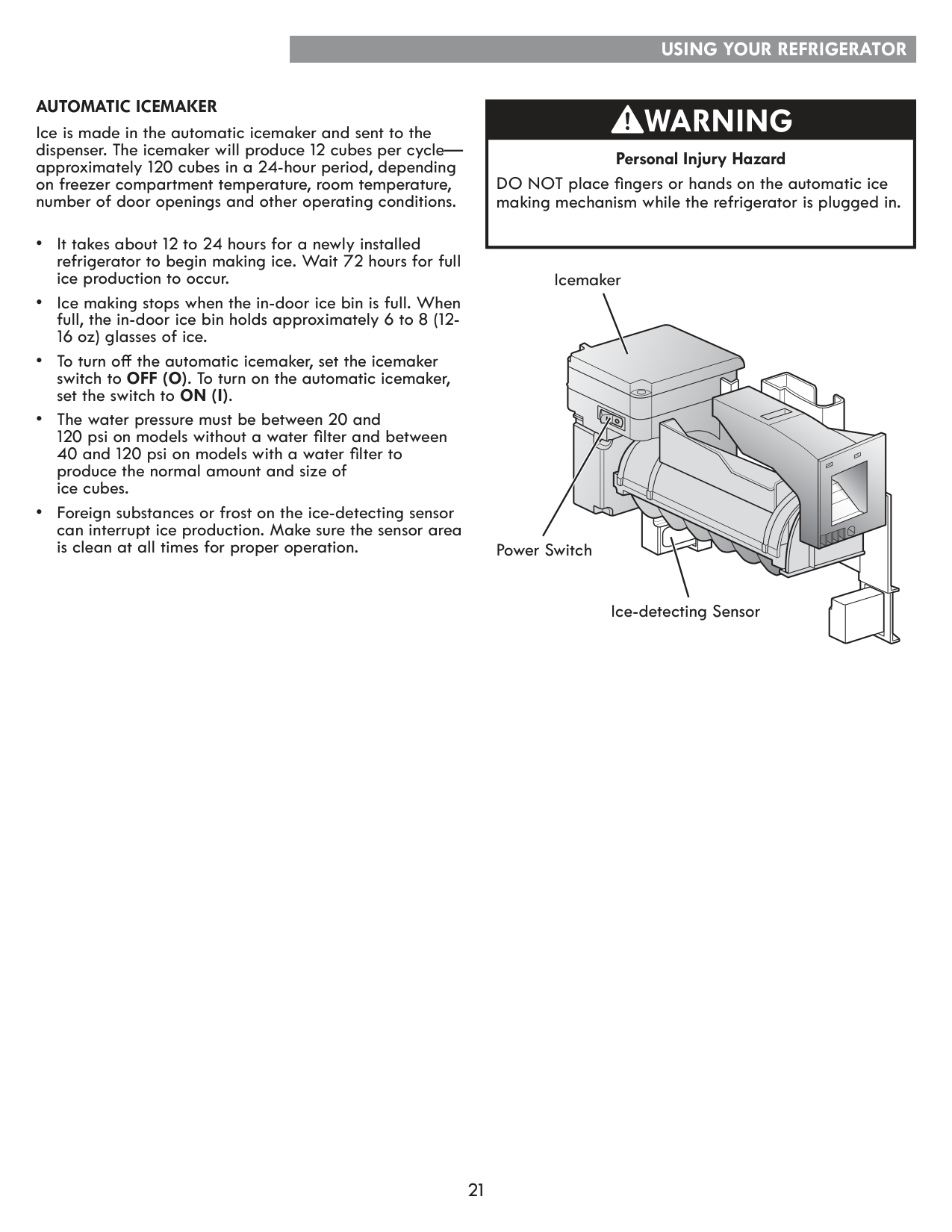
Warning
Rotating parts may cause injury. ▶Never reach into or underneath the ice maker. Note: The ice cube maker automatically detects that the ice storage container is full and stops producing ice cubes. It may take up to 48 hours until the ice storage container is full. Tips ¡ You can accelerate ice cube production by setting a colder freezer compartment temperature or by switching on Super freezing. This slightly increases the energy consumption. ¡ If the ice cubes taste stale, dispose of the remaining ice cubes and the cubes produced over the next 24 hours. If the ice cubes still taste stale, change the water filter. Putting the ice maker into operation Notes ¡ Ice cube production starts as soon as the appliance is switched on and the freezer compartment has reached the set temperature. ¡ As soon as the freezer compartment reaches the set temperature, the first batch of ice cubes will be ready in approximately 4 hours. Requirement: The appliance is connected to the drinking water connection. ▶For hygiene reasons, discard the ice cubes produced within the first 24 hours. Switching on ice cube production ▶Lift the ice maker cover upwards and press the ice maker button. a The ice maker button lights up. Note: If you press and hold the ice maker button for 3 seconds, the filter change status is reset.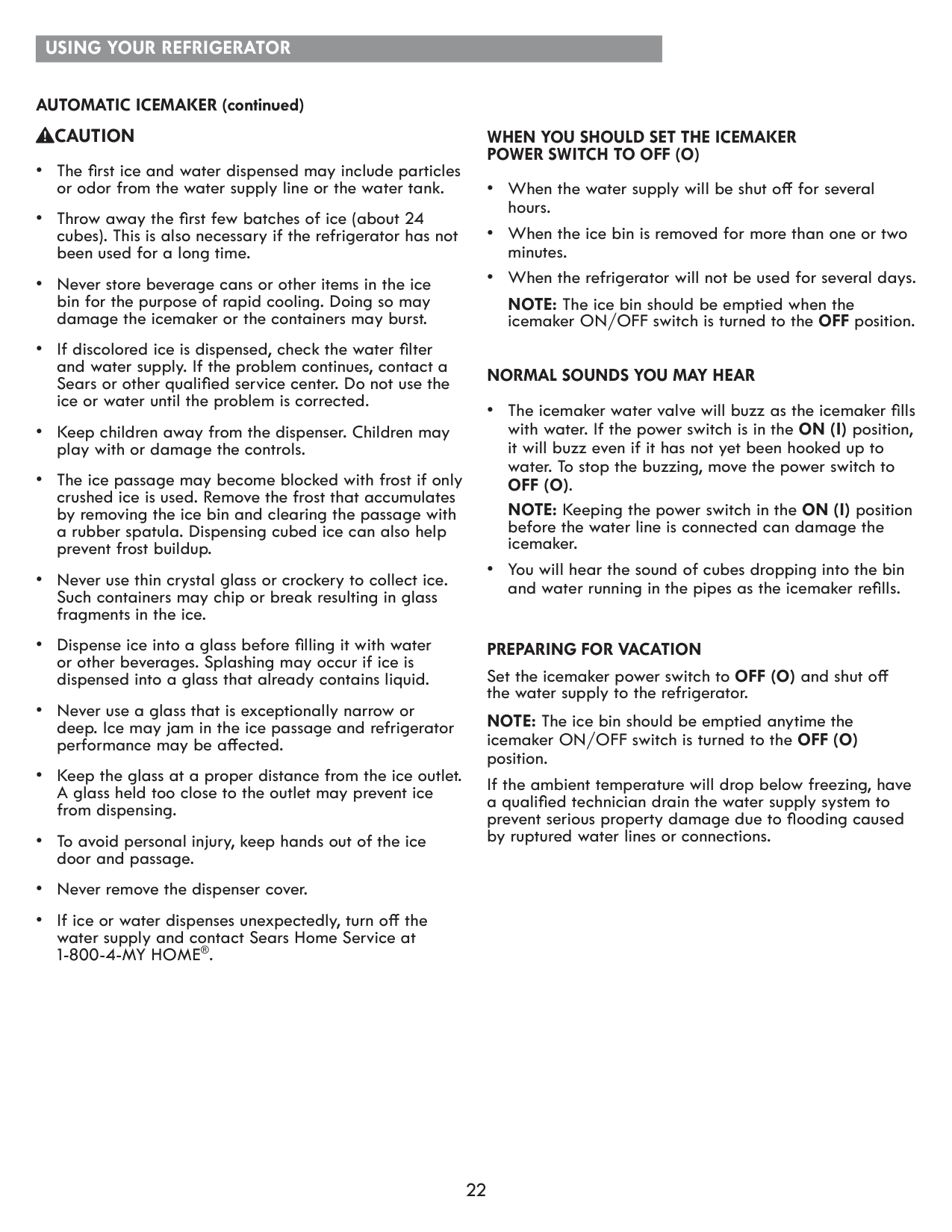
Defrosting
Switching off ice cube production ▶Lift the ice maker cover upwards and press the ice maker button . a The ice maker button goes out. Note: If you press and hold the ice maker button for 3 seconds, the filter change status is reset.
Defrosting
15 Defrosting
Defrosting
15.1 Defrosting in the refrigerator compartment The refrigerator compartment in your appliance defrosts automatically.
15.2 Defrosting in the cool-fresh compartment The cool-fresh compartment in your appliance defrosts automatically.
15.3 Defrosting in the freezer compartment The fully automatic NoFrost system ensures that the freezer compartment remains frost-free. Defrosting is not required.
Cleaning and maintenance
16 Cleaning and maintenance
Cleaning and maintenance
To keep your appliance working efficiently for a long time, it is important to clean and maintain it carefully. Customer Service must clean inaccessible points. Cleaning by Customer Service can give rise to costs.
16.1 Preparing the appliance for cleaning
16.2 Cleaning the appliance
Warning Moisture intrusion may cause an electric shock. ▶Do not use any steam cleaners or high-pressure cleaners to clean the appliance.
Notice: Unsuitable cleaning agents may damage the surfaces of the appliance. ▶Do not use hard scouring pads or cleaning sponges. ▶Do not use strong or abrasive cleaning agents. ▶Do not use cleaning agents with a high alcohol content. ▶Do not use stainless-steel cleaning agents on the outside of the appliance.
If you clean fittings and accessories in the dishwasher, this may cause them to become deformed or discolor. ▶Never clean fittings and accessories in the dishwasher.
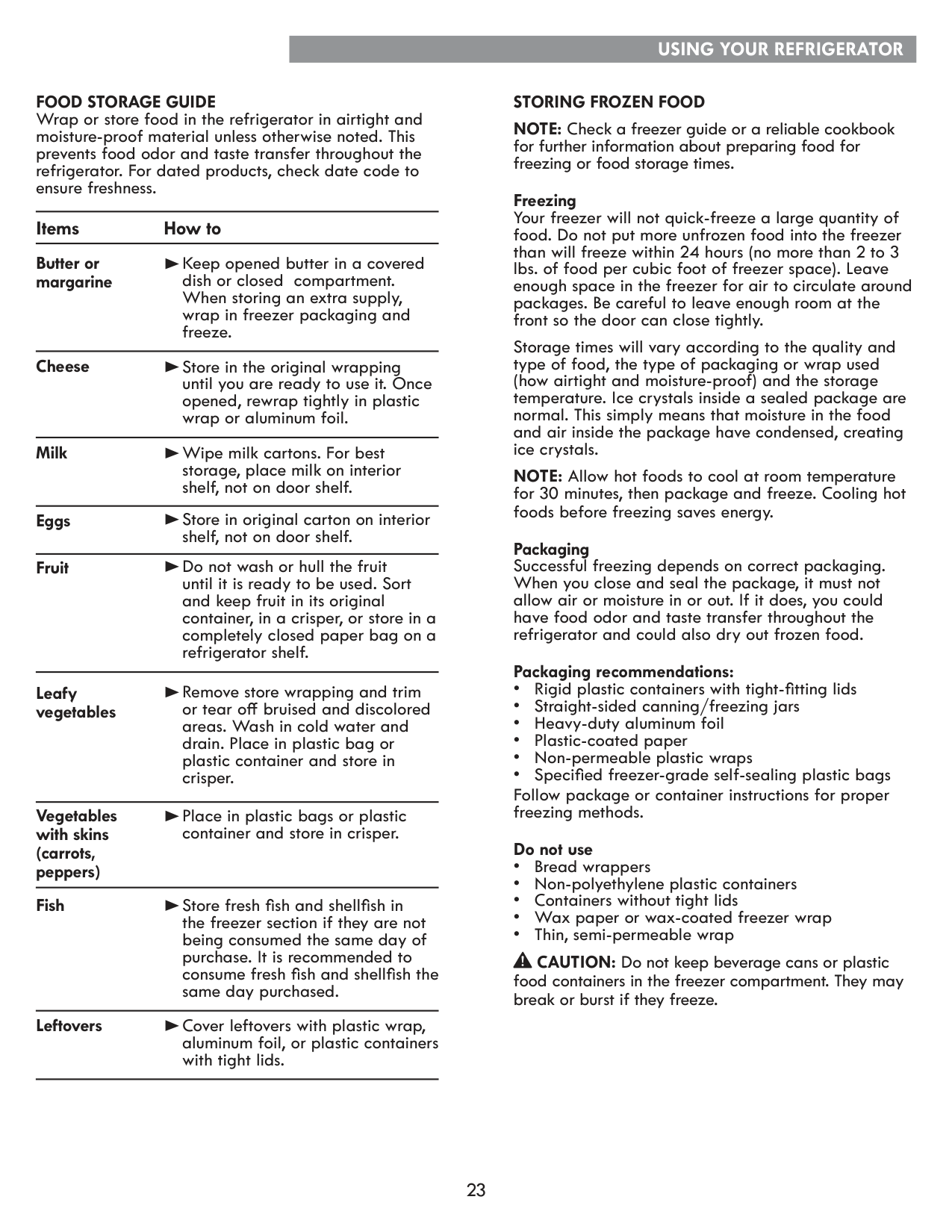
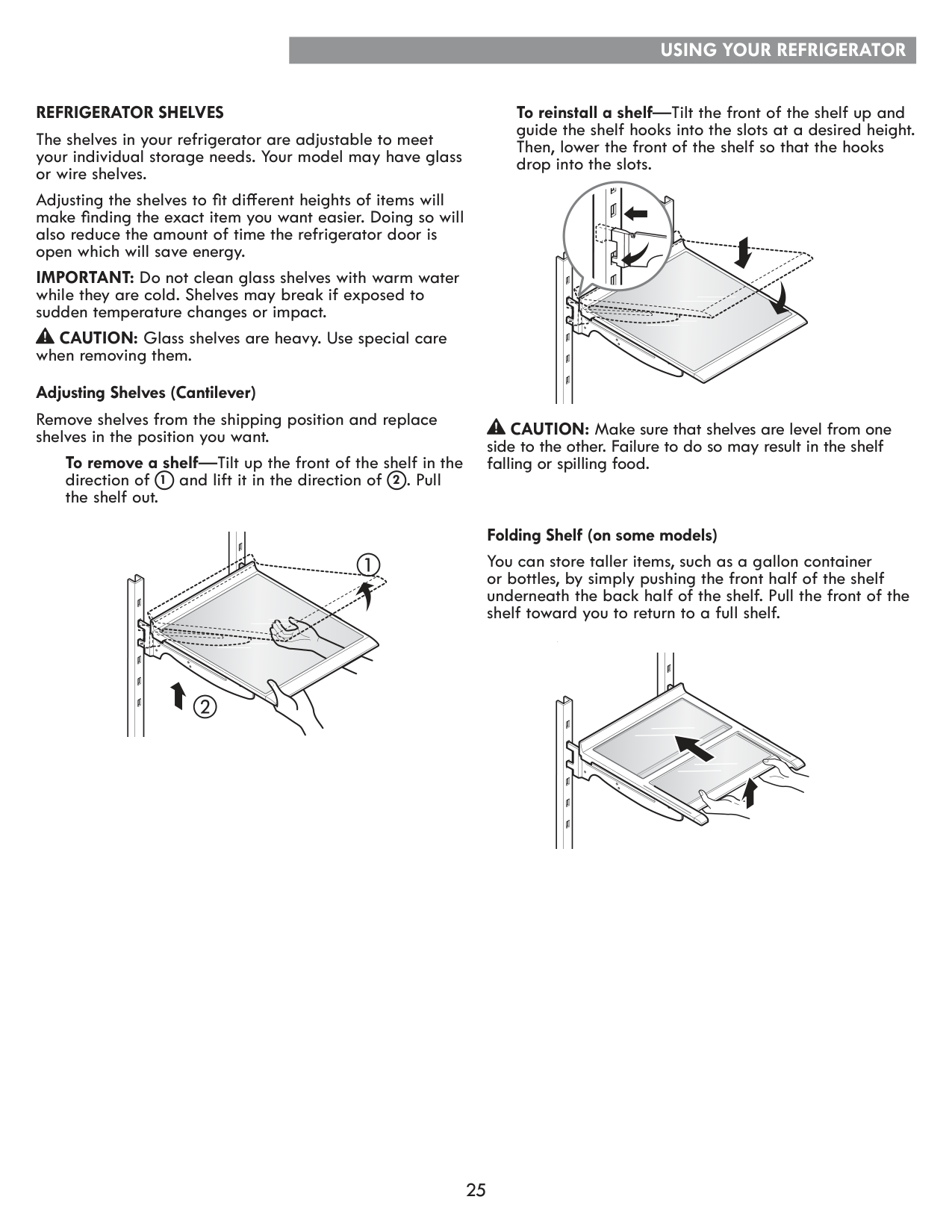
Cleaning and maintenance 23 16.3 Removing the fittings If you want to clean the fittings thoroughly, remove these from your appliance. Removing the shelf ▶Lift the shelf and remove it.
Removing the equipment bar ▶Lift the equipment bar and remove it.
Removing the fixed shelf
Removing the door tray ▶Lift the door tray and remove it.
Removing the pull-out containers
Removing the cool-fresh container
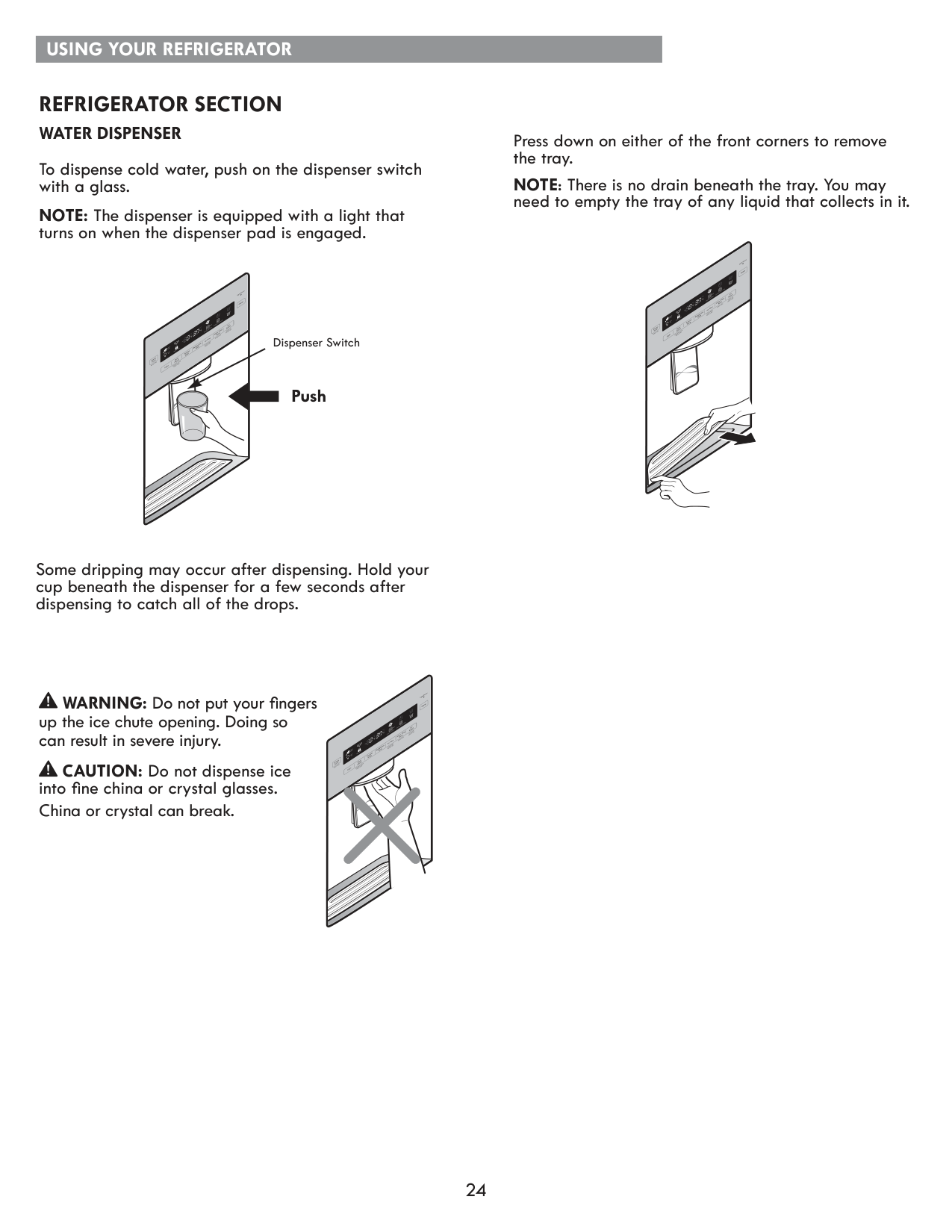
Cleaning and maintenance
Removing the frozen food pull-out container
Removing the flat frozen food container
Removing the ice cube container
Removing the suspended frozen food container ▶ Lift out the suspended frozen food container.
Cleaning and maintenance 25 16.4 Removing the appliance components If you want to clean your appliance thoroughly, you can remove certain components from your appliance. Telescopic rails You can remove the telescopic rails in order to clean them thoroughly. Removing the telescopic rails
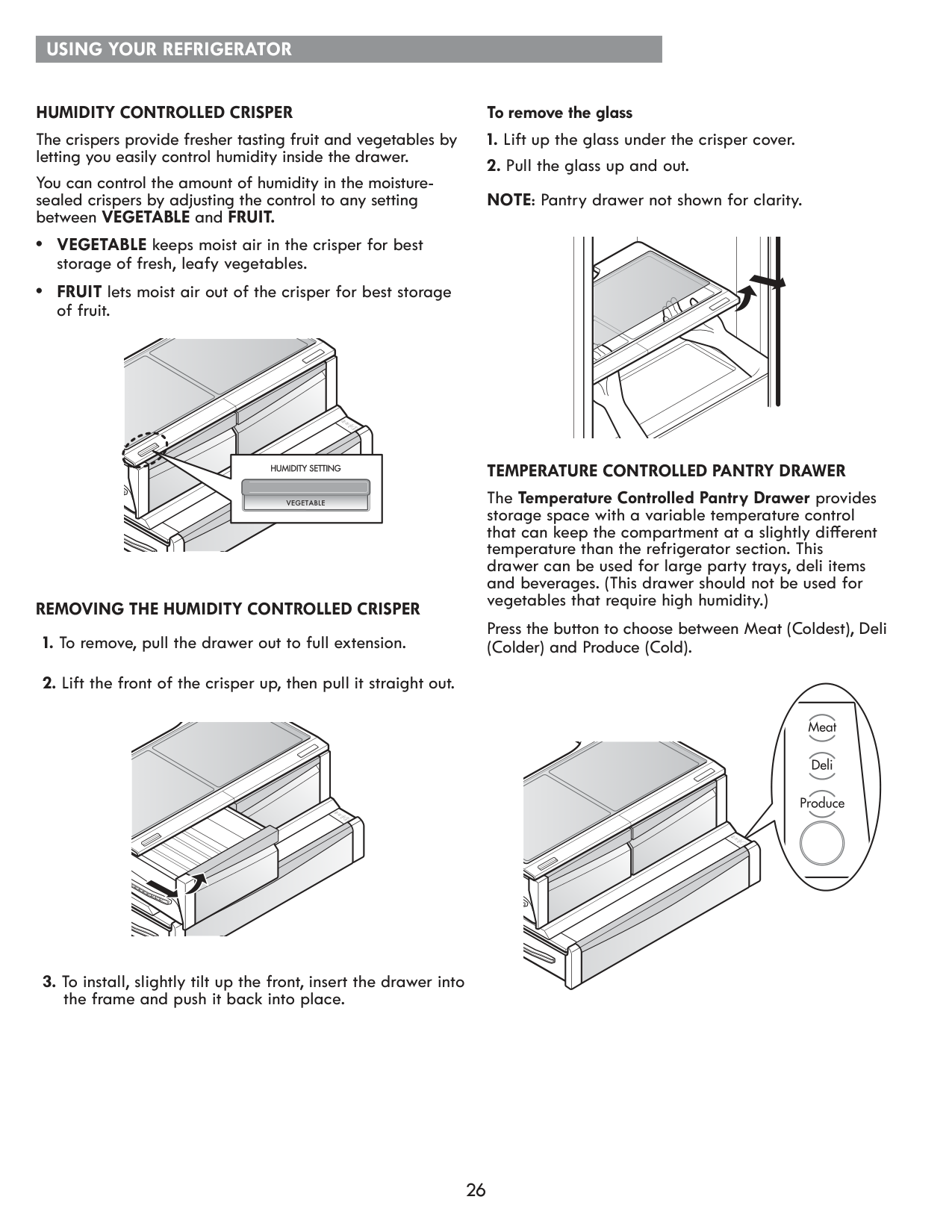
Cleaning and maintenance
Removing the refrigerator compartment glass plate
Install the refrigerator compartment glass plate ▶Place the refrigerator compartment glass plate at the rear of the base of the refrigerator compartment and lower it.
Cool-fresh container cover To clean the cool-fresh container cover thoroughly, you can remove it.
Removing the cool-fresh container cover
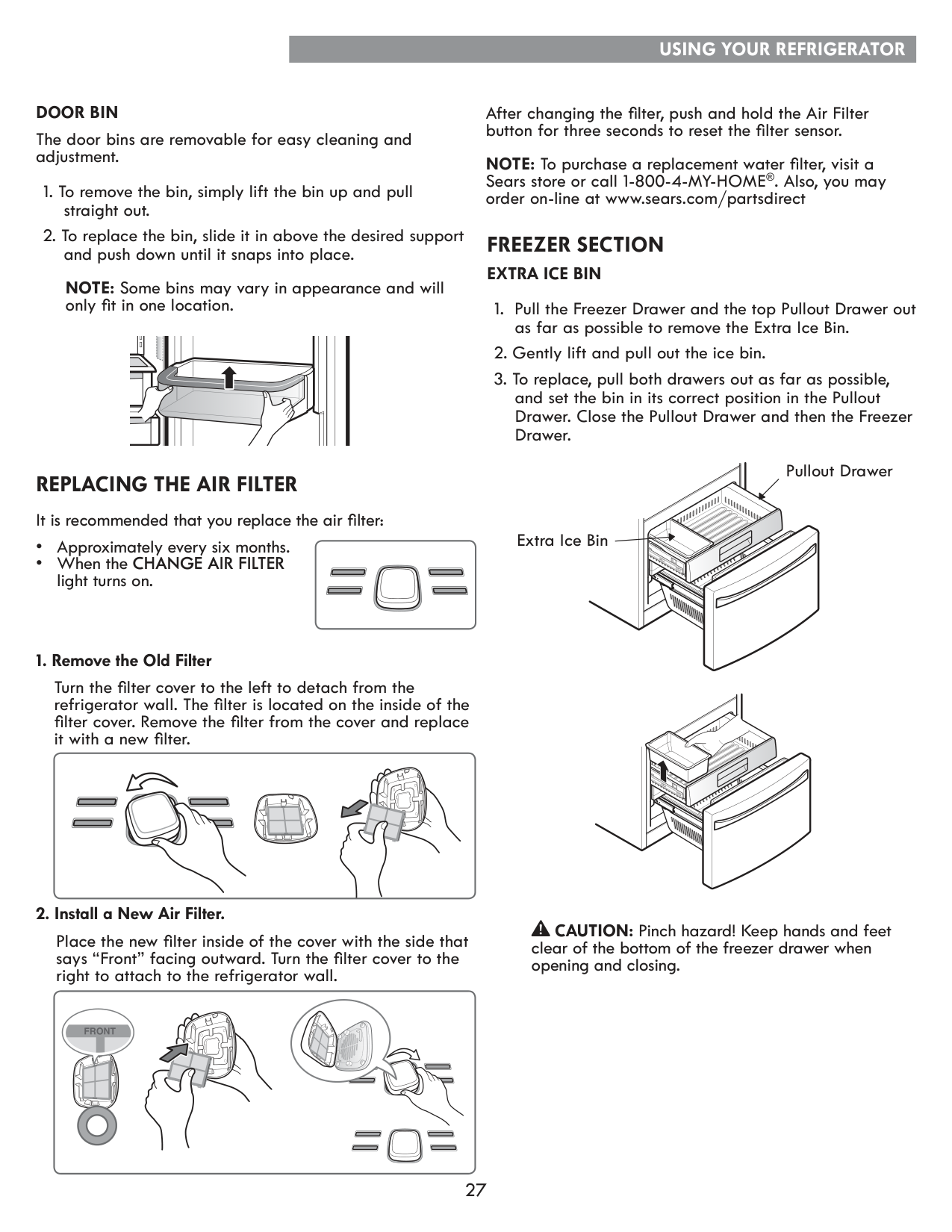
Cleaning and maintenance
27
Fitting the cool-fresh container cover
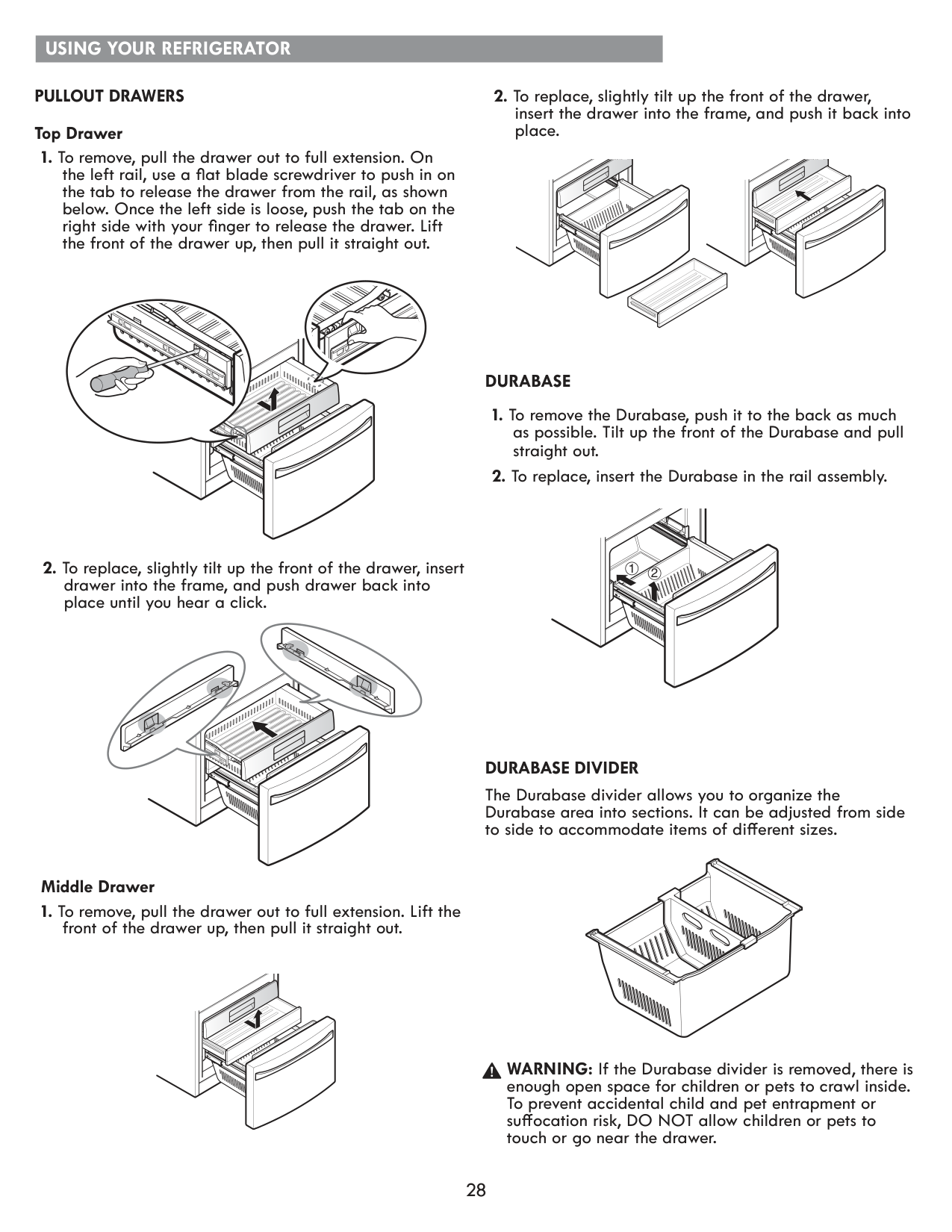
Troubleshooting
Troubleshooting
You can eliminate minor issues on your appliance yourself. Please read the information on eliminating issues before contacting Customer Service. This may avoid unnecessary repair costs.
Warning
Improper repairs are dangerous.
▶Repairs to the appliance should only be performed by authorized service providers.
▶Only original spare parts may be used to repair the appliance.
▶If the power cord or the appliance power cable of this appliance becomes damaged, it must be replaced with a special power cord or special appliance power cable, which is available from the manufacturer or the manufacturer's Customer Service.
| Issue | Cause and troubleshooting | |-------|---------------------------| | The appliance is not cooling, the displays and lighting are lit. | Showroom mode is switched on. 1. Press and hold for 15 seconds until three audible signals sound. a The lighting on the control panels and the interior lighting switch themselves off briefly. a flashes and a warning signal sounds. 2. Press . 3. After a short time, check whether your appliance is cooling. | | The LED lighting does not work. | Various causes are possible. ▶Call customer service. → "Customer Service", Page 31 | | Home Connect® is not working properly. | Various causes are possible. ▶Go to www.home-connect.com. | | "E" or "d" appears on the temperature display. | The electronics have detected a fault. 1. Switch off the appliance. → Page 14 2. Disconnect the appliance from the power supply. Unplug the power plug or switch off the circuit breaker in the fuse box. 3. Reconnect the appliance after 5 minutes. 4. Switch on the appliance. → Page 14 5. If the message still appears on the display, call customer service. → "Customer Service", Page 31 | | A warning signal sounds and flashes. | The door alarm is switched on. The appliance door is open. ▶Close the appliance door. | | A warning tone sounds and the temperature display (freezer compartment) and flash. | The temperature alarm is switched on. Various causes are possible. 1. Press . a The alarm is switched off. 2. After several hours, check whether the set freezer compartment temperature has been reached again. External ventilation openings are covered up. ▶Remove any obstructions from in front of the external ventilation openings. Large quantities of fresh food have been placed inside. ▶Switch on Super freezing before placing a larger amount of food in the appliance. → "Switching on Super freezing", Page 15 |
Troubleshooting 29
Issue Cause and troubleshooting The temperature differs greatly from the setting. Various causes are possible.
Troubleshooting 30
Issue Cause and troubleshooting The ice maker is not functioning. Ice cube production is switched off. ▶Switch on ice cube production. → Page 21 There is no water being supplied to the appliance. ▶Ensure that there is a water supply and that the shut-off valve on the water connection is open. Contact an installer if necessary. Kink in the water hose. ▶Turn off the water supply and straighten the kink in water hose. If necessary, replace the water hose. Fault in the ice maker.
Storage and disposal
31
a If, at the end of the appliance self-test, two audible signals sound and the temperature display indicates the set temperature, your appliance is OK. The appliance switches to normal operation. a If, at the end of the appliance self-test, 5 audible signals sound and the submenu setting display shows , inform customer service.
Storage and disposal
18 Storage and disposal
Storage and disposal
18.1 Taking the appliance out of operation
18.2 Disposal of your old appliance
Environmentally compatible disposal allows valuable raw materials to be recycled.
Warning
Children can lock themselves in the appliance, thereby putting their lives at risk. ▶Remove the appliance doors and the appliance drawer. ▶To prevent children from climbing in, leave shelves and containers in the appliance. ▶Keep children away from the discarded appliance.
Warning
If the tubes are damaged, flammable refrigerant and harmful gases may escape and ignite. ▶Do not damage the tubes of the refrigerant circuit or the insulation.
Customer Service
19 Customer Service
Customer Service
With any warranty repair, we will make sure your appliance is repaired by an authorized service provider using genuine replacement parts. We use only genuine replacement parts for all repairs.
Detailed information on the warranty period and terms of warranty can be found in the Statement of Limited Product Warranty, from your retailer, or on our website.
If you contact Customer Service, you will need the model number (E-Nr.) and the production number (FD) of your appliance.
USA: 1-800-944-2904 www.bosch-home.com/us/owner-support/get-support www.bosch-home.com/us/shop
Canada: 1-800-944-2904 www.bosch-home.ca/service/get-support www.bosch-home.ca/service/cleaners-and-accessories
For assistance with connecting to Home Connect®, you can also view instructions here: www.home-connect.com/us/en/help-support/set-up
19.1 Model number (E-Nr.) and production number (FD)
You can find the model number (E-Nr.) and the production number (FD) on the appliance's rating plate.
→ "Appliance", Fig. 1 /13, Page 10
Making a note of your appliance's details and the Customer Service telephone number will enable you to find them again quickly.
Technical specifications
20 Technical specifications
Technical specifications
Refrigerant, cubic capacity and further technical specifications can be found on the rating plate.
→ "Appliance", Fig. 1 /13, Page 10
32 Table of Contents 1 Safety.................................................................... 34 1.1 Definitions of Safety Terms .......................... 34 1.2 General Information .............................................. 34 1.3 Proper Use............................................ 34 1.4 User Restrictions ......................... 34 1.5 Safe Transport........................................................... 34 1.6 Safe Installation....................................................... 34 1.7 Safe Operation ........................................................ 35 1.8 Damaged Unit.............................................. 36 1.9 Warnings in Accordance with California Proposition 65 .............................................. 36 2 Preventing Material Damage ..................................... 37 3 Environmental Protection and Energy Savings....... 37 3.1 Disposal of Packaging .................................. 37 3.2 Save Energy.......................................... 37 4 Installation and Connection ................................... 38 4.1 Delivery Contents ............................................... 38 4.2 Installation Location Criteria............................. 38 4.3 Assemble Unit...................................................... 38 4.4 Prepare Unit for First Use ........ 38 4.5 Connect Unit to Potable Water Connection.................................................................... 38 4.6 Electrical Connection of Unit .................... 38 5 Unit Description ........................................ 39 5.1 Unit................................................................... 39 5.2 Control Panel .......................................... 40 5.3 Control Panel (Submenu) ..................... 41 5.4 Control Panel (Fresh Food Compartment) .. 42 6 Equipment ............................................................. 42 6.1 Shelf................................................................... 42 6.2 Equipment Rail ................................................... 42 6.3 Fixed Shelf ............................................................ 43 6.4 Drawer Pan.................................................................. 43 6.5 Fresh Food Pan........................................................... 43 6.6 Pan Divider .................................................. 43 6.7 Flat Frozen Food Pan................................... 43 6.8 Frozen Food Drawer Pan ................................. 43 6.9 Suspended Frozen Food Pan.......................... 43 6.10 Butter and Cheese Compartment .................... 43 6.11 Door Compartment .............................. 43 6.12 Ice Maker Reserve ................................................ 43 6.13 Accessories .......................................................... 44 7 Basic Operation................................................... 44 7.1 Power On Unit.................................. 44 7.2 Notes Regarding Unit Operation ................................................................. 44 7.3 Power Off Unit ................................................... 44 7.4 Set Temperature Unit.................................. 44 7.5 Set Temperature............................................... 44 7.6 Fresh Food Compartment Levels............................ 45 8 Additional Functions ......................................... 45 8.1 Super Cooling .................................................. 45 8.2 Super Freezing .................................................... 45 8.3 Vacation Mode ....................................................
Important Safety Instructions
Read and Keep These Instructions
Important Safety Instructions
Read and keep these instructions.
Installation and Connection 38 Installation and Connection 4 Installation and Connection Installation and Connection 4.1 Contents of Delivery After unpacking the product, inspect all parts for any damage caused by transport and ensure that the delivery is complete. In case of complaints, please contact your dealer or our customer service → Page 61. The delivery includes: ¡ Independent appliance ¡ Equipment and accessories1 ¡ Assembly material ¡ Assembly instructions ¡ User manual ¡ Limited product warranty declaration ¡ Warranty annex document2 ¡ Energy label ¡ Information on energy consumption and noise ¡ Information on Home Connect® 4.2 Criteria for Installation Location
Warning
If the appliance is installed in a room that is too small, a possible leak in the refrigeration circuit could result in a flammable mixture of gas and air. ▶Install the appliance only in a room with a minimum volume of 35 ft3 (1 m3) per 8 g of refrigerant. The amount of refrigerant is indicated on the nameplate. → "Appliance", Fig. 1 /13, Page 40 Depending on the model, the weight of the appliance at the factory may reach 345 lbs (155 kg). The floor must be stable enough to support the weight of the appliance. The floor must be level. Installation Above and Below, and Side by Side If you want to install 2 refrigerators stacked or side by side, you must observe a distance of at least 150 mm between the appliances. For selected appliances, installation without minimum distance is possible. Consult your dealer or kitchen designer. 4.3 Assemble the Appliance ▶Assemble the appliance according to the assembly instructions provided. 4.4 Prepare the Appliance for First Use
Description of the Appliance 39 Description of the Appliance 5 Description of the Appliance Description of the Appliance 5.1 Appliance This section contains an overview of the components of your appliance.
A
B
C
1 2 3 4 5 6 7 8 9 10 11 12 13 14 15 16 17 18 19 20 1 Depending on the equipment and size, there may be differences between your appliance and the illustrations.A
Refrigeration Compartment → Page 49B
Fresh Food Compartment → Page 49C
Freezer Compartment → Page 49 1 Control Panel → Page 40 2 Equipment Rail → Page 42 3 Water Dispenser → Page 51
5.3 Control Panel (Sub-menu)
The sub-menu allows you to make additional settings.
1 2 3 4 5 6 7 8 9 3
1 Indicates the selected sub-menu.
2 / allows you to navigate in the sub-menu.
3 opens the Home Connect settings menu.
4 opens the lighting settings menu.
5 opens the menu to change the temperature unit.
6 Indicates the sub-menu setting.
7 / modifies the sub-menu setting.
8 opens the door alarm settings menu.
9 opens the filter settings menu.
5.4 Control Panel (Fresh Food Compartment)
The control panel for the fresh food compartment allows you to adjust the temperature and humidity in the fresh food compartment.
1 2 3 4 5 6 7 4
1 adjusts the storage setting of the fresh food compartment for meat and fish.
2 adjusts the storage setting of the fresh food compartment for fruit.
3 adjusts the storage setting of the fresh food compartment for vegetables.
4 adjusts the storage setting of the fresh food compartment for beverages.
5 adjusts the storage setting of the fresh food compartment for snacks.
6 illuminates when user-defined settings are configured via the Home Connect® app. You will find more information in the Home Connect® app.
7 disables the touch lock of the control panel (fresh food compartment).
Equipment
6 Equipment
Equipment
The equipment of your appliance depends on its model.
6.1 Shelf
Warning:
The shelf hooks can scratch the rear wall of the refrigeration compartment when hooked at an angle.
▶Ensure that the shelf is horizontal and the hooks are properly engaged.
To vary the position of the shelf as needed, you can remove the shelf and reposition it elsewhere.
→ "Removing the Shelf", Page 53
Note
To not obstruct air circulation, do not cover the internal ventilation openings.
6.2 Equipment Rail
The equipment rail offers additional storage space in the refrigeration compartment on equipment pieces:
¡ Store a bottle safely on the bottle hook support.
¡ Store jars in the container.
Equipment
43
■ Store an egg box on the shelf. You can position the equipment parts at any point along the equipment rail.
Notice:
The hooks of the equipment rail can scratch the rear wall of the refrigeration compartment when it is hung at an angle.▶Make sure the equipment rail is horizontal and the hooks are properly engaged.
You can remove the equipment rail and reposition it elsewhere.
→ "Removing the equipment rail", Page 53
Tip: Position the equipment rail in the middle of the refrigeration compartment.
6.3 Fixed Shelf
Always place the fixed shelf in the indicated position.
6.4 Drawer Bin
Store large plates or containers with covered processed foods in the drawer bin.
6.5 Fresh Food Compartment
Use the lower temperatures of the cold compartment to preserve perishable foods, e.g. fish, meat and cold cuts.
6.6 Bin Divider
Warning
Children can get into the appliance and suffocate.
▶Never remove the divider from the suspended frozen food bin.
Notice:
The divider of the suspended frozen food bin is damaged when removed.▶Never remove the divider from the suspended frozen food bin.
To vary the distribution of the suspended frozen food bin, you can move the bin divider.
6.7 Flat Frozen Food Bin
Store flat frozen foods, ice reserve and ice scoop in the flat frozen food bin.
6.8 Frozen Food Drawer Bin
For better overview and to remove frozen foods more quickly, pull out the frozen food drawer bin.
6.9 Suspended Frozen Food Bin
Store bulky frozen foods in the suspended frozen food bin.
6.10 Butter and Cheese Compartment
Store butter and hard cheese in the butter and cheese compartment.
6.11 Door Compartment
To vary the position of the compartment in the door as needed, you can remove it and reposition it elsewhere.
→ "Removing the door compartment", Page 54
6.12 Ice Reserve
If ice production is activated, ice cubes are automatically stored in the ice reserve.
Notice:
The ice dispenser can be blocked or damaged by foods or objects stored in the ice bin.▶Never store foods or objects in the ice bin.
Note: To avoid overfilling the ice reserve, do not manually distribute ice cubes in it.
Basic Operation 44
Tip: To prevent ice cubes from falling out of the ice storage bin into the freezer compartment, do not close the freezer drawer.
6.13 Accessories
Use only original accessories. They have been specially designed for your appliance.
The accessory for your appliance depends on the model.
Ethylene Absorber
Important safety instructions and information on installation and use are provided in the ethylene absorber assembly instructions.
The ethylene absorber slows the ripening of fruits and vegetables sensitive to ethylene to preserve their freshness longer.
Installing the Ethylene Absorber
▶Install the ethylene absorber according to its assembly instructions.
Using the Refill Kit
Note: To obtain refill kits, contact our after-sales service or visit our website.
Ice Scoop
Use the ice scoop to remove a portion of ice cubes.
Basic Operation
7 Basic Operation
Basic Operation
7.1 Turning On the Appliance
Note: If the appliance was previously turned off using the control panel, press .
a The appliance begins to refrigerate. a An alarm sounds, the temperature display (freezer compartment) flashes and is on, because the freezer compartment is not yet cold enough.
a turns off once the set temperature is reached.
7.2 Notes Regarding Appliance Operation
¡ When you turn on the appliance, it may take several hours before the set temperature is reached.
Do not store any food until the set temperature is reached.
¡ The front surfaces and side walls of the housing are slightly heated temporarily. This prevents condensation.
¡ When you close the door, a vacuum may form. The door is then difficult to reopen. Wait a few moments until the vacuum is equalized.
¡ The appliance temperature varies depending on the following conditions:
– Frequency of appliance openings – Load – Temperature of newly stored food – Ambient temperature – Direct sun exposure
7.3 Turning Off the Appliance
▶Press .
7.4 Setting the Temperature Unit
You can choose between the temperature units °F and °C.
7.5 Setting the Temperature
Setting the Temperature of the Refrigeration Compartment
▶Press / repeatedly until the temperature display (refrigeration compartment) shows the desired temperature setting.
The recommended temperature in the refrigeration compartment is 37 °F (3 °C).
Setting the Temperature of the Freezer Compartment
▶Press / repeatedly until the temperature display (freezer compartment) shows the desired temperature setting.
The recommended temperature in the freezer compartment is 0 °F (−18 °C).
8.5 Fresh Mode To keep food fresh longer, you can enable Fresh Mode on the appliance. The appliance automatically adjusts temperatures.
Refrigeration Compartment
36 °F (2 °C)
Fresh Compartment
32 °F (0 °C)
Freezer Compartment Temperature unchanged
Activate Fresh Mode ▶Press . a lights up.
Deactivate Fresh Mode ▶Press . a The previously set temperature is displayed.
8.6 Interior Lighting You can turn off the interior lighting or adjust the brightness.
0 Interior lighting off
1 Minimum brightness
5 Maximum brightness
Adjust Interior Lighting
8.7 Sabbath Mode In Sabbath Mode, all non-essential functions are disabled to allow you to use the appliance on the Sabbath day.
In Sabbath Mode, the following functions are disabled: ¡ Super-refrigeration ¡ Super-freezing ¡ Alarm ¡ Water dispenser ¡ Ice maker ¡ Interior lighting ¡ Audio signals ¡ Messages on the control panel
Note: In Sabbath Mode, the control panel lighting is dimmer.
Activate Sabbath Mode ▶Press and hold for 10 seconds until an audio signal sounds. a lights up.
Note: After approximately 80 hours, the appliance returns to normal operation.
Deactivate Sabbath Mode ▶Press and hold for 5 seconds until an audio signal sounds.
8.8 Filter Change Notification The filter change notification activates every 6 months. lights up.
Note: If water consumption increases, the filter change notification activates sooner.
Deactivate Filter Change Notification
8.9 Filter Change Status If you replace the filter before the filter change notification, reset the filter change status.
1 Filter change status measurement in progress
0 Reset filter change status
Reset Filter Change Status
Alarm
9 Alarm
9.1 Door Alarm The door alarm sounds when the appliance door remains open for an extended period. An audio alarm sounds and flashes.
Deactivate Door Alarm ▶Close the appliance door or press . a The audio alarm is deactivated. a turns off.
47
Home Connect®
10 Home Connect®
Home Connect®
This appliance can be networked. Connect your appliance to a mobile device to control it via the Home Connect® application.
Home Connect® is not available in all countries. The availability of the Home Connect® function depends on the Home Connect® service offerings in your country.
You can find more information at: www.home-connect.com.
To use Home Connect®, first configure the connection to your home network WLAN (Wi-Fi) and the Home Connect® application.
Wait at least 2 minutes after starting the appliance until the internal initialization of the appliance is complete. Then set up Home Connect® first.
The Home Connect® app will guide you through the connection process. Follow the steps prescribed by the Home Connect® application to make the settings.
Tip: Also observe the instructions in the Home Connect® application.
Notes
¡ Observe the safety instructions in this user manual and ensure that they are also followed if you use the appliance via the Home Connect® application.
¡ Commands on the appliance itself always have priority. During this time, control via the Home Connect® application is not possible.
10.1 Configure the Home Connect® Application
The Home Connect® app will guide you through the connection process.
10.2 Configure Home Connect®
Requirement
¡ The Home Connect® application is configured on the mobile device. ¡ The appliance has access to the home network WLAN (Wi-Fi) at the installation location.
Refrigeration Compartment
11 Refrigeration Compartment
Refrigeration Compartment
You can store dairy products, eggs, cooked dishes, pastries, opened preserves and hard cheeses in the fresh compartment.
The temperature is adjustable from 33 °F (1 °C) to 43 °F (6 °C).
Cold storage also allows you to store perishable foods for short and medium term.
The lower the temperature chosen, the longer food stays fresh.
11.1 Tips for storing food in the refrigeration compartment
¡ Store only fresh and intact food. ¡ Keep food in an airtight or covered container. ¡ Do not place food in front of internal ventilation openings or in direct contact with the rear wall to avoid obstructing air circulation and preventing food from freezing. ¡ Allow hot drinks and food to cool before storing. ¡ Observe the expiration date or best-before date specified by the manufacturer.
11.2 Cold zones in the refrigeration compartment
Air circulating in the refrigeration compartment creates zones with different temperatures.
Coldest zone
The coldest zone is located in the drawer bin.
Tip: Store perishable foods such as fish, cold cuts and meat in the fresh compartment.
Warmest zone
The warmest zone is located at the very top, against the door.
Tip: Store hard cheeses and butter there. The cheese can continue to develop its flavor, while the butter remains easy to spread.
12 Fresh Compartment
Fresh Compartment
You can keep food fresh up to three times longer in the fresh compartment compared to the refrigeration compartment.
The temperature can be adjusted from 29°F (−2°C) to 40°F (4°C) using preset level settings.
The quality of stored food is better preserved by cool storage. Low temperature and optimal air humidity create ideal storage conditions for fresh food products.
12.1 Level recommendations in the fresh compartment
Storage Setting | Food ---|--- | Meat, fish and seafood | Fruits, mixed groceries with fruits and vegetables, cold cuts, cheeses and dairy products | Vegetables | Beverages | Snacks and miscellaneous
Tip: Fruits, vegetables, beverages and snacks can be frozen at a temperature below 32 °F (0 °C).
Use the storage setting only for meat and fish.
13 Freezer Compartment
Freezer Compartment
In the freezer compartment, you can store frozen food, freeze food and make ice cubes.
The temperature is adjustable from 6 °F (−14 °C) to −7 °F (−22 °C).
The temperature for long-term storage of food should be at 0 °F (–18 °C) or lower.
Freezing allows you to store easily perishable food long-term. Low temperatures slow down or stop food deterioration.
13.1 Tips for storing food in the freezer compartment
¡ Store food in suitable packaging.

13.2 Tips for freezing fresh food
¡ Freeze only fresh food with an impeccable appearance. ¡ Freeze food in portions. ¡ Prepared dishes are more suitable than raw edible foods. ¡ Wash, chop and blanch vegetables before freezing. ¡ Before freezing, wash fruit, remove seeds and peel fruit if necessary, add sugar or ascorbic acid solution if necessary. ¡ Baked goods, fish and seafood, meat, game and poultry, eggs without shells, cheese, butter, curd, prepared dishes and leftovers are suitable for freezing. ¡ Lettuce, radishes, eggs in shells, grapes, raw apples and pears, yogurt, sour cream, fresh cream and mayonnaise are not suitable for freezing.
Wrapping frozen foods
Appropriate packaging material and the correct type of packaging are essential to maintain product quality and prevent freezer burn.
13.3 Defrosting methods for frozen food
Warning
During defrosting, bacteria can multiply and frozen food can spoil.
▶Do not refreeze food that is partially or completely thawed. ▶Only refreeze food after cooking or roasting it. ▶Do not use the entire storage period.
¡ Defrost animal products in the refrigeration compartment, for example fish, meat, cheese and curd milk. ¡ Defrost bread at room temperature. ¡ Prepare food in the microwave, oven or on the stovetop for immediate consumption.
14 Hydraulic System
Your appliance has components containing water. The hydraulic system only works if a water filter or bypass cap is installed. Disable ice cube production before disconnecting the appliance from the drinking water connection.
14.1 Water filter
The water filter filters particles and chlorine taste from water.
The water filter reduces other impurities, such as chloramines, lead and pharmaceuticals.
Note: The water filter does not filter bacteria or microbes.
Change the water filter:
¡ every 6 months. ¡ when the indicator lights up. ¡ when water flow is visibly reduced.
Tips
¡ For a new water filter, contact our after-sales service, your retailer or consult our website. ¡ If you do not wish to use a water filter in your appliance or have an external water filter system installed, you can permanently replace the water filter with a bypass cap.
The bypass cap filters only coarse water particles and can be cleaned if necessary. For a bypass cap, contact our after-sales service or consult our website.
Filter change notification
The filter change notification activates every 6 months. The indicator lights up.
Note: If water consumption increases, the filter change notification triggers earlier.
Disable filter change notification

14.3 Ice Dispenser
Use the ice dispenser to produce ice cubes.
Warning
Rotating parts can cause injury.
▶Never put your hand under or in the ice dispenser.
Note: The ice dispenser automatically detects when the ice reserve is full and stops ice production.
Filling the ice reserve can take up to 48 hours.
Tips
¡ You can speed up ice production by setting a colder freezer temperature or by activating Super-freezing. This will slightly increase energy consumption.
¡ If the ice cubes taste unpleasant, discard the remaining ice cubes and ice production for the next 24 hours. If the ice cubes continue to taste bad afterwards, change the water filter.
Putting the ice dispenser into service
Notes
¡ Ice production starts as soon as the appliance is switched on and the freezer compartment has reached the set temperature.
¡ The first ice cubes are ready approximately 4 hours after the freezer compartment has reached the set temperature.
Requirement: The appliance is connected to drinking water.
▶For hygiene reasons, discard all ice cubes produced during the first 24 hours.
Starting ice production
▶Flip the ice dispenser cover up and press the ice dispenser button.
a The ice dispenser button lights up.
Note: By pressing the ice dispenser button for 3 seconds, you reset the filter change status.
Stopping ice production
▶Flip the ice dispenser cover up and press the ice dispenser button.
a The ice dispenser button goes out.
Note: By pressing the ice dispenser button for 3 seconds, you reset the filter change status.
15 Defrosting
15.1 Defrosting the refrigeration compartment
The refrigeration compartment of your appliance defrosts automatically.
15.2 Defrosting the fresh food compartment
The fresh food compartment of your appliance defrosts automatically.
15.3 Defrosting the freezer compartment
Thanks to the fully automatic "NoFrost" system, the freezer compartment does not frost over. No defrosting is necessary.
16 Cleaning and Maintenance
To keep your appliance operational for a long time, clean and maintain it carefully.
Cleaning of inaccessible points must be carried out by the after-sales service. Cleaning by the after-sales service may incur costs.

Cleaning and Maintenance
53
16.1 Preparing the Appliance for Cleaning
16.2 Cleaning the Appliance
Warning
Moisture that enters can cause electric shock. ▶Do not use a high-pressure cleaner or steam cleaner to clean the appliance.
Note:
Inappropriate cleaning products may damage the appliance surface. ▶Do not use abrasive pads or steel wool sponges. ▶Do not use harsh or scouring cleaning products. ▶Do not use highly alcoholic cleaning products. ▶Do not use stainless steel cleaner on the outside of the appliance.
If you clean equipment parts and accessories in the dishwasher, they may warp or discolor. ▶Never clean equipment and accessories in the dishwasher.
16.3 Removing Equipment Parts
If you want to thoroughly clean the equipment parts, remove them from your appliance.
Removing the Shelf
▶Lift the shelf and remove it.
Removing the Equipment Rail
▶Lift the equipment rail and remove it.
Removing the Fixed Shelf

Troubleshooting
58
Troubleshooting
17 Troubleshooting
You can eliminate minor defects in your appliance yourself. Please read the troubleshooting information before contacting customer service. This can avoid unnecessary repair costs.
Warning
Improper repairs are dangerous. ▶ Repairs to the appliance must only be carried out by authorized service providers. ▶ Only original replacement parts may be used to repair the appliance. ▶ If the mains power cord or the appliance power cord is damaged, it must be replaced by specific cords available from the manufacturer or its after-sales service.
| Fault | Cause and Troubleshooting | |-------|--------------------------| | The appliance does not refrigerate, displays and lighting are on. | The appliance is in Exhibition mode. 1. Press for 15 seconds until three beeps sound. a The control panel lighting and interior lighting briefly turn on. a flashes and an alarm sounds. 2. Press . 3. Check after a short time if the appliance is refrigerating. | | LED lighting does not work. | This problem can have many causes. ▶ Call after-sales service. → "Customer Service", Page 61 | | Home Connect® does not work correctly. | This problem can have many causes. ▶ Visit www.home-connect.com. | | An "E" or a "d" appears in the temperature display. | Electronics detected a fault. 1. Turn off the appliance. → Page 44 2. Disconnect the appliance from the mains. Remove the mains power cord plug or disable the fuse in the fuse box. 3. Reconnect the appliance after 5 minutes. 4. Turn on the appliance. → Page 44 5. If this message still appears, contact after-sales service. → "Customer Service", Page 61 | | flashes and an alarm sounds. | The door alarm is activated. The appliance door is open. ▶ Close the appliance door. | | An alarm sounds, the temperature display (freezer) and flash. | Temperature alarm is activated. This problem can have many causes. 1. Press . a The alarm turns off. 2. Check after a few hours if the set temperature in the freezer compartment has been reached again. The external ventilation openings are covered. ▶ Remove obstacles in front of the external ventilation openings. The appliance is filled with large quantities of fresh food products. ▶ Turn off Super-freezing before storing a larger quantity of food. → "Turn on Super-freezing", Page 45 |

Troubleshooting 60
Problem Cause and Troubleshooting
Ice cubes are produced in insufficient quantity.
Ice dispenser does not work.
Ice production is disabled. ▶Start ice production. → Page 52
No water supply. ▶Make sure there is a water supply and the shut-off valve on the water connection is open. Contact an installer if necessary.
The inlet tube is bent. ▶Turn off the water supply and straighten the water pipe bend. If necessary, replace the water pipe.
Ice dispenser malfunction.
The appliance buzzes, bubbles, hums, clicks, clatters, or rumbles.
This is not a defect. A motor is running, for example the refrigeration unit, fan. Refrigerant circulates in the pipes. The motor, switches, solenoid valves, and water valves turn on or off. Automatic defrosting is in progress. Ice cubes fall into the ice bin. No action necessary.
The appliance makes noise.
The appliance is not level. ▶Level the appliance using a bubble level and adjustable feet.
The appliance is not positioned independently. ▶Maintain minimum distances from the appliance.
Equipment parts wobble or get stuck. ▶Check removable equipment parts and reposition them correctly if necessary.
Bottles or containers touch each other. ▶Separate the containers or bottles from each other.
Super-freezing function is activated. No action necessary.
17.1 Power Failure
In case of a power failure, the temperature inside the appliance increases, which shortens storage time and reduces the quality of frozen food.
Notes
¡ Open the appliance as little as possible in case of power failure and do not store other food. ¡ Check the quality of food immediately after the power failure. – Discard frozen food that is thawed and has a temperature above 41 °F (5 °C). – Boil or fry slightly thawed frozen food and consume it or refreeze it.
17.2 Perform Appliance Self-Test
Your appliance has a self-test that indicates malfunctions that your customer service can remedy.

Storage and Disposal
61
Storage and Disposal
18 Storage and Disposal
Storage and Disposal
18.1 Decommissioning the Appliance
18.2 Disposing of Used Appliance
Environmentally responsible disposal allows recovery of valuable raw materials.
Warning
Children may lock themselves in the appliance and endanger their lives. ▶Remove the doors and drawer from the appliance. ▶To prevent children from entering the appliance, do not remove the shelves and bins. ▶Keep children away from the appliance that is no longer in use.
Warning
If tubing is damaged, flammable refrigerant fluid and harmful gases may escape and ignite. ▶Be careful not to damage the refrigeration circuit tubing or insulation.
Customer Service
19 Customer Service
Customer Service
For any repairs covered under warranty, we ensure that your appliance is repaired with genuine replacement parts by a properly trained and authorized technician. We use only genuine replacement parts for repairs.
For more information about warranty duration and conditions in your country, consult our warranty terms with your retailer or on our website.
When contacting customer service, provide the model number (E-Nr.) and manufacturing number (FD) of the appliance.
USA: 1-800-944-2904 www.bosch-home.com/us/owner-support/get-support www.bosch-home.com/us/shop
Canada: 1-800-944-2904 www.bosch-home.ca/en/service/get-support www.bosch-home.ca/en/service/cleaners-and-accessories
You can also find help contacting Home Connect® at: www.home-connect.com/us/en/help-support/set-up
19.1 Model Number (E-Nr.) and Manufacturing Number (FD)
The model number (E-Nr.) and manufacturing number (FD) are indicated on the appliance rating plate. → "Appliance", Fig. 1 /13, Page 40
To quickly find your appliance data and the customer service phone number, feel free to copy them elsewhere.
Technical Data
20 Technical Data
Technical Data

62 Table of Contents 1 Safety ................................................................ 64 1.1 Safety definitions....................................... 64 1.2 General instructions ........................................... 64 1.3 Intended use............................................................ 64 1.4 User group limitation............................. 64 1.5 Safe transport................................................... 64 1.6 Safe installation................................................... 64 1.7 Safe use ............................................................. 65 1.8 Damaged appliance ...................................................... 66 1.9 Warnings pursuant to California Proposition 65 ................................................ 66 2 Avoid material damage.......................................... 67 3 Environmental protection and savings .............. 67 3.1 Tips for packaging disposal ............. 67 3.2 Save energy....................................................... 67 4 Installation and connection............................................ 67 4.1 Delivered material .................................................. 67 4.2 Requirements for selecting the placement location............................................................... 68 4.3 Appliance installation............................................ 68 4.4 Prepare the appliance for first use.................... 68 4.5 Connect the appliance to water outlet ................... 68 4.6 Connect the appliance to electrical outlet...................... 68 5 Getting to know the appliance............................ 69 5.1 Appliance ................................................................... 69 5.2 Control panel...................................................... 70 5.3 Control panel (submenu) .................................... 71 5.4 Control panel (cool compartment)................ 72 6 Equipment .......................................................... 72 6.1 Tray................................................................... 72 6.2 Equipment bar............................................ 73 6.3 Fixed tray ............................................................. 73 6.4 Sliding drawer ..................................................... 73 6.5 Fresh drawer............................................................ 73 6.6 Compartment divider ............................... 73 6.7 Flat container for frozen products.......... 74 6.8 Sliding drawer for frozen products ............. 74 6.9 Suspended container for frozen products ............................................................. 74 6.10 Butter and cheese compartment..... 74 6.11 Door shelves for bottles....................... 74 6.12 Ice cube storage .............................. 74 6.13 Accessories ............................................................ 74 7 Basic operation ......................................................... 74 7.1 Turn on the appliance................................................ 74 7.2 Warnings regarding appliance operation ................................................................ 74 7.3 Turn off the appliance ................................................... 75 7.4 Adjust the temperature unit ............................ 75 7.5 Adjust the temperature .............................................. 75 7.6 Fresh drawer storage settings............ 75 8 Additional functions............................................. 75 8.1 Super cool ................................................................. 75 8.2 Super freeze..................................................... 75 8.3 Vacation mode ......................................

Important Safety Instructions
Read and Keep These Instructions1.1 Safety Signal Definitions
Here you can find explanations of the safety signal words used in this manual.
Warning
This indicates that death or serious injury may occur if this warning is not followed.
Caution
This indicates that minor or moderate injury may occur if this warning is not followed.
Notice
This indicates that damage to the appliance or property may occur if this notice is not followed.
Note: This alerts you to important information or suggestions.
1.2 General Instructions
1.3 Intended Use
Use this appliance only:
1.4 User Group Limitations
This appliance is not intended for use by persons (including children) with reduced physical, sensory, or mental capabilities, or lack of experience and knowledge, unless they are supervised or instructed on how to use the appliance by a person responsible for their safety.
Prevent children from playing with the appliance.
Cleaning and maintenance of the appliance by the user must not be performed by children without supervision by a responsible adult.
1.5 Safe Transport
Warning
The high weight of the appliance could cause injury when lifting it.
1.6 Safe Installation
Warning
Incorrect installation is dangerous.
Damaged insulation of the power connection cable is dangerous.
Warning
If the ventilation openings of the appliance are blocked, a flammable mixture of air and gas can form in case of a refrigerant circuit leak.

Warning
Using an extended power cord and unauthorized adapters is dangerous. ▶Do not use extension cords or multiple outlet power strips. ▶Use only adapters and power cords authorized by the manufacturer. ▶If the power cord is too short and no longer cord is available, contact an electrician to adapt your home installation. Power supply units or mobile multiple outlet strips can overheat and cause fires. ▶Do not place power supply units or mobile multiple outlet strips behind appliances.1.7 Safe Use
Warning
Moisture penetration can cause electric shock. ▶The appliance should only be used indoors. ▶Do not expose the appliance to intense heat and humidity sources. ▶Do not use steam jet or high-pressure cleaners to clean the appliance.Warning
Children can place packing material over their head or wrap themselves in it and suffocate. ▶Keep packing material out of reach of children. ▶Do not allow children to play with packing material. Children can inhale or ingest small parts and suffocate. ▶Keep small parts out of reach of children. ▶Do not allow children to play with small parts.Warning
If the refrigeration circuit is damaged, flammable refrigerant liquid may escape and explode. ▶To speed up defrosting, do not use any other mechanical device or means other than those recommended by the manufacturer. ▶Separate frozen foods stuck with an object such as a wooden spoon handle. Products containing propellant or flammable gases and explosive materials may cause an explosion (for example, aerosols). ▶Do not store products containing propellant or flammable gases or explosive materials in the appliance.Warning
Electrical devices inside the appliance may cause fires (for example, heaters, ice makers, etc.). ▶Do not operate electrical devices inside the appliance.Warning
Containers with carbonated beverages may burst. ▶Do not store containers containing gaseous liquids below 34 °F (1 °C) in the cool compartment. ▶Do not store carbonated beverage containers in the freezer. Risk of eye injury from flammable refrigerant liquid and harmful gases leaking out. ▶Do not damage the refrigeration circuit pipes and insulation. The appliance may tip over. ▶Do not step on or lean on the pedestal, drawers, or doors.Warning
Contact with frozen products and cold surfaces can cause frostbite. ▶Never place frozen foods taken directly from the freezer into your mouth. ▶Avoid prolonged skin contact with frozen foods, ice, and freezer surfaces.Caution
To prevent food contamination, the following instructions must be observed. ▶If the door is opened for an extended period, a considerable temperature increase may occur in the appliance compartments. ▶Regularly clean surfaces that may come into contact with food and accessible drainage systems.Important Safety Instructions
Read and Keep These Instructions

Avoiding Material Damage
Avoiding Material Damage
Warning: When moving the appliance, due to its heavy weight or the inclination of the appliance wheels, the floor can be damaged. ▶ Transport the appliance with a sack truck. ▶ Protect the floor with something when the appliance is to be moved and do not move it in a zigzag pattern.
When closing the appliance door, it can be damaged if the door frame is open. ▶ Do not open the door frame manually. ▶ If the door frame is open, it must be closed before closing the appliance door.
When stepping on or leaning on the appliance, pedestals, drawers or doors, the appliance can be damaged. ▶ Do not step on or lean on the appliance, pedestal, drawers or doors.
Water pressure that is too low or too high can negatively affect the appliance operation. ▶ Ensure that the water pressure of the water supply device is a minimum of 29 psi (200 kPa) and a maximum of 116 psi (800 kPa). ▶ If the water pressure exceeds the maximum value indicated, a pressure reduction valve must be installed between the water inlet and the appliance hose kit.
Modified or damaged water hoses can cause damage to property or the appliance. ▶ Do not bend, crush, modify or cut the water hoses. ▶ Never reuse water hoses that have already been used. ▶ Never pull the water hose from the back of the appliance.
Dirt with oil or grease can create pores in plastic parts and door seals. ▶ Keep plastic parts and rubber seals clean of oils and greases.
Metal or metallic-looking parts may contain aluminum. In contact with acidic food, aluminum corrodes and discolors. ▶ Only packaged food can be stored in the appliance.
If the appliance elements and accessories are washed in the dishwasher, they could become deformed or discolored. ▶ Never wash appliance elements and accessories in the dishwasher.
Environmental Protection and Energy Saving
Environmental Protection and Energy Saving
3.1 Tips for Disposal of Packaging
All packaging materials are environmentally friendly and recyclable. ▶ Dispose of the different materials separately according to their nature.
3.2 Saving Energy
If you follow these instructions, your appliance will consume less electricity.
Selection of Placement Location • Protect the appliance from direct solar radiation. • Install the appliance at the greatest possible distance from radiators, ovens and other heat sources: – Maintain a distance of 1¼" (30 mm) from gas or electric stoves. – Maintain a distance of 11¾" (300 mm) from coal or oil ovens. • Never cover or obstruct the external ventilation openings.
Energy Saving During Operation
Note: The arrangement of equipment parts does not affect the appliance's energy consumption. • Open the appliance briefly and close it properly. • Never cover or block the internal ventilation openings or external ventilation openings. • Transport food in an insulated bag and place it immediately in the freezer. • Allow hot food or beverages to cool to room temperature before storing. • Defrost frozen products inside the refrigeration compartment to take advantage of the cold they release. • Always leave a little space between food and the back panel. • Vacuum dust from the external ventilation grilles.
Installation and Connection
Installation and Connection
4.1 Material Delivered
After unpacking the appliance, verify that no parts have been damaged during transport and that the supply volume is complete.
If you have any complaints, you should contact the distributor.

Equipment and Accessories1 Material for Installation Installation Instructions Instruction Manual Limited Product Warranty Statement Warranty Document2 Energy Label Information on Energy Consumption and Appliance Noise Information about Home Connect®
4.2 Requirements for Selecting the Installation Location
Warning
If the appliance is in too small a space, a flammable mixture of air and gas can form in case of a leak in the cooling circuit.▶Place the appliance in spaces that have a minimum volume of 35 cubic feet (1 m3) per 0.3 oz (8 g) of refrigerant. The amount of refrigerant is indicated on the rating plate. → "Appliance", Fig. 1 /13, Page 70
The factory weight of the appliance can reach, depending on the specific model, up to 345 lb (155 kg).
To support the weight of the device, the surface must be sufficiently stable.
The surface must be level.
Stacking and Side-by-Side Installation
If two refrigeration appliances are to be installed one above the other, a minimum distance of 150 mm must be maintained between them. For certain appliances, installation without minimum distance is possible. In this regard, consult a specialized distributor or kitchen planner.
4.3 Installation of the Appliance
▶Install the appliance following the attached installation instructions.
4.4 Preparing the Appliance for First Use
4.5 Connecting the Appliance to the Water Supply
Requirements
¡ A shut-off valve must be installed at the water supply connection and must be freely accessible once the appliance is installed. ¡ The water supply connection must be checked, and the water quality must be verified.
Install an external water filter system if there are persistent sediments or the water remains cloudy.
4.6 Connecting the Appliance to the Electrical Network
The appliance connection data is found on the rating plate. → "Appliance", Fig. 1 /13, Page 70
a The appliance is ready for use.
1 Depending on appliance equipment 2 Not available in all countries

Getting to know the appliance
5 Getting to know the appliance
5.1 Appliance
Here you will find an overview of the components of your appliance.
A
B
C
1 2 3 4 5 6 7 8 9 10 11 12 13 14 15 16 17 18 19 20
1 The illustrations may show details and features of equipment and size that do not match those of your specific appliance.
A
Refrigeration compartment → Page 79B
Fresh compartment → Page 80C
Freezer → Page 801 Control panel → Page 70
2 Equipment bar → Page 73
3 Water dispenser → Page 82

Getting to Know Your Appliance
4 Fixed Shelf → Page 73
5 Sliding Drawer → Page 73
6 Control Panel (Fresh Compartment) → Page 72
7 Fresh Drawer → Page 73
8 Ice Maker → Page 82
9 Ice Cube Storage → Page 74
10 Water Filter → Page 81
11 Butter and Cheese Compartment → Page 74
12 Interior Lighting
13 Rating Plate → Page 93
14 Door Frame with Condensation Protection → Page 67
15 Door Shelves for Large Bottles → Page 74
16 Sliding Drawer for Frozen Foods → Page 74
17 Flat Container for Frozen Foods → Page 74
18 Suspended Container for Frozen Foods → Page 74
19 Compartment Divider → Page 73
20 Threaded Foot
5.2 Control Panel
All functions of your appliance are adjusted through the control panel and information about the operating status is displayed.
1 2 3 4 5 6 7 8 9 10 11 12 13
2
1 Activates or deactivates Super Cooling.
2 Displays the set temperature of the refrigeration compartment in °F or °C.
3 / Allow adjustment of the refrigeration compartment temperature.
4 Activates and deactivates Fresh Mode.
5 Activates or deactivates Energy Saving Mode.
6 Activates and deactivates Vacation Mode.
7 Turns the appliance on and off.
8 Deactivates the alarm.
9 Opens and closes the menu.
10 Illuminates when the filter needs to be changed.
11 Activates or deactivates Super Freezing.
12 Displays the set temperature of the freezer compartment in °F or °C.
13 / Allow adjustment of the freezer temperature.

5.4 Control Panel (Fresh Compartment)
Using the control panel of the fresh compartment, you can adjust the temperature and humidity in the fresh compartment.
1 2 3 4 5 6 7 4
1 Sets the storage setting of the fresh drawer for meat and fish.
2 Sets the storage setting of the fresh drawer for fruit.
3 Sets the storage setting of the fresh drawer for vegetables.
4 Sets the storage setting of the fresh drawer for beverages.
5 Sets the storage setting of the fresh drawer for snacks.
6 Illuminates when user-defined settings are established via the Home Connect® application. For more information, consult the Home Connect® application.
7 Deactivates the key lock on the control panel (fresh compartment).
Equipment
6 Equipment
Equipment
The equipment of the appliance depends on the model.
6.1 Shelf
Warning:
The shelf hooks can scratch the rear panel of the refrigeration compartment if they are hooked at an angle.
▶Ensure that the shelf is in a horizontal position and that the hooks are fully engaged.
If you wish to change the position of the shelves as needed, you can remove them and reposition them elsewhere.
→ "Removing the Shelves", Page 84

Equipment
Note Do not cover the interior ventilation openings to avoid impairing air circulation.
6.2 Equipment Bar
The equipment bar provides additional storage space inside the refrigeration compartment through the equipment components:
¡ Store a bottle in the bottle shelf safely. ¡ Store jars in the container. ¡ Store an egg box in the tray.
Equipment components can be placed anywhere on the equipment bar.
Warning:
The hooks of the equipment bar can scratch the rear panel of the refrigeration compartment if hooked at an angle.▶Make sure the equipment bar is in a horizontal position and that the hooks are fully engaged.
The equipment bar can be removed and placed elsewhere.
→ "Removing the equipment bar", Page 84
Tip: Place the equipment bar in the center of the refrigeration compartment.
6.3 Fixed Tray
Always place the fixed tray in the indicated position.
6.4 Sliding Drawer
Store covered large dishes or flat containers with prepared food in the sliding drawer.
6.5 Fresh Drawer
The coldest zone of the fresh drawer is used for storing perishable foods (for example, fish, meat, and cold cuts).
6.6 Compartment Divider
Warning
Children can climb onto the appliance and suffocate.▶Never remove the divider from the suspended container for frozen products.
Notice:
The divider of the suspended container for frozen products can be damaged if removed.▶Never remove the divider from the suspended container for frozen products.
To vary the division of the suspended container for frozen products, slide the container divider.

6.7 Flat Container for Frozen Products
Frozen products, ice cube storage, and ice scoop can be stored in the flat container for frozen products.
6.8 Sliding Drawer for Frozen Products
For better overview and to remove frozen products more quickly, the sliding drawer for frozen products can be pulled out.
6.9 Suspended Container for Frozen Products
The suspended container allows storage of large frozen products.
6.10 Butter and Cheese Compartment
Store butter and cheese in their specific compartment.
6.11 Door Shelves for Bottles
The bottle shelves can be removed and repositioned elsewhere to modify their position as needed.
→ "Remove the door bottle shelf", Page 84
6.12 Ice Cube Storage
When ice cube production is activated, ice cubes are automatically stored in the ice cube storage.
Warning:
The ice cube maker device may be damaged or blocked if food or objects are introduced into the ice cube storage.
▶Never place food or objects in the ice cube storage.
Note: To avoid overfilling the ice cube storage, do not distribute ice cubes in the ice cube storage by hand.
Tip: To prevent ice cubes from falling from the ice cube storage into the freezer, do not slam the freezer drawer shut.
6.13 Accessories
Use original accessories. They are designed for your appliance.
The appliance accessories depend on the model.
Ethylene Absorbent
The ethylene absorbent assembly instructions included contain important safety information and information about its assembly and handling.
The ethylene absorbent slows the ripening of fruits and vegetables that are sensitive to this substance, to keep them fresh longer.
Install the Ethylene Absorbent
▶Install the ethylene absorbent according to the assembly and use instructions.
Use the Refill Kit
Note: The refill kit can be purchased through our Customer Service or on our website.
Ice Scoop
The ice scoop allows you to remove a portion of ice cubes.
7 Basic Operation
7.1 Turn On the Appliance
Note: If the appliance was previously turned off using the control panel, press .
a The appliance begins to cool. a A warning tone is heard and the temperature display (freezer) flashes and lights up because the freezer temperature is too high.
a turns off as soon as the set temperature has been reached.
7.2 Warnings Regarding Appliance Operation
¡ Once the appliance is turned on, it takes several hours until the set temperature is reached.
Do not place food in the appliance before the set temperature is reached.
¡ The front sides and side walls of the appliance heat up slightly at times. This prevents the formation of condensation water.
¡ When the door is closed, negative pressure may be generated. The door becomes difficult to open again.
Wait a moment until the pressure stabilizes.

8 Funciones adicionales

8.3 Vacation Mode If you will be away for an extended period of time, you can activate vacation mode.
Caution
While vacation mode is active, the refrigeration compartment warms up. The temperature increase can contribute to bacterial growth and food spoilage.▶If vacation mode is active, do not store food in the refrigeration compartment.
The appliance automatically resets the following temperatures.
Refrigeration compartment
43 °F (6 °C)
Fresh compartment40 °F (4 °C)
Freezer Temperature unchangedNote: During vacation mode, ice cube production and water dispenser are deactivated.
Activating vacation mode ▶Press . a lights up.
Deactivating vacation mode ▶Press . a Previously set temperature is displayed.
8.4 Energy Saving Mode With energy saving mode, the appliance operation changes to consume less energy.
The appliance automatically resets the following temperatures.
Refrigeration compartment
43 °F (6 °C)
Fresh compartment32 °F (0 °C)
Freezer6 °F (−14 °C)
Activating energy saving mode ▶Press . a lights up.
Deactivating energy saving mode ▶Press . a Previously set temperature is displayed.
8.5 Fresh Mode To keep food fresh longer, you can activate fresh mode on the appliance.
The appliance automatically resets the following temperatures.
Refrigeration compartment
36 °F (2 °C)
Fresh compartment32 °F (0 °C)
Freezer Temperature unchangedActivating fresh mode ▶Press . a lights up.
Deactivating fresh mode ▶Press . a Previously set temperature is displayed.
8.6 Interior Lighting You can deactivate interior lighting or adjust the brightness.
0 Interior lighting deactivated 1 Minimum brightness 5 Maximum brightness
Adjusting interior lighting
8.7 Sabbath Mode With Sabbath mode, all functions that are not necessary for using the appliance during the Sabbath are disconnected.
During Sabbath mode, the following functions remain disconnected: ¡ Super cool ¡ Super freeze ¡ Alarm ¡ Water dispenser ¡ Ice cube production ¡ Interior lighting ¡ Acoustic signals ¡ Control panel messages
Note: During Sabbath mode, control panel lighting is dimmed.
Activating Sabbath mode ▶Hold pressed for ten seconds until an acoustic signal sounds. a lights up.
Note: After approximately 80 hours, the appliance returns to normal operation.

Home Connect®
10 Home Connect®
Home Connect®
This appliance is suitable for network connection. Connect your appliance with a mobile device to control functions through the Home Connect® application.
Home Connect® services are not available in all countries. The availability of the Home Connect® function depends on the availability of Home Connect® services in your country. For more information, visit: www.home-connect.com.
To use Home Connect®, first establish a connection with the home network WLAN (Wi-Fi1) and with the Home Connect® application.
After turning on the appliance, wait at least two minutes for internal initialization to complete. Only then perform the Home Connect® setup.
The Home Connect® application will guide you through the registration process. Follow the instructions in the Home Connect® application to establish the settings.
Tip: Also observe the instructions in the Home Connect® application.
Notes
¡ You must observe the safety instructions in this instruction manual and ensure compliance when operating the appliance through the Home Connect® application. → "Safety", Page 64
¡ In any case, operation from the appliance itself takes priority. During that time, operation of the appliance through the Home Connect® application is not possible.
10.1 Configure the Home Connect® Application
The Home Connect® application will guide you through the registration process.
10.2 Configure Home Connect®
Requirements
¡ The Home Connect® application is configured on the mobile device. ¡ The appliance receives coverage from the home network WLAN (Wi-Fi) where you are located.
10.3 Check Signal Strength
Signal strength should be checked if the connection is not established correctly.
Note: The signal strength value should be at minimum.
Improve Coverage
If signal strength is too low, the connection may be interrupted.
▶ Execute one of the possible solutions: ‒ Move the router and the refrigerator appliance closer together. ‒ Ensure that the connection is not disturbed by shielded walls. ‒ To intensify the signal, install a repeater.
10.4 Install Home Connect® Software Update
The appliance periodically searches for Home Connect® software updates.
Note: If updates are available, it appears in the submenu display.
To cancel the update and restore the submenu display to the set temperature, press any touch pad.
1Wi-Fi is a registered trademark of Wi-Fi Alliance.

10.5 Reset Home Connect® Settings
If the appliance has connection problems with the home wireless network WLAN (Wi-Fi) or if you want to connect it to another network, you can reset the Home Connect® settings.
10.6 Remote Diagnostics
Customer service can access the appliance through Remote Diagnostics when contacting that service if the appliance is connected to the Home Connect® server and if Remote Diagnostics is available in the country where the appliance is used.
Tip: For more information and to check the availability of the Remote Diagnostics service in a specific country, consult the help website / local Technical Service: www.home-connect.com.
10.7 Data Protection
Please note the data protection information.
When you first connect your appliance to an internet-connected home network, the appliance transmits the following categories of data to the Home Connect® server (initial registration):
¡ Clear identification of the appliance (composed of the appliance key and MAC address of the Wi-Fi communication module used). ¡ Security certificate of the Wi-Fi communication module (for technical protection of connection information). ¡ Current versions of the appliance software and hardware. ¡ The status of any previous reset to factory settings.
Initial registration prepares the use of Home Connect® functions and is only necessary the first time you want to use these Home Connect® functions.
Note: Be aware that Home Connect® functions can only be used in connection with the Home Connect® application. You can find data protection information in the Home Connect® application.
11 Refrigeration Compartment
In the refrigeration compartment, you can store dairy products, eggs, prepared dishes, baked goods, opened preserves, and aged cheeses.
The temperature can be adjusted from 33 °F (1 °C) to 43 °F (6 °C).
In the refrigeration compartment, you can also store perishable foods for the short and medium term. The lower the selected temperature, the longer food stays fresh.
11.1 Tips for Storing Food in the Refrigeration Compartment
¡ Store only fresh food in perfect condition. ¡ Store packaged food hermetically sealed or covered properly. ¡ Do not place food in front of the internal ventilation openings or in direct contact with the rear panel to avoid impairing air circulation and prevent food from freezing. ¡ Allow hot food and beverages to cool

11.2 Cold Zones of the Refrigeration Compartment
Air circulation in the refrigeration compartment creates different cold zones.
The Coldest Zone
The coldest zone of the compartment is in the sliding drawer.
Tip Store perishable foods (for example, fish, cold cuts, and meat) in the fresh food compartment. → "Fresh Food Compartment", Page 80
The Least Cold Zone
The least cold zone is located in the upper part of the interior of the door.
Tip Store less perishable food in the least cold zone, for example, aged cheese and butter. This way, the cheese will retain its aroma and the butter can be easily spread on bread.
Fresh Food Compartment
12 Fresh Food Compartment
Fresh Food Compartment
In the fresh food compartment, food stays in good condition up to three times longer than in the refrigeration compartment.
The temperature can be adjusted from 29 °F (−2 °C) to 40 °F (4 °C) using the predefined storage settings.
By storing in the fresh food compartment, the quality of stored food is better preserved.
The low temperature and optimal air humidity provide ideal conditions for storing fresh food.
12.1 Storage Recommendations for the Fresh Food Compartment
Storage Setting | Food ---|--- | Meat, fish and seafood | Vegetables, mixed storage of fruit and vegetables, cold cuts, cheeses and dairy products | Vegetables | Beverages | Snacks and others
Tip Fruit, vegetables, beverages and snacks can freeze below 32 °F (0 °C). Use the storage setting only for meat and fish.
Freezer
13 Freezer
Freezer
In the freezer, it is possible to store ultra-frozen products, freeze food and prepare ice cubes.
The temperature can be adjusted from 6 °F (−14 °C) to −7 °F (−22 °C).
Storage of food for long periods of time should be done at a temperature of 0 °F (−18 °C) or lower.
Perishable foods can be stored frozen for a long time. Low temperatures slow down or stop their deterioration.
13.1 Tips for Placing Food in the Freezer
■ Store food in airtight containers. ■ Frozen food should not come into contact with fresh food that you want to freeze. ■ Distribute food evenly in the suspended container for frozen products.
13.2 Tips for Freezing Fresh Food
■ Freeze only fresh food in perfect condition. ■ Freeze food in portions. ■ Prepared food is more suitable than raw food. ■ Wash, chop and blanch vegetables before freezing them. ■ Wash fruit, remove pits, and if desired, peel before freezing; if desired, sugar or an ascorbic acid solution can be added. ■ Some foods suitable for freezing are bread and pastries, fish, seafood, meat, game, poultry, eggs without shells, cheese, butter, cottage cheese, pre-cooked dishes and food leftovers. ■ Some foods not suitable for freezing are lettuce, radishes, eggs with shells, grapes, raw apples or pears, yogurt, sour or fresh cream and mayonnaise.
Packaging of Frozen Products
Using the correct type and material of packaging allows you to significantly preserve the quality of products and prevent freezer burn.

81 13.3 Thawing Methods for Frozen Products
Caution
Bacteria can multiply during the food thawing process and food can spoil.▶Do not refreeze food that has been thawed or partially thawed. ▶Only after cooking or frying can food be refrozen. ▶The maximum storage period can no longer be used.
¡ Thaw animal-derived foods such as fish, meat, cheese, or cottage cheese in the refrigeration compartment. ¡ Thaw bread at room temperature. ¡ Prepare food for immediate consumption in the microwave, oven, or on cooktops.
Water System
14 Water System
Water System
The appliance has components that conduct water. The water system only functions if a water filter or bypass cap is installed. Disconnect ice cube production before disconnecting the appliance from the water outlet. → Page 83
14.1 Water Filter
The water filter filters water particles and chlorine taste. The water filter reduces other types of impurities, such as chloramine, lead, and pharmaceuticals.
Note: The water filter does not filter bacteria or microbes from water.
Replace the water filter: ¡ every 6 months. ¡ if the indicator lights up. ¡ if you notice the water dispenser is running low.
Recommendations
¡ A new water filter can be obtained through our customer service, your distributor, or our website. ¡ If you do not wish to use a water filter in the appliance or have an external water filter system installed, you can permanently replace the water filter with a bypass cap.
The bypass cap only filters coarse water particles and can be cleaned if necessary. You can obtain a bypass cap through our Customer Service or on our website.
Filter Change Notification
The filter change notification is activated every six months. The indicator lights up.
Note: If water consumption increases, the filter change notification is activated earlier.
Deactivate Filter Change Notification
Filter Change Status
If you replace the filter before the change notification is issued, you must reset the filter change status.
1 Measuring current filter change status
0 Resetting filter change status
Resetting Filter Change Status
Replace the Water Filter or Replace It with a Bypass Cap

Ice Maker
When the freezer has reached the set temperature, the first ice production will be complete after approximately 4 hours.
Requirement: The appliance is connected to the drinking water outlet.
▶For hygiene reasons, discard the ice cubes produced in the first 24 hours.
Activating Ice Production
▶Fold up the ice maker lid and press the ice maker sensor.
a The ice maker sensor illuminates.
Note: If you press and hold the ice maker sensor for three seconds, the filter change status is reset.
Deactivating Ice Production
▶Fold up the ice maker lid and press the ice maker sensor.
a The ice maker sensor turns off.
Note: If you press and hold the ice maker sensor for three seconds, the filter change status is reset.
Defrosting
15 Defrosting
15.1 Defrosting the Refrigerator Compartment
The refrigerator compartment defrosts automatically.
15.2 Defrosting the Fresh Food Compartment
The fresh food compartment defrosts automatically.
15.3 Defrosting in the Freezer
Thanks to the fully automatic "NoFrost" system, frost does not form in the freezer. No defrosting is necessary.
Cleaning and Care
16 Cleaning and Care
To maintain the appliance's functionality over a long period, it must be maintained and cleaned carefully.
Cleaning in hard-to-reach areas must be performed by Customer Service. Cleaning by Customer Service incurs costs.
16.1 Preparing the Appliance for Cleaning
16.2 Cleaning the Appliance
Warning
Moisture penetration can cause electrical shock.
▶Do not use steam jet or high-pressure cleaners to clean the appliance.
Notice
Improper cleaning products can damage the appliance surface.
▶Do not use scouring pads or hard-fiber sponges.
▶Do not use harsh or abrasive agents.

Troubleshooting Minor Faults 89 Troubleshooting Minor Faults 17 Troubleshooting Minor Faults Troubleshooting Minor Faults You can resolve minor errors in your appliance yourself. Read the information about how to troubleshoot errors before contacting Customer Service. This way you can avoid unnecessary repair costs.
Warning
Improper repairs are dangerous. ▶Repairs should only be carried out by an authorized service technician. ▶Only original spare parts may be used to repair the appliance. ▶If the mains connection cable or the connection cable of this appliance is damaged, it must be replaced with a special mains connection cable or a special connection cable for this appliance that can be obtained from the manufacturer or your customer service.Fault | Causes and Problem Resolution ---|--- The appliance does not cool; the indicator panels and interior lighting illuminate. | The display mode is activated. | 1. Hold down for 15 seconds until three acoustic signals sound. | a The control panel lighting and interior lighting turn off briefly. | a flashes and an acoustic signal sounds. | 2. Press . | 3. After a brief period of time, ensure that the appliance cools. The LED lighting does not work. | Several causes are possible. | ▶Contact Customer Service. | → "Customer Service", Page 92 Home Connect® does not work correctly. | Several causes are possible. | ▶Visit www.home-connect.com. The temperature display shows "E" or "d". | The electronic system has detected a fault. | 1. Turn off the appliance. → Page 75 | 2. Disconnect the appliance from the mains. | Remove the mains connection cable plug or disconnect the circuit breaker. | 3. Reconnect the appliance after five minutes. | 4. Turn on the appliance. → Page 74 | 5. If the indicator panel display appears again, contact Customer Service. | → "Customer Service", Page 92 An acoustic signal sounds and flashes. | The door alarm is activated. | The appliance door is open. | ▶Close the appliance door. The acoustic signal sounds, the temperature indicator (freezer) and flashes. | The temperature alarm is activated. | Several causes are possible. | 1. Press . | a The alarm is deactivated. | 2. Check after a few hours that the freezer has reached the set temperature again. | The external ventilation openings are covered. | ▶The cause of the obstruction of the external ventilation openings must be eliminated. | Large quantities of fresh food have been added inside. | ▶Activate Super Freezing before adding a large quantity of food. | → "Activate Super Freezing", Page 75

91 Troubleshooting
Fault Causes and Solutions
Ice maker does not work.
Ice production is deactivated. ▶Turn on ice production. → Page 83
No water supply. ▶Ensure water supply is available and the water inlet valve is open. If necessary, contact an installer.
Water line is kinked. ▶Turn off the water supply and straighten the water line. If necessary, replace the water line.
Ice maker malfunction.
The appliance makes sounds, bubbles, rattles, hums, clicks, creaks, or water flow noises.
This is not a fault. A motor is running (compressors, fan). Refrigerant flows through the tubes. The motor, switches, solenoid valves, or water valves are connecting or disconnecting. Automatic defrosting is running. Ice cubes are falling into the ice bin. No action is necessary.
The appliance makes noise.
The appliance is not level. ▶Level the appliance using a bubble level and adjustable feet.
The appliance is not free standing. ▶Maintain minimum clearances around the appliance.
Appliance components are loose or stuck. ▶Check removable components and reinsert if necessary.
Bottles or containers are touching each other. ▶Separate bottles or containers from each other.
Super Freezing function is activated. No action is necessary.
17.1 Power Outage
During a power outage, the appliance temperature rises, reducing storage time and affecting the quality of frozen products.
Notes ¡ During a power outage, it is recommended to open the appliance as little as possible and not store new food. ¡ After a power outage ends, check the quality of the food. – Discard frozen products that have thawed and reached temperatures above 41 °F (5 °C). – Frozen products that have partially thawed can be cooked or warmed slightly for consumption; they can also be refrozen.
17.2 Run Appliance Self-Check
Your appliance has an automatic check function that displays faults that Customer Service can remedy.

Storage and Disposal 18 Storage and Disposal Storage and Disposal 18.1 Stopping Device Operation
Warning
Children can become trapped in the device and endanger their lives. ▶Remove the doors and drawers from the device. ▶Leave the trays and containers inside the device to prevent children from accessing the interior. ▶Keep children away from used devices.Warning
If tubing is damaged, flammable refrigerant and harmful gases can escape, which may cause a fire. ▶Do not damage the tubing of the refrigeration circuit and insulation.Customer Service 19 Customer Service Customer Service For every repair covered by warranty, we ensure that your device is repaired with original replacement parts by a qualified and authorized service provider. We use only original replacement parts for all types of repairs.
Detailed information about the warranty validity period and warranty conditions can be found in our warranty conditions, with your distributor, or on our website.
When contacting customer service, be sure to provide the model number (E-Nr.) and the serial number (FD) of your device.
USA:
1-800-944-2904 www.bosch-home.com/us/owner-support/get-support www.bosch-home.com/us/shopCanada:
1-800-944-2904 www.bosch-home.ca/en/service/get-support www.bosch-home.ca/en/service/cleaners-and-accessoriesHere you can find help for connecting with Home Connect®: www.home-connect.com/us/en/help-support/set-up
19.1 Model Number (E-Nr.) and Serial Number (FD) The model number (E-Nr.) and serial number (FD) are located on the device's rating plate. → "Device," Fig. 1 /13, Page 70
To quickly locate device data or the customer service telephone number again, you can note this information.

Register your appliance to enjoy customized benefits. Thank you for being a Bosch customer! Simply create a MyBosch account, then register your appliance. You'll find a variety of customized information in MyBosch such as: