Craftsman Cmxgbam1054541 Snow Blower
Ask AI
— answers from the official manualAnswers from the official manual.
Common questions
Common Questions
19 totalWhat type of oil should I use in the CMXGBAM1054541 Snow Blower?
Use 5W-30 engine oil with a minimum classification of SF/SG. For 208cc and 243cc engines, use approximately 20 oz. (600 ml), and for 277cc, 357cc, and 420cc engines, use approximately 37.2 oz. (1100 ml). Do not use nondetergent oil or 2-stroke engine oil as it could shorten the engine's service life.
How often should I change the engine oil?
Change the engine oil after the first 5 hours of operation and once a season or every 50 hours thereafter. Before storage, drain fuel from the tank by running the engine until it is empty.
What fuel should I use in this snow blower?
Use automotive gasoline (unleaded or low leaded) with a minimum of 87 octane. Gasoline with up to 10% ethanol or 15% MTBE can be used. Never use an oil/gasoline mixture, dirty gasoline, or E85 gasoline. Fill the tank to no more than 1/2 inch below the bottom of the filler neck to allow space for fuel expansion.
What replacement shear pins should I use?
For 2-stage snow blowers, use gold colored shear pins (OEM Part No. 738-04124A). For 3-stage snow blowers, use black shear pins (OEM Part No. 738-05273). NEVER replace shear pins with anything other than these OEM parts, as damage resulting from improper replacement will NOT be covered by warranty.
How do I safely clear a clogged chute assembly?
Shut the engine OFF immediately and disconnect the spark plug wire. Wait 10 seconds to be sure the impeller blades have stopped rotating. Always use a clean-out tool, not your hands, to clear the chute. Never put your hand in the discharge or collector openings.
What is the spark plug gap specification?
The spark plug gap should be set to .02-.03 inches (0.60-0.80 mm). The correct spark plug is F6RTC (Sears Part #951-10292). Check the spark plug once a season or every 25 hours of operation, and change it once a season or every 100 hours.
Show 13 more questions
How should I store the snow blower when not in use for an extended period?
What is the minimum age for operating this snow blower?
How do I check the engine oil level?
When should I change the engine oil?
What should I do if the auger fails to stop when the control is released?
How do I safely clear a clogged discharge chute?
How often should I check and replace the spark plug?
What are the correct replacement shear pins for my snow blower?
How should I prepare my snow blower for storage if I won't be using it for 30 days or longer?
What should I do if the engine fails to start?
What type of oil should I use in my Craftsman snow blower?
What should I do if the auger doesn't completely stop rotating when disengaged?
What should I do if the snow blower fails to propel itself forward?
Full Manual
76 pages
Caution
Before using this equipment, read the manual and follow all safety rules and operating instructions. CRAFTSMAN® is a registered trademark of Stanley Black & Decker, Inc., used under license. CRAFTSMAN® es una marca registrada de Stanley Black & Decker, Inc., utilizada bajo licencia. © 2018 CRAFTSMAN U.S. & Canada Only CRAFTSMAN.com Form No. 769-15670 (June 4, 2018)Instruction Manual | Guide D’Utilisation
Snow Blower
Model Nos.Cmxgbam1054541
Cmxgbam1054542
Cmxgbam1054543
Cmxgbam1054544
Cmxgbam1054546
If You Have Questions Or Comments, Contact Us.
Pour Toute Question Ou Tout Commentaire, Nous Contacter.
1-888-331-4569Www.Craftsman.Com
NOTE: This Operator’s Manual covers several models. Features may vary by model. Not all features in this manual are applicable to all models and the model depicted may differ from yours. The terms “snow thrower” and “snow blower” may be used interchangeably for this product.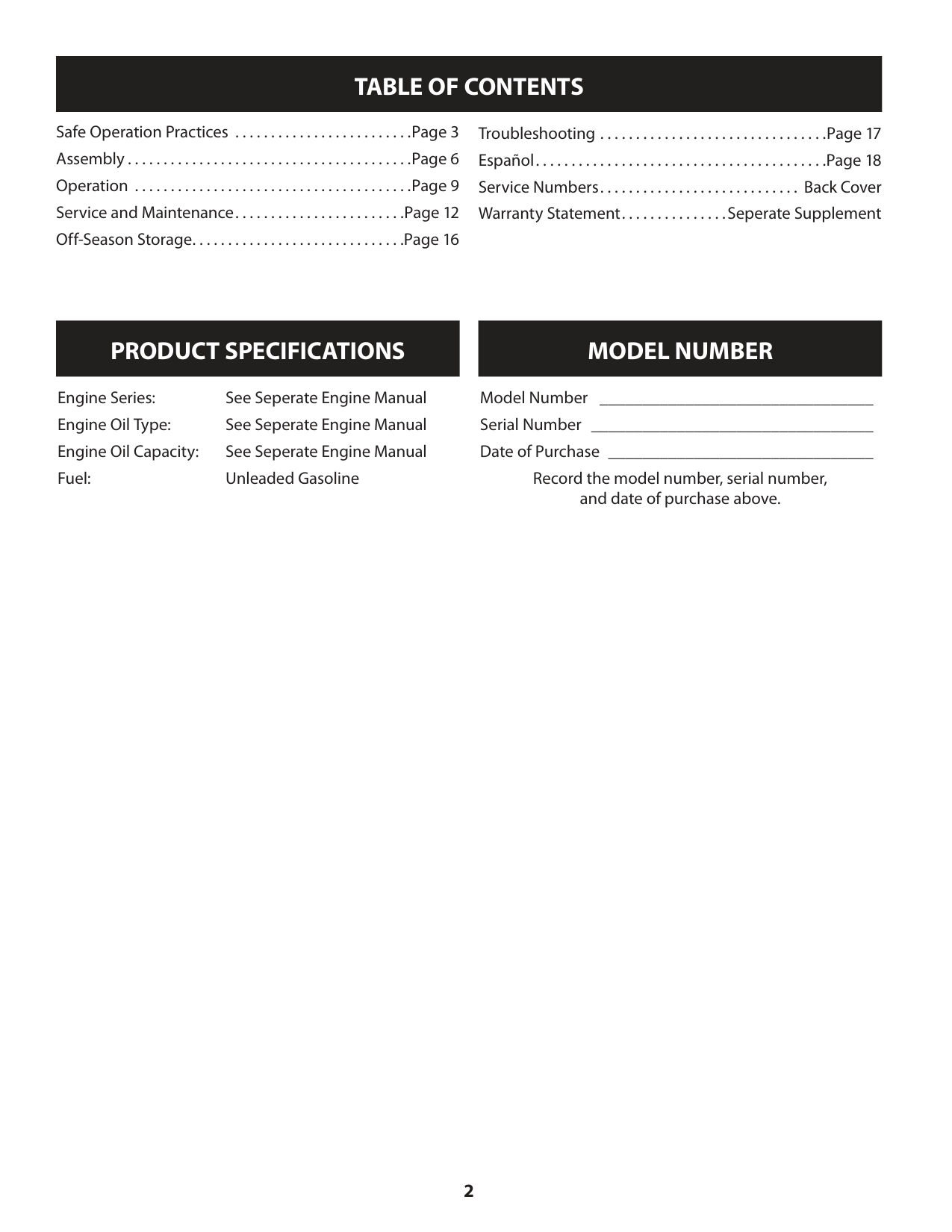
2
Table Of Contents
© Sears Brands, LLCModel Number
Product Specifications
Engine Oil:5W-30
Fuel:Unleaded Gasoline Spark Plug:
F6RTC (Sears Part #951-10292) Spark Plug Gap: .020” to 0.030” Model Number _ ________________________________ Serial Number __________________________________ Date of Purchase ________________________________ Record the model number, serial number, and date of purchase above. Safe Operation Practices . . . . . . . . . . . . . . . . . . . . . . . . . Page 3 Assembly. . . . . . . . . . . . . . . . . . . . . . . . . . . . . . . . . . . . . . . . Page 7 Operation . . . . . . . . . . . . . . . . . . . . . . . . . . . . . . . . . . . . . . Page 21 Service &Maintenance. . . . . . . . . . . . . . . . . . . . . . . . . . . Page 28 Off-Season Storage. . . . . . . . . . . . . . . . . . . . . . . . . . . . . . Page 36 Troubleshooting. . . . . . . . . . . . . . . . . . . . . . . . . . . . . . . . Page 37 Warranty Statement. . . . . . . . . . . See Separate Supplement Español. . . . . . . . . . . . . . . . . . . . . . . . . . . . . . . . . . . . . . . . . Page 39
3
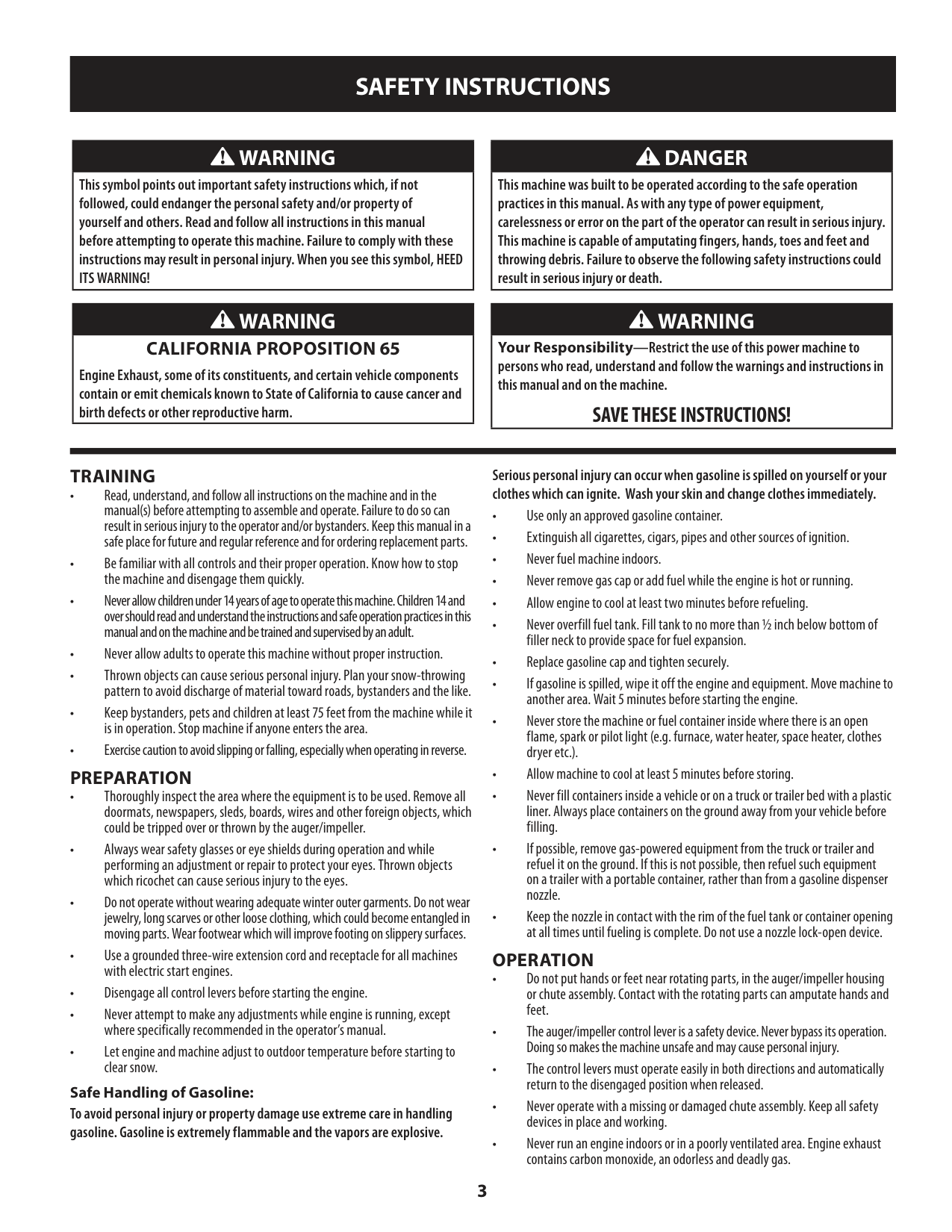
Safety Instructions
NOTE: The terms “snow thrower” and “snow blower” may be used interchangeably for this product.Training
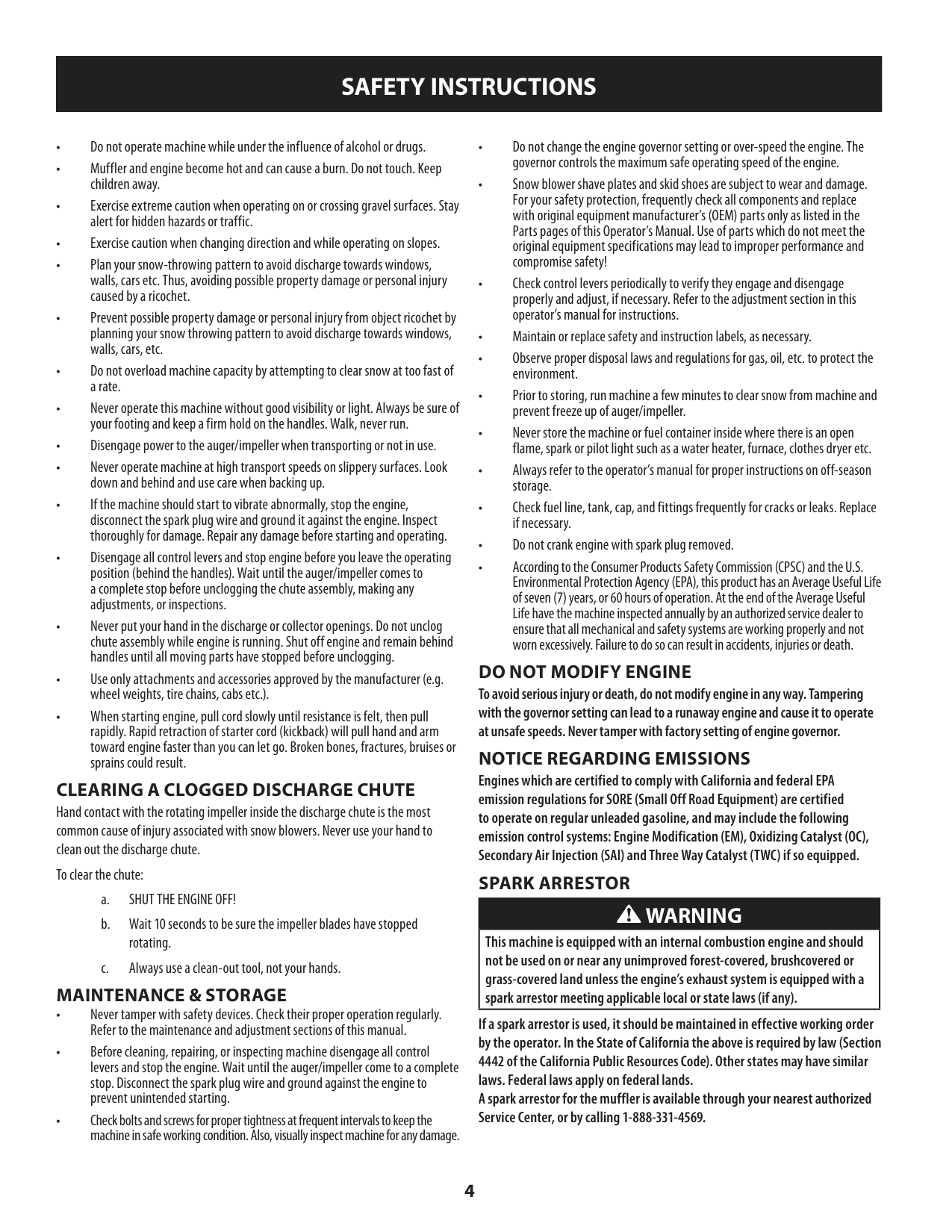
• Read, understand, and follow all instructions on the machine and in the manual(s) before attempting to assemble and operate. Failure to do so can result in serious injury to the operator and/or bystanders. Keep this manual in a safe place for future and regular reference and for ordering replacement parts. • Be familiar with all controls and their proper operation. Know how to stop the machine and disengage them quickly. • Never allow children under 14 years of age to operate this machine. Children 14 and over should read and understand the instructions and safe operation practices in this manual and on the machine and be trained and supervised by an adult. • Never allow adults to operate this machine without proper instruction. • Thrown objects can cause serious personal injury. Plan your snow-throwing pattern to avoid discharge of material toward roads, bystanders and the like. • Keep bystanders, pets and children at least 75 feet from the machine while it is in operation. Stop machine if anyone enters the area. • Exercise caution to avoid slipping or falling, especially when operating in reverse.Preparation
• Thoroughly inspect the area where the equipment is to be used. Remove all doormats, newspapers, sleds, boards, wires and other foreign objects, which could be tripped over or thrown by the auger/impeller. • Always wear safety glasses or eye shields during operation and while performing an adjustment or repair to protect your eyes. Thrown objects which ricochet can cause serious injury to the eyes. • Do not operate without wearing adequate winter outer garments. Do not wear jewelry, long scarves or other loose clothing, which could become entangled in moving parts. Wear footwear which will improve footing on slippery surfaces. • Use a grounded three-wire extension cord and receptacle for all machines with electric start engines. • Disengage all control levers before starting the engine. • Adjust collector housing height to clear gravel or crushed rock surfaces. • Never attempt to make any adjustments while engine is running, except where specifically recommended in the operator’s manual. • Let engine and machine adjust to outdoor temperature before starting to clear snow. Safe Handling of Gasoline: To avoid personal injury or property damage use extreme care in handling gasoline. Gasoline is extremely flammable and the vapors are explosive. Serious personal injury can occur when gasoline is spilled on yourself or your clothes which can ignite. Wash your skin and change clothes immediately. • Use only an approved gasoline container. • Never fill containers inside a vehicle or on a truck or trailer bed with a plastic liner. Always place containers on the ground away from your vehicle before filling. • When practical, remove gas-powered equipment from the truck or trailer and refuel it on the ground. If this is not possible, then refuel such equipment on a trailer with a portable container, rather than from a gasoline dispenser nozzle. • Keep the nozzle in contact with the rim of the fuel tank or container opening at all times until fueling is complete. Do not use a nozzle lock-open device. • Extinguish all cigarettes, cigars, pipes and other sources of ignition. • Never fuel machine indoors. • Never remove gas cap or add fuel while the engine is hot or running. Allow engine to cool at least two minutes before refueling. • Never over fill fuel tank. Fill tank to no more than ½ inch below bottom of filler neck to allow space for fuel expansion. • Replace gasoline cap and tighten securely.Warning
This symbol points out important safety instructions which, if not followed, could endanger the personal safety and/or property of yourself and others. Read and follow all instructions in this manual before attempting to operate this machine. Failure to comply with these instructions may result in personal injury. When you see this symbol, HEEDIts Warning!
Warning
California Proposition 65
Engine Exhaust, some of its constituents, and certain vehicle components contain or emit chemicals known to State of California to cause cancer and birth defects or other reproductive harm.Danger
This machine was built to be operated according to the safe operation practices in this manual. As with any type of power equipment, carelessness or error on the part of the operator can result in serious injury. This machine is capable of amputating fingers, hands, toes and feet and throwing debris. Failure to observe the following safety instructions could result in serious injury or death.Warning
Your Responsibility—Restrict the use of this power machine to persons who read, understand and follow the warnings and instructions in this manual and on the machine.Save These Instructions!
4
Safety Instructions
• If gasoline is spilled, wipe it off the engine and equipment. Move unit to another area. Wait 5 minutes before starting the engine. If fuel is spilled on clothing, change clothing immediately. • To reduce fire hazards, keep machine free of grass, leaves, or other debris build-up. Clean up oil or fuel spillage and remove any fuel soaked debris. • Never store the machine or fuel container inside where there is an open flame, spark or pilot light as on a water heater, space heater, furnace, clothes dryer or other gas appliances.Operation
• Do not put hands or feet near rotating parts, in the auger/impeller housing or chute assembly. Contact with the rotating parts can amputate hands and feet. • The auger/impeller control lever is a safety device. Never bypass its operation. Doing so makes the machine unsafe and may cause personal injury. • The control levers must operate easily in both directions and automatically return to the disengaged position when released. • Never operate with a missing or damaged chute assembly. Keep all safety devices in place and working. • Never run an engine indoors or in a poorly ventilated area. Engine exhaust contains carbon monoxide, an odorless and deadly gas. • Do not operate machine while under the influence of alcohol or drugs. • Muffler and engine become hot and can cause a burn. Do not touch. Keep children away. • Exercise extreme caution when operating on or crossing gravel surfaces. Stay alert for hidden hazards or traffic. • Exercise caution when changing direction and while operating on slopes. Do not operate on steep slopes. • Plan your snow-throwing pattern to avoid discharge towards windows, walls, cars etc. Thus, avoiding possible property damage or personal injury caused by a ricochet. • Never direct discharge at children, bystanders and pets or allow anyone in front of the machine. • Do not overload machine capacity by attempting to clear snow at too fast of a rate. • Never operate this machine without good visibility or light. Always be sure of your footing and keep a firm hold on the handles. Walk, never run. • Disengage power to the auger/impeller when transporting or not in use. • Never operate machine at high transport speeds on slippery surfaces. Look down and behind and use care when backing up. • After striking a foreign object or if the machine should start to vibrate abnormally, stop the engine, disconnect the spark plug wire and ground it against the engine. Inspect thoroughly for damage. Repair any damage before starting and operating. • Disengage all control levers and stop engine before you leave the operating position (behind the handles). Wait until the auger/impeller comes to a complete stop before unclogging the chute assembly, making any adjustments, or inspections. • Never put your hand in the discharge or collector openings. Do not unclog chute assembly while engine is running. Shut off engine and remain behind handles until all moving parts have stopped before unclogging. • Use only attachments and accessories approved by the manufacturer (e.g. wheel weights, tire chains, cabs etc.). • When starting engine, pull cord slowly until resistance is felt, then pull rapidly. Rapid retraction of starter cord (kickback) will pull hand and arm toward engine faster than you can let go. Broken bones, fractures, bruises or sprains could result. • If situations occur which are not covered in this manual, use care and good judgment.Clearing A Clogged Discharge Chute
Hand contact with the rotating impeller inside the discharge chute is the most common cause of injury associated with snow throwers. Never use your hand to clean out the discharge chute. To clear the chute: a.Shut The Engine Off!
b. Wait 10 seconds to be sure the impeller blades have stopped rotating. c. Always use a clean-out tool, not your hands.Maintenance & Storage
• Never tamper with safety devices. Check their proper operation regularly. Refer to the maintenance and adjustment sections of this manual. • Before cleaning, repairing, or inspecting machine disengage all control levers and stop the engine. Wait until the auger/impeller come to a complete stop. Disconnect the spark plug wire and ground against the engine to prevent unintended starting. • Check bolts and screws for proper tightness at frequent intervals to keep the machine in safe working condition. Also, visually inspect machine for any damage. • Do not change the engine governor setting or over-speed the engine. The governor controls the maximum safe operating speed of the engine. • Snow thrower shave plates and skid shoes are subject to wear and damage. For your safety protection, frequently check all components and replace with original equipment manufacturer’s (OEM) parts only as listed in the Parts pages of this operator’s manual. Use of parts which do not meet the original equipment specifications may lead to improper performance and compromise safety! • Check control levers periodically to verify they engage and disengage properly and adjust, if necessary. Refer to the adjustment section in this operator’s manual for instructions. • Maintain or replace safety and instruction labels, as necessary.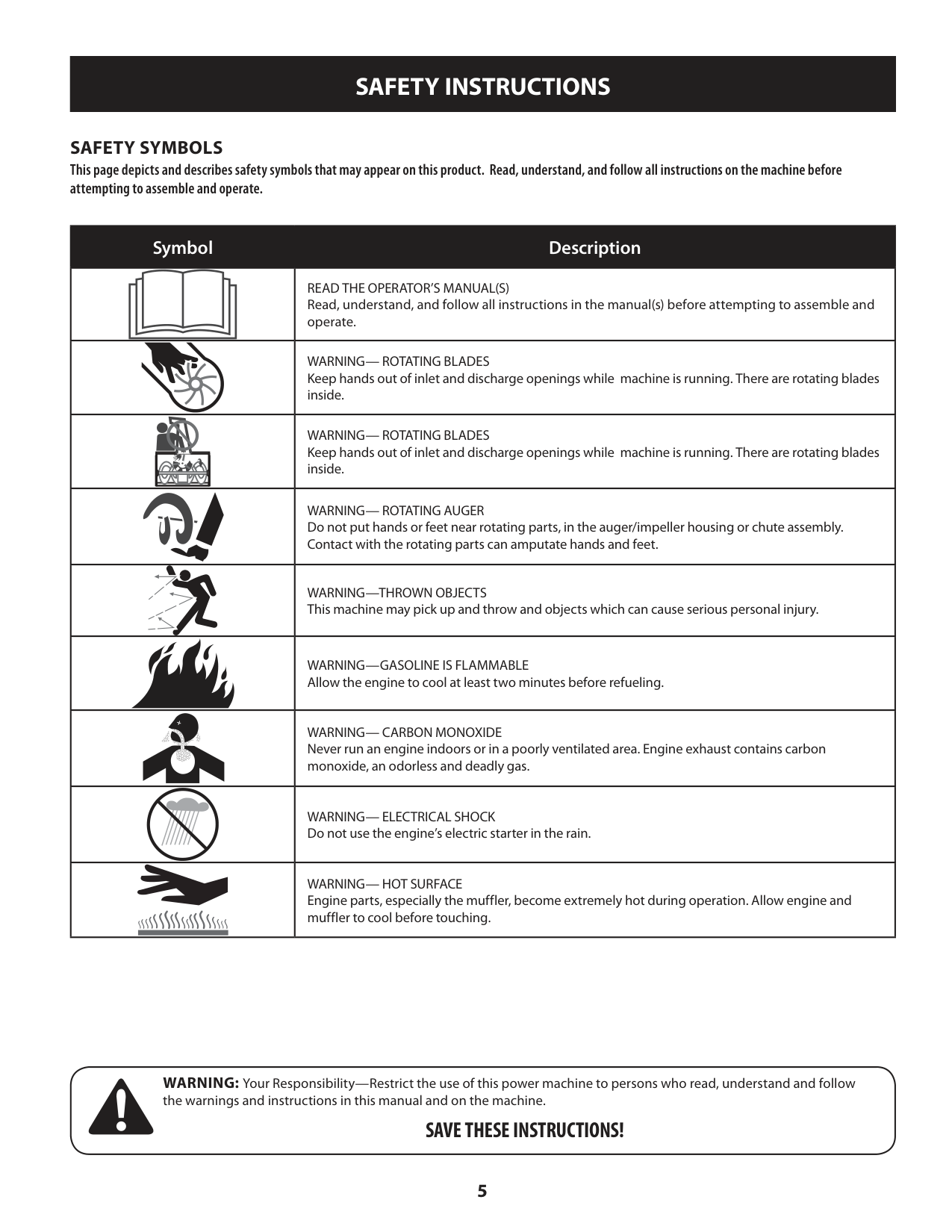
5
Safety Instructions
• Observe proper disposal laws and regulations for gas, oil, etc. to protect the environment. • Prior to storing, run machine a few minutes to clear snow from machine and prevent freeze up of auger/impeller. • Never store the machine or fuel container inside where there is an open flame, spark or pilot light such as a water heater, furnace, clothes dryer etc. • Always refer to the operator’s manual for proper instructions on off-season storage. • Check fuel line, tank, cap, and fittings frequently for cracks or leaks. Replace if necessary. • Do not crank engine with spark plug removed. • According to the Consumer Products Safety Commission (CPSC) and the U.S. Environmental Protection Agency (EPA), this product has an Average Useful Life of seven (7) years, or 60 hours of operation. At the end of the Average Useful Life have the machine inspected annually by an authorized service dealer to ensure that all mechanical and safety systems are working properly and not worn excessively. Failure to do so can result in accidents, injuries or death.Do Not Modify Engine
To avoid serious injury or death, do not modify engine in any way. Tampering with the governor setting can lead to a runaway engine and cause it to operate at unsafe speeds. Never tamper with factory setting of engine governor.Notice Regarding Emissions
Engines which are certified to comply with California and federal EPA emission regulations for SORE (Small Off Road Equipment) are certified to operate on regular unleaded gasoline, and may include the following emission control systems: Engine Modification (EM), Oxidizing Catalyst (OC), Secondary Air Injection (SAI) and Three Way Catalyst (TWC) if so equipped.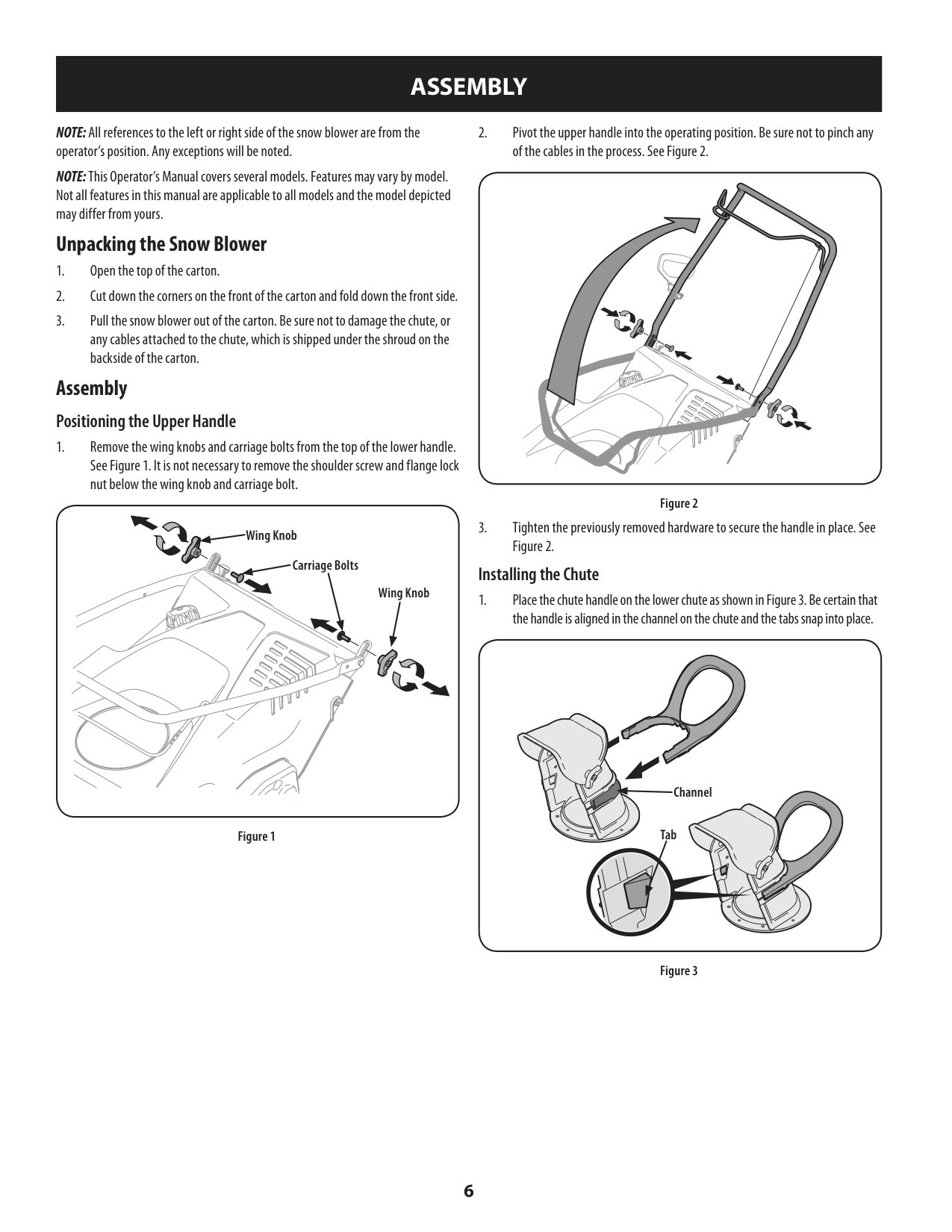
6
Safety Instructions
Safety Symbols
This page depicts and describes safety symbols that may appear on this product. Read, understand, and follow all instructions on the machine before attempting to assemble and operate. Symbol DescriptionRead The Operator’S Manual(S)
Read, understand, and follow all instructions in the manual(s) before attempting to assemble and operate.Warning— Rotating Blades
Keep hands out of inlet and discharge openings while machine is running. There are rotating blades inside.Warning— Rotating Blades
Keep hands out of inlet and discharge openings while machine is running. There are rotating blades inside.Warning— Rotating Auger
Do not put hands or feet near rotating parts, in the auger/impeller housing or chute assembly. Contact with the rotating parts can amputate hands and feet.Warning—Thrown Objects
This machine may pick up and throw and objects which can cause serious personal injury.Warning—Gasoline Is Flammable
Allow the engine to cool at least two minutes before refueling.Warning— Carbon Monoxide
Never run an engine indoors or in a poorly ventilated area. Engine exhaust contains carbon monoxide, an odorless and deadly gas.Warning— Electrical Shock
Do not use the engine’s electric starter in the rain.Warning— Hot Surface
Engine parts, especially the muffler, become extremely hot during operation. Allow engine and muffler to cool before touching. WARNING: Your Responsibility—Restrict the use of this power machine to persons who read, understand and follow the warnings and instructions in this manual and on the machine.Save These Instructions!
7
Assembly
NOTE: This Operator’s Manual covers several models. Features may vary by model. Not all features in this manual are applicable to all models and the model depicted may differ from yours. Refer to Figure 1 which shows the different versions and match the contents of carton (chute and directional control rod/flex shaft) to identify your specific unit. Electric Chute Control Page 16 Manual Chute Control Rod Chute Assembly Flex Shaft Overhead Chute Control (w/ Flex Shaft Steel Chute) Page 14 Chute Assembly Standard Side Crank Chute Control Page 10 Standard Side Crank Rod Assembly Chute Assembly Overhead Chute Control (w/ Chute Control Rod) Page 11 Overhead Chute Control Rod Chute Assembly 2-Way & 4-Way Chute Control Page 12 Chute Control Rod Chute Assembly Figure 1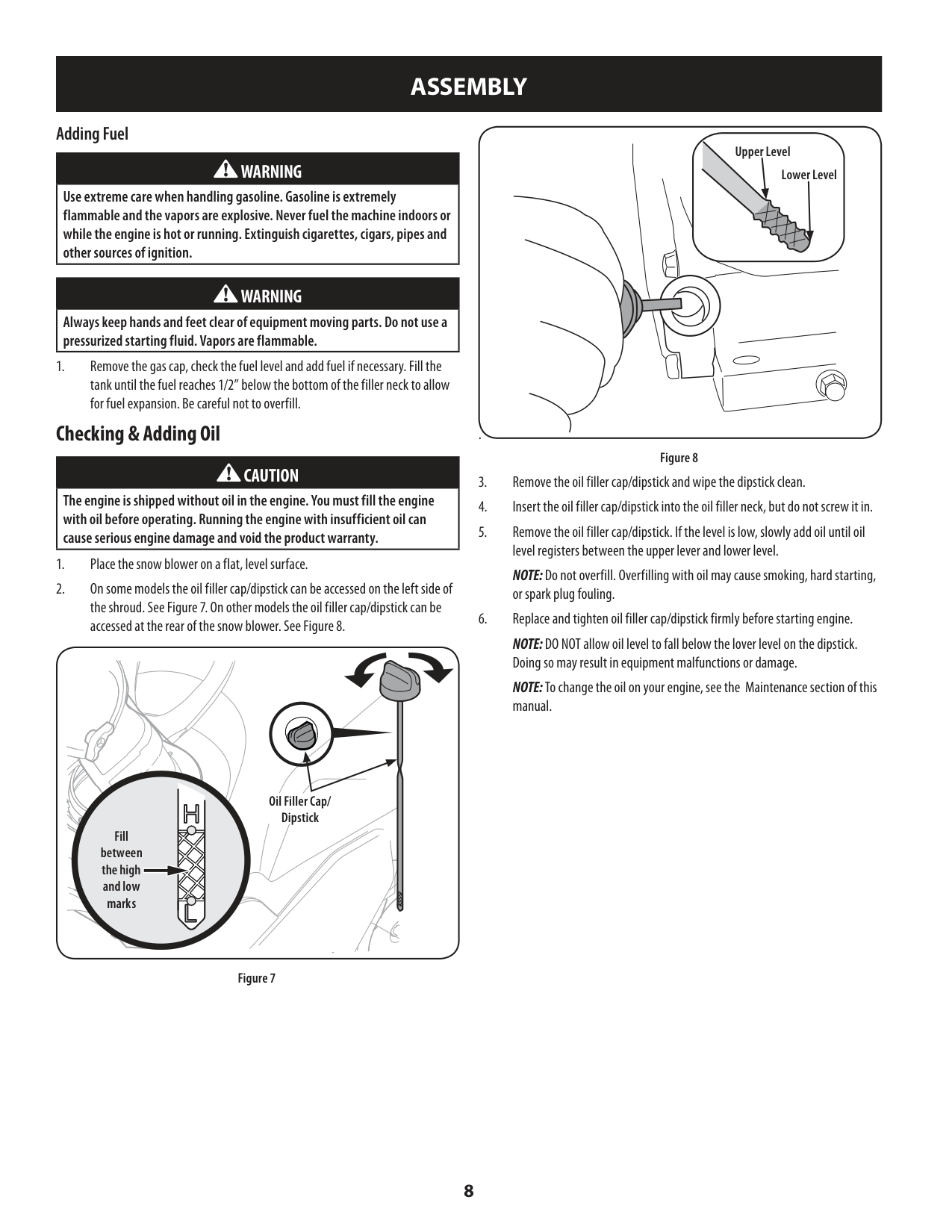
8
Assembly
NOTE: References to right or left side of the snow blower are determined from behind the unit in the operating position (standing directly behind the snow blower, facing the handle panel). UNPACKING: Removing From Carton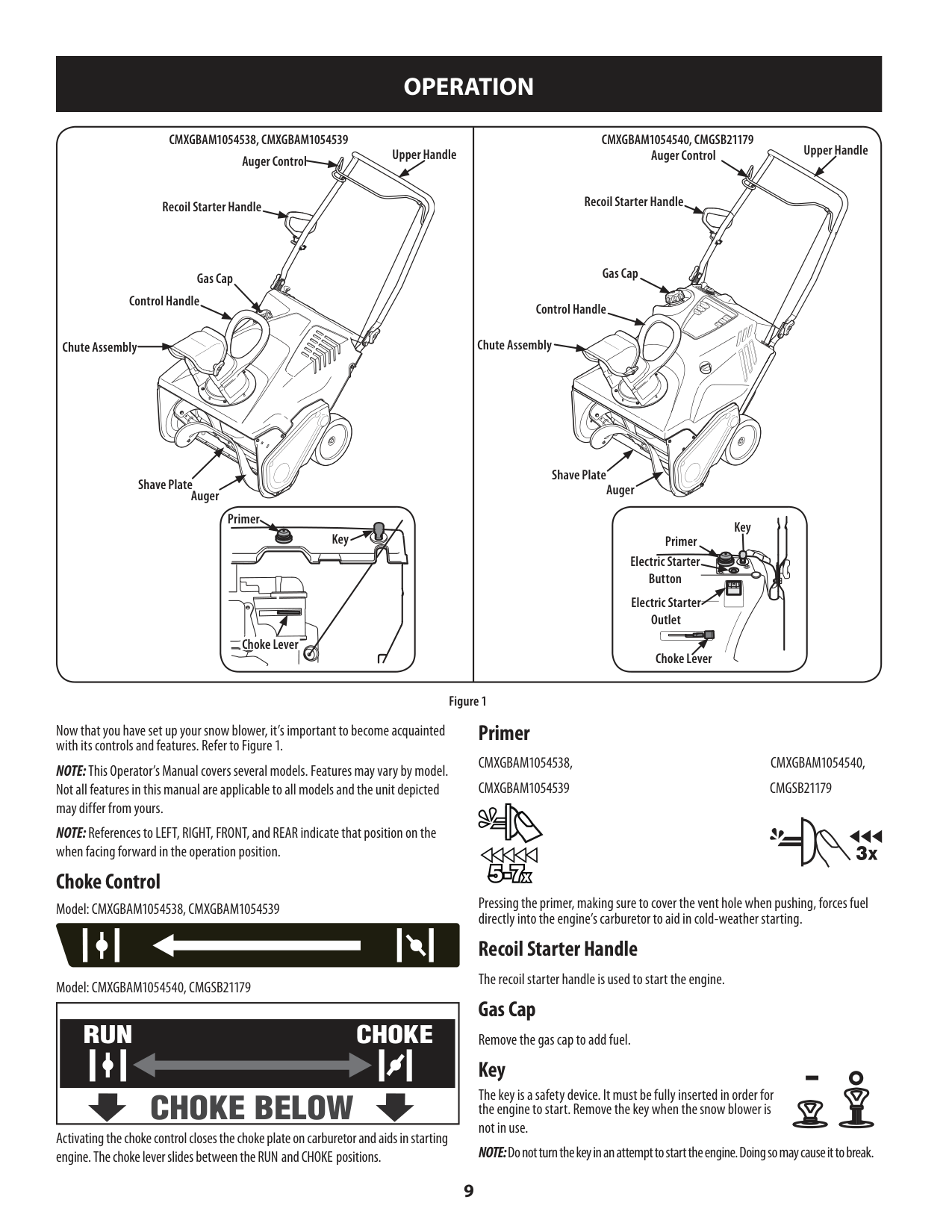
9
Assembly
Stop
Refer to Figure 1 to identify your applicable chute style and continue to Chute Assembly Options (page 9). Chute Assembly Options Refer to Figure 1 and proceed to your applicable Chute Control Style on pages 10-17.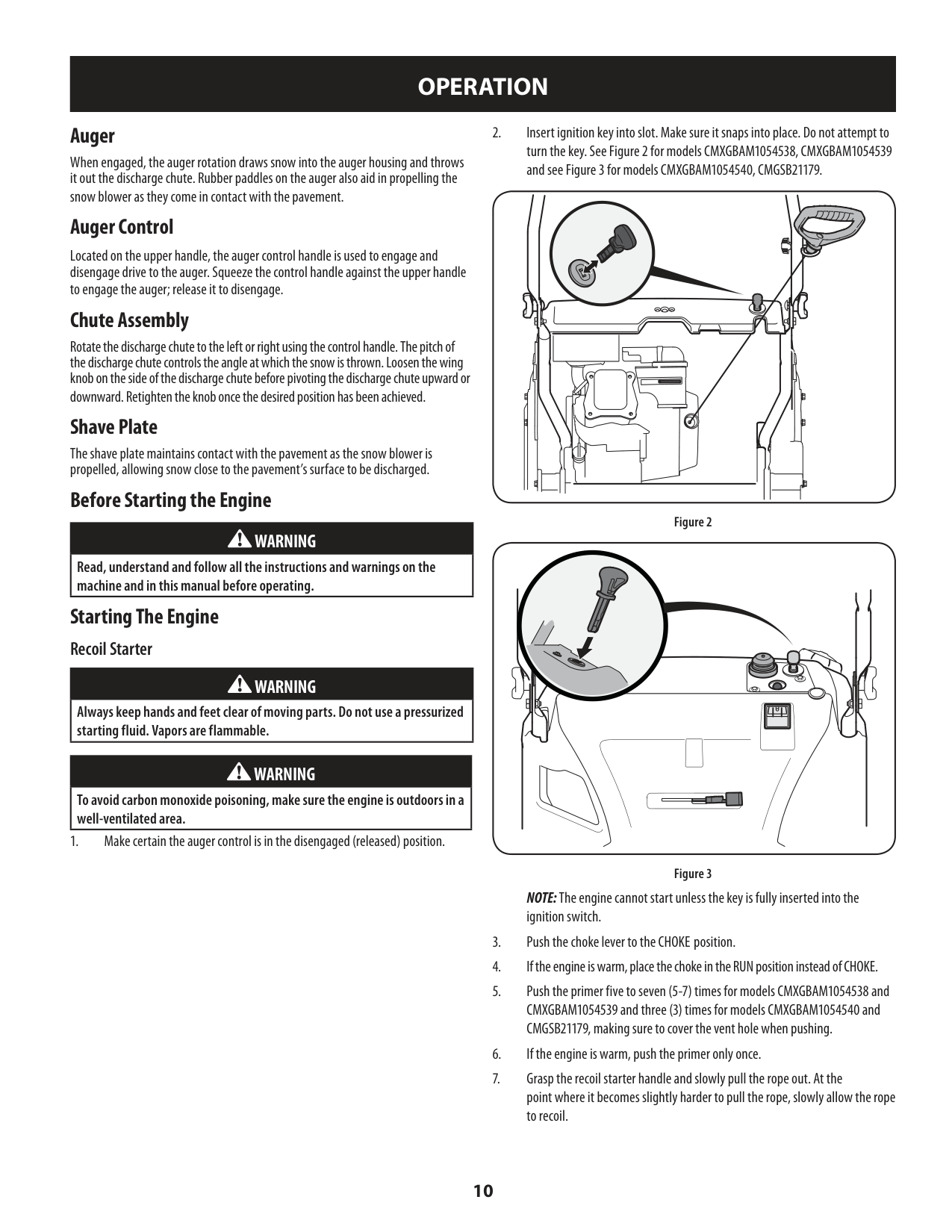
10
Assembly
Stop
Continue to Set-Up (page 18). Standard Side Crank Chute Control Figure 8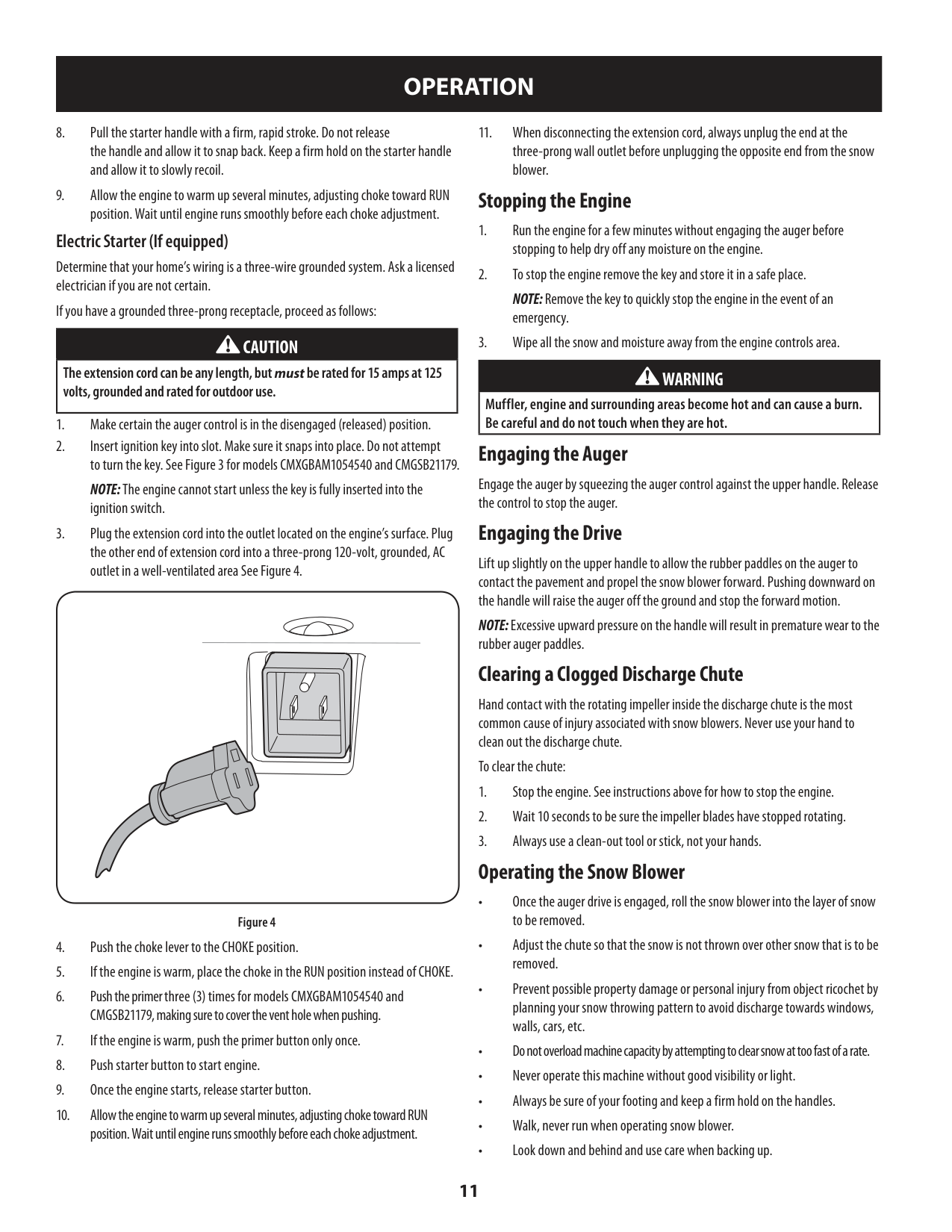
11
Assembly
Overhead Chute Control (w/ Chute Control Rod) Figure 12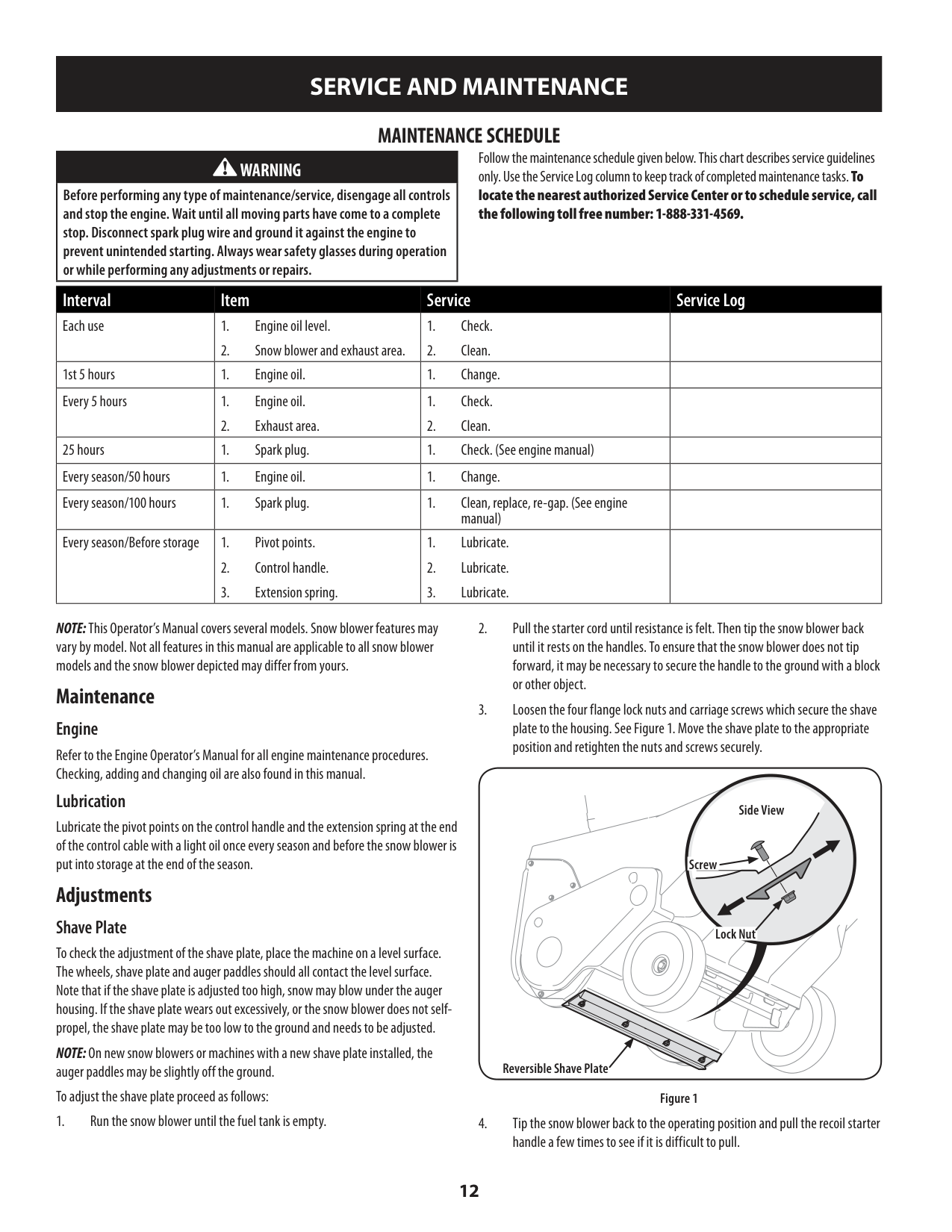
12
Assembly
Stop
Continue to Set-Up (page 18). 2-Way & 4-Way Chute Control Figure 18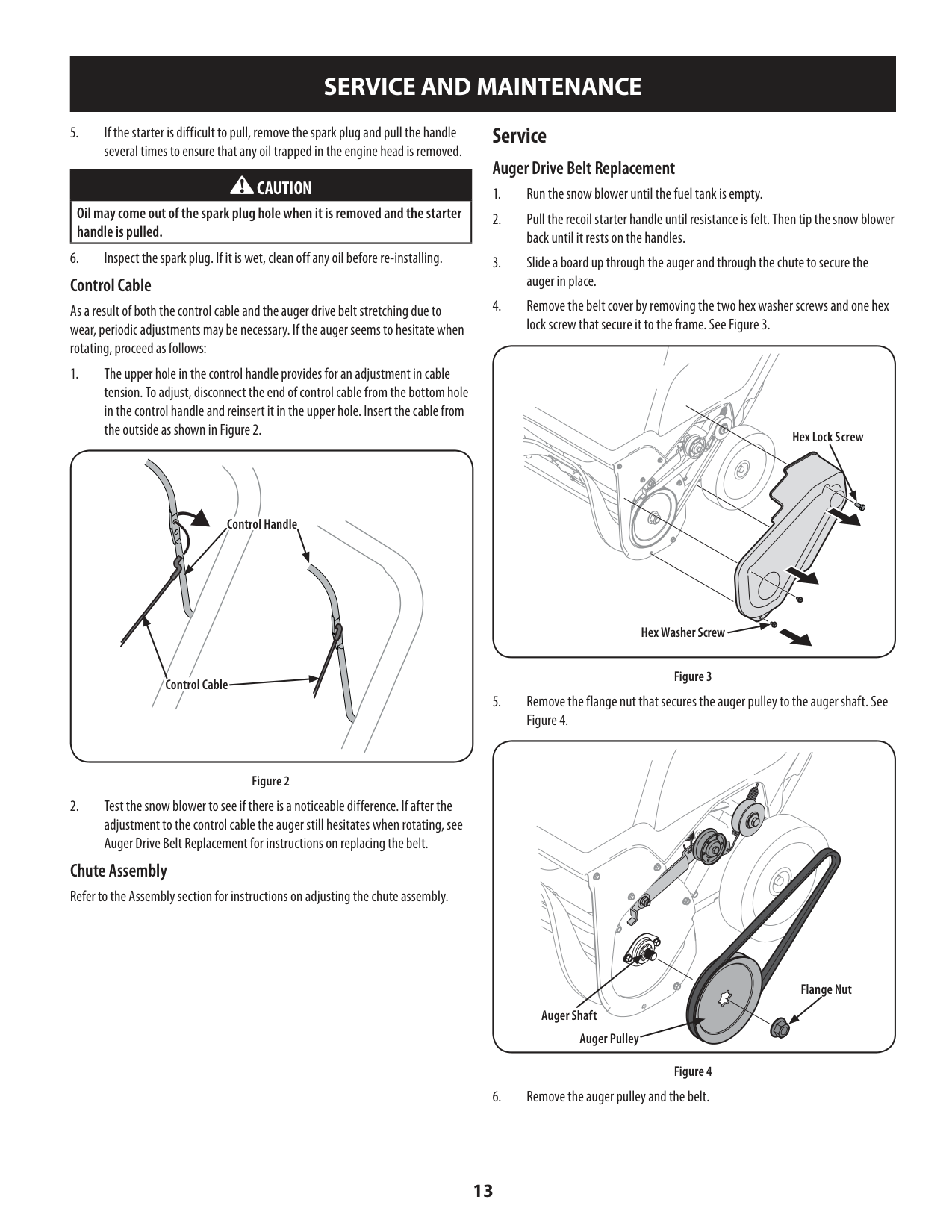
13
Assembly
NOTE: For smoothest operation, cables should all be to the left of the chute directional control rod.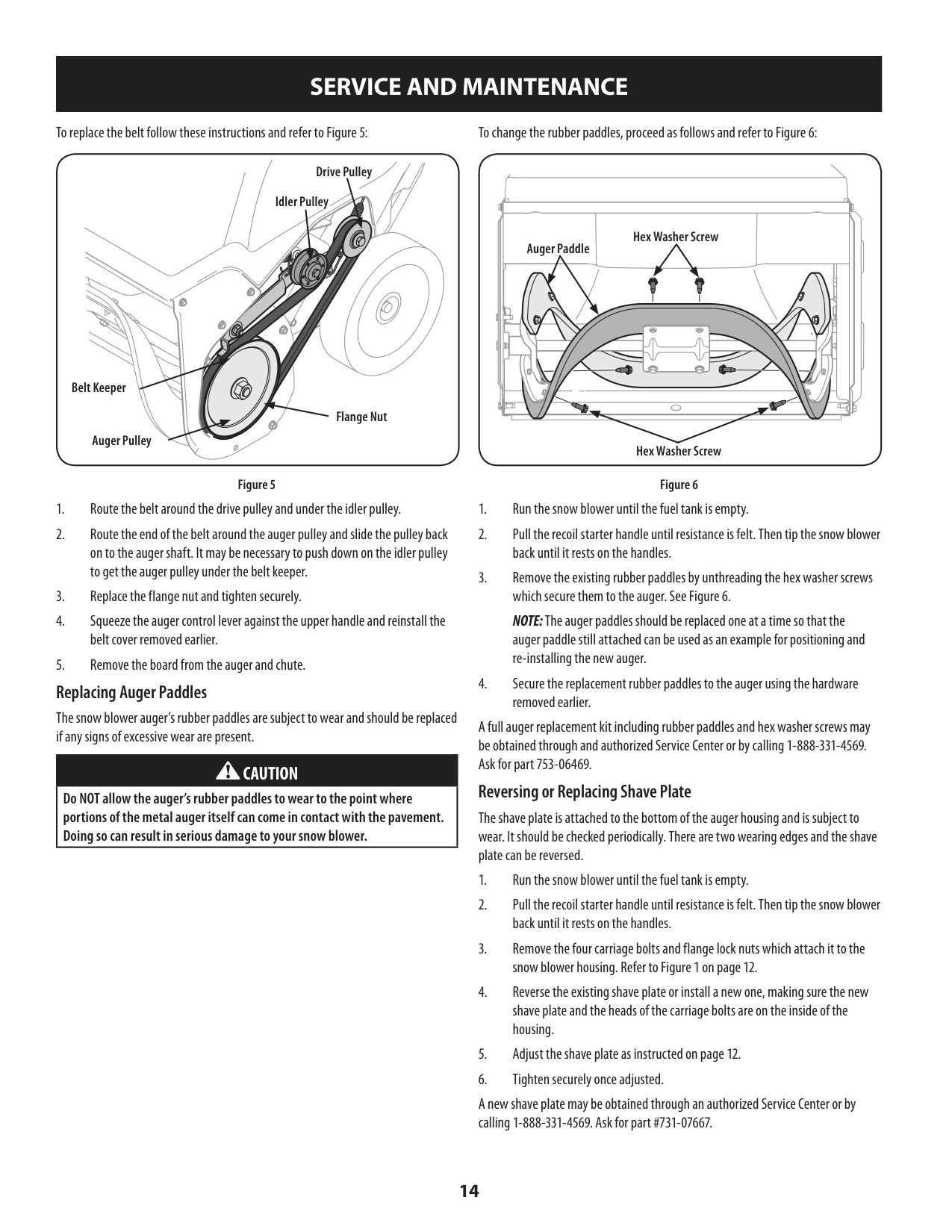
14
Assembly
Figure 24 NOTE: Chute control rod will fit snug into pinion gear. Support rear of dash panel with one hand while inserting rod with your other hand to ensure rod is inserted all the way into pinion gear. NOTE: The hole in the chute directional control rod is a reference for aligning rod with indicator arrow on pinion gear, and will be visible after rod has been inserted.Stop
Continue to Set-Up (page 18). Overhead Chute Control (w/ Flex Shaft & Steel Chute) Figure 26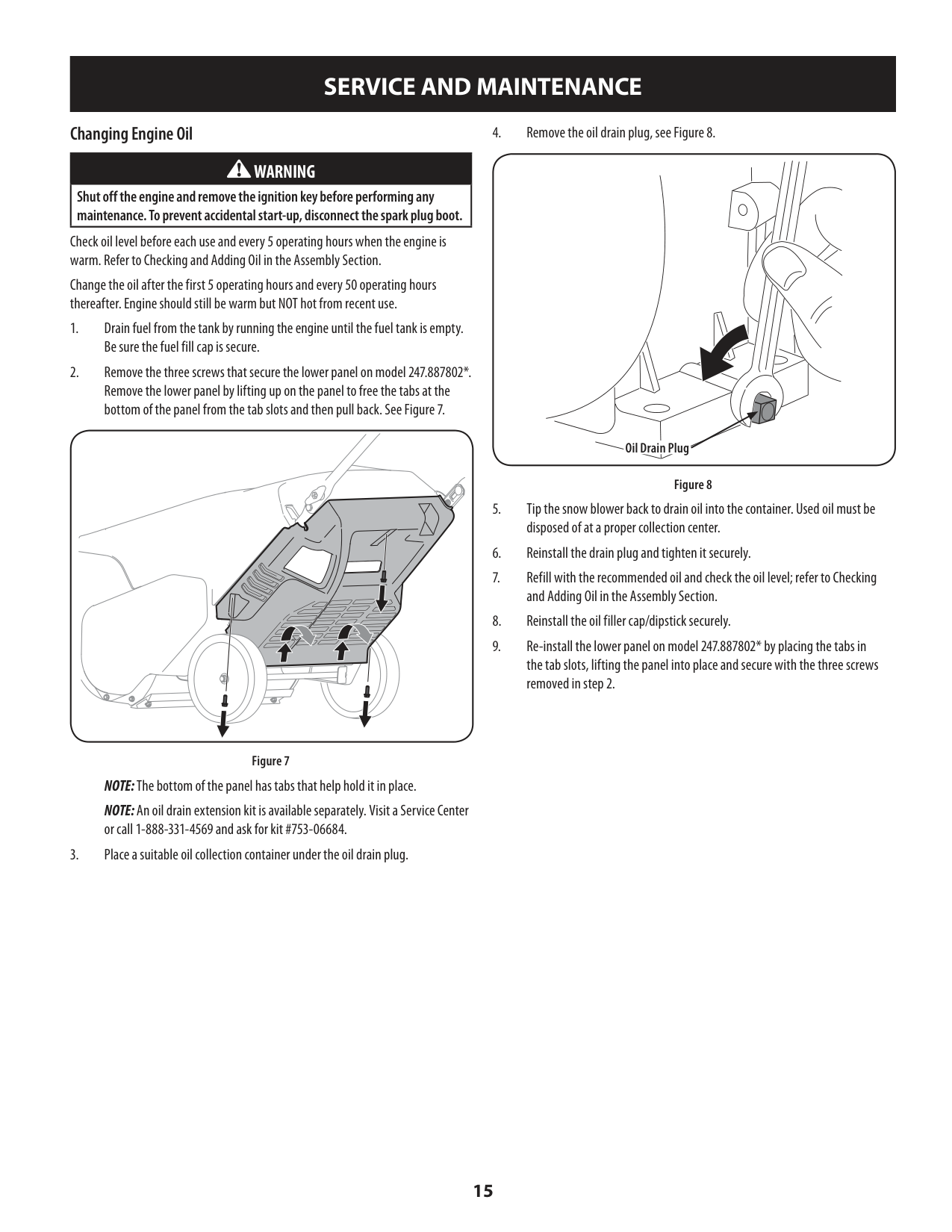
15
Assembly
16
Assembly
Stop
Continue to Set-Up (page 18). Electric Chute Control Figure 33Figure 34 NOTE: For smoothest operation, the cables should all be to the left of the chute control rod.
17
Assembly
18
Assembly
Stop
Continue to Set-Up (page 18). Set-Up Chute Control Cable Routing (If Equipped) For units equipped with 2-way or 4-way chute control joystick, electric chute control and/or chute-pitch controls, ensure control cables are routed properly. NOTE: For smoothest operation, cables should all be to the left of the chute directional control rod. NOTE: The number of cables routed through the wire guides will depend on unit model.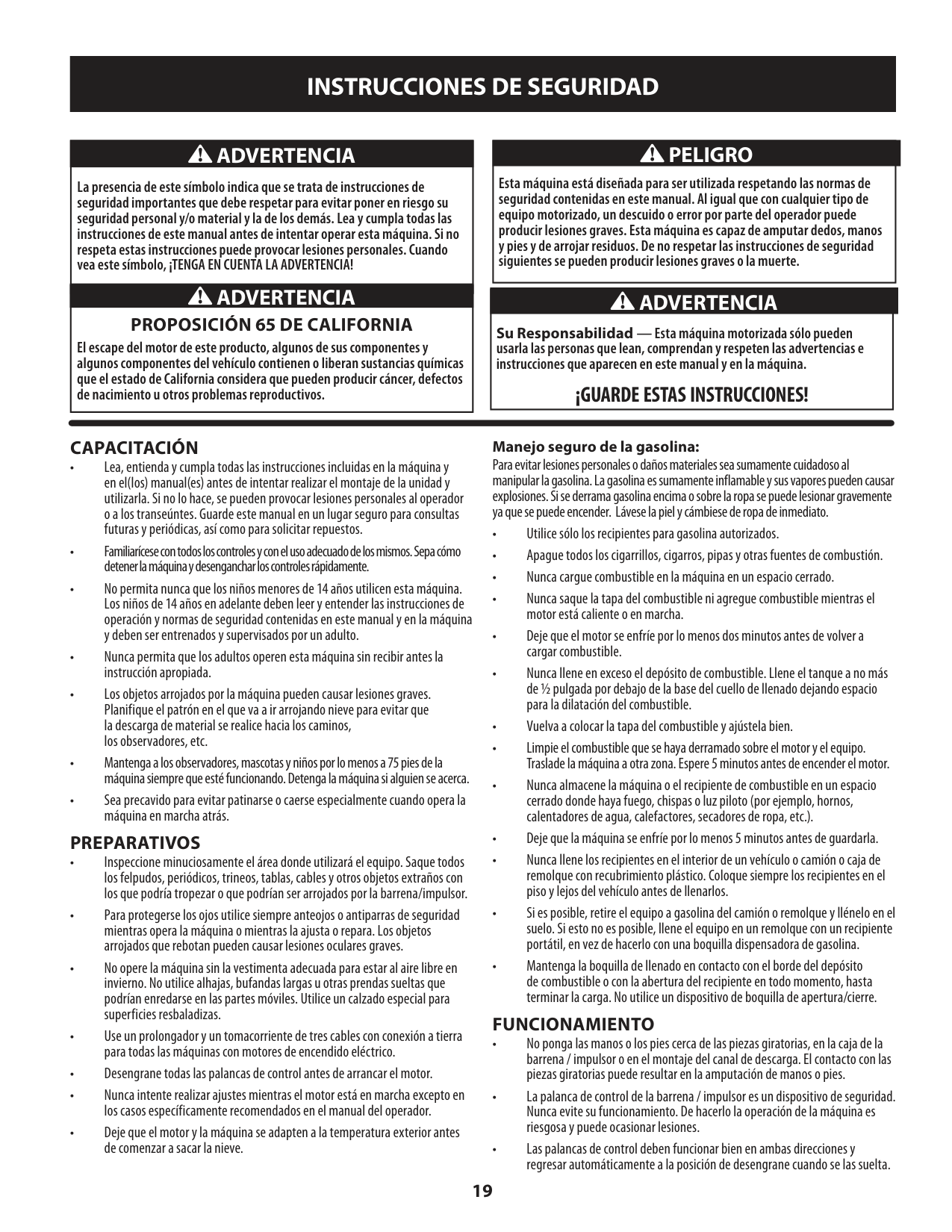
19
Assembly
Chute Clean-Out Tool A chute clean-out tool is fastened to the top of the auger housing with a mounting clip. See Figure 42. The tool is designed to clear a chute assembly of ice and snow. This item is fastened with a cable tie at the factory. Cut the cable tie before operating the snow blower.Warning
Never use your hands to clear a clogged chute assembly. Shut OFF engine and remain behind handles until all moving parts have stopped before using the clean-out tool to clear the chute assembly. Chute Clean-Out Tool Figure 42 Drift Cutters (if equipped)Warning
Under any circumstance do not exceed manufacturer’s recommended psi. Equal tire pressure should be maintained at all times. Excessive pressure when seating beads may cause tire/rim assembly to burst with force sufficient to cause serious injury. Refer to sidewall of tire for recommended pressure. The tires are over-inflated for shipping purposes. Check the tire pressure before operating the snow blower. Refer to the tire side wall for tire manufacturer’s recommended psi and deflate (or inflate) the tires as necessary. NOTE: Equal tire pressure is to be maintained at all times for performance purposes. Adjustments Skid Shoes The snow blower skid shoes are adjusted at the factory to be approx 1/8” below the bottom surface of the shave plate. Adjust them downward, if desired, prior to operating the snow blower.Caution
It is not recommended that you operate this snow blower on gravel as it can easily pick up and throw loose gravel, causing personal injury or damage to the snow blower and surrounding property. • For close snow removal on a smooth surface, raise skid shoes higher on the auger housing. Refer to Figure 45. • Use a middle or lower position when the area to be cleared is uneven, such as a gravel driveway. NOTE: If you choose to operate the snow blower on a gravel surface, keep the skid shoes in position for maximum clearance between the ground and the shave plate.
20
Assembly
To adjust the skid shoes:Warning
Prior to operating your snow blower, carefully read and follow all instructions below. Perform all adjustments to verify your snow blower is operating safely and properly. Check the adjustment of the auger control as follows: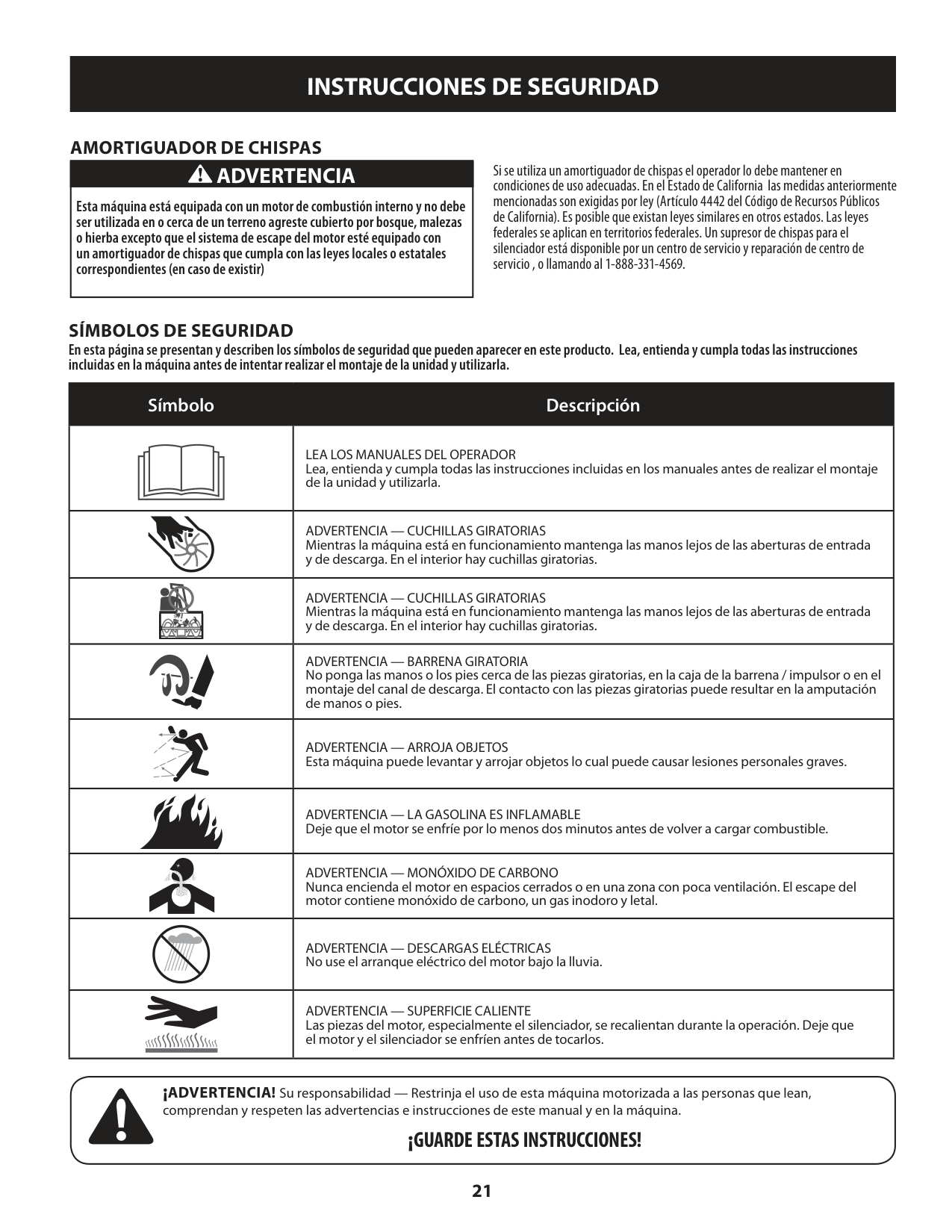
21
Operation
Meets ANSI Safety Standards Craftsman Snow Blowers conform to the safety standard of the American National Standards Institute (ANSI). † If Equipped Standard Chute Directional Control † Shift Lever Augers Skid Shoe Clean Out Tool Chute Assembly Drive Control Lever Auger Control Lever Auger Housing LED Light Bar † Drift Cutters † Overhead Chute Directional Control † Heated Grips † Shift Lever 4-Way/2-Way Chute Directional Control Joystick † Shift Rod Manual Chute Directional Control † Electric Chute Directional Control Joystick † Steering Trigger Control † Shift Lever Shift Lever Muffler Muffler Choke Control Choke Control Safety Key Safety Key Throttle Control Throttle Control Recoil Starter Handle Recoil Starter Handle Oil Drain Oil Drain Fuel Cap Fuel Cap Oil Fill Oil Fill Electric Starter Outlet/Switchbox Primer Primer Electric Starter Button Electric Starter Button Electric Starter Outlet Figure 47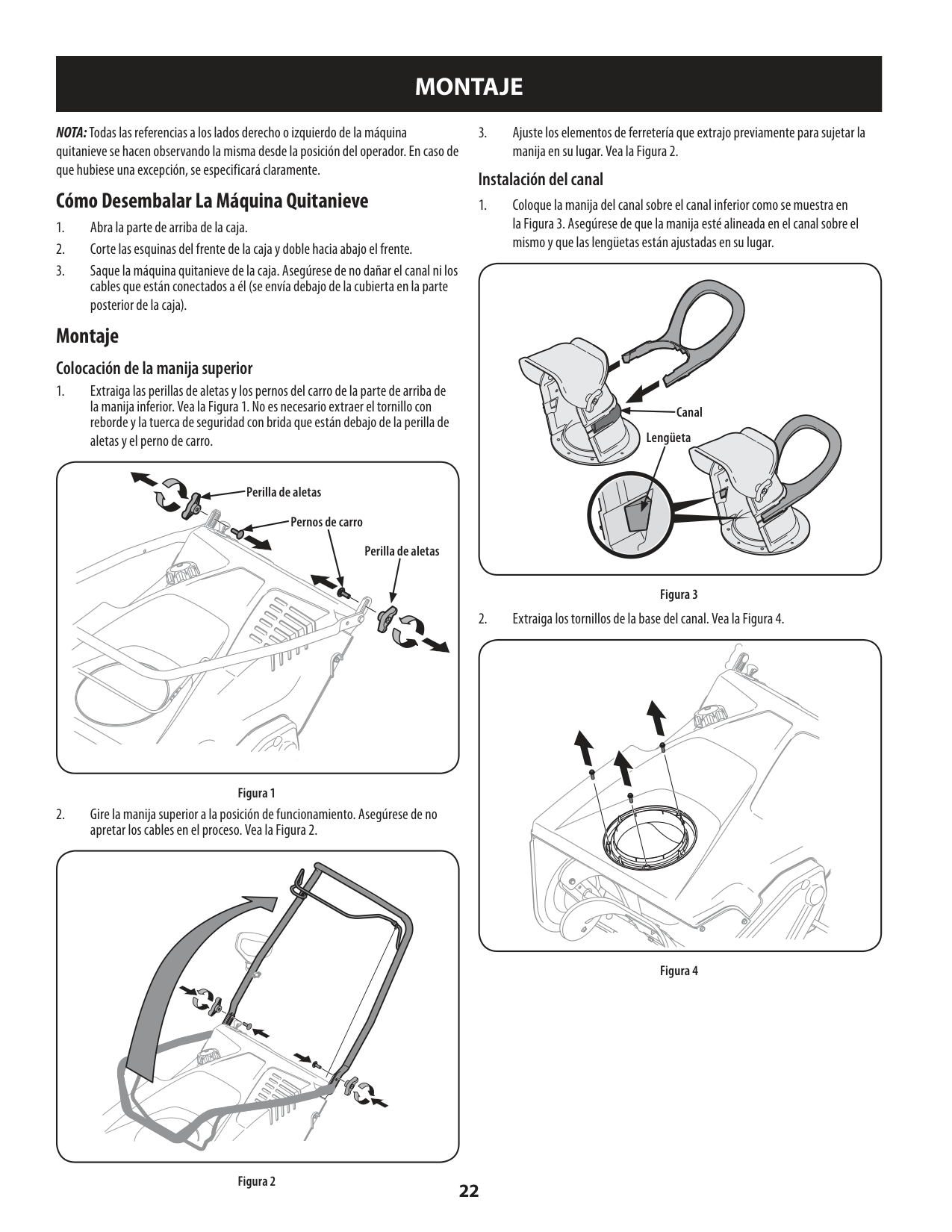
22
Operation
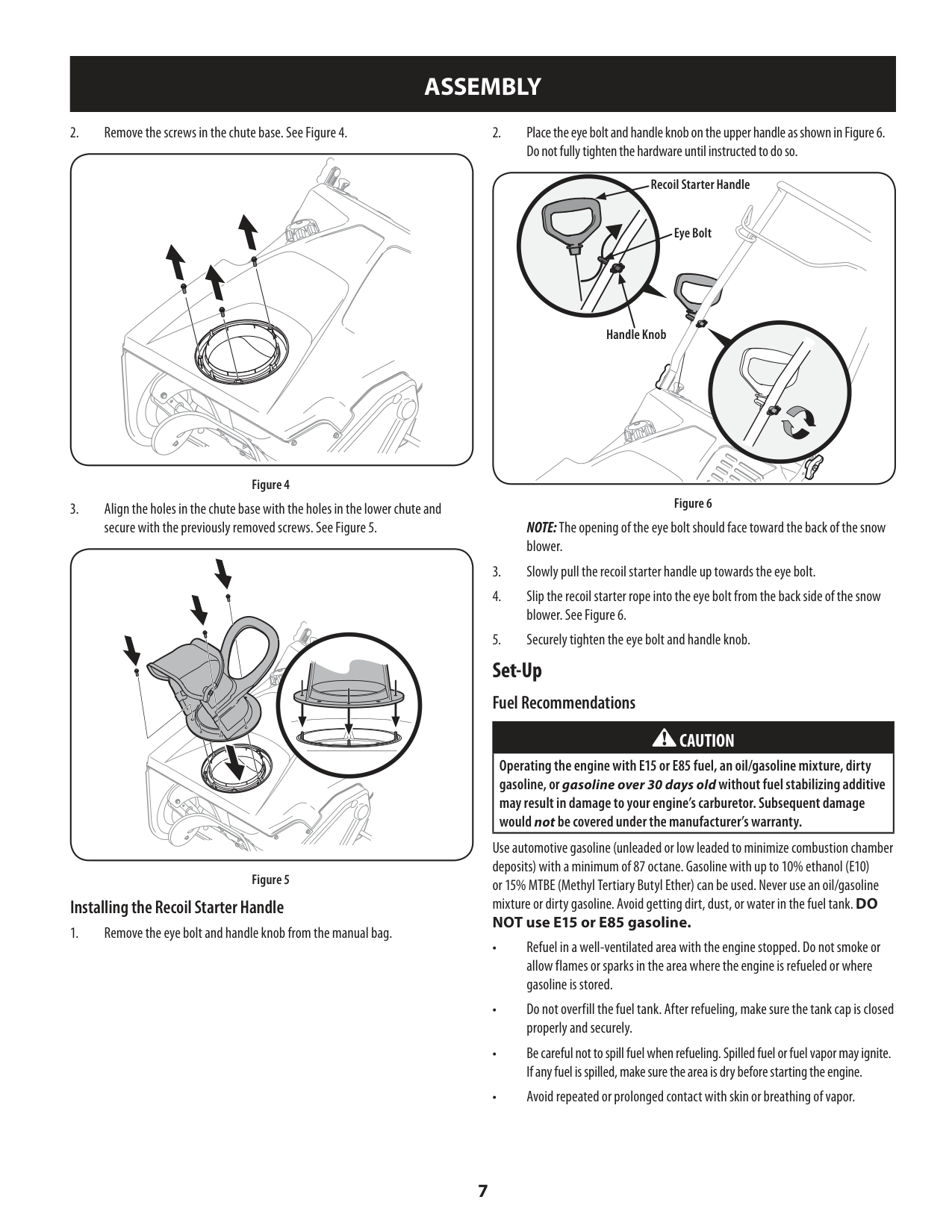
Now that you have set up your snow blower, it’s important to become acquainted with its controls and features. Refer to Figure 47. NOTE: This Operator’s Manual covers several models. Snow blower features may vary by model. Not all features in this manual are applicable to all snow blower models and the snow blower depicted may differ from yours. NOTE: All references to the left or right side of the snow blower are from the operator’s position. Any exceptions will be noted. Shift Lever The shift lever is located on the right side of the handle panel. Place the shift lever into any of eight positions to control the direction of travel and ground speed. Forward Your snow blower has six forward (F) speeds. Position one (1) is the slowest and position six (6) is the fastest. Reverse Your snow blower has two reverse (R) speeds. Position one (1) is the slower and position two (2) is the faster. Drift Cutters (If Equipped) The drift cutters are designed for use in deep snow. Their use is optional for normal snow conditions. Maneuver the snow blower so that the cutters penetrate a high standing snow drift to assist snow falling into the augers for throwing. Safety Key The safety key is a safety device. It must be fully inserted in order for the engine to start. Remove the safety key when the snow blower is not in use. NOTE: Do not turn the safety key in an attempt to start the engine. Doing so may cause it to break. Choke Control The choke control is found on the rear of the engine and is activated by turning the rotary choke knob to the CHOKE position. Activating the choke control closes the choke plate on the carburetor and aids in starting the engine. Recoil Starter Handle This handle is used to manually start the engine. LED Light (If Equipped) The LED light is located inside of the handle panel and is ON when the engine is running. LED Light Bar (If Equipped) The LED headlight is located on top of the auger housing and is automatically turned ON when the engine is started. Throttle Control The throttle control is located on the rear of the engine. It regulates the speed of the engine and will shut off the engine when moved into the STOP position. Primer Depressing the primer forces fuel directly into the engine’s carburetor to aid in cold-weather starting. Electric Starter Button (If Equipped) Pressing the electric starter button engages the engine’s electric starter when plugged into a 120V power source. Electric Starter Outlet (If Equipped) Requires the use of a three-prong outdoor extension cord and a 120V power source/ wall outlet. Oil Fill Engine oil level can be checked and oil added through the oil fill. Fuel Cap Unthread the fuel cap to add gasoline to the fuel tank. Auger When engaged, the auger blades rotate and draw snow into the auger housing. Chute Assembly Snow drawn into the auger housing is discharged out the chute assembly. Skid Shoes Position the skid shoes based on surface conditions. Adjust upward for hard-packed snow. Adjust downward when operating on gravel or crushed rock surfaces. Wheel Steering Controls (If Equipped) The left and right wheel steering controls are located on the underside of the handles. Squeeze the right control to turn right; squeeze the left control to turn left. NOTE: Operate the snow blower in open areas until you are familiar with these controls.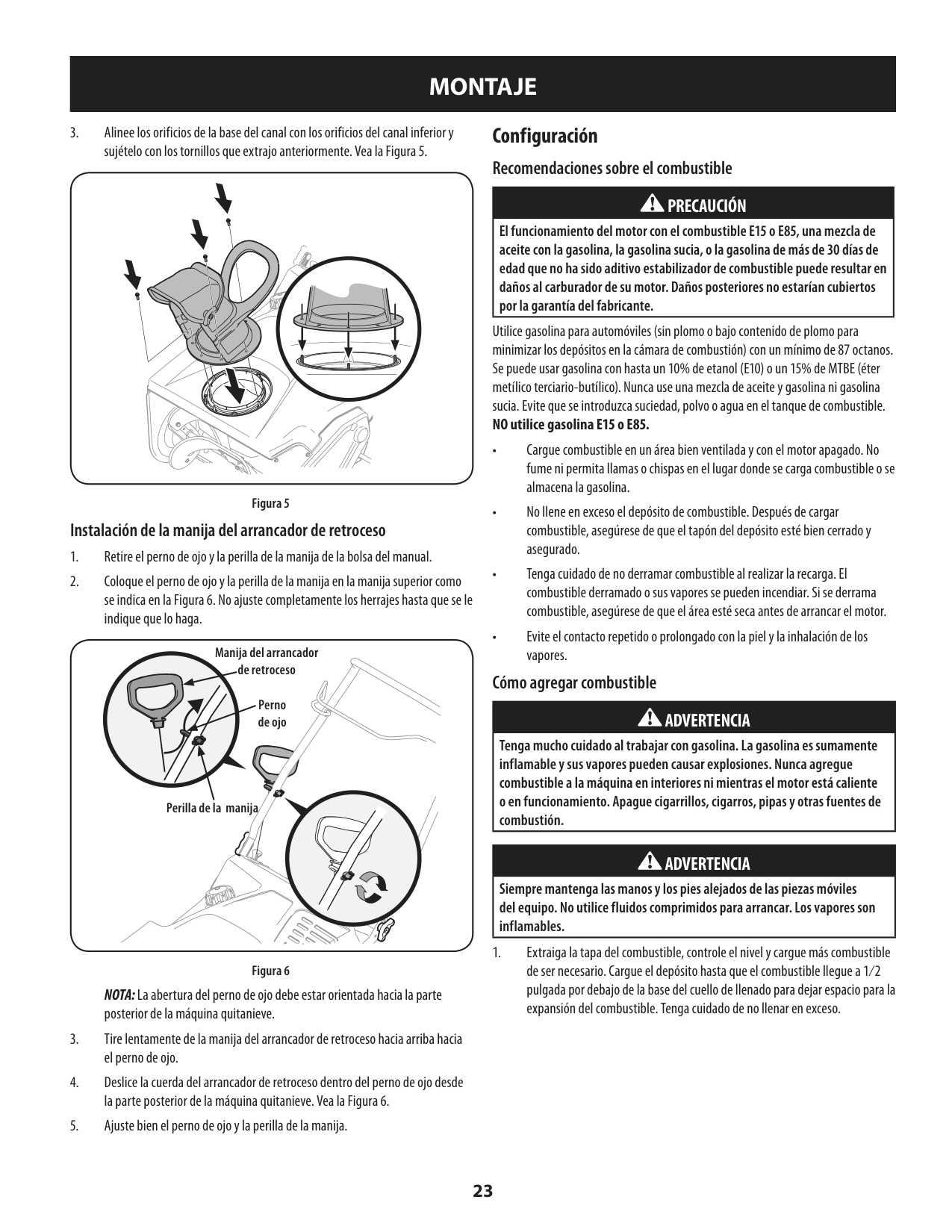
23
Operation
Auger ControlAuger
Control
Go
The auger control is located on the left handle. Squeeze the control grip against the handle to engage the auger and start snow throwing action. Release to stop. IMPORTANT: Refer to the Auger Control information in the Assembly & Set-Up section prior to operating your snow blower. Read and follow all instructions carefully and perform all adjustments to verify your snow blower is operating safely and properly. Drive Control/ Auger Control Lock*Drive
Control
Go
The drive control is located on the right handle. Squeeze the control grip against the handle to engage the wheel drive. Release to stop. *On select models, the drive control also locks the auger control so you can operate the chute directional control without interrupting the snow throwing process. If the auger control is engaged simultaneously with the drive control, the operator can release the auger control (on the left handle) and the augers will remain engaged. Release both controls to stop the augers and wheel drive. NOTE: Always release the drive control before changing speeds. Failure to do so will result in increased wear on your machine’s drive system. Overhead Chute Directional Control (If Equipped)Chute Directional Control
Discharge
Left
Discharge
Right
Adjustable
Chute Tilt
The overhead chute directional control is located in the center of the snow blower between the handle panel and lower handle. To change the direction in which snow is thrown, rotate the chute directional control. Two-Way Chute Control (If Equipped) The two-way chute control (Joystick) is located on the left side of the handle panel. • To change the direction in which snow is thrown, squeeze the button on the chute control lever and pivot the chute control lever to the right or to the left.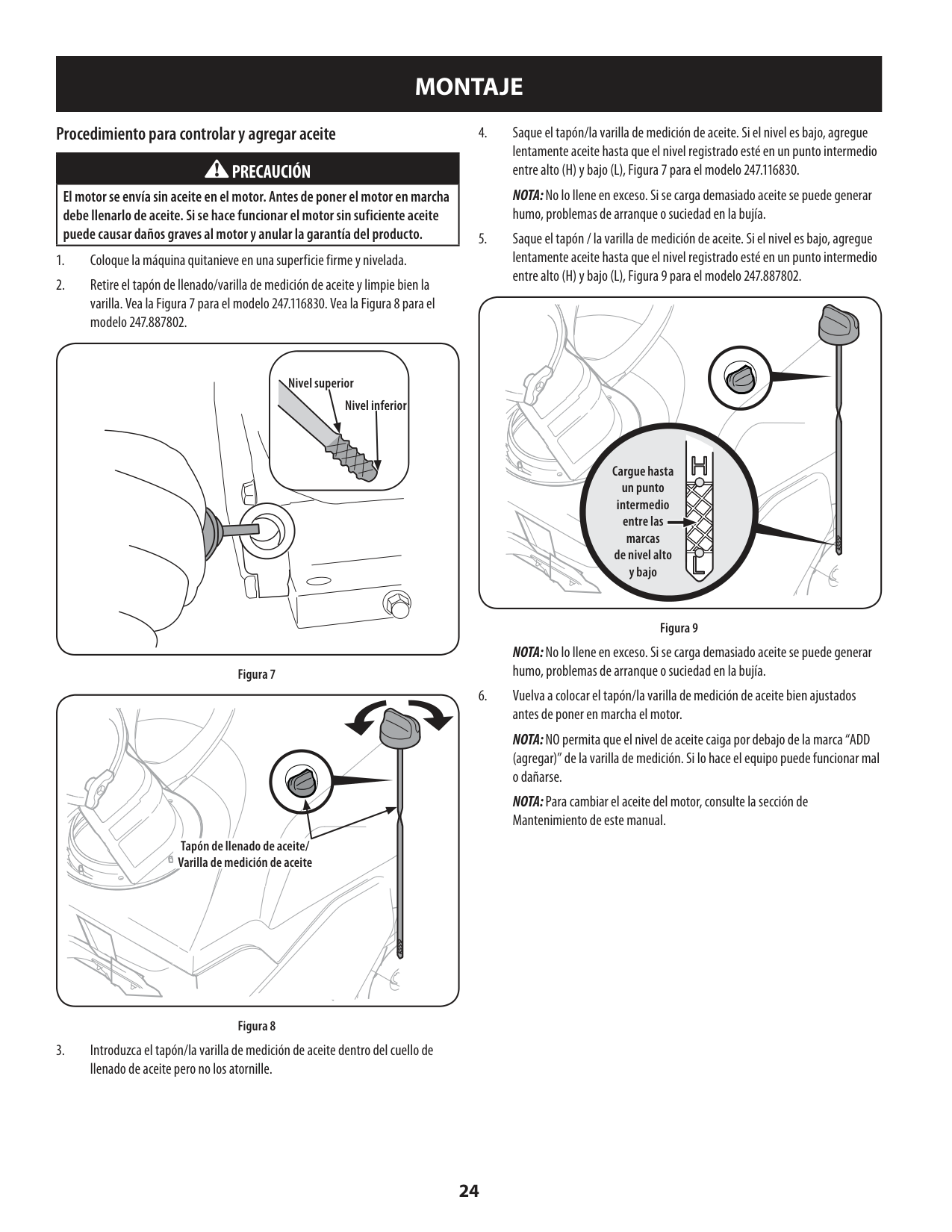
24
Operation
Four-Way Chute Control (Joystick) (If Equipped) The four-way chute control™ (joystick) is located on the left side of the handle panel. • To change the direction in which snow is thrown, squeeze the button on the chute control lever and pivot the chute control lever to the right or to the left. • To change the angle/distance which snow is thrown, pivot the chute control lever forward to tilt the chute down and backward to tilt the chute up. Electric Chute Control Joystick (If Equipped)Directional Control
Electric Chute
Chute
Rotate
Left
Chute
Rotate
Right
Chute Tilt Up
Chute Tilt Down
The electric chute control (joystick) is located on the right side of the handle panel. • To change the direction in which snow is thrown, move the joystick to the right or to the left. • To change the angle/distance which snow is thrown, pivot the joystick forward to tilt the chute down and backward to tilt the chute up. Manual Chute Control (Units with Electric Chute Directional Control Joystick) Follow this procedure to manually change the chute direction on units equipped with an electric chute directional control joystick and manual chute directional control rod only. See Figure 47.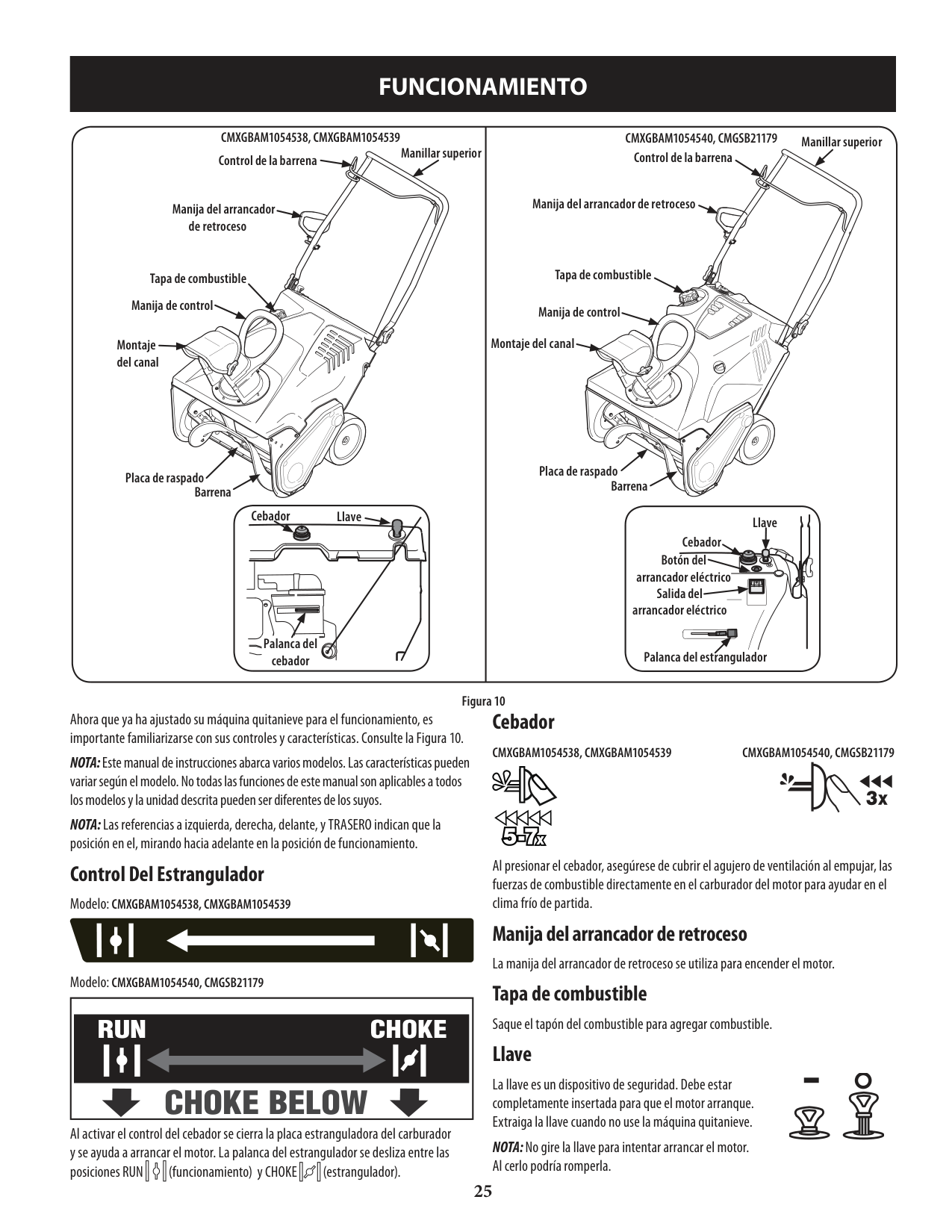
25
Operation
Clean-Out ToolWarning
Never use your hands to clear a clogged chute assembly. Shut off engine and remain behind handles until all moving parts have stopped before using the clean-out tool to clear the chute assembly. The chute clean-out tool is conveniently fastened to the rear of the auger housing with a mounting clip. Should snow and ice become lodged in the chute assembly during operation, proceed as follows to safely clean the chute assembly and chute opening:Warning
Read, understand, and follow all instructions and warnings on the machine and in this manual before operating. Oil The unit was shipped with oil in the engine. Check oil level before each operation to ensure adequate oil in the engine. NOTE: Be sure to check the engine on a level surface with the engine stopped.Warning
Use extreme care when handling gasoline. Gasoline is extremely flammable and the vapors are explosive. Never fuel the machine indoors or while the engine is hot or running. Extinguish cigarettes, cigars, pipes and other sources of ignition.Warning
Always keep hands and feet clear of moving parts. Do not use a pressurized starting fluid. Vapors are flammable. NOTE: Allow the engine to warm up for a few minutes after starting. The engine will not develop full power until it reaches operating temperatures.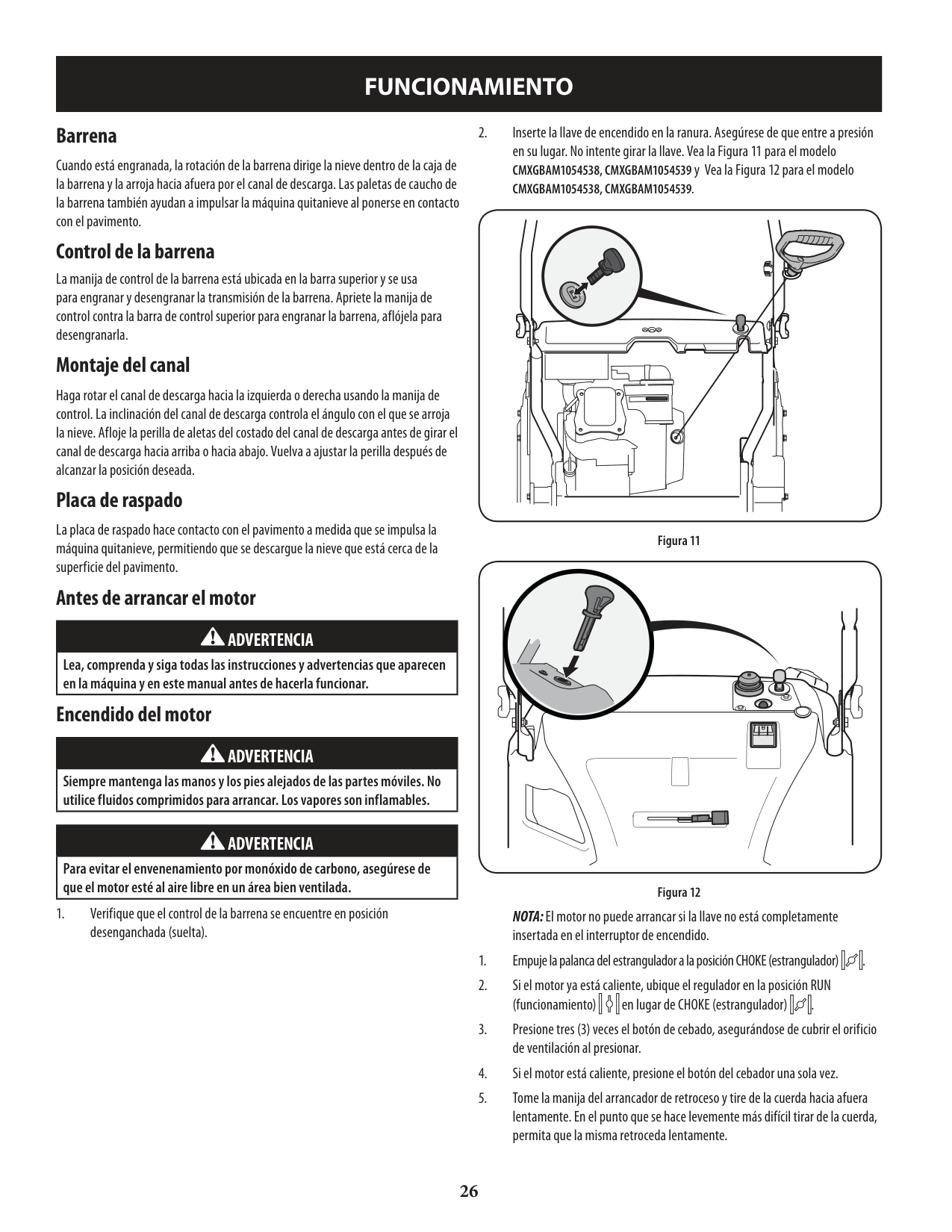
26
Operation
Electric StarterWarning
The electric starter is equipped with a grounded three-wire power plug, and is designed to operate on 120 volt AC household current. It must be used with a properly grounded three-prong receptacle at all times to avoid the possibility of electric shock. Follow all instructions carefully prior to operating the electric starter. DO NOT use electric starter in the rain. Determine that your home’s wiring is a three-wire grounded system. Ask a licensed electrician if you are not certain. If you have a grounded three-prong receptacle, proceed as follows. If you do not have the proper house wiring, DO NOT use the electric starter under any conditions.Caution
The extension cord can be any length, but must be rated for 15 amps at 125 volts, grounded and rated for outdoor use.Caution
Do not pull the starter handle while the engine running.Warning
Keep a firm grip on the starter cord handle to prevent rapid retraction of starter cord (kickback). Rapid retraction can pull hand and arm toward engine faster than you can let go, and result in broken bones, fractures, bruises or sprains.Warning
To avoid unsupervised engine operation, never leave the machine unattended with the engine running. Turn the engine off after use and remove key. Stopping The Engine After you have finished snow-throwing, run engine for a few minutes before stopping to help dry off any moisture on the engine.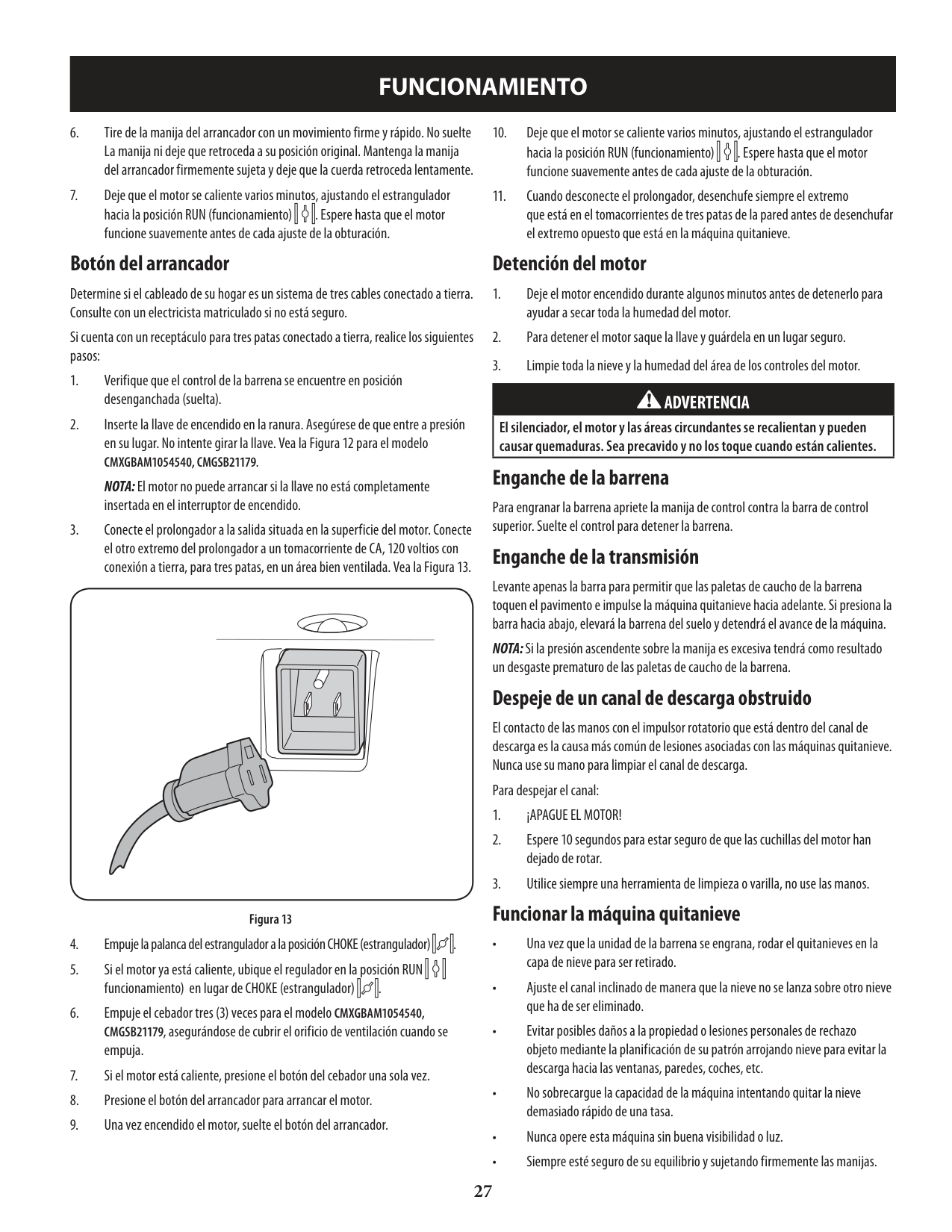
27
Operation
Replacing Shear PinsWarning
NEVER replace the auger shear pins with anything other than OEM Part No. 738-04124A (gold colored replacement shear pins) or OEM Part No. 738-05273 (Black colored replacement shear pins). Any damage to the auger gearbox or other components as a result of failing to do so will NOT be covered by your snow blower’s warranty.Warning
Always turn off the snow blower’s engine and remove the key prior to replacing shear pins. Each auger blade is secured to the spiral shaft with a shear pin and bow-tie clip. If an auger blade strikes a foreign object or ice jam, the pin will shear off to prevent damage to the blade. If an auger blade does not turn, check to see if its pin has sheared off. IMPORTANT: ALWAYS use the correct OEM replacement shear pin. 2-Stage Snow Blowers • The auger is secured to the spiral shaft using gold colored shear pins (Sears OEM Part No. 738-04124A). See Figure 50. Figure 50 3-Stage Snow Blowers • The side augers and central accelerator auger are secured to the spiral shaft using black shear pins (OEM Part No. 738-05273). See Figure 51. Figure 51 Using Snow Blower to Clear SnowWarning
Check the area to be cleared for foreign objects. Remove foreign objects, if any.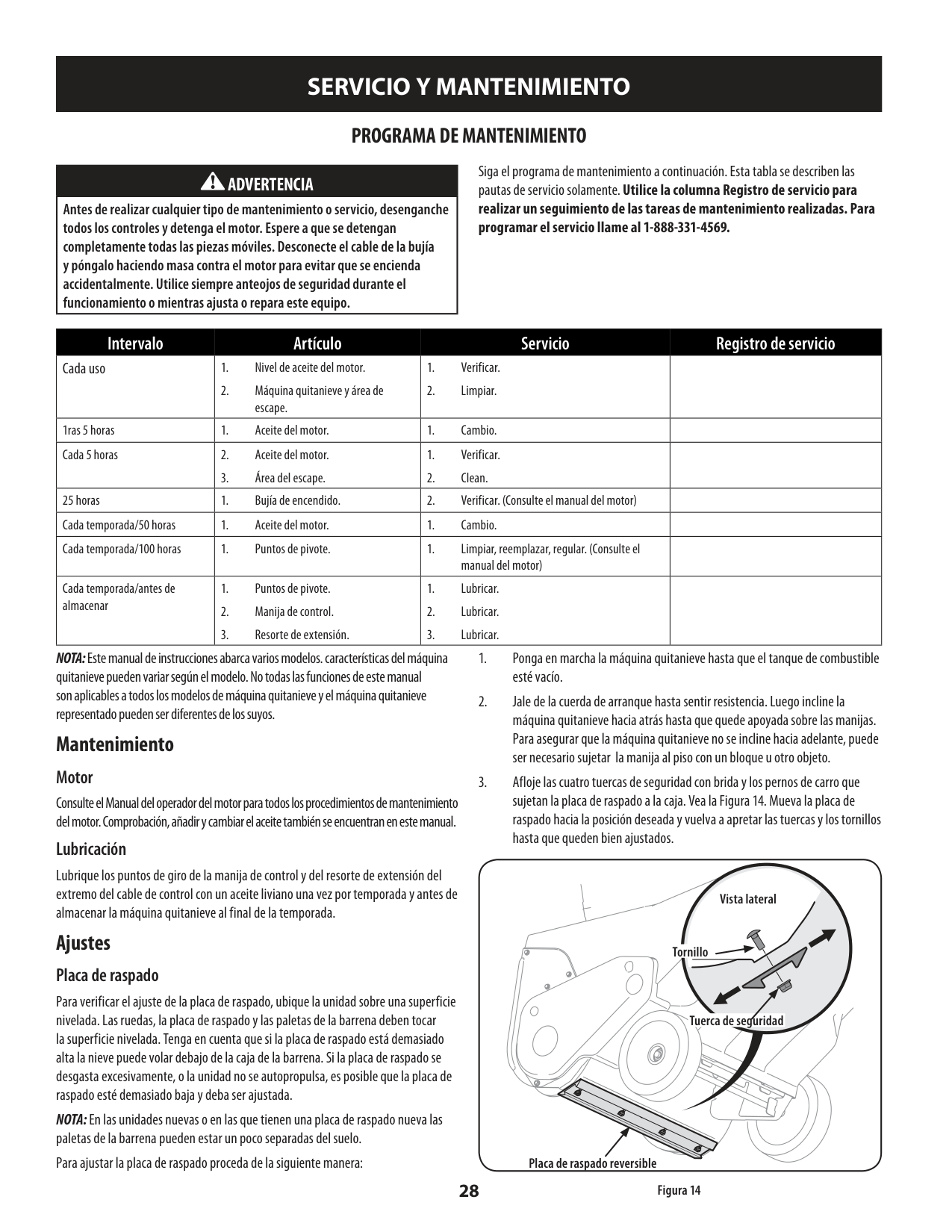
28
Service And Maintenance
Warning
Before performing any type of maintenance/service, disengage all controls and stop the engine. Wait until all moving parts have come to a complete stop. Disconnect spark plug wire and ground it against the engine to prevent unintended starting. Follow the maintenance schedule given below. This chart describes service guidelines only. Use the Service Log column to keep track of completed maintenance tasks. To locate the nearest Sears Service Center or to schedule service, call the following toll free number:1-888-331-4569.Maintenance Schedule
Interval Item Service Service Log Each Use and every 5 hoursWarning
Before lubricating, repairing, or inspecting, disengage all controls and stop engine. Wait until all moving parts have come to a complete stop. NOTE: Check the oil level before each use to be sure correct oil level is maintained. NOTE: 208cc and 243cc engines use 600 ml (approx. 20 oz.). NOTE: 277cc, 357 and 420cc engines use 1100 ml (approx. 37.2 oz). When adding oil to the engine, refer to viscosity chart below. Do not over-fill. Use a 4-stroke, or an equivalent high detergent, premium quality motor oil certified to meet or exceed U.S. automobile manufacturer’s requirements for service classification SG, SF. Motor oils classified SG, SF will show this designation on the container.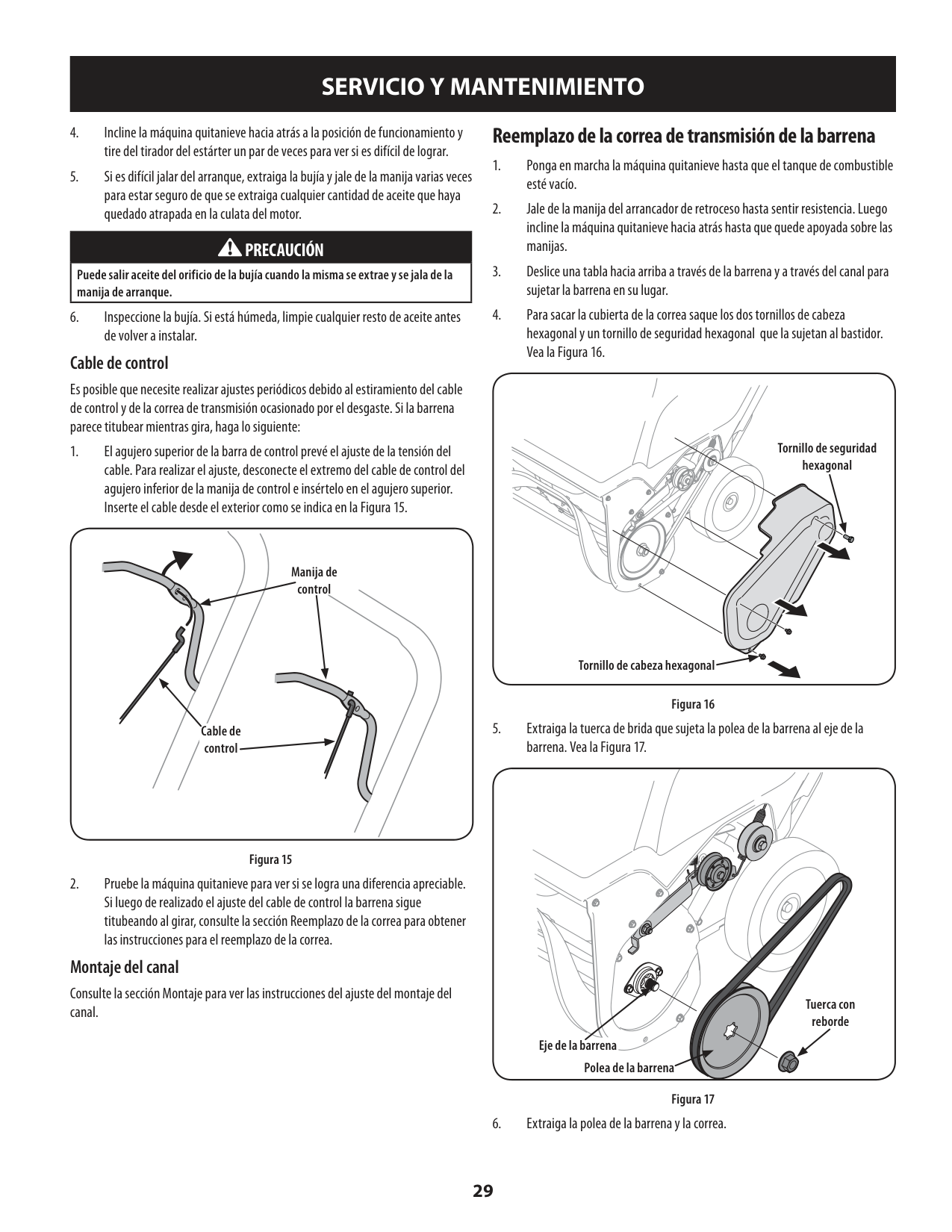
29
Service And Maintenance
Changing Engine Oil NOTE: Change the engine oil after the first 5 hours of operation and once a season or every 50 hours thereafter.Caution
Used oil is a hazardous waste product. Dispose of used oil properly. Do not discard with household waste. Check with your local authorities or Sears Service Center for safe disposal/recycling facilities.5W-30
0W-30
-40º SyntheticCaution
DO NOT use nondetergent oil or 2-stroke engine oil. It could shorten the engine’s service life.Caution
Thoroughly wash your hands with soap and water as soon as possible after handling used oil. Washer (if equipped) Oil Drain Plug Figure 54 Checking Spark PlugWarning
DO NOT check for spark with spark plug removed. DO NOT crank engine with spark plug removed.Warning
If the engine has been running, the muffler will be very hot. Be careful not to touch the muffler. NOTE: Check the spark plug once a season or every 25 hours of operation. Change the spark plug once a season or every 100 hours. To ensure proper engine operation, the spark plug must be properly gapped and free of deposits.Caution
The spark plug must be tightened securely. A loose spark plug can become very hot and can damage the engine. Spark Plug Spark Plug Boot Figure 55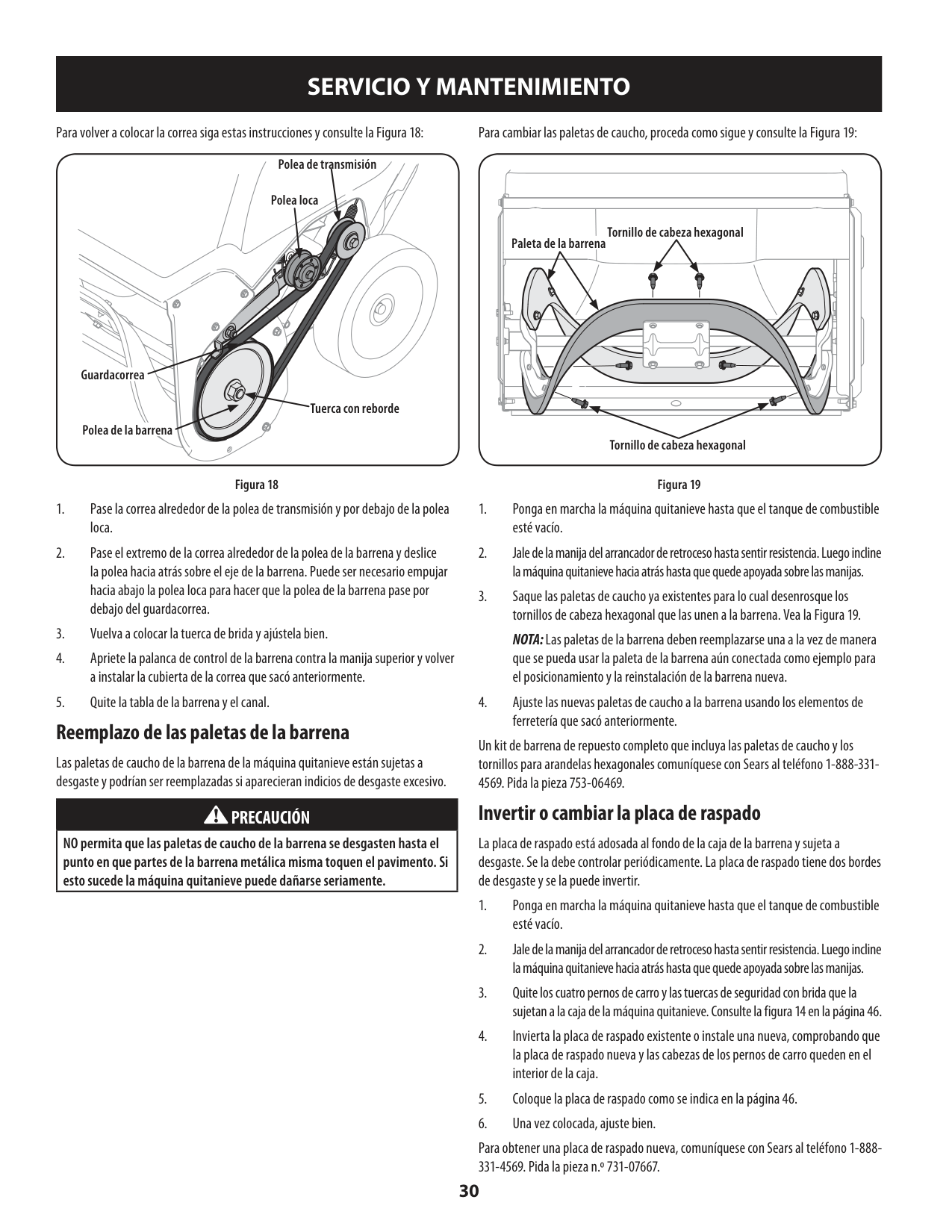
30
Service And Maintenance
.02-.03 in. (0.60-0.80 mm) Electrode Figure 56 Lubrication Gear Shaft The gear (hex) shaft should be lubricated at least once a season or after every 25 hours of operation.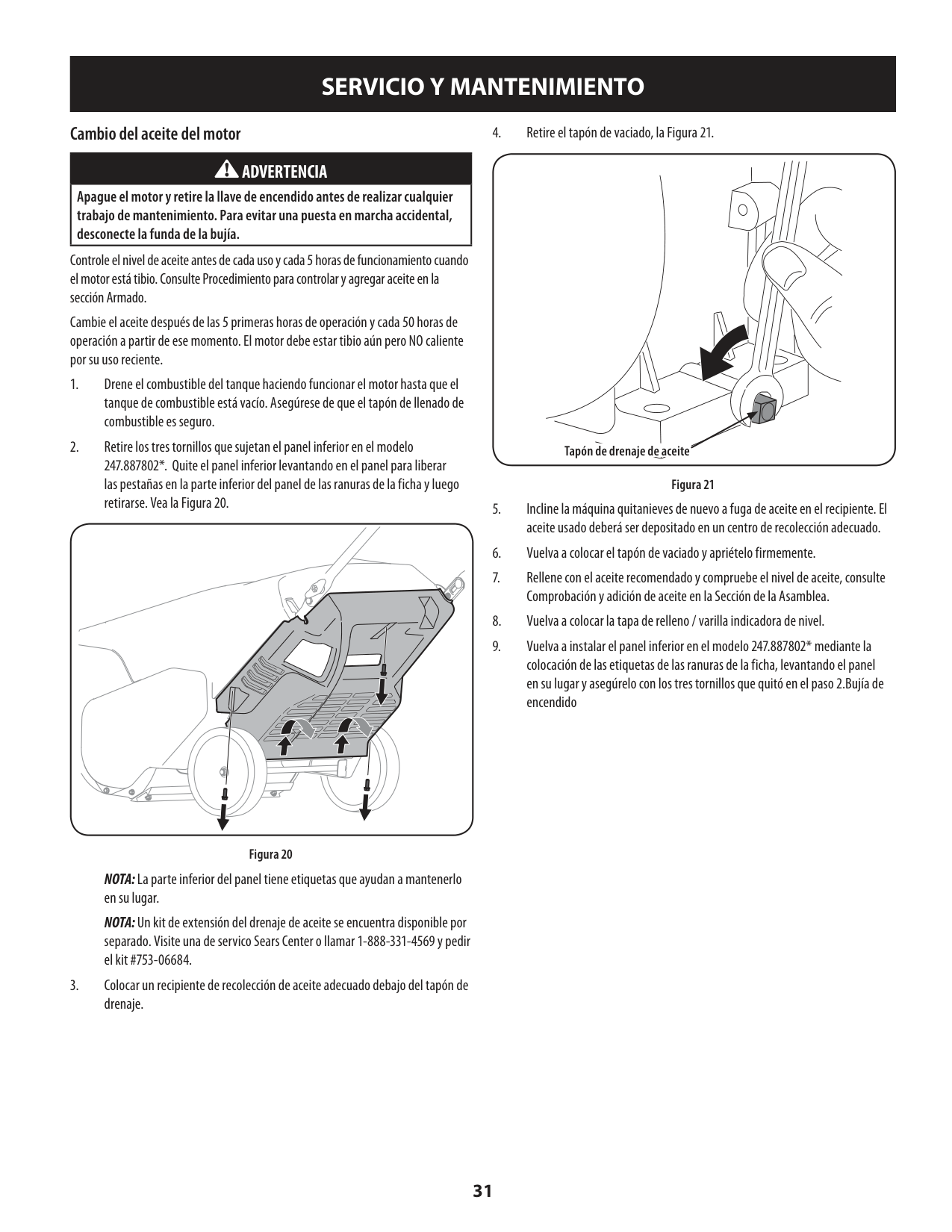
31
Service And Maintenance
32
Service And Maintenance
Drive Control When the drive control is released and in the disengaged “up” position, the cable should have very little slack. It should NOT be tight. Also, if there is excessive slack in the drive cable or if the unit experiences intermittent drive while using, the cable may need to be adjusted. Check the adjustment of the drive control as follows:
33
Service And Maintenance
Chute If the chute fails to remain stationary during operation, the pre-load of the chute can be adjusted by tightening the hex nut found on the front of the chute control head.
34
Service And Maintenance
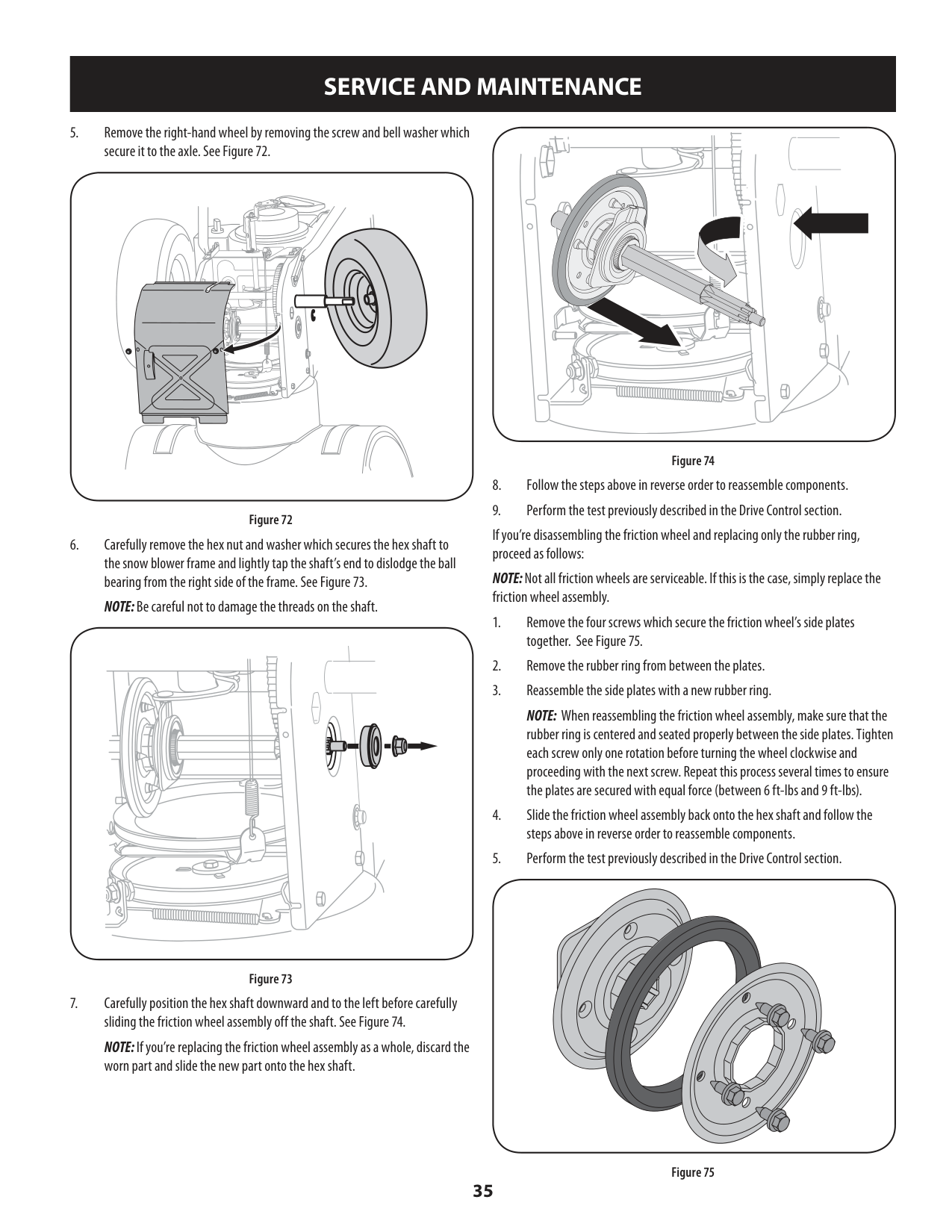
35
Service And Maintenance
36
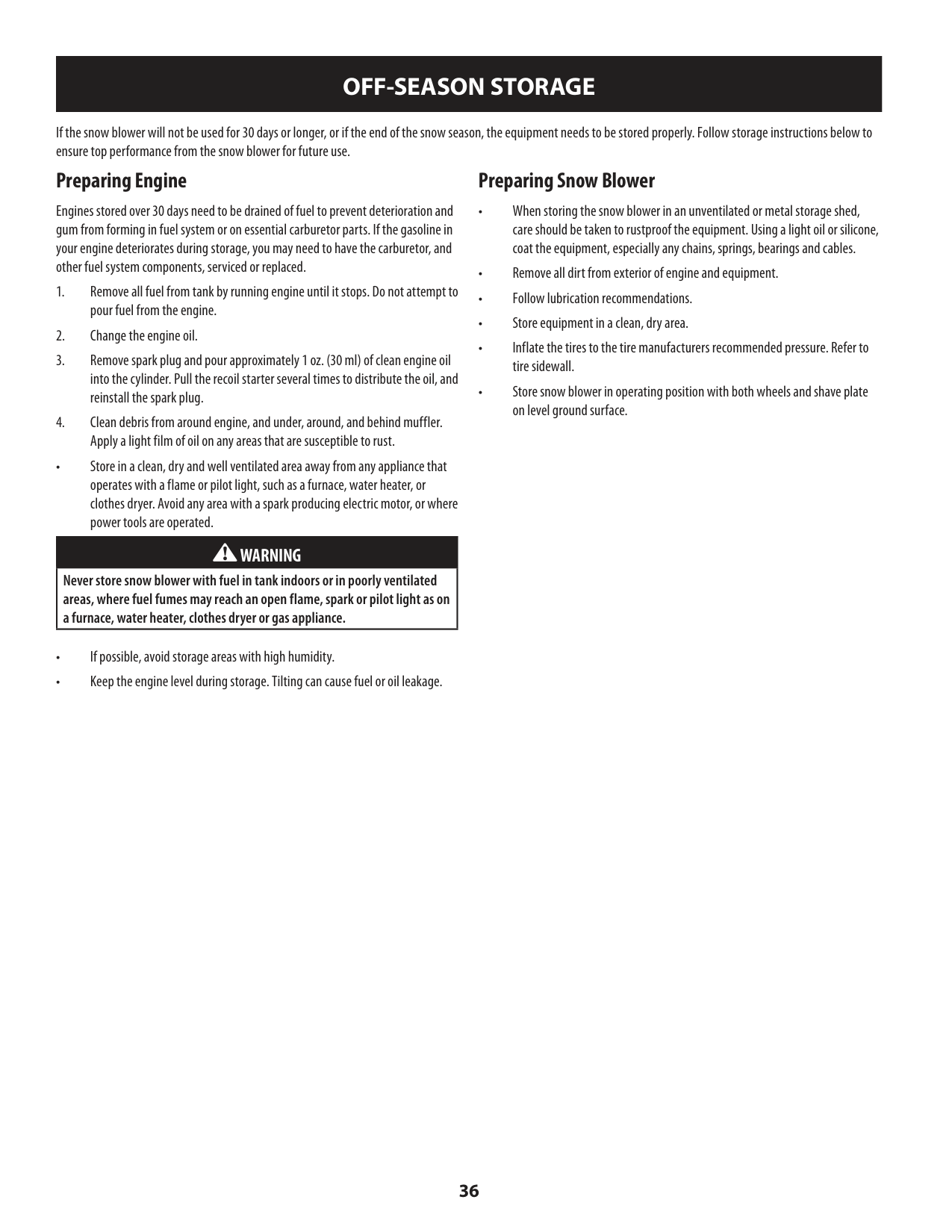
Off-Season Storage
If the snow blower will not be used for 30 days or longer, or if the end of the snow season, the equipment needs to be stored properly. Follow storage instructions below to ensure top performance from the snow blower for future use. Preparing Engine Engines stored over 30 days need to be drained of fuel to prevent deterioration and gum from forming in fuel system or on essential carburetor parts. If the gasoline in your engine deteriorates during storage, you may need to have the carburetor, and other fuel system components, serviced or replaced.Warning
Never store snow blower with fuel in tank indoors or in poorly ventilated areas, where fuel fumes may reach an open flame, spark or pilot light as on a furnace, water heater, clothes dryer or gas appliance. • If possible, avoid storage areas with high humidity. • Keep the engine level during storage. Tilting can cause fuel or oil leakage. Preparing Snow Blower • When storing the snow blower in an unventilated or metal storage shed, care should be taken to rustproof the equipment. Using a light oil or silicone, coat the equipment, especially any chains, springs, bearings and cables. • Remove all dirt from exterior of engine and equipment. • Follow lubrication recommendations. • Store equipment in a clean, dry area. • Inflate the tires to the tire manufacturers recommended pressure. Refer to tire sidewall. • Store snow blower in operating position with both wheels and shave plate on level ground surface.
37
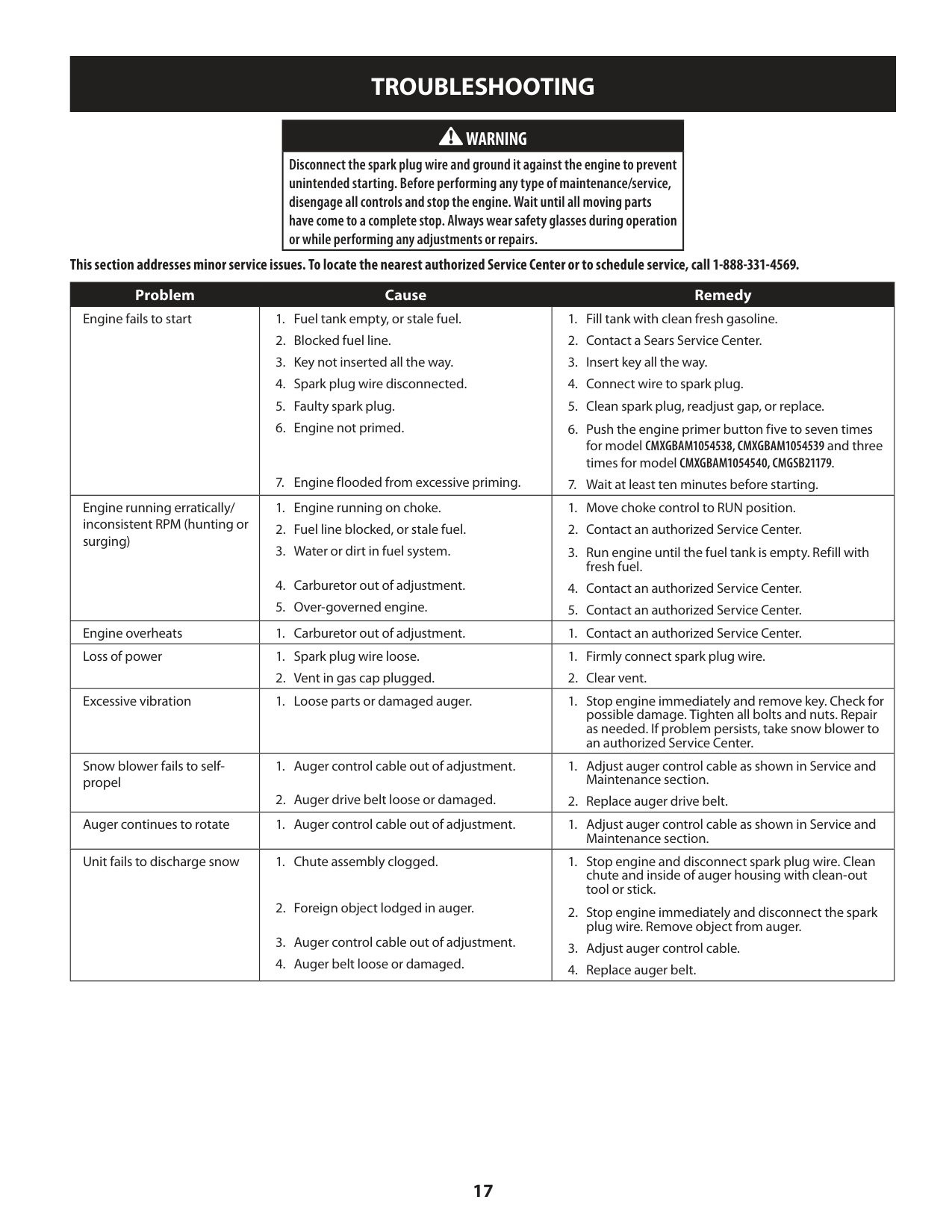
Troubleshooting
Warning
Disconnect the spark plug wire and ground it against the engine to prevent unintended starting. Before performing any type of maintenance/service, disengage all controls and stop the engine. Wait until all moving parts have come to a complete stop. Always wear safety glasses during operation or while performing any adjustments or repairs. This section addresses minor service issues. To locate the nearest Sears Service Center or to schedule service, call the following toll free number: 1-888-331-4569. Problem Cause Remedy Engine fails to start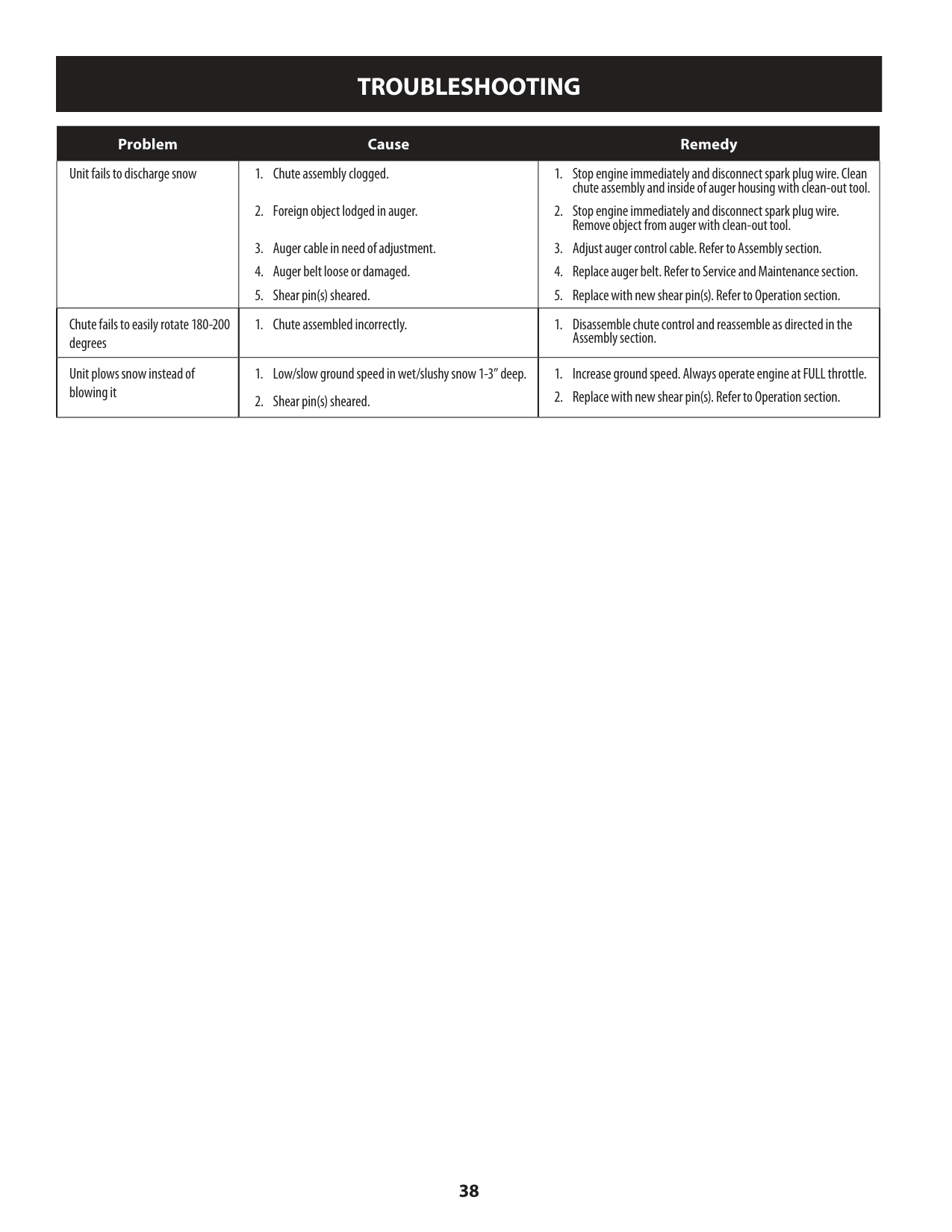
38
Troubleshooting
Problem Cause Remedy Unit fails to discharge snow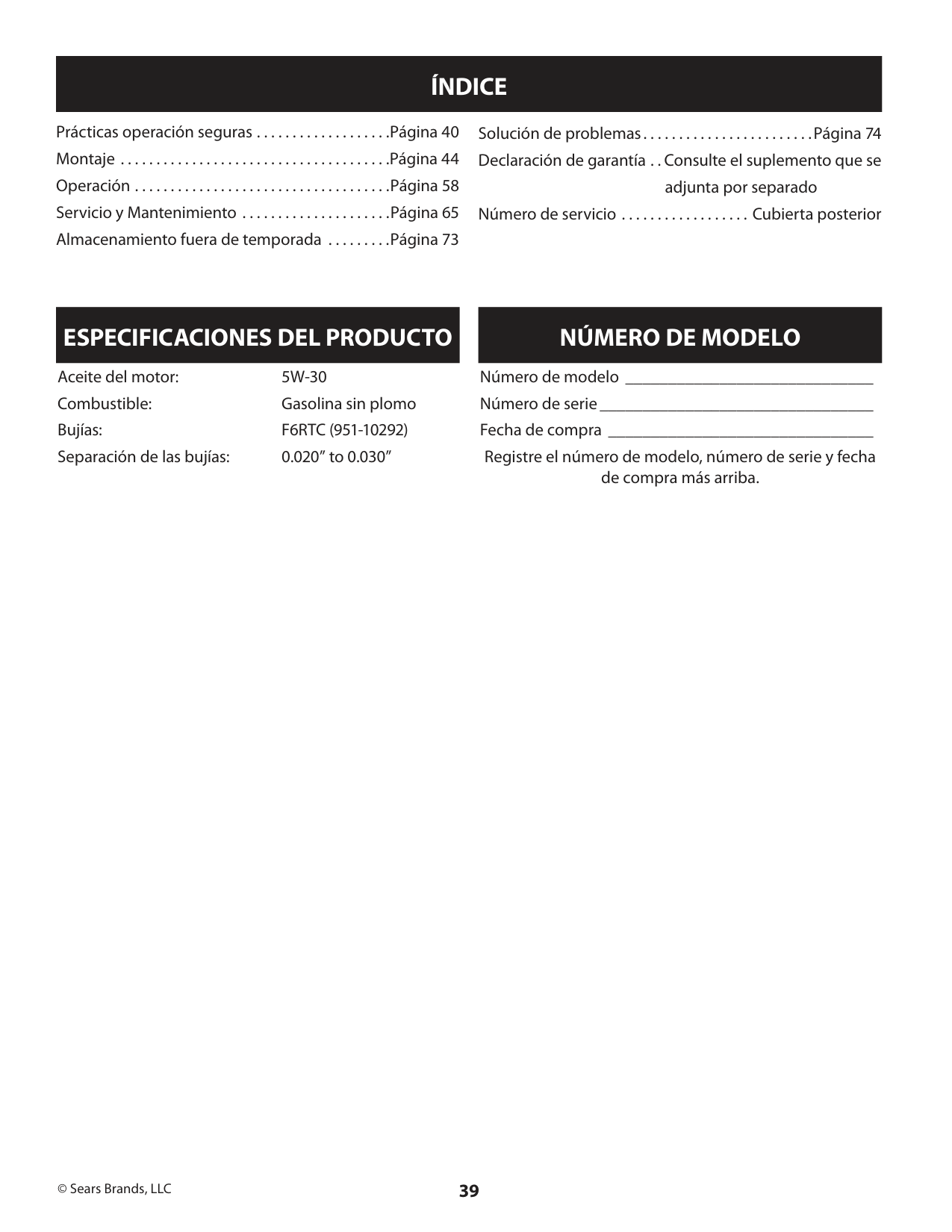
39
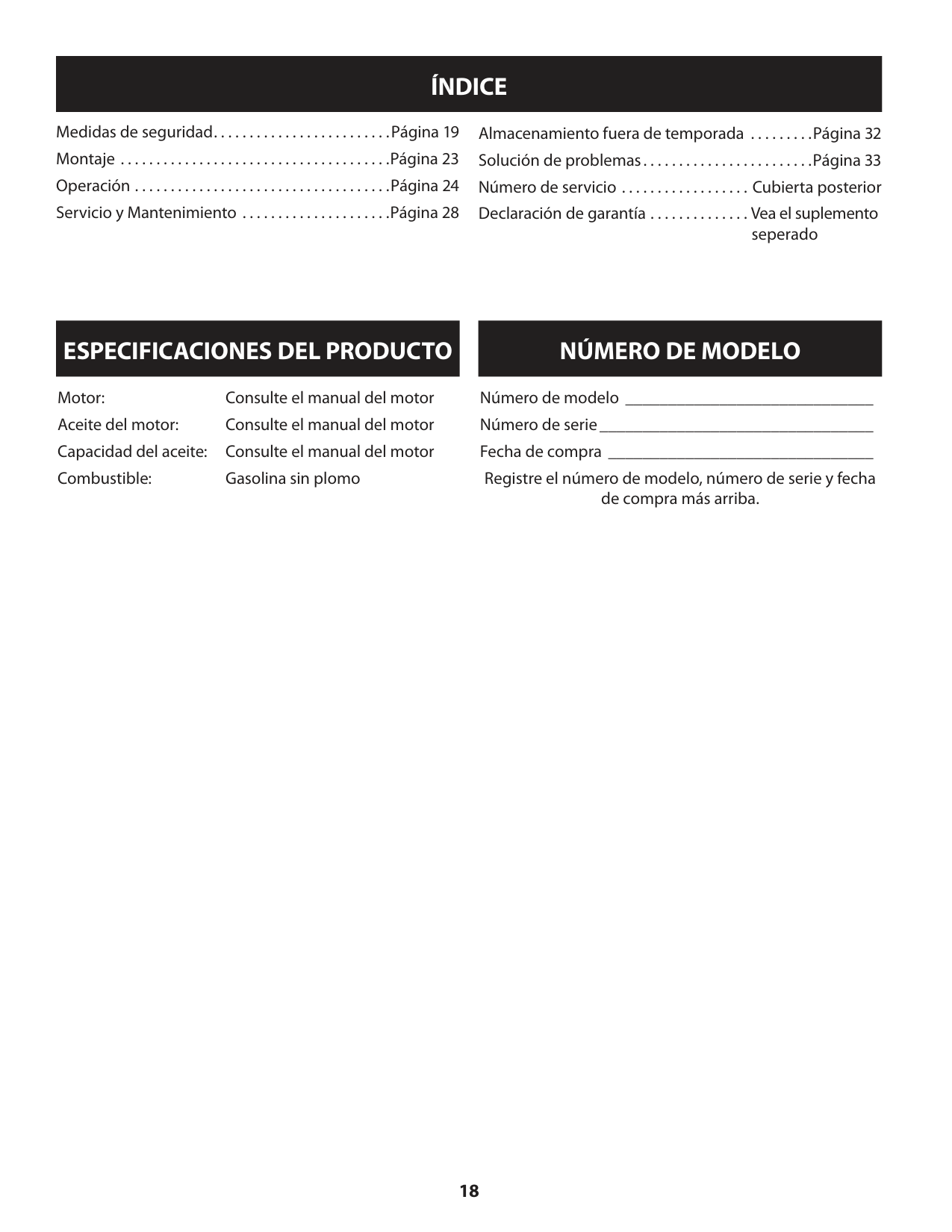
Índice
© Sears Brands, LLCNúmero De Modelo
Especificaciones Del Producto
Aceite del motor:5W-30
Combustible:Gasolina sin plomo Bujías:
F6Rtc (951-10292)
Separación de las bujías: 0.020” to 0.030” Número de modelo_ _____________________________ Número de serie_________________________________ Fecha de compra_ _______________________________ Registre el número de modelo, número de serie y fecha de compra más arriba. Prácticas operación seguras. . . . . . . . . . . . . . . . . . . Página 40 Montaje. . . . . . . . . . . . . . . . . . . . . . . . . . . . . . . . . . . . . . Página 44 Operación. . . . . . . . . . . . . . . . . . . . . . . . . . . . . . . . . . . . Página 58 Servicio y Mantenimiento. . . . . . . . . . . . . . . . . . . . . Página 65 Almacenamiento fuera de temporada . . . . . . . . . Página 73 Solución de problemas. . . . . . . . . . . . . . . . . . . . . . . . Página 74 Declaración de garantía. . Consulte el suplemento que seadjunta por separado Número de servicio. . . . . . . . . . . . . . . . . . . Cubierta posterior
40
Instrucciones De Seguridad
Capacitación
• Lea, entienda y cumpla todas las instrucciones incluidas en la máquina y en los manuales antes de montarla y utilizarla. Guarde este manual en un lugar seguro para consultas futuras y periódicas, así como para solicitar repuestos. • Lea el Manual del Operador y siga todas las advertencias e instrucciones de seguridad. El fracaso de hacer así puede causar la herida seria al operador y/o personas presentes. • Familiarícese con todos los controles y con el uso adecuado de los mismos. Sepa cómo detener la máquina y desactivar los controles rápidamente. • No permita nunca que los niños menores de 14 años utilicen esta máquina. Los niños de 14 años en adelante deben leer y entender las instrucciones de operación y normas de seguridad contenidas en este manual, y en la máquina ydeben ser entrenados y supervisados por un adulto. • Nunca permita que los adultos operen esta máquina sin recibir antes la instrucción apropiada. • Los objetos arrojados por la máquina pueden producir lesiones graves. Planifique el patrón en el que va a ir arrojando nieve para evitar que la descarga de material se realice hacia los caminos, los observadores, etc. • Mantenga a los observadores, ayudantes, mascotas y niños por lo menos a 75 pies de la máquina mientras la misma está en funcionamiento. Detenga la máquina si alguien se acerca. • Sea precavido para evitar patinarse o caerse especialmente cuando opera la máquina en reversa.Preparativos
Inspeccione minuciosamente el área donde utilizará el equipo. Saque todos los felpudos, periódicos, trineos, tablas, cables y otros objetos extraños con los que podría tropezar o que podrían ser arrojados por la barrena / impulsor. • Para protegerse los ojos utilice siempre anteojos o antiparras de seguridad mientras opera la máquina o mientras la ajusta o repara. Los objetos arrojados que rebotan pueden producir lesiones oculares graves. • No opere la máquina sin la vestimenta adecuada para estar al aire libre en invierno. No utilice alhajas, bufandas largas u otras prendas sueltas que podrían enredarse en las partes móviles. Utilice un calzado especial para superficies resbaladizas. • Use un prolongador y un tomacorriente de tres cables con conexión a tierra para todas las máquinas con motores de encendido eléctrico. • Ajuste la altura de la caja del tomacorriente para limpiar la grava o las superficies con piedras trituradas. • Desengrane todas las palancas de control antes de arrancar el motor. • Nunca intente realizar ajustes mientras el motor está en marcha excepto en los casos específicamente recomendados en el manual del operador. • Deje que el motor y la máquina se adapten a la temperatura exterior antes de comenzar a sacar la nieve.Advertencia
La presencia de este símbolo indica que se trata de instrucciones importantes de seguridad que se deben respetar para evitar poner en peligro su seguridad personal y/o material y la de otras personas. Lea y siga todas las instrucciones de este manual antes de poner en funcionamiento esta máquina. Si no respeta estas instrucciones podría provocar lesiones personales. Cuando vea este símbolo, ¡preste atención a la advertencia!Advertencia
Proposición 65 De California
El escape del motor de este producto, algunos de sus componentes y algunos componentes del vehículo contienen o liberan sustancias químicas que el estado de California considera que pueden producir cáncer, defectos de nacimiento u otros problemas reproductivos.Peligro
Esta máquina fue construida para ser operada de acuerdo con las reglas de seguridad contenidas en este manual. Al igual que con cualquier tipo de equipo motorizado, un descuido o error por parte del operador puede producir lesiones graves. Esta máquina es capaz de amputar manos y pies y de arrojar objetos con gran fuerza. De no respetar las instrucciones de seguridad siguientes se pueden producir lesiones graves o la muerte.Advertencia
Su responsabilidad—Restrinja el uso de esta máquina motorizada a las personas que lean, comprendan y respeten las advertencias e instrucciones que aparecen en este manual y en la máquina.¡Guarde Estas Instrucciones!
41
Instrucciones De Seguridad
Manejo seguro de la gasolina Para evitar lesiones personales o daños materiales tenga mucho cuidado cuando trabaje con gasolina. La gasolina es sumamente inflamable y sus vapores pueden causar explosiones. Si se derrama gasolina encima o sobre la ropa se puede lesionar gravemente ya que se puede incendiar. Lávese la piel y cámbiese de ropa de inmediato. • Utilice sólo los recipientes para gasolina autorizados. • Apague todos los cigarrillos, cigarros, pipas y otras fuentes de combustión. • Nunca cargue combustible en la máquina en un espacio cerrado. • Nunca saque la tapa del combustible ni agregue combustible mientras el motor está caliente o en marcha. • Deje que el motor se enfríe por lo menos dos minutos antes de volver a cargar combustible. • Nunca llene en exceso el depósito de combustible. Llene el tanque a no más de ½ pulgada por debajo de la base del cuello de llenado dejando espacio para la dilatación del combustible. • Vuelva a colocar la tapa de la gasolina y ajústela bien. • Limpie el combustible que se haya derramado sobre el motor y el equipo. Traslade la máquina a otra zona. Espere 5 minutos antes de encender el motor. • Nunca almacene la máquina o el recipiente de combustible en un espacio cerrado donde haya fuego, chispas o luz piloto (por ejemplo, hornos, calentadores de agua, calefactores, secadores de ropa, etc.). • Deje que la máquina se enfríe por lo menos 5 minutos antes de guardarla. • Nunca llene los recipientes en el interior de un vehículo o camión o caja de remolque con recubrimientos plásticos. Coloque siempre los recipientes en el piso y lejos del vehículo antes de llenarlos. • Si es posible, retire el equipo a gasolina del camión o remolque y llénelo en el suelo. Si esto no es posible, llene el equipo en un remolque con contenedor portátil, en vez de desde una boquilla dispensadora de gasolina. • Mantenga la boquilla dispensadora en contacto con el borde del depósito de combustible o con la abertura del recipiente en todo momento, hasta terminar la carga. No utilice un dispositivo de apertura/cierre de boquilla.Funcionamiento
• No ponga las manos o los pies cerca de las piezas rotatorias, en la caja de la barrena / impulsor o en el montaje del canal de descarga. Hacer contacto con piezas giratorias puede resultar en la amputación de manos o pies. • La palanca de control de la barrena / impulsor es un dispositivo de seguridad. Nunca evite su funcionamiento. De hacerlo la operación de la máquina es riesgosa y puede ocasionar lesiones. • Las palancas de control deben funcionar bien en ambas direcciones y regresar automáticamente a la posición de desengrane cuando se las suelta. • Nunca opere la máquina si falta un montaje del canal o si el mismo está dañado. Mantenga todos los dispositivos de seguridad en su lugar y en funcionamiento. • Nunca encienda el motor en espacios cerrados o en una zona con poca ventilación. El escape del motor contiene monóxido de carbono, un gas inodoro y letal. • No utilice la máquina bajo la influencia del alcohol o las drogas. • El silenciador y el motor se calientan y pueden causar quemaduras. No los toque. Mantenga a los niños alejados. • Sea sumamente precavido cuando opere la máquina sobre una superficie con grava o cuando la cruce. Manténgase alerta por si se presentan peligros ocultos o tránsito. • Tenga cuidado cuando cambie de dirección o cuando opere la máquina en pendientes. No use la máquina en pendientes pronunciadas. • Planifique el patrón en el que va a ir arrojando nieve para evitar que la descarga de material se produzca hacia las ventanas, las paredes, los automóviles, etc. y evitar así posibles daños materiales o lesiones producidas por los rebotes. • Nunca dirija la descarga hacia los niños, los observadores o las mascotas ni deje que nadie se pare delante de la máquina. • No sobrecargue la capacidad de la máquina tratando de sacar la nieve muy rápidamente. • Nunca opere esta máquina sin buena visibilidad o iluminación. Siempre debe estar seguro de que está bien afirmado y sujetando firmemente las manijas. Camine, nunca corra. • Corte la corriente a la barrena / impulsor cuando transporte la máquina o cuando la misma no está en uso. • Nunca opere la máquina a alta velocidad de desplazamiento sobre superficies resbaladizas. Mire hacia abajo y hacia atrás y tenga cuidado cuando vaya marcha atrás. • Si la máquina comenzara a vibrar de manera anormal, detenga el motor, desconecte el cable de la bujía y póngala de manera que haga masa contra el motor. Inspeccione la máquina minuciosamente para ver si está dañada. Repare todos los daños antes de encender y operar la máquina. • Desengrane todas las palancas de control y detenga el motor antes de dejar la posición de operación (detrás de las manijas). Espere a que la barrena / impulsor se detenga por completo antes de destapar el montaje del canal o realizar ajustes e inspecciones. • Nunca ponga las manos en las aberturas de descarga o de recolección. Utilice siempre la herramienta de limpieza que se adjunta para destapar la abertura de descarga. No destape el montaje del canal mientras el motor está en funcionamiento. Antes de destaparlo, apague el motor y permanezca detrás de las manijas hasta que todas las partes móviles se hayan detenido. • Use sólo uniones y accesorios aprobados por el fabricante (por ejemplo, pesas para las ruedas, cadenas para los neumáticos, cabinas, etc.). Para obtener más información acerca de estos temas, llame al 1-800-469-4663.
42
Instrucciones De Seguridad
• Para encender el motor, jale de la cuerda lentamente hasta que sienta resistencia, luego jale rápidamente. El repliegue rápido de la cuerda de arranque (tensión de retroceso) le jalará la mano y el brazo hacia el motor más rápido de lo que usted puede soltar. El resultado pueden ser huesos rotos, fracturas, hematomas o esguinces. • Si se presentan situaciones que no están previstas en este manual, sea cuidadoso y use el sentido común. • Para pedir repuestos o servicio horario para este producto, llame a 1-800- 469-4663.Mantenimiento Y Almacenamiento
• Nunca altere los dispositivos de seguridad. Controle periódicamente que funcionen correctamente. Remítase a las secciones de mantenimiento y ajuste de este manual. • Antes de realizar la limpieza, reparar o revisar la máquina, desengrane todas las palancas de control y detenga el motor. Espere a que la barrena / impulsor se detenga por completo. Desconecte el cable de la bujía y póngalo haciendo masa contra el motor para evitar que se encienda accidentalmente. • Controle frecuentemente que todos los pernos y tornillos estén bien ajustados para comprobar que la máquina se encuentra en condiciones seguras de funcionamiento. Además, haga una inspección visual de la máquina para verificar si está dañada. • No cambie la configuración del regulador del motor ni acelere demasiado el mismo. El regulador del motor controla la velocidad máxima segura de funcionamiento del motor. • Las placas de raspado y las zapatas antideslizantes que se usan con la máquina quitanieve se desgastan y se dañan. Para proteger su seguridad, verifique frecuentemente todos los componentes y reemplácelos sólo con partes de los fabricantes de equipos originales (OEM). ¡El uso de piezas que no cumplen con las especificaciones del equipo original puede resultar en rendimiento inadecuado además de poner en riesgo la seguridad! • Revise las palancas de control periódicamente para verificar que engranen y desengranen adecuadamente y ajústelos si es necesario. Consulte la sección de ajustes de este manual del operador para obtener instrucciones. • Mantenga o reemplace las etiquetas de seguridad e instrucciones según sea necesario. • Respete las normas referentes a la disposición correcta y las reglamentaciones sobre gasolina, aceite, etc. para proteger el medio ambiente. • Antes de almacenar la máquina enciéndala unos minutos para sacar la nieve que haya quedado en la misma y para evitar así que se congele la barrena / impulsor. • Según la Comisión de Seguridad de Productos para el Consumidor de los Estados Unidos (CPSC) y la Agencia de Protección Ambiental de los Estados Unidos (EPA), este producto tiene una vida útil media de siete (7) años, ó 60 horas de funcionamiento. Al finalizar la vida útil media, adquiera una máquina nueva o haga inspeccionar anualmente ésta por un distribuidor de servicio autorizado para cerciorarse de que todos los sistemas mecánicos y de seguridad funcionan correctamente y no tienen excesivo desgaste. Si no lo hace, pueden producirse accidentes, lesiones o muerte • Nunca almacene la máquina o el recipiente de combustible en un espacio cerrado donde haya fuego, chispas o luz piloto como por ejemplo, calentadores de agua, hornos, secadores de ropa, etc. • Consulte siempre el manual del operador para obtener instrucciones adecuadas para el almacenamiento fuera de temporadaVerifique frecuentemente la línea de combustible, el tanque, el tapón, y los accesorios buscando rajaduras o pérdidas. Reemplace de ser necesario. • No dé arranque al motor si no está la bujía de encendido.No Modifique El Motor
Para evitar lesiones graves o la muerte, no modifique el motor bajo ninguna circunstancia. Si cambia la configuración del regulador el motor puede descontrolarse y operar a velocidades inseguras. Nunca cambie la configuración de fábrica del regulador del motor.Aviso Referido A Emisiones
Los motores que están certificados y cumplen con las regulaciones de emisiones federales EPA y de California para SORE (Equipos pequeños todo terreno) están certificados para operar con gasolina común sin plomo y pueden incluir los siguientes sistemas de control de emisiones: Modificación de motor (EM) y catalizador de tres vías (TWC) si están equipados de esa manera.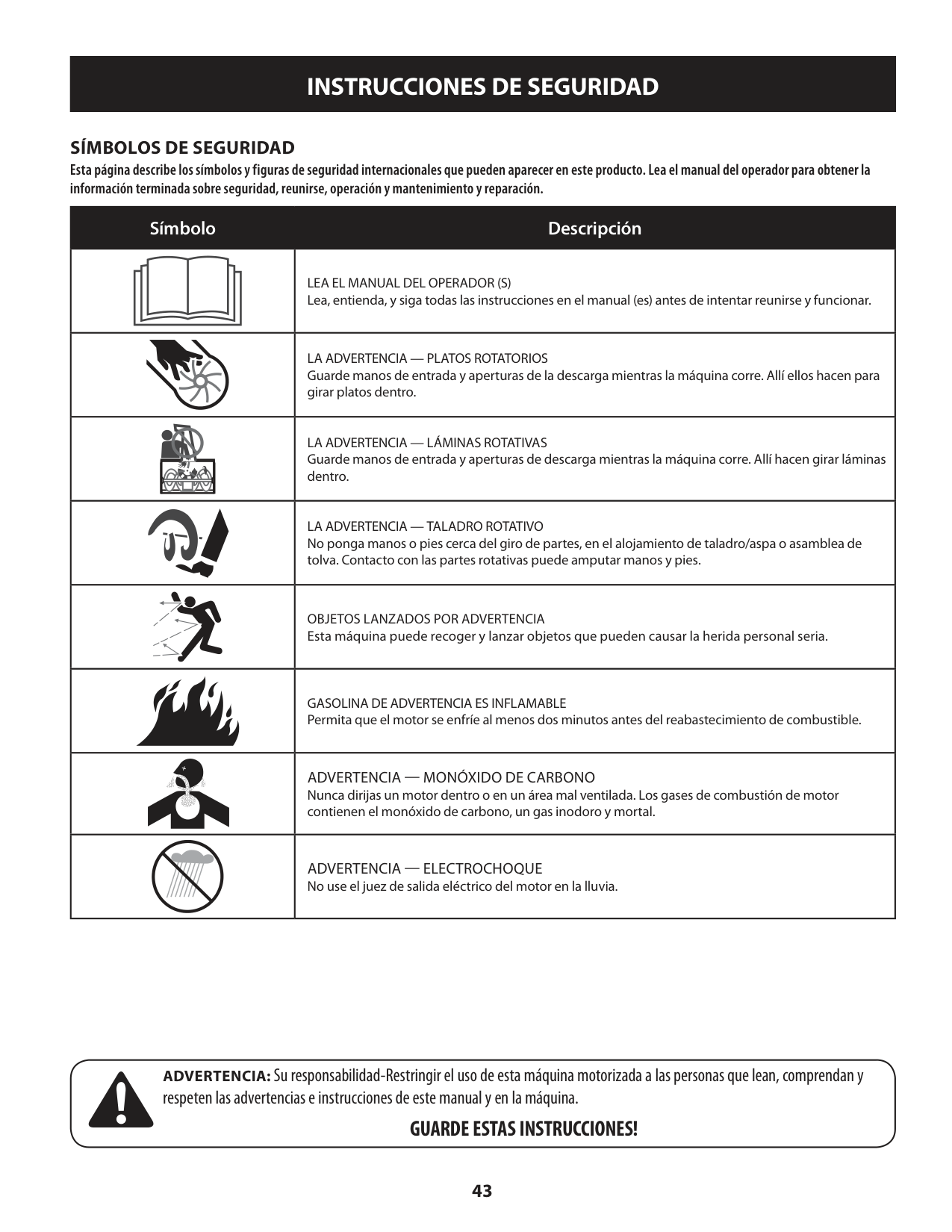
43
Instrucciones De Seguridad
Símbolos De Seguridad
Esta página describe los símbolos y figuras de seguridad internacionales que pueden aparecer en este producto. Lea el manual del operador para obtener la información terminada sobre seguridad, reunirse, operación y mantenimiento y reparación. Símbolo DescripciónLea El Manual Del Operador (S)
Lea, entienda, y siga todas las instrucciones en el manual (es) antes de intentar reunirse y funcionar.La Advertencia — Platos Rotatorios
Guarde manos de entrada y aperturas de la descarga mientras la máquina corre. Allí ellos hacen para girar platos dentro.La Advertencia — Láminas Rotativas
Guarde manos de entrada y aperturas de descarga mientras la máquina corre. Allí hacen girar láminas dentro.La Advertencia — Taladro Rotativo
No ponga manos o pies cerca del giro de partes, en el alojamiento de taladro/aspa o asamblea de tolva. Contacto con las partes rotativas puede amputar manos y pies.Objetos Lanzados Por Advertencia
Esta máquina puede recoger y lanzar objetos que pueden causar la herida personal seria.Gasolina De Advertencia Es Inflamable
Permita que el motor se enfríe al menos dos minutos antes del reabastecimiento de combustible.Advertencia — Monóxido De Carbono
Nunca dirijas un motor dentro o en un área mal ventilada. Los gases de combustión de motor contienen el monóxido de carbono, un gas inodoro y mortal.Advertencia — Electrochoque
No use el juez de salida eléctrico del motor en la lluvia. ADVERTENCIA: Su responsabilidad-Restringir el uso de esta máquina motorizada a las personas que lean, comprendan y respeten las advertencias e instrucciones de este manual y en la máquina.Guarde Estas Instrucciones!
44
Montaje
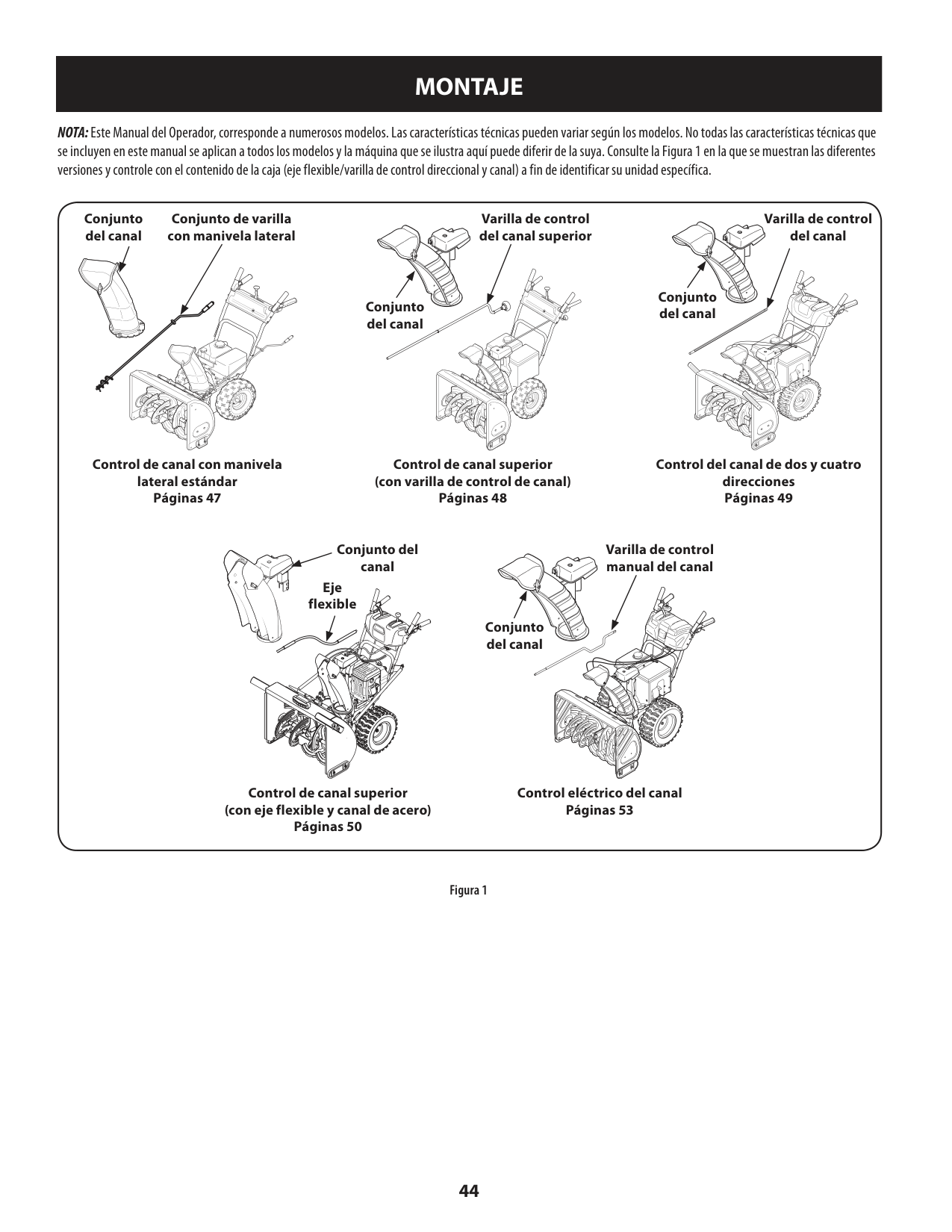
NOTA: Este Manual del Operador, corresponde a numerosos modelos. Las características técnicas pueden variar según los modelos. No todas las características técnicas que se incluyen en este manual se aplican a todos los modelos y la máquina que se ilustra aquí puede diferir de la suya. Consulte la Figura 1 en la que se muestran las diferentes versiones y controle con el contenido de la caja (eje flexible/varilla de control direccional y canal) a fin de identificar su unidad específica. Control eléctrico del canal Páginas 53 Varilla de control manual del canal Conjunto del canal Eje flexible Control de canal superior (con eje flexible y canal de acero) Páginas 50 Conjunto del canal Control de canal con manivela lateral estándar Páginas 47 Conjunto de varilla con manivela lateral Conjunto del canal Control de canal superior (con varilla de control de canal) Páginas 48 Varilla de control del canal superior Conjunto del canal Control del canal de dos y cuatro direcciones Páginas 49 Varilla de control del canal Conjunto del canal Figura 1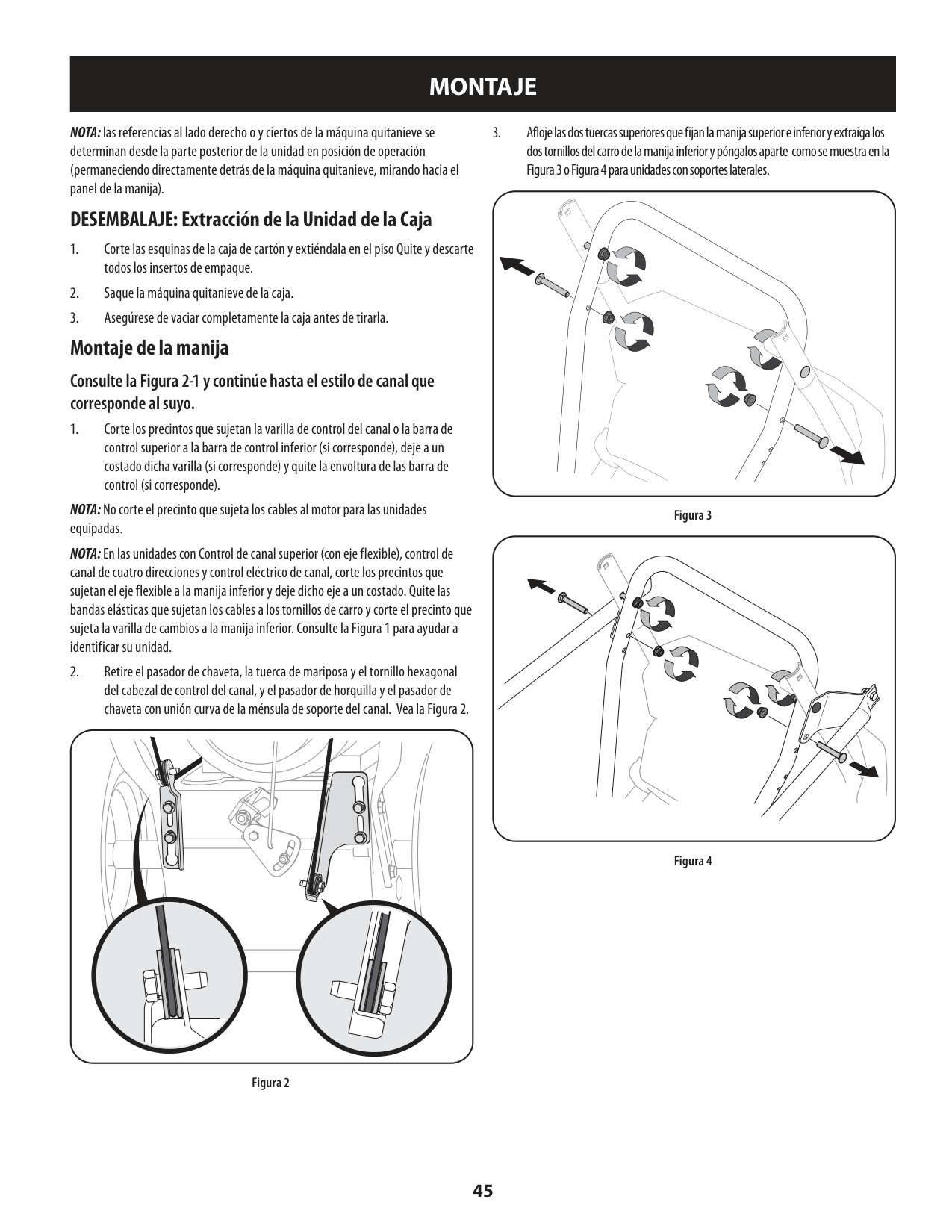
45
Montaje
NOTA: las referencias al lado derecho o y ciertos de la máquina quitanieve se determinan desde la parte posterior de la unidad en posición de operación (permaneciendo directamente detrás de la máquina quitanieve, mirando hacia el panel de la manija). DESEMBALAJE: Extracción de la Unidad de la Caja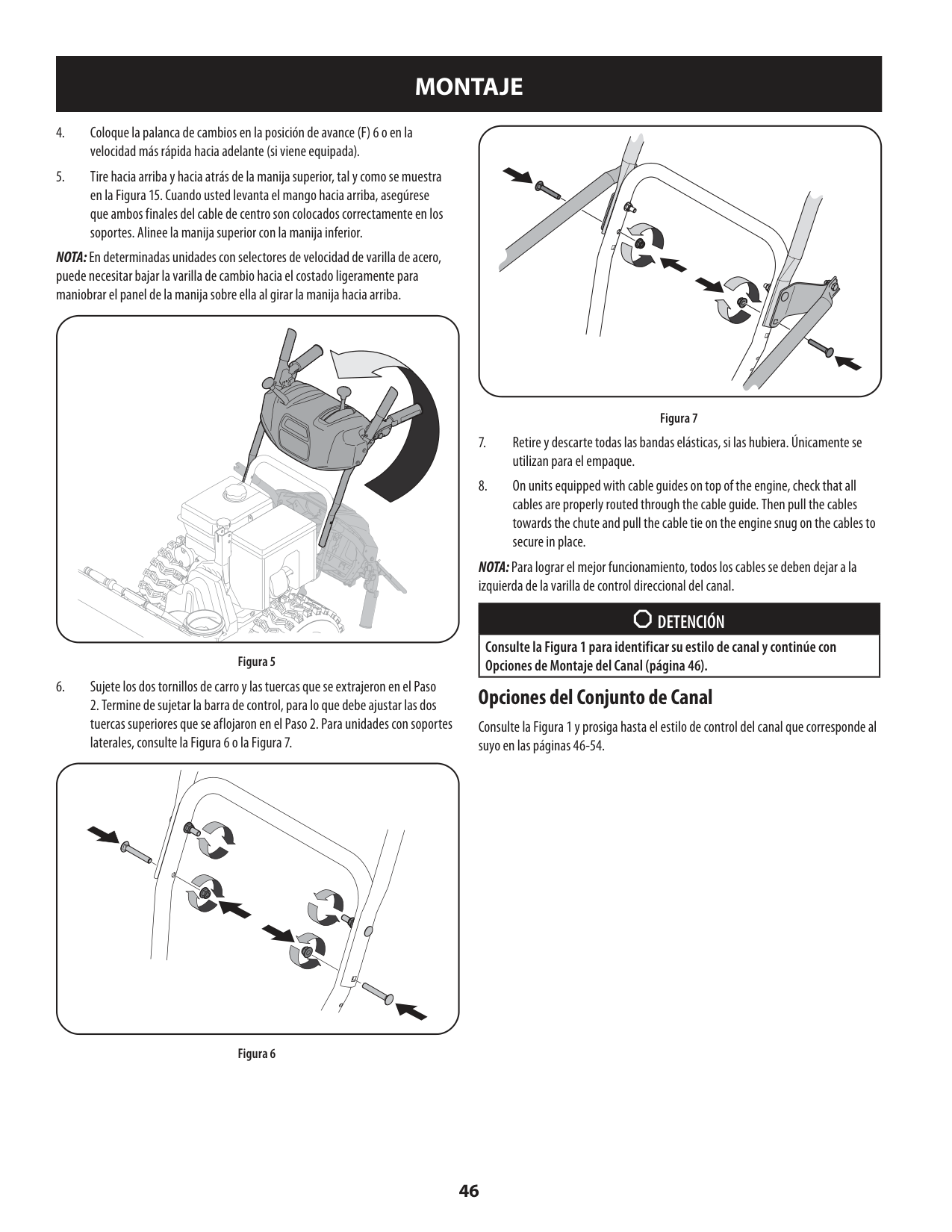
46
Montaje
Detención
Consulte la Figura 1 para identificar su estilo de canal y continúe con Opciones de Montaje del Canal (página 46). Opciones del Conjunto de Canal Consulte la Figura 1 y prosiga hasta el estilo de control del canal que corresponde al suyo en las páginas 46-54.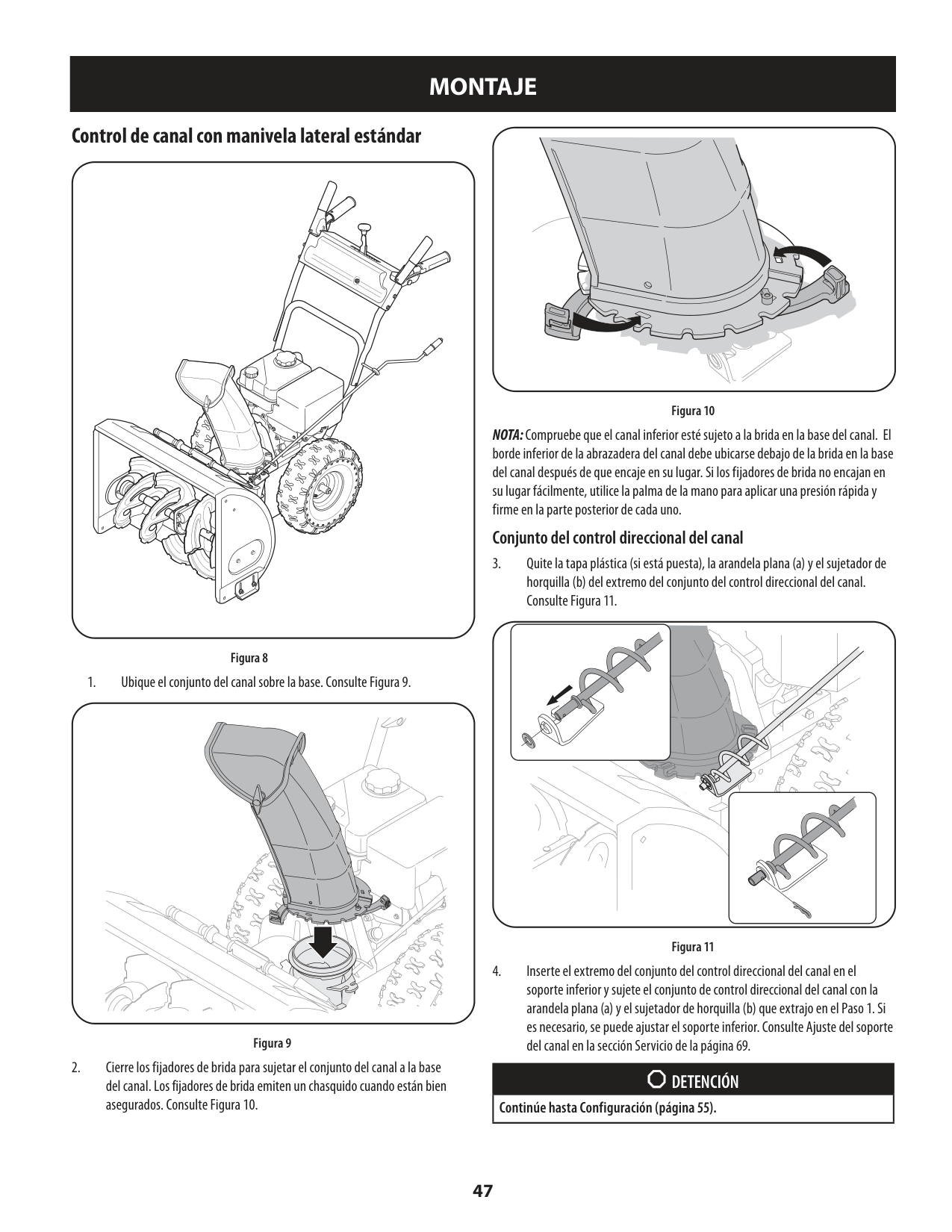
47
Montaje
Figura 10 NOTA: Compruebe que el canal inferior esté sujeto a la brida en la base del canal. El borde inferior de la abrazadera del canal debe ubicarse debajo de la brida en la base del canal después de que encaje en su lugar. Si los fijadores de brida no encajan en su lugar fácilmente, utilice la palma de la mano para aplicar una presión rápida y firme en la parte posterior de cada uno. Conjunto del control direccional del canalDetención
Continúe hasta Configuración (página 55). Control de canal con manivela lateral estándar Figura 8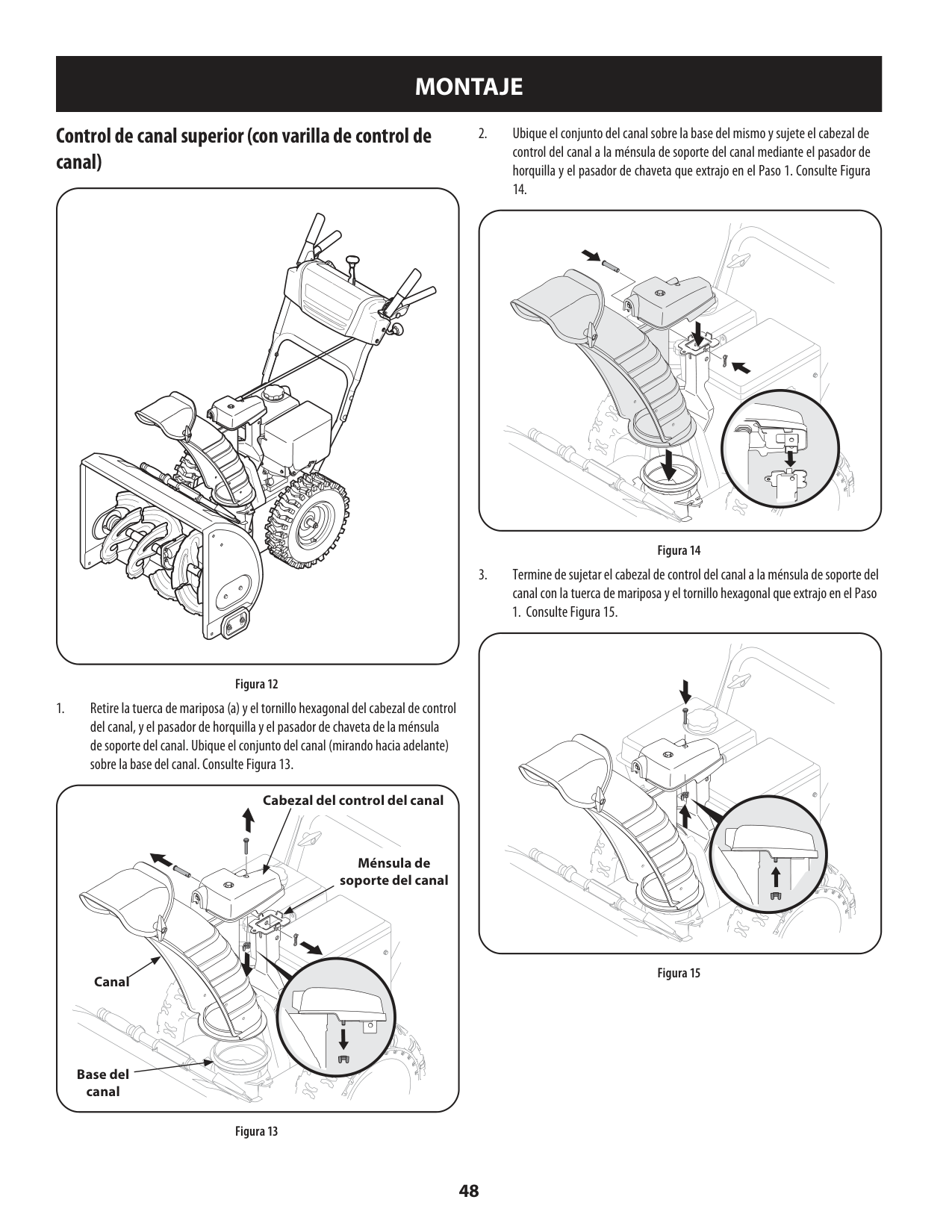
48
Montaje
Control de canal superior (con varilla de control de canal) Figura 12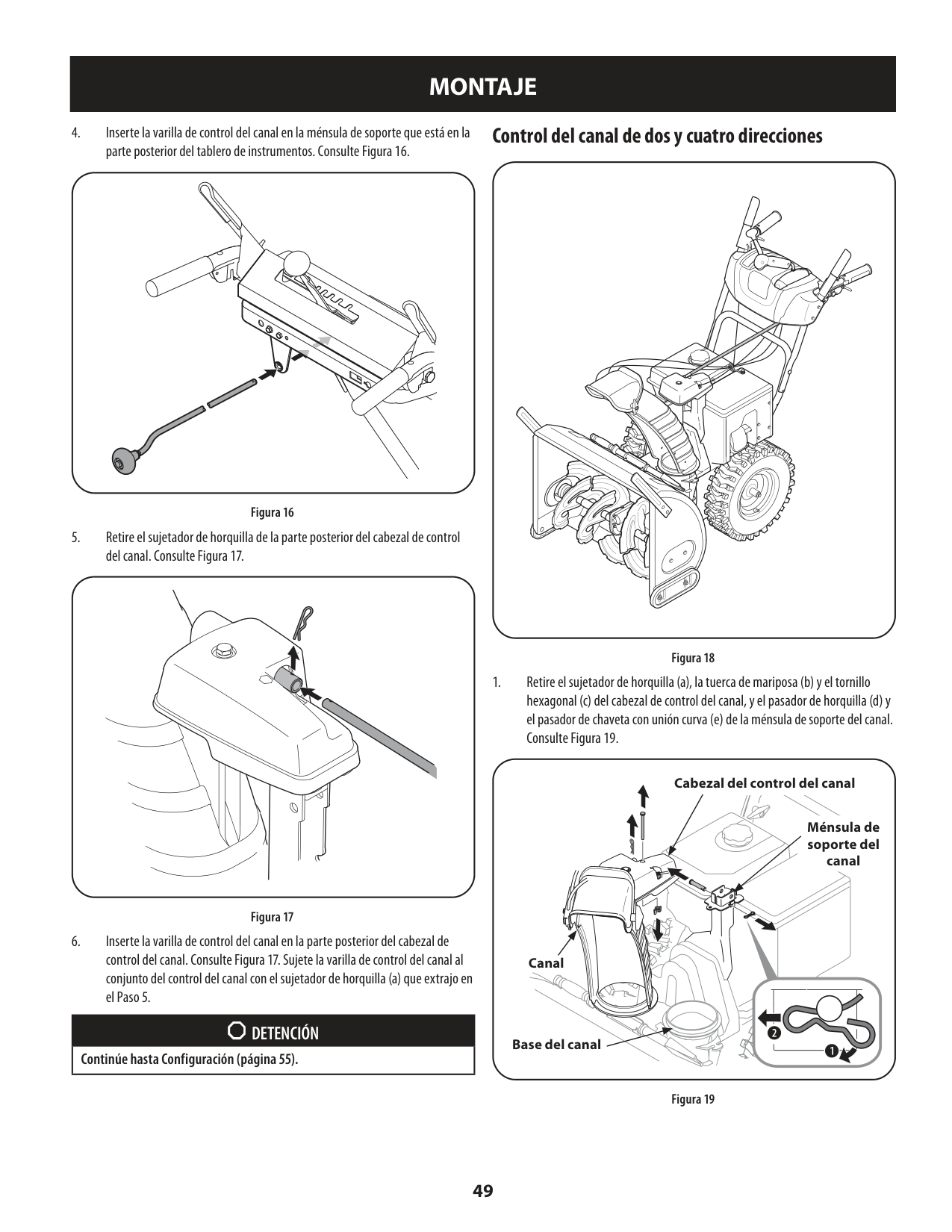
49
Montaje
Detención
Continúe hasta Configuración (página 55). Control del canal de dos y cuatro direcciones Figura 18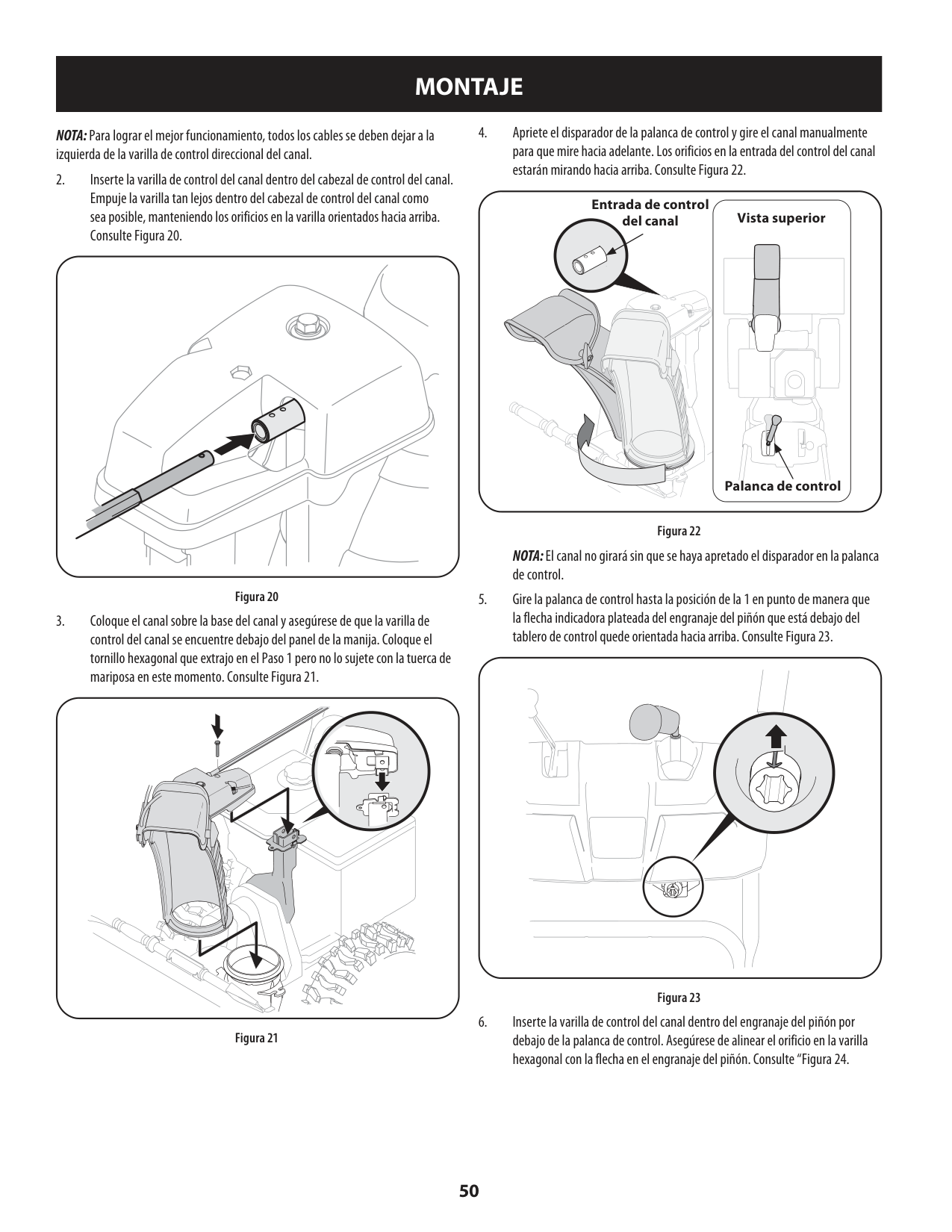
50
Montaje
NOTA: Para lograr el mejor funcionamiento, todos los cables se deben dejar a la izquierda de la varilla de control direccional del canal.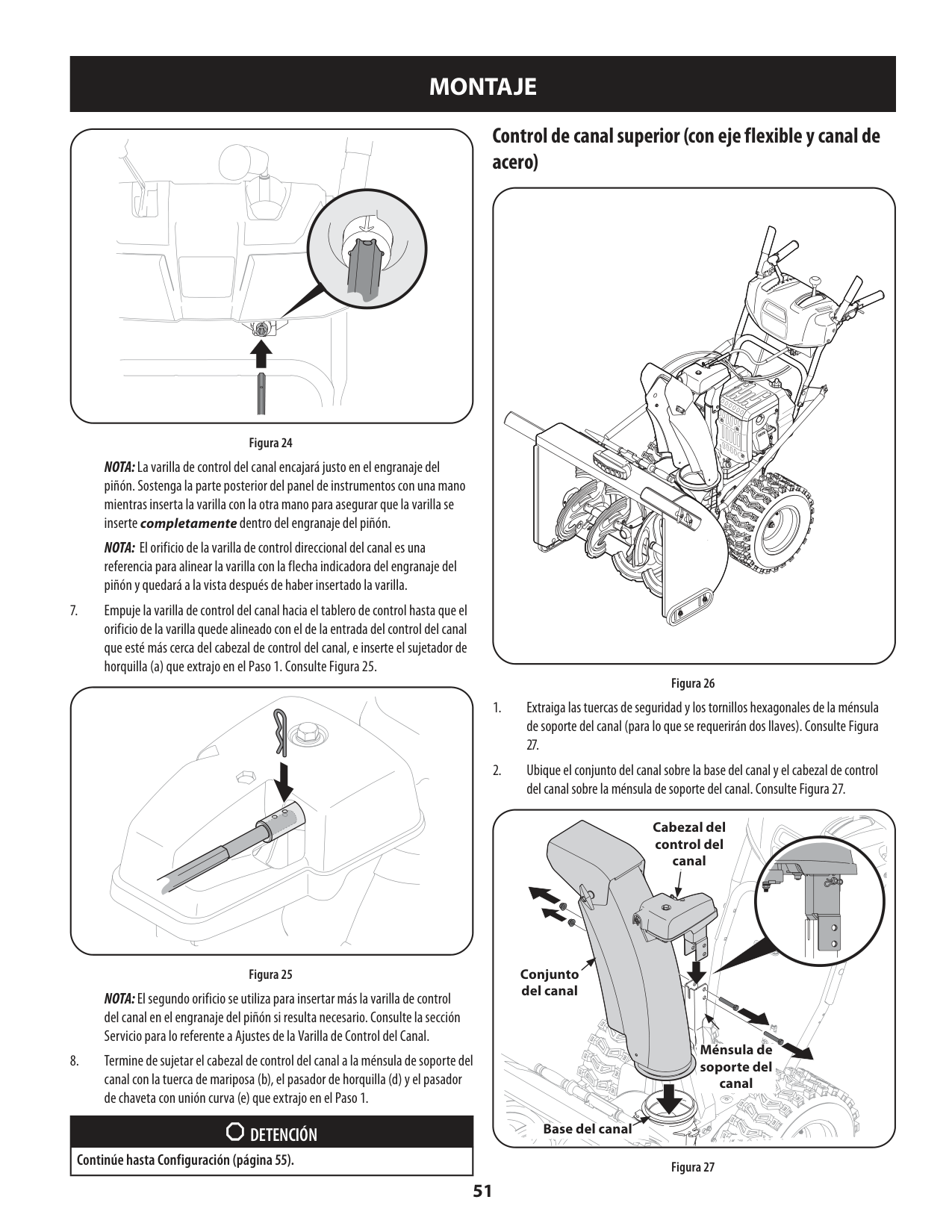
51
Montaje
Figura 24 NOTA: La varilla de control del canal encajará justo en el engranaje del piñón. Sostenga la parte posterior del panel de instrumentos con una mano mientras inserta la varilla con la otra mano para asegurar que la varilla se inserte completamente dentro del engranaje del piñón. NOTA: El orificio de la varilla de control direccional del canal es una referencia para alinear la varilla con la flecha indicadora del engranaje del piñón y quedará a la vista después de haber insertado la varilla.Detención
Continúe hasta Configuración (página 55). Control de canal superior (con eje flexible y canal de acero) Figura 26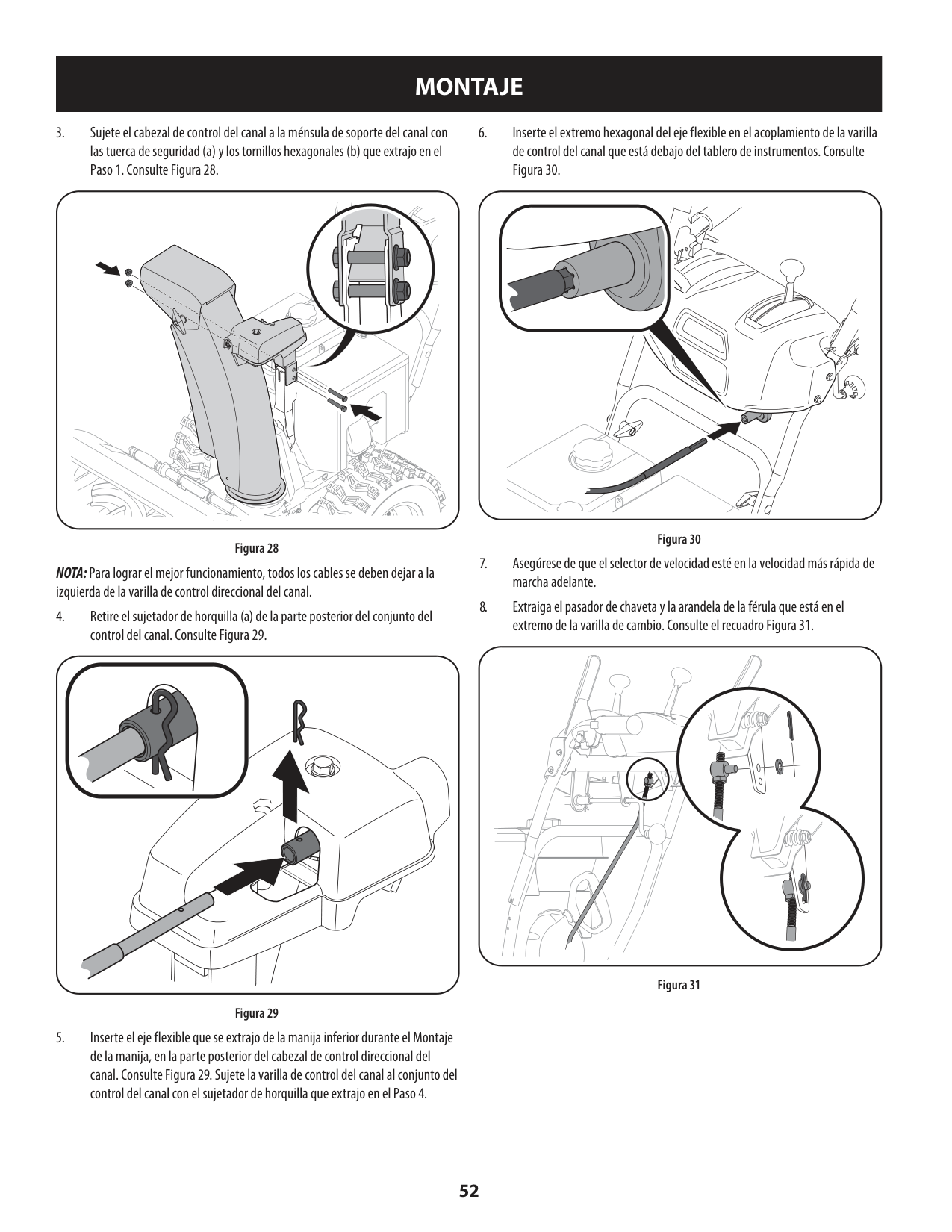
52
Montaje
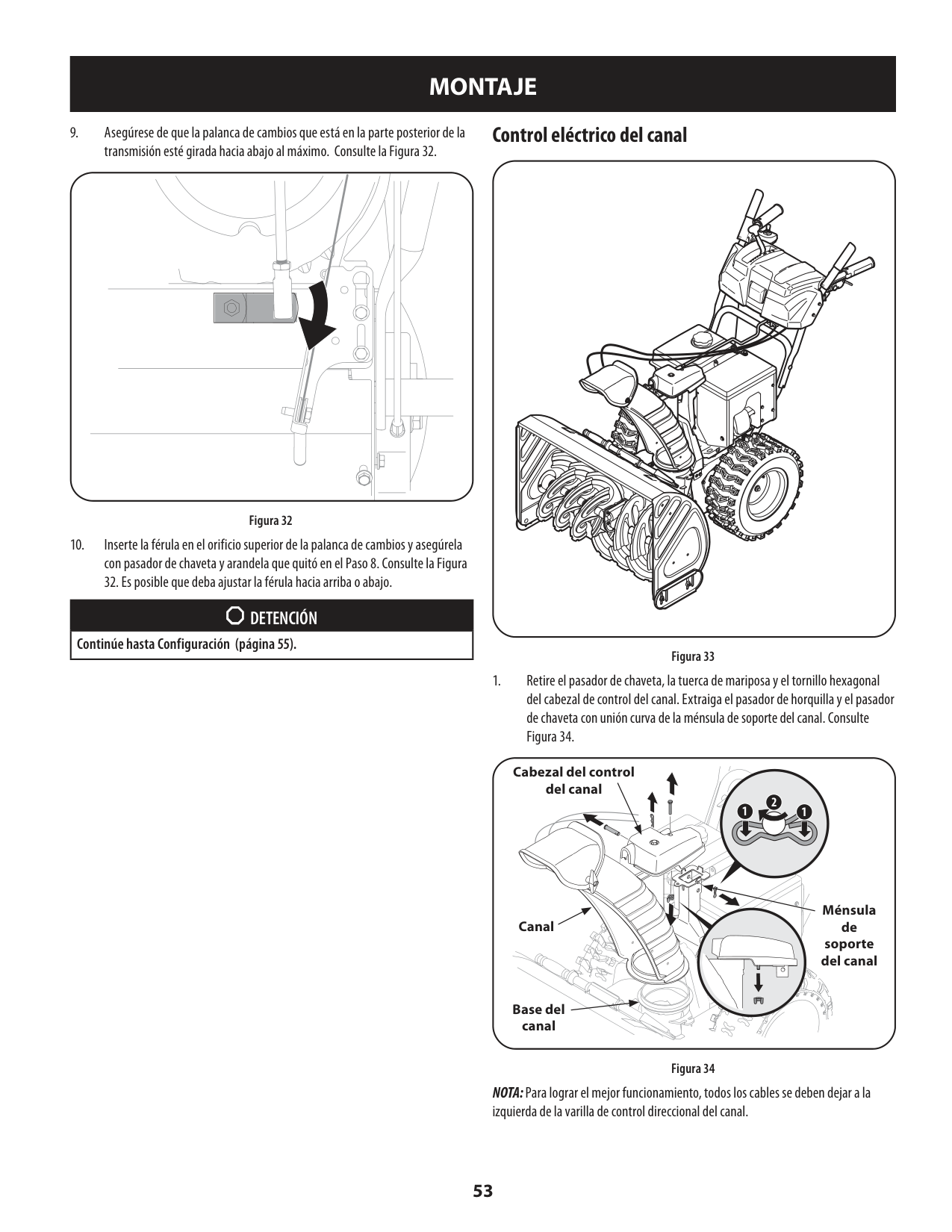
53
Montaje
Detención
Continúe hasta Configuración (página 55). Control eléctrico del canal Figura 33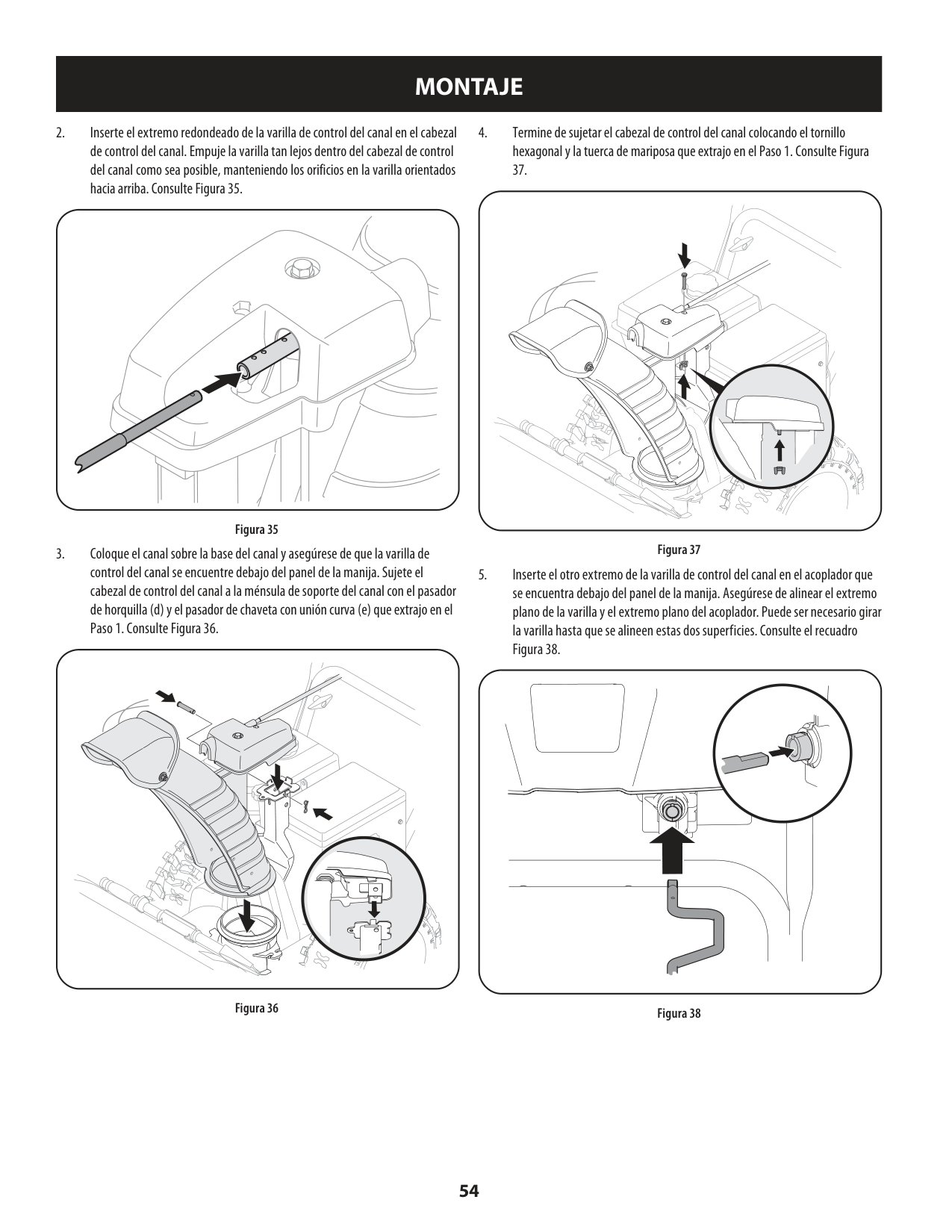
54
Montaje
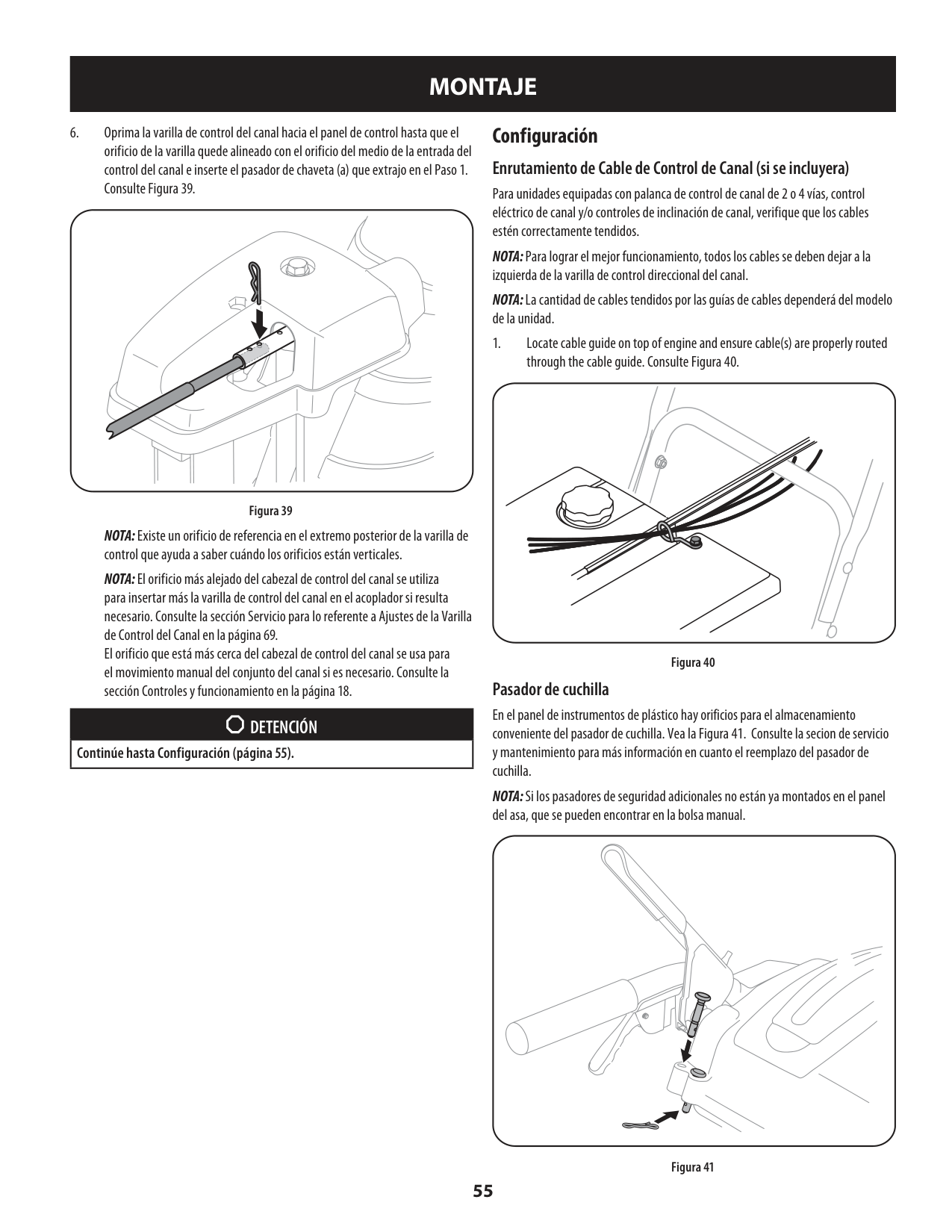
55
Montaje
Detención
Continúe hasta Configuración (página 55). Configuración Enrutamiento de Cable de Control de Canal (si se incluyera) Para unidades equipadas con palanca de control de canal de 2 o 4 vías, control eléctrico de canal y/o controles de inclinación de canal, verifique que los cables estén correctamente tendidos. NOTA: Para lograr el mejor funcionamiento, todos los cables se deben dejar a la izquierda de la varilla de control direccional del canal. NOTA: La cantidad de cables tendidos por las guías de cables dependerá del modelo de la unidad.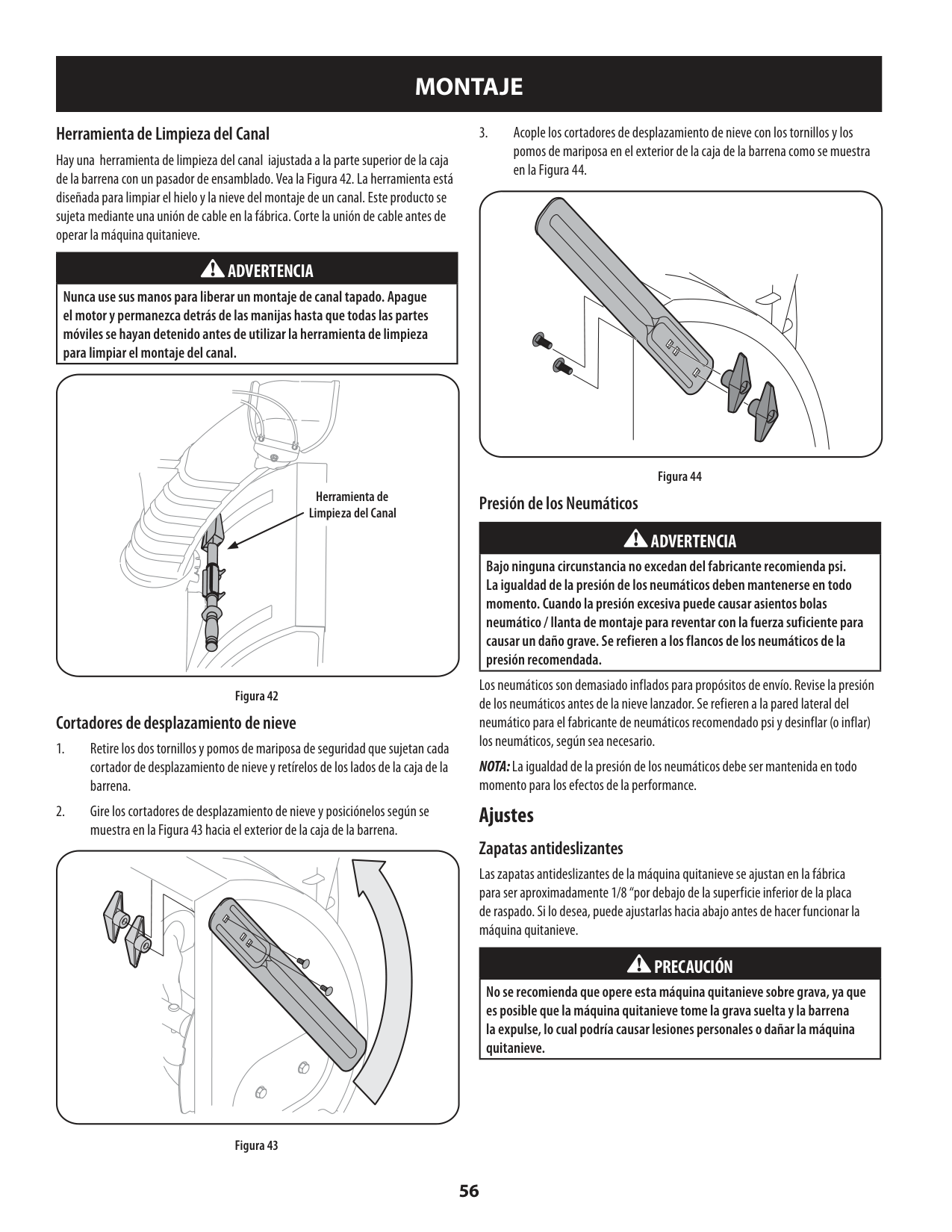
56
Montaje
Herramienta de Limpieza del Canal Hay una herramienta de limpieza del canal iajustada a la parte superior de la caja de la barrena con un pasador de ensamblado. Vea la Figura 42. La herramienta está diseñada para limpiar el hielo y la nieve del montaje de un canal. Este producto se sujeta mediante una unión de cable en la fábrica. Corte la unión de cable antes de operar la máquina quitanieve.Advertencia
Nunca use sus manos para liberar un montaje de canal tapado. Apague el motor y permanezca detrás de las manijas hasta que todas las partes móviles se hayan detenido antes de utilizar la herramienta de limpieza para limpiar el montaje del canal. Herramienta de Limpieza del Canal Figura 42 Cortadores de desplazamiento de nieveAdvertencia
Bajo ninguna circunstancia no excedan del fabricante recomienda psi. La igualdad de la presión de los neumáticos deben mantenerse en todo momento. Cuando la presión excesiva puede causar asientos bolas neumático / llanta de montaje para reventar con la fuerza suficiente para causar un daño grave. Se refieren a los flancos de los neumáticos de la presión recomendada. Los neumáticos son demasiado inflados para propósitos de envío. Revise la presión de los neumáticos antes de la nieve lanzador. Se refieren a la pared lateral del neumático para el fabricante de neumáticos recomendado psi y desinflar (o inflar) los neumáticos, según sea necesario. NOTA: La igualdad de la presión de los neumáticos debe ser mantenida en todo momento para los efectos de la performance. Ajustes Zapatas antideslizantes Las zapatas antideslizantes de la máquina quitanieve se ajustan en la fábrica para ser aproximadamente 1/8 “por debajo de la superficie inferior de la placa de raspado. Si lo desea, puede ajustarlas hacia abajo antes de hacer funcionar la máquina quitanieve.Precaución
No se recomienda que opere esta máquina quitanieve sobre grava, ya que es posible que la máquina quitanieve tome la grava suelta y la barrena la expulse, lo cual podría causar lesiones personales o dañar la máquina quitanieve.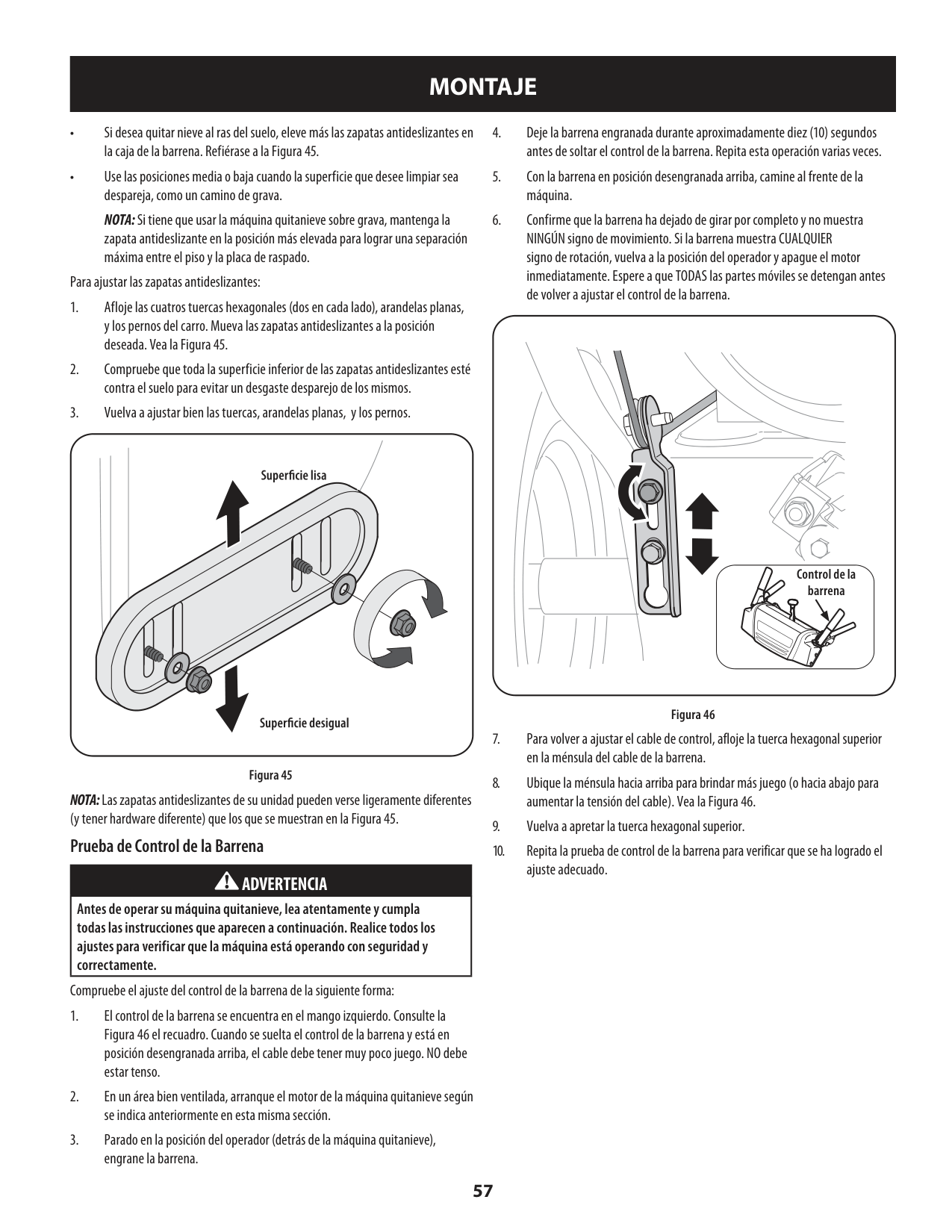
57
Montaje
• Si desea quitar nieve al ras del suelo, eleve más las zapatas antideslizantes en la caja de la barrena. Refiérase a la Figura 45. • Use las posiciones media o baja cuando la superficie que desee limpiar sea despareja, como un camino de grava. NOTA: Si tiene que usar la máquina quitanieve sobre grava, mantenga la zapata antideslizante en la posición más elevada para lograr una separación máxima entre el piso y la placa de raspado. Para ajustar las zapatas antideslizantes:Advertencia
Antes de operar su máquina quitanieve, lea atentamente y cumpla todas las instrucciones que aparecen a continuación. Realice todos los ajustes para verificar que la máquina está operando con seguridad y correctamente. Compruebe el ajuste del control de la barrena de la siguiente forma: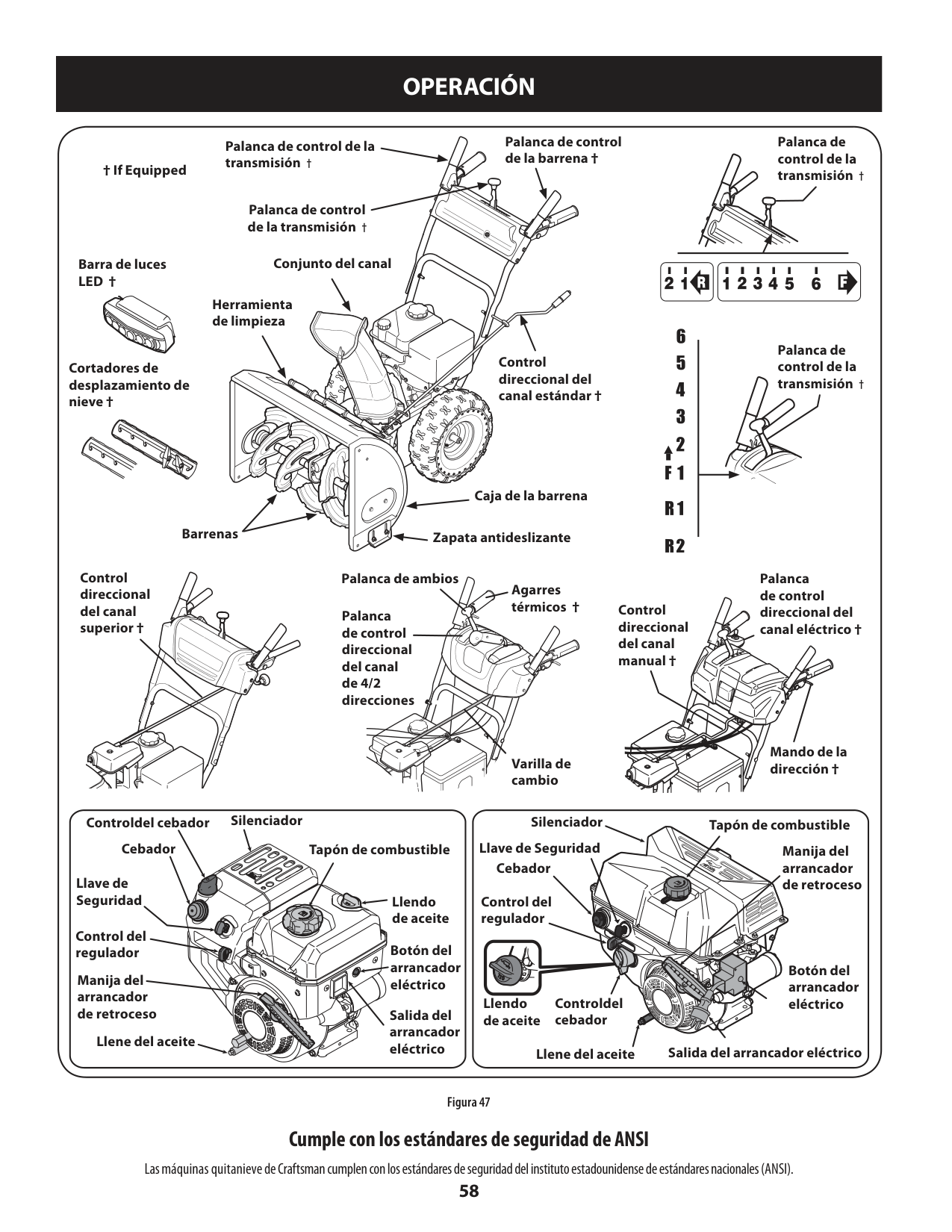
58
Operación
Cumple con los estándares de seguridad de ANSI Las máquinas quitanieve de Craftsman cumplen con los estándares de seguridad del instituto estadounidense de estándares nacionales (ANSI). Silenciador Silenciador Controldel cebador Controldel cebador Llave de Seguridad Llave de Seguridad Control del regulador Control del regulador Manija del arrancador de retroceso Manija del arrancador de retroceso Llene del aceite Llene del aceite Tapón de combustible Tapón de combustible Llendo de aceite Llendo de aceite Salida del arrancador eléctrico Salida del arrancador eléctrico Cebador Cebador Botón del arrancador eléctrico Botón del arrancador eléctrico † If Equipped Barra de lucesLed †
Cortadores de desplazamiento de nieve † Palanca de control de la barrena † Palanca de control de la transmisión † Palanca de control de la transmisión † Conjunto del canal Herramienta de limpieza Control direccional del canal estándar † Caja de la barrena Zapata antideslizante Barrenas Control direccional del canal superior † Palanca de ambios Agarres térmicos † Palanca de control direccional del canal de 4/2 direcciones Varilla de cambio Palanca de control direccional del canal eléctrico † Control direccional del canal manual † Mando de la dirección † Palanca de control de la transmisión † Palanca de control de la transmisión † Figura 47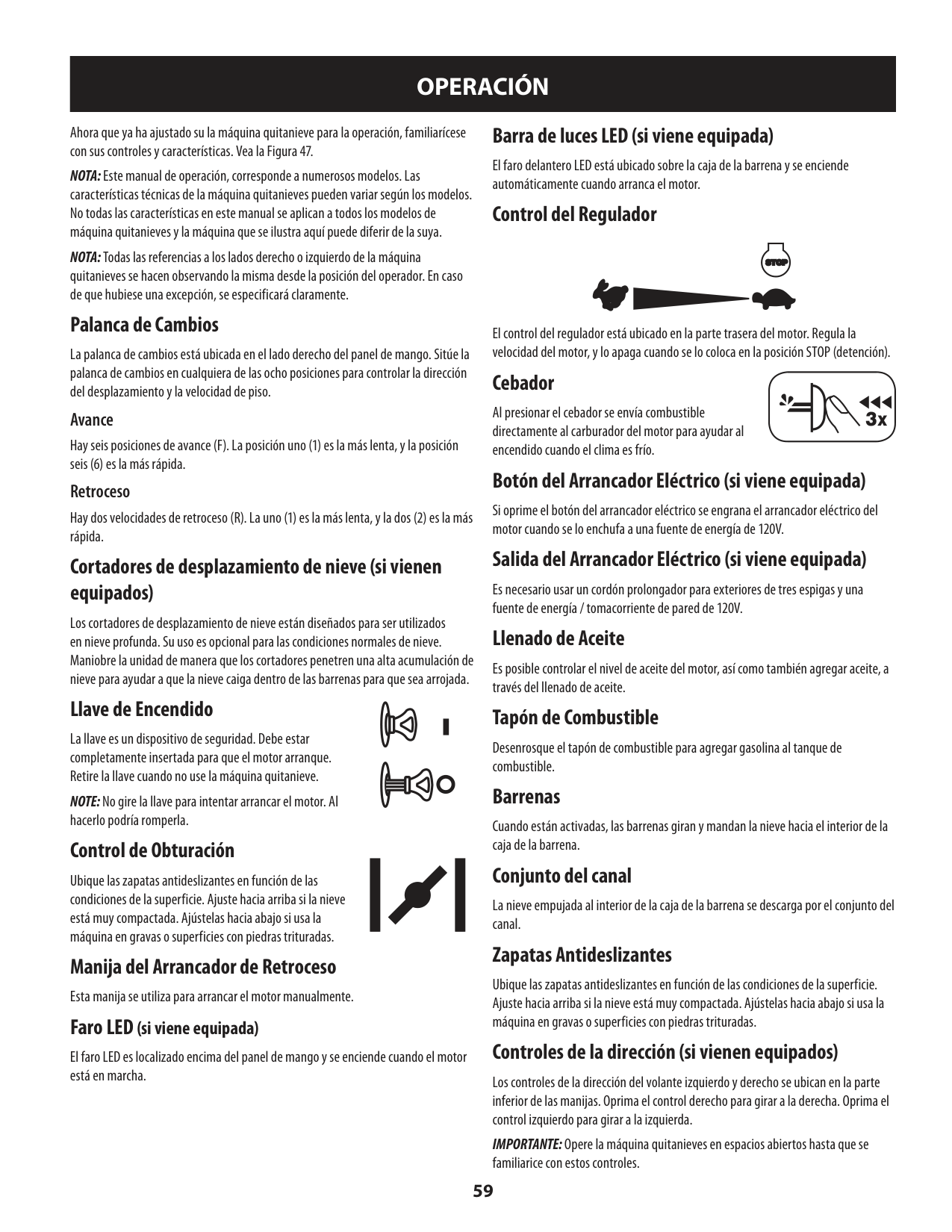
59
Operación
Ahora que ya ha ajustado su la máquina quitanieve para la operación, familiarícese con sus controles y características. Vea la Figura 47. NOTA: Este manual de operación, corresponde a numerosos modelos. Las características técnicas de la máquina quitanieves pueden variar según los modelos. No todas las características en este manual se aplican a todos los modelos de máquina quitanieves y la máquina que se ilustra aquí puede diferir de la suya. NOTA: Todas las referencias a los lados derecho o izquierdo de la máquina quitanieves se hacen observando la misma desde la posición del operador. En caso de que hubiese una excepción, se especificará claramente. Palanca de Cambios La palanca de cambios está ubicada en el lado derecho del panel de mango. Sitúe la palanca de cambios en cualquiera de las ocho posiciones para controlar la dirección del desplazamiento y la velocidad de piso. Avance Hay seis posiciones de avance (F). La posición uno (1) es la más lenta, y la posición seis (6) es la más rápida. Retroceso Hay dos velocidades de retroceso (R). La uno (1) es la más lenta, y la dos (2) es la más rápida. Cortadores de desplazamiento de nieve (si vienen equipados) Los cortadores de desplazamiento de nieve están diseñados para ser utilizados en nieve profunda. Su uso es opcional para las condiciones normales de nieve. Maniobre la unidad de manera que los cortadores penetren una alta acumulación de nieve para ayudar a que la nieve caiga dentro de las barrenas para que sea arrojada. Llave de Encendido La llave es un dispositivo de seguridad. Debe estar completamente insertada para que el motor arranque. Retire la llave cuando no use la máquina quitanieve. NOTE: No gire la llave para intentar arrancar el motor. Al hacerlo podría romperla. Control de Obturación Ubique las zapatas antideslizantes en función de las condiciones de la superficie. Ajuste hacia arriba si la nieve está muy compactada. Ajústelas hacia abajo si usa la máquina en gravas o superficies con piedras trituradas. Manija del Arrancador de Retroceso Esta manija se utiliza para arrancar el motor manualmente. Faro LED (si viene equipada) El faro LED es localizado encima del panel de mango y se enciende cuando el motor está en marcha. Barra de luces LED (si viene equipada) El faro delantero LED está ubicado sobre la caja de la barrena y se enciende automáticamente cuando arranca el motor. Control del Regulador El control del regulador está ubicado en la parte trasera del motor. Regula la velocidad del motor, y lo apaga cuando se lo coloca en la posición STOP (detención). Cebador Al presionar el cebador se envía combustible directamente al carburador del motor para ayudar al encendido cuando el clima es frío. Botón del Arrancador Eléctrico (si viene equipada) Si oprime el botón del arrancador eléctrico se engrana el arrancador eléctrico del motor cuando se lo enchufa a una fuente de energía de 120V. Salida del Arrancador Eléctrico (si viene equipada) Es necesario usar un cordón prolongador para exteriores de tres espigas y una fuente de energía / tomacorriente de pared de 120V. Llenado de Aceite Es posible controlar el nivel de aceite del motor, así como también agregar aceite, a través del llenado de aceite. Tapón de Combustible Desenrosque el tapón de combustible para agregar gasolina al tanque de combustible. Barrenas Cuando están activadas, las barrenas giran y mandan la nieve hacia el interior de la caja de la barrena. Conjunto del canal La nieve empujada al interior de la caja de la barrena se descarga por el conjunto del canal. Zapatas Antideslizantes Ubique las zapatas antideslizantes en función de las condiciones de la superficie. Ajuste hacia arriba si la nieve está muy compactada. Ajústelas hacia abajo si usa la máquina en gravas o superficies con piedras trituradas. Controles de la dirección (si vienen equipados) Los controles de la dirección del volante izquierdo y derecho se ubican en la parte inferior de las manijas. Oprima el control derecho para girar a la derecha. Oprima el control izquierdo para girar a la izquierda. IMPORTANTE: Opere la máquina quitanieves en espacios abiertos hasta que se familiarice con estos controles.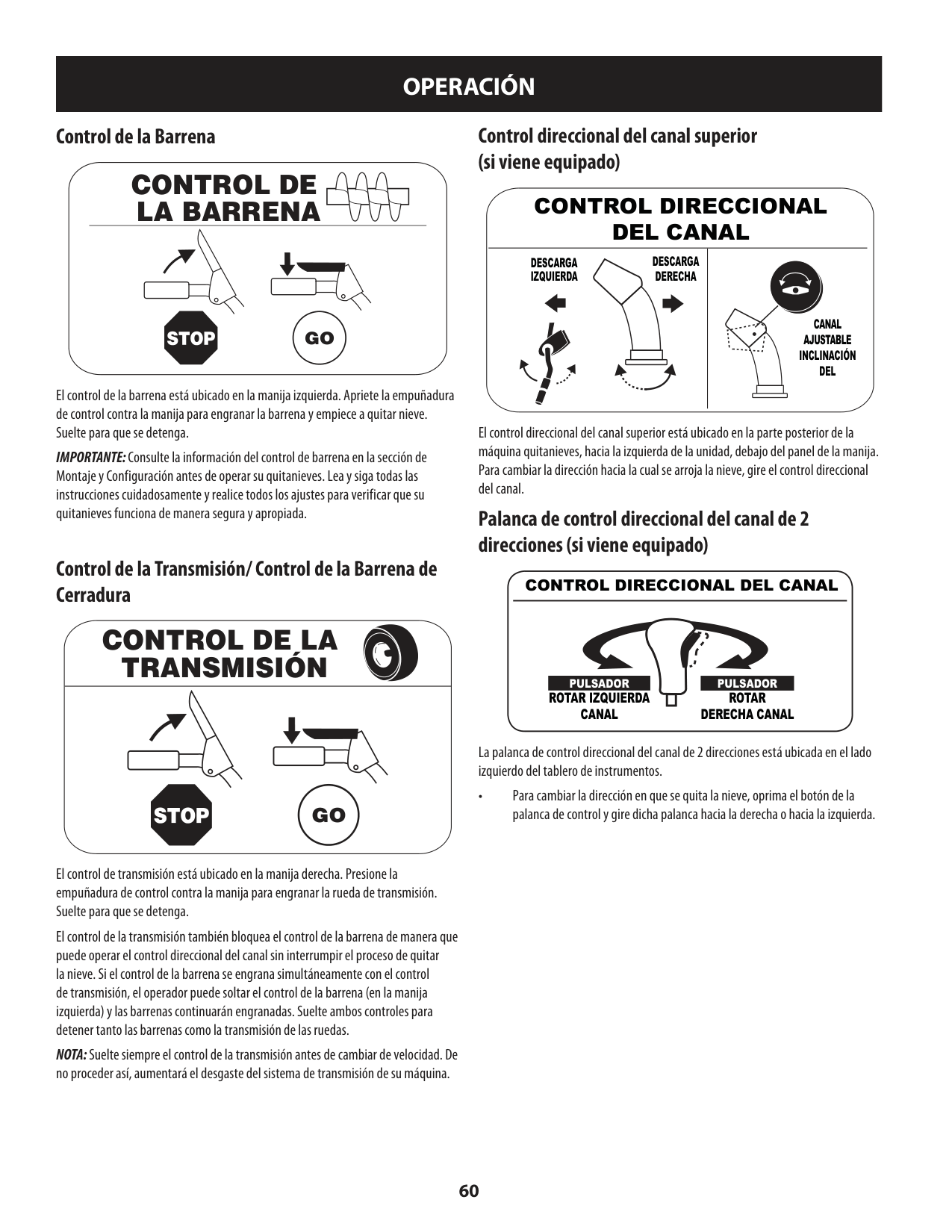
60
Operación
Control de la BarrenaControl De
La Barrena
Go
El control de la barrena está ubicado en la manija izquierda. Apriete la empuñadura de control contra la manija para engranar la barrena y empiece a quitar nieve. Suelte para que se detenga. IMPORTANTE: Consulte la información del control de barrena en la sección de Montaje y Configuración antes de operar su quitanieves. Lea y siga todas las instrucciones cuidadosamente y realice todos los ajustes para verificar que su quitanieves funciona de manera segura y apropiada. Control de la Transmisión/ Control de la Barrena de CerraduraControl De La
Transmisión
Go
El control de transmisión está ubicado en la manija derecha. Presione la empuñadura de control contra la manija para engranar la rueda de transmisión. Suelte para que se detenga. El control de la transmisión también bloquea el control de la barrena de manera que puede operar el control direccional del canal sin interrumpir el proceso de quitar la nieve. Si el control de la barrena se engrana simultáneamente con el control de transmisión, el operador puede soltar el control de la barrena (en la manija izquierda) y las barrenas continuarán engranadas. Suelte ambos controles para detener tanto las barrenas como la transmisión de las ruedas. NOTA: Suelte siempre el control de la transmisión antes de cambiar de velocidad. De no proceder así, aumentará el desgaste del sistema de transmisión de su máquina. Control direccional del canal superior (si viene equipado)Control Direccional
Del Canal
Descarga
Derecha
Canal
Ajustable
Inclinación
Del
Descarga
Izquierda
El control direccional del canal superior está ubicado en la parte posterior de la máquina quitanieves, hacia la izquierda de la unidad, debajo del panel de la manija. Para cambiar la dirección hacia la cual se arroja la nieve, gire el control direccional del canal. Palanca de control direccional del canal de 2 direcciones (si viene equipado)Rotar
Derecha Canal
Pulsador
Pulsador
Rotar Izquierda
Canal
Control Direccional Del Canal
La palanca de control direccional del canal de 2 direcciones está ubicada en el lado izquierdo del tablero de instrumentos. • Para cambiar la dirección en que se quita la nieve, oprima el botón de la palanca de control y gire dicha palanca hacia la derecha o hacia la izquierda.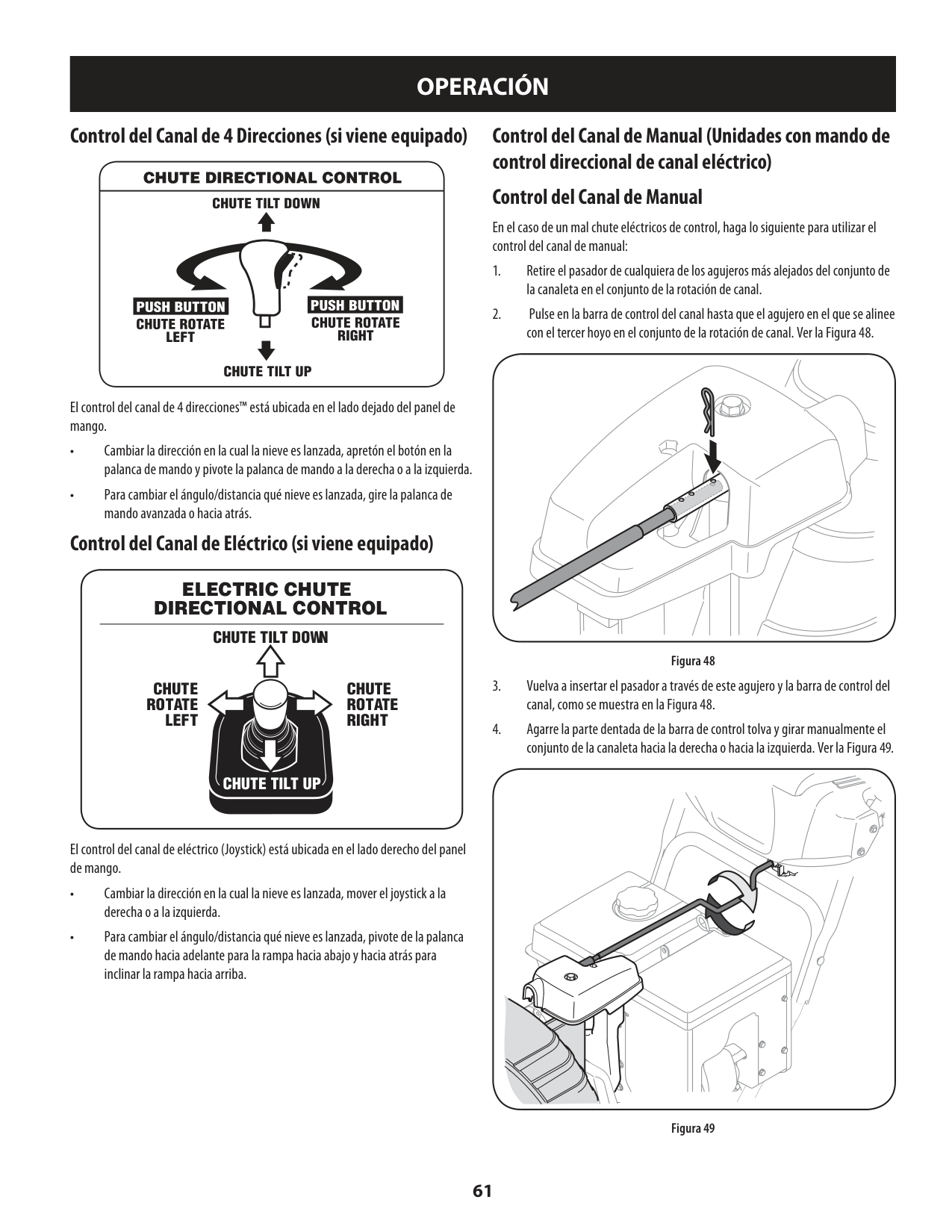
61
Operación
Control del Canal de 4 Direcciones (si viene equipado) El control del canal de 4 direcciones™ está ubicada en el lado dejado del panel de mango. • Cambiar la dirección en la cual la nieve es lanzada, apretón el botón en la palanca de mando y pivote la palanca de mando a la derecha o a la izquierda. • Para cambiar el ángulo/distancia qué nieve es lanzada, gire la palanca de mando avanzada o hacia atrás. Control del Canal de Eléctrico (si viene equipado)Directional Control
Electric Chute
Chute
Rotate
Left
Chute
Rotate
Right
Chute Tilt Up
Chute Tilt Down
El control del canal de eléctrico (Joystick) está ubicada en el lado derecho del panel de mango. • Cambiar la dirección en la cual la nieve es lanzada, mover el joystick a la derecha o a la izquierda. • Para cambiar el ángulo/distancia qué nieve es lanzada, pivote de la palanca de mando hacia adelante para la rampa hacia abajo y hacia atrás para inclinar la rampa hacia arriba. Control del Canal de Manual (Unidades con mando de control direccional de canal eléctrico) Control del Canal de Manual En el caso de un mal chute eléctricos de control, haga lo siguiente para utilizar el control del canal de manual: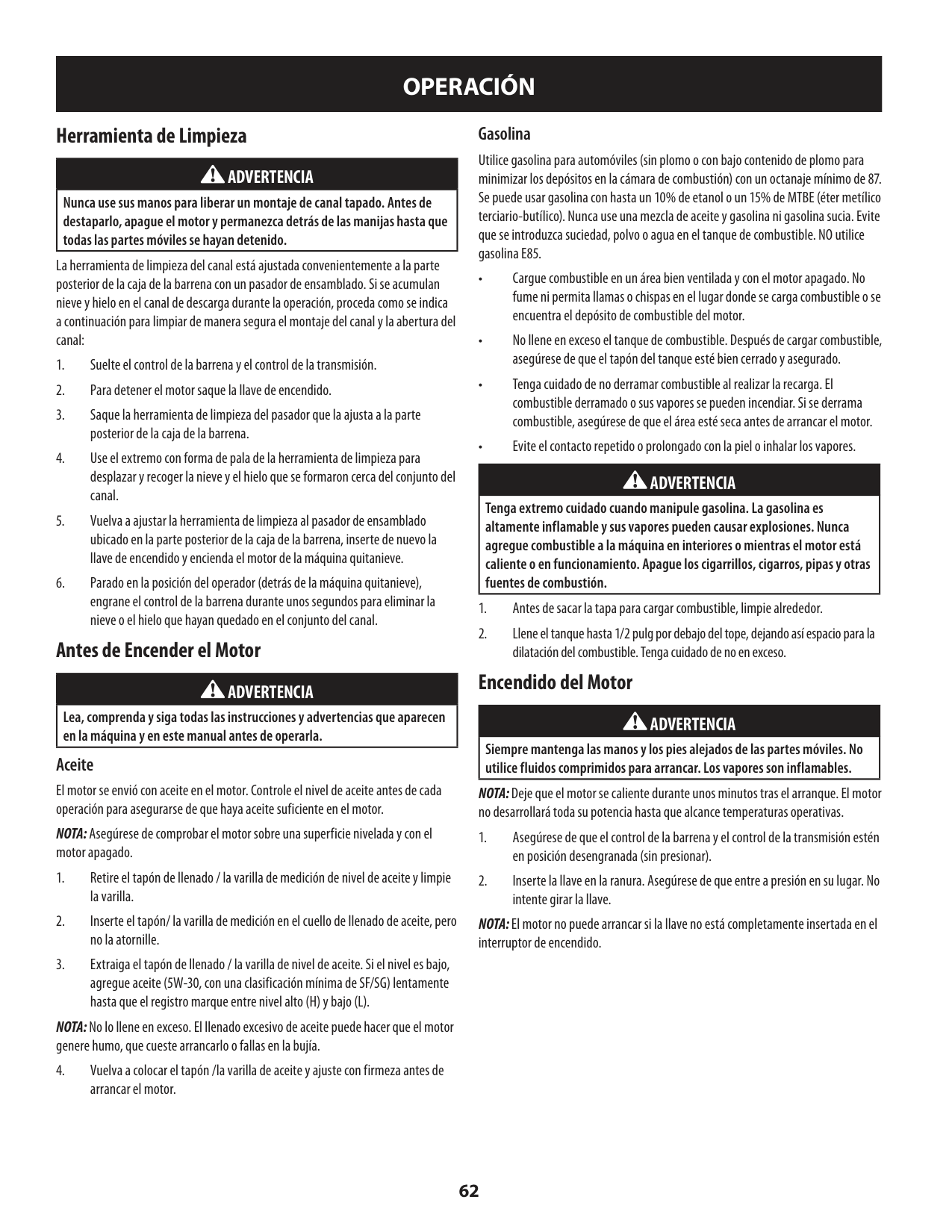
62
Operación
Herramienta de LimpiezaAdvertencia
Nunca use sus manos para liberar un montaje de canal tapado. Antes de destaparlo, apague el motor y permanezca detrás de las manijas hasta que todas las partes móviles se hayan detenido. La herramienta de limpieza del canal está ajustada convenientemente a la parte posterior de la caja de la barrena con un pasador de ensamblado. Si se acumulan nieve y hielo en el canal de descarga durante la operación, proceda como se indica a continuación para limpiar de manera segura el montaje del canal y la abertura del canal:Advertencia
Lea, comprenda y siga todas las instrucciones y advertencias que aparecen en la máquina y en este manual antes de operarla. Aceite El motor se envió con aceite en el motor. Controle el nivel de aceite antes de cada operación para asegurarse de que haya aceite suficiente en el motor. NOTA: Asegúrese de comprobar el motor sobre una superficie nivelada y con el motor apagado.Advertencia
Tenga extremo cuidado cuando manipule gasolina. La gasolina es altamente inflamable y sus vapores pueden causar explosiones. Nunca agregue combustible a la máquina en interiores o mientras el motor está caliente o en funcionamiento. Apague los cigarrillos, cigarros, pipas y otras fuentes de combustión.Advertencia
Siempre mantenga las manos y los pies alejados de las partes móviles. No utilice fluidos comprimidos para arrancar. Los vapores son inflamables. NOTA: Deje que el motor se caliente durante unos minutos tras el arranque. El motor no desarrollará toda su potencia hasta que alcance temperaturas operativas.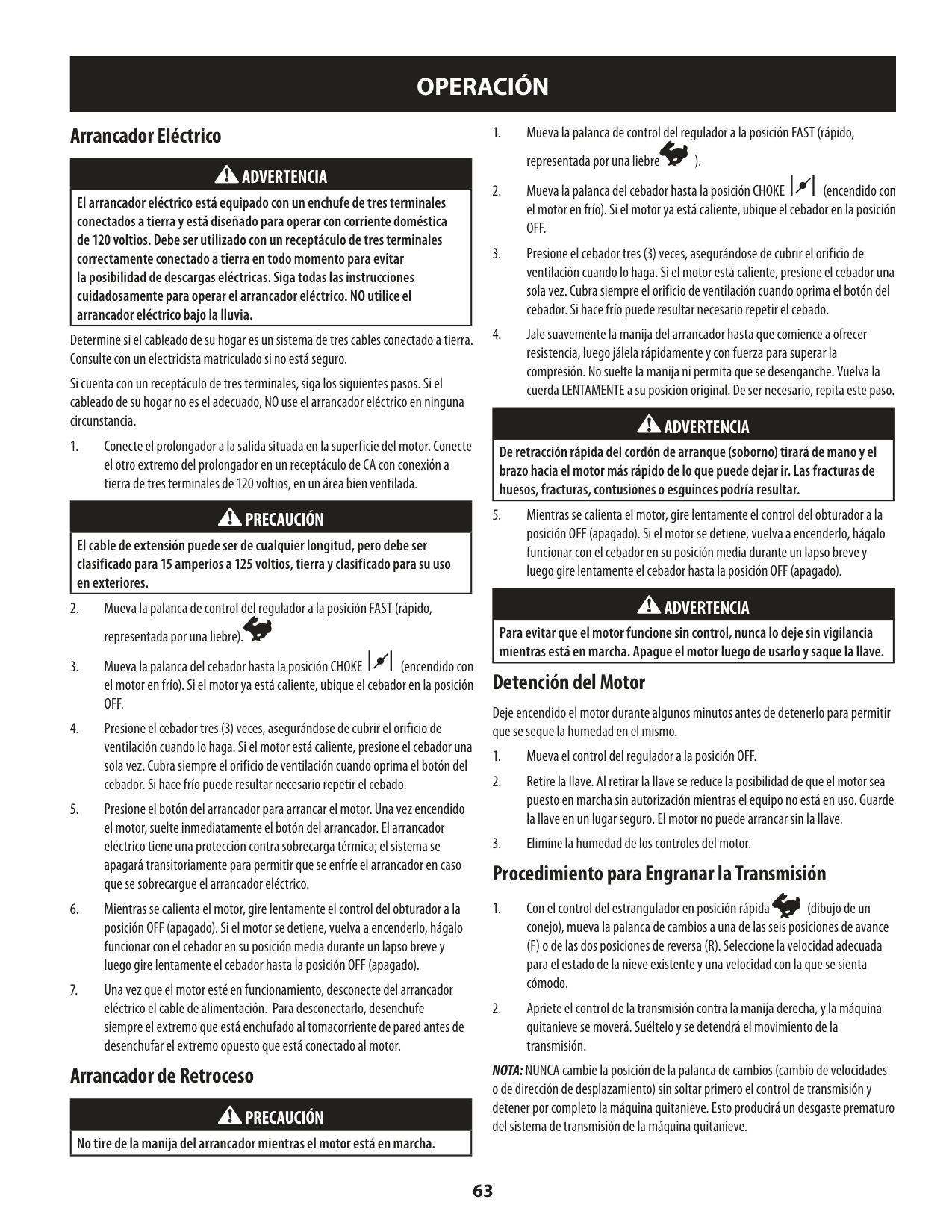
63
Operación
Arrancador EléctricoAdvertencia
El arrancador eléctrico está equipado con un enchufe de tres terminales conectados a tierra y está diseñado para operar con corriente doméstica de 120 voltios. Debe ser utilizado con un receptáculo de tres terminales correctamente conectado a tierra en todo momento para evitar la posibilidad de descargas eléctricas. Siga todas las instrucciones cuidadosamente para operar el arrancador eléctrico. NO utilice el arrancador eléctrico bajo la lluvia. Determine si el cableado de su hogar es un sistema de tres cables conectado a tierra. Consulte con un electricista matriculado si no está seguro. Si cuenta con un receptáculo de tres terminales, siga los siguientes pasos. Si el cableado de su hogar no es el adecuado, NO use el arrancador eléctrico en ninguna circunstancia.Precaución
El cable de extensión puede ser de cualquier longitud, pero debe ser clasificado para 15 amperios a 125 voltios, tierra y clasificado para su uso en exteriores.Off.
Precaución
No tire de la manija del arrancador mientras el motor está en marcha.Off.
Advertencia
De retracción rápida del cordón de arranque (soborno) tirará de mano y el brazo hacia el motor más rápido de lo que puede dejar ir. Las fracturas de huesos, fracturas, contusiones o esguinces podría resultar.Advertencia
Para evitar que el motor funcione sin control, nunca lo deje sin vigilancia mientras está en marcha. Apague el motor luego de usarlo y saque la llave. Detención del Motor Deje encendido el motor durante algunos minutos antes de detenerlo para permitir que se seque la humedad en el mismo.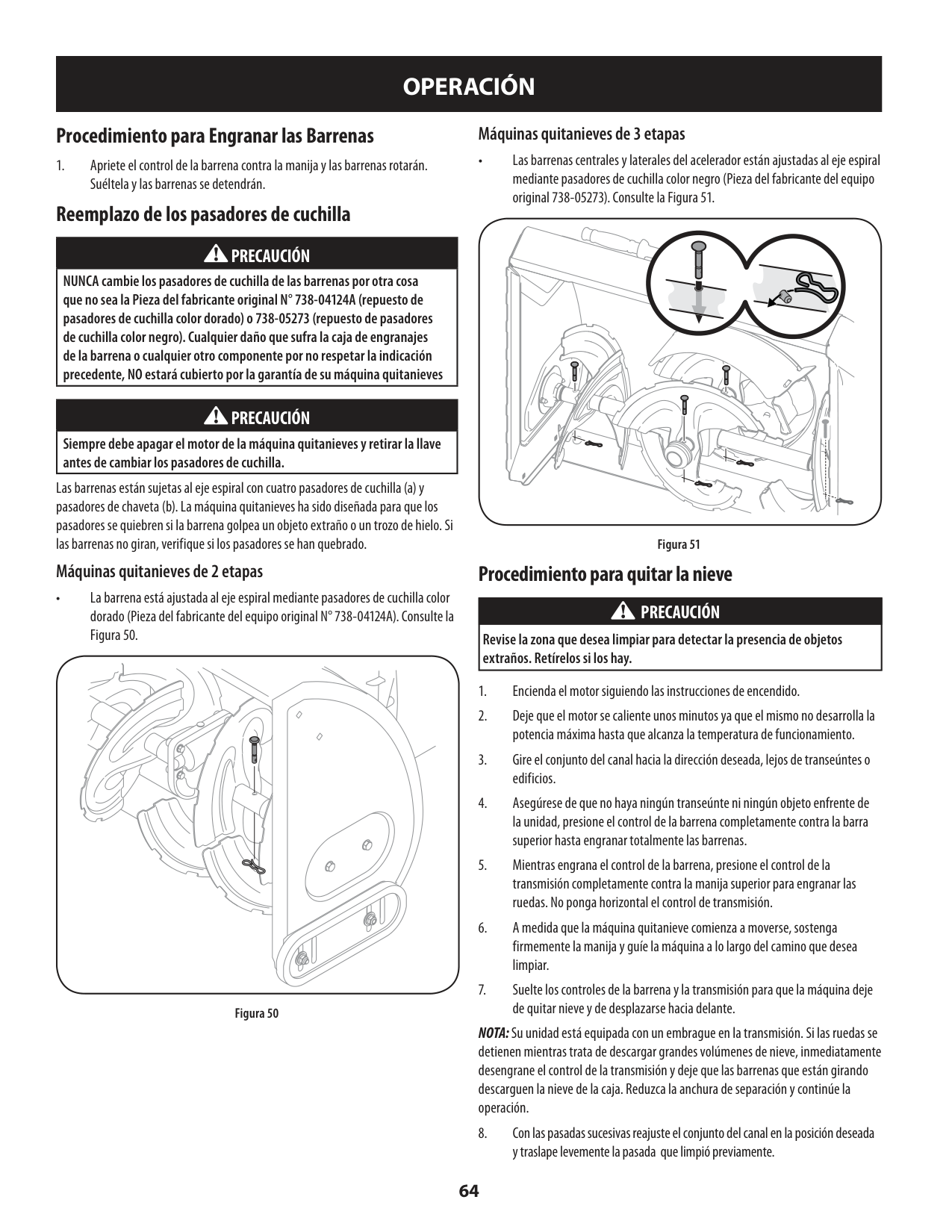
64
Operación
Procedimiento para Engranar las BarrenasPrecaución
NUNCA cambie los pasadores de cuchilla de las barrenas por otra cosa que no sea la Pieza del fabricante original N° 738-04124A (repuesto de pasadores de cuchilla color dorado) o 738-05273 (repuesto de pasadores de cuchilla color negro). Cualquier daño que sufra la caja de engranajes de la barrena o cualquier otro componente por no respetar la indicación precedente, NO estará cubierto por la garantía de su máquina quitanievesPrecaución
Siempre debe apagar el motor de la máquina quitanieves y retirar la llave antes de cambiar los pasadores de cuchilla. Las barrenas están sujetas al eje espiral con cuatro pasadores de cuchilla (a) y pasadores de chaveta (b). La máquina quitanieves ha sido diseñada para que los pasadores se quiebren si la barrena golpea un objeto extraño o un trozo de hielo. Si las barrenas no giran, verifique si los pasadores se han quebrado. Máquinas quitanieves de 2 etapas • La barrena está ajustada al eje espiral mediante pasadores de cuchilla color dorado (Pieza del fabricante del equipo original N° 738-04124A). Consulte la Figura 50. Figura 50 Máquinas quitanieves de 3 etapas • Las barrenas centrales y laterales del acelerador están ajustadas al eje espiral mediante pasadores de cuchilla color negro (Pieza del fabricante del equipo original 738-05273). Consulte la Figura 51. Figura 51 Procedimiento para quitar la nievePrecaución
Revise la zona que desea limpiar para detectar la presencia de objetos extraños. Retírelos si los hay.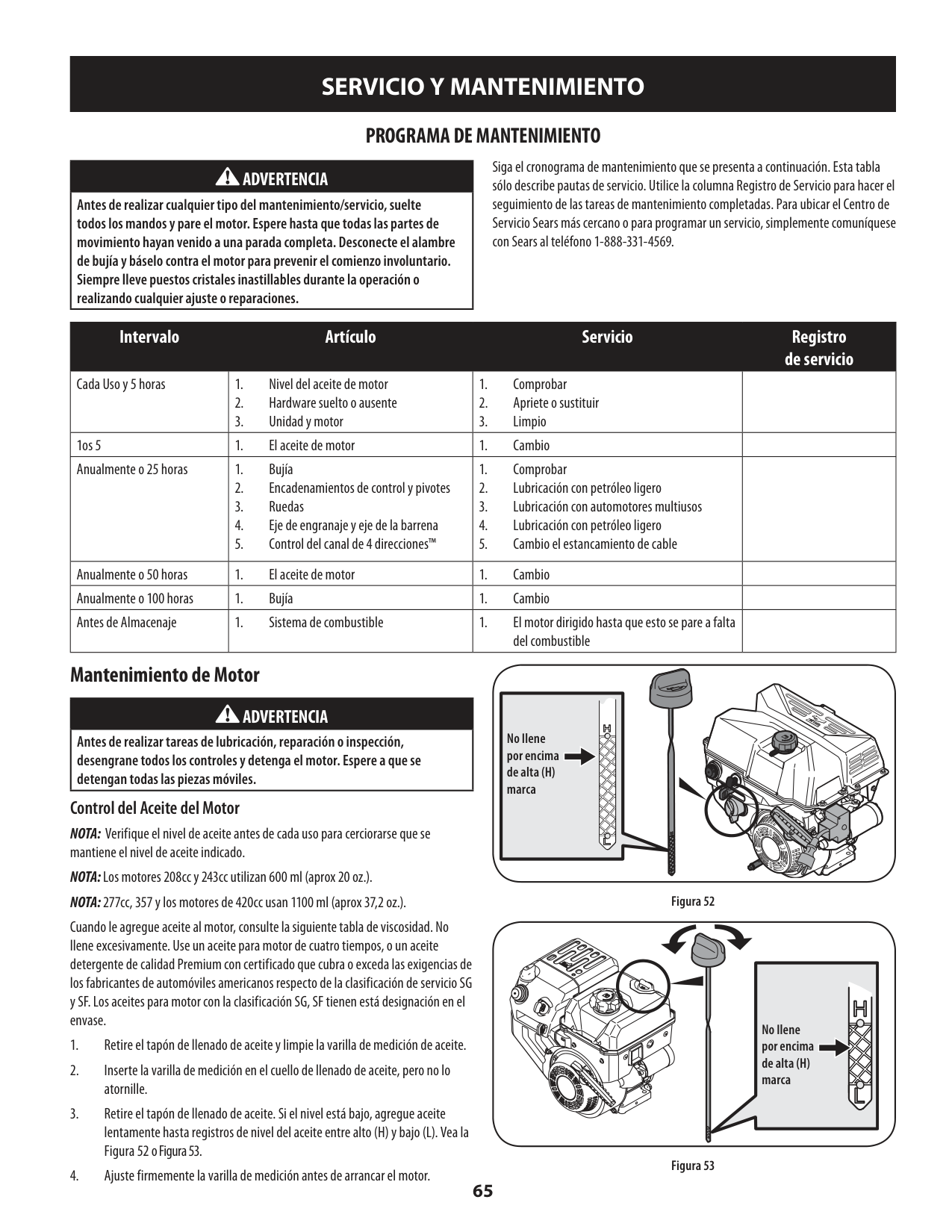
65
Servicio Y Mantenimiento
Advertencia
Antes de realizar cualquier tipo del mantenimiento/servicio, suelte todos los mandos y pare el motor. Espere hasta que todas las partes de movimiento hayan venido a una parada completa. Desconecte el alambre de bujía y báselo contra el motor para prevenir el comienzo involuntario. Siempre lleve puestos cristales inastillables durante la operación o realizando cualquier ajuste o reparaciones. Siga el cronograma de mantenimiento que se presenta a continuación. Esta tabla sólo describe pautas de servicio. Utilice la columna Registro de Servicio para hacer el seguimiento de las tareas de mantenimiento completadas. Para ubicar el Centro de Servicio Sears más cercano o para programar un servicio, simplemente comuníquese con Sears al teléfono 1-888-331-4569.Programa De Mantenimiento
Intervalo Artículo Servicio Registro de servicio Cada Uso y 5 horasAdvertencia
Antes de realizar tareas de lubricación, reparación o inspección, desengrane todos los controles y detenga el motor. Espere a que se detengan todas las piezas móviles. Control del Aceite del Motor NOTA: Verifique el nivel de aceite antes de cada uso para cerciorarse que se mantiene el nivel de aceite indicado. NOTA: Los motores 208cc y 243cc utilizan 600 ml (aprox 20 oz.). NOTA: 277cc, 357 y los motores de 420cc usan 1100 ml (aprox 37,2 oz.). Cuando le agregue aceite al motor, consulte la siguiente tabla de viscosidad. No llene excesivamente. Use un aceite para motor de cuatro tiempos, o un aceite detergente de calidad Premium con certificado que cubra o exceda las exigencias de los fabricantes de automóviles americanos respecto de la clasificación de servicio SG y SF. Los aceites para motor con la clasificación SG, SF tienen está designación en el envase.No Ilene por encima de alta (H) marca Figura 52 No Ilene por encima de alta (H) marca Figura 53
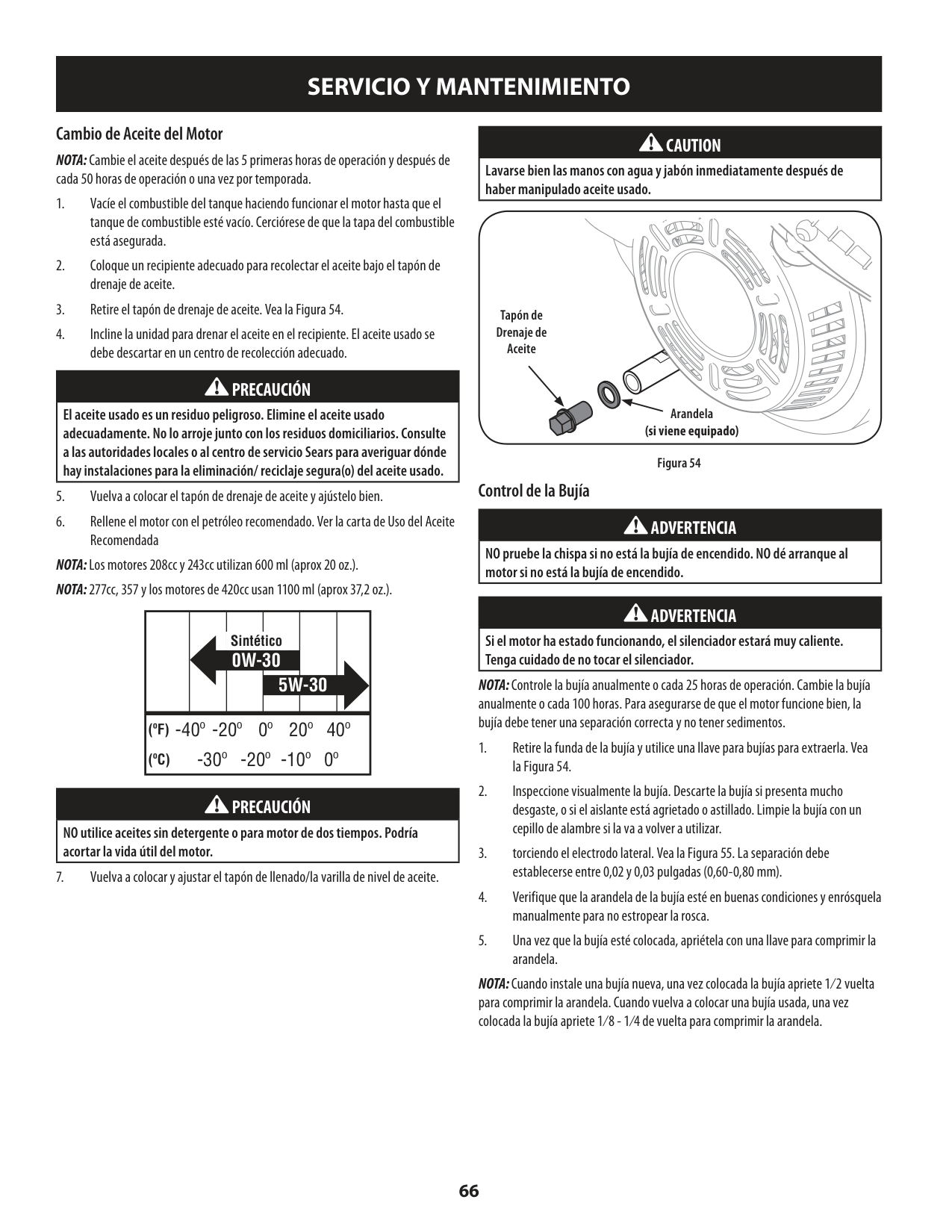
66
Servicio Y Mantenimiento
Cambio de Aceite del Motor NOTA: Cambie el aceite después de las 5 primeras horas de operación y después de cada 50 horas de operación o una vez por temporada.Precaución
El aceite usado es un residuo peligroso. Elimine el aceite usado adecuadamente. No lo arroje junto con los residuos domiciliarios. Consulte a las autoridades locales o al centro de servicio Sears para averiguar dónde hay instalaciones para la eliminación/ reciclaje segura(o) del aceite usado.5W-30
0W-30
-40º SintéticoPrecaución
NO utilice aceites sin detergente o para motor de dos tiempos. Podría acortar la vida útil del motor.Caution
Lavarse bien las manos con agua y jabón inmediatamente después de haber manipulado aceite usado. Arandela (si viene equipado) Tapón de Drenaje de Aceite Figura 54 Control de la BujíaAdvertencia
NO pruebe la chispa si no está la bujía de encendido. NO dé arranque al motor si no está la bujía de encendido.Advertencia
Si el motor ha estado funcionando, el silenciador estará muy caliente. Tenga cuidado de no tocar el silenciador. NOTA: Controle la bujía anualmente o cada 25 horas de operación. Cambie la bujía anualmente o cada 100 horas. Para asegurarse de que el motor funcione bien, la bujía debe tener una separación correcta y no tener sedimentos.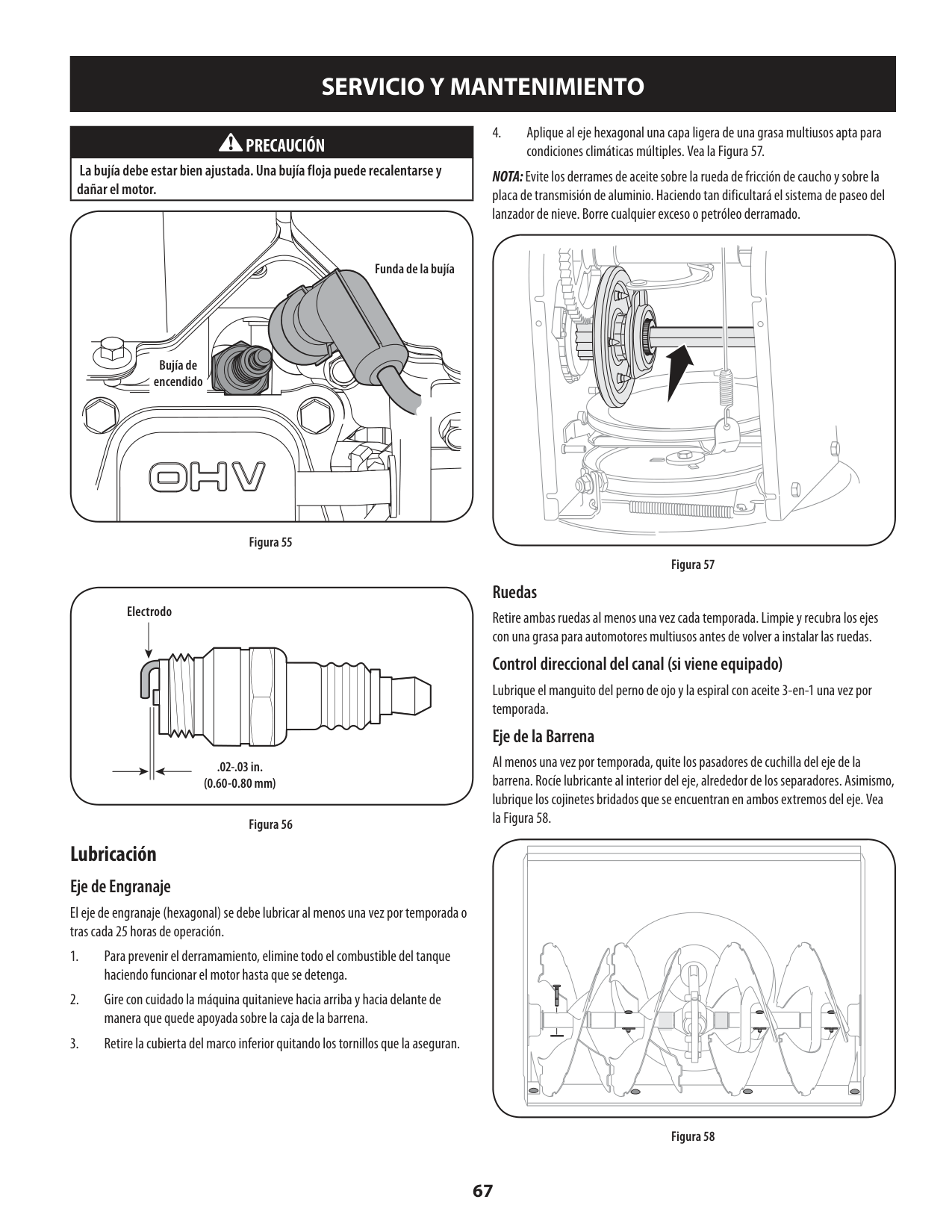
67
Servicio Y Mantenimiento
Precaución
La bujía debe estar bien ajustada. Una bujía floja puede recalentarse y dañar el motor. Bujía de encendido Funda de la bujía Figura 55 .02-.03 in. (0.60-0.80 mm) Electrodo Figura 56 Lubricación Eje de Engranaje El eje de engranaje (hexagonal) se debe lubricar al menos una vez por temporada o tras cada 25 horas de operación.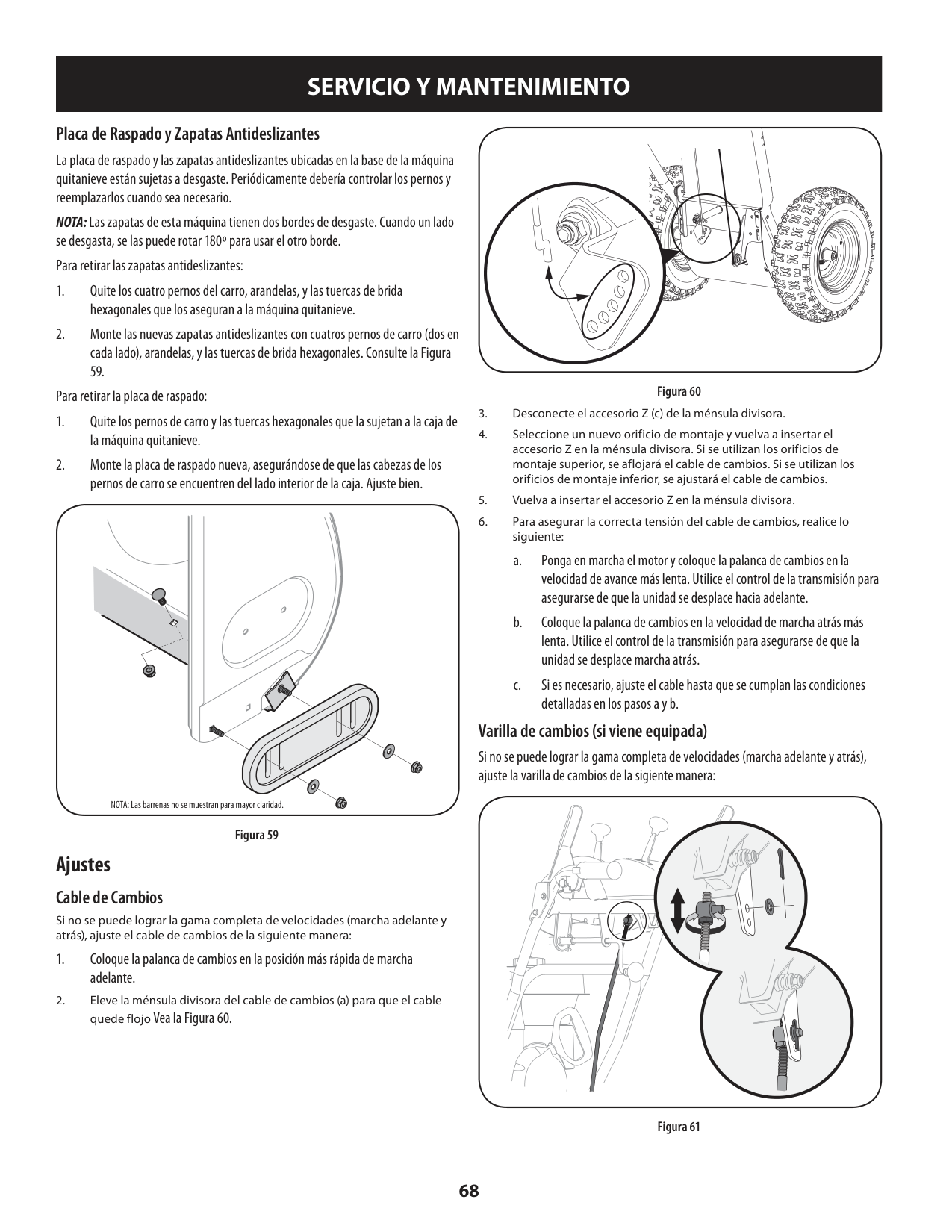
68
Servicio Y Mantenimiento
Placa de Raspado y Zapatas Antideslizantes La placa de raspado y las zapatas antideslizantes ubicadas en la base de la máquina quitanieve están sujetas a desgaste. Periódicamente debería controlar los pernos y reemplazarlos cuando sea necesario. NOTA: Las zapatas de esta máquina tienen dos bordes de desgaste. Cuando un lado se desgasta, se las puede rotar 180º para usar el otro borde. Para retirar las zapatas antideslizantes: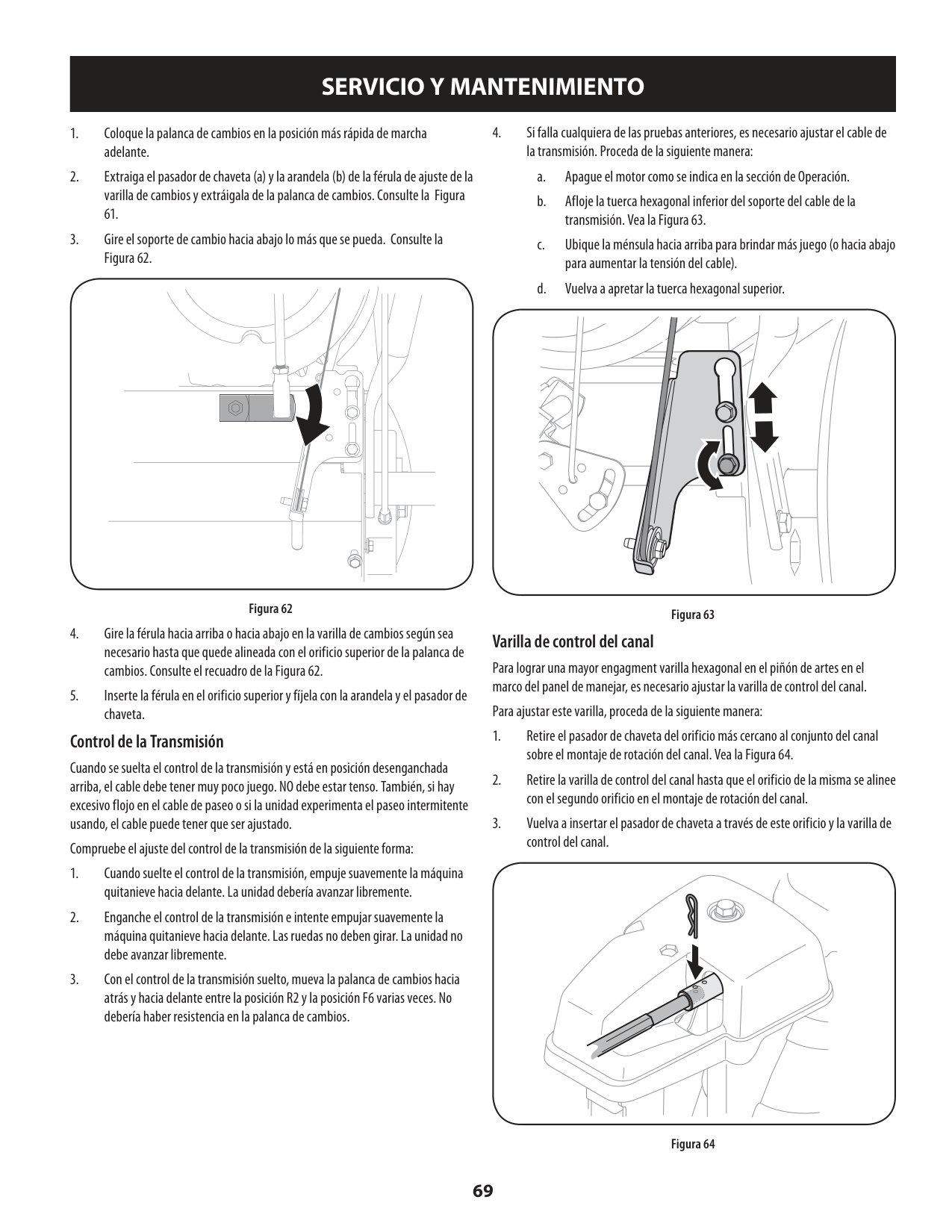
69
Servicio Y Mantenimiento
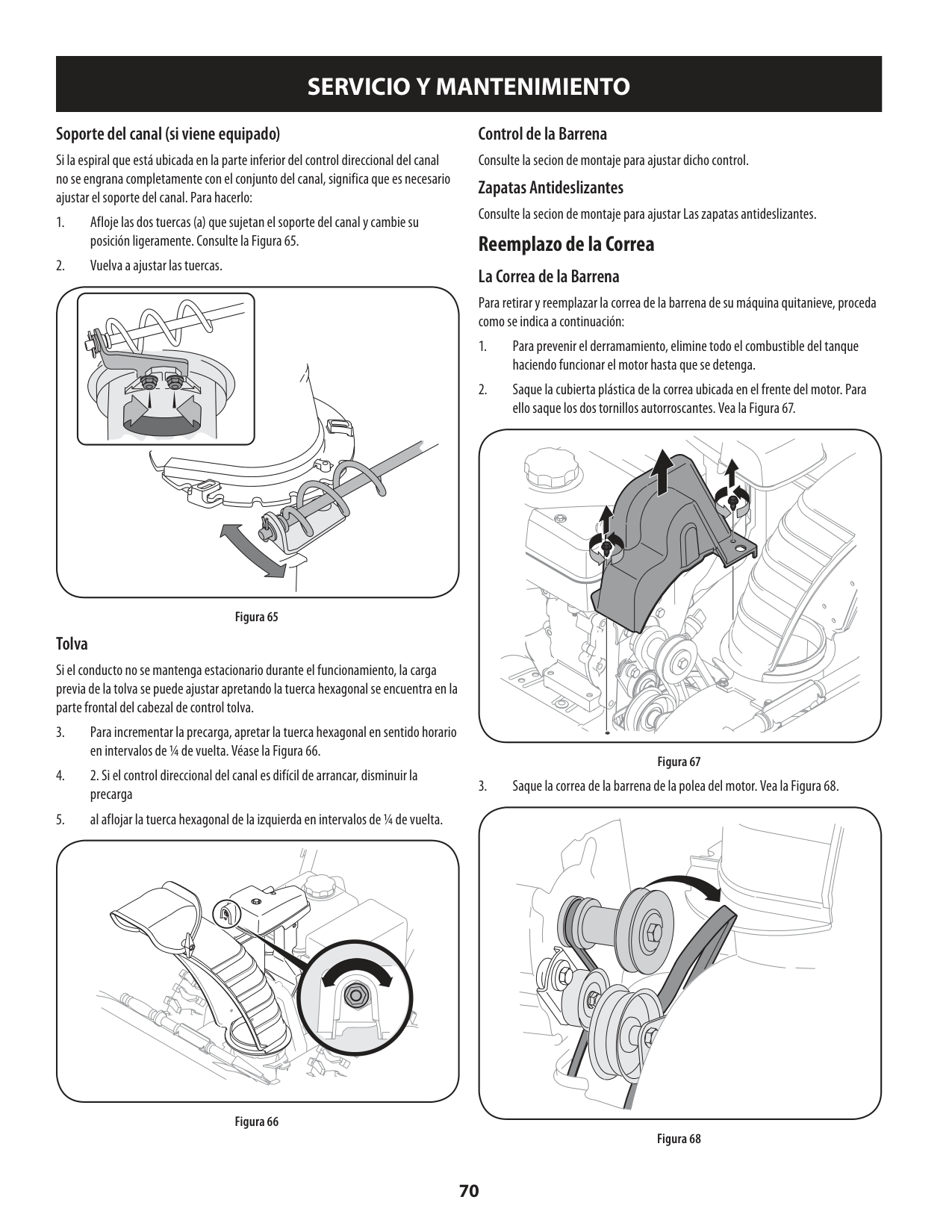
70
Servicio Y Mantenimiento
Soporte del canal (si viene equipado) Si la espiral que está ubicada en la parte inferior del control direccional del canal no se engrana completamente con el conjunto del canal, significa que es necesario ajustar el soporte del canal. Para hacerlo: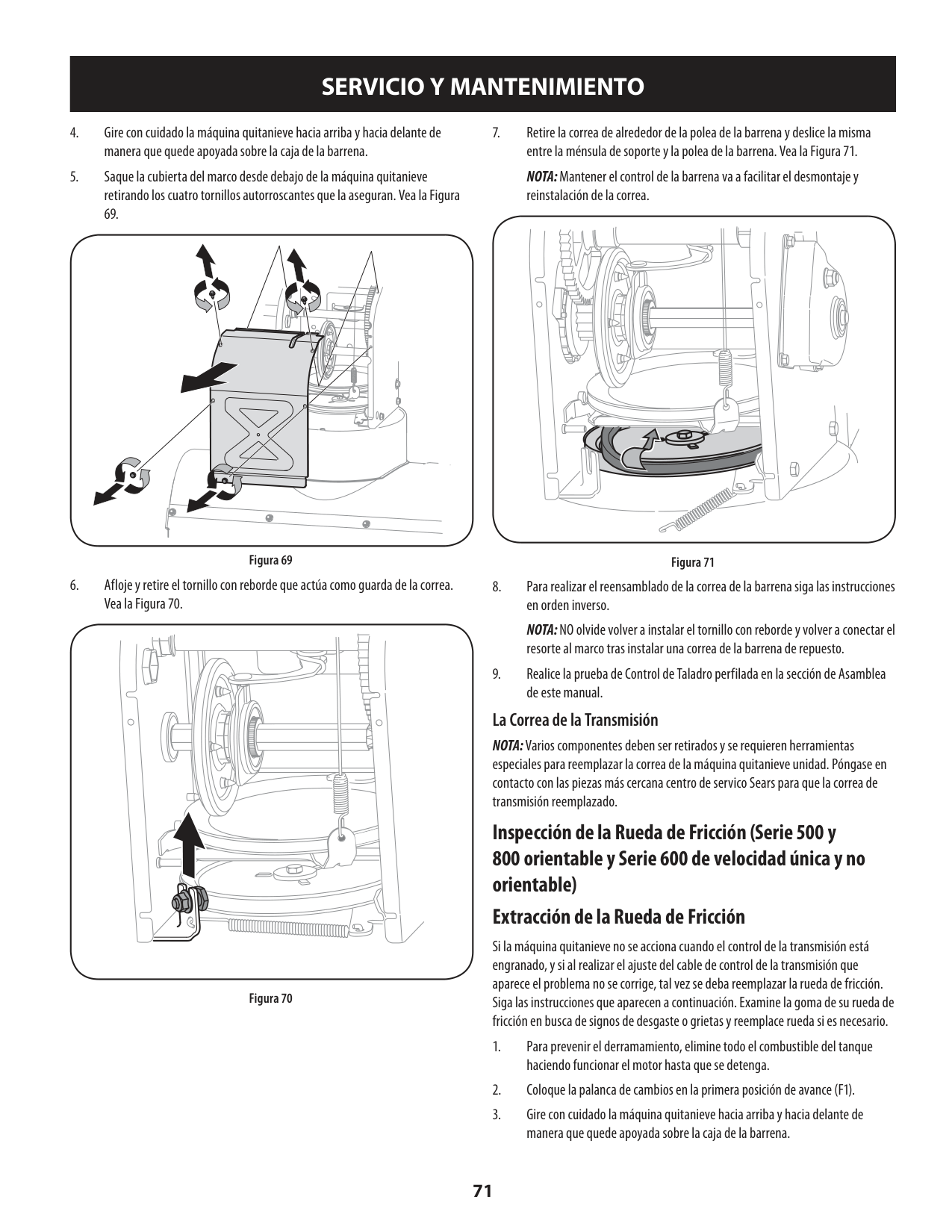
71
Servicio Y Mantenimiento
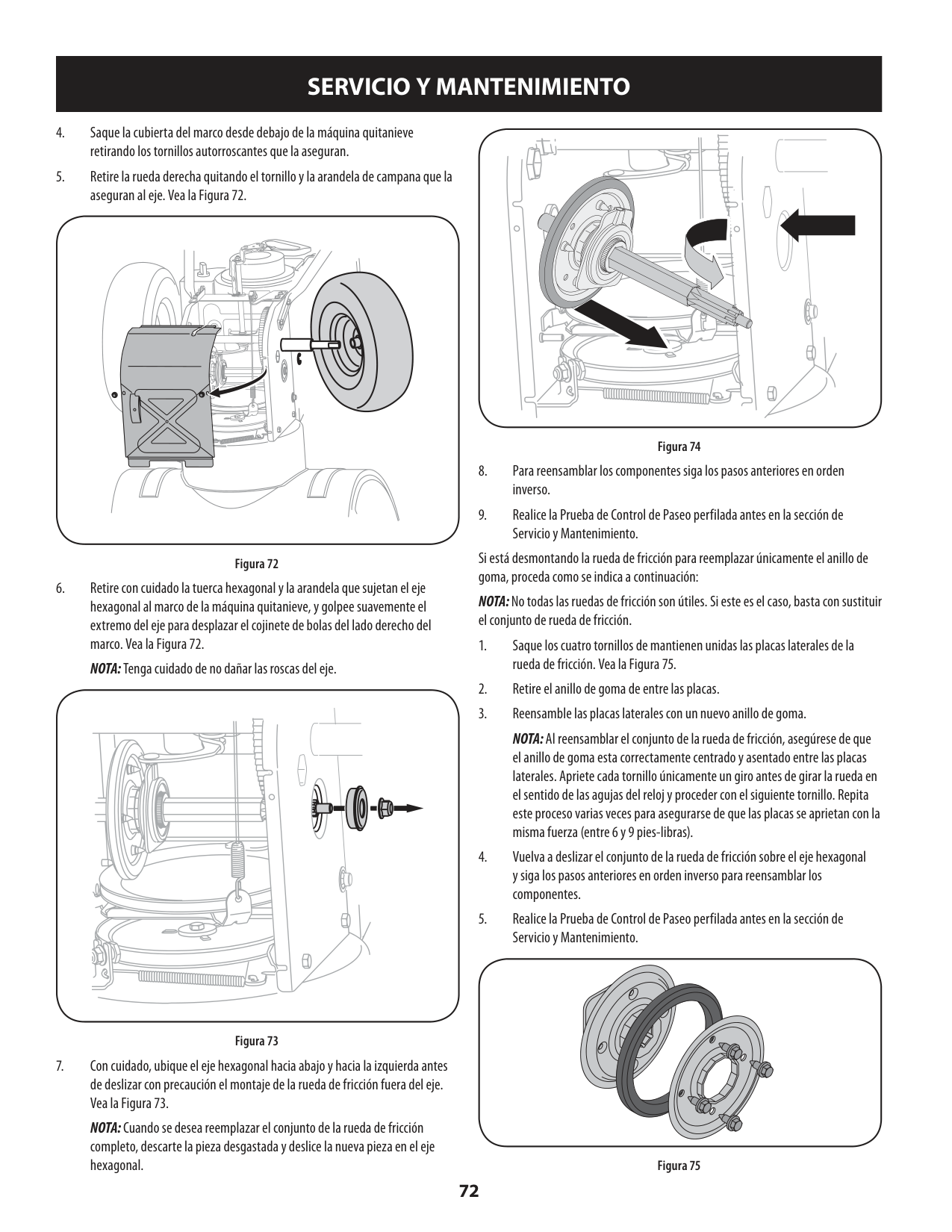
72
Servicio Y Mantenimiento
73
Almacenamiento Fuera De Temporada
Si no se va a utiliza el equipo durante 30 días o más, o si es el final de la temporada de nieve y ya no existe posibilidad de que nieve, es necesario almacenar el equipo de manera adecuada. Siga las instrucciones de almacenamiento que se indican a continuación para garantizar el rendimiento máximo de la máquina quitanieve para uso futuro . Preparación del Motor Los motores que se almacenan durante más de 30 días necesitan ser drenados de combustible para evitar que se deterioren y se forme goma en el sistema de combustible o en las piezas principales del carburador. Si la gasolina de su motor se deteriora durante el almacenamiento, es posible que deba reparar o reemplazar el carburador y otros componentes del sistema de combustible.Advertencia
Nunca almacene la máquina quitanieve con combustible en el tanque en un espacio cerrado o en áreas con poca ventilación, donde los gases del combustible puedan alcanzar el fuego, chispas o una luz piloto como la que tienen algunos hornos, calentadores de agua, secadores de ropa o algún otro dispositivo a gas. • Si es posible, evite sectores de almacenamiento con mucha humedad. • Mantenga el motor nivelado en el almacén. La inclinación del motor puede causar pérdidas de combustible o aceite. Preparación de la Máquina Quitanieve • Cuando almacene la máquina quitanieve en un galpón de depósito metálico o con poca ventilación, tenga especial cuidado de realizarle un tratamiento anti- oxidante al equipo. Use aceite ligero o silicón para recubrir el equipo, especialmente las cadenas, los resortes, los cojinetes y los cables. • Elimine todo el polvo del exterior del motor y del equipo. • Siga las recomendaciones de lubricación en la sección de mantenimiento de este manual. • Almacene el equipo en un área despejada y seca. • Inflar los neumáticos a la presión de los fabricantes de neumáticos recomendada. Consulte el flanco del neumático. • Lanzanieves tienda en posición de funcionamiento con las dos ruedas y placa de raspado en la superficie de la tierra llana.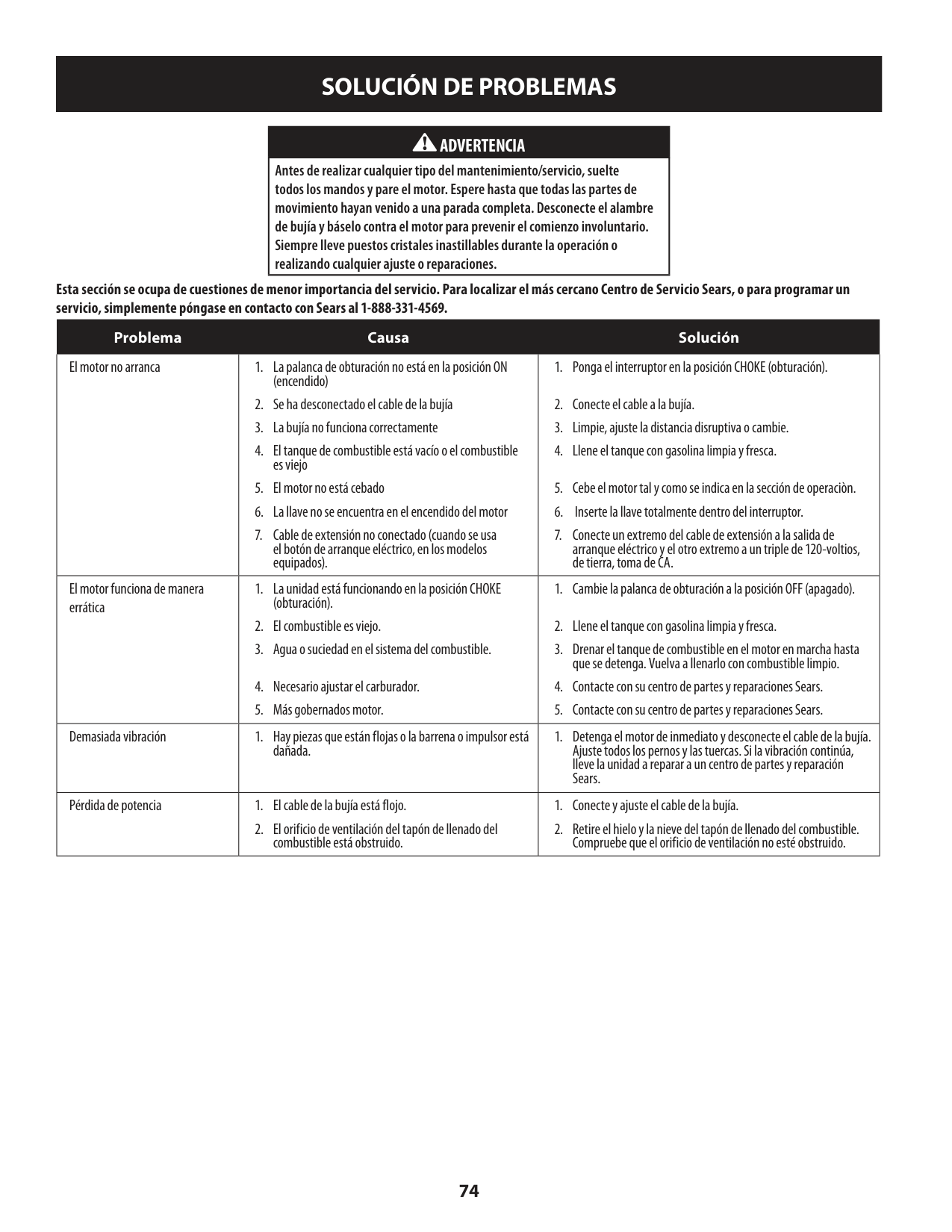
74
Solución De Problemas
Advertencia
Antes de realizar cualquier tipo del mantenimiento/servicio, suelte todos los mandos y pare el motor. Espere hasta que todas las partes de movimiento hayan venido a una parada completa. Desconecte el alambre de bujía y báselo contra el motor para prevenir el comienzo involuntario. Siempre lleve puestos cristales inastillables durante la operación o realizando cualquier ajuste o reparaciones. Esta sección se ocupa de cuestiones de menor importancia del servicio. Para localizar el más cercano Centro de Servicio Sears, o para programar un servicio, simplemente póngase en contacto con Sears al 1-888-331-4569. Problema Causa Solución El motor no arranca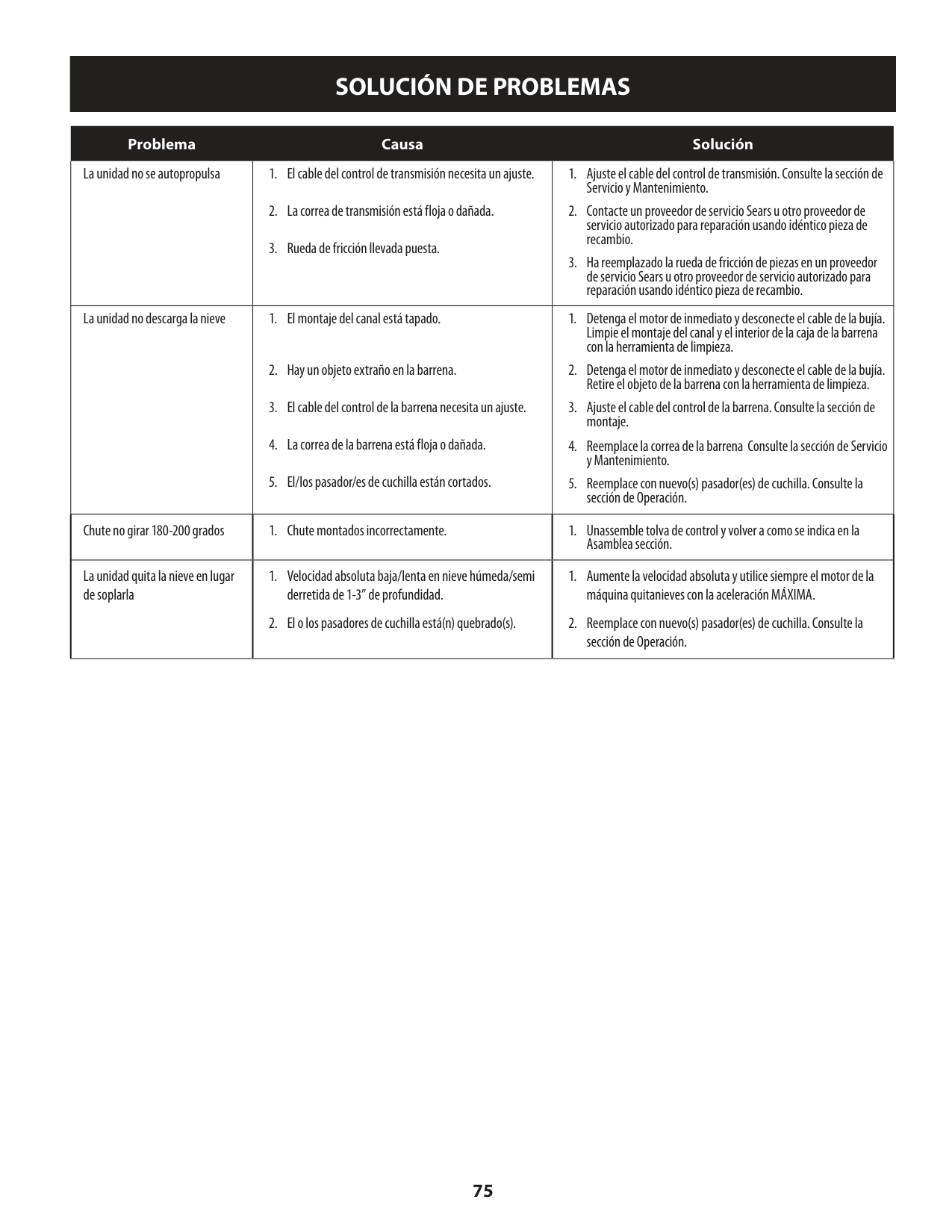
75
Solución De Problemas
Problema Causa Solución La unidad no se autopropulsa
Product Manufactured by (Producto fabricado por): MTD LLC, P.O. BOX 361131 CLEVELAND, OHIO 44136-0019